JAC S2. Elctrical Wiring diagrams - part 6
 

  Index      JAC     JAC S2. Elctrical Wiring diagrams


Search            copyright infringement  


Content      ..     4      5      6      7     ..


JAC S2. Elctrical Wiring diagrams - part 6


                                                                                  Air-conditioning Device 

Air-conditioning Device  


      72 


(II)Installation 


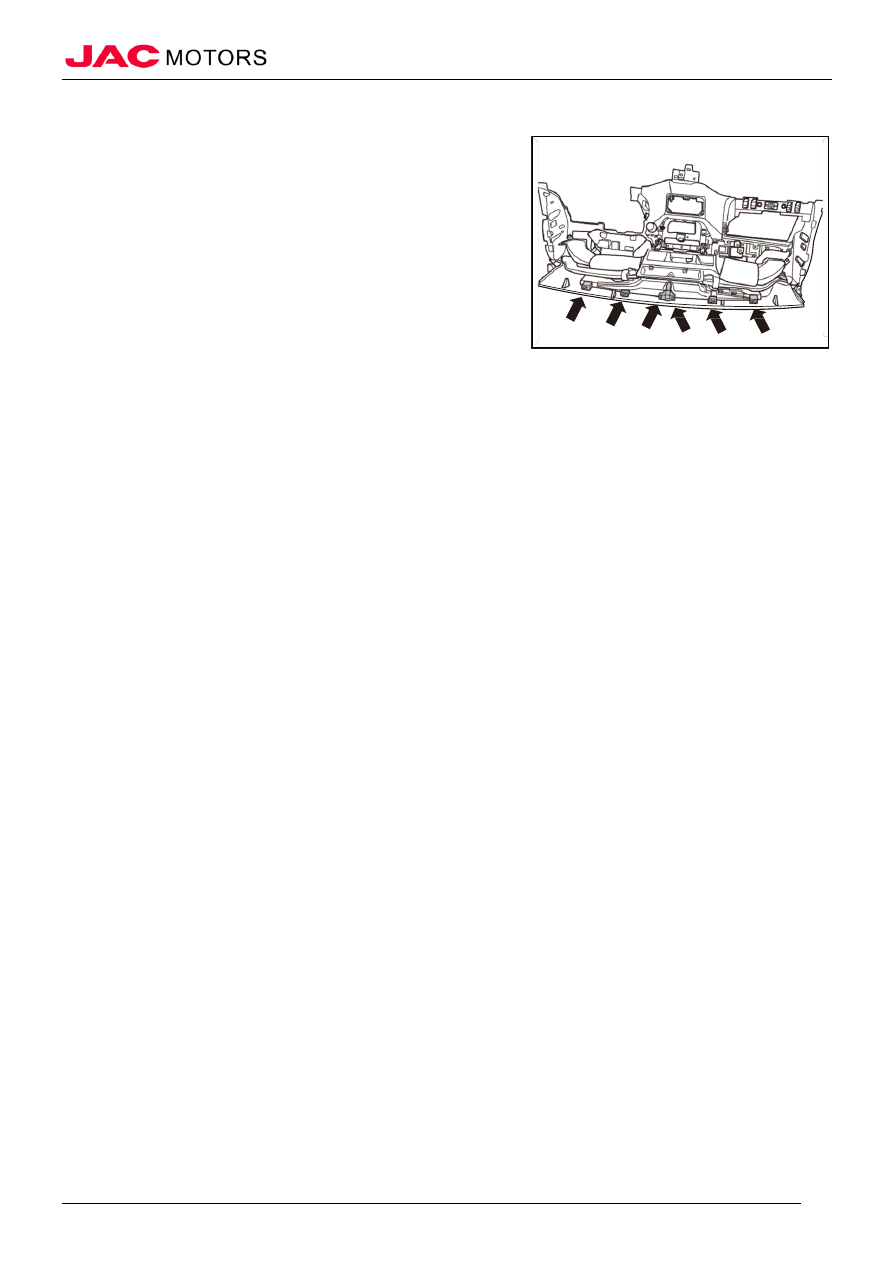
1. Install front defrost air pipe assembly   

1). Place front defrost air pipe assembly to installation position, 

and tighten 6 fixed bolts of front defrost air pipe assembly 

and dashboard; 


2. Install left/right defrost air pipe assembly 

3. Install dashboard assembly 

4. Install front passenger’s side air bag 

5. Install central cover assembly 

6. Install lower guard plate assembly of driver’s side 

7. Install combination meter 

8. Install central left trim plate assembly 

9. Install audio assembly 

10. Install audio panel assembly 

11. Install A/C controller assembly 

12. Install glove box assembly 

13. Install central right trim plate assembly 

14. Install end cover of dashboard 

15. Install upper trim plate assembly of A column 

16. Install lower trim plate assembly of A column 

17. Install threshold guard plate assembly of front door 

18. Install combination switch assembly 

19. Install jacketing of steering column 

20. Install steering wheel assembly 

21. Install driver’s side air bag assembly 

22. Install auxiliary dashboard assembly 

23. Install front storage box assembly 

24. Install saucer cover plate assembly 

25. Install front extension plate 

26. Connect negative electrode of battery 

27. Close engine hood cover 


-------------------------------------------------------------------------------------------------------------------------------------------------------------

                                                                                  Safety Auxiliary System 

Safety Auxiliary System   


        73 

Safety Auxiliary System 


I、Summary 


(I)Summary of Safety Auxiliary System 


Generally, auxiliary restriction system indicates whole safety airbag system, and there are “SRS” marks on trim cover of 
airbag or where there are airbags; 


1、Driver Airbag - DAB:Directly protect driver’s upper body when serious front collision happened, and it can stop 

driver from moving forward in some extent. Usually this kind of airbag is installed inside steering wheel, and trim cover of DAB 

is horn cover on steering wheel; 

2、Passenger Airbag - PAB:Directly protect passenger’s upper body when serious front collision happened, and it can 

stop driver from moving forward in some extent. Usually this kind of airbag is installed inside dashboard of front passenger’s 

side, and there are visible type and hidden type; 

3、Side Airbag - SAB:Mainly supply extra protection to front driver and passenger. Protect chest of front driver and 

passenger and hip of person in vehicle collision side. 

Caution      When  driving,  please  fasten  safety  belt  as  required.  Protection  effect  will  not  be  obvious  when  only  using 

airbag, and in some sense, using airbag without main restriction system (safety belt) will cause passenger more 
harm. Safety airbag is auxiliary device of safety belt, and can’t replace safety belt. 


Component Position 


1. Air bag assembly of driver                              3. Airbag assembly of front passenger 

2. Airbag controller 


-------------------------------------------------------------------------------------------------------------------------------------------------------------

                                                                                  Safety Auxiliary System 

Safety Auxiliary System   


        74 


(II)Principle of Airbag System 


Operation Condition of Airbag 


30°  

  30°


Front impact with enough strong impact force happened in the area of 30°range of vehicle centerline can make airbag work. 

Operating Principle of Airbag System 

When vehicle happened collision, collision between vehicle and obstruction is called first collision, which can cause vehicle 

speed decrease suddenly; collision between passenger and inner structure of vehicle is called second collision. Before passenger in 
vehicle and structure component of vehicle happened second collision, rapidly insert airbag full of air between passenger and inner 
structure component of vehicle, and absorb kinetic energy of passenger by airbag breathability and exhausting throttling effect, and 
this can slow down violent impact and separate passenger and inner structure component to protect passenger. 

Airbag, seat and safety belt constitute vehicle restriction system.


Operation Principle Diagram of Restriction System 


Operation principle diagram of restriction system 

Safety belt pre-tension system 

Airbag system 

Collision 
signal 

Control/Diag
nosis system 

Detonate 

Airbag 

Restriction 

Restriction 

Driver/Passen
ger 

Saf
et

y bel

Pre-tension 

Load limit 

-------------------------------------------------------------------------------------------------------------------------------------------------------------

                                                                                  Safety Auxiliary System 

Safety Auxiliary System   


        75 


(III)Airbag Control Module(ACU)Function 

1. Sense vehicle collision; 

2. Detonate airbag of driver’s side and passenger’s side; 

3. Detonate pre-tension type safety belt of driver’s side and passenger’s side; 

4. Monitor working condition of airbag system; 

5. Report state of airbag system by warning indicating light: ready or fault; 

6. Diagnose and maintain airbag system by serial diagnosis communication port; 

7. After collision happened, records related collision information data and working state of airbag all components; 

8. After collision happened, transmits collision signal to ETACS module, engine ECU module. ETACS module open locked door 

to be convenient to escape; engine ECU module cuts off fuel-way to prevent fire; 


(IV)Maintenance Note 

Note 

During maintaining, it may cause airbag system be denoted accidently and lead to serious accident if don’t 

operate according to right procedure. Fault during maintenance may cause airbag can’t be denoted normally 
when needed and cause serious accident. 

△Note 

Before maintaining (including removal/installation/detection or replacement of components etc.), must read 

the following instructions carefully, and operate according to right procedure in service instruction. 

1. Don’t separate driver’s side airbag assembly and passenger’s side airbag assembly etc. airbag components; 

2. Don’t maintain any component as shown below, only replace these components; 

1)Driver’s side airbag; 

2)Passenger’s side airbag; 

3)Airbag control module; 

3. Don’t expose airbag to high temperature or nearby fire; 

4. Immediately clean with dry cloth if there are butter, detergent, oil or water; 

5. Don’t drop airbag. Don’t use dropped airbag; 

6. Only can obtain original packaging component from authorized dealers; 

7. Place airbag right side upward to steady position after removing. Don’t place any goods on it; 

8. Confirm whether number of replaced component is right. Don’t use other vehicle component to be substitute; 

9. Even in the condition of slight collision accident but airbag not denoted, must check backing strap surface and airbag sensor. If 

there is hollow, crack or deformation, please replace new airbag assembly; 

10. Must first deal with airbag before throwing vehicle or airbag; 

11. Inflating device will become very hot after airbag denoted, and should deal after it cooling down naturally. Don’t use water to 
cool down; 

12. Don’t measure resistance of airbag module circuit, which may cause airbag denoted; 


-------------------------------------------------------------------------------------------------------------------------------------------------------------

                                                                                  Safety Auxiliary System 

Safety Auxiliary System   


        76 

(V)Special Tool List 


No.


Tool No.


Tool Name


Tool Diagram 

Use


1


Denoted tool


Denote airbag


2


Diagnosis inspector


Wiring harness 

inspector for module


3


Simulator


Simulator connector to 

check resistance of 

wiring harness 


II、Troubleshooting 

(I)Troubleshooting of Airbag System 

When turning ignition switch to “ON”, airbag indicating light on dashboard flicker several seconds and then turns off, which 

indicates airbag system is in normal state. When turning ignition switch to “ON”, airbag indicating light is not on or always on, 
which indicates there is fault in airbag system. Use special fault diagnosis to diagnose for further analysis. 

1)Use diagnosis device to read fault code; 

2)Maintain according to fault code; 

3)Clear fault code by diagnosis device; 

△ Note 

Must use diagnosis device to clear fault code stored in system after fault is removed. 

△ Note 

Don’t use other electrical test device to test any circuit of SRS system except explanatory operation in this 

instruction. Don’t try to maintain, connect or change SRS wiring harness, if wiring harness damaged, please 
replace new wiring harness. Keep grounding point clean. 

(II)Maintenance of Safety Airbag System 

1. If safety airbag not denoted when vehicle happens accident in low speed/side impact/rollover, should inspect the following 

items: 

(1). Check whether there is dent, crack or deformation in ACU housing and installation bracket; 

(2). Check whether connection is damaged or terminal is deformed; 

(3). Check whether installation bolt, grounding wire is damaged; 

2. Maintenance inspection of safety airbag system 


1. Safety Airbag Module 

(1). Check whether there is dent, crack or deformation in backing strap cover; 

-------------------------------------------------------------------------------------------------------------------------------------------------------------

                                                                                  Safety Auxiliary System 

Safety Auxiliary System   


        77 

(2). Check whether connection is damaged, terminal is deformed or wire gets stuck; 

(3). Check whether there is dent, crack or deformation in safety airbag gas generator housing; 

(4). Install safety airbag assembly to steering wheel, and check coordination with steering wheel or alignment state; 

2. Warning/Note Label 

(1). On steering wheel skeleton; 

(2). On safety airbag assembly of driver’s side; 

(3). On safety airbag assembly of passenger’s side; 

(4). On safety airbag control module (ACU); 

(5). Obey instructions on label when maintain SRS. If label dirty or damaged, please replace them; 

3. Airbag Control Module (ACU) 

△ Warning 

When ACU failure, must replace, don’t maintain it. 

3. Disposal treatment method of safety airbag system component 

Before abandoning safety airbag or vehicle with safety airbag, it needs to denote airbag, personal can’t denote airbag 
privately, please give to professional person to denote. 


III、Safety Airbag Assembly of Driver’s side  (DAB) 

(I)Removal 

1. Open engine hood cover 

2. Disconnect negative electrode of battery    Refer to “Disconnection and connection of battery electrode” 

3. Remove safety airbag assembly of driver’s side  (DAB) 

1). Use screwdriver to insert into removal hole  ①  in 3H, 

screwdriver push clamp spring on skeleton forward along 
guide groove on skeleton, and separate DAB clamp detent 
from steering wheel skeleton. 

2). Use screwdriver to insert into removal hole  ②  in 9H, 

screwdriver push clamp spring on skeleton forward along 
guide groove on skeleton, and separate DAB clamp detent 
from steering wheel skeleton. 

3). Rotate steering wheel 90° anticlockwise, and use 

screwdriver to insert into removal hole  ③  in 6H, 

screwdriver push clamp spring on skeleton forward along 
guide groove on skeleton, and separate DAB clamp detent 
from steering wheel skeleton. 

4). After three clamp detents separating from steering wheel 

skeleton, pull DAB out from steering wheel along axial 
direction of steering column. 

△Note 

Screwdriver push clamp spring forward along guide groove, clamp spring get deformed, and DAB clamp detent 

separate from clamp spring. 

△Note 

When removing steering wheel with bright trim, 

please make sure time of pulling out DAB in 6H 
position to be not less than in 3H and 9H position. 
Or else 6H position of DAB may drag steering 
wheel bright trim, and lead to bright trim damaged 
or crack. 

△ Note 

Disconnecting battery negative electrode for at 

least 1 minute before removing DAB. 

5). Disconnect wiring harness connector of driver’s side airbag 

and wiring harness connector of horn, and take down 
driver’s side airbag assembly; 

△ Note 

Please place airbag assembly to right place. 


-------------------------------------------------------------------------------------------------------------------------------------------------------------

                                                                                  Safety Auxiliary System 

Safety Auxiliary System   


        78 


(II)Installation 


1. Install driver’s side airbag assembly 

1). Connect wiring harness connector of driver’s side airbag 

and wiring harness connector of horn; 

2). Install driver’s side airbag to steering wheel, and ensure 3 

clamp detent to be in right place; 


2. Connect negative electrode of battery 

3. Close engine hood cover 


-------------------------------------------------------------------------------------------------------------------------------------------------------------

                                                                                  Safety Auxiliary System 

Safety Auxiliary System   


        79 


IV、Front Passenger’s Side Airbag Assembly 

(I)Removal 

1. Open engine hood cover 

2. Disconnect negative electrode of battery 

3. Remove glove box assembly    Refer to “Glove box assembly” 

4. Remove front passenger’s side airbag assembly 

1). Remove 2 fixed bolts of front passenger’s side airbag 

assembly and dashboard beam; 

△ Note 

Disconnect battery negative electrode at least 

1minute before removing front passenger’s 
side airbag assembly. 


2). Pry cover plate of front passenger’s side airbag; 

3). Disconnect wiring harness connector of front passenger’s 

side airbag assembly, and take front passenger’s side 
airbag assembly out from airbag frame of dashboard; 

△ Note 

Place cover plate upward to front passenger’s 

side airbag assembly. 


(II)Installation 

1. Install front passenger’s side airbag assembly 

1). Connect wiring harness connector of front passenger’s side 

airbag assembly, and install front passenger’s side airbag 
to dashboard; 


-------------------------------------------------------------------------------------------------------------------------------------------------------------

                                                                                  Safety Auxiliary System 

Safety Auxiliary System   


        80 

2). Install 2 fixed bolts of front passenger’s side airbag assembly and dashboard beam; 


2. Install glove box 

3. Connect battery negative electrode 

4. Close engine hood cover 


-------------------------------------------------------------------------------------------------------------------------------------------------------------

                                                                                  Safety Auxiliary System 

Safety Auxiliary System   


        81 

V、Airbag Controller 

(I)Removal 

1. Open engine hood cover 

2. Disconnect battery negative electrode    Refer to “Disconnection and connection of battery electrode” 

3. Remove front extension plate assembly    Refer to “Front extension plate assembly” 

4. Remove saucer cover plate assembly    Refer to “Auxiliary dashboard assembly” 

5. Remove front storage box assembly    Refer to “Auxiliary dashboard assembly” 

6. Remove auxiliary dashboard assembly    Refer to “Auxiliary dashboard assembly” 

7. Remove airbag controller 

1). Disconnect wiring harness connector  ①  of airbag controller; 

2). Remove 3 fixed nuts  ②  of airbag controller; 

3). Take out airbag controller; 


(II)Installation 

1. Install airbag controller 

1). Place airbag controller to installation position, and tighten 3 fixed 

nuts  ②  of airbag controller; 

2). Connect wiring harness connector  ①  of airbag controller; 


2. Install dashboard assembly 

3. Install front storage box assembly 

4. Install saucer cover plate assembly 

5. Install front extension plate 

6. Connect negative electrode of battery 

7. Close engine hood cover 

-------------------------------------------------------------------------------------------------------------------------------------------------------------

                                                                                                      BCM Device 

BCM Device 


                      82 

BCM Device


I、Summary 

(I)Structure Outline 

To reduce failure rate of vehicle and carry out more effective hommization control, use body control device to centrally 

control all kinds of electrical units. Vehicle body control device includes one radio frequency receiver. Main functions of vehicle 
body control device: 

- Front/Rear wiper control 

- Key hole illumination control 

- Indoor light control 

- Day driving light control 

- Position light control 

- Front/Rear fog light control 

- High beam light control 

- Low beam light control 

- Automatic light control 

- Brake light control 

- Turning light and hazard warning light 

- Economize on electricity 

- Remote control or mechanical key lock 

- Remote control or mechanical key unlock 

- Automatically lock function 

- Reset function 

- Remote control tail door unlock 

- Central control lock/unlock function 

- Pulling out key unlock function 

- Collision force unlock function 

- Anti-mistake-lock function 

- Rear defrost control 

- Electrical power window control 

- Anti-clamping motor control 

- Instruction brake signal retransmission 

- Reversing signal retransmission 

- Engine hood cover signal retransmission 

- Vehicle body anti-theft system 


-------------------------------------------------------------------------------------------------------------------------------------------------------------

                                                                                                      BCM Device 

BCM Device 


                      83 

Component Position 


1. BCM controller assembly 


(II)Function Requirement 

Wiper System 

1. Front Wiper Control 

BCM controls wiper motor and water spraying pump by monitoring state of wiper switch and combination switch, and 

realizes all working mode of wiper system: front wiper low speed working, front wiper high speed working, front wiper 
intermittence working, front wiper closed, front windshield spraying water etc.. 

1) When ignition switch to “ON”, front wiper controlling switch connects to high speed/low speed/intermittence position, 

namely corresponding switch on, thus front wiper performs corresponding action. 

2) When wiper switch is in intermittence position, Intermittence regulating time has 5 gears. Intermittence regulating time 

shown as below: 

When vehicle speed is higher than 60km/h (can equipped with 60km/h or 100km/h, default 60km/h), if use intermittence 

mode, reduce 4s on the set time. 

Vehicle speed treatment: received signal on network is 15 bits, valid value range is 0x0-0x14D5, ratio coefficient is 

0.05625. 

3) Wiper high/low speed control: when switch connects to low speed position, low speed relay actuated, motor works in 

low speed. If switch connects to high speed, high speed relay actuated, motor works in high speed.   

4) When inching switch works, low speed always works. 

5) Front spraying water is less than 400ms, wiper not works; when more than 400ms, wiper always work with spraying 

water, and then wiping three times after water spraying stopping. 

6) Front wiper resetting control: After switch is off, when motor is not running to initial position, BCM not receives 

resetting position signal, high speed relay cut off, low speed relay not cut off, and motor continues to work; when motor runs to 
initial position, resetting switch is actuated, BCM receives resetting position signal, low speed relay cuts off, and motor stops 
running. 


-------------------------------------------------------------------------------------------------------------------------------------------------------------

                                                                                                      BCM Device 

BCM Device 


                      84 

7) When in intermittence position, water spraying is prior. 

8) Wiper high speed running period is 1s, and low speed running period is 4/3s. 

Emergency strategy    When running, if detecting front wiper resetting switch not change for 18s, it can judge that motor 

gets stuck, and close output. At the same time only when ignition switch one circulation of ON-OFF-
ON or wiper switch connect to other switch position from OFF, it can restart wiper. 

2. Rear Wiper Control 

BCM controls wiper motor and water spraying pump by monitoring state of wiper switch and combination switch, and 

realizes all working mode of wiper system: rear wiper and rear wiper spraying water etc.. 

Rear wiper can be configured to be there is or not by diagnosis, default is open rear wiper. 

1)There are only “ON” and “OFF” in rear wiper, and it always wipes in low speed when in “ON”; 

2)Rear wiper doesn’t work after rear water spraying switch is on for less than 600ms, rear wiper works a wiper period at 

least after the switch is on for 600ms; 

3)When spraying water time is more 3s than a wiper period, it wipes a period.


Light Control 

1. Keyhole Illumination Light Control 

Keyhole illumination is mainly to be convenient to insert key for customer. When key not inserting ignition switch, driver’s 

side door is open, keyhole illumination light is on; when turning ignition switch to “ON”, keyhole illumination light will be off, 
and after door is closed, keyhole illumination light is on for 10s and then off. 

2. Position Light Control 

Indoor top light is to illuminate when driver and passengers getting into vehicle or inside the vehicle. 

1) When door light is in automatic position and satisfies one of the following conditions, interior light will be immediately on: 

1、Undefended success; 

2、Any door is open; 

2) When satisfying one of the following conditions, interior light will be off gradually: 

1、After undefended successfully, interior light will be on for 30s and then off gradually; 

2、When open vehicle door from closed state, interior will be on for 30s, and then off gradually; 

3) When satisfying the following conditions, interior light will be off immediately: 

1、When open vehicle door from closed state, interior is on continuously, if door is open for more than 15min, interior 

will be off immediately; 

2、When defended successfully, interior top light will be off immediately, immediately off after defended successfully 

is prior to interior light working 30s and then off gradually after undefended successfully; 

3、When four doors are closed, ignition switch is in “ON”, interior light will be off immediately; 

4) Collision signal detonates interior light on: 

1、  When collision signal is effective, interior will be on immediately; 

2、After collision signal detonating interior light on, if ignition switch is turned from “OFF” to “ON”, interior light will 

be off immediately. Interior light gradually off time is 5.5±0.5s. 

3. Day Driving Light Control 

Day driving light is to warning when driving in daylight. Day driving light can be configured to be there is or not by 

diagnosis, default is open day driving light. Used to enable control of day driving light: 

1)When turning ignition switch to “ON”, put down manual brake, position light has no output, then day driving light 

will be on; 


-------------------------------------------------------------------------------------------------------------------------------------------------------------

                                                                                                      BCM Device 

BCM Device 


                      85 

2)When ignition switch is not in “ON”/ “ST” or manual brake is not pulled up or position light has output, day driving 

light will be off; 

4. Position Light Control 

Position light is to shown width and indicating. Position light has high and low configuration. 

Low Configuration: 

When ignition switch is in any position, position light switch input is effective or automatic light requesting position light 
on, position light, license plate light and backlight output is on; when position light switch input is ineffective and automatic 
light requesting position light off, position light, license light and backlight output is off. 

When position light switch input is still effective, if left front door is open, pull out key, small light will be off immediately; 
if left front door is closed, pull out key, small light will not be off; left front door open, small light will be off, and it will be 
on when key inserted. 

High configuration (with PEPS) : 

When ignition switch is not in OFF, position light switch input is effective or automatic light requesting position light on, 
position light, license plate light and backlight output is on; when position light switch input is ineffective and automatic 
light requesting position light off or ignition switch is in OFF, position light, license plate light and backlight output is 
closed. 

5. Rear Fog Light Control   

Rear fog light is mainly to warning in foggy weather. Rear fog light will be on when satisfying the following conditions: 

Open Condition: 

Ignition switch is in “ON”, at least one of front fog light, low beam light or high beam light is on, and rear fog light 

(transient state) is effective. 

Closed condition: 

1)When position light is off or rear fog light switch is off, rear fog light is off; 

2)Ignition switch is turned to other position except “ON”; 

4. Emergency Strategy   

States of rear fog light are the same before and after starting. 

6. Front Fog Light Control 

Front fog light is mainly to warning in foggy weather. Front fog light can be configured to be there is or not by diagnosis, 

default is open front fog light. 

1)  When ignition switch is in “ON” and position light is on, press front fog light switch to open front fog light. Front 

fog light switch is normal state switch; 

2)  When position light is off or front fog light switch is closed or ignition switch is turned to other position except 
“ON”, front fog light will be off. 

7. High Beam Light Control 

High beam light is mainly to illuminate distance in night. 

To BCM, overtaking light and high beam light uses one input, in which overtaking light can mechanism automatically 

return. High beam light function description are shown as below: 

1) When ignition switch is in ‘ON”, and low beam light switch is on or [automatic light switch is on and BCM judging it 

is night through value of sunshine sensor] (even low beam light is not on), BCM output high beam light enable low 
effective signal, the signal connect back to high beam light switch through wiring harness; 

2) When ignition switch is in “ON”, and high beam light enable signal is effective, open high beam light switch, high 

beam light is on; 

3) When high beam light switch is closed, or ignition switch is not in “ON”, or high beam light enable signal is 
ineffective, high beam light is off; 

4) Anytime, when high beam light is on, low beam light is on at the same time. Whether high/low beam light is on at the 

same time can be decided by configuration, default is high/low beam light on at the same time. 

8. Low Beam Light Control 

Low beam light is mainly to illuminate vicinity in night. Front headlight mechanism structure is: when turning to low beam 

light, position light switch is on.   


-------------------------------------------------------------------------------------------------------------------------------------------------------------

                                                                                                      BCM Device 

BCM Device 


                      86 

Low beam light function is described as below: 

1) When ignition switch is in “ON”, and BCM detecting low beam light switch input is effective, low beam light is on. 

2) When ignition switch is in “ON”, and BCM detecting low beam light switch input is effective and automatic light 
requesting headlight on, low beam light is on. 

3) When ignition switch is in “OFF”, overtaking light switch turned from “ON” to “OFF” denotes the function of 

“taking me home”, one ignition circulation denotes one “taking me home” function, enable the function of “taking 
me home” again when ignition state turned to “OFF” next time, low beam light is continuously on for 30s. 

4) When ignition switch is in “ON”, and low beam light switch is on or [automatic light switch is on and BCM judges 

it is night by value of sunshine sensor] (even low beam light is not on), BCM output high beam light to enable 
effective signal, the signal connects to high beam light switch by wiring harness. 

When in the condition 1 above, low beam light is closed when detecting corresponding low beam light switch is closed. 

When in the condition 2 above, low beam light is closed when automatic light switch is closed or request signal is valid. 

When in the condition 3 above, low beam light is closed when time is up or ignition switch is turned to “OFF”. 

Note: Automatic light request signal is valid indicates light “AUTO” is valid, sunshine signal gets up to light threshold value 
requirement. For automatic light strategy please refer to “automatic light”. 

9. Automatic Light Control   

Function of automatic light is to lit position light and low beam light when light outside is dark and light control switch is in 

automatic position. Automatic light function gets to know outside condition by sunshine sensor. 

Two EEPROM can be equipped with threshold 

AutolampDay_Cfg: range is 0-5V, initial value is 1.8V (specific corresponding initial threshold is supplied by sensor), 
AutolampNight_Cfg: range is 0-5V, initial value is 1.2V (specific corresponding initial threshold is supplied by sensor). 

1. When BCM power on to initialization, default the night; 

2. When input voltage of automatic light sensor is higher than AutolampDay_Cfg, judge it is daytime; 

3. When input voltage of automatic light sensor is lower than AutolampDay_Cfg, judge it is nighttime; 

10. Brake Light Control 

Brake light is mainly to lit the light when braking. When ignition state is in any position, braking switch is valid or braking 

request on network is valid, thus open brake light and high position brake light, brake light and high position brake light are 
controlled partly. 

When in normal mode, brake light and high position brake light can both open through MCU control or brake switch 

control. 

When in limphome mode, brake light and high position brake light should can be controlled by brake switch. 

11. Turning light and Hazard Warning Light 

Turning light mainly consists of left front turning light, left side turning light, left rear turning light, left turning indicating 

light, right front turning light, right side turning light, right rear turning light, right turning indicating light. When working, 
turning light twinkles with the frequency of 90±10 times per minute. Time of on and off are the same. Left front turning light, left 
side turning light and left rear turning light merge one way output, right front turning light, right side turning light and right rear 
turning light merge one way output, and left turning indicating light and right turning indicating light transmit to meter by CAN. 

1)  When ignition switch is in “ON”, turning switch is connected or disconnected, thus corresponding turning light twinkle 

or closed, and at the same time denotes or connect to tell-tail light on dashboard and flashlight relay twinkle and tweet in the 
same frequency; 

2)  When turning light switch is turned to left or right, BCM drive corresponding turning light to activate to twinkle 3 

times at least; 

3)  When turning light is closed after activating, turning light will be closed after completing its incipient minimum three 

times twinkle periods. 

4)  When turn turning light switch from left to right after left turning light is activated, left side turning light will be off, 

and right side turning light will be on. 

5)  When turn turning light switch from right to left after right turning light is activated, right side turning light will be off, 

and left side turning light will be on. 

6)  Hazard warning light includes two side turning light, key in any position all can drive these turning lights to warning, 

corresponding switch is self-lock switch. 


-------------------------------------------------------------------------------------------------------------------------------------------------------------

                                                                                                      BCM Device 

BCM Device 


                      87 

7)  When ignition switch is in “ON”, warning light is prior to turning light, specified instruction are shown as below: if 

turning light is on, open warning light switch, then warning light is on instead of turning light, and system gets back to 
turning light on state until warning light switch is off; if warning light is on, turn turning light switch to left or right, then 
turning light is on instead of warning light, and system gets back to warning light on state until turning light output is closed 
or ignition switch is turned from “ON” to “OFF”. 

8)  If receive collision signal, all lights work at least 5s in warning light state, and pressing warning light switch again after 

5s will close warning light, which is to prevent warning light switch being pressed due to collision; when detecting ignition 
switch is turned from “ON”-“OFF”-“ON”, collision is removed, warning light recover to normal work. 

9)  When turning light reports fault due to short circuit to grounding or overload, short circuit state will be recorded to 

memory through relevant DTC, and disconnect the side turning light high side drive core immediately, turning indicating 
light on combination meter will be off; if turning light is on again and don’t carry out corresponding operation during this 
time ignition circulation, must restart ignition switch once (ignition switch ON-OFF-ON), thus output can recover to normal. 

10)  When working in turning light working mode, some side turning light reports fault due to open circuit or short circuit 

to power supply, open circuit state will be recorded in memory through relevant DTC, and the side turning light will twinkle 
with double frequency, turning indicating light on combination meter will twinkle with double frequency. Must    restart 
ignition switch once (ignition switch ON-OFF-ON), thus output can recover to normal; or open circuit fault is removed 
during this time ignition circulation, which can recover to twinkle with normal frequency. 

Note: Parts marked red indicate that it can close warning light signal after collision signal happened 5s. 

12. Power Saving Control 

It is mainly to save battery power. 

1)If detecting any signal change when BCM is in “OFF”, connect power saving relay immediately, and recover supplying 

power: 

· Any door state signal of four doors 

· Remote control unlock signal 

· Central control unlock signal 

· Ignition state signal 

· Mechanism key unlock signal 

2)After connecting power saving relay, all signals above don’t change, thus close power saving relay after 15 min. 

3)After connecting power saving relay, detecting any signal above changing again, thus start 15 min timing again. 

4)When ignition switch is in “ON”, “ACC”, “START”, power saving relay is always actuated. 

5)After BCM getting into dormancy, close power saving relay. 


Lock System 

Lock system control door lock by interior relay of BCM. 

Vehicle lock function description: 

Defended state: all vehicle doors close, use remote control to lock or BCM state after driver’s side key lock successfully; 

Undefended state: use remote control to unlock or driver’s side key unlock or state after tail door remote control unlock; 

Remote control launcher function: Don’t respond to remote control order in condition of key inserting signal is valid. 

Door Lock Function 

Door lock is controlled by BCM interior relay, BCM control door lock motor after receiving valid unlock signal, output time 

of four doors lock motor unlock and lock is 250ms, output time of tail door lock motor unlock. There is lock motor inside vehicle 
door lock, and there are 2 mechanism states: 

Unlock state: vehicle door lock can open from exterior or interior. 

Lock state: vehicle door lock only can open from interior. 


-------------------------------------------------------------------------------------------------------------------------------------------------------------


Content      ..     4      5      6      7     ..