JAC HFC4DA1-2C engine. Instruction - part 6
 

  Index      JAC     JAC HFC4DA1-2C engine. Instruction


Search            copyright infringement  


Content      ..     4      5      6      7     ..


JAC HFC4DA1-2C engine. Instruction - part 6


Maintenance instruction for sunray hfc4da1-2c china-IV diesel engines 


82

2) Working Principle 

This sensor is composed of two sensors, namely airflow sensor and intake temperature sensor, and is installed on the 
intake hose after the air cleaner. This type of sensor requires that there shall be free of air leakage from the sensor to 
the engine combustion chamber, or it will lead to unstable idling of engine or even engine flameout.   

The airflow sensor integrates some micro-electronic units on a ceramic substrate. When the engine is working, the 
diaphragm will be heated. The intake airflow passing through the diaphragm will take away the heat and the 
Wheatstone bridge integrated on the diaphragm will increase the current to supplement the heat loss, which leads to 
the variation of electric signal. This signal is transmitted to the engine control unit ECU, based on which the ECU can 
obtain the load variation of the engine and thus control the fuel injection pulse width.   

The intake temperature sensing unit is one negative temperature coefficient (NTC) thermistor. The sensor installs two 
same sensing units on two sides of the thermal diaphragm. When the intake airflow flows through the diaphragm, the 
temperature of the temperature sensing unit on the front of diaphragm is slightly lower than that of temperature 
sensing unit on the rear. Based on this characteristic, the ECU can judge the direction of airflow.   


3) Measurement analysis   

Wiring terminals: 1. +12V power supply; 2. Grounding; 3. Air temperature signal; 4. Airflow rate signal.   


4) Malfunction Mode 

The subsequent electronic device of the air flowmeter in the ECU can judge the malfunctions such as open-circuit or 
short-circuit of internal circuit and connecting circuit of air flowmeter and the damage of sensor. Upon the detection 
that the output signal of the sensor is out of its output characteristic curve, the ECU will judge as malfunction of 
sensor.  

5) Troubleshooting   

When the airflow sensor is failed, the engine cooling fan will run at high speed for one period after the ignition key is 
turned to Off. For instance: When the airflow rate is higher than the upper limit of airflow or less than the lower limit 
of airflow, the ECU will judge as malfunction of sensor (Though the intake airflow rate is less than lower limit 
(closing to zero) at the start of the vehicle, the ECU can judge the start condition) and at the same time light up the 
engine malfunction lamp and work under malfunction mode.   

Air flowmeter 

Voltage output V


Common rail 

pressure 


-------------------------------------------------------------------------------------------------------------------------------------------------------------

Maintenance instruction for sunray hfc4da1-2c china-IV diesel engines 


83

5. Rail pressure sensor 

1) Overview   

The resistance of the metal film installed on the diaphragm will change accordingly following the change of shape. 
This change of shape generated by the established system pressure (approximate 1mm under 1,500bar pressure) will 
change the resistance and lead to the change of voltage between two sides of 5V bridge composed of resistor units. 
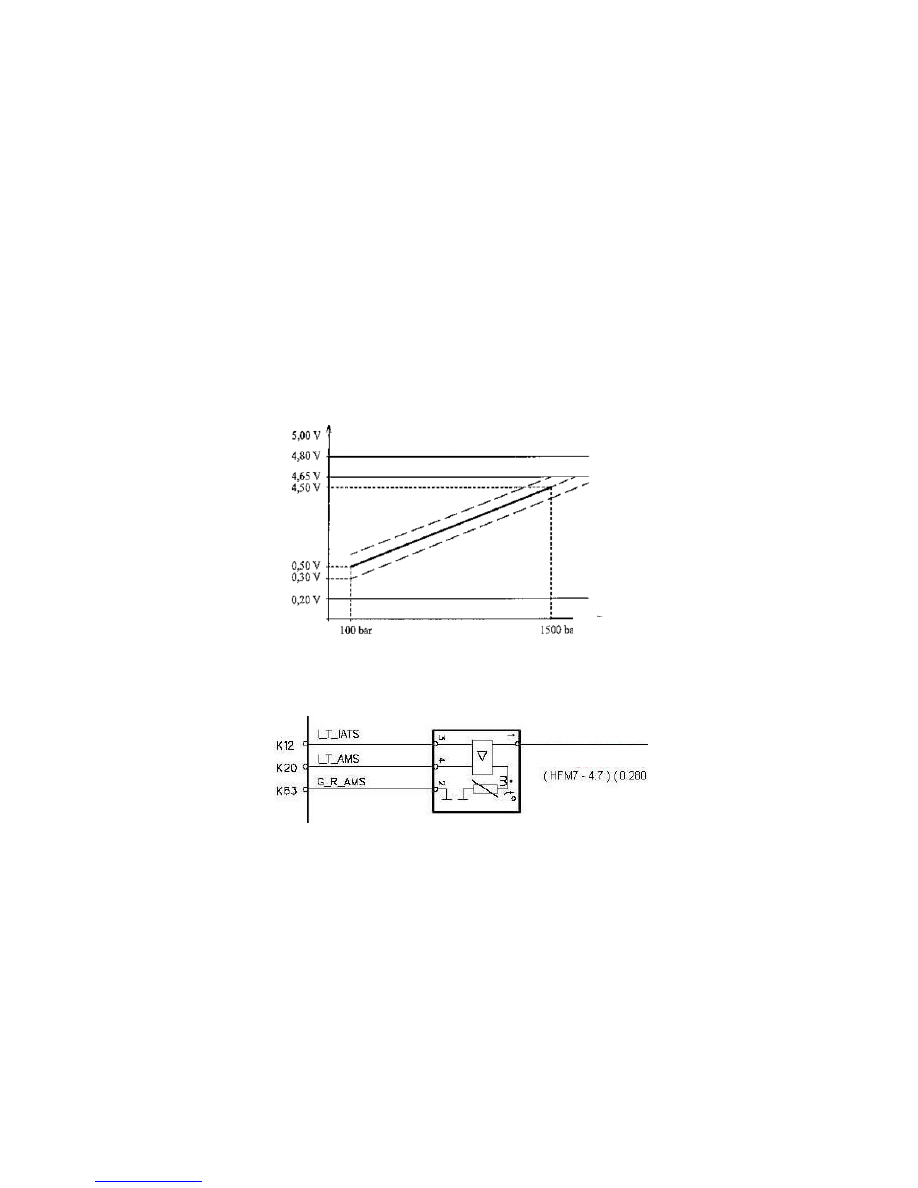
This voltage change range is 0~70mv (depending on the applied pressure) and is amplified to 0.5~4.5V by the 
evaluation circuit.   
The accurate measurement of rail pressure is of great importance to the effective working of the system. This is one of 
the causes for very strict tolerance over the rail pressure sensor during the pressure measurement. Under the scope of 
main working conditions, the measurement accuracy is approximately ±2% of the full scale reading.   

Wiring terminals: 1. Grounding; 2. Rail pressure sensor signal; 3. +5V power supply.   

2) Working Principle 

It transmits one voltage signal to the ECU, depending on the fuel pressure. The rail pressure sensor must measure the 
instant pressure in the fuel rail and embody sufficient accuracy and rapid response capability. The rail pressure sensor 
is composed of following parts:   
cIntegrated sensing unit welded onto the pressure device   
d Printed circuit board (PCB) with electric evaluation circuit   
sensor housing with electric connector. The fuel flows into the rail pressure sensor via one hole on the common rail 
and the end of this hole is sealed by one sensor diaphragm. The fuel under high pressure reaches the sensor diaphragm 
via one blind hole. One sensing unit (semiconductor unit) is arranged on this diaphragm and converts the pressure into 
electric signal. This signal generated is transmitted via wire to evaluation circuit, which will amplify this signal and 
transmit to the ECU.   

3) Test analysis  

Wiring terminals: 1 - Grounding; 2 - Rail pressure sensor signal; 3 - +5V power supply.   


4) Malfunction Mode 

The malfunction indicator lamp lights up if the voltage is higher or less than this limit. If the voltage is out of the 
normal working voltage range, but is not out of the limit, the malfunction indicator lamp will not light up.   

5) Troubleshooting  

The light-up of the engine malfunction indicator lamp indicates the presence of malfunction in the engine system and 
it’s necessary to diagnose with diagnosis instrument. Use JAC special diagnosis instrument to communicate with ECU 
of electronic injection system and read out the malfunction data in the ECU.   

6.  Engine coolant temperature sensor   

1) Overview   

z  The sensor is installed on the cylinder head, closing to the water outlet. The body is made of brass to protect the 

resistor unit fabricated from negative temperature coefficient (NTC) resistor;   

Rail 

pressure 

sensor 

5V power supply

Rail sensor signal

Grounding


-------------------------------------------------------------------------------------------------------------------------------------------------------------

Maintenance instruction for sunray hfc4da1-2c china-IV diesel engines 


84

z  The temperature resistor of the temperature sensor is one part of the 5V 

voltage division circuit. Two terminals of the temperature sensor is 
connected with the voltage charged circuit. When the temperature 
resistor of the temperature sensor changes along with the temperature, 
the voltage of the voltage charged circuit changes accordingly, which 
will be inputted to the analog/digital conversion circuit of ECU 
interface circuit. The relationship characteristic curve between voltage 
and temperature is stored in the ECU of engine management system;   

z  Sunray is equipped with 3-wire water temperature sensor to save the 

cost and guarantee the system unity.   

2) Working Principle 

The coolant temperature sensor is used to measure the working temperature of the engine. The ECU will provide the 
engine with best control scheme, depending on different temperatures.   

This sensor is one negative temperature coefficient (NTC) thermistor, of which the resistance reduces following the 
increasing of coolant temperature in a non-linear mode. The negative temperature coefficient thermistor is installed 
within one copper heat conducting sleeve. By means of one voltage division circuit, the ECU converts the resistance 
change of thermistor to one varying voltage and provides to the ECU and thus monitors the change of water 
temperature (internal structure of ECU).   


3) Measurement analysis   

Wiring terminals: 1 – Temperature signal; 2 – Grounding   

Reference values: -10℃  8.642---10.152 kΩ 

                                          20℃2.351---2.649 kΩ 

80℃0.313---0.332 kΩ 

4) Malfunction Mode 

Upon the detection that the water temperature signal is higher or less than the limit range, the ECU will light up the 
malfunction indicator lamp.   

5) Troubleshooting   

Sunray is fitted with one independent coolant temperature sensor to transmit the water temperature signal to the 
instrument for display of instrument water temperature alarm. If the water temperature alarm indicator lamp lights up, 
stop for cooling immediately. If the water temperature alarm indicator lamp lights up frequently, drive to the 
authorized service station of JAC Multifunctional Commercial Vehicle Company for service.   

7. Water level sensor   

1) Overview   

z  The fuel-water separator position sensor is functioned to measure the water content in the fuel filter;   

z  When the water content reaches a predefined level, the ECU will control the working of the engine. This sensor 

is installed on the bottom of the fuel filter;   

Characteristic curve of temperature sensor

Resi

st

an

ce


Temperature 

Water 

temperature 

sensor


To water temperature gauge


Signal terminal

Grounding


-------------------------------------------------------------------------------------------------------------------------------------------------------------

Maintenance instruction for sunray hfc4da1-2c china-IV diesel engines 


85

z  The fuel-water separator position sensor is installed on the bottom of the fuel filter;   

z  Wiring terminals: 1. Water level sensor; 2. Water level signal; 3. +12V power supply.   

2) Working Principle 

The grain substances are high-accuracy filtered by means of the interception and absorption of the filter medium and 
the water concentrated on the filter medium is 
separated by gravity force. The water separated 
is deposited in the water chamber at the lower 
portion of filter housing.   

The water level sensor is installed at the lower 
portion of water chamber. When the water level 
reaches the sensing point of the sensor, the 
internal circuit of sensor is actuated to output 
signal to the ECU. At the same time, the signal is 
transmitted to the instrument to light up the 
water level alarm lamp.   

3) Measurement analysis   

Wiring terminals: 1 - Water level sensor; 2 - Water level signal; 3 - +12V power supply.   

4) Malfunction Mode 

z  Short-circuit or open-circuit of sensor;   

z  Unstable sensor signal;   

z  Sensor signal is out of range.   

1) Troubleshooting 

Use Sunray special diagnosis instrument to check the trouble code and determine the malfunction position. Mainly 
check the circuit of sensor and determine whether there is short-circuit or open-circuit between circuit and the 
grounding wire, whether there is short-circuit or open-circuit to power supply, and whether the circuit is consistent 
with the given pin definition.   

8. Accelerator pedal position sensor  

1) Overview   

The accelerator pedal position sensor is mounted on 
the accelerator pedal.   

The accelerator pedal position sensor and the 
accelerator pedal form one integral part. The 
accelerator pedal position sensor internally 
incorporates two same potentiometer sensors to 
provide the driver’s driving demand signal to the ECU. 
This process is completely same with the presently 
mechanical pedal in terms of operation, in order to 
adapt to the years of driving habit of the driver. Two 
same sensors provide the accelerator signal to the 
ECU respectively, which guarantees more safety and reliability of the system.   

Wiring terminals: 1. +5V; 2. +5V; 3. Grounding of accelerator pedal 1; 4. Signal of accelerator pedal 1; 5. Grounding 
of accelerator pedal 2; 6. Signal of accelerator pedal 2.   

Signal terminal of 

fuel-water separator 

position sensor 

Water level sensor of 

fuel-water separator

Output vo

ltage 

Full close 

Full open 

Open angle of accelerator pedal 


-------------------------------------------------------------------------------------------------------------------------------------------------------------

Maintenance instruction for sunray hfc4da1-2c china-IV diesel engines 


86

2Working Principle 

The accelerator pedal position sensor internally adopts the damping structure and internally incorporates two same 
potentiometer sensors. The signal pointers of the sensors are coaxial with the pedal. When the accelerator pedal is 
stepped down, the potentiometer pointer will rotate coaxially with the pedal and, following the sliding of the 
potentiometer pointer, the signal terminals output different voltage or resistance signal. Two movable potentiometer 
sensors with different resistances within the position sensor output different resistances. However, there is a defined 
relationship between the resistances outputted by two sensors. The ECU adopts the voltage signals, instead of the 
resistance signals of the sensor, in order to prevent the signal distortion caused by the voltage fluctuation of the 
alternator. A comparison circuit is adopted to compare the signal voltage outputted by the sensor with the standard 
voltage and the ECU adopts the comparison result to judge the movement amplitude of the pedal. The ECU compares 
the signals inputted by the sensor 1 and sensor 2 and considers other sensors (engine speed, load, etc.) to jointly judge 
the trueness of the signals outputted by the sensors. If the signal distortion is judged in any of two sensors, the ECU 
controls the engine to actuate malfunction mode and adopt restrained driving measures.   

The accelerator pedal position sensor provides one signal voltage varying along with the accelerator pedal position. 
The engine control unit (ECU) will provide independent 5V reference voltage and low level reference voltage to each 
accelerator pedal position sensor. When the accelerator pedal is stepped down, the signal voltage of the accelerator 
pedal position sensor 1 is increased, namely from approximate 0.7V at the free position to above 4V at the fully 
stepped down position. When the accelerator pedal is stepped down, the signal voltage of the accelerator pedal 
position sensor 2 is increased, namely from approximate 0.3V at the free position to above 2V at the fully stepped 
down position. Two data monitor mutually via control system.   

3) Measurement analysis   

Wiring terminals: 1 - +5V; 2 - +5V; 3 - Grounding of accelerator pedal 1; 4 - Signal of accelerator pedal 1; 5 - 
Grounding of accelerator pedal 2; 6 - Signal of 
accelerator pedal 2.   

Working voltage of sensor: 5V   

Malfunction Mode 

Short-circuit or open-circuit of sensor 1;   

Short-circuit or open-circuit of sensor 2;   

Unstable sensor signal;   

Sensor signal is out of range.   

4) Troubleshooting 

Use Sunray special diagnosis instrument to check the trouble code and determine the malfunction position. Mainly 
check the circuit of sensor and determine whether there is short-circuit or open-circuit between circuit and the 
grounding wire, whether there is short-circuit or open-circuit to power supply, and whether the circuit is consistent 
with the given pin definition.   

Characteristic of sensor internal structure: Two potentiometer sensors within the sensor adopt independent power 
supply and independent grounding wire, which can guarantee the system safety. When one sensor is damaged, another 
sensor can still work. However, the engine system has already actuated the malfunction mode in such case and the 
electronic control system will adopt the restrained driving measures.   

9. Vehicle speed sensor   

1) Overview   

The vehicle speed sensor is located at the rear portion of the transmission and is mainly functioned to provide speed 
signal to the engine control unit and instruments.   

Accelerator 

pedal 

module

Power supply of sensor 1

Signal 1


Power supply of sensor 2

Signal 2


Grounding of sensor 2


Grounding of sensor 1


-------------------------------------------------------------------------------------------------------------------------------------------------------------

Maintenance instruction for sunray hfc4da1-2c china-IV diesel engines 


87

2Working Principle 

The signal of vehicle speed sensor provides vehicle speed signal to the ECU, based on which the ECU calculates the 
vehicle speed. It’s internally composed of one Hall speed sensor. Please refer to the camshaft position sensor for the 
working principle.   

3Measurement analysis   


10. Clutch switch  

1) Overview  

The clutch switch is located on the upper portion of the clutch pedal and is mainly functioned for cruise control and 
engine torque smoothness control.   

2) Working Principle 

The clutch switch is installed at the clutch pedal and transmits the operation signal of clutch pedal to the engine ECU. 
Its inside is one two-pin contact switch. When the clutch pedal is stepped down, the lower central position of the 
clutch switch springs out. In such case, two pins of the clutch switch are connected. When the clutch pedal is released, 
two pins of the clutch switch are disconnected. Therefore, the engine can learn the operation state of the driver by 
measuring the electric level (high or low) of the clutch switch signal wire.   

3) Measurement analysis  


4) Malfunction Mode 

Short-circuit or open-circuit of sensor;   

Unstable sensor signal;   

Sensor signal is out of range.   

5) Troubleshooting 

Use Sunray special diagnosis instrument to check the trouble code and determine the malfunction position. Mainly 
check the circuit of sensor and determine whether there is short-circuit or open-circuit between circuit and the 
grounding wire, whether there is short-circuit or open-circuit to power supply, and whether the circuit is consistent 
with the given pin definition.   

Input signal 

of vehicle 

speed sensor 


-------------------------------------------------------------------------------------------------------------------------------------------------------------

Maintenance instruction for sunray hfc4da1-2c china-IV diesel engines 


88

11.Dual brake switch 

1) Overview  

The dual brake switch is located on the upper portion of the brake pedal and internally incorporates two independent 
switches.  

2) Working Principle 

The brake switch monitors the action of the brake pedal and transmits the signal measured to the engine ECU. The 
brake switch is equipped with two switching mechanisms, which are the main and secondary units of the brake switch. 
When the signals from both units are inputted, the engine ECU will judge as normal braking signal. These switching 
signals are related to the accelerator pedal and are used to control the fuel amount during the braking. This means that 
the operation of accelerator pedal will not lead to malfunction when the brake pedal is stepped down, but the operation 
of accelerator pedal will reduce the fuel amount when the brake pedal is stepped down.   

3) Measurement analysis  


12. A/C switch  

1) Overview   

The A/C switch is located on the A/C control panel and is mainly functioned to transmit actuation directive of A/C 
compressor to the engine control unit.   

2). Working Principle 

A/C request is the input signal that the driver requests the working of A/C and controls the working of A/C relay as 
well as the speed promotion of the engine.   

3) Measurement analysis   


4) Malfunction Mode:   

z  Short-circuit or open-circuit of signal circuit;   

z  Unstable signal;   

z  The signal is out of range.   

Low pressure

High pressure

A/C switch


-------------------------------------------------------------------------------------------------------------------------------------------------------------

Maintenance instruction for sunray hfc4da1-2c china-IV diesel engines 


89

5) Troubleshooting   

Use Sunray special diagnosis instrument to check the 
trouble code and determine the malfunction position. 
Mainly check the circuit of sensor and determine whether 
there is short-circuit or open-circuit between circuit and the 
grounding wire, whether there is short-circuit or 
open-circuit to power supply, and whether the circuit is 
consistent with the given pin definition.   

II. Engine control unit (ECU)   

1) Overview   

The engine control unit is located on the firewall on the 
back of the bottom of the glove box.   

2) Working Principle 

The ECU has one metal housing and the sensors, actuators, and power supply are connected to the ECU via multi-pole 
plug. The power supply parts for direct control of actuators are integrated in the ECU so that their heat can be 
effectively expanded to the ECU housing.   

Requirements for ECU are as below:   

- Surrounding (ambient) temperature: -40ºC~+85ºC   

- Resistance to fuel, lubricating oil, etc. 

- Resistance to moisture.   

- The mechanical load has high requirements of the exposure to electromagnetic compatible (EMC) signal.   

The ECU is used to calculate the signal received from the external sensors and control at the allowable voltage level. 
Based on these input data and stored characteristic graph, the microprocessor can calculate out the duration and 
accurate moment for fuel injection and convert into time-signal curve. The specific accuracy requirement and high 
dynamic response of engine require high level calculation capability.   
The driver stage is actuated by means of the output signal and supplies proper power to the actuators to control the 
common rail pressure and the high pressure pump units. In addition, the actuators can control the engine functions 
(such as relays for exhaust gas recirculation actuator, turbocharger pressure actuator, and electronically controlled fuel 
pump) and other auxiliary functions (such as fan relay, auxiliary heater relay, and electric heating plug relay, and air 
conditioner). The driver stage has the short-circuit protection and the protection against damage due to current 
overload. These types of malfunctions and the open-circuit will be reported to the microprocessor. The diagnosis 
function of the fuel injector driver stage can identify the error signal curve occurred. In addition, one series of output 
signal can be transmitted to other vehicle systems via different interfaces. Within the specific safety concept 
framework, the ECU can monitor the entire injection system.   
The actuation of fuel injector advances special requirements over the driver stage. Within the fuel injector, the current 
from the driver stage generates one magnetic field force in the magnetic coil that applies onto the hydraulic high 
pressure system. To ensure the accurate tolerance and high repeatability of the fuel injection amount, this coil must be 
actuated in front of a steep current wave. This requires ECU to form high voltage.   

The actuation time (fuel injection duration) can be classified by the current control circuit into start current stage and 
holding stage. It must work accurately to ensure that the fuel injectors can guarantee the repeatability of fuel injection 
under all working conditions. In addition, it must reduce the energy loss in the ECU and the fuel injectors.   


-------------------------------------------------------------------------------------------------------------------------------------------------------------

Maintenance instruction for sunray hfc4da1-2c china-IV diesel engines 


90

3) Measurement analysis   


Interface A   


Interface K   


Definition for ECU pins of EDC17 control system:   

Terminal 

No. 

Description 

Terminal 

No. 

Description 

Interface A   

A01 

High fuel injector of 3

rd

 cylinder   

A31 

Low fuel injector of 2

nd

 cylinder   

A02 

High fuel injector of 2

nd

 cylinder   

A32 


A03 


A33 

Low fuel injector of 4

th

 cylinder   

A04 

Power supply of EGR actuator   

A34 


A05 


A35 

Earthing of camshaft position sensor   

A06 

5V power supply of rail pressure sensor   

A36 


A07 

5V power supply of absolute pressure sensor   

A37 

High coolant temperature signal   

Outlet 

Outlet 


-------------------------------------------------------------------------------------------------------------------------------------------------------------

Maintenance instruction for sunray hfc4da1-2c china-IV diesel engines 


91

Terminal 

No. 

Description 

Terminal 

No. 

Description 

A08 

5V power supply of camshaft position sensor 

A38 


A09  

A39  

A10 


A40 

Earthing of rail pressure sensor 

A11  

A41  

A12  

A42  

A13 

Signal of crankshaft position sensor 

A43 


A14 

Earthing of crankshaft position sensor 

A44 


A15  

A45  

A16 

High fuel injector of 1

st

 cylinder   

A46 

Low fuel injector of 3

rd

 cylinder   

A17 

High fuel injector of 4

th

 cylinder   

A47 

Low fuel injector of 1

st

 cylinder   

A18  

A48  

A19 

Earthing of EGR actuator   

A49 


A20 


A50 

Low coolant temperature signal   

A21  

A51  

A22 

Air conditioner relay control   

A52 

Rail pressure sensor signal   

A23  

A53 

Temperature signal of absolute pressure 

sensor 

A24  

A54 

Pressure signal of absolute pressure 

sensor 

A25  

A55  

A26  

A56 

Shielding wire of crankshaft position 

sensor  

A27 


A57 

Signal of camshaft position sensor   

A28 

Earthing of absolute pressure sensor   

A58 


A29  

A59  

A30 


A60 

Control of fuel metering unit 

Interface K   

K01 

Positive pole of battery   

K48 

Vehicle speed sensor output   

K02 

Negative pole of battery   

K49 


K03 

Positive pole of battery   

K50 


K04 

Negative pole of battery   

K51 

Cruise control lamp   

K05 

Positive pole of battery   

K52 

Cruise control mode   

K06 

Negative pole of battery   

K53 

Cruise control mode   

K07  

K54 Anti-theft 

cable 


K08  

K55 Clutch 

switch 

control 

K09  

K56  

K10 


K57 

Preheating feedback signal   

K11 


K58 

Grounding of accelerator pedal sensor 2 

K12 

Intake temperature signal of air flowmeter   

K59 

Pressure difference sensor signal   


-------------------------------------------------------------------------------------------------------------------------------------------------------------

Maintenance instruction for sunray hfc4da1-2c china-IV diesel engines 


92

Terminal 

No. 

Description 

Terminal 

No. 

Description 

K13 


K60 

Accelerator pedal sensor signal 2 

K14  

K61  

K15  

K62  

K16 


K63 

Earthing signal of air flowmeter   

K17  

K64  

K18  

K65  

K19 

Vehicle speed signal input   

K66 

CAN communication   

K20 

Intake flow signal of air flowmeter   

K67 

Grounding of accelerator pedal sensor 1 

K21 

Exhaust brake switch control   

K68 


K22 

Power supply 2 of accelerator pedal sensor   

K69 

Control signal of turbocharger actuator 

K23 

5V power supply of EGR   

K70 

Malfunction indicator lamp   

K24  

K71 OBD 

indicator 

lamp 


K25  

K72  

K26  

K73  

K27 

5V power supply of pressure difference sensor   

K74 

Cruise control mode   

K28 

Power supply 1 of accelerator pedal sensor   

K75 


K29 

Exhaust brake relay control   

K76 


K30 Anti-theft 

cable 


K77 Water 

level 

signal 


K31 

Position signal of EGR 

K78 

Auxiliary brake switch   

K32  

K79  

K33 


K80 

Earthing of pressure difference sensor 

K34 


K81 

Accelerator pedal sensor signal 1 

K35  

K82  

K36  

K83  

K37 

Air conditioner switch signal   

K84 


K38 Main 

brake 

switch 

K85  

K39 

Earthing of EGR position sensor   

K86 


K40 

Cruise control mode   

K87 

CAN communication   

K41  

K88  

K42  

K89  

K43 

Engine speed signal output   

K90 

Preheating control signal   

K44 

Line K diagnosis   

K91 

Preheating indicator lamp   

K45  

K92  

K46 

Ignition switch power switch control   

K93 


K47 

Main relay control 

K94 


4) Malfunction Mode 

Unstable idling, poor acceleration, start failure, high idling, out-of-tolerance of emission, difficult start, failure of air 
conditioner, control failure of fuel injector, engine flameout, etc.   

Failure arising from the burnout of ECU internal parts due to electric overload of external devices; rusting of circuit 


-------------------------------------------------------------------------------------------------------------------------------------------------------------

Maintenance manual for sunray hfc4da1-2c china-IV diesel engines 


93

board due to water ingress of ECU.   

5) Troubleshooting 

Connect the plug and use engine data diagnosis cable to read the engine malfunction records; disconnect the plug and 
check whether the ECU connecting wire is intact. Mainly check whether ECU power supply and grounding circuit are 
normal, whether the external sensors are working normally, whether the output signal are reliable, and whether the 
circuit is intact.   

Check whether the actuators are working normally and whether their circuits are intact. Finally replace the ECU for 
test.  

III. Actuators   

1. Fuel injector   

1) Overview   

The fuel injectors are located on the engine cylinder head and are mainly functioned to provide accurate fuel injection 
for the engine at the correct moment.   

2) Working Principle 

To realize effective fuel injection start point and accurate injection amount, the common rail system adopts the special 
fuel injector with hydraulic servo system and electronic control unit (solenoid valve). At the start of fuel injection 
process, the fuel injector needs to adopt a relatively high current to rapidly open the solenoid valve. Till the needle 
valve of the fuel injector nozzle reaches the maximum travel and the fuel injector nozzle is fully opened, the control 
current is reduced to a relatively low constant current. In 
such case, the fuel injection amount depends on the open 
moment and the pressure in the common rail. When the 
solenoid valve is no longer working and is closed, the fuel 
supply process is completed.   

The fuel injection start moment and the fuel injection 
amount are regulated by the electronically controlled fuel 
injector. These fuel injectors substitute the fuel injector 
assembly (injector nozzle and fuel injector body). Similar to 
the fuel injector assembly of modern direct injection diesel 
engine, the holders are used to install the fuel injector on the 
cylinder head. In other words, it’s unnecessary to make any 
large modification to the cylinder head to install the 
common rail fuel injectors onto the modern direct injection 
diesel engine.   

Design structure   

The fuel injector (figure) can be divided into several 
functional blocks:   

- Injector nozzle 

- Hydraulic servo system 

- Solenoid valve   

As shown in the figure, the fuel enters into nozzle through 
high pressure connecting pipe (4) and fuel inlet groove (10) 
and enters into the valve control chamber (8) through fuel 
inlet (7). The control chamber is connected with fuel return 
pipe (1) via fuel drainage hole (6) and the fuel drainage hole 

Fuel injector   
a. Close of fuel injector (Still state)    b. Open of fuel injector (Fuel 
injection) 
1. Fuel return pipe  2. Electric connector  3. Control unit 
(electromagnetic field)    4. Rail fuel inlet (high pressure)    5. Ball 
valve    6. Fuel drainage hole    7. Fuel inlet hole    8. Valve control 
chamber  9. Valve control plunger  10. Fuel inlet groove to 
injector nozzle    11. Injector nozzle needle valve   


-------------------------------------------------------------------------------------------------------------------------------------------------------------

Maintenance manual for sunray hfc4da1-2c china-IV diesel engines 


94

is opened by solenoid valve. After the fuel drainage hole is closed, the hydraulic force applied onto the valve 
controlled plunger (9) exceeds the pressure on the pressure shoulder of injector nozzle needle valve (11). Therefore, 
the needle valve is pushed into the needle valve seat to block the high pressure passage to the combustion chamber.   
When the solenoid valve of the fuel injector is actuated, the fuel drainage hole opens. In such case, the pressure in the 
control chamber drops and thus the force applied onto the plunger reduces. Once the hydraulic pressure is less than the 
force applied onto the pressure shoulder of the needle valve, the injector nozzle needle valve opens and the fuel injects 
into the combustion chamber via the injection hole. The cause to indirectly control the injector nozzle needle valve by 
hydraulic gain system is that the solenoid valve can’t directly generate the force required to rapidly open the needle 
valve. The control amount required to open the injector nozzle needle valve is not included from the actual fuel 
injection amount and is conveyed to the fuel return pipe through the fuel drainage hole of the control chamber. 
Besides the control amount, the loss control fuel and the leak fuel at the injector nozzle needle valve and the valve 
plunger chamber are conveyed to the fuel tank via the fuel return pipe and the fuel collection pipe connecting the 
relief valve.   
Depending on the working condition of the engine and the pressure generated by the high pressure fuel pump, the fuel 
injector can be classified to 4 working conditions:   

- Close of fuel injector (due to application of high pressure)   

- Open of fuel injector (start of fuel injection)   

- Full open of fuel injector   

- Close of fuel injector (complete of fuel injection)   

These working conditions are generated by means of the pressure distribution applied onto the fuel injector parts. 
When the engine is stopped and there is no pressure in the common rail, the injector nozzle spring will close the fuel 
injector.  

Close of fuel injector (still state):   

The solenoid valve is not actuated under still state and thus the fuel injector is closed (a). When the fuel drainage hole 
is closed, the valve spring will press the ball vale of armature onto the fuel return orifice. The high pressure of 
common rail is formed in the valve control chamber. Afterwards, a similar pressure is formed within the injector 
nozzle chamber. The pressure applied onto the end face of control plunger by the rail pressure and the injector nozzle 
spring force work together against the open force applied onto the conical pressure bearing face of needle valve by 
fuel to maintain the needle valve at close state.   

Open of fuel injector (start of fuel injection):   

While the injector nozzle is at still state, the solenoid valve is actuated by the start current to ensure rapid open (b). 
The force generated by the actuated solenoid valve overcomes the spring force so that the armature opens the fuel 
drainage hole. Almost at the same time, the high start current drops to the low holding current required by the electric 
magnet. This is possible as the air cap of the magnetic circuit becomes really small. When the ball valve of the fuel 
drainage hole opens, the fuel flows from the valve control chamber to the empty chamber above and then returns to 
the fuel tank via the fuel return pipe. The fuel drainage hole makes the pressure not completely balanced so that the 
pressure in the valve control chamber drops. Therefore, the pressure in the valve control chamber is less than the 
pressure of the fuel rail, which is still maintained in the fuel injector chamber, and the pressure drop in the valve 
control chamber reduces the force applied onto the control plunger so that the injector nozzle needle valve opens and 
the fuel injection starts.   

The open speed of the injector nozzle needle valve depends on the flow difference between the fuel drainage hole and 
the fuel inlet hole. The control plunger reaches its top dead center and then is held by one film of fuel, which is 
formed by the fuel flow between the fuel drainage hole and the fuel inlet hole. In such case, the injector nozzle 
completely opens and the fuel is injected into the combustion chamber at a pressure almost equaling to the fuel 
pressure in the common rail. The pressure distribution in the injector nozzle is similar to that at the open stage.   

Close of fuel injector (complete of fuel injection):   

When the solenoid valve is no longer actuated, the valve spring pushes down the armature so that the ball of the valve 


-------------------------------------------------------------------------------------------------------------------------------------------------------------

Maintenance manual for sunray hfc4da1-2c china-IV diesel engines 


95

closes the fuel drainage hole. The armature is of two-part design. Though the armature block is guided by the pressure 
shoulder during the downward movement, it can bounce back following the return spring and thus will not apply 
downward force onto the armature and the ball valve.   
The close of fuel drainage hole enables the entry of fuel via fuel inlet hole into the control chamber for pressure 
establishment. This pressure is equivalent to the rail pressure and applies additional force onto the end face of the 
control plunger. The resultant force from this force and spring force overcomes the pressure in the injector nozzle 
chamber to close the injector nozzle needle valve.   
The close speed of the injector nozzle needle valve depends on the flow passing through the fuel inlet hole. Once the 
injector nozzle needle valve hits its lower seat again, the fuel injection stops.   

3) Measurement analysis   


4) Matching of fuel injector   

The matching of fuel injector must be performed in event of any 
of the following conditions:   

z  Replacement of fuel injector. 

z  Replacement of ECU   

z  Confusion of installation serial number before and after the 

maintenance.  

While performing the matching, input the matching code on the 
fuel injector (as shown in the figure) in order into the diagnosis 
instrument for matching.   

2. EGR valve control system   

1) Overview   

z  The electronically controlled EGR valve controls the 

open extent of the valve by means of the positive and 
reverse rotation of the DC motor and performs the 
close-loop control as per the feedback signal of the 
position sensor.   

z  To guarantee the NOx emission of the engine, the ECU 

measures and calculates the EGR percentage as per the 
input parameters of the engine (such as speed and intake 
pressure) and the calibrated MAPs), issues control 
signal to the EGR valve, and performs the close-loop 
control via the position sensor.   

z  The EGR valve is installed on the intake manifold. The constant temperature of the EGR valve inlet emission 

Fuel injector 1 “high”

Fuel injector 1 "Low”

Fuel injector 4 “high”

Fuel injector 4 "Low”

Fuel injector 2 "Low”

Fuel injector 3 "Low”

Fuel injector 3 “high”

Fuel injector 2 “high”

Cylinder 1

Cylinder 4

Cylinder 3

Cylinder 2

EGR valve 

Intake manifold 

assembly 


-------------------------------------------------------------------------------------------------------------------------------------------------------------

Maintenance manual for sunray hfc4da1-2c china-IV diesel engines 


96

can't exceed 260ºC, with the peak temperature no more than 300ºC.   

2) Measurement analysis   


3. Variable nozzle turbocharger (VNT) control   

1) Overview   

z  HFC4DA1-2C adopts variable section turbocharger technology so that the turbocharger and the engine are well 

matched under all working conditions to realize best engine performance.   

z  The blades of the VNT are connected to the control tie rod and the displacement of the control tie rod is 

controlled by the vacuum pressure of the vacuum chamber on the VNT. Changing the vacuum pressure of the 
vacuum chamber can change the position of VNT blades and control the flow area of the turbine. The vacuum 
pressure of the vacuum chamber is controlled by VNT solenoid valve, of which one port is connected to the 
vacuum chamber on the VNT, one port is connected to the vacuum pump, and another port is connected to the air. 
This connector in the engine is additionally fitted with filter to prevent the ingress of contaminant (such as dust) 
into the valve. The open extent of the VNT solenoid valve is regulated by the PWM wave issued by ECU and the 
solenoid valve is installed on the crossbeam of the body water tank.   

2) Measurement analysis   


4. Fuel metering unit 

1) Overview   

The fuel metering unit is located on the high pressure fuel pump and is functioned to control the fuel amount from the 
low pressure pump to the high pressure pump.   

2) Working Principle 

The fuel metering valve is installed at the high pressure fuel inlet of high pressure fuel pump and is functioned to 
regulate the fuel supply amount and fuel pressure, of which the regulation requirement is subject to the control of 
ECU. The control coil of the metering valve is closed when not electrified, which cuts off the fuel supply to the 
plunger of high pressure fuel pump. The ECU changes the fuel inlet section area of metering unit by means of pulse 
signal to increase or reduce the fuel supply amount.   

3) Measurement analysis   

Wiring terminals: 1 – Signal terminal; 2 – 12V voltage.   

EGR power supply


EGR position signal 

EGR signal grounding 

EGR control signal terminal

EGR control grounding 
terminal 

EGR passage section 

EGR actuator 

Turbocharger actuator 

Turbocharger control signal 


-------------------------------------------------------------------------------------------------------------------------------------------------------------

Maintenance manual for sunray hfc4da1-2c china-IV diesel engines 


97


4) Malfunction Mode 

Short-circuit or open-circuit of metering valve; damage of metering valve; contamination of metering valve.   

5) Troubleshooting 

Use Sunray special diagnosis instrument to check the trouble code and determine the malfunction position. Mainly 
check the circuit of metering valve and determine whether there is short-circuit or open-circuit between circuit and the 
grounding wire, whether there is short-circuit or open-circuit to power supply, and whether the circuit is consistent 
with the given pin definition.   


5. Preheating control unit 

1) Overview  

The preheating control unit is located in the engine compartment and is mainly functioned for the rapid start of engine 
under cold state.   

2) Working Principle 

The preheating control unit is functioned to ensure effective cold start and shorten the warm-up time, which is closely 
related to the exhaust emission. The preheating time is a function of coolant temperature. At the start of the engine or 
during the actual running, the turn-on duration of the electric heating plug depends on one series of parameters, 
including the fuel injection amount and engine speed. The control of the electric heating plug is realized by one power 
relay (GCU).   

The main part of the electric heating plug is the tubular heating unit. The heating unit is firmly and air-tightly installed 
within the electric heating plug housing to guard against corrosion and thermal gas impact. The heating unit is one 

Fuel metering unit signal

Fuel metering unit 

CP1H and CP4.x metering unit


Fuel amount

Fuel supply to high 

pressure pump 

Full load fuel amount


Fuel amount characteristic 

Idling fuel amount

Ampere


-------------------------------------------------------------------------------------------------------------------------------------------------------------


Content      ..     4      5      6      7     ..