Infiniti QX60 (2023 year). Manual in english - page 16
 

  Index      Manuals     Infiniti QX60 (2023 year). Manual in english


Search            copyright infringement  


Content      ..     14      15      16      17     ..


Infiniti QX60 (2023 year). Manual in english - page 16


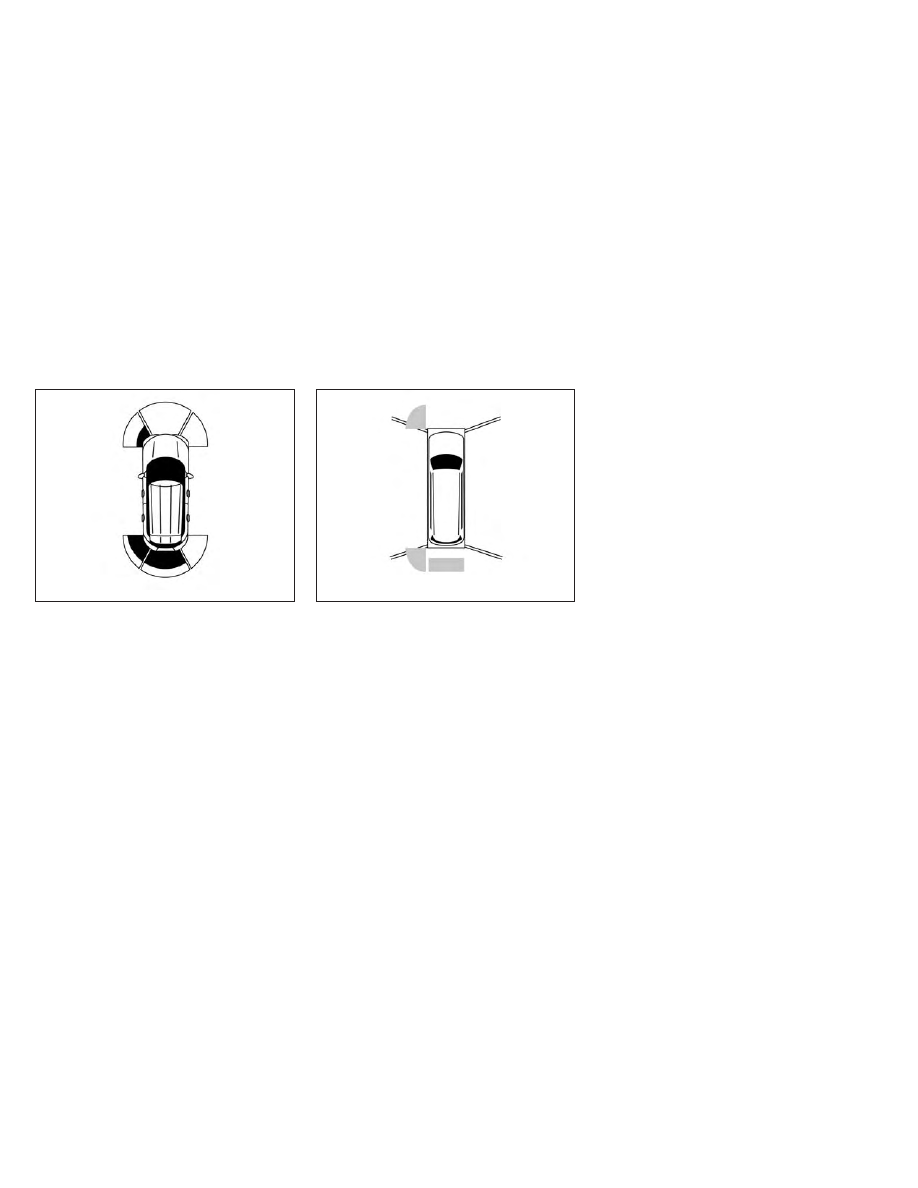
When the vehicle moves closer to an ob-
stacle, the sonar indicator (detected area) ap-
pears in the vehicle information display.

The sonar indicator also appears on the cam-
era view of the center display.

LSD4337

LSD4338

5-174

Starting and driving

CarManuals2.com

-------------------------------------------------------------------------------------------------------------------------------------------------------------

HOW TO ENABLE/DISABLE THE
FRONT AND REAR SONAR

SYSTEM

The system is automatically activated when
the push button ignition is placed in the ON
position and the shift lever is in the R (Re-
verse) position.

Perform the following steps to enable or dis-
able the sonar system:

1. Press the

button until “Settings” ap-

pears in the vehicle information display
and then press OK. Use the scroll dial to
select “Driver Assistance.” Then press the
OK button.

2. Select “Parking Aids” and press the OK

button.

• Select “Auto Show Sonar” and press the

OK button to turn on or off the option to
automatically display the sonar when
activated.

• Select “Front Sonar” (if so equipped) and

press the OK button to turn the front
sonar sensors only on or off.

• Select “Rear Sonar” and press the OK

button to turn the rear sonar sensors
only on or off.

• Select “Sonar Distance” to change the

sonar system volume to “Long,” Me-
dium” or “Short.”

• Select “Sonar Volume” to change the

sonar system distance to “High,” “Me-
dium” or “Low.”

LSD4656

For vehicles with the 7 inch (18 cm) display

Starting and driving

5-175

CarManuals2.com

-------------------------------------------------------------------------------------------------------------------------------------------------------------

NOTE:

The system will automatically be turned on
when the engine is restarted.

SONAR LIMITATIONS

WARNING

Listed below are the system limitations for
the sonar system. Failure to operate the
vehicle in accordance with these system
limitations could result in serious injury or
death.

Read and understand the limitations of
the sonar system as contained in this
section. Inclement weather may affect
the function of the sonar system; this
may include reduced performance or a
false activation.

The sonar system is deactivated at
speeds above 6 mph (10 km/h). It is re-
activated at lower speeds.

Inclement weather or ultrasonic sources
such as an automatic car wash, a truck’s
compressed-air brakes or a pneumatic
drill may affect the function of the sys-
tem; this may include reduced perfor-
mance or a false activation.

LSD4520

For vehicles with the 12.3 inch (31.2 cm) display

5-176

Starting and driving

CarManuals2.com

-------------------------------------------------------------------------------------------------------------------------------------------------------------

The system is not designed to prevent
contact with small or moving objects. Al-
ways move slowly. The system will not
detect small objects below the bumper or
on the ground.

The system may not detect the following
objects: fluffy objects such as snow,
cloth, cotton, glass-wool, etc.; thin ob-
jects such as rope, wire and chain, etc.; or
wedge-shaped objects; complex-shaped
objects or multiple objects in close.

The sonar system may not detect objects
at speeds above 3 mph (5 km/h) and may
not detect certain angular or moving
objects.

The sonar system may not operate in the
following conditions:

When rain, snow, ice, dirt, etc. ad-
heres to the sonar.

When a loud sound is heard in the
area around the vehicle.

When the surface of the obstacle is
diagonal to the front or rear of the
vehicle.

When a sonar or the area around the
sensor is extremely hot or cold.

The sonar system may unintentionally
operate in the following conditions:

When there is overgrown grass in the
area around the vehicle.

When there are bumps, protrusions
or manhole covers on the road
surface.

When the vehicle drives through a
draped flag or a curtain.

When there is an accumulation of
snow or ice behind the vehicle.

When driving on a steep hill.

SYSTEM TEMPORARILY
UNAVAILABLE

When sonar blockage is detected, the system
will be deactivated automatically.

The system is not available until the condi-
tions no longer exist.

The sonar sensors may be blocked by tempo-
rary ambient conditions such as splashing
water, mist or fog. The blocked condition
may also be caused by objects such as ice,
frost or dirt obstructing the sonar sensors.

Action to take:

When the above conditions no longer exist,
the system will resume automatically.

SYSTEM MAINTENANCE

The sonar sensors

O

A

and

O

B

are located on

the front and rear bumpers.
• Always keep the area near the sonar sen-

sors clean.

LSD4521

Starting and driving

5-177

CarManuals2.com

-------------------------------------------------------------------------------------------------------------------------------------------------------------

• If the sonar sensors are dirty, wipe them off

with a soft cloth while being careful to not
damage them.

• The sonar sensors may be blocked by tem-

porary ambient conditions such as splash-
ing water, mist or fog. The blocked condi-
tion may also be caused by objects such as
ice, frost or dirt obstructing the sonar sen-
sors. Check for and remove objects ob-
structing the area around the sonar
sensors.

• Do not subject the area around the sonar

sensors to strong impact. Also, do not re-
move or disassemble the sonar sensors. If
the sonar sensors and peripheral areas are
deformed in an accident, etc., have the so-
nar sensors checked by an INFINITI retailer.

• Do not attach stickers (including transpar-

ent material), install accessories or apply
additional paint on the sonar sensors and
their surrounding areas. This may cause a
malfunction or improper operation.

• When washing the vehicle using a high-

pressure washer, do not apply direct
washer pressure on the sonar sensors. This
may cause a malfunction of the sonar
sensors.

The Idling Stop System activates to prevent
unnecessary

fuel

consumption,

exhaust

emissions and noise.
• When you stop the vehicle, the engine is

turned off automatically.

• When you release the brake pedal to begin

moving again, the engine is turned on
automatically.

WARNING

The engine restarts if the vehicle moves at
approximately 1 mph (2 km/h) or more (on
a downhill grade, etc.) while the engine is
turned off by the Idling Stop System. De-
press the brake pedal immediately to stop
the vehicle to prevent an accident.

CAUTION

At the end of the journey the engine must
be stopped and ignition switch be pushed
off. Lock the vehicle as normal. Pushing the
ignition switch off will shut down all elec-
trical systems. Failure to do this may result
in a discharged battery.

NOTE:

The Idling Stop System will not activate un-
der the following conditions:

When the engine is kept idling without the
vehicle being driven after the engine is
turned on.

When the engine coolant temperature is
low.

When the battery capacity is low.

When the battery temperature is low.

When the vehicle is moving.

When

a

negative

pressure

booster

decreases.

When the engine hood is opened with the
engine running.

When the engine is turned on with the en-
gine hood open.

When the driver’s seat belt is not fastened.

When the driver’s door is open.

When the steering wheel is operated.

When the Idling Stop System indicator
blinks at a low speed.

When the fan speed control is in any position
other than “OFF,” (0) while the air flow con-
trol is in the front defogger position.

When the front defroster switch is on.

IDLING STOP SYSTEM

5-178

Starting and driving

CarManuals2.com

-------------------------------------------------------------------------------------------------------------------------------------------------------------

When the rear window defroster switch is
on.

When the temperature inside the vehicle is
lower than approximately 20°C (68°F),
unless the Air Conditioning ECO custom-
ize option is selected, and the ECO driving
mode is on.

When the temperature inside the vehicle is
higher than approximately 30°C (86°F),
unless the Air Conditioning ECO custom-
ize option is selected, and the ECO driving
mode is on. (When the air conditioner is
off, the Idling Stop System will operate.)

When the fan speed of the air conditioner
is set to the maximum speed, unless the Air
Conditioning ECO customize option is se-
lected, and the ECO driving mode is on.

When the Idling Stop OFF switch is turned
on.

When the power consumption is large.

When the altitude is high.

When the accelerator pedal is depressed.

When the shift lever is any range other
than D (Drive).

When the brake pedal is not firmly
depressed.

When stopping the vehicle on steep slop-
ing roads.

NOTE:

The Idling Stop System may not activate
when the Intelligent Key is not in the vehicle
and you open/close any door.

NOTE:

The engine will not restart even if the brake
pedal is released while the Idling Stop Sys-
tem is activated under the following condi-
tions: (The engine may restart under other
conditions.)

When the automatic brake hold system is
activated.

When the engine hood is opened.

NOTE:

It may take some time until the Idling Stop
System

activates

under

the

following

conditions:

When the battery is discharged.

When the outside temperature is low or
high.

When the battery is replaced or the bat-
tery terminal is disconnected for extended
periods and then reconnected.

NOTE:

When the Idling Stop System indicator light
illuminates, the engine starts running auto-
matically under at least one of the following
conditions:

The vacuum pressure for brake system is
not enough as the brake pedal is repeat-
edly depressed.

The driver’s seat belt is unfastened, or the
driver’s door is open.

The battery voltage becomes low (due to
electrical load from other vehicle systems
like headlights, heaters, etc., or auxiliary
devices connected to the 12 volt socket
inside the vehicle).

The vehicle speed is above about 1 mph
(2 km/h).

When the rear window defroster is
operated.

When the temperature inside the vehicle is
lower than approximately 68°F (20°C),
unless the Air Conditioning ECO custom-
ize option is selected, and the ECO driving
mode is on.

Starting and driving

5-179

CarManuals2.com

-------------------------------------------------------------------------------------------------------------------------------------------------------------

When the temperature inside the vehicle is
higher than approximately 86°F (30°C),
unless the Air Conditioning ECO custom-
ize option is selected, and the ECO driving
mode is on. (When the air conditioner is
off, the Idling Stop System will operate.)

When the front defroster is turned on.

When more than 3 minutes have elapsed
since the Idling Stop System was active.

When the accelerator pedal is depressed.

When the steering wheel is operated. (The
steering wheel operation may become
heavy, but this is not a malfunction.)

When the battery capacity is low.

When the power consumption is high.

When the shift lever is any range other
than D (Drive).

When the Idling Stop OFF switch is
pushed.

When the negative pressure of the brake
system is not sufficiently applied by de-
pressing the brake pedal several times.

NOTE:

The Idling Stop System may not active when
the Intelligent Key is not in the vehicle and
you open/close any door.

NOTE:

The following condition will prevent the
Idling Stop System from automatically re-
starting the engine. Starting the engine with
the ignition switch operation is then
necessary:

The hood is open.

Use this system while waiting at a stop light,
etc. When the vehicle is stopped for long
periods of time, turn off the engine.

When the engine is stopped by the Idling Stop
System, heating, cooling and dehumidifying
functions will be deactivated. To avoid the air
conditioning functions from being deacti-
vated, turn off the Idling Stop System by
pushing the Idling Stop OFF switch.

RETROGRADE MOVEMENT
CONTROL FUNCTION

This system is designed to reduce the retro-
grade movement that occurs while the driv-
er’s foot changes from depressing the brake
pedal to the accelerator pedal when moving
the vehicle while the Idling Stop System is
active on a hilly road.

IDLING STOP SYSTEM DISPLAY

The status of the Idling Stop System can be
checked in the vehicle information display.

5-180

Starting and driving

CarManuals2.com

-------------------------------------------------------------------------------------------------------------------------------------------------------------

If the Idling Stop System is activated or de-
activated using the Idling Stop OFF switch,
the message is shown.

The fuel saved and the engine stop time
mode shows the following items:
• The fuel saved shows the estimated quan-

tity of fuel that was saved by the Idling
Stop System every time the engine is auto-
matically stopped.

• The engine stop time shows the time that

the engine has been stopped for by the
Idling Stop System.

The total fuel saved and the engine stop time
can also be checked in the vehicle information
display. For additional information, see “Ve-
hicle information display” (P. 2-22 or 2-44).

If the engine stops when the Idling Stop Sys-
tem is activated and will not start automati-
cally, the message is shown.

LSD4277

Idling Stop System ON or OFF

LSD4278

Fuel saved and engine stop time

LSD4279

Auto start deactivation

Starting and driving

5-181

CarManuals2.com

-------------------------------------------------------------------------------------------------------------------------------------------------------------

This message is displayed when the Idling
Stop System is malfunctioning.

It is recommended that you have the system
checked. It is recommended that you visit an
INFINITI retailer for this service.

This indicator is displayed when the vehicle is
stopped if the engine is prevented from au-
tomatically stopping by the Idling Stop sys-
tem under the inhibition conditions. For addi-
tional information, see “Idling Stop System”
(P. 5-178).

When the vehicle is stopped, the guidance is
displayed if the Idling Stop system is deacti-
vated due to not fully depressing the brake
pedal.

If you wish to activate the Idling Stop system,
further depress the brake pedal. For addi-
tional information, see “Idling Stop System”
(P. 5-178).

The display disappears under the following
conditions:
• The Idling Stop system is activated.
• The vehicle starts running.

LSD4280

System fault

LSD4776

Idling Stop inhibition

LSD4777

Idling Stop guidance display (further

depressing the brake pedal)

5-182

Starting and driving

CarManuals2.com

-------------------------------------------------------------------------------------------------------------------------------------------------------------

When the vehicle is stopped, the guidance is
displayed if the Idling Stop system is deacti-
vated

since

the

steering

operation

is

detected.

The Idling Stop system is deactivated due to
steering operation being detected. For addi-
tional information, see “Idling Stop System”
(P. 5-178).

The display disappears under the following
conditions:
• The Idling Stop system is activated.
• The vehicle starts running.

When the vehicle is stopped, the guidance is
displayed if the Idling Stop system is deacti-
vated since the air conditioner (cooling, heat-
ing or dehumidifying functions) is given
priority.

The Idling Stop system is deactivated since
the air conditioner is given priority. For addi-
tional information, see “Idling Stop System”
(P. 5-178).

The display disappears under the following
conditions:
• The Idling Stop system is activated.
• The vehicle starts running.

LSD4778

Idling Stop guidance display (detection of

the steering operation)

LSD4779

Idling Stop guidance display (placing

priority on the air conditioner)

Starting and driving

5-183

CarManuals2.com

-------------------------------------------------------------------------------------------------------------------------------------------------------------

IDLING STOP OFF SWITCH

The system can be temporarily deactivated
by pushing the Idling Stop OFF switch. Push-
ing the switch again or restarting the engine
by using the ignition switch will reactivate the
Idling Stop System.
• When the Idling Stop System is deactivated

while the engine is running, the engine is
prevented from automatically stopping.

• When the Idling Stop System is deactivated

after the engine has been automatically
stopped by the Idling Stop System, the en-
gine will immediately restart if suitable con-
ditions are present. The engine will then be
prevented from automatically stopping
during the same journey.

NOTE:

• The Idling Stop System ON or OFF mes-

sage is displayed for a few seconds in the
vehicle information display when the
Idling Stop System OFF switch is pushed.
For additional information, see “Idling
Stop System Display” (P. 5-180).

• The Idling Stop System resets to ON every

time the ignition switch is switched from
the OFF position to the ON position.

• It is best to disable the ISS system when

towing a trailer. You can do this by pushing
the Idling Stop OFF switch.

FREEING A FROZEN DOOR LOCK

To prevent a door lock from freezing, apply
de-icer through the key hole. If the lock be-
comes frozen, heat the key before inserting it
into the key hole, or use the INFINITI Intelli-
gent Key.

ANTIFREEZE

In the winter when it is anticipated that the
temperature will drop below 32°F (0°C),
check the antifreeze to assure proper winter
protection. For additional information, see
“Engine cooling system” (P. 8-4).

BATTERY

If the battery is not fully charged during ex-
tremely cold weather conditions, the battery
fluid may freeze and damage the battery. To
maintain maximum efficiency, the battery
should be checked regularly. For additional
information, see “Battery” (P. 8-13).

DRAINING OF COOLANT WATER

If the vehicle is to be left outside without
antifreeze, drain the cooling system, including
the engine block. Refill before operating the
vehicle. For additional information, see
“Changing engine coolant” (P. 8-5).

LSD4442

COLD WEATHER DRIVING

5-184

Starting and driving

CarManuals2.com

-------------------------------------------------------------------------------------------------------------------------------------------------------------

TIRE EQUIPMENT

1. SUMMER tires have a tread designed to

provide superior performance on dry
pavement. However, the performance of
these tires will be substantially reduced in
snowy and icy conditions. If you operate
your vehicle on snowy or icy roads,
INFINITI recommends the use of MUD &
SNOW or ALL SEASON TIRES on all four
wheels. It is recommended that you visit
an INFINITI retailer for the tire type, size,
speed rating and availability information.

2. For additional traction on icy roads, stud-

ded tires may be used. However, some
U.S. states and Canadian provinces pro-
hibit their use. Check local, state and pro-
vincial laws before installing studded tires.

Skid and traction capabilities of studded
snow tires on wet or dry surfaces may be
poorer than that of non-studded snow tires.

3. Tire chains may be used. For additional

information, see “Tire chains” (P. 8-38).

All-Wheel Drive (AWD) model

If you install snow tires, they must also be the
same size, brand, construction and tread pat-
ter on all four wheels.

SPECIAL WINTER EQUIPMENT

It is recommended that the following items
be carried in the vehicle during winter:
• A scraper and stiff-bristled brush to re-

move ice and snow from the windows and
wiper blades.

• A sturdy, flat board to be placed under the

jack to give it firm support.

• A shovel to dig the vehicle out of

snowdrifts.

• Extra washer fluid to refill the windshield-

washer fluid reservoir.

DRIVING ON SNOW OR ICE

WARNING

Wet ice (32°F, 0°C and freezing rain),
very cold snow or ice can be slick and very
hard to drive on. The vehicle will have
much less traction or “grip” under these
conditions. Try to avoid driving on wet
ice until the road is salted or sanded.

Whatever the condition, drive with
caution. Accelerate and slow down with
care. If accelerating or downshifting too
fast, the drive wheels will lose even more
traction.

Allow more stopping distance under
these conditions. Braking should be
started sooner than on dry pavement.

Allow greater following distances on
slippery roads.

Watch for slippery spots (glare ice).
These may appear on an otherwise clear
road in shaded areas. If a patch of ice is
seen ahead, brake before reaching it. Try
not to brake while on the ice, and avoid
any sudden steering maneuvers.

Do not use the cruise control on slippery
roads.

Snow can trap dangerous exhaust gases
under your vehicle. Keep snow clear of
the exhaust pipe and from around your
vehicle.

Starting and driving

5-185

CarManuals2.com

-------------------------------------------------------------------------------------------------------------------------------------------------------------

MEMO

5-186

Starting and driving

CarManuals2.com

-------------------------------------------------------------------------------------------------------------------------------------------------------------

-------------------------------------------------------------------------------------------------------------------------------------------------------------

Push the switch on to warn other drivers
when you must stop or park under emer-
gency conditions. All turn signal lights flash.

WARNING

If stopping for an emergency, be sure to
move the vehicle well off the road.

Do not use the hazard warning flashers
while moving on the highway unless un-
usual circumstances force you to drive so
slowly that your vehicle might become a
hazard to other traffic.

Turn signals do not work when the haz-
ard warning flasher lights are on.

The flashers will operate with the ignition
switch placed in any position.

Some jurisdictions may prohibit the use of
the hazard warning flasher switch while
driving.

In the event of a roadside emergency, road-
side assistance service is available to you.
Please refer to your Warranty Information
Booklet (U.S.) or the Warranty & Roadside
Assistance Information Booklet (Canada) for
details.

LIC0394

HAZARD WARNING FLASHER
SWITCH

ROADSIDE ASSISTANCE PROGRAM

6-2

In case of emergency

CarManuals2.com

-------------------------------------------------------------------------------------------------------------------------------------------------------------

To shut off the engine in an emergency situ-
ation while driving, perform the following
procedure:
– Rapidly push the push-button ignition

switch three consecutive times in less than
1.5 seconds, or

– Push and hold the push-button ignition

switch for more than 2 seconds.

TIRE PRESSURE MONITORING
SYSTEM (TPMS)

This vehicle is equipped with Tire Pressure
Monitoring System (TPMS). It monitors tire
pressure of all tires except the spare. When
the low tire pressure warning light is lit, and
the “Tire Pressure Low - Add Air” warning
appears in the vehicle information display,
one or more of your tires is significantly
under-inflated. If equipped, the system also
displays pressure of all tires (except the spare
tire) on the display screen by sending a signal
from a sensor that is installed in each wheel. If
the vehicle is being driven with low tire pres-
sure, the TPMS will activate and warn you of
it by the low tire pressure warning light. This
system will activate only when the vehicle is
driven at speeds above 16 mph (25 km/h).
For additional information, see “Warning
lights, indicator lights and audible reminders”
(P. 2-12) and “Tire Pressure Monitoring Sys-
tem (TPMS)” (P. 5-5).

WARNING

Radio waves could adversely affect elec-
tric medical equipment. Those who use a
pacemaker should contact the electric
medical equipment manufacturer for the
possible influences before use.

If the low tire pressure warning light illu-
minates while driving, avoid sudden
steering maneuvers or abrupt braking,
reduce vehicle speed, pull off the road to
a safe location and stop the vehicle as
soon as possible. Driving with under-
inflated tires may permanently damage
the tires and increase the likelihood of
tire failure. Serious vehicle damage could
occur and may lead to an accident and
could result in serious personal injury.
Check the tire pressure for all four tires.
Adjust the tire pressure to the recom-
mended COLD tire pressure shown on
the Tire and Loading Information label to
turn the low tire pressure warning light
OFF. If the light still illuminates while
driving after adjusting the tire pressure,
a tire may be flat or the TPMS may be
malfunctioning. If you have a flat tire,
replace it with a spare tire as soon as
possible, If no tire is flat and all tires are
properly

inflated,

have

the

vehicle

checked. It is recommended that you
visit an INFINITI retailer for this service.

EMERGENCY ENGINE SHUT OFF

FLAT TIRE

In case of emergency

6-3

CarManuals2.com

-------------------------------------------------------------------------------------------------------------------------------------------------------------

When using a wheel without TPMS such
as the spare tire, the TPMS will not func-
tion and the low tire pressure warning
light will flash for approximately 1 min-
ute. The light will remain on after 1 min-
ute. Have your tires replaced and/or
TPMS system reset as soon as possible.
It is recommended that you visit an
INFINITI retailer for these services.

Replacing tires with those not originally
specified by INFINITI could affect the
proper operation of the TPMS.

Do not inject any tire liquid or aerosol tire
sealant into the tires, as this may cause a
malfunction of the tire pressure sensors.

CHANGING A FLAT TIRE

If you have a flat tire, follow the instructions
below:

Stopping the vehicle

1. Safely move the vehicle off the road and

away from traffic.

2. Turn on the hazard warning flashers.

3. Park on a level surface and apply the park-

ing brake. Push the park button to shift to
the P (Park) position.

4. Turn off the engine.

5. Raise the hood to warn other traffic and

to signal professional road assistance
personnel that you need assistance.

6. Have all passengers get out of the vehicle

and stand in a safe place, away from traf-
fic and clear of the vehicle.

WARNING

Make sure the parking brake is securely
applied and the shift position is placed in
the P (Park) position.

Never change tires when the vehicle is on
a slope, ice or slippery areas. This is
hazardous.

Never change tires if oncoming traffic is
close to your vehicle. Wait for profes-
sional road assistance.

Blocking wheels

Place suitable blocks at both the front and
back of the wheel diagonally opposite the flat
tire to prevent the vehicle from moving when
it is jacked up.

WARNING

Be sure to block the wheel as the vehicle
may move and result in personal injury.

LCE2142

A. Blocks

B. Flat tire

6-4

In case of emergency

CarManuals2.com

-------------------------------------------------------------------------------------------------------------------------------------------------------------

Getting the spare tire and tools

1. Open the liftgate and lift the luggage

board in the cargo area using the strap.

2. Remove the jack and tool kit cover by

lifting up using the handles.

3. Remove the tool kit

O

A

by releasing the

Velcro straps

O

B

.

LCE2483

LCE2473

LIC5151

In case of emergency

6-5

CarManuals2.com

-------------------------------------------------------------------------------------------------------------------------------------------------------------

4. Remove the jack.
• The jack is secured by a fastener

O

C

. To

release the fastener, assemble the jacking
rod

O

D

into the wheel nut wrench

O

E

and

rotate counterclockwise to release.

• Insert the flat end of the wheel nut wrench

O

E

into the slot of the fastener

O

C

, and

rotate counterclockwise to release the jack.

5. The lowering mechanism for the spare tire

is located on the passenger side of the
cargo area. Remove the cover

O

F

to ac-

cess the lowering mechanism.

6. Attach the spare tire winch socket

O

G

to

the lowering mechanism nut.

7. To lower the spare tire, insert the wheel

nut wrench

O

E

into the jacking rod

O

D

and

insert the T-shaped end of the jacking rod
into the winch socket

O

G

and rotate

counterclockwise.

8. Once the spare tire is lowered, release it

from the vehicle by guiding the lowering
cable and winch through the center of the
tire.

NOTE:

Fully lower the spare tire below the vehicle
before attempting to remove the winch from
the spare tire.

9. After removing the spare tire from under

the vehicle, be sure to crank the cable up
by rotating the winch socket clockwise to
stow it.

LCE2475

LCE2484

6-6

In case of emergency

CarManuals2.com

-------------------------------------------------------------------------------------------------------------------------------------------------------------

CAUTION

Make sure safety cable is coiled above
spare

tire

when

reinstalling

spare

tire/wheel.

When re-installing the spare tire under
the vehicle after use, be sure to secure it
with the tire stem facing down toward
the ground. If the spare tire is improperly
secured with the stem facing up towards
the bottom of the vehicle, there is an in-
creased risk of separating from the ve-
hicle in the event of a crash which may
pose a hazard in traffic or risk of injury to
others.

LCE2488

In case of emergency

6-7

CarManuals2.com

-------------------------------------------------------------------------------------------------------------------------------------------------------------

Jacking up vehicle and removing
the damaged tire

WARNING

Never get under the vehicle while it is
supported only by the jack. If it is neces-
sary to work under the vehicle, support it
with safety stands.

Use only the jack provided with your ve-
hicle to lift the vehicle. Do not use the
jack provided with your vehicle on other
vehicles. The jack is designed for lifting
only your vehicle during a tire change.

Use the correct jack-up points. Never use
any other part of the vehicle for jack
support.

If your vehicle is equipped with Running
Boards use the Jack Point located on the
front or rear mounting brackets.

Never jack up the vehicle more than
necessary.

Never use blocks on or under the jack.

Do not start or run the engine while ve-
hicle is on the jack. It may cause the ve-
hicle to move. This is especially true for
vehicles with limited slip differentials.

Do not allow passengers to stay in the
vehicle while it is on the jack.

Never run the engine with a wheel(s) off
the ground. It may cause the vehicle to
move.

Always refer to the illustration for the correct
placement and jack-up points for your spe-
cific vehicle model and jack type.

Carefully read the caution label attached to
the jack body and the following instructions.

6-8

In case of emergency

CarManuals2.com

-------------------------------------------------------------------------------------------------------------------------------------------------------------

LIC4866

Vehicle shown without running boards

In case of emergency

6-9

CarManuals2.com

-------------------------------------------------------------------------------------------------------------------------------------------------------------

WARNING

If your vehicle is equipped with Running
Boards use the Jack Point located on the
front or rear mounting brackets.

The Jack Point is located directly behind
the triangle shaped protrusion near the
front and rear of the Running Board
stepping surface.

1. Loosen each wheel nut one or two turns

by turning counterclockwise with the
wheel nut wrench.

Do not remove the

wheel nuts until the tire is off the ground.

2. Place the jack directly under the jack-up

point as illustrated so the top of the jack
contacts the vehicle at the jack-up point.
The jack-up points are indicated by the
notches under the frame.

If the vehicle is equipped with INFINITI
Running Boards, the jack-up points are
indicated on the running board stepping
surface and the running board mounting
brackets.

The jack should be used on firm and level
ground.

LCE2469

Vehicle shown with running boards

6-10

In case of emergency

CarManuals2.com

-------------------------------------------------------------------------------------------------------------------------------------------------------------

3. Install the assembled jack rod into the jack

as shown.

4. To lift the vehicle, securely hold the jack

lever and rod. Carefully raise the vehicle
until the tire clears the ground.

NOTE:

If the lug nut wrench/jack handle contacts
the ground while raising the vehicle, disas-
semble the lug nut wrench from the jack ex-
tension rod, rotate it 90 degrees and
reassemble.

5. Remove the wheel nuts and then remove

the tire.

Installing the spare tire

The spare tire is designed for emergency use.
For additional information, see “Wheels and
tires” (P. 8-28).

1. Clean any mud or dirt from the surface

between the wheel and hub.

2. Carefully put the spare tire on and tighten

the wheel nuts finger tight.

3. With the wheel nut wrench, tighten wheel

nuts alternately and evenly in the se-
quence illustrated (

O

A

,

O

B

,

O

C

,

O

D

,

O

E

)

until they are tight.

LCE0087

LCE2043

WCE0056

In case of emergency

6-11

CarManuals2.com

-------------------------------------------------------------------------------------------------------------------------------------------------------------

4. Lower the vehicle slowly until the tire

touches the ground. Then, with the wheel
nut wrench, tighten the wheel nuts se-
curely in the sequence illustrated (

O

A

,

O

B

,

O

C

,

O

D

,

O

E

). Lower the vehicle completely.

WARNING

Incorrect wheel nuts or improperly tight-
ened wheel nuts can cause the wheel to
become loose or come off. This could
cause an accident.

Do not use oil or grease on the wheel
studs or nuts. This could cause the nuts
to become loose.

Retighten the wheel nuts when the ve-
hicle has been driven for 621 miles
(1,000 km) (also in cases of a flat tire,
etc.).

As soon as possible, tighten the wheel nuts
to the specified torque with a torque wrench.

Wheel nut tightening torque:

83 ft-lb (113 N·m)

The wheel nuts must be kept tightened to
specification at all times. It is recommended
that wheel nuts be tightened to specifica-
tions at each lubrication interval.

Adjust tire pressure to the COLD pressure.

COLD pressure: After vehicle has been
parked for 3 hours or more or driven less
than 1 mile (1.6 km).

COLD tire pressures are shown on the Tire
and Loading Information label affixed to the
driver side center pillar.

5. Securely store the flat tire, tools and jack-

ing equipment in the vehicle.

6. Close the liftgate.

WARNING

Always make sure that the spare tire and
jacking equipment are properly secured
after use. Such items can become dan-
gerous projectiles in an accident or sud-
den stop.

The spare tire is designed for emergency
use. For additional information, see
“Wheels and tires” (P. 8-28).

To start your engine with a booster battery,
the instructions and precautions below must
be followed.

WARNING

If done incorrectly, jump starting can
lead to a battery explosion, resulting in
severe injury or death. It could also dam-
age your vehicle.

Explosive hydrogen gas is always pres-
ent in the vicinity of the battery. Keep all
sparks and flames away from the
battery.

Do not allow battery fluid to come into
contact with eyes, skin, clothing or
painted surfaces. Battery fluid is a corro-
sive sulfuric acid solution which can
cause severe burns. If the fluid should
come into contact with anything, imme-
diately flush the contacted area with
water.

Keep battery out of the reach of children.

The booster battery must be rated at 12
volts. Use of an improperly rated battery
can damage your vehicle.

JUMP STARTING

6-12

In case of emergency

CarManuals2.com

-------------------------------------------------------------------------------------------------------------------------------------------------------------

Whenever working on or near a battery,
always wear suitable eye protectors (for
example, goggles or industrial safety
spectacles) and remove rings, metal
bands, or any other jewelry. Do not lean
over the battery when jump starting.

Do not attempt to jump start a frozen
battery. It could explode and cause seri-
ous injury.

Your vehicle has an automatic engine
cooling fan. It could come on at any time.
Keep hands and other objects away from
it.

WARNING

Always follow the instructions below. Fail-
ure to do so could result in damage to the
charging system and cause personal injury.

1. If the booster battery is in another vehicle,

position the two vehicles to bring their
batteries near each other.

Do not allow the two vehicles to touch.

2. Apply the parking brake. Push the park

button to shift to the P (Park) position.
Switch off all unnecessary electrical sys-
tems (lights, heater, air conditioner, etc.).

3. Place the ignition switch to the LOCK or

OFF position.

4. Connect the jumper cables in the se-

quence illustrated (

O

A

,

O

B

,

O

C

,

O

D

).

CAUTION

Always connect positive (+) to positive
(+) and negative (−) to body ground (for
example, strut mounting bolt, engine lift
bracket, etc.) — not to the battery.

Make sure the jumper cables do not
touch moving parts in the engine com-
partment and that the cable clamps do
not contact any other metal.

LCE2223

In case of emergency

6-13

CarManuals2.com

-------------------------------------------------------------------------------------------------------------------------------------------------------------

5. Start the engine of the booster vehicle and

let it run for a few minutes.

6. Keep the engine speed of the booster ve-

hicle at about 2,000 rpm and start the
engine of the vehicle being jump started.

CAUTION

Do not keep the starter motor engaged for
more than 10 seconds. If the engine does
not start right away, place the ignition
switch in the OFF position and wait 3 to 4
seconds before trying again.

7. After starting the engine, carefully discon-

nect the negative cable and then the posi-
tive cable.

CAUTION

Automatic transmission models cannot be
push-started. Attempting to do so may
cause transmission damage.

WARNING

Do not continue to drive if your vehicle
overheats. Doing so could cause engine
damage or a vehicle fire.

To avoid the danger of being scalded,
never remove the radiator or coolant
reservoir cap while the engine is still hot.
When the radiator or coolant reservoir
cap is removed, pressurized hot water
will spurt out, possibly causing serious
injury.

Do not open the hood if steam is coming
out.

If your vehicle is overheating (indicated by an
extremely high temperature gauge reading
and the Low Oil Pressure: See Owner’s
Manual warning message appears in the ve-
hicle information display), or if you feel a lack
of engine power, detect abnormal noise, etc.
take the following steps:

1. Move the vehicle safely off the road, apply

the parking brake.

2. Push the park button to shift to the P

(Park) position.

Do not stop the engine.

PUSH STARTING

IF YOUR VEHICLE OVERHEATS

6-14

In case of emergency

CarManuals2.com

-------------------------------------------------------------------------------------------------------------------------------------------------------------

3. Turn off the air conditioner. Open all the

windows, move the heater or air condi-
tioner temperature control to maximum
hot and fan control to high speed.

4. Get out of the vehicle. Look and listen for

steam or coolant escaping from the radia-
tor before opening the hood. If steam or
coolant is escaping, turn off the engine.
Do not open the hood further until no
steam or coolant can be seen.

5. Open the engine hood.

WARNING

If steam or water is coming from the en-
gine, stand clear to prevent getting
burned.

6. Visually check drive belts for damage or

looseness. Also check if the cooling fan is
running. The radiator hoses and radiator
should not leak water. If coolant is leaking,
the water pump belt is missing or loose, or
the cooling fan does not run, stop the
engine.

WARNING

Be careful not to allow your hands, hair,
jewelry or clothing to come into contact
with, or get caught in, engine belts or the
engine cooling fan. The engine cooling fan
can start at any time.

7. After the engine cools down, check the

coolant level in the engine coolant reser-
voir tank with the engine running. Add
coolant to the engine coolant reservoir
tank if necessary. Have your vehicle re-
paired. It is recommended that you visit an
INFINITI retailer for this service.

When towing your vehicle, all jurisdictional
and local regulations for towing must be fol-
lowed. Incorrect towing equipment could
damage your vehicle. Towing instructions are
available from an INFINITI retailer. Local ser-
vice operators are generally familiar with the
applicable laws and procedures for towing.
To assure proper towing and to prevent ac-
cidental damage to your vehicle, INFINITI
recommends having a service operator tow
your vehicle. It is advisable to have the service
operator

carefully

read

the

following

precautions:

WARNING

Never ride in a vehicle that is being
towed.

Never get under your vehicle after it has
been lifted by a tow truck.

CAUTION

When towing, make sure that the trans-
mission, axles, steering system and pow-
ertrain are in working condition. Use dol-
lies or flatbed if any of the listed systems
are not working.

Always attach safety chains before
towing.

TOWING YOUR VEHICLE

In case of emergency

6-15

CarManuals2.com

-------------------------------------------------------------------------------------------------------------------------------------------------------------

For additional information about towing your
vehicle behind a Recreational Vehicle, see
“Flat towing for all-wheel drive vehicle”
(P. 10-30) or “Flat towing for front wheel
drive vehicle” (P. 10-31).

TOWING RECOMMENDED BY
INFINITI

INFINITI recommends towing your vehicle
based upon the type of drivetrain. For addi-
tional information, refer to the diagrams in
this section to ensure that your vehicle is
properly towed.

All Wheel Drive (AWD) models with
automatic transmission

INFINITI recommends that towing dollies be
used when towing your vehicle or place the
vehicle on a flatbed truck as illustrated.

CAUTION

Never tow AWD models equipped with an
automatic transmission with any of the
wheels on the ground as this may cause
serious and expensive damage to the
powertrain.

LIC4863

6-16

In case of emergency

CarManuals2.com

-------------------------------------------------------------------------------------------------------------------------------------------------------------

NOTE:

If the battery is completely drained the
transmission will not manually shift to other
positions.

Two-Wheel Drive models with
automatic transmission

INFINITI recommends that your vehicle be
towed with the driving (front) wheels off the
ground or place the vehicle on a flatbed truck
as illustrated.

CAUTION

Never tow automatic transmission mod-
els with the front wheels on the ground
or four wheels on the ground (forward or
backward), as this may cause serious and
expensive damage to the transmission. If
it is necessary to tow the vehicle with the
rear wheels raised always use towing
dollies under the front wheels.

LIC4864

In case of emergency

6-17

CarManuals2.com

-------------------------------------------------------------------------------------------------------------------------------------------------------------

When towing automatic transmission
models with the rear wheels on the
ground or on towing dollies:

Place the ignition switch in the OFF
position, and secure the steering
wheel in a straight-ahead position
with a rope or similar device. Never
secure the steering wheel by placing
the ignition switch in the LOCK posi-
tion. This may damage the steering
lock mechanism (for models with a
steering lock mechanism).

NOTE:

If the battery is completely drained the
transmission will not manually shift to other
positions.

VEHICLE RECOVERY (freeing a
stuck vehicle)

WARNING

To avoid vehicle damage, serious personal
injury or death when recovering a stuck
vehicle:

Contact a professional towing service to
recover the vehicle if you have any ques-
tions regarding the recovery procedure.

Tow chains or cables must be attached
only to main structural members of the
vehicle.

Do not use the vehicle tie-downs to tow
or free a stuck vehicle.

Only use devices specifically designed for
vehicle recovery and follow the manu-
facturer's instructions.

Always pull the recovery device straight
out from the front of the vehicle. Never
pull at an angle.

Route recovery devices so they do not
touch any part of the vehicle except the
attachment point.

If your vehicle is stuck in sand, snow, mud,
etc., use a tow strap or other device designed
specifically for vehicle recovery. Always fol-
low the manufacturer's instructions for the
recovery device.

Rocking a stuck vehicle

WARNING

Stand clear of a stuck vehicle.

Do not spin your tires at high speed. This
could cause them to explode and result in
serious injury. Parts of your vehicle could
also overheat and be damaged.

If your vehicle is stuck in sand, snow, mud,
etc., use the following procedure:

1. Turn off the Vehicle Dynamic Control

(VDC) system.

2. Make sure the area in front and behind the

vehicle is clear of obstructions.

3. Turn the steering wheel right and left to

clear an area around the front tires.

4. Slowly rock the vehicle forward and

backward.

• Shift back and forth between R (Re-

verse) and D (Drive).

• Apply the accelerator as little as pos-

sible to maintain the rocking motion.

• Release the accelerator pedal before

shifting between R (Reverse) and D
(Drive).

• Do not spin the tires above 35 mph (55

km/h).

5. If the vehicle cannot be freed after a few

tries, contact a professional towing ser-
vice to remove the vehicle.

6-18

In case of emergency

CarManuals2.com

-------------------------------------------------------------------------------------------------------------------------------------------------------------

7 Appearance and care

Cleaning exterior . . . . . . . . . . . . . . . . . . . . . . . . . . . . . . . . . 7-2

Washing . . . . . . . . . . . . . . . . . . . . . . . . . . . . . . . . . . . . . . 7-2
Waxing . . . . . . . . . . . . . . . . . . . . . . . . . . . . . . . . . . . . . . . 7-2
Removing spots . . . . . . . . . . . . . . . . . . . . . . . . . . . . . . . 7-3
Underbody . . . . . . . . . . . . . . . . . . . . . . . . . . . . . . . . . . . 7-3
Glass . . . . . . . . . . . . . . . . . . . . . . . . . . . . . . . . . . . . . . . . . 7-3
Aluminum alloy wheels . . . . . . . . . . . . . . . . . . . . . . . . 7-3
Chrome parts . . . . . . . . . . . . . . . . . . . . . . . . . . . . . . . . . 7-3
Tire dressings . . . . . . . . . . . . . . . . . . . . . . . . . . . . . . . . . 7-3

Cleaning interior . . . . . . . . . . . . . . . . . . . . . . . . . . . . . . . . .7-4

Air fresheners . . . . . . . . . . . . . . . . . . . . . . . . . . . . . . . . . 7-5

Power moonroof . . . . . . . . . . . . . . . . . . . . . . . . . . . . . 7-5
Floor mats (if so equipped) . . . . . . . . . . . . . . . . . . . . 7-5
Seat belts . . . . . . . . . . . . . . . . . . . . . . . . . . . . . . . . . . . . . 7-7
Cleaning the seat tracks . . . . . . . . . . . . . . . . . . . . . . . 7-7

Corrosion protection . . . . . . . . . . . . . . . . . . . . . . . . . . . . . 7-7

Most common factors contributing to
vehicle corrosion . . . . . . . . . . . . . . . . . . . . . . . . . . . . . . 7-7
Environmental factors influence the rate
of corrosion . . . . . . . . . . . . . . . . . . . . . . . . . . . . . . . . . . 7-7
Protect your vehicle from corrosion . . . . . . . . . . . .7-8

CarManuals2.com

-------------------------------------------------------------------------------------------------------------------------------------------------------------


Content      ..     14      15      16      17     ..