Infiniti QX60 (2023 year). Manual in english - page 2
 

  Index      Manuals     Infiniti QX60 (2023 year). Manual in english


Search            copyright infringement  


Content      ..      1      2      3      ..


Infiniti QX60 (2023 year). Manual in english - page 2


belt fit. For additional information, see “Pre-
cautions on seat belt usage” (P. 1-17). Also,
the seatback can be reclined to allow occu-
pants to rest when the vehicle is parked.

WARNING

After adjustment, gently rock in the seat
to make sure it is securely locked.

Do not ride in a moving vehicle when the
seatback is reclined. This can be danger-
ous. The shoulder belt will not be against
your body. In an accident, you could be
thrown into it and receive neck or other
serious injuries. You could also slide un-
der the lap belt and receive serious inter-
nal injuries.

For the most effective protection when
the vehicle is in motion, the seat should
be upright. Always sit well back and up-
right in the seat and adjust the seat belt
properly. For additional information,
see “Precautions on seat belt usage”
(P. 1-17).

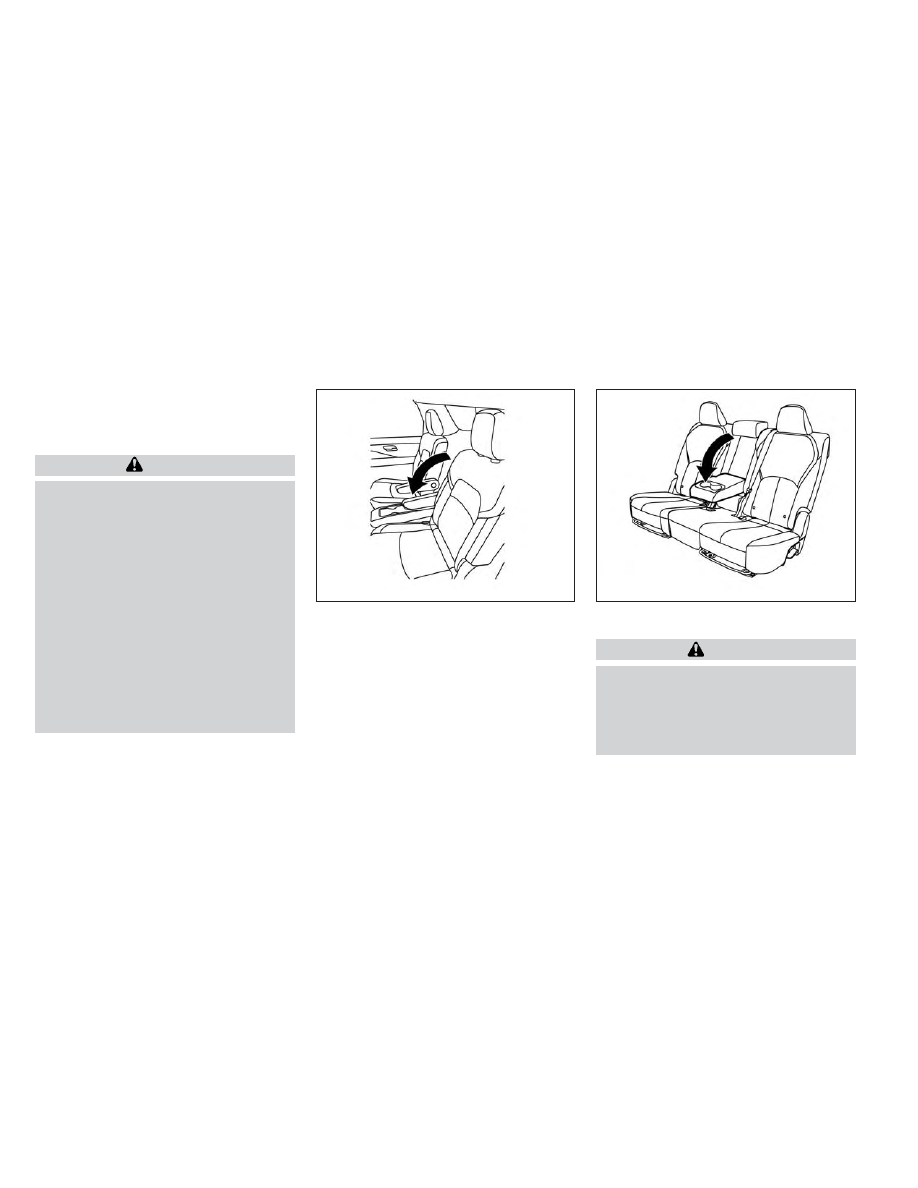
ARMRESTS

The 2nd row bench seat or the 2nd row
captain’s seats come equipped with arm-
rest(s). Pull the armrest down as shown.

FLEXIBLE SEATING

WARNING

Never allow anyone to ride in the cargo
area or on the rear seats when they are in
the fold-down position. In a collision,
people riding in these areas without
proper restraints are more likely to be
seriously injured or killed.

LRS3383

2nd row captain’s seats (if so equipped)

LRS3578

2nd row bench seats (if so equipped)

1-8

Safety-Seats, seat belts and supplemental restraint system

CarManuals2.com

-------------------------------------------------------------------------------------------------------------------------------------------------------------

When folding the bench seat seatback
down for maximum storage, make sure
the seat base is in the latched position by
rocking the seat base. If the seat base is
not properly secured, cargo stored on
top of a folded seatback may become a
projectile causing personal injury or ve-
hicle damage.

Do not allow people to ride in any area of
your vehicle that is not equipped with
seats and seat belts. Be sure everyone in
your vehicle is in a seat and using a seat
belt properly.

Do not allow more than one person to use
the same seat belt.

Do not fold down the rear seats when
occupants are in the rear seat area or any
luggage is on the rear seats.

Make sure that the seat path is clear

before moving the seat.

Be careful not to allow hands or feet

to get caught or pinched in the seat.

Head restraints/headrests should be ad-
justed properly as they may provide sig-
nificant protection against injury in an
accident. Always replace and adjust
them properly if they have been removed
for any reason.

If the head restraints/headrests are re-
moved for any reason, they should be se-
curely stored to prevent them from caus-
ing injury to passengers or damage to the
vehicle in case of sudden braking or an
accident.

When returning the seatbacks to the up-
right position, be certain they are com-
pletely secured in the latched position. If
they are not completely secured, passen-
gers may be injured in an accident or sud-
den stop.

Properly secure all cargo to help prevent
it from sliding or shifting. Do not place
cargo higher than the seatbacks. In a
sudden stop or collision, unsecured cargo
could cause personal injury.

CAUTION

When folding the 2nd row seat for maxi-
mum cargo holding, be sure that the
cargo does not contact the center con-
sole of the captain’s seat (if so equipped)
to avoid possible damage to the console.

When folding or returning the seat(s) to
the upright position, to avoid injury to
yourself and others:

Make sure that the seat path is clear

before moving the seat.

Be careful not to allow hands or feet

to get caught or pinched in the seat.

Safety-Seats, seat belts and supplemental restraint system

1-9

CarManuals2.com

-------------------------------------------------------------------------------------------------------------------------------------------------------------

Folding the 2nd row seats

To fold the 2nd row seats flat for maximum
cargo hauling:

1. Make sure that the head restraints/

headrests are lowered or removed. To re-
move the head restraint/headrest, push
and hold the lock knob while moving the
head restraint/headrest in an upward di-
rection. Store the head restraint/headrest
properly so it is not loose in the vehicle.

2. Stow the 2nd row seat belts in the seat belt

hooks found on the sides of the vehicle.

3. Lift up on the recline lever on the side of

the outboard seats to fold the seatbacks
flat. The seatback will lock into place
when in cargo mode to optimize the load
floor.

4. To return the 2nd row seats to a seating

position, lift up on the recline lever on the
side of the outboard seats and push up on
the seatback until it latches in place.

3rd row manual folding seats

To fold the 3rd row seats flat for maximum
cargo capacity:

1. Pull the strap

O

A

to release the head

restraint/headrest forward.

2. Pull up on the latch

O

B

located in the

upper corner of each seatback and lower
the seatback forward over the seat base.

LRS3520

2nd row captain’s seats (if so equipped)

LRS3452

2nd row bench seats (if so equipped)

LRS3543

1-10

Safety-Seats, seat belts and supplemental restraint system

CarManuals2.com

-------------------------------------------------------------------------------------------------------------------------------------------------------------

Manual operation to return the 3rd row seats
to a seating position (if so equipped):

1. Use the pull straps

O

C

to raise each seat-

back. Pull back until the seatback latches
into position.

Make sure to properly raise

each seatback to an upright and secured
position.

2. Do not use the pull strap to return the

head restraint/headrest to the upright
position. Pull back on the head restraint/
headrest until it latches in the upright
position.

Power operation to return the 3rd row seats
to a seating position (if so equipped):

1. Push and hold the corresponding switch

O

D

located on the left side in the cargo

area.

A beep sounds once and the seatback will be
returned automatically.

A beep sounds twice when the seatback is
fully returned to the seating position.

If the control unit detects any obstacle or
malfunctions while in the power operation, a
beep sounds for 4 seconds and the seatback
will return to the folded position automati-
cally. Check if there are any obstacles caught
that prevent seats from returning to the
folded position. It is recommended that you
visit an INFINITI retailer if the beep still
sounds.

CAUTION

When operating the 3rd row power seat-
back return, make sure that the vehicle is
stopped and the transmission is in the P
(Park) position.

WARNING

When the seat is returned to the normal
seating position, the head restraints/
headrests must be returned to the up-
right position to properly protect vehicle
occupants.

Never allow anyone to ride in the cargo
area or on the 3rd row seats when they
are in the fold-down position. In a colli-
sion, people riding in these areas are
more likely to be seriously injured or
killed.

LRS3420

Safety-Seats, seat belts and supplemental restraint system

1-11

CarManuals2.com

-------------------------------------------------------------------------------------------------------------------------------------------------------------

Do not allow people to ride in any area of
your vehicle that is not equipped with
seats and seat belts. Be sure everyone in
your vehicle is in a seat and using a seat
belt properly.

Do not fold down the 3rd row seats when
occupants are in the 3rd row seat area or
any luggage is on the 3rd row seats.
– Make sure that the seat path is clear
before moving the seat.
– Be careful not to allow hands or feet to
get caught or pinched in the seat.

Properly secure all cargo to help prevent
it from sliding or shifting. Do not place
cargo higher than the seatbacks. In a
sudden stop or collision, unsecured cargo
could cause personal injury.

WARNING

Head restraints/headrests supplement the
other vehicle safety systems. They may
provide additional protection against in-
jury in certain rear end collisions. Adjust-
able head restraints/headrests must be
adjusted properly, as specified in this sec-
tion. Check the adjustment after someone
else uses the seat. Do not attach anything
to the head restraint/headrest stalk, ex-
cept for genuine INFINITI accessories spe-
cifically tested for use with the vehicle’s
head restraint/headrest stalk. Do not re-
move the head restraint/headrest. Do not
use the seat if the head restraint/headrest
has been removed. If the head restraint/
headrest was removed, reinstall and prop-
erly adjust the head restraint/headrest
before an occupant uses the seating posi-
tion. Failure to follow these instructions
can reduce the effectiveness of the head
restraints/headrests. This may increase
the risk of serious injury or death in a
collision.

The illustration shows the seating positions
equipped with head restraints/headrests.

Indicates the seating position is equipped

with a head restraint.

쮿

Indicates the seating position is equipped

with a headrest.
• Adjustable head restraints/headrests have

multiple notches along the stalk(s) to lock
them in a desired adjustment position.

• The

non-adjustable

head

restraints/

headrests have a single locking notch to
secure them to the seat frame.

LRS3414

Captain’s seats (if so equipped)

HEAD RESTRAINTS/HEADRESTS

1-12

Safety-Seats, seat belts and supplemental restraint system

CarManuals2.com

-------------------------------------------------------------------------------------------------------------------------------------------------------------

• Proper Adjustment:

– For the adjustable type, align the head

restraint/headrest so the center of your
ear is approximately level with the center
of the head restraint/headrest.

– If your ear position is still higher than the

recommended alignment, place the head
restraint/headrest at the highest position.

• If the head restraint/headrest has been re-

moved, ensure that it is reinstalled and
locked in place before riding in that desig-
nated seating position.

ADJUSTABLE HEAD
RESTRAINT/HEADREST
COMPONENTS

1. Removable head restraint/headrest

2. Multiple notches

3. Lock knob

4. Stalks

NON-ADJUSTABLE HEAD
RESTRAINT/HEADREST
COMPONENTS

1. Removable head restraint/headrest

2. Single notch

3. Lock knob

4. Stalks

LRS3415

Bench seats (if so equipped)

LRS2300

LRS2299

Type A (if so equipped)

Safety-Seats, seat belts and supplemental restraint system

1-13

CarManuals2.com

-------------------------------------------------------------------------------------------------------------------------------------------------------------

REMOVE

Use the following procedure to remove the
head restraint/headrest:

1. Pull the head restraint/headrest up to the

highest position.

2. Push and hold the lock knob.

3. Remove the head restraint/headrest from

the seat.

4. Store the head restraint/headrest prop-

erly in a secure place so it is not loose in
the vehicle.

5. Reinstall and properly adjust the head

restraint/headrest before an occupant
uses the seating position.

LRS3391

Type B (if so equipped)

LRS2302

1-14

Safety-Seats, seat belts and supplemental restraint system

CarManuals2.com

-------------------------------------------------------------------------------------------------------------------------------------------------------------

INSTALL

1. Align the head restraint/headrest stalks

with the holes in the seat. Make sure that
the head restraint/headrest is facing the
correct direction. The stalk with the notch
(notches)

O

1

must be installed in the hole

with the lock knob

O

2

.

2. Push and hold the lock knob and push the

head restraint/headrest down.

3. Properly

adjust

the

head

restraint/

headrest before an occupant uses the
seating position.

ADJUST

For adjustable head restraint/headrest

Adjust the head restraint/headrest so the
center is level with the center of your ears.
If your ear position is still higher than the
recommended alignment, place the head
restraint/headrest at the highest position.

For non-adjustable head restraint/headrest

Make sure the head restraint/headrest is po-
sitioned so the lock knob is engaged in the
notch before riding in that designated seating
position.

LRS2303

WRS0134

LRS2351

Safety-Seats, seat belts and supplemental restraint system

1-15

CarManuals2.com

-------------------------------------------------------------------------------------------------------------------------------------------------------------

Raise

To raise the head restraint/headrest, pull it
up.

Make sure the head restraint/headrest is po-
sitioned so the lock knob is engaged in the
notch before riding in that designated seating
position.

Lower

To lower, push and hold the lock knob and
push the head restraint/headrest down.

Make sure the head restraint/headrest is po-
sitioned so the lock knob is engaged in the
notch before riding in that designated seating
position.

FOLDING HEAD
RESTRAINT/HEADREST

To fold the head restraint/headrest, pull the
strap located on the rear of the head
restraint/headrest.

If the head restraint/headrest has been
folded, make sure that it is returned to the
upright position.

Make sure the head restraint/headrest is po-
sitioned so the lock knobs are engaged in the
notches before riding in that designated
seating position.

LRS2305

LRS2306

LRS2307

1-16

Safety-Seats, seat belts and supplemental restraint system

CarManuals2.com

-------------------------------------------------------------------------------------------------------------------------------------------------------------

WARNING

When the seat is returned to the normal
seating position, the head restraint/
headrest must be returned to the upright
position

to

properly

protect

vehicle

occupants.

PRECAUTIONS ON SEAT BELT
USAGE

If you are wearing your seat belt properly
adjusted and you are sitting upright and well
back in your seat with both feet on the floor,
your chances of being injured or killed in a
collision and/or the severity of injury may be
greatly reduced. INFINITI strongly encour-
ages you and all of your passengers to buckle
up every time you drive, even if your seating
position includes a supplemental air bag.

Most U.S. states and Canadian provinces or
territories specify that seat belts be worn at
all times when a vehicle is being driven.

SSS0136

SEAT BELTS

Safety-Seats, seat belts and supplemental restraint system

1-17

CarManuals2.com

-------------------------------------------------------------------------------------------------------------------------------------------------------------

WARNING

Every person who drives or rides in this
vehicle should use a seat belt at all times.
Children should be in the rear seats and in
an appropriate restraint.

WARNING

The seat belt should be properly adjusted
to a snug fit. Failure to do so may reduce
the effectiveness of the entire restraint
system and increase the chance or sever-
ity of injury in an accident. Serious injury
or death can occur if the seat belt is not
worn properly.

SSS0134

SSS0016

1-18

Safety-Seats, seat belts and supplemental restraint system

CarManuals2.com

-------------------------------------------------------------------------------------------------------------------------------------------------------------

WARNING

Always route the shoulder belt over your
shoulder and across your chest. Never
put the belt behind your back, under your
arm or across your neck. The belt should
be away from your face and neck, but not
falling off your shoulder.

Position the lap belt as low and snug as
possible AROUND THE HIPS, NOT THE
WAIST. A lap belt worn too high could
increase the risk of internal injuries in an
accident.

Be sure the seat belt tongue is securely
fastened to the proper buckle.

Do not wear the seat belt inside out or
twisted. Doing so may reduce its
effectiveness.

Do not allow more than one person to use
the same seat belt.

Never carry more people in the vehicle
than there are seat belts.

If the seat belt warning light glows con-
tinuously or chime continues while the
ignition is turned on with all doors closed
and all seat belts fastened, it may indi-
cate a malfunction in the system. Have
the system checked. It is recommended
that you visit an INFINITI retailer for this
service.

No changes should be made to the seat
belt system. For example, do not modify
the seat belt, add material, or install de-
vices that may change the seat belt rout-
ing or tension. Doing so may affect the
operation of the seat belt system. Modi-
fying or tampering with the seat belt
system may result in serious personal
injury.

Once the seat belt pretensioner(s) have
activated, they cannot be reused and
must be replaced together with the re-
tractor. It is recommended that you visit
an INFINITI retailer for this service.

All seat belt assemblies, including retrac-
tors and attaching hardware, should be
inspected after any collision. It is recom-
mended that you visit an INFINITI re-
tailer for this service. INFINITI recom-
mends that all seat belt assemblies in use
during a collision be replaced unless the
collision was minor and the belts show no
damage and continue to operate prop-
erly. Seat belt assemblies not in use dur-
ing a collision should also be inspected
and replaced if either damage or im-
proper operation is noted.

All child restraints and attaching hard-
ware should be inspected after any colli-
sion. Always follow the restraint manu-
facturer's inspection instructions and
replacement

recommendations.

The

child restraints should be replaced if they
are damaged.

SSS0014

Safety-Seats, seat belts and supplemental restraint system

1-19

CarManuals2.com

-------------------------------------------------------------------------------------------------------------------------------------------------------------

SEAT BELT WARNING LIGHT
AND CHIME

Both the driver's and passenger's front seats
are equipped with a seat belt warning light
and chime. The warning light, located on the
instrument panel, will show the status of the
driver and passenger seat belt.

NOTE:

The front passenger seat belt warning light
will not light up if the seat is not occupied.
The 2nd and 3rd row seats may also be
equipped with a seat belt reminder.

For additional information, see “Warning
lights, indicator lights and audible reminders”
(P. 2-12).

PREGNANT WOMEN

INFINITI recommends that pregnant women
use seat belts. The seat belt should be worn
snug and always position the lap belt as low as
possible around the hips, not the waist. Place
the shoulder belt over your shoulder and across
your chest. Never run the lap/shoulder belt
over your abdominal area. Contact your doctor
for specific recommendations.

INJURED PERSONS

INFINITI recommends that injured persons
use seat belts. Check with your doctor for
specific recommendations.

PRE-CRASH SEAT BELTS WITH
COMFORT FUNCTION (front
seats) (if so equipped)

The pre-crash seat belt tightens the seat belt
with a motor to help restrain front seat occu-
pants. This helps reduce the risk of injury in a
collision.

The motor retracts the seat belt under the
following emergency conditions:
• During emergency braking.
• During sudden steering maneuvers.
• Activation of the Forward Emergency

Braking (FEB) with Pedestrian Detection
system (if so equipped). For additional in-
formation, see “Forward Emergency Brak-
ing (FEB) with Pedestrian Detection sys-
tem” (P. 5-128).

• In the event of certain types of rollover

collisions.

The pre-crash seat belt will not be active
when:
• The seat belt is not fastened.
• The vehicle speed is under 10 mph (15 km/h)

during emergency braking.

• The vehicle speed is under 19 mph (30 km/h)

during sudden steering maneuvers.

The pre-crash seat belt will not be active
when the brake pedal is not depressed except
when sudden steering maneuvers occur and
the Forward Emergency Braking (FEB) with
Pedestrian Detection system (if so equipped)
activates.

LRS0786

1-20

Safety-Seats, seat belts and supplemental restraint system

CarManuals2.com

-------------------------------------------------------------------------------------------------------------------------------------------------------------

The motor also retracts the seat belt when
the seat belt is fastened or unfastened. When
the seat belt is fastened, the motor tightens
the seat belt for a snug fit. When the seat belt
is unfastened, the motor retracts the seat
belt. If the seat belt is not fully retracted, the
motor retracts the seat belt when the door is
opened.

Always wear your seat belt correctly and sit
upright and well back.

If the motor cannot retract the seat belt when
the seat belt is fastened or unfastened, it may
indicate the pre-crash seat belt system has a
malfunction. It is recommended that you visit
an INFINITI retailer to check and repair the
system.

When the seat belt is retracted repeatedly in
a short period of time, the motor may not be
able to retract the seat belt. After a few
minutes, the motor reactivates and retracts
the seat belt. If the seat belt still cannot be
retracted by the motor, the pre-crash seat
belt system has a malfunction. It is recom-
mended that you visit an INFINITI retailer to
check and repair the system.

THREE-POINT TYPE SEAT BELT
WITH RETRACTOR

WARNING

Every person who drives or rides in this
vehicle should use a seat belt at all times.
Children should be in the rear seats and in
an appropriate restraint.

Do not ride in a moving vehicle when the
seatback is reclined. This can be danger-
ous. The shoulder belt will not be against
your body. In an accident, you could be
thrown into it and receive neck or other
serious injuries. You could also slide un-
der the lap belt and receive serious inter-
nal injuries.

For the most effective protection when
the vehicle is in motion, the seat should
be upright. Always sit well back and up-
right in the seat with both feet on the
floor and adjust the seat belt properly.

Do not allow children to play with the
seat belts. Most seating positions are
equipped with Automatic Locking Re-
tractor (ALR) mode seat belts. If the seat
belt becomes wrapped around a child’s
neck with the ALR mode activated, the
child can be seriously injured or killed if
the seat belt retracts and becomes tight.
This can occur even if the vehicle is
parked. Unbuckle the seat belt to release
the child. If the seat belt cannot be un-
buckled or is already unbuckled, release
the child by cutting the seat belt with a
suitable tool (such as a knife or scissors)
to release the seat belt.

Fastening the seat belts

1. Adjust the seat. For additional informa-

tion, see “Seats” (P. 1-2).

Safety-Seats, seat belts and supplemental restraint system

1-21

CarManuals2.com

-------------------------------------------------------------------------------------------------------------------------------------------------------------

2. Slowly pull the seat belt out of the retrac-

tor and insert the tongue into the buckle

O

A

until you hear and feel the latch

engage.

The retractor is designed to lock during
a sudden stop or on impact. A slow pull-
ing motion permits the seat belt to
move and allows you some freedom of
movement in the seat.

If the seat belt cannot be pulled from its
fully retracted position, firmly pull the
belt and release it. Then smoothly pull
the belt out of the retractor.

3. Position the lap belt portion

low and snug

on the hips

O

B

as shown.

4. Pull the shoulder belt portion toward the

retractor to take up extra slack

O

C

. Be sure

the shoulder belt is routed over your
shoulder and across your chest.

The front passenger seat and the rear seating
positions three-point seat belts have two
modes of operation:
• Emergency Locking Retractor (ELR)
• Automatic Locking Retractor (ALR)

The ELR mode allows the seat belt to extend
and retract to allow the driver and passen-
gers some freedom of movement in the seat.
The ELR locks the seat belt when the vehicle
slows down rapidly or during certain impacts.

The ALR mode (child restraint mode) locks
the seat belt for child restraint installation.

When the ALR mode is activated, the seat
belt cannot be extended again until the seat
belt tongue is detached from the buckle and
fully retracted. The seat belt returns to the
ELR mode after the seat belt fully retracts.
For additional information, see “Child re-
straints” (P. 1-28).

The ALR mode should be used only for child
restraint installation. During normal seat
belt use by an occupant, the ALR mode
should not be activated. If it is activated, it
may cause uncomfortable seat belt tension.
It can also change the operation of the front
passenger air bag. For additional informa-
tion, see “Front passenger air bag and status
light” (P. 1-65).

LRS2674

LRS2675

1-22

Safety-Seats, seat belts and supplemental restraint system

CarManuals2.com

-------------------------------------------------------------------------------------------------------------------------------------------------------------

WARNING

When fastening the seat belts, be certain
that the seatbacks are completely secured
in the latched position. If they are not com-
pletely secured, passengers may be injured
in an accident or sudden stop.

Unfastening the seat belts

To unfasten the seat belt, press the button on
the buckle

O

1

. The seat belt automatically

retracts.

Checking seat belt operation

Seat belt retractors are designed to lock seat
belt movement by two separate methods:
• When the seat belt is pulled quickly from

the retractor.

• When the vehicle slows down rapidly.

To increase your confidence in the seat belts,
check the operation as follows.
• Grasp the shoulder belt and pull forward

quickly. The retractor should lock and re-
strict further belt movement.

If the retractor does not lock during this
check, get the system checked. It is recom-
mended that you visit an INFINITI retailer for
this service, or to learn more about seat belt
operation.

WRS0139

Safety-Seats, seat belts and supplemental restraint system

1-23

CarManuals2.com

-------------------------------------------------------------------------------------------------------------------------------------------------------------

Shoulder belt height adjustment
(front seats)

The shoulder belt anchor height should be
adjusted to the position best for you. For
additional information, see “Precautions on
seat belt usage” (P. 1-17).

To adjust, push the button

O

A

and then move

the shoulder belt anchor to the desired posi-
tion so that the belt passes over the center of
the shoulder. The belt should be away from
your face and neck, but not falling off of your
shoulder. Release the adjustment button to
lock the shoulder belt anchor into position.

WARNING

After adjustment, release the adjust-
ment button and try to move the shoul-
der belt anchor up and down to make
sure it is securely fixed in position.

The shoulder belt anchor height should
be adjusted to the position best for you.
Failure to do so may reduce the effec-
tiveness of the entire restraint system
and increase the chance or severity of
injury in an accident.

The shoulder belt should rest on the
middle of the shoulder. It must not rest
against the neck.

Be sure that the seat belt is not twisted
in any way.

Be sure that the shoulder belt anchor is
secured by trying to move the shoulder belt
anchor up and down after adjustment.

Seat belt hook

When the seat belt is not in use and when
folding down the rear seats, hook the rear
seat belts on the seat belt hooks.

SEAT BELT EXTENDERS

If, because of body size or driving position, it
is not possible to properly fit the lap/shoulder
belt and fasten it, an extender that is compat-
ible with the installed seat belts is available
for purchase. The extender adds approxi-
mately 8 in (200 mm) of length and may be
used for all seating positions.

SSS0896

A

Shoulder belt height adjust button

LRS3448

2nd row

1-24

Safety-Seats, seat belts and supplemental restraint system

CarManuals2.com

-------------------------------------------------------------------------------------------------------------------------------------------------------------

Seat belt extenders are available for the:
• Driver and front passenger seating position
• 2nd and 3rd row seating position

It is recommended that you visit an INFINITI
retailer for assistance with purchasing an ex-
tender if an extender is required.

WARNING

Only INFINITI seat belt extenders, made
by the same company which made the
original equipment seat belts, should be
used with INFINITI seat belts.

Adults and children who can use the
standard seat belt should not use an ex-
tender. Such unnecessary use could re-
sult in serious personal injury in the event
of an accident.

Never use seat belt extenders to install
child restraints. If the child restraint is
not secured properly, the child could be
seriously injured or killed in a collision or
a sudden stop.

SEAT BELT MAINTENANCE

To clean the seat belt webbing,

apply a

mild soap solution or any solution recom-
mended for cleaning upholstery or carpet.
Then wipe with a cloth and allow the seat
belts to dry in the shade. Do not allow the
seat belts to retract until they are com-
pletely dry.

If dirt builds up in the shoulder belt guide of
the seat belt anchors,

the seat belts may

retract slowly. Wipe the shoulder belt guide
with a clean, dry cloth.

Periodically check to see that the seat belt
and the metal components,

such as buck-

les, tongues, retractors, flexible wires and
anchors, work properly. If loose parts, de-
terioration, cuts or other damage on the
webbing is found, the entire seat belt as-
sembly should be replaced.

WARNING

Do not allow children to play with the seat
belts. Most seating positions are equipped
with Automatic Locking Retractor (ALR)
mode seat belts. If the seat belt becomes
wrapped around a child’s neck with the
ALR mode activated, the child can be seri-
ously injured or killed if the seat belt re-
tracts and becomes tight. This can occur
even if the vehicle is parked. Unbuckle the
seat belt to release the child. If the seat belt
cannot be unbuckled or is already unbuck-
led, release the child by cutting the seat
belt with a suitable tool (such as a knife or
scissors) to release the seat belt.

Children need adults to help protect them.
They need to be properly restrained.

In addition to the general information in this
manual, child safety information is available
from many other sources, including doctors,
teachers, government traffic safety offices,
and community organizations. Every child is
different, so be sure to learn the best way to
transport your child.

CHILD SAFETY

Safety-Seats, seat belts and supplemental restraint system

1-25

CarManuals2.com

-------------------------------------------------------------------------------------------------------------------------------------------------------------

There are three basic types of child restraint
systems:
• Rear-facing child restraint
• Forward-facing child restraint
• Booster seat

The proper restraint depends on the child's
size. Generally, infants up to about 1 year and
less than 20 lbs. (9 kg) should be placed in
rear-facing child restraints. Forward-facing
child restraints are available for children who
outgrow rear-facing child restraints and are
at least 1 year old. Booster seats are used to
help position a vehicle lap/shoulder belt on a
child who can no longer use a forward-facing
child restraint.

WARNING

Infants and children need special protec-
tion. The vehicle's seat belts may not fit
them properly. The shoulder belt may come
too close to the face or neck. The lap belt
may not fit over their small hip bones. In an
accident, an improperly fitting seat belt
could cause serious or fatal injury. Always
use appropriate child restraints.

All U.S. states and Canadian provinces or
territories require the use of approved child
restraints for infants and small children. For
additional information, see “Child restraints”
(P. 1-28).

A child restraint may be secured in the vehicle
by using either the LATCH (Lower Anchor
and Tethers for CHildren) system or with the
vehicle seat belt. For additional information,
see “Child restraints” (P. 1-28).

INFINITI recommends that all pre-teens and
children be restrained in the rear seats.
Studies show that children are safer when
properly restrained in a rear seat than in the
front seat.

This is especially important because your
vehicle has a supplemental restraint system
(air bag system) for the front passenger.
For additional information, see “Child re-
straints” (P. 1-28) 
and “Supplemental Re-
straint System (SRS)” (P. 1-54).

INFANTS

Infants up to at least 1 year old should be
placed in a rear-facing child restraint.
INFINITI recommends that infants be placed
in child restraints that comply with Federal
Motor Vehicle Safety Standards or Canadian
Motor Vehicle Safety Standards. You should
choose a child restraint that fits your vehicle
and always follow the manufacturer's in-
structions for installation and use.

SMALL CHILDREN

Children that are over 1 year old and weigh at
least 20 lbs. (9 kg) should remain in a rear-
facing child restraint as long as possible up to
the height or weight limit of the child re-
straint. Children who outgrow the height or
weight limit of the rear-facing child restraint
and are at least 1 year old should be secured
in a forward-facing child restraint with a har-
ness. Refer to the manufacturer’s instructions
for minimum and maximum weight and
height recommendations. INFINITI recom-
mends that small children be placed in child
restraints that comply with Federal Motor
Vehicle Safety Standards or Canadian Motor
Vehicle Safety Standards. You should choose
a child restraint that fits your vehicle and
always follow the manufacturer’s instruc-
tions for installation and use.

1-26

Safety-Seats, seat belts and supplemental restraint system

CarManuals2.com

-------------------------------------------------------------------------------------------------------------------------------------------------------------

LARGER CHILDREN

Children should remain in a forward-facing
child restraint with a harness until they reach
the maximum height or weight limit allowed
by the child restraint manufacturer.

Once a child outgrows the height or weight
limit of the harness-equipped forward-facing
child restraint, INFINITI recommends that
the child be placed in a commercially available
booster seat to obtain proper seat belt fit. For
a seat belt to fit properly, the booster seat
should raise the child so that the shoulder belt
is properly positioned across the chest and
the top, middle portion of the shoulder. The
shoulder belt should not cross the neck or
face and should not fall off the shoulder. The
lap belt should lie snugly across the lower hips
or upper thighs, not the abdomen. A booster
seat can only be used in seating positions that
have a three-point type seat belt. The
booster seat should fit the vehicle seat and
have a label certifying that it complies with
Federal Motor Vehicle Safety Standards or
Canadian Motor Vehicle Safety Standards.
Once the child has grown so the shoulder belt
is no longer on or near the face and neck and
the lap belt can be positioned properly across
the lower hips or upper thighs, use the seat
belt without the booster seat.

A booster seat should be used until the child
can pass the seat belt fit test below:
• Are the child’s back and hips against the

vehicle seatback?

• Is the child able to sit without slouching?
• Do the child’s knees bend easily over the

front edge of the seat with feet flat on the
floor?

• Can the child safely wear the seat belt (lap

belt low and snug across the hips and
shoulder

belt

across

mid-chest

and

shoulder)?

• Is the child able to use the properly adjusted

head restraint/headrest?

• Will the child be able to stay in position for

the entire ride?

If you answered no to any of these questions,
the child should remain in a booster seat us-
ing a three-point type seat belt.

NOTE:

Laws in some communities may follow dif-
ferent guidelines. Check local and state
regulations to confirm your child is using the
correct restraint system before traveling.

LRS2690

Safety-Seats, seat belts and supplemental restraint system

1-27

CarManuals2.com

-------------------------------------------------------------------------------------------------------------------------------------------------------------

WARNING

Never let a child stand or kneel on any seat
and do not allow a child in the cargo area.
The child could be seriously injured or killed
in a sudden stop or collision.

PRECAUTIONS ON CHILD
RESTRAINTS

WARNING

Failure to follow the warnings and in-
structions for proper use and installation
of child restraints could result in serious
injury or death of a child or other passen-
gers in a sudden stop or collision:

The child restraint must be used and
installed properly. Always follow all
of the child restraint manufacturer's
instructions for installation and use.

Infants and children should never be
held on anyone's lap. Even the stron-
gest adult cannot resist the forces of
a collision.

Do not put a seat belt around both a
child and another passenger.

INFINITI recommends that all child re-
straints be installed in the rear seat.
Studies show that children are safer
when properly restrained in the rear
seat than in the front seat. If you must
install a forward-facing child restraint
in the front seat, see “Forward-facing
child restraint installation using the
seat belts” (P. 1-45).

ARS1098

ARS1098

CHILD RESTRAINTS

1-28

Safety-Seats, seat belts and supplemental restraint system

CarManuals2.com

-------------------------------------------------------------------------------------------------------------------------------------------------------------

Even with the INFINITI Advanced Air
Bag System, never install a rear-
facing child restraint in the front seat.
An inflating air bag could seriously in-
jure or kill a child. A rear-facing child
restraint must only be used in the rear
seat.

Be sure to purchase a child restraint
that will fit the child and vehicle.
Some child restraints may not fit
properly in your vehicle.

Child restraint anchorages are de-
signed to withstand only those loads
imposed by correctly fitted child re-
straints. Under no circumstances are
they to be used to attach adult seat
belts, or other items or equipment to
the vehicle. Doing so could damage
the child restraint anchorages. The
child restraint will not be properly in-
stalled using the damaged anchorage,
and a child could be seriously injured
or killed in a collision.

Never use the anchor points for adult
seat belts, or other items.

A child restraint with a top tether
strap should not be used in the front
passenger seat.

Keep seatbacks as upright as possible
after fitting the child restraint.

Infants and children should always be
placed in an appropriate child re-
straint while in the vehicle.

When the child restraint is not in use,
keep it secured with the LATCH system
or a seat belt. In a sudden stop or colli-
sion, loose objects can injure occupants
or damage the vehicle.

CAUTION

A child restraint in a closed vehicle can
become very hot. Check the seating sur-
face and buckles before placing a child in
the child restraint.

2nd row one touch function should not
be used when a child restraint is
occupied.

The 2nd row one touch button is enabled
when the vehicle is stopped. If the button
is pressed the seat will unlatch and may
move.

To prevent personal injury supervise
children occupying the 2nd and 3rd rows
and prevent them from operating child
seat access mode.

This vehicle is equipped with a universal child
restraint anchor system, referred to as the
LATCH (Lower Anchors and Tethers for
CHildren) system. Some child restraints in-
clude rigid or webbing-mounted attachments
that can be connected to these anchors. For
additional information, see “LATCH (Lower
Anchors and Tethers for CHildren) system”
(P. 1-30).

If you do not have a LATCH compatible child
restraint, the vehicle seat belts can be used.

WRS0256

Safety-Seats, seat belts and supplemental restraint system

1-29

CarManuals2.com

-------------------------------------------------------------------------------------------------------------------------------------------------------------

Several manufacturers offer child restraints
for infants and children of various sizes.
When selecting any child restraint, keep the
following points in mind:
• Choose only a restraint with a label certify-

ing that it complies with Federal Motor
Vehicle Safety Standard 213 or Canadian
Motor Vehicle Safety Standard 213.

• Check the child restraint in your vehicle to

be sure it is compatible with the vehicle's
seat and seat belt system.

• If the child restraint is compatible with your

vehicle, place your child in the child restraint
and check the various adjustments to be sure
the child restraint is compatible with your
child. Choose a child restraint that is de-
signed for your child's height and weight.
Always follow all recommended procedures.

• If the combined weight of the child and

child restraint is less than 65 lbs. (29.5 kg),
you may use either the LATCH anchors or
the seat belt to install the child restraint (not
both at the same time).

• If the combined weight of the child and

child restraint is greater than 65 lbs. (29.5
kg), use the vehicle’s seat belt (not the lower
anchors) to install the child restraint.

• Be sure to follow the child restraint manu-

facturer’s instructions for installation.

All U.S. states and Canadian provinces or
territories require that infants and small
children be restrained in an approved child
restraint at all times while the vehicle is be-
ing operated. Canadian law requires the top
tether strap on forward-facing child re-
straints be secured to the designated anchor
point on the vehicle.

LATCH (Lower Anchors and
Tethers for CHildren) SYSTEM

Your vehicle is equipped with special anchor
points that are used with LATCH system
compatible child restraints. This system may
also be referred to as the ISOFIX or ISOFIX
compatible system. With this system, you do
not have to use a vehicle seat belt to secure
the child restraint unless the combined
weight of the child and child restraint exceeds
65 lbs. (29.5 kg). If the combined weight of
the child and child restraint is greater than
65 lbs. (29.5 kg), use the vehicle's seat belt

LRS3363

LATCH system lower anchor locations -

captain’s seats (if so equipped)

1-30

Safety-Seats, seat belts and supplemental restraint system

CarManuals2.com

-------------------------------------------------------------------------------------------------------------------------------------------------------------

(not the lower anchors) to install the child
restraint. Be sure to follow the child restraint
manufacturer's instructions for installation.

The LATCH lower anchor points are provided
to install child restraints in the following po-
sitions only:
• 2nd row bench seats (if so equipped)
• 2nd row captain’s seats (if so equipped)
• 3rd row driver’s side seating position

LATCH lower anchor

WARNING

Failure to follow the warnings and instruc-
tions for proper use and installation of child
restraints could result in serious injury or
death of a child or other passengers in a
sudden stop or collision:

Attach LATCH system compatible child
restraints only at the locations shown in
the illustration.

Do not secure a child restraint in the 2nd
row center position and 2nd row driver’s
side seating position at the same time.

Inspect the lower anchors by inserting
your fingers into the lower anchor area.
Feel to make sure there are no obstruc-
tions over the anchors such as seat belt
webbing or seat cushion material. The
child restraint will not be secured prop-
erly if the lower anchors are obstructed.

Child restraint anchorages are designed
to withstand only those loads imposed
by correctly fitted child restraints. Under
no circumstances are they to be used to
attach adult seat belts, or other items or
equipment to the vehicle. Doing so could
damage the child restraint anchorages.
The child restraint will not be properly
installed using the damaged anchorages,
and a child could be seriously injured or
killed in a collision.

LRS3378

LATCH system lower anchor locations -

bench seat (if so equipped)

Safety-Seats, seat belts and supplemental restraint system

1-31

CarManuals2.com

-------------------------------------------------------------------------------------------------------------------------------------------------------------

LATCH lower anchor location

The LATCH lower anchors are located as
shown. A label is attached to the seatback to
help you locate the LATCH lower anchors.

LRS3036

LATCH lower anchor location

LRS3375

LATCH label locations 2nd row captain’s

seats (if so equipped)

LRS3376

LATCH label locations 2nd row bench seat

(if so equipped)

1-32

Safety-Seats, seat belts and supplemental restraint system

CarManuals2.com

-------------------------------------------------------------------------------------------------------------------------------------------------------------

LATCH in the center 2nd row
seating position (if so equipped)

A 5th LATCH anchor can be found between
the outboard LATCH anchor pairs. It is spe-
cifically designed to be used together with
the inboard LATCH anchor on the driver’s
side, in order to install a Child Restraint Sys-
tem (CRS) in the 2nd row center seating po-
sition. Do not use the 5th LATCH anchor in
combination with an anchor other than the
driver’s side inboard LATCH anchor.

These anchors utilize standard LATCH an-
chor spacing,

O

A

of 11.02 in (280 mm).

WARNING

Never attach two CRS attachments to
the same LATCH anchor. This may over-
load the anchor in a collision, which could
increase the risk of the occupant’s seri-
ous injury or death.

When installing the CRS in the center
2nd row seating position with the in-
board LATCH anchors, be careful to en-
sure any occupant or CRS in the out-
board seating positions is properly
restrained using the vehicle seat belt and
there is no interference with the center
CRS installation. If the outboard occu-
pants cannot be properly restrained,
consider using the vehicle seat belt to
restrain the CRS in the center seating
position, or moving the CRS to another
position instead.

LRS3513

LATCH label locations 3rd row driver’s

seating position

LRS3372

Safety-Seats, seat belts and supplemental restraint system

1-33

CarManuals2.com

-------------------------------------------------------------------------------------------------------------------------------------------------------------

When installing the CRS in the 2nd row
seating position, use the seat back re-
cline feature to align the left and right
sides of the seat back, creating one
evenly reclined surface. Never install a
CRS in the center seating position when
one part of the seat back is further re-
clined than the other. This may create an
unstable surface on which to install the
CRS. Failure to evenly recline the seat
backs before CRS installation could in-
crease the risk of the occupant’s serious
injury or death. Remember to re-check
that the CRS is properly installed any
time the seats are reclined or adjusted.

LRS3373

OK

LRS3374

NG (the seat back recline is not aligned)

1-34

Safety-Seats, seat belts and supplemental restraint system

CarManuals2.com

-------------------------------------------------------------------------------------------------------------------------------------------------------------

Installing child restraint LATCH
lower anchor attachments

LATCH compatible child restraints include
two rigid or webbing-mounted attachments
that can be connected to two anchors lo-
cated at certain seating positions in your ve-
hicle. With this system, you do not have to
use a vehicle seat belt to secure the child
restraint. Check your child restraint for a label
stating that it is compatible with LATCH. This
information may also be in the instructions
provided by the child restraint manufacturer.

When installing a child restraint, carefully
read and follow the instructions in this
manual and those supplied with the child
restraint.

Top tether anchor

WARNING

Do not allow cargo to contact the top
tether strap when it is attached to the
top tether anchor. Properly secure the
cargo so it does not contact the top
tether strap. Cargo that is not properly
secured or cargo that contacts the top
tether strap may damage it during a col-
lision. A child could be seriously injured or
killed in a collision if the top tether strap
is damaged.

Child restraint anchorages are designed
to withstand only those loads imposed
by correctly fitted child restraints. Under
no circumstances are they to be used to
attach adult seat belts, or other items or
equipment to the vehicle. Doing so could
damage the child restraint anchorages.
The child restraint will not be properly
installed using the damaged anchorages,
and a child could be seriously injured or
killed in a collision.

LRS0661

LATCH webbing-mounted attachment

LRS0662

LATCH rigid-mounted attachment

Safety-Seats, seat belts and supplemental restraint system

1-35

CarManuals2.com

-------------------------------------------------------------------------------------------------------------------------------------------------------------

Top tether anchor point locations

1

Top tether strap

2

Anchor point

Anchor points are located in the following
locations:
• 2nd row bench seat (if so equipped) on the

seatback in the seating positions shown.

• 2nd row captain’s seat (if so equipped) on the

seatback in the seating positions shown.

• 3rd row bench on the seatback in the seat-

ing positions as shown.

If you have any questions when installing a
top tether strap, it is recommended that you
visit an INFINITI retailer for this service.

LRS3040

2nd row bench seat (if so equipped)

LRS3417

2nd row captain’s seats (if so equipped)

LRS3544

3rd row bench seat

1-36

Safety-Seats, seat belts and supplemental restraint system

CarManuals2.com

-------------------------------------------------------------------------------------------------------------------------------------------------------------

REAR-FACING CHILD
RESTRAINT INSTALLATION
USING LATCH

WARNING

Child restraint anchorages are designed to
withstand only those loads imposed by
correctly fitted child restraints. Under no
circumstances are they to be used to attach
adult seat belts, or other items or equip-
ment to the vehicle. Doing so could damage
the child restraint anchorages. The child re-
straint will not be properly installed using
the damaged anchorages, and a child could
be seriously injured or killed in a collision.

For additional information, see “Child safety”
(P. 1-25) and “Child restraints” (P. 1-28) for all
Warnings and Cautions before installing a
child restraint.

Do not use the lower anchors if the combined
weight of the child and the child restraint
exceeds 65 lbs. (29.5 kg). If the combined
weight of the child and the child restraint is
greater than 65 lbs. (29.5 kg), use the vehi-
cle's seat belt (not the lower anchors) to in-
stall the child restraint. Be sure to follow the
child restraint manufacturer's instructions for
installation.

Follow these steps to install a rear-facing
child restraint in the 2nd row seats using the
LATCH system:

1. Position the child restraint on the seat.

Always follow the child restraint manu-
facturer's instructions.

2. Secure the child restraint anchor attach-

ments to the LATCH lower anchors.
Check to make sure the LATCH attach-
ment is properly attached to the lower
anchors.

LRS2997

Rear-facing webbing-mounted – step 2

Safety-Seats, seat belts and supplemental restraint system

1-37

CarManuals2.com

-------------------------------------------------------------------------------------------------------------------------------------------------------------

3. For child restraints that are equipped with

webbing-mounted attachments, remove
any additional slack from the anchor at-
tachments. Press downward and rear-
ward firmly in the center of the child re-
straint with your hand to compress the
vehicle seat cushion and seatback while
tightening the webbing of the anchor
attachments.

4. After attaching the child restraint, test it

before you place the child in it. Push it
from side to side while holding the child
restraint near the LATCH attachment
path. The child restraint should not move
more than 1 inch (25 mm), from side to
side. Try to tug it forward and check to see
if the LATCH attachment holds the re-
straint in place. If the restraint is not se-
cure, tighten the LATCH attachment as
necessary, or put the restraint in another
seat and test it again. You may need to try
a different child restraint or try installing

LRS2996

Rear-facing rigid-mounted – step 2

LRS0673

Rear-facing – step 3

LRS0674

Rear-facing – step 4

1-38

Safety-Seats, seat belts and supplemental restraint system

CarManuals2.com

-------------------------------------------------------------------------------------------------------------------------------------------------------------

by using the vehicle seat belt (if appli-
cable). Not all child restraints fit in all types
of vehicles.

5. Check to make sure the child restraint is

properly secured prior to each use. If the
child restraint is loose, repeat steps 2
through 4.

REAR-FACING CHILD
RESTRAINT INSTALLATION
USING THE SEAT BELTS

WARNING

The three-point seat belt with Automatic
Locking Retractor (ALR) must be used
when installing a child restraint. Failure to
use the ALR mode will result in the child
restraint not being properly secured. The
restraint could tip over or be loose and
cause injury to a child in a sudden stop or
collision.

For additional information, see “Child safety”
(P. 1-25) and “Child restraints” (P. 1-28) be-
fore installing a child restraint.

Do not use the lower anchors if the combined
weight of the child and the child restraint
exceeds 65 lbs. (29.5 kg). If the combined
weight of the child and the child restraint is
greater than 65 lbs. (29.5 kg), use the vehi-
cle's seat belt (not the lower anchors) to in-
stall the child restraint. Be sure to follow the
child restraint manufacturer's instructions for
installation.

Follow these steps to install a rear-facing
child restraint using the vehicle seat belts in
the rear seats:

1.

Child restraints for infants must be used
in the rear-facing direction and therefore
must not be used in the front seat.

Posi-

tion the child restraint on the seat. Always
follow the child restraint manufacturer’s
instructions.

WRS0256

Rear-facing – step 1

Safety-Seats, seat belts and supplemental restraint system

1-39

CarManuals2.com

-------------------------------------------------------------------------------------------------------------------------------------------------------------


Content      ..      1      2      3      ..