Infiniti QX55 (2023 year). Manual in english - page 12
 

  Index      Manuals     Infiniti QX55 (2023 year). Manual in english


Search            copyright infringement  


Content      ..     10      11      12      13     ..


Infiniti QX55 (2023 year). Manual in english - page 12


Snow chains are used.

Wheels or tires other than INFINITI

recommended are used.

The brakes are cold at low ambient

temperatures or immediately after
driving has started.

The braking force becomes poor due

to wet brakes after driving through a
puddle or washing the vehicle.

Turn the RAB system off in the following
conditions to prevent the occurrence of
an unexpected accident resulting from
sudden system operation:

The vehicle is towed.

The vehicle is carried on a flatbed

truck.

The

vehicle

is

on

the

chassis

dynamometer.

The vehicle drives on an uneven road

surface.

Suspension parts other than those

designated

as

Genuine

INFINITI

parts are used. (If the vehicle height
or the vehicle body inclination is
changed, the system may not detect
an obstacle correctly.)

If the vehicle is using an accessory like

a bike rack, or cargo carrier that
blocks the sensors.

Excessive noise (e.g., audio system vol-
ume, an open vehicle window) will inter-
fere with the chime sound, and it may not
be heard.

SYSTEM MALFUNCTION

If the RAB system malfunctions, it will be
turned off automatically, the RAB system
warning light will illuminate, and the “System
fault See Owner’s Manual” warning message
will appear in the vehicle information display.

Action to take

If the warning light illuminates, park the ve-
hicle in a safe location, turn the engine off,
and restart the engine. If the warning light
continues to illuminate, have the RAB system
checked. It is recommended that you visit an
INFINITI retailer for this service.

NOTE:

If the RAB system cannot be operated tem-
porarily, the RAB system warning light
blinks.

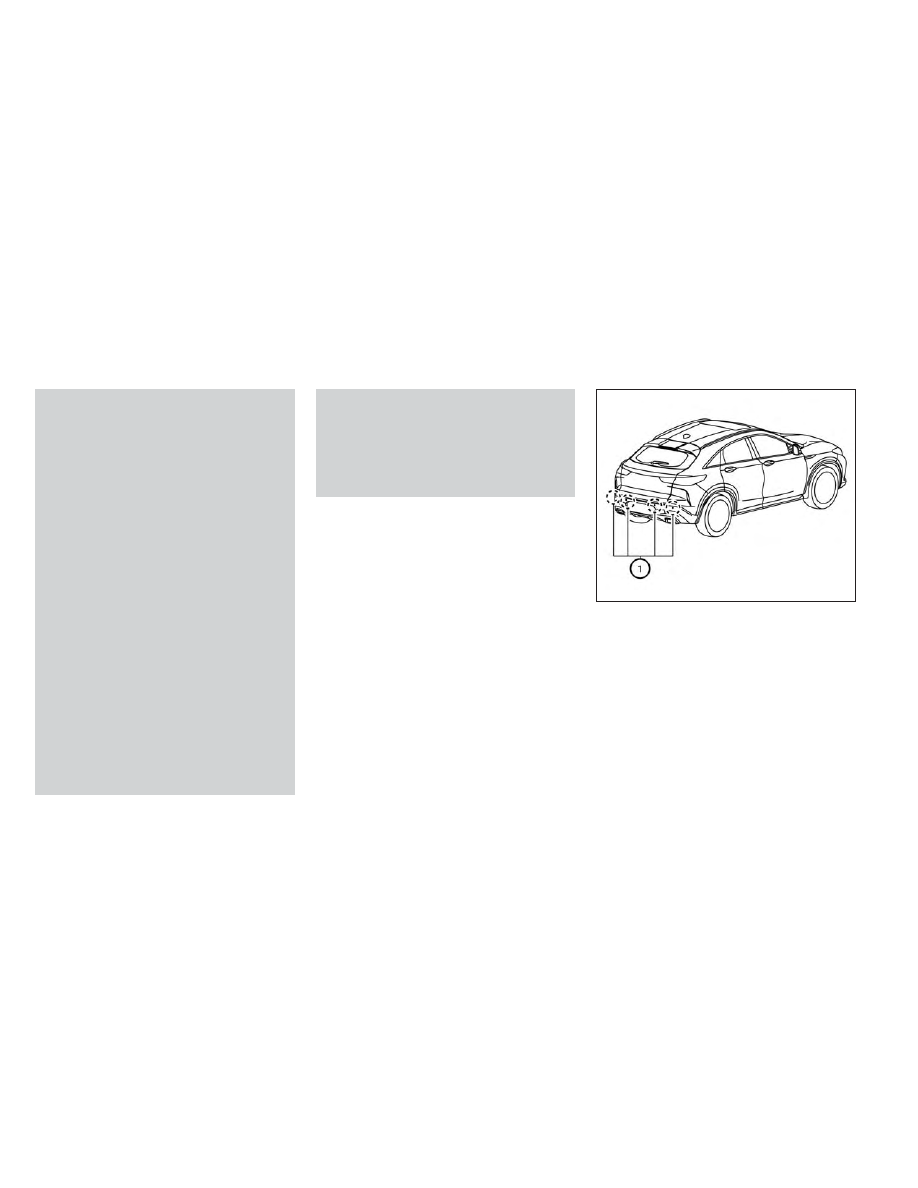
SYSTEM MAINTENANCE

Observe the following items to ensure proper
operation of the system:
• Always keep the parking sensors

O

1

clean.

• If the parking sensors are dirty, wipe them

off with a soft cloth while being careful to
not damage them.

• Do not subject the area around the parking

sensors

O

1

to strong impact. Also, do not

remove or disassemble the parking sensors.
If the parking sensors and peripheral areas
are deformed in an accident, etc., have the
sensors checked. It is recommended that
you visit an INFINITI retailer for this service.

LSD4097

5-108

Starting and driving

CarManuals2.com

-------------------------------------------------------------------------------------------------------------------------------------------------------------

• Do not install any stickers (including trans-

parent stickers) or accessories on the park-
ing sensors

O

1

and their surrounding areas.

This may cause a malfunction or improper
operation.

WARNING

Failure to follow the warnings and instruc-
tions for proper use of the FEB with Pedes-
trian Detection system could result in seri-
ous injury or death.

The FEB with Pedestrian Detection sys-
tem is a supplemental aid to the driver. It
is not a replacement for the driver’s at-
tention to traffic conditions or responsi-
bility to drive safely. It cannot prevent
accidents due to carelessness or danger-
ous driving techniques.

The FEB with Pedestrian Detection sys-
tem does not function in all driving, traf-
fic, weather and road conditions.

The FEB with Pedestrian Detection system
can assist the driver when there is a risk of a
forward collision with the vehicle ahead in the
traveling lane or with a pedestrian ahead in
the traveling lane.

The FEB with Pedestrian Detection system
uses a radar sensor

O

A

located on the front of

the vehicle to measure the distance to the
vehicle ahead in the same lane. For pedestri-
ans, the FEB with Pedestrian Detection sys-
tem uses a camera

O

B

installed behind the

windshield in addition to the radar sensor.

LSD4098

FORWARD EMERGENCY BRAKING
(FEB) WITH PEDESTRIAN
DETECTION SYSTEM

Starting and driving

5-109

CarManuals2.com

-------------------------------------------------------------------------------------------------------------------------------------------------------------

SYSTEM OPERATION

1. Vehicle ahead detection indicator

2. FEB with Pedestrian Detection emer-

gency warning indicator

3. FEB with Pedestrian Detection system

warning light

The FEB with Pedestrian Detection system
operates at speeds above approximately 3
mph (5 km/h). For the pedestrian detection
function, the FEB with Pedestrian Detection
system operates at speeds between 6 – 37
mph (10 – 60 km/h).

If a risk of a forward collision with a vehicle is
detected, the FEB with Pedestrian Detection
system will first provide a warning to the
driver by flashing the vehicle ahead detection
indicator and providing an audible alert. In
addition, the FEB with Pedestrian Detection
system pushes the accelerator pedal up, and
then the system applies partial braking. If the
driver applies the brakes quickly and force-
fully, but the FEB with Pedestrian Detection
system detects that there is still the possibility
of a forward collision, the system will auto-
matically increase the braking force.

If the risk of a collision becomes imminent
and the driver does not take action, the FEB
with Pedestrian Detection system issues the
second warning to the driver by flashing the
FEB with Pedestrian Detection emergency
warning indicator (red), providing an audible
warning, and then automatically applies
harder braking.

LSD2955

5-110

Starting and driving

CarManuals2.com

-------------------------------------------------------------------------------------------------------------------------------------------------------------

If a risk of a forward impact with a pedestrian
is detected, the FEB with Pedestrian Detec-
tion system will provide a warning to the
driver by flashing the FEB with Pedestrian
Detection emergency warning indicator (red),
provides an audible alert and the system will
apply partial baking. If the driver applies the
brakes quickly and forcefully but the FEB
with Pedestrian Detection system detects
that there is still the possibility of a forward
impact with a pedestrian, the system will au-
tomatically increase the braking force. If the
risk of collision becomes imminent and the
driver does not take action, the FEB with
Pedestrian Detection system automatically
applies harder braking.

NOTE:

The vehicle’s brake lights come on when any
braking is performed by the FEB with Pedes-
trian Detection system.

Depending on vehicle speed and distance to
the vehicle or pedestrian ahead, as well as
driving and roadway conditions, the system
may help the driver avoid a forward collision
or may help mitigate the consequences if a
collision should be unavoidable. If the driver is
handling the steering wheel, accelerating or
braking, the FEB with Pedestrian Detection
system will function later or will not function.

The automatic braking will cease under the
following conditions:
• When the steering wheel is turned to avoid

a collision.

• When the accelerator pedal is depressed.
• When there is no longer a vehicle or a pe-

destrian detected ahead.

If the FEB with Pedestrian Detection system
has stopped the vehicle, the vehicle will re-
main at a standstill for approximately 2 sec-
onds before the brakes are released.

Starting and driving

5-111

CarManuals2.com

-------------------------------------------------------------------------------------------------------------------------------------------------------------

TURNING THE FEB WITH
PEDESTRIAN DETECTION

SYSTEM ON/OFF

Perform the following steps to enable or dis-
able the FEB with Pedestrian Detection
system.

1. Press the MENU button below the lower

display screen.

2. Select “Driver Assistance.”

3. Select “Emergency Assist.”

4. Select “ON” to turn the “Forward” system

on or off.

When the FEB with Pedestrian Detection
system is turned off, the FEB with Pedestrian
Detection system warning light illuminates.

NOTE:

• The FEB with Pedestrian Detection sys-

tem will be automatically turned on when
the engine is restarted.

• The Predictive Forward Collision Warning

(PFCW) system (if so equipped) is inte-
grated into the FEB with Pedestrian De-
tection system. There is not a separate se-
lection in the lower display for the PFCW
system. When the FEB with Pedestrian
Detection is turned off, the PFCW system
is also turned off.

LSD3610

5-112

Starting and driving

CarManuals2.com

-------------------------------------------------------------------------------------------------------------------------------------------------------------

FEB WITH PEDESTRIAN
DETECTION SYSTEM
LIMITATIONS

WARNING

Listed below are the system limitations for
the FEB with Pedestrian Detection system.
Failure to operate the vehicle in accor-
dance with these system limitations could
result in serious injury or death.

The FEB with Pedestrian Detection sys-
tem cannot detect all vehicles or pedes-
trians under all conditions.

The FEB with Pedestrian Detection sys-
tem does not detect the following:

Pedestrians that are small (for ex-
ample, children), in a sitting position,
operating

toys/skateboards,

on

scooters or in wheelchairs, or not in
an upright standing or walking
position.

Animals of any size.

Obstacles (for examples, cargo or de-
bris) on the roadway or roadside.

Oncoming or crossing vehicles.

Vehicles where the tires are difficult
to see or the shape of the rear of the
vehicle is unclear or obstructed.

Parked vehicles.

The FEB with Pedestrian Detection sys-
tem has some performance limitations.

If a stationary vehicle is in the vehi-
cle’s path, the FEB with Pedestrian
Detection system will not function
when the vehicle approaches the sta-
tionary vehicle at speeds over ap-
proximately 50 mph (80 km/h).

Pedestrian detection will not func-
tion when the vehicle is driven at
speeds over approximately 37 mph
(60 km/h) or below approximately 6
mph (10km/h).

For pedestrians, the FEB with Pedes-
trian Detection system will not issue the
first warning.

The FEB with Pedestrian Detection sys-
tem may not function properly or detect
a vehicle or pedestrian ahead in the fol-
lowing conditions:

In poor visibility conditions (such as
rain, snow, fog, dust storms, sand
storms, smoke, and road spray from
other vehicles).

If dirt, ice, snow, fog or other material
is covering the radar sensor area or
camera area of windshield.

If strong light (for example, sunlight
or high beams) enters the front cam-
era or a sudden change in brightness
occurs (for example, entering a tun-
nel or driving in lightning).

In dark or dimly lit conditions, such as
at night or in tunnels, including cases
where your vehicle’s headlights are
off or dim, or the tail lights of the
vehicle ahead are off.

When the direction of the camera is
misaligned.

When driving on a steep downhill
slope, on roads with sharp curves,
and/or bumpy or dirt roads.

If there is interference by other radar
sources.

When your vehicle’s position or
movement is changed quickly or sig-
nificantly (for example, lane change,
turning vehicle, abrupt steering, sud-
den acceleration or deceleration).

When your vehicle or the vehicle or
pedestrian ahead moves quickly or
significantly such that the system
cannot detect and react in time (for
example, pedestrian moving quickly
toward the vehicle at close range, ve-
hicle cutting in, changing lanes, mak-
ing a turn, steering abruptly, sudden
acceleration or deceleration).

Starting and driving

5-113

CarManuals2.com

-------------------------------------------------------------------------------------------------------------------------------------------------------------

When the vehicle or pedestrian is off-
set from the vehicle’s forward path.

If the speed difference between the
two vehicles is small.

The pedestrian’s profile is partially
obscured or unidentifiable; for ex-
ample, due to transporting luggage,
pushing a stroller, wearing bulky or
very loose-fitting clothing or acces-
sories, or being in a unique posture
(such as raising hands).

There is poor contrast of a person to
the background, such as having
clothing color or pattern which is
similar to the background.

For approximately 15 seconds after
starting the engine.

If the vehicle ahead has a unique or
unusual shape, extremely low or high
clearance heights, or unusual cargo
loading or is narrow (for example, a
motorcycle).

When the vehicle or pedestrian is lo-
cated near a traffic sign, a reflective
area (for example, water on road), or
is in a shadow.

When

multiple

pedestrians

are

grouped together.

When the view of the pedestrian is
obscured by a vehicle or other object.

The system performance may be de-
graded in the following conditions:

The vehicle is driven on a slippery
road.

The vehicle is driven on a slope.

Excessively heavy baggage is loaded
in the rear seat or the cargo area of
your vehicle.

The system is designed to automatically
check the sensor’s (radar and camera)
functionality, within certain limitations.
The system may not detect some forms
of obstruction of the sensor area such as
ice, snow or stickers, for example. In
these cases, the system may not be able
to warn the driver properly. Be sure that
you check, clean and clear sensor areas
regularly.

In some road and traffic conditions, the
FEB with Pedestrian Detection system
may unexpectedly apply partial braking.
When acceleration is necessary, depress
the accelerator pedal to override the
system.

The FEB with Pedestrian Detection sys-
tem may operate when a pattern, object,
shadow or lights are detected that are
similar to the outline of vehicles or pe-
destrians, or if they are the same size and
position as a vehicle or motorcycle’s tail
lights.

The system may keep operating when
the vehicle ahead is turning right or left.

The system may operate when your ve-
hicle is approaching and passing a vehicle
ahead.

Depending on the road shape (curved
road, entrance and exit of the curve,
winding road, lane regulation, under
construction, etc.), the system may op-
erate temporarily for the oncoming ve-
hicle in front of your vehicle.

5-114

Starting and driving

CarManuals2.com

-------------------------------------------------------------------------------------------------------------------------------------------------------------

WARNING

Listed below are the system limitations for
the FEB with Pedestrian Detection system.
Failure to operate the vehicle in accor-
dance with these system limitations could
result in serious injury or death.

The FEB with Pedestrian Detection sys-
tem may react to:

objects on the roadside (traffic sign,
guardrail, pedestrian, motorcycle,
vehicle, etc.)

pedestrians when driving on the nar-
row alleys, etc.

pedestrians who temporarily pro-
trude into or approaching the driving
lane to avoid the obstacles on the
road shoulder

objects above road (low bridge, traf-
fic sign, etc.)

objects on the road surface (railroad
track, grate, steel plate, etc.)

objects in the parking garage (beam,
pillar, etc.)

pedestrians

or

motorcycles

ap-

proaching the travelling lane

vehicles, pedestrians, motorcycles or
objects in adjacent lanes or close to
the vehicle

oncoming pedestrians

objects on the road (such as trees)

Braking distances increase on slippery
surfaces.

Excessive noise will interfere with the
warning chime sound, and the chime may
not be heard.

LSD4248

Starting and driving

5-115

CarManuals2.com

-------------------------------------------------------------------------------------------------------------------------------------------------------------

When driving on some roads, such as wind-
ing, hilly, curved, narrow roads, or roads
which are under construction, the sensor may
detect vehicles in a different lane, or may
temporarily not detect a vehicle traveling
ahead. This may cause the system to work
inappropriately.

The detection of vehicles may also be af-
fected by vehicle operating (steering maneu-
ver or traveling position in the lane, etc.) or
vehicle condition. If this occurs, the system
may warn you by blinking the system indica-
tor and sounding the chime unexpectedly.
You will have to manually control the proper
distance away from the vehicle traveling
ahead.

SSD0253

5-116

Starting and driving

CarManuals2.com

-------------------------------------------------------------------------------------------------------------------------------------------------------------

SYSTEM TEMPORARILY

UNAVAILABLE

Condition A:

In the following conditions, the FEB with Pe-
destrian Detection system warning light
blinks and the system will be turned off
automatically.
• The radar sensor picks up interference from

another radar source.

• The camera area of the windshield is

misted or frozen.

• Strong light is shining from the front.
• The cabin temperature is over approxi-

mately 104°F (40°C) in direct sunlight.

• The camera area of the windshield glass is

continuously covered with dirt, etc.

Action to take

When the above conditions no longer exist,
the FEB with Pedestrian Detection system
will resume automatically.

NOTE:

When the inside of the windshield or camera
area is misted or frozen, it will take a period
of time to remove it after A/C turns ON. If
dirt appears on this area have it checked. It is
recommended that you visit an INFINITI re-
tailer for this service.

LSD3920

Starting and driving

5-117

CarManuals2.com

-------------------------------------------------------------------------------------------------------------------------------------------------------------

Condition B:

In the following conditions, the FEB with Pe-
destrian Detection system warning light will
illuminate, the system will be turned off au-
tomatically and the “Forward Driving Aids
temporarily disabled Front Sensor blocked
See Owner’s Manual” warning message will
appear in the vehicle information display.
• The sensor area of the front bumper is

covered with dirt or is obstructed.

Action to take

If the warning light (orange) comes on, stop
the vehicle in a safe place, place press the
park button to engage the P (Park) position
and turn the engine off. Clean the radar sen-
sor area of the front bumper or the camera
area of the windshield with a soft cloth, and
restart the engine. If the warning light contin-
ues to illuminate, have the FEB with Pedes-
trian Detection system checked. It is recom-
mended that you visit an INFINITI retailer for
this service.

When driving on roads with limited road
structures or buildings (for example, long
bridges, deserts, snow fields, driving next to
long walls).

Action to take

When the above conditions no longer exist,
the FEB with pedestrian detection system
will resume automatically.

NOTE:

If the FEB with Pedestrian Detection system
stops working, the PFCW system (if so
equipped) will also stop working.

SYSTEM MALFUNCTION

If the FEB with Pedestrian Detection system
malfunctions, it will be turned off automati-
cally, a chime will sound, the FEB with Pedes-
trian Detection system warning light (orange)
will illuminate and the warning message
[Malfunction] will appear in the vehicle infor-
mation display.

Action to take

If the warning light (orange) comes on, stop
the vehicle in a safe location, turn the engine
off and restart the engine. If the warning light
continues to illuminate, have the FEB with
Pedestrian Detection system checked. It is
recommended that you visit an INFINITI re-
tailer for this service.

NOTE:

If the FEB with Pedestrian Detection system
stops working, the PFCW system (if so
equipped) will also stop working.

5-118

Starting and driving

CarManuals2.com

-------------------------------------------------------------------------------------------------------------------------------------------------------------

SYSTEM MAINTENANCE

The radar sensor

O

A

is located on the front of

the vehicle. The camera

O

B

is located on the

upper side of the windshield.
To keep the FEB with Pedestrian Detection
system operating properly, be sure to ob-
serve the following:
• Always keep sensor areas of the front

bumper and windshield clean.

• Do not strike or damage the areas around

the sensors (ex. Bumper, windshield).

• Do not cover or attach stickers, or install

any accessory near the sensors. This could
block sensor signals, and/or cause failure
or malfunction.

• Do not attach metallic objects near the ra-

dar sensor (brush guard, etc.). This could
cause failure or malfunction.

• Do not place reflective materials, such as

white paper or a mirror, on the instrument
panel. The reflection of sunlight may ad-
versely affect the camera unit's detection
capability.

• Do not alter, remove or paint the front

bumper. Before customizing or restoring
the front bumper, it is recommended that
you visit an INFINITI retailer.

Radio frequency statement

For USA/Canada

Model: ARS4–A

IC: 4135A-ARS4A

FCC ID: OAYARS4A

This device complies with Part 15 of the FCC
Rules and with Industry Canada licence-
exempt RSS standard(s). Operation is subject
to the following two conditions: (1) This de-
vice may not cause interference, and (2) this
device must accept any interference, includ-
ing interference that may cause undesired
operation of the device.

Le présent appareil est conforme aux CNR
d'Industrie Canada applicables aux appareils
radio exempts de licence. L'exploitation est
autorisée aux deux conditions suivantes: (1)
L'appareil ne doit pas produire de brouillage,
et (2) l'utilisateur de l'appareil doit accepter
tout brouillage radioélectrique subi, même si
le brouillage est susceptible d'en comprom-
ettre le fonctionnement.

Radio

Frequency

Radiation

Exposure

Information:

This equipment complies with FCC and IC
radiation exposure limits set forth for an un-
controlled environment.

This equipment should be installed and oper-
ated with minimum distance of 30 cm be-
tween the radiator and your body.

This transmitter must not be co-located or
operating in conjunction with any other an-
tenna or transmitter.

Cet équipment est conforme aux limites
d’exposition aux rayonnements IC établies
pour un environnement non contrôlé. Cet
équipment doit étre installé et utilisé avec un
minimum de 30 cm de distance entre la
source de rayonnnement et votre corps.

LSD4098

Starting and driving

5-119

CarManuals2.com

-------------------------------------------------------------------------------------------------------------------------------------------------------------

FCC Notice

Changes or modifications not expressly ap-
proved by the party responsible for compli-
ance could void the user’s authority to oper-
ate the equipment.

WARNING

Failure to follow the warnings and instruc-
tions for proper use of the PFCW system
could result in serious injury or death.

The PFCW system can help warn the
driver before a collision occurs but will
not avoid a collision. It is the driver’s re-
sponsibility to stay alert, drive safely and
be in control of the vehicle at all times.

The PFCW system can help alert the driver
when there is a sudden braking of a second
vehicle traveling in front of the vehicle ahead
in the same lane.

The PFCW system uses a radar sensor

O

A

located on the front of the vehicle to measure
the distance to the vehicle ahead in the same
lane.

LSD4095

PREDICTIVE FORWARD COLLISION
WARNING (PFCW)

5-120

Starting and driving

CarManuals2.com

-------------------------------------------------------------------------------------------------------------------------------------------------------------

1. Vehicle ahead detection indicator

2. FEB with Pedestrian Detection system

warning light

LSD3921

Starting and driving

5-121

CarManuals2.com

-------------------------------------------------------------------------------------------------------------------------------------------------------------

PFCW SYSTEM OPERATION

The PFCW system operates at speeds above
approximately 3 mph (5 km/h).

If there is a potential risk of a forward colli-
sion, the PFCW system will warn the driver
by blinking the vehicle ahead detection indi-
cator, and sounding an audible alert.

LSD2263

5-122

Starting and driving

CarManuals2.com

-------------------------------------------------------------------------------------------------------------------------------------------------------------

TURNING THE PFCW SYSTEM

ON/OFF

Perform the following steps to turn the
PFCW system on or off.

1. Press the MENU button below the lower

display screen.

2. Select “Driver Assistance.”

3. Select “Emergency Assist.”

4. Select “ON” to turn the “Forward” system

on or off.

When the PFCW system is turned off, the
FEB with Pedestrian Detection system
warning light illuminates.

NOTE:

• The PFCW system will be automatically

turned on when the engine is restarted.

• The PFCW system (if so equipped) is inte-

grated into the FEB with Pedestrian De-
tection system. There is not a separate se-
lection in the lower display for the PFCW
system. When the FEB with Pedestrian
Detection is turned off, the PFCW system
is also turned off.

LSD3610

Starting and driving

5-123

CarManuals2.com

-------------------------------------------------------------------------------------------------------------------------------------------------------------

PFCW SYSTEM LIMITATIONS

LSD2312

Illustration A

5-124

Starting and driving

CarManuals2.com

-------------------------------------------------------------------------------------------------------------------------------------------------------------

WARNING

Listed below are the system limitations for
the PFCW system. Failure to operate the
vehicle in accordance with these system
limitations could result in serious injury or
death.

The PFCW system cannot detect all ve-
hicles under all conditions.

The radar sensor does not detect the fol-
lowing objects:

Pedestrians, animals or obstacles in
the roadway

Oncoming vehicles

Crossing vehicles

(Illustration A) The PFCW system does
not function when a vehicle ahead is a
narrow vehicle, such as a motorcycle.

The radar sensor may not detect a ve-
hicle ahead in the following conditions:

Snow or heavy rain.

Dirt, ice, snow or other material cov-
ering the radar sensor.

Interference by other radar sources.

Snow or road spray from traveling
vehicles.

Driving in a tunnel.

(Illustration B) When the vehicle
ahead is being towed.

(Illustration C) When the distance to
the vehicle ahead is too close, the
beam

of

the

radar

sensor

is

obstructed.

LSD2265

Illustration B

Starting and driving

5-125

CarManuals2.com

-------------------------------------------------------------------------------------------------------------------------------------------------------------

(Illustration D) When driving on a
steep downhill slope or roads with
sharp curves.

The system is designed to automatically
check the sensor’s functionality, within
certain limitations. The system may not
detect some forms of obstruction of the
sensor area such as ice, snow, stickers,
etc. In these cases, the system may not
be able to warn the driver properly. Be
sure that you check, clean and clear the
sensor area regularly.

Excessive noise will interfere with the
warning chime sound, and the chime may
not be heard.

5-126

Starting and driving

CarManuals2.com

-------------------------------------------------------------------------------------------------------------------------------------------------------------

LSD2266

Illustration C

Starting and driving

5-127

CarManuals2.com

-------------------------------------------------------------------------------------------------------------------------------------------------------------

LSD2313

Illustration D

5-128

Starting and driving

CarManuals2.com

-------------------------------------------------------------------------------------------------------------------------------------------------------------

SYSTEM TEMPORARILY

UNAVAILABLE

Condition A

When the radar sensor picks up interference
from another radar source, making it impos-
sible to detect a vehicle ahead, the PFCW
system is automatically turned off.

The FEB with Pedestrian Detection system
warning light (orange) will illuminate.

Action to take

When the above conditions no longer exist,
the PFCW system will resume automatically.

Condition B

When the sensor area of the front bumper is
covered with dirt or is obstructed, making it
impossible to detect a vehicle ahead, the
PFCW system is automatically turned off.

The FEB with Pedestrian Detection system
warning light (orange) will illuminate and the
“Forward Driving Aids temporarily disabled
Front Sensor blocked See Owner’s Manual”
warning message will appear in the vehicle
information display.

LSD3920

Starting and driving

5-129

CarManuals2.com

-------------------------------------------------------------------------------------------------------------------------------------------------------------

Action to take

If the warning light (orange) comes on, stop
the vehicle in a safe place, press the Park
button to place the vehicle in the P (Park)
position and turn the engine off. Clean the
radar cover on the lower grille with a soft
cloth, and restart the engine. If the warning
light continues to illuminate, have the PFCW
system checked. It is recommended that you
visit an INFINITI retailer for this service.
• When driving on roads with limited road

structures or buildings (for example, long
bridges, deserts, snow fields, driving next to
long walls).

Action to take:

When the above conditions no longer exist
the PFCW system will resume automatically

NOTE:

If the FEB with Pedestrian Detection system
stops working, the PFCW system (if so
equipped) will also stop working.

SYSTEM MALFUNCTION

If the PFCW system malfunctions, it will be
turned off automatically, a chime will sound,
the FEB with Pedestrian Detection system
warning light (orange) will illuminate and the
warning message [Malfunction] will appear
in the vehicle information display.

Action to take

If the warning light (orange) comes on, stop
the vehicle in a safe location, turn the engine
off and restart the engine. If the warning light
continues to illuminate, have the PFCW sys-
tem checked. It is recommended that you visit
an INFINITI retailer for this service.

SYSTEM MAINTENANCE

The sensor

O

A

is located on the front of the

vehicle.

To keep the system operating properly, be
sure to observe the following:
• Always keep the sensor area of the front

bumper clean.

• Do not strike or damage the areas around

the sensor.

• Do not cover or attach stickers or similar

objects on the front bumper near the sen-
sor area. This could cause failure or
malfunction.

LSD4095

5-130

Starting and driving

CarManuals2.com

-------------------------------------------------------------------------------------------------------------------------------------------------------------

• Do not attach metallic objects near the

sensor area (brush guard, etc.). This could
cause failure or malfunction.

• Do not alter, remove or paint the front

bumper. Before customizing or restoring
the front bumper, it is recommended that
you visit an INFINITI retailer.

For USA/Canada

Model: ARS4–A

IC: 4135A-ARS4A

FCC ID: OAYARS4A

This device complies with Part 15 of the FCC
Rules and with Industry Canada licence-
exempt RSS standard(s). Operation is subject
to the following two conditions: (1) This de-
vice may not cause interference, and (2) this
device must accept any interference, includ-
ing interference that may cause undesired
operation of the device.

Le présent appareil est conforme aux CNR
d'Industrie Canada applicables aux appareils
radio exempts de licence. L'exploitation est
autorisée aux deux conditions suivantes: (1)
L'appareil ne doit pas produire de brouillage,
et (2) l'utilisateur de l'appareil doit accepter
tout brouillage radioélectrique subi, même si
le brouillage est susceptible d'en comprom-
ettre le fonctionnement.

Radio

Frequency

Radiation

Exposure

Information:

This equipment complies with FCC and IC
radiation exposure limits set forth for an un-
controlled environment.

This equipment should be installed and oper-
ated with minimum distance of 30 cm be-
tween the radiator and your body.

This transmitter must not be co-located or
operating in conjunction with any other an-
tenna or transmitter.

Cet équipment est conforme aux limites
d’exposition aux rayonnements IC établies
pour un environnement non contrôlé. Cet
équipment doit étre installé et utilisé avec un
minimum de 30 cm de distance entre la
source de rayonnement et votre corps.

FCC Notice

Changes or modifications not expressly ap-
proved by the party responsible for compli-
ance could void the user’s authority to oper-
ate the equipment.

CAUTION

During the first 1,200 miles (2,000 km),
follow these recommendations to obtain
maximum engine performance and ensure
the future reliability and economy of your
new vehicle. Failure to follow these recom-
mendations may result in shortened engine
life and reduced engine performance.

• Avoid driving for long periods at constant

speed, either fast or slow, and do not run
the engine over 4,000 rpm.

• Do not accelerate at full throttle in any

gear.

• Avoid quick starts.
• Avoid hard braking as much as possible.

BREAK-IN SCHEDULE

Starting and driving

5-131

CarManuals2.com

-------------------------------------------------------------------------------------------------------------------------------------------------------------

Follow these easy-to-use Fuel Efficient Driv-
ing Tips to help you achieve the most fuel
economy from your vehicle.

1.

Use Smooth Accelerator and Brake Pedal
Application

• Avoid rapid starts and stops.
• Use smooth, gentle accelerator and

brake application whenever possible.

• Maintain constant speed while com-

muting and coast whenever possible.

2.

Maintain Constant Speed

• Look ahead to try and anticipate and

minimize stops.

• Synchronizing your speed with traffic

lights allows you to reduce your number
of stops.

• Maintaining a steady speed can mini-

mize red light stops and improve fuel
efficiency.

3.

Use Air Conditioning (A/C) at Higher Ve-
hicle Speeds

• Below 40 mph (64 km/h), it is more

efficient to open windows to cool the
vehicle due to reduced engine load.

• Above 40 mph (64 km/h), it is more

efficient to use A/C to cool the vehicle
due to increased aerodynamic drag.

• Recirculating the cool air in the cabin

when the A/C is on reduces cooling
load.

4.

Drive

at

Economical

Speeds

and

Distances

• Observing the speed limit and not ex-

ceeding 60 mph (97 km/h) (where le-
gally allowed) can improve fuel effi-
ciency due to reduced aerodynamic
drag.

• Maintaining a safe following distance

behind other vehicles reduces unneces-
sary braking.

• Safely monitoring traffic to anticipate

changes in speed permits reduced brak-
ing and smooth acceleration changes.

• Select a gear range suitable to road

conditions.

5.

Use Cruise Control

• Using cruise control during highway

driving helps maintain a steady speed.

• Cruise control is particularly effective in

providing fuel savings when driving on
flat terrains.

6.

Plan for the Shortest Route

• Utilize a map or navigation system to

determine the best route to save time.

7.

Avoid Idling

• Shutting off your engine when safe for

stops exceeding 30–60 seconds saves
fuel and reduces emissions.

8.

Buy an Automated Pass for Toll Roads

• Automated passes permit drivers to use

special lanes to maintain cruising speed
through the toll and avoid stopping and
starting.

9.

Winter Warm Up

• Limit idling time to minimize impact to

fuel economy.

• Vehicles typically need no more than 30

seconds of idling at start-up to effec-
tively circulate the engine oil before
driving.

• Your vehicle will reach its ideal operat-

ing temperature more quickly while driv-
ing versus idling.

10.

Keeping your Vehicle Cool

• Park your vehicle in a covered parking

area or in the shade whenever possible.

• When entering a hot vehicle, opening

the windows will help to reduce the in-
side temperature faster, resulting in re-
duced demand on your A/C system.

FUEL EFFICIENT DRIVING TIPS

5-132

Starting and driving

CarManuals2.com

-------------------------------------------------------------------------------------------------------------------------------------------------------------

• Keep your engine tuned up.
• Follow

the

recommended

scheduled

maintenance.

• Keep the tires inflated to the correct pres-

sure. Low tire pressure increases tire wear
and lowers fuel economy.

• Keep all the wheels in correct alignment.

Improper alignment increases tire wear and
lowers fuel economy.

• Use the recommended viscosity engine oil.

For additional information, see “Recom-
mended fluids/lubricants and capacities”
(P. 10-2).

If any malfunction occurs in the Intelligent
AWD system while the engine is running,
messages are displayed in the meter.

If the AWD error warning message is dis-
played, there may be a malfunction in the
Intelligent AWD system. Reduce vehicle
speed and have your vehicle checked as soon
as possible. It is recommended that you visit
an INFINITI retailer for this service.

The AWD high temperature message may be
displayed while trying to free a stuck vehicle
due to increased oil temperature. The driving
mode may change to 2-Wheel Drive (2WD).
If this message is displayed, stop the vehicle
with the engine idling, as soon as it is safe to
do so. Then if the message turns off, you can
continue driving.

LSD4249

LSD4250

INCREASING FUEL ECONOMY

INTELLIGENT ALL-WHEEL DRIVE
(AWD)

Starting and driving

5-133

CarManuals2.com

-------------------------------------------------------------------------------------------------------------------------------------------------------------

The tire size message may be displayed if
there is a large difference between the diam-
eters of front and rear wheels. Pull off the
road in a safe area, with the engine idling.
Check that all tire sizes are the same, that the
tire pressure is correct and that the tires are
not excessively worn.

If any warning messages continue to be dis-
played, have your vehicle checked as soon as
possible. It is recommended that you visit an
INFINITI retailer for this service.

WARNING

Do not drive beyond the performance ca-
pability of the tires. Accelerating quickly,
sharp steering maneuvers or sudden
braking may cause loss of control, even
with Intelligent AWD engaged.

For AWD equipped vehicles, do not at-
tempt to raise two wheels off the ground
and shift the transmission to any drive or
reverse position with the engine running.
Doing so may result in drivetrain damage
or unexpected vehicle movement which
could result in serious personal injury or
vehicle damage.

Do not attempt to test an AWD
equipped vehicle on a 2-wheel dyna-
mometer (such as the dynamometers
used by some states for emissions test-
ing) or similar equipment even if the
other two wheels are raised off the
ground. Make sure that you inform the
test facility personnel that your vehicle is
equipped with AWD before it is placed
on a dynamometer. Using the wrong test
equipment may result in drivetrain dam-
age or unexpected vehicle movement
which could result in serious personal in-
jury or vehicle damage.

CAUTION

Do not operate the engine on a free roller
when any of the wheels are raised.

If you use the free roller, rotate four
wheels with the same speed without
raising any wheels.

If an AWD warning message is displayed
while driving there may be a malfunction
in the AWD system. Reduce the vehicle
speed immediately and have your vehicle
checked as soon as possible. It is recom-
mended that you visit an INFINITI re-
tailer for this service.

The powertrain may be damaged if you
continue driving when the AWD tem-
perature or tire size incorrect messages
are displayed.

If the AWD high temperature message is
displayed while you are driving, pull off
the road in a safe area, and idle the en-
gine. The driving mode will change to
2WD to prevent the AWD system from
malfunctioning. If the warning message
turns off, you can drive again.

LSD4251

5-134

Starting and driving

CarManuals2.com

-------------------------------------------------------------------------------------------------------------------------------------------------------------

If the tire size incorrect message is dis-
played while you are driving, pull off the
road in a safe area with the engine idling.
Check that all tire sizes are the same,
that the tire pressure is correct and that
the tires are not excessively worn.

If a warning message continues to be dis-
played after the above operations, have
your vehicle checked as soon as possible.
It is recommended that you visit an
INFINITI retailer for this service.

WARNING

Do not stop or park the vehicle over
flammable materials such as dry grass,
waste paper or rags. They may ignite and
cause a fire.

Safe parking procedures require that
both the parking brake be set and the
transmission placed into P (Park). Fail-
ure to do so could cause the vehicle to
move unexpectedly or roll away and re-
sult in an accident. Make sure the shift
lever has been pushed as far forward as it
can go and cannot be moved without de-
pressing the foot brake pedal.

Never leave the engine running while the
vehicle is unattended.

Do not leave children unattended inside
the vehicle. They could unknowingly ac-
tivate switches or controls or make the
vehicle move. Unattended children could
become involved in serious accidents.

WSD0050

PARKING/PARKING ON HILLS

Starting and driving

5-135

CarManuals2.com

-------------------------------------------------------------------------------------------------------------------------------------------------------------

To help avoid risk of injury or death
through unintended operation of the ve-
hicle and/or its systems, do not leave
children, people who require the assis-
tance of others or pets unattended in
your vehicle. Additionally, the tempera-
ture inside a closed vehicle on a warm day
can quickly become high enough to cause
a significant risk of injury or death to
people and pets.

1. Apply the electronic parking brake.

2. Press the Park button to place the vehicle

in the P (Park) position.

3. To help prevent the vehicle from rolling

into traffic when parked on an incline, it is
a good practice to turn the wheels as
illustrated.

• HEADED DOWNHILL WITH CURB

O

A

:

Turn the wheels into the curb and move
the vehicle forward until the curb side
wheel gently touches the curb.

• HEADED UPHILL WITH CURB

O

B

:

Turn the wheels away from the curb and
move the vehicle back until the curb side
wheel gently touches the curb.

• HEADED UPHILL OR DOWNHILL,

NO CURB

O

C

:

Turn the wheels toward the side of the
road so the vehicle will move away from
the center of the road if it moves.

4. Place the ignition switch in the LOCK

position.

ELECTRIC POWER STEERING
TYPE

WARNING

If the engine is not running or is turned
off while driving, the power assist for the
steering will not work. Steering will be
harder to operate.

When the power steering warning light
illuminates with the engine running,
there will be no power assist for the
steering. You will still have control of the
vehicle, but the steering will be harder to
operate. Have the power steering sys-
tem checked. It is recommended that you
visit an INFINITI retailer for this service.

The power steering system is designed to
provide power assist while driving to operate
the steering wheel with light force.

When the steering wheel is operated repeat-
edly or continuously while parking or driving
at a very low speed, the power assist for the
steering wheel will be reduced. This is to pre-
vent overheating of the power steering sys-
tem and protect it from getting damaged.
While the power assist is reduced, steering
wheel operation will become heavy. When
the temperature of the power steering sys-
tem goes down, the power assist level will

POWER STEERING

5-136

Starting and driving

CarManuals2.com

-------------------------------------------------------------------------------------------------------------------------------------------------------------

return to normal. Avoid repeating such steer-
ing wheel operations that could cause the
power steering system to overheat.

You may hear a sound when the steering
wheel is operated quickly. However, this is
not a malfunction.

If the power steering warning light illumi-
nates while the engine is running, it may indi-
cate the power steering system is not func-
tioning properly and may need servicing.
Have the power steering system checked. It is
recommended that you visit an INFINITI re-
tailer for this service.

When the power steering warning light illu-
minates with the engine running, there will be
no power assist for the steering, but you will
still have control of the vehicle. At this time,
greater steering effort is required to operate
the steering wheel, especially in sharp turns
and at low speeds.

For additional information, see “Power steer-
ing warning light” (P. 2-16).

DIRECT ADAPTIVE STEERING®
TYPE

WARNING

When the power steering warning light
illuminates with the engine running, the
power assist for the steering will cease
operation. You will still have control of
the vehicle, but the steering will be
harder to operate.

If wheels or tires other than the INFINITI
recommended ones are used, Direct
Adaptive Steering® may not operate
properly and the power steering warning
light may illuminate.

Do not modify the vehicle’s suspension
parts such as shock absorbers, struts,
springs, stabilizer bars, bushings and
wheels are not INFINITI recommended
for your vehicle or are extremely deterio-
rated, Direct Adaptive Steering may not
operate properly and the power steering
warning light may illuminate.

Do not modify the vehicle’s steering. If
steering parts are not INFINITI recom-
mended for your vehicle or are extremely
deteriorated, Direct Adaptive Steering
may not operate properly and the power
steering warning light may illuminate.

If the Vehicle Dynamic Control (VDC)
OFF indicator light illuminates, the
power steering warning light may also
illuminate at the same time. Stop the ve-
hicle in a safe location, turn the engine
off and restart the engine. If the power
steering warning light continues to illu-
minate, have the system checked. It is
recommended that you visit an INFINITI
retailer for this service. For additional in-
formation, see “Vehicle Dynamic Control
(VDC) system” (P. 5-141).

CAUTION

Do not place the ignition switch in the
ON position while the steering wheel or a
tire is removed.

Do not turn the steering wheel as much
as possible while the ignition switch is
any position other than the ON position.

Installing an accessory on the steering
wheel, or changing the steering wheel,
may reduce the steering performance.

Direct Adaptive Steering is designed to con-
trol the steering force and steering angle ac-
cording to the vehicle speed and amount of
turning of the steering wheel.

Starting and driving

5-137

CarManuals2.com

-------------------------------------------------------------------------------------------------------------------------------------------------------------

The steering characteristic can be selected
using the INFINITI Drive Mode Selector. For
additional information, see “INFINITI Drive
Mode Selector” (P. 5-29).

If the VDC system is turned off, the setting of
steering becomes Standard mode.

If the power steering warning light illumi-
nates while the engine is running, it may indi-
cate that Direct Adaptive Steering is not
functioning properly and may need servicing.
Have the system checked. It is recommended
that you visit an INFINITI retailer for this
service. For additional information, see
“Power steering warning light” (P. 2-16)

When the power steering warning light illu-
minates with the engine running, the power
assist for the steering will cease operation.
You will still have control of the vehicle. How-
ever, greater steering effort will be needed,
especially in sharp turns and at low speeds.

If Direct Adaptive Steering is malfunctioning,
the steering wheel may turn slightly even
when driving on a straight road.

Under the following conditions, the steering
wheel may turn slightly even when driving on
a straight road. This is due to a protection
mechanism for Direct Adaptive Steering. The

steering wheel will return to the normal posi-
tion after the protection mechanism is
deactivated.

Condition A:

• When the engine is stalled or likely to be

stalled

• When the steering wheel is held in the full

lock position or when the front tire touches
an obstruction

• When the battery is discharged

To return the steering wheel to the normal
position, stop the vehicle in a safe location
and stop operating the steering wheel. Then
drive the vehicle for a short period of time.

Condition B:

• When the steering wheel is operated re-

peatedly or continuously while parking or
driving at a very low speed. In this case, the
power assist for the steering wheel will be
reduced.

To return the steering wheel to the normal
position, stop the vehicle in a safe location
and wait for a period of time, without oper-
ating the steering wheel, until the tempera-
ture of Direct Adaptive Steering cools down.
Avoid repeated steering wheel operations
that could cause Direct Adaptive Steering to
overheat.

When the vehicle is tested on the 2–wheel
dynamometer, the power steering warning
light may illuminate. To turn off the power
steering warning light, stop the vehicle in a
safe location, turn the engine off, restart the
engine, and then drive the vehicle for a period
of time.

The following conditions do not indicate a
malfunction of Direct Adaptive Steering:
• You may notice wider steering play when

the ignition switch is in the OFF or AUTO
ACC position compared to when it is in the
ON position.

• After the engine is started, the steering

wheel may turn slightly even when driving a
straight road. To return to the normal posi-
tion, drive the vehicle on a straight road for
a period of time.

• After the engine is started, the steering

wheel may move if the steering wheel was
turned to the fully locked position while the
ignition switch was in the OFF position.

• After the vehicle is tested on the 4–wheel

dynamometer, the steering wheel may turn
slightly even when driving on a straight
road. To return the steering wheel to the
normal position, drive the vehicle on a
straight road for a period of time.

5-138

Starting and driving

CarManuals2.com

-------------------------------------------------------------------------------------------------------------------------------------------------------------

You may hear a noise under the following
conditions. However, this is not a malfunc-
tion.
• When the engine is started or stopped.
• When the steering wheel is turned in the full

lock position.

The brake system has two separate hydraulic
circuits. If one circuit malfunctions, you will
still have braking at two wheels.

BRAKE PRECAUTIONS

Vacuum assisted brakes

The brake booster aids braking by using en-
gine vacuum. If the engine stops, you can
stop the vehicle by depressing the brake
pedal. However, greater foot pressure on the
brake pedal will be required to stop the ve-
hicle and stopping distance will be longer.

Using the brakes

Avoid resting your foot on the brake pedal
while driving. This will overheat the brakes,
wear out the brake pads faster, and reduce
gas mileage.

To help reduce brake wear and to prevent the
brakes from overheating, reduce speed and
downshift to a lower gear before going down
a slope or long grade. Overheated brakes
may reduce braking performance and could
result in loss of vehicle control.

WARNING

While driving on a slippery surface, be
careful when braking, accelerating or
downshifting. Abrupt braking or accel-
erating could cause the wheels to skid
and result in an accident.

If the engine is not running or is turned
off while driving, the power assist for the
brakes will not work. Braking will be
harder.

Wet brakes

When the vehicle is washed or driven through
water, the brakes may get wet. As a result,
your braking distance will be longer and the
vehicle may pull to one side during braking.

To dry the brakes, drive the vehicle at a safe
speed while lightly pressing the brake pedal
to heat up the brakes. Do this until the brakes
return to normal. Avoid driving the vehicle at
high

speeds

until

the

brakes

function

correctly.

BRAKE SYSTEM

Starting and driving

5-139

CarManuals2.com

-------------------------------------------------------------------------------------------------------------------------------------------------------------


Content      ..     10      11      12      13     ..