Infiniti QX55 (2023 year). Manual in english - page 8
 

  Index      Manuals     Infiniti QX55 (2023 year). Manual in english


Search            copyright infringement  


Content      ..     6      7      8      9     ..


Infiniti QX55 (2023 year). Manual in english - page 8


WARNING

Failure to follow the warnings and instruc-
tions for proper use of the sonar function
as outlined in this section could result in
serious injury or death.

The sonar is a convenience feature. It is
not a substitute for proper parking.

This function is designed as an aid to the
driver in detecting large stationary ob-
jects to help avoid damaging the vehicle.

The driver is always responsible for
safety

during

parking

and

other

maneuvers.

Always look around and check that it is
safe to move before parking.

Read and understand the limitations of
the sonar as contained in this section.

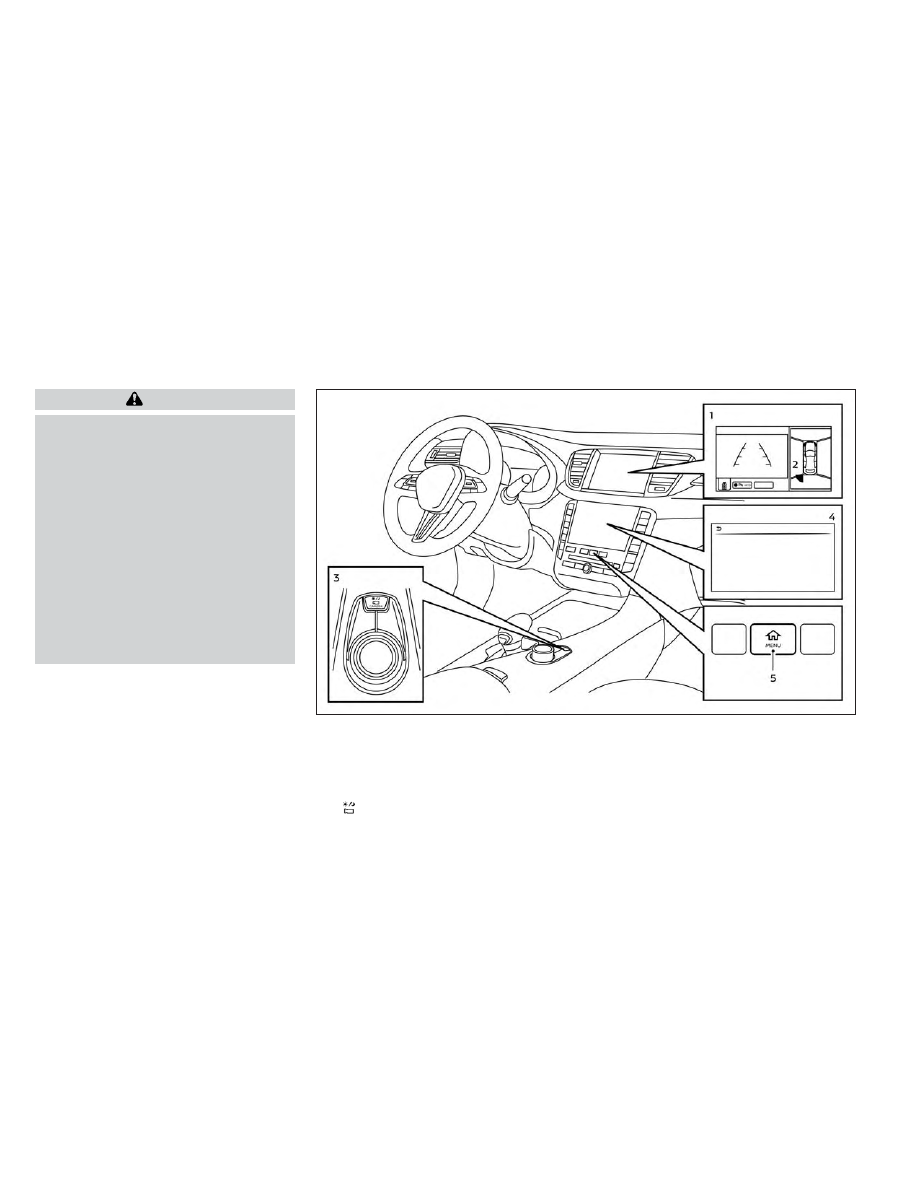
The sonar function helps to inform the driver
of large stationary objects around the vehicle
when parking by issuing an audible and visual
alert.

SONAR SYSTEM OPERATION

1. Upper

touch-screen

display

(upper

display)

2. Sonar indicator

3.

CAMERA button

4. Lower

touch-screen

display

(lower

display)

5. MENU button

The system gives the tone for front objects
when the shift lever is in the “D” (Drive) posi-
tion and both front and rear objects when the
shift lever is in the “R” (Reverse) position.

LHA5564

CAMERA AIDING SONAR (parking
sensor) (if so equipped)

4-24

Monitor, climate, audio, phone and voice recognition systems

CarManuals2.com

-------------------------------------------------------------------------------------------------------------------------------------------------------------

When the camera image is shown on the
upper display, the system shows the sonar
indicator regardless of the shift lever position.

The system is deactivated at speeds above 6
mph (10 km/h). It is reactivated at lower
speeds.

The colors of the sonar indicators and the
distance guide lines in the front, front-wide
and rear views indicate different distances to
the object.

When the objects are detected, the indicator
(green) appears and blinks and the tone
sounds intermittently. When the vehicle
moves closer to the object, the color of the
indicator turns yellow and the rate of the
blinking and the rate of the tone increase.
When the vehicle is very close to the object,
the indicator stops blinking and turns red, and
the tone sounds continuously.

The intermittent tone will stop after 3 sec-
onds when an object is detected by only the
corner sonar and the distance does not
change.

The tone will stop when the object is no
longer near the vehicle.

TURNING ON AND OFF THE
SONAR FUNCTION

When the “

” key

O

A

is selected, the

indicator

O

B

will turn off and the sonar will be

turned off temporarily. The Moving Object
Detection (MOD) system will also be turned
off at the same time. For additional informa-
tion, see “Moving Object Detection (MOD)”
(P. 4-27). When the “

” key

O

A

is selected

again, the indicator will turn on and the sonar
will turn back on.

In the below cases, the sonar will be turned
back on automatically:

• When the shift lever is placed in the “R”

(Reverse) position.

• When the

CAMERA button is pressed

and a screen other than the camera view is
shown on the display.

• When vehicle speed decreases below ap-

proximately 6 mph (10 km/h).

• When the ignition switch is placed in the

“OFF” position and turned back to the “ON”
position again.

To prevent the sonar system from activating
altogether, use the “Sonar” menu. For addi-
tional information, see “Sonar function set-
tings” (P. 4-26).

LHA5239

LHA5230

Monitor, climate, audio, phone and voice recognition systems

4-25

CarManuals2.com

-------------------------------------------------------------------------------------------------------------------------------------------------------------

Sonar function settings

To set up the sonar function to your preferred
settings, press the MENU button, touch the
“Settings” key, and then touch the “Parking
Sonar” key on the lower display.

Designs and items displayed on the screen
may vary depending on the models.

Auto Show Sonar Image:

When the sonar

detects an object while this item is turned on,
the Around View® Monitor will interrupt the
current view in the display to show the sur-
rounding area of the vehicle.

Front:

When this item is turned on, the front

sonar sensors are active and a sonar indicator

O

C

will appear at the corner of the vehicle to

inform the driver when an obstacle is near.
Another sonar indicator

O

D

may also appear

on either a side view and front view Around
View® Monitor screen to aid the driver when
an object is near.

Rear:

When this item is turned on, the rear

sonar sensors are active and a sonar indicator

O

C

will appear at the corner of the vehicle to

inform the driver when an obstacle is near.
Another sonar indicator

O

D

may also appear

on either a side view or front view Around
View® Monitor screen to aid the driver when
an object is near.

Distance:

Adjust the sensitivity level of the

sonar to “Short”, “Medium”, or “Long”.

Volume:

Adjust the volume of the buzzer to

“High”, “Medium”, or “Low”.

SONAR SYSTEM LIMITATIONS

For additional information, see “Sonar limita-
tions” (P. 5-151).

SYSTEM TEMPORARILY
UNAVAILABLE

For additional information, see “System tem-
porarily unavailable” (P. 5-152).

SYSTEM MAINTENANCE

For additional information, see “System
maintenance” (P. 5-152).

LHA5275

LHA5276

4-26

Monitor, climate, audio, phone and voice recognition systems

CarManuals2.com

-------------------------------------------------------------------------------------------------------------------------------------------------------------

1. Upper

touch-screen

display

(upper

display)

2. Lower

touch-screen

display

(lower

display)

3. MENU button

4.

CAMERA button

LHA5419

MOVING OBJECT DETECTION
(MOD) (if so equipped)

Monitor, climate, audio, phone and voice recognition systems

4-27

CarManuals2.com

-------------------------------------------------------------------------------------------------------------------------------------------------------------

WARNING

Failure to follow the warnings and in-
structions for proper use of the Moving
Object Detection system could result in
serious injury or death.

The MOD system is not a substitute for
proper vehicle operation and is not de-
signed to prevent contact with objects
surrounding the vehicle. When maneu-
vering, always use the outside mirrors
and rearview mirror and turn and check
the surroundings to ensure it is safe to
maneuver.

The system is deactivated at speeds
above 6 mph (10 km/h). It is reactivated
at lower speeds.

The MOD system is not designed to de-
tect surrounding stationary objects.

The MOD system can inform the driver of
moving objects near the vehicle when back-
ing out of garages, maneuvering in parking
lots and in other such instances.

The MOD system detects moving objects by
using image processing technology on the
image shown in the display.

MOD SYSTEM OPERATION

The MOD system will turn on automatically
under the following conditions:
• When the shift lever is in the R (Reverse)

position. When activating the Around
View® Monitor, the guide lines, the icons
and the messages may not be displayed
immediately.

• When the

CAMERA button is pressed

to activate the camera view on the display.

• When vehicle speed decreases below ap-

proximately 6 mph (10 km/h) and the cam-
era screen is shown in the upper display.

The MOD system operates in the following
conditions

when

the

camera

view

is

displayed:
• When the shift position is in the P (Park) or

N (Neutral) position and the vehicle is
stopped, the MOD system detects moving
objects in the bird’s-eye view. The MOD
system will not operate if the outside mir-
rors are moving in or out, in the stowed
position, or if either front door is opened.

LHA5241

Front and bird’s-eye views

4-28

Monitor, climate, audio, phone and voice recognition systems

CarManuals2.com

-------------------------------------------------------------------------------------------------------------------------------------------------------------

• When the shift lever is in the D (Drive) po-

sition and the vehicle speed is below ap-
proximately 6 mph (10 km/h), the MOD
system detects moving objects in the front
view or front-wide view.

• When the shift lever is in the R (Reverse)

position and the vehicle speed is below ap-
proximately 6 mph (10 km/h), the MOD
system detects moving objects in the rear
view. When activating the Around View®
Monitor, the guide lines, the icons and the
messages may not be displayed immedi-
ately. The MOD system will not operate if
the liftgate is open.

The MOD system does not detect moving
objects in the front-side view. The MOD icon
is not displayed on the screen when in this
view.

NOTE:

When activating the Around View® Moni-
tor, the guide lines, the icons and the mes-
sages may not be displayed immediately.

When the MOD system detects moving ob-
jects near the vehicle, a yellow frame will be
displayed on the view where the objects are
detected. While the MOD system continues

to detect moving objects, the yellow frame
continues to be displayed.

NOTE:

While the sonar (if so equipped) is beeping,
the MOD system does not chime.

In the bird’s-eye view, the yellow frame

O

1

is

displayed on each camera image (front, rear,
right, left) depending on where moving ob-
jects are detected.

The yellow frame

O

2

is displayed on each

view in the front view and rear view modes.

LHA5242

Front-wide view

LHA5290

Rear and bird’s-eye views

LHA5291

Rear and front-side views

Monitor, climate, audio, phone and voice recognition systems

4-29

CarManuals2.com

-------------------------------------------------------------------------------------------------------------------------------------------------------------

A blue or green MOD icon

O

3

is displayed in

the view where the MOD system is operative.
A gray MOD icon is displayed in the view
where the MOD system is not operative.

If the MOD system is turned off, the MOD
icon

O

3

is not displayed.

TURNING MOD ON AND OFF

1. Press the MENU button beneath the

lower display.

2. Touch the “Settings” key

3. Touch the “Camera’ key then the “Cam-

era” key again.

4. Touch “Moving Object Detection” on the

menu screen to switch between on and
off.

You can also turn MOD on and off by touch-
ing the “

” key

O

4

on the upper display.

When MOD is on, the indicator will turn yel-
low. When MOD is off, the indicator will turn
black.

When the sonar or MOD system is com-
pletely turned off from the setting menu, the

” will turn black.

MOD SYSTEM LIMITATIONS

WARNING

Listed below are the system limitations for
MOD. Failure to operate the vehicle in ac-
cordance with these system limitations
could result in serious injury or death.

Excessive noise (for example, audio sys-
tem volume or open vehicle window) will
interfere with the chime sound, and it
may not be heard.

The MOD system performance will be
limited according to environmental con-
ditions and surrounding objects such as:

When there is low contrast between

background and the moving objects.

When there is a blinking source of

light.

When strong light such as another

vehicle’s headlight or sunlight is
present.

When camera orientation is not in its

usual position, such as when a mirror
is folded.

When there is dirt, water drops or

snow on the camera lens.

When the position of the moving ob-

jects in the display is not changed.

The MOD system might detect flowing
water droplets on the camera lens, white
smoke from the muffler, moving shad-
ows, etc.

The MOD system may not function
properly depending on the speed, direc-
tion, distance or shape of the moving
objects.

If your vehicle sustains damage to the
parts where the camera is installed, leav-
ing it misaligned or bent, the sensing
zone may be altered and the MOD sys-
tem may not detect objects properly.

When the temperature is extremely high
or low, the screen may not display ob-
jects clearly. This is not a malfunction.

4-30

Monitor, climate, audio, phone and voice recognition systems

CarManuals2.com

-------------------------------------------------------------------------------------------------------------------------------------------------------------

NOTE:

The blue or green MOD icon will change to
orange if one of the following has occurred:

When the system is malfunctioning.

When

the

component

temperature

reaches a high level (icon will blink).

When the RearView camera has detected
a blockage (icon will blink).

If the icon light continues to illuminate or-
ange, have the MOD system checked. It is
recommended that you visit an INFINITI re-
tailer for this service.

SYSTEM MAINTENANCE

CAUTION

Do not use alcohol, benzine or thinner to
clean

the

camera.

This

will

cause

discoloration.

Do not damage the camera as the moni-
tor screen may be adversely affected.

If dirt, rain or snow accumulates on any of the
cameras

O

1

, the MOD system may not oper-

ate properly. Clean the camera by wiping
with a cloth dampened with a diluted mild
cleaning agent and then wiping with a dry
cloth.

LHA5420

Monitor, climate, audio, phone and voice recognition systems

4-31

CarManuals2.com

-------------------------------------------------------------------------------------------------------------------------------------------------------------

Adjust air flow direction for the center vents

O

1

, driver’s and passenger's side vents

O

2

,

rear console vents

O

3

, by moving the vent

slide and/or vent assemblies.

Open or close the vents using the dial. Move
the dial toward the

to open the vents or

toward the

to close them.

LHA4575

VENTS

4-32

Monitor, climate, audio, phone and voice recognition systems

CarManuals2.com

-------------------------------------------------------------------------------------------------------------------------------------------------------------

1. Lower touch-screen display (lower display)
2.

Temperature control increase button

(passenger’s side)

3.

Temperature control decrease button

(passenger’s side)

4.

Air recirculation button

5.

Front defroster button

6.

Rear window and outside mirror de-

froster switch

7. ON-OFF button
8.

Heated seat switches (if so equipped)

9.

Climate controlled seat switches (if so

equipped)

10.

CLIMATE button

11.

MENU button

12.

Manual air flow control button

13.

Fan speed decrease button

14.

Fan speed increase button

15.AUTO button
16.

Temperature control decrease button

(driver’s side)

17.

Temperature control increase button

(driver’s side)

WARNING

The air conditioner cooling function op-
erates only when the engine is running.

Do not leave children or adults who
would normally require the assistance of
others alone in your vehicle. Pets should
also not be left alone. They could acci-
dentally injure themselves or others
through inadvertent operation of the
vehicle. Also, on hot, sunny days, tem-
peratures in a closed vehicle could
quickly become high enough to cause se-
vere or possibly fatal injuries to people or
animals.

Do not use the recirculation mode for
long periods as it may cause the interior
air to become stale and the windows to
fog up.

Start the engine and operate the controls to
activate the air conditioner.

LHA5475

HEATER AND AIR CONDITIONER
(automatic)

Monitor, climate, audio, phone and voice recognition systems

4-33

CarManuals2.com

-------------------------------------------------------------------------------------------------------------------------------------------------------------

NOTE:

• Odors from inside and outside the vehicle

can build up in the air conditioner unit.
Odor can enter the passenger compart-
ment through the vents.

• When parking, set the heater and air con-

ditioner controls to turn off air recircula-
tion to allow fresh air into the passenger
compartment. This should help reduce
odors inside the vehicle

AUTOMATIC OPERATION

Press the AUTO button to set the automatic
control mode that keeps the air distribution,
temperature

and

the

fan

speed

automatically.

Cooling and/or dehumidified
heating (AUTO)

This mode may be used all year round as the
system automatically works to keep a con-
stant temperature. Air flow distribution, air
intake control, and fan speed are also con-
trolled automatically.

1. Press the

CLIMATE button on the

lower display menu. The CLIMATE screen
will display on the lower display.

2. Press the AUTO button on. (The indicator

on the button will illuminate and AUTO
will be displayed on the CLIMATE screen.)

3. Press the

temperature control

buttons on the driver’s side to set the de-
sired temperature.

• The temperature of the passenger com-

partment will be maintained automatically.
Air flow distribution, air intake control and
fan speed are also controlled automatically.

• A visible mist may be seen coming from the

vents in hot, humid conditions as the air is
cooled rapidly. This does not indicate a
malfunction.

Dehumidified defrosting or
defogging

1. Press the

front defroster button on.

(The indicator light on the button will
come on.)

2. Operate the

temperature con-

trol

buttons

to

set

the

desired

temperature.

• To quickly remove ice from the outside of

the windows, use the

fan speed con-

trol button or the “

” key to set the fan

speed to maximum.

• As soon as possible after the windshield is

clean, press the AUTO button to return to
the automatic mode.

• When the

front defroster button is

pressed, the air conditioner will automatically
be turned on at outside temperatures ap-
proximately 32°F (0°C) to defog the wind-
shield. The air recirculate mode automatically
turns off, allowing outside air to be drawn
into the passenger compartment to further
improve the defogging performance.

Remote Engine Start with
Intelligent Climate Control (if so
equipped)

Vehicles equipped with automatic climate
controls and Remote Engine Start function
may go into automatic heating or cooling
mode when Remote Engine Start is activated
depending on outside and cabin tempera-
tures. During this period, the climate control
display and buttons will be inoperable until
the ignition switch is placed in the ON posi-
tion. In Remote Engine Start defrosting
mode, the rear window defroster, heated
seat (if so equipped) and heated steering
wheel (if so equipped) may be activated au-
tomatically. In Remote Engine Start cooling
mode, the climate controlled seat (if so
equipped) may be activated automatically.

4-34

Monitor, climate, audio, phone and voice recognition systems

CarManuals2.com

-------------------------------------------------------------------------------------------------------------------------------------------------------------

Voice Recognition logic (if so
equipped)

When the climate control system is on, the
fan speed may be automatically lowered so
that commands are more easily recognized.
Fan speed can be adjusted using the

fan

speed decrease and

increase buttons, if

desired.

MANUAL OPERATION

Fan speed control

Press the

fan speed increase and

fan speed decrease buttons to manually con-
trol the fan speed. Fan speed can also be
controlled by touching the “

” or “

keys on the lower display.

Press the AUTO button to return to auto-
matic control of the fan speed.

Temperature control

Press the

temperature control

buttons up or down to set the desired
temperature.

The temperature can be set within the fol-
lowing range:
• For U.S.: 60 to 90°F (16 to 32°C)
• For Canada: 64 to 90°F (18 to 32°C)

Air recirculation

Press the

air recirculation button to

recirculate interior air inside the vehicle. The

indicator light on the button will come

on.

The air recirculation cannot be activated
when the air conditioner is in the

front

defrosting mode.

When the outside temperature exceeds 70°F
(21°C), the air conditioning system may de-
fault to air recirculation mode automatically
to reduce overall power consumption. To exit
air recirculation mode, deselect the

air

recirculation button (indicator will turn off) to
enter fresh air mode.

Automatic intake air control

In the AUTO mode, the intake air will be
controlled automatically. To manually control
the intake air, press the

air recirculation

button. To return to the automatic control
mode, press and hold the

air recircula-

tion button for about 2 seconds. The indica-
tor light will flash twice, and then the intake
air will be controlled automatically.

Air flow control

Press the

button to manually control air

flow. Pressing the button repeatedly will
cycle through the available modes and dis-
play the corresponding icon on the lower dis-
play. Air flow can also be controlled by touch-
ing the “

” key on the lower display:

Air flows from center and side
vents.

Air flows from center and side
vents and foot outlets.

Air flows mainly from foot outlets.

Air flows from defroster and foot
outlets.

To turn system off

Press the ON-OFF button.

CLIMATE button

Press the

CLIMATE button to show the

CLIMATE screen on the lower display.

Rear window and outside mirror
defroster switch

For additional information, see “Rear window
defroster, outside mirror defroster, and wiper
deicer (if so equipped) switch” (P. 2-39).

Monitor, climate, audio, phone and voice recognition systems

4-35

CarManuals2.com

-------------------------------------------------------------------------------------------------------------------------------------------------------------

Heated seat switches (if so
equipped)

For additional information, see “Heated
seats” (P. 2-49).

Climate controlled seat switches (if
so equipped)

For additional information, see “Climate con-
trolled seat switches” (P. 2-48).

OPERATING TIPS

The sensors,

O

A

and

O

B

on the instrument

panel, help the system maintain a constant
temperature. Do not put anything on or
around these sensors.

• When the engine coolant temperature and

outside air temperature are low, the air may
flow from defroster or foot outlets to ini-
tialize automatic heating mode. This is not a
malfunction. After the coolant temperature
warms up, air will flow normally from the
foot outlets

• A visible mist may be seen coming from the

ventilators in hot, humid conditions as the
air is cooled rapidly. This does not indicate a
malfunction.

LHA4686

4-36

Monitor, climate, audio, phone and voice recognition systems

CarManuals2.com

-------------------------------------------------------------------------------------------------------------------------------------------------------------

CLIMATE SETTING SCREEN

Climate control settings can be changed on
the screen.

Available setting items may vary depending
on models and specifications.

Press the

CLIMATE button on the

lower display menu. The CLIMATE screen
will display on the lower display.

Heating (A/C off)

The air conditioner does not activate in this
mode. When you need to heat only, use this
mode.

1. Press the

CLIMATE button.

2. If the Climate system is off, press the

ON-OFF button to turn the system on.

3. If the

A/C indicator is on, touch the “

A/C” key to turn the A/C off.

4. Press the

temperature control

buttons on the driver’s side to set the
desired temperature.

• When in AUTO mode, the temperature of

the passenger compartment will be main-
tained automatically. Air flow distribution
and

fan

speed

are

also

controlled

automatically.

• Do not set the temperature lower than the

outside air temperature or the system may
not work properly.

• This procedure is not recommended if win-

dows fog up.

When the outside temperature decreases to
approximately 32°F (0°C), the A/C function
does not activate even if the

A/C indi-

cator light illuminates.

Air conditioning (A/C)

Touch the “

A/C” key to turn the A/C

mode on or off. Turn on the A/C mode for
effective cooling and dehumidifying. When
the A/C indicator light is on, the A/C mode is
on.

Sync mode setting

The driver’s, passenger’s and rear (if so
equipped) temperature setpoints can be syn-
chronized using the “

SYNC” key on the

lower display. When the key is touched, tem-
perature settings become synchronized and
the SYNC indicator turns on.

LHA5299

Type A (if so equipped)

LHA5457

Type B (if so equipped)

Monitor, climate, audio, phone and voice recognition systems

4-37

CarManuals2.com

-------------------------------------------------------------------------------------------------------------------------------------------------------------

• If the driver’s side temperature buttons are

pressed, the driver’s side, passenger’s side,
and rear (if so equipped) temperature set-
tings will update simultaneously.

• If the passenger’s side or rear (if so

equipped)

temperature

buttons

are

pressed, Sync mode will exit, the indicator
light will go off, and the temperature will
update based on the button pressed. Driv-
er’s side temperature will remain the same
until manually changed.

Steering wheel heater (if so
equipped)

The heated steering wheel system is de-
signed to operate only when the surface tem-
perature of the steering wheel is below 68°F
(20°C).

If the surface temperature of the steering
wheel is below 68°F (20°C), the system will
heat the steering wheel and cycle off and on
to maintain a temperature above 68°F
(20°C). The indicator light will remain on as
long as the system is on.

Touch the “

Steering Heater” key on the

CLIMATE screen on the lower display to turn
the steering wheel heater on or off. When the
steering wheel heater is on, the indicator light
is on.

NOTE:

Once activated, your heated steering
wheel will automatically turn on and off to
maintain a temperature above 68°F
(20°C). The heated steering wheel will turn
off automatically after 30 minutes of use.

When the temperature of the steering
wheel is above 122°F (50°C) and the
heated steering wheel is turned on, the
system will not heat the steering wheel.
This does not indicate a malfunction.

Automatic Climate Control System
(if so equipped)

The Automatic Climate Control System
keeps the air inside of the vehicle clean, using
the automatic air recirculation control with
the exhaust gas/outside odor detecting sen-
sor with ion control.

O

1

“Auto Recirc” key

Touch to turn on the automatic recirculation
mode.

O

2

Plasmacluster® icon

Indicates the Plasmacluster® ion emission
status.

Ion control:

The Automatic Climate Control System unit
generates highly concentrated Plasmaclus-
ter® ions into the air blown from the ventila-
tors to reduce odor absorbed into the interior
trim and to suppress airborne bacteria. The
high-density Plasmacluster® ions also have a
proven skin moisture preserving effect.

LHA5458

4-38

Monitor, climate, audio, phone and voice recognition systems

CarManuals2.com

-------------------------------------------------------------------------------------------------------------------------------------------------------------

The Plasmacluster® icon on the CLIMATE
screen indicates the status of the Plasma-
cluster® ion emission from the system and
changes with the amount of the air flow.

Automatic air recirculation control with the
exhaust gas/outside odor detection sensor:

The Automatic Climate Control System
comes with an exhaust gas detection/
outside odor sensor. When the automatic air
circulation control is activated, the sensor de-
tects odors outside the vehicle such as pulp or
chemicals, and exhaust such as gasoline or
diesel. When such odors or gases are de-
tected the display and the system automati-
cally change from fresh air mode to the recir-
culation mode.

When the automatic air recirculation is on, for
the first 5 minutes, the air recirculation mode
is selected to prevent dust, dirt, and pollen
from entering the vehicle and to clean the air
inside of the vehicle.

After 5 minutes, the sensor detects exhaust
gas and automatically alternates between
the air recirculation mode and the fresh air
mode.

The automatic air recirculation mode can be
activated under the following conditions.
• The air flow control is not in the front de-

froster mode (the indicator light on the

front defroster button is turned off).

• The outside temperature is about 32°F

(0°C) or more.

REAR CLIMATE CONTROL (if so
equipped)

1.

Rear temperature display

2.

Rear temperature control increase

button

3.

Rear temperature control decrease

button

You can adjust the climate control system for
rear seat passengers using the buttons on the
back of the console.

Press the

to increase the rear

temperature.

LHA4582

Rear temperature switch (if so equipped)

Monitor, climate, audio, phone and voice recognition systems

4-39

CarManuals2.com

-------------------------------------------------------------------------------------------------------------------------------------------------------------

Press the

to decrease the rear

temperature.

If front passengers touch the “

SYNC”

key on the Climate screen, the rear tempera-
ture settings will synchronize with the driver’s
and passenger’s side settings.

Heated rear seat switches (if so
equipped)

For additional information, see “Heated rear
seat switches” (P. 2-50).

Heater and air conditioner settings can be
changed on the screen.

1. Press the

MENU button on the

lower display menu.

2. Using the arrow, tab over to the next

screen and touch the “Settings” key.
Touch the arrow again to get to the next
screen and touch “Other”.

3. Touch the “CLIMATE” key.

Available setting items may vary depending
on models and specifications.

Available settings

Use A/C While Idle (if so equipped)

Touch to turn on/off the Idling Stop Prior-
ity mode. While this item is turned on and
the engine is on, the Climate Control will
not be affected by the Idling Stop activa-
tion. Otherwise, when the engine is off by
the Idle Stop function, the Climate Control
System will be able to heat and cool the
cabin.

Steering Wheel Heater

Touch to turn the steering wheel heater on
and off.

Auto Steering Wheel Heater

The automatic control mode for the
steering-wheel heating can be turned on
and off. When the item is turned on, the
steering-wheel heating will turn on auto-
matically if the temperature inside the ve-
hicle compartment is low at the time when
the ignition switch is placed in the ON
position. Regardless of the temperature,
the steering-wheel heating will turn off
after 30 minutes. If the steering-wheel
heater is turned on or off manually by
touching

on the CLIMATE screen,

the automatic steering-wheel heating
control mode will be canceled and will re-
turn to the manual mode.

LHA5459

HEATER AND AIR CONDITIONER
SETTINGS (if so equipped)

4-40

Monitor, climate, audio, phone and voice recognition systems

CarManuals2.com

-------------------------------------------------------------------------------------------------------------------------------------------------------------

–– If the surface temperature of the

steering-wheel is above the temperature
within which the system is designed to
operate, the system will not heat the
steering-wheel. This is not a malfunction.

The air conditioner system in your INFINITI
vehicle is charged with a refrigerant designed
with the environment in mind.

This refrigerant does not harm the earth's
ozone layer.

Special charging equipment and lubricant is
required when servicing your INFINITI air
conditioner. Using improper refrigerants or
lubricants will cause severe damage to your
air conditioner system. For additional infor-
mation, see “Air conditioner system refriger-
ant and oil recommendations” (P. 10-7).

It is recommended that you visit an INFINITI
retailer for servicing your “environmentally
friendly” air conditioning system.

WARNING

The air conditioner system contains refrig-
erant under high pressure. To avoid per-
sonal injury, any air conditioner service
should be done only by an experienced
technician with proper equipment.

The vehicle is equipped with a shark fin an-
tenna and an antenna pattern is printed in-
side the rear window.

CAUTION

Do not place metalized film near the rear
window glass or attach any metal parts
to it. This may cause poor reception or
noise.

When cleaning the inside of the rear win-
dow, be careful not to scratch or damage
the rear window antenna. Lightly wipe
along the antenna with a dampened soft
cloth.

SERVICING AIR CONDITIONER

ANTENNA

Monitor, climate, audio, phone and voice recognition systems

4-41

CarManuals2.com

-------------------------------------------------------------------------------------------------------------------------------------------------------------

When installing a CB, ham radio or car phone
in your vehicle, be sure to observe the follow-
ing precautions; otherwise, the new equip-
ment may adversely affect the engine control
system and other electronic parts.

WARNING

A cellular phone should not be used for
any purpose while driving so full atten-
tion may be given to vehicle operation.
Some jurisdictions prohibit the use of
cellular phones while driving.

If you must make a call while your vehicle
is in motion, the hands free cellular phone
operational

mode

is

highly

recom-

mended. Exercise extreme caution at all
times so full attention may be given to
vehicle operation.

If you are unable to devote full attention
to vehicle operation while talking on the
phone, pull off the road to a safe location
and stop your vehicle.

CAUTION

Keep the antenna as far away as possible
from the electronic control modules.

Keep the antenna wire more than 8 in
(20 cm) away from the electronic control
system harnesses. Do not route the an-
tenna wire next to any harness.

Adjust the antenna standing-wave ratio
as recommended by the manufacturer.

Connect the ground wire from the CB
radio chassis to the body.

For additional information, it is recom-
mended that you visit an INFINITI re-
tailer for servicing.

“Made for iPod”, “Made for iPhone” and
“Made for iPad” mean that an electronic ac-
cessory has been designed to connect spe-
cifically to iPod, iPhone or iPad, respectively,
and has been certified by the developer to
meet Apple performance standards. Apple is
not responsible for the operation of this de-
vice or its compliance with safety and regu-
latory standards. Please note that the use of
this accessory with iPod, iPhone or iPad may
affect wireless performance.

iPad, iPhone, iPod classic, iPod nano, iPod
shuffle and iPod touch are trademarks of
Apple Inc., registered in the U.S. and other
countries. Lightning is a trademark of Apple
Inc.

CAR PHONE OR CB RADIO

iPod®/iPhone®

4-42

Monitor, climate, audio, phone and voice recognition systems

CarManuals2.com

-------------------------------------------------------------------------------------------------------------------------------------------------------------

MEMO

Monitor, climate, audio, phone and voice recognition systems

4-43

CarManuals2.com

-------------------------------------------------------------------------------------------------------------------------------------------------------------

5 Starting and driving

Precautions when starting and driving . . . . . . . . . . . .5-4

Exhaust gas (carbon monoxide) . . . . . . . . . . . . . . . .5-4
Three-way catalyst . . . . . . . . . . . . . . . . . . . . . . . . . . .5-4
Tire Pressure Monitoring System (TPMS) . . . . . .5-5
On-pavement and off-road driving
precautions . . . . . . . . . . . . . . . . . . . . . . . . . . . . . . . . . . .5-8
Avoiding collision and rollover . . . . . . . . . . . . . . . . .5-9
Off-road recovery . . . . . . . . . . . . . . . . . . . . . . . . . . . .5-9
Rapid air pressure loss . . . . . . . . . . . . . . . . . . . . . . . .5-9
Drinking alcohol/drugs and driving . . . . . . . . . . . 5-10
Driving safety precautions . . . . . . . . . . . . . . . . . . . 5-10
Intelligent All-Wheel Drive (AWD) driving
safety precautions (if so equipped) . . . . . . . . . . . .5-12

Push-button ignition switch . . . . . . . . . . . . . . . . . . . . 5-13

Operating range . . . . . . . . . . . . . . . . . . . . . . . . . . . . 5-14
Push-button ignition switch positions . . . . . . . . 5-14
Emergency engine shut off . . . . . . . . . . . . . . . . . . .5-15
INFINITI Intelligent Key battery
discharge . . . . . . . . . . . . . . . . . . . . . . . . . . . . . . . . . . . .5-15
INFINITI Vehicle Immobilizer System . . . . . . . . . 5-16

Before starting the engine . . . . . . . . . . . . . . . . . . . . . . 5-16
Starting the engine . . . . . . . . . . . . . . . . . . . . . . . . . . . . . 5-16

Remote Engine Start . . . . . . . . . . . . . . . . . . . . . . . . .5-17

Driving the vehicle . . . . . . . . . . . . . . . . . . . . . . . . . . . . . 5-18

Continuously Variable Transmission
(CVT) . . . . . . . . . . . . . . . . . . . . . . . . . . . . . . . . . . . . . . . 5-18

Electronic parking brake . . . . . . . . . . . . . . . . . . . . . . . . 5-24

Automatic operation . . . . . . . . . . . . . . . . . . . . . . . . 5-24
Manual operation . . . . . . . . . . . . . . . . . . . . . . . . . . . 5-25

Automatic brake hold . . . . . . . . . . . . . . . . . . . . . . . . . . 5-26

How to activate/deactivate the
automatic brake hold function . . . . . . . . . . . . . . . 5-27
How to use the automatic brake hold
function . . . . . . . . . . . . . . . . . . . . . . . . . . . . . . . . . . . . 5-28

INFINITI Drive Mode Selector . . . . . . . . . . . . . . . . . . 5-29

Standard mode . . . . . . . . . . . . . . . . . . . . . . . . . . . . . 5-29
Sport mode . . . . . . . . . . . . . . . . . . . . . . . . . . . . . . . . . 5-29
Personal mode . . . . . . . . . . . . . . . . . . . . . . . . . . . . . . 5-30
ECO mode . . . . . . . . . . . . . . . . . . . . . . . . . . . . . . . . . 5-31

Traffic Sign Recognition (TSR) (if so equipped) . . 5-31

System operation . . . . . . . . . . . . . . . . . . . . . . . . . . . 5-32
Turning the Traffic Sign Recognition
(TSR) system on and off . . . . . . . . . . . . . . . . . . . . . 5-33
System temporarily unavailable . . . . . . . . . . . . . . 5-33
System malfunction . . . . . . . . . . . . . . . . . . . . . . . . . 5-33
System maintenance . . . . . . . . . . . . . . . . . . . . . . . . 5-34

Lane Departure Warning (LDW) . . . . . . . . . . . . . . . . 5-34

LDW system operation . . . . . . . . . . . . . . . . . . . . . . 5-35
How to enable/disable the LDW system . . . . . 5-36
LDW system limitations . . . . . . . . . . . . . . . . . . . . . 5-36
System temporarily unavailable . . . . . . . . . . . . . . 5-37
System malfunction . . . . . . . . . . . . . . . . . . . . . . . . . 5-38

CarManuals2.com

-------------------------------------------------------------------------------------------------------------------------------------------------------------

System maintenance . . . . . . . . . . . . . . . . . . . . . . . . 5-38

Lane Departure Prevention (LDP) . . . . . . . . . . . . . . . 5-39

LDP system operation . . . . . . . . . . . . . . . . . . . . . . . 5-40
How to enable/disable the LDP system . . . . . . 5-41
LDP system limitations . . . . . . . . . . . . . . . . . . . . . . 5-42
System temporarily unavailable . . . . . . . . . . . . . . 5-43
System malfunction . . . . . . . . . . . . . . . . . . . . . . . . . 5-44
System maintenance . . . . . . . . . . . . . . . . . . . . . . . . 5-44

Blind Spot Warning (BSW) . . . . . . . . . . . . . . . . . . . . . 5-45

BSW system operation . . . . . . . . . . . . . . . . . . . . . . 5-46
How to enable/disable the BSW system . . . . . 5-47
BSW system limitations . . . . . . . . . . . . . . . . . . . . . 5-48
BSW driving situations . . . . . . . . . . . . . . . . . . . . . . 5-49
System temporarily unavailable . . . . . . . . . . . . . . 5-51
System maintenance . . . . . . . . . . . . . . . . . . . . . . . . 5-52

Blind Spot Intervention® (BSI) . . . . . . . . . . . . . . . . . . 5-53

BSI system operation . . . . . . . . . . . . . . . . . . . . . . . 5-55
How to enable/disable the BSI system . . . . . . . 5-56
BSI system limitations . . . . . . . . . . . . . . . . . . . . . . . 5-57
BSI driving situations . . . . . . . . . . . . . . . . . . . . . . . . 5-59
System temporarily unavailable . . . . . . . . . . . . . . 5-63
System malfunction . . . . . . . . . . . . . . . . . . . . . . . . . 5-63
System maintenance . . . . . . . . . . . . . . . . . . . . . . . . 5-64

Rear Cross Traffic Alert (RCTA) . . . . . . . . . . . . . . . . 5-65

RCTA system operation . . . . . . . . . . . . . . . . . . . . . 5-66

How to enable/disable the RCTA system . . . . 5-68
RCTA system limitations . . . . . . . . . . . . . . . . . . . . 5-69
System temporarily unavailable . . . . . . . . . . . . . . .5-71
System maintenance . . . . . . . . . . . . . . . . . . . . . . . . 5-72

ProPILOT Assist . . . . . . . . . . . . . . . . . . . . . . . . . . . . . . . 5-73

ProPILOT Assist system operation . . . . . . . . . . 5-75
Turning the conventional (fixed speed)
cruise control mode on . . . . . . . . . . . . . . . . . . . . . . 5-78
Operating ProPILOT Assist . . . . . . . . . . . . . . . . . 5-78
How to enable/disable the Steering
Assist . . . . . . . . . . . . . . . . . . . . . . . . . . . . . . . . . . . . . . 5-83
Intelligent Cruise Control (ICC)
(for vehicles with ProPILOT Assist) . . . . . . . . . . 5-84
Steering Assist . . . . . . . . . . . . . . . . . . . . . . . . . . . . . . 5-95
Conventional (fixed speed) cruise control
mode . . . . . . . . . . . . . . . . . . . . . . . . . . . . . . . . . . . . . . 5-101

Rear Automatic Braking (RAB) . . . . . . . . . . . . . . . . . 5-104

RAB system operation . . . . . . . . . . . . . . . . . . . . . 5-105
Turning the RAB system on/off . . . . . . . . . . . . 5-106
RAB system limitations . . . . . . . . . . . . . . . . . . . . . 5-106
System malfunction . . . . . . . . . . . . . . . . . . . . . . . . 5-108
System maintenance . . . . . . . . . . . . . . . . . . . . . . . 5-108

Forward Emergency Braking (FEB) with
Pedestrian Detection system . . . . . . . . . . . . . . . . . . 5-109

System operation . . . . . . . . . . . . . . . . . . . . . . . . . . 5-110

CarManuals2.com

-------------------------------------------------------------------------------------------------------------------------------------------------------------

Turning the FEB with Pedestrian
Detection system on/off . . . . . . . . . . . . . . . . . . . 5-112
FEB with Pedestrian Detection system
limitations . . . . . . . . . . . . . . . . . . . . . . . . . . . . . . . . . 5-113
System temporarily unavailable . . . . . . . . . . . . . 5-117
System malfunction . . . . . . . . . . . . . . . . . . . . . . . . 5-118
System maintenance . . . . . . . . . . . . . . . . . . . . . . . 5-119

Predictive Forward Collision Warning (PFCW) . 5-120

PFCW system operation . . . . . . . . . . . . . . . . . . . 5-122
Turning the PFCW system on/off . . . . . . . . . . 5-123
PFCW system limitations . . . . . . . . . . . . . . . . . . . 5-124
System temporarily unavailable . . . . . . . . . . . . . 5-129
System malfunction . . . . . . . . . . . . . . . . . . . . . . . . 5-130
System maintenance . . . . . . . . . . . . . . . . . . . . . . . 5-130

Break-in schedule . . . . . . . . . . . . . . . . . . . . . . . . . . . . . 5-131
Fuel efficient driving tips . . . . . . . . . . . . . . . . . . . . . . 5-132
Increasing fuel economy . . . . . . . . . . . . . . . . . . . . . . . 5-133
Intelligent All-Wheel Drive (AWD) . . . . . . . . . . . . . 5-133
Parking/parking on hills . . . . . . . . . . . . . . . . . . . . . . . 5-135
Power steering . . . . . . . . . . . . . . . . . . . . . . . . . . . . . . . 5-136

Electric power steering type . . . . . . . . . . . . . . . . 5-136

Direct Adaptive Steering® type . . . . . . . . . . . . . 5-137

Brake system . . . . . . . . . . . . . . . . . . . . . . . . . . . . . . . . . 5-139

Brake precautions . . . . . . . . . . . . . . . . . . . . . . . . . . 5-139
Anti-lock Braking System (ABS) . . . . . . . . . . . . . 5-140
Brake Assist . . . . . . . . . . . . . . . . . . . . . . . . . . . . . . . 5-141

Vehicle Dynamic Control (VDC) system . . . . . . . . 5-141

Brake force distribution . . . . . . . . . . . . . . . . . . . . 5-143

Chassis Control . . . . . . . . . . . . . . . . . . . . . . . . . . . . . . . 5-144

Active Trace Control . . . . . . . . . . . . . . . . . . . . . . . 5-144
Active Engine Brake . . . . . . . . . . . . . . . . . . . . . . . . 5-145
Active Ride Control . . . . . . . . . . . . . . . . . . . . . . . . 5-146

Hill start assist system . . . . . . . . . . . . . . . . . . . . . . . . 5-146
Front and rear sonar system (if so equipped) . . . 5-147

System operation . . . . . . . . . . . . . . . . . . . . . . . . . . 5-148
Sonar function settings . . . . . . . . . . . . . . . . . . . . . 5-149
Turning on and off the sonar function . . . . . . . 5-150
Sonar limitations . . . . . . . . . . . . . . . . . . . . . . . . . . . 5-151
System temporarily unavailable . . . . . . . . . . . . . 5-152
System maintenance . . . . . . . . . . . . . . . . . . . . . . . 5-152

Cold weather driving . . . . . . . . . . . . . . . . . . . . . . . . . . 5-153

Freeing a frozen door lock . . . . . . . . . . . . . . . . . . 5-153

CarManuals2.com

-------------------------------------------------------------------------------------------------------------------------------------------------------------

-------------------------------------------------------------------------------------------------------------------------------------------------------------

WARNING

Do not leave children or adults who
would normally require the assistance of
others alone in your vehicle. Pets should
also not be left alone. They could acci-
dentally injure themselves or others
through inadvertent operation of the
vehicle. Also, on hot, sunny days, tem-
peratures in a closed vehicle could
quickly become high enough to cause se-
vere or possibly fatal injuries to people or
animals.

Properly secure all cargo with ropes or
straps to help prevent it from sliding or
shifting. Do not place cargo higher than
the seatbacks. In a sudden stop or colli-
sion, unsecured cargo could cause per-
sonal injury.

EXHAUST GAS (carbon monoxide)

WARNING

Do not breathe exhaust gases; they con-
tain colorless and odorless carbon mon-
oxide. Carbon monoxide is dangerous. It
can cause unconsciousness or death.

If you suspect that exhaust fumes are
entering the vehicle, drive with all win-
dows fully open, and have the vehicle in-
spected immediately.

Do not run the engine in closed spaces
such as a garage.

Do not park the vehicle with the engine
running for any extended length of time.

Keep the rear vent windows, liftgates,
doors and trunk lids (if so equipped)
closed while driving, otherwise exhaust
gases could be drawn into the passenger
compartment. If you must drive with one
of these open, follow these precautions:

1. Open all the windows.
2. Set the

air recirculation button

to off and the fan control dial to high
to circulate the air.

If electrical wiring or other cable connec-
tions must pass to a trailer through the
seal on the liftgate or the body, follow
the manufacturer's recommendation to
prevent carbon monoxide entry into the
vehicle.

The exhaust system and body should be
inspected by a qualified mechanic when-
ever:

a. The vehicle is raised for service.

b. You suspect that exhaust fumes are

entering

into

the

passenger

compartment.

c. You notice a change in the sound of

the exhaust system.

d. You have had an accident involving

damage to the exhaust system, un-
derbody, or rear of the vehicle.

THREE-WAY CATALYST

The three-way catalyst is an emission control
device installed in the exhaust system. Ex-
haust gases in the three-way catalyst are
burned at high temperatures to help reduce
pollutants.

WARNING

The exhaust gas and the exhaust system
are very hot. Keep people, animals or
flammable materials away from the ex-
haust system components.

Do not stop or park the vehicle over
flammable materials such as dry grass,
waste paper or rags. They may ignite and
cause a fire.

PRECAUTIONS WHEN STARTING
AND DRIVING

5-4

Starting and driving

CarManuals2.com

-------------------------------------------------------------------------------------------------------------------------------------------------------------

CAUTION

Do not use leaded gasoline. Deposits
from leaded gasoline will seriously re-
duce the three-way catalyst's ability to
help reduce exhaust pollutants.

Keep your engine tuned up. Malfunc-
tions in the ignition, fuel injection, or
electrical systems can cause over rich
fuel flow into the three-way catalyst,
causing it to overheat. Do not keep driv-
ing if the engine misfires, or if noticeable
loss of performance or other unusual op-
erating conditions are detected. Have
the vehicle inspected promptly. It is rec-
ommended that you visit an INFINITI re-
tailer for this service.

Avoid driving with an extremely low fuel
level. Running out of fuel could cause the
engine to misfire, damaging the three-
way catalyst.

Do not race the engine while warming it
up.

Do not push or tow your vehicle to start
the engine.

TIRE PRESSURE MONITORING
SYSTEM (TPMS)

Each tire, including the spare (if provided),
should be checked monthly when cold and
inflated to the inflation pressure recom-
mended by the vehicle manufacturer on the
vehicle placard or tire inflation pressure label.
(If your vehicle has tires of a different size
than the size indicated on the vehicle placard
or tire inflation pressure label, you should
determine the proper tire inflation pressure
for those tires.)

As an added safety feature, your vehicle has
been equipped with a Tire Pressure Monitor-
ing System (TPMS) that illuminates a low tire
pressure telltale when one or more of your
tires is significantly under-inflated. Accord-
ingly, when the low tire pressure telltale illu-
minates, you should stop and check all your
tires as soon as possible, and inflate them to
the proper pressure. Driving on a significantly
under-inflated tire causes the tire to overheat
and can lead to tire failure. Under-inflation
also reduces fuel efficiency and tire tread life,
and may affect the vehicle’s handling and
stopping ability.

Please note that the TPMS is not a substitute
for proper tire maintenance, and it is the driv-
er’s responsibility to maintain correct tire
pressure, even if under-inflation has not
reached the level to trigger illumination of the
TPMS low tire pressure telltale.

Your vehicle has also been equipped with a
TPMS malfunction indicator to indicate
when the system is not operating properly.
The TPMS malfunction indicator is combined
with the low tire pressure telltale. When the
system detects a malfunction, the telltale will
flash for approximately one minute and then
remain continuously illuminated. This se-
quence will continue upon subsequent vehicle
start-ups as long as the malfunction exists.
When the malfunction indicator is illumi-
nated, the system may not be able to detect
or signal low tire pressure as intended. TPMS
malfunctions may occur for a variety of rea-
sons, including the installation of replace-
ment or alternate tires or wheels on the ve-
hicle that prevent the TPMS from functioning
properly. Always check the TPMS malfunc-
tion telltale after replacing one or more tires
or wheels on your vehicle to ensure that the
replacement or alternate tires and wheels al-
low the TPMS to continue to function
properly.

Starting and driving

5-5

CarManuals2.com

-------------------------------------------------------------------------------------------------------------------------------------------------------------

Additional information:

• When using a wheel without the TPMS

such as the spare tire, the TPMS does not
monitor the tire pressure of the spare tire.

• The TPMS will activate only when the ve-

hicle is driven at speeds above 16 mph (25
km/h). Also, this system may not detect a
sudden drop in tire pressure (for example, a
flat tire while driving).

• The low tire pressure warning light does

not automatically turn off when the tire
pressure is adjusted. After the tire is in-
flated to the recommended pressure, the
vehicle must be driven at speeds above 16
mph (25 km/h) to activate the TPMS and
turn off the low tire pressure warning light.
Use a tire pressure gauge to check the tire
pressure.

• The “Tire Pressure Low — Add Air” warning

appears in the vehicle information display
when the low tire pressure warning light is
illuminated and low tire pressure is de-
tected. The “Tire Pressure Low - Add Air”
warning turns off when the low tire pres-
sure warning light turns off.

• The “Tire Pressure Low — Add Air” warning

appears each time the ignition switch is in
the ON position as long as the low tire
pressure warning light remains illuminated.

• The “Tire Pressure Low — Add Air” warning

does not appear if the low tire pressure
warning light illuminates to indicate a
TPMS malfunction.

• Tire pressure rises and falls depending on

the heat caused by the vehicle’s operation
and the outside temperature. Do not re-
duce the tire pressure after driving because
the tire pressure rises after driving. Low
outside temperature can lower the tem-
perature of the air inside the tire which can
cause a lower tire inflation pressure. This
may cause the low tire pressure warning
light to illuminate. If the warning light illu-
minates, check the tire pressure for all four
tires.

• The Tire and Loading Information label is

located in the driver's door opening.

• You can also check the pressure of all tires

(except the spare tire) on the vehicle infor-
mation display screen. The order of the tire
pressure figures displayed on the screen
corresponds with the actual order of the
tire position.

For additional information, see “Low tire
pressure warning light” (P. 2-13) and “Tire
Pressure Low — Add Air” (P. 2-28).

WARNING

Radio waves could adversely affect elec-
tric medical equipment. Those who use a
pacemaker should contact the electric
medical equipment manufacturer for the
possible influences before use.

If the low tire pressure warning light illu-
minates while driving, avoid sudden
steering maneuvers or abrupt braking,
reduce vehicle speed, pull off the road to
a safe location and stop the vehicle as
soon as possible. Driving with under-
inflated tires may permanently damage
the tires and increase the likelihood of
tire failure. Serious vehicle damage could
occur and may lead to an accident and
could result in serious personal injury.
Check the tire pressure for all four tires.
Adjust the tire pressure to the recom-
mended COLD tire pressure shown on
the Tire and Loading Information label to
turn the low tire pressure warning light
off. If you have a flat tire, replace it with
a replacement tire as soon as possible.
(For additional information, see “Flat
tire” (P. 6-3) 
for changing a flat tire.)

5-6

Starting and driving

CarManuals2.com

-------------------------------------------------------------------------------------------------------------------------------------------------------------

When using a wheel without the TPMS
such as the spare tire, when a spare tire is
mounted or a wheel is replaced, tire pres-
sure will not be indicated, the TPMS will
not function and the low tire pressure
warning light will flash for approxi-
mately 1 minute. The light will remain on
after 1 minute. Have your tires replaced
and/or TPMS system reset as soon as
possible. It is recommended that you
visit an INFINITI retailer for this service.

Replacing tires with those not originally
specified by INFINITI could affect the
proper operation of the TPMS.

Do not inject any tire liquid or aerosol tire
sealant into the tires, as this may cause a
malfunction of the tire pressure sensors.

CAUTION

The TPMS may not function properly
when the wheels are equipped with tire
chains or the wheels are buried in snow.

Do not place metalized film or any metal
parts (antenna, etc.) on the windows.
This may cause poor reception of the sig-
nals from the tire pressure sensors, and
the TPMS will not function properly.

Some devices and transmitters may tempo-
rarily interfere with the operation of the
TPMS and cause the low tire pressure
warning light to illuminate.

Some examples are:
• Facilities or electric devices using similar

radio frequencies are near the vehicle.

• If a transmitter set to similar frequencies is

being used in or near the vehicle.

• If a computer (or similar equipment) or a

DC/AC converter is being used in or near
the vehicle.

The low tire pressure warning light may illu-
minate in the following cases:
• If the vehicle is equipped with a wheel and

tire without TPMS.

• If the TPMS has been replaced and the ID

has not been registered.

• If the wheel is not originally specified by

INFINITI.

FCC Notice:

For USA:

This device complies with Part 15 of the FCC
Rules. Operation is subject to the following
two conditions: (1) This device may not
cause harmful interference, and (2) this de-
vice must accept any interference received,

including interference that may cause unde-
sired operation.

Note: Changes or modifications not ex-
pressly approved by the party responsible
for compliance could void the user’s author-
ity to operate the equipment.

For Canada:

This

device

contains

licence-exempt

transmitter(s)/receiver(s) that comply with
Innovation, Science and Economic Develop-
ment Canada’s licence-exempt RSS(s). Op-
eration is subject to the following two con-
ditions: (1) This device may not cause
interference. (2) This device must accept any
interference, including interference that
may cause undesired operation of the
device.

TPMS with Tire Inflation Indicator

When adding air to an under-inflated tire, the
TPMS with Tire Inflation Indicator provides
visual and audible signals outside the vehicle
to help you inflate the tires to the recom-
mended COLD tire pressure.

Starting and driving

5-7

CarManuals2.com

-------------------------------------------------------------------------------------------------------------------------------------------------------------

Vehicle set-up:

1. Park the vehicle in a safe and level place.

2. Apply the parking brake and press the

park button to engage the P (Park)
position.

3. Place the ignition switch in the ON posi-

tion. Do not start the engine.

Operation:

1. Add air to the tire.

2. After a few seconds, the hazard indicators

will start flashing.

3. When the designated pressure is reached,

the horn beeps once and the hazard indi-
cators stop flashing.

4. Perform the above steps for each tire.

• If the tire is over-inflated more than ap-

proximately 4 psi (30 kPa), the horn
beeps and the hazard indicators flash
three times. To correct the pressure,
push the core of the valve stem on the
tire briefly to release pressure. When the
pressure reaches the designated pres-
sure, the horn beeps once.

• If the hazard indicator does not flash

within approximately 15 seconds after
starting to inflate the tire, it indicates
that the TPMS with Tire Inflation Indi-
cator is not operating.

• The TPMS will not activate the TPMS

with Tire Inflation Indicator under the
following conditions:
– If there is interference from an exter-

nal device or transmitter.

– The air pressure from the inflation de-

vice is not sufficient to inflate the tire.

– There is a malfunction in the TPMS.
– There is a malfunction in the horn or

hazard indicators.

– The identification code of the tire

pressure sensor is not registered to
the system.

– The battery of the tire pressure sensor

is low.

• If the TPMS with Tire Inflation Indicator

does not operate due to TPMS interfer-
ence, move the vehicle about 3 ft (1 m)
backward or forward and try again.

If the TPMS with Tire Inflation Indicator is
not working, use a tire pressure gauge.

ON-PAVEMENT AND OFF-ROAD
DRIVING PRECAUTIONS

Utility vehicles have a significantly higher
rollover rate than other types of vehicles.

They have higher ground clearance than pas-
senger cars to make them capable of per-
forming in a variety of on-pavement and off-
road applications. This gives them a higher
center of gravity than ordinary vehicles. An
advantage of higher ground clearance is a
better view of the road, allowing you to an-
ticipate problems. However, they are not de-
signed for cornering at the same speeds as
conventional 2-Wheel Drive vehicles any
more than low-slung sports cars are de-
signed to perform satisfactorily under off-
road conditions. If at all possible, avoid sharp
turns at high speeds. As with other vehicles of
this type, failure to operate this vehicle cor-
rectly may result in loss of control or vehicle
rollover.

In a rollover crash, an unbelted person is sig-
nificantly more likely to die than a person
wearing a seat belt.

For additional information, see “Driving
safety precautions” (P. 5-10).

5-8

Starting and driving

CarManuals2.com

-------------------------------------------------------------------------------------------------------------------------------------------------------------

AVOIDING COLLISION AND
ROLLOVER

WARNING

Failure to operate this vehicle in a safe and
prudent manner may result in loss of con-
trol or an accident.

Be alert and drive defensively at all times.
Obey all traffic regulations. Avoid excessive
speed, high speed cornering, or sudden steer-
ing maneuvers, because these driving prac-
tices could cause you to lose control of your
vehicle.

As with any vehicle, loss of control could re-
sult in a collision with other vehicles or ob-
jects or cause the vehicle to roll over, par-
ticularly if the loss of control causes the
vehicle to slide sideways.

Be attentive at all times, and avoid driving
when tired. Never drive when under the influ-
ence of alcohol or drugs (including prescrip-
tion or over-the-counter drugs which may
cause drowsiness). Always wear your seat
belt as outlined in the “Safety – Seats, seat
belts and supplemental restraint system” sec-
tion of this manual, and also instruct your
passengers to do so.

Seat belts help reduce the risk of injury in
collisions and rollovers.

In a rollover crash, an unbelted person is sig-
nificantly more likely to die than a person
wearing a seat belt.

OFF-ROAD RECOVERY

While driving, the right side or left side wheels
may unintentionally leave the road surface. If
this occurs, maintain control of the vehicle by
following the procedure below. Please note
that this procedure is only a general guide.
The vehicle must be driven as appropriate
based on the conditions of the vehicle, road
and traffic.

1. Remain calm and do not overreact.

2. Do not apply the brakes.

3. Maintain a firm grip on the steering wheel

with both hands and try to hold a straight
course.

4. When appropriate, slowly release the ac-

celerator pedal to gradually slow the
vehicle.

5. If there is nothing in the way, steer the

vehicle to follow the road while vehicle
speed is reduced. Do not attempt to drive
the vehicle back onto the road surface
until vehicle speed is reduced.

6. When it is safe to do so, gradually turn the

steering wheel until both tires return to
the road surface. When all tires are on the
road surface, steer the vehicle to stay in
the appropriate driving lane.

• If you decide that it is not safe to return

the vehicle to the road surface based on
vehicle,

road

or

traffic

conditions,

gradually slow the vehicle to a stop in a
safe place off the road.

RAPID AIR PRESSURE LOSS

Rapid air pressure loss or a “blow-out” can
occur if the tire is punctured or is damaged
due to hitting a curb or pothole. Rapid air
pressure loss can also be caused by driving on
under-inflated tires.

Rapid air pressure loss can affect the han-
dling and stability of the vehicle, especially at
highway speeds.

Help prevent rapid air pressure loss by main-
taining the correct air pressure and visually
inspecting the tires for wear and damage. For
additional information, see “Wheels and tires”
(P. 8-27). If a tire rapidly loses air pressure or
“blows-out” while driving, maintain control of
the vehicle by following the procedure below.

Starting and driving

5-9

CarManuals2.com

-------------------------------------------------------------------------------------------------------------------------------------------------------------

Please note that this procedure is only a gen-
eral guide. The vehicle must be driven as ap-
propriate based on the conditions of the ve-
hicle, road and traffic.

WARNING

The following actions can increase the
chance of losing control of the vehicle if
there is a sudden loss of tire air pressure.
Losing control of the vehicle may cause a
collision and result in personal injury.

The vehicle generally moves or pulls in
the direction of the flat tire.

Do not rapidly apply the brakes.

Do not rapidly release the accelerator
pedal.

Do not rapidly turn the steering wheel.

1. Remain calm and do not overreact.

2. Maintain a firm grip on the steering wheel

with both hands and try to hold a straight
course.

3. When appropriate, slowly release the ac-

celerator pedal to gradually slow the
vehicle.

4. Gradually steer the vehicle to a safe loca-

tion off the road and away from traffic if
possible.

5. Lightly apply the brake pedal to gradually

stop the vehicle.

6. Turn on the hazard warning flashers and

contact a roadside emergency service to
change the tire. For additional informa-
tion, see “Flat tire” (P. 6-3).

DRINKING ALCOHOL/DRUGS
AND DRIVING

WARNING

Never drive under the influence of alcohol
or drugs. Alcohol in the bloodstream re-
duces coordination, delays reaction time
and impairs judgement. Driving after
drinking alcohol increases the likelihood of
being involved in an accident injuring your-
self and others. Additionally, if you are in-
jured in an accident, alcohol can increase
the severity of the injury.

INFINITI is committed to safe driving. How-
ever, you must choose not to drive under the
influence of alcohol. Every year thousands of
people are injured or killed in alcohol-related
accidents. Although the local laws vary on
what is considered to be legally intoxicated,
the fact is that alcohol affects all people dif-
ferently and most people underestimate the
effects of alcohol.

Remember, drinking and driving don't mix!
And that is true for drugs, too (over-the-
counter, prescription, and illegal drugs). Don't
drive if your ability to operate your vehicle is
impaired by alcohol, drugs, or some other
physical condition.

DRIVING SAFETY PRECAUTIONS

Your INFINITI is designed for both normal
and off-road use. However, avoid driving in
deep water or mud as your INFINITI is mainly
designed for leisure use, unlike a conventional
off-road vehicle.

Remember that 2-Wheel Drive (2WD) mod-
els are less capable than All-Wheel Drive
(AWD) models for rough road driving and
extrication when stuck in deep snow or mud,
or the like.

Please observe the following precautions:

WARNING

Spinning the front wheels on slippery
surfaces may cause the AWD warning
message to display and the AWD system
to automatically switch from the AWD
to the 2WD mode. This could reduce the
traction.

5-10

Starting and driving

CarManuals2.com

-------------------------------------------------------------------------------------------------------------------------------------------------------------

Drive carefully when off the road and
avoid dangerous areas. Every person
who drives or rides in this vehicle should
be seated with their seat belt fastened.
This will keep you and your passengers in
position when driving over rough terrain.

Do not drive across steep slopes. Instead
drive either straight up or straight down
the slopes. Off-road vehicles can tip over
sideways much more easily than they can
forward or backward.

Many hills are too steep for any vehicle.
If you drive up them, you may stall. If you
drive down them, you may not be able to
control your speed. If you drive across
them, you may roll over.

Do not shift gears while driving on
downhill grades as this could cause loss
of control of the vehicle.

Stay alert when driving to the top of a
hill. At the top there could be a drop-off
or other hazard that could cause an
accident.

If your engine stalls or you cannot make
it to the top of a steep hill, never attempt
to turn around. Your vehicle could tip or
roll over. Always back straight down in R
(Reverse) gear and apply brakes to con-
trol your speed.

Heavy braking going down a hill could
cause your brakes to overheat and fade,
resulting in loss of control and an acci-
dent. Apply brakes lightly and use a low
gear to control your speed.

Unsecured cargo can be thrown around
when driving over rough terrain. Prop-
erly secure all cargo so it will not be
thrown forward and cause injury to you
or your passengers.

Secure heavy loads in the cargo area as
far forward and as low as possible. Do
not equip the vehicle with tires larger
than specified in this manual. This could
cause your vehicle to roll over.

Do not grip the inside or spokes of the
steering wheel when driving off-road.
The steering wheel could move suddenly
and injure your hands. Instead drive with
your fingers and thumbs on the outside
of the rim.

Before operating the vehicle, ensure that
the driver and all passengers have their
seat belts fastened.

Always drive with the floor mats in place
as the floor may become hot.

Lower your speed when encountering
strong crosswinds. With a higher center
of gravity, your INFINITI is more af-
fected by strong side winds. Slower
speeds ensure better vehicle control.

Do not drive beyond the performance ca-
pability of the tires, even with AWD
engaged.

For AWD equipped vehicles, do not at-
tempt to raise two wheels off the ground
and shift the transmission to any drive or
reverse position with the engine running.
Doing so may result in drivetrain damage
or unexpected vehicle movement which
could result in serious vehicle damage or
personal injury.

Do not attempt to test an AWD
equipped vehicle on a 2-wheel dyna-
mometer (such as the dynamometers
used by some states for emissions test-
ing) or similar equipment even if the
other two wheels are raised off the
ground. Make sure you inform test facil-
ity

personnel

that

your

vehicle

is

equipped with AWD before it is placed
on a dynamometer. Using the wrong test
equipment may result in drivetrain dam-
age or unexpected vehicle movement
which could result in serious vehicle dam-
age or personal injury.

Starting and driving

5-11

CarManuals2.com

-------------------------------------------------------------------------------------------------------------------------------------------------------------


Content      ..     6      7      8      9     ..