FM 1-02 (FM 101-5-1) MCRP 5-12A OPERATIONAL TERMS AND GRAPHICS (SEPTEMBER 2004) - page 9
FM 1-02/MCRP 5-12A________________________________________________________________
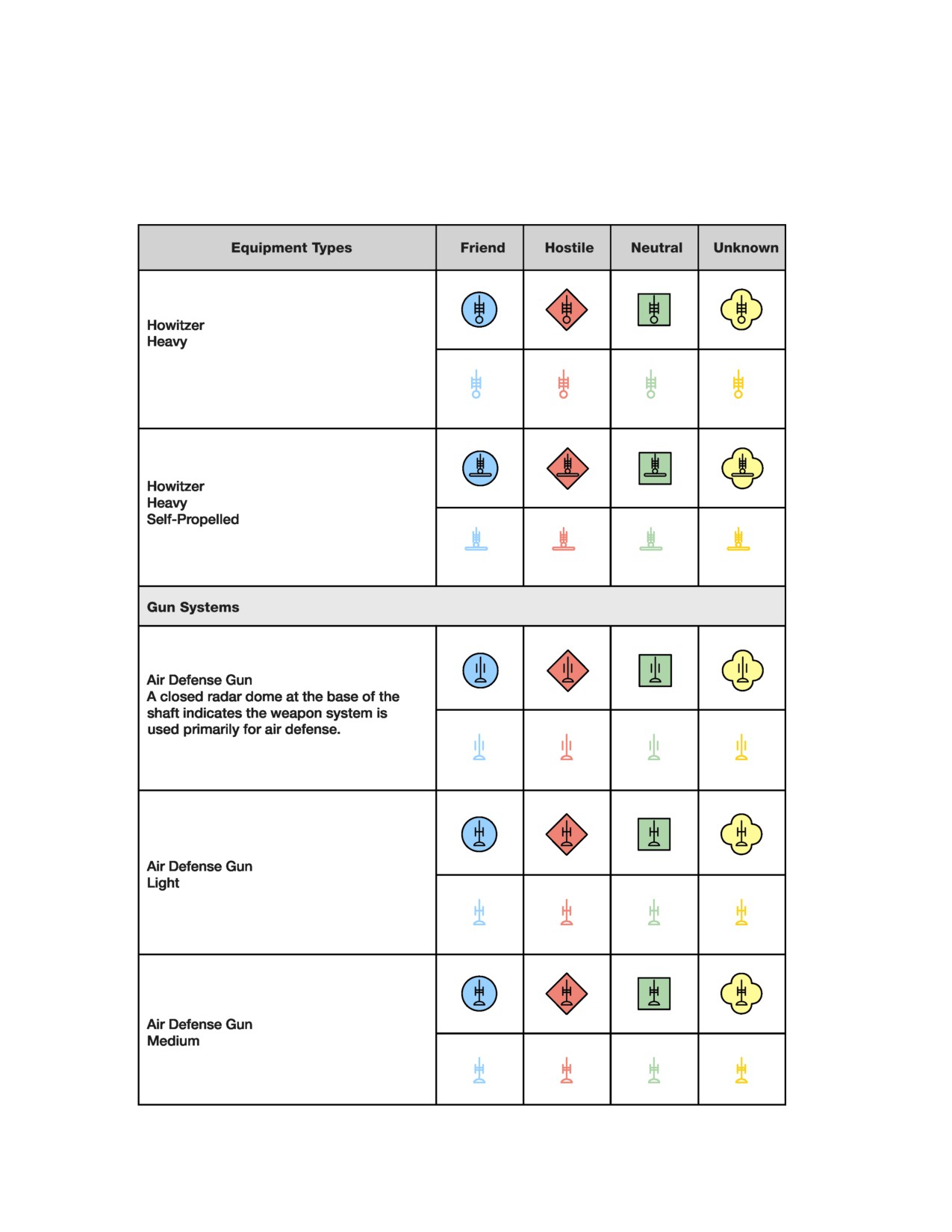
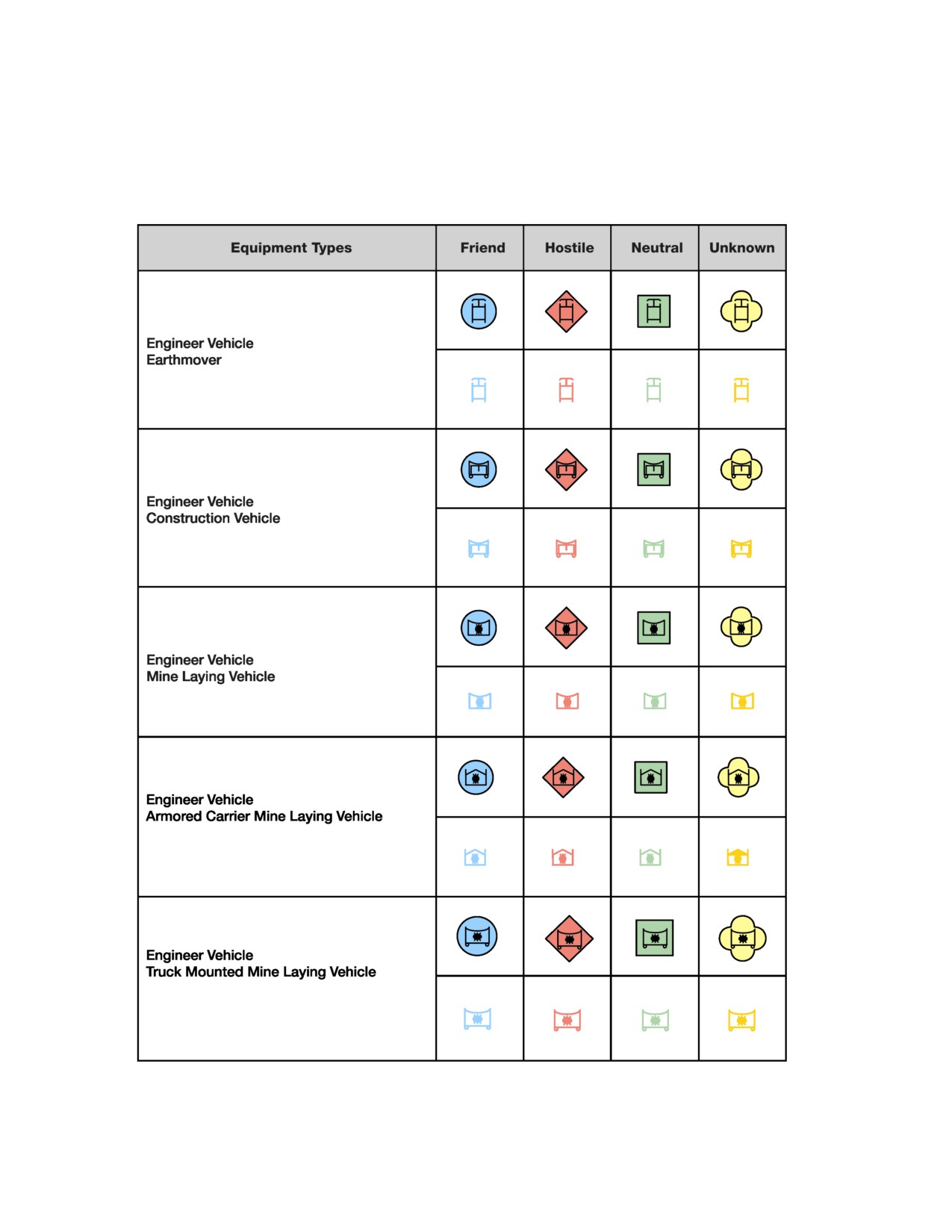
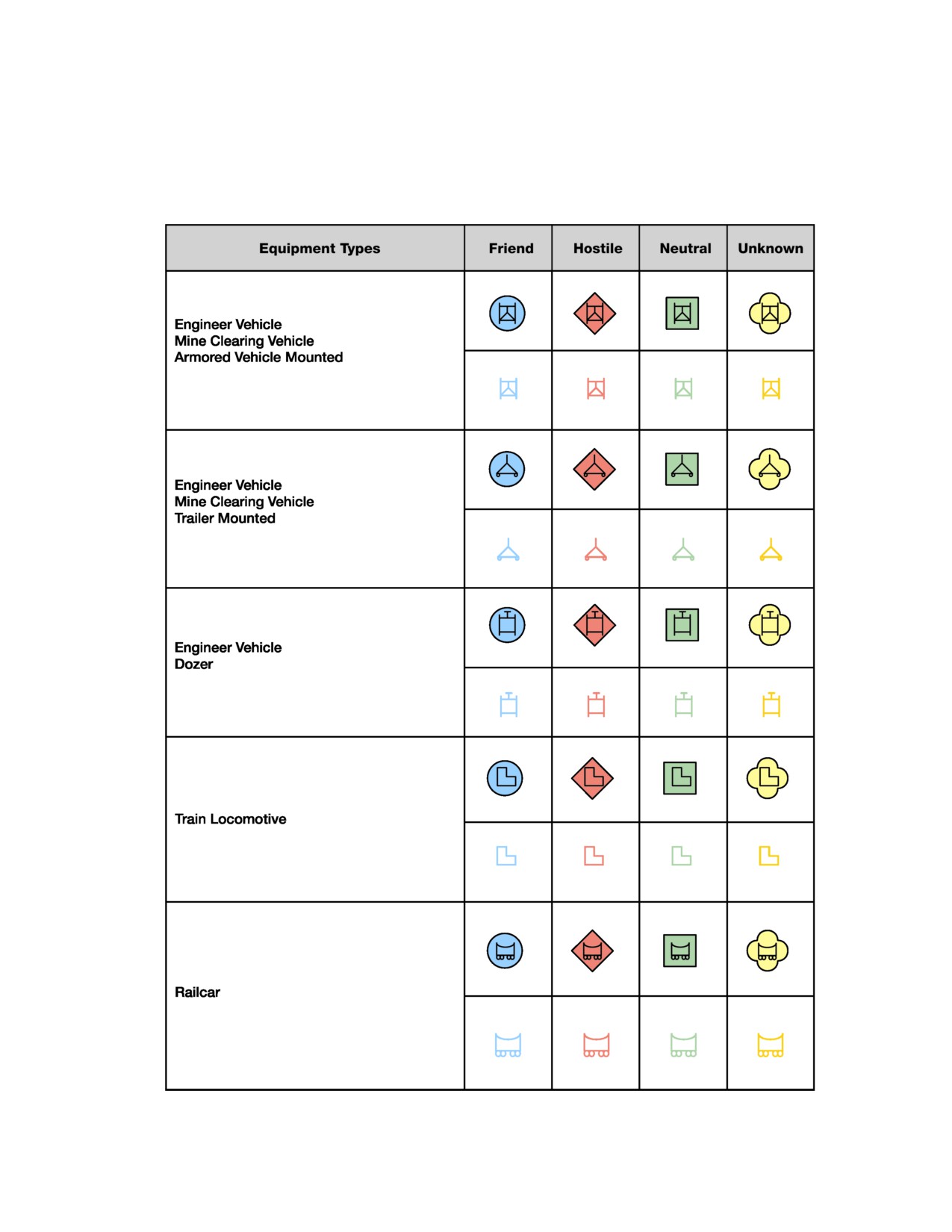
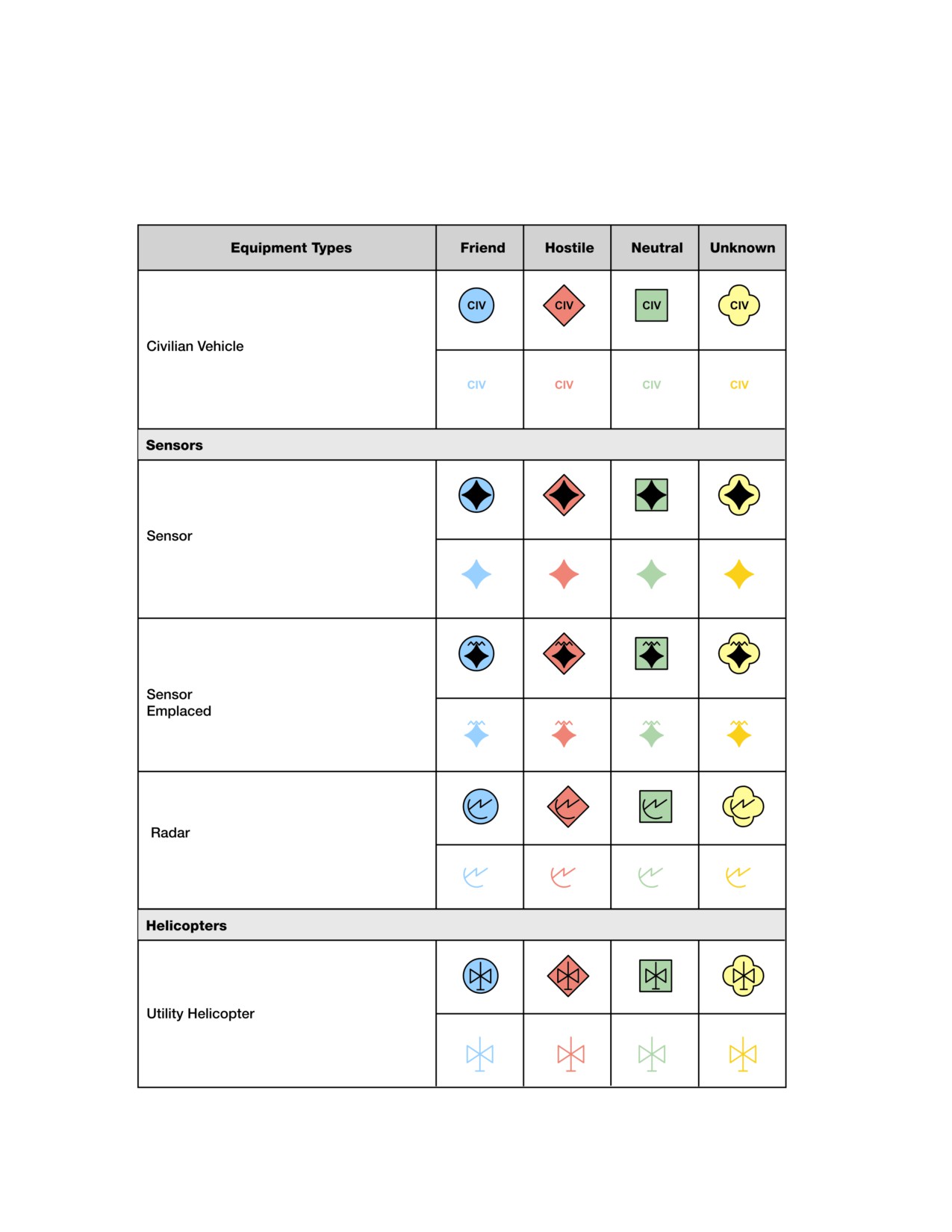
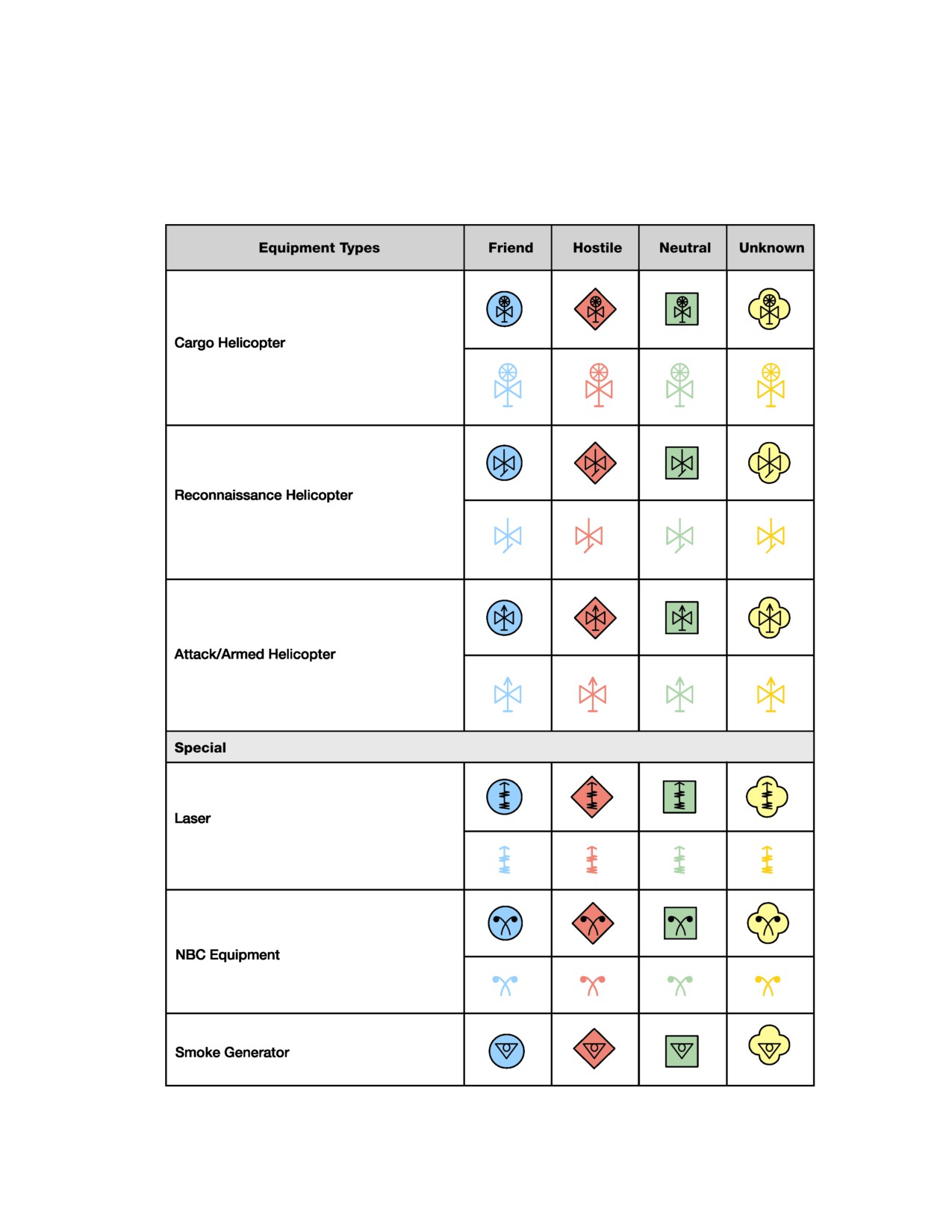
Table 6-4. Field A: Equipment Types
6-16
________________________________________________________________Equipment Symbols
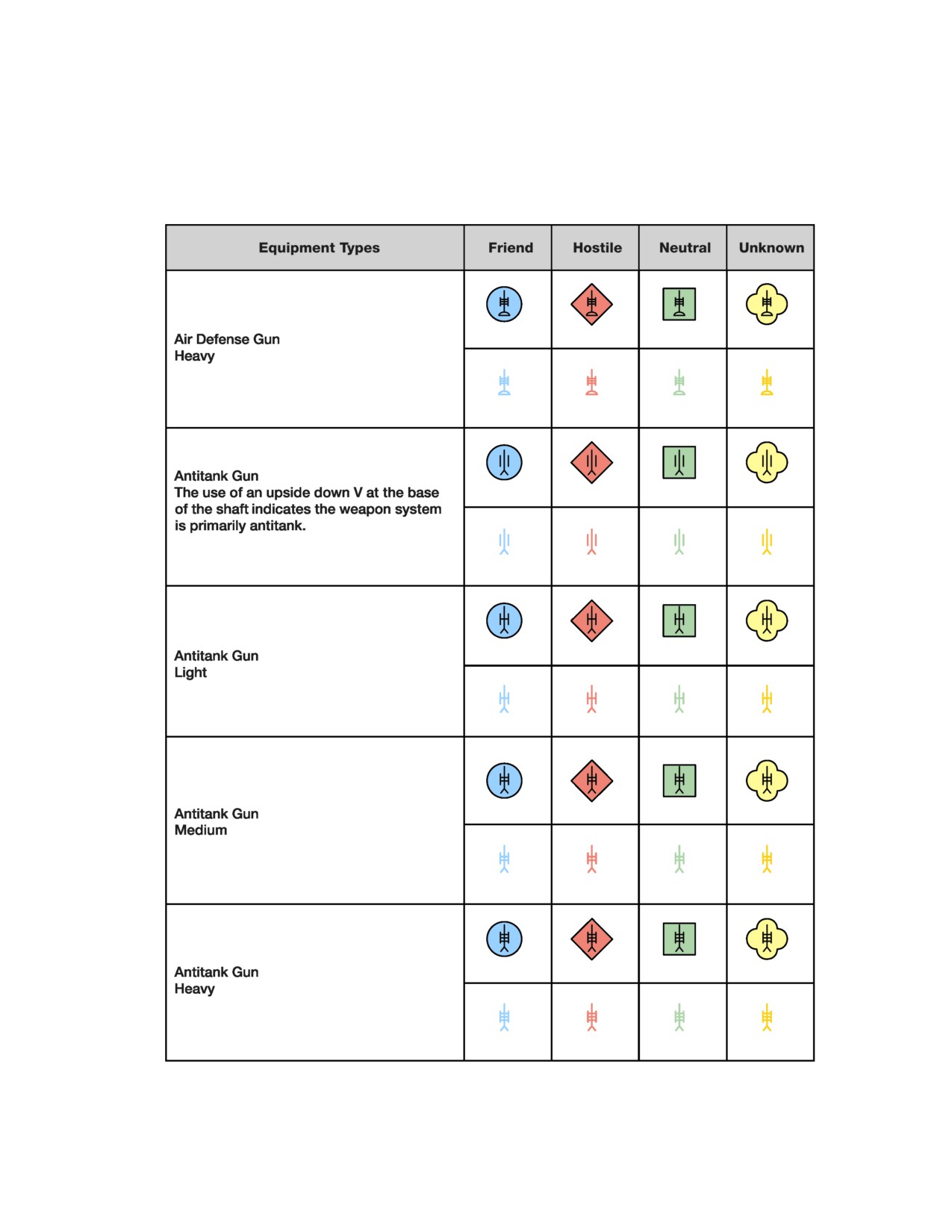
Table 6-4. Field A: Equipment Types
6-17
FM 1-02/MCRP 5-12A________________________________________________________________
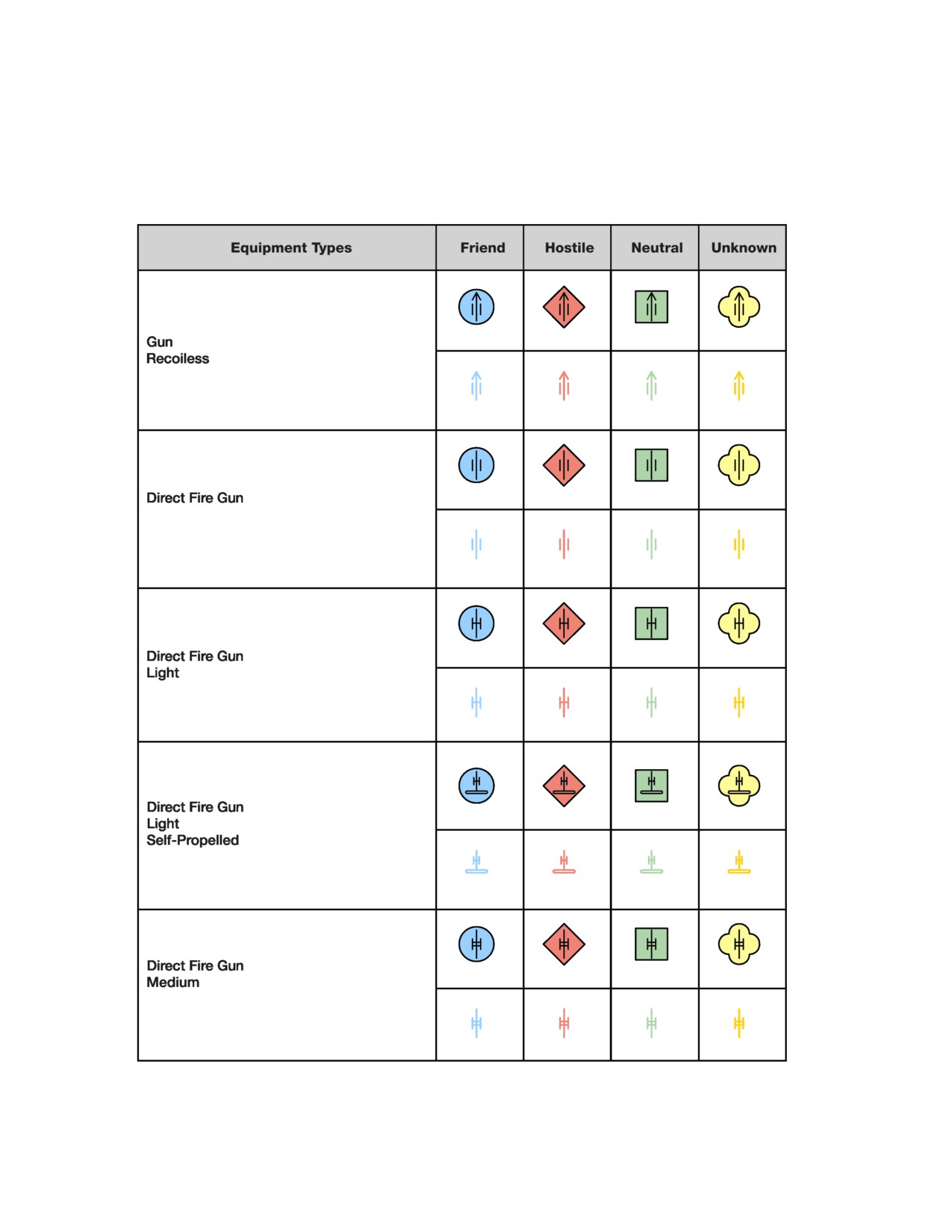
Table 6-4. Field A: Equipment Types
6-18
________________________________________________________________Equipment Symbols
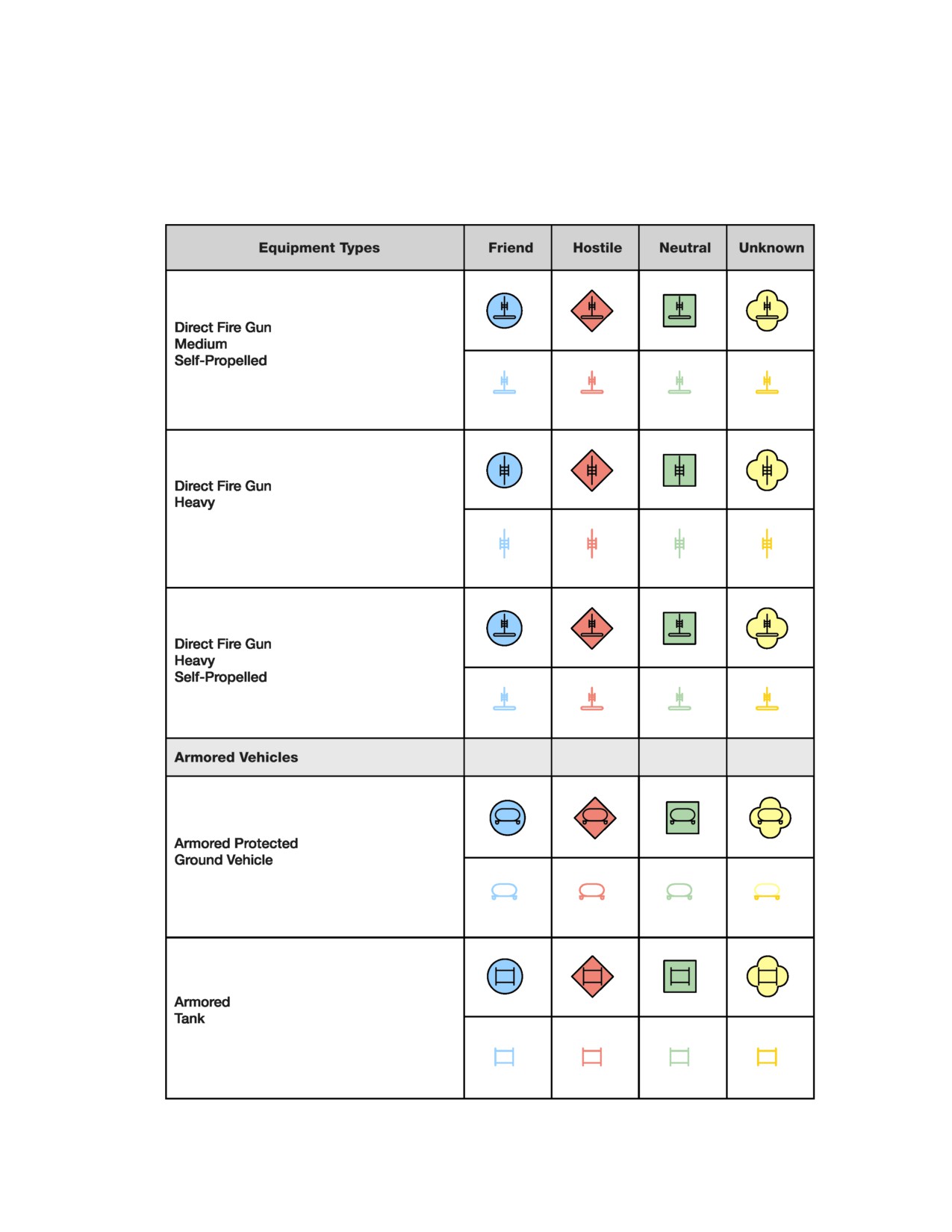
Table 6-4. Field A: Equipment Types
6-19
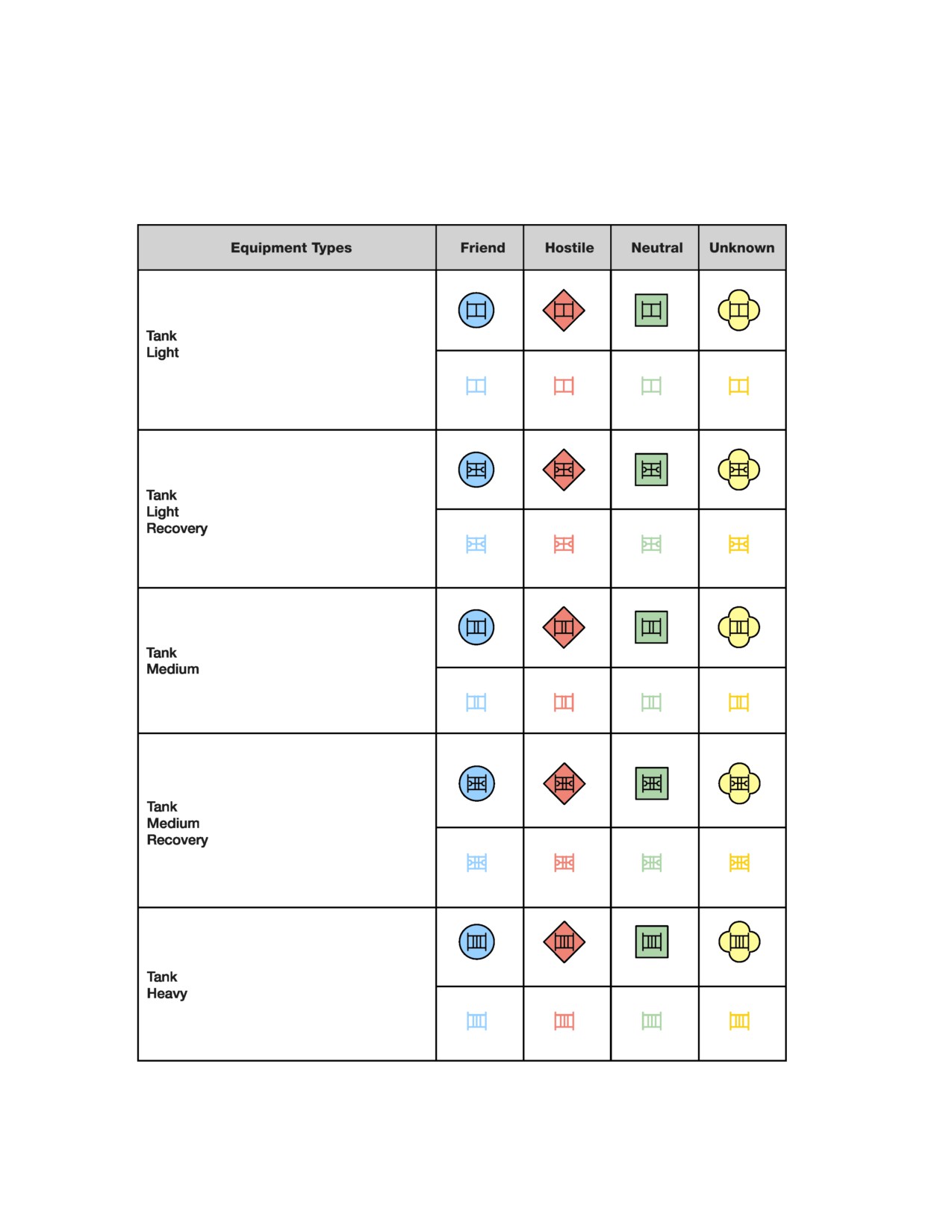
FM 1-02/MCRP 5-12A________________________________________________________________
Table 6-4. Field A: Equipment Types
6-20
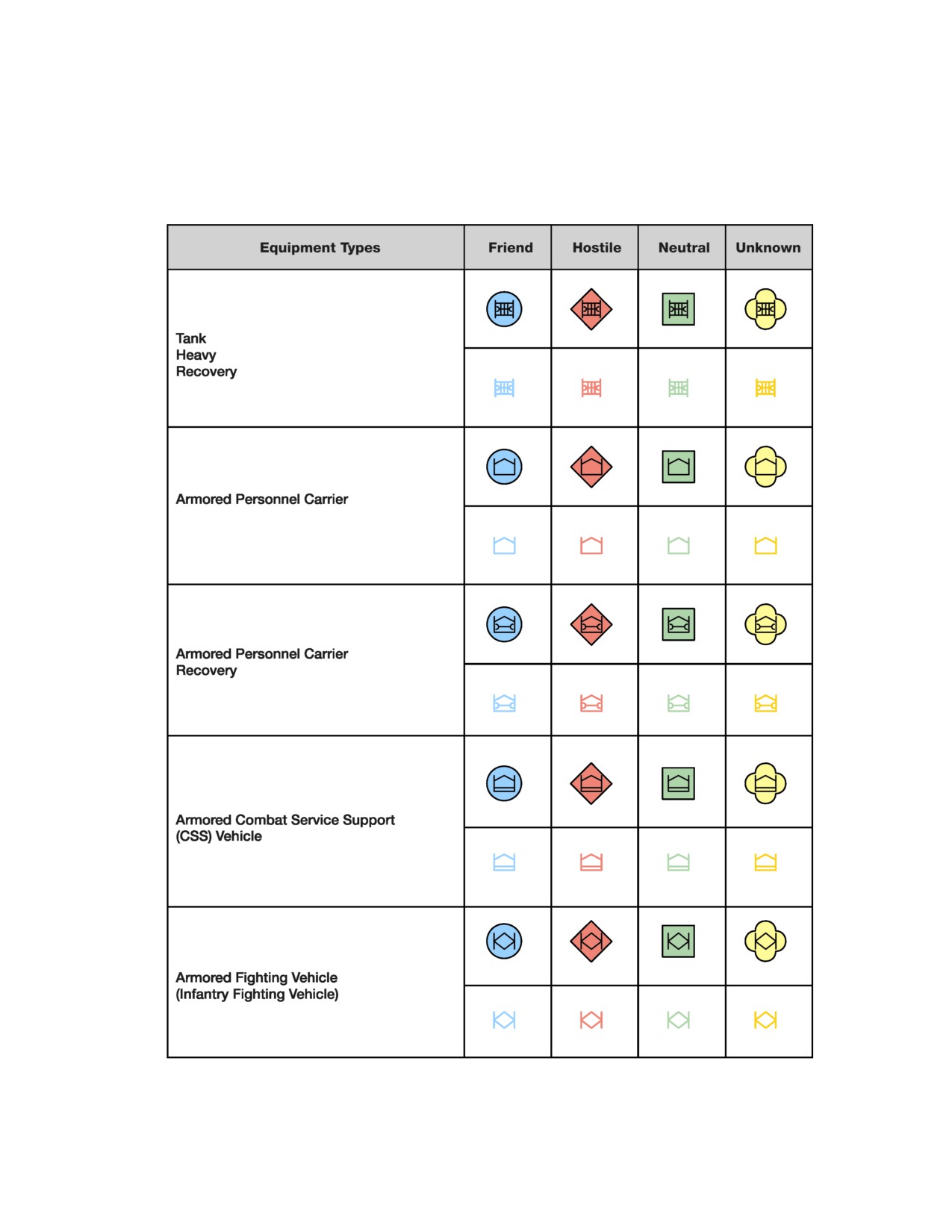
________________________________________________________________Equipment Symbols
Table 6-4. Field A: Equipment Types
6-21
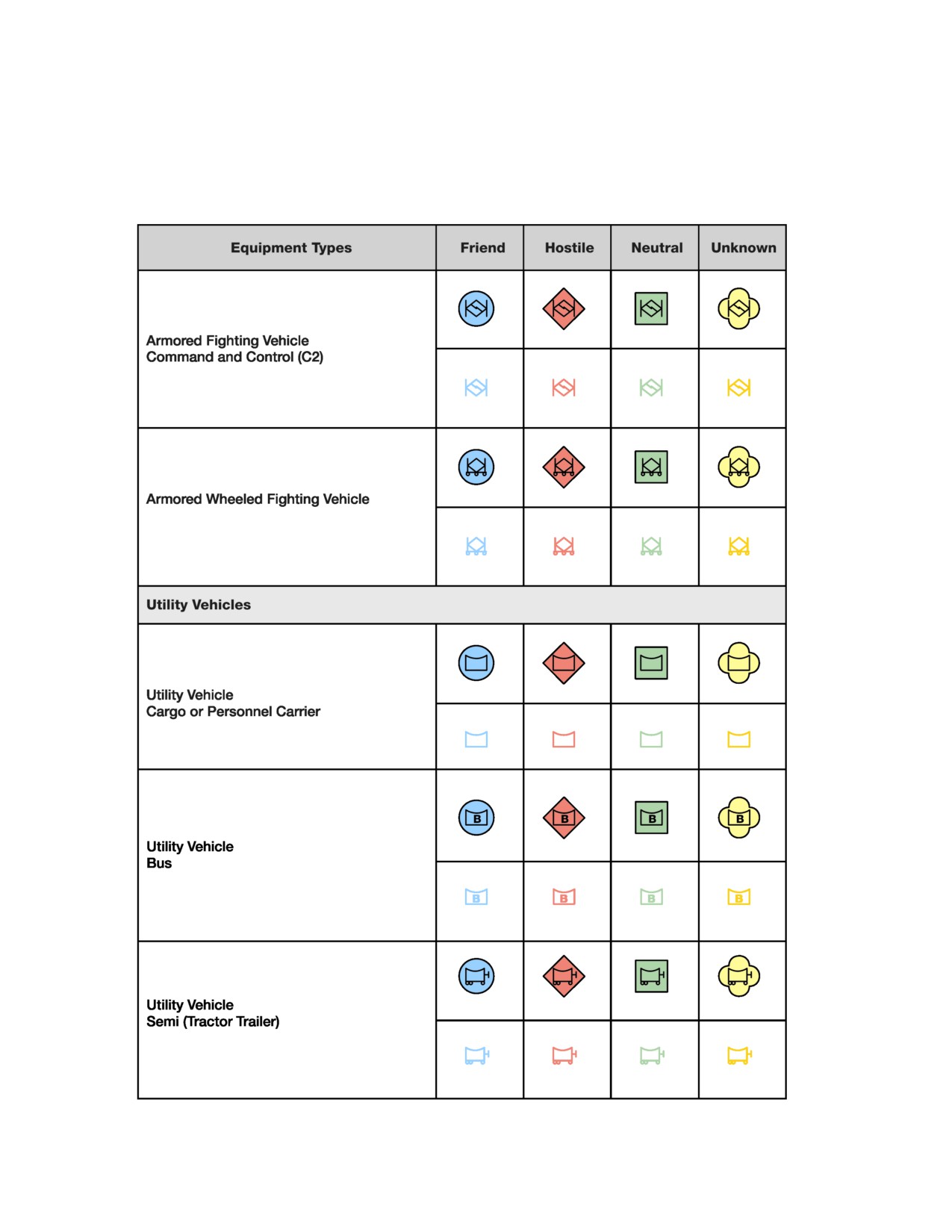
FM 1-02/MCRP 5-12A________________________________________________________________
Table 6-4. Field A: Equipment Types
6-22
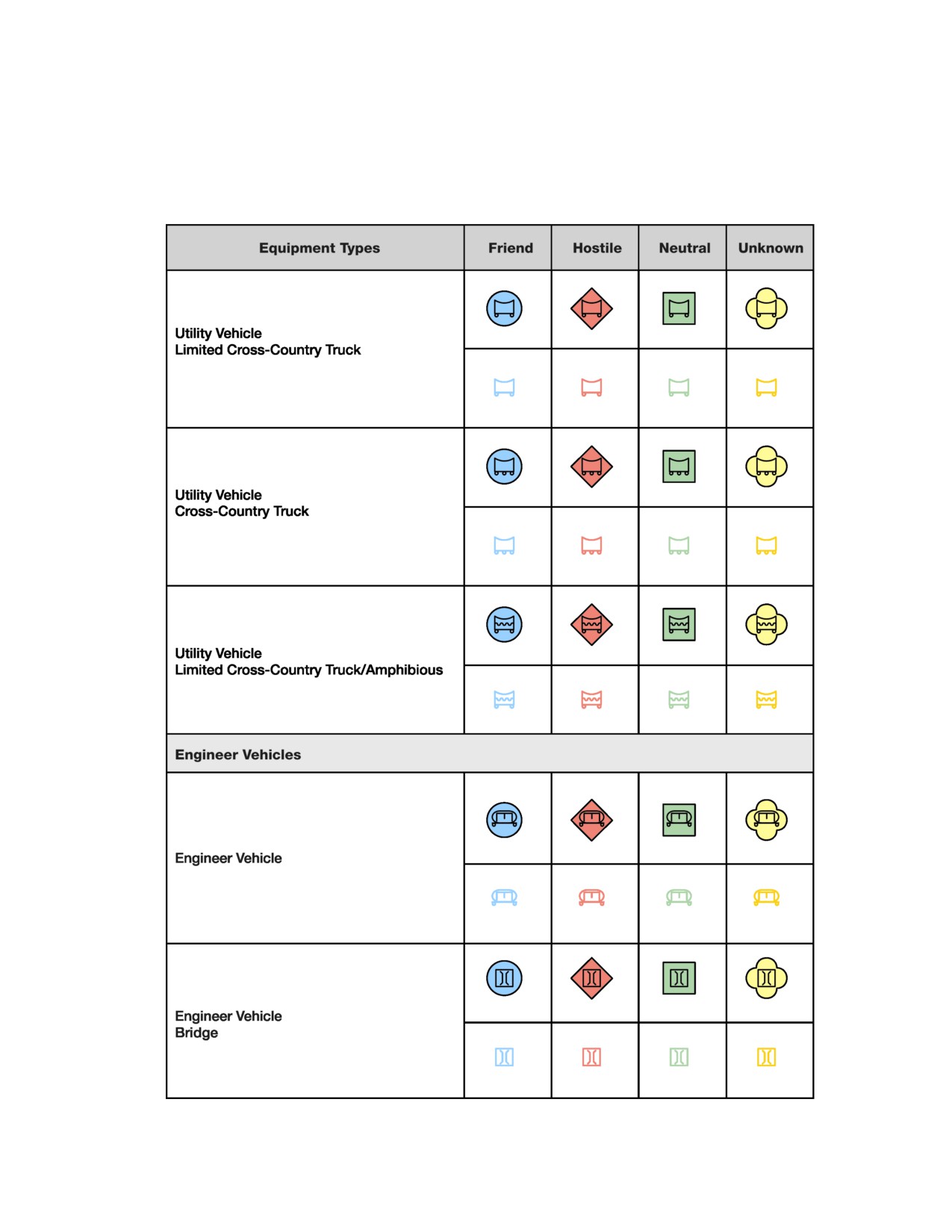
________________________________________________________________Equipment Symbols
Table 6-4. Field A: Equipment Types
6-23
FM 1-02/MCRP 5-12A________________________________________________________________
Table 6-4. Field A: Equipment Types
6-24
________________________________________________________________Equipment Symbols
Table 6-4. Field A: Equipment Types
6-25
FM 1-02/MCRP 5-12A________________________________________________________________
Table 6-4. Field A: Equipment Types
6-26
________________________________________________________________Equipment Symbols
Table 6-4. Field A: Equipment Types
6-27
FM 1-02/MCRP 5-12A________________________________________________________________
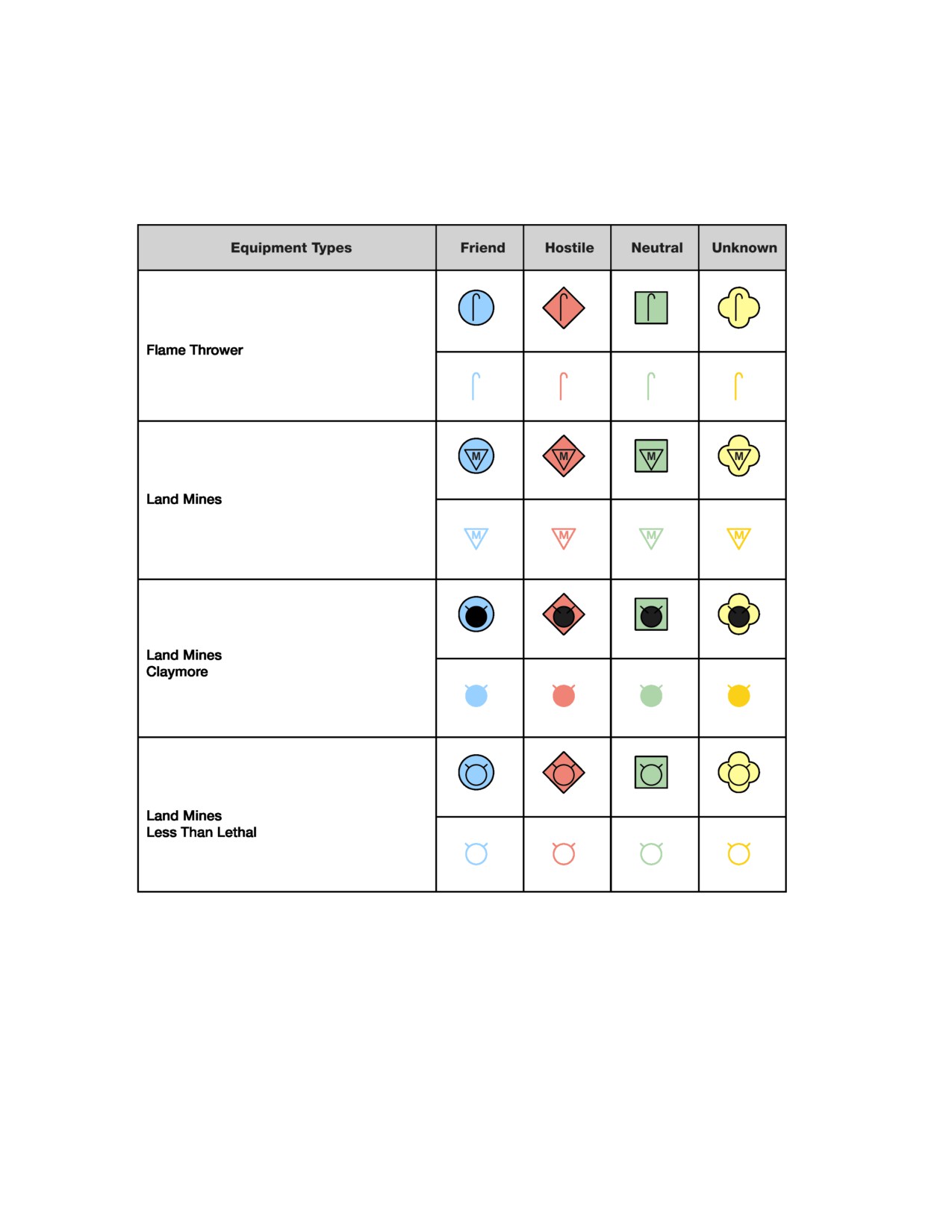
Table 6-4. Field A: Equipment Types
6-28
________________________________________________________________Equipment Symbols
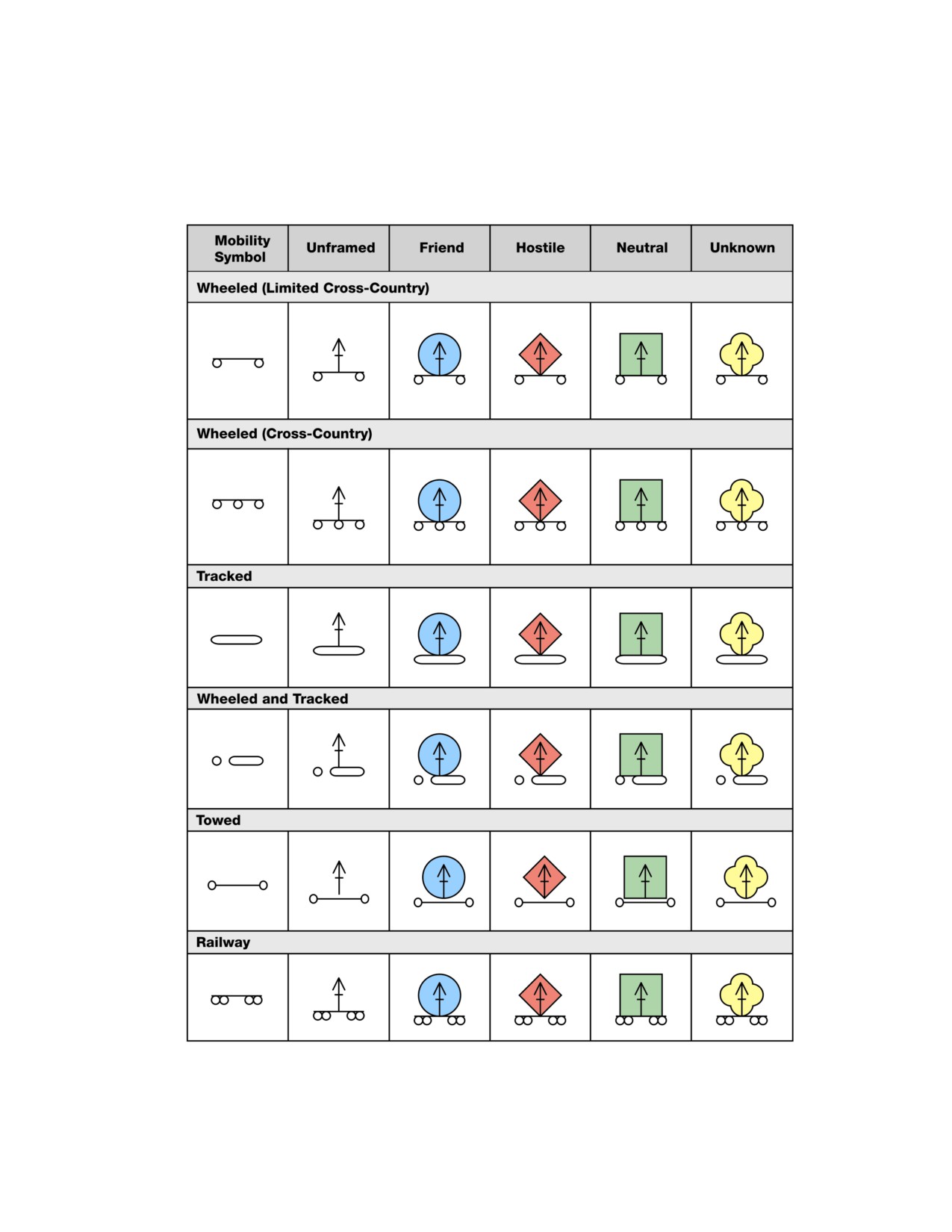
Table 6-5. Field R: Mobility Indicator
6-29
FM 1-02/MCRP 5-12A________________________________________________________________
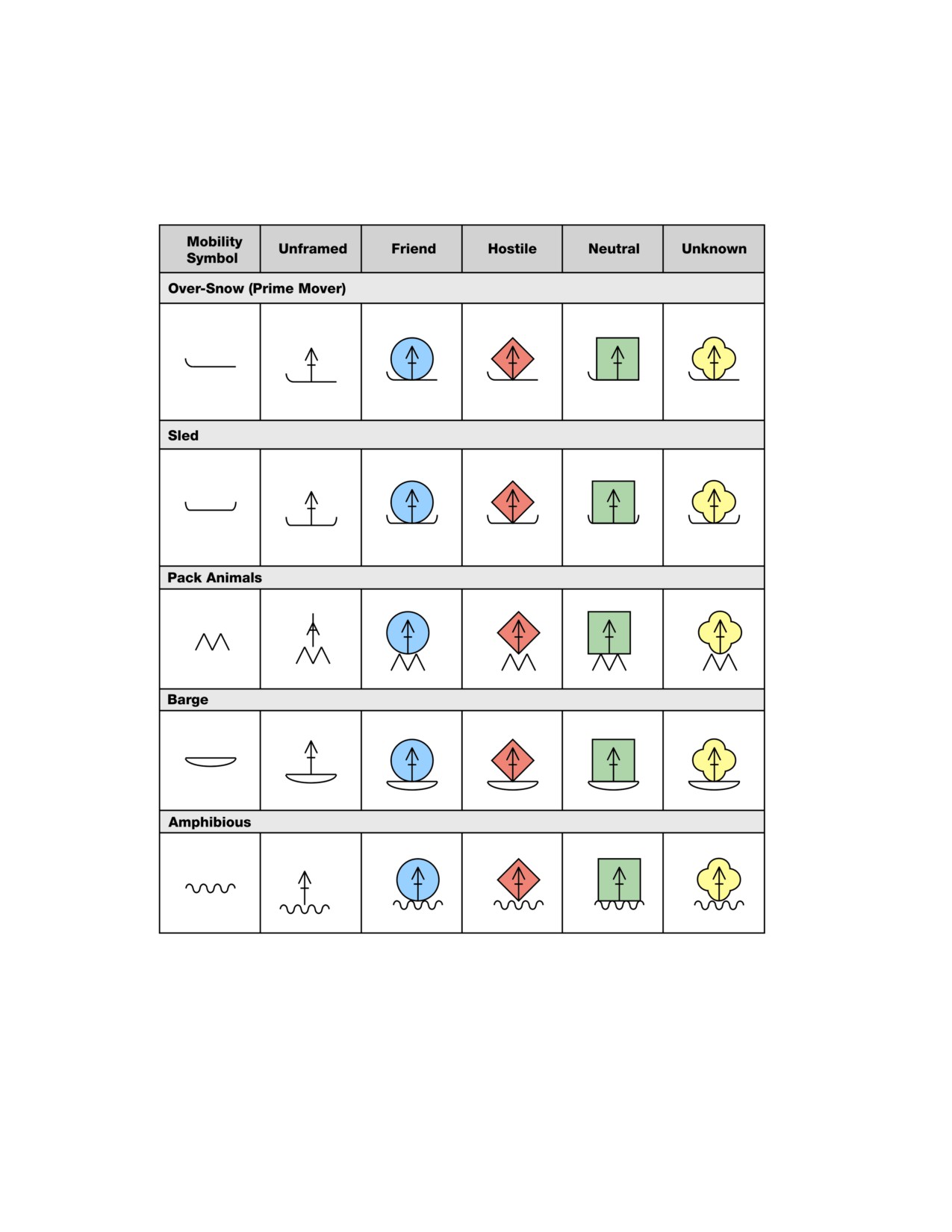
Table 6-5. Field R: Mobility Indicator
SIZE AND RANGE INDICATORS
6-5. In building equipment symbols, horizontal or vertical lines are added for
size and range indicators. If an equipment symbol has no lines, it is a basic
equipment symbol. Adding one line designates it as light or short-range.
Adding two lines designates it as medium or medium-range. Finally, adding
three lines designates it as heavy or long-range. If a system is designated as
greater than heavy or long-range, heavy or long-range indicators will be used.
6-30
________________________________________________________________Equipment Symbols
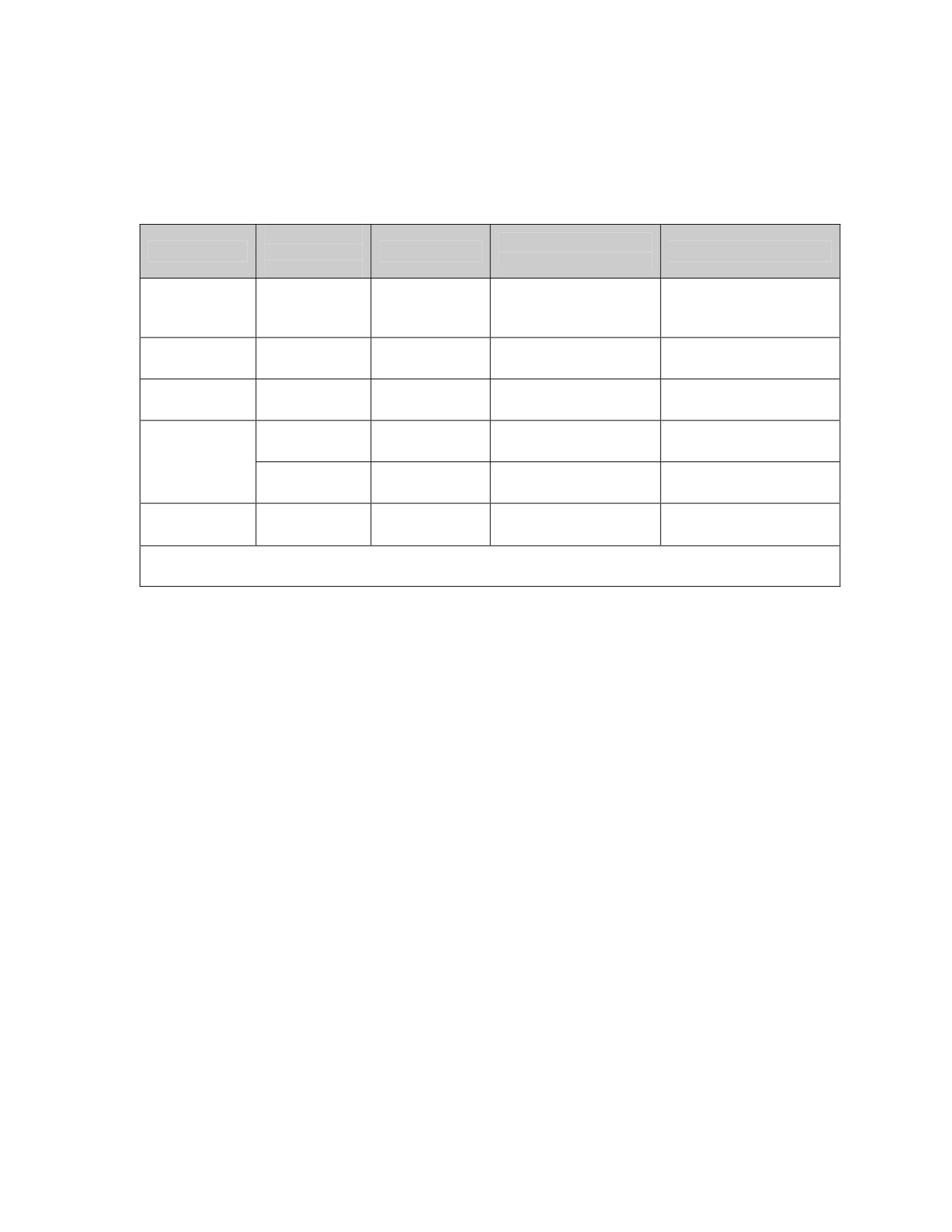
Table 6-6. Standards for Size and Range Indicators by Equipment Systems
Standard
Medium/medium
System
Weight/Range/
Light/Short
Heavy/Long
(Intermediate)
Caliber
Caliber and
Greater than 120 mm
Greater than 160 mm
Cannon
120 mm or
Maximum
but not greater than
but not greater than
Artillery
less
Range1
160 mm
210 mm
Greater than 60 mm
Mortar
Caliber
60 mm or less
107 mm or larger
but less than 107 mm
Cargo
Less than 12
Between 12 tons and
Semitrailers
Greater than 40 tons
Capacity
tons
40 tons
Less than
Between 4,000 lbs
Greater than 10,000
Weight
Utility
4,000 lbs
and 10,000 lbs
lbs
Helicopters
Less than 240
Between 240 and 320
Greater than 320
Range
nautical miles
nautical miles
nautical miles
Watercraft
Less than 300
Between 300 tons
Greater than 1,700
Capacity
(Army)
tons
and 1,700 tons
tons
1Cannon artillery has a very heavy category: greater than 210 mm.
6-31
This page intentionally left blank.
Chapter 7
Graphic Control Measures
Graphic control measures are graphic directives given by a commander to
subordinate commanders to assign responsibilities, coordinate fire and
maneuver, and control combat operations. They include boundaries; lines;
areas; points; targets; or nuclear, biological or chemical attacks/events.
Land graphic control measures are classified as maneuver, fire support,
command and control, mobility/countermobility/survivability, and combat
service support. This chapter establishes a standard system for the devel-
opment and use of graphic control measures. These graphic control meas-
ures are the standard for all simulations, including those used in live,
virtual, and constructive environments.
Note. For most graphic control measures, there is a corresponding definition
in chapter 1. In an electronic copy, click on the page number to view the defi-
nition, then click on the corresponding page number to return to the graphic
control measure. Included with the definition is the field manual that pro-
vides further information on the use of that graphic control measure.
OVERLAYS
7-1. Overlays are graphics drawn on top of a map, sketch, or photograph. To
ensure accurate alignment, the overlay must have at least two reference
marks at opposite locations. (FM 101-5 provides the minimum labeling re-
quirements for an overlay.) On automated displays, overlays are graphical in-
formation that is joined electronically so it can be “turned on or off” over or in
front of the primary digital display, such as a map, sketch, or photograph.
COLORS
7-2. When drawing manually or using a color computer-generated display,
show all friendly graphic control measures in black. Show hostile graphic
control measures in red. If red is not available, place the abbreviation “ENY”
on the graphic in at least two places. If other colors are used to show friendly
or hostile factions, use a legend to ensure understanding of the use of colors
on the overlay. If neutral or unknown graphic control measures are included
on the overlay, use green and yellow if available. If green and yellow are not
available, draw neutral or unknown graphics in black and include the abbre-
viations of “NEU” for neutral or “UNK” for unknown. Draw all obstacles—
friendly, hostile, neutral, unknown or factional—using green; if green is not
available, draw obstacles using black. (Obstacle graphics are shown in the
mobility and survivability section.)
7-1
FM 1-02/MCRP 5-12A________________________________________________________________
ORIENTATION OF CONTROL MEASURES
7-3. Most of the control measures in this chapter have a 360-degree orienta-
tion capability. Control measures are oriented to reflect their position on the
ground. The labeling of those symbols is described in the next paragraph.
BUILDING GRAPHIC CONTROL MEASURES
LABELING
7-4. Make all text labeling upper case letters. The reader should be able to
read the labels for all text labels of modifier fields for graphic control meas-
ures when the bottom of the overlay is closest to the reader. Labeling written
on an angle should be readable when the overlay is turned a quarter of a turn
(90 degrees) clockwise (to the right) or counterclockwise (to the left). For
boundaries, abbreviations of unit designations can be used when the abbre-
viation will not cause confusion. (See table 7-1 for the description of fields for
text or graphic modifiers for boundaries. See table 7-2, page 7-5, for a list of
abbreviations for unit designations.)
BOUNDARIES
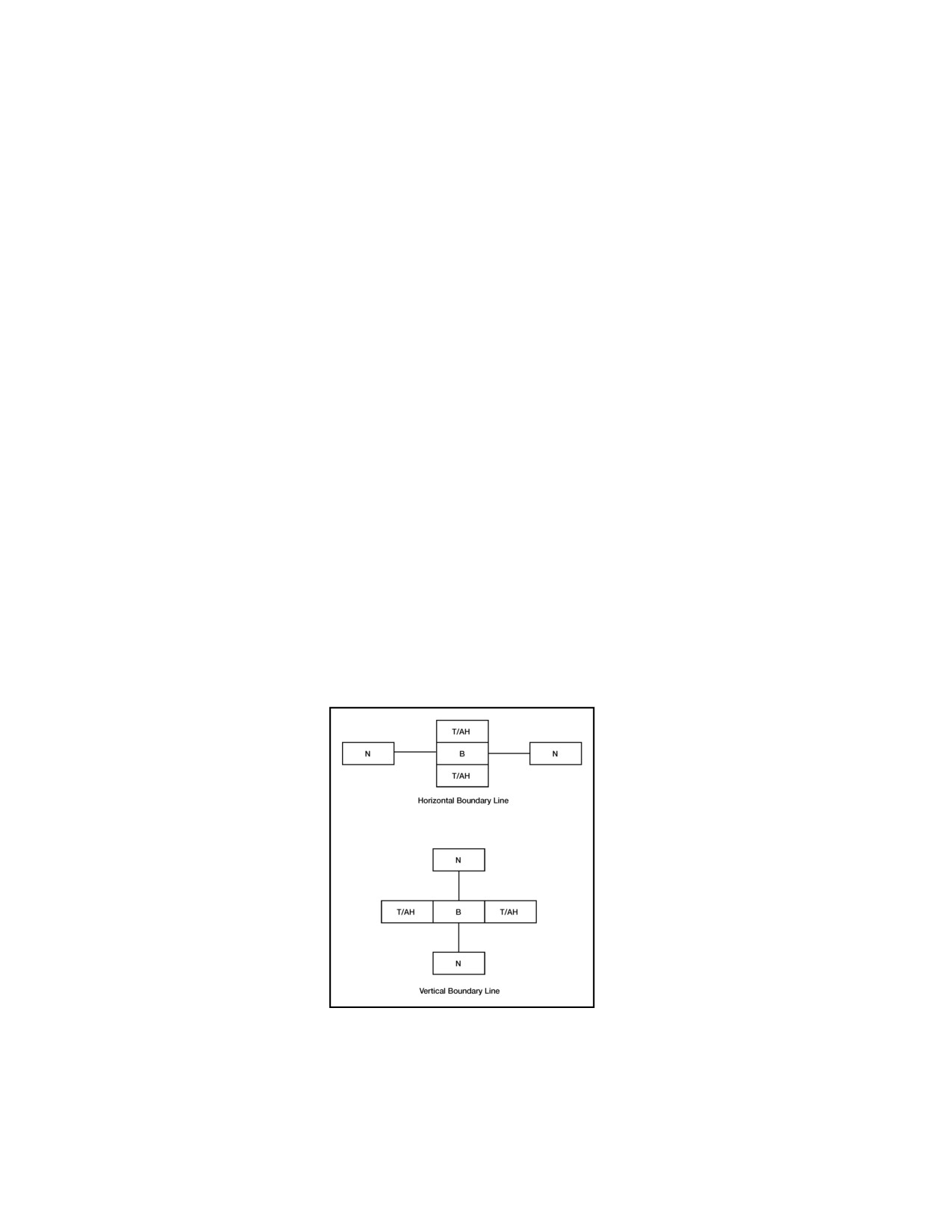
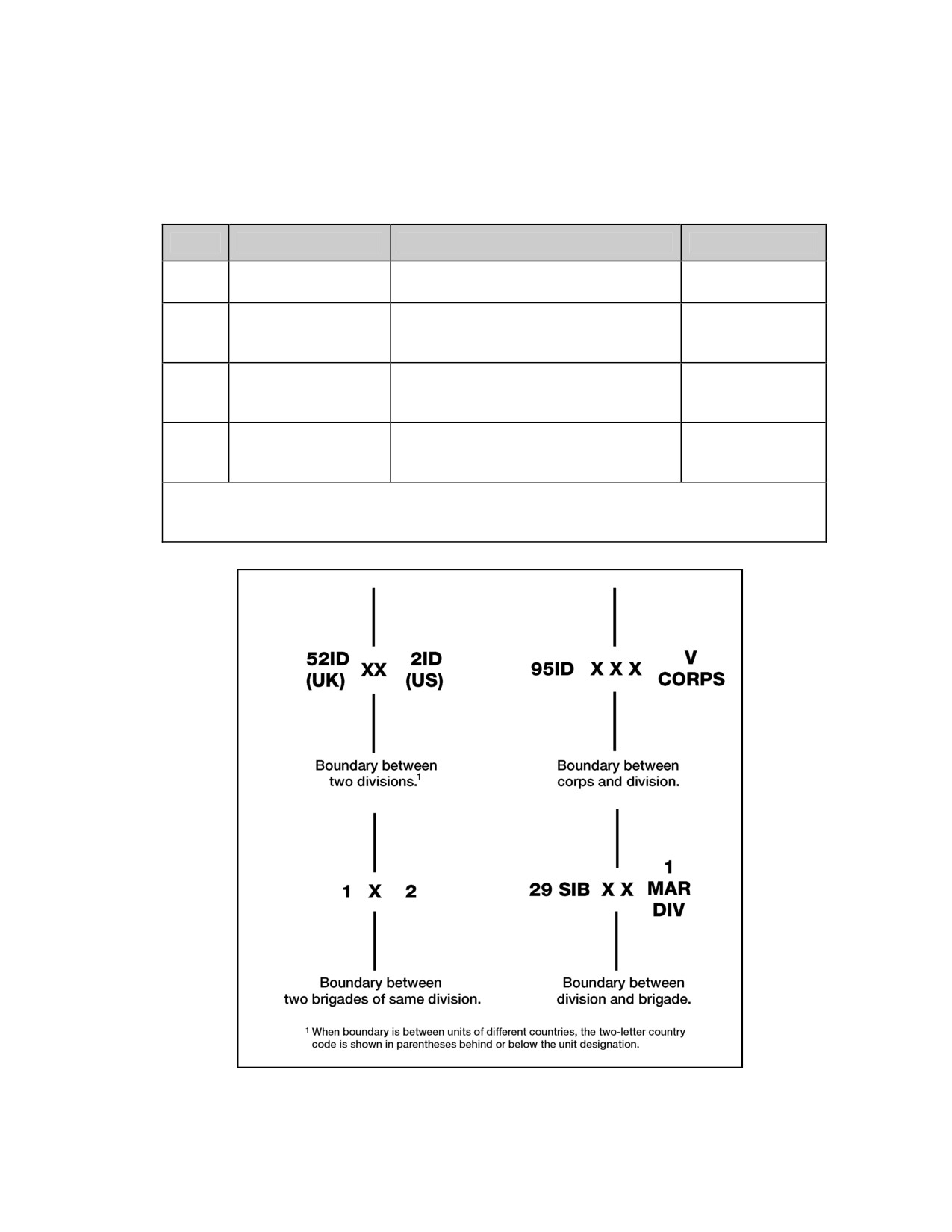
7-5. For boundaries, place size markings perpendicular to the boundary line.
For all boundaries, use Arabic numerals to show the numbers of units, except
for a corps boundary—use Roman numerals to show the number of corps.
Figure 7-1 provides the orientation of boundary modifier fields for horizontal
(east/west) and vertical
(north/south) boundaries. Figures
7-2
(page
7-3)
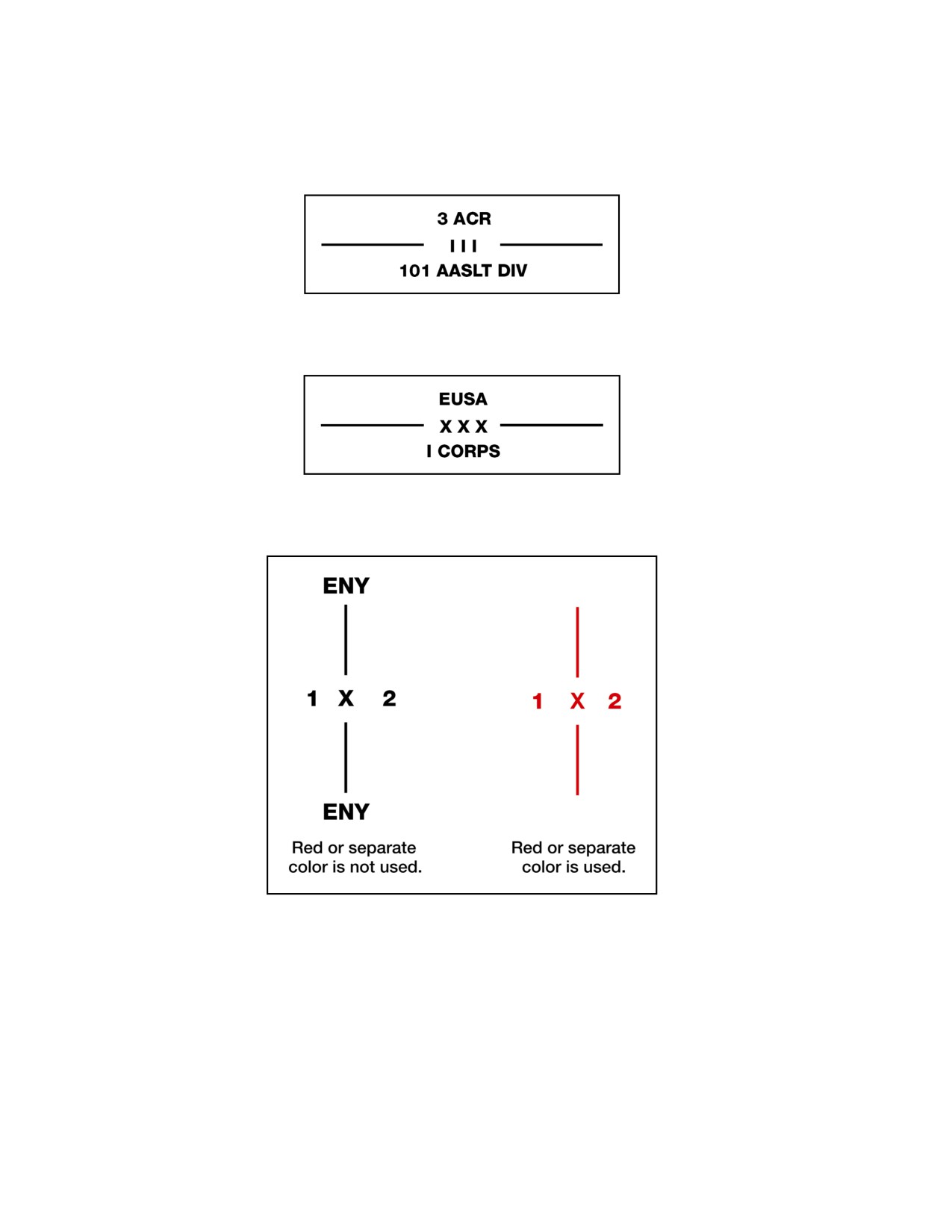
through 7-5 (page 7-4) are examples of boundary symbols as they are used.
Figure 7-1. Boundary Modifier Fields
7-2
___________________________________________________________Graphic Control Measures
Table 7-1. Description of Fields for Text or Graphic Modifiers for Boundaries
Field
Field Type
Description
Text/Graphic
A symbol modifier that denotes the size
B
Echelon
Both
of a unit (see table 5-6, page 5-33).1
Denotes hostile symbol. The letters
N
Hostile (Enemy)
“ENY” are used when color red is not
Text
used (see paragraph 7-2) “colors.”
An alphanumeric designator that
T
Unique Designation
uniquely identifies a particular unit
Text
(designation).
A two-letter code that indicates the
AH
Country Indicator
country of origin of the unit (see
Text
chapter 2).
1 The symbol for the highest echelon unit on lateral boundary is used for the boundary line.
The symbol for the lower echelon unit on a rear or forward boundary is used for the boundary
line.
Figure 7-2. Examples of Friendly Lateral Boundaries
7-3
FM 1-02/MCRP 5-12A________________________________________________________________
Figure 7-3. Example of a Friendly Rear Boundary
Figure 7-4. Example of a Friendly Forward Boundary
Figure 7-5. Examples of Hostile Lateral Boundaries
7-4
___________________________________________________________Graphic Control Measures
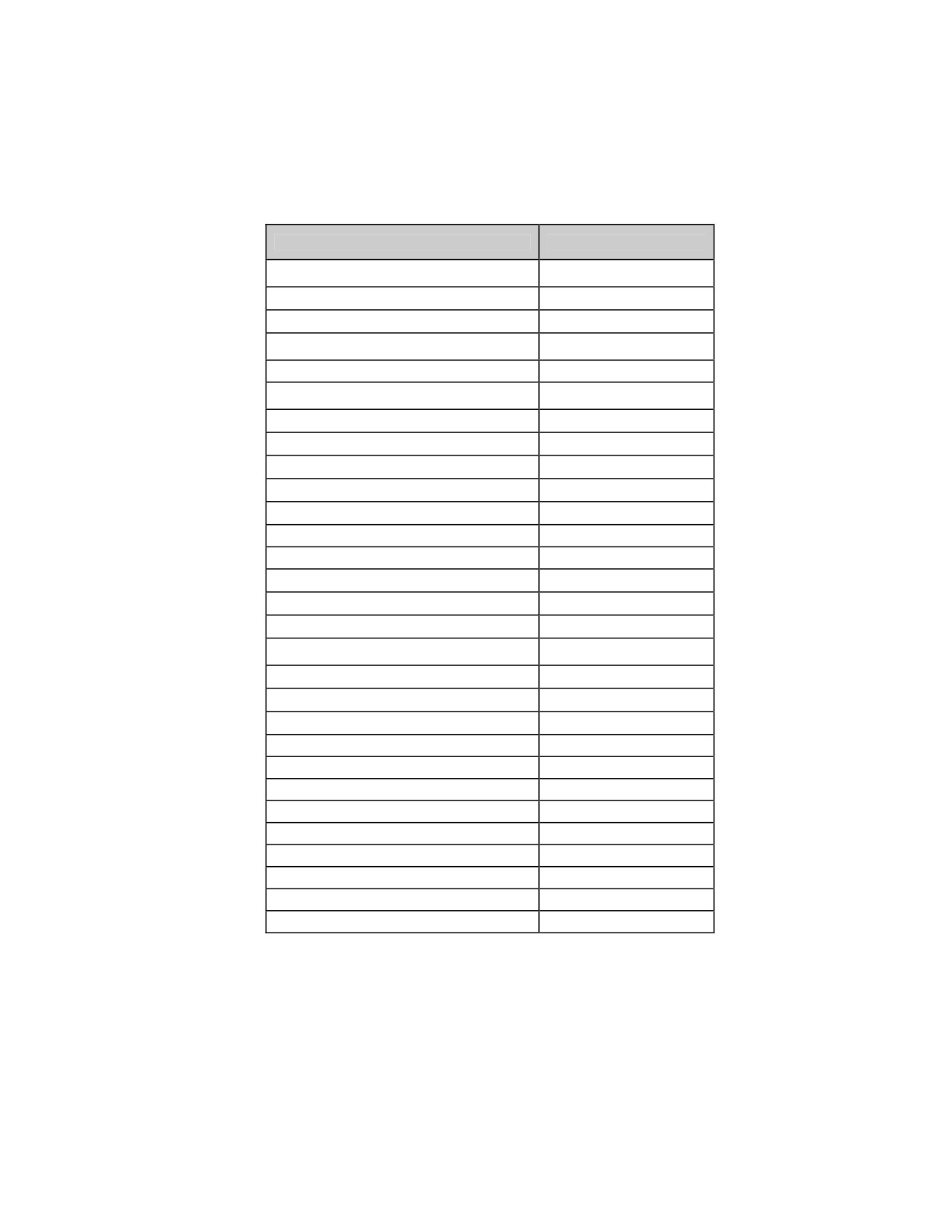
Table 7-2. Unit Abbreviations
Unit Designation
Abbreviation
Army
ARMY
• Third United States Army
• TUSA
• Eighth United States Army
• EUSA
Corps
CORPS
Marine Expeditionary Force
MEF
Division
DIV
• Airborne Division
• ABN DIV
• Air Assault Division
• AASLT DIV
• Armored Division
• AD
• Cavalry Division
• CD
• Infantry Division
• ID
□ Infantry Division (Light)
□ ID(L)
□ Infantry Division (Mechanized)
□ ID(M)
• Marine Division
• MAR DIV
• Motorized Division
• MTZ DIV
• Mountain Division
• MTN DIV
Brigade
BDE
• Marine Expeditionary Brigade
• MEB
• Separate Armored Brigade
• SAB
• Separate Infantry Brigade
• SIB
Regiment
REGT
Marine Expeditionary Unit
MEU
Battalion
BN
Squadron
SQDN
Company
CO
Troop
TRP
Battery
BTRY
Platoon
PLT
Squad
SQD
LINES
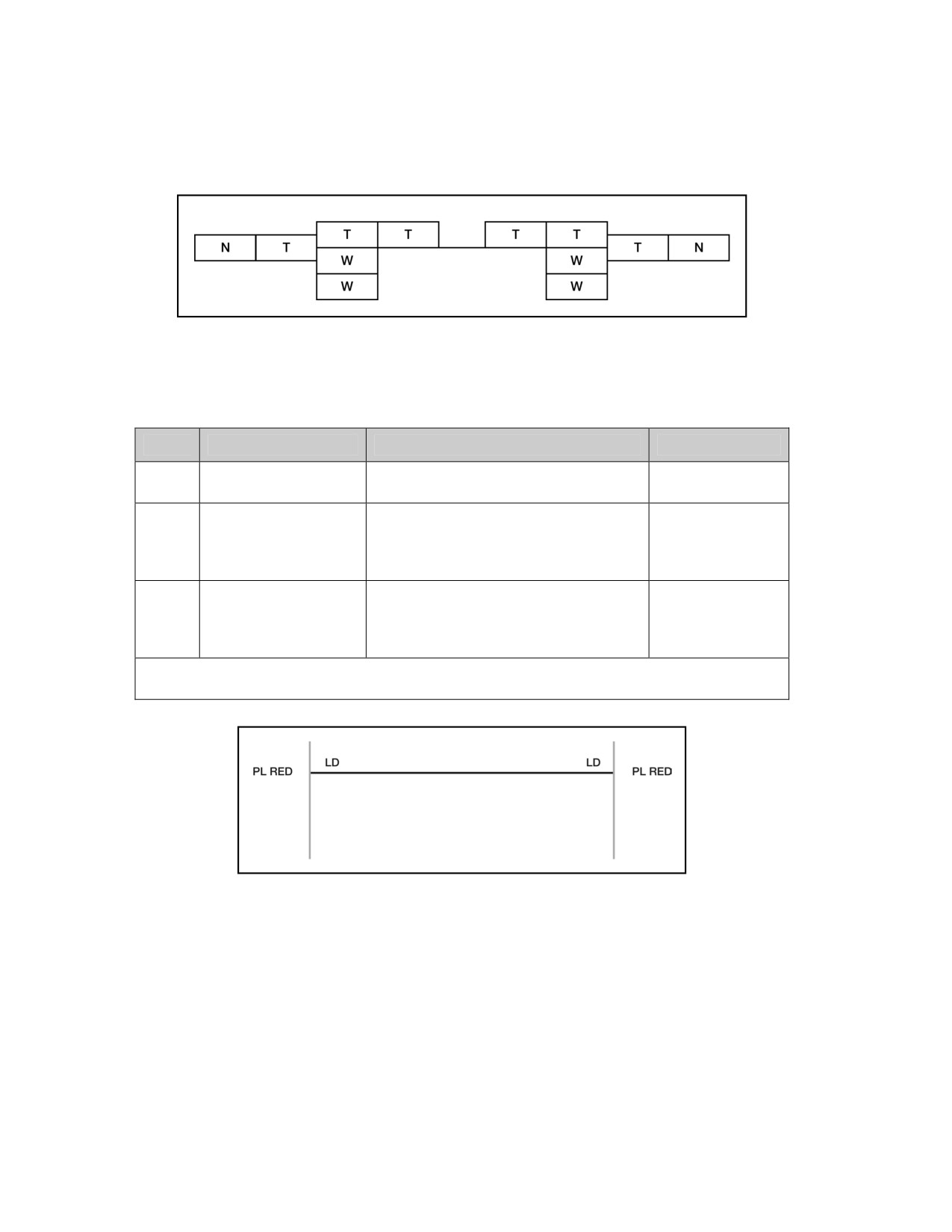
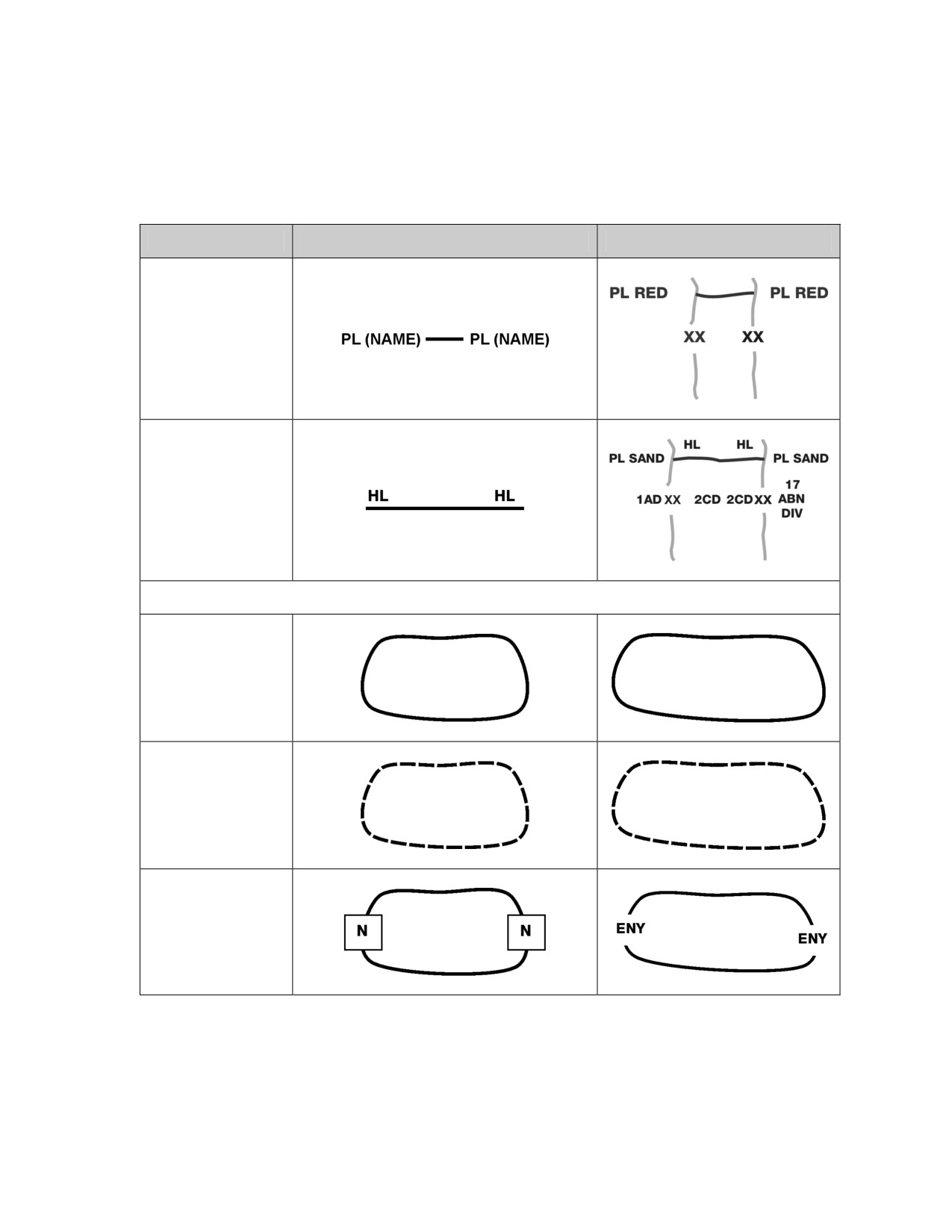
7-6. Most lines should also be named as a phase line for easy reference dur-
ing orders and radio transmissions. Mark phase lines as “PL (name).” Label
other lines that have a specific purpose and are also named as phase lines
(such as no-fire line, “NFL” ) on top of the line at both ends of the line inside
the lateral boundaries, or as often as necessary for clarity. (See figure 7-6 for
line modifier fields; figure 7-7 is an example of how line symbols are used.
See table 7-3 for description of fields for text or graphic modifiers for lines.)
7-5
FM 1-02/MCRP 5-12A________________________________________________________________
Figure 7-6. Line Modifier Fields
Table 7-3. Description of Fields for Text or Graphic Modifiers for Lines
Field
Field Type
Description
Text/Graphic
Denotes hostile symbol. The letters
N
Hostile (Enemy)
Text
“ENY” are used.
An alphanumeric title that uniquely
identifies a particular control measure
T
Unique Designation
Text
line (FSCL, NFL, PL, RFL) with a unit
(designation) or name.
An alphanumeric designator for
displaying a date/time group
W1
Date-Time Group
Text
(DDHHMMSSZMONYY) or “O/O” for
on order.
1For graphic control measures, two “W” fields can be used to indicate the effective time of
that graphic control measure.
Figure 7-7. Example of a Friendly Line of Departure on a Phase Line
AREAS
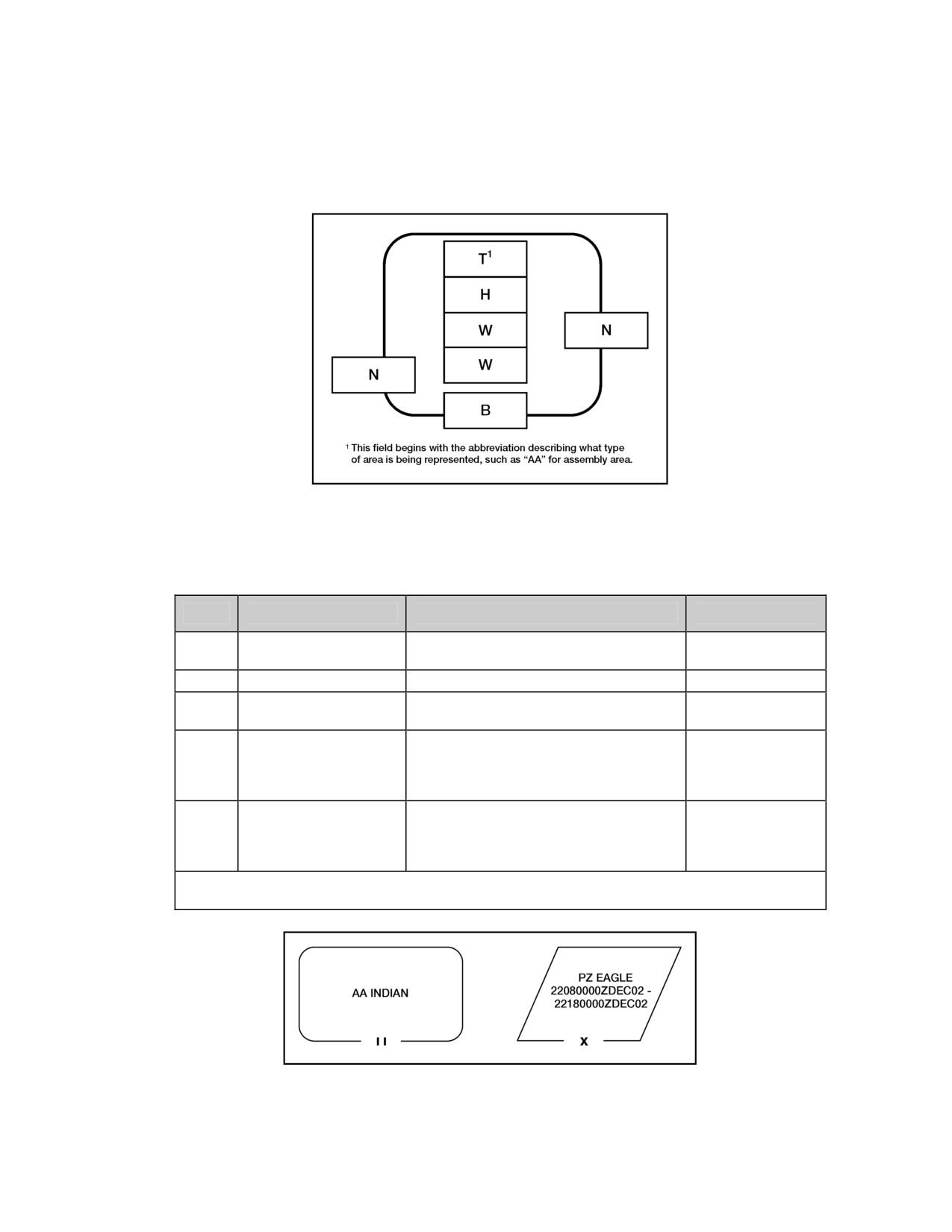
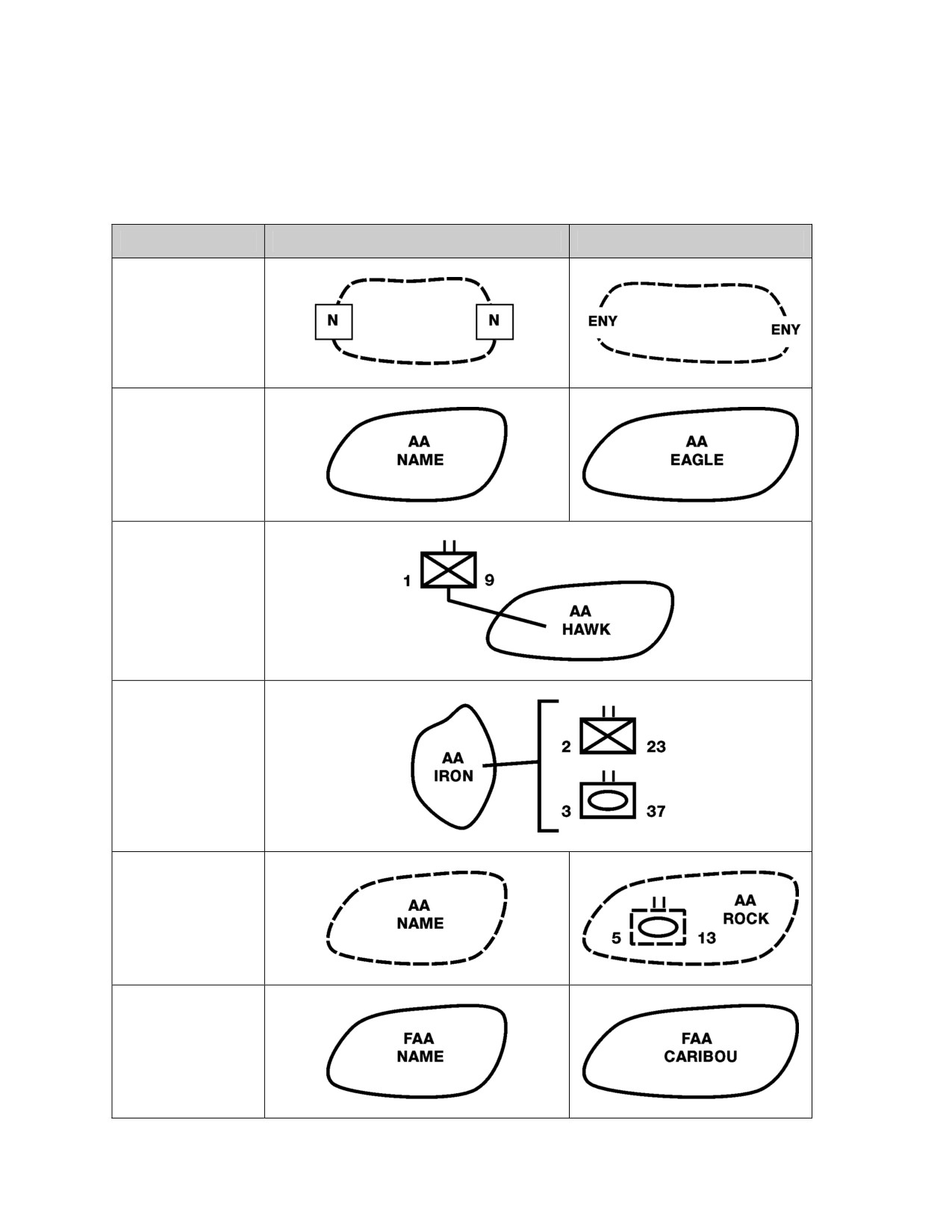
7-7. Areas will normally be marked with the abbreviation for the type of area
(see figure 7-8) followed by a name. Place this labeling in the center of the
area unless the area is too small or the labeling would interfere with locating
units (see figure 7-9). Not all fields are required for each area; some areas
may use only one field, while others will use several. (See table 7-4 for de-
scription of fields for text or graphic modifiers for areas.)
7-6
___________________________________________________________Graphic Control Measures
Figure 7-8. Area Modifier Fields
Table 7-4. Description of Fields for Text or Graphic Modifiers for Areas
Field
Field Type
Description
Text/Graphic
B
Echelon
A symbol modifier that denotes the size of
Both
a unit (see table 5-6, page 5-33).
H
Additional Information
Free text.
Text
N
Hostile (Enemy)
Denotes hostile symbol. The letters “ENY”
Text
are used.
T
Unique Designation
An alphanumeric title that uniquely
Text
identifies a particular symbol (AA, NFA,
FFA, OBJ) with a particular unit
(designation) or name.
W1
Date-Time Group
An alphanumeric designator for displaying
Text
a date/time group
(DDHHMMSSZMONYY) or “O/O” for on
order.
1For graphic control measures, the two “W” fields can be used to indicate the effective time of that
graphic control measure.
Figure 7-9. Examples of Friendly Assembly Area and Pickup Zone
7-7
FM 1-02/MCRP 5-12A________________________________________________________________
POINTS
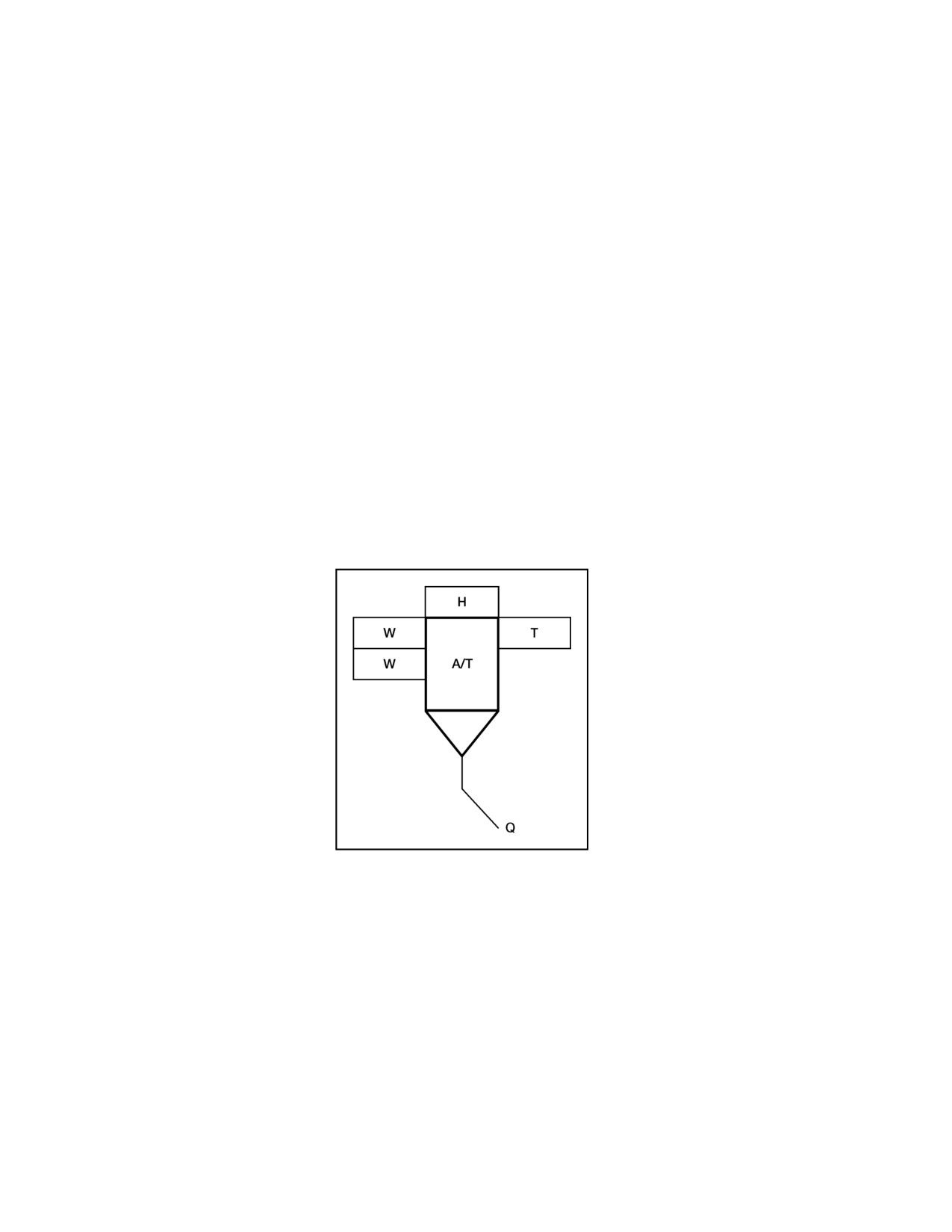
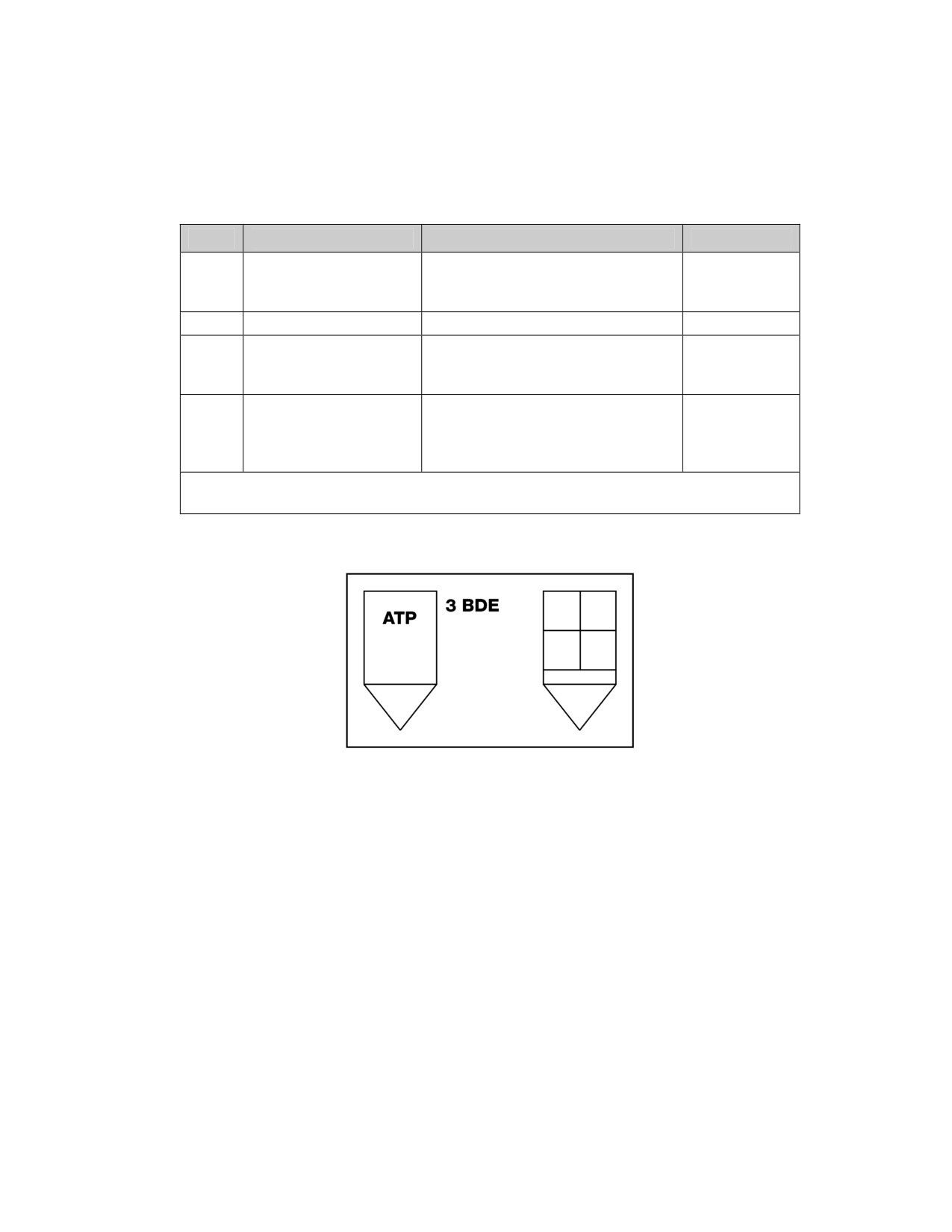
7-8. Most graphic control measure points are depicted as shown in figure
7-10. Supply points follow this format with a modification to the symbol. As
with the symbol for supply units, there is an additional line placed toward
the bottom of the box (see figure 7-11, page 7-9). However, there are other
points (contact, coordination, decision, target) that are depicted differently.
(See table 7-5, page 7-9, for description of fields for text or graphic modifiers
for points.) The convention for depicting and labeling those points is shown in
table 7-7, page 7-12, through table 7-17, page 7-62.
7-9. In building points, the name/type of the point is abbreviated and posi-
tioned inside the top part of the point symbol in field “A.” For supply symbols,
this may be a graphic depiction. In addition, below the abbreviation of the
point name, the designation of the unit servicing that point can be included
in field “T.” To differentiate points, the point is numbered, lettered, or a com-
bination. The number, letter, or combination is placed on the outside of the
symbol on the right side at the top in field “T.” On the outside of the point on
the left side at the top and middle, date-time groups can be associated with
the point. On the outside of the point at the top, additional information can
be provided in field “H.”
Figure 7-10. Point Modifier Fields
7-8
___________________________________________________________Graphic Control Measures
Table 7-5. Description of Fields for Text or Graphic Modifiers for Points
Field
Field Type
Description
Text/Graphic
Icon or icons that represent the
A
Symbol
basic functions of the symbol. (The
Both
innermost part of a symbol.)
H
Additional Information
Free text.
Text
An alphanumeric title that uniquely
T
Unique Designation
identifies a particular symbol (such
Text
as AXP, DCN, EPW, MCP).
An alphanumeric designator for
displaying a date/time group
W1
Date-Time Group
Text
(DDHHMMSSZMONYY) or “O/O”
for on order.
1For graphic control measures, the two “W” fields can be used to indicate the effective
time of that graphic control measure.
Figure 7-11. Examples of Friendly Ammunition
Transfer Point and Class VIII Supply Point
FIRE SUPPORT COORDINATING MEASURES
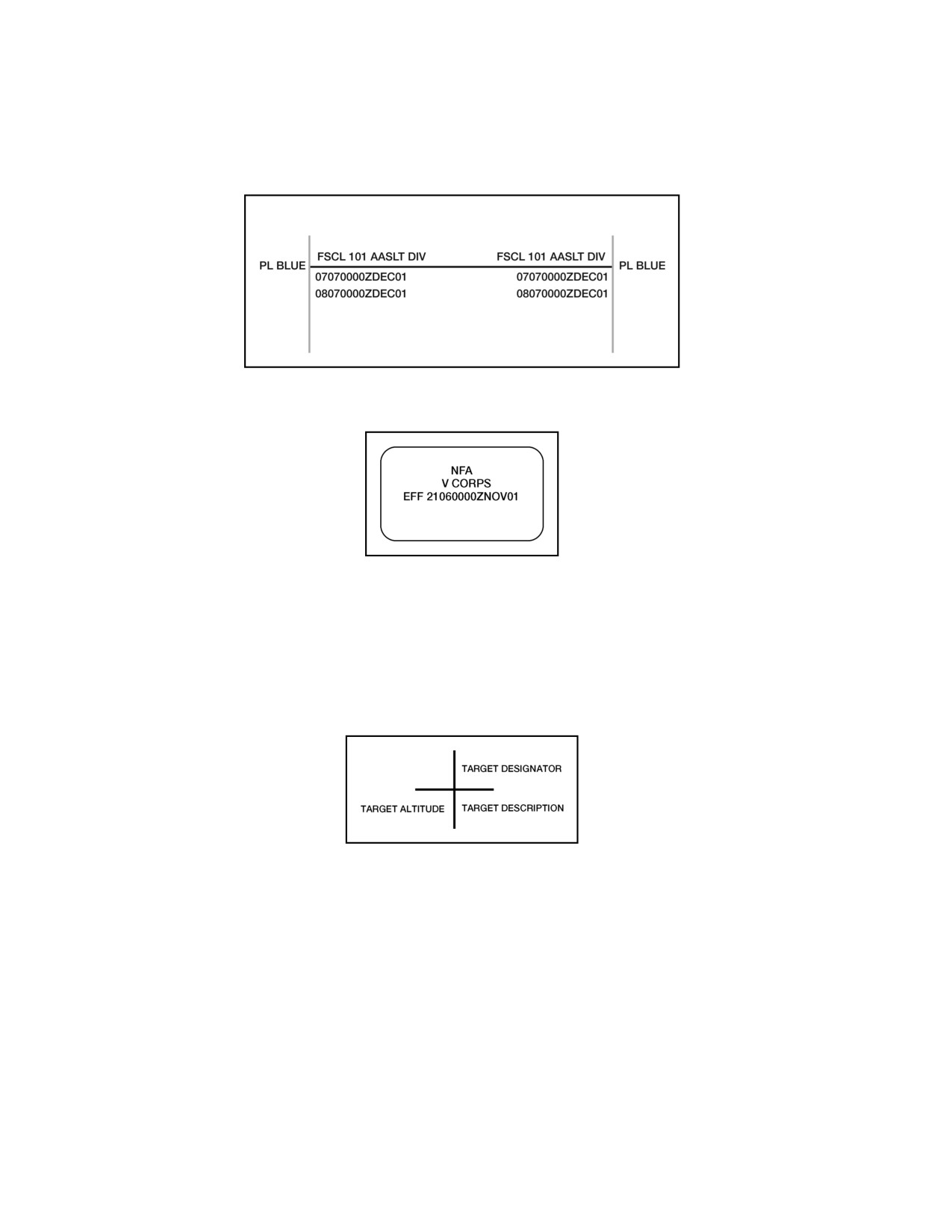
7-10. Label fire support coordinating measures with the effective times, the
controlling headquarters, and the abbreviation of the control measure. Place
this labeling on both ends of the line (see examples in figure 7-12 and figure
7-13) and repeat as often as necessary for clarity along any line that passes
through many boundaries.
7-9
FM 1-02/MCRP 5-12A________________________________________________________________
Figure 7-12. Example of a Friendly FSCL on a Phase Line
Figure 7-13. Example of a Friendly No-Fire Area
TARGETS
7-11. Targets are labeled with target designator, target altitude, and target
description (as shown in figure 7-14). Guidance on determining the lettering
and numbering for target designators is found in FM 6-20-40.
Figure 7-14. Target Labeling Fields
NUCLEAR, BIOLOGICAL, AND CHEMICAL ATTACKS/EVENTS
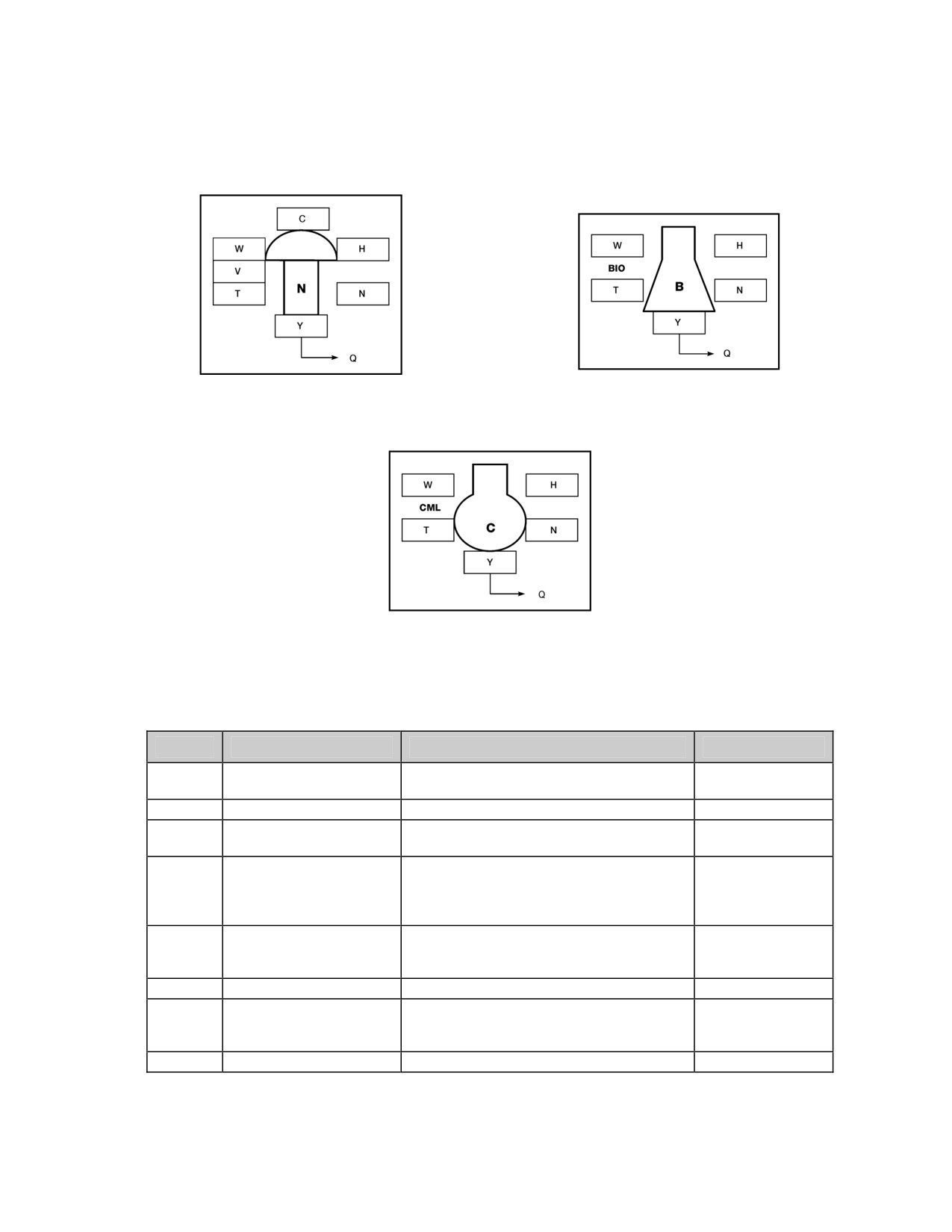
7-12. Nuclear, biological, and chemical attacks/events are depicted as shown
in figure 7-15 through figure 7-17. (See table 7-6, page 7-11, for a description
of fields for text or graphic modifiers for nuclear, biological, and chemical at-
tacks/events. For examples and descriptions of field entries for fire support
control measures, see figure 7-6, page 7-6, and table 7-3, page 7-6, for lines
and figure 7-8, page 7-7, and table 7-4, page 7-7, for areas.)
7-10
___________________________________________________________Graphic Control Measures
Figure 7-16. Biological Event
Figure 7-15. Nuclear Attack/Event
Figure 7-17. Chemical Event
Table 7-6. Description of Fields for Text or Graphic
Modifiers for Nuclear, Biological, and Chemical Attacks/Events
Field
Field Type
Description
Text/Graphic
A modifier that identifies the number of
C
Quantity
Text
items present.
H
Additional Information
Free text.
Text
Denotes hostile symbol. The letters “ENY”
N
Hostile (Enemy)
Text
are used.
With arrow, for nuclear, biological, or
Direction of Movement
chemical release events indicates downwind
Q
Arrow/Offset Location
Graphic
direction. Without arrow, it is used to denote
Indicator
precise location or to declutter.
For friendly nuclear strikes, designates the
T
Unique Designation
friendly delivery system (missile, satellite,
Text
aircraft).
V
Type of Equipment
Nuclear: Friendly weapon type.
Text
An alphanumeric designator for displaying a
W
Date-Time Group
date/time group (DDHHMMSSZMONYY) or
Text
“O/O” for on order.
Y
Location
Latitude and longitude or grid coordinates.
Text
7-11
FM 1-02/MCRP 5-12A________________________________________________________________
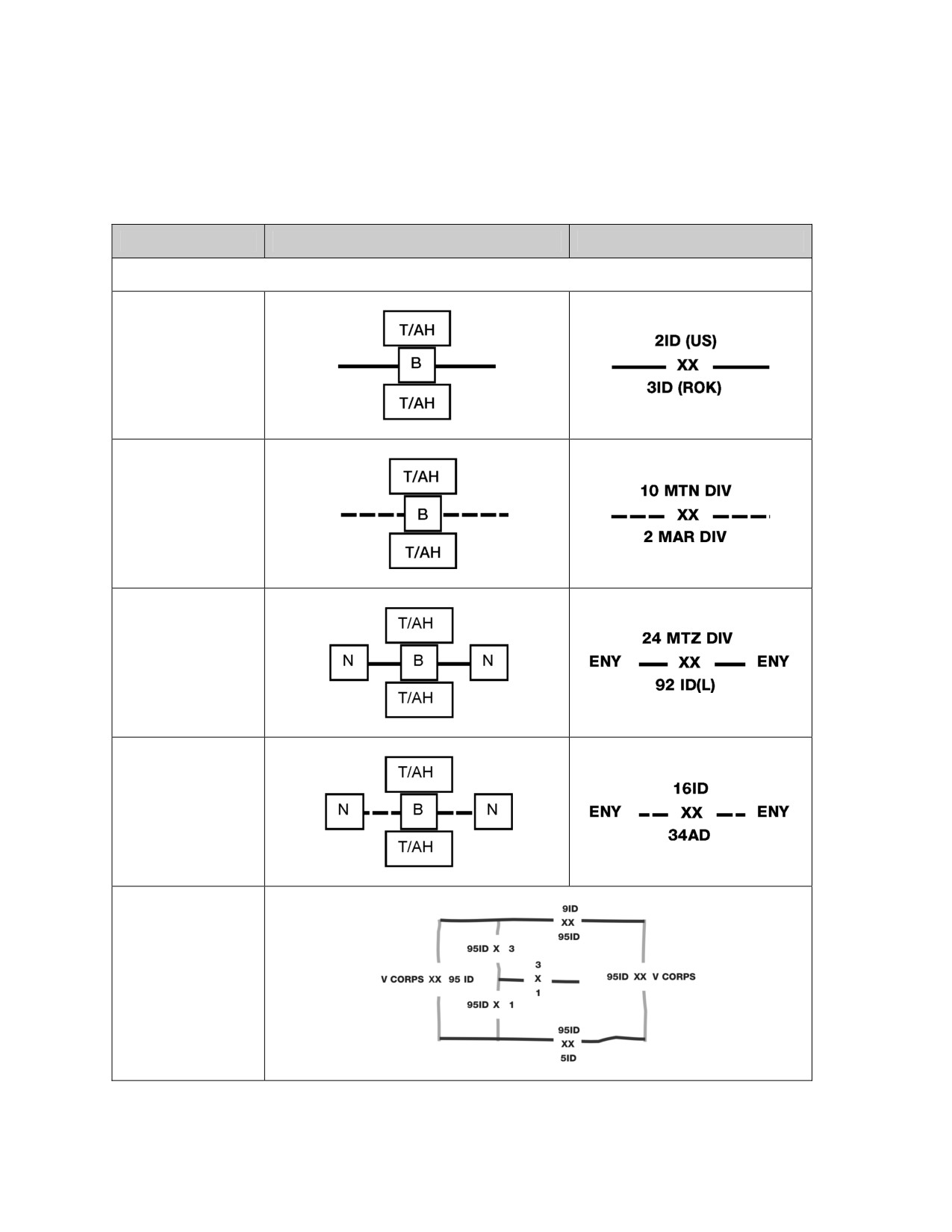
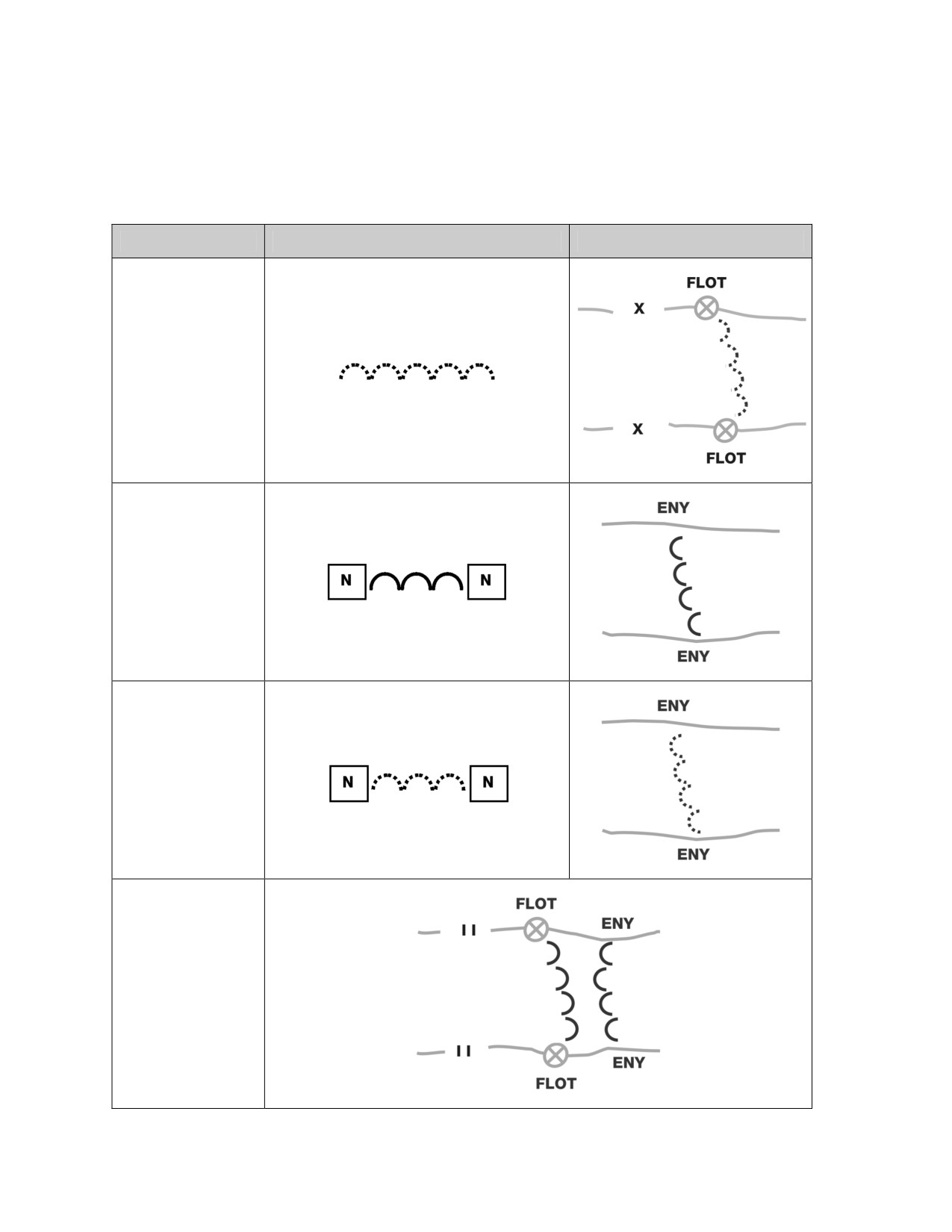
Table 7-7. Examples of Maneuver Control Measures
Control Measure
Graphic
Example
Boundaries (See page 1-24 for definition.)
Friendly Present
Boundary
Friendly Planned or
On Order Boundary
Enemy Known
Boundary
Enemy Suspected
Boundary
Lateral Boundaries.
(See page 1-110
for definition.)
7-12
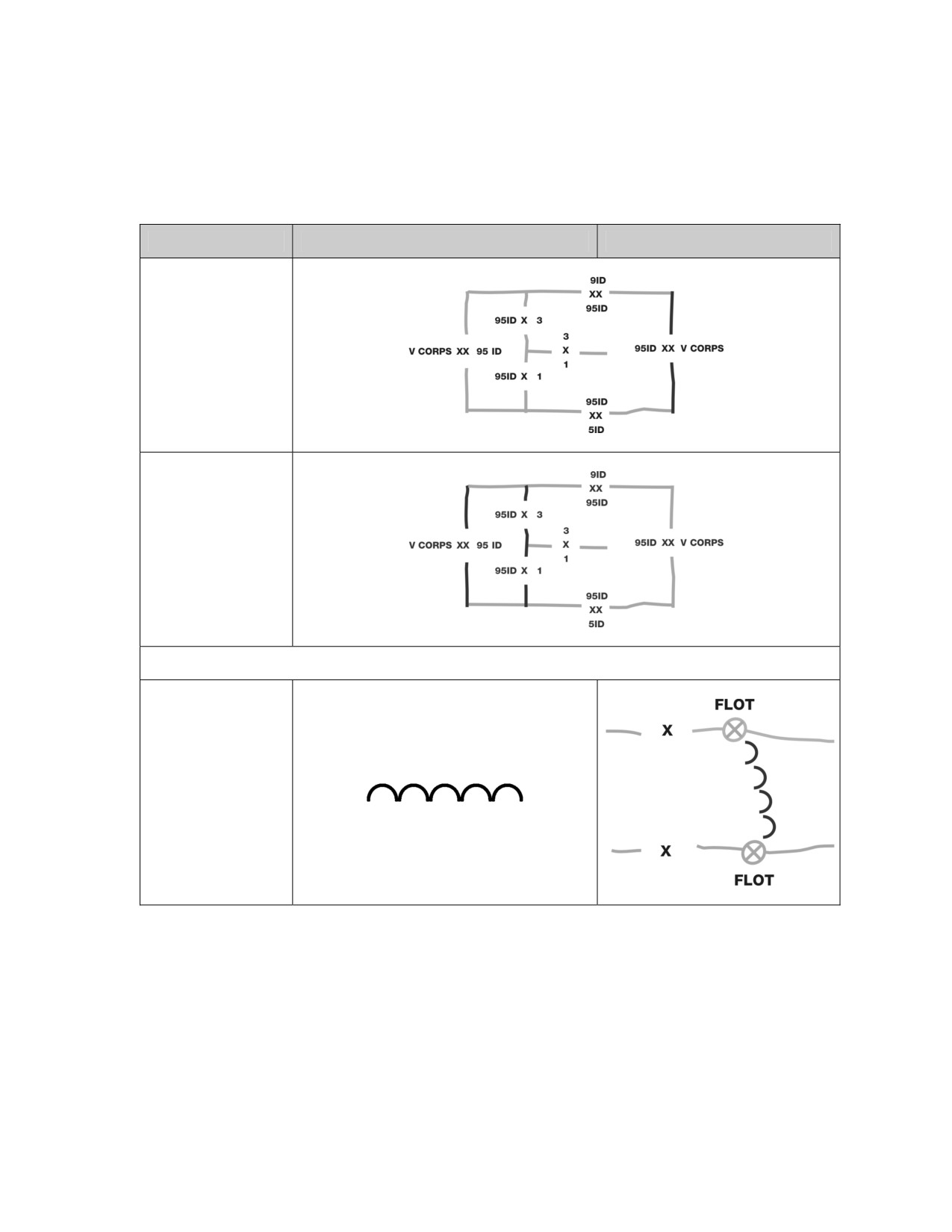
___________________________________________________________Graphic Control Measures
Table 7-7. Examples of Maneuver Control Measures
Control Measure
Graphic
Example
Forward
Boundaries
Rear Boundaries
(See page 1-157
for definition.)
Lines
Forward Line of
Own Troops
(FLOT).
(See page 1-85 for
definition.)
Friendly Present
7-13
FM 1-02/MCRP 5-12A________________________________________________________________
Table 7-7. Examples of Maneuver Control Measures
Control Measure
Graphic
Example
Forward Line of
Own Troops
(FLOT)
Friendly Planned or
On Order
Forward Line of
Own Troops
(FLOT)
Enemy Known or
Confirmed
Forward Line of
Own Troops
(FLOT)
Enemy Suspected
Line of Contact
(LC).
(See page 1-113
for definition.)
7-14
___________________________________________________________Graphic Control Measures
Table 7-7. Examples of Maneuver Control Measures
Control Measure
Graphic
Example
Phase Line (PL).
(See page 1-145
for definition.)
Handover Line.
(See page 1-91 for
definition.)
Areas
Friendly Area
Friendly Planned or
On Order Area
Enemy Known or
Confirmed Area
7-15
FM 1-02/MCRP 5-12A________________________________________________________________
Table 7-7. Examples of Maneuver Control Measures
Control Measure
Graphic
Example
Enemy Suspected
Area
Assembly Area
(AA).
(See page 1-15 for
definition.)
Occupied
Assembly Area
(AA)
Assembly Area
(AA) Occupied by
Multiple Units
Proposed or On
Order Assembly
Area (AA)
Forward Assembly
Area (FAA)
7-16
___________________________________________________________Graphic Control Measures
Table 7-7. Examples of Maneuver Control Measures
Control Measure
Graphic
Example
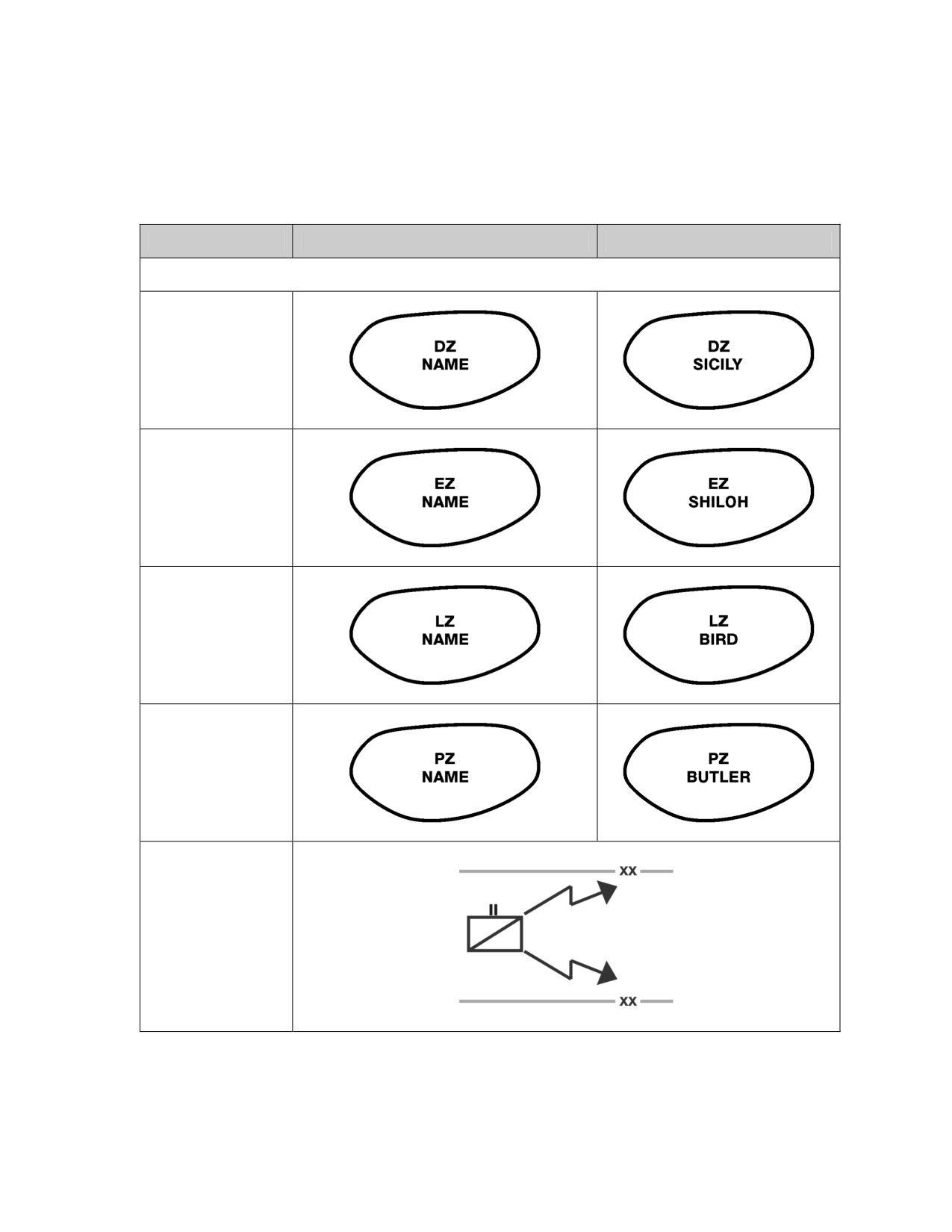
Specified Areas
Drop Zone (DZ).
(See page 1-67 for
definition.)
Extraction Zone
(EZ).
(See page 1-76 for
definition.)
Landing Zone (LZ).
(See page 1-109
for definition.)
Pickup Zone (PZ).
(See page 1-146
for definition.)
Search Area/
Reconnaissance
Area
7-17
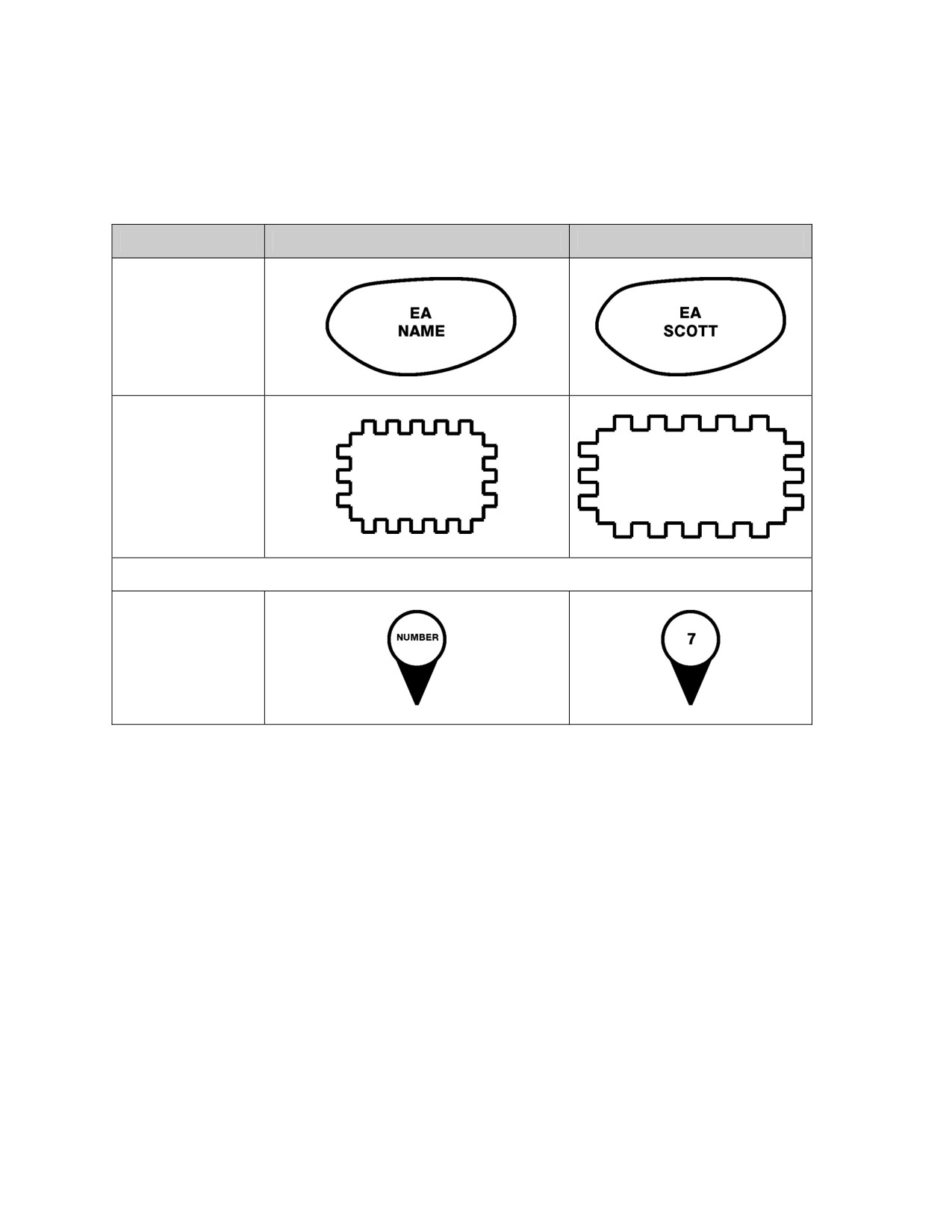
FM 1-02/MCRP 5-12A________________________________________________________________
Table 7-7. Examples of Maneuver Control Measures
Control Measure
Graphic
Example
Engagement Area
(EA).
(See page 1-71 for
definition.)
Fortified Area
Points
Point of Interest
7-18
___________________________________________________________Graphic Control Measures
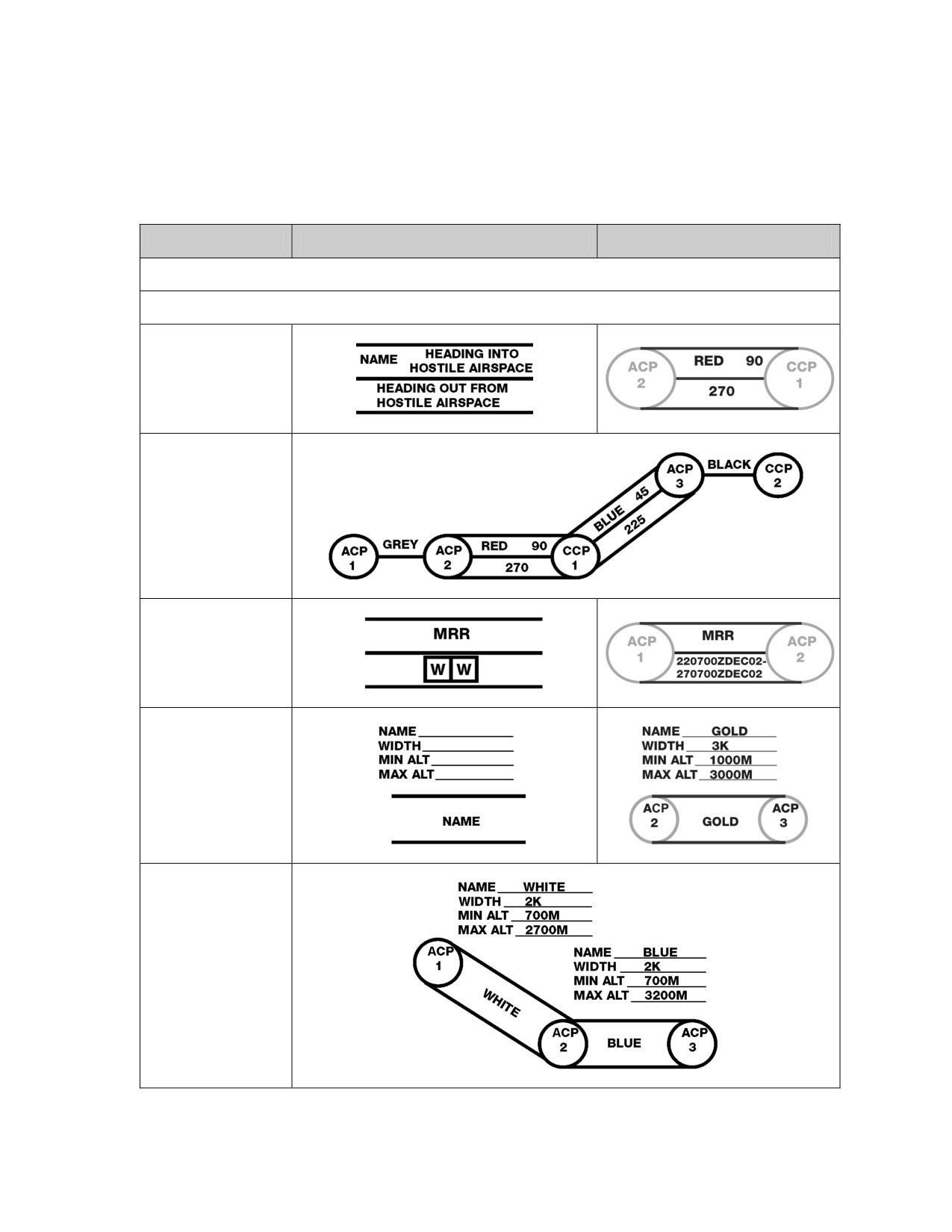
Table 7-8. Examples of Airspace Control Measures
Control Measure
Graphic
Example
Note: (See page 1-8 for definition of Airspace Control Measures (ACM)
Lines
Air Corridor.
(See page 1-6 for
definition.)
Air Corridor
Minimum-Risk
Route (MRR).
(See page 1-125
for definition.)
Standard-Use
Army Aircraft Flight
Route (SAAFR).
(See page 1-176
for definition.)
Standard-Use
Army Aircraft Flight
Route (SAAFR)
7-19
FM 1-02/MCRP 5-12A________________________________________________________________
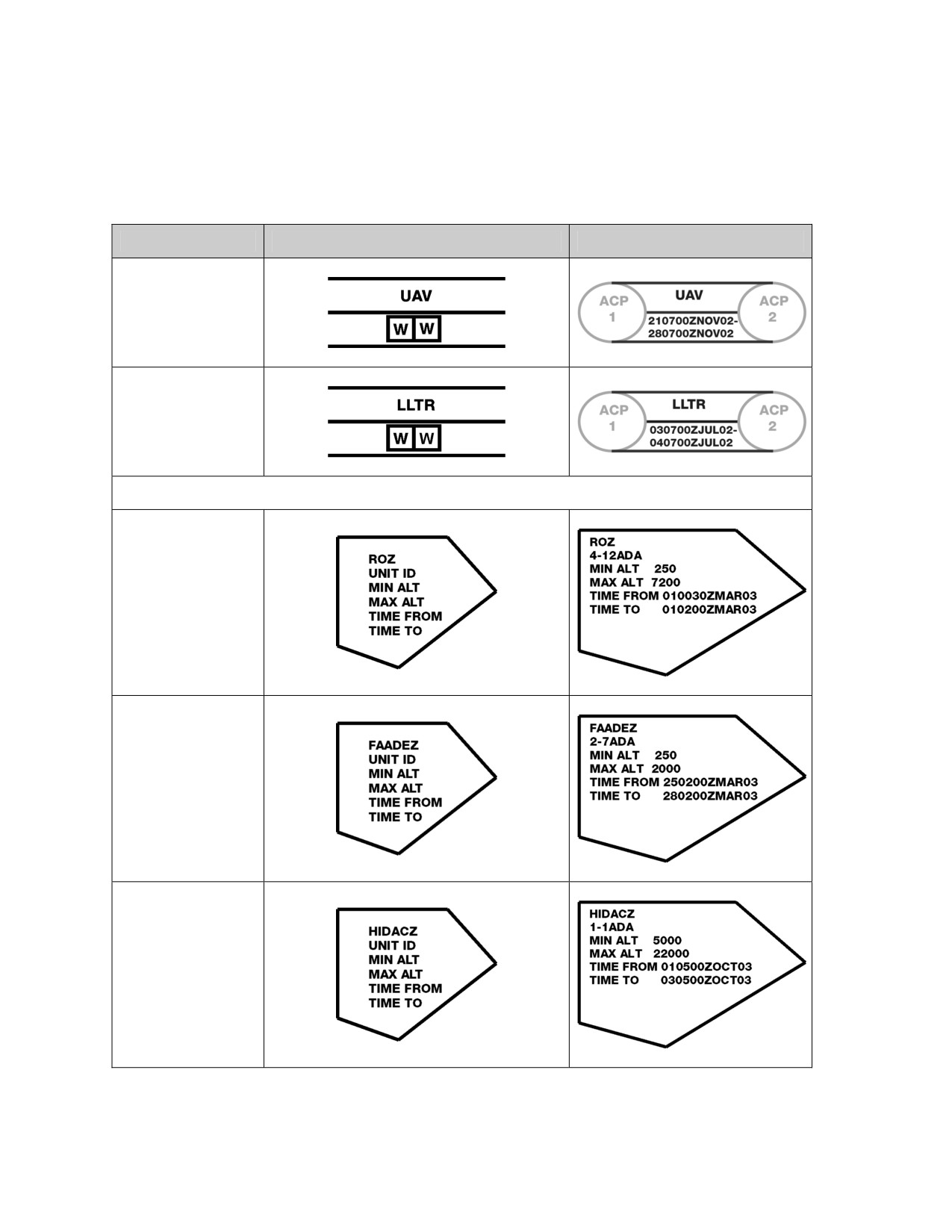
Table 7-8. Examples of Airspace Control Measures
Control Measure
Graphic
Example
Unmanned Aerial
Vehicle (UAV)
Route
Low-Level Transit
Route (LLTR).
(See page 1-115
for definition.)
Areas
Restricted
Operations Zone
(ROZ).
(See page 1-162
for definition.)
Forward Area Air
Defense
Engagement Zone
(FAADEZ).
(See page 1-84 for
definition.)
High-Density
Airspace Control
Zone (HIDACZ).
(See page 1-93 for
definition.)
7-20
___________________________________________________________Graphic Control Measures
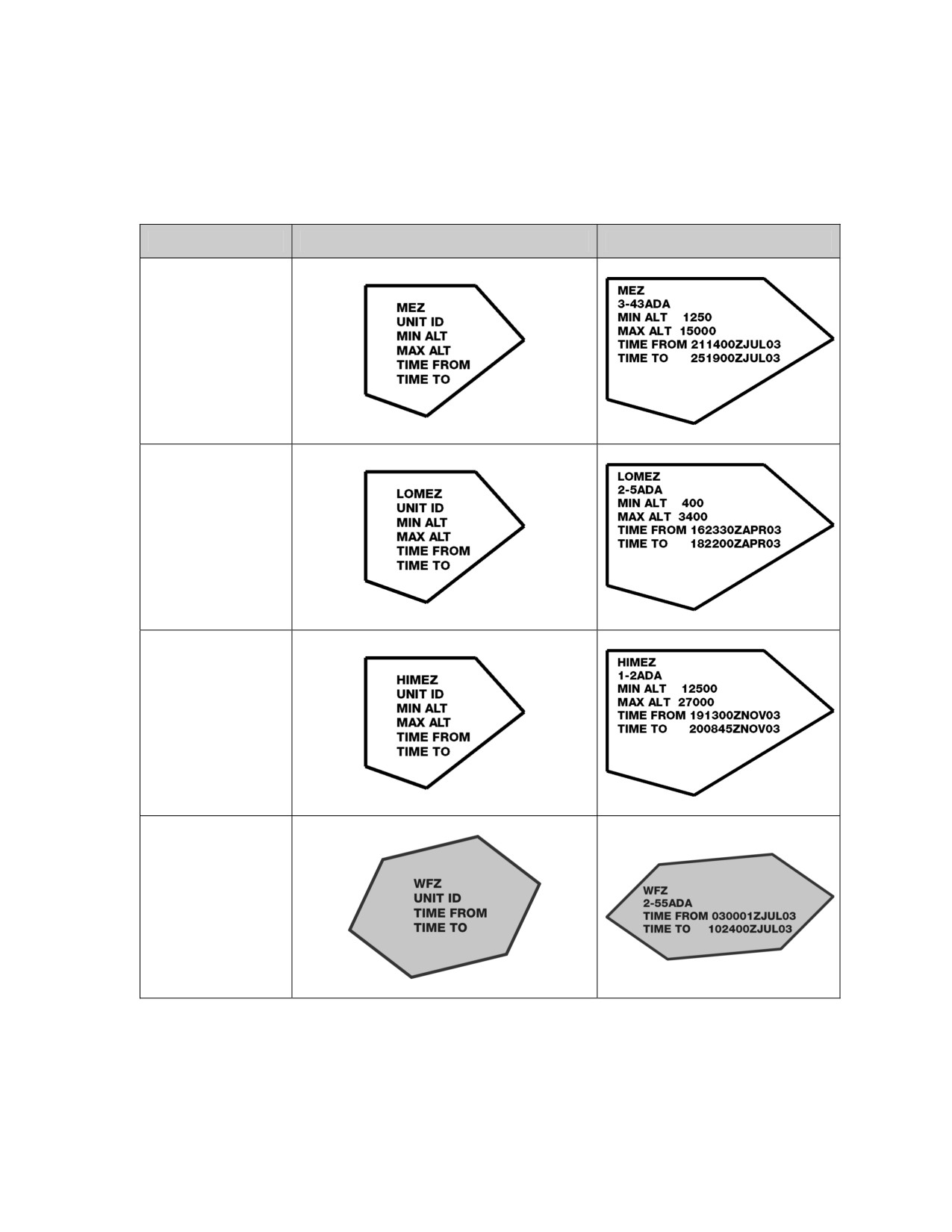
Table 7-8. Examples of Airspace Control Measures
Control Measure
Graphic
Example
Missile
Engagement Zone
(MEZ)
Low-Altitude
Missile
Engagement Zone
(LOMEZ).
(See page 1-115
for definition.)
High-Altitude
Missile
Engagement Zone
(HIMEZ).
(See page 1-93 for
definition.)
Weapons Free
Zone (WFZ).
(See page 1-199
for definition.)
7-21
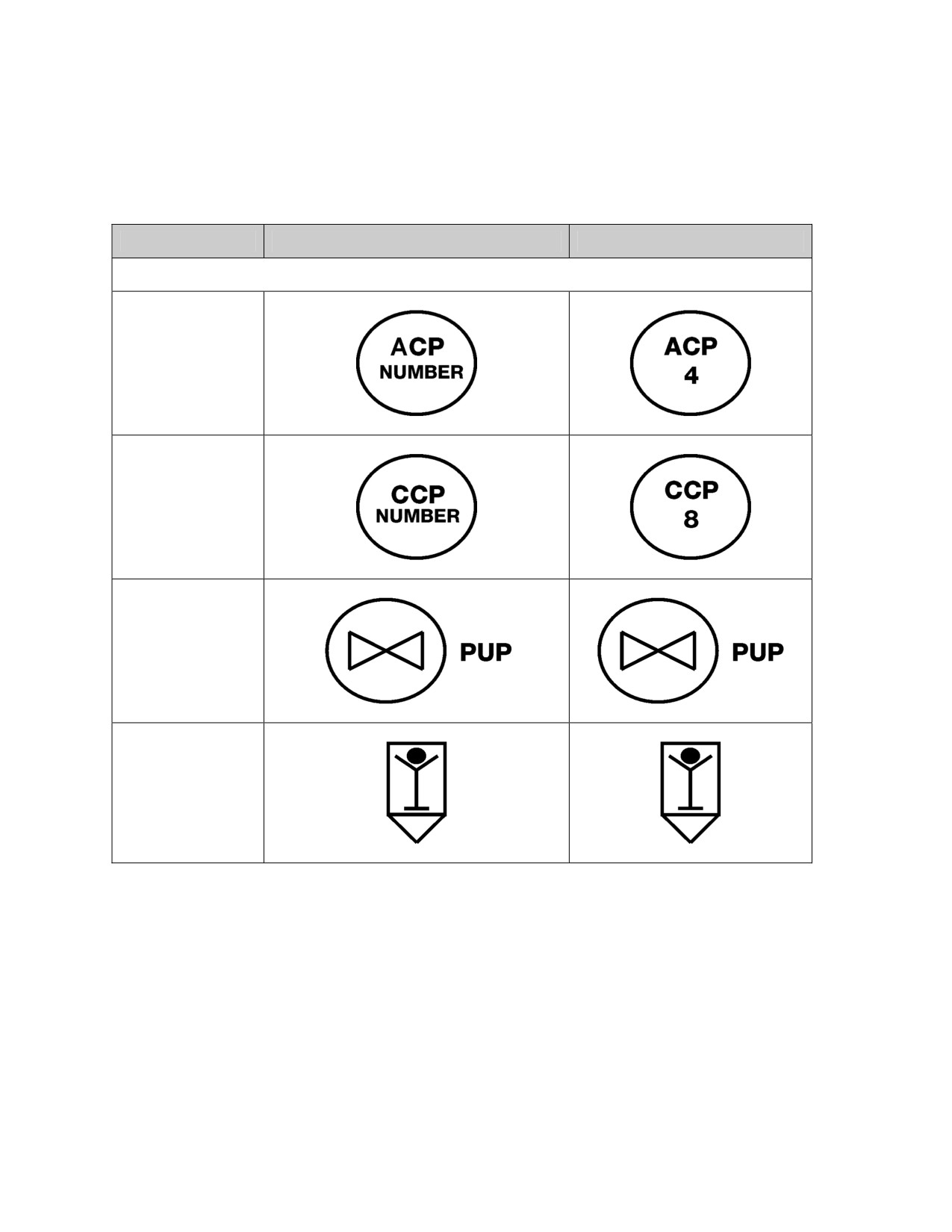
FM 1-02/MCRP 5-12A________________________________________________________________
Table 7-8. Examples of Airspace Control Measures
Control Measure
Graphic
Example
Points
Air Control Point
(ACP).
(See page 1-5 for
definition.)
Communications
Checkpoint (CCP).
(See page 1-40 for
definition.)
Pop-Up Point
(PUP).
(See page 1-148
for definition.)
Downed Aircrew
Pickup Point.
(See page 1-66 for
definition.)
7-22
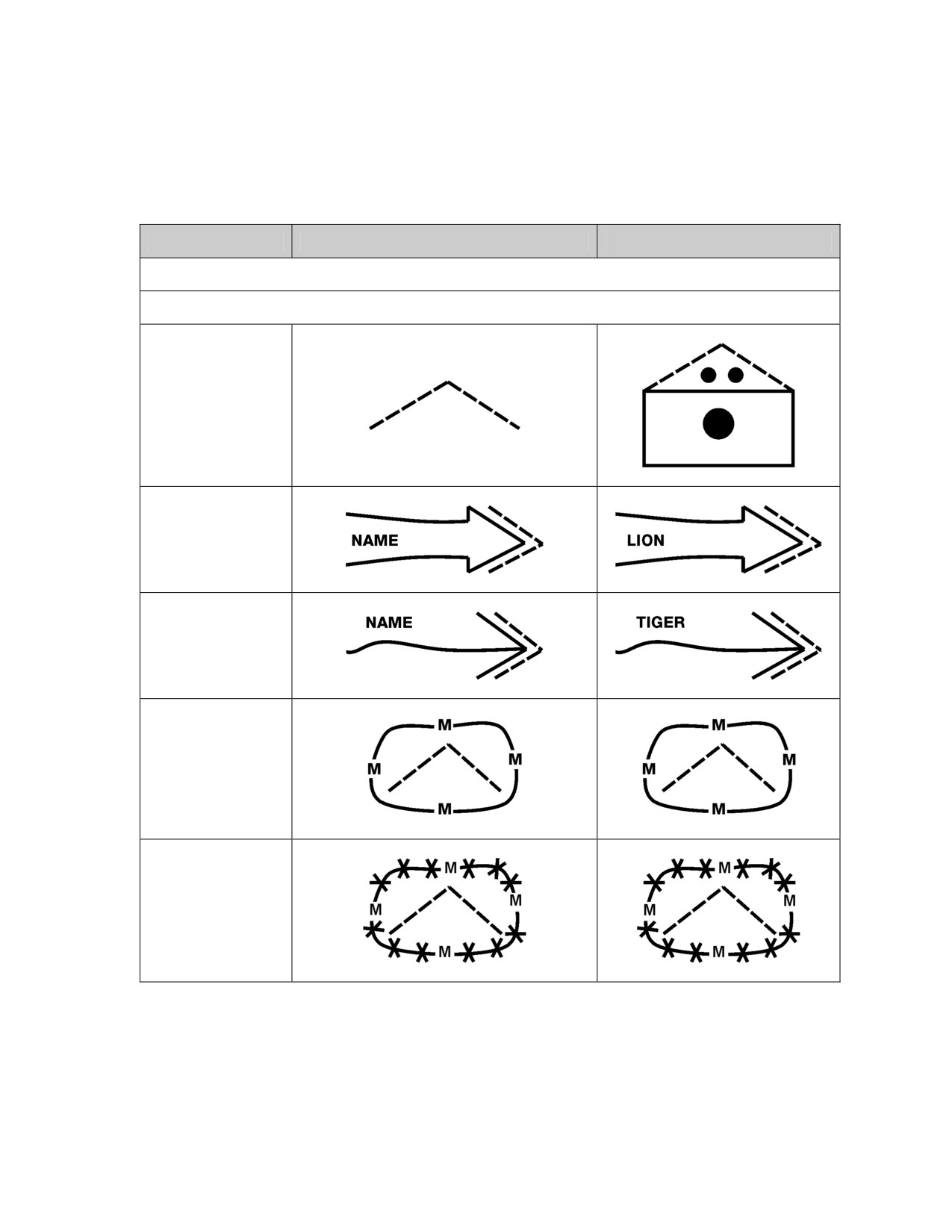
___________________________________________________________Graphic Control Measures
Table 7-9. Examples of Deception Control Measures
Control Measure
Graphic
Example
Note: (See page 1-52 for definition of deception.)
Decoys/Feints
Dummy (also
Decoy or Feint).
(See pages 1-54
and 1-76 for
definitions.)
Axis of Advance for
a Feint
Direction of Attack
for a Feint
Decoy Mined Area
Fenced Decoy
Mined Area
7-23