FM 1-02 (FM 101-5-1) MCRP 5-12A OPERATIONAL TERMS AND GRAPHICS (SEPTEMBER 2004) - page 7
FM 1-02/MCRP 5-12A________________________________________________________________
TAC
tactical (artillery, naval gunfire, and close air support)
(graphics)
TACAIR
tactical air
TACAN
tactical air navigation
TACC
tactical air command center (USMC); tactical air control center
(USN)
TACCP
tactical command post
TACLAN
tactical local area network
TACOM
tactical command (NATO only)
TACON
tactical control
TACP
tactical air control party
TACSAT
tactical satellite
TADIL
tactical digital information link
TAF
tactical air force
TAI
targeted area of interest
TALCE
tanker airlift control element
TALO
tactical air liaison officer; theater airlift liaison officer
TAV
total asset visibility
TBM
tactical ballistic missile; theater ballistic missile
TBMD
tactical ballistic missile defense; theater ballistic missile
defense
TBMPGIP
tactical ballistic missile projected ground impact point
TCF
tactical combat force
TCP
traffic control post
TDA
table of distribution and allowances
TEB
tactical exploitation brigade
TECHCON
technical control
TECHINT
technical intelligence
TEL
transporter erector launcher
TERF
terrain flight
TF
task force
tgt
target
TIB
toxic industrial biological
TIC
toxic industrial chemical
TIH
toxic industrial hazard
TIM
toxic industrial material
TIR
toxic industrial radiological
TIRS
terrain index reference system
2-28
___________________________________Operational Acronyms, Abbreviations, and Country Codes
TLAM
Tomahawk land-attack missile
TLP
troop leading procedures
tm
team
TM
theater missile
TMD
theater missile defense
TMFDB
tactical minefield data base
T/MVD
towing/mine-detection vehicle
TOC
tactical operations center
TOD
time of day
TOE
table of organization and equipment
TOR
terms of reference
TOT
time on target (naval gunfire, mortar, and close air support)
TOW
tube-launched, optically tracked, wire-guided
TPC
tactical pilot chart; tactical psychological operations company
TPD
tactical psychological operations detachment
TPFDD
time-phased force and deployment data
TPFDL
time-phased force and deployment list
TPT
tactical psychological operations team
TRADOC
United States Army Training and Doctrine Command
trans
transportation
TRP
target reference point; troop
TS
top secret
TSM
target synchronization matrix
TSS
target selection standard
TTP
tactics, techniques, and procedures
—U—
UAV
unmanned aerial vehicle
UCL
unit configured load
UGS
unattended ground sensors
UHF
ultrahigh frequency
UMCP
unit maintenance collection point
UMT
unit ministry team
UNAAF
Unified Action Armed Forces
USACAC
United States Army Combined Arms Center
USAF
United States Air Force
USAFSOC
United States Air Force special operations command
USAID
United States Agency for International Development
USASOC
United States Army Special Operations Command
2-29
FM 1-02/MCRP 5-12A________________________________________________________________
USCENTCOM
United States Central Command
USCG
United States Coast Guard
USEUCOM
United States European Command
USFK
United States Forces Korea
USMC
United States Marine Corps
USN
United States Navy
USPACOM
United States Pacific Command
USSOUTHCOM
United States Southern Command
USSPACECOM
United States Space Command
UT1
Universal Time
UTC
Coordinated Universal Time
UTM
universal transverse mercator
UTO
Universal Time Observed
UW
unconventional warfare
UXO
unexploded explosive ordnance
—V—
V
veterinary (graphics)
VA
vulnerability assessment
VFR
visual flight rules
VHF
very high frequency
VITD
vector interim terrain data
—W—
WARNO
warning order
WCS
weapons control status
WEZ
weapon engagement zone
WFZ
weapons free zone
WGS
world geodetic system
WIA
wounded in action
WMD
weapons of mass destruction
WME
warfighting mass effect
—Z—
Z
Zulu Time
ZOS
zone of separation
ZULU
Universal Time
2-30
___________________________________Operational Acronyms, Abbreviations, and Country Codes
SECTION II - TWO-LETTER GEOGRAPHICAL ENTITY CODES
2-1. The following list of two-letter geographical entity codes was taken from
NATO STANAG 1059, Distinguishing Letters for Geographical Entities for
Use in NATO.
—A—
AA
Aruba
AC
Antigua and Barbuda
AF
Afghanistan
AG
Algeria
AJ
Azerbaijan
AL
Albania
AM
Armenia
AN
Andorra
AO
Angola
AR
Argentina
AS
Australia
AT
Ashmore and Cartier Islands
AU
Austria
AV
Anguilla
AY
Antarctica
—B—
BA
Bahrain
BB
Barbados
BD
Bermuda
BE
Belgium
BF
Bahamas
BG
Bangladesh
BH
Belize
BJ
Bjoernoeya (Bear Island)
BK
Bosnia and Herzegovina
BL
Bolivia
BN
Benin
BO
Belarus
BR
Brazil
BS
Bassas da India
BT
Bhutan
2-31
FM 1-02/MCRP 5-12A________________________________________________________________
BU
Bulgaria
BV
Bouvet Island
BX
Brunei
BY
Burundi
—C—
CA
Canada
CB
Cambodia
CD
Chad
CF
Congo
CG
Congo, Democratic Republic of (Zaire)
CH
China
CI
Chile
CJ
Cayman Islands
CK
Cocos (Keelig) Islands
CM
Cameroon
CN
Comoros
CO
Colombia
CR
Coral Sea Islands
CS
Costa Rica
CT
Central African Republic
CU
Cuba
CV
Cape Verde
CW
Cook Islands
CY
Cyprus
CZ
Czech Republic
—D—
DA
Denmark
DJ
Djibouti
DO
Domenica
DR
Dominican Republic
—E—
EC
Ecuador
EG
Egypt
EI
Ireland
EK
Equatorial Guinea
EN
Estonia
ER
Eritrea
2-32
___________________________________Operational Acronyms, Abbreviations, and Country Codes
ES
El Salvador
ET
Ethiopia
EU
Europa Islands
—F—
FG
French Guiana
FI
Finland
FJ
Fiji
FK
Falkland Islands
FM
Federated States of Micronesia
FO
Faeroe Islands
FP
French Polynesia (including Tahiti)
FQ
Kingman Reef
FR
France
FS
French southern and Antarctic lands (excluding Terre Adelie)
FY
Republic of Macedonia (Former Yugoslav Republic of Macedonia)
—G—
GA
Gambia
GB
Gabon
GE
Germany
GG
Georgia
GH
Ghana
GI
Gibraltar
GJ
Grenada
GL
Greenland
GO
Glorioso Islands
GP
Guadeloupe
GQ
Guam
GR
Greece
GT
Guatemala
GU
Guernsey
GV
Guinea
GY
Guyana
—H—
HA
Haiti
HK
Hong Kong
HM
Heard and McDonald Islands
HO
Honduras
2-33
FM 1-02/MCRP 5-12A________________________________________________________________
HQ
Howland Island
HR
Croatia
HU
Hungary
—I—
IC
Iceland
ID
Indonesia
IM
Isle of Man
IN
India
IO
British Indian Ocean Terrritory
IP
Clipperton
IR
Iran
IS
Israel
IT
Italy
IV
Ivory Coast
IZ
Iraq
—J—
JA
Japan
JE
Jersey
JM
Jamaica
JN
Jan Mayen
JO
Jordan
JQ
Johnston Atoll
JU
Juan de Nova Island
—K—
KE
Kenya
KG
Kyrgyzstan
KN
North Korea
KQ
Baker Island
KR
Kiribati
KS
South Korea
KT
Christmas Island
KU
Kuwait
KZ
Kazakhstan
—L—
LA
Laos
LE
Lebanon
LG
Latvia
2-34
___________________________________Operational Acronyms, Abbreviations, and Country Codes
LH
Lithuania
LI
Liberia
LO
Slovakia
LQ
Palmyra Atoll
LS
Liechtenstein
LT
Lesotho
LU
Luxembourg
LY
Libya
—M—
MA
Madagascar (Malagasy Republic)
MB
Martinique
MC
Macao
MD
Moldova
ME
Mayotte
MG
Mongolia
MH
Montserrat
MI
Malawi
ML
Mali
MN
Monaco
MO
Morocco
MP
Mauritius
MQ
Midway Islands
MR
Mauritania
MT
Malta
MU
Oman
MV
Maldives
MY
Malaysia
MX
Mexico
MZ
Mozambique
—N—
NA
Netherlands Antilles
NC
New Caledonia
NE
Niue
NF
Norfolk Island
NG
Niger
NH
Vanuatu
NI
Nigeria
2-35
FM 1-02/MCRP 5-12A________________________________________________________________
NL
Netherlands
NO
Norway
NP
Nepal
NR
Nauru
NS
Surinam
NU
Nicaragua
NZ
New Zealand
—P—
PA
Panama
PC
Pitcairn Islands
PE
Peru
PF
Parcel Islands
PG
Spratly Islands
PK
Pakistan
PL
Poland
PM
Panama
PO
Portugal
PP
Papua New Guinea
PS
Paulau
PU
Guinea Bissau
—Q—
QA
Qatar
—R—
RE
Reunion
RM
Marshall Islands
RO
Romania
RP
Philippines
RQ
Puerto Rico
RS
Russia
RW
Rwanda
—S—
SA
Saudi Arabia
SB
St. Pierre and Miquelon
SC
St. Kitts and Newvis
SE
Seychelles
SF
South Africa
SG
Senegal
2-36
___________________________________Operational Acronyms, Abbreviations, and Country Codes
SH
St. Helena
SI
Slovenia
SL
Sierra Leone
SM
San Marino
SN
Singapore
SO
Somalia
SP
Spain
SS
Samoa
ST
St. Lucia
SX
South Georgia and South Sandwich Islands
SU
Sudan
SV
Svalbard
SW
Sweden
SY
Syria
SZ
Switzerland
—T—
TC
United Arab Emirates
TD
Trinidad and Tobago
TE
Tromelin Island
TH
Thailand
TI
Tajikistan
TK
Turks and Caicos Islands
TL
Tokelau Islands
TM
East Timor
TN
Tonga
TO
Togo
TP
Sao Tome and Principe
TS
Tunisia
TU
Turkey
TV
Tuvalu
TX
Turkmenistan
TW
Taiwan
TZ
Tanzania
—U—
UG
Uganda
UK
United Kingdom
UP
Ukraine
2-37
FM 1-02/MCRP 5-12A________________________________________________________________
US
United States
UV
Burkina
UY
Uruguay
UZ
Uzbekistan
—V—
VC
St. Vincent
VE
Venezuela
VI
Virgin Islands
VM
Vietnam
VT
Vatican City
—W—
WA
Namibia
WF
Wallis and Futuna
WQ
Wake Island
WS
Western Samoa
WZ
Swaziland
—X—
XA
Bophuthatswana
—Y—
YE
Yemen
YU
Yugoslavia Federal Republic (Serbia and Montenegro)
—Z—
ZA
Zambia
ZI
Zimbabwe
2-38

Chapter 3
Multi-Service Brevity Codes, Procedure Words, and
Tactical Tasks
SECTION I - BREVITY CODES
+This section is rescinded. Refer to FM 1-02.1.
SECTION II - PROCEDURE WORDS (PROWORDS)
3-1. To keep voice transmissions as short and clear as possible, radio operators employ
procedure words (prowords)—a word or phrase limited to radio telephone procedure,
used to facilitate communication by conveying information in a condensed standard
form. The following is a list of commonly used prowords; their meanings are given in
chapter 1.
all after
I authenticate
silence
all before
I read back
silence lifted
authenticate
I say again
speak slower
authentication is
I spell
this is
break
I verify
time
correct
message
to
correction
more to follow
unknown station
disregard this transmission—out
out
verify
do not answer
over
wait
exempt
priority
wait out
figures
read back
wilco
flash
relay to
word after
from
roger
word before
groups
routine
words twice
immediate
say again
wrong
info
service
SECTION III - TACTICAL MISSION TASKS
3-2. A tactical mission task is the specific activity performed by a unit while executing a
form of tactical operation or form of maneuver. It may be expressed in terms of either
actions by a friendly force or effects on an enemy force. Tactical mission tasks describe
the results or effects the commander wants to achieve, the what and why of a mission
statement. The following is a list of commonly used tactical mission tasks; their
meanings are given in chapter 1.
2 February 2010
FM1-02/MCRP 5-12A, C1
3-1
FM 1-02/MCRP 5-12A, C1
attack by fire
destroy
neutralize
block
disengage
occupy
breach
disrupt
reduce
bypass
exfiltrate
retain
canalize
fix
secure
clear
follow and assume
seize
contain
follow and support
support-by-fire
control
interdict
suppress
counter reconnaissance
isolate
turn
defeat
3-2
2 February 2010
This chapter implements STANAG 2019, STANAG 2022, QSTAG 509, and QSTAG 511.
Chapter 4
Military Symbols
A military symbol is a graphic representation of units, equipment, installations,
control measures, and other elements relevant to military operations. As a part of
doctrine, these symbols provide a common visual language for all users.
Standardization of military symbols is essential if operational information is to be
passed among military units without misunderstanding. This chapter defines the
single standard used to develop and depict hand-drawn and computer-generated
military symbols for situation maps, overlays, and annotated aerial photographs for
all types of military operations. It provides rules for building specific sets of military
symbols. These rules provide details of construction, but allow enough flexibility for
the user to build symbols to meet operational needs.
PURPOSE
4-1. The main purpose of military symbology is to allow commanders and staffs to
graphically display certain elements of the operational picture. Situation maps, overlays,
and annotated aerial photographs are used to express an operation plan or order, concept,
or friendly or hostile (enemy) situation. The combination of unit and equipment symbols
and control measures, as well as other military symbols, creates an indispensable tool for
quickly portraying military operations.
This manual primarily focuses on land military symbols. Chapter 4 discusses a single
standard for military symbols. For detailed requirements for the composition and
construction of symbols and control measures, see—
• Chapter 5, Unit Symbols.
• Chapter 6, Equipment Symbols.
• Chapter 7, Graphic Control Measures.
• Chapter 8, Installation Symbols.
• Chapter 9, Stability Operations and Support Operations Symbols.
Where applicable, links are provided between symbols and terms for greater
understanding. The Army field manuals referenced with the terms provide an explanation
of how those terms are used.
The symbology defined in this manual is in compliance with Department of Defense
Military Standard 2525, Common Warfighting Symbology.
2 February 2010
FM 1-02/MCRP 5-12A, C1
4-1
FM 1-02/MCRP 5-12A, C1
ORIENTATION OF MILITARY SYMBOLS
4-2. All the military symbols in this manual are designed to be displayed with a single
orientation. The symbols will be displayed with the top of the symbol pointed north.
COMPOSITION OF MILITARY SYMBOLS
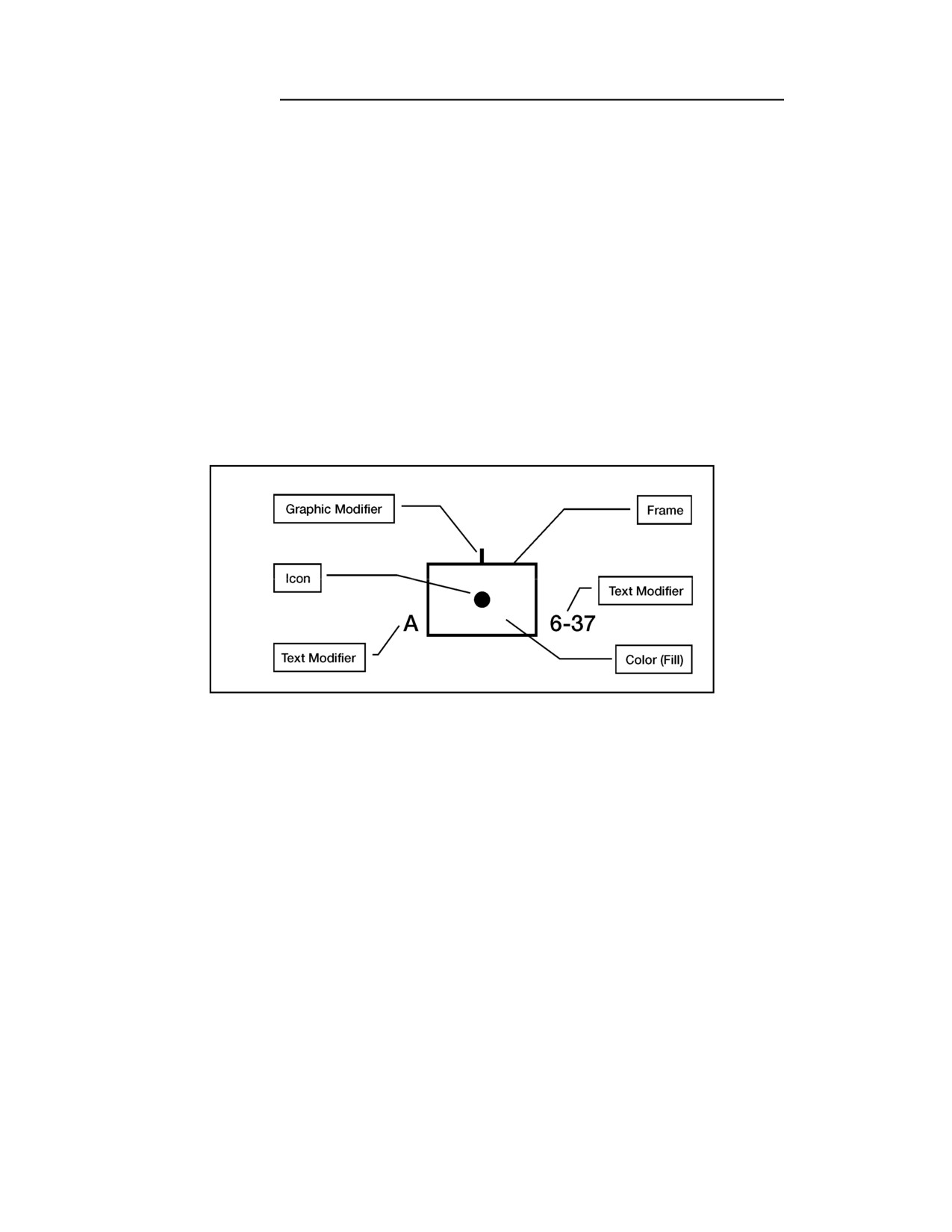
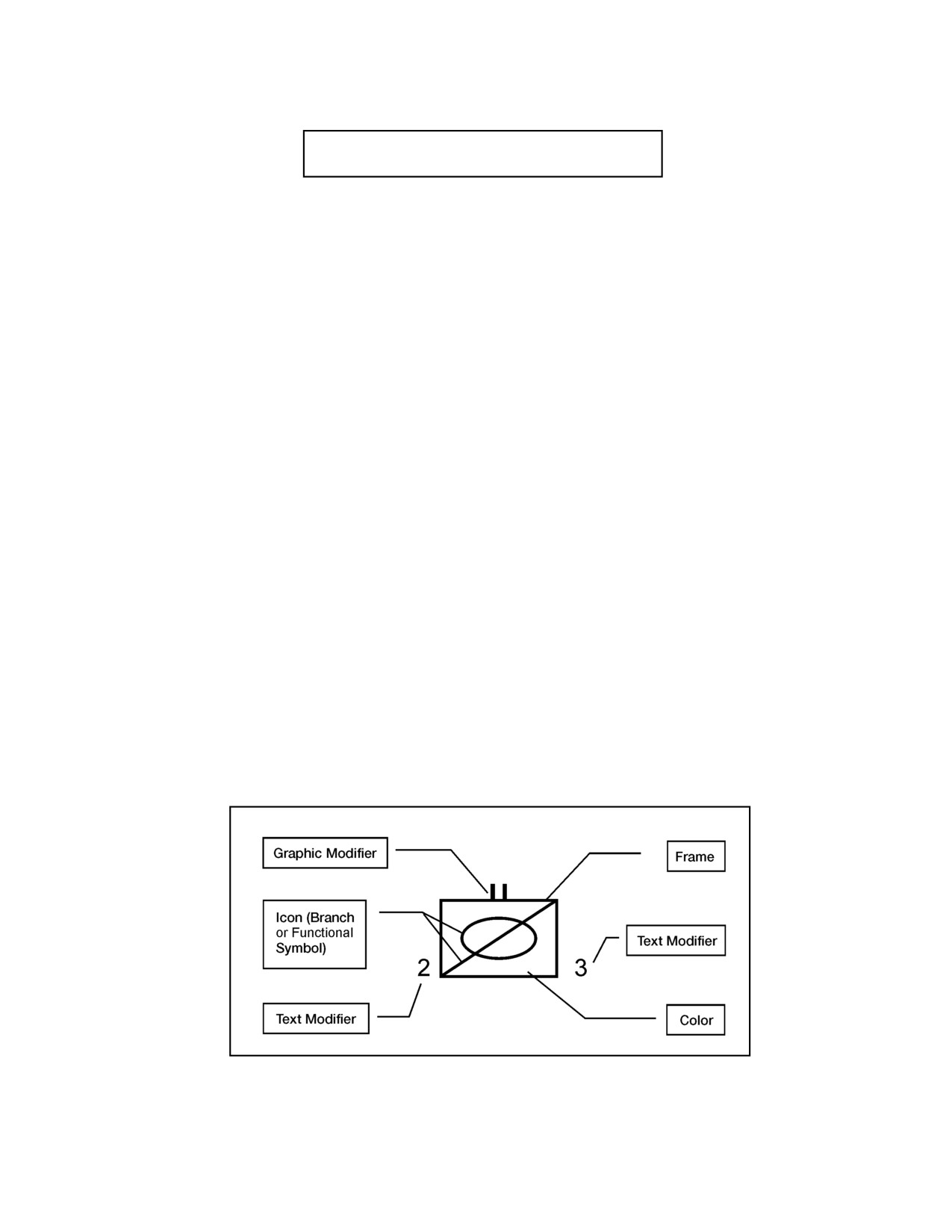
4-3. A military symbol is composed of a frame, color (fill), icon(s), and may include text
or graphic modifiers that provide additional information (see figure 4-1.) Included in
military symbols are graphic control measures, which are composed of boundaries; lines;
areas; points; targets; and nuclear, biological, or chemical attacks/events. The
composition of graphic control measures varies from that of unit, equipment, installation,
and support operations and stability operations symbols. Graphic control measures have
the same attributes as other military symbols, but utilize different rules for building. The
details for building graphic control measures are provided in chapter 7 of this manual.
Figure 4-1. Components of a Military Symbol
FRAME
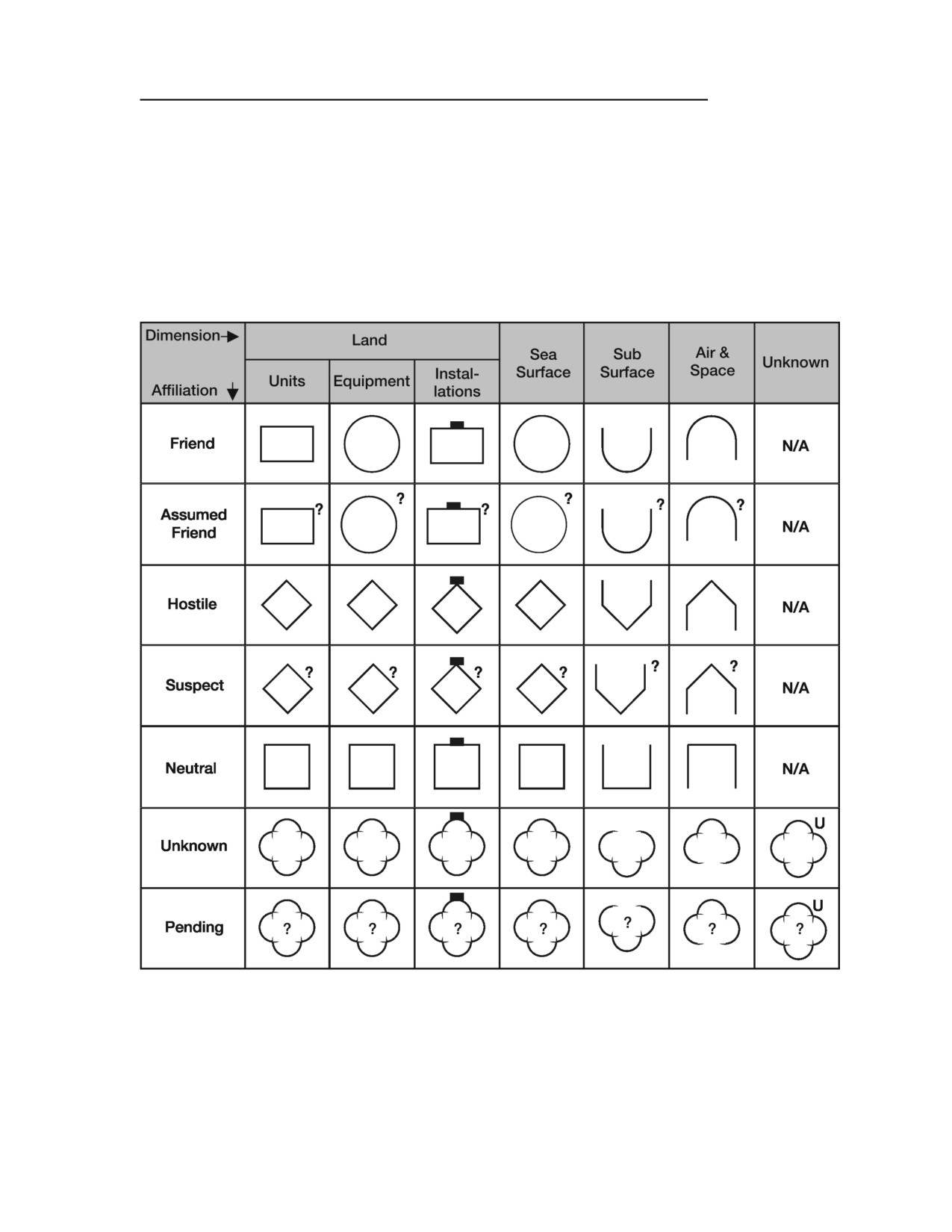
4-4. The frame is the geometric border of a military symbol. It represents affiliation,
dimension, and status. The frame serves as the base to which the other components of the
symbol are added. A frame can be black or colored, depending on the system being used
for representation (see color paragraph below). The frame may include modifiers (U or ?)
that are placed inside or outside the frame that help determine affiliation. These modifiers
are considered to be an integral part of the frame.
z
Affiliation. Affiliation refers to the relationship of the symbol being represented
to friendly forces. The affiliation categories are friend, assumed friend, hostile,
suspect, neutral, unknown, and pending. (The frame shapes for affiliation are
shown in table 4-1.)
z
Dimension. Dimension refers to the primary mission area for the symbol being
represented. There are five dimensions that can be represented: land, sea
surface, sea subsurface, air and space, and unknown. Normally, if the dimension
cannot or has not been determined, it is considered to be unknown. This manual
focuses on the land dimension (see table 4-1).
4-2
2 February 2010
+Military Symbols
z
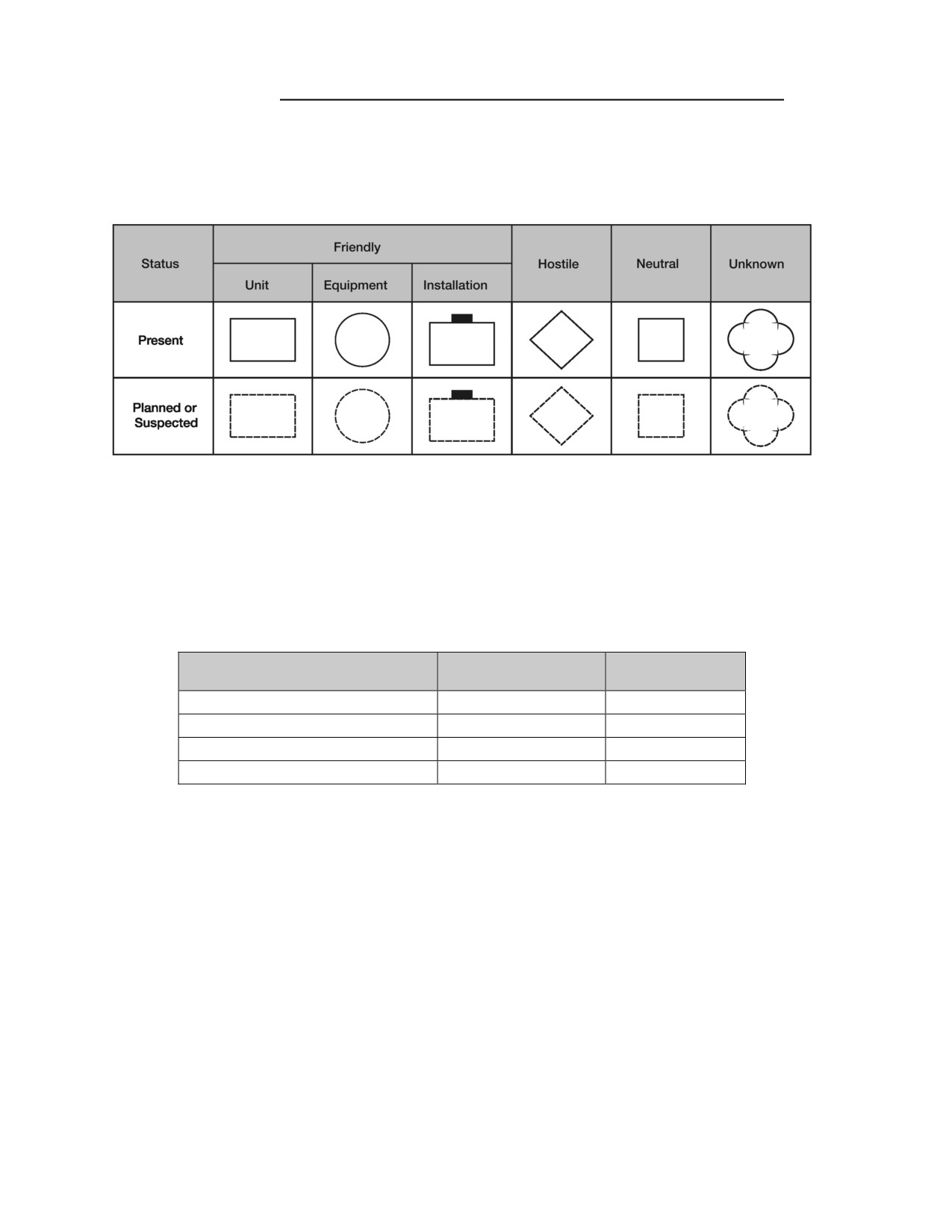
Status. Status refers to whether a unit is known to be present at the location
identified or whether it is a planned or suspected location. Regardless of
affiliation, present status is indicated by a solid line and planned or suspected
status is indicated by a dashed line (see table 4-2).
Table 4-1. Frame Shapes for All Affiliations and Dimensions
2 February 2010
FM 1-02/MCRP 5-12A, C1
4-3
FM 1-02/MCRP 5-12A, C1
Table 4-2. Status of Symbols
COLOR (FILL)
4-5. Color indicates affiliation. Color is the hue of the line marking the geometric border
or the fill of the interior area of the frame. Table 4-3 depicts the default colors that are
used to designate colored symbols for either hand-drawn or computer-generated displays.
The use of any colors other than those in table 4-3 for military symbols must be
explained in an accompanying legend.
Table 4-3. Color Defaults
Computer-
Affiliation
Hand-Drawn
Generated
Friend, Assumed Friend
Blue
Cyan
Hostile, Suspect
Red
Red
Neutral
Green
Green
Unknown, Pending
Yellow
Yellow
ICON
4-6. The icon is the innermost part of the military symbol providing an abstract pictorial
or alphanumeric representation of the function or role of the military symbol. Within the
frame and as an integral part of a basic icon, there may also be additional graphic or text
modifiers that further define the function or role of the military symbol being displayed.
See chapters 4, 5, 7, and 8 for application and examples.
TEXT OR GRAPHIC MODIFIERS
4-7. A text or graphic modifier provides additional information about a symbol. This
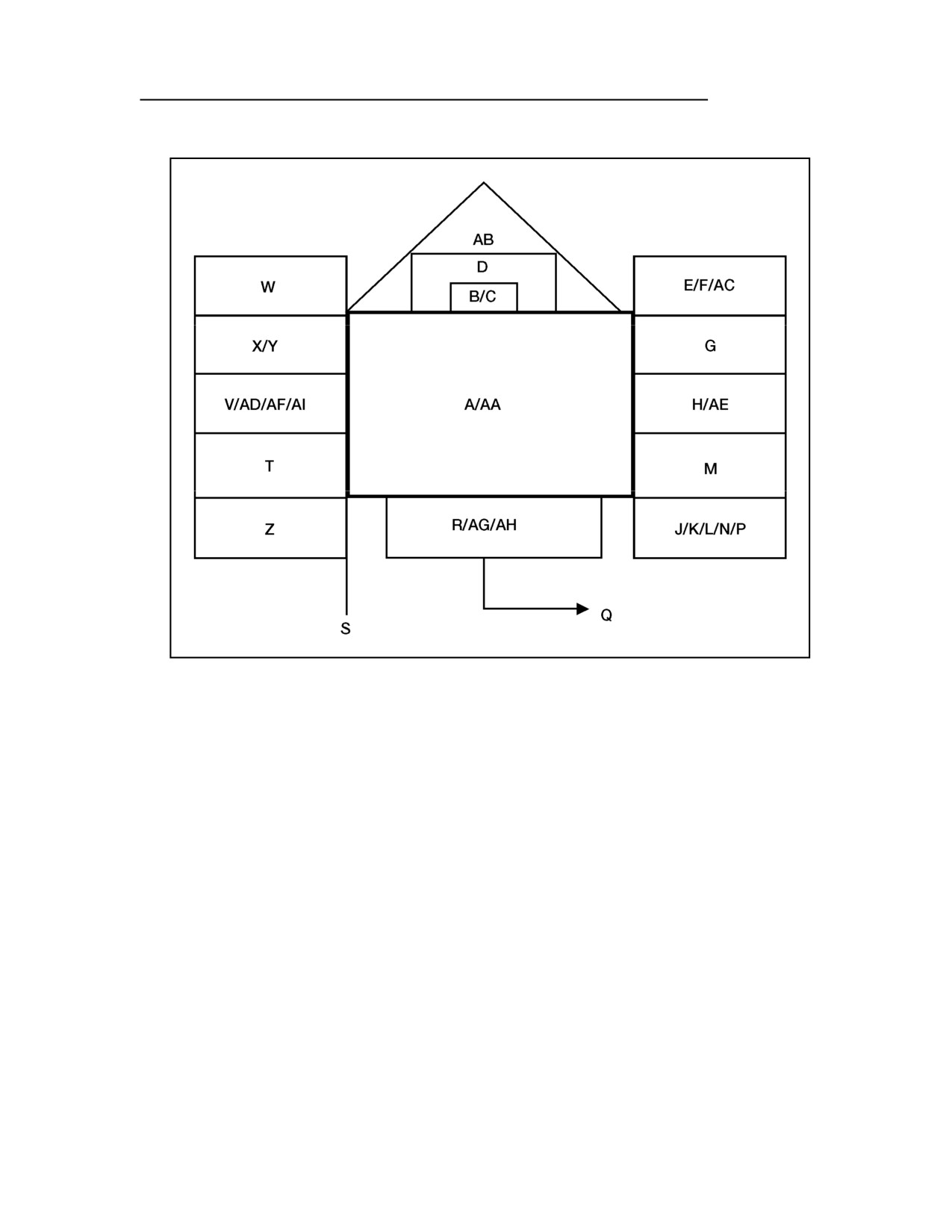
information is displayed on the outside of the frame. The default placement of modifiers
in fields around the frame is shown in figure 4-2. The placement of these modifiers is the
same, regardless of frame shape.
4-4
2 February 2010
+Military Symbols
Figure 4-2. Field Positions for Text or Graphic Modifiers
4-8. The field entries in table 4-4 correspond with the field positions in figure 4-2. This
table includes all entries used for military symbols. Selected portions of this table are
reproduced in chapters 5, 6, 7, 8, and 9 for easy reference in building symbols. For many
of the fields in table 4-4, specific entries are found in chapters 5, 6, 7, 8, and 9.
2 February 2010
FM 1-02/MCRP 5-12A, C1
4-5
FM 1-02/MCRP 5-12A, C1
Table 4-4. Descriptions of Fields for Text or Graphic Modifiers for Military Symbols
Text/
Field
Field Title
Description
Application
Graphic
A
Symbol Indicator
Icon or icons that represent the basic
All
Both
functions of the symbol. (The innermost
part of a symbol.)
B
Echelon
A symbol modifier that denotes the size of
Unit,
Both
a unit (see table 5-6, page 5-33). Also used
control
to denote a command (see paragraph 5-5
measures
and figure 5-3, page 5-34).
C
Quantity
A modifier that identifies the number of
Equipment,
Text
items present.
SO/SO
D
Task Force
A symbol placed over the echelon indicator
Unit
Graphic
to denote a task-organized unit (see figure
5-4, page 5-34).
E
Frame Shape
Helps determine affiliation or battle
Unit,
Text
Modifier
dimension of symbol. “U” represents
equipment,
unknown battle dimension. Question mark
installation,
“?” represents suspect or assumed friend
SO/SO
affiliation.
F
Reinforced or
Indicates whether a unit is reinforced (+),
Unit
Text
Detached
reduced (-), or reinforced and reduced (+)
(see figure 5-5, page 5-35).
G
Staff Comments
Free text. Can be used by staff for
Unit,
Text
information required by commander.
equipment,
installation,
SO/SO
H
Additional
Free text. Additional information not
All
Text
Information
covered by other fields.
J
Evaluation Rating
Degree of confidence that may be placed
Unit,
Text
on the information represented by the
SO/SO,
symbol. It is shown as one letter and one
equipment,
number made up of Reliability of Source
installation
and Credibility of Information.
Reliability of Source:
A. Completely reliable
B. Usually reliable
C. Fairly reliable
D. Not usually reliable
E. Unreliable
F. Reliability cannot be judged.
Credibility of Information:
1. Confirmed by other sources
2. Probably true
3. Possibly true
4-6
2 February 2010
+Military Symbols
Table 4-4. Descriptions of Fields for Text or Graphic Modifiers for Military Symbols
Text/
Field
Field Title
Description
Application
Graphic
4. Doubtful
5. Improbable
6. Truth cannot be judged.
K
Combat
Effectiveness of unit or equipment
Unit,
Text
Effectiveness
displayed.
equipment,
installation
1. Fully operational
2. Substantially operational
3. Marginally operational
4. Not operational
Capacity of
Capacity of installation displayed, such as
Installation
number of items produced or repaired.
L
Signature
Uses an exclamation point “!”as a text
Equipment
Text
Equipment
modifier to indicate a detectable electronic
signature for hostile equipment.
M
Higher Formation
Number or title of the next higher echelon
Unit,
Text
command of unit being displayed.
SO/SO,
equipment,
installation
N
Hostile (Enemy)
Denotes hostile graphic control measure.
Control
Text
The letters “ENY” are used when the color
measures
red is not used. Can also be used for
neutral or unknown when required. The
letters “NEU” or “UNK” are used.
P
Identification
IFF/SIF identification modes and codes.
Unit,
Text
Friend or Foe
equipment
(IFF)/Selective
Identification
Feature (SIF)
Q
Direction of
With arrow, it denotes the direction symbol
All
Graphic
Movement Arrow
is moving or will move.
For nuclear, biological, or chemical release
events, indicates downwind direction.
Offset Location
Without arrow, it is used to denote precise
Indicator
location of units or to declutter mutiple unit
locations (see figure 5-6, page 5-42.),
except for headquarters (see field S).
R
Mobility Indicator
Pictorial representation of the mobility of
Equipment
Graphic
the symbol.
2 February 2010
FM 1-02/MCRP 5-12A, C1
4-7
FM 1-02/MCRP 5-12A, C1
Table 4-4. Descriptions of Fields for Text or Graphic Modifiers for Military Symbols
Text/
Field
Field Title
Description
Application
Graphic
S
Headquarters
Identifies symbol as a headquarters.
Unit,
Graphic
Staff Indicator
installation,
SO/SO
Offset Location
Used to indicate precise location of
Indicator
headquarters or to declutter multiple
headquarters locations (see figure 5-7,
page 5-42.).
T
Unique
An alphanumeric designator that uniquely
All
Text
Designation
identifies a particular unit (designation);
equipment (number); installation (name).
For friendly nuclear strikes, this designates
the friendly delivery system (missile,
satellite, aircraft).
V
Type of
Identifies unique designation.
Unit,
Text
Equipment
equipment,
Nuclear: Friendly weapons type.
SO/SO
W
Date-Time Group
An alphanumeric designator for displaying
All
Text
a date-time group (DDHHMMSSZMONYY)
or “O/O” for on order. The date-time group
is composed of a group of six numeric
digits with a time zone suffix and the
standardized three-letter abbreviation for
the month followed by two digits. The first
pair of digits represents the day; the
second pair, the hour; the third pair, the
minutes. The last two digits of the year are
after the month. For automated systems,
two digits may be added before the time
zone suffix and after the minutes to
designate seconds.
X
Altitude/Depth
Altitude as displayed on the global
All
Text
positioning system (GPS).
Flight level for aircraft.
Depth for submerged objects.
Height in feet of equipment or structure on
the ground.
Nuclear: Height of burst.
Y
Location
Latitude and longitude or grid coordinates.
All
Text
Z
Speed
Displays speed in nautical miles per hour
Units,
Text
or kilometers per hour.
equipment,
SO/SO
4-8
2 February 2010
+Military Symbols
Table 4-4. Descriptions of Fields for Text or Graphic Modifiers for Military Symbols
Text/
Field
Field Title
Description
Application
Graphic
AA
Named C2
This field applies to named commands
Unit,
Text
Headquarters or
such as SHAPE, SACLANT, EUCOM,
SO/SO,
SO/SO
USARPAC, or joint, multinational, or
installation
nonmilitary
coalition commands such as CJTF, JTF.
organizations
(see table 5-7, page 5-36.). Can be used to
indicate international organizations (UN or
ICRC/RC), nongovernment organizations
(NGO), national governmental agencies
(USAID), or regional intragovernmental
organizations (EU).
AB
Feint or Dummy
Indicates that it is a dummy or a feint for
All
Graphic
Indicator
deception purposes.
AC
Country Indicator
A two-letter code that indicates the country
All
Text
of origin of the unit (see chapter 2). This
field can be used also for factions or
groups in support operations and stability
operations. (Names of factions or groups
must be spelled out.)
AD
Platform Type
Electronic Intelligence Notation (ELNOT) or
Equipment
Text
Communications Intelligence Notation
(CENOT)
AE
Equipment
Equipment teardown time in minutes.
Equipment
Text
Teardown Time
AF
Common
Example: Paladin for M109A6 howitzer or
Unit,
Text
Identifier
Abrams for the M-1 tank.
equipment
AG
Auxiliary
Indicates the presence of a towed sonar
Equipment
Graphic
Equipment
array. Used with surface and subsurface
Indicator
equipment.
AH
Headquarters
Indicates what type of element of a
Unit
Text
Elements
headquarters is being represented, such
as TOC, MAIN. (see table 5-8, page 5-39.).
AI
Installation
Indicates the composition of the
Installation
Text
Composition
installation, such as production, service,
storage, research, or utility.
4-9. For information on building air, sea surface, sea subsurface, and space military
symbols, refer to Military Standard 2525. The rules for the construction of these military
symbols are identical to those for land symbols. All the frame shapes that are used with
each of the domains: air, land, sea surface, sea subsurface, and space can be found in
table 4-1, page 4-3. This also provides a reference for users of this manual to understand
how land symbology fits into joint symbology. Selected parts of the land portions of
table
4-1, page 4-3, are reproduced in chapters 4, 5, 7, and 8 as necessary for the
construction of those symbols and the understanding of building symbols.
2 February 2010
FM 1-02/MCRP 5-12A, C1
4-9
FM 1-02/MCRP 5-12A, C1
BASIC RULES FOR BUILDING SYMBOLS
4-10. When building symbols as described in chapters 5 through 7, follow the basic rules:
z
Use existing symbols or modifiers whenever possible as building blocks for new
symbols.
z
Symbols must be usable in both hand-drawn and computer-generated automated
modes.
z
Symbols must be easily distinguishable so as not to be confused with other
symbols.
z
Friendly symbols must not use attributes that could be confused with enemy
symbols.
z
Symbols must be distinguishable without color for use on a monochrome
display.
z
Composite symbols will generally have the primary symbol centered above or
below the modifying symbols.
4-11. All symbols will be drawn or portrayed with the top of the symbol facing the top of
the overlay (normally north is at the top). Orientation of the symbol will be accomplished
by using the “Q” field for moving symbols or another graphic such as a battle position or
support by fire position.
4-10
2 February 2010
This chapter implements STANAG 2961.
Chapter 5
Unit Symbols
This chapter establishes a single standard for developing land unit sym-
bols. A unit is a military element whose structure is prescribed by a com-
petent authority. This chapter includes a wide variety of unit symbols and
modifiers for building new or unique symbols. However, no attempt to de-
pict all unit symbols has been made. Rather, a standard method for con-
structing unit symbols is presented. Once the user is familiar with the
prescribed system, any desired unit can be developed using the logical se-
quence provided in this chapter. The symbols shown in this chapter are
adequate for depicting hostile units. When representing unorthodox units,
select the most appropriate symbol contained herein. Avoid using any
symbols, or combinations and modifications of symbols, that differ from
those in this manual. If, after searching doctrinal symbols and modifiers,
it is necessary to create a new symbol, explain the symbol in an accompa-
nying legend. Computer-generated systems may have difficulty in passing
nonstandard symbols.
COMPOSITION OF UNIT SYMBOLS
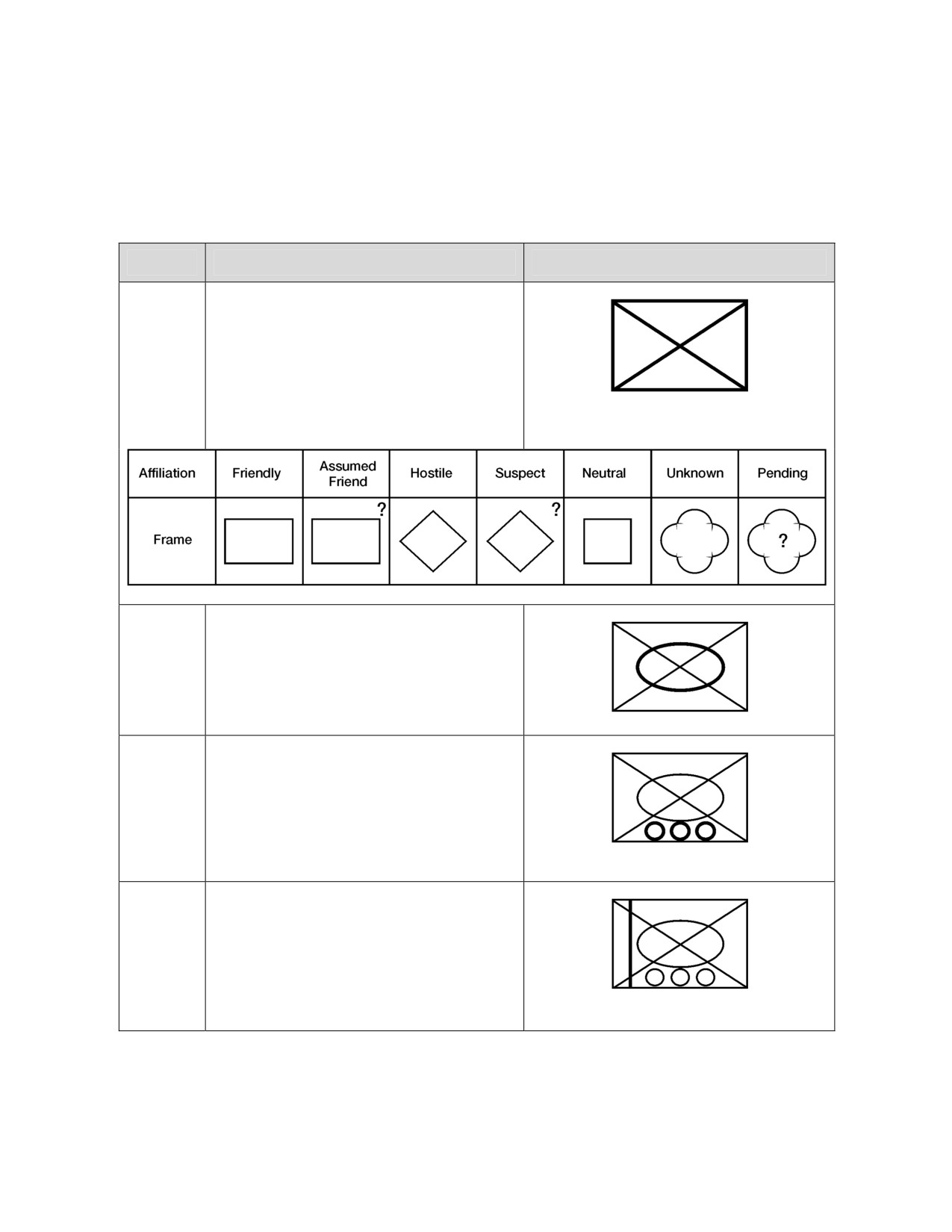
5-1. A unit symbol is composed of a frame, color (fill), branch (an arm of ser-
vice of the Army/Marine Corps) or functional symbols (icon), and text and/or
other symbol modifiers (figure 5-1). (See table 5-1 for the steps used to build
unit symbols.)
Figure 5-1. Unit Symbol Components
5-1
FM 1-02/MCRP 5-12A________________________________________________________________
Table 5-1. Building Unit Symbols
Step #
Step
Example
Step 1.
First choose the frame that matches the
affiliation of the unit (friendly, hostile,
neutral). Then choose branch or functional
symbol for field “A” (see figure 5-2, page 5-
3; table 5-2, page 5-4; and table 5-3, page
5-6). In this example, the affiliation is
friendly and the branch is infantry. (See the
Friendly Infantry Unit
following land unit frame shapes and
affiliations.)
If required , choose the second (additional)
Step 2.
branch symbol modifier that further
explains the capability of that unit,
modifying field “A.” In this example, the
branch symbol modifier is “mechanized” or
“armored” (see table 5-3, page 5-10).
Friendly Mechanized Infantry Unit
Again, if required, choose third branch
Step 3.
symbol modifier for the next capability, for
field “A.” In this example, the third function
or capability is “wheeled” or more
appropriately “wheeled armored vehicle.”
This is a mobility modifier. It describes the
capability of the unit to move personnel and
Friendly Wheeled Armored Infantry Unit
equipment (see table 5-4, page 5-26).
Choose a fourth branch symbol modifier for
Step 4.
any other capability, for field “A.” In this
example, the fourth function or capability is
“gun system equipped.” It is possible to
have additional symbol modifiers; however,
for this example, no further functional or
capability modifiers are provided (see table
Friendly Wheeled Armored Infantry Unit
5-4, page 5-26).
with Gun Systems
5-2
_____________________________________________________________________Unit Symbols
Table 5-1. Building Unit Symbols
Step #
Step
Example
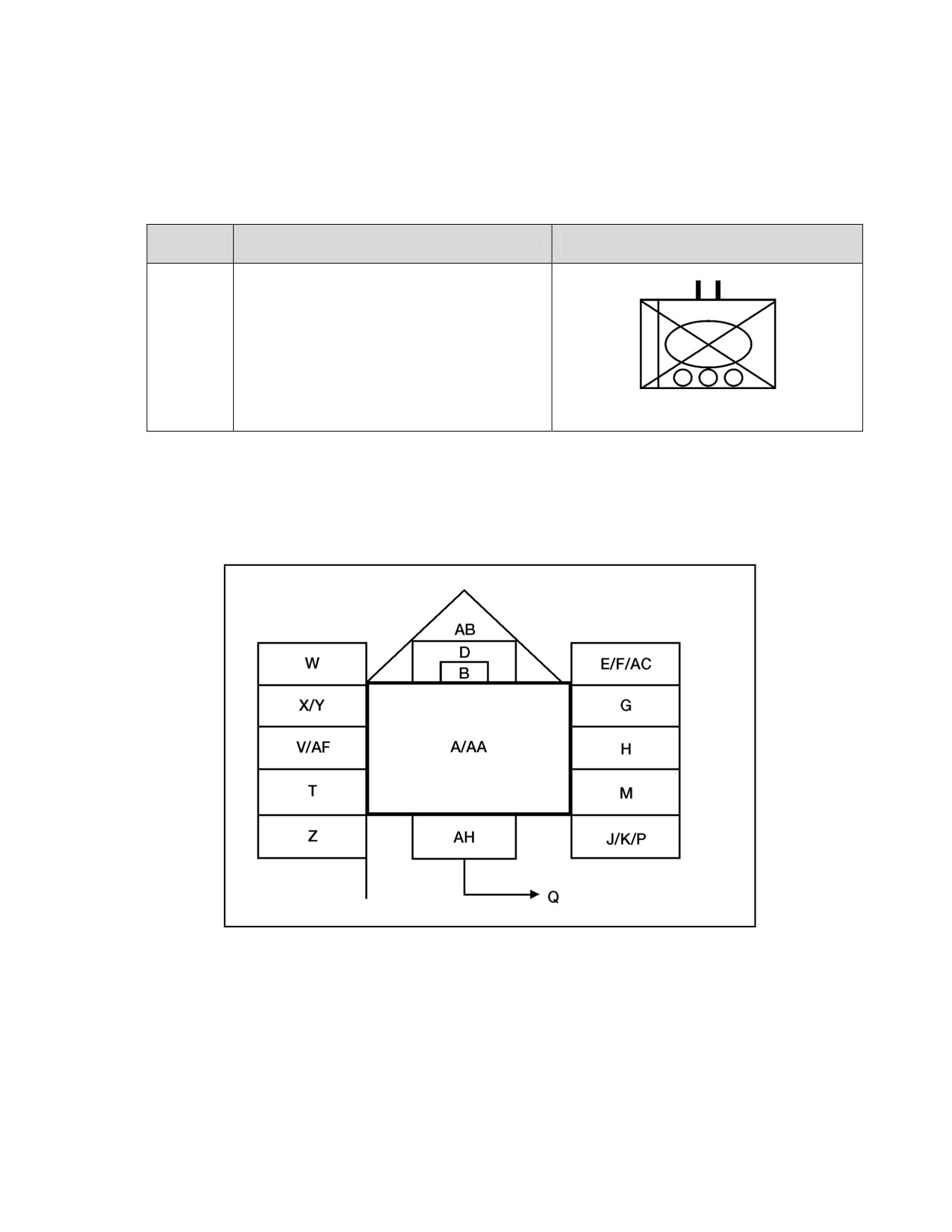
Step 5.
Choose the text or graphic modifiers as
necessary to provide further amplifying
information. In this example, the graphic
modifier is the echelon symbol, or field “B”
for a battalion (see table 5-6, page 5-33).
Friendly Wheeled Armored Infantry
Battalion with Gun Systems
UNIT SYMBOL MODIFIER FIELDS
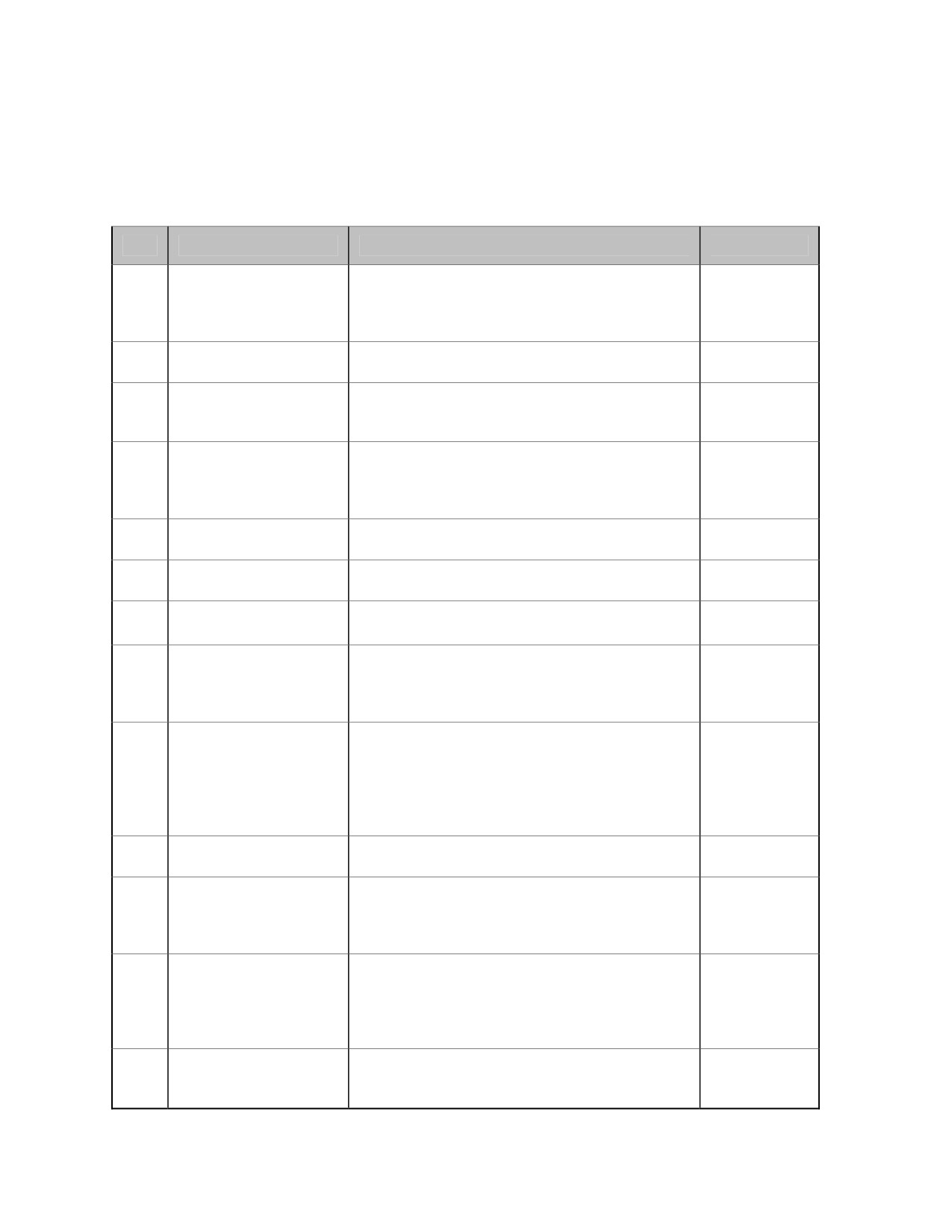
5-2. Figure
5-2 shows the placement of unit labeling fields around the
friendly land unit symbol frame. The placement of unit symbol modifier fields
is the same regardless of frame shape or affiliation.
Figure 5-2. Unit Symbol Modifier Fields
5-3. Table 5-2 provides a description of each of the unit symbol modifier
fields as shown in figure 5-2. See appendix B for examples of unit symbols
with multiple fields that are filled in.
5-3
FM 1-02/MCRP 5-12A________________________________________________________________
Table 5-2. Descriptions of Fields for Text or Graphic Modifiers for Unit Symbols
Field
Field Title
Description
Text/Graphic
A
Symbol
Basic branch or functional symbol that can
Both
include capability modifiers (see table 5-3,
page 5-6, and table 5-4, 5-26). (See table 5-5,
page 5-30, for special operations forces.)
B
Echelon
A symbol modifier that denotes the size of a
Both
unit (see table 5-6, page 5-33).
D
Task Force
A symbol placed over the echelon indicator to
Graphic
denote a task organized unit (see figure 5-4,
page 5-34).
E
Frame Shape Modifier
Helps determine affiliation or battle dimension
Text
of symbol. “U” represents unknown battle
dimension. Question mark “?” represents
suspect or assumed friend.
F
Reinforced or
Indicates whether a unit is reinforced (+),
Text
Detached
reduced (-), or reinforced and reduced (+).
G
Staff Comments
Free text. Can be used by staff for information
Text
required by commander.
H
Additional Information
Free text.
Text
J
Evaluation Rating
Degree of confidence that may be placed on
Text
the information represented by the symbol. It is
shown as one letter and one number (STANAG
2022) (see chapter 4).
K
Combat Effectiveness
Effectiveness of unit or equipment displayed.
Text
1. Fully operational
2. Substantially operational
3. Marginally operational
4. Not operational
M
Higher Formation
Number or title of higher echelon command of
Text
unit being displayed.1
P
Identification Friend or
Identification modes and codes.
Text
Foe (IFF)/Selective
Identification Feature
(SIF)
Q
Direction of Movement
With arrow, it denotes the direction symbol is
Graphic
Arrow/Offset Location
moving or will move. Without arrow, it is used to
Indicator
denote precise location or to declutter, except
headquarters (see field S and figure 5-6, page
5-42).
S
Headquarters Staff
Identifies unit symbol as a headquarters or
Graphic
Indicator/Offset
used to indicate precise location or to declutter
Location Indicator
(see figure 5-5, page 5-35).
5-4
_____________________________________________________________________Unit Symbols
Table 5-2. Descriptions of Fields for Text or Graphic Modifiers for Unit Symbols
Field
Field Title
Description
Text/Graphic
T
Unique Designation
An alphanumeric designator that uniquely
Text
identifies a particular unit (designation).1
V
Type of Equipment
Identifies unique designation (such as M-2 for
Text
infantry fighting vehicle).
W
Date-Time Group
An alphanumeric designator for displaying a
Text
date-time group (DDHHMMSSZMONYY) or
“O/O” for on order. The date-time group is
composed of a group of six numeric digits with
a time zone suffix and the standardized three-
letter abbreviation for the month followed by
two digits. The first pair of digits represents the
day; the second pair, the hour; the third pair,
the minutes. The last two digits of the year are
after the month. For automated systems, two
digits may be added before the time zone suffix
and after the minutes to designate seconds.
X
Altitude/Depth
Altitude as displayed on the global positioning
Text
system (GPS).
Y
Location
Latitude and longitude; grid coordinates.
Text
Z
Speed
Dispays speed in nautical miles per hour or
Text
kilometers per hour.
AA
Named C2
This field applies to named commands such as
Text
Headquarters
SHAPE, SACLANT, EUCOM, USARPAC or
joint, multinational, or coalition commands such
as CJTF, JTF, MJTF (see table 5-7, page 5-
36).
AB
Feint or Dummy
Indicates that it is a dummy or a feint for
Graphic
Indicator
deception purposes.
AC
Country Indicator
A two-letter code that indicates the country of
Text
origin of the unit (see chapter 2).
AF
Common Identifier
Example: Paladin for M109A6 howitzer or
Text
Abrams for the M-1 tank.
AH
Headquarters Element
Indicates what type of element of a
Text
headquarters is being represented, such as
TOC, MAIN (see table 5-8, page 5-39).
1 For those units designated under the Combat Arms Regimental System (CARS), both the
battalion (or squadron) and traditional regimental numbers are shown. To avoid confusion with
different levels of command, both numerical designations of the CARS units are always written
together and separated by a dash (-) rather than a slash (/). AR 600-82, The US Army Regimental
System, provides a listing of CARS units.
5-5
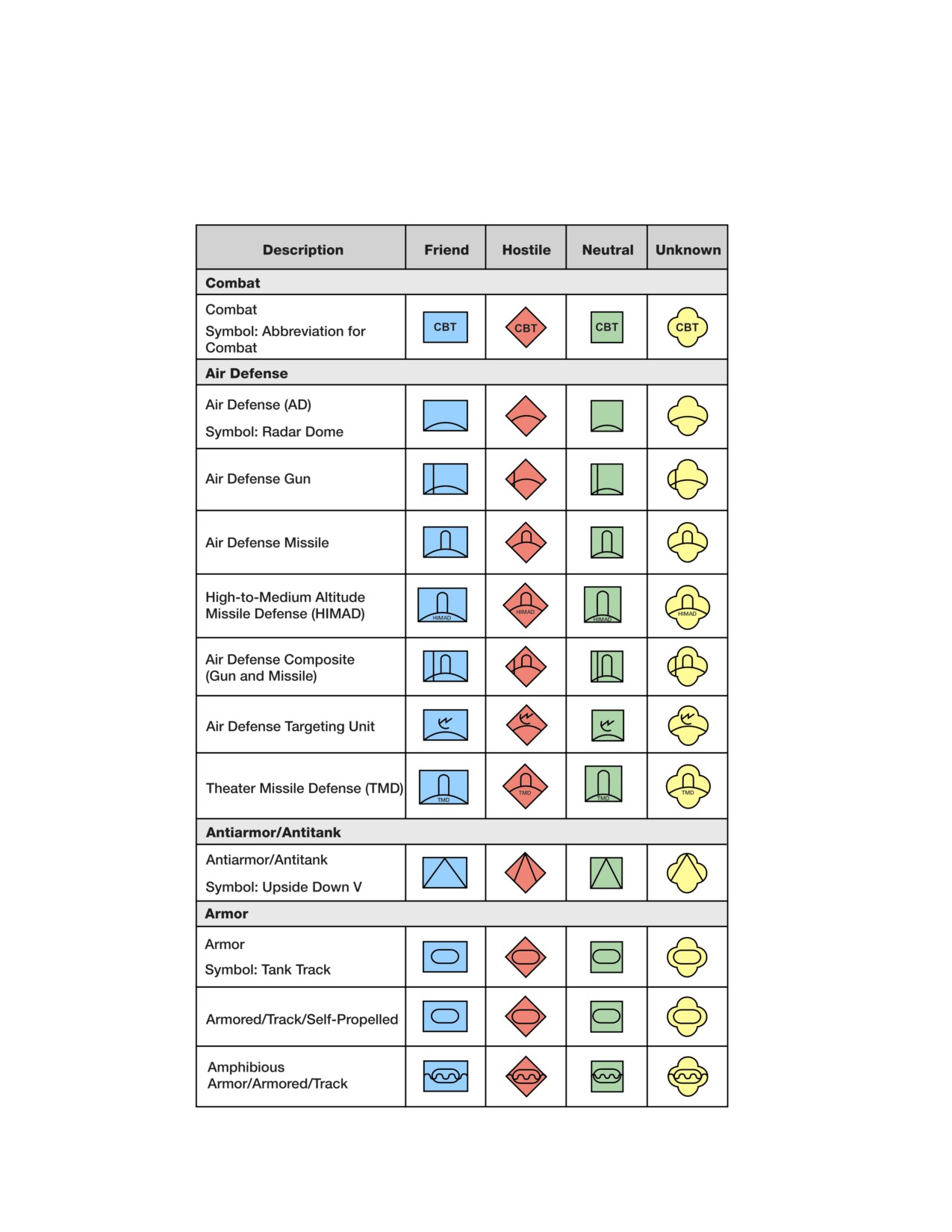
FM 1-02/MCRP 5-12A________________________________________________________________
Table 5-3. Field A: Branch and Functional Symbols
5-6
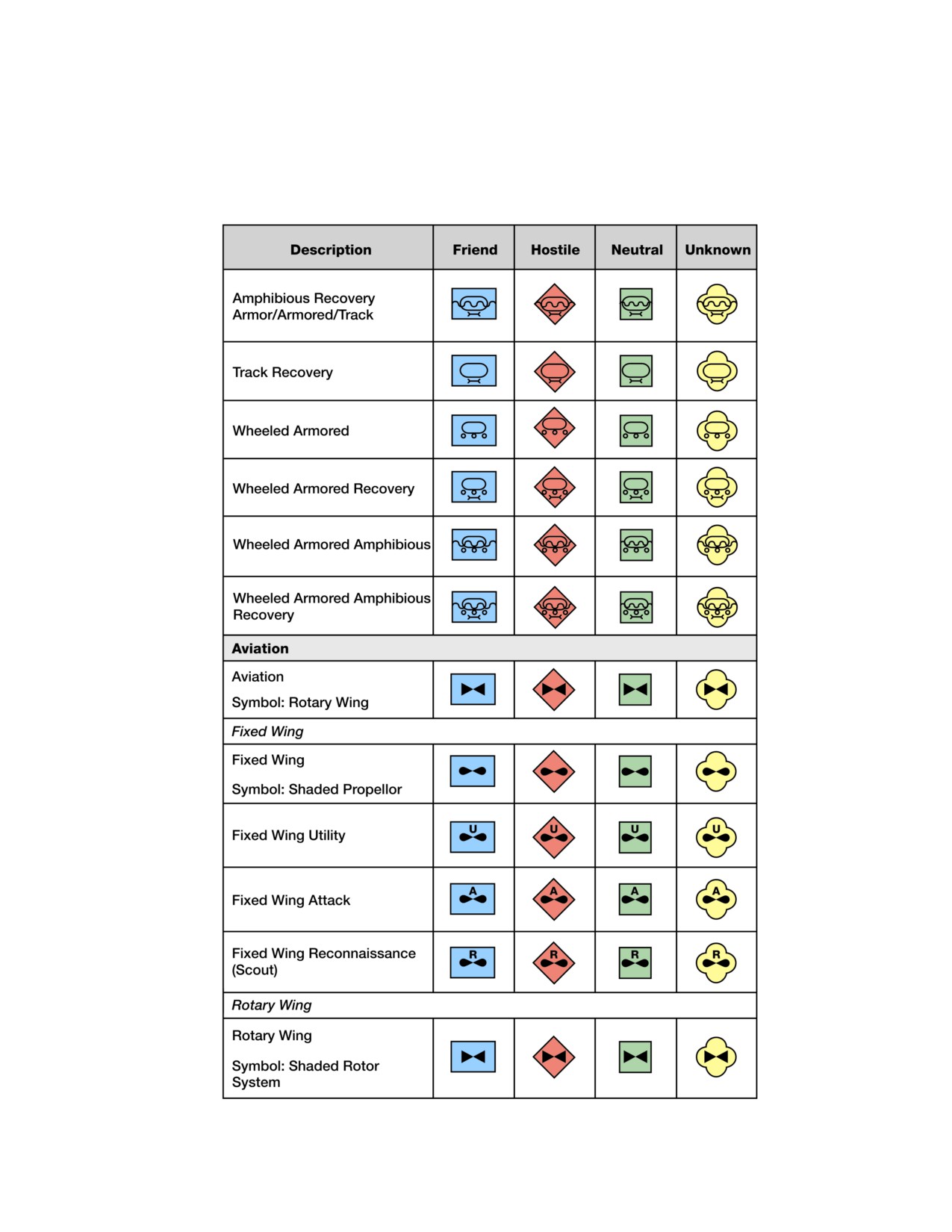
_____________________________________________________________________Unit Symbols
Table 5-3. Field A: Branch and Functional Symbols
5-7
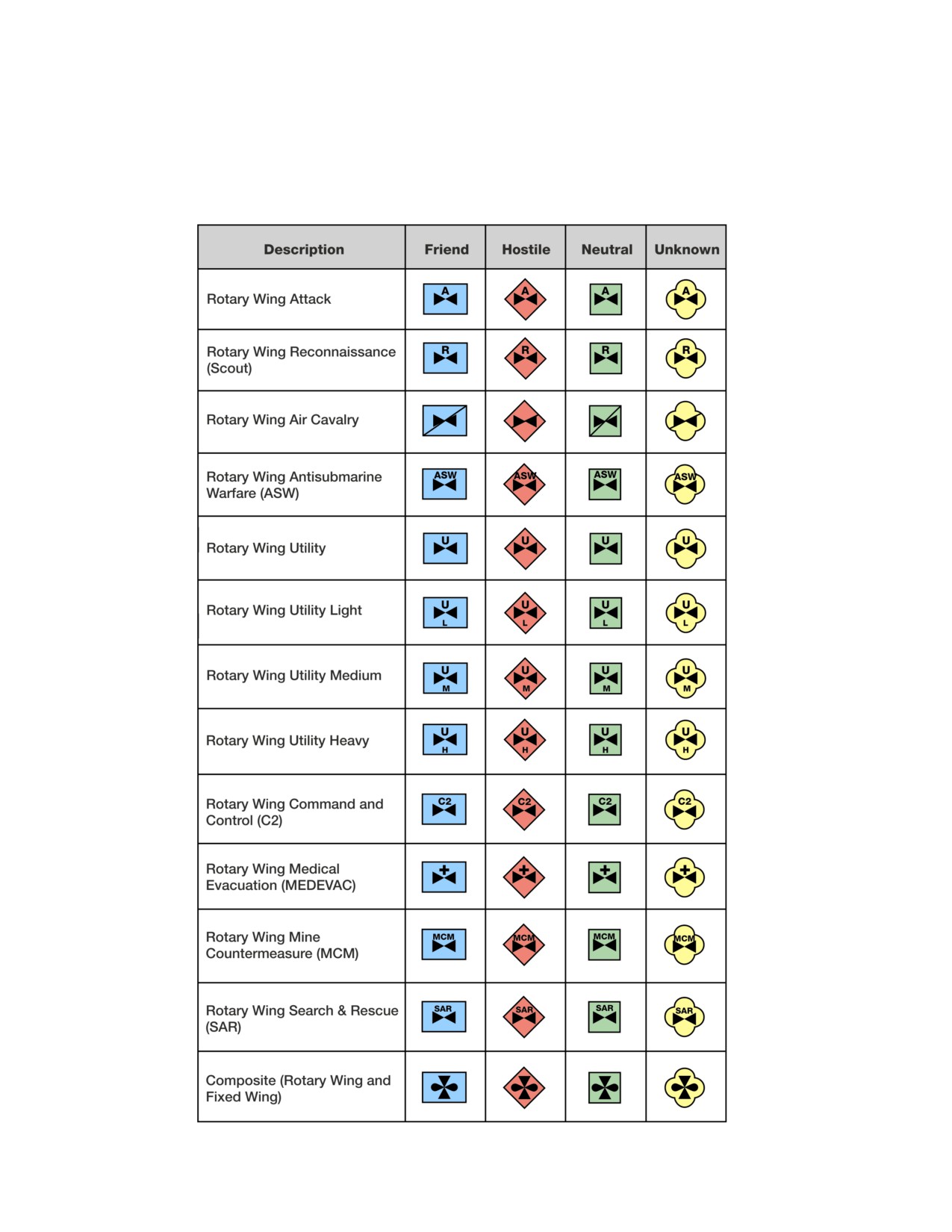
FM 1-02/MCRP 5-12A________________________________________________________________
Table 5-3. Field A: Branch and Functional Symbols
5-8
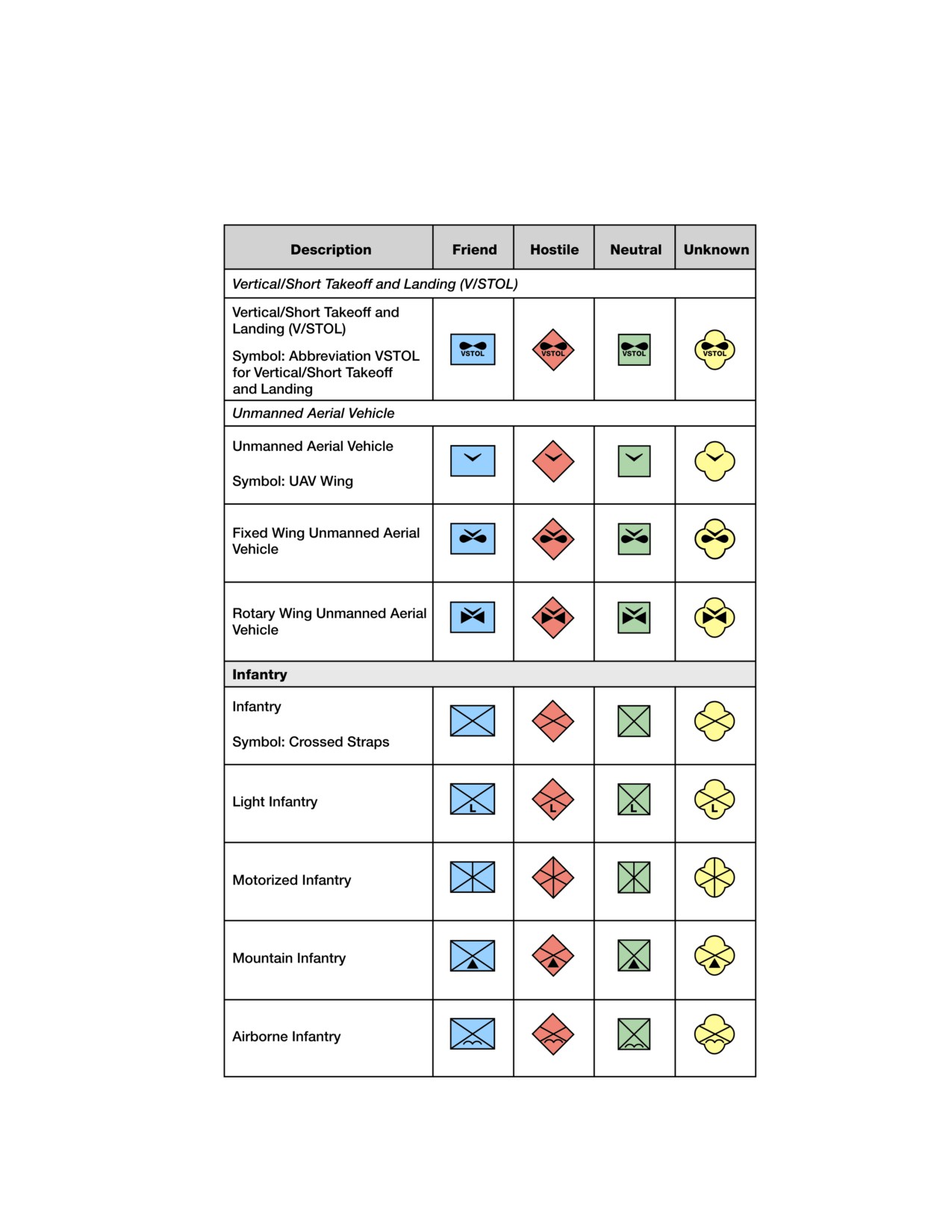
_____________________________________________________________________Unit Symbols
Table 5-3. Field A: Branch and Functional Symbols
5-9
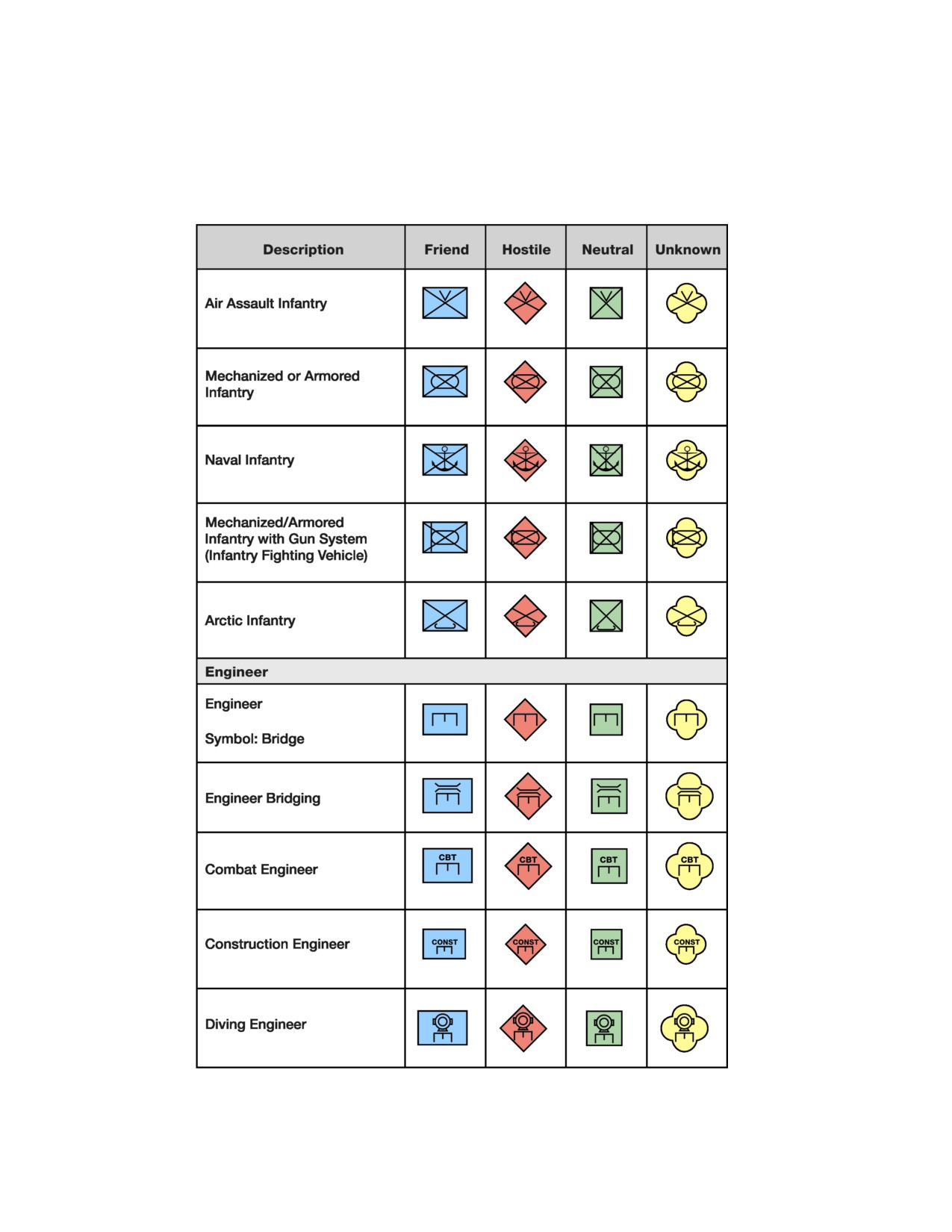
FM 1-02/MCRP 5-12A________________________________________________________________
Table 5-3. Field A: Branch and Functional Symbols
5-10
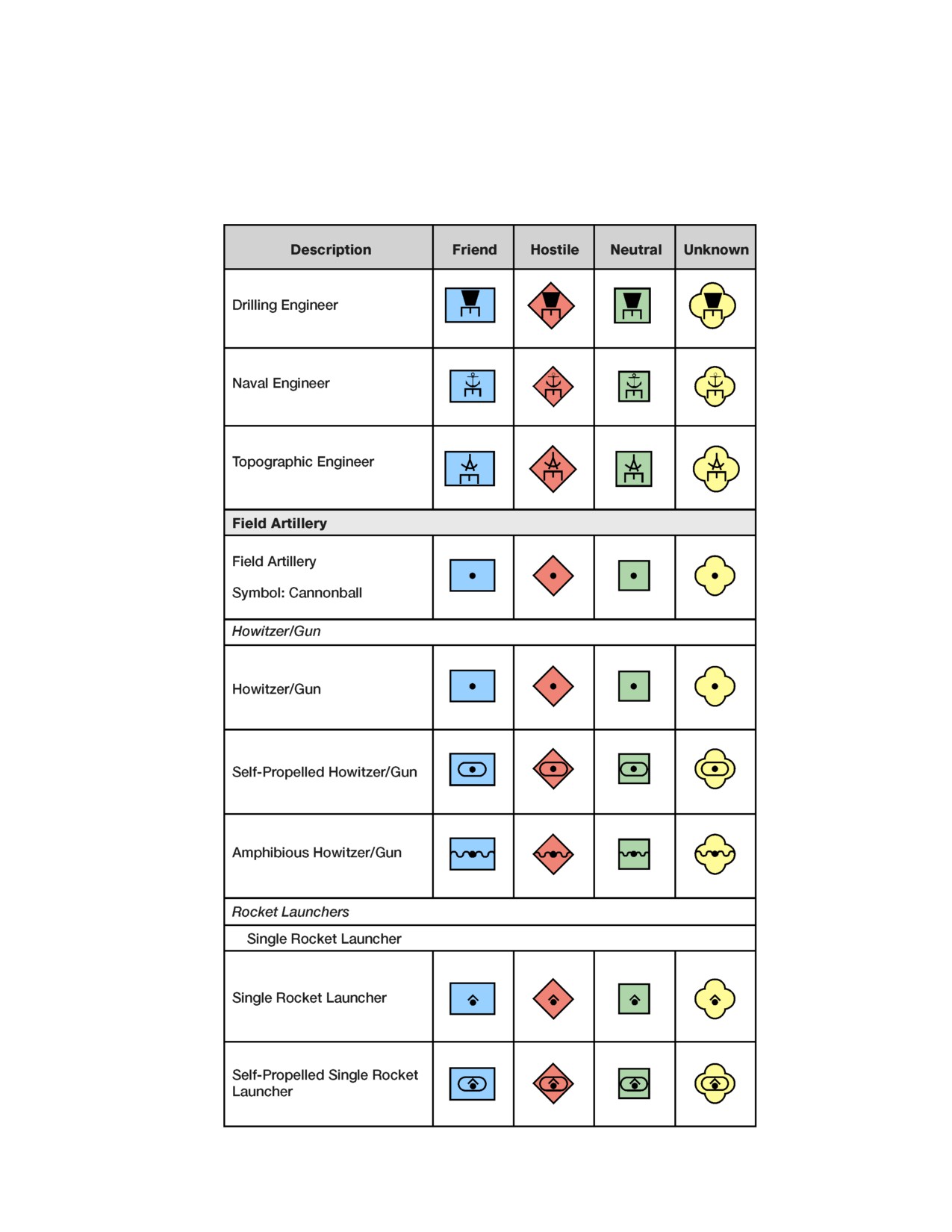
_____________________________________________________________________Unit Symbols
Table 5-3. Field A: Branch and Functional Symbols
5-11
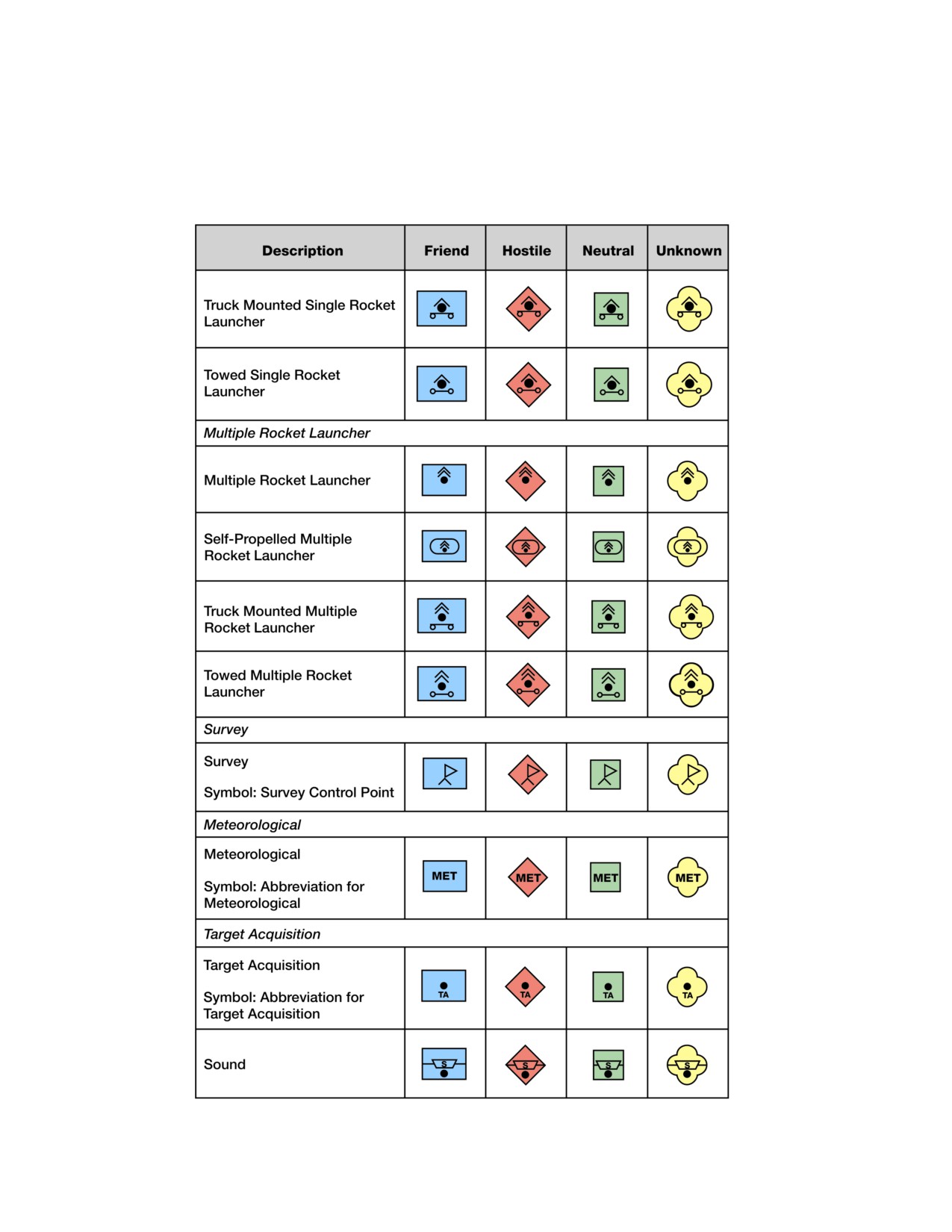
FM 1-02/MCRP 5-12A________________________________________________________________
Table 5-3. Field A: Branch and Functional Symbols
5-12
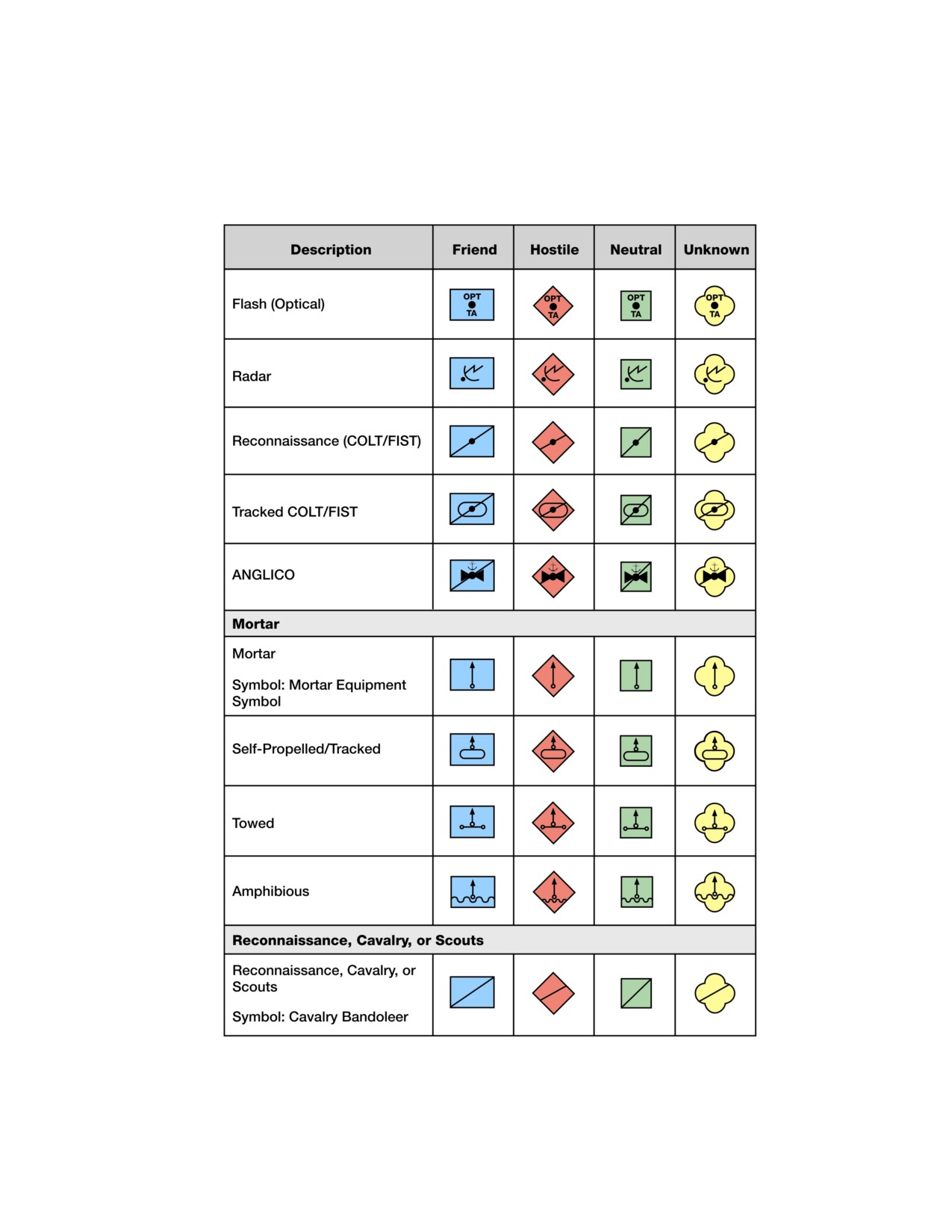
_____________________________________________________________________Unit Symbols
Table 5-3. Field A: Branch and Functional Symbols
5-13
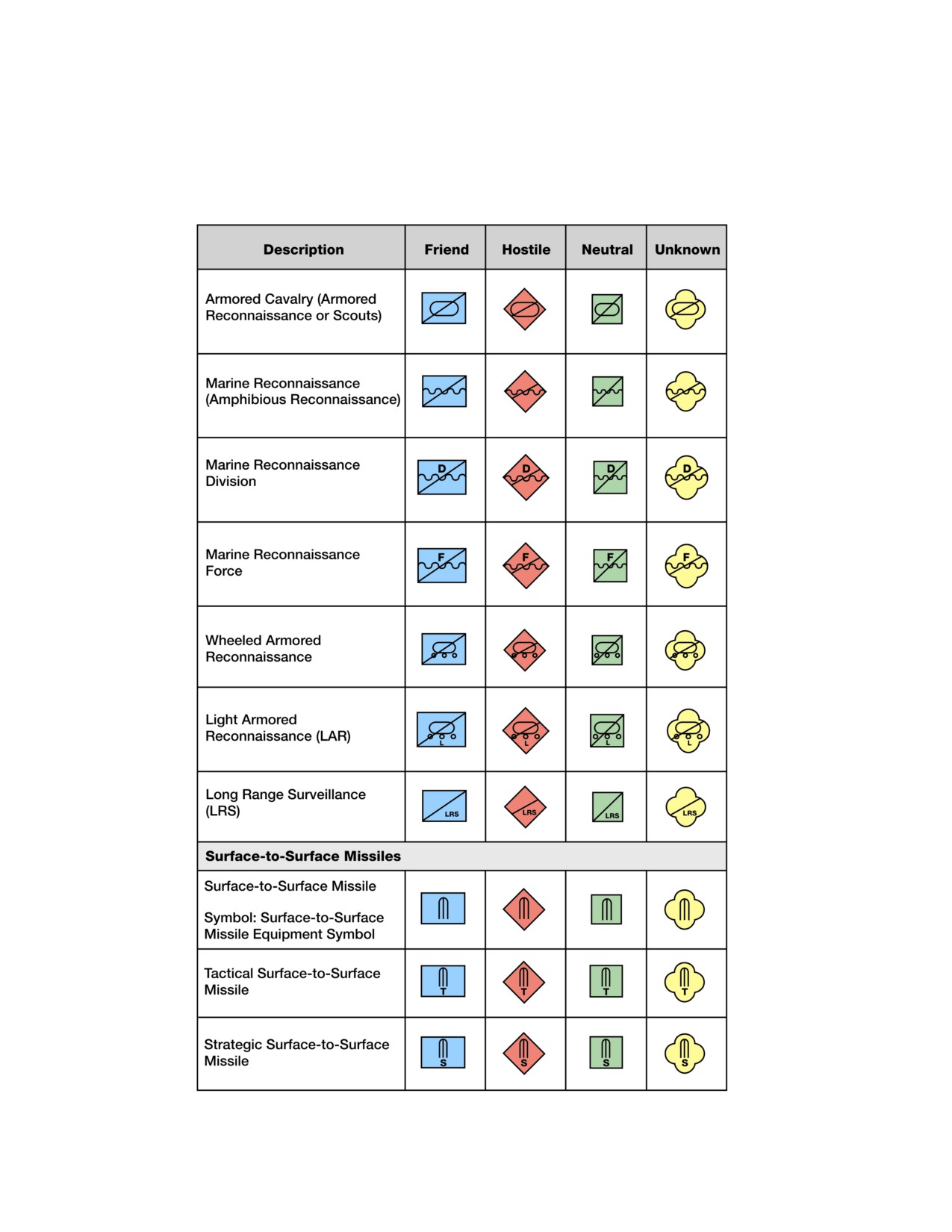
FM 1-02/MCRP 5-12A________________________________________________________________
Table 5-3. Field A: Branch and Functional Symbols
5-14
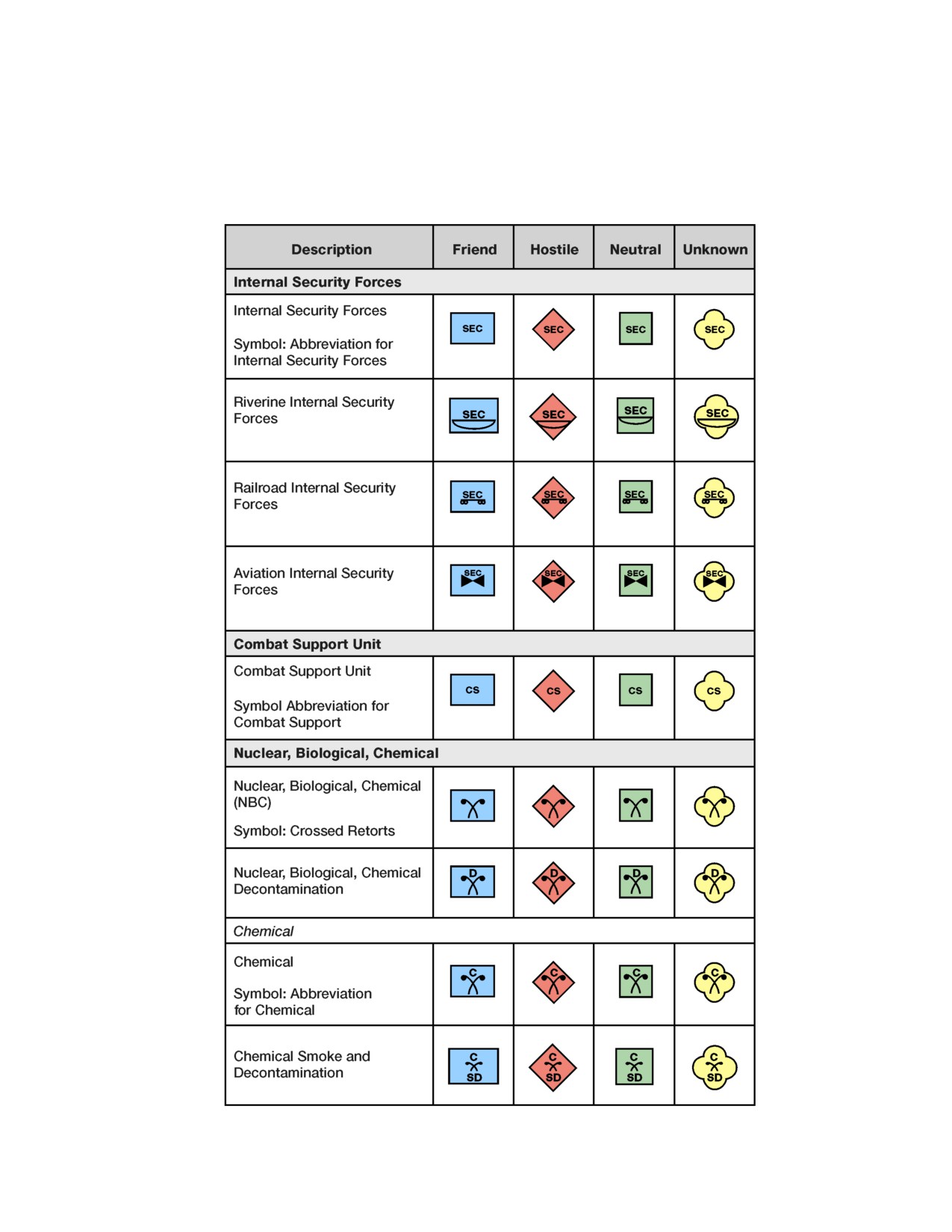
_____________________________________________________________________Unit Symbols
Table 5-3. Field A: Branch and Functional Symbols
5-15
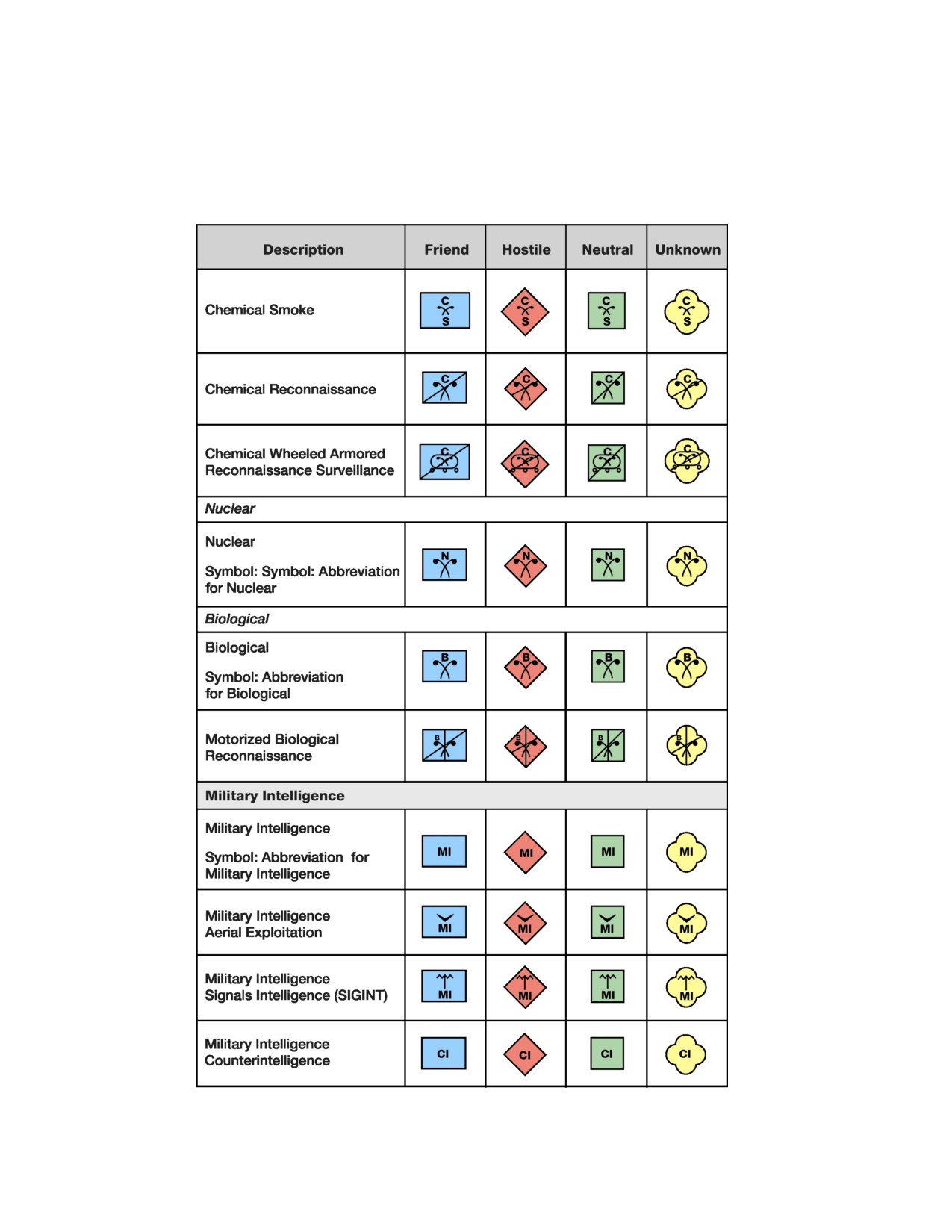
FM 1-02/MCRP 5-12A________________________________________________________________
Table 5-3. Field A: Branch and Functional Symbols
5-16
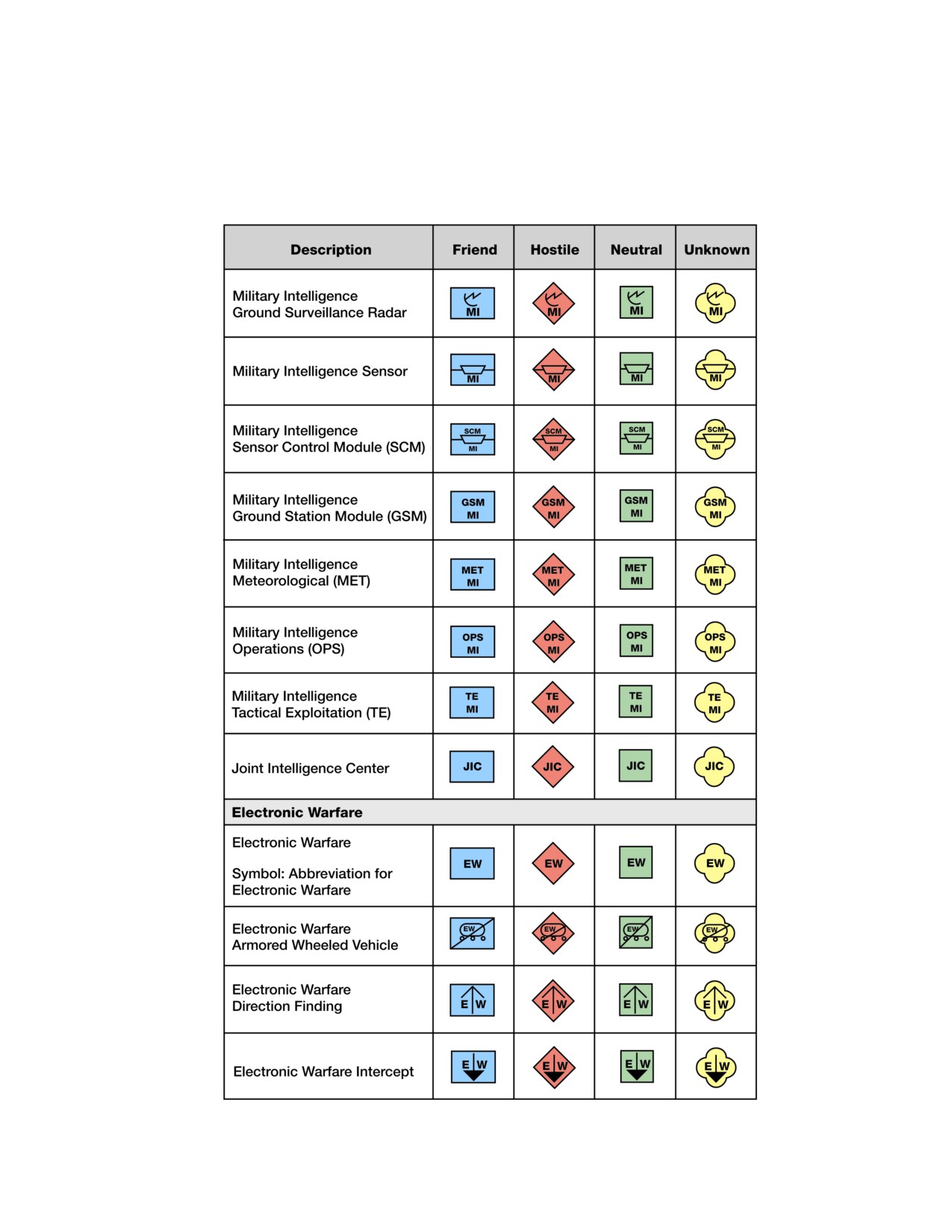
_____________________________________________________________________Unit Symbols
Table 5-3. Field A: Branch and Functional Symbols
5-17