FM 3-04.111 (FM 1-111) Aviation Brigades (AUGUST 2003) - page 2
FM 3-04.111 (FM 1-111)
to rapidly react to enemy incursions and to move personnel and cargo allows
it to contribute greatly to rear area operations. However, the potential for
fratricide may be the greatest in the rear area. Detailed planning and
coordination, preplanned reaction drills, SOPs, and rehearsals serve to
reduce this risk.
RULES OF ENGAGEMENT, RULES OF INTERACTION
2-22. All personnel must be thoroughly familiar with the higher
headquarters rules of engagement (ROE) and rules of interactions (ROI)
limitations. These restrictions must be carefully considered, particularly
regarding civilian effects, the legal status of isolated persons, and restrictions
on fires and types of weapons. ROE and ROI should be briefed and rehearsed
on a regular basis to ensure understanding and to disseminate changes.
Realistic scenarios must be war-gamed and rehearsed so all members of the
unit fully understand whether to engage, and the degree of force to use if
engaging (see Appendix N).
SECTION II - BATTLEFIELD OPERATING SYSTEMS
INTELLIGENCE BATTLEFIELD OPERATING SYSTEM
2-23. Accurate and timely intelligence is central to the effective employment
of combat power. Information dominance enables the commander to see the
battlefield and to dictate, in terms of time and space, maneuver against
identified enemy positions. The intelligence system plans, directs, collects,
processes, produces, and disseminates intelligence on the threat and
environment to perform IPB and the other intelligence tasks, such as—
• Situation development.
• Target development and support to targeting.
• Indications and warning.
• Intelligence support to BDA.
• Intelligence support to force protection.
• Intelligence support to personnel recovery .
SOURCES
2-24. Highly accurate SA is generated from many sources. These sources
include national assets, UAV, Army aviation, and the many other command,
control, communications, computers, intelligence, surveillance, and
reconnaissance (C4ISR) assets.
2-25. The front line soldier is another extremely valuable intelligence source.
Commanders should instill in all crew members that they are reconnaissance
soldiers. Their sightings and reporting of any activity may make the
difference between victory and defeat.
2-6
Chapter Two
INTELLIGENCE PREPARATION OF THE BATTLEFIELD
2-26. A critical part of IPB involves collaborative, cross-BOS analysis at each
level of command. Accurate intelligence, sound assessments, and target
development can reduce many uncertainties about the battlefield. The IPB
process is the principal tool the S2 uses to analyze the enemy and the effects
of the weather and terrain. FM
2-01.3
(FM 34-130) contains detailed
information on the IPB process.
2-27. The ability to see the battlefield, whether linear or nonlinear, is
possible only by harnessing the capabilities available to the echelons above
the aviation brigade. Procedures to ensure an accurate and continually
updated IPB must be developed between the brigade and its higher
headquarters. These procedures should be established as soon as possible and
should be reflected in the SOP before deployment.
INTELLIGENCE TEMPLATES
2-28. The S2 section provides graphic displays of doctrinal, situation, event,
and decision support templates (DSTs).
Templates and Asymmetric Forces
2-29. During the Cold War, most nations patterned their doctrine after those
of the two super powers—the United States of America and the Union of
Soviet Socialist Republics. Consequently, many military operations around
the world demonstrated a high degree of consistency. However, today, a large
number of threat forces and operatives are evolving differently. Given this, it
may be much harder to determine the doctrine used by threat forces and
operatives. However, a pattern of operations can be determined over time,
and asynchronous templates developed to predict patterns of operation.
Doctrinal Template
2-30. Doctrinal templates illustrate the disposition and activity of enemy
forces and assets conducting a particular operation unconstrained by the
effects of the battle space. They represent the application of enemy doctrine
under ideal conditions. Ideally, doctrinal templates depict the enemy's
normal organization for combat, frontages, depths, boundaries and other
control measures. The staff uses the doctrinal template as a guide and
modifies the portrayed dispositions to take advantage of available defensive
terrain. It also uses doctrinal templates to determine the likely locations of
high-value targets
(HVTs). For unconventional operations, asynchronous
templates can be developed as enemy patterns of operations emerge.
Situation Template
2-31. Situation templates are graphic depictions of expected threat
dispositions should the threat adopt a particular course of action (COA). They
usually depict the most critical point in the operation as agreed upon by the
intelligence and operations officers. The staff uses situation templates to
support staff war gaming and develops event templates.
2-7
FM 3-04.111 (FM 1-111)
Event Template
2-32. The differences between the named areas of interest (NAI), indicators,
and target priority lists (TPL) associated with each COA form the basis of the
event template. The event template is a guide for collection and intelligence,
surveillance, and reconnaissance (ISR) planning. It depicts where to collect
the information that will indicate which COA the threat has adopted.
Decision Support Template
2-33. The DST depicts decision points (DPs), timelines (movement of forces
and the flow of the operation), and other key items of information required to
execute a specific friendly COA. It translates intelligence estimates and the
operation plan (OPLAN) into graphic form. This template is a total staff
effort to help the commander synchronize assets and make timely decisions
through war-gaming friendly and enemy COAs. The commander uses the
template to confirm or deny enemy COAs, exploit assailable enemy flanks,
and select HVTs for engagement. The commander may also plan to interdict
critical points that will force the enemy to abandon a COA.
INTELLIGENCE, SURVEILLANCE, AND RECONNAISSANCE PLAN
2-34. Collection management by the S2 is based on intelligence requirements
not answered at this point by the IPB process. The ISR plan is updated
continually. Frequent ISR adjustment gives the commander a time-phased
picture of the battlefield. It also provides viable options for using critical
assets in a timely manner.
COMMANDER'S INTENT
2-35. A clearly stated commander's intent, combined with specific
commander's critical information requirements (CCIR), is fundamental to
gain the intelligence information needed for the unit to accomplish its
missions. These also provide the focus required to understand critical
information throughout the aviation brigade.
MANEUVER BATTLEFIELD OPERATING SYSTEM
2-36. Infantry, armor, cavalry, and aviation forces are organized, trained,
and equipped primarily for maneuver. Commanders maneuver these forces to
gain positions of advantage against the enemy, thereby creating conditions
for tactical and operational success. By maneuver, friendly forces can destroy
enemy forces or hinder their movement by direct and indirect application of
firepower, or the threat of its application.
2-37. The aviation brigade headquarters shapes the battle space to maximize
its units' capabilities to find and fix the enemy and destroy enemy assets. It
also provides firepower, supports air assaults, conducts air movement, and
enhances C2 to support ground forces.
FIRE SUPPORT BATTLEFIELD OPERATING SYSTEM
2-38. Commanders integrate and synchronize fires and effects to delay,
disrupt, or destroy enemy forces, systems, and facilities. The FS system
2-8
Chapter Two
includes the collective and coordinated use of target acquisition data and
indirect fire weapons. It also includes fixed-wing aircraft, armed helicopters,
electronic warfare (EW), and other lethal and nonlethal means to attack
targets. FS plans must be integrated and synchronized with the aviation
brigade scheme of maneuver, consistent with the commander's intent, and
with A2C2.
AIR DEFENSE BATTLEFIELD OPERATING SYSTEM
2-39. The AD system protects the force from air and missile attack, and from
aerial surveillance. It prevents the enemy from interdicting friendly forces
while freeing commanders to synchronize maneuver and firepower. All
members of the combined arms team perform AD tasks; however, ground-
based air defense artillery (ADA) units execute most Army AD operations.
Air cavalry and attack aircraft sensors can help identify inbound enemy
aircraft that may have evaded AD detection systems. Armed helicopters also
can conduct limited defensive air combat operations to protect maneuver
forces, augment AD forces, or provide self-defense for aviation forces.
MOBILITY/COUNTERMOBILITY/SURVIVABILITY BATTLEFIELD
OPERATING SYSTEM
2-40. The aviation brigade contributes directly or indirectly to each of these
operations.
MOBILITY
2-41. Mobility operations preserve friendly force freedom of maneuver. They
include breaching obstacles, increasing battlefield circulation, improving or
building roads, providing bridge and raft support, and identifying routes
around contaminated areas. Aviation assets can perform reconnaissance to
find adequate sites and routes, insert personnel and equipment, and provide
overwatch for ground operations.
COUNTERMOBILITY
2-42. Countermobility denies mobility to enemy forces. It limits the
maneuver of enemy forces and enhances the effectiveness of friendly fires.
Countermobility missions include obstacle building and smoke generation.
Aviation can perform reconnaissance to find appropriate sites and routes for
obstacle emplacement. They can insert engineers and materiel to create
obstacles and provide overwatch for ground operations. Selected UH-60s can
emplace minefields with the Volcano system, while air cavalry and attack
assets can provide fires to cover obstacles and employ white phosphorous
rockets to provide smoke.
SURVIVABILITY
2-43. Survivability operations protect friendly forces from the effects of
enemy weapons systems and from natural occurrences. Hardening of
facilities and fortification of battle positions (BPs) are active survivability
measures. Military deception, operations security (OPSEC), and dispersion
also increase survivability. NBC defense measures are essential survivability
2-9
FM 3-04.111 (FM 1-111)
tasks. Aviation can perform reconnaissance to find adequate sites and routes.
They can insert or extract personnel and equipment and provide overwatch
for ground operations. They also can conduct aerial surveys of known or
suspected NBC contaminated areas.
2-44. The brigade enhances aircrew survivability by mission planning,
coordination, and aircraft survivability equipment (ASE) settings based on
threat analysis. Appendix J addresses aircraft survivability.
COMBAT SERVICE SUPPORT BATTLEFIELD OPERATING SYSTEM
2-45. The CSS system sustains forces. It includes use of host nation
infrastructure and contracted support. CSS provides supply, maintenance,
transportation, HSS, personnel support, legal support, finance, religious
support, and distribution management. It also includes most aspects of CMO.
Aviation forces conduct air movement operations to move personnel, supplies,
and equipment to support ground forces, refugees, or disaster victims. Air
cavalry and attack assets perform reconnaissance to identify routes,
overwatch transport, and provide PZ or LZ security.
COMMAND AND CONTROL BATTLEFIELD OPERATING SYSTEM
2-46. C2 is the exercise of authority and direction by a commander over
assigned and attached forces. C2 has two components—the commander and
the C2 system. Communications systems, intelligence systems, and computer
networks form the backbone of C2 systems. They allow commanders to lead
from any point on the battlefield. The C2 system enables the commander's to
make informed decisions, delegate authority, and synchronize the BOS.
Moreover, the C2 system enables the commander's to adjust plans for future
operations, even while focusing on the current fight.
2-47. Staffs work within the commander's intent to direct units and control
resource allocations. They also are alert to spotting enemy or friendly
situations that require command decisions and advise commanders
concerning them. The aviation brigade enhances the supported commander's
C2 flexibility and mobility by providing UH-60 aircraft equipped with C2
systems, and by transporting key personnel, LNOs, and high-priority
messages and orders.
SECTION III - OPERATIONS
CHARACTERISTICS OF OPERATIONS
2-48. Aviation brigade missions are offensively oriented and are typically the
same whether the division or corps is attacking or defending. Fundamental to
the success of operations are the characteristics of surprise, concentration,
tempo, and audacity.
SURPRISE
2-49. Surprise is attacking the enemy at a time or place or in a manner for
which they are unprepared and do not expect. It delays enemy reactions,
2-10
Chapter Two
overloads and confuses their C2 systems, and induces psychological shock. It
also forces them to make decisions they are not prepared to make. Surprise,
however, may be difficult to achieve. Especially in SSC operations, enemy
forces are generally small formations imbedded in urban and restrictive
terrain, and tend to be engaged at relatively close range. At all levels of
conflict, the enemy has access to global news, intelligence from sympathetic
factions, possible assistance from local nationals, and discreet reconnaissance
provided by other potential adversaries. Cellular telephones, electronic mail,
and Internet instant messenger services may also speed the enemy's receipt
and dissemination of information.
2-50. Commanders and staff must perform a thorough analysis of their CCIR
and guard them to preserve the element of surprise. Use of well-planned,
effective deception operations also can preserve the element of surprise.
Raids and air assaults at unexpected times and places can disrupt enemy
operations. The air cavalry can screen the friendly force to preclude similar
surprise by the enemy.
CONCENTRATION
2-51. Concentration is the massing of overwhelming combat power to achieve
a single purpose. Commanders concentrate forces to the degree necessary to
achieve overwhelming effects. They balance the necessity for concentrating
forces with avoiding large formations that are vulnerable to attack.
Synchronization is key to successful concentration.
TEMPO
2-52. Tempo is the rate of military action. After gaining the initiative, the
attacker sets the tempo to maintain relentless pressure on the enemy. This
forces the enemy to make decisions for which they are unprepared, to conduct
maneuver they have not rehearsed, and prevents them from recovering from
the initial shock of the attack. The key to maintaining the appropriate tempo
is to anticipate enemy reaction within the military decision-making process
(MDMP), prepare the necessary plans, rehearse as required, and then quickly
maneuver forces to seize opportunities when presented. The aviation
brigade's ability to rapidly exploit enemy weaknesses enhances friendly
tempo.
AUDACITY
2-53. Audacity is a simple plan of action, boldly executed. It seizes and
exploits the initiative. Commanders must be prepared to act quickly to
exploit opportunities.
CONSIDERATIONS FOR NONLINEAR OPERATIONS
2-54. Nonlinear operations occur in contiguous and noncontiguous AOs. The
AO normally is very large in comparison to the number of troops deployed for
an operation. Enemy forces may be widely dispersed and numerically
superior. Especially in SSC, the enemy can be expected to take advantage of
restrictive and urban terrain. The fluid nature of the nonlinear battlefield
and the changing disposition of attacking and defending forces, increases the
2-11
FM 3-04.111 (FM 1-111)
potential for fratricide. The presence of noncombatants further complicates
operations. Commanders must exercise prudence when clearing fires, both
direct and indirect, within this setting. Appendix N contains a detailed
discussion of ROE.
PLANNING CONSIDERATIONS
2-55. The aviation brigade's organization and capabilities require some
unique planning considerations. A general discussion follows. Chapter 4
contains more detailed information, including identification of brigade
planning responsibilities versus those of the battalion.
AIR-GROUND INTEGRATION
2-56. Air and ground assets require effective integration to conduct
operations successfully and minimize the potential for fratricide and civilian
casualties. Integration starts at home station with the implementation of
effective tactical SOPs, habitual relationships, and training. It continues
through planning, preparation, and execution of the operation (see Appendix
Q).
Fundamentals
2-57. To ensure effective integration, commanders and staffs must consider
some fundamentals for air-ground integration. The fundamentals that
provide the framework for enhancing the effectiveness of both air and ground
maneuver assets include—
• Understanding capabilities and limitations of each force.
• Use of SOPs.
• C2.
• Maximizing and concentrating the effects of available assets.
• Employment methods.
• Coordination of direct and indirect fires.
• Synchronization.
Command and Control
2-58. Aviation assets normally remain under aviation brigade or battalion
control. Subordinate battalion and company commanders operate on the
command network but coordinate detailed actions on other nets or face-to-
face. The commander ensures the focus of subordinate elements remains
synchronized while executing various missions. He also clarifies coordination
priorities and issues orders to each subordinate element, particularly on
support issues, such as FARP. This does not preclude direct coordination
between ground and aviation elements.
Air-Ground Control
2-59. An alternate method of C2 is the formation of air-ground task forces or
teams. This normally is a temporary relationship to deal with a specific
situation. OPCON is the normal command relationship. Specific employment
guidelines must be established before operations. Air-ground teams are best
2-12
Chapter Two
used when decentralized company operations are required. Based on mission,
enemy, terrain and weather, troops and support available, time available,
and civil considerations
(METT-TC), control may reside with either the
ground or air commander. Rehearsals are essential.
SECURITY/FORCE PROTECTION
2-60. Aviation units have limited capability to secure unit AAs while
concurrently conducting operations and performing maintenance. A
battlefield of a nonlinear, asymmetric nature requires that aviation forces
carefully consider security force requirements. This battlefield rarely has
clearly defined flanks or rear areas. Forces must be allocated to protect
critical assets against conventional and terrorist attacks. Mutual support can
reduce the amount of dedicated security needed by aviation forces.
LOGISTICS SUPPORT
2-61. The combination of the nonlinear battlefield and the diversity of the
aviation brigade's battalions often requires that FARPs and maintenance
teams operate simultaneously at different locations. Establishment and
resupply operations require careful planning and coordination. When
possible, these activities should be part of the mission rehearsal.
2-13
Chapter 3
Battle Command
Leadership is based on the knowledge of men. Man is the fundamental instrument in
war; other instruments change but he remains relatively constant. Unless his
behavior and elemental attributes are understood, gross mistakes will be made in
planning operations and troop leading. In the training of the individual soldier, the
essential considerations are to integrate individuals into a group and to establish for
that group a high standard of military conduct and performance of duty without
destroying the initiative of the individual.
Chapter 4, Page 27
War Department Field Manual FM 100-5
Field Service Regulations
Operations
War Department, 15 June 1944
SECTION I - GENERAL
CONCEPT OF BATTLE COMMAND
3-1. Battle command is the art of combat decision-making, leading, and
motivating soldiers—and their organizations—into action to accomplish
missions. It visualizes the current and future status of friendly and enemy
forces, then formulates concepts of operations to accomplish the mission. It
assigns missions, prioritizes and allocates resources, and assesses risks. It
also selects the critical time and place to act, and knows how and when to
make critical adjustments during the fight. Commanders must see, hear, and
understand the needs of seniors and subordinates, and guide their
organizations toward the desired end. The concept of battle command
incorporates three vital components—decision making, leadership, and
control. These components are discussed below.
DECISION-MAKING
3-2. Decision-making is knowing whether to decide, then when and what to
decide. These are tactical and operational judgments, but can be strategic
judgments. To command is to—
• Anticipate the activities that will be put into motion once a decision is
made.
• Know how irretrievable some commitments will be once put into
motion.
• Know the consequences of deciding.
• Anticipate the outcomes that can be expected from implementing a
decision.
3-0
Chapter Three
LEADERSHIP
3-3. Leadership is taking responsibility for decisions. It is loyalty to
subordinates, inspiring and directing assigned forces and resources toward a
purposeful end, and establishing a teamwork climate. The climate should
produce success and demonstrate moral and physical courage in the face of
adversity. It also provides the vision that both focuses and anticipates the
future course of events.
3-4.
“The duty of every leader is to be competent in the profession of arms.
Competence requires proficiency in four skill sets: interpersonal, conceptual,
technical, and tactical. Army leaders hone these skills through continual
training and self-study
” 1
CONTROL
3-5. Control is inherent in battle command. Control monitors the status of
organizational effectiveness. It identifies deviations from standards and
corrects them. Control provides the means to regulate, synchronize, and
monitor forces and functions. These tasks are performed through collection,
fusion, assessment, and dissemination of information and data.
3-6. Commanders control operations. Commanders lead from critical points
on the battlefield, delegate authority, and synchronize aviation actions with
other battlefield operations. Skilled staffs work within command intent to
direct and control units. Skilled staffs resource allocations to support the
desired end.
SECTION II - COMMAND AND CONTROL
COMMAND AND CONTROL SYSTEM
3-7. The C2 system is defined as the facilities, equipment, communications,
procedures, and personnel essential to a commander for planning, directing,
and controlling operations of assigned forces.
3-8. ABCS provides the electronic architecture in which we build SA. Signal
planning increases the commander's options by providing the requisite signal
support systems for varying operational tempos. These systems pass critical
information at decisive times; thus, they leverage and exploit tactical success
and make future operations easier. The three levels of ABCS are—
• Global Command and Control System—Army (GCCS-A).
• Army tactical command and control system (ATCCS).
• Force XXI Battle Command Brigade and Below (FBCB2).
3-9. Appendix K contains additional information on ABCS.
3-10. The C2 system gives the commander structure and means to make and
convey decisions and to evaluate the situation as it develops. The decisions
and higher-level intent are then translated into productive actions. The
1 FM 3-0, Operations, 14 June 2001, para. 4-17, p. 4-7.
3-1
FM 3-04.111 (FM 1-111)
decisions are based on the information derived from the C2 process, which
consists of the following:
• Acquire information.
• Assess whether new actions are required.
• Determine what these actions should be.
• Direct subordinates to take appropriate actions.
• Supervise and assess.
3-11. Effective and efficient C2 is a process that begins and ends with the
commander. The commander must develop techniques and procedures that
promote an expeditious flow of information throughout the entire C2 process.
These techniques and procedures should be in the unit's tactical SOP. FM 5-
0 (FM 101-5) and FM 1-02 (FM 101-5-1) discusses various techniques.
COMMAND AND SUPPORT RELATIONSHIPS
3-12. Command and support relationships are fundamental to aviation
operations. Table 3-1 depicts relationships and responsibilities.
COMMAND RELATIONSHIPS
3-13. The command relationships are assigned, attached, OPCON, or
TACON. An aviation brigade unit is attached only to a unit that can support
its logistics needs. The aviation unit is placed under OPCON or TACON
when it is to be used for a specific mission, the effective time of the
relationship is short, or the gaining unit is unable to provide logistics
support. Normally, the parent headquarters retains control of the aviation
unit. Subordinate units may also be assigned, attached, OPCON, and
TACON. The air cavalry and attack units, pure or task-organized are—
• Attached to other aviation brigades; however, some support may still
have to come from the parent headquarters depending on the duration,
or intensity of the mission.
• Placed under OPCON or TACON of the gaining unit when the unit is to
be used for a specific mission, the effective time of the relationship is
short, or the gaining unit is unable to provide logistics support.
Assigned
3-14. Assigned is to place units or personnel in an organization where such
placement is relatively permanent. The organization controls and
administers the units or personnel for the primary function, or greater
portion of the functions, of the unit or personnel.
3-2

Chapter Three
Table 3-1. Command Relationship To Inherent Responsibility
Inherent Responsibilities Are:
Gaining unit
can impose
If Relationship
Has
May be task-
Assigned
Establishes/
Has priorities
further
command
Receives
Provides
Is:
organized
position or
maintains
established
command or
relationship
CSS from:
liaison to:
by:
AO by:
commo with:
by:
support
with:
relationship
of:
Attached;
As required
Gaining
Unit to which
OPCON;
Attached
Gaining unit
Gaining unit
Gaining unit
by gaining
Gaining unit
unit
attached
TACON; GS;
unit
DS
Parent unit
and gaining
unit; gaining
As required
As required
OPCON;
unit may
by gaining
OPCON
Gaining unit
Parent unit
Gaining unit
by gaining
Gaining unit
TACON; GS;
pass
unit and
unit
DS
OPCON to
parent unit
lower HQ
Note 1
As required
As required
by gaining
TACON
Gaining unit
Parent unit
Parent unit
Gaining unit
by gaining
Gaining unit
GS; DS
unit and
unit
parent unit
As required
As required
Not
Assigned
Parent unit
Parent unit
Parent unit
Gaining unit
by parent
by gaining
Parent unit
applicable
unit
unit
Parent unit;
Supported
Supported
Supported
DS
Parent unit
Parent unit
Parent unit
support ed
Note 2
unit
unit
unit
unit
As required
As required
Not
GS
Parent unit
Parent unit
Parent unit
Parent unit
by parent
Parent unit
by parent unit
applicable
unit
NOTE 1: In NATO, the gaining unit may not task-organize a multinational unit.
NOTE 2: Commanders of units in DS may further assign support relationships between their subordinate units and elements of the
supported unit after coordination with the supported commander.
Attached
3-15. Attached is the placement of units or personnel in an organization
where such placement is relatively temporary. Subject to limitations imposed
by the attachment order, the commander of the unit receiving the attachment
provides sustainment support above its organic capability. Normally, the
parent unit is responsibility for transfers, promotion of personnel, nonjudicial
punishment, courts martial, and administrative actions.
Operational Control
3-16. OPCON is the authority to perform those functions of command over
subordinate forces involving organizing and employing commands and forces,
assigning tasks, designating objectives, and giving authoritative direction
necessary to accomplish the mission. OPCON may be delegated. It includes
authoritative direction over all aspects of military operations and joint
training necessary to accomplish missions assigned to the command. OPCON
normally provides full authority to organize commands and forces and to
employ those forces as the commander considers necessary to accomplish
3-3
FM 3-04.111 (FM 1-111)
assigned missions. OPCON does not, in and of itself, include authoritative
direction for logistics or matters of administration, discipline, internal
organization, or unit training.
Tactical Control
3-17. TACON is the command authority that is limited to the detailed and,
usually, local direction and control of movements or maneuvers necessary to
accomplish missions or tasks assigned. TACON is inherent in OPCON.
TACON may be delegated. TACON allows commanders to apply force and
direct the tactical use of logistics assets but does not provide authority to
change organizational structure or direct administrative and logistical
support.
SUPPORT RELATIONSHIPS
3-18. The support relationships of utility and heavy helicopter assets are DS
and GS. Specific definitions and missions are listed below.
Direct Support
3-19. DS is a mission requiring a force to support another specific force and
authorizing it to answer directly to the supported force's request for
assistance. Assault and heavy helicopter units will often be placed in a DS
role for air movement operations, particularly logistics movement. When
operating in a DS role, the missions can be coordinated directly between the
aviation unit and the supported unit.
General Support
3-20. GS is the support that is given to the supported force as a whole and
not to any particular subdivision thereof. As an example, assault helicopters
units assigned at EAC and corps levels may be placed in GS to several units
within the theater or corps. These units will receive missions from their
parent headquarters based upon support priorities established by theater
and corps commanders. When operating in a GS role, the supported unit
must request aviation support from the appropriate headquarters (division
G3 for divisional aviation assets, corps G3 for corps aviation assets).
PLANNING
3-21. The aviation brigade develops its OPLANs as an integral part of its
higher headquarters staff, at its own headquarters, or both.
PLANNING AT THE BRIGADE'S HIGHER HEADQUARTERS
3-22. The major advantage of the aviation brigade assisting the higher
headquarters staff in the development of the overall plan is that it saves
time. The intelligence situation and air tasking order (ATO) changes and
restrictions are immediately available to all planners. Additionally, because
aviation expertise is involved throughout the planning process, it ensures
that aviation-related issues are resolved concurrently with plan development.
All of the above preclude the time-consuming queries associated with
3-4
Chapter Three
planning at different locations, thus saving critical time in developing and
distributing the required orders to execute the plan.
PLANNING AT THE AVIATION BRIGADE HEADQUARTERS
3-23. In addition to the planning for the operational mission, the aviation
brigade must ensure the myriad details of aviation operations are also
accomplished. Those details are planned, coordinated, and rehearsed
concurrently with OPLAN development. Examples of ongoing preparation
include—
• Task organization actions, such as unit movements or exchange of
liaison personnel.
• Airspace C2 coordination.
• Theater air-ground system (TAGS), airspace control order (ACO), ATO,
and special instructions (SPINS).
• Selected rehearsals and training.
• FARP movement, composition, and emplacement.
• Maintenance support movement, composition, and emplacement.
• Downed aircrew recovery plans and procedures.
• Weather checks and analysis.
• Passage of lines planning.
• AD status.
• Weapons configurations and loads.
• External fuel tank distribution and management.
• Internal configuration of utility and cargo aircraft.
• Communications planning.
• Personnel recovery planning.
MILITARY DECISION-MAKING PROCESS
3-24. To effectively plan and coordinate missions, the commander and staff
follow the MDMP. FM 5-0 (FM 101-5) discusses the process in detail.
TROOP-LEADING PROCEDURES
3-25. Although the MDMP is essential to accomplish the mission, effective
troop-leading procedures are equally important. For this reason troop-leading
procedures must be a matter of SOP and checklists within that SOP.
Although personality can accomplish much in certain circumstances, a
missed step can easily lead to mission shortfalls or failure. Written troop-
leading procedure steps provide a guide the leader applies in ways that are
consistent with the situation, the leader's experience, and the experience of
subordinate leaders.
3-26. Troop-leading procedures ensure rapid setup, tear down, and
movement of C2 elements. The brigade C2 elements and supporting signal
units must practice to ensure they relocate in a timely manner.
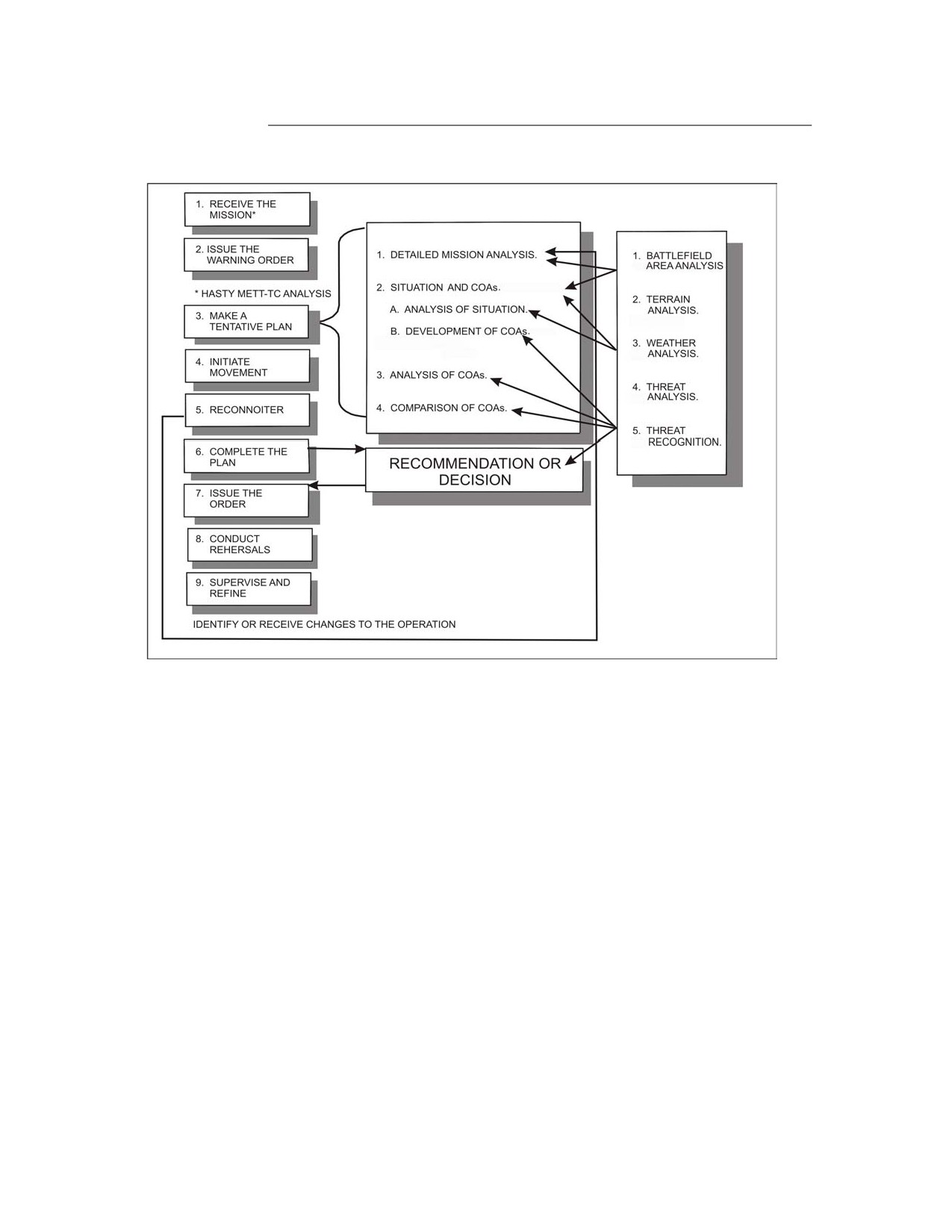
3-27. Figure
3-1 shows the relationship between the MDMP and troop-
leading procedures.
3-5
FM 3-04.111 (FM 1-111)
Figure 3-1. The MDMP Model and Troop-Leading Procedures
DECIDE, DETECT, DELIVER, ASSESS METHODOLOGY
3-28. Decide, detect, deliver, assess (D3A) methodology facilitates the attack
of the right target or objective with the right asset at the right time. It was
developed principally for targeting. Although D3A applies to Army aviation, it
does so in a slightly different manner. Aviation flies manned aircraft (and
coordinates for UAV and other support) to a target area to deliver ordnance,
and when required, conducts air assaults to achieve the desired results. For
aviation, D3A is much more than targeting. The D3A process outlined below
offers a method for aviation commanders to make the optimal use of the
process.
DECIDE, DETECT, DELIVER, ASSESS UTILIZATION
3-29. D3A is used in every aspect of mission planning. What must be
accomplished may be included in the orders/directives from higher
headquarters or it may fall squarely on the commander. D3A helps the
commander decide what to attack, how to acquire necessary enemy
information, when best to attack, and how to attack in a way that meets the
higher commander's intent. Finally, it enables the commander to know
whether the guidance has been met. D3A is a dynamic process. It must keep
up with the changing face of the battlefield.
3-6
Chapter Three
3-30. A HVT is a target the enemy commander requires for the successful
completion of the mission. The loss of HVTs would be expected to seriously
degrade important enemy functions throughout the friendly commander's
area of interest.
3-31. A high-payoff target (HPT) is a target whose loss to the enemy will
significantly contribute to the success of the friendly COA. HPTs are those
HVTs, identified through war gaming, that must be acquired and successfully
attacked for the success of the friendly commander's mission.
DECIDE
3-32. The decide function is the first step of the D3A process. It is based on
current intelligence and helps define further intelligence development
requirements. Targeting priorities must be addressed for each phase or
critical event of an operation. The products developed include the high-payoff
target list (HPTL). The HPTL is a prioritized list containing those targets
whose loss to the enemy will contribute to the success of the friendly COA. It
also includes the main targets and those targets that protect it. It provides
the overall focus and sets priorities for intelligence collection, target selection
standards (TSS) and attack planning. The decide function should answer the
following questions:
• What targets or objectives should be acquired and attacked?
• In what priority should targets or objectives be attacked?
• When and where are the targets or objectives likely to be found?
• What routes are required for Army aviation ingress and egress?
• Who or what can locate the targets?
• How accurately must the target location be known to initiate the
attack?
• What channels are needed to provide acquisition on a real-time basis?
3-33. The decide function is facilitated and supported by—
• The intelligence collection plan (which may include external assets such
as UAVs, Air Force, Navy, and Marine assets) that answers the
commander’s priority information requirements (PIR), to include those
HPTs designated as PIR. At division level and below, an ISR plan
supports the intelligence collection plan (see FM 2-00.21 [FM 34-2-1]).·
• The TSS that address target location accuracy or other specific criteria
that must be met before targets can be attacked.·
• The attack guidance matrix that is approved by the commander
addresses which targets will be attacked, how, when, and the desired
effects.
HIGH-PAYOFF TARGET LIST
3-34. The HPTL indicates the prioritized targets to be acquired and attacked
for each phase of the battle. The number of target priorities should not be
excessive. Too many priorities dilute intelligence collection, acquisition, and
attack efforts. The HPTL is used as a planning tool to determine attack
guidance and to refine the intelligence collection/ISR plan. This list may
3-7
FM 3-04.111 (FM 1-111)
indicate the commander's operational need for BDA of the specific target and
the time window for collecting and reporting it.
DETECT
3-35. The detect process finds the HPTs (critical enemy forces) that must be
attacked to accomplish what has been decided for each phase of an operation.
Target acquisition assets and agencies execute the intelligence collection plan
and focus on specific areas of interest. Mobile HPTs must be detected and
tracked to maintain a current target location. Target tracking is inherent to
detection and is executed throughout the collection plan. Tracking priorities
are based on the commander’s concept of the operation and targeting
priorities. The detect function should answer the following questions:
• What is the target description and its size?
• Where are the targets?
• What objective must be secured?
• How long will the enemy remain in the desired target area once
acquired?
• Do any ingress or egress routes have to be changed or modified?
Collection
3-36. The S2 is the main figure in directing the effort to detect the HPTs
identified in the decide function. He determines accurate, identifiable, and
timely requirements for collection systems. The detect function involves
locating HPTs accurately enough to engage them. It primarily entails
executing the intelligence collection plan.
DELIVER
3-37. The deliver function of the process executes the attack guidance and
supports the commander’s battle plan once the HPTs have been located and
identified. Both tactical and technical decisions affect the selection of the
attack systems and the units to conduct the attack. The decisions are
reflected in the staff’s earlier development of the attack guidance matrix,
schemes of maneuver, and FS plans for planned targets. The decision to
attack targets of opportunity follows the attack guidance. It is based on
factors such as target activity, dwell time, and payoff compared to other
targets currently being processed for engagement. The deliver function
should answer the following questions:
• When should the target or objective be attacked?
• What is protecting the target and how will those targets be neutralized
or destroyed?
• What is the desired effect/degree of damage?
• What attack system
(aviation, artillery, other service, lethal or
nonlethal) should be used?
• What unit(s), including ground forces, will conduct the attack?
• What are the number and type of munitions to be employed?
• What is the response time of the attacking unit(s)?
3-8
Chapter Three
Attack Guidance
3-38. Attack guidance is recommended by the staff, approved by the
commander, and distributed via the attack guidance matrix. The guidance
should detail a prioritized list of HPTs; when, how, desired effects, SPINS,
and those HPTs that require BDA. The S3 or fire support officer (FSO)
recommends the attack system for each target. All attack assets, including
ground forces, should be considered. The attack should optimize the
capabilities of—
• Ground and SOF.
• Helicopters.
• Armed UAVs.
• Indirect fire assets: artillery, mortars, Naval surface fire support
(NSFS).
• Combat air operations—CAS and air interdiction (AI).
• Engineers (countermobility: helicopter and artillery delivered mines).
• ADA.
• Cruise missiles.
• EW.
• Psychological operations (PSYOP).
• Civil affairs.
• Deception.
Attack Criteria
3-39. Effects refer to the target or objective attack criteria. The S3/FSO
specifies attack criteria according to higher headquarters guidance. Target
criteria should be given in quantifiable terms. Criteria may be expressed as a
percentage of casualties, destroyed elements, time on target (TOT), duration
of fires, number of tubes or launchers, allocation or application of assets. If
ground forces are required to achieve the desired effects, the size of force,
time on the ground, extraction, and linkup plans must be determined.
Additionally, the S3/FSO should identify accuracy or time constraints,
required coordination, limitations on amount or types of ammunition (Table
3-2), use of ground forces, and BDA requirements.
3-9

FM 3-04.111 (FM 1-111)
Table 3-2. Munitions Selection
PREFERRED MUNITIONS
TYPE TARGETS
Missile, radar frequency (RF)
Heavy armor, bunkers, cave entrances, helicopters, slow-
Hellfire
moving fixed-wing aircraft, other hard targets. Used when
minimizing exposure is essential for survival.
Missile, semiactive laser (SAL)
Heavy armor, bunkers, cave entrances, helicopters, slow-
Hellfire
moving fixed-wing aircraft, other hard targets. Used when a
good line of sight (LOS) to target is available and to conserve
RF missiles
Missile, Stinger
Helicopters, slow-moving fixed-wing aircraft.
Cannon, 30 mm high explosive,
Materiel, personnel, and helicopters.
dual purpose
Machine Gun, .50 caliber ball
Personnel and unarmored targets.
Machine Gun, .50 caliber tracer
Observation of trajectory, incendiary effect, signaling.
Machine Gun, .50 caliber,
Light armor, concrete shelters, and similar bullet resistant
armor piercing
targets.
Machine Gun, .50 caliber,
Hardened or armored targets to ignite flammable material.
incendiary
Machine Gun, .50 caliber,
Combined effects of armor piercing and incendiary rounds.
armor piercing incendiary
Machine Gun, 7.62 mm ball
Personnel and unarmored targets.
Machine Gun, 7.62 mm tracer
Observation of trajectory, incendiary effect, signaling.
Machine Gun, 7.62 mm armor
Light armor, concrete shelters, and similar bullet resistant
piercing
targets.
Rocket, high explosive
Materiel, personnel.
Rocket, high explosive multi-
Light armor, wheeled vehicles, materiel, personnel.
purpose
Rocket, flechette
Personnel, unarmored vehicles, and helicopters.
Rocket, illumination
Battlefield illumination, shut-down of enemy night vision
devices (NVDs).
Rocket, white phosphorous
Target marking, incendiary.
(smoke)
Danger Close
3-40. FM 3-09.32 (FM 90-20) provides risk-estimates for fixed- and rotary-
winged aircraft-delivered ordnance.
3-41. FM 3-09.32 (FM 90-20) designates danger close for Army aircraft
systems as—
• Hellfire, 75 m.
• Rockets, 175 m.
• Guns, 150 m.
3-10
Chapter Three
WARNING
These estimates and the resultant danger close
ranges are for use in combat and are not minimum
safe distances for peacetime training use. The
supported commander must accept responsibility
for the risk to friendly forces when targets are
inside the danger close range.
3-42. Aviation commanders must consider aircrew proficiency when
operating near ground troops, especially with rockets and guns.
ASSESS
3-43. Combat assessment is the determination of the overall effectiveness of
force employment during military operations. Combat assessment is
composed of the following three major components:
• BDA.
• Munitions effectiveness assessment.
• Reattack recommendation.
3-44. BDA is the timely and accurate estimate of damage resulting from the
application of military force. BDA provides commanders with snapshots of
their effectiveness on the enemy and an estimate of the enemy’s remaining
combat effectiveness, capabilities, and intentions. It provides essential
information for determining if a reattack is required.
3-45. Munitions effectiveness assessment is conducted concurrently with
BDA. It is the basis of recommendations for changes to increase the
effectiveness of—
• Methodology.
• Tactics.
• Weapon system.
• Munitions.
• Weapon delivery parameters.
3-46. Reattack and other recommendations should address operational
objectives relative to—
• Target.
• Target critical elements.
• Target systems.
• Enemy combat force strengths.
INTEGRATION OF THE DECIDE, DETECT, DELIVER, ASSESS PROCESS
INTO THE DECISION-MAKING PROCESS
3-47. The D3A process is integrated into the unit's MDMP. As the staff
develops plans for future operations, they use the D3A methodology to ensure
the synchronization of the plan.
3-11
FM 3-04.111 (FM 1-111)
MISSION ANALYSIS
3-48. During mission analysis, the S2 provides the HVT that result from
aviation brigade and higher headquarters analysis of the enemy COAs. The
HVT list details the capabilities and limitations of each target. Additionally,
each staff member reviews the assets available to acquire (detect), attack
(deliver), or assess targets.
COMMANDER'S GUIDANCE
3-49. The commander issues guidance following approval of the restated
mission. This guidance provides the staff an initial planning focus. The
commander identifies the enemy COA considered most probable or most
dangerous, along with its associated HVTs. The commander also identifies an
initial focus on targets deemed critical to mission success. While issuing
guidance on the scheme of maneuver, the commander issues initial attack
guidance, indicating the desired effect on targets.
COURSE OF ACTION DEVELOPMENT
3-50. During the development of each COA, the staff determines the targets
that, if successfully attacked, would contribute to the success of the mission.
Forces are arrayed to acquire and attack these tentative HPTs to meet the
commander's guidance.
COURSE OF ACTION ANALYSIS AND COMPARISON
3-51. The staff analyzes the COAs by risk assessment, war gaming, and a
comparison of the war game results. During war gaming the staff prioritizes
the HPTs and determines which assets are available to acquire the targets
(this becomes the basis for the S2's ISR plan). The staff also determines
which attack mechanisms are available to achieve the desired effects on the
target. TSS are determined to identify the time and accuracy requirements
necessary to destroy HPTs. Additionally, war gaming establishes the criteria
for a successful attack, actions to achieve BDA, and reattack options. During
COA comparison the staff can use the COA's ability to achieve the
commander's attack guidance as a criterion. The results of the war gaming
are reflected in the development of the initial targeting synchronization
matrix.
AVIATION MISSION PLANNING SYSTEM
3-52. Aviation mission planning system (AMPS) is an automated mission
planning and synchronization tool designed specifically for aviation
operations. Generally, it is used in the flight planning sections or tactical
operations center
(TOC) operations cells of aviation brigades,
battalion/squadrons and company/troops. AMPS functions include tactical
planning, mission management, and maintenance management functions.
3-12
Chapter Three
AVIATION MISSION PLANNING SYSTEM TACTICAL PLANNING FUNCTION
3-53. The tactical planning function includes brigade and battalion/
squadron level planning tasks, such as intelligence data processing, route,
communications, and navigation planning. This facilitates review and
preparation of the air mission brief. Additional AMPS uses are—
• Detailed terrain analysis.
• Determining LOS and intervisibility between a BP and an engagement
area (EA).
• Determining prominent terrain along the route to be flown, using the
perspective view feature.
3-54. Each of the LNOs that support ground maneuver brigades, and the
LNOs supporting the division main (DMAIN) and tactical CPs, have an
AMPS available to assist COA development and war gaming during the
MDMP, reverse-planning and coordination. During air assaults, the ground
maneuver air assault task force staff can exploit AMPS and the LNO to
simplify preparation of the landing plan, air movement plan and loading
plan. The division DOCC similarly may employ AMPS to plan shaping
operations and integrate aviation routes with other deep joint suppression of
enemy air defense (JSEAD)/shaping fires and AI.
3-55. Because LNOs, aviation brigade, and battalion and below planners
have AMPS access, planning can occur concurrently. Planners can use AMPS
to pass aviation brigade, DOCC, and ground maneuver planning to lower
echelons to update their plans. The orders function of AMPS assists operation
order
(OPORD), warning order
(WARNORD), and fragmentary order
(FRAGO) development and distribution to lower echelons. This facilitates the
passing of up-to-date information and changes from higher headquarters and
supported units.
3-56. The mission management function also facilitates company and platoon
level planning. These tasks include aircraft performance planning, weight
and balance calculations, flight planning, and fighter management. The tasks
also include OPLAN changes and OPORD development. It helps companies
and platoons conduct rehearsals using the route visualization and
intervisibility features of AMPS.
AVIATION MISSION PLANNING SYSTEM MISSION MANAGEMENT FUNCTION
3-57. AMPS and maneuver control system
(MCS) work together as
complimentary systems. During the mission, MCS receives enemy locations,
friendly locations, preplanned artillery locations, and forecast weather and
transfers data to AMPS. AMPS applies the technical characteristics of the
aircraft
(speed, range, and payload) to give the commander mission
alternatives.
3-58. When mission changes occur, commanders at all echelons can direct
staffs to employ AMPS to speed the development of revised plans and new
FRAGOs. This can involve new and alternate routes to a changing EA or
objective of air assaults.
3-13
FM 3-04.111 (FM 1-111)
3-59. As one phase of a mission completes, the download of aircraft data into
AMPS and subsequently MCS, can assist development of intelligence for
higher echelons and staffs planning follow-on missions.
AVIATION MISSION PLANNING SYSTEM MAINTENANCE MANAGEMENT FUNCTION
3-60. The maintenance management function primarily assists unit level
maintenance. This function permits postmission downloading of aircraft data
by maintenance personnel.
AVIATION MISSION PLANNING SYSTEM DATA
3-61. Aviation units may save AMPS data on a data transfer cartridge (DTC)
used to upload mission data to the aircraft via the data transfer module
(DTM). Data created at battalion level is given to the company for its own
detailed planning down to platoon level. Printed output products can include
weight and balance forms, strip maps, flight planning data, OPORDs, route
navigation, and communications cards. After mission completion, aircrews
use the DTC to download mission history to AMPS. Units can transfer AMPS
postmission products, such as enemy locations and BDA, to MCS to update
the tactical situation. Aviation units also can employ AMPS, with a tactical
communication interface module (TCIM), to view video cross link (VIXL)
imagery sent from the OH-58D. Video imagery sent using VIXL requires the
transmitting aircraft to address the image directly to a specific AMPS.
AVIATION MISSION PLANNING SYSTEM MAPS
3-62. AMPS can generate maps, created from a compressed ARC digitized
raster graphic (CADRG) and digital terrain elevation data (DTED) media
available from the National Imagery and Mapping Agency (NIMA) databases.
Digitally-cut compact discs-read only memory (CD-ROMs) store maps for a
particular AO for ready transfer to floppy disks, compact discs ReWritable
(CD-RWs) or the AMPS hard drive. Units can maintain and organize
different AO databases or various scale maps on floppy disks.
AVIATION MISSION PLANNING SYSTEM LIMITATIONS
3-63. Because nearly all Army aircraft employ different DTCs, a single
AMPS planning database cannot fill the DTCs for all aircraft types involved
in any given mission. Units may employ a local area network (LAN), CD-RW,
or floppy disc to transfer the planning database of one AMPS to another.
Once this database transfers, the gaining AMPS operator can modify the data
to fit the specific aircraft and use that aircraft’s DTC to download mission
information.
3-64. The long-term solution for data transfer is a standardized Personal
Computer Memory Card International Association data transfer card such as
that for Comanche. Future requirements exist to update planning in flight
via joint variable message format (JVMF) message to the aircraft improved
data modem (IDM).
3-14
Chapter Three
BATTLE RHYTHM
3-65. Successful continuous operations require a tactical SOP that covers the
management of rest, especially for critical personnel. For the purposes of
describing the aspects of that requirement, the commonly accepted term
battle rhythm is used.
OPERATIONAL TEMPO AND BATTLE RHYTHM
3-66. The aviation brigade should be staffed for 24-hour operations; however,
it also conducts cyclical missions. SOPs establish methods of ensuring the
right personnel are available for either cyclical or
24-hour operations.
Regardless of the methods used, practice during exercises must determine
the strengths and weaknesses of each shift. Such knowledge allows leaders to
focus on the critical areas that require additional training.
Absence of Battle Rhythm
3-67. Without the procedures to establish battle rhythm, leaders and units
reach a point of diminished returns. This typically occurs between 72-96
hours of operations. As leader fatigue sets in, information flow, the planning
process, execution, and CSS suffer—often greatly. Symptoms of diminished
battle rhythm include—
• Leader fatigue.
• Leaders who are not fully aware of critical DPs.
• Leaders who are not available at critical DPs.
• Disjointed timelines between various levels of command.
Presence of Battle Rhythm
3-68. Battle rhythm allows units and leaders to function at a sustained level
of efficiency for extended periods. Effective battle rhythm permits an
acceptable level of leadership at all times. It can focus leadership at critical
points in the fight or during particular events. Procedures and processes that
facilitate efficient decision-making and parallel planning are critical to
achieving battle rhythm. Every component of battle rhythm makes unique
contributions to sustained operations.
Training
3-69. It is difficult, if not impossible, to establish battle rhythm while
simultaneously conducting operations. Preplanning makes it happen.
Planning, preparing, and training before deployment lays a solid foundation
for a viable battle rhythm during operations.
Battle Rhythm Elements
3-70. Battle rhythm is a multifaceted concept that includes the following
elements:
• Sleep/rest plans.
• Trained second and third-tier leadership in CPs and administrative and
logistics operations centers (ALOCs).
• Synchronized multiechelon timelines.
3-15
FM 3-04.111 (FM 1-111)
• Established processes and SOPs.
Staff Depth
3-71. Established processes and SOPs relieve many antagonistic effects of
extended operations. SOPs that establish and maintain battle rhythm by
facilitating routine decisions and operations are a step in the right direction.
Soldiers who are trained to do the right things in the absence of leaders or
orders can relieve commanders and staff of many of the time-consuming
tasks that rob them of essential rest. Examples of areas that
noncommissioned officers (NCOs) and junior officers can accomplish for the
commander and staff include—
• Battle summaries and updates during a fight.
• Intelligence updates before, during, and after a battle.
• CSS updates before, during, and after a battle.
• Updates to the next higher commander.
• Shift change briefings.
Challenges of Battle Rhythm
3-72. Challenges to battle rhythm include NCO and junior officer duties and
field grade duties. They also include synchronization of planning, execution,
and rehearsal timelines.
Noncommissioned Officer and Junior Officer Responsibilities
3-73. NCOs and junior officers can provide valuable contributions to
operations. However, NCOs and junior officers manning CPs and ALOCs are
sometimes relegated to menial tasks, such as CP/ALOC security and TOC
setup and teardown. They contribute little to the tactical missions. The
improper use of personnel produces the following results:
• Key leaders become exhausted.
• Battle staff trained NCOs fade into obscurity during operations.
• The initiative of trained subordinates is stifled, and the incentive to
train is diminished.
3-74. The following techniques ensure proper use of personnel:
• Appropriate tasks are assigned to junior NCOs and specialists.
• Routine things are done routinely. Effective training and SOPs will
instill trust in the officers and confidence in junior NCOs and
specialists.
• Field grade officer duties are examined. This ensures that they are not
tasked with taking spot reports, updating maps, and manning the CP
during noncritical times.
Continuous Operations and Timelines Synchronization
3-75. Timelines for the operation at hand must consider not only the next
operation, but also extended continuous operations. Synchronized,
multiechelon timelines assist units in achieving battle rhythm. If units do not
address critical events at least one level up and down, disruption results. An
3-16
Chapter Three
example of an unsynchronized timeline is a brigade rehearsal that conflicts
with company inspections or other events in their internal timeline. Lower
echelon units seldom recover from a poor timeline directed by a higher
headquarters. Development of SOPs that include planning, rehearsal, and
execution timelines two levels below brigade prevents these conflicts.
Sleep Plans
3-76. Units must develop detailed rest plans and enforce them. Leaders have
to rest to maintain their effectiveness; however, some leaders attempt to get
involved in every aspect of planning and execution. This phenomenon is
linked to trust and confidence building. The attitude that it is easier to do
something yourself than it is to train someone else to do it can unhinge any
rest plan. An integral part of the planning process is to determine when
senior leader presence is required. It is just as important to identify when a
leader's presence is not required. The planning process should include the
following supporting techniques:
• Include a sleep plan in the METT-TC analysis.
• Ensure that leaders have confidence in the second and third echelon of
leadership and their ability to make routine decisions.
• Instill trust and confidence in the officers, junior NCOs, and specialists
by effective training and SOPs.
• Consider contingencies and establish criteria for waking leaders.
• Post sleep plans in CPs.
• Synchronize sleep plans with higher and subordinate headquarters.
STANDING OPERATING PROCEDURES UTILIZATION
3-77. SOPs must be practiced and reviewed during professional development
and sergeants' time. The existence of an SOP will not resolve troop-leading
challenges unless the SOP is practiced often and internalized by unit
members. Checklists are critical, as many leaders will often find themselves
rushed, physically fatigued, distracted, and deprived of sleep. Checklists
ensure that each step is considered even when leaders are exhausted.
Appendix B addresses tactical SOP considerations:
PILOTS' BRIEFS
3-78. Pilots' briefs normally are not conducted at the brigade level. However,
the brigade commander, his staff aviators, senior flying warrant officers, and
flight surgeon (FS) should attend subordinate unit pilot briefs on a routine
basis. This ensures their own familiarity with subordinate unit personnel,
operations, and tactics, techniques, and procedures
(TTP). Additionally,
regular attendance at pilots' briefs provide the brigade and subordinate
commanders and staffs with direct feedback on the interaction between
brigade and battalion operations. Lastly, subordinate commanders,
operations personnel, standardization, safety, and maintenance officers
(MOs) should attend periodically the pilots' briefs of other units to
understand the level of standardization within the brigade.
3-17
FM 3-04.111 (FM 1-111)
SECTION III - REHEARSALS
GENERAL
3-79. A rehearsal is essential for success in operations. Appendix G, FM 5-0
(FM
101-5) contains a discussion of rehearsal types, techniques,
responsibilities, and conduct. Items critical to aviation operations are
discussed below.
3-80. Rehearsal types include—
• Confirmation Brief.
• Backbrief.
• Combined Arms Rehearsal.
• Support Rehearsal.
• Battle Drill or SOP Rehearsal.
3-81. Rehearsal techniques include—
• Full Dress Rehearsal.
• Reduced Force Rehearsal.
• Terrain Model Rehearsal.
• Sketch Map Rehearsal.
• Map Rehearsal.
• Radio Rehearsal.
3-82. Once commanders are satisfied that personnel understand the concept
of operation, they must rehearse the plan. Rehearsals are accomplished at all
levels. They may be conducted separately at each echelon, in one large
rehearsal, or using a combination of the two. An appropriate large rehearsal
would be operation in a deep area or cross-forward line of own troops (FLOT)
air assault. An appropriate by-echelon rehearsal would be normal support to
daily operations. Rehearsals are as detailed as time and resources permit.
They may be a series of full-up, live-fire rehearsals or as simple as a quick
review on the map. All rehearsals must include reviewing or conducting—
• Actions on the objective.
• Maneuver, movement, and fires.
• Critical event rehearsals (FARP, PZ).
• Contact drills en route.
• Contingencies.
REHEARSAL SEQUENCE AND ATTENDANCE
3-83. The rehearsal's sequence of events and who attends are both critical.
All critical members of the units should attend. Critical members are those
who have key parts in the operation and whose failure to accomplish a task
could cause mission failures. Rehearsals should start at the objective. One
major reason for starting at the objective is time. If time becomes critical
3-18
Chapter Three
during the rehearsal, then give adequate attention to the most critical part of
the mission. If time allows, the rehearsal should also cover—
• Actions on the objective.
• Actions on contact.
• Occupation of reconnaissance or surveillance positions, BPs, and
landing plans.
• Passage of lines.
• En route and return route plans.
• Actions in the AA (outfront boresight, communication checks, line-up
for take-off, take-off, landing upon return).
• Loading plan (ammunition for attack and reconnaissance; troops, cargo,
and equipment for assault).
• CASEVAC procedures.
• CSAR procedures.
• In-stride downed aircrew recovery procedures.
• Contingency plans (change of mission, aircraft equipment malfunction).
REHEARSAL QUESTION RESOLUTION
3-84. The brigade commander and staff may conduct the rehearsal or observe
it. Regardless, detailed questions serve to ensure that the units who will
execute the mission thoroughly understand it, and that the brigade has
accomplished its planning. The following questions are examples of critical
questions that should be answered during the rehearsal:
• Contingency drills at the objective. What if the enemy does this? Or
that?
• Who is responsible for calls for fire? Whom do they call?
• Who provides rear or flank security?
• Who collects and sends spot reports? Whom do they call, and on which
net?
• Who initiates fires for the attack?
• Where do crews get the time sequencing for Have Quick (unless
automatic)?
• Who is talking to the Air Force for JAAT operations?
• Who initiates communications checks?
• Who coordinates with the ground force commander?
• Who confirms all call signs, nets, and authenticators?
• What radio calls (digital and voice) are required during the operation?
• What are the success criteria, and how do we know if they have been
met?
• What are the mission criteria, and who makes that decision?
• What are the divert criteria, and who makes that decision?
• What are the in-stride downed aircrew procedures?
• What are the CASEVAC procedures?
• What are the ROE? Review scenarios to ensure understanding.
3-19
FM 3-04.111 (FM 1-111)
• What are the ASE requirements and settings?
• Who makes BDA reports, to whom, and when?
CONFLICT RESOLUTION AT THE REHEARSAL
3-85. Conflicts may arise during a rehearsal. The commander must ensure
conflicts are resolved and the rehearsal does not become a war game. War
gaming should have been accomplished during the planning process. The
rehearsal ensures that all members of the unit understand their roles and
how they contribute to success. It is not the time to develop a new plan.
REHEARSAL COMPLETION
3-86. At the end of any rehearsal the commander should receive correct
responses from every member present about the—
• Mission/actions at the objective.
• Commander's intent.
• Timetable for mission execution.
SECTION IV - SPLIT-BASED OPERATIONS
3-87. The aviation brigade can conduct split-based operations as defined in
FM 1-02 (FM 101-5-1). “The dividing of logistics, staff, management, and
command functions so that only those functions absolutely necessary are
deployed, allowing some logistics, staff, management, and command
functions to be accomplished from the CONUS or another theater."2
3-88. The aviation brigade requires personnel and equipment augmentation
if it is to operate and fight in two different locations.
3-89. Battalions and squadrons are not designed or organized to conduct
split-based operations. If these operations are required, the unit requires
significant augmentation.
SECTION V - COMMAND AND STAFF RESPONSIBILITIES
BRIGADE COMMANDER
3-90. The brigade commander commands, controls, and coordinates the
aviation brigade. He is responsible for the outcome of his force's combat
actions. The variety and impact of tasks confronting him are unique.
Although he commands a brigade-level organization, his focus of employment
is at division and corps level, and often higher. These tasks require
cooperation of many people, integration of complex systems that span into the
joint community, and sensible division of work. The brigade commander C2s
organic, assigned, or attached forces. He must task-organize these forces to
accomplish all specified and implied tasks. He must integrate the critical
2 FM 101-5-1, Operational Terms and Graphics, 30 September 1997, p. 1-143.
3-20
Chapter Three
support provided by other friendly elements. His main concerns are to
accomplish the mission and to ensure the welfare of his soldiers. The
successful commander delegates authority and fosters an organizational
climate of mutual trust, cooperation, and teamwork.
3-91. The brigade commander is the force behind tactical planning. He
analyzes and defines the mission and directs its execution. He issues mission-
oriented orders that are detailed only to the extent necessary for coordination
within a broad scope. The commander acknowledges the professional
competence and expertise of his subordinate commanders who have extensive
latitude within his intent in how they execute their missions.
3-92. The brigade commander is a critical advisor to senior commanders in
developing the campaign plan. He must analyze the long-term aspects of the
brigade's employment in the campaign and provide the necessary advice.
3-93. The brigade commander must understand the impact of his unit's
actions and the actions of his soldiers on the modern battlefield. He must
institute necessary training for his soldiers in media operations and ROE.
Such training serves to eliminate or mitigate actions that would require
much of the commander's time to resolve if they occurred.
3-94. All plans and orders are in concert with the senior commander's intent.
Subordinate unit commanders and staffs must understand this intent. Thus,
they can act appropriately when communications fail or local situations
change. The brigade commander controls the ongoing battle. He provides
guidance for planning future operations.
3-95. The aviation brigade's forces influence the spectrum of deep, close, and
rear area operations; therefore, the commander must see the battlefield from
the same perspective as the higher commander. Tactical decisions constantly
must be aimed at synchronizing his combat efforts with those of other force
assets. The commander must know the enemy as well as he knows his own
forces. His guidance should reflect the products of a detailed mission analysis
supported by a thorough and current IPB.
3-96. The brigade commander relies on his staff and subordinate
commanders to advise and help plan and supervise operations. He must
understand his staff's capabilities and limitations. He must train them to
execute operational concepts in his absence. He institutes cross-training
among the staff; thus, the unit can still operate when combat losses occur. He
also is responsible for safety and standardization during all conditions—
peacetime or combat. He develops and directs a brigade safety and
standardization program.
COMMANDER'S PRESENCE
3-97. When not in battle, the brigade commander normally operates in the
main CP. During battle, he moves to a position to best make the decisions
necessary to influence the outcome of the fight. He must be in a position to
affect operations while maintaining communications with higher, lower, and
adjacent units. The best location for the commander could be the main CP,
the tactical CP, or forward with the battle. This decision is based on METT-
TC as well as the commander's assessment of whether personal presence may
3-21
FM 3-04.111 (FM 1-111)
be key to mission accomplishment. Even as digital linkages improve the
ability to see the battle, at times personal presence may be the best option.
COMMANDER'S AIRCRAFT
3-98. The brigade commander selects the type helicopter that gives him the
best visualization of the situation, time on station, or personal presence. The
aviation brigade commander should be rated in more than one of the
brigade's aircraft. The commander also should be current in his primary
aircraft before assuming command.
DEPUTY BRIGADE COMMANDER (CORPS AVIATION BRIGADE)
3-99. The deputy commander is responsible to the brigade commander for
duties as assigned. Normally he supervises high-priority missions that are
beyond the brigade commander's span of control. For example, if the brigade
is conducting an air assault while simultaneously supporting a ground
operation with the attack helicopter regiment, the aviation brigade
commander could place the deputy commander at either location. This
ensures that all brigade-level issues can be quickly resolved.
EXECUTIVE OFFICER
3-100. The executive officer (XO) is second in command and the principal
assistant to the commander. The scope of the XO's duties are often tailored
by the desires of the commander. Normally, the XO directs, supervises, and
ensures coordination of staff work except in those specific areas reserved by
the brigade commander. During combat operations, the XO usually is
positioned in the main CP to direct and coordinate the staff. The XO remains
current on the tactical and logistics situations and is always prepared to
assume command. The commander should allow the XO to assume command
during selected training exercises so that he will be prepared to assume
command in combat.
3-101. As staff coordinator and supervisor, the XO—
• Formulates and announces staff operating policies.
• Ensures that the commander and staff are informed on matters
affecting the command.
• Supervises the main CP operations.
• Ensures execution of staff tasks and the coordinated efforts of staff
members.
• Ensures that the staff performs as a team; assigns definite
responsibilities.
• Transmits the commander's decisions to the staff and to subordinate
commanders, when applicable, for the commander. Staff members can
deal directly with the commander; however, they are obligated to
inform the XO of the commander's instructions or requirements.
• Establishes and monitors liaison and liaison activities.
• Supervises the information program.
• Serves as the materiel readiness officer.
3-22
Chapter Three
ASSISTANT AVIATION OFFICER
3-102. The assistant aviation officer (AAO) is a critical position, but is not
yet recognized in any brigade-level TOE. He is the brigade's senior liaison to
its higher headquarters and usually works in the corps or DMAIN CP or
DOCC. He is the critical link between the aviation brigade commander and
the supported force commander and staff. The responsibilities of this position
require an experienced field grade officer, well versed in all aspects of
aviation operations.
COMMAND SERGEANT MAJOR
3-103. The command sergeant major
(CSM) acts in the name of the
commander and is his primary advisor concerning enlisted soldiers. The CSM
focuses attention on functions critical to the success of the operation. The
CSM assists the commander in the following ways:
• Monitors NCO development, promotions, and assignments.
• Identifies, plans, and assesses soldier training tasks to support the
performance of collective (unit) tasks on the METL.
• Monitors subordinate unit morale.
• Provides recommendations and expedites procurement and preparation
of enlisted replacements for subordinate units.
• Monitors food service and other logistics operations.
• Conducts informal investigations.
• Assists in controlling brigade movements.
• May lead the brigade advance or quartering party during a major
movement, coordinating closely with the HHC Commander.
• Monitors the CSS effort when the XO is in the TOC or forward.
BRIGADE STAFF ELEMENTS
3-104. The paragraphs below provide brief descriptions of the key aviation
brigade staff elements. Where necessary and appropriate, further discussion
is contained elsewhere in this manual.
GENERAL
3-105. The brigade staff consists of the officers and enlisted personnel who
plan, supervise, and synchronize combat, CS and CSS according to the
brigade commander's concept and intent. Except in scope, duties and
responsibilities of the brigade staff are similar to those of higher echelon
staff. Key personnel must be positioned on the battlefield where they can
carry out their duties.
BRIGADE STANDING OPERATING PROCEDURE AND THE STAFF
3-106. The SOP must clearly define the responsibilities of key personnel to
preclude conflicts and ensure that all functions are supervised. SOPs
streamline the reports process by showing standard briefing formats and
identifying individuals who request, receive, process, and disseminate
information.
3-23
FM 3-04.111 (FM 1-111)
REDUCTION OF DEMANDS ON THE COMMANDER'S TIME
3-107. Staff members reduce the demands on the commander's time. The
staff—
• Obtains, analyzes, and provides information.
• Anticipates the situation.
• Makes recommendations. (The staff does not ask the commander for
solutions. It presents issues, offers COA, and recommends one of those
COA.)
• Prepares plans and orders.
• Supervises the execution of orders.
• Coordinates the operation.
MAINTAINS THE SITUATION
3-108. The staff gives the commander an accurate picture of the AO. Delays
in receiving or disseminating critical information adversely affect the entire
operation. The staff must identify key indicators and push for quick and
accurate reports from both subordinate and higher headquarters.
Information flow—both horizontally and vertically—must be on a priority
basis. Operational conditions dictate priorities.
ESTIMATES
3-109. Staff estimates may be informal at brigade level and below; however,
they must address battlefield activity, project COA, and predict results.
Careful IPB, selection of the most important enemy indicators, and
development of contingency plans facilitate estimates and allow timely
response. The key person in this process is the XO. He ensures that the staff
maintains a proper perspective.
STAFF COMMUNICATIONS WITH THE COMMANDER
3-110. Information flow is critical. For some information, the commander
must be notified immediately. The commander must provide the staff with
guidance on the types of information he considers critical. Many commanders
post a list in the TOC of information categories that they want to be notified
about immediately.
3-111. The staff must provide the commander with critical, concise, accurate
information. The XO establishes the guidance and the training that ensures
briefs do not burden the commander with time-consuming, lengthy, or
meandering discussions. Critical information is communicated to the
commander on a priority basis set by his guidance. The commanders set
priorities for communicating critical information. Established briefings to the
commander are open and frank, but follow a set agenda.
3-24
Chapter Three
ADJUTANT
3-112. The Adjutant (S1) assesses unit readiness and combat effectiveness
for the organization. The S1 provides the following support to soldiers and
their families:
• Manning the unit.
• Personnel readiness.
• Strength accounting.
• Casualty operations.
• Replacement operations.
• Mail operations.
• Morale, welfare, and recreation.
• Other essential personnel support and services.
3-113. The S1 also has coordinating responsibility for finance, religious
activities, public affairs, and legal services support for the unit. The S1 is
normally collocated with the S4 in the ALOC. The S1 and S4 must cross-train
to enable them to conduct continuous operations.
INTELLIGENCE OFFICER
3-114. The Intelligence Officer
(S2) provides combat intelligence, which
includes collecting and processing information. The S2 provides current
information and analyzed intelligence of tactical value concerning terrain,
weather, and the enemy. This intelligence helps to facilitate planning and
execution of combat operations. The S2 performs the following functions:
• Converts the information requirements of the commander into the
CCIR.
• Facilitates the IPB process.
• Helps develop the DST.
• Coordinates intelligence activities.
• Frequently updates the commander and staff on the enemy situation.
• Maintains isolated personnel reports (ISOPREP).
• Works closely with the fire support element (FSE) and S3 section to
ensure information is passed throughout the brigade.
OPERATIONS OFFICER
3-115. The Operations Officer (S3) is responsible for matters pertaining to
the organization, employment, training, and operations of the brigade and
supporting elements. The S3 section provides planning and task organization
of brigade elements for combat operations, including personnel recovery. The
S3 monitors the battle, ensures necessary CS assets are provided when and
where required, and anticipates developing situations. The S3 section
maintains routine reporting, coordinates the activities of liaison personnel,
and is always planning ahead. In the area of command, control,
communications, computers, and intelligence
(C4I), the S3, through the
communications-electronics officer (S6), ensures that procedures are in place
to resolve complexities posed by the different communications systems,
3-25
FM 3-04.111 (FM 1-111)
ATCCS, and connectivity in each type aircraft. For example, the TOC usually
does not have HF, ultra high frequency (UHF), or very high frequency (VHF)
radios; the AH-64 has only one FM radio; CH-47s may not have Have Quick;
and not all aircraft have HF radios. The S3 maintains close coordination with
the S4 and the S1 for logistics and personnel statuses. If possible, the S3
should be rated in more than one of the brigade's aircraft.
CHEMICAL OFFICER
3-116. The chemical officer advises the commander on NBC operations,
decontamination, smoke, obscurants, and flame. The chemical officer works
directly for the S3 and integrates NBC into all aspects of operations. The
chemical officer may have other S3 section responsibilities, and can act as an
assistant S3 when directed.
CHEMICAL OPERATIONS CELL
3-117. The chemical operations cell provides advice to the commander and
staff on NBC defense matters, decontamination, equipment maintenance,
NBC reconnaissance, and support contingency requirements.
ASSISTANT S3 (FLIGHT OPERATIONS OFFICER)
3-118. NCOs and flight operations specialists assist the assistant S3. The
assistant S3—
• Obtains and distributes applicable portions of the SPINS and ATO.
• Obtains A2C2 control measures and directives from the A2C2 element.
• Incorporates applicable A2C2 measures into the scheme of maneuver.
• Maintains the A2C2 overlay.
• Establishes and monitors the flight following net (ATS network) for
brigade aircraft, when required.
• Helps the S3 and the FSO plan JSEAD fires.
• Coordinates for additional aviation support, such as CH-47 movement
of unit equipment, supplies, ammunition, and fuel.
• Maintains the flying-hour program and monitors fighter management.
AIR LIAISON OFFICER
3-119. Depending on the type of brigade and the expected types of missions,
an air liaison officer (ALO) may be provided. The ALO is an Air Force officer
who is a member of the tactical air control party (TACP). He may serve as a
forward air controller (FAC) or have additional officers assigned to the ALO
as FACs. The ALO advises the commander and staff on the employment of
air support, including CAS, AI, JSEAD, aerial reconnaissance, and airlift. In
the absence of an ALO, the S3 ensures these duties are accomplished.
DIVISION LIAISON OFFICER
3-120. The two division LNOs provide necessary liaison between the aviation
brigade and the DMAIN and tactical CPs. Each liaison team consists of a
captain LNO and aviation operations NCO. Like the brigade LNOs, each
3-26
Chapter Three
division LNO team has an AMPS, mobile subscriber equipment (MSE)
telephone, and FM radio to help plan/coordinate the aviation brigade portions
of missions with the division. When an LNO is located at the aviation brigade
TOC, he works as an assistant S3 or performs other duties as assigned by the
S3. LNOs should be advanced course graduates, pilots in command (PCs),
and possess a strong knowledge of the capabilities of all aircraft in the
brigade.
BRIGADE LIAISON OFFICER
3-121. The LNO represents the S3 at the headquarters of another unit,
effecting coordination between the two units. The LNO, as such, is a staff
officer and an extension of the S3. He ensures the aviation brigade
commander's intent is embedded in the other unit's plan. He must be careful
not to commit aviation assets or approve changes to a plan without
coordinating with the aviation brigade S3 or commander. When an LNO is
located at the aviation brigade TOC, he works as an assistant S3 or performs
other duties as assigned by the S3. LNOs should be advanced course
graduates, PCs, and possess a strong knowledge of the capabilities of all
aircraft in the brigade.
3-122. As stated in Chapter
1, all aviation brigade headquarters must
conduct liaison with higher headquarters main, tactical, and rear CPs; the
forward brigades; and the reserve simultaneously. Although only three of
these six positions have been recognized on existing TOEs, each is critical.
3-123. LNOs must have the necessary vehicles to move with the supported
headquarters. They must have the necessary communications to
communicate with the aviation brigade headquarters and aviation units.
LIAISON OFFICER TEAMS
3-124. An LNO team supports each authorized LNO position. A team
consists of one commissioned officer, one tactical operations warrant officer,
and two enlisted soldiers. When an LNO team is located at the aviation
brigade TOC, it performs other duties as assigned by the S3.
LIAISON OFFICERS TO THE BRIGADE
3-125. LNOs from other units usually work with the aviation brigade S3. The
LNO facilitates exchange of information and ensures mutual understanding
and unity of purpose before, during, and after combat operations. LNOs from
other units may include supporting personnel and equipment.
BRIGADE STANDARDIZATION INSTRUCTOR PILOT
3-126. The standardization instructor pilot (SP) is a primary advisor to the
commander for the standardization program. He develops, integrates,
implements, monitors, and manages the aircrew training and
standardization programs. He also advises, as required, on the crew selection
process, employment of aircraft systems, sensors, and weapons. The brigade
SP acts as the coordinating staff officer for the standardization of reading
files. He is also a principal trainer and peer leader for subordinate unit IPs.
3-27
FM 3-04.111 (FM 1-111)
The brigade SP often flies as the other crew member for the brigade
commander or the S3. If the brigade commander does not use the SP as his
pilot, he may want an SP rated in an aircraft other than the ones in which
the commander is rated to expand available expertise.
BRIGADE SAFETY OFFICER
3-127. The safety officer
(SO) assists the commander during the risk
management process and monitors all brigade and subordinate unit missions
to identify and address potential hazards. He recommends actions that allow
safe mission accomplishment. The SO is frequently the other crew member
for the brigade commander or the S3. The brigade SO is responsible to the
brigade SP for the standardization of the safety contents of the reading files.
He is also a principal trainer and peer leader for the subordinate unit SOs.
The SO must be rated in the highest-density type aircraft in the brigade.
BRIGADE TACTICAL OPERATIONS OFFICER
3-128. The tactical operations officer’s primary duty is to advise the brigade
commander and staff on appropriate ASE techniques and procedures,
airspace planning, and integration of Joint assets for each major mission. The
tactical operations officer conducts the ASE part of the risk management
process. He integrates the unit’s OPLAN into the theater airspace structure.
He also manages the organization’s personnel recovery program. He is
frequently the other crew member for the brigade commander or S3. He is
also a principal trainer and peer leader for the battalion tactical operations
officers. The tactical operations officer must be rated in the highest-density
type aircraft in the brigade.
BRIGADE AIR TRAFFIC SERVICES OFFICER
3-129. The air traffic services officer
(ATSO) is responsible for matters
pertaining to the organization, employment, training, and operations of the
supporting ATS element. Normally, he is the commander of the ATS
battalion or supporting ATS element. The ATS section plans and task-
organizes ATS elements and recommends methods of employment. The ATSO
monitors operations and ensures ATS assets are provided, when and where
required. The ATS officer maintains close coordination with higher ATS
elements.
BRIGADE AVIATION LIFE SUPPORT OFFICER
3-130. The aviation life support officer (ALSO) is a critical position, but is not
yet recognized in any brigade or battalion-level TOE. Usually one of the
subordinate unit ALSOs serves as both the unit and brigade ALSO. This
technique precludes additional borrowed military manpower for the
subordinate units. Chapter
8, Army Regulation
(AR)
95-1 lists the
responsibilities of the ALSO. They include, but are not limited to, the duties
listed below.
3-28
Chapter Three
• Assists, advises, and represents the commander in all matters
pertaining to aviation life support system (ALSS) and aviation life
support equipment (ALSE).
• Keeps an up-to-date ALSS maintenance SOP.
• Monitors the ALSS maintenance programs of subordinate units to
ensure completeness and standardization.
• Develops and executes a training program that maintains and tracks
the proficiency of ALSE technicians.
• Develops, in coordination with the S3, a standardized training program
that indoctrinates aircrew members in appropriate wear and use of
assigned ALSE.
• Monitors unit missions to ensure the brigade and its subordinate units
have the ALSE needed to meet mission requirements.
• Monitors the inventory control records of subordinate units to account
for and ensure all ALSS shop-assigned property such as vests, radios,
life preservers, and test equipment are maintained.
AVIATION LIFE SUPPORT EQUIPMENT NONCOMMISSIONED OFFICER
3-131. The ALSE NCO is a critical position, but is not yet recognized in any
brigade or battalion-level TOE. He should be an E-6, or above, and possesses
ASI Q2. He should be a graduate of either the U.S. Air Force C3AABR92230-
000, U.S. Navy LSE C-602-2010, or U.S. Army 860-ASIQ2 ALSE school. The
ALSE NCO—
• Monitors the performance of scheduled and unscheduled ALSE
maintenance.
• Monitors the processing of ALSE test equipment for calibration and
shipping of equipment requiring repair at a higher maintenance level.
• Maintains a skill efficiency level sufficient to perform his technical
supervisory responsibilities.
LOGISTICS OFFICER
3-132. The logistics officer
(S4), as the brigade's logistics planner,
coordinates with battalion S4s or separate company supply officers or first
sergeants (1SGs) about status of maintenance, equipment, and supplies. He
coordinates with supporting units and higher headquarters staffs to ensure
logistics support is continuous. The S4 section provides supervision and
coordination of food service, supply, transportation, and maintenance support
for the brigade.
BRIGADE AVIATION MAINTENANCE OFFICER
3-133. The aviation maintenance officer (AMO) is a staff officer assigned to
the S4 section. He is an advisor to the brigade commander and staff for
aviation maintenance issues. The AMO ensures close coordination with the
AVUM and supporting aviation intermediate maintenance
(AVIM)
commanders. He is responsible to the SP for the standardization of the
aviation maintenance contents of the reading files. The brigade AMO is a
3-29
FM 3-04.111 (FM 1-111)
trainer and peer leader for the subordinate unit AMOs. He should be rated in
the highest-density type aircraft in the brigade.
BRIGADE MAINTENANCE OFFICER
3-134. The MO is the primary advisor to the brigade commander and staff
for ground maintenance issues. He is a key figure in the management of the
ground maintenance program. He is empowered to speak for the commander
and XO regarding ground maintenance issues. The brigade MO is a trainer
and peer leader for the subordinate unit ground MOs.
CIVIL-MILITARY OPERATIONS OFFICER
3-135. A Civil-Military Operations (CMO) (S5), if assigned, is normally not
available to the brigade. However, in certain operations, a CMO may be
designated or attached. The S3 is responsible for CMO when no CMO is
provided. In operations where the areas of responsibility for the S3 and the
CMO overlap, the CMO is subordinate to the S3. S5 personnel working in any
of the brigade's subordinate unit areas are subordinate to the commander of
that subordinate unit, regardless of rank.
CIVIL-MILITARY OPERATIONS
3-136. Civil-military operations (CMOs) are activities that support military
operations embracing the interaction between the military force and civilian
authorities. These operations foster the development of favorable emotions,
attitudes, and behavior in neutral, friendly, or hostile groups.
CIVIL-MILITARY OPERATIONS CENTER
3-137. When accomplishing CMO duties, the designated officer may have to
coordinate with a civil-military operations center
(CMOC). This is an
operations center formed from civil affairs assets. It serves as the primary
interface between the U.S. armed forces and the local civilian population,
humanitarian organizations, nongovernmental organizations, private
volunteer organizations, other international agencies, multinational military
forces, and other agencies of the U.S. government. The CMOC ensures
continuous coordination among the key participants regarding civil-military
matters. It is a flexible, mission-dependent organization that can be formed
at brigade and higher-level headquarters.
COMMUNICATIONS-ELECTRONICS OFFICER
3-138. The Communications-Electronics Officer (S6) advises the commander
on signal matters, CP location, signal facilities, signal assets, and signal
activities for deception. The S6 section plans for, coordinates, and oversees
implementation of communications systems. It performs unit-level
maintenance on ground radio and field wire communications equipment. It
installs, operates, and maintains the radio retransmission site. The S6
monitors the maintenance status of signal equipment, coordinates the
preparation and distribution of the signal operation instructions (SOI), and
manages communications security (COMSEC) activities. The S6 section’s
3-30
Chapter Three
responsibilities include supervision of electronic mail on both the unclassified
and classified nets and the LAN.
3-139. An automation officer, a signal systems technician (warrant officer),
and three enlisted LAN managers support the S6.
CHAPLAIN AND UNIT MINISTRY TEAM
3-140. The chaplain provides religious support to all personnel assigned or
attached to the brigade staff and HHC. He also supervises the subordinate
unit chaplains and provides backup services as required. These include
nondenominational coverage and ministry for casualties and hospitalized
members of the brigade. The chaplain advises the commander on religious,
moral, and soldier welfare issues. He establishes liaison with unit ministry
teams (UMTs) of higher and adjacent units. The chaplain and chaplain's
assistant compose the UMT, which usually operates from the same location
as the S1.
ENGINEER OFFICER
3-141. An engineer officer is not normally available. When available, the
engineer officer is the commander or leader of the engineer unit supporting
the brigade. He is a terrain expert and an excellent resource for assisting the
S2 on the effects of terrain and weather with respect to the IPB. The engineer
officer also assists with Volcano operations. In the absence of an engineer
officer, the S3 is responsible for engineer functions. The S3 may designate
someone to act as the engineer officer.
ENGINEER UNITS
3-142. Engineer units normally support the brigade for construction of
protective works or facilities as required by the situation and according to the
engineer priority of work.
FIRE SUPPORT OFFICER
3-143. A FSO may be provided to an aviation brigade, especially attack
brigades. The primary duty of the FSO is to support the scheme of maneuver
with fires. The FSO accomplishes this by close coordination with the S3 and
brigade commander. The FSO plans, controls, and synchronizes all lethal and
nonlethal FS for brigade operations. He coordinates JSEAD. The FSO
integrates and coordinates offensive information operations
(IO) into FS
planning. He works with the TOC and the A2C2 element regarding FA firing
unit locations, changes to fire support coordinating measures (FSCM) and
airspace control measures
(ACM). The FSO maintains digital and voice
communications with supporting artillery. In the absence of a supporting
FSO, the S3 section ensures FSO tasks are accomplished.
FLIGHT SURGEON
3-144. The brigade FS advises and assists commanders on matters
concerning the medical condition of the command including preventive,
curative, and restorative care. The FS periodically flies with aircrews to
3-31
FM 3-04.111 (FM 1-111)
monitor medical and environmental factors that affect crew readiness. He,
with subordinate unit FSs, conducts flight physicals for unit personnel. The
FS determines requirements for the requisition, procurement, storage,
maintenance, distribution, management, and documentation of medical
equipment and supplies for the brigade HHC. The FS operates the brigade
aid station that is normally located in the AA.
MEDICAL TREATMENT TEAM
3-145. The medical treatment team provides unit-level HSS for the brigade
HHC, and medical oversight for subordinate unit medical sections. The
medical treatment team also provides emergency medical treatment,
advanced trauma management, and routine sick call services.
HEADQUARTERS AND HEADQUARTERS COMPANY ELEMENTS
3-146. The company headquarters, in addition to supporting the aviation
brigade staff, has operational elements listed below.
HEADQUARTERS AND HEADQUARTERS COMPANY COMMANDER
3-147. The HHC commander is responsible for all the unit does or fails to do.
He leads the HHC and mentors, guides, and inspires the soldiers of the
company. He serves as the headquarters commander for the brigade AA, and
answers to the brigade XO. The HHC commander should have qualified as a
PC in his previous assignment, but it is not necessary that PC status be
sustained for this position. The HHC commander supports, secures, and
moves the main CP, and supports all elements of the HHC.
HEADQUARTERS AND HEADQUARTERS COMPANY EXECUTIVE OFFICER
3-148. The XO is the second in command of the company, usually a
successful ex-platoon leader. He should have qualified as a PC in his previous
assignment, but it is not necessary that PC status be sustained for this
position. The XO is a key figure in assisting the HHC commander. The XO—
• Coordinates with the brigade when the company commander is not
available.
• Receives new orders and begins troop-leading procedures when the
commander is operating forward.
• Leads the company when the company commander directs.
• Manages company logistics requirements.
HEADQUARTERS AND HEADQUARTERS COMPANY FIRST SERGEANT
3-149. The HHC 1SG acts in the name of the commander when dealing with
the other NCOs in the unit. He is the commander's primary advisor
concerning the enlisted soldiers. The 1SG focuses unit attention on any
function critical to the success of their mission. The
1SG assists the
commander in the following ways:
• Monitors NCO development, promotions, and assignments.
• Identifies, plans, and assesses soldier training tasks to support the
performance of collective (unit) tasks on the METL.
3-32