FM 3-04.111 (FM 1-111) Aviation Brigades (AUGUST 2003) - page 1
FM 3-04.111 (FM 1-111)
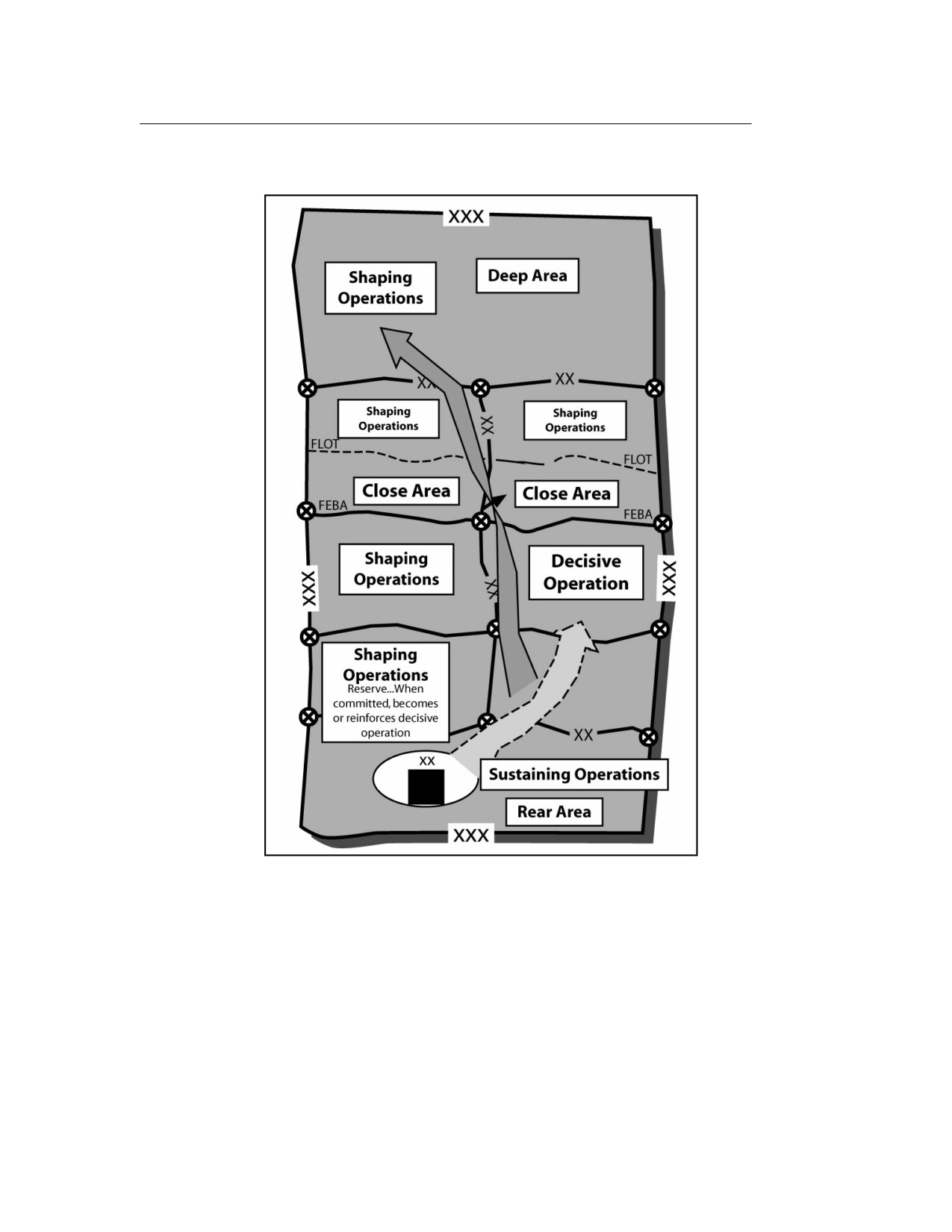
Aviation Brigades
AUGUST 2003
DISTRIBUTION RESTRICTION: Approved for public release; distribution unlimited.
HEADQUARTERS, DEPARTMENT OF THE ARMY
*FM 3-04.111 (FM 1-111)
Field Manual
Headquarters
No. 3-04.111
Department of the Army
Washington, DC, 21 August 2003
Aviation Brigades
Contents
Page
PREFACE
x
Chapter 1
FUNDAMENTALS, MISSIONS, ORGANIZATION
1-1
Section I - General
1-1
Brigade Types
1-1
Organization
1-2
Brigade Missions
1-2
Fundamentals
1-3
Training
1-5
Section II - Corps Aviation Brigade
1-6
Corps Aviation Brigade Mission
1-6
Corps Aviation Brigade Organization
1-6
Corps Aviation Brigade Fundamentals
1-6
Section III - Attack Helicopter Regiment (Corps Aviation Brigade)
1-7
Corps Attack Helicopter Regiment Mission
1-7
Corps Attack Helicopter Regiment Organization
1-8
Corps Attack Helicopter Regiment Fundamentals
1-8
Section IV - Aviation Group (Corps Aviation Brigade)
1-9
Aviation Group Mission
1-9
Aviation Group Organization
1-9
Aviation Group Fundamentals
1-10
Section V - Division Aviation Brigade (Heavy Division)
1-10
Aviation Brigade (Heavy Division) Mission
1-10
Aviation Brigade (Heavy Division) Organization
1-10
Aviation Brigade (Heavy Division) Fundamentals
1-11
Section VI - Division Aviation Brigade (Light Division)
1-12
Aviation Brigade (Light Division) Mission
1-12
Aviation Brigade (Light Division) Organization
1-13
DISTRIBUTION RESTRICTION: Approved for public release distribution is unlimited.
*This publication supersedes FM 1-111, dated 27 October 1997.
i
FM 3-04.111 (FM 1-111)
Page
Aviation Brigade (Light Division) Fundamentals
1-13
Section VII - Division Aviation Brigade (Airborne Division)
1-14
Aviation Brigade (Airborne Division) Mission
1-14
Aviation Brigade (Airborne Division) Organization
1-14
Aviation Brigade (Airborne Division) Fundamentals
1-15
Section VIII - Attack Helicopter Brigade (Air Assault Division)
1-15
Attack Helicopter Brigade (Air Assault Division) Mission
1-15
Attack Helicopter Brigade (Air Assault Division) Organization
1-16
Attack Helicopter Brigade (Air Assault Division) Fundamentals
1-17
Section IX - Air Assault Brigade (Air Assault Division)
1-17
Air Assault Brigade (Air Assault Division) Mission
1-17
Air Assault Brigade (Air Assault Division) Organization
1-18
Air Assault Brigade (Air Assault Division) Fundamentals
1-18
Section X - Theater Aviation Brigade
1-19
Theater Aviation Brigade Mission
1-19
Theater Aviation Brigade Organization
1-19
Theater Aviation Brigade Fundamentals
1-20
Section XI - Division Combat Support Aviation Brigade
1-20
Division Combat Support Aviation Brigade Mission
1-20
Division Combat Support Aviation Brigade Organization
1-20
Division Combat Support Aviation Brigade Fundamentals
1-21
Section XII - Army Special Operations Aviation Regiment
1-21
Organization
1-21
Fundamentals
1-22
Chapter 2
BATTLEFIELD DYNAMICS AND FRAMEWORK
2-0
Section I - Key Operational Considerations
2-0
Introduction
2-0
Decisive, Shaping, and Sustaining Operations
2-0
Nonlinear Operations
2-2
Linear Operations
2-4
Rules of Engagement, Rules of Interaction
2-6
Section II - Battlefield Operating Systems
2-6
Intelligence Battlefield Operating System
2-6
Maneuver Battlefield Operating System
2-8
Fire Support Battlefield Operating System
2-8
Air Defense Battlefield Operating System
2-9
Mobility/Countermobility/Survivability Battlefield Operating System
2-9
Combat Service Support Battlefield Operating System
2-10
Command and Control Battlefield Operating System
2-10
ii
Contents
Page
Section III - Operations
2-10
Characteristics of Operations
2-10
Considerations for Nonlinear Operations
2-11
Planning Considerations
2-12
Chapter 3
BATTLE COMMAND……………………………………………………………...……… 3-0
Section I - General
3-0
Concept of Battle Command
3-0
Section II - Command and Control
3-1
Command and Control System
3-1
Command and Support Relationships
3-2
Planning
3-4
Military Decision-Making Process
3-5
Decide, Detect, Deliver, Assess Methodology
3-6
Integration of the Decide, Detect, Deliver, Assess Process into the Decision-
Making Process
3-11
Aviation Mission Planning System
3-12
Battle Rhythm
3-15
Standing Operating Procedures Utilization
3-17
Pilots' Briefs
3-17
Section III - Rehearsals
3-18
General
3-18
Rehearsal Sequence and Attendance
3-18
Rehearsal Question Resolution
3-19
Conflict Resolution at the Rehearsal
3-20
Rehearsal Completion
3-20
Section IV - Split-Based Operations
3-20
Section V - Command and Staff Responsibilities
3-20
Brigade Commander
3-20
Deputy Brigade Commander (Corps Aviation Brigade)
3-22
Executive Officer
3-22
Assistant Aviation Officer
3-23
Command Sergeant Major
3-23
Brigade Staff Elements
3-23
Adjutant
3-25
Intelligence Officer
3-25
Operations Officer
3-25
Chemical Officer
3-26
Air Liaison Officer
3-26
Division Liaison Officer
3-26
Brigade Liaison Officer
3-27
iii
FM 3-04.111 (FM 1-111)
Page
Liaison Officers to the Brigade
3-27
Brigade Standardization Instructor Pilot
3-27
Brigade Safety Officer
3-28
Brigade Tactical Operations Officer
3-28
Brigade Air Traffic Services Officer
3-28
Brigade Aviation Life Support Officer
3-28
Logistics Officer
3-29
Civil-Military Operations Officer
3-30
Communications-Electronics Officer
3-30
Chaplain and Unit Ministry Team
3-31
Engineer Officer
3-31
Fire Support Officer
3-31
Flight Surgeon
3-31
Headquarters and Headquarters Company Elements
3-32
Section VI - Brigade Command and Control Facilities
3-33
General
3-33
Main Command Post
3-36
Main Command Post Site Selection
3-38
Main Command Post Displacement
3-38
Tactical Operations Center
3-41
Administrative and Logistics Operations Center
3-43
Rear Command Post
3-45
Alternate Command Post
3-45
Command Group
3-45
Section VII - Command, Control, Communications, Computers,
Intelligence, Surveillance, and Reconnaissance
3-45
Overview
3-45
Communications
3-47
Means of Communication
3-49
Section VIII - Communications Nets
3-52
Amplitude Modulation/Frequency Modulation Radio Nets
3-52
Standard Army Management Information Systems Nets
3-55
Army Battle Command System Nets
3-55
Chapter 4
COMMON OPERATIONAL PROCEDURES
4-0
Section I - Fundamentals
4-0
General
4-0
Time Required to Plan
4-0
Warning Order
4-0
Commander's Critical Information Requirements
4-1
Common Planning Process
4-1
iv
Contents
Page
Situational Awareness
4-2
Types of Operations
4-3
Common Terms
4-5
Aviation Brigade Operations
4-10
Section II - Planning Considerations
4-14
General
4-14
Enemy
4-14
Terrain and Weather
4-15
Troops and Support Available
4-16
Time Available
4-17
Civil Considerations
4-17
Media Presence
4-17
Planning Models
4-18
Brigade and Subordinate Planning Responsibilities
4-18
Section III - Nuclear, Biological, and Chemical Weapons
4-24
Contamination Avoidance
4-25
Protective Measures
4-25
Section IV - Special Environments
4-26
Urbanized Terrain
4-26
Mountains and High Altitude Terrain
4-26
Snow, Ice, Extreme Cold Weather
4-26
Jungles
4-27
Deserts
4-27
Over-Water Operations
4-27
Smoke and Obscurants
4-27
Section V - Shipboard Operations
4-28
Section VI - Unmanned Aerial Vehicle Operations
4-28
Unmanned Aerial Vehicle in Reconnaissance, Surveillance, and Target
Acquisition Operations
4-28
Concepts of Unmanned Aerial Vehicle and Aviation Brigade Cooperative
Employment
4-28
Section VII - Instrument Flight Proficiency
4-30
Air Movement/Self-Deployment
4-31
Inadvertent Instrument Meteorological Conditions
4-31
Ground Attack
4-31
Section VIII - Formation Flight
4-31
Planning Considerations
4-31
Section IX - Reconstitution
4-32
Overview
4-32
Chapter 5
EMPLOYMENT
5-0
v
FM 3-04.111 (FM 1-111)
Page
Section I - General
5-0
Section II - Corps Aviation Brigade
5-0
Overview
5-0
Task Organization Considerations
5-0
Airfields
5-1
How to Fight
5-1
Section III - Corps Attack Helicopter Regiment
5-4
Overview
5-4
Task Organization Considerations
5-4
How to Fight
5-4
Section IV - Corps Aviation Group
5-8
Overview
5-8
Task Organization Considerations
5-8
How to Fight
5-9
Section V - Division Aviation Brigade (Heavy Division)
5-13
Overview
5-13
Task Organization Considerations
5-13
How to Fight
5-13
Section VI - Division Aviation Brigade (Light Division)
5-17
Overview
5-17
Task Organization Considerations
5-17
How to Fight
5-18
Section VII - Division Aviation Brigade (Airborne)
5-22
Overview
5-22
Task Organization Considerations
5-22
How to Fight
5-23
Section VIII - Attack Helicopter Brigade (Air Assault Division)
5-28
Overview
5-28
Task Organization Considerations
5-28
How to Fight
5-28
Section IX - Air Assault Brigade (Air Assault Division)
5-32
Overview
5-32
Task Organization Considerations
5-33
How to Fight
5-33
Section X - Theater Aviation Brigade
5-37
Overview
5-37
Task Organization Considerations
5-37
Airfields
5-37
How to Fight
5-38
Section XI - Division Combat Support Aviation Brigade
5-40
vi
Contents
Page
Overview
5-40
Task Organization Considerations
5-40
How to Fight
5-40
Section XII - Army Special Operations Aviation Regiment
5-42
Chapter 6
OTHER TACTICAL OPERATIONS
6-1
Section I - Passage Of Lines and Battle Handover
6-1
Passage of Lines
6-1
Battle Handover
6-3
Section II - Air Combat Operations
6-4
Planning Considerations
6-4
Army Aircraft Weapons Capabilities in Air Combat
6-5
Section III - Deception Operations
6-6
Feint
6-6
Demonstration
6-6
Section IV - Search and Attack Operations
6-7
Aviation's Role
6-7
Elements of Search and Attack
6-7
Command and Control
6-8
Section V - Raids
6-8
Section VI - Joint Air Attack Team Employment
6-10
Section VII - Operations in Urbanized Terrain
6-10
Conducting Operations in Urbanized Terrain
6-10
Planning and Execution of Urban Operations
6-11
Section VIII - Stability and Support Operations
6-12
General
6-12
Categories of Operations
6-12
Support Operations
6-16
Stability and Support Operations Planning Considerations
6-17
Force Protection
6-18
Rules of Engagement
6-18
Host Nation Considerations
6-18
Chapter 7
COMBAT SUPPORT
7-1
Section I - Military Intelligence
7-1
Enablers
7-1
Counter-Intelligence
7-1
Electronic Warfare
7-1
Section II - Fire Support
7-2
Planning
7-2
Close Air Support
7-8
vii
FM 3-04.111 (FM 1-111)
Page
Naval Surface Fire Support
7-9
Section III - Air Defense
7-10
Planning and Employment
7-10
Active Air Defense
7-13
Passive Air Defense
7-13
Section IV - Engineer Support
7-14
Planning Considerations
7-14
Functions
7-14
Section V - Military Police Support
7-15
Battlefield Missions
7-15
Section VI - Psychological Operations
7-16
General
7-16
Aviation in Psychological Operations
7-16
Section VII - Civil Affairs Support
7-17
General
7-17
Aviation in Civil Affairs Operations
7-17
Section VIII - Air Force Weather Team Support
7-17
Weather Teams
7-17
Chapter 8
COMBAT SERVICE SUPPORT
8-0
Section I - Overview
8-0
Sustainment Imperatives
8-0
Fundamentals of Support
8-1
Combat Service Support Functions
8-2
Section II - Supply and Materiel Operations
8-4
Methods of Distribution
8-5
Materiel Management Centers
8-5
Requisition and Distribution of Supplies
8-6
Support by Host Nation
8-9
Section III - Maintenance Principles
8-9
Section IV - Vehicle and Ground Equipment Maintenance and Recovery
8-9
Maintenance Support Structure
8-9
Vehicle and Equipment Recovery Procedures
8-10
Section V - Aviation Maintenance Operations
8-10
Management Balance
8-11
Support System Structure
8-11
Section VI - Aircraft Recovery, Evacuation, and Battle Damage
Assessment and Repair
8-14
Battlefield Management of Damaged Aircraft
8-14
viii
Contents
Page
Section VII - Aviation Life Support System
8-16
General
8-16
Aviation Life Support System Maintenance Management and Training
Program Considerations
8-16
Section VIII - Standard Army Management Information Systems
Architecture
8-17
Standard Army Retail Supply System-Objective
8-17
Unit-Level Logistics Systems
8-18
Standard Army Maintenance System
8-18
Integrated Logistics Analysis Program
8-19
Defense Automatic Addressing System
8-19
Section IX - Safety
8-19
Accident Causes
8-20
Safety Regulations
8-20
Responsibilities
8-21
Safety
8-21
Appendix A
RISK MANAGEMENT
A-1
Appendix B
TACTICAL STANDING OPERATING PROCEDURES CONSIDERATIONS
B-1
Appendix C
DEPLOYMENT
C-1
Appendix D
ASSEMBLY AREA OPERATIONS/ROAD MARCH
D-1
Appendix E
COMMUNICATIONS
E-0
Appendix F
ARMING AND REFUELING OPERATIONS
F-0
Appendix G
ARMY AIRSPACE COMMAND AND CONTROL
G-1
Appendix H
UNMANNED AERIAL VEHICLE CONSIDERATIONS
H-0
Appendix I
AIRCRAFT CHARACTERISTICS
I-0
Appendix J
AIRCRAFT SURVIVABILITY
J-0
Appendix K
DIGITIZATION
K-1
Appendix L
ARMY AIRBORNE COMMAND AND CONTROL SYSTEM
L-0
Appendix M
MEDIA CONSIDERATIONS
M-1
Appendix N
RULES OF ENGAGEMENT
N-1
Appendix O
ENVIRONMENTAL CONSIDERATIONS
O-1
Appendix P
JOINT AIR ATTACK TEAM OPERATIONS
P-1
Appendix Q
AIR-GROUND INTEGRATION
Q-1
Appendix R
URBAN OPERATIONS
R-0
GLOSSARY
Glossary-1
BIBLIOGRAPHY
Bibliography-1
INDEX
Index-1
ix
Preface
The operational concepts in this field manual (FM) are based on Army doctrine as
established in FM 1 (FM 100-1) and FM 3-0 (FM 100-5). This manual is intended
for all Army aviation commanders, staffs, and any U.S. military personnel
expecting to conduct operations with Army aviation units.
This FM applies to the transition force across the full range of military
operations—stability and support operations (SASO), small scale contingencies
(SSC), and major theater war (MTW).
This FM covers each type aviation brigade in the Army, based on transition force
organization and force structure. The focus throughout this manual is how to
fight and sustain. It also will help Army branch schools teach Army aviation
brigade operations.
To standardize doctrine and simplify updates, the United States Army Aviation
Center (USAAVNC) is standardizing the format of aviation battalion and air
cavalry squadron manuals to match FM 3.04-111 (FM 1-111). Each manual will
contain the same chapter titles, in the same sequence, and corresponding
chapters of each manual will contain similar content. All appendices to this
manual also apply to the manuals listed below. When rewritten, these manuals
will not contain appendices unless a special demand exists for unit-specific
information.
• FM 3-04.112 (FM 1-112).
• FM 3-04.113 (FM 1-113).
• FM 3-04.114 (FM 1-114).
This manual applies to the Active Component (AC), Reserve Component (RC),
and Army civilians. It builds on the collective knowledge and experience gained
through recent operations, many exercises, and the deliberate process of
informed reasoning. It is rooted in time-tested principles and fundamentals,
while addressing new technologies and diverse threats to national security.
Finally, this FM furnishes a foundation for subordinate doctrine, force design,
materiel acquisition, professional education, and individual and unit training.
The proponent for this publication is the USAAVNC. Send comments and
recommended changes to Commander, USAAVNC, ATTN: ATZQ-TDS-D, Fort
Rucker, AL 36362.
Unless this publication states otherwise, masculine nouns or pronouns do not
refer exclusively to men.
x
Chapter 1
Fundamentals, Missions, Organization
"Good ships and good guns are simply good weapons, and the best weapons are
useless save in the hands of men who know how to fight with them."
President Theodore Roosevelt, Medal of Honor
Message to Congress, December 1901
The aviation brigade is organized and equipped to support both Joint and
Army operations. It conducts continuous combat, combat support (CS),
and combat service support (CSS) operations throughout the depth and
breadth of the battlefield. Aviation brigades are found at every echelon
from the division to corps, field army, and theater command. Although
their organization and composition are different at each level, and their
principal focus can range from attack to support, each brigade follows
time-tested fundamentals to achieve success on the battlefield. Those
fundamentals are discussed in section I of this chapter. Following Section
I are sections for each of the
11 brigade-sized organizations, their
principal mission focus, and general comments.
SECTION I - GENERAL
1-1. Aviation brigades support the force commander in planning,
coordinating, and executing operations. The aviation brigade—through
coordination, liaison, command and control (C2), and situational awareness
(SA) and understanding—sets the conditions for the brigade's success. The
aviation brigade is the continuity between the supported organization and all
aviation operations within that commander's battle space. Although the
aviation brigade commander may or may not have complete C2 over
aeromedical evacuation, fixed-wing, and unmanned aerial vehicle
(UAV)
units, he ensures all aviation operations are coordinated and synchronized.
BRIGADE TYPES
1-2. The Transition Force consists of 11 distinct types of aviation brigades.
The following brigade-sized organizations called regiments or group are
included:
• Corps Aviation Brigade.
• Attack Helicopter Regiment (Corps Aviation Brigade).
• Aviation Group (Corps Aviation Brigade).
• Division Aviation Brigade (Heavy Division).
• Division Aviation Brigade (Light Division).
1-1
FM 3-04.111 (FM 1-111)
• Division Aviation Brigade (Airborne Division).
• Attack Helicopter Brigade (Air Assault Division).
• Air Assault Brigade (Air Assault Division).
• Theater Aviation Brigade (TAB).
• Division Combat Support Aviation Brigade (DCSA Bde).
• Army Special Operations Aviation Regiment (ARSOAR).
ORGANIZATION
1-3. A brigade-sized organization has at least one headquarters and
headquarters company (HHC) and three subordinate battalions. Throughout
this manual, for readability, the term HHC includes a headquarters and
headquarters troop (HHT); and the term battalion includes squadron. The
terms HHT and squadron may be used when specifically discussing cavalry
organizations.
1-4. The HHC provides personnel and equipment for the C2 functions of the
brigade and security and defense of the command post (CP).
1-5. The numbers and types of subordinate battalions are based on the
brigade's mission. Although separate companies may be assigned, attached,
or under operational control (OPCON) to brigades, it presents challenges for
C2 as the brigade staff must also prepare plans and orders on the level of
detail normally found at the battalion level.
BRIGADE MISSIONS
1-6. Each brigade is tailored for specific missions as discussed in this
chapter. However, each brigade accepts other organizations and performs
missions not necessarily defined in the table of organization and equipment
(TOE) mission statement.
1-7. When task-organized with the appropriate assets from other aviation
brigades, all brigades can perform any of the traditional combat, CS, and CSS
missions. Each brigade, despite its structure, can plan, coordinate, and
execute reconnaissance, security, attack, air assault, air movement, and C2
operations. However, depending on their level of training, the TAB, the
aviation group in the corps aviation brigade, and the air assault division's
assault brigade may require augmentation to their staffs to conduct cavalry
and attack missions. Conversely, the attack regiment in the corps aviation
brigade and the air assault division's attack helicopter brigade may require
augmentation to their staffs to conduct air assault operations.
1-8. The appropriate section in this chapter describes each brigade's mission.
Chapters four through six describes each brigade’s operational aspects.
COMBAT MISSIONS
1-9. Aviation maneuver forces engage in destroying enemy forces by direct
and indirect fire. These missions include—
• Reconnaissance/surveillance.
• Security.
1-2
Chapter One
• Attack.
• Air assault.
• Fire support (FS).
• Joint Air Attack Team (JAAT).
• Defensive air combat.
1-10. Aspects of security missions include the following:
• All aviation maneuver forces can conduct screening operations. When
task-organized with ground units, they can screen over wider areas and
for longer time.
• Commensurate with their level of training to operate with ground
forces, when task-organized with the appropriate ground units, aviation
units can conduct guard operations.
• Aviation units normally do not conduct covering force operations, but do
participate in covering force operations as part of a larger force.
COMBAT SUPPORT MISSIONS
1-11. CS missions include—
• Command, control, communications, and intelligence (C3I).
• Air movement of units.
• Liaison officer (LNO) movement.
• Message delivery.
• Fast rope insertion/extraction system
(FRIES) and special patrol
insertion/extraction system (SPIES).
• Air traffic services (ATS).
• Aerial mine delivery operations (Volcano).
• Nuclear, biological, and chemical (NBC) surveys.
COMBAT SERVICE SUPPORT MISSIONS
1-12. CSS missions include—
• Aerial sustainment.
• Aircraft recovery.
• Casualty evacuation
(CASEVAC) in coordination with medical
evacuation (MEDEVAC).
FUNDAMENTALS
1-13. Commanders and staffs must be fully aware of the battlefield operating
systems (BOS):
• Intelligence.
• Maneuver.
• FS.
• Air defense (AD).
• Mobility, countermobility, and survivability.
• CSS.
1-3
FM 3-04.111 (FM 1-111)
• C2.
1-14. All aviation brigades must be able to conduct—
• Strategic deployment by land, sea, or air (Appendix C).
• Administrative and tactical movements (Appendix D).
1-15. All aviation brigade headquarters must simultaneously—
• C2 multiple and diverse subordinate units.
• Conduct multiple current operations.
• Plan multiple future operations.
• Protect and sustain their forces.
1-16. All aviation brigade headquarters must conduct liaison simultaneously
with—
• Higher headquarters main, tactical CP, rear CP.
• Forward brigades.
• The reserve.
1-17. Corps and division aviation brigades, groups, and regiments must
simultaneously—
• C2 ground maneuver units.
• Coordinate as required with the deep operations coordination cell
(DOCC).
1-18. All aviation units must accomplish operations during any of the
following conditions:
• As a subordinate unit assigned, attached, OPCON, or tactical control
(TACON), to another service.
• Near ground forces.
• Day or night.
• Limited visibility
(crew instrument meteorological conditions [IMC]
proficiency is critical).
• NBC.
• High altitude flight operations (engine power management skills are
paramount).
• All environments, such as desert, mountain, rolling hills, dense forest,
jungle, plains, urban, extreme cold weather, over water, shipboard.
• Operations with external fuel tanks (except OH-58D).
1-19. Each aviation unit must be proficient in the following areas:
• Ground gunnery (crew-served and individual weapons).
• Defensive air combat.
• Passage of lines.
• Formation flight.
• Terrain flight (low-level, contour, nap-of-the-earth [NOE]).
• Movement techniques
(travelling, travelling overwatch, bounding
overwatch).
• Airfield and forward arming and refueling point (FARP) operations.
• Emergency procedures (aircraft, refueling, weapons malfunction).
1-4
Chapter One
• Base defense
(includes emergency evacuation under all weather
conditions).
• NBC exposure avoidance and decontamination.
• Other basic tactical skills
(mission training plans
[MTPs], aircrew
training manuals [ATMs], soldier training publications [STPs]).
1-20. Each attack and air cavalry unit must be proficient in the following
areas:
• Reconnaissance and security operations.
• Attack helicopter operations (includes JAAT operations).
• Air assault security.
• Aerial gunnery (running fire, hovering fire, remote launch, and air-to
air engagements).
1-21. Each UH-60 and CH-47 unit must be proficient in the following areas:
• Landing zone (LZ) and pickup zone (PZ) operations.
• Air assault and air movement.
• External and internal load operations.
• Door gunnery.
• SPIES and FRIES (selected crews only).
• Mine delivery using Volcano (UH-60 only).
• C2 support, if equipped.
1-22. Each fixed-wing aviation unit must be proficient in the following areas:
• Airfield operations.
• Tactical flight.
• C2 support.
• Cargo transport, as appropriate.
TRAINING
1-23. The key to successful training is to assemble the required elements and
to train to standard
(combined arms training strategies [CATS], MTPs,
ATMs, STPs), beginning at home station and extending to all operations.
Critical to effective training are opposing forces
(OPFOR); observer
controllers (OCs); feedback systems, such as the multiple integrated laser
engagement system/air-ground engagement system
(MILES/AGES) II,
tactical engagement simulator system
(TESS), or aviation survivability
equipment trainer
(ASET IV); higher and adjacent headquarters; and
supported headquarters for air-ground integration.
1-24. Training can be a major challenge, especially if the other elements of
the corps or division are not available for concurrent training. That challenge
is further complicated if MILES/AGES II, TESS, or ASET-IV is not available
for feedback. When those elements are not available, the aviation brigade
must develop alternatives. Elements that represent supporting, supported,
and higher elements (usually called white cells) can be assembled and
trained to represent those headquarters. Vehicles from within the brigade
can be organized to replicate OPFOR target arrays. The ground elements of
the cavalry squadron can replicate the supported force for divisional brigades.
1-5
FM 3-04.111 (FM 1-111)
If the AD battalion is available, they can augment the OPFOR. MILES/AGES
II, TESS, and ASET-IV can be available if requested far enough in advance.
SECTION II - CORPS AVIATION BRIGADE
CORPS AVIATION BRIGADE MISSION
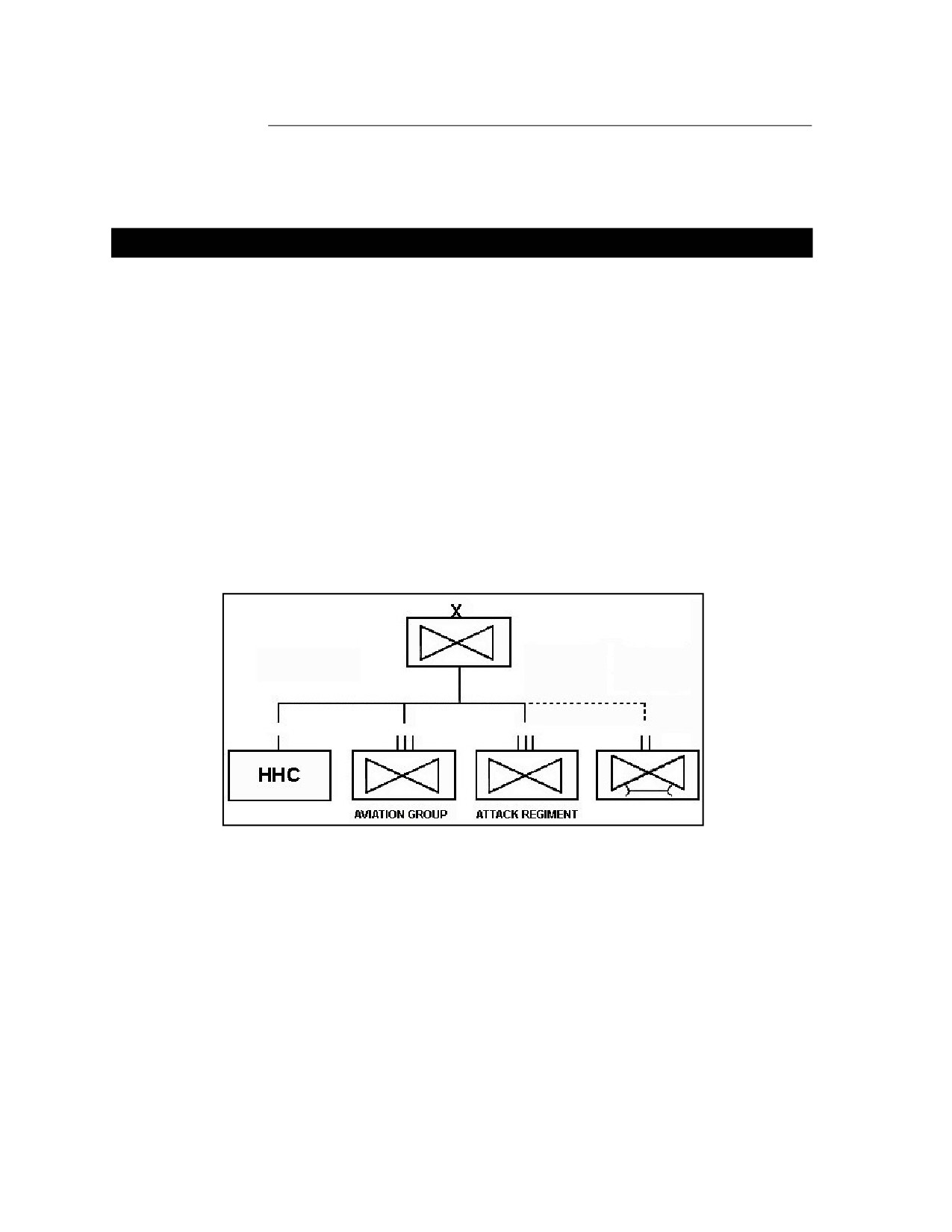
1-25. The corps aviation brigade's TOE mission is to plan, coordinate, and
execute aviation and combined arms operations to support the corps scheme
of maneuver. This brigade (Figure 1-1) supports each of the corps. Its focus
encompasses all aspects of aviation operations and may include ground
maneuver operations. Attack helicopter units destroy enemy forces by fire
and maneuver and conduct reconnaissance and security operations. Utility
and heavy helicopter units transport combat personnel, supplies, and
equipment. They support air assault operations. They provide C2 aircraft and
ATS for Army airspace command and control (A2C2) integration, airspace
information, and terminal and forward area support services (see Appendix
G). They also support combat search and rescue (CSAR) and CASEVAC,
when required.
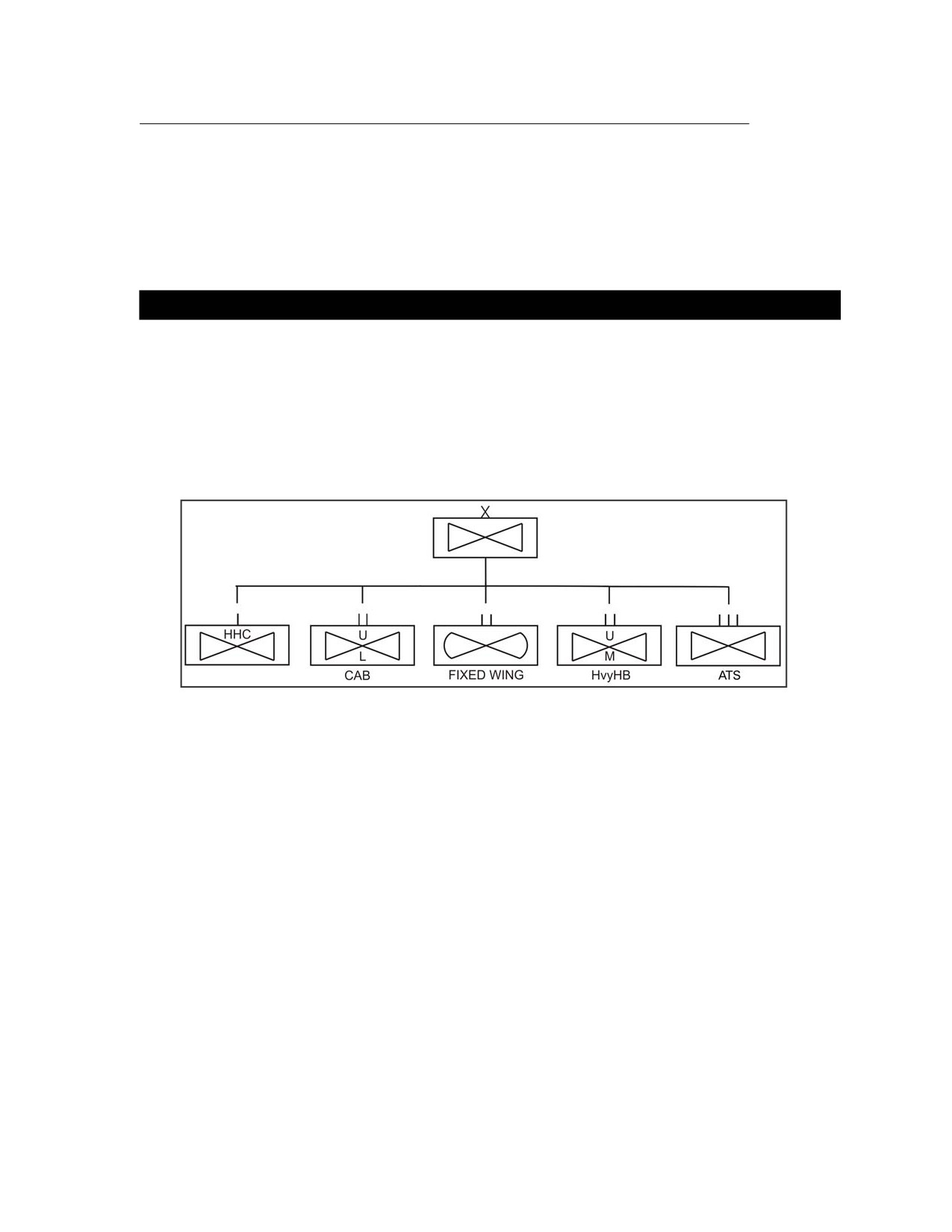
Figure 1-1. Corps Aviation Brigade
CORPS AVIATION BRIGADE ORGANIZATION
1-26. A corps aviation brigade's normal structure includes an HHC, an
aviation group, and an attack helicopter regiment (see next two sections). It
receives its aviation maintenance support from the Aviation Maintenance
Battalion, Corps Support Command (COSCOM).
CORPS AVIATION BRIGADE FUNDAMENTALS
1-27. Besides the fundamentals discussed in Section I of this chapter, the
corps aviation brigades must—
• Support corps and division shaping operations.
• Support division close combat operations.
1-6
Chapter One
• Coordinate with the Corps DOCC.
• Maintain intelligence preparation of the battlefield (IPB).
• C2 the subordinate units of the aviation group until the group
headquarters is activated, certified, and deployed.
• Act as or provide the maneuver headquarters for operations to react to
rear area threats.
1-28. The corps aviation brigade may conduct maneuver operations
independently, with or without the attachment of ground elements, or in
support of corps maneuver units. Support operations may be conducted in
either a direct support (DS) or general support (GS) role. Corps brigade units
may also augment or support the aviation brigades of subordinate divisions
or the aviation elements of separate brigades and the corps cavalry regiment.
Support to subordinate elements normally is in the form of additional C2,
logistics support, or attack helicopter units. Corps aviation units may conduct
corps rear area security and may serve as or support a tactical or operational
reserve.
SECTION III - ATTACK HELICOPTER REGIMENT (CORPS AVIATION
BRIGADE)
CORPS ATTACK HELICOPTER REGIMENT MISSION
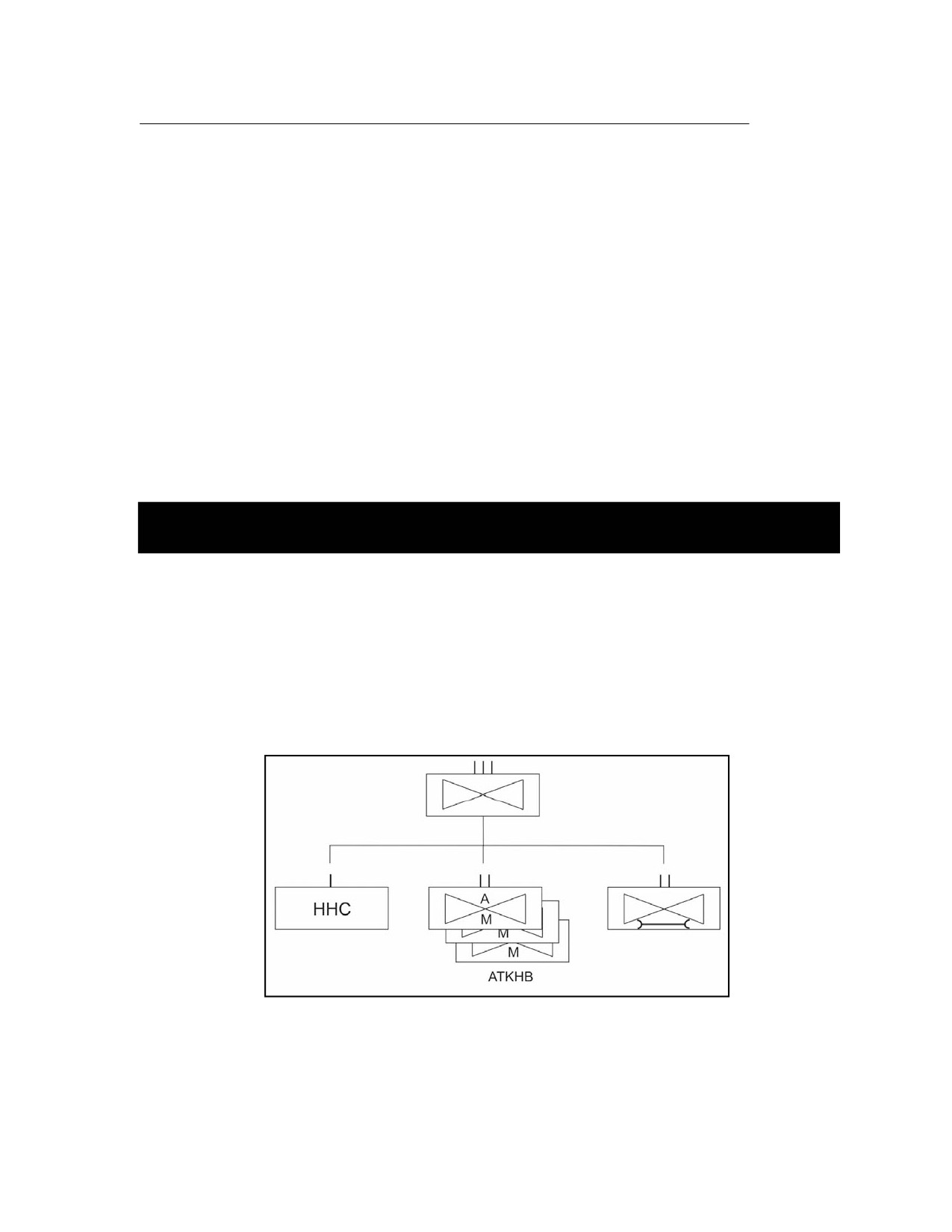
1-29. The corps attack helicopter regiment’s TOE mission statement is to
plan, coordinate, and execute aviation and combined arms operations to
support the corps aviation brigade scheme of maneuver. This regiment
(Figure 1-2) destroys enemy forces using fire, maneuver, and shock effect. Its
secondary missions are reconnaissance, security, defensive air combat, and
support of division close combat operations.
Figure 1-2. Corps Attack Helicopter Regiment
1-7
FM 3-04.111 (FM 1-111)
CORPS ATTACK HELICOPTER REGIMENT ORGANIZATION
1-30. A corps attack regiment has one HHC and three attack helicopter
battalions (ATKHB). It receives dedicated C2 and logistics support from the
corps aviation group.
1-31. The ATKHB consists of one HHC, three attack helicopter companies
(ATKHC) with seven AH-64s each, and one aviation unit maintenance
(AVUM) company.
1-32. The attack helicopter regiment receives its aviation maintenance
support from the Aviation Maintenance Battalion, COSCOM.
CORPS ATTACK HELICOPTER REGIMENT FUNDAMENTALS
1-33. Besides the fundamentals discussed in Section I of this chapter, the
corps attack helicopter regiment must be able to—
• Support corps and division shaping operations.
• Support division close combat operations.
• Coordinate with the corps DOCC.
• Maintain IPB.
• Act as or provide the maneuver headquarters for operations to react to
rear area threats.
1-34. The attack regiment is an armor killer that is very effective against
massed, moving targets. It is effective against enemy field artillery (FA), AD,
communications, and logistics units. It also is effective against point targets
(such as cave entrances, bunker apertures, windows in buildings) and other
hard or soft targets. It cannot occupy terrain; however, it can deny terrain for
a limited time by dominating it with direct and indirect fires. The attack
regiment enables the corps commander to mass combat power rapidly at the
decisive time to shape the battlefield for decisive operations or to conduct
decisive operations. It is an excellent reserve force against an armor threat or
massed forces.
1-35. In its reconnaissance and security role, the attack regiment provides
critical intelligence, sets the stage for attack helicopter and ground maneuver
operations. It clears the way for air assault and aerial mining missions and
secures routes for aerial and ground resupply. Attack helicopter sensor video
recording capability provides the corps or supported commander excellent
reconnaissance and battle damage assessment
(BDA) information.
Subordinate attack units of the regiment must be proficient in
reconnaissance and security, attack, and defensive air combat.
1-36. When task-organized with ground maneuver forces, it can conduct
cover and guard operations.
1-37. The corps attack regiment frequently operates far forward of corps
ground units at distances that often outstrip normal radio communications
ranges. Overcoming the operational challenges requires the application of the
latest technical solutions for communications. Among those solutions are
satellite communications
(SATCOM), aerial retransmission, aerial radio
relay, and high frequency (HF) radio.
1-8
Chapter One
SECTION IV - AVIATION GROUP (CORPS AVIATION BRIGADE)
AVIATION GROUP MISSION
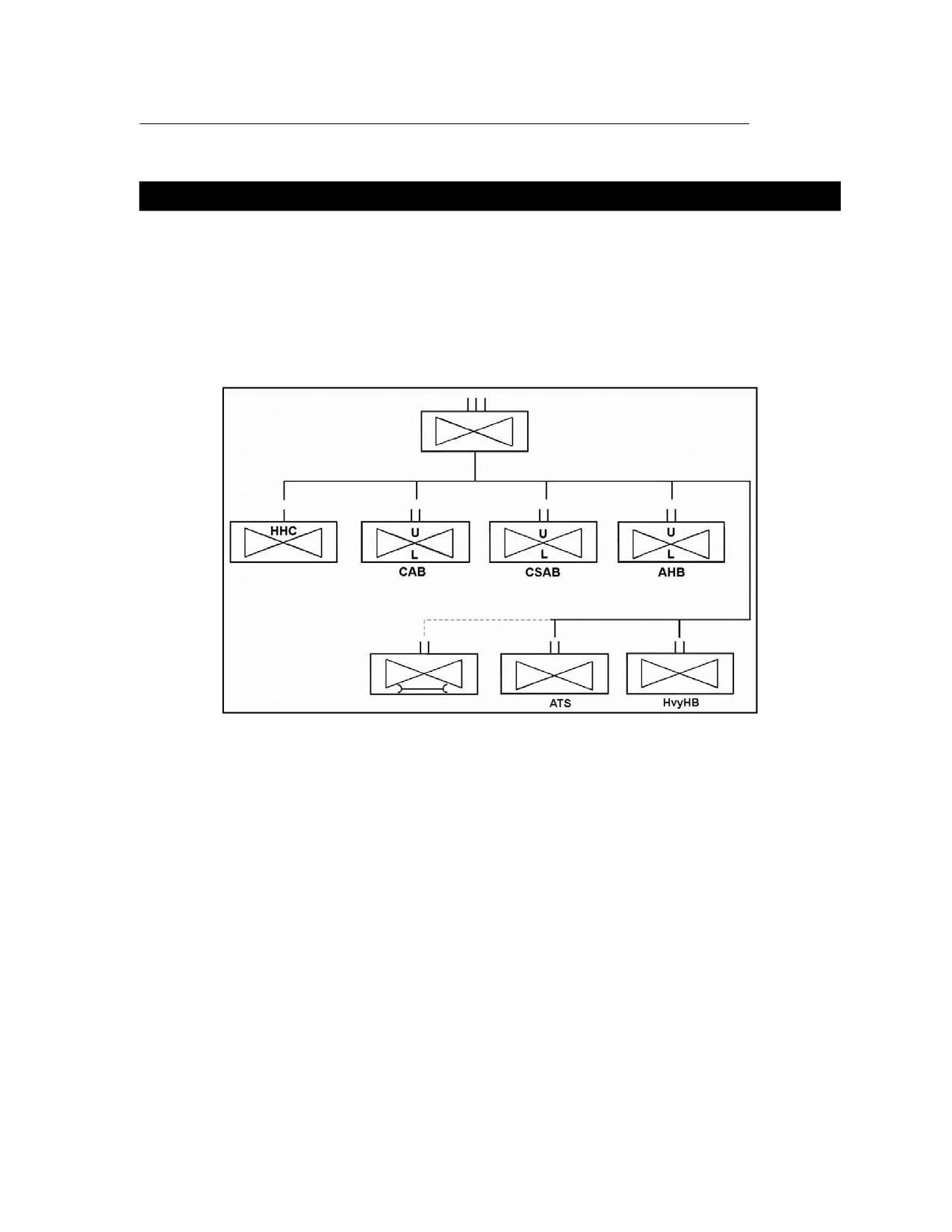
1-38. The corps aviation group TOE mission is to plan, coordinate, and
execute aviation and combined arms operations to support the corps aviation
brigade scheme of maneuver. This group's (Figure 1-3) principal mission
focus is C2, air assault, air movement, aerial delivery of mines, and ATS.
Figure 1-3. Corps Aviation Group
AVIATION GROUP ORGANIZATION
1-39. A corps aviation group's normal structure includes an HHC, a
command aviation battalion (CAB), a combat support aviation battalion
(CSAB), an assault helicopter battalion (AHB), a heavy helicopter battalion
(HvyHB), and an ATS battalion.
• The CAB consists of one HHC, three command aviation companies
(CAC) with eight UH-60s each, and one AVUM company.
• The CSAB consists of one HHC, three support aviation companies
(SAC) with eight UH-60s each, and one AVUM company.
• The AHB consists of one HHC, three assault helicopter companies
(AHC) with eight UH-60s each, and one AVUM company.
• The HvyHB consists of 1 HHC and 4 heavy helicopter companies
(HvyHC) with 14 CH-47s each.
1-40. The corps aviation group receives its aviation maintenance support
from the Aviation Maintenance Battalion, COSCOM.
1-9
FM 3-04.111 (FM 1-111)
AVIATION GROUP FUNDAMENTALS
1-41. Besides the fundamentals discussed in Section I of this chapter, the
corps aviation group must be able to—
• Maintain IPB.
• Support attack helicopter regiment missions.
• Manage the support requirements for the corps.
• Maintain air assault proficiency within the AHB and CSAB.
1-42. The aviation group provides continuous C2 support to the corps
command group, the corps aviation brigade, and the attack helicopter
regiment. As the number of C2 platforms is limited, close coordination with
the corps G3 is essential to establish priorities.
1-43. The aviation group supports air movement requirements for the corps
headquarters and subordinate unit air assault or air movement requirements
with the AHB. It provides logistics support, air movement support, and air
assault support with the HvyHB.
1-44. The aviation group augments or supports the aviation brigades of
divisions or the aviation elements of separate brigades and the corps cavalry
regiment. It supports rear area security and a tactical or operational reserve.
1-45. The aviation group operates over vast distances that often outstrip
normal radio communications ranges. Overcoming the operational challenges
requires the application of the latest technical solutions for communications.
Among those solutions are SATCOM and radio integration with corps
communications nodes.
SECTION V - DIVISION AVIATION BRIGADE (HEAVY DIVISION)
AVIATION BRIGADE (HEAVY DIVISION) MISSION
1-46. The heavy division aviation brigade’s TOE mission is to find, fix and
destroy enemy forces using maneuver to concentrate and sustain combat
power at the critical time and place, as an integrated member of the
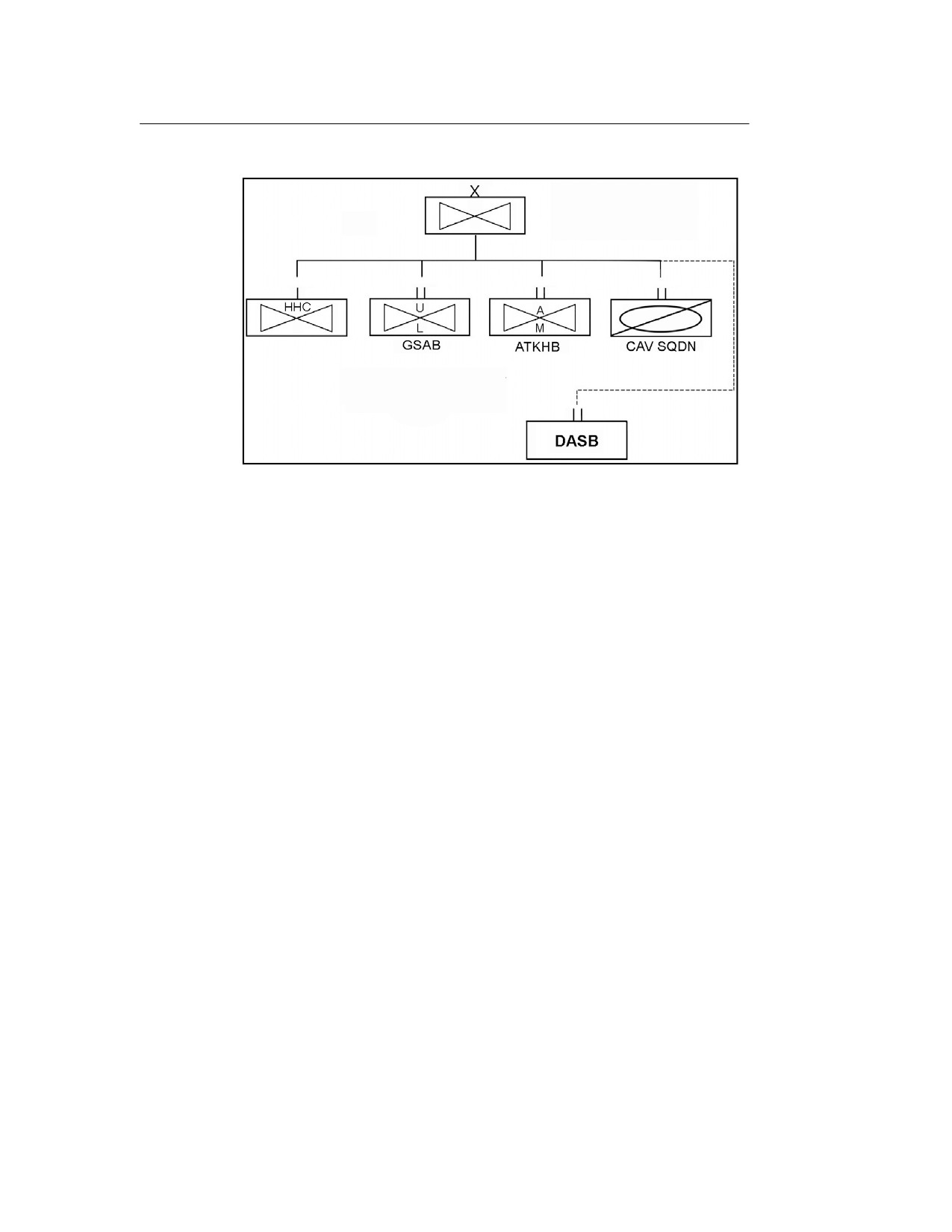
combined arms team. This brigade (Figure 1-4) destroys enemy forces using
fire, maneuver, and shock effect. It conducts reconnaissance and security
operations and provides C2 support. It conducts air movement operations and
aerial delivery of mines. The attack helicopter and air cavalry units have a
secondary mission of defensive air combat.
AVIATION BRIGADE (HEAVY DIVISION) ORGANIZATION
1-47. The brigade has an HHC, a divisional cavalry squadron, a general
support aviation battalion (GSAB), and an ATKHB.
• The cavalry squadron consists of one HHT, three armored cavalry
troops equipped with cavalry fighting vehicles (CFV) and M1 Abrams
tanks, two air cavalry troops (ACTs) equipped with eight OH-58Ds or
eight AH-64As each, and one AVUM troop.
1-10
Chapter One
Figure 1-4. Heavy Division Aviation Brigade
• The GSAB consists of one HHC, one CAC with eight UH-60s, one SAC
with eight UH-60s, and one AVUM company.
• The ATKHB consists of one HHC, three ATKHCs equipped with six
AH-64S each, and one AVUM company.
1-48. The ATKHB is an armor killer that is very effective against massed,
moving targets. It is also effective against enemy FA, AD, communications,
and logistics units. It also is effective against point targets (such as cave
entrances, bunker apertures, windows in buildings) and other hard or soft
targets. It cannot occupy terrain; however, it can deny terrain for a limited
time by dominating it with direct and indirect fires. The ATKHB enables the
division commander to mass combat power rapidly at the decisive time to
shape the battlefield for decisive operations or to conduct decisive operations.
It is an excellent reserve force against an armor threat or massed forces.
1-49. Division Support Command (DISCOM) supports the division aviation
brigade with a division aviation support battalion (DASB).
AVIATION BRIGADE (HEAVY DIVISION) FUNDAMENTALS
1-50. Besides the fundamentals discussed in Section I of this chapter, the
aviation brigade must be able to—
• Maintain IPB.
• Execute attack helicopter operations near ground forces.
• Support division decisive operations.
• Conduct division shaping and decisive operations.
• Participate in or command guard and cover missions when task-
organized with ground maneuver forces.
• Act as or provide the maneuver headquarters for operations to react to
rear area threats.
1-51. The heavy division aviation brigade is the principal integrator of
aviation assets within the heavy division. Its primary role is to set the
1-11
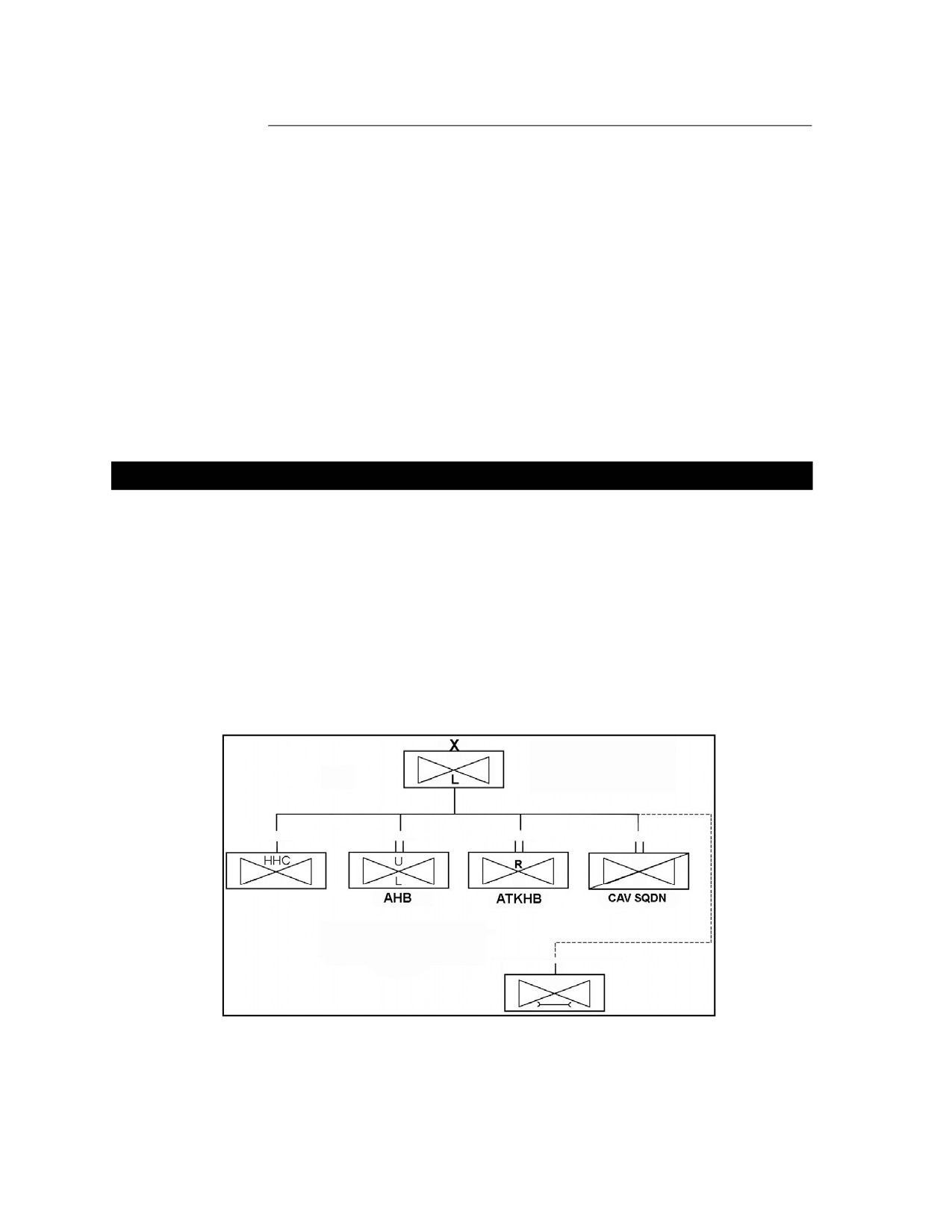
FM 3-04.111 (FM 1-111)
conditions for success for each of its units in their support of the ground
maneuver commander. The brigade must be prepared to fight as a whole. It
must be prepared to provide aviation support for multiple missions requiring
pure or task-organized units.
1-52. The cavalry squadron fights under division or aviation brigade control.
Its primary missions are reconnaissance and security.
1-53. The ATKHB fights in close coordination with divisional ground units
and conducts shaping operations. It also conducts reconnaissance and
security missions.
1-54. The GSAB provides DS and GS to all elements of the division. These
include ground brigades, DISCOM, division artillery
(DIVARTY), signal
battalion, the aviation brigade, the cavalry squadron, the ATKHB, and the
DASB.
SECTION VI - DIVISION AVIATION BRIGADE (LIGHT DIVISION)
AVIATION BRIGADE (LIGHT DIVISION) MISSION
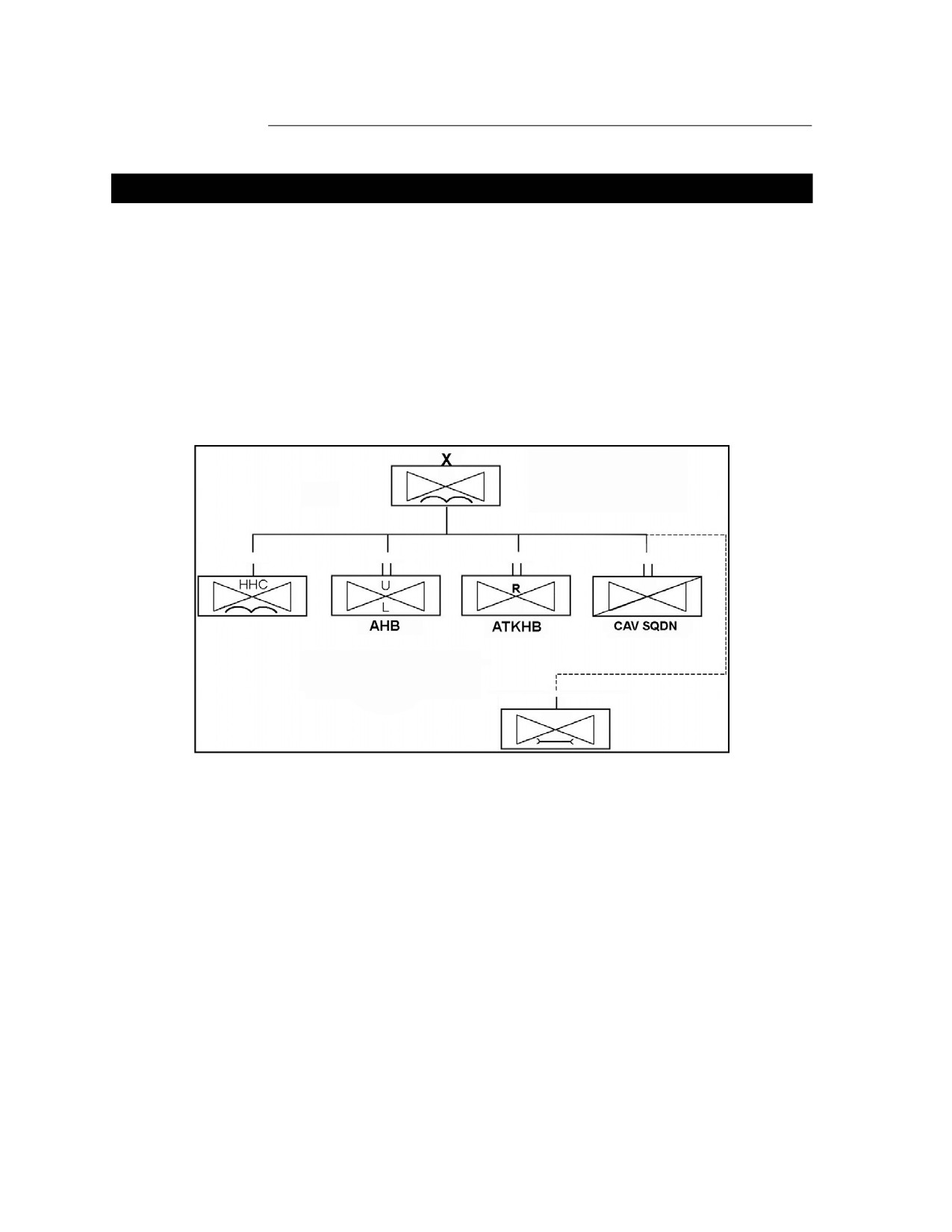
1-55. The light division aviation brigade’s TOE mission is to plan, coordinate,
and execute aviation and combined arms operations to support the division
scheme of maneuver. This brigade (Figure 1-5) destroys enemy forces using
fire, maneuver, and shock effect. It conducts reconnaissance and security
operations, air assault and air movement operations, and aerial delivery of
mines. It also provides C2 support. The attack helicopter and air cavalry units
have a secondary mission of defensive air combat.
Figure 1-5. Light Division Aviation Brigade
1-12
Chapter One
AVIATION BRIGADE (LIGHT DIVISION) ORGANIZATION
1-56. The light division aviation brigade has an HHC, a divisional cavalry
squadron, an AHB, and an ATKHB (OH-58D).
• The cavalry squadron consists of one HHT, one ground cavalry troop
equipped with light wheeled vehicles, two ACTs equipped with eight
OH-58Ds each, and one AVUM troop.
• The AHB consists of 1 HHC, 1 CAC with 8 UH-60s, 2 AHCs with 15
UH-60s each, and one AVUM company.
• The ATKHB consists of one HHC, three ATKHCs equipped with eight
OH-58Ds each, and one AVUM company.
1-57. DISCOM supports the division aviation brigade with an aviation
maintenance company from the Main Support Battalion (MSB), DISCOM.
AVIATION BRIGADE (LIGHT DIVISION) FUNDAMENTALS
1-58. Besides the fundamentals discussed in Section I of this chapter, the
aviation brigade must be able to—
• Maintain IPB.
• Conduct air assault operations with own assets and attached assets
from the corps and other divisions.
• Execute attack helicopter operations near ground forces.
• Support division decisive operations.
• Conduct division shaping and decisive operations.
• Participate in or command guard and cover missions when task-
organized with ground maneuver forces.
• Act as or provide the maneuver headquarters for operations to react to
rear area threats.
1-59. The aviation brigade is the principal integrator of aviation assets
within the division. Its primary role is to set the conditions for success for
each of its units in their support of the ground maneuver commander. The
brigade must be prepared to fight as a whole. It must be prepared to provide
aviation support for multiple missions requiring pure or task-organized units.
1-60. The cavalry squadron fights under division or aviation brigade control.
Its primary missions are reconnaissance and security.
1-61. The ATKHB fights in close coordination with divisional ground units
and is an excellent force for conducting reconnaissance and security missions.
The battalion does not normally execute operations in deep areas; however, it
can execute a deep area mission or raid against the right target array.
1-62. The AHB provides air assault, air movement, and a robust logistics
capability to the division. The CAC provides C2 support to the division
command group, aviation brigade, cavalry squadron, and ATKHB.
1-13
FM 3-04.111 (FM 1-111)
SECTION VII - DIVISION AVIATION BRIGADE (AIRBORNE DIVISION)
AVIATION BRIGADE (AIRBORNE DIVISION) MISSION
1-63. The airborne division aviation brigade’s TOE mission is to find, fix, and
destroy enemy forces using fire and maneuver to concentrate and sustain
combat power to support division operations. This brigade
(Figure
1-6)
destroys threat forces using fire, maneuver, and shock effect. It conducts
reconnaissance and security operations and provides C2 support. It conducts
air assault and air movement operations and aerial delivery of mines. Its
attack and air cavalry units have a secondary mission of defensive air
combat.
Figure 1-6. Airborne Division Aviation Brigade
AVIATION BRIGADE (AIRBORNE DIVISION) ORGANIZATION
1-64. The airborne division aviation brigade has an HHC, a divisional
cavalry squadron, an AHB, and ATKHB, (OH-58D).
• The cavalry squadron consists of one HHT, one ground cavalry troop
equipped with light, air-droppable wheeled vehicles, three ACTs
equipped with eight OH-58Ds each, and one AVUM troop.
• The AHB consists of 1 HHC, 1 CAC with 8 UH-60s, 2 AHCs with 15
UH-60s each, and 1 AVUM company.
• The ATKHB consists of one HHC, three ATKHCs equipped with eight
OH-58Ds each, and one AVUM company.
1-65. DISCOM supports the division aviation brigade with a provisional
DASB.
1-14
Chapter One
AVIATION BRIGADE (AIRBORNE DIVISION) FUNDAMENTALS
1-66. Besides the fundamentals discussed in Section I of this chapter, the
aviation brigade must be able to—
• Maintain IPB.
• Conduct air assault operations with own assets and attached assets
from the corps and other divisions.
• Execute attack helicopter operations near ground forces.
• Support division decisive operations.
• Conduct division shaping and decisive operations.
• Participate in or command guard and cover missons when task-
organized with ground maneuver forces.
• Act as or provide the maneuver headquarters for operations to react to
rear area threats.
1-67. The aviation brigade is the principal integrator of aviation assets
within the division. Its primary role is to set the conditions for success for
each of its units in their support of the ground maneuver commander. The
brigade must be prepared to fight as a whole. It must be prepared to provide
aviation support for multiple missions requiring pure or task-organized units.
1-68. The cavalry squadron fights under division or aviation brigade control.
Its primary missions are reconnaissance and security.
1-69. The ATKHB fights in close coordination with divisional ground units
and is an excellent force for conducting reconnaissance and security. The
battalion does not normally execute operations in deep areas; however,
against the right target array it can execute a deep area mission or raid.
1-70. The AHB provides air assault, air movement, and a robust logistics
capability to the division. The CAC provides C2 support to the division
command group, aviation brigade, cavalry squadron, and ATKHB.
SECTION VIII - ATTACK HELICOPTER BRIGADE (AIR ASSAULT DIVISION)
ATTACK HELICOPTER BRIGADE (AIR ASSAULT DIVISION) MISSION
1-71. The air assault division attack helicopter brigade’s TOE mission is to
plan, coordinate, and execute aviation operations as an integrated maneuver
element of the combined arms team to support division operations. This
brigade (Figure 1-7) destroys enemy forces using fire, maneuver, and shock
effect. It conducts reconnaissance and security operations and provides C2
support. It conducts air assault and air movement operations and aerial
delivery of mines. The attack and air cavalry units have a secondary mission
of defensive air combat.
1-15
FM 3-04.111 (FM 1-111)
Figure 1-7. Attack Helicopter Brigade (Air Assault Division)
ATTACK HELICOPTER BRIGADE (AIR ASSAULT DIVISION)
ORGANIZATION
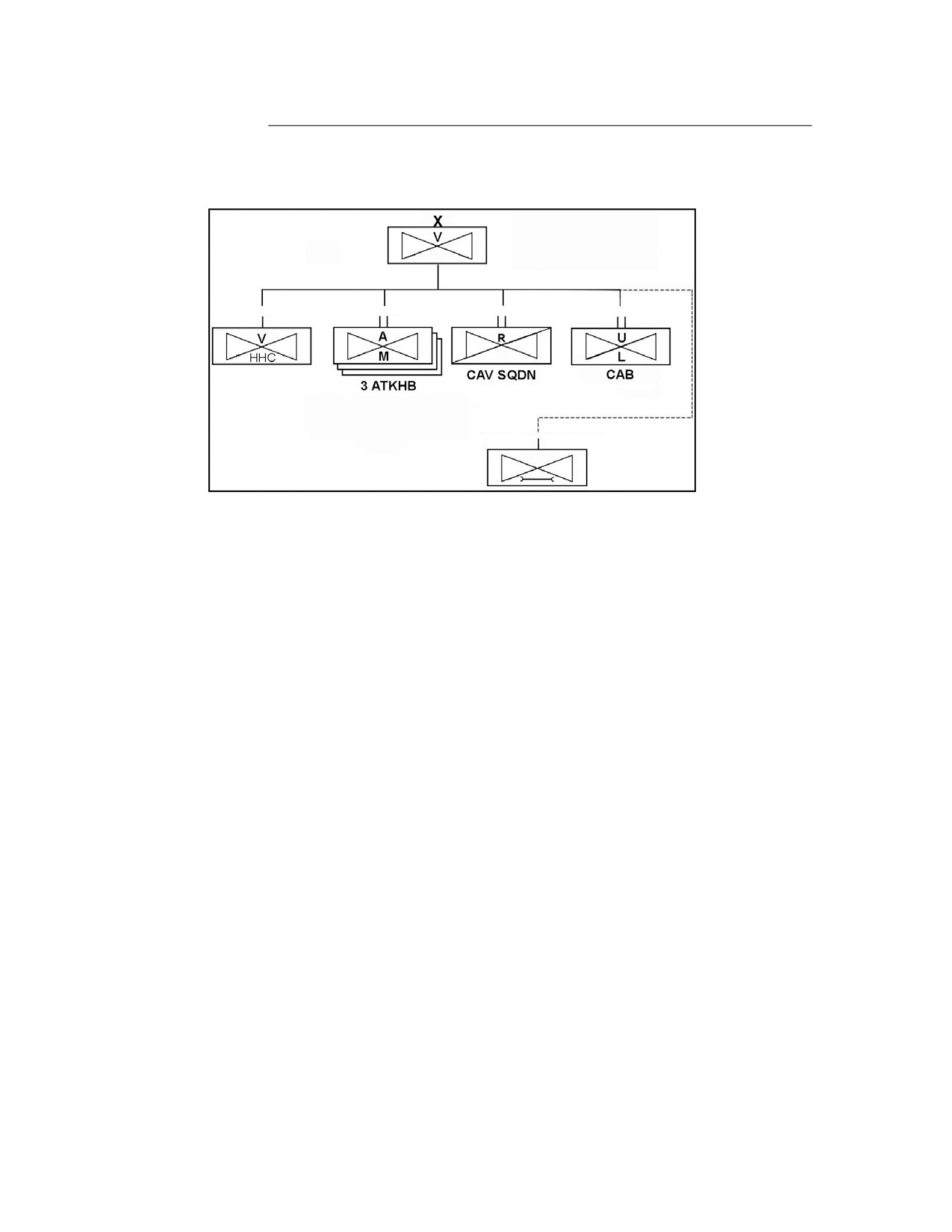
1-72. The air assault division attack helicopter brigade structure has one
HHC, three ATKHBs, one air cavalry squadron, and one CAB. (Note: TOE
documents show the CAB in the air assault brigade; however, the division
has placed the CAB in the attack helicopter brigade.) This decision provides
an aerial mine delivery capability and C2 support for the attack helicopter
brigade. The attack helicopter brigade's CAB provides C2 support for the
division.
• The ATKHB consists of one HHC, three ATKHC with six AH-64s each,
and one AVUM company.
• The air cavalry squadron consists of one HHT, three ACTs with eight
OH-58Ds each, and one AVUM troop.
• The CAB consists of one HHC, two CACs of eight UH-60s each, one
SAC of eight UH-60s, and one AVUM company.
1-73. The ATKHBs are armor killers that are very effective against massed
and moving targets. They are especially effective against enemy FA, AD,
communications, and logistics units. They are also effective against point
targets (such as cave entrances, bunker apertures, windows in buildings) and
other hard or soft targets. They cannot occupy terrain; however, they can
deny terrain for a limited time by dominating it with direct and indirect fires.
The attack helicopter brigade enables the division commander to mass
combat power rapidly at the decisive time to shape the battlefield for decisive
operations or to conduct decisive operations. It is an excellent reserve force
against an armor threat or massed forces.
1-74. The attack helicopter brigade receives its aviation maintenance
support from the Aviation Maintenance Battalion, DISCOM.
1-16
Chapter One
ATTACK HELICOPTER BRIGADE (AIR ASSAULT DIVISION)
FUNDAMENTALS
1-75. Besides the fundamentals discussed in Section I of this chapter, the
aviation brigade must be able to—
• Maintain IPB.
• Execute attack helicopter operations near ground forces.
• Provide air assault security as required.
• Support division decisive operations.
• Conduct division shaping and decisive operations.
• Participate in or command guard and cover missions when task-
organized with ground maneuver forces.
• Act as or provide the maneuver headquarters for operations to react to
rear area threats.
1-76. The attack helicopter brigade, reinforced with utility and heavy
helicopter elements, conducts operations to accomplish division objectives.
1-77. The attack helicopter brigade conducts up to three separate attack
operations to support division operations. These attack operations may be
under attack helicopter brigade control, under OPCON of a ground brigade,
or a combination of the two.
1-78. The brigade may support up to three aviation task forces, one for each
ground brigade. Support may be balanced for each brigade or task-organized
as required to support the division scheme of maneuver. The following is an
example of support for a three-brigade operation:
• A heavy aviation task force would support one brigade.
• A light aviation task force would support a second brigade.
• A third brigade would receive aviation GS of CS and CSS missions.
SECTION IX - AIR ASSAULT BRIGADE (AIR ASSAULT DIVISION)
AIR ASSAULT BRIGADE (AIR ASSAULT DIVISION) MISSION
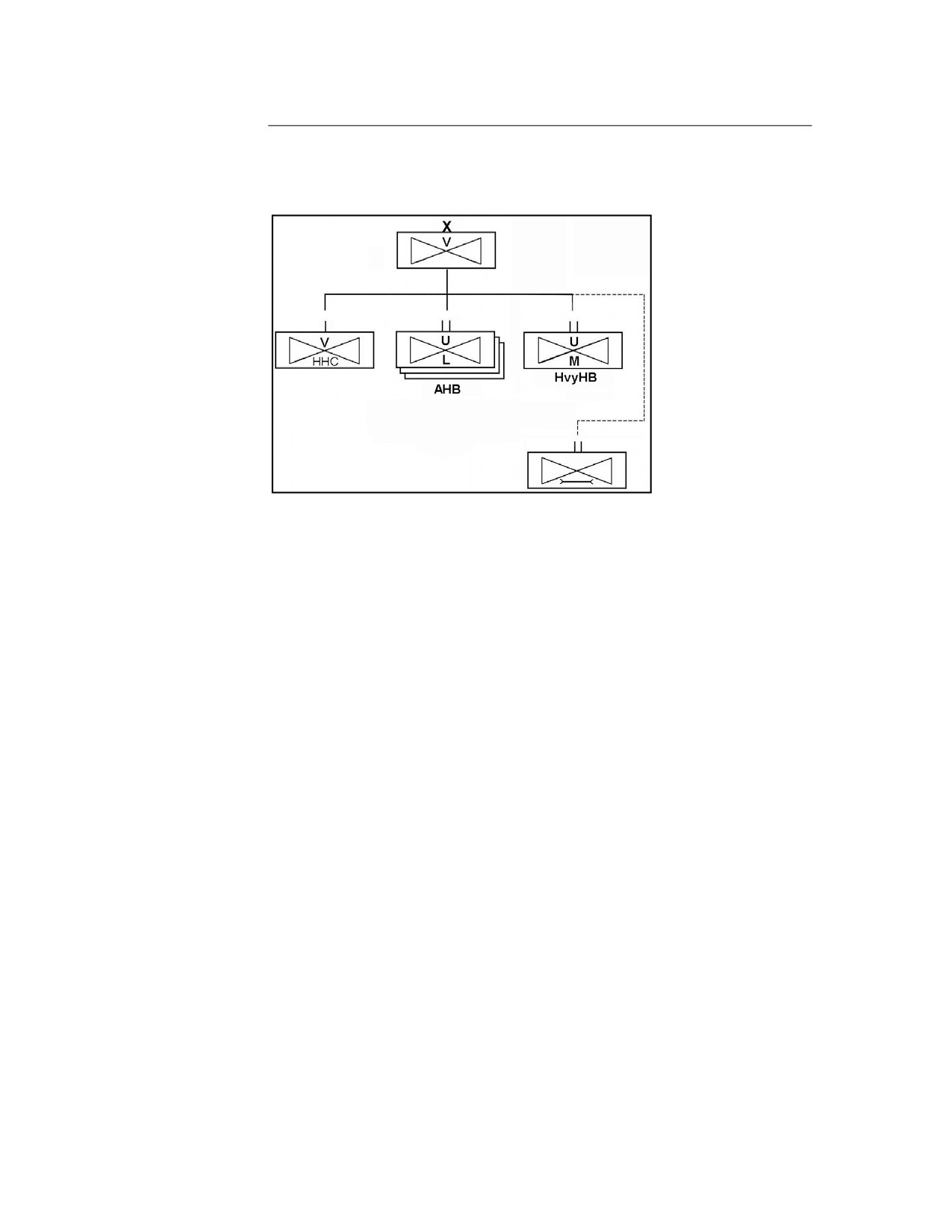
1-79. The air assault division aviation brigade's TOE mission is to plan,
coordinate, and execute aviation operations as an integrated maneuver
element of the combined arms team to support division operations. This
brigade's
(Figure 1-8) primary mission focus is air assault operations to
support division combat operations. It also conducts air movement operations
and aerial delivery of mines. (Note: TOE documents show the CAB in the air
assault brigade; however, the division has placed the CAB in the attack
helicopter brigade.) This decision provides an aerial mine delivery capability
and C2 support for the attack helicopter brigade. The attack helicopter
brigade's CAB provides C2 support for the division.
1-17
FM 3-04.111 (FM 1-111)
Figure 1-8. Air Assault Brigade (Air Assault Division)
AIR ASSAULT BRIGADE (AIR ASSAULT DIVISION) ORGANIZATION
1-80. The air assault division air assault brigade has one HHC, three AHBs,
and one HvyHB.
• The AHB consists of 1 HHC, 3 AHCs with 10 UH-60s each, and 1
AVUM company.
• The HvyHB consists of 1 HHC, 3 HvyHCs with 14 CH-47s each, and 1
AVUM company.
1-81. The air assault brigade receives its aviation maintenance support from
the Aviation Maintenance Battalion, DISCOM.
AIR ASSAULT BRIGADE (AIR ASSAULT DIVISION) FUNDAMENTALS
1-82. Besides the fundamentals discussed in Section I of this chapter, the
aviation brigade must be able to—
• Maintain IPB.
• Conduct air assault operations with own assets and attached assets
from the corps and other divisions.
• Support division sustaining operations.
• Act as or provide the maneuver headquarters for operations to react to
rear area threats.
1-83. The air assault brigade, reinforced with elements from the attack
helicopter brigade, forms three air assault task forces to support each of the
three ground brigades simultaneously. This support may be balanced for each
brigade or task-organized as required to support the division scheme of
maneuver.
1-84. The air assault brigade, reinforced with elements from the attack
helicopter brigade, forms two air assault forces to support two of the
division's three ground brigades. These air assault task forces may be
1-18
Chapter One
balanced or task-organized as required to support the division scheme of
maneuver. The division's third ground brigade would receive, at a minimum,
CS and CSS aviation GS.
1-85. The air assault brigade, reinforced with elements from the attack
helicopter brigade, conducts operations to move a ground brigade in two lifts.
SECTION X - THEATER AVIATION BRIGADE
THEATER AVIATION BRIGADE MISSION
1-86. The TAB’s TOE mission is to plan, coordinate, and execute aviation
operations to support the theater. This brigade (Figure 1-9) supports echelons
above corps (EAC) organizations. Its principal focus is C2 support for the EAC
headquarters and logistics support for the theater.
Figure 1-9. Theater Aviation Brigade
THEATER AVIATION BRIGADE ORGANIZATION
1-87. A TAB is designed, tailored, and configured for the specific theater in
which it operates. The Army component commander organizes the brigade
based on the mission guidance from the theater combatant commander. The
brigade's normal structure includes an HHC, a CAB, a TAB, a HvyHB, and
an ATS group.
• The CAB consists of one HHC, three CACs with eight UH-60s each, and
one AVUM company.
• The TAB consists of one HHC, three theater aviation companies
(TACs), with eight C-12s each, one TAC with eight C-23s, and one
AVUM company.
• The HvyHB consists of 1 HHC and 2 HvyHCs with 14 CH-47s each.
• The ATS Group consists of an HHC and the appropriate ATS battalions
and companies.
1-88. The theater support command (TSC) provides aviation maintenance
support. This normally is accomplished by an aviation maintenance company,
but it could be provided by contractor supported aviation facility or a
combination of both.
1-19
FM 3-04.111 (FM 1-111)
THEATER AVIATION BRIGADE FUNDAMENTALS
1-89. Besides the fundamentals discussed in Section I of this chapter, the
TABs must be able to C2—
• Fixed- and rotary-wing aircraft as they support the C2 requirements of
the EAC headquarters throughout the theater.
• Fixed-wing aircraft as they support the C2 requirements of the EAC
headquarters for flight external to the theater.
• Logistics aircraft as they support EAC units.
• Air assault or air movement operations in reaction to rear area threats.
• ATS needs for the theater (through its ATS Group).
1-90. One of the TAB's largest challenges is communications. It operates over
vast distances that often outstrip normal radio communications ranges.
Overcoming the operational challenges requires the application of the latest
technical solutions for communications. These connections include SATCOM
and radio integration with theater communications nodes.
1-91. The TAB may augment or support the aviation brigades of subordinate
corps or divisions or the aviation elements of separate brigades and the corps
cavalry regiment. Support to subordinate elements normally is additional C2
or logistics support. Theater aviation units may conduct theater rear area
security and may support a tactical reserve.
SECTION XI - DIVISION COMBAT SUPPORT AVIATION BRIGADE
DIVISION COMBAT SUPPORT AVIATION BRIGADE MISSION
1-92. The DCSA Bde’s TOE mission is to find, fix and destroy enemy forces
using maneuver to concentrate and sustain combat power at the critical time
and place, as an integrated member of the combined arms team. This brigade
(Figure 1-10) provides C2, air movement, and air assault support to selected
AC divisions when those divisions deploy.
1-93. The aviation elements of the DCSA Bde train to accomplish the mission
of their associated AC division.
DIVISION COMBAT SUPPORT AVIATION BRIGADE ORGANIZATION
1-94. A DCSA Bde normal structure includes an HHC, GSABs, AHBs, and a
HvyHC. It also has two ground cavalry troops.
• The GSAB consists of one HHC, two SACs (or one SAC and one CAC) of
eight UH-60s each, and one AVUM company.
• The AHB consists of 1 HHC, 2 AHCs of 10 UH-60s each, and 1 AVUM
company.
• The HvyHC consists of one company headquarters and two heavy
helicopter platoons of seven CH-47s each.
1-20
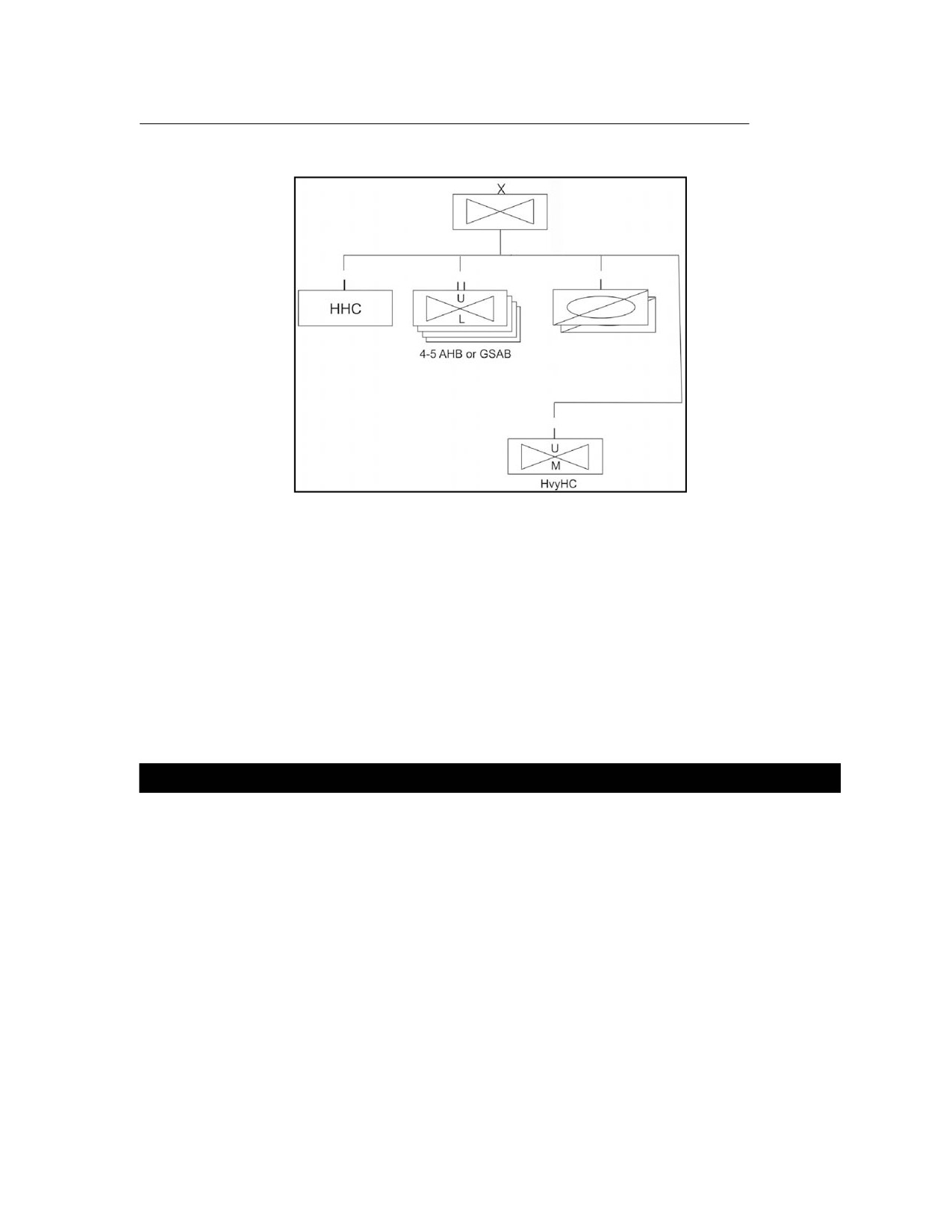
Chapter One
Figure 1-10. Division Combat Support Aviation Brigade
DIVISION COMBAT SUPPORT AVIATION BRIGADE FUNDAMENTALS
1-95. The DCSA Bde trains its subordinate units to accomplish the tasks of
the AC divisions with which they are scheduled to deploy. This training
should consist of home station training according to the AC unit's mission
essential task list (METL). It also should consist of training at the combat
training centers (CTC).
1-96. The DCSA Bde concept is emerging and could change over time. If so,
message addendums from USAAVNC and the National Guard (NG) Bureau
will serve as interim doctrine until the concept is set.
SECTION XII - ARMY SPECIAL OPERATIONS AVIATION REGIMENT
ARMY SPECIAL OPERATIONS AVIATION REGIMENT MISSION
1-97. ARSOAR's mission is to plan, support, and conduct special air
operations by clandestinely and covertly penetrating hostile and denied
airspace. ARSOAR supports special operations forces (SOF) conducting joint,
combined, interagency, and coalition operations in regional crises, major
conflicts, or as directed by the President and Secretary of Defense. ARSOAR
organizes, equips, trains, validates, sustains, and employs assigned aviation
units for the U.S. Army Special Operations Command.
ORGANIZATION
1-98. The ARSOAR (Figure 1-11) consists of an HHC, three battalions,
separate forward-deployed companies, a special operations aviation training
company
(SOATC), and a systems integration and maintenance office
(SIMO). The ARSOAR's rotary-wing aircraft include the AH/MH-6, MH-60,
MH-60 variant known as the defensive armed penetrator (DAP), and MH-47.
1-21
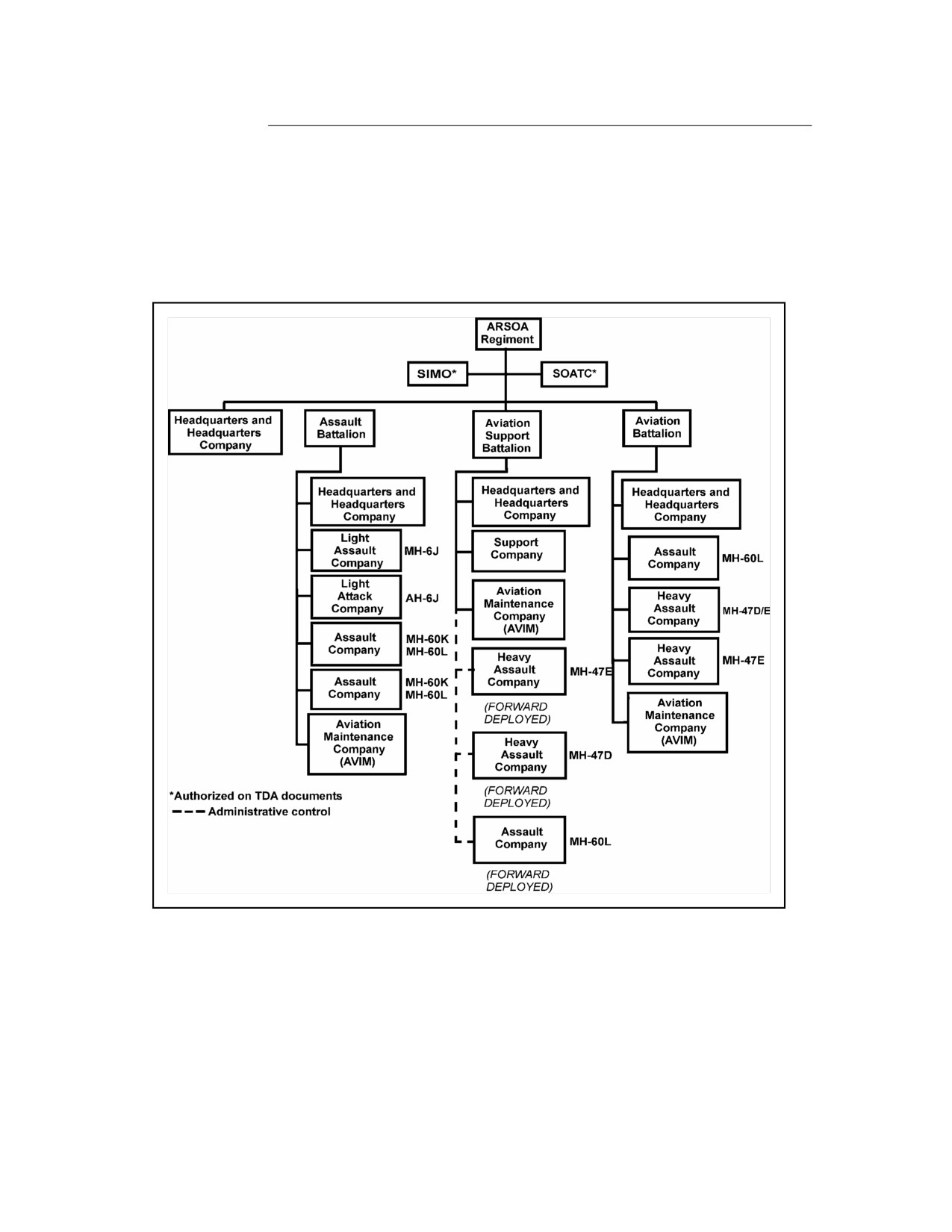
FM 3-04.111 (FM 1-111)
ARSOA units are designed to plan, conduct, and support special operations
missions unilaterally or jointly in all theaters and at all levels of conflict. To
accomplish this mission, ARSOA units are task-organized according to the
unit they will support, the theater of operations, and expected missions.
ARSOA task organizations are formed around one of the regiment's
battalions.
Figure 1-11 Army Special Operations Aviation Regiment
FUNDAMENTALS
1-99. ARSOA units are trained and equipped to infiltrate, resupply, and
exfiltrate U.S. SOF and other designated personnel. Training is tailored
specifically to profiles that support the SOF mission. Units prefer to operate
at night, using night vision goggles (NVG) or night vision systems (NVS) and
low-level flight profiles. Training is conducted in all operational
environments and terrain—desert, mountain, jungle, urban, over water.
Inherent in the training is the ability to operate from maritime platforms.
1-22
Chapter One
Emphasis is placed on precise navigation over long range and under adverse
weather conditions.
1-100. ARSOA aircraft are modified to add the capability for aerial refueling
and to enhance precise navigation, secure communications, long-range flight
performance, and increased weapons lethality. These enhancements give
ARSOA the unique capability to take advantage of adverse weather, limited
visibility, or low-cloud ceilings. These conditions provide concealment for air
operations and help achieve surprise.
1-101. Organic attack helicopter aircrews are specifically trained to provide
close air support (CAS) and terminal guidance for precision munitions to
support SOF.
1-23
Chapter 2
Battlefield Dynamics and Framework
Our soldiers and equipment operate in the physical domain. The
information they need for battle is created, manipulated, and shared in
the information domain. However, to succeed in network-centric warfare,
we must transform our operations into the knowledge domain. This is
where our force can develop and share high-quality SA. The knowledge
domain is where our force can develop a shared knowledge of the
commander's intent. It also is where our force can self-synchronize its
operations. What this means is that we are on the cusp of achieving Sun
Tzu's dream to know our enemy and know ourselves fully. We use this
knowledge so that we need not fear a hundred battles, terrorism, or any
other threat. We also use this knowledge to transform our Army to meet
any challenge it faces in the 21st Century.
The physical domain is combat. The information domain is SA. The
knowledge domain is the commander's intent. The combination of the
information and knowledge domains yields situational understanding
(SU).
The Army Battle Command System (ABCS) can enable commanders to
transform operations into the knowledge domain. It can provide the
synergy necessary to multiply the force.
SECTION I - KEY OPERATIONAL CONSIDERATIONS
INTRODUCTION
2-1. The modern battlefield may be linear, nonlinear, or both. Despite its
configuration, commanders employ decisive, shaping, and sustaining
operations to accomplish assigned missions. The aviation brigade is a key
maneuver and support force for these operations.
DECISIVE, SHAPING, AND SUSTAINING OPERATIONS
2-2. FM
3-0
(FM
100-5) defines three all-encompassing categories of
operations—decisive, shaping, and sustaining.
• The decisive operation conclusively determines the outcome of a battle
or engagement.
• Shaping operations establish conditions for a successful decisive
operation.
• Sustaining operations generate and maintain combat power.
2-0
Chapter Two
2-3. Commanders direct simultaneous and sequential decisive, shaping, and
sustaining operations by synchronizing their forces in time, space, resources,
purpose, and action.
Decisive, Shaping, and Sustaining Vignette
An Army division (minus) is in a lodgment area conducting a defense while awaiting
the follow-on forces. Enemy forces attack to destroy the division lodgment area. The
division's decisive operation is the successful defense of the lodgment area. Its
shaping operation is the destruction of the enemy's mobile reserve before it can be
committed. Its sustaining operations are those actions to ensure ammunition, fuel,
parts, food, water, and health service support (HSS) are provided. The aviation
brigade participates in the operation as an element of the decisive operation, the
shaping operation, and the sustainment operations. Attack and air cavalry forces,
with UH-60 Volcano mine systems and UH-60 C2 aircraft, attack to destroy the
enemy's mobile reserve. This operation to destroy the enemy mobile reserve is a
shaping operation by the division and a decisive operation for the aviation brigade.
Assault and heavy lift forces emplace FARPs. UH-60 aircrews support the division
staff or ground maneuver brigades with C2. The emplacement of FARPs is both a
division and aviation brigade sustaining operation.
DECISIVE OPERATIONS
2-4. There is only one decisive operation for any major operation, battle, or
engagement for any given echelon. It may include multiple actions conducted
simultaneously throughout the area of operations (AO). Commanders weight
the decisive operation by economizing combat power allocated to shaping
operations.
2-5. The aviation brigade participates in and supports decisive operations
by—
• Finding, fixing, and destroying enemy forces.
• Conducting air assaults and air movement.
• Emplacing minefields.
• Supporting C2 operations.
SHAPING OPERATIONS
2-6. Shaping operations establish conditions for the successful decisive
operation by setting the battlefield to our advantage. Shaping includes lethal
and nonlethal operations to make the enemy vulnerable to attack and impede
or divert his attempts to maneuver. It also facilitates the maneuver of
friendly forces, enhances deception, or otherwise dictates the time and place
for decisive battle. Through shaping, commanders gain the initiative,
preserve momentum, and control the tempo of combat.
2-7. When expressing their intent, commanders clearly and succinctly define
how the effects of shaping operations support the decisive operation. Shaping
operations may occur with, before, or after initiation of decisive operations.
They may involve any combination of forces.
2-8. Some shaping operations, especially those that occur simultaneously
with the decisive operation, are economy of force actions. If the available force
does not permit simultaneous decisive and shaping operations, the
2-1
FM 3-04.111 (FM 1-111)
commander sequences shaping operations around the decisive operation. A
shaping operation may become the decisive operation if circumstances or
opportunities dictate. In that case, the commander weights the new decisive
operation at the expense of other shaping operations.
2-9. The aviation brigade can shape by turning, blocking, fixing, and
disrupting enemy forces. This can be done with helicopter-emplaced
minefields, attack helicopters, air assault forces, and mobile C2 platforms.
SUSTAINING OPERATIONS
2-10. Sustaining operations generate and maintain combat power. Failure to
sustain normally results in failure of the overall effort. Sustaining operations
at any echelon are those that help the shaping and decisive operations by
assuring freedom of action and continuity of operations, such as CSS and C2.
Sustaining operations include CSS, sustainment base security and
maintenance, movement control, terrain management, and protection of lines
of communication (LOC) and headquarters.
2-11. Sustaining operations are inseparable from decisive and shaping
operations, although they are not by themselves decisive or shaping.
Sustaining operations occur throughout the AO. They underwrite the tempo
of the overall operation, assuring the ability to take advantage of any
opportunity without delay.
2-12. The assault and HvyHBs are ideal for sustaining operations. Air
cavalry and attack forces, coupled with the mobile and agile aerial C2
platforms, are excellent forces for protecting sustainment forces as they move
from one location to another or in their assembly areas (AAs).
NONLINEAR OPERATIONS
2-13. Nonlinear operations now characterize mission environments more
than ever. A nonlinear battlefield lacks the traditional grid of close, deep, and
rear areas. The resulting battle space is fluid, changing throughout mission
preparation and execution. In the nonlinear environment, aviation is an
essential force for success.
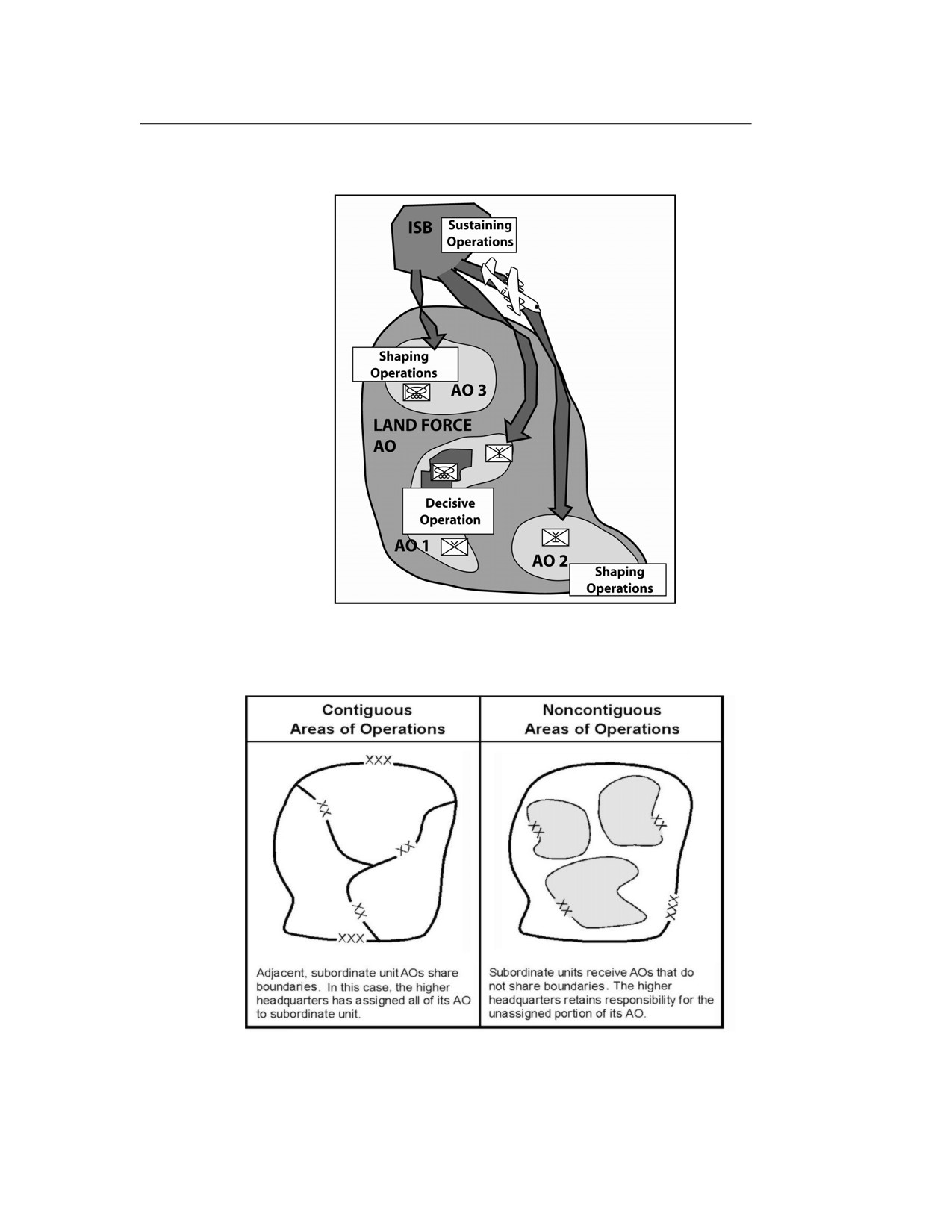
2-14. Within the nonlinear environment, maneuver units may be deployed in
contiguous or noncontiguous AOs (Figures 2-1 and 2-2). Even when operating
in contiguous AOs, maneuver forces orient on assigned objectives without
geographic reference to adjacent forces. These operations typically focus on
multiple decisive points. Most decisive results occur when distributed
operations (attacking the enemy at multiple locations) are synchronized to
achieve simultaneous effects. SASO normally are nonlinear with
noncontiguous AOs.
2-15. Nonlinear and linear operations are not mutually exclusive. Depending
upon perspective and echelon, operations often combine nonlinear and linear
characteristics. For example, a brigade may be deployed in a nonlinear
manner, while its battalions or some companies are deployed linearly with
respect to each other.
2-2
Chapter Two
Figure 2-1. Example of Offensive Operation—Nonlinear,
Noncontiguous
Figure 2-2. Contiguous and Noncontiguous Areas of Operations
2-3
FM 3-04.111 (FM 1-111)
LINEAR OPERATIONS
2-16. Traditional linear operations involve conventional combat and
concentrated maneuver forces. Ground forces share boundaries and orient
against a similarly organized enemy force. Terrain or friendly forces secure
flanks and protect CSS operations.
2-17. Despite the increasing nonlinear nature of operations, linearity still
characterizes many operations or phases of operations. When U.S. forces lack
sufficient information, are severely outnumbered, or when the threat to LOCs
reduces freedom of action, a force may conduct linear operations to
concentrate and synchronize combat power. In some multinational
operations, the capabilities and doctrine of partners may dictate this spatial
organization of the AO. In such situations commanders direct and focus on
close, deep, and rear area operations. The aviation brigade contributes in
combat, CS, and CSS by providing reconnaissance, security, attack, assault,
utility, heavy helicopter, CASEVAC, and C2 forces (Figure 2-3).
CLOSE AREAS
2-18. The close area is that area where the commander envisions close
combat taking place or being imminent. Here he seeks to overmatch the
enemy by synchronizing combat effects using maneuver and supporting fires
to produce a decision. Subordinate commanders engaged in the force
commander's close area designate their own close, deep, and rear areas.
2-19. Fratricide avoidance is an especially important consideration when
operating near friendly ground forces. Avoidance is enhanced by—
• Detailed planning and coordination by the aviation brigade and its
subordinate units with supported ground units.
• Accurate unit locations, times, frequencies, and recognition signals.
• Well-rehearsed plans, fully supported by tested battle drills involving
all elements of the air and ground force.
• Common standing operating procedures (SOP) and exercises to hone
skills.
DEEP AREAS
2-20. The deep area is an area forward of the close area that commanders
use to shape enemy forces before they are encountered or engaged in the close
area. Typically, the deep area extends from the forward boundary of
subordinate units to the forward boundary of the controlling echelon. Thus,
the deep area relates to the close area not only in terms of geography but also
in terms of purpose and time. The aviation brigade depends heavily on its
higher headquarters to develop the intelligence necessary to successfully
execute operations in deep areas.
2-4
Chapter Two
Figure 2-3. Example Defense Operation-Linear Contiguous
REAR AREAS
2-21. The rear area is a specific area within the AO used primarily for the
performance of support functions. The majority of sustaining operations occur
in the rear areas. Operations in rear areas assure freedom of action,
continuity of operations, sustainment, and C2. The rear area may be
contiguous with or separate from a close area. On a linear battlefield, the
rear area for any particular command is the area extending forward from its
rear boundary to the rear of the area assigned to the next lower level of
command. On the nonlinear battlefield, it may be difficult to define rear
areas. In essence, rear areas are wherever there are no ground maneuver
forces within the higher headquarters AO. The ability of the aviation brigade
2-5
///////////////////////////////////////