FM 2-22.3 (FM 34-52) HUMAN INTELLIGENCE COLLECTOR OPERATIONS (September 2006) - page 8
FM 2-22.3 _________________________________________________________________________________
Intelligence and Research home page. Contains country and region-
specific information, policies, and warnings.
Information Service.
(NGA)
(formerly National Imagery and Mapping Agency).
the Federal Research Division of the Library of Congress.
C-2
6 September 2006
FM 2-22.3
Appendix D
S2 Guide for Handling Detainees, Captured Enemy
Documents, and Captured Enemy Equipment
D-1. Detainees, retained personnel, CEDs, and CEE are critical sources of
combat intelligence. Often the Maneuver Battalion S2 is the first MI officer
to encounter these sources. His actions are critical to the exploitation system.
Information from these items is time sensitive, and these information sources
need to be exploited at as low an echelon as possible. The S2 should
anticipate requirements for support based on planned missions and request
HUMINT collector support as necessary. If unable to receive HUMINT
collector support, the S2 must be prepared to exploit these sources of
information to the best of his ability and more importantly expedite their
evacuation to locations and units where they can be exploited.
PURPOSE
D-2. This guide is for battalion and brigade S2s. It explains standard
procedures on what the S2 should do when his unit—
• Captures an enemy soldier or other detainee.
• Encounters a civilian on the battlefield.
• Finds or captures an enemy document.
• Discovers an unusual enemy weapon or other unusual piece of
equipment during tactical operations.
PERSONNEL HANDLING
D-3. The GPW defines persons entitled to treatment as prisoners of war upon
capture, in Article 4 (see Appendix A, Section I).
D-4. The GC defines the civilian population
(exclusive of those civilian
persons listed in GPW, Article 4) who benefit to varying degrees from the
provisions of the Geneva Conventions. (See Appendix A, Sections II and III.)
D-5. Persons in each of these categories have distinct rights, duties, and
restrictions. Persons who are not members of the Armed Forces, as defined in
Article 4, GPW, who bear arms or engage in other conduct hostile to the
enemy thereby deprive themselves of many of the privileges attaching to the
members of the civilian population. The capturing unit treats all combatants
and noncombatants who are suspected of being part of the threat force as
EPWs or retained personnel until their status can be determined. This
determination normally occurs at the detainee collection point or at a higher
echelon. Noncombatants are handled, questioned, detained, evacuated, and
released in accordance with theater policy. In all cases, detainees are treated
humanely.
6 September 2006
D-1
FM 2-22.3
_________________________________________________________________________________________
D-6. Detainees are treated humanely but with firmness at all times. High
standards of discipline are required not only of detainees but also of
capturing and escort forces. Fraternization with detainees or mistreatment
or abuse of them is not only a violation but also is not conducive to good
discipline. In addition to not being conducive to good discipline, the
mistreatment or abuse of detainees is a violation of the UCMJ for which
violators may be punished. The control of detainees is exercised through the
issuance and firm enforcement of necessary instructions in their own
language. Instructions relating to their control during evacuation from the
combat zone should be as brief as possible. Care must be taken to ensure that
detainees have a clear understanding of all instructions to them.
D-7. At the capture point, the capturing element performs the following steps
on detainees. The senior soldier will ensure that the steps are performed. The
steps are referred to as the "Five S's and a T".
STEP 1. SEARCH
D-8. The capturing unit’s first job is to disarm, search, and maintain positive
control over all detainees. The detainees are disarmed and searched for
concealed weapons and for equipment and documents of particular
intelligence value immediately upon capture, unless the number of detainees
captured, enemy action, or other circumstances make such a search
impracticable. Until each detainee is searched, the responsible forces must be
alert to prevent the use of concealed weapons or destruction of documents or
equipment.
D-9. The capturing unit gathers all loose CEDs and CEE in the area.
Identification documents and protective military equipment such as helmets
or NBC gear stay with the detainee unless otherwise directed by the
battalion S2.
• Equipment. Items of personal or individual equipment that are new or
appear to be of a type not previously observed may be of intelligence
value and should be processed and reported in accordance with the
unit’s SOP, specific evacuation instructions in Annex B (Intelligence) of
the OPORD, and theater policy. Equipment for personal protection
such as protective masks or protective clothing may not be taken
unless replaced with equivalent equipment.
• Documents. A CED is any piece of recorded information that has been
in the hands of the enemy. CEDs include but are not limited to maps,
sketches, photographs, orders, tactical and technical manuals and
instructions, code books, log books, maintenance records, shipping and
packing slips and lists, war and field diaries, personal diaries, pay
books, newspapers, service records, postal savings books, payrolls,
postcards and letters, and any written, printed, engraved, or
photographic matter that may contain information relative to the
enemy and to weather and terrain data. A capturing unit is normally
not able to accurately determine the potential intelligence value of any
documents found on the detainee. It is therefore normally expedient to
remove all documents, with the exception of the detainee’s primary
identification document. These documents are sealed in a waterproof
D-2
6 September 2006
_________________________________________________________________________________ FM 2-22.3
container and tagged with part C of the capture tag. If capture tags are
not available, the document bag must be marked at a minimum to
identify the detainee to whom the documents belong (see Appendix I).
• Personal effects. Except as provided in Step 1, detainees should be
permitted to retain all of their personal effects including money;
valuables; protective equipment, such as helmets, protective masks,
and like items; effects and articles used for clothing or eating, except
knives and forks; identification cards or tags; badges of grade and
nationality; and articles having a personal or sentimental value. When
items of equipment issued for the personal protection of detainees are
taken from them, they must be replaced with equivalent items serving
the same purpose. Although money and other valuables may be taken
from detainees as a security measure, they must then be receipted for
and a record thereof maintained in a special register. These
administrative steps normally are not practical to accomplish prior to
arrival of the detainee at an EPW camp.
STEP 2. SILENCE
D-10. Detainees are kept silent so that they cannot plan deception or
encourage each other to resist. Keeping the detainees silent also prevents
them from relieving the stress and shock of capture by talking with others. If
the shock of capture is preserved, HUMINT collectors can take advantage of
it in an approach. The capturing unit instructs or signals the detainees to be
silent. If that does not work, the detainee is gagged. Guards give orders to
detainees, but do not converse with them or give them any comfort items.
STEP 3. SAFEGUARD
D-11. All detainees are promptly evacuated out of the “danger” zone. Their
presence may not be used to render points or areas immune to attack, nor
should they be retained for participation in psychological warfare or other
activities. The capturing forces must protect detainees from reprisals.
Detainees will not be denied food, potable water, or appropriate clothing and
shelter. Necessary medical attention will not be delayed. Those detainees
held in an area should be provided protective facilities and equipment and
should be oriented as to procedures to be followed in case of chemical,
biological, and radiological agent attack.
STEP 4. SEGREGATE
D-12. The capturing unit separates officers from enlisted, senior from junior,
male from female, and civilian from military within their capabilities to both
guard and safeguard the detainees. (Physical segregation at this point is not
always possible.) Deserters and people of different nationalities and
ideologies should be further segregated. The capturing unit prepares a
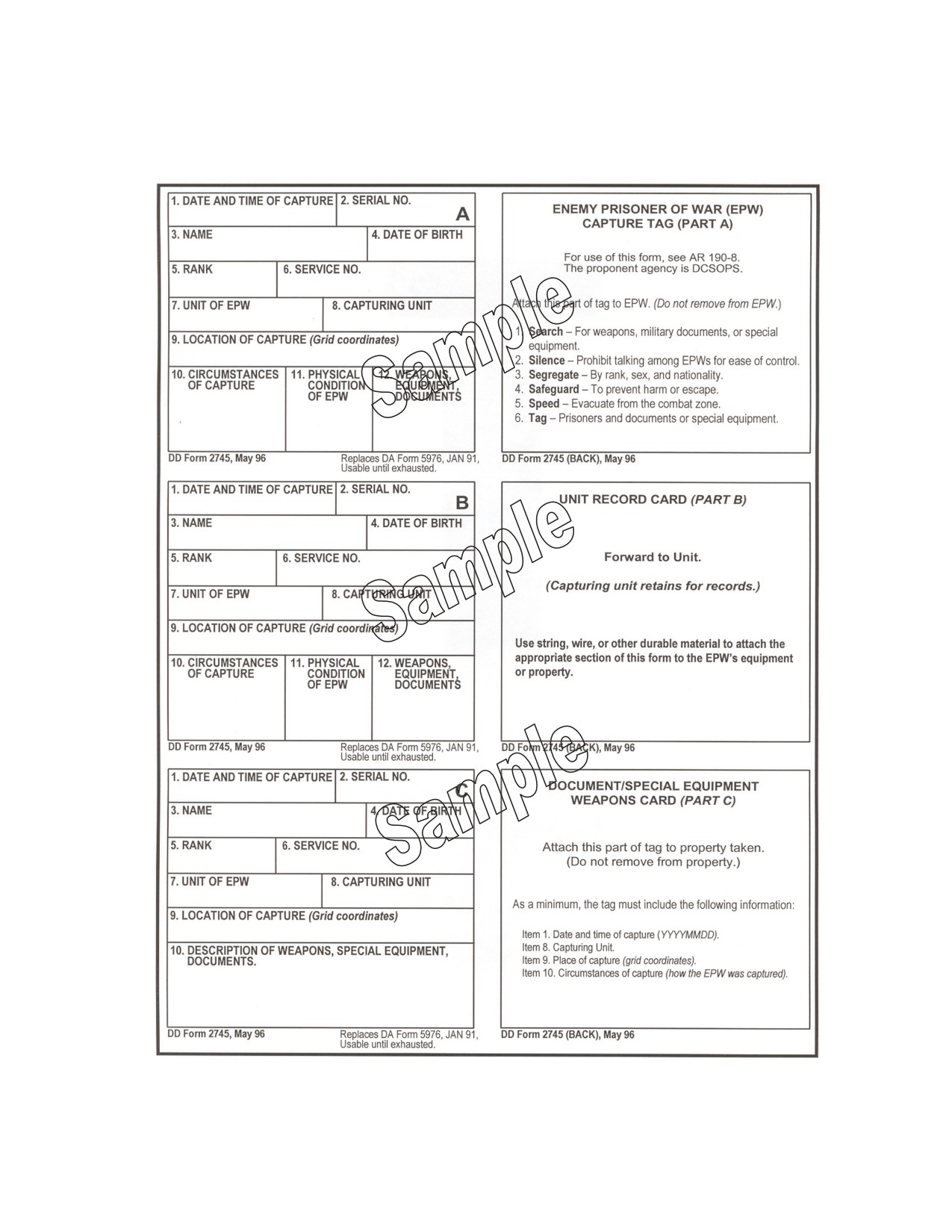
capture tag and puts one on each detainee
(see Figure D-1). Tagging
procedures are discussed in paragraph D-16.
6 September 2006
D-3
FM 2-22.3
_________________________________________________________________________________________
STEP 5. SPEED TO THE REAR
D-13. The capturing unit moves detainees and CEDs to the unit supply point
or other area where transportation to the rear is available for evacuation.
Evacuation of detainees from the combat zone should be effected within the
minimum time after capture. While in the combat zone, not only may
detainees become casualties as the result of enemy fire but also the fluidity of
operations, the wide dispersion of units, and the austerity of facilities may
necessitate their rapid evacuation.
D-14. The normal evacuation channel is from the detainee collection point
through intermediate detainee holding areas to an internment facility at a
higher echelon. Available returning transportation, however, may bypass any
intermediate detainee holding area and proceed directly to a corps or theater
internment facility. Detainees will then be processed directly into the corps
or theater internment facility. Evacuation may be by foot, vehicle, rail,
aircraft, or ship. Evacuate detainees who are litter patients through medical
channels.
D-15. The command (brigade and above) from which the detainees are being
evacuated is responsible to provide transportation and rations and for
coordinating all other matters related to the evacuation. Escort guards are
furnished by the command (division and above) to which the detainees are
being evacuated.
STEP 6. TAG
D-16. When the detainees have been searched and segregated, the capturing
unit prepares a capture tag and puts one on each detainee. It is very
important that the capturing unit fill out the Capture Tag as accurately and
completely as possible. HUMINT collectors will use the information from
the tag when preparing to interrogate detainees. The “capturing unit” and
“location of capture” information will be used to provide direct feedback to
the capturing unit when information of immediate tactical value is obtained.
Each EPW tag has a different serial number used for the purpose of
accountability and cannot be reproduced. The EPW tag is perforated into
three parts: Part A is attached to the detainee, Part B is retained by the
capturing unit, and Part C is attached to the detainee’s property (see Figure
D-1).
DOCUMENT HANDLING
DOCUMENTS FOUND ON ENEMY PRISONER OF WAR
D-17. The battalion S2 and subordinate unit commander ensure that CEDs
found on detainees are handled as follows. The capturing unit will—
• Search each detainee.
• Return identification documents to detainees. It may be preferable to
return only one identity document, to preclude the detainee from
spreading extras around to cause confusion. The preferred ID
document to return to the detainee is a picture ID (such as a military
D-4
6 September 2006
_________________________________________________________________________________ FM 2-22.3
or government ID card). If the detainee has several identification
documents, the S2 returns the ID that most accurately reflects the
detainee’s official status. This might be a military ID for a soldier and
a passport or government-issue ID for a civilian. If the detainee has
several identification documents with different names, this may be an
indicator of CI interest. The S2 notifies the nearest CI unit.
• Write the following on the top and bottom half of the EPW capture tag:
Number of documents taken, date and time, location and
circumstances of capture, capturing unit’s designation.
• Put CEDs in a waterproof bag, one per detainee.
• Affix Part C of the capture tag to the bag.
• Give CEDs to the senior escort.
• Direct the senior escort to evacuate CEDs with the detainee.
DOCUMENTS FOUND IN THE AO
D-18. An example of CEDs found in the AO is paperwork discovered in an
overrun CP, but not on a detainee. The capturing unit will—
• Put CEDs in a waterproof bag.
• Follow the same procedures described above, and tag the bag.
• Evacuate the CEDs to the battalion S2.
• Evacuate all CEDs as dictated by Annex B of the OPORD. This is
normally through the MI chain (for example, from Battalion S2 to
Brigade S2, to the first HUMINT collection or DOCEX unit in the MI
chain). The S2 normally coordinates with the S4 for the use of supply
vehicles returning empty to the rear for the transportation of large
numbers of documents.
INITIAL DOCUMENT EXPLOITATION
D-19. A combat unit without language-qualified personnel can perform
limited battlefield DOCEX, mainly on maps and overlays. The unit S2 is
normally responsible for any initial exploitation by the capturing unit. The
S2 safeguards the items pending disposition. At the same time he—
• Looks over the document.
• Does not mark or harm it in anyway.
• Uses whatever resources are available to decipher it; for example,
dictionaries and enemy map symbol guides.
• Looks for information that has a direct bearing on his current mission.
D-20. The S2 extracts the combat information and uses the SALUTE format
as a template to organize the information.
6 September 2006
D-5
FM 2-22.3
_________________________________________________________________________________________
EQUIPMENT HANDLING PROCEDURES
D-21. CEE includes all types of foreign materiel found on a detainee or in the
AO that may have military application. The capturing unit—
• Always permits the detainee to keep protective equipment and
equipment for his personal well being unless this gear is replaced by
equivalent items by the capturing unit. This equipment includes
helmet, NBC gear, mess gear (excluding knife and fork).
• Disposes of equipment in accordance with unit SOPs and instructions
in Annex B of the OPORD. Most routine equipment is normally
destroyed in place. Unusual or new equipment or equipment identified
as being of TECHINT interest is tagged with a CEE tag (Part C of
DD Form 2745) and evacuated to the nearest TECHINT unit.
Communications equipment is also tagged and evacuated to the
nearest SIGINT unit.
• Identifies equipment that cannot be easily evacuated; its location is
passed through intelligence channels to the nearest unit that will be
involved in its exploitation.
FIELD-EXPEDIENT TAGGING PROCEDURES
D-22. When no standard tag forms are available, the following field-
expedient methods may be used:
• Use meals, ready-to-eat (MRE) cardboard or other type of paper.
• Write the capturing unit’s designation.
• Write data and time of capture.
• Write POC coordinates.
• Write circumstances of capture.
• Identify EPW, captured document, or equipment captured.
• Put tag, without damaging the CED, in a waterproof bag.
• Attach EPW and CEE tags so they will not come off.
MEDICAL CARE
D-23. Medical equipment and supplies to permit the administering of
emergency first aid should be available at each EPW collecting point and
EPW holding area. A qualified medical retained person, if available, may
administer first aid to other detainees. All detainees suspected of having
communicable diseases are isolated for examination by a medical officer.
Wounded detainees may be questioned by intelligence personnel once the
detainees are cleared by competent medical authority for questioning.
D-24. For evacuation purposes, detainees may be classified as walking
wounded or sick, or as non-walking wounded or sick. Walking wounded
detainees are evacuated through MP EPW evacuation channels. Non-walking
wounded are delivered to the nearest medical aid station and evacuated
through medical channels.
D-6
6 September 2006
_________________________________________________________________________________ FM 2-22.3
Figure D-1. DD Form 2745 (Enemy Prisoner of War Capture Tag).
6 September 2006
D-7
This page intentionally left blank.
FM 2-22.3
Appendix E
Extracts from Allied Joint Publication (AJP)-2.5
Following are excerpts from Allied Joint Publication-2.5, Handling of Captured
Personnel, Equipment and Documents. AJP-2.5 is primarily an amalgamation of
procedures outlined in STANAG 2033, STANAG 2044, and STANAG 2084, and will be
used as the authoritative source for matters governed by those STANAGs. S2s and
HUMINT collectors should maintain a copy on hand.
THE GENEVA CONVENTIONS
E-1. Treatment of prisoners of war (PWs) and other detainees as well as the
handling of personal possessions including personal documents belonging to
them will at all times be in accordance with the 1949 Geneva Conventions
and, if ratified by the nations concerned, with the 1977 Protocols.
THE DETAINING POWER
E-2. The responsibilities of the ”Detaining Power” as set out in GC3 shall rest
with the nation or the deployed NATO command which initiated the capture
or detention of the person or persons in question.
E-3. Transfers of PWs between NATO nations must be in accordance with
GC3, Article 12, as interpreted but not superseded by national agreements.
KNOWLEDGE OF THE GENEVA CONVENTIONS AND THE 1977
PROTOCOLS
E-4. The Geneva Conventions require the signatories in time of both peace
and war to circulate the text of the Conventions as widely as possible within
their countries. They are especially required to ensure that the provisions
and implications of the Conventions are clearly understood by the members
of their armed forces and by the civilians attached to them. In order to assist
this process, it is suggested in the Conventions that instruction in them is
included in the syllabus of appropriate military and civilian courses of
instruction.
E-5. The conventions also state that any military or other authority
assuming responsibility for dealing with PWs in time of war or armed conflict
must be in possession of the text of the Conventions and that its personnel
must be instructed in how the Conventions affect them in the execution of
their duties with PWs.
E-6. If ratified by the nations concerned, these requirements are, by
inference, also applicable to the 1977 Protocols.
6 September 2006
E-1
FM 2-22.3 _________________________________________________________________________________
PRISONER-OF-WAR STATUS
E-7. Captured personnel
(CPERS) can be divided into two categories:
Captured personnel who are PWs and other detainees.
E-8. Prisoner-of-war status is conferred on captured personnel who fall
within the categories listed in Article 4 of GC3, which is reproduced in
Annex A, or, if ratified by the nations concerned, those who meet the
expanded definition of a PW as stated in Protocol I of the 1977 Protocols.
E-9. Other detainees are personnel being held by NATO forces until their
status can be determined and their further disposition can be decided.
E-10. Furthermore, when NATO forces are engaged in Peacetime Support
Operations (PSOs), the operational plan should contain specific instructions
as to which individuals will have PW status. Directions for handling other
detainees, including those suspected of crimes against humanity and war
crimes, are also to be included in the operational plan or in the Standing
Operating Procedures used in the operation.
PERSONNEL
E-11. Conditions allowing, the following procedures should be followed by the
capturing unit:
a. CPERS should be disarmed immediately, and all documents and
effects of military or investigative interest except for necessary clothing,
identity documents and protective equipment (Geneva Convention Relative
to the Treatment of Prisoners of War (GC3), Article 18) should be removed.
CPERS should then be tagged in accordance with the procedures outlined at
Annex B. A Common Capture Report should also be completed and forwarded
in accordance with the procedure set out in Annex C. It is important that the
documents, equipment, maps, etc., taken from a CPERS accompany him to
the next receiving unit. Valuable information may be lost by not having these
items available during processing and interrogation.
b. Within the confines of the tactical situation, CPERS are to be
segregated according to rank, grade, service, sex and nationality or ethnic
group/warring faction to minimize the opportunity to prepare counter-
interrogation measures. Furthermore, deserters, civilians and political
indoctrination personnel will be individually segregated from other CPERS.
Such segregation shall be undertaken in a manner which does not violate
GC3, Article 16.
c. Talking or fraternization between CPERS is to be prevented in order
not to prejudice future intelligence collection operations. CPERS will be
allowed no opportunity to exchange information between themselves, to
exchange identities or to dispose of articles of intelligence interest.
d. Interrogation operations must not be compromised by contact between
CPERS and personnel not concerned with interrogation duties.
e. CPERS will also be prevented from observing sensitive and critical
activities, equipment and procedures involving NATO, national or allied
forces.
E-2
6 September 2006
_________________________________________________________________________________ FM 2-22.3
f. CPERS are to be guarded in a manner which shall deny them the
opportunity for escape or sabotage.
g. Defectors and political refugees should also be segregated from other
CPERS wherever possible. These personnel shall be screened by the nearest
Interrogation Unit (IU), which will decide on their value to the intelligence
organization and consequent future movements. In all cases, defectors are to
be treated in accordance with the Geneva Convention Relative to the
Protection of Civilians in Time of War (GC4). National policy may provide
defectors treatment in accordance with GC3 where such treatment provides
greater protection than GC4.
h. Personnel claiming to be agents of an allied power shall also be
segregated from other CPERS. The intelligence organization (G2 or CJ2) is to
be informed of all such individuals as soon as possible and will arrange for
their screening to determine their future disposition.
i. CPERS suspected of crimes against humanity and war crimes will also
be segregated from other prisoners. Legal authorities and the intelligence
organization are to be informed of such suspects as soon as possible. They
will be taken into custody by law enforcement personnel. Intelligence
exploitation should be undertaken in cooperation with the legal authorities.
j. All CPERS are to be treated humanely.
k. Naval and Air Force personnel are to be identified and the intelligence
organization is to be notified in order that interrogation by naval/air force
personnel may take place at the earliest opportunity.
l. CPERS are to be escorted to the nearest Collecting Point or Holding Area as
quickly as possible.
m. Should any doubt arise as to whether any persons, including those
appearing to be PWs, having committed a belligerent act and having fallen
into Allied hands, belong to any of the categories of persons entitled to PW
status pursuant to Article 4 of GC3, such persons shall enjoy the protection of
GC3 until such time as their status has been determined by a competent
tribunal. If such a tribunal determines that an individual does not qualify for
PW status, then the detaining commander must determine whether the
detainee qualifies as a ”protected person” pursuant to GC4, and obtain legal
advice relative to the proper course of action for dealing with such detainees.
DOCUMENTS
E-12. Captured documents (CDOC) considered of intelligence interest will be
handled by the capturing unit in the following manner:
a. The capturing unit will conduct a preliminary screening to obtain
information of immediate technical or tactical value.
b. An intelligence report
(INTREP) identifying the CDOC and its
disposition as well as giving information considered to be of immediate
tactical value will be prepared and submitted by the capturing unit. (See
STANAG 2022.)
6 September 2006
E-3
FM 2-22.3 _________________________________________________________________________________
c. The capturing unit will tag or otherwise mark the CDOC as follows:
- National identifying letters of capturing unit as prescribed in
STANAG 1059.
- Designation of capturing unit including service.
- Serial number of the CDOC. This will consist of a number allocated
sequentially by the capturing unit.
- DTG of capture.
- Location of capture (geographic coordinates or UTM grid reference
including grid zone designation and
100,000-meter square
identification).
- Captured from Unit (enemy or warring faction) (including national
identifying letters in accordance with STANAG 1059).
- Summary of circumstances under which the CDOC was obtained.
Interrogation serial number of any associated CPERS, if appropriate
or known.
- CED associated with a captured person should be marked with part
C of the Standardized EPW Capture and Personal Equipment Tag.
d. CED to be used as evidence in legal proceedings against CPERS
suspected of crimes against humanity and war crimes will be kept under
guard or in a secure area separate from other CED.
EQUIPMENT
E-13. Captured Equipment
(CE) and Associated Technical Documents
(ATDs) considered of intelligence interest will be handled by the capturing
unit in the following manner:
a. A Capture Report as set out in Annex C of the OPORD will be
prepared by the capturing unit upon the discovery or capture of CE or ATD
believed to be of intelligence interest. The reporting channels are from the
capturing unit through the chain of command to the first TECHINT element.
b. The capturing unit will conduct a preliminary screening to obtain
information of immediate technical or tactical value. A Preliminary Technical
Report (PRETECHREP) as set out in Annex D of the OPORD will be
prepared and submitted through established intelligence channels.
c. Intelligence Reports
(INTREP) may, as circumstances dictate, be
submitted in advance but not in lieu of the Capture Report and
PRETECHREP. (See STANAG 2022.)
d. CE and ATD will be tagged or marked by the capturing unit as follows:
- National identifying letters of capturing unit as prescribed in
STANAG 1059.
- Designation of capturing unit including service.
- DTG of capture.
- Location of capture (geographic coordinates or UTM grid reference
including grid zone designation and
100,000-meter square
identification).
E-4
6 September 2006
_________________________________________________________________________________ FM 2-22.3
- Captured from Unit (enemy or warring faction) (including national
identifying letters in accordance with STANAG 1059).
- Summary of circumstances of capture.
- Associated CPERS.
e. CE and ATD to be used as evidence in legal proceedings against
CPERS suspected of crimes against humanity and war crimes will be kept
under guard separate from other CE and ATD.
6 September 2006
E-5
This page intentionally left blank.
FM 2-22.3
Appendix F
NATO System of Allocating Interrogation Serial Numbers
1. Every captured person selected for interrogation will be given an Interrogation Serial
Number. This number shall be allocated by the Interrogation Unit conducting the first
interrogation of the captured person.
2. The number should not be confused with the Prisoner of War Internment Serial Number
(ISN), which is to be used for administrative purposes only.
3. The purpose of the Interrogation Serial Number is to identify the source of information to
ensure its proper evaluation, processing, and follow-up action. It will also identify the nationality
and location of the interrogation unit.
4. The number shall be constituted as follows:
a.
2 letters to indicate the Nationality of the captured person (see para 6).
b.
2 letters to indicate the Service of the captured person (see para 7).
c.
1 letter to indicate the Arm of Service of the captured person (see para 8).
d.
4 numbers to indicate the Interrogation Sequence Number of the captured person (see
para 9).
e.
4 numbers to indicate the Day and Month of Capture.
f.
A dash (-) to show a sequence break.
g.
4 letters to indicate the Nationality and Service of the Interrogation Unit (see para 10).
h.
4 letters to indicate the Interrogation Unit.
5. Each group shall be separated by a dash. The final number shall therefore appear as in the
following examples:
LS - NV - B - 0012 - 2105 - USNV - 0159
Liechtenstein - Naval prisoner - Seaman - 12th captured person interrogated -
captured 21 May - interrogated by US Navy - team 159
AN - AF - H - 0357 - 0211 - GEAF - 0007
Andorra - Air force prisoner - Intelligence - 357th captured person interrogated -
captured 2 Nov - interrogated by GE Air Force - team 7
6 September 2006
F-1

FM 2-22.3 _________________________________________________________________________________
SM - AR - X - 0431 - 0707 - UKAR - 0019
San Marino - Army prisoner - One star or above - 431st captured person interrogated -
captured 7 Jul - interrogated by UK Army - team 19
6. The two letters used for indicating the Nationality of the captured person will be in
accordance with established NATO Country codes in STANAG 1059.
7. The following list of letters is to be used to indicate the Service of the captured person:
AR
- Army
NI
- Naval Infantry
NV
- Navy
AB
- Airborne Forces
NA
- Naval Air Arm
SF
- Special Purpose Forces
AF
- Air Force
PL
- Police
IR
- Irregular
CV
- Civilian (other than Police)
8. The following list of letters is to be used to indicate the Arm of Service of the captured person:
Navy
Army
Air Force
Other/Partisan
(A)
(B)
(C)
Forces
(D)
A. Aircrew
Aircrew
Aircrew
Aircrew
B. Seamen
Infantry
Ground Crew
Merchant Marine
C. Communications
Signals
Communications
Radio
Officers/Operators
D. Weapons/
Electrical/Electronic
Electrical/Electronic
Electronic Engineer
Engineer
Engineer
E. Mechanical/
Engineers
Mechanical/Air
Marine/Engineers
Frame/Engineers
F. Gunnery
Artillery
Ordnance
Weapons/Ordnance
Explosives
G. *HQ Staff
*HQ Staff
*HQ Staff
*HQ Staff
H. Intelligence
Intelligence
Intelligence
Intelligence
I. Marines
Airborne Forces
Airfield Defense
J. Cooks/Stewards
Catering
Catering
Catering
K. Legal/Political
Legal/Political
Legal/Political
Legal/Political
L. Medical/Dental/
Medical/Dental/
Medical/Dental/
Medical/Dental/
Nursing
Nursing
Nursing
Nursing
M. Electronic
Electronic Warfare
Electronic Warfare
Electronic Warfare
Warfare
N. Operations
Operations
Operations
Operations
O. Police
Police
Police
Police
P. Supply
Quartermaster
Supply
Supply
Q. Strategic
Strategic Weapons
Strategic Weapons
Strategic Weapons
Weapons
R. Special Purpose
Special Purpose
Special Purpose
Special Purpose
Forces
Forces
Forces
Forces
S. Air Traffic Control
Armored
Air Traffic Control
Air Traffic Control
T. *Unknown
*Unknown
*Unknown
*Unknown
F-2
6 September 2006

_________________________________________________________________________________ FM 2-22.3
Navy
Army
Air Force
Other/Partisan
(A)
(B)
(C)
Forces
(D)
U. Instructors
Education
Education
Instructors
V. Ministers of
Ministers of Religion
Ministers of Religion
Ministers of Religion
Religion
W. *Submarines
Artillery Spotters
Forward Air
Couriers, etc.
Controllers
X. *One Star +
*One Star +
*One Star +
*Officers in Command
of Irregular Forces
Y. *Other
*Other
*Other
*Other
*Notes: G - Headquarters staffs below one star rank
T - Captured Person’s arm of service not known to report writer
W - To be used in respect of all submarines regardless of arm or specialization
X - To be used in respect of all ONE STAR or above officers regardless of army
Y - PW arm of service not included in the appropriate list
9. The sequence number of the interrogated captured personnel shall be of four digits allocated
in numerical order of interrogation by the team first interrogating the captured person.
10. Country, services and team codes.
a. Country codes, as laid down in STANAG 1059, are to be used for indication of the
Nationality of the Interrogation Team.
b. The following lists of letters are to be used for indicating the Service of the Interrogation
Team:
ARMY
- AR
AIR FORCE
- AF
NAVY
- NV
MARINE
- MR
COAST GUARD
- CG
PARA-MILITARY
- PM
c. NATO teams will use the following abbreviations: (These will be determined as
command changes are implemented and STANAG 1059 is revised).
SC EUROPE
RC SOUTH
RC NORTH
JHQ SOUTHWEST
JHQ NORTH
JHQ SOUTH
JHQ NORTHEAST
JHQ SOUTH CENTER
JHQ CENTER
JHQ SOUTHEAST
CC AIR NORTH
CC AIR SOUTH
CC NAV NORTH
CC NAV SOUTH
SC ATLANTIC
RC EAST
RC WEST
STRIK FLTLANT
RC SOUTHEAST
SUB ACLANT
11. Nations will allocate 4-digit serial numbers to their interrogation teams. NATO Commands
will issue similar numbers to subordinate national interrogation teams under their command.
6 September 2006
F-3
This page intentionally left blank.
FM 2-22.3
Appendix G
Questioning Quick Reference
This appendix offers a quick reference for the trained HUMINT collector. It is not meant to be
all-inclusive, nor instructive in proper questioning technique, but lays out frequently used
requirements grouped logically by OB factor. Proper formation of questions is covered in detail
in Chapter 9.
Missions: Mission questioning consists of three areas: Time of Capture Mission, Future
Mission, and Past Mission. Missions are questioned in that order, to ensure that the information
is collected in the order of importance to a supported commander. Logical follow-up questioning
may lead the collector into any of the OB factors at any time during questioning in order to
provide complete information.
Offensive Missions:
When will the enemy attack?
Where will they attack?
What is the main objective of the attack?
What units will participate in the attack?
What tactics will be employed?
What artillery, air, and other units will support the attack?
Defensive Missions:
Where will the enemy establish lines of defense?
What units have been assigned to the defensive lines?
What obstacles have been emplaced (mines, trenches, wire, etc.)?
What artillery support is there for the defensive operation?
Retrograde Operations:
What units will take part in the retreat?
What are the current positions of the retreating units?
When will they start to retreat?
What routes will be used?
What is the planned destination of the retreating units?
What units will cover the retreat?
Composition:
What is the command and control element of (the target unit)?
What types of units are directly subordinate to (the target unit)?
What is the designation of (each of the subordinate units)?
How many units of that type are directly subordinate to (target unit)?
What units are attached? When? Why? What unit(s) are they detached from?
What units are detached? When? Why? What unit(s) are they attached to now?
6 September 2006
G-1
FM 2-22.3 _________________________________________________________________________________
Weapons and Equipment Strength:
Individual Weapons:
What individual weapons are there in (target unit)?
How many?
What is the distribution of the weapons?
Crew-Served Weapons: What crew-served weapons are in (target unit)?
How many?
What is the distribution of the weapons?
Other Weapons: What other weapons are there in (target unit)?
What types?
How many?
How are they distributed?
Vehicles: What armored vehicles are in (unit)?
How many?
What nomenclature?
What other vehicles are in (unit)?
Dispositions:
Disposition questioning is ideally done with the aid of a map.
Where is (the target disposition)?
Show (on the map) the location of (the target disposition).
What enemy units, activities, or equipment are at that location?
What security measures are being employed at that location?
Additionally, specific types of dispositions require additional follow-up:
Area-Type Dispositions: (Staging Areas, Assembly Areas, Trains, etc.)
Show on the map (or describe) the perimeter of the disposition.
Where are units or activities located within it?
Where are the approaches/entrance?
What unit is in charge?
What vehicles or equipment are located within the disposition?
What is the date of information?
Line-Type Dispositions: (Line of Departure, Artillery emplacement, etc.)
Show on the map (or describe) the location of the disposition.
Define and locate both ends of the disposition.
What equipment is located there?
In the case of artillery, describe the placement and orientation of the guns,
ammunition, radar, and support vehicles.
Tactics:
Offensive: What offensive tactics are being employed by (unit)?
What other units are involved?
When did (unit) begin employing these tactics?
What are the major objectives?
Defensive: What defensive tactics are being employed by (unit)?
What other units are involved?
When did (unit) begin employing these tactics?
Special Operations: What special operations tactics are being employed by (unit)?
What are the designations of the units employing special operations tactics? When did
(unit) begin employing special operations tactics?
Where/Why are these tactics being employed?
G-2
6 September 2006
_________________________________________________________________________________ FM 2-22.3
Training:
Individual Training: What individual training is being conducted by (unit)?
Who is being trained?
How effective is the training?
Where is the training conducted?
What are the training standards?
Unit Training: What unit training is being conducted by (unit)?
Who is being trained?
How effective is the training?
Where is the training conducted?
What are the training standards?
Specialized Training: What specialized training is being conducted by (unit)?
Who is being trained?
How effective is the training?
Where is the training conducted?
What are the training standards?
What specialized equipment is used in the conduct of the training?
Combat Effectiveness:
Losses:
Personnel: What personnel losses have been incurred by (unit)?
When? Where? How?
What were the duty positions/ranks of the lost personnel?
Equipment: What equipment losses have been sustained by (unit)?
What type of equipment was lost?
When? Where? How many?
How were they lost?
Replacements (Personnel):
Received: What replacements have been received by (unit)?
What replacements are available to (unit)?
How many?
From where were the replacements received?
Available: What personnel replacements are available to (unit)?
From where are replacements available?
How many? What ranks?
How long would it take for replacements to arrive once requested?
Replacements (Equipment):
Received: What equipment replacements have been received by (unit)?
How many?
From where were the replacements received?
How does the quality of the replacement equipment compare to that of the original
equipment?
What is the level of confidence in the replacement equipment, compared to the original?
Available: What equipment replacements are available to (unit)?
From where are replacements available?
How long would it take to receive replacement equipment once requested?
How many of each type of equipment are available?
6 September 2006
G-3
FM 2-22.3 _________________________________________________________________________________
Reinforcements:
Received: What reinforcements have been received by (unit)?
What type was the reinforcing unit?
What is the designation of the reinforcing unit?
What equipment did the reinforcing unit bring?
To which unit was the reinforcing unit further assigned?
Why did (receiving unit) receive reinforcements?
How long will the reinforcing unit be assigned as reinforcement to (unit)?
Available: What reinforcements are available to (unit)?
From where (parent unit/location) are reinforcements available?
What types of units are available to reinforce (unit)?
How long would it take for reinforcements to arrive, once requested?
Morale:
Describe the morale of the members of (unit).
How long has the morale been…?
What is the unit leadership doing to (maintain/improve) the morale?
What effect has (high/low) morale had on the behavior or performance of the unit
members?
Logistics:
Weapons: What is the condition of the (specific weapons) in (the unit)?
Why are (the weapons) in that condition?
What is being done to improve the condition of (the weapons)?
How often is maintenance performed? By whom?
Who inspects weapons? How often?
Is there an increased emphasis on maintenance? If so, why?
What is done to prevent/alleviate a shortage while weapons are being maintained?
What spare parts are there for weapons in (unit)?
What shortages of spare parts are there?
What problems are there with spare parts (quality, fit, delays, etc)?
Ammunition: What types of ammunition are available for the (weapon/weapon system)
in the (unit)?
What problems are being experienced with ammunition for (weapon or weapon system)
in (unit)? Why? Since when?
What is being done to correct the problem(s)?
What shortages of ammunition for (weapon or weapon system) are there in (unit)?
What is being done to correct the shortage?
When was the last issue of ammunition for the (weapon or weapon system) in the (unit)?
How much was issued?
When is the next issue of ammunition planned?
(For insurgents/irregulars - Where is funding obtained for ammunition/explosive
purchases?
Where are ammunition/explosives obtained?
How are ammunition/explosives transported/delivered?
Vehicles: What is the condition of the (specific vehicle) in (the unit)?
Why are (the vehicles) in that condition?
What is being done to improve the condition of (the vehicles)?
How often is maintenance performed? By whom?
Who inspects vehicles? How often?
G-4
6 September 2006
_________________________________________________________________________________ FM 2-22.3
Is there an increased emphasis on maintenance? If so, why?
What is done to prevent/alleviate a shortage while vehicles are being maintained?
What spare parts are there for vehicles in (unit)?
What shortages of spare parts are there?
What problems are there with spare parts (quality, fit, delays, etc)?
POL:
What problems have been experienced with the petroleum, oils, and lubricants (POL) for
the (vehicle type) in the (unit)?
Why are there problems?
Since when have there been problems?
What is being done to correct the problems?
What shortages of POL are there? Why?
What is being done to alleviate the shortages?
When was the last resupply of POL in (unit)? Where? How much?
When is the next resupply of POL planned?
Communications Equipment:
What is the condition of the (specific radio set) in (the unit)?
Why are (the radios) in that condition?
What is being done to improve the condition of (the radios)?
How often is maintenance performed? By whom?
Who inspects communication equipment? How often?
Is there an increased emphasis on maintenance? If so, why?
What is done to prevent/alleviate a shortage while radios are being maintained? What
spare parts are there for communication equipment in (unit)?
What shortages of spare parts are there?
What problems are there with spare parts (quality, fit, delays, etc)?
Medical:
Equipment: What individual medical equipment is in (unit)? How many?
What is the distribution?
What are the contents of individual medical kits in the (unit)?
What is the quality?
What shortages are there?
What problems are there with the individual medical equipment/supplies in (unit)?
What vehicular medical equipment is in (unit)? How many?
What is the distribution?
What are the contents of vehicular medical kits in (unit)?
What is the quality?
What shortages are there?
What problems are there with the vehicular medical equipment/supplies in (unit)?
Personnel: What medical personnel are assigned to (unit)?
What medical personnel are available to treat members of (unit)? How many? What are
the duty positions of the medical personnel?
What level of medical care are the medical personnel able to provide to members of
(unit)?
Facilities: What medical facilities are available to members of (unit)?
Where are the medical facilities?
What level of care is available there?
What higher echelons of medical care are available?
6 September 2006
G-5
FM 2-22.3 _________________________________________________________________________________
Medical Evacuation (MEDEVAC) Procedures: What MEDEVAC procedures are
available to members of (unit)?
Where are MEDEVAC collection points?
What different MEDEVAC procedures are used for more seriously wounded personnel,
compared to lightly wounded?
Food: What rations are members of (unit) eating?
What shortages are there of food?
What is the quality?
What problems have been encountered with the rations provided to (unit)?
When was the last issue of rations to members of (unit)?
When is the next issue?
What reserve stocks of field rations are there in (unit)?
Water: What is the source of drinking water for members of (unit)?
What problems have been encountered with quality, shortages, or contamination of
drinking water?
What water purification methods are available to members of (unit)?
Under what circumstances will they be used?
If water purification tablets are used, what color are they?
Electronic Technical Data:
Radio Frequencies: What are the primary and alternate frequencies for radios in
(each unit)?
Under what circumstances will alternate frequencies be used?
What networks operate on the various frequencies?
Call Signs: What is the call sign of (unit)?
What is the call sign of (each) person of authority in the unit?
When do call signs change?
What informal call signs are in use?
Miscellaneous:
Personalities: Question for name, rank, unit, duty position, and unit of key leaders.
Collect identifying characteristics such as age, height, weight, build, hair and eye color,
writing hand, facial hair and teeth.
Report contact information such as work and home addresses, telephone numbers, fax
number, and email address.
Complete biographical IIR format is in DIAM 58-12 (S//NF).
Code Names: What is the code name of (each unit)?
What code names are being used for specific operations?
Passwords: What is the current challenge/password for (unit)?
When did it go into effect?
When will it change?
What will the next challenge/password be?
What other (informal, “run in”) passwords are in use?
Obstacles:
Enemy: What obstacles have the enemy forces emplaced?
Where, when, what type of obstacles?
What safe lanes are there through or around the obstacles?
(If mine fields, collect type, pattern, quantity, and method of emplacement of mines.)
How are the obstacles being covered (artillery, ambush, etc.)?
G-6
6 September 2006
_________________________________________________________________________________ FM 2-22.3
Why have the obstacles been emplaced where they are (denial of terrain, canalization
into a fire sack, etc.)?
Friendly: What friendly obstacles have enemy forces encountered?
Where? When?
Have those obstacles been breached or otherwise neutralized?
What effect have the friendly obstacles had on enemy maneuver?
PSYOP:
Enemy: What PSYOP are being conducted by (unit)?
What is the text of the messages?
Who is the target audience?
Where are the PSYOP materials prepared?
Where and how are they delivered? What is the hoped-for effect?
Friendly: What PSYOP have members of (unit) encountered? Where? When?
What form of PSYOP was encountered?
What effect have the PSYOP had on the officers/NCOs/enlisted of (unit)?
What is the leadership of (unit) doing to counter the effects of friendly PSYOP?
6 September 2006
G-7
This page intentionally left blank.
FM 2-22.3
Appendix H
SALUTE Reporting
H-1. The SALUTE report format requires brief entries which require the
collector to break information down into basic elements: who, what, where,
when, why, and how. This allows for efficient reporting via electronic or
hardcopy medium. It also allows the analyst to quickly scan multiple reports
to find specific information.
H-2. Figure H-1 provides guidance and is not to be construed as strict
requirements. SALUTE reports of combat activity may only contain a word
or two in each entry, whereas Intelligence reports tend to include more
detail.
6 September 2006
H-1
FM 2-22.3 _________________________________________________________________________________
TO: Usually the address of the supported S2/G2 (according to unit SOP)
FROM: Your unit or team designation, or your duty position, as appropriate
DTG: The date-time group of when the report is being submitted
Report Number: From local SOP
1. (S)ize/Who: Expressed as a quantity, and echelon, or size (e.g., 1 x BDE). If
multiple echelons are involved in the activity being reported, there can be multiple
entries (e.g.,1 x BDE; 2 x BN). Non-standard units are reported as such (e.g., bomb-
making class; support staff).
2. (A)ctivity/What: This line is the focal point of the report and relates to the PIR or
important non-PIR information being reported. It should be a concise bullet
statement.
3. (L)ocation/Where: Generally a grid coordinate, including the 100,000 meter grid
zone designator. The entry can also be an address, if appropriate, but still should
include an 8-digit grid coordinate. City names will always be followed by the two-
character country code. If the activity being reported involves movement (advance,
withdrawal, etc.) the location entry will include “From” and “To” entries. The route
used will be reported under “Equipment/How.”
4. (U)nit/Who: This entry identifies who is performing the activity described in the
“Activity/What” entry. Include the complete designation of a military unit,
identification of a civilian or insurgent group, or the full name of an individual, as
appropriate.
5. (T)ime/When: For a future event, this is when the activity will initiate. Past
events are usually not the subject of SALUTE reports, but if a past event is to be
reported, the Time/When entry will generally reflect when the event ended. Ongoing
events are reported as such. Reports of composition of forces, morale, and Electronic
Technical Data and other non-event topics are reported as ongoing. When reporting
on a disposition, the “Time/When” entry is generally the last time the source was at
the disposition.
6. (E)quipment/How: The information reported in this entry clarifies, completes,
and/or expands upon information reported in any of the previous entries. It includes
information concerning equipment involved, tactics used, and any essential elements
of information not reported in the previous paragraphs.
7. Remarks: Use this entry to report the source of the information, whether a person,
a CED, open-source media, or other source. Include the date of information and the
PIR that the reported information addresses. Map data for coordinates given in the
“Location/Where” entry are included, stating map series name, sheet number, scale
and edition. If there are enclosures to the SALUTE report, such as sketches, they are
annotated here.
Figure H-1. Example of a Written SALUTE Report.
H-2
6 September 2006
FM 2-22.3
Appendix I
Document Exploitation and Handling
I-1. DOCEX is a vital information source in the development of the all-
source intelligence picture. Unless planned for and carefully monitored, the
volume of CEDs in all operations can rapidly overwhelm a unit’s capability to
extract meaningful information.
DEFINITIONS
I-2. A document, as defined by AJP 2.5, is any piece of recorded information,
regardless of form. Documents include printed material such as books,
newspapers, pamphlets, OPORDs, and identity cards as well as handwritten
materials such as letters, diaries, and notes. Documents also include
electronically recorded media such as computer files, tape recordings, and
video recordings and the electronic equipment which contains documents or
other vitally important intelligence. Examples include hard drives, operating
systems, and personal electronic devices, including phones, PDAs, and GPS
devices. A CED may be needed by several collection or exploitation activities
at the same time, requiring copies to be made. Collectors must have ready
access to copying equipment. Documents often must be evacuated through
two different channels for proper exploitation, which also makes copying
necessary. Such documents and equipment require special handling to
assure that they are returned to their owners.
I-3. DOCEX is the systematic extraction of information from threat
documents for the purpose of producing intelligence or answering IRs. A
threat document has been in the possession of the threat, written by the
threat, or is directly related to a future threat situation. DOCEX can occur in
conjunction with HUMINT collection activities or as a separate activity.
I-4. A CED is any document that was in the possession of an enemy force
that subsequently comes into the hands of a friendly force, regardless of the
origin of that document. There are three types of CEDs.
• Official - documents of government or military origin.
• Identity - personal items such as identification (ID) cards or books,
passports, driver licenses.
• Personal - documents of a private nature such as diaries, letters, and
photographs.
I-5. Open-source documents are documents that are available to the general
public including but not limited to newspapers, books, videotapes, public
records, and documents available on the Internet or other publicly available
electronic media.
6 September 2006
I-1
FM 2.22.3 _________________________________________________________________________________
I-6. Source-associated documents are documents that are encountered on or
in immediate association with a human source. These may include both
official and personal documents. Documents associated with human sources
are normally exploited, at least initially, during the interrogation or
debriefing of the source. Interrogators typically use these documents during
planning and preparation for interrogation of the associated EPW. These
personal documents and source identification documents are therefore
evacuated in conjunction with the associated source and sent through
prisoner, detainee, or refugee evacuation channels rather than through
intelligence channels. If the duplication capability exists, collectors should
copy personal documents that contain intelligence information and evacuate
the copy through intelligence channels. The original personal document
should be evacuated with the detainee but not on his person until the
HUMINT collector has exploited it. Collectors evacuate official documents
through intelligence channels after initial exploitation. If possible, the
collector will copy official documents and evacuate the copy with, but not on,
the source.
OPEN-SOURCE INFORMATION
I-7. Open-source information is publicly available information appearing in
print or electronic form. Open-source information may be transmitted via
radio, television, newspapers, commercial databases, electronic mail
networks, or other electronic media like CD-ROMs. Whatever form they take,
open sources are not—
• Classified at their origin.
• Subject to proprietary constraints.
• The product of sensitive contacts with US or foreign persons.
I-8. In all operations, open-source collection can be a valuable addition to the
overall intelligence collection and each intelligence discipline’s efforts. Open-
source information supplements the HUMINT collection effort, and all types
of open sources must be considered for exploitation.
I-9. Open sources are evaluated and categorized as friendly, neutral, or
hostile. Certain high-value, open-source information sources may be
identified for continuous monitoring. Other open-source information sources
may be identified to screen for the presence or lack of specific indicators. In
addition, the information obtained from open sources is extremely helpful for
the HCT members to be current with the latest developments in the AO,
which enables them to establish rapport and effectively converse with their
sources. Open-source documents are exploited in the same manner as CEDs.
OPEN-SOURCE DOCUMENT OPERATIONS
I-10. Open-source document operations are the systematic extraction of
information from publicly available documents in response to command IRs.
Open-source document operations can be separate operations or can be
included as part of other ongoing operations. Open-source documents are
significant in the planning of all operations, especially during the execution
I-2
6 September 2006
_________________________________________________________________________________ FM 2-22.3
of stability and reconstruction operations and civil support operations. As
well as hard data, open-source information can provide valuable background
information on the opinions, values, cultural nuances, and other sociopolitical
aspects in AOIs. In evaluating open-source documents, collectors and
analysts must be careful to determine the origin of the document and the
possibilities of inherent biases contained within the document.
CAPTURED DOCUMENT OPERATIONS
I-11. One of the significant characteristics of operations is the proliferation of
recordkeeping and communications by digital methods (faxes, e-mails, typed,
or computer-generated documents). The rapid and accurate extraction of
information from these documents contributes significantly to the
commander’s accurate visualization of his battlefield. Documents may be
captured on or in immediate association with EPWs and detainees, may be
found on or turned in by refugees, line crossers, DPs or local civilians, or may
be found in abandoned enemy positions or anywhere on the battlefield.
DOCUMENT EVACUATION AND HANDLING
I-12. The rapid evacuation and exploitation of documents is a shared
responsibility. It originates with the capturing unit and continues to the
complete extraction of pertinent information and the arrival of the document
at a permanent repository, normally at the joint level, either within the
theater of operations or outside of it. Documents captured in association with
detainees and EPWs, with the exception of identity documents, are removed
from the individual to ensure that documents of intelligence interest are not
destroyed. These documents are evacuated through EPW evacuation
channels with, but not on the person of, the detainee. With the exception of
official documents, all documents are eventually returned to the detainee.
I-13. CEDs not associated with a detainee are evacuated through MI
channels, generally starting with the capturing unit’s S2. Depending on the
type of documents, they may eventually be evacuated to the National Center
for Document Exploitation. HUMINT collectors and translators can extract
information of intelligence interest from CEDs at every echelon; they will
make an attempt to exploit CEDs within their expertise and technical
support constraints. Collectors evacuate CEDs to different elements based
upon the information contained and the type of document concerned. For
example, documents related to criminal activity may be evacuated to the
nearest criminal investigative unit. Direct evacuation to an element outside
the chain of command takes place at the lowest practical echelon but is
normally done by the first MI unit in the chain of command. Document
evacuation procedures are outlined in Annex B (Intelligence) of the unit’s
OPORD and SOPs.
Actions by the Capturing Unit
I-14. Document accountability begins at the time the document comes into US
possession. Original documents must not be marked, altered, or defaced in
any way. The capturing unit attaches a DD Form 2745 (Enemy Prisoner of
War Capture Tag), Part C, to each document. Only in the case where a
6 September 2006
I-3
FM 2.22.3 _________________________________________________________________________________
capturing unit does not have the time nor the manpower to mark each
document due to ongoing combat operations should the capturing unit fill out
one capture tag for a group of documents. In this case, the capturing unit
should place the documents in a weatherproof container (box or plastic bag).
The capturing unit should fill out two copies of the DD Form 2745, placing
one copy inside the container and attaching one to the outside of the
container. If these forms are not available, the capturing unit records the
required data on any piece of paper. Figure I-1 shows an example of a field
expedient tag. At a minimum, the capturing unit should record the
information as follows:
• Time the document was captured as a DTG.
• Place document was captured, including an 8-digit coordinate, and
description of the location. This should be as detailed as time allows.
For example, if a terrorist safe house was searched, documents might
be “bagged and tagged” based on what room of the house they were in,
what file cabinet, what desk, and so forth.
• Identity of the capturing unit.
• Identity of the source from whom the document was taken, if
applicable.
• Summary of the circumstances under which the document was found.
I-15. Document evacuation procedures are listed in Annex B (Intelligence) to
the OPORD. If the capturing unit does not contain a supporting HCT, it
forwards any CEDs found on the battlefield directly to its S2. The S2 extracts
PIR information as practicable, ensures that the documents are properly
tagged, and ensures speedy evacuation to the next higher echelon through
intelligence channels. Normally, a capturing unit will use any available
vehicle, and in particular empty returning supply vehicles, to evacuate
documents. Documents captured on or in association with detainees,
including EPWs, should be tagged and removed from the detainee. They are
evacuated with (but not on) the detainees to an MP escort unit or an EPW
holding facility.
I-16. When large numbers of documents are captured in a single location, it is
often more expedient for the capturing unit to request a DOCEX team or
HCT from the supporting MI unit be sent to the documents rather than
attempting to evacuate all the documents. This reduces the burden on the
capturing unit, facilitates the rapid extraction of information, and enables
the priority evacuation of documents of importance to higher echelons. This
method should only be used if the capturing unit can adequately secure the
documents until the arrival of the DOCEX team and if the battlefield
situation and MI resources permit the dispatch of a team. The capturing unit
should include in its request the following:
• The identification of the capturing unit.
• Its location and the location of the documents.
I-4
6 September 2006
_________________________________________________________________________________ FM 2-22.3
CAPTURED DOCUMENT TAG
NATIONALITY OF CAPTURING FORCE:___US________________________
_______________________________________________________________
DATE/TIME CAPTURED:_____151310ZAUG2004______________________
PLACE CAPTURED_______BH56321785, Smalltown, IZ________________
CAPTURING UNIT:______1stPlt/B Trp/1-1 Cav_______________________
IDENTITY OF SOURCE (If Applicable):____MAJ, Republican Guard______
______________________________________________________________
CIRCUMSTANCES OF CAPTURE:____Surrendered his company to_______
____a passing US cavalry patrol_____________________________________
DESCRIPTION OF WEAPON/DOCUMENT:__1 x PSYOP document_______
produced by US 16th PSYOP Bn
Figure I-1. Example of a Field Expedient Capture Document Tag.
• The general description of the document site
(such as an enemy
brigade headquarters).
• The approximate number and type of documents.
• The presence of captured computers or similar equipment.
I-17. The MI unit dispatching the team should notify the requesting team as
soon as possible to provide them an estimated time of arrival and to
coordinate the arrival of the team. There is no set time for how long any
particular echelon may keep a document for study. The primary aim of
speedy evacuation to the rear for examination by qualified DOCEX elements
remains. Each echelon is responsible to prevent recapture, loss, or
destruction of the CEDs.
ACTIONS BY THE FIRST HUMINT COLLECTION OR DOCEX UNIT
I-18. The first HUMINT collection or DOCEX unit to receive CEDs should
log, categorize, and exploit the documents to the best of its abilities based on
METT-TC factors. They should rapidly identify documents requiring special
handling or special expertise to exploit and evacuate those documents to the
appropriate agencies. The MI unit SOP or OPORD should list special
document evacuation requirements and priorities.
6 September 2006
I-5

FM 2.22.3 _________________________________________________________________________________
Accountability
I-19. The capturing unit and each higher echelon take steps to ensure that
they maintain CED accountability during document evacuation. To establish
accountability, the responsible element inventories all incoming CEDs.
Anyone who captures, evacuates, processes, or handles CEDs must maintain
accountability. All CEDs should have completed captured document tags. An
incoming batch of documents should include a captured document
transmittal. Figure I-2 shows this format. The exact format for a document
transmittal is a matter of local SOP, but it should contain the information
listed below:
• The identity of the element to which the CEDs are to be evacuated.
• The identity of the unit forwarding the CEDs.
• The identification number of the document transmittal.
• Whether or not CEDs in the package have been screened and the
screening category.
(If not screened, NA is circled.)
Document
handlers should package documents that have been screened
separately, by category.
• A list of the document serial numbers of the CEDs in the package.
TO:__________________________
DTG:_____________________________
FROM:_______________________
TRANSMITTAL NO:_________________
SCREENED: YES / NO
CATEGORY: A B C D NA
CED SERIAL NUMBERS:
Figure I-2. Example of a Captured Document Transmittal Sheet.
I-20. When a batch is received without a transmittal, the HUMINT collection
element contacts the forwarding units and obtains a list of document serial
numbers (if possible). The HUMINT collection element records all trace
actions in its journal. Accountability includes—
• Inventorying the CEDs as they arrive.
• Initiating necessary trace actions.
I-6
6 September 2006

_________________________________________________________________________________ FM 2-22.3
• Maintaining the captured document log. (See Figure I-3.)
I-21. When a collector includes intelligence derived from a CED in an
intelligence report, he references the identification letters and number of the
document concerned to avoid false confirmation.
Inventory
I-22. The receiving element conducts an initial inventory of incoming CEDs
by comparing the CED to the captured document tag and accompanying
transmittal documents. This comparison identifies—
• Transmittals that list missing CEDs.
• Document tags not attached to CEDs.
• CEDs not attached to document tags.
• CEDs not listed on the accompanying transmittal documents.
UNIT:________________________________________________________
FILE
RECEIVED DOCUMENT
INCOMING
FORWARDING
RECEIVED
DTG AND PLACE
NUMBER
DTG SERIAL#
TRANSMITTAL#
UNIT
BY
OF CAPTURE
1501
150830AUG99
0102368
1T08
1/82d Abn Div
SSG KIM
150500AUG99/EK030949
1502
150930AUG99
0110443
2T11
2/82d Abn Div
SSG KIM
150620AUG99/EK045860
1503
150930AUG99
1039964
2T11
2/82d Abn Div
SSG KIM
150725AUG99/EK058383
1504
150930AUG99
1192583
2T11
2/82d Abn Div
SSG KIM
150725AUG99/EK058383
CAPTURING
SCREENING
DESCRIPTION
DESTINATION/
REMARKS
UNIT
CATEGORY
OF DOCUMENT
TRANSMITTAL #
Co A, 1/504th, 1 Bde, 82d
A
Letter of promotion, KP, 1Pg
JDEC, 15T01
SALUTE written
Co B, 2/504th, 2 Bde, 82d
A
Letter describing attack, RU, 3 Pg
JDEC, 15T01
SALUTE written
Co B, 2/504th, 2 Bde, 82d
B
List of call signs, RU, 1Pg
JDEC, 15T03
None
Co B, 2/504th, 2 Bde, 82d
C
Personal letter, KP, 2 Pg
JDEC 15T02
Translation end
Figure I-3. Example of a Captured Document Log.
Trace Actions
I-23. The receiving unit initiates trace actions on all missing CEDs, missing
captured document tags, and all information missing from the captured
document tags. They initiate trace actions by contacting elements from which
the documents were received. The receiving unit can complete this corrective
action swiftly if that unit's captured document log was filled out completely.
If necessary, the trace action continues to other elements that have handled
the document. If a captured document tag is unavailable from elements that
have previously handled the CED, the document examiner fills out a
6 September 2006
I-7
FM 2.22.3 _________________________________________________________________________________
captured document tag for the document using whatever information is
available. Attempts to obtain missing CEDs are critical because of the
information those CEDs might contain.
Document Logs
I-24. The captured document log is a record of what an element knows about
a CED. After trace actions are initiated for any missing documents, the CEDs
are entered in the REMARKS section of the captured document log. This log
must contain the following:
•
Name of capturing unit.
•
File number (a sequential number to identify the order of entry).
•
DTG the CED was received at this element.
•
Document serial number of the captured document tag.
•
Identification number of the transmittal document accompanying the
CED.
•
Complete designation of the unit that forwarded the CED.
•
Name and rank of individual that received the CED.
•
DTG and place of capture (as listed on the captured document tag).
•
Identity of the capturing units (as listed on the captured document
tag).
•
Document category (after screening).
•
Description of the CED. (At a minimum, the description includes the
original language; number of pages; type of document such as a map,
letter, or photograph; and the enemy's identification number for the
CED, if available.)
•
Destination and identification number of the outgoing transmittal.
•
Remarks to include any other information that can assist the unit in
identifying the CED including processing codes. These are set up by
local SOPs to denote all actions taken with the document while at the
element, including intelligence reports, translations, reproductions, or
return of the CED to the source from whom it was taken.
DOCUMENT SCREENING
I-25. Document screening is the rapid but systematic evaluation of documents
to determine which documents contain priority information. Selected priority
documents will be exploited immediately for PIR information and evacuated
expeditiously (often electronically) to a DOCEX facility. Document screening
can be done manually (requiring a linguist who is well versed in the current
collection requirements) or through the use of scanning devices with key
word identification capability. Document processing does not require the
complete translation of a document but requires sufficient translation to
I-8
6 September 2006
_________________________________________________________________________________ FM 2-22.3
determine the significance of the document. A non-linguist may be able to do
a degree of preliminary screening based on document format and the location
where the document was found.
I-26. As screeners screen each document, they assign one of four category
designations. The assigned category determines the document's priority for
exploitation and evacuation. Document screening requires that the screening
units receive the most current PIR and intelligence requirements; current
friendly and enemy situation update; and relevant OB information.
Screeners at higher echelons can re-categorize CEDs, to more accurately
reflect the requirements at that level or information that has past its LTIOV.
DOCUMENT CATEGORIES
I-27. Documents are divided into categories to prioritize their evacuation and
the extraction of information from them for intelligence purposes. Document
categories are discussed below.
Category A
I-28. Category A documents are those that require priority evacuation and/or
special handling because of their special intelligence value. They contain
SALUTE reportable information. Category A documents also include those
that are of interest to another command, collecting agency, or other agency
(for example, TECHINT, Air Force, Navy, PSYOP, Cryptography).
I-29. What determines if a document is a Category A document changes
according to the operational environment and will be set forth in each
DOCEX element's SOP and in Annex B (Intelligence) of the unit’s OPORD.
Documents that are evidence in legal proceedings against captured personnel
suspected of crimes against humanity and war crimes will be handled as
Category A documents. All Category A documents are handled as SECRET.
Standard Category A documents include but are not limited to—
• Unmarked maps.
• Maps and charts containing any operational graphics, which are sent
to the G2/S2. From G2/S2, they would be evacuated to the all-source
analysis center.
• Air Force related documents, which should go to the nearest Air Force
headquarters.
• Navy related documents, which should be sent to the nearest Navy
headquarters.
• TECHINT-related documents, which are evacuated to the nearest
TECHINT unit.
• Cryptographic and communications-related documents, which are
evacuated to the nearest SIGINT analysis unit.
• Documents constituting evidence to be used in legal proceedings
against persons suspected of crimes against humanity and war crimes,
6 September 2006
I-9
FM 2.22.3 _________________________________________________________________________________
which will be marked “CRIMINAL EVIDENCE.” Such documents will
be kept separate from other documents and will be stored under guard
or in a secure area until turned over to a war crimes investigative unit.
SJA should be consulted concerning chain of custody requirements.
Category B
I-30. Category B documents contain information of intelligence interest to the
supported command. The lowest echelon possible exploits the documents and
evacuates them through intelligence channels. Category B documents are
handled as SECRET.
Category C
I-31. Category C documents and items contain no information of intelligence
interest but still require special administrative accountability (for example,
currency, works of art, narcotics). Currency is accounted for on DA Form
4137 (Evidence/Property Custody Document).
Category D
I-32. Category D documents contain no information of intelligence value.
Only the theater or higher document repository can categorize documents as
Category D.
GROUP DOCUMENTS
I-33. CEDs are first grouped according to their assigned screening category.
Personnel must be careful when sorting CEDs to ensure no CED is separated
from its associated documents. These large groupings can be broken down
into smaller groups. Each of these smaller groupings consists of CEDs that
were—
• Captured by the same unit.
• Captured in the same place.
• Captured on the same day at the same time.
• Received at the DOCEX element at the same time.
TRANSMITTAL OF CEDS FROM FIRST AND SUBSEQUENT MI UNITS
I-34. Unless they have an HCT in DS, most units that capture or find
documents normally have no way of evaluating, categorizing, or otherwise
differentiating documents. They are all tagged and evacuated together by the
most expedient means through MI channels. Once these documents arrive at
a HUMINT collection or DOCEX unit, the unit can screen, categorize, and
extract information from the documents. The degree that documents are
exploited at each echelon is dependent on mission priorities and available
resources. Document handlers must note any attempts to exploit CEDs on
the transmittal documents to prevent unnecessary duplication of effort by
higher echelons.
I-10
6 September 2006
_________________________________________________________________________________ FM 2-22.3
I-35. When transportation assets are limited, CEDs are evacuated according
to priority based on document categorization. All Category A CEDs will be
evacuated first, followed in order by Categories B, C, and D. Documents that
have not yet been screened will be evacuated as Category C documents, but
the transmittal slip will clearly indicate that the documents have not been
screened.
I-36. Documents will be evacuated in accordance with unit SOP and Annex B
(Intelligence) in the unit OPORD. Lower priority CEDs, no matter how old,
are never evacuated ahead of those with higher priority. CEDs are packaged
so that a package of documents contains CEDs of only one category. If the
CED cannot be screened because of time or language constraints, it should be
treated as a Category C, but kept separate from screened Category C CEDs.
I-37. When CEDs are evacuated from any echelon, a document transmittal
sheet is used (Figure I-2). A separate transmittal document is prepared for
each group of CEDs to be evacuated. The sending unit prepares a separate
transmittal document for each separate addressee. The transmittal
identification number is recorded in the captured document log (Figure I-3)
as part of the entry for each captured document. Copies of all translations
should accompany the documents to avoid duplication of effort. If the sending
unit submitted intelligence reports electronically, it should note the report
number or include a copy of the report with the document to avoid duplicate
reporting.
I-38. All CEDs being evacuated must be accompanied with the appropriate—
• Technical document (TECHDOC) cover sheet.
• SECRET cover sheet on Categories A and B documents.
• Translation reports and hardcopy reports accompanying translated
documents.
• Captured document tags.
JOINT DOCUMENT EXPLOITATION FACILITY
I-39. The Theater MI brigade or group is normally tasked with the
establishment of the theater JDEF. The JDEF is staffed by Army linguists,
supported by technical experts from the Army and from the other services,
and supplemented as required by military and civilian contract translators.
The JDEF will normally contain MI experts from SIGINT, CI, TECHINT,
and other areas as required to identify and exploit documents of interest to
these specialties.
I-40. Military and civilian translators must have security clearances
appropriate to their mission requirements. This normally equates to at least
a Secret clearance since the translators must be made aware of US collection
requirements to facilitate their work. The JDEF performs a final
examination of all documents of possible theater intelligence value before
storing or evacuating them. The DIA sets procedures for exploitation of
documents above theater Army level.
6 September 2006
I-11
FM 2.22.3 _________________________________________________________________________________
DOCUMENT PROCESSING (RECOVERY AND TRANSLATION)
I-41. Units must normally process documents prior to exploiting them.
Document processing includes the translation of foreign language documents
into English, the recovery of damaged documents, the decryption of
encrypted documents, and the extraction of documents from electronic media
such as the extraction or downloading of files from a computer disc or hard
drive. This need for processing frequently limits the amount of DOCEX that
can be done outside a DOCEX facility.
DOCUMENT RECOVERY
I-42. At a minimum, the JDEF manning includes teams trained in extracting
and downloading information from electronic media such as computer hard
drives. These individuals work in conjunction with TECHINT personnel
responsible for the evaluation of captured computer hardware and software.
These teams are prepared to deploy forward as necessary to accomplish their
mission.
DOCUMENT TRANSLATION
I-43. Translations are not intelligence information reports. They are,
however, often a precondition for DOCEX. Once translated, intelligence
information can be extracted and reported on an IIR, SALUTE, or similar
report. A translation should accompany the original foreign language
document; a copy of the translation should accompany any copies of the
original foreign language document and, as required, the intelligence reports.
A translation report should contain the following information:
• Where the report will be sent.
• Which element prepared the report.
• DTG of the document translation.
• Report number as designated by local SOPs.
• Document number taken from the captured document tag.
• Document description including type of document, number of pages,
physical construction of document, and enemy identification number, if
applicable.
• Original captured document language.
• DTG document was received at element preparing the report.
• DTG document was captured.
• Place document was captured.
• Identity of capturing unit.
• Circumstances under which document was captured.
• Name of translator.
I-12
6 September 2006