FM 2-22.3 (FM 34-52) HUMAN INTELLIGENCE COLLECTOR OPERATIONS (September 2006) - page 9
_________________________________________________________________________________ FM 2-22.3
• Type of translation: full, extract, or summary.
• Remarks for clarification or explanation, including the identification of
the portions of the document translated in an extract translation.
• Classification and downgrading instructions in accordance with
AR 380-5.
TYPES OF TRANSLATION
I-44. There are three types of translations:
•
Full—one in which the entire document is translated. This is both time
and manpower intensive, especially for lengthy or highly technical
documents. Normally only a DOCEX facility at theater or national
level will do full translations, and then only when the value of the
information, technical complexity, or political sensitivity of the
document requires a full translation. Even when dealing with Category
A documents, it may not be necessary to translate the entire document
to gain the relevant information it contains.
•
Extract—one in which only a portion of the document is translated. For
instance, a TECHINT analyst may decide that only a few paragraphs
in the middle of a 600-page helicopter maintenance manual merit
translation, and that a full translation is not necessary. The analyst
would request only what he needed.
•
Summary—one in which a translator begins by reading the entire
document. He then summarizes the main points of information instead
of rendering a full or extract translation. A summary translation is
normally written, but may be presented orally, particularly at the
tactical level. Summary translations may be done as part of the
document screening process. A summary translation requires a
translator have more analytical abilities. The translator must balance
the need for complete exploitation of the document against time
available in combat operations. Translators working in languages of
which they have a limited working knowledge may also use a summary
translation. For instance, a Russian linguist may not be able to
accurately deliver a full translation of a Bulgarian language document.
However, he can probably render a usable summary of its content.
TRANSLATOR SUPPORT TO DOCEX
I-45. When HUMINT collectors are not available due to shortages or other
mission requirements, DOCEX can be performed by military or civilian
linguists under the management of a cadre of HUMINT collectors.
SECURITY REQUIREMENTS
I-46. Document translators will usually need to have a clearance in order to
conduct document translation. An exception is that open-source document
translation does not require a security clearance unless the information
collected from the open-source documents is linked to specific US collection
6 September 2006
I-13
FM 2.22.3 _________________________________________________________________________________
requirements, plans, or operations. In this case the translator will need a
clearance appropriate to the level of the particular contingency plan or
operation to which the information is linked. Individuals without a security
clearance should not be used in the exploitation of a closed source or CEDs.
By their very nature, the translation of these documents gives keys into the
level of US knowledge and the direction of US planning and intentions that
precludes their translation by individuals without a security clearance.
SOURCES OF TRANSLATORS
I-47. There are various sources that a commander can use to obtain the
linguists necessary to support DOCEX operations.
• RC and AC MI linguists. Dependent on their mission requirements,
any MI soldiers with the required language qualification may be used
as document translators. The advantage of using MI soldiers is that
they have the appropriate security clearance and have a firm grasp of
collection requirements. The DOCEX operation will usually require MI
officers to manage the administrative portions.
• Other linguists. Non-MI Army linguists include numerous soldiers who
have proficiency in a foreign language, regardless of MOS. US civilians
can be contracted to provide translator support as can local nationals.
Local national hires will provide the bulk of the translator support.
REQUIREMENTS FOR A DOCEX OPERATION
I-48. The number of personnel required to conduct DOCEX varies with the
echelon and with the volume of documents. Regardless of the size of the
operation, certain basic functions must occur:
• Supervision and Administration. These are the C2 and logistical
aspects of the DOCEX operation that ensure that operations are
smooth and uninterrupted.
• Accountability. Accountability includes logging documents in and out,
copying documents as required, storing documents, receiving and
transmitting documents, maintaining files, and other routine
activities. This ranges from a parttime task for one individual at a low
echelon, to warehouse-sized operations involving tons of documents at
an EAC document repository.
• Screening. Screening involves the review and categorization of all
documents, the prioritization for translation and exploitation, and the
identification of documents for special handling and immediate
transmittal to specialized units for exploitation. Screening requires
senior, experienced individuals well versed in the target language and
the collection requirements, capable of making rapid decisions based
on minimal information. The number of screeners required depends on
the document flow that may range from only a few per day at a low
echelon, to literally thousands of documents a day at a theater-level
activity.
I-14
6 September 2006
_________________________________________________________________________________ FM 2-22.3
•
Security Requirements. Security requirements include ensuring that
the personnel dealing with the documents have the appropriate
security level and that they do not pose a security risk to the US. This
is particularly important when dealing with non-US translators.
Security also evolves ensuring that the documents are marked in
accordance with regulation and that proper security measures are in
place to prevent compromise of information. At higher echelons,
dealing with large numbers of non-US translators normally requires a
designated CI team conducting recurring personnel security
evaluations.
•
Translation. This function involves the directed translation of
documents from the target language to English. It requires personnel
with the appropriate clearance level who have a working idiomatic
knowledge of the target language and English. Higher echelon
activities, such as the EAC document repository, group their
translation efforts by subject area. For example, one person or group
could translate all medical-related documents. At lower echelons, the
translators require a more general knowledge. At lower echelons, the
same person may translate a document, extract the pertinent
information, and report that information. At higher echelons, these are
often separate functions.
•
Exploitation and Reporting. This task is the identification and
extraction of information in response to collection requirements and
requires a high level of expertise. The individual must be totally
knowledgeable of collection requirements and must be able to readily
identify indicators of activity or identify the significance of minute
pieces of information that could contribute to answering requirements.
Reporting involves placing that extracted information into a coherent,
properly formatted report so that the all-source analyst can add it to
the intelligence picture.
•
Quality Control. This aspect includes ensuring that all aspects of the
DOCEX operation⎯including accounting for, screening, translating,
exploiting, and reporting--are functioning correctly.
REPORTING
I-49. Information collected from documents is normally reported in a
SALUTE report or an IIR. Reporting through other reporting formats is
discouraged. Intelligence reports are normally forwarded electronically or as
otherwise directed by SOPs and operational instructions. Normally an
electronic or hardcopy file of each report is maintained at the unit of origin;
one electronic or hardcopy is submitted through intelligence reporting
channels; and one is forwarded with evacuated documents to the next unit to
receive the document to prevent redundant reporting. In the event that the
document itself cannot be evacuated in a timely manner, a verified copy of a
translation report can be forwarded separately from the original document to
an exploitation agency.
6 September 2006
I-15
FM 2.22.3 _________________________________________________________________________________
DOCUMENT EXPLOITATION IN SUPPORT OF HUMINT COLLECTION
I-50. Documents found on detainees, including EPWs--that can be exploited
more efficiently when combined with HUMINT collection--are forwarded
with the detainee to the next echelon in the EPW/detainee evacuation
channel. In exceptional cases, documents may be evacuated ahead of the
EPW or other detainee for advance study by intelligence units. A notation
should be made on the EPW’s capture tag or accompanying administrative
papers about the existence of such documents and their location if they
become separated from the detainee.
SOURCE-ASSOCIATED DOCUMENTS
I-51. Documents captured on or in association with a human source play an
important role in the HUMINT collection process. These documents may
contain reportable information the same as with any other CED. The
information is immediately extracted from the documents and forwarded in
the appropriate intelligence report. In addition to reportable information,
documents (in particular personal documents) may provide valuable insight
into the attitude and motivation of the source and can be effectively used by
the HUMINT collector in the approach process (see Chapter 8). Guidelines
for the disposition of the detainee's documents and valuables are set by
international agreements and discussed in more detail in AR 190-8 and
FM 19-4.
I-52. The capturing unit removes all documents, with the exception of the
source's primary identification document, from an EPW or other detainee to
prevent their destruction. These are placed in a waterproof container
(usually a plastic bag) and Part C of the capture tag is placed in the bag.
Documents from each source should be placed in a separate bag. These
documents are turned over to the first MP EPW handling unit in the chain of
command. The MPs will inventory all documents and prepare a handreceipt
and provide a copy to the EPW or detainee.
I-53. To ensure proper handling and expeditious disposition of these
documents, the first HUMINT collection element to see the detainee should
review the documents as part of the source screening process. If an official
document is confiscated and evacuated through MI channels, the HUMINT
collector must obtain a receipt for that document from the MPs. If possible,
the HUMINT collection unit copies any documents that contain information
of intelligence interest and forwards the copies through MI channels. With
the exception of an identification document, documents are normally kept
separate from the detainee until the detainee arrives at a permanent
confinement facility, at which time documents are returned to them per AR
190-8.
I-54. Three possible actions may be taken with documents captured with a
source. The documents may be confiscated, impounded, or returned to the
source.
I-16
6 September 2006
_________________________________________________________________________________ FM 2-22.3
Confiscated
I-55. Documents confiscated from a source are taken away with no intention
of returning them. Official documents, except identification documents, are
confiscated and appropriately evacuated. The intelligence value of the
document should be weighed against the document's support in the HUMINT
collection of the source. The HUMINT collector must comply with the
accounting procedures established for CEDs by the MPs in accordance with
AR 190-8.
Impounded
I-56. Some CEDs will contain information that must be exploited at higher
echelons. These documents may be impounded by the HUMINT collector and
evacuated through intelligence channels. The HUMINT collector must issue
a receipt to the source for any personal documents that he impounds. He
must comply with the accounting procedures established for CEDs
impounded by the MPs in accordance with AR 190-8. When a CED is
impounded, it is taken with the intent of eventual return. Personal
documents with military information will be impounded if the military value
is greater than the sentimental value. An example of a personal document
whose military value might outweigh the sentimental value could be a
personal photograph that includes military installations or equipment.
I-57. When a CED is impounded, it must be receipted. The receipt will
include an itemized list of all the items taken from the prisoner, and the
name, rank, and unit of the person issuing the receipt. Items of high value
may be impounded for security reasons. For instance, an EPW or detainee
apprehended with an unusually large amount of money would have the
money impounded and receipted. The MPs will establish and maintain a DA
Form 4237-R (Detainee Personnel Record) for impounded items. The register
will identity the owner of the impounded items and provide a detailed
description of the items impounded. A receipt will be given to anyone who
has items impounded. Also, the OIC or authorized representative will
complete and sign DA Form 1132-R (Prisoner's Personal Property List -
Personal Deposit Fund). A copy will be provided the source. See AR 190-8 for
procedures on handling personal effects.
Returned
I-58. Returned CEDs are usually personal in nature. They are taken only to
be inspected for information of interest and are given back to the source.
Personal documents belonging to a source will be returned to the source after
examination in accordance with the GPW. These documents are CEDs whose
sentimental value outweighs their military value and may be returned to the
source. Copies of these documents may be made and forwarded if deemed
necessary. Except for an identification document (which is always returned
to the source), documents are evacuated with the source, rather than on the
source, until the source reaches a permanent confinement facility at EAC.
6 September 2006
I-17
This page intentionally left blank.
FM 2-22.3
Appendix J
References
The following references are provided to assist HUMINT collectors, commanders, and
trainers in obtaining regulatory guidance for HUMINT collection operations. These and
other references are in the bibliography.
1. AR 350-1. Army Training and Education. 9 April 2003.
2. AR 380-5. Department of the Army Information Security Program. September 2000.
3. AR 380-10. Technology Transfer, Disclosure of Information, and Contacts with Foreign
Representatives. 15 February 2001.
4. AR 380-15. (C) Safeguarding NATO Classified Information. 1 March 1984.
5. AR 380-28. Department of the Army Special Security System. 12 December 1991.
6. AR 380-40. Policy for Controlling and Safeguarding Communications Security (COMSEC)
Material. 22 October 1990.
7. AR 380-49. Industrial Security. 15 April 1982.
8. AR 380-53. Telecommunications Security Monitoring. 29 April 1998.
9. AR 380-67. Personnel Security Program. 9 September 1988.
10. AR 381-1. Security Controls on Dissemination of Intelligence Information.
12 February 1990.
11. AR 381-10. U.S. Army Intelligence Activities. 1 July 1984.
12. AR 381-12. Subversion and Espionage Directed Against the US Army (SAEDA).
15 January 1993.
13. AR 381-14. Technical Counterintelligence (TCI). 30 September 2002.
14. AR 381-20. (U) US Army Counterintelligence Activities (S). 26 September 1986.
15. AR 381-45. Investigative Records Repository. 25 August 1989.
16. AR 381-47. (U) US Army Offensive Counterespionage Activities (S). 30 July 1990.
17. AR 381-100. (U) Army Human Intelligence Collection Program (S). 15 May 1988.
18. AR 381-102. (U) US Army Cover Support Program (S). 10 January 1991.
19. AR 381-143. Military Intelligence Nonstandard Material Policies and Procedures.
1 December 1986.
6 September 2006
J-1
FM 2-22.3 _________________________________________________________________________________
20. AR 381-172. Counterintelligence Force Protection Source Operations and Low-Level Source
Operations. 30 December 1994.
21. AR 614-115. Military Intelligence Excepted Career Program. 12 April 2004.
22. AR 614-200. Military Intelligence Civilian Excepted Career Program. 30 September 2004.
23. DA Pam 381-15. Foreign Military Intelligence Collection Activities Program. 1 June 1988.
24. Executive Order 12333. United States Intelligence Activities. 4 December 1981.
25. DOD Directive 2310.1. DOD Program for Enemy Prisoners of War (EPOW) and Detainees
(Short Title: DOD Enemy POW Detainee Program). 18 August 1994.
26. DOD Directive 3115.09. DOD Intelligence Interrogations, Detainee Debriefings, and
Tactical Questioning. 3 November 2005.
27. DOD Directive 5100.77. DOD Law of War Program. 9 December 1998.
28. DOD Directive 5240.1. DOD Intelligence Activities. 3 December 1982.
29. DOD Instruction 3020.41. Contractor Personnel Authorized to Accompany the U.S. Armed
Forces. 3 October 2005.
30. The Under Secretary of Defense for Intelligence (USD(I) Memorandum, Guidance for the
Conduct and Oversight of Defense Human Intelligence (HUMINT) (U). 14 December 2004.
31. USD(I) Memorandum, Implementation Instructions for USD(I) Memorandum, Guidance
for the Conduct and Oversight of Defense Human Intelligence HUMINT (U). 7 September
2005.
32. DOD Regulation 5240.0-R. Procedures Governing the Activities of DOD Intelligence
Components That Affect United States Persons. December 1982.
33. Detainee Treatment Act of 2005, Public Law No. 109-163, Title XIV.
Further information and links to many of the above publications can be found at:
ARTEPS, MTPs, and other intelligence training products are available at the Reimer
Digital Library http://www.adtdl.army.mil.
J-2
6 September 2006
FM 2-22.3
Appendix K
Contract Interrogators
INTRODUCTION
K-1. Contractors are used increasingly to augment existing capabilities and
bridge gaps in the deployed force structure. With the increased use of
contractors comes the need to identify the doctrine and procedures affecting
their employment. Leaders and those working with contractors must
understand that contractors are civilians authorized to accompany the force
in the field and should be provided with an ID card as proof of their
authorization. In accordance with GPW Article 4, contractors are to be
accorded POW status if captured.
KEY TERMS
K-2. Contract Interrogator. A contract interrogator is a contractor who is
specifically trained and DOD certified for, tasked with, and engages in the
collection of information from individuals
(HUMINT sources) for the
purpose of answering intelligence information requirements. Their
operations must be conducted in accordance with all applicable law and
policy. Applicable law and policy include US law; the law of war; relevant
international law; relevant directives including DOD Directive 3115.09,
“DOD Intelligence Interrogations, Detainee Debriefings, and Tactical
Questioning”; DOD Directive
2310.1E,
“The Department of Defense
Detainee Program”; DOD instructions; and military execute orders
including FRAGOs. Contract interrogators will operate only in fixed
facilities and not in tactical operations. See DOD Instruction 3020.41 for
additional information.
K-3. External Support Contractor. Contract interrogators fall into the
category of External Support Contractor. They work under contracts
awarded by contracting officers serving under the command and
procurement authority of supporting headquarters outside the theater.
Their support augments the commander's organic capability.
K-4. Contracting Officer Representative
(COR). A COR is the
contracting officer’s designated representative who assists in the technical
monitoring and administration of a contract. Typically, a COR is
responsible for assisting the contracting officer in contractor-employee day-
to-day management of issues that may affect contractor or unit
requirements.
K-5. Statement of Work (SOW) or Performance Work Statement:
• Contractor roles and functional requirements, as well as security
issues and the relationship to the military chain of command, must be
accurately and adequately defined in the SOW. The SOW should
include a description of the essential service and require the contractor
6 September 2006
K-1
FM 2-22.3 _________________________________________________________________________________
to prepare contingency plans to reasonably ensure continuation.
Contractors are required to perform all tasks identified within the
SOW and all other provisions defined within the contract. The SOW
may also stipulate the appointment of a senior contractor at each
echelon or facility to be the point of contact for the commander and the
COR for resolving contract performance and scheduling challenges.
• The contract must stipulate whether the duty of a senior contractor is
an additional duty or the full-time job of the selected contractor.
Considering that contractors are “managed” rather than “commanded,”
having a senior contractor will assist the commander in managing the
contract. Without an onsite contractor supervisor, the default chain of
command for contract interrogators might otherwise reside in CONUS,
at the contractor’s headquarters.
CIVILIAN STATUS
K-6. A contract employee cannot be made to engage in any activity
inconsistent with his civilian status such as serving as a crew member on a
weapon system. Interrogations are presumptively consistent with civilian
contractor status, but other tasks should be vetted with the command’s
legal advisor to ensure they are legally permissible.
COMMAND CONSIDERATIONS
K-7. Theaters in which large-scale operations are conducted are very likely
to employ contract interrogators, due to limited numbers of Army HUMINT
collectors available. The presence of contractors in the AO adds an
additional dimension to the commander’s planning process. Force protection
is a critical issue. Even in "permissive" environments such as in the case of
humanitarian operations, contractors may be placed in danger. The
commander must protect his contractors since they have limited capacity to
protect themselves.
K-8. The commander has no command authority over contractor personnel.
Their relationship with the Government is governed by the terms and
conditions of their contract. In short, the commander must "manage"
contractor personnel through the contracting process. He has no authority
to command or discipline them unless it is a declared war, at which time
contractors may fall under the provisions of the UCMJ. This distinction
between command and management does not prohibit the commander from
directing contractors to carry out essential activities, such as activities
related to security and safety, consistent with the terms of their contracts.
K-9. The terms and conditions of any contract must be constructed so as to
include provisions requiring contractor personnel to abide by all guidance
and obey all instructions and general orders applicable to US Armed Forces
and DOD civilians including those issued by the Theater Commander. The
contractor can be required to "take reasonable steps" to ensure his
personnel comply with the above and to ensure "the good conduct" of his
employees. Furthermore, the contractor can be required to promptly
resolve, to the satisfaction of the COR, all contractor employee performance
and conduct problems identified by the COR. The COR can direct the
K-2
6 September 2006
_________________________________________________________________________________ FM 2-22.3
contractor, at the contractor's expense (for example, a non-allowable charge
to the contract) to remove and replace any contractor employee failing to
comply with the above. This provides a significant tool to aid in achieving
good order and discipline within an AO. The commander also has the
authority to initiate proceedings that could lead to charges under Military
Extraterritorial Jurisdiction Act (MEJA) or the War Crimes Act.
K-10. Contractors will be subject to the extraterritorial jurisdiction of the
United States and will comply with all applicable law and policy. Applicable
law and policy include US law; the law of war; relevant international law;
relevant directives including DOD Directive 3115.09, “DOD Intelligence
Interrogations, Detainee Debriefings, and Tactical Questioning”; DOD
Directive 2310.1E, “The Department of Defense Detainee Program”; DOD
instructions; and military execute orders including FRAGOs. Contractor
misconduct may be subject to prosecution under federal jurisdiction
pursuant to the MEJA or the War Crimes Act, or both. Procedures for
initiating investigation into such misconduct will normally be established
by the operational command.
K-11. The operational command will also establish procedures for referral
to federal civilian authorities and necessary pre-trial confinement.
Contractors normally will also be subject to the criminal jurisdiction of the
HN unless granted immunity from jurisdiction through the provisions of a
SOFA or equivalent agreement, or unless the HN waives jurisdiction. As a
general rule, contractors are not subject to the UCMJ (with the possible
exception for periods of formally declared war).
K-12. The commander should expect contractors to use all means at their
disposal to continue to provide essential services, in accordance with the
terms and conditions of contracts, until the military releases them. The
combatant commander determines when to execute contingency plans for
essential services and when to release a contractor.
INTERROGATOR CONTRACT CONSIDERATIONS
K-13. Contracts should be written with the following principles and
considerations:
• Contractors will be deployable under all operational scenarios. They
will be subject to the same time-phased force deployment data
requirements as deploying military units.
• The contractor information system will interface with the Standard
Army Management Information System at both retail and wholesale
levels. Army units should not have to contend with two separate
information systems.
• The contractors will provide interrogation support at fixed facilities as
needed. During deployments, the commander (subject to contract terms
and conditions) will determine where contractors operate in their AO.
• The contractors will not replace force structure. They will augment
Army capabilities and provide an additional option for meeting support
requirements.
6 September 2006
K-3
FM 2-22.3 _________________________________________________________________________________
•
Force protection, including the protection of contractors, is the
responsibility of commanders.
•
The unit must integrate contractor support into the overall support
plan. Transportation of contractors on the battlefield must be planned.
•
Command and control of contract personnel is dependent upon terms
and conditions of the contract. The contracting officer or his designated
representative is the appointed liaison for monitoring contractor
performance requirements and will ensure that contractors move
material and personnel according to the combatant commander’s plan.
A good technique is for the command to designate and train a unit
COR or Contracting Officer’s Technical Representative (COTR) at each
facility where contract interrogators will be working. Because
international and domestic law, including SOFAs, affect the
relationship between commanders and contract personnel,
commanders and CORs should seek legal advice concerning issues
arising during operations.
•
The unit must establish a contractor personnel reporting and
accountability system. Again, a good technique is for the command to
designate and train a unit COR or TCOR at each facility where
contract interrogators will be working.
•
During deployments, contractors will live and work in field conditions
comparable to those for the supported ARFOR. Living arrangements,
transportation requirements, food, medical, and other support services
will be provided according to the contract. These services may include
but are not limited to--
Non-routine medical and dental care.
Mess.
Quarters.
Special clothing, equipment, weapons, or training mandated by the
applicable commander.
Mail.
Emergency notification.
•
Planning must be accomplished to ensure agreed upon support to
contractors is available to the responsible commander.
CONTRACT INTERROGATOR REQUIREMENTS
SELECTION AND EMPLOYMENT CRITERIA
K-14. Contract personnel must meet certain minimum requirements to be
qualified to work as contract interrogators. It is the responsibility of the
hiring contracting company to ensure that these criteria, set by the
Government, are met by the personnel they hire.
K-15. Policy will dictate employment criteria such as minimum education,
military service, security clearance, and previous training. Certain civilian
experience and training may also meet the policy requirements for contract
K-4
6 September 2006
_________________________________________________________________________________ FM 2-22.3
interrogator qualifications. Commanders and CORs should refer to the
current DA policy on contract interrogators for appropriate guidance.
TRAINING REQUIREMENTS
K-16. All contractor interrogators must successfully complete a training
program approved by the United States Army Intelligence Center and Fort
Huachuca, or the Defense HUMINT Management Office, which will serve
as validation to perform MI interrogations
(see DODD 3115.09). The
organization Commander or Director initiating the contract must certify
that the training has been completed. The training program will ensure
that contract interrogators are trained and certified on—
• The most current TTP of interrogation as promulgated by DOD.
• The applicable law and policy related to the treatment of detainees.
Applicable law and policy include US law; the law of war; relevant
international law; relevant directives including DOD Directive
3115.09, “DOD Intelligence Interrogations, Detainee Debriefings, and
Tactical Questioning”; DOD Directive 2310.1E, “The Department of
Defense Detainee Program”; DOD instructions; and military execute
orders including FRAGOs.
K-17. Contract interrogators must also receive training on the supported
unit’s mission and Interrogation Counter-Resistance Policy pertinent to the
AOR they are supporting. This training will be conducted in-theater by the
gaining unit.
EQUIPMENT
K-18. Contractors must be issued personal protection gear appropriate for
the threat environment. This may include ballistic helmet, personal body
armor, NBC protective gear, and in certain circumstances a personal
weapon. Contract interrogators must have access to automation equipment
to support their mission of intelligence collection and reporting.
UTILIZATION
K-19. Only trained and certified contractors working under the supervision
of MI personnel are authorized to conduct interrogations. Contract
interrogators may conduct interrogations with an interpreter in the room;
however, an OIC or NCO will monitor the interrogation by personal
presence or by means of live video camera feed.
K-20. Contract interrogators—
• Will not supervise any military personnel or federal government
employees, nor will they be in charge of interrogation facilities.
• Will operate only in fixed facilities. This requirement provides a
measure of force protection to the contract interrogator and frees up
Army HUMINT collectors for tactical missions.
• Must submit a written interrogation plan to the OIC or NCOIC, and
receive approval for the plan, in advance of each interrogation. The
plan will specify the information desired and identify what techniques
6 September 2006
K-5
FM 2-22.3 _________________________________________________________________________________
and approaches for obtaining information will be used to conduct the
interrogations.
WORK LOCATIONS
K-21. The commander may position contract interrogators in fixed
detention facilities anywhere in the theater, in accordance with the terms
and conditions of their contract.
ATTIRE
K-22. Contractors accompanying the force should be visibly distinct from
soldiers so as not to jeopardize their status. The JTF or combatant
commander may direct contract personnel to wear civilian clothing or a
uniform that says “civilian.” Specific items of military attire required for
safety or security may also be worn, such as chemical defense equipment,
cold weather equipment, or mission specific safety equipment.
FIRE ARMS
K-23. A contractor authorized to accompany the force in the field is not
entitled to be issued a firearm. However, a contract employee may be armed
only if all of following conditions are met:
• The theater commander grants his approval.
• The employee's corporate policy allows it.
• The employee agrees.
K-24. If all three conditions are met, then the employee must pass proper
military side-arm training and will be issued a military specification
weapon and ammunition (generally, a 9-millimeter pistol) for personal
protection. The contractor must also comply with all applicable DOD,
service, and local command policies on weapons.
RECOMMENDED READING
DOD Instruction 3020.41. Contractor Personnel Authorized to
Accompany the U.S. Armed Forces. 3 October 2005.
AR 715-9. Contractors Accompanying the Force. 29 October 1999.
DA Pamphlet 715-16. Contractor Deployment Guide. 27 February
1998.
FM 3-100.21. Contractors on the Battlefield. 3 January 2003.
FM 63-11. Logistics Support Element Tactics, Techniques, and Procedures.
8 October 1996.
AMC Pamphlet 715-18. AMC Contracts and Contractors Supporting
Military Operations. June 2000.
K-6
6 September 2006
FM 2-22.3
Appendix L
Sample Equipment for HCT Operations
L-1. This materiel and equipment list is provided as a sample of what an
HCT may require to support the commander’s intelligence requirements.
Some of the equipment that is intended to be given to a source should be
considered expendable.
L-2. HCT Kit Bag - Assumes four-person configuration for each echelon.
Regardless of support relationship (Organic/DS/GS/GSR), HCTs inherently
require the following.
L-3. Movement/Survivability/Security:
• Two M998 1-¼ ton vehicle (or non-tactical vehicle as appropriate for
mission) per team.
• One crew/squad served weapon per team.
• One M16A2 per team.
• Three M4s per team.
• Four 9mms per team.
• M68 Aim-point System.
• One x body armor with protective plate per team member.
L-4. Collection and Reporting System - Hardware 1 x System per HCT:
• Scaleable collection and reporting tool that changes configuration
depending on where it is on the battlefield.
• Should include an individual collection and reporting tool.
• Should include a tool for stand-alone SIPRNET connectivity via satellite
or other.
L-5. Collection and Reporting System - Software 1 x per System:
• Simple, intuitive Graphic User Interface (GUI).
• Standardized Reports - SALUTE, IIR, Tactical Interrogation Report,
Contact Report, BSD Report. (Policy states that once filled out, the BSD
becomes classified; therefore, change policy or make the collection or
reporting tool classified as well.)
• Source Management Tool.
• CI Investigations Reports.
• Link Analysis (capable of interface with coalition systems--in this case,
Analyst Notebook).
• Mapping - Single, standardized tool
(down to 1:12,500 scale maps,
operational graphics, GPS interface).
6 September 2006
L-1
FM 2-22.3 _________________________________________________________________________________
• Biometrics Integration/Biometrics Enrollment Tools (Integrated
Automated Fingerprint Identification System [IAFIS]-compliant 10-print
fingerprint scanners, iris scanners, photographing station).
• Basic DOCEX application.
• Foreign Language Translation.
• Mission Planning Software.
• Query Tools: basic, advanced, multi-entity, multi-media, save user-
defined queries.
L-6. Collection and Reporting System - Peripherals 1 x HCT:
• Digital video/still.
• Printer with print and scanner head (photo quality with ports for flash
cards/memory sticks).
• Separate collection kit for biometrics (ink/card packets and/or IAFIS-
compliant live scanner, iris scanner). Must be FBI compliant and
portable).
• GPS.
• Digital voice recorder (Universal Serial Bus [USB] interface).
L-7. Communications - Requires organic communications systems to higher
and laterally (non-line of sight and line of sight):
• Intra-team communications - 1 x individual:
Secure or nonsecure (prefer secure).
Hands-free and/or handheld.
• Team to all - 1 x HCT:
Secure.
FM/UHF/Microwave.
Line of sight.
Non-line of sight.
Voice.
Digital.
Cellular telephone:
- Voice.
- Backup for transmitting data.
- GPS enabled.
Friendly force identification and tracking system.
• HCT to Source - 2 sets x HCT:
Phone cards.
Cell phones.
Radios.
Email or “Blackberry-like” communications.
One-way pager.
Clandestine signaling.
L-2
6 September 2006
_________________________________________________________________________________ FM 2-22.3
L-8. Source Support - 2 sets x HCT:
• Source tracking (blue-force tracker-like capability).
• Digital Voice Recorder (micro, USB interface).
• Digital video or still camera, with telephoto lenses.
• GPS.
•
1 x 1Gb Thumb Drive.
L-9. Data Storage - 1 x HCT:
•
2 x hard drives (one for UNCLASS, one for SECRET).
•
2 x Micro/Thumb, 1Gb drive (one for UNCLASS, one for SECRET).
L-10. Power Generation - 1 x liquid fuel generator or high-capacity (12
hour) (battery - silent, vehicle recharge), power source - 1 x HCT.
L-11. 1 x Universal Power Conversion Kit per HCT and OMT.
L-12. Vision Enhancement:
•
2 x night vision goggles (NVG) per HCT.
•
1 x thermal sensor per HCT.
•
1 x binoculars per individual (4 each).
•
1 x laser range finder per HCT.
6 September 2006
L-3
This page intentionally left blank.
FM 2-22.3
Appendix M
Restricted Interrogation Technique - Separation
INTRODUCTION
M-1. As part of the Army's efforts to gain actionable intelligence in the war
on terrorism, HUMINT collectors may be authorized, in accordance with this
appendix, to employ the separation interrogation technique, by exception, to
meet unique and critical operational requirements. The purpose of separation
is to deny the detainee the opportunity to communicate with other detainees
in order to keep him from learning counter-resistance techniques or
gathering new information to support a cover story; decreasing the detainee's
resistance to interrogation. Separation, further described in paragraphs M-2
and M-28, is the only restricted interrogation technique that may be
authorized for use. Separation will only be used during the interrogation of
specific unlawful enemy combatants for whom proper approvals have been
granted in accordance with this appendix. However, separation may not be
employed on detainees covered by Geneva Convention Relative to the
Treatment of Prisoners of War (GPW), primarily enemy prisoners of war
(EPWs). The separation technique will be used only at COCOM-approved
locations. Separation may be employed in combination with authorized
interrogation approaches—
• On specific unlawful enemy combatants.
• To help overcome resistance and gain actionable intelligence.
• To safeguard US and coalition forces.
• To protect US interests.
GENERAL
M-2. This appendix provides doctrinal guidance for the use of separation as
an interrogation technique. Separation involves removing the detainee from
other detainees and their environment, while still complying with the basic
standards of humane treatment and prohibitions against torture or cruel,
inhuman, or degrading treatment or punishment, as defined in the Detainee
Treatment Act of 2005 and addressed in GPW Article 3 (Common Article III).
Separation is to be distinguished from segregation, which refers to removing
a detainee from other detainees and their environment for legitimate
purposes unrelated to interrogation, such as when necessary for the
movement, health, safety and/or security of the detainee, or the detention
facility or its personnel. This appendix—
• Will be reviewed annually and may be amended or updated from time
to time to account for changes in doctrine, policy, or law, and to address
lessons learned.
• Is not a stand-alone doctrinal product and must be used in conjunction
with the main portion of this manual.
6 September 2006
M-1
FM 2-22.3 _________________________________________________________________________________
M-3. Careful consideration should be given prior to employing separation as
an interrogation technique in order to mitigate the risks associated with its
use. The use of separation should not be confused with the detainee-handling
techniques approved in Appendix D. Specifically, the use of segregation
during prisoner handling (Search, Silence, Segregate, Speed, Safeguard, and
Tag [5 S's and a T]) should not be confused with the use of separation as a
restricted interrogation technique.
M-4. Members of all DOD Components are required to comply with the law of
war during all armed conflicts, however such conflicts are characterized, and
in all other military operations. Proper application of separation as a
restricted interrogation technique in selective cases involving specific
unlawful enemy combatants and in accordance with the safeguards outlined
in this manual is consistent with the minimum humane standards of
treatment required by US law, the law of war; and does not constitute cruel,
inhuman, or degrading treatment or punishment as defined in the Detainee
Treatment Act of 2005 and addressed in GPW Common Article III.
M-5. Use of separation for interrogation is authorized by exception.
Separation will be applied on a case-by-case basis when there is a good basis
to believe that the detainee is likely to possess important intelligence and the
interrogation approach techniques provided in Chapter 8 are insufficient.
Separation should be used as part of a well-orchestrated strategy involving
the innovative application of unrestricted approach techniques. Separation
requires special approval, judicious execution, special control measures, and
rigorous oversight.
M-6. Additionally, the use of separation as a restricted interrogation
technique shall be conducted humanely in accordance with applicable law
and policy. Applicable law and policy for purposes of this appendix include
US law; the law of war; relevant international law; relevant directives
including DOD Directive 3115.09, “DOD Intelligence Interrogations, Detainee
Debriefings, and Tactical Questioning”; DOD Directive
2310.1E,
“The
Department of Defense Detainee Program”; DOD instructions; and military
execute orders including FRAGOs.
M-7. More stringent than normal safeguards must be applied when using the
separation technique. Use of separation is subject to USD(I) oversight.
Compared to approach techniques, there are two additional steps in the
approval process (see Figure M-l) for the use of the separation technique:
• First, the COCOM Commander approves (after SJA review) use of the
separation technique in theater.
• Second, following the COCOM Commander's approval, the first
General Officer/Flag Officer (GO/FO) in an interrogator's chain of
command approves each specific use of separation and the
interrogation plan that implements separation (this is non-delegable).
Interrogation supervisors shall have their servicing SJA review the
interrogation plan before submitting it to the GO/FO for approval.
M-2
6 September 2006
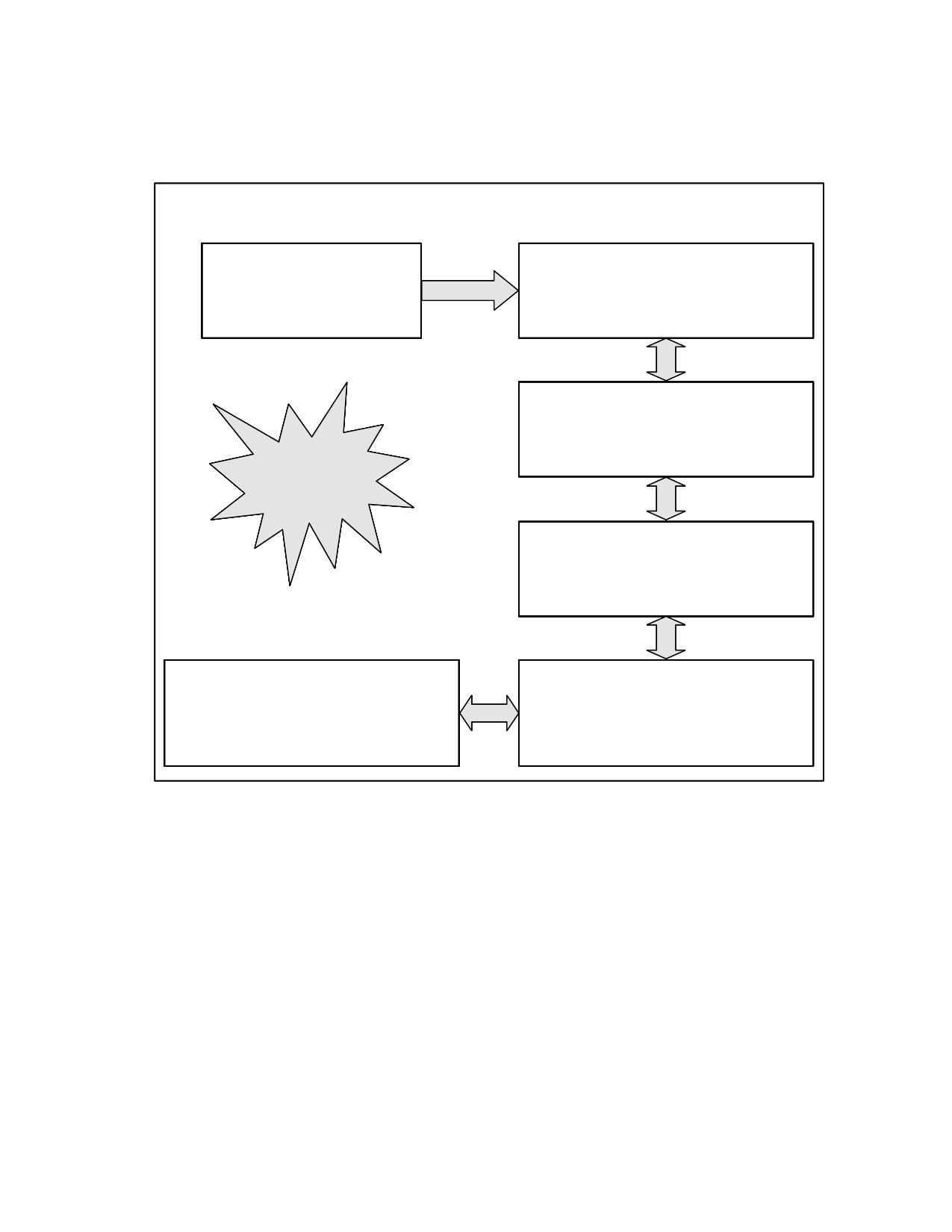
_________________________________________________________________________________ FM 2-22.3
Separation Technique Approval
COCOM Commander
USD(I)
Approves overall use of
Provides oversight of OSD Policy
interrogation approach techniques
in theater.
GO/FO
Approves each interrogation plan that includes
Available
COCOM-authorized use of separation.
Advice:
Approves all extensions or additional iterations.
SJA,
BSC,
Analysts
Interrogation Unit
Reviews interrogation plans that include use of
COCOM-approved use of separation. Plans,
prepares, executes, and assesses their use.
Interrogation Supervisor
Interrogator
Reviews interrogation plan for necessity and
Develops interrogation plan based on screening
appropriateness of requested use of separation.
and assessment of source’s intelligence value
Ensures that proper safeguards and support
and level of cooperation.
are stipulated.
Figure M-1. Separation Approval Process.
M-8. The employment of separation requires notification, acknowledgment,
and periodic review, in accordance with USD(I) Memorandum, "(S//NF)
Guidance for the Conduct and Oversight of Defense Human Intelligence
(HUMINT) (U)," dated
14 December
2004. This means that after the
separation is approved for use by COCOMs, the I&WS must be notified as
soon as practical. The Office of the Secretary of Defense will review these
activities periodically in accordance with DOD Directive 3115.09.
M-9. The planning process for the employment of standard interrogation
operations also applies to the employment of the separation technique
(see Chapter 4).
6 September 2006
M-3
FM 2-22.3 _________________________________________________________________________________
RESPONSIBILITIES
M-10. Commanders of interrogation or detention facilities and forces
employing the approved separation technique are responsible for compliance
with applicable law and policy. Commanders must understand that
separation poses a higher risk to the detainee than do standard techniques,
and so require strenuous oversight to avoid misapplication and potential
abuse.
M-11. The interrogation chain of command must coordinate the interrogation
plan with the detention operations commander. Close coordination must
occur between intelligence personnel and personnel responsible for detainee
operations, including MP, security forces, Master at Arms, and other
individuals providing security for detainees (hereafter referred to as guards).
Guards do not conduct intelligence interrogations and, in accordance with
DOD Directive 3115.09, will not set the conditions for interrogations. Guards
may support interrogators as requested for detainee custody, control, escort,
and/or additional security
(for example, for combative detainees), in
accordance with paragraphs 5-57 through 5-66 and FM 3-19.40, JP 3-63, and
the approved interrogation plan.
M-12. The detention operations commander (in conjunction with the MI
commander) may convene a multidiscipline custody and control oversight
team including, but not limited to, MP, MI, BSC (if available), and legal
representatives. The team can advise and provide measures to ensure
effective custody and control in compliance with applicable law and policy.
M-13. Commanders must consider the following when employing separation:
• Is separation directed against the appropriate individual and is it
necessary for collecting important intelligence?
• Does separation complement the overall interrogation strategy and
interrogation approach technique or techniques?
• Is the application of separation with the specific detainee at issue
consistent with humane treatment and in accordance with applicable
law and policy?
M-14. Planning for the use of separation requires coordination with staff
elements that provide support to interrogation operations. Staff elements
that support interrogation facilities and forces employing separation will
comply with paragraphs 4-59 and 4-60 and all controls and safeguards
identified in paragraphs M-17 through M-26.
GENERAL CONTROLS AND SAFEGUARDS
HUMANE TREATMENT
M-15. All captured or detained personnel shall be treated humanely at all
times and in accordance with DOD Directive 3115.09, "DOD Intelligence
Interrogations, Detainee Debriefings, and Tactical Questioning"; DOD
Directive
2310.1E,
“Department of Defense Detainee Program,” and no
person in the custody or under the control of the DOD, regardless of
nationality or physical location, shall be subject to cruel, inhuman, or
degrading treatment or punishment as defined in US law, including the
M-4
6 September 2006
_________________________________________________________________________________ FM 2-22.3
Detainee Treatment Act of 2005. All intelligence interrogations, debriefings,
or tactical questioning to gain intelligence from captured or detained
personnel shall be conducted in accordance with applicable law and policy.
M-16. Any inhumane treatment—including abusive practices, torture, or
cruel, inhuman, or degrading treatment or punishment as defined in US law,
including the Detainee Treatment Act of
2005—is prohibited and all
instances of such treatment will be reported immediately in accordance with
paragraph 5-69 thru 5-72. Beyond being impermissible, these unlawful and
unauthorized forms of treatment are unproductive because they may yield
unreliable results, damage subsequent collection efforts, and result in
extremely negative consequences at national and international levels. Review
by the servicing SJA is required prior to using separation. Each interrogation
plan must include specific safeguards to be followed: limits on duration,
interval between applications, and termination criteria. Medical personnel
will be available to respond in the event a medical emergency occurs.
FM 2-22.3 REQUIREMENTS
M-17. Separation must be employed in accordance with the standards in this
manual. These standards include the following:
• Prohibitions against abusive and unlawful actions (see para 5-75) and
against the employment of military working dogs in the conduct of
interrogation (see paras 5-59 and 8-2).
• Requirement for non-DOD agencies to observe the same standards for
the conduct of interrogation operations and treatment of detainees
when in DOD facilities (see para 5-55).
• Prohibition on guards conducting intelligence interrogations or taking
any actions to set the conditions for interrogations. Humane treatment,
evacuation, custody and control (reception, processing, administration,
internment, and safety) of detainees; force protection; and the
operation of the internment facility are discussed in paragraphs 5-57
through 5-66. (FM 3-19 .40 and JP 3-63 also thoroughly discuss
detainee operations.)
• Assignment of ISNs to all detainees in DOD control, whether or not
interrogation has commenced, as soon as possible; normally within 14
days of capture. (See AR 190-8 and Secretary of Defense Memorandum
dated 20 September 2005, "(S//NF) Policy on Assigning Detainee
Internment Serial Numbers (ISN)(U)."
• Access to detainees by the ICRC.
REPORTING OF ABUSES AND SUSPECTED ABUSES
M-18. As an interrogation technique, separation is particularly sensitive due
to the possibility that it could be perceived as an impermissible act.
Interrogators applying the separation technique and the chain of command
supervising must be acutely sensitive to the application of the technique to
ensure that the line between permissible or lawful actions and impermissible
or unlawful actions is distinct and maintained. Therefore, HUMINT
collectors should have heightened awareness and understanding of the risks,
6 September 2006
M-5
FM 2-22.3 _________________________________________________________________________________
control measures, and safeguards associated with the use of separation. Any
interrogation technique that appears to be cruel, inhuman, or degrading as
defined in US law; or impermissibly coercive, or is not listed in this manual,
is prohibited and should be reported immediately to the chain of command or
other appropriate channels for resolution. Orders given to treat detainees
inhumanely are unlawful. Every interrogator must know how to respond to
orders that the individual interrogator perceives to be unlawful
(see paras 5-80 through 5-82).
M-19. If the order is a lawful order, it should be obeyed. Failure to obey a
lawful order is an offense under the UCMJ.
COMMAND POLICY AND OPERATION ORDERS
M-20. The provisions of this appendix must be written into COCOM policy
and/or OPORDs when using the restricted interrogation technique of
separation.
MEDICAL
M-21. Commanders are responsible to ensure that detainees undergoing
separation during interrogation receive adequate health care as described in
greater detail in paragraph 5-91.
TRAINING AND CERTIFICATION
M-22. Only those DOD interrogators who have been trained and certified by
the United States Army Intelligence Center
(USAIC), or other Defense
HUMINT Management Office (DHMO) designated agency, in accordance
with guidance established by USD(I) to use separation, are authorized to
employ this technique. The training must meet certification standards
established by the Defense HUMINT Manager in coordination with
applicable DOD components. Properly trained and certified contract
interrogators are authorized to initiate interrogation plans that request the
use separation, and, once the plan is approved, to employ the technique in
accordance with the provisions of this appendix and Appendix K. Contract
interrogators will always be utilized under the supervision and control of US
government or military personnel (see para K-19 and K- 20). Non-DOD
personnel conducting interrogations in DOD facilities must be certified by
their agency and separately gain approval (through their agency's chain of
command) for the additional technique described in this appendix. They must
present this written certification and agency approval to the COCOM before
use is permitted (see para 5-55).
PLANNING
M-23. Planning for the use of separation must include—
• An interrogation plan that addresses safeguards, limits of duration,
interval between applications, termination criteria, and presence of
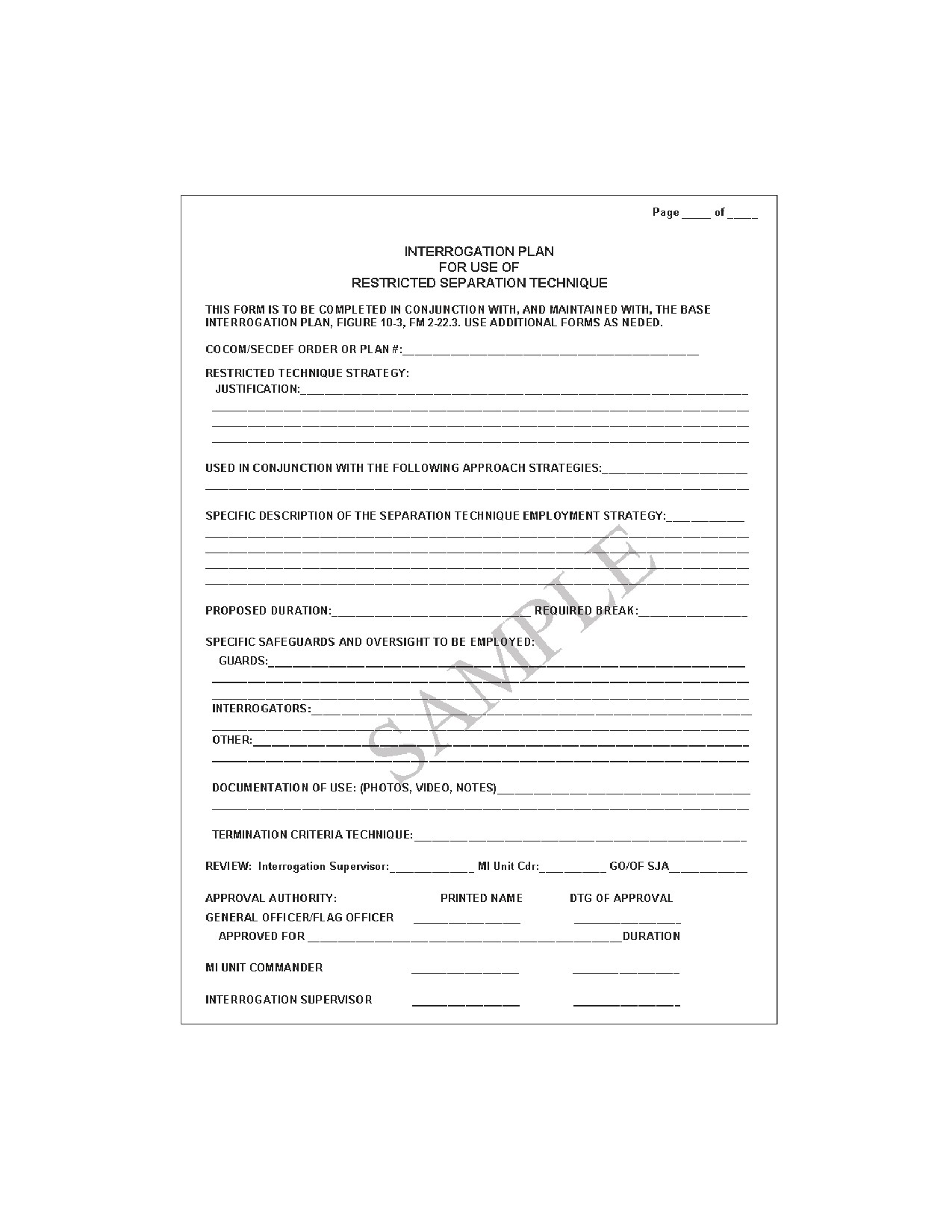
qualified medical personnel for emergencies (see Figure M-2).
• A provision for detainees to be checked periodically in accordance with
command health care directives, guidance, and SOPs applicable to all
detainees.
• A legal review.
M-6
6 September 2006
_________________________________________________________________________________ FM 2-22.3
Figure M-2. Installation Plan for Restricted Separation Techniques.
6 September 2006
M-7
FM 2-22.3 _________________________________________________________________________________
• Documentation of the use of separation, including photographs and/or
videotaping, if appropriate and available (see para 5-54).
M-24. Separation is only authorized for use in interrogation operations, not
for other Military Source Operations. Separation may be approved for use in
combination with authorized approach techniques. General controls and
safeguards contained in this manual must be applied during the use
separation, in conjunction with the safeguards specific to the separation
technique. Planning must consider the possible cumulative effect of
using multiple techniques and take into account the age, sex, and
health of detainees, as appropriate.
TECHNICAL CONTROL
M-25. Requests for approval of separation will be forwarded (for information
purposes only) via secure means through intelligence technical channels at
the same time as they are sent through command channels. Intelligence
technical channels are those used for forwarding of source information and
technical parameters of collection operations from lower to higher and
passing tasking specifics, source information, technical control measures, and
other sensitive information from higher to lower. The technical chain extends
from the HCT through the OMT and Operations Section (if one exists) to the
C/J/G/S2X.
APPLICATION OF SEPARATION TECHNIQUE
M-26. The purpose of separation is to deny the detainee the opportunity to
communicate with other detainees in order to keep him from learning
counter-resistance techniques or gathering new information to support a
cover story, decreasing the detainee's resistance to interrogation. Separation
does not constitute sensory deprivation, which is prohibited. For the purposes
of this manual, sensory deprivation is defined as an arranged situation
causing significant psychological distress due to a prolonged absence, or
significant reduction, of the usual external stimuli and perceptual
opportunities. Sensory deprivation may result in extreme anxiety,
hallucinations, bizarre thoughts, depression, and anti-social behavior.
Detainees will not be subjected to sensory deprivation.
M-27. Physical separation is the best and preferred method of separation. As
a last resort, when physical separation of detainees is not feasible, goggles or
blindfolds and earmuffs may be utilized as a field expedient method to
generate a perception of separation.
M-28. Objectives:
• Physical Separation: Prevent the detainee from communicating with
other detainees (which might increase the detainee's resistance to
interrogation) and foster a feeling of futility.
• Field Expedient Separation: Prolong the shock of capture. Prevent the
detainee from communicating with other detainees (which might
increase the detainee's resistance to interrogation) and foster a feeling
of futility.
M-8
6 September 2006
_________________________________________________________________________________ FM 2-22.3
M-29. Safeguards:
• Duration: Self-explanatory.
• Physical Separation: Limited to 30 days of initial duration.
• Field Expedient Separation: Limited to 12 hours of initial
duration at the initial interrogation site. This limit on duration does
not include the time that goggles or blindfolds and earmuffs are used
on detainees for security purposes during transit and evacuation.
• Oversight Considerations for Field Expedient Separation:
The intended use of field expedient means of separation must be
specified on the interrogation plan that is submitted to the GO/FO
for approval.
Detainees must be protected from self-injury when field expedient
means of separation are used. The effect of the application of field
expedient separation means on the detainee must be monitored to
detect any possible health concerns.
M-30. The following safeguards apply to both Physical Separation and Field
Expedient Separation.
•
Break: Additional periods of separation will not be applied without the
approving GO/FO's determination of the length of a break between
iterations.
•
Extension:
Physical Separation Method: Extensions of this technique past 30
days must be reviewed by the servicing SJA and approved by the
original approving GO/FO or his replacement in that position.
Field Expedient Method: Extensions past 12 hours of initial
duration at the initial interrogation site must be reviewed by the
servicing SJA and approved by the original approving/replacement
GO/FO.
Medical: Detainees will be checked periodically in accordance with
command health care directives, guidance, and SOPs applicable to
all detainees.
Custody and Control: The interrogation chain of command must
coordinate the interrogation plan with the Detention Operations
Commander. The Detention Operations Commander (in conjunction
with the MI commander) may convene a multidiscipline custody and
control oversight team including, but not limited to, MP, MI, BSC (if
available), and legal representatives. The team can advise and
provide measures to ensure effective custody and control in
compliance with the requirements of applicable law and policy.
•
Oversight Considerations:
Use of hoods (sacks) over the head, or of duct tape or adhesive tape
over the eyes, as a separation method is prohibited.
If separation has been approved, and the interrogator subsequently
determines that there may be a problem, the interrogator should
seek further guidance through the chain of command before applying
the technique.
6 September 2006
M-9
FM 2-22.3 _________________________________________________________________________________
Care should be taken to protect the detainee from exposure (in
accordance with all appropriate standards addressing excessive or
inadequate environmental conditions) to—
− Excessive noise.
− Excessive dampness.
− Excessive or inadequate heat, light, or ventilation.
− Inadequate bedding and blankets.
− Interrogation activity leadership will periodically monitor the
application of this technique.
Use of separation must not preclude the detainee getting four hours
of continuous sleep every 24 hours.
Oversight should account for moving a detainee from one
environment to another (thus a different location) or arrangements
to modify the environment within the same location in accordance
with the approved interrogation plan.
M-31. Suggested Approach Combinations:
• Futility.
• Incentive.
• Fear Up.
M-10
6 September 2006
_________________________________________________________________________________ FM 2-22.3
Glossary
The glossary lists acronyms and terms with Army or joint definitions, and other selected terms.
Where Army and joint definitions are different, (Army) follows the term. Terms for which
FM 2-22.3 is the proponent manual (the authority) are marked with an asterisk (*) and followed
by the number of the paragraph (¶) or page where they are defined. For other terms, refer to the
manual listed. JP 1-02, Dictionary of Military and Associated Terms and FM 1-02 Operational
Terms and Graphics are posted on the Joint Electronic Library, which is available online and on
CD ROM.
•
Use this URL to access JP 1-02 online:
02/TOC.HTM
•
Use this URL to access FM 1-02 online:
02/TOC.HTM
•
/jel/service_pubs/101_5_1.pdf
•
Follow this path to access JP 1-02 on the Joint Electronic Library CD-ROM:
Mainmenu>Joint Electronic Library>DOD Dictionary.
•
Follow this path to access FM 1-02 on the Joint Electronic Library CD-ROM:
Mainmenu>Joint Electronic Library>Service Publications>Multiservice Pubs>
FM 101-5-1.
*2X
The *2X Staff conducts mission and RM for all HUMINT and CI
entities located within the designated AOIR. It coordinates,
deconflicts, and synchronizes all HUMINT and CI activities in the
designated AOIR. (“*2X” indicates 2X functions at all levels.)
AC
Active Component
ACCO
Army Central Control Office
ACE
analysis and control element
ACT
Analysis Control Team
ADA
Air Defense Artillery
ADP
automated data processing
ADCON
administrative control
aka
also known as
AMHS
Automated Message Handling System
AMID
allied military intelligence battalion
AO
area of operations
AOI
area of interest
AOIR
area of intelligence responsibility
AOR
area of responsibility
6 September 2006
Glossary-1
FM 2-22.3 _________________________________________________________________________________
approx
approximately
ARNG
Army Reserve National Guard
ASAS
All-Source Analysis System
ASCC
Army Service Component Command
ASD(C3I)
Assistant Secretary of Defense (Command, Control,
Communications, and Intelligence)
ASI
additional skill identifier
assn
assassination
ATD
associated technical document
BAT
Biometric Automated Toolset
BCT
brigade combat team
BDA
battle damage assessment
BOS
Battlefield Operating System
BSC
Behavioral Science Consultant
BSD
basic source data
C2
command and control
CA
civil affairs
CAT
category
CCIR
commander’s critical information requirement
CCNY
City College of New York
CDOC
captured document
CDR
commander
CGS
common ground station
CE
captured equipment (STANAG term)
CED
captured enemy document
CEE
captured enemy equipment
CENTCOM
US Central Command
CFSO
Counterintelligence Force Protection Source Operations
CHAMS
CI/HUMINT Automated Management System
CHATS
CI/HUMINT Automated Tool Set
CI
counterintelligence
CIA
Central Intelligence Agency
CICA
Counterintelligence Coordination Authority
CIAC
Counterintelligence Analysis Cell
Glossary-2
6 September 2006
_________________________________________________________________________________ FM 2-22.3
CID
Criminal Investigation Division
CIFA
Counterintelligence Field Agency
C2X
Coalition Intelligence Staff Officer
C/J2X LNO
Coalition/Joint Intelligence Staff Liaison Officer
C/J/G2X
Coalition/Joint/Corps/Division Intelligence Staff Officer
C/J/G/S2
Coalition/Joint/Corps/Division/Brigade and Below Intelligence
Staff Officer
C/J/G/S2X
Coalition/Joint/Corps/Division/Brigade and Below Intelligence
Staff Officer
CMO
civil-military operations
COA
course of action
COCOM
Combatant Command
COE
common operating environment
COLISEUM
Community On-Line Intelligence System for End Users and
Managers
COMMZ
communications zone
CONUS
continental United States
CONOP
contingency operations
COP
common operational picture
COR
contracting officer representative
COT
commercial off-the-shelf
COTR
Contracting Officer’s Technical Representative
counterintelligence
Information gathered and activities conducted to protect against
espionage, other intelligence activities,
sabotage, or
assassinations conducted by or on behalf of foreign governments
or elements thereof, foreign organizations, or foreign persons, or
international terrorist activities. (FM 2-0)
Counterintelligence
Subordinate to the J/G2X and coordinates all CI activities for a
Coordinating Authority
deployed force. It provides technical support to all CI assets and
coordinates and deconflicts CI activities in the deployed AO.
(FM 2-0)
CP
command post
CPERS
captured personnel (JP-2.5)
CPR
Common Point of Reference
CS
combat support
CSS
combat service support
CTF
coalition task force
6 September 2006
Glossary-3
FM 2-22.3 _________________________________________________________________________________
DA
Department of the Army
DCGS-A
Distributed Common Ground System-Army
DCIS
Defense Criminal Investigative Service
DCISS
Defense Intelligence Agency CI Information System
DCP
detainee collection point
DEA
Drug Enforcement Agency
debriefing
The systematic questioning of individuals to procure information
to answer specific collection requirements by direct and indirect
questioning techniques. (FM 2-0)
DED
Data Element Dictionary
DH
Defense HUMINT
DHMO
Defense HUMINT Management Office
DHS
Department of Homeland Security
DIA
Defense Intelligence Agency
DII
DOD Information Infrastructure
DISCOM
Division Support Command
DOCEX
document exploitation
document exploitation
The systematic extraction of information from all media formats
in response to collection requirements. (FM 2-0)
DOD
Department of Defense
DOE
Department of Energy
DP
displaced person
DRP
Detainee Reporting
DRS
Detainee Report System
DS
direct support
DSCA
defense support of civilian authorities
DSS
decision support software
DST
decision support template
DTG
date-time group
EAC
echelons above corps
EEFI
essential elements of friendly information
EPW
enemy prisoner of war
evaluating
In intelligence usage, appraisal of an item of information in
terms of credibility, reliability, pertinence, and accuracy.
(FM 2-0)
Glossary-4
6 September 2006
_________________________________________________________________________________ FM 2-22.3
EW
electronic warfare
FBI
Federal Bureau of Investigation
FEO
forced entry operations
FFIR
friendly force information requirement
FHA
foreign humanitarian assistance
FISS
Foreign Intelligence Security Service
Five S’s
search, seize, segregate, safeguard, and silence
FORSCOM
US Army Forces Command
FRAGO
fragmentary order
FRN
field reporting number
FSE
fire support element
Gb
gigabyte
GC
Geneva Convention Relative to the Protection of Civilian Persons
in Time of War
GPS
Global Positioning System
GPW
Geneva Convention Relative to the Treatment of Prisoners of War
GRCS
Guardrail Common Sensor
GRIFN
Guardrail Information Node
GS
general support
GSR
general support-reinforcing
GUI
graphic user interface
GWS
Geneva Convention for the Amelioration of the Condition of the
Wounded and Sick in Armed Forces in the Field
HAC
HUMINT analysis cell
HAT
HUMINT analysis team
HCR
HUMINT collection requirement
HCT
HUMINT collection team
HET
human exploitation team
HN
host nation
HOC
HUMINT operations cell
HSOC
Homeland Security Operations Center
HQ
headquarters
HQDA
Headquarters, Department of the Army
6 September 2006
Glossary-5
FM 2-22.3 _________________________________________________________________________________
human intelligence
The collection by a trained HUMINT collector of foreign
information from people and multimedia to identify elements,
intentions, composition, strength, dispositions, tactics, equip-
ment, and capabilities. (FM 2-0)
HUMINT
Human Intelligence
HUMINT Analysis Cell
The “fusion point” for all HUMINT reporting and operational
analysis in the ACE and JISE. It determines gaps in reporting
and coordinates with the requirements manager to cross-cue
other intelligence sensor systems.
HUMINT Analysis Team
Sub-element of the G2 ACE that supports the G2 development of
IPB products and developing and tailoring requirements to match
HUMINT collection capabilities.
HUMINT Operations Cell
Assigned under the J/G2X to track all HUMINT activities in the
area of intelligence responsibility (AOIR). It provides technical
support to all HUMINT collection operations and deconflicts
HUMINT collection operations in the AO. (FM 2-0)
I&WS
Deputy Under Secretary of Defense for Intelligence and
Warfighting Support
IAFIS
Integrated Automated Fingerprint Identification System
IBS
Integrated Broadcast Services
ICF
intelligence contingency fund
ICRC
International Committee of the Red Cross
ID
identification
IED
improvised explosive device
IG
Inspector General
IIMG
Interagency Incident Management Group
IIR
intelligence information report
IMINT
imagery intelligence
INTREP
intelligence report
INTSUM
intelligence summary
IPB
intelligence preparation of the battlefield
IPF
Intelligence Processing Facility
IPSP
Intelligence Priorities for Strategic Planning
IR
information requirements
ISA
International Standardization Agreement
ISN
Internment Serial Number
ISR
intelligence, surveillance, and reconnaissance
IU
Interrogation Unit (AJP-2.5)
Glossary-6
6 September 2006
_________________________________________________________________________________ FM 2-22.3
J2
Joint Intelligence Directorate/Staff
J2X
Joint Intelligence Staff Officer
J2X
Responsible for controlling, coordinating and deconflicting all
HUMINT and CI collection activities and keeping the joint force
J2 informed on all HUMINT and CI activities conducted in the
joint force AOR. (*2X Staff Handbook) Umbrella organization
consisting of human intelligence operation cell and the task force
counterintelligence coordinating authority.
The J2X is
responsible for coordination and deconfliction of all human
source-related activity. See also counterintelligence; human
intelligence.
(JP 2-01)
J5
Joint Staff Directorate, Civil Affairs
J/G2
Joint/Corps/Division Intelligence Staff Officer
J/G/S2
Joint/Corps/Division/Brigade and Below Intelligence Staff Officer
J/G/S2X
Joint/Corps/Division/Brigade and Below Intelligence Staff Officer
JAC
Joint Analysis Center
JAO
joint area of operations
JCMEC
Joint Captured Materiel Exploitation Center
JDEF
joint document exploitation facility
JDS
Joint Dissemination System
JFC
Joint Forces Commander
JIC
Joint Interrogation Center
JIDC
Joint Interrogation and Debriefing Center
JISE
Joint Intelligence Support Element
JTF
joint task force
JUMPS
job, unit, mission, PIR and IR, and supporting information
JWICS
Joint Worldwide Intelligence Communications System
KB
knowledgeability brief
LCC
Land Component Command
LDR
Lead Development Report
LEA
law enforcement agency
LNO
Liaison Officer
LRS
long-range surveillance
LTIOV
latest time information is of value
MAGTF
Marine Air-Ground Task Force
MASINT
measurement and signature intelligence
MDMP
Military Decisionmaking Process
6 September 2006
Glossary-7
FM 2-22.3 _________________________________________________________________________________
MEDEVAC
medical evacuation
MEF
Marine expeditionary force
MEJA
Military Extraterritorial Jurisdiction Act
METT-TC
mission, equipment, terrain and weather, troops and support
available, time available, and civil considerations
MI
Military Intelligence
MILO
mission, identification, location, and organization
MSO
military source operations
MOS
military occupation specialty
MP
Military Police
MTOE
modified table of organization and equipment
MTW
major theater war
NA
not applicable
NAC
national agency check
NAI
named area of interest
NATO
North Atlantic Treaty Organization
NBC
nuclear, biological, and chemical
NCO
noncommissioned officer
NCOIC
noncommissioned officer in charge
NGA
National Geospatial-Intelligence Agency
NGO
non-governmental organization
NIP
Notice of Intelligence Potential
NIST
national intelligence support team
NOFORN
no foreign dissemination
NRT
near-real time
NSA
National Security Agency
NVG
night vision goggles
OB
order of battle
OCONUS
outside continental United States
OCR
optical character recognition
OGA
other government agencies
O/I
operations and intelligence
OIC
officer in charge
OMT
operational management team
Glossary-8
6 September 2006
_________________________________________________________________________________ FM 2-22.3
OPCON
operational control
OPLAN
operations plan
OPORD
operations order
OSC
operations support cell
OSD
Office of the Secretary of Defense
OSINT
open-source intelligence
OPTEMPO
operational tempo
OVOP
overt operational proposal
PDA
Personal Digital Assistant
PIR
priority intelligence requirement
PME
peacetime military engagement
PMO
Provost Marshal Office
POL
petroleum, oils, and lubricants
POW
prisoner of war
PRETECHREP
preliminary technical report
priority intelligence
Those intelligence requirements for which a commander has
requirements
an anticipated and stated priority in the task of planning and
decisionmaking. (JP 1-02)
PSO
peacetime stability operation (STANAG term)
PSYOP
Psychological Operations
PVO
private volunteer organization
PW
Prisoner of War (as used in the GPW)
R
reinforcing
R&S
reconnaissance and surveillance
RC
Reserve Components
RFI
request for information
RM
requirements management
ROE
rules of engagement
RSR
Resource Status Report
SALUTE
Size, Activity, Location, Unit, Time, Equipment
SBI
special background investigation
SCC
Service Component Commands
SCI
sensitive compartmented information
SCO
Sub-Control Office
SDR
Source-Directed Requirement
6 September 2006
Glossary-9
FM 2-22.3 _________________________________________________________________________________
security detainee
Those detainees who are not combatants, but who may be under
investigation or pose a threat to US forces if released.
SE
southeast
SECDEF
Secretary of Defense
SERE
survival, evasion, resistance, and escape
S.F.P.
Students for Peace
SIGINT
signals intelligence
SII
statement of intelligence interest
SIO
senior intelligence officer
SIPRNET
Secret Internet Protocol Router Network
SIR
specific information requirement
SITMAP
situation map
SJA
Staff Judge Advocate
SME
subject matter expert
SOF
Special Operations Forces
SOFA
Status of Forces Agreement
SOI
signal operating instruction
SOP
standing operating procedure
SOW
statement of work
Source (DOD)
1. A person, thing, or activity from which information is obtained.
2. In clandestine activities, a person (agent), normally a foreign
national, in the employ of an intelligence activity for intelligence
purposes. 3. In interrogation activities, any person who furnishes
information, either with or without the knowledge that the
information is being used for intelligence purposes. In this
context, a controlled source is in the employment or under the
control of the intelligence activity and knows that the information
is to be used for intelligence purposes. An uncontrolled source is a
voluntary contributor of information and may or may not know
that the information is to be used for intelligence purposes. See
also agent; collection agency. (JP 1-02)
SQL
structured query language
SSC
small-scale contingency
Stability and Reconstruction
Operations
Those operations that sustain and exploit security and control
over areas, populations, and resources. They employ military
capabilities to reconstruct or establish services and support
civilian agencies. Stability and reconstruction operations involve
both coercive and cooperative actions.
STANAG
Standardization Agreement
Glossary-10
6 September 2006
_________________________________________________________________________________ FM 2-22.3
TACON
tactical control
tactical questioning
The expedient initial questioning for information of immediate
tactical value. Soldiers conduct tactical questioning based on the
unit’s SOP, ROE, and the order for that mission. Unit leaders
must include specific guidance for tactical questioning in the
order for appropriate missions. The unit S3 and S2 must also
provide specific guidance down to the unit level to help guide
tactical questioning. (FM 2-0)
TCICA
Theater Counterintelligence Coordination Authority
TCP
traffic control point
TDA
table of distribution and allowances
TDRC
Theater Detainee Reporting Center
TECHDOC
technical document
TECHNINT
technical intelligence
TES
Tactical Exploitation System
TF
task force
THREATCON
threat condition
TOE
table of organization and equipment
TPFDDL
Time-Phased Forces Deployment Data List
TTP
tactics, techniques, and procedures
TS
Top Secret
tvl
travel
TWS
Trusted Workstation
UCMJ
Uniform Code of Military Justice
UNCLASS
unclassified
unk
unknown
USAR
US Army Reserve
USB
Universal Serial Bus
USCENTCOM
US Central Command
USD(I)
Under Secretary of Defense for Intelligence
UTM
universal transverse mercator (grid)
UW
unconventional warfare
WARNO
warning order
WMD
weapons of mass destruction
WO
warrant officer
WTC
World Trade Center
6 September 2006
Glossary-11
This page intentionally left blank.
_________________________________________________________________________________ FM 2-22.3
Bibliography
The bibliography lists field manuals by new number followed by old number,
as indicated.
DOCUMENTS NEEDED
These documents must be available to the intended users of this publication.
JP 0-2. Unified Action Armed Forces. 10 July 2001.
JP 2-0. Doctrine for Intelligence Support to Joint Operations. 9 March 2000.
JP 2-01.2. (U) Joint Doctrine and Tactics, Techniques, and Procedures for
Counterintelligence Support to Operations (S//NF). 13 June 2006.
JP 3-0. Doctrine for Joint Operations. 10 September 2001.
JP 3-63. Joint Doctrine for Detainee Operations. September 2005.
JP 4-0. Doctrine for Logistic Support of Joint Operations. 6 April 2000.
AR 40-25. Nutrition Standards and Education. 15 June 2001.
AR 715-9. Contractors Accompanying the Force. 29 October 1999.
DA Pam 715-16. Contractor Deployment Guide. 27 February 1998.
FM 1. The Army. 14 June 2005.
FM 1-02. Operational Terms and Graphics. 21 September 2004.
FM 2-0. Intelligence. 17 May 2004.
FM 3-0. Operations. 14 June 2001.
FM 3-100.21. Contractors on the Battlefield. 3 January 2003.
FM 5-0. Army Planning and Orders Production. 20 January 2005.
FM 6-0. Mission Command: Command and Control of Army Forces. 11 August 2003.
FM 27-10. Law of Land Warfare. July 1956.
FM 34-5. (U) Human Intelligence and Related Counterintelligence Operations (S//NF).
29 July 1994.
FM 34-130. Intelligence Preparation of the Battlefield. 8 July 1994.
FM 63-11. Logistics Support Element Tactics, Techniques, and Procedures. 8 October
1996.
FM 71-100. Division Operations. 28 August 1996.
FM 100-15. Corps Operations. 13 September 1989.
FM 101-5. Staff Organization and Operations. 31 May 1997.
AMC Pam 715-18. AMC Contracts and Contractors Supporting Military Operations.
June 2000.
6 September 2006
Bibliography-1