MULTISERVICE TACTICS, TECHNIQUES, AND PROCEDURES FOR NUCLEAR, BIOLOGICAL, AND CHEMICAL RECONNAISSANCE FM 3-11.19 (JULY 2004) - page 4
capabilities. A field of fire is the area which a weapon or a group of
weapons may cover effectively with fire from a given position.
• Cover and concealment. Planners identify the cover and
concealment that may be available to preclude possible targeting by
an adversary.
• Obstacles. Planners identify the obstacles (natural and man-made)
that may be used by an adversary with capabilities (such as
persistent chemical agents) to impede or delay the advance of US
forces.
• Key terrain. Key terrain is any feature or area that would offer a
marked tactical advantage if an adversary seized it or gained control
of it.
• AA. An AA is a route by which a force may reach key terrain or an
objective. NAIs along an AA that an enemy may target with NBC
weapons are also identified.
(2)
The terrain analysis is conducted as follows:
• The terrain is evaluated through a map analysis supplemented by
NBC reconnaissance.
• Terrain factor overlays are developed and analyzed, including the
identification of contaminated areas.
• Combined-obstacle overlays are developed.
• AAs are identified and analyzed.
• AA overlays are developed.
(3)
Terrain analysis examines the potential impact of factors on
contaminants. Contamination hazards depend on the ground conditions encountered.
For example, the surface and soil type affect how readily a chemical agent is absorbed
into the soil. The type of surface also affects the persistency of chemical agents. Even
though the actual operational environment is a combination of conditions, looking at the
following general conditions separately will give an indication of what to expect:
• Sand. Sand is generally any surface that has a large amount of sand
(such as a beach), and it normally has good drainage. When chemical
agents are applied to this surface, they tend to be drawn into the
subsurface, lowering the quantity of contamination available for
liquid detection.
• Soil. Soil is generally any surface that contains quantities of clay
and loam. Depending on the relative amount of each soil component,
chemical agents react differently. Normally, some percentage of the
agent is absorbed into the subsurface (until saturation).
• Grass. Grass is generally any surface covered with a layer of grass,
from a few centimeters to a half meter in height. A portion of the
chemical agent remains on the grass, while the rest is absorbed into
the underlying soil. The chemical agent on the grass is available for
liquid detection.
D-2
• Mud. Mud is generally any surface saturated with water, resulting
in muddy conditions. The amount of persistent agent that can be
absorbed by wet soil is inversely related to the water content of the
soil (such as the more water, the less chemical agent absorbed).
Under this condition, chemical agents remain on the surface longer,
thus increasing the probability of detection.
• Artificial surfaces. Artificial surfaces (such as concrete and wood)
are porous. Liquid agents are absorbed over time. The surface may
initially present a contact hazard and later present a vapor hazard
during agent off-gassing.
(4) The more absorbent the soil, the less liquid remains on the surface. This
decreases the probability of detection by M8/M9 detector paper. The smoother and
harder the surface, the higher the probability of detection with an NBCRS. When the
NBCRS is detecting on rough surfaces, the sampling wheel tends to bounce, decreasing
the probability of detection. On soft or porous surfaces, the ability of the NBCRS to detect
contamination can be improved by stopping to lower the probe near the surface. The
heated probe causes absorbed chemical agents to vaporize. The vaporized agent can then
be analyzed by NBC reconnaissance assets.
b.
Weather Analysis. Weather in the AO is analyzed to determine its effects on
friendly and threat operations. The operational and tactical environments require that
weather and terrain be considered simultaneously and developed as an integrated
product. Weather and terrain can be graphically portrayed to indicate the possible
impact of NBC weapons within an AO. For example, weather conditions influence the
persistency of liquid contamination. Such contamination is detected in two ways—as a
vapor (as it evaporates) or by physical contact. As wind speed and temperature increase,
the evaporation of liquid contamination increases. This means that there are more
vapors present to detect, thus increasing the probability of detection. The following
factors should be considered when analyzing weather aspects:
• Wind speed and direction can impact the downwind travel and hazard
areas associated with NBC agents.
• Atmospheric stability can play a key factor in the analysis of when an
adversary may use NBC weapons.
• Temperature and humidity have a direct impact on the performance of
personnel and equipment. Temperature extremes and humidity reduce
the capabilities of personnel and equipment and may require the use of
special personnel shelters or equipment.
c.
Other Analysis. This includes all aspects of the battlefield environment that
affect friendly or threat COAs not already incorporated into terrain and weather
analyses.
4.
Evaluate the Adversary
Threat evaluation is a detailed study of threat forces, their composition and
organization, tactical doctrine, weapons, equipment, and supporting systems. Threat
evaluation determines threat capabilities and limitations and how the threat would fight
if not constrained by weather and terrain. Evaluate the adversary by—
D-3
• Identifying threat capabilities.
• Identifying gaps in the current intelligence holdings.
• Creating or updating threat models.
• Creating templates.
a.
Identifying Threat Capabilities. Threat capabilities are broad COAs and
supporting operations used by the threat to influence the accomplishment of the friendly
mission. Planners use intelligence information to assess possible enemy offensive NBC
capabilities and to assess the potential impact of agent use.
b.
Identifying Gaps in the Current Intelligence Holdings. Planners describe the
prioritization of gaps in the current holdings on enemy offensive NBC capabilities using
the commander’s initial IR. The early identification of gaps allows planners to initiate
action to collect the NBC intelligence required to fill the gaps.
c.
Creating or Updating Threat Models. Threat evaluation is performed by
knowing the threat and using decision support tools that would portray how enemy NBC
weapon use could impact the AO. The use of models and other automated decision tools
provides a means to assess the potential footprint for an enemy attack. For example, the
NBC and intelligence sections coordinate and determine how an adversary may use his
capability to get the best spread of agent on the target. There are multiple factors to
consider, including weapon fusing, direct or indirect delivery of the agent to the target,
downwind hazard estimates, contamination deposition patterns, the TBM threat,
radiological hazards, and TIM hazards.
(1) Weapon Fusing. Weapon fusing affects when a munition detonates. For
example, if a munition detonates at ground level, it deposits most of the agent in the
shell crater, minimizing the contaminated area. When munitions burst above the target,
wind speed and direction directly influence the spread of the agent. As a munition
bursts, the heavier droplets fall faster and the smaller ones drift downwind. The most
heavily contaminated area is near the attack area. The chemical agent radiates in a bell
shape in the direction of the wind, creating a contamination footprint. A unit conducting
NBC reconnaissance has a higher probability of detecting contamination when traveling
crosswind to the footprint. The higher the concentration of the agent, the higher the
probability of detection. The concentration of the agent on the ground depends on the
type of agent, the time since delivery, the delivery method, and the type of ground
surfaces.
(2) Delivery of the Agent. Delivery of the agent may be direct or indirect.
Indirect (off-target) delivery is generally upwind of the target area, and the resulting
aerosol/vapor cloud or spray stream drifts onto the target. Direct or indirect types of
attack can be delivered from a bursting munition or from a spray device. A radiological
dispersal device (RDD) can also use a spray device. Munitions or spray tanks can be
filled for dissemination as—
• A finely divided powder in aerosol suspension.
• Liquid splashes or droplets or as a finely divided liquid in aerosol
suspension.
• A volatile liquid that quickly evaporates into a vapor when released
as an aerosol (explosively or from a spray).
D-4
NOTE: Solid agents are unlikely to evaporate quickly enough to form a vapor,
although frozen liquids will evaporate when the temperature rises.
(a) Bursting Munition. A bursting munition has a thin outside layer
filled with an agent; the agent is dispersed by an air or ground burst. An airburst covers
a large area; a ground burst impacts directly on the target. In a ground burst, the
explosion drives some of the agent into the crater, where it can persist and remain a
hazard (vapor, percutaneous, or ingestion). The types of munitions used are point source
and multiple point source.
• Point source. A point source munition disseminates an agent
from a single point. Delivery can be an air burst, a surface
burst, or a penetrating round. A massive chemical bomb
delivered by aircraft, missile, or artillery shell is an example of
a point source delivery.
• Multiple point source. A number of point source munitions
are distributed in an irregular pattern over a target area. Each
point source munition spreads the agent as an aerosol or a
vapor that merges with other aerosols and vapors downwind.
Cluster bombs and multiple rocket launchers are examples of
multiple point source delivery systems.
(b) Spray Device. Spray devices release chemicals from storage tanks or
from containers carried by systems, such as aircraft, submarines, patrol boats, missiles,
and other vehicles. The degree of dispersion is varied, thus influencing the duration of
effectiveness. Spray device delivery is characterized as a line source, which simply means
that it disseminates agents along a line of release. An aircraft spray system (internally or
externally mounted) is an example of a line source delivery system.
(3) Downwind Hazard Estimates. Downwind hazards from biological
weapons have a significantly larger potential area of effect than chemical weapons. If
weather conditions are optimal, a downwind hazard can extend to a few hundred
kilometers. The quantities required for BW are small compared to those required for
chemical weapons, and BW agents can be disseminated crosswind with few, if any,
indications of hostile intent. Key variables that affect the downwind hazard area include
weather, terrain, the type of agent, particle size, and the type of delivery system.
(4) Contamination Deposition Patterns. Contamination deposition patterns
could result from a bursting artillery attack (Figure D-1, page D-6). The sample surface
contamination pattern provides the basis for some general conclusions as follows:
• Agent deposition generally radiates in a bell shape in the downwind
direction.
• The heaviest concentrations usually occur closest to where the
warhead functions.
• The deposition of the agent is uneven. Deposition concentrations
generally decrease in crosswind directions from the downwind path
of the agent.
• The contamination deposition footprint lessens over time, and the
concentration levels decrease.
D-5
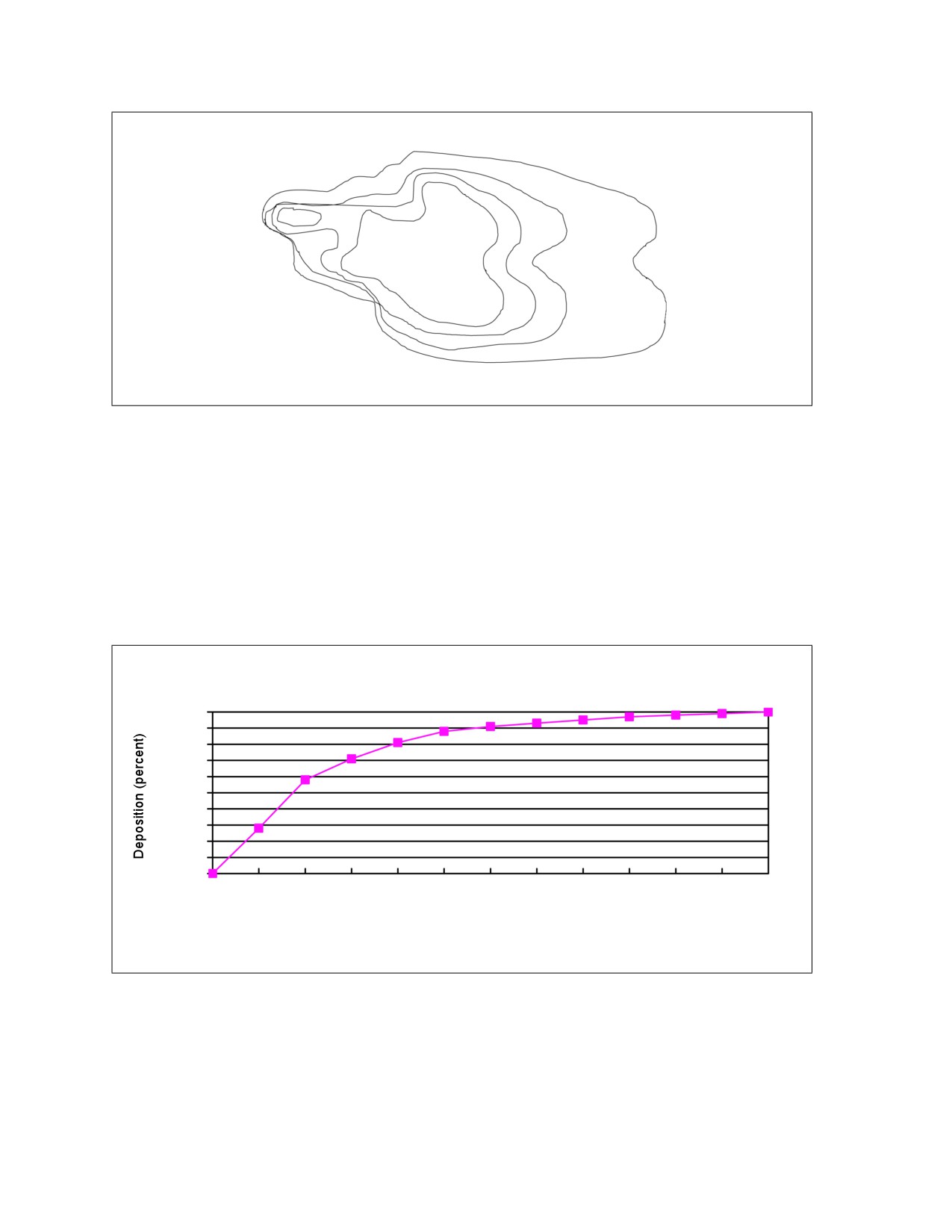
10 mg/m2
100 mg/m2
Figure D-1. Sample Contamination Footprint for a Liquid-Agent
Artillery Attack
(5) TBM Threat.
(a) TBMs have unique characteristics that must be considered when
planning defensive actions. For example, no other target system can put a warhead into
the theater rear area or threaten neutral countries within a matter of minutes. Airburst
warheads from a TBM provide effective area coverage and dispersion patterns for CB
agents. When released at optimal burst heights, agents fall to the ground within 5 to 60
minutes (Figure D-2) in the direction of the prevailing wind.
100
90
80
70
60
50
40
30
20
10
0
0
5
10
15
20
25
30
35
40
45
50
55
60
Time (minutes)
Figure D-2. Airburst Warhead Deposition Time (Notional)
(b) Large agent droplets or solids fall more quickly; small droplets fall
further downwind at a slower rate. Similarly, the vapor released as these agents
evaporate moves from the point of release toward the ground in a downwind direction.
D-6
(c) Secondary threats may also exist during and after some TBM
attacks. TBMs may have warheads that do not separate from the missile body until the
warhead functions or the missile hits the ground.
(d) In addition to the explosive, chemical, or biological hazards, the
missile may impact a building or create a crater. When this happens, the impact site may
contain hazards from the remaining missile fuel and oxidizer or from the facility or
structure the missile hits (e.g., fuel, power lines, munitions). Depending on the quantity
remaining, the residual fuel and oxidizer (red, fuming nitric acid) can cause M8 detector
paper to falsely indicate the presence of chemical agents or to mask the presence of an
agent.
(6) Radiological Hazards. Radiological hazards can include alpha, beta, and
gamma radiation that must be considered when planning reconnaissance missions. The
threat to US forces could include the radiological hazards from nuclear facilities,
radiological dispersion, improvised nuclear devices, sealed sources, reactor fuel
production, or luminescent military commodities.
(a) Nuclear Facilities. Nuclear facilities may release radioactive
material to the environment as a result of an attack on the installation, sabotage, or an
accident (e.g., Chernobyl). A damaged reactor can release large amounts of radioactive
material, composed of many different radionuclides, over an extended period of time.
Radioactive materials of concern include noble gases, halogens (radioiodines), mixed
particulate fission products, and transuranics (e.g., uranium and plutonium).
Consequently, forces downwind from an incident may face the possibility of external and
internal exposure over a large affected area and for an extended period of time. The
hazard posed by internal exposure to radiation is radionuclide-specific. Therefore,
estimates of an effective dosage (i.e., the dosage from internally deposited nuclides)
highly depend on the identification and quantification of the environmental
contamination, particularly airborne contamination.
(b) Radiological Dispersion. Radiological materials are used in many
industrial, research, and medical applications and are increasingly available. Dispersal
falls into two categories—simple radiological dispersal and RDDs.
• Simple radiological dispersal. Simple radiological dispersal
could be any dissemination of radioactive material other than
that produced by a nuclear explosive device. It is specifically
designed to cause damage, injury, or area denial by means of
the radiation produced following dissemination. For example,
an adversary could create a perceived or real health threat by
securing a supply of radioactive material from a medical lab, an
industry, or another site and dispersing the material into the
public water supply or via an aircraft over a troop staging area.
• RDD. An RDD can be defined as any device (including a
weapon or equipment) other than a nuclear explosive device
that is specifically designed to disseminate radioactive
materials to cause damage, injury, or area denial via the
radiation produced by decaying radionuclides in the material.
The use of the explosive or incendiary, mixed with radioactive
materials, could create an incident in which the initial explosion
would kill persons in the immediate vicinity of the device. The
D-7
radionuclide decay would continue to threaten first responders
and others near the incident site.
(c) Improvised Nuclear Devices. A nuclear detonation is the sudden
release of energy from nuclear fission or fusion. The prompt, initial radiation poses a
severe external radiation hazard, while fallout poses serious external and internal
radiation hazards. The radioactive material produced by a nuclear explosion is composed
of the same fission products as those from a reactor accident and may also include
activation products produced when neutrons from the fission interact with the
surrounding environment. Plutonium and/or uranium not fissioned during the nuclear
reaction will also be dispersed by the explosion. Because of the large amounts of energy
released from a nuclear explosion, the plumes of fallout and airborne contamination can
impact massive geographic regions.
(d) Sealed Sources. It is conceivable that personnel may enter areas
where radioactive materials have been left (intentionally or unintentionally). Breakdown
in normal control mechanisms, collateral damage caused by combat, or malicious use by
adversaries able to acquire medical or industrial sources of radioactive material could
result in significant radiation dosages to forces. Sealed sources, by definition, are
designed to contain radioactive material inside (e.g., radioactive gases in glass vials,
radioactive powders double-encapsulated in stainless steel, metal impregnated with
radionuclides and then encapsulated). When such sources maintain their structural
integrity, they pose an external exposure hazard from the penetrating radiation
(neutrons or gamma rays). However, when the integrity of a source is compromised, the
source can present a contamination problem and an internal hazard from the
nonpenetrating radiation (beta or alpha particles). Commonly found, sealed sources that
may pose a significant gamma radiation exposure hazard include iridium-192 industrial
radiography sources, cobalt-60 medical teletherapy sources, and cesium-137 calibration
irradiator sources.
(e) Reactor Fuel Production. Uranium is a naturally occurring, low-level
radioactive metal that has many civilian and military applications. Natural uranium
metal is processed by the nuclear-power industry to produce uranium enriched in the
isotope uranium-235, which is then suitable for use as nuclear reactor fuel. The
inadvertent release of reactor fuel (e.g., terrorist incident) could cause exposure to
gamma and beta radiation.
(f)
Luminescent Military Commodities. Tritium is widely used in the
military to create self-luminescent displays on compasses, weapon sights, and other
items. Tritium is also used in some nuclear devices. Generally, exposure to this nuclide is
not a serious threat because tritium is a very low-energy beta emitter that disperses
quickly in the environment if released. As a low-energy beta emitter, it is an internal
exposure concern. Tritium detection requires special monitoring and sampling
techniques.
(7) TIM Hazards. Given the prevalence of TIM throughout the world, a
significant hazard to US forces exists. Area studies, intelligence estimates, and economic
studies can also be used to indicate the type and level of TIM hazard in a specific AO.
TIM hazards must be determined at the local level, based on local activities (industrial,
agricultural). A TIM assessment of an area must include commercial transportation
routes (highway and rail), chemical production and storage areas, pipelines, and
temporary storage areas (such as ports, rail yards, and airfields). In the field, it is
D-8
common practice to ship hazardous, useful, and valuable materials in mismarked or
unmarked containers, railcars, and drums. TIM releases should be considered in the
following four categories:
• Intentional release. This is the intentional use of TIM against US
or allied forces and/or civilians in the AO.
• Collateral damage. This is the unintentional release of TIM caused
by friendly or enemy military action in the AO.
• Accidental release. This type of release dramatically increases if
qualified, trained plant or storage operators flee an area.
• Sabotage. Sabotage may be carried out by individuals with a
political agenda or by disgruntled employees at a facility. Although
the intent of the sabotage may be to disrupt the production of a
specific product, TIM releases may cause an unintentional hazard.
d. Creating Templates. This process converts the threat doctrine or patterns of
operation to graphics (doctrinal templates). Doctrinal templates convert the threat order
of battle (OB) data into graphics that show how the threat might use its offensive NBC
capability according to doctrine and training, without the constraints of weather and
terrain. A template includes a description of threat offensive NBC capabilities, tactics,
and options. It also lists or describes the options available to the threat if the operation
fails or if subsequent operations succeed. A template can identify high-value targets
(HVTs), which are assets that the threat commander requires for successful mission
completion.
5.
Determine Adversary Courses of Action
a.
Commanders determine the adversary COAs that will influence the
accomplishment of the friendly mission. They—
• Identify the likely objectives of the threat and the desired end state.
• Identify the full set of COAs and associated NBC offensive capabilities
available to the threat.
• Evaluate and prioritize each COA. Use judgment to rank the threat COAs
in their likely order of adoption.
• Develop each COA in the amount of detail that time allows. To ensure
completeness, integrate the following NBC considerations:
n
What. Identify the type of agent(s) that may be used to support
adversary COAs.
n
When. Identify the time the adversary may use his offensive NBC
capability.
n
Where. Identify the sectors or zones where NBC agents may be
used.
n
How. Identify the method by which the threat will employ its
offensive NBC capability.
D-9
n
Why. Identify the objective or end state that the threat intends to
accomplish.
b.
For each COA, commanders develop the following products for follow-on
analysis and comparison:
(1) Situation Template. The situation template is a doctrinal template with
terrain and weather constraints applied. It is a graphic depiction of expected threat
dispositions for each possible threat COA. It usually depicts the most critical point in the
operation as agreed upon by the intelligence and operations officers.
(2) Event Template. The event template is a guide for NBC reconnaissance
collection planning. The event template depicts the NAI where activity or the lack of
activity may indicate which COA the threat has adopted.
(3) Event Matrix. The event matrix provides details on the type of NBC
activity expected in each NAI, the times the NAI is expected to be active, and its
relationship to other activities on the battlefield.
(4) Decision Support Template. The decision support template is a combined
intelligence and operations estimate in graphic form. It indicates the points where a
decision from the commander may be required, based on input from multiple sources,
including NBC reconnaissance information.
D-10
Appendix E
SAMPLING
1.
Background
Although a sample collected from an alleged attack area can be significant, it can
become useless if the sample team does not record critical information about its
collection. It can also become useless if the collector improperly packs the sample, it
becomes too warm, or it breaks during shipment to an analysis center. Further, the
sample can be a hazard if there is an incident (e.g., spillage) during shipment.
NOTES:
1. The term sample refers to nonhuman and nonanimal origin. The term
specimen refers to human and animal origin.
2. Always consider that chemical agents may have been used. Check for
chemical agents before collecting a biological sample or specimen. Chemical
agents can damage or destroy biological agents. Also, chemical agents not
identified in the sample or specimen can pose a hazard to receiving laboratory
personnel. Mark all samples that are potentially contaminated with chemical
agents.
3. Protect the collector from potential BW agents. At a minimum, respiratory
protection and protective gloves must be worn. Additional care must be taken
when collecting samples and specimens to prevent cross contamination. Gloves
must be changed or decontaminated between sample collections, and gloves
must be changed between specimen collections. In addition, sample and
specimen containers and packaging should be decontaminated with 5 percent
chlorine solution.
4. Do not deliver samples to the clinical laboratory of an MTF for analysis.
Deliver them to the supporting confirmatory laboratory for processing to
prevent accidentally spreading a BW agent in the MTF.
2.
Plan
a.
A sampling plan is essential to a successful sampling operation. The plan
defines the strategies and methods to best fulfill the objectives of the investigation. Each
sampling operation is unique; therefore, each operation requires a unique plan. In many
cases, large amounts of material might not be available. The most important
consideration is that the sample accurately reflects the scene and that it has not been
contaminated by the collection or handling process.
b. The validity of the subsequent laboratory analysis and the extent to which it
produces a valid snapshot of an incident scene depends on the degree with which
sampling operations conform to the sampling plan objectives. In some circumstances
(such as a terrorist incident), multiple samples may be drawn. In other cases (such as an
unopened letter suspected of containing anthrax spores), a single sample will fulfill the
E-1
sampling objectives. The sampling plan must consider the expected results of the
sampling operation as a guide. The sampling plan defines the—
• Purpose and scope of the operation, including the objectives, limitations,
and pertinent background information.
• Sampling media, such as groundwater, surface water, soil, sediment, and
waste.
• Sampling parameters, such as the expected contaminants or type of
contaminants.
• Sampling scheme, consisting of the sample type, strategy, and number.
• Techniques to be used.
• Time schedule (how long the sampling mission will last).
3.
Operations
a.
Site Assessment. Before conducting any sampling, the sampling team should
conduct a survey of the sampling site.
NOTE: If sufficient personnel are available, the site assessment may be
conducted by a separate team or element.
(1) The sampling team should establish contamination control zones (hot,
warm, and cold) and must decontaminate the outside of sample containers using a 5
percent chlorine solution. They should solicit information from victims, witnesses, and
emergency response personnel, if available. Observations of the scene and the situation
can assist the team in developing a sampling plan. Information on reported odors, tastes,
and symptoms can provide preliminary information to help identify the type of material
being encountered. For chemical agents, this information is particularly useful.
Immediate symptoms (such as twitching, pupil dilation, lacrimation, and breathing
difficulties) can point the team toward a chemical incident.
(2) The sampling team should mark and take note of safety hazards and any
challenges that might affect the sampling operation. All potential forms of harm
(thermal, radiological, asphyxiation, chemical, biological, etiological, mechanical, and
structural) should be identified. Before entering any structure, the location and/or
coordinates should be taken and entered on a diagram/sketch form. These could be map
grid coordinates or global positioning system (GPS) coordinates, as appropriate.
(3) The sampling team should conduct first-entry monitoring of the sample
site. TIM environment monitoring may be enhanced by available CB monitoring
equipment, as required. For chemical environments, equipment might consist of M8
detector paper, Draeger tubes, M256 kits, improved CAM, or a combination thereof. For
biological environments, the team may conduct tests using surface samplers and
handheld assays, if available. Any hot spots should also be identified. The area should be
marked so that the sampling team will know the location of the initial sampling.
(4) Using the diagram/sketch form and a tape measure, the reconnaissance
team should sketch the layout of the area where sampling is to take place. Particular
attention should be paid to determining potential sampling locations. The layout of the
room/field should be documented with dimensions, measurements, and items that might
be of interest. Relevant reference points, control areas, and hazards should be annotated
E-2
on the form. The diagram/sketch form can be used to brief the sampling team, which may
use the form when conducting sampling operations.
(5) Digital and still photographs and videos may also be taken of the entire
sampling area. The sampling team leader (TL) and team members should review the
videos and photographs to develop a proper sampling plan that supports the overall
objectives. Photographs should be logged into the photographic log.
(6) Upon completion of photography, filming, and surveying, the
reconnaissance team should place documentation in a large, clear, sealed bag.
Information should be facing outward so that it can be read. Equipment must also be
bagged and decontaminated upon removal from the hot zone.
(7) After processing through decontamination, the reconnaissance leader
should brief the commander and the sampling TL.
b.
Sampling Team Roles. The size and composition of the sampling team may
vary based on the size, type, and scope of the incident and the response. At a minimum,
the team should consist of five personnel—a TL, a two-person sampling team, and a two-
person backup sampling team.
(1)
The TL—
• Develops a sampling plan that supports the overall operational
objectives.
• Reviews the photographs and videos of the sampling site with the
reconnaissance team.
• Prioritizes the sampling locations.
• Makes team assignments.
• Briefs the sampling team.
• Coordinates with the incident commander (IC) to control access to
the sampling scene and ensure that it is secure.
• Coordinates with other agencies, as required.
(2)
The sampling team—
• Consists of at least two personnel. One individual serves as the
recorder, logging in all samples and videotaping or taking
photographs of the entire sampling process. The second person
conducts the actual sampling process. They buddy-check each other
throughout the operation.
• Prepares all the items necessary to conduct sampling operations
(such as labels, pens, decontamination equipment, and sampling
kits).
• Uses the layered-glove method for sampling operations. The
individual conducting the sampling wears at least two pairs of
gloves. After taking a sample, he peels off the outer layer of gloves.
The individual recording the operation hands over a fresh pair of
outer gloves for taking the next sample.
• Avoids getting gloves contaminated during sampling operations.
E-3
c.
Sampling Kits. Several commercially available sampling kits have been
developed, and new kits are currently in development. Biological sampling kits are
developed for application in a specific sampling situation or a variety of situations. The
type of sampling kit available for use depends on the unit equipment authorizations.
d. Sampling Considerations. Sampling is a key step in determining the presence
of TIM suspected of containing CB agents. The goal of sampling is to collect a series of
samples of suspected material that are representative of the original source, thus
permitting analysis at the incident site or an alternate location. An important factor to
keep in mind during sampling operations for a potential criminal investigation is that
non-law-enforcement emergency responders are not evidence gatherers. However,
responders that follow the procedures documented herein can facilitate the process for
law enforcement officials through proper sample collection, documentation, and tracking.
(1)
Types of Samples. Samples consist of the following types:
•
Environment. This sample is removed from common, natural
materials, such as water, soil, or vegetation.
•
CBRN. This sample could include CB warfare agents, radiological
samples, and TIM.
•
Matrix. The environmental medium sampled may contain a suspect
analyte (e.g., groundwater, surface water, soil, sediments, waste,
air). Matrices are commonly separated into three categories—liquid,
solid, and vapor—referring to the physical state of the medium.
•
Background. This sample is collected away from the source area
(upwind or upgrade) to isolate the effects of the source or site on the
sampling process. Control samples ensure that the target compound
in the sample is specific to the operation location and is not a result
of cross contamination or naturally occurring background
components.
•
Blank. This is a collection item that is taken to the field for a
collection mission, but it is not used. The blank sample is analyzed
with the collected samples to ensure that specific materials
identified in the samples were not present before the sampling
operation.
•
Medical. This specimen is taken from animals or humans suspected
of being infected with a biological agent. The specimen may include
blood, tissue, nasal secretions, vomitus, urine, or feces.
(2)
Sampling Approaches. Grab sampling and composite sampling are two
basic collection techniques in sampling operations. Grab sampling is when a single
sample is removed at a single point in time from one location. This can be contrasted
with composite sampling in which samples are taken at multiple locations at one time or
at one location over a course of time and then combined together. Composite sampling
produces an average value of a site when analyzed. It is commonly employed when
analyzing environmental sites for pollutants or when screening large numbers of
samples, such as during waste disposal operations.
(a) Most sampling operations are a series of discrete grab samples.
Multiple grab samples carry an analytical cost burden, but composite sampling risks
E-4
dilution of the CB agent to below the detection limit of the analytical platforms.
Furthermore, the probability of the samples being required as evidence in court
proceedings makes grab sampling the preferred method for sampling operations.
(b) Once the sample collection type has been determined, the sampling
team must consider whether there is a suspect substance to be sampled or whether the
sampling is intended to confirm the successful decontamination of a site. The number of
samples that must be taken and the number of personnel available to support the
sampling operation are also key factors. Additionally, time constraints on when the
objectives must be achieved are important. These are just a few of the issues that must
be addressed in developing a sample strategy. There are three basic strategies for
sampling a given target area:
• Random. Random, unsystematic sampling of the target or a
portion of the target may be used when there is no known
specific area of concentration or when there is concern, but a
lack of definitive information, that drives site selection to a
specific zone.
• Systematic. Systematic (or grid) sampling is an objective
strategy where samples are taken at predetermined intervals.
Regular patterns of samples can rely on a grid structure that is
superimposed on the target area or some other type of
persistent pattern that is applied to a zone. In some cases, the
grid can literally be demarcated with string or stakes.
• Judgmental. Judgmental (or selective) sampling is a
subjective strategy where sites are selected based on the
assessment or determination of the sampling team. Often,
judgmental sampling is employed to take a series of grab
samples from the areas considered to be the most likely sites of
contamination.
e.
Sampling Guidelines. While specific sampling procedures vary depending on
the matrix and the type of sampling kit, there are common guidelines that apply to any
sampling operation. Safety is the foremost concern during any sampling operation. The
sample site may be inherently dangerous and contaminated.
(1) Identify any hazards that could impact the sampling operation. Develop a
plan for eliminating, minimizing, or avoiding the hazard.
(2) Ensure that all personnel involved in the operation are dressed in the
appropriate level of PPE according to Occupational Safety and Health Administration
regulations.
(3) Ensure that the sampling site is clear of secondary or additional devices
before the sampling operation. However, remain vigilant for the possibility that these
devices may be present. If any devices are found, remove them or render them safe before
proceeding with any sampling operation.
(4) Do not conduct operations in a contaminated area without backup
personnel present. They should be partially dressed in the appropriate PPE and
prepared to enter the area as an emergency extraction team.
(5) Take the following steps to ensure that contamination is not spread:
E-5
• Establish hot, warm, and cold zones. Clearly mark the boundaries
between the zones.
• Clearly identify ingress and egress points after the zones are
established.
• Establish a decontamination area in the warm zone for personnel
and equipment. Decontaminate all sampling team members and
sample containers according to applicable guidelines (as defined by
the sampling team).
(6) Place a disposable, impermeable sheet on a field table or the ground for
the staging of sampling equipment and containers.
(7) Prepare prepackaged sampling tools in the cold zone. The goal is to
maximize the amount of time the team is able to spend collecting samples in the hot zone
by thoroughly preparing sampling gear in the cold zone.
(8) Collect critical samples and those that are most likely to be lost,
destroyed, altered, or overlooked first; and then move them to the staging area.
(9) Ensure that sampling tools are precleaned, individually wrapped, and
sterile. Do not reuse or recycle them. Use them to collect a single sample only.
CAUTION
Do not use alcohol wipes for biological samples because they
can destroy the biological material collected.
(10) Avoid contaminating the outside of the primary container. Test the
container for contamination if possible; for example, certain liquid military chemical
agents can be detected with M8 detector paper. If the container becomes contaminated,
repackage the entire sample in an uncontaminated container.
(11) Place the primary container into a secondary container for transport to
the cold zone for packaging and shipping.
(12) Decontaminate secondary containers before removing them from the
contaminated area.
f.
Selecting the Sampling Location.
(1) The type of sampling (Table E-1) may vary based on the nature, source,
type, and method of dissemination and the site location. Typically, the best locations for
sampling are in areas where casualties have occurred, in areas with wilted or discolored
plants, or near an abundance of dead animals (particularly fish and birds).
(2) Solid samples (such as powders, solids, paints, and metals) may be useful
if they are collected at a crime scene, an impact area, a blast zone, an operating facility,
or locations where runoff may collect. Look for areas that exhibit stains, powdering, or
particulate matter on surfaces, vegetation, or the ground. Less preferred areas are those
exposed to direct sunlight and high temperatures. Other than casualties, aerosols may
leave little residue. Water and vegetation downwind of the sampling site and PPE
(especially filters) may also provide useful samples.
E-6

Table E-1. Selecting the Sampling Location
Location
Potential Sample Collection Areas
Surface Sampling
Office
Desk, bench, and tabletop
Floor, concrete, and linoleum
Exit door
Interior door, cabinet, drawer, and cart handle
Wall
Baseboard molding
Bookshelf
Bookcase top and shelf
Ceiling
Chair arm
Coat rack
File cabinet
Fire extinguisher
Stair railing
Stairwell tread
Storage locker
Telephone
Window sill
Household
Floor
Wall
Appliance
Window and window sill
Mantle
Television
Countertop
Laboratory
Instrument washing area
Instrument sterilization area
Equipment surface (centrifuge, balance)
Interior and exterior of incubator, storage cabinet, etc.
Bench top
Window and window sill
Ventilation System
Fan housing exterior
Supply duct interior and exterior
Air supply and return vent
Fan interior
Top of fan housing
E-7

Table E-1.
Selecting the Sampling Location (Continued)
Location
Potential Sample Collection Areas
Vehicle Interior
Dashboard
Window
Seat
Steering wheel
Potentially Exposed Personnel
Clothing
Boot
Skin
Nasal cavity
Outdoors
Vehicle exterior
Building exterior
Air Sampling
Personal
Personal air monitor
Solid and Liquid Sampling
Outdoors
Leaf
Soil
Loose powder
Puddle of liquid
Debris
Surface film from confined body of water
Indoors
Loose powder
Unlabeled container of solid or liquid
Piece of material (carpet, curtain, clothing, etc.)
g.
Sampling Guidelines. Use the following guidelines when collecting samples:
• Take soil samples as close to the center of contamination as possible, ½
inch deep, and over a surface area of 3½ by 3½ inches. Samples may be
taken near bodies of fallen victims.
• Ensure that stone samples are no bigger than ¼ to ½ inch, and place them
in a plastic freezer bag. The volume of stones should be approximately 200
to 300 milliliters.
• Collect snow samples from the layer that is suspected of being exposed to
the contaminant.
• Do not collect vegetable, leaf, grass, or grain matter by hand. Pay
particular attention to the discoloration or withering of the matter. Place
each sample in a separate container.
• Take samples from walls, vehicles, or other types of immovable objects by
scraping the contaminated surface and placing the scrapings in a jar.
E-8
4.
Documentation
a.
A complete history of the circumstances surrounding the acquisition of each
sample or specimen must be documented and provided to the analyzing agency. These
documents should also accompany shipments to the confirmatory laboratory. Critical
information includes the—
•
Meteorological conditions. Describe the meteorological conditions at
the time of sampling and at the time of the alleged attack.
•
Attack to collection time. State the estimated length of time after the
alleged attack when the sample or specimen was taken.
•
Circumstances of the acquisition. Describe how the sample or
specimen was obtained and indicate the source of the sample.
•
Physical description. Describe the physical state (solid, liquid, powder,
viscosity), color, approximate size, weight or volume, identity (i.e.,
military nomenclature, dirt, leaves), and dose rate (if radiologically
contaminated).
•
Circumstances of the agent deposition. Describe the type of delivery
system; how the system or weapon functioned; how the agent acted on
release; sounds heard during dissemination; a description of craters or
shrapnel found associated with the burst; and colors of smoke, flames, or
mist that may be associated with the attack.
•
Agent effects on vegetation. Describe the general area (jungle,
mountain, grassland) and changes in the vegetation after agent
deposition (i.e., color change, wilting, drying, dead) in the main attack and
fringe areas.
•
Agent effects on humans. Describe how the agent affected personnel in
the main attack area versus the fringe areas; the duration of agent effects;
peculiar odors that may have been noticed in the area before, during, and
after the attack; measures taken that alleviated or worsened the effects;
and the approximate number of victims and survivors (include age and
gender).
•
Agent effects on animals. Describe the types of animals that were and
were not affected by the attack and a description of how they were
affected.
•
Grid coordinates. Identify the location where the sample or specimen
was taken.
•
Presumptive identification. Identify the system that conducted the
sample identification (if applicable).
b.
See Figure E-1, page E-10, for a sample CW/BW report that serves to capture
the critical data described earlier. The report allows the data collector to note and record
relevant details associated with pre- and postcollection conditions. Do not consider the
report to be all-inclusive.
E-9

1.
Sample or Specimen Identification #: ________________________________________________
2.
Collection Date/Time: ____________________________________________________________
3.
Collector/Unit: __________________________________________________________________
4.
Type/Sample:
_____environmental
_____biomedical
_____single
_____multiple
_____air
_____surface
_____solid
_____liquid
_____sampling method
_____sampling medium
5.
Purpose:
_____attack
_____CB alarm
_____chemical detection
_____illness/death
_____reconnaissance
_____other
6.
Post Exposure:
_____hours
_____days
_____weeks
_____unknown
7.
Location:
_____town ____________________________________________________________________
_____coordinates _______________________________________________________________
a.
Terrain:
_____flat
_____hills
_____mountain
_____desert
_____jungle
_____sparse
_____trees
_____grass
_____shore
_____river
_____ocean
b.
Weather:
_____clear
_____cloudy
_____rain
_____fog
_____snow
_____dust
c.
Wind:
_____light
_____heavy
_____gusty
_____none
d.
Odor:
_____sweet
_____fruity
_____peppery
_____floral
_____irritating
_____changing
_____none
Figure E-1. Sample CW/BW Report
E-10

e.
Temperature:
_____at time of attack
_____at time of sample collection
8.
Comments: ____________________________________________________________________
9.
Attack:
a.
Date/Time: ________________________________________________________________
b.
Method:
_____artillery
_____rocket
_____aircraft bomb
_____aircraft spray
_____mortar
_____rocket-propelled grenade/grenade
_____other (describe)
_____________________
c.
Explosion:
_____air (height _____)
_____ground (size_____)
_____distance
Description: _______________________________________________________________
d.
Consistency:
_____smoke
_____mist
_____dust
_____rain
_____gel
_____invisible
Description: _______________________________________________________________
10.
Environmental Sample:
_____soil
_____water
_____vegetation
_____air
_____other
Description: ____________________________________________________________________
11.
Biomedical Specimen:
_____acute
_____convalescent
_____exposed, not ill
_____postmortem
_____control
Explain: _______________________________________________________________________
_____blood
_____liver
_____lung
_____spleen
_____brain
_____skin
_____kidney
_____urine
_____other
12.
Comments: ____________________________________________________________________
______________________________________________________________________________
13.
Casualty: service number ________________ unit ________________ sex: male female
Figure E-1. Sample CW/BW Report (Continued)
E-11

14.
Signs/Symptoms: onset ________________________ duration ___________________________
a.
Head:
_____fever
_____chills
_____headache
_____flushed face
_____dizziness
_____unconsciousness
_____coma
_____hallucinations
b.
Eyes:
_____double vision
_____blurred vision
_____large pupils
_____pinpoint pupils
c.
Nose:
_____runny
_____bleeding
d.
Throat:
_____sore
_____dry
_____salivating
_____bloody sputum
_____hoarseness
_____difficulty speaking
e.
Respiration:
_____difficulty breathing
_____wheezing (in/out)
_____chest pain/discomfort
_____coughing
_____labored breathing
f.
Heart:
_____pounding or running
_____irregular heartbeat
g.
Gastrointestinal:
_____loss of appetite
_____nausea
_____frequent vomiting
_____vomiting with blood
_____frequent diarrhea
_____diarrhea with blood
h.
Urinary:
_____bloody urine
_____unable to urinate
i.
Musculoskeletal:
_____neck pain
_____muscle tenderness
_____muscle trembling/twitching
_____paralysis (describe) ____________________________________________________
_____convulsions
_____tremors
_____muscle aches
_____back pain
_____joint pain
Figure E-1. Sample CW/BW Report (Continued)
E-12

j.
Skin:
_____rash
_____redness
_____itching
_____blisters
_____pain
_____numbness
_____profuse perspiration
15.
Comments:_____________________________________________________________________
______________________________________________________________________________
16.
Animals Affected: _____yes
_____no
Describe: ______________________________________________________________________
17.
Related Specimens:
_____________________________________________________________
Identification Number: ____________________________________________________________
Description: ____________________________________________________________________
18.
Collector: ______________________________________________________________________
Signature:
_____________________________________________________________________
Name: ________________________________________________________________________
Phone Number: _________________________________________________________________
E-mail: ________________________________________________________________________
19.
Reviewer:
_____________________________________________________________________
Signature:
_____________________________________________________________________
Name: ________________________________________________________________________
Phone Number: ________________________________________________________________ ‘
E-mail: ________________________________________________________________________
Figure E-1. Sample CW/BW Report (Continued)
5.
Identification and Control
NOTE: The sample identification and control procedures for collection devices
and systems will vary slightly from the procedures described below. However,
maintaining an unbroken chain of custody and assigning a unique sample
identification number are required.
a. Samples must be carefully controlled to be of greatest value. A sample package
consists of a chain of custody that must be recorded on a sample or specimen custody
document (Figure E-2, page E-14). The chain of custody is critical because it provides an
E-13
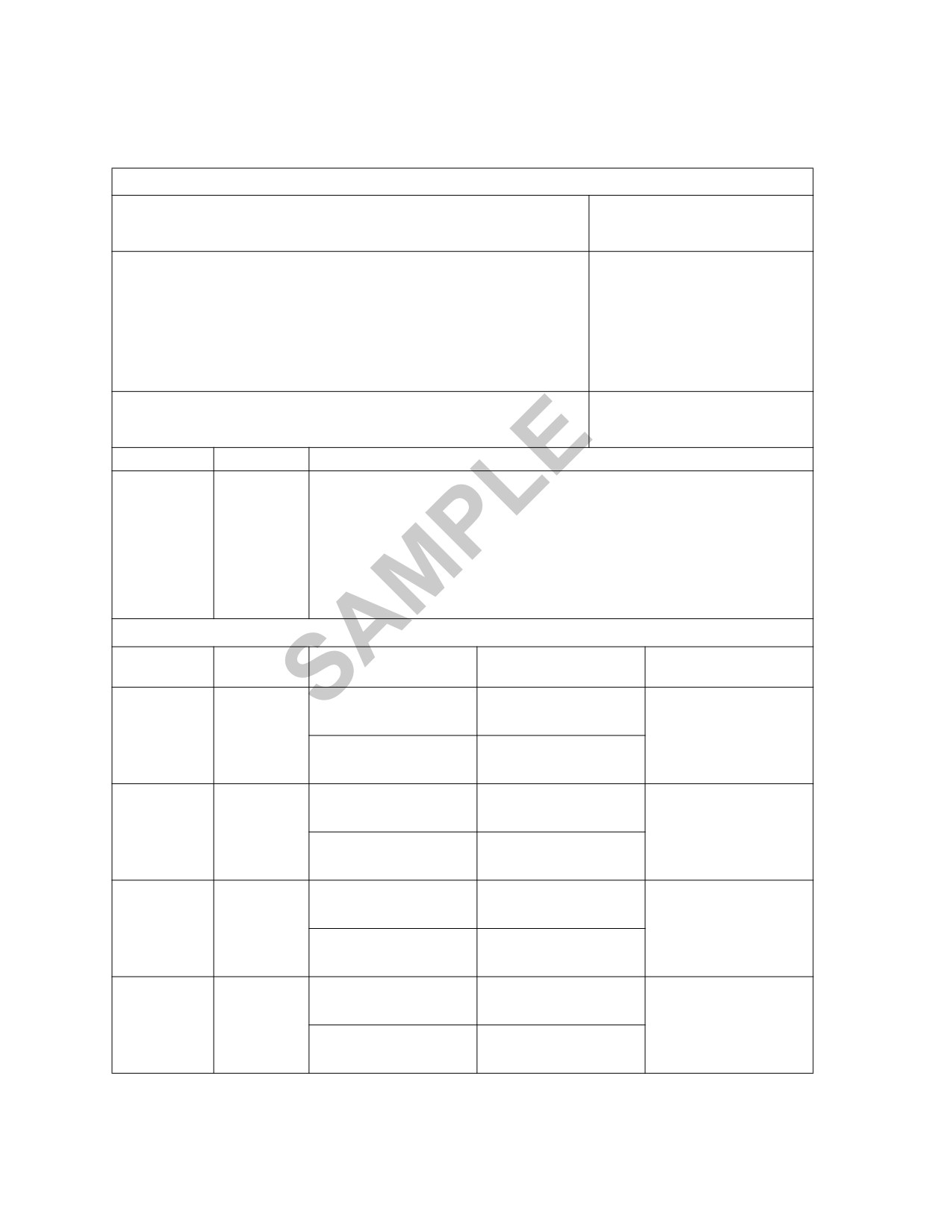
audit trail of when and where the sample was taken. The team assigns an identification
number and affixes it to the sample or its container to aid in identification.
Sample or Specimen Custody Document
1. Receiving Activity
2. Location
3. Name, Grade, and Title of Person From Whom Received
4. Address (Include Zip Code)
Owner
Other
5. Where Obtained
6. Date/Time Obtained
7. Item #
8. Quantity
9. Description of Sample or Specimen
Chain of Custody
11. Date
14. Purpose of
10. Item #
12. Released by
13. Received by
(yymmdd)
Change of Custody
Signature
Signature
Name, Grade, and Title
Name, Grade, and Title
Signature
Signature
Name, Grade, and Title
Name, Grade, and Title
Signature
Signature
Name, Grade, and Title
Name, Grade, and Title
Signature
Signature
Name, Grade, and Title
Name, Grade, and Title
Figure E-2. Sample Chain-of-Custody Form
E-14
b.
The document identifies when the sample was collected, who collected the
sample, who maintained custody of the sample, and what was been done with the
sample. When samples are transferred from one person to another, a custody transfer
occurs. A custody transfer also occurs when supervision of the sample changes. All
sample transfers or custody changes are documented. Use a Department of Defense (DD)
Form 1911 (Material Courier Receipt) or another document (such as a DA Form 4137
[Evidence/Property Custody Document] or a Centers for Disease Control and Prevention
[CDC] laboratory response network chain-of-custody form, as directed) for each shipment
transported. The chain of custody must accompany the sample during transport from the
point of collection to the final receiving location. Each time the sample is transferred to
another individual, the receiving person must sign the document to show that they have
received the sample. The chain-of-custody document provides answers to the following
questions:
• When was the sample collected?
• How many samples were collected?
• Who maintained custody of the sample?
• What was done with the sample at each change of custody?
c.
The instructions for completing the form in Figure E-2 are as follows:
Block 1. Enter the unit designation.
Block 2. Enter the address, code, or coordinates of the collecting organization
according to the SOP.
Block 3. Enter the name, grade, and title of the person from whom the sample
was received.
Block 4. Enter the nearest large city, if applicable, and the country. Include
the mailing address, Army post office (APO) or Fleet post office (FPO), and zip
code.
Block 5. Enter the address, unit code, or coordinates of the location where the
sample was collected according to the SOP.
Block 6. Enter the date-time group when the sample was obtained.
Block 7. Enter and itemize each package being evacuated.
Block 8. Enter the quantity of samples received.
Block 9. Enter descriptive information for items. The following are sample
descriptions:
• Sample vial package. A sample vial containing less than 10
milliliters of the sample, wrapped with lab film, and sealed with
tamper-resistant tape.
• Sample bottle. A sample bottle containing less than 50 milliliters of
the sample, wrapped with lab film, and sealed with tamper-resistant
tape.
• Cold-weather sample. A 50-milliliter conical tube containing a
cold-weather filter, placed in less than 40 milliliters of collection
fluid, wrapped with lab film, and sealed with tamper-resistant tape.
E-15
• Supporting documents. A sealed disk mailer containing one
biological event log and one incident report, individually labeled.
NOTES: Close the entries in blocks 7, 8, and 9 with an initialed line
and the words “nothing follows.” If the item description(s) will not fit
in block 9, continue the description on a plain sheet of paper,
remembering to close it with an initialed line and the words “nothing
follows.”
Block 10. Enter the appropriate item number(s) from block 7 that are being
transferred. If a separate action is done with only one of the items on the list,
create a separate chain of custody form for that item and attach a copy of the
original form.
Block 11. Enter the date of the transaction (yymmdd).
Block 12. Enter the name of the person currently responsible for the custody
of the item.
Block 13. Enter the name of the person assuming responsibility for the item.
Block 14. Enter a brief, accurate explanation of why the custody of the article
was transferred (e.g., released for evacuation).
d. To prevent confusion, use the sample identification number (Figure E-3) when
referring to the sample or to information concerning its acquisition. A sample
identification number contains the following information:
•
Country of acquisition. This is a two-digit alphabetic code for the
country from which the collector took the sample. A listing of country
codes is shown in Table E-2. (See International Organization for
Standardization [ISO] 3166-1 for more information.)
•
Date acquired. This is a six-digit numerical code for the year, month,
and day that the collector took the sample.
•
Sequence number. This is a three-digit numerical code assigned by the
team. It begins each collection day. The first sample collected is 001, the
second 002, and so forth.
•
Identification. This is a two- or three-digit alphabetic code for the
sampler’s identity, and it must be protected. Use codes XA through XZ
and then XXA through XXZ, if necessary. The NBC center operational
level commander (e.g., COCOM commander, joint task force [JTF]
commander, component commander) should assign two- and three-digit
alphabetic codes to their units.
LA011020-002-XA
LA
=
The collector took the sample in Laos.
011020
=
The sample was obtained on 20 October 2001.
002
=
This was the second sample taken on 20 October 2001.
XA
=
John Doe collected the sample; XA signifies his identity.
Figure E-3. Example of a Sample Identification Number
E-16
Table E-2. Country Codes
Country
Code
Afghanistan
AF
Albania
AL
Algeria
DZ
American Samoa
AS
Andorra
AD
Angola
AO
Anguilla
AI
Antarctica
AQ
Antigua and Barbuda
AG
Argentina
AR
Armenia
AM
Aruba
AW
Australia
AU
Austria
AT
Azerbaijan
AZ
Bahamas
BS
Bahrain
BH
Bangladesh
BD
Barbados
BB
Belarus
BY
Belgium
BE
Belize
BZ
Benin
BJ
Bermuda
BM
Bhutan
BT
Bolivia
BO
Bosnia and Herzegovina
BA
Botswana
BW
Bouvet Island
BV
Brazil
BR
British Indian Ocean Territory
IO
Brunei Darussalam
BN
Bulgaria
BG
Burkina Faso
BF
Burundi
BI
Cambodia
KH
Cameroon
CM
Canada
CA
Cape Verde
CV
Cayman Islands
KY
Central African Republic
CF
Chad
TD
Chile
CL
E-17
Table E-2. Country Codes (Continued)
Country
Code
China
CN
Christmas Island
CX
Cocos (Keeling) Islands
CC
Colombia
CO
Comoros
KM
Congo
CG
Congo, The Democratic Republic of the
CD
Cook Islands
CK
Costa Rica
CR
Cote D'ivoire
CI
Croatia
HR
Cuba
CU
Cyprus
CY
Czech Republic
CZ
Denmark
DK
Djibouti
DJ
Dominica
DM
Dominican Republic
DO
Ecuador
EC
Egypt
EG
El Salvador
SV
Equatorial Guinea
GQ
Eritrea
ER
Estonia
EE
Ethiopia
ET
Falkland Islands (Malvinas)
FK
Faroe Islands
FO
Fiji
FJ
Finland
FI
France
FR
French Guiana
GF
French Polynesia
PF
French Southern Territories
TF
Gabon
GA
Gambia
GM
Georgia
GE
Germany
DE
Ghana
GH
Gibraltar
GI
Greece
GR
Greenland
GL
Grenada
GD
Guadeloupe
GP
E-18
Table E-2. Country Codes (Continued)
Country
Code
Guam
GU
Guatemala
GT
Guinea
GN
Guinea-Bissau
GW
Guyana
GY
Haiti
HT
Heard Island and McDonald Islands
HM
Holy See (Vatican City State)
VA
Honduras
HN
Hong Kong
HK
Hungary
HU
Iceland
IS
India
IN
Indonesia
ID
Iran, Islamic Republic of
IR
Iraq
IQ
Ireland
IE
Israel
IL
Italy
IT
Jamaica
JM
Japan
JP
Jordan
JO
Kazakhstan
KZ
Kenya
KE
Kiribati
KI
Korea, Democratic People's Republic of
KP
Korea, Republic of
KR
Kuwait
KW
Kyrgyzstan
KG
Lao People's Democratic Republic
LA
Latvia
LV
Lebanon
LB
Lesotho
LS
Liberia
LR
Libyan Arab Jamahiriya
LY
Liechtenstein
LI
Luthuania
LT
Luxembourg
LU
Macao
MO
Macedonia, The Former Yugoslav Republic of
MK
Madagascar
MG
Malawi
MW
Malaysia
MY
E-19
Table E-2. Country Codes (Continued)
Country
Code
Maldives
MV
Mali
ML
Malta
MT
Marshall Islands
MH
Martinique
MQ
Mauritania
MR
Mauritius
MU
Mayotte
YT
Mexico
MX
Micronesia, Federated States of
FM
Moldova, Republic of
MD
Monaco
MC
Mongolia
MN
Montserrat
MS
Morocco
MA
Mozambique
MZ
Myanmar
MM
Namibia
NA
Nauru
NR
Nepal
NP
Netherlands
NL
Netherlands Antilles
AN
New Caledonia
NC
New Zealand
NZ
Nicaragua
NI
Niger
NE
Nigeria
NG
Niue
NU
Norfolk Island
NF
Northern Mariana Islands
MP
Norway
NO
Oman
OM
Pakistan
PK
Palau
PW
Palestinian Territory, Occupied
PS
Panama
PA
Papua New Guinea
PG
Paraguay
PY
Peru
PE
Philippines
PH
Pitcairn
PN
Poland
PL
Portugal
PT
E-20
Table E-2. Country Codes (Continued)
Country
Code
Puerto Rico
PR
Qatar
QA
Reunion
RE
Romania
RO
Russian Federation
RU
Rwanda
RW
Saint Helena
SH
Saint Kitts and Nevis
KN
Saint Lucia
LC
Saint Pierre and Miquelon
PM
Saint Vincent and the Grenadines
VC
Samoa
WS
San Marino
SM
Sao Tome and Principe
ST
Saudi Arabia
SA
Senegal
SN
Serbia and Montenegro
CS
Seychelles
SC
Sierra Leone
SL
Singapore
SG
Slovakia
SK
Slovenia
SI
Solomon Islands
SB
Somalia
SO
South Africa
ZA
South Georgia and the South Sandwich Islands
GS
Spain
ES
Sri Lanka
LK
Sudan
SD
Suriname
SR
Svalbard and Jan Mayen
SJ
Swaziland
SZ
Sweden
SE
Switzerland
CH
Syrian Arab Republic
SY
Taiwan, Province of China
TW
Tajikistan
TJ
Tanzania, United Republic of
TZ
Thailand
TH
Timor-Leste
TL
Togo
TG
Tokelau
TK
Tonga
TO
E-21
Table E-2. Country Codes (Continued)
Country
Code
Trinidad and Tobago
TT
Tunisia
TN
Turkey
TR
Turkmenistan
TM
Turks and Caicos Islands
TC
Tuvalu
TV
Uganda
UG
Ukraine
UA
United Arab Emirates
AE
United Kingdom
GB
United States
US
United States Minor Outlying Islands
UM
Uruguay
UY
Uzbekistan
UZ
Vanuatu
VU
Venezuela
VE
Viet Nam
VN
Virgin Islands, British
VG
Virgin Islands, US
VI
Wallis and Futuna
WF
Western Sahara
EH
Yemen
YE
Zambia
ZM
Zimbabwe
ZW
6.
Reporting and Shipping
a.
The collector must provide a formatted message for transmission as soon as
possible to report the acquisition of the sample and the shipment of samples and
specimens. The collector ensures that the acquisition message has been properly
classified.
b.
A complete background information history of circumstances (i.e., a completed
CW/BW sample report and a chain-of-custody form) about the collection of each sample
or specimen must be compiled. Critical background information is contained in the CW/
BW sample report.
c.
All suspect NBC samples and collected specimens are evacuated to a medical
or confirmatory laboratory for analysis. Laboratories will prioritize sample or specimen
analysis based on METT-TC factors. The numbers and types of samples and specimens
analyzed are determined by the laboratory commander.
d. A message generally contains the following information:
• The sample or specimen identification number and shipment date,
transportation mode, courier identification, air bill-of-lading number,
E-22
flight number, destination, and estimated time of arrival (if applicable).
(The chain-of-custody form is used to maintain control of the sample.)
• Background information surrounding the sample or specimen, such as the
circumstances surrounding its acquisition.
• The name of another country or agency that obtained the sample or
specimen from the same event or area and is not shown on the message
address.
• All the details that relate to the acquisition of the sample or specimen,
despite how insignificant they may seem to the collector.
e.
Designated samples and specimens are shipped by the fastest, safest means
possible, preferably by a TEU, to the location designated by the controlling headquarters.
The receiving laboratory is notified in advance of the sample shipment, and the receiving
laboratory may provide special shipping instructions.
f.
The designated sample courier controls the transport of samples and
specimens to the designated location. Coordination is made with the receiving location
(i.e., laboratory) before the actual delivery. Suspect CB samples and specimens are
generally delivered to the supporting laboratory in the AO for in-theater analysis before
they are transported out of the AO. The supporting laboratory withdraws an aliquot of
each sample or specimen for analysis. The supporting laboratory provides a field
confirmatory identification, and the CONUS-based laboratory provides a definitive
identification.
NOTE: The CONUS-based reference laboratory is responsible for providing
definitive identification and confirmation for national level decision making.
g.
The controlling headquarters uses the following criteria to determine the final
destination of each sample or specimen:
• Does the sample or specimen contain CBR material?
• Is the sample or specimen content completely unknown?
• What is the ability to get the sample to its destination within the required
time frame?
• Does the sample contain an infectious substance?
h. In any case, the TEU must be notified in advance of shipment so that
additional instructions or deviations from standard instructions can be given. The TEU
controls the transport of samples and specimens to their final destination(s).
NOTES:
1. Do not ship suspected toxic samples or specimens or munitions systems to
CONUS technical centers or intelligence agencies without coordination and
prior approval by the recipient.
2. Coordinate with the supporting laboratory upon its arrival in the AOR. This
coordination supports the material exchange of information.
E-23
7.
Witness Interviews
a. Introduction.
(1) Interviewing an alleged victim or witness is an important phase of an
investigation. Generally, if the mission requires interviews with alleged victims or
interrogation of threat forces, the interview should be conducted by trained interrogation
teams.
(2) Although sample collection is important, the interview process is an
important phase of an investigation. Each collector must constantly be aware of how he
may unconsciously influence a witness’ testimony. Vocal tones, facial expressions, body
language, and the manner in which he poses questions can affect testimony.
(3) Therefore, each collector must constantly monitor the interpreter and the
interviewee. He must also monitor the type of questions used to ensure that they do not
lead the witness toward a foregone conclusion. The following paragraphs cover, in detail,
the rationale and techniques used for successful interviews, but they are only guidelines.
Figure E-4 shows a sample interview form.
b.
Elements of Proper Interviewing.
(1) A collector using an interpreter should position himself so that he can
monitor the witness and the interpreter and maintain control of the interview direction
and speed. A tape recorder may be used to preserve the actual conversation so that it can
be reviewed later.
(2) A key element to interviewing more than one person in a group of people
is to ensure that each person is questioned alone. Questions should not lead to yes or no
answers. If the witness does not understand the question, he may respond with yes to
avoid displeasing the collector. This could result in a rapid, but inaccurate, interview.
(3) When conducting an interview—
• Ensure that it is conducted in a way that is as psychologically
comfortable for the witness as possible.
• Do not become emotionally involved with the state of affairs or
surroundings of a witness during an interview.
• Be aware that misinformation and propaganda may be presented.
Testimony should describe scientific reality, not a social or political
truth.
• Understand that many people do not have the education or the
means to establish the scientific causality of an event. Because of
this, the witness may identify the wrong factor as the cause of the
event.
• Do not assume anything about information received surrounding an
investigation. Misinformation of varying intensity and sophistication
can come from any group of people.
c.
Background Information. The interviewer uses information about a witness’
social and environmental background to help establish his credibility and relationship to
an alleged attack. The most important part of the background is establishing the correct
names and aliases of the witness. In multicultural societies, individuals often use
E-24

CB Incident Interview
Date: _______________________ Interviewer: ____________________________________________
Subject’s Name: _____________________________________________________________________
Alias #1 _____________________________ #2 ____________________________________
Age: _________________
Sex: Male Female
Year of Birth: ___________________________
Nationality: _________________________________________________________________________
Subject’s Address: ___________________________________________________________________
Identification Card #:
_________________________________________________________________
Delivery Methods
Type:
_____unknown
_____ground
_____air
_____artillery/rocket
_____mine
_____other (describe):
________________________________________________________
Height: _____(m)
Size: _____(m) (affected area)
Distance: _____(m)
Agent Characteristics
Odor:
_____none
_____sweet
_____fruity
_____irritating
_____peppery
_____floral
_____changing _____unknown
_____other (describe):
_____________________________
Comments: _________________________________________________________________________
__________________________________________________________________________________
Consistency:
_____smoke
_____mist
_____dust
_____rain
_____gel
_____dry
_____visible
_____invisible
_____other (describe):
________________________________
Color: ___________________ Describe Development of Color: _______________________________
__________________________________________________________________________________
Area Coverage:
_____________________________________________________________________
Physical Dissemination/Coverage (Droplet Size and Distribution) (write or draw):
Symptoms:
Figure E-4. Sample CB Incident Interview Form
E-25
Individual Actions
During Attack:_______________________________________________________________________
__________________________________________________________________________________
After Attack: ________________________________________________________________________
__________________________________________________________________________________
Protective Measures:
________________________________________________________________
Treatment Received: _________________________________________________________________
__________________________________________________________________________________
Environmental Effects
Vegetation Change? Yes No
Describe: __________________________________________________________________________
__________________________________________________________________________________
__________________________________________________________________________________
Animals Affected? Yes No
Describe: __________________________________________________________________________
__________________________________________________________________________________
Others Affected
Name
Age
Symptoms
Resolution
Figure E-4. Sample CB Incident Interview Form (Continued)
E-26
different names that correspond to each society in which they exist. Because of the
confusion that surrounds combat areas, a photograph of the witness can often aid in
recontacting the witness. The next important element of background information
involves defining the witness’ military training and service.
d. Attack Data and Agent Characteristics.
(1) The description of how an alleged CB attack occurred is critical in
determining whether or not an attack occurred. Often, the best way to proceed is by
asking questions such as “What happened next?” or “What was it like?”
(2) Always ask questions that require the witness to describe or explain the
situation. During questioning, do not assume that any specific event occurred. For
example, instead of asking “What color was the agent?” ask “Was there a color associated
with the event?”
(3) If the event involved a weapon, ensure that the questioning derives
information on how the weapon functioned. Information that shows the witness’
awareness of the difference between high-explosive (HE) and toxic-agent weapon
functioning is important.
(4) A sketch may be drawn of the area, indicating north, the wind direction at
the time of the attack, and the approximate scale. When applicable, include a description
of topographic features; the location of trees, forests, and buildings; the disposition of
personnel; the personnel affected; the points of impact of shells or other projectiles; the
zone contaminated by the agent spread; the location of dead or wounded persons and
animals; and other relevant information.
8.
Handling and Packaging Materials
a.
Characteristics. There are several physical and chemical characteristics that
must be considered when selecting a suitable container for shipping and sampling.
Important characteristics include the container material, size, shape, and sealing
method. Generally, a container should be made of material that is chemically
nonreactive with the sample and it should maintain physical integrity during normal
handling and shipment. The container must have sufficient volume to contain enough
samples for all analyses required of the sample and for several repeat analyses. It should
have an opening that allows for easy filling and emptying of the container and that
minimizes external contamination of the container. Finally, all containers should be new
and unused. Table E-3, page E-28, recommends sample containers based on accepted
analytical practices.
b.
Precautions. To ensure an accurate analysis, it is critical that a sample does
not become contaminated during the process of collection and transport. To avoid cross
contamination, take the following precautions:
• Work from the suspect least contaminated site toward the suspect most
contaminated site.
• Wear disposable gloves, and change them after taking each group of
samples at one site (e.g., discard your gloves after collecting all soil
samples).
E-27

Table E-3. Container Selection
Sample Type
Analysis Test Category
Container
Air
Chemical
Air filter
Radiological
Swipes
Soil
Chemical
4-oz high-density polyethylene
Biological
4-oz high-density polyethylene
Radiological
4-oz high-density polyethylene
Water
Chemical
Low-density polyethylene
Radiological
Low-density polyethylene
Vegetation
Chemical
4-oz high-density polyethylene
Biological
4-oz high-density polyethylene
Radiological
4-oz high-density polyethylene
Liquid agent
Chemical
Low-density polyethylene
Biological
Low-density polyethylene
Dilute agent
Chemical
Low-density polyethylene
•
Keep equipment away from dirt, dust, soil, and surfaces that are likely to
be contaminated. Put the equipment on a clean, plastic sheet.
•
Double-bag samples immediately after they are collected.
•
Clean the sampling equipment after taking each group of samples and
check for residual contamination, or use disposable sampling equipment.
•
Clean and decontaminate sampling tools between sample collections. To
avoid cross contamination, wipe the outside of all containers with a 5
percent chlorine solution.
c.
Collection Bags. A leakproof, clear, plastic collection bag can be used as the
initial container for samples, such as protective masks and filter canisters, individual
antidote and decontamination kits, munition fragments, and other items that are too
large to place in a specimen jar. It can also be used to package containers, which ensures
a vapor barrier in case the container is broken in transit. It acts as an initial or
secondary vapor barrier that prevents air from leaking in and toxic material from
leaking out. The following are recommended procedures when using leakproof, clear,
plastic collection bags:
Step 1. Verify that the item has a command designated sample or specimen
number if you are packaging a sample or specimen container.
Step 2. Carefully place the sample or specimen in a bottom corner of the bag.
Step 3. Ensure that each layer of packaging is decontaminated using a 5
percent chlorine solution.
Step 4. Squeeze all the air out of the bag, and seal it.
d. Jars and Tubes. Glass specimen jars and polypropylene tubes can be used for
collection; however, do not store biological samples in polypropylene containers because
proteins and deoxyribonucleic acid (DNA) may adhere to them. Use glass containers to
E-28

hold small environmental samples or autopsy specimens. Use polypropylene tubes to
hold medical specimens, such as blood and urine. Use glass containers instead of plastic
ones because toxic agents may leach chemicals from plastics into a sample, introducing
contamination and complicating analysis efforts.
e.
Shipping Containers. Place samples and specimens into commercial, biohazard
shipping containers for shipping.
f.
Commercial-Air Shipment. When the samples must be transported on
commercial aircraft, International Air Transport Association-approved sample transport
containers must be used for shipment and delivery to the designated location.
g.
Temperatures. Samples or specimens submitted for analysis must be properly
packaged, labeled, and shipped to ensure that they arrive in an analytically acceptable
condition. All samples should be maintained at 1° to 4°C. Ideally, samples should arrive
at the laboratory within 6 hours of collection. The samples should be delivered to the
CONUS laboratory within 24 to 48 hours. If the samples or specimens cannot be
delivered to CONUS within this time, they should be flash-frozen to -165°C. Dry ice can
be used if flash-freezing is not available. If the samples cannot be delivered to CONUS
within 48 hours, the supporting laboratory should subculture the samples and specimens
and send the subculture to the CONUS laboratory.
h. Insulation. Standard polyethylene or metal ice chests are the most easily
procured items that can be used to ship CB samples and specimens. Even though an ice
chest provides good insulation for samples or specimens and the coolant, place extra
insulation and cushioning around the metal cans inside the ice chest. Plastic bubble
wrap or foam rubber can be used with good results.
NOTE: Table E-4 lists materials that can be used to assemble a CB sample
collection equipment kit.
Table E-4. CB Sample Collection Equipment
Description
Stock Number
Amount
Bag, plastic, recloseable
10 each
Blade, surgical, CS21, 150s
6515-01-009-5297
2 each
Bleach, 32-oz
1 bottle
Chest, ice
1 each
Combustible gas indicator that indicates
1 each
the percentage of oxygen and volatility
Container, shipping, International Air
1 each
Transport Association
Floor sweep (vermiculite)
8720-01-026-9419
2 bags
Gas meter capable of providing on-station
1 each
analysis and detection capability for
multiple gases, including industrial gases
Gas meter that detects vapor in ppm and
10 each
indicates the presence of vapor and its
strength
Gauze pads
1 box
Gloves, size 8-8½
8415-00-J02-2902
2 boxes
Gloves, size 9-9½
8415-00-634-4639
2 boxes
E-29
Table E-4. CB Sample Collection Equipment (Continued)
Description
Stock Number
Amount
Ice pack
CP TR-6345-20
6 each
Insulated bag, Type 1
AF 01-814-8
10 each
Insulated bag, Type 2
AF 01-814-10
10 each
Knife, pocket
5110-00-526-8740
1 each
Labels, paper, pressure-sensitive
7530-00-577-4376
20 each
Liquid sampler
W 51910 (50/box)
2 boxes
Marking pen, waterproof
AF 13-381
10 each
Matches, waterproof
20 each
Methanol, 32-oz
2 bottles
Microspatula with nonstick ends
AF 21-401-50A
2 each
Pad, cooling chemical
6530-00-133-4299
2 each
Pad, nonadherent
6510-00-111-0706
4 each
Paper, nonbleeding, plastic strip, pH
SW-S 65271
1 each
testing
Parafilm with a dispenser
6640-01-185-3289
2 boxes
Personal air sampler
LSS G4980
1 each
Pipette, graduated, transfer type
AF 13-711-9A
10 each
Pipette, jumbo, transfer type
AF 13-711-7
1 each
Plastic bags
AF 01-812-6B (500/pack)
1 pack
Pliers, #47, 5-in
6520-00-543-5330
1 each
Pocket bubble metric kit
GL4981
2 each
Polypropylene scoop, 5 x 2 x 2 inches
ASP S1021-5
1 each
Razor, surgical prep
6515-00-926-2089
10 each
Sample bottle, 6-oz
CP J-6103-50
5 bottles
Sampling container (with lead shielding
1 each
for radiation sample)
Scissors, universal type
AF 08-951-30
1 each
Screwdriver, flat tip, ¼-in
5120-00- 596-8653
1 each
Seals, tamper-resistant
100 each
Spoon spatula
AF 14-356-10
2 each
Stopcock, three-way
ASP S8965-2
1 each
Syringe, hypodermic, 50- or 60-ml
6515-00-168-6913
2 each
Tape, antiseizing
8030-00-889-3535
1 each
Tape, pressure-sensitive, adhesive, 2-in
7510-00-159-4450
1 each
Throat swab
1 box
Tongs
AF 15-202-5
1 each
Tube
EC ST-023
1 each
Tubing, laboratory, clear, R3602
AF 14-169-3B
1 box
Watch, wrist
6645-00-066-4279
2 each
Water, sterile, 32-oz
1 bottle
Whirl/pak bag, 6-oz
AF 01-812-6B
1 box
E-30

9.
Techniques and Procedures
a.
The collection of environmental samples is an integral part of investigating
allegations pertaining to the first use of CB agents. The types of samples and specimens
taken and the collection methods are influenced by guidance from the operational or
tactical level commander on sampling requirements, the assignment of collection assets,
and the prioritization of sampling efforts. During sampling operations, the commander
establishes the required protective equipment to fit the situation.
b.
NBC reconnaissance units collect samples under various circumstances. For
example, a reconnaissance unit may collect samples in an area free of hostile forces or a
special forces (SF) team may collect samples within the enemy AO or deep in the enemy
rear area. Samples may include toxic-agent munitions, chemical products, air, water,
soil, and vegetation. Expended equipment includes items such as M256A1 kits and M8/
M9 detector paper. These items should be recovered, packaged, and shipped with the
samples for analysis. Different information may be derived from each type of sample.
Table E-5 shows the recommended sizes of samples.
Table E-5. Recommended Sizes of Samples
Item
Size
Remarks
Chemical Samples
Soil
10 cm x 5 cm x 1 cm
A larger area is more useful than a greater depth.
Liquid agent
50 ml
None
Diluted agent
10 ml
The depth depends on the water source and the agent
surface tension.
Water
50 ml (maximum)
The depth depends on the water source and the agent
surface tension.
Vegetation
Equivalent to 3 leaves or 3
The size depends on the amount of contamination. The
handfuls of grass
best samples are found closest to the release point.
Biological Samples
Soil
10 cm x 5 cm x 1 cm
A larger area is more useful than a greater depth.
Liquid
25 to 50 ml
A C18 Sep-Pak™ cannot be used with medical
samples.
Vegetation
About the size of a soft drink
The best samples are found closest to the release
can
point.
Radiological Samples
Water
2 l
This sample is obtained from surface or water
discharges.
1 l
This sample is obtained from drinking water.
Soil
2 kg (about 1 m x 1 m x 8
This is the gamma spectrometry plus the gross alpha or
cm)
beta.
100 g
This is the gross alpha or beta.
Vegetation
3 l, densely packed
None
c.
Sampling techniques vary according to the circumstances under which the
sampling team must work. Teams may be able to obtain neat chemical-agent samples
from shipping, production, and storage containers. The return and recovery of any
sample identification or test equipment previously used to identify the agents (such as
M256 series kits, M8/M9 detector paper) are of great value to the laboratory conducting
E-31