FM 3-21.8 (FM 7-8) The Infantry Rifle Platoon and Squad (MARCH 2007) - page 14
Appendix F
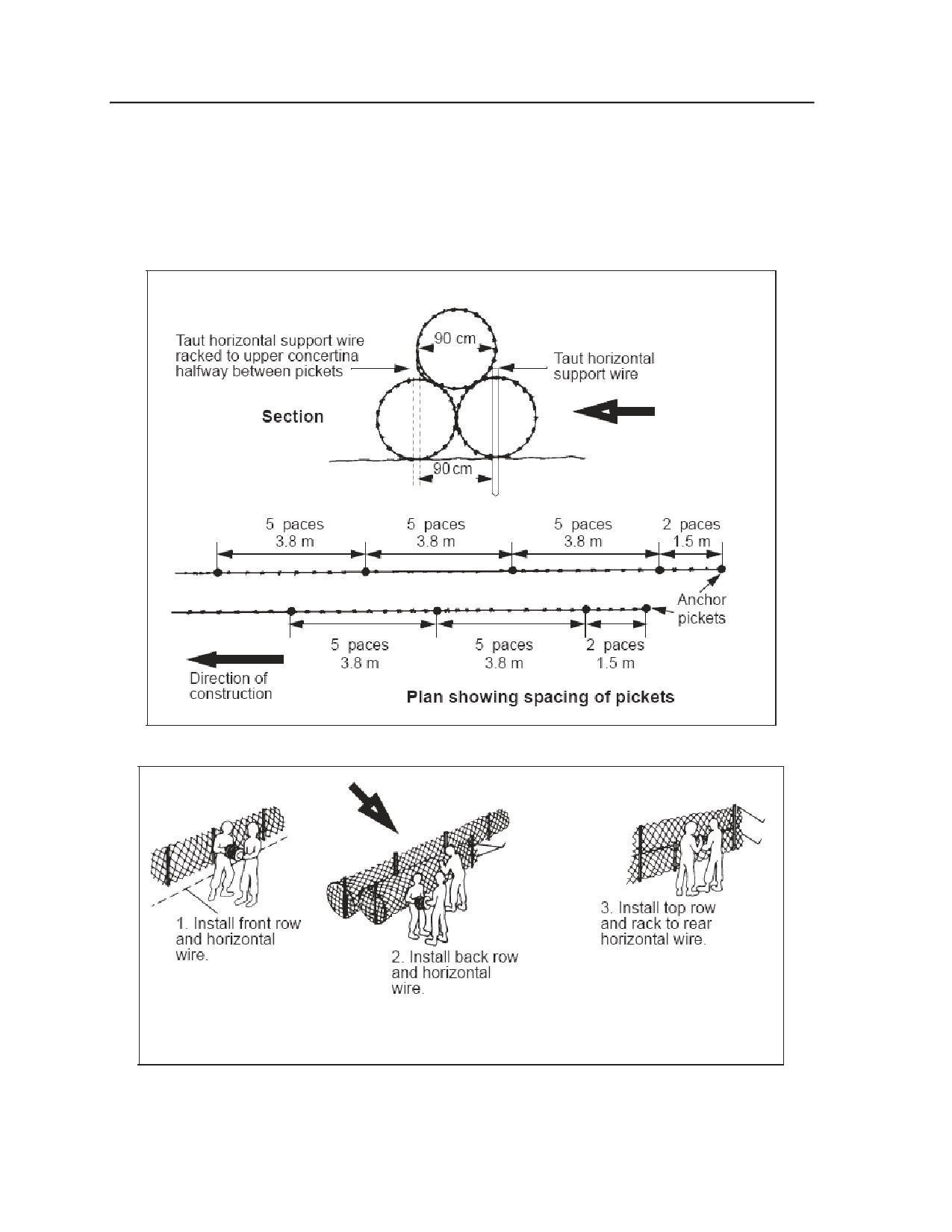
F-147. First, lay out and install pickets from left to right (facing the enemy). Put the long pickets five
paces apart, and the short (anchor) pickets two paces from the end of the long pickets (Figure F-19). The
enemy and friendly picket rows are offset and are placed 3 feet apart. Now lay out rolls of concertina. Place
a roll in front of the third picket on the enemy side, and two rolls to the rear of the third picket on the
friendly side. Repeat this step every fourth picket thereafter. Install the front row concertina and horizontal
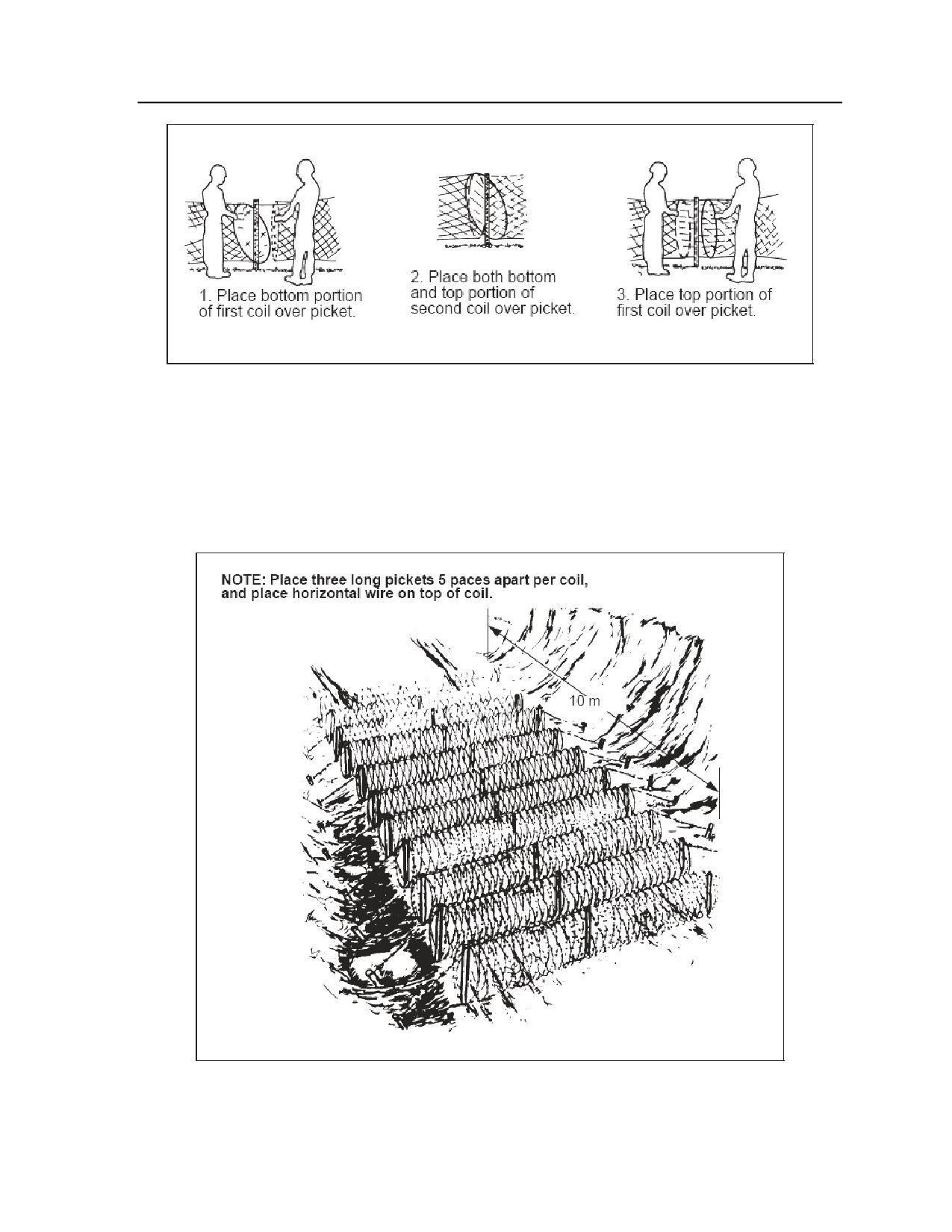
wire (Figure F-20). Place the concertina over the pickets. Install the rear row of concertina and horizontal
wire. Install the top row of concertina and join the rear horizontal wire (Figure F-21).
Figure F-19. Triple standard concertina fence.
Figure F-20. Installing concertina.
F-40
FM 3-21.8
28 March 2007
Obstacle Reduction and Employment
Figure F-21. Joining concertina.
CONCERTINA ROADBLOCK
F-148. The concertina roadblock is placed across roadways and designed to block wheeled or tracked
vehicles. The roadblock is constructed of 11 concertina rolls or coils placed together, about 10 meters in
depth, reinforced with long pickets five paces apart. The rolls or coils should not be tautly bound allowing
them to be dragged and tangled around axles, tank road wheels, and sprockets. Additionally, wire is placed
horizontally on top of the concertina rolls or coils (Figure F-22).
Figure F-22. Eleven-row antivehicular wire obstacle.
28 March 2007
FM 3-21.8
F-41
Appendix F
TANGLEFOOT
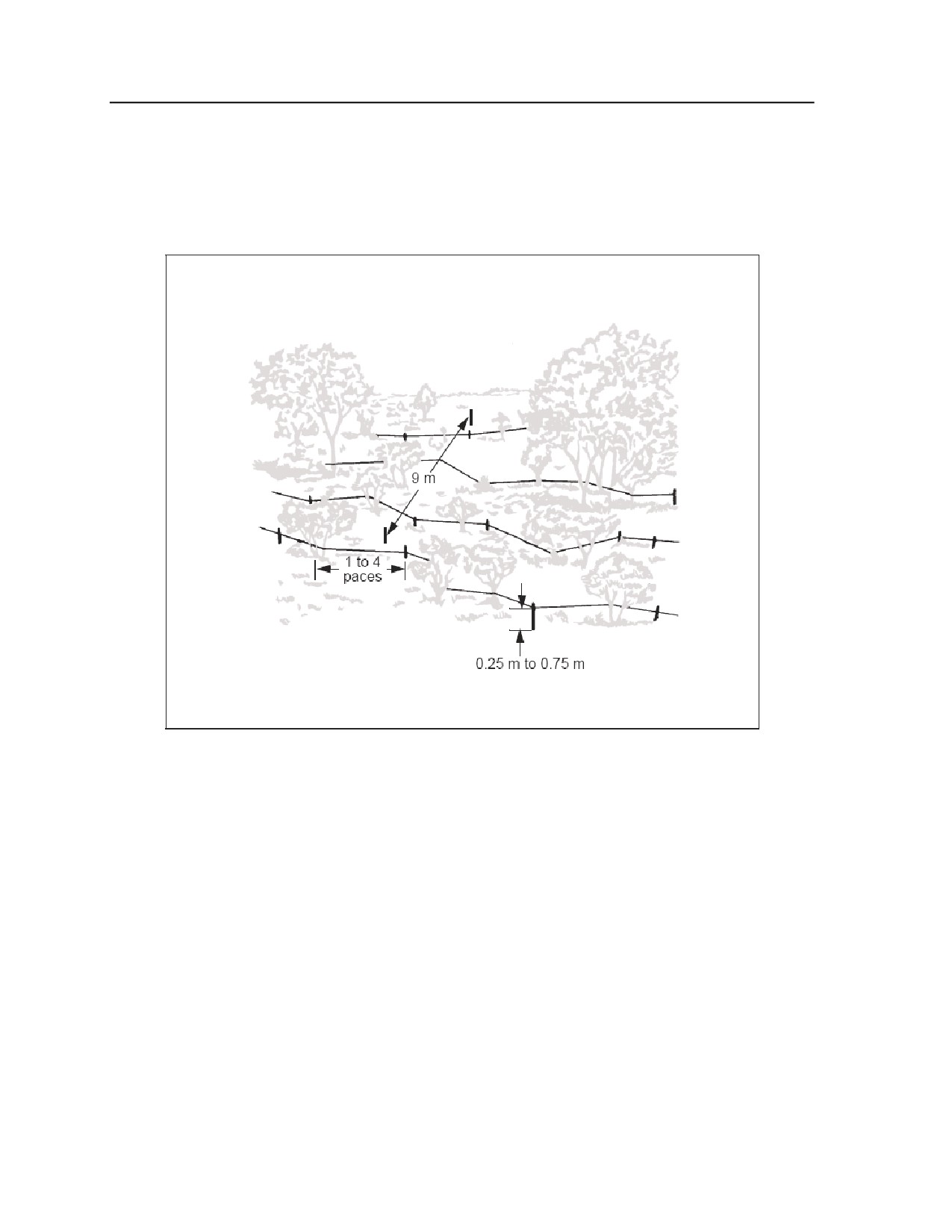
F-149. Tanglefoot is used where concealment is essential and to prevent the enemy from crawling
between fences and in front of emplacements (Figure F-23). The obstacle should be employed in a
minimum width of 32 feet. The pickets should be placed at irregular intervals of 2 ½ feet to 10 feet. The
height of the barbed wire should vary between 9 to 30 inches. Tanglefoot should be sited in scrub, if
possible, using bushes as supports for part of the wire. On open ground, short pickets should be used.
Figure F-23. Tanglefoot.
F-42
FM 3-21.8
28 March 2007
Appendix G
Other Small Unit Organizations
As part of full spectrum operations, the Infantry platoon can expect to conduct
missions with other types of Infantry platoons (within and outside of their own
Infantry battalion), combat arms units, and combat support units. To aid the Infantry
platoon leader, this appendix briefly discusses the structure, capabilities, and
limitations of—
The Infantry battalion scout platoon
Infantry battalion mortar platoon
Infantry battalion sniper section
Bradley platoon and squad
Stryker platoon and squad
Maneuver company fire support team (FIST)
Combat engineer support
Air defense assets
Tank platoon
INFANTRY BATTALION SCOUT PLATOON
G-1. The Infantry battalion scout platoon serves as the forward "eyes and ears" for the battalion
commander. The primary mission of the scout platoon is to conduct reconnaissance and security to answer
CCIR, normally defined within the battalion’s intelligence, surveillance, reconnaissance (ISR) plan. The
scout platoon can conduct route, zone, and area reconnaissance missions. The platoon can also conduct
limited screening operations and can participate as part of a larger force in guard missions.
G-2. The scout platoon is organized into a platoon headquarters and three squads of six men each. Each
squad leader is responsible for controlling his squad’s movement and intelligence collection requirements.
He reports critical intelligence information obtained by his squad to the scout platoon leader or battalion
TOC.
G-3. In either offensive or defensive operations, the commander may deploy his scout platoon to conduct
screening operations of the battalion's front, flank, or rear. The scout platoon may also occupy outposts
from which it can relay critical information to the TOC concerning enemy composition, disposition, and
activities.
INFANTRY BATTALION MORTAR PLATOON
G-4. The primary role of the Infantry battalion mortar platoon is to provide immediate, responsive indirect
fires in support of the maneuver companies or battalion. The battalion mortar platoon consists of a mortar
platoon headquarters, a mortar section that contains the fire direction center (FDC), and four mortar squads.
The platoon’s FDC controls and directs the mortar platoon’s fires. Infantry battalion mortar sections are
equipped with 120-mm and 81-mm mortars, but only have the capability to man 50 percent of these
mortars at any one time.
G-5. The mortar platoon provides the commander with the ability to shape the Infantry's close fight with
indirect fires that—
Provide close supporting fires for assaulting Infantry forces in any terrain.
Destroy, neutralize, suppress, or disrupt enemy forces and force armored vehicles to button up.
28 March 2007
FM 3-21.8
G-1
Appendix G
Fix enemy forces or reduce the enemy's mobility and canalize his assault forces into engagement
areas.
Deny the enemy the advantage of defile terrain and force him into areas covered by direct fire
weapons.
Optimize indirect fires in urban terrain.
Significantly improve the Infantry’s lethality and survivability against a close dismounted
assault.
Provide obscuration for friendly movement.
G-6. Each mortar system is capable of providing three primary types of mortar fires:
(1) High explosive (HE) rounds are used to suppress or destroy enemy Infantry, mortars, and other
supporting weapons. HE is also used to interdict the movement of men, vehicles, and supplies in
the enemy's forward area. Bursting white phosphorus (WP) rounds are often mixed with HE
rounds to enhance their suppressive and destructive effects.
(2) Obscuration rounds are used to conceal friendly forces as they maneuver or assault and to blind
enemy supporting weapons. Obscurants can also be used to isolate a portion of the enemy force
while it is destroyed piecemeal. Some mortar rounds use bursting WP to achieve this
obscuration. Bursting WP may be used to mark targets for engagement by other weapons,
usually aircraft, and for signaling.
(3) Illumination rounds, to include infra-red illumination, are used to reveal the location of enemy
forces hidden by darkness. They allow the commander to confirm or deny the presence of the
enemy without revealing the location of friendly direct fire weapons. Illumination fires are often
coordinated with HE fires to expose the enemy and to kill or suppress him.
INFANTRY BATTALION SNIPER SECTION
G-7. The primary mission of the sniper section in combat is to support combat operations by delivering
precise long-range fire on selected targets. Snipers create casualties among enemy troops, slow enemy
movement, lower enemy morale, and add confusion to their operations. They can engage and destroy high
payoff targets. The secondary mission of the sniper section is collecting and reporting battlefield
information. The sniper section is employed in all types of operations. This includes offensive, defensive,
stability operations and civil support operations in which precision fire is delivered at long ranges. It also
includes combat patrols, ambushes, countersniper operations, forward observation elements, military
operations in urbanized terrain, and retrograde operations in which snipers are part of forces left in contact
or as stay-behind forces.
COMPOSITION OF SNIPER SECTION
G-8. The Sniper section has 10 enlisted personnel: a section leader, 3 long range sniper rifle systems, and
3 standard sniper rifle systems. There are three sniper teams in the sniper section organized with a sniper,
observer, and security. As a result, the sniper section can effectively employ three sniper teams at any one
time. When necessary, the commander can employ up to five ad hoc sniper teams for limited duration
missions by employing two man teams. Sniper teams can be task organized to any unit in the battalion or
employed directly under battalion control. Snipers are most effective when leaders in the supported unit
understand capabilities, limitations and tactical employment of sniper teams. See FM 3-21.10, The Infantry
Rifle Company, and Appendix F for additional information on sniper team employment.
MECHANIZED INFANTRY RIFLE PLATOON AND SQUAD
(BRADLEY)
G-9. BFV-equipped infantry rifle platoons and rifle squads normally operate as part of a larger force. They
provide their own suppressive fires either to repel enemy assaults or to support their own maneuver. During
close combat, platoon leaders consider the following to determine how to employ the BFVs.
Support the rifle squads with direct fires.
Provide mobile protection to transport rifle squads to the critical point on the battlefield.
G-2
FM 3-21.8
28 March 2007
Other Small Unit Organizations
Suppress or destroy enemy infantry fighting vehicles and other lightly armored vehicles.
Destroy enemy armor with TOW fires.
CAPABILITIES
G-10. The Bradley platoon's effectiveness is enhanced because of the lethality of its weapons systems and
the rifle squad. To employ the platoon effectively, the platoon leader capitalizes on its strengths. The BFV-
equipped mechanized infantry platoon can—
Assault enemy positions.
Assault with small arms and indirect fires to deliver rifle squads to tactical positions of
advantage.
Use 25-mm cannon and 7.62-mm machine gun fire to effectively suppress or destroy the
enemy's infantry.
Block dismounted avenues of approach.
Seize and retain key and decisive terrain.
Clear danger areas and prepare positions for mounted elements.
Conduct mounted or dismounted patrols and operations in support of security operations.
Develop the situation with Soldiers (three rifle squads) and equipment (25-mm cannon, TOW,
and 7.62-mm coaxial machine gun).
Establish strong points to deny the enemy important terrain or flank positions.
Infiltrate enemy positions.
Overwatch and secure tactical obstacles.
Repel enemy attacks through close combat.
Conduct assault breaches of obstacles.
Participate in air assault operations.
Destroy light armor vehicles using direct fire from the BFV.
Employ 25-mm cannon fire to fix, suppress, or disrupt the movement of fighting vehicles and
antiarmor systems up to 2,500 meters.
Use TOW fires to destroy tanks and fighting vehicles out to 3,750 meters.
Use Javelin fires to destroy tanks and fighting vehicles out to 2,000 meters.
Operate in a chemical, biological, radiological, or nuclear (CBRN) environment.
Participate in stability operations.
LIMITATIONS
G-11. BFV-equipped Infantry rifle platoons have the following limitations:
Increased maintenance requirements.
Increased fuel requirements.
Size of vehicle limits maneuverability in restricted terrain.
Load noise signature.
Limited crew situational awareness.
ORGANIZATION
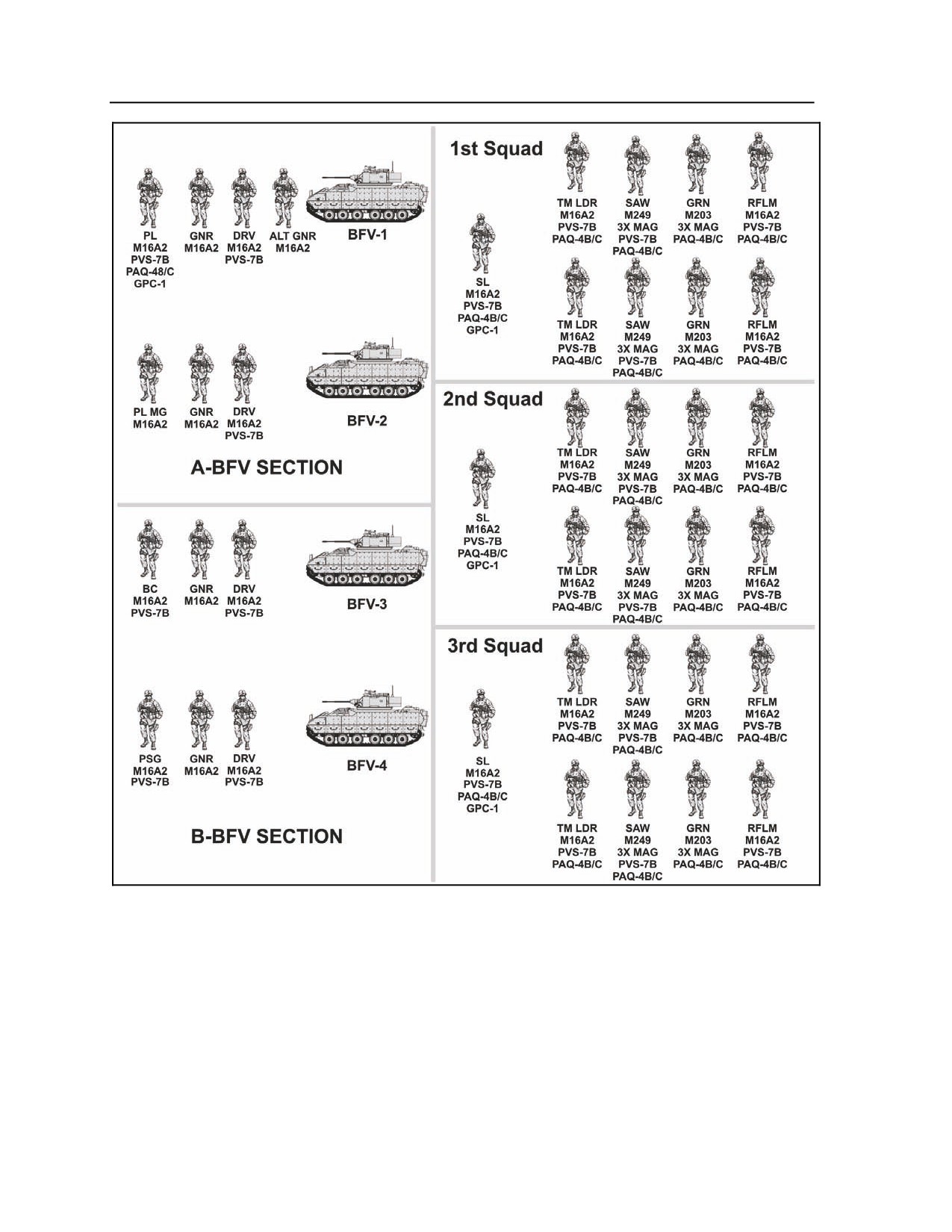
G-12. The mechanized infantry rifle platoon is equipped with four BFVs and can fight mounted or with
rifle squads on the ground. Figure G-1 illustrates the BFV-equipped mechanized infantry rifle platoon
organization. The platoon can fight as unified mutually supporting maneuver elements or as two distinct
maneuver elements—one mounted and one dismounted. The platoon must prepare to fight in a variety of
operational environments. Once the rifle squads have dismounted, the mounted element provides a base of
fire for the rifle squads as they close with and destroy the enemy.
28 March 2007
FM 3-21.8
G-3
Appendix G
Figure G-1. Bradley fighting vehicle platoon organization.
STRYKER BRIGADE COMBAT TEAM INFANTRY RIFLE PLATOON
AND SQUAD
G-13. The Army organized the Stryker brigade combat team (SBCT) in response to the need for a force that
can deploy rapidly as an "early responder" to a crisis area anywhere in the world.
CAPABILITIES
G-14. The platoon combines the effects of the Infantry squads, the weapons squad, and the direct fires from
the Infantry carrier vehicle (ICV). This includes Javelin fire-and-forget antitank missile fires. Protection is
G-4
FM 3-21.8
28 March 2007
Other Small Unit Organizations
afforded by the vehicle and the ability of the vehicle to protect the infantrymen from small-arms fire and
fragmentation before dismounting. The SBCT infantry platoon equipped with the ICV can—
Use the mobility of the ICV to transport the infantry squads to a position of advantage under the
protection of the vehicle.
Operate in a mounted or dismounted role.
Destroy light armor vehicles and personnel using direct fire.
Employ fires from the vehicle to destroy, suppress, or fix personnel and light infantry fighting
vehicles.
Destroy tanks and fighting vehicles with CCMS fires out to 2,000 meters (Javelin).
Block dismounted avenues of approach.
Protect obstacles and prevent enemy breaching operations.
Establish strong points to deny the enemy key terrain or flank positions.
Conduct assault breaches of obstacles.
Clear danger areas and prepare positions for mounted elements.
Assault enemy positions.
Augment the ICV, mobile gun system (MGS), and tank antiarmor fires.
Move over terrain not trafficable by other wheeled vehicles with the infantry squads.
Infiltrate enemy positions.
Conduct mounted or dismounted patrols and operations in support of security operations.
Conduct air assault operations.
Limitations
G-15. The ICV-equipped infantry platoon has the following limitations:
Platoon ICVs are vulnerable to enemy antiarmor fires.
Platoon infantry squads are vulnerable to small arms and indirect fires.
The pace of dismounted offensive operations is limited to the foot speed of the infantryman.
The ICV poses a variety of difficulties in water-crossing operations, including the requirement
for either adequate fording sites or a bridge with sufficient weight classification.
A Soldier's load increases as a result of additional digital equipment and increased battery
requirements.
Inherent in a situation as an "early responder" is the difficulty in obtaining supplies for ongoing
operations, especially with long lines of communication
(LOC) and resupply in an
underdeveloped area of operation. This situation is compounded because the unit may operate
forward of the debarkation point and with threats to the LOCs, the routes may not be secure.
ORGANIZATION
G-16. The SBCT Infantry platoon has three elements: the platoon headquarters (Figure G-2), the mounted
element, and the infantry squad element. The SBCT Infantry platoon is equipped with four ICVs. The ICV
is a fully mobile system capable of operating in conjunction with infantry and other elements of the
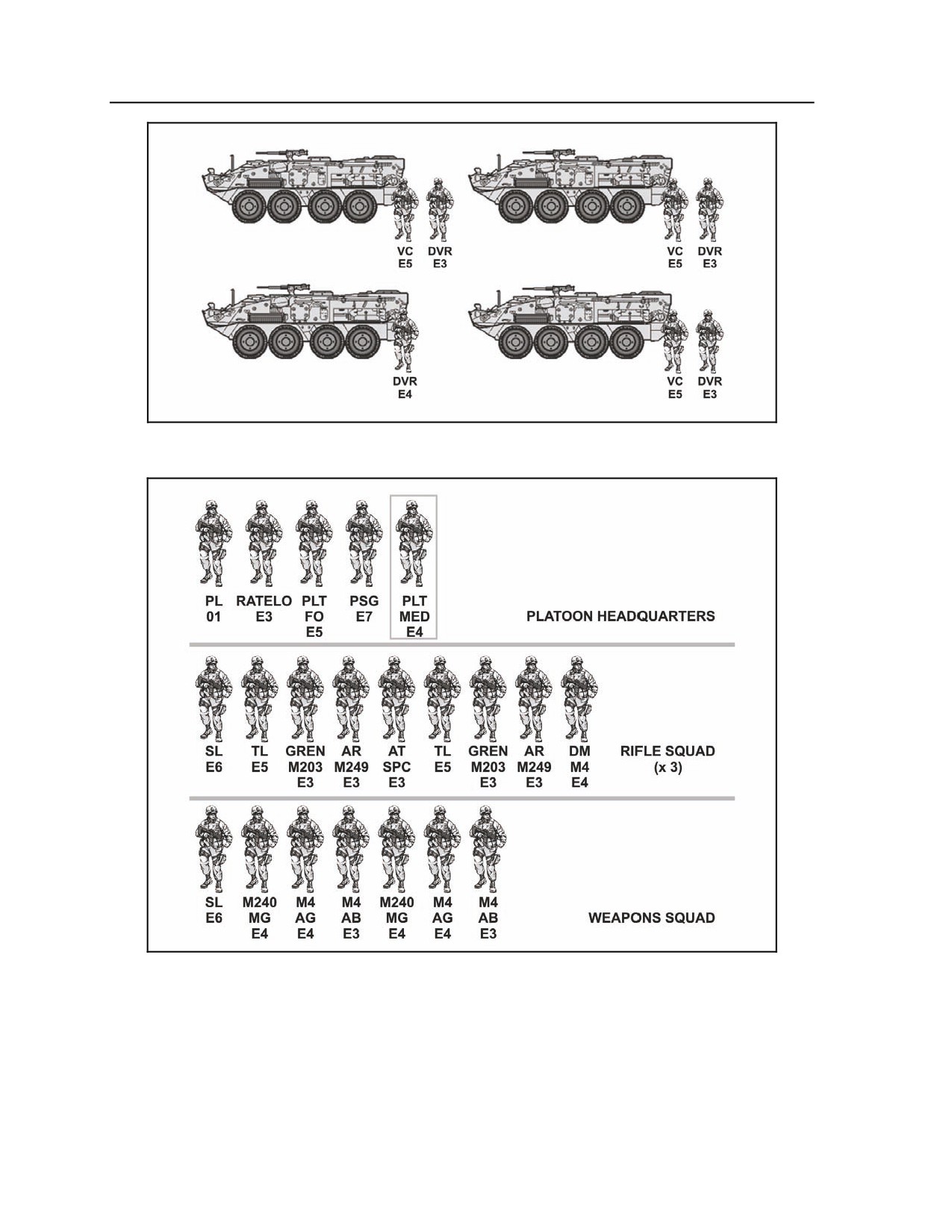
combined arms team. Each ICV has a vehicle commander (VC) and driver that operate the vehicle (Figure
G-2). The PSG or a senior squad leader is included in the mounted section as the fourth VC and serves as
one of the section leaders. The dismounted element (Figure G-3) consists of the platoon headquarters, three
rifle squads, and a weapons squad.
28 March 2007
FM 3-21.8
G-5
Appendix G
Figure G-2. Mounted element organization.
Figure G-3. Dismounted element organization.
PLATOON FORWARD OBSERVER DUTIES AND RESPONSIBILITIES
G-17. As the platoon’s fire support representative, the primary duty of the FO is to locate targets and call
for and adjust indirect fire support. Additional responsibilities include the following:
Refine or submit key targets for inclusion in the company fire plan.
Prepare, maintain, and use situation maps.
G-6
FM 3-21.8
28 March 2007
Other Small Unit Organizations
Establish and maintain communications with company FIST.
Advise the platoon leader as to the capabilities and limitations of available indirect fire support.
Report battlefield intelligence.
Laser designate targets when required.
MANEUVER COMPANY FIRE SUPPORT TEAM (FIST) FIRE
REQUEST CHANNELS
G-18. The FIST serves as the net control system (NCS) on the company fire support net. The FIST relays
the call for fire to supporting artillery on a digital net or sends the fire mission to the mortar platoon or
section. The command net allows the FIST to monitor unit operations. It links the FIST to the commander
and platoon leaders for planning and coordination. This net is also an alternate means the platoon leader
can use to contact the company commander when primary means fail.
Quick Fire Channel
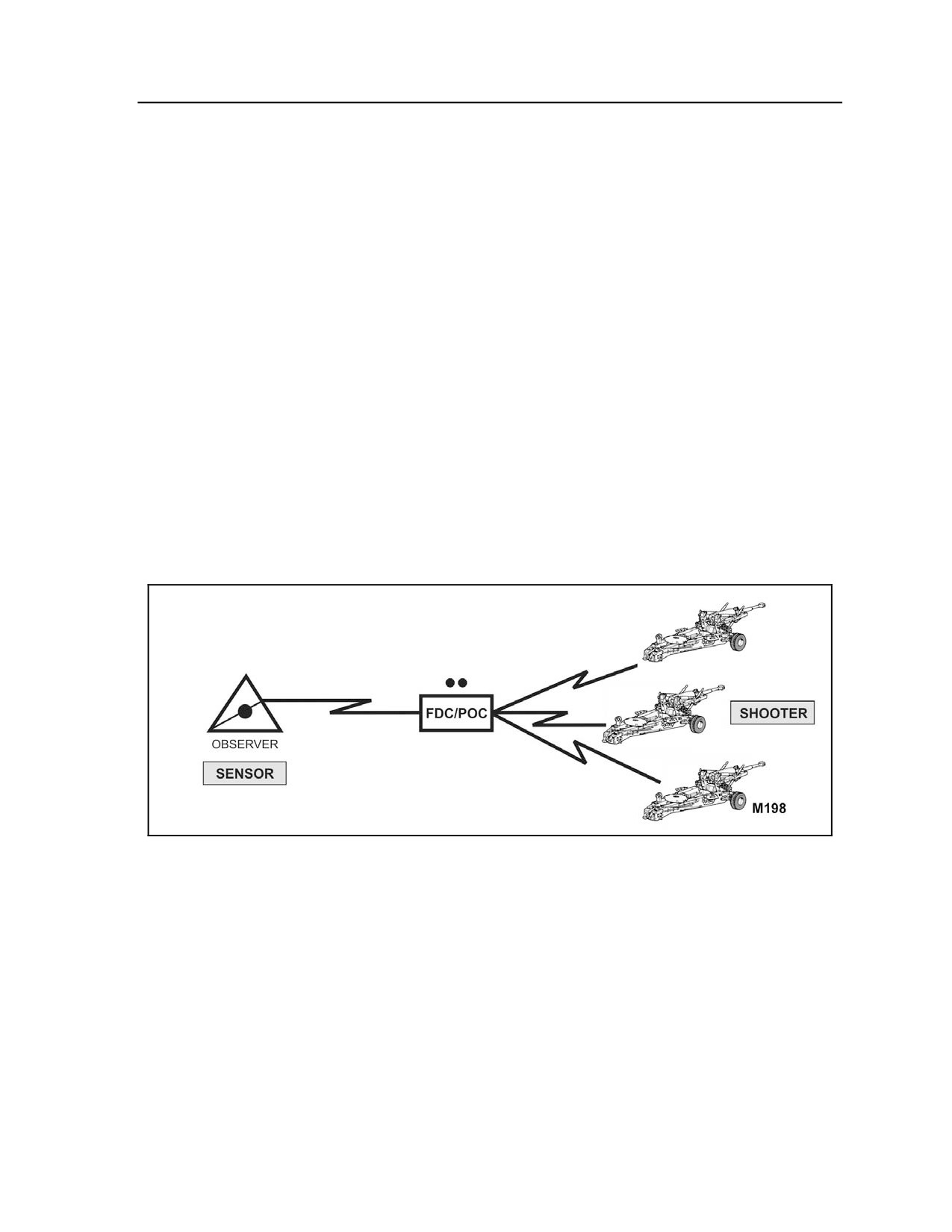
G-19. A quick fire channel is established to directly link an observer (or other target executor) with a
weapon system (Figure G-4). Quick fire channels may be either voice or digital nets. Within a maneuver
brigade, quick fire channels are normally established on FA or mortar nets. These channels are designed to
expedite calls for fire against high profile targets (HPTs) or to trigger preplanned fires. Quick fire channels
may also be used to execute fires for critical operations or phases of the battle. Examples include linking a
combat observation and laser team (COLT) with a battery or platoon FDC for counter reconnaissance fires
or an AN-TPQ-37 radar with the multiple launch rocket system (MLRS) battery FDC for counterfires.
Copperhead missions can best be executed by using quick fire channels.
Figure G-4. Quick fire channel illustrating sensor-to-shooter link.
COMBAT ENGINEER SUPPORT
G-20. The light engineer organization is tailored to fight as part of the combined arms team in the Infantry.
It focuses on mobility and provides limited countermobility and survivability engineer support. A light
engineer unit can be task-organized to provide the necessary engineer functions to fight the battle.
ENGINEER PLATOON
G-21. An engineer platoon may be task-organized to a battalion or company based on the higher
commander’s analysis of METT-TC. The engineer platoon can be employed to accomplish most engineer
missions. However they may require external support for them to conduct continuous operations for more
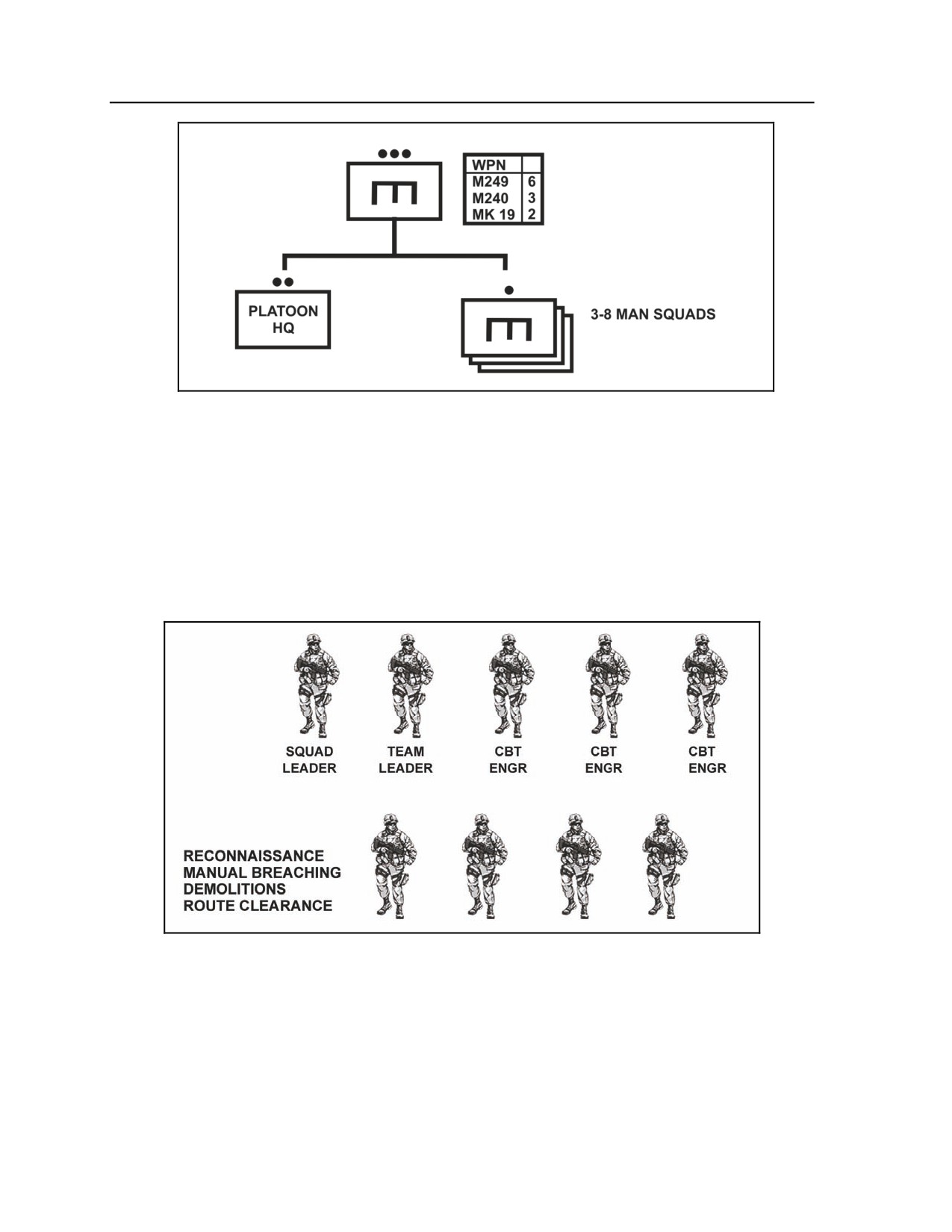
than 48 hours. Figure G-5 shows an example of an engineer platoon.
28 March 2007
FM 3-21.8
G-7
Appendix G
Figure G-5. Engineer platoon.
SAPPER SQUAD
G-22. A sapper squad may be task-organized to a company and executes engineer tasks to support the
company mission. Task organization is based on the battalion commander’s analysis of METT-TC. The
squad is the smallest engineer element that can be employed with its own organic C2 assets. Therefore, it
can accomplish tasks such as reconnaissance, manual breaching, demolitions, or route clearance as part of a
platoon or company mission. Depending on METT-TC, the engineer may receive augmentation of engineer
equipment such as a small earth excavator (SEE) or other specialized engineer equipment. Figure G-6
shows an example of a sapper squad.
Figure G-6. Sapper squad.
CAPABILITIES AND MISSIONS
G-23. The mission of engineers corresponds to those missions normally conducted by Infantry units.
Engineer units can operate in restricted terrain such as forests, jungles, mountains, and urban areas.
Because of their austere nature, once they are employed, light engineers have the same tactical mobility as
the Infantry. To compensate for this, they train to operate in a decentralized manner. Like their supported
maneuver force, they operate best under conditions of limited visibility.
G-8
FM 3-21.8
28 March 2007

Other Small Unit Organizations
Capabilities
G-24. The engineer’s focus is mobility. They are experts in supporting infiltrations, air assaults, parachute
assaults, ambushes, and raids. In this role, the engineer may conduct covert breaches, route reconnaissance,
and obstacle reduction. He may also identify potential enemy counterattack routes and establish
countermobility measures such as using scatterable mines (SCATMINEs) to protect the force. Engineers
train in Infantry skills and are able to move undetected when close to the enemy.
Missions
G-25. Engineer missions fit into one of three categories: mobility, countermobility, and survivability.
Table G-1 shows the tasks included in each of these categories. Depending on METT-TC, an engineer
platoon or squad might be attached to a company. Engineers conduct reconnaissance, evaluate obstacles,
and use demolitions and field expedients.
Table G-1. Engineer missions.
MOBILITY
COUNTERMOBILITY
SURVIVABILITY
Breach obstacles.
Construct obstacles to
Construct crew-served
Clear minefields.
turn, fix, block, or disrupt
weapons and vehicle
Clear routes.
enemy forces.
fighting positions.
Cross gaps expediently.
Construct combat roads or
trails.
SURVIVABILITY
G-26. Engineer units may also be employed in survivability operations to assist in protecting friendly units
by helping to prepare areas such as defensive positions. They may employ their blades to help prepare
positions for systems such as mortars, C2, and key weapons. Units should prepare their areas for the arrival
of the blades by marking the positions, identifying leaders to supervise position construction, and
designating guides for the blade movement between positions.
G-27. Engineer units might employ a small earth excavator to aid in position construction. A SEE has a
backhoe, bucket loader, handled hydraulic rock drill, chain saw, and pavement breaker. The SEE can dig
positions for individual, crew-served, and AT weapons or for Stinger missile teams. It can also be
employed to dig in ammunition pre-stock positions.
AIR AND MISSLE DEFENSE
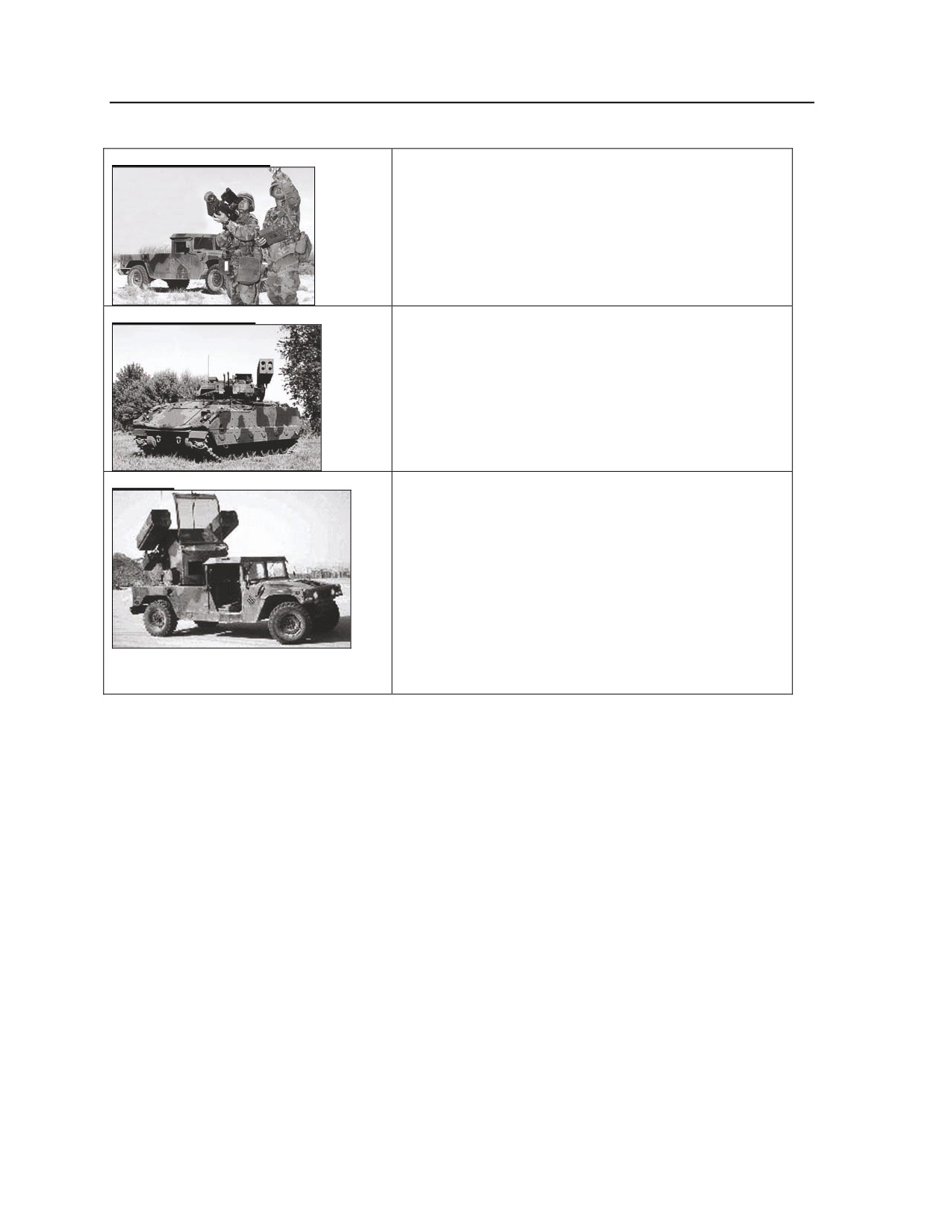
G-28. Air defense systems that may operate in and adjacent to the Infantry platoon AO are the Avenger,
man-portable air defense systems (MANPADS), and Linebacker (Table G-2). All systems can operate as
MANPADS Stinger teams. Although other short-range air defense (SHORAD) systems support divisional
units, the Infantry platoon is most likely to be supported by the Avenger or a MANPADS Stinger team. The
Stinger is also fired from the Avenger and is designed to counter high-performance, low-level, ground
attack aircraft; helicopters; and observation and transport aircraft.
28 March 2007
FM 3-21.8
G-9
Appendix G
Table G-2. Air defense systems.
Man-Portable System
Personnel: 2-man crew
Basic load: 6 missiles with M998 HMMWV
Acquisition/range: Visual
Engagement range: 5 km
Engagement altitude: 3 km+
Mutual support: 2 km+
Bradley Linebacker
Personnel: 4-man crew
Basic load: 10 missiles (4 ready to fire, 6 stowed)
Acquisition/range: Visual/thermal
Engagement range: 5 km (Stinger); 2,500-m 25-mm;
900-m coax
Engagement altitude: 3 km+
Mutual support: 3 km
Emplacement time: Fire on the move
Reload time: 4 minutes
Avenger
Personnel: 2-man crew
Basic load: 8 ready-to-fire missiles, 250 rounds .50 cal
Acquisition/range: Visual/FLIR
9-10 km, laser range
finder
Engagement range: 5 km+, .50 cal range: 1,800 m
Rate of fire: 1,025 rpm
Engagement altitude: 3 km+
Mutual support: 3 km
Emplacement time: 6 minutes, can remote operations
out to 50 meters
AVENGER AND MANPADS STINGERS
G-29. The Avenger’s combined arms mission is to provide protection to combat forces and other critical
assets from attack. The Avenger is designed to counter hostile cruise missiles, unmanned aircraft systems,
low-flying, high-speed, fixed-wing aircraft, and helicopters attacking or transiting friendly airspace. The
Avenger provides the battalions with highly mobile dedicated air defense firepower. It is equipped with two
standard vehicle-mounted launchers (SVMLs). Each carries four Stinger missiles. The Avenger has the
following capabilities:
A modified fire control subsystem and SVMLs that allow the Avenger to shoot on the move.
An unobstructed, 360-degree field of fire that can engage at elevations between -10 and +70
degrees.
A .50 cal machine gun that affords a measure of self-protection by providing additional coverage
of the Stinger missile’s inner launch boundary.
A sensor package (forward-looking infrared radar [FLIR], carbon dioxide, eye-safe laser range
finder, and a video autotracker) that provides target acquisition capability in battlefield
obscuration at night and in adverse weather.
Two-man crew can remain in the vehicle or remotely control the platform from a separate
fighting position.
Shoot-on-the-move and slew-to-cue capability.
System maintains dismounted Stinger missile capability in event of launcher system damage,
failure, or static mode.
G-10
FM 3-21.8
28 March 2007
Other Small Unit Organizations
G-30. The MANPADS Stinger Missile System employs a two-man crew that consists of a crew chief and
a gunner. The MANPADS team normally has assigned transportation. Unit leaders must carefully consider
the consequences before separating a Stinger team from its vehicle. Stinger teams operating away from
their vehicles are limited in their ability to haul extra missiles to their firing point.
EARLY WARNING ALERTS
G-31. If SHORAD units are operating in the area, the platoon may receive early warning alerts from its
elements. The SHORAD radar teams can broadcast an early warning of enemy air activity that will filter
down to the platoon via the brigade, battalion, and company command nets. If METT-TC factors permit,
the SHORAD platoon provides voice early warning directly to the battalions.
EMPLOYMENT OF AIR DEFENSE SYSTEMS
G-32. In offensive situations, air defense elements accompany the main attack. They may maneuver with
the battalion’s lead companies orienting on low-altitude air avenues of approach. When the unit is moving
or in a situation that requires short halts, air defense elements should remain within the platoon’s organic
weapons systems maximum ranges to assure mutual support. The Stinger gunners (MANPADS) can
dismount to provide air defense when the unit reaches the objective or pauses during the attack. In the
defense, air defense elements may establish BPs based on available intelligence preparation of the
battlefield (IPB) information and the company commander’s scheme of maneuver.
Weapons Control Status
G-33. The weapons control status (WCS) describes the relative degree of control in effect for air defense
fires. It applies to all weapons systems. The WCS is dictated in the battalion OPORD and may be updated
based on the situation. The three levels of control are:
Weapons Free. Crews can fire at any air target not positively identified as friendly. This is the
least restrictive WCS level.
Weapons Tight. Crews can fire only at air targets positively identified as hostile according to
the prevailing hostile criteria.
Weapons Hold. Crews are prohibited from firing except in self-defense or in response to a
formal order. This is the most restrictive control status level.
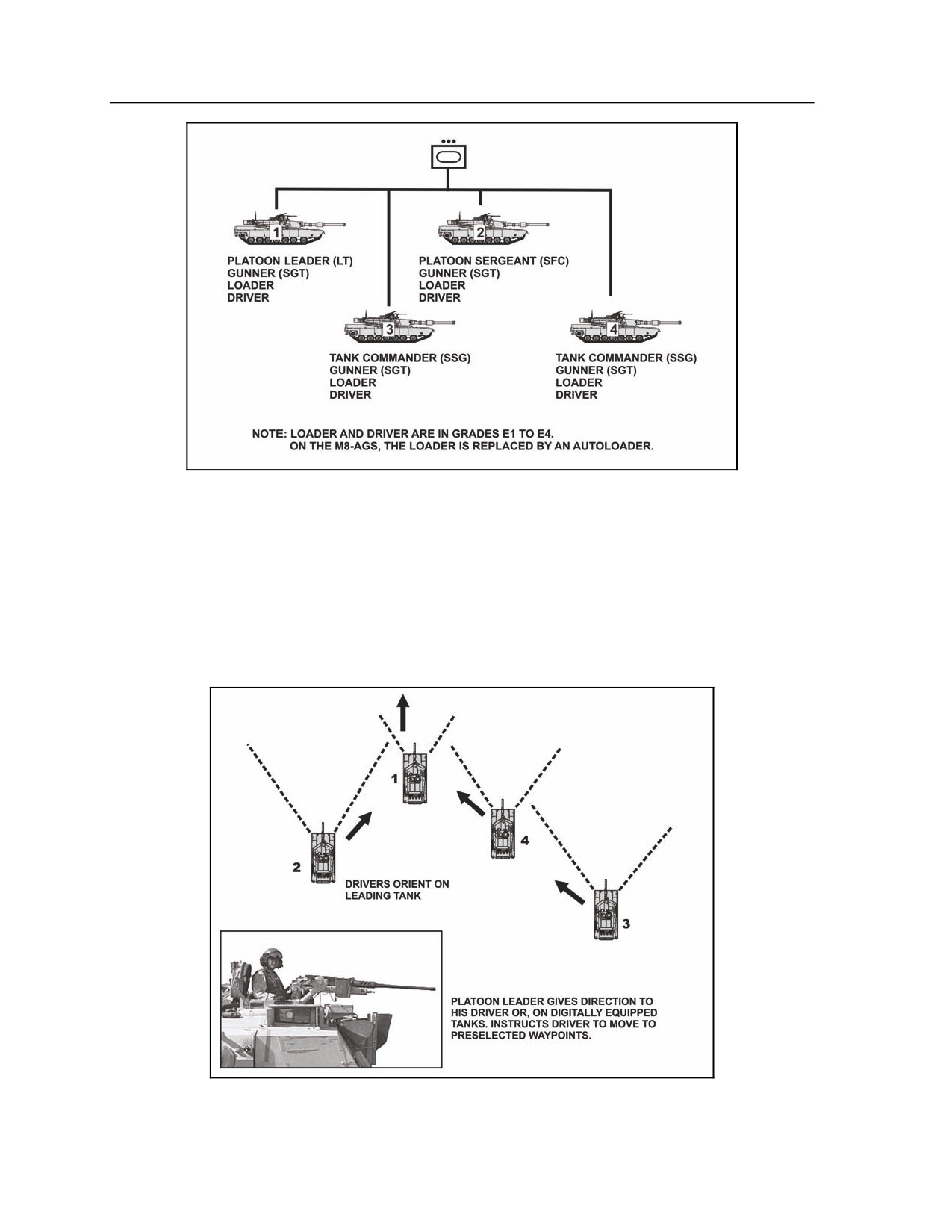
TANK PLATOON
G-34. The tank platoon is the smallest maneuver element within a tank company. Organized to fight as a
unified element, the platoon consists of four main battle tanks organized into two sections. The platoon
leader (Tank 1) and platoon sergeant (Tank 4) are the section leaders. Tank 2 is the wingman in the platoon
leader's section; Tank 3 is the wingman in the platoon sergeant's section (Figure G-7).
28 March 2007
FM 3-21.8
G-11
Appendix G
Figure G-7. Tank platoon organization.
G-35. The tank platoon is organic to tank companies and armored cavalry troops. The platoon may be
cross-attached to a number of organizations, commonly a mechanized infantry company, to create company
teams. It may also be placed under operational control (OPCON) of a light infantry battalion.
G-36. Under battlefield conditions, the wingman concept facilitates control of the platoon when it operates
in sections. The concept requires that one tank orient on another tank on either its left or right side. In the
absence of specific instructions, wingmen move, stop, and shoot when their leaders do. In the tank platoon,
Tank 2 orients on the platoon leader's tank, while Tank 3 orients on the platoon sergeant's tank. The platoon
sergeant (PSG) orients on the platoon leader's tank (Figure G-8).
Figure G-8. The tank wingman concept.
G-12
FM 3-21.8
28 March 2007
Appendix H
Security
Security is the measures taken by the platoon to protect it against all acts designed to
impair its effectiveness. Security measures are an inherent aspect of all military
operations and can be moving or stationary.
SECTION I — SECURITY FUNDAMENTALS
H-1. Infantry platoons conduct local security measures. They may also be tasked to provide security
measures for larger units (called the main body). Measures include screen, guard, cover, and area security.
These tasks are executed in the larger unit’s security zone (front, flank, or rear of the main body). The
application of these security measures is founded on the enduring doctrine found in FM 22-6, Guard Duty.
Leaders given these tasks or participating in the task of a larger unit must, at a minimum, understand their
engagement criteria and whether or not to become decisively engaged.
Local security consists of low-level security operations conducted near a unit to prevent
surprise by the enemy (FM 1-02). Local security measures are the same as those outlined for
exterior guards in FM 22-6.
Screen is a form of security operations that primarily provides early warning to the protected
force. (FM 1-02) A screen consists of a combination of observation posts and security patrols.
Guard is a term with a dual meaning; the difference is the size element referred to. When used
to refer to individuals, a guard is the individual responsible to keep watch over, protect, shield,
defend, warn, or any duties prescribed by general orders and/or special orders. Guards are also
referred to as a sentinels, sentries, or lookouts (FM 22-6). When used in reference to units, a
guard is a tactical mission task where the guard force protects the main body by fighting to gain
time while observing and preventing the enemy’s observation and direct fire against the main
body. (FM 1-02) Units conducting a guard mission cannot operate independently because they
rely upon the fires and warfighting functions of the main body. Guards consist of a combination
of OPs, battle positions, combat patrols, reconnaissance patrols, and movement to contact for
force protection.
Cover is a form of security operations with the primary task is to protect the main body. This is
executed by fighting to gain time while also observing and preventing the enemy’s ground
observation and direct fire against the main body. (FM 1-02) Ordinarily only battalion -sized
element and larger have the assets necessary to conduct this type of security operation.
Area security is a form of security operations conducted to protect friendly forces, installations,
routes, and actions within a specific area. (FM 1-02) During conventional operations (major
theater of war scenarios) area security refers the security measures used in friendly controlled
areas. Many of the tasks traditionally associated with stability operations and small scale
contingencies fall within the scope of area security. These include road blocks, traffic control
points, route security, convoy security, and searches.
H-2. The screen, guard, and cover are the security measures used primarily by battalion-sized units to
secure themselves from conventional enemy units. These measures, respectively, contain increasing levels
of combat power and provide increasing levels of security for the main body. Along with the increase of
combat power, there is an increase in the unit’s requirement to fight for time, space, and information on the
enemy. Conceptually, the measures serve the same purpose as the local security measures by smaller units.
For example, a battalion will employ a screen for early warning while a platoon will emplace an OP. The
purpose is the same—early warning—only the degree and scale of the measures are different.
H-3. Local and area security are related in that they both focus on the enemy threat within a specified area.
Again, the difference is one of degree and scale. Local security is concerned with protecting the unit from
28 March 2007
FM 3-21.8
H-1

Appendix H
enemy in the immediate area, whereas area security is concerned with enemy anywhere in the leader’s area
of operation (AO).
SECURITY FUNDAMENTALS
H-4. The techniques employed to secure a larger unit are generally the same as those of traditional
offensive and defensive operations. It is the application of those techniques that differ. Table H-1 lists the
most common techniques used, information required to execute the operation, and the principles used to
employ them.
Table H-1. Security fundamentals.
Principles of Security
Techniques Used to
Information Required from
Operations
Perform Security
Controlling Headquarters
Operations
• Observation post
• Trace of the security area (front, sides,
• Three General Orders
• Combat outpost
and rear boundaries), and initial
• Provide early and accurate
• Battle position
position within the area
warning
• Patrols
• Time security is to be established
• Provide reaction time and
• Combat formations
• Main body size and location
maneuver space
• Movement techniques
• Mission, purpose and commander’s
• Orient on the force / facility
• Infiltration
intent of the controlling headquarters
being secured
• Movement to contact
• Counterreconnaissance and
• Perform continuous
• Dismounted, mounted,
engagement criteria
reconnaissance
and air insertion
• Method of movement to occupy the
• Maintain enemy contact
• Roadblocks
area (zone reconnaissance,
infiltration, tactical road march,
• Checkpoints
movement to contact; mounted,
• Convoy and route security
dismounted, or air insertion)
• Searches
• Trigger for displacement and method
of control when displacing.
• Possible follow-on missions
H-2
FM 3-21.8
28 Mach 2007

Security
LOCAL SECURITY
A unit must be protected at all times from surprise. Exterior guards are
utilized to protect a unit from surprise and to give the unit time to prepare to counter
any threat. Guards must be alert for surprise by ground, airborne, and air attacks; to
provide early warning of chemical, biological, radiological, and nuclear (CBRN) attack
or contamination; and to protect supplies and supply installations. If the unit is
moving, security may vary from observation to the use of security patrols. During
short halts, guards, small security detachments, and forward patrols are used to
provide all-round security. For stationary positions in combat or hostile areas, unit
commanders use exterior guards to establish a surveillance system to operate day
and night throughout the unit area. The commander may use guards, listening posts,
observation posts, patrols, aerial observers, and any other available means. The
guards may have any number of special devices to assist them in performing their
duties. These may include CBRN detection devices, electronic detection devices,
infrared or other night vision devices, trip flares and antipersonnel mines,
noisemaking devices, or any other device to provide early warning to the guard and
unit.
Local Security—FM 22-6, Guard Duty. 17 September 1971.
H-5. Local security prevents a unit from being surprised and is an important part of maintaining the
initiative. Local security includes any local measure taken by units against enemy actions. It involves
avoiding detection by the enemy or deceiving the enemy about friendly positions and intentions. It also
includes finding any enemy forces in the immediate vicinity and knowing as much about their positions and
intentions as possible. The requirement for maintaining local security is an inherent part of all operations.
Table H-2 lists a sample of active and passive local security measures.
Table H-2. Active and passive security measures.
Active and Passive Security Measures
Active Measures
-Combat formations, movement techniques, movement to contact, spoiling
(moving)
attacks
- Moving as fast as conditions allow to prevent enemy detection and adaptation
- Skillful use of terrain
Active Measures
(stationary)
Outside the perimeter
- Observation posts, security patrols
- Battle positions, combat patrols, reconnaissance patrols
- Employing early warning devices
- Establishing roadblocks / checkpoints
Inside the perimeter
- Establishing access points (entrance and exits)
- Establishing the number and types of positions to be manned
- Establishing readiness control (REDCON) levels
- Designating a reserve / response force
- Establishing stand-to measures
Passive measures
-Camouflage, cover and concealment, and deception measures
(see appendix X)
- Signal security
- Noise and light discipline
SCREEN
H-6. A screen primarily provides early warning to the main body. A unit performing a screen observes,
identifies, and reports enemy actions. Screen is defensive in nature but not passive in execution. It is
employed to cover gaps between forces, exposed flanks, or the rear of stationary or moving forces.
28 March 2007
FM 3-21.8
H-3
Appendix H
Generally, a screening force fights only in self-defense. However, it may engage enemy reconnaissance
elements within its capability (counterreconnaissance). A screen provides the least amount of protection of
any security mission. It does not have the combat power to develop the situation. It is used when the
likelihood of enemy contact is remote, the expected enemy force is small, or the friendly main body needs
only a minimum amount of time once it is warned to react effectively
H-7. Screen tasks are to—
Provide early warning of threat approach.
Provide real-time information, reaction time, and maneuver space to the protected force.
Maintain contact with the main body and any security forces operating on its flanks.
Maintain continuous surveillance of all avenues of approach larger than a designated size
into the area under all visibility conditions.
Allow no enemy ground element to pass through the screen undetected and unreported.
Maintain contact with enemy forces and report any activity in the AO.
Destroy or repel all enemy reconnaissance patrols within its capabilities.
Impede and harass the enemy within its capabilities while displacing.
Locate the lead elements of each enemy advance guard and determine its disposition,
composition and strength, and capabilities.
Stationary Screen
H-8. When tasked to conduct a stationary screen (Figure H-1), the leader first determines likely avenues of
approach into the main body’s perimeter. The leader determines the location of potential OPs along these
avenues of approach. Ideally, the leader assigns OPs in depth if he has the assets available. If necessary, he
identifies additional control measures (such as threat named areas of interest [NAIs], phase lines, TRPs, or
checkpoints) to assist in controlling observation, tracking of the enemy, and movement of his own forces.
The unit conducts mounted and foot patrols to cover ground between OP that cannot be observed from
OPs. Once the enemy is detected from an OP, the screening force may engage him with indirect fires. This
prevents the enemy from penetrating the screen line and does not compromise the location of the OP. If
enemy pressure threatens the security of the screening force, the unit reports the situation to the controlling
headquarters and requests permission to displace to a subsequent screen line or follow-on mission.
H-4
FM 3-21.8
28 Mach 2007

Security
Figure H-1. Squad-sized stationary screen.
Moving Screen
H-9. Infantry platoons may conduct a moving screen to the flanks or rear of the main body force. The
movement of the screen is tied to time and distance factors associated with the movement of the friendly
main body.
H-10. Responsibilities for a moving flank screen begin at the front of the main body’s lead combat element
and end at the rear of the protected force. In conducting a moving flank screen, the unit either occupies a
series of temporary OPs along a designated screen line to overwatch the main body, or if the main body is
moving too fast, continues to move while maintaining surveillance. The screening force uses one or more
of the three basic movement techniques to control movement along the screened flank (traveling, traveling
overwatch, and bounding overwatch).
GUARD
H-11. A guard differs from a screen in that a guard force contains sufficient combat power to defeat, cause
the withdrawal of, or fix the lead elements of an enemy ground force before it can engage the main body
with direct fires. A guard force uses all means at its disposal, including decisive engagement, to prevent the
enemy from penetrating the security zone. It operates within the range of the main body’s indirect fire
weapons, deploying over a narrower front than a comparable-size screening force to permit concentrating
combat power. The three types of guard operations are: advance; flank; and rear guard.
H-12. Infantry platoons as part of a company can be assigned a guard mission conduct all of the measures
associated with a screen. Additionally, they —
Destroy the enemy advance guard.
Cause the enemy main body to deploy, and then report its disposition, composition and strength,
and capabilities.
28 March 2007
FM 3-21.8
H-5
Appendix H
AREA SECURITY
H-13. Area security is used by battalion-sized units and above to secure their area of operations (AO) from
smaller enemy units (special purpose forces, guerrillas).
H-14. During area security operations civilians will be present. Therefore, commanders must ensure
Soldiers understand the current ROE. However, leaders are always responsible for protecting their forces
and consider this responsibility when applying the rules of engagement. Restrictions on conducting
operations and using force must be clearly explained and understood by everyone. Soldiers must
understand that their actions, no matter how minor, may have far-reaching positive or negative effects.
They must realize that both friendly or hostile media and psychological operations organizations can
quickly exploit their actions, especially the manner in which they treat the civilian population.
H-15. Leaders executing area security measures in a densely populated area must carefully assess the effect
of imposing a degree of control on both traffic and pedestrians. For instance, during the rush hour period,
however efficient the traffic control point (TCP), a crowd of impatient civilians or cars and trucks can
quickly build-up and precipitate the very situation that the TCP leader is trying to avoid.
H-16. Population and resource control operations will cause inconvenience and disruption to all aspects of
community life. Therefore, it is important that members of the civil community appreciate the purpose of
such operations. In particular, they must understand that the control measures are protective and not
punitive. All personnel involved in operations designed to ensure security must be thoroughly conversant
with their duties and responsibilities. They must be able to work quickly and methodically to prevent delay
and disruption to legitimate activities. They must also work to avoid unnecessary damage to personnel,
vehicles, and property. To achieve their purpose they must be thorough. Leaders, at all levels, must ensure
that adequate security is in place to counter all assessed risks.
SECTION III — OBSERVATION POSTS
H-17. The OP, the primary means of maintaining surveillance of an assigned avenue or NAI, is a position
from where units observe the enemy and direct and adjust indirect fires against him. From the OP, Infantry
platoons send SALUTE reports to their controlling headquarters when observing enemy activity.
TYPES OF OPS
H-18. OPs can be executed either mounted or dismounted. As they are complementary, if possible they
should be used in combination.
H-19. The main advantage of a dismounted OP is that it provides maximum stealth hopefully preventing
the enemy from detecting it. The two main disadvantages are that it has limited flexibility, taking time to
displace and limited firepower to protect itself if detected.
H-20. The main advantages of a mounted OP are the flexibility that comes from vehicle mobility as well as
the additional combat power resident in the vehicle’s optics, communications, weapons, and protection.
The main disadvantage is that vehicles are inherently easier to detect and can prevent the unit from
accomplishing its mission.
POSITIONING OF OPS
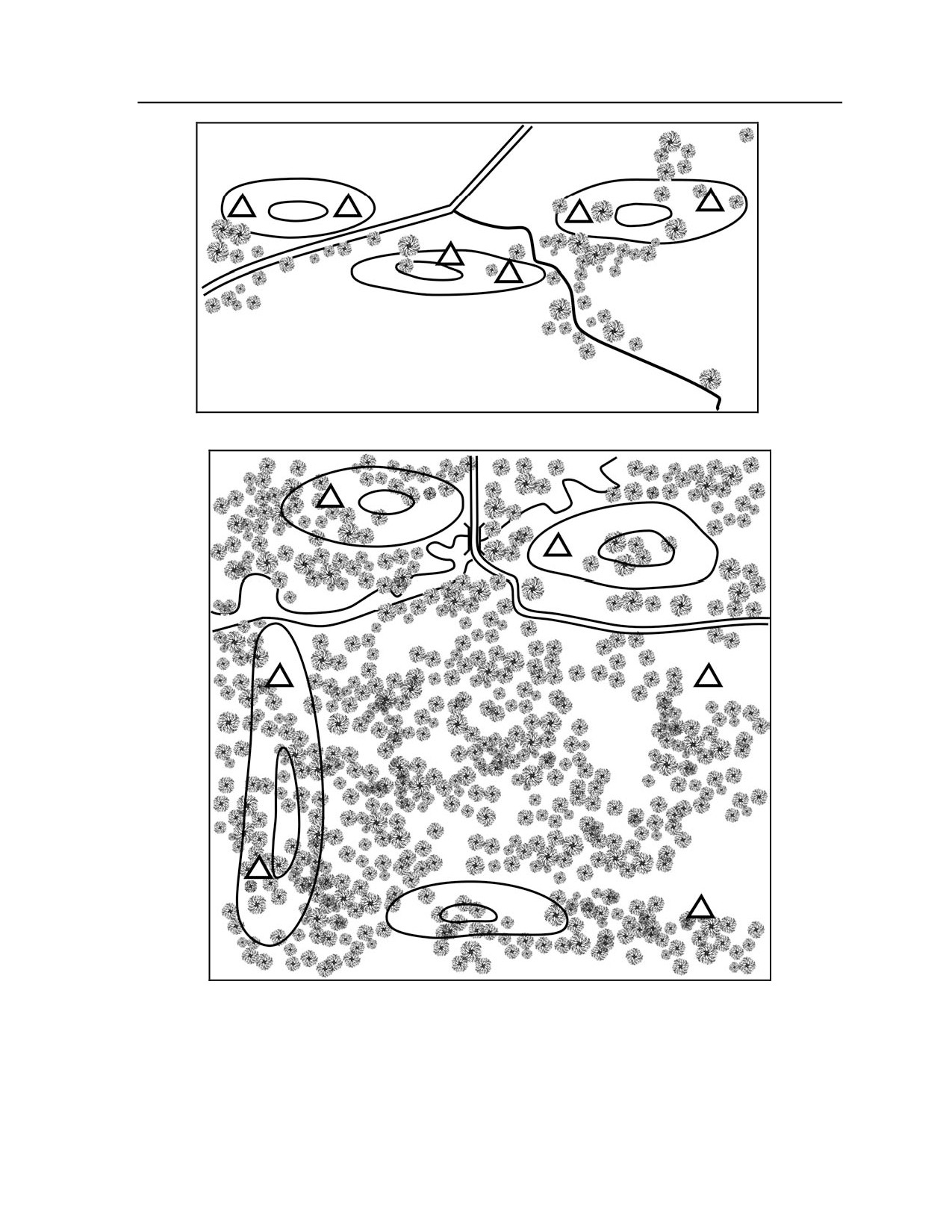
H-21. Based on the specific METT-TC, leaders may array OPs linearly or in depth (Figures H-2 and H-3).
Depth is the preferred technique for maintaining contact with a moving enemy along a particular avenue of
approach. Linear placement is optimal when there is no clear avenue of approach or the enemy is not
moving.
H-6
FM 3-21.8
28 Mach 2007
Security
Figure H-2. Linear positioning of OPs.
Figure H-3. In-depth positioning of OPs.
SELECTING AND SECURING THE OP
H-22. Based on guidance from the controlling headquarters, the leader selects the general location for the
unit’s OPs after conducting METT-TC analysis. From his analysis, he determines how many OPs he must
establish. He also decides where they must be positioned to allow long-range observation along the avenues
28 March 2007
FM 3-21.8
H-7
Appendix H
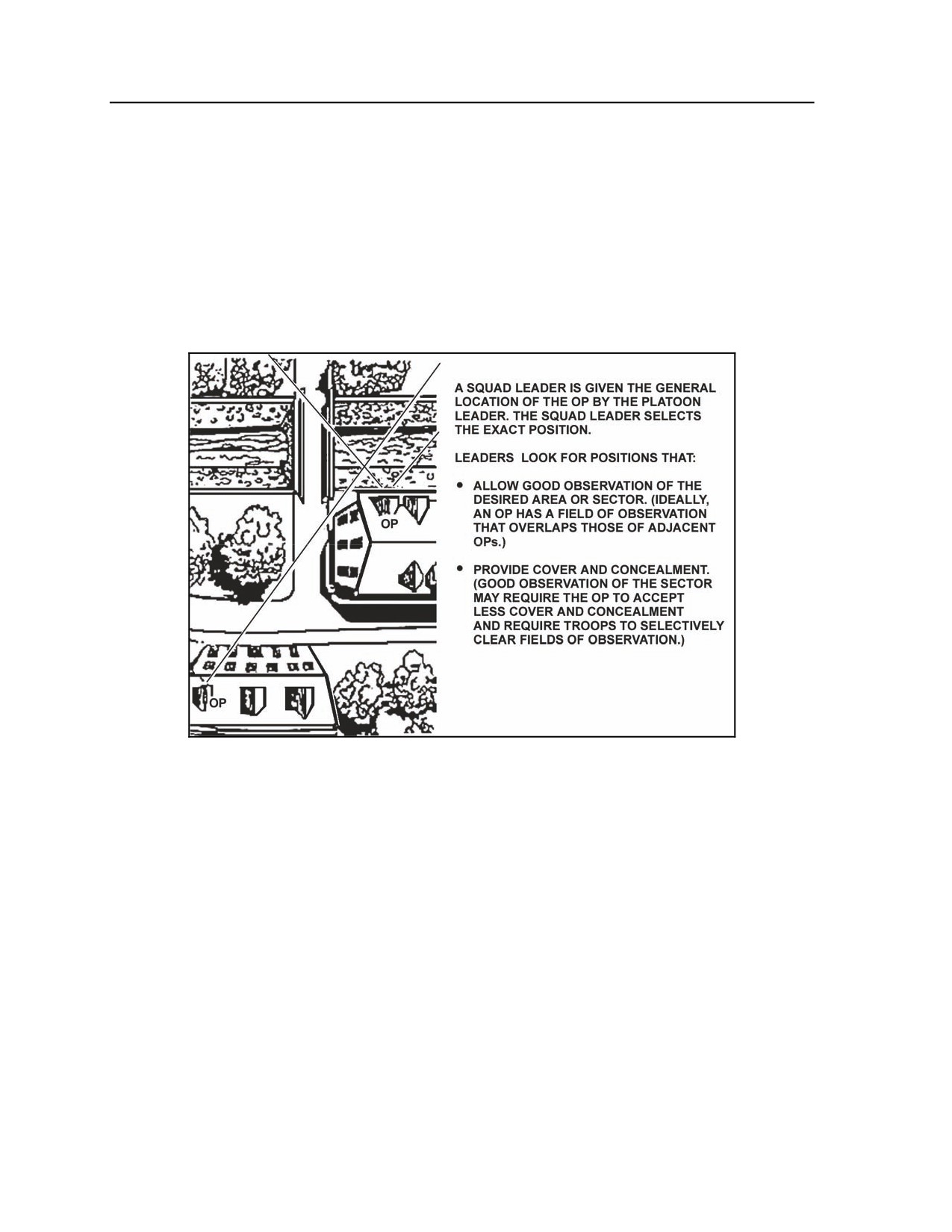
of approach assigned and to provide depth through the sector. Leaders assigned a specific OP select its
exact position when they get on the actual ground. See Figure H-4 for example of OP selection in urban
terrain. OPs should have the following characteristics:
Covered and concealed routes to and from the OP. Soldiers must be able to enter and leave their
OP without being seen by the enemy.
Unobstructed observation of the assigned area or sector. Ideally, the fields of observation of
adjacent OPs overlap to ensure full coverage of the sector.
Effective cover and concealment. Leaders select positions with cover and concealment to reduce
their vulnerability on the battlefield. Leaders may need to pass up a position with favorable
observation capability but with no cover and concealment to select a position that affords better
survivability. This position should not attract any attention or skyline the observer.
Figure H-4. Selection of OP location.
OP SECURITY
H-23. Small teams are extremely vulnerable in an OP. Their best self-defense is not to be seen, heard, or
otherwise detected by the enemy. They employ active and passive local security measures.
OCCUPYING THE OP
H-24. The leader selects an appropriate technique to move to the observation post or screen line based on
his analysis of METT-TC. (Infiltration, zone reconnaissance, movement to contact [mounted, dismounted,
or air insertion], using traveling, traveling overwatch, or bounding overwatch.)
MANNING AND EQUIPMENT AT THE OP
H-25. At least two Soldiers are required to operate an OP. One man establishing security, recording
information, and reporting to higher while the other observes. These men switch jobs every 20-30 minutes
because the efficiency of the observer decreases with time. Three or more Soldiers are required to increase
H-8
FM 3-21.8
28 Mach 2007
Security
security. For extended periods of time (12 hours or more), the unit occupies long-duration OPs by squad-
sized units. Essential equipment for the OP includes the following:
Map of the area.
Compass / GPS.
Communications equipment.
Observation devices (binoculars, observation telescope, thermal sights, and/or night vision
devices).
SOI extract.
Report formats contained in the SOP.
Weapons.
Protective obstacles and early warning devices.
Camouflage, cover and concealment, and deception equipment as required.
DRAWING A OP SECTOR SKETCH
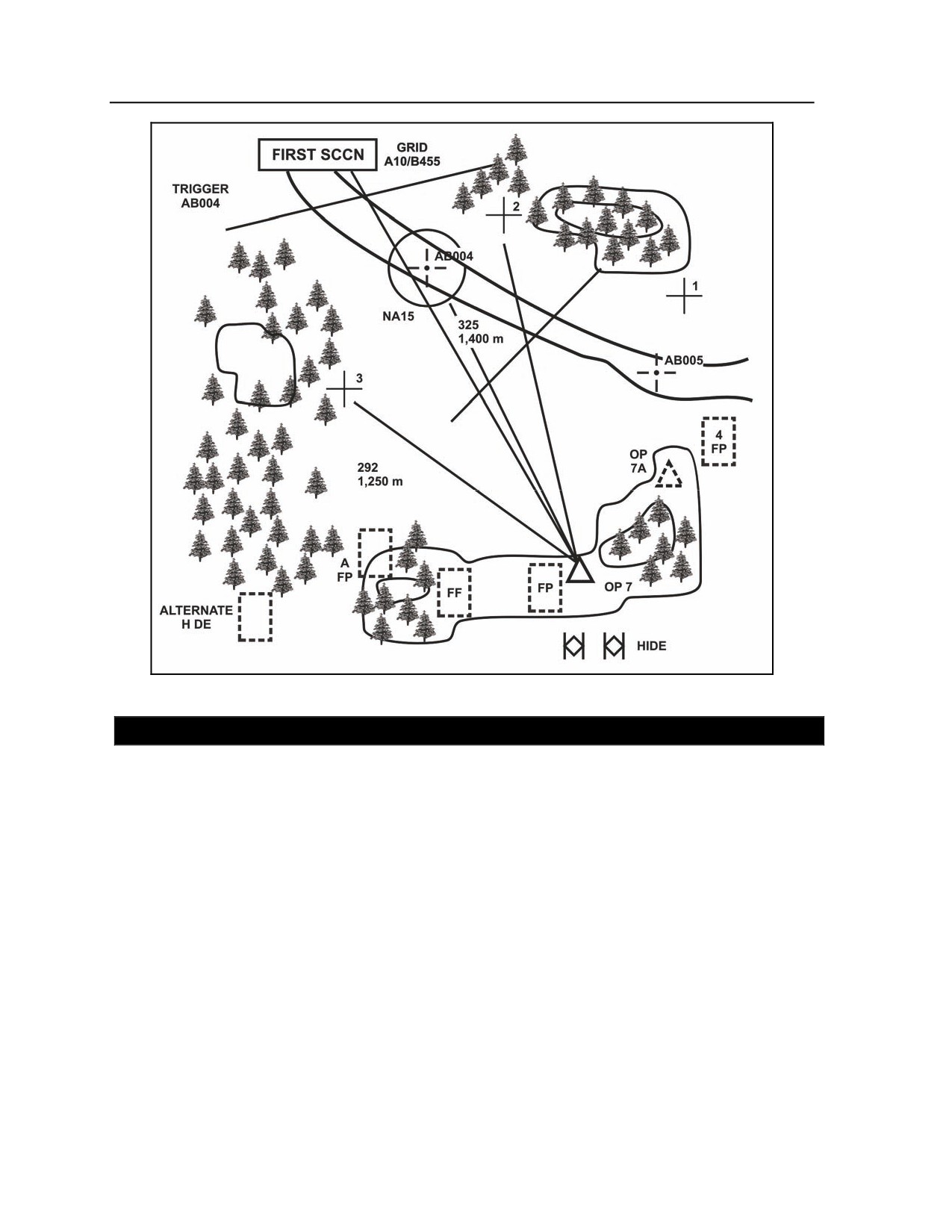
H-26. Once the leader has established the OP he prepares a sector sketch. This sketch is similar to a
fighting position sketch but with some important differences. Figure H-5 shows an example OP sector
sketch. At a minimum, the sketch should include:
A rough sketch of key and significant terrain.
The location of the OP.
The location of the hide position.
The location of vehicle fighting and observation positions.
Alternate positions (hide, fighting, observation).
Routes to the OP and fighting positions.
Sectors of observation.
Direct and indirect fire control measures.
28 March 2007
FM 3-21.8
H-9
Appendix H
Figure H-5. Example OP sector sketch.
SECTION IV — TRAFFIC CONTROL POINTS (CHECKPOINTS)
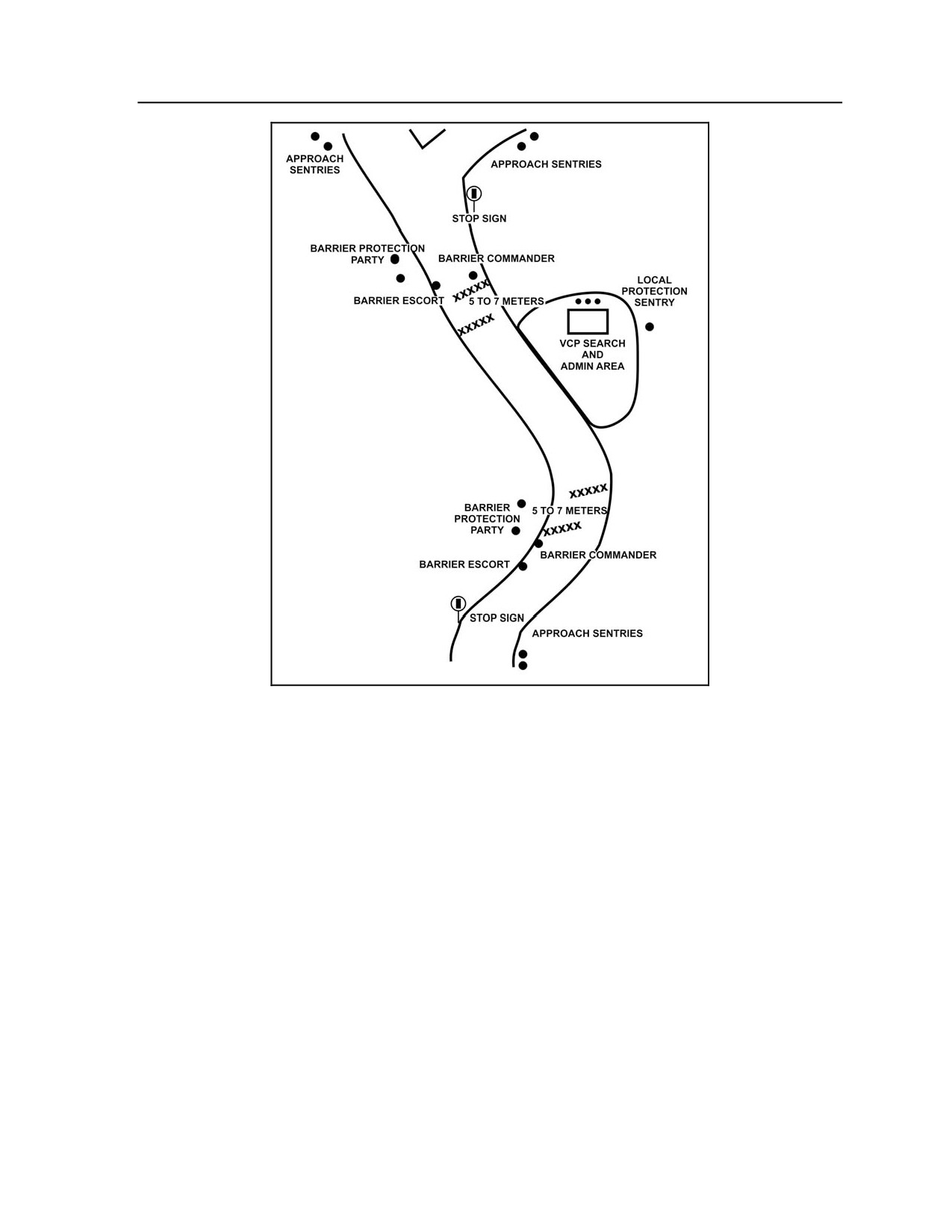
H-27. Checkpoint (CP): As defined by FM 1-02 is a place where military police check vehicular or
pedestrian traffic in order to enforce circulation control measures and other laws, orders, and regulations.
The CP is primarily a military police task; however, while conducting area security, Infantry platoons are
frequently employed to establish and operate CPs (Figure H-6).
H-28. Although similar, the CP should not to be confused with a roadblock or blocking position.
Roadblocks are designed to prevent all access to a certain area by both wheeled and pedestrian traffic for a
variety of purposes. The CP should also not be confused with an OP which is established to collect
information.
H-29. When conducting checkpoint operations, Soldiers need the following support:
Linguists that are familiar with the local language and understand English.
HN police or a civil affairs officer.
Wire / Sandbags.
Signs to reduce misunderstandings and confusion on the part of the local populace
Lighting.
Communications equipment.
Handheld translation devices.
H-10
FM 3-21.8
28 Mach 2007
Security
Figure H-6. Example check-point sketch.
TYPES OF CPS
H-30. There are two types of CPs: deliberate; and hasty.
DELIBERATE CP
H-31. A deliberate CP is permanent or semi-permanent. It is established to control the movement of
vehicles and pedestrians, and to help maintain law and order. They are typically constructed and employed
to protect an operating base or well-established roads. Like defensive positions, deliberate CPs should be
continuously improved. Deliberate CPs—
Control all vehicles and pedestrian traffic so crowds cannot assemble, known offenders or
suspected enemy personnel can be arrested, curfews can be enforced, deter illegal movement,
prevent the movement of supplies to the enemy, and deny the enemy contact with the local
inhabitants.
Dominate the area of responsibility around the CP. This includes maintaining law and order by
local patrolling to prevent damage to property or injury to persons.
Collect information.
28 March 2007
FM 3-21.8
H-11
Appendix H
HASTY CP
H-32. A hasty CP differs from a deliberate CP in that they are not, in most cases, pre-planned. A hasty CP
will usually be activated as part of a larger tactical plan or in reaction to hostile activities (for example,
bomb, mine incident, or sniper attack), and can be lifted on the command of the controlling headquarters. A
hasty CP will always have a specific task and purpose. Most often used to avoid predictability and
targeting by the enemy. It should be set up to last from five minutes to up to two hours using an ambush
mentality. The short duration reduces the risk of the enemy organizing an attack against the checkpoint.
The maximum time suggested for the CP to remain in place would be approximately eight hours, as this
may be considered to be the limit of endurance of the units conducting the CP and may invite the CP to
enemy attacks.
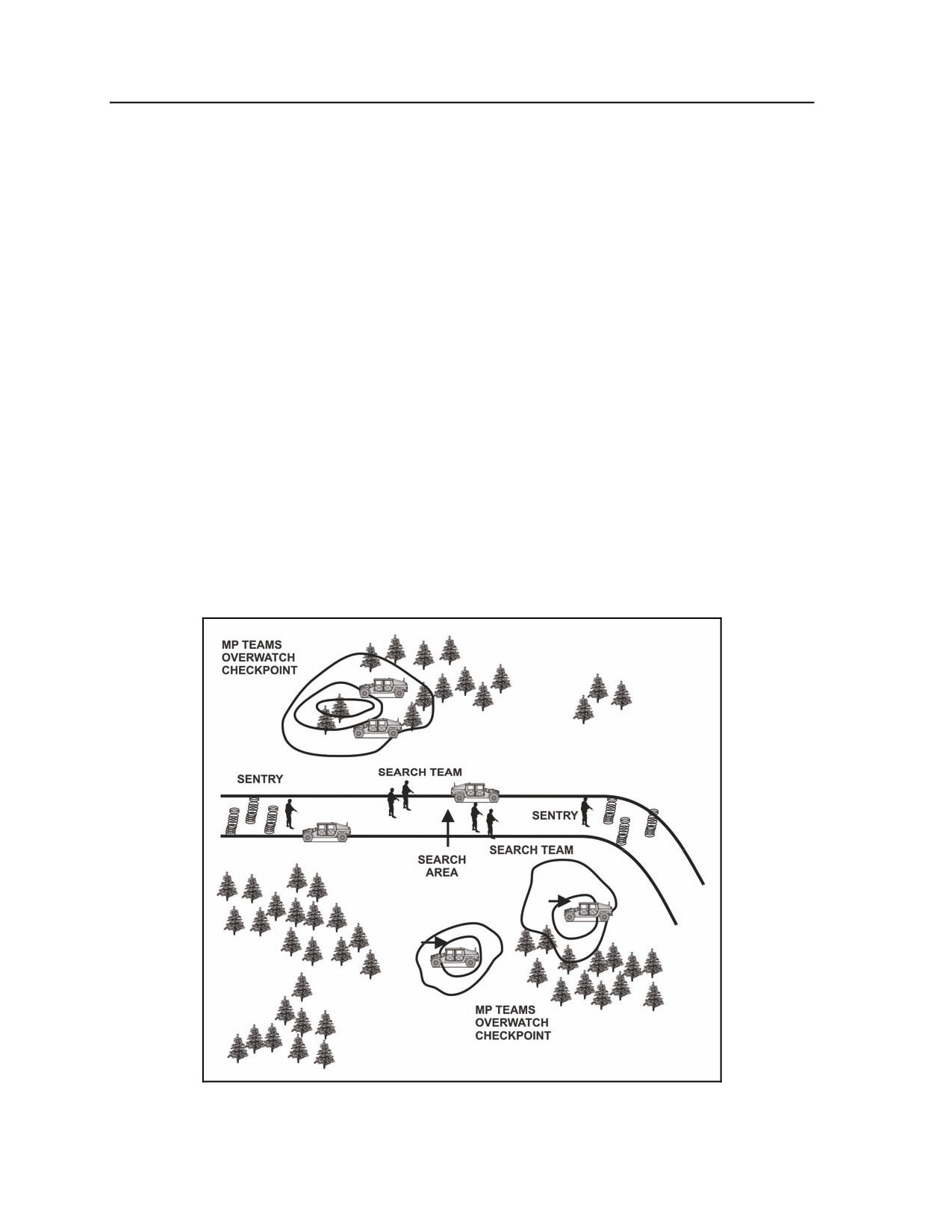
H-33. Characteristics of a hasty checkpoint (Figure H-7) include:
Located along likely enemy avenues of approach.
Achieve surprise.
Temporary.
Unit is able to carry and erect construction materials without additional assistance.
Uses vehicles as an obstacle between the vehicles and personnel, and reinforces them with
concertina wire.
Soldiers are positioned at each end of the checkpoint.
Soldiers are covered by mounted or dismounted automatic weapons.
Assault force/response force is concealed nearby to attack or assault in case the site is attacked.
H-34. The hasty CPs success is brought about by swift and decisive actions. In many cases, there may be no
clear orders before the CP is set up. Leaders must rely on common sense and instinct to determine which
vehicles or pedestrians to stop for questioning or searching. They are moved quickly into position,
thoroughly conducted, and just as swiftly withdrawn when lifted or once the threat has passed.
Figure H-7. Hasty check point example.
H-12
FM 3-21.8
28 Mach 2007
Security
PHYSICAL LAYOUT
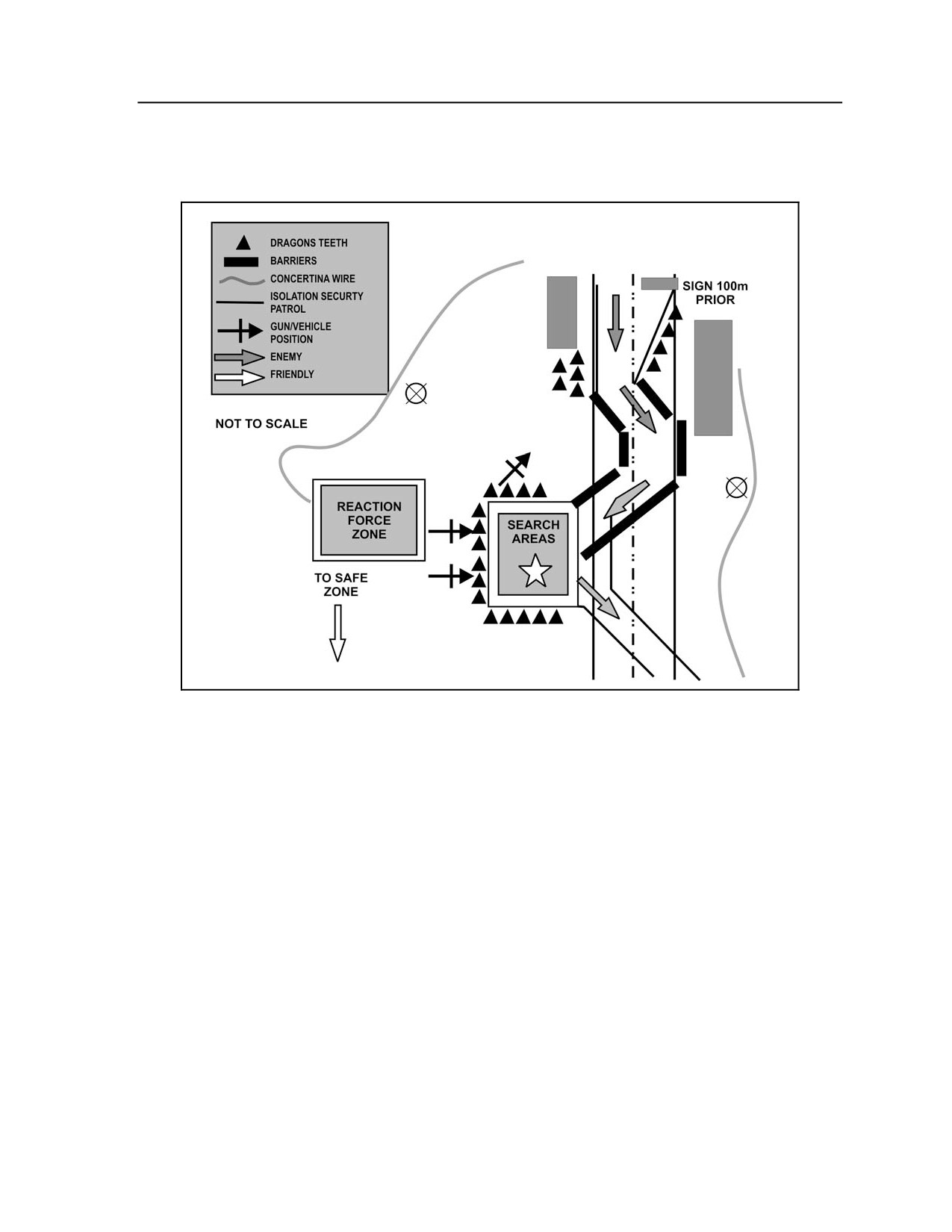
H-35. A checkpoint should consist of four areas: canalization zone, turning or deceleration zone, search
zone, and safe zone (Figure H-8).
Figure H-8. Four zones of a CP.
H-36. The CP should be sited in such a position as to prevent persons approaching the site from bypassing
it or turning away from the CP without arousing suspicion. Ideal sites are where vehicles have already had
to slow down. It should be remembered that on country roads vehicles will need extra room to slow down
and halt, (particularly large heavy vehicles). The sighting of the CP must take into consideration the type
and number of vehicles expected to be using that part of the road where the CP will be sited. Areas where
there are few road networks enhance the CP effectiveness.
H-37. The site should allow for a vehicle escape route and include plans to destroy a hostile element that
uses such a route. If the checkpoint is completely sealed off, enemy forces may attempt to penetrate it by
attempting to run over obstacles or personnel.
H-38. Location should make it difficult for a person to turn around or reverse without being detected.
Soldiers establish hasty checkpoints where they cannot be seen by approaching traffic until it is too late for
approaching traffic to unobtrusively withdraw. Effective locations on which to set up hasty checkpoints
include—
Bridges (near either or both ends, but not in the middle).
Defiles, culvert, or deep cuts (either end is better than in the middle).
Highway intersections (these must be well organized to reduce the inherent danger).
The reverse slope of a hill (hidden from the direction of the main flow of traffic).
Just beyond a sharp curve.
28 March 2007
FM 3-21.8
H-13
Appendix H
CANALIZATION ZONE
H-39. The canalization zone uses natural obstacles and/or artificial obstacles to canalize the vehicles into
the checkpoint.
Place warning signs out forward of the checkpoint to advise drivers of the checkpoint ahead (at
least 100 meters).
Canalize the vehicles so they have no way out until they have the consent of personnel
controlling the checkpoint.
This zone encompasses the area from maximum range to maximum effective range of your
weapon systems. It usually consists of disrupting and/or turning obstacles.
TURNING OR DECELERATION ZONE
H-40. The search element establishes obstacles and an overwatch force to control each road or traffic lane
being blocked. The turning or deceleration zone forces vehicles into making a rapid decision. The vehicle
can decelerate, make slow hard turns, or maintain speed and crash into a series of obstacles. The road or
traffic lanes should be blocked by means of obstacles positioned at either end of the CP. See Appendix F
for a discussion of obstacles. These obstacles should be such as to be quickly and easily moved in case of
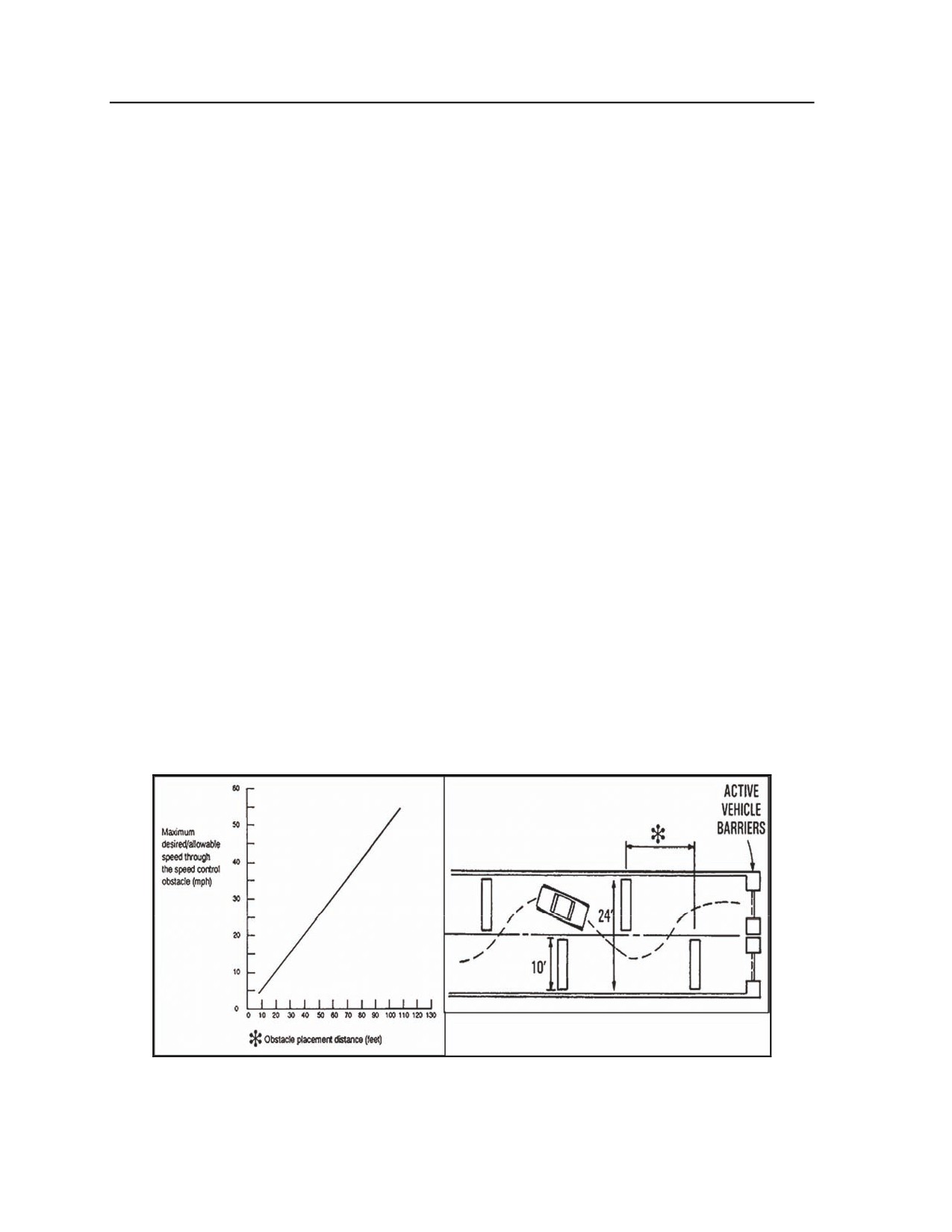
emergencies. They should be sited so as to extend the full width of a traffic lane and staggered to force
vehicles to slow to negotiate an ‘S’ turn (Figure H-9). Stop signs should also be erected ahead of the
obstacles and at night illuminated by means of a light or lantern.
H-41. Ensure that vehicles are stopped facing an obstacle (berm, tank, or wall) that is capable of stopping a
slow moving truck. Some obstacles will have to be improvised. Examples of these include:
Downed trees.
Beirut toothpick - nails driven through lumber.
Caltrops placed across the road.
Debris, rubble, large rocks.
Abatis.
Road cratering.
Dragon’s teeth, tetrahedrons, concrete blocks.
Mines.
Prepared demolitions.
Concertina wire.
Figure H-9. Controlling vehicle speed through obstacle placement and serpentine placement.
H-14
FM 3-21.8
28 Mach 2007
Security
SEARCH ZONE
H-42. The search zone is a relatively secure area where personnel and vehicles are positively identified and
searched. A decision is made to confiscate weapons and contraband, detain a vehicle, or allow it to pass.
The area is set up with a blocking obstacle that denies entry/exit without loss of life or equipment. When
searching:
Isolate the vehicle being checked from other cars by an obstacle of some type, which is
controlled by a Soldier.
Emplace an overwatch position with a crew-served weapon in an elevated position to cover the
vehicle, particularly the driver. The crew-served weapon should be mounted on a T/E and tripod.
H-43. The search zone is further subdivided into three subordinate areas:
Personnel search zone - where personnel are positively identified, searched, and/or detained.
This may include partitioned or screened areas to provide privacy, especially when searching
women and children. Use female Soldiers to search women, if available.
Vehicle search zone - where vehicles are positively identified, and searched.
Reaction force zone - where a reaction force is located to reinforce the checkpoint and
immediately provide assistance using lethal and non-lethal force. Additionally, engineers, and
EOD personnel may be co-located here to assist in analyzing and diffusing/destroying
ammunition, demolitions, and/or booby traps. This element is organized and equipped to
conduct close combat. This element engages in accordance with the established engagement
criteria and ROE. This element has a position which allows it to overwatch the CP as well as
block or detain vehicles that try to avoid the CP.
H-44. When establishing these zones, consider the following:
Weapons’ surface danger zones (SDZs), geometry.
360 degree security.
Rapid removal of detainees and vehicles.
Capabilities and skill level of all attachments.
Potential suicide
H-45. Placing the search area to the side of the road permits two-way traffic. If a vehicle is rejected, it is
turned back. If vehicle is accepted for transit, it is permitted to travel through the position. If the vehicle is a
threat, the CP leader determines whether to attack or apprehend.
H-46. When confronted by a potentially threatening vehicle:
The search element alerts the CP leader, moves to a safe/fortified position, and may engage or
allow the vehicle to pass based on leader instructions and ROE.
If the vehicle passes through the escape lane, the leader may direct the assault element to engage
the vehicle based on ROE.
SAFE ZONE
H-47. The safe zone is the assembly area for the checkpoint that allows personnel to eat, sleep, and recover
in relative security.
TASK ORGANIZATION
H-48. The basic organization of a CP includes a security element, a search element, an assault element, and
a C2 element. The actual strength and composition of the force is determined by the nature of the threat,
road layout, type of checkpoint required, and the anticipated number of vehicles to be processed. Table H-3
details typical duties of these elements as well as a general list of Do’s and Don’ts.
28 March 2007
FM 3-21.8
H-15

Appendix H
Table H-3. Task organization.
C2
Overall Responsibility
- Exercises C2
- Maintains communications with controlling HQ
- Maintains a log of all activities
- Coordinates RIP as required
- Coordinates linkups as required
- Coordinates the role of civil authorities
- Coordinates local patrols.
- Integrates reserve / QRF
- If available, the C2 element should have a vehicle for patrolling, for moving elements, or
administrative actions
Security Element
- Provides early warning to the CP through local security measures
- Prevent ambush
- Able to reinforce position is necessary
- Observes and reports suspicious activity
- Monitors traffic flow up to and through the checkpoint
Search Element
-Halts vehicles at the checkpoint.
- Guides vehicles to search area
- Conducts vehicle searches: passenger, cargo
- Conducts personnel searches: male, female
- Directs cleared vehicles out of the CP
- Detains personnel as directed
Assault Element
- Destroys escaping vehicles and personnel
- Able to reinforce position as necessary
(Soldiers occupy support by fire positions beyond the actual CP)
Do
- Speak to driver - driver speaks to occupants
- Have the driver open all doors and compartments before Soldier conducts search of vehicle
- Ask politely to follow your instructions
- Speak naturally and no louder than necessary
- Allow driver to observe the search
- All vehicle occupants are required to exit the vehicle
- Be courteous when searching
- Use scanners and metal detectors when possible
- Stay calm and make a special effort to be polite
- Maintain a high standard of dress, military bearing, and stay in uniform
Don’t
- Be disrespectful or give any hint of dislike
- Put your head or arm in vehicle or open the door without permission
- Shout or show impatience
- Frisk women or tell them to put their hands up
- Become involved in a heated argument
- Use force as directed by unit ROE
- Become careless or sloppy in appearance
H-16
FM 3-21.8
28 Mach 2007
Security
C2 ELEMENT
H-49. The C2 element controls the operation. The C2 element normally consists of a leader, his RTO and
runner.
H-50. The leader normally establishes a headquarters / administrative area to synchronize the efforts of the
subordinate activities. The headquarters and security element should be sited centrally and in a position
which facilitates control of the obstacles. The headquarters area should be secure and sufficiently large to
incorporate an administrative area and vehicle search area. Depending on the threat, this area should have
sufficient cover or survivability positions should be built.
H-51. The CP should have communication to their controlling headquarters by radio. A spare radio and
batteries should be supplied to the CP. Radio and telephone checks are carried out as per the unit’s SOP
using signal security measures. Communications within the site should be undertaken using whatever
means are available.
CIVIL AUTHORITY ASSISTANCE
H-52. The closest liaison must be maintained between the CP leader and the senior policeman. Policemen
at a CP are employed to assist in the checking and searching of vehicles and personnel, to make arrests
when necessary. Police are ideally employed on the scale of one officer for each lane of traffic. These civil
authorities should attend rehearsals. As the degree of threat increases, police officers should be on stand by
to move with the patrol to the CP site. Wherever possible, it should be the responsibility of the military to
command and control the CP while the police control the search aspects.
H-53. The leader must understand the guidance from his chain of command on contingencies that occur
outside of the CP area that might require forces from the CP. The CP, unless otherwise ordered, is the
primary task. If an incident occurs in the vicinity of the checkpoint that is likely to require manpower and
affect the efficient operation of the CP, the leader should seek guidance from his higher headquarters.
H-54. Sequence of events for establishing the CP include:
Leader’s reconnaissance.
Establish support by fire positions (and fighting positions as required).
Establish blocking positions (entrance and exit).
Establish search area for personnel and vehicles.
Establish holding area (if required).
Establish an area for C2 and admin.
SECURITY ELEMENT
H-55. The nature of the CP makes it particularly vulnerable to enemy attack. Protection should therefore be
provided for overall position as well as those of subordinate positions. Concealed sentries should also be
positioned on the approaches to the CP to observe and report approaching traffic, and to prevent persons or
vehicles from evading the CP. When available, early warning devices or radar may be used to aid guards on
the approaches to the CP.
H-56. The security element stays alert for any change of scenery around the checkpoint. Crowds gathering
for no apparent reason or media representatives waiting for an event are all indicators that something may
happen.
ESCALATION OF FORCE
H-57. Escalation of Force (EOF) is a sequential action that begins with non-lethal force measures that could
escalate to lethal force measures to protect the force. Infantrymen at the CP must ensure they follow ROE
and EOF guidance when reacting to situations.
28 March 2007
FM 3-21.8
H-17
Appendix H
SEARCH ELEMENT
Vehicle Searches
H-58. Two members of the search team position themselves at both rear flanks of the vehicle undergoing a
search, putting the occupants at a disadvantage. These Soldiers maintain eye contact with the occupants
once they exit the vehicle and react to any threat attempts by the occupants during the vehicle search.
H-59. The actual search is conducted by two Soldiers. One Soldier conducts interior searches; the other
performs exterior searches. They instruct the occupants (with interpreters if available) to exit the vehicle
during the interior search and instruct the driver to watch the vehicle search. Once the interior search is
complete, they escort the driver to the hood of the vehicle and instruct him to open it. After the engine
compartment has been examined, they instruct the driver to open the other outside compartments (tool
boxes, gas caps, trunks). The driver removes any loose items that are not attached to the vehicle for
inspection. Members of the search team rotate positions to allow for mental breaks.
H-60. Soldiers use mirrors and metal detectors to thoroughly search each vehicle for weapons, explosives,
ammunition, and other contraband. Depending on the threat level, the vehicle search area provides blast
protection for the surrounding area.
Personnel Searches
H-61. Soldiers may be required to conduct personnel searches at the checkpoints. Every attempt should be
made for host nation authorities to conduct, or at least observe, searches of local nationals. Additionally,
leaders must plan for same-gender searches. Personnel searches are conducted only when proper
authorization has been obtained, usually from higher HQ, according to the ROE, Status of Forces
Agreement (SOFA), or host nation agreements. This does not preclude units from searching individuals
that pose a threat to U.S. or other friendly forces.
H-62. Units may have to detain local nationals who become belligerent or uncooperative at checkpoints.
The OPORD and the ROE must address the handling of such personnel. In any case, self-protection
measures should be planned and implemented according to the orders from higher HQ.
H-63. Searches of local nationals should be performed in a manner that preserves the respect and dignity of
the individual. Special consideration must be given to local customs and national cultural differences. In
many cultures it is offensive for men to touch or even talk to women in public. Searchers must be polite,
considerate, patient, and tactful. Leaders must make every effort not to unnecessarily offend the local
population. Such situations can have a very negative impact on peace operations and can quickly change
popular opinion toward U.S. and other friendly forces.
H-64. Each captive is searched for weapons and ammunition, items of intelligence value, and other
inappropriate items. Use of digital cameras will record any evidence of contraband.
H-65. When possible, conduct same gender searches. However, this may not always be possible due to
speed and security considerations. If females are not available, use medics or NCOs with witnesses.
Perform mixed gender searches in a respectful manner using all possible measures to prevent any action
that could be interpreted as sexual molestation or assault. The on-site supervisor carefully controls Soldiers
doing mixed-gender searches to prevent allegations of sexual misconduct.
H-66. Soldiers conduct individual searches in search teams that consist of the following:
Searcher: A searcher is the Soldier that actually conducts the search. He is in the highest-risk
position.
Security: Security includes at least one Soldier to provide security. He maintains eye contact
with the individual being searched.
Observer: The observer is a leader that has supervisory control of the search operation. He also
provides early warning for the other members of the team.
H-67. The two most common methods that are used to conduct individual searches are the frisk search, and
the wall search.
H-18
FM 3-21.8
28 Mach 2007
Security
Frisk search: This method is quick and adequate to detect weapons, evidence, or contraband.
However, it is more dangerous because the searcher has less control of the individual being
searched.
Wall search: This method affords more safety for the searcher because the individual is
searched in a strained, awkward position. Any upright surface, such as a wall, vehicle, tree, or
fence may be used.
H-68. If more control is needed to search an uncooperative individual, the search team places the subject in
the kneeling or prone position.
SECTION V — CONVOY AND ROUTE SECURITY
H-69. Convoy security missions are conducted when insufficient friendly forces are available to
continuously secure lines of communication in an AO. They may also be conducted in conjunction with
route security missions. A convoy security force operates to the front, flanks, and rear of a convoy element
moving along a designated route. Convoy security missions are offensive in nature and orient on the force
being protected.
H-70. To protect a convoy, the security force must accomplish the following critical tasks:
Reconnoiter and determine the trafficability of the route the convoy will travel.
Clear the route of obstacles or positions from where the threat could influence movement along
the route.
Provide early warning and prevent the threat from impeding, harassing, containing, seizing, or
destroying the convoy.
Protect the escorted force from enemy contact
React decisively to enemy contact
H-71. Company-sized units and larger organizations usually perform convoy or route security missions.
Convoy security provides protection for a specific convoy. Route security aims at securing a specific route
for a designated period of time, during which multiple convoys may use the route. These missions include
numerous tasks such as reconnaissance, security, escorting, and establishing a combat reaction force. These
tasks become missions for subordinate units. The size of the unit performing the convoy or route security
operation depends on many factors, including the size of the convoy, the terrain, and the length of the route.
For example, an Infantry platoon can escort convoys, perform route reconnaissance, and establish traffic
control points along main supply routes.
ORGANIZATION OF FORCES
H-72. During convoy security operations, the convoy security commander and Infantry leader must
establish and maintain security in all directions and throughout the platoon. As noted, several factors,
including convoy size affect this disposition. The key consideration is whether the unit is operating as part
of a larger escort force or is executing the escort mission independently. Additional METT-TC
considerations include the employment of rifle squads during the mission (fire teams ride in escorted
vehicles).
H-73. The unit should also be reinforced with engineers to reduce obstacles along the route. The higher
headquarters should coordinate additional ISR assets to support the security mission. Unmanned aircraft
systems (UASs) or aerial reconnaissance should reconnoiter the route in advance of the unit’s lead
elements.
H-74. When the platoon executes a convoy escort mission independently, the convoy commander and
platoon leader disperse Infantry in vehicles throughout the convoy formation to provide forward, flank, and
rear security. Engineer assets, if available, should be located near the front to respond to obstacles. At
times, engineer assets may be required to move ahead of the convoy with scouts to proof the convoy route.
In some independent escort missions, variations in terrain along the route may require the unit to operate
using a modified traveling overwatch technique. In it, one section leads the convoy while the other trails the
28 March 2007
FM 3-21.8
H-19
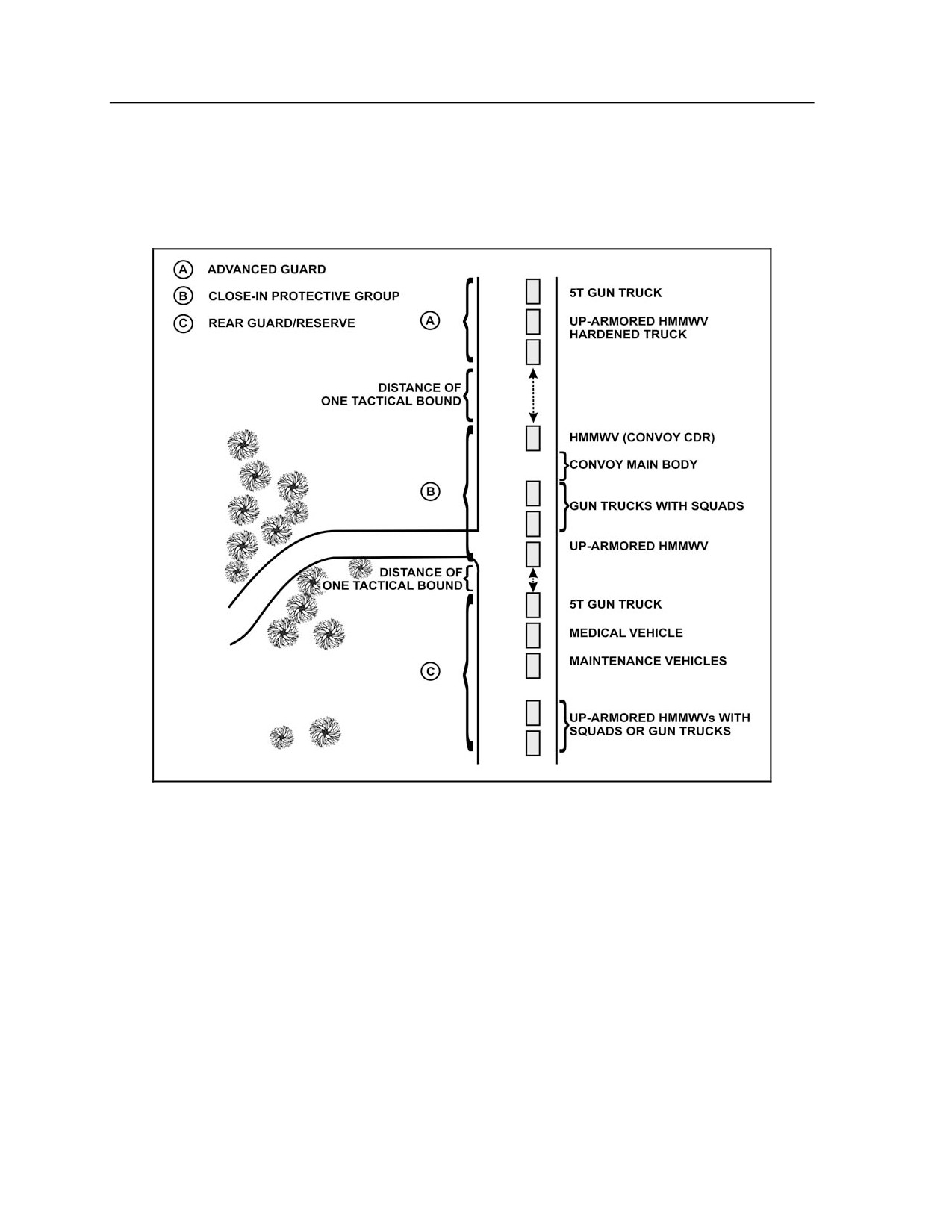
Appendix H
convoy. Dispersion between vehicles in each section is sufficient to provide flank security. The terrain may
not allow the trail section to overwatch the movement of the lead section.
H-75. When sufficient forces are available, the convoy security should be organized into four elements:
reconnaissance element; screen element; escort element; and a reaction element
(Figure H-10). The
Infantry platoon may be assigned any one of the four tasks, but as a general rule, probably cannot be
assigned all four.
Figure H-10. Convoy escort organization.
ADVANCED GUARD
H-76. The advance guard reconnoiters and proofs the convoy route. The advanced guard element performs
tasks associated with movement to contact and zone / route reconnaissance forward of the convoy. It
searches for signs of enemy activity such as ambushes and obstacles. This element focuses on identifying
enemy forces able to influence the route, route trafficability, or refugees or civilian traffic that may disrupt
movement. Engineers are attached to the unit to assist reconnoitering and classifying bridges, fords, and
obstacles along the route. The advanced guard normally operates from 3 to 4 kilometers ahead of the main
body of the convoy. If available, UASs or aerial reconnaissance should precede the reconnaissance element
by 5 to 8 kilometers dependent on the terrain and visibility conditions.
H-77. Within its capabilities, the advanced guard attempts to clear the route and provides the convoy
commander with early warning before the arrival of the vehicle column. In some cases, an individual
vehicle, a squad, or a platoon-sized element may be designated as part of the advanced guard and may
receive additional combat vehicle support (tank with a mine plow, or mine roller). The leader plans for
integrating engineer assets to aid in breaching point-type obstacles. Command-detonated devices and other
improvised explosive devises (IEDs) pose a major threat during route reconnaissance.
H-20
FM 3-21.8
28 Mach 2007
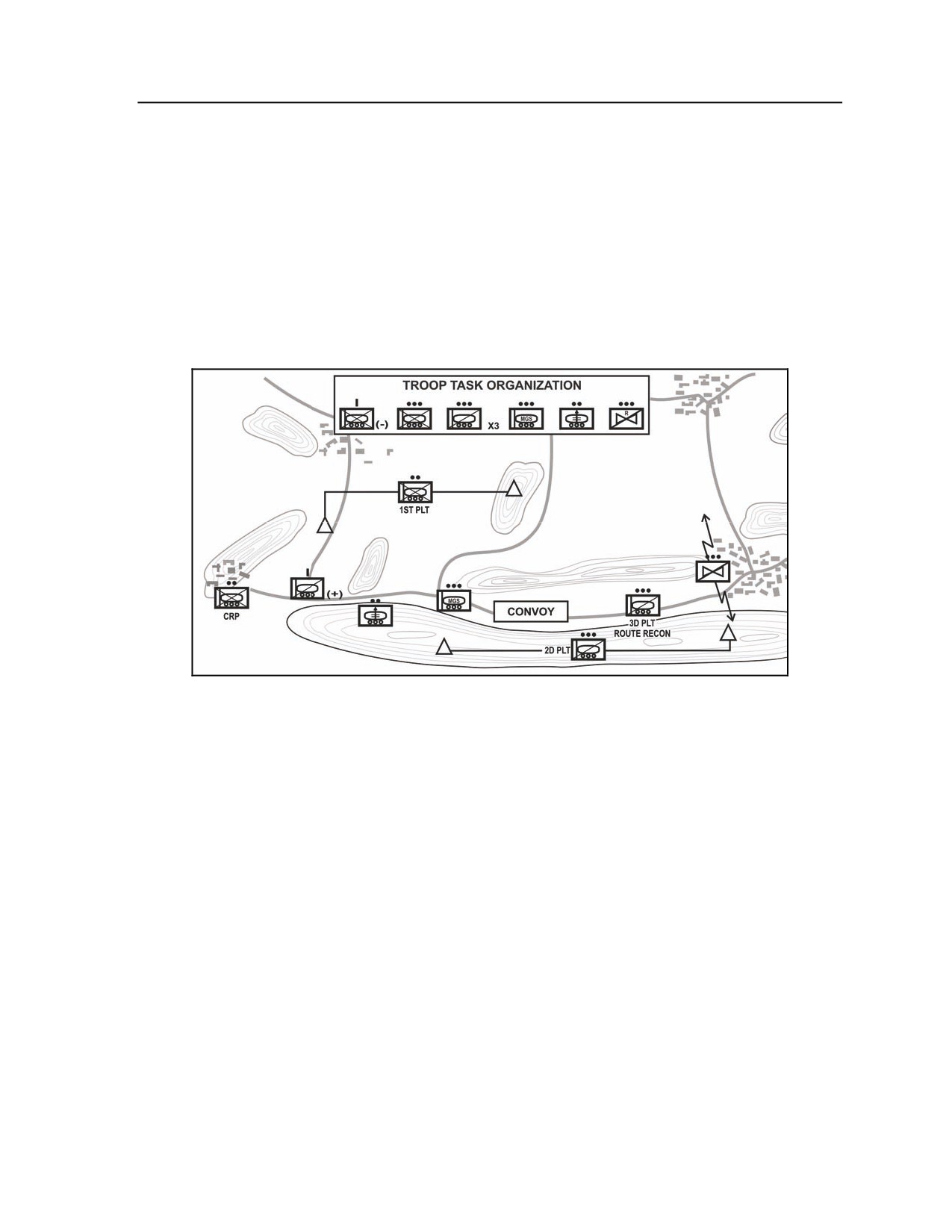
Security
FLANK AND REAR GUARD/SCREEN
H-78. This element performs a guard or screen, depending on the amount of combat power allocated,
providing early warning and security to the convoy’s flanks and rear (unit may utilize outposts). The leader
must develop graphic control measures to enable a moving flank screen centered on the convoy. The guard
/ screen’s purpose is to prevent observation for employment of effective indirect fires and identify combat
elements prior to a direct fire engagement against the convoy. These elements gain and maintain contact
with threat reconnaissance and combat elements, employing fires (direct and indirect) to suppress and
guiding reaction or escort elements to defeat or destroy the threat force. Units use a combination of OPs or
battle positions on terrain along the route.
H-79. The rear guard follows the convoy (Figure H-11). It provides security in the area behind the main
body of the vehicle column, often moving with medical and recovery assets. Again, an individual vehicle or
the entire unit may make up this element.
Figure H-11. Rear guard.
ESCORT ELEMENT
H-80. The escort element provides close-in protection to the convoy. The convoy may be made of many
types of vehicles, including military sustainment and C2 as well as civilian trucks and buses. The escort
element may also provide a reaction force to assist in repelling or destroying threat contact. The unit
assigned the escort mission to provide local security throughout the length of the convoy. The escort
element defeats close ambushes and marks bypasses or breaches obstacles identified by reconnaissance as
necessary. If the reaction force is not available in sufficient time, the escort element may be required to
provide a reaction force to defeat far ambushes or block attacking threat forces. The Infantry platoon or
squad may perform a convoy escort mission either independently or as part of a larger unit’s convoy
security mission. Aviation units may also be a part of the escort force and the leaders of both ground and air
must be able to quickly contact each other.
REACTION FORCE
H-81. The reaction force provides firepower and support to the elements above in order to assist in
developing the situation or conducting a hasty attack. It may also perform duties of the escort element. The
reserve will move with the convoy or be located at a staging area close enough to provide immediate
interdiction against the enemy.
28 March 2007
FM 3-21.8
H-21
Appendix H
COMMAND AND CONTROL
H-82. Because of the task organization of the convoy escort mission, C2 is especially critical. The
relationship between the Infantry platoon or squad and the convoy commander must provide unity of
command and effort if combat operations are required during the course of the mission. In most cases, the
unit will execute the escort mission under the control of the security force commander, who is usually
under OPCON or attached to the convoy commander.
H-83. The leader should coordinate with the security force commander or the escorted unit to obtain or
exchange the following information:
Time and place of linkup and orders brief.
Number and type of vehicles to be escorted.
High value assets within the convoy.
Available weapon systems, ammunition, and ordnance (crew served, squad, and individual).
Vehicle maintenance status and operating speeds.
Convoy personnel roster.
Unit’s or escorted unit SOP, as necessary.
Rehearsal time / location.
H-84. It is vital that the convoy commander issues a complete OPORD to all convoy vehicle commanders
before executing the mission. This is important because the convoy may itself be task-organized from a
variety of units, and some vehicles may not have tactical radios. The order should follow the standard five-
paragraph OPORD format (Table H-4), but special emphasis should be placed —
Route of march (including a strip map for each vehicle commander).
Order of march.
Actions at halts.
Actions in case of vehicle breakdown.
Actions on contact.
Chain of command.
Communication and signal information.
H-22
FM 3-21.8
28 Mach 2007

Security
Table H-4. Convoy OPORD example.
Task Organization
SITUATION
SERVICE AND SUPPORT
Enemy:
MEDEVAC procedures:
• Activity in the last 48 hours
•
9-line MEDEVAC request
• Threats
• Location of medical support/combat
• Capabilities
lifesavers
Friendly:
• Potential PZ/LZ locations
• Units in the area or along the route
Maintenance procedures:
• ROE
• Location of maintenance personnel
Light and Weather Data:
• Location and number of tow bars
• Effects of light and weather on the enemy
• Recovery criteria
and on friendly forces
• Stranded vehicle procedures
• BMNT, sunrise, high temp, winds, sunset,
EENT, moonrise, % illumination, low temp
MISSION
COMMAND AND SIGNAL
Task and purpose of the movement
Convoy commander
mission statement
Sequence of command
Location of convoy commander
Call signs of every vehicle/unit in the convoy
Convoy frequency
MEDEVAC frequency
Alternate frequencies
EXECUTION
Commander’s intent
End-state
Concept of the operation (concept sketch or terrain model)
Task to maneuver units
Fires
CAS
Coordinating instructions:
• Timeline
o Marshal
o Rehearsals
o Convoy briefing
o Inspections
o Initiate movement
o Rest halts
o Arrival time
• Order of movement/bumper numbers and individual manifest
• Movement formation
• Speed/catch-up speed
• Interval (open areas and in built-up areas)
• Weapons orientation, location of key weapons systems
• Route
• Checkpoints
• Actions on contact
• Actions on breakdowns
• Actions at the halt (short halt and long halt)
REACTING TO ENEMY CONTACT
H-85. As the convoy moves to its new location, the enemy may attempt to harass or destroy it. This contact
28 March 2007
FM 3-21.8
H-23
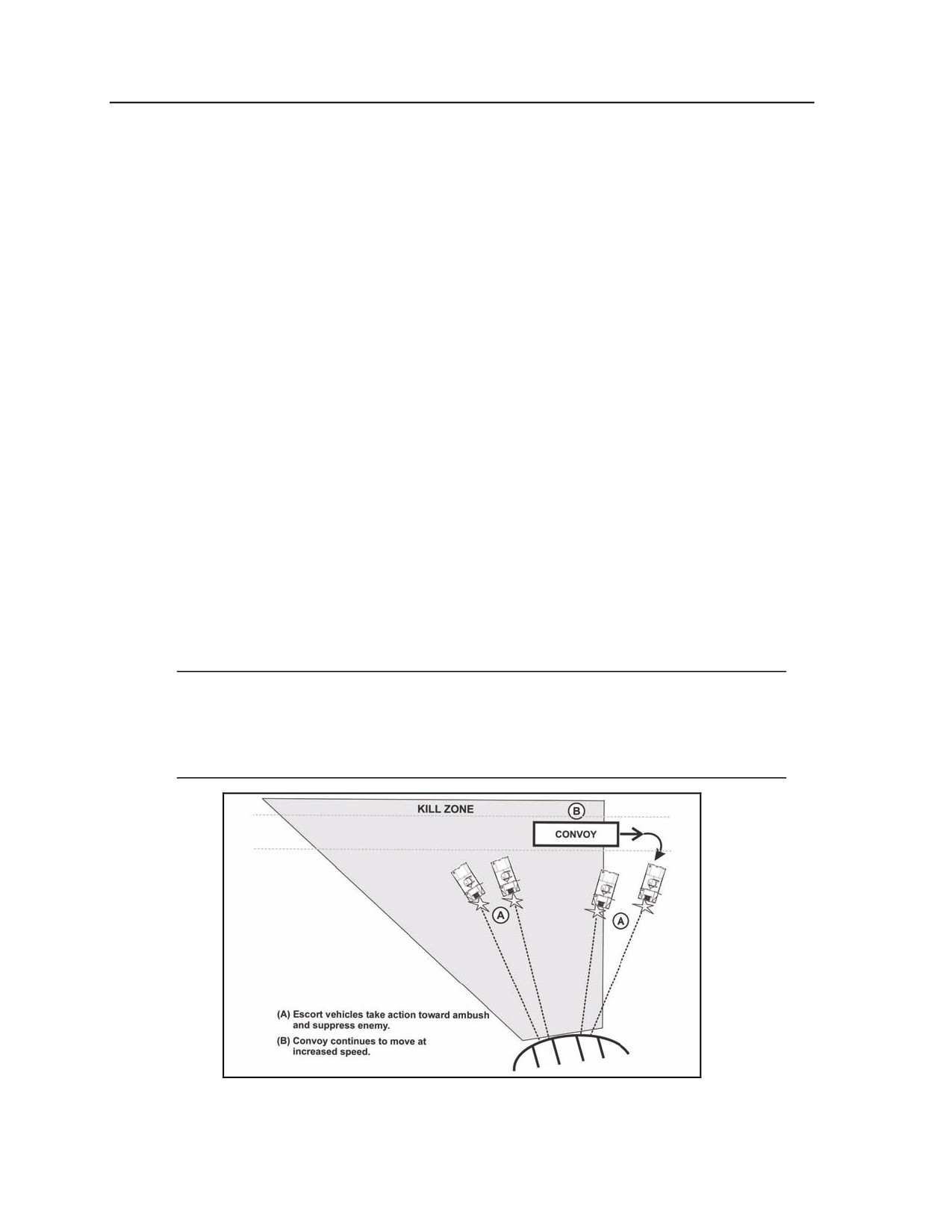
Appendix H
will usually occur in the form of an ambush, often with the use of a hastily-prepared obstacle. The safety of
the convoy rests on the speed and effectiveness with which escort elements can execute appropriate actions
on contact. Based on the factors of METT-TC, portions of the convoy security force such as the unit may
be designated as a reaction force. The reaction force performs its escort duties, conducts tactical movement,
or occupies an AA (as required) until enemy contact occurs and the convoy commander gives it a reaction
mission.
ACTIONS AT AN AMBUSH
H-86. An ambush is one of the more effective ways to interdict a convoy. Reaction to an ambush must be
immediate, overwhelming, and decisive. Actions on contact must be planned for and rehearsed so they can
be executed quickly.
H-87. In almost all situations, the unit will take several specific, instantaneous actions when it reacts to an
ambush (Figures H-12 and H-13). However, if the convoy is moving fuel and other logistics, the best
method might be to suppress the enemy, continue to move and report. These steps, illustrated in include
the following:
As soon as they encounter an enemy force, the escort vehicles take action toward the enemy.
They seek covered positions between the convoy and the enemy and suppress the enemy with
the highest volume of fire permitted by the ROE. Contact reports are submitted to higher
headquarters as quickly as possible.
The convoy commander retains control of the convoy vehicles and continues to move them
along the route at the highest possible speed.
Convoy vehicles, if armed, may return fire only if the escort has not positioned itself between the
convoy and the enemy force.
Leaders may request that any damaged or disabled vehicles be abandoned and pushed off the
route.
The escort leader uses SPOTREPs to keep the convoy security commander informed. If
necessary, the escort leader or the convoy commander requests support from the reaction force
and or calls for and adjusts indirect fires.
NOTE: Fire support for areas behind the forward line of troops is planned and coordinated on
an area basis (such as a base operations center, base cluster operations center, or rear area
operations center). This planning may provide fire support to main supply routes (MSRs) or
other routes. Convoy commanders are responsible for the fire support plans for their convoy and
for ensuring escort security leaders are familiar with the plan.
Figure H-12. Convoy escort actions toward ambush.
H-24
FM 3-21.8
28 Mach 2007
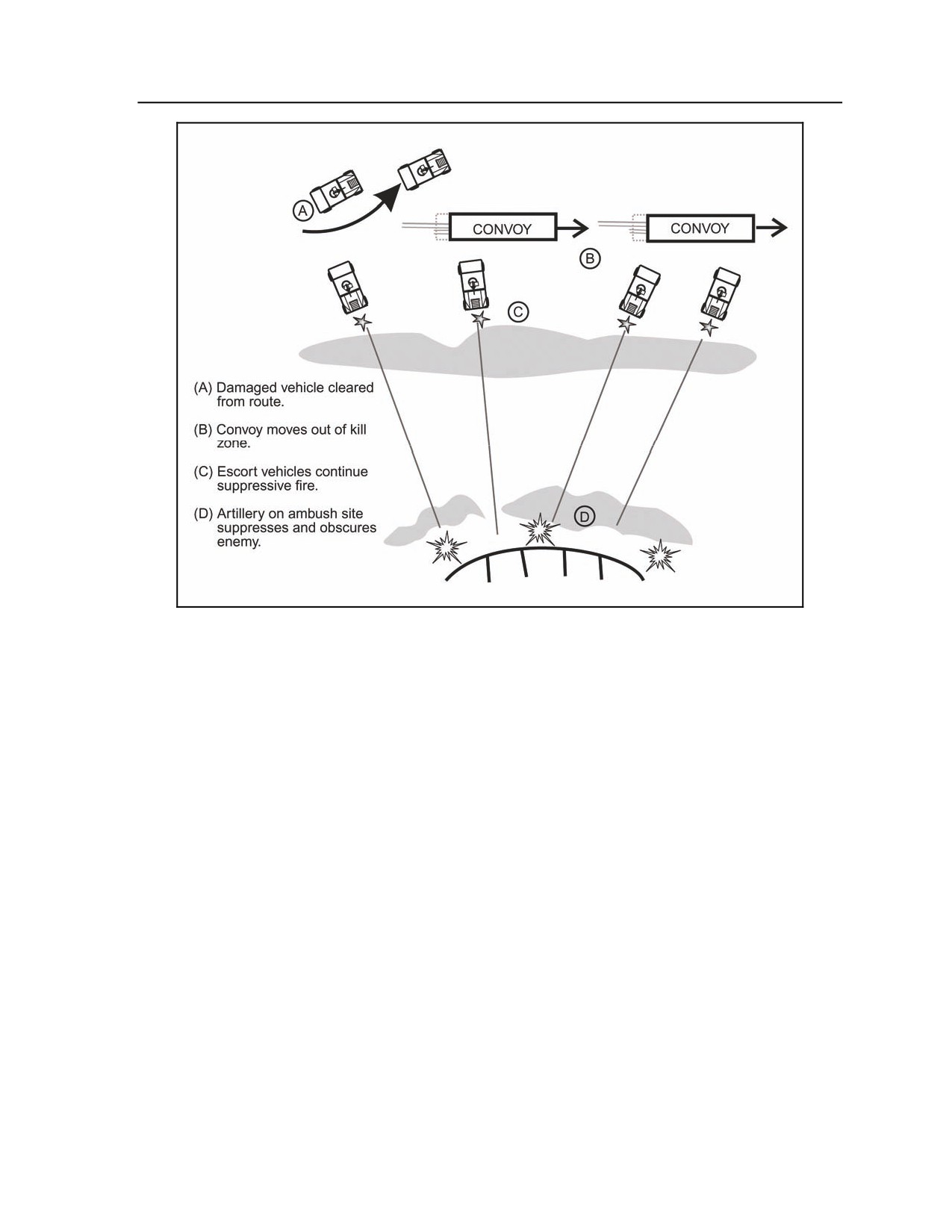
Security
Figure H-13. Convoy continues to move.
H-88. Once the convoy is clear of the kill zone, the escort element executes one of the following COAs:
Continues to suppress the enemy as combat reaction forces move to support (Figure H-14).
Uses the Infantry to assault the enemy (Figure H-15).
Breaks contact and moves out of the kill zone.
Request immediate air support to cut-off escape routes.
H-89. In most situations, Infantry platoons or squads will continue to suppress the enemy or execute an
assault. Contact should be broken only with the approval of the controlling commander.
28 March 2007
FM 3-21.8
H-25