FM 3-21.8 (FM 7-8) The Infantry Rifle Platoon and Squad (MARCH 2007) - page 12
Appendix C
C-64. The 60-mm illumination round available now is the standard cartridge, illuminating, M83A3. This
round has a fixed time of delay between firing and start of the illumination. The illumination lasts for about
25 seconds, providing moderate light over a square kilometer.
C-65. The 60-mm illumination round does not provide the same degree of illumination as do the rounds of
he heavier mortars and field artillery. However, it is sufficient for local, point illumination. The small size
of the round can be an advantage where illumination is desired in an area but adjacent friendly forces to not
want to be seen. The 60-mm illumination round can be used without degrading the night vision devices of
adjacent units.
C-66. The medium and heavy mortars can provide excellent illumination over wide areas. The 120-mm
mortar illumination round provides one million candlepower for 60 seconds.
C-67. The M203 40-mm grenade, as well as all mortars have the capability to deliver IR illumination
rounds in addition to the more common white light.
SPECIAL ILLUMINATION TECHNIQUES
C-68. Following are three special illumination techniques that mortars have effectively used.
C-69. An illumination round fired extremely high over a general area will not always alert an enemy force
that it is being observed. However, it will provide enough illumination to optimize the use of image
intensification (starlight) scopes such as the AN/TVS-5 and the AN/TVS-4.
C-70. An illumination round fired to burn on the ground will prevent observation beyond the flare into the
shadow. This is one method of countering enemy use of image intensification devices. A friendly force
could move behind the flare with greater security.
C-71. An illumination round fired to burn on the ground can be used to mark targets during day or night.
Illumination rounds have an advantage over WP as target markers during high winds. The smoke cloud
from a WP round will quickly be blown downwind. The smoke from the burning illumination round will
continue to originate from the same point, regardless of the wind.
CONSIDERATIONS WHEN USING THERMAL SIGHTS
C-72. Although illumination rounds may aid target acquisition when friendly forces are using image
intensification devices (such as night vision devices), this is not so when thermal sights are used. As the
illumination flares burn out and land on the ground, they remain as a distinct hot spot seen through thermal
sights for several minutes. This may cause confusion, especially if the flare canisters are between the
enemy and the friendly forces. WP rounds can also cause these hot spots that can make target identification
difficult for gunners using thermal sights (tanks, BFV, TOW, or Javelin).
C-18
FM 3-21.8
28 March 2007
Appendix D
Vehicle Employment Considerations
Employing combat vehicles with Infantry platoons and squads increases their combat
power. Combining combat vehicles and Infantry to achieve complementary and
reinforcing effects has proven to be a significant advantage. Operations that integrate
combat vehicles and Infantry forces combine the advantages of the vehicle’s
mobility, protection, firepower, and ability to use their information platform. They
also increase the Infantryman’s ability to operate in restricted and severely restricted
terrain.
Infantry units conduct operations with a variety of combat vehicles. The principles
for integrating combat vehicles with Infantry are similar regardless of the specific
vehicle type. Combat vehicles that most often work with Infantry forces include the
M1 Abrams tank, the M2 Bradley fighting vehicle (BFV), the Stryker Infantry carrier
vehicle
(ICV), and multiple versions of the assault high-mobility multipurpose
wheeled vehicle (HMMWV). This appendix is written from the perspective of an
Infantry platoon leader controlling a combat vehicle section or platoon. However, the
technical and tactical information addressed in the following pages is also generally
valid for Infantry platoons attached to mechanized/heavy units.
SECTION I — CAPABILITIES
D-1. The primary roles of the combat vehicles discussed in this appendix are to provide Infantry platoons
with mobility to allow them to maneuver. Combat vehicles also provide bases of fire; protection, breaching
capabilities, enhanced communication platforms, and a variety of sustainment assets that include re-supply
and MEDEVAC capabilities. Effective integration of these forces provides complementary and reinforcing
effects to Infantry and mounted forces.
PRINCIPLES OF EMPLOYMENT
D-2. There are three general principles for employing combat vehicles with Infantrymen:
(1) So the combat power capabilities of the vehicle can support the maneuver of the Infantry.
(2) So the combat power of the Infantry platoon can support the maneuver of combat vehicle
sections or platoons.
(3) The wingman concept. To achieve mutual support, combat vehicles almost always work in this
concept. The wingman concept is similar to the buddy team concept Infantrymen employ
(operating in two-vehicle sections). Just like Infantrymen never fight alone, combat vehicles
never operate without the mutual support and evacuation capability the combat vehicle wingman
provides.
GENERAL EMPLOYMENT CONSIDERATIONS
D-3. Employment of combat vehicles requires thorough understanding and integration of the vehicle and
the Infantry unit. The following paragraphs focus on general employment considerations.
28 March 2007
FM 3-21.8
D-1
Appendix D
Combat Vehicles Supporting the Infantry
D-4. Combat vehicles support Infantry units by leading Infantrymen in open terrain and providing them a
protected, fast-moving assault weapons system. They suppress and destroy enemy weapons, bunkers, and
tanks by fire and movement. They may provide transport when the enemy situation permits.
Mobility
D-5. The following is a list of the primary mobility functions that combat vehicles provide an Infantry
platoon during combat operations:
Assist opposed entry of Infantry into buildings or bunkers.
Breach or reduce obstacles by fire.
Provide mobility to the dismounted force.
Provide enhanced communication platforms and multiple communications systems.
Sustainment (MEDEVAC and re-supply).
Firepower
D-6. The following is a list of the primary firepower functions that combat vehicles provide an Infantry
platoon during combat operations:
Speed and shock effect to assist the Infantry in rapidly executing an assault.
Lethal and accurate direct fire support (support by fire).
Suppression of identified sniper positions.
Heavy volume of suppressive fires and a mobile base of fire for the Infantry.
Employment of technical assets (thermal viewers and range finders) to assist in target acquisition
and ranging.
Neutralization or suppression of enemy positions with direct fire as Infantry closes with and
destroys the enemy.
Attack by fire any other targets designated by the Infantry.
Accurate direct fires even while the vehicle is moving at high speeds with stabilized gun
systems.
Destruction of enemy tanks and armored personnel carriers (APCs).
Protection
D-7. The following are ways that combat vehicles protect an Infantry platoon during combat operations:
Dominate the objective during consolidation and reorganization to defeat a counterattack and
protect Infantry forces.
Protect the movement of advancing Infantry through open terrain with limited cover and
concealment.
Secure cleared portions of the objective by covering avenues of approach.
Establish roadblocks or checkpoints.
Provide limited obscuration with smoke grenades and smoke generators.
Isolate objectives with direct fire to prevent enemy withdrawal, reinforcement, or counterattack.
Infantrymen Supporting Combat Vehicles
D-8. Infantrymen support vehicular forces by finding and breaching or marking antitank obstacles. They
detect and destroy or suppress enemy antitank weapons. Infantrymen may designate targets for armored
vehicles and protect them in close terrain.
D-2
FM 3-21.8
28 March 2007

Vehicle Employment Considerations
Mobility
D-9. Mobility functions that Infantry provide to units with vehicles during combat operations include:
Seize and retain terrain.
Clear defiles and restrictive urban terrain ahead of vehicular forces.
Firepower
D-10. Firepower functions that Infantry provide to units with vehicles during combat operations include:
Actions on the objective (clear trenches, knock out bunkers, enter and clear buildings).
Employ AT systems (Javelin) to destroy armored threats.
Protection
D-11. Ways Infantry protect units with vehicles during combat operations include:
Provide local security over dead space / blind spots that weapon systems on combat vehicles
cannot cover.
Consolidate and reorganize (perform EPW procedures and direct MEDEVAC).
TECHNICAL CAPABILITIES
D-12. Infantry leaders must have a basic understanding of the technical capabilities of combat vehicles.
These include vehicle characteristics, firepower and protection.
VEHICLE CHARACTERISTICS
D-13. To win in battle, leaders must have a clear understanding of the capabilities and limitations of their
equipment. The tank, Bradley, Stryker ICV, and assault HMMWV each have their own capabilities,
limitations, characteristics, and logistical requirements. Even though their role to the Infantry is virtually
the same, these vehicles provide support in different ways. To effectively employ combat vehicles, leaders
must understand the specific capabilities and limitations of vehicles that may be attached/OPCONed to
their unit. The following information is a brief overview of the combat vehicles’ characteristics as they
apply to combat power. Table D-1 displays vehicle characteristics. (*Specifics vary by vehicle and
modifications.)
Table D-1. Mobility characteristics of combat vehicles.
ASSLT HMMWV*
ICV*
BFV*
Tank*
Tracks/Wheels
Wheels
Wheels
Tracks
Tracks
Length
196.5"
275"
254"
312"
Width
86”
107"
126"
144"
Height
74" (without wpn)
104"
117"
96"
Weight
5,600 lbs
38,000 lbs
50,000 lbs
68.7 tons
Speed
78 mph
60 mph
42 mph
42 mph
Firepower
D-14. The weapons and ammunition of vehicular units are designed to defeat specific enemy targets,
though many are multi-purpose. An Infantry leader with a basic understanding of these weapons and
ammunition types will be able to better employ vehicular units to defeat the enemy. Table D-2 lists the
basic weapons and ammunition types offered by vehicular units that generally support Infantry platoons.
28 March 2007
FM 3-21.8
D-3

Appendix D
Table D-2. Weapons, ammunition, and targets.
ASSLT HMMWV
ICV
BFV
Tank
Weapon
Weapon
Weapon
Weapon
Target
Target
Target
Target
Ammo
Ammo
Ammo
Ammo
40mm
Trucks,
40mm
Trucks,
25mm
Trucks,
120mm
Trucks,
MK 19
troops,
MK 19
troops,
(HE)
troops,
(HEAT)
troops,
Max area:
bunkers,
Max
bunkers,
Max
bunkers,
Max
bunkers,
2,212m
buildings
area:
buildings
effective:
buildings
effective:
buildings,
Blast Munition
2,212m
3,000m
3,000m
APCs
Max
point:
Max
1,500m
point:
1,500m
None
None
None
None
25mm
APCs
120mm
APCs,
(sabot)
(sabot)
tanks
Cannon
Max
Max
effective:
effective:
2,500m
3,000m
M249
Troops,
M2 .50
Troops,
M240C
Troops,
M240C
Troops,
5.56mm
trucks,
caliber
trucks,
7.62mm*
trucks
7.62mm
trucks,
Max area:
eqpmnt
Max
equipment
Max
Max
eqmnt
800m
area:
effective:
effective:
K
Max
1,830m
900m
900m
point:
Max
M2 .50
I
600m
point:
caliber
N
M240B
1,200m
Max
E
7.62mm
area:
T
(mounted)
1,830m
I
Machine
Max area:
Max
C
Gun
1,100m
point:
(AT)
1,200m
Max
point:
800m
M2 .50
caliber
Max area:
1,830m
Max
point:
1,200m
Max
Tanks
Max
Tanks,
Max
Tanks,
None
None
TOW Missile
effective:
effective:
helicopters,
effective:
helicopters,
3,750m
3,750m
bunkers
3,750m
bunkers
*The BFV does not have a heavy machine gun.
Protection
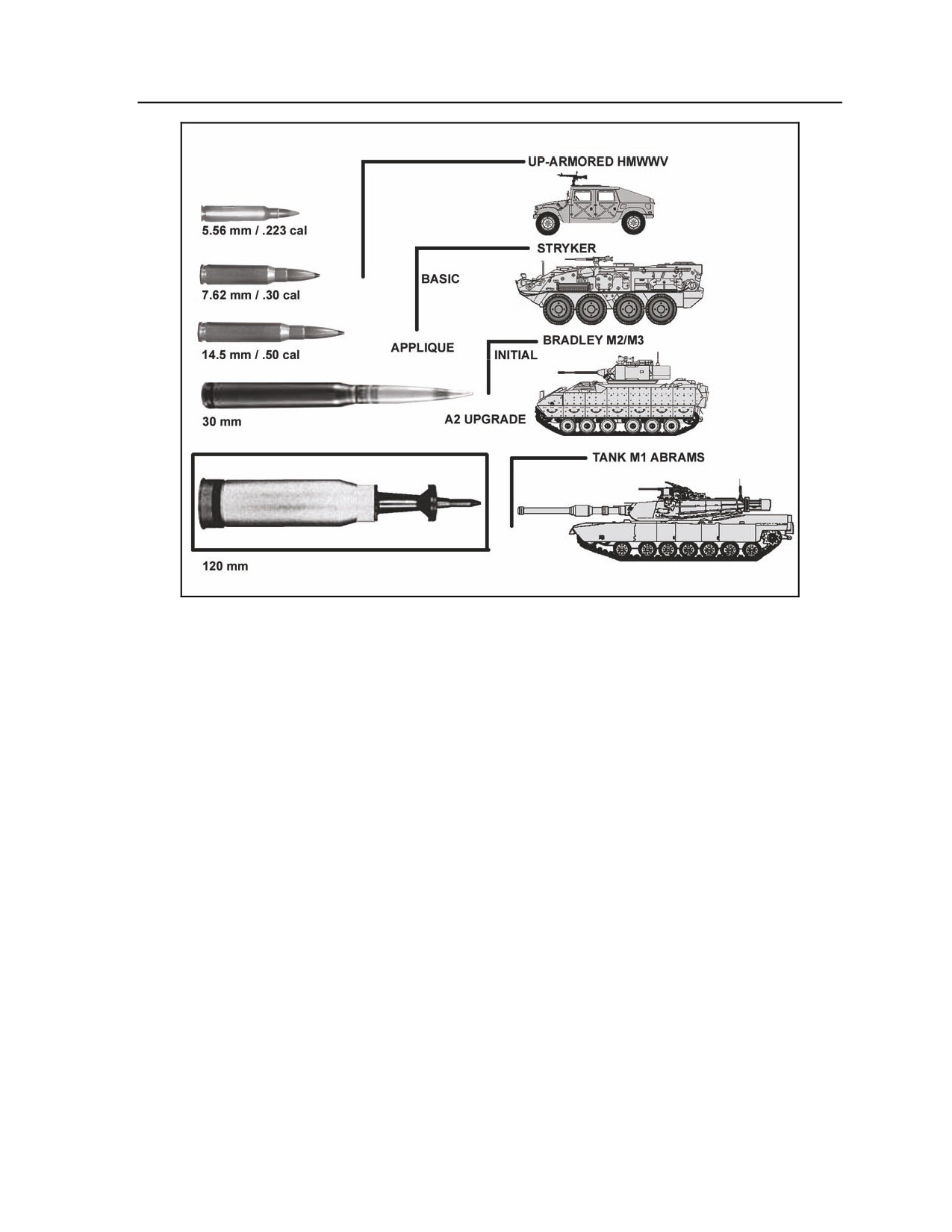
D-15. All combat vehicles offer varying degrees of protection from direct and indirect fire. Figure D-1
illustrates the generally-progressive degrees of protection offered by combat vehicles.
D-4
FM 3-21.8
28 March 2007
Vehicle Employment Considerations
Figure D-1. Comparative levels of ballistic protection.
TANKS (M1)
D-16. The M1-series tank provides rapid mobility combined with excellent protection and highly lethal,
accurate fires. They are most effective in generally open terrain with extended fields of fire.
Mobility Advantages
D-17. The tank's mobility comes from its capability to move at high speed both on and off road. The tank’s
ability to cross ditches; ford streams and shallow rivers; and push through small trees, vegetation, and
limited obstructions allows effective movement in various types of terrain.
Mobility Disadvantages
D-18. Tanks consume large quantities of fuel. They are very noisy and must be started periodically in cold
weather or when using thermal night sights and radios to ensure the batteries stay charged. The noise,
smoke, and dust generated by tanks make it difficult for the Infantry in their vicinity to capitalize on stealth
to achieve surprise. Tanks cannot cross bodies of water deeper than four feet without deep water fording
kits or bridging equipment. Due to the length of the tank main gun, the turret will not rotate if a solid object
such as a wall, post, or tree is blocking it. Tracked vehicles can also “throw track.” This occurs when the
track loses tension on the sprockets and/or support arms and the track becomes disconnected from the tank.
Repairing the track can be a lengthy process.
Firepower Advantages
D-19. The tank's main gun is extremely accurate and lethal at ranges out to 4,000 meters. Tanks with
stabilized main guns can fire effectively even when moving at high speeds cross-country. The tank remains
the best antitank weapon on the battlefield. The various machine guns (M1 tank commander's caliber .50
and 7.62-mm coax and the loader's 7.62-mm MG) provide a high volume of supporting fires for the
28 March 2007
FM 3-21.8
D-5
Appendix D
Infantry. The target acquisition capabilities of the tank exceed the capability of all systems in the Infantry
battalion. The thermal sight provides a significant capability for observation and reconnaissance. It can also
be used during daylight hours to identify heat sources (personnel and vehicles), even through vegetation.
The laser range finder provides an increased capability for the Infantry force to establish fire control
measures (such as trigger lines and TRPs), and to determine exact locations.
Firepower Disadvantages
D-20. The normal, basic load for the tank’s main gun is primarily armor piercing discarding sabots (APDS)
antitank rounds. These rounds are not as effective against light armored or wheeled vehicles, bunkers,
trench lines, buildings, or enemy personnel. They also present a safety problem when fired over the heads
of exposed Infantrymen due to the discarded sabot pieces that fall to the ground. HE ammunition provides
better destructive effects on the above-mentioned targets except enemy personnel, which the tank's machine
guns are most effective against. The resupply of all tank ammunition is difficult and requires logistic
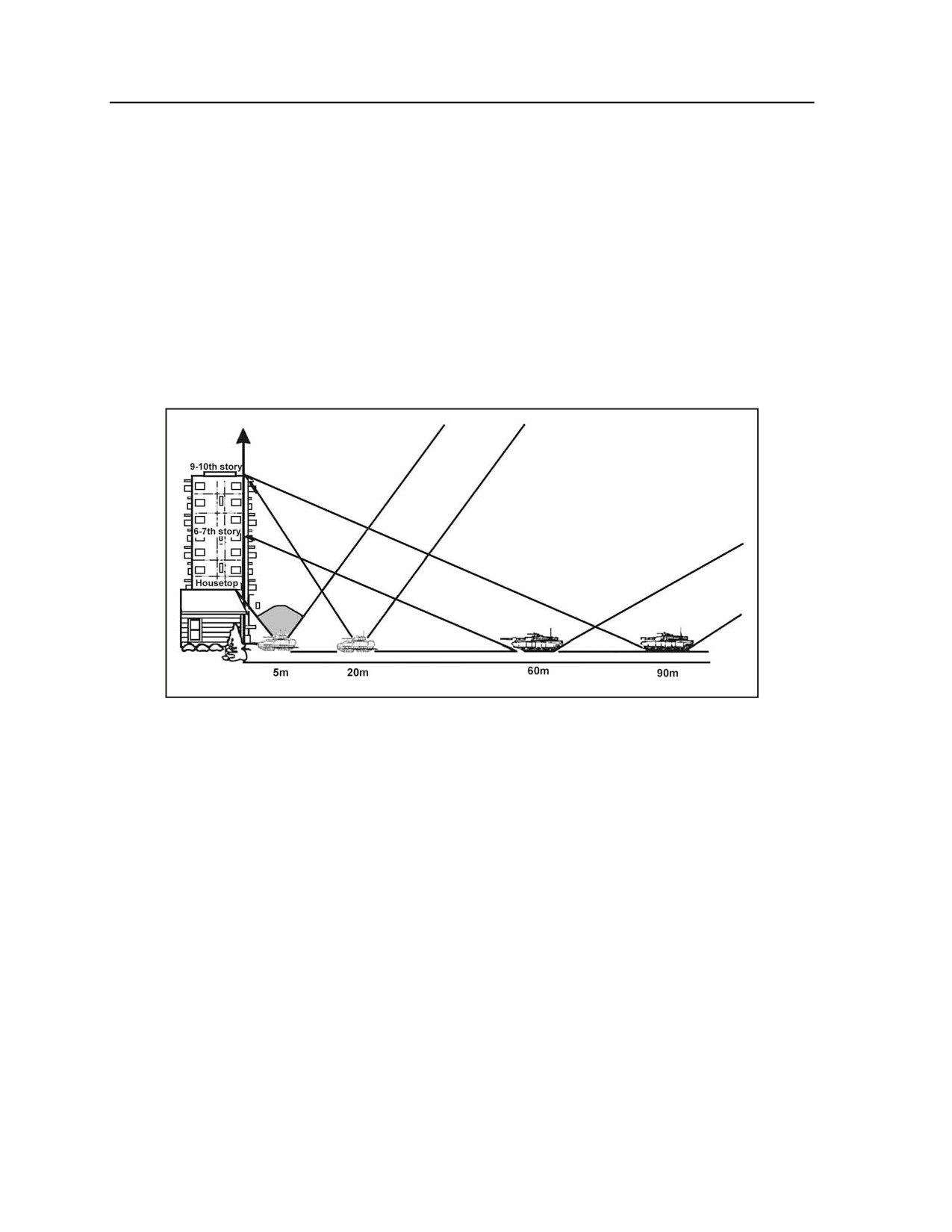
support from the heavy battalion. The main gun of an M1A2 can only elevate +20 degrees and depress -9
degrees. Figure D-2 illustrates M1A2 fields of fire on the urban terrain.
Figure D-2. M1A2 fields of fire on urban terrain.
Protection Advantages
D-21. Generally, tank armor provides excellent protection to the crew. Across the frontal 60-degree arc, the
tank is impenetrable to all weapons except heavy AT missiles or guns and the main gun on enemy tanks.
When fighting with the hatches closed, the crew is impenetrable to all small arms fire, artillery rounds
(except a direct hit), and AP mines. The tank's smoke grenade launcher and on-board smoke generator
provide rapid concealment from all but thermal observation.
Protection Disadvantages
D-22. The tank is most vulnerable to lighter AT weapons from the flanks, top, and especially the rear. The
top is especially vulnerable to precision-guided munitions (artillery or air delivered). AT mines can also
destroy or disable the vehicle. When fighting with hatches closed, the tank crew's ability to see, acquire,
and engage targets (especially close-in Infantry) is greatly reduced.
Information Advantages
D-23. FBCB2, global positioning systems (GPSs), and inertial position navigation (POSNAV) systems
allow today’s tanks the mobility to virtually any designated location with greater speed and accuracy than
ever before. Use of visual signals and the single channel ground/airborne radio system (SINCGARS)
facilitates rapid and secure communication of orders and instructions. This capability allows tank crews to
quickly mass the effects of their weapon systems while remaining dispersed to limit the effects of the
D-6
FM 3-21.8
28 March 2007
Vehicle Employment Considerations
enemy’s weapons. On-board optics and sighting systems enable tank crews to acquire and destroy enemy
tanks, armored vehicles, and fortifications using the main gun, and to suppress enemy positions, personnel,
and lightly armored targets with the tank’s machine guns
Information Disadvantages
D-24. Not all tanks are equipped with digitally enhanced systems (FBCB2). Additionally, at present, the
situational awareness and enemy situation acquired by the FBCB2 cannot be easily shared with Infantry
units on the ground.
M2 BRADLEY FIGHTING VEHICLE (BFV)
D-25. The M2 BFV provides good protection and mobility combined with excellent firepower to support
Infantry units with direct fire.
Advantages
D-26. The mobility of the M2 is comparable to the tank. In addition to the three-man crew, the vehicle is
designed to carry seven additional Infantrymen with a combat load.
Disadvantages
D-27. The M2 consumes significant quantities of fuel, but less than a M1. The BFV is louder than the M1,
and like the M1, its engine must be started periodically in cold weather or when using the thermal night
sight and radios to ensure the batteries stay charged. Like all heavy vehicles, the noise, smoke, and dust
generated by the M2 makes it difficult for the Infantry to capitalize on its ability to move with stealth and to
avoid detection when moving on the same approach. Improvised barricades, narrow streets and alleyways,
or large amounts of rubble can block BFVs in an urban area. Heavy woods will restrict their movement in a
rural area. The 25-mm cannon does not project out over the front of the Bradley like a tank, but it does
protrude over the sides of the Bradley when the gunner is aiming at 3 o’clock or 9 o’clock. This will cause
some problems for the Bradley when trying to negotiate narrow avenues of approach. Attaching and
removing rucksacks to the exterior of the vehicle can be a lengthy process, and the rucksacks are exposed
to enemy fire.
Firepower Advantages
D-28. The primary weapon on the M2 is the 25-mm chain gun that fires APDS, high explosive incendiary
with tracer (HEI-T), and TPT. This weapon is extremely accurate and lethal against lightly armored
vehicles, bunkers, trench-lines, and personnel at ranges out to 2,000 meters. The stabilized gun allows
effective fires even when moving cross-country. The TOW provides an effective weapon for destroying
enemy tanks or other point targets at extended ranges to 3,750 meters. The 7.62-mm coax provides a high
volume of suppressive fires for self defense and supporting fires for the Infantry up to 800 meters. The
combination of the stabilized turret, thermal sight, high volume of fire, and the reinforcing effects of
weapons and ammunition makes the M2 an excellent suppression asset supporting Infantry assaults. The
thermal sight provides a significant capability for observation and reconnaissance. It can also be used
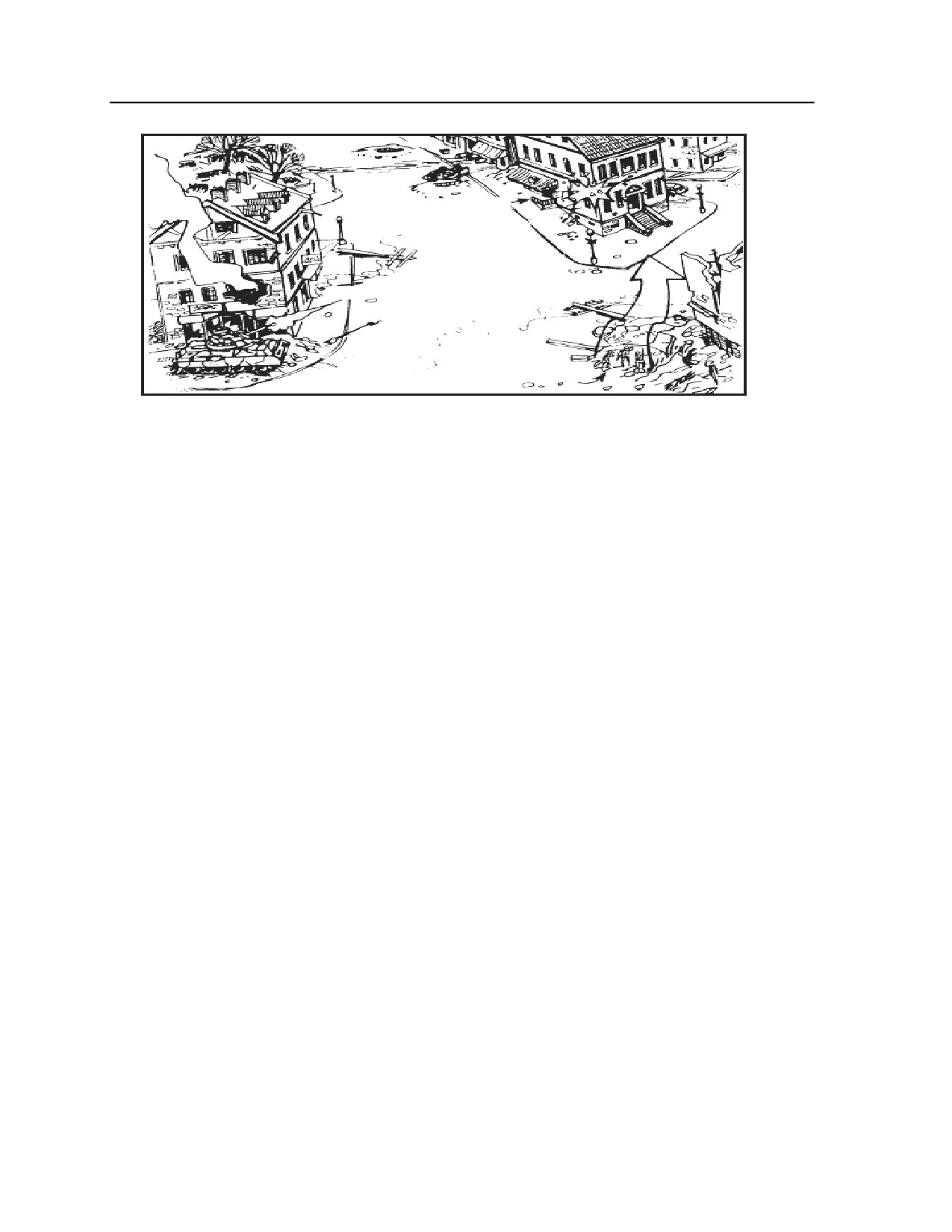
during the day to identify heat sources (personnel and vehicles) even through light vegetation. Figure D-3
shows the 25-mm supporting Infantry in an urban setting.
28 March 2007
FM 3-21.8
D-7
Appendix D
Figure D-3. BVF 25-mm infantry support.
Firepower Disadvantages
D-29. When operating the thermal sight with the M2engine off, a "clicking" sound can be heard at a
considerable distance from the vehicle. The resupply of ammunition is difficult and requires external
logistic support.
Protection Advantages
D-30. Overall, the M2 provides good protection. When fighting with the hatches closed, the crew is well
protected from small-arms fire, fragmentation munitions, and AP mines. The M2 smoke-grenade launcher
and on-board smoke generator provide rapid concealment from all but thermal observation.
Protection Disadvantages
D-31. The vehicle is vulnerable from all directions to any AT weapons and especially enemy tanks. AT
mines can destroy or disable the vehicle. When the crew is operating the vehicle with the hatches open,
they are vulnerable to small-arms fire.
Information Advantages
D-32. The target acquisition capabilities of the M2 exceed the capability of the other systems in the Infantry
battalion. The thermal sight provides a significant capability for observation and reconnaissance. It can also
be used during the day to identify heat sources (personnel and vehicles) even through light vegetation.
Many models of the BFV are now equipped with the FBCB2.
Information Disadvantages
D-33. Bradley vehicle crewmen have poor all-round vision through their vision blocks. They are also easily
blinded by smoke or dust. Therefore, the Bradley vehicle should not be approached while it is in contact
because the crew may have difficulty seeing Infantryman outside of the vehicle. The Bradley commander
(BC) must be informed where the dismounted Infantry are located to prevent any accidents on the
battlefield.
STRYKER INFANTRY CARRIER VEHICLE (ICV)
D-34. There are two variants of the Stryker: the Infantry carrier vehicle (ICV); and the mobile gun system
(MGS). The primary design of the Stryker is found in the basic ICV. This troop transport vehicle is quite
capable of carrying nine Infantry Soldiers and their equipment, a crew of two, a driver, and a vehicle
commander. There are eight configurations of the ICV that provide comprehensive sustainment. The eight
ICV configurations include: command vehicle; reconnaissance vehicle; fire support vehicle; mortar carrier
D-8
FM 3-21.8
28 March 2007
Vehicle Employment Considerations
vehicle; antitank guided missile vehicle; engineer squad vehicle; medical evacuation vehicle; and nuclear,
biological, and chemical reconnaissance vehicle. The MGS incorporates a 105-mm turreted gun and
autoloader system. The Stryker can greatly reduce the amount of inventory and logistical support for
combat brigades, while at the same time increasing the Infantry’s ability to deploy.
Mobility
D-35. The Stryker vehicle enables the team to maneuver in close and urban terrain, provide protection in
open terrain, and transport infantry quickly to critical battlefield positions.
Advantages
D-36. With 4x8- and 8x8-wheel drive, the Stryker is designed for all-weather use over all types of terrain
and can ford hard-bottomed bodies of water to a depth of 67 inches. Stryker vehicles have a maximum
speed of 60 miles per hour and a range of 300 miles on a tank of fuel. The vehicles are swift, easily
maintainable, and include features designed for the safety of Soldiers. The Stryker’s has run-flat tires that
can be inflated or deflated from inside the vehicle to adapt to surfaces ranging from deep mud to hardtop. It
also has a built-in fire suppression system, and a self-recovery winch. The vehicles run quieter than current
armored personnel carriers, increasing their stealth. Steel-belted tires with run-flat liners enable vehicle
mobility for 5 miles (8 km) with all tires flat.
Disadvantages
D-37. For vehicles weighing 10-20 tons, wheels are inferior to tracks in crossing sand, mud, and snow.
Driving more than five miles on a flattened tire can cause a fire. Improvised barricades, narrow streets and
alleyways, or large amounts of rubble can block Stryker vehicles in urban areas. Dense forests can block it
in rural areas.
Firepower Advantages
D-38. The ICV has a remote weapon station with a universal soft mount cradle that can mount either a .50
caliber M2 machine gun, MK 19 40-mm grenade launcher, or M240B 7.62-mm machine gun. It is also
armed with four M6 smoke grenade launchers. Stowed ammunition includes:
32 66-mm smoke grenades.
3,200 7.62-mm rounds.
2,000 .50 cal rounds or four hundred thirty MK 19 rounds.
D-39. Troops carry—
2,240 5.56-mm ball ammunition.
1,120 5.56-mm linked ammunition.
Firepower Disadvantages
D-40. The ICV loses some of the ammunition effects that tanks and Bradley fighting vehicles can provide
to the Infantryman. For this reason the ICV can suppress light skinned vehicles, bunkers, buildings, and
enemy Infantry, but is not as effective as a BFV or tank against enemy light-armored or armored vehicles.
Protection Advantages
D-41. The basic ICV provides armored protection for the two-man crew and a squad of nine Infantry
Soldiers. The ICV’s armor protection will stop .50-caliber bullets and protects against 152-mm airburst
shells. The basic armor package on every Stryker vehicle is a steel hull that protects against 7.62-mm
bullets; and a ceramic, added-on appliqué that gives protection against 14.5-mm machine guns. Hull floor
plate and fuel tank armor protect from blast and fragment effects of antipersonnel mine detonations. Low
silhouette and low noise output make the vehicle a difficult target to detect and engage.
28 March 2007
FM 3-21.8
D-9
Appendix D
Protection Disadvantages
D-42. The ICV is vulnerable to all AT fires and tanks. The effectiveness of RPG fire can be mitigated with
a slat-armor application (cage) that causes a premature detonation of the RPG warhead away from the hull
of the ICV.
Information
D-43. Just as with the tank and Bradley, the Stryker ICV vehicle crewmen have poor all-round vision
through their vision blocks. They are also easily blinded by smoke or dust.
ASSAULT HIGH-MOBILITY MULTIPURPOSE WHEELED VEHICLE
(HMMWV)
D-44. The HMMWV is a light, highly mobile, diesel-powered, four-wheel-drive vehicle equipped with an
automatic transmission. Using components and kits common to the M998 chassis, the HMMWV can be
configured as a troop carrier, armament carrier, TOW missile carrier, or a Scout vehicle.
MOBILITY ADVANTAGES
D-45. The HMMWV rests on a four-wheel chassis. Its four-wheel drive enables it to operate in a variety of
terrain and climate conditions. It is capable of fording water up to 30 inches in depth, and can ford depths
of up to 60 inches with the deep water fording kit. The HMMWV’s size allows it to travel in the narrow
streets of urban terrain with minimal damage to the infrastructure. Some models of the HMMWV (M1026,
M1036, M1046, and M1114) employ a winch that aids in self recovery and recovery of similar vehicles.
Mobility Disadvantages
D-46. Although generally equipped with run-flat tires, the HMMWV’s tires are very susceptible to enemy
fire. HMMWVs have much less ability to breach obstacles than tracked vehicles. The HMMWV can be
blocked by hasty and complex obstacles. I can also be easily rolled, especially with the armored M114.
Firepower Advantages
D-47. The HMMWV can employ a variety of weapon systems that offer excellent direct fire support to
Infantry forces. The TOW, .M2, MK 19, M240B, and M249 can all be mounted in HMMWV models with
turrets. The capabilities of these weapon systems are discussed in greater detail in Table D-2.
Firepower Disadvantages
D-48. In almost all instances, the HMMWV can only mount one weapon system. This makes it less
effective than tanks or BFVs that can employ antitank and antipersonnel weapons simultaneously.
Protection Advantages
D-49. The M1114 is an up-armored HMMWV that provides ballistic, artillery, and mine blast protection to
vehicle occupants. The M1114 can protect occupants from 7.62-mm assault rifle armor-piercing rounds and
155-mm artillery airburst, and provides 12 pounds front and 4 pounds rear antitank mine protection. Other
protection features include complete perimeter ballistic protection, mine blast protection, and a turret shield
for the gunner. Supplemental armor packages are now available for many models of the HMMWV. This
armor has been shown to be effective against improvised explosive devices.
Protection Disadvantages
D-50. All models other than the M1114 offer extremely limited protection from direct or indirect fire.
Leaders should not plan or direct the use of these vehicles for cover from enemy small arms, indirect fire,
or rocket-propelled grenades. Gunners are exposed while manning their weapon system to direct and
indirect fire. The lack of internal space causes difficulties if transporting a casualty.
D-10
FM 3-21.8
28 March 2007

Vehicle Employment Considerations
Information Advantages
D-51. The HMMWV has a variety of features that make it excellent for gathering and managing
information. The crew and passengers of the HMMWV generally have excellent situational awareness due
to a large front windshield and large windows located on the door at each seat. HMMWVs can carry two
SINCGARS-class FM radio systems. They can also employ a power amplifier to extend the
communications range to 35 kilometers in open terrain. The HMMWV can be configured to carry many
digital devices to include the FBCB2 and PLGRs. The weapon systems of the HMMWV can employ sites
with night vision, thermal, and range-finding capabilities with high resolution and magnification in some
systems.
Information Disadvantages
D-52. Many of the digital and electronic devices of the HMMWV require constant power sources. The need
to start the HMMWV to keep the batteries charged can present a tactical problem if stealth is desired during
an operation.
SIZE AND WEIGHT CONSIDERATIONS
D-53. Infantry leaders must consider the size and weight of combat vehicles operating in units before
conducting an operation (Table D-3). Terrain that supports the movement of Infantrymen may or may not
support the movement of combat vehicles. Structures of particular concern are bridges, overpasses, and
culverts as structural failure could be deadly to the Soldiers in the vicinity. Many bridges in North America
and Europe are marked with signs that state the load bearing capabilities of that structure. In other areas,
Infantrymen should rely on route reconnaissance overlays that show the carrying capabilities of the routes
being used. In the absence of such information, Infantry leaders should always use the cautious approach
and avoid suspect infrastructure.
Table D-3. Vehicle size and weight classification.
Height
Width
Vehicle
Weight
(feet)
(inches)
M1 Tank
68.7 tons
10.14
143.75
BFV with reactive armor
33 tons
11.3
142.2
BFV without reactive armor
28 tons
11.3
130
Stryker ICV
38,000 lbs.
104
107
ASLT HMMWV
6,780 lbs.
74
85
SURFACE DANGER AREAS
D-54. Infantry leaders must consider the surface danger zones (SDZ) of combat vehicle weapon systems
that are operating with their units. This information is crucial for the leaders to develop safe and effective
direct fire control plans. Effective application of SDZs prevents fratricide and maximizes direct fire upon
the enemy.
D-55. Each weapon system has a unique SDZ. SDZs are the minimum safe distances and angles that must
be considered when operating in close proximity to weapon systems. SDZs take into consideration a
round’s maximum distance, lateral dispersion, and backblast (if applicable). This information allows
leaders to plan for safe and effective maneuver of their forces. Reference Section III of this appendix for a
detailed analysis of SDZs for weapon systems associated with combat vehicles in this appendix.
TACTICAL CAPABILITIES
D-56. Light Infantry units may have combat vehicle sections attached for combat operations. Table D-4
shows a list of tasks that these combat vehicle sections may perform while attached or under the operational
control of Infantry units.
28 March 2007
FM 3-21.8
D-11

Appendix D
Table D-4. Tasks of combat vehicles in Infantry operations.
Infantry Operations
Combat Vehicle Tasks
Movement to contact
Support by fire; attack by fire; assault; breach; follow and support;
reserve; route clearance; convoy escort; checkpoint/roadblock
operations.
Attack
Support by fire; attack by fire; assault; breach.
Exploitation
Serve as security force (screen); lead the exploitation (assault or
attack by fire).
Pursuit
Serve as enveloping force, reserve (attack by fire or assault), or
security force (screen); lead direct pressure force (support by fire,
attack by fire, or assault).
Security (screen, guard, cover)
Screen; guard; defend; delay; attack by fire; assault.
Defend
Screen; guard; defend; delay; attack by fire (counterattack); assault
(counterattack).
Retrograde (delay, withdraw, retire)
Defend; delay; screen; guard; attack by fire (counterattack); withdraw.
Break out from encirclement
Serve as rupture force (assault or attack by fire) or rear guard (delay).
D-57. Infantry units may be attached to mechanized/armored units during combat operations. Table D-5
shows a list of tasks that Infantry units may perform while attached or under the operational control of
combat vehicular units.
Table D-5. Tasks of the Infantry in combat vehicle operations.
Combat Vehicle Operations
Infantry Tasks
Attack by fire
Secure an ABF position (reconnoiter an area or attack); provide
local security or act as the blocking force (defend).
Support by fire
Secure an SBF position (reconnoiter an area or attack); provide
local security; conduct overwatch/support by fire.
Bypass
Serve as the fixing force (defend); perform linkup with follow-on
forces.
Assault
Attack; assault; breach; overwatch/support by fire; knock out a
bunker; clear a trench line; clear a building.
Clearance in restricted
Attack; assault; overwatch/support by fire; knock out a bunker; clear
terrain
a trench line; clear a building; breach, clear AT teams.
Defend
Defend; defend in urban operations/building; construct an obstacle.
Screen/guard
Perform surveillance or screen.
Breach
Breach; overwatch/support by fire; assault.
Hasty water/gap crossing
Cross water obstacles; assault; overwatch/support by fire.
Delay
Delay; break contact.
Withdrawal
Break contact; serve as advance party (assembly area procedures).
TACTICAL MOVEMENT RATES
D-58. Leaders of combat vehicle units often fail to recognize the speed with which the Infantry can move
when operating dismounted. Numerous factors can affect the rate of march for the Infantry forces
including, tactical considerations, weather, terrain, march discipline, acclimatization, availability of water
and rations, morale, and individual loads. Table D-6 summarizes dismounted rates of march for normal
terrain. The normal distance covered by an Infantry force in a 24-hour period is from 20 to 32 kilometers,
marching from five to eight hours at a rate of 4 kph. A march in excess of 32 kilometers in 24 hours is
considered a forced march. Forced marches increase the number of hours marched; not the rate of march.
D-12
FM 3-21.8
28 March 2007
Vehicle Employment Considerations
Absolute maximum distances for dismounted marches are 56 kilometers in 24 hours, 96 kilometers in 48
hours, or 128 kilometers in 72 hours.
Table D-6. Dismounted rates of march (normal terrain).
ROADS
CROSS-COUNTRY
Day
4.0 kph
2.4 kph
Night
3.2 kph
1.6 kph
Carrying Capacities of Combat Vehicles
D-59. There may be times when combat vehicles and Infantrymen must move quickly from one place to
another to accomplish their mission. In such cases, and depending on the enemy threat and the level of
training, Infantrymen should ride in or on combat vehicles.
D-60. Riding on the outside of the vehicles is hazardous. Therefore, Infantry should only ride on vehicles
when the need for speed is great. By riding on, not in, vehicles, the Infantry gives up its best protection—
the ability to move with stealth and avoid detection. Soldiers riding on the outside armored vehicles are
vulnerable to all types of fire. Also, Soldiers must watch out for obstacles that may cause tanks to turn
suddenly; tree limbs that may knock them off; and for the traversing of the turret gun, which may also
knock them off.
D-61. The only advantages the Infantry gains from riding in or on combat vehicles is speed of movement
and increased haul capability. In this case, the following apply:
Avoid riding on the lead vehicle of a section or platoon. These vehicles are most likely to make
contact and can react quicker without Soldiers on top.
Position the Infantry leaders with the combat vehicle leaders. Discuss and prepare contingency
plans for chance contact or danger areas. Infantry should dismount and clear choke points or
other danger areas.
Assign air guards and sectors of responsibility for observation. Ensure all personnel remain alert
and stay prepared to dismount immediately. In the event of contact, the armored vehicle will
immediately react as required for its own protection. The Infantry on top are responsible for their
own safety. Rehearse a rapid dismount of the vehicle.
Consider putting rucksacks, ammunition, and other equipment on vehicles, and have the Infantry
move on a separate avenue of approach. This can increase Infantry mobility by allowing them to
move through more suitable terrain.
Tanks
D-62. Riding on tanks reduces tank maneuverability and may restrict firepower. Infantrymen may be
injured if the tank must slew its turret to return fire on a target. Consequently, Soldiers must dismount to
clear danger areas or as soon as enemy contact is made.
D-63. Soldiers ride on tanks by exception and depending on the likelihood of contact. There are several
tactical and safety considerations that must be considered before Infantrymen ride on a tank. The M1 series
tank is not designed to carry riders easily. Riders must not move to the rear deck. Engine operating
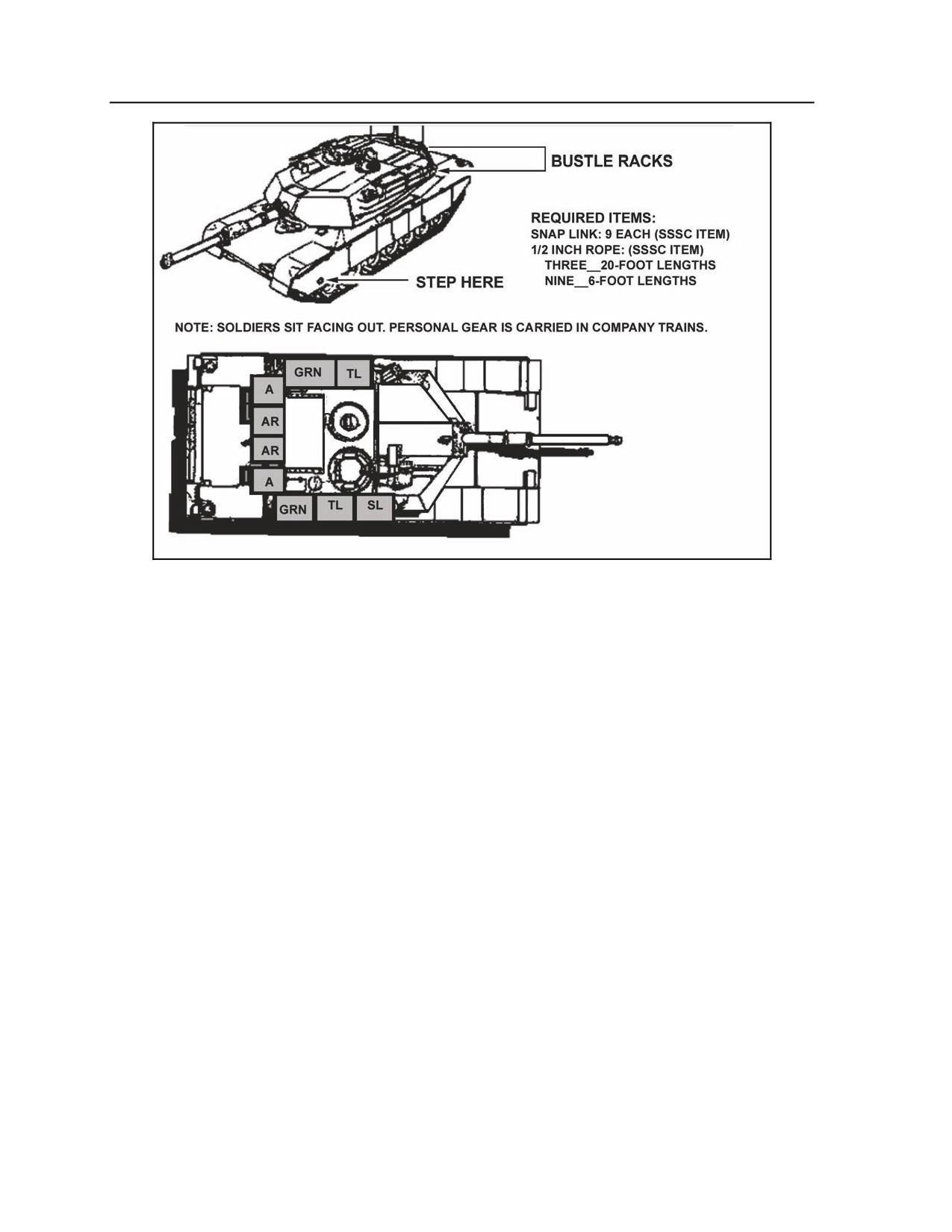
temperatures make this area unsafe for riders (Figure D-4).
28 March 2007
FM 3-21.8
D-13
Appendix D
Figure D-4. Mounting and riding arrangements on an M1-series tank.
D-64. One Infantry squad can ride on the turret. Soldiers must mount in such a way that their legs cannot
become entangled between the turret and the hull by an unexpected turret movement. Rope may be used as
a field-expedient Infantry rail to provide secure handholds.
D-65. Everyone must ride to the rear of the smoke grenade launchers. This automatically keeps everyone
clear of the coaxial machine gun and laser range finder.
D-66. The Infantry must always be prepared for sudden turret movement. Leaders should caution Soldiers
about sitting on the turret blowout panels. This safety knowledge is critical because 250 pounds of pressure
will prevent the panels from working properly. If there is an explosion in the ammunition rack, the panels
blow outward to lessen the blast effect in the crew compartment.
D-67. If enemy contact is made, the tank should stop in a covered and concealed position and allow
Infantry time to dismount and move away from the tank. This action needs to be practiced before
movement.
D-68. The Infantry should not ride with anything more than their battle gear. Personal gear should be
transported elsewhere.
Bradley Fighting Vehicle
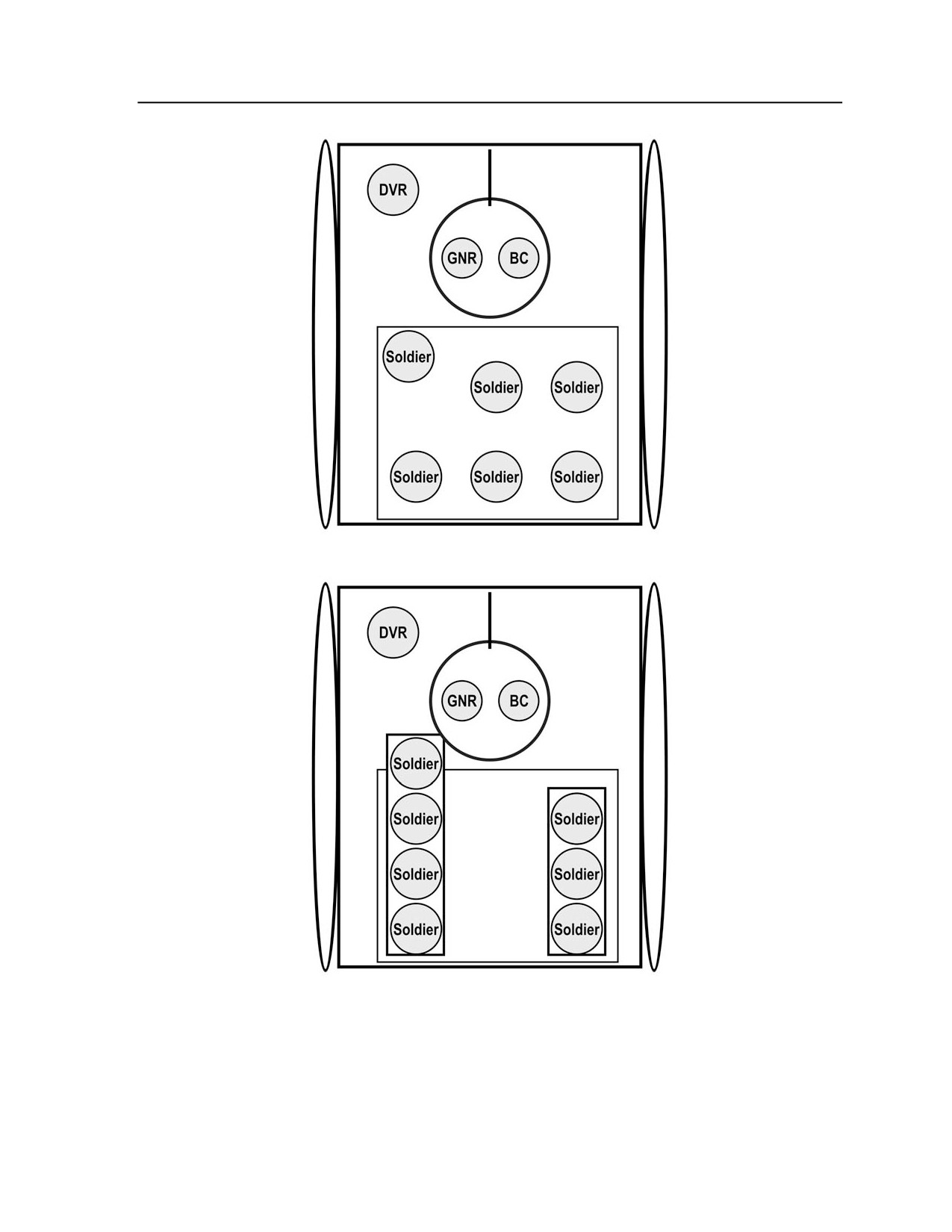
D-69. The BFV is designed to carry six Infantrymen and a crew of three: a Bradley commander (BC),
gunner (GNR), and driver (DVR). The troop compartment of the BFV carries six Infantrymen in combat
gear. Rucksacks are generally carried on the outside of the vehicle. Prior to riding in the vehicle,
Infantrymen who are not familiar with the BFV should be thoroughly trained on its exit points, fire drills,
and rollover drills. The major difference in carrying capacity between the M2A1 and the
M2A2/ODS/M2A3 is the seating configuration. The M2A1 has six individual seats, while the
M2A2/ODS/M2A3 has two benches that are on the left and right sides of the troop compartment. Figures
D-5 and D-6 illustrate the carrying capacity of the BFV-series combat vehicles.
D-14
FM 3-21.8
28 March 2007
Vehicle Employment Considerations
Figure D-5. M2A1 seating diagram.
Figure D-6. M2A2, ODS, and M2A3 seating diagram.
Infantry Carrier Vehicle
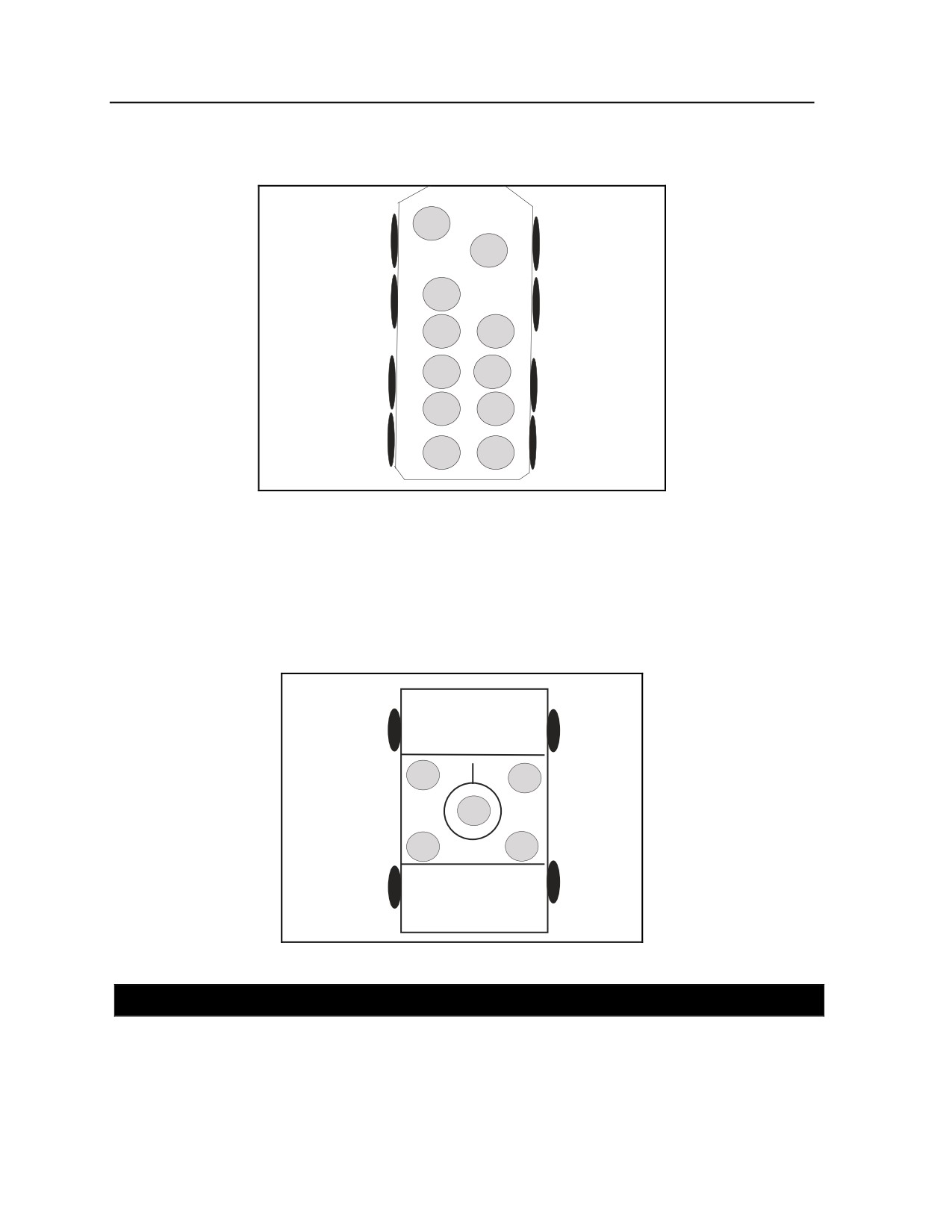
D-70. The Stryker Infantry carrier vehicle is designed to carry a nine-man Infantry squad in combat gear, a
driver, and a vehicle commander (VC). Rucksacks are generally carried on the outside of the ICV.
28 March 2007
FM 3-21.8
D-15
Appendix D
Infantrymen who are not familiar with the ICV should be thoroughly trained on its exit points, fire drills,
and rollover drills prior to riding in the vehicle. Figure D-7 illustrates the carrying capacity of the ICV.
DVR
VC
Soldier
Soldier
Soldier
Soldier
Soldier
Soldier
Soldier
Soldier
Soldier
Figure D-7. Seating diagram for the ICV.
Assault HMMWV
D-71. The ASSLT HMMWV class of vehicles is designed to carry five Soldiers in combat gear, a truck
commander (TC), a gunner, a driver, and two Soldiers in the rear passenger seats. Rucksacks are generally
carried on the outside or in the rear cargo storage area of the ASSLT HMMWV. Infantrymen who are not
familiar with the ASSLT HMMWV should be thoroughly trained on its exit points, fire drills, and rollover
drills prior to riding in the vehicle. Figure D-8 illustrates the carrying capacity of the ASSLT HMMWV.
DVR
TC
GNR
Soldier
Soldier
Figure D-8. Seating diagram for the ASSLT HMMWV.
SECTION II — OPERATIONS
D-72. The intent of this section is to familiarize leaders with conducting operations with combat vehicles.
The section is divided under three subsections: plan, prepare, and execute.
D-16
FM 3-21.8
28 March 2007
Vehicle Employment Considerations
PLAN
D-73. Employment of combat vehicles requires thorough understanding and integration of the vehicle with
the Infantry unit. The following paragraphs focus on planning considerations for combat vehicles and
dismounted Infantry integration.
TASK ORGANIZATION OPTIONS
D-74. A combat vehicle platoon or section would normally be OPCONed to an Infantry company during
combined arms operations at the company team level. However, in the COE, Infantry platoons may receive
combat vehicle platoons or sections to conduct operations. There are four basic techniques of task-
organizing the combat vehicle section into the Infantry company for combat operations: combat vehicle
platoon as a maneuver element; combat vehicle sections under Infantry control; combat vehicle sections
under company and platoon control; and Infantry squads under combat vehicle control. This concept holds
true for all combat vehicle units.
Combat Vehicle Platoon as a Maneuver Element
D-75. The combat vehicle platoon leader is responsible for maneuvering the vehicles IAW the company
team commander’s intent. Likely missions for the combat vehicles with this task organization are support
by fire (SBF), or overwatch of the Infantry’s movement. The combat vehicle platoon leader can choose to
maneuver the platoon by sections to execute the mission. This maneuver provides greater flexibility in
supporting the Infantry during the close fight.
Combat Vehicle Sections Under Infantry Platoon Control
D-76. Combat vehicles are broken down into two sections. Each section is placed under the OPCON of an
Infantry platoon and maneuvered IAW the company team commander’s intent. The commander
relinquishes direct control of the combat vehicle maneuver to his subordinates. This technique is very
effective in maintaining the same rate of progress between the combat vehicles and the Infantry. Leaders
have the additional responsibility of maneuvering combat vehicles. The general lack of experience with
combat vehicles and the overall battlefield focus of the leaders can affect this technique. This technique is
best suited for when contact with the enemy is expected and close continuous support is required for
movement or clearing buildings.
Combat Vehicle Sections Under Company and Platoon Control
D-77. Combat vehicle platoons can be broken down into two sections: one under company control; the
other under platoon control. The selected maneuver Infantry platoon would have a combat vehicle section
available to support the close fight. With this technique, the company team commander has a combat
vehicle section to deploy. This task organization still allows support to the Infantry close fight while
keeping additional support options in reserve for the commander to employ. The disadvantages to this
technique are Infantry platoon leaders instead of the combat vehicle platoon leaders are maneuvering
vehicles, and vehicles directly available to the company team commander are cut in half. This technique
requires detailed planning, coordination, and rehearsals between the Infantry and combat vehicle sections.
Infantry Squads Under Combat Vehicle Platoon Control
D-78. The company team commander has the option of placing one or more Infantry squads under the
OPCON of the combat vehicle platoon leader. He may also retain all combat vehicles under the control of
the combat vehicle platoon leader, or place a combat vehicle section under the OPCON of an Infantry
platoon leader. This provides the company team commander with a fourth maneuver platoon. It also
involves the combat vehicle platoon leader in the fight. It can work well when a mobile reserve that needs
Infantry protection is required.
28 March 2007
FM 3-21.8
D-17

Appendix D
Guidelines
D-79. None of the techniques described are inherently better than another one. The task organization must
be tailored to accomplish the mission. Regardless of the technique selected, the following guidelines should
be followed.
D-80. It is preferable for combat vehicles to operate as sections. This is an integral component of how
combat vehicle units train and fight. If the company commander is controlling the combat vehicles, he
needs to move forward to a position where he can effectively maneuver the combat vehicles in support of
the Infantry.
D-81. Combat vehicles should be used to shield squads and teams (minus the unarmored versions of the
ASSLT HMMWV) from building to building. As part of the maneuver plan, the leader of the forward
element controls the combat vehicles.
D-82. The task organization should support the span of control. If the company commander is going to
control the combat vehicles, there is no reason to task-organize the tanks by section under Infantry
platoons.
D-83. Combat vehicles need Infantry support when the two elements are working together. Do not leave
combat vehicles alone because they are not well suited to provide local security during the operation.
Combat vehicles are extremely vulnerable to dismounted attack when operating in urban terrain. They are
most vulnerable and need local security when Infantry are in the process of clearing buildings.
RISK MANAGEMENT
D-84. Infantry leaders must identify and implement controls to mitigate risks associated with conducting
operations with combat vehicles. These risks are divided into two categories: tactical and accidental risk.
Table D-7 contains a basic list of risks and control measures leaders should consider when conducting
operations with combat vehicles. Table D-8 contains a list of possible accidental hazards and control
measures.
Table D-7. Risk management matrix for tactical hazards.
Tactical Hazards
Control Measure
Wear individual body armor (IBA), reinforce vehicle (sand bags), use
Enemy Direct Fire
proper scanning techniques, and engage in marksmanship training.
Enemy Indirect
Practice mounted react to indirect fire drills, vary speed and distance to
Fire
avoid a trigger from an enemy indirect fire system.
Maintain situational awareness (SA), maintain current obstacle overlay for
Mines
AO, remain on cleared areas, be proficient in mine removal.
Scan, use WARLOCK (anti-remote-detonation IED system), use up-armor,
IEDs
and avoid predictability.
Scan, maintain SA, avoid predictability, use DVR techniques, engage in
Sniper Attacks
tactical movement (MVT) training.
Train leaders; refer to PAO; adhere to the ROE, Soldier's Creed, Law of
Media Exploitation
War, and the Geneva Conventions.
Gunner and Infantrymen riding on vehicles use proper scanning
VBIED
techniques, maintain SA, avoid predictability, use DVR techniques, and
engage in tactical MVT training.
Scan, maintain SA, avoid predictability, use DVR techniques, engage in
Ambush
tactical MVT training.
D-18
FM 3-21.8
28 March 2007

Vehicle Employment Considerations
Table D-8. Risk management matrix for accidental hazards.
Accidental Hazards
Control Measure
Vehicle Collision
Ensure DVR is qualified and TC is alert.
Conduct fire drills, keep fire extinguishers present and
Vehicle Fire
serviceable, perform proper PMCS.
Ensure DVR/TC/dismount situational awareness, train and
Vehicle Rollover
rehearse with vehicles, know SOPs for communication between
vehicle and dismounts. Secure loads.
Train on high decibel danger zones and wear hearing
Vehicle Striking Dismount
protection.
Vehicle Malfunction
Perform proper PMCS, ensure BDR kit is available.
Train on high decibel danger zones and wear hearing
Hearing Damage
protection.
Verify eye protection during PCI, leaders enforce it during
Eye Damage
execution.
Be aware of TOW backblast and high heat exhaust zones, wear
Burns
gloves when riding or operating equipment and weapons
(changing barrels).
Have proper load plan, use tie downs with snap links (M1
Falling From Moving Vehicle
turret), wear seat belts (HMMWV, LMTV, 5-Ton), and ensure
DVR is qualified.
Train on vehicle exits and ensure Soldiers have passed the
Drowning After Water Entry
Combat Water Survival Test (CWST).
Fratricide by WPN System of
Use day/night friendly recognition systems and proper fire
Vehicle
control measures.
Disorientation
Ensure map is present, TC is briefed, and graphics are current.
D-85. Many Infantrymen are not familiar with the hazards that may arise during operations with combat
vehicles. The most obvious of these include the dangers associated with main-gun fire, and the inability of
combat vehicle crews to see people and objects near their vehicles. Leaders of heavy and Infantry units
alike must ensure that their troops understand the following points of operational safety.
Discarding Sabot
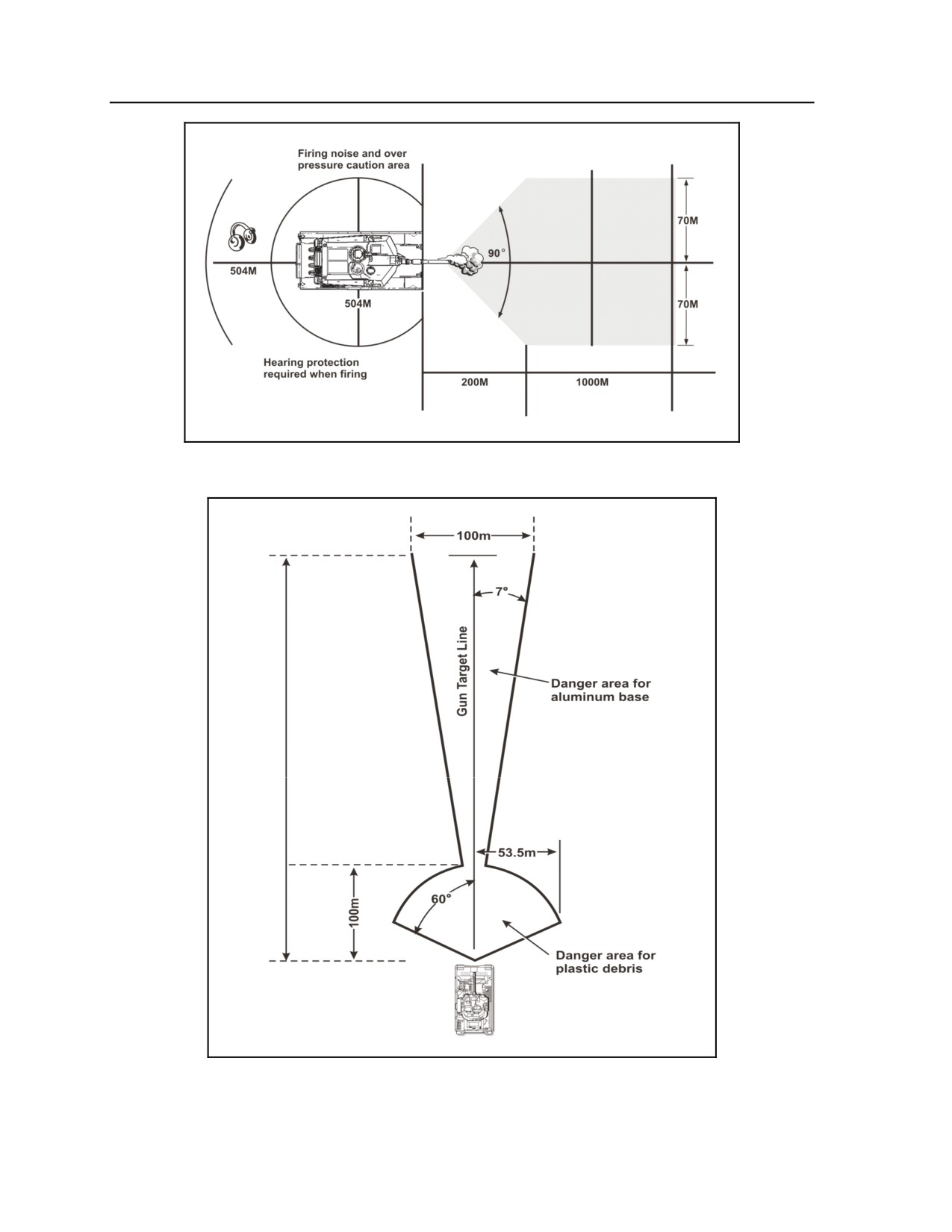
D-86. Tank 120-mm sabot rounds and 25-mm BFV rounds discard stabilizing petals when fired, posing a
downrange hazard for Infantry. The aluminum petals of the tank rounds are discarded in an area extending
70 meters to the left and right of the gun-target line out to a range of 1 kilometer (Figure D-9). The danger
zone for plastic debris from BFV rounds extends 60 degrees to the left and right of the gun-target line, and
out to 100 meters from the vehicle (Figure D-10). Infantrymen should not be in or near the direct line of
fire for the tank main gun or BFV cannon unless they are under adequate overhead cover.
28 March 2007
FM 3-21.8
D-19
Appendix D
Figure D-9. M1 tank danger zone.
Figure D-10. BFV danger zone.
D-20
FM 3-21.8
28 March 2007
Vehicle Employment Considerations
Ground Movement Hazards
D-87. Crewmen on combat vehicles have very limited abilities to see anyone on the ground to the side or
rear of the vehicle. As a result, vehicle crews and dismounted Infantrymen share responsibility for avoiding
the hazards this may create. Infantrymen must maintain a safe distance from heavy vehicles at all times. In
addition, when they work close to heavy vehicles, Infantry Soldiers must ensure that the vehicle
commander knows their location at all times, by establishing communication.
NOTE: Mounted and M1-series tanks are deceptively quiet and may be difficult for Infantrymen
to hear as they approach. As noted, vehicle crews and Infantrymen share the responsibility of
eliminating potential dangers in this situation.
M1 Exhaust Plume Hazard
D-88. M1-series tanks have an extremely hot exhaust plume that exits from the rear of the tank and angles
downward. This exhaust is hot enough to burn skin and clothing. Infantrymen should therefore avoid the
rear exhaust of the M1.
TOW Missile System
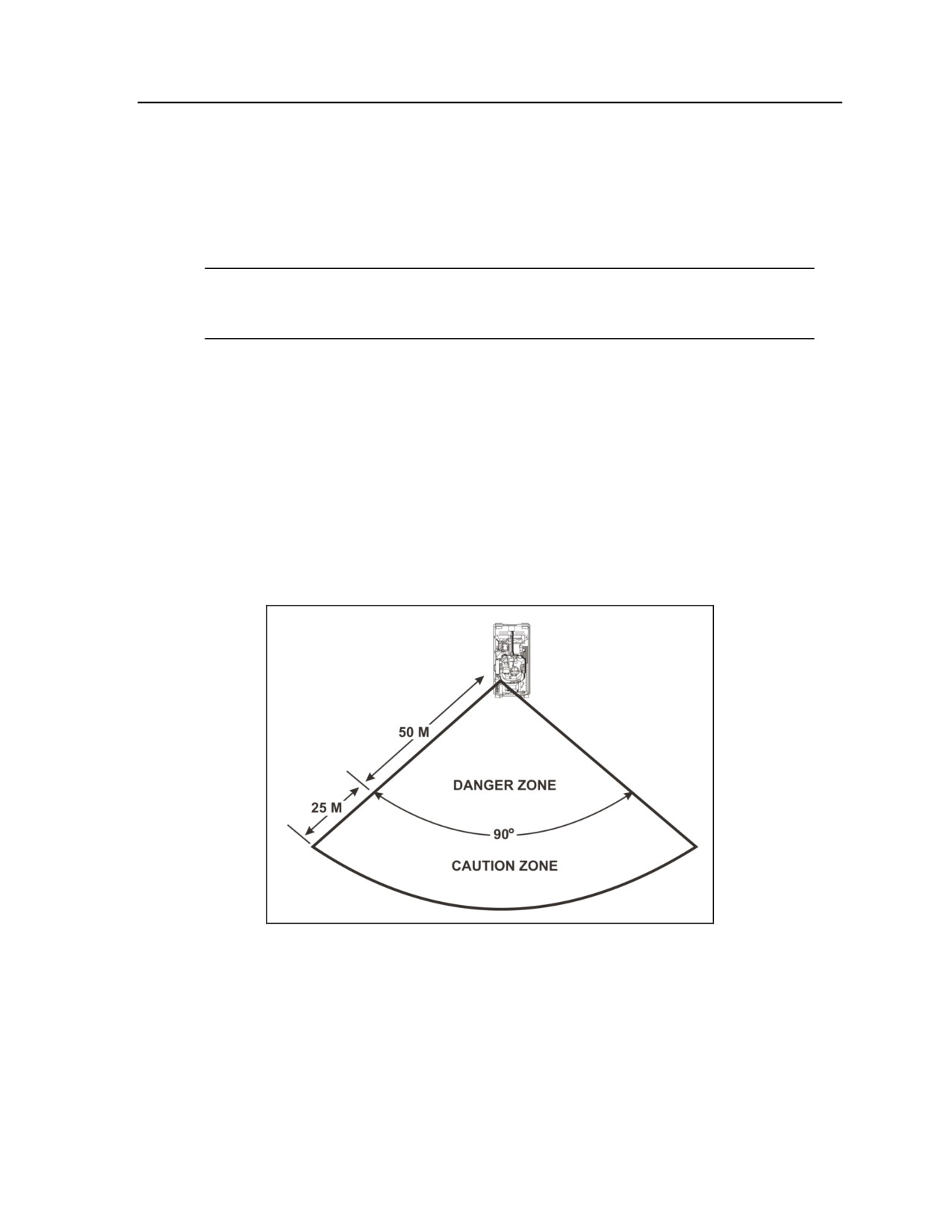
D-89. The TOW missile system can be employed on the BFV, the ASSLT HMMWV, and the ICV. The
system has a dangerous area extending 75 meters to the rear of the vehicle in a 90-degree “cone.” The area
is divided into a 50-meter danger zone and a 25-meter caution zone (Figure D-11). In the 50-meter zone,
serious casualties or fatalities are likely to occur from the blast and flying debris. Soldiers are safe in the
25-meter zone, provided they do not face the aft end of the launcher.
Figure D-11. BFV TOW backblast danger zone.
PREPARE
D-90. Key to planning operations with combat vehicles are rehearsals that gain the trust and confidence of
vehicle crews and Infantryman.
28 March 2007
FM 3-21.8
D-21
Appendix D
REHEARSAL TECHNIQUES
D-91. A rehearsal is a session in which a staff or unit practices expected actions to improve performance
during execution (FM 6-0). They are the cornerstone to any successful operation. Leaders are responsible to
ensure that all combat vehicles attached to their units are incorporated into rehearsals. Rehearsals should
include the tactical movement plan, and actions on the objective. Integration of combat vehicles is crucial
because the relationship between vehicle crew men and Infantrymen may not be routine. Thorough
rehearsals ensure that—
Communications are established between the crewmen in the vehicles and Infantrymen prior to
execution.
Infantrymen are familiar with the technical capabilities and tactical movement of the vehicle.
Vehicle crewmen understand the spatial relationship between the Infantrymen on the ground and
their sectors of fire.
Infantrymen understand the spatial relationship between the combat vehicles on the ground and
their sectors of fire.
D-92. Following are five types of rehearsal techniques that can be used with combat vehicles: full-dress,
reduced-force, terrain-model, sketch-map, and map.
Full-Dress Rehearsal
D-93. A full-dress rehearsal produces the most detailed understanding of the operation. It involves every
participating Soldier, system, and combat vehicle. If possible, organizations execute full-dress rehearsals
under the same conditions the force expects to encounter during an actual operation (weather, time of day,
terrain—with use of live ammunition). The full-dress rehearsal is the most difficult to accomplish at higher
echelons. At those levels, commanders develop a second rehearsal plan that mirrors the actual plan but fits
the terrain available for the rehearsal. Mounted rehearsals involve actual movement of the combat vehicles
along with the Infantrymen. Advantages of full-dress rehearsals include:
Maintenance, communications, and weapon systems of the vehicles are checked during the
rehearsal.
Vehicle crewmen and Infantrymen gain a greater understanding of the battle space and spatial
relationship of their operations.
Leaders can ensure their graphic control measures are safe and effective.
D-94. The disadvantage of the full-dress rehearsal is it requires a larger area to conduct properly.
Nevertheless, when METT-TC allows, leaders should always conduct a full-dress rehearsal.
Reduced-Force Rehearsal
D-95. A reduced-force rehearsal involves only key leaders of the organization and its subordinate units
(squad leaders and vehicle commanders). It normally takes fewer resources than a full-dress rehearsal.
Terrain requirements can be the same as for a full-dress rehearsal even though there are fewer participants.
The platoon leader first decides the level of leader involvement. The selected leaders then rehearse the plan
while traversing the actual or similar terrain. Leaders often use the reduced-force rehearsal technique to
rehearse fire control measures for an engagement area during defensive operations. It may be used to
prepare key leaders for a full-dress rehearsal, and may require developing a rehearsal plan that mirrors the
actual plan, but fits the terrain of the rehearsal.
Terrain-Model Rehearsal
D-96. The terrain-model rehearsal takes less time and fewer resources than a full-dress or reduced-force
rehearsal. (A terrain-model rehearsal takes proficient Soldiers to execute to standard.) It is the most popular
rehearsal technique. An accurately-constructed terrain model helps subordinate leaders visualize the
commander’s intent and concept of operations. When possible, leaders place the terrain model where it
overlooks the actual terrain of the area of operations (AO). However, if the situation requires more security,
they place the terrain model on a reverse slope within walking distance of a point overlooking the AO. The
D-22
FM 3-21.8
28 March 2007
Vehicle Employment Considerations
model’s orientation coincides with that of the terrain. The size of the terrain model can vary from small
(using markers to represent units) to large (on which the participants can walk). A large model helps
reinforce the participants’ perception of unit positions on the terrain.
Sketch-Map Rehearsal
D-97. Leaders can use the sketch-map technique almost anywhere, day or night. Procedures are the same as
for a terrain-model rehearsal, except the leader uses a sketch map in place of a terrain model. Effective
sketches are large enough for all participants to see as each participant walks through execution of the
operation. Participants move markers on the sketch to represent unit locations and maneuvers.
Map Rehearsal
D-98. A map rehearsal is similar to a sketch-map rehearsal, except the leader uses a map and operation
overlay of the same scale used to plan the operation.
EXCHANGE INFORMATION
D-99. Task organizations of units are likely to change during combat operations. When this occurs, some
basic exchange information must occur to ensure success. First, an area must be chosen that provides
security for the exchange to take place. The METT-TC may dictate the exchange must occur over FM or
digital communications. However, when possible, leaders should meet and speak face to face. General
exchange information includes:
Number of personnel in the unit.
Number of vehicles in the unit.
Sensitive items list.
Weapons capabilities.
Logistical capability (particularly Class I, III, and V).
Status/problems with logistics.
Radio frequencies, call signs, and time hack.
Graphics and overlays.
Soldier uniform types.
Day/night marking systems.
Enemy situation updates.
Terrain/route information.
PRECOMBAT CHECKS/PRECOMBAT INSPECTIONS
D-100. Infantry leaders may not always be proficient with the combat vehicles that are attached to their
units for combat operations. Nevertheless, leaders are still responsible for ensuring that the combat vehicles
and Soldiers in their unit are prepared to begin combat operations. Table D-9 contains a generic pre-
execution checklist leaders can use to ensure that combat vehicles in their unit are prepared for combat
operations.
28 March 2007
FM 3-21.8
D-23

Appendix D
Table D-9. Sample vehicle pre-execution checklist.
Vehicle
•
Configured according to the secure load plan (personnel and equipment).
Preparations
•
Vehicle refueled.
•
Water cans full, Class I stowed.
•
Equipment cleaned and stowed.
•
First-aid kit/combat-lifesaver bag complete and stowed.
•
Eye protection (sun, wind, dust goggles) stowed for exposed Soldiers.
•
Fire extinguisher secured and serviceable.
•
Slave cable secured and operational (at least one for each vehicle type).
•
One tow bar or recovery strap stowed for every two like-vehicle types.
•
Vehicle dispatched, technical manual (TM) present, vehicle tool kit stowed.
•
Basic load of ammunition stowed.
•
Rollover drill (water & land) complete.
•
CASEVAC drill complete.
•
Fire escape drill complete.
•
A basic Class IV load stowed (concertina wire, sandbags, pickets).
•
Battle damage repair kit (BDR) stowed.
•
Map of AO with current graphic control measures stowed.
Communications
•
Radios operational, mounted, and secured; connections and receptacles cleaned and
Equipment
frequencies set.
•
Internal communication operational.
•
Extra hand microphones stowed.
•
Dismount kit for radios stowed.
•
Force XXI Battle Command, brigade and below (FBCB2); Blue Force Tracker (BFT);
precision lightweight global positioning system receiver (PLGR); and inertial
navigational system are operational, loaded with current graphics (if applicable), and
communicating with other digital systems.
•
FM, integrated communications (ICOM), and communications checks are complete
with higher, adjacent units, and subordinate units.
•
Vehicles’ internal communication is operational.
•
Antennas present and operational, connections clean.
•
COMSEC (ANCD) equipment operational.
•
Telephones operational and stowed.
•
OE-254 complete, operational, and stowed.
•
All required nets entered and monitored.
CBRN
•
M11 decontamination apparatus mounted and operational.
•
Hasty decontamination kit with DS-2 and nitrogen bottles stowed.
•
Automatic chemical alarm operational and mounted.
•
M256 kits stowed.
Optics
•
Night-vision devices and binoculars cleaned, operational, and stowed for
DVR/TC/GNR (night vision goggles [NVGs]) and driver’s night vision block (VVS2 for
BFV).
•
Weapons’ optics operational, zeroed, clean, with extra batteries (if needed).
Maintenance
•
Preventive maintenance checks (-10) and services conducted on all equipment.
•
DA Form 2404, Equipment Inspection and Maintenance Worksheet, completed on all
equipment.
Firepower
•
Weapons’ mounts and turrets are operational and move freely.
•
Boresight complete (if needed).
•
All weapons cleaned and test-fired.
D-24
FM 3-21.8
28 March 2007

Vehicle Employment Considerations
Security
D-101. Security must be maintained at all times during combat operations. Combat vehicles and
Infantrymen provide complementary effects to one another with respect to security.
Combat Vehicles Securing Infantry
D-102. Combat vehicles can provide security to Infantrymen in many ways. In patrol bases and assembly
areas, combat vehicles can use their weapon systems and night vision/thermal sights to provide early
detection and a high volume of fire. During movement, combat vehicles can move to the front, rear, or
flanks of the Infantry to provide protection from direct fire (tank, BFV, ICV, M1114 ASSLT HMMWV)
and antipersonnel mines. They can also use their sights and weapon systems to detect and engage the
enemy. On the objective, combat vehicles can dominate the terrain, provide security, and defeat a
counterattack while the Infantrymen conduct actions on the objective.
Infantry Securing Combat Vehicles
D-103. Infantrymen can provide security to combat vehicles throughout an operation. In patrol bases and
assembly areas, Infantrymen can secure the perimeter while combat vehicles conduct maintenance. During
movement, Infantrymen can move to the front, rear, and flanks of combat vehicles to eliminate antiarmor
threats and detect antitank mines. Infantrymen also clear defiles and other terrain that restrict the movement
of combat vehicles. On the objective, Infantrymen can clear buildings, trenches, and bunkers while
conducting EPW searches.
Sustainment
D-104. Infantry leaders should be aware of the robust logistical requirements of combat vehicles during
combat operations. Normally, the leaders of attached vehicular units are responsible for bringing the
majority of their logistical needs with them due to the austere and very different logistical support system
of light Infantry units. Table D-10 provides leaders an overview of some logistical planning factors for
combat operations.
Table D-10. Classes of supply considerations for combat vehicles.
Class I
Class I food requirements are determined based on the vehicular unit’s personnel strength
reports. This process may be complicated by unique mission requirements imposed on the
team. This could include rapid changes in task organization or dispersion of subordinate team
elements over a wide area.
Class II
Many Class II items required by tank and BFV crews such as specialized tools and flame
retardant clothing may be difficult to obtain in a light organization. These items will usually come
with the combat vehicles and should be checked by Infantry leaders.
Class III
The fuel and other POL products required by vehicular units are extremely bulky, so they
present the greatest sustainment challenges in planning and preparing for light/heavy
operations. Transportation support must be planned carefully. Planners must consider the
placement of fuel heavy expanded mobility tactical trucks (HEMTTs) during all phases of the
operation. Also, leaders must know their locations and the resupply plan. They must focus on
general-use POL products such as lubricants that are not ordinarily used by light organizations.
Vehicular units should stock their basic load of these items and make necessary resupply
arrangements before attachment to the light Infantry unit.
28 March 2007
FM 3-21.8
D-25

Appendix D
Table D-10. Classes of supply considerations for combat vehicles (continued).
Class IV
Vehicular units do not have any unique requirements for barrier or fortification materials. The
main consideration is any Class IV materials the vehicle commanders want may need loading
and transport prior to attachment. Infantry leaders should be aware of the increased load
capacity of combat vehicles and plan to utilize this asset to carry larger volumes of Class IV
items such as sandbags, concertina wire, and pickets.
Class V
Along with POL products, ammunition for vehicular units presents the greatest transportation
challenge in light/heavy operations. Class V requirements may include TOW missiles, 120-mm
main gun rounds, 25-mm rounds, 40-mm MK19 rounds, .50 cal rounds, 7.62-mm link, 5.56-mm
loose, and smoke grenades for smoke grenade launchers. Planning for Class V resupply
should parallel that for Class III. Key considerations include anticipated mission requirements,
and the availability of HEMTTs. Ammunition may be pre-stocked based on expected
consumption rates.
Class VI
Vehicular unit operations create no unique requirements for personal demand items and
sundries.
Class VII
Class VII consists of major end items. This includes entire vehicles such as a "float" tanks or
BFVs units require as replacements for organic vehicles. The handling of these items requires
thorough planning to determine transportation requirements and positioning in the scheme of
the operation. Class VII items include smaller, but mission-essential items such as the boresight
telescope for the BFV.
Class VIII
Vehicular units involved in light/heavy operations have no unique requirements for medical
supplies. However, vehicular units may be capable of carrying more Class VIII supplies and
provide standard/non-standard CASEVAC for combat operations.
Class IX
Class IX products (repair parts) are crucial to the sustainment of combat vehicles attached to
Infantry units. Repair parts are essential during combat operations. Requirements for items on
the team’s parts load list (PLL) and ASL must be carefully considered before light/heavy
operations begin. The vehicular unit may find it advantageous to prestock selected items in
anticipation of its operational needs.
D-105.
Combat vehicle sections attached to Infantry units may also receive resupply through a LOGPAC
(logistical resupply) from their parent unit. These LOGPACs generally occur in the tailgate or service
station method.
D-106. As directed by the commander or XO, the first sergeant establishes the company resupply point.
He uses either the service station or tailgate method, and briefs each LOGPAC driver on which method to
use. When he has the resupply point ready, the first sergeant informs the commander. The company
commander then directs each unit or element to conduct resupply based on the tactical situation.
Service Station Method
D-107. The service station method allows vehicles with their squads to move individually or in small
groups to a centrally-located resupply point (Figure D-12). Depending on the tactical situation, a vehicle,
section, or platoon moves out of its position, conducts resupply operations, and then moves back into
position. This process continues until the entire platoon has received its supplies. When using this method,
vehicles enter the resupply point following a one-way traffic flow. Only vehicles that require immediate
maintenance stop at the maintenance holding area. Vehicles move through each supply location. The crews
rotate individually to eat, pick up mail and sundries, and refill or exchange water cans. When all platoon
vehicles and crews have completed resupply, they move to a holding area. There, time permitting, leaders
conduct a precombat inspection (PCI).
D-26
FM 3-21.8
28 March 2007
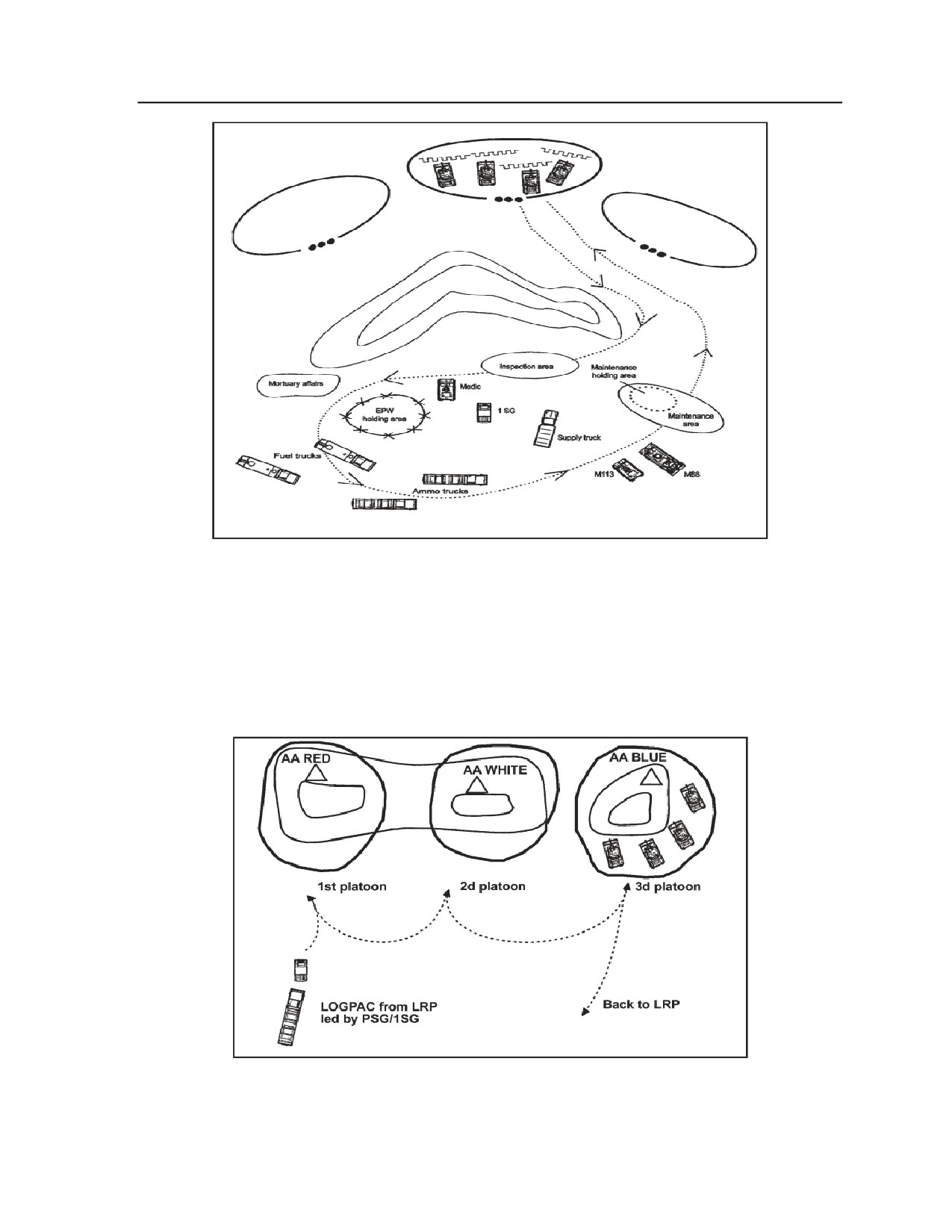
Vehicle Employment Considerations
Figure D-12. Service station method.
Tailgate Method
D-108. In assembly areas, the first sergeant normally uses the tailgate method (Figure D-13). Combat
vehicles remain in their vehicle positions or back out a short distance to allow trucks carrying Class III and
V supplies to reach them. Individual Soldiers rotate through the feeding area. While there, they pick up
mail and sundries and refill or exchange water cans. They also centralize and guard any EPW, and take
Soldiers killed in action (KIA) and their personal effects to the holding area. Once there, the first sergeant
assumes responsibility for them.
Figure D-13. Tailgate method.
28 March 2007
FM 3-21.8
D-27
Appendix D
Emergency Resupply
D-109. Occasionally (normally during combat operations), the unit might have such an urgent need for
resupply that it cannot wait for a routine LOGPAC. Emergency resupply could involve CBRN equipment
as well as Classes III, V, VIII, and water.
Prestock Resupply
D-110. In defensive operations, and at some other times, the unit will most likely need restocked supplies,
also known as pre-positioned or "cached" resupply. Normally, the unit only pre-positions Class IV and V
items, but they can also pre-position Class III supplies. However, they must refuel platoon vehicles before
they move into fighting positions, while first occupying the battle position, or while moving out of their
fighting position to refuel.
D-111. All levels must carefully plan and execute prestock operations. Every leader, down to vehicle
commanders and squad leaders, must know the exact locations of prestock sites. During reconnaissance or
rehearsals, they verify these locations. Leaders take steps to ensure the survivability of prestocked supplies.
These measures include selecting covered and concealed positions and digging in the prestock positions.
The leader must have a removal and destruction plan to prevent the enemy from capturing pre-positioned
supplies.
D-112. During offensive operations, the unit can pre-position supplies on similar combat vehicles well
forward on the battlefield. This works well if the unit expects to use a large volume of fire, with
corresponding ammunition requirements, during a fast-moving operation.
MAINTENANCE AND RECOVERY
D-113. Recovery operations and maintenance are crucial components of the leader’s plan when working
with combat vehicles.
Maintenance
D-114. Leaders must plan for regular maintenance halts throughout extended operations. Combat vehicles
require regular maintenance to perform consistently throughout combat operations. Combat vehicles can
become non-mission capable (NMC) due to a number of variables including, direct and indirect enemy fire,
mines and IEDs, vehicle accidents, and parts failure. Infantry leaders should enforce regular preventive
maintenance checks and services (PMCS) of all combat vehicles attached to their unit. PMCS is operator-
level maintenance conducted before, during, and after equipment operations. Comprehensive PMCS
identifies actual and potential problems and ensures repairs are made in a timely manner to minimize
vehicle downtime. Early detection and correction of these faults can decrease the possibility of the combat
vehicle breaking down during combat operations and prevent minor faults from deteriorating into major
faults. It is the vehicle crew’s responsibility to conduct PMCS. It is the leader’s job to ensure the PMCS is
conducted regularly and to standard.
D-115. Leaders should plan vehicle security for the vehicle crews as they conduct PMCS, based on the
enemy situation. Additionally, leaders should establish a maintenance rotation to ensure that all of their
combat vehicles are not conducting maintenance at the same time. This will maximize the combat power of
the unit. Leaders should also—
Verify that all current and updated technical manuals and references are available or
requisitioned for unit assigned equipment.
Verify that all tools, POL, personnel, and other resources are available for PMCS.
Observe operators performing PMCS at prescribed intervals.
Review maintenance forms and reporting procedures for accuracy and completeness.
Verify that the operator has correctly identified and corrected, or recorded, faults on DA Form
2404, Equipment Inspection and Maintenance Worksheet.
Confirm that NMC faults are corrected before dispatch.
D-28
FM 3-21.8
28 March 2007
Vehicle Employment Considerations
D-116. Leaders should also plan for the possibility of combat vehicles requiring maintenance at a level
greater than the crew is equipped or trained to conduct. This often requires specially trained mechanics and
equipment that is organic to the parent unit of the combat vehicle attachment. Leaders should plan for two
possibilities. One, the maintenance team moves to the combat vehicles. This may require additional
security and or escorts from the Infantry. Two, the combat vehicles must move to the maintenance team.
Maintenance teams are often located at the parent unit’s UMCP (unit maintenance collection point).
Infantry leaders may have the responsibility of providing security or escort duties. Additionally, leaders
should plan on the NMC vehicles to be absent from their task organization if a major maintenance fault is
discovered.
Recovery Operations
D-117. Leaders are responsible for recovery operations that occur within their units. However, leaders
should consult the senior officer or non-commissioned officer of the attached vehicular unit for the
technical aspects of the recovery operation. Infantry leaders must have a thorough recovery plan that
ensures their combat vehicles can be recovered throughout the operation. Recovery operations extricate
damaged or disabled equipment and move it to locations where repairs can be made. Recovery is the
primary responsibility of the using unit. The primary role of the Infantry during recovery operations is to
provide security and assist with the recovery under supervision of the vehicle crew.
D-118. Recovery operations can be very dangerous. Recovery should be conducted under the supervision
of the Infantry leader, using the experience and technical competence of the combat vehicle crew. The
general rule in recovering a vehicle that is simply NMC in simple terrain is like vehicles can recover each
other. For example, tanks recover tanks, and BFVs recover BFVs. However, there are vehicles specifically
designed for recovery operations. These vehicles should be used if vehicles become stuck, flipped over, or
severely damaged. The M-936 medium wrecker can be used to recover some wheeled vehicles, to include
the assault HMMWV. The M88A1 medium recovery vehicle (MRV) is a full-tracked armored vehicle used
to perform battlefield rescue and recovery missions. The M88A1 MRV performs hoisting, winching, and
towing operations in support of recovery operations and evacuation of heavy tanks and other tracked
combat vehicles. It has a fuel/defuel capability and is fully equipped to provide maintenance and recovery
support for the main battle tank family and similar vehicles. These functions can be performed in all types
of terrain during all weather conditions.
28 March 2007
FM 3-21.8
D-29
This page intentionally left blank.

Appendix E
Helicopter Movement
Infantry platoons may conduct air movement operations to pick up patrols by
helicopter, re-supply with helicopters, or evacuate casualties. This appendix discusses
general helicopter information including, the five stages of an airmobile operation,
how to organize the unit for a helicopter move, and how to select and secure a pickup
zone.
SECTION I — CHARACTERISTICS OF HELICOPTERS
E-2. Helicopters most commonly used by Infantry platoons are the UH-60, Blackhawk and the CH-47,
Chinook (Table E-1). See FM 90-4, Air Assault Operations, for information on air movement and air
assault operations, and FM 3-21.38, Pathfinder Operations, for information on pathfinder operations.
Table E-1. Helicopter characteristics.
UH-60A
UH-60L
CH-47D
Passenger capacity
11
11
33
(seats in)
Passenger capacity
18
18
60
(seats out)
Max cargo weight
8,500 lbs.
8,500 lbs.
26,000 lbs.
Cargo hook capacity
8,000 lbs.
9,000 lbs.
26,000 lbs. (center hook)
17,000 lbs (fore & aft hook)
25,000 lbs (fore & aft hook combined)
NOTE: Actual allowable cargo load (ACL) may be determined by ground and aviation unit commanders.
CAPABILITIES
E-3. Under normal conditions, helicopters can climb and drop at steep angles. This allows them to fly
from and into confines and unimproved areas. Other helicopter capabilities include—
Transporting cargo as an internal load or external (sling) load and delivering to unit areas not
supplied by any other means.
Overflying or bypassing obstacles or enemy in order to reach objectives otherwise inaccessible.
Flying at low altitudes to achieve surprise and deceive the enemy using hills and trees for cover
and concealment.
Operating under limited visibility conditions.
E-4. It is ALWAYS preferred to use a helicopter for loading or unloading of troops and equipment. If
terrain prevents the helicopters from landing, troops and their combat equipment can be unloaded while
hovering a short distance above the ground with troop ladders, rappelling ropes, or fast ropes. If the aircraft
can hover low enough, Soldiers may jump out. The troop ladder (or in limited applications- a SPIES rope)
can also be used to extract troops when the helicopter cannot land.
LIMITATIONS
E-5. The large amount of fuel used by helicopters may limit their range and allowable cargo load (ACL).
Other helicopter limitations include:
28 March 2007
FM 3-21.8
E-1
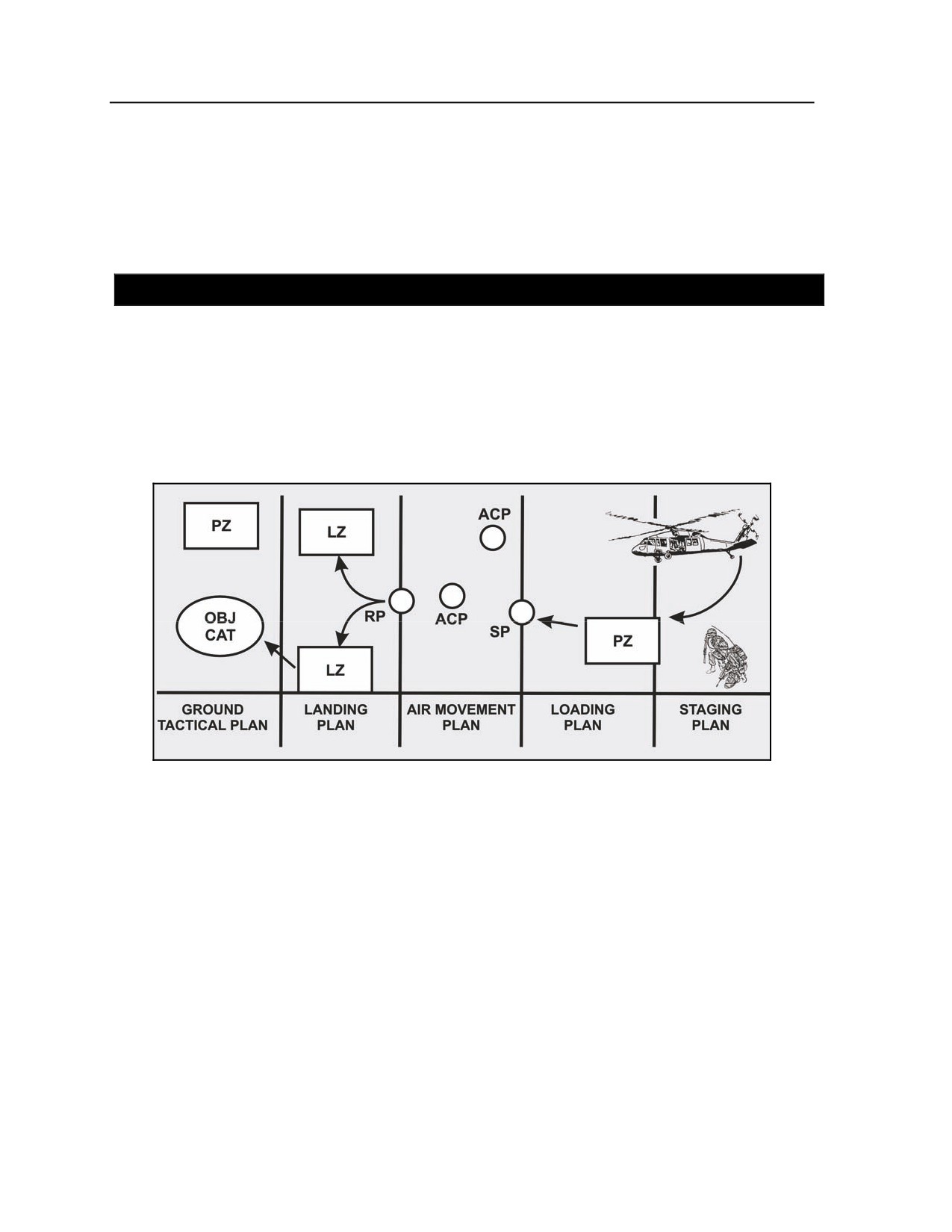
Appendix E
Extreme weather conditions such as fog, hail, sleet, ice, or winds (40 knots or more) and gusty
winds (gusts up to 15 knots above a lull) will prevent the use of helicopters.
Engine and rotor noise may compromise the secrecy of the mission.
Limited size or number of suitable landing zones (LZs).
The load-carrying capability of helicopters decreases with increases of pickup zone (PZ)/landing
zone (LZ) altitude, humidity, and temperature.
Vulnerability to enemy air defense systems and small arms fire.
SECTION II —AIRMOBILE OPERATIONS STAGES
E-6. There are five stages to an air movement operation (Figure E-1). The ground tactical plan is the key
planning phase. All other planning is conducted in a backward manner from it. The five stages of this
reverse planning sequence are—
(1) Ground tactical plan (GTP).
(2) Landing plan.
(3) Air movement plan.
(4) Loading plan.
(5) Staging plan.
Figure E-1. Air movement through the five stages.
E-7. The ground tactical plan drives the entire mission. Convenience of landing considerations is
subordinate to putting units on the ground where they can fight. The five plans tie together in this way:
The ground tactical plan drives the sequence of arrival and amount of combat power onto the
LZs.
Combat power arriving at available LZs to accomplish the mission becomes the landing plan.
Moving troops and equipment to LZs on the designated flight routes becomes the air movement
plan.
Getting troops and equipment from current friendly locations to the designated LZs dictate the
loading plan and PZ locations.
The PZ loading plan designates the requirements that become the staging plan to move friendly
troops onto the PZ when and where needed.
GROUND TACTICAL PLAN
E-8. The ground tactical plan for an air movement operation contains the same essential elements as other
Infantry missions, but differs in one area: it is prepared to capitalize on the speed and mobility of the
aircraft to achieve surprise. Units are placed on or near the objective to immediately seize the objective.
E-2
FM 3-21.8
28 March 2007

Helicopter Movement
The ground tactical commander, in accordance with doctrine and METT-TC, determines his ground tactical
plan. The five stages of the reverse planning sequence cannot be developed independently. In addition to
standard planning considerations for actions on the objective, the commander’s plan should include—
H-hour times.
Primary and alternate LZ(s).
Means of identifying LZ(s).
Task organization.
Chalk configurations.
Special equipment required (such as kick-off bundles, ropes).
Attack aviation assets available and missions.
Suppression of enemy air defenses (SEAD).
Landing formations.
Offloading procedures.
LANDING PLAN
E-9. Unlike approaching an objective in armored vehicles, Soldiers in helicopters are most vulnerable
when landing, and are potentially more vulnerable to enemy fire than if they were on the ground.
Suppressive fires are employed to deny the enemy unhindered access to the landing forces, so the timing of
fires is critical to the success of the landing.
E-10. The ground tactical commander’s plan typically results in two types of landing plans: on the
objective (within enemy small arms range), or away from the objective (outside of enemy small arms
range). Landing away from the objective is the more common of the two landing plans. The mobility and
speed of the helicopters further enables the unit to land to the rear of the objective and aid in the element of
surprise and confusion during any subsequent assault. Table E-2 lists factors considered when constructing
the landing plan. Regardless of the landing plan used, the Infantry platoon must land ready to fight.
Table E-2. Landing plan considerations.
Land away from the objective
Land on the objective (within enemy
Factors
(outside of enemy small arms
small arms range) when…
range) when…
Mission
The mission is enemy force-oriented.
The mission is terrain-oriented.
Enemy
There is incomplete intelligence on enemy
There is precise intelligence on enemy
disposition.
dispositions.
Terrain
There is incomplete intelligence on terrain
There is precise intelligence on terrain
(especially LZs) and weather, or there are
(especially LZs) and weather, and there are
no suitable LZs on or near the objective.
suitable LZs on the objective.
Troops available
Conditions are not set.
Conditions are set and verified.
Time
There is time available to develop the
Time is critical to secure the objective.
situation.
Intent
The unit plan is to arrive at the LZ prepared
The unit has a plan to establish continuous
to move out quickly and ensure rapid
suppression of any enemy fire immediately
advance on objective.
upon landing while aggressively assaulting
to secure the objective.
E-11. Good PZs and LZs allow for helicopter insertion or extraction without exposing the unit or aircraft to
unnecessary risks. Three-hundred-and-sixty-degree security must be maintained at all times. Preparatory
and supporting fires are planned to suppress the enemy as the aircraft land on the LZ or the PZ. The control
and distribution of all available means to suppress the enemy at a most vulnerable time is imperative. Fires
should be focused along the base of the exit tree line (right door exit shoots at the right tree line).
Regardless of threat data, suppressive fires are planned, although not necessarily executed, for every
primary and alternate PZ or LZ. Whether a PZ or LZ, units establish a defensive posture and employ local
security measures as required, shifting as necessary when chalks land or depart.
28 March 2007
FM 3-21.8
E-3
Appendix E
E-12. The ground tactical commander, in coordination with the supporting aviation unit, selects the
location of helicopter PZs and LZs. There are many factors that leaders must consider when choosing
appropriate LZs and PZs. These requirements are covered by aviation unit SOPs or are prearranged by the
aviation unit commander in coordination with the pathfinder leader. The final decision concerning
minimum landing zone requirements rests with the aviation unit commander. Among those factors
considered is the number, type and landing formation of the helicopters, surface conditions, obstacles,
ground slope, approach and departure route, atmospheric conditions, and type of loads.
NUMBER, TYPE, AND LANDING FORMATION OF THE HELICOPTERS
E-13. The number, type, and landing formation of helicopters determine the minimum landing space
requirement and total size of the LZ and PZ. It may be necessary to have two PZs or LZs, or to land the
necessary aircraft one at a time. Differing aircraft may have different landing point size requirements. A
single UH-60 requires a touch down point (cleared area) of 50 meters in diameter without sling load, and
80 meters with sling load. A CH-47 requires a touchdown point of 80 meters in diameter without sling
load, and 100 meters with sling load.
SURFACE CONDITIONS
E-14. The surface at the landing point must be firm enough to keep helicopters from bogging down, raising
too much dust, debris, or blowing snow. Troops remove loose debris that may damage the rotor blades or
engines.
OBSTACLES
E-15. Helicopters should not land on a landing point that includes obstacles. An obstacle in this case is
defined as any object or terrain feature (anything 18 inches high or deep) that could cause damage to the
airframe or rotor system of the aircraft, or prevent safe landing. Objects or equipment placed on the PZ/LZ
in conjunction with the operation (such as landing lights and slingloads) are not included. Obstructions (for
example, rocks, stumps, and holes) that cannot be removed must be clearly marked. Methods of marking
obstacles that cannot be cleared for both day and night must also be considered.
GROUND SLOPE
E-16. When the slope is less than 7 percent (4 degrees), helicopters may land in any direction. Where
ground slope is from 7 to 15 percent (4 to 8 degrees), aircraft must land and park sideslope or upslope.
Helicopters with skids as landing gear may not land, but must terminate at a hover. If ground slope is
greater than 15 percent (8 degrees), helicopters cannot land safely, and may sometimes hover to drop off
Soldiers or supplies.
APPROACH AND DEPARTURE ROUTES
E-17. The direction of departure and landing should be generally into the wind, over the lowest obstacle,
and along the long axis of the LZ. If there is only one satisfactory approach direction because of obstacles
or the tactical situation, most helicopters can land with a slight crosswind or tailwind. PZs or LZs should
be free of tall trees, telephone and power lines, and similar obstructions on the approach and departure
ends. Use an obstacle ratio of 10:1 when determining how much additional space is required for landing
and take-off. A helicopter needs 100 meters of horizontal clearance from a 10-meter tree for takeoff or
landing.
ATMOSPHERIC CONDITIONS
E-18. As the humidity, altitude and temperature increase, the performance capability of aircraft decrease.
This result in greater fuel consumption, lower ACLs, and larger LZ requirements. These
limitations/considerations should be highlighted by aviation LNOs during planning.
E-4
FM 3-21.8
28 March 2007
Helicopter Movement
TYPE OF LOAD
E-19. Most helicopters cannot take off or land vertically when fully loaded, so a larger LZ/PZ and better
approach and departure routes may be required for fully loaded aircraft. LZs must be larger for aircraft
delivering sling loads compared to aircraft delivering internal loads and Soldiers.
OTHER CONSIDERATIONS
E-20. Other considerations when selecting PZs and LZs include:
Location in relation to objective.
Ability of the unit to secure.
Enemy location, capabilities, and strength.
Cover and concealment.
Identification from air.
Weather and its effect.
Visibility (darkness, fog, snow, dust, etc)
AIR MOVEMENT PLAN
E-21. Air movement involves flight operations from PZ, to LZ, and back. The Infantry leader and all chalk
leaders should maintain the following items:
A marked air route map.
Compass/GPS.
Watch synchronized with the flight crew and ground element.
Air movement table, PZ sketch, and LZ sketch.
Call signs and frequencies for all aviation and ground units involved in or around the operation.
Backpack FM radio.
E-22. The air movement plan includes en-route security for the lift aircraft by attack aviation. It also
includes, false insertions to deceive the enemy, suppression of enemy air defense positions along the flight
route, and emergency procedures in the event an aircraft is lost en route due to maintenance or enemy fire.
E-23. To maximize operational control, aviation assets are designated as lifts, serials, and loads. A lift is
all utility and cargo aircraft assigned to a mission. Each time all assigned aircraft pick up troops and/or
equipment and set them down on the LZ, one lift is completed. The second lift is completed when all
aircraft place their second load on the LZ. There may be times when a lift is too large to fly in one
formation. In such cases, the lift is organized into a number of serials. A serial is a tactical group of two or
more aircraft and separated from other tactical groupings within the lift by time or space. The use of serials
may be necessary to maintain effective control of aviation assets when the capacity of available PZs or LZs
is limited or to take advantage of available flight routes. The personnel and equipment designated to be
moved a single aircraft is called a load or chalk. Each chalk must have a chalk leader who ensures that
every man in his chalk gets on and off the helicopter, that everything is ready to load, and that everything
gets loaded and unloaded correctly. The chalk leader should sit in the aircraft where he can best stay
oriented during flight and where he can get off quickly at landing sites to control his men. Figure E-2
shows the relationship between a chalk, serial, and lift.
28 March 2007
FM 3-21.8
E-5
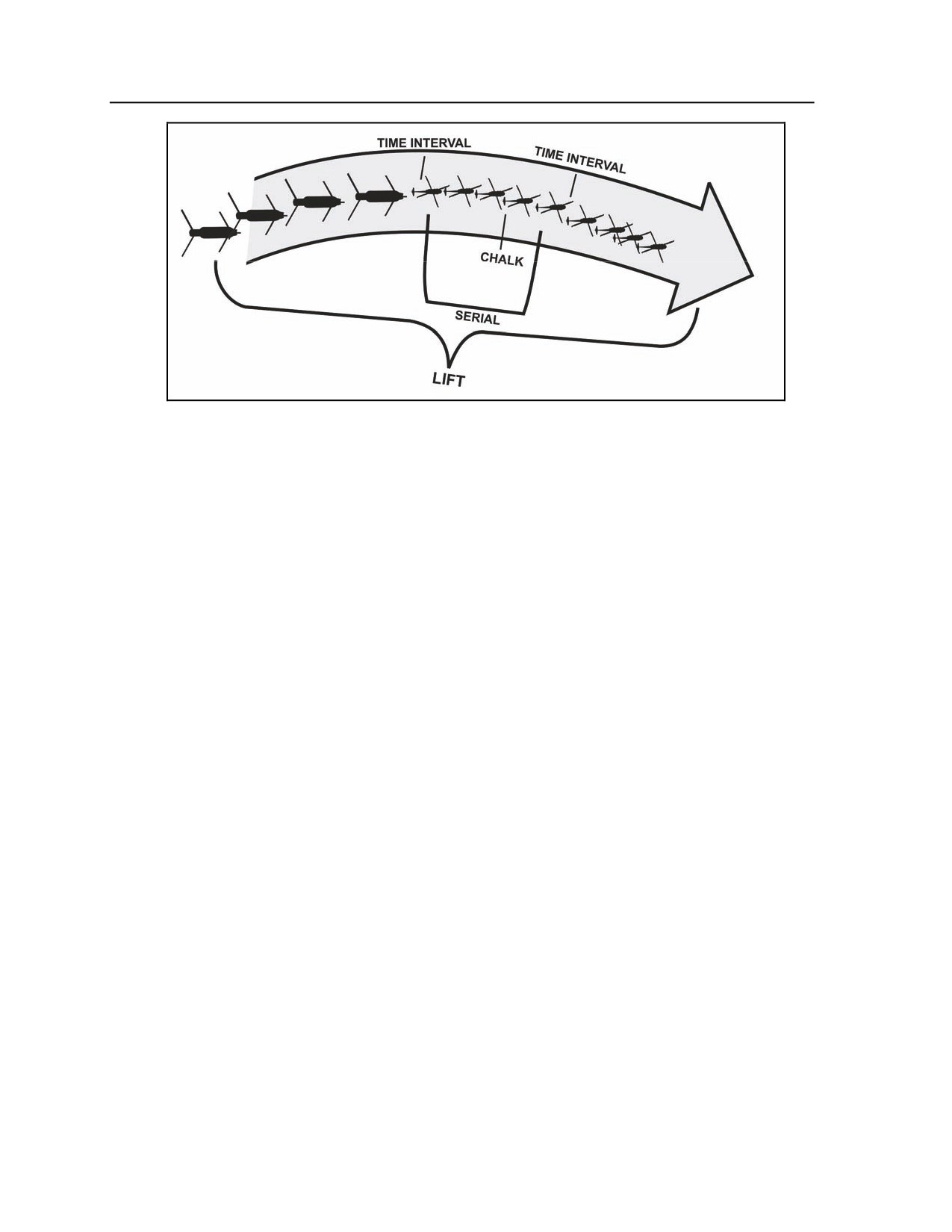
Appendix E
Figure E-2. Lifts, serials, and chalks.
LOADING PLAN
E-24. Air movement operations do not succeed on the PZ, but the failure of the mission can occur there.
Therefore, PZs must be established to run efficiently. Assault forces are organized on the PZ, not the LZ.
Every serial must be a self-contained force that understands what it must do on landing at either the
primary or alternate LZ, and later in executing the ground tactical plan.
E-25. Before an Infantry platoon is lifted by helicopter, it must be organized for the move. The load
(amount of men, weapons, equipment, and ammunition) that can be carried by a helicopter varies. It is
based on the type of helicopter used, configuration of the helicopter, temperature, altitude of the PZ or LZ,
humidity, and fuel load. What can be carried is the allowable cargo load (ACL). This is one of the main
factors considered when planning aircraft loads. When the Infantry platoon is alerted for a movement by
helicopter, the allowable cargo load will be given to the leader. The unit can then be organized into
chalks/loads based on the given allowable cargo load of each type of aircraft. Page E-5 displays an
example of a “Tadpole Diagram” (Figure E-3) that is used to plan and organize the chalks and loads.
E-6
FM 3-21.8
28 March 2007
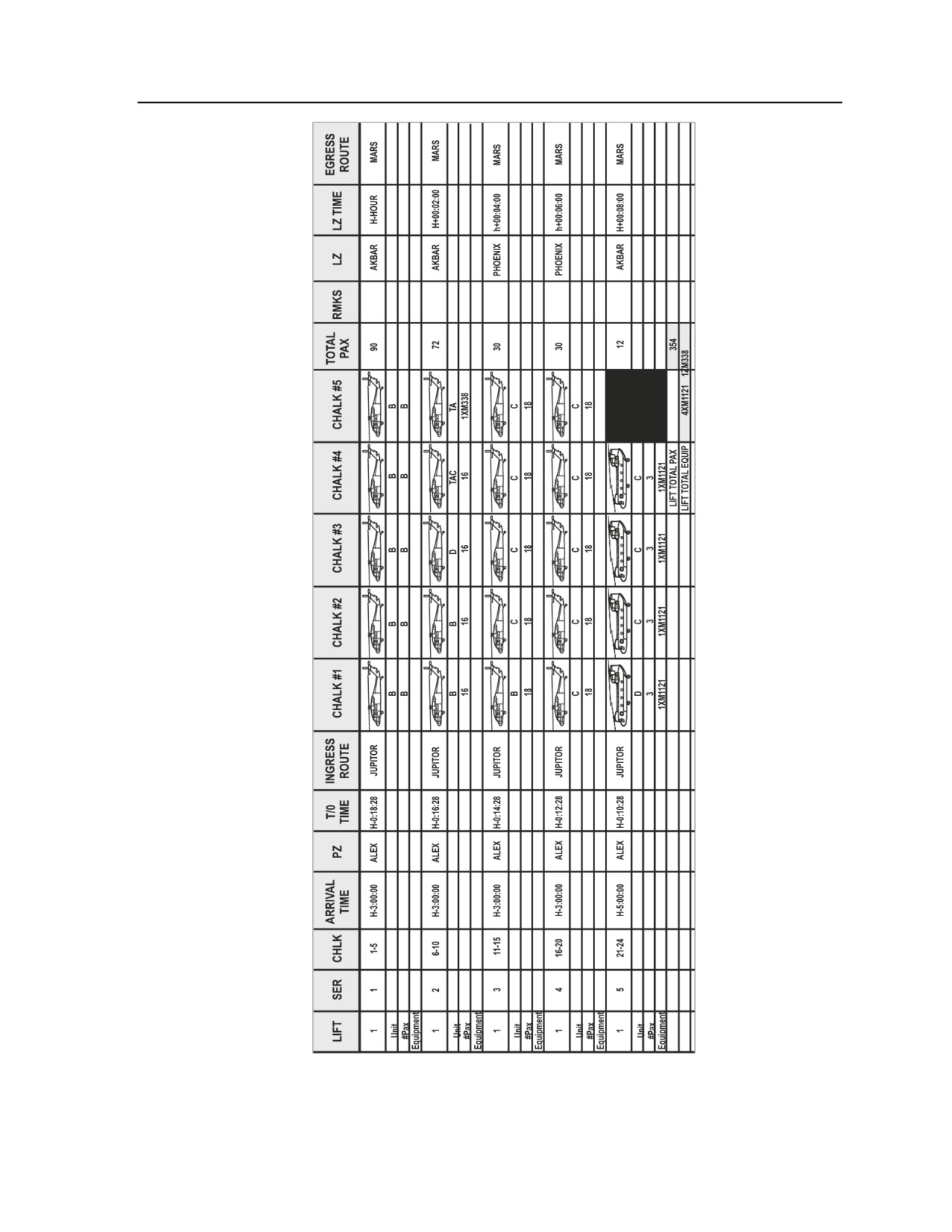
Helicopter Movement
Figure E-3. Tadpole diagram.
28 March 2007
FM 3-21.8
E-7
Appendix E
E-26. The leader maintains the tactical integrity and self-sufficiency of each aircraft load as much as
possible. He maintains tactical integrity by keeping squads and fire teams intact on chalks and the platoon
intact within a serial. He maintains self-sufficiency by loading a machine gun and its ammunition and crew,
or an entire antiarmor team on the same aircraft. Key men, weapons, and equipment should be cross-loaded
among different aircraft. Platoon leaders and platoon sergeants should fly on separate helicopters. So
should machine gun teams. This kind of cross-loading can prevent the loss of control or unit effectiveness
in the event a helicopter is lost.
E-27. The leader prepares a load plan for the platoon that tells each man which aircraft he is to get in and
who the chalk leader is.
E-28. The chalk leader tells each man in his chalk where to sit, what to do in case of emergency, and what
to do when the aircraft lands.
STAGING PLAN
E-29. As part of the staging plan, Soldiers must mark obstacles on the PZ in both day and night operations.
In daylight, troops use red panels or other easily seen objects and materials to mark obstacles. In night
operations, units use signal lights to avoid security problems. Visible or infrared lights can be used, but the
choice must be coordinated with the lift unit. In any case, pilots should be advised of obstacles whether
marked or unmarked.
E-30. For a night operation, Soldiers can use flashlights, chemical lights, or expedient devices to show the
direction of landing and to mark aircraft landing points. However, pilots cannot see blue or green chemical
lights under aviator night vision goggles. Therefore, blue and green chemical lights should be used for
Infantry staging purposes only. Always use red, orange, yellow, or infrared for aircraft positions.
E-31. There are many ways to mark a PZ or LZ at night. The inverted “Y” is one way. An inverted “Y”
indicates the landing point of the lead aircraft and its direction of approach. The formation used by the
aircraft will determine how to place the lights for other aircraft. Table E-3 lists examples of PZ markings
during day and night operations.
E-32. Security on the PZ is of the utmost importance. It may be conducted by a separate unit that is not
conducting the air movement. At a minimum, the Infantry platoon secures itself and maintains a high state
of readiness while awaiting arrival of the aircraft.
E-33. Whenever possible, Infantry platoons should conduct “cold-load” rehearsals prior to conducting an
air movement. This can be done on the actual aircraft (best method), or using field expedient methods.
Chalk leaders arrange their chalk considering the last one to load the aircraft is the first one off. Soldiers
are designated to open/close doors, secure and unload equipment, and understand the direction they will
move or secure once getting off the aircraft. If the lift aircraft arrives at the LZ before execution of the
mission, the chalk leader should conduct face-to-face coordination with the air crew. This is done to ensure
everyone knows the PZ on-load and LZ off-load procedures. It also avoids confusion and speeds actions
on the LZ, allowing the aircraft to spend minimal time on the ground. Information that should be
coordinated include: which door(s) will be used to load and unload; actions if the aircraft takes enemy fire
en route and on the ground; special safety considerations; crash procedures; location of the primary and
alternate LZs; direction of landing; time warnings with hand and arm signals inside the aircraft; and any
other special mission requirements.
E-8
FM 3-21.8
28 March 2007

Helicopter Movement
Table E-3. Example PZ marking methods.
Position
Day
Night
PZ entry point for Infantry
NCOIC, signage
NCOIC, two blue chem lights
PZ control point
HMMWV and VS-17 panel
Green chem lights on antennae
Chalk stage points
Guides, signage
Guide, blue chem light
Lead touchdown points
VS-17 panel
Inverted “Y,” infrared lights
Aircraft touchdown points
VS-17 panel
Red chem light per aircraft
Obstacles
FM communication
Red chem light ring around obstacle
Loads to be picked up
Hook-up teams stationed on
Swinging infrared chem light per
loads
load
SECTION III — SAFETY
E-34. Infantry leaders must enforce strict safety measures when working with helicopters. Measures
include:
Avoid the tail rotor. Never approach or depart to the rear of a helicopter except when entering or
exiting a CH-47. Approach from 3 or 9 o’clock is preferred when using UH-60s.
Keep a low body silhouette when approaching and departing a helicopter, especially on slopes.
Keep safety belts fastened when helicopter is airborne.
Keep muzzle pointing down and on safe.
Keep all radio antennas down and secure.
Keep hand grenades secured.
Do not jump from a hovering helicopter until told to by an air crew member.
28 March 2007
FM 3-21.8
E-9