FM 3-21.8 (FM 7-8) The Infantry Rifle Platoon and Squad (MARCH 2007) - page 11
Appendix B
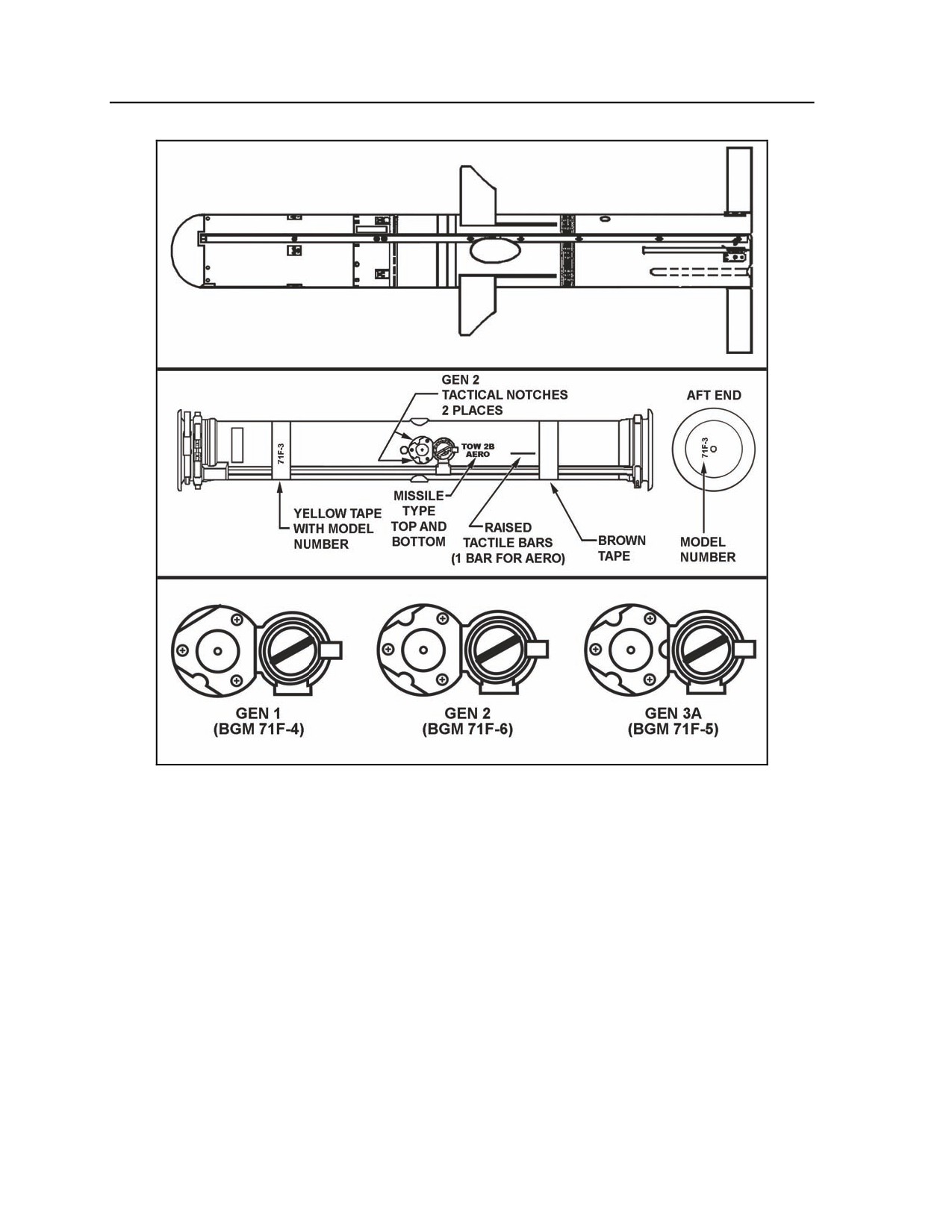
Figure B-9. TOW 2B Aero missile with identification.
B-12
FM 3-21.8
28 March 2007
Shoulder-Launched Munitions and Close Combat Missile Systems
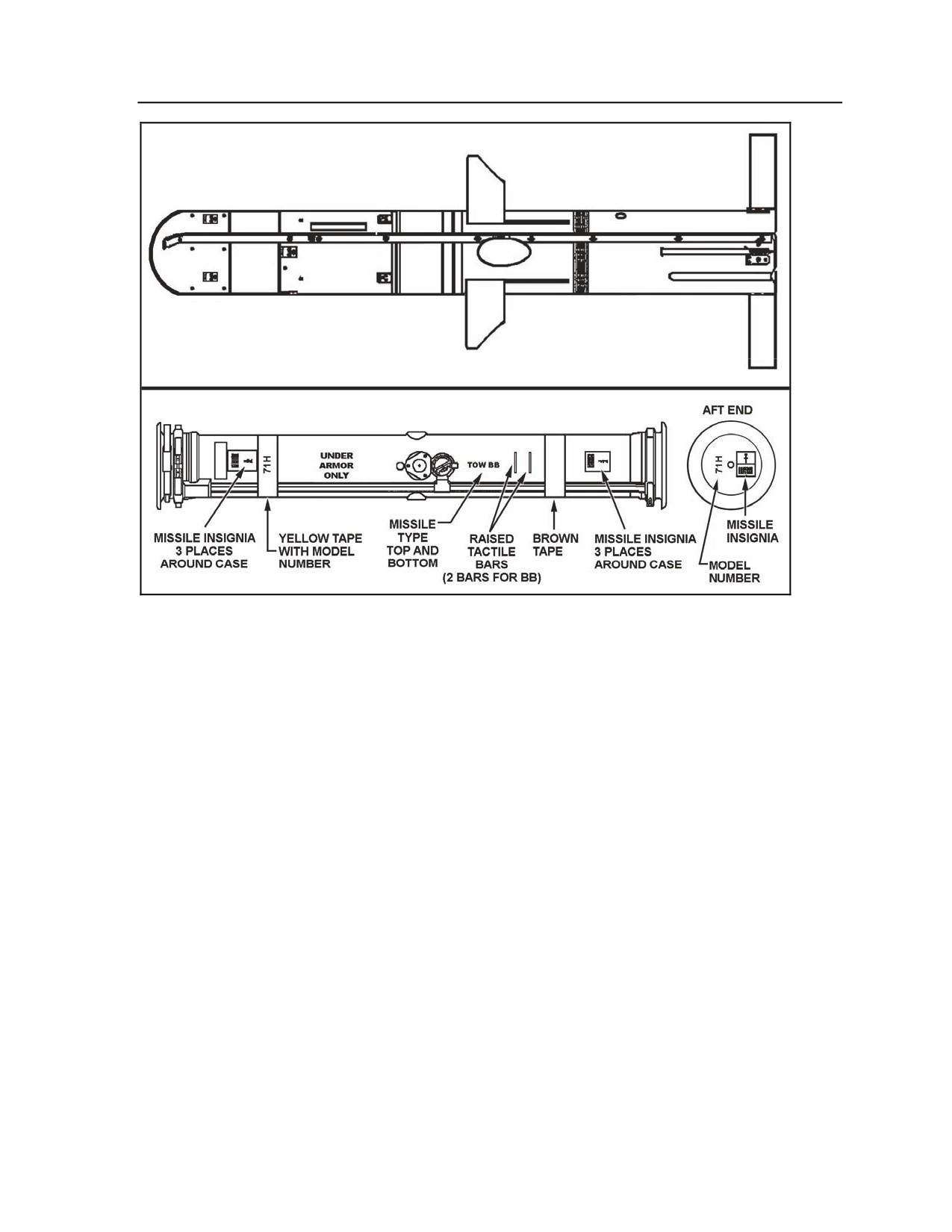
Figure B-10. TOW bunker buster (BB) missile and identification.
M41 Improved Target Acquisition System (ITAS)
B-29. The ITAS is primarily a mounted system that utilizes the M1121 HMMWV as the carrier vehicle.
The M1121 HMMWV is a one-vehicle (1 1/4-ton truck) combat system that is air transportable, versatile,
maintainable, and survivable. The vehicle carries one complete launcher system, seven encased missiles,
and a three-man crew. The tactical or training situation may demand that the crew dismount the carrier and
employ the ITAS in the dismounted or tripod configuration.
B-30. The M41 ITAS fires all existing and future versions of the TOW family of missiles. The ITAS
provides for the integration of both the day sight and NVS into a single housing and for automatic
boresighting. It has embedded training (for sustainment training) and advanced built-in test/built-in-test
equipment (BIT/BITE), which provides fault detection and isolation.
B-31. The automatic missile tracking and control capabilities of the ITAS provide a high first-round-hit
probability. To operate the system, the gunner places the track gates on the target, fires the missile, and
centers the crosshairs on the target image until missile impact. The optical tracking and command functions
within the system guide the missile to the target as long as the gunner keeps the crosshairs on target.
B-32. The ITAS provides the Infantry platoon with advanced optics during daylight and limited visibility to
aid in surveillance and target acquisition in both defensive and offensive operations.
B-33. The ITAS can be vehicle-mounted or ground-emplaced (tripod-mounted) for operation. Missiles can
be launched from either operational mode. The entire system can be carried by a single crew for short
distances. Moving it over long distances without the vehicle will require two crews, which causes two
systems to be out of operation at the same time. The vehicle-mounted launcher is more mobile and can be
quickly prepared for use. The launcher can be assembled and disassembled without the use of tools.
28 March 2007
FM 3-21.8
B-13
Appendix B
SECTION II — EMPLOYMENT CONSIDERATIONS
B-34. The objective of the Army’s warfighting doctrine is to concentrate decisive combat power at the right
time and place, by massing fires rather than by massing forces, and by presenting the enemy with multiple
threats. This section discusses SLM and CCSM employment considerations. A lethal mix of CCMs and
SLM provide the Infantry unit with the flexibility to employ multiple systems designed to deliver
maximum direct fire lethality and destroy enemy formations at both long range and in close combat. At
close combat range (15-300 meters), SLM provide Soldiers with the ability to deliver direct fire lethality at
very close proximity to the enemy. At extended range (300-4,500 meters), a mix of Javelin and TOW
provides the Infantry leader with overwhelming combat overmatch. These weapons serve as key
components by applying overlapping and interlocking fires to achieve synergy and mutual support for his
maneuver force.
B-35. For a better understanding of how SLM and CCMS fit into the Infantry platoon’s fire plan, see
Chapter 3.
URBAN OPERATIONS AND FIELD FORTIFICATIONS
B-36. Operations in complex terrain and urban environments alter the basic nature of close combat. History
tells us that engagements are more frequent and occur more rapidly when engagement ranges are close.
Studies and historical analyses have shown that only 5 percent of all targets are more than 100 meters
away. About 90 percent of all targets are located 50 meters or less from the identifying Soldier. Few
personnel targets will be visible beyond 50 meters. Engagements usually occur at 35 meters or less.
B-37. Soldiers employ SLM in the short, direct fire, close-quarter engagement range of close combat. Their
use is preferable in urban areas where other direct fire (M1 Abrams and M2/M3 BFV) and indirect fire
systems (artillery and mortars) and CAS are incapable of operating due to risks of fratricide and collateral
damage. In close combat, Soldiers employ SLM against a wide variety of targets. These include: personnel
armed with individual and crew served weapons fighting from armored platforms (T-72s, BTRs, BRDMs);
light armored personnel carriers and Infantry fighting vehicles
(BMP1-3 and M113); modified
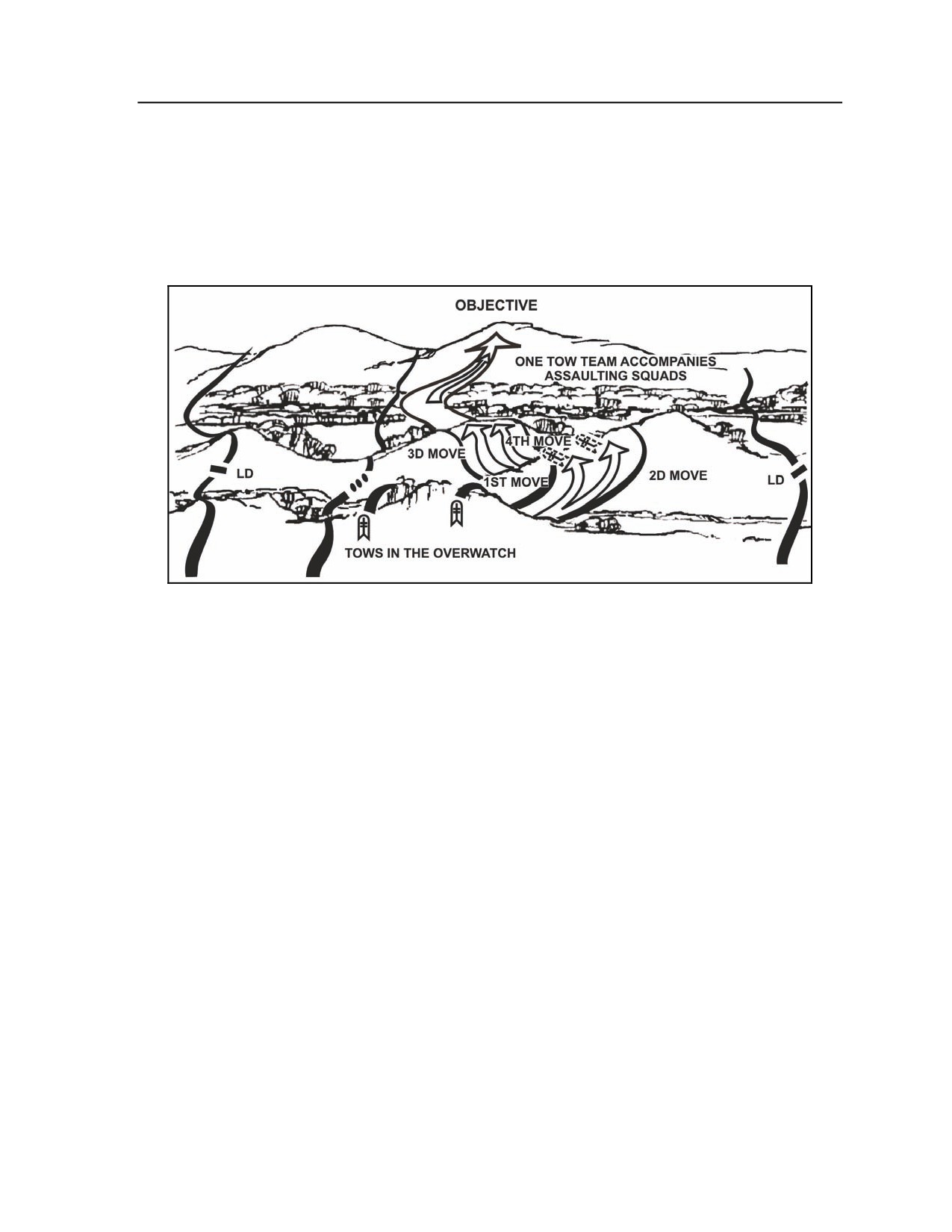
personnel/Infantry vehicles; lightly armed vehicles; and enemy in fortified positions, behind walls, inside
caves and masonry buildings, and within earthen bunkers.
B-38. CCMS teams provide overwatching antitank fires during the attack of a built-up area. They are best
employed in these types of areas along major thoroughfares and in upper floors of buildings or roofs to
attain long-range fields of fire. Because the minimum engagement distance limits firing opportunities in the
confines of densely built-up areas, CCMS may not be the weapon of choice in the urban environment (FM
3-06.11). Urban area hazards include, fires caused by both friendly and enemy forces that may cause target
acquisition and lock-on problems, clutter on the battlefield that may cause lock-on problems, and line-of
sight communications that may be limited by structures. CCMS unique flight path forces the gunner to
think in three dimensions. Other urban environment hazards include overhead obstacles such as street
signs, light poles, and wires, which could impede the missile’s flight path.
SHOULDER-LAUNCHED MUNITIONS IN THE BUNKER DEFEAT ROLE
B-39. The current inventory of the M136 AT4 and the XM141 BDM in combination with the M72-series
LAW provide the Infantry squad the capability to incapacitate personnel within earth and timber bunkers,
masonry buildings, and light armored vehicles. However, neither system is fully capable of fire-from
enclosure.
B-40. SLM that can be safely fired from an enclosure to incapacitate personnel within earth and timber
bunkers, masonry buildings, and light armored vehicles are currently being developed to increase the
lethality, survivability, and mobility of the SLM gunner.
B-14
FM 3-21.8
28 March 2007

Shoulder-Launched Munitions and Close Combat Missile Systems
ENGAGEMENT OF FIELD FORTIFICATIONS AND BUILDINGS WITH SLM
B-41. The M72-series LAW and AT4 have proven to have only limited success inflicting casualties against
enemy troops in field fortifications and buildings. The XM141 BDM was designed to enhance the
destruction of these fortifications and enemy personnel inside them. The BDM’s warhead contains a dual
mode fuse that automatically adjusts for the type of target on impact. For soft targets, such as sandbagged
bunkers, the XM141 warhead automatically adjusts to delayed mode and hits the target with very high
kinetic energy. The warhead is propelled through the barrier and into the fortification or building where the
fuze detonates the warhead and causes much greater damage. Soldiers should not expect to severely
damage fortified targets with M72 LAWs or AT4s. However, if the recommendations shown in Table B-6
are used, Soldiers may be able to gain a temporary advantage.
Table B-6. Effects of the AT4 and M72A3 LAW on field fortifications or bunkers.
AIM
EFFECT WHEN AT4 OR M72A3
RECOMMENDED
POINT
IS FIRED AT AIM POINT
FIRING TECHNIQUE
Firing
Rounds fired into firing ports or apertures may not
Coordinate fire: Fire CCM at a point 6 to
Port or
have the desired effect on the enemy. The rounds
12 inches from the front edge of the firing
Aperture
may detonate against the rear wall of the position,
ports in the berm. Fire small arms at the
causing little structural damage to the position or to
bunker or position to prevent personnel
the equipment or personnel within, unless they are
within from returning fire.
hit directly. The AT4 produces less effect than the
M72A3 LAW.
Berm
Firing at the berm causes the round to detonate
Firing the AT4 and LAW at berms should
outside the fighting position or inside the berm itself,
be avoided because of the negligible
creating only dust, a small hole in the berm, or
effects.
minor structural damage to the position, but little
damage to personnel or equipment unless they are
hit directly. The AT4 produces less effect than the
M72A3 LAW.
Window
The round may travel completely through the
Fire 6 to 12 inches from the sides or
structure before detonating. If not, it creates dust
bottom of a window. CCMs explode on
and causes minor structural damage to the rear
contact with brick or concrete, creating an
wall, but little damage to personnel or equipment,
opening whose size is determined by the
unless they are hit directly. The AT4 produces less
type of round used.
effect than the M72A3 LAW.
Wall
The round detonates on contact, creating dust and
The M72-series LAW may be used to
causing a small hole and minor structural damage,
create a loophole, which is a hole large
but little damage to personnel or equipment, unless
enough to throw hand grenades through.
they are hit directly. Overpressure from the round
The AT4 produces less effect than the
entering the structure may temporarily incapacitate
M72-series LAW.
enemy personnel.
Corner
Corners are reinforced and thus harder to penetrate
Avoid targeting corners because of the
than other parts of a wall. Any CCM round will
negligible effects.
detonate sooner on a corner than on a less dense
surface. Detonation should occur in the targeted
room, creating dust and causing overpressure,
which can temporarily incapacitate personnel inside
the structure near the point of detonation. The AT4
causes more overpressure than the M72-series
LAW.
CCMS Engagement Considerations
B-42. Urban engagement considerations for CCMS include engagement distance, thermal crossover,
backblast, weapon penetration, and breaching structural walls. Details follow. TOW systems should always
seek to engage at maximum range. If within 1,000 meters of an enemy, the flight time of the TOW missile
would likely be greater than the flight time of a main gun tank round.
28 March 2007
FM 3-21.8
B-15
Appendix B
Engagement Distance. The Javelin missile has a minimum engagement distance (150 meters in
the attack mode and 65 meters in the direct attack mode), which limits its use in built-up areas.
The TOW 2B has a minimum range of 200 meters and a maximum range of 3,750, which limits
its use in built-up areas.
Crossover. Sometimes the Javelin seeker or TOW round will not be able to distinguish between
the background and the target because the two have the same temperature (crossover).
Time. When a gunner comes across a target of opportunity, he may not be able to take
advantage of it. The cool down time of the Javelin’s NVS is 2.5 to 3.5 minutes. Javelin seeker
cool down takes about 10 seconds. Once the BCU is activated, the gunner has a maximum of 4
minutes to engage the target before the battery coolant unit is depleted.
Backblast. The soft launch capability of the Javelin enables the gunner to fire from inside
buildings because there is little overpressure or flying debris.
Weapon Penetration. The dual charge Javelin warhead penetrates typical urban targets. The
direct attack mode is selected when engaging targets in a building. Enemy positions or bunkers
in the open closer than 150 meters are engaged using the direct attack mode. Positions in the
open farther than 150 meters are engaged using either the top or direct attack mode, depending
on the situation.
Breaching Structural Walls. The Javelin and TOW (except for the TOW BB) are not effective
when breaching structural walls. Antitank guided missiles (ATGMs) are not designed to breach
structural walls effectively. All CCMS are designed to produce a small hole, penetrate armor,
and deliver the explosive charge. Breaching calls for the creation of a large hole. CCMS are
better used against armored vehicles or for the destruction of enemy-fortified fighting positions.
ANTIARMOR ROLE
B-43. In the past decade, there has been a revolution in armor technology. Research and new developments
have come from Europe, the United States, and Israel. These improvements are also becoming much more
common in third world armies. In addition, many older tanks and other armored fighting vehicles are being
retrofitted with improved armor protection. These advanced armor configurations improve the vehicles’
survivability against all weapons. They are specifically designed to protect against HEAT warheads and
essentially fall into four categories: reactive, laminated, composite, and appliqué. Improved armor types
include:
Reactive Armor. Reactive armor comes in several varieties, but the principle is essentially the
same on all. The armor consists of blocks of explosives sandwiched between two metal plates
and bolted on the outside of the vehicle. Small-arms and artillery shrapnel will not set off the
blocks. However, when a HEAT round strikes the block, the explosive ignites and blows
outwards. The blast and the moving steel plates disperse and deflect the jet of the HEAT
warhead, dramatically reducing its ability to penetrate armor.
Laminated Armor. Laminated armor consists of flat layers of steel armor plates with layers of
ceramics, fiberglass, or other nonmetallic materials in between. This armor is highly effective
against all types of weapons, but is difficult and expensive to manufacture. Vehicles with
laminated armor are characterized by flat, slab sides, such as on the M1 Abrams and the German
Leopard II.
Composite Armor. Composite armor consists of a nonmetallic core (usually some kind of
ceramic) around which the rest of the steel of the hull or the turret is molded. This is much more
effective than conventional steel armor against all types of weapons, but less so than laminated
armor.
Appliqué Armor. Appliqué armor is essentially extra plates mounted or welded on top of the
hull or turret of a vehicle. They can be made of any material, but are frequently made of ceramic
or laminated materials. Like reactive armor, appliqué armor is an easy and cost-effective way of
improving the protection of older vehicles.
B-16
FM 3-21.8
28 March 2007
Shoulder-Launched Munitions and Close Combat Missile Systems
EXPLOITING ARMORED VEHICLE WEAKNESSES
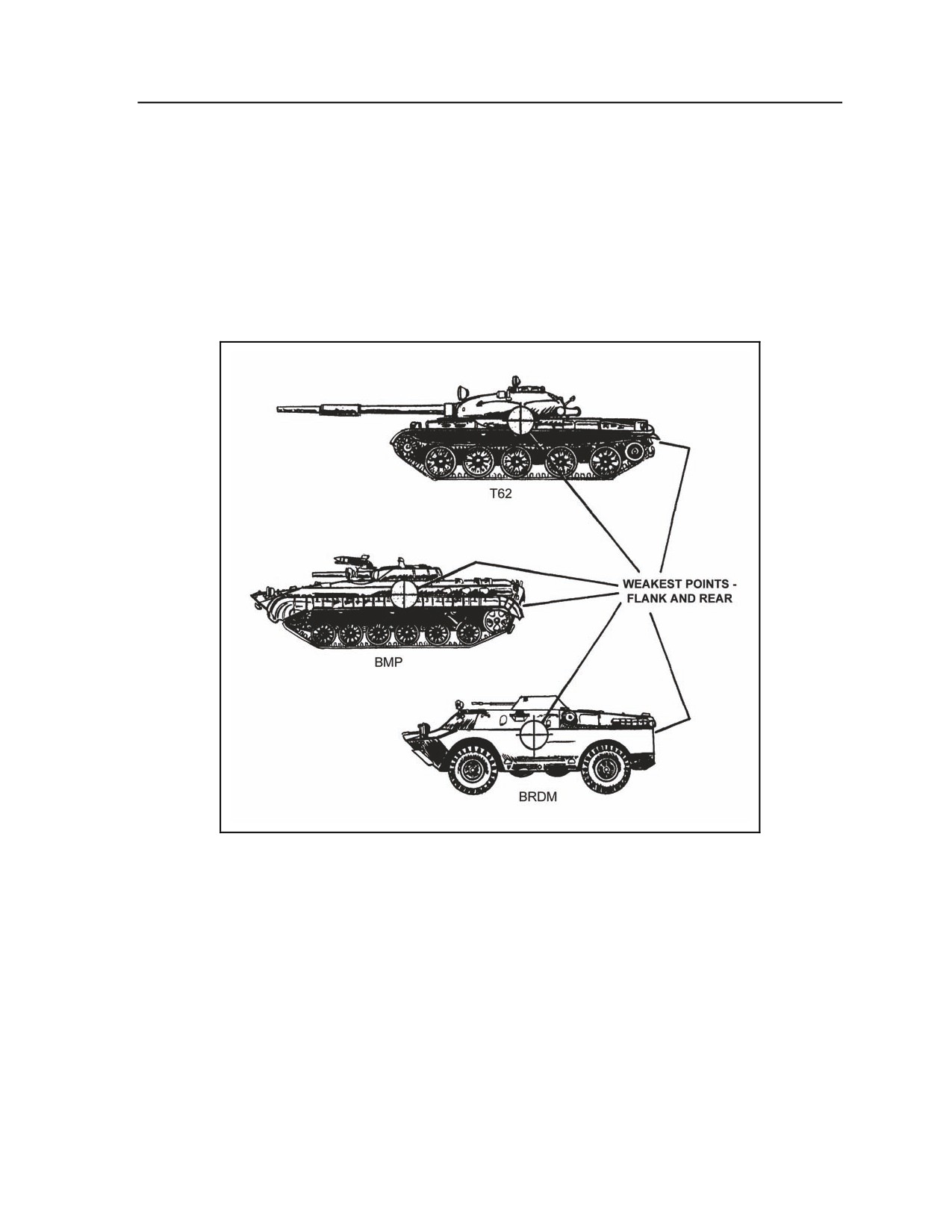
B-44. Because they are designed mainly for offensive operations against other armored vehicles (Figure B
11), armored vehicles usually have their heaviest armor in front. All vehicles are vulnerable to repeated hits
on their flanks and rear, though the flank offers the largest possible target. Firers should always aim center
of mass to increase the probability of a hit. The older the vehicle model, the less protection it has against
SLM and CCMS. Newer versions of older vehicle models may use bolt-on (appliqué) armor to improve
their survivability. Reactive armor usually covers the forward-facing portions and sides of the vehicle and
can defeat shaped-charge weapons such as the SLM. When reactive armor detonates, it disperses metal
fragments to 200 meters. SLM cause only a small entry hole in an armored vehicle target, though some
fragmentation or spall may occur.
Figure B-11. Armored vehicle weak points.
B-45. Natural or man-made obstacles can be used to force the armored vehicle to slow, stop, or change
direction. This pause enables the firer to achieve a first-round hit. If he does not achieve a catastrophic kill
on the first round, he or another firer must be ready to engage the target vehicle immediately with another
round.
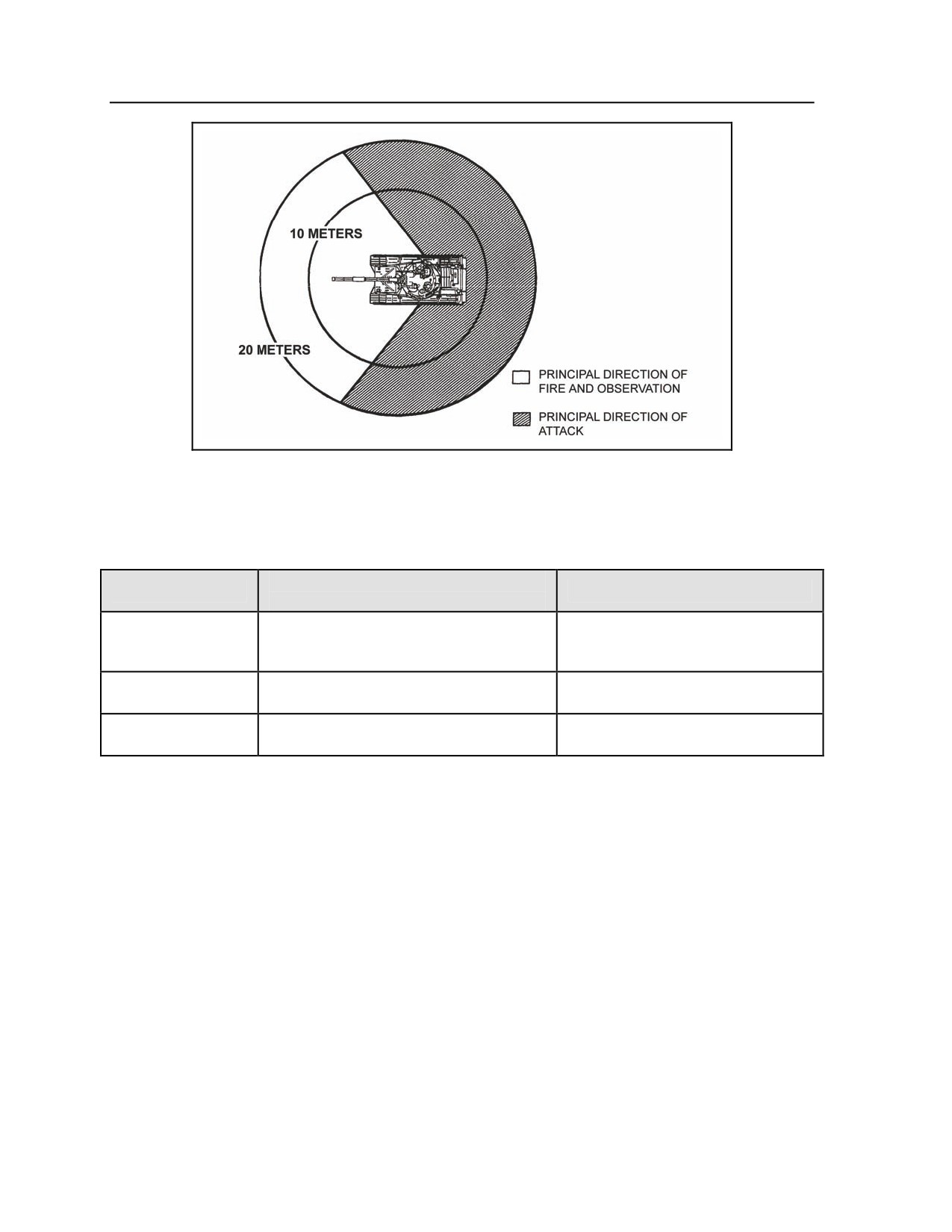
B-46. The white area in Figure B-12 shows the most favorable direction of attack when the turret is facing
to the front. The gray area shows the vehicle’s principal direction of fire and observation when the turret is
facing to the front). Volley fires can greatly degrade the additional protection that appliqué and reactive
armors provide to the target vehicle.
28 March 2007
FM 3-21.8
B-17
Appendix B
Figure B-12. Limited visibility of armored vehicles.
B-47. Armored vehicle kills are classified according to the level of damage achieved (Table B-7).
Table B-7. Armored vehicle kills.
Part of Vehicle
Type Of Kill
Capability After Kill
Damaged or Destroyed
Mobility Kill
Suspension (track, wheels, or road
Vehicle cannot move, but it can still
wheels) or power train (engine or
return fire.
transmission) has been damaged.
Firepower Kill
Main armament has been disabled.
Vehicle can still move, so it can get
away.
Catastrophic Kill
Ammunition or fuel storage section has
Vehicle completely destroyed.
been hit by more than one round.
SHOULDER-LAUNCHED MUNITIONS IN THE ANTIARMOR ROLE
B-48. When Soldiers employ the M136 AT4 and M72-series LAW to defeat threat armored vehicles, it
requires Soldiers to engage threat vehicles using single or paired shots. Gunners require positions that allow
engagement against the flank or rear of the target vehicles. They must seek covered and concealed positions
from where targets can be engaged. However, the M136 AT4 cannot be fired safely from within an
enclosure because it denies the protection offered by enclosed fighting positions and masonry buildings.
FM 3-23.25 advises firing the M136 AT4 and XM141 BDM from an enclosure under combat conditions
only when no other tactical option exists due to the risk of both auditory and non-auditory injury.
SLM Warhead Effects on Armor
B-49. SLM warheads have excellent armor penetration ability and lethal after-armor effects (especially the
AT4 and M72A7). The extremely destructive shaped-charge explosives can penetrate more than 14 inches
(35.6 centimeters) of rolled homogeneous armor (RHA). Types of warhead armor effects follow and are
illustrated in Figure B-13.
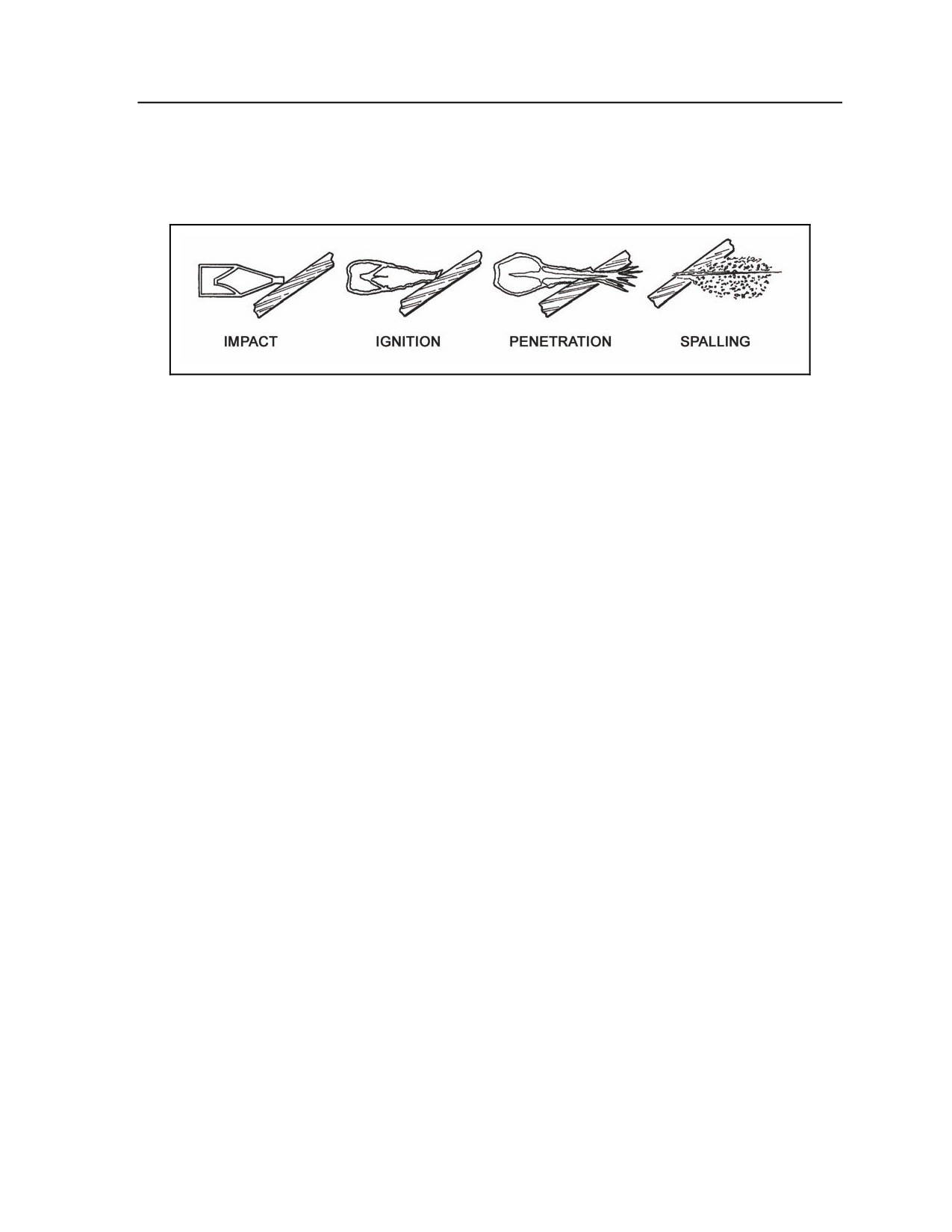
Impact. The nose cone crushes; the impact sensor activates the fuze.
Ignition. The fuze element activates the electric detonator. The booster detonates, initiating the
main charge.
B-18
FM 3-21.8
28 March 2007
Shoulder-Launched Munitions and Close Combat Missile Systems
Penetration. The main charge fires and forces the warhead body liner into a directional gas jet
that penetrates armor plate.
Spalling
(After-Armor Effects). The projectile fragments and incendiary effects produce
blinding light and highly destructive results.
Figure B-13. Effects of SLM warheads on armor targets.
Engagement of Other Vehicles
B-50. The M72-series LAW proves more effective against light vehicles. The M136 AT4 proves more
effective against armored vehicles. Non-armored vehicles such as trucks, cars, and boats are considered soft
targets. Firing along their length offers the greatest chance of a kill, because this type of shot is most likely
to hit their engine block or fuel tank.
Methods OF Engagement
B-51. The four engagement methods for SLM include single, sequence, pair, and volley firing. The leader
evaluates the situation on the ground to determine which of these methods to use. Regardless of whether
they are used singly or in combination, communications are needed as well. The methods of engagement
are rehearsed IAW unit SOP.
Single Firing
B-52. A single Soldier with one SLM may engage an armored vehicle, but this is not the preferred method
of engagement. Several SLM are normally required to effectively kill an armored vehicle. A single gunner
firing one round must hit a vital part of the target in order to do damage (Figure B-14). A single firer can
engage targets out to 225 meters with the LAW, or 300 meters with the AT4 (when he knows the actual
range).
28 March 2007
FM 3-21.8
B-19
Appendix B
Figure B-14. Single firing.
Sequence Firing
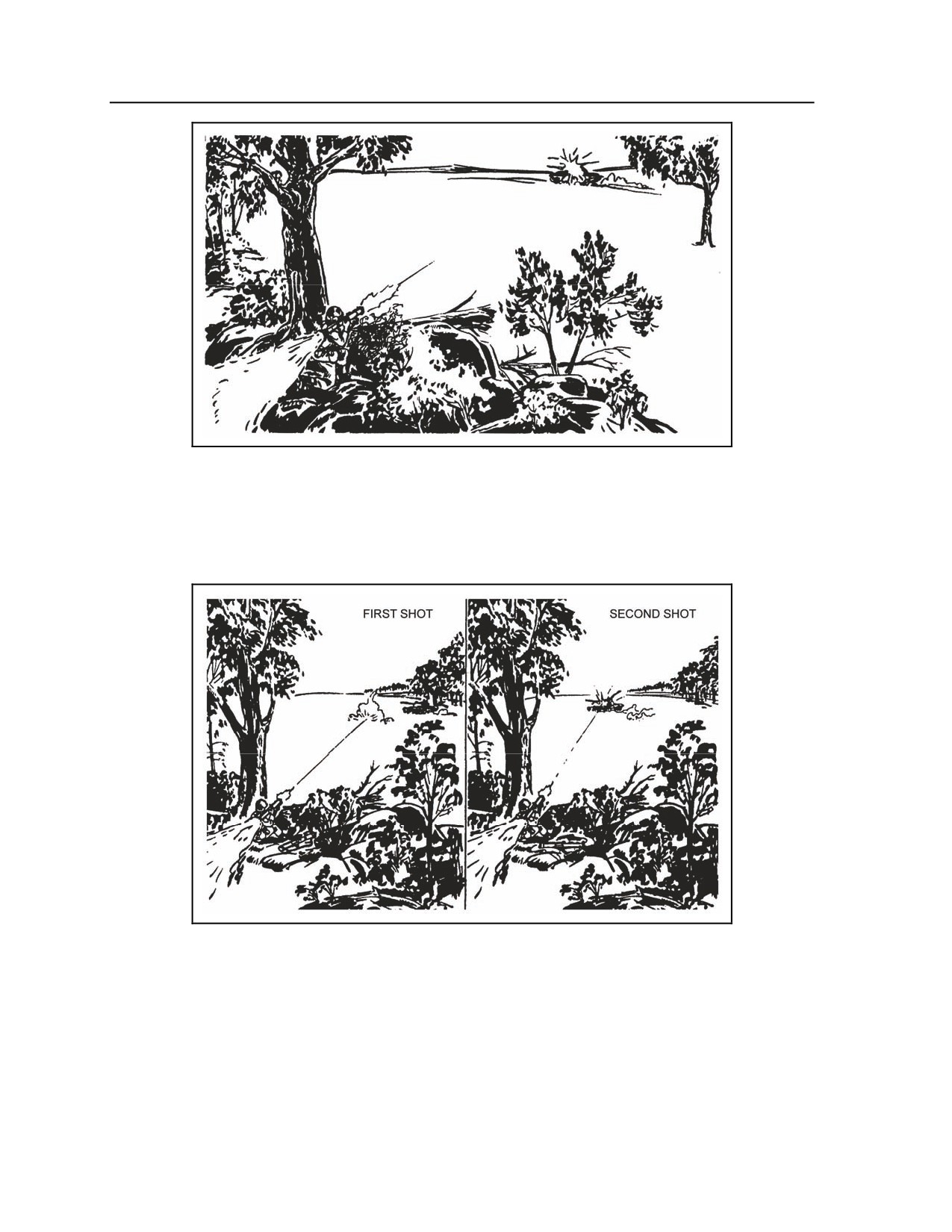
B-53. A single firer, equipped with two or more SLM prepared for firing, engages the target. After engaging
with the first round and observing the impact, the firer adjusts his point of aim. He then engages with
another round until he destroys the target or runs out of rounds (Figure B-15).
Figure B-15. Sequence firing.
Pair Firing
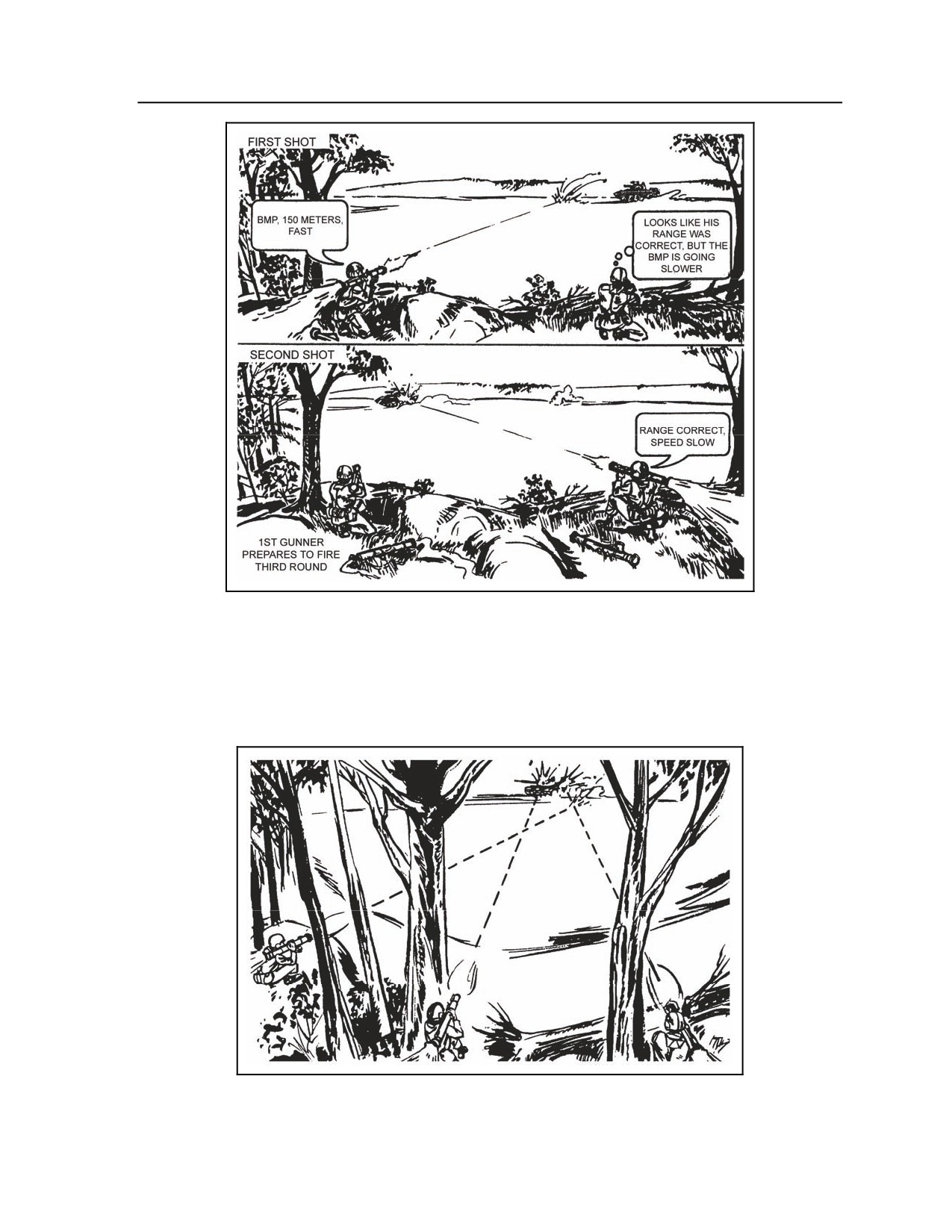
B-54. Two or more firers, equipped with two or more SLM prepared for firing, engage a single target.
Before firing, the first firer informs the others of the estimated speed and distance to the target. If the
impact of his round proves his estimate to be correct, the other firers engage the target until it is destroyed.
If the impact of the round proves his estimate to be incorrect, the second firer informs the others of his own
estimate, and then he engages the target. This continues until the target is destroyed or all rounds are
expended (Figure B-16).
B-20
FM 3-21.8
28 March 2007
Shoulder-Launched Munitions and Close Combat Missile Systems
Figure B-16. Pair firing.
Volley Firing
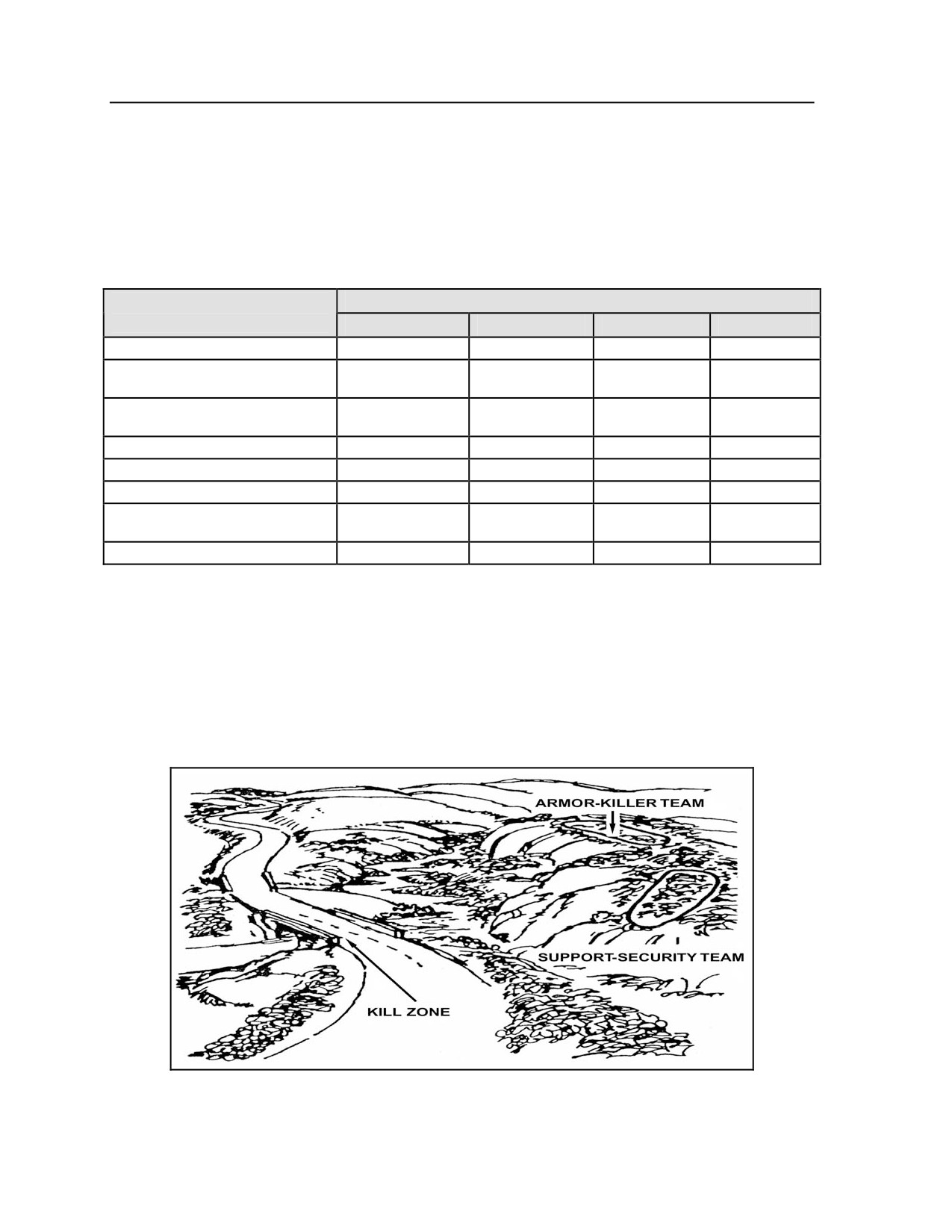
B-55. Two or more firers can engage a single target when the range is known. These firers engage the target
at the same time on a prearranged signal such as a command, whistle, mine, or TRP. This can be the most
effective means of engagement as it places the most possible rounds on one target at one time, increasing
the possibility of a kill (Figure B-17).
Figure B-17. Volley firing.
28 March 2007
FM 3-21.8
B-21
Appendix B
TOW COUNTERMEASURES TO IMPROVED ARMOR
B-56. TOW crews can expect to be issued a mix of TOW missile types on the battlefield, with widely
varying capabilities. Gunners and leaders must be familiar with the different missile types and their
respective capabilities. The proper type of missile must be chosen for each type of target (Table B-8).
B-57. TOW crews must strive harder than ever to find positions where they can engage enemy vehicles
from the flank. Modern tanks with reactive armor have become increasingly difficult to kill from the front.
Table B-8. Missile selection priority chart.
THREAT VEHICLE-TYPE
SELECTION PRIORITY
TARGETS
First
Second
Third
Fourth
Tanks with appliqué armor
TOW 2B
TOW 2A
TOW 2
ITOW
Tanks with explosive reactive
TOW 2B
TOW 2A
TOW 2
ITOW
armor
Tanks without appliqué/ reactive
TOW 2B
TOW 2A
TOW 2
ITOW
armor
Light armored personnel carriers
TOW 2
TOW 2A
TOW 2B
ITOW
Light armored wheeled vehicles
TOW 2
TOW 2A
TOW 2B
ITOW
Antiaircraft vehicles
TOW 2
TOW 2A
TOW 2B
ITOW
Armored vehicles in hull defilade
TOW 2B
TOW 2A
TOW 2
ITOW
positions
Bunkers/fortifications
TOW BB
TOW 2
TOW 2A
ITOW
ANTIARMOR AMBUSH ROLE
B-58. Antiarmor ambushes are usually conducted to destroy small groups of armored vehicles, force the
enemy to move more slowly and cautiously, or force the enemy into a choke point. Units conducting an
antiarmor ambush can use Javelins or TOWs for this purpose. The Javelin and TOW have a slow rate of
fire, so other weapons systems must be prepared to engage the vehicles while the Javelin gunners attach the
CLU to new rounds or the TOW gunners load new rounds. The Javelin's 2,000-meter range and the TOWs
3,750 meter range allow flexibility in choosing ambush positions. In addition to fires into the kill zones, the
Javelin and TOW can be employed in a security role to guard high-speed avenues of approach, to slow or
stop enemy reinforcements, or to destroy vehicles attempting to flee the kill zone (Figure B-18).
Figure B-18. Antiarmor ambush.
B-22
FM 3-21.8
28 March 2007
Shoulder-Launched Munitions and Close Combat Missile Systems
OFFENSIVE OPERATIONS
B-59. CCMS contribute to offensive operations by providing long-range fires that destroy enemy armor
and protect the force from armored counterattacks. In the absence of armored targets, CCMS can engage
enemy fortifications and hovering helicopters. CCMS are normally used in a support-by-fire role during
offensive operations. The primary consideration for such employment is the availability of appropriate
fields of fire and the armored threat. CCMS crews can effectively protect flanks against armored threats
and can also provide overwatch for unit movement (Figure B-19).
Figure B-19. TOW supporting offensive operations.
DEFENSIVE OPERATIONS
B-60. During planning, the leader considers the enemy armor threat, then positions antiarmor weapons
accordingly to cover armor avenues of approach. He also considers the fields of fire, tracking time, and
minimum engagement distance of each weapon. The section leader or squad leader selects a primary
position and sector of fire for each antiarmor weapon. He also picks alternate and supplementary positions
for them. Each position should allow flank fire and have cover and concealment. The leader should
integrate the ITAS into his limited visibility security and observation plan. The squad leader selects the
fighting position and assigns the sector of fire. Considering the fundamentals of antiarmor employment will
greatly improve the crew’s survivability. ITAS crews must coordinate with adjacent units to ensure
security. The TOW’s 3,750-meter maximum range makes it difficult for the enemy to engage the crew with
direct fire, which forces the enemy to deploy earlier than intended. The gunner prepares a range card for his
primary position. If time permits, he also prepares them for his alternate and supplementary positions
(Table B-9).
B-61. Reserve forces armed with SLM may be employed to assist counterattacks to regain key positions.
They are also used to block enemy penetrations, to meet unexpected enemy thrusts, and to provide support
by fire to endangered friendly units during disengagements and withdrawals. In the event defensive
positions are in danger of being overrun by enemy armored vehicles, SLM may be used against armored
vehicles and lightly armored vehicles posing an immediate threat, including light tanks. The maximum
range provides leaders with greater flexibility in positioning each round and provides a means of achieving
overlapping sectors of fire for increased survivability.
28 March 2007
FM 3-21.8
B-23

Appendix B
Table B-9. Personnel duties.
Gunner/
Section
Tasks to be Performed
Team Leader
Assistant
Sergeant
Gunner
Integrate CCMS into the platoon tactical plan:
• Select general weapons positions.
• Assign sectors of fires.
X
• Coordinate mutual support.
X
• Coordinate with adjacent units.
X
X
Reconnoiter for and select tentative CCMS firing
positions (primary, alternate, and supplementary)
and routes between positions.
X
Supervise continual preparation and
improvement of positions.
X
X
Coordinate security for the CCMS teams.
X
Inspect the selection of tentative firing positions,
X
X
confirm or make adjustments.
Supervise preparation of range card.
X
X
Control movement of gunners between positions.
X
X
Issue fire commands to gunners.
X
X
Coordinate resupply and collection of extra
X
rounds carried in platoon.
Identify enemy avenues of approach.
X
Prepare fighting position (primary, alternate,
supplementary).
X
Prepare range card.
X
X
Designate target reference points.
X
Prestock rounds.
X
X
Prepare round for firing.
X
React to fire commands.
X
Engage targets.
X
SECTION III — SAFETY
B-62. Leaders must employ SLM/CCMS to effectively minimize danger to friendly Soldiers caused by the
surface danger zone (SDZ) or backblast danger zones. They must weigh the risk of firing the missile in
close proximity to friendly assault forces against the need to suppress or destroy enemy fortifications or
vehicles from the support-by-fire or assault position. This section discusses SLM and CCMS safety.
SLM
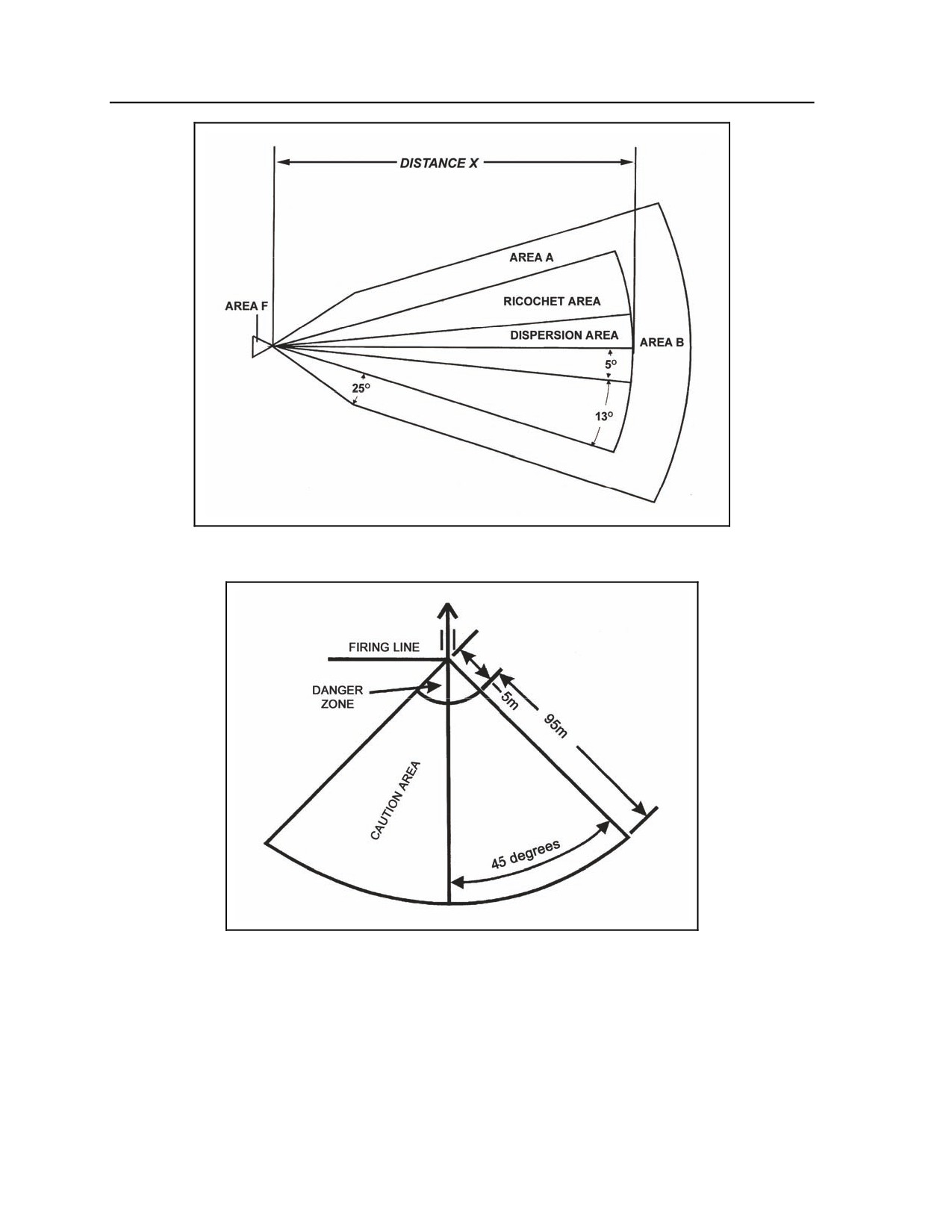
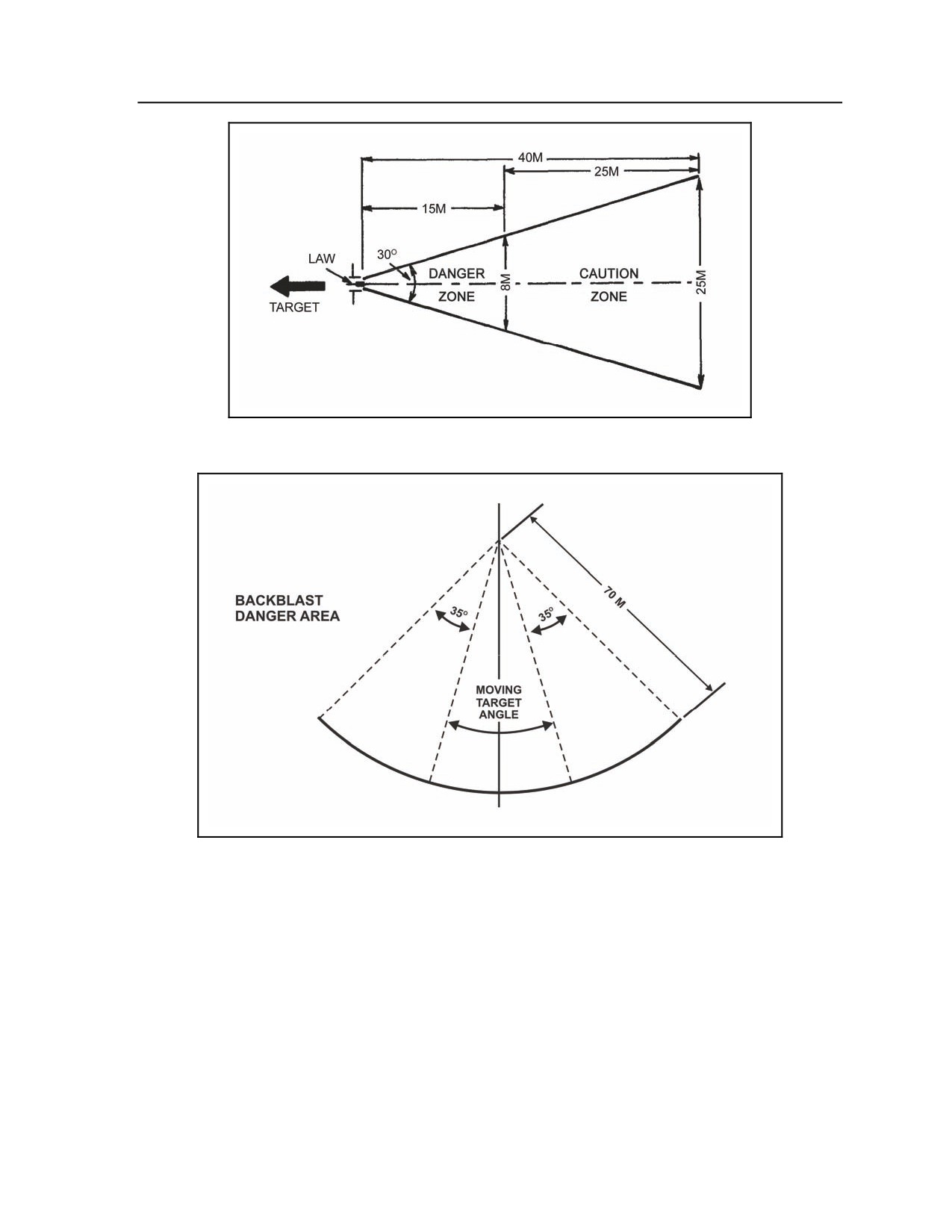
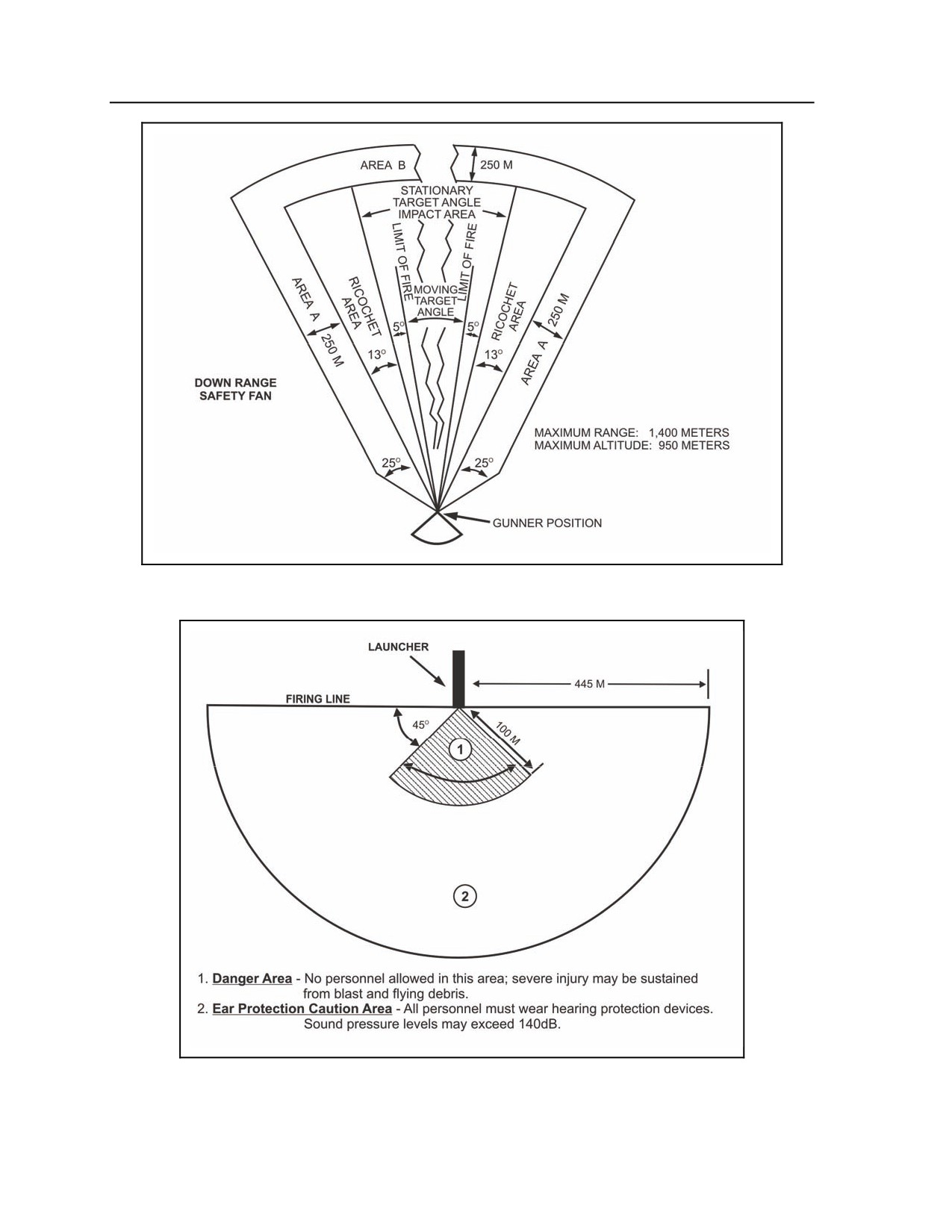
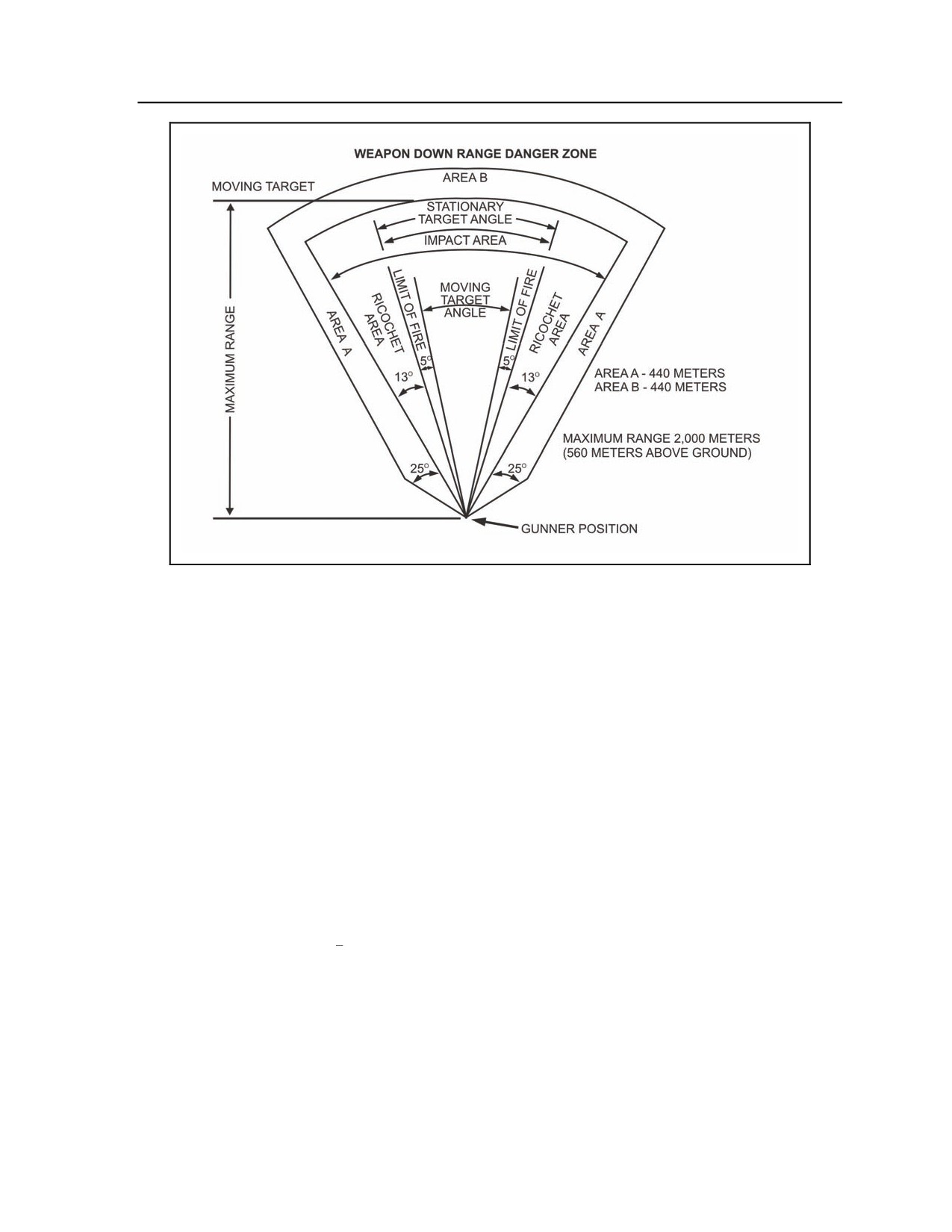
B-63. Figures B-20 through B-27 and Table B-10 illustrate surface danger zone (SDZ) and backblast
danger zone information for SLM. See DA PAM 385-63, Range Safety, and FM 3-23.25, Shoulder-
Launched Munitions, for more specific information regarding this and other safety-specific information.
B-24
FM 3-21.8
28 March 2007
Shoulder-Launched Munitions and Close Combat Missile Systems
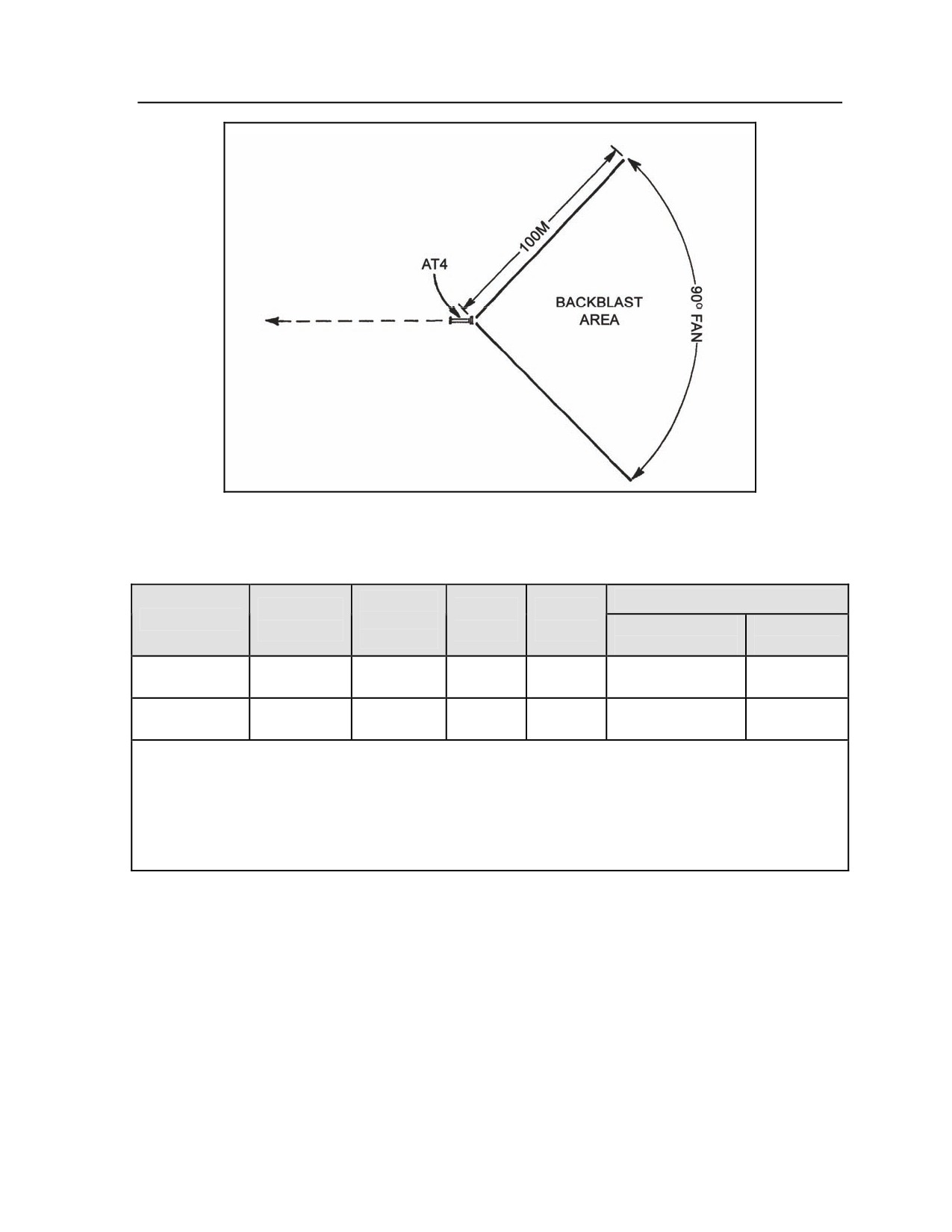
Figure B-20. M136 AT4 backblast danger area.
Table B-10. AT4 SDZ criteria in meters.
Minimum
Area F2
Distance
Area
Area
Type
Range to
X
A
B
Danger Zone
Caution
Target
Depth
Area Depth
84-mm HEAT
2,100
50
227
488
53
954
M1361
9-mm Trainer,
1,600
N/A
N/A
N/A
N/A
N/A
M939
NOTES:
1Increased dud rates may occur when firing HE (M136) at impact angles of 10 degrees or less.
2Area F is 90-degree angle (45 degrees left and right) of rearward extension of launcher target line.
3Danger zone occupation could result in fatalities or serious casualties including, severe burns, eye damage, or permanent
hearing loss. The hazards are baseplate fragments, debris, fireball, high noise levels, and overpressure.
4Caution area is an extension of the primary danger area. Occupation of this area could also result in severe casualties due to
backblast, debris, high noise levels, and possible baseplate fragments. Primary danger area and caution area are conditions
that may not be modified.
28 March 2007
FM 3-21.8
B-25
Appendix B
Figure B-21. SDZ for firing AT4.
Figure B-22. SDZ area F for firing AT4.
B-26
FM 3-21.8
28 March 2007
Shoulder-Launched Munitions and Close Combat Missile Systems
Figure B-23. M72A2/3 LAW backblast area.
Figure B-24. Improved LAW backblast danger area.
28 March 2007
FM 3-21.8
B-27
Appendix B
Figure B-25. SDZ for firing Improved LAW.
Figure B-26. XM141 BDM backblast danger area.
B-28
FM 3-21.8
28 March 2007
Shoulder-Launched Munitions and Close Combat Missile Systems
Figure B-27. SDZ for firing XM141 BDM.
COMBAT SAFETY FOR ALL SLM
B-64. Combat safety rules and procedures include all those that apply to training with the following
modifications.
Engagement From an Enclosure
B-65. Firing from an enclosure creates unique hazards. Therefore, before positioning Soldiers in enclosures
(combat only), leaders must consider several factors that affect safety. Only in combat, when no other
tactical option exists, should the M136 AT4 and XM141 be fired from an enclosure. If it must be employed
this way, the enclosure must meet the following minimum requirements. The M72-series LAW has been
rated safe for use from an enclosure, but only when the enclosure meets the following minimum
requirements.
Construction. The building must be sturdily constructed to reduce structural damage that would
occur in a weakly constructed enclosure such as one made of wood or stucco.
Size of Enclosure. Minimum measurements for the enclosure are as follows:
AT4 and XM141 - minimum room size 17 by 24 feet; minimum ceiling
height 8 feet (combat only).
LAW - minimum room size 12 by 15 feet.
Ventilation to the Rear and Sides. To allow for backblast, at least 20 square feet of ventilation
(for a standard 3-foot by 7-foot doorway) must be provided directly behind the firer. Doors and
windows should be removed beside and behind the position to increase ventilation and reduce
overpressure, noise, and blast effects. On the front wall, windows and doors should be
reinforced, rather than removed, because removing would draw attention to the position.
Reinforcing the windows also helps protect the firer from enemy direct-fire weapons.
Objects and Debris. Any objects or debris to the rear of the weapon must be removed to prevent
them from flying around the room and possibly injuring personnel as a result of the backblast.
28 March 2007
FM 3-21.8
B-29
Appendix B
Muzzle Clearance. Muzzle clearance must be at least 6 inches.
Weapon Clearance. Properly positioning the weapons within the enclosure is vital to the safety
and survival of all personnel in the enclosure. The weapons should be positioned so no walls are
within 5 meters to the rear or side of the weapon.
Non-Firing Personnel Positions. If any other Soldiers are present, they must avoid standing in
corners or near walls and must remain forward of the rear of the launcher.
Engagement from a Fighting Position
B-66. The M72-series LAW, M136 AT4, and SMAW-D can be fired from the standard Infantry fighting
position. However, to increase accuracy and reduce danger to friendly Soldiers, the area to the rear of the
firing position must have no walls, large trees, or other obstructions within 5 meters (5 1/2 yards). Ensuring
the absence of such obstructions avoids deflection of weapon backblast onto the firer or into the position.
Individual Infantry Fighting Position. The Soldier must lean against the rear wall and ensure
that the venturi or the rear of the weapon protrudes past the rear of the position.
Two-Soldier Infantry Fighting Position. Nonfiring personnel must remain clear of the
backblast area. These positions should be constructed and sited so none are located in another
position’s backblast danger zone.
Modified Firing Position. A modified firing position may be constructed to the side of the two-
Soldier fighting position. Firing from a modified position reduces the possibility of injury to the
firer or the other Soldier in the fighting position, while still offering the firer protection from
enemy return fire.
OVERHEAD FIRE
B-67. SLM should not be fired over the heads of friendly Soldiers, unless the Soldiers have adequate
protection against direct impact or other hazards.
JAVELIN
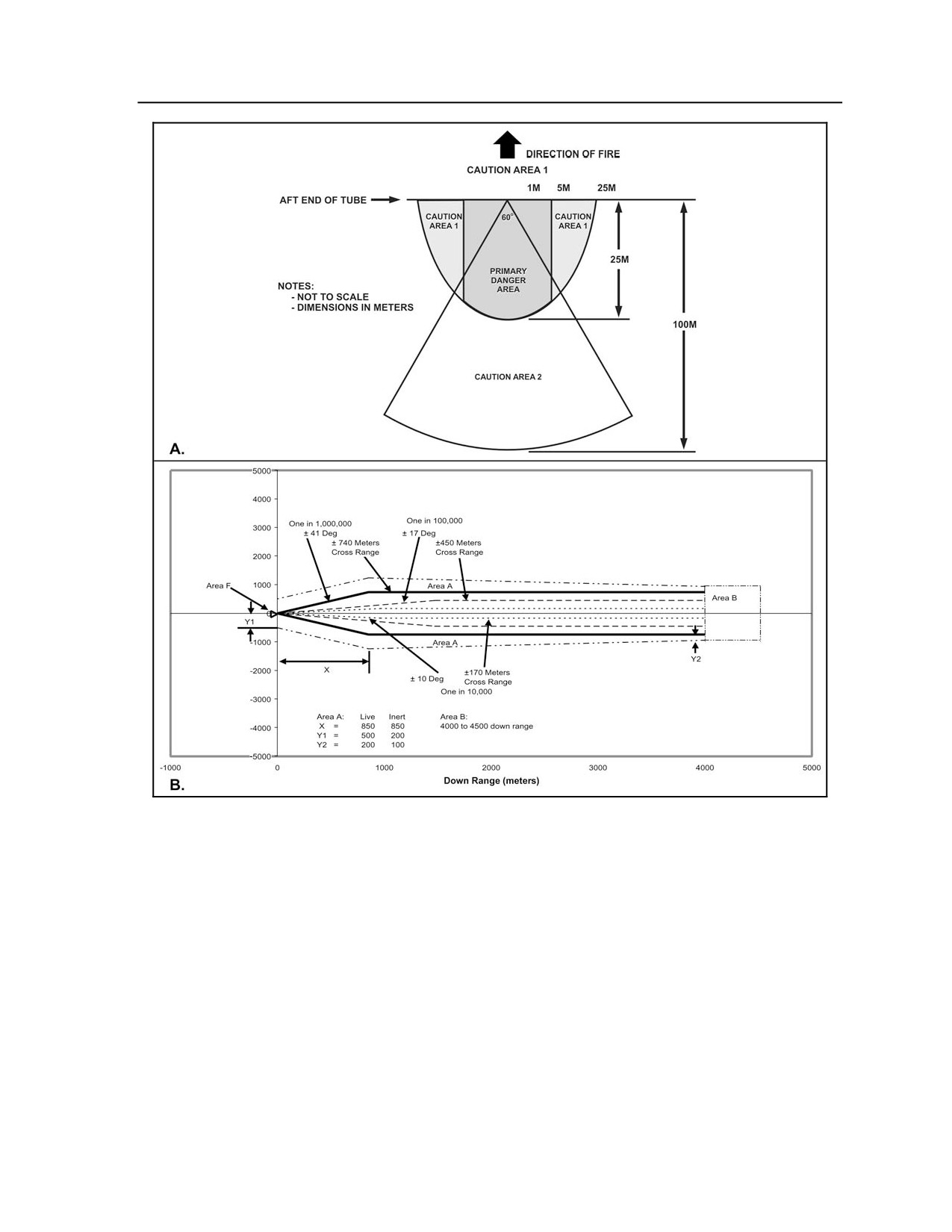
B-68. Figure B-28 shows the Javelin backblast danger area and SDZ. The primary danger area is a
60-degree sector, with the apex of the sector at the aft end of the missile launch motor.
B-30
FM 3-21.8
28 March 2007
Shoulder-Launched Munitions and Close Combat Missile Systems
Figure B-28. Javelin backblast area and surface danger zone.
FIRING FROM ENCLOSURES
B-69. The Javelin can be fired from inside a building. However, the room from which it is fired must be at
least 7 feet high, 12 feet wide, and 15 feet deep.
Debris. Debris and loose objects are cleared from behind the launch site when firing within a
confined area.
Venting. When possible, doors and windows are opened to allow the backblast and overpressure
to escape.
Structural Damage. Escaping gases from the missile’s first-stage motor are hot and flammable.
The materials that can easily catch fire are removed before firing (for example, some types of
curtains and throw rugs).
Hearing Protection. All personnel within
25 meters of the Javelin must wear hearing
protection.
28 March 2007
FM 3-21.8
B-31
Appendix B
Face Shield. The face shield protects the gunner’s face. It is possible to damage the face shield
absorber between the indentation and the CLU main housing. If this part of the face shield is
missing, the gunner must switch from firing the Javelin with the right eye to the left eye.
TOW
B-70. When firing from either a hasty or improved fighting position, the gunner must take into
consideration obstructions directly to his front, to his rear, and to the sides of the fighting position.
FIRING LIMITATIONS
E-1. Some conditions may limit the firing and engagement capabilities of the TOW. The following
information should be considered before engaging targets.
(See TM 9-1425-450-12, Operator and
Organizational Maintenance Manual for TOW 2 Weapon System, Guided Missile System M220A2, for
updated firing limitations.)
Firing Over Bodies of Water. Maximum and limited range firing over water varies according
to missile type. If the range is less than 1,100 meters, the missile’s range is not affected.
However, if it is wider than 1,100 meters it can reduce the range of the TOW. A TOW position
should be as high above and as far back from the water as the tactical situation allows. The
squad or section leader should analyze his sector as soon as the position is occupied to determine
if water will affect the employment of the TOW. Signals being sent through the command-link
wires are shorted out when a large amount of wire is submerged in water.
Firing Over Electrical Lines. If the command-link wires make contact with a live high-voltage
power line, personnel can be injured or control of the missile could be lost. The launcher
electronics may also be damaged. In addition to power lines, other high-voltage sources include
street cars, electric train ways, and some moving target trolleys on training ranges.
Firing in Windy Conditions. Gusty, flanking, or quartering winds can cause the launch tube to
vibrate and spoil the tracking performance. The effect is similar to driving in a strong crosswind.
Strong winds can move the missile around during flight, but as long as the crosshairs are kept on
the center mass of the target, the weapon system itself can compensate for wind effects.
Firing Through Smoke and Area Fires. Smoke can obscure the line of sight and hide the
target when using the daysight tracker. A smooth tracking rate should be maintained as the target
disappears into a smoke cloud so the missile will still be on target or very close as the vehicle
goes out the other side of the smoke cloud. (This technique should be practiced during field
tracking exercises.) A fire can burn through the command-link wire, causing loss of control of
the missile.
Firing From Bunkers and Buildings. In accordance with DA Pam 385-63, TOWs will not be
fired from buildings, bunkers, or within 100 meters of a vertical or nearly vertical backstop
without the approval of the commanding general.
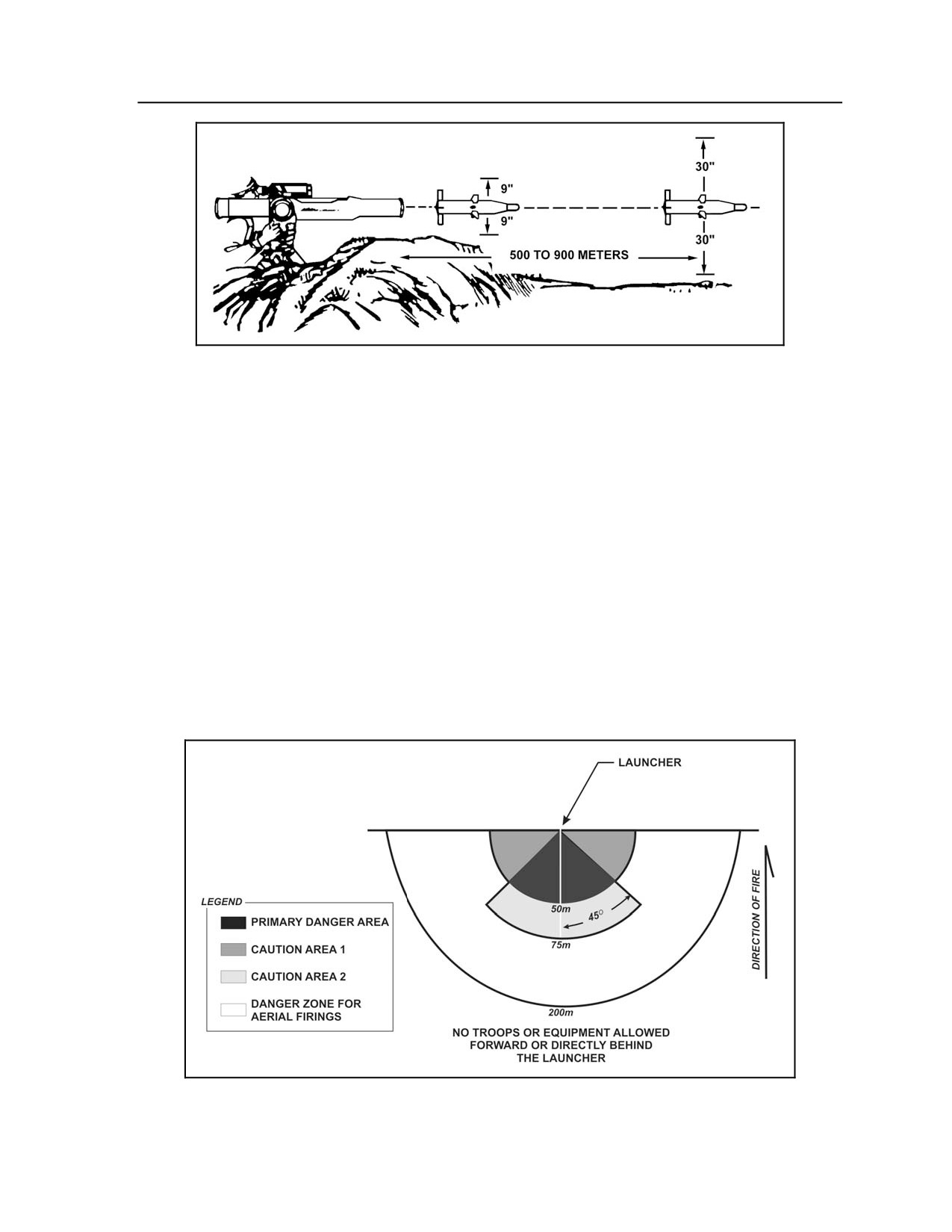
Clearance Requirements. The TOW muzzle must have at least nine inches of clearance at the
end of the launch tube so the wings and control surfaces of the missile will not be damaged when
they extend after clearing the launch tube. The muzzle of the launch tube must extend beyond
any enclosure, window sill, or aperture. It must also have at least 30 inches of clearance between
the line of sight and any obstruction from 500 to 900 meters downrange. A 30-inch line-of-sight
clearance ensures a high probability the missile will not strike the ground on the way to the
target (Figure B-29).
Firing TOW Bunker Buster Missile. The missile warhead arms after launcher is between 35
and 65 meters. There is a very remote possibility of a TOW BB missile airburst 43 meters from
launch platform. The probability of an inadvertent warhead detonation resulting in shrapnel
injury to an exposed crewmember is also very remote. The crew is protected from shrapnel
during firing from Stryker ATGM vehicles. The TOW BB is not currently fired from a
HMMWV.
B-32
FM 3-21.8
28 March 2007
Shoulder-Launched Munitions and Close Combat Missile Systems
Figure B-29. Clearance requirements.
SURFACE DANGER ZONE
B-71. The surface danger zone for any firing range consists of a firing area, a target area, impact area, and
danger areas surrounding these locations (Figure B-30). An additional area for occupation by personnel
during firings may also be required. The shape and size of the surface danger zone varies with the type of
missile or rocket being fired. (Refer to DA Pam 385-63 for dimensions.)
Primary Danger Area. The primary danger area is a 90-degree cone with a 50-meter radius.
The apex of the cone is centered at the rear of the missile launcher. Serious casualties or
fatalities are likely to occur to anyone in the area during firing. Hazards include launch motor
blast, high noise levels, overpressure, and debris.
Caution Area 1. The caution area 1 extends in a radial pattern from each side of the primary
danger area to the firing line with a radius of 50 meters. Permanent hearing damage could occur
to personnel without adequate hearing protection in this area during firing. The hazards are high
noise levels and overpressure.
Caution Area 2. The caution area 2 is an extension of the primary danger area with the same
associated hazards and personnel protection required. The radius of this area is 75 meters.
200-Meter Zone. The 200-meter zone is the danger area for aerial firings 15.25 meters or more
above ground level.
Figure B-30. Surface danger zone for firing basic TOW, TOW 2A, and TOW 2B missiles.
28 March 2007
FM 3-21.8
B-33
Appendix B
FIRING ANGLE LIMITATIONS
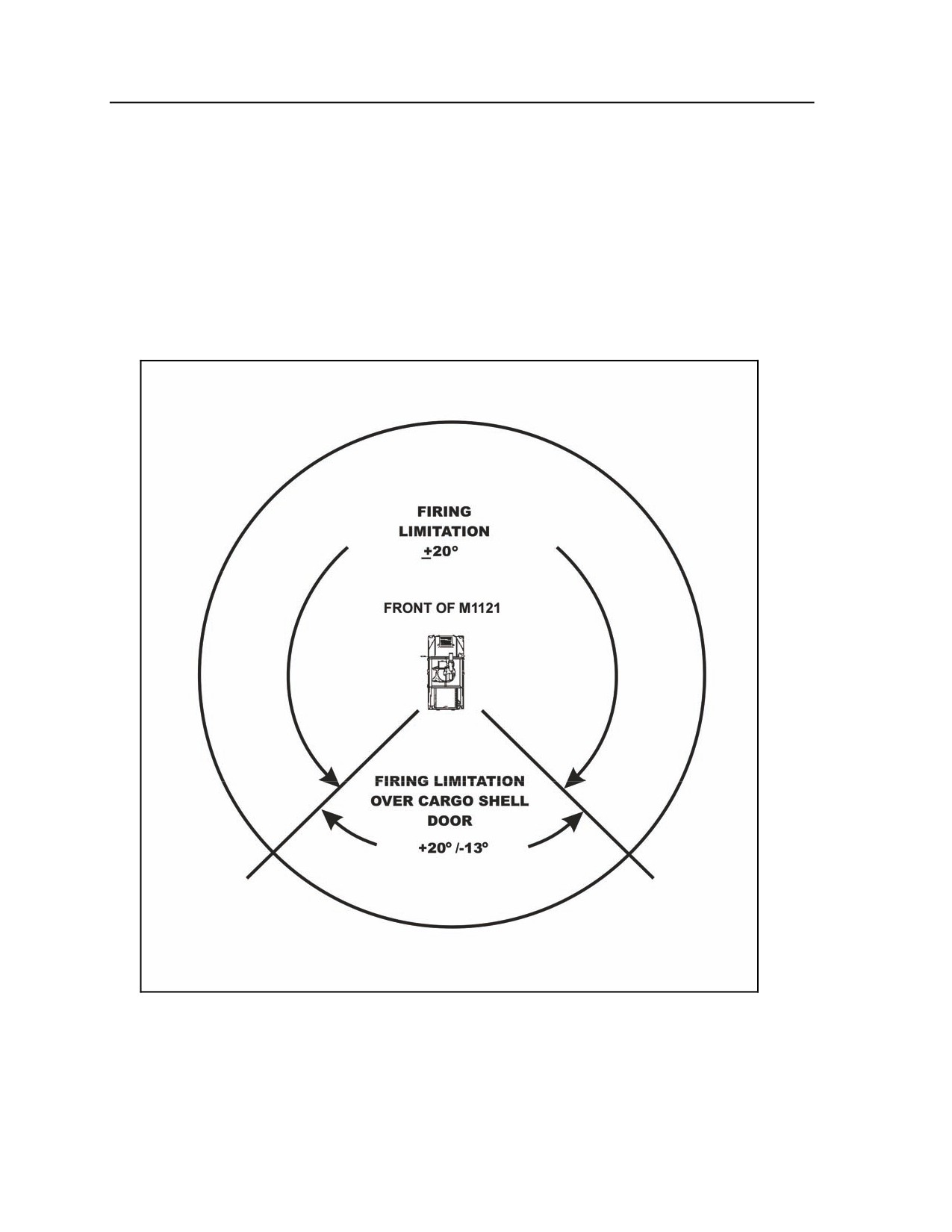
B-72. Azimuth and elevation firing angles are limited by the traversing unit, the vehicle, and other external
restrictions. All elevation angles are referenced to the horizontal plane of the traversing unit. Azimuth
angles are referenced to the long axis of the vehicle and depend on whether the launch tube points over the
front or rear of the vehicle. The other reference line is the LOS from the TOW to the target.
B-73. When the TOW is tripod-mounted, a 360-degree lateral track is possible, because the traversing unit
is not restricted in azimuth. Mechanical stops limit the elevation angle coverage to 20 degrees below and 30
degrees above the horizontal plane. Before the missile is fired, the LOS angle should be estimated at the
expected time of launch and throughout the expected missile flight time. The firing position should be
changed or a different target selected if an expected line-of-sight angle exceeds the firing limitation angle.
B-74. Firing angle limitations of TOW carriers are as illustrated in Figure B-31.
Figure B-31. M1121-mounted TOW firing angle limitations.
B-34
FM 3-21.8
28 March 2007
Appendix C
Fire Planning
Fire planning is the continual process of selecting targets on which fires are
prearranged to support a phase of the concept of operation. Fire planning is
accomplished concurrently with maneuver planning at all levels. Leaders conduct fire
planning to suppress, isolate, obscure, neutralize, destroy, deceive, or disrupt known,
likely, or suspected targets, and to support the actions of the maneuver element. Fires
are planned for all phases of an operation.
SECTION I — FIRE PLANNING
C-1. Fire planning starts as soon as the leader gets a mission. Once begun, fire planning continues through
the operation’s completion. The primary aim of fire planning is to develop how fire is to be massed,
distributed and controlled to best support the leader’s concept of operation.
C-2. Fires are either targets of opportunity, or planned targets. Targets of opportunity are not planned in
advance, but are engaged as they present themselves in accordance with established engagement criteria
and rules of engagement. Planned targets are ones on which fires are prearranged, although the degree of
this prearrangement may vary. The degree of prearrangement influences the time it takes to receive fires.
The greater the prearrangement—the faster the reaction time. The subject of this section is planned fires.
C-3. Planned targets are categorized as scheduled, or on-call. Scheduled fires are fired in accordance with
a pre-established time schedule and sequence. On-call targets are fired in response to a request for fires.
Priority targets are a special type of on-call target. Priority targets have quick reaction times because the
firing unit has guns set on a specific target when not engaged in other fire missions.
C-4. To be effective fires must be integrated and synchronized in time, space, and purpose over the entire
concept of operation. Integration means all available assets are planned and used throughout an operation.
Synchronization means that these assets are sequenced in time, space, and purpose in an optimal manner,
producing complementary and reinforcing effects for the maneuver element.
On 14 May 1945 during the Ryukyus Campaign in Okinawa after three days
of heavy fighting, the companies of 1st Battalion, 305th IN, 77th ID were reduced to the
size of platoons, led by corporals and sergeants. Despite loses, the commander
decided to continue its advance. In order to achieve surprise, the morning attack
began without preparatory fires. The rifle companies moved over the LD at 0800
hours and advanced 200 yards with out a shot being fired by the enemy. Surprise
had been achieved, but the enemy quickly recovered and achieved fire superiority by
pouring machine gun and mortar fire on the attacking units, stopping their advance.
Two of the enemy positions along ridge were destroyed by mortar fire but the troops
were still unable to move with out being met by enemy fire. Determined not to loose
ground already gained, the battalion commander ordered the 81-mm mortar platoon
to place suppressive fires in front of the lead company. Placing fire only 50 yards in
front of the troops, he kept moving the barrage ahead as troops advanced.
The battalion’s mortar PL went forward to the lead elements, and after a
hasty visual recon decided to use two mortars on the mission. He adjusted one
mortar about 50 yards in front of the company and the second about 100 yards in
front of the company. One fired at a range of 700; the other at a range of 750 yards.
28 March 2007
FM 3-21.8
C-1
Appendix C
At these ranges two turns of the elevating crank would move the impact of the round
about 25 yards.
The lead company slowly resumed its advance, moving behind this curtain
of mortar fire. The enemy moved back into their cave positions to get out of the fire,
becoming easy prey for flame throwers and satchel charges. Seven caves were
taken care of in this fashion as the advance moved slowly - but continuously forward.
Each mortar fired at a rate of about 10 rounds per minute. Some rounds fell as close
as 25 yards to the troops, wounding three riflemen with fragments. Within 45 minutes
ridge 59 was secured.
—Suppressive Fires
FIRE PLANNING PROCESS
C-5. Fire planning begins with the concept of fires. This essential component of the concept of operation
complements the leader’s scheme of maneuver detailing the leader’s plan for direct and indirect preparatory
and supporting fires. Fire planning requires a detailed knowledge of weapon characteristics and logistical
capabilities of those providing the support. Although leaders may be augmented with personnel to assist in
planning and controlling attached or supporting assets, the responsibility for planning and execution of fires
lies with the leader. The leaders do not wait to receive the higher headquarters’ plan to begin their own fire
planning. Rather, he begins as soon as possible to integrate fires into his own concept of operation and the
concept of operation of the higher headquarters.
C-6. Additional assets are allocated in either a command or support relationship (see Chapter 1). An
example of a command relationship would be an attachment of a section from the weapons company. The
leader relies on the senior representative from the organization to provide expertise when planning. An
example of a support relationship would be direct support from the artillery battalion or from an attack
aviation company. When planning fires or CAS from a supporting unit, the leader normally receives
someone from that organization to assist them. For example, if the unit were to get close air support
(CAS), a Soldier trained to control the CAS would probably be attached to assist the leader in his planning
and execution.
C-7. Developing the concept of fire should be fairly straight forward during deliberate operations because
of the ability to conduct reconnaissance, planning, and preparation. However, during hasty operations the
unit may have to rely on its internal SOPs and more hands on control by the leader.
PLOT-CR
C-8. Leaders refine, or establish if required, timings and control to ensure these targets are initiated,
adjusted, and shifted properly. If possible, the observer should locate where he can see assigned target.
Leaders refine, or develop a detailed execution matrix assigning responsibility for each target to the leader
or observer who is in the best position to control them should be developed. These Soldiers must know
when each target, series, or group is fired. They must also understand what effect is desired on which
enemy positions, and when to lift or shift the fires. Leaders may consider the use of pyrotechnic or other
signals to ensure communication. Units’ assigned responsibilities for executing fires continually refine and
rehearse their actions. Responsibilities are further refined with the information contained in the categories
contained in the memory aid PLOT:
Purpose
C-9. The purpose outlines how the target assists the maneuver element or contributes to the higher
headquarters’ concept of operation.
Location
C-10. An identified target is the target’s proposed location given as a grid preferably with a known point.
The target location is not the location of the enemy - it is where the leader (or the higher headquarters)
thinks the enemy will be.
C-2
FM 3-21.8
28 March 2007
Fire Planning
Observer
C-11. The observation plan is how the leader plans to monitor the battlefield to execute the target. He
assigns primary and alternate observers with proposed locations where they can observe the target and
associated triggers. Positioning is perhaps the most important aspect of the plan. Observers’ positions
must allow them to see the trigger for initiating fires as well as the target area and the enemy forces on
which the target is oriented. The leader also must consider other aspects of observer capabilities, including
available equipment, communication, and their security. This information is critical to the leader. If an
enemy asset is critical enough to be designated as a target, then it must be adequately resourced with
execution assets.
Trigger
C-12. A trigger is event- or time-oriented criteria used to initiate planned actions directed toward achieving
surprise and inflicting maximum destruction on the enemy or a designated point (FM 1-02). Triggers can
be a physical point on the ground, a laser or lazed spot, or an action or event that causes and action among
friendly forces. When using triggers to control fires, leaders ensure they have allocated them to start, shift,
and cease fires. There are two types of triggers: tactical; and technical. Tactical triggers cue the observer/
executor of the target to communicate to the firing agency to prepare to fire. In the offense tactical triggers
are tied to a friendly maneuver event. In the defense, tactical triggers are usually tied to enemy actions.
Technical triggers involve the actual firing of the target, taking into account the enemy rate of march, and
the friendly munition’s time of flight.
C-13. When using triggers in the defense it is important for subordinates to have a method, usually
addressed in the unit’s SOP, for marking triggers. The marking method should work during day and
limited visibility operations.
TACTICAL USES OF PLANNED FIRES
C-14. Fires are used for many different tactical reasons. They include:
Fire delivered before an attack to weaken the enemy position (FM 1-02).
Supporting fires (covering fires). Supporting fires enable the friendly maneuver element to move
by destroying, neutralizing, or suppressing enemy fires, positions, and observers.
Final protection fires (FPF) is an immediately available prearranged barrier of fire designed to
impede enemy movement across defensive lines or areas.
Suppression.
Obscuration.
Counterbattery (indirect fires only). Counterbattery is fire to destroy or neutralize enemy
artillery / mortars. These missions are normally controlled at higher level headquarters. Direct
support artillery moves with supported units and aviation is used to destroy enemy fire support
means and key enemy units and facilities. Counter battery radars are positioned to maintain
radar coverage to ensure continuous coverage during rapid movement forward.
Harassing fire is observed or predicted (unobserved) fire intended to disrupt enemy troop and
vehicle movement, disturb their rest, and lower their morale.
Illumination.
ECHELONMENT OF FIRE - PLANNED FIRES TECHNIQUE
C-15. Echelonment of fires is the schedule of fire ranging from the highest caliber munitions to the lowest
caliber munitions. The purpose of echeloning fires is to maintain constant fires on the enemy while using
the optimum delivery system. Leaders use REDs, SDZs, and MSDs to manage associated risks. In the
defense, triggers are tied to the progress of the enemy as it moves through the AO, enabling the leader to
engage the enemy throughout the depth of the sector. In the offense triggers are tied to the progress of the
maneuver element as it moves toward the objective protecting the force and facilitating momentum up to
the objective.
28 March 2007
FM 3-21.8
C-3
Appendix C
Defensive Echelonment
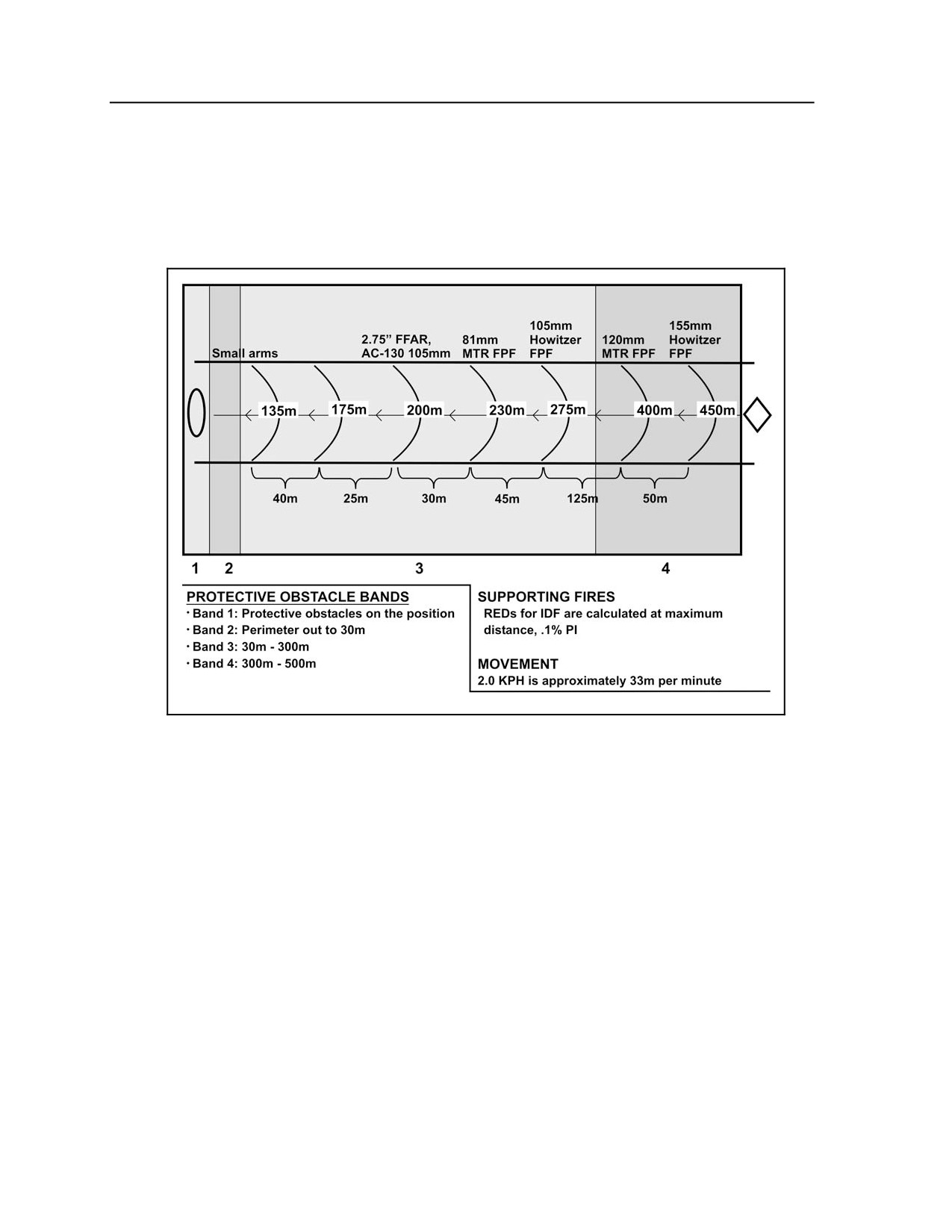
C-16. In the defense, echeloning fires are scheduled based on their optimum ranges to maintain continuous
fires on the enemy, disrupting his formation and maneuver. Echelonment of fires in the defense places the
enemy under increasing volumes of fire as he approaches a defensive position. Aircraft and long-range
indirect fire rockets and artillery deliver deep supporting fires. Close supporting fires such as final
protective fires (FPF) are closely integrated with direct fire weapons such as Infantry weapons, tank
support, and antiarmor weapons systems. Figure C-1 illustrates an example of defensive echelonment.
Figure C-1. Defensive echelonment of fires example.
Offensive Echelonment
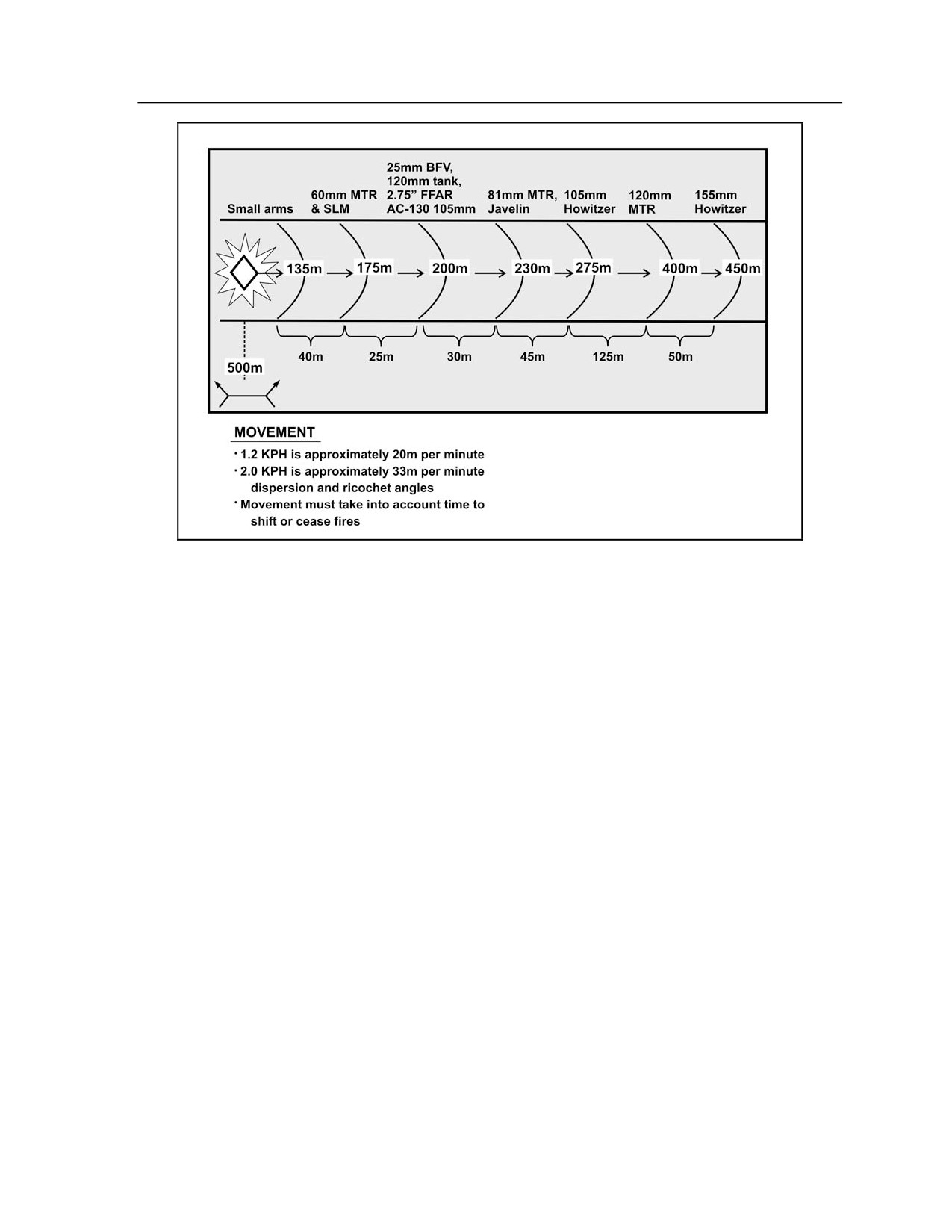
C-17. In the offense, weapons are scheduled based on the point of a predetermined safe distance away from
any maneuvering friendly troops. When scheduled effectively, fires provide protection for friendly forces
as they move to and assault an objective. They also allow friendly forces to get in close with minimal
casualties and prevent the defending enemy from observing and engaging the assault by forcing him to take
cover. The overall objective of offensive scheduled fires is to allow the friendly force to continue the
advance unimpeded (Figure C-2).
C-4
FM 3-21.8
28 March 2007
Fire Planning
Figure C-2. Offensive echelonment of fires example.
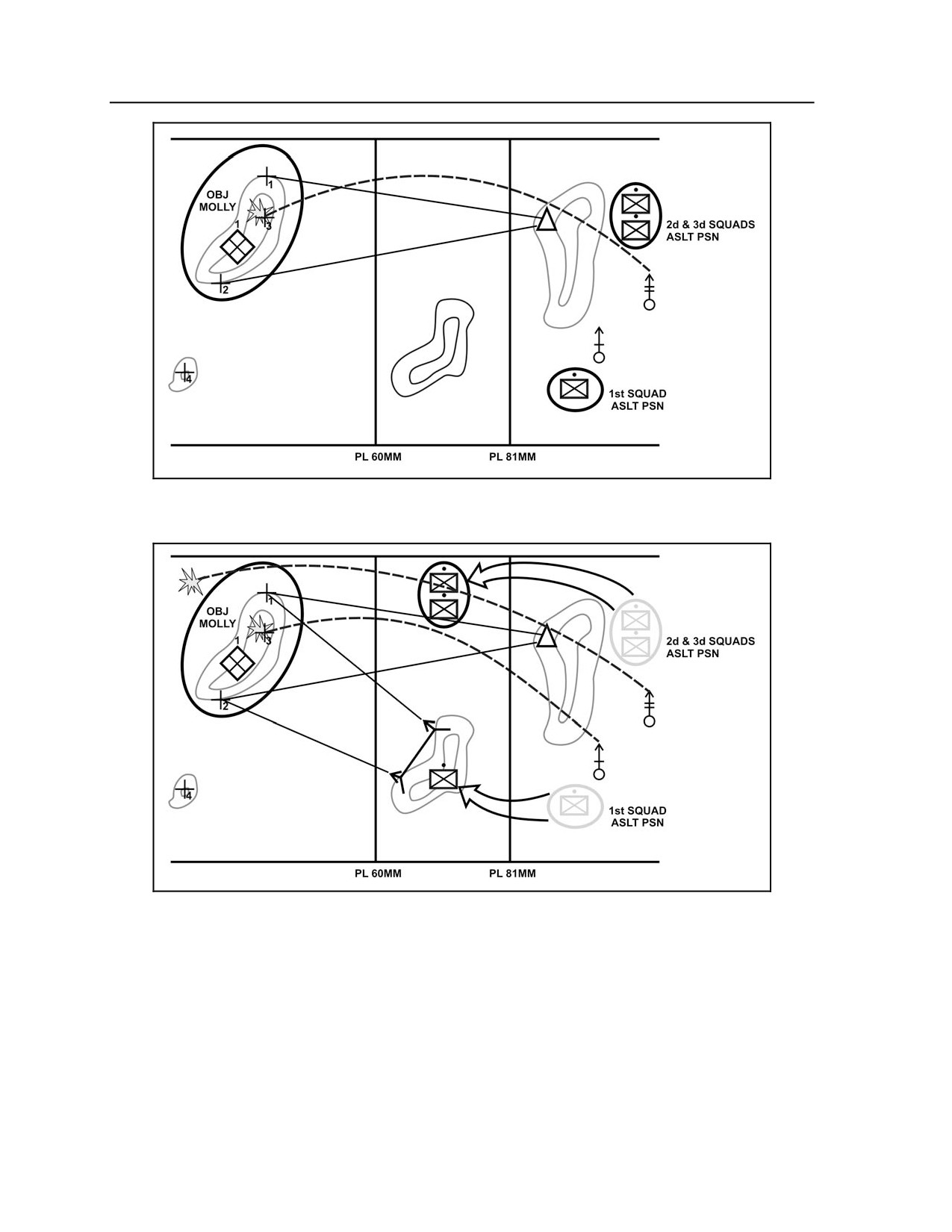
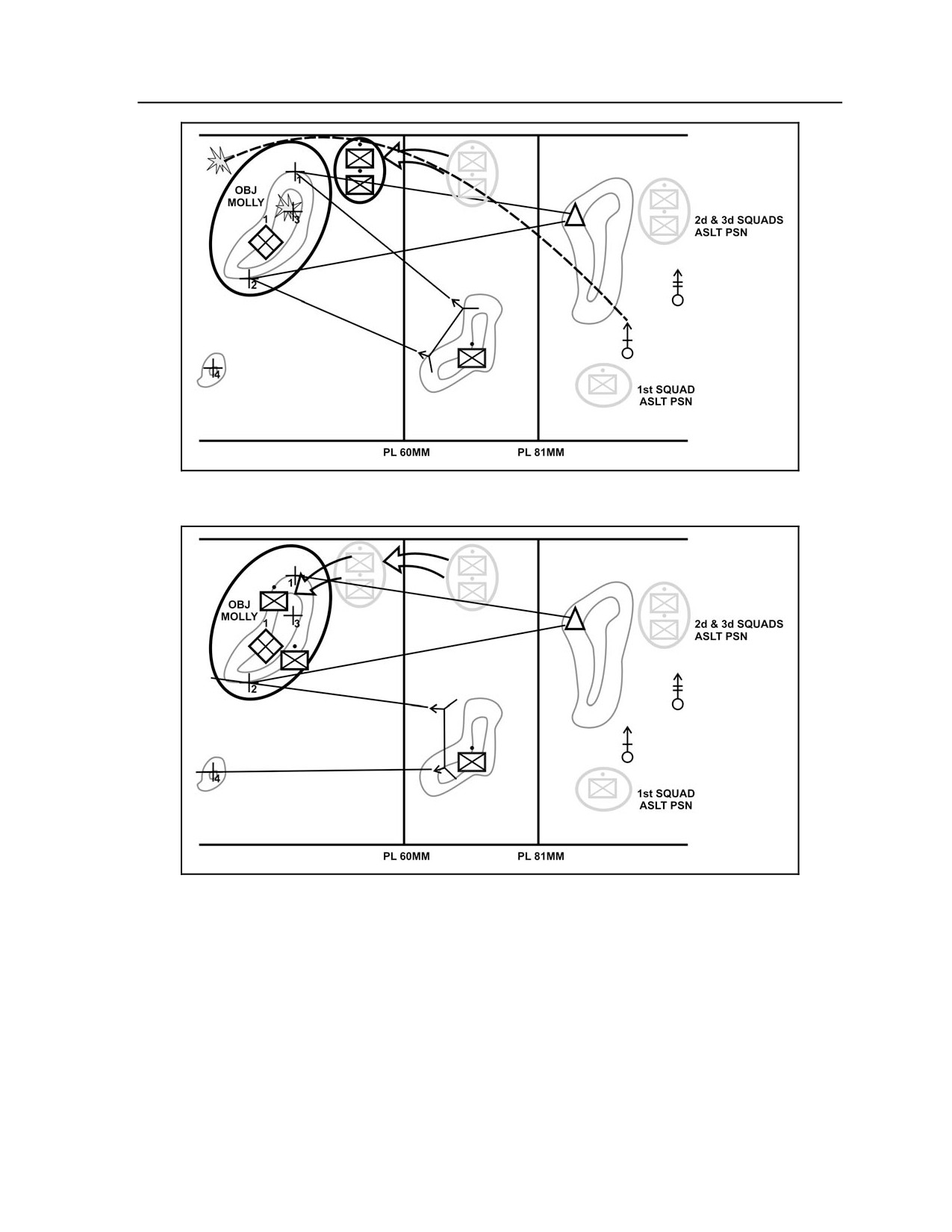
C-18. As an example of echelonment of fires use during the conduct of a mission, consider an operation in
which a platoon assaults an enemy position (Figures C-3 through C-6). As the lead elements of the unit
approach the designated phase line en route to the objective, the leader orders the fire support officer (FSO)
to begin the preparation. Observers track friendly movement rates and confirm them. Other fire support
officers in the chain of command may need to adjust the plan during execution based on unforeseen
changes to anticipated friendly movement rates.
C-19. As the unit continues its movement toward the objective, the first weapon system engages its targets.
It maintains fires on the targets until the unit crosses the next phase line that corresponds to the RED of the
weapon system being fired.
C-20. To maintain constant fires on the targets, the next weapon system begins firing before the previous
weapon system ceases or shifts. This ensures no break in fires, enabling the friendly forces’ approach to
continue unimpeded. However, if the unit rate of march changes, the fire support system must remain
flexible to the changes.
C-21. The FSO shifts and engages with each delivery system at the prescribed triggers, initiating the fires
from the system with the largest RED to the smallest. Once the maneuver element reaches the final phase
line, the FSO ceases the final indirect fire system or shifts to targets beyond the objective to cease all fires
on the objective. Direct fire assets in the form of supporting fires are also maintained until the final assault,
then ceased or shifted to targets beyond the objective.
28 March 2007
FM 3-21.8
C-5
Appendix C
Figure C-3. 81-mm mortars begin firing.
Figure C-4. 81-mm mortars shift, 60-mm mortars and supporting fires begin.
C-6
FM 3-21.8
28 March 2007
Fire Planning
Figure C-5. 60-mm mortars shift.
Figure C-6. Supporting fires shift for final assault.
28 March 2007
FM 3-21.8
C-7
Appendix C
FIRE PLANNING FOR THE DEFENSE
C-22. To develop a defensive fire plan, the leader—
Assigns primary and secondary sectors from primary and alternate position to each subordinate.
Designates unit point or area targets and other control measures, such as target reference points
(TRPs), to coordinate the fire when more than one subordinate is firing into the same
engagement area or sector.
Receives target information from subordinates (normally provided on sector sketches and/or
individual weapon range cards). The leader reviews this target information to insure that fire is
equally distributed across the entire unit’s sector and that sufficient control measures are
established.
Completes the unit’s fire plan and gives a sketch to his higher headquarters.
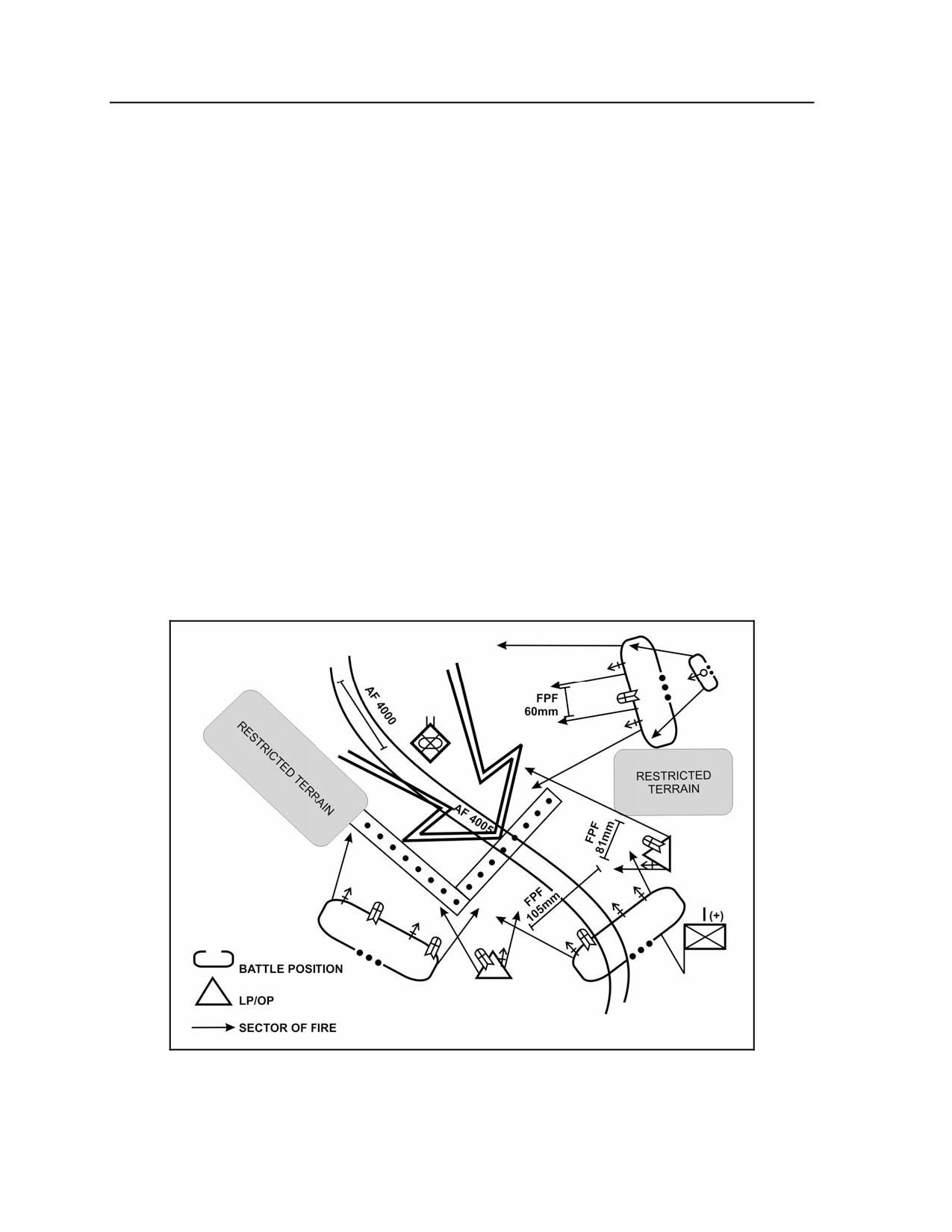
C-23. In the defense, fires are planned in three locations - in front of the unit’s position, on the position
(FPF), and behind the position. Figure C-7 shows fires masses in front of a company-sized position. Fire
plans are best developed using the seven steps of engagement area development technique:
(1) Identify likely enemy avenues of approach.
(2) Identify the enemy scheme of maneuver.
(3) Determine where to kill the enemy.
(4) Emplace weapon systems.
(5) Plan and integrate obstacles.
(6) Plan and integrate indirect fires.
(7) Conduct an engagement area rehearsal.
Figure C-7. Company defensive fire plan sketch.
C-8
FM 3-21.8
28 March 2007
Fire Planning
C-24. The engagement area (EA) is the place where the leader intends to destroy an enemy force using the
massed fires of all available weapons. The success of any engagement depends on how effectively the
leader can integrate the obstacle and indirect fire plans with his direct fire plan in the EA to achieve the
unit's purpose. Completing the steps of EA development is not a lengthy process. Particularly at the
Infantry platoon level, EA development can occur rapidly without an elaborate decision making process.
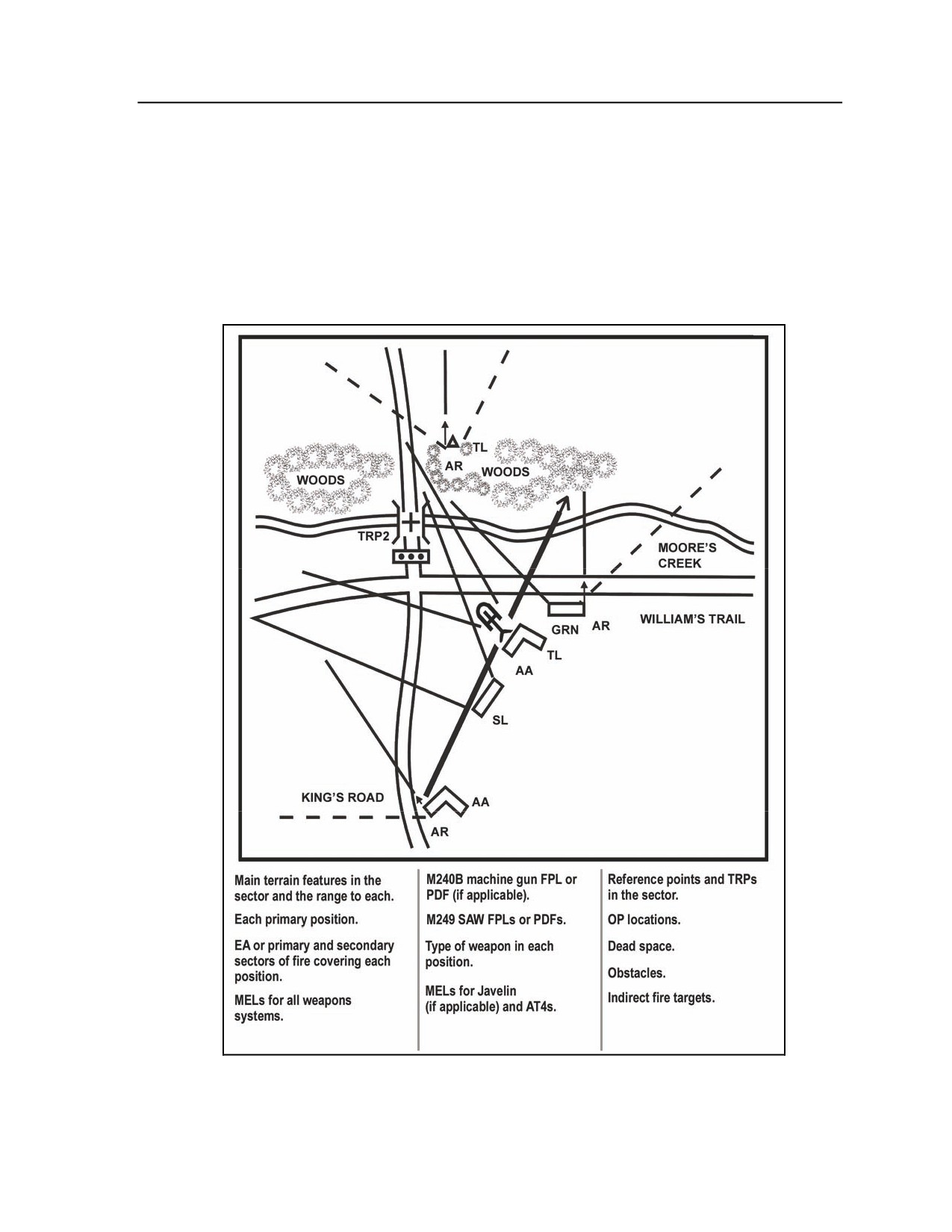
SQUAD FIRE PLANNING
C-25. The squad leaders make two copies of their sector sketches. One copy goes to the platoon leader; the
other remains at the position. The squad leaders draw sector sketches as close to scale as possible, showing
the elements contained in Figure C-8.
Figure C-8. Squad sector sketch.
28 March 2007
FM 3-21.8
C-9
Appendix C
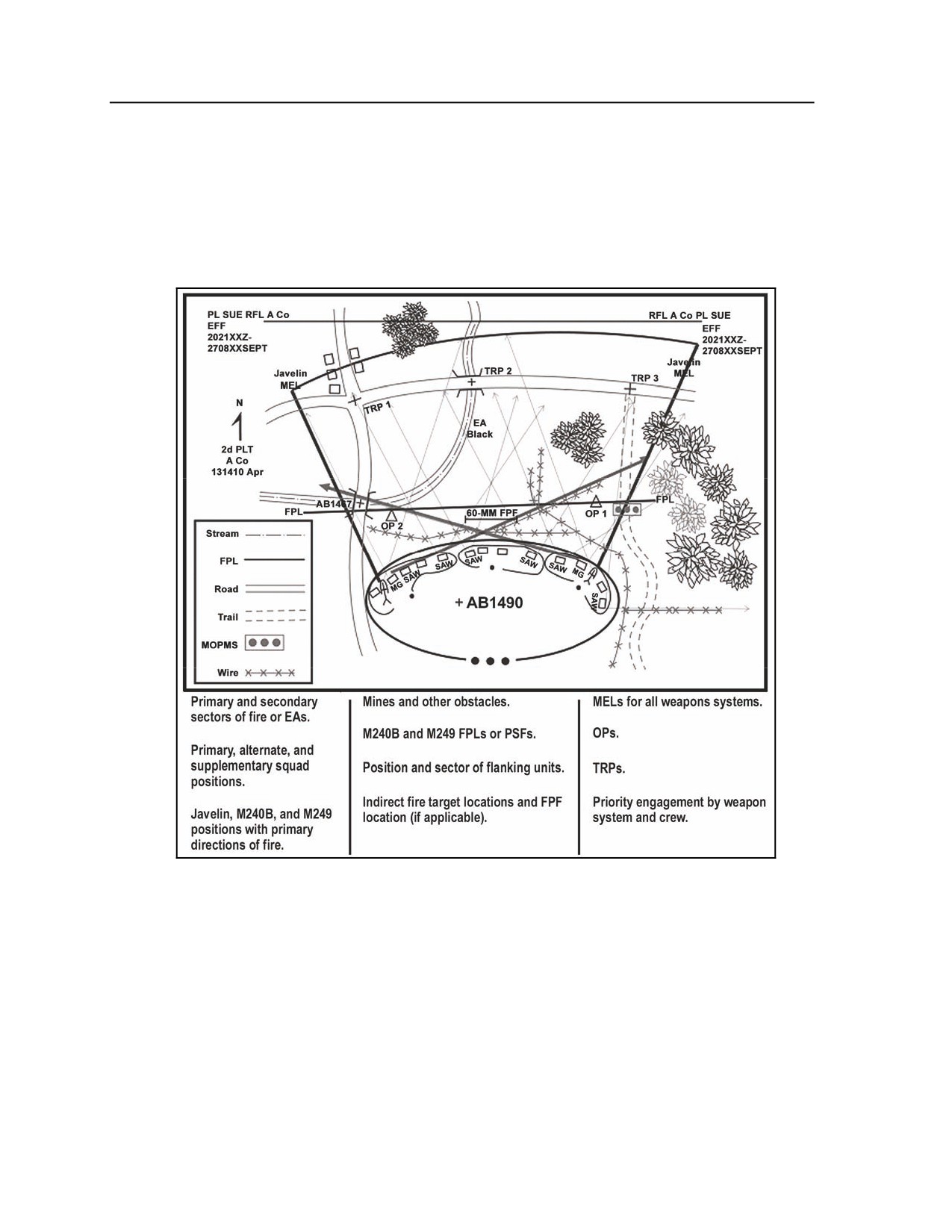
PLATOON FIRE PLANNING
C-26. Squad leaders prepare their sketches and submit them to the platoon leader. The platoon leader
combines all sector sketches (and possibly separate range cards) to prepare a platoon sector sketch. A
platoon sector sketch is drawn as close to scale as possible that includes a target list for direct and indirect
fires. One copy is submitted to the company commander, one copy is given to the PSG, and one copy is
maintained by the platoon leader. As a minimum, the platoon sector sketch should show the elements
contained in Figure C-9.
Figure C-9. Platoon sector sketch.
FINAL PROTECTIVE LINE
C-27. The final protective line (FPL) is a line of fire selected where an enemy assault is to be checked by
interlocking fire from all available weapons and obstacles (FM 1-02). The FPL consists of all available
measures, to include protective obstacles, direct fires, and indirect fires. The FPF targets the highest type
of priority targets and takes precedence over all other fire targets. The FPF differs from a standard priority
target in that fire is conducted at the maximum rate until the mortars are ordered to stop, or until
ammunition is depleted. If possible, the FPF should be registered.
C-28. If Soldiers are in well-prepared defensive positions with overhead cover, an FPF can be adjusted very
close to the friendly positions, just beyond bursting range. If required, the leader can even call for artillery
C-10
FM 3-21.8
28 March 2007

Fire Planning
fires right on the unit’s position using proximity or time fuzes for airbursts. Table C-1 shows indirect fire
mortar weapon system characteristics that should be used when planning the FPF.
Table C-1. Normal FPF dimensions for each number of mortars.
Risk Estimated
Risk Estimated
Number
Width
Depth
Weapon
Distance, .1% PI
Distance, 10% PI
of Tubes
(meters)
(meters)
MORTARS
120 mm
4
300
75
400m
100m
120 mm
2
150
75
81 mm
4
150
50
230m
80m
81 mm
2
75
50
60 mm
2
60
30
175m
65m
FIRE PLANNING FOR THE OFFENSE
C-29. Offensive fire planning follows the same methodology as defensive fire planning within constraints
of the situation. The main difference is that offensive fire planning always includes the synchronization
between the base of fire and the maneuver element. Inevitably, the leader’s plan will not be as detailed as
the defensive plan, but the presence of a maneuver element requires a baseline of planning and control to
ensure fire support is effective and efficient.
C-30. The leader must plan how he will engage known or suspected enemy targets, where friendly
suppressive fire may be needed, and how he will control the unit’s fires against both planned targets and
targets of opportunity. Fire planning should include a thorough analysis of the type of threat expected. This
will aid the supporting friendly element in tailoring the weapon and ammunition requirements to suit the
situation.
C-31. Offensive fire planning supports four phases: planning and preparation, approach to the objective,
actions on the objective, and follow-through. The degree of completeness and centralization of offensive
fire planning depends on the time available to prepare for the offensive. Fires are planned in four locations
on the battlefield - short of the LD / LC, LD / LC to the objective, on the objective, and behind the
objective. Table C-2 lists planning considerations for each of the four locations.
28 March 2007
FM 3-21.8
C-11

Appendix C
Table C-2. Planning considerations.
Phase
Plan Fires to:
1) Planning and
• Support unit in assembly areas.
Preparation (Short of the
• Support unit’s movement to the LD / LC.
LD / LC)
• Disrupt enemy reconnaissance forces.
• Disrupt enemy defensive preparations.
• Disrupt enemy spoiling attacks.
2) Approach to the
• Begin echeloning fires for maneuver units.
Objective (LD / LC to the
• Suppress and obscure for friendly breaching operations.
Objective)
• Suppress and obscure enemy security forces throughout movement.
• Provide priority of fires to lead element.
• Screen / guard exposed flanks.
3) Actions on the
• Fires to block enemy reinforcements.
Objective (On the
• Fires to suppress enemy direct fire weapons.
Objective)
• Suppress and obscure point of penetration.
• Suppress and obscure enemy observation of friendly forces.
4) Follow Through
• Disrupt movement of enemy reinforcements during the assault.
(Beyond The Objective)
• Block avenues of enemy approach.
• Disrupt enemy withdraw.
• Screen friendly forces from enemy counterattacks during the assault.
• Consolidate objective after the assault.
C-32. For simplicities, offensive fire planning is divided into two categories - preparatory and supporting
fires. The concept of fires will have artillery and mortars in support of an attack to gain and maintain fire
superiority on the objective until the last possible moment. When this indirect fire lifts, the enemy should
be stunned and ineffective for a few moments. Take full advantage of this period by doing any or all of the
following:
Combat Vehicles. Vehicles used in the attack, or as fire support, continue to give close support.
Maintaining Fire Superiority. Small-arms fire from local and internal SBF is continued as long
as possible.
Maneuver Elements. Assaulting troops must try to fire as they advance. Troops must observe
fire discipline, as in many cases fire control orders will not be possible. They must not arrive at
the objective without ammunition.
Audacity. Where the ground and vegetation do not prohibit movement, leading sections should
move very quickly over the last 30 or 40m to the enemy positions to minimize exposure.
C-33. When planning fires for the offense, leaders verify the fire element’s task organization and ensure
there exists plans and coordinating measures for the attack, exploitation, pursuit, and contingency plans.
Leaders develop or confirm with the responsible level authority that supporting systems are positioned and
repositioned to ensure continuous fires throughout the operation. Mutual support of fire systems promotes
responsive support and provides the commanders of maneuver units freedom of action during each critical
event of the engagement or battle
C-34. There exists a diverse variety of munitions and weapon systems, direct and indirect, to support close
offensive operations. To effectively integrate fire support, the leader must understand the mission, the
commander’s intent, the concept of operations, and the critical tasks to be accomplished. The leader plans
fires to focus on enemy capabilities and systems that must be neutralized. Critical tasks include:
Continuous in-depth support (accomplished by proper positioning of systems).
Isolating enemy forces.
Softening enemy defenses by delivering effective preparatory fires.
C-12
FM 3-21.8
28 March 2007
Fire Planning
Suppressing and obscuring enemy weapon systems to reduce enemy standoff capabilities.
Interdicting enemy counterattack forces, isolating the defending force, and preventing its
reinforcement and resupply.
SECTION II — TARGET EFFECTS PLANNING
C-35. Not only must fire support planners determine what enemy targets to hit, and when, but must also
decide how to attack each enemy target. Leaders should consider all the aspects of target effects when
planning fires. Although this section is specific to mortars, the following concepts generally apply to most
indirect fires.
HIGH-EXPLOSIVE AMMUNITION
C-36. When mortar rounds impact they throw fragments in a pattern that is never truly circular, and may
even travel irregular, based on the round’s angle of fall, the slope of the terrain, and the type soil. However,
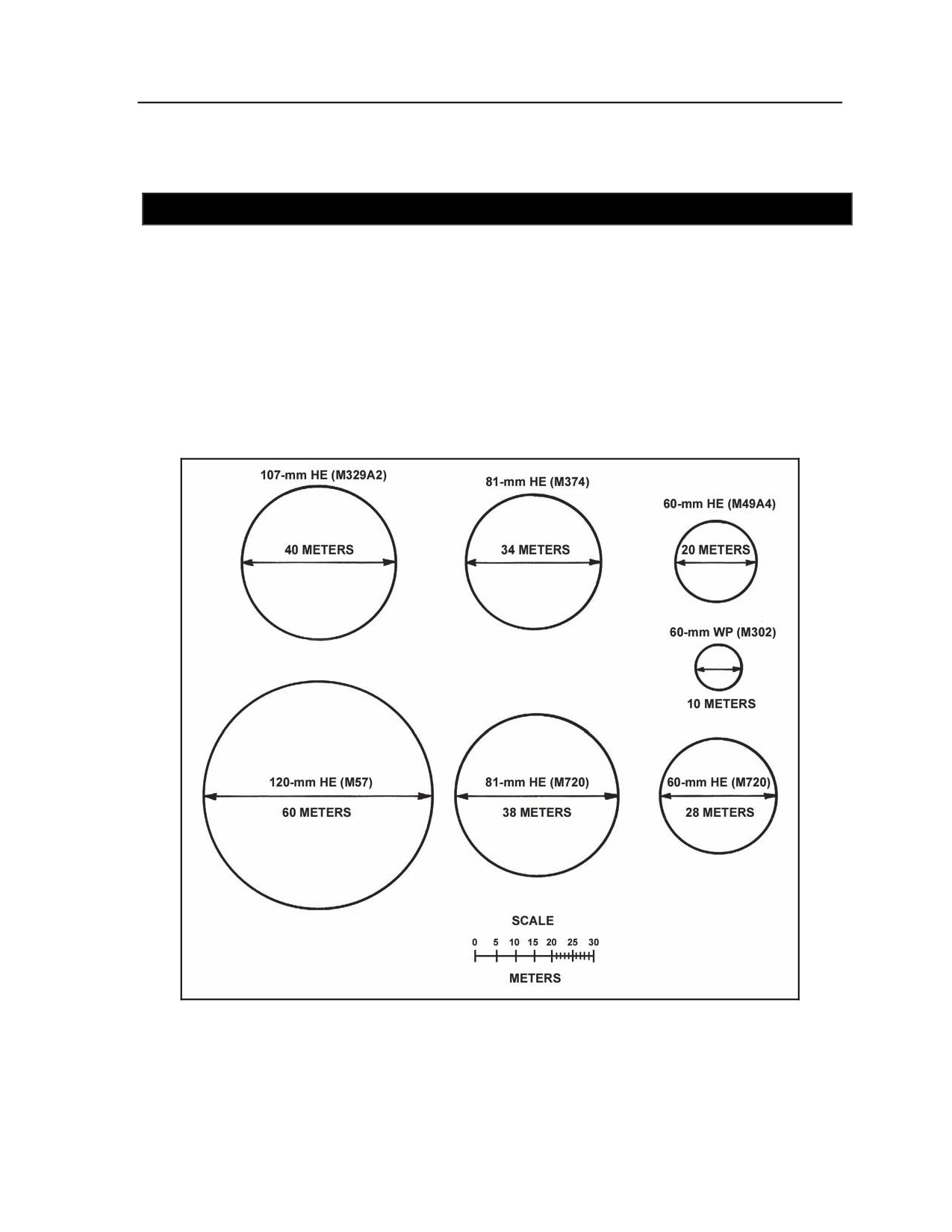
for planning purposes, each mortar high explosive (HE) round is considered to have a circular lethal
bursting area. Figure C-10 shows a scale representation of the lethal bursting areas of mortar rounds.
Figure C-10. Comparison of lethal bursting areas of U.S. mortar rounds.
28 March 2007
FM 3-21.8
C-13
Appendix C
FUZE SETTINGS
C-37. The decision concerning what fuze setting to use depends on the position of the enemy.
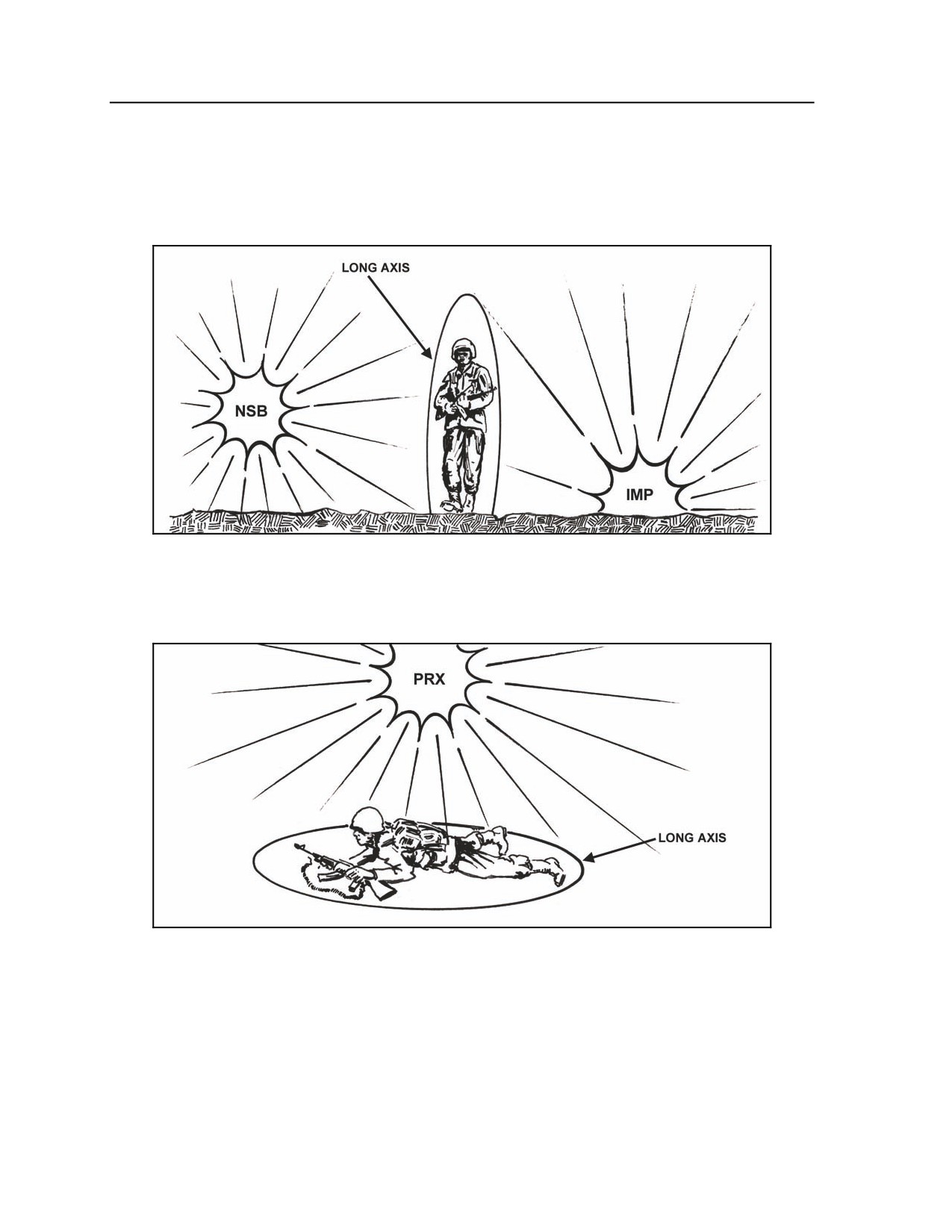
C-38. Exposed enemy troops that are standing up are best engaged with impact (IMP) or near surface burst
(NSB) fuze settings. The round explodes on, or near, the ground. Shell fragments travel outward
perpendicular to the long axis of the standing target (Figure C-11).
Figure C-11. Standing targets.
C-39. If exposed enemy troops are lying prone, the proximity (PRX) fuze setting is most effective. The
rounds explode high above the ground, and the fragments coming downward are once again traveling
perpendicular to the long axis of the targets (Figure C-12).
Figure C-12. Prone targets.
C-40. The PRX setting is also the most effective if the enemy is in open fighting positions, without
overhead cover. Even PRX settings will not always produce effects if the positions are deep (Figure C-13).
C-14
FM 3-21.8
28 March 2007
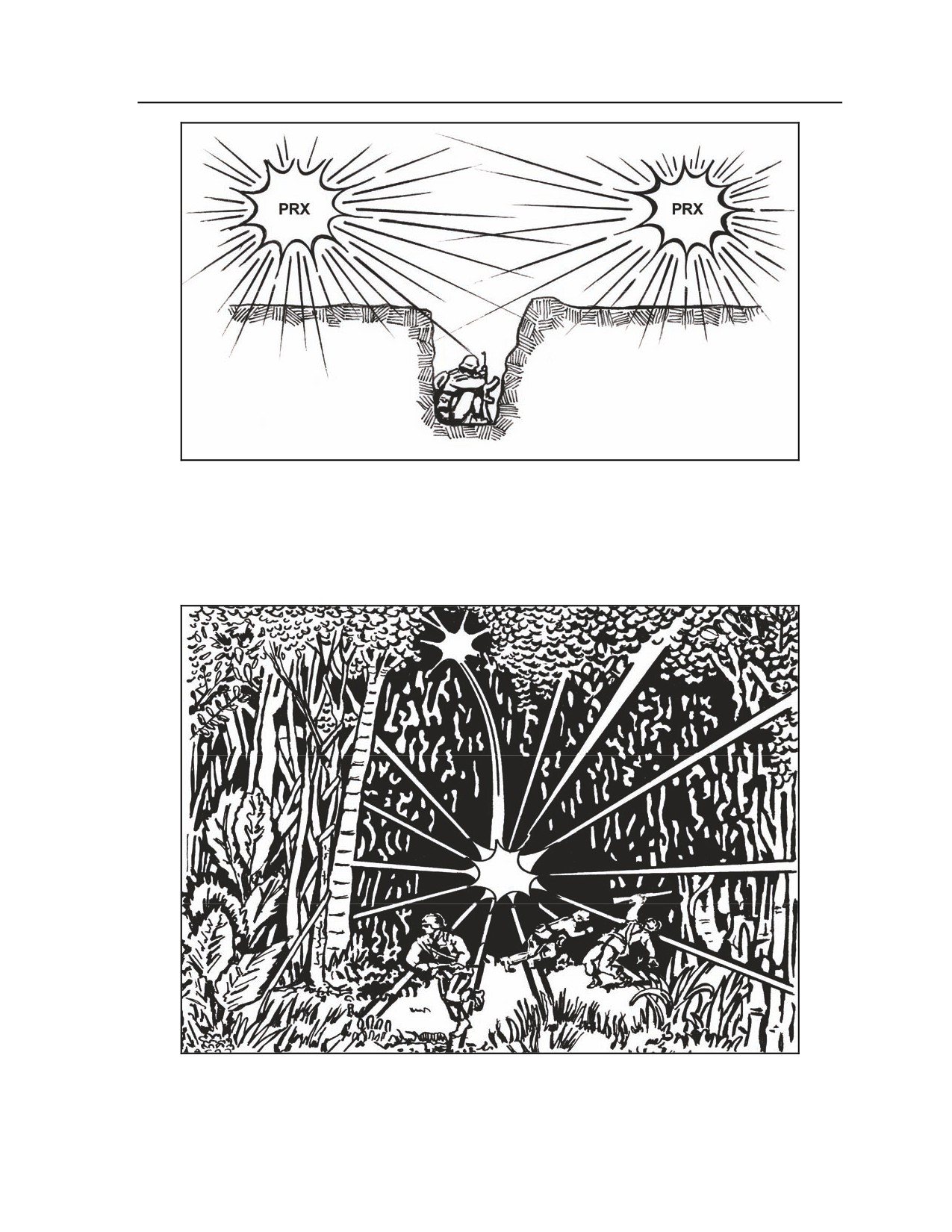
Fire Planning
Figure C-13. Targets in open fighting positions.
C-41. The DLY fuze setting is most effective when the enemy is below triple canopy jungle or in fighting
positions with overhead cover. Light mortars will have little effect against overhead cover. Even medium
mortars have limited effect. Heavy mortars can destroy a bunker or enemy troops beneath jungle canopy
with a hit or near-miss (Figure C-14).
Figure C-14. Targets beneath triple canopy jungle.
28 March 2007
FM 3-21.8
C-15
Appendix C
EFFECTS OF COVER ON HIGH-EXPLOSIVE ROUNDS
C-42. Enemy forces will normally be either standing or prone. They maybe in the open or protected by
varying degrees of cover. Each of these changes the target effects of mortar fire.
C-43. Surprise mortar fire is always more effective than fire against an enemy that is warned and seeks
cover. Recent studies have shown that a high casualty rate can be achieved with only two rounds against an
enemy platoon standing in the open. The same studies required 10 to 15 rounds to duplicate the casualty
rate when the platoon was warned by adjusting rounds and sought cover. If the enemy soldiers merely lay
prone, they significantly reduce the effects of mortar fire. Mortar fire against standing enemy forces is
almost twice as effective as fire against prone targets.
C-44. Proximity fire is usually more effective than surface-burst rounds against targets in the open. The
effectiveness of mortar fire against a prone enemy is increased by about 40 percent by firing proximity-
fuzed rounds rather than surface-burst rounds.
C-45. If the enemy is in open fighting positions without overhead cover, proximity-fuzed mortar rounds are
about five times as effective as impact-fuzed rounds. When fired against troops in open fighting positions,
proximity-fuzed rounds are only 10 percent as effective as they would be against an enemy in the open. For
the greatest effectiveness against troops in open fighting positions, the charge with the lowest angle of fall
should be chosen. It produces almost two times as much effect as the same round falling with the steepest
angle.
C-46. If the enemy has prepared fighting positions with overhead cover, only impact-fuzed and delay-fuzed
rounds will have much effect. Proximity-fuzed rounds can restrict the enemy’s ability to move from
position to position, but they will cause few, if any, casualties. Impact-fuzed rounds cause some blast and
suppressive effect. Delay-fuzed rounds can penetrate and destroy a position but must achieve a direct hit.
Only the 120-mm mortar with a delay-fuze setting can damage a Soviet-style strongpoint defense. Heavy
bunkers cannot be destroyed by light or medium mortar rounds.
SUPPRESSIVE EFFECTS OF HE MORTAR ROUNDS
C-47. Suppression from mortar is not as easy to measure as the target effect. It is the psychological effect
produced in the mind of the enemy that prevents him from returning fire or carrying on his duties.
Inexperienced or surprised Soldiers are more easily suppressed than experienced, warned Soldiers. Soldiers
in the open are much more easily suppressed than those with overhead cover. Suppression is most effective
when mortar fires first fall; as they continue, their suppressive effects lessen. HE rounds are the most
suppressive, but bursting WP mixed with HE has a great psychological effect on the enemy.
C-48. If a 60-mm mortar round lands within 20 meters of a target, the target will probably be suppressed, if
not hit.
C-49. If a 60-mm mortar round lands within 35 meters of a target, there is a 50 percent chance it will be
suppressed. Beyond 50 meters, little suppression takes place.
C-50. If an 81-mm mortar round lands within 30 meters of a target, the target will probably be suppressed,
if not hit.
C-51. If an 81-mm mortar round lands within 75 meters of a target, there is a 50 percent chance that the
target will be suppressed. Beyond 125 meters, little suppression takes place.
C-52. If a heavy mortar round (proximity-fuzed) lands within 65 meters of target, the target will probably
be suppressed, if not hit.
C-53. If a heavy mortar round (proximity-fuzed) lands within 125 meters of a target, there is a 50 percent
chance the target will be suppressed. Beyond 200 meters, little suppression takes place. The 120-mm
mortar round is better for suppression than the 107-mm, but both are excellent suppressive rounds.
C-16
FM 3-21.8
28 March 2007
Fire Planning
ILLUMINATION, SMOKE, AND WHITE PHOSPHORUS
C-54. Illumination and obscuration missions are important functions for mortar platoons or sections.
Atmospheric stability, wind velocity, and wind direction are the most important factors when planning
target effects for smoke and white phosphorus (WP) mortar rounds. The terrain in the target area also
effects smoke and WP rounds.
C-55. The bursting WP round provides a screening, incendiary, marking, and casualty-producing effect. It
produces a localized, instantaneous smoke cloud by scattering burning WP particles.
C-56. The WP round is used mainly to produce immediate, close point obscuration. It can be used to screen
the enemy’s field of fire for short periods, which allows troops to maneuver against him. The 60-mm WP
round is not sufficient to produce a long-lasting, wide-area smoke screen, but the much larger WP round
from the heavy mortar is.
C-57. The bursting WP round can be used to produce casualties among exposed enemy troops and to start
fires. The casualty-producing radius of the WP round is much less than that of the HE round. Generally,
more casualties can be produced by firing HE ammunition than by firing WP. However, the WP burst
causes a significant psychological effect, especially when used against exposed troops. A few WP mixed
into a fire mission of HE rounds may increase the suppressive effect of the fire.
C-58. The WP rounds can be used to mark targets, especially for attack by aircraft. Base-ejecting smoke
rounds, such as the 81-mm M819 RP round, produce a dispersed smoke cloud, normally too indistinct for
marking targets.
C-59. The effects of atmospheric stability can determine whether mortar smoke is effective at all or, if
effective, how much ammunition will be needed.
During unstable conditions, mortar smoke and WP rounds are almost ineffective--the smoke
does not spread but often climbs straight up and quickly dissipates.
Under moderately unstable atmospheric conditions, base-ejecting smoke rounds are more
effective than bursting WP rounds. The M819 RP round for the M252 mortar screens for over
2½ minutes.
Under stable conditions, both RP and WP rounds are effective.
The higher the humidity, the better the screening effects of mortar rounds.
C-60. The M819 RP round loses up to 35 percent of its screening ability if the ground in the target area is
covered with water or deep snow. During extremely cold and dry conditions over snow, up to four times
the number of smoke rounds may be needed than expected to create an adequate screen. The higher the
wind velocity, the more effective bursting WP rounds are, and the less effective burning smoke rounds
become.
C-61. If the terrain in the target area is swampy, rain-soaked, or snow-covered, then burning smoke rounds
may not be effective. These rounds produce smoke by ejecting felt wedges soaked in red phosphorus.
These wedges then burn on the ground, producing a dense, long-lasting cloud. If the wedges fall into mud,
water, or snow, they can be extinguished. Shallow water can reduce the smoke produced by these rounds
by as much as 50 percent. Bursting WP rounds are affected little by the terrain in the target area, except that
deep snow and cold temperatures can reduce the smoke cloud by about 25 percent.
C-62. Although bursting WP rounds are not designed to cause casualties, the fragments of the shell casing
and bits of burning WP can cause injuries. Burning smoke rounds do not cause casualties and have little
suppressive effect.
ILLUMINATION
C-63. Illumination rounds can be used to disclose enemy formations, to signal, or to mark targets. There are
illumination rounds available for all mortars.
28 March 2007
FM 3-21.8
C-17