FM 3-21.8 (FM 7-8) The Infantry Rifle Platoon and Squad (MARCH 2007) - page 10

Appendix A
M2 .50-Caliber AP. For use against armored aircraft and lightly-armored vehicles, concrete
shelters, and other bullet-resisting targets.
M8 .50-Caliber API. For combined armor-piercing and incendiary effect.
M20 .50-Caliber API Tracer. For combined armor-piercing and incendiary effect, with the
additional tracer feature.
Table A-5. M2 Ballistic data.
MAXIMUM
TRACER
AVERAGE
AVAILABLE M2 CARTRIDGES
RANGE
BURNOUT
MUZZLE VELOCITY
(meters)
(meters)
(feet per second)
Ball, M2
7,400
——
2,930
Tracer, M1 (with gilding metal jacket)
5,575
1,800
2,860
Tracer, M1 (with clad steel jacket)
5,450
1,800
3,030
Tracer, M17
5,450
2,450
3,030
Incendiary, M1
6,050
——
3,090
Armor-piercing, M2
7,400
——
2,930
Armor-piercing incendiary, M8
6,470
——
3,050
Armor-piercing incendiary tracer, M20
6,470
*300-1,750
3,050
* This tracer is dim at near ranges but increases in brightness as it moves farther from the gun.
SECTION II — COMBAT TECHNIQUES OF FIRE
A-12. This section is designed to illustrate the characteristics of machine gun fire, the types of enemy
targets that might be engaged, and how to successfully apply machine gun fire on those enemy targets.
A-13. Read the appropriate FM (as shown in Table A-1) for more weapon-specific information on engaging
enemy targets with a particular machine gun.
CHARACTERISTICS OF FIRE
A-14. The gunner’s or leader’s knowledge of the machine gun is not complete until he learns about the
action and effect of the projectiles when fired. The following definitions will help the leader, gunner, and
automatic rifleman understand the characteristics of fire for the platoon’s machine guns.
LINE OF SIGHT
A-15. Line of sight is an imaginary line drawn from the firer’s eye through the sights to the point of aim.
BURST OF FIRE
A-16. A burst of fire is a number of successive rounds fired with the same elevation and point of aim when
the trigger is held to the rear. The number of rounds in a burst can vary depending on the type of fire
employed.
TRAJECTORY
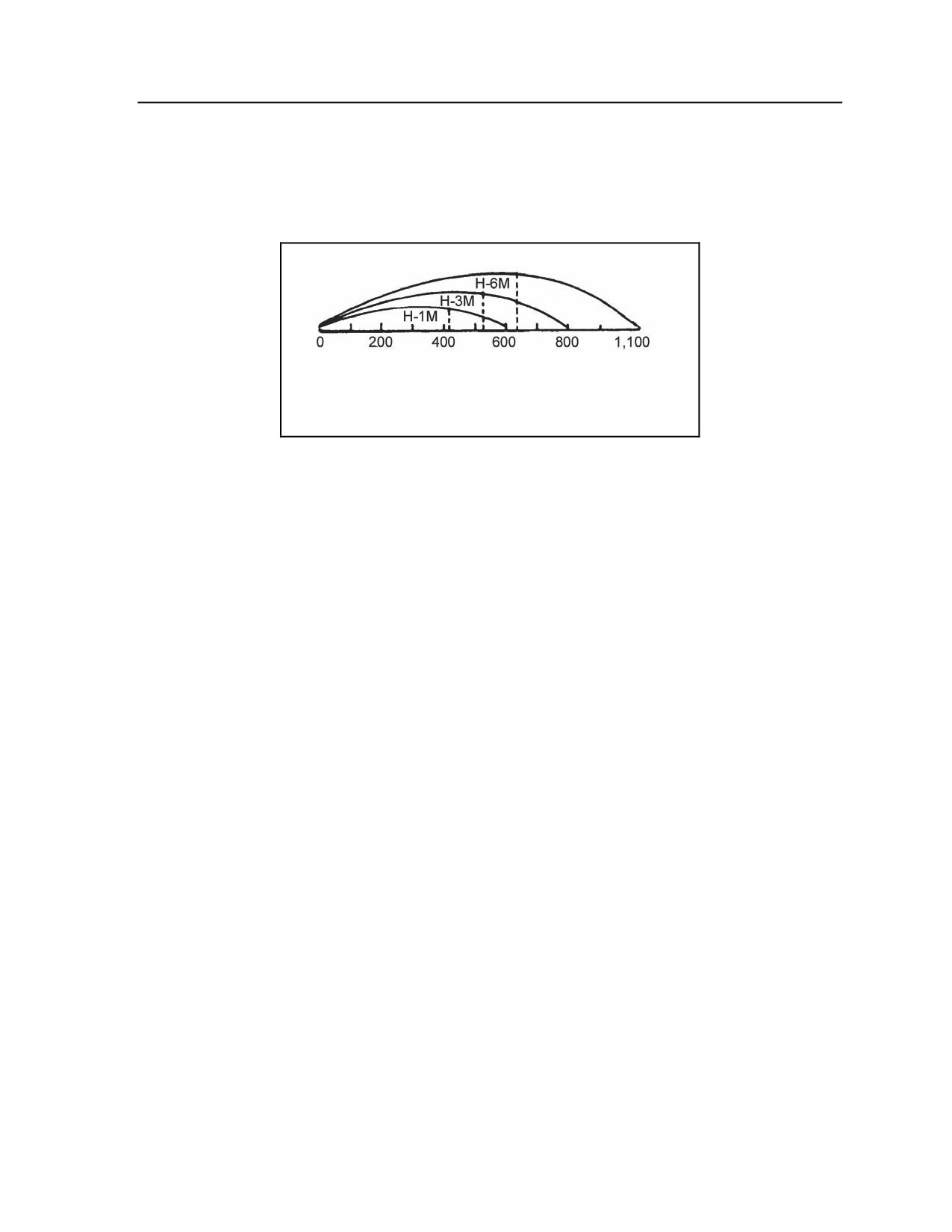
A-17. Trajectory is the curved path of the projectile in its flight from the muzzle of the weapon to its
impact. The major factors that influence trajectory are the velocity of the round, gravity, rotation of the
round, and resistance of the air. As the range to the target increases, so does the curve of trajectory (Figure
A-5).
A-6
FM 3-21.8
28 March 2007
Machine Gun and Squad Automatic Weapon Employment
MAXIMUM ORDINATE
A-18. Maximum ordinate is the highest point above the line of sight the trajectory reaches between the
muzzle of the weapon and the base of the target. It always occurs at a point about two-thirds of the distance
from weapon to target and increases with range. Like trajectory, maximum ordinate increases as the range
increases (Figure A-5).
H = Maximum Ordinate
(highest point of trajectory)
Figure A-5. Trajectory and maximum ordinate.
CONE OF FIRE
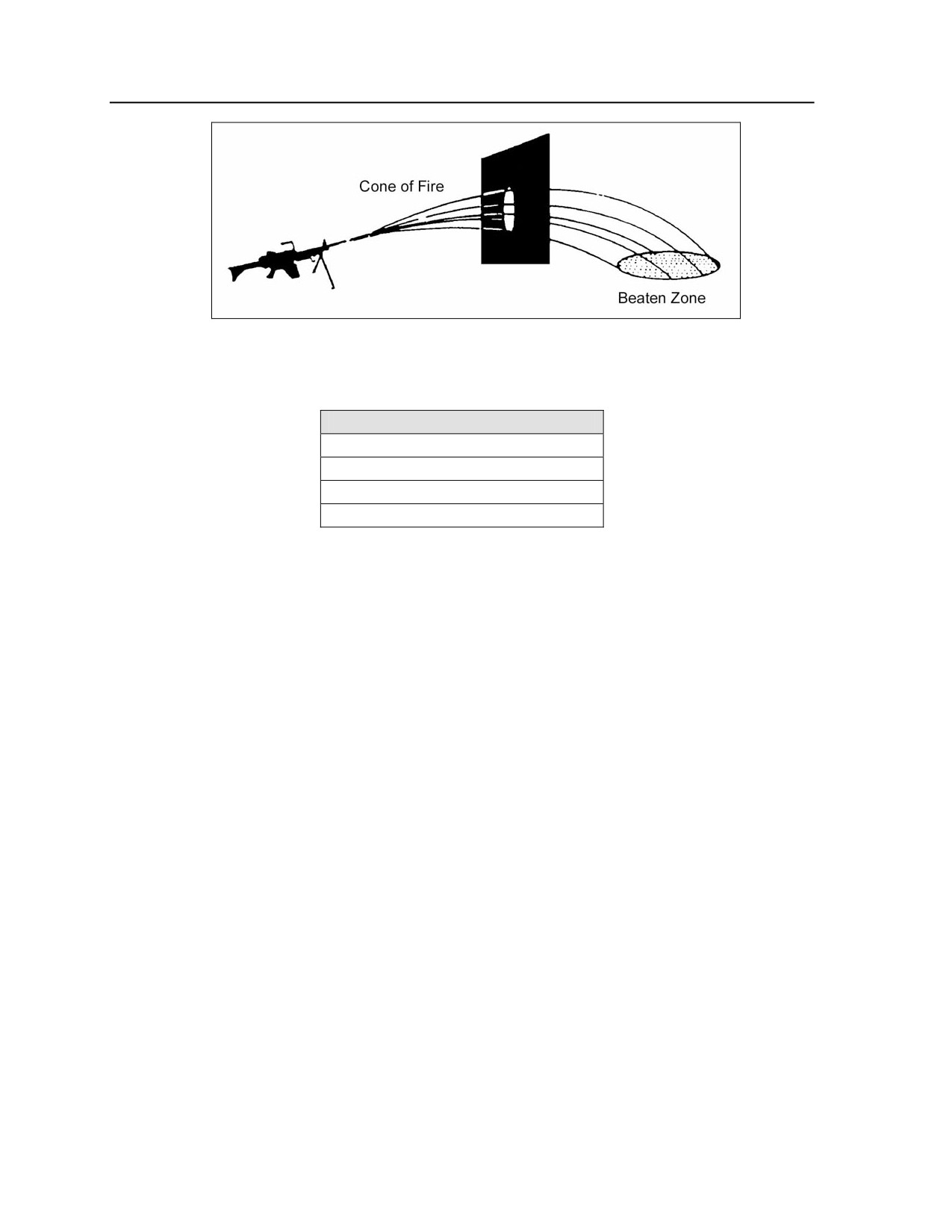
A-19. The cone of fire is the pattern formed by the different trajectories in each burst as they travel
downrange. Vibration of the weapon and variations in ammunition and atmospheric conditions all
contribute to the trajectories that make up the cone of fire (Figure A-6).
BEATEN ZONE
A-20. The beaten zone is the elliptical pattern formed when the rounds within the cone of fire strike the
ground or target. The size and shape of the beaten zone change as a function of the range to and slope of the
target, but is normally oval or cigar shaped and the density of the rounds decreases toward the edges.
Gunners and automatic riflemen should engage targets to take maximum effect of the beaten zone. The
simplest way to do this is to aim at the center base of the target. Most rounds will not fall over the target,
and any that fall short will create ricochets into the target (Figure A-6).
Effective Beaten Zone
A-21. Because of dispersion, only that part of the beaten zone in which 85 percent of the rounds fall is
considered the effective beaten zone.
Effect of Range on the Beaten Zone
A-22. As the range to the target increases, the beaten zone becomes shorter and wider. Conversely, as the
range to the target decreases, the beaten zone becomes longer and narrower (Table A-6).
Effect of Slope on the Beaten Zone
A-23. The length of the beaten zone for any given range will vary according to the slope of the ground. On
rising ground, the beaten zone becomes shorter but remains the same width. On ground that slopes away
from the gun, the beaten zone becomes longer but remains the same width.
28 March 2007
FM 3-21.8
A-7
Appendix A
Figure A-6. Cone of fire and beaten zone.
Table A-6. Beaten zones of M240B.
M240B
Range: 500m (1m wide x 110m long)
Range: 1,000m (2m wide x 75m long)
Range: 1,500m (3m wide x 55m long)
Range: 2,000m (4m wide x 50m long)
DANGER SPACE
A-24. This is the space between the muzzle of the weapon and the target where the trajectory does not rise
above 1.8 meters (the average height of a standing Soldier) that includes the beaten zone. Gunners should
consider the danger space of their weapons when planning overhead fires.
SURFACE DANGER ZONE
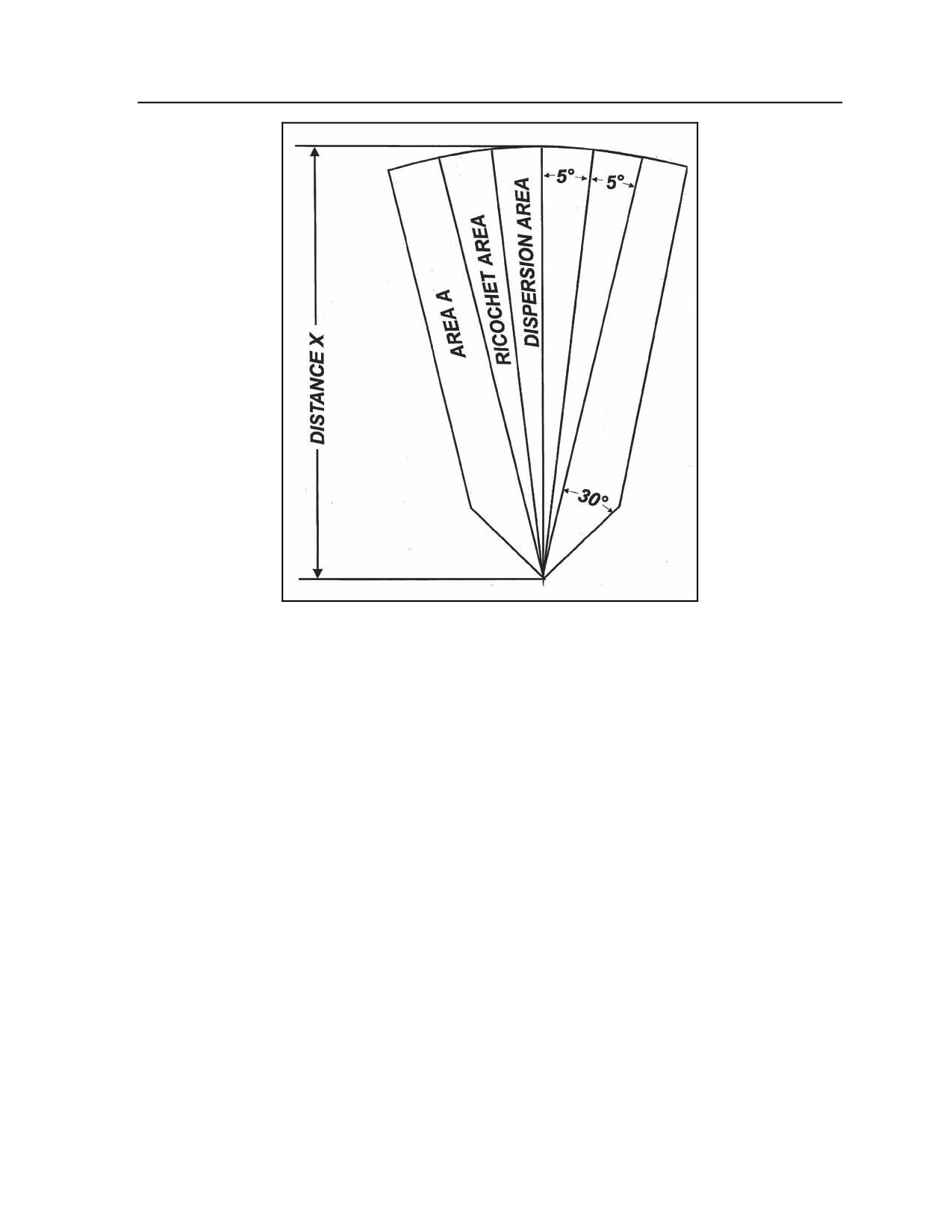
A-25. Surface danger zones (SDZs) were developed for each weapon and are defined as the area in front,
back, or side of the muzzle of the weapon that provides a danger to friendly forces when the weapon is
fired. The SDZ is not just the area that comprises the cone of fire as it moves downrange. It also involves
the possible impact area on both sides of the gun target line and the possible dispersion of material caused
by the strike of the rounds, the possible ricochet area, and any area to the rear that is adversely affected by
the effects of firing the weapon (Figure A-7).
A-26. SDZs were developed primarily for ranges and must be complied with when training, but they should
also be complied with in combat when possible to minimize risk to friendly forces.
A-27. Refer to DA PAM 385-63 for a more detailed discussion of the SDZs for machine guns.
A-8
FM 3-21.8
28 March 2007
Machine Gun and Squad Automatic Weapon Employment
Figure A-7. Example surface danger zone for machine guns.
CLASSIFICATIONS OF AUTOMATIC WEAPONS FIRE
A-28. The U.S. Army classifies automatic weapons fires with respect to the ground, target, and weapon.
CLASSIFICATION OF FIRES WITH RESPECT TO THE GROUND
A-29. Fires with respect to the ground include grazing and plunging fire.
Dead Space
A-30. Any fold or depression in the ground that prevents a target from being engaged from a fixed position
is termed dead space. Paragraph A-81 discusses methods of determining dead space.
Grazing Fires
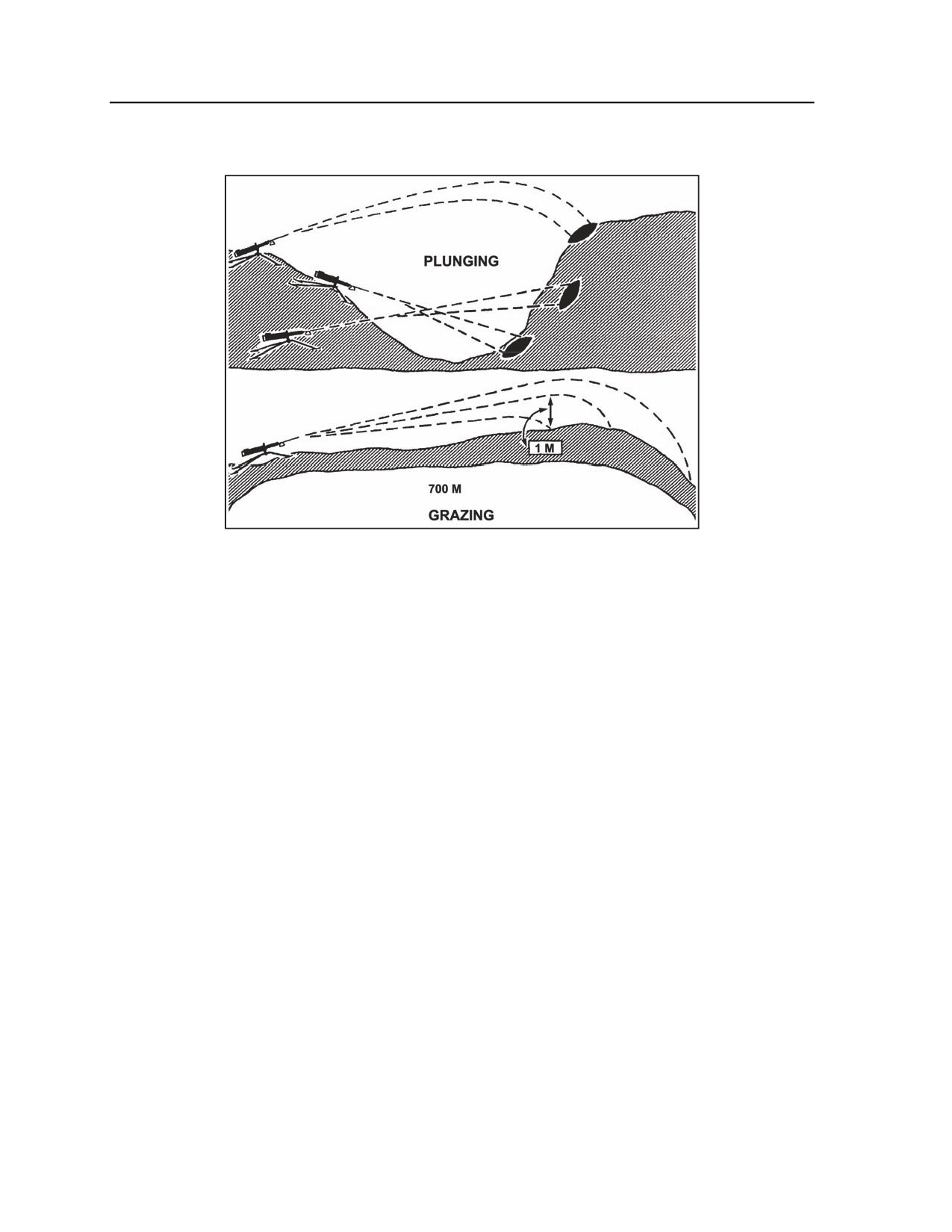
A-31. Automatic weapons achieve grazing fire when the center of the cone of fire does not rise more than
1 meter above the ground. Grazing fire is employed in the final protective line (FPL) in defense and is only
possible when the terrain is level or uniformly sloping. Any dead space encountered along the FPL must be
covered by indirect fire, such as from an M203. When firing over level or uniformly sloping terrain, the
machine gun M240B and M249 can attain a maximum of 600 meters of grazing fire. The M2 can attain a
maximum of 700 meters. Paragraphs A-78 and A-79 discuss the FPL.
Plunging Fires
A-32. Plunging fire occurs when there is little or no danger space from the muzzle of the weapon to the
beaten zone. It occurs when weapons fire at long range, when firing from high ground to low ground, when
28 March 2007
FM 3-21.8
A-9
Appendix A
firing into abruptly rising ground, or when firing across uneven terrain, resulting in a loss of grazing fire at
any point along the trajectory (Figure A-8).
Figure A-8. Classes of fire with respect to the ground.
CLASSIFICATION OF FIRES WITH RESPECT TO THE TARGET
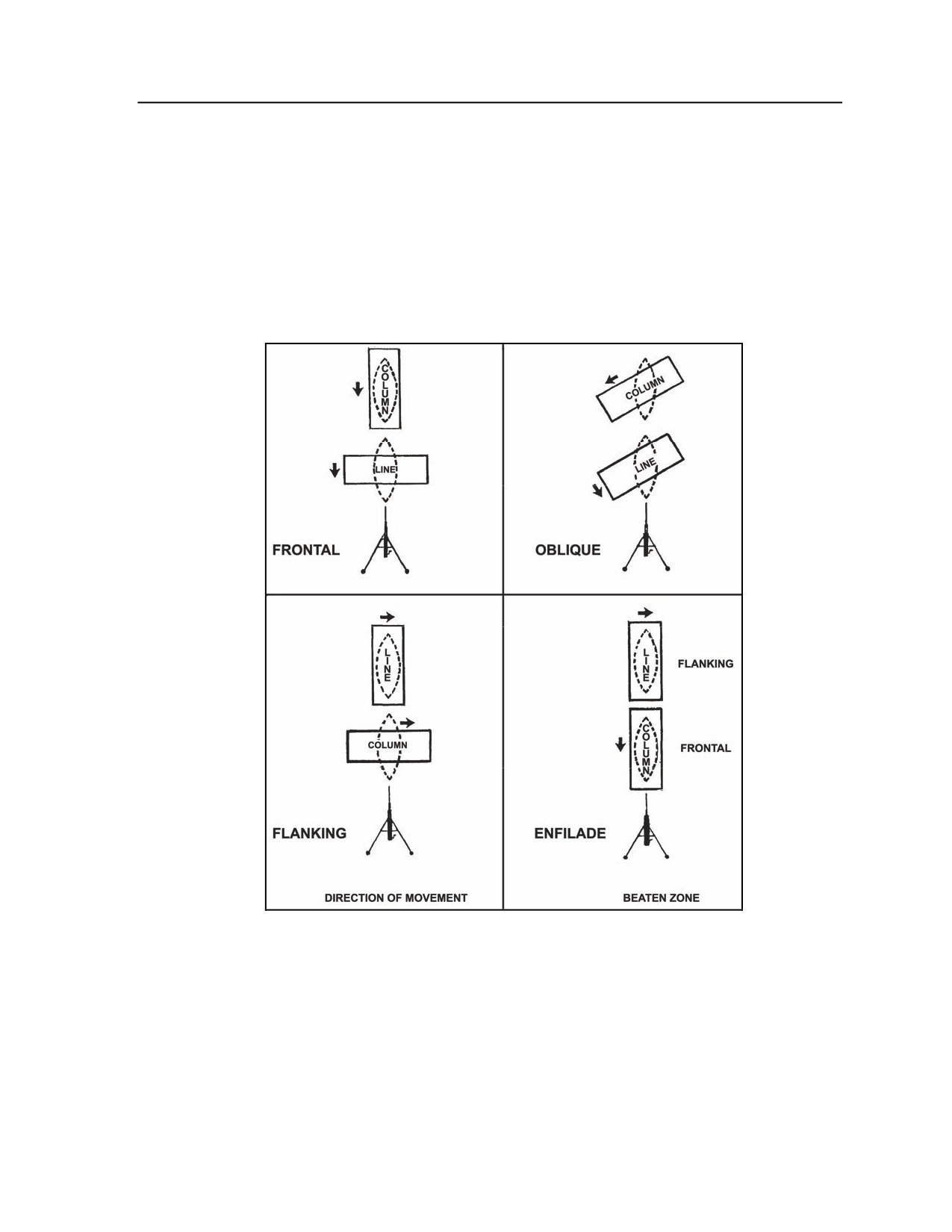
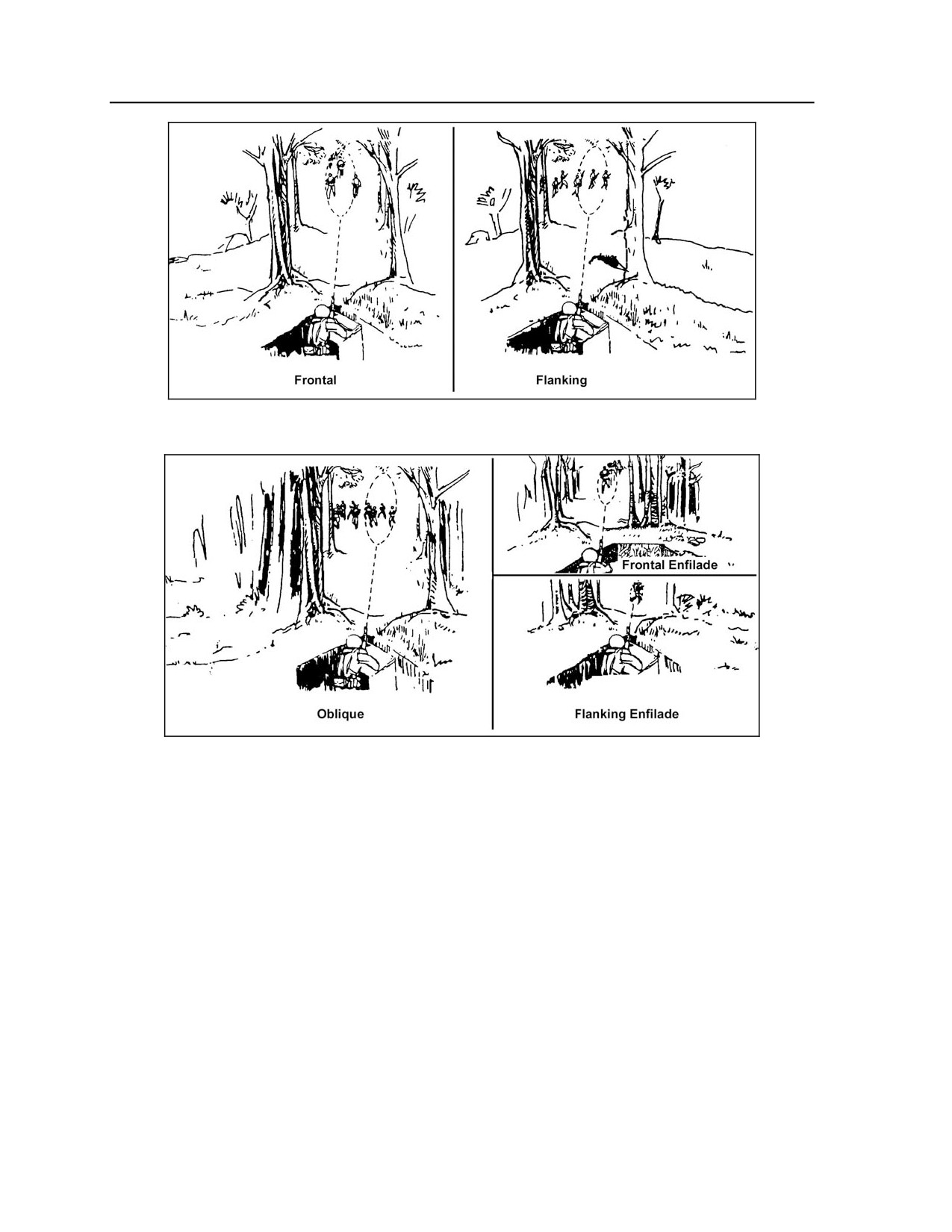
A-33. Fires with respect to the target include enfilade, frontal, flanking, and oblique fire (Figures A-9,
A-10, and A-11). These targets are normally presented to gun teams by the enemy and must be engaged as
they are presented. For instance, if the enemy presents its flank to the gun crew as it moves past their
position from the left or right, the gun crew will have no choice but to employ flanking fire on the enemy.
A-34. Leaders and gunners should strive at all times to position their gun teams where they can best take
advantage of the machine gun’s beaten zone with respect to an enemy target. Channeling the enemy by use
of terrain or obstacles so they approach a friendly machine gun position from the front in a column
formation is one example. In this situation, the machine gun would employ enfilade fire on the enemy
column, and the effects of the machine gun’s beaten zone would be much greater than if it engaged that
same enemy column from the flank.
Enfilade Fire
A-35. Enfilade fire occurs when the long axis of the beaten zone coincides or nearly coincides with the long
axis of the target. It can be frontal fire on an enemy column formation or flanking fire on an enemy line
formation. This is the most desirable class of fire with respect to the target because it makes maximum use
of the beaten zone. Leaders and gunners should always strive to position the guns to the extent possible that
they can engage enemy targets with enfilade fire (Figures A-9 and A-11).
Frontal Fire
A-36. Frontal fire occurs when the long axis of the beaten zone is at a right angle to the front of the target.
This type of fire is highly desirable when engaging a column formation. It then becomes enfilade fire as the
beaten zone coincides with the long axis of the target (Figures A-9 and A-10). Frontal fire is not as
desirable when engaging a line formation because the majority of the beaten zone normally falls below or
after the enemy target.
A-10
FM 3-21.8
28 March 2007
Machine Gun and Squad Automatic Weapon Employment
Flanking Fire
A-37. Flanking fire is delivered directly against the flank of the target. Flanking fire is highly desirable
when engaging an enemy line formation. It then becomes enfilade fire as the beaten zone will coincide with
the long axis of the target (Figures A-9 and A-10). Flanking fire against an enemy column formation is
least desirable because the majority of the beaten zone normally falls before or after the enemy target.
Oblique Fire
A-38. Gunners and automatic riflemen achieve oblique fire when the long axis of the beaten zone is at an
angle other than a right angle to the front of the target (Figures A-9 and A-11).
Figure A-9. Classes of fire with respect to the target.
28 March 2007
FM 3-21.8
A-11
Appendix A
Figure A-10. Frontal fire and flanking fire.
Figure A-11. Oblique fire and enfilade fire.
CLASSIFICATION OF FIRES WITH RESPECT TO THE MACHINE GUN
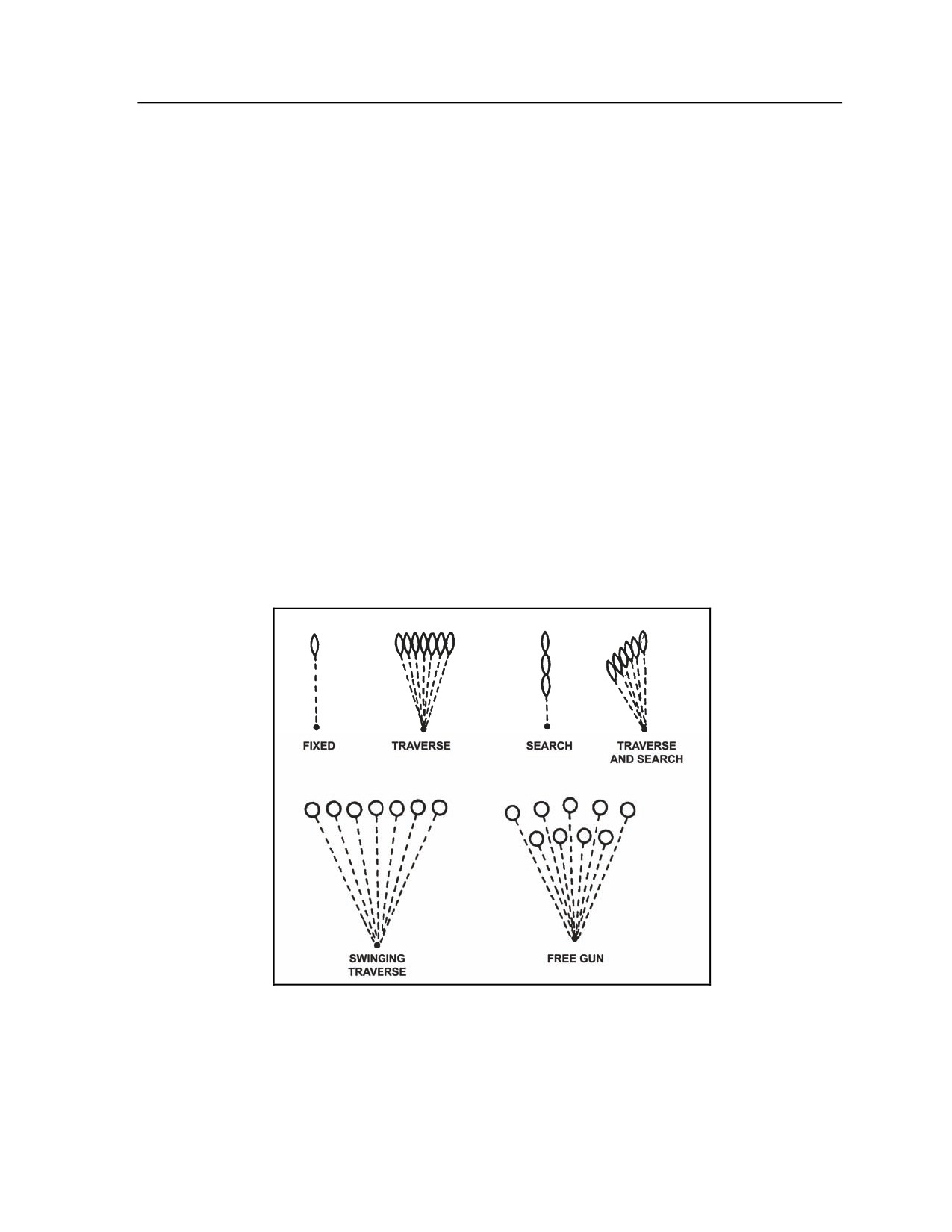
A-39. Fires with respect to the weapon include fixed, traversing, searching, traversing and searching,
swinging traverse, and free gun fires (Figure A-12).
Fixed Fire
A-40. Fixed fire is delivered against a stationary point target when the depth and width of the beaten zone
will cover the target with little or no manipulation needed. After the initial burst, the gunners will follow
any change or movement of the target without command.
Traversing Fire
A-41. Traversing disperses fires in width by successive changes in direction, but not elevation. It is
delivered against a wide target with minimal depth. When engaging a wide target requiring traversing fire,
the gunner should select successive aiming points throughout the target area. These aiming points should be
close enough together to ensure adequate target coverage. However, they do not need to be so close that
they waste ammunition by concentrating a heavy volume of fire in a small area.
A-12
FM 3-21.8
28 March 2007
Machine Gun and Squad Automatic Weapon Employment
Searching Fire
A-42. Searching distributes fires in depth by successive changes in elevation. It is employed against a deep
target or a target that has depth and minimal width, requiring changes in only the elevation of the gun. The
amount of elevation change depends upon the range and slope of the ground.
Traversing and Searching Fire
A-43. This class of fire is a combination in which successive changes in direction and elevation result in
the distribution of fires both in width and depth. It is employed against a target whose long axis is oblique
to the direction of fire.
Swinging Traverse
A-44. Swinging traverse fire is employed against targets that require major changes in direction but little or
no change in elevation. Targets may be dense, wide, in close formations moving slowly toward or away
from the gun, or vehicles or mounted troops moving across the front. If tripod mounted, the traversing slide
lock lever is loosened enough to permit the gunner to swing the gun laterally. When firing swinging
traverse, the weapon is normally fired at the cyclic rate of fire. Swinging traverse consumes a lot of
ammunition and does not have a beaten zone because each round seeks its own area of impact.
Free Gun
A-45. Free gun fire is delivered against moving targets that must be rapidly engaged with fast changes in
both direction and elevation. Examples are aerial targets, vehicles, mounted troops, or infantry in relatively
close formations moving rapidly toward or away from the gun position. When firing free gun, the weapon
is normally fired at the cyclic rate of fire. Free gun fire consumes a lot of ammunition and does not have a
beaten zone because each round seeks its own area of impact.
Figure A-12. Classes of fire with respect to the gun.
APPLICATION OF FIRE
A-46. Application of fire consists of the methods the gunner uses to effectively cover an enemy target area.
Training these methods of applying fire can be accomplished only after the weapons squad leader and the
gunners have learned how to recognize the different types of targets they may find in combat. They must
28 March 2007
FM 3-21.8
A-13
Appendix A
also know how to distribute and concentrate their fire, and how to maintain the proper rate of fire.
Normally, the gunner is exposed to two types of targets in the squad or platoon sector: enemy soldiers, and
supporting automatic weapons. Leaders must ensure that these targets have priority and that they are
engaged immediately.
A-47. To be effective, machine gun fire must be distributed over the entire target area. Improper
distribution of fire results in gaps that allow the enemy to escape or use their weapons against friendly
positions without effective opposition.
A-48. The method of applying fire to a target is generally the same for either a single gun or a pair of guns.
Direct lay is pointing the gun for direction and elevation so the sights are aligned directly on the target. Fire
is delivered in width, depth, or in a combination of the two. To distribute fire properly, gunners must know
where to aim, how to adjust their fire, and the direction to manipulate the gun. The gunner must aim, fire,
and adjust on a certain point of the target. Binoculars may be used by the leader to facilitate fire adjustment.
SIGHT PICTURE
A-49. A correct sight picture has the target, front sight post, and rear sight aligned. The sight picture has
sight alignment and placement of the aiming point on the target. The gunner aligns the front sight post in
the center of the rear sight and then aligns the sights with the target. The top of the front sight post is
aligned on the center base of the target.
BEATEN ZONE
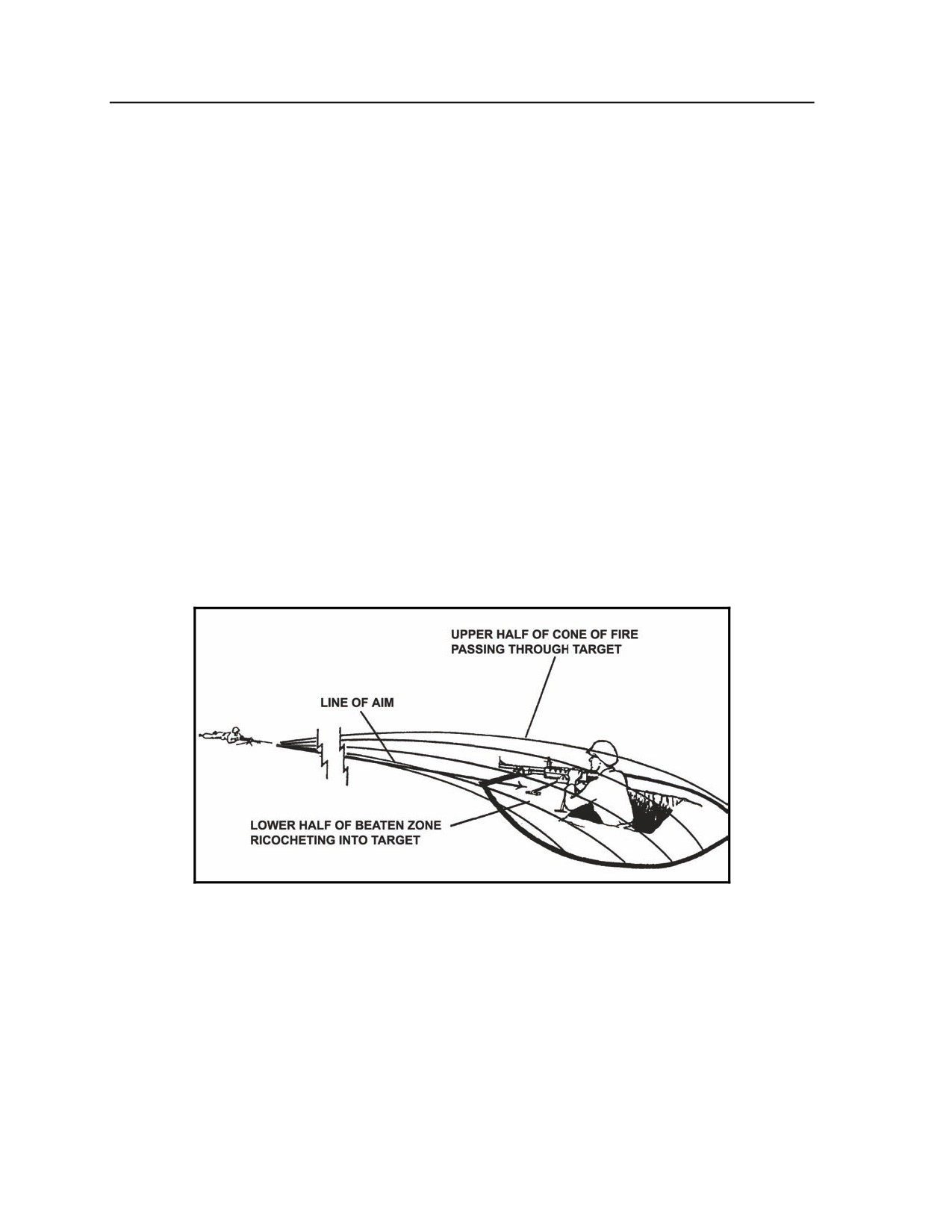
A-50. The gunner ensures throughout his firing that the center of the beaten zone is maintained at the center
base of the target for maximum effect from each burst of fire. When this is done, projectiles in the upper
half of the cone of fire will pass through the target if it has height, and the projectiles in the lower half of
the beaten zone may ricochet into the target (Figure A-13).
Figure A-13. Line of aim and placement of center of beaten zone on target.
A-51. The gunner must move his beaten zone in a certain direction over the target. The direction depends
on the type of target and whether the target is engaged with a pair of guns or a single gun. When engaging
targets other than point targets with a pair of guns, the targets are divided so fire is evenly distributed
throughout the target area. Fire delivered on point targets or a specific area of other target configurations is
called concentrated fire.
TARGET ENGAGEMENTS BY TYPES OF TARGETS
A-52. Gunners engage targets throughout their respective sectors. They must know how to effectively
engage all types of targets, either individually or with other gunners.
A-14
FM 3-21.8
28 March 2007
Machine Gun and Squad Automatic Weapon Employment
A-53. Gunner’s targets in combat are normally enemy troops in various formations or displacements, which
require distribution and concentration of fire. These targets often have both width and depth, and the
application of machine gun fire is designed to completely cover the area in which the enemy is known or
suspected to be. These targets may be easy to see or may be indistinct and difficult to locate. The size of the
target, stated in terms of the number of aiming points required to engage it completely, determines its type.
A-54. When a single gunner is assigned any target he is responsible for covering the entire target.
A-55. When a pair of gunners engage an enemy target, each gunner is normally responsible for effectively
covering one half of the target. The gunners must be prepared to engage the entire target should the other
gun go down.
A-56. The machine gun can provide units with a self-defense capability against hostile low-flying, low-
performance aircraft. These guns are employed in the air defense role as part of the unit’s local defense.
The machine guns are not components of an integrated and coordinated air defense system. Unless
otherwise directed, hostile aircraft within range of the gun (about 800 meters maximum effective range)
should be engaged. The decision will be made by the commander. Typical targets are surveillance,
reconnaissance, and liaison aircraft; troop carriers; helicopters; and drones.
ENGAGEMENT AND EMPLOYMENT
A-57. The mission is to impose maximum attrition upon the attacking enemy such as low-flying, low-
performance aircraft. Employment of machine guns used for air defense is guided by the following defense
design factors:
Defense design should produce an equally balanced defense that is effective in all directions,
unless a forced route of approach exists.
Machine guns should be sited so the maximum number of targets can be engaged, continuous
fire can be delivered, and the most likely routes of approach are covered.
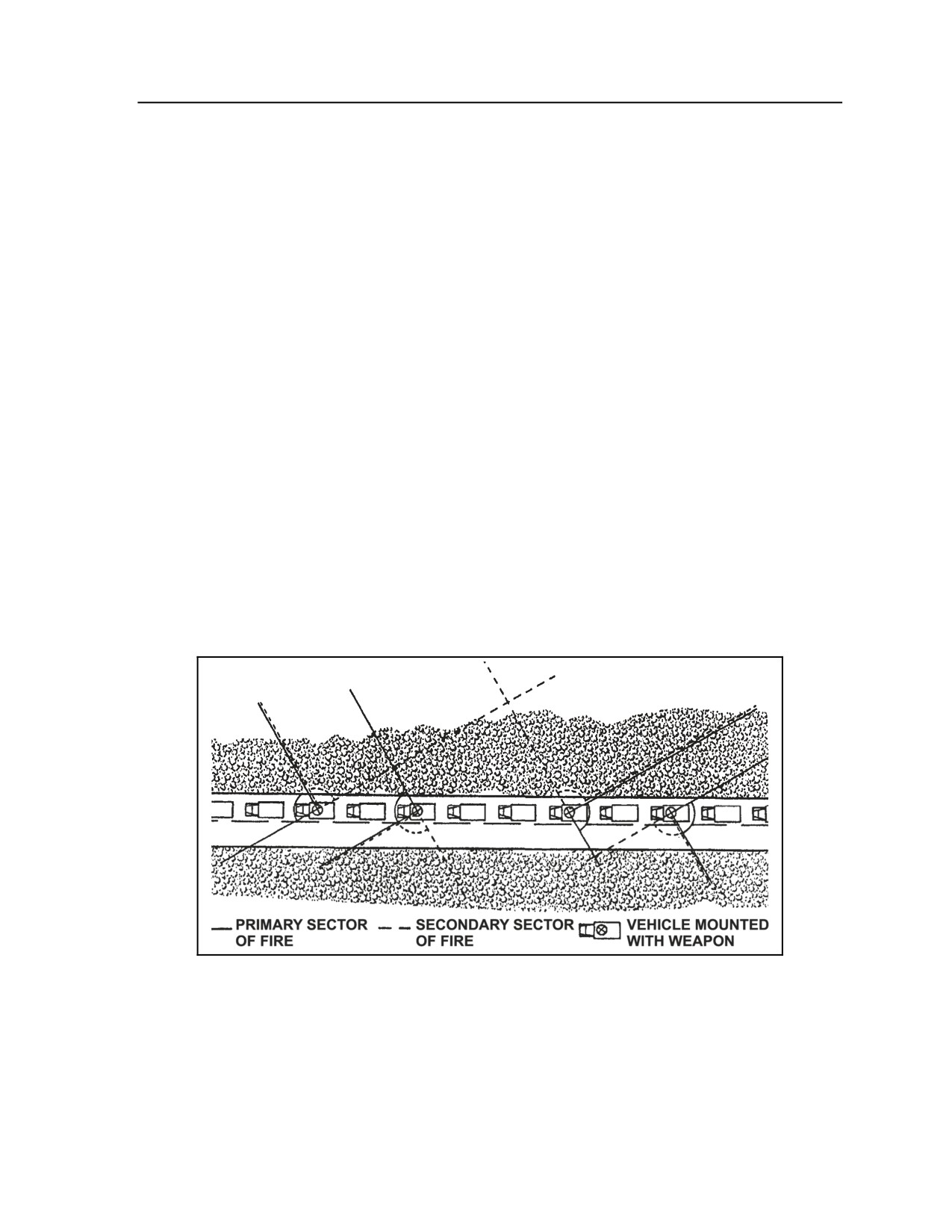
Machine guns used to defend march columns should be interspersed in the convoy, with
emphasis on the lead and rear elements (Figure A-14).
Figure A-14. March column with four machine guns.
TARGET SELECTION AND ENGAGEMENT CONTROL
A-58. These actions depend upon visual means. The sites selected for the guns must provide maximum
observation and unobstructed sectors of fire. Units furnished machine guns in sufficient numbers should
site them within mutual support distances of 90 to 360 meters. Each gun is assigned a primary and
28 March 2007
FM 3-21.8
A-15
Appendix A
secondary sector of fire. Weapon crews maintain constant vigilance in their primary sectors of fire,
regardless of the sector in which the guns are actually engaged.
DISTRIBUTION, CONCENTRATION, AND RATE OF FIRE
A-59. The size and nature of the enemy target determines how machine gun fire is applied. Automatic
weapons fire in one of three rates: rapid, sustained, or cyclic. The rates of fire for each machine gun are
shown in Table A-1. The situation normally dictates the rate used, but the availability of ammunition and
need for barrel changes play important roles as well. The rate of fire must be controlled to adequately cover
the target, but not waste ammunition or destroy the barrel.
DISTRIBUTED AND CONCENTRATED FIRE
A-60. Distributed fire is delivered in width and depth such as at an enemy formation. Concentrated fire is
delivered at a point target such as an automatic weapon or an enemy fighting position.
RAPID FIRE
A-61. Rapid rate of fire places an exceptionally high volume of fire on an enemy position. Machine
gunners normally engage targets at the rapid rate to suppress the enemy quickly. Rapid fire requires much
more ammunition than sustained fire and requires frequent barrel changes.
SUSTAINED FIRE
A-62. Once the enemy has been suppressed, machine gunners fire at the sustained rate. Sustained fire
conserves ammunition and requires only infrequent barrel changes, but it might not be enough volume of
fire to effectively suppress or destroy.
CYCLIC RATE OF FIRE
A-63. To fire the cyclic rate, the gunner holds the trigger to the rear while the assistant gunner feeds
ammunition into the weapon. This is normally only used to engage aerial targets in self-defense or to fire
the final protective fire in the defense to protect the perimeter. This produces the highest volume of fire the
machine gun can fire, but can permanently damage the machine gun and barrel and should be used only in
case of emergency.
TARGET ENGAGEMENT DURING LIMITED VISIBILITY
A-64. Gunners have difficulty detecting and identifying targets during limited visibility. The leader's ability
to control the fires of his weapons is also reduced; therefore, he may instruct the gunners to fire without
command when targets present themselves.
A-65. Gunners should engage targets only when they can identify the targets, unless ordered to do
otherwise. For example, if one gunner detects a target and engages it, the other gunner observes the area
fired upon and adds his fire only if he can identify the target or if ordered to fire.
A-66. Tracer ammunition helps a gunner engage targets during limited visibility and should be used if
possible. It is important to note that in certain circumstances the enemy will have an easy time identifying
the machine gun’s position if the gunner uses tracer ammunition. The need to effectively engage targets
must be balanced with the need to keep the guns safe before deciding to employ tracers. If firing unaided,
gunners must be trained to fire low at first and adjust upward. This overcomes the tendency to fire high.
A-67. When two or more gunners are engaging linear targets, linear targets with depth, or deep targets, they
do not engage these targets as they would when visibility is good. With limited visibility, the center and
flanks of these targets may not be clearly defined. Therefore, each gunner observes his tracers and covers
what he believes to be the entire target.
A-16
FM 3-21.8
28 March 2007
Machine Gun and Squad Automatic Weapon Employment
TECHNIQUES
A-68. Techniques of fire include assault fire; overhead fire; and fire from a defilade position. Only
automatic rifles use assault fire.
ASSAULT FIRE
A-69. Automatic riflemen use assault fire when in close combat. Assault fire involves firing without the aid
of sights using the hip, shoulder, and underarm positions. The underarm position is best when rapid
movement is required. In all three positions, automatic riflemen adjust their fire by observing the tracer and
the impact of the bullets in the target area. Additional considerations for automatic riflemen using assault
fire include—
Maintaining alignment with the rest of the assault element.
Reloading rapidly.
Aiming low and adjusting the aim upward toward the target.
Distributing fires across the objective when not engaging enemy automatic weapons.
OVERHEAD FIRE
A-70. Gunners can use overhead fire when there is sufficient low ground between the machine gun and the
target area for the maneuver of friendly forces. A machine gun on a tripod is capable of delivering this type
of fire because of the small and uniform dispersion of the cone of fire. Gunners must accurately estimate
range to the target and establish a safety limit that is an imaginary line parallel to the target where fire
would cause casualties to friendly Soldiers. Gun crews and leaders must be aware of this safety limit.
Leaders must designate signals for lifting or shifting fires. Gunners should not attempt overhead fires if the
terrain is level or slopes uniformly, if the barrel is badly worn, or if visibility is poor.
Gunner’s Rule
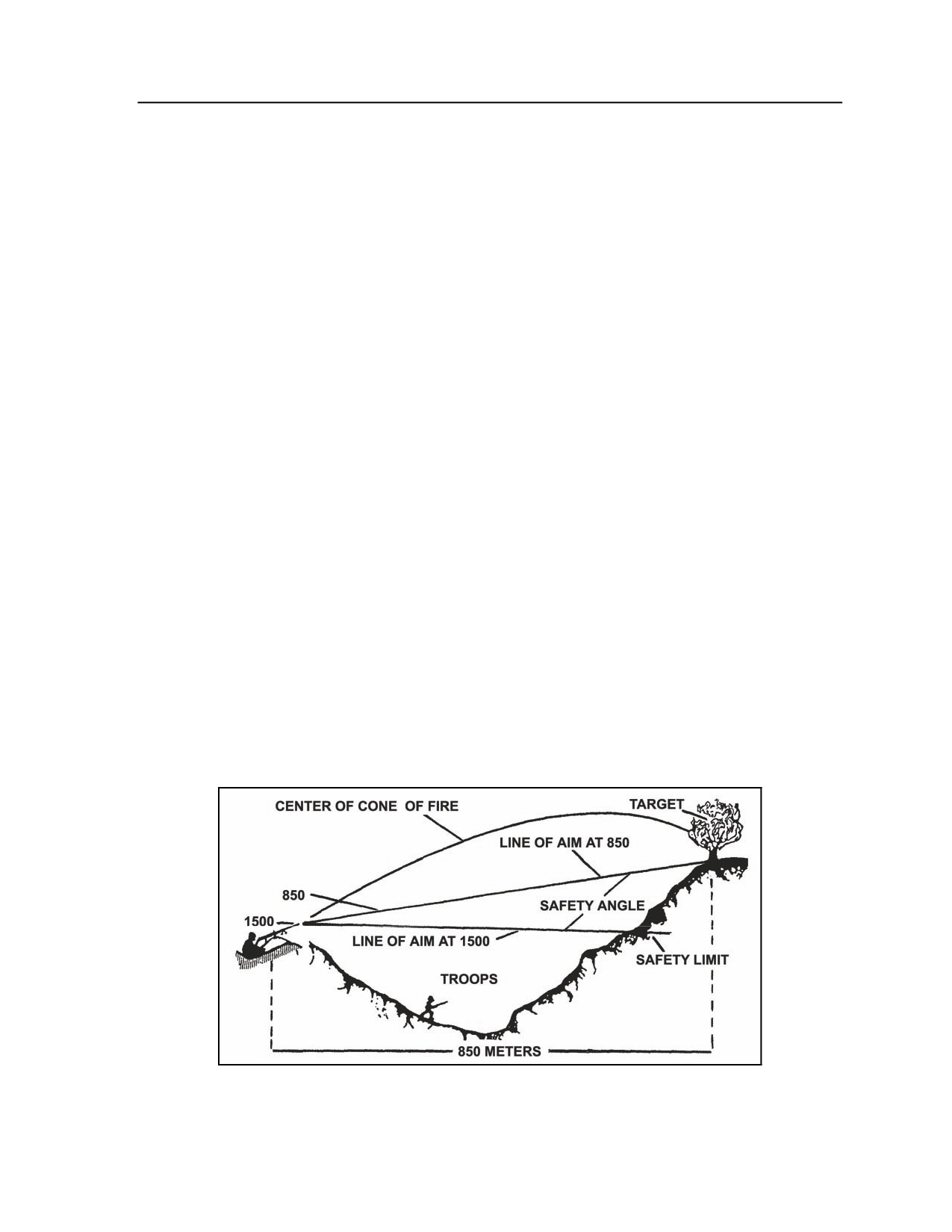
A-71. The gunner’s rule can be applied when the friendly troops are at least 350 meters in front of the gun
position and the range to the target is 850 meters or less (Figure A-15). The rule follows:
Lay the gun on the target with the correct sight setting to hit the target.
Without disturbing the lay of the gun, set the rear sight at a range of 1,600 meters.
Look through the sights and notice where the new line of aim strikes the ground. This is the limit
of troop safety. When the feet of the friendly troops reach this point, fire must be lifted or
shifted.
Figure A-15. Application of gunner’s rule.
28 March 2007
FM 3-21.8
A-17
Appendix A
Leader’s Rule
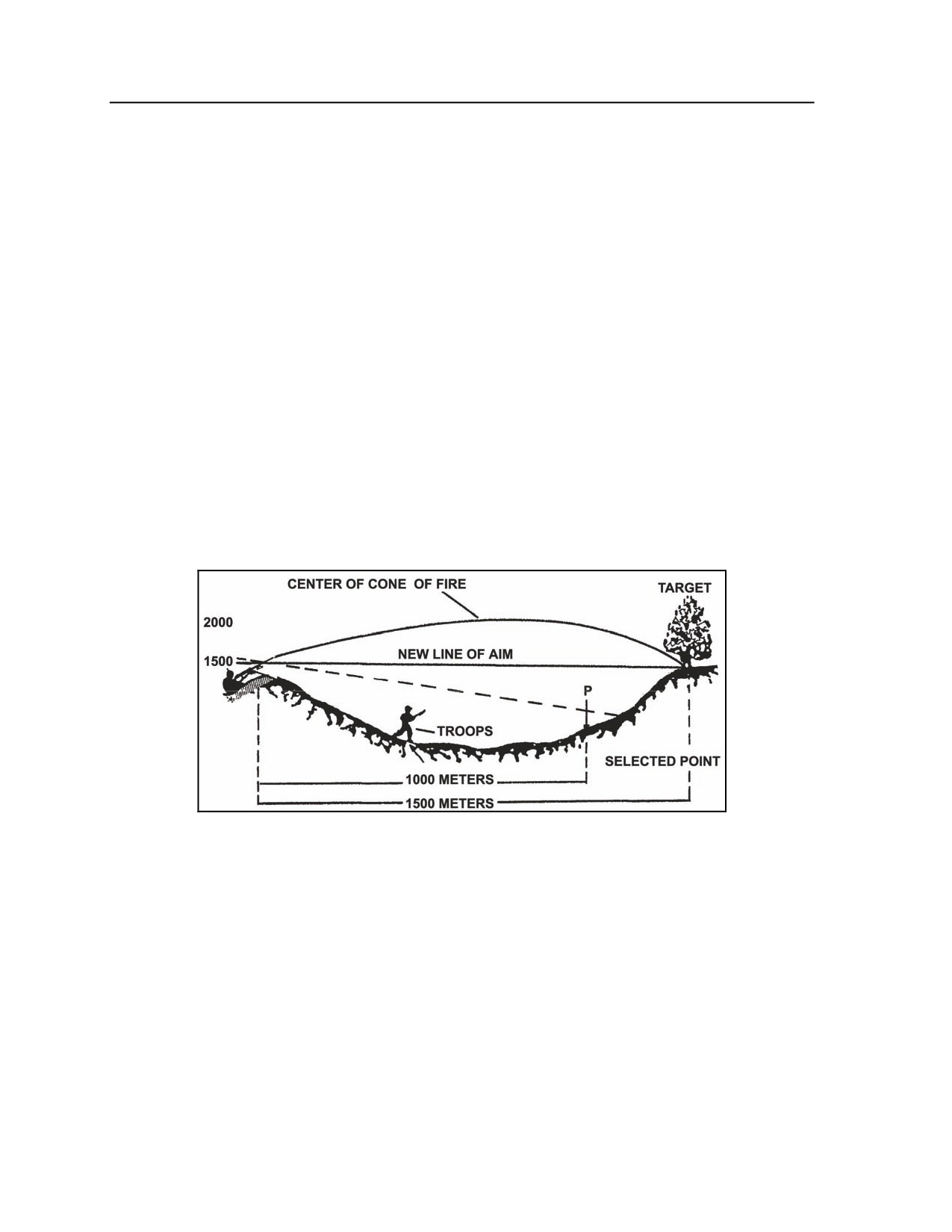
A-72. When the range to the target is greater than 850 meters, overhead fire should be delivered only in an
emergency. Even then, fire should only extend to a range at which the tracers or strike of the bullets can be
seen by the gunner. In this situation the leader’s rule applies (Figure A-16). The platoon or section leader
uses the leader’s rule only when the target is greater than 850 meters. The rule follows:
Select a point on the ground where it is believed friendly troops can advance with safety.
Determine the range to this point by the most accurate means available.
Lay the gun on the target with the correct sight setting to hit the target.
Without disturbing the lay of the gun, set the rear sight to 1,600 meters or the range to the target
plus 500 meters, whichever is the greater of the two ranges. Under no conditions should the sight
setting be less than 1,500 meters.
Note the point where the new line of aim strikes the ground.
If it strikes at the selected point, that point marks the limit of safety.
If it strikes short of the selected point, it is safe for troops to advance to the point where the
line of aim strikes the ground and to an unknown point beyond. If fire is called for after
friendly troops advance farther than the point where the line of aim strikes the ground, this
farther point is determined by testing new selected points until the line of aim and the
selected point coincide.
If it clears the selected point, it is safe for the troops to advance to the selected point and to
an unknown point beyond. If it is advantageous to have troops advance beyond the selected
point, this farther point must be determined by testing new selected points until the line of
aim and the selected point coincide. This point marks the line of safety.
Figure A-16. Application of leader’s rule.
FIRE FROM A DEFILADE POSITION
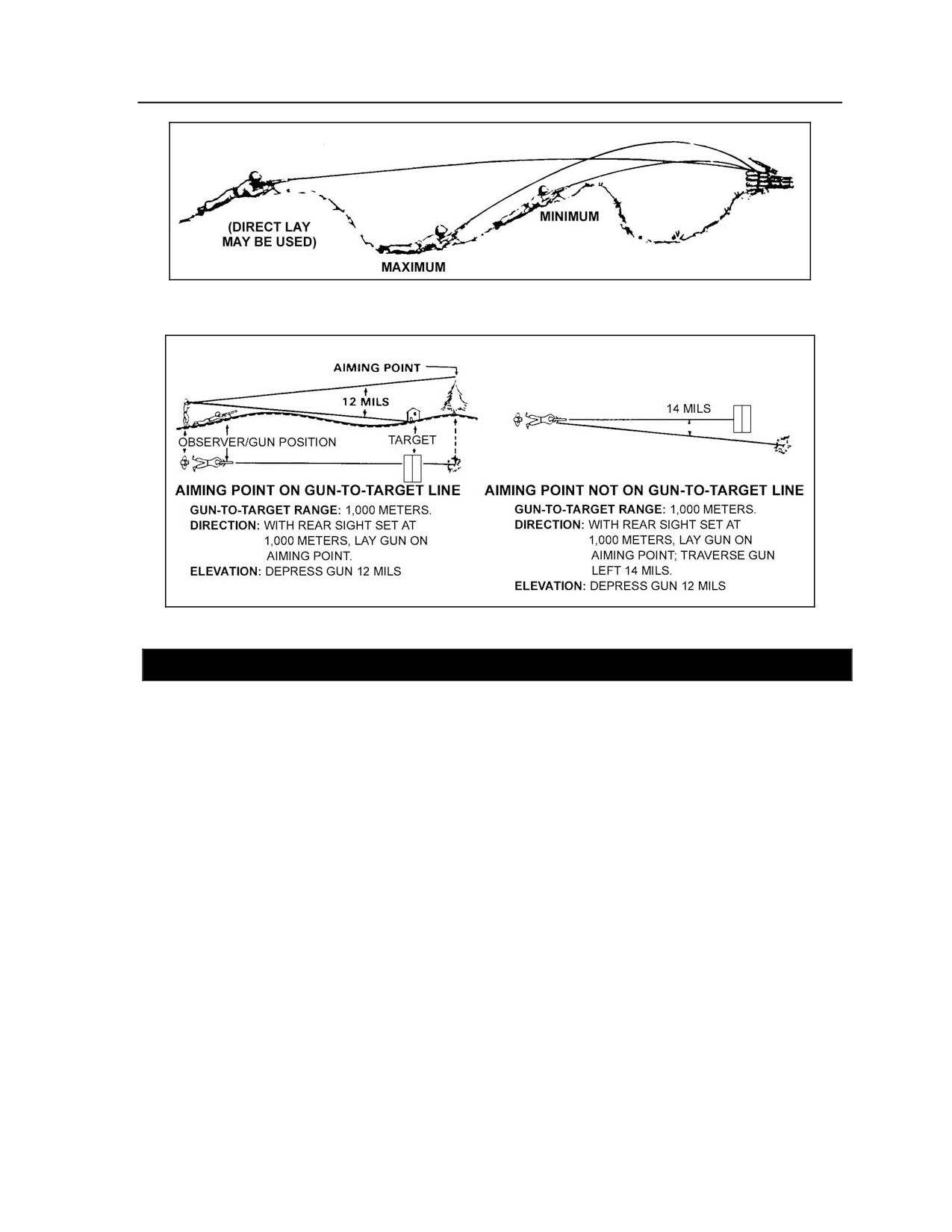
A-73. Defilade positions protect gunners from frontal or enfilading fires
(Figure A-17). Cover and
concealment may not provide the gunner a view of some or all of the target area. In this instance, some
other member of the platoon must observe the impact of the rounds and communicate adjustments to the
gunner (Figure A-18). Gunners and leaders must consider the complexity of laying on the target. They must
also take into account the gunner’s inability to make rapid adjustments to engage moving targets, the ease
with which targets are masked, and the difficulty in achieving grazing fires for an FPL.
A-18
FM 3-21.8
28 March 2007
Machine Gun and Squad Automatic Weapon Employment
Figure A-17. Defilade positions.
Figure A-18. Observer adjusting fire.
SECTION III — PREDETERMINED FIRES
A-74. Predetermined fires organize the battlefield for the gunners. They allow the leader and gunner to
select potential targets or target areas that will most likely be engaged or that have tactical significance.
This includes dismounted enemy avenues of approach, likely positions for automatic weapons, and
probable enemy assault positions. The gunners do this by using sectors of fire, final protective lines, or a
principal direction of fire and selected target areas. This preparation maximizes the effectiveness of the
machine gun during good as well as limited visibility. It enhances fire control by reducing the time required
to identify targets, determine range, and manipulate the weapon onto the target. Abbreviated fire commands
and previously-recorded data enable the gunner to aim or adjust fire on the target quickly and accurately.
Selected targets should be fired on in daylight whenever practical to confirm data. The range card identifies
the targets and provides a record of firing data.
TERMINOLOGY
A-75. Gunners need to know several terms associated with predetermined fire.
SECTOR OF FIRE
A-76. A sector of fire is an area to be covered by fire that is assigned to an individual, a weapon, or a unit.
Gunners are normally assigned a primary and a secondary sector of fire.
FINAL PROTECTIVE FIRE
A-77. A final protective fire (FPF) is an immediately-available, prearranged barrier of fire to stop enemy
movement across defensive lines or areas.
28 March 2007
FM 3-21.8
A-19
Appendix A
FINAL PROTECTIVE LINE
A-78. An FPL is a predetermined line along which grazing fire is placed to stop an enemy assault. If an
FPL is assigned, the machine gun is sighted along it except when other targets are being engaged. An FPL
becomes the machine gun's part of the unit's final protective fires. An FPL is fixed in direction and
elevation. However, a small shift for search must be employed to prevent the enemy from crawling under
the FPL and to compensate for irregularities in the terrain or the sinking of the tripod legs into soft soil
during firing. Fire must be delivered during all conditions of visibility.
A-79. A good FPL covers the maximum area with grazing fire. Grazing fire can be obtained over various
types of terrain out to a maximum of 600 meters. To obtain the maximum extent of grazing fire over level
or uniformly sloping terrain, the gunner sets the rear sight at 600 meters. He then selects a point on the
ground that he estimates to be 600 meters from the machine gun, and he aims, fires, and adjusts on that
point. To prevent enemy soldiers from crawling under grazing fire, he searches (downward) by lowering
the muzzle of the weapon.
PRINCIPAL DIRECTION OF FIRE
A-80. A principal direction of fire (PDF) is assigned to a gunner to cover an area that has good fields of fire
or has a likely dismounted avenue of approach. It also provides mutual support to an adjacent unit. Machine
guns are sighted using the PDF if an FPL has not been assigned. If a PDF is assigned and other targets are
not being engaged, machine guns remain on the PDF. A PDF has the following characteristics:
It is used only if an FPL is not assigned; it then becomes the machine gun's part of the unit's final
protective fires.
When the target has width, direction is determined by aiming on one edge of the target area and
noting the amount of traverse necessary to cover the entire target.
The gunner is responsible for the entire wedge-shaped area from the muzzle of the weapon to the
target, but elevation may be fixed for a priority portion of the target.
DEAD SPACE AND GRAZING FIRE
A-81. The extent of grazing fire and the extent of dead space may be determined in two ways. In the
preferred method, the machine gun is adjusted for elevation and direction. A member of the squad then
walks along the FPL while the gunner aims through the sights. In places where the Soldier's waist
(midsection) falls below the gunner's point of aim, dead space exists. Arm-and-hand signals must be used
to control the Soldier who is walking and to obtain an accurate account of the dead space and its location.
Another method is to observe the flight of tracer ammunition from a position behind and to the flank of the
weapon.
PRIMARY SECTOR OF FIRE
A-82. The primary sector of fire is assigned to the gun team to cover the most likely avenue of enemy
approach from all types of defensive positions.
SECONDARY SECTOR OF FIRE
A-83. The secondary sector of fire is assigned to the gun team to cover the second most likely avenue of
enemy approach. It is fired from the same gun position as the primary sector of fire.
RANGE CARD
A-84. DA Form 5517-R, Standard Range Card, provides a record of firing data and aids defensive fire
planning.
A-20
FM 3-21.8
28 March 2007
Machine Gun and Squad Automatic Weapon Employment
FIELD EXPEDIENTS
A-85. When laying the machine gun for predetermined targets, the gunner can use field expedients as a
means of engaging targets when other sources are not available.
BASE STAKE TECHNIQUE
A-86. A base stake is used to define sector limits and may provide the lay for the FPL or predetermined
targets along a primary or secondary sector limit. This technique is effective in all visibility conditions. The
gunner uses the following steps:
Defines the sector limits by laying the gun for direction along one sector limit and by emplacing
a stake along the outer edge of the folded bipod legs. Rotates the legs slightly on the receiver, so
the gunner takes up the “play.” Uses the same procedure for placing a stake along the opposite
sector limit.
Lays the machine gun along the FPL by moving the muzzle of the machine gun to a sector limit.
Adjusts for elevation by driving a stake into the ground so the top of the stake is under the gas
cylinder extension. This allows a few mils of depression to cover irregularities in the terrain.
Lays the machine gun to engage other targets within a sector limit. Done in a primary sector by
using the procedure described previously, except he keeps the elevation fixed.
NOTCHED-STAKE OR TREE-CROTCH TECHNIQUE
A-87. The gunner uses the notched-stake or tree-crotch technique with the bipod mount to engage
predetermined targets within a sector or to define sector limits. This technique is effective during all
conditions of visibility and requires little additional material. The gunner uses the following steps:
Drives either a notched stake or tree crotch into the ground where selected targets are
anticipated. Places the stock of the machine gun in the nest of the stake or crotch and adjusts the
weapon to hit the selected targets and to define his sector limits.
Digs shallow, curved trenches or grooves for the bipod feet. (These trenches allow for rotation of
the bipod feet as the gunner moves the stock from one crotch or stake to another.)
HORIZONTAL LOG OR BOARD TECHNIQUE
A-88. This technique is used with the bipod or tripod mount to mark sector limits and engage wide targets.
It is good for all visibility conditions and is best suited for flat, level terrain. The gunner uses the following
steps.
Bipod-Mounted Machine Gun
A-89. Using a bipod-mounted machine gun, the gunner places a log or board beneath the stock of the
weapon so the stock can slide across it freely. He digs shallow, curved trenches or grooves for the bipod
feet to allow rotation of the feet as he moves the stock along the log or board. (The gunner may mark the
sector limits by notching or placing stops on the log or board. The gunner uses the bipod firing position and
grip.)
Tripod-Mounted Machine Gun
A-90. Using a tripod-mounted machine gun, the gunner places a log or board beneath the barrel,
positioning it so the barrel, when resting on the log or board, is at the proper elevation to obtain grazing
fire. When appropriate, he marks the sector limits as described for the bipod in the preceding paragraph.
(This technique is used only if a T&E mechanism is not available.)
28 March 2007
FM 3-21.8
A-21
Appendix A
SECTION IV — FIRE CONTROL
A-91. Fire control includes all actions of the leader and Soldiers in planning, preparing, and applying fire
on a target. The leader selects and designates targets. He also designates the midpoint and flanks or ends of
a target, unless they are obvious to the gunner. The gunner fires at the instant desired. He then adjusts fire,
regulates the rate of fire, shifts from one target to another, and ceases fire. When firing, the gunner should
continue to fire until the target is neutralized or until signaled to do otherwise by the leader.
A-92. Predetermined targets, including the FPL or PDF, are engaged on order or by SOP. The signal for
calling for these fires is normally stated in the defense order. Control these predetermined targets by using
arm-and-hand signals, voice commands, or pyrotechnic devices. Gunners fire the FPL or PDF at the
sustained rate of fire unless the situation calls for a higher rate. When engaging other predetermined targets,
the sustained rate of fire is also used unless a different rate is ordered.
METHODS OF FIRE CONTROL
A-93. The noise and confusion of battle may limit the use of some of these methods. Therefore, the leader
must select a method or combination of methods that will accomplish the mission.
ORAL
A-94. The oral fire control method can be effective, but sometimes the leader may be too far away from the
gunner, or the noise of the battle may make it impossible for him to hear. The primary means of the oral
fire control method is the issuance of a fire command.
ARM-AND-HAND SIGNALS
A-95. Arm-and-hand signals are an effective fire control method when the gunner can see the leader. All
gunners must know the standard arm-and-hand signals. The leader gets the gunner's attention and then
points to the target. When the gunner returns the READY signal, the leader commands FIRE.
PREARRANGED SIGNALS
A-96. Prearranged signals are either visual or sound signals such as casualty-producing devices (rifle or
claymore), pyrotechnics, whistle blasts, or tracers. These signals should be included in SOPs. If the leader
wants to shift fire at a certain time, he gives a prearranged signal such as smoke or pyrotechnics. Upon
seeing the signal, the gunner shifts his fire to a prearranged point.
PERSONAL CONTACT
A-97. In many situations, the leader must issue orders directly to individual Soldiers. Personal contact is
used more than any other method by Infantry leaders. The leader must use maximum cover and
concealment to keep from disclosing the position or himself.
RANGE CARDS
A-98. When using the range card method of fire control, the leader must ensure all range cards are current
and accurate. Once this is accomplished, the leader may designate certain targets for certain weapons with
the use of limiting stakes or with fire commands. He should also designate no-fire zones or restricted fire
areas to others. The key factor in this method of fire control is that gunners must be well disciplined and
pay attention to detail.
STANDING OPERATING PROCEDURES
A-99. SOPs are actions to be executed without command that are developed during the training of the
squads. Their use eliminates many commands and simplifies the leader's fire control. SOPs for certain
actions and commands can be developed to make gunners more effective. Some examples follow:
A-22
FM 3-21.8
28 March 2007

Machine Gun and Squad Automatic Weapon Employment
Observation. The gunners continuously observe their sectors.
Fire. Gunners open fire without command on appropriate targets that appear within their sectors.
Check. While firing, the gunners periodically check with the leader for instructions.
Return Fire. The gunners return enemy fire without order, concentrating on enemy automatic
weapons.
Shift Fire. Gunners shift their fires without command when more dangerous targets appear.
Rate of Fire. When gunners engage a target, they initially fire at the rate necessary to gain and
maintain fire superiority.
Mutual Support. When two or more gunners are engaging the same target and one stops firing,
the other increases the rate of fire and covers the entire target. When only one gunner is required
to engage a target and the leader has alerted two or more, the gunner not firing aims on the target
and follows the movements of the target. He does this to fire instantly in case the other machine
gun malfunctions or ceases fire before the target has been eliminated.
FIRE COMMANDS
A-100. A fire command is given to deliver effective fire on a target quickly and without confusion. When
the leader decides to engage a target that is not obvious to the squad, he must provide them with the
information they need to effectively engage the target. He must alert the Soldiers; give a target direction,
description, and range; name the method of fire; and give the command to fire. There are initial fire
commands and subsequent fire commands.
A-101. It is essential that the commands delivered by the weapons squad leader are understood and echoed
by the assistant gunner/gun team leader and the gunner. Table A-7 provides an example of the weapons
squad fire commands and actions used by the weapons squad leader (WSL), assistant gunner (AG)/gun
team leader (GTL), and gunner.
Table A-7. Example weapons squad fire commands and actions.
ACTION
WSL COMMANDS
AG/GTL COMMANDS
GUNNER ACTIONS
GUNNER
AND ACTIONS
RESPONSES
WSL or GTL
”Light-skinned truck,
“Light-skinned truck, 3
Gunner looks for laser and
“TGT identified.”
identifies target
3 o’clock, 400 m, on
o’clock, 400 m, on my
identifies target.
within gun
my laser.”
laser.”
Gunner traverses and gets on
“TGT acquired.”
team’s sector
“Once on TGT engage.”
target.
Gunner engages target with
correct rate of fire.
Gun team (or
“Gun 1-Bipod.”
Repeats “Gun 1-Bipod”
Gets down beside AG/GTL.
“Gun 1 up” once
weapons SQD)
and identifies location for
ready to fire.
go to bipod
gun.
Gun team go to
“Gun 1-Tripod.”
Repeats “Gun 1-Tripod”
Gunner picks up gun and places
“Gun 1 up” once
tripod
and lays down tripod (if not
into tripod. He gets AG/GTL to
ready to fire.
done) and prepares to lock
lock it in. Once locked in, the
gun on tripod.
AG/GTL collapses bipod legs.
Barrel change
NA
“Gun 1 prepare for barrel
Fires one more burst.
Repeats AG/GTL
change.”
Waits for barrel change.
command. Once
“Gun 1 barrel change.”
done, “Gun 1 up.”
Displace gun
“Gun 1 out of action,
“Gun 1 out of action,
Gunner takes gun off tripod,
“Gun 1, ready to
prepare to move.”
prepare to move.”
continues to orient towards
move.”
Breaks down barrel bag,
target on bipod, and prepares to
prepares to move.
move.
WSL identifies
“Gun 1, left, center,
Using binoculars identifies
Gunner makes necessary
“Sector identified” to
sector of fire for
right sectors on my
sectors and states, “Gun 1
adjustments, tells AG/GTL
AG/GTL once he
gun team(s)
mark. Do you
identifies.” Adjusts gunner
whether he identifies or not.
identifies.
Day-marks
identify?”
onto target.
Engages or makes further
w/tracer
(Always marks left to
adjustments.
Night-marks
right.)
with PEQ/tracer
28 March 2007
FM 3-21.8
A-23

Appendix A
Table A-7. Example weapons squad fire commands and actions (continued).
ACTION
WSL COMMANDS
AG/GTL COMMANDS
GUNNER ACTIONS
GUNNER
AND ACTIONS
RESPONSES
WSL or AG/GTL
“Gun 1, sustained ‗‗
Echoes command, starts
Gunner echoes command, also
Echoes rate of fire
gives or adjusts
seconds, engage.”
count. Tells gunner to fire.
counts and fires when AG/GTL
“Sustained __
rate of fire
Keeps count between
gives command to fire.
seconds.”
bursts and ensures gun
does not fire out of turn.
WSL changes
“Gun 1, shift fire,
Echoes command to shift;
Gunner echoes command,
Echoes command
gun team(s)
target # (or) right/left
identifies new
makes necessary adjustment,
with AG/GTL. “Shift
sector of fire or
sector.”
target/sector. Adjusts
acquires new target. Confirms
fire to TGT #__.”
shift fire
Marks sector same
gunner, alerts WSL once
with AG/GTL that all is OK.
Once identified,
as above.
the gunner has shifted.
Engages new sector when told.
“Sector/target
identified.”
Talking the gun
WSL gives gun
Repeats rate of fire and
Repeats rate of fire command,
“Sustained __
teams (ensuring
teams the rate of
maintains proper count,
keeps own count. Fires when
seconds.”
one gun fires
fire. (As long as they
telling gunner when to fire.
told to fire. Adjusts rate of fire off
during the other
are keeping correct
Adjusts rate of fire off of
of lead gun.
gun’s interval
interval, they should
lead gun.
and visa versa).
“talk” themselves.)
Lift fire
“Lift fire, lift fire, lift
Repeats command to
Repeats command. Ceases all
Echoes “lift fire.”
fire.” Or
gunner, ensures gunner
fire onto the objective. Maintains
“Gun 1, lift fire.”
lifts fire.
overwatch and scans objective
until told to reengage or go out
of action.
Round count
If need to know
AG/GTL continuously links
Gunner echoes round count to
“Gun 1, 200
round count, prompt
rounds and gives WSL
ensure it is heard.
rounds.”
“Gun 1, round
round count every 100.
count.”
“Gun 1, 200 rounds.”
“Watch and
“Gun 1, watch and
Repeats command,
Repeats command, searches
“Gun 1, watch and
shoot” or
shoot.”
searches objective for
objective for targets of
shoot.”
“Traverse and
“Gun 1, traverse and
targets of opportunity
opportunity in sector. Confirms
“Gun 1, traverse
search”
search.”
within sector.
target with AG/GTL before
and search.”
engaging.
INITIAL FIRE COMMANDS
A-102. Initial fire commands are given to adjust onto the target, change the rate of fire after a fire mission
is in progress, interrupt fire, or terminate the alert.
ELEMENTS
A-103. Fire commands for all direct-fire weapons follow a pattern that includes similar elements. There
are six elements in the fire command for the machine gun: alert; direction; description; range; method of
fire; and command to open fire. The gunners repeat each element of fire command as it is given.
Alert
A-104. This element prepares the gunners for further instructions. The leader may alert both gunners in the
squad and may have only one fire, depending upon the situation. To alert and have both gunners fire, the
leader announces FIRE MISSION. If he desires to alert both gunners but have only one fire, he announces
GUN NUMBER ONE, FIRE MISSION. In all cases, upon receiving the alert, the gunners load their
machine guns and place them on FIRE.
Direction
A-105. This element indicates the general direction to the target and may be given in one or a combination
of the following methods.
A-24
FM 3-21.8
28 March 2007
Machine Gun and Squad Automatic Weapon Employment
Oral
A-106. The leader orally gives the direction to the target in relation to the position of the gunner (for
example, FRONT, LEFT FRONT, RIGHT FRONT).
Pointing
A-107. The leader designates a small or obscure target by pointing with his finger or aiming with a
weapon. When he points with his finger, a Soldier standing behind him should be able to look over his
shoulder and sight along his arm and index finger to locate the target. When aiming his weapon at a target,
a Soldier looking through the sights should be able to see the target. Leaders may also use lasers in
conjunction with night vision devices to designate a target to the gunner.
Tracer Ammunition
A-108. Tracer ammunition is a quick and sure method of designating a target that is not clearly visible.
When using this method, the leader should first give the general direction to direct the gunner's attention to
the target area. To prevent the loss of surprise when using tracer ammunition, the leader does not fire until
he has given all elements of the fire command except the command to fire. The leader may fire his
individual weapon. The firing of the tracer(s) then becomes the last element of the fire command, and it is
the signal to open fire.
NOTE: Soldiers must be aware that with the night vision device, temporary blindness ("white
out") may occur when firing tracer ammunition at night or when exposed to other external light
sources. Lens covers may reduce this effect.
Reference Points
A-109. Another way to designate obscure targets is to use easy-to-recognize reference points. All leaders
and gunners must know terrain features and the terminology used to describe them (see FM 3-25.26, Map
Reading and Land Navigation). When using a reference point, the word "reference" precedes its
description. This is done to avoid confusion. The general direction to the reference point should be given.
Description
A-110. The target description creates a picture of the target in the minds of the gunners. To properly apply
their fire, the Soldiers must know the type of target they are to engage. The leader should describe it
briefly. If the target is obvious, no description is necessary.
Range
A-111. The leader always announces the estimated range to the target. The range is given, so the gunner
knows how far to look for the target and what range setting to put on the rear sight. Range is announced in
meters. However, since the meter is the standard unit of range measurement, the word "meters" is not used.
With machine guns, the range is determined and announced to the nearest hundred or thousand (for
example, THREE HUNDRED, or ONE THOUSAND).
Method of Fire
A-112. This element includes manipulation and rate of fire. Manipulation dictates the class of fire with
respect to the weapon. It is announced as FIXED, TRAVERSE, SEARCH, or TRAVERSE AND
SEARCH. Rate controls the volume of fire (sustained, rapid, and cyclic). Normally, the gunner uses the
sustained rate of fire. The rate of fire is omitted from the fire command. The method of fire for the machine
gun is usually 3- to 5-round bursts (M249) and 6- to 9-round bursts (M60/M240B).
28 March 2007
FM 3-21.8
A-25
Appendix A
Command to Open Fire
A-113. When fire is to be withheld so surprise fire can be delivered on a target or to ensure that both
gunners open fire at the same time, the leader may preface the command to commence firing with AT MY
COMMAND or AT MY SIGNAL. When the gunners are ready to engage the target, they report READY to
the leader. The leader then gives the command FIRE at the specific time desired. If immediate fire is
required, the command FIRE is given without pause and the gunners fire as soon as they are ready.
SUBSEQUENT FIRE COMMANDS
A-114. Subsequent fire commands are used to make adjustments in direction and elevation, to change
rates of fire after a fire mission is in progress, to interrupt fires, or to terminate the alert. If the gunner fails
to properly engage a target, the leader must promptly correct him by announcing or signaling the desired
changes. When these changes are given, the gunner makes the corrections and resumes firing without
further command.
A-115. Adjustments in direction and elevation with the machine gun are always given in meters; one
finger is used to indicate 1 meter and so on. Adjustment for direction is given first. For example: RIGHT
ONE ZERO METERS or LEFT FIVE METERS. Adjustment for elevation is given next. For example:
ADD FIVE METERS or DROP ONE FIVE METERS. These changes may be given orally or with arm-
and-hand signals.
Changes in the rate of fire are given orally or by arm-and-hand signals.
To interrupt firing, the leader announces CEASE FIRE, or he signals to cease fire. The gunners
remain on the alert. They resume firing when given the command FIRE.
To terminate the alert, the leader announces CEASE FIRE, END OF MISSION.
DOUBTFUL ELEMENTS AND CORRECTIONS
A-116. When the gunner is in doubt about any element of the fire command, he replies, SAY AGAIN
RANGE, TARGET. The leader then announces THE COMMAND WAS, repeats the element in question,
and continues with the fire command.
A-117. When the leader makes an error in the initial fire command, he corrects it by announcing
CORRECTION, and then gives the corrected element. When the leader makes an error in the subsequent
fire command, he may correct it by announcing CORRECTION. He then repeats the entire subsequent fire
command.
ABBREVIATED FIRE COMMANDS
A-118. Fire commands do not need not be complete to be effective. In combat, the leader gives only the
elements necessary to place fire on a target quickly and without confusion. During training, however, he
should use all of the elements to get gunners in the habit of thinking and reacting properly when a target is
to be engaged. After the gunner's initial training in fire commands, he should be taught to react to
abbreviated fire commands, using one of the following methods.
Oral
A-119. The leader may want to place the fire of one machine gun on an enemy machine gun and quickly
tells the gunner to fire on that gun.
Hand-and-Arm Signals
A-120. Battlefield noise and the distance between the gunner and the leader often make it necessary to use
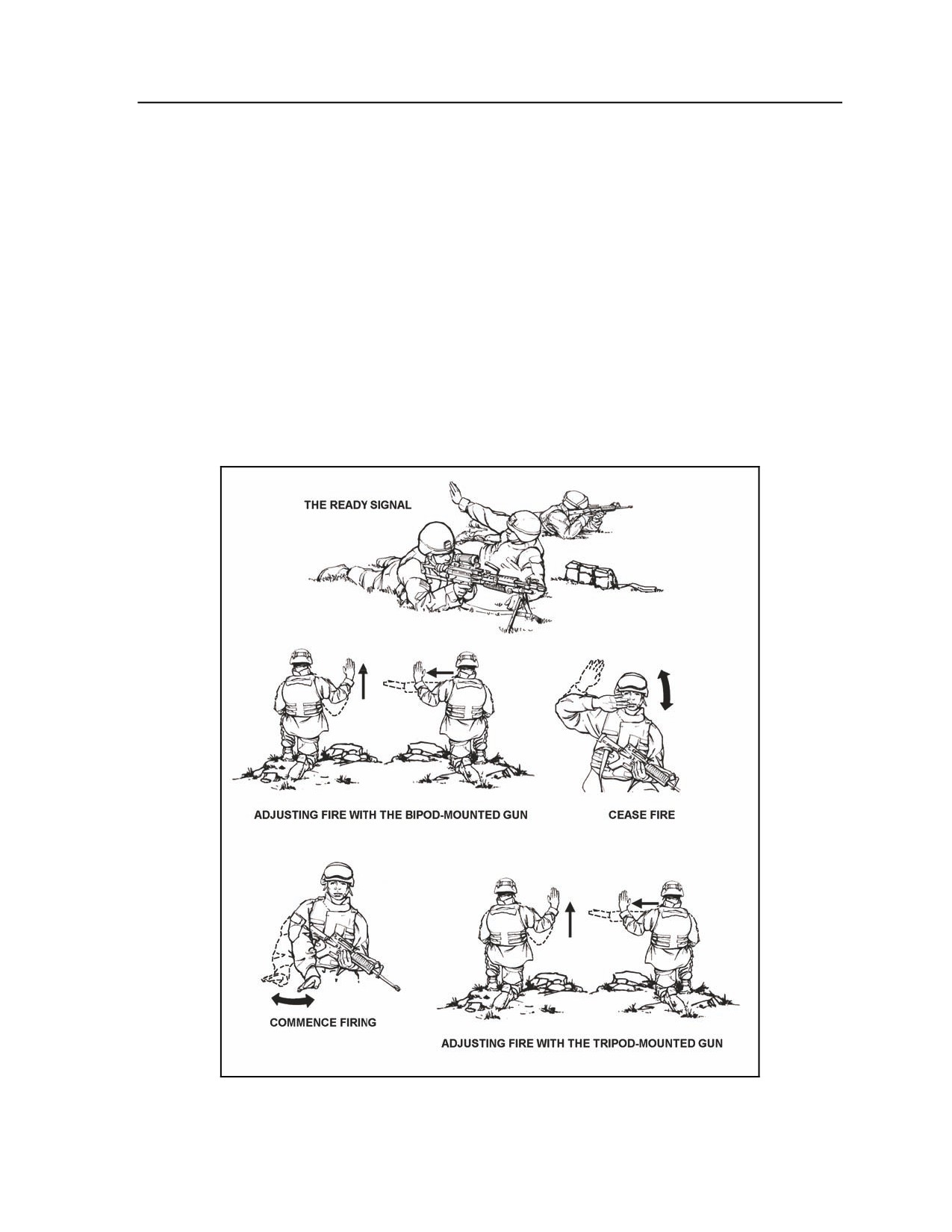
arm-and-hand signals to control fire (Figure A-19). When an action or movement is to be executed by only
one of the gunners, a preliminary signal is given to that gunner only. The following are commonly used
signals for fire control:
A-26
FM 3-21.8
28 March 2007
Machine Gun and Squad Automatic Weapon Employment
Ready. The gunner indicates that he is ready to fire by yelling UP or having the assistant gunner
raise his hand above his head toward the leader.
Commence Firing or Change Rate of Firing. The leader brings his hand (palm down) to the
front of his body about waist level, and moves it horizontally in front of his body. To signal an
increase in the rate of fire, he increases the speed of the hand movement. To signal slower fire,
he decreases the speed of the hand movement.
Change Direction or Elevation. The leader extends his arm and hand in the new direction and
indicates the amount of change necessary by the number of fingers extended. The fingers must
be spread so the gunner can easily see the number of fingers extended. Each finger indicates 1
meter of change for the weapon. If the desired change is more than 5 meters, the leader extends
his hand the number of times necessary to indicate the total amount of change. For example,
right nine would be indicated by extending the hand once with five fingers showing and a
second time with four fingers showing for a total of nine fingers.
Interrupt or Cease Firing. The leader raises his arm and hand (palm outward) in front of his
forehead and brings it downward sharply.
Other Signals. The leader can devise other signals to control his weapons. A detailed
description of arm-and-hand signals is given in FM 21-60.
Figure A-19. Hand-and-arm signals.
28 March 2007
FM 3-21.8
A-27

Appendix A
SECTION V — MACHINE GUN USE
A-121. Despite their post-Civil War development, modern machine guns did not exhibit their full potential
in battle until World War I. Although the machine gun has changed, the role of the machine gun and
machine gunner has not. The mission of machine guns in battle is to deliver fires when and where the
leader wants them in both the offense and defense. Machine guns rarely, if ever, have independent
missions. Instead, they provide their unit with accurate, heavy fires to accomplish the mission.
TACTICAL ORGANIZATION OF THE MACHINE GUN
A-122. The accomplishment of the platoon’s mission demands efficient and effective machine gun crews.
Leaders consider the mission and organize machine guns to deliver firepower and fire support to any area
or point needed to accomplish the assigned mission.
A-123. Infantry platoons will normally have an organic weapons squad that consists of a weapons squad
leader and two gun teams. Depending on the unit’s organization or the platoon’s mission, there could be
additional machine gun teams attached or organic to the platoon.
A-124. The weapons squad consists of a weapons squad leader and machine gun teams. Each machine gun
team has a gunner, assistant gunner, and ammunition bearer. In some units the senior member of the gun
team is the gunner. In other units the assistant gunner is the senior gun team member who also serves as the
gun team leader. Table A-8 illustrates equipment carried by the weapons squad. Table A-9 illustrates the
duty positions within the weapons squad and gives possible duty descriptions and responsibilities. The
tables serve to show possible position and equipment use only. Individual unit SOPs and available
equipment dictate the exact role each weapons squad member plays within his squad.
Table A-8. Example weapons squad equipment by position.
Weapons Squad
Assistant Gunner/
Ammunition
Gunner
Leader
Gun Team Leader
Bearer
Weapon
M4 (w/ 7 mags*)
M4 (w/ 7 mags*)
M240B (50-100 rounds)
M4 (w/ 7 mags)
Day Optic
ACOG
ACOG
M145
M68/ACOG
Laser
PEQ-2
PEQ-2
PEQ-2
PAQ-4/PEQ-2
Additional
3x magnifier**
3x magnifier**
3x magnifier**
Tripod
Equipment
Spare barrel(s)***
T&E
M240
100 rounds
300 rounds
100 rounds
300 rounds
Ammunition
Miscellaneous
Whistle
M9 pistol
M9 pistol
NA
Pen gun flare**
Cleaning kit
Cleaning kit
Other shift signals**
Binoculars****
CLP for 72 hours*****
VS-17 panel
Binoculars****
*WSL and AG/GTL load tracer rounds (4:1 mix) in magazines for marking targets.
**3x magnifier, flares, and shift signals are readily accessible at all times.
***Spare barrel(s) marked by relative age with ¼ pieces of green tape on carrying handle.
Oldest barrel=2 parallel strips
Second newest barrel=1 strip
Newest barrel=no tape
****Binoculars carried in the assault pack or in suitable pouch on vest (mission dependent).
*****Gunners always carry enough CLP for 72 hours of operations.
A-28
FM 3-21.8
28 March 2007

Machine Gun and Squad Automatic Weapon Employment
Table A-9. Example weapons squad duty positions and responsibilities.
Weapons
Senior squad leader within the platoon. Responsible for all training and employment of the
Squad Leader
machine guns. The WSL’s knowledge, experience, and tactical proficiency influence the
effectiveness of the squad.
Assistant
AG/GTL is a team leader with the responsibilities of a fire team leader.
Gunner/
GTL is responsible for his team members and all the gun equipment.
Gun Team
GTL and his team will be tactically proficient and knowledgeable on this FM and applicable
Leader
FMs and TMs that apply to the machine gun.
GTL assists the WSL on the best way to employ the M240B.
GTL enforces field discipline while the gun team is employed.
GTL leads by example in all areas. He sets the example in all things.
GTL assists the WSL in all areas. He advises him of any problems either tactical or
administrative.
AG is responsible for all action concerning the gun.
AG/GTL calls the ammunition bearer if ammunition is needed or actively seeks it out if the
ammunition bearer is not available. Constantly updates the WSL on the round count and
serviceability of the M240B.
When the gun is firing, AG/GTL spots rounds and makes corrections to the gunner’s fire. Also
watches for friendly troops to the flanks of the target area or between the gun and the target.
If the gunner is hit by fire, AG/GTL immediately assumes the roll of the gunner.
AG/GTL is always prepared to change the gun’s barrel (spare barrel is always out when the
gun is firing). Ensures the hot barrel is not placed on live ammunition or directly on the ground
when it comes out of the gun.
Machine
If second in the gun team’s chain of command, he is always fully capable of taking the GTL
Gunner
position.
Primary responsibility is to the gun. Focused on its cleanliness and proper function.
Immediately reports any abnormalities to the GTL or WSL.
If necessary for gunner to carry M240B ammunition, carries it in on his back so the AG/GTL
can access it without stopping the fire of the gun.
Always carries the necessary tools for the gun to be properly cleaned, along with a sufficient
amount of oil for the gun’s proper function.
Ammunition
The AB is the rifleman/equipment bearer for the gun team.
Bearer
Normally the newest member of the gun team. Must quickly learn everything he can, exert
maximum effort at all times, and attempt to outdo his gun team members in every situation.
Follows the gunner without hesitation. During movement moves to the right side of the gunner
and no more than one 3-5 meters rush away from the gun.
During firing, pulls rear security and if the gunner comes under enemy fire, provides immediate
suppression while the gun moves into new position.
Responsible for the tripod and T&E mechanism. They must always be clean and ready for
combat. Responsible for replacing them, if necessary.
SECURITY
A-125. Security includes all command measures to protect against surprise, observation, and annoyance
by the enemy. The principal security measures against ground forces include employment of security
patrols and detachments covering the front flanks and rear of the unit’s most vulnerable areas. The
composition and strength of these detachments depends on the size of the main body, its mission, and the
nature of the opposition expected. The presence of machine guns with security detachments augments their
firepower to effectively delay, attack, and defend, by virtue of their inherent firepower.
A-126. The potential of air and any potential ground attacks on the unit demands every possible precaution
for maximum security while on the move. Where this situation exists, the machine gun crew must be
thoroughly trained in the hasty delivery of antiaircraft fire and of counterfires against enemy ground forces.
28 March 2007
FM 3-21.8
A-29
Appendix A
The distribution of the machine guns in the formation is critical. The machine gun crew is constantly on the
alert, particularly at halts, ready to deliver fire as soon as possible. If the leader expects a halt to exceed a
brief period, he carefully chooses machine gun positions to avoid unduly tiring the machine gun crew. If he
expects the halt to extend for a long period, he can have the machine gun crew take up positions in support
of the unit. The crew covers the direction from which he expects enemy activity as well as the direction
from which the unit came. The leader selects positions that permit the delivery of fire in the most probable
direction of enemy attack, such as valleys, draws, ridges, and spurs. He chooses positions that offer
obstructed fire from any potential enemy locations.
MACHINE GUNS IN THE OFFENSE
A-127. Successful offensive operations result from the employment of fire and movement. Each is
essential and greatly depends upon the other. Without the support of covering fires, maneuvering in the
presence of enemy fire can result in disastrous losses. Covering fires, especially those that provide fire
superiority, allow maneuvering in the offense. However, fire superiority alone rarely wins battles. The
primary objective of the offense is to advance, occupy, and hold the enemy position.
MACHINE GUN AS A BASE OF FIRE
A-128. Machine gun fire from a support-by-fire (SBF) position must be the minimum possible to keep the
enemy from returning effective fire. Ammunition must be conserved so the guns do not run out of
ammunition.
A-129. The weapon squad leader positions and controls the fires of all machine guns in the element.
Machine gun targets include key enemy weapons or groups of enemy targets either on the objective or
attempting to reinforce or counterattack. In terms of engagement ranges, machine guns in the base-of-fire
element may find themselves firing at targets within a range of 800 meters. The nature of the terrain, desire
to achieve some standoff, and the other factors of METT-TC prompt the leader to the correct tactical
positioning of the base-of-fire element.
A-130. The machine gun delivers an accurate, high-volume rate of lethal fire on fairly large areas in a
brief time. When accurately placed on the enemy position, machine gun fires secure the essential element
of fire superiority for the duration of the firing. Troops advancing in the attack should take full advantage
of this period to maneuver to a favorable position from where they can facilitate the last push against the
enemy. In addition to creating enemy casualties, machine gun fire destroys the enemy's confidence and
neutralizes his ability to successfully engage the friendly maneuver element.
A-131. There are distinct phases of rates of fire employed by the base of fire element:
Initial heavy volume (rapid rate) to gain fire superiority.
Slower rate to conserve ammunition (sustained rate) while still preventing effective return fire
as the assault moves forward.
Increased rate as the assault nears the objective.
Lift and shift to targets of opportunity.
A-132. All vocal commands from the leaders to change the rates of fire are accompanied simultaneously
by hand-and-arm signals.
A-133. Machine guns in the SBF role should be set in and assigned a primary and alternate sector of fire
as well as a primary and alternate position.
A-134. Machine guns are suppressive fire weapons used to suppress known and suspected enemy
positions. Therefore, gunners cannot be allowed to empty all of their ammunition into one bunker simply
because that is all they can identify at the time.
A-135. The SBF position, not the assault element, is responsible for ensuring there is no masking of fires.
The assault element might have to mask the SBF line because they have no choice on how to move. It is the
SBF gunner’s job to continually shift fires, or move gun teams or the weapons squad to support the assault
and prevent any masking.
A-30
FM 3-21.8
28 March 2007
Machine Gun and Squad Automatic Weapon Employment
A-136. Shift and shut down the weapon squad gun teams one at a time, not all at once. M203 and mortar
or other indirect fire can be used to suppress while the machine guns are moved to where they can shoot.
A-137. Leaders must take into account the SDZ of the machine guns when planning and executing the lift
and or shift of the SBF guns. The effectiveness of the enemy on the objective will play a large role in how
much risk should be taken with respect to the lifting or shifting of fires.
A-138. Once the SBF line is masked by the assault element, fires are shifted and or lifted to prevent enemy
withdrawal or reinforcement.
MACHINE GUN WITH THE MANEUVER ELEMENT
A-139. Under certain terrain conditions, and for proper control, machine guns may join the maneuver or
assault unit. When this is the case, they are assigned a cover fire zone or sector.
A-140. The machine guns seldom accompany the maneuver element. The gun’s primary mission is to
provide covering fire. The machine guns are only employed with the maneuver element when the area or
zone of action assigned to the assault or company is too narrow to permit proper control of the guns. The
machine guns are then moved with the unit and readied to employ on order from the leader and in the
direction needing the supporting fire.
A-141. When machine guns move with the element undertaking the assault, the maneuver element brings
the machine guns to provide additional firepower. These weapons are fired from a bipod, in an assault
mode, from the hip, or from the underarm position. They target enemy automatic weapons anywhere on the
unit's objective. Once the enemy’s automatic weapons have been destroyed (if there are any), the gunners
distribute their fire over their assigned zone or sector. In terms of engagement ranges, the machine gun in
the assault engages within 300 meters of its target and frequently at point-blank ranges.
A-142. Where the area or zone of action is too wide to allow proper coverage by the platoon’s organic
machine guns, the platoon can be assigned additional machine guns or personnel from within the company.
This may permit the platoon to accomplish its assigned mission. The machine guns are assigned a zone or a
sector to cover and they move with the maneuver element.
M 249 MACHINE GUN IN THE OFFENSE
A-143. In the offense, M249s target any enemy-supporting weapons being fired from fixed positions
anywhere on the squad’s objective. When the enemy’s supporting weapons have been destroyed, or if there
are none, the machine gunners distribute their fire over that portion of the objective that corresponds to
their team’s position.
MEDIUM MACHINE GUNS IN THE OFFENSE
A-144. In the offense the platoon leader has the option to establish his base of fire element with one or two
machine guns, the M249 light machine gun, or a combination of the weapons. The platoon sergeant or
weapons squad leader may position this element and control its fires when the platoon scheme of maneuver
is to conduct the assault with the Infantry squads. The M240B machine gun, when placed on a tripod,
provides stability and accuracy at greater ranges than the bipod, but it takes more time to maneuver the
machine gun should the need arise. The machine gunners target key enemy weapons until the assault
element masks their fires. They can also be used to suppress the enemy’s ability to return accurate fire, or
to hamper the maneuver of the enemy’s assault element. They fix the enemy in position and isolate him by
cutting off his avenues of reinforcement. They then shift their fires to the flank opposite the one being
assaulted and continue to target any automatic weapons that provide enemy support, and engage any enemy
counterattack. M240B fires also can be used to cover the gap created between the forward element of the
friendly assaulting force and terrain covered by indirect fires when the indirect fires are lifted and shifted.
On signal, the machine gunners and the base-of-fire element displace to join the assault element on the
objective.
28 March 2007
FM 3-21.8
A-31
Appendix A
MK 19 AND M2 IN THE OFFENSE
A-145. The MK 19 and M2 can be used as part of the base-of-fire element to assist the friendly assault
element by suppressing enemy bunkers and lightly-armored vehicles. Even if ammunition fired from the
guns is not powerful enough to destroy enemy vehicles, well-aimed suppressive fire can keep the enemy
buttoned up and unable to place effective fire on friendly assault elements. The MK 19 and M2 are
particularly effective in preventing lightly-armored enemy vehicles from escaping or reinforcing. Both
vehicle mounted weapons can fire from a long range stand-off position, or be moved forward with the
assault element.
MACHINE GUNS IN THE DEFENSE
A-146. The platoon’s defense centers on its machine guns. The platoon leader sites the rifle squad to
protect the machine guns against the assault of a dismounted enemy formation. The machine gun provides
the necessary range and volume of fire to cover the squad front in the defense.
A-147. The primary requirement of a suitable machine gun position in the defense is its effectiveness in
accomplishing specific missions. The position should be accessible and afford cover and concealment.
Machine guns are sited to protect the front, flanks, and rear of occupied portions of the defensive position,
and to be mutually supporting. Attacking troops usually seek easily-traveled ground that provides cover
from fire. Every machine gun should therefore have three positions: primary, alternate, and supplementary.
All of these positions should be chosen by the leader to ensure his sector is covered and that the machine
guns are protected on their flanks.
A-148. The leader sites the machine gun to cover the entire sector or to overlap sectors with the other
machine guns. The engagement range may extend from over 1,000 meters where the enemy begins his
assault to point-blank range. Machine gun targets include enemy automatic weapons and command and
control elements.
A-149. Machine gun fire is distributed in width and depth in a defensive position. The leader can use
machine guns to subject the enemy to increasingly devastating fire from the initial phases of his attack, and
to neutralize any partial successes the enemy might attain by delivering intense fires in support of
counterattacks. The machine gun’s tremendous firepower enables the unit to hold ground. This is what
makes them the backbone or framework of the defense.
M249 MACHINE GUN IN THE DEFENSE
A-150. In the defense, the M249 adds increased firepower without the addition of manpower.
Characteristically, M249s are light, fire rapidly, and have more ammunition than the rifles in the squad they
support. Under certain circumstances, the platoon leader may designate the M249 machine gun as a platoon
weapon.
MEDIUM MACHINE GUNS IN THE DEFENSE
A-151. In the defense, the medium machine gun provides sustained direct fires that cover the most likely
or most dangerous enemy dismounted avenues of approach. It also protects friendly units against the
enemy’s dismounted close assault. The platoon leader positions his machine guns to concentrate fires in
locations where he wants to inflict the most damage to the enemy. He also places them where they can take
advantage of grazing enfilade fires, stand-off or maximum engagement range, and best observation of the
target area. Machine guns provide overlapping and interlocking fires with adjacent units and cover tactical
and protective obstacles with traversing or searching fires. When final protective fires are called for,
machine guns (aided by M249 fires) place an effective barrier of fixed, direct fire across the platoon front.
Leaders position machine guns to—
Concentrate fires where they want to kill the enemy.
Fire across the platoon front
Cover obstacles by direct fire.
Tie in with adjacent units.
A-32
FM 3-21.8
28 March 2007

Machine Gun and Squad Automatic Weapon Employment
MK 19 AND M2 IN THE DEFENSE
A-152. In the defense, MK 19 and M2 machine guns may be fired from the vehicle mount or dismounted
from the vehicle and mounted on a tripod at a defensive fighting position designed for the weapon system.
A-153. These guns provide sustained direct fires that cover the most likely enemy mounted avenue of
approach. Their maximum effective range enables them to engage enemy vehicles and equipment at far
greater ranges than the platoon’s other direct fire weapons.
A-154. When mounted on the tripod, the M2 and MK 19 are highly accurate to their maximum effective
range and predetermined fires can be planned for likely high pay off targets. The trade off is these weapon
systems are relatively heavy, and take more time to move.
A-155. These guns are not as accurate when mounted on vehicles as they are when fired from the tripod-
mounted system. They are, however, more easily maneuvered to alternate firing locations should the need
arise.
AMMUNITION PLANNING
A-156. Leaders must carefully plan for the rates of fire to be employed by machine guns as they relate to
the mission and the amount of ammunition available. The weapons squad leader must fully understand the
mission the amount of available ammunition and the application of machine gun fire needed to fully
support all key events of the mission. Planning will ensure the guns do not run out of ammunition.
A-157. A mounted platoon might have access to enough machine gun ammunition to support the guns
throughout any operation. A dismounted platoon with limited resupply capabilities has to plan for only the
basic load to be available. In either case, leaders must take into account key events the guns must support
during the mission. They must plan for the rate of machine gun fire needed to support the key events, and
the amount of ammunition needed for the scheduled rates of fire.
A-158. The leader must make an estimate of the total amount of ammunition needed to support all the
machine guns. He must then adjust the amount of ammunition used for each event to ensure enough
ammunition is available for all phases of the operation. Examples of planning rates of fire and ammunition
requirements for a platoon’s machine guns in the attack follow.
KNOW RATES OF FIRE
A-159. Leaders and gunners must know how much ammunition is required to support the different rates of
fire each platoon machine gun and assault weapon will require. Coupling this knowledge with an accurate
estimate of the length of time and rates of fire their guns are scheduled to fire will ensure enough
ammunition resources to cover the entire mission. As part of an example of the planning needed to use
M240Bs in support-by-fire roles, the rates of fire for the M240B are listed in Table A-10.
Table A-10. M240B rates of fire.
Sustained
•
100 rounds per minute
• Fired in 6- to 9-round bursts
•
4-5 seconds between bursts (barrel change every 10 minutes)
Rapid
•
200 rounds per minute
• Fired in 10- to 12-round bursts
•
2-3 seconds between bursts (barrel change every 2 minutes)
Cyclic
•
650-950 rounds per minute
• Continuous burst (barrel change every minute)
28 March 2007
FM 3-21.8
A-33
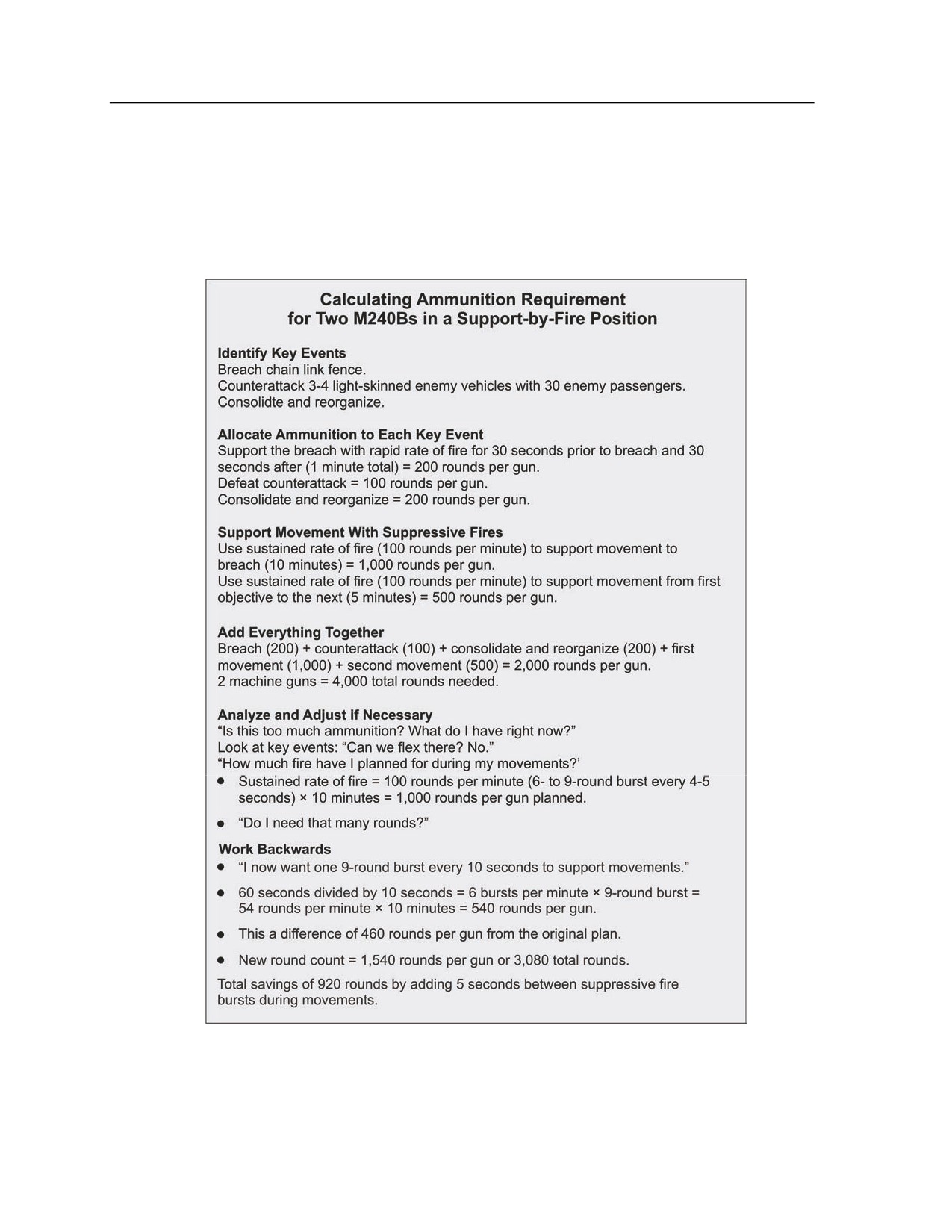
Appendix A
AMMUNITION REQUIREMENT
A-160. Leaders must calculate the number of rounds needed to support every machine gun throughout all
phases of the operation. Ammunition must be allocated for each key event and to support movement with
suppressive fires. For example, in the following list, key events are given for a platoon using two M240Bs
in a support-by-fire position. Figure A-20 illustrates steps the leader must take to accurately estimate the
ammunition required.
Figure A-20. Example of ammunition requirement calculation.
A-34
FM 3-21.8
28 March 2007
Appendix B
Shoulder-Launched Munitions and
Close Combat Missile Systems
Shoulder-launched munitions (SLM) and Close Combat Missile Systems (CCMS) are
employed by the Infantry platoon to destroy enemy field fortifications or disable
enemy vehicles at ranges from 15 to 3,750 meters. They can engage targets in assault,
support-by-fire, and defensive roles, and are the Infantry platoon’s highest casualty-
producing organic weapons when used against armored enemy vehicles. This
appendix addresses SLM and CCMS use by the Infantry platoon and discusses their
capabilities and limitations.
SECTION I — MUNITIONS
B-1. SLM and CCMS are used against field fortifications, enemy vehicles, or other similar enemy targets.
SLM are issued to Infantry Soldiers as rounds of ammunition in addition to their assigned weapons. While
Javelins are organic to the Infantry weapons squad, tube-launched, optically-tracked, wire-guided (TOW)
missile weapon systems are found in the assault platoons in the Infantry battalion’s weapon company. This
section discusses the specific types of SLM and CCMS the Infantry platoon or squad will employ. Section
II discusses their employment considerations. Section III discusses safety. For complete information read
FM 3-23.25, Shoulder Launched Munitions; FM 3-22.37, Javelin Medium Antiarmor Weapon System; FM
3-22.34, Tow Weapon System; and FM 3-22.32, Improved Target Acquisition System, M41.
SHOULDER-LAUNCHED MUNITIONS
B-2. SLM include the M136 AT4; the M72A3 light antiarmor weapon (LAW) and improved M72A7
LAW; and the XM141 bunker defeat munition (BDM). The XM141 has also been referred to as the
shoulder-launched multipurpose assault weapon-disposable
(SMAW-D). Table B-1 lists select SLM
specifications.
B-3. All SLM are lightweight, self-contained, single-shot, disposable weapons that consist of unguided
free flight, fin-stabilized, rocket-type cartridges packed in expendable, telescoping launchers (except the
AT4 which does not telescope) that also serve as storage containers. The only requirement for their care is a
visual inspection. SLM can withstand extreme weather and environmental conditions, including arctic,
tropical, and desert climates.
B-4. SLM increase the lethality and survivability of the Infantry Soldier and provide him a direct fire
capability to defeat enemy personnel within armored platforms. BDM provides the Soldier a direct fire
capability to defeat enemy personnel located within field fortifications, bunkers, caves, masonry structures,
and lightly armed vehicles and to suppress enemy personnel in lightly armored vehicles.
B-5. The individual Soldier will use SLM to engage threat combatants at very close ranges—across the
street or from one building to another. The Soldier may employ SLM as a member of a support- by-fire
element to incapacitate threat forces that threaten the assault element. When the assault element clears a
building, the leader may reposition the SLM gunner inside to engage a potential counterattack force.
28 March 2007
FM 3-21.8
B-1

Appendix B
Table B-1. Shoulder-launched munitions.
SHOULDER-
M136 AT4
M72A3 LAW
M72A7
XM141 BDM
LAUNCHED
IMPROVED LAW
(SMAW-D)
MUNITION
FIELD MANUAL
FM 3-23.25
FM 3-23.25
FM 3-23.25
FM 3-23.25
CARRY WEIGHT
14.8 lbs
5.5 lbs
8.0 lbs
15.7 lbs
6.7 kg
2.5 kg
3.6 kg
7.2 kg
LENGTH:
CARRY
102.0 cm
67 cm
75.5 cm
79.2 cm
EXTENDED
N/A
100 cm
98 cm
137.1 cm
CALIBER
84-mm
66-mm
60-mm
83-mm
MUZZLE
290 m/s
144.8 m/s
200 m/s
217 m/s
VELOCITY
950 f/s
475 f/s
656 f/s
712 f/s
OPERATING
-40° to 60° C
-40° to 60° C
-40° to 60° C
-32° to 49° C
TEMPERATURE
-40° to 140° F
-40° to 140° F
-40° to 140° F
-20° to 120° F
MAXIMUM
300 m
Stationary
220 m
500 m
EFFECTIVE
200 m
RANGE
Moving
165 m
MAXIMUM
2,100 m
1,000 m
1,400 m
2,000 m
RANGE
MINIMUM
10 m
10 m
25 m
15 m
ARMING RANGE
M136 AT4
B-6. The M136 AT4 is a lightweight, self-contained, SLM designed for use against the improved armor of
light armored vehicles. It provides lethal fire against light armored vehicles, and has some effect on most
enemy field fortifications.
Ammunition
B-7. The AT4 is a round of ammunition with an integral, rocket-type cartridge. The cartridge consists of a
fin assembly with tracer element; a point detonating fuze; and a high-explosive antitank (HEAT) warhead
(Figure B-1).
B-2
FM 3-21.8
28 March 2007
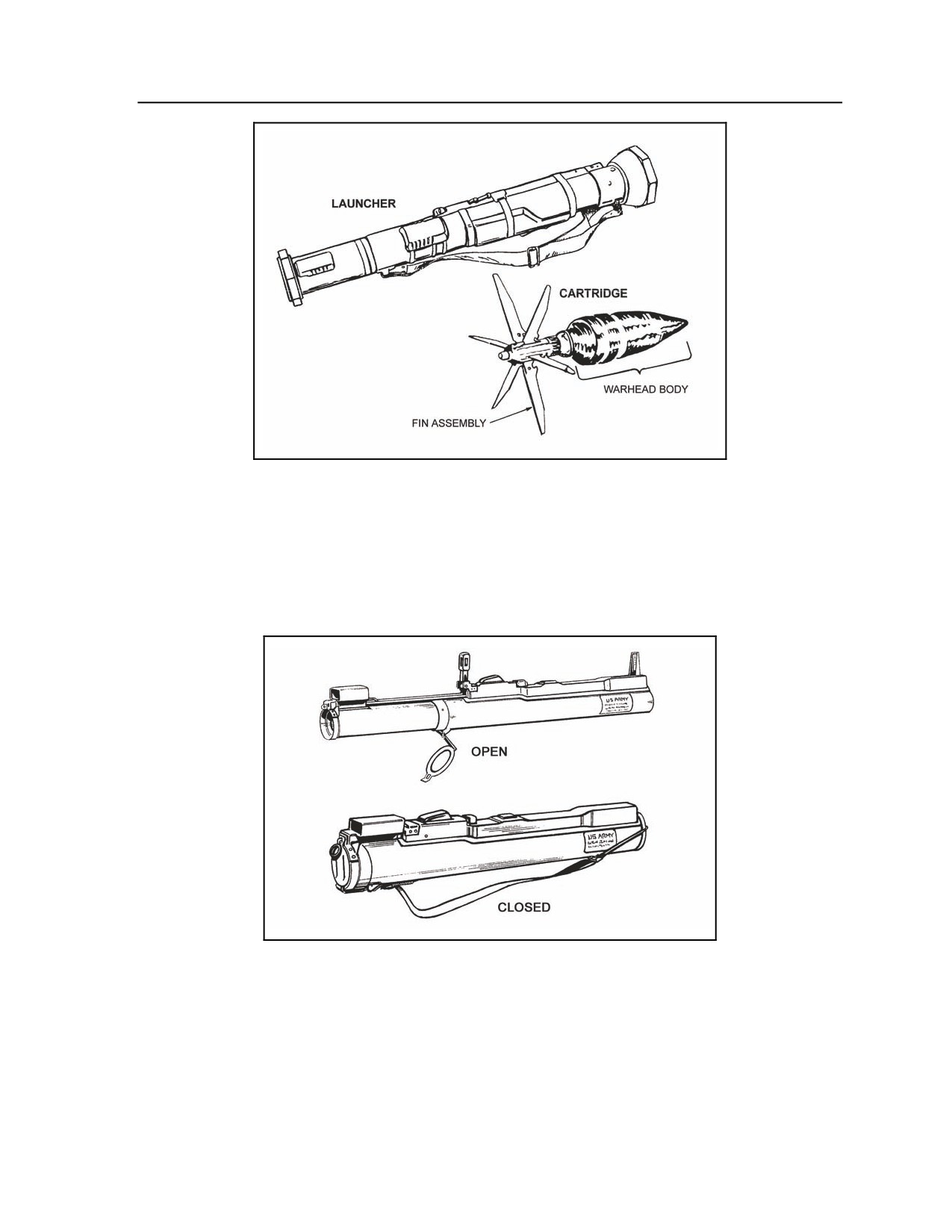
Shoulder-Launched Munitions and Close Combat Missile Systems
Figure B-1. M136 AT4 launcher and HEAT cartridge.
M72-SERIES LIGHT ANTITANK WEAPON (LAW)
B-8. The M72 LAWs used by Infantry platoons today are the M72A3 and M72A7. They are lightweight
and self-contained SLM consisting of a rocket packed in a launcher (Figure B-2). They are man-portable,
and may be fired from either shoulder. The launcher, which consists of two tubes, one inside the other,
serves as a watertight packing container for the rocket and houses a percussion-type firing mechanism that
activates the rocket.
Figure B-2. M72A3 LAW.
M72A3
B-9. The M72A3 contains a nonadjustable propelling charge and a 66-mm rocket. Every M72A3 has an
integral HEAT warhead in the rocket’s head (or body) section (Figure B-3). Although the M72A3 is mainly
employed as an antiarmor weapon, it may be used with limited success against secondary targets such as
gun emplacements, pillboxes, buildings, or light vehicles.
28 March 2007
FM 3-21.8
B-3
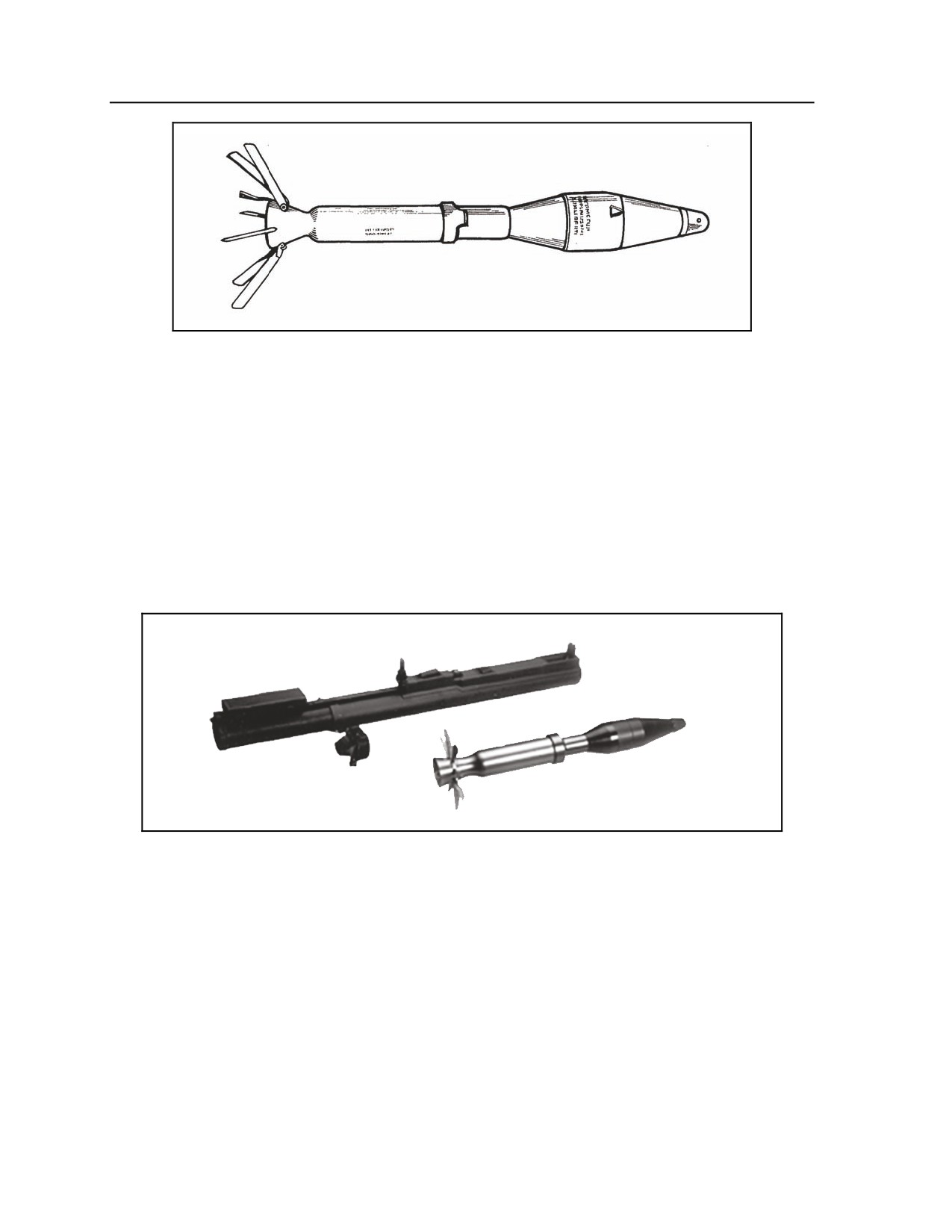
Appendix B
Figure B-3. M72A3 LAW 66-mm high-explosive antiarmor rocket.
Improved M72A7 LAW
B-10. The M72A7 is the Improved LAW currently employed by Infantry platoons. It is a compact,
lightweight, single-shot, disposable weapon optimized to defeat lightly armored vehicles at close combat
ranges (Figure B-4). The M72A7 offers enhanced capabilities beyond that of the original M72-series. The
Improved M72 consists of a 60mm unguided rocket prepackaged at the factory in a telescoping, throw
away launcher. The system performance improvements include a higher velocity rocket motor that extends
the weapon effective range, increased lethality warhead, lower and more consistent trigger release force,
rifle-type sight system, and better overall system reliability and safety. The weapon contains a 60-mm
rocket and an integral HEAT warhead. The warhead is designed to penetrate
150 millimeters of
homogenous armor and is optimized for maximum fragmentation behind light armor, Infantry fighting
vehicle(s) (IFV), and urban walls.
Figure B-4. Improved M72A7 LAW with rocket.
XM141 BUNKER DEFEAT MUNITION (SMAW-D)
B-11. The XM141 BDM was developed to defeat enemy bunkers and field fortifications (Figure B-5). The
XM141 is a disposable, lightweight, self-contained, man-portable, shoulder-fired, high explosive
multipurpose munition.
B-4
FM 3-21.8
28 March 2007
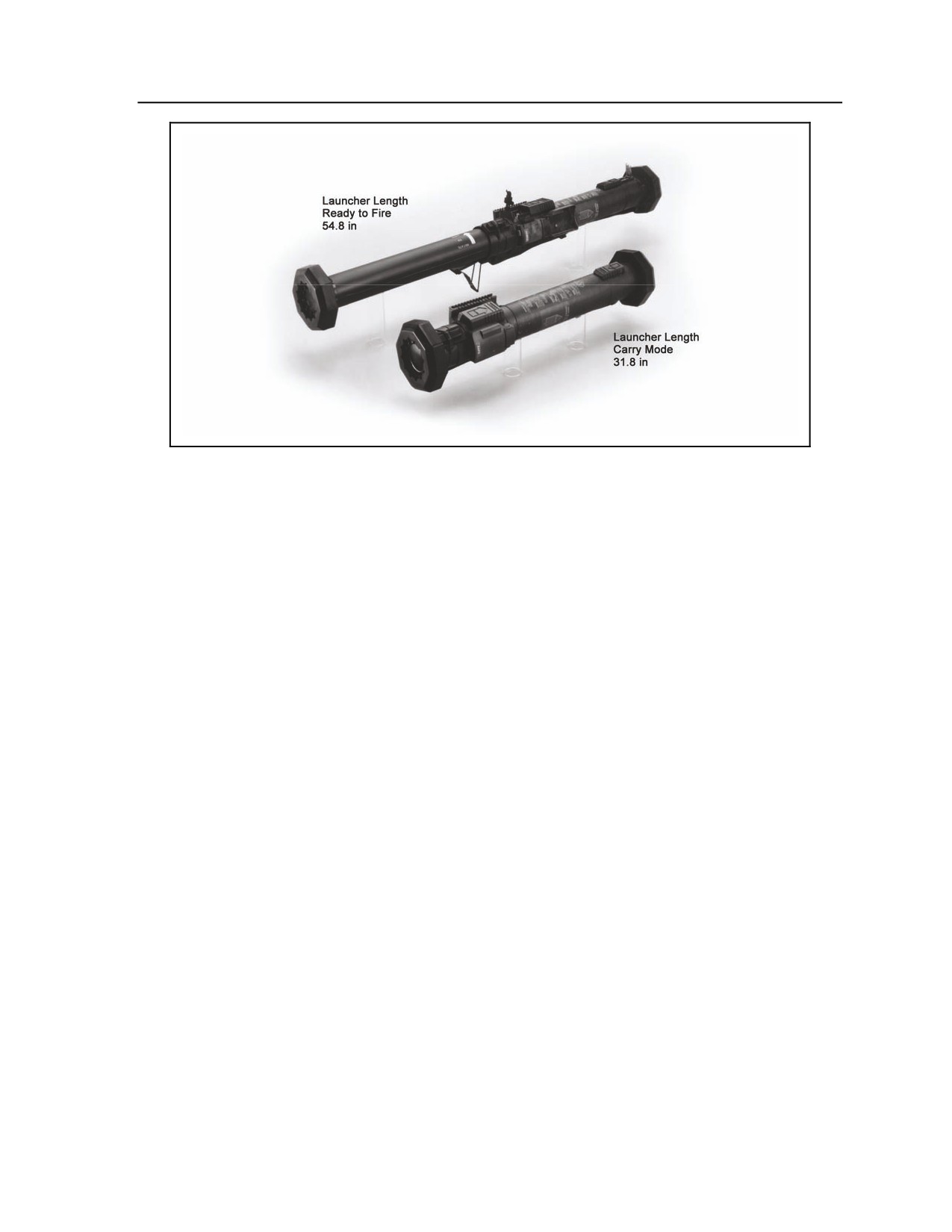
Shoulder-Launched Munitions and Close Combat Missile Systems
Figure B-5. XM141 bunker defeat munition.
Ammunition
B-12. The XM141 utilizes the 83-mm high explosive dual purpose (HEDP) assault rocket (Figure B-6).
The 83-mm HEDP assault rocket warhead consists of a dual mode fuze, and 2.38 pounds of A-3 explosive.
B-13. Warhead function, in quick or delay mode, is automatically determined by the fuze when the rocket
impacts a target. The XM141 is fired at hard or soft targets without any selection steps required by the
gunner. This automatic feature assures that the most effective kill mechanism is employed. Warhead
detonation is instantaneous when impacting a hard target, such as a brick or concrete wall or an armored
vehicle. Impact with a softer target, such as a sandbagged bunker, results in a fuze time delay that permits
the rocket to penetrate into the target before warhead detonation.
B-14. The XM141 BDM can destroy bunkers, but is not optimized to kill the enemy soldiers within
masonry structures in urban terrain or armored vehicles. The XM141 BDM can penetrate masonry walls,
but multiple rounds may be necessary to deliver sufficient lethality against enemy personnel behind the
walls.
B-15. The XM141 has been used with great success in destroying personnel and equipment in enemy
bunkers, field fortifications, and caves in recent operations.
28 March 2007
FM 3-21.8
B-5
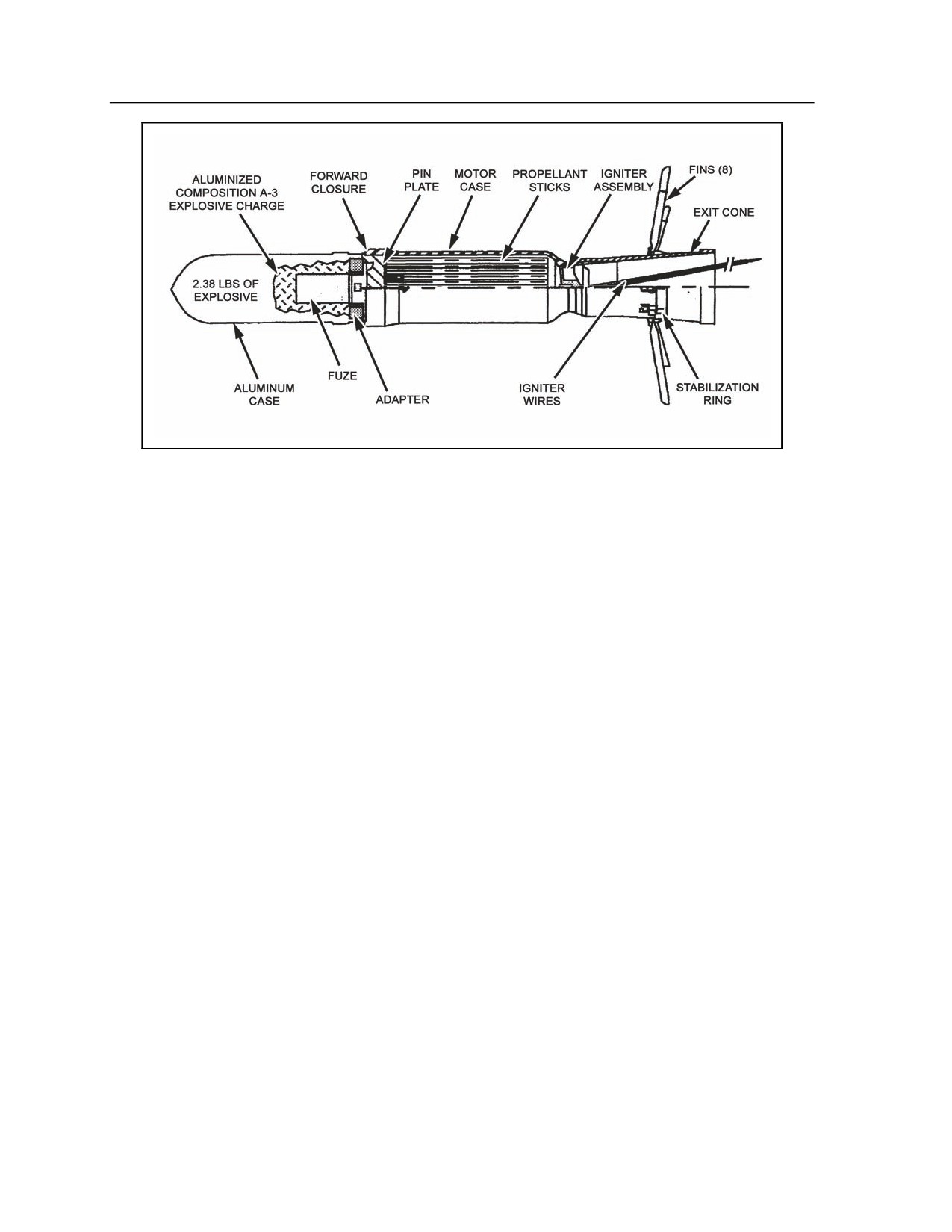
Appendix B
Figure B-6. XM141 high-explosive dual purpose assault rocket.
CLOSE COMBAT MISSILE SYSTEMS
B-16. CCMS are used primarily to defeat main battle tanks and other armored combat vehicles. In the
current force, this category of weapons includes the TOW and the Javelin. The TOW and Javelin provide
overmatch antitank fires during the assault and provide extended range capability for engaging armor
during both offense and defense. These systems have a moderate capability against bunkers, buildings, and
other fortified targets commonly found during combat in urban areas. The TOW’s bunker buster round is
capable of destroying the majority of urban targets.
JAVELIN
B-17. The Javelin is a fire-and-forget, shoulder-fired, man-portable CCMS that consists of a reusable
M98A1 command launch unit (CLU) and a round (Figure B-7). The CLU houses the daysight, night vision
sight (NVS), controls, and indicators. The round consists of the missile, the launch tube assembly (LTA),
and the battery coolant unit (BCU). The LTA serves as the launch platform and carrying container for the
missile. See FM 3-22.37 for complete information regarding the Javelin’s technical specifications, care,
maintenance, operation, gunnery skills training, training aids, and safety.
B-18. The Javelin CCMS’ primary role is to destroy enemy armored vehicles out to 2,000 meters. The
Javelin can be employed in a secondary role of providing fire support against point targets such as bunkers
and crew-served weapons positions. In addition, the Javelin CLU can be used alone as an aided vision
device for reconnaissance, security operations, and surveillance. When Bradley fighting vehicles are part of
a combined-arms team, the Javelin becomes a secondary antiarmor weapons system. It supports the fires of
tanks and TOWs, covers secondary armor avenues of approach, and provides observation posts with an
antiarmor capability. The Javelin gunner should be able to engage up to three targets in two minutes,
making him very effective against any armor threat.
B-6
FM 3-21.8
28 March 2007
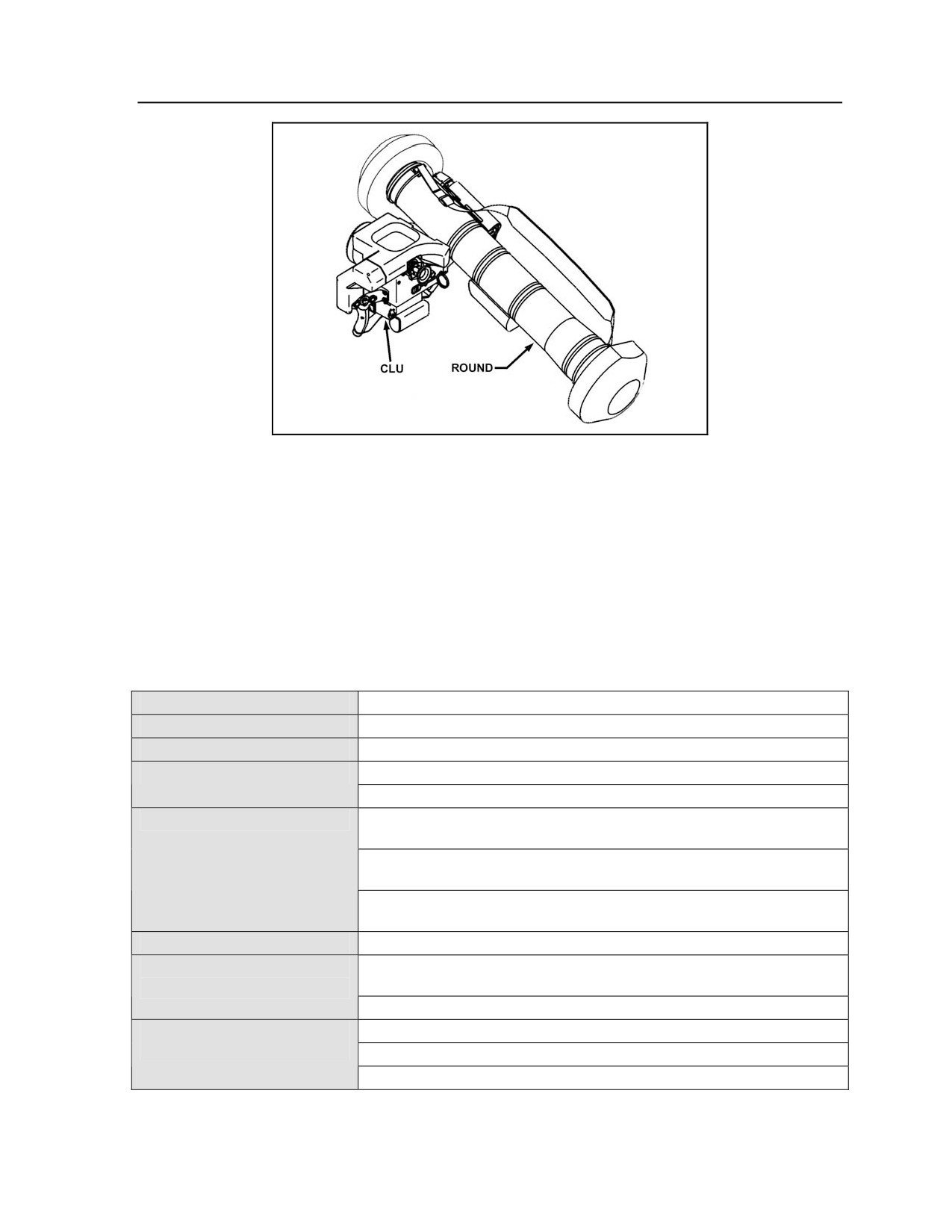
Shoulder-Launched Munitions and Close Combat Missile Systems
Figure B-7. Javelin close combat missile system.
Command Launch Unit
B-19. The M98A1 CLU is the reusable portion of the Javelin system. It contains the controls and
indicators. The CLU provides further utility to the Infantry platoon by allowing accurate surveillance out to
two kilometers in both day and night. CLUs have been used to spot and destroy enemy snipers in hidden
positions over 1,000 meters away.
B-20. Tables B-2 through B-4 list the Javelin's capabilities and features, the physical characteristics of the
CLU, and the physical characteristics of the round.
Table B-2. Javelin capabilities and features.
Javelin Missile System
Surface attack guided missile and M98A1 command launch unit
Type of System
Fire and forget
Crew
One- to three-Soldier teams based on TO&E
Missile modes
Top attack (default)
Direct attack
Ranges
Top attack mode minimum effective engagement:
150 meters
Direct attack mode minimum effective engagement range:
65 meters
Maximum effective engagement range (direct attack and top attack
modes): 2,000 meters
Flight Time
About 14 seconds at 2,000 meters
Backblast Area
Primary danger zone extends out 25 meters at a 60-degree (cone-
shaped) angle
Caution zone extends the cone-shaped area out to 100 meters
Firing From Inside
Minimum room length: 15 feet
Enclosures
Minimum room width: 12 feet
Minimum room height: 7 feet
28 March 2007
FM 3-21.8
B-7

Appendix B
Table B-3. Physical characteristics of the command launch unit.
M98A1
With battery, carrying bag, and cleaning kit
Command
Weight: 14.16 lb. (6.42 kg)
Launch Unit
Length: 13.71 in (34.82 cm)
Height: 13.34 in (33.88 cm)
Width: 19.65 in (49.91 cm)
Sights
Daysight
Magnification: 4X
Field-of-view (FOV): 4.80° x 6.40°
Night Vision Sight
Wide field-of-view (WFOV) magnification: 4.2X
WFOV: 4.58° x 6.11°
Narrow field-of-view (NFOV) magnification: 9.2X
NFOV: 2.00° x 3.00° (approximately)
Battery Type
Lithium Sulfur Dioxide (LiSO2) BA-5590/U
(Nonrechargeable)
Number required: 1
NSN: 6135-01-036-3495
Weight: 2.2 lbs. (1.00 kg)
Life:
4.0 hrs below 120°F (49°C)
3.0 hrs between 50°F to 120°F (10°C to 49°C)
1.0 hrs between -20°F to 50°F (-49°C to 10°C)
0.5 hrs above 120°F (49°C)
Table B-4. Physical characteristics of the round.
Complete Round
Weight: 35.14 lb. (15.97 kg)
(Launch tube
Length: 47.60 in (120.90 cm)
assembly with missile
Diameter with end caps: 11.75 in (29.85 cm)
and BCU)
Inside diameter: 5.52 in (14.00 cm)
Battery Coolant Unit
Weight: 2.91 lb. (1.32 kg)
Length: 8.16 in (20.73 cm)
Width: 4.63 in (11.75 cm)
Battery type: lithium, nonrechargeable
Battery life: 4 min of BCU time
Battery coolant gas: argon
Missile
B-21. The
Javelin missile consists of the guidance section, the mid-body section, the warhead, the
propulsion section, and the control actuator section. A discussion of the guidance section and warhead
follows.
B-8
FM 3-21.8
28 March 2007
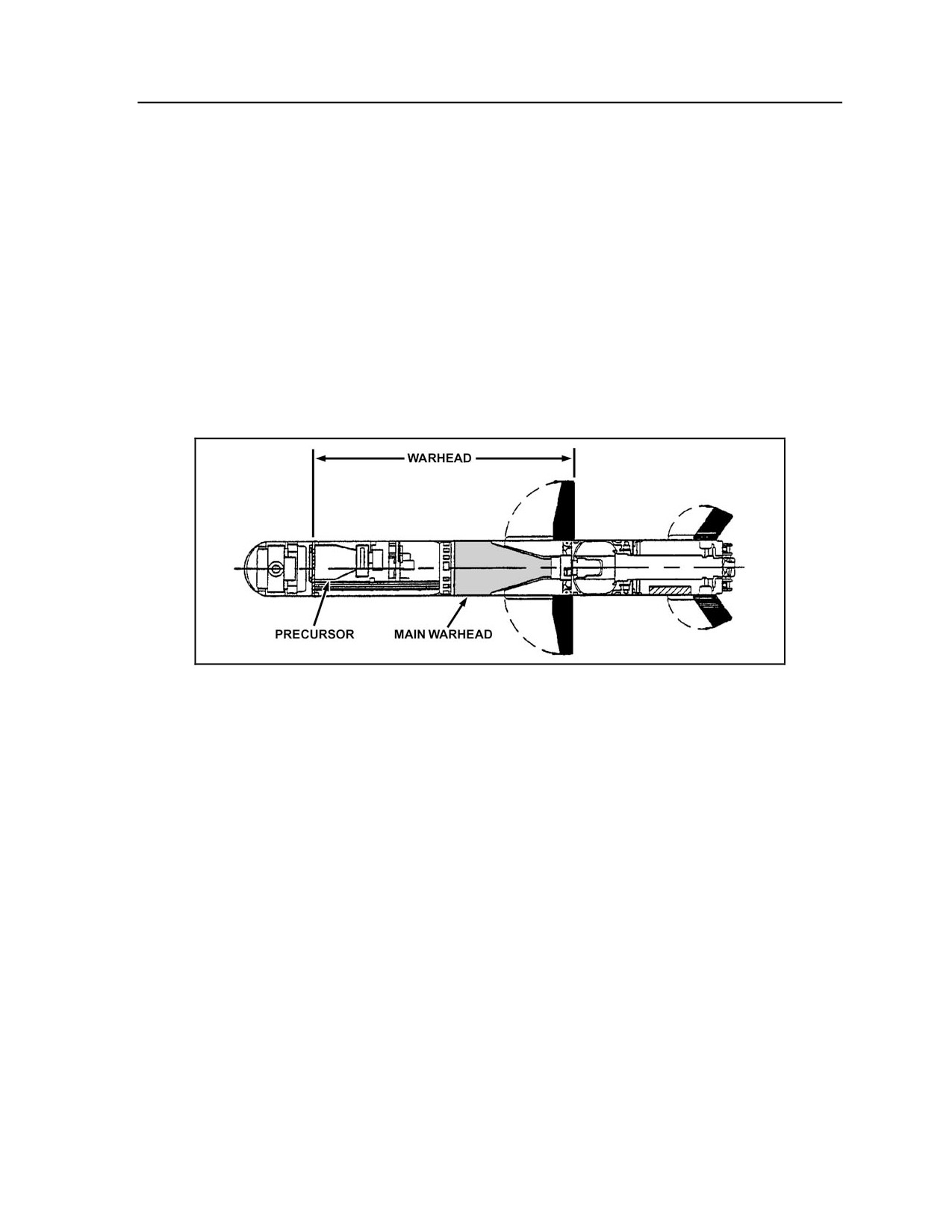
Shoulder-Launched Munitions and Close Combat Missile Systems
Guidance Section
B-22. The guidance section provides target tracking and flight control signals. It is the forward section of
the missile and includes the seeker head section and the guidance electronics unit.
Warhead Section
B-23. The Javelin missile uses a dual charged warhead (Figure B-8) that contains a precursor charge and
main charge.
Precursor Charge. The precursor charge is an HE antitank shaped charge. Its purpose is to cause
reactive armor on the target to detonate before the main charge reaches the armor. Once the reactive
armor is penetrated, the target’s main hull is exposed to the warhead’s main charge. If the target is not
equipped with reactive armor, the precursor provides additional explosives to penetrate the main
armor.
Main Charge. The main charge is the second charge of a dual-charge warhead and is also an HE
antitank shaped charge. The primary warhead charge is designed to penetrate the target’s main armor
to achieve a target kill.
Figure B-8. Javelin missile warhead.
Capabilities and Limitations
B-24. The Javelin has some unique capabilities that provide the unit with an effective antiarmor weapon
system. However, the Infantry leader should also understand the system's limitations in order to effectively
employ this system (Table B-5).
28 March 2007
FM 3-21.8
B-9

Appendix B
Table B-5. Javelin capabilities and limitations.
Capabilities
Limitations
Firepower
• Maximum effective range is 2,000
• CLU sight cannot discriminate targets past 2,000
meters.
meters.
• Fire-and-forget capability. Missile
• NVS cool-down time is from 2.5 to 3.5 minutes.
imaging infrared (I2R) system gives
• Seeker’s cool-down time is about 10 seconds.
missile ability to guide itself to the target
• BCU life, once activated, is only about 4 minutes.
when launched by the gunner.
• FOV can be rendered useless during limited
• Two missile flight paths:
visibility conditions (rain, snow, sleet, fog, haze,
Top attack - impacts on top of
smoke, dust, and night). Visibility is limited by the
target.
following:
Direct attack - impacts on front, rear,
Day FOV relies on daylight to provide the
or flank of target.
gunner a suitable target image; limited
• Gunner can fire up to three missiles
visibility conditions may block sun.
within 2 minutes.
NVS uses the infrared naturally emitted from
• Dual-shaped charge warhead can
objects. Infrared crossover is the time at both
defeat any known enemy armor.
dawn and dusk that terrain and targets are
close enough in temperature to cause
• NVS sees little degradation of target
image.
targets to blend in with their surroundings.
Natural clutter occurs when the sun heats
• Countermeasures used by enemy are
objects to a temperature close enough to
countered by the NVS filter.
surrounding terrain that it causes a target to
blend in with terrain.
Artificial clutter occurs when there are man-
made objects that emit large amounts of
infrared (for example, burning vehicles).
Heavy fog reduces the capability of the
gunner to detect and engage targets.
• Flight path of missile is restricted in wooded,
mountainous, and urban terrain.
• Gunner must have line of sight for the seeker to
lock onto a target.
Maneuver
• Man-portable.
• Weight of Javelin makes maneuvering slow over
long distances.
• Fire-and-forget capability allows gunner
to shoot and move before missile
• The Javelin round is bulky and restricts
impact.
movement in heavily-wooded or vegetative
terrain.
• Soft launch capability allows it to be
fired from inside buildings and bunkers.
• Maneuverable over short distances for
the gunners.
Protection
• Passive infrared targeting system used
• Gunner must partially expose himself to engage
to acquire lock-on cannot be detected.
the enemy.
• Launch motor produces a small
• CLU requires a line of sight to acquire targets.
signature.
• Fire-and-forget feature allows gunner to
take cover immediately after missile is
launched.
TUBE-LAUNCHED, OPTICALLY-TRACKED, WIRE-GUIDED (TOW) MISSILE WEAPON SYSTEM
B-25. The Infantry TOW weapon system consists of the Improved Target Acquisition System (ITAS)
launcher, which has tracking and control capabilities, and the missile, which is encased in a launch
container. The launcher is equipped with self-contained, replaceable units.
B-10
FM 3-21.8
28 March 2007
Shoulder-Launched Munitions and Close Combat Missile Systems
B-26. The TOW is designed to destroy enemy tanks, fortifications, and other materiel targets. Its line-of
sight launcher initiates, tracks, and controls the missile’s flight through command-link wire-transmitted
guidance signals. It can be employed in all weather conditions as long as the gunner can see the target
through the ITAS. The TOW also provides a long-range assault capability against heavily fortified bunkers,
pillboxes, and gun emplacements.
B-27. The current versions of the TOW missile can destroy targets at a minimum range of 65 meters and a
maximum range of 3,750 meters. The TOW 2B missile can destroy targets at a minimum range of 200
meters and a maximum range of 3,750 meters. TOW missiles in development are being produced to
effectively engage enemy targets out to 4,500 meters.
Missile System Configurations and Types
B-28. The TOW CCMS consists of multiple configurations with numerous types of missiles. These
configurations mainly consist of minor modified work orders that are transparent to the operator and are
continually updated. All configurations use the same basic airframe, aerodynamic control system,
command-link wire, and missile electronics designs. The current missile types are listed below.
Improved TOW. The ITOW missile has an improved 5-inch warhead from the original TOW
missile that includes extended probes for greater standoff and penetration. It can destroy targets
at a minimum range of 65 meters and a maximum range of 3,750 meters.
TOW 2. The TOW 2 missile has a full-caliber 6-inch warhead that includes an extended probe.
In addition to the infrared radiator of the ITOW missile, TOW 2 has a second infrared radiator to
provide hardened system performance against battlefield obscurants and countermeasures. The
second radiator is called the thermal beacon and provides link compatibility with the electro
optical infrared nightsight, which is part of the TOW 2 launcher system.
TOW 2A. The TOW 2A adds a small explosive charge in the tip of the extended probe that
causes enemy reactive armor to detonate prematurely, thus allowing the TOW 2A’s warhead to
penetrate the main armor.
TOW 2B. The TOW 2B has an entirely different warhead and kill mechanism than the previous
TOW missiles. It is a top-attack missile (fly over/shoot down) that defeats enemy armor at its
most vulnerable point⎯the top deck of the turret and hull. The TOW 2B has a tandem warhead
that fires two explosively formed projectiles down through the thin upper deck armor of the
enemy vehicle. The gunner tracks the target the same as any other TOW missile with the
crosshairs on center mass, but the missile automatically flies 2.25 meters above the line of sight
(LOS). When the missile senses that it is directly above the target (by means of the target’s
shape and magnetic field), it automatically fires its warhead. The TOW 2B missile can destroy
targets at a minimum range of 288 meters when fired from the ground mount and 200 meters
when fired from the HMMWV or BFV. The TOW 2B has a maximum range of 3,750 meters
whether ground- or vehicle-mounted.
TOW 2B GEN 1. The TOW 2B GEN 1 is similar to the TOW 2B but includes the addition of
the GEN 1 Counter Active Protection System (CAPS), which is used to defeat enemy active
protection systems.
TOW 2B Aero. The TOW 2B Aero is an extended range version of the TOW 2B missile with
an aerodynamic nose and has an effective range of 4,500 meters (Figure B-9). This longer range
(compared to the 3,750 meter range of the previous TOW missiles) allows a TOW crew to fire
well beyond the weapons range of its targeted vehicle.
TOW 2B Aero With GEN 1, 2, and 3A CAPS. These versions of TOW 2B Aero have the
addition of different generations of CAPS to defeat an enemy target’s active protection system,
allowing the TOW 2B missile to successfully engage any armored vehicle up to 4,500 meters
(Figure B-9).
TOW Bunker Buster. The TOW Bunker Buster (BB) replaces the TOW 2A warhead with a
fragmenting bulk charge for non-armor targets (Figure B-10). The TOW BB has a range of
3,750 meters. Its missile is capable of defeating bunkers, breaching masonry walls, and engaging
targets in support of urban operations.
28 March 2007
FM 3-21.8
B-11