FM 3-21.8 (FM 7-8) The Infantry Rifle Platoon and Squad (MARCH 2007) - page 8
Chapter 8
Establish triggers based on enemy movement rates.
Obtain accurate target locations using survey and navigational equipment.
Refine target locations to ensure coverage of obstacles.
Register artillery and mortars.
Plan FPF.
CONDUCT AN ENGAGEMENT AREA REHEARSAL
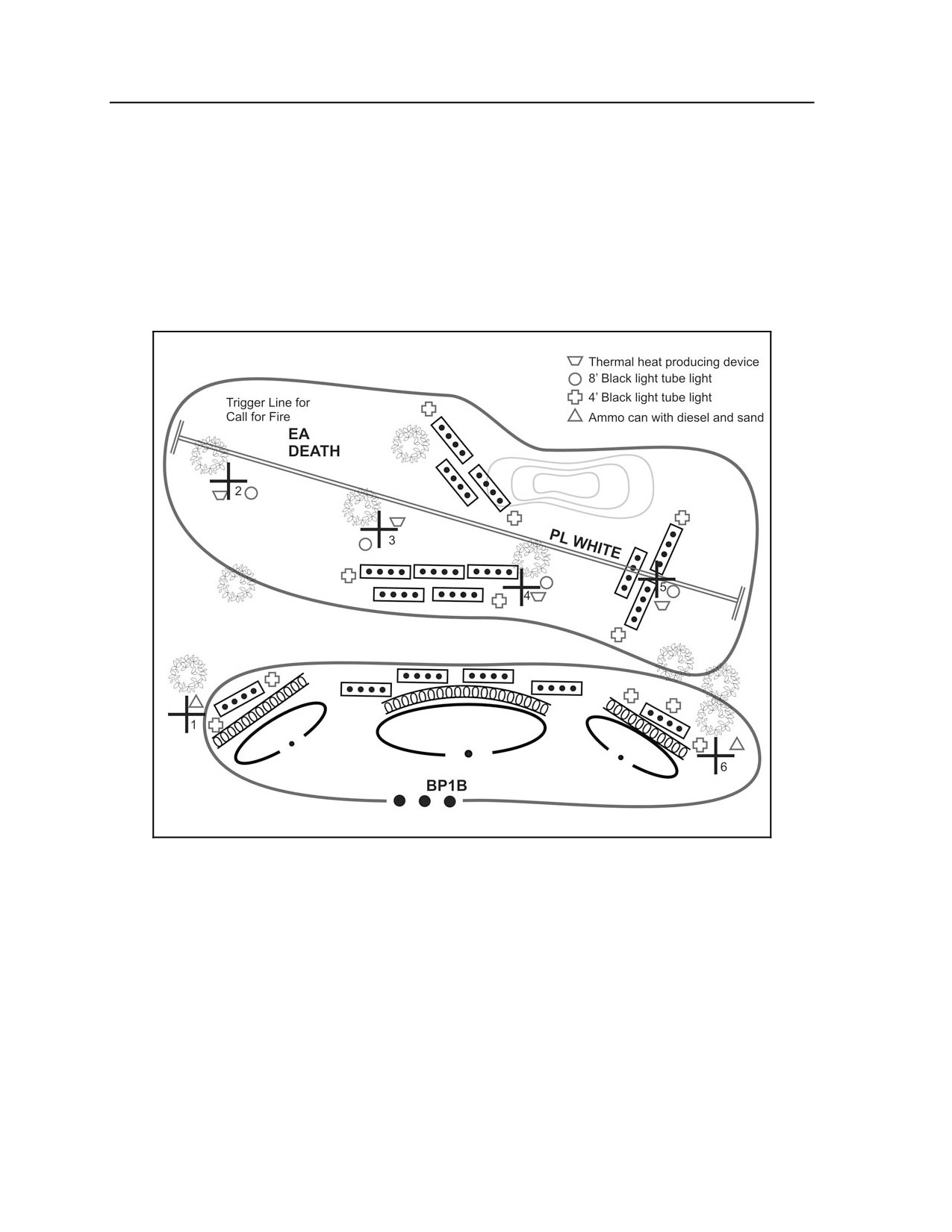
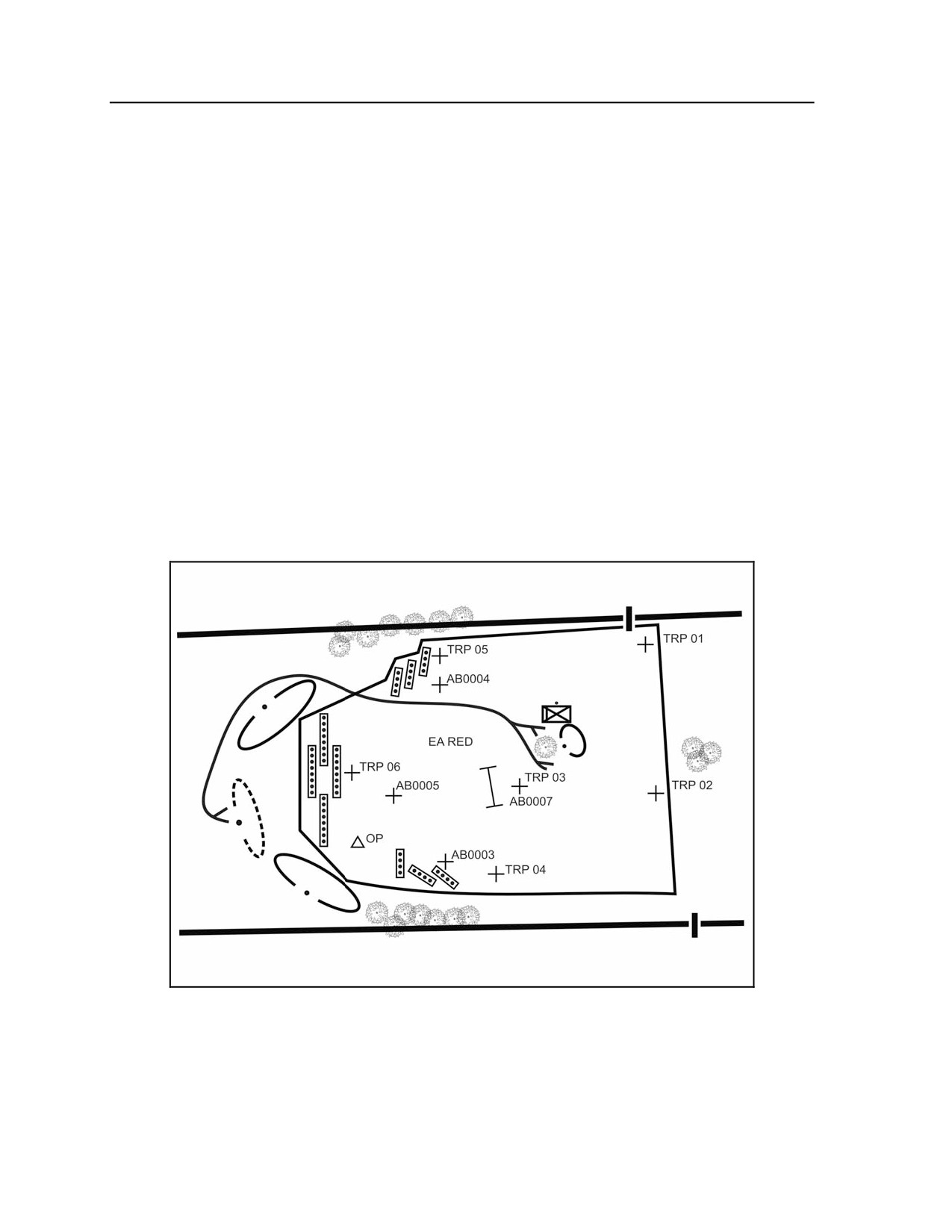
8-75. The purpose of rehearsal is to ensure that every leader and every Soldier understands the plan (Figure
8-7), and is prepared to cover his assigned areas with direct and indirect fires.
Figure 8-7. Integrated engagement area plan.
8-76. The platoon will probably participate in a company-level engagement area rehearsal. The company
commander has several options for conducting a rehearsal, but the combined arms rehearsal produces the
most detailed understanding of the plan. One technique the platoon leader may use for his rehearsal is the
full dress rehearsal. In the defense, the platoon leader may have the platoon sergeant and squads conduct a
movement through the engagement area to depict the attacking enemy force, while the platoon leader and
squad leaders rehearse the battle from the platoon defensive positions. The rehearsal should cover—
Rearward passage of security forces (as required).
Closure of lanes (as required).
Use of fire commands, triggers, and or maximum engagement lines (MELs) to initiate direct and
indirect fires.
Shifting of fires to refocus and redistribute fire effects.
Disengagement criteria.
8-18
FM 3-21.8
28 March 2007
Defensive Operations
Identification of displacement routes and times.
Preparation and transmission of critical reports.
Assessment of the effects of enemy weapons systems.
Displacement to alternate, supplementary, or subsequent defensive positions.
Cross-leveling or resupply of Class V items.
Evacuation of casualties.
NOTE: When conducting his rehearsal, the platoon leader should coordinate the platoon
rehearsal with the company to ensure other units’ rehearsals are not planned for the same time
and location. Coordination will lead to more efficient use of planning and preparation time for
all company units. It will also eliminate the danger of misidentification of friendly forces in the
rehearsal area.
SECTION V — OCCUPATION AND PREPARATION OF DEFENSIVE
POSITIONS
8-77. Occupation and preparation of defensive positions is conducted concurrently with the TLP and
engagement area development. The process is not sequential. The potential problem associated with this
process is the lack of adequate preparation time if the platoon has several other defensive positions
(alternate, supplementary, and subsequent) and engagement areas to develop.
OCCUPATION OF THE DEFENSE
8-78. The platoon occupies defensive positions IAW the platoon leader’s plan and the results of the
reconnaissance.
8-79. To ensure an effective and efficient occupation, rifle squads move to the locations marked previously
by the reconnaissance element. These positions may also be on the operational graphics. Once in position,
each squad leader checks his location on the map to ensure he is complying with the platoon leader’s
graphics. As the platoon occupies its positions, the platoon leader ensures that each squad locates IAW his
plan. If the platoon leader notes discrepancies between actual positioning of the squads and his plan, he
corrects it immediately.
8-80. Once each rifle squad has occupied its position, the platoon leader must walk the positions to ensure
that weapons orientation, positioning of the rifle squads, and understanding of the plan are IAW the pre
established plan. The platoon leader should not rely on updates from his subordinates. He should always
walk his defensive perimeter. For command and control purposes, each squad leader must know the
location of the platoon leader and the platoon sergeant.
8-81. Night vision equipment enhances the occupation process under limited visibility conditions. For
instance, the platoon leader can mark his position with an infrared light source and squad leaders can move
to premarked positions with infrared light sources showing them where to locate. Additionally, the squad
leaders can use AN/PAQ-4B/Cs or AN/PEQ-2As to point out sectors of fire and TRPs to their Soldiers,
using infrared light sources to keep the occupation clandestine.
8-82. The platoon may conduct a hasty occupation in the defense during a counterattack or after
disengagement and movement to alternate, supplementary, or subsequent defensive positions.
8-83. The platoon leader issues a FRAGO covering the following minimum information:
Changes in the enemy or friendly situation.
The platoon task and purpose (what the platoon must accomplish and why).
The task and purpose for each subordinate element.
The scheme of fires.
Coordinating instructions.
28 March 2007
FM 3-21.8
8-19
Chapter 8
8-84. At a minimum, the following actions must be taken:
The platoon approaches the defensive positions from the rear or flank.
The platoon establishes direct fire control measures or, if these are preplanned, reviews the plan.
The platoon leader reports, “Occupied” to the company commander.
8-85. The platoon conducts deliberate occupation of defensive positions when time is available, when
enemy contact is not expected, and when friendly elements are positioned forward in the sector to provide
security for forces in the main battle area. Actually establishing defensive positions is accomplished
concurrently with the development of the engagement area. The platoon leader directs the initial
reconnaissance from the engagement area and then tentatively emplaces crew-served weapon systems.
8-86. Once the defensive positions are established, subordinate leaders can begin to develop their sector
sketches and fire plans based on the basic fire plan developed during the leader’s reconnaissance. Fighting
positions are improved while the direct fire plan is finalized and proofed. The platoon leader, with guidance
from the company commander, designates the level of preparation for each defensive position based on the
time available and other tactical considerations for the mission. The three levels of defensive position
preparation (occupy, prepare, and reconnoiter) are listed here in descending order of thoroughness and time
required.
OCCUPY
8-87. Complete the preparation of the position from where the platoon will initially defend. The position is
fully reconnoitered, prepared, and occupied prior to the “defend not later than (NLT)” time specified in the
company order. The platoon must rehearse the occupation, and the platoon leader must establish a trigger
for occupation of the position.
PREPARE
8-88. The position and the corresponding engagement area will be fully reconnoitered. Squad positions in
the defensive positions and direct fire control measures in the engagement area should be marked.
Survivability positions may be dug, ammunition caches pre-positioned, and protective obstacles emplaced.
RECONNOITER
8-89. Both the engagement area and defensive positions will be fully reconnoitered. Tentative weapon
positions should be planned in the defensive positions, and direct fire control measures should be
established in the engagement area.
8-90. In addition to establishing the platoon’s primary defensive positions, the platoon leader and
subordinate leaders normally plan for preparation and occupation of alternate, supplementary, and
subsequent defensive positions. This is done IAW the company order. See Section II for characteristics of
alternate, supplementary, and subsequent defensive positions.
PRIORITY OF WORK
8-91. Leaders must ensure that Soldiers prepare for the defense quickly and efficiently. Work must be done
in order of priority to accomplish the most in the least amount of time while maintaining security and the
ability to respond to enemy action. Below are basic considerations for priorities of work.
Emplace local security (all leaders).
Position and assign sectors of fire for each squad (platoon leader).
Position and assign sectors of fire for the CCMS and medium machine gun teams (platoon
leader).
Position and assign sectors of fire for M249 MG, grenadiers, and riflemen (squad leaders).
Establish command post and wire communications.
Designate FPLs and FPFs.
Clear fields of fire and prepare range cards.
8-20
FM 3-21.8
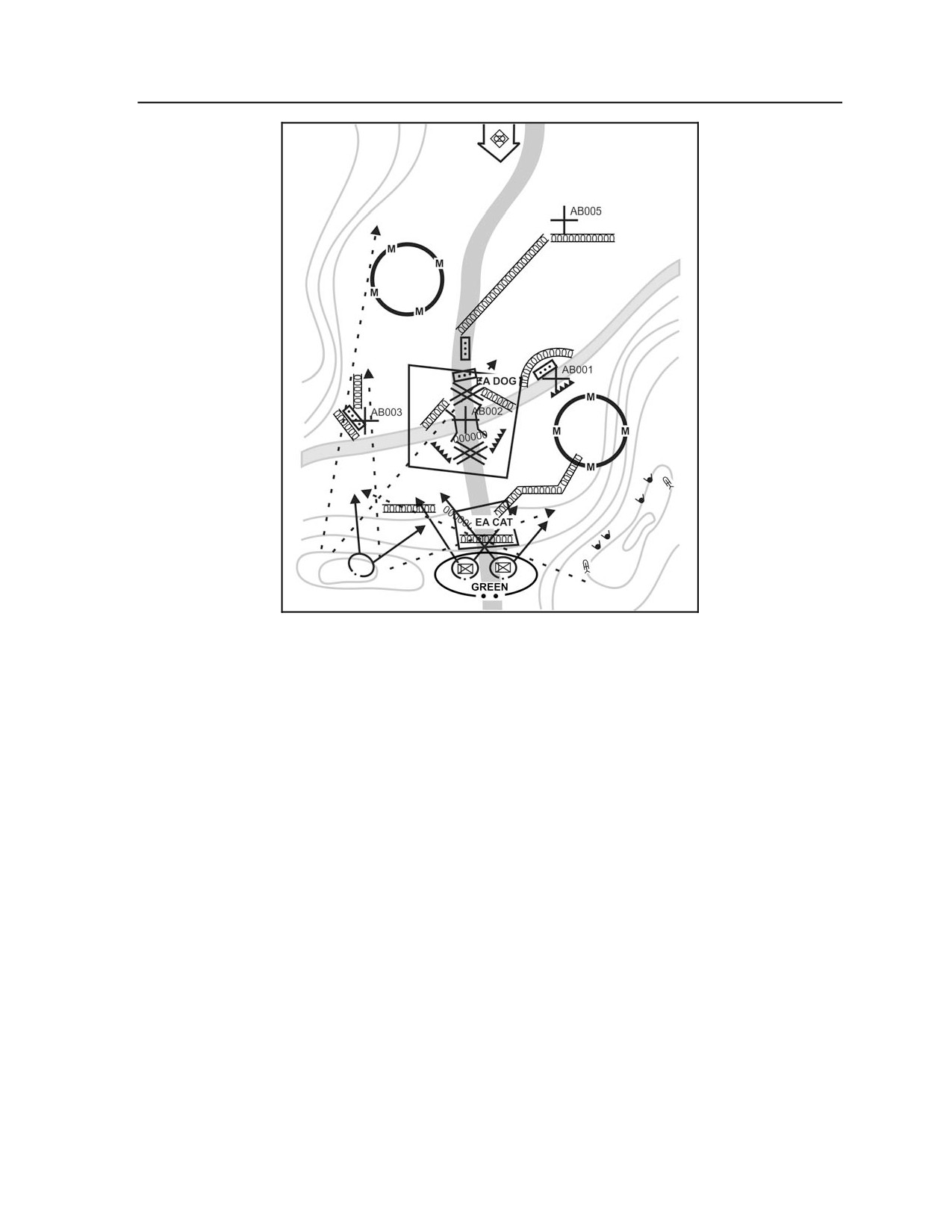
28 March 2007
Defensive Operations
Prepare sector sketches (leaders).
Dig fighting positions (stage 1 [see Section VII]).
Establish communication and coordination with the company and adjacent units.
Coordinate with adjacent units. Review sector sketches.
Emplace antitank and Claymore mines, then wire and other obstacles.
Mark or improve marking for TRPs and other fire control measures.
Improve primary fighting positions and add overhead cover (stage 2).
Prepare supplementary and then alternate positions (same procedure as the primary position).
Establish sleep and rest plans.
Distribute and stockpile ammunition, food, and water.
Dig trenches to connect positions.
Continue to improve positions—construct revetments, replace camouflage, and add to overhead
cover.
8-92. Unit priorities of work are normally found in SOPs. However, the commander will dictate the
priorities of work for the company based on the factors of METT-TC. Several actions may be accomplished
at the same time. Leaders must constantly supervise the preparation of fighting positions, both for tactical
usefulness and proper construction.
SECURITY IN THE DEFENSE
8-93. Security in the defense includes all active and passive measures taken to avoid detection by the
enemy, deceive the enemy, and deny enemy reconnaissance elements accurate information on friendly
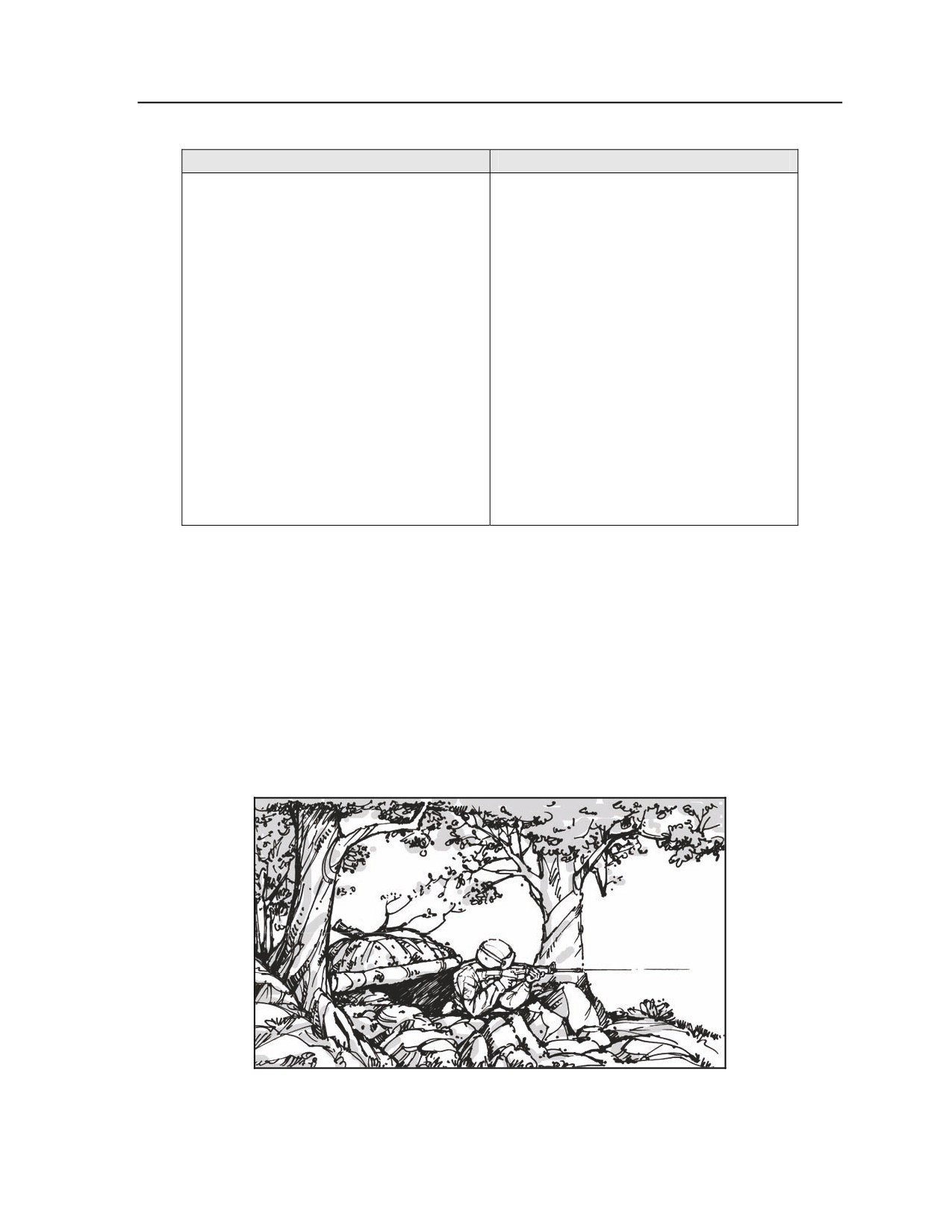
positions. The two primary tools available to the platoon leader are observation posts and patrols. In
planning for the security in the defense, the platoon leader considers the terrain in terms of OAKOC. He
uses his map to identify terrain that will protect the platoon from enemy observation and fires while
providing observation and fires into the engagement area. Additionally, he uses intelligence updates to
increase his situational understanding, reducing the possibility of the enemy striking at a time or in a place
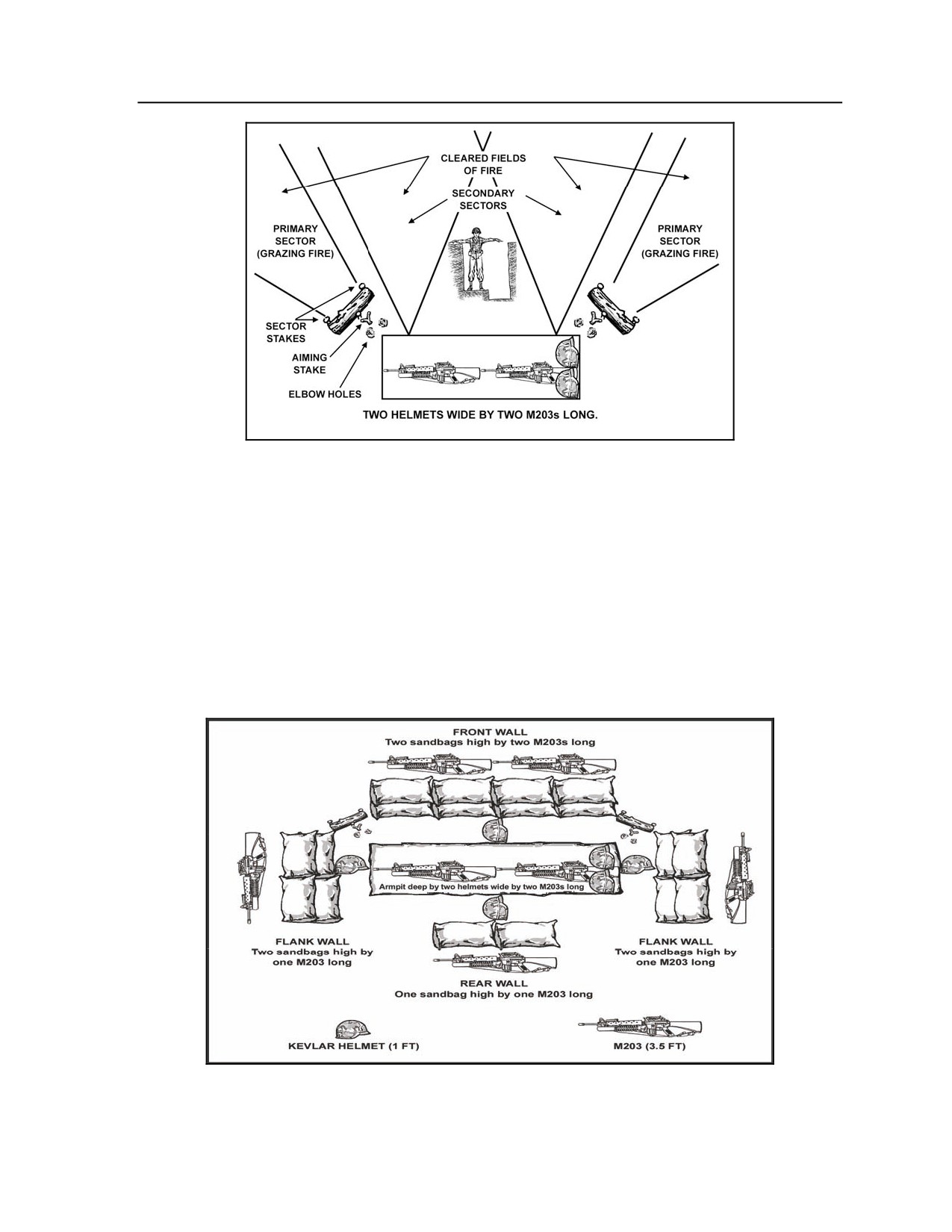
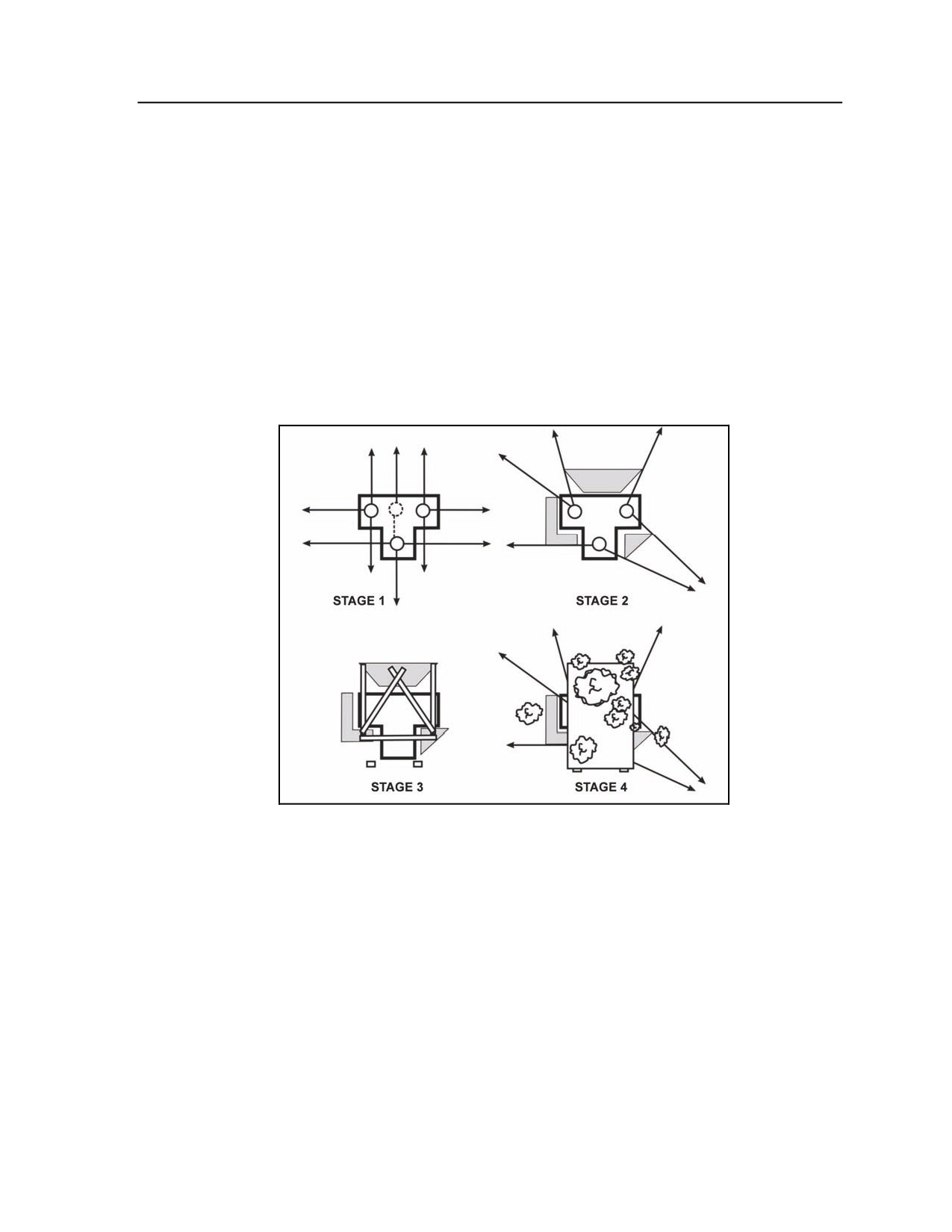
for which the platoon is unprepared.
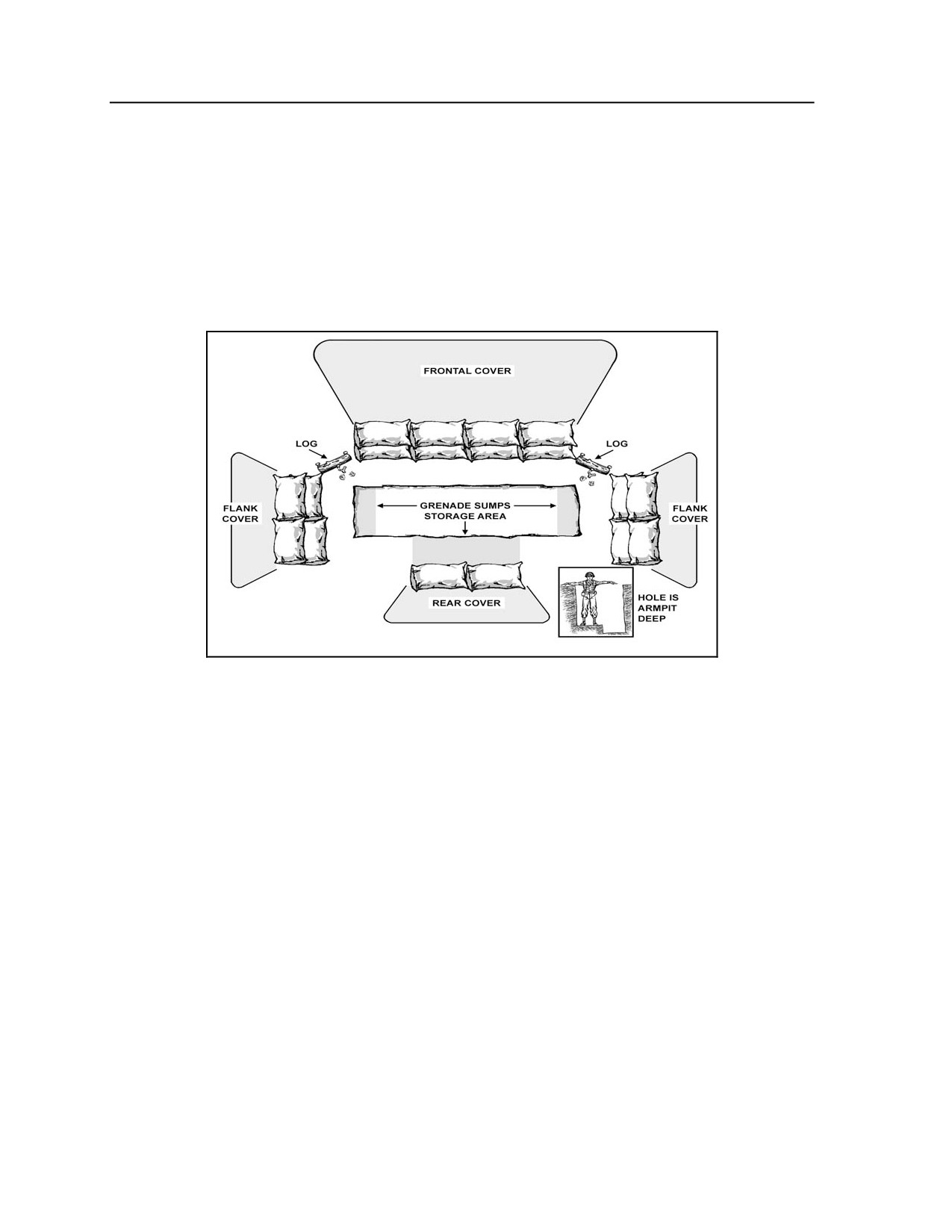
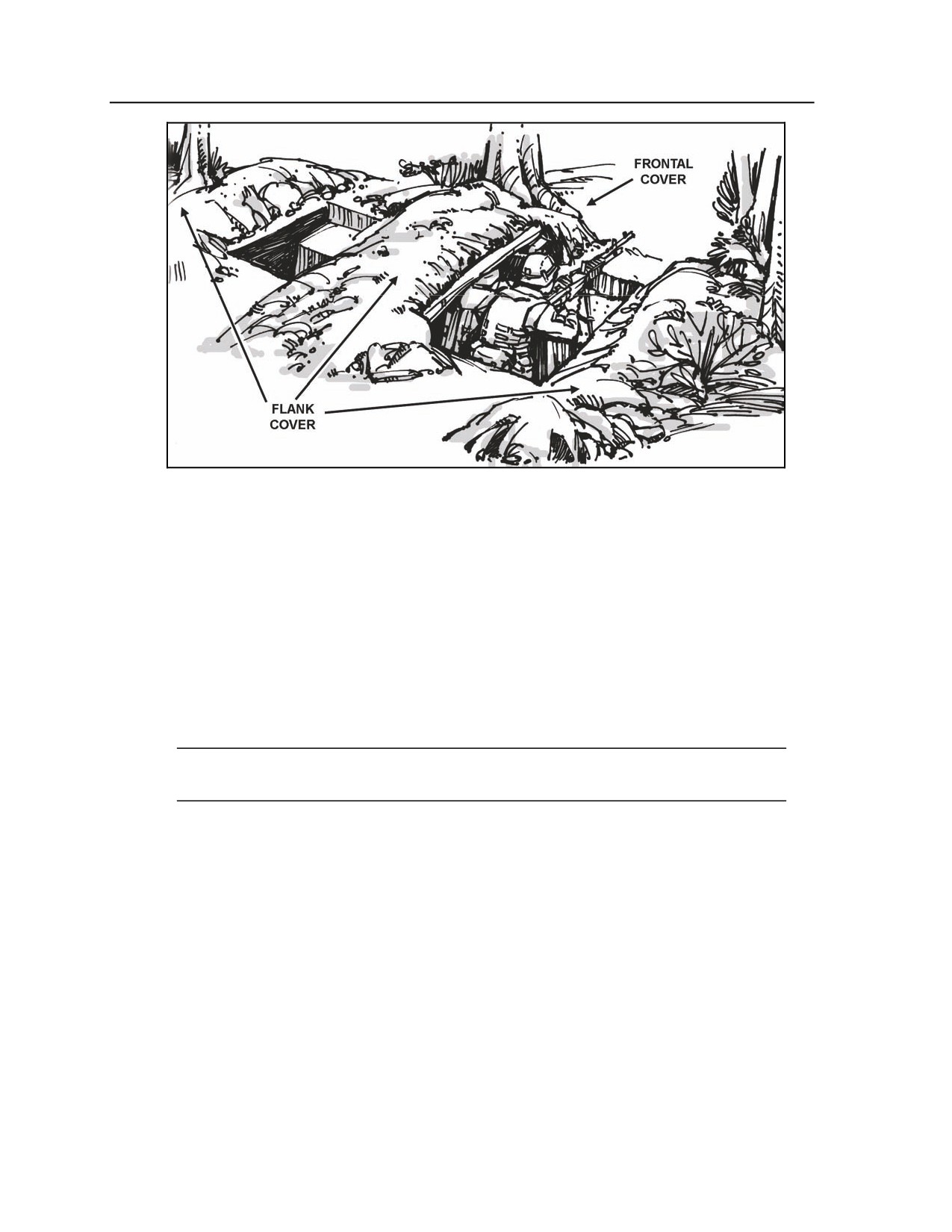
OBSERVATION POSTS
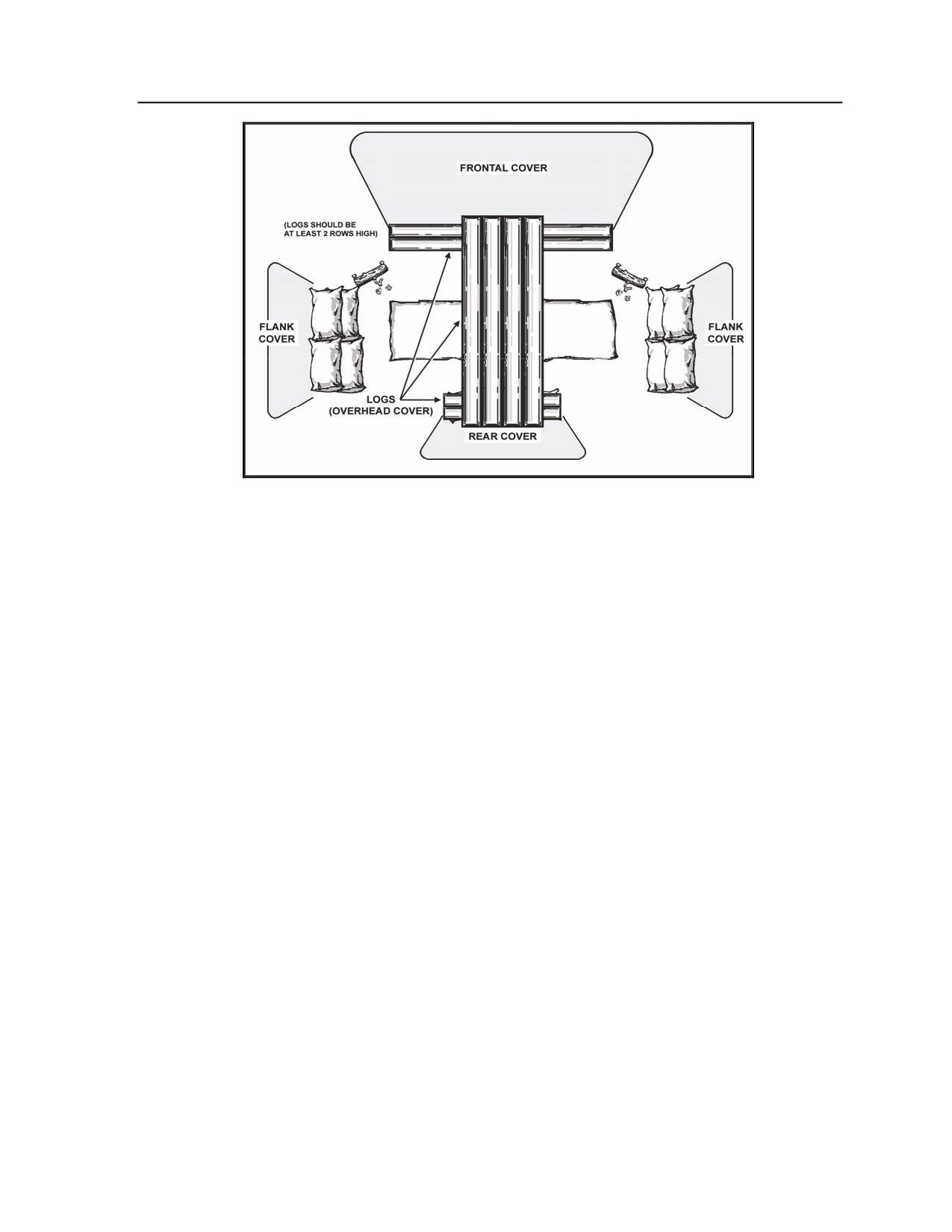
8-94. An observation post gives the platoon its first echelon of security in the defense. The observation
post provides early warning of impending enemy contact by reporting direction, distance, and size. It
detects the enemy early and sends accurate reports to the platoon. The platoon leader establishes
observation posts along the most likely enemy avenues of approach into the position or into the area of
operations. Leaders ensure that observation posts have communication with the platoon.
8-95. Early detection reduces the risk of the enemy overrunning the observation post. Observation posts
may also be equipped with a Javelin CLU to increase the ability to detect the enemy. They may receive
infrared trip flares, infrared parachute flares, infrared M203 rounds, and even infrared mortar round support
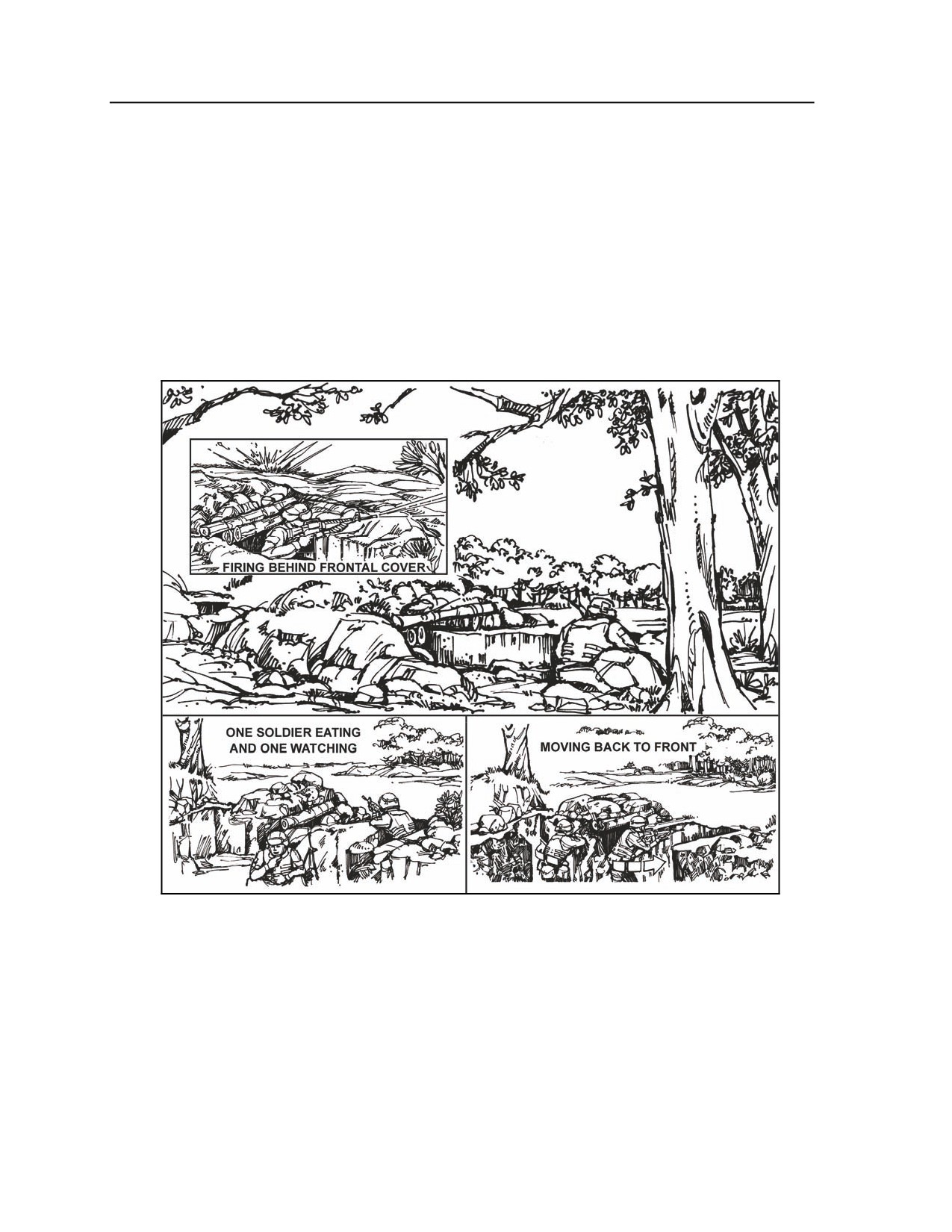
to illuminate the enemy. The platoon leader weighs the advantages and disadvantages of using infrared
illumination when the enemy is known to have night vision devices that detect infrared light. Although
infrared and thermal equipment within the platoon enables the platoon to see the observation post at a
greater distance, the observation post should not be positioned outside the range of the platoon’s small-
arms weapons.
8-96. To further reduce the risk of fratricide, observation posts use GPS, if available, to navigate to the exit
and entry point in the platoon’s position. The platoon leader submits an observation post location to the
company commander to ensure a no-fire area (NFA) is established around each observation post position.
The commander sends his operational overlay with observation post positions to the battalion and adjacent
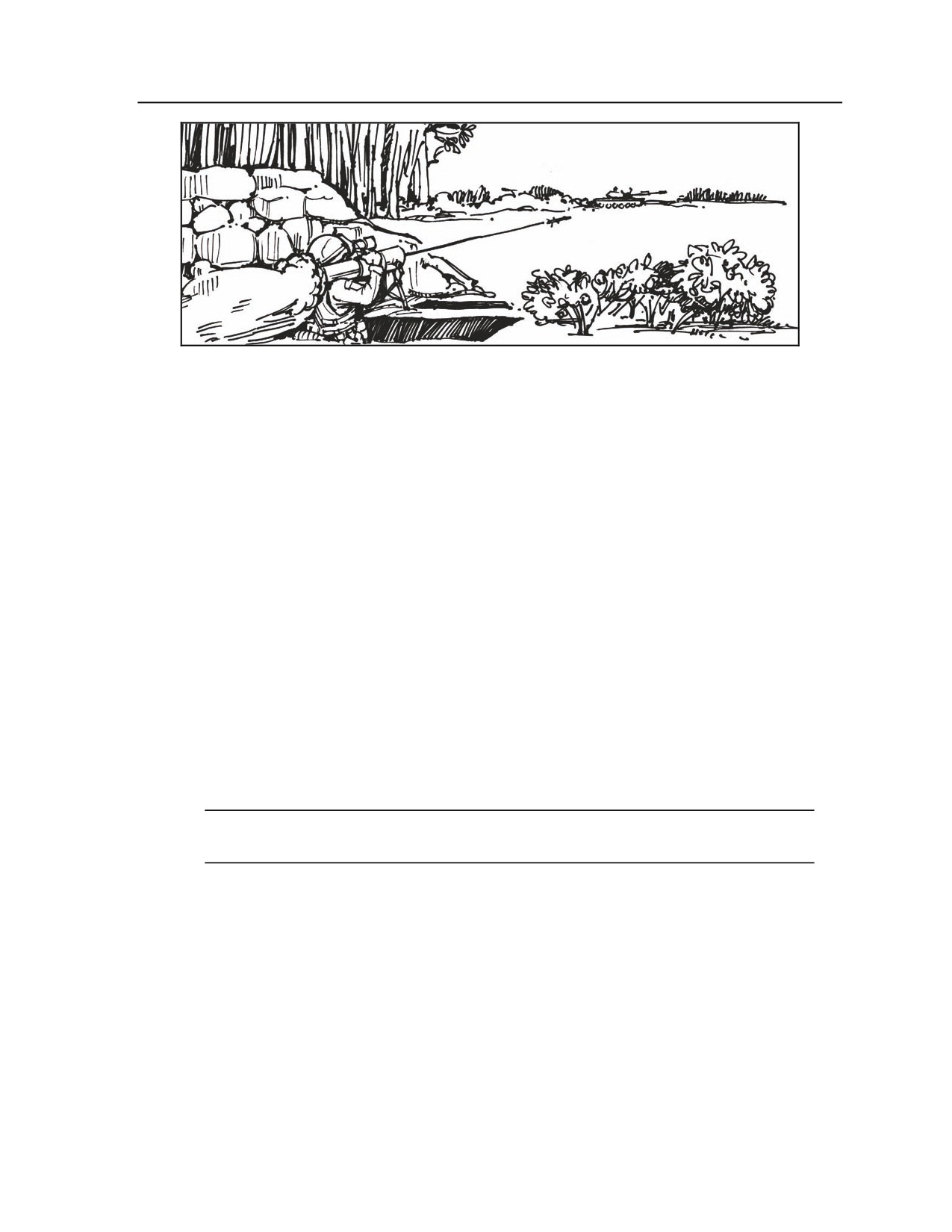
units. He receives the same type overlay from adjacent units to assist in better command and control and
fratricide avoidance. The platoon leader confirms that the company fire support element
(FSE) has
forwarded these locations to the battalion FSO and has received the appropriate NFAs on the fire support
graphics.
28 March 2007
FM 3-21.8
8-21
Chapter 8
PATROLS
8-97. Platoons actively patrol in the defense. Patrols enhance the platoon’s ability to fill gaps in security
between observation posts (see Chapter 9). The platoon leader forwards his tentative patrol route to the
commander to ensure they do not conflict with other elements within the company. The commander
forwards the entire company’s patrol routes to the battalion. This allows the battalion S3 and S2 to ensure
all routes are coordinated for fratricide prevention, and that the company and platoons are conforming to
the battalion intelligence, surveillance, and reconnaissance (ISR) plan. The patrol leader may use a GPS to
enhance his basic land navigational skills as he tracks his patrol’s location on a map, compass, and pace
count or odometer reading.
ESTABLISHMENT OF DEFENSIVE POSITIONS
8-98. Platoons establish defensive positions IAW the platoon leader and commander’s plan. They mark
engagement areas using marking techniques prescribed by unit SOP. The platoon physically marks
obstacles, TRPs, targets, and trigger lines in the engagement area. During limited visibility, the platoon can
use infrared light sources to mark TRPs for the rifle squads. When possible, platoons should mark TRPs
with both a thermal and an infrared source so the rifle squads can use the TRP.
RANGE CARD
8-99. A range card is a sketch of a sector that a direct fire weapons system is assigned to cover. Range
cards aid in planning and controlling fires. They also assist crews in acquiring targets during limited
visibility, and orient replacement personnel, platoons, or squads that are moving into position. During good
visibility, the gunner should have no problems maintaining orientation in his sector. During poor visibility,
he may not be able to detect lateral limits. If the gunner becomes disoriented and cannot find or locate
reference points or sector limit markers, he can use the range card to locate the limits. The gunner should
make the range card so he becomes more familiar with the terrain in his sector. He should continually
assess the sector and, if necessary, update his range card.
SECTOR SKETCHES
8-100. Detailed sketches aid in the planning, distribution, and control of the platoon fires. Gunners
prepare the range cards. Squad leaders prepare squad sector sketches, section leaders prepare section
sketches, and the platoon leader prepares the platoon sketch.
WEAPONS PLACEMENT
8-101. To position weapons effectively, leaders must know the characteristics, capabilities, and
limitations of the weapons; the effects of terrain; and the tactics used by the enemy. Additionally, the
platoon leader must consider whether his primary threat will be vehicles or Infantry. His plan should
address both mounted and dismounted threats. Also, the platoon leader may have an antitank section
attached.
CLOSE COMBAT MISSILE SYSTEMS EMPLOYMENT
8-102. The primary role of Close Combat Missile Systems (CCMS) is to destroy enemy armored vehicles.
When there is no armored vehicle enemy, CCMS can be employed in a secondary role of providing fire
support against point targets such as crew-served weapons positions. CCMS optics (such as the Javelin’s
command launch unit [CLU]) can be used alone or as an aided vision device for reconnaissance, security
operations, and surveillance. Reduced or limited visibility will not degrade the effectiveness of the CCMS.
This fact allows the antiarmor specialist to continue to cover his sector without having to reposition closer
to the avenue of approach. The platoon leader’s assessment of the factors of METT-TC will determine the
employment of CCMS. (For a detailed discussion on the employment of the Javelin, refer to Appendix B.)
Based on the situation, the platoon leader may employ all or some of the CCMS. He may use centralized
control or decentralized control.
8-22
FM 3-21.8
28 March 2007
Defensive Operations
Centralized Control
8-103. The platoon leader controls the fires of his CCMS gunners by both physically locating the weapons
in his vicinity and personally directing their fires, or by grouping them together under the control of the
platoon sergeant or weapons squad leader.
Decentralized Control
8-104. CCMS gunners operate with and are controlled by their weapons squad leader. A rifle squad leader
may need to employ one fire team with a CCMS. The platoon leader normally gives the command to fire.
MEDIUM MACHINE GUN EMPLOYMENT
8-105. Medium machine guns are the platoon’s primary crew-served weapons that are positioned first if
the enemy is a dismounted force. (For a detailed discussion on the employment of the M240B and the
M249, refer to Appendix A.) Once these guns are sited, the leader positions riflemen to protect them. The
guns are positioned to place direct fire on locations where the platoon leader wants to concentrate combat
power to destroy the enemy.
M203 EMPLOYMENT
8-106. The M203 grenade launcher is the squad leader’s indirect fire weapon. The platoon leader
positions the grenadier to cover dead space in the squad’s sector, especially the dead space for the medium
machine guns. The grenadier is also assigned a sector of fire overlapping the riflemen’s sectors of fire. The
high-explosive dual purpose (HEDP) round is effective against lightly armored vehicles.
EMPLOYMENT OF RIFLEMEN
8-107. The platoon and squad leaders assign positions and sectors of fire to each rifleman in the platoon.
Normally, they position the riflemen to support and protect machine guns and antiarmor weapons.
Riflemen are also positioned to cover obstacles, provide security, cover gaps between platoons and
companies, or provide observation.
COORDINATION
8-108. Coordination is important in every operation. In the defense, coordination ensures that units
provide mutual support and interlocking fires. In most circumstances, the platoon leader conducts face-to
face coordination to facilitate understanding and resolve issues effectively. The platoon leader should send
and receive the following information prior to conducting face-to-face coordination:
Location of leaders.
Location of fighting positions.
Location of observation posts and withdrawal routes.
Location and types of obstacles, including Claymores.
Location, activities, and passage plan for reconnaissance platoon and other units forward of
the platoon’s position.
Location of all Soldiers and units operating in and around the platoon’s area of operations.
SECTION VI — DEFENSIVE TECHNIQUES
8-109. The platoon will normally defend IAW command orders using one of these basic techniques:
Defend an area.
Defend a battle position.
Defend a strongpoint.
Defend a perimeter.
Defend a reverse slope.
28 March 2007
FM 3-21.8
8-23
Chapter 8
DEFEND AN AREA
8-110. Defending an area sector allows a unit to maintain flank contact and security while ensuring unity
of effort in the scheme of maneuver. Areas afford depth in the platoon defense. They allow the platoon to
achieve the platoon leader’s desired end state while facilitating clearance of fires at the appropriate level of
responsibility. The company commander normally orders a platoon to defend an area (Figure 8-8) when
flexibility is desired, when retention of specific terrain features is not necessary, or when the unit cannot
concentrate fires because of any of the following factors:
Extended frontages.
Intervening, or cross-compartmented, terrain features.
Multiple avenues of approach.
8-111. The platoon is assigned an area defense mission to prevent a specific amount of enemy forces from
penetrating the area of operations. To maintain the integrity of the area defense, the platoon must remain
tied to adjacent units on the flanks. The platoon may be directed to conduct the defense in one of two ways.
8-112. He may specify a series of subsequent defensive positions within the area from where the platoon
will defend to ensure that the fires of two platoons can be massed.
8-113. He may assign an area to the platoon. The platoon leader assumes responsibility for most tactical
decisions and controlling maneuvers of his subordinate squads by assigning them a series of subsequent
defensive positions. This is done IAW guidance from the company commander in the form of intent,
specified tasks, and the concept of the operation. The company commander normally assigns an area to a
platoon only when it is fighting in isolation.
Figure 8-8. Concept of the operation for defending an area.
8-24
FM 3-21.8
28 March 2007
Defensive Operations
DEFEND A BATTLE POSITION
8-114. The company commander assigns the defensive technique of defending a battle position to his
platoons when he wants to mass the fires of two or more platoons in a company engagement area, or to
position a platoon to execute a counterattack. A unit defends from a battle position to—
Destroy an enemy force in the engagement area.
Block an enemy avenue of approach.
Control key or decisive terrain.
Fix the enemy force to allow another friendly unit to maneuver.
8-115. The company commander designates engagement areas to allow each platoon to concentrate its
fires or to place it in an advantageous position for the counterattack. Battle positions are developed in such
a manner to provide the platoon the ability to place direct fire throughout the engagement area. The size of
the platoon battle position can vary, but it should provide enough depth and maneuver space for
subordinate squads to maneuver into alternate or supplementary positions and to counterattack. The battle
position is a general position on the ground. The platoon leader places his squads on the most favorable
terrain in the battle position based on the higher unit mission and commander’s intent. The platoon then
fights to retain the position unless ordered by the company commander to counterattack or displace. The
following are basic methods of employing a platoon in a battle position:
Same battle position, same avenue of approach.
Same battle position, multiple avenues of approach.
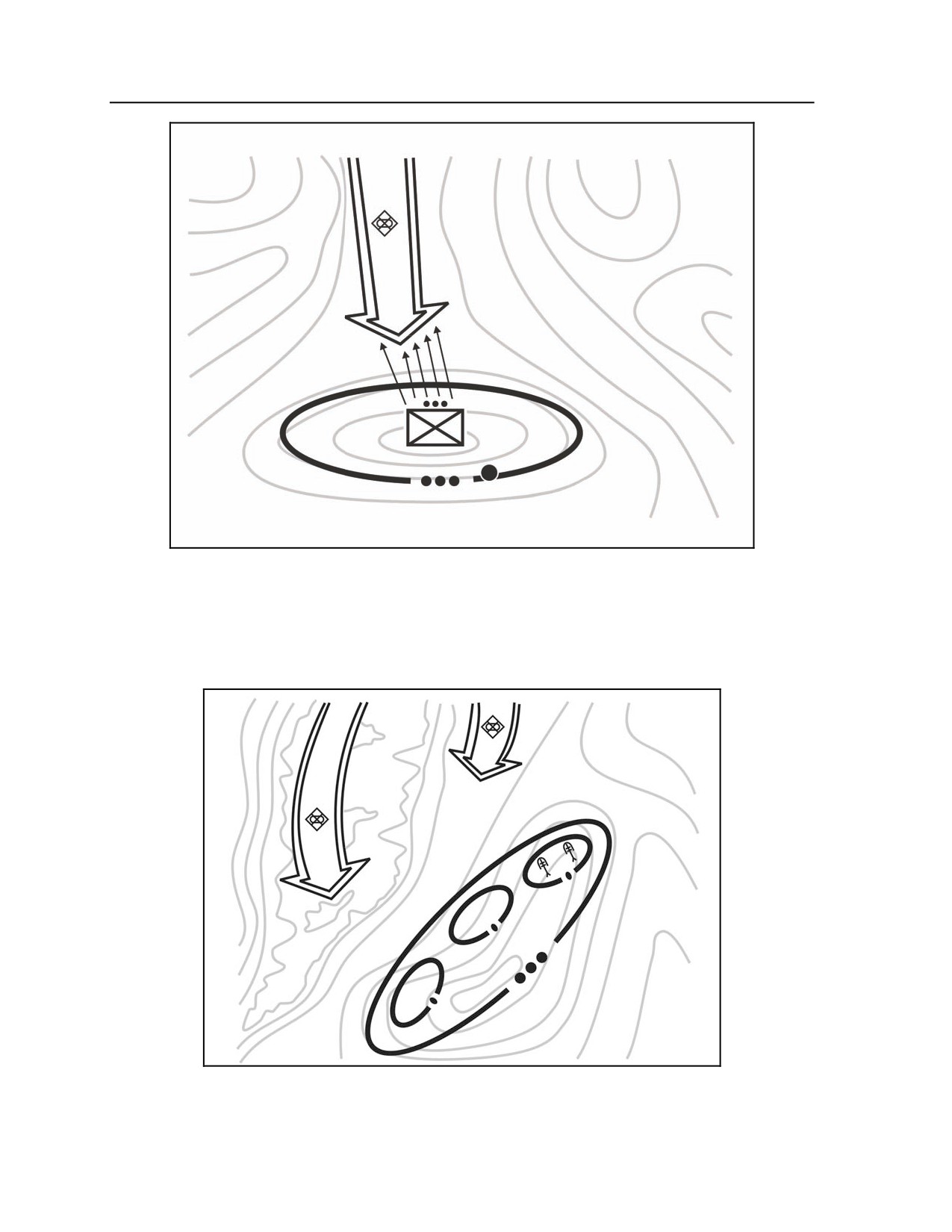
Different battle positions, same avenue of approach.
Different battle positions, multiple avenues of approach.
SAME BATTLE POSITION, SAME AVENUE OF APPROACH
8-116. Rifle squads are on the same battle position covering the same avenue of approach (Figure 8-9).
The platoon can defend against mounted and dismounted attacks and move rapidly to another position.
8-117. All squads are in the same battle position when the terrain provides good observation, fields of
fire, and cover and concealment.
8-118. Employing all the squads of the platoon on the same battle position covering the same avenue of
approach is the most conservative use of the platoon. Its primary advantages are that it facilitates command
and control functions because of the proximity of squad elements on the same approach and it provides
increased security.
28 March 2007
FM 3-21.8
8-25
Chapter 8
Figure 8-9. Same battle position, same avenue of approach.
SAME BATTLE POSITION, MULTIPLE AVENUES OF APPROACH
8-119. Rifle squads occupy the same battle position but cover multiple enemy avenues of approach
(Figure 8-10).
Figure 8-10. Same battle position, multiple avenues of approach.
8-26
FM 3-21.8
28 March 2007
Defensive Operations
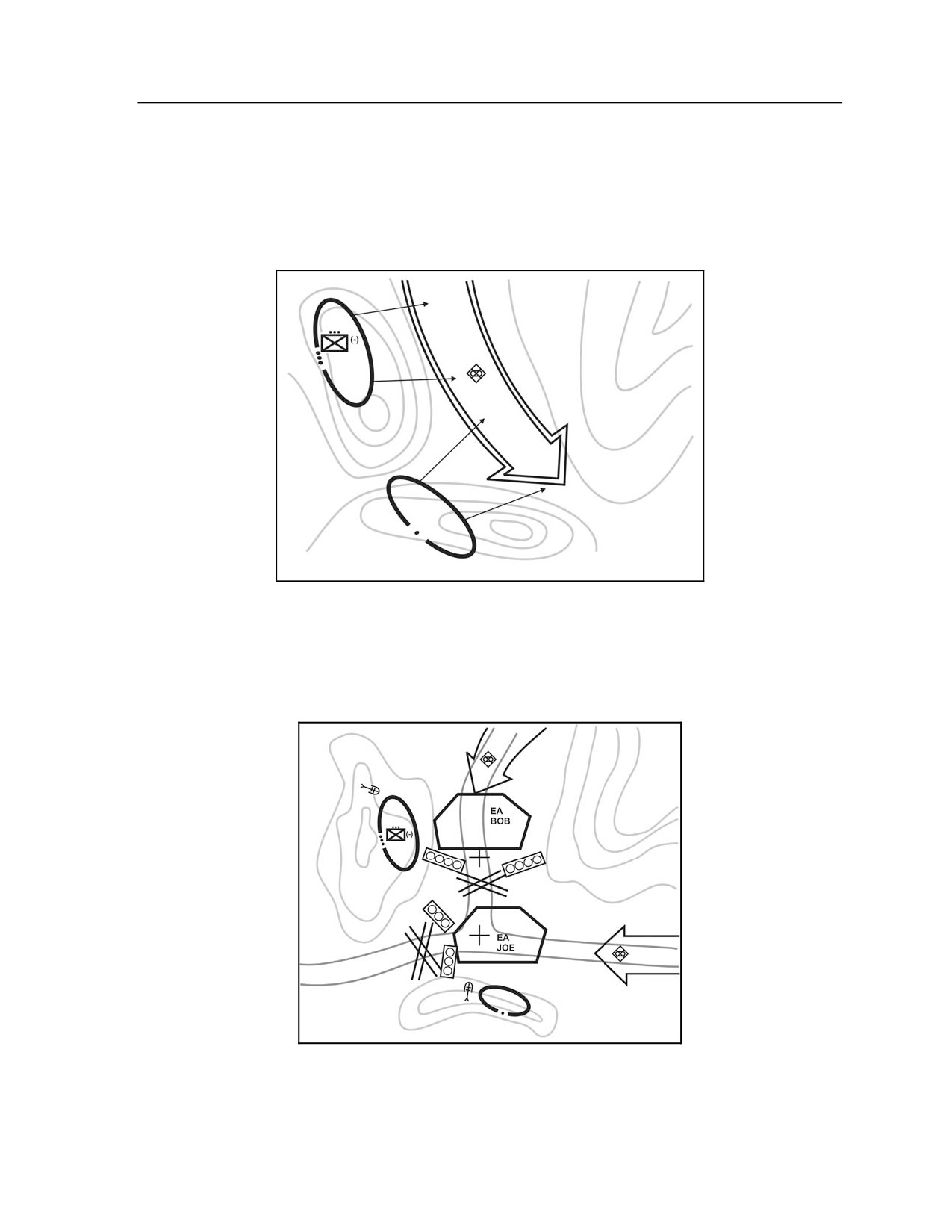
DIFFERENT BATTLE POSITIONS, SAME AVENUE OF APPROACH
8-120. Rifle squads are on different battle positions covering the same avenue of approach (Figure 8-11).
If positioned on separate battle positions, rifle squads must fight in relation to each other when covering the
same avenues of approach. A weapons squad can provide supporting fires for the rifle squads from their
primary, alternate, or supplementary positions. All squads are positioned to engage enemy forces on the
same avenue of approach, but at different ranges.
Figure 8-11. Different battle positions, same avenue of approach.
DIFFERENT BATTLE POSITIONS, MULTIPLE AVENUES OF APPROACH
8-121. Squads may be employed on different battle positions and multiple avenues of approach (Figure 8
12) to ensure that the squad battle positions cannot be fixed, isolated, or defeated by the enemy.
Figure 8-12. Different battle positions, multiple avenues of approach.
28 March 2007
FM 3-21.8
8-27
Chapter 8
DEFEND A STRONGPOINT
8-122. Defending a strongpoint (Figure 8-13) is not a common mission for an Infantry platoon. A
strongpoint defense requires extensive engineer support (expertise, materials, and equipment), and takes a
long time to complete. When the platoon is directed to defend a strongpoint, it must retain the position until
ordered to withdraw. The success of the strong-point defense depends on how well the position is tied into
the existing terrain. This defense is most effective when it is employed in terrain that provides cover and
concealment to both the strongpoint and its supporting obstacles. Mountainous, forested, or urban terrain
can be adapted easily to a strongpoint defense. Strongpoints placed in more open terrain require the use of
reverse slopes or of extensive camouflage and deception efforts. This defensive mission may require the
platoon to—
Hold key or decisive terrain critical to the company or battalion scheme of maneuver.
Provide a pivot to maneuver friendly forces.
Block an avenue of approach.
Canalize the enemy into one or more engagement areas.
CHARACTERISTICS OF THE STRONGPOINT DEFENSE
8-123. The prime characteristic of an effective strongpoint is that it cannot be easily overrun or bypassed.
It must be positioned and constructed so the enemy knows he can reduce it only at the risk of heavy
casualties and significant loss of materiel. He must be forced to employ massive artillery concentrations
and dismounted Infantry assaults in his attack, so the strongpoint must be tied in with existing obstacles and
positioned to afford 360-degree security in observation and fighting positions.
TECHNIQUES AND CONSIDERATIONS
8-124. A variety of techniques and considerations are involved in establishing and executing the
strongpoint defense, including considerations for displacement and withdrawal from the strongpoint.
8-125. The platoon leader begins by determining the projected size of the strongpoint. He does this
through assessing the number of weapons systems and individual Soldiers available to conduct the assigned
mission, and by assessing the terrain on which the platoon will fight. He must remember that although a
strongpoint is usually tied into a company defense and flanked by other defensive positions, it must afford
360-degree observation and firing capability.
8-126. The platoon leader must ensure that the layout and organization of the strongpoint maximizes the
capabilities of the platoon’s personnel strength and weapons systems without sacrificing the security of the
position. Platoon options range from positioning CCMS outside the strongpoint (with the rifle squads
occupying fighting positions inside it), to placing all assets within the position. From the standpoint of
planning and terrain management, placing everything in the strongpoint is the most difficult option and
potentially the most dangerous because of the danger of enemy encirclement.
8-28
FM 3-21.8
28 March 2007
Defensive Operations
Figure 8-13. Defending a strongpoint.
8-127. In laying out the strongpoint, the platoon leader designates weapon positions that support the
company defensive plan. Once these primary positions have been identified, he continues around the
strongpoint, siting weapons on other possible enemy avenues of approach and engagement areas until he
has the ability to orient effectively in any direction. The fighting positions facing the company engagement
area may be along one line of defense or staggered in depth along multiple lines of defense (if the terrain
supports positions in depth).
8-128. The platoon’s reserve may be comprised of a fire team, squad, or combination of the two. The
platoon leader must know how to influence the strongpoint battle by employing his reserve. He has several
employment options including reinforcing a portion of the defensive line or counterattacking along a
portion of the perimeter against an identified enemy main effort.
8-129. The platoon leader should identify routes or axes that will allow the reserve to move to any area of
the strongpoint. He should then designate positions the reserve can occupy once they arrive. These routes
and positions should afford sufficient cover to allow the reserve to reach its destination without enemy
interdiction. The platoon leader should give special consideration to developing a direct fire plan for each
contingency involving the reserve. The key area of focus may be a plan for isolating an enemy penetration
of the perimeter. Rehearsals cover actions the platoon takes if it has to fall back to a second defensive
perimeter, including direct fire control measures necessary to accomplish the maneuver. FPF may be
employed to assist in the displacement.
8-130. Engineers support strongpoint defense by reinforcing the existing obstacles. Priorities of work will
vary depending on the factors of METT-TC, especially the enemy situation and time available. For
example, the first
12 hours of the strongpoint construction effort may be critical for emplacing
countermobility obstacles and survivability positions, and command and control bunkers. If the focus of
engineer support is to make the terrain approaching the strongpoint impassable, the battalion engineer effort
must be adjusted accordingly.
28 March 2007
FM 3-21.8
8-29
Chapter 8
8-131. The battalion obstacle plan provides the foundation for the company strongpoint obstacle plan. The
commander or platoon leader determines how he can integrate protective obstacles (designed to defeat
dismounted enemy Infantry assaults) into the overall countermobility plan. If adequate time and resources
are available, he should plan to reinforce existing obstacles using field-expedient demolitions.
8-132. Once the enemy has identified the strongpoint, he will mass all the fires he can spare against the
position. To safeguard his rifle squads, the platoon leader must arrange for construction of overhead cover
for individual fighting positions. If the strongpoint is in a more open position (such as on a reverse slope),
he may also plan for interconnecting trenchlines. This will allow Soldiers to move between positions
without exposure to direct and indirect fires. If time permits, these crawl trenches can be improved to
fighting trenches or standard trenches.
DEFEND A PERIMETER
8-133. A perimeter defense allows the defending force to orient in all directions. In terms of weapons
emplacement, direct and indirect fire integration, and reserve employment, a platoon leader conducting a
perimeter defense should consider the same factors as for a strongpoint operation.
8-134. The perimeter defense allows only limited maneuver and limited depth. Therefore, the platoon may
be called on to execute a perimeter defense under the following conditions:
Holding critical terrain in areas where the defense is not tied in with adjacent units.
Defending in place when it has been bypassed and isolated by the enemy.
Conducting occupation of an independent assembly area or reserve position.
Preparing a strongpoint.
Concentrating fires in two or more adjacent avenues of approach.
Defending fire support or engineer assets.
Occupying a patrol base.
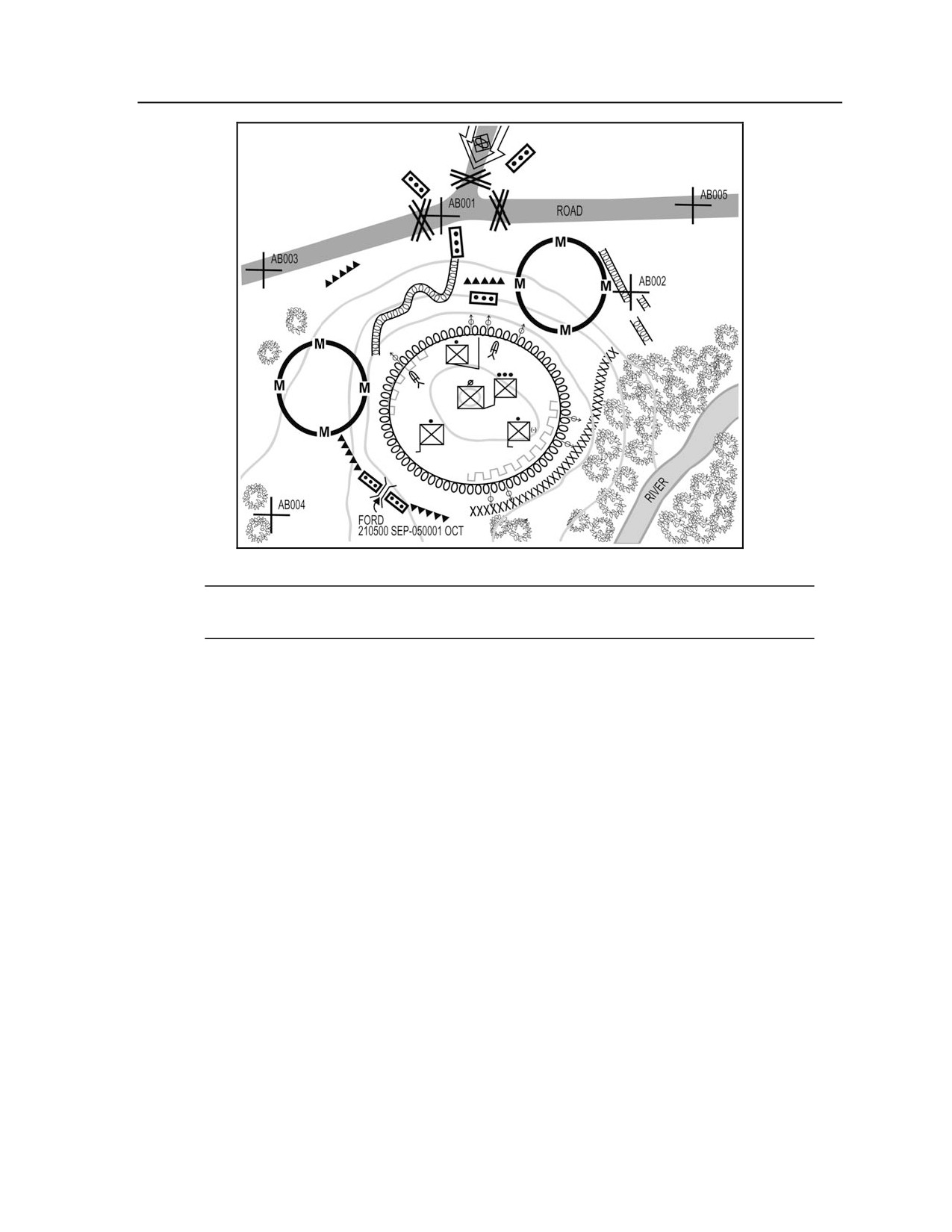
8-135. The major advantage of the perimeter defense (Figure 8-14) is the platoon’s ability to defend
against an enemy avenue of approach. A perimeter defense differs from other defenses in that—
The trace of the platoon is circular or triangular rather than linear.
Unoccupied areas between squads are smaller.
Flanks of squads are bent back to conform to the plan.
The bulk of combat power is on the perimeter.
The reserve is centrally located.
8-30
FM 3-21.8
28 March 2007
Defensive Operations
Figure 8-14. Perimeter defense with rifle team in reserve.
NOTE: A variant of the perimeter defense is the use of the shaped defense, which allows two of
the platoon’s squads to orient at any particular time on any of three engagement areas.
DEFEND A REVERSE SLOPE
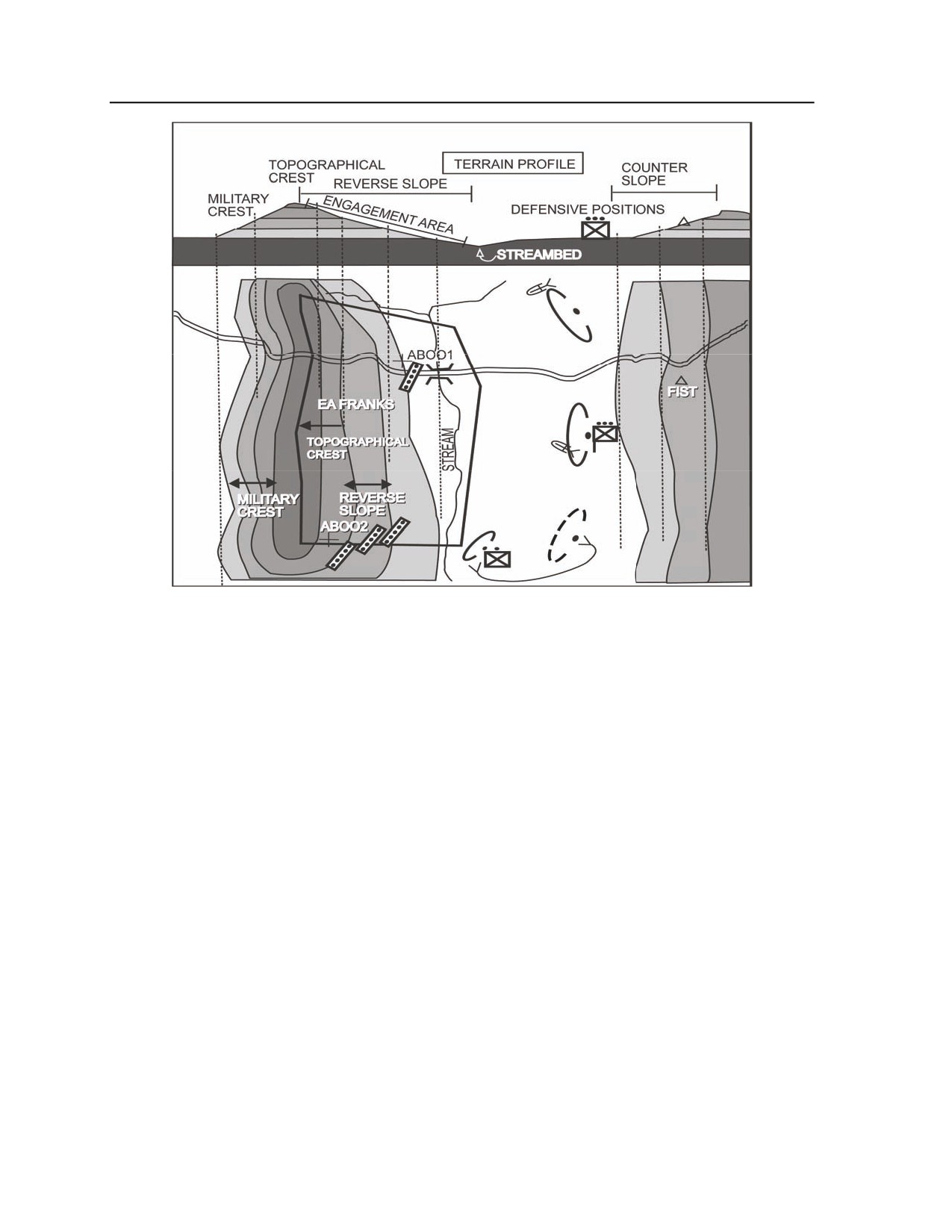
8-136. The platoon leader’s analysis of the factors of METT-TC often leads him to employ his forces on
the reverse slope (Figure 8-15). If the rifle squads are on a mounted avenue of approach, they must be
concealed from enemy direct fire systems. This means rifle squads should be protected from enemy tanks
and observed artillery fire.
28 March 2007
FM 3-21.8
8-31
Chapter 8
Figure 8-15. Reverse-slope defense options.
8-137. The majority of a rifle squad’s weapons are not effective beyond 600 meters. To reduce or prevent
destruction from enemy direct and indirect fires beyond that range, a reverse-slope defense should be
considered. Using this defense conflicts to some extent with the need for maximum observation forward to
adjust fire on the enemy, and the need for long-range fields of fire for CCMS. In some cases it may be
necessary for these weapons systems to be deployed forward while the rifle squads remain on the reverse
slope. CCMS gunners withdraw from their forward positions as the battle closes. Their new positions
should be selected to take advantage of their long-range fires, and to get enfilade shots from the depth and
flanks of the reverse slope.
8-138. The nature of the enemy may change at night, and the rifle squads may occupy the forward slope
or crest to deny it to the enemy. In these circumstances, it is feasible for a rifle squad to have an alternate
night position forward. The area forward of the topographical crest must be controlled by friendly forces
through aggressive patrolling and both active and passive reconnaissance measures. The platoon should use
all of its night vision devices to deny the enemy undetected entry into the platoon’s defensive area. CCMS
are key parts of the platoon’s surveillance plan and should be positioned to take advantage of their thermal
sights. The enemy must not be allowed to take advantage of reduced visibility to advance to a position of
advantage without being taken under fire.
8-139. The company commander normally makes the decision to position platoons on a reverse slope. He
does so when—
He wishes to surprise or deceive the enemy about the location of his defensive position.
Forward slope positions might be made weak by direct enemy fire.
Occupation of the forward slope is not essential to achieve depth and mutual support.
Fields of fire on the reverse slope are better or at least sufficient to accomplish the mission.
Forward slope positions are likely to be the target of concentrated enemy artillery fires.
8-32
FM 3-21.8
28 March 2007
Defensive Operations
8-140. The following are advantages of a reverse-slope defense:
Enemy observation of the position, including the use of surveillance devices and radar, is
masked.
Enemy cannot engage the position with direct fire without coming within range of the
defender’s weapons.
Enemy indirect fire will be less effective because of the lack of observation.
Enemy may be deceived about the strength and location of positions.
Defenders have more freedom of movement out of sight of the enemy.
8-141. Disadvantages of a reverse-slope defense include the following:
Observation to the front is limited.
Fields of fire to the front are reduced.
Enemy can begin his assault from a closer range.
8-142. Obstacles are necessary in a reverse-slope defense. Because the enemy will be engaged at close
range, obstacles should prevent the enemy from closing too quickly and overrunning the positions.
Obstacles on the reverse slope can halt, disrupt, and expose enemy vehicles to flank antitank fires.
Obstacles should also block the enemy to facilitate the platoon’s disengagement.
SECTION VII — FIGHTING AND SURVIVABILITY POSITIONS
8-143. The defensive plan normally requires building fighting positions. Fighting positions protect
Soldiers by providing cover from direct and indirect fires and by providing concealment through
positioning and proper camouflage. Because the battlefield conditions confronting Infantrymen are never
standard, there is no single standard fighting position design that fits all tactical situations.
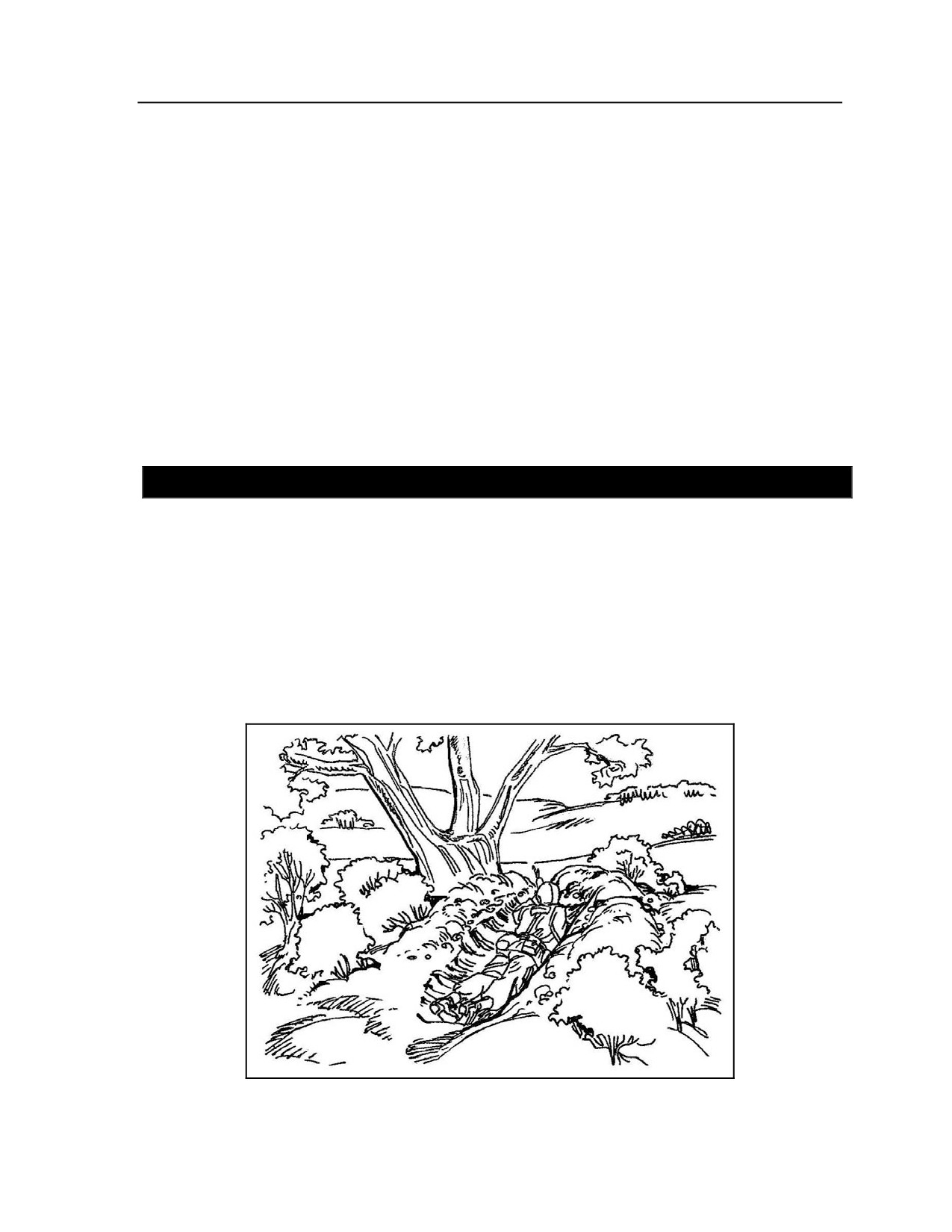
8-144. Soldiers prepare fighting positions even when there is little or no time before contact with the
enemy is expected (Figure 8-16). They locate them behind whatever cover is available and where they can
engage the enemy. The position should give frontal protection from direct fire while allowing fire to the
front and oblique. Occupying a position quickly does not mean there is no digging. Soldiers can dig initial
positions in only a few minutes. A fighting position just 18 inches deep will provide a significant amount of
protection from direct fire and even fragmentation. All positions are built by stages. The initial fighting
position construction can be improved over time to a more elaborate position.
Figure 8-16. Initial fighting position.
28 March 2007
FM 3-21.8
8-33
Chapter 8
PRINCIPLES
8-145. Leaders follow three basic principles to effectively and efficiently prepare fighting positions: site
positions to best engage the enemy, prepare positions by stages, and inspect all positions. The leader’s
responsibilities include the following:
Protect troops.
Plan and select fighting position sites.
Supervise construction.
Inspect periodically.
Depending on assets, request technical advice from engineers as required.
Improve and maintain unit survivability continuously.
Determine if there is a need to build the overhead cover up or down.
SITE POSITIONS TO BEST ENGAGE THE ENEMY
8-146. The most important aspect of a fighting position is that it must be tactically well positioned.
Leaders must be able to look at the terrain and quickly identify the best location for fighting positions.
Good positions allow—
Soldiers to engage the intended enemy element within their assigned sectors of fire.
Soldiers to fire out to the maximum effective range of their weapons with maximum grazing
fire and minimal dead space.
Grenadiers to be placed in positions to cover dead space.
8-147. Leaders must ensure fighting positions provide mutually supporting, interlocking fires. This allows
them to cover the platoon’s sector from multiple positions. When possible, they site positions behind
natural cover and in easily camouflaged locations. The enemy must not be able to identify the position until
it is too late and he has been effectively engaged.
PREPARE POSITIONS BY STAGES
8-148. Leaders must ensure their Soldiers understand when and how to prepare fighting positions based
on the situation. Soldiers prepare fighting positions every time the platoon makes an extended halt. Half of
the platoon digs in while the other half maintains security. Soldiers prepare positions in stages and a leader
inspects the position at each stage before the Soldiers move to the next stage. When expecting an
immediate enemy attack, Infantrymen dig stage 1 fighting positions. As time becomes available, these
defensive positions are continually improved, enlarged, and strengthened.
Stage 1
8-149. The platoon leader checks fields of fire from the prone position. For a stage 1 position (Figure
8-17) the Soldiers—
Emplace sector stakes.
Stake the primary sector.
Position grazing fire log or sandbag between the sector stakes.
Place the aiming stake(s) to allow limited visibility engagement of a specific target.
Trace the outline of the position on the ground.
Clear the fields of fire for both the primary and secondary sectors of fire.
Ensure the leader inspects the position before they move to stage 2.
8-34
FM 3-21.8
28 March 2007
Defensive Operations
Figure 8-17. Stage 1, preparation of a fighting position.
Stage 2
8-150. Soldiers prepare retaining walls (Figure 8-18) for the parapets. They ensure that—
There is a minimum distance (equal to the width of one helmet) from the edge of the hole to
the beginning of the front, flank, and rear cover.
The cover to the front consists of sandbags (or logs), two to three high, and for a two-Soldier
position, about the length of two M302 rifles (about 7 feet).
The cover to the flanks is the same height, but only one M203 rifle length (about 3.5 feet).
The cover to the rear is one sandbag high and one M203 long (about 3.5 feet).
If logs are used, they must be held firmly in place with strong stakes.
The leader inspects the retaining wall before they begin stage 3.
Figure 8-18. Stage 2, preparation of a fighting position.
28 March 2007
FM 3-21.8
8-35
Chapter 8
Stage 3
8-151. Soldiers dig the position and throw dirt forward of the parapet retaining walls and pack it down
hard (Figure 8-19). They—
Dig the position armpit (of the tallest Soldier) deep.
Fill the parapets in order of front, flanks, and rear.
Camouflage the parapets and the entire position.
Dig grenade sumps and slope the floor toward them.
Dig storage areas for two rucksacks into the rear wall if needed.
Ensure the leader inspects the work.
Figure 8-19. Stage 3, preparation of a fighting position.
Stage 4
8-152. In stage
4, Soldiers prepare the overhead cover
(Figure
8-20). At times, the terrain will
accommodate the construction of a position with overhead cover that protects Soldiers from indirect fire
fragmentation while allowing them to return fire. Sometimes, especially on open terrain, this is not
possible, and the entire position must be built below ground level. Although this type of position offers
excellent protection and concealment to Soldiers, it limits their ability to return fire from within a protected
area. To prepare overhead cover, Soldiers—
Always provide solid lateral support. They build the support with 4- to 6-inch logs on top of
each other running the full length of the front and rear cover.
Place five or six logs 4 to 6 inches in diameter and two M203s long (about 7 feet) over the
center of the position, resting them on the overhead cover support, not on the sandbags.
Place waterproofing (plastic bags, ponchos) on top of these logs.
Put a minimum of 18 inches of packed dirt or sandbags on top of the logs.
Camouflage the overhead cover and the bottom of the position.
Ensure the leader inspects the position.
8-36
FM 3-21.8
28 March 2007
Defensive Operations
Figure 8-20. Stage 4, preparation of a fighting position.
INSPECT ALL POSITIONS
8-153. Leaders must ensure their Soldiers build fighting positions that are both effective and safe. An
improperly sited position cannot be used and an improperly constructed position is a danger to its
occupants. Leaders should inspect the progress of the fighting position at each stage in its preparation.
FIGHTING POSITION MATERIALS
8-154. Sometimes Soldiers must construct fighting positions using only the basic tools and materials they
can carry or find in the local area such as entrenching tools, sandbags, and locally cut timber. At other
times, significant amounts of Class IV construction materials and heavier digging tools may be available
(Table 8-1).
28 March 2007
FM 3-21.8
8-37

Chapter 8
Table 8-1. Examples of field-expedient fighting position materials.
Wall Revetment
Stand Alone Positions
•
Sheet metal
•
Prefabricated concrete catch basins
•
Corrugated sheet metal
•
Military vans
•
Plastic sheeting
•
Shipping containers
•
Plywood
•
Large diameter pipe/culvert
•
Air mat panels
•
Steel water tanks
•
Air Force air load pallets
•
Vehicle hulks
Overhead Cover Stringers
Wall Construction (Building Up)
•
Single pickets
•
55-gallon drums filled with sand
•
Double pickets
•
Shipping boxes/packing material
•
Railroad rails
•
Expended artillery shells filled with
sand
•
“I” beams
•
Prefabricated concrete panels
•
2-inch diameter pipe
•
Timbers (2”x 4”, 4”x 4”, and larger)
•
Prefabricated concrete traffic barriers
•
Reinforced concrete beams
•
Sand grid material
•
55-gallon drums cut in half
•
Culverts cut in half
•
Pre-cast concrete panels 6-8 inches
thick
•
Airfield panels
Aiming Stakes
Limiting Stakes
•
2-foot pickets
•
2-foot pickets
•
Wooden tent poles
•
Wooden tent poles
•
Filled sandbags
NOTE: Regardless of the position design, the type of construction materials, the tools available,
or the terrain, all fighting positions must incorporate sound engineering construction principles.
Unless it is constructed properly, a fighting position can easily collapse and crush or bury the
Soldiers within. FM 5-103, Survivability, and FM 5-34, Engineer Field Data, provide excellent
information on these principles. Additionally, GTA 05-08-001, Survivability Positions, and
GTA 07-06-001, Fighting Position Construction--Infantry Leader’s Reference Card, contain
detailed information in easy-to-use formats.
TYPES OF FIGHTING POSITIONS
8-155. There are many different types of fighting positions. The number of occupants; types of weapons;
tools, materials, and time available; and terrain dictate the type of position.
8-156. The do’s and don’ts of fighting position construction are listed in Table 8-2.
8-38
FM 3-21.8
28 March 2007
Defensive Operations
Table 8-2. Do’s and don’ts of fighting position construction.
DO…
DON’T…
• Construct to standard.
• Fail to supervise.
• Ensure adequate material is available.
• Use sandbags for structural support.
• Dig down as much as possible.
• Put Soldiers in marginally safe
• Maintain, repair, and improve positions
positions.
continuously.
• Take short cuts.
• Inspect and test position safety daily,
• Build above ground unless absolutely
after heavy rain, and after receiving
necessary.
direct and indirect fire.
• Forget lateral bracing on stringers.
• Revet walls in unstable and sandy soil.
• Forget to camouflage.
• Interlock sandbags for double wall
• Drive vehicles within 6 feet of a fighting
construction and corners.
position.
• Check stabilization of wall bases.
• Fill sandbags about 75% full.
• Use common sense.
• Use soil to fill sandbags, fill in any
cavities in overhead cover, or spread to
blend with surroundings.
8-157. Infantry fighting positions are normally are constructed to hold one, two, or three Soldiers. There
are special designs adapted for use by machine gun (M240B) and antiarmor (Javelin) teams.
ONE-SOLDIER FIGHTING POSITION
8-158. Positions that contain a single Soldier are the least desirable, but they are useful in some situations.
One-Soldier positions may be required to cover exceptionally wide frontages. They should never be
positioned out of sight of adjacent positions. The one-Soldier fighting position (Figure 8-21) should allow
the Soldier to fire to the front or to the oblique from behind frontal cover. Advantages and disadvantages to
consider when choosing a one-Soldier fighting position include:
The one-Soldier position allows choices in the use of cover.
The hole only needs to be large enough for one Soldier and his gear.
It does not have the security of a two-Soldier position.
Figure 8-21. One-soldier fighting position.
28 March 2007
FM 3-21.8
8-39
Chapter 8
TWO-SOLDIER FIGHTING POSITION
8-159. A two-Soldier fighting position (Figure 8-22) is normally more effective than a one-Soldier
fighting position. It can be used to provide mutual support to adjacent positions on both flanks and to cover
dead space immediately in front of the position. One or both ends of the hole may extend around the sides
of the frontal cover. Modifying a position in this way allows both Soldiers to have better observation and
greater fields of fire to the front. Also, during rest or eating periods, one Soldier can watch the entire sector
while the other sleeps or eats. If they receive fire from their front, they can move back to gain the
protection of the frontal cover. By moving about one meter, the Soldiers can continue to find and hit targets
to the front during lulls in enemy fire. This type of position—
Requires more digging.
Is more difficult to camouflage.
Provides a better target for enemy hand grenades.
Figure 8-22. Two-soldier fighting position.
THREE-SOLDIER FIGHTING POSITION
8-160. A three-Soldier position has several advantages. A leader can be in each position, making
command and control easier. It supports continuous security operations better than other positions. One
Soldier can provide security; one can do priority work; and one can rest, eat, or perform maintenance. This
allows the priority of work to be completed more quickly than in a one- or two-Soldier position. This
position allows the platoon to maintain combat power and security without shifting personnel or leaving
positions unmanned. It provides 360-degree observation and fire, and is more difficult for the enemy to
destroy because he must kill or suppress three Soldiers.
8-40
FM 3-21.8
28 March 2007
Defensive Operations
8-161. When using three-Soldier positions, the leader must consider several things. Either the distance
between positions must be increased, or the size of the squad’s sector must be reduced. The choice depends
mainly on visibility and fields of fire. Because the squad leader is in a fighting position that will most likely
be engaged during the battle, he cannot exert personal control over the other two positions. The squad
leader controls the battle by—
Communicating his plans and intent to his squad, including control measures and fire plans.
Using prearranged signals like flares, whistles, or tracers.
Positioning key weapons in his fighting position.
Placing his fighting position so it covers key or decisive terrain.
Placing his fighting position where his team might be able to act as a reserve.
8-162. The three-Soldier emplacement is a T-position (Figure 8-23). This basic design can be changed by
adding or deleting berms, changing the orientation of the T, or shifting the position of the third Soldier to
form an L instead of a T. The layout of the position can be oriented to fire on expected enemy avenues of
approach from any direction. Berms must not block observation or fire into assigned primary or alternate
sectors. Care must be taken to properly support the overhead cover.
Figure 8-23. Three-soldier T-position.
MACHINE GUN POSITION
8-163. The primary sector of fire is usually to the oblique so a machine gun can fire across the platoon’s
front. The tripod is used on the side covering the primary sector of fire. The bipod legs are used on the side
covering the secondary sector of fire. When changing from primary to secondary sectors, the gunner moves
only the machine gun. Occasionally a sector of fire that allows firing directly to the front is assigned, but
this can reduce the frontal cover for the crew when firing to the oblique (Figure 8-24). For a detailed
discussion on the employment of the M240B, refer to Appendix A.
28 March 2007
FM 3-21.8
8-41
Chapter 8
Figure 8-24. Machine gun position.
8-164. After the platoon leader positions the machine gun, he marks the position of the tripod legs and the
limits of his sectors of fire. The crew then traces the outline of the hole and the frontal cover (if it must be
improved).
8-165. The crew digs firing platforms first to lessen their exposure in case they must fire before
completing the position. The platforms must not be so low that the gun cannot be traversed across its entire
sector of fire, reducing the profile of the gunner when firing and reducing the frontal cover height.
8-166. After digging the firing platforms, the crew digs the hole. They first place the dirt where frontal
cover is needed, digging the hole deep enough (usually armpit deep) to protect them while allowing the
gunner to fire with comfort. When the frontal cover is high enough and thick enough, the crew uses the rest
of the dirt to build flank and rear cover. Trench-shaped grenade sumps are dug at various points so either
Soldier can kick a grenade into one if needed. Overhead cover for a machine gun position is constructed
following the steps of stage 4, preparation of a fighting position (see paragraph 8-152f and Figure 8-20).
NOTE: In some positions, a machine gun might not have a secondary sector of fire. In this
case, dig only half the position.
8-167. For a three-Soldier crew for a machine gun, the ammunition bearer digs a one-Soldier fighting
position to the flank that is connected with the gun position by a crawl trench. From this position, the
ammunition bearer can see and fire to the front and to the oblique. Usually the ammunition bearer is on the
same side as the FPL or PDF. This allows him to see and fire his rifle into the machine gun’s secondary
sector and to see the gunner and assistant gunner.
JAVELIN POSITION
8-168. The Javelin can be employed from initial or completed positions (Figure 8-25). However, some
changes are required. For a detailed discussion on the employment of the Javelin, refer to Appendix B.
8-42
FM 3-21.8
28 March 2007
Defensive Operations
Figure 8-25. Javelin position.
8-169. The gunner must keep the weapon at least 6 inches above the ground to allow room for the
stabilizing fins to unfold. The hole is only waist deep to allow the gunner to move while tracking to acquire
a target. Because the Javelin gunner must be above ground level, the frontal cover should be high enough to
hide his head, and, if possible, the backblast of the Javelin. A hole is dug in front of the position for the
bipod legs.
8-170. When the Javelin can be fired in one direction only, the position is adjusted to provide cover and
concealment from all other directions, and the Javelin should be fired to the oblique. This protects the
position from frontal fire and allows engagement of the target from the flank. Both ends of the launcher
must extend out over the edges of the hole.
8-171. Overhead cover must be built on the flanks. Cover must be large enough for the gunner, the
tracker, and the missiles. Overhead cover that allows fire from underneath can be built if the backblast area
is clear. Overhead cover must be well camouflaged.
8-172. The Javelin is an important weapon and is easy to detect. Therefore, selection and preparation of
alternate positions have high priority. When preparing an alternate position, the gunner should select and
improve a covered route to it so he can move to the position under fire.
SLM POSITION
8-173. The AT4 can be fired from Infantry fighting positions. If the AT4 is to be fired from a two-Soldier
position, the gunner must ensure the other Soldier is not in the backblast area. Assume the basic standing
position, but instead of stepping forward, lean against the back wall of the fighting position. Ensure that the
rear of the weapon extends beyond the rear of the fighting position.
NOTE: Leaders must ensure that light antiarmor weapons are positioned so the backblast
misses other fighting positions.
TRENCHES
8-174. When there is time and help available, trenches should be dug to connect fighting positions so
Soldiers can move by covered routes. The depth of a trench depends on the type of help and equipment
available. Without engineer help, platoons dig crawl trenches (about 3 feet deep by 2 feet wide) (Figure
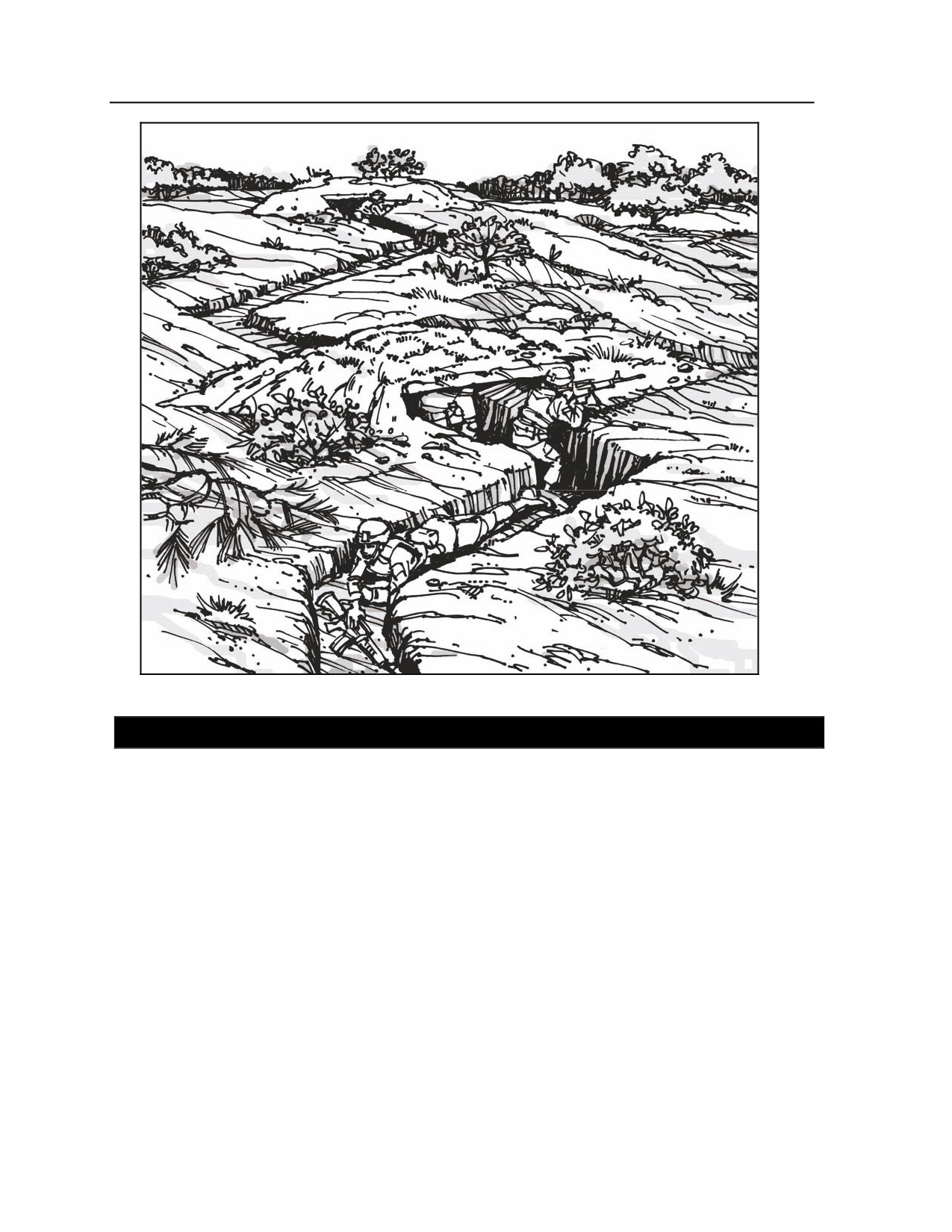
8-26). With engineer help, they dig standard trenches. The trench should zigzag so the enemy cannot fire
down a long section. Platoons normally dig crawl trenches because engineer assets are usually limited.
Platoons use crawl trenches to conceal their movement into and within positions. Spoil is placed on
parapets, normally on each side of the trench. If the trench runs across a forward slope, all the spoil is
placed on the enemy side to make the forward parapet higher. All spoil needs careful concealment from
enemy direct observation.
28 March 2007
FM 3-21.8
8-43
Chapter 8
Figure 8-26. Crawl trenches.
SECTION VIII — RETROGRADE
8-175. The retrograde is a type of defensive operation that involves organized movement away from the
enemy. The enemy may force these operations, or a commander may execute them voluntarily. Retrograde
operations are transitional and are not considered in isolation. There are three forms of retrograde:
withdrawal; delay; and retirement. Platoons may participate in stay-behind missions as part of a withdrawal
or delay.
WITHDRAWAL
8-176. A withdrawal occurs when an element disengages from enemy contact to reposition itself for
another mission. A platoon usually conducts a withdrawal as part of a larger force. As part of a company, a
platoon may withdraw with the main element (under pressure) or may be used as the detachment left in
contact (DLIC) in a withdrawal not under pressure. This information applies whether or not the platoon is
under pressure from the enemy. Regardless of employment, the platoon leader conducts his withdrawal
IAW his higher commander’s guidance. On receipt of the order to conduct a withdrawal, the platoon leader
begins preparing his order based on his higher unit’s FRAGO. He identifies possible key terrain and routes
based on the higher unit’s graphics and his map. He formulates and briefs his FRAGO to his squad leaders.
When the withdrawal is executed, squad leaders ensure they are moving IAW the platoon leader’s plan by
monitoring position locations.
8-44
FM 3-21.8
28 March 2007
Defensive Operations
WITHDRAWAL NOT UNDER PRESSURE
8-177. In a withdrawal not under pressure, platoons may serve as or as part of the DLIC. A DLIC is used
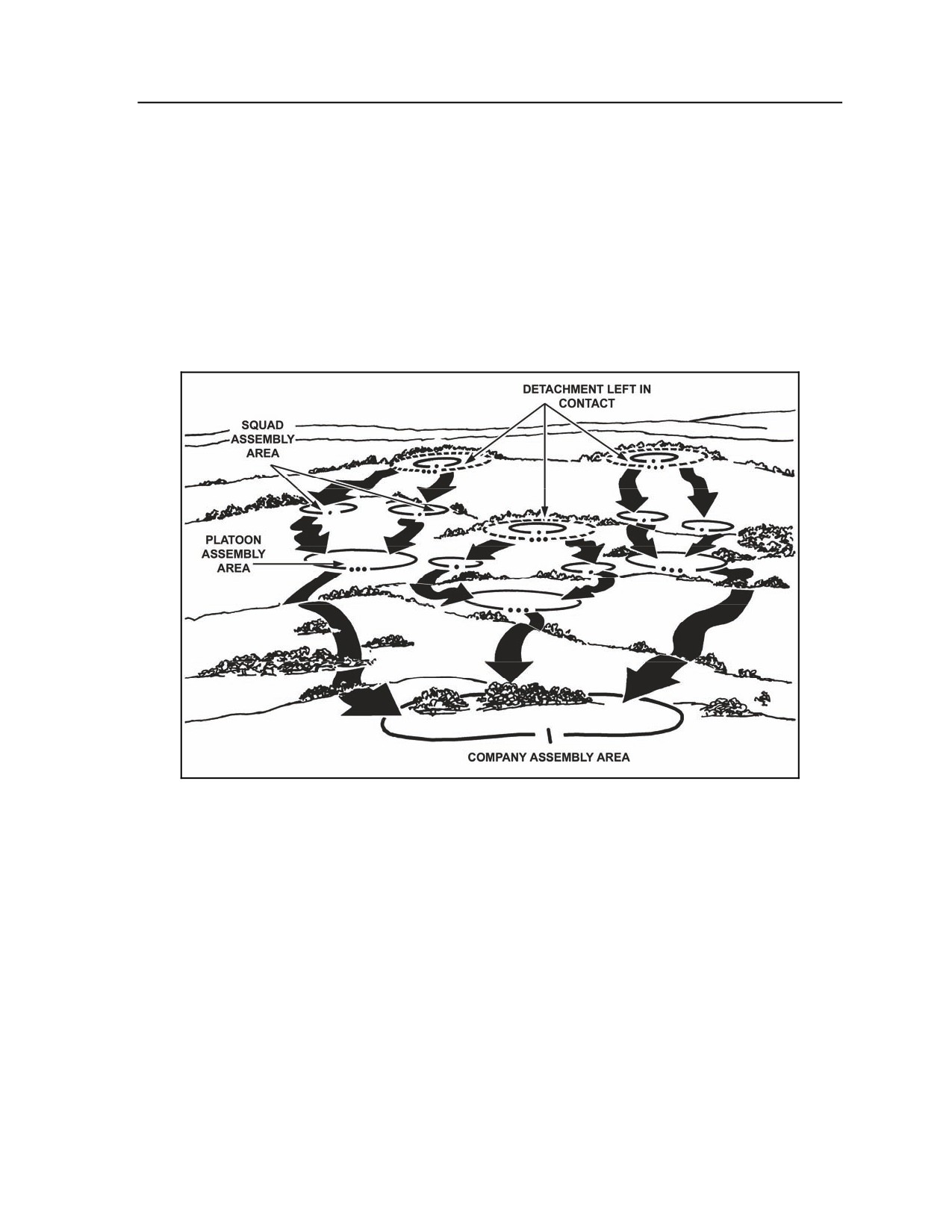
to deceive the enemy into thinking that the entire force is still in position (Figure 8-27). As the DLIC, the
platoon—
Repositions squads and weapons to cover the company’s withdrawal.
Repositions a squad in each of the other platoon positions to cover the most dangerous avenue
of approach into the position.
Continues the normal operating patterns of the company and simulates company radio traffic.
Covers the company withdrawal with planned direct and indirect fires if the company is
attacked during withdrawal.
Withdraws by echelon once the company is at its next position.
Figure 8-27. Withdrawal not under pressure.
WITHDRAWAL UNDER PRESSURE
8-178. If the platoon cannot prepare and position the security force, it conducts a fighting withdrawal. The
platoon disengages from the enemy by maneuvering to the rear. Soldiers and squads not in contact are
withdrawn first to provide suppressive fire and to allow Soldiers and squads in contact to withdraw.
DISENGAGEMENT
8-179. Based on orders from the battalion commander, the company commander determines how long to
retain defensive positions. The company may be required to remain and fight for a certain amount of time,
or it may be required to disengage and displace to subsequent positions. A platoon, as part of a company,
may disengage to defend from another battle position, prepare for a counterattack, delay, withdraw, or
prepare for another mission.
8-180. Fire and movement to the rear is the basic tactic for disengaging. All available fires are used to
slow the enemy and allow platoons to move away. The company commander may move his platoons and
mass fires to stop or slow the enemy advance before beginning the movement away from the enemy.
28 March 2007
FM 3-21.8
8-45
Chapter 8
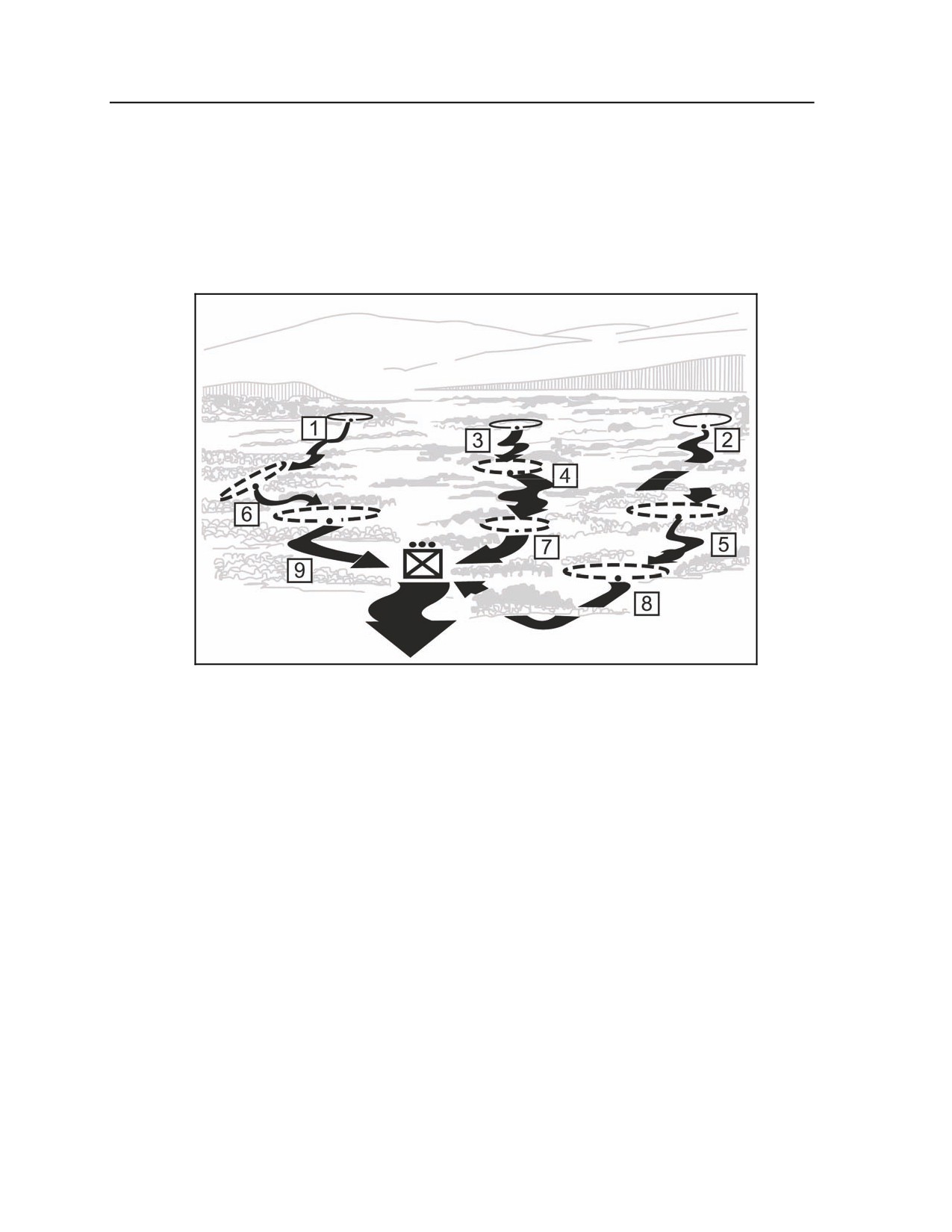
8-181. Using bounding overwatch, a base of fire is formed to cover platoons or squads moving away from
the enemy. One platoon or squad acts as the base of fire, delaying the enemy with fire or retaining terrain
blocking his advance, while other platoons or squads disengage.
8-182. Moving platoons or squads get to their next position and provide a base of fire to cover the
rearward movement of forward platoons and squads.
8-183. Fire and movement is repeated until contact with the enemy is broken, the platoons pass through a
different base-of-fire force, or the platoons are in position to resume their defense (Figure 8-28).
Figure 8-28. Bounding overwatch to the rear.
8-184. Tactics used by the platoon to disengage from the enemy differ according to the company
commander’s plan for disengagement, how the platoon is deployed, and other factors. The following
actions apply in all cases:
Maximum use is made of the terrain to cover rearward movement. Squads back out of
position and move, attempting to keep a terrain feature between them and the enemy.
Rapid movement and effective base of fire enhance mobility and are key to a successful
disengagement.
8-185. Plans for disengagement may be part of any defensive plan. When squads are separated, there are
three ways they can disengage: by teams; by thinning the lines when they must cover their own movement;
or simultaneously when they are covered by another force.
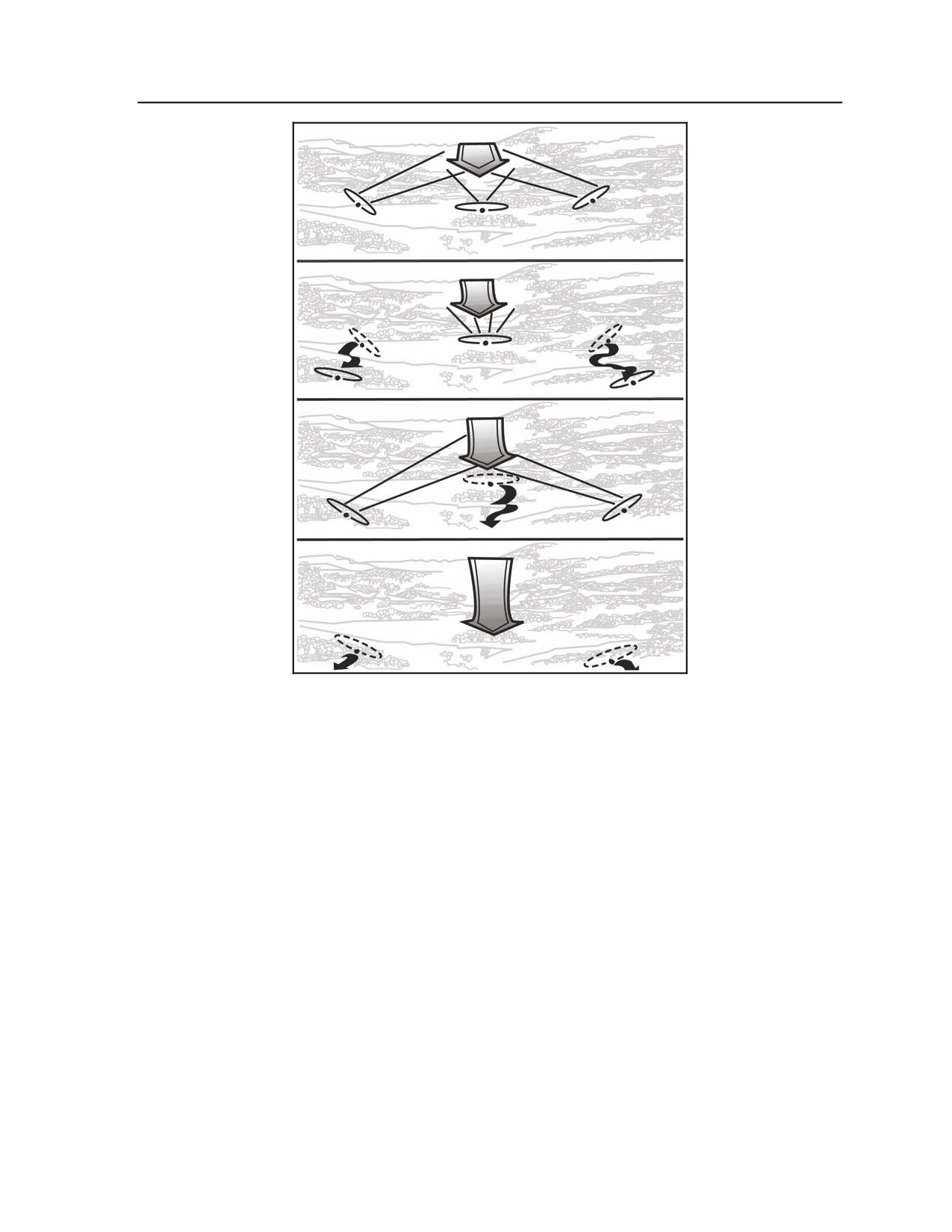
Teams
8-186. When the rifle platoon must cover their own movement, two squads stay in position as a base of
fire (Figure 8-29). The third squad and weapons squad move to the rear (crew served weapons move based
on the platoon leader’s assessment of when they could best move). The squads left in position must fire into
the entire element’s sector to cover the movement of the other squad(s). Sectors of fire are adjusted for
better coverage of the element’s sector. The moving squad may displace by fire teams or as squads because
there are two squads covering their movement. The squads left in position sequentially disengage.
Movement to the rear by alternating squads continues until contact is broken.
8-46
FM 3-21.8
28 March 2007
Defensive Operations
Figure 8-29. Disengagement by squads.
Thinning the Lines
8-187. When disengaging by thinning the lines, selected Soldiers from each fire team (usually one Soldier
from each fighting position) disengage and move to the rear (Figure 8-30). The Soldiers still in position
become the base of fire to cover the movement.
28 March 2007
FM 3-21.8
8-47
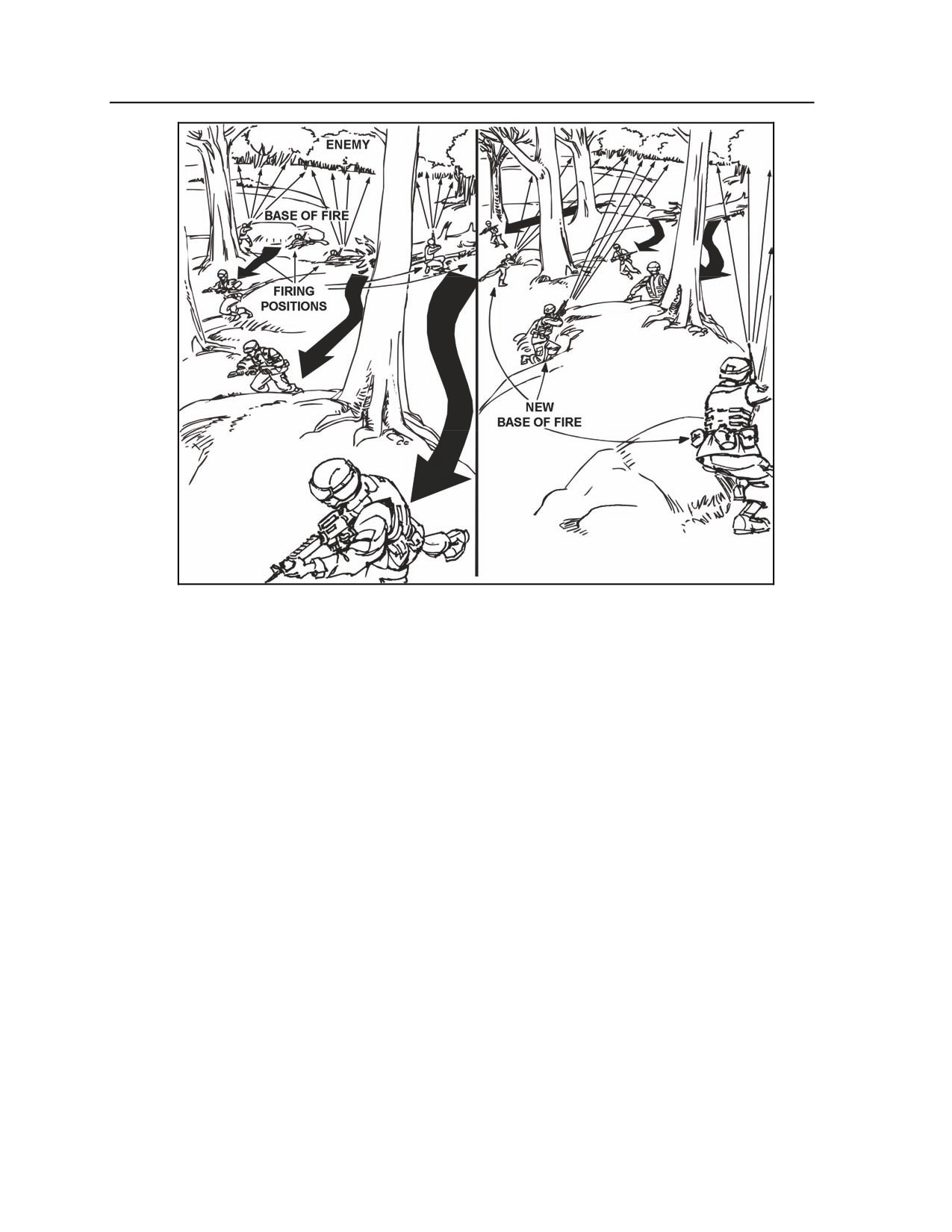
Chapter 8
Figure 8-30. Disengagement by thinning the lines.
Simultaneous
8-188. Squads disengage simultaneously when they are covered by another force. Simultaneous
disengagement is favored when rapid movement is critical; when the disengaging element is adequately
covered by overwatching fires; when the enemy has not closed on the rifle squad or cannot fire effectively
at it; and when there are obstacles to delay the enemy. Simultaneous disengagement is used when rifle
squads are able to move before the enemy can close on their position. Other platoons of the company or
battalion cover the disengagement with supporting fires.
DELAY
8-189. In a delay, the enemy slows its forward momentum when the platoon forces him to repeatedly
deploy for the attack. After causing the enemy to deploy, the delaying force withdraws to new positions,
trading space for time. A delay is typically done to buy time for friendly forces to regain the offensive. It is
also done to buy time so friendly forces can establish an effective defense, or to determine enemy
intentions. Inflicting casualties on the enemy is normally secondary to slowing the enemy approach. As part
of a company or larger operation, the platoon can expect to be tasked as a reserve, security force, or part of
the main body. The squads or sections and platoons disengage from the enemy as described in a withdrawal
under pressure (see paragraph 8-176) and move directly to their next position and defend again. The squads
and platoons slow the advance of the enemy by causing casualties and equipment losses by employing—
Ambushes.
Snipers.
Obstacles.
Minefields (including phony minefields).
Artillery and mortar fire.
8-48
FM 3-21.8
28 March 2007
Defensive Operations
8-190. A common control measure used in these missions is the delay line, which is a phase line the
enemy is not allowed to cross until a specified date and time. Infantry must carefully consider the mobility
difference between themselves and the attacking force, maximizing the use of both terrain and counter-
mobility obstacles. A delay operation terminates when the delaying force conducts a rearward passage of
lines through a defending force, the delaying force reaches defensible terrain and transitions to the defense,
the advancing enemy force reaches a culminating point and can no longer continue to advance, or the
delaying force goes on the offensive.
STAY-BEHIND OPERATIONS
8-191. Stay-behind operations can be used as part of defensive or retrograde operations. In these
operations, the commander leaves a unit in position to conduct a specified mission while the remainder of
his forces withdraw or retire from an enemy. Stay-behind is inherently risky, and resupply and casualty
evacuation are difficult. Conducting stay-behind operations places a premium on Infantry leadership and
initiative, and ultimately terminates when the unit conducts a linkup with attacking friendly forces or
reenters friendly lines.
TYPES
8-192. The two types of stay-behind operations are unplanned; and deliberate.
Unplanned
8-193. An unplanned stay-behind operation is one in which a unit finds itself cut off from other friendly
elements for an indefinite time. In this kind of operation the unit has no specific planning or targets, and
must rely on its organic assets.
Deliberate
8-194. A deliberate stay-behind operation is one in which a unit plans to operate in an enemy-controlled
area as a separate yet cohesive element for a certain amount of time or until a specified event occurs. A
deliberate stay-behind operation requires extensive planning. Squads, sections, and platoons conduct this
type of operation as part of larger units.
PLANNING
8-195. Troop-leading procedures (TLP) apply to stay-behind operations. Planners must pay strict attention
to task organization, reconnaissance, and sustainment.
Task Organization
8-196. A stay-behind unit includes only the Soldiers and equipment needed for the mission. It provides its
own logistics support and security, and must be able to hide easily and move through restrictive terrain.
Reconnaissance
8-197. Reconnaissance is most important in a stay-behind operation. Reporting tasks and information
requirements can include suitable sites for patrol bases, hide positions, observation posts, caches, water
sources, dismounted and mounted avenues of approach, kill zones, engagement areas, and covered and
concealed approach routes. The unit may be required to collect intelligence on enemy forces around them.
Logistics
8-198. Because the stay-behind unit will not be in physical contact with its supporting unit, supplies of
rations, ammunition, radio batteries, water, and medical supplies are cached. Provisions for casualty and
EPW evacuation depend on company and battalion plans.
28 March 2007
FM 3-21.8
8-49
Chapter 8
RETIREMENT
8-199. Retirement is a form of retrograde in which a force not in contact with the enemy, moves away
from the enemy. Retiring units organize to fight but do so only in self defense. Retirements are usually not
as risky as delays or withdrawals. Retiring units normally road march away from the enemy. Infantry
platoons participate in retirements as part of their company and higher headquarters.
8-50
FM 3-21.8
28 March 2007
Chapter 9
Patrols and Patrolling
A patrol is a detachment sent out by a larger unit to conduct a specific mission.
Patrols operate semi-independently and return to the main body upon completion of
their mission. Patrolling fulfills the Infantry’s primary function of finding the enemy
to either engage him or report his disposition, location, and actions. Patrols act as
both the eyes and ears of the larger unit and as a fist to deliver a sharp devastating jab
and then withdraw before the enemy can recover.
SECTION I — OVERVIEW
PATROLS AND PATROLLING
9-1. A patrol is sent out by a larger unit to conduct a specific combat, reconnaissance, or security mission.
A patrol’s organization is temporary and specifically matched to the immediate task. Because a patrol is an
organization, not a mission, it is not correct to speak of giving a unit a mission to "Patrol."
9-2. The terms “patrolling” or “conducting a patrol” are used to refer to the semi-independent operation
conducted to accomplish the patrol’s mission. Patrols require a specific task and purpose.
9-3. A commander sends a patrol out from the main body to conduct a specific tactical task with an
associated purpose. Upon completion of that task, the patrol leader returns to the main body, reports to the
commander and describes the events that took place, the status of the patrol’s members and equipment, and
any observations.
9-4. If a patrol is made up of an organic unit, such as a rifle squad, the squad leader is responsible. If a
patrol is made up of mixed elements from several units, an officer or NCO is designated as the patrol
leader. This temporary title defines his role and responsibilities for that mission. The patrol leader may
designate an assistant, normally the next senior man in the patrol, and any subordinate element leaders he
requires.
9-5. A patrol can consist of a unit as small as a fire team. Squad- and platoon-size patrols are normal.
Sometimes, for combat tasks such as a raid, the patrol can consist of most of the combat elements of a rifle
company. Unlike operations in which the Infantry platoon or squad is integrated into a larger organization,
the patrol is semi-independent and relies on itself for security.
PATROL LEADERS
9-6. The leader of every patrol, regardless of the type or the tactical task assigned, has an inherent
responsibility to prepare and plan for possible enemy contact while on the mission. Patrols are never
administrative. They are always assigned a tactical mission. On his return to the main body, the patrol
leader must always report to the commander. He then describes the patrol's actions, observations, and
condition.
PURPOSE OF PATROLLING
9-7. There are several specific purposes that can be accomplished by patrolling:
Gathering information on the enemy, on the terrain, or on the populace.
Regaining contact with the enemy or with adjacent friendly forces
28 March 2007
FM 3-21.8
9-1
Chapter 9
Engaging the enemy in combat to destroy him or inflict losses.
Reassuring or gaining the trust of a local population.
Preventing public disorder.
Deterring and disrupting insurgent or criminal activity.
Providing unit security.
Protecting key infrastructure or bases.
TYPES OF PATROLS
9-8. Patrol missions can range from security patrols in the close vicinity of the main body, to raids deep
into enemy territory. Successful patrolling requires detailed contingency planning and well-rehearsed small
unit tactics. The planned action determines the type of patrol.
COMBAT AND RECONNAISSANCE PATROLS
9-9. The two categories of patrols are combat and reconnaissance. Regardless of the type of patrol being
sent out, the commander must provide a clear task and purpose to the patrol leader. Any time a patrol
leaves the main body of the unit there is a possibility that it may become engaged in close combat.
9-10. Patrols that depart the main body with the clear intent to make direct contact with the enemy are
called combat patrols. The three types of combat patrols are raid patrols, ambush patrols (both of which are
sent out to conduct special purpose attacks), and security patrols.
9-11. Patrols that depart the main body with the intention of avoiding direct combat with the enemy while
seeing out information or confirming the accuracy of previously-gathered information are called
reconnaissance patrols. The most common types reconnaissance patrols are area, route, zone, and point.
Leaders also dispatch reconnaissance patrols to track the enemy, and to establish contact with other friendly
forces. Contact patrols make physical contact with adjacent units and report their location, status, and
intentions. Tracking patrols follow the trail and movements of a specific enemy unit. Presence patrols
conduct a special form of reconnaissance, normally during stability or civil support operations.
ORGANIZATION OF PATROLS
9-12. A patrol is organized to perform specific tasks. It must be prepared to secure itself, navigate
accurately, identify and cross danger areas, and reconnoiter the patrol objective. If it is a combat patrol, it
must be prepared to breach obstacles, assault the objective, and support those assaults by fire. Additionally,
a patrol must be able to conduct detailed searches as well as deal with casualties and prisoners or detainees.
9-13. The leader identifies those tasks the patrol must perform and decides which elements will implement
them. Where possible, he should maintain squad and fire team integrity.
9-14. Squads and fire teams may perform more than one task during the time a patrol is away from the
main body or it may be responsible for only one task. The leader must plan carefully to ensure that he has
identified and assigned all required tasks in the most efficient way.
9-15. Elements and teams for platoons conducing patrols include the common and specific elements for
each type of patrol. The following elements are common to all patrols.
HEADQUARTERS ELEMENT
9-16. The headquarters element normally consists of the patrol leader and his radio operator. The platoon
sergeant may be designated as the assistant patrol leader. Combat patrols may include a forward observer
and perhaps his radio operator. Any attachments the platoon leader decides that he or the platoon sergeant
must control directly are also part of the headquarters element.
AID AND LITTER TEAM(S)
9-17. Aid and litter teams are responsible for locating, treating, and evacuating casualties.
9-2
FM 3-21.8
28 March 2007
Patrols and Patrolling
ENEMY PRISONER OF WAR/DETAINEE TEAM(S)
9-18. EPW teams are responsible for controlling enemy prisoners IAW the five S's and the leader's
guidance. These teams may also be responsible for accounting for and controlling detainees or recovered
personnel.
SURVEILLANCE TEAM(S)
9-19. Surveillance teams are used to establish and maintain covert observation of an objective for as long
as it takes to complete the patrol’s mission.
EN ROUTE RECORDER
9-20. An en route recorder can be designated to record all information collected during the mission.
COMPASS AND PACE MAN
9-21. If the patrol does not have access to global positioning systems, or if it is operating in a location
where there is no satellite reception, it may be necessary to navigate by dead reckoning. This is done with a
compass man and a pace man.
ASSAULT TEAM(S)
9-22. Combat patrols designate assault teams to close with the enemy on the objective or to clear the
ambush kill zone.
SUPPORT TEAM(S)
9-23. Combat patrols designate teams to provide direct fire in support of the breach and assault teams.
BREACH TEAM(S) AND SEARCH TEAM(S)
9-24. Combat patrols have breach teams to assist the assault team in getting to the objective. Search teams
are designated to conduct a cursory or detailed search of the objective area.
INITIAL PLANNING AND COORDINATION FOR PATROLS
9-25. Leaders plan and prepare for patrols using troop-leading procedures and an estimate of the situation.
They must identify required actions on the objective, plan backward to the departure from friendly lines,
then forward to the reentry of friendly lines.
9-26. The patrol leader will normally receive the OPORD in the battalion or company CP where
communications are good and key personnel are available for coordination. Because patrols act semi-
independently, move beyond the direct-fire support of the parent unit, and often operate forward of friendly
units, coordination must be thorough and detailed.
9-27. Patrol leaders may routinely coordinate with elements of the battalion staff directly. Unit leaders
should develop tactical SOPs with detailed checklists to preclude omitting any items vital to the
accomplishment of the mission.
9-28. Items coordinated between the leader and the battalion staff or company commander include:
Changes or updates in the enemy situation.
Best use of terrain for routes, rally points, and patrol bases.
Light and weather data.
Changes in the friendly situation.
The attachment of Soldiers with special skills or equipment (engineers, sniper teams, scout dog
teams, FOs, or interpreters).
28 March 2007
FM 3-21.8
9-3
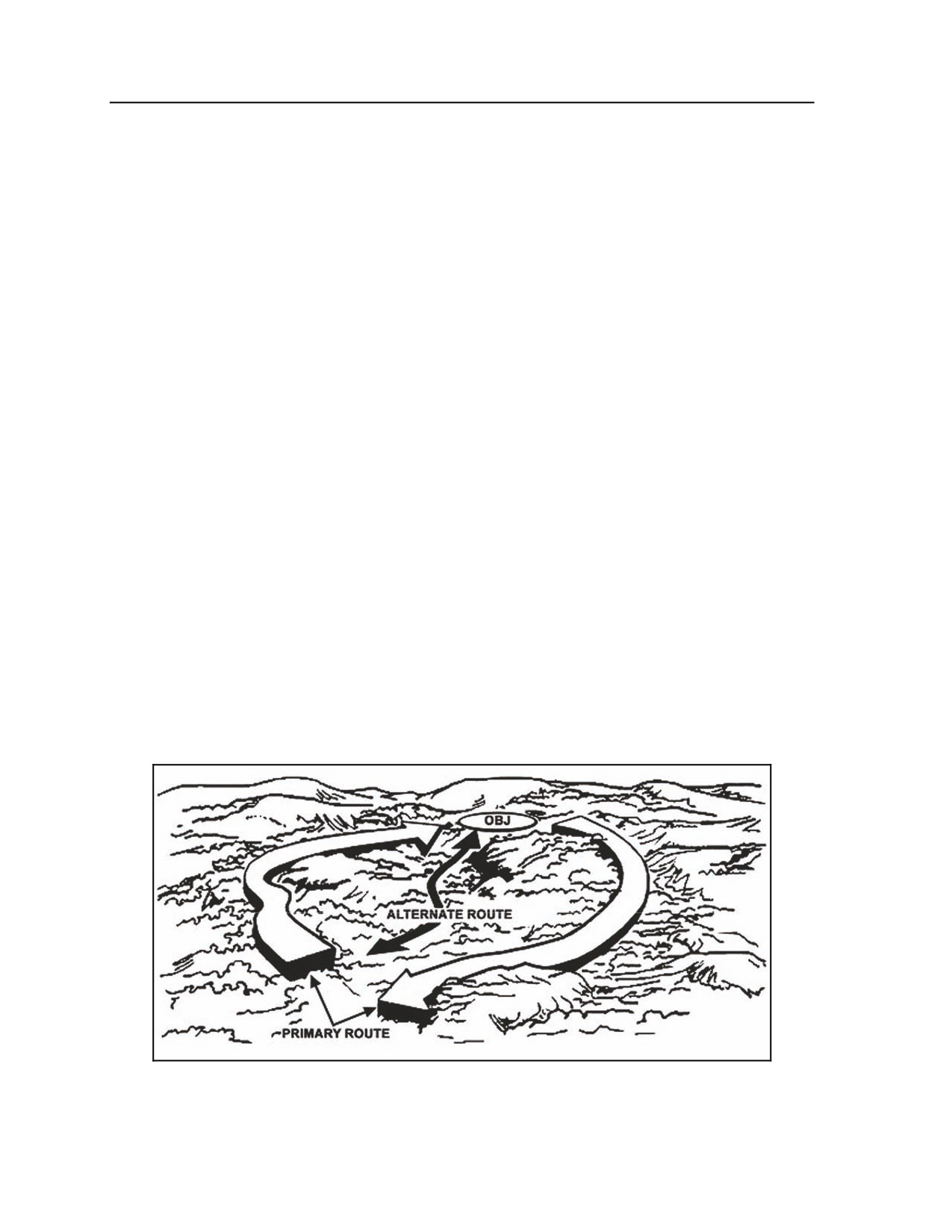
Chapter 9
Use and location of landing or pickup zones.
Departure and reentry of friendly lines.
Fire support on the objective and along the planned routes, including alternate routes.
Rehearsal areas and times. The terrain for the rehearsal should be similar to that at the objective,
to include buildings and fortifications if necessary. Coordination for rehearsals includes security
of the area, use of blanks, pyrotechnics, and live ammunition.
Special equipment and ammunition requirements.
Transportation support, including transportation to and from the rehearsal site.
Signal plan—call signs frequencies, code words, pyrotechnics, and challenge and password.
9-29. The leader coordinates with the unit through which his platoon or squad will conduct its forward and
rearward passage of lines.
9-30. The platoon leader also coordinates patrol activities with the leaders of other units that will be
patrolling in adjacent areas at the same time.
COMPLETION OF THE PATROL PLAN
9-31. As the platoon leader completes his plan, he considers the following elements.
ESSENTIAL AND SUPPORTING TASKS
9-32. The leader ensures that he has assigned all essential tasks to be performed on the objective, at rally
points, at danger areas, at security or surveillance locations, along the route(s), and at passage lanes.
KEY TRAVEL AND EXECUTION TIMES
9-33. The leader estimates time requirements for movement to the objective, leader's reconnaissance of the
objective, establishment of security and surveillance, compaction of all assigned tasks on the objective,
movement to an objective rally point to debrief the platoon, and return through friendly lines.
PRIMARY AND ALTERNATE ROUTES
9-34. The leader selects primary and alternate routes to and from the objective (Figure 9-1). Return routes
should differ from routes to the objective.
Figure 9-1. Primary and alternate routes.
9-4
FM 3-21.8
28 March 2007
Patrols and Patrolling
SIGNALS
9-35. The leader should consider the use of special signals. These include arm-and-hand signals, flares,
voice, whistles, radios, visible and nonvisible lasers. All signals must be rehearsed to ensure all Soldiers
know what they mean.
CHALLENGE AND PASSWORD OUTSIDE OF FRIENDLY LINES
9-36. The challenge and password from the SOI must not be used when the patrol is outside friendly lines.
The unit’s tactical SOP should state the procedure for establishing a patrol challenge and password as well
as other combat identification features and patrol markings.
LOCATION OF LEADERS
9-37. The leader considers where he, the platoon sergeant, and other key leaders should be located for each
phase of the patrol mission. The platoon sergeant is normally with the following elements for each type of
patrol:
On a raid or ambush, he normally controls the support element.
On an area reconnaissance, he normally supervises security in the objective rally point (ORP).
On a zone reconnaissance, he normally moves with the reconnaissance element that sets up the
link-up point.
ACTIONS ON ENEMY CONTACT
9-38. The leader's plan must address actions on chance contact at each phase of the patrol mission.
The plan must address the handling of seriously wounded and KIAs.
The plan must address the handling of prisoners captured as a result of chance contact who are
not part of the planned mission.
DEPARTURE FROM FRIENDLY LINES OR FIXED BASE
9-39. The departure from friendly lines, or from a fixed base, must be thoroughly planned and coordinated.
COORDINATION
9-40. The platoon leader must coordinate with the commander of the forward unit and leaders of other
units that will be patrolling in the same or adjacent areas. The coordination includes SOI information,
signal plan, fire plan, running passwords, procedures for departure and reentry of lines, planned dismount
points, initial rally points, actions at departure and reentry points, and information about the enemy.
(1) The platoon leader provides the forward unit leader with the unit identification, size of the
patrol, departure and return times, and area of operation.
(2) The forward unit leader provides the platoon leader with the following:
Additional information on terrain just outside the friendly unit lines.
Known or suspected enemy positions in the near vicinity.
Likely enemy ambush sites.
Latest enemy activity.
Detailed information on friendly positions, obstacles, and OPs.
Friendly unit fire plan.
Support the unit can provide
(fire support, litter teams, guides, communications, and
reaction force).
28 March 2007
FM 3-21.8
9-5
Chapter 9
PLANNING
9-41. In his plan for the departure of friendly lines, the leader should consider the following sequence of
actions:
Making contact with friendly guides at the contact point.
Moving to a coordinated initial rally point just inside friendly lines.
Completing final coordination.
Moving to and through the passage point.
Establishing a security-listening halt beyond the friendly unit's final protective fires.
RALLY POINTS
9-42. The leader considers the use and locations of rally points. A rally point is a place designated by the
leader where the platoon moves to reassemble and reorganize if it becomes dispersed.
SELECTION OF RALLY POINTS
9-43. The leader physically reconnoiters routes to select rally points whenever possible. He selects
tentative points if he can only conduct a map reconnaissance. Routes are confirmed by the leader through
actual inspection as the platoon moves through them. Rally points must—
Be easy to recognize on the ground.
Have cover and concealment.
Be away from natural lines of drift.
Be defendable for short periods.
TYPES OF RALLY POINTS
9-44. The most common types of rally points are initial, en route, objective, reentry, near- and far-side.
Soldiers must know which rally point to move to at each phase of the patrol mission. They should know
what actions are required there and how long they are to wait at each rally point before moving to another.
Following are descriptions of these five rally points.
(1) Initial rally point. An initial rally point is a place inside of friendly lines where a unit may
assemble and reorganize if it makes enemy contact during the departure of friendly lines or before
reaching the first en route rally point. It is normally selected by the commander of the friendly
unit.
(2) En route rally point. The leader designates en route rally points based on the terrain, vegetation,
and visibility.
(3) Objective rally point. The objective rally point (ORP) is a point out of sight, sound, and small-
arms range of the objective area. It is normally located in the direction that the platoon plans to
move after completing its actions on the objective. The ORP is tentative until the objective is
pinpointed (Figure 9-2). Actions at or from the ORP include—
Issuing a final FRAGO.
Disseminating information from reconnaissance if contact was not made.
Making final preparations before continuing operations.
Accounting for Soldiers and equipment after actions at the objective are complete.
Reestablishing the chain of command after actions at the objective are complete.
9-6
FM 3-21.8
28 March 2007
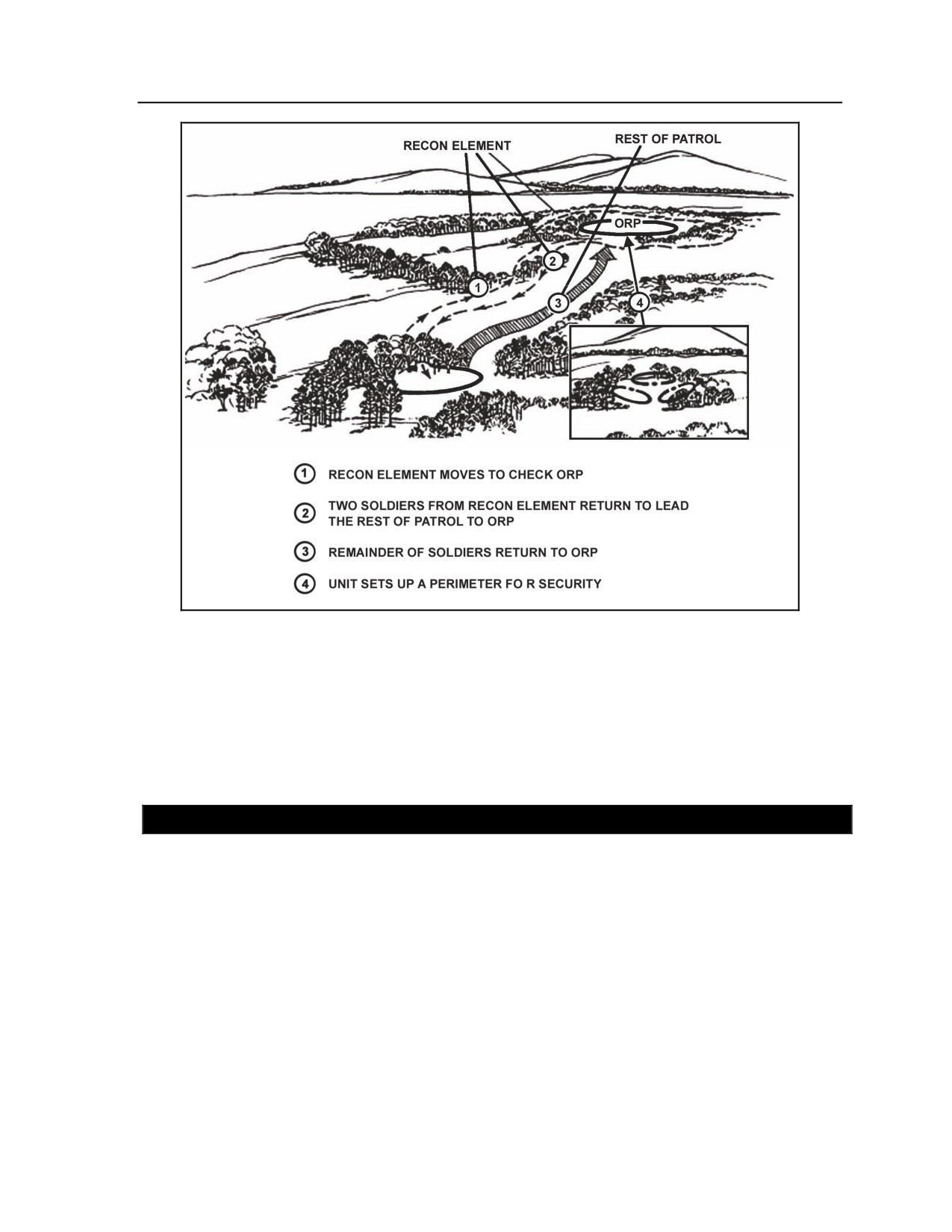
Patrols and Patrolling
Figure 9-2. Objective rally point.
(4) Reentry rally point. The reentry rally point is located out of sight, sound, and small-arms weapons range of
the friendly unit through which the platoon will return. This also means that the RRP should be outside the final
protective fires of the friendly unit. The platoon occupies the RRP as a security perimeter.
(5) Near-and far-side rally points. These rally points are on the near and far side of danger areas. If the platoon
makes contact while crossing the danger area and control is lost, Soldiers on either side move to the rally point
nearest them. They establish security, reestablish the chain of command, determine their personnel and
equipment status, continue the patrol mission, and link up at the OR.
SECTION II — COMBAT PATROLS
9-45. A combat patrol provides security and harasses, destroys, or captures enemy troops, equipment, or
installations. When the commander gives a unit the mission to send out a combat patrol, he intends for the
patrol to make contact with the enemy and engage in close combat. A combat patrol always attempts to
remain undetected while moving, but of course it ultimately discloses its location to the enemy in a sudden,
violent surprise attack. For this reason, the patrol normally carries a significant amount of weapons and
ammunition. It may carry specialized munitions. A combat patrol collects and reports any information
gathered during the mission, whether related to the combat task or not. The three types of combat patrols
are raid, ambush, and security.
RAID
9-46. A raid is a surprise attack against a position or installation for a specific purpose other than seizing
and holding the terrain. It is conducted to destroy a position or installation, to destroy or capture enemy
soldiers or equipment, or to free prisoners. A raid patrol retains terrain just long enough to accomplish the
28 March 2007
FM 3-21.8
9-7