FM 4-20.198 Multiservice Helicopter Sling Load: Single-Point Load Rigging Procedures (February 2009) - page 8
Chapter 8
RIGGING STEPS
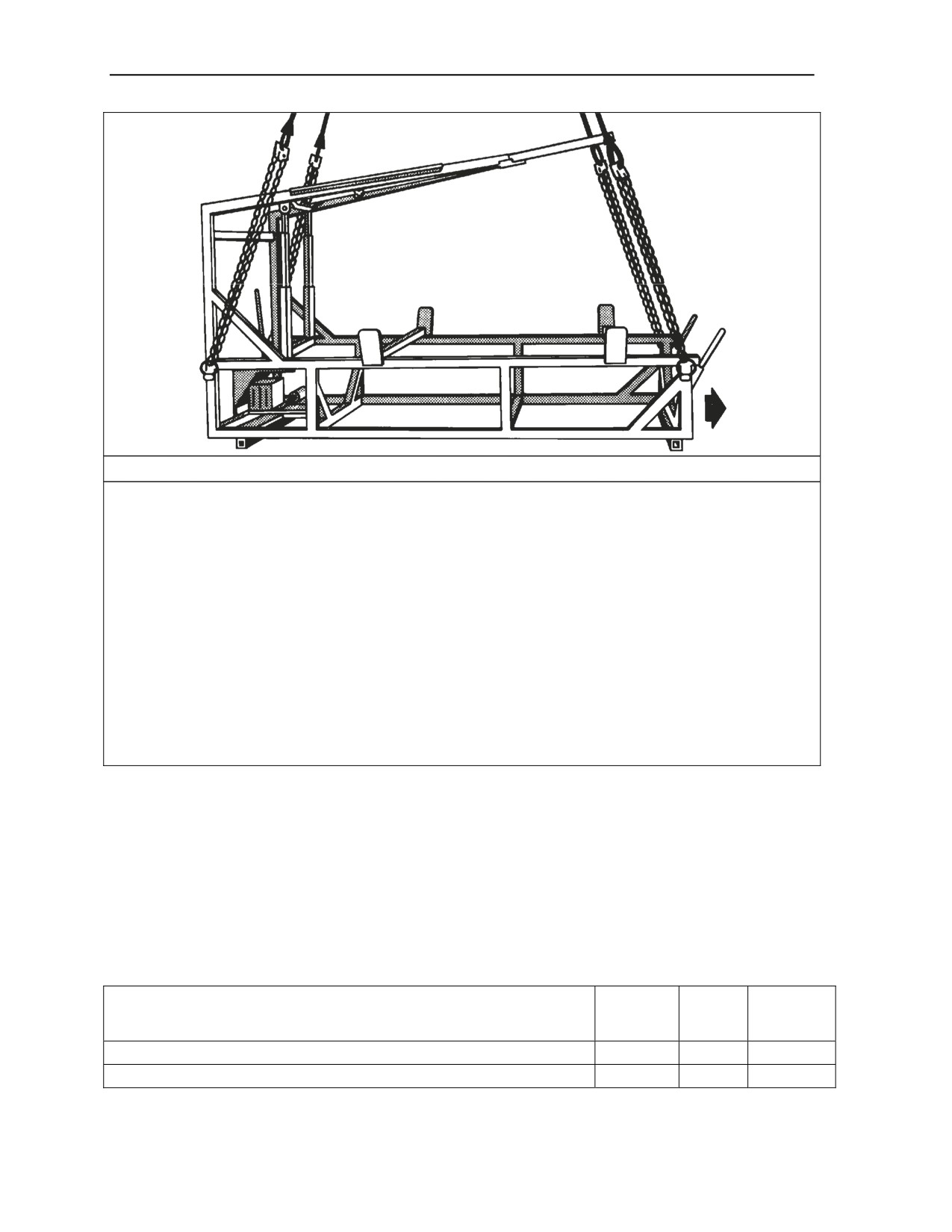
1. Position the apex fitting near the roller. Route outer sling legs 1 and 2 to the front of the load (roller
end). Route inner sling legs 3 and 4 to the rear of the load (engine end). Sling legs 1 and 3 must be on
the left side of the load.
2. Route the chain end of sling leg 1 through the left front lift provision. Place the correct link from Table 8-
16 in the grab hook. Repeat with sling leg 2 and the right front lift provision. Secure the excess chain
with tape or Type III nylon cord.
3. Route the chain end of sling leg 3 through the left rear lift provision. Place the correct link from Table 8-
16 in the grab hook. Repeat with sling leg 4 on the right rear lift provision.
4. Pad the sling legs/chains in the area where they make contact with the vehicle.
5. Cluster and tie (breakaway technique) the sling legs together on top of the roller to prevent
entanglement during hookup and lift-off.
Figure 8-16. Mk155 Launcher, Mine Clearing
M68A2 LINE CHARGE, DEMOLITION WITH OR WITHOUT MK22
ROCKET MOTOR
8-18. The M68A2 line charge, demolition with or without Mk22 rocket motor is rigged for single-point
sling load using the following procedures:
z
Applicability. The following items in Table 8-17 are certified for all helicopters with suitable
lift capacity by the US Army Natick Soldier Center:
Table 8-17. M68A2 Line Charge, Demolition with or without Mk22 Rocket Motor
Nomenclature
Max
Sling
Link
Weight
Set
Count
(Pounds)
Front/Rear
M68A2 Line Charge, Demolition with Mk22 Rocket Motor
2,672
10K
3/3
M68A2 Line Charge, Demolition Inert
2,486
10K
3/3
FM 4-20.198/MCRP 4-11.3E, VOL II/NTTP 3-04.12/
8-34
AFMAN 11-223 (I), VOL II/COMDTINST M13482.3B
20 February 2009
Certified Single-Point Rigging Procedures for Engineer Equipment
z
Materials. The following materials are required to rig this load:
Sling set (10,000-pound capacity).
Tape, adhesive, pressure-sensitive, 2-inch wide roll.
Cord, nylon, Type III, 550-pound breaking strength.
Webbing, cotton, 1/4-inch, 80-pound breaking strength.
Tie-down strap, CGU-1B (4 each).
z
Personnel. Two persons can prepare and rig each load in 20 minutes.
z
Procedures. The following procedures apply to this load:
Preparation. Prepare the load using the following steps:
─ Ensure the end of the load opposite the electrical connectors and fuse storage area is
designated as the front of the load.
─ Ensure the storage box lid is closed and secured with Type III nylon cord or tape.
─ Ensure the rocket motor box is secured with metal strapping.
─ Center the rocket motor box on top of the line charge container.
─ Connect two CGU-1/B tie-down straps together to form one long strap. Route the strap
around the line charge and rocket motor box lengthwise. Tighten the strap securely.
─ Route two CGU-1/B tie-down straps across the rocket motor box and underneath the line
charge container. Position the strap at each end of the containers approximately equal
distance from the center. Tighten the strap securely. Secure the excess tie-down strap
with tape or Type III nylon cord.
Note. When rigging the line charge without the rocket motor, omit preparation steps 3 through
6.
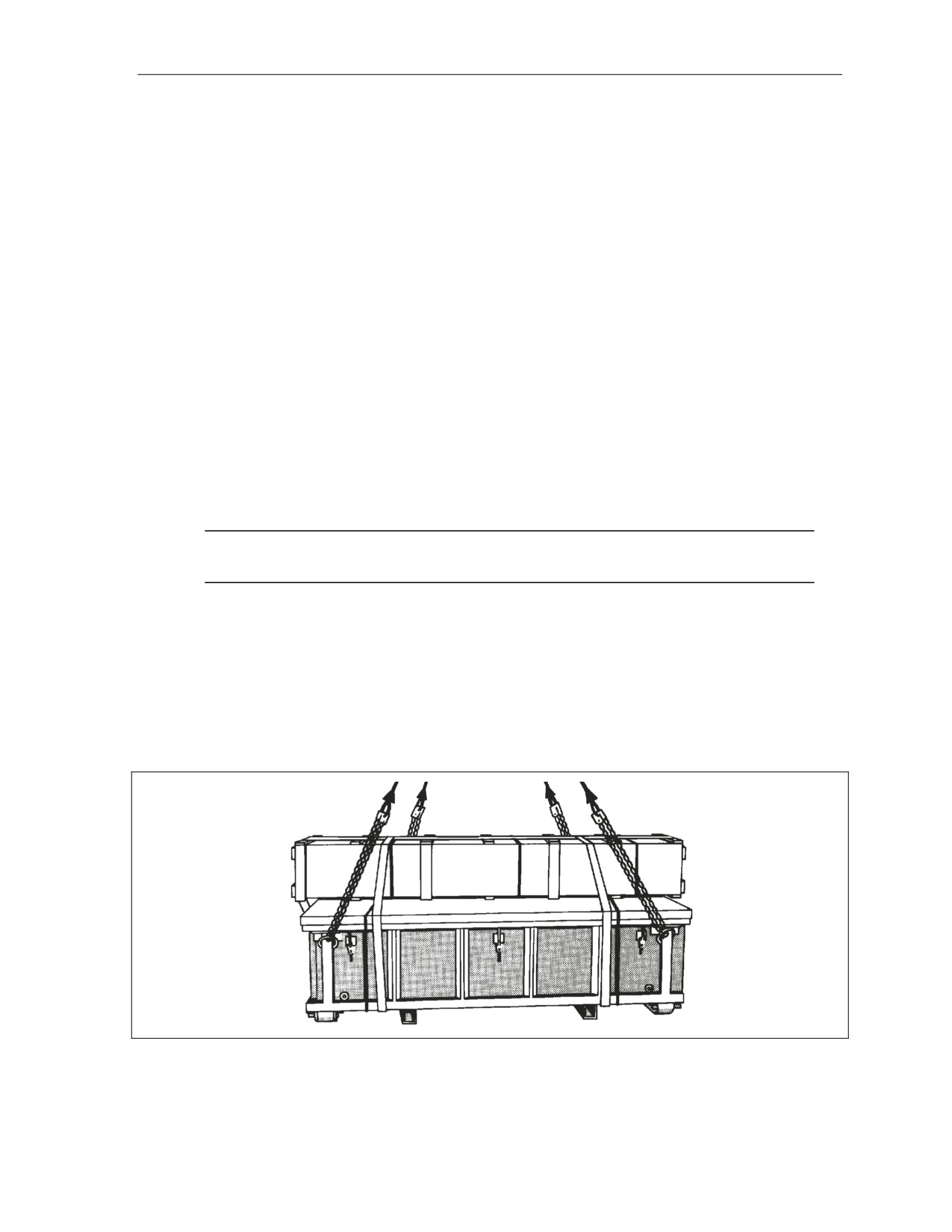
Rigging. Rig the load according to the steps in Figure 8-17.
Hookup. The hookup team stands alongside the line charge. The static wand person
discharges the static electricity with the static wand. The hookup person places the apex fitting
onto the aircraft cargo hook. The hookup team then moves clear of the load but remains close to
the load as the helicopter removes slack from the sling legs. When successful hookup is
assured, the hookup team quickly exits the area underneath the helicopter to the designated
rendezvous point.
Derigging. Derigging is the reverse of the preparation and rigging procedures.
Figure 8-17. M68A2 Line Charge, Demolition with or without Mk22 Rocket Motor
20 February 2009
FM 4-20.198/MCRP 4-11.3E, VOL II/NTTP 3-04.12/
AFMAN 11-223 (I), VOL II/COMDTINST M13482.3B
8-35

Chapter 8
RIGGING STEPS
1. Position the apex fitting on top of the container. Route outer sling legs 1 and 2 to the front of
the load. Route inner sling legs 3 and 4 to the rear of the load. Sling legs 1 and 3 must be
on the left side of the load.
2. Loop the chain end of sling leg 1 through the left front lift ring. Place the correct link from
Table 8-17 in the grab hook. Repeat with sling leg 2 and the right front lift ring.
3. Loop the chain end of sling leg 3 through the left rear lift ring. Place the correct link from
Table 8-17 in the grab hook. Repeat with sling leg 4 and the right rear lift ring.
4. Cluster and tie (breakaway technique) the sling legs together on top of the launch rail to
prevent entanglement during hookup and lift-off.
Figure 8-17. M68A2 Line Charge, Demolition with or without Mk22 Rocket Motor (Continued)
MK155 LAUNCHER WITH OR WITHOUT M68A2 DEMOLITION
LINE CHARGE AND MK22 ROCKET MOTOR ON M353 TRAILER
8-19. The Mk155 launcher with or without M68A2 demolition line charge and Mk22 rocket motor on
M353 trailer is rigged for single-point sling load using the following procedures:
z
Applicability. The following items in Table 8-18 are certified for all helicopters with suitable
lift capacity by the US Army Natick Soldier Center:
Table 8-18. Mk155 Launcher with or without M68A2 Demolition Line Charge and Mk22 Rocket
Motor on M353 Trailer
Nomenclature
Max
Sling
Link
Weight
Set
Count
(Pounds)
Front/Rear
Mk155 Launcher
3,700
10K
3/3
Mk Launcher with M68A2 Line, Demolition Charge and Mk22 Rocket
6,312
10K
3/3
Motor
z
Materials. The following materials are required to rig this load:
Sling set (10,000-pound capacity).
Tape, adhesive, pressure-sensitive, 2-inch wide roll.
Cord, nylon, Type III, 550-pound breaking strength.
Webbing, cotton, 1/4-inch, 80-pound breaking strength.
Tie-down strap, CGU-1B (4 each).
z
Personnel. Two persons can prepare and rig each load in 20 minutes.
z
Procedures. The following procedures apply to this load:
Preparation. Prepare the load using the following steps:
─ Ensure the launcher is securely attached to the trailer chassis. Ensure the launch rail is in
the collapsed or storage mode and not in its vertical position.
─ Ensure the storage box lid is closed and secured with Type III nylon cord or tape (if
installed).
─ Tie off hoses and safety chains and secure any loose items with nylon cord or tape.
─ Set the parking brake.
FM 4-20.198/MCRP 4-11.3E, VOL II/NTTP 3-04.12/
8-36
AFMAN 11-223 (I), VOL II/COMDTINST M13482.3B
20 February 2009
Certified Single-Point Rigging Procedures for Engineer Equipment
─ Place and secure the Mk22 rocket motor box inside the aircraft using the CGU-1/B tie-
down straps (if required).
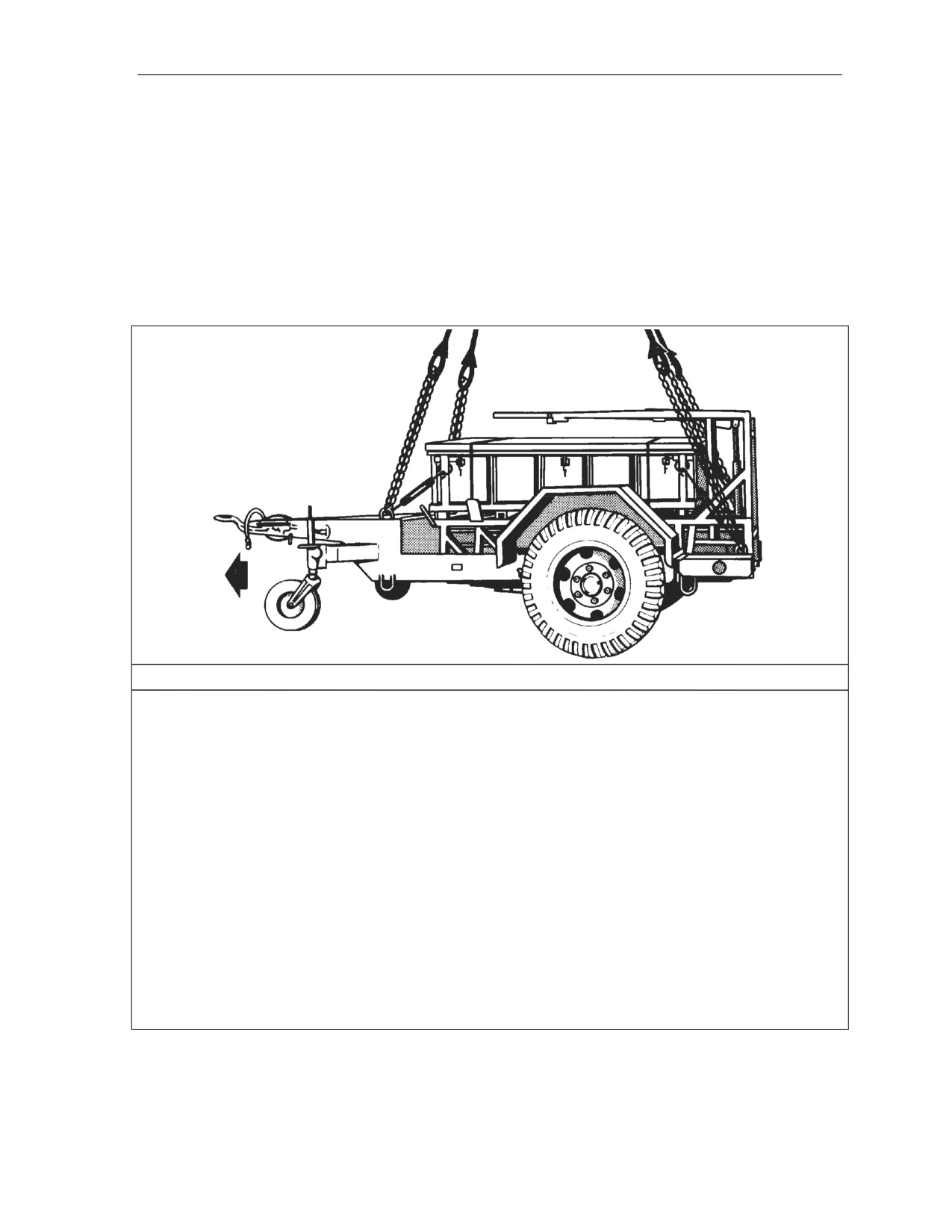
Rigging. Rig the load according to the steps in Figure 8-18.
Hookup. The hookup team stands on the trailer chassis. The static wand person discharges
the static electricity with the static wand. The hookup person places the apex fitting onto the
aircraft cargo hook. The hookup team then moves clear of the load but remains close to the load
as the helicopter removes slack from the sling legs. When successful hookup is assured, the
hookup team quickly exits the area underneath the helicopter to the designated rendezvous
point.
Derigging. Derigging is the reverse of the preparation and rigging procedures.
RIGGING STEPS
1. Position apex fitting on top of the launcher. Route outer sling legs 1 and 2 to the front of the
trailer and the inner sling legs 3 and 4 to the rear. Sling legs 1 and 3 should be to the left
side of the load.
2. Loop the chain end of sling leg 1 through the left front lift provision on the trailer chassis
located aft of the left leveling wheel assembly. Place the correct link from Table 8-18 in the
grab hook. Repeat with sling leg 2 and the right front lift provision.
3. Loop the chain end of sling leg 3 through the left rear lift provision on the trailer chassis
located aft of the trailer left wheel. Place the correct link from Table 8-18 in the grab hook.
Repeat with sling leg 4 and the right rear lift provision.
4. Raise the apex fitting above the launcher and tie or tape sling legs to the launch rail to
prevent entanglement during hookup.
5. Cluster and tie or tape (breakaway technique) all sling legs above the launch rail to prevent
entanglement during hookup and lift-off.
Figure 8-18. Mk155 Launcher on M353 Trailer
20 February 2009
FM 4-20.198/MCRP 4-11.3E, VOL II/NTTP 3-04.12/
AFMAN 11-223 (I), VOL II/COMDTINST M13482.3B
8-37
Chapter 8
MK155 LAUNCHER WITH OR WITHOUT M68A2 DEMOLITION
LINE CHARGE AND MK22 ROCKET MOTOR ON M200A1 OR
MOBILE-TRAC SYSTEM (MTS) TRAILER
8-20. The Mk155 launcher with or without M68A2 demolition line charge and Mk22 rocket motor on
M200A1 or mobile-trac system trailer are rigged for single-point sling load using the following procedures:
z
Applicability. The following items in Table 8-19 are certified for all helicopters with suitable
lift capacity by the US Army Natick Soldier Center:
Table 8-19. Mk155 Launcher with or without M68A2 Demolition Line Charge and Mk22 Rocket
Motor on M200A1 or Mobile-Trac System Trailer
Nomenclature
Max
Sling
Link
Weight
Set
Count
(Pounds)
Front/Rear
Mk155 Launcher on M200A1 Trailer
3,330
10K
3/3
Mk155 Launcher with M68A2, Demolition Charge and Mk22 Rocket
5,620
10K
10/3
Motor on M200A1 Trailer
Mk155 Launcher with M68A2, Demolition Charge and Mk22 Rocket
7,172
10K
10/3
Motor on Mobile-Trac System Trailer
z
Materials. The following materials are required to rig this load:
Sling set (10,000-pound capacity).
Tape, adhesive, pressure-sensitive, 2-inch wide roll.
Cord, nylon, Type III, 550-pound breaking strength.
Webbing, cotton, 1/4-inch, 80-pound breaking strength.
Tie-down strap, CGU-1B (4 each).
z
Personnel. Two persons can prepare and rig each load in 20 minutes.
z
Procedures. The following procedures apply to this load:
Preparation. Prepare the load using the following steps:
─ Ensure the launcher is securely attached to the trailer chassis. Ensure the launch rail is in
the collapsed or storage mode and not in its vertical position.
─ Ensure the storage box lid is closed and secured with Type III nylon cord or tape (if
installed).
─ Tie off hoses and safety chains and secure any loose items with nylon cord or tape.
─ Set the parking brake.
─ Place and secure the Mk22 rocket motor box inside the aircraft using the CGU-1/B tie-
down straps (if required).
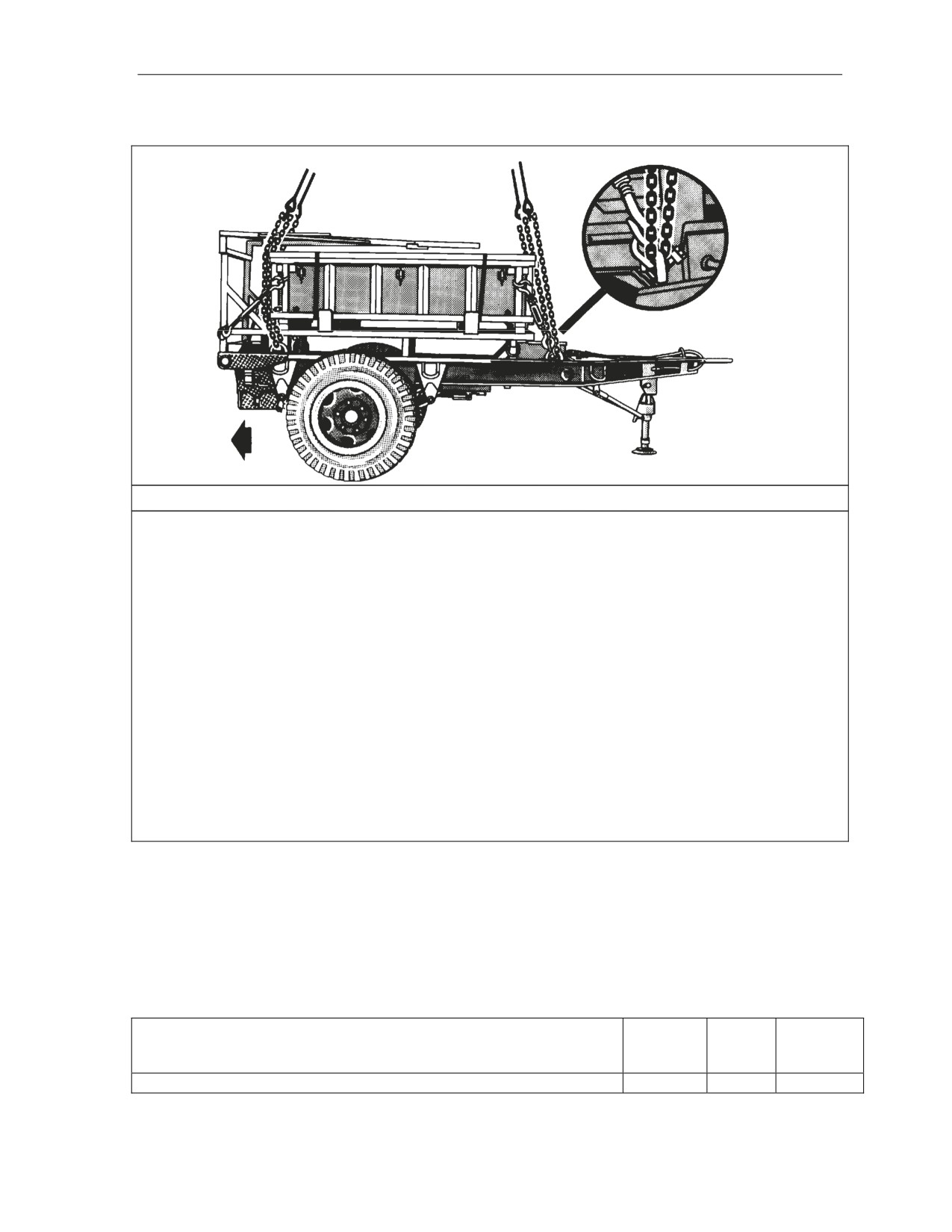
Rigging. Rig the load according to the steps in Figure 8-19.
Hookup. The hookup team stands on the trailer chassis or on the charge. The static wand
person discharges the static electricity with the static wand. The hookup person places the apex
fitting onto the aircraft cargo hook. The hookup team then moves clear of the load but remains
close to the load as the helicopter removes slack from the sling legs. When successful hookup is
assured, the hookup team quickly exits the area underneath the helicopter to the designated
rendezvous point.
Derigging. Derigging is the reverse of the preparation and rigging procedures.
FM 4-20.198/MCRP 4-11.3E, VOL II/NTTP 3-04.12/
8-38
AFMAN 11-223 (I), VOL II/COMDTINST M13482.3B
20 February 2009
Certified Single-Point Rigging Procedures for Engineer Equipment
RIGGING STEPS
1. Position apex fitting on top of the launcher. Route outer sling legs 1 and 2 to the front of the
trailer and the inner sling legs 3 and 4 to the rear. Sling legs 1 and 3 should be to the left
side of the load.
2. Loop the chain end of sling leg 1 through the left front lift provision on the trailer chassis
located aft of the lunette. Place the correct link from Table 8-19 in the grab hook. Repeat
with sling leg 2 and the right front lift provision.
3. Loop the chain end of sling leg 3 through the left rear lift provision on the trailer chassis
located aft of the demolition charge container. Place the correct link from Table 8-19 in the
grab hook. Repeat with sling leg 4 and the right rear lift provision.
4. Raise the apex fitting above the launcher and tie or tape sling legs to the launch rail to
prevent entanglement during hookup.
5. Cluster and tie (breakaway technique) all sling legs above the launch rail to prevent
entanglement during hookup and lift-off.
Figure 8-19. Mk155 Launcher on M200A1 or Mobile-Trac System Trailer
LRT-110, 7 1/2-TON CRANE
8-21. The LRT-110, 7 1/2-ton crane is rigged for single-point sling load using the following procedures:
z
Applicability. The following item in Table 8-20 is certified for all helicopters with suitable lift
capacity by the US Army Natick Soldier Center:
Table 8-20. LRT-110, 7 1/2-Ton Crane
Nomenclature
Max
Sling
Link
Weight
Set
Count
(Pounds)
Front/Rear
LRT-110, 7 ½-Ton Crane
24,230
25K
3/3
20 February 2009
FM 4-20.198/MCRP 4-11.3E, VOL II/NTTP 3-04.12/
AFMAN 11-223 (I), VOL II/COMDTINST M13482.3B
8-39
Chapter 8
z
Materials. The following materials are required to rig this load:
Sling set (25,000-pound capacity).
Tape, adhesive, pressure-sensitive, 2-inch wide roll.
Cord, nylon, Type III, 550-pound breaking strength.
Webbing, cotton, 1/4-inch, 80-pound breaking strength.
Tie-down strap, CGU-1B (4 each).
Webbing, tubular, nylon, 1/2-inch.
Felt sheet, cattle hair, Type IV, 1/2-inch or suitable substitute.
z
Personnel. Two persons can prepare and rig each load in 20 minutes.
z
Procedures. The following procedures apply to this load:
Preparation. Prepare the load using the following steps:
─ Fold side mirrors in toward cab and tie or tape, as necessary. Tape or secure windshield
wipers to windshield.
─ Ensure the wheels are pointing straight ahead. Secure the steering wheel with nylon cord
or tape.
─ Secure doors, tool box covers, and all loose equipment with nylon cord or tape. Secure
hook-block assembly to the end of the boom mast with CGU-l/B cargo tie-down or
equivalent.
─ Secure boom light power cable with nylon cord or tape.
─ Insert wooden cable wedges at the drum to prevent the cable from unspooling if the cable
becomes slack. Secure wedges with 1/2-inch tubular nylon.
─ Set the parking brake.
Rigging. Rig the load according to the steps in Figure 8-20.
Hookup. The hookup team stands beside the left and right side of the boom base. The
static wand person discharges the static electricity with the static wand. The hookup person
places the apex fitting onto the aircraft cargo hook. The hookup team then moves clear of the
load but remains close to the load as the helicopter removes slack from the sling legs. When
successful hookup is assured, the hookup team quickly exits the area underneath the helicopter
to the designated rendezvous point.
Derigging. Derigging is the reverse of the preparation and rigging procedures.
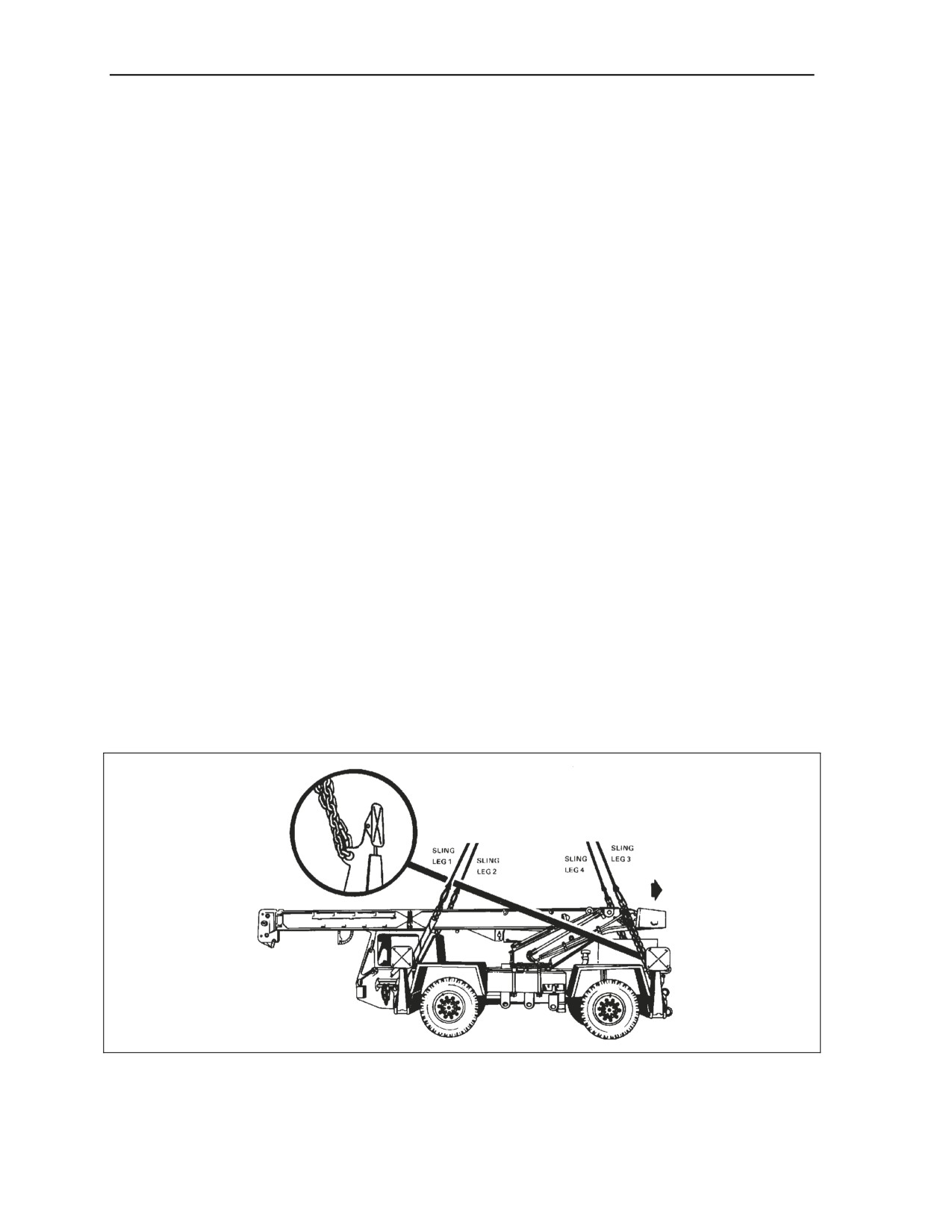
Figure 8-20. LRT-110, 7 1/2-Ton Crane
FM 4-20.198/MCRP 4-11.3E, VOL II/NTTP 3-04.12/
8-40
AFMAN 11-223 (I), VOL II/COMDTINST M13482.3B
20 February 2009

Certified Single-Point Rigging Procedures for Engineer Equipment
RIGGING STEPS
1. Position apex fitting on top of the boom directly above the boom base. Route outer sling legs
1 and 2 to the front (cab end) of the crane and the inner sling legs 3 and 4 to the rear. Sling
legs 1 and 3 must be on the left (driver’s) side of the load.
2. Loop the chain end of sling leg 1 through the lift provision located on the inboard side of the
front left outrigger. Place the correct link from Table 8-20 in the grab hook. Repeat with
sling leg 2 on the right front outrigger.
3. Loop the chain end of sling leg 3 through the lift provision located on the inboard side of the
left rear outrigger. Place the correct link from Table 8-20 in the grab hook. Repeat with sling
leg 4 on the right rear outrigger.
4. Pad the sling legs where they contact the crane cab.
5. Cluster and tie (breakaway technique) all sling legs together to prevent entanglement during
hookup and lift-off.
Figure 8-20. LRT-110, 7 1/2-Ton Crane (Continued)
LRT-110, 7 1/2-TON CRANE BOOM
8-22. The LRT-110, 7 1/2-ton crane boom is rigged for single-point sling load using the following
procedures:
z
Applicability. The following item in Table 8-21 is certified for all helicopters with suitable lift
capacity by the US Army Natick Soldier Center:
Table 8-21. LRT-110, 7 1/2-Ton Crane Boom
Nomenclature
Max
Sling
Link
Weight
Set
Count
(Pounds)
Front/Rear
LRT-110, 7 ½-Ton Crane Boom
8,600
10K
3/3
z
Materials. The following materials are required to rig this load:
Sling set (10,000-pound capacity).
Tape, adhesive, pressure-sensitive, 2-inch wide roll.
Cord, nylon, Type III, 550-pound breaking strength.
Webbing, cotton, 1/4-inch, 80-pound breaking strength.
Tie-down strap, CGU-1B (4 each).
Webbing, tubular, nylon, 1/2-inch.
z
Personnel. Two persons can prepare and rig each load in 20 minutes.
z
Procedures. The following procedures apply to this load:
Preparation. Prepare the load using the following steps:
─ Sectionalize the crane according to instructions in the operator’s manual.
─ Secure hook-block assembly to the end of the boom mast with CGU-l/B cargo tie-down
or equivalent.
─ Secure boom light power cable with nylon cord or tape.
─ Insert wooden cable wedges at the drum to prevent the cable from unspooling if the cable
becomes slack. Secure wedges with 1/2-inch tubular nylon.
20 February 2009
FM 4-20.198/MCRP 4-11.3E, VOL II/NTTP 3-04.12/
AFMAN 11-223 (I), VOL II/COMDTINST M13482.3B
8-41
Chapter 8
─ Secure the boom hydraulic hoses with tape or nylon cord. Make sure the hoses are clear
of the boom base.
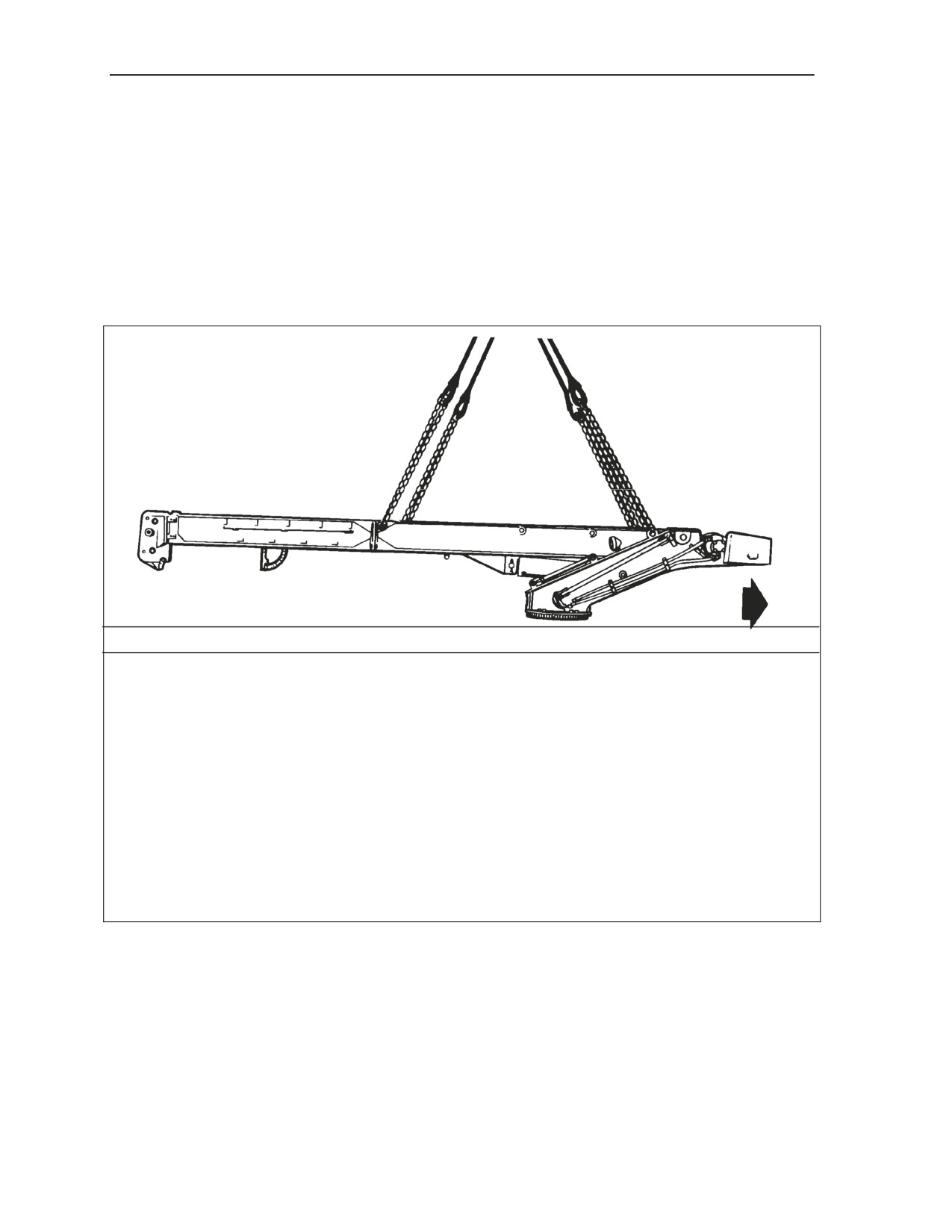
Rigging. Rig the load according to the steps in Figure 8-21.
Hookup. The hookup team stands beside the boom. The static wand person discharges the
static electricity with the static wand. The hookup person places the apex fitting onto the
aircraft cargo hook. The hookup team then moves clear of the load but remains close to the load
as the helicopter removes slack from the sling legs. When successful hookup is assured, the
hookup team quickly exits the area underneath the helicopter to the designated rendezvous
point.
Derigging. Derigging is the reverse of the preparation and rigging procedures.
RIGGING STEPS
1. Position apex fitting on top of the boom directly above the boom base. Route outer sling legs
1 and 2 to the front (counterweight) end and inner sling legs 3 and 4 to the rear (hook) end.
Sling legs 1 and 3 must be on the left side of the boom.
2. Loop the chain end of sling leg 1 through the lift provision located on top of the boom left
support arm near the counterweight end. Place the correct link from Table 8-21 in the grab
hook. Repeat with sling leg 2 on the right side support arm.
3. Loop the chain end of sling leg 3 through the lift provision located on the left side near the
middle of the boom. Place the correct link from Table 8-21 in the grab hook. Repeat with
sling leg 4 on the right side.
4. Cluster and tie (breakaway technique) all sling legs together to prevent entanglement during
hookup and lift-off.
Figure 8-21. LRT-110, 7 1/2-Ton Crane Boom
LRT-110, 7 1/2-TON CRANE POWER UNIT
8-23. The LRT-110, 7 1/2-ton crane power unit is rigged for single-point sling load using the following
procedures:
z
Applicability. The following item in Table 8-22 is certified for all helicopters with suitable lift
capacity by the US Army Natick Soldier Center:
FM 4-20.198/MCRP 4-11.3E, VOL II/NTTP 3-04.12/
8-42
AFMAN 11-223 (I), VOL II/COMDTINST M13482.3B
20 February 2009
Certified Single-Point Rigging Procedures for Engineer Equipment
Table 8-22. LRT-110, 7 1/2-Ton Crane Power Unit
Nomenclature
Max
Sling
Link
Weight
Set
Count
(Pounds)
Front/Rear
LRT-110, 7 ½-Ton Crane Power Unit
15,600
25K
3/3
z
Materials. The following materials are required to rig this load:
Sling set (25,000-pound capacity).
Tape, adhesive, pressure-sensitive, 2-inch wide roll.
Cord, nylon, Type III, 550-pound breaking strength.
Webbing, cotton, 1/4-inch, 80-pound breaking strength.
Tie-down strap, CGU-1B (4 each).
Webbing, tubular, nylon, 1/2-inch.
Felt sheet, cattle hair, Type IV, 1/2-inch or suitable substitute.
z
Personnel. Two persons can prepare and rig each load in 20 minutes.
z
Procedures. The following procedures apply to this load:
Preparation. Prepare the load using the following steps:
─ Sectionalize the crane according to instructions in the operator’s manual.
─ Fold side mirrors in toward cab and tie or tape, as necessary. Tape or secure windshield
wipers to windshield.
─ Ensure the wheels are pointing straight ahead. Secure the steering wheel with nylon cord
or tape. Engage the parking brake.
─ Secure doors, tool box covers, and all loose equipment with nylon cord or tape.
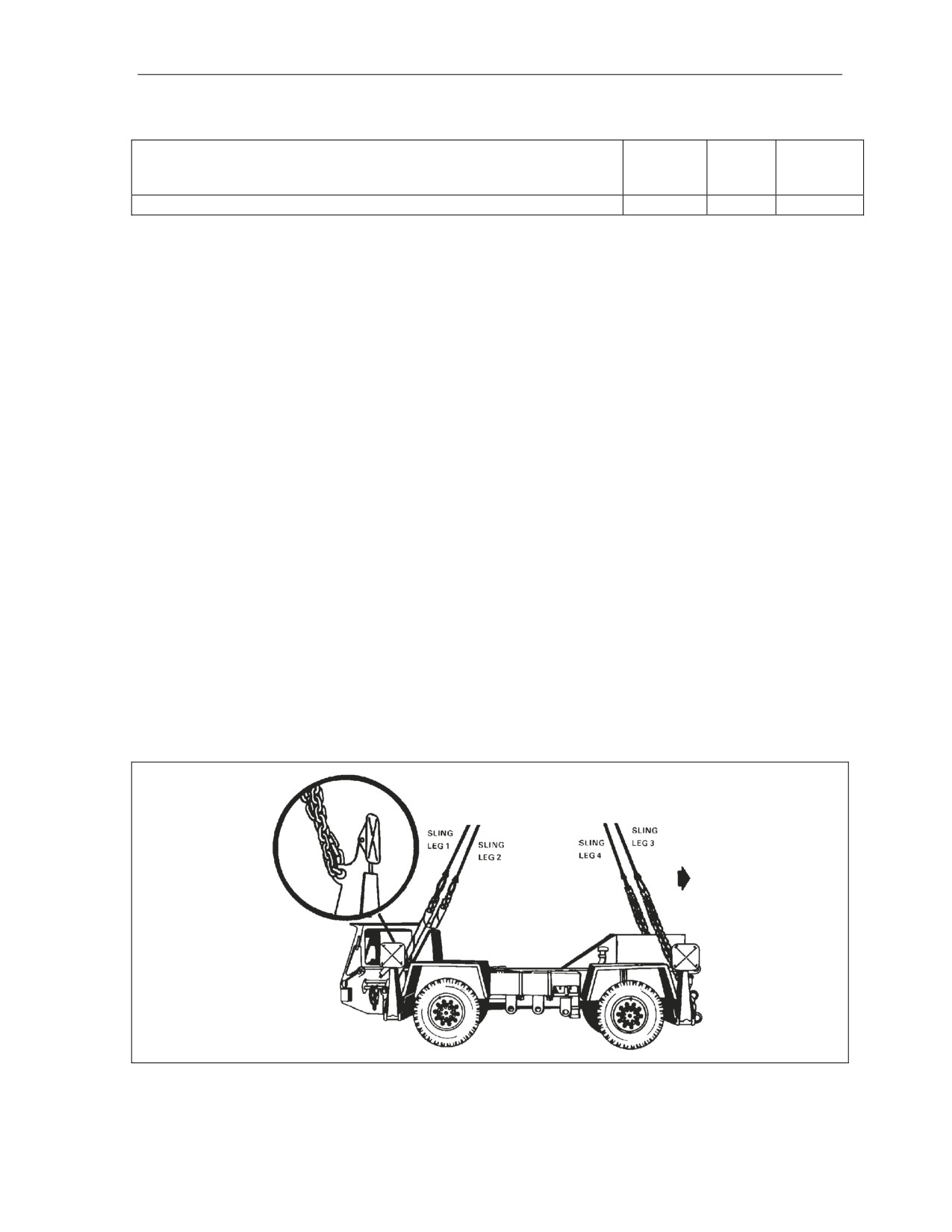
Rigging. Rig the load according to the steps in Figure 8-22.
Hookup. The hookup team stands beside the left and right side of the boom base. The
static wand person discharges the static electricity with the static wand. The hookup person
places the apex fitting onto the aircraft cargo hook. The hookup team then moves clear of the
load but remains close to the load as the helicopter removes slack from the sling legs. When
successful hookup is assured, the hookup team quickly exits the area underneath the helicopter
to the designated rendezvous point.
Derigging. Derigging is the reverse of the preparation and rigging procedures.
Figure 8-22. LRT-110, 7 1/2-Ton Crane Boom Power Unit
20 February 2009
FM 4-20.198/MCRP 4-11.3E, VOL II/NTTP 3-04.12/
AFMAN 11-223 (I), VOL II/COMDTINST M13482.3B
8-43
Chapter 8
RIGGING STEPS
1. Position apex fitting on top of the boom base attaching point. Route outer sling legs 1 and 2
to the front (cab end) of the crane and the inner sling legs 3 and 4 to the rear. Sling legs 1
and 3 must be on the left (driver’s) side of the load.
2. Loop the chain end of sling leg 1 through the lift provision located on the inboard side of the
front left outrigger. Place the correct link from Table 8-22 in the grab hook. Repeat with sling
leg 2 on the right front outrigger. Pad the sling legs where they contact the crane cab.
3. Loop the chain end of sling leg 3 through the lift provision located on the inboard side of the
left rear outrigger. Place the correct link from Table 8-22 in the grab hook. Repeat with sling
leg 4 on the right rear outrigger.
4. Cluster and tie (breakaway technique) all sling legs together to prevent entanglement during
hookup and lift-off.
Figure 8-22. LRT-110, 7 1/2-Ton Crane Boom Power Unit (Continued)
TRUCK, FORKLIFT, MC-4000
8-24. The truck, forklift, MC-4000 is rigged for single-point sling load using the following procedures:
z
Applicability. The following item in Table 8-23 is certified for all helicopters with suitable lift
capacity by the US Army Natick Soldier Center:
Table 8-23. Truck, Forklift, MC-4000
Nomenclature
Max
Sling
Link
Weight
Set
Count
(Pounds)
Front/Rear
Truck, Forklift, Rough Terrain, MC-4000, TAMCN B2565
8,600
15K
4/10
z
Materials. The following materials are required to rig this load:
Sling set (15,000-pound capacity).
Tape, adhesive, pressure-sensitive, 2-inch wide roll.
Cord, nylon, Type III, 550-pound breaking strength.
Webbing, cotton, 1/4-inch, 80-pound breaking strength.
z
Personnel. Two persons can prepare and rig each load in 20 minutes.
z
Procedures. The following procedures apply to this load:
Preparation. Prepare the load using the following steps:
─ Insert the articulating lock pin to keep the front and rear sections from twisting while in
flight.
─ Secure the seat cushion and steering wheel with Type III nylon cord. Engage the hand
brake and place the transmission in neutral.
─ Ensure the fuel tank is less than 3/4 full.
─ Raise the fork tines 1 foot above the ground.
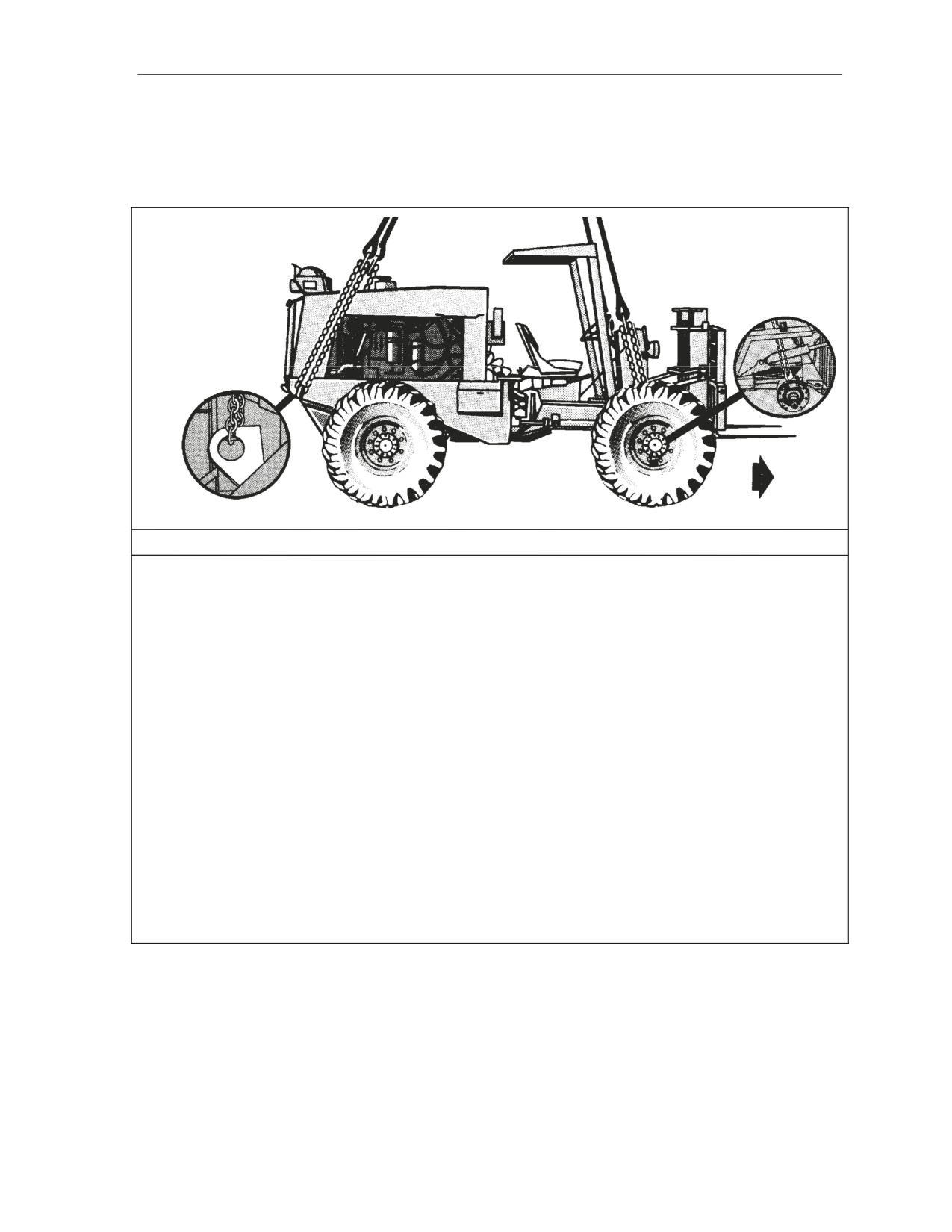
Rigging. Rig the load according to the steps in Figure 8-23.
Hookup. The hookup team stands on top of the engine deck. The static wand person
discharges the static electricity with the static wand. The hookup person places the apex fitting
onto the aircraft cargo hook. The hookup team then moves clear of the load but remains close to
the load as the helicopter removes slack from the sling legs. When successful hookup is
FM 4-20.198/MCRP 4-11.3E, VOL II/NTTP 3-04.12/
8-44
AFMAN 11-223 (I), VOL II/COMDTINST M13482.3B
20 February 2009
Certified Single-Point Rigging Procedures for Engineer Equipment
assured, the hookup team quickly exits the area underneath the helicopter to the designated
rendezvous point.
Derigging. Derigging is the reverse of the preparation and rigging procedures.
RIGGING STEPS
1. Position apex fitting/web ring on top of the engine hood or ROPS. Route outer sling legs 1
and 2 to the front of the forklift and inner sling legs 3 and 4 to the rear of the engine area.
Sling legs 1 and 3 must be on the left side of the load.
2. Loop the chain end of sling leg 1 through the left front lift provision (not the tie-down
provision) that is located directly above the forward axle housing between the left front tire
and the hydraulic cylinder. Place the correct link from Table 8-23 in the grab hook. Repeat
with sling leg 2 on the right front lift provision.
3. Loop the chain end of sling leg 3 through the left rear lift provision. Place the correct link
from Table 8-23 in the grab hook. Repeat with sling leg 4 and the right rear lift provision.
4. Pull the front sling legs up and tape or tie (breakaway technique) the grab links to the front
side of the upper light brackets to ensure the sling legs do not become entangled.
5. Pull the aft sling legs together on top of the engine compartment and tie (breakaway
technique) the two grab links together.
6. Cluster and tie (breakaway technique) all sling legs together on top of the forklift to prevent
entanglement during hookup and lift-off.
Figure 8-23. Truck, Forklift, MC-4000
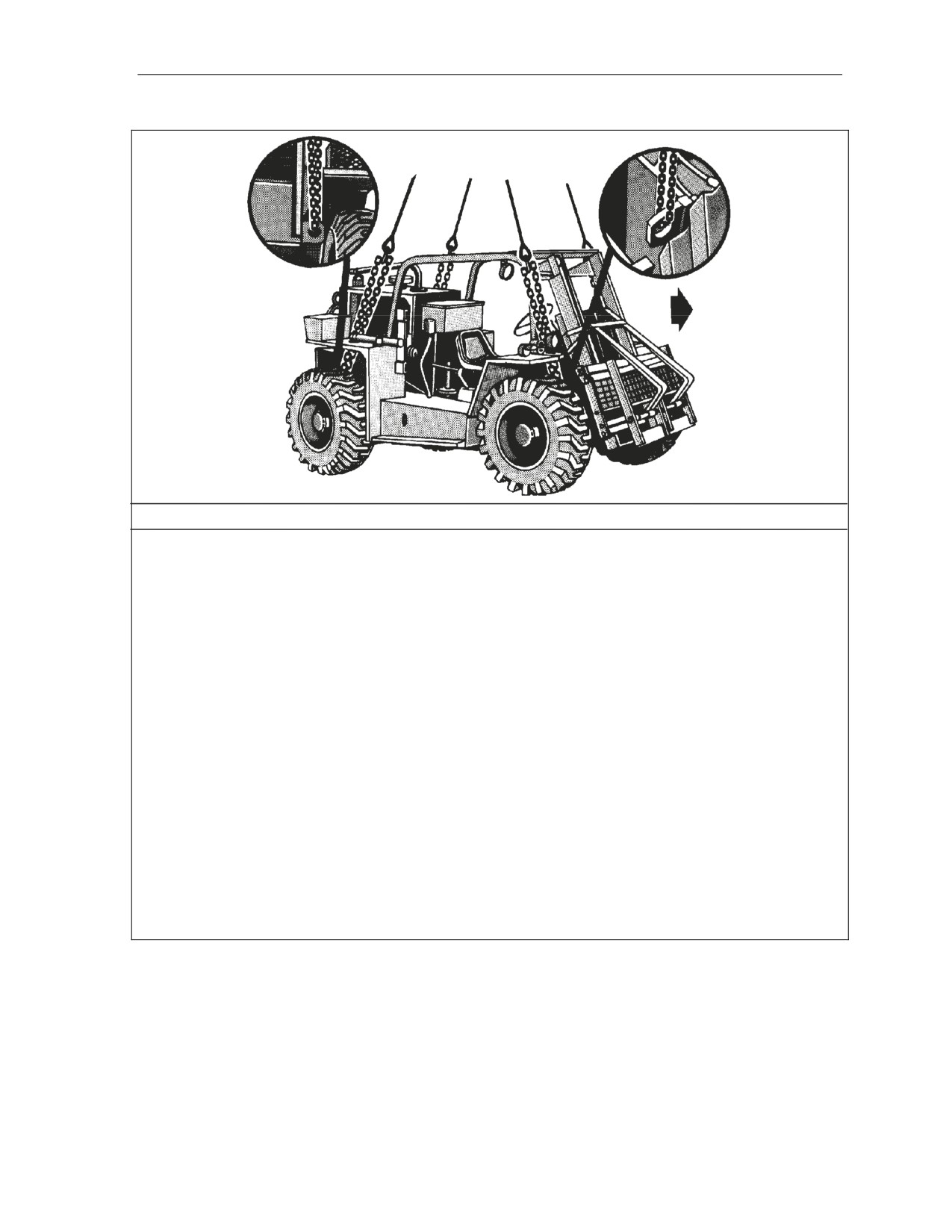
TRUCK, FORKLIFT, RT4000
8-25. The truck, forklift, RT4000 is rigged for single-point sling load using the following procedures:
z
Applicability. The following item in Table 8-24 is certified for all helicopters with suitable lift
capacity by the US Army Natick Soldier Center:
20 February 2009
FM 4-20.198/MCRP 4-11.3E, VOL II/NTTP 3-04.12/
AFMAN 11-223 (I), VOL II/COMDTINST M13482.3B
8-45
Chapter 8
Table 8-24. Truck, Forklift, RT4000
Nomenclature
Max
Sling
Link
Weight
Set
Count
(Pounds)
Front/Rear
Truck, Forklift, Rough Terrain, RT4000, TAMCN B2566
10,860
15K
3/10
z
Materials. The following materials are required to rig this load:
Sling set (15,000-pound capacity).
Tape, adhesive, pressure-sensitive, 2-inch wide roll.
Cord, nylon, Type III, 550-pound breaking strength.
Webbing, cotton, 1/4-inch, 80-pound breaking strength.
Tie-down strap, CGU-1B (4 each).
z
Personnel. Two persons can prepare and rig each load in 10 minutes.
z
Procedures. The following procedures apply to this load:
Preparation. Prepare the load using the following steps:
─ Secure the seat cushion and steering wheel with Type III nylon cord. Engage the hand
brake and place the transmission in neutral.
─ Ensure the fuel tank is less than 3/4 full.
─ Raise the fork tines 1 foot above the ground. Lift the fork ends upward and secure to the
lift cylinder frame using the CGU-1B straps.
─ Tape the end of the exhaust pipe.
Rigging. Rig the load according to the steps in Figure 8-24.
Hookup. The hookup team stands on top of the falling objects protection system (FOPS).
The static wand person discharges the static electricity with the static wand. The hookup person
places the apex fitting onto the aircraft cargo hook. The hookup team then moves clear of the
load but remains close to the load as the helicopter removes slack from the sling legs. When
successful hookup is assured, the hookup team quickly exits the area underneath the helicopter
to the designated rendezvous point.
Derigging. Derigging is the reverse of the preparation and rigging procedures.
FM 4-20.198/MCRP 4-11.3E, VOL II/NTTP 3-04.12/
8-46
AFMAN 11-223 (I), VOL II/COMDTINST M13482.3B
20 February 2009
Certified Single-Point Rigging Procedures for Engineer Equipment
RIGGING STEPS
1.
Position apex fitting on top of the falling object protection system (FOPS). Route outer sling
legs 1 and 2 to the front of the forklift and inner sling legs 3 and 4 to the rear of the engine
area. Sling legs 1 and 3 must be on the left side of the load.
2.
Loop the chain end of sling leg 1 through the left front lift provision (not the tie-down
provision) that is located directly above the forward axle housing between the left front tire
and the hydraulic cylinder. Place the correct link from Table 8-24 in the grab hook. Repeat
with sling leg 2 on the right front lift provision.
3.
Loop the chain end of sling leg 3 through the left rear lift provision. Place the correct link
from Table 8-24 in the grab hook. Repeat with sling leg 4 and the right rear lift provision.
Secure excess chain with tape or nylon cord.
4.
Pull the front sling legs up and tape or tie (breakaway technique) the grab links to the front
side of the upper light brackets to ensure the sling legs do not become entangled.
5.
Pull the aft sling legs together on top of the engine compartment and tie (breakaway
technique) the two grab links together.
6.
Cluster and tie (breakaway technique) all sling legs together on top of the FOPS to prevent
entanglement during hookup and lift-off.
Figure 8-24. Truck, Forklift, RT4000
20 February 2009
FM 4-20.198/MCRP 4-11.3E, VOL II/NTTP 3-04.12/
AFMAN 11-223 (I), VOL II/COMDTINST M13482.3B
8-47
Chapter 8
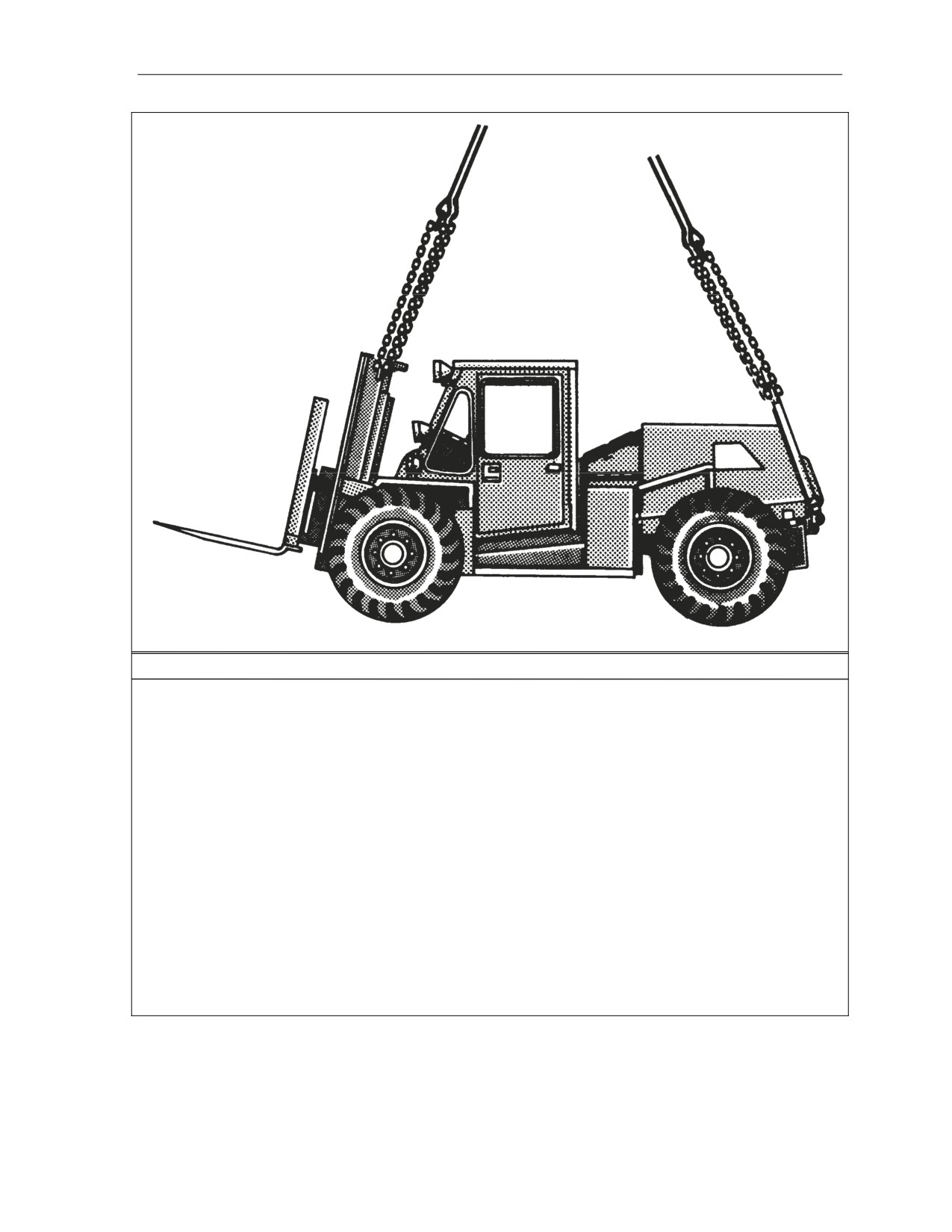
MHE-270/MHE-271 TRUCK, FORKLIFT, RT4000
8-26. The MHE-270/MHE-271 truck, forklift, RT4000 is rigged for single-point sling load using the
following procedures:
z
Applicability. The following item in Table 8-25 is certified for all helicopters with suitable lift
capacity by the US Army Natick Soldier Center:
Table 8-25. MHE-270/MHE-271 Truck, Forklift, RT4000
Nomenclature
Max
Sling
Link
Weight
Set
Count
(Pounds)
Front/Rear
MHE-270 without Cab, NSN: 3930-01-330-8907
11,700
25K
40/3
MHE-271 with Cab, NSN: 3930-01-330-8906
11,920
25K
40/3
z
Materials. The following materials are required to rig this load:
Sling set (25,000-pound capacity).
Tape, adhesive, pressure-sensitive, 2-inch wide roll.
Cord, nylon, Type III, 550-pound breaking strength.
Webbing, cotton, 1/4-inch, 80-pound breaking strength.
z
Personnel. Two persons can prepare and rig each load in 15 minutes.
z
Procedures. The following procedures apply to this load:
Preparation. Prepare the load using the following steps:
─ Tilt the mast back as far as it will go.
─ Ensure the fuel tank is less than 3/4 full.
─ Tilt the tow bar up as far as it will go. Ensure both pins which hold the tow bar in an
upright position are disengaged. The tow bar must be free to rotate.
─ Place the transmission in neutral and straighten the front wheels.
─ Engage the parking brake.
─ Secure the doors, chains, fire extinguisher, and all loose equipment with tape or Type III
nylon cord.
─ Tape all lights, windows and glass fixtures.
─ Tape the windshield wipers to the windshield.
Rigging. Rig the load according to the steps in Figure 8-25.
Hookup. The hookup team stands on the rear of the forklift. The static wand person
discharges the static electricity with the static wand. The hookup person places the apex fitting
onto the aircraft cargo hook. The hookup team then moves clear of the load but remains close to
the load as the helicopter removes slack from the sling legs. When successful hookup is
assured, the hookup team quickly exits the area underneath the helicopter to the designated
rendezvous point.
Derigging. Derigging is the reverse of the preparation and rigging procedures.
FM 4-20.198/MCRP 4-11.3E, VOL II/NTTP 3-04.12/
8-48
AFMAN 11-223 (I), VOL II/COMDTINST M13482.3B
20 February 2009
Certified Single-Point Rigging Procedures for Engineer Equipment
RIGGING STEPS
1. Position the apex fitting on top of the rear of the forklift. Route outer sling legs 1 and 2 to the
mast and inner sling legs 3 and 4 to the tow bar. Sling legs 1 and 3 must be on the left side
of the load.
2. Loop the chain end of sling leg 1 through the left front lift provision located at the top of the
left mast. Place the correct link from Table 8-25 in the grab hook. Repeat with sling leg 2
and the right front lift provision.
3. Loop the chain end of sling leg 3 down through the left rear lift provision located on the left
side of the tow bar. Place the correct link from Table 8-25 in the grab hook. Repeat with
sling leg 4 and the right rear lift provision.
4. Pull the front sling legs up and tape or tie (breakaway technique) to the top of the mast to
ensure the sling legs do not become entangled.
5. Cluster and tie or tape (breakaway technique) all sling legs together on top of the forklift to
prevent entanglement during hookup and lift-off.
Figure 8-25. MHE-270/MHE-271 Truck, Forklift, RT4000
20 February 2009
FM 4-20.198/MCRP 4-11.3E, VOL II/NTTP 3-04.12/
AFMAN 11-223 (I), VOL II/COMDTINST M13482.3B
8-49
Chapter 8
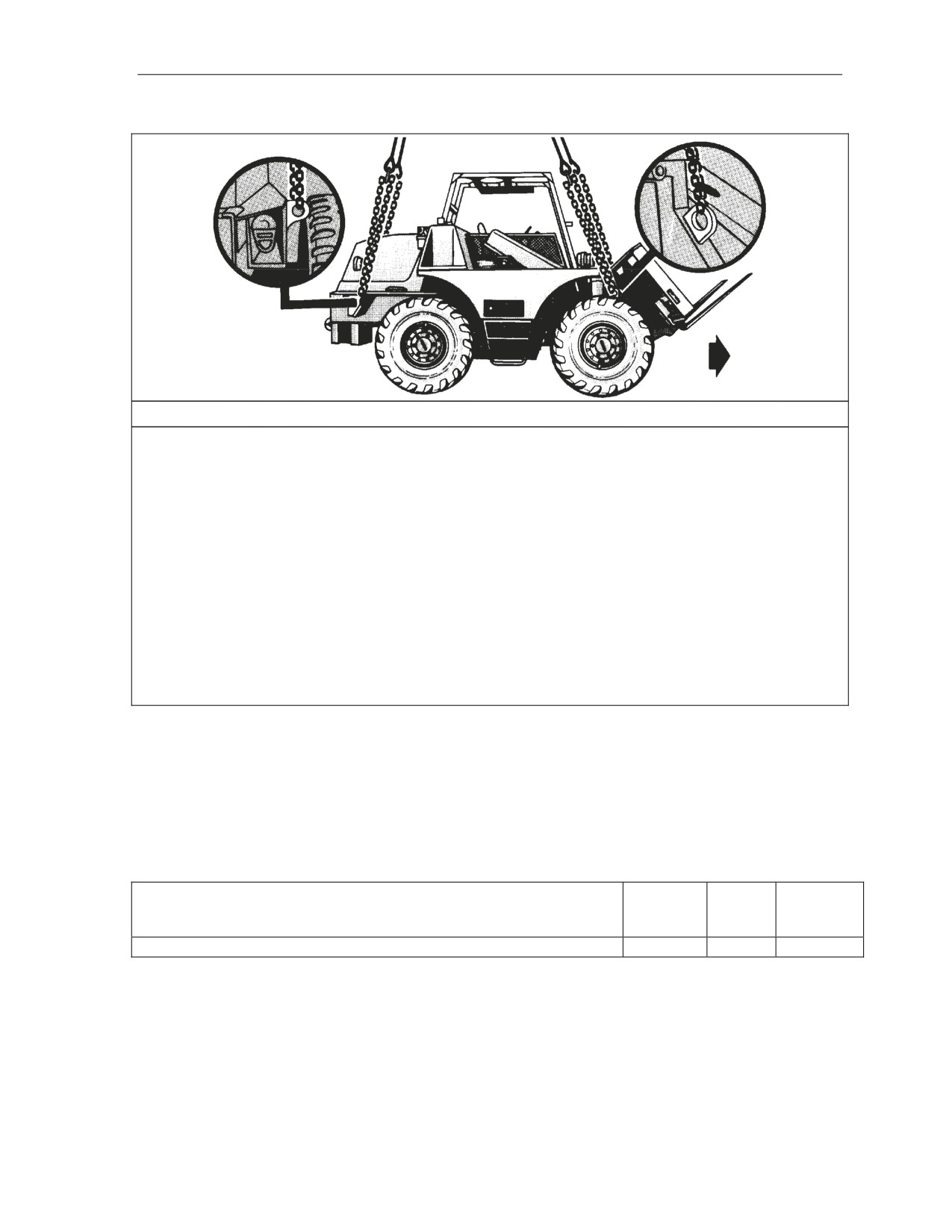
TRUCK, FORKLIFT, MC-6000
8-27. The truck, forklift, MC-6000 is rigged for single-point sling load using the following procedures:
z
Applicability. The following item in Table 8-26 is certified for all helicopters with suitable lift
capacity by the US Army Natick Soldier Center:
Table 8-26. Truck, Forklift, MC-6000
Nomenclature
Max
Sling
Link
Weight
Set
Count
(Pounds)
Front/Rear
Truck, Forklift, MC-6000
19,800
40K
3/16
z
Materials. The following materials are required to rig this load:
Sling set (40,000-pound capacity).
Tape, adhesive, pressure-sensitive, 2-inch wide roll.
Cord, nylon, Type III, 550-pound breaking strength.
Webbing, cotton, 1/4-inch, 80-pound breaking strength.
Tie-down strap, CGU-1B (4 each).
Felt sheet, cattle hair, Type IV, 1/2-inch or suitable substitute.
z
Personnel. Two persons can prepare and rig each load in 10 minutes.
z
Procedures. The following procedures apply to this load:
Preparation. Prepare the load using the following steps:
─ Position the forks so they are sitting on the travel blocks and are tilted all the way aft.
─ Ensure the fuel tank is less than 3/4 full. Place the transmission in neutral and engage the
parking brake.
─ Route two CGU-1/B cargo tie-down straps around the rear access doors.
─ Route two CGU-1/B cargo tie-down straps around the engine access doors.
─ Secure the tool box lid with tape or Type III nylon cord.
Rigging. Rig the load according to the steps in Figure 8-26.
Hookup. The hookup team stands on top of the engine deck. The static wand person
discharges the static electricity with the static wand. The hookup person places the apex fitting
onto the aircraft cargo hook. The hookup team then moves clear of the load but remains close to
the load as the helicopter removes slack from the sling legs. When successful hookup is
assured, the hookup team quickly exits the area underneath the helicopter to the designated
rendezvous point.
Derigging. Derigging is the reverse of the preparation and rigging procedures.
FM 4-20.198/MCRP 4-11.3E, VOL II/NTTP 3-04.12/
8-50
AFMAN 11-223 (I), VOL II/COMDTINST M13482.3B
20 February 2009
Certified Single-Point Rigging Procedures for Engineer Equipment
RIGGING STEPS
1. Position apex fitting on top of the roll over protection system (ROPS). Route outer sling legs
1 and 2 to the front of the forklift and inner sling legs 3 and 4 to the rear. Sling legs 1 and 3
must be on the left side of the load.
2. Loop the chain end of sling leg 1 through the left front lift provision mounted on the frame
inboard of the left front tire. Place the correct link from Table 8-26 in the grab hook. Repeat
with sling leg 2 and the right front lift provision.
3. Loop the chain end of sling leg 3 through the left rear lift provision located on the frame aft of
the left rear tire. Place the correct link from Table 8-26 in the grab hook. Repeat with sling
leg 4 and the right rear lift provision.
4. Lift the sling leg and tie (breakaway technique) the grab hooks to the ROPS. Cluster and tie
(breakaway technique) all sling legs together on top of the forklift to prevent entanglement
during hookup and lift-off.
Figure 8-26. Truck, Forklift, MC-6000
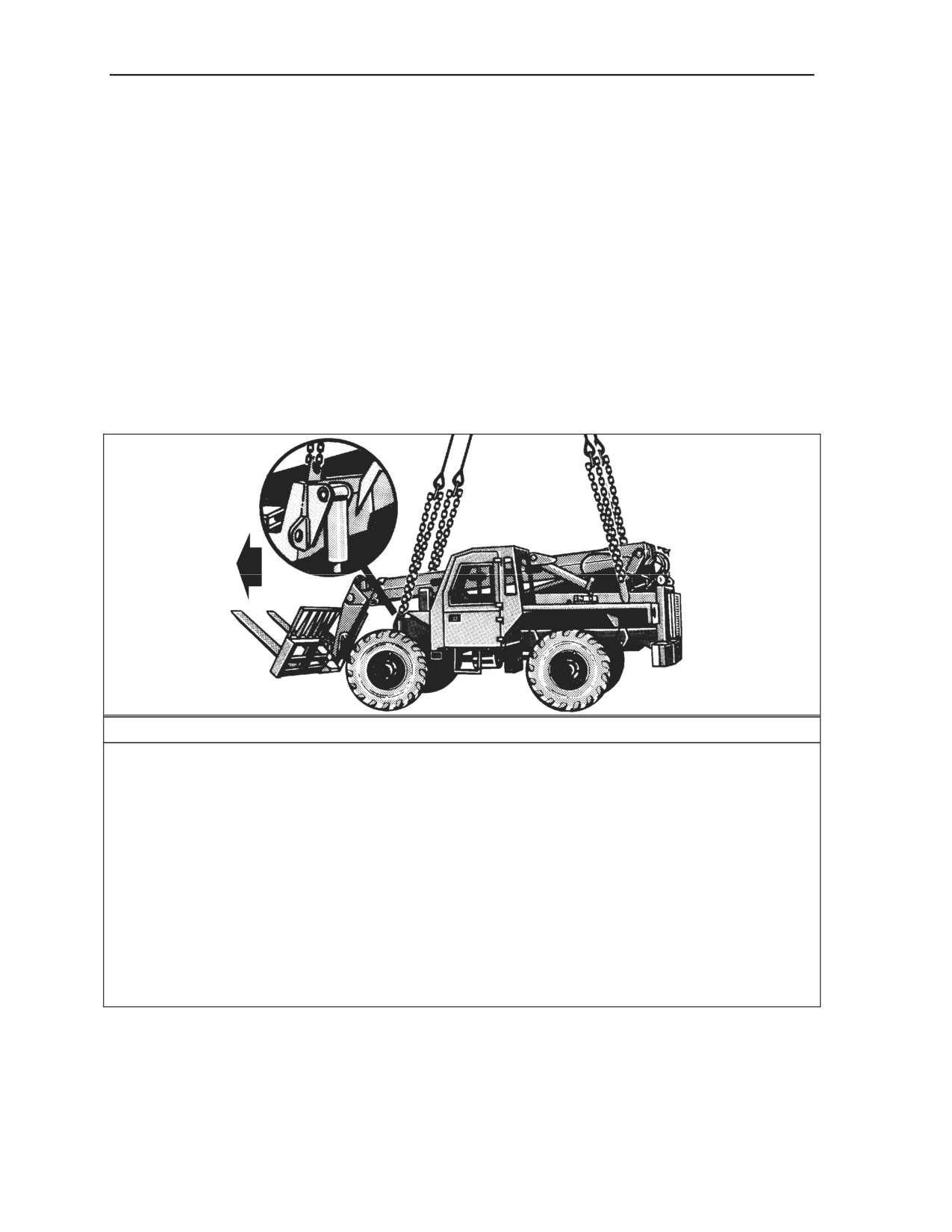
EXTENDABLE BOOM FORKLIFT
8-28. The extendable boom forklift is rigged for single-point sling load using the following procedures:
z
Applicability. The following item in Table 8-27 is certified for all helicopters with suitable lift
capacity by the US Army Natick Soldier Center:
Table 8-27. Extendable Boom Forklift
Nomenclature
Max
Sling
Link
Weight
Set
Count
(Pounds)
Front/Rear
Extendable Boom Forklift
25,640
40K
3/20
z
Materials. The following materials are required to rig this load:
Sling set (40,000-pound capacity).
Tape, adhesive, pressure-sensitive, 2-inch wide roll.
Cord, nylon, Type III, 550-pound breaking strength.
Webbing, cotton, 1/4-inch, 80-pound breaking strength.
Tie-down strap, cargo, CGU-1/B (as required).
z
Personnel. Two persons can prepare and rig each load in 10 minutes.
20 February 2009
FM 4-20.198/MCRP 4-11.3E, VOL II/NTTP 3-04.12/
AFMAN 11-223 (I), VOL II/COMDTINST M13482.3B
8-51
Chapter 8
z
Procedures. The following procedures apply to this load:
Preparation. Prepare the load using the following steps:
─ Secure the forks against the carriage using the CGU-1/Bs.
─ Raise the carriage 10 inches off the ground, retract and raise the boom.
─ Set the parking brake.
─ Place the gear selector lever in neutral.
─ Tape the exhaust pipe end.
Rigging. Rig the load according to the steps in Figure 8-27.
Hookup. The hookup team stands on the falling objects protection system (FOPS). The
static wand person discharges the static electricity with the static wand. The hookup person
places the apex fitting onto the aircraft cargo hook. The hookup team then moves clear of the
load but remains close to the load as the helicopter removes slack from the sling legs. When
successful hookup is assured, the hookup team quickly exits the area underneath the helicopter
to the designated rendezvous point.
Derigging. Derigging is the reverse of the preparation and rigging procedures.
RIGGING STEPS
1. Position the apex fitting on top of the falling object protection system (FOPS). Route outer
sling legs 1 and 2 to the front of the EBFL and inner sling legs 3 and 4 to the rear of the
EBFL. Sling legs 1 and 3 must be on the left side of the load.
2. Loop the chain end of sling leg 1 through the left front lift provision. Place the correct link
from Table 8-27 in the grab hook. Repeat with sling leg 2 and the right front lift provision.
3. Loop the chain end of sling leg 3 through the left rear lift provision. Place the correct link
from Table 8-27 in the grab hook. Repeat with sling leg 4 and the right rear lift provision.
Secure excess chain with tape or Type III nylon cord.
4. Cluster and tie (breakaway technique) all sling legs together on top of the FOPS to prevent
entanglement during hookup and lift-off.
Figure 8-27. Extendable Boom Forklift
FM 4-20.198/MCRP 4-11.3E, VOL II/NTTP 3-04.12/
8-52
AFMAN 11-223 (I), VOL II/COMDTINST M13482.3B
20 February 2009
Certified Single-Point Rigging Procedures for Engineer Equipment
EXTENDABLE BOOM FORKLIFT (NEW VERSION)
8-29. The extendable boom forklift (new version) is rigged for single-point sling load using the following
procedures:
z
Applicability. The following item in Table 8-28 is certified for all helicopters with suitable lift
capacity by the US Army Natick Soldier Center:
Table 8-28. Extendable Boom Forklift (New Version)
Nomenclature
Max
Sling Set
Link Count
Weight
Front/Rear
(Pounds)
Extendable Boom Forklift (New Version)
28,400
40K
3/48 Cab Side
3/50 Boom Side
z
Materials. The following materials are required to rig this load:
Sling set (40,000-pound capacity).
Tape, adhesive, pressure-sensitive, 2-inch wide roll.
Cord, nylon, Type III, 550-pound breaking strength.
Webbing, cotton, 1/4-inch, 80-pound breaking strength.
Tiedown strap, cargo, CGU-1/B (as required).
z
Personnel. Two persons can prepare and rig this load in 10 minutes.
z
Procedures. The following procedures apply to this load:
Preparation. Prepare the load using the following steps:
─ Secure the forks against the carriage using the CGU-1/Bs.
─ Set the parking brake.
─ Place the gear selector lever in neutral.
─ Tape the exhaust pipe end.
─ Lower the boom and tilt the forks all the way back.
─ Secure all latches on the windows with tape or Type III nylon cord.
─ Tape the windshield wipers to the windshield.
─ Tape all lights and mirrors.
─ Secure all equipment in the cab with tape or Type III nylon cord.
─ Ensure the wheels are pointed straight ahead and secure the steering wheel with Type III
nylon cord.
─ Secure the engine cover with Type III nylon cord.
Rigging. Rig the load according to the steps in Figure 8-28.
Hookup. The hookup team stands on the side of the load. The static wand person
discharges the static electricity with the static wand. The hookup person places the apex fitting
onto the aircraft cargo hook. The hookup team then moves clear of the load but remains close to
the load as the helicopter removes slack from the sling legs. When successful hookup is
assured, the hookup team quickly exits the area underneath the helicopter to the designated
rendezvous point.
Derigging. Derigging is the reverse of the preparation and rigging procedures.
20 February 2009
FM 4-20.198/MCRP 4-11.3E, VOL II/NTTP 3-04.12/
AFMAN 11-223 (I), VOL II/COMDTINST M13482.3B
8-53
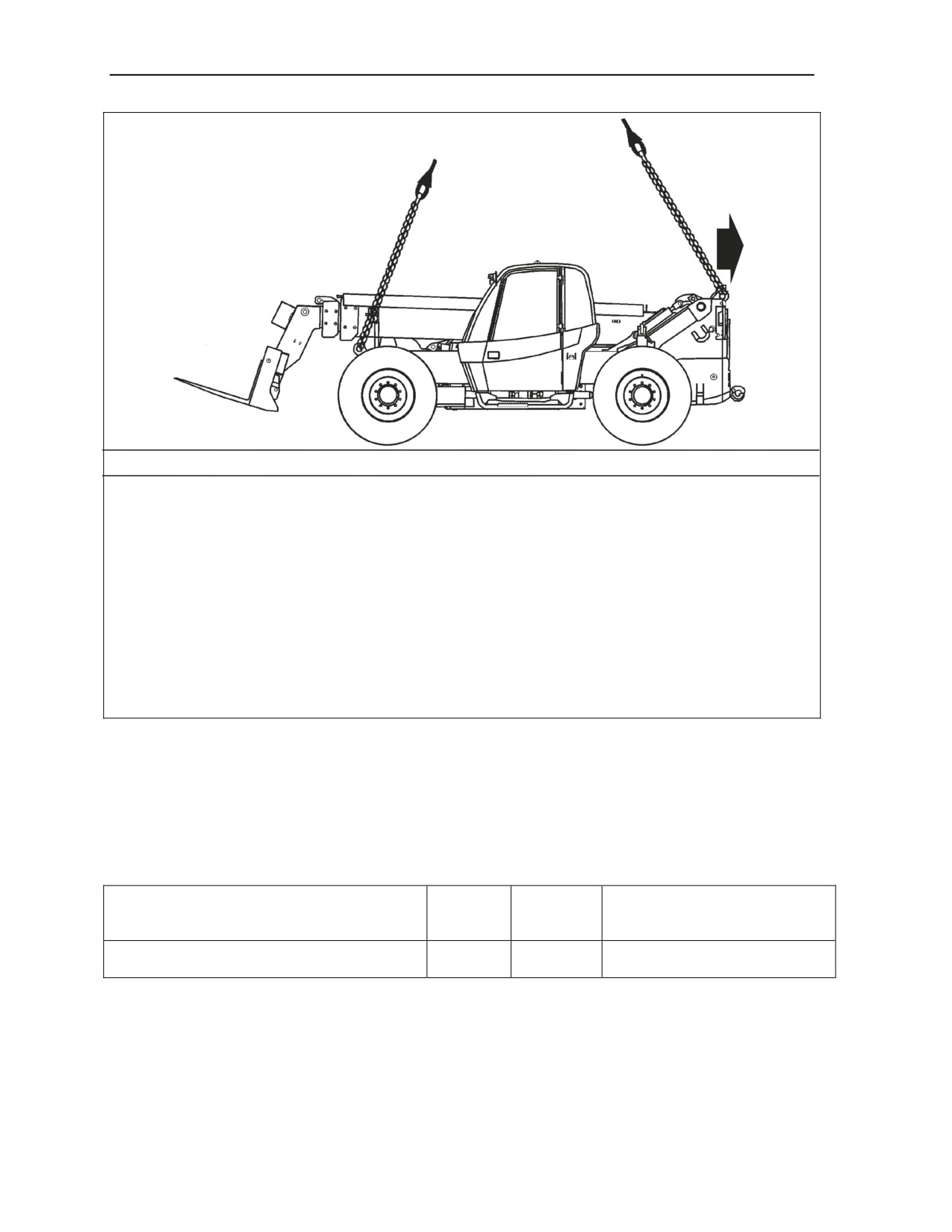
Chapter 8
RIGGING STEPS
1. Position the apex fitting on top of the vehicle. Route outer sling legs 1 and 2 to the front of
the EBFL and inner sling legs 3 and 4 to the rear of the EBFL. Sling legs 1 and 3 must be on
the left side of the load.
2. Loop the chain end of sling leg 1 through the left front lift provision. Place the correct link
from Table 8-28 in the grab hook. Repeat with sling leg 2 and the right front lift provision.
3. Loop the chain end of sling leg 3 through the left rear lift provision. Place the correct link
from Table 8-28 in the grab hook. Repeat with sling leg 4 and the right rear lift provision.
Secure excess chain with tape or Type III nylon cord.
4. Cluster and tie (breakaway technique) all sling legs together on top of the vehicle to prevent
entanglement during hookup and lift-off.
Figure 8-28. Extendable Boom Forklift (New Version)
LIGHT ROUGH TERRAIN FORKLIFT (LRTF)
8-30. The light rough terrain forklift is rigged for single-point sling load using the following procedures:
z
Applicability. The following item in Table 8-29 is certified for all helicopters with suitable lift
capacity by the US Army Natick Soldier Center:
Table 8-29. Light Rough Terrain Forklift
Nomenclature
Max
Sling Set
Link Count
Weight
Front/Rear
(Pounds)
Light Rough Terrain Forklift
13,700
15K
25/3 Cab Side
30/3 Boom Side
z
Materials. The following materials are required to rig this load:
Multileg sling set (15,000-pound capacity).
Tape, adhesive, pressure-sensitive, 2-inch wide roll.
Cord, nylon, Type III, 550-pound breaking strength.
Webbing, cotton, 1/4-inch, 80-pound breaking strength.
Tiedown strap, cargo, CGU-1/B (as required).
FM 4-20.198/MCRP 4-11.3E, VOL II/NTTP 3-04.12/
8-54
AFMAN 11-223 (I), VOL II/COMDTINST M13482.3B
20 February 2009
Certified Single-Point Rigging Procedures for Engineer Equipment
z
Personnel. Two persons can prepare and rig each load in 10 minutes.
z
Procedures. The following procedures apply to this load:
Preparation. Prepare the load using the following steps:
─ Slide and secure the forks together in the middle of the carriage using CGU-1/Bs.
─ Set the parking brake.
─ Place the gear selector lever in neutral.
─ Tape the exhaust pipe end.
─ Secure all latches on the windows with tape or Type III nylon cord.
─ Tape the windshield wipers to the windshield.
─ Tape all lights and mirrors.
─ Secure all equipment in the cab with tape or Type III nylon cord.
─ Ensure the wheels are pointed straight ahead and secure the steering wheel with Type III
nylon cord.
─ Secure the engine cover with Type III nylon cord.
Rigging. Rig the load according to the steps in Figure 8-29.
Hookup. The hookup team stands on the side of the load. The static wand person
discharges the static electricity with the static wand. The hookup person places the apex fitting
onto the aircraft cargo hook. The hookup team then moves clear of the load but remains close to
the load as the helicopter removes slack from the sling legs. When successful hookup is
assured, the hookup team quickly exits the area underneath the helicopter to the designated
rendezvous point.
Derigging. Derigging is the reverse of the preparation and rigging procedures.
20 February 2009
FM 4-20.198/MCRP 4-11.3E, VOL II/NTTP 3-04.12/
AFMAN 11-223 (I), VOL II/COMDTINST M13482.3B
8-55
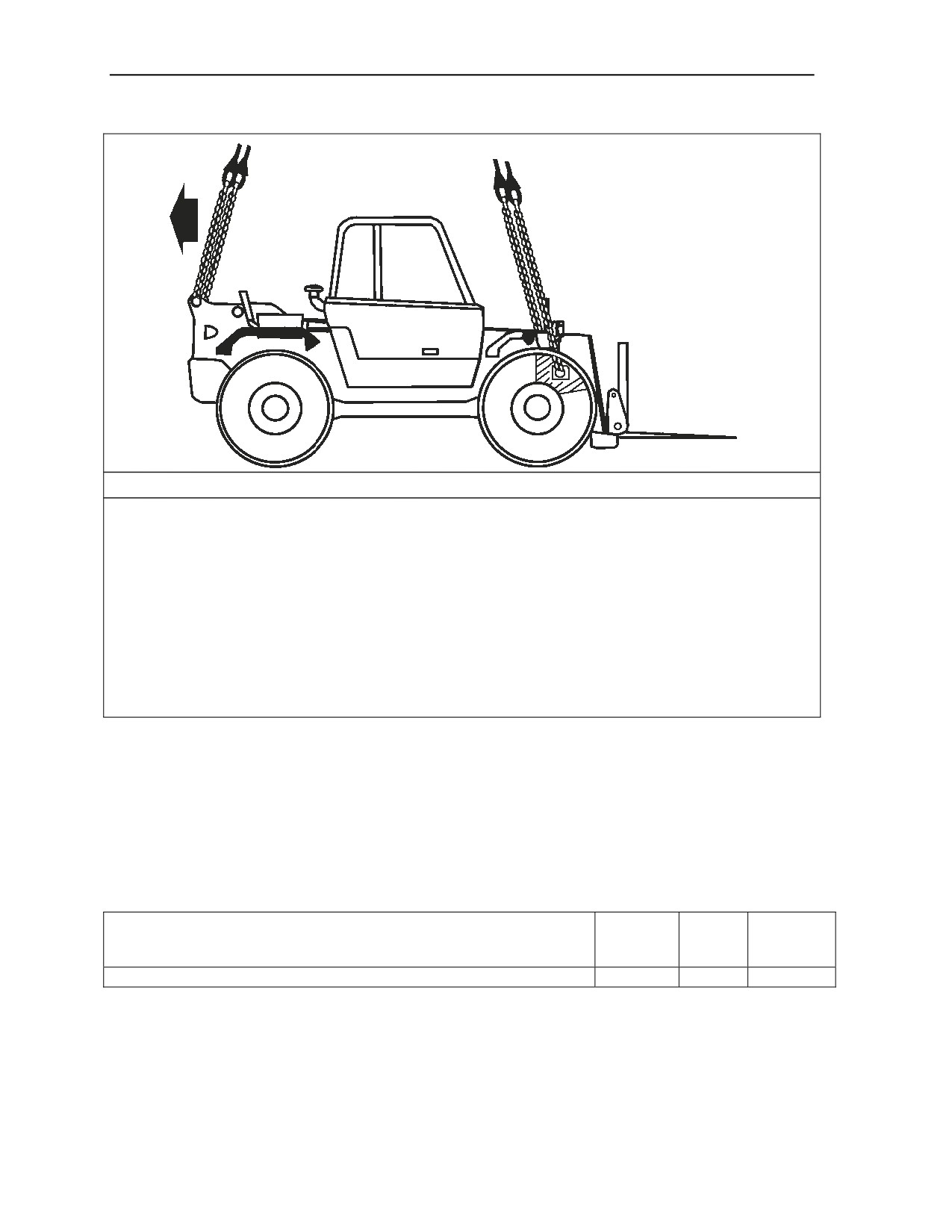
Chapter 8
RIGGING STEPS
1. Position the apex fitting on top of the vehicle. Route outer sling legs 1 and 2 to the front of
the EBFL and inner sling legs 3 and 4 to the rear of the EBFL. Sling legs 1 and 3 must be on
the left side of the load.
2. Loop the chain end of sling leg 1 through the left front lift provision. Place the correct link
from Table 8-29 in the grab hook. Repeat with sling leg 2 and the right front lift provision.
3. Loop the chain end of sling leg 3 through the left rear lift provision. Place the correct link
from Table 29 in the grab hook. Repeat with sling leg 4 and the right rear lift provision.
Secure excess chain with tape or Type III nylon cord.
4. Cluster and tie (breakaway technique) all sling legs together on top of the vehicle to prevent
entanglement during hookup and lift-off.
Figure 8-29. Light Rough Terrain Forklift
WELDING SHOP ON M200A1 TRAILER
8-31. The welding shop on M200A1 trailer is rigged for single-point sling load using the following
procedures:
z
Applicability. The following item in Table 8-30 is certified for all helicopters with suitable lift
capacity by the US Army Natick Soldier Center:
Table 8-30. Welding Shop on M200A1 Trailer
Nomenclature
Max
Sling
Link
Weight
Set
Count
(Pounds)
Front/Rear
Welding Shop on M200A1 Trailer
7,220
10K
3/17
z
Materials. The following materials are required to rig this load:
Sling set (10,000-pound capacity).
Tape, adhesive, pressure-sensitive, 2-inch wide roll.
Cord, nylon, Type III, 550-pound breaking strength.
Webbing, cotton, 1/4-inch, 80-pound breaking strength.
Webbing, nylon, tubular, 1/2-inch.
FM 4-20.198/MCRP 4-11.3E, VOL II/NTTP 3-04.12/
8-56
AFMAN 11-223 (I), VOL II/COMDTINST M13482.3B
20 February 2009
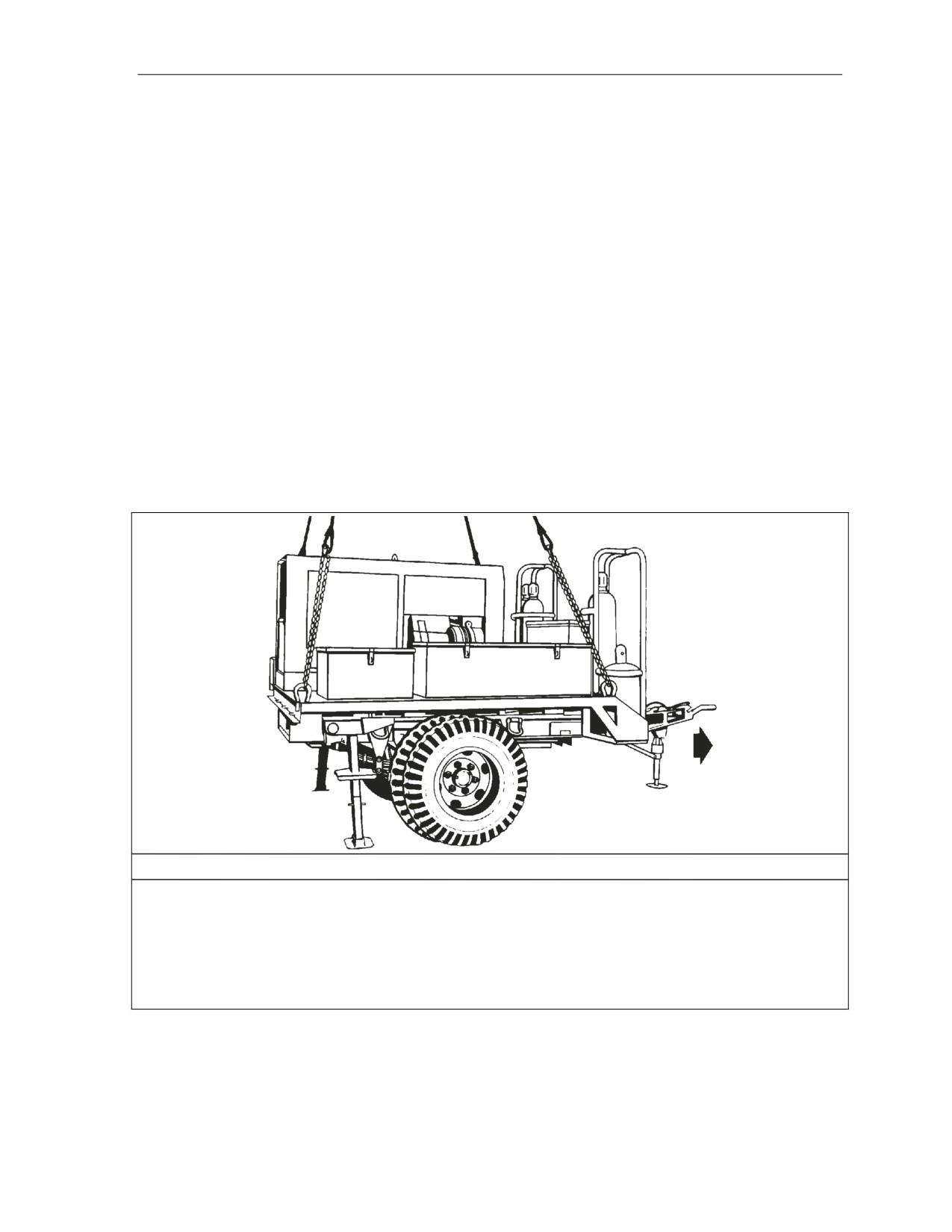
Certified Single-Point Rigging Procedures for Engineer Equipment
z
Personnel. Two persons can prepare and rig each load in 20 minutes.
z
Procedures. The following procedures apply to this load:
Preparation. Prepare the load using the following steps:
─ Secure all compressed gas cylinders to trailer with nylon cord. Ensure all the caps are
properly installed.
─ Secure the safety chains to tow bar of trailer with tape or Type III nylon cord.
─ Secure rear outriggers in position by routing 1/2-inch tubular nylon over rear deck and
under engine housing and tie on outriggers below step plate.
─ Secure engine doors and control panel cover by routing nylon cord around entire engine
and tying cord.
─ The front leg must be in full down position.
Rigging. Rig the load according to the steps in Figure 8-30.
Hookup. The hookup team stands on top of the trailer. The static wand person discharges
the static electricity with the static wand. The hookup person places the apex fitting onto the
aircraft cargo hook. The hookup team then moves clear of the load but remains close to the load
as the helicopter removes slack from the sling legs. When successful hookup is assured, the
hookup team quickly exits the area underneath the helicopter to the designated rendezvous
point.
Derigging. Derigging is the reverse of the preparation and rigging procedures.
RIGGING STEPS
1. Position apex fitting on top of welding shop. Route outer sling legs 1 and 2 to the front of the
trailer and inner sling legs 3 and 4 to the rear of the trailer. Sling legs 1 and 3 should be on
the left side of the load.
2. Loop the chain end of sling leg 1 through the left front lift provision located on the left front
corner of the trailer. Place the correct link from Table 8-30 in the grab hook. Repeat with
sling leg 2 on the right front lift provision.
Figure 8-30. Welding Shop on M200A1 Trailer
20 February 2009
FM 4-20.198/MCRP 4-11.3E, VOL II/NTTP 3-04.12/
AFMAN 11-223 (I), VOL II/COMDTINST M13482.3B
8-57
Chapter 8
RIGGING STEPS (Continued)
3. Loop the chain end of sling leg 3 through the left rear lift provision. Place the correct link
from Table 8-30 in the grab hook. Repeat with sling leg 4 on the right rear lift provision.
Secure excess chain with tape or nylon cord.
4. Cluster and tie (breakaway technique) all sling legs together to prevent entanglement during
hookup and lift-off.
Figure 8-30. Welding Shop on M200A1 Trailer (Continued)
250 CFM AIR COMPRESSOR
8-32. The 250 CFM air compressor is rigged for single-point sling load using the following procedures:
z
Applicability. The following item in Table 8-31 is certified for all helicopters with suitable lift
capacity by the US Army Natick Soldier Center:
Table 8-31. 250 CFM Air Compressor
Nomenclature
Max
Sling
Link
Weight
Set
Count
(Pounds)
Front/Rear
250 CFM Air Compressor
7,425
10K
3/15
z
Materials. The following materials are required to rig this load:
Sling set (10,000-pound capacity).
Tape, adhesive, pressure-sensitive, 2-inch wide roll.
Cord, nylon, Type III, 550-pound breaking strength.
Webbing, cotton, 1/4-inch, 80-pound breaking strength.
Felt sheet, cattle hair, Type IV, 1/2-inch or suitable substitute.
z
Personnel. Two persons can prepare and rig each load in 20 minutes.
z
Procedures. The following procedures apply to this load:
Preparation. Prepare the load using the following steps:
─ Engage parking brake. Secure light cables with tape or nylon cord. Tie off hoses on
reels to prevent unrolling. Close and latch all doors and lids.
─ Ensure fuel cap is secure. Pad front corners of shelter along bolt lines with felt and tape.
─ Tape or tie the lift provisions in the UP position to prevent fouling.
Rigging. Rig the load according to the steps in Figure 8-31.
Hookup. The hookup team stands on top of the trailer. The static wand person discharges
the static electricity with the static wand. The hookup person places the apex fitting onto the
aircraft cargo hook. The hookup team then moves clear of the load but remains close to the load
as the helicopter removes slack from the sling legs. When successful hookup is assured, the
hookup team quickly exits the area underneath the helicopter to the designated rendezvous
point.
Derigging. Derigging is the reverse of the preparation and rigging procedures.
FM 4-20.198/MCRP 4-11.3E, VOL II/NTTP 3-04.12/
8-58
AFMAN 11-223 (I), VOL II/COMDTINST M13482.3B
20 February 2009
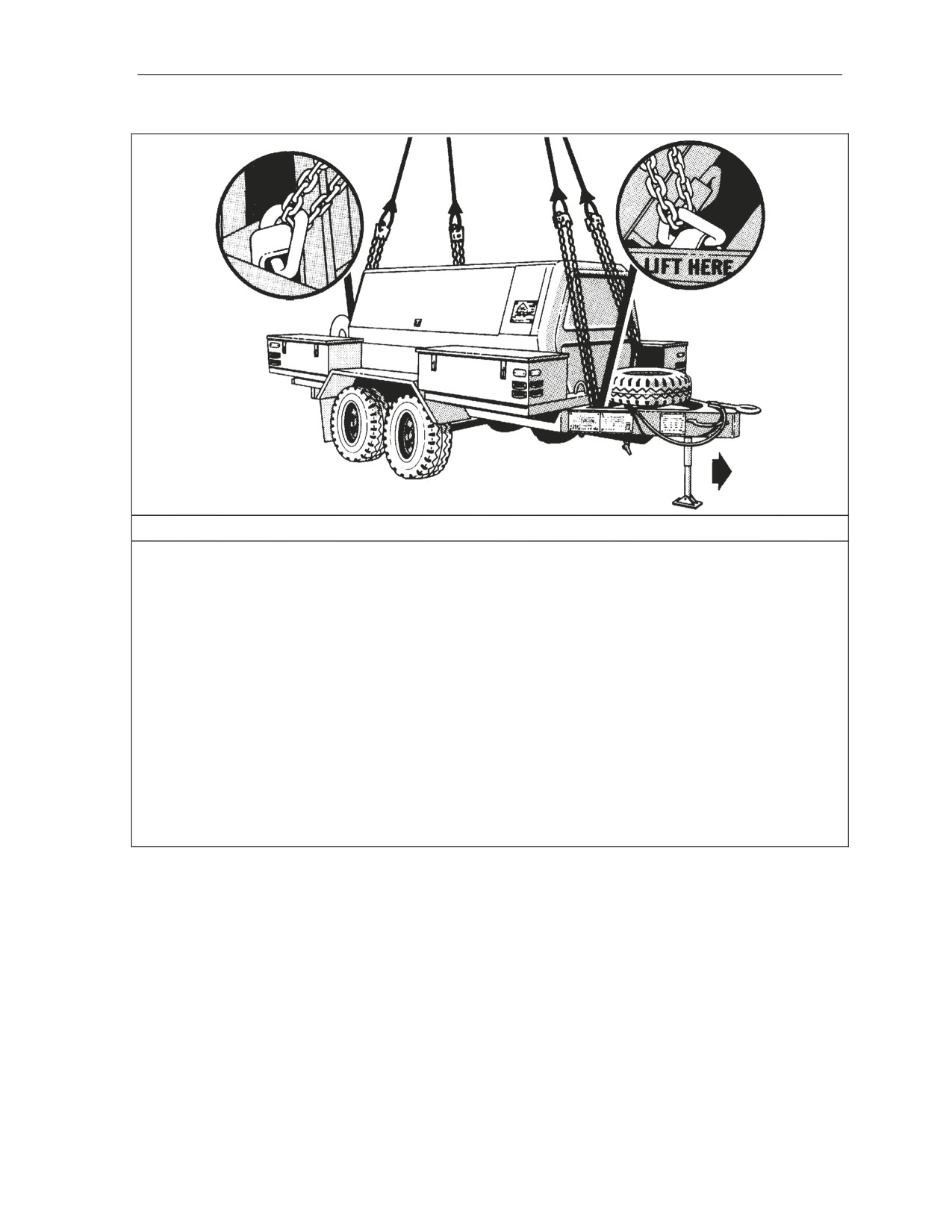
Certified Single-Point Rigging Procedures for Engineer Equipment
RIGGING STEPS
1. Carefully place apex fitting on top of the compressor. Route outer sling legs 1 and 2 to the
front of the trailer and the inner sling legs 3 and 4 to the rear. Sling legs 1 and 3 must be on
the left side of the load.
2. Loop the chain end from sling leg 1 through the left front lift provision on the tongue of the
trailer. Place the correct link from Table 8-31 in the grab hook. Repeat this procedure for
sling leg 2 on the right side of the tongue.
3. Loop the chain end from sling leg 3 through the left rear lift provision. Place the correct link
from Table 8-31 in the grab hook. Repeat this procedure for sling leg 4. Tie (breakaway
technique) the sling legs to prevent fouling the hose reels. Secure excess chain with tape or
nylon cord.
4. Cluster and tie (breakaway technique) all sling legs together to prevent entanglement during
hookup and lift-off.
Figure 8-31. 250 CFM Air Compressor
PNEUMATIC TOOL AND COMPRESSOR OUTFIT / HYDRAULIC
PIONEER TOOL OUTFIT (PTO) ON M353 TRAILER
8-33. The pneumatic tool and compressor outfit / hydraulic pioneer tool outfit on M353 trailer are rigged
for single-point sling load using the following procedures:
z
Applicability. The following items in Table 8-32 are certified for all helicopters with suitable
lift capacity by the US Army Natick Soldier Center:
20 February 2009
FM 4-20.198/MCRP 4-11.3E, VOL II/NTTP 3-04.12/
AFMAN 11-223 (I), VOL II/COMDTINST M13482.3B
8-59
Chapter 8
Table 8-32. Tool Outfits on M353 Trailer
Nomenclature
Max
Sling
Link
Weight
Set
Count
(Pounds)
Front/Rear
Pneumatic Tool and Compressor
8,040
10K
3/18
Hydraulic Pioneer Tool Outfit
6,740
10K
3/20
z
Materials. The following materials are required to rig this load:
Sling set (10,000-pound capacity).
Tape, adhesive, pressure-sensitive, 2-inch wide roll.
Cord, nylon, Type III, 550-pound breaking strength.
Webbing, cotton, 1/4-inch, 80-pound breaking strength.
Felt sheet, cattle hair, Type IV, 1/2-inch or suitable substitute.
z
Personnel. Two persons can prepare and rig each load in 15 minutes.
z
Procedures. The following procedures apply to this load:
Preparation. Prepare the load using the following steps:
─ Engage both hand brakes.
─ Ensure fuel cap is secure. Secure all loose gear and doors.
─ Secure the light cable to the drawbar with Type III nylon cord or tape.
─ Tape all lights, reflectors, and glass fixtures.
─ Secure the two small wheels.
Rigging. Rig the load according to the steps in Figure 8-32.
Hookup. The hookup team stands on top of the trailer. The static wand person discharges
the static electricity with the static wand. The hookup person places the apex fitting onto the
aircraft cargo hook. The hookup team then moves clear of the load but remains close to the load
as the helicopter removes slack from the sling legs. When successful hookup is assured, the
hookup team quickly exits the area underneath the helicopter to the designated rendezvous
point.
Derigging. Derigging is the reverse of the preparation and rigging procedures.
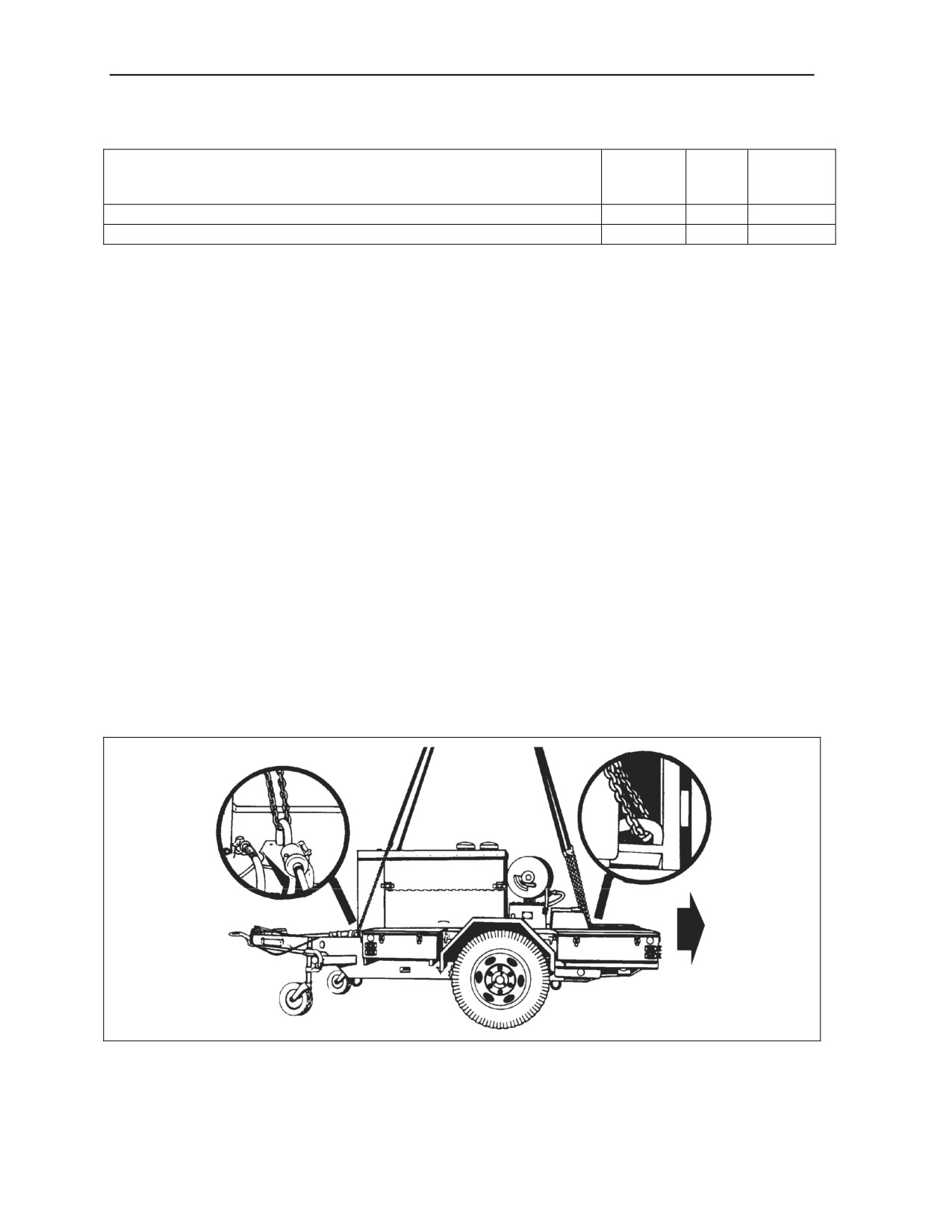
Figure 8-32. Tool Outfits on M353 Trailer
FM 4-20.198/MCRP 4-11.3E, VOL II/NTTP 3-04.12/
8-60
AFMAN 11-223 (I), VOL II/COMDTINST M13482.3B
20 February 2009
Certified Single-Point Rigging Procedures for Engineer Equipment
RIGGING STEPS
1. Position apex fitting on top of the compressor. Route outer sling legs 1 and 2 to the front of
the trailer and inner sling legs 3 and 4 to the rear. Sling legs 1 and 3 must be on the left side
of the load.
2. Loop the chain end of sling leg 1 through the lifting eye located at the left front corner of the
trailer. Place the correct link from Table 8-32 in the grab hook. Repeat with sling leg 2 and
the lifting eye located at the right front corner of the trailer.
3. Loop the chain end of sling leg 3 through the lifting eye at the left rear corner of the trailer.
Place the correct link from Table 8-32 in the grab hook. Repeat with sling leg 4 and the lifting
eye at the right rear corner of the trailer.
4. Cluster and tie (breakaway technique) all sling legs together on top of the air compressor to
prevent entanglement during hookup and lift-off. Ensure the rear sling legs are tied so they
do not become entangled under the hose reels.
Figure 8-32. Tool Outfits on M353 Trailer (Continued)
FUEL DISPENSING SYSTEM, TACTICAL AIRFIELD (TAFDS)
8-34. The tactical airfield fuel dispensing system is rigged for single-point sling load using the following
procedures:
z
Applicability. The following item in Table 8-33 is certified for all helicopters with suitable lift
capacity by the US Army Natick Soldier Center:
Table 8-33. Fuel Dispensing System, Tactical Airfield
Nomenclature
Max
Sling
Link
Weight
Set
Count
(Pounds)
Front/Rear
Fuel Dispensing System, Tactical Airfield
3,500
15K
5/5
z
Materials. The following materials are required to rig this load:
Sling set (15,000-pound capacity).
Tape, adhesive, pressure-sensitive, 2-inch wide roll.
Cord, nylon, Type III, 550-pound breaking strength.
Webbing, cotton, 1/4-inch, 80-pound breaking strength.
z
Personnel. Two persons can prepare and rig each load in 15 minutes.
z
Procedures. The following procedures apply to this load:
Preparation. Prepare the load using the following steps:
─ Secure the battery cover, inlet plugs, and outlet plugs with tape or Type III nylon cord.
─ Tape the engine intake and exhaust openings.
─ Secure the canvas cover on the pump with Type III nylon cord.
─ Engage one hand brake.
Rigging. Rig the load according to the steps in Figure 8-33.
Hookup. The hookup team stands on the pump tires. The static wand person discharges
the static electricity with the static wand. The hookup person places the apex fitting onto the
aircraft cargo hook. The hookup team then moves clear of the load but remains close to the load
as the helicopter removes slack from the sling legs. When successful hookup is assured, the
hookup team quickly exits the area underneath the helicopter to the designated rendezvous
point.
Derigging. Derigging is the reverse of the preparation and rigging procedures.
20 February 2009
FM 4-20.198/MCRP 4-11.3E, VOL II/NTTP 3-04.12/
AFMAN 11-223 (I), VOL II/COMDTINST M13482.3B
8-61
Chapter 8
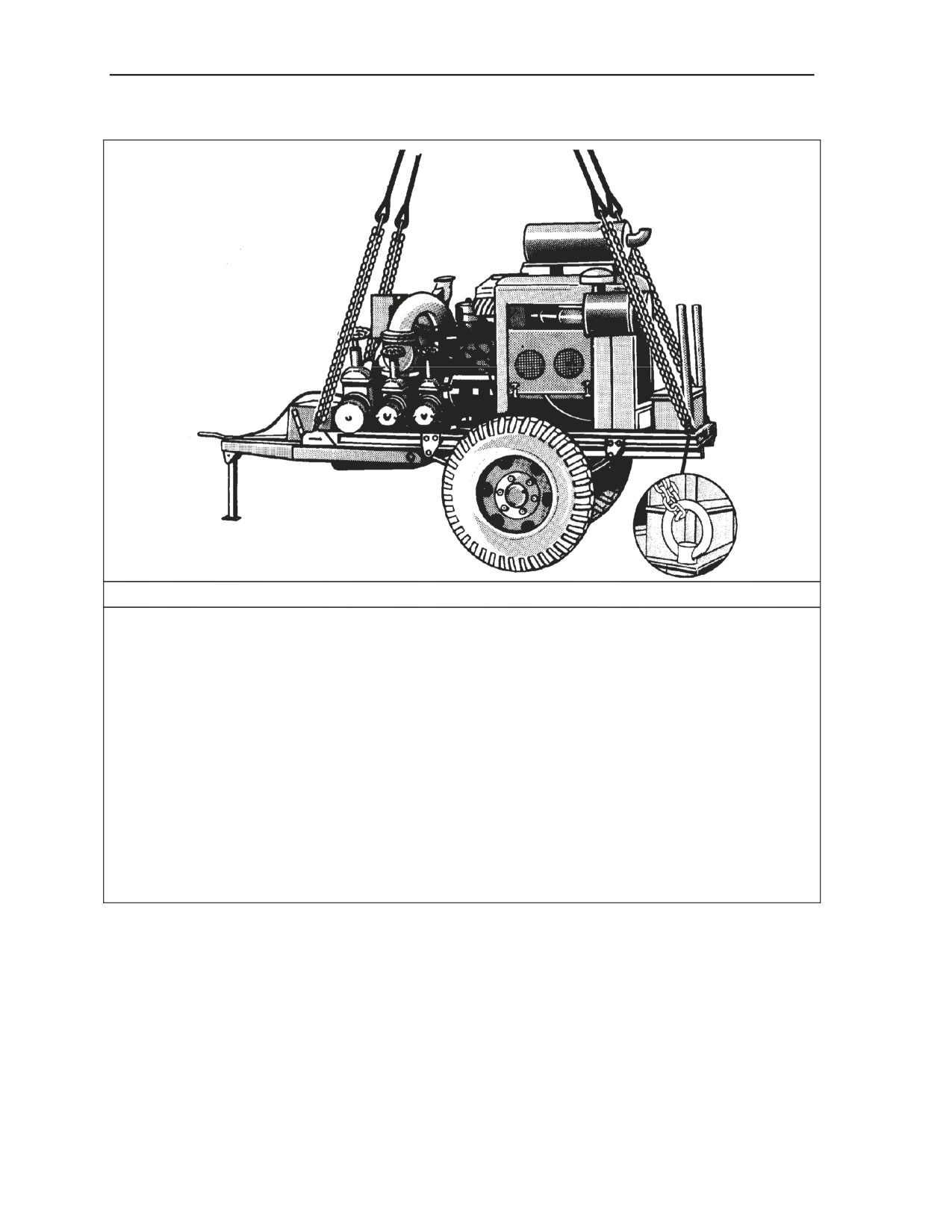
RIGGING STEPS
1. Position apex fitting on top of the pump. Route outer sling legs 1 and 2 to the front of the
trailer and inner sling legs 3 and 4 to the rear. Sling legs 1 and 3 must be on the left side of
the load.
2. Loop the chain end of sling leg 1 through the left front lift provision located on the left front
corner of the trailer. Place the correct link from Table 8-33 in the grab hook. Repeat with
sling leg 2 and the right front lift provision.
3. Loop the chain end of sling leg 3 through the left rear lift provision located on the left rear
corner of the trailer. Place the correct link from Table 8-33 in the grab hook. Repeat with
sling leg 4 and the right rear lift provision.
4. Cluster and tie (breakaway technique) all sling legs together on top of the pump to prevent
entanglement during hookup and lift-off.
Figure 8-33. Fuel Dispensing System, Tactical Airfield
FM 4-20.198/MCRP 4-11.3E, VOL II/NTTP 3-04.12/
8-62
AFMAN 11-223 (I), VOL II/COMDTINST M13482.3B
20 February 2009
Certified Single-Point Rigging Procedures for Engineer Equipment
BOAT, BRIDGE ERECTION
8-35. The bridge erection boat is rigged for single-point sling load using the following procedures:
z
Applicability. The following item in Table 8-34 is certified for all helicopters with suitable lift
capacity by the US Army Natick Soldier Center:
Table 8-34. Boat, Bridge Erection
Nomenclature
Max
Sling
Link
Weight
Set
Count
(Pounds)
Front/Rear
Boat, Bridge, Erection
6,000
15K
4/4
z
Materials. The following materials are required to rig this load:
Sling set (15,000-pound capacity).
Tape, adhesive, pressure-sensitive, 2-inch wide roll.
Cord, nylon, Type III, 550-pound breaking strength.
Webbing, cotton, 1/4-inch, 80-pound breaking strength.
z
Personnel. Two persons can prepare and rig each load in 30 minutes.
z
Procedures. The following procedures apply to this load:
Preparation. Prepare the load using the following steps:
─ Remove and secure the canvas cover in the stern of the boat.
─ Remove or secure all loose items of equipment.
─ Attach the front section to the rear section of the boat.
─ Tape all lights, gages, compass, and glass items.
─ Ensure the shipping cradles are removed from both boat sections.
Rigging. Rig the load according to the steps in Figure 8-34.
Hookup. The hookup team stands on top of the boat. The static wand person discharges
the static electricity with the static wand. The hookup person places the apex fitting onto the
aircraft cargo hook. The hookup team then moves clear of the load but remains close to the load
as the helicopter removes slack from the sling legs. When successful hookup is assured, the
hookup team quickly exits the area underneath the helicopter to the designated rendezvous
point.
Derigging. Derigging is the reverse of the preparation and rigging procedures.
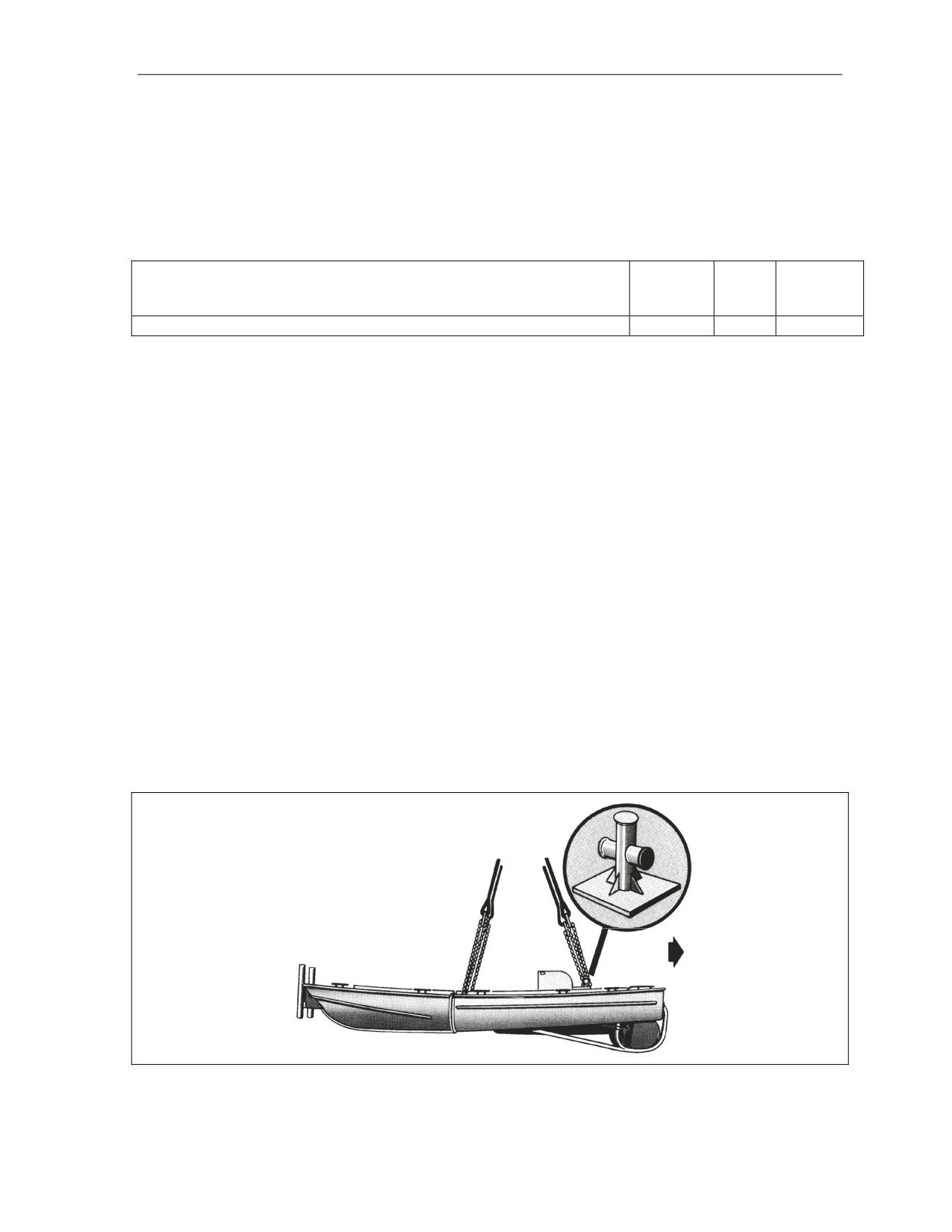
Figure 8-34. Boat, Bridge Erection
20 February 2009
FM 4-20.198/MCRP 4-11.3E, VOL II/NTTP 3-04.12/
AFMAN 11-223 (I), VOL II/COMDTINST M13482.3B
8-63
Chapter 8
RIGGING STEPS
1. Position apex fitting on top of the center of the boat. Route outer sling legs 1 and 2 to the
stern section and inner sling legs 3 and 4 to the bow section. Make sure chains for sling legs
3 and 4 are forward (toward the bow) of the horizontal arms on the rear towing bitt. Sling
legs 1 and 3 must be on the same side of the load.
2. Loop the chain end of sling leg 1 through the left rear lifting U-bolt located on the left side of
the stern section. Place the correct link from Table 8-34 in the grab hook. Repeat with sling
leg 2 and the right rear lifting U-bolt.
3. Wrap the chain end of sling leg 3 two times around the vertical post of the rear towing bitt.
Wrap the chain end of sling leg 4 two times in the opposite direction around the vertical post
of the rear towing bitt. Place the correct link from Table 8-34 in the grab hook. Ensure the
chains are below the horizontal arm of the towing bitt.
4. Cluster and tie (breakaway technique) all sling legs together on top of the boat to prevent
entanglement during hookup and lift-off.
Figure 8-34. Boat, Bridge Erection (Continued)
BRIDGE, MEDIUM GIRDER, DRY GAP (MGB)
8-36. The bridge, medium girder, dry is rigged for single-point sling load using the following procedures:
z
Applicability. The following item in Table 8-35 is certified for all helicopters with suitable lift
capacity by the US Army Natick Soldier Center:
Table 8-35. Bridge, Medium Girder, Dry
Nomenclature
Max
Sling
Link
Weight
Set
Count
(Pounds)
Front/Rear
Medium Girder Bridge, Ramp Section, Palletized, TAMCN BO152
6,500
15K
10/5
z
Materials. The following materials are required to rig this load:
Sling set (15,000-pound capacity).
Tape, adhesive, pressure-sensitive, 2-inch wide roll.
Cord, nylon, Type III, 550-pound breaking strength.
Webbing, cotton, 1/4-inch, 80-pound breaking strength.
Tie-down strap, cargo, CGU-1/B (as required).
z
Personnel. Two persons can prepare and rig each load in 20 minutes.
z
Procedures. The following procedures apply to this load:
Preparation. Prepare the load using the following steps:
─ The larger ends of the bridge sections are at the front of the load.
─ Ensure all sections of the bridge are properly secured to the pallet using the cargo tie-
down straps. Route two straps from the pallet forward end to the aft end. Route the
remaining straps from one side of the pallet, over the ramp sections, and to the other
side of the pallet. Tighten all tie-down straps.
Rigging. Rig the load according to the steps in Figure 8-35.
Hookup. The hookup team stands on top of the bridge ramp sections. The static wand
person discharges the static electricity with the static wand. The hookup person places the apex
FM 4-20.198/MCRP 4-11.3E, VOL II/NTTP 3-04.12/
8-64
AFMAN 11-223 (I), VOL II/COMDTINST M13482.3B
20 February 2009
Certified Single-Point Rigging Procedures for Engineer Equipment
fitting onto the aircraft cargo hook. The hookup team then moves clear of the load but remains
close to the load as the helicopter removes slack from the sling legs. When successful hookup is
assured, the hookup team quickly exits the area underneath the helicopter to the designated
rendezvous point.
Derigging. Derigging is the reverse of the preparation and rigging procedures.
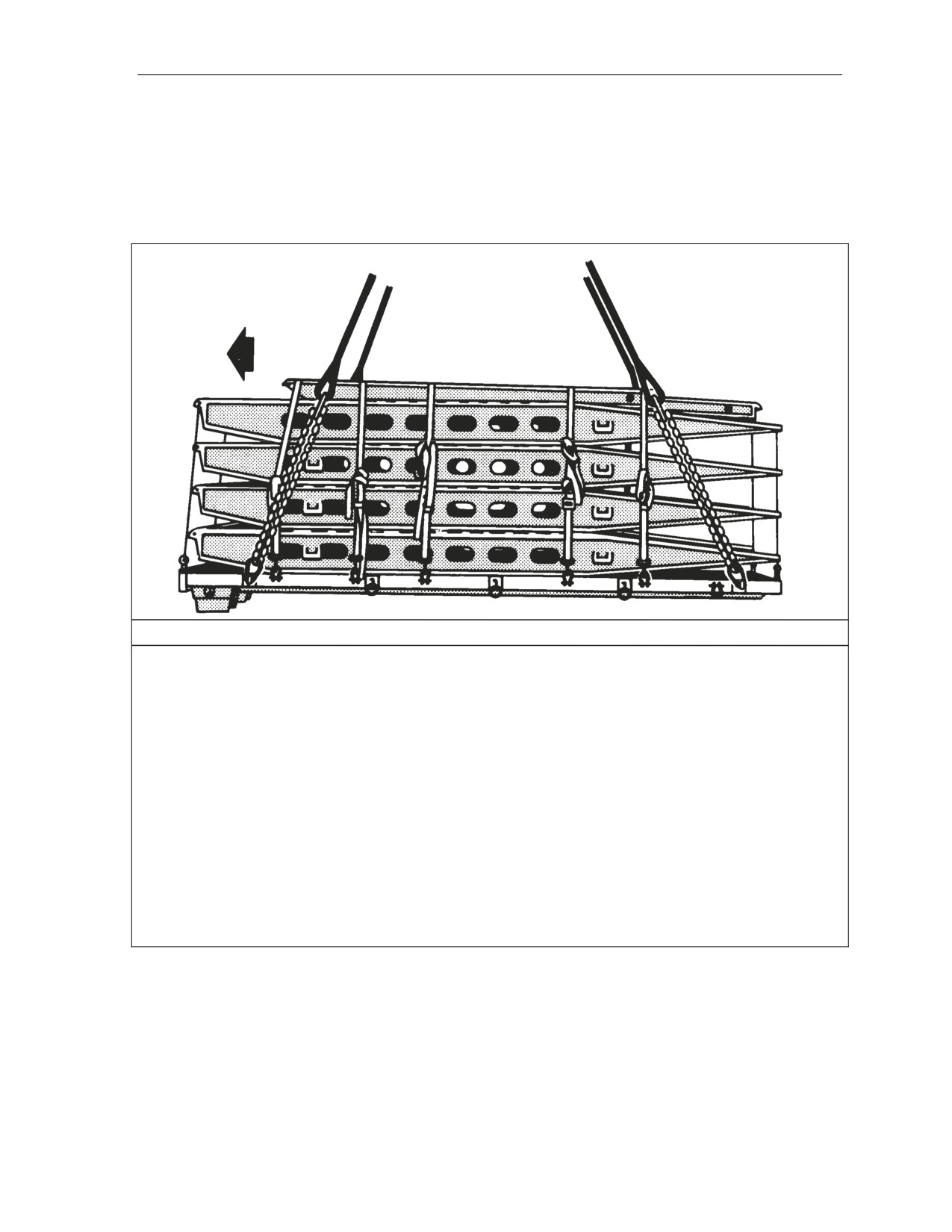
RIGGING STEPS
1. Position apex fitting on top of the ramp sections. Route outer sling legs 1 and 2 to the front of
the load and inner sling legs 3 and 4 to the rear. Sling legs 1 and 3 must be on the left side
of the load.
2. Loop the chain end of sling leg 1 through the pallet left front lift provision. Place the correct
link from Table 8-35 in the grab hook. Repeat with sling leg 2 and the pallet right front lift
provision. Secure excess chain with nylon cord.
3. Loop the chain end of sling leg 3 through the pallet left rear lift provision. Place the correct
link from Table 8-35 in the grab hook. Repeat with sling leg 4 and the pallet right rear lift
provision.
4. Cluster and tie (breakaway technique) all sling legs together on top of the bridge ramp
sections to prevent entanglement during hookup and lift-off.
Figure 8-35. Medium Girder Bridge
20 February 2009
FM 4-20.198/MCRP 4-11.3E, VOL II/NTTP 3-04.12/
AFMAN 11-223 (I), VOL II/COMDTINST M13482.3B
8-65
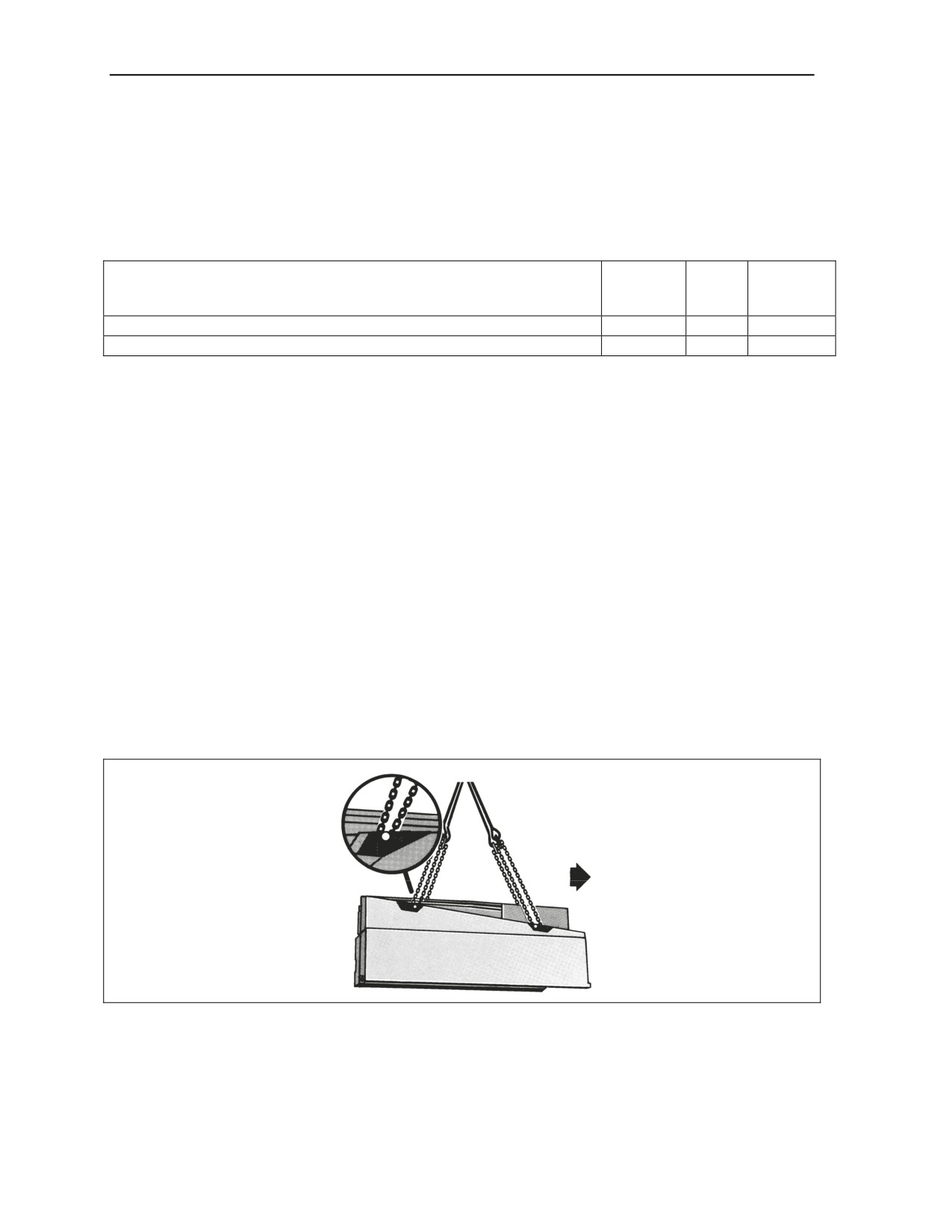
Chapter 8
RIBBON BRIDGE, RAMP BAY
8-37. The ribbon bridge, ramp bay is rigged for single-point sling load using the following procedures:
z
Applicability. The following items in Table 8-36 are certified for all helicopters with suitable
lift capacity by the US Army Natick Soldier Center:
Table 8-36. Ribbon Bridge, Ramp Bay
Nomenclature
Max
Sling
Link
Weight
Set
Count
(Pounds)
Front/Rear
Ribbon Bridge, Ramp Bay
11,560
25K
3/60
Improved Ribbon Bridge, Ramp Bay
13,270
25K
3/60
z
Materials. The following materials are required to rig this load:
Sling set (25,000-pound capacity).
Tape, adhesive, pressure-sensitive, 2-inch wide roll.
Cord, nylon, Type III, 550-pound breaking strength.
Webbing, cotton, 1/4-inch, 80-pound breaking strength.
z
Personnel. Two persons can prepare and rig each load in 15 minutes.
z
Procedures. The following procedures apply to this load:
Preparation. Prepare the load using the following steps:
─ The shorter end of the bay section is the front of the load.
─ Ensure all the bay latches are securely fastened.
Rigging. Rig the load according to the steps in Figure 8-36.
Hookup. The hookup team stands on top of the ramp bays. The static wand person
discharges the static electricity with the static wand. The hookup person places the apex fitting
onto the aircraft cargo hook. The hookup team then moves clear of the load but remains close to
the load as the helicopter removes slack from the sling legs. When successful hookup is
assured, the hookup team quickly exits the area underneath the helicopter to the designated
rendezvous point.
Derigging. Derigging is the reverse of the preparation and rigging procedures.
Figure 8-36. Ribbon Bridge, Ramp Bay
FM 4-20.198/MCRP 4-11.3E, VOL II/NTTP 3-04.12/
8-66
AFMAN 11-223 (I), VOL II/COMDTINST M13482.3B
20 February 2009
Certified Single-Point Rigging Procedures for Engineer Equipment
RIGGING STEPS
1. Position the apex fitting on top of the ramp bay. Route outer sling legs 1 and 2 to the front of
the bay and inner sling legs 3 and 4 to the rear of the bay. Sling legs 1 and 3 must be on the
left side of the load.
2. Loop the chain end of sling leg 1 through the left front lift provision (a pin located between
two plates on the top edge of the bay). Place the correct link from Table 8-36 in the grab
hook. Repeat with sling leg 2 and the right front lift provision.
3. Loop the chain end of sling leg 3 through the left rear lift provision (a pin located between two
plates on the top left edge of the bay). Place the correct link from Table 8-36 in the grab
hook. Repeat with sling leg 4 and the right rear lift provision. Secure the excess chain with
Type III nylon cord.
4. Pull the chain of each sling leg up tightly, tape or tie with nylon cord just above the lift
provisions to prevent the chain from falling down between the plates.
5. Cluster and tie (breakaway technique) all sling legs together on top of the bay to prevent
entanglement during hookup and lift-off.
Figure 8-36. Ribbon Bridge, Ramp Bay (Continued)
RIBBON BRIDGE INTERIOR BAY
8-38. The ribbon bridge, interior bay is rigged for single-point sling load using the following procedures:
z
Applicability. The following items in Table 8-37 are certified for all helicopters with suitable
lift capacity by the US Army Natick Soldier Center:
Table 8-37. Ribbon Bridge, Interior Bay
Nomenclature
Max
Sling
Link
Weight
Set
Count
(Pounds)
Front/Rear
Ribbon Bridge, Interior Bay
11,800
25K
3/15
Improved Ribbon Bridge, Interior Bay
13,860
25K
3/15
z
Materials. The following materials are required to rig this load:
Sling set (25,000-pound capacity).
Tape, adhesive, pressure-sensitive, 2-inch wide roll.
Cord, nylon, Type III, 550-pound breaking strength.
Webbing, cotton, 1/4-inch, 80-pound breaking strength.
z
Personnel. Two persons can prepare and rig each load in 15 minutes.
z
Procedures. The following procedures apply to this load:
Preparation. Prepare the load using the following steps:
─ The end with the roadway lock is the front of the load.
─ Ensure all the bay latches are securely fastened.
Rigging. Rig the load according to the steps in Figure 8-37.
Hookup. The hookup team stands on top of the interior bays. The static wand person
discharges the static electricity with the static wand. The hookup person places the apex fitting
onto the aircraft cargo hook. The hookup team then moves clear of the load but remains close to
the load as the helicopter removes slack from the sling legs. When successful hookup is
assured, the hookup team quickly exits the area underneath the helicopter to the designated
rendezvous point.
Derigging. Derigging is the reverse of the preparation and rigging procedures.
20 February 2009
FM 4-20.198/MCRP 4-11.3E, VOL II/NTTP 3-04.12/
AFMAN 11-223 (I), VOL II/COMDTINST M13482.3B
8-67
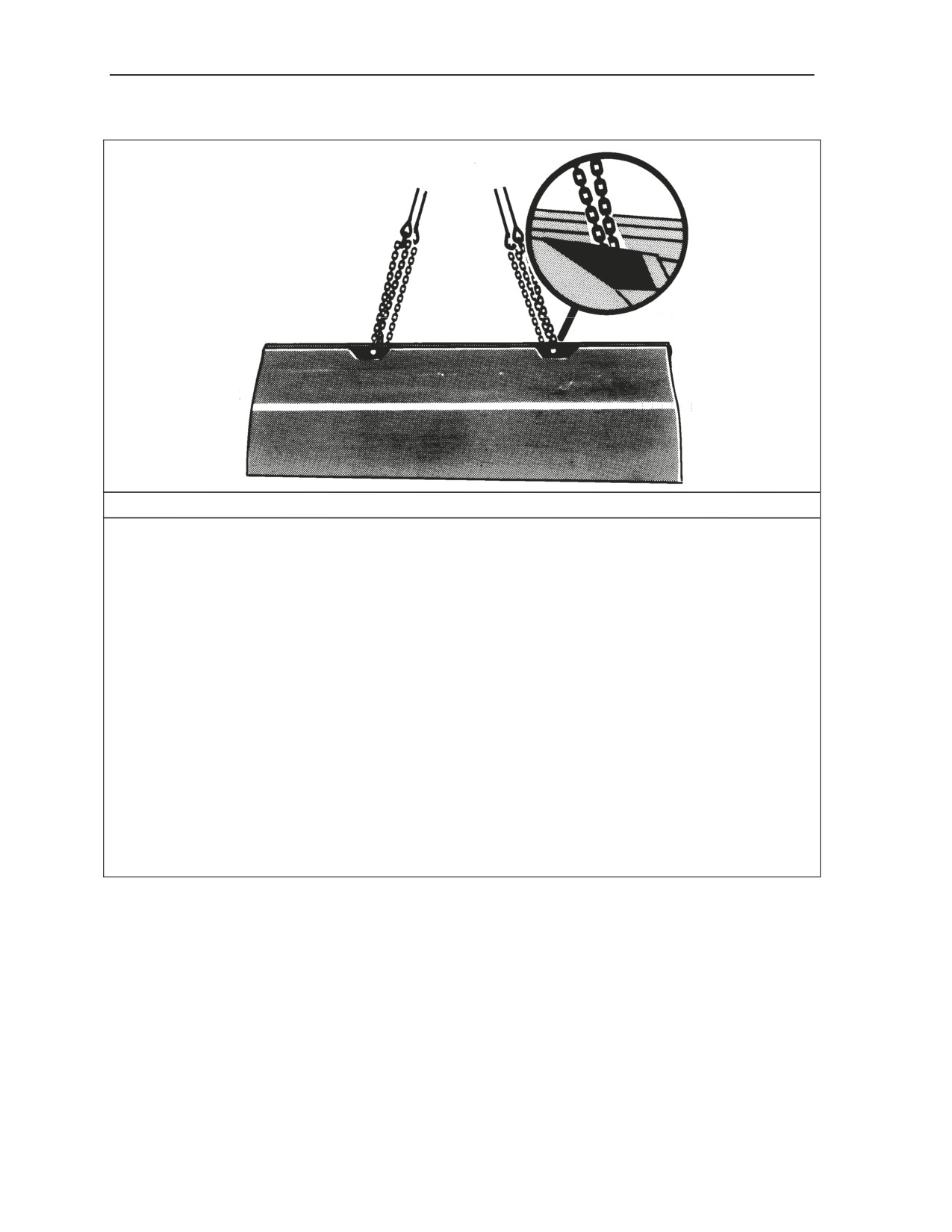
Chapter 8
RIGGING STEPS
1. Position the apex fitting on top of the interior bay. Route outer sling legs 1 and 2 to the front
of the bay and inner sling legs 3 and 4 to the rear of the bay. The front of the bay is the end
with the roadway lock. Sling legs 1 and 3 must be on the left side of the load.
2. Loop the chain end of sling leg 1 through the left front lift provision (a pin between two plates
on the top left edge of the bay). Place the correct link from Table 8-37 in the grab hook.
Repeat with sling leg 2 and the right front lift provision.
3. Loop the chain end of sling leg 3 through the left rear lift provision (a pin located between two
plates on the top left edge of the bay). Place the correct link from Table 8-37 in the grab
hook. Repeat with sling leg 4 and the right rear lift provision. Secure excess chain with tape
or nylon cord.
4. Pull the chain of each sling leg up tightly, tape or tie with nylon cord just above the lift
provisions to prevent the chain from falling down between the plates.
5. Cluster and tie (breakaway technique) all sling legs together on top of the bay to prevent
entanglement during hookup and lift-off.
Figure 8-37. Ribbon Bridge, Interior Bay
FM 4-20.198/MCRP 4-11.3E, VOL II/NTTP 3-04.12/
8-68
AFMAN 11-223 (I), VOL II/COMDTINST M13482.3B
20 February 2009
Certified Single-Point Rigging Procedures for Engineer Equipment
WATER PURIFICATION UNIT-REVERSE OSMOSIS (ROWPU)
8-39. The water purification unit-reverse osmosis is rigged for single-point sling load using the following
procedures:
z
Applicability. The following item in Table 8-38 is certified for all helicopters with suitable lift
capacity by the US Army Natick Soldier Center:
Table 8-38. Water Purification Unit-Reverse Osmosis
Nomenclature
Max
Sling
Link
Weight
Set
Count
(Pounds)
Front/Rear
MC 257 Water Purification Unit-Reverse Osmosis, 600 Gallons Per Hour,
7,400
15K
5/5
Skid Mounted, TAMCN B2064
z
Materials. The following materials are required to rig this load:
Sling set (15,000-pound capacity).
Tape, adhesive, pressure-sensitive, 2-inch wide roll.
Cord, nylon, Type III, 550-pound breaking strength.
Webbing, cotton, 1/4-inch, 80-pound breaking strength.
z
Personnel. Two persons can prepare and rig each load in 15 minutes.
z
Procedures. The following procedures apply to this load:
Preparation. Prepare the load using the following steps:
─ The water pump end is the front of the load.
─ Secure all containers, boxes, and other equipment with tape or Type III nylon cord.
─ Tape all glass fixtures.
Rigging. Rig the load according to the steps in Figure 8-38.
Hookup. The hookup team stands on top of the unit. The static wand person discharges
the static electricity with the static wand. The hookup person places the apex fitting onto the
aircraft cargo hook. The hookup team then moves clear of the load but remains close to the load
as the helicopter removes slack from the sling legs. When successful hookup is assured, the
hookup team quickly exits the area underneath the helicopter to the designated rendezvous
point.
Derigging. Derigging is the reverse of the preparation and rigging procedures.
20 February 2009
FM 4-20.198/MCRP 4-11.3E, VOL II/NTTP 3-04.12/
AFMAN 11-223 (I), VOL II/COMDTINST M13482.3B
8-69
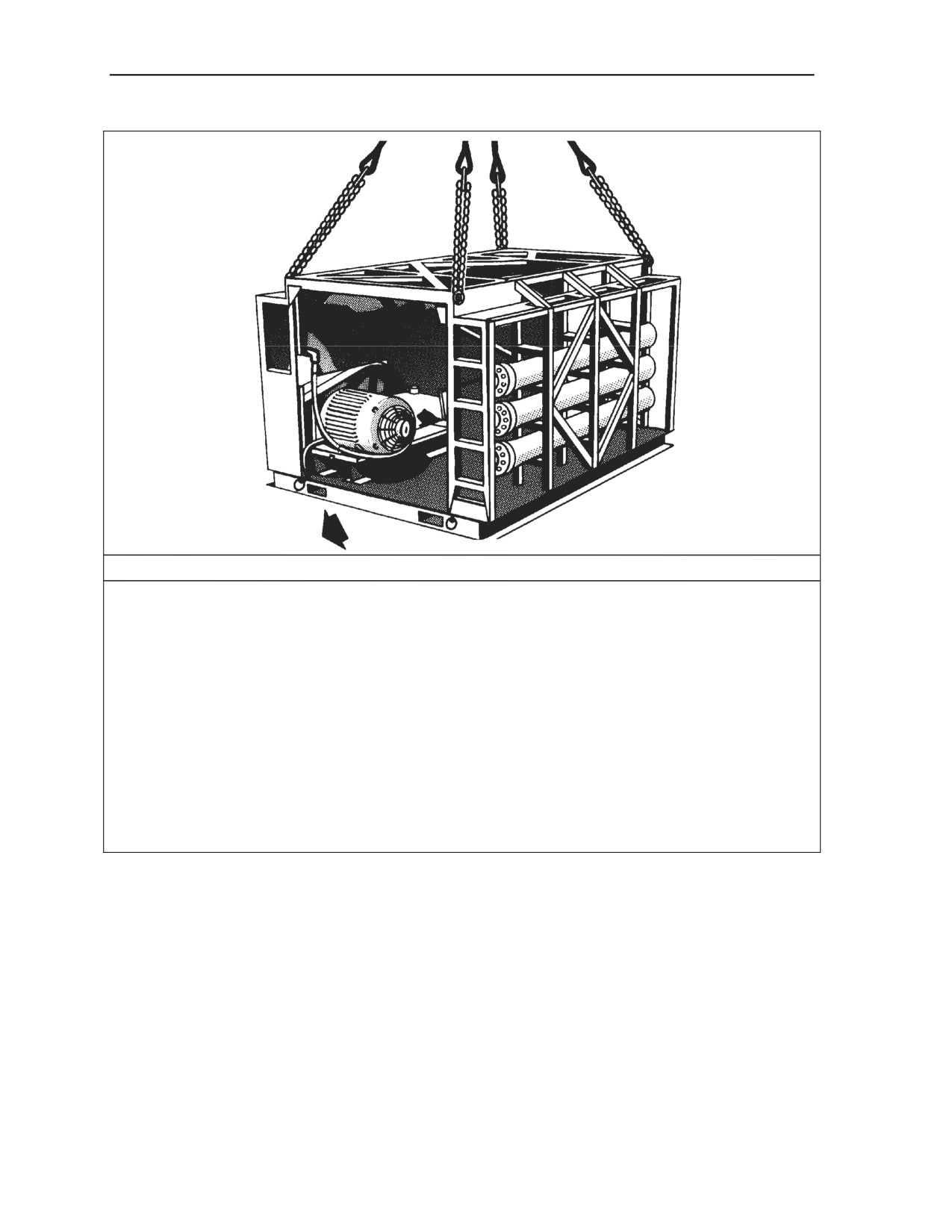
Chapter 8
RIGGING STEPS
1. Position apex fitting on top of the ROWPU unit. Route outer sling legs 1 and 2 to the front of
the unit and inner sling legs 3 and 4 to the rear. Sling legs 1 and 3 must be on the left side of
the load.
2. Loop the chain end of sling leg 1 through the left front lift ring on the top of the unit. Place the
correct link from Table 8-38 in the grab hook. Repeat with sling leg 2 and the right front lift
ring.
3. Loop the chain end of sling leg 3 through the left rear lift ring. Place the correct link from
Table 8-38 in the grab hook. Repeat with sling leg 4 and the right rear lift ring.
4. Cluster and tie (breakaway technique) all sling legs together on top of the unit to prevent
entanglement during hookup and lift-off.
Figure 8-38. Water Purification Unit-Reverse Osmosis
MS114 WFD CONCRETE MIXER
8-40. The MS114 WFD concrete mixer is rigged for single-point sling load using the following
procedures:
z
Applicability. The following item in Table 8-39 is certified for all helicopters with suitable lift
capacity by the US Army Natick Soldier Center:
FM 4-20.198/MCRP 4-11.3E, VOL II/NTTP 3-04.12/
8-70
AFMAN 11-223 (I), VOL II/COMDTINST M13482.3B
20 February 2009
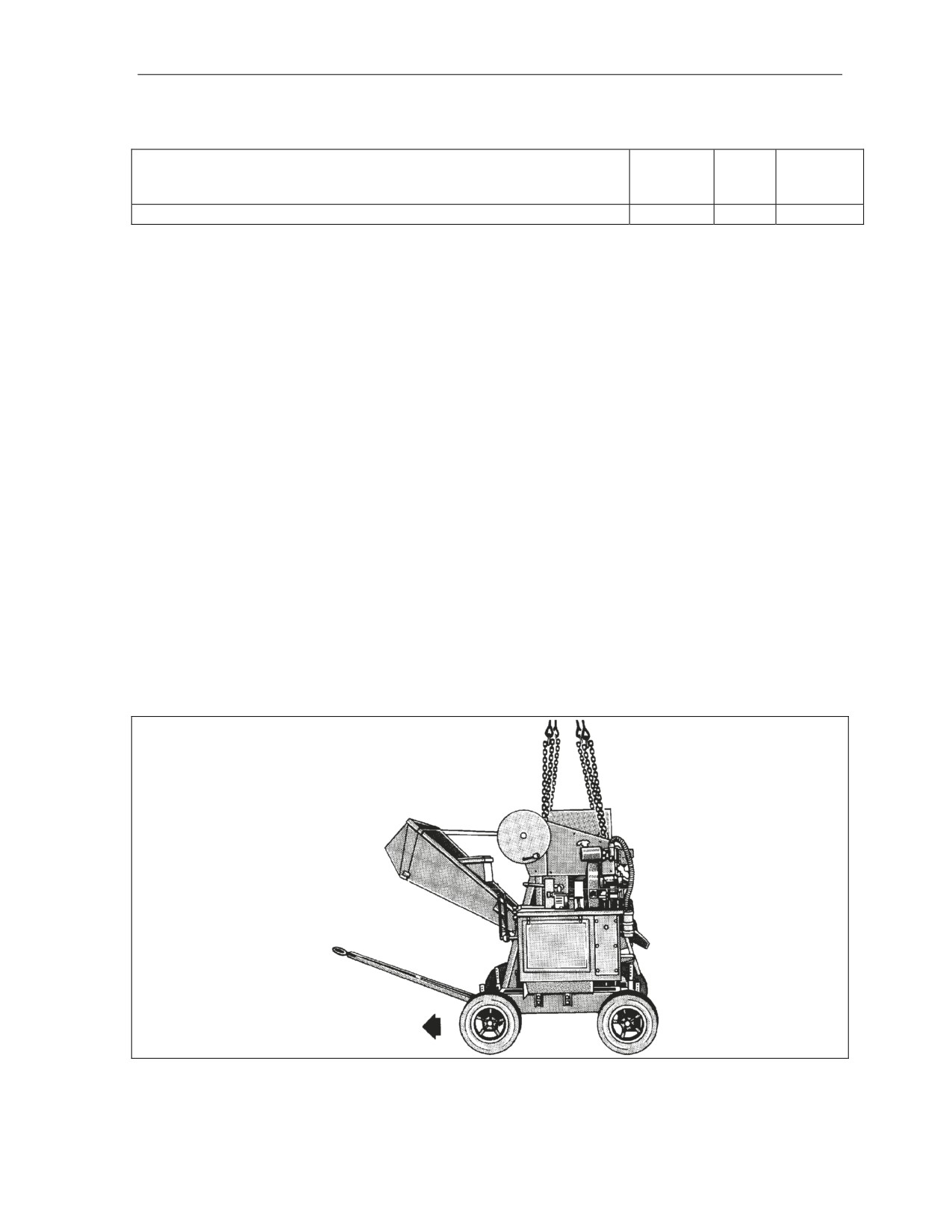
Certified Single-Point Rigging Procedures for Engineer Equipment
Table 8-39. MS114 WFD Concrete Mixer
Nomenclature
Max
Sling
Link
Weight
Set
Count
(Pounds)
Front/Rear
MS114 WFD Concrete Mixer
4,223
15K
50/30
z
Materials. The following materials are required to rig this load:
Sling set (15,000-pound capacity).
Tape, adhesive, pressure-sensitive, 2-inch wide roll.
Cord, nylon, Type III, 550-pound breaking strength.
Webbing, cotton, 1/4-inch, 80-pound breaking strength.
Tie-down strap, cargo, CGU-1/B (as required).
z
Personnel. Two persons can prepare and rig each load in 10 minutes.
z
Procedures. The following procedures apply to this load:
Preparation. Prepare the load using the following steps:
─ Secure all hoses, cables, or chains with tape or nylon cord.
─ Secure the towbar in the raised/locked position.
─ Raise the scoop to the up position and secure the scoop elevating wheel with the tie-
down strap.
─ Since the mixer does not have a hand brake, loop a tie-down strap through a wheel rim
and secure it to the frame to keep the wheel from turning.
Rigging. Rig the load according to the steps in Figure 8-39.
Hookup. The hookup team stands on top of the mixer. The static wand person discharges
the static electricity with the static wand. The hookup person places the apex fitting onto the
aircraft cargo hook. The hookup team then moves clear of the load but remains close to the load
as the helicopter removes slack from the sling legs. When successful hookup is assured, the
hookup team quickly exits the area underneath the helicopter to the designated rendezvous
point.
Derigging. Derigging is the reverse of the preparation and rigging procedures.
Figure 8-39. MS114 WFD Concrete Mixer
20 February 2009
FM 4-20.198/MCRP 4-11.3E, VOL II/NTTP 3-04.12/
AFMAN 11-223 (I), VOL II/COMDTINST M13482.3B
8-71
Chapter 8
RIGGING STEPS
1. Position the apex fitting on top of the mixer. Route outer sling legs 1 and 2 to the front of the
mixer (tow bar end) and inner sling legs 3 and 4 to the rear. Sling legs 1 and 3 must be on
the left side of the load.
2. Loop the chain end of sling leg 1 through the left front U-bolt lift provision located on the left
top side of the mixer. Place the correct link from Table 8-39 in the grab hook. Route the
chain from the inboard side of the provision to the outboard side. Repeat with sling leg 2 and
the right front lift provision. Secure excess chain with tape or nylon cord.
3. Loop the chain end of sling leg 3 through the left rear U-bolt lift provision located on the left
top side of the mixer. Place the correct link from Table 8-39 in the grab hook. Route the
chain from the inboard side of the provision to the outboard side. Repeat with sling leg 4 and
the right rear lift provision. Secure excess chain with tape or nylon cord.
4. Cluster and tie (breakaway technique) all sling legs together on top of the mixer to prevent
entanglement during hookup and lift-off.
Figure 8-39. MS114 WFD Concrete Mixer (Continued)
COUNTERMINE MINI-FLAIL
8-41. The countermine mini-flail is rigged for single-point sling load using the following procedures:
z
Applicability. The following item in Table 8-40 is certified for all helicopters with suitable lift
capacity by the US Army Natick Soldier Center:
Table 8-40. Countermine Mini-Flail
Nomenclature
Max
Sling
Link
Weight
Set
Count
(Pounds)
Front/Rear
Countermine Mini-Flail
2,420
10K
35/3
z
Materials. The following materials are required to rig this load:
Sling set (10,000-pound capacity).
Tape, adhesive, pressure-sensitive, 2-inch wide roll.
Cord, nylon, Type III, 550-pound breaking strength.
Webbing, cotton, 1/4-inch, 80-pound breaking strength.
Felt sheet, cattle hair, Type IV, 1/2-inch or suitable padding.
z
Personnel. Two persons can prepare and rig this load in 10 minutes.
z
Procedures. The following procedures apply to this load:
Preparation. Prepare the load using the following steps:
─ Tape the flail headspring mechanism to the lift/tie crossmember.
─ Ensure the engine compartment door securing pin is present and safety the pin with tape.
─ Secure loose cables, safety cables, and safety chains with tape or Type III nylon cord.
─ Engage the brakes.
Rigging. Rig the load according to the steps in Figure 8-40.
Hookup. The hookup team stands beside the mini-flail. The static wand person discharges
the static electricity with the static wand. The hookup person places the apex fitting onto the
aircraft cargo hook. The hookup team then moves clear of the load but remains close to the load
as the helicopter removes slack from the sling legs. When successful hookup is assured, the
FM 4-20.198/MCRP 4-11.3E, VOL II/NTTP 3-04.12/
8-72
AFMAN 11-223 (I), VOL II/COMDTINST M13482.3B
20 February 2009
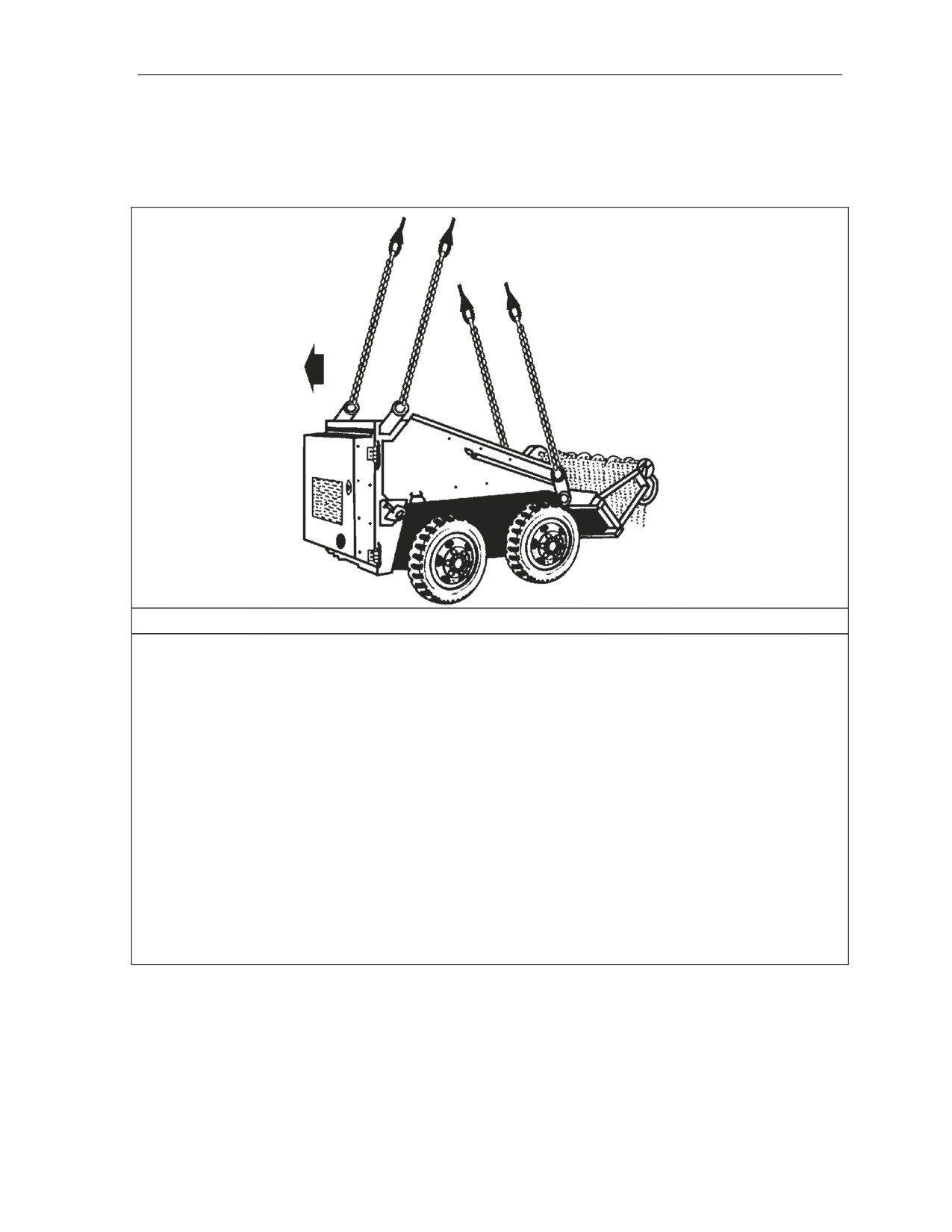
Certified Single-Point Rigging Procedures for Engineer Equipment
hookup team quickly exits the area underneath the helicopter to the designated rendezvous
point.
Derigging. Derigging is the reverse of the preparation and rigging procedures.
RIGGING STEPS
1. Position the apex fitting near the mini-flail. Route outer sling legs 1 and 2 to the front of the
load (engine end). Route inner sling legs 3 and 4 to the rear of the load (flail head). Sling
legs 1 and 3 must be on the left side of the load.
2. Route the chain end of sling leg 1 through the left front lift provision (engine end). Place the
correct link from Table 8-40 in the grab hook. Repeat with sling leg 2 and the right front lift
provision. Secure the excess chain with Type III nylon cord.
3. Route the chain end of sling leg 3 through the left rear lift provision (flail head end). Place the
correct link from Table 8-40 in the grab hook. Repeat with sling leg 4 on the right rear lift
provision.
4. Pad the sling legs/chains in the area where they make contact with the vehicle.
5. Cluster and tie (breakaway technique) the sling legs together on top of the vehicle to prevent
entanglement during hookup and lift-off.
Figure 8-40. Countermine Mini-Flail
20 February 2009
FM 4-20.198/MCRP 4-11.3E, VOL II/NTTP 3-04.12/
AFMAN 11-223 (I), VOL II/COMDTINST M13482.3B
8-73