FM 4-20.198 Multiservice Helicopter Sling Load: Single-Point Load Rigging Procedures (February 2009) - page 2

Chapter 2
M1097/M1097A2 SHELTER CARRIER (HMMWV) WITH
LIGHTWEIGHT MULTIPURPOSE SHELTER (LMS)
2-10. The M1097/M1097A2 shelter carrier with lightweight multipurpose shelter is rigged for single-point
sling load using the following procedures:
z
Applicability. The following items in Table 2-9 are certified for all helicopters with suitable lift
capacity by the US Army Natick Soldier Center:
Table 2-9. Lightweight Multipurpose Shelter
Nomenclature
Max
Sling Set
Link Count
Weight
Front/Rear
(Pounds)
Advanced Field Artillery Tactical Data Systems (AFATADS), System #1,
8,882
10K
50/3
RWS with a CHS-2 AN/GYG-3(V)1
Air Defense Communications Platform AN/MSQ-124
10,000
10K
40/3
Biological Integrated Detection System (BIDS)
9,000
10K
40/3
Common Ground Station, Joint Surveillance Target Attack Radar
10,300
25K
32/5
(JSTAR) System
15K
40/3
Digital Group Multiplexer (DGM) AN/TRC-138C
9,020
10K
60/10
Enhanced Position Location Reporting System (EPLRS) Downsized Net
10,000
10K
70/3
Control Station (NCS-E(D))
Forward Area Air Defense Command Control System, AN/TSQ-182
9,800
10K
40/3
Forward Area Air Defense Command Control System, AN/TSQ-183
7,561
10K
40/3
Forward Area Air Defense Command Control System, AN/TSQ-184
7,297
10K
40/3
High Frequency Communications Central AN/TRC 120
8,765
15K
50/5
High Mobility Digital Group Multiplexer Assemblage (HMDA) AN/TRC-
9,100
10K
60/10
173B, AN/TRC-174B, AN/TRC-175B
High Mobility Downsized (HMD) Direct Air Support Central
8,420
15K
40/3
Integrated Meteorological Systems (IMETS), Block I & II
9,050
10K
70/3
Marine Expeditionary Force Intelligence Analysis System (IAS)
9,220
15K
64/2
Marine Expeditionary Force Intelligence Analysis System S1
9,194
15K
40/3
Marine Expeditionary Force Intelligence Analysis System S2
9,126
15K
40/3
Meteorological Measuring Set AN/TMQ-41
7,770
15K
40/3
8,200
10K
40/3
Mobile Radio Broadcasting Subsystem (MRBS)
9,746
10K
40/3
Mobile Radio (MR) Cargo Vehicle
9,907
10K
40/3
Mobile Television Broadcasting Subsystem (MTBS)
9,295
10K
40/3
Mobile Television (MT) Cargo Vehicle
9,637
10K
40/3
Operations Central (OC) Group Firefinder AN/TPQ-36 (V) 8
8,620
10K
50/3
Spare Equipment and Maintenance Shelter AN/TSQ-190 (V) 1
9,220
10K
40/3
Tactical Control and Analysis Center
9,300
15K
40/3
Tactical Remote Sensor System (TRSS) Sensor Mobile Monitoring
7,685
10K
40/3
System (SMMS)
Communications Data Link System on M1097A2
9,900
15K
40/3
2-22
FM 4-20.198/MCRP 4-11.3E, VOL II/NTTP 3-04.12/
AFMAN 11-223 (I), VOL II/COMDTINST M13482.3B
20 February 2009
Certified Single-Point Rigging Procedures for Wheeled Vehicles
z
Materials. The following materials are required to rig this load:
Sling set (10,000-pound capacity).
─ Chain length, part number 38850-00053-101, from a 10,000-pound capacity sling set (4
each).
─ Coupling link, part number 5779125, from a 10,000-pound sling set (4 each).
OR
Multileg sling set (15,000-pound capacity for the CH-53E only).
─ Additional chain lengths from the sling set being used (8 each).
─ Additional coupling links from the sling set being used (8 each).
Tape, adhesive, pressure-sensitive, 2-inch wide roll.
Cord, nylon, Type III, 550-pound breaking strength.
Webbing, cotton, 1/4-inch, 80-pound breaking strength.
Felt sheet, cattle hair, Type IV, 1/2-inch or suitable padding.
Padding, cellulose.
z
Personnel. Two persons can prepare and rig this load in 15 minutes.
z
Procedures. The following procedures apply to this load:
Preparation. Prepare the load using the following steps:
─ Extend the sling leg chains by connecting one additional chain length to each chain on a
10,000-, 25,000- or 40,000-pound capacity sling set with coupling links. Connect two
additional chain lengths to each chain on the 15,000-pound multileg sling set chain
with coupling links.
─ Fold mirrors forward in front of the windshield for added protection and tie together with
Type III nylon cord.
─ Secure all equipment inside the shelter with tape, nylon cord, or lashings; close and
secure shelter vents and door with nylon cord or tape.
─ Secure environmental control unit cover with duct tape.
─ Disconnect the power cord from the rear panel and secure it to the rear platform with
Type III nylon cord. Lower the power panel door and secure the door.
─ Secure all equipment and cargo inside the vehicle with tape, nylon cord, or lashings.
Secure the doors shut if installed.
─ Ensure the fuel tank is not over 3/4 full. Inspect fuel tank cap, oil filler cap, and battery
caps for proper installation.
─ Engage the vehicle parking brake and put the transmission in neutral.
─ Ensure the front wheels are pointed straight ahead. Tie down the steering wheel, using
the securing device attached under the dashboard.
─ Tape the windshield in an X formation from corner to corner.
─ Install the lift provisions on the outer ends of the rear bumper by removing the tiedown
provisions located inboard of the bumper end and installing them on the outer ends of
the rear bumper.
─ Remove the upper antenna mounting bracket if installed.
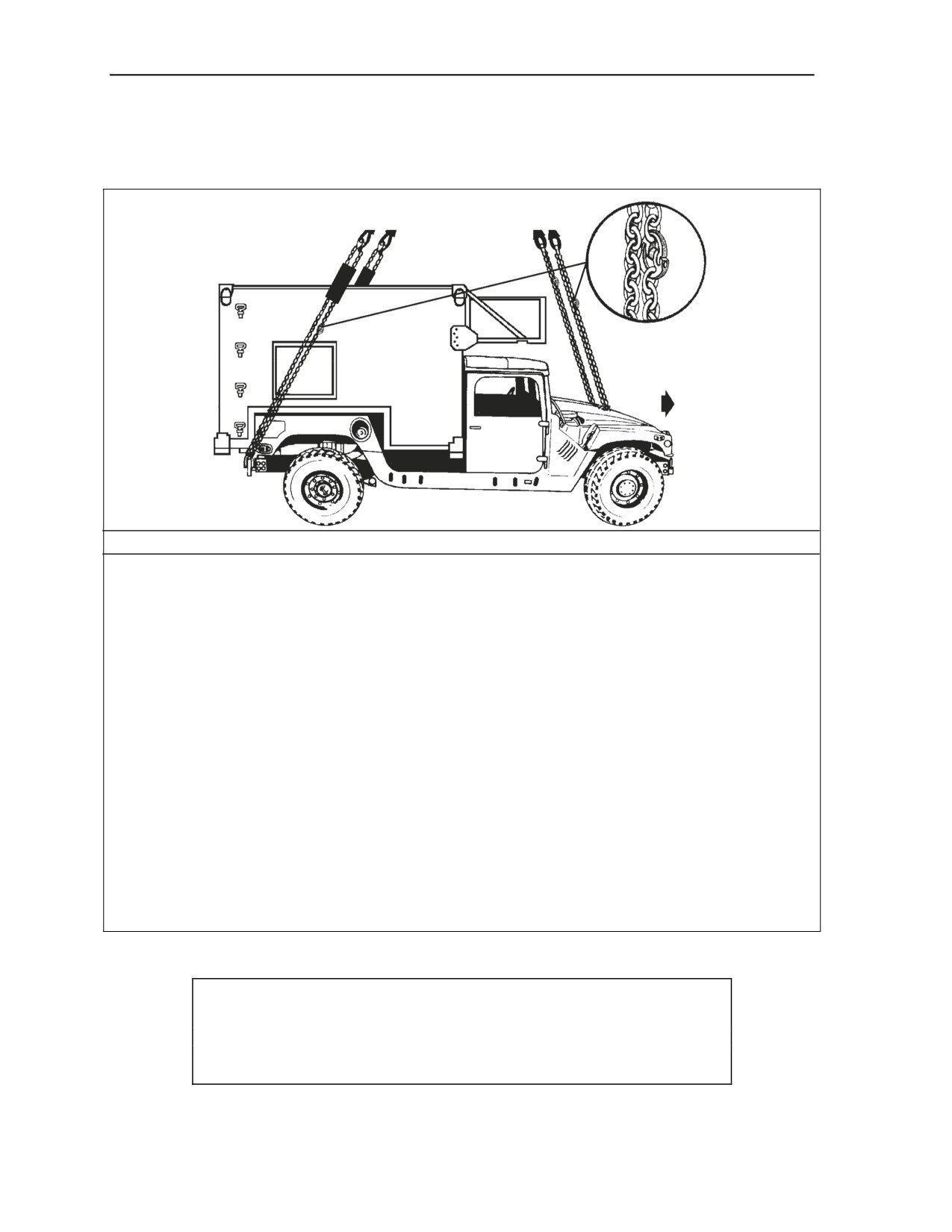
Rigging. Rig the load according to the steps in Figure 2-9.
Note. Hookup of this load presents substantial risk of damage to the load or injury to the
hookup personnel. Use of a reach pendant is recommended for this load.
Hookup. The hookup team stands on top of the shelter. The static wand person discharges
the static electricity with the static wand. The hookup person places the apex fitting onto the
aircraft cargo hook. The hookup team then carefully dismounts the vehicle and remains close to
the load as the helicopter removes slack from the sling legs. When successful hookup is
20 February 2009
FM 4-20.198/MCRP 4-11.3E, VOL II/NTTP 3-04.12/
AFMAN 11-223 (I), VOL II/COMDTINST M13482.3B
2-23
Chapter 2
assured, the hookup team quickly exits the area underneath the helicopter to the designated
rendezvous point.
Derigging. Derigging is the reverse of the preparation and rigging procedures.
RIGGING STEPS
1. Position apex fitting on top of the shelter. Route outer sling legs 1 and 2 to the front of the
vehicle and inner sling legs 3 and 4 to the rear. Sling legs 1 and 3 must be on the left side of
the load.
2. Loop the chain end of sling leg 1 through the left front lift provision that protrudes through the
hood from inboard to outboard. Place the correct link from Table 2-9 in the grab hook.
Repeat with sling leg 2 and the right front lift provision. Secure excess chain with Type III
nylon cord.
3. Route the chain end of sling leg 3 through the lift provision located on the left end of the rear
bumper from inboard to outboard. Place the correct link from Table 2-9 in the grab hook.
Repeat with sling leg 4 and the right rear lift provision. Secure excess chain with Type III
nylon cord.
4. Wrap the rear slings with padding where they contact the shelter sides.
5. Raise the apex fitting above the shelter carrier keeping the slings to the side of the shelter.
6. Cluster and tie (breakaway technique) all sling legs together on top of the shelter to prevent
entanglement during hookup and lift-off.
Figure 2-9. LMS Shelter Mounted on M1097/M1097A2
CAUTION
Do not use the lift shackles located near the center of the rear bumper
for sling load lift provisions.
2-24
FM 4-20.198/MCRP 4-11.3E, VOL II/NTTP 3-04.12/
AFMAN 11-223 (I), VOL II/COMDTINST M13482.3B
20 February 2009
Certified Single-Point Rigging Procedures for Wheeled Vehicles
M1097A2 SHELTER CARRIER (HMMWV) WITH LIGHTWEIGHT
MULTIPURPOSE SHELTER (LMS) USING SHELTER LIFT RINGS AS
SLING GUIDES
2-11. The M1097A2 shelter carrier with lightweight multipurpose shelter using the shelter lift rings as
sling guides is rigged for single-point sling load using the following procedures:
z
Applicability. The following item in Table 2-10 is certified for all helicopters with suitable lift
capacity by the US Army Natick Soldier Center:
Table 2-10. Lightweight Multipurpose Shelter Using Shelter Lift Rings as Sling Guides
Nomenclature
Max
Sling
Link Count
Weight
Set
Front/Rear
(Pounds)
Analysis Control Team-Enclave, AN-TYQ-103
10,300
25K
40/5
z
Materials. The following materials are required to rig this load:
Sling set (25,000-pound capacity).
─ Chain length, part number 38850-00053-102, from a 25,000-pound capacity sling set
(4 each).
─ Coupling link, part number 664241, from a 25,000-pound sling set (4 each).
Tape, adhesive, pressure-sensitive, 2-inch wide roll.
Cord, nylon, Type III, 550-pound breaking strength.
Webbing, cotton, 1/4-inch, 80-pound breaking strength.
z
Personnel. Two persons can prepare and rig this load in 20 minutes.
z
Procedures. The following procedures apply to this load:
Preparation. Prepare the load using the following steps:
─ Extend the sling leg chains by connecting one additional chain length to each chain on a
25,000-pound capacity sling set with coupling links.
─ Fold mirrors forward in front of the windshield for added protection and tie together with
Type III nylon cord.
Secure all equipment inside the shelter with tape, nylon cord, or lashings;
close and secure shelter vents and door with nylon cord or tape.
─ Secure all equipment and cargo inside the vehicle with tape, nylon cord, or lashings.
Secure the doors shut if installed.
─ Ensure the fuel tank is not over 3/4 full. Inspect fuel tank cap, oil filler cap, and battery
caps for proper installation.
─ Engage the vehicle parking brake and put the transmission in neutral.
─ Ensure the front wheels are pointed straight ahead. Tie down the steering wheel, using
the securing device attached under the dashboard.
─ Tape the windshield in an X formation from corner to corner.
─ Tie the shelters rear lift rings together with Type III nylon cord on top of the shelter. The
rings should be positioned so they point towards the front of the vehicle.
Install the lift provisions on the outer ends of the rear bumper by removing
the tiedown provisions located inboard of the bumper end and installing
them on the outer ends of the rear bumper.
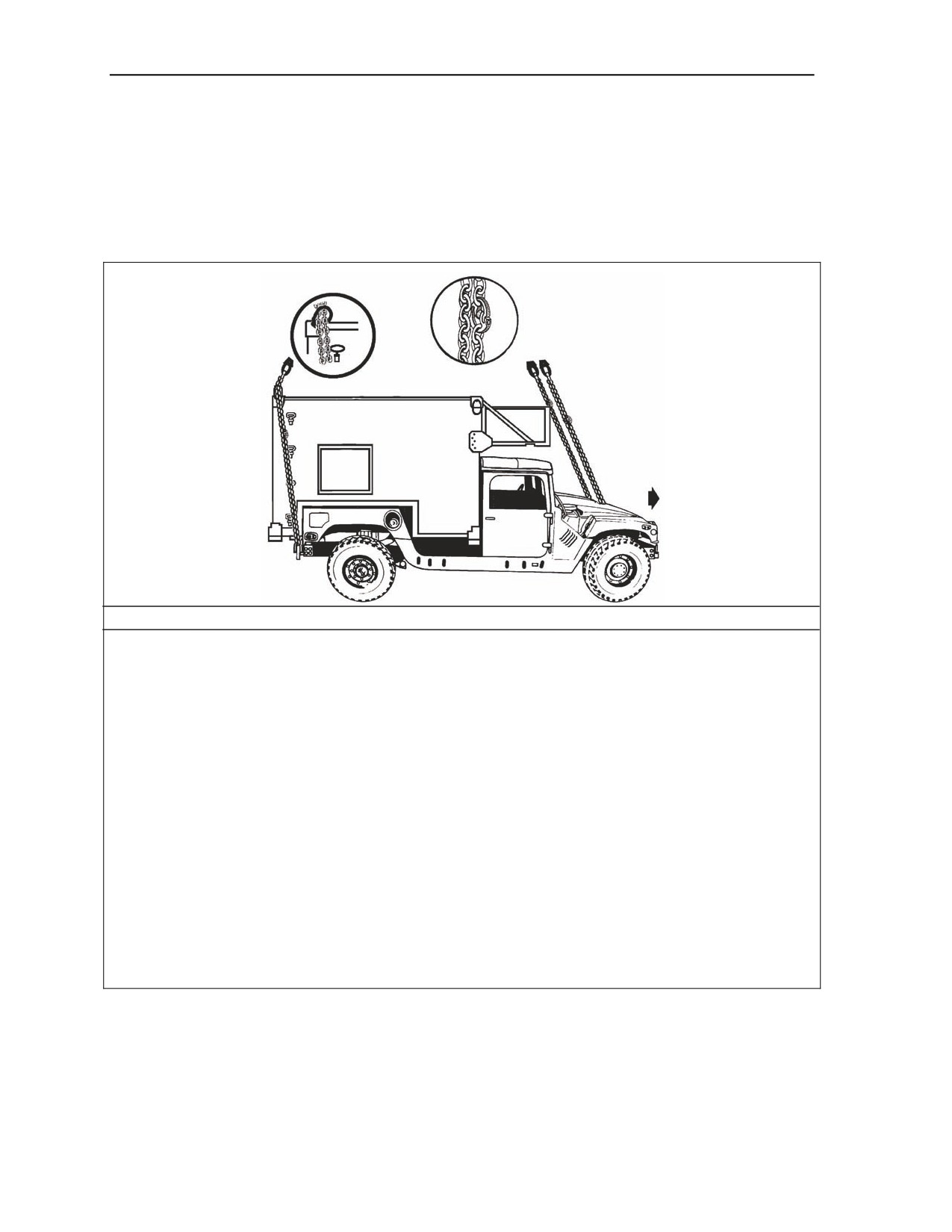
Rigging. Rig the load according to the steps in Figure 2-10.
Note. Hookup of this load presents substantial risk of damage to the load or injury to the
hookup personnel. Use of a reach pendant is recommended for this load.
20 February 2009
FM 4-20.198/MCRP 4-11.3E, VOL II/NTTP 3-04.12/
AFMAN 11-223 (I), VOL II/COMDTINST M13482.3B
2-25
Chapter 2
Hookup. The hookup team stands on top of the shelter. The static wand person discharges
the static electricity with the static wand. The hookup person places the apex fitting onto the
aircraft cargo hook. The hookup team then carefully dismounts the vehicle and remains close to
the load as the helicopter removes slack from the sling legs. When successful hookup is
assured, the hookup team quickly exits the area underneath the helicopter to the designated
rendezvous point.
Derigging. Derigging is the reverse of the preparation and rigging procedures.
RIGGING STEPS
1. Position apex fitting on top of the shelter. Route outer sling legs 1 and 2 to the front of the vehicle and
inner sling legs 3 and 4 to the rear. Sling legs 1 and 3 must be on the left side of the load.
2. Loop the chain end of sling leg 1 through the left front lift provision that protrudes through the hood from
inboard to outboard. Place the correct link from Table 2-10 in the grab hook. Repeat with sling leg 2
and the right front lift provision. Secure excess chain with Type III nylon cord.
3. Route the right sling leg chain through the right rear shelter lift ring to the right rear lift provision located
on the outer end of the rear bumper. Continue routing the chain back through the right rear shelter lift
ring and back to the grab hook. Place the correct link from Table 2-10 in the grab hook. Repeat the
procedure using the left sling leg chain, left rear shelter lift ring, and the left lift provision located on the
end of the bumper.
4.
Raise the apex fitting above the shelter carrier keeping the slings to the side of the shelter and
removing all slack from the chains. Tie the rear chains to the rear shelter lift rings with Type III nylon
cord.
5. Cluster and tie (breakaway technique) all sling legs together on top of the shelter to prevent
entanglement during hookup and lift-off.
Figure 2-10. LMS Shelter Mounted on M1097A2 Using Shelter Lift Rings as Sling Guides
2-26
FM 4-20.198/MCRP 4-11.3E, VOL II/NTTP 3-04.12/
AFMAN 11-223 (I), VOL II/COMDTINST M13482.3B
20 February 2009
Certified Single-Point Rigging Procedures for Wheeled Vehicles
CAUTION
Do not use the lift shackles located near the center of the rear bumper
for sling load lift provisions.
M1037/M1042 SHELTER CARRIER (HMMWV) WITH
LIGHTWEIGHT MULTIPURPOSE SHELTER (LMS)
2-12. The M1037/M1042 shelter carrier with lightweight multipurpose shelter is rigged for single-point
sling load using the following procedures:
z
Applicability. The following item in Table 2-11 is certified for all helicopters with suitable lift
capacity by the US Army Natick Soldier Center:
Table 2-11. Lightweight Multipurpose Shelter on M1037/M1042
Nomenclature
Max
Sling
Link Count
Weight
Set
Front/Rear
(Pounds)
High Frequency Communications Central, AN/TSC-120
8,365
10K
50/5
z
Materials. The following materials are required to rig this load.
Multileg sling set (15,000-pound capacity for the CH-53E only).
─ Additional chain lengths from the sling set being used (8 each).
─ Additional coupling links from the sling set being used (8 each).
Tape, adhesive, pressure-sensitive, 2-inch wide roll.
Cord, nylon, Type III, 550-pound breaking strength.
Webbing, cotton, 1/4-inch, 80-pound breaking strength.
Felt sheet, cattle hair, Type IV, 1/2-inch or suitable padding.
Padding, cellulose.
z
Personnel. Two persons can prepare and rig this load in 15 minutes.
z
Procedures. The following procedures apply to this load:
Preparation. Prepare the load using the following steps:
─ Extend the sling leg chains by connecting one additional chain length to each chain on a
10,000-, 25,000-or 40,000-pound capacity sling set with coupling links. Connect two
additional chain lengths to each chain on the 15,000-pound multileg sling set chain
with coupling links.
─ Fold mirrors forward in front of the windshield for added protection and tie together with
Type III nylon cord.
─ Secure the shelter to the truck using wire rope or tie-down assemblies.
─ Secure all equipment inside the shelter with tape, nylon cord, or lashings; close and
secure shelter vents and door with nylon cord or tape.
─ Secure environmental control unit cover with duct tape.
─ Disconnect the power cord from the rear panel and secure it to the rear platform with
Type III nylon cord. Lower the power panel door and secure the door.
─ Secure all equipment and cargo inside the vehicle with tape, nylon cord, or lashings.
Secure the doors shut if installed.
─ Ensure the fuel tank is not over 3/4 full. Inspect fuel tank cap, oil filler cap, and battery caps for
proper installation.
─ Engage the vehicle parking brake and put the transmission in neutral.
20 February 2009
FM 4-20.198/MCRP 4-11.3E, VOL II/NTTP 3-04.12/
AFMAN 11-223 (I), VOL II/COMDTINST M13482.3B
2-27

Chapter 2
─ Ensure the front wheels are pointed straight ahead. Tie down the steering wheel, using the
securing device attached under the dashboard.
─ Tape the windshield in an X formation from corner to corner.
─ Install the lift provisions on the outer ends of the rear bumper by removing the tiedown provisions
located inboard of the bumper end and installing them on the outer ends of the rear bumper.
Rigging. Rig the load according to the steps in Figure 2-9.
Notes. 1. Use the link count from Table 2-11.
2. Hookup of this load presents substantial risk of damage to the load or injury to the
hookup personnel. Use of a reach pendant is recommended for this load.
Hookup. The hookup team stands on top of the shelter. The static wand person discharges the static
electricity with the static wand. The hookup person places the apex fitting onto the aircraft cargo hook.
The hookup team then carefully dismounts the vehicle and remains close to the load as the helicopter
removes slack from the sling legs. When successful hookup is assured, the hookup team quickly exits the
area underneath the helicopter to the designated rendezvous point.
Derigging. Derigging is the reverse of the preparation and rigging procedures.
M1113 TRUCK, UTILITY, EXPANDED CAPACITY (HMMWV) WITH
LIGHTWEIGHT MULTIPURPOSE SHELTER (LMS)
2-13. The M1113 truck, utility, expanded capacity with lightweight multipurpose shelter is rigged for
single-point sling load using the following procedures:
z
Applicability. The following item in Table 2-12 is certified for all helicopters with suitable lift
capacity by the US Army Natick Soldier Center:
Table 2-12. M1113 with Lightweight Multipurpose Shelter (LMS)
Nomenclature
Max
Sling
Link Count
Weight
Set
Front/Rear
(Pounds)
Analysis Control Team - Enclave (ACT-E)
11,500
25K
40/5
Common Ground Station (CGS), Joint Surveillance Target Attack
11,500
25K
32/5
Radar (JSTAR) System (V)2
Digital Topographic Support System-Light (DTSS-L)
11,500
25K
32/5
Integrated System Control (ISYSCON), AN/TYQ-76B, (V)1, (V)2, and
11,500
25K
32/5
Degraded configurations
Meteorological Measuring System Profiler, (MMS-P), AN/TMQ-52
11,500
25K
40/3
Shadow Tactical Unmanned Vehicle (TUAV), Air Vehicle Transport
11,500
25K
32/5
Shadow Tactical Unmanned Vehicle (TUAV), Ground Control Station
11,500
25K
32/5
Shadow Tactical Unmanned Vehicle (TUAV), Maintenance Section
11,500
25K
32/5
Multifunctional
Single Shelter Switch (SSS), AN/TTC-56
11,500
25K
32/5
Tactical Airspace Integration System (TAIS)
11,500
25K
32/5
Trojan Spirit Lite (V)3 Support Vehicle, AN/TSQ-226 (V)3
11,500
25K
35/3
IMETS AN/TMQ-40C and AN/TMQ-40D
11,500
25K
32/5
z
Materials. The following materials are required to rig this load:
Sling set (25,000-pound capacity).
─ Chain length, part number 38850-00053-102, from a 25,000-pound capacity sling set (4
each).
─ Coupling link, part number 664241, from a 25,000-pound sling set (4 each).
2-28
FM 4-20.198/MCRP 4-11.3E, VOL II/NTTP 3-04.12/
AFMAN 11-223 (I), VOL II/COMDTINST M13482.3B
20 February 2009
Certified Single-Point Rigging Procedures for Wheeled Vehicles
Tape, adhesive, pressure-sensitive, 2-inch wide roll.
Cord, nylon, Type III, 550-pound breaking strength.
Webbing, cotton, 1/4-inch, 80-pound breaking strength.
Felt sheet, cattle hair, Type IV, 1/2-inch or suitable padding.
z
Personnel. Two persons can prepare and rig this load in 15 minutes.
z
Procedures. The following procedures apply to this load:
Preparation. Prepare the load using the following steps:
─ Extend the sling leg chains by connecting one additional chain length to each chain on a
25,000-pound capacity sling set with coupling links.
─ Fold mirrors forward in front of the windshield for added protection and tie together with
Type III nylon cord.
─ Secure all equipment inside the shelter with tape, nylon cord, or lashings; close and
secure shelter vents and door with nylon cord or tape.
─ Secure environmental control unit cover with duct tape.
─ Disconnect the power cord from the rear panel and secure it to the rear platform with
Type III nylon cord. Lower the power panel door and secure the door.
─ Secure all equipment and cargo inside the vehicle with tape, nylon cord, or lashings.
Secure the doors shut if installed.
─ Ensure the fuel tank is not over 3/4 full. Inspect fuel tank cap, oil filler cap, and battery
caps for proper installation.
─ Engage the vehicle parking brake and put the transmission in neutral.
─ Ensure the front wheels are pointed straight ahead. Tie down the steering wheel, using
the securing device attached under the dashboard.
─ Tape the windshield in an X formation from corner to corner.
─ Install the lift provisions on the outer ends of the rear bumper.
─ Remove the upper antenna mounting bracket if installed.
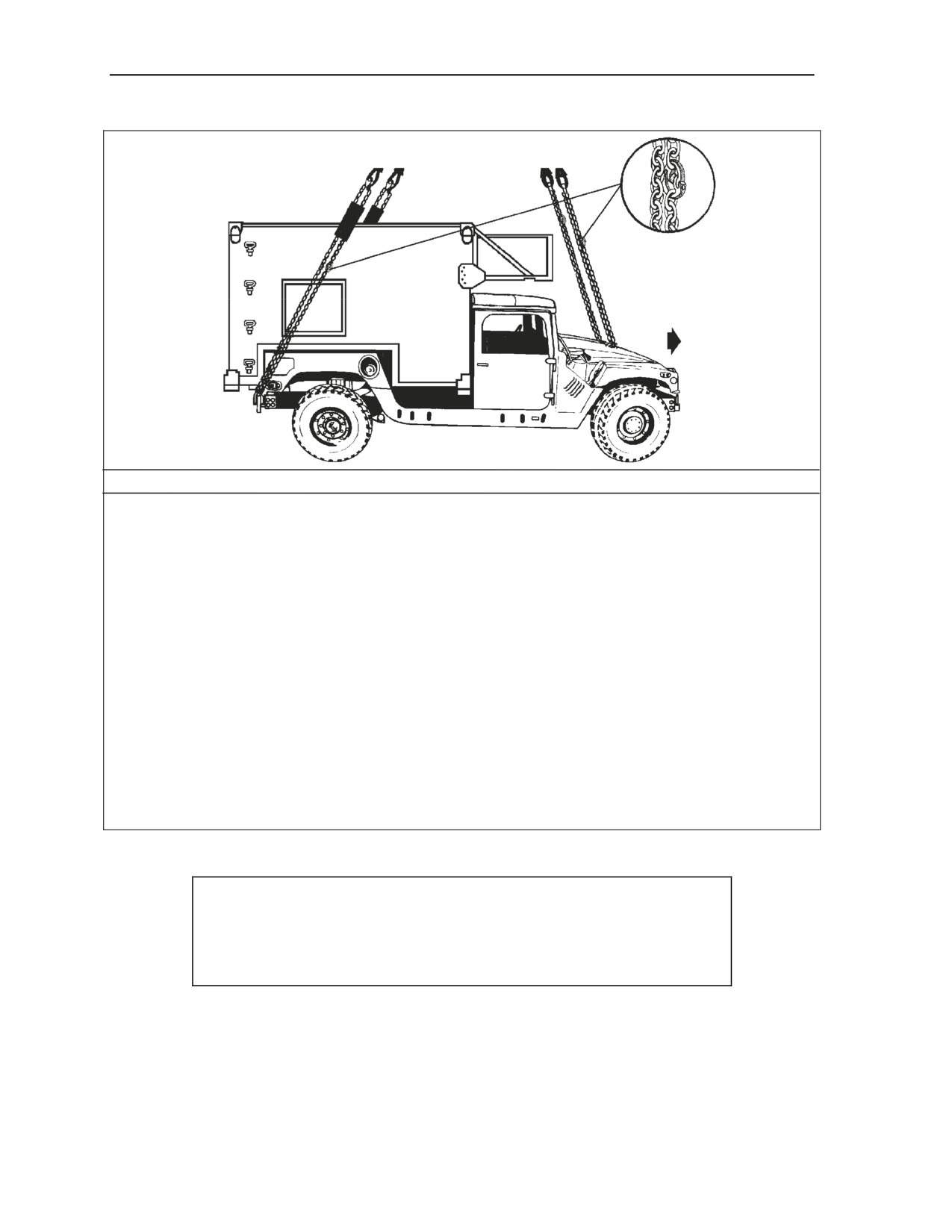
Rigging. Rig the load according to the steps in Figure 2-11.
Hookup. The hookup team stands on top of the shelter. The static wand person discharges
the static electricity with the static wand. The hookup person places the apex fitting onto the
cargo hook. The hookup team then carefully dismounts the vehicle and remains close to the load
as the helicopter removes slack from the sling legs. When successful hookup is assured, the
hookup team quickly exits the area underneath the helicopter to the designated rendezvous
point.
Derigging. Derigging is the reverse of the preparation and rigging procedures.
Note. Hookup of this load presents substantial risk of damage to the load or injury to the
hookup personnel. Use of a reach pendant is recommended for this load.
20 February 2009
FM 4-20.198/MCRP 4-11.3E, VOL II/NTTP 3-04.12/
AFMAN 11-223 (I), VOL II/COMDTINST M13482.3B
2-29
Chapter 2
RIGGING STEPS
1. Position the apex fitting on top of the shelter. Route outer sling legs 1 and 2 to the front of
the vehicle and inner sling legs 3 and 4 to the rear. Sling legs 1 and 3 must be on the left
side of the load.
2. Loop the chain end of sling leg 1 through the left front lift provision that protrudes through the
hood from inboard to outboard. Place the correct link from Table 2-12 in the grab hook.
Repeat with sling leg 2 through the right front lift provision. Secure all excess chain with
Type III nylon cord.
3. Loop the chain end of sling leg 3 through the left rear lift provision located on the left end of
the rear bumper. Place the correct link from Table 2-12 in the grab hook. Repeat with sling
leg 4 through the right rear lift provision Secure all excess chain with Type III nylon cord.
4. Wrap the rear slings with padding where they contact the shelter sides.
5. Cluster and tie (breakaway technique) the sling legs in each sling set together to prevent
entanglement during hookup and lift-off.
Figure 2-11. M1113 with Lightweight Multipurpose Shelter (LMS)
CAUTION
Do not use the lift shackles located near the center of the rear bumper
for sling load lift provisions.
2-30
FM 4-20.198/MCRP 4-11.3E, VOL II/NTTP 3-04.12/
AFMAN 11-223 (I), VOL II/COMDTINST M13482.3B
20 February 2009
Certified Single-Point Rigging Procedures for Wheeled Vehicles
M1097/M1113 SHELTER CARRIER (HMMWV) WITH GITCHNER
MODEL 1497A SHELTER
2-14. The M1097/M1113 shelter carrier with Gitchner model 1497A shelter is rigged for single-point sling
load using the following procedures:
z
Applicability. The following item in Table 2-13 is certified for all helicopters with suitable lift
capacity by the US Army Natick Soldier Center:
Table 2-13. M1097/M1113 with Gitchner Model 1497A Shelter
Nomenclature
Max
Sling
Link Count
Weight
Set
Front/Rear
(Pounds)
Joint Tactical Information Distribution System (JTIDS), AN/TYQ-
10,000
10K
30/3
JTIDS Shelter on M1097 HMMWV
AN/TSM-210 Electronic Shop on Enhanced Capacity Vehicle, M1113
10,360
25K
22/46
HMMWV
z
Materials. The following materials are required to rig this load:
Sling set (10,000-pound capacity).
─ Chain length, part number 38850-00053-101, from a 10,000-pound capacity sling set
(4 each).
─ Coupling link, part number 577-0415, from a 10,000-pound capacity sling set (4 each).
OR
Sling set (25,000-pound capacity).
─ Chain length, part number 38850-00053-102, from a 25,000-pound capacity sling set
(4 each).
─ Coupling link, part number 664241, from a 25,000-pound capacity sling set (4 each).
Tape, adhesive, pressure-sensitive, 2-inch wide roll.
Cord, nylon, Type III, 550-pound breaking strength.
Webbing, cotton, 1/4-inch, 80-pound breaking strength.
Felt sheet, cattle hair, Type IV, 1/2-inch or suitable padding.
Padding, cellulose.
z
Personnel. Two persons can prepare and rig this load in 15 minutes.
z
Procedures. The following procedures apply to this load:
Preparation. Prepare the load using the following steps:
─ Extend the sling leg chains by connecting one additional chain length to each chain on a
10,000- or 25,000-pound capacity sling set with coupling links.
─ Fold mirrors forward in front of the windshield for added protection and tie together with
Type III nylon cord.
─ Secure all equipment inside the shelter with tape, nylon cord, or lashings. Close and
secure all shelter doors and vents with tape or Type III nylon cord.
─ Secure the environmental control unit cover with duct tape.
─ Disconnect the power cord from the rear panel and secure it to the rear platform with
Type III nylon cord. Lower the power panel door and secure it.
─ Secure all equipment and cargo inside the vehicle with tape, nylon cord, or lashings.
Secure the doors shut if installed.
─ Ensure the fuel tank is not over 3/4 full. Inspect fuel tank cap, oil filler cap, and battery
caps for proper installation.
─ Engage the vehicle parking brake and put the transmission in neutral.
20 February 2009
FM 4-20.198/MCRP 4-11.3E, VOL II/NTTP 3-04.12/
AFMAN 11-223 (I), VOL II/COMDTINST M13482.3B
2-31
Chapter 2
─ Ensure the front wheels are pointed straight ahead. Tie down the steering wheel, using
the securing device attached under the dashboard.
─ Tape the windshield in an X formation from corner to corner.
─ Install the lift provisions on the outer ends of the rear bumper by removing the tiedown
provisions located inboard of the bumper end and installing them on the outer ends of
the rear bumper.
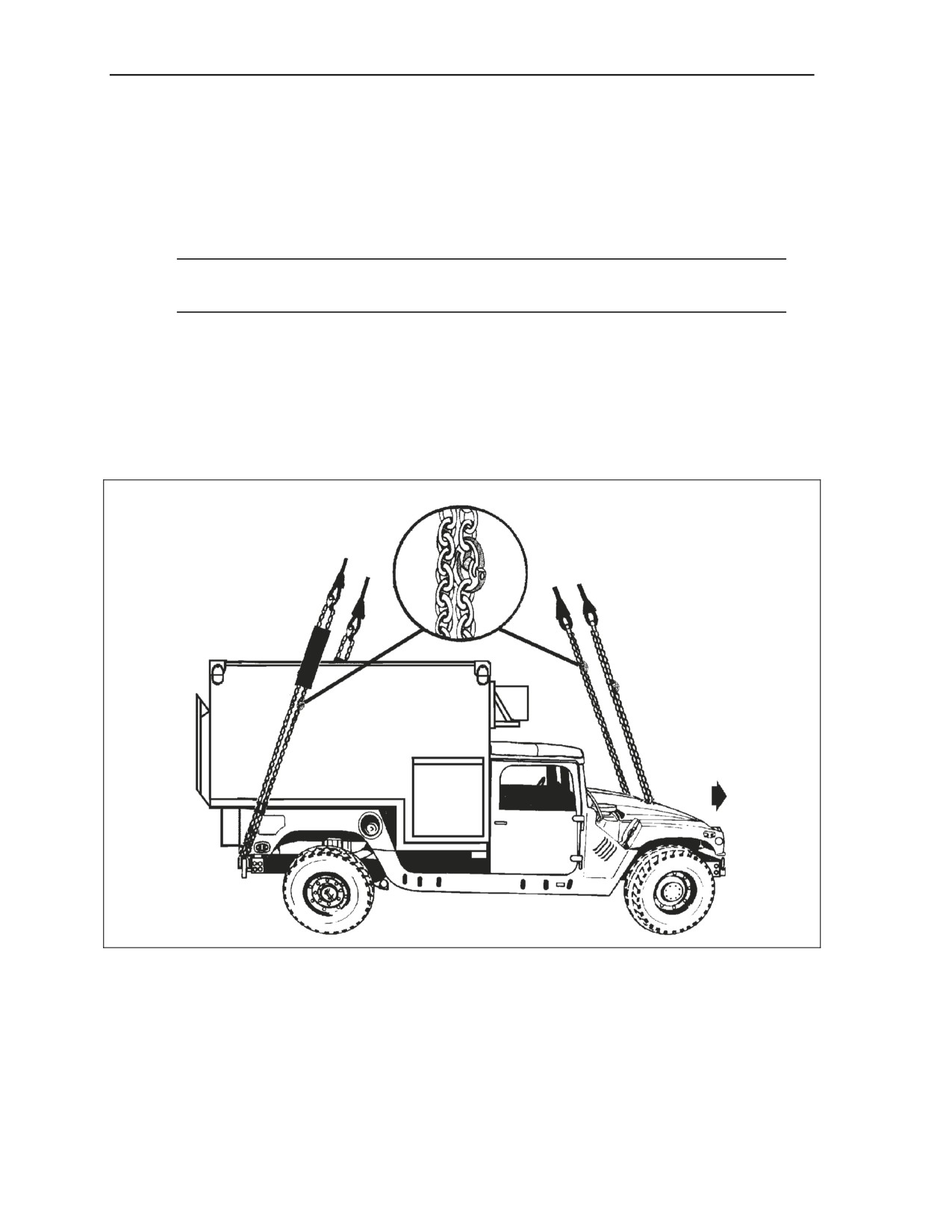
Rigging. Rig the load according to the steps in Figure 2-12.
Note. Hookup of this load presents substantial risk of damage to the load or injury to the
hookup personnel. Use of a reach pendant is recommended for this load.
Hookup. The hookup team stands on top of the shelter. The static wand person discharges
the static electricity with the static wand. The hookup person places the apex fitting onto the
aircraft cargo hook. The hookup team then carefully dismounts the vehicle and remains close to
the load as the helicopter removes slack from the sling legs. When successful hookup is
assured, the hookup team quickly exits the area underneath the helicopter to the designated
rendezvous point.
Derigging. Derigging is the reverse of the preparation and rigging procedures.
Figure 2-12. M1097/M1113 with Gitchner Model 1497A Shelter
2-32
FM 4-20.198/MCRP 4-11.3E, VOL II/NTTP 3-04.12/
AFMAN 11-223 (I), VOL II/COMDTINST M13482.3B
20 February 2009
Certified Single-Point Rigging Procedures for Wheeled Vehicles
RIGGING STEPS
1. Position apex fitting on top of the vehicle. Route outer sling legs 1 and 2 to the front of the
vehicle and inner sling legs 3 and 4 to the rear. Sling legs 1 and 3 must be on the left side of
the load.
2. Loop the chain end of sling leg 1 through the left front lift provision that protrudes through the
hood from inboard to outboard. Place the correct link from Table 2-13 in the grab hook.
Repeat with sling leg 2 and the right front lift provision. Secure excess chain with Type III
nylon cord.
3. Route the chain end of sling leg 3 through the lift provision located on the left end of the rear
bumper from inboard to outboard. Place the correct link from Table 2-13 in the grab hook.
Repeat with sling leg 4 and the right rear lift provision.
4. Cluster and tie (breakaway technique) all sling legs together on top of the shelter to prevent
entanglement during hookup and lift-off.
Figure 2-12. M1097/M1113 with Gitchner Model 1497A Shelter (Continued)
CAUTION
Do not use the lift shackles located near the center of the rear bumper
for sling load lift provisions.
M1097A2 SHELTER CARRIER (HMMWV) WITH SPECIAL
OPERATIONS MEDIA SYSTEM (SOMS-B) IN S-788 SHELTER
2-15. The M1097A2 shelter carrier with SOMS-B in S-788 shelter is rigged for single-point sling load
using the following procedures:
z
Applicability. The following item in Table 2-14 is certified for all helicopters with suitable lift
capacity by the US Army Natick Soldier Center:
Table 2-14. M1097A2 Shelter Carrier with SOMS-B in S-788 Shelter
Nomenclature
Max
Sling
Link Count
Weight
Set
Front/Rear
(Pounds)
Special Operations Media System
9,080
10K
40/3
z
Materials. The following materials are required to rig this load:
Sling set (10,000-pound capacity).
─ Chain length, part number 38850-00053-101, from a 10,000-pound capacity sling set (4
each).
─ Coupling link, part number 577-0415, from a 10,000-pound sling set (4 each).
Tape, adhesive, pressure-sensitive, 2-inch wide roll.
Cord, nylon, Type III, 550-pound breaking strength.
Webbing, cotton, 1/4-inch, 80-pound breaking strength.
Felt sheet, cattle hair, Type IV, 1/2-inch or suitable padding.
20 February 2009
FM 4-20.198/MCRP 4-11.3E, VOL II/NTTP 3-04.12/
AFMAN 11-223 (I), VOL II/COMDTINST M13482.3B
2-33
Chapter 2
Padding, Cellulose.
z
Personnel. Two persons can prepare and rig this load in 15 minutes.
z
Procedures. The following procedures apply to this load:
Preparation. Prepare the load using the following steps:
─ Extend the sling leg chains by connecting one additional chain length to each chain on a
10,000-pound capacity sling set with coupling links.
─ Fold mirrors forward in front of the windshield for added protection and tie together with
Type III nylon cord.
─ Secure all equipment inside the shelter with tape, nylon cord, or lashings; close and
secure shelter vents and door with nylon cord or tape.
─ Disconnect the power cord from the rear panel and secure it to the rear platform with
Type III nylon cord. Lower the power panel door and secure the door.
─ Secure all equipment and cargo inside the vehicle with tape, nylon cord, or lashings.
Secure the doors shut if installed.
─ Ensure the fuel tank is not over 3/4 full. Inspect fuel tank cap, oil filler cap, and battery
caps for proper installation.
─ Engage the vehicle parking brake and put the transmission in neutral.
─ Ensure the front wheels are pointed straight ahead. Tie down the steering wheel, using
the securing device attached under the dashboard.
─ Tape the windshield in an X formation from corner to corner.
─ Install the lift provisions on the outer ends of the rear bumper.
─ Remove the upper antenna bracket if installed.
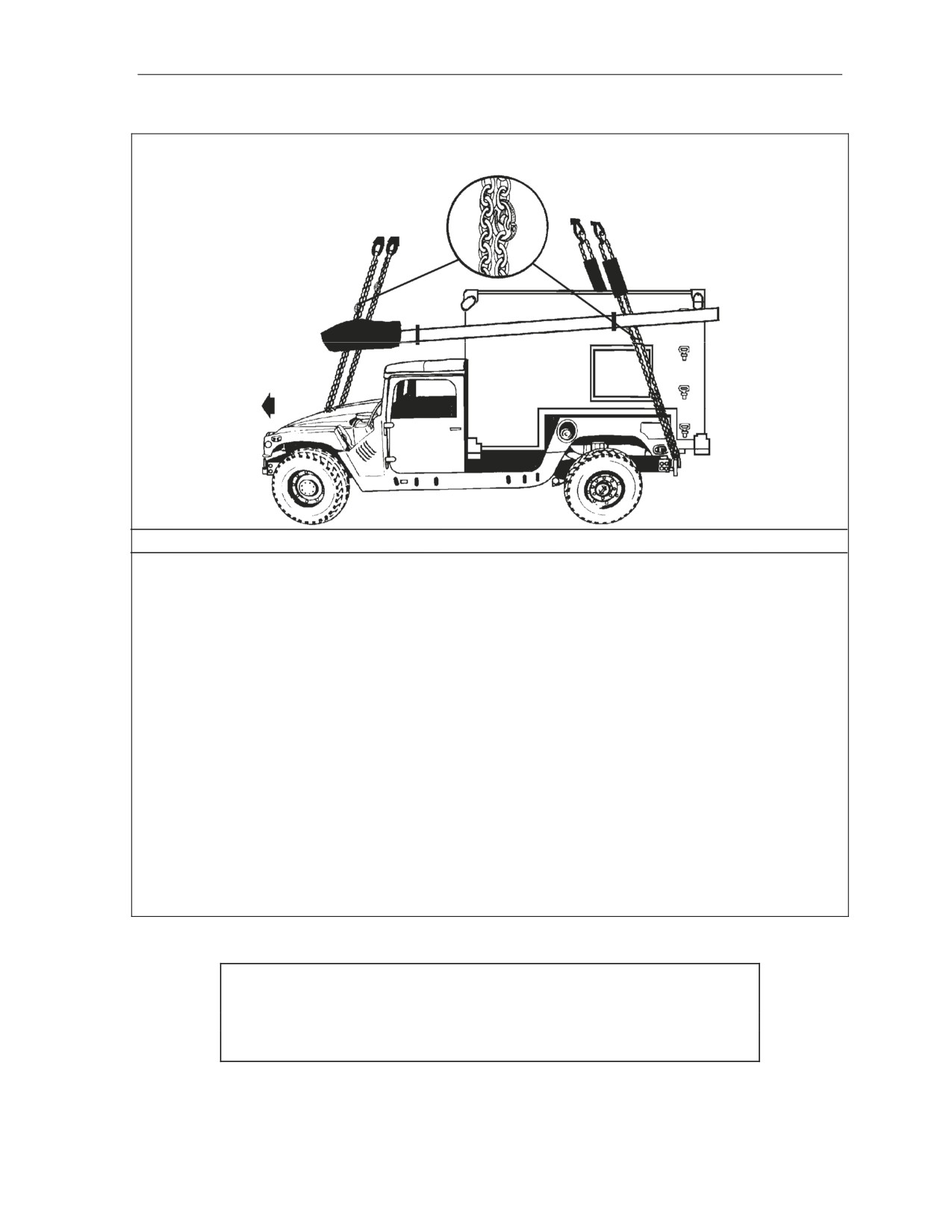
Rigging. Rig the load according to the steps in Figure 2-13.
Notes.
1. Ensure the chains on sling leg 1 are routed between the shelter and the 30 meter mast.
2. Hookup of this load presents substantial risk of damage to the load or injury to the
hookup personnel. Use of a reach pendant is recommended for this load.
Hookup. The hookup team stands on top of the shelter. The static wand person discharges
the static electricity with the static wand. The hookup person places the apex fitting onto the
cargo hook. The hookup team then carefully dismounts the vehicle and remains close to the load
as the helicopter removes slack from the sling legs. When successful hookup is assured, the
hookup team quickly exits the area underneath the helicopter to the designated rendezvous
point.
Derigging. Derigging is the reverse of the preparation and rigging procedures.
2-34
FM 4-20.198/MCRP 4-11.3E, VOL II/NTTP 3-04.12/
AFMAN 11-223 (I), VOL II/COMDTINST M13482.3B
20 February 2009
Certified Single-Point Rigging Procedures for Wheeled Vehicles
Note. Ensure the chains on sling leg 1 are routed between the shelter and the 30 meter mast.
RIGGING STEPS
1. Position the apex fitting on top of the shelter. Route outer sling legs 1 and 2 to the front of
the vehicle and inner sling legs 3 and 4 to the rear. Sling legs 1 and 3 must be on the left
side of the load.
2. Loop the chain end of sling leg 1 through the left front lift provision that protrudes through the
hood from inboard to outboard. Place the correct link from Table 2-14 in the grab hook.
Repeat with sling leg 2 through the right front lift provision. Secure all excess chain with
Type III nylon cord.
3. Loop the chain end of sling leg 3 through the left rear lift provision located on the left end of
the rear bumper. Place the correct link from Table 2-14 in the grab hook. Repeat with sling
leg 4 through the right rear lift provision Secure all excess chain with tape or Type III nylon
cord.
4. Wrap the rear slings with padding where they contact the shelter sides.
5. Cluster and tie (breakaway technique) the sling legs in each sling set together to prevent
entanglement during hookup and lift-off.
Figure 2-13. M1097A2 Shelter Carrier with SOMS-B in S-788 Shelter
CAUTION
Do not use the lift shackles located near the center of the rear bumper
for sling load lift provisions.
20 February 2009
FM 4-20.198/MCRP 4-11.3E, VOL II/NTTP 3-04.12/
AFMAN 11-223 (I), VOL II/COMDTINST M13482.3B
2-35
Chapter 2
TACTICAL DATA NETWORK (TDN) GATEWAY ON M1097A1
HMMWV
2-16. The Tactical Data Network Gateway on M1097A1 is rigged for single-point sling load using the
following procedures:
z
Applicability. The following item in Table 2-15 is certified for all helicopters with suitable lift
capacity by the US Army Natick Soldier Center:
Table 2-15. Tactical Data Network Gateway on M1097A1 HMMWV
Nomenclature
Max
Sling
Link Count
Weight
Set
Front/Rear
(Pounds)
Tactical Data Network (TDN) Gateway on M1097A1 HMMWV
9,580
15K
30/3
z
Materials. The following materials are required to rig this load:
Multileg sling set (15,000-pound capacity).
─ Additional chain lengths, part number 3408-4, from a 15,000-pound capacity sling set
(8 each).
─ Coupling link, part number 31611, from a 15,000-pound capacity sling set (8 each).
Tape, adhesive, pressure-sensitive, 2-inch wide roll.
Cord, nylon, Type III, 550-pound breaking strength.
Webbing, cotton, 1/4-inch, 80-pound breaking strength.
z
Personnel. Two persons can prepare and rig this load in 15 minutes.
z
Procedures. The following procedures apply to this load:
Preparation. Prepare the load using the following steps:
─ Fold the mirrors inward for added protection and tie together with Type III nylon cord.
─ Secure all equipment inside the unit with tape, Type III nylon cord or tiedown straps.
Secure all vents, doors and latches with tape or Type III nylon cord
─ Secure all equipment and cargo inside the vehicle cab with tape, Type III nylon cord, or
tiedown straps. Secure the doors shut, if installed.
─ Ensure the fuel tank is not over 3/4 full. Inspect fuel tank cap, oil filler cap, and battery
caps for proper installation.
─ Engage the vehicle parking brake and put the transmission in neutral.
─ Ensure the front wheels are pointed straight ahead. Tie down the steering wheel, using
the securing device attached under the dashboard or Type III nylon cord.
─ Extend the sling leg chains by connecting two additional chain length to each chain on
the 15,000-pound capacity sling set with coupling links.
─ Tape the windshield in an X formation from corner to corner.
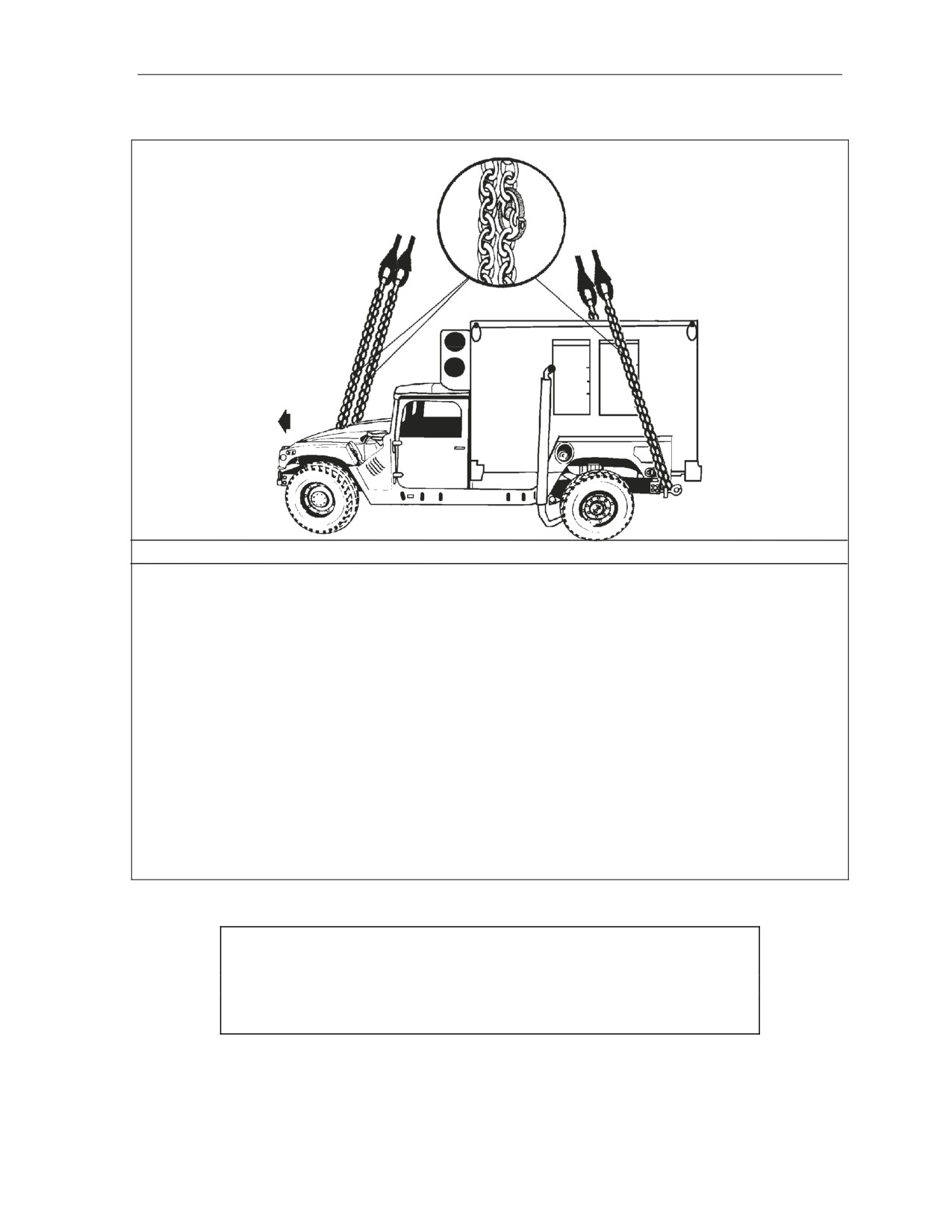
Rigging. Rig the load according to the steps in Figure 2-14.
Note. Hookup of this load presents substantial risk of damage to the load or injury to the hookup
personnel. Use of a reach pendant is recommended for this load.
Hookup. The hookup team stands on the roof of the shelter. The static wand person
discharges the static electricity with the static wand. The hookup person places the apex fitting
on the cargo hook. The hookup team then carefully dismounts the vehicle and remains close to
the load as the helicopter removes slack from the sling legs. When successful hookup is
assured, the hookup team quickly exits the area underneath the helicopter to the designated
rendezvous point.
Derigging. Derigging is the reverse of the preparation and rigging procedures.
2-36
FM 4-20.198/MCRP 4-11.3E, VOL II/NTTP 3-04.12/
AFMAN 11-223 (I), VOL II/COMDTINST M13482.3B
20 February 2009
Certified Single-Point Rigging Procedures for Wheeled Vehicles
RIGGING STEPS
1. Position apex fitting on top of the truck. Route outer sling legs 1 and 2 to the front of the
vehicle and inner sling legs 3 and 4 to the rear. Sling legs 1 and 3 must be on the left side of
the load.
2. Loop the chain end of sling leg 1 through the left front lift provision that protrudes through the
hood from inboard to outboard. Place the correct link from Table 2-15 in the grab hook.
Repeat with sling leg 2 and the right front lift provision. Secure excess chain with Type III
nylon cord.
3. Loop the chain end of sling leg 3 through the left rear lift provision located on the outer ends
of the rear bumper. Place the correct link from Table 2-15 in the grab hook. Repeat with
sling leg 4 and the right rear lift provision. Secure excess chain with Type III nylon cord.
4. Cluster and tie (breakaway technique) all sling legs together on top of the vehicle to prevent
entanglement during hookup and lift-off.
Figure 2-14. Tactical Data Network Gateway on M1097A1 HMMWV
CAUTION
Do not use the lift shackles located near the center of the rear bumper
for sling load lift provisions.
20 February 2009
FM 4-20.198/MCRP 4-11.3E, VOL II/NTTP 3-04.12/
AFMAN 11-223 (I), VOL II/COMDTINST M13482.3B
2-37
Chapter 2
M1037/M1097 SHELTER CARRIER (HMMWV) WITH G15840 SMOKE
GENERATOR SET, M157/M157A1E1
2-17. The M1037/M1097 shelter carrier (HMMWV) with G15840 smoke generator set, M157/M157A1E1
is rigged for single-point sling load using the following procedures:
z
Applicability. The following item in Table 2-16 is certified for all helicopters with suitable lift
capacity by the US Army Natick Soldier Center:
Table 2-16. M1037/M1097 Shelter Carrier (HMMWV) With G15840 Smoke Generator Set,
M157/M157A1E1
Nomenclature
Max
Sling
Link Count
Weight
Set
Front/Rear
(Pounds)
Smoke Generator Set, M157 on M1037
7,400
10K
80/30
Smoke Generator Set, M157 on M1097
8,025
10K
80/30
Smoke Generator Set, M157A1E1 on M1097
8,035
10K
80/30
z
Materials. The following materials are required to rig this load.
Sling set (10,000-pound capacity).
Tape, adhesive, pressure-sensitive, 2-inch wide roll.
Cord, nylon, Type III, 550-pound breaking strength.
Webbing, cotton, 1/4-inch, 80-pound breaking strength.
Felt sheet, cattle hair, Type IV, 1/2-inch or suitable padding.
z
Personnel. Two persons can prepare and rig this load in 15 minutes.
z
Procedures. The following procedures apply to this load:
Preparation. Prepare the load using the following steps:
─ Fold mirrors forward in front of the windshield for added protection and tie together with
Type III nylon cord.
─ Secure all equipment and cargo inside the vehicle with tape, nylon cord, or lashings.
Secure the doors shut if installed.
─ Ensure the fuel tank is not over 3/4 full. Inspect fuel tank cap, oil filler cap, and battery
caps for proper installation.
─ Engage the vehicle parking brake and put the transmission in neutral.
─ Ensure the front wheels are pointed straight ahead. Tie down the steering wheel, using
the securing device attached under the dashboard.
─ Tape the windshield in an X formation from corner to corner.
─ Install the lift provisions on the outer ends of the rear bumper by removing the tiedown
provisions located inboard of the bumper end and installing them on the outer ends of
the rear bumper.
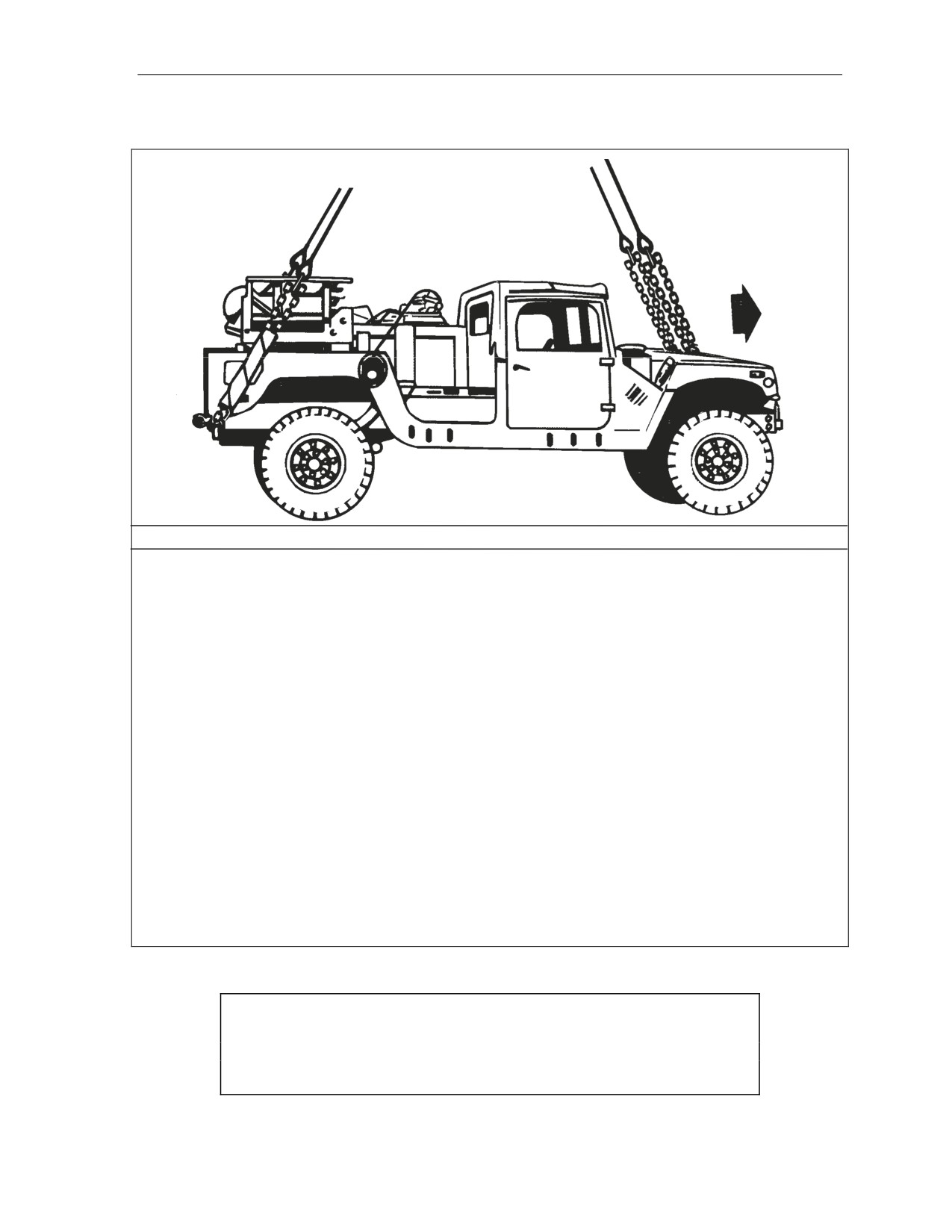
Rigging. Rig the load according to the steps in Figure 2-15.
Hookup. The hookup team stands on top of the load. The static wand person discharges
the static electricity with the static wand. The hookup person places the apex fitting onto the
aircraft cargo hook. The hookup team then carefully dismounts the vehicle and remains close to
the load as the helicopter removes slack from the sling legs. When successful hookup is
assured, the hookup team quickly exits the area underneath the helicopter to the designated
rendezvous point.
Derigging. Derigging is the reverse of the preparation and rigging procedures.
2-38
FM 4-20.198/MCRP 4-11.3E, VOL II/NTTP 3-04.12/
AFMAN 11-223 (I), VOL II/COMDTINST M13482.3B
20 February 2009
Certified Single-Point Rigging Procedures for Wheeled Vehicles
RIGGING STEPS
1. Position apex fitting on top of the roof of the HMMWV. Route outer sling legs 1 and 2 to the
front of the vehicle and inner sling legs 3 and 4 to the rear. Sling legs 1 and 3 must be on the
left side of the load.
2. Loop the chain end of sling leg 1 through the left front lift provision that protrudes through the
hood from inboard to outboard. Place the correct link from Table 2-16 in the grab hook.
Repeat with sling leg 2 and the right front lift provision. Secure excess chain with Type III
nylon cord.
3. Route the chain end of sling leg 3 through the lift provision located on the left end of the rear
bumper from inboard to outboard. Place the correct link from Table 2-16 in the grab hook.
Repeat with sling leg 4 and the right rear lift provision. Secure excess chain with Type III
nylon cord.
4. Wrap the rear slings with padding where they contact the vehicle sides.
5. Raise the apex fitting above the vehicle keeping the slings to the side of the vehicle.
6. Cluster and tie (breakaway technique) all sling legs together on top of the shelter to prevent
entanglement during hookup and lift-off.
Figure 2-15. M157/M157A1E1 Smoke Generator Set Mounted on the M1037/M1097
CAUTION
Do not use the lift shackles located near the center of the rear bumper
for sling load lift provisions.
20 February 2009
FM 4-20.198/MCRP 4-11.3E, VOL II/NTTP 3-04.12/
AFMAN 11-223 (I), VOL II/COMDTINST M13482.3B
2-39
Chapter 2
M1113 (HMMWV) WITH M56 SMOKE GENERATING SYSTEM
2-18. The M1113 (HMMWV) with M56 smoke generating system is rigged for single-point sling load
using the following procedures:
z
Applicability. The following item in Table 2-17 is certified for all helicopters with suitable lift
capacity by the US Army Natick Soldier Center:
Table 2-17. M1113 with M56 Smoke Generating System
Nomenclature
Max
Sling
Link Count
Weight
Set
Front/Rear
(Pounds)
M1113 (HMMWV) With M56 Smoke Generating System with
9,400
10K
50/3
Graphite in Tank
M1113 (HMMWV) With M56 Smoke Generating System
9,400
10K
50-Front
without Graphite in Tank
3-Right Rear
14-Left Rear
z
Materials. The following materials are required to rig this load:
Sling set (10,000-pound capacity).
Tape, adhesive, pressure-sensitive, 2-inch wide roll.
Cord, nylon, Type III, 550-pound breaking strength.
Webbing, cotton, 1/4-inch, 80-pound breaking strength.
Felt sheet, cattle hair, Type IV, 1/2-inch or suitable padding.
Spreader bar assembly (component of the M996/M997 HMMWV Ambulance).
z
Personnel. Two persons can prepare and rig this load in 10 minutes.
z
Procedures. The following procedures apply to this load:
Preparation. Prepare the load using the following steps:
─ Fold mirrors forward in front of the windshield for added protection and tie together with
Type III nylon cord.
─ Secure all equipment and cargo inside the vehicle with tape, nylon cord, or lashings.
Remove and secure the doors in the cab of the vehicle.
─ Ensure the fuel tank is not over 3/4 full. Inspect fuel tank cap, oil filler cap, and battery
caps for proper installation.
─ Engage the vehicle parking brake and put the transmission in neutral.
─ Ensure the front wheels are pointed straight ahead. Tie down the steering wheel, using
the securing device attached under the dashboard.
─ Ensure the turbine fuel and both fog oil tanks are not over 3/4 full.
─ Set the three-way valve to the OFF position.
─ Ensure the IR hopper latches are securely closed and the auxiliary hoses are attached to
the mounting bracket at the forward end of the inboard fog oil tank.
─ Secure all latches and doors with tape or Type III nylon cord.
─ Extend the spreader bar until the holes line up. Install the pin and engage the keeper.
─ Position the spreader bar across the rear of the vehicle between the rear slings.
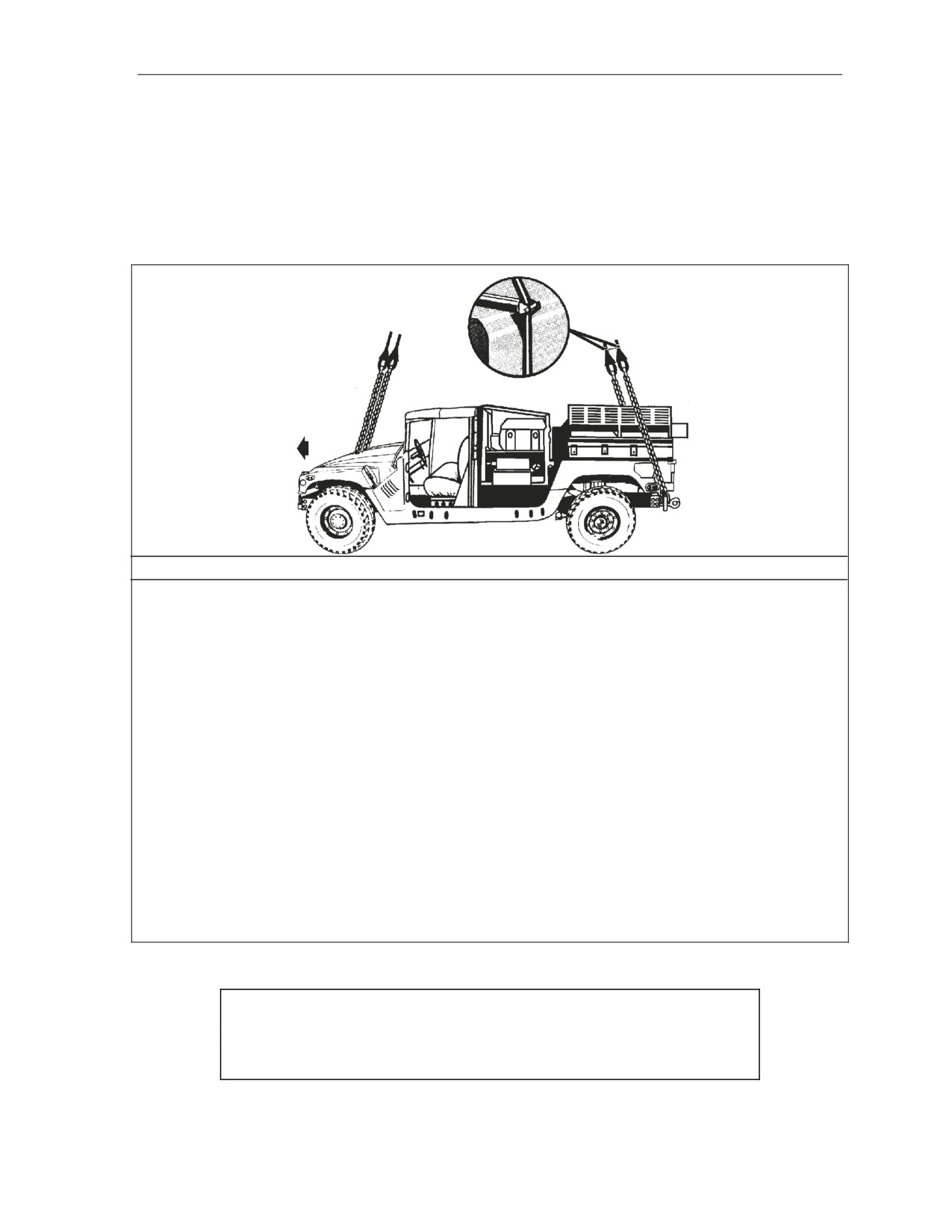
Rigging. Rig the load according to the steps in Figure 2-16.
CAUTION
Total weight of load is restricted to 9,400 pounds due to the structural
strength of the spreader bar.
2-40
FM 4-20.198/MCRP 4-11.3E, VOL II/NTTP 3-04.12/
AFMAN 11-223 (I), VOL II/COMDTINST M13482.3B
20 February 2009
Certified Single-Point Rigging Procedures for Wheeled Vehicles
Hookup. The hookup team stands on the IR hopper loading platform on the left side of the
vehicle. The static wand person discharges the static electricity with the static wand. The
hookup person places the apex fitting onto the aircraft cargo hook. The hookup team then
carefully dismounts the vehicle and remains close to the load as the helicopter removes slack
from the sling legs. When successful hookup is assured, the hookup team quickly exits the area
underneath the helicopter to the designated rendezvous point.
Derigging. Derigging is the reverse of the preparation and rigging procedures.
RIGGING STEPS
1.
Position the apex fitting on top of the IR hopper or on the forward end of the fog oil tanks.
Route outer sling legs 1 and 2 to the front of the vehicle and inner sling legs 3 and 4 to the
rear. Sling legs 1 and 3 must be on the left side of the load.
2.
Loop the chain end of sling leg 1 through the left front lift provision that protrudes through the
hood from inboard to outboard. Place the correct link from Table 2-17 in the grab hook.
Repeat with sling leg 2 and the right front lift provision. Secure excess chain with tape or
Type III nylon cord.
3.
Place the nylon rope of sling legs 3 and 4 in the guides on the ends of the spreader bar.
Route the chain end of sling leg 3 through the lift provision located on the left end of the rear
bumper from inboard to outboard. Place the correct link from Table 2-17 in the grab hook.
Repeat with sling leg 4 and the right rear lift provision.
4.
Pad the sling legs in the area where they make contact with the structure.
5.
Cluster and tie (breakaway technique) all sling legs together on top of the shelter to prevent
entanglement during hookup and lift-off.
Figure 2-16. M1113 (HMMWV) With M56 Smoke Generating System
CAUTION
Do not use the lift shackles located near the center of the rear bumper
for sling load lift provisions.
20 February 2009
FM 4-20.198/MCRP 4-11.3E, VOL II/NTTP 3-04.12/
AFMAN 11-223 (I), VOL II/COMDTINST M13482.3B
2-41
Chapter 2
M1097 (HMMWV) WITH FIBERGLASS CARGO BED COVER (CBC)
2-19. The M1097 (HMMWV) with fiberglass cargo bed cover is rigged for single-point sling load using
the following procedures:
z
Applicability. The following item in Table 2-18 is certified for all helicopters with suitable lift
capacity by the US Army Natick Soldier Center:
Table 2-18. M1097 (HMMWV) With Fiberglass Cargo Bed Cover
Nomenclature
Max
Sling
Link Count
Weight
Set
Front/Rear
(Pounds)
Cargo Bed Cover, HMMWV, Type I, Camouflage,
10,000
10K
50/3
NSN: 5411-01-647-3243
15K
62/2
Cargo Bed Cover, HMMWV, Type I, Sand, NSN: 5411-01-479-1928
10,000
10K
50/3
15K
62/2
z
Materials. The following materials are required to rig this load:
Sling set (10,000-pound capacity).
─ Chain length, part number 38850-00053-101, from a 10,000-pound capacity sling set
(4 each).
─ Coupling link, part number 577-0415, from a 10,000-pound sling set (4 each).
OR
Multileg sling set (15,000-pound capacity for the CH-53E only).
─ Additional chain lengths from the sling set being used (8 each).
─ Additional coupling links from the sling set being used (8 each).
Tape, adhesive, pressure-sensitive, 2-inch wide roll.
Cord, nylon, Type III, 550-pound breaking strength.
Webbing, cotton, 1/4-inch, 80-pound breaking strength.
Felt sheet, cattle hair, Type IV, 1/2-inch or suitable padding.
z
Personnel. Two persons can prepare and rig this load in 15 minutes.
z
Procedures. The following procedures apply to this load:
Preparation. Prepare the load using the following steps:
─ Extend the sling leg chains by connecting one additional chain length to each chain on a
10,000-pound capacity sling set with coupling links. Connect two additional chain
lengths to each chain on the 15,000-pound multileg sling set chain with coupling links.
─ Fold mirrors forward in front of the windshield for added protection and tie together with
Type III nylon cord.
─ Secure the cargo bed cover to the truck using wire rope or tie-down assemblies.
─ Secure all equipment inside the cargo bed cover with tape, nylon cord, or lashings; close
and secure shelter vents and door with nylon cord or tape.
─ Secure all equipment and cargo inside the vehicle with tape, nylon cord, or lashings.
Secure the doors shut if installed.
─ Ensure the fuel tank is not over 3/4 full. Inspect fuel tank cap, oil filler cap, and battery
caps for proper installation.
─ Engage the vehicle parking brake and put the transmission in neutral.
─ Ensure the front wheels are pointed straight ahead. Tie down the steering wheel, using
the securing device attached under the dashboard.
─ Tape the windshield in an X formation from corner to corner.
2-42
FM 4-20.198/MCRP 4-11.3E, VOL II/NTTP 3-04.12/
AFMAN 11-223 (I), VOL II/COMDTINST M13482.3B
20 February 2009
Certified Single-Point Rigging Procedures for Wheeled Vehicles
─ Install the lift provisions on the outer ends of the rear bumper by removing the tiedown
provisions located inboard of the bumper end and installing them on the outer ends of
the rear bumper.
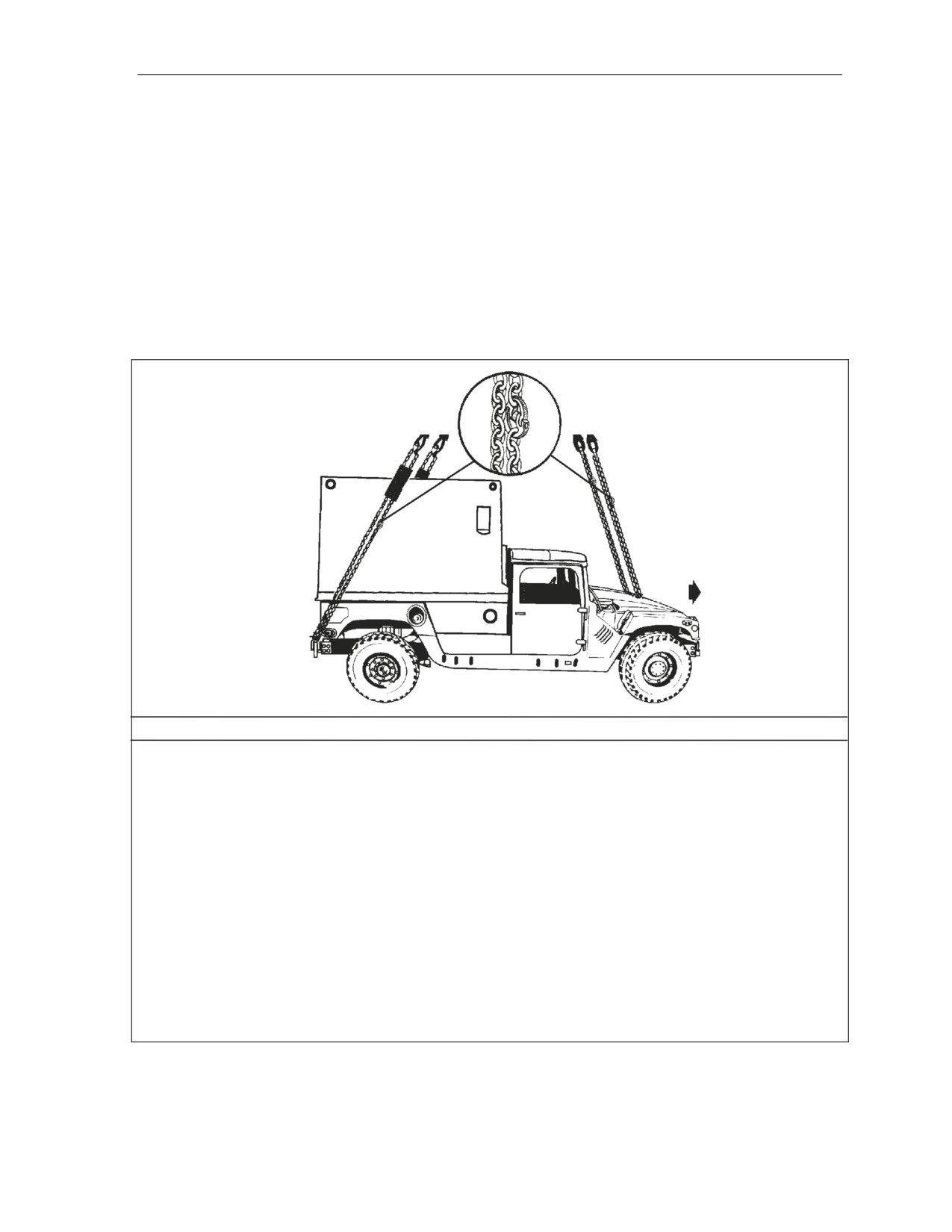
Rigging. Rig the load according to the steps in Figure 2-17.
Hookup. The hookup team stands on top of the cargo bed cover. The static wand person
discharges the static electricity with the static wand. The hookup person places the apex fitting
onto the aircraft cargo hook. The hookup team then carefully dismounts the vehicle and remains
close to the load as the helicopter removes slack from the sling legs. When successful hookup is
assured, the hookup team quickly exits the area underneath the helicopter to the designated
rendezvous point.
Derigging. Derigging is the reverse of the preparation and rigging procedures.
RIGGING STEPS
1. Position apex fitting on top of the cargo bed cover. Route outer sling legs 1 and 2 to the front
of the vehicle and inner sling legs 3 and 4 to the rear. Sling legs 1 and 3 must be on the left
side of the load.
2. Loop the chain end of sling leg 1 through the left front lift provision that protrudes through the
hood from inboard to outboard. Place the correct link from Table 2-18 in the grab hook.
Repeat with sling leg 2 and the right front lift provision. Secure excess chain with Type III
nylon cord.
3. Route the chain end of sling leg 3 through the lift provision located on the left end of the rear
bumper from inboard to outboard. Place the correct link from Table 2-18 in the grab hook.
Repeat with sling leg 4 and the right rear lift provision. Secure excess chain with Type III
nylon cord.
4. Wrap the rear slings with padding where they contact the cover sides.
Figure 2-17. M1097 with Fiberglass Cargo Bed Cover
20 February 2009
FM 4-20.198/MCRP 4-11.3E, VOL II/NTTP 3-04.12/
AFMAN 11-223 (I), VOL II/COMDTINST M13482.3B
2-43
Chapter 2
RIGGING STEPS (Continued)
5. Raise the apex fitting above the CBC keeping the slings to the side of the CBC.
6. Cluster and tie (breakaway technique) all sling legs together on top of the shelter to prevent
entanglement during hookup and lift-off.
Figure 2-17. M1097 with Fiberglass Cargo Bed Cover (Continued)
M1097 (HMMWV) WITH CONTACT MAINTENANCE TRUCK,
HEAVY (CMTH)
2-20. The M1097 with contact maintenance truck, heavy is rigged for single-point sling load using the
following procedures:
z
Applicability. The following item in Table 2-19 is certified for all helicopters with suitable lift
capacity by the US Army Natick Soldier Center:
Table 2-19. M1097 with Contact Maintenance Truck, Heavy
Nomenclature
Max
Sling
Link Count
Weight
Set
Front/Rear
(Pounds)
CMTH, Aviation Section (AS)
9,400
10K
80/30
z
Materials. The following materials are required to rig this load:
Sling set (10,000-pound capacity).
─ Chain length, part number 38850-00053-101, from a 10,000-pound capacity sling set
(4 each).
─ Coupling link, part number 577-0415, from a 10,000-pound capacity sling set (4 each).
Tape, adhesive, pressure-sensitive, 2-inch wide roll.
Cord, nylon, Type III, 550-pound breaking strength.
Webbing, cotton, 1/4-inch, 80-pound breaking strength.
Felt sheet, cattle hair, Type IV, 1/2-inch or suitable padding.
Spreader bar assembly (component of the M996/M997 HMMWV Ambulance).
z
Personnel. Two persons can prepare and rig this load in 15 minutes.
z
Procedures. The following procedures apply to this load:
Preparation. Prepare the load using the following steps:
─ Extend the sling leg chains by connecting one additional chain length to each chain using
the coupling links.
─ Fold mirrors forward in front of the windshield for added protection and tie together with
Type III nylon cord.
─ Ensure the shelter is properly attached to the truck.
─ Secure all equipment inside the shelter with tape, nylon cord, or lashings. Close and
secure all doors.
─ Secure the environmental control unit cover with duct tape.
─ Secure all equipment and cargo inside the vehicle with tape, nylon cord, or lashings.
Secure the doors in the shelter or in the cab of the vehicle.
─ Ensure the fuel tank is not over 3/4 full. Inspect fuel tank cap, oil filler cap, and battery
caps for proper installation.
2-44
FM 4-20.198/MCRP 4-11.3E, VOL II/NTTP 3-04.12/
AFMAN 11-223 (I), VOL II/COMDTINST M13482.3B
20 February 2009
Certified Single-Point Rigging Procedures for Wheeled Vehicles
─ Engage the vehicle parking brake and put the transmission in neutral.
─ Ensure the front wheels are pointed straight ahead. Tie down the steering wheel, using
the securing device attached under the dashboard.
─ Tape the windshield in an X formation from corner to corner.
─ Install the lift provisions on the outer ends of the rear bumper by removing the tiedown
provisions located inboard of the bumper end and installing them on the outer ends of
the rear bumper.
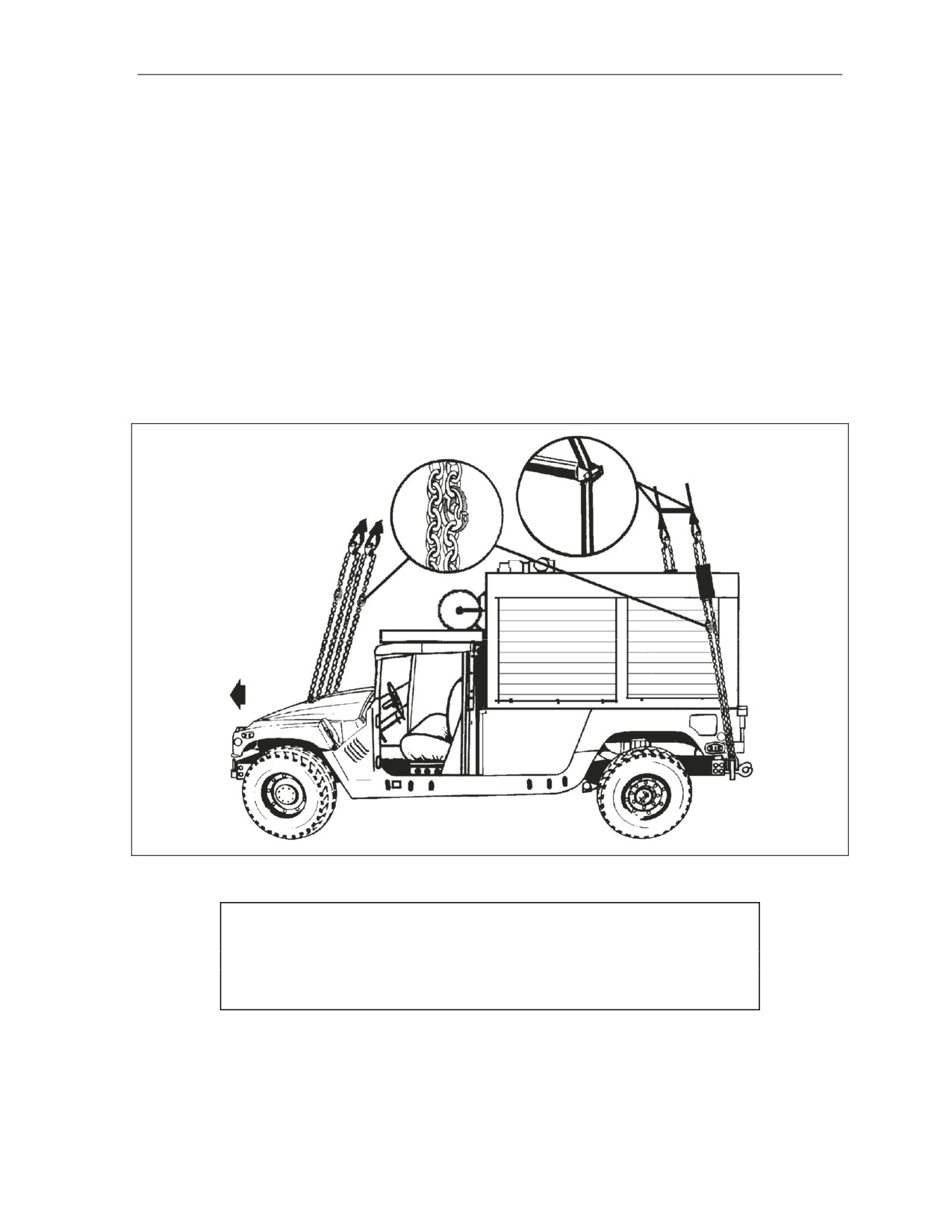
Rigging. Rig the load according to the steps in Figure 2-18.
Hookup. The hookup team stands on top of the shelter. The static wand person discharges
the static electricity with the static wand. The hookup person places the apex fitting onto the
aircraft cargo hook. The hookup team then carefully dismounts the vehicle and remains close to
the load as the helicopter removes slack from the sling legs. When successful hookup is
assured, the hookup team quickly exits the area underneath the helicopter to the designated
rendezvous point.
Derigging. Derigging is the reverse of the preparation and rigging procedures.
Figure 2-18. M1097 with Contact Maintenance Truck, Heavy
CAUTION
Do not use the lift shackles located near the center of the rear bumper
for sling load lift provisions.
20 February 2009
FM 4-20.198/MCRP 4-11.3E, VOL II/NTTP 3-04.12/
AFMAN 11-223 (I), VOL II/COMDTINST M13482.3B
2-45
Chapter 2
RIGGING STEPS
1. Position apex fitting on top of the vehicle. Route outer sling legs 1 and 2 to the front of the
vehicle and inner sling legs 3 and 4 to the rear. Sling legs 1 and 3 must be on the left side of
the load.
2. Loop the chain end of sling leg 1 through the left front lift provision that protrudes through the
hood from inboard to outboard. Place the correct link from Table 2-19 in the grab hook.
Repeat with sling leg 2 and the right front lift provision. Secure excess chain with Type III
nylon cord.
3. Position the spreader bar assembly 12 to18 inches forward of the rear of the shelter. Route
the rear sling legs through guides on the end of the spreader bar and install the pins and
keepers.
4. Route the chain end of sling leg 3 through the lift provision located on the left end of the rear
bumper from inboard to outboard. Place the correct link from Table 2-19 in the grab hook.
Repeat with sling leg 4 and the right rear lift provision.
5. Secure the spreader bar retainer cable to the sling leg chain.
6. Cluster and tie (breakaway technique) all sling legs together on top of the shelter to prevent
entanglement during hookup and lift-off.
Figure 2-18. M1097 with Contact Maintenance Truck, Heavy (Continued)
M1097A1 (HMMWV) WITH REMOTE LANDING SITE TOWER
(RLST)
2-21. The M1097A1 with remote landing site tower is rigged for single-point sling load using the
following procedures:
z
Applicability. The following item in Table 2-20 is certified for all helicopters with suitable lift
capacity by the US Army Natick Soldier Center:
Table 2-20. M1097A1 with Remote Landing Site Tower
Nomenclature
Max
Sling
Link Count
Weight
Set
Front/Rear
(Pounds)
M1097A1 with Remote Lansing Site Tower
8,460
15K
60/3
z
Materials. The following materials are required to rig this load:
Sling set (15,000-pound capacity).
─ Chain length, part number 34080-4, from 15,000-pound capacity sling sets (8 each).
─ Coupling link, part number 31611, from 15,000-pound capacity sling sets (8 each).
Tape, adhesive, pressure-sensitive, 2-inch wide roll.
Cord, nylon, Type III, 550-pound breaking strength.
Webbing, cotton, 1/4-inch, 80-pound breaking strength.
Felt sheet, cattle hair, Type IV, 1/2-inch or suitable padding.
z
Personnel. Two persons can prepare and rig this load in 15 minutes.
2-46
FM 4-20.198/MCRP 4-11.3E, VOL II/NTTP 3-04.12/
AFMAN 11-223 (I), VOL II/COMDTINST M13482.3B
20 February 2009
Certified Single-Point Rigging Procedures for Wheeled Vehicles
z
Procedures. The following procedures apply to this load:
Preparation. Prepare the load using the following steps:
─ Fold mirrors forward in front of the windshield for added protection and tie together with
Type III nylon cord.
─ Secure all equipment and cargo inside the vehicle with tape, nylon cord, or lashings.
Remove and secure the doors in the cab of the vehicle.
─ Ensure the fuel tank is not over 3/4 full. Inspect fuel tank cap, oil filler cap, and battery
caps for proper installation.
─ Engage the vehicle parking brake and put the transmission in neutral.
─ Ensure the front wheels are pointed straight ahead. Tie down the steering wheel, using
the securing device attached under the dashboard.
─ Install the lift provisions on the outer ends of the rear bumper by removing the tiedown
provisions located inboard of the bumper end and installing them on the outer ends of
the rear bumper.
─ Configure the RLST in the TRANSPORT mode in accordance with the operator's
manual.
─ Ensure the RLST is properly secured to the vehicle. Secure all equipment inside the
RLST with the hold-down straps, tape, or Type III nylon cord.
─ Secure the RLST cover with the straps provided. Secure the loose ends with tape.
─ Tape the windshield in an X formation from corner to corner.
─ Extend the sling leg chains by connecting two additional chain lengths to each chain with
coupling links.
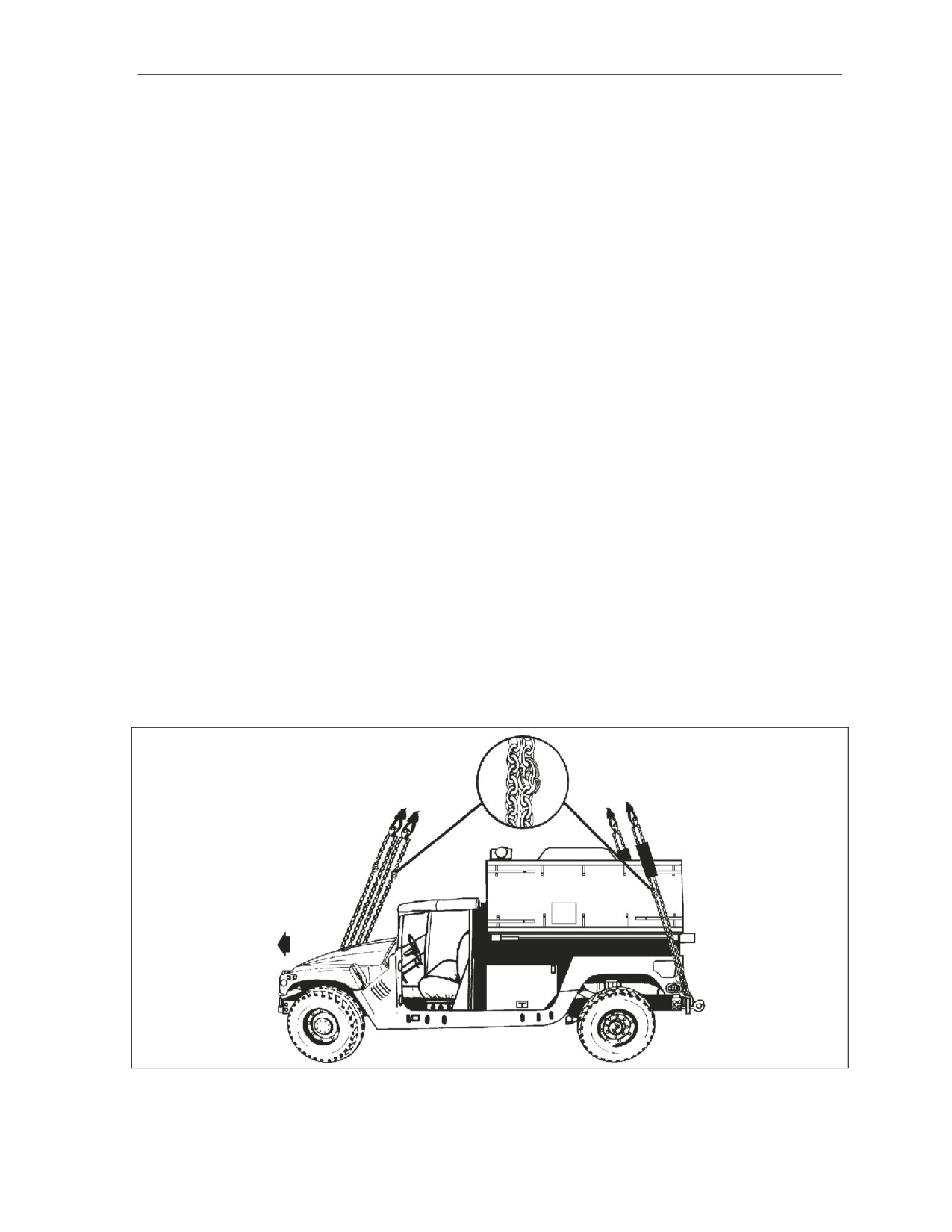
Rigging. Rig the load according to the steps in Figure 2-19.
Hookup. The hookup team stands on the vehicle. The static wand person discharges the
static electricity with the static wand. The hookup person places the apex fitting onto the
aircraft cargo hook. The hookup team then carefully dismounts the vehicle and remains close to
the load as the helicopter removes slack from the sling legs. When successful hookup is
assured, the hookup team quickly exits the area underneath the helicopter to the designated
rendezvous point.
Derigging. Derigging is the reverse of the preparation and rigging procedures.
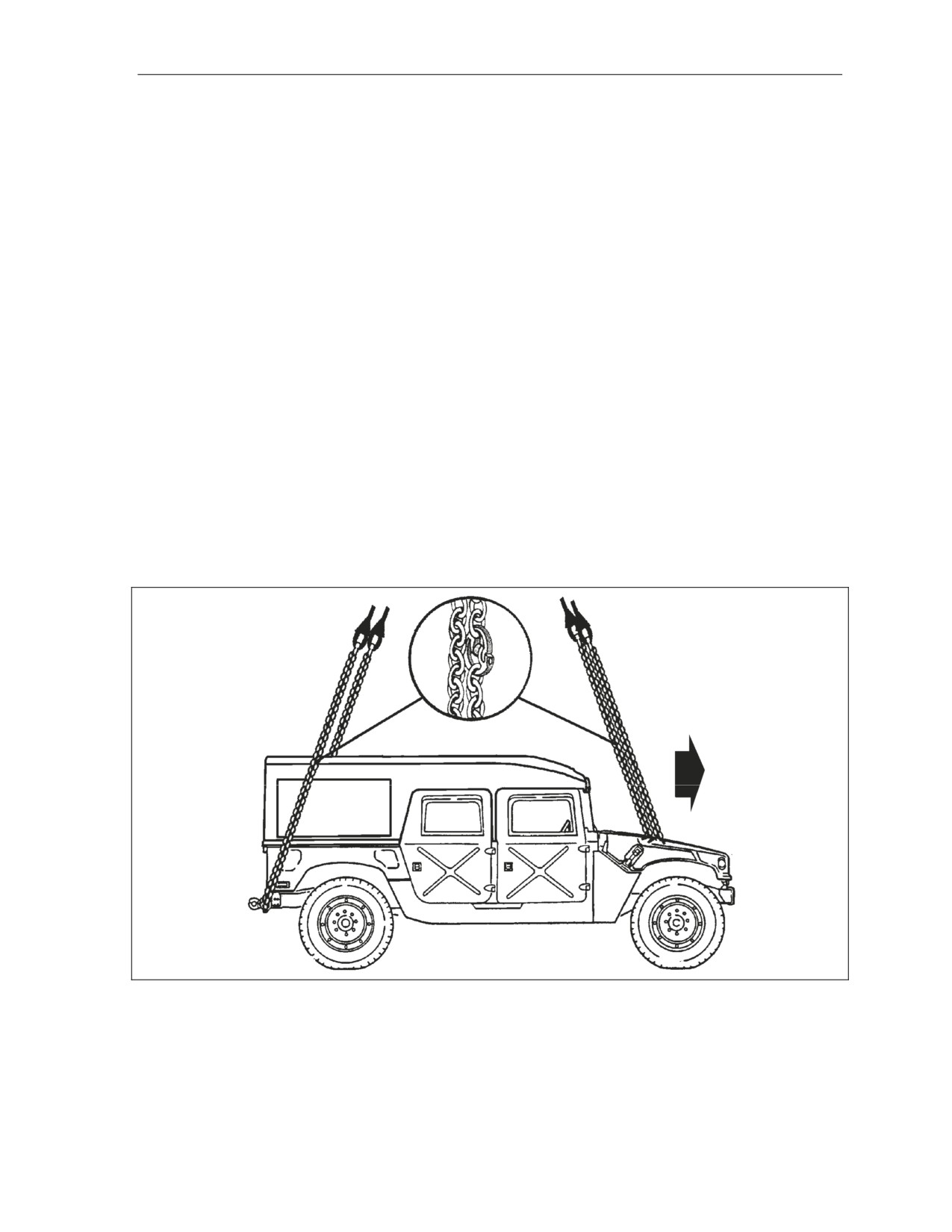
Figure 2-19. M1097A1 with Remote Landing Site Tower
20 February 2009
FM 4-20.198/MCRP 4-11.3E, VOL II/NTTP 3-04.12/
AFMAN 11-223 (I), VOL II/COMDTINST M13482.3B
2-47

Chapter 2
RIGGING STEPS
1. Position the web ring beside the RLST. Route outer sling legs 1 and 2 to the front of the
vehicle and inner sling legs 3 and 4 to the rear. Sling legs 1 and 3 must be on the left side of
the load.
2. Loop the chain end of sling leg 1 through the left front lift provision that protrudes through the
hood from inboard to outboard. Place the correct link from Table 2-20 in the grab hook.
Repeat with sling leg 2 and the right front lift provision. Secure excess chain with Type III
nylon cord.
3. Route the chain end of sling leg 3 through the lift provision located on the left end of the rear
bumper from inboard to outboard. Place the correct link from Table 2-20 in the grab hook.
Repeat with sling leg 4 and the right rear lift provision.
4. Pad the sling legs in the area where they make contact with the RLST.
5. Cluster and tie (breakaway technique) all sling legs together on top of the shelter to prevent
entanglement during hookup and lift-off.
Figure 2-19. M1097A1 with Remote Landing Site Tower (Continued)
CAUTION
Do not use the lift shackles located near the center of the rear bumper
for sling load lift provisions.
PROPHET AN/MLQ-40 (V) ON M1097/M1097A1 HMMWV
2-22. The Prophet AN/MLQ-40 (V) on M1097 is rigged for single-point sling load using the following
procedures:
z
Applicability. The following item in Table 2-21 is certified for all helicopters with suitable lift
capacity by the US Army Natick Soldier Center:
Table 2-21. Prophet AN/MLQ-40 (V) on M1097/M1097A1
Nomenclature
Max
Sling
Link Count
Weight
Set
Front/Rear
(Pounds)
Prophet AN/MLQ-40 (V) 1
10,000
10K
55/10
Prophet AN/MLQ-40 (V) 3
10,000
10K
55/10
Prophet Control Vehicle
10,000
10K
55/10
z
Materials. The following materials are required to rig this load:
Sling set (10,000-pound capacity).
─ Chain length, part number 38850-00053-101, from a 10,000-pound capacity sling set
(4 each).
─ Coupling link, part number 577-0415, from a 10,000-pound sling set (4 each).
Tape, adhesive, pressure-sensitive, 2-inch wide roll.
Cord, nylon, Type III, 550-pound breaking strength.
2-48
FM 4-20.198/MCRP 4-11.3E, VOL II/NTTP 3-04.12/
AFMAN 11-223 (I), VOL II/COMDTINST M13482.3B
20 February 2009
Certified Single-Point Rigging Procedures for Wheeled Vehicles
Webbing, cotton, 1/4-inch, 80-pound breaking strength.
z
Personnel. Two persons can prepare and rig this load in 15 minutes.
z
Procedures. The following procedures apply to this load:
Preparation. Prepare the load using the following steps:
─ Fold mirrors forward inward and tie together with Type III nylon cord.
─ Ensure the Prophet cargo bed cover is secured to the truck. Secure all equipment and
cargo inside the unit with tape, nylon cord, or lashings. Close and secure the door.
─ Secure all equipment and cargo inside the vehicle with tape, nylon cord, or lashings.
Roll up all the windows and secure the doors closed (if installed).
─ Ensure the fuel tank is not over 3/4 full. Inspect fuel tank cap, oil filler cap, and battery
caps for proper installation.
─ Engage the vehicle parking brake and put the transmission in neutral.
─ Ensure the front wheels are pointed straight ahead. Tie down the steering wheel, using
the securing device attached under the dashboard.
─ Tape the windshield in an X formation from corner to corner.
─ Extend the sling leg chains by connecting one additional chain length to each chain on a
10,000-pound capacity sling set with coupling links.
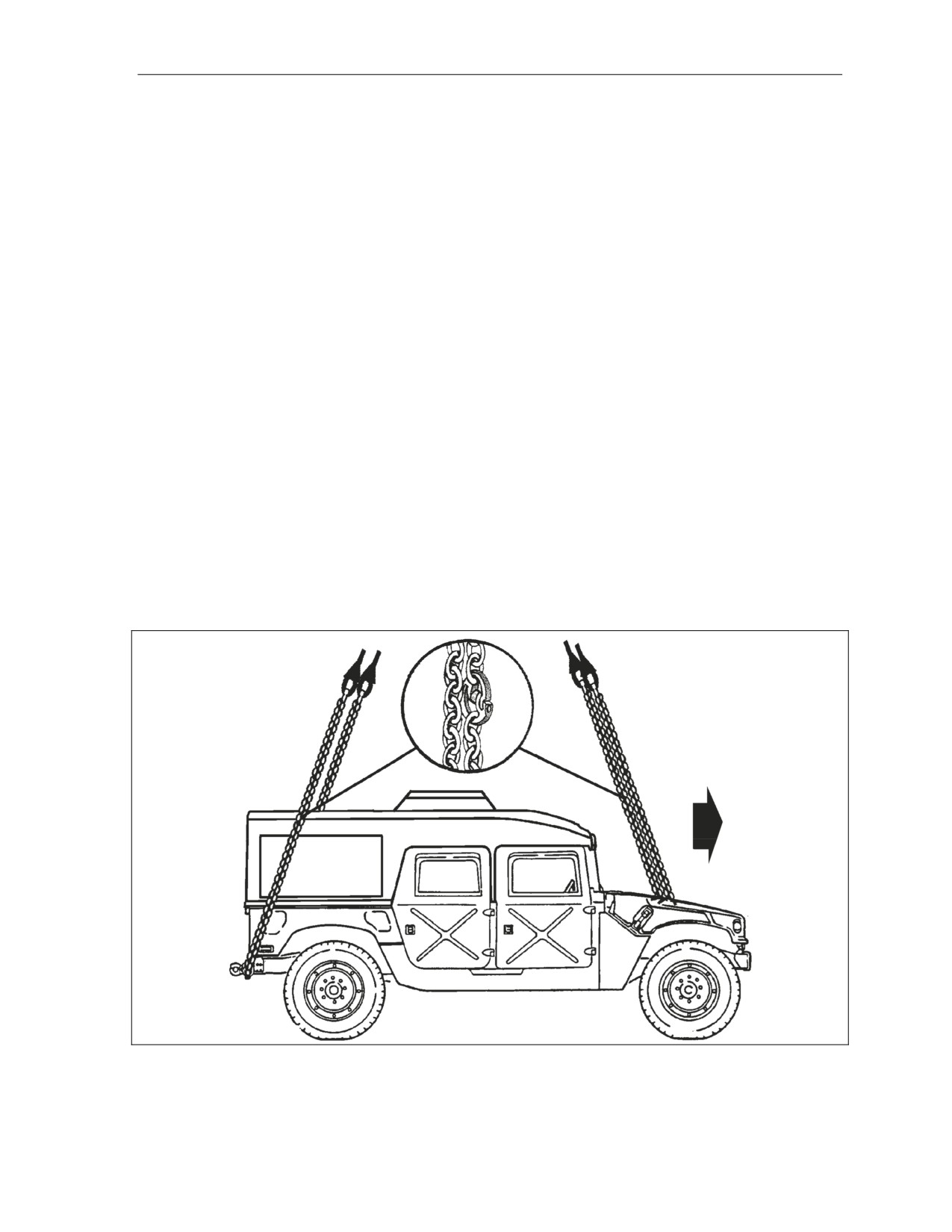
Rigging. Rig the load according to the steps in Figure 2-20.
Hookup. The hookup team stands on top of the vehicle. The static wand person discharges
the static electricity with the static wand. The hookup person places the apex fitting on the
cargo hook. The hookup team then carefully dismounts the vehicle and remains close to the
load as the helicopter removes slack from the sling legs. When successful hookup is assured,
the hookup team quickly exits the area underneath the helicopter to the designated rendezvous
point.
Derigging. Derigging is the reverse of the preparation and rigging procedures.
Figure 2-20. Prophet AN/MLQ-40 (V) on M1097 HMMWV
20 February 2009
FM 4-20.198/MCRP 4-11.3E, VOL II/NTTP 3-04.12/
AFMAN 11-223 (I), VOL II/COMDTINST M13482.3B
2-49
Chapter 2
RIGGING STEPS
1. Position the apex fitting on top of the vehicle roof. Route outer sling legs 1 and 2 to the front
of the vehicle and inner sling legs 3 and 4 to the rear. Sling legs 1 and 3 must be on the left
side of the load.
2. Loop the chain end of sling leg 1 through the left front lift provision that protrudes through the
hood from inboard to outboard. Place the correct link from Table 2-21 in the grab hook.
Repeat with sling leg 2 through the right front lift provision.
3. Loop the chain end of sling leg 3 through the left rear lift provision located on the outside end
of the rear bumper. Place the correct link from Table 2-21 in the grab hook. Repeat with
sling leg 4 through the right rear lift provision.
4. Secure all excess chain with Type III nylon cord.
5. Cluster and tie (breakaway technique) the sling legs in each sling set together to prevent
entanglement during hookup and lift-off.
Figure 2-20. Prophet AN/MLQ-40 (V) on M1097 HMMWV (Continued)
CAUTION
Do not use the lift shackles located near the center of the rear bumper
for sling load lift provisions.
HELMET HARDTOP (AMTECH CORP) CARGO BED COVER ON
M1097A2 HMMWV
2-23. The Helmet Hardtop (Amtech Corp) cargo bed cover on M1097A2 is rigged for single-point sling
load using the following procedures:
z
Applicability. The following item in Table 2-22 is certified for all helicopters with suitable lift
capacity by the US Army Natick Soldier Center:
Table 2-22. Helmet Hardtop (Amtech Corp) Cargo Bed Cover on M1097A2
Nomenclature
Max
Sling
Link Count
Weight
Set
Front/Rear
(Pounds)
Measurements and Signature Intelligence (MASINT)
10,300
25K
45/10
z
Materials. The following materials are required to rig this load:
Sling set (25,000-pound capacity).
─ Chain length, part number 38850-00053-102, from a 25,000-pound capacity sling set
(4 each).
─ Coupling link, part number 664241, from a 25,000-pound sling set (4 each).
Tape, adhesive, pressure-sensitive, 2-inch wide roll.
Cord, nylon, Type III, 550-pound breaking strength.
Webbing, cotton, 1/4-inch, 80-pound breaking strength.
z
Personnel. Two persons can prepare and rig this load in 15 minutes.
2-50
FM 4-20.198/MCRP 4-11.3E, VOL II/NTTP 3-04.12/
AFMAN 11-223 (I), VOL II/COMDTINST M13482.3B
20 February 2009
Certified Single-Point Rigging Procedures for Wheeled Vehicles
z
Procedures. The following procedures apply to this load:
Preparation. Prepare the load using the following steps:
─ Fold mirrors forward inward and tie together with Type III nylon cord.
─ Ensure the cargo bed cover is secured to the truck. Secure all equipment and cargo
inside the unit with tape, nylon cord, or lashings. Close and secure the door.
─ Secure all equipment and cargo inside the vehicle with tape, nylon cord, or lashings.
Roll up all the windows and secure the doors closed (if installed).
─ Ensure the fuel tank is not over 3/4 full. Inspect fuel tank cap, oil filler cap, and battery
caps for proper installation.
─ Engage the vehicle parking brake and put the transmission in neutral.
─ Ensure the front wheels are pointed straight ahead. Tie down the steering wheel, using
the securing device attached under the dashboard.
─ Tape the windshield in an X formation from corner to corner.
─ Extend the sling leg chains by connecting one additional chain length to each chain on a
10,000-pound capacity sling set with coupling links.
Rigging. Rig the load according to the steps in Figure 2-21.
Hookup. The hookup team stands on top of the vehicle. The static wand person discharges
the static electricity with the static wand. The hookup person places the apex fitting on the
cargo hook. The hookup team then carefully dismounts the vehicle and remains close to the
load as the helicopter removes slack from the sling legs. When successful hookup is assured,
the hookup team quickly exits the area underneath the helicopter to the designated rendezvous
point.
Derigging. Derigging is the reverse of the preparation and rigging procedures.
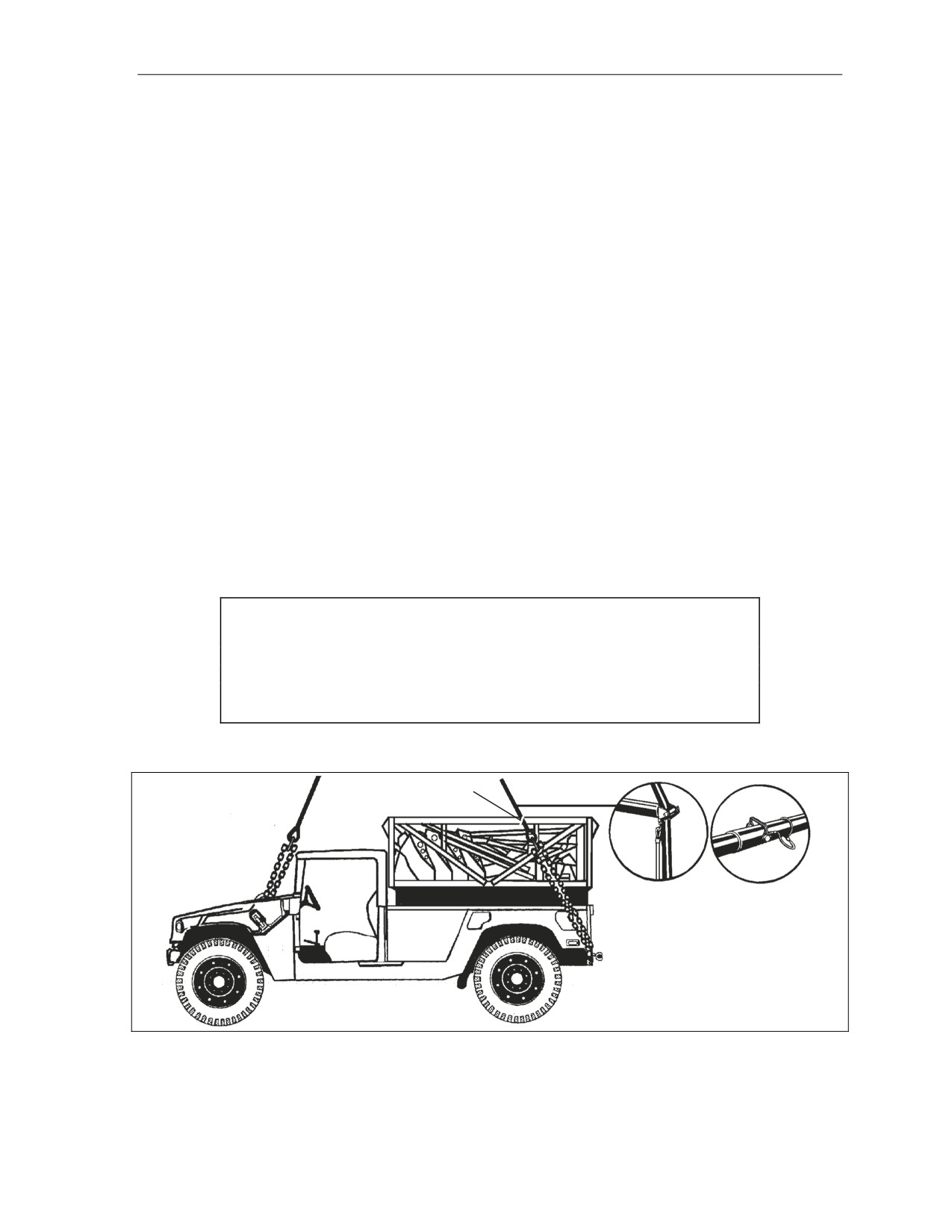
Figure 2-21. Helmet Hardtop (Amtech Corp) Cargo Bed Cover on M1097A2
20 February 2009
FM 4-20.198/MCRP 4-11.3E, VOL II/NTTP 3-04.12/
AFMAN 11-223 (I), VOL II/COMDTINST M13482.3B
2-51
Chapter 2
RIGGING STEPS
1. Position the apex fitting on top of the vehicle roof. Route outer sling legs 1 and 2 to the front
of the vehicle and inner sling legs 3 and 4 to the rear. Sling legs 1 and 3 must be on the left
side of the load.
2. Loop the chain end of sling leg 1 through the left front lift provision that protrudes through the
hood from inboard to outboard. Place the correct link from Table 2-22 in the grab hook.
Repeat with sling leg 2 through the right front lift provision.
3. Loop the chain end of sling leg 3 through the left rear lift provision located on the outside end
of the rear bumper. Place the correct link from Table 2-22 in the grab hook. Repeat with
sling leg 4 through the right rear lift provision.
4. Secure all excess chain with tape or Type III nylon cord.
5. Cluster and tie (breakaway technique) the sling legs in each sling set together to prevent
entanglement during hookup and lift-off.
Figure 2-21. Helmet Hardtop (Amtech Corp) Cargo Bed Cover on M1097A2 (Continued)
CAUTION
Do not use the lift shackles located near the center of the rear bumper
for sling load lift provisions.
M1097 (HMMWV) WITH ANTENNA AS-3036/TSC ON OA-9134/TSC
PALLET GROUP
2-24. The M1097 with antenna AS-3036/TSC on OA-9134/TSC pallet group is rigged for single-point
sling load using the following procedures:
z
Applicability. The following item in Table 2-23 is certified for all helicopters with suitable lift
capacity by the US Army Natick Soldier Center:
Table 2-23. M1097 with Antenna AS-3036/TSC on OA-9134/TSC Pallet Group
Nomenclature
Max
Sling
Link Count
Weight
Set
Front/Rear
(Pounds)
OA-9134/TSC Pallet Group, Antenna AS-3036/TSC on M1097
7,129
10K
46/8
z
Materials. The following materials are required to rig this load:
Sling set (10,000-pound capacity).
Reach pendant (11,000-pound capacity).
Tape, adhesive, pressure-sensitive, 2-inch wide roll.
Cord, nylon, Type III, 550-pound breaking strength.
Webbing, cotton, 1/4-inch, 80-pound breaking strength.
Felt sheet, cattle hair, Type IV, 1/2-inch or suitable padding.
Spreader bar assembly (component of the M996/M997 HMMWV Ambulance).
2-52
FM 4-20.198/MCRP 4-11.3E, VOL II/NTTP 3-04.12/
AFMAN 11-223 (I), VOL II/COMDTINST M13482.3B
20 February 2009
Certified Single-Point Rigging Procedures for Wheeled Vehicles
z
Personnel. Two persons can prepare and rig this load in 20 minutes.
z
Procedures. The following procedures apply to this load:
Preparation. Prepare the load using the following steps:
─ Fold mirrors forward in front of the windshield for added protection and tie together with
Type III nylon cord. Remove the cab doors.
─ Ensure the antenna support structure is secured to the truck. Secure all loose equipment
within the antenna support structure with Type III nylon cord, tape, or lashings.
─ Secure all equipment and cargo inside the vehicle with tape, nylon cord, or lashings.
─ Ensure the fuel tank is not over 3/4 full. Inspect fuel tank cap, oil filler cap, and battery
caps for proper installation.
─ Engage the vehicle parking brake and put the transmission in neutral.
─ Ensure the front wheels are pointed straight ahead. Tie down the steering wheel, using
the securing device attached under the dashboard.
─ Tape the windshield in an X formation from corner to corner.
─ Install the lift provisions on the outer ends of the rear bumper by removing the tiedown
provisions located inboard of the bumper end and installing them on the outer ends of
the rear bumper.
Rigging. Rig the load according to the steps in Figure 2-22.
Hookup. The hookup team stands in the bed of the vehicle. The static wand person
discharges the static electricity with the static wand. The hookup person places the apex fitting
onto the aircraft cargo hook. The hookup team then carefully dismounts the vehicle and remains
close to the load as the helicopter removes slack from the sling legs. When successful hookup is
assured, the hookup team quickly exits the area underneath the helicopter to the designated
rendezvous point.
CAUTION
An aircrew member must monitor the spreader bar at all times. If there
is any evidence of the spreader bar bending the load should be set
down at the nearest suitable landing area.
Derigging. Derigging is the reverse of the preparation and rigging procedures.
BREAKAWAY TIE
Figure 2-22. M1097 with AS-3036/TSC Antenna on OA-9134/TSC Pallet Group
20 February 2009
FM 4-20.198/MCRP 4-11.3E, VOL II/NTTP 3-04.12/
AFMAN 11-223 (I), VOL II/COMDTINST M13482.3B
2-53
Chapter 2
RIGGING STEPS
1.
Install the reach pendant on the apex fitting of the sling set.
2.
Position apex fitting and reach pendant on top of the antenna support structure assembly.
Route outer sling legs 1 and 2 to the front of the vehicle and inner sling legs 3 and 4 to the
rear. Sling legs 1 and 3 must be on the left side of the load.
3.
Loop the chain end of sling leg 1 through the left front lift provision that protrudes through the
hood from inboard to outboard. Place the correct link from Table 2-23 in the grab hook.
Repeat with sling leg 2 and the right front lift provision. Secure excess chain with Type III
nylon cord.
4.
Position the spreader bar assembly 12 inches from the rear of the antenna support structure.
Route the rear sling ropes through the guides on the end of the spreader bar. Secure the
sling ropes in the guides with the retainer pins and keepers.
5.
Route the chain end of sling leg 3 through the lift provision located on the left end of the rear
bumper from inboard to outboard. Place the correct link from Table 2-23 in the grab hook.
Repeat with sling leg 4 and the right rear lift provision. Secure excess chain with Type III
nylon cord.
6.
Remove all slack from sling legs 3 and 4. Install a breakaway tie using 1/4-inch cotton
webbing around each leg and around the top bar of the antenna support structure.
7.
Extend the spreader bar retainer cable down the length of the sling leg and secure to the
chain with Type III nylon cord.
8.
Cluster and tie (breakaway technique) all sling legs together on top of the shelter to prevent
entanglement during hookup and lift-off.
Figure 2-22. M1097 with AS-3036/TSC Antenna on OA-9134/TSC Pallet Group (Continued)
CAUTION
Do not use the lift shackles located near the center of the rear bumper
for sling load lift provisions.
M1097 (HMMWV) WITH HIGH MOBILITY DIGITAL GROUP
MULTIPLEXER (DGM), AUXILIARY EQUIPMENT
TRANSPORTATION CONTAINER (AETC) IN 2 AND 3 MAST
CONFIGURATIONS
2-25. The M1097 with high mobility digital group multiplexer (DGM), auxiliary equipment transportation
container (AETC) in 2 and 3 mast configurations is rigged for single-point sling load using the following
procedures:
z
Applicability. The following item in Table 2-24 is certified for all helicopters with suitable lift
capacity by the US Army Natick Soldier Center:
2-54
FM 4-20.198/MCRP 4-11.3E, VOL II/NTTP 3-04.12/
AFMAN 11-223 (I), VOL II/COMDTINST M13482.3B
20 February 2009
Certified Single-Point Rigging Procedures for Wheeled Vehicles
Table 2-24. M1097 with High Mobility Digital Group Multiplexer (DGM), Auxiliary Equipment
Transportation Container (AETC) in 2 and 3 Mast Configurations
Nomenclature
Max
Sling
Link Count
Weight
Set
Front/Rear
(Pounds)
2 Mast AETC Configuration
8,500
10K
55/3
3 Mast AETC Configuration
9,500
10K
55/3
z
Materials. The following materials are required to rig this load:
Sling set (10,000-pound capacity).
─ Chain length, part number 38850-00053-101, from a 10,000-pound capacity sling set (4
each).
─ Coupling link, part number 577-0415, from a 10,000-pound sling set (4 each).
Tape, adhesive, pressure-sensitive, 2-inch wide roll.
Cord, nylon, Type III, 550-pound breaking strength.
Webbing, cotton, 1/4-inch, 80-pound breaking strength.
Felt sheet, cattle hair, Type IV, 1/2-inch or suitable padding.
z
Personnel. Two persons can prepare and rig this load in 20 minutes.
z
Procedures. The following procedures apply to this load:
Preparation. Prepare the load using the following steps:
─ Fold mirrors forward in front of the windshield for added protection and tie together with
Type III nylon cord. Remove the cab doors.
─ Remove, fold, stow, and secure the canvas cover for the AETC using Type III nylon
cord.
─ Ensure the AETC is secured to the truck with wire rope or tie-down assemblies. Secure
all equipment and cargo inside the AETC with tape, Type III nylon cord, and lashings.
─ Secure all equipment and cargo inside the vehicle with tape, nylon cord, or lashings.
─ Ensure the fuel tank is not over 3/4 full. Inspect fuel tank cap, oil filler cap, and battery
caps for proper installation.
─ Engage the vehicle parking brake and put the transmission in neutral.
─ Ensure the front wheels are pointed straight ahead. Tie down the steering wheel, using
the securing device attached under the dashboard.
─ Tape the windshield in an X formation from corner to corner.
─ Install the lift provisions on the outer ends of the rear bumper by removing the tiedown
provisions located inboard of the bumper end and installing them on the outer ends of
the rear bumper.
─ Connect one additional chain length to each chain of the sling set with the coupling link.
Rigging. Rig the load according to the steps in Figure 2-23.
Hookup. The hookup team stands in the bed of the vehicle. The static wand person
discharges the static electricity with the static wand. The hookup person places the apex fitting
onto the aircraft cargo hook. The hookup team then carefully dismounts the vehicle and remains
close to the load as the helicopter removes slack from the sling legs. When successful hookup is
assured, the hookup team quickly exits the area underneath the helicopter to the designated
rendezvous point.
Derigging. Derigging is the reverse of the preparation and rigging procedures.
20 February 2009
FM 4-20.198/MCRP 4-11.3E, VOL II/NTTP 3-04.12/
AFMAN 11-223 (I), VOL II/COMDTINST M13482.3B
2-55
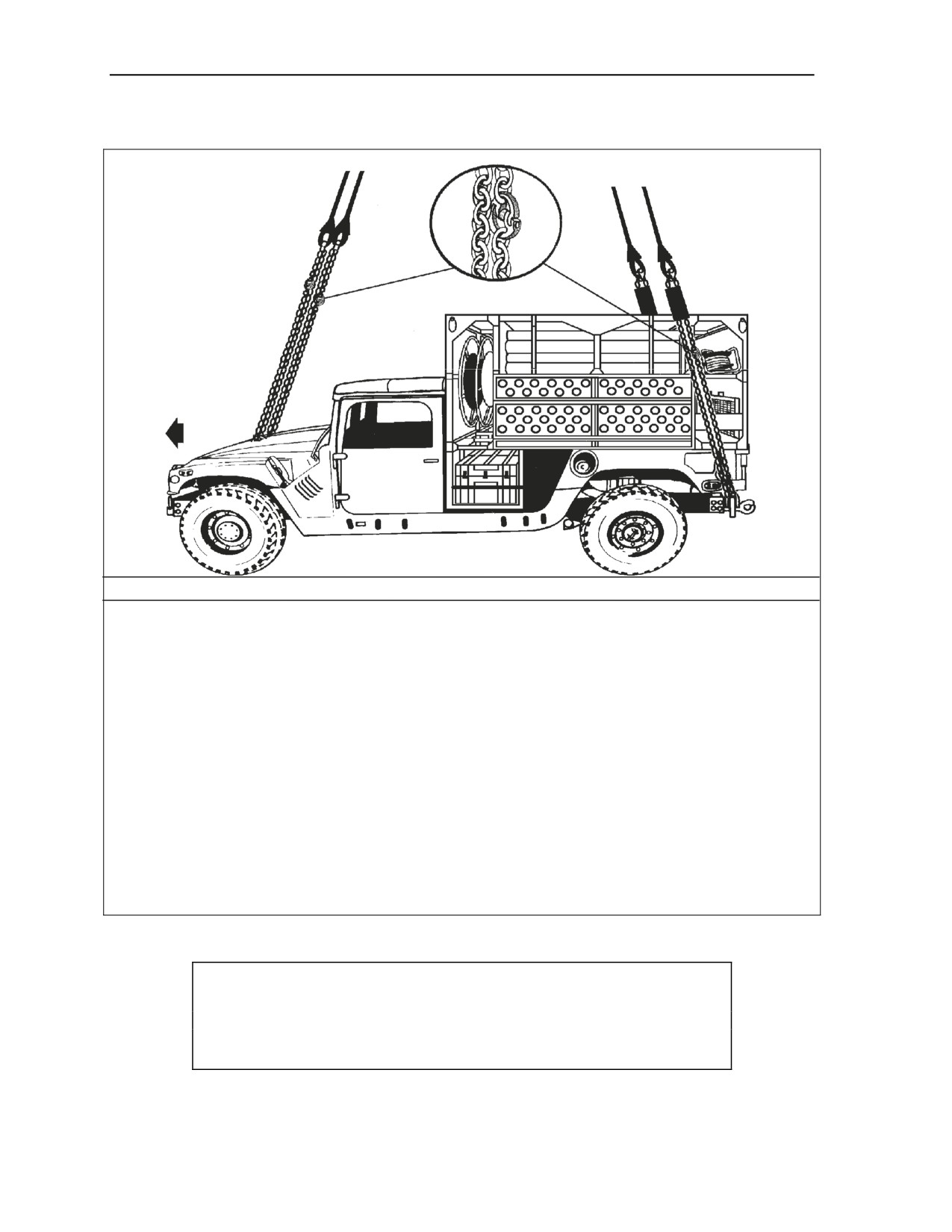
Chapter 2
RIGGING STEPS
1. Position apex fitting on top of the shelter. Route outer sling legs 1 and 2 to the front of the
vehicle and inner sling legs 3 and 4 to the rear. Sling legs 1 and 3 must be on the left side of
the load.
2. Loop the chain end of sling leg 1 through the left front lift provision that protrudes through the
hood from inboard to outboard. Place the correct link from Table 2-24 in the grab hook.
Repeat with sling leg 2 and the right front lift provision. Secure excess chain with tape or
Type III nylon cord.
3. Route the chain end of sling leg 3 through the lift provision located on the left end of the rear
bumper from inboard to outboard. Place the correct link from Table 2-24 in the grab hook.
Repeat with sling leg 4 and the right rear lift provision. Pad the slings where they contact the
frame. Secure excess chain with tape or Type III nylon cord.
4. Cluster and tie (breakaway technique) all sling legs together on top of the shelter to prevent
entanglement during hookup and lift-off.
Figure 2-23. M1097 with 2 or 3 Mast AETC Configuration
CAUTION
Do not use the lift shackles located near the center of the rear bumper
for sling load lift provisions.
2-56
FM 4-20.198/MCRP 4-11.3E, VOL II/NTTP 3-04.12/
AFMAN 11-223 (I), VOL II/COMDTINST M13482.3B
20 February 2009
Certified Single-Point Rigging Procedures for Wheeled Vehicles
M1097A2 (HMMWV) WITH SECURE MOBILE ANTI-JAM TACTICAL
TERMINAL (SMART-T) PALLET
2-26. The M1097A2 with secure mobile anti-jam tactical terminal (SMART-T) pallet is rigged for single-
point sling load using the following procedures:
z
Applicability. The following item in Table 2-25 is certified for all helicopters with suitable lift
capacity by the US Army Natick Soldier Center:
Table 2-25. M1097A2 with Secure Mobile Anti-Jam Tactical Terminal Pallet
Nomenclature
Max
Sling
Link Count
Weight
Set
Front/Rear
(Pounds)
M1097A2 with Secure Anti-Jam Tactical Terminal Pallet
8,540
10K
30/3
z
Materials. The following materials are required to rig this load:
Sling set (10,000-pound capacity).
Tape, adhesive, pressure-sensitive, 2-inch wide roll.
Cord, nylon, Type III, 550-pound breaking strength.
Webbing, cotton, 1/4-inch, 80-pound breaking strength.
z
Personnel. Two persons can prepare and rig this load in 10 minutes.
Procedures. The following procedures apply to this load:
Preparation. Prepare the load using the following steps:
─ Fold mirrors forward in front of the windshield for added protection and tie together with
Type III nylon cord.
─ Secure all equipment and cargo inside the vehicle with tape, nylon cord, or lashings.
Remove and secure the doors in the cab of the vehicle.
─ Ensure the fuel tank is not over 3/4 full. Inspect fuel tank cap, oil filler cap, and battery
caps for proper installation.
─ Engage the vehicle parking brake and put the transmission in neutral.
─ Ensure the front wheels are pointed straight ahead. Tie down the steering wheel, using
the securing device attached under the dashboard.
─ Secure all loose equipment on the SMART-T with tape or Type III nylon cord.
─ Tape the windshield in an X formation from corner to corner. Tape all mirrors, lights
and gauges. Remove and secure the rear cabin window.
─ Secure the antenna dish.
Rigging. Rig the load according to the steps in Figure 2-24.
Hookup. The hookup team stands on the vehicle. The static wand person discharges the
static electricity with the static wand. The hookup person places the apex fitting onto the
aircraft cargo hook. The hookup team then carefully dismounts the vehicle and remains close to
the load as the helicopter removes slack from the sling legs. When successful hookup is
assured, the hookup team quickly exits the area underneath the helicopter to the designated
rendezvous point.
Derigging. Derigging is the reverse of the preparation and rigging procedures.
20 February 2009
FM 4-20.198/MCRP 4-11.3E, VOL II/NTTP 3-04.12/
AFMAN 11-223 (I), VOL II/COMDTINST M13482.3B
2-57
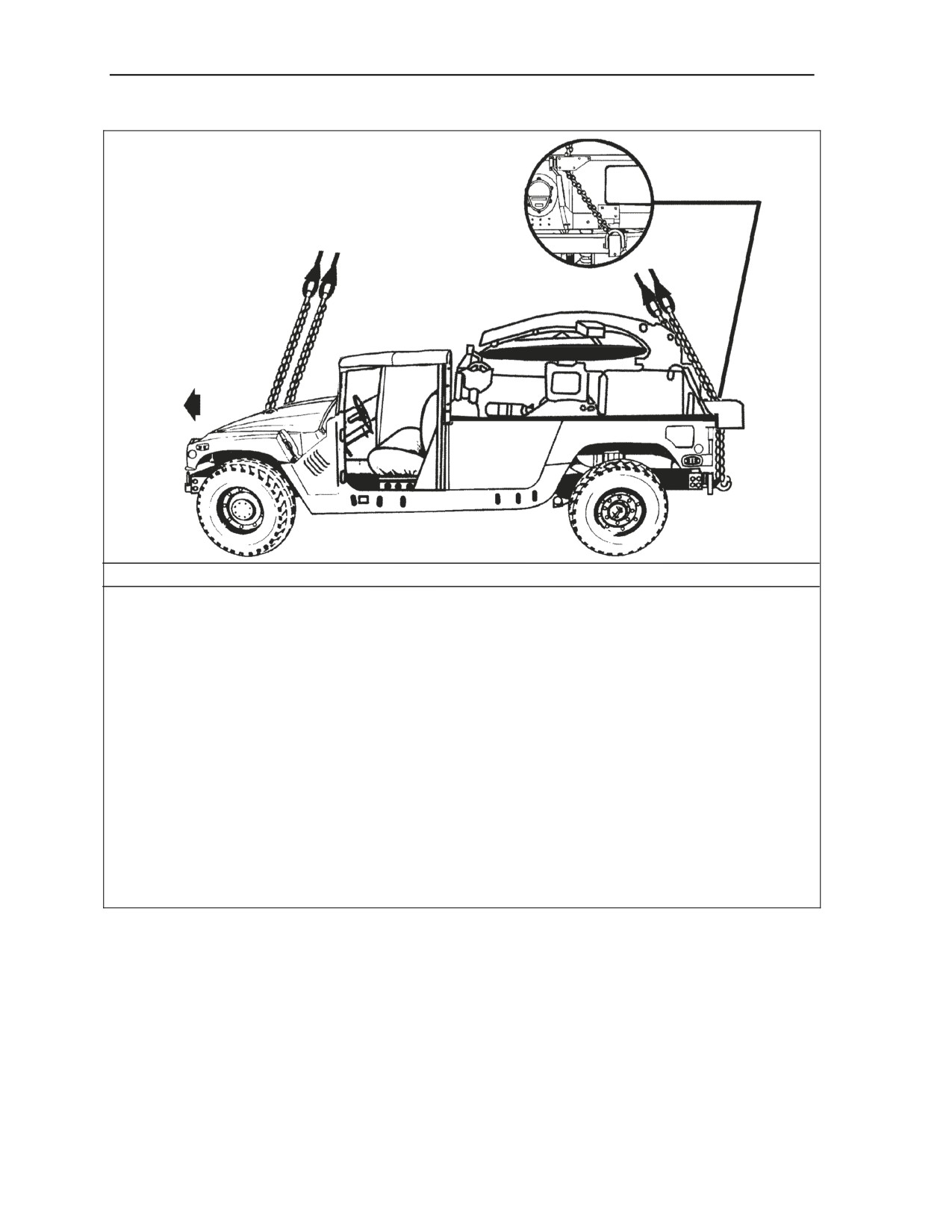
Chapter 2
RIGGING STEPS
1. Position apex fitting on top of the vehicle. Route outer sling legs 1 and 2 to the front of the
vehicle and inner sling legs 3 and 4 to the rear. Sling legs 1 and 3 must be on the left side of
the load.
2. Loop the chain end of sling leg 1 through the left front lift provision that protrudes through the
hood from inboard to outboard. Place the correct link from Table 2-25 in the grab hook.
Repeat with sling leg 2 and the right front lift provision. Secure excess chain with tape or
Type III nylon cord.
3. Route the chain end of sling leg 3 through the sling guide located on the tailgate. Loop the
chain end through the left lift provision on the bumper and thread back through the sling
guide. Place the correct link from Table 2-25 in the grab hook. Repeat with sling leg 4 and
the right rear lift provision.
4. Cluster and tie or tape (breakaway technique) all sling legs together on top of the shelter to
prevent entanglement during hookup and lift-off.
Figure 2-24. M1097A2 with Secure Mobile Anti-Jam Tactical Terminal Pallet
2-58
FM 4-20.198/MCRP 4-11.3E, VOL II/NTTP 3-04.12/
AFMAN 11-223 (I), VOL II/COMDTINST M13482.3B
20 February 2009
Certified Single-Point Rigging Procedures for Wheeled Vehicles
AIR TRAFFIC NAVIGATION, INTEGRATION, AND CONTROL
SYSTEM (ATNAVICS) RADAR SENSOR PALLET ON M1113 HMMWV
2-27. The Air Traffic Navigation, Integration, and Control System (ATNAVICS) radar sensor pallet on
M1113 is rigged for single-point sling load using the following procedures:
z
Applicability. The following item in Table 2-26 is certified for all helicopters with suitable lift
capacity by the US Army Natick Soldier Center:
Table 2-26. Air Traffic Navigation, Integration, and Control System radar sensor pallet on
M1113
Nomenclature
Max
Sling
Link Count
Weight
Set
Front/Rear
(Pounds)
M1113 with ATNAVICS Radar Sensor Pallet
11,500
25K
30/3
z
Materials. The following materials are required to rig this load:
Sling set (25,000-pound capacity).
─ Additional chain lengths, part number 38850-00053-102, from a 25,000-pound capacity
sling set (4 each).
─ Coupling link, part number 664241, from a 25,000-pound capacity sling set (4 each).
Tape, adhesive, pressure-sensitive, 2-inch wide roll.
Cord, nylon, Type III, 550-pound breaking strength.
Webbing, cotton, 1/4-inch, 80-pound breaking strength.
Strap, cargo, tiedown, CGI-1/B (as required).
z
Personnel. Two persons can prepare and rig this load in 15 minutes.
z
Procedures. The following procedures apply to this load:
Preparation. Prepare the load using the following steps:
─ Fold the mirrors inward for added protection and tie together with Type III nylon cord.
Remove the doors and secure the doors on the load with Type III nylon cord.
─ Secure all equipment inside the unit with tape, Type III nylon cord or tiedown straps.
Secure all vents, doors and latches with tape or Type III nylon cord.
─ Secure all equipment and cargo inside the vehicle cab with tape, Type III nylon cord, or
tiedown straps.
─ Ensure the fuel tank is not over 3/4 full. Inspect fuel tank cap, oil filler cap, and battery
caps for proper installation.
─ Engage the vehicle parking brake and put the transmission in neutral.
─ Ensure the front wheels are pointed straight ahead. Tie down the steering wheel, using
the securing device attached under the dashboard or Type III nylon cord.
─ Extend the sling leg chains by connecting one additional chain length to each chain on
the 25,000-pound capacity sling set with coupling links.
─ Install the sling leg guides on the rear corners of the radar sensor pallet as required in
TM 11-5840-381-23&P, chapter 2.
Rigging. Rig the load according to the steps in Figure 2-25.
Hookup. The hookup team stands on the vehicle. The static wand person discharges the
static electricity with the static wand. The hookup person places the apex fitting on the cargo
hook. The hookup team then carefully dismounts the vehicle and remains close to the load as
the helicopter removes slack from the sling legs. When successful hookup is assured, the
hookup team quickly exits the area underneath the helicopter to the designated rendezvous
point.
Derigging. Derigging is the reverse of the preparation and rigging procedures.
20 February 2009
FM 4-20.198/MCRP 4-11.3E, VOL II/NTTP 3-04.12/
AFMAN 11-223 (I), VOL II/COMDTINST M13482.3B
2-59
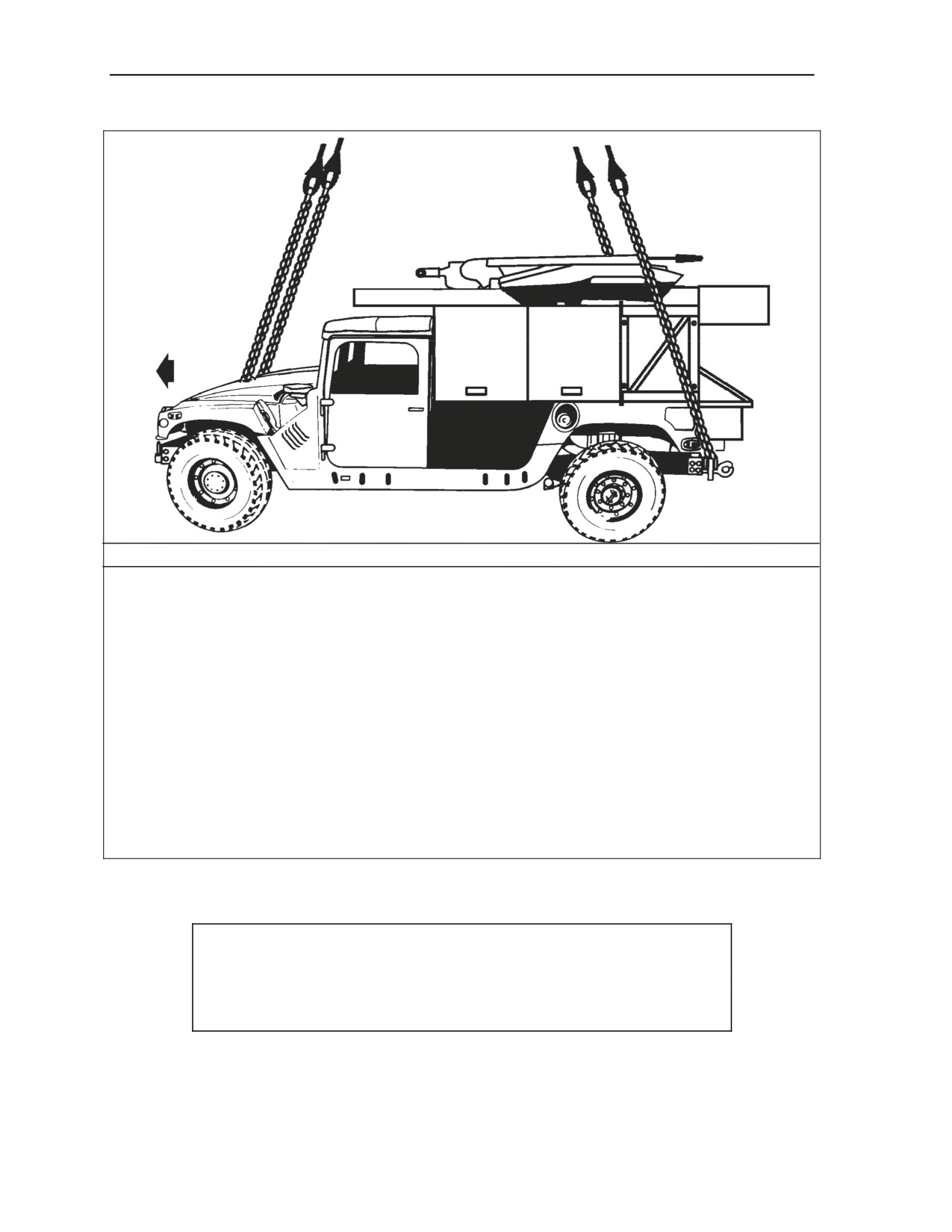
Chapter 2
RIGGING STEPS
1. Position apex fitting on top of the truck. Route outer sling legs 1 and 2 to the front of the
vehicle and inner sling legs 3 and 4 to the rear. Sling legs 1 and 3 must be on the left side of
the load.
2. Loop the chain end of sling leg 1 through the left front lift provision that protrudes through the
hood from inboard to outboard. Place the correct link from Table 2-26 in the grab hook.
Repeat with sling leg 2 and the right front lift provision. Secure excess chain with Type III
nylon cord.
3. Loop the chain end of sling leg 3 through the left rear lift provision located on the outer ends
of the rear bumper. Place the correct link from Table 2-26 in the grab hook. Repeat with
sling leg 4 and the right rear lift provision. Secure excess chain with Type III nylon cord.
4. Cluster and tie (breakaway technique) all sling legs together on top of the vehicle to prevent
entanglement during hookup and lift-off.
Figure 2-25. Air Traffic Navigation, Integration, and Control System Radar Sensor Pallet on
M1113
CAUTION
Do not use the lift shackles located near the center of the rear bumper
for sling load lift provisions.
2-60
FM 4-20.198/MCRP 4-11.3E, VOL II/NTTP 3-04.12/
AFMAN 11-223 (I), VOL II/COMDTINST M13482.3B
20 February 2009
Certified Single-Point Rigging Procedures for Wheeled Vehicles
TROJAN SPIRIT LITE (V)2, CENTRAL COMMUNICATIONS AN/TSQ-
226 (V)2 ON M1113 HMMWV
2-28. The Trojan Spirit Lite (V)2, central communications AN/TSQ-226 (V)2 on M1113 is rigged for
single-point sling load using the following procedures:
z
Applicability. The following item in Table 2-27 is certified for all helicopters with suitable lift
capacity by the US Army Natick Soldier Center:
Table 2-27. Trojan Spirit Lite (V)2, Central Communications AN/TSQ-226 (V)2 on M1113
Nomenclature
Max
Sling
Link Count
Weight
Set
Front/Rear
(Pounds)
Trojan Spirit Lite (V) 2, Central Communications AN/TSQ-226 (V) 2 on
11,500
25K
35/3
M1113
z
Materials. The following materials are required to rig this load:
Sling set (25,000-pound capacity).
─ Additional chain lengths, part number 38850-00053-102, from a 25,000-pound capacity
sling set (4 each).
─ Coupling link, part number 664241, from a 25,000-pound capacity sling set (4 each).
Tape, adhesive, pressure-sensitive, 2-inch wide roll.
Cord, nylon, Type III, 550-pound breaking strength.
Webbing, cotton, 1/4-inch, 80-pound breaking strength.
z
Personnel. Two persons can prepare and rig this load in 15 minutes.
z
Procedures. The following procedures apply to this load:
Preparation. Prepare the load using the following steps:
─ Fold the mirrors inward for added protection and tie together with Type III nylon cord.
─ Secure all equipment inside on the pallet with tape, Type III nylon cord or tiedown
straps. Secure all vents, doors and latches with tape or Type III nylon cord.
─ Secure all equipment and cargo inside the vehicle cab with tape, Type III nylon cord, or
tiedown straps. Secure the doors shut, if installed.
─ Ensure the fuel tank is not over 3/4 full. Inspect fuel tank cap, oil filler cap, and battery
caps for proper installation.
─ Engage the vehicle parking brake and put the transmission in neutral.
─ Ensure the front wheels are pointed straight ahead. Tie down the steering wheel, using
the securing device attached under the dashboard or type III nylon cord.
─ Extend the sling leg chains by connecting one additional chain length to each chain on
the 25,000-pound capacity sling set with coupling links.
─ Tape the windshield in an X formation from corner to corner.
─ Secure the rear lift provision in the up position with Type III nylon cord.
Rigging. Rig the load according to the steps in Figure 2-26.
Hookup. The hookup team stands on top of the vehicle. The static wand person discharges
the static electricity with the static wand. The hookup person places the apex fitting on the
cargo hook. The hookup team then carefully dismounts the vehicle and remains close to the
load as the helicopter removes slack from the sling legs. When successful hookup is assured,
the hookup team quickly exits the area underneath the helicopter to the designated rendezvous
point.
Derigging. Derigging is the reverse of the preparation and rigging procedures.
20 February 2009
FM 4-20.198/MCRP 4-11.3E, VOL II/NTTP 3-04.12/
AFMAN 11-223 (I), VOL II/COMDTINST M13482.3B
2-61