FM 4-20.198 Multiservice Helicopter Sling Load: Single-Point Load Rigging Procedures (February 2009) - page 1
FM 4-20.198 (FM 10-450-4)
MCRP 4-11.3E, VOL II
NTTP 3-04.12
AFMAN 11-223 (I), VOL II
COMDTINST M13482.3B
Multiservice Helicopter Sling Load:
Single-Point Load Rigging Procedures
20 February 2009
DISTRIBUTION RESTRICTION. Approved for public release; distribution is unlimited.
Headquarters
Department of the Army
United States Marine Corps
Department of the Navy
Department of the Air Force
United States Coast Guard
*FM 4-20.198 (FM 10-450-4)/MCRP 4-11.3E, VOL II/NTTP 3-04.12/
AFMAN 11-223 (I), VOL II/COMDTINST M13482.3B
Field Manual
Headquarters
Department of the Army
No. 4-20.198 (10-450-4)
United States Marine Corps
Marine Corps Reference Publication
Department of the Navy
No. 4-11.3E, Vol II
Department of the Air Force
Navy Tactics, Techniques, and Procedures
United States Coast Guard
No. 3-04.12
Washington, DC 20 February 2009
Air Force Manual
No. 11-223 (I), Vol II
Commandant Instruction
No. M13482.3B
Multiservice Helicopter Sling Load:
Single-Point Load Rigging Procedures
Contents
Page
PREFACE
x
Scope
x
User Information
x
Request for Waivers
xi
Chapter 1
FUNDAMENTAL PRINCIPLES OF SLING LOAD
1-1
Introduction
1-1
Classification Definitions of Sling Load
1-1
Certification of Equipment for Helicopter Sling Load
1-2
Requests for Sling Load Certification
1-2
Unique Items of Equipment or Operational Requirements
1-3
Equipment Rigging Procedures
1-3
General Rigging Instructions
1-4
Chapter 2
CERTIFIED SINGLE-POINT RIGGING PROCEDURES FOR WHEELED VEHICLES
............................................................................................................................ 2-1
Introduction
2-1
M996/M997/M997A2 Truck, Ambulance, (HMMWV)
2-1
Distribution Restriction: Approved for public release; distribution is unlimited.
*This publication supersedes FM 10-450-4/MCRP 4-23E, Vol II/NWP 3-04.12/AFJMAN 11-223 Vol II/
COMDTINST 13482.3A, 30 May 1998.
i
Contents
M966/M1036/M1045/M1045A2/M1046 TOW Missile Carrier (HMMWV),
M1025/M1025A2/M1026/M1043/M1043A2/ M1043A2 with Marine Armor Kit
(MAK)/M1044/M1151 Armament Carrier (HMMWV)
2-4
M998/M1123 with Marine Armor Kit (MAK) (USMC)/M1037 Modified (GVW
9,400 lbs)/M1038/M1097/M1097A2/M1152 Truck, Cargo, 1 1/4-ton
(HMMWV)
2-6
M1037/M1042/M1097/M1097A1/M1097A2/M1113/M1152 Shelter Carrier
(HMMWV) without Shelter
2-9
M1037/M1042 Shelter Carrier (HMMWV) with S-250 or S-250E Shelter
2-11
M1097 Shelter Carrier, Heavy HMMWV, with S-250 or S-250E Shelter
2-14
M1037 Shelter Carrier (Heavy HMMWV) with Downsized Direct Support
Section (DDSS) Shelter
2-18
M1037 Shelter Carrier (HMMWV) with S-318 Shelter
2-20
M1097/M1097A2 Shelter Carrier (HMMWV) with Lightweight Multipurpose
Shelter (LMS)
2-22
M1097A2 Shelter Carrier (HMMWV) with Lightweight Multipurpose Shelter
(LMS) Using Shelter Lift Rings as Sling Guides
2-25
M1037/M1042 Shelter Carrier (HMMWV) with Lightweight Multipurpose
Shelter (LMS)
2-27
M1113 Truck, Utility, Expanded Capacity (HMMWV) with Lightweight
Multipurpose Shelter (LMS)
2-28
M1097/M1113 Shelter Carrier (HMMWV) with Gitchner Model 1497A Shelter 2-31
M1097A2 Shelter Carrier (HMMWV) with Special Operations Media System
(SOMS-B) in S-788 Shelter
2-33
Tactical Data Network (TDN) Gateway on M1097A1 HMMWV
2-36
M1037/M1097 Shelter Carrier (HMMWV) with G15840 Smoke Generator
Set, M157/M157A1E1
2-38
M1113 (HMMWV) with M56 Smoke Generating System
2-40
M1097 (HMMWV) with Fiberglass Cargo Bed Cover (CBC)
2-42
M1097 (HMMWV) with Contact Maintenance Truck, Heavy (CMTH)
2-44
M1097A1 (HMMWV) with Remote Landing Site Tower (RLST)
2-46
Prophet AN/MLQ-40 (V) on M1097/M1097A1 HMMWV
2-48
Helmet Hardtop (Amtech Corp) Cargo Bed Cover on M1097A2 HMMWV
2-50
M1097 (HMMWV) with Antenna AS-3036/TSC on OA-9134/TSC Pallet
Group
2-52
M1097 (HMMWV) with High Mobility Digital Group Multiplexer (DGM),
Auxiliary Equipment Transportation Container (AETC) in 2 and 3 Mast
Configurations
2-54
M1097A2 (HMMWV) with Secure Mobile Anti-Jam Tactical Terminal
(SMART-T) Pallet
2-57
Air Traffic Navigation, Integration, and Control System (ATNAVICS) Radar
Sensor Pallet on M1113 HMMWV
2-59
Trojan Spirit Lite (V)2, Central Communications AN/TSQ-226 (V)2 on M1113
HMMWV
2-61
AN/MRC-142B Radio Terminal Set with 30M Mast on M998 HMMWV
2-63
M998 (HMMWV) with Two MRC-127 Stacks
2-65
M998/M1038 (HMMWV) with Lightweight Tactical Fire Control Systems
(LTACFIRE)/Tactical Terminal Control System (TTCS)
2-66
M1097A2 (HMMWV) Soft Top Truck with Advanced Field Artillery Tactical
Data Systems (AFATADS)
2-69
ii
FM 4-20.198/MCRP 4-11.3E, VOL II/NTTP 3-04.12/
AFMAN 11-223 (I), VOL II/COMDTINST M13482.3B
20 February 2009
Contents
M1097A2 (HMMWV) with Advanced Field Artillery Tactical Data System
(AFATDS) Full Size Soft Top Installation Kit (STIK)
2-70
M1037 (HMMWV) with AN/TPQ-36 Firefinder Generator Pallet
2-72
M1097 (HMMWV) with Sentinel AN/MPQ-64 Tactical Quiet Generator (TQG)2-75
M1097 (HMMWV) with AN/TPQ-42, Meteorological Hydrogen Generator
(MHG)
2-76
M1037 (HMMWV) with Compressed Air-Foam System, Mobile (CAFSM)
2-78
M1113 (HMMWV) with Tactical Super High Frequency Satellite Terminal
(TSST)
2-80
M1113 (HMMWV) with Tactical Super High Frequency Satellite Terminal
(TSST) Mobile Power Unit (MPU)
2-82
M1113 (HMMWV) Mission Vehicle with Petroleum Quality Analysis System
(PQAS) Shelter
2-84
Interim Fast Attack Vehicle (IFAV) Truck, Long Wheel Base
2-86
John Deere M-Gator (Model #VGM6X01001)
2-87
TWO John Deere M-Gators, Model #VGM6X01001, Side by Side (Shotgun
Method)
2-89
Light Armored Vehicle (LAV) (USMC)
2-93
Chapter 3
CERTIFIED SINGLE-POINT RIGGING PROCEDURES FOR TRAILERS
3-1
Introduction
3-1
M416 1/4-Ton Trailer
3-1
M101A2/A3 3/4-Ton Trailer
3-3
M1048/M1073 Trailer
3-5
M1048 Trailer with Tracked Suspension System
3-7
M149A2 Water Trailer (USMC)
3-8
M989 Heavy-Expanded Mobility Ammunition Trailer (HEMAT)
3-10
M989A1 Heavy-Expanded Mobility Ammunition Trailer (HEMAT II)
3-12
Mk14, Trailer, Container Hauler
3-14
Mk15, Trailer, Wrecker/Recovery
3-15
Mk16, Trailer, Fifth-Wheel Adapter
3-17
Mk17, Trailer, Drop-Side Cargo
3-18
M116A2 Trailer with Antenna Groups, AS-3954/TRC (2 each) (USMC)
3-20
M116A2 Trailer with AN/TPQ-36 Firefinder Antenna Transceiver Group
(ATG)
3-22
M116A2 Trailer with M894 18,000-BTU Air Conditioner and MEP-003A
Generator
3-24
M116A2 Trailer, Single Channel Objective Tactical Terminal (SCOTT)
3-25
M116A3 Trailer with OE334 Antenna Coupler Group
3-28
M105A3 Trailer
3-29
High Mobility Trailers (HMT), M1101/M1102
3-30
HMT Trailer with Sentinel AN/MPQ-64 Antenna Transmitter Group (ATG)
3-32
HMT Trailer with Remote Landing Site Tower (RLST)
3-35
HMT Trailer with Line of Sight Anti-Tank (LOSAT) Resupply Trailer
3-37
MKT-90/MKT-95/MKT-99 Field Kitchen Trailer
3-39
Hydraulic System Test and Repair Unit (HSTRU)
3-41
Desert Operation Trailer (DOT) with Desert Operation Motorcycle (DOM)
3-42
M332 Ammunition Trailer, 1 1/2-Ton
3-44
AS-4492/TSC, Lightweight, High Gain, X-band Antenna (LHGXA) Trailer
3-45
M1112 400-Gallon Water Trailer
3-48
20 February 2009
FM 4-20.198/MCRP 4-11.3E, VOL II/NTTP 3-04.12/
AFMAN 11-223 (I), VOL II/COMDTINST M13482.3B
iii
Contents
M1082 Light Medium Tactical Vehicle (LMTV) and M1095 Medium Tactical
Vehicle (MTV) Trailers
3-49
Small Portable Expeditionary Aeromedical Rapid Response (SPEARR)
Trailer
3-51
Minimum Operating Strip Lighting System (MOSLS)
3-53
Assault Command Post with High Mobility Wheel Set
3-55
Trailer Support System with Expeditionary Shelter
3-56
Shadow Tactical Unmanned Aerial Vehicle (TUAV), Launcher/Recovery
Trailer (L/R-T)
3-58
Small Emplacement Excavator (SEE) Transporter (Trailer)
3-61
Trailer Mounted Environmental Control System (TMECS)
3-63
Petroleum Quality Analysis System (PQAS) Trailer
3-64
Chapter 4
CERTIFIED SINGLE-POINT RIGGING PROCEDURES FOR TRAILERS WITH
MOUNTED GENERATORS
4-1
Introduction
4-1
M353 Trailer Chassis with Mounted Generators
4-1
M200A1 Trailer-Mounted Power Units, Generators, and Power Plants
4-2
M103A3 Trailer-Mounted Power Units, Generators, and Power Plants
4-5
M103A3/A4 Trailer-Mounted Power Units, Generators, and Power Plants
4-8
M116A2 Trailer-Mounted Power Units, Generators, and Power Plants
4-10
M116A3 Trailer-Mounted Power Units, Generators, and Power Plants
4-11
High Mobility Trailer (HMT) with AN/MJQ-35A Power Plant
4-13
High Mobility Trailer (HMT) with Tactical Quiet Generator Power Units
4-15
High Mobility Trailer (HMT) with Generator For Joint Surveillance Target
Attack Radar (JSTAR) System
4-17
Chapter 5
CERTIFIED SINGLE-POINT RIGGING PROCEDURES FOR TRUCK AND TOWED
COMBINATIONS
5-1
Introduction
5-1
M973/M973E1/M1065/M1066 Small Unit Support Vehicle (SUSV)
5-1
M1067 Flatbed Small Unit Support Vehicle (SUSV)
5-5
Chapter 6
CERTIFIED SINGLE-POINT RIGGING PROCEDURES FOR HOWITZERS AND
WEAPONS SYSTEMS
6-1
Introduction
6-1
M101A1 105-MM Howitzer, with or without A-22 Cargo Bags
6-1
M102 105-MM Howitzer
6-4
M102 105-MM Howitzer with One A-22 Cargo Bag
6-5
M102 105-MM Howitzer with Two or Three A-22 Cargo Bags
6-7
Two M102 105-MM Howitzers
6-9
Two M102 105-MM Howitzers with One, Two, or Three A-22 Cargo Bags
6-12
M119/M119A2 105-MM Howitzer, Folded/Towed Position
6-14
M119 105-MM Howitzer, Forward/Firing Position
6-16
M119/M119A2, 105-MM Howitzer, Forward/Firing Position, Platform Down,
with Additional Boxes of Ammunition
6-19
M114A2 155-MM Howitzer, Towed
6-22
M198 155-MM Howitzer, Towed/Stowed
6-25
Two M101A1 105-MM Howitzers
6-27
BMS-120 Battalion Mortar System
6-29
M777/M777A1/M777A2, 155-mm, Lightweight Howitzer
6-32
iv
FM 4-20.198/MCRP 4-11.3E, VOL II/NTTP 3-04.12/
AFMAN 11-223 (I), VOL II/COMDTINST M13482.3B
20 February 2009
Contents
Chapter 7
CERTIFIED SINGLE-POINT RIGGING PROCEDURES FOR GUIDED MISSILE
SYSTEMS
7-1
Introduction
7-1
Avenger
7-1
Avenger on M1097/M1097A1/M1097A2 HMMWV with ECU/PPU and an
Aluminum Airlift Bumper with or without Bustle Box Stowed on the Roof
7-3
Chapter 8
CERTIFIED SINGLE-POINT RIGGING PROCEDURES FOR ENGINEER
EQUIPMENT
8-1
Introduction
8-1
T-3 Tractor, Crawler
8-1
D5B Tractor, Dozer
8-2
MC1150E Full Tracked Tractor
8-5
JD450G Type III Full-Tracked Tractor Dozer
8-6
Case Model 580 Wheeled Industrial Tractor
8-9
Small Emplacement Excavator (SEE)
8-10
High Mobility Materiel Handler (HMMH)
8-13
Ditching Machine
8-14
950BS Scoop Loader
8-16
130GS Grader
8-20
613BS Elevating Scraper
8-22
613WDS Water Distributor
8-25
Roller, Towed, Vibrating
8-28
Towed Rollers
8-30
Vibrating Roller, Caterpillar, RO-33
8-31
Mk155 Launcher, Mine Clearing
8-33
M68A2 Line Charge, Demolition with or without Mk22 Rocket Motor
8-34
Mk155 Launcher with or without M68A2 Demolition Line Charge and Mk22
Rocket Motor on M353 Trailer
8-36
Mk155 Launcher with or without M68A2 Demolition Line Charge and Mk22
Rocket Motor on M200A1 or Mobile-Trac System (MTS) Trailer
8-38
LRT-110, 7 1/2-Ton Crane
8-39
LRT-110, 7 1/2-Ton Crane Boom
8-41
LRT-110, 7 1/2-Ton Crane Power Unit
8-42
Truck, Forklift, MC-4000
8-44
Truck, Forklift, RT4000
8-45
MHE-270/MHE-271 Truck, Forklift, RT4000
8-48
Truck, Forklift, MC-6000
8-50
Extendable Boom Forklift
8-51
Extendable Boom Forklift (NEW VERSION)
8-53
Light Rough Terrain Forklift (LRTF)
8-54
Welding Shop on M200A1 Trailer
8-56
250 CFM Air Compressor
8-58
Pneumatic Tool and Compressor Outfit / Hydraulic Pioneer Tool Outfit (PTO)
on M353 Trailer
8-59
Fuel Dispensing System, Tactical Airfield (TAFDS)
8-61
Boat, Bridge Erection
8-63
Bridge, Medium Girder, Dry Gap (MGB)
8-64
Ribbon Bridge, Ramp Bay
8-66
20 February 2009
FM 4-20.198/MCRP 4-11.3E, VOL II/NTTP 3-04.12/
AFMAN 11-223 (I), VOL II/COMDTINST M13482.3B
v
Contents
Ribbon Bridge Interior Bay
8-67
Water Purification Unit-Reverse Osmosis (ROWPU)
8-69
MS114 WFD Concrete Mixer
8-70
Countermine Mini-Flail
8-72
Bobcat Skid-Steer Loaders
8-74
277 Multi-Terrain Loader (MTL)
8-76
420-D Backhoe Loader
8-78
IC45 Crawler Carrier
8-80
All-Purpose Remote Transport System (ARTS) Vehicle
8-81
M4 Robotic Mine Flail
8-84
Chapter 9
CERTIFIED SINGLE-POINT RIGGING PROCEDURES FOR LIQUID CONTAINERS
............................................................................................................................9-1
Introduction
9-1
Lightweight Collapsible Fabric Tank
9-1
One to Four 500-Gallon Fuel Drums
9-2
Six 500-Gallon Fuel Drums, Empty
9-6
Storage Module, Fuel/Water, Six Compartment Container (SIXCON),
Individual
9-8
Two Storage Modules, Fuel/Water, Six Compartment Container (SIXCON),
stacked
9-9
Chapter 10
CERTIFIED SINGLE-POINT RIGGING PROCEDURES FOR SHELTERS
10-1
Introduction
10-1
AN/ASM-146 or AN/MSM-108 Electronic Shops
10-1
Communications or Electronic Systems Housed in S-250 Shelters
10-2
Communications or Electronic Systems Housed in Lightweight Multipurpose
Shelter (LMS)
10-4
Digital Tech Controller (DTC) Housed in a Modified Gitchner Shelter
10-6
Communications or Electronic Systems Housed in S-280 Shelters
10-7
8- x 8- x 10-Foot Shelter Systems
10-11
Downsized Digital Group Multiplexer (DDGM) Shelter Assemblages
10-12
AN/TYC-5A Data Communications Terminal
10-14
AN/TRN-44 Tactical Air Navigation Shelter
10-15
Hardened Army Tactical Shelter (HATS)
10-17
Cradle Mounted AN/TPQ-32A Radar Set, Component of the AN/MPQ-49A
Forward Area Alerting Radar (FAAR) System
10-19
NATO Air Base Satcom (NABS) Shelter Pallet, AN/TSC-93B (V)2
10-21
Refrigerator, Rigid Box without Refrigerator Unit
10-23
Petroleum Quality Analysis System (PQAS) Shelter
10-24
Chapter 11
CERTIFIED SINGLE-POINT RIGGING PROCEDURES FOR CONTAINERS11-1
Introduction
11-1
Shipping/Storage Containers
11-1
Quadcons
11-3
Authorized Stockage List Mobility Systems (ASLMS)
11-5
Authorized Stockage List Mobility Systems, Connected
11-6
Field Medical Oxygen Generation/Distribution System (FMOGDS)
11-8
Field Medical Oxygen Generation/Distribution System (FMOGDS)
(Combined)
11-10
vi
FM 4-20.198/MCRP 4-11.3E, VOL II/NTTP 3-04.12/
AFMAN 11-223 (I), VOL II/COMDTINST M13482.3B
20 February 2009
Contents
Launch Pod Container (LPC) with Multiple Launch Rocket System (MLRS)
Rockets or Guided Multiple Launch Rocket System (G-MLRS) Rockets /
Guided Missile Launch Assembly (GMLA)Pods with Army Tactical Missile
System (ATACMS) Missiles, One Container
11-12
Launch Pod Container (LPC) with Multiple Launch Rocket System (MLRS)
Rockets or Guided Multiple Launch Rocket System (G-MLRS) Rockets /
Guided Missile Launch Assembly (GMLA)Pods with Army Tactical Missile
System (ATACMS) Missiles, Two Containers
11-13
M1A1 Full-Up Power Pack (FUPP) Container
11-16
Distributed Explosive Technology (DET) System, Array Container
11-18
Distributed Explosive Technology (DET) System, Landing Craft, Air
Cushioned (LCAC), Landing Interface Kit (LIK) Container, Single
11-19
Distributed Explosive Technology (DET) System, Landing Craft, Air
Cushioned (LCAC), Landing Interface Kit (LIK) Container, Doubled, Stacked11-20
Chapter 12
CERTIFIED SINGLE-POINT RIGGING PROCEDURES FOR RADAR AND
SATELLITE EQUIPMENT
12-1
Introduction
12-1
AN/TPQ-37 Artillery-Loading Radar Set (Firefinder)
12-1
AN/TMQ-31 Radio Direction Finder
12-3
AN/TPQ-36 Firefinder Antenna Radar Set
12-4
AN/TPQ-36 Firefinder II
12-7
OE-361/G Quick Reaction Satellite Antenna
12-9
AS-3471/TPN-22 Antenna Pallet (USMC)
12-11
Antenna Pallet Transit Frame
12-13
Digital Group Multiplexer (DGM), Digital Antenna Mast Program (DAMP), 2
and 3 Antenna Pallet Configurations
12-15
Digital Group Multiplexer (DGM), Auxiliary Equipment Transportation
Container (AETC), 2 and 3 Mast Configurations
12-16
Lightweight Generator Frame Assembly (AN/TSC-93B Reconfiguration)
Satellite Communications Terminal
12-18
Secure Mobile Anti-Jam Reliable Tactical Terminal (SMART-T) Pallet
12-20
Unmanned Threat Emitter (UMTE) System
12-21
Chapter 13
CERTIFIED SINGLE-POINT RIGGING PROCEDURES FOR GENERATOR SETS
.......................................................................................................................... 13-1
Introduction
13-1
Aviation Ground Power Unit (AGPU)
13-1
Aviation Direct Current Generator Set (ADCGS)
13-3
Skid Mounted Generators
13-4
MEP112A Generator Pallet
13-6
NATO Air Base Satcom (NABS) Power Pallet AN/TSC-85(V)2
13-7
Skid Mounted Tactical Quiet Generator Sets
13-9
Chapter 14
CERTIFIED SINGLE-POINT RIGGING PROCEDURES FOR MISCELLANEOUS
EQUIPMENT
14-1
Introduction
14-1
Forward Area Refueling Equipment (FARE)
14-1
Fire Extinguisher, Dry Chemical
14-2
Rigid Raiding Craft
14-4
2.75-inch Rocket Fastpack Pallet
14-5
Special Divers Air Support System (SDASS)
14-7
20 February 2009
FM 4-20.198/MCRP 4-11.3E, VOL II/NTTP 3-04.12/
AFMAN 11-223 (I), VOL II/COMDTINST M13482.3B
vii
Contents
Two Mobile Oversnow Transport (MOST) Snowmobiles with or without Two
Sleds
14-8
Container Roll-in/out Platform (CROP), M3/M3A1, Two Empty Platforms,
Stacked
14-11
Special Operations Craft-Riverine (SOC-R) and Naval Special Warfare Rigid
Inflatable Boat (NSWRIB) Trailer
14-12
Chapter 15
SUITABLE SINGLE-POINT RIGGING PROCEDURES FOR WHEELED VEHICLES
..........................................................................................................................15-1
Introduction
15-1
M342A2 2 1/2-Ton Dump Truck with Winch
15-1
M35A1/A2 2 1/2-Ton Cargo Truck with Winch
15-2
M54A2 5-Ton Cargo Truck with Winch
15-5
M52A2 or M818 5-Ton tractor with Winch
15-7
Crane, Self-Propelled, for Army Aircraft Maintenance and Positioning
(SCAMP)
15-8
Chapter 16
SUITABLE SINGLE-POINT RIGGING PROCEDURES FOR TRAILERS
16-1
Introduction
16-1
M105 1 1/2-Ton Trailer
16-1
M270A1 Semitrailer, Wrecker
16-2
M172A1 Semitrailer, Lowbed
16-4
Trailer, Flatbed, Tilt Deck, 15-Ton, 8-Wheel
16-5
Trailer-Mounted Welding Shop
16-7
LEB 300 Welding Machine on 2 1/2-Ton Trailer Chassis
16-9
Trailer-Mounted Compressor, Reciprocating
16-10
Trailer-Mounted AN/MTC-10
16-12
Trailer-Mounted Tool Outfit
16-13
Trailer-Mounted, Lube, Service Unit
16-15
Trailer, Bolster, M796
16-16
M149 Series Water Trailers
16-18
Chapter 17
SUITABLE SINGLE-POINT RIGGING PROCEDURES FOR ENGINEER
EQUIPMENT
17-1
Introduction
17-1
MRS-100 Wheeled Industrial Tractor
17-1
M5 8-Foot Aggregate Spreader
17-2
Roller, Towed, Vibrating, 1-Drum, 5-Ton, VR55TM
17-4
Roller, Road, Towed, Wheeled, 13-Tire, 9-Ton
17-5
Tar Kettles
17-7
16SM Concrete Mixer
17-9
Road Sweeper, Towed
17-11
Sheepsfoot Roller, Two-Drum, MD-96
17-12
Model 1150 Full Tracked Tractor
17-14
M4K 4000-Pound Forklift
17-16
Floodlight Set, Trailer-Mounted
17-18
Chapter 18
SUITABLE SINGLE-POINT RIGGING PROCEDURES FOR LIQUID CONTAINERS
..........................................................................................................................18-1
Introduction
18-1
Tank, Fabric, Collapsible, 10,000-Gallon
18-1
viii
FM 4-20.198/MCRP 4-11.3E, VOL II/NTTP 3-04.12/
AFMAN 11-223 (I), VOL II/COMDTINST M13482.3B
20 February 2009
Contents
60,000-Gallon Fuel System Supply Point
18-3
One to Six 250-Gallon Water Drums
18-5
Chapter 19
SUITABLE SINGLE-POINT RIGGING PROCEDURES FOR SHELTERS
19-1
Introduction
19-1
Tool Set, Aviation Maintenance, SE 1, Airmobile
19-1
Shop, Portable, Aircraft Maintenance (SPAM)
19-3
Chapter 20
SUITABLE SINGLE-POINT RIGGING PROCEDURES FOR CONTAINERS 20-1
Introduction
20-1
One CONEX Container
20-1
Two CONEX Containers
20-2
Chapter 21
SUITABLE SINGLE-POINT RIGGING PROCEDURES FOR RADAR EQUIPMENT
.......................................................................................................................... 21-1
Introduction
21-1
AN/MPQ-4A Radar Set
21-1
Chapter 22
SUITABLE SINGLE-POINT RIGGING PROCEDURES FOR GENERATOR SETS
.......................................................................................................................... 22-1
Introduction
22-1
Trailer-Mounted Generators
22-1
7.5KW Generator Set
22-3
Chapter 23
SUITABLE SINGLE-POINT RIGGING PROCEDURES FOR MISCELLANEOUS
EQUIPMENT
23-1
Introduction
23-1
350-GPM Pump Assembly
23-1
Light Tactical Floating Raft Bridge
23-3
Medium-Span Bridge
23-10
M4T6 Bridge
23-12
Appendix A
NATIONAL STOCK NUMBERS FOR SLINGS, NETS, AND SPARE PARTS A-1
Appendix B
SLING CONVERSION CHART
B-1
Appendix C
AIRSPEED FACTORS
C-1
GLOSSARY
Glossary-1
REFERENCES
References-1
INDEX
Index-1
20 February 2009
FM 4-20.198/MCRP 4-11.3E, VOL II/NTTP 3-04.12/
AFMAN 11-223 (I), VOL II/COMDTINST M13482.3B
ix
Preface
SCOPE
This manual is one of a series of manuals for aviation and ground personnel who perform helicopter sling load
missions ashore or aboard ship. Other manuals in this series are FM 4-20.197(FM 10-450-3)/MCRP 4-11.3E,
VOL I/NWP 3-04.11/AFMAN (I) 11-223, VOL I/COMDTINST M13482.2B and FM 10-450-5/MCRP 4-23E,
VOL III/NWP 3-04.13/AFJMAN 11-223, VOL III/COMDTINST M13482.4A
These manuals are a coordinated effort of the US Army, US Marine Corps, US Navy, US Air Force, and US
Coast Guard. All services participate in the sling load certification program begun by the Army in 1984. These
manuals include standardized rigging procedures and other information from that program. Chapters 2 through
14 contain rigging procedures for single-point loads which gave been certified for sling load. Chapters 15
through 23 contain rigging procedures which have not been certified but have demonstrated acceptable static
lift and flight characteristics during a flight test.
Efforts were made to standardize ground crew and hookup procedures and terminology. Where service-unique
requirements apply to an entire chapter or body of text, the service initials are at the beginning of the chapter or
text. Otherwise the initials are at the end of the applicable sentence.
Rigging equipment and procedures described in this manual may not be authorized for all aircraft or services
because of equipment or service restrictions.
This publication applies to the Active Army, the Army National Guard (ARNG)/Army National Guard of the
United States (ARNGUS), and the United States Army Reserve (USAR) unless otherwise stated.
USER INFORMATION
This publication applies to the Active Army, the Army National Guard (ARNG)/Army National Guard of the
United States (ARNGUS), and the United States Army Reserve (USAR). The proponent of this publication is
United States Army Training and Doctrine Command
(TRADOC). Recommendations for changes or
improvement to the manual are requested. Army personnel submit DA Form 2028 (Recommended Changes to
Publications and Blank Forms) to:
Aerial Delivery and Field Services Department
USA Quartermaster Center and School
ATTN: ADMMO
710 Adams Avenue
Fort Lee, VA 23801-1502
Navy personnel submit recommended changes to:
Commander
Navy Warfare Development Command
ATTN: N5
686 Cushing Road
Newport, RI 02841-1207
x
FM 4-20.198/MCRP 4-11.3E, VOL II/NTTP 3-04.12/
AFMAN 11-223 (I), VOL II/COMDTINST M13482.3B
20 February 2009
Preface
Marine Corps. Readers of this publication are encouraged to submit suggestions and changes through the
Universal Need Statement (UNS) process. The UNS submission process is delineated in Marine Corps Order
3900.15A, Marine Corps Expeditionary Force Development System, which can be obtained from the Marine
Corps Publications Electronic Library Online (universal reference locator:
information:
z
Location of change
Publication number and title
Current page number
Paragraph number (if applicable)
Line number
Figure or table number (if applicable)
z
Nature of change
Addition/deletion of text
Proposed new text
With a copy to:
Commanding General
Marine Corps Systems Command (PSE)
Quantico, VA 22134-5021
Air Force personnel submit AF Form 847 (Recommendation for Change of Publication) to:
HQ AFSOC/A3TW
Hurlburt Field, FL 32544-5273
Coast Guard personnel submit rapidraft letter (CG-3883) or AF Form 847 to:
Commandant (G-OCA)
US Coast Guard
2100 2nd Street SW
Washington, DC 20593
With a copy to:
Commander
Aviation Training Center (TRADIV)
Mobile, AL 36117
REQUEST FOR WAIVERS
Services should submit requests for waivers to their respective points of contact.
USA - Director, Aerial Delivery and Field Services Department, 710 Adams Avenue, Ft. Lee, VA
23801-
1502
USMC -CG, MCCDC, Quantico, VA
22134-5021 with copy to CG, MARCORSYSCOM (PSE), Quantico,
VA 2314-5021
USN - Naval Air Systems Command, AIR-4.3.5.4, Mechanical Systems Branch, External Loads Transport
Systems, NAVAIR Lakehurst NJ 08733
USAF - Applicable major command (DO)
USCG - Cmdt (G-OAV), Washington, DC 20330
20 February 2009
FM 4-20.198/MCRP 4-11.3E, VOL II/NTTP 3-04.12/
AFMAN 11-223 (I), VOL II/COMDTINST M13482.3B
xi
Chapter 1
Fundamental Principles of Sling Load
INTRODUCTION
1-1. This chapter contains general information about certification for helicopter sling load and explains
the role of the Surface Deployment and Distribution Command Transportation Engineering Agency
(SDDCTEA) and the Department of Defense (DOD) sling load certification authority. This authority rests
with the US Army Natick Soldier Center (NSC). This chapter also explains the information contained in
the equipment rigging procedures and gives some general rigging instructions.
CLASSIFICATION DEFINITIONS OF SLING LOAD
1-2. All sling loads are classified under one of the following definitions:
z
Certified Sling Loads. Certified sling loads are those items of equipment and their associated
rigging procedures which have completed the evaluation and testing required by Natick Soldier
Center (NSC) for sling load certification. These rigging procedures are in Chapters 2 through
14. Only certified sling loads are authorized for the Marine Corps. The US Army NSC has
indicated that any single point sling load certified under a specific aircraft is also certified for
any aircraft with suitable lift capability. The following restrictions apply for sling load
certification to remain in effect:
The load must be within the lifting capability of the desired helicopter model and not
exceed the rated capacity of the sling set being used.
The load shall be rigged in accordance with the certified rigging procedure. Failure to rig
the load exactly as directed by the certified rigging procedure creates a unique load.
The maximum tested stable airspeed (straight and level flight determined during one flight
test) specified for the load in the applicability section of the rigging procedure or in appendix C
of this manual is a recommendation and not a restriction, unless so stated.
Changes or modifications to load characteristics (weight, model, NSN, accompanying load,
structure of items etc.) creates a unique load.
This certification is limited to single-point loads only.
Note. When carrying loads at weights close to the aircraft hook limitations, close coordination
with the aviation unit is required.
CAUTION
Loads weighing less than
6,000 pounds may not fly in a stable
condition and may incur jettisoning problems when flown under a CH-
53E helicopter. CH-53E units may have restrictions on flying light
loads. Direct coordination with CH-53E units is encouraged.
z
Suitable Sling Loads. Suitable sling loads are those items of equipment and their associated
rigging procedures that have not been certified but have demonstrated acceptable static lift and
flight characteristics during a flight test. In most cases these loads were not pull tested in
accordance with MIL- STD-913, but are known loads which have been flown without incident
20 February 2009
FM 4-20.198/MCRP 4-11.3E, VOL II/NTTP 3-04.12/
AFMAN 11-223 (I), VOL II/COMDTINST M13482.3B
1-1
Chapter 1
for years and which NSC considers to be proven safe. These rigging procedures are in Chapters
15 through 23.
z
Unique Sling Loads. Unique loads are equipment carried on a one time or low-frequency basis,
such as telephone poles, artillery targets, or barrier material. The lack of sling load certification
in itself does not preclude a commander from carrying a unique load. Due to the lack of rigging
procedures, unique loads should be considered high risk loads. Each service is responsible for
determining its policy on carrying unique loads.
(USA) The movement of unique loads
should be approved by the high risk approving authority. The name and rank of the
approving authority should be printed in the bottom right corner of the remarks block on DA
Form 7382 (Sling Load Inspection Record). Only the most experienced personnel should
attempt to rig and inspect a unique load. When possible static lift the load prior to flight.
z
Prohibited Sling Loads. Prohibited sling loads are items of equipment that are prohibited from
sling loading as determined by each service. These loads have been denied sling load
certification and are a safety hazard if carried. They have either structural deficiencies or have
exhibited unstable flight characteristics during flight testing. Each service will identify these
loads and transmit this information by separate list. Contact your service point of contact
identified in the Preface if you have any questions regarding the classification of a particular
load.
CERTIFICATION OF EQUIPMENT FOR HELICOPTER SLING LOAD
1-3. Certification for sling load assures the user that the item has met minimum standards
z
Objective. The objective of sling load certification is to assure the user that the
equipment being transported can withstand the stresses of a sling load flight
environment. Certification for sling load assures the user that the item has met minimum
standards for structural integrity and that the associated rigging procedures have been developed
specifically for that item.
z
Responsibilities. Within the US Army, the SDDCTEA is responsible for transportability
approval of developmental equipment. Within the DOD, NSC is the lead activity responsible
for providing sling load certification and rigging procedures for military equipment. When an
item is certified for sling load, it means that NSC, in cooperation with various test activities, has:
Conducted an engineering analysis of the load and lifting provisions for structural adequacy
during sling loading.
Verified that the lift provisions meet the strength requirements of the applicable military
standard by means of proof load testing.
Developed and/or validated sling load rigging procedures through static lift testing.
Evaluated flight reports and determined that the particular load meets acceptable flight
characteristics with the type helicopter flown during the flight test.
Issued a statement of sling load certification for the particular load, including load
configuration(s), weight(s), types of helicopter(s), and maximum tested stable airspeed (straight
and level flight as attained during the one flight evaluation). Certification is valid only for the
conditions specified in the rigging procedures.
REQUESTS FOR SLING LOAD CERTIFICATION
1-4. Each service headquarters must designate, request, and prioritize the fielded equipment to be
evaluated by NSC for sling load certification. Individual units can request sling load certification for
fielded equipment through the appropriate service agency which will add the item to the prioritized list.
The NSC will evaluate the equipment on a priority basis. Single-point loads which have been certified
under any DOD helicopter may be flown in the single-point configuration by any DOD helicopter with
suitable lift capability. The following agencies are responsible for their branch of service:
z
US Army - Commander, Combined Arms Support Command, ATTN: QM Combat
Developments, Suite 250, 3901 A Avenue, Fort Lee, VA 23801-1809.
1-2
FM 4-20.198/MCRP 4-11.3E, VOL II/NTTP 3-04.12/
AFMAN 11-223 (I), VOL II/COMDTINST M13482.3B
20 February 2009
Fundamental Principles of Sling Load
z
US Marine Corps - Commanding General, Marine Corps System Command (PSE) Quantico,
VA 22134-5021.
z
US Navy - Naval Air Systems Command (NAVAIR).
z
US Air Force - US Air Force Systems Command.
UNIQUE ITEMS OF EQUIPMENT OR OPERATIONAL
REQUIREMENTS
1-5. Helicopter sling loading of unique items, due to operational requirements, will be at the discretion of
the commander. Equipment not listed in this manual should be static lifted (when possible) by a crane to
determine proper rigging and stability characteristics. Personnel thoroughly familiar with sling load
rigging procedures should assist in the static lift testing. Flight evaluating may be conducted after a
satisfactory static rigging configuration has been determined.
Note. Low density equipment with low weight and large surface area (flat surfaces), such as
shelters, empty trailers, pallet loads, boat shaped items, and empty fuel or water drums, are
likely to become extremely unstable when flown during sling load operations, even at low
airspeeds, and should be flown with extreme caution.
EQUIPMENT RIGGING PROCEDURES
1-6. This section explains the information that is contained in the rigging procedures for each load.
Chapters 2 through 14 contain the rigging procedures for certified single-point loads and Chapters 15
through 23 contains the rigging procedures for suitable single-point loads.
z
Applicability Paragraph. The applicability paragraph states whether a load is “certified” or
“suitable” for sling load and the types of helicopters. The maximum tested stable airspeed is
listed in Appendix C. For certified loads, this airspeed is the maximum airspeed attained by the
helicopter during the evaluation flight before the load became unstable or before the aircraft
power requirements were exceeded. For suitable loads, the maximum recommended airspeed is
based on previous experience with this helicopter/load combination. For either certified or
suitable loads, the airspeed listed is a recommendation and not a restriction, unless so
stated. The aircrew should closely monitor the load during the flight, especially if the
helicopter exceeds the recommended airspeed.
z
Load Description. The load description paragraph identifies the load, model, national stock
number (NSN) or other identification, and the weight of the load for certification.
The actual weight of the equipment may vary somewhat from the actual rigged weight
during the flight evaluation due to equipment modifications, fuel, equipment added to the load,
or different models of the same item. The load weight on the equipment data plate or in the
operator’s manual takes precedence over the load weight in this manual. Weigh the load if there
is any doubt about its actual weight. If the load weight exceeds the weight listed in the load
description paragraph, the load becomes a unique load. Contact your service point of contact if
you have any questions about the load description or weight.
Equipment such as cargo trailers and cargo trucks contain descriptions of the allowable
additional cargo weight. Do not exceed the fully loaded weight. Some trailers become
extremely unstable at low weights; therefore, a minimum weight is identified. If your trailer is
below that weight, add more cargo or dummy weight as close to the center of the trailer as
possible until you reach the minimum weight.
z
Preparation. The preparation steps are intended to reduce the possibility of damage to the
equipment caused by sling leg entanglement during the hookup and lift-off operation or by wind
resistance encountered during the flight. Since these preparation steps are not directive in
nature, the commander assumes responsibility for any damage to the equipment caused by
deviation from the preparation steps.
20 February 2009
FM 4-20.198/MCRP 4-11.3E, VOL II/NTTP 3-04.12/
AFMAN 11-223 (I), VOL II/COMDTINST M13482.3B
1-3
Chapter 1
z
Rigging. The rigging steps give information as to the position of the apex fitting on the load,
routing orientation of the sling legs, location of the lift provisions, chain link number for each
sling leg, and steps required to prevent the sling legs from becoming entangled on the load. Do
not change the chain link number in the rigging procedures under any circumstances as it may
change sling leg loading and cause lift provision failure.
The purpose of the illustration accompanying the rigging procedures is to depict what a
properly rigged load looks like with the slack removed from the sling legs. The arrow identifies
the direction of flight.
Appendix A contains NSN component listings for slings, sling sets, cargo nets, and other
miscellaneous equipment and materials.
z
Hookup. Certain sling loads, such as HMMWVs with shelters, present substantial risk of
damage to the load or injury to the hookup personnel. This risk is increased during dual point
hookup or night operations.
To reduce the risk of damage to the load or injury to the hookup personnel an extended
sling system or reach pendant as defined in FM 4-20.197 may be used.
Using a reach pendant increases the distance between the load and the helicopter. Reach
pendants should not be used on loads that have a tendency to spin during flight. A static
discharge person is not required when using a reach pendant.
If the tactical environment permits, the use of a longline sling set may reduce the risk.
Polyester round slings are recommended for use as vertical pendants.
GENERAL RIGGING INSTRUCTIONS
CAUTION
Inspect lifting provisions and supporting structure for damage or
degradation prior to sling loading. Do not transport loads with
damaged or degraded lift provisions.
1-7. All single-point loads have rigging instructions.
z
Preparing the Load. Prepare the load to be transported by following the preparation and
rigging instructions for each item. Typical preparation instructions will provide information to
secure loose items, remove or secure canvas covers, and remove obstructions, such as antennas.
Place protective padding on windshields and other components that could be damaged by the
metal parts of the sling set during hookup or release. The load should be secure enough to
withstand winds in excess of 120 knots caused by the forward airspeed of the aircraft. If
possible, position the load in the takeoff direction so the pilot does not have to pick the load up
and then turn the aircraft into the takeoff direction.
z
Preparing the Equipment. Inspect and assemble the slings and miscellaneous equipment
required to prepare and rig the load. Following the instructions in Chapter 6 of FM 4-
20.197/MCRP
4-11.3E, VOL I/NWP
3-04.11/AFMAN
11-223(I), VOL I/COMDTINST
M13482.2B, add or remove sling legs, chains, or apex fittings as required. Never exceed the
capacity of the sling legs or apex fitting/web ring. If you have a sling set with a higher capacity
than the sling set prescribed, use the chain link conversion chart in Appendix B to determine the
corresponding chain link for your sling set.
z
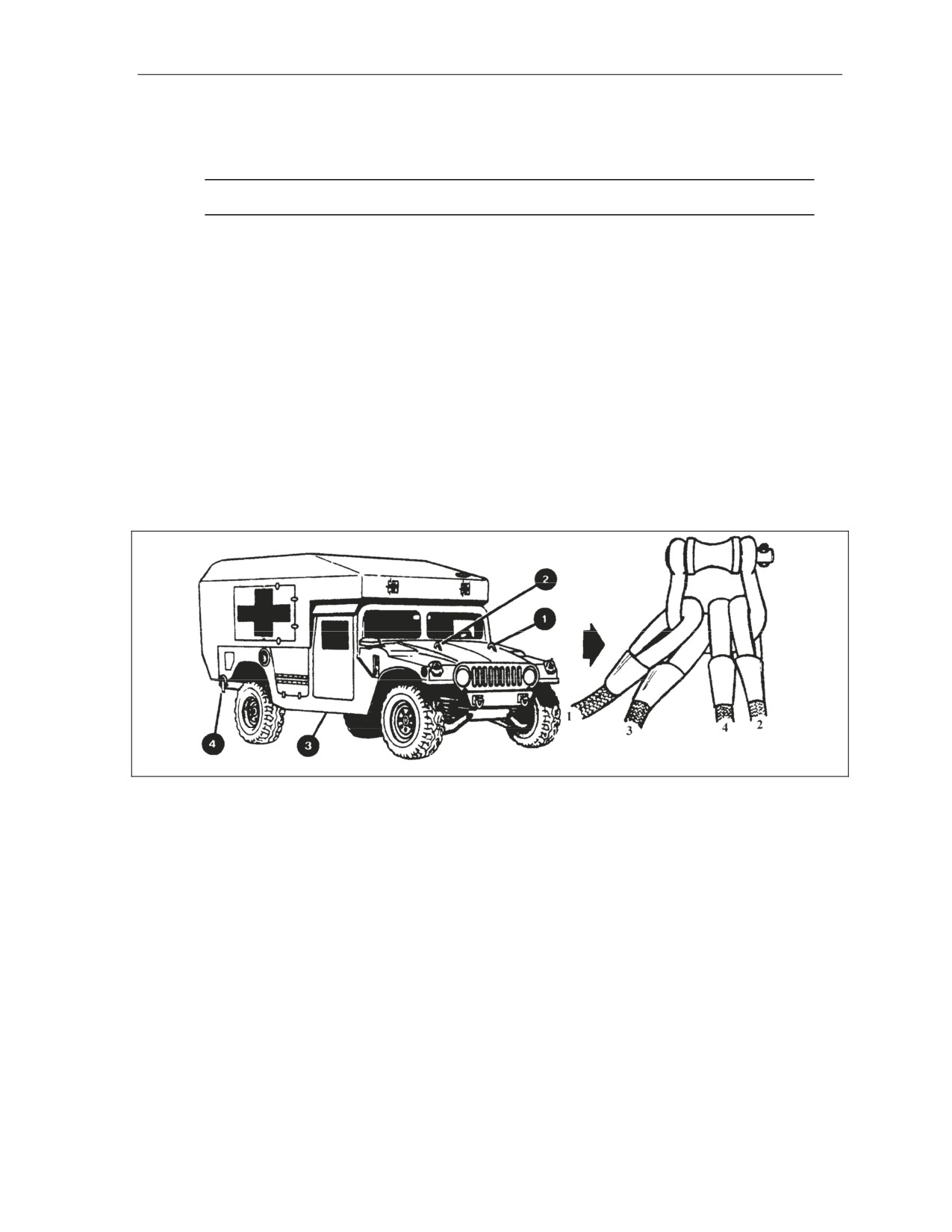
Positioning and Attaching the Sling Set. Position the sling set near the load. The sling legs
for a typical load with four lifting points are routed as shown in Figure 1-1.
Rigging a typical load with four lifting points is begun by connecting:
─ Sling leg 1 to the left front lifting provision.
─ Sling leg 2 to the right front lifting provision.
─ Sling leg 3 to the left rear lifting provision.
1-4
FM 4-20.198/MCRP 4-11.3E, VOL II/NTTP 3-04.12/
AFMAN 11-223 (I), VOL II/COMDTINST M13482.3B
20 February 2009
Fundamental Principles of Sling Load
─ Sling leg 4 to the right rear lifting provision.
─ If a six-leg sling set is required, the innermost sling legs, 5 and 6, are connected to the
left and right middle lift provisions.
Note. Odd numbered sling legs go to the same side of the load.
Following the equipment rigging procedures, loop the free end of the chain end through the
lift provision and insert the specified chain link in the grabhook/grab link. Tie or tape the excess
chain end to prevent the unrestrained chain from damaging the load. If necessary, wrap padding
around the chain or rope assembly to prevent damage to the load or sling set. If the procedures
prescribe a spreader bar, install and pad it according to the rigging instructions.
Breakaway safety ties are used to temporarily restrain the sling legs to keep them from
becoming entangled on the load as the helicopter lifts the load. These safety ties are made of
Type I, 1/4-inch cotton webbing or duct tape.
z
Viewing the Load. Left, right, front, and rear directions are designated from the driver’s
perspective for vehicles and towed equipment. Howitzer gun tubes are considered the front of
the load. The front or rear is identified on other items of equipment. The sling leg numbering
system prevents sling legs from crossing each other and causing damage to the sling legs or
causing the load to twist in flight. To improve flight stability, some loads are transported
backwards. Do not confuse the front of the load as it is carried with the end designated as the
front for rigging purposes. The arrow shown in the illustration identifies the direction of flight.
Figure 1-1. Sling Leg Lifting Point Designation
20 February 2009
FM 4-20.198/MCRP 4-11.3E, VOL II/NTTP 3-04.12/
AFMAN 11-223 (I), VOL II/COMDTINST M13482.3B
1-5
This page intentionally left blank.
Chapter 2
Certified Single-Point Rigging Procedures for Wheeled
Vehicles
INTRODUCTION
2-1. This chapter contains rigging procedures for single-point wheeled vehicle loads that have been
certified for sling load. Each rigging procedure is found in a paragraph that includes a description of the
load, materials required for rigging, and steps to complete the procedure. An applicability paragraph is
also a part of each paragraph and identifies the certified loads. The certified single-point rigging
procedures for wheeled vehicles are in this section. Paragraphs 2-2 through 2-44 give detailed instructions
for rigging loads.
Notes. 1. Reach pendants may be used on all single point loads. A static discharge person is not
required when using a reach pendant.
2. Canvas tops and doors should be removed and stowed inside the vehicle if
time allows. These items may be damaged if the airspeed exceeds 100 knots.
M996/M997/M997A2 TRUCK, AMBULANCE, (HMMWV)
2-2. The M996/M997/M997A2 ambulance is rigged for single-point sling load using the following
procedures:
z
Applicability. The following items in Table 2-1 are certified for all helicopters with suitable lift
capacity by the US Army Natick Soldier Center:
Table 2-1. Truck, Ambulance, (HMMWV)
Nomenclature
Max
Sling
Link Count
Weight
Set
Front/Rear
(Pounds)
Truck, Ambulance, M996, HMMWV
7,400
10K
80/30
Truck, Ambulance, M997, HMMWV
7,400
10K
80/30
Truck, Ambulance, M997A2, HMMWV
10,300
25K
65/24
z
Materials. The following materials are required to rig this load:
Sling set (10,000-pound capacity).
OR
Sling set (25,000-pound capacity).
Tape, adhesive, pressure-sensitive, 2-inch wide roll.
Cord, nylon, Type III, 550-pound breaking strength.
Webbing, cotton, 1/4-inch, 80-pound breaking strength.
Spreader bar assembly (component of vehicle).
z
Personnel. Two persons can prepare and rig this load in 15 minutes.
z
Procedures. The following procedures apply to this load:
Preparation. Prepare the load using the following steps:
20 February 2009
FM 4-20.198/MCRP 4-11.3E, VOL II/NTTP 3-04.12/
AFMAN 11-223 (I), VOL II/COMDTINST M13482.3B
2-1
Chapter 2
─ Fold the mirrors forward in front of the windshield and tie together with Type III nylon
cord. Tape the windshield in an X formation from corner to corner.
─ Remove the spreader bar from under the right hand seat inside the ambulance.
─ Secure all equipment inside the rear compartment with tape, nylon cord, and/or lashings.
Close and secure the door.
─ Secure all other equipment inside the vehicle with tape, nylon cord, and/or lashings.
Close and secure the doors.
─ Make sure the fuel tank is not over 3/4 full. Inspect fuel tank cap, oil filler cap, and
battery caps for proper installation.
─ Engage the vehicle parking brake. Place the transmission in neutral.
─ Make sure that the front wheels are pointed straight ahead. Tie down the steering wheel
using the securing device attached under the dashboard.
─ Secure the Red Cross insignia covers in the closed position.
─ Remove the keeper from the spreader bar and extend the bar so the holes line up.
Reinstall pin and engage keeper. Use the sighting hole in the tube to assist in aligning
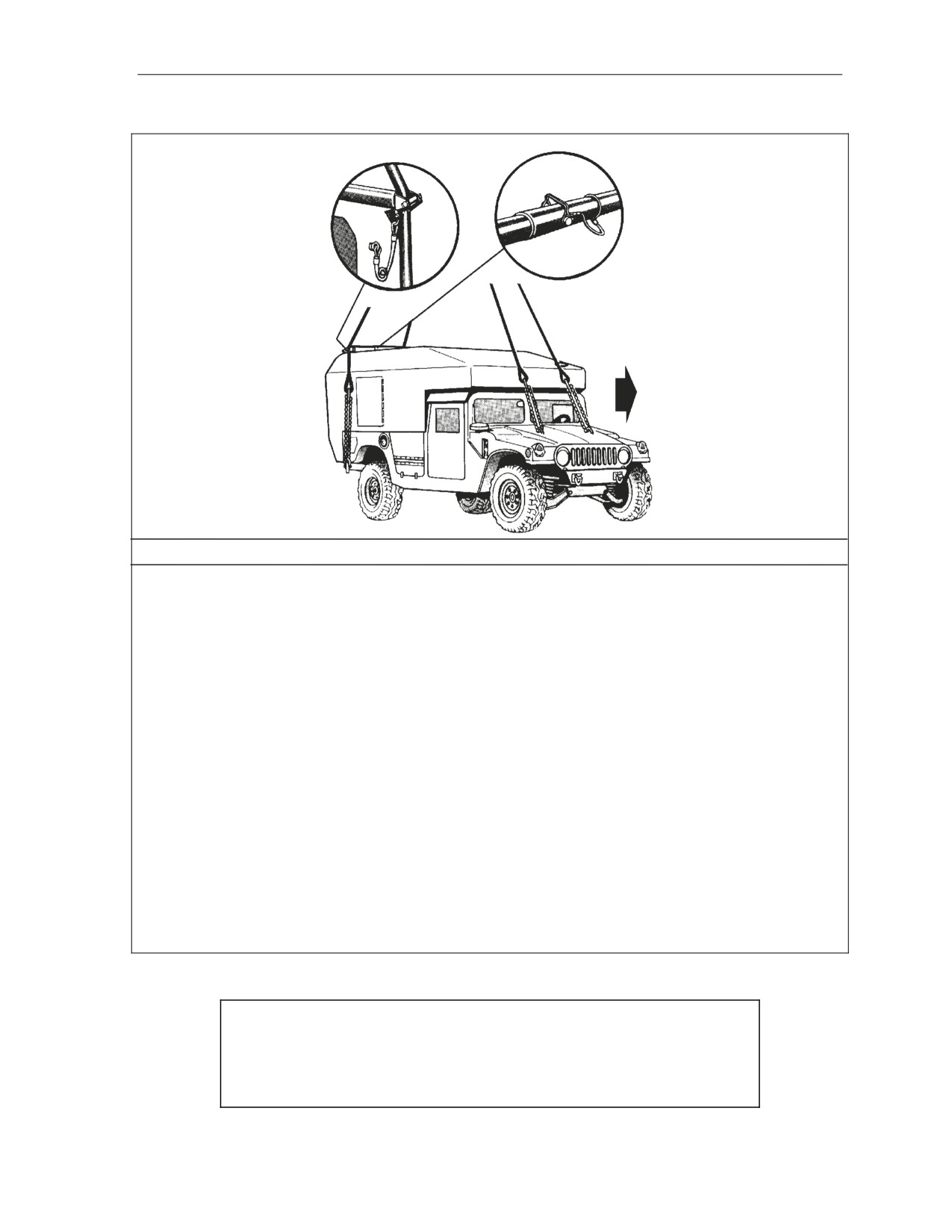
holes for the pin. See top view insert in Figure 2-1.
─ Position the spreader bar across the rear end of the vehicle roof. Attach the spreader bar
check cables to the eyebolts located on the aft exterior sidewall of the rear
compartment. See rear view insert in Figure 2-1.
─ Install lift provisions on the outer ends of the rear bumper by removing the tie-down
provisions located inboard of the bumper ends and installing them on the outer
ends of the rear bumper, if necessary.
Rigging. Rig the load according to the steps in Figure 2-1.
Note. Hookup of this load presents substantial risk of damage to the load or injury to the
hookup personnel. Use of a reach pendant is recommended for this load.
Hookup. The hookup team stands on the roof of the vehicle. The static wand person
discharges the static electricity with the static wand. The hookup person places the apex fitting
onto the aircraft cargo hook. The hookup team then carefully dismounts the vehicle and remains
close to the load as the helicopter removes slack from the sling legs. When successful hookup is
assured, the hookup team quickly exits the area underneath the helicopter to the designated
rendezvous point.
Derigging. Derigging is the reverse of the preparation and rigging procedures.
2-2
FM 4-20.198/MCRP 4-11.3E, VOL II/NTTP 3-04.12/
AFMAN 11-223 (I), VOL II/COMDTINST M13482.3B
20 February 2009
Certified Single-Point Rigging Procedures for Wheeled Vehicles
TOP VIEW
REAR VIEW
RIGGING STEPS
1. Position apex fitting on top of the ambulance. Route outer sling legs 1 and 2 to the front of
the vehicle and inner sling legs 3 and 4 to the rear. Sling legs 1 and 3 must be on the left
side of the load.
2. Loop the chain end of sling leg 1 through the left front lift provision that protrudes through the
hood. Place the correct link from Table 2-1 in the grab hook. Repeat with sling leg 2 and the
right front lift provision.
3. Place the nylon rope of sling legs 3 and 4 in the guides on the ends of the spreader bar.
Attach the spreader bar guide retainer pins and keepers. Lay the spreader bar on the roof.
Make sure the sling legs are in front of the check cable eyebolts.
4. The rear lift provisions are located on the outer ends of the rear bumper. Loop the chain end
of sling leg 3 through the left rear lift provision. Place the correct link from Table 2-1 in the
grab hook. Repeat with sling leg 4 and the right rear lift provision.
5. Secure all excess chain with tape or Type III nylon cord.
6. Cluster and tie (breakaway technique) all sling legs together on top of the vehicle to prevent
entanglement during hookup and lift-off.
Figure 2-1. M996/M997/M997A2 Ambulance (HMMWV)
CAUTION
Do not use the lift shackles located near the center of the rear bumper
for sling load lift provisions.
20 February 2009
FM 4-20.198/MCRP 4-11.3E, VOL II/NTTP 3-04.12/
AFMAN 11-223 (I), VOL II/COMDTINST M13482.3B
2-3

Chapter 2
M966/M1036/M1045/M1045A2/M1046 TOW MISSILE CARRIER
(HMMWV), M1025/M1025A2/M1026/M1043/M1043A2/ M1043A2 WITH
MARINE ARMOR KIT (MAK)/M1044/M1151 ARMAMENT CARRIER
(HMMWV)
2-3. The M966/M1036/M1045/M1045A2/M1046 TOW Missile Carriers and the M1025/M1025A2/
M1026/M1043/M1043A2/M1043A2 with MAK/M1044/M1151 Armament Carrier are rigged for single-
point sling load using the following procedures:
z
APPLICABILITY. The following items in Table 2-2 are certified for all helicopters with
suitable lift capacity by the US Army Natick Soldier Center:
Table 2-2. TOW Missile/Armament Carriers, (HMMWV)
Nomenclature
Max
Sling
Link Count
Weight
Set
Front/Rear
(Pounds)
TOW Missile Carrier, HMMWV, M966/M1036/M1045/M1046
10K
80/3
Varies by
15K
60/3
Model
40K
53/3
TOW Missile Carrier, HMMWV, M1045A2
10,300
25K
65/5
Armament Carrier, HMMWV, M1025/M1026/M1043A2
10K
80/3
Varies by
15K
60/3
Model
40K
53/3
Armament Carrier, HMMWV, M1025A2/M1043A2
10,300
25K
65/5
Armament Carrier, HMMWV, M1025A2, Line of Sight Anti-Tank
8,240
10K
40/3
(LOSAT), Resupply Vehicle with Reloader Crane
Armament Carrier, HMMWV, M1043A2 with MAK (USMC)
10,300
15K
35/3
Armament Carrier, HMMWV, M1151 (Empty)
7,300
25K
50/3
15K
50/3
Armament Carrier, HMMWV, M1151 (Loaded)
11,500
25K
20/3
15K
20/3
Notes. 1. Recommended airspeed for CH-53E when using the 15,000-pound multileg sling set
is 80 knots. The recommended airspeed for the CH-53E when using the 40,000-pound capacity
sling set is 95 knots.
2. For vehicle weights up to 7,300 pounds, the recommended maximum airspeed for the
UH-60 is 100 knots. For loads weighing above 7,300 pounds, the recommended maximum
airspeed is 70 knots. Coordinate closely with the aviation unit as to the vehicle weight including
all gear carried on the vehicle.
z
Materials. The following materials are required to rig this load:
Sling set (10,000-pound capacity, 25,000-pound capacity, or 40,000-pound capacity).
OR
Multileg sling set (15,000-pound).
─ Chain length, from a 15,000-pound capacity sling set (4 each) (used on M1043A2 with
MAK).
─ Coupling link, from a 15,000-pound sling set (4 each) (used on M1043A2 with MAK).
Tape, adhesive, pressure-sensitive, 2-inch wide roll.
Cord, nylon, Type III, 550-pound breaking strength.
Webbing, cotton, 1/4-inch, 80-pound breaking strength.
2-4
FM 4-20.198/MCRP 4-11.3E, VOL II/NTTP 3-04.12/
AFMAN 11-223 (I), VOL II/COMDTINST M13482.3B
20 February 2009
Certified Single-Point Rigging Procedures for Wheeled Vehicles
Felt sheet, cattle hair, Type IV, 1/2-inch or suitable padding.
z
Personnel. Two persons can prepare and rig this load in 15 minutes.
z
Procedures. The following procedures apply to this load:
Preparation. Prepare the load using the following steps:
─ Extend the sling leg chains by connecting one additional chain length to each chain on a
15,000-pound capacity sling set with a coupling link (used on M1043A2 with MAK).
─ Fold mirrors forward in front of the windshield for added protection and tie together with
Type III nylon cord. Tape the windshield in an X formation from corner to corner.
─ Secure all equipment and cargo inside the vehicle with tape, nylon cord, or lashings.
Remove antennas and stow inside vehicle.
─ Ensure the fuel tank is not over 3/4 full. Inspect fuel tank cap, oil filler cap, and battery
caps for proper installation.
─ Engage the vehicle parking brake and put the transmission in neutral.
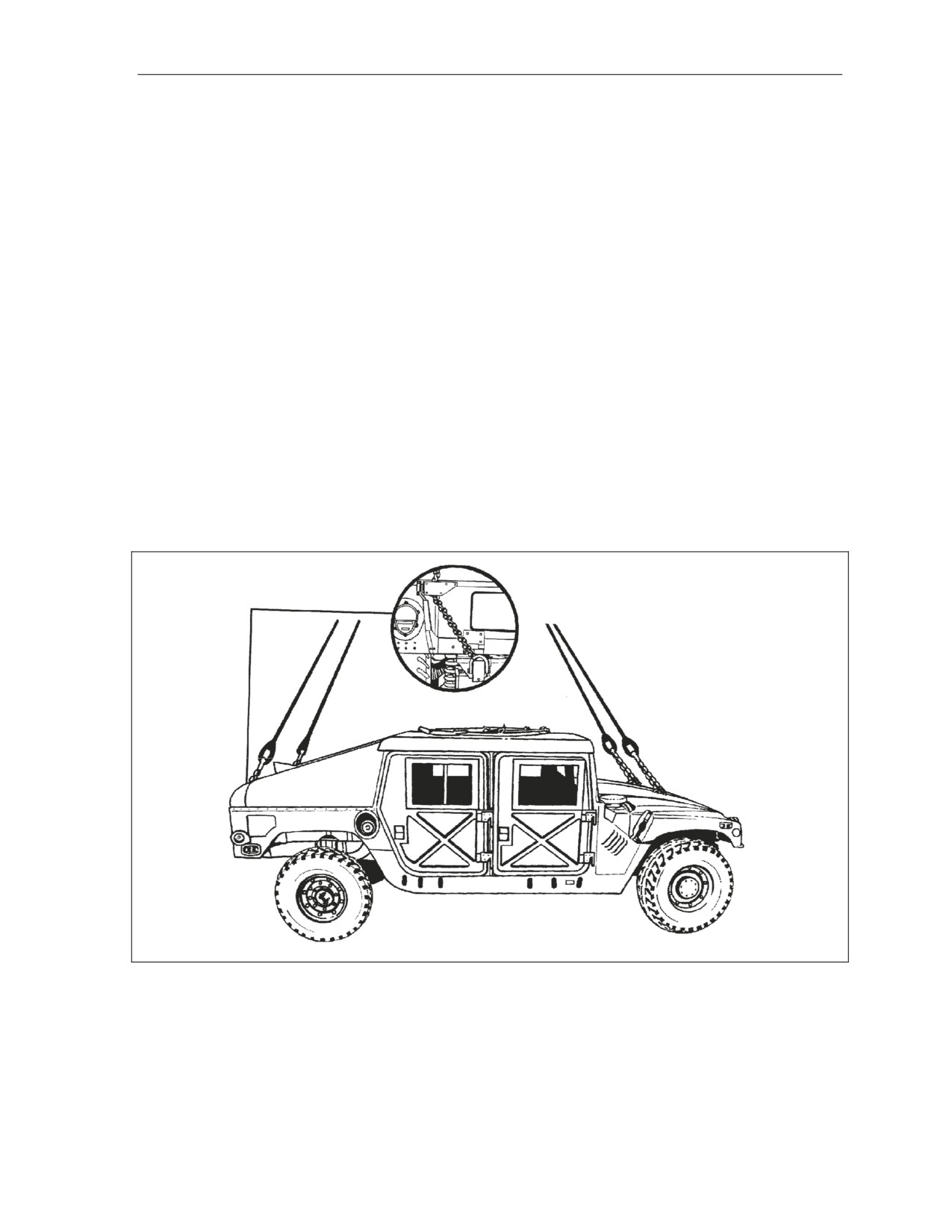
Rigging. Rig the load according to the steps in Figure 2-2.
Hookup. The hookup team stands on the roof of the vehicle. The static wand person
discharges the static electricity with the static wand. The hookup person places the apex fitting
onto the aircraft cargo hook. The hookup team then carefully dismounts the vehicle and remains
close to the load as the helicopter removes slack from the sling legs. When successful hookup is
assured, the hookup team quickly exits the area underneath the helicopter to the designated
rendezvous point.
Derigging. Derigging is the reverse of the preparation and rigging procedures.
Figure 2-2. TOW Missile Carrier (HMMWV)
20 February 2009
FM 4-20.198/MCRP 4-11.3E, VOL II/NTTP 3-04.12/
AFMAN 11-223 (I), VOL II/COMDTINST M13482.3B
2-5

Chapter 2
RIGGING STEPS
1. Position apex fitting on the roof of the vehicle. Route outer sling legs 1 and 2 to the front of the vehicle
and inner sling legs 3 and 4 to the rear. Sling legs 1 and 3 must be on the left side of the load.
2. Loop the chain end of sling leg 1 through the left front lift provision that protrudes through the hood.
Place the correct link from Table 2-2 in the grab hook. Repeat with sling leg 2 and the right front lift
provision. Secure excess chain with tape or Type III nylon cord.
3. Route the chain end of sling leg 3 through the eyelet opening in the upper left corner of the tailgate.
Loop the chain end through the left lift provision on the bumper and thread back through the eyelet
opening in the tailgate. Place the correct link from Table 2-2 in the grab hook. Repeat with sling leg 4
and the right rear lift provision. See insert above.
4. Wrap rear chains with padding where they contact the shell back.
5. Cluster and tie (breakaway technique) all sling legs together on top of the vehicle to prevent
entanglement during hookup and lift-off.
Figure 2-2. TOW Missile Carrier (HMMWV) (Continued)
M998/M1123 WITH MARINE ARMOR KIT (MAK) (USMC)/M1037
MODIFIED (GVW 9,400 LBS)/M1038/M1097/M1097A2/M1152 TRUCK,
CARGO, 1 1/4-TON (HMMWV)
2-4. The M998/M1123 with MAK/M1037 Modified/M1038/M1097/M1097A2/M1152, 1 1/4-ton cargo
trucks are rigged for single-point sling load using the following procedures:
z
Applicability. The following items in Table 2-3 are certified for all helicopters with suitable lift
capacity by the US Army Natick Soldier Center:
Table 2-3. 1 1/4-Ton Cargo Truck (HMMWV)
Nomenclature
Max
Sling
Link Count
Weight
Set
Front/Rear
(Pounds)
Truck, 1 1/4-ton, HMMWV, M998/M1038
10K
80/3
7,700
15K
60/3
40K
53/3
Truck, 1 1/4-ton, HMMWV, M998A1
10K
80/3
7,500
15K
60/3
40K
53/3
Truck, 1 1/4-ton, HMMWV, M998 with AN/MRC110-A Radio Set
10K
80/3
7,700
15K
60/3
40K
53/3
Truck, 1 1/4-ton, HMMWV, Modified , (GVW 9,400 lbs), M1037
9,400
10K
80/3
15K
60/3
Truck, 1 1/4-ton, Heavy HMMWV, Cargo Variant, M1097
10,001
25K
60/10
Truck, 1 1/4-ton, Heavy HMMWV, Cargo Variant, M1097A2
10,300
25K
60/10
2-6
FM 4-20.198/MCRP 4-11.3E, VOL II/NTTP 3-04.12/
AFMAN 11-223 (I), VOL II/COMDTINST M13482.3B
20 February 2009

Certified Single-Point Rigging Procedures for Wheeled Vehicles
Table 2-3. 1 1/4-Ton Cargo Truck (HMMWV) (Continued)
Nomenclature
Max
Sling
Link Count
Weight
Set
Front/Rear
(Pounds)
Integrated System Control (ISYSCON), Support
10,300
25K
60/10
Carrier/RadioTruck, 1 1/4-ton, Heavy HMMWV, M1097.
Truck, 1 1/4-ton, HMMWV with MAK, M1123, 2 door or 4 door
10,300
15K
35/3
passenger compartment (USMC)
Truck, 1 1/4-ton, Heavy HMMWV, Cargo Variant, M1152 (Empty)
7,300
25K
60/3
15K
50/3
Truck, 1 1/4-ton, Heavy HMMWV, Cargo Variant, M1152 (Loaded)
11,500
25K
20/3
15K
20/3
WARNING
THIS CARGO VEHICLE (M1037 MODIFIED, 9,400-LB GVW)
SHOULD NOT BE CONFUSED WITH THE SHELTER CARRIER
(M1037, 8,600-LB GVW). THE M1037, MODIFIED, HAS IMPROVED
LIFT PROVISIONS WHICH ALLOWS IT TO BE LIFTED AT HIGHER
GROSS VEHICLE WEIGHTS.
Note.: 1. Recommended airspeed for CH-53E when using the 15,000-pound multileg sling set is
100 knots. Recommended airspeed for the CH-53E, when using the 40,000-pound capacity
sling set, is 105 knots.
2. For vehicle weights up to 7,300 pounds, the recommended maximum airspeed for the
UH-60 is 100 knots. For loads weighing above 7,300 pounds the recommended maximum
airspeed is 70 knots. Coordinate closely with the aviation unit as to the vehicle weight including
all gear carried on the vehicle.
z
Materials. The following materials are required to rig this load:
Sling set (10,000-pound capacity or 25,000-pound capacity or 40,000-pound capacity).
OR
Multileg sling set (15,000-pound capacity )
─ Chain length, from a 15,000-pound capacity sling set (4 each) (used on M1123 with
MAK).
─ Coupling link, from a 15,000-pound sling set (4 each) (used on M1123 with MAK).
─ Tape, adhesive, pressure-sensitive, 2-inch wide roll.
─ Cord, nylon, Type III, 550-pound breaking strength.
─ Webbing, cotton, 1/4-inch, 80-pound breaking strength.
─ Felt sheet, cattle hair, Type IV, 1/2-inch or suitable padding.
z
Personnel. Two persons can prepare and rig this load in 15 minutes.
z
Procedures. The following procedures apply to this load:
Preparation. Prepare the load using the following steps:
─ Extend the sling leg chains by connecting one additional chain length to each chain on a
15,000-pound capacity sling set with a coupling link (used on M1123 with MAK).
20 February 2009
FM 4-20.198/MCRP 4-11.3E, VOL II/NTTP 3-04.12/
AFMAN 11-223 (I), VOL II/COMDTINST M13482.3B
2-7
Chapter 2
─ Fold mirrors forward in front of the windshield for added protection and tie together with
Type III nylon cord. If installed, remove canvas covering over the bed of the truck.
Remove the doors. Tape the windshield in an X formation from corner to corner. If
time permits, fold canvas top and tie to windshield for added protection.
─ Secure all equipment and cargo inside the vehicle with tape, nylon cord, or lashings.
Remove antennas and stow inside vehicle.
─ Ensure the fuel tank is not over 3/4 full. Inspect fuel tank cap, oil filler cap, and battery
caps for proper installation.
─ Engage the vehicle parking brake and put the transmission in neutral.
─ Ensure the front wheels are pointed straight ahead. Tie down the steering wheel, using
the securing device attached under the dashboard.
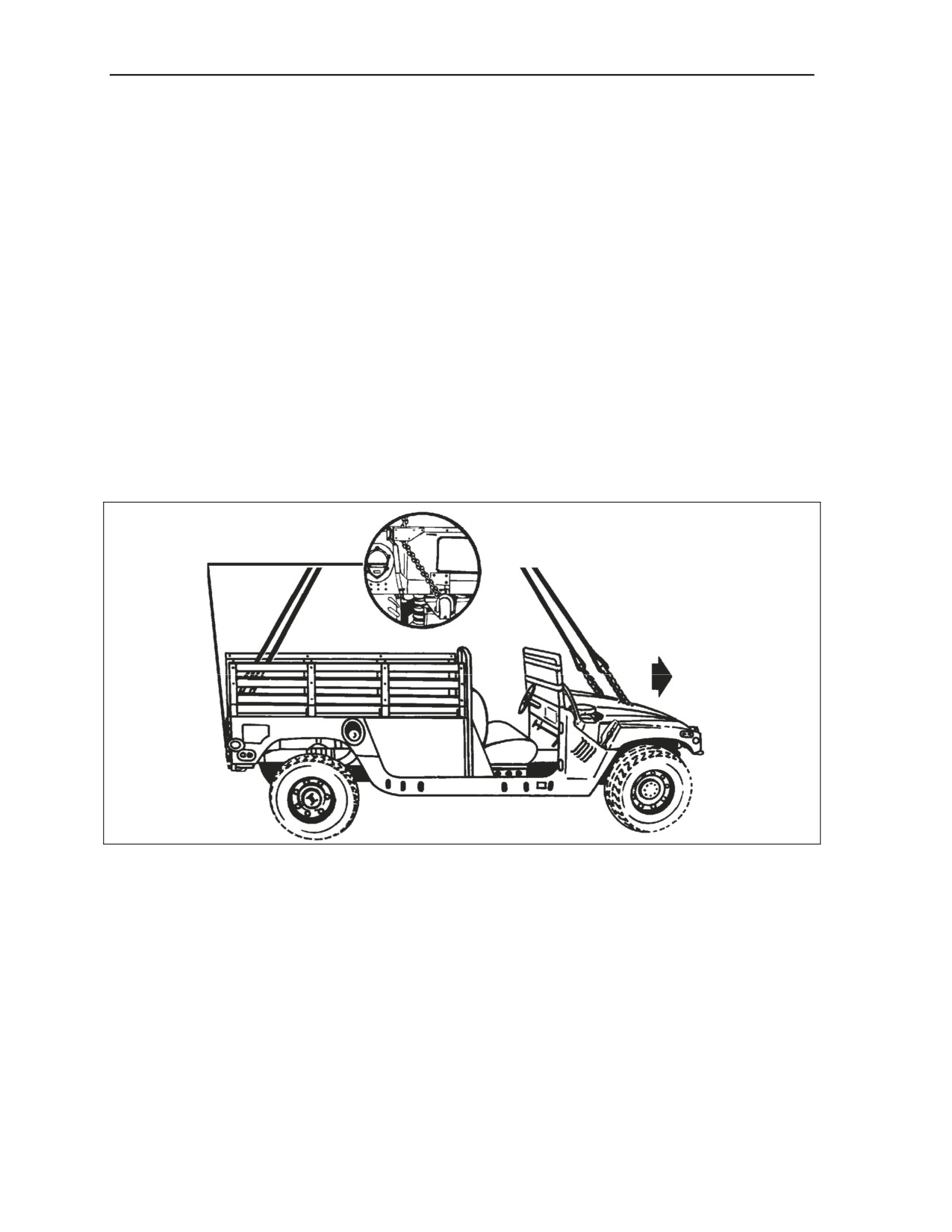
Rigging. Rig the load according to the steps in Figure 2-3.
Hookup. The hookup team stands in the bed of the vehicle. The static wand person
discharges the static electricity with the static wand. The hookup person places the apex fitting
onto the aircraft cargo hook. The hookup team then carefully dismounts the vehicle and remains
close to the load as the helicopter removes slack from the sling legs. When successful hookup is
assured, the hookup team quickly exits the area underneath the helicopter to the designated
rendezvous point.
Derigging. Derigging is the reverse of the preparation and rigging procedures.
Figure 2-3. 1 1/4-Ton Cargo Truck (HMMWV)
2-8
FM 4-20.198/MCRP 4-11.3E, VOL II/NTTP 3-04.12/
AFMAN 11-223 (I), VOL II/COMDTINST M13482.3B
20 February 2009

Certified Single-Point Rigging Procedures for Wheeled Vehicles
RIGGING STEPS
1. Position apex fitting in the bed of the vehicle. Route outer sling legs 1 and 2 to the front of
the vehicle and inner sling legs 3 and 4 to the rear. Sling legs 1 and 3 must be on the left
side of the load.
2. Loop the chain end of sling leg 1 through the left front lift provision that protrudes through the
hood from inboard to outboard. Place the correct link from Table 2-3 in the grab hook.
Repeat with sling leg 2 through the right front lift provision. Secure excess chain with tape or
Type III nylon cord.
3. Route the chain end of sling leg 3 through the eyelet opening in the upper left corner of the
tailgate. Loop the chain end through the left lift provision on the bumper and thread back
through the eyelet opening in the tailgate. Place the correct link from Table 2-3 in the grab
hook. Repeat with sling leg 4 through the right rear lift provision. See insert above.
4. Cluster and tie (breakaway technique) all sling legs together on top of the trailer to prevent
entanglement during hookup and lift-off.
Figure 2-3. 1 1/4-Ton Cargo Truck (HMMWV) (Continued)
M1037/M1042/M1097/M1097A1/M1097A2/M1113/M1152 SHELTER
CARRIER (HMMWV) WITHOUT SHELTER
2-5. The M1037/M1042/M1097/M1097A1/M1097A2/M1113/M1152 shelter carriers without shelter are
rigged for single-point sling load using the following procedures:
z
Applicability. The following items in Table 2-4 are certified for all helicopters with suitable lift
capacity by the US Army Natick Soldier Center:
Table 2-4. HMMWV Shelter Carriers without Shelter
Nomenclature
Max
Sling
Link Count
Weight
Set
Front/Rear
(Pounds)
Shelter Carriers, M1037/M1042
5,220
15K
60/3
10K
Shelter Carriers, M1097/M1097A1
10,000
10K
60/3
Shelter Carrier, M1097A2
10,300
25K
50/3
Shelter Carrier, M1113 (Empty)
6,400
25K
40/10
Shelter Carrier, M1152 (Empty)
7,300
25K
60/3
Shelter Carrier, M1152 (Loaded)
11,500
25K
30/3
z
Materials. The following materials are required to rig this load:
Multileg sling set (15,000-pound capacity or 40,000-pound capacity for CH-53 only).
OR
Sling set (10,000-pound capacity or 25,000-pound capacity for CH-60 and CH-47).
Tape, adhesive, pressure-sensitive, 2-inch wide roll.
Cord, nylon, Type III, 550-pound breaking strength.
Webbing, cotton, 1/4-inch, 80-pound breaking strength.
Felt sheet, cattle hair, Type VI, 1/2-inch or suitable substitute.
z
Personnel. Two persons can prepare and rig this load in 15 minutes.
20 February 2009
FM 4-20.198/MCRP 4-11.3E, VOL II/NTTP 3-04.12/
AFMAN 11-223 (I), VOL II/COMDTINST M13482.3B
2-9
Chapter 2
z
Procedures. The following procedures apply to this load:
Preparation. Prepare the load using the following steps:
─ Fold mirrors forward in front of the windshield for added protection and tie together with
Type III nylon cord. Tape the windshield in an X formation from corner to corner.
─ Secure all equipment and cargo inside the vehicle with tape, nylon cord, or lashings.
Secure the doors shut if installed.
─ Ensure the fuel tank is not over 3/4 full. Inspect the fuel tank cap, oil filler cap, and
battery caps for proper installation.
─ Engage the vehicle parking brake and place the transmission in neutral.
─ Ensure the front wheels are pointed straight ahead. Tie down the steering wheel using
the securing device attached under the dashboard.
─ Install the lift provisions on the outer ends of the rear bumper by removing the tiedown
provisions located inboard of the bumper end and installing them on the outer ends of
the rear bumper.
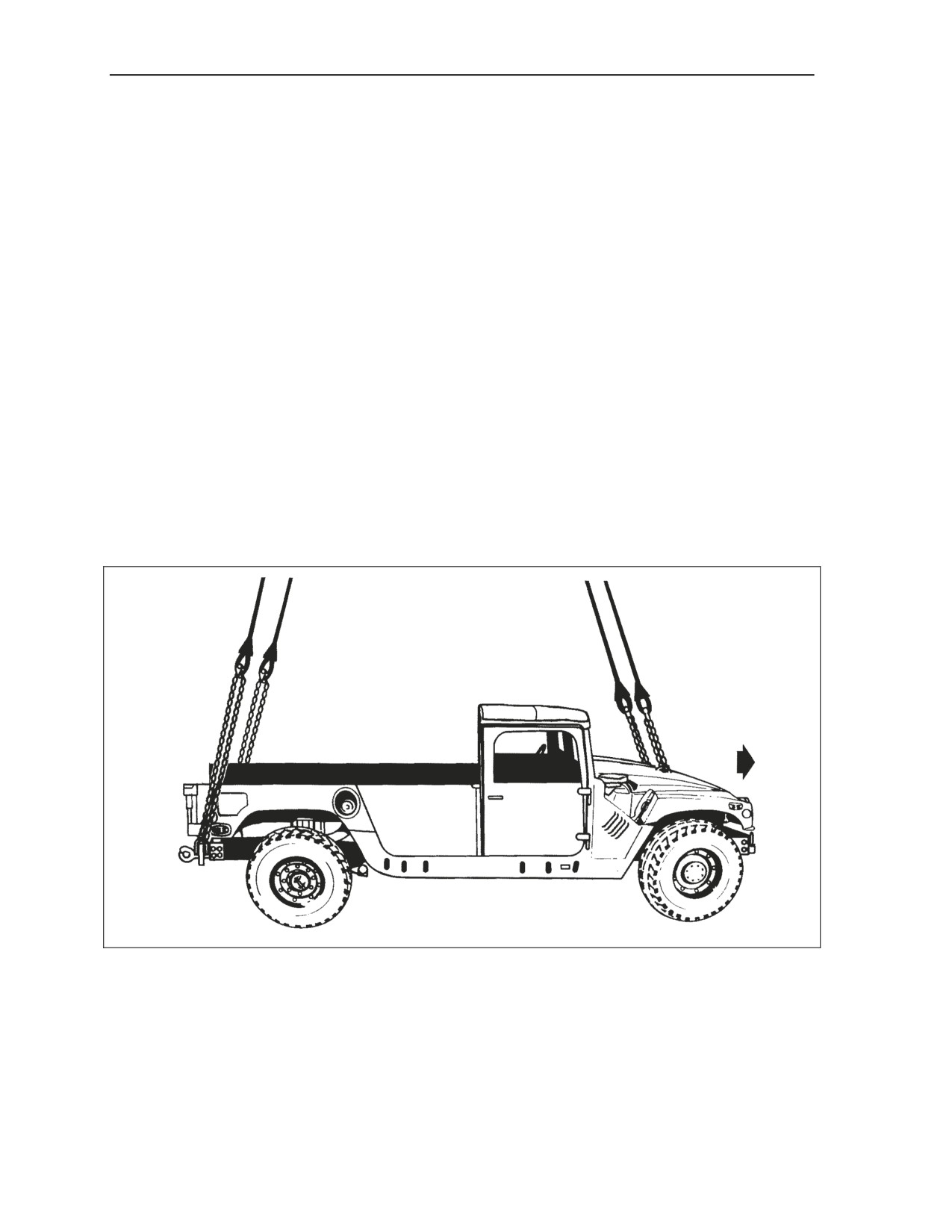
Rigging. Rig the load according to the steps in Figure 2-4.
Hookup. The hookup team stands in the bed of the vehicle. The static wand person
discharges the static electricity with the static wand. The hookup person places the apex fitting
onto the aircraft cargo hook. The hookup team then carefully dismounts the vehicle and remains
close to the load as the helicopter removes slack from the sling legs. When successful hookup is
assured, the hookup team quickly exits the area underneath the helicopter to the designated
rendezvous point.
Derigging. Derigging is the reverse of the preparation and rigging procedures.
Figure 2-4. HMMWV Shelter Carriers without Shelter
2-10
FM 4-20.198/MCRP 4-11.3E, VOL II/NTTP 3-04.12/
AFMAN 11-223 (I), VOL II/COMDTINST M13482.3B
20 February 2009

Certified Single-Point Rigging Procedures for Wheeled Vehicles
RIGGING STEPS
1. Position apex fitting in the bed of the vehicle. Route outer sling legs 1 and 2 to the front of the vehicle
and inner sling legs 3 and 4 to the rear. Sling legs 1 and 3 must be on the left side of the load.
2. Loop the chain end of sling leg 1 through the left front lift provision that protrudes through the hood from
inboard to outboard. Place the correct link from Table 2-4 in the grab hook. Repeat with sling leg 2
through the right front lift provision. Secure excess chain with tape or Type III nylon cord.
3. Route the chain end of sling leg 3 through the lift provision located on the left end of the bumper from
inboard to outboard. Place the correct link from Table 2-4 in the grab hook. Repeat with sling leg 4
through the right rear lift provision. Secure excess chain with tape or Type III nylon cord.
4.
Wrap rear chains with padding where they contact the shelter carrier.
5. Cluster and tie (breakaway technique) all sling legs together on top of the trailer to prevent
entanglements.
Figure 2-4. HMMWV Shelter Carriers without Shelter (Continued)
M1037/M1042 SHELTER CARRIER (HMMWV) WITH S-250 OR
S-250E SHELTER
2-6. The M1037 and M1042 shelter carriers with S-250 or S-250E shelters are rigged for single-point
sling load using the following procedures:
z
Applicability. The following items in Table 2-5 are certified for all helicopters with suitable lift
capacity by the US Army Natick Soldier Center:
Table 2-5. M1037/M1042 Shelter Carrier (HMMWV) With S-250 or S-250E Shelter
Nomenclature
Max
Sling
Link Count
Weight
Set
Front/Rear
(Pounds)
NC Operations
8,800
10K
80/30
NC Switch
8,513
10K
80/30
NC LOS (V3)
8,611
10K
80/30
NC Management
8,800
10K
80/30
NC Support
8,400
10K
80/30
LEN Operations
8,800
10K
80/30
LEN Switch
8,800
10K
80/30
LEN LOS (V4)
8,800
10K
80/30
LEN Management
8,800
10K
80/30
LEN Cable Vehicle
8,180
10K
80/30
SSC Command
8,800
10K
80/30
SSC Planning
8,300
10K
80/30
SSC Technical
8,507
10K
80/30
20 February 2009
FM 4-20.198/MCRP 4-11.3E, VOL II/NTTP 3-04.12/
AFMAN 11-223 (I), VOL II/COMDTINST M13482.3B
2-11

Chapter 2
Table 2-5. M1037/M1042 Shelter Carrier (HMMWV) With S-250 or S-250E Shelter (Continued)
Nomenclature
Max
Sling
Link Count
Weight
Set
Front/Rear
(Pounds)
LOS(V1)
8,800
10K
80/30
LOS(V2)
8,500
10K
80/30
Radio Access Unit
8,800
10K
80/30
SEN(V1)
8,800
10K
80/30
SEN(V2)
8,800
10K
80/30
Maintenance #1
8,084
10K
80/30
Maintenance #2
8,350
10K
80/30
Battalion Spares
8,800
10K
80/30
Company Spares
7,850
10K
80/30
AN/TLQ
8,040
10K
80/30
Deployable Media Production Center
7,840
10K
80/30
Operational Control Group (OCG)/ Firefinder AN/TPQ-36 Block I
7,500
10K
80/30
TLQ-37 Intelligence and Electronic Warfare (IEW) System
8,200
10K
80/30
z
Materials. The following materials are required to rig this load:
Sling set (10,000-pound capacity).
Chain length, part number 38850-00053-101, from a 10,000-pound capacity sling set
(4 each).
Coupling link, part number 5779125, from a 10,000-pound sling set (4 each).
Tape, adhesive, pressure-sensitive, 2-inch wide roll.
Cord, nylon, Type III, 550-pound breaking strength.
Webbing, cotton, 1/4-inch, 80-pound breaking strength.
Felt sheet, cattle hair, Type IV, 1/2-inch or suitable padding.
Padding, cellulose.
z
Personnel. Two persons can prepare and rig this load in 15 minutes.
z
Procedures. The following procedures apply to this load:
Preparation. Prepare the load using the following steps:
─ Connect one additional chain length to each chain of the sling set with the coupling link.
─ Fold mirrors forward in front of the windshield for added protection and tie together with
Type III nylon cord. Tape the windshield in an X formation from corner to corner.
─ Secure the shelter to the truck using wire rope or tie-down assemblies. Secure all
equipment inside the shelter with tape, nylon cord, or lashings; close and secure the
door.
─ Secure all equipment and cargo inside the vehicle with tape, nylon cord, or lashings.
Secure the doors shut if installed.
─ Ensure the fuel tank is not over 3/4 full. Inspect fuel tank cap, oil filler cap, and battery
caps for proper installation.
─ Engage the vehicle parking brake and put the transmission in neutral.
─ Ensure the front wheels are pointed straight ahead. Tie down the steering wheel, using
the securing device attached under the dashboard.
─ Install the lift provisions on the outer ends of the rear bumper by removing the tiedown
provisions located inboard of the bumper end and installing them on the outer ends of
the rear bumper.
2-12
FM 4-20.198/MCRP 4-11.3E, VOL II/NTTP 3-04.12/
AFMAN 11-223 (I), VOL II/COMDTINST M13482.3B
20 February 2009
Certified Single-Point Rigging Procedures for Wheeled Vehicles
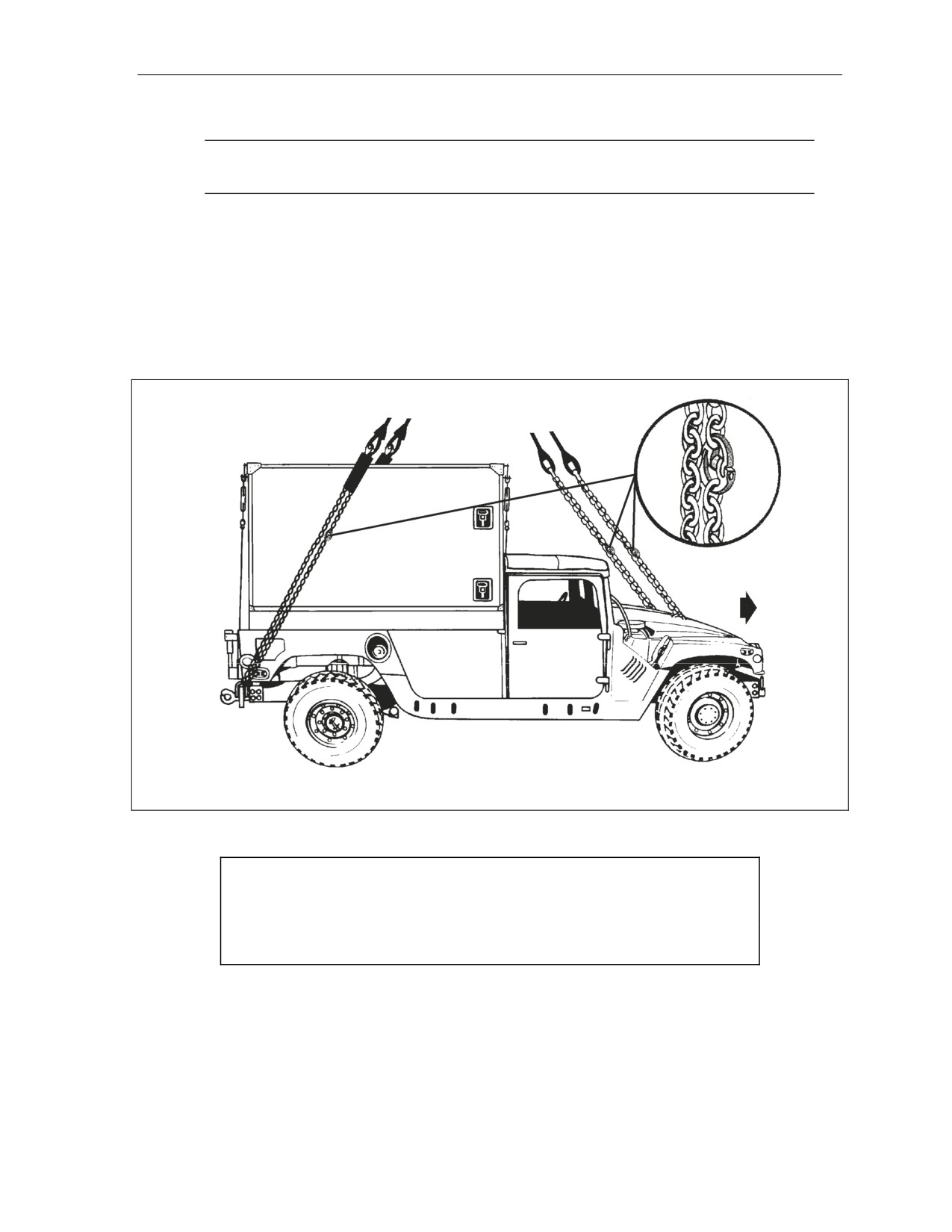
Rigging. Rig the load according to the steps in Figure 2-5.
Note. Hookup of this load presents substantial risk of damage to the load or injury to the
hookup personnel. Use of a reach pendant is recommended for this load.
Hookup. The hookup team stands on top of the shelter. The static wand person discharges
the static electricity with the static wand. The hookup person places the apex fitting onto the
aircraft cargo hook. The hookup team then carefully dismounts the vehicle and remains close to
the load as the helicopter removes slack from the sling legs. When successful hookup is
assured, the hookup team quickly exits the area underneath the helicopter to the designated
rendezvous point.
Derigging. Derigging is the reverse of the preparation and rigging procedures.
Figure 2-5. M1037/1042 Shelter Carrier with S-250/S-250E Shelter
CAUTION
Do not use the lift shackles located near the center of the rear bumper
for sling load lift provisions.
20 February 2009
FM 4-20.198/MCRP 4-11.3E, VOL II/NTTP 3-04.12/
AFMAN 11-223 (I), VOL II/COMDTINST M13482.3B
2-13

Chapter 2
RIGGING STEPS
1. Position apex fitting on top of the shelter. Route outer sling legs 1 and 2 to the front of the vehicle and
inner sling legs 3 and 4 to the rear. Sling legs 1 and 3 must be on the left side of the load.
2. Loop the chain end of sling leg 1 through the left front lift provision that protrudes through the hood from
inboard to outboard. Place the correct link from Table 2-5 in the grab hook. Repeat with sling leg 2 and
the right front lift provision. Secure excess chain with tape or Type III nylon cord.
3. Route the chain end of sling leg 3 through the lift provision located on the left end of the rear bumper
from inboard to outboard. Place the correct link from Table 2-5 in the grab hook. Repeat with sling leg 4
and the right rear lift provision. Secure excess chain with tape or Type III nylon cord.
4. Wrap the rear slings with padding where they contact the shelter sides.
5. Raise the apex fitting above the shelter carrier keeping the slings to the side of the shelter.
6. Cluster and tie (breakaway technique) all sling legs together on top of the shelter to prevent
entanglement during hookup and lift-off.
Figure 2-5. M1037/1042 Shelter Carrier with S-250/S-250E Shelter (Continued)
M1097 SHELTER CARRIER, HEAVY HMMWV, WITH S-250 OR S-
250E SHELTER
2-7. The M1097 shelter carrier, heavy HMMWV, with S-250 or S-250E shelter is rigged for single-point
sling load using the following procedures:
z
Applicability. The following items in Table 2-6 are certified for all helicopters with suitable lift
capacity by the US Army Natick Soldier Center:
Table 2-6. M1097 Shelter Carrier, Heavy HMMWV, With S-250 or S-250E Shelter
Nomenclature
Max
Sling
Link Count
Weight
Set
Front/Rear
(Pounds)
S-250/S-250E
10,001
25K
60/10
AN/TRC-170 Communication Shelter
9,240
15K
40/3
TRQ-32, Intelligence and Electronic Warfare (IEW) System
9,700
10K
60/10
Platoon Operations Center (POC), Intelligence and Electronic
9,700
10K
60/10
Warfare (IEW) System
Mobile Subscriber Equipment Contingency Communications
9,993
10K
60/10
Package/Light Forces Contingency Communications Package in S-
250E
Mobile Subscriber Equipment Contingency Communications
8,913
10K
60/10
Package/Light Forces Contingency Communications Package in S-
250
LOS (V1)
9,038
10K
60/10
LOS (V2)
9,038
10K
60/10
2-14
FM 4-20.198/MCRP 4-11.3E, VOL II/NTTP 3-04.12/
AFMAN 11-223 (I), VOL II/COMDTINST M13482.3B
20 February 2009

Certified Single-Point Rigging Procedures for Wheeled Vehicles
Table 2-6. M1097 Shelter Carrier, Heavy HMMWV, With S-250 or S-250E Shelter (Continued)
Nomenclature
Max
Sling
Link Count
Weight
Set
Front/Rear
(Pounds)
LOS (V3)
9,038
10K
60/10
LOS (V4)
9,038
10K
60/10
NODAL Support Vehicle
8,250
10K
60/10
NC Operations
9,100
10K
60/10
NC Switch
8,813
10K
60/10
NC LOS (V3)
8,911
10K
60/10
NC Management
9,100
10K
60/10
NC Support
8,700
10K
60/10
LEN Operations
9,100
10K
60/10
LEN Switch
9,100
10K
60/10
LEN LOS (V4)
9,100
10K
60/10
LEN Management
9,100
10K
60/10
LEN Cable Vehicle
8,480
10K
60/10
SSC Command
9,100
10K
60/10
SSC Planning
8,600
10K
60/10
SSC Technical
8,807
10K
60/10
LOS(V1)
9,100
10K
60/10
LOS(V2)
8,800
10K
60/10
Radio Access Unit
9,100
10K
60/10
SEN(V1)
9,100
10K
60/10
SEN(V2)
9,100
10K
60/10
Maintenance #1
8,384
10K
60/10
Maintenance #2
8,650
10K
60/10
Battalion Spares
9,100
10K
60/10
Company Spares
8,150
10K
60/10
AN/TLQ-17A (V3)
8,340
10K
60/10
Deployable Media Production Center
8,140
10K
60/10
Operational Control Group (OCG)/ Firefinder AN/TPQ-36 Block I
7,800
10K
60/10
TLQ-37 Intelligence and Electronic Warfare (IEW) System
8,500
10K
60/10
z
Materials. The following materials are required to rig this load:
Sling set (10,000-pound capacity or 25,000-pound capacity).
OR
Multileg sling set (15,000-pound capacity for the CH-53E only).
─ Additional chain lengths from the sling set being used (4 each).
─ Additional coupling links from the sling set being used (4 each).
Tape, adhesive, pressure-sensitive, 2-inch wide roll.
Cord, nylon, Type III, 550-pound breaking strength.
Webbing, cotton, 1/4-inch, 80-pound breaking strength.
Felt sheet, cattle hair, Type IV, 1/2-inch or suitable padding.
Padding, Cellulose.
20 February 2009
FM 4-20.198/MCRP 4-11.3E, VOL II/NTTP 3-04.12/
AFMAN 11-223 (I), VOL II/COMDTINST M13482.3B
2-15
Chapter 2
z
Personnel. Two persons can prepare and rig this load in 15 to 25 minutes.
z
Procedures. The following procedures apply to this load:
Preparation. Prepare the load using the following steps:
─ Connect one additional chain length to each chain of the sling set with the coupling link.
─ Fold mirrors forward in front of the windshield and tie together with Type III nylon cord.
Tape the windshield in an X formation from corner to corner.
─ Secure the shelter to the truck using wire rope or tie-down assemblies. Secure all
equipment inside the shelter with tape, nylon cord, or lashings; close and secure the
door.
─ Secure all equipment and cargo inside the vehicle with tape, nylon cord, or lashings.
Secure the doors shut if installed.
─ Ensure the fuel tank is not over 3/4 full. Inspect fuel tank cap, oil filler cap, and battery
caps for proper installation.
─ Engage the vehicle parking brake and put the transmission in neutral.
─ Ensure the front wheels are pointed straight ahead. Tie down the steering wheel, using
the securing device attached under the dashboard.
─ Install the lift provisions on the outer ends of the rear bumper by removing the tiedown
provisions located inboard of the bumper end and installing them on the outer ends of
the rear bumper.
─ When using the multileg sling set, attach an additional chain length to the end of the
chain on each sling leg with the coupling link.
Rigging. Rig the load according to the steps in Figure 2-6.
Note. Hookup of this load presents substantial risk of damage to the load or injury to the
hookup personnel. Use of a reach pendant is recommended for this load.
Hookup. The hookup team stands on top of the shelter. The static wand person discharges
the static electricity with the static wand. The hookup person places the apex fitting onto the
aircraft cargo hook. The hookup team then carefully dismounts the vehicle and remains close to
the load as the helicopter removes slack from the sling legs. When successful hookup is
assured, the hookup team quickly exits the area underneath the helicopter to the designated
rendezvous point.
Derigging. Derigging is the reverse of the preparation and rigging procedures.
2-16
FM 4-20.198/MCRP 4-11.3E, VOL II/NTTP 3-04.12/
AFMAN 11-223 (I), VOL II/COMDTINST M13482.3B
20 February 2009
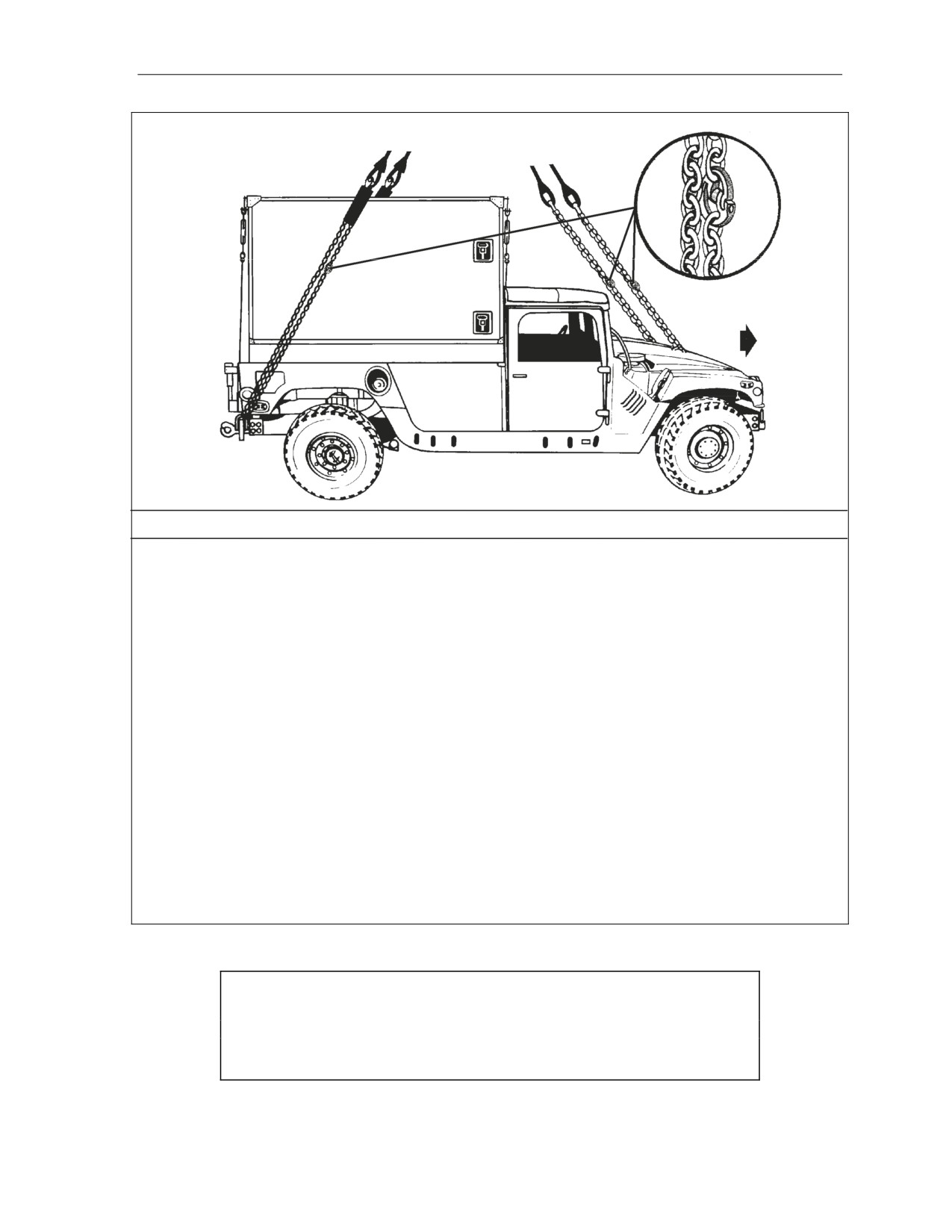
Certified Single-Point Rigging Procedures for Wheeled Vehicles
RIGGING STEPS
1. Position apex fitting on top of the shelter. Route outer sling legs 1 and 2 to the front of the
vehicle and inner sling legs 3 and 4 to the rear. Sling legs 1 and 3 must be on the left side of
the load.
2. Loop the chain end of sling leg 1 through the left front lift provision that protrudes through the
hood from inboard to outboard. Place the correct link from Table 2-6 in the grab hook.
Repeat with sling leg 2 and the right front lift provision. Secure excess chain with tape or
Type III nylon cord.
3. Route the chain end of sling leg 3 through the lift provision located on the left end of the rear
bumper from inboard to outboard. Place the correct link from Table 2-6 in the grab hook.
Repeat with sling leg 4 and the right rear lift provision. Secure excess chain with tape or
Type III nylon cord.
4. Wrap the rear slings with padding where they contact the shelter sides.
5. Raise the apex fitting above the shelter carrier keeping the slings to the side of the shelter.
6. Cluster and tie (breakaway technique) all sling legs together on top of the shelter to prevent
entanglement during hookup and lift-off.
Figure 2-6. M1097 Shelter Carrier with S-250/S-250E Shelter
CAUTION
Do not use the lift shackles located near the center of the rear bumper
for sling load lift provisions.
20 February 2009
FM 4-20.198/MCRP 4-11.3E, VOL II/NTTP 3-04.12/
AFMAN 11-223 (I), VOL II/COMDTINST M13482.3B
2-17
Chapter 2
M1037 SHELTER CARRIER (HEAVY HMMWV) WITH DOWNSIZED
DIRECT SUPPORT SECTION (DDSS) SHELTER
2-8. The M1037 shelter carrier HMMWV with downsized direct support section shelter is rigged for
single-point sling load using the following procedures:
z
Applicability. The following item in Table 2-7 is certified for all helicopters with suitable lift
capacity by the US Army Natick Soldier Center:
Table 2-7. Downsized Direct Support Section Shelter
Nomenclature
Max
Sling
Link Count
Weight
Set
Front/Rear
(Pounds)
Downsized Direct Support Section (DDSS)
8,030
10K
70/3
z
Materials. The following materials are required to rig this load:
Sling set (10,000-pound capacity).
Chain length, part number 38850-00053-101, from a 10,000-pound capacity sling set (4
each).
Coupling link, part number 5779125, from a 10,000-pound sling set (4 each).
Tape, adhesive, pressure-sensitive, 2-inch wide roll.
Cord, nylon, Type III, 550-pound breaking strength.
Webbing, cotton, 1/4-inch, 80-pound breaking strength.
Felt sheet, cattle hair, Type IV, 1/2-inch or suitable padding.
Padding, Cellulose.
z
Personnel. Two persons can prepare and rig this load in 15 minutes.
z
Procedures. The following procedures apply to this load:
Preparation. Prepare the load using the following steps:
─ Connect one additional chain length to each chain of the sling set with the coupling link.
─ Fold mirrors forward in front of the windshield for added protection and tie together with
Type III nylon cord.
─ Secure the shelter to the truck using wire rope or tie-down assemblies.
─ Remove the ladder from the rear of the shelter. Secure the ladder inside the shelter.
Secure all equipment inside the shelter with tape, nylon cord, or lashings; close and
secure shelter vents and door with nylon cord or tape.
─ Secure all equipment and cargo inside the vehicle with tape, nylon cord, or lashings.
Secure the doors shut if installed.
─ Ensure the fuel tank is not over 3/4 full. Inspect fuel tank cap, oil filler cap, and battery
caps for proper installation.
─ Engage the vehicle parking brake and put the transmission in neutral.
─ Ensure the front wheels are pointed straight ahead. Tie down the steering wheel, using
the securing device attached under the dashboard.
─ Tape the windshield in an X formation from corner to corner.
─ Install the lift provisions on the outer ends of the rear bumper by removing the tiedown
provisions located inboard of the bumper end and installing them on the outer ends of
the rear bumper.
Rigging. Rig the load according to the steps in Figure 2-7.
Note. Hookup of this load presents substantial risk of damage to the load or injury to the
hookup personnel. Use of a reach pendant is recommended for this load.
2-18
FM 4-20.198/MCRP 4-11.3E, VOL II/NTTP 3-04.12/
AFMAN 11-223 (I), VOL II/COMDTINST M13482.3B
20 February 2009
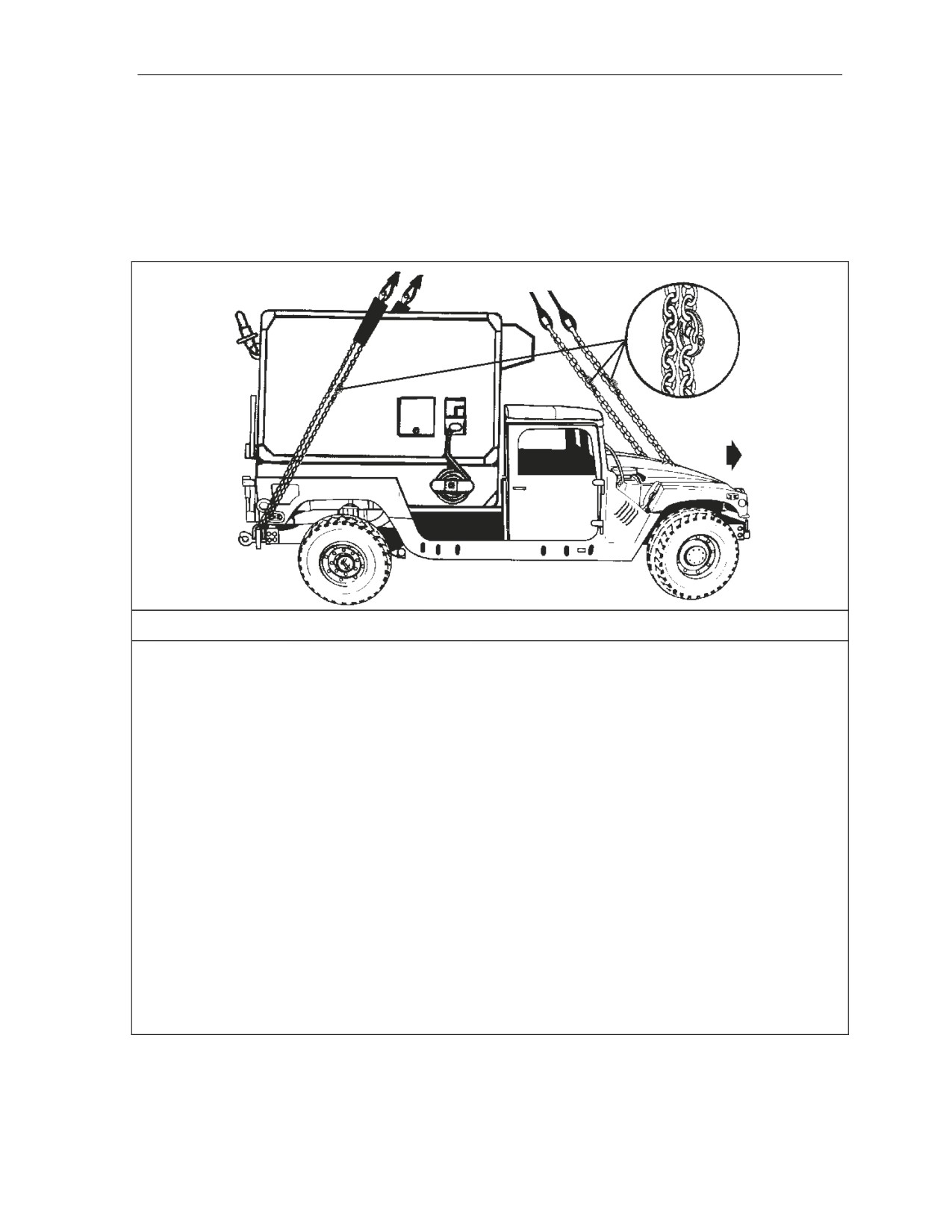
Certified Single-Point Rigging Procedures for Wheeled Vehicles
Hookup. The hookup team stands on top of the shelter. The static wand person discharges
the static electricity with the static wand. The hookup person places the apex fitting onto the
aircraft cargo hook. The hookup team then carefully dismounts the vehicle and remains close to
the load as the helicopter removes slack from the sling legs. When successful hookup is
assured, the hookup team quickly exits the area underneath the helicopter to the designated
rendezvous point.
Derigging. Derigging is the reverse of the preparation and rigging procedures.
RIGGING STEPS
1. Position apex fitting on top of the shelter. Route outer sling legs 1 and 2 to the front of the
vehicle and inner sling legs 3 and 4 to the rear. Sling legs 1 and 3 must be on the left side of
the load.
2. Loop the chain end of sling leg 1 through the left front lift provision that protrudes through the
hood from inboard to outboard. Place the correct link from Table 2-7 in the grab hook.
Repeat with sling leg 2 and the right front lift provision. Secure excess chain with tape or
Type III nylon cord.
3. Route the chain end of sling leg 3 through the lift provision located on the left end of the rear
bumper from inboard to outboard. Place the correct link from Table 2-7 in the grab hook.
Repeat with sling leg 4 and the right rear lift provision. Secure excess chain with tape or
Type III nylon cord.
4. Wrap the rear slings with padding where they contact the shelter sides.
5. Raise the apex fitting above the shelter carrier keeping the slings to the side of the shelter.
6. Cluster and tie (breakaway technique) all sling legs together on top of the shelter to prevent
entanglement during hookup and lift-off.
Figure 2-7. Downsized Direct Support Section Mounted on the M1037
20 February 2009
FM 4-20.198/MCRP 4-11.3E, VOL II/NTTP 3-04.12/
AFMAN 11-223 (I), VOL II/COMDTINST M13482.3B
2-19
Chapter 2
M1037 SHELTER CARRIER (HMMWV) WITH S-318 SHELTER
2-9. The M1037 shelter carrier with S-318 shelter is rigged for single-point sling load using the following
procedures:
z
Applicability. The following item in Table 2-8 is certified for all helicopters with suitable lift
capacity by the US Army Natick Soldier Center:
Table 2-8. S-318 Shelter
Nomenclature
Max
Sling
Link Count
Weight
Set
Front/Rear
(Pounds)
S-318 Shelter Mounted on M1037
7,440
10K
80/30
z
Materials. The following materials are required to rig this load.
Sling set (10,000-pound capacity).
Chain length, part number 38850-00053-101, from a 10,000-pound capacity sling set
(4 each).
Coupling link, part number 5779125, from a 10,000-pound sling set (4 each).
Tape, adhesive, pressure-sensitive, 2-inch wide roll.
Cord, nylon, Type III, 550-pound breaking strength.
Webbing, cotton, 1/4-inch, 80-pound breaking strength.
Felt sheet, cattle hair, Type IV, 1/2-inch or suitable padding.
Padding, cellulose.
z
Personnel. Two persons can prepare and rig this load in 15 minutes.
z
Procedures. The following procedures apply to this load:
Preparation. Prepare the load using the following steps:
─ Connect one additional chain length to each chain of the sling set with the coupling link.
─ Fold mirrors forward in front of the windshield for added protection and tie together with
Type III nylon cord.
─ Secure the shelter to the truck using wire rope or tie-down assemblies.
Secure all equipment inside the shelter with tape, nylon cord, or lashings;
close and secure shelter vents and door with nylon cord or tape.
─ Secure all equipment and cargo inside the vehicle with tape, nylon cord, or lashings.
Secure the doors shut if installed.
─ Ensure the fuel tank is not over 3/4 full. Inspect fuel tank cap, oil filler cap, and battery
caps for proper installation.
─ Engage the vehicle parking brake and put the transmission in neutral.
─ Ensure the front wheels are pointed straight ahead. Tie down the steering wheel, using
the securing device attached under the dashboard.
─ Tape the windshield in an X formation from corner to corner.
─ Install the lift provisions on the outer ends of the rear bumper by removing the tiedown
provisions located inboard of the bumper end and installing them on the outer ends of
the rear bumper.
Rigging. Rig the load according to the steps in Figure 2-8.
Note. Hookup of this load presents substantial risk of damage to the load or injury to the
hookup personnel. Use of a reach pendant is recommended for this load.
2-20
FM 4-20.198/MCRP 4-11.3E, VOL II/NTTP 3-04.12/
AFMAN 11-223 (I), VOL II/COMDTINST M13482.3B
20 February 2009
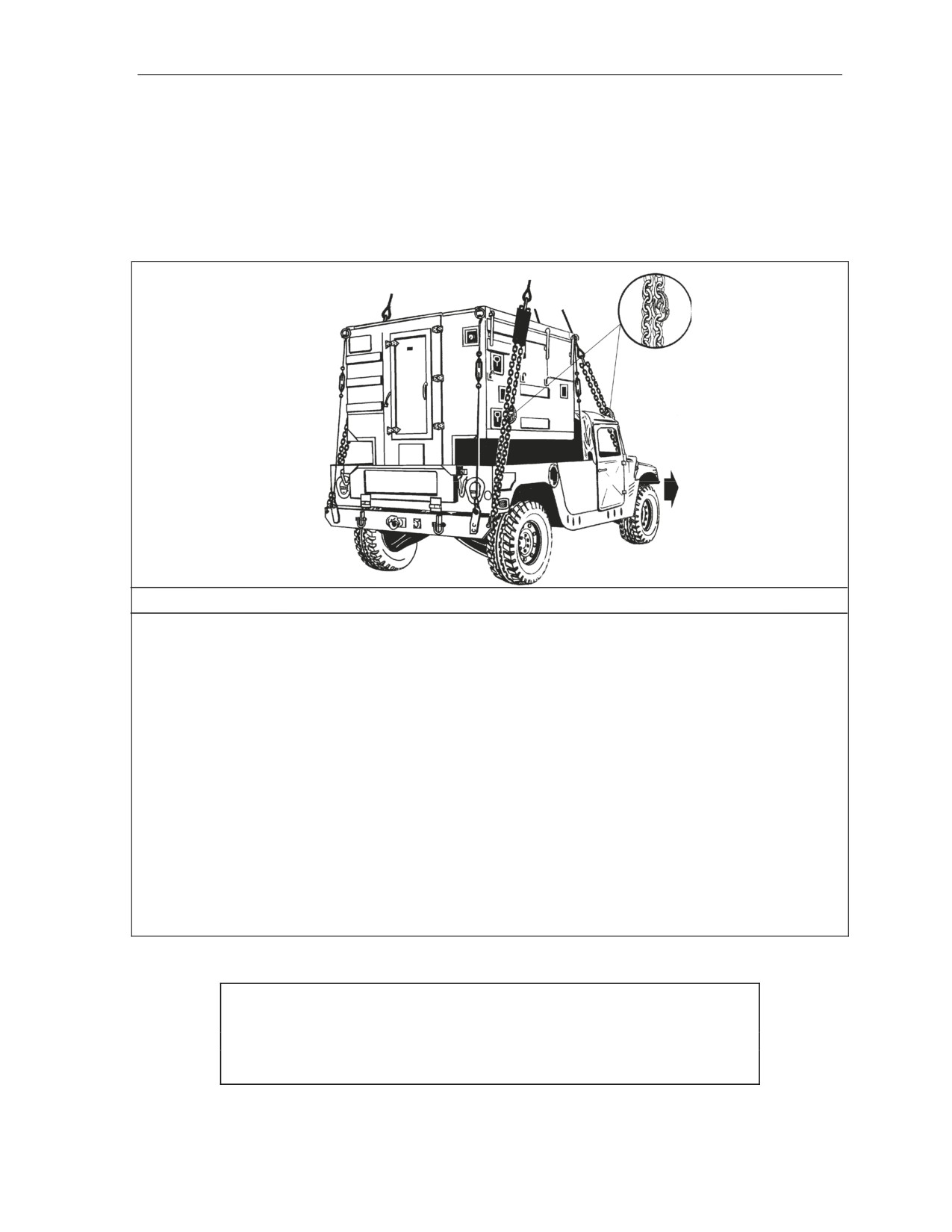
Certified Single-Point Rigging Procedures for Wheeled Vehicles
Hookup. The hookup team stands on top of the shelter. The static wand person discharges
the static electricity with the static wand. The hookup person places the apex fitting onto the
aircraft cargo hook. The hookup team then carefully dismounts the vehicle and remains close to
the load as the helicopter removes slack from the sling legs. When successful hookup is
assured, the hookup team quickly exits the area underneath the helicopter to the designated
rendezvous point.
Derigging. Derigging is the reverse of the preparation and rigging procedures.
RIGGING STEPS
1. Position apex fitting on top of the shelter. Route outer sling legs 1 and 2 to the front of the vehicle and
inner sling legs 3 and 4 to the rear. Sling legs 1 and 3 must be on the left side of the load.
2. Loop the chain end of sling leg 1 through the left front lift provision that protrudes through the hood from
inboard to outboard. Place the correct link from Table 2-8 in the grab hook. Repeat with sling leg 2 and
the right front lift provision. Secure excess chain with tape or Type III nylon cord.
3. Route the chain end of sling leg 3 through the lift provision located on the left end of the rear bumper
from inboard to outboard. Place the correct link from Table 2-8 in the grab hook. Repeat with sling leg 4
and the right rear lift provision. Secure excess chain with tape or Type III nylon cord.
4. Wrap the rear slings with padding where they contact the shelter sides.
5. Raise the apex fitting above the shelter carrier keeping the slings to the side of the shelter.
6. Cluster and tie (breakaway technique) all sling legs together on top of the shelter to prevent
entanglement during hookup and lift-off.
Figure 2-8. S-318 Shelter Mounted on the M1037
CAUTION
Do not use the lift shackles located near the center of the rear bumper
for sling load lift provisions.
20 February 2009
FM 4-20.198/MCRP 4-11.3E, VOL II/NTTP 3-04.12/
AFMAN 11-223 (I), VOL II/COMDTINST M13482.3B
2-21
///////////////////////////////////////