FM 3-19.13 LAW ENFORCEMENT INVESTIGATIONS (JANUARY 2005) - page 3
FM 3-19.13
Block 3. Have the interviewee write in the time and initial above it after
he signs the sworn affidavit located on the last page of the statement.
Block 4. Enter the CID or military police case file sequence number.
Block 5. Enter the interviewee’s last name, first name, and middle
initial.
Block 6. Enter the interviewee’s SSN.
Block 7. Enter the military or civilian pay grade of the person being
advised; for example, E3, O3, GS09, or “Civ” if there is no military
affiliation. If the person is in the military, indicate his status as either AD,
USAR, or USNG.
Block 8. Enter the interviewee’s complete military or governmental
organization including unit, installation, state, and zip code or APO or
FPO. If interviewing a civilian who does not have any military affiliation,
enter the his current home address including the city, state, and zip code
or APO or FPO.
Block 9. In most cases, the statement will consist of a narrative section
followed by a question and answer portion. The narrative format is where
the interviewee provides his version of events in a logical story-based
format in his own words (but not necessarily verbatim). After the entire
story is laid out in the narrative format, questions and answers will be
used to draw out inconsistencies, gaps, and other issues that are not clear.
If the elements of proof were not adequately addressed in the narrative,
they must be addressed by specific questions that will draw out these
details. Seasoned investigators may use several questions to resolve one
element of an offense, as opposed to formulating one question directly
from the UCMJ. For example, do not ask the interviewee “When you
struck the man in the head with the brick, did you intend to cause
grievous bodily harm or death?” because this almost compels him to lie.
Instead the investigator should ask the following:
z
“Why did you hit the man with the brick?”
z
“What did you think would happen when you hit him in the head with
the brick?”
z
“Did you think that hitting him in the head could seriously hurt him?”
z
“Why didn't you just use your fist?”
z
“Did you want to hurt this man?”
z
“Do you think striking someone with a brick could kill them?”
The responses to these broken down parts of the question are much more
likely to result in honest answers, because it would sound implausible to
say, “No, I just wanted to get his attention.” The entirety of the statement
must answer the who, what, where, when, why, and how of the crime. All
elements of proof for the crime must be addressed. Additionally, the
statement must specify the times and dates of specific acts and the
methods used to complete the crime. It must identify suspects,
accomplices, witnesses, and persons who knew of the crime. It must
account for stolen property and instruments used in the crime. It must tie
the evidence to the victim and/or to the interviewee. The interviewee must
be given the chance to edit the statement when it is completed. The first
step in this editing process is to ask, “Is there anything you would like to
4-38 Interviews and Interrogations
FM 3-19.13
add or delete from this statement at this time?” This question is repeated
until an answer of “No” is received. After the last word in the body of the
statement, write “End of Statement” to close it out. If the statement will
not fit on the front, back, and top of the final page of DA Form 2823, use
continuation pages. Begin the statement on the front of DA Form 2823.
Line out the reverse side with one diagonal line drawn from corner to
corner if the page is not needed. Do not include the lined-out side of the
form in the page count; it does not need to be initialed. Use white bond
paper for your continuation pages. Each page must have a heading giving
the same information as the heading of DA Form 2823 and bearing the
word “continued.” The bottom of each continuation page must show the
initials of the person making the statement and cite the page number in
relation to the total pages of the statement. Instructions for using
continuation pages can be found at the bottom of page 1, DA Form 2823
(see Figure 4-8, page 4-35). Conclude the statement on page 3 (final page)
where the affidavit is printed. Before administering the oath of
affirmation, the interviewee must read the entire statement, or have it
read to him. He must line through and correct all misstatements, errors,
and corrections as he edits the statement. It is generally an accepted
practice to program several easy to identify typographical errors into the
statement, which the interviewee should identify, correct, and initial
during his review. This helps to establish that the interviewee read the
statement before signing it and that he felt comfortable changing errors or
misstatements.
4-102. If preparing a statement on a typewriter and a mistake is made and
noticed while the statement is being typed, make slash marks over each letter
and leave a space for the interviewee’s initials. This way the wrong word can
still be seen, and it will not cause any doubt when and if the statement is
introduced into court. If a mistake is found after the statement is completed,
line the word out, write the correction above the mistake, and have the
interviewee initial it. Do not use correction tape or white correction fluid to
correct errors.
4-103. The affidavit is the last section of DA Form 2823. It states that the
information was given voluntarily and that all mistakes and corrections on
the statement were corrected and initialed by the interviewee. It shows that
the number of pages in the statement was verified. Before administering the
oath, the investigator must have the interviewee read the affidavit out loud,
which will allow the investigator to refute later claims that the interviewee
could not read and was too embarrassed to tell the investigator. The
interviewee could also claim that, even though he could not read, he signed
the statement to avoid ridicule. The investigator should then ask the
interviewee what the oath means to him. Having the interviewee state in his
own words what the oath means will allow the investigator to testify to the
interviewee's level of reading comprehension. Administering the oath is
accomplished when the investigator raises his right hand and has the
interviewee raise his right hand and asks, “Do you swear or affirm that this
statement is true and correct to the best of your knowledge, so help you God.”
If the interviewee objects to the use of the word God, the investigator deletes it
from the oath and then reads the oath again. After the interviewee answers
the oath in the affirmative, the investigator has him place his initials in
Interviews and Interrogations 4-39
FM 3-19.13
Block 2 and write in the current time in Block 3 along with his initials. The
investigator should also have the interviewee initial beside the first and last
word on the page and on the bottom of each page of the statement. The
interviewee signs the affidavit on the line above “signature of person making
statement” (page 3). The investigator signs the affidavit on the line above
“signature of person administering oath” (page 3). Additionally, the
investigator must type or print his name on the line above “typed name of
person administering oath” and the authority on the line above “authority to
administer the oath.” If the interviewee is subject to the UCMJ, the authority
is UCMJ, Article 136 (b)4. If the interviewee is a civilian, not subject to the
UCMJ, the authority is Section 303, Title 5, USC (5 USC 303). The affidavit
page is included in the page count of the statement even if it contains no text
from the statement. It is an integral part of the statement. See Figure 4-8,
page 4-35.
INTERVIEW SKETCHES
4-104. After completing the body of the interview or interrogation of the
suspect and before the closure, an interview sketch should be obtained.
Interview sketches are very effective in capturing routes that the suspect took
in committing the crime and fleeing from it. They also capture actions taken
in the commission of the crime, which include locations along the route where
each action occurred. The sketch should be hand drawn by the suspect and
should outline the area of the crime scene. The investigator can ask the
suspect questions pertaining to the “who, what, where, when, and how” of the
crime and then ask him to annotate his response on the sketch. The interview
sketch is a free-hand drawing of a scene or object relevant to the crime and
describes the actions taken during the crime. The sketch is only obtained after
full disclosure is reached. The suspect must draw the sketch as he remembers
it. Do not provide information that is pertinent to the crime; however, the
investigator can guide the suspect in the completion of the sketch. Relevant
facts, such as buildings, structures, and other pertinent features should be
included in the sketch, if possible, along with the entrance and exit points,
avenues of approach, and evidentiary items. The suspect should use the word
“I” when annotating his location in relation to the sketch and when writing
directions or routes he used during the commission of the crime. Once the
sketch is completed, the investigator should have the suspect sign and date it.
The investigator's printed name and signature should also be on the sketch as
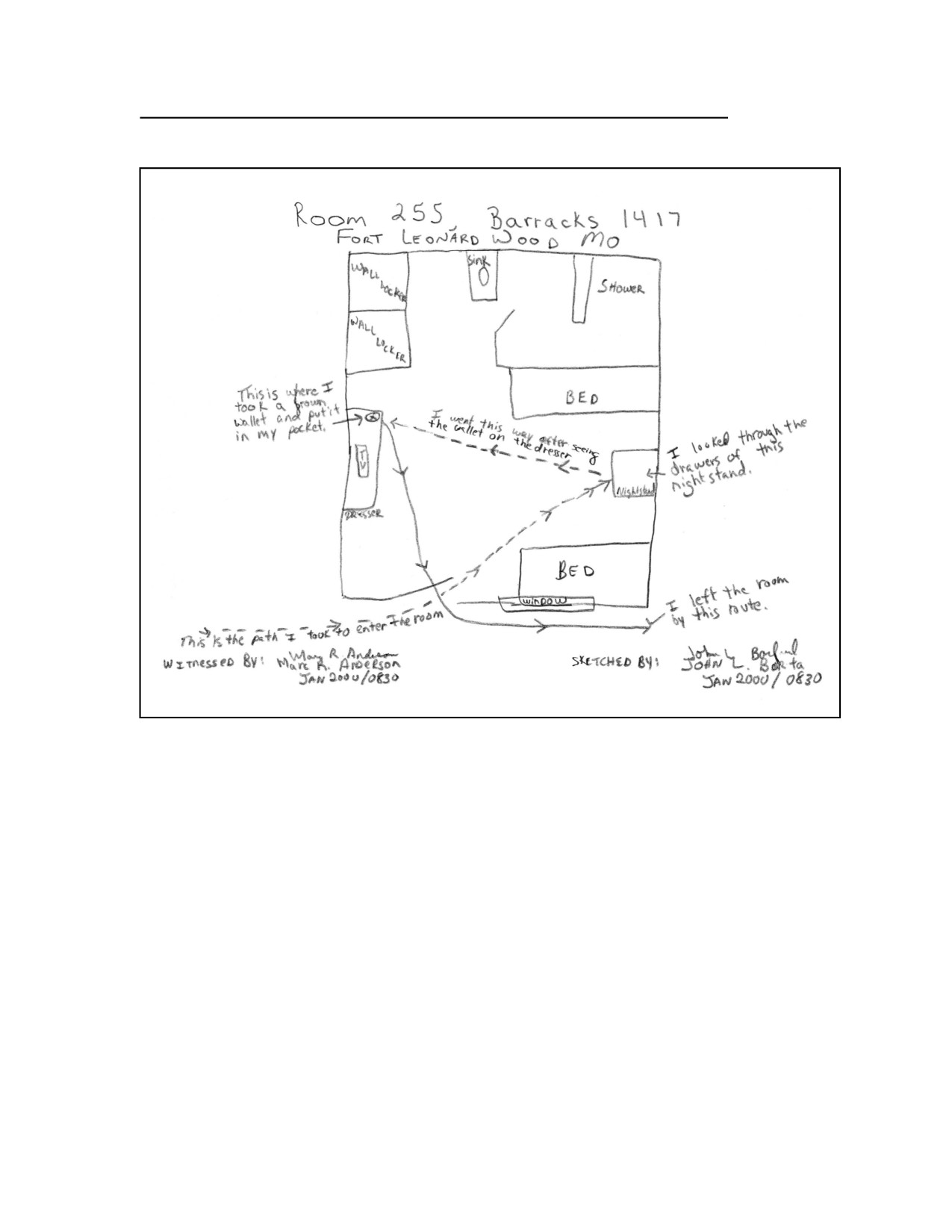
a witness. See Figure 4-11.
LETTERS OF APOLOGY
4-105. Letters of apology are extremely effective in interrogations involving
crimes against persons, but can be applied to other offenses as well. This is
especially effective when interviewing someone suspected of sexually abusing
multiple children but has confessed to only one incident with one child. The
investigator has the choice of taking a sworn statement from the suspect to
record his first confession or to go on with the interrogation in the hope that
the suspect will continue to cooperate.
4-106. At the point when a suspect has confessed to crimes against a
particular person, but the investigator needs to continue the interrogation for
4-40 Interviews and Interrogations
FM 3-19.13
Figure 4-11. Completed Sketch
other issues or to explore other potential victims, the investigator can explain
that it took a lot of courage to take responsibility for his actions. The
investigator can tell the suspect that it would be very beneficial if he would
tell the victim how he feels about what he did. The investigator should then
suggest that the suspect write the victim a letter taking responsibility for
what he did and telling the victim how sorry he is for hurting him.
4-107. Once the suspect has written the letter, if he has not specifically
addressed what he did to the victim, the investigator can urge him to come
straight out and tell the victim what he did, that it was wrong, and how he
feels about having done it. Writing this letter serves two very significant
purposes. First, it serves as a confession handwritten by the suspect. Second,
it places the suspect in the victim’s state of mind and helps him to view his
actions from the victim’s prospective.
4-108. Once the suspect is in this state of mind, he is significantly more
emotionally vulnerable, creating the perfect opportunity to transition into the
exploration of additional victims and/or crimes. Once the letter is obtained, it
is evidence in the investigation just as any other statement; however, a copy of
Interviews and Interrogations 4-41
FM 3-19.13
the letter should be provided to the victim's advocate for consideration as to
whether or not the letter should be provided to the victim. The advocate may
determine that the letter will only serve to further traumatize the victim or
decide that it will help the victim in the healing process. The decision whether
or not to provide the letter to the victim should be made by trained clinical
personnel.
SPECIAL CONSIDERATIONS
4-109. When conducting interviews, an investigator may encounter
individuals or situations that require special consideration. When this occurs,
the investigator should maintain his focus of discovering the truth. Distinct
regulations or guidelines may govern the conduct of certain interviews, but
they should not take away from the basic guidelines on conducting interviews.
SENIOR PERSONS
4-110. Whenever an allegation of criminality or impropriety against a senior
person is received, the local PM and USACIDC offices will be notified
immediately of the allegation. A determination will be made whether the
investigative responsibility is kept locally or sent to the Department of the
Army Inspector General (DAIG) to investigate the allegation. Under no
circumstances will a senior person be interviewed as a suspect or subject
without specific prior authorization from the designated investigative
command.
4-111. When a senior person reports to either the military police or USACIDC
field element that he is a victim of (or witness to) a crime, he is interviewed to
begin the investigative process. Whenever a senior person needs to be
interviewed as a victim or witness to an investigation, the field element
concerned will conduct the interview according to normal investigative
procedures. Senior persons are identified as the following:
z
A general or flag grade officer
(includes active and reserve
component).
z
A general officer or flag grade officer designee.
z
A DA civilian in the grade of GS16 or higher.
z
Any other person of equivalent rank who occupies a key position as
designated by the appropriate commander.
JUVENILES
4-112. A juvenile is identified as a person who is less than 18 years of age at
the time of the incident being investigated and who is not AD military.
Certain precautions must be observed when questioning juveniles regardless
of whether they are the victim, witness, suspect, or subject.
4-113. To get a complete and accurate story, investigators must avoid
alienating the juvenile. The use of abusive language, threats, or otherwise
abrasive behavior toward juveniles will in almost all instances only make it
more difficult to relate to them in general. Do not use condemning terms like
juvenile delinquent, thief, or liar. An investigator must be in control of his
emotions and temper at all times. In some situations, feigning anger
4-42 Interviews and Interrogations
FM 3-19.13
momentarily may be appropriate in adjusting an juvenile’s power base and
anxiety. In most cases, these behaviors will only create distance between the
juvenile and the investigator.
4-114. Avoid coercive practices or any acts that might push an innocent, but
frightened or emotionally troubled, juvenile to falsely confess. What most
juveniles, especially troubled juveniles, want more than anything is to be
respected, listened to, and understood. One of the greatest frustrations in
young people is that nobody listens to them, and most authoritative figures
talk down to them. Strong-arm tactics will reinforce this frustration and cause
the juvenile to retreat into his feelings of being misunderstood and oppressed.
4-115. Investigators can gain a juvenile’s confidence by treating him with
respect and dignity and encouraging him to take care of his immediate needs
and to reciprocate the respect being offered to him. A juvenile will normally be
interviewed in a noncustodial setting. He should not be interviewed in front of
his peers because he will feel the need to maintain a hard-line stance with
authority figures. Consider questioning a juvenile in his home if the parents
are cooperative and willing to work with investigators. However, if the
parents are making excuses for the juvenile without him offering any denials,
investigators will have to gain the support of the parents before conducting an
effective interview. To get the interview started, establish a bond of mutual
interest, respect, and experience. Treat a juvenile with consideration and be
friendly. When getting personal information, tell him why the information is
needed. While obtaining information from a juvenile, the investigator may
offer information about himself that will help the juvenile relate to him and
keep the interview going.
4-116. An interview or interrogation of a juvenile by an investigator of the
opposite sex should be conducted in the presence of a witness. When possible,
the witness should be of the same sex as the juvenile being interviewed. If the
juvenile to be interviewed is considered a suspect, the parent or guardian of
the juvenile should be present during the rights advisement process. The
juvenile should be advised of his rights against self-incrimination with the
consent of the parent or guardian. Further, the juvenile should be advised
that the interview could be terminated at anytime. In some cases, the
presence of the parents may be beneficial to the interview process. However,
in many instances, juveniles are reluctant to discuss misconduct in the
presence of their parents, and consideration should be given to asking the
parents to observe the interview in another room.
4-117. Avoid contacting juveniles at school, if possible. If circumstances
require that interviews be conducted at a school, the investigator must
observe certain precautions. Contact the school principal first and explain the
circumstances related to the interview and why it must be conducted at
school. Do not contact the student’s teacher or the student first. Ask if there is
a room in which the student can be interviewed. Never enter the classroom to
question or apprehend a student. Do not contact students at school during
hours when a number of other students may see investigators with the
juvenile. Remove a juvenile from school only as a last resort. If a student is to
be apprehended, investigators must explain this to the school officials and get
permission to take the juvenile from the school, unless specific court
instructions mandate otherwise.
Interviews and Interrogations 4-43
FM 3-19.13
4-118. Ensure that the juvenile’s parents have been notified if the student
must be removed from school. When an investigator detains or takes a
juvenile into custody for an offense, the following actions should be taken:
z
Immediately advise the juvenile of his rights in language that he
understands.
z
Promptly notify his parent or guardian and the local office of the SJA.
4-119. When juvenile subjects are in custody, they will not be fingerprinted or
photographed without the written permission of a federal judge responsible
for juvenile cases. This permission is required, regardless of consent by the
juvenile, parent, or guardian.
INTERPRETERS
4-120. Investigators may have to question suspects who do not speak English.
Although in an ideal scenario, the interrogator should be able to conduct the
interview in the suspect's native language. This is not always possible or
practical. An investigator should not attempt to conduct an interrogation by
himself in a foreign language, unless he is fluent in the required language.
4-121. When using interpreters, there are several considerations that should
be planned before the interview. It is best if the interpreter is a member of the
US armed forces or is a US citizen. If this is not possible, a qualified local
inhabitant can be used; however, it is essential that the interpreter being used
is completely trustworthy and understands that he should not edit what the
interrogator or the suspect says. Interpreters should be intelligent and
articulate. They should be able to quickly learn the habits, methods, and ways
of different investigators. They should be educated in the use of their own
language and English. Social and educational levels are often discernible by
speech habits or peculiarities. Interpreters must be able to express themselves
clearly and intelligibly to all persons whom they are likely to question. They
must be honest and free from criminal tendencies or affiliation. If they are
native to the area, they should be free from unfavorable notoriety among the
local populace. A good reputation and standing in the community prevents an
interpreter from being intimidated by persons of higher rank or standing.
They must be willing to accept a subordinate or supportive role in the actual
questioning of a suspect, which means they must be willing to permit the
investigator to ask the questions and to receive and evaluate the answers.
Additionally, they should understand that they are not to ask questions on
their own accord unless told to do so by the investigator. If the investigator
has an understanding of the language being used in the interrogation, he will
be better equipped to check the accuracy, loyalty, and obedience of the
interpreter. If the investigator does not have any familiarity with the
language used, it is good practice to have another linguist observe the
interview and report their observations to the investigator.
INTERPRETERS TRANSLATING QUESTIONS AND ANSWERS
4-122. The interviewer asks the suspect the questions and the interpreter
translates the questions as close to verbatim as possible. The interpreter then
translates the answer back to the interviewer who evaluates it and formulates
the next question. Investigators should prepare the questions they intend to
4-44 Interviews and Interrogations
FM 3-19.13
ask before initiating the interview. Questions should be clear and concise and
designed to invoke brief, factual answers. Direct the interpreter to make his
translation of long statements at regular and convenient pauses during the
suspect's utterances. The interruptions must come at the end of complete
thoughts, but not after extended statements, as the interpreter will naturally
abbreviate the response to only include those portions he believes are most
relevant. This may be challenging if the subject is allowed to give extensive
narrative versions of his account. Therefore, investigators should try to avoid
questions that take long explanations and invite digressions.
4-123. Whenever possible, the investigator should give the questions to the
interpreter in writing before the interview, so he can adequately prepare and
clarify questioning approaches before the interview. Additionally, the
interpreter may need to research specialized vocabulary in relation to the
specific offense. The investigator should be frontally aligned with the suspect
and look at him while issuing questions and listening to the responses. The
interpreter should generally observe the suspect, but try to limit eye contact,
which will encourage him to look at the investigator during the interview
process.
4-124. The interpreter should stand or sit to the side and slightly forward of
the investigator. This will allow the investigator to converse with the
interpreter, but still portray to the suspect that the investigator is conducting
the interview. The interpreter should not move around or do anything that
will distract the suspect’s attention from the investigator. The investigator
should address the suspect directly, looking him in the eye to hold his
attention. Ask questions slowly and clearly in concise and unambiguous
English. Do not use slang words or expressions unique to a region, which
could confuse the interpreter. Do not tell the interpreter to ask the suspect a
question. For example, do not say to the interpreter, “Ask him if he knows
John Doe.” Instead, say the question directly to the suspect in English, “Do
you know John Doe?” The interpreter translates the question into the
language of the suspect. The interpreter should do this promptly in a clear
and well-modulated voice. He should try to reproduce the tone and emphasis
used by the investigator. When the suspect answers the question in his native
language, the interpreter should repeat the answer in English, translating it
as literally as possible. Insist that the interpreter translate the suspect’s
answer directly. Do not permit the interpreter to reply, “He says he does.”
Investigators should get the answer through the interpreter as though the
suspect answered it in English, such as, “Yes, I know him,” using the first
person. If the investigator feels an explanation is warranted as to the word
selection of the suspect, he should ask the interpreter at a later time. If fact
clarification is required, additional questions should be posed directly to the
suspect by the investigator.
4-125. Hold digressions to an absolute minimum. Do not allow the suspect
and interpreter to begin an extensive conversation or argument. If the
investigator wants to take detailed notes, he needs to instruct the interpreter
to speak slowly and distinctly and to pause while notes are being recorded.
Use of a stenographer or a recording device may be warranted and used
within appropriate guidelines. If the stenographer speaks both languages, he
should record all statements made in both languages. This gives a means of
Interviews and Interrogations 4-45
FM 3-19.13
cross-checking the accuracy of the translation. The Status of Forces
Agreement (SOFA) is different in every country and effects how local
nationals are interviewed. Appropriate coordination must be made before
conducting these interviews.
NATIONAL GUARD MEMBERS
4-126. Personnel who commit criminal acts while on duty as a member of the
USNG may or may not be subject to the UCMJ. Therefore, before interviewing
a soldier in the USNG, determine if he was activated under Title 10, USC (10
USC) or Title 32, USC (32 USC). Whenever USNG personnel are deployed
overseas, they must be activated under 10 USC, which means they are subject
to the UCMJ. Personnel serving in the continental United States (CONUS)
are likely activated under 32 USC, meaning they are not subject to the UCMJ.
Before interviewing a USNG soldier, verify his status. The interviewer should
be familiar with the appropriate elements of proof under the statute that the
soldier can be charged with to determine if he may be interviewed in a
noncustodial setting. Because USNG soldiers activated under 32 USC are not
subject to the UCMJ, they may be interviewed without giving the UCMJ,
Article 31(b), warnings required of investigators who are subject to the
manual.
JOINT AND COLLATERAL CRIMINAL INTERVIEWS
4-127. The Memorandum of Understanding (MOU) (January 1985) between
the DOD and the DOJ, was implemented by DODD 5525.7 (which can be
found in AR 27-10). The MOU defines the respective investigative
responsibilities of the FBI and military criminal investigative organizations.
It establishes three categories of coordination with the FBI to determine
primary investigative responsibility in situations where dual responsibility
exists. Local military police and USACIDC units will conduct investigations
covered by those categories unless a US attorney directs otherwise or the FBI
makes a positive assertion of its investigative authority. When the FBI
undertakes an investigation in which there is an Army interest, it should be
undertaken as a joint investigation with military police and USACIDC
participation.
4-128. Questions concerning the types of coordination to be affected in any
particular case should be referred to the major subordinate command office of
the SJA. When investigative purview is in question, coordination of
investigations with the FBI must be conducted before any interview. When
conducting interviews or interrogations in conjunction with other
investigative organizations of interest, conduct them according to the
guidelines of the lead investigative organization. However, if such interviews
(especially with foreign organizations) deviate from military guidelines,
regulations, or laws, military investigators may not participate and may
choose to completely disassociate from these activities even if they are legally
permitted to do so for the other organization.
CONFESSION SUPPRESSION COUNTERMEASURE
4-129. In recent years, criminal defense attorneys and the military DC have
adopted numerous standardized tactics designed to suppress confessions. An
4-46 Interviews and Interrogations
FM 3-19.13
analysis of this trend indicates that confessions are very difficult obstacles for
the DC to overcome with panel members. Especially when evidence and
investigator testimony implicates the accused, along with a confession.
Consequently, panel members tend to be more ready to convict suspects who
admit to criminal misconduct.
4-130. In an attempt to gain acquittals, the DC will frequently attack the
veracity of confessions so he may more effectively argue away other evidence
presented during the trial process. The following are some examples of tactics
used by the DC to impugn confessions: (1) coercive tactics were employed to
gain a confession, (2) the suspect was denied his basic human rights, (3) the
suspect was not allowed to eat, sleep, or take breaks, (4) the suspect did not
actually read the statement, (5) the investigator put words into the suspect’s
statement that were not derived from the suspect, and (6) the investigators
were overbearing and/or abusive.
4-131. Confession suppression countermeasures are designed to thwart
future claims made by the DC. Many of these countermeasures have been
discussed throughout this chapter.
4-132. One of the most basic countermeasures is to program easy to identify
typographical errors within the body of the statement. When the suspect
corrects the errors, it demonstrates that he read the statement and felt
comfortable making changes to it before swearing that it was true and correct.
4-133. If the rapport-based interview style is used appropriately during
interrogations, suspects will like, respect, and trust the investigator at the
time of the interview. However, after speaking to counsel, the suspect will
often claim to have been maltreated. Therefore, asking questions within the
body of the statement designed to explore the suspect’s perception of his
treatment at the conclusion of the interview are very effective in refuting or
preventing future claims of abuse or coercion. Examples are as follows:
z
“How were you treated by CID and/or MPI today?”
z
“Why did you decide to tell me the truth today?”
z
“You were questioned for 10 hours today, were you allowed bathroom,
smoking, or meal breaks?”
4-134. Suspects who are treated with dignity and respect will respond in a
similar fashion. They will frequently answer with the following:
z
“I was treated with respect.”
z
“You were very professional and nice.”
z
“You were courteous but persistent.”
4-135. Although DC may try to attack sworn statements typed by the
investigator, interview sketches, letters of apology, and handwritten
statements will diminish future claims that investigators put words in the
suspect's mouth or that the suspect did not read his statement.
4-136. Videotaping I&I can also be instrumental in disproving claims of
coercion, overbearing investigators, and other alleged acts of misconduct on
the part of investigators. In the rapport-based interview process, investigators
are kind, caring, and compassionate toward suspects, which is in direct
contradiction to claims of abuse. However, the DC will use television interview
Interviews and Interrogations 4-47
FM 3-19.13
and interrogation tactics to reinforce these claims in the mind of the panel.
Recording the interview can serve to impugn or prevent these claims from
ever being made.
4-48 Interviews and Interrogations
PART TWO
Crime Scene Processing and Documentation
Part Two describes numerous legal and scientific requirements concerning the
collection, preservation, and documentation of evidence and crime scene processing.
Guidance on many of the technical aspects of crime scene photography is in Part
Two. The chapters of Part Two provide investigators and first responders with crime
scene control measures and safety considerations.
Chapter 5
Crime Scene Investigations
There is no steadfast rule that can be applied to defining the dimensions of
a crime scene. Areas that are well removed from the actual crime scene
frequently yield important evidence. The scene of a crime is, in itself,
evidence. Valuable physical evidence is normally found at or near the site
where the most critical action was taken by the criminal against the victim
or property. Just as it is likely to discover and develop critical evidence in
the immediate area surrounding the body in a homicide, the site of forcible
entry into a building often has the greatest potential for yielding evidence.
Technological advances in forensic science, coupled with the ability of
crime laboratories to successfully analyze evidence, have greatly increased
the investigator’s responsibility. Items not previously thought to be of
evidentiary value may hold the key to the successful identification or
elimination of a suspect or lead to the identification and conviction of the
offenders. The investigator is responsible for conducting a thorough
investigation of the crime scene and ensuring the proper collection,
preservation, documentation, and transportation of evidence.
LEGAL AND SCIENTIFIC REQUIREMENTS
5-1. The legal requirements concerning evidence are met when the
investigator can identify each piece of evidence, describe the exact location of
the item, indicate when the item was collected, and maintain and show a
proper chain of custody. The investigator or a trained crime laboratory
technician must also describe changes that may have occurred in the evidence
between the time it was collected and its introduction as evidence before the
court.
5-2. An investigator’s notes, photographs, and sketches become the legal
record of his actions and aid immeasurably with introducing physical evidence
in court. The written and photographic records of the scene also put the
Crime Scene Investigations 5-1
FM 3-19.13
presented evidence into perspective and help laboratory experts determine
what tests are needed. Finally, the investigator’s notes, photographs, and
sketches provide him with a valuable reference of his actions during the
processing of the crime scene. Investigators must be thoroughly familiar with
the techniques and procedures described in Chapter 6.
5-3. Crime scene processing in a deployed area can prove to be more
challenging, simply because of the lack of support and a possible hostile
environment. Appendix B contains a predeployment list which will assist in
preparing agents for conducting criminal investigations in a forward-deployed
area.
5-4. Scientific requirements in handling and processing evidence are met
when the investigator takes every precaution to minimize any change or
modification to the evidence. Biological materials always undergo some
change. Weather and other unavoidable circumstances may induce change in
some types of materials. The use of clean, spill-proof containers and proper
packing materials reduce spillage, evaporation, or seepage of a sample or
alteration of an item by accidentally scratching or bending it.
FIRST MILITARY POLICE RESPONDER
5-5. It is important for the first responder at the scene to be observant when
approaching, entering, and exiting a crime scene. He must engage every sense
to detect and determine the presence of potential threats, such as people,
chemicals, or explosive devices.
INITIAL RESPONSE
5-6. One of the most important aspects of securing the crime scene is to
preserve the scene with minimal contamination and disturbance of physical
evidence. The initial response to an incident should be expeditious and
methodical. Upon arrival, military police should assess the scene and treat the
incident as a crime scene.
5-7. Military police shall promptly, yet cautiously, approach and enter a crime
scene, remain observant of any people, vehicles, events, potential evidence,
and environmental conditions. Military police will—
z
Note or log dispatch information, such as the address or location, time,
date, type of call, and parties involved.
z
Be aware of any individuals or vehicles leaving the crime scene.
z
Approach the scene cautiously, scan the entire area to thoroughly
assess the scene, and note any possible secondary crime scenes. Look
for any individuals and vehicles in the vicinity that may be related to
the crime.
z
Make initial observations (look, listen, and smell) to assess the scene
and ensure officer safety before proceeding.
z
Remain alert and attentive. Assume that the crime is ongoing until it
is determined otherwise.
z
Treat the location as a crime scene until it has been assessed and
determined to be otherwise.
5-2 Crime Scene Investigations
FM 3-19.13
SAFETY PROCEDURES
5-8. The safety and physical well-being of military police and other
individuals, in and around the crime scene, is the first priority of the first
responding military policeman. The control of physical threats will ensure the
safety of military police and others that are present. Military police arriving
at the scene should identify and control any dangerous situations or
individuals. They should do the following:
z
Ensure that there is no immediate threat to other responders by
scanning the area for sights, sounds, and smells that may be
dangerous to personnel, such as HAZMAT, gasoline, and natural gas.
If the situation involves a clandestine drug laboratory, biological
weapons, or weapons of mass destruction (WMD), contact the
appropriate personnel or agency before entering the scene.
z
Approach the scene in a manner designed to reduce the risk of harm to
other military police while maximizing the safety of victims,
witnesses, and others individuals in the area.
z
Survey the scene for dangerous individuals and control the situation.
z
Notify supervisory personnel and call for backup and other
appropriate assistance.
EMERGENCY CARE
5-9. After controlling any dangerous situations or individuals, the next
responsibility of the first responding military policeman is to ensure that
medical attention is provided to injured individuals while minimizing
contamination of the scene. Assisting, guiding, and instructing medical
personnel during the care and removal of injured individuals will diminish the
risk of contamination and loss of evidence. The first responding military
policeman should ensure that medical attention is provided with minimal
contamination of the scene. The first responding military policeman should do
the following:
z
Assess the victim(s) for signs of life and medical needs and provide
immediate medical attention.
z
Call for medical personnel.
z
Guide medical personnel to the victim to minimize contamination or
alteration of the crime scene.
z
Point out potential physical evidence to medical personnel, and
instruct them to minimize contact with the evidence. For example,
ensure that medical personnel preserve all clothing and personal
effects without cutting through bullet holes or knife tears, and
document any movement of individuals or items by medical personnel.
z
Instruct medical personnel not to “cleanup” the scene and not to
remove or alter items originating from the scene.
z
Obtain the name, unit, and telephone number of attending personnel
and the name and location of the medical facility where the victim was
taken if medical personnel arrived first.
z
Attempt to obtain a “dying declaration” if there is a chance that the
victim may die.
Crime Scene Investigations 5-3
FM 3-19.13
z
Document any statements or comments made by the victims, suspects,
or witnesses at the scene.
z
Send a military policeman with the victim or suspect to document any
comments made, and preserve evidence if the victim or suspect is
transported to a medical facility. If military police are not available to
accompany the victim or suspect, stay at the scene and ask medical
personnel to preserve evidence and document any comments made by
the victim or suspect.
CRIME SCENE SECURITY
5-10. Controlling, identifying, and removing individuals at the crime scene
are important functions of the first responding military policeman in
protecting the crime scene. Controlling the movement and limiting the
number of persons who enter the crime scene are essential in maintaining
scene integrity, safeguarding evidence, and minimizing contamination.
Military police should—
z
Restrict individuals’ movement and activity to maintain safety at the
scene and prevent them from altering or destroying physical evidence.
z
Identify all individuals at the scene.
Suspects. They must secure and separate suspects from one
another.
Witnesses. They must secure and separate witnesses from one
another to prevent collaboration of their stories.
Bystanders. They must determine if bystanders are witnesses. If
they are witnesses, treat them as stated above; if not, remove
them from the scene.
Victims, family, and friends. They must control these individuals
while showing compassion.
Medical and other assisting personnel.
5-11. Military police must exclude unauthorized and nonessential personnel
from the scene. This includes military police not working the case, politicians,
media, and so forth.
BOUNDARY ESTABLISHMENT
5-12. Identifying perimeters assists in the protection of the scene.
Establishing the boundaries is a critical aspect in controlling the integrity of
evidentiary material. The perimeters of a crime scene may be easily defined
when an offense is committed within a building. When the perpetrator takes
the fruits of his crime away from the crime scene to another area, the
perimeter becomes more difficult to establish. If an offense is committed in the
open, such as in the desert, the perimeter of the offense becomes even more
vague. Regardless of the ease in which perimeters may be established, this is
a measure that must be determined at the beginning of the investigation. The
location and types of crime determine the number of crime scenes and the
boundaries. Boundaries are established beyond the initial scope of the crime
scene with the understanding that the boundaries can be reduced in size when
deemed necessary, but cannot be easily expanded.
5-4 Crime Scene Investigations
FM 3-19.13
5-13. The first responding military policeman at the scene should conduct an
initial assessment to establish and control the crime scene and its boundaries.
Military police should—
z
Establish the boundaries of the scene. Start at the focal point and
extend outward to include the following:
Location where the crime occurred.
Potential points and paths of the exit and entry of suspects and
witnesses.
Places where the victim or evidence may have been moved.
Military police must be aware of and protect trace and impression
evidence while assessing the scene.
z
Set up physical barriers to include ropes, cones, crime scene barrier
tape, available vehicles, personnel, or other equipment. Existing
boundaries, such as doors, walls, and gates can be used.
z
Document the entry and exit of all individuals entering and leaving
the scene once the boundaries have been established. Maintain a log of
each individual’s name, rank, SSN, unit, and telephone number.
z
Control the flow of individuals and animals entering and leaving the
scene to maintain the integrity of the scene.
z
Implement measures to preserve and protect evidence that may be
lost or compromised due to the elements (rain, snow, or wind) or
footsteps, tire tracks, sprinklers, and so forth.
z
Document the original location of the victim or objects that are being
moved. If possible, insist that the victim and objects remain in place
until the arrival of the investigation team.
z
Consider search and seizure issues to determine the necessity of
obtaining consent to search and/or obtain a search warrant. The
investigation team will generally perform this measure.
z
Ensure that no one—
Smokes.
Chews tobacco.
Uses the telephone or bathroom.
Eats or drinks.
Moves any items (including weapons) unless it is necessary for the
safety and well-being of individuals at the scene.
Adjusts the thermostat or opens windows or doors (maintain the
scene as it was found).
Touches anything unnecessarily (note and document any items
moved).
Repositions moved items, litters, or spits within the established
boundaries of the scene.
DOCUMENTATION OF ACTIONS AND OBSERVATIONS
5-14. The first responding military policeman must produce clear, concise,
documented notes attesting to his actions and observations at the crime scene.
However, all military police must record their activities at a crime scene and
note any observations they make as soon as possible after the event occurs to
Crime Scene Investigations 5-5
FM 3-19.13
preserve information. These notes, especially those of the first responding
military policeman, are vital in providing information to substantiate
investigative considerations. All notes must be maintained as part of the
permanent case. The first responding military policeman should record the
following:
z
Observations of the crime scene, to include the location of persons and
items within the crime scene.
z
The appearance and conditions of the crime scene upon arrival, such
as smells, ice, liquids, movable furniture, weather, temperature, or
personal items and whether the lights are on or off; the shades are up,
down, open, or closed; or the doors and windows are open or closed.
z
Personal information, statements, or comments from witnesses,
victims, and suspects.
z
The actions of others and any of his own actions.
5-15. Once the investigation team arrives to take control of the scene, the first
responding military policeman briefs the investigator in charge and
relinquishes responsibility of the scene. The military policeman then assists
the investigation team as necessary.
INITIAL NOTIFICATION TO THE INVESTIGATOR
5-16. Upon initial notification of an investigation, the investigator begins
making crime scene notes. The investigator annotates the date and time of
notification and how the complaint was received. He also obtains full
identification of the reporting party and the details pertaining to the initial
discovery. He must ask the following six “W” and “H” questions:
z
“Who is involved (subject, victims, and witnesses)?”
z
“What occurred?”
z
“When did the incident occur?”
z
“Where did the incident occur?”
z
“Why this type of crime, victim, and location?”
z
“How was the crime committed?”
5-17. The investigator determines the route of response and, upon arrival,
parks the vehicle in a safe place. The first investigator on the scene
approaches with caution to consider his safety.
INVESTIGATION TEAM ARRIVAL
5-18. This section covers the use of the investigation team concept. When an
investigator is the only one to respond to a scene, he must make adjustments
to these procedures to ensure that no steps are missed.
CONDUCT A SCENE ASSESSMENT
5-19. A scene assessment allows the investigator in charge to determine the
type of incident to be investigated and the level of investigation to be
conducted. The investigator can develop a plan for the coordinated
identification, collection, and preservation of physical evidence and for the
5-6 Crime Scene Investigations
FM 3-19.13
identification of witnesses. During the scene assessment, an exchange of
information between law enforcement personnel can occur. The investigator
in charge identifies specific responsibilities, shares preliminary information,
and develops investigative plans according to CID policy; federal, state, and
local laws; and the laws of the HN when applicable. The investigator in charge
should—
z
Talk with the first responding military policeman regarding his
activities and observations.
z
Evaluate safety issues, such as blood-born pathogens and chemical
hazards that may affect personnel entering the scene.
z
Evaluate search and seizure issues to determine the necessity of
obtaining consent to search and the requirement of obtaining a search
warrant.
z
Evaluate and establish a path of entry and exit to the scene to be used
by authorized personnel, such as medical, HAZMAT, and other law
enforcement agencies, if not already accomplished by the first
responders.
z
Evaluate the initial scene boundaries.
z
Determine and prioritize the number and size of the scenes.
z
Establish a secure area within close proximity to the scenes for the
purpose of consultation and equipment staging.
z
Establish and maintain communication with personnel when multiple
scenes exist.
z
Establish a secure area for temporary evidence storage according to
the rules of evidence and chain of custody.
z
Determine and request additional investigative resources as required,
such as personnel, specialized units, legal consultation, prosecutors,
and equipment.
z
Ensure continued scene integrity by documenting the entry and exit of
authorized personnel and other related actions and by preventing
unauthorized access to the scene.
z
Ensure that witnesses to the incident are identified and separated.
Obtain a valid identification from each.
z
Ensure that the surrounding area is canvassed and the results
documented.
z
Ensure that the preliminary documentation, such as notes,
photographs, and sketches of the scene, is complete. The initial
photographs should include any injured individuals and vehicles
involved in the incident.
CONDUCT THE PRELIMINARY SURVEY OF THE CRIME SCENE (SCAN THE SCENE)
5-20. The investigator should consider the crime scene unstable and fragile in
the sense that the evidentiary value of items can be easily degraded or lost.
Normally, there is only one opportunity to search the scene properly;
Crime Scene Investigations 5-7
FM 3-19.13
therefore, it is important that it is done right. Conduct the preliminary survey
by—
z
Performing a cautious “walk-through” of the scene.
z
Developing a general theory of the crime.
z
Recording the general condition of the scene.
z
Taking preliminary photographs and making videos.
z
Determining the extent of the search area.
z
Identifying and protecting fragile physical evidence.
z
Determining personnel and equipment needs.
5-21. If it is determined that the search could be lengthy, set aside an area
that is close (but outside the critical area) to use as a collection point for trash
generated during the search. Equipment not in immediate use should be
placed in this area. This area is also the designated break area for police
personnel. Using this type of area reduces the chance of contaminating the
scene.
5-22. By the end of the preliminary survey of the scene, the investigator
should have noted what obvious items of evidence should be collected. He
must decide the processing order and collect them. The order of collection is
predicated on how best to move through the crime scene without destroying
the value of the evidence. Some forms of evidence are easily collected, such as
a beer can or broken padlock. Others, such as a handprint on a sheetrock wall,
may require assistance from an outside agency. If this is the case, protect the
item of evidence (for example, with a plastic dome covering), check the item
for trace evidence; secure the covering over the surface containing the
evidence with evidence tape or paper-packaging tape; and note the time, date,
and initials of the investigator. Note the time, method of protection, and the
results of the check for trace evidence in the crime scene notes. The time and
method of protection must also be reflected in the evidence control document
when collecting the item.
5-23. If the scene is very large or more than one individual is going to search,
decide what should be searched and how the tasks and the area is going to be
divided. If the search must extend beyond the immediate crime scene, use
military police personnel for additional assistance.
CONDUCT A SCENE “WALK-THROUGH”
5-24. The scene “walk-through” provides the investigator in charge with an
overview of the entire scene. The walk-through provides the first opportunity
to identify valuable and fragile evidence and determine initial investigative
procedures. It provides a systematic examination and documentation of the
scene. The walk-through also identifies any threats to scene integrity. The
written and photographic documentation of the investigation team, along with
the notes of the first responding military policeman, provide a permanent
record of the crime scene. The investigator in charge conducts a walk-through
5-8 Crime Scene Investigations
FM 3-19.13
of the scene with the individuals who are responsible for processing the scene.
During the scene walk-through, the investigator in charge—
z
Uses the established path of entry to avoid contaminating the scene.
z
Prepares the preliminary documentation (notes, photographs, and
sketches) of the scene as it is observed.
z
Identifies and protects fragile and perishable evidence, considering
elements such as wind, rain, and snow. He also considers crowds,
hostile environments, and so forth.
EVALUATE PHYSICAL-EVIDENCE POSSIBILITIES
5-25. Evidence evaluation begins upon arrival at the scene and becomes
detailed based on observations from the preliminary survey. The investigator
determines what evidence is likely to be present. He concentrates on the most
transient evidence and works to the least volatile material.
5-26. The investigator focuses his efforts on easily accessible areas in open
view and progresses eventually to possible out of view locations. He considers
whether the evidence appears to have been moved inadvertently and
evaluates whether the scene and evidence appears to be intentionally
contrived.
INITIATE THE NARRATIVE
5-27. The investigator starts a narrative to record his findings. A narrative is
a running description of the crime scene and should include the following:
z
The case identifier number.
z
The date, time, and location.
z
The weather and lighting conditions.
z
The condition and position of the evidence.
z
The assignments of support personnel.
5-28. Nothing is insignificant to record if it catches the investigator's
attention. Under most circumstances, the investigator does not collect
evidence during the recording of the narrative, but rather, he makes
photographs and sketches to supplement, not substitute for, the narrative.
CRIME SCENE PROCESSING
5-29. When processing the crime scene, the investigator in charge has
multiple responsibilities. He must determine team composition, establish the
requirements for the contamination control of the evidence, verify the
requirements for scene documentation, conduct the search, and prioritize the
evidence collection. The investigator enforces the collection, preservation,
inventorying, packaging, transporting, and submission of evidence. As a
result of the scene assessment that the investigator in charge conducted
earlier, he can determine the number of personnel required and how
responsibilities will be assigned.
Crime Scene Investigations 5-9
FM 3-19.13
DETERMINE THE TEAM COMPOSITION
5-30. Based on the type of incident and the complexity of the scene, the
investigator in charge determines the team composition and decides what
specialized resources are required. Only trained personnel will perform scene
processing. Following the walk-through, the investigator in charge should do
the following:
z
Assess the need for additional personnel. Additional personnel may be
needed in cases with multiple scenes, victims, witnesses, or other
circumstances.
z
Assess forensic needs and request the assistance of forensic specialists
at the scene for their expertise and/or equipment.
z
Ensure that scene security and entry and exit documentation
continue.
z
Select qualified personnel to perform specialized tasks, such as taking
photographs, making sketches, lifting latent prints, and collecting
evidence.
z
Document team composition by name and assignment.
MINIMIZE CONTAMINATION
5-31. The investigator in charge minimizes the contamination of evidence by
implementing safe, clean, and careful procedures. These procedures are
implemented to ensure the welfare of all individuals at the scene and
maintain the integrity of the evidence. Other team members to include
investigators and other responders should do the following:
z
Limit access to the scene to those individuals directly involved in
scene processing.
z
Follow established entry and exit control routes at the scene.
z
Identify the first responders and collect elimination samples from
them.
z
Designate a secure area for trash and equipment.
z
Use personal protective equipment (PPE) to prevent contamination of
personnel and minimize scene contamination.
z
Clean, sanitize, or dispose of tools, equipment, and PPE between
evidence collections and scenes.
z
Use single-use equipment when directly collecting biological samples.
DOCUMENT THE SCENE
5-32. A well-documented scene ensures the integrity of the investigation and
provides a permanent record for later evaluation. It also assists in the final
written report and court testimony. A team member should do the following:
z
Review the assessment of the scene to determine what type of
documentation is needed.
z
Coordinate the notes, photographs, sketches, videos, and
measurements.
5-10 Crime Scene Investigations
FM 3-19.13
z
Take photographs of the following:
The scene using overall, medium, and close-up coverage.
The evidence collected with and without a measurement scale
and/or other evidence identifiers.
The victims, suspects, witnesses, crowds, and vehicles.
Any additional perspectives, such as aerial shots and the area
under the body once it is removed.
5-33. A team member may also videotape the crime scene as an optional
supplement to the photographs. Additionally, a team member prepares the
preliminary sketches and measures the following:
z
The immediate area of the scene, noting case identifiers (numbers)
and indicating which way is north on the sketch.
z
The relative location of items of evidence and the correlation of the
evidence items with the evidence records, such as the log and
DA Form 4002 (Evidence/Property Tag).
z
The evidence before it is removed.
z
The rooms, furniture, and other objects.
z
The distance to adjacent buildings or other landmarks.
5-34. The same team member, or another, generates the investigator’s notes
at the scene being sure to document circumstances that deviate from usual
procedures. (See Chapter 6 for investigator’s notes.)
CONDUCT THE SEARCH
5-35. A crime scene search is a planned, coordinated, and legal search
conducted by law enforcement officials to locate physical evidence. The search
is conducted in an efficient, systematic manner and covers the entire crime
scene area. The method used depends on the nature of the scene and the
characteristics of the crime. When an investigator decides his approach to the
crime scene search, he—
z
Establishes the perimeters of the crime scene search area.
z
Determines the search patterns.
z
Briefs the personnel.
z
Coordinates information.
z
Terminates the search.
Establish the Perimeters of the Crime Scene Search Area
5-36. The perimeters of a crime scene may be easily defined when an offense
is committed within a building. When the perpetrator takes the fruits of his
crime away from the crime scene to another area, the perimeter becomes more
difficult to establish. If an offense is committed in the open, such as in the
desert, the perimeter of the offense becomes even more vague. Regardless of
the ease with which perimeters may be established, this is a measure that an
investigator must determine at the beginning of the investigation. Identifying
the perimeters assists in the protection of the scene.
Crime Scene Investigations 5-11

FM 3-19.13
Determine the Search Patterns
5-37. A competent search of a crime scene demands close attention to detail.
Items and materials that may seem unimportant at first may later prove to be
critical to the case. For this reason, begin the search of a crime scene with
determination and alertness.
5-38. A successful crime scene search produces a comprehensive and
nondestructive accumulation of all available physical evidence within a
reasonable period of time. The search should minimize the movement and
avoid the unneeded disturbance of evidence. Conduct a crime scene by using
one or more of the following methods:
z
Circle search.
z
Strip search.
z
Grid search.
z
Zone or sector search.
5-39. The search method is determined by the intent of the search and the
area to be covered. In rooms, buildings, and small outdoor areas, a systematic
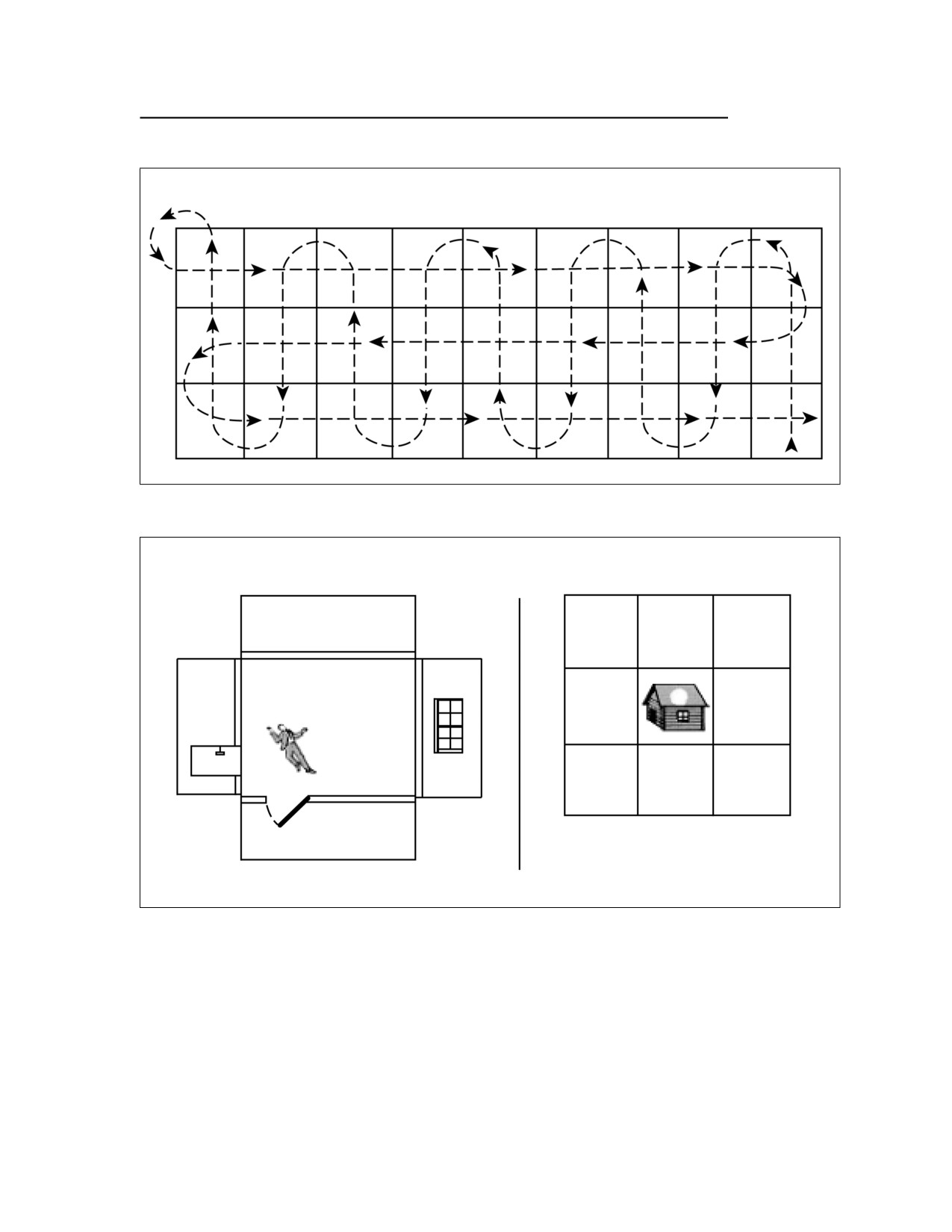
circle search is often used. In large outdoor areas a grid search is most useful.
After mentally dividing the area into strips about 4 feet wide, the searcher
begins at one corner of the main area and moves back and forth from one side
to the other, each trip being made within one strip. Then the searcher moves
from end to end. Both indoor and outdoor areas may be searched using the
zone or sector method. Refer to Figures 5-1, 5-2, 5-3.
Ever Widening
Narrowing
Figure 5-1. The Circle Search Method
Brief the Searchers
5-40. The searchers must be thoroughly briefed. They must be provided with
a full description of the evidence being looked for. Tell the searchers that the
evidence may have been hidden or discarded and what to do when they find a
5-12 Crime Scene Investigations
FM 3-19.13
End
Start
Figure 5-2. The Grid Search Method
3
2
3
3
1
2
1
2
2
4
3
2
3
5
1--Immediate area of importance
2--Contiguous areas
3--Other areas
Figure 5-3. The Zone or Sector Search Method
piece of evidence or an item believed to be the one being looked for. They
must—
z
Not touch or move the item.
z
Immediately report it to the person in charge of the search.
z
Protect the area until an investigator arrives.
Crime Scene Investigations 5-13
FM 3-19.13
Coordinate Information
5-41. The investigator in charge of a crime scene must integrate the
investigative efforts and findings with the requirements and findings of lab
examiners, morticians, and other technicians. The coordination involves the
lateral sharing of information discovered as it pertains to a crime. This is
particularly true of technicians on the scene. A delay in the sharing of
information may affect the successful recovery of physical evidence. Likewise,
a delay in providing information to investigators may delay the apprehension
of a suspect.
Terminate the Search
5-42. An investigator must determine when to terminate the search of a
scene. The extent and nature of the scene impacts the amount of time required
on that scene. Once an investigator believes that a scene has been fully
examined, he can terminate the search. If the investigator must temporarily
stop the search, perhaps to protect fragile evidence, he must secure the scene.
PRIORITIZE THE COLLECTION OF EVIDENCE
5-43. Prioritize the collection of evidence. The timely and methodical
preservation and collection of evidence prevents its loss, destruction, or
contamination. The investigator in charge and team members determine the
order in which to collect evidence. Team members should—
z
Conduct a careful and methodical evaluation considering all physical
evidence possibilities, such as biological fluids, latent prints, and trace
evidence.
z
Focus first on the easily accessible areas that are in open view and
proceed to the out-of-view areas.
z
Select a systematic search pattern to collect evidence based on the size
and location of the scenes.
z
Select a progression of processing and collecting methods so that
initial techniques do not compromise subsequent methods. The team
members must concentrate on the most transient evidence and work
toward the least transient. They must move from the least intrusive to
the most intrusive processing and collection methods.
z
Assess environmental and other factors that may affect the evidence.
z
Be aware of multiple scene victims, suspects, witnesses, vehicles, and
locations.
z
Recognize other methods that are available to locate, technically
document, and collect evidence, such as an alternate light source,
blood pattern documentation, and projectile trajectory analysis.
PROCESS CRIME SCENE EVIDENCE
5-44. The integrity of a crime scene should always be maintainted.Evidence
at crime scenes should be protected from contamination or other harmful
change. During the processing of the scene, evidence should be appropriately
packaged, labeled, and maintained in a secure, temporary manner until final
packaging and submission to a secured evidence storage facility or the
5-14 Crime Scene Investigations
FM 3-19.13
USACIL. See Chapter 19 for details on secure storage of evidence. The
handling of physical evidence is one of the most important factors of the
investigation; therefore, the team members must—
z
Maintain scene security throughout the processing and until the
release of the scene.
z
Document the collection of evidence by recording and photographing
its location at the scene, and by recording the name of the person who
collected it and the date.
z
Collect each item identified as evidence.
z
Establish the chain of custody for each piece of evidence.
z
Obtain standard or reference samples from the scene.
z
Obtain control samples.
z
Obtain elimination samples.
z
Secure electronically recorded evidence immediately, such as
answering machine tapes, surveillance camera videotapes, and
computers from the vicinity.
z
Identifying and securing evidence in containers at the crime scene.
This requires a team member to label, date, and initial the container.
The case number should be annotated, if known, when marking the
container. Different types of evidence require different types of
containers, such as porous, nonporous, and crushproof.
z
Package items to avoid contamination and cross-contamination. (See
Chapter 19).
z
Document the condition of firearms and weapons before rendering
them safe for transportation and submission.
z
Avoid excessive handling of evidence after it is collected.
z
Maintain evidence at the scene in a manner designed to diminish
degradation or loss.
z
Transport and submit evidence items for secure storage.
(See
Chapter 19).
CRIME SCENE INVESTIGATION DOCUMENTATION AND
COMPLETION
5-45. The investigator in charge establishes a crime scene debriefing team,
performs a final survey of the crime scene, and compiles the crime scene case
file to complete the investigation. The investigator in charge oversees the
debriefing team and the compilation of the case file while verifying accuracy
and completion.
ESTABLISH A CRIME SCENE DEBRIEFING TEAM
5-46. The crime scene debriefing is the best opportunity for law enforcement
personnel and other responders to ensure that the crime scene investigation is
complete. It enables law enforcement personnel and other responders to share
information regarding particular scene findings before releasing the scene. It
provides an opportunity for input regarding a follow-up investigation, special
requests for assistance, and the establishment of postscene responsibilities.
Crime Scene Investigations 5-15
FM 3-19.13
When participating in a crime scene debriefing, law enforcement personnel
and other responders should—
z
Ensure that the crime scene debriefing team includes the investigator
in charge of the crime scene, other investigators and evidence
collection personnel, such as photographers, evidence technicians,
latent print personnel, specialized personnel, and the first responding
military policeman (if still present).
z
Discuss what evidence was collected.
z
Discuss preliminary scene findings with the team members.
z
Discuss potential, technical forensic testing and the sequence of tests
to be performed.
z
Initiate any actions identified during discussions that are required to
complete the crime scene investigation.
z
Brief the person or persons in charge upon the completion of the
assigned crime scene tasks.
CONDUCT A FINAL SURVEY OF THE CRIME SCENE
5-47. Conducting a final survey of the crime scene ensures that all evidence
has been collected and the scene has been completely processed before release.
The investigator in charge directs a walk-through at the conclusion of the
crime scene investigation and ensures that the scene investigation is
complete. He ensures that—
z
Each area identified as part of the crime scene is visually inspected.
z
All evidence collected at the scene is accounted for.
z
All equipment and materials generated by the investigation are
removed.
z
Any dangerous materials or conditions are reported and addressed.
z
The crime scene is released according to jurisdictional requirements.
COMPILE A CRIME SCENE CASE FILE
5-48. Reports and other documentation pertaining to the investigation are
compiled into a case file by the investigator in charge of the crime scene. This
file is a record of the actions taken and of the evidence collected at the scene.
This documentation allows for independent review of the work conducted. The
investigator in charge obtains the following for the crime scene case file:
z
First responding military policeman's documentation.
z
Emergency medical personnel documents.
z
Entry and exit control logs.
z
Photographs and videos.
z
Crime scene sketches and diagrams.
z
Evidence documentation.
z
Documentation of other responders.
z
Record-of-consent form or search warrant.
z
Reports, such as forensic or technical reports. They should be added to
the file when they become available.
5-16 Crime Scene Investigations
Chapter 6
Notes, Photographs, and Sketches
An investigator should know the requirements necessary to document a
crime to include notes, photographs, and sketches. He must be skillful in
developing these tools. He must consider himself the “artist” of the crime
scene because all three of these tools are necessary to successfully
reconstruct the scene. The better an investigator is in the development of
these skills, the better the opportunity for solving a crime and convicting
the perpetrator.
NOTES
6-1. Taking good notes may be one of the most important actions an
investigator does while responding to and processing a crime scene. There are
two main reasons why notes are important. They represent the basic source of
information, or the raw material that will be used in the written report of the
investigation, and they aid an investigator in the recall of events for testimony
in court.
6-2. The type of notebook an investigator uses may seem to be immaterial,
but it can be of significant importance. Unless a separate notebook is used for
each case, a loose-leaf notebook is best for taking notes. A notebook may be
examined in court. If notes from several cases are included in the same book,
there is a chance of unauthorized disclosure of information on matters not
being dealt with in the case being heard. If a loose-leaf notebook is used, the
pages on other cases can be removed. Unauthorized disclosure of facts related
to other cases should be avoided.
6-3. An investigator should place his name and pertinent business
information on the inside cover of the notebook in case it is misplaced. At no
time should an investigator annotate his home address or phone number in
the notebook. The investigator’s objective should be to make notes that will be
meaningful months after the event. Notes that are unclear shortly after they
are written may later be unintelligible. Investigators should never expect to
rely on their memory of associated events to give single-word notes full
meaning. This becomes especially important when the investigator has to
write the report or testify in court. The formal written report may not require
the level of detail that is required for a testimony. The details recorded in an
investigator’s notes should anticipate both the needs of the written report and
the questions that an investigator may be called on to answer in court.
6-4. In cases involving a lot of physical material and a large crime scene, an
investigator may want to use a portable audio and/or video device. By taping
observations and findings, more details can be included in the notes. In all
Notes, Photographs, and Sketches
6-1
FM 3-19.13
cases, the tapes should be transcribed into a written record that may be
carried into court. An investigator should—
z
Keep his notes in a safe place with the local office case file. Even after
a criminal has been convicted and sent to prison, there is always a
chance that an appeal or another civil action will require an
investigator’s appearance in court again.
z
Print his notes if his handwriting is not easy to read. Use blue or black
ink that will not smudge easily.
z
Number each page of his notes and write his name, title or rank, the
case number (when known), and the current date on each page.
z
Record the time when an action is taken, information is received, and
an event is observed.
z
Not edit or erase notes. Line out an entry if a mistake is made, initial
it, and then write the correct information.
z
Include a detailed description of the scene and any item believed to be
pertinent to the case. The description should be as complete as
possible.
z
Record the exact location (the measurements and triangulation of
evidence) of where an item was found.
z
Cite the relative distances separating various items.
z
State the techniques used to collect evidence, and record identifying
marks placed on the item or the package in which the evidence was
placed.
z
Tell what techniques were used to provide crime scene security and
the methods used to search the scene.
z
Include any actions taken that may have a bearing on the evidence
obtained or that may significantly affect the investigation.
PHOTOGRAPHS
6-5. One of the most valuable aids to a criminal investigation is quality
photographs. When properly taken, photographs and a photograph log
supplement notes and sketches, clarify written reports, provide identification
of personnel, and are a permanent record of fragile or perishable evidence.
Photographs are of great value during every phase of the investigation and
any subsequent judicial proceedings. They may also be of great value if a
crime scene has to be reconstructed or questions arise concerning the
sequence of events, such as who was present during the initial investigative
phase or how did particular items of evidence appear at that time.
Photographs may be a judge’s or jurors' only view of a crime scene and prove
most useful when they closely duplicate the exact scene as seen by the
investigator.
6-6. Preserving and safeguarding images is important to the successful
introduction of forensic images in a court of law. The original image should be
stored and maintained in an unaltered state. This includes maintaining the
original digital images. The duplicates or copies should be used for working
images when applicable. Keep registered mail receipts and copies of work
orders for film processing in the case file.
6-2 Notes, Photographs, and Sketches
FM 3-19.13
6-7. The following medias are recommended for the preservation of original
images because of their quality, durability, permanence, reliability, and ease
with which copies may be generated:
z
Silver-based film negatives in 35-millimeter or larger format.
z
Write-once compact disk recordable (CDR).
z
Digital versatile disk recordable (DVD-R).
6-8. Time is an important consideration when photographing the crime scene.
Fragile trace evidence (such as tire tracks in rain or fresh snow) that is subject
to damage or destruction should be photographed before any other crime
scene processing is conducted.
CAMERAS
6-9. All cameras, whether they are film-based or digital, share common
characteristics. They all have a lens to form the image, some ability to focus
the image, and a place in a light tight box to hold film. All cameras work on
the same principle; light enters the lens and strikes either the film or the
digital chip. In the case of film, the silver halide molecules in the film are
“exposed.” This makes some areas darker on the negative than other areas.
The resulting negative can be printed. In the case of a digital camera, the light
energy is converted to electrical energy and the information is converted to a
usable computer-based file. The main components of the typical camera are
the lens, camera body, exposure meter, and film.
LENS
6-10. The lens is usually made of glass and metal or plastic components. The
lens is used to form an image on the film or chip. A 50-millimeter lens is
considered a normal lens for 35-millimeter photography. This means that the
50-millimeter lens approximates what the eye sees when you look at a scene
or object. There is less apparent distortion with the 50-millimeter lens than
with a wide-angle (28-millimeter) or a telephoto (200-millimeter) lens. The
lens usually has the following two aspects that require input from the
photographer:
z
Focus. Turning the front ring on the barrel of the lens changes the
focus. Point-and-shoot cameras sometimes have a fixed focus, where
anything from 8 feet to infinity is in the acceptable focus. Other
point-and-shoot cameras may have a variable or automatic focus.
Single-lens reflex (SLR) cameras have a variable or automatic focus.
The ability to precisely control focus is one of the main benefits of the
SLR.
z
Aperture or F-stop. Most cameras have an aperture range from F-2.8
to F-22. The aperture should be viewed as a fraction of the length of the
lens. A good rule of thumb is to make the aperture a fraction. Instead
of F-16, view it as 1/16. Instead of F-2.8, view it as 1/2.8. That will
assist in visualizing why F-16 is a smaller F-stop than F-2.8. The
aperture controls the amount of light entering the lens/camera. A
small aperture such as F-16 or F-22 allows less light to enter the
camera over a given time than a large aperture such as F-2.8. The
Notes, Photographs, and Sketches
6-3
FM 3-19.13
aperture also controls the depth of field. The depth of field is the range
at which objects being photographed appear sharp in the photograph.
At F-16, a sharp focus may be obtained over a range from 3 to 100 feet.
At F-2.8, sharpness may be obtained only from 3 to 5 feet. The larger
the F-stop (F-2.8), the less depth of field. This becomes critical when
doing close-up photography because the closer the object, the depth of
field is less.
CAMERA BODY
6-11. The camera body is nothing more than a lighttight box that holds the
lens on one end and the film on the other end. In the case of modern cameras,
various mechanical and electrical devices and controls allow adjustments.
Modern cameras also have shutters that allow the light to strike the film for a
specific period of time. The main adjustment on the camera body that requires
concern is the shutter speed. All modern cameras allow the user to adjust the
speed or the duration or time the shutter stays open. Most cameras allow
shutter speeds from 8 seconds to 1/4000 second. This is important because it is
impossible to handhold a camera at a slow shutter speed and get a sharp print
due to camera movement. The basic rule of thumb is to use the lens length to
determine the lowest possible shutter speed that a camera can safely be
handheld. With a 50-millimeter lens, a camera should not be handheld at a
shutter speed that is less than 1/60 second. With a 200-millimeter lens, a
camera should not be handheld at a shutter speed less than 1/250 second.
EXPOSURE METER
6-12. Exposure is determined by the amount of light falling on the object
being photographed. A bright sunny day requires less exposure than a rainy,
cloudy day. The meter in the camera automatically adjusts the camera
exposure to provide acceptable pictures in most cases. The two adjustments
that can be made are the aperture and shutter speed. They are interrelated
and a change in one affects the other. If the exposure value is 10, the camera
meter might give a proper exposure of F-8 at 1/60 second. If a greater depth of
field were needed, the aperture would be changed, increasing the aperture
from F-8 to F-16. The automatic exposure meter in the camera would
automatically slow down the shutter speed to 1/15 second to maintain the
correct exposure. This would cause a problem. The camera could no longer be
handheld with a normal 50-millimeter lens and get sharp photographs.
Therefore, a tripod must be used. The general rule is the slower the shutter
speed, the smaller the aperture opening and the faster the shutter speed, the
larger the aperture opening.
FILM
6-13. The selection of film is very important. Films come in various speeds. A
film with a slow speed, such as 100 International Organization for
Standardization (ISO), will have a finer-grain structure and better resolution
than a faster film, such as 400 ISO. This allows photographs to be taken with
greater resolution and detail. A faster film allows for a greater depth of field
and works better in low-light conditions. However, the faster film has larger
grains of silver embedded in the emulsion. While that makes the film more
6-4 Notes, Photographs, and Sketches
FM 3-19.13
sensitive to light, it increases the grain structure and causes lower resolution.
An investigator might not wish to use the faster film if the photographs are
going to be enlarged to show fine details, such as those found in tire tracks,
footwear, or fingerprints.
6-14. The following are three general types of film:
z
Color negative. Used for most general and all violent crime scene
photographs. Most color negative film has less contrast and resolving
ability than black and white film. It generally comes in speeds of 100
ISO to 800 ISO. While the 800 ISO film may allow the camera to be
handheld without a flash or tripod, the grain structure is large and
results in low resolution (less detail).
z
Color reversal. Also known as slide film and is used only when color
slides for projection or presentation purposes are desired. Color
reversal film is not to be used for crime scenes because color prints
made from color “slides” do not have good resolution and generally
have increased contrast levels.
z
Black and white film. Used when high-resolution photographs are
needed. Black and white film should be used when photographing
items that may require examination at the laboratory. Tire tracks,
footwear, and latent fingerprints should be photographed with black
and white film. Black and white film is usually found in speeds of 100
ISO to 400 ISO.
CRIME SCENE PHOTOGRAPHY
6-15. The crime scene is photographed as soon as possible and before any
evidence is disturbed. Photographs are not a substitute for crime scene
sketches. All photographs are documented in a photograph log with camera
positions indicated on a sketch. The crime scene photograph log records the
photograph and describes the type of photograph. The photograph is precisely
identified, and the identifying data is recorded as each shot is taken. See
Figure 6-1, page 6-6.
6-16. The camera positions and distances are also recorded in the crime scene
photograph log. This is achieved by measuring from a point on the ground
directly below the camera lens to an object used as the focus point for the
picture. In making overall crime scene photographs, it is best to keep the
camera at about eye level. Take overlapping photographs of interior scenes
intended to depict an area as a whole, moving in one direction around the
room or area.
6-17. One of the most important elements in investigative photography is
maintaining perspective. Photographs must reproduce with the same
impression of relative position and size of visible objects (the scene as it would
appear to someone standing in the photographer’s shoes). Any significant
distortion in perspective will reduce, or destroy altogether, the evidentiary
Notes, Photographs, and Sketches
6-5
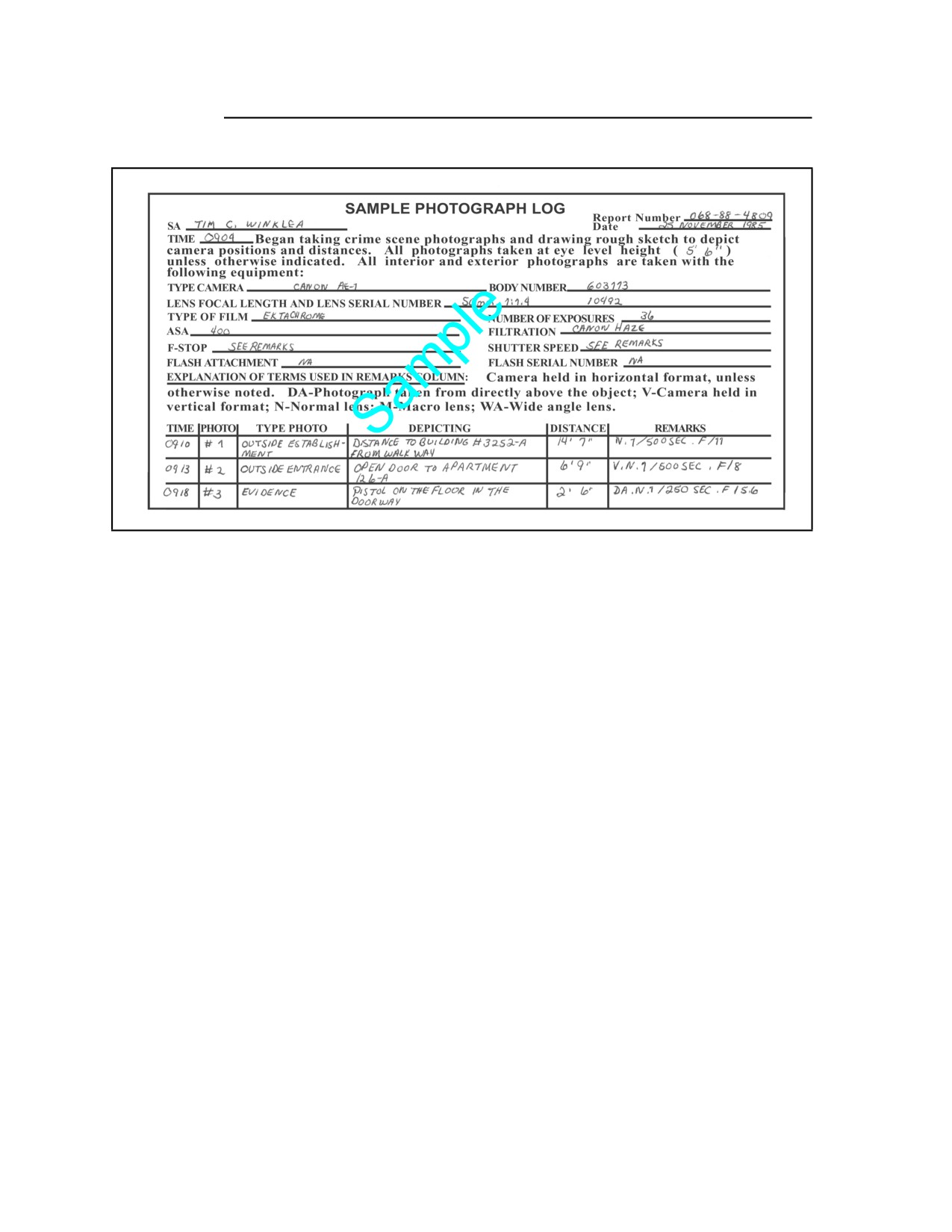
FM 3-19.13
Figure 6-1. Sample Photograph Log
value of the photograph. An investigator taking basic crime scene
photography should—
z
Not assume that the confines of the crime scene have been properly
identified or that they have been properly secured.
z
Watch where he is walking, and consider that he might be walking on
evidence while concentrating on obtaining photographs.
z
Photograph evidence before recovery.
z
Photograph a room or area from eye level to represent a normal view.
z
Ensure that a progression of overall, medium, and close-up
photographs of any objects of evidence are taken.
z
Photograph the interior crime scene using a series of overlapping 360°
photographs and a wide-angle lens.
z
Photograph the exterior crime scene establishing the location of the
scene by a series of overall photographs including landmarks.
Photographs should have a 360° coverage.
z
Consider aerial photography to capture large areas, roads, and other
means of approach or departure. Coordinate with the laboratory on
proper aerial-photography techniques.
z
Use a ruler for size determination (scale). Always photograph the item
without the ruler first.
z
Photograph areas adjacent to the crime scene, such as points of entry,
exits, windows, and attics.
z
Photograph items and places to corroborate the statements of
witnesses, victims, and suspects.
6-18. All evidence should be photographed three times. An evidence-
establishing photograph should be taken to show the evidence and its position
6-6 Notes, Photographs, and Sketches
FM 3-19.13
in relation to other evidence, and a close-up photograph that fills the frame
should be taken with and without a ruler.
6-19. For a photograph to have the highest quality as evidence, it must depict
the scene, person, or object precisely as it was found. Photography is an
exclusive function of the crime scene and must not include people working or
extraneous objects in the image.
6-20. Photographs are admissible in court if the investigator can testify that
they accurately depict the area or item observed, and the personnel who
captured the original image or who were present at the time the original
image was captured can verify that the image is a true and accurate
representation. The accuracy of a photograph relates to the degree that it
represents the appearance of the subject matter as to form, tone, color (if
applicable), and scale. A lens other than normal (50 millimeter) may not
correctly portray distances between objects or show them in proper
perspective. In these situations, crime scene sketches and notes play strong
supporting roles.
6-21. Because scale, distances, and perspective are important in interpreting
photographs taken at crime scenes, always include a ruler. Because some
courts may not allow even this minor modification to the scene, an identical
photograph without the ruler must first be taken.
FLASH PHOTOGRAPHY
6-22. A flash should be used when exposing photographs inside a building or
whenever there is a general lack of light. Most electronic flashes are
automatic and do not require adjustment from the operator. Remember the
following rules when using an electronic flash for crime scene photography:
z
Remove the flash from the camera and use a flash extension cord
when taking close-up fingerprint and toolmark photographs. This
prevents “hot spots” of light that can cause severe overexposure to the
top part of the photograph. Do this by using the following procedures:
Place the camera on a tripod; do not attempt to handhold it.
Ensure that the camera back is parallel with the latent print. If
the photograph is taken at an angle, the print will not be
completely in focus.
Fill the viewfinder of the camera with the latent area. Get as close
as possible. Focus carefully. There is an extremely shallow depth
of field when focusing on a close object. Unless the camera back is
kept parallel and a small F-stop (F-11 through F-22) is used, parts
of the evidence will probably be out of focus in the photograph.
Hold the flash 1 to 2 feet away and at about a 45° angle from the
evidence being photographed.
Expose several frames at different flashes to subject distances and
angles.
z
Remove the flash from the camera and use the flash extension cord to
create shadows in the impression when taking footwear and tire track
photographs. This will result in increased contrast or detail in the
Notes, Photographs, and Sketches
6-7
FM 3-19.13
negative, which the laboratory will enlarge for examination. Do this
by using the following procedures:
Place the camera on a tripod, and ensure that the legs of the
tripod do not obscure the footwear or tire track impressions. Focus
and fill the frame. Do not attempt to take usable examination type
photographs from 6 to 10 feet away.
Ensure that the back of the camera is parallel with the
impression. If the impression is on sloping ground, ensure that the
camera back slopes in the same direction and at approximately
the same degree.
Ensure that there is at least a
6-inch ruler visible in the
photograph. The ruler should be at the same level as the bottom of
the impression to allow enlargements to life-size photographic
prints.
Attach the flash to the off-camera flash synch cord. Take a series
of photographs with the flash held about 3 feet away at a 45° angle
to the impression. Expose numerous photographs varying the
angle and distance of the flash from the impression. The minimum
number of exposures should be two each from all four directions,
front, back, and two sides of the impression. This will provide the
laboratory with usable negatives for later examination and
comparison.
Shoot some photographs at the recommended meter setting, such
as 1/250 at F-11 when photographing impressions in snow. Then
shoot several photographs at a higher exposure, such as 1/125 at
F-11 or 1/60. Bright objects can fool in-camera exposure meters.
Photograph longer impressions, such as tire tread patterns, in
segments of 1 to 2 feet in length. Ensure that the sections overlap.
Place the camera on a tripod to assist in keeping the same camera
to the subject distance. This is important when sizing and printing
later in the darkroom.
SPECIALIZED PHOTOGRAPHY
6-23. Some crime scenes require specialized photography because of the type
of film required, the type of shot required or the manner in which shots must
be taken, or the uniqueness of the crime or scene. Specialized photography is
required for arson scenes, death scenes, and autopsies.
Arson Scenes
6-24. All arson scenes should be shot with color film, especially if the fire is in
progress. At arson scenes, an investigator will work with either an active or
inactive fire scene. At an active fire scene, the investigator must use caution
in photographing the fires due to the many dangers present. The investigator
must always follow the orders of the fire chief. Do the following at an active
fire scene:
z
Photograph the fire in progress using a tripod from all angles or sides.
z
Use color film. The color of the flame and smoke may provide
information regarding the accelerant and the temperature of the fire.
6-8 Notes, Photographs, and Sketches
FM 3-19.13
z
Photograph the entire fire at intervals, keeping note of times. This
will show the speed of progression.
z
Photograph the crowd in small segments so that faces are identifiable.
Many times arson suspects will remain at the scene to watch the fire.
6-25. At an inactive fire scene, the investigator must use caution and
coordinate with the fire chief before entering the scene. At an inactive fire
scene, the investigator should do the following:
z
Photograph the exterior from all sides and the interior using 360°
overlapping photographs.
z
Be aware that when photographing burned areas, 2 to 3 extra F-stops
of exposure are needed. The investigator will have to override the
camera’s built in meter, take a reading with it on automatic, and
switch it to manual and increase the exposure by 2 to 3 F-stops
(decrease the shutter speed or increase the aperture setting). Because
dark, charred areas do not reflect a great deal of light, extra exposure
is required to show the charred patterns. Always use a flash and
tripod to photograph all fire scenes.
z
Have the fire chief point out the suspected point of origin. Photograph
that area and its relationship to the rest of the area or building. Pay
attention to an “alligator” pattern charring because it shows the
intensity of the fire.
z
Photograph anything of possible evidentiary value, such as cans,
bottles, strings, wires, or matches.
z
Photograph any suspected points of entry.
z
Photograph areas that are adjacent to the fire scene to show the
proximity of other structures, if present.
z
Photograph any voided areas where items, such as, knick-knacks,
televisions, or stereos could have been removed. This may indicate
arson by the owner.
z
Photograph electrical junction boxes and the main electrical box in the
building.
z
Watch for trail patterns where an accelerant could have been used.
Death Scenes
6-26.
All death scenes should be photographed using color film. The
investigator should do the following:
z
Take an integrity photograph before entering the area where the
deceased is located. This records the area before anyone enters and
disturbs the scene. This action is secondary to rendering first aid to a
living victim.
z
Photograph the area of the deceased with
360° overlapping
photographs.
z
Photograph the deceased from all four sides.
z
Take several identification photographs of the individual’s face.
z
Photograph all wounds, abrasions, or other marks on the deceased.
Photograph with and without rulers.
Notes, Photographs, and Sketches
6-9
FM 3-19.13
z
Photograph the overall scene and establish close-up photographs of all
potential evidence, such as weapons or pill bottles.
z
Photograph livor mortis patterns if present before moving the
deceased.
z
Photograph all bloodstains on the skin and clothing of the victim, with
and without a ruler, before removal. Movement of the deceased can
alter the bloodstain patterns.
z
Photograph all signs of gunshot powder stippling or tattooing or the
lack of it in all firearm-related deaths. Much of the powder pattern can
inadvertently be washed off during the autopsy.
Autopsy
6-27. Always use color film to photograph autopsies. When using a scale in
close-up photographs, use white, gray, or a combination of both to allow the
person printing the photographs to balance the lighting. This also reduces the
green color that is usually obtained when shooting film under fluorescent
lights. The investigator should do the following:
z
Take overall shots to record the entire body from all angles, to include
the front and back. The use of a wide-angle lens may be required.
Photographs must be taken both before and after the body is
undressed and cleaned up.
z
Photograph the face to include the front, profile, and any unique facial
or dental features. Take several photographs of the face straight on
using a normal focal length lens (50 millimeter) to avoid distortion. A
ladder may be required to accomplish this.
z
Photograph old scars (including those as a result of operations or
previous injuries) and tattoos.
z
Photograph wounds by taking orientation photographs and close-up or
macrophotographs with and without a ruler. The ruler must be
parallel with the camera back so that the photographs can be printed
life-size, if necessary. This is especially important if impressions from
belt buckles, threaded pipes, or bite marks are present.
z
Photograph internal injuries, by taking orientation and close-up
photographs.
z
Photograph projectiles while still in the body and once they are
removed.
z
Photograph anything noted by the pathologist as being out of the
ordinary or anything that proves or disproves the facts or witness
testimony. Use the photographs to substantiate and document the
findings, both pathological and investigative.
6-28. When photographing organs or objects removed from the body, ensure
that the item is wiped off and there is a clean “field” behind it. A clean cloth
works best. Bloody objects, such as a table, clothes, or other items in and
around the area being photographed, are distracting and can confuse the
viewer.
6-10 Notes, Photographs, and Sketches
FM 3-19.13
6-29. Investigators should expose all necessary identifying photographs of the
genital area as soon as possible. If no defects exist in and around the genitalia,
investigators should then cover that area with a small cloth.
SURVEILLANCE PHOTOGRAPHY
6-30. All surveillance photography should be taken using high-speed black
and white film (400 ISO or higher). In surveillance photography, a longer
length lens, such as 200 to 500 millimeter, is almost always required. The
investigator should do the following:
z
Select the lens remembering that the general rule to obtaining a
recognizable image of a face is to use 2 millimeter of lens focal length
for each foot of distance between the camera and the subject. A
200-millimeter lens will give a recognizable facial image at 100 feet.
z
Use a tripod and a cable release. A long lens magnifies movement. If
the camera or lens is not stable, the photographs will show movement
and will result in blurry images. If no tripod is available, brace the
lens against a wall or tabletop. In a vehicle, a side window can be
rolled partway down with the lens resting on the top edge of the
window. Ensure that the vehicle engine is turned off to avoid any
vibration. Remember to always use a shutter speed that is faster than
the length of the lens; for example, if using a 200-millimeter lens, use
a 1/250 second shutter speed. Besides obtaining a facial image on the
film large enough to identify, the most important consideration is to
have a fast shutter speed, usually 1/250 second or faster to stop
motion.
z
Shoot several exposures of each subject and/or transaction.
z
Recognize that the depth of field is less important when doing
surveillance photography than the shutter speed. The lens can be
opened to the widest aperture in order to gain a faster shutter speed.
Focus carefully because the depth of field (range of acceptable focus)
will be very shallow at wider apertures, such as F-2.8 or F-4.
PHOTOGRAPHY OF SCENES AND OBJECTS FOR EVIDENCE
6-31. Crime scene photographs of impressions or other evidence, which may
require laboratory evaluation and analysis, must be recorded using
35-millimeter film. Digital images are currently not suitable for USACIL
analysis of evidence. Use film to record latent fingerprints, blood patterns and
stains, footwear impressions, toolmark impressions, and tire tracks. Digital
images for this type of evidence may look satisfactory but the fine detail
needed for laboratory analysis is not discernible.
6-32. Video imaging can be used in a supplementary capacity. It is suggested
that the camera have the ability to disable on-camera audio to avoid
unnecessary conversations during taping. Do not rely on video to record fine
details.
Notes, Photographs, and Sketches
6-11
FM 3-19.13
CRIME SCENE VIDEO
6-33. In addition to photographing and sketching a crime scene, investigators
should consider videotaping the scene. Videotaping is not a replacement for
still photography of the crime scene but rather a supplement. Videotaping
should be well-planned and follow the same basic principles as still
photography (movement from the general to the specific). This will result in
fewer mistakes and allow a smooth transition from one area of the crime scene
to the next. A tripod or monopod will help steady the camera and provide a
smooth video.
VIDEOTAPING (BEFORE)
6-34. Before taking a video camera to the crime scene, verify that there is
extra videotape and batteries available. Ensure that the batteries are fully
charged.
6-35. While at the scene, but before videotaping, play the tape for
approximately 10 seconds before beginning the recording. This will prevent
recording on the tape leader and possibly loosing the first few seconds of the
recording. White balance the camera before shooting and anytime the lighting
conditions change. Turn off or disable the audio record capabilities. This
eliminates the possibility of making erroneous statements or picking up
extraneous comments.
VIDEOTAPING
6-36. Identify the subject matter at the beginning of the tape, such as case
number, investigator’s name, or scene. Plan each shot in advance to provide
sufficient information and prevent confusion. Do not record anything on the
tape that is not of potential evidentiary value and do not delete anything from
the tape. Use the video light if the light levels are low.
6-37. Use standard play (SP) to record. Image quality quickly degrades when
using other than SP. Be careful not to over zoom because this can be
distracting and it magnifies movement.
6-38. Try to leave the focus of the camera on normal to wide-angle and move
in closer to the subject for close-ups. Be consistent and establish a routine.
Always pan from the same direction (right to left or left to right).
VIDEOTAPING (AFTER)
6-39. Do not rewind the tape at the scene. Wait until leaving the scene when
no additional recording is required. After videotaping the scene, always do the
following:
z
Make a master copy or working copy to use in making duplications
and for viewing. Each time a videotape is played there is degradation.
z
Place the date, time, and your initials on the tape, and preserve it the
same as other physical evidence.
6-12 Notes, Photographs, and Sketches
FM 3-19.13
z
Punch-out or break the antierase tabs.
z
Store tapes in a place free of dust and equipment that produces
magnetic fields. These items may reduce the tape quality or even
destroy the tape.
SKETCHES
6-40. The two types of sketches that an investigator makes of a crime scene
are the rough sketch and finished sketch. If an investigator wishes to provide
an additional dimension to a sketch to demonstrate hidden walls or other
areas, he may want to draw a cross-projection sketch. Sketches help to
recreate the crime scene by depicting the location of evidence, the victim’s
body, points of entry and exit to a crime scene, and other details.
ROUGH SKETCHES
6-41. A rough sketch is the sketch that is drawn by an investigator while at
the crime scene. Its purpose is to portray information accurately. A rough
sketch is usually not drawn to scale, but it must show accurate distances,
dimensions, and relative proportions. To eliminate excessive detail in a
sketch, there may have to be more than one sketch drawn. For example, one
sketch may be devoted to the position of the victim’s body and one or two of
the more critical evidence items. Other sketches might show the lay of
evidence items with respect to the point of entry or to other critical points. See
Figure 6-2, page 6-14, for an example of a rough sketch.
FINISHED SKETCHES
6-42. A finished sketch uses the information provided in the rough sketch, but
it is more of a professional version. A finished sketch does not need to be
drawn by the same person who drew the rough sketch, but whoever draws the
rough sketch must verify the accuracy of the finished sketch. It is best if an
experienced draftsman draws the finished sketch. The name of the person
who drew the finished sketch is shown in the report and on the sketch. A copy
of the smooth sketch is attached to each copy of the investigation report.
Finished sketches are often drawn to scale from information in the rough
sketch. By making a scaled drawing, the numbers showing distances can be
left out. If the finished sketch is not drawn to scale, these distances must be
shown. See Figure 6-3, page 6-15, for an example of a finished sketch drawn to
scale.
CROSS-PROJECTION SKETCHES
6-43. Cross-projection is used to add another dimension to sketches. This
dimension is useful when items or locations of interest are on or in wall
surfaces in an enclosed space. The walls, windows, and doors in a cross-
projection sketch are drawn as though the walls had been folded out flat on
the floor with the surface projected up. The required measurements and
triangulation of evidence are then entered on the sketch. Measurements in
cross-projection have length, not height, and there are no tops or bases to
measure. Measurements are made from corner to corner. Several items of
information are considered essential in a cross-projection sketch. The sketch
should include the following:
Notes, Photographs, and Sketches
6-13