FM 3-19.13 LAW ENFORCEMENT INVESTIGATIONS (JANUARY 2005) - page 2
FM 3-19.13
identify the damage that was caused. Follow the same procedure for all other
objects.
OBSERVATIONS AND DESCRIPTIONS BY WITNESSES
3-23. An investigator must ask a witness specific questions about the general,
specific, and changeable features of a person as with the investigator's
systematic approach to observations and descriptions. A witness is not trained
to commit details to memory about things he has observed and may not be
able to without specific questions, such as, “What color eyes did he have?”
Asking specific questions from the items listed in Table 3-1, without
suggesting clues or hints, can trigger the recall of a witness. Normally, a
witness will not have to provide a description associated with a deceased
person. The witness may be required to identify that person based on previous
observations.
3-24. A witness must be spoken to as soon as possible after he has made his
observations and before he has time to talk to others or to change his
observations, consciously or unconsciously, to fit a pattern of other things he
may have seen or heard. Imaginative persons often use conjecture to fill in the
gaps in their knowledge of an incident. This is particularly true if they later
learn that the incident is important in an investigation. Investigators must
evaluate the information of a witness and compare it with all related data
before using it to investigate further. Investigators must also be aware of, and
make allowances for the many factors that may influence a person's
understanding and retention of the details he relates.
3-25. When obtaining a description from a witness, the investigator must
learn of any influences affecting the understanding of what the witness
observed. The investigator must determine if there are influences that might
cause a witness to give false answers or to purposely withhold information so
that he does not become involved. To help put the witness at ease, the
investigator can talk to him briefly before questioning him. The investigator
should ask the witness to repeat his descriptions to reveal discrepancies made
on purpose or by incomplete observation. These flaws should be clarified in an
attempt to get a better description. The investigator's questions may lead a
witness to admit that he distorted the truth. Usually, a witness who lies or
hides information often makes unconscious slips that can be detected by the
investigator.
IDENTIFICATION
3-26. When a witness or victim identifies a person, place, object, or event, it
helps the investigator to relate that identity to an incident. Before a witness
makes an identification, ensure that he has made as complete a description as
he can. This will help avoid false identifications and reduce the chance for
error. Let the witness identify a person or an object from among a group of like
persons or objects. Showing a witness one weapon or one person for
identification may confuse him. The witness may give a false identification
because the investigator presented a particular weapon or person to him. A
witness can identify a person through means of field identification, mug shot
identification, and photograph or lineup identification. When a witness
3-8 Observations, Descriptions, and Identifications
FM 3-19.13
identifies a place, have him describe its general location in relation to known
landmarks and then describe it in detail. The witness should then be asked to
take the investigator to the scene.
3-27. Field identification should be used when the person (suspect) is
apprehended while committing a crime or is apprehended in the general
vicinity of the crime scene. Witnesses and victims should be asked to make on-
the-scene identification of the suspect as soon as possible after the occurrence
of a crime.
3-28. Mug shots should be used if the witness saw the suspect and it is
believed that the suspect has a previous police record with a photograph. If
the witness or victim can provide substantial information concerning a
suspect's appearance, a composite sketch should be drawn.
3-29. When a field lineup cannot be conducted or a suspect is not in custody,
photographic identification should be used. A suspect does not have the right
to a lawyer, does not need to be present, and does not need to be informed of
when his picture is used in photographic identification. When a witness or
victim is viewing the lineup, stress the point that he need not identify anyone
from the photographs. There should be at least six photographs in the lineup
with comparable similarities. At a minimum, height, age, race, weight, and
general appearance must be considered. The investigator documents the
photographs of the suspects with an individual number (1 through 6) and
their position. The lineup should be completed a minimum of three times with
each witness or victim, with the position of the photographs varied each time.
The investigator documents the location and identity of the individual used in
the photographic lineup within his notes and report, in addition to taking a
photograph or copying the image of the lineup. When having an object
identified, the lineup should be conducted in a like manner. The items should
be similar, such as, if a particular name-brand revolver is in question, then all
pictures should be of a revolver of that name brand.
3-30. When a suspect is in custody and there were witnesses to the crime,
lineup identification may be used. The requirements are basically the same as
those of photographic identification. At least six people of the same height,
age, race, weight, and general appearance must be used. If one person is asked
to perform a movement, then all who participate in the lineup must be
required to perform the movement. The same is true with verbal statements.
If one person is directed to make a certain statement, then all persons must
make the same statement. Witnesses and victims must be told that they do
not have to identify anyone from the lineup.
3-31. Each person in the lineup is given a numbered card. The name and
number of each person's position in the lineup is recorded. The lineup is
photographed to verify the location of each person in it. Military suspects are
required to participate in lineup identifications. They are entitled to counsel
but do not have to be advised of this unless they are in pretrial confinement.
At this time, the attorney assigned to represent the military suspect must be
afforded the opportunity to observe the lineup. Attorneys who are assigned to
observe physical lineups may not issue guidance, participate, and/or interfere
in anyway. They are restricted to an observer role.
Observations, Descriptions, and Identifications 3-9
FM 3-19.13
COMPOSITE SKETCHES
3-32. Composite photographs or sketches are often used to help identify
persons. Composites are developed from separate photographs, templates, or
sketches of foreheads, eyes, noses, mouths, chins, or other facial features. The
witness selects the example that most nearly looks like the particular facial
feature of the person to be identified. Do not show a witness a photo lineup
before having him help develop a composite. It may influence his memory of
the subject.
3-33. Commercially manufactured kits can be used to make composite
drawings or photos from verbal descriptions. The drawing from such a kit can
resemble a person so closely it removes others from suspicion. Kit models that
use true photos of facial features, hairstyles, eyeglasses, and hats produce
realistic photo-like composites.
3-34. If photographs or sketches of separate features are not available, many
photographs of different persons or objects may be used. Have the witness
pick out the features that most closely look like the person or object to be
drawn, or have an artist sketch a likeness of persons or objects from
descriptions given by one or more witnesses. Even this kind of drawing or
portrait may be useful to an investigation.
3-35. Another consideration for making composites is the use of computer
programs. These composite-generating programs allow the user to make an
initial sketch based on information provided by the witness. The sketch is
carefully created based on multiple-choice and free-form questions. The
witness views the sketch and recommends changes that can be quickly made.
3-10 Observations, Descriptions, and Identifications
Chapter 4
Interviews and Interrogations
I&I is an investigator's means of obtaining testimonial evidence from or
about persons connected with an incident. Interviewing skills are among
the most basic and essential tools at an investigator's disposal. Although
extensive investigations may reveal extremely incriminating physical
evidence that will certainly lead to a conviction, there is only one way to
ever truly know the full extent of the criminal acts committed by an
individual. In almost all cases, the only place from which all of the answers
can be obtained is from the person who committed the offenses.
OVERVIEW
4-1. The goal of any investigator should be to determine what happened,
which can only be fully revealed by discovering all of the facts pertaining to an
event. One of the most difficult types of evidence to obtain can be testimonial
evidence, especially from the offending party in the form of a confession.
4-2. The key to obtaining information from a suspect is the style of
questioning and the approaches used during questioning to get to the truth.
Years of research and experience have clearly established that criminals are
more likely to confess to someone they like, trust, and respect than to someone
who does not allow them to retain their dignity. Additionally, rapport-based
interview techniques provide investigators with greater protection against
obtaining false confessions than more confrontational interrogation styles.
4-3. Rapport-based interrogation techniques are substantially and
consistently more effective in gaining cooperation and truth than other more
confrontational styles. Additionally, rapport-based interview techniques
provide investigators with greater protection against obtaining false
confessions when safeguards that will ensure that false confessions can
clearly be distinguished from valid ones are implemented.
4-4. Evidence and facts developed from a professionally processed crime scene
can often provide sufficient information to identify, prosecute, and convict the
offender. However, it is the testimonial evidence from victims, witnesses, and
the offender that can fully document and explain the events being scrutinized.
Using the proper skills to interview all persons present at the scene, those
having knowledge of the events surrounding the crime, and those with
knowledge of the participants will reveal exactly what took place.
TESTIMONIAL EVIDENCE
4-5. Testimonial evidence is the result of interviews conducted during an
investigation. The testimony can be written or verbal and may stem from any
Interviews and Interrogations 4-1
FM 3-19.13
of the various types of interviews conducted. Interviews include those
resulting from an area canvass or taken from a complainant, victim, witness,
suspect, or subject. Investigators must continuously strive to be objective
while conducting interviews and try to put all of the collected information
together like pieces of a puzzle. This will help investigators determine if
something is out of place or missing. Testimonial evidence can never stand
alone. Therefore, it should always be compared to all other aspects of the
investigation, including physical or forensic evidence, circumstantial
evidence, alibis, and motives.
4-6. Although testimonial evidence can be the most beneficial evidence in
many investigations, it is also the least reliable form of evidence. It does
require investigators to maintain a greater level of objectivity and skill than
many other forms of evidence identification, collection, and preservation.
There are several factors that contribute to the lesser degree of reliability in
testimonial evidence. Some of these factors are the fragility of human memory
and the fact that people have the ability and, on occasion, the inclination to
lie. The observations or perceptions of others may conflict due to the fact that
people observe a single event from various vantage points. Although peoples’
observations are factually accurate, they may be skewed by perception. The
guidance provided in this chapter is designed to limit the effects of these
factors and aid investigators in discovering the truth.
4-7. Understanding human nature can be extremely helpful in thwarting the
collection of contaminated information while conducting an investigation.
With the passage of time, memory fades and details will be lost, which can
result in the loss of valuable information. Similarly, by nature, people
generally want to be as helpful as possible. They do not want to be considered
less than observant, which can result in the contamination of evidence. If
witnesses are allowed to discuss their observations with one another before
being interviewed, they tend to incorporate statements and observations
(provided by other witnesses) into their account of the incident. This is
generally not intended (in any way) to derail the investigative process.
However, several studies have proven that erroneous information inserted
into a scenario is frequently incorporated in future witness accounts by the
individuals who were provided such information. Being cognizant of this and
recognizing the fragility of human recollection will aid the investigator in
avoiding the collection of contaminated information.
INTERVIEW TYPES
4-8. There are various types of interviews that an investigator may have to
conduct. The type used depends on the situation and the person to be
interviewed. Interview types consist of canvass, victim, witness, and suspect.
CANVASS INTERVIEW
4-9. Canvass interviews are conducted in areas surrounding the locations
where criminal acts are committed. During a canvass interview, nobody (in
particular) is a target of the interview. Canvass interviews are designed in a
web-like fashion to capture information or identify witnesses from people who
may not come forward on their own or who may be otherwise linked to the
4-2 Interviews and Interrogations
FM 3-19.13
offense under investigation. Frequently, individuals who possess material
facts that can aid in the resolution of a criminal investigation are not aware
that a crime was committed. They would not think to report something they
observed just because it may have been suspicious. For example, if someone
observed a stranger in his neighborhood, he may mentally take note of their
observations but not report it to the authorities unless informed of a crime
and asked if he heard or saw anything suspicious during the time frame in
question.
4-10. Canvass interviews are most effective if conducted within 24 hours of
the incident being investigated. Human memory fades with time, and people
only tend to recall information for long periods of time if it is significant to
them. Merely seeing a person or vehicle in a neighborhood or hearing a loud
bang that awakened them from sleep would probably not be a significant
event. As time passes, it becomes increasingly difficult to obtain details, such
as what time an event occurred; the color, make, and model of a vehicle; and
the physical descriptions of any suspicious people. Although canvass
interviews are most effective in the early stages of an investigation, they can
also yield leads and provide evidence much later in the investigative process.
Consequently, they should never be overlooked as an investigative tool in any
appropriate situation.
4-11. Canvass interviews are conducted when investigators physically walk
through the immediate area where a crime was committed, such as a
residence, business district, or public gathering place. The investigators
should talk to every individual they can locate, such as parents, children,
passersby, or other persons likely to have been in a position to see or hear
something that may have evidentiary value. Each person talked to should be
fully identified and recorded in the investigative case file by name, address,
and phone number. A brief description as to what he observed or did not
observe should also be recorded in the file. Frequently, a more detailed
interview of persons identified during a canvass interview will be warranted,
and it is important to know what he previously reported. In some cases, it may
be beneficial to conduct the canvass interviews at the same time of day or
night that the crime occurred. Additionally, some instances may require
conducting canvass interviews on the same day of the week that the crime
occurred. Some witnesses may only be in a particular area on a certain day or
at a specific time as part of their routine, such as truck drivers and Army
National Guard (ARNG) or US Army Reserve (USAR) personnel. This is
especially helpful in locating potential witnesses who work shifts or are only
in the area during specific times of the day, such as postal workers or people
who jog or walk pets past the area.
VICTIM INTERVIEW
4-12. The victim of a crime (the person who suffered an injury or loss) should
be interviewed as soon as possible. The victim will describe items used in the
commission of the offense that may not otherwise be identified during a crime
scene examination. Although victim interviews and other investigative
actions often occur simultaneously, it is important that the scene not be
released until after the victim is thoroughly interviewed.
Interviews and Interrogations 4-3
FM 3-19.13
4-13. When interviewing a victim, the investigator must always be cognizant
that the victim may be traumatized and emotionally affected. The investigator
must be aware of this fact and approach the victim with compassion and
concern for his well-being. Although conducting interviews around the
emotional state of a victim can be time-consuming, the victim will be much
more cooperative for longer periods of time if he is treated with dignity and
respect. When a victim is severely traumatized, his emotions can cause him to
provide partial or fragmented information or to focus only on the most
traumatic aspects of the incident. In these cases, it is generally a good idea to
obtain as much information as possible in a verbal format. Conduct a follow-
up interview at a later date when the victim can provide a detailed, logically
written statement.
4-14. Investigators should be familiar with the provisions of DODD 1030.1
and DODI 1030.2. These directives implement statutory requirements for
victim and witness assistance and provide guidance for assisting victims and
witnesses of a crime. Together, the directive and instruction provide policy
guidance and specific procedures to be followed for victim and witness
assistance in all sectors of the military. These procedures are described in
Chapter 1.
4-15. It is important to note that a large percentage of people lie or omit
information when interviewed by law enforcement officials. This phenomenon
is not restricted to suspects or individuals making false complaints. Genuine
victims frequently omit information that they feel is embarrassing or that
causes other people to question their decency. This may go as far as a direct lie
to prevent embarrassment or shame from certain actions that they think may
be scrutinized. Identifying the fact that a purported victim omitted
information or lied does not necessarily indicate that he is not a bona fide
victim—this is normal human behavior. It can be helpful to explain to the
victim that everyone tends to cast himself in the best light possible when
providing an account of an adversarial situation. Addressing this fact up front
and letting the victim know that he will not be judged will frequently lesson
this factor. It is also important to keep in mind that a victim or the parent of a
child victim may exaggerate aspects of the reported crime. This may be done
in order to overcome perceived law enforcement indifference to the crime or in
an effort to ensure rapid responses. It is the investigator’s responsibility to
obtain accurate information and ensure that he does not commit victims to
false or misleading statements. This is particularly important when
interviewing the victim of a sexual assault. Unless the investigator
establishes good rapport and obtains the victim's complete trust, it is very
likely that the victim will omit information, which he believe shows complicity
in the incident.
False Report
4-16. On occasion, individuals who are not victims of a crime will make a false
report. Generally, they do this in order to conceal other illicit behaviors they
are involved in. Even when an investigator is suspicious as to the veracity of a
victim's complaint, it is generally a good idea to accept the report at face value
and thoroughly investigate the allegation, while being objective and open-
minded. If it is determined at the conclusion of the investigation that the
4-4 Interviews and Interrogations
FM 3-19.13
complaint was false, the purported victim’s status will change to that of a
suspect. This is the time the individual should be interrogated, not when he
initially makes the suspicious complaint. When investigators allow their
objectivity to become jaded by a previous experience or by the lack of “logic” in
the reported crime, they develop tunnel vision. This causes them not to see an
investigation for what it is. Investigators should remember that if someone
makes a false report, there is plenty of time for the investigation to expose this
fact. However, if he is the victim of a legitimate crime, time is a critical
component of solving the investigation and a lack of objectivity can result in
catastrophic failures in protecting the public.
Self-incrimination
4-17. If information is obtained during an interview with a victim indicating
that he committed a criminal offense (such as drinking under age or adultery)
in the course of events related to the offense, then he must be advised of his
legal rights before being asked any questions about the suspected misconduct.
It is generally advisable to complete the victim's interview without addressing
the offenses for which he is suspected before executing the rights warning and
asking about his criminal conduct. However, if the interview cannot be
completed without addressing these issues, appropriate rights warnings must
be rendered. If the victim is in the military, he must be advised of his legal
rights. If the victim is a civilian, then a noncustodial warning would be
appropriate, and he should be advised that his suspected actions constitute a
crime. If the offense is of a nature that is not under the investigative purview
of the organization conducting the investigation, investigators may refer that
aspect to the appropriate authority, to include the unit commander. However,
the conduct cannot simply be ignored.
WITNESS INTERVIEW
4-18. There are several categories of witnesses, including an eyewitness,
significant party, and expert witness. For the purpose of this chapter, a
“witness” is defined as anyone having direct knowledge of criminal activities.
An “eyewitness” is defined as anyone who observes criminal activities.
4-19. Significant parties are defined as anyone having other than direct
knowledge or observations, but bearing information that would tend to prove
or disprove aspects of the crime being investigated. These people may be able
to verify or refute an alibi or may have been present when an individual who
was involved in the crime made statements about what they did, but was not
present when the crime was committed.
4-20. An expert witness is a person who can provide insight as to the
significance of the evidence collected and what that evidence indicates with
regard to guilt or innocence. An expert witness can interpret crime scene
evidence, such as how the crime was committed.
4-21. Witnesses should always be interviewed, one at a time, to obtain facts
about the incident under investigation. Witnesses should be separated before
the interview and not allowed to discuss the case before being interviewed. If
witnesses are traumatized as a result of what they observed, they will often
want to be with people that they feel comfortable with, such as family or
Interviews and Interrogations 4-5
FM 3-19.13
friends who also may have witnessed the incident. A case-by-case
determination as to how to handle each situation should be made. In some
instances, it may be appropriate to accommodate such requests. However, the
investigator should instruct the witnesses not to discuss the incident and
explain why discussions could contaminate what each individual actually
observed or heard. The investigator should have the witnesses wait in the
presence of another investigator to ensure that these discussions do not occur.
4-22. When conducting witness interviews, it is generally acceptable to take
notes from the onset of the interview. When witnesses appear to be
traumatized from the incident, investigators should take a more sympathetic
approach, allowing them to tell their story for the first time without
interruption. While listening to the entire account, investigators should be
supportive and understanding of the witnesses’ emotional states. Once the
story is fully disclosed, it becomes easier for the witness to talk about it. This
will provide the investigator the opportunity to seek out details and take
adequate notes.
4-23. A written sworn statement should be obtained from all witnesses.
Caution should be taken in providing witnesses with copies of their
statements. The release of these documents can create difficulty later in the
investigation, especially when a purported victim or witness becomes a
suspect at a later point in the investigative process. Additionally, witnesses
who are provided with a copy of their statement tend to read them again
before subsequent interviews. This makes it difficult for investigators to
identify inconsistencies in stories over a period of time. It is normal for a
person’s memory to fade over a period of time. However, people who read their
previous statement before subsequent interviews will tend to provide the
same level of details months after the incident. This raises suspicion on the
part of investigators who may be unaware that the individual may have a copy
of their previous statement.
4-24. Not releasing copies of statements is an accepted practice. It is done to
protect the integrity of the investigation. If the person who rendered a
statement requests a copy of it, consideration must be given as to whether or
not releasing the statement will hamper future investigative efforts. In many
of these situations, it may be better to provide copies of these statements only
after the completion of the investigation. If a formal Freedom of Information
Act (FOIA) request is received that requests the release of investigative
products, it should be coordinated with a USACIDC-designated
representative or an installation release authority.
4-25. Occasionally, an investigator may encounter a victim or witness who is
reluctant or refuses to cooperate with the investigation and provide a
statement. The victim or witness may be afraid of retribution or may be a
friend of the suspect and does not want to see the suspect prosecuted. The
investigator should make an attempt to understand why the victim or witness
does not wish to cooperate. With that understanding, the investigator can
attempt to alleviate any fears and explain the importance of his cooperation.
Some victims or witnesses are under the mistaken impression that the “right
to remain silent” applies to them. If necessary, military members can be
ordered to cooperate with investigators. This should be used as a last resort.
In the case of civilians, the prosecutor can issue a subpoena and compel them
4-6 Interviews and Interrogations
FM 3-19.13
to testify. In either case, the investigator should consult with the appropriate
prosecutor to determine the best course of action when dealing with
uncooperative victims and witnesses.
SUSPECT INTERVIEW
4-26. The first thing that must be addressed in determining whether to
interview or interrogate a suspect is to recognize the difference between an
interview and an interrogation. An interview is generally unstructured and
takes place in a variety of locations, such as a residence, workplace, or police
station. It is conducted in a dialogue format where investigators are seeking
answers to typically open-ended questions, and the guilt or innocence of the
person being interviewed is generally unknown. An interrogation is planned
and structured. It is generally conducted in a controlled environment free
from interruption or distraction and is monologue-based. The investigator
must be reasonably certain of the suspect’s guilt before initiating an
interrogation.
4-27. When questioning a suspect for the first time, if the investigator is not
reasonably certain of guilt, an interview is the preferred investigative tool.
During this process, a suspect will be asked questions about his actions during
the time of the incident. Investigators should obtain detailed descriptions of
the individual’s activities for the periods of time before, during, and after the
crime occurred. By obtaining this information, investigators will be able to
determine the accuracy of any alibis and whether or not there is evidence that
is in conflict with the purported actions of the suspect. Through observation of
the suspect’s verbal and nonverbal responses, the investigator can assess if
any indications of deception are present, which may cause the investigator to
transition to an interrogational setting.
4-28. When conducting an interview, the suspect is asked questions and is
encouraged to speak freely. The investigator should take notes throughout
this process, recording the information provided and behavioral responses to
both nonthreatening (not case-related) and relevant (case-related) questions.
Interviews are not confrontational in nature, which means investigators do
not directly accuse the suspect of committing the crime under investigation;
however, questions pertaining to the suspect’s possible involvement,
motivation, or other issues that could connect the individual to the crime may
be explored.
4-29. If the investigator is reasonably certain that the suspect is responsible
for the crime under investigation, it is generally appropriate to initiate an
interrogation without conducting an interview first. However, due to the need
to develop rapport and themes, interrogations should still begin with an open
discussion. Interrogation techniques are discussed later in this chapter. This
discussion may be related to nonthreatening issues or may include minor
aspects of the offense under investigation. If the investigator is reasonably
certain as to the guilt of the suspect, he should try to avoid asking the suspect
questions that will likely result in denial. This will make getting to the truth
more difficult during the interrogation. An interrogation is confrontational in
nature, which means the suspect will be directly confronted with his
involvement in the offense. The confrontation should not be adversarial. It
should provide the suspect with dignity and respect. An interrogation is not
Interviews and Interrogations 4-7
FM 3-19.13
an open two-way communication. If the suspect is allowed to interrupt and
provide false denials, he will be entrenched into his lie, making it
progressively more difficult to obtain the truth during the interrogation.
INTERVIEW OR INTERROGATION SETTING
4-30. It is important to determine what physical setting or environment will
be most conducive to gaining the trust and confidence of an interviewee and
will produce the most truthful and meaningful information. Interviews or fact-
finding explorations can be and frequently are conducted in a myriad of
settings, locations, and environments. Generally not planned or structured,
they consist of free-flowing information to and from the investigator. An
interview can be effectively conducted in both suspect-supportive and
-nonsupportive environments. It is completely acceptable to conduct an
interview at a suspect’s work, home, or other location where he may feel more
comfortable. Comfort sometimes allows a suspect to talk more openly and
freely, which can greatly benefit the investigative process.
4-31. An interrogation needs to be strictly planned and controlled. An
interrogation should rarely, if ever, be conducted in a suspect-supportive
environment. The location selected for an interrogation should be supportive
to the interrogator and provide absolute privacy (free from distraction or
disruption). Interrogation rooms should not be equipped with phones, outside
windows, wall ornamentation, and so forth. In addition to these requirements,
the room should be strategically arranged to ensure the most practical and
conducive environment. If the room is equipped with a two-way mirror, the
suspect should not face directly toward it. This serves as a constant reminder
that someone may be monitoring the interview from another room and allows
the interviewee to become distracted by his own reflection.
4-32. It is generally a good idea to have a small table in the room to complete
paperwork, such as interview worksheets and rights warning certificates. It is
paramount to position the table and chairs in a manner that does not allow
the table to become a physical barrier once the interrogation stage begins.
Ideally, there should be two different types of chairs in the room. One should
be a standard four-legged chair that is comfortable but not mobile. Prevented
from rolling around the room, the subject and interrogator will not become
distracted by movement. The second chair should be equipped with rollers,
which allows the interrogator to move back and forth from the table to the
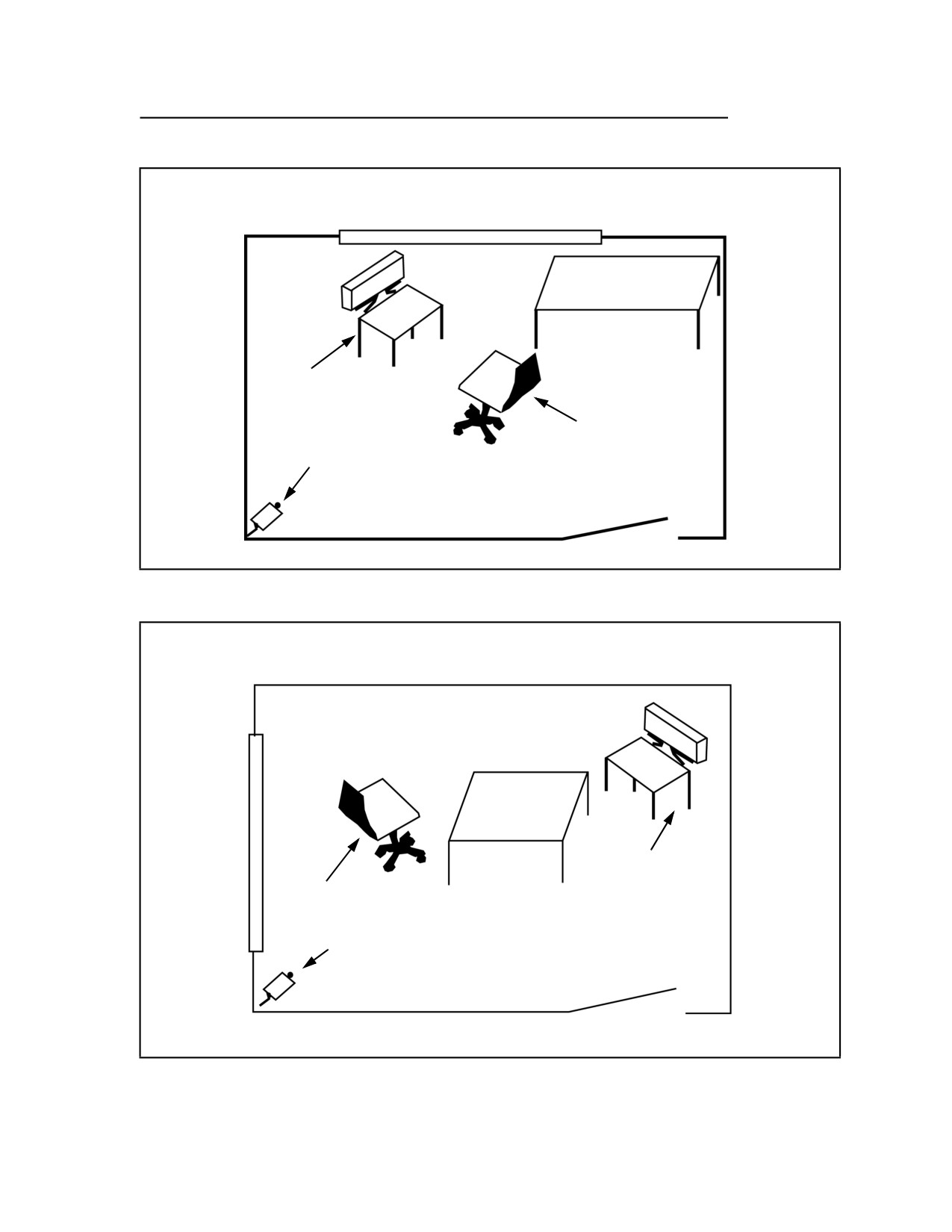
suspect as paperwork is being completed. See Figure 4-1 for a depiction of a
favorable interrogation setting and Figure 4-2 for a depiction of a poor
interrogation setting. Additionally, a mobile chair will aid the interrogator in
applying proximal (physical proximity) and haptic (physical contact)
techniques. See paragraph 4-87, page 4-31.
GENERAL RAPPORT BUILDING
4-33. Establishing a good rapport with those involved in an investigation will
aid the investigator immensely in conducting a thorough and timely
investigation. Rapport building begins immediately upon first contact with a
victim, witness, suspect, commanders, or other law enforcement agencies and
continues throughout the course of the investigation. Investigators must
4-8 Interviews and Interrogations
FM 3-19.13
Observation mirror
Table
Suspect’s chair
Interrogator’s chair
Video camera
Figure 4-1. Correct Arrangement of Interrogation Room
Observation
mirror
Table
Suspect’s chair
Interrogator’s chair
Video camera
Figure 4-2. Incorrect Arrangement of Interrogation Room
Interviews and Interrogations 4-9
FM 3-19.13
always be cognizant of their behavior and conduct when in the presence of
these persons. Victims, witnesses, and suspects will immediately begin sizing
up the investigator. An investigator who is perceived as unprofessional, rude,
lazy, unprepared, or uncaring will not gain the trust and confidence of the
victim or witness and is more likely to be challenged by a suspect. An
investigator who presents a professional appearance and attitude and conveys
a genuine concern for the interviewee will obtain a much higher level of
cooperation. He will have a higher resolution rate during assigned
investigations. Each person must be treated with dignity and respect
regardless of the investigator's personal views or opinions. Investigators
displaying these positive attributes will see a greater level of cooperation from
commanders and other law enforcement agencies. Rapport is the cornerstone
of testimonial evidence and must be maintained throughout the investigative
process.
CUSTODIAL VERSUS NONCUSTODIAL SETTINGS
4-34. According to federal law and CID Regulation 195-1, investigators may
conduct noncustodial interviews of suspects who are not subject to the UCMJ.
According to the decisions and case law stemming from Arizona versus
Miranda, law enforcement personnel who question suspects who are in
custody must issue a “Miranda” warning. Accordingly, suspects not in a
custodial status may be interviewed without issuing a “Miranda” warning;
however, the standard for whether a person is in custody is measured by the
suspect's perception regarding his ability to leave or terminate the interview
(not from the police officer’s perspective). The most effective means for
investigators to ensure that the suspect knows his custodial status is to advise
him by saying, “You are not under arrest, you are free to leave at any time,
and you do not have to answer any questions.” Once the suspect acknowledges
this warning and the interview is conducted, the investigator should
document this warning on the first line of the suspect’s statement, which
serves as a written record of the warning. If a suspect’s ability to leave is in
any way impeded, he is reasonably in custody, and must be issued the
“Miranda” warning. If a civilian suspect is interviewed in a custodial setting,
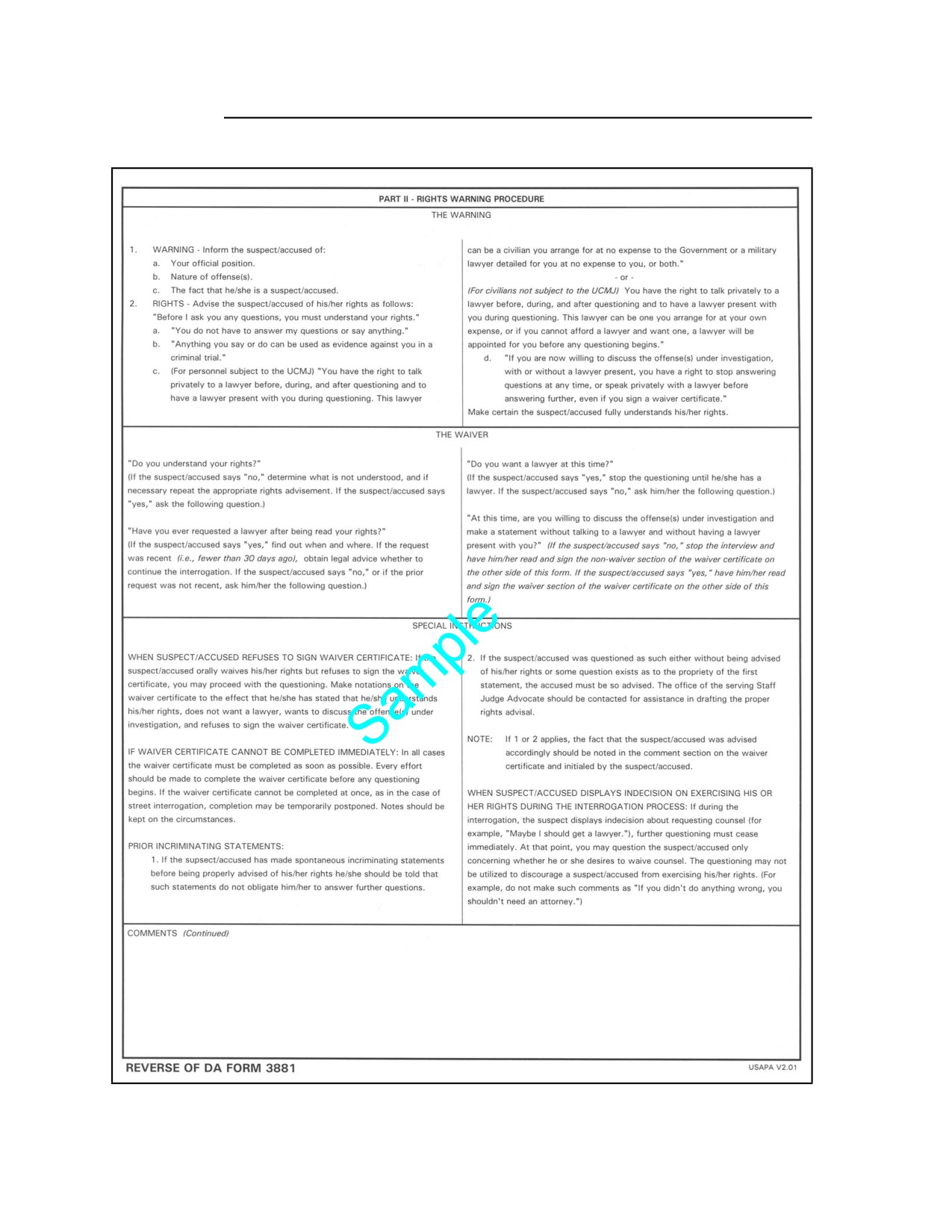
he must be advised of his “Miranda” rights. These rights are on the reverse
side of DA Form 3881 (Rights Warning Procedure/Waiver Certificate).
Properly executing DA Form 3881 in such instances is the appropriate
mechanism for administering this warning.
4-35. According to UCMJ, Article 31(b), anyone subject to the UCMJ may not
elicit self-incriminating statements from anyone else subject to the manual
until that person has been advised of his rights indicated therein. UCMJ,
Article 31(b), requires the suspect to be informed as to the nature of the
accusation, that he does not have to make any statements regarding the
offense, and that any statements made by him may be used as evidence
against him. DA Form 3881, which incorporates the warning requirements
from both the UCMJ and “Miranda,” should be used whenever feasible in
conducting suspect interviews of military personnel or civilian personnel in a
custodial setting.
4-36. There is no relief from the requirements of UCMJ, Article 31(b), and
failure to comply will result in the suppression of all statements. The UCMJ
4-10 Interviews and Interrogations
FM 3-19.13
reads, “No statements obtained from any person in violation of this article, or
through the use of coercion, unlawful influence, or unlawful inducement may
be received in evidence against him [or her] in trial by court-martial.”
DEPARTMENT OF THE ARMY FORM 3881
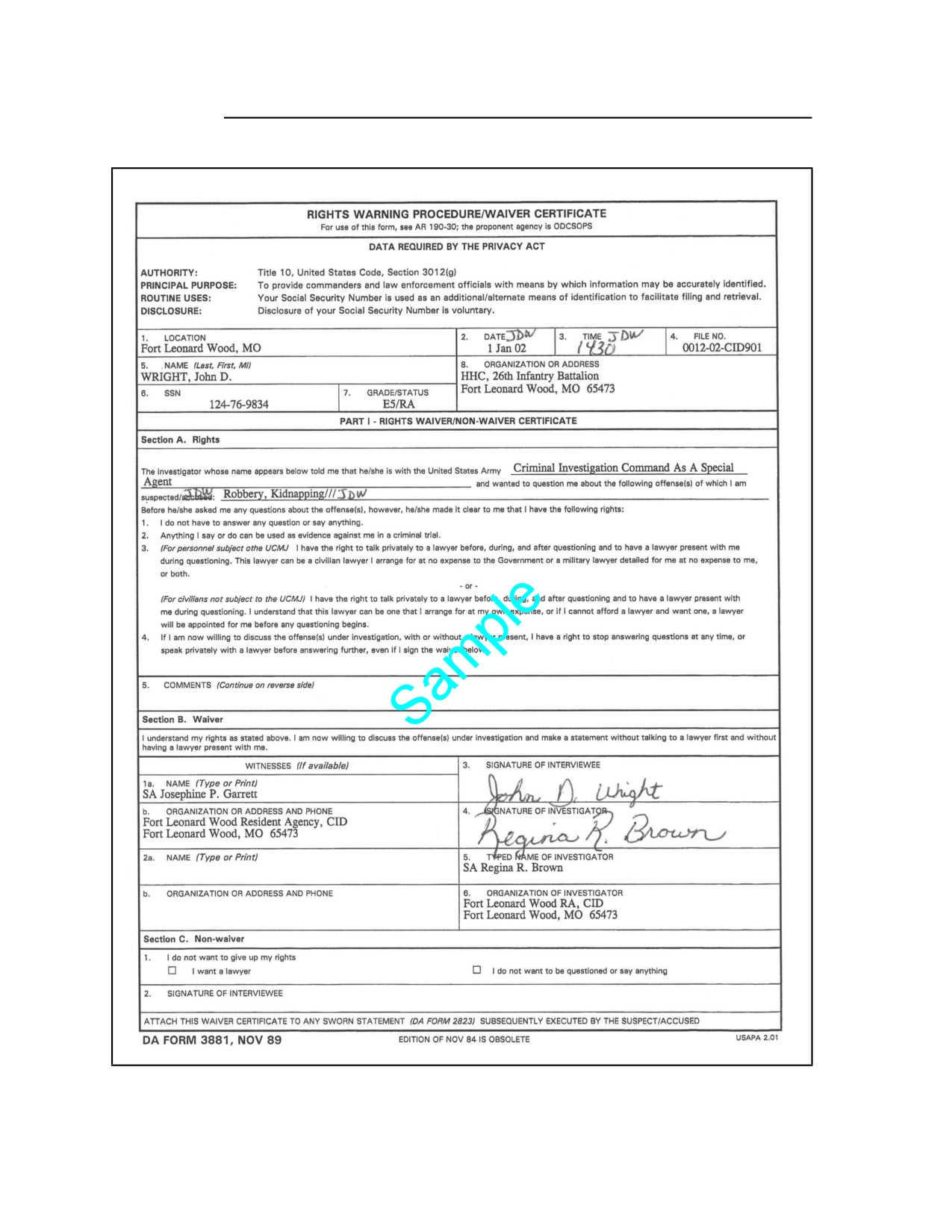
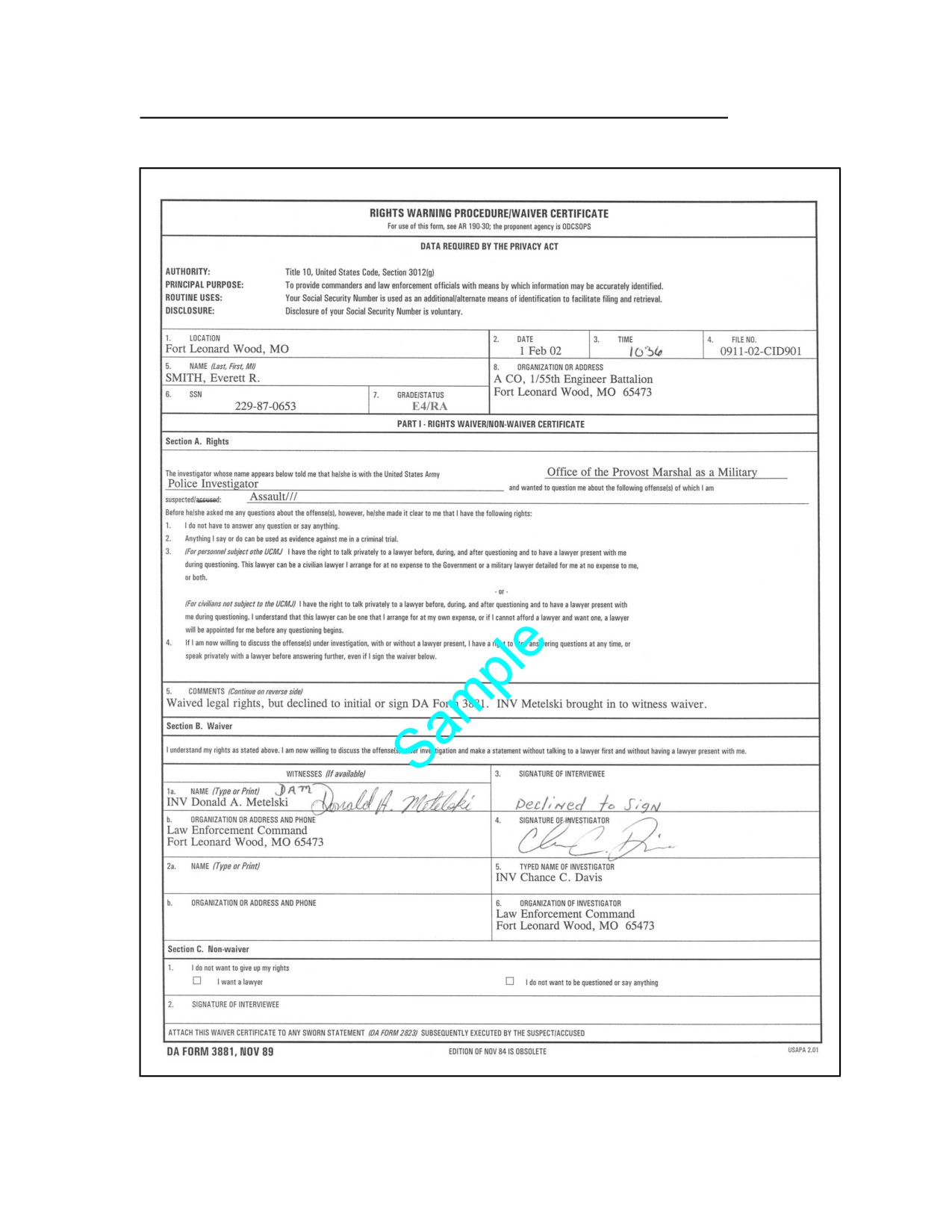
4-37. This section describes the procedures for preparing a DA Form 3881.
See Figures 4-3, 4-4, and 4-5, pages 4-12 through 4-14. This form is filled out
each time an accused or suspected person is questioned. It is best to fill out the
administrative data on the form first.
Block 1. Enter the geographic location; such as the city or installation
and the state in which the form will be executed. Do not enter specifics
such as a building number or military police station.
Block 2. Enter the date (day, month, and year). Have the suspect initial
above the date.
Block 3. Have the suspect write in the time and initial above it after he
has been administered the rights warning.
Block 4. Enter the CID or military police case file sequence number.
Block 5. Enter the suspect’s last name, first name, and middle initial.
Block 6. Enter the suspect’s SSN.
Block 7. Enter the military or civilian pay grade of the person being
advised; for example, E3, O3, GS09, or enter “Civ” if there is no military
affiliation. If the person is in the military, indicate his status as either
active duty (AD), USAR, or US National Guard (USNG).
Block 8. Enter the suspect’s complete military or governmental
organization including unit, installation, state, and zip code or Army Post
Office (APO) or Fleet Post Office (FPO). If interviewing a civilian who does
not have any military affiliation, enter the his current home address
including the city, state, and zip code or APO or FPO.
Part I, Section A. Enter the applicable organization and status of the
person issuing the rights warning, such as “Criminal Investigation
Command as a Special Agent” or “Provost Marshal’s Office as a Military
Police Investigator.” A formal accusation can only be accomplished
through the referral of charges. Investigative personnel will always line
through the word “accused” to ensure that the suspect understands that
he is merely a suspect. However, if interviewing someone subsequent to
the referral of charges, the word “suspect” should be stricken. The
investigator must then orient the suspect toward the nature of the offense
for which he is suspected. Plain language should be used (not a statute or
other citation). For example, if suspected of murder, the word “murder”
would be entered in this section, not UCMJ, Article 118. After all
suspected offenses have been indicated, three slashes (///) should be placed
behind the last offense cited. Having the suspect draw in the slashes and
initial both where the word “accused” was stricken and again following the
slashes will help to show the suspect’s understanding of his status in the
interview and specifically what offenses he is being interviewed for.
Blocks 1 through 4. Administer the rights warning advisement by
reading the information, starting with number 2, that is located in the
Interviews and Interrogations 4-11
FM 3-19.13
Figure 4-3. Sample 1 of DA Form 3881
4-12 Interviews and Interrogations
FM 3-19.13
Figure 4-4. Sample 2 of DA Form 3881
Interviews and Interrogations 4-13
FM 3-19.13
Figure 4-5. Reverse of DA Form 3881
4-14 Interviews and Interrogations
FM 3-19.13
warning section on the reverse side of DA Form 3881 (see Figure 4-5). The
investigator should provide the rights waiver certificate that is located on
the front of DA Form 3881 to the suspect for him to follow. Upon
completion of the rights warnings advisement, the investigator
administers the rights waiver advisement by reading verbatim the
questions in quotations that are located in the waiver section on the
reverse side of another DA Form 3881 (see Figure 4-5). Proper use of DA
Form 3881 will help investigators ensure that only knowing and voluntary
waivers are obtained.
Block 5. Use the comments section to record clarification questions posed
to the suspect and his responses. If additional space is required, use the
comments section located on the reverse side of the form. Because of the
“McOmber Rule” being abolished, there is no longer a requirement to ask
if the suspect has requested an attorney after being read his rights within
the past 30 days. However, if the suspect has an attorney, the attorney
must be present for any interviews.
Part I, Section B, Blocks 1 through 2. All witnesses to a rights
warning, which may include military police and/or investigators, parents
or guardians of juveniles, and military sponsors, should print their names
in the blocks dedicated to witnesses (blocks 1a or 2a). Additionally, the
witness should record his unit or organization, address, and telephone
number in blocks 1b or 2b. It is also a good idea to have the witness initial
adjacent to his name (see Figure 4-4, page 4-13).
Block 3. If the suspect states the following: (1) I understand my rights,
(2) I have not requested an attorney after being read my rights, (3) I do not
want an attorney, and (4) I am willing to make a statement, he has waived
his rights and should sign his name in this block. If the suspect has
questions or does not answer the questions to the satisfaction of the
investigator to show that he has knowingly and voluntarily waived his
rights, the investigator must provide clarification or ask additional
questions. He must do this before having the suspect sign the waiver
certificate (see Figure 4-3, page 4-12).
Blocks 4 through 6. The special agent or military policeman
administering the rights advisement signs in block 4 and prints or types
his name in block 5. The investigator's unit of assignment should be
entered in block 6.
Part I, Section C, Blocks 1 and 2. If the suspect invokes his rights by
requesting counsel or declines to discuss the offenses at that time, he
should then check the appropriate boxes in block 1 and sign in block 2. If
the suspect invokes his rights and declines to sign the document, the
investigator may write, “declined to sign” in block 3 (see Figure 4-4,
page 4-13). Once the suspect invokes his legal rights, the investigator
must stop all discussions that are designed or are likely to cause the
suspect to be incriminated. If the suspect did not request an attorney, but
related he did not desire to be interviewed at that time, he may be
reapproached by investigators after a reasonable “rest bit,” which has
normally been held to as little as two hours. However, if the suspect
requested counsel, the investigator may not reapproach him until he is
Interviews and Interrogations 4-15
FM 3-19.13
afforded a “reasonable opportunity” to seek out and confer with counsel,
which is normally several working days.
4-38. In the instance that a suspect waives his rights, but declines to sign the
DA Form 3881, this fact may be recorded both in Part I, Section A, Block 5
(comments) and in Part I, Section B, Block 3 (signature of interviewee).
Whenever possible, such waivers should be witnessed by at least one other
party. This can be accomplished by simply bringing a third party into the
interview room and asking the suspect if he was advised of his rights,
understood his rights, and is willing to discuss the offenses under
investigation but did not want to sign the form. If the suspect affirms this to
be true and accurate, the witness should sign his name in Part I, Section B,
Block 1a to confirm his presence during this portion of the interview (see
Figure 4-4, page 4-13).
TRICKERY AND DECEIT
4-39. The use of trickery, deceit, ploys, and lying is legally permissible during
the course of an interrogation under the following conditions. However, no
form of trickery or deceit may be used to gain a knowing and voluntary waiver
of legal rights, and no such lies, ploys, trickery, or deceit can be of a nature to
shock the conscience of society or to cause an otherwise innocent person to
confess. For instance, threatening a mother with the loss of her children may
likely cause her to choose her children over the truth and consequently confess
even if she is not guilty. Conversely, it would be permissible to tell a suspect
that his fingerprints were found on evidence or that a witness observed him at
the scene because an innocent person would know that he was not there and
refute the statement, whereas a guilty person may feel trapped by the
overwhelming evidence and confess.
4-40. Although it is legally permissible to employ deceitful tactics when
conducting interrogations, it is not advised or recommended for several
reasons. First, the suspect knows more about the crime than the investigator
so it is easy for him to catch the investigator in a lie. Once caught in a lie by
the suspect, the investigator loses all credibility. Secondly, juries and judges
do not like to place their trust and confidence in police officers who appear to
manipulate case facts and/or lie as part of their duties. Although lying rarely
results in a confession being thrown out, it is frequently a factor used in a
deliberation for panel members and judges who are not certain they can
completely trust the officer who they know to be a convincing liar. This can
result in reduced sentences and occasional acquittals. Defense attorneys have
become very adept at bringing out lies told during interrogations in courtroom
settings and at turning these lies into credibility issues for the panel.
4-41. Historically, the reason police officers have felt the need to lie during
the conduct of interrogations was to apply pressure to the suspect. Convincing
a suspect that the evidence clearly links him to the crime may pressure him
into telling the truth. Although this pressure is essential to the interrogation
process, investigators do not need to resort to lying to pressure the suspect
into confessing or telling the truth. The presentation of “potential evidence” is
far superior to deceit in not only creating evidentiary pressure for a suspect,
but it allows the investigator to do so with absolute integrity and credibility.
4-16 Interviews and Interrogations
FM 3-19.13
4-42. Rather than telling the suspect that his fingerprints were found on an
item of evidence, the investigator should consider telling the suspect, “We
have recovered several latent fingerprint impressions from the crime scene,
and I am going to send them to the lab with your record fingerprints.” Remind
the suspect that he may find it very difficult to explain how his fingerprints
were discovered at the scene if he continues to insist that he was never there.
4-43. Presenting potential evidence to cause a positive reaction from the
suspect works well for many different situations. For example, reminding a
suspect that a parking lot or store is equipped with surveillance cameras may
cause him to believe he was recorded on tape. If the investigator does not
know if the location was equipped with cameras, he can send another
investigator to check. He can then tell the suspect that he just sent someone
over to obtain any videotapes that may exist. Although the investigator does
not know whether or not this evidence exists, he presents the potential for the
recovery of evidence that will link the suspect to the crime.
4-44. In just about any situation where an investigator can develop a lie to
apply evidentiary pressure to a suspect, he can just as easily identify potential
evidence to apply the same pressure without lying. If challenged in court, the
investigator can explain potential evidence to a panel without losing
credibility, but it is difficult to explain deceit and lying as a “legitimate”
interrogation technique without losing credibility.
SELECTION OF AN INTERVIEW OR INTERROGATION STYLE
4-45. This section describes the two basic styles (indirect and direct) used to
conduct I&I. Choosing the correct style can be a challenge even for the most
experienced investigator. Human quirks of behavior or personality can affect
the success of getting a person to honestly and effectively communicate with
an investigator. An investigator’s failure to establish rapport and gain the
suspect's trust, confidence, and respect may greatly bear on his ability to
glean a truthful statement from the suspect. When selecting an interview
style, consideration should be given to whether or not the investigator is
reasonably certain of the suspect’s guilt. When the suspect’s guilt is certain, a
direct style may be the proper choice. If he was previously interviewed, find
out what he was told by previous investigators and what he said during those
interviews. In all cases where the investigator is not reasonably certain that
the suspect committed the offense, he should be interviewed using an indirect
style.
INDIRECT STYLE
4-46. If a suspect’s guilt is uncertain or doubtful, indirect questioning is used
to gain a detailed account of the suspect’s activities before, during, and after
the time the offense took place. The indirect style of questioning is exploratory
in nature and is generally initiated by merely asking the suspect to tell the
investigator his story or to explain his actions on the date in question. The
investigator listens and takes detailed notes making observations of both
verbal and nonverbal mannerisms that may provide insight as to the
likelihood of deception. Questions are generally asked for clarification or to
explore apparent inconsistencies. Questions posed in this style are generally
Interviews and Interrogations 4-17
FM 3-19.13
open-ended and are not inclined to lead the suspect in any direction with his
answer. Facts that are definitely known or strongly suggest the suspect's guilt
are used to formulate questions designed to evaluate his verbal response and
physical reaction, which will in turn provide insight into the inclination of a
suspect to lie. The indirect style is not designed to cause perpetrators to
confess. It is designed to arm the investigator with an extremely detailed
account of the suspect’s activities, which can be verified or refuted by facts
developed through the investigative process. Once sufficient evidence is
established to warrant an interrogation, the investigator will transition to the
direct style.
DIRECT STYLE
4-47. The direct style of interviewing is designed to prevent the suspect from
getting entrenched in a lie, which will make getting to the truth more difficult.
In this style, the investigator tries to maintain an atmosphere of monologue.
The investigator lays out case facts. He works on the emotions, logic, and
reasoning of the suspect in an attempt to get him to see his situation in a more
realistic light, without enabling him to build a wall of lies. This style of
interviewing is very structured and should be well-planned before initiating
the interrogation. In addition to providing case facts to the suspect to make
him feel he was identified as the person responsible for the crime, the
investigator must decide what evidence will be withheld from the suspect to
identify or corroborate admissions or confessions. In order for this style to
work effectively, the investigator must present no uncertainty as to the
suspect’s guilt, but he should seem relatively uncertain as to motivation. If the
investigator seems uncertain, the suspect will be significantly more likely to
hold out hope that his involvement in the crime will go undetected. Caution
should be used when employing this style with weak-minded individuals or
people with a less than average intelligence quotient (IQ) because they are
more susceptible to rendering false confessions. Safeguards must be used to
ensure that confessions are the result of guilt, not mental fatigue. All
investigators conducting interrogations should ensure that a suspect who
confesses is able to provide information he would not otherwise know unless
he was involved in the commission of the crime. Investigators should also
ensure that investigative personnel did not provide the information in the
suspect’s confession. Additionally, when an investigator suspects that an
interviewee is making admissions merely to stop the interview process, he
should consider providing information that is not true to see if the suspect
incorporates this information into his statement. If a suspect attempts to
incorporate this information into his statement, the investigator should
recognize the propensity of the individual to accept responsibility for the
things he did not do and should implement strong safeguards to prevent false
confessions.
OBSERVATION OF BEHAVIOR (VERBAL AND NONVERBAL)
4-48. Interviewers observe verbal and nonverbal responses to recognize
whether an individual is being truthful or deceptive. The nonverbal responses
will either compliment or contradict the verbal response. Although an
individual may provide verbal responses to direct questions, as much as 70
4-18 Interviews and Interrogations
FM 3-19.13
percent of all communication takes place at the nonverbal level. Through a
comparison of the two, investigators are much more successful in determining
if an individual is attempting to deceive them. Because nonverbal responses
are typically generated at a subconscious level, they are more reliable than
the spoken word. Observation and active listening will assist in determining if
the interviewee is being truthful or deceptive. Very few people are so adept at
lying that they can control both their verbal and nonverbal responses.
VERBAL INDICATORS OF DECEPTION
4-49. Signs of verbal deception include the following:
z
The chosen word. Normally, an innocent person will use realistic
terms such as rape, robbery, and murder. A guilty person will
generally avoid harsh terms and use more socially acceptable terms,
such as had sex, took, or died when discussing alleged offenses.
z
Vocal characteristics. A nondeceptive person will normally have a
clear, steady voice and will remain this way regardless of the stress
applied during the interview process. His vocal characteristics will be
consistent with and support what he is saying is saying verbally. A
guilty person tends to lose this quality and clarity when responding to
questions that cause him to lie. His voice may change pitch or waver,
and the speed of his response is usually drawn out as he takes
additional time to formulate his response. Anticipate follow-up
questions and look for consistency in their story. Once he has
developed his response, he may speed up his responses, displaying
confidence in his answer.
4-50. It is extremely important to note that assessing verbal and nonverbal
responses for indicators of deception is accomplished by evaluating clusters of
behavior. One or two observed behaviors do not necessarily mean that the
person is practicing deception; however, a constant comparison of responses
and reactions to nonthreatening and threatening questions is essential to this
process.
EVALUATION OF VERBAL RESPONSES
4-51. When analyzing verbal responses, there are specific reactions that will
assist investigators in recognizing truthful and deceptive responses. It is
important to remember that these reactions are just general guidelines, but
they are effective and accurate most of the time. The accuracy of these
Interviews and Interrogations 4-19
FM 3-19.13
reactions depends on the mental and physical state of the suspect. Specific
reactions are as follows:
z
Truthful response. Suspects generally answer questions with direct
and spontaneous answers. Speech clarity, rate, and pitch are more
understandable and smoother than that of a guilty suspect. Although
truthful suspects will sometimes use clipped word endings to
emphasize their innocence and your understanding, such as, “I...did
not...do it,” they will much more frequently use contractions, which
are more free flowing, such as “I didn't do it.”
z
Deceptive response. Suspects normally delay in answering
questions by using vocalized pauses, asking for questions to be
repeated, answering with vague responses, or repeating questions
before providing answers (some people do this out of habit).
Evaluation for these behaviors should begin during the opening stages
of the interview and continue during nonthreatening questions. This
will help to delineate between someone employing deceptive practices
and someone reacting out of habit.
4-52. It is important to remember that often times, what the suspect “does
not” say is as important as what he “does” say. Be cognizant of gaps in
timelines and specific questions that the suspect provides only evasive
answers to or just does not answer. A suspect may be very committed to
stating that he did not break into a building but may entirely avoid answering
whether or not he stole contents from the building. This may indicate that the
building was unlocked or that another suspect broke into the building. This
way he uses a specific denial to adamantly assert his innocence without
technically lying.
NONVERBAL INDICATORS OF DECEPTION
4-53. Observe the position (posture) of the entire body. Try to determine if the
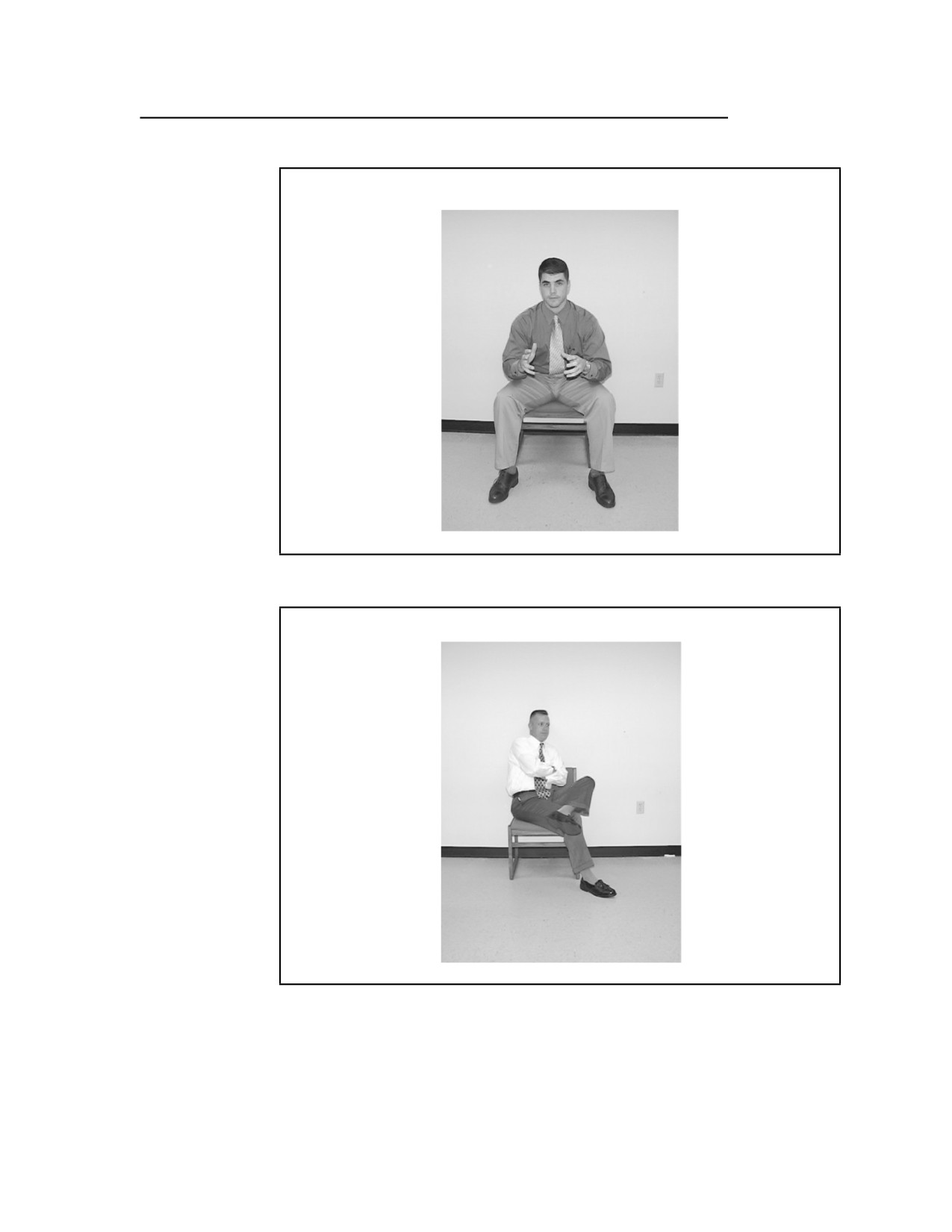
person has an open or closed posture. An innocent person will generally sit
upright, appearing more relaxed and casual. In most cases, he will go as far as
to lean toward the interviewer inviting the questions and demonstrating an
eagerness to resolve the issue (see Figure 4-6). A guilty person will appear to
be stiffer and more rigid. He may lean back in his chair or slouch. He will
generally avoid a frontal alignment with the interviewer, which presents a
closed posture. The crossing of arms or legs, holding elbows close to the body,
or tucking legs under the chair are good indicators of a deceptive person (see
Figure 4-7). Normally, these body positions will change frequently and be very
erratic.
4-20 Interviews and Interrogations
FM 3-19.13
Figure 4-6. Portrayal of an Innocent Person
Figure 4-7. Portrayal of a Guilty Person
Interviews and Interrogations 4-21
FM 3-19.13
4-54. Signs of nonverbal indicators of deception include the following:
z
Physical movements. Initial contact and the introduction of
nonthreatening questions will allow the interviewer to observe the
natural movement of the interviewee's hands. As the interview
progresses, the interviewer can observe if there is any change in the
smooth, fluid motion of the interviewee's hands when asking
threatening questions. A sign of deception could be if the interviewee
engages in grooming gestures or closes his previously open posture or
if his bodily reactions become erratic.
z
Gestures. Certain gestures are good indicators of deception.
Investigators should look for the following two basic types of gestures:
Grooming gestures. Examples of grooming gestures are when a
person removes lint from his clothing, rubs or wrings his hands,
taps his fingers on a tabletop, scrapes at the surface of the
tabletop with his fingernails, or rearranges his clothes or jewelry.
Supportive gestures. Supportive gestures are when a person
places his hands over his mouth or eyes when speaking, places his
hands or fists under his chin, holds his forehead with his hands, or
places his hands under or between his legs.
All of these bodily reactions and postures occur as a subconscious protection
mechanism and are generally more consistent with deception than
truthfulness. They are the result of a guilty person subconsciously attempting
to release the stress and anxiety of lying. In these cases where verbal and
nonverbal responses do not complement one another, the physical responses
are typically more reliable than the verbal responses.
z
Facial expression. This is another subtle indicator of deception. A
guilty person may use a variety of facial expressions resulting from
fear of detection. The variation of facial expressions may be suggestive
of untruthfulness or the lack of such variation may be suggestive of
truthfulness. Truthful individuals should exhibit expressions that
coincide with the subject of the conversation and should not be
obviously exaggerated. Deceptive individuals tend to feign shock,
surprise, or overly exaggerate emotional responses.
4-55. Nonverbal responses will either support or contradict the spoken word.
If the person answers a question while leaning forward in an upright posture
without accompanying movements and using direct eye contact, normally, this
is considered to be the actions of a truthful person. However, if the person
gave the same reply and also crossed his legs, folded his arms, looked at the
floor, or shook his head in agreement while answering in the negative, this
would tend to indicate deception.
INTERROGATION PROCESS
4-56. Establishing and maintaining effective rapport with suspects during an
interrogation is instrumental in obtaining their cooperation and getting them
to expose facts they would not otherwise feel comfortable disclosing. The key
to establishing rapport lies almost entirely within the mind of the interviewer.
If the investigator cannot relate to the suspect as an innocent person, he will
4-22 Interviews and Interrogations
FM 3-19.13
not be able to effectively develop rapport or display sincerity. The investigator
must look for characteristics or commonalities between himself and the
suspect in order for the investigator to see the suspect as an individual. It is
important for the investigator to remember that no one is inherently evil and
that good people sometimes do bad things. If an investigator is able to
separate the crime from the person being interrogated, he is more likely to get
the suspect to like, trust and respect him. Guilty persons are substantially
more likely to confess to an investigator they like, trust, and respect; whereas,
innocent suspects are provided the greatest safeguards from false confessions
through rapport-based interrogation techniques.
4-57. Sincerity is commonly the most difficult component of rapport building
for most interrogators. Investigators often believe they can “pretend” to care
about the suspect’s situation in order to gain his trust. However, sincerity
cannot be faked; it is either sincere or fake. Sincerity is the best tool to use to
emotionally move the suspect. Separating the crime from the suspect, and
finding something within the suspect that the investigator can relate to is the
most effective means by which investigators can develop genuine concern for
the suspect. This is the key to developing and maintaining rapport with the
suspect and gaining his confidence.
INTERROGATION PHASES
4-58. The interrogation consists of four phases. Each phase serves a distinct
purpose and allows the investigator to move in a structured and meaningful
manner through the interrogation process. The four phases include—
z
Preparation.
z
Opening.
z
Body.
z
Closing.
PREPARATION
4-59. Probably the most neglected phase of the interrogation process is the
preparation phase. By nature, interrogations are structured; however, it is
difficult to develop this structure without adequate planning. There are
several key components of preparation that provide the greatest advantage to
the investigator. There are several components of preparation. The following
key components provide the greatest advantage to the investigator:
z
Researching the suspect’s background.
z
Researching case data.
z
Planning the interrogation.
z
Mentally preparing for the interrogation.
z
Establishing the most appropriate interrogation environment.
4-60. Researching the suspect’s background involves collecting as much
background information on the subject, as possible. This will aid the
investigator in analyzing the suspect’s training, education, financial situation,
upbringing, and other factors that may be useful during the interrogation.
The more background information an investigator has at his disposal, the
Interviews and Interrogations 4-23
FM 3-19.13
better. This information will have a dramatic psychological impact during an
interrogation. Presentation of this background information during the
interview causes the suspect to realize how thorough the investigation is and
will continue to be. This is extremely beneficial in increasing anxiety at key
points of the interrogation process. Investigators should consider numerous
sources when seeking background information on a suspect. Sources include
the following:
z
Employment or military records.
z
Evaluation reports.
z
Service record briefs.
z
Medical records.
z
National Crime Information Center (NCIC).
z
Financial Crimes Enforcement Network (FinCEN).
z
Education records.
z
Internet sources.
4-61. Another key component of the preparation phase is to research case
data. A complete understanding of the incident under investigation is
paramount to a successful interrogation. This should include physically
visiting the crime scene, viewing all crime scene photos and sketches, reading
all statements collected during the investigation to date, and discussing the
investigation in detail with the case agent and other investigative personnel
involved in investigating the offense. While conducting this review, the
investigator should identify all actual and potential evidence that could link
the suspect to the scene, victim, or crime. Evidence is the pressure plate used
in the interrogation that forces a suspect to face the fact that at the end of the
investigation there will be no doubt as to who committed the offense. Actual
evidence is any evidence that is known to exist, such as physical evidence
collected; surveillance tapes seized; testimonial evidence from victims,
witnesses, or co-conspirators; or other items that the investigative
organization already knows to exist. Potential evidence is evidence that could
be identified during the investigation and link the perpetrator to the crime.
4-62. Planning the interrogation and mentally preparing for the interrogation
involves a thorough analysis of all known case facts, the suspect’s personal
background, and what trends indicate why others have committed similar
crimes. The investigator will be able to speculate what the suspect’s motive
was for committing the crime with a relatively high degree of accuracy. Once
the investigator understands the likely motive for the crime, he should
determine the most effective means of approaching the suspect. If the
investigator asks himself, “If I did this, how would I have to be approached,
and what would I have to be confronted with in order for me to tell the truth
about this?” By placing himself in the mental state of the suspect and
answering these questions, an investigator can then develop the approach he
should use in getting the suspect to see his situation in the most realistic
light, while not making him defensive. Causing a suspect to take a defensive
posture places barriers between him and the interrogator. This hampers the
investigator’s ability to maintain rapport. Mapping out the interrogation
process in this manner provides the structure required for an interrogation. It
4-24 Interviews and Interrogations
FM 3-19.13
will enable the investigator to more effectively control the process, ultimately
resulting in full disclosure of the truth by the suspect being interrogated.
4-63. Establishing the most effective interrogation environment is a very
important component of the interrogation process. Generally, the most
effective interrogation environment is one controlled by the investigator, such
as a police station. If possible, a room specifically designed for interviews
should be used; one that is free of exterior windows and wall ornamentation so
as not to distract the suspect. There should be one small table situated in a
such a manner so that the suspect cannot use it as a barrier to hide behind.
The chair intended for the suspect should be a four-legged stationary chair,
which does not lend itself to swiveling or other movement. This should keep
the suspect from moving around in the interview room and causing a
distraction during the interrogation process. The interrogator’s chair should
be equipped with wheels and a swivel mechanism, allowing the investigator to
move around subtly during the interrogation process.
4-64. Where feasible, there should be a two-way mirror installed in the
interview room that allows other investigative personnel to observe the
interrogation and take copious notes instead of being physically located in the
interview room serving as a distraction. In complex interrogations, it may be
advisable to establish a means of communication between personnel observing
the interrogation and the interrogator. This allows the observers to point out
issues that create anxiety in the suspect, point out conflicts in the suspect’s
stories, or provide the interrogator with questions that should be asked. One
of the best mechanisms for this is to place a computer monitor in the interview
room, which is split from a computer system in the observation room, and
place it only where the interrogator can observe the information displayed on
it. Using this setup, the interrogator can read comments placed on the
monitor at his convenience. This would not be as much of a distracter as using
an earpiece to relay verbal commands.
OPENING
4-65. The opening portion of the interview is essential in establishing the tone
of the interrogation. Before the interrogation, the investigator should attempt
to assess where the power base and anxiety level of the suspect will be, based
on his status in the community. Power base refers to how much control and
power the suspect believes he has as compared to the interrogator. For
example, if a senior military officer were being interviewed, he would likely
feel that he has greater power and control over the interview process than
someone of lesser rank. Likewise, the anxiety level of a senior officer would
likely be lower. The investigator’s introduction is designed to adjust the power
base and anxiety level appropriately. When the power base is anticipated to be
high and the anxiety low, the investigator should seek to reduce the power
base, while increasing the anxiety level. Whereas, when the power base is low
and the anxiety is high, the investigator should seek to increase the power
base, while reducing the anxiety. In an optimal situation, a suspect’s power
base, as he may see it, should be about equal to that of the investigator.
However, the investigator should, in actuality, control the structure and
conduct of the interrogation. If a suspect’s anxiety level is too low, there is a
lack of concern on the part of the suspect, which reduces the possibility of
Interviews and Interrogations 4-25
FM 3-19.13
emotionally affecting him. However, if the anxiety level is too high, the
investigator will not be able to accurately assess the suspect’s nonverbal
communication or get him to focus on key issues.
4-66. When an investigator introduces himself to a suspect with a high power
base, he should not subordinate himself to the suspect. For example, if the
suspect is a senior officer who outranks the investigator, the investigator
should use the suspect’s rank and last name when he initially introduces
himself. He should then refer to himself by using his official title and last
name (such as, “Good morning Lieutenant Colonel Johnson. My name is
Special Agent Smith. I am glad you could come in today. Could you please
follow me?”). It should be noted that generally, the investigator always walks
behind the suspect for safety reasons; however, when interviewing senior
personnel, walking in front of them subtly diminishes the perception of
subordination. The investigator may then ask the suspect if he would like to
take off his coat. If he does, show him where a hanger is and instruct him to
hang it up. The investigator may then ask the suspect if he would like some
coffee. If he accepts, the investigator should then point out where the coffee
pot is and tell him to help himself. During this process, the investigator
should be polite, courteous, and professional; however, he should not refer to
the suspect as “sir” or “ma’am.” He should just use the rank and/or the rank
and last name. This approach has proven itself in modifying the power base
and anxiety level to the desired levels.
4-67. Suspects who have a lower power base are often uncomfortable and very
apprehensive. Consequently, when the investigator introduces himself to the
suspect, he should call him “sir” or “ma’am,” even if the person is a janitor. He
should use the person’s first name if he is a lower enlisted soldier. The
investigator should then introduce himself using only his first and last name
in a very friendly and congenial manner. The investigator should then thank
the person for coming in and tell him that he understands that he is very
busy, but it is good to see that he wants to take care of this issue. The
investigator should cater to the suspect by offering to hang his coat up,
pouring him a cup of coffee, and putting cream and sugar in his coffee for him.
This makes the suspect feel that he is important in the process and that the
investigator sees him as an individual, not by the status that others may see
him as having in the community.
4-68. The opening portion of the interrogation is where investigators begin
the rapport-building process. In building rapport, the investigator should
explore the suspect’s interests, looking for common ground that he can relate
to on a personal level. When those interests are identified, the investigator
should spend a reasonable period of time discussing these topics from a purely
personal vantage point. This not only helps the suspect to see the investigator
as a person with whom he can relate, but also aids the investigator in a
similar fashion and is paramount to successful interrogations.
4-69. After establishing the initial tone of the interview and rapport, the
investigator should complete a biographical data sheet. While completing the
form, the investigator should maintain the previously established
environmental tone, continuing to build rapport. Being friendly and polite will
reduce anxiety; whereas, being more rigid and professional will increase
anxiety.
4-26 Interviews and Interrogations
FM 3-19.13
BODY
4-70. The body of the interview is the heart of the interrogation process. This
is where all actual discussion pertaining to the offense itself transpires. It is
during this phase of the interrogation that the investigator strives for the
suspect to tell what happened in a detailed statement, which includes the
who, what, where, when, why, and how of the crime. The presentation of
themes and alternative questions, along with the observation of the suspect
for deceptive behavior, all occur in this phase of the interrogation process. The
end result should be a complete description of events, people, places, things,
and thoughts (planning and intent), and all elements of proof for each offense
should be clearly established.
CLOSING
4-71. It is important to close the interview in a manner that leaves the
suspect feeling good about himself and the investigator. After a suspect
confesses, many investigators succumb to the desire to tell the suspect that he
is going to jail or what he did was disgusting, and a week later found
themselves in a situation wherein the same suspect had to be reinterviewed.
Unfortunately, since the suspect felt taken advantage of, or ridiculed at the
conclusion of the previous interview, he was no longer willing to cooperate.
Letting the suspect leave the interview with a sense of dignity and the
perception that the investigator cared about him as a person, leaves the
opportunity for positive future contact with the suspect. Honesty should
always be rewarded with gratitude and respect, which serves to encourage
further honesty. After a suspect renders his statement, it is advisable for the
investigator to escort him out of the interview room and explain the
fingerprinting process. He should explain why it is being done, what happens
to the fingerprints, and why they will be released to the military police desk
sergeant. The impact of the investigator explaining these things before they
happen continues to make the suspect feel that he matters as a person and
that he is important to the investigator. This opens the door for future contact.
INTERROGATION THEMES
4-72. Themes are essentially the vehicle used by interrogators to deliver the
interrogation approaches. Themes are used to help the suspect see and
appreciate his situation more clearly without making him defensive in the
process. Themes can be as simple as the development of a suspicion of the
suspect’s motive (following the determined approaches) or as complex as a
story that allows the suspect to draw his own conclusion about the right thing
to do. Story type themes are very effective in getting suspects to participate in
the interview process in a philosophical manner without actually discussing
the crime in question, which keeps the suspect from becoming defensive and
putting up barriers.
4-73. Other story themes can be used to prevent the initial lie from being told
and to humanize the investigator. If an investigator is reasonably certain of a
suspect's guilt, it is significantly easier for investigators to stop the lie before
it is told. Once a suspect lies and the more he is allowed to lie, the more
difficult it is to get beyond the lie to the truth. If a suspect knows that he is
Interviews and Interrogations 4-27
FM 3-19.13
going to be interviewed, he goes over in his mind what he will be confronted
with and what evidence may exist that can link him to the crime. Then he
explores his options. One aspect of this exploration is, almost always, what
can he say to explain the evidence away in an attempt to get away with the
crime. Themes can frequently help get beyond the preparation that the
suspect has done by the investigator distracting him from his prepared story
and attempting to get him to modify his view of the situation to a more
realistic and practical one.
4-74. A theme may be designed to pry at those things most important to the
suspect, which is why it is vital during the rapport-building stage for
investigators to seek out the things that will help a suspect better recognize
the situation for what it is and to influence the suspect to be honest. For
instance, if a suspect has a strong relationship with his mother, investigators
may want to have him reflect on how his mother would feel about the
situation. This could also be effective when used with how he handles himself
subsequent to the incident. Other themes may be designed to change the
suspect's perspective of the investigator. Frequently, in interrogation settings,
the suspect has a predisposed depiction of the interrogator as the enemy or
someone who does not care about him but just wants to solve the investigation
and put someone in jail. Themes of this nature are designed to show the
suspect that the investigator is a human being who cares about doing the
right thing for the right reason. These types of themes attempt to show the
suspect that the investigator is impartial, understanding, and trying to
ensure that the most thorough efforts are undertaken to protect the interests
of all involved in an ethical manner. Allowing the suspect to recognize these
facts helps him to relate to the investigator as an individual, cultivate trust,
and build respect between himself and investigator.
APPROACHES
4-75. Various approach methods are used in interrogation. The following
paragraphs discuss the different types of approach.
FLATTERY
4-76. One approach is to use flattery. This is used to build self-esteem within
the suspect or feed his ego. It is accomplished by making favorable
observations, telling the suspect positive things that his command, friends, or
loved ones said about him. By complimenting his appearance, prior positive
conduct, character, patriotism, or other attributes, the investigator makes the
suspect feel better about himself. As long as this approach is delivered with
sincerity, it will help the investigator build and maintain rapport and a sense
of mutual trust and respect. After a suspect makes an admission, he may feel
depressed or uncertain that this was a good course of action. The use of
flattery at this point helps reinforce his decision to be honest and enables him
to continue telling the truth. The subject knows he did something wrong and
he does not need condemnation for his actions. He just needs understanding
and respect. Flattery can help him maintain his self-respect, ease inner
turmoil, and maintain a positive interview environment.
4-28 Interviews and Interrogations
FM 3-19.13
SUSPECT VERSUS SUSPECT
4-77. When investigating a crime involving more than one suspect, it is often
effective to pit the suspects against each other. Seat the suspects where they
can see each other through the door to the interview room, but where they
cannot communicate. When a suspect realizes that other possible suspects to
the crime have been identified and are also being interviewed, he will likely
realize that the evidence against him is mounting and that another suspect
may attempt to place himself in the best light by attributing the greater
responsibility to one of the other suspects. This approach can have a dramatic
psychological impact on a suspect and compel him to relate his story first in
order to cast himself in the most credible and understandable situation
possible.
SYMPATHY
4-78. This technique is designed to let the suspect know that the investigator
understands what he did and why he did it. However, the investigator should
be careful not to condone or condemn the offense, merely to understand the
suspect’s emotional state. To some extent, people want pity and
understanding. The investigator should try to truly understand the suspect's
motivation and emotional state, which will allow him to show sympathy and
sincerity when talking to the suspect. The suspect will quickly identify
attempts at sympathy that are void of sincerity as hollow words, resulting in
more of an obstacle than a tool.
LOGIC AND REASONING
4-79. This approach is generally the favored mechanism in cases with a great
deal of evidence or when interviewing someone who is street-smart (someone
who has committed numerous crimes and dealt with police on numerous
occasions). The logic and reasoning approach is more effective with regard to
hardened or career criminals. In delivering this approach, the investigator
should be rational, tell the suspect that the facts prove the case, and lay out
those facts. At the end of the interview, the only thing left to understand is the
why of the offense. The facts already show who, what, when, where, and how.
COLD SHOULDER
4-80. This approach is used best on an egotistical individual after a lot of
flattery. After building up the suspect’s self-esteem, the investigator begins
the interview process. However, when the suspect offers a denial that is
clearly untrue, the investigator does not verbally respond to the statement. He
merely realigns himself in his chair, leans back, and looks at the suspect in
blank silence. Frequently, the suspect will realize how implausible his
statement was and attempt to clarify it or, in some cases, retract it. The
investigator may follow up with a plea to be treated with the same respect
that he has provided the suspect and request that his intelligence not be
insulted. This can, in many cases, result in an agreement to provide mutual
respect and honesty.
Interviews and Interrogations 4-29
FM 3-19.13
TRANSFERENCE OF BLAME
4-81. In some cases, especially theft, a suspect will feel that the victim’s
actions justified his crimes. For instance, a suspect may feel that the
government owed him compensation for the many long hours he worked and
attempt to gain restitution by taking items of value from the Army.
Sometimes, the suspect feels that if a victim really wanted the items, he would
have secured them better. Occasionally, it is appropriate for investigators to
allow and encourage this justification. However a suspect might use this as a
crutch to legally justify his actions, such as self-defense in an assault
situation. The investigator must evaluate all case facts to determine if the
claims being asserted by the suspect are reasonable and indisputable.
HYPOTHESIS
4-82. This approach is used after a thorough evaluation leads to the how and
why a crime was committed. The investigator may be able to speculate as to
the suspect’s motivation and present a hypothesis. This should only be done if
the investigator reasonably believes the hypothesis to be accurate based on
case facts.
ALTERNATIVE QUESTIONS
4-83. Alternative questions are asked of suspects who assume a defeated
posture and are ready to tell the truth but have not yet made a disclosure. The
alternative question is designed to help the suspect feel that the investigator
understands and does not judge him. It does not provide an excuse for the
suspect that justifies his actions. Many disciplines within the interview and
interrogation arena have been criticized by experts in the field of “the
false-confession syndrome” because of the way they present alternative
questions. These professionals often testify against police officers for several
reasons. The primary reason is, in their opinion, that police officers “provide”
suspects with their story without regard for the truth to obtain an admission.
An investigator’s purpose and function is to discover the truth; these tactics
should not be employed if the investigator does not believe what he is
suggesting to the suspect to be an accurate hypothesis regarding his
motivation. When suggesting the acceptable motivation, the investigator must
have evaluated all evidence and case facts, and the speculation should be as
accurate as possible. Then the investigator should contrast the acceptable
motivation against a less acceptable reason for committing the same offense.
4-84. Speculation as to the suspect's true motivation should be as close as
humanly possible to the suspect's actual motivation, which helps the suspect
feel understanding from the interrogator as opposed to judgment. For
example, when interviewing a suspected child molester, do not approach the
suspect's motivation as a one-time incident. Historical evidence strongly
supports that these types of crimes are of a multiple nature and, if the suspect
admits to assaulting one child based on this approach, it would be difficult to
get him to talk about other abuses. The interrogator may want to address the
motivation issue using supported case facts, such as, I know you truly care
about the child or children, you tried to be a good role model, and you were
taught right from wrong, but your feelings for the child manifested themselves
4-30 Interviews and Interrogations
FM 3-19.13
in the form of sex instead of nurturing. This approach could be contrasted
with someone who waits in parks and abducts children with the intent of
hurting them. The interrogator could ask the suspect, “You're clearly not this
guy are you? You do care about these kids, and you never intended to hurt
them, did you”?
4-85. Based on what is known about the majority of pedophiles, this
speculation is accurate. However, when the suspect is approached in this
manner, he does not feel that he is being judged or condemned by the
investigator, who earnestly wants to understand “why” this happened.
4-86. The presentation of alternative questions in this fashion will lead to
more complete disclosures by the suspect. It will also help interrogators retain
more credibility during courtroom presentation.
PROXIMAL AND HAPTIC TECHNIQUES
4-87. It is important to realize that within the structure of rapport-based
interrogations, the object is to help the suspect become comfortable with the
interrogator. The proper use of proximal and haptic techniques reduces
psychological barriers and improves rapport building. With the intent to build
rapport, rather than to increase anxiety or to intimidate, distance between the
interrogator and suspect can be adjusted as the interrogation progresses.
Similarly, touching can be extremely effective; however, caution should be
used when employing this technique. Frequently, investigators
misunderstand what a touch accomplishes during the interrogation process. A
touch should generally be executed at a key point in the interrogation—when
the suspect becomes emotional, when he is about to make an admission, or
immediately after he has made an admission. The message a touch sends is
that the investigator understands and can relate to the suspect and does not
judge him. The delivery of a touch is the most critical aspect of this technique.
The investigator should not reach out and grab or pat the suspect, as it may be
interpreted as condescending and insincere. A touch should be delivered using
a couple of fingers on the outer portion of the suspect’s leg or arm. The more
unintentional a touch appears, the more effective it is in relaying the desired
message.
FALSE CONFESSIONS
4-88. The vast majority of false confessions result from some form of coercion,
such as being threatened with the death penalty or the loss of their children or
being forced into a situation where they felt the need to protect someone close
to them. Interrogators must be cognizant that false confessions can be
produced and know how to prevent and/or delineate them from viable
confessions. People who have low IQs (generally considered to be under 80)
and youths are typically more susceptible to providing a false confession
induced by extreme psychological pressures.
4-89. Although false confessions are rare, there have been several instances
where people who confessed to a crime and were subsequently convicted were
later proven to be innocent through forensic evidence. Because juries tend to
place a great deal of weight in confessions when deliberating a case, it is
Interviews and Interrogations 4-31
FM 3-19.13
paramount that investigators and interrogators implement safeguards to
prevent false confessions. A confession should never stand alone on its own
merit; it must be collaborated. Therefore, it is important that interrogators
not provide the suspect with details from the investigation that only the
perpetrator would know. These details should also be shielded from the
media. A suspect who confesses should be able to provide information and
details of the crime not known or only known by authorized police personnel.
If interrogators show the crime scene photos to the suspect or take him to the
crime scene before getting this information, this critical safeguard can be
negated. Additionally, videotaping the entire interrogation from start to finish
can be an indispensable tool in preserving the integrity of the process. This
can be extremely useful in refuting claims of police misconduct in
interrogations. Videotaped interrogations can show a lack of coercion and can
clearly depict whether the suspect provided details without having been
provided by the interrogator. Therefore, videotaping all interrogations should
be strongly considered as an investigative tool when practical.
DOCUMENTATION OF STATEMENTS
4-90. Statements from suspects are important documents. They must be
recorded and made a permanent part of the investigation.
4-91. There are forums that can be appropriate mechanisms in recording
information obtained through the interview process. However, they all have
strengths and weaknesses that make some more appropriate than others
based on the situation.
AUDIOTAPING AND/OR VIDEOTAPING
4-92. Investigators should consider whether recording the interrogation is
feasible and practical. If a determination is made to record interviews, the
suspect’s permission must be obtained unless there is Army general counsel
approval for recording and/or intercepting. Permission can be obtained
verbally or in writing. It is best to include the verbal permission as part of the
recording. The rights advisement of suspects and subjects should also be
included in the recording if the decision is made to videotape and/or audiotape
the interview. Recording an interrogation should start with an introduction of
the parties being recorded, the time and date, and the agreement of each party
to the recording. The interrogation should not be conducted without recording
all of it. Turning on a video camera to record just the confession negates
nearly all of the safeguards sought from the recording process.
4-93. Breaks may be taken during the recording. However, when a break is
taken, the investigator conducting the interview should state that a break is
being taken and the time and date of the break. The recording equipment
should be turned off during the break. Once the interview resumes, the
investigator should annotate on the tape the parties that are present along
with the time and date and a brief description stating what occurred during
the break, such as ate lunch or took a rest room break.
4-94. When interviewing children, the investigator should use open-ended
questions instead of closed-ended or leading questions. Using leading
questions, especially with child victims, can cause severe contamination of the
4-32 Interviews and Interrogations
FM 3-19.13
child’s statement. The tape generated from the interview should be
maintained with the case file and the transcripts.
WRITTEN STATEMENTS
4-95. Written statements are permanent records of the pretrial testimony of
accused persons, suspects, victims, complainants, and witnesses. They may be
used in court as evidence attesting to what was told to investigators. They also
are used to refresh the memory of the persons making the statements.
Typewritten Sworn Statements
4-96. Typewritten sworn statements are the preferred method for recording
and preserving statements from victims and witnesses. However, when taking
confessions from a suspect, defense attorneys have grown very adept at
attacking the credibility of these statements. They suggest that the words in
the statement are the investigator’s and not the suspect’s. Defense attorneys
will try to establish that the investigator manipulated what the suspect said.
This defense tactic is easily defended because the suspect is being asked
clarification questions throughout the writing of the statement and is able to
read the statement as it is being typed. The suspect is allowed and encouraged
to change any aspect of the statement that did not accurately capture what he
was trying to say. After the statement is completed, the suspect reads it again,
then signs, and swears it to be true and accurate. The last question on the
statement is, “Is there anything you would like to add to or delete from this
statement at this time?” The suspect’s response is recorded and appropriate
action to delete and/or add information is taken at that time. The benefit of
this type of statement is that it is generally brief and concise, well written,
and address the elements of proof in a very clear manner. These statements
can be taken in conjunction with handwritten statements, interview sketches,
letters of apology, and/or audio recording or video recording.
4-97. A second option for obtaining typewritten statements from a suspect
who has admitted to criminal culpability is to ask the suspect if he can type. If
he states that he can, the investigator may ask him to type his own statement.
This approach bears the same protections against defense assertions than if
the investigator edited the statement. If this technique is employed, the first
question asked in the question and answer portion of the statement should be,
“Did you type the statement above?” Additional questions should be used to
clarify or explore aspects of the suspect's typed narrative.
Handwritten Sworn Statements
4-98. Handwritten sworn statements are tools that can be used by
investigators to record statements. This tool is most appropriate for suspect
interviews. These types of statements are very effective in recording
confessions. They are written by hand and in the words of the suspect, making
it very difficult for defense attorneys to suggest manipulation of the facts by
investigators. This has become a defense attorney’s routine tactic when
typewritten sworn statements are presented in court. As with any tool, there
are some advantages and disadvantages to using the handwritten statement.
One disadvantage is that the person providing the statement may not be able
to write the statement in a clear and concise manner based on his educational
Interviews and Interrogations 4-33
FM 3-19.13
level. His handwriting may be so bad that it is difficult to determine exactly
what was written. However, after the suspect has written his statement, it is
the responsibility of the investigator to carefully read over the statement and
ensure that all elements of proof are adequately addressed, and all reasonable
questions are answered. The question and answer section is no different than
in the typewritten sworn statement. The investigator will ensure that the
question and answer section clears up any doubt or confusion in the suspect's
statement. He ensures that all the elements of proof have been addressed
appropriately. This type of statement will frequently require many more
clarification questions than would be required of typewritten statements.
4-99. Handwritten statements lend themselves to a technique known as
statement analysis. Statement analysis should only be conducted by trained
personnel and should only be considered when the circumstances are
conducive to such analysis. Once a suspect is interviewed, the content of any
statements taken will likely have been influenced and will not be conducive to
true statement analysis. Consequently, the need for and value of statement
analysis must be addressed before any interviews of the suspect. Generally,
the suspect whose statement is to be analyzed is suspected of a criminal
offense. Therefore, he should generally be advised of his legal rights before
being asked to write such a statement.
4-100. In some cases, there may be a need to conduct a statement analysis of
a victim's statement. Not because the victim is suspected of lying or criminal
complicity, but to identify aspects of his story that may be embellished or
omitted out of embarrassment or other factors. This is especially useful in
sexual-assault complaints. Even bona fide victims frequently omit
information they feel could cause them to be judged or otherwise scrutinized.
Statement analysis on a victim’s statement should be considered on a
case-by-case basis and used only when there is an articulable benefit.
However, if the investigator suspects that the victim is making a false report,
he must advise the victim of his legal rights according to his military and
custodial status before being requested to make such a statement. It should be
noted that an accurate statement analysis cannot be conducted on a
statement typed by a third party or written by a suspect after he has been
questioned about the matter under investigation. These activities
contaminate the interviewee's articulation of the incident.
Department of the Army Form 2823
4-101. Sworn statements are recorded on DA Form 2823 (Sworn Statement),
and rights warnings are recorded on DA Form 3881. To permit written
statements to be admissible in court, they must be carefully and completely
prepared. Follow the instructions listed below when preparing a DA Form
2823. See Figures 4-8, 4-9, and 4-10, pages 4-35 through 4-37.
Block 1. Enter the geographic location; such as the city or installation in
which the statement is rendered.
Block 2. Enter the date of the interview. Have the interviewee initial
above the date after he signs the sworn affidavit located on the last page of
the statement.
4-34 Interviews and Interrogations
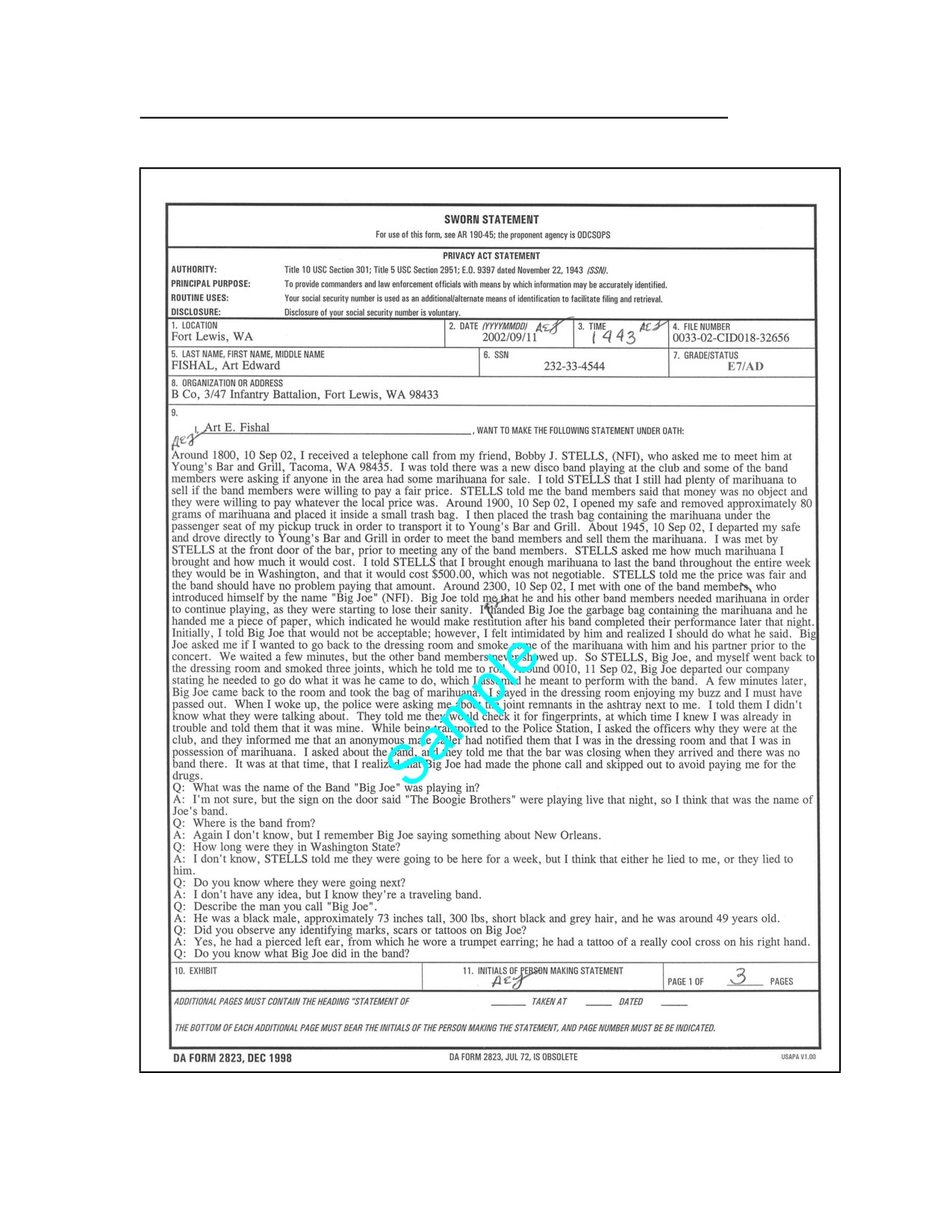
FM 3-19.13
Figure 4-8. Sample DA Form 2823, Page 1
Interviews and Interrogations 4-35
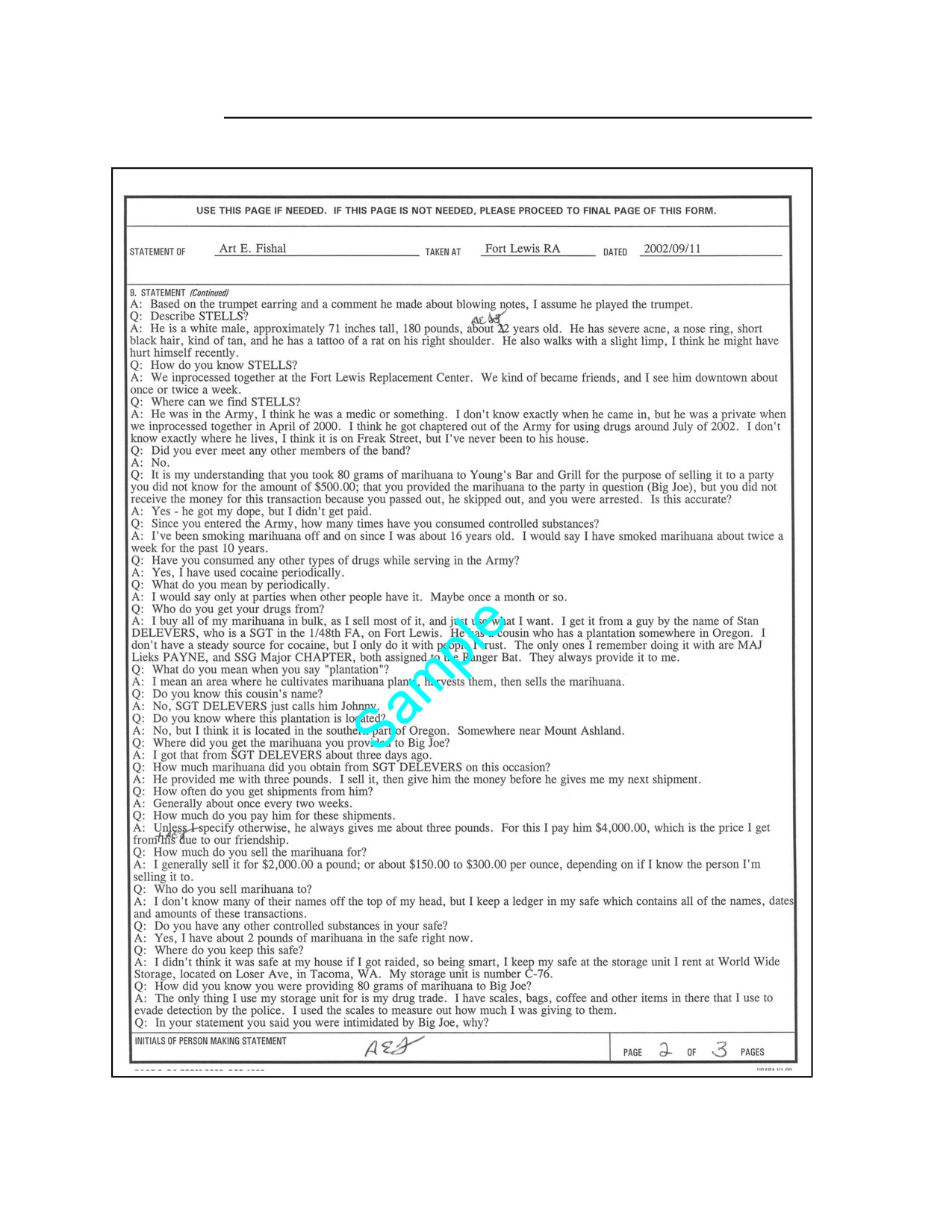
FM 3-19.13
Figure 4-9. Sample DA Form 2823, Page 2, Continuation Page
4-36 Interviews and Interrogations
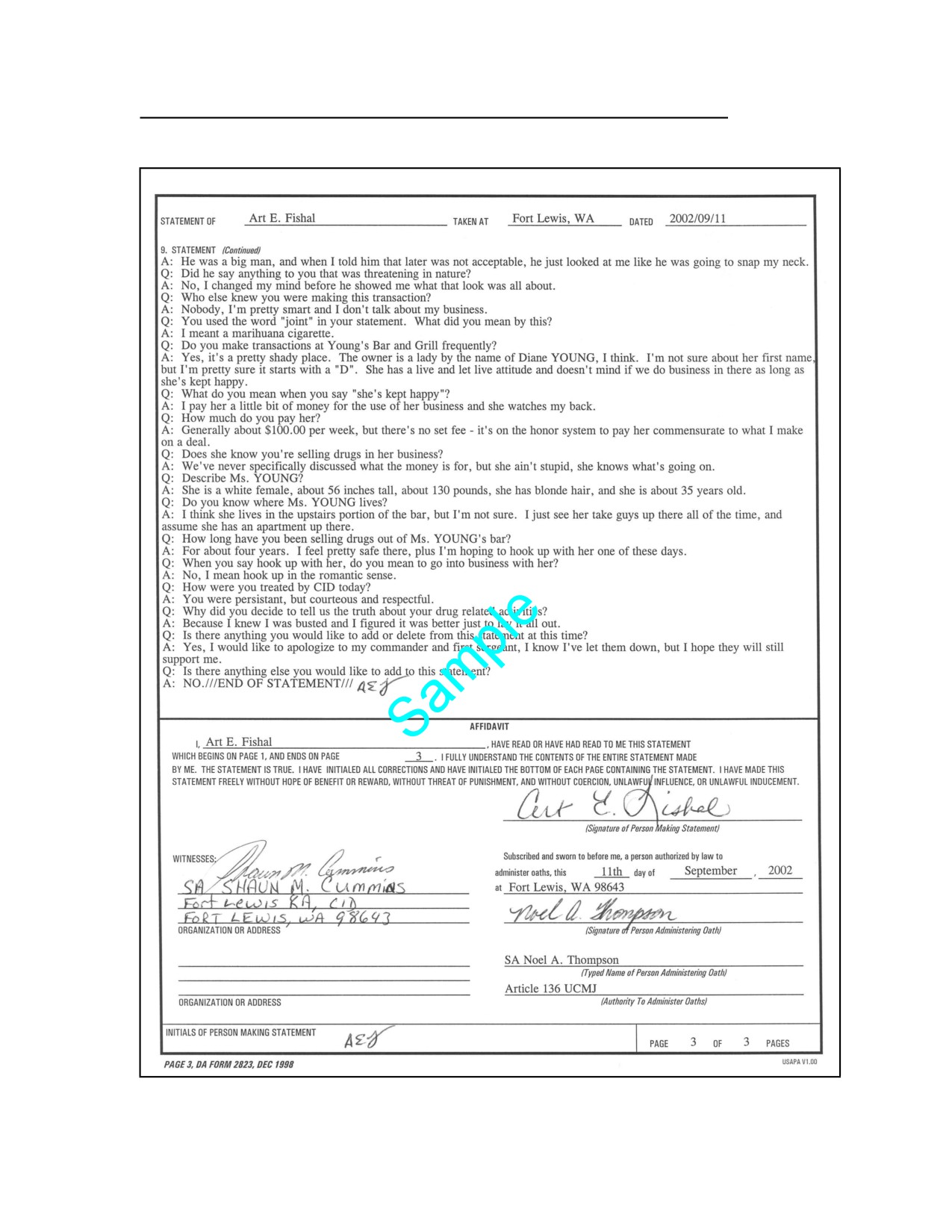
FM 3-19.13
Figure 4-10. Sample DA Form 2823, Page 3, Affidavit or Final Page
Interviews and Interrogations 4-37