FM 3-11.3 MULTISERVICE TACTICS, TECHNIQUES, AND PROCEDURES FOR CHEMICAL, BIOLOGICAL, RADIOLOGICAL, AND NUCLEAR CONTAMINATION AVOIDANCE (FEBRUARY 2006) - page 8

b.
Message Precedence. All other messages, after the initial NBC1 NUC report has
been sent, should be given a precedence, which reflects the operational value of the
contents. Normally, IMMEDIATE would be appropriate.
NBC5 NUC Report
Line Item
Description
Cond*
Example
ALFA
Strike serial number
O
ALFA/US/A234/001/N//
DELTA
DTG of attack or detonation and
O
DELTA/201405ZSEP2005//
attack end
OSCAR
Reference DTG for estimated contour
M
OSCAR/201505ZSEP2005//
lines
XRAYA*
Actual contour information
M
XRAYA/5CGH/32UND620475/
32UND662522/32UND883583/
32UND830422/32UND620475//
XRAYB*
Predicted contour information
O
XRAYB/75/100CGH/32UND621476/
32UND621477/32UND622477/
32UND622476/32UND621476//
YANKEE
Downwind direction and downwind
O
YANKEE/270DGT/015KPH//
speed
ZULU
Actual weather conditions
O
ZULU/4/10C/7/5/1//
GENTEXT
General text
O
-
*The Cond column shows that each line item is operationally determined (O) or mandatory (M).
Figure G-32. Sample NBC5 NUC Report
c.
Plotting Data and Producing an NBC5 NUC Report.
(1)
Contaminated areas are shown on the nuclear contamination situation
map, and information about them must be passed to other units and HQ. The most
expeditious means for this is the nuclear contamination overlay.
(2)
The preparation of such an overlay is described below:
(a) After all available information from monitoring and surveying has
been plotted on a map as normalized (H+1, unshielded ground dose rates [R1]), contour
lines for the standard dose rates can be drawn on a nuclear contamination overlay.
(b) When constructing the nuclear contamination overlay, there are
factors that locally affect the contamination pattern.
(c)
This is particularly true between points in an aerial survey. These
include topographic features, such as bluffs or cuts, heavily built-up or wooded areas, and
bodies of water. For example, a large river will carry away any fallout landing in it, leaving
its path relatively free of contamination. Also, the contamination hazard near a lake will be
lower than expected. The fallout particles will sink to the bottom of the lake, and the water
2 February 2006
FM 3-11.3/MCWP 3-37.2A/NTTP 3-11.25/AFTTP(I) 3-2.56
G-65
will provide shielding. In wooded or built-up areas, a measure of the reduction of dose rate
can be obtained by using the TFs (see Table G-3, page G-57) for these areas.
(d) Dose rate contour lines showing the contamination hazard in an area
can be drawn as follows: Count the number of readings taken for the route or leg. Since the
aircraft flew at a constant ground speed, taking readings at equal time intervals, the
distance covered between any two consecutive readings will be the same. If the route or leg
is divided into a number of equal-length segments, the total number of segments will equal
the number of time intervals. Each division point on the route or leg will represent a
location over which a dose rate reading was taken. The interval between readings equals
the length of the course leg or route divided by the number of readings, minus one. For
example, if seven readings are taken, the route is divided into only six segments—one less
than the number of readings taken by the survey party. The formula is:
Route or Course Leg Distance (km)
Interval Distance =
(Number of Readings - 1)
•
Determine the H+1 dose rate contour lines to be plotted (e.g., 20 [30
for NATO], 100, 300, 1,000 cGy/hr). These contour lines may be required for NBC5 report
purposes or for anticipated calculations to be made from the data.
1,000 cGy/h = Plotted in red.
300 cGy/h = Plotted in green.
100 cGy/h = Plotted in blue.
20 cGy/h = Plotted in black. (NATO forces use a 30 cGy/h line.)
•
Determine the points on the chosen survey routes or on course legs
and close to monitoring locations that are providing the desired dose rates.
•
Connect all the points having the same dose rates with a smooth line.
Use all plotted monitoring data as additional guides in constructing these contours.
•
Use care and judgment in plotting these contours and visualize the
probable general shape and direction of the pattern. Any dose rates disproportionately
higher than other readings in the immediate area indicate possible hot spots. When such
readings are reported, that area should be rechecked. If dose rates are confirmed, these hot
spots should be plotted and clearly identified. Figure G-33 shows a typical plot that might
be developed from survey data.
G-66
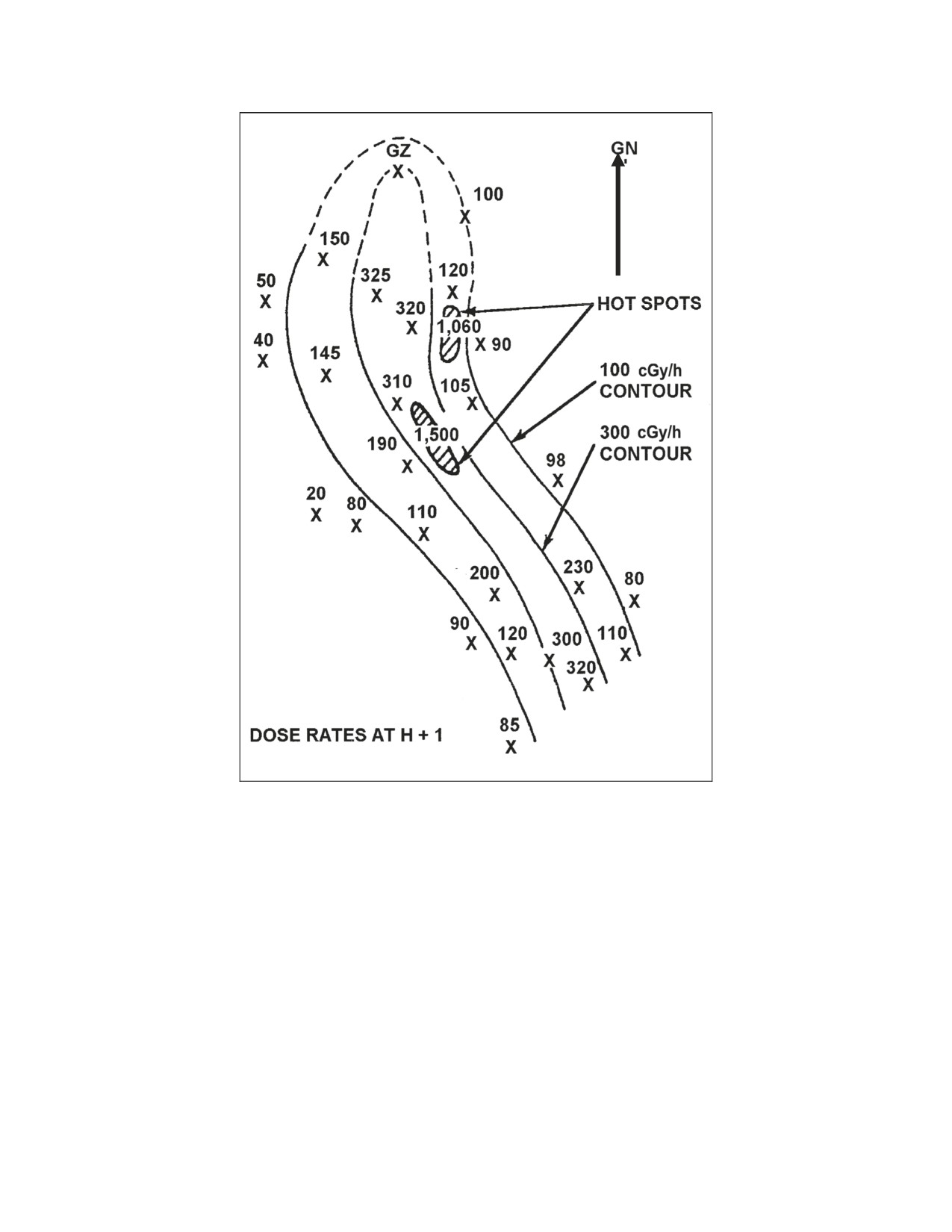
Figure G-33. Sample Fallout Pattern Plotted From Survey Data
•
The nuclear contamination overlays (Figure G-34, page G-68) that are
used for evaluation purposes must provide the most detailed information possible. The
minimum information required is—
—Map designation and orientation data.
—Nuclear burst and GZ identification (lines ALFA and FOXTROT of
the NBC2 NUC report).
—H hour (line DELTA of the NBC2 NUC report).
—Reference time (line OSCAR of the NBC5 NUC report).
—Decay rate/soil type.
—Time of preparation and validity time.
2 February 2006
FM 3-11.3/MCWP 3-37.2A/NTTP 3-11.25/AFTTP(I) 3-2.56
G-67
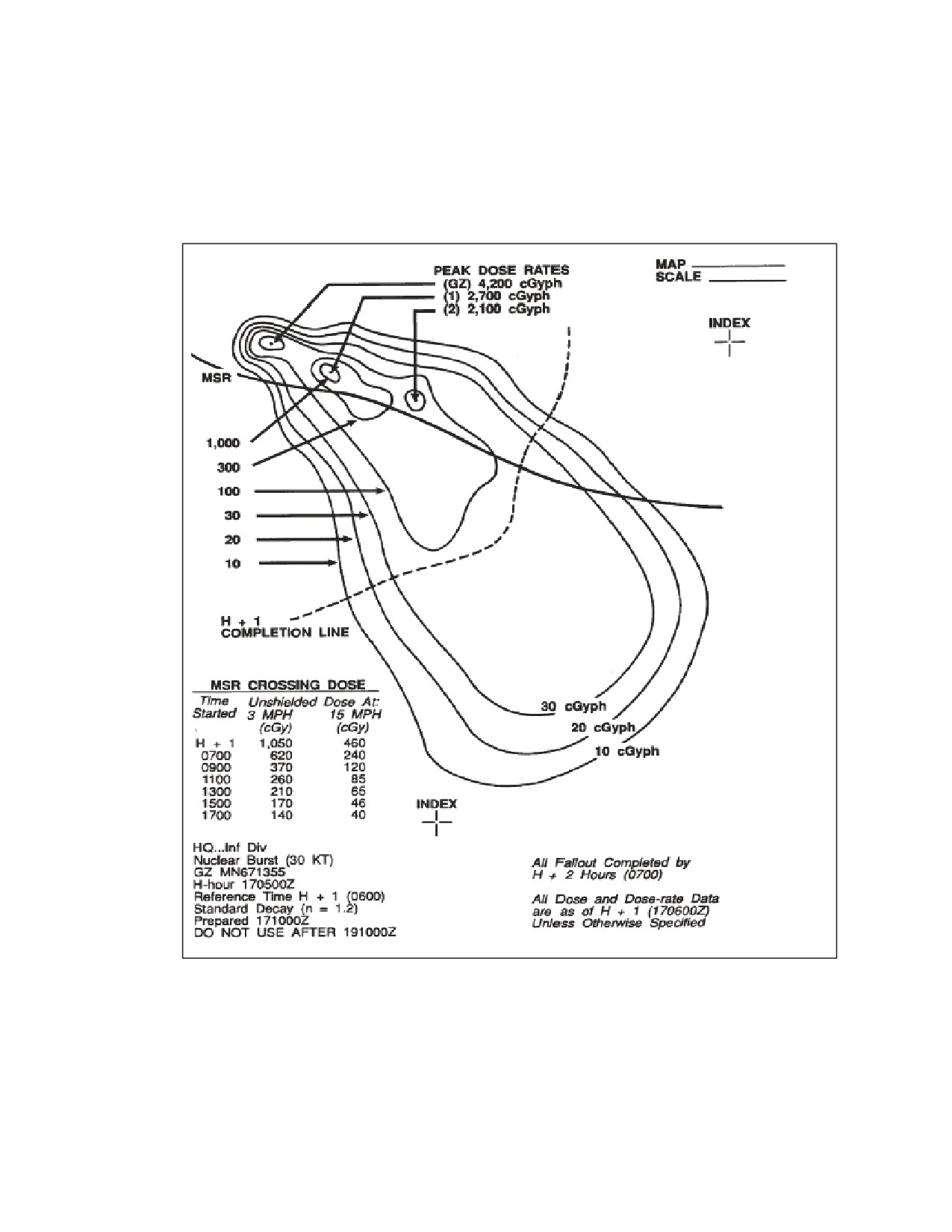
—Source of the contamination fallout or neutron-induced
contamination.
—Standard dose rate contour lines.
—Additional information, such as the time of completion lines for
fallout, may also be included where the unit SOPs require such information.
Figure G-34. Sample NBC5 NUC Contamination Overlay
d.
Reporting Data.
(1)
Electronic communications are not always available. If this is the case, the
nuclear contamination overlay must be converted into a series of readings and coordinates
for transmission as an NBC5 NUC report. This method has a disadvantage. It requires the
addressee to replot the data from the NBC5 NUC report and connect them to produce dose
G-68
rate contours, which is a time-consuming process. Staff planners must consider that the
shapes of dose rate contours drawn to correspond with a relatively brief series of readings
and coordinates can vary significantly.
(2)
If electronic communications of the data or communications of the hard
copy are not available and if time and distance permit, nuclear contamination overlays are
sent by messenger. Data is transmitted manually by the NBC5 NUC report as a last
resort.
(3)
When the contamination comes from a single burst, the dose rates will be
normalized to H+ 1. But if there have been several detonations at different times and no
single H+ 1 is possible, the dose rates are reported for a specific time.
(4)
On the NBC5 NUC report, a closed contour line on a plot is represented by
repeating the first coordinate.
(5)
To calculate the dose rates along the contour lines at a later time, use the
procedures described in paragraph 10e below and label the contour lines accordingly.
e.
Determining the Dose Rate for an Arbitrary Time. The Kaufmann equation can
be used as follows:
R1 x T1n = R2 x T2n can be mathematically changed to represent the missing
(or objective) variable to read: R2 = R1 / (t2)n or R2 = R1 / NF.
(1)
In this equation—
R2 = Dose rate at the location at the arbitrary time.
R1 = Dose rate (normalized to H+1) at the location.
t1
= H+1.
t2
= Arbitrary time, in hours, after H hour.
n
= Decay rate.
NF = Normalization factor.
NOTE: If R1 is the normalized dose rate reading at H+1, then t1 will always be 1.
Therefore the equation can be set up as follows:
Dose rate reading at H+1 is 600 cGy/h. Determine the dose at H+12. The decay
rate is 1.0.
R1 = 600 cGph; t1 = 1 hr; t2 = 12 hr; n = 1
(a) Step 1. Set up the formula.
R2 = R1 / (t2)n or
R2 = R1 / NF
(b) Step 2. Work the problem.
R2 = 600 / (12)1.0
or
R2 = 600 / 12
R2 = 600 / (12)
or
R2 = 50 cGy/h
R2 = 50 cGy/h
(2)
The NF graphs found in Appendix J can be utilized to determine the NF for
a given time if using the R2 = R1 / NF formula only if less than H+12 hours after the burst.
2 February 2006
FM 3-11.3/MCWP 3-37.2A/NTTP 3-11.25/AFTTP(I) 3-2.56
G-69
(a) Step 1. Determine the time (in hours and minutes) after the burst
that the reading was taken (12 hours).
(b) Step 2. Enter the appropriate figure in Appendix J with the time after
burst. Read across to the appropriate decay exponent column, and find the NF (12 hours
down and 1.0 across (decay rate down is 12.000).
(c)
Step 3. Divide the dose rate reading by the NF. The product is the
arbitrary time dose rate reading (600 / 12 = 50 cGy/h).
(3)
The decay rate nomograms found in Appendix J can also be used to
determine the dose rate at an arbitrary time.
(a) Step 1. Set up a table to properly record the information in the
problem.
R2
t2
R1
n
?
12 hr
600 cGy/h
1.0
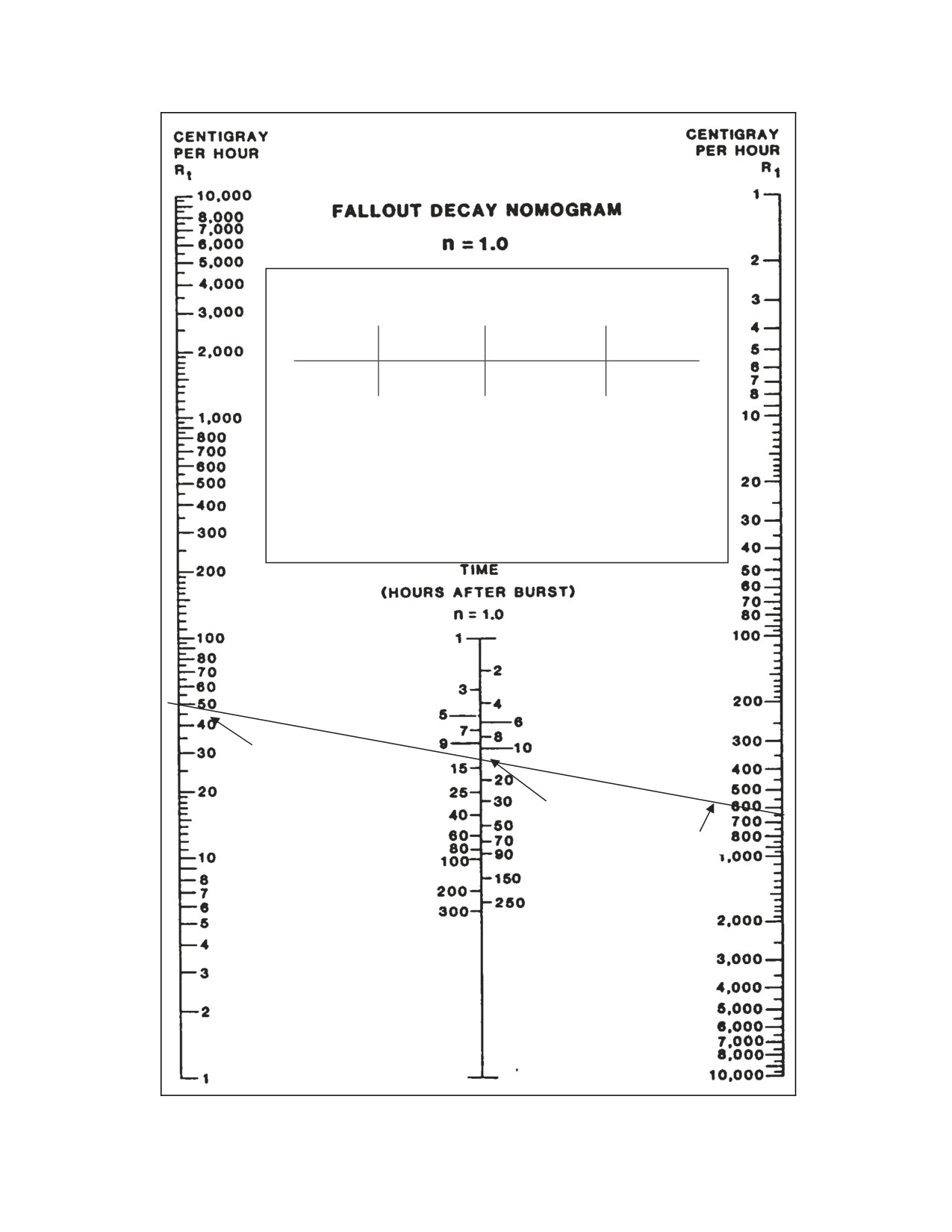
(b) Step 2. Find the nomogram for fallout decay using a decay rate (n) of
1.0 (see Figure G-35).
(c)
Step 3. Align the hairline on the value of 600 cGy/h on the far
right-hand R1 column. Lay the hairline across 12 in the Time column.
(d) Step 4. Holding the hairline straight and steady, read the value in the
far left-hand Rt column (Rt is the same as R2). This answer should be approximately 50
cGy/h.
G-70
Step 1. Set up a table to properly record the information in the
problem.
R2
t2
R1
n
?
12 hr
600 cGyph
1.0
Step 2. Align the hairline on the value of 600 cGyph on the far right-
hand R1 column. Lay the hairline across 12 in the time column.
Step 3. Holding the hairline straight and steady, read the value in the
far left-hand Rt column (Rt is the same as R2). This answer should be
approximately 50 cGyph.
Note: Hairline may not be to scale.
50cGy/h
12 hr
~600cGy/h
Figure G-35. Determining a Dose Rate at an Arbitrary Time (Example)
2 February 2006
FM 3-11.3/MCWP 3-37.2A/NTTP 3-11.25/AFTTP(I) 3-2.56
G-71
f.
Determining the Time That the Given Dose Rate is Expected. The Kaufmann
equation can also be used as follows:
R1 x T1n = R2 x T2n can be mathematically changed to represent the missing
(or objective) variable to read: t2 = R1 x t1 / R2.
(1)
In this equation—
R2 = Dose rate at the location at the arbitrary time.
R1 = Dose rate (normalized to H+1) at the location.
t1
= H+1.
t2
= Arbitrary time, in hours, after H hour.
NOTE: If R1 is the normalized dose rate reading at H+1, then t1 will always be 1.
Therefore, the equation can be set up as: t2 = R1 / R2.
Example: The dose rate reading at H+1 is 1,000 cGy/h. The decay rate is 1.0. Determine
the time at which R2 will be 500cGy/h.
R1 = 1,000 cGy/h; R2 = 500 cGy/h
(a) Step 1. Set up the formula.
t2 = R1 / R2
(b) Step 2. Work the problem.
t2 = 1,000/500
t2 = 2 hours
(2)
The decay rate nomograms in Appendix J can also be used to determine the
dose rate at an arbitrary time.
(a) Step 1. Set up a table to properly record the information in the
problem.
R2
t2
R1
n
500 cGy/h
?
1,000 cGy/h
1.0
(b) Step 2. Find the nomogram for fallout decay using a decay rate (n) of
1.0 (Appendix J).
(c)
Step 3. Align the hairline on the value of 1,000 cGy/h on the far right-
hand R1 column. Lay the hairline across to the far left-hand Rt column (Rt is the same as
R2) with 500 cGy/h.
(d) Step 4. Hold the hairline straight and steady, and read the value in
the Time column. This answer should be approximately 2 hours.
g.
Total Dose Reduction. The primary objective of the commander is to accomplish
the mission while keeping the total dose as low as possible. The total dose may be reduced
in several ways.
G-72
(1)
Avoid the area. When the actual measured fallout area cannot be avoided,
select the route that has the lowest dose rate. Commit the fewest number of personnel
possible to the operation.
(2)
Reduce exposure time. Plan operations to minimize the time spent in
contaminated areas. Select the route that is fastest and easiest to cross.
(3)
Delay the time of entry. If possible, allow the contamination to decay.
(4)
Use shielding. All vehicles should have increased shielding. Cross fallout
areas on foot as a last resort.
h.
Total Dose Procedures. The dose rate of radiation does not directly determine
whether or not personnel become casualties. Casualties depend on the total dose received.
If dose rates were constant, the total dose would simply be the product of the dose rate and
the time spent in the contaminated area (just as in a road movement problem, rate x time =
distance). However, the dose rate continually diminishes because of the decay. This makes
the calculation more complicated. The actual dose received is always less than the product
of the dose rate at the time of the entry times the duration of stay. The total dose, time of
entry, and time of stay calculations in the fallout areas are solved in the total dose
nomograms.
(1)
Using the total dose nomograms in Appendix J, relate the total dose, H+1
dose rate, stay time Ts, and entry time Te. The index scale is a pivoting line. It is used as
an intermediate step between D and R1 and Ts and Te. The index scale value can be used to
multiply R1 to find D. The four values on these nomograms are defined below:
D = Total dose in cGy.
R1 = Dose rate, in cGy/h, one hour after the burst (H+1).
Ts
= Stay time, in hours.
Te
= Entry time (hours after H hour).
n
= Decay rate.
NOTE: The H+1 dose rate must always be used. Never use a dose rate taken at
any other time.
R1 must be known before the total dose nomograms can be used. If any two
of the other three values are known, the nomograms can be used to find the
missing piece of information. D and R1 or Ts and Te are used together.
(2)
When working with total dose nomograms, start the problem on the side of
the nomogram where the two known values are located. If D and R1 are given, start on the
left side. If Ts and Te are given, start on the right side. Never begin a problem by joining D
or R1 with either of the time values. Place a hairline on either side with D and R1 or Ts and
Te. Align the hairline with the Index line; while holding the hairline in place with the Index
value. Enter the nomogram with the remaining side, D and R1, or Ts and Te to determine
the missing value.
2 February 2006
FM 3-11.3/MCWP 3-37.2A/NTTP 3-11.25/AFTTP(I) 3-2.56
G-73
(3)
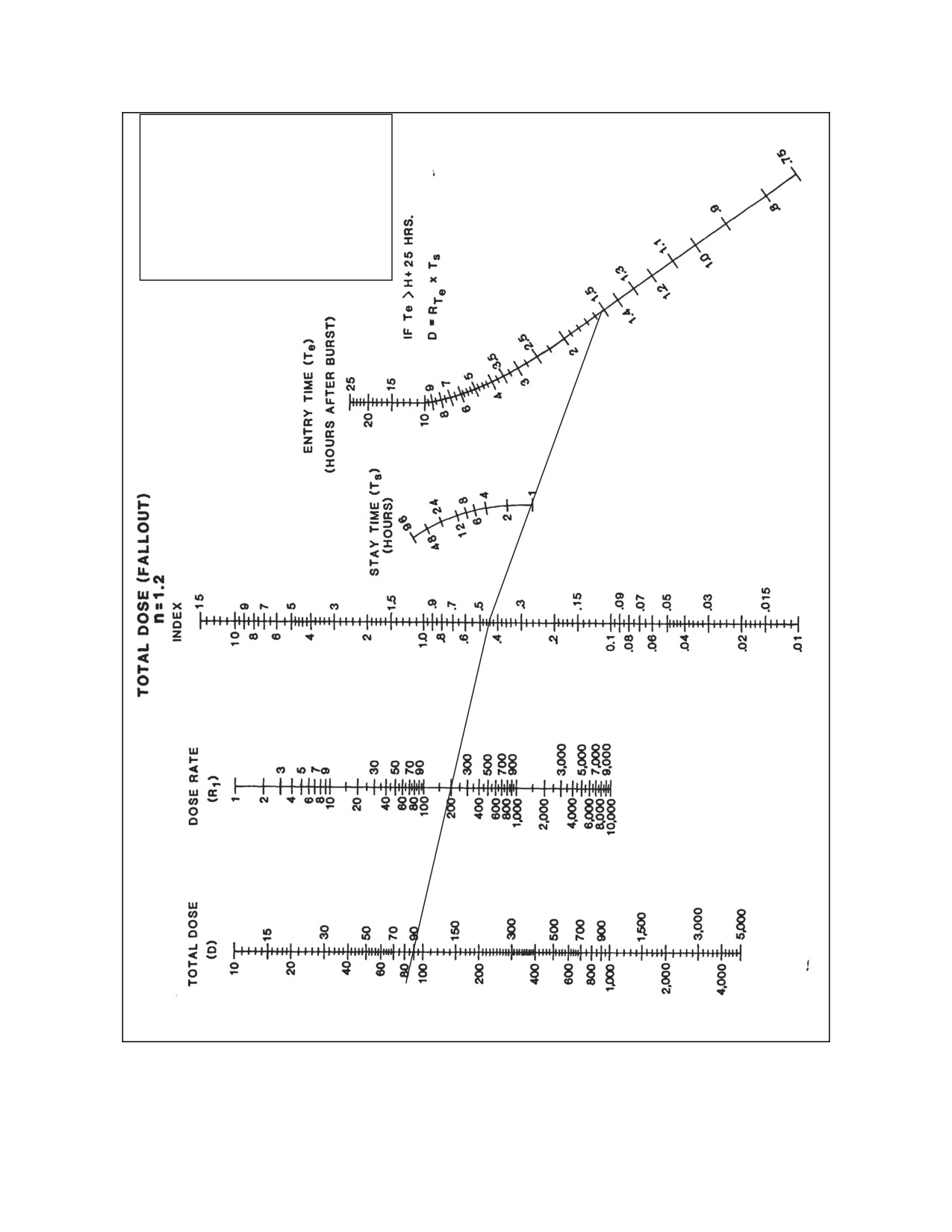
Example: Given R1
=
200 cGy/h
Te
=
H+1.5 hours
Ts
=
1 hour
n
=
1.2
Find
D
=
?
D
R1
Ts
Te
n
?
200 cGy/h
1 hr
1.5 hr
1.2
Solution:
90 cGy.
Select the n = 1.2 total dose nomogram. Connect H+1.5 hours on the Te scale with the Ts
reading of 1 hour. Pivot the hairline at its point of intersection with the index scale to the
200 cGy/h on the R1 scale. Read D = 90 cGy on the total dose scale. See Figure G-36 for an
example.
(4)
By 25 hours after the burst, the change in the rate of decay is so low that it
is relatively insignificant. Therefore, a different approach is used to estimate the total dose
when Te is greater than 25 hours. In this case, simply multiply the dose rate at the time of
entry by the time of stay. This is written “NOTE: This formula can be modified to
determine Te or Ts as well.”
D = RTe x Ts can be mathematically changed to represent the missing (or objective)
variable to read:
R1
RTe =
(Te)n
D
= Total dose (cGy).
RTe
= Dose rate (cGy/h) at time of entry.
Ts
= Time of stay (h).
Example: Given—
R1 = 300 cGy/h
Ts = 2 hours
Te = H+30 hours
n = 1.2
Find
D = ?
(a) Step 1. Set up the formula.
R1
300 cGy/h
D =
x 2 =
x 2
(Te)n
(30)1.2
(b) Step 2. Work the problem.
300 cGy/h
D =
x 2
= 10 cGy/h
(59.231)
G-74
Select the n = 1.2 total dose
nomogram. Connect H+1.5 hours on
the Te scale with the Ts reading of 1
hour. Pivot the hairline at its point of
intersection with the index scale to
the 200 cGy/h on the R1 scale. Read
D = 90 cGy on the total dose scale.
NOTE: Hairline may not be to
scale.
Figure G-36. Total Dose Fallout (n=1.2) (Example)
2 February 2006
FM 3-11.3/MCWP 3-37.2A/NTTP 3-11.25/AFTTP(I) 3-2.56
G-75
i.
Crossing a Fallout Area.
(1)
In nuclear operations, it is to be expected that extensive areas will be
residually radioactive. It may be necessary to cross an area where there is residual
radiation.
(2)
When crossing a contaminated area, the dose rate will increase as the
center of the area is approached and will decrease as the far side is approached. Therefore,
determine an average dose rate for total dose calculations. A reasonable approximation of
the average dose rate can be determined using only one-half of the highest dose rate. This
is written:
Rmax
Ravg =
2
Ravg = average dose rate
Rmax = highest dose rate encountered or expected to be encountered
(3)
This calculation is sufficient when looking for a suitable route for crossing a
contaminated area or when time is critical.
(4)
The effective dose rate for a crossing problem can be treated like the dose
rate for a fixed point. Therefore, all follow-on calculations (e.g., accumulated dose, earliest
time of entry) for the crossing problem can be done using the same procedures used for a
fixed point described earlier. The TF must also be applied as in a stationary situation.
j.
Optimum Time of Exit from Fallout Areas.
(1)
Nuclear fallout may present a serious hazard to units that remain in the
contaminated area. Shelters (such as, field emplacements) are the best protective measures
against nuclear radiation for troops in the field. If the shelter provides any appreciable
amount of protection, it will be advantageous to remain and improve it rather than to
evacuate to an uncontaminated area. If the situation permits and higher HQ approves, the
commander may decide to move out of the contaminated area. By evacuating at the
optimum exit time, the radiation dose to personnel is kept to a minimum.
(2)
To compute the optimum exit time from a fallout area, the time of the
detonation, location of an uncontaminated area, average TF, and time required to evacuate
must be known.
(3)
When moving from an area contaminated by fallout, the unit moves into an
uncontaminated location. This will necessitate waiting until fallout is complete at the
present positions.
(4)
The average TF of the fallout shelters and the vehicles used to leave the
contaminated area must be computed. Since all shelters are not the same, an average
value should be used. The TF of a vehicle may be estimated. A unit moving on foot will be
fully exposed and will have a TF of 1.0.
(5)
The time to load vehicles and move out of the contaminated area must be
estimated. In order to minimize exposure time, it may be necessary to temporarily abandon
nonessential items and recover them at a later time when the dose rate has decreased to an
acceptable value. The optimum time of exit (Topt) is calculated as—
G-76
Topt = MF x Tev
MF is a multiplication factor taken from Figure G-37, page G-78.
Tev is the time required to evacuate the contaminated area.
The following abbreviations are used in the optimum time of exit calculations:
TFS is the average TF for the fallout shelters.
TFM is the average TF after leaving shelters (during movement out of the
contaminated area).
TFRatio is the TF ratio.
(6)
Compute the optimum exit time by the following steps:
(a) Step 1. Calculate the TF ratio (TFRatio = TFS/TFM).
(b) Step 2. Determine the multiplication factor (MF). Enter the vertical
axis of Figure G-37, page G-78, with the value obtained for TFRatio. Move horizontally along
this value to the curve. Move straight down, and read the MF from the horizontal axis.
(c)
Step 3. Calculate the optimum exit time. Multiply MF by Tev. The
product is the optimum time, in hours, after detonation that the unit should leave its
shelters and evacuate the area.
(7)
Special Considerations.
(a) The unit should evacuate the fallout area as soon as possible when the
ratios of TFRatio are close to or greater than 0.5.
(b) If the optimum time of exit is estimated to be before the actual arrival
of fallout, the unit should evacuate the area as soon as possible after the fallout is complete
and an uncontaminated area is available.
(c)
The unit will receive the smallest dose possible if it leaves the
contaminated area at the optimum time of exit. If the commander is willing to accept up to
a 10 percent increase in dose, he may leave the shelters any time between one-half and
twice the optimum time of exit.
(d) If possible, personnel should improve their shelters while waiting for
the optimum time of exit. The estimate of the optimum time of exit should be recalculated
if significant improvement is made in the shelters. Improved shelters mean the unit should
remain in shelters for a longer period of time to minimize the dose to the personnel.
2 February 2006
FM 3-11.3/MCWP 3-37.2A/NTTP 3-11.25/AFTTP(I) 3-2.56
G-77
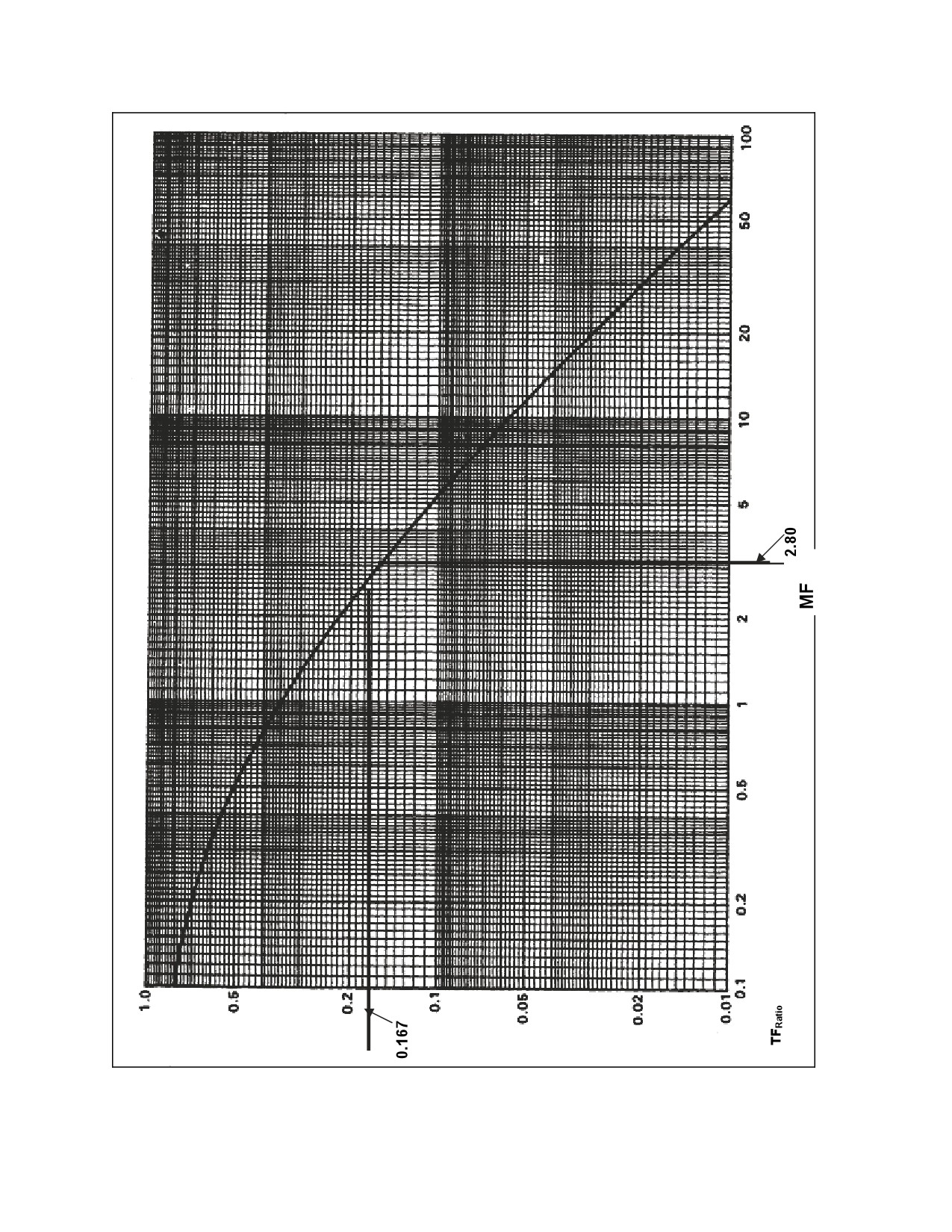
Figure G-37. MF (Example)
G-78

k.
Neutron-Induced Radiation Areas.
(1)
Type of Burst. Neutrons are produced in all nuclear-weapon bursts. Some
of these neutrons may be captured by various elements in the soil under the burst. As a
result, these elements become radioactive, emitting beta particles and gamma radiation for
an extended period of time. Beta particles are a negligible hazard unless the radioactive
material makes direct contact with the skin for an extended period of time. Beta particles
can cause skin irritations, varying from reddening to open sores. In contrast, gamma
radiation readily penetrates the body and can cause radiation injury and even death. To
determine the external military hazard posed by induced radiation, an analysis of the dose
rate of the emitted gamma radiation must be determined.
(2)
Location Data. The location of a suspected, induced radiation area created
by an air burst is determined by nuclear-burst data. Weather conditions have no influence
on its location or size. Surface winds will not affect the pattern. The pattern, if produced,
will always be around GZ. The size of the pattern depends on the yield of the weapon and
the HOB. Table G-4 shows the boundaries of the induced area for different yields.
Assuming an optimum HOB, the user enters the table with the yield of the weapon. The
distance given is the maximum horizontal radius to which a 2-cGy/h dose rate will extend 1
hour after the burst.
Table G-4. Radii of Neutron-Induced Contamination
Estimated Yield (KT)
Horizontal Radius of 2-cGy/h Dose Rate H+1 (m)
0.1
200
1.0
700
10.0
1,000
100.0
1,600
1,000.0
2,000
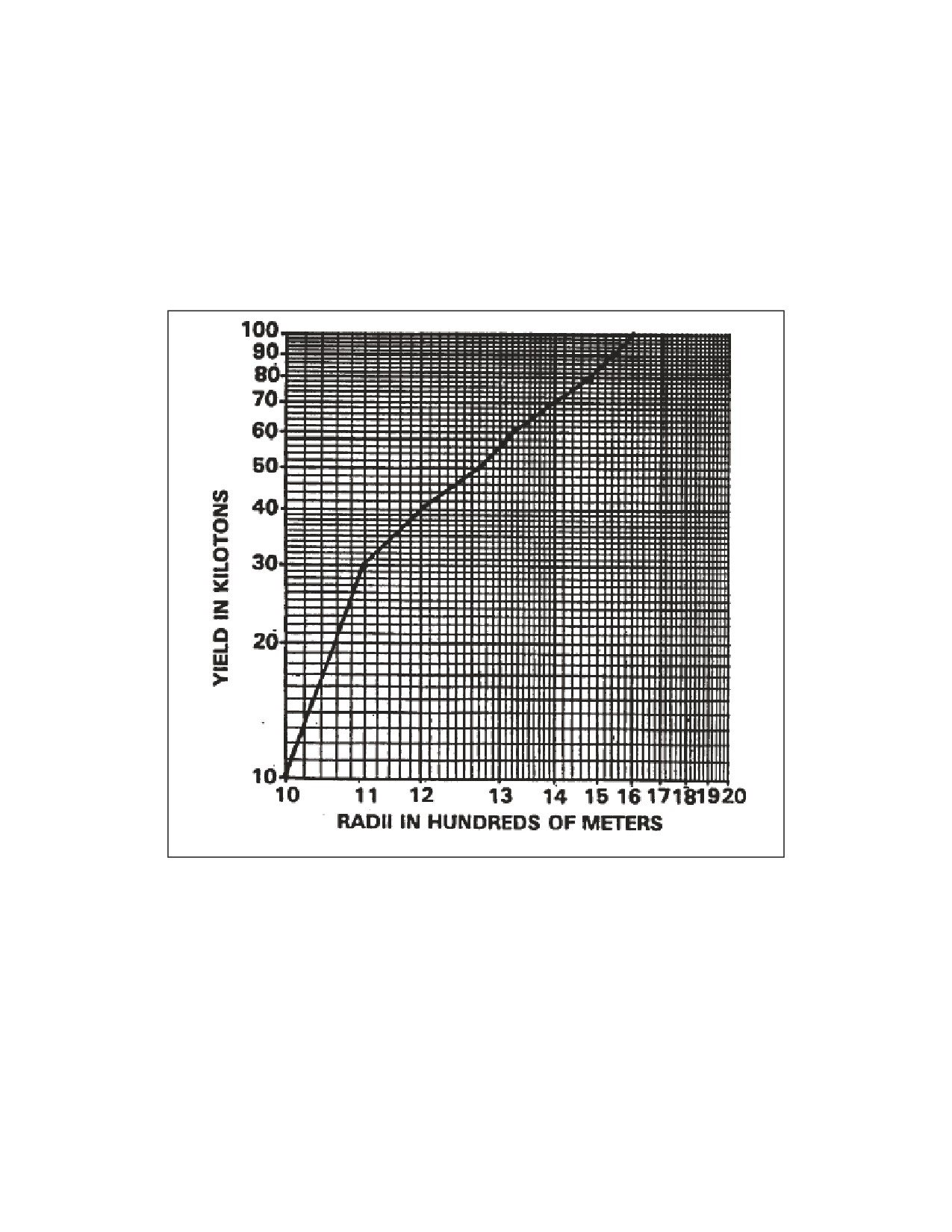
(a) Enter the Keller nomogram (Figure G-38 or G-39, pages G-80 and
G-81) with the yield of the weapon to extract the horizontal radius, in meters. The distance
given is the maximum horizontal radius to which a 2-cGy/h dose rate will extend 1 hour
after the burst.
(b) Enter the radii of the neutron-induced contamination (see Table G-4)
with the yield of the weapon to extract the horizontal radius, in meters. The distance given
is the maximum horizontal radius to which a 2-cGy/h dose rate will extend 1 hour after the
burst.
(c)
The following steps should be utilized when plotting neutron-induced
radiation areas:
•
Step 1. Obtain a clean sheet of overlay paper.
•
Step 2. Obtain the nuclear-burst information from the NBC2 NUC
report or from the CBRN cell strike serial log. Record the strike serial number, DTG of
burst, GZ location, weapon yield, and map scale on the overlay.
•
Step 3. Utilize the Keller nomogram or the radii of induced-
contamination table to determine the horizontal radius of the 2-cGy/h line.
•
Step 4. Select the GZ coordinate.
2 February 2006
FM 3-11.3/MCWP 3-37.2A/NTTP 3-11.25/AFTTP(I) 3-2.56
G-79
•
Step 5. Draw a circle around the GZ that matches the distance
extracted in Step 3 (see Figure G-37, page G-78).
(d) The circular area with a radius as given in Figure G-40, page G-82,
around GZ is regarded as contaminated until actual dose rate readings indicate otherwise.
The actual area of contamination is usually substantially less, depending on the actual
yield and the HOB.
Figure G-38. Keller Nomogram for Neutron-Induced Areas From 10 to 100 Kilotons
G-80
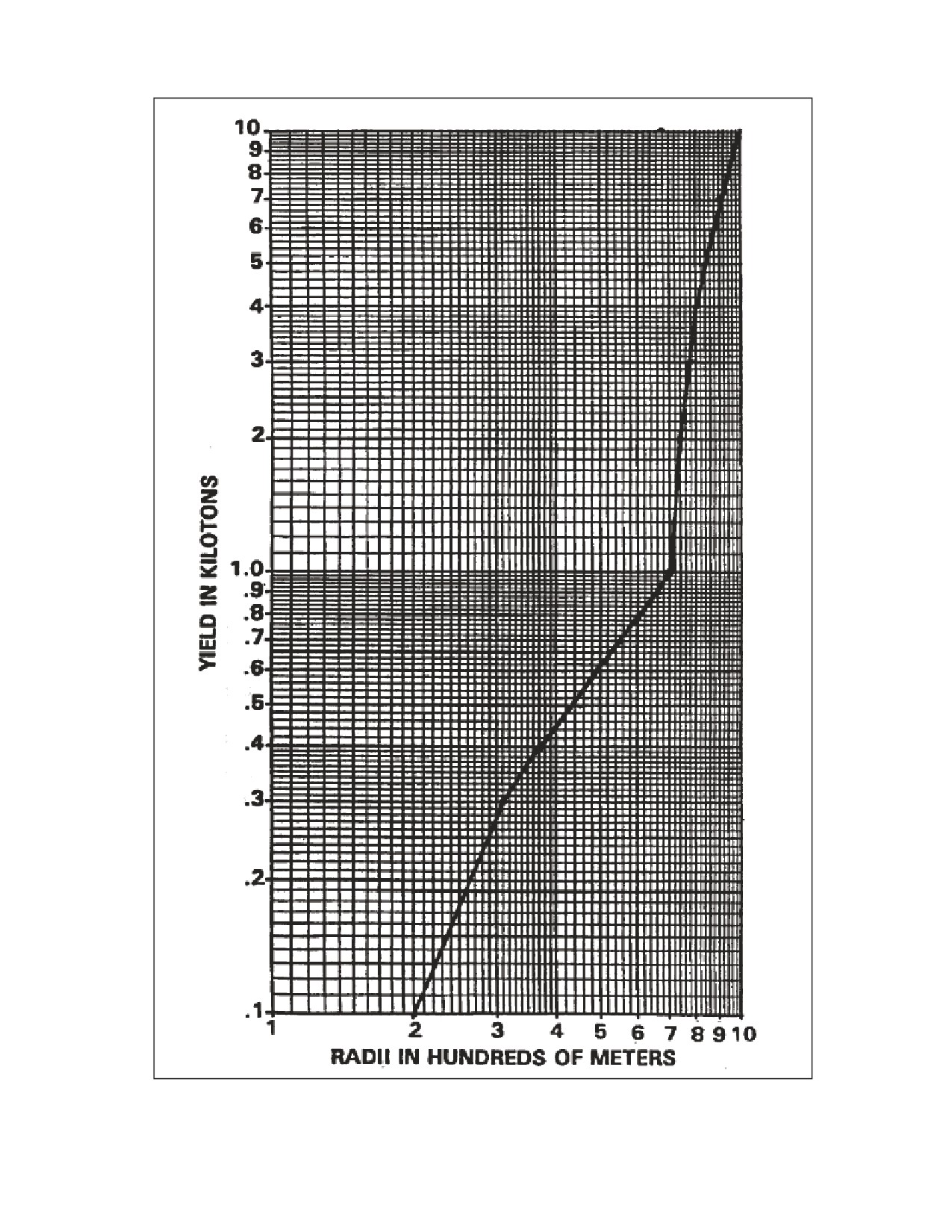
Figure G-39. Keller Nomogram for Neutron-Induced Areas From 0.1 to 10 Kilotons
2 February 2006
FM 3-11.3/MCWP 3-37.2A/NTTP 3-11.25/AFTTP(I) 3-2.56
G-81
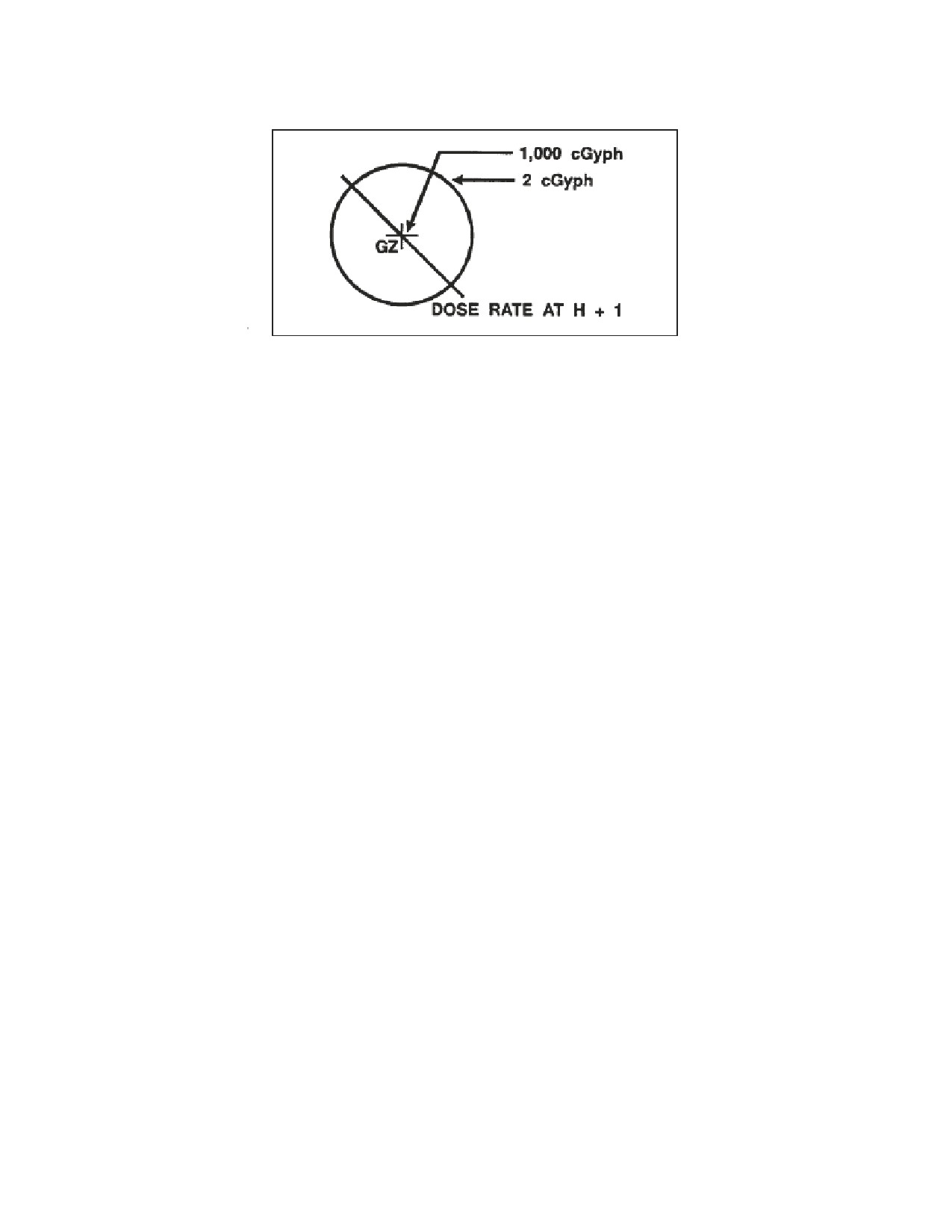
Figure G-40. Example of Plotted Neutron Induced Area
(3)
Decay of Induced Radiation.
(a) The soil in the target area is radioactive to a depth of 0.5 meter at GZ.
In contrast, fallout is a deposit of radioactive dust on the surface. From this, it can be seen
that decontamination of the area is impractical.
(b) The decay characteristics of induced radiation are considerably
different from those of the fallout. Fallout is a mixture of many substances, all with
different rates of decay. Induced radiation is produced primarily in aluminium,
manganese, and sodium.
(c)
Other elements, such as silicon, emit so little gamma radiation or
decay so fast that they are less important.
(d) During the first 30 minutes after a burst, the principal contributor to
induced radiation is radioactive aluminium. Almost all soils contain aluminium. It is one
of the most abundant elements in the earth’s surface. Radioactive aluminium has a
half-life of 2 to 3 seconds. Because of this, almost all the radioactive aluminium has
decayed within 30 minutes after the burst.
(e) Most soils also contain significant quantities of manganese. This
element decays with a half-life of about 2.6 hours. From 30 minutes after a burst until 10
to 20 hours after the burst, manganese and sodium are the principal contributors to the
radiation. After 10 to 20 hours after the burst, sodium (which decays with a half-life of
about 15 hours) is the principal source of radiatio.
(f)
Soil composition is the most important factor in the decay of induced
radiation. Its decay must be considered differently from that of fallout. For fallout, the
decay rate is calculated by using the Kaufmann equation. For induced radiation, the
percentage (by weight) of elements present in the soil determines the decay rate.
(g) Since soil composition varies widely, even in a localized area, the
actual chemical composition of the soil must be known to determine the rate of decay of the
induced radiation. The soils are divided into four types (see Table G-5).
(h) Since the actual soil composition will not be known, soil Type II (the
slowest decay) is used for all calculations until the CBRN cell advises the use of a different
soil type.
G-82
Table G-5. Soil Types for Induced Radiation Calculations
Element
Type I
Type II
Type III
Type IV
Sodium
-
1.30
0.16
0.001
Manganese
0.008
0.01
2.94
0.006
Aluminum
2.890
6.70
18.79
0.005
Iron
3.750
2.20
10.64
46.650
Silicon
33.100
32.00
10.23
0.004
Titanium
0.390
0.27
1.26
-
Calcium
0.080
2.40
0.45
-
Potassium
-
2.70
0.88
0.001
Hydrogen
0.390
0.70
0.94
0.001
Boron
-
-
-
-
Nitrogen
0.065
-
0.26
-
Sulphur
0.070
0.03
0.26
-
Magnesium
0.050
0.60
0.34
-
Chromium
0.008
-
0.04
-
Phosphorus
3.870
0.04
0.13
-
Carbon
50.330
-
9.36
-
Oxygen
50.82
43.32
53.332
(i)
Soil type is determined by using engineer soil maps or an NBC4 NUC
report and the induced-decay nomograms in Appendix J. The method is basically a process
of elimination. The dose rate and the time it was measured are applied to an induced-decay
nomogram. This will result in an H+1 or R1 dose rate. Compare the rates and times with
the nomograms until the results have the same R1.
(4)
TFs. TFs for induced areas are determined in the field. The TF in Table
G-6 should be used with the greatest reservation. Actual TF in induced areas may be lower
by as much as 70 percent because of the technical characteristics of radiation.
Table G-6. TFs for Common Structures
Structure
Neutrons
Structure
Neutrons
3 Feet Underground
0.01
Concrete Shelter
Frame House
0.80
9-inch walls
0.50
Basement
0.80
12-inch walls
0.40
Multifloor Building
N/A
24-inch walls
0.20
Upper Floors
1.00
Shelter (Partly Aboveground)
Lower Floors
0.80
2 feet of earth cover
0.08
3 feet of earth cover
0.05
(a) Essentially, the strength of gamma radiation is measured in MeV.
Fallout less than 24 hours old has an average energy of 0.67 MeV. Induced radiation
emitted from the three principal soil elements has a range of 0.68 to 1.2 MeV.
(b) Because of the unique decay characteristics of induced radiation, the
TF must be recalculated frequently (every 4 hours is recommended). This accounts for the
changes in the penetration ability of the remaining radiation.
2 February 2006
FM 3-11.3/MCWP 3-37.2A/NTTP 3-11.25/AFTTP(I) 3-2.56
G-83
(5)
Dose Rate Calculations. The decrease in the dose rate must be calculated
before the total dose can be found. This is done with the decay nomograms. Use the
residual radiation (induced) decay nomograms in Appendix J for these calculations. They
allow the user to predict the dose rate at any time after the burst.
(a) The Rt scale shows H+1 dose rates.
(b) The Rt scale shows the dose rate at other times. This scale shows dose
rates at x t.
(6)
Total Dose Calculations. The nomograms in Appendix J are used for
predicting the total dose received in an induced area. This nomogram relates total dose,
H+1 dose rate, stay time, and entry time. The two scales to the left of the index line show
the total dose and H+1 dose rate. There are two stay-time scales to the right of the index
line. The extreme right scale shows entry time. The index line is a pivoting line, which is
used as an intermediate step between D and R1. R1 is found by using one of the induced-
decay nomograms.
(a) If the soil type is unknown, assume that the soil is Type II. The total
dose nomogram (Appendix J) is never used to find R1.
(b) The “stay time” Ts must also be calculated. If the soil type is known,
the appropriate scale under “stay time” will be used. It is possible to find any one value on
the total dose nomogram if the other three are given. The formula for time of stay is
calculated as—
Example 1: Given—
R1 = 140 cGy/h
Te = H + 6 hours
Ts =
1 hour
Soil Type: II
Find D
Answer: 72 cGy
Solution: On the nomogram (Appendix J) connect H+6 on the Te scale with 1
hour on the Ts scale (soil Types II and IV) with a hairline. Pin the hairline at the point of
intersection with the index scale. Now, pivot the hairline to 140 cGy/h on the R1 scale.
Read 72 cGy on the D scale.
Example 2: Given—
R1 = 300 cGy/h
Te = H+6 hours
D = 70 cGy
Soil Type: III
Find Ts
Answer: 1 hour
G-84
Solution: On the nomogram (Appendix J) connect 70 cGy on the D scale with
300 cGy/h on the R1 scale. Pin the hairline at the point of intersection with the index scale.
Pivot the hairline to H+6 hours on the Te scale. Read 1 hour on the Ts scale (soil Types I
and III).
(7)
Crossing an Induced Radiation Area. If an area must be crossed, the lowest
dose rate area consistent with the mission is selected.
(a) When calculating the total dose, it is necessary to determine an
average dose rate. Dose rates increase as the center of the area is approached and then
decrease beyond the center of the area. The average dose rate represents the mean value
that an individual is exposed to during the time of stay. A reasonable approximation of the
average dose rate can be obtained by dividing the maximum dose rate predicted to be
encountered by two. This is written as—
Rmax
Ravg =
2
(b) The time of stay (TS) must be calculated (see Figure G-41, page G-86).
The formula for time of stay is calculated as—
Distance
TS =
Speed
•
Step 1. Identify the time of entry (Te).
•
Step 2. Calculate Ravg (this will be the R1 value for the nomogram).
•
Step 3. Calculate TS.
•
Step 4. Use the appropriate nomogram (see Figure G-41, page G-86).
Line the Te and TS (based on soil type) up.
•
Step 5. Pivot the hairline to the R1 value.
•
Step 6. Convert OD to ID to determine the total dose.
2 February 2006
FM 3-11.3/MCWP 3-37.2A/NTTP 3-11.25/AFTTP(I) 3-2.56
G-85
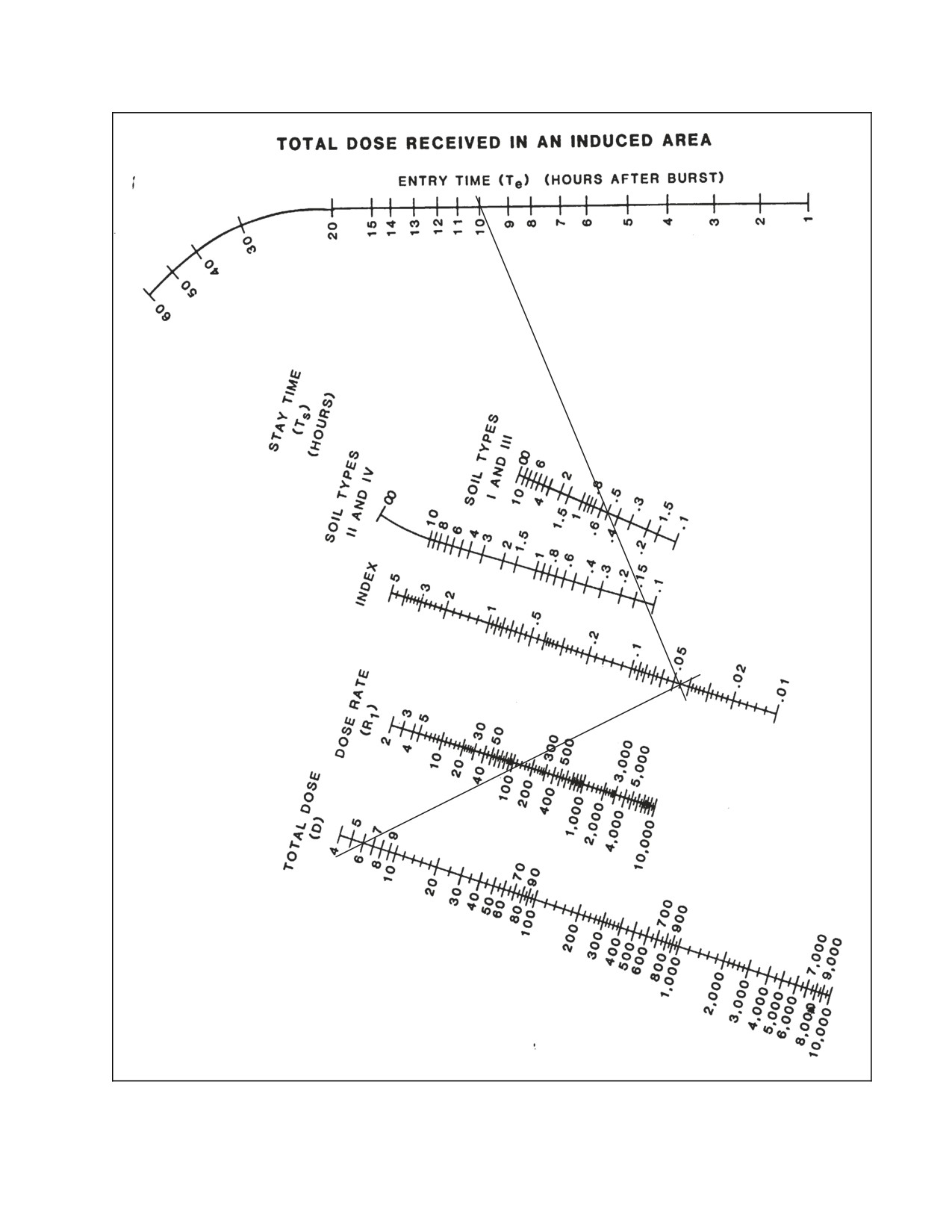
Connect 10 hours on the Te scale with 0.1 hour on the Ts scale (soil
Types II and IV). Pin the hairline on the index scale. Pivot the hairline
150 cGyph on the R1 scale. Read the OD as 6 cGy. Calculate the ID:
ID = OD x TF ID = 6 cGyph x 0.22 ID = 1.32 cGyph or
1 cGyph. NOTE: Hairline may not be to scale.
Figure G-41. Total Dose-Induced Radiation (Example)
G-86
(8)
Determination of Decay Rate for Induced Radiation. Decay characteristics
of an induced radiation are considerably different from those of a fallout. The Kaufmann
equation may not be applied.
(a) The decay of induced radiation depends on the elements in which it is
induced. Soil contains many different elements with varying half-lives, so the decay rate
changes in time and must be monitored constantly.
(b) The decay rate (n) at a fixed location can only be determined from
consecutive measurements, using the following equation:
1
Ra
X 1n
(
)
t
Ra + t
(c)
Ra is the dose rate reading in cGy/h at an arbitrary time and (Ra + t)
is a second reading taken at the same location after t hours.
(d) Manganese and sodium are two elements with relatively long half-
lives that are frequently found in soils. Therefore, they are expected to be the principal
sources of radiation after a burst. For sodium, with its half-life of 15 hours, the decay rate
is 0.046. For manganese, with its half-life of 2.6 hours, the decay rate is 0.27.
(9)
Determination of Dose Rate for Arbitrary Time. The dose rate (R1+t), in
cGy/h, at an arbitrary time (t hours) after a reading is calculated as—
R1 + t = Ra(-n x t)
Ra is the dose rate at the time (t) of the reading, n is the decay rate at that time, and EXP ()
is the exponential function (inverse or INV; the argument is the power to which
e=2.71828…is raised).
(10) Determination of Dose Accumulated in Neutron-Induced Area. The dose D,
in cGy, accumulated between entry to and exit from a neutron-induced gamma activity
(NIGA) area is found by using the formula—
D = R1/n((-n x tin ) - (-n x tout))
R1 is the dose rate in cGy/h at the reference time, n is the decay rate at that time, tin and tout
are the time of entry and exit from the NIGA area, in hours, after the reference time.
(11) Determination of Earliest Time of Entry. To ensure that a limiting dose
(DL) is not accumulated during a stay in an NIGA area, the earliest time of entry (tin) can
be determined as follows:
Te = -1/n * (DL/(R * n * (1 -(-n * Ts)).
TS = Time of stay in the area in hours
R = Dose rate at the reference time H+1
n
= Decay rate at that time
(12) Determination of Time of Exit from Neutron-Induced Area Given a
Maximum Dosage. If a certain limit DL for the dose accumulated during a stay in an NIGA
2 February 2006
FM 3-11.3/MCWP 3-37.2A/NTTP 3-11.25/AFTTP(I) 3-2.56
G-87

area is given, the time (tout) to leave the area can be determined from the following
equation:
Tout = -1/n*n((-n*Te)-(n*DL)/R1)
Te = Time of entry, in hours, after the reference time at which the dose rate was R1 and the
decay rate was D.
11. NBC6 NUC Report
The NBC6 NUC report (Figure G-42) provides commanders and staff with detailed
information that is vital to the operation.
a.
Purpose. The NBC6 NUC report is used to provide detailed information on a
nuclear attack. The NBC6 NUC report is submitted to higher HQ. It is written in narrative
form with as much detail as possible.
b.
Message Precedence. All other messages, after the initial NBC1 NUC report has
been sent, should be given a precedence, which reflects the operational value of the
contents. Normally, IMMEDIATE would be appropriate.
NBC6 NUC Report
Line Item
Description
Cond*
Example
ALFA
Strike serial number
O
ALFA/US/A234/001/N//
DELTA
DTG of attack or detonation and
O
DELTA/201405ZSEP2005//
attack end
FOXTROT
Location of attack and qualifier
O
FOXTROT/32UNB058640/EE//
QUEBEC
Location and type reading/sample/
O
QUEBEC/32VNJ481203/GAMMA/-//
detection
SIERRA
DTG of reading
O
SIERRA/202300ZSEP2005//
GENTEXT
General text
M
GENTEXT/NBCINFO/WEAPON YIELD
ESTIMATED FOR EVALUATION OF
COLLATERAL DAMAGE PURPOSES
ONLY//
*The Cond column shows that each line item is operationally determined (O) or mandatory (M).
Figure G-42. Sample NBC6 NUC Report
G-88

(12) Determination of Time of Exit from Neutron-Induced Area Given a
Maximum Dosage. If a certain limit DL for the dose accumulated during a stay in an NIGA
area is given, the time (tout) to leave the area can be determined from the following
equation:
Tout = -1/n*n((-n*Te)-(n*DL)/R1)
Te = Time of entry, in hours, after the reference time at which the dose rate was R1 and the
decay rate was D.
11. NBC6 NUC Report
The NBC6 NUC report (Figure G-42) provides commanders and staff with detailed
information that is vital to the operation.
a.
Purpose. The NBC6 NUC report is used to provide detailed information on a
nuclear attack. The NBC6 NUC report is submitted to higher HQ. It is written in narrative
form with as much detail as possible.
b.
Message Precedence. All other messages, after the initial NBC1 NUC report has
been sent, should be given a precedence, which reflects the operational value of the
contents. Normally, IMMEDIATE would be appropriate.
NBC6 NUC Report
Line Item
Description
Cond*
Example
ALFA
Strike serial number
O
ALFA/US/A234/001/N//
DELTA
DTG of attack or detonation and
O
DELTA/201405ZSEP2005//
attack end
FOXTROT
Location of attack and qualifier
O
FOXTROT/32UNB058640/EE//
QUEBEC
Location and type reading/sample/
O
QUEBEC/32VNJ481203/GAMMA/-//
detection
SIERRA
DTG of reading
O
SIERRA/202300ZSEP2005//
GENTEXT
General text
M
GENTEXT/NBCINFO/WEAPON YIELD
ESTIMATED FOR EVALUATION OF
COLLATERAL DAMAGE PURPOSES
ONLY//
*The Cond column shows that each line item is operationally determined (O) or mandatory (M).
Figure G-42. Sample NBC6 NUC Report
2 February 2006 FM 3-11.3/MCWP 3-37.2A/NTTP 3-11.25/AFTTP(I) 3-2.56
G-89
THIS PAGE IS INTENTIONALLY LEFT BLANK
Appendix H
RELEASE-OTHER-THAN-ATTACK CONTAMINATION AVOIDANCE
TACTICS, TECHNIQUES, AND PROCEDURES
1.
Background
The ROTA contamination avoidance TTP provides vital SA to the commander when
faced with a ROTA incident.
a.
General. This appendix covers the procedures to warn and report CBRN
releases other than the traditional military CBRN attacks resulting from the offensive use
of CBRN weapons. These releases may include, but are not limited to, CBRN or TIM
releases due to damaged or destroyed storage bunkers, transport vehicles, storage or
production facilities, ammunition supply sites, power plants, etc.
b.
Characteristics.
(1)
Types of HAZMAT. Most nations in the world have some form of hazardous
CB (or radiological) production or storage facilities. Most of these materials are used for
peaceful purposes and are considered to be in one of the following categories:
(a) Agricultural. These include insecticides, herbicides, fertilizers, etc.
(b) Industrial. These are chemicals or other substances (biological or
radiological) used in manufacturing processes or for cleaning.
(c)
Production and Research. These are CBRN materials used in
research or produced in a facility.
(2)
Detection. Civilian chemical materials or compounds or biological
materials may not be detectable by the standard CB detection devices of tactical units.
Also, these materials may not be detectable with the human senses and may cause
symptoms that are different than symptoms from CBRN agents.
(3)
Definitions.
(a) Release Area. This is the predicted area immediately affected by the
release.
(b) Hazard Area. This is the predicted area in which unprotected
personnel may be affected by CBRN material spreading downwind from the release area.
The downwind distance depends on the type of the release, the weather and terrain in the
release area, and the area downwind of the release area.
(c)
Contaminated Area. This is the area in which CBRN material may, in
solid or liquid form, remain at hazardous levels for some time after the release. The actual
shape and duration can only be determined by surveys.
(d) Elevated Releases. Any release which, due to fire, momentum, or
explosion, is carried more than 50 m above the ground is considered an elevated release.
2 February 2006 FM 3-11.3/MCWP 3-37.2A/NTTP 3-11.25/AFTTP(I) 3-2.56
H-1
(e) TIM. TIM is the generic term for toxic (CB) or radioactive substances
in a solid, liquid, aerosolised, or gaseous form. These may be used (or stored for use) for
industrial, commercial, medical, military, or domestic purposes. TIM may be chemical,
biological, or radioactive and may be described as toxic industrial chemical (TIC), toxic
industrial biological (TIB), or toxic industrial radiological (TIR).
2.
Release-Other-Than-Attack Contamination Avoidance Procedures
Avoidance procedures are broken down into three actions—before, during, and after
the attack. The lists given, while not all-encompassing, may assist in developing the unit
SOP and directives.
a.
Preattack.
(1)
Alert subordinate units.
(2)
Assess the ability of the MOPP gear to protect against agent or material;
request additional protective gear as required.
(3)
Specify (commanders) the appropriate MOPP levels; establish automatic
masking criteria; and, if MOPP0 is assumed, determine the location for the chemical
protective clothing based on the METT-TC.
(4)
Continue the mission while ensuring that the following actions are
implemented to minimize casualties and damage:
(a) Protect personnel, equipment, munitions, POL, food, and water from
the contamination.
(b) Place the detection paper to provide visibility and maximum exposure
to liquid agents.
(c)
Practice OPSEC, dispersal, and cover and concealment so that the
unit may avoid being targeted.
(d) Check to ensure that the chemical detectors and alarms are prepared
for use.
(e) Prepare the updated CDMs for each unit.
(5)
Determine the decontamination requirements.
b.
During Attack.
(1)
All personnel automatically mask, sound the alarm, decontaminate
themselves (as required), assume MOPP4, and administer self-aid and buddy-aid.
(2)
The chain of command and communications are restored and the unit
continues the mission.
(3)
Adjacent units are immediately warned of the potential downwind vapor
hazards.
(4)
The unit identifies the type of agent and submits an NBC1 ROTA report as
the mission permits.
(5)
The unit performs the following actions for attacks that leave liquid or solid
contamination on the equipment, personnel, or terrain:
H-2
FM 3-11.3/MCWP 3-37.2A/NTTP 3-11.25/AFTTP(I) 3-2.56
2 February 2006
(a) Conduct personal wipe-down and operator’s spray-/wipe-down.
(b) Warn medical evacuation personnel of the contamination casualties.
Wrap and mark the persons killed in action.
(c)
Mark the contaminated area, and relocate to a clean area if the
mission allows.
(d) Determine where and when further decontamination can be
accomplished, if necessary.
(e) Coordinate for decontamination, and resupply protective clothing and
decontaminants.
(f)
Ensure that the contaminated battle dress overgarments are
exchanged within 24 hours after being contaminated.
(g) Replace the contaminated protective covers within 24 hours.
(h) Conduct unmasking procedures, treat casualties, prepare for
evacuation (as the mission permits), and ensure the operational status of the service
detection systems.
(i)
Receive the NBC2 ROTA report, plot the potential hazard area, and
inform the commander.
c.
Postattack.
(1)
The unit has undergone decontamination operations, and casualties have
been evacuated.
(2)
The unit reorders CBRN defense equipment (i.e., MOPP suits, filters,
decontamination kits).
(3)
If the unit has not yet identified what agent was used, continue the effort to
identify the agent and source. This will be done by using the following:
•
M8 chemical-agent detection paper.
•
M256A1 chemical-agent detection kit.
•
ICAM or Chemical-Agent Monitor Block II (CAM II [USMC]).
•
Automatic Chemical-Agent Detector Alarm (ACADA).
•
AN/VDR-2 radiac set.
•
AN/PDR-56 radiac set.
•
AN/PDR-77 radiac set.
•
ADM-300 radiac set.
•
DOD biological sampling kit.
•
HAZMAT identification system.
•
Hazardous category, chemical identification system.
•
Samples that are forwarded to the area lab for analysis.
2 February 2006 FM 3-11.3/MCWP 3-37.2A/NTTP 3-11.25/AFTTP(I) 3-2.56
H-3
(4)
If the unit must continue to operate in or occupy the contaminated area, the
unit should do the following:
•
Continue efforts to refine the contamination hazard area and extent by
continued sampling and detection.
•
Adjust or improve the MOPP as required.
•
Mark the contaminated areas and identify the “hot spots.”
•
Monitor the contamination decay or covering to determine when natural
decay may render the area safe.
•
Be alert for transient contamination and the spreading or movement of
contamination by natural sources (i.e., wind, rain, runoff, rivers) or by human sources (i.e.,
vehicle traffic, rotor wash).
3.
Release-Other-Than-Attack Information Management
Managing ROTA information is crucial for the success of a command. To be useful,
the ROTA information must be collected, reported, and evaluated. Once evaluated, it can
be used as battlefield intelligence. Obtaining and converting ROTA information into usable
intelligence does not just happen. The volume of information that needs to be collected and
reported could easily disrupt communications and tactical operations if not properly
managed.
a.
Collecting ROTA Information. The first step in managing ROTA information is
to determine what information is available and who is available to collect it. Observer data
provides information that a ROTA event (intentionally or accidentally) has occurred.
Monitoring, survey, and reconnaissance data provide information on where the hazard is
located. Every unit is responsible for observing and recording ROTA events, but only
selected units automatically submit NBC1 ROTA reports to the CBRN cell.
b.
Consolidating ROTA Data.
(1)
NBC1 ROTA reports allow the CBRN cell to collect information on where
the designated observers have seen a nuclear attack. The CBRN cell then evaluates this
information in the form of an NBC2 ROTA report. From the NBC2 ROTA report, a
simplified or detailed hazard prediction is made. This prediction (NBC3 ROTA report) is
only an estimate of the hazard area. Feedback is needed from the units to determine
exactly where the contamination is located. This feedback comes from monitoring, survey,
and reconnaissance data (NBC4 ROTA reports). Monitoring and reconnaissance operations
give the initial location of CBRN hazards to the CBRN cell. Initial monitoring and
reconnaissance reports are generally forwarded through intelligence channels to the CBRN
cell. This information may also be sent to the CBRN cell by the use of various DSTs, as
discussed in Chapter III.
(2)
The CBRN cell then plots the information on the situation map. If more
information is required, the CBRN cell directs a unit (picked because of its location and
capability) to collect and forward the necessary data. This information could be from
additional monitoring reports or a survey of the area in question. Collecting ROTA
information is a joint effort of units and the CBRN cell. The unit does the actual collecting
of information. The CBRN cell plans for and directs the collection effort. More detailed
H-4
FM 3-11.3/MCWP 3-37.2A/NTTP 3-11.25/AFTTP(I) 3-2.56
2 February 2006
information concerning this collection effort is addressed in Multiservice Tactics,
Techniques, and Procedures for Nuclear, Biological, and Chemical Reconnaissance.
c.
Evaluating ROTA Information. After the ROTA information has been collected,
it is evaluated. It is then used as battlefield intelligence. The CBRN cell is the primary
evaluation center. The units and intermediate HQ use this raw data to develop ROTA
intelligence for their own use until detailed results are available from the CBRN cell.
d.
Transmitting ROTA Information. The procedures used to transmit ROTA
information to and from the CBRN cell are an important part of the IM. The method of
transmitting information depends on the tactical situation and mission of the unit. Refer to
Chapter III for more detailed information.
4.
NBC1 ROTA Report
The NBC1 ROTA report (Figure H1, page H-6) is the most widely used report. The
observing unit uses this report to provide ROTA data. All units must be completely
familiar with the NBC1 ROTA report format and its information. The unit must prepare
this report quickly and accurately and send it to the next higher HQ. Battalion (squadron)
or the service equivalent and higher elements decide which NBC1 ROTA reports to forward
to the next higher HQ. If several reports are received for the same ROTA event, a
consolidated NBC1 ROTA report is forwarded. This reduces the number of reports to a
manageable level.
a.
Purpose. The purpose of the NBC1 ROTA report is to provide ROTA data.
b.
Precedence. The first time a ROTA event occurs, the designated unit will send
the NBC1 ROTA report with a FLASH precedence. If a previous NBC1 ROTA report has
been forwarded, an IMMEDIATE precedence will be used.
c.
Information Included. The report will include lines BRAVO, CHARLIE, GOLF,
INDIA, and TANGO and may include line items ALFA, FOXTROT, MIKER, YANKEE,
ZULU, and GENTEXT with the information as currently described for CBRN reports. Line
CHARLIE provides the same information as line DELTA, except it indicates an observed
ROTA event rather than an observed attack. Line GOLF will include the type of delivery if
applicable, the ROTA type of container (e.g., bunker, waste, reactor, transport, stockpile),
and the size of the release (small, large, or extra large) if appropriate. Line INDIA will
indicate the observed release height and indicate the type of release as ROTA nuclear
power plant, TIM, or the agent name or identification number. Line INDIA will indicate
the material persistency. Additional descriptive entries for a ROTA event can be entered
into line MIKER. Line TANGO will indicate a description of the terrain/topography and
the vegetation. Lines YANKEE and ZULU may indicate locally observed weather. Line
GENTEXT will provide the specific chemical compound or the type of biological agent if
available.
d.
Preparation. Determine the line items for this report by utilizing the same
procedures as the previous contamination avoidance TTP appendixes per the type of attack
or event.
2 February 2006 FM 3-11.3/MCWP 3-37.2A/NTTP 3-11.25/AFTTP(I) 3-2.56
H-5

NBC1 ROTA Report
Line Item
Description
Cond*
Example
ALFA
Strike serial number
O
BRAVO
Location of observer and direction of
M
BRAVO/32UNB062634/2500MLG//
attack or event
CHARLIE
DTG of report or observation and end
M
CHARLIE/281530ZSEP2005//
of event
FOXTROT
Location of attack or event
O
FOXTROT/32UNB058640/EE//
GOLF
Delivery and quantity information
M
GOLF/SUS/TPT/1/TNK/SML//
INDIA
Release information on CB agent
M
INDIA/SURF/2978/-/ARD//
attacks or ROTA events
MIKER
Description and status
O
MIKER/LEAK/CONT//
TANGO
Terrain/topography and vegetation
M
TANGO/URBAN/URBAN//
description
YANKEE
Downwind direction and downwind
O
YANKEE/270DGT/015KPH//
speed
ZULU
Actual weather conditions
O
ZULU/4/10C/7/5/1//
GENTEXT
General text
O
*The Cond column shows that each line item is operationally determined (O) or mandatory (M).
Figure H-1. Sample NBC1 ROTA Report
5.
NBC2 ROTA Report
The NBC2 ROTA report reflects the evaluated ROTA data. It is based on one or more
NBC1 ROTA reports. Users of the NBC2 ROTA reports are not limited to the use of the
line items shown in Figure H-2. Other line items may be added as appropriate.
a.
Purpose. The purpose of the NBC2 ROTA report is to pass the evaluated data to
the higher, subordinate, and adjacent units.
b.
Precedence. All messages after the initial NBC1 ROTA report has been sent,
should be given a precedence, which reflects the operational value of the contents.
Normally, IMMEDIATE would be appropriate.
c.
Preparation. The division (or designated higher HQ) CBRN cell prepares the
NBC2 ROTA report, assigns a strike serial number, and disseminates the report to the
appropriate unit.
d.
Subsequent Data. Subsequent data may be received after the NBC2 ROTA
report is sent. Use the same strike serial number and DTG of the attack or incident.
Determine the line items for this report utilizing the same procedures as the previous
contamination avoidance TTP appendixes per the type of attack or event.
H-6
FM 3-11.3/MCWP 3-37.2A/NTTP 3-11.25/AFTTP(I) 3-2.56
2 February 2006

NBC2 ROTA Report
Line Item
Description
Cond.
Example
ALFA
Strike serial number
M
ALFA/US/WEP/001/RN//
CHARLIE
DTG of report /observation and event
M
CHARLIE/281530ZSEP2005/
end
281545ZSEP1997//
FOXTROT
Location of attack or event
M
FOXTROT/32UNB058640/EE//
GOLF
Delivery and quantity information
M
GOLF/SUS/TPT/1/TNK/1//
INDIA
Release information on CB agent
M
INDIA/SURF/2978/-/ARD//
attacks or ROTA events
MIKER
Description and status
M
MIKER/LEAK/CONT//
TANGO
Terrain/topography and vegetation
M
TANGO/URBAN/URBAN//
description
YANKEE
Downwind direction and downwind
O
YANKEE/270DGT/015KPH//
speed
ZULU
Actual weather conditions
O
ZULU/4/10C/7/5/1//
GENTEXT
General text
O
*The Cond column shows that each line item is operationally determined (O) or mandatory (M).
Figure H-2. Sample NBC2 ROTA Report
6.
NBC3 ROTA Report
The NBC3 ROTA report reflects the predicted areas of contamination. It is based on
the NBC2 ROTA report and any current relative data. Users of the NBC3 ROTA reports
are not limited to the use of the line items shown in Figure H-3, page H-8. Other line items
may be added as appropriate.
a.
Purpose. The purpose of the NBC3 ROTA report is to report the immediate
warning of the predicted contamination and hazard areas to higher, subordinate, and
adjacent units.
b.
Precedence. All messages after the initial NBC1 ROTA report has been sent
should be given a precedence, which reflects the operational value of the contents.
Normally, IMMEDIATE would be appropriate.
c.
Preparation. The report will use the information as described in this manual for
lines ALFA, CHARLIE, FOXTROT, GOLF, INDIA, PAPAA, PAPAX, YANKEE, ZULU, and
GENTEXT. The hazard area location is described in line PAPAX, with the defining release
area radius and protective action distance summarized in line PAPAA. Line XRAYA may
be used to report contours for the measured areas of air contamination. Determine the line
items for this report utilizing the same procedures as the previous contamination avoidance
TTP appendixes per the type of attack or event.
2 February 2006 FM 3-11.3/MCWP 3-37.2A/NTTP 3-11.25/AFTTP(I) 3-2.56
H-7

NBC3 ROTA Report
Line Item
Description
Cond*
Example
ALFA
Strike serial number
M
ALFA/US/WEP/001/RN//
CHARLIE
DTG of report /observation and event
M
CHARLIE/281530ZSEP2005//
end
FOXTROT
Location of attack or event
M
FOXTROT/32UNB058640/EE//
GOLF
Delivery and quantity information
O
GOLF/SUS/TPT/1/TNK/1//
INDIA
Release information on CB agent
M
INDIA/SURF/2978/-/ARD//
attacks or ROTA events
PAPAA
Predicted attack/release and hazard
M
PAPAA/1000M*/-/5KM/-//
area
PAPAX**
Hazard area location for weather
M
PAPAX/081200ZSEP1997/
period
32VNJ456280/32VNJ456119/
32VNJ576200/32VNJ566217/
32VNJ456280//
XRAYB***
Predicted contour information
C
YANKEE
Downwind direction and downwind
O
YANKEE/270DGT/015KPH//
speed
ZULU
Actual weather conditions
O
ZULU/4/10C/7/5/1//
GENTEXT
General text
O
*The Cond column shows that each line item is operationally determined (O) or mandatory (M).
**Line item is repeatable up to three times in order to describe three possible hazard areas corresponding to the
time periods from the CDM. A hazard area for a following time period will always include the previous hazard
area.
***Line item is repeatable up to 50 times to represent multiple contours.
Figure H-3. Sample NBC3 ROTA Report
d.
Types of Releases. There may be chemical, biological, and/or radiological
material present in any AO, which will present a hazard to persons if it is released into the
atmosphere. Releases may be accidental or intentional. The amount of material released
may be small or extremely large. Such ROTA events can be divided into two types based on
their origin:
(1)
Type N, ROTA Nuclear. Nuclear material can be released into the
atmosphere from the core of a nuclear reactor, has been damaged or which has gone out of
control. Similar incidents may occur at nuclear-fuel reprocessing or production facilities.
Such a release can result in very high levels of radiation, covering distances of hundreds of
km.
(2)
Type T, TIM. There are five cases of incidents under Type T. These cases
include items that may be used or stored for use for industrial, commercial, medical,
military, or domestic purposes. TIM may be TIC, TIB, or TIR.
(a) Case 1, Nuclear-Waste or Radiological-Material Storage. Damage to a
nuclear-waste or radiological-material storage facility may result in the release of
radiological material into the atmosphere. Such a release will result in LLR covering a
H-8
FM 3-11.3/MCWP 3-37.2A/NTTP 3-11.25/AFTTP(I) 3-2.56
2 February 2006
fairly short distance, which will be dangerous to anyone remaining in the hazard area for
an extended period of time.
(b) Case 2, RDD. The intentional release of large amounts of radiological
material can result in hazardous areas extending far downwind.
(c)
Case 3, Biological Bunker or Production Facility. Damage to a storage
bunker containing biological agents intended for use in BW or to production facilities for
such agents containing active agent containers will result in smaller release areas and
lower quantities than if agents had been dispersed from a weapon. However, due to the
toxicity of such agents and the likelihood of having an elevated plume, dispersed material
may travel downwind at hazardous levels for many hours.
(d) Case 4, Chemical Stockpile or TIM Transport/Storage. Damage to
stockpiled munitions containing chemical agents will result in considerably smaller
quantities of agent released than the intentional use of munitions; therefore, the downwind
hazard area will usually be smaller than for a chemical attack. Damage to containers of
TIM being transported by road, rail, or boat can result in large quantities released into the
atmosphere. However, the toxicity and stability of these materials will be less than for
chemical agents and the hazard areas will also be smaller than for a chemical attack. This
category also includes small storage quantities and single munitions found leaking on the
battlefield.
(e) Case 5, Bulk Chemical Storage. TIC are stored in very large
quantities (greater than 1,500 kg) in large tanks, often under pressure and at low
temperatures. A catastrophic rupture of such a tank will result in a highly toxic cloud,
which usually exhibits dense-gas behavior. This type of release may also occur
intentionally by a terrorist or other deliberate action. Such a cloud will not travel with the
wind until after its concentration has been reduced considerably, often when it is below
toxic levels. In addition to their toxicity, TIC are often corrosive, flammable, explosive, or
able to react violently with air or water. These hazards may be greater than the immediate
toxic effects.
e.
Procedures and Constraints.
(1)
Procedures.
(a) Record and update the following information:
•
Weather information from relevant CBRN commanders, which may
contain forecast data and measured data.
•
Weather information from local measurements and observations,
which may contain data before and during the cloud passage period.
•
A database of local meteorology measured during the cloud passage
period
(b) Record the terrain features (wooded areas, mountains, plains, etc.),
which may influence the direction and speed of the ROTA clouds.
(c)
Generate an NBC3 ROTA report, and consider distribution whenever
the threat of a ROTA event is high.
(d) Estimate the MET parameters for the release area and downwind of
the release area upon the receipt of an NBC1 or NBC2 ROTA report.
2 February 2006 FM 3-11.3/MCWP 3-37.2A/NTTP 3-11.25/AFTTP(I) 3-2.56
H-9
(e) Select (according to the national directives) the weather information to
be used, and calculate the predicted downwind hazard area.
(2)
Constraints.
(a) When calculating the predicted downwind hazard area from ROTA
events, many factors will affect the accuracy of the prediction. Some of these factors
include the following:
•
Type and amount of CBRN agents or materials.
•
Type and amount of delivery or storage systems.
•
Type and amount of agent containers.
•
Terrain composition.
•
Weather.
•
Air stability.
•
Type of surface.
•
Vegetation.
•
Surface air temperature.
•
Relative humidity.
(b) Some of the above factors are not considered when using the
procedures in this appendix or annotated to refer to a previous appendix for appropriate
hazard prediction procedures unless evaluated and estimated manually by the user.
(c)
The procedures shown in this appendix or annotated to refer to a
previous appendix for appropriate hazard prediction procedures are based on the limited
amount of information available at the time of the ROTA event.
(d) To be able to make more accurate predictions, more information about
the listed factors has to be available and more sophisticated methods have to be used for
prediction.
f.
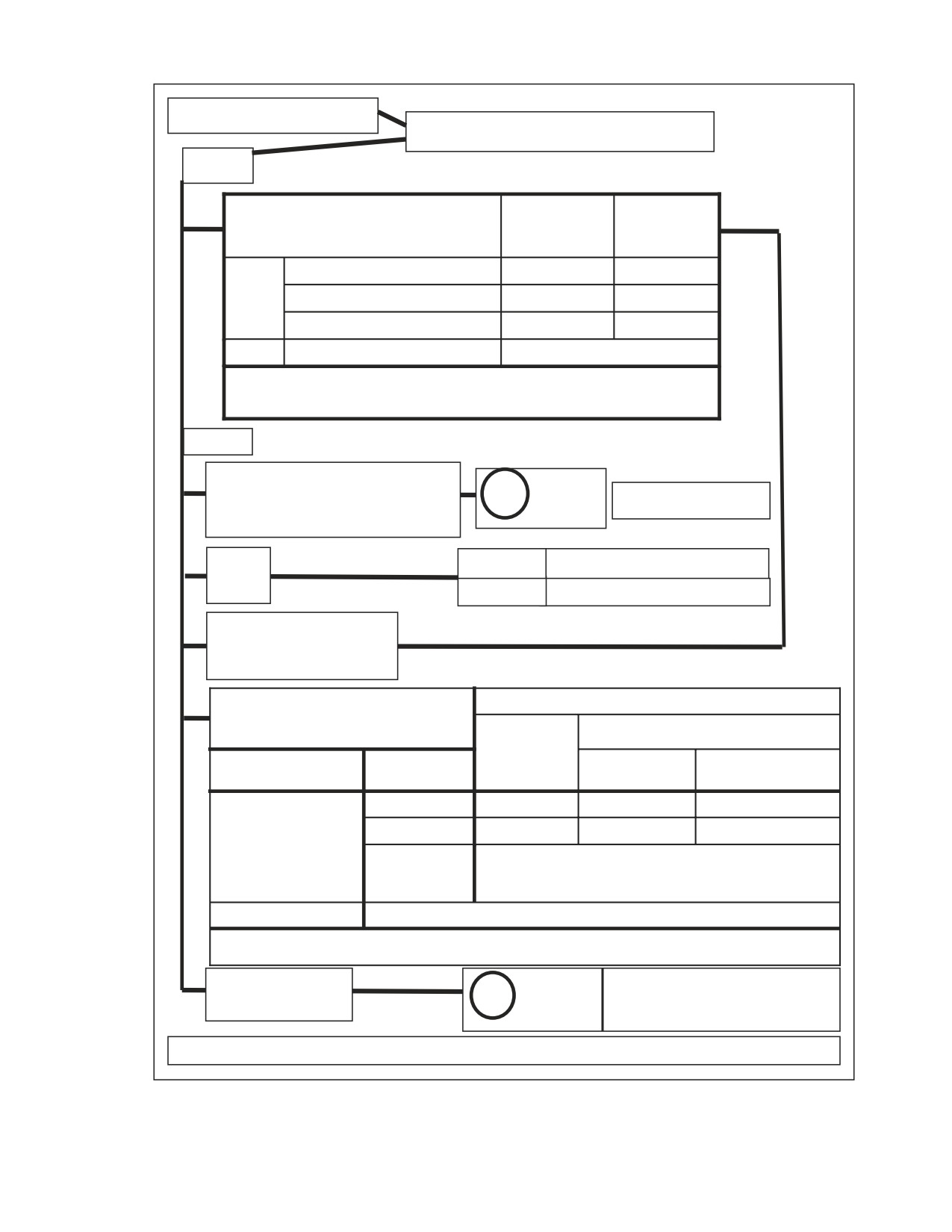
ROTA Types and Cases (see Table H-1). A sample decision flowchart for the
ROTA types and cases is shown in Figure H-4, page H-12.
H-10 FM 3-11.3/MCWP 3-37.2A/NTTP 3-11.25/AFTTP(I) 3-2.56
2 February 2006

Table H-1. ROTA Types and Cases
Type of Release/
Subcategory
Type
Case
Procedures
Material Type
Nuclear reactor
N
-
Refer to
Appendix F*
Nuclear waste
T
1
1 km radius
TIM
Radiological dispersion
2
Refer to
Appendix F*
Biological bunker
Refer to
3
Appendix F
Chemical stockpile or TIM transport
Refer to
4
Appendix E and
the ERG*
Bulk chemical storage
2 km daytime;
5
6 km nighttime*
*Also refer to the hazard prediction for elevated releases.
g.
Hazard Prediction Methods.
(1)
Type N, Releases of Nuclear Fuel from a Nuclear Reactor. Material
released from a nuclear-reactor incident will be mostly, or all, particles of nuclear fuel.
Since the decay of the particles from a nuclear-reactor accident is different than for
nuclear-weapon fallout, the procedures used for the hazard prediction after nuclear
detonations cannot be used.
(a) The release may be violent enough to send the nuclear-fuel particles
into the upper atmosphere. The hazard area prediction procedures described in Appendix F
should be used, assuming a Type P attack. If the release takes more than 5 minutes, the
latest arrival time may need to be adjusted for the duration of the release.
(b) Hazard areas for extended duration releases should be recalculated as
a Type R attack. The end points of the line are the release location and the current position
of the front end of the cloud. Use 1.5 times the mean wind speed. For wind speeds of 10
kph or less, Type P must be used.
(c)
If the release is reported as continuous and the reported duration
exceeds 2 hours or is not reported, the procedures for Type S should be followed.
(d) If the bulk of the material is elevated to a high altitude, the wind
speed and bearing at that height from the CBRN BWM or other appropriate MET data
should be used. If the material extends continuously from near the ground to a high
elevation (above 50 m), the procedures for an elevated release should also be used.
2 February 2006 FM 3-11.3/MCWP 3-37.2A/NTTP 3-11.25/AFTTP(I) 3-2.56
H-11
Plot Location (FOXTROT)
What is the delivery system/container (GOLF)?
Type N
Type N, Release of Nuclear Fuel
Wind Speed
Wind Speed
Type T, Case 3, BW Bunker or Production
≤10 kph
>10 kph
Facility
OBS
Release for ≤5 min
Type P
Type P
Release for >5 min
Type R*
Type P
Release for >2hrs
Type S
Type S
SUS
Unknown
Type S
*Type R Instructions
Point 1 is location (FOXTROT); Point 2 is 1.5 x WS downwind direction.
Type T
Case 1
Type T
Nuclear-Waste or
1 km
Case 1
PAPAA: /-/-/01km//
Radiological-Material Storage
Facilities
Case 2
SUS
BW Type S
RDDs
Observed Corresponding BW Type P or R
Case 3
Biological-Agent Bunkers
or Production Facilities
Case 4
PAPAA: Release Area/-/Protective Action Distance/-//
Release from CW Stockpile or TIM
Transport/Storage
Release Area
Protective Action Distance*
Radius
Release Container:
Known
SML (≤1,500 kg)
XLG (>15,00 kg)
Information
CW Stockpile ≤200
UNKNOWN
915 m
11 km
22 km
liters
Leaking Munition,
UN/NA Only
915 m
UN/NA, in meters
UN/NA, in meters X 2
TIM from Transport
UN/NA & ERG
Use the UN/NA number to locate distances identified in the
GREEN pages of the ERG. If the distance is not found,
consult the ORANGE pages.
CW Stockpile >200 liters
Use CW procedures to determine distances (Appendix E)
If the wind speed is ≤10 kph, draw a circle with a radius equal to the protective action distance.
Case 5
Day: 2 km
DAY: PAPAA /-/-/01km //
Bulk Storage Tank
Night: 6 km
NIGHT: PAPAA /-/-/06km //
In the event of Type N or T, Case 2, 3, or 4, elevated releases, see pages H-17 and H-18 for proper procedures.
Figure H-4. Sample Decision Flowchart for ROTA Types and Cases
H-12 FM 3-11.3/MCWP 3-37.2A/NTTP 3-11.25/AFTTP(I) 3-2.56
2 February 2006
(2)
Type T, Releases of TIM. Due to the differences in materials and release
types, hazard prediction methodology must be broken down into five cases.
(a) Case 1, Release From Nuclear-Waste or Radiological-Material Storage
Facilities. Nuclear waste and radiological materials are usually stored well below ground
level, usually in a special lead drum contained in concrete shelters. Damage to such a
facility may rupture some of the drums and release the radiological material into the
atmosphere over an extended period of time.
•
The release area will be localized, and the hazard area is not expected
to be very large. However, the cloud may be toxic at low levels for an extended period of
time.
•
An exclusion zone of a 1-km radius around the suspected radiological
hazard should be established.
(b) Case 2, Release From an RDD. If a high level of radiation is detected
as a passing cloud, the release will likely have been intentional and involve large quantities
of radiological material, which may continue at toxic levels for a considerable downwind
distance.
•
The cloud of radiological particles will be transported like a biological
agent cloud, so the biological procedures from Appendix F for a Type S attack should be
used.
•
If the radiological release is observed, the corresponding biological
attack Type P or R should be used.
(c)
Case 3, Release From Biological-Agent Bunkers or Production
Facilities. Storage facilities for biological agents usually consist of underground concrete
shelters. These shelters are closer to the ground surface. Damage to such a facility may
release some biological material from the shelter into the atmosphere as a jet of biological
agent, smoke, dust, and soil. The release area will be localized, and the amount of viable
agent dispersed will likely be less than that dispersed from an efficient biological weapon.
However, since many biological agents require only a few inhaled organisms to affect a
person, the downwind distance of the hazard area may still be considerable.
•
The biological-hazard area prediction procedures in Appendix F
should be used for a Type P attack. If the release takes more than 5 minutes, the latest
arrival time may need to be adjusted for the duration of the release. For wind speeds ≤10
kph, Type P must be used.
•
Hazard areas for extended duration releases should be recalculated as
a Type R attack where the end points of the line are the release location and the current
position of the front end of the cloud, using 1.5 times the mean wind speed.
•
If the release is reported as continuous and the reported duration
exceeds 2 hours or is not reported, the procedures for Type S should be followed.
•
If the bulk of the material is elevated to a high altitude (above 50 m),
the wind speed and bearing at that height from the CBRN BWM or other appropriate MET
data should be used. If the material extends continuously from near the ground to a high
elevation, the procedures for an elevated release should also be used.
2 February 2006 FM 3-11.3/MCWP 3-37.2A/NTTP 3-11.25/AFTTP(I) 3-2.56
H-13
(d) Case 4, Release from a Chemical Stockpile or TIM Transport/Storage.
Incidents involving the release of chemical agents from a stockpile of munitions or bulk
storage will usually involve only a small number of munitions. In such a case, the
downwind hazard will be considerably smaller than that predicted using the procedures in
Appendix E. In the case of a chemical-agent release from a large number of munitions or
bulk storage of chemical agents, the agent quantity will be sufficient to warrant the use of
Appendix E. Because of their lower toxicity and stability, the incidental release of a TIM
from transport vehicles is expected to affect an area considerably smaller than that
predicted using the chemical-agent procedures. The procedure to use is determined as
follows:
•
If a chemical stockpile or bulk storage mass is released that exceeds
200 liters, use the procedures in Appendix E for the appropriate agent and persistency.
•
If there is a small chemical stockpile mass released or if there is a
single leaking munition or TIM release from a transport vehicle, use the following
procedure (adapted from the Emergency Response Guidebook [ERG]).
o Release Area. The release area is assumed to be a circle having
a radius equal to the isolation distance from the ERG (see Figure H-5). The 4-digit United
Nations (UN) or North American (NA) identification number should be annotated on line
INDIA. If the identification number or the ERG is not available, use a radius of 915
meters. If the distance is not found in the green section of the ERG, the orange section
should be consulted before using the default distance. If more information is available, a
different radius may be specified in GENTEXT. Draw the circle of the specified radius,
centered at the release location.
o Protective Action Distance. Obtain the protective action distance
from the ERG using the 4-digit UN or NA identification number and the size of the spill as
annotated on line GOLF. If the size of the spill is not available, assume large (LRG). If the
identification number is not available, use a distance of 11 km. If the distance is not found
in the green section of the ERG, the orange section should be consulted before using the
default distance. If the spill is greater than 1,500 kg (extra large [XLG]), double the
protective action distance.
H-14 FM 3-11.3/MCWP 3-37.2A/NTTP 3-11.25/AFTTP(I) 3-2.56
2 February 2006