FM 3-11.3 MULTISERVICE TACTICS, TECHNIQUES, AND PROCEDURES FOR CHEMICAL, BIOLOGICAL, RADIOLOGICAL, AND NUCLEAR CONTAMINATION AVOIDANCE (FEBRUARY 2006) - page 6
u3 = wind speed (in kph) for the third NBC CDR 2-hour period.
t1 = hours remaining after the attack or detection within the NBC CDR 2-hour
period of validity corresponding to the attack.
(2)
Special Cases.
•
For any NBC CDR time periods where the wind speed is <10 kt, a value of
10 kt should be used for computations.
•
Weather information may not be available for the full 6-hour period after
an attack. If this is the case, the hazard distances can only be calculated for the time
weather is available.
(3)
Downwind Travel Distance. To calculate the downwind travel distance,
perform the following steps:
•
Step 1. If the attack or detection occurs in the first NBC CDR 2-hour time
period, three downwind distances are calculated: d1, using the first NBC CDR time period
(set WHISKEY); d2, using the second NBC CDR time period (set XRAY); and d3, using the
third NBC CDR time period (set YANKEE).
•
Step 2. If the attack or detection occurs in the second NBC CDR time
period, downwind distances are calculated: d1, using the second NBC CDR time period (set
XRAY) and d2, using the third NBC CDR time period (set YANKEE).
•
Step 3. If the attack or detection occurs in the third NBC CDR time period,
only d1 can be calculated using set YANKEE.
(4)
Total Downwind Distance. The total downwind distance of the center of the
biological cloud is the sum of the three distances:
DA = d1 + d2 + d3
Where —
DA = total downwind distance in km.
(5)
Leading and Trailing Edges. The leading and trailing edges for the current
NBC CDR should also be computed, based on the downwind distance path and using the
factors of 1.5 and 0.5, respectively:
DL = 1.5DA
DT = 0.5DA
Where—
DL = leading edge distance, in km
DT = trailing edge distance, in km
(f)
Third Time Period. If only the third time period is applicable, it must
be extended to include the leading edge:
DE = DL - d1 - d2
2 February 2006 FM 3-11.3/MCWP 3-37.2A/NTTP 3-11.25/AFTTP(I) 3-2.56
F-13
Where—
DE = extended distance (in km) traveled within the third NBC CDR 2-hour
period.
e.
Determining Initial Hazard Areas.
(1)
Case 1 Attacks.
(a) Wind Speed. The wind speed is 10 kph or less, so a wind speed of 10
kph should be used.
(b) Radius of Hazard Area. The radius of the hazard area circle equals
the attack area radius plus the product of a wind speed of 10 kph times the time in hours
remaining after the attack of detection in the corresponding CDR time period. For example,
in a Type P, Case 1, attack having a 2-hour travel duration, the hazard area radius would
equal:
(time × wind speed) = radius for Case 1
(2 h × 10 km/h) + 4 km = 24 km
(c)
Types P, Q, and S. A single hazard area circle will result for Types P,
Q, and S. The area within this circle represents the hazard area. The attack area for Type
S is drawn as a NOT DISCLOSED (see STANAG 2130, Annex I).
(d) Type R. Two circles are drawn for Type R, with tangents drawn
between the hazard area circles. The total enclosed area represents the hazard area.
(e) Downwind Distance. A value of zero is used for the downwind
distance path, leading edge, and trailing edge computations for Case 1 attacks, since the
wind direction is considered variable. The leading edge can be considered to be the edge of
the hazard area circle.
(2)
Case 2 Attacks.
(a) Downwind Direction. Determine the downwind direction from the
NBC CDM. Draw a line through the center of the attack circle, oriented in the downwind
direction.
(b) Type R. For a Type R release, choose one of the attack area circles.
Calculate the downwind distance for the first period (d1). This is accomplished in the same
manner as in paragraph 5d above (time x wind speed + radius of circle). The line should
extend to distance d1 in the downwind direction from the center of the circle. In the upwind
direction along the same line, mark a distance equal to twice the attack circle radius.
(c)
End of d1. Draw a line perpendicular to the downwind direction line,
at the downwind distance (d1), and extending in both directions.
(d) Tangent Lines. Draw two lines tangent to the attack circle from the
upwind point marked, extending until they intersect with the perpendicular line. These
lines will form a 30° angle on either side of the downwind direction line.
(e) Type R. For a Type R release, for the other attack area circle and
connect the lower hazard area corners to enclose the combined downwind hazard area
repeat this procedure.
F-14
FM 3-11.3/MCWP 3-37.2A/NTTP 3-11.25/AFTTP(I) 3-2.56
2 February 2006
(f)
Type S. For a Type S release, there is no hazard area plotted because
the location and time of the release are unknown. A 25-km-radius circle defines an area
where there is a risk of being exposed to the biological agent. Informing friendly units
throughout the area of this risk should be considered. Before a hazard prediction can be
carried out, reports are required from units in the area or survey teams. Once more
information about the attack has been obtained, Type S attacks should then be treated as
Type P, Q, or R.
f.
Prediction of the Initial Hazard.
(1)
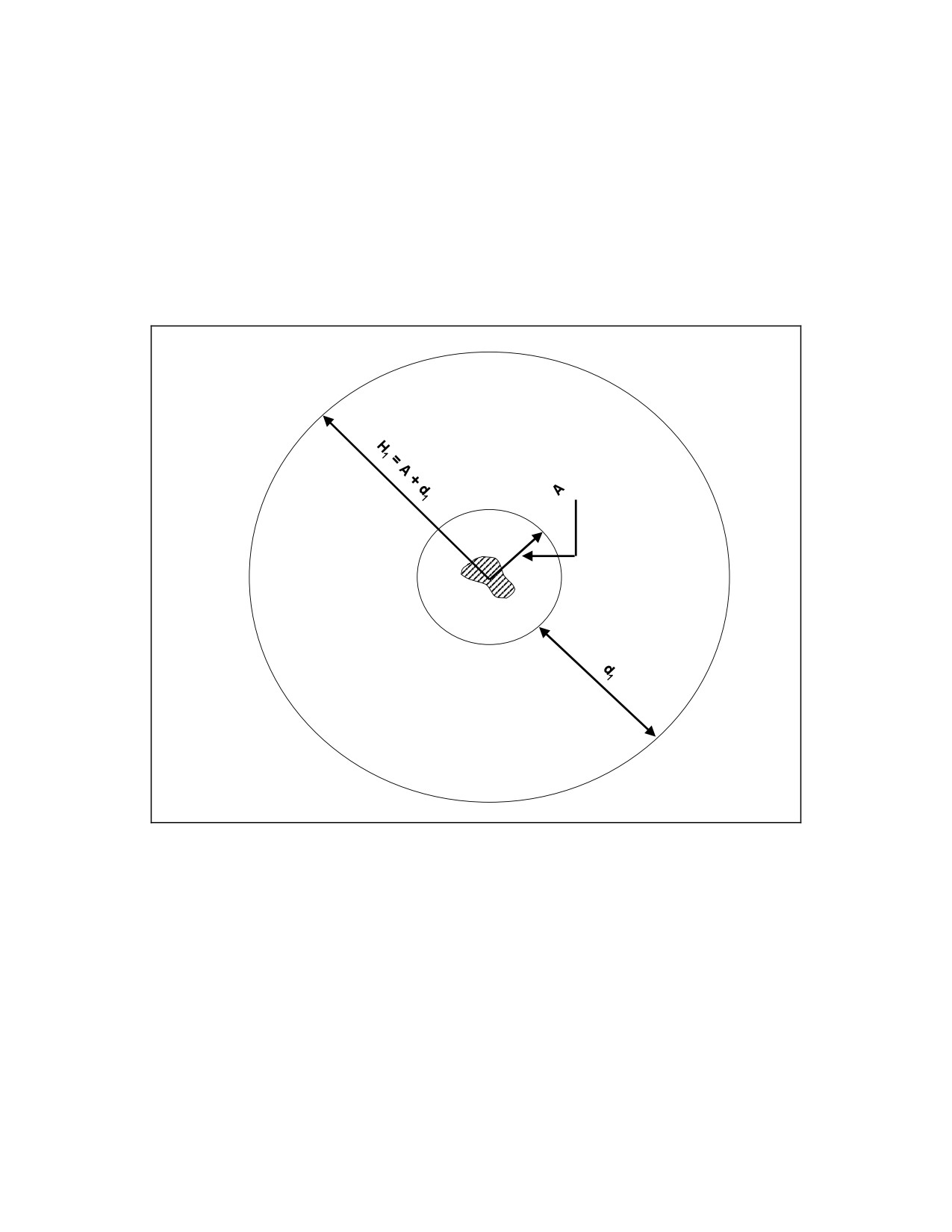
Type P, Case 1 Attack (Figure F-4).
ATTACK
AREA
HAZARD AREA
Figure F-4. Type P, Case 1, Attack
NOTE: A = radius of attack area, H1 = radius of initial hazard area, d1 = downwind
travel distance in the CDR time period,
t1 = time remaining from attack in the
CDR time period, u1 = wind speed (10 kph ), H1 = A + d1, d1 = u1 x t1. A wind speed
of 10 kph is assumed.
(a) Step 1. Obtain the location of the attack from the relevant NBC BIO
message (line FOXTROT), and plot it on the map.
(b) Step 2. Draw a circle with a radius (A), around the center of the
attack location. The area within this circle represents the attack area.
(c)
Step 3. Draw a circle with a radius (H1) that equals the radius of the
attack area (4 km) plus the downwind travel
distance (d1). Distance d1 is equal to the wind
2 February 2006 FM 3-11.3/MCWP 3-37.2A/NTTP 3-11.25/AFTTP(I) 3-2.56
F-15
speed (u1) for the CDR time period times the remaining time (t1) from the attack within
that CDR time period.
(d) Step 4. Prepare and transmit an NBC3 BIO report to units and
installations in the predicted hazard area in accordance with SOPs, using the prediction in
Figure F-4, page F-15.
(2)
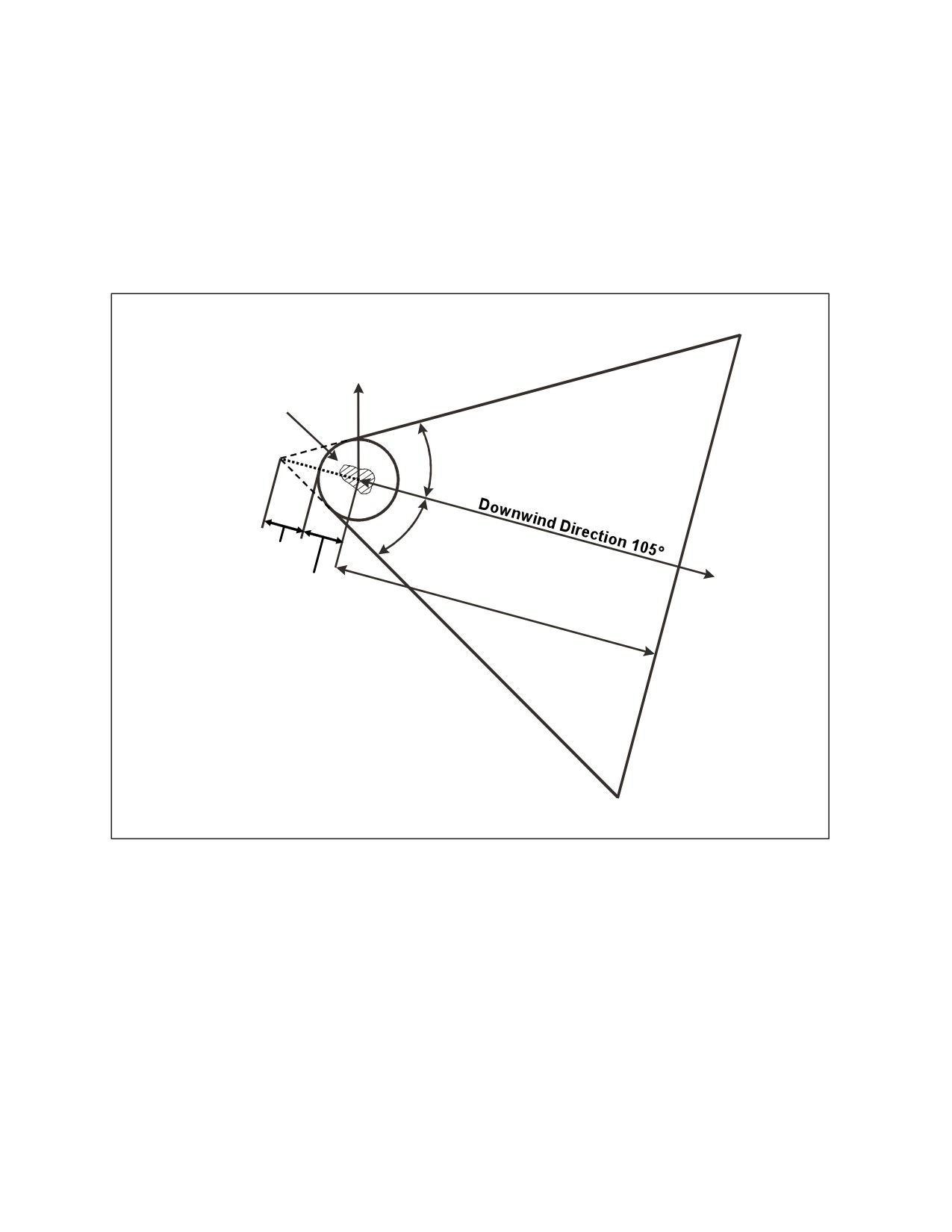
Type P, Case 2, Attack (Figure F-5).
GN
ATTACK
AREA
HAZARD
AREA
30°
30°
A
A
d1
Figure F-5. Type P, Case 2, Attack
NOTE: A = radius of attack area, d1 = downwind travel distance in the CDR time
period, t1 = time remaining from attack in the CDR time period, u1 = wind speed, d1 =
u1 x t1.
(a) Step 1. Obtain the location of the attack from the relevant NBC BIO
message(s) (set FOXTROT), and plot it on the map (see Figure F-5).
(b) Step 2. From the center of the attack location, draw a GN line.
(c)
Step 3. Draw a circle with the attack area radius around the center of
the attack location. The area within this circle represents the attack area.
(d) Step 4. Using the valid NBC CDM, identify the downwind direction
and the downwind speed.
F-16
FM 3-11.3/MCWP 3-37.2A/NTTP 3-11.25/AFTTP(I) 3-2.56
2 February 2006
(e) Step 5. From the center of the attack area, draw a line showing the
downwind direction.
(f)
Step 6. Determine the downwind travel distance (d1). If d1 is less
than the attack area radius, set it equal to the attack area radius.
(g) Step 7. Plot the downwind travel distance from the center of the
attack area on the downwind direction line.
(h) Step 8. From the downwind travel distance, draw a line perpendicular
to the downwind direction line. Extend the line to either side of the downwind direction
line.
(i)
Step 9. Extend the downwind direction line twice the attack area
radius upwind from the center of the attack area. This is equal to twice the radius of the
attack area.
(j)
Step 10. From the upwind end of this line, draw two lines, which are
tangents to the attack area circle, and extend them until they intersect with the line
perpendicular of the downwind direction line. These lines will form a 30°angle on either
side of the downwind direction line.
(k) Step 11. The hazard area is bound by—
•
The upwind edge of the attack area circle.
•
The two 30° tangents.
•
The line perpendicular to the downwind direction line.
(l)
Step 12. Prepare and transmit an NBC3 BIO report to units and
installations in the predicted hazard area according to the SOP.
(3)
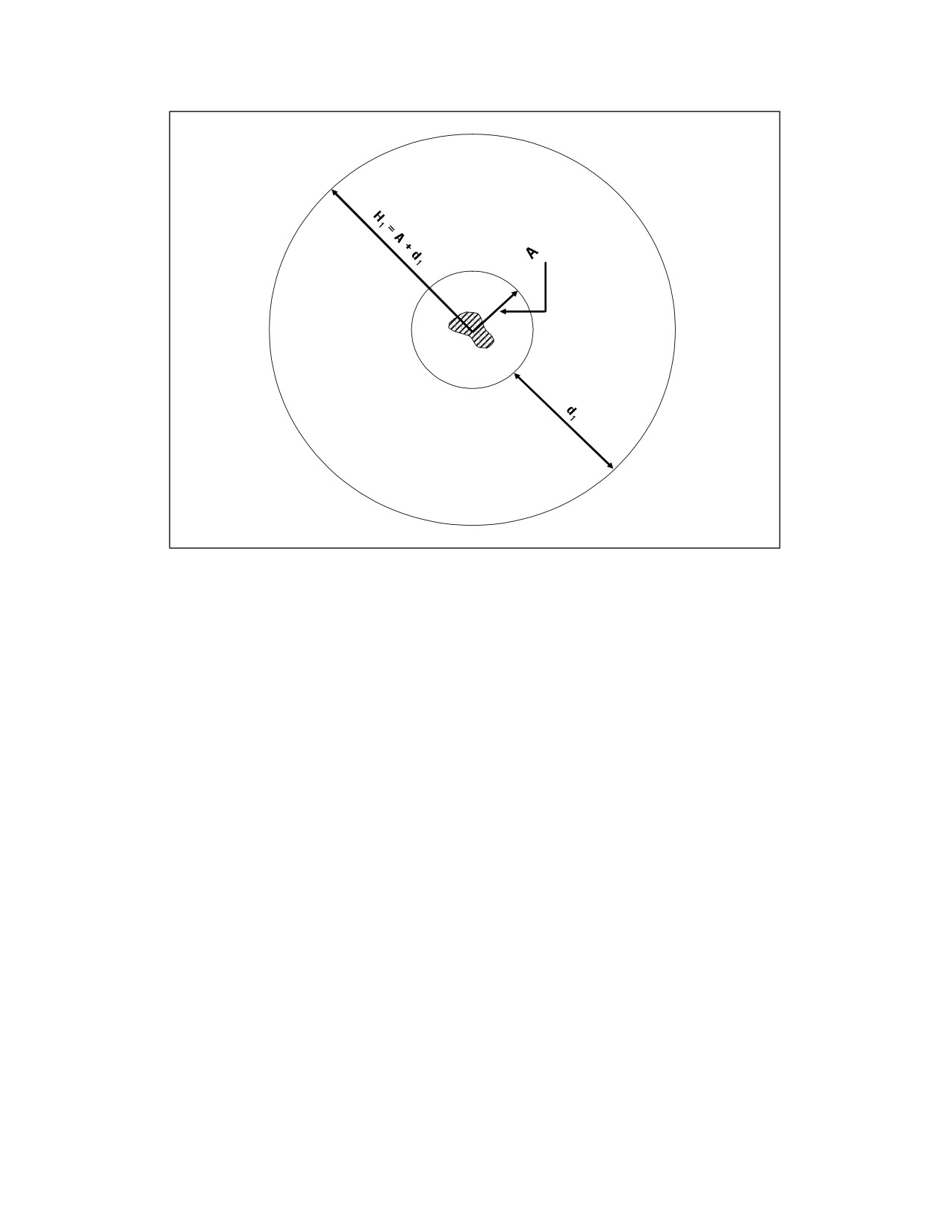
Type Q, Case 1, Attack (Figure F-6).
2 February 2006 FM 3-11.3/MCWP 3-37.2A/NTTP 3-11.25/AFTTP(I) 3-2.56
F-17
ATTACK
AREA
HAZARD AREA
Figure F-6. Type Q, Case 1, Attack
NOTE: A = radius of attack area, H1 = radius of hazard area, d1 = downwind travel
distance in the CDR time period, t1 = time remaining from attack in the CDR time
period, u1 = wind speed (10 kph), H1 = A + d1, d1 = u1 x t1.
(a) Step 1. Obtain the location of the attack from the relevant NBC BIO
message (set FOXTROT), and plot it on the map.
(b) Step 2. Draw a circle with the attack area radius around the center of
the attack location. The area within this circle represents the attack area.
(c)
Step 3. Draw a circle with a radius equal to the distance d1 (10 kph
times the travel duration) plus the radius of the attack area. This circle will represent the
hazard area.
(d) Step 4. Prepare and transmit an NBC3 BIO report to units and
installations in the predicted hazard area according to the SOP.
(4)
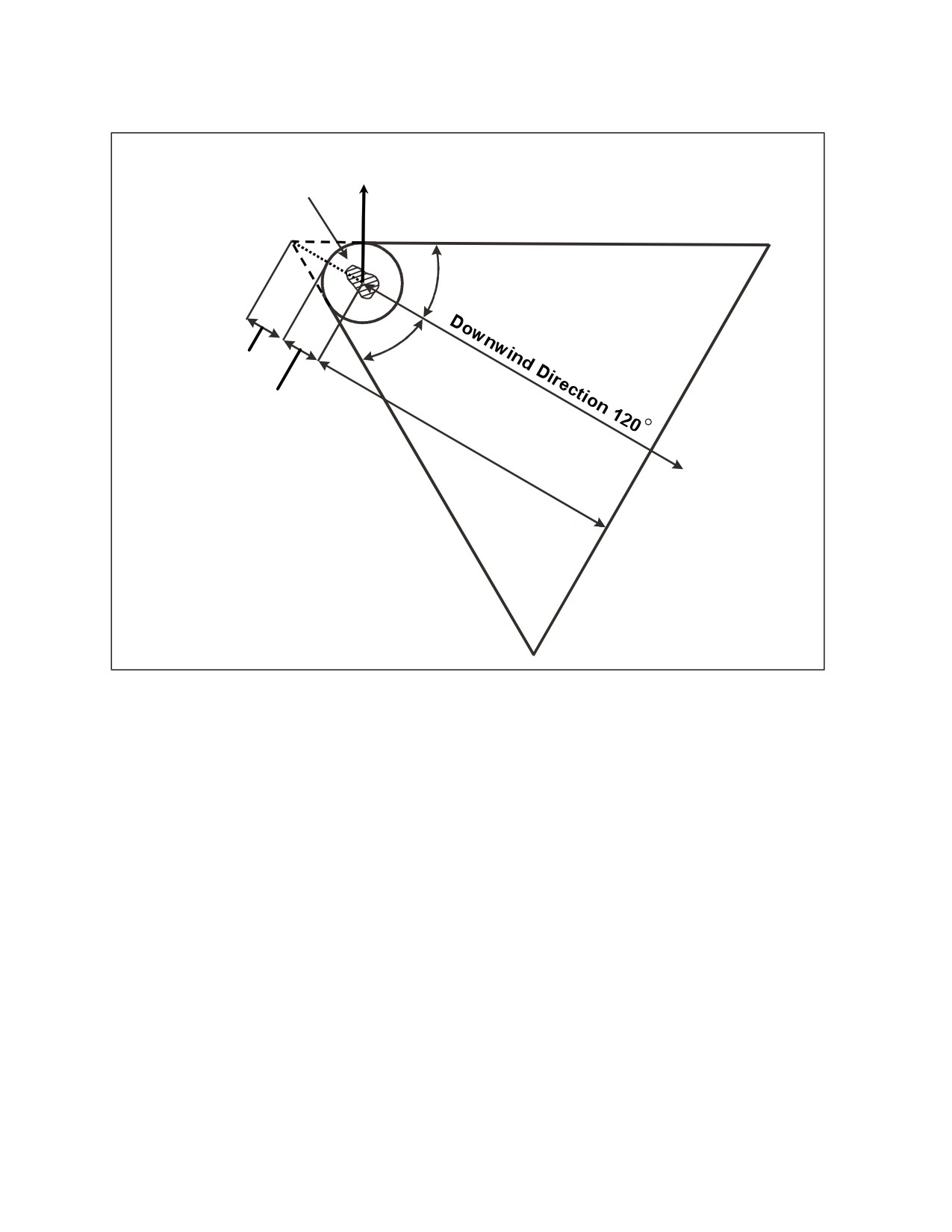
Type Q, Case 2, Attack (Figure F-7).
F-18
FM 3-11.3/MCWP 3-37.2A/NTTP 3-11.25/AFTTP(I) 3-2.56
2 February 2006
GN
ATTACK
AREA
30o
HAZARD
AREA
30o
A
A
d1
Figure F-7. Type Q, Case 2, Attack
NOTE: A = radius of attack area, H1 = radius of hazard area, d1 = downwind travel
distance in the CDR time period, t1 = time remaining from attack in the CDR time
period, u1 = wind speed (10 kph), H1 = A + d1, d1 = u1 x t1.
(a) Step 1. Obtain the location of the attack from the relevant NBC BIO
message(s) (set FOXTROT) and plot it on the map (see Figure F-7).
(b) Step 2. From the center of the attack location, draw a GN line.
(c)
Step 3. Draw a circle with the attack area radius around the center of
the attack location. The area within this circle represents the attack area.
(d) Step 4. Using the valid NBC CDM, identify the downwind direction
and the downwind speed.
(e) Step 5. From the center of the attack area, draw a line showing the
downwind direction.
(f)
Step 6. Determine the downwind travel distance (d1) (see paragraph
7d(3). If d1 is less than the attack area radius, set it equal to the attack area radius.
2 February 2006 FM 3-11.3/MCWP 3-37.2A/NTTP 3-11.25/AFTTP(I) 3-2.56
F-19
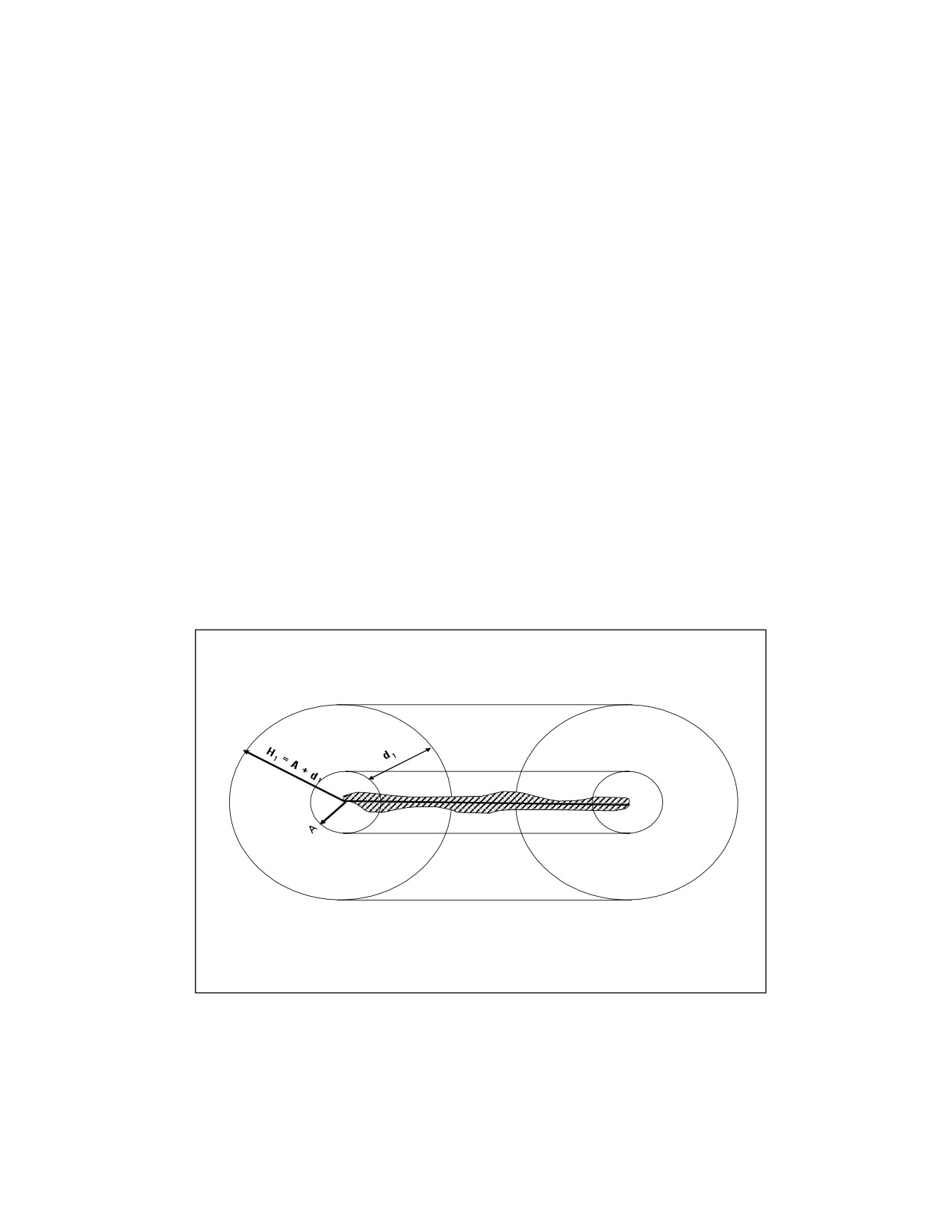
(g) Step 7. Plot the downwind travel distance from the center of the
attack area on the downwind direction line.
(h) Step 8. From the downwind travel distance, draw a line perpendicular
to the downwind direction line. Extend the line to either side of the downwind direction
line.
(i)
Step 9. Extend the downwind direction line, twice the attack area
radius, upwind from the center of the attack area. This is equal to twice the radius of the
attack area.
(j)
Step 10. From the upwind end of this line, draw two lines that are
tangents to the attack area circle, and extend them until they intersect with the
perpendicular to the downwind direction line. These lines will form a 30° angle on either
side of the downwind direction line.
(k) Step 11. The hazard area is bound by—
•
The upwind edge of the attack area circle.
•
The two 30° tangents.
•
The line perpendicular to the downwind direction line.
(l)
Step 12. Prepare and transmit an NBC3 BIO report to units and
installations in the predicted hazard area according to the SOP.
(5)
Type R, Case 1, Attack (Figure F-8).
HAZARD
AREA
Figure F-8. Type R, Case 1, Attack
F-20
FM 3-11.3/MCWP 3-37.2A/NTTP 3-11.25/AFTTP(I) 3-2.56
2 February 2006
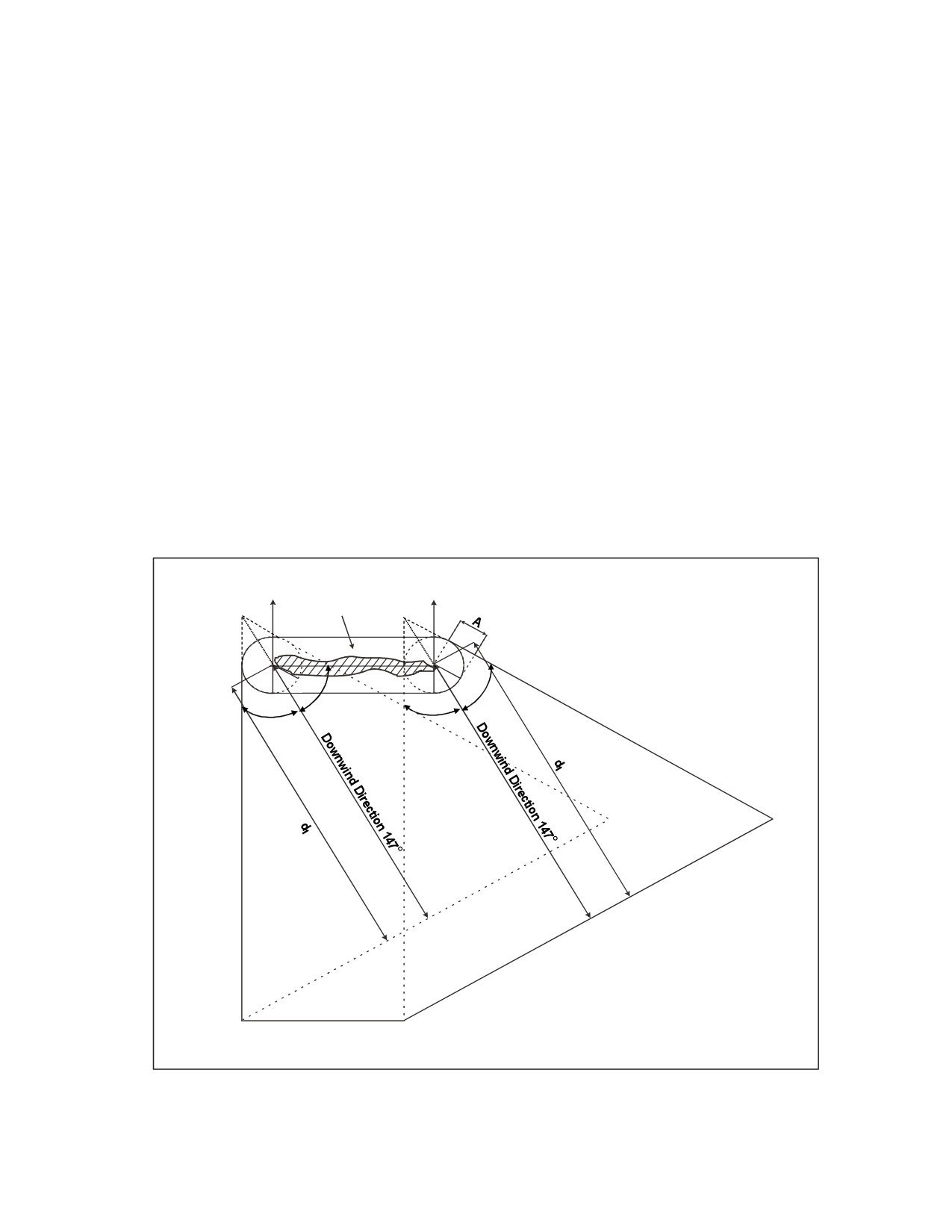
NOTE: A = radius of attack area, H1 = radius of hazard area, d1 = downwind travel
distance in the CDR time period, t1 = time remaining from attack in the CDR time
period, u1 = wind speed (10 kph), H1 = A + d1, d1 = u1 X t1.
(a) Step 1. Obtain the locations of the attack end points from the relevant
NBC BIO message (set FOXTROT), and plot them on the map. Connect the end points to
form the attack line.
(b) Step 2. Draw a circle with the attack area radius around each end
point.
(c)
Step 3. Connect these circles on both sides by drawing tangents to the
circles parallel to the attack line to designate the attack area.
(d) Step 4. Draw a circle with a radius equal to the distance d1 (10 kph
times the travel duration) plus the radius of the attack area.
(e) Step 5. Connect these circles on both sides by drawing tangents to the
circles parallel to the attack line to designate the hazard area.
(f)
Step 6. Prepare and transmit an NBC3 BIO report to units and
installations in the predicted hazard area according to the SOP.
(6)
Type R, Case 2, Attack (Figure F-9).
GN
GN
ATTACK AREA
30°
30°
30°
30°
HAZARD
AREA
Y
X
Figure F-9. Type R, Case 2, Attack
2 February 2006 FM 3-11.3/MCWP 3-37.2A/NTTP 3-11.25/AFTTP(I) 3-2.56
F-21
NOTE: A = radius of attack area, d1 = downwind travel distance in the CDR time
period, t1 = time remaining from attack in the CDR time period, u1 = wind speed, d1 =
u1 x t1.
(a) Step 1. Obtain the locations of the attack end points from the relevant
NBC BIO message(s) (set FOXTROT), and plot them on the map. Connect the end points to
form the attack line.
(b) Step 2. Draw a circle with the attack area radius around each point.
(c)
Step 3. Connect these circles on both sides by drawing tangents to the
circles parallel to the attack line to designate the attack area.
(d) Step 4. Draw a GN line from the center of each circle.
(e) Step 5. Using the valid NBC CDM, identify the downwind direction
and the downwind speed.
(f)
Step 6. From the center of each attack area circle, draw a line
showing the downwind direction.
(g) Step 7. Determine the downwind travel distance (d1).
(h) Step 8. Plot the downwind travel distance from the center of each
attack area circle on the downwind direction lines.
(i)
Step 9. From the downwind travel distance, draw a line perpendicular
to each of the downwind direction lines. Extend the lines to either side of the downwind
direction lines.
(j)
Step 10. Extend the downwind direction lines, twice the attack area
radius, upwind from the center of each attack area circle. This is equal to twice the radius
of the attack area.
(k) Step 11. From the upwind end of each line, draw two lines, which are
tangents to the attack area circle, and extend them until they intersect with the
perpendiculars to the downwind direction lines. These lines will form a 30° angle on either
side of the downwind direction lines.
(l)
Step 12. Draw a line connecting the downwind corners of the two
hazard areas (Points X and Y in Figure F-9, page F-21).
(m) Step 13. Prepare and transmit an NBC3 BIO report to units and
installations in the predicted hazard area according to the SOP.
(7)
Type S, Case 1 and 2, Attacks (Figure F-10).
F-22
FM 3-11.3/MCWP 3-37.2A/NTTP 3-11.25/AFTTP(I) 3-2.56
2 February 2006
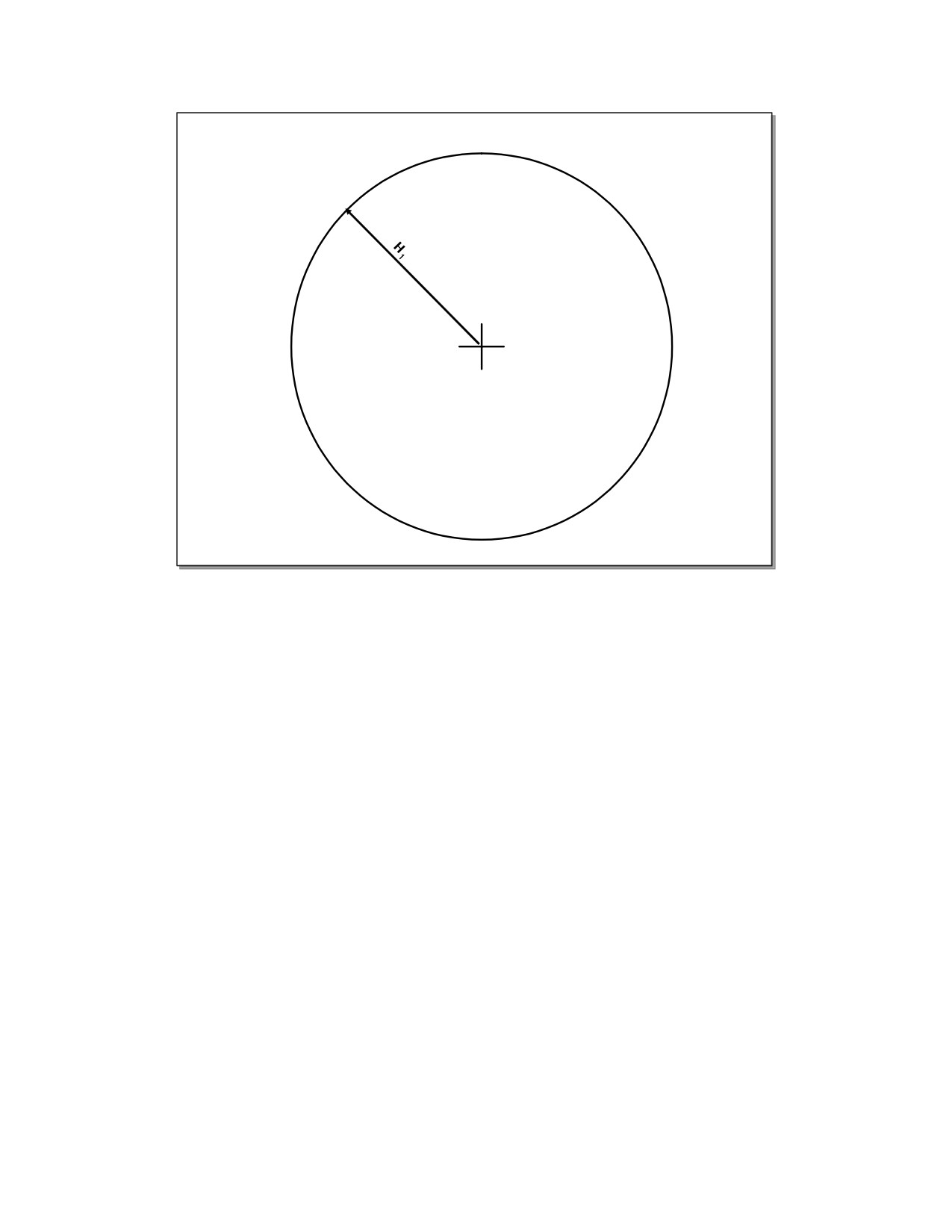
HAZARD AREA
Figure F-10. Type S, Cases 1 and 2, Attacks
NOTE: H1 = radius of hazard area.
(a) Step 1. Obtain the location of the attack from the relevant NBC BIO
message(s) (set FOXTROT or QUEBEC), and plot it on the map.
(b) Step 2. Draw a circle with the attack area radius around the center of
the detection location. The area within this circle represents the attack area and the
hazard area.
(c)
Step 3. Prepare and transmit an NBC3 BIO report to units and
installations in the predicted hazard area according to the SOP.
g.
Adjusted Hazard Prediction. When the wind direction does not change by 30° or
more and does not drop below 10 kph, the total downwind distance can be used to calculate
a single hazard area as shown in Figure F-11. The leading and trailing edges should also
be computed, starting at the attack location. The leading and trailing edges should be
displayed with lines drawn perpendicular to the downwind distance path, extending to the
tangent lines. After significant weather changes, the NBC3 BIO report may no longer be
accurate or apply. An adjusted NBC3 BIO report must be sent to the unit or installation in
the new hazard area if possible. Also notify the units that may no longer be in the hazard
area. Significant weather changes are:
•
Representative downwind speed of 10 kph or more or if the wind speed increases
from less than 10 kph to more than 10 kph or the reverse.
•
Change in downwind direction by 30° or more.
2 February 2006 FM 3-11.3/MCWP 3-37.2A/NTTP 3-11.25/AFTTP(I) 3-2.56
F-23
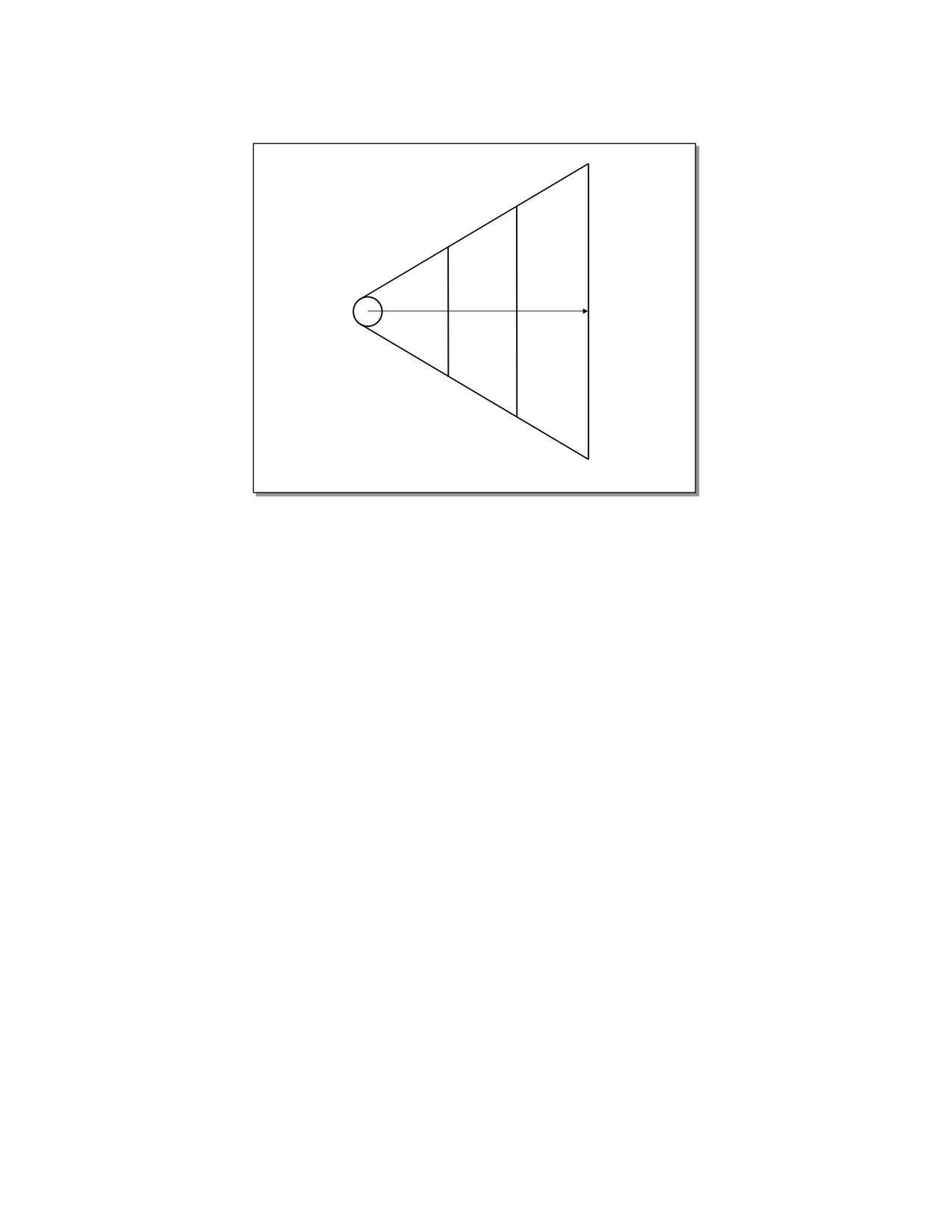
DT
DA
DL
Figure F-11. Type Q, Case 2, Attack With Constant Wind Speed
(1)
When the wind direction changes by 30° or more or the wind speed changes
between Case 1 and Case 2, the recalculation procedures from Appendix E should be used
for Type A chemical as shown in Figure F-12, page F-25.
F-24
FM 3-11.3/MCWP 3-37.2A/NTTP 3-11.25/AFTTP(I) 3-2.56
2 February 2006
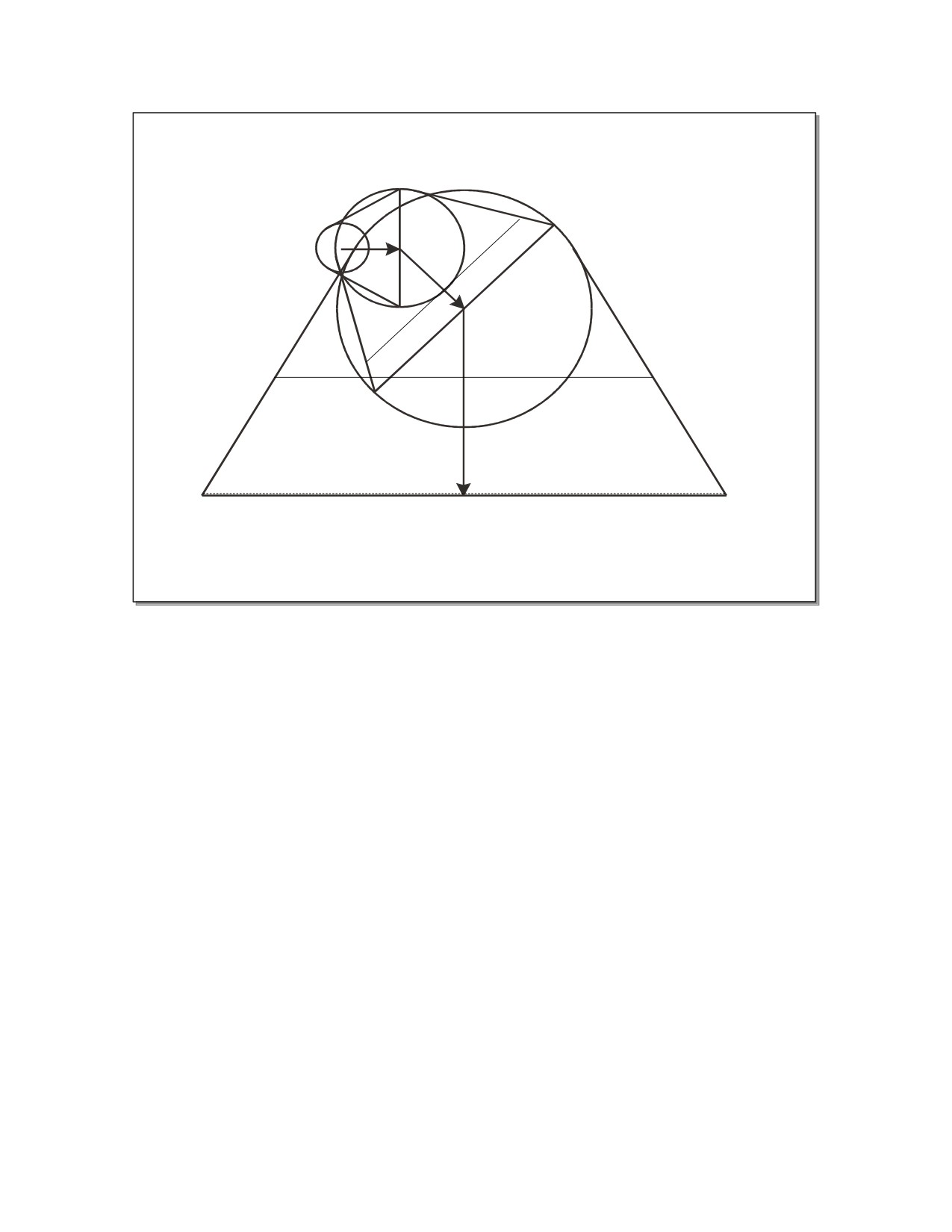
DT
DA
DL
Figure F-12. Type Q, Case 2, Attack (1 Hour Into CDR, Changing Downwind Direction)
(a) Draw the attack area circle and the initial hazard area for the NBC
CDR time period containing the attack. For a Type S attack, draw the attack area radius
circle centered on the observation location and wait for more information.
(b) The hazard area at the end of that time period is drawn as a circle
centered at the downwind edge (d1), having a radius equal to the distance along the
perpendicular line from the downwind direction line to one of the tangents.
(c)
If the next time period is Case 1 extend this circle by the distance d2.
(d) If the next time period is Case 2, draw a new downwind direction line
for the new time period of distance d2 from the end of the d1 line. Repeat the triangle
procedure with the circle just drawn being the new attack area.
(e) Draw the circle containing the hazard area at the end of the second
time period as described for the end of the first time period.
(f)
Construct the hazard area for the third time period as described for
the second time period. For Case 2, use the extended distance (DE) to include the leading
edge.
(g) The hazard area for the current NBC CDR includes the combined
areas drawn for the initial hazard area and hazard areas associated with the second and
third time periods, if applicable.
(2)
The NBC3 BIO report should be generated by corresponding to the current
NBC CDR time-periods. The hazard area defined in set PAPAX should only include those
2 February 2006 FM 3-11.3/MCWP 3-37.2A/NTTP 3-11.25/AFTTP(I) 3-2.56
F-25
points computed for the current NBC CDR, which should be extended to 6 hours from the
time of the attack. In this case, the hazard area for no more than three time periods will
appear in PAPAX.
(3)
The leading and trailing edges are computed along the downwind distance
path, starting at the attack location. The leading and trailing edges should be displayed
with lines drawn perpendicular to the downwind distance path, extending to the tangent
lines for the time period containing each distance.
(4)
For Type S attacks, notice should be taken of the location of enemy
positions further upwind of the hazard area, calculated in accordance with paragraph
7c(2)(d). The area between the enemy positions and the template should be considered as
being potentially biologically contaminated, with appropriate warnings issued and
protective measures taken. If a new detection is made outside the hazard area, the
procedures in 7c(2)(d) should be repeated for the new location.
h. Hazards Spanning Multiple CDM Messages.
(1)
Before proceeding to the next CDR, the downwind hazard area should be
recalculated. The third time period for the recalculation is not to be extended, to include the
leading edge, e.g., distance d3 should be used in place of distance DE; however, the leading
and trailing edge distances still need to be computed and plotted as points. Distance (DA)
is also not to be extended to result in 6 hours total time. Rather, d3 will end at the end of
the current CDR (e.g., 2u3). If the attack occurs in the second or third CDR time period,
only one or two distances will result as described in paragraph 7d(3). If actual measured
MET conditions have been recorded during a current NBC CDR, a better estimate of the
current hazard area will be obtained.
(2)
An attack circle for the end of the current NBC CDR is drawn centered at
the current downwind location and then extended to the tangent lines. This attack circle
defines the extent of the cloud at the end of the current NBC CDR. If this circle does not
include the leading and trailing edge distances, the circle radius should be enlarged around
the current downwind location until both points are included.
(3)
The hazard area for the next 6-hour time period should be computed when
the next NBC CDR is received. If the next NBC CDR has not been received, the last time
period for the current NBC CDR should be used for lines WHISKEYM, XRAYM, and
YANKEEM. When the next NBC CDR is received, the hazard prediction should be
recalculated. The hazard area should then be reported in line PAPAX of a new NBC3 BIO
report.
(4)
Hazard areas should continue to be computed until no further
contamination can be confirmed or until the hazard duration that follows has been reached.
Attention should still be paid to the previously calculated areas, which may be
contaminated until the end of agent effectiveness.
i.
Termination of Biological Hazard Assessment. For biological attack Types P, Q,
and R where the NBC3 BIO report was generated from one or more NBC1 BIO reports with
the biological agent UNK, the NBC3 BIO report computations may be terminated if a
chemical agent is confirmed. Otherwise, biological hazard assessment should continue until
further information is available.
F-26
FM 3-11.3/MCWP 3-37.2A/NTTP 3-11.25/AFTTP(I) 3-2.56
2 February 2006

j.
Hazard Duration. Upon confirmation of a specific biological agent or toxin, the
expected duration of viability of the agent should be recorded in the second field of set
PAPAA. The attack area radius computed for the current NBC CDR should be entered into
the first field of set PAPAA.. Agents may continue to be a hazard on the ground in the
contaminated area from days to, potentially, years.
8.
NBC4 BIO Report
The NBC4 BIO report (see Figure F-13) is the recorded result of an initial detection,
reconnaissance, survey, or monitoring action at a location being checked for the presence of
biological agents. Each line QUEBEC,ROMEO, SIERRA, TANGO, WHISKEY, YANKEE,
and ZULU segment in every NBC4 BIO report is a record of one contamination sample
point location, environment, time of reading, type and level of contamination, method of
sampling, and local MET conditions. The NBC4 BIO report will often be far downwind of
the attack area location as defined in the corresponding NBC2 and NBC3 BIO reports,
since biological agents will most likely be detected as airborne contamination. An NBC4
BIO report can be assumed to be associated with the same attack if —
•
It can be placed in the hazard area for an NBC3 BIO report between the
expected earliest and latest times of arrival.
•
It is within 10 km and 2 hours of another NBC4 BIO report, which has already
been assigned to an attack.
NBC4 BIO Report
Line Item
Description
Cond
Example
ALFA
Strike serial number
O
ALFA/US/A234/001/C//
INDIA
Release information on CB agent
O
INDIA/AIR/BIO/BG//
attacks or ROTA events
QUEBEC*
Location of reading/sample/detection
M
QUEBEC/32VNJ481203/-/DET//
and type of sample/detection
ROMEO*
Level of contamination, dose rate trend
O
ROMEO/20PPM//
and decay rate trend
SIERRA*
DTG of reading or initial detection of
M
SIERRA/202300ZSEP1997//
contamination
TANGO*
Terrain/topography and vegetation
M
TANGO/FLAT/URBAN//
description
WHISKEY
Sensor information
O
WHISKEY/POS/POS/NO/MED//
YANKEE*
Downwind direction and downwind
M
YANKEE/270DGT/015KPH//
speed
ZULU*
Actual weather conditions
O
ZULU/4/10C/7/5/1//
GENTEXT
General text
O
*Lines QUEBEC, ROMEO, SIERRA, and TANGO are a segment. With the exclusion of set ROMEO, this
segment is mandatory. Sets/segments are repeatable up to 20 times in order to describe multiple detection,
monitoring, or survey points.
Figure F-13. Sample NBC4 BIO Report
2 February 2006 FM 3-11.3/MCWP 3-37.2A/NTTP 3-11.25/AFTTP(I) 3-2.56
F-27

9.
NBC5 BIO Report
The NBC5 BIO report (Figure F-14) is prepared from the contamination plot. This
report is last in order because it consists of a series of grid coordinates. Often, this message
must be sent on the radio nets. This requires lengthy transmission. If an overlay is not
sent, the recipient is required to plot each coordinate and redraw the plot. For NBC5 BIO
reports, lines INDIA (release information), OSCAR (reference time), and XRAYA (actual
contour information) are mandatory.
NBC5 BIO Report
Line Item
Description
Cond
Example
ALFA
Strike serial number
O
ALFA/US/A234/001/C//
DELTA
DTG of attack or detonation and
O
DELTA/201405ZSEP1997//
attack end
INDIA
Release information on CB agent
M
INDIA/AIR/BIO/BG//
attacks or ROTA events
OSCAR
Reference DTG for estimated contour
M
OSCAR/201505ZSEP1997//
lines
XRAYA*
Actual contour information
M
XRAYA/LCT50/32VNJ575203/
32VNJ572211/32VNJ560219/
32VNJ534218/32VNJ575203//
XRAYB*
Predicted contour information
O
YANKEE
Downwind direction and downwind
O
YANKEE/270DGT/015KPH//
speed
ZULU
Actual weather conditions
O
ZULU/4/10C/7/5/1//
GENTEXT
General text
O
*Sets are repeatable up to 50 times to represent multiple contours.
Figure F-14. Sample NBC5 BIO Report
10. NBC6 BIO Report
This optional NBC BIO report is a narrative description of biological attacks that have
occurred in the reporting unit AO. The NBC6 BIO report contains as much information as
is known about the attacks. It is submitted only when requested.
F-28
FM 3-11.3/MCWP 3-37.2A/NTTP 3-11.25/AFTTP(I) 3-2.56
2 February 2006
Appendix G
NUCLEAR-CONTAMINATION AVOIDANCE TACTICS, TECHNIQUES,
AND PROCEDURES
1.
Background
Under the threat of or in actual nuclear warfare, units continually evaluate the
impact that enemy use of nuclear-weapons could have on the conduct of operations. They
must be prepared for a contingency action to reduce the disruption caused by a nuclear
attack (e.g., establishing a nuclear OEG).
a.
Casualty-producing levels of fallout can extend to greater distances and cover
greater areas than most other nuclear weapon effects. Such fallout levels can, therefore,
influence actions on the battlefield for a considerable time. Knowledge and understanding
of the nuclear contamination aspects discussed in this appendix help the commander
determine the advantages and disadvantages of each COA open to him in the execution of
assigned missions.
b.
Fallout areas can be the largest contaminated area produced on the battlefield.
There are two important aspects of fallout prediction—winds aloft and surface winds
determine where fallout will occur. Therefore, the actual location of the fallout can differ
greatly from those that might be expected from the direction of the surface winds.
c.
Fallout particles are often visible during daylight hours. The arrival and settling
of dust-like particles after a nuclear burst should be assumed to indicate the onset of fallout
unless monitoring shows no radiation in the area. Any precipitation following a nuclear
attack must be regarded as rainout from the nuclear cloud.
d.
The neutron-induced area is small compared to the fallout area produced by the
same yield nuclear weapon. It is often contained within the area of greatest destruction and
collateral obstacles (e.g., tree blow down, rubble, or fire). Frequently, there will be no need
to enter the neutron-induced area. Units should move into neutron-induced areas only
when necessary. If units are required to pass through GZ or the attack location or to occupy
positions in the immediate vicinity of GZ, the induced radiation is operationally significant.
Units will base their entry and stay times on the radiation level present in the induced
area.
e.
The dose rate at any location within a contaminated area does not remain
constant. The dose rate decreases with time. Therefore, in time, a radiation hazard will be
of no military significance. The rate at which this decay takes place also varies with time,
generally becoming slower as time passes. The decay rate for contamination in an area
depends on many factors. It generally cannot be determined until several series of dose
rate readings are taken for specific locations within the contaminated area. Standard decay
conditions are, therefore, assumed by all units until actual conditions are determined or
until higher HQ directs otherwise.
2 February 2006
FM 3-11.3/MCWP 3-37.2A/NTTP 3-11.25/AFTTP(I) 3-2.56
G-1
2.
Nuclear-Contamination Avoidance Procedures
Avoidance procedures are broken down into actions before the attack, during the
attack, and after the attack. The lists given, while not all-encompassing, may assist in
developing unit SOPs and directives.
a.
Preattack.
(1)
Evaluate and monitor enemy nuclear-weapon activities. Reassess threat
and risk, including the following:
•
Yield of nuclear weapons.
•
Expected detonation height (high altitude, air, surface, or subsurface).
•
Likely delivery systems and range.
•
Nuclear weapons storage facility locations and activity or movement.
•
Nuclear weapons deployed to the units.
•
Doctrine for use.
•
Past use of nuclear weapons and likelihood of use.
•
Training and exercises in nuclear warfare.
•
The administration of iodine tablets.
•
MET and environmental analysis associated with potential delivery means
and identified nuclear weapons.
•
Expected damage at this location after an attack.
(2)
Determine the following radiological detection capabilities:
•
Types of radiation able to detect.
•
Types of radiation unable to detect.
•
Concept of operations for detectors, including joint service, HN, and
coalition force assets.
•
Normal background readings for radiological detectors.
(3)
Determine how many and what types of radiation detection instruments
and support equipment are available for use.
NOTES:
1. Consider the instruments available for use through or by joint service,
coalition, and HN forces.
2. Consider detectors that are at the home station and those scheduled to arrive
via the time-phased force deployment data.
(4)
Determine the following number and type of activities that require
radiological detection:
•
Dosimeter use (individual use and in main shelter area).
•
Detection (patient decontamination and mobile reconnaissance teams).
G-2
FM 3-11.3/MCWP 3-37.2A/NTTP 3-11.25/AFTTP(I) 3-2.56
2 February 2006
(5)
Use the nomograms and calculations for determining probable hazard
dimensions for nuclear attacks.
(6)
Direct shelter management teams and CBRN reconnaissance teams to take
background readings as follows:
•
Shelter management teams take readings inside the main living/shelter
areas of the facility, in and around the personnel decontamination station, and in the
immediate area outside of the shelter.
•
Reconnaissance teams take background readings at locations that may be
used as reconnaissance points (normally not located near shelters) or future radiological
shelters (unmanned at the present time).
(7)
Develop a concept of operations for the use of radiological detection
instruments. Use the following techniques as guidelines:
•
Shelter teams will only take readings outside the shelter until the point is
reached where a reading (however small) can be measured inside the main living/shelter
area of the facility.
NOTE: Once this point has been reached, the protection factor (PF) or CF of the
shelter can be determined by dividing the outside reading by the inside reading.
For example, the PF/CF of a shelter would be 50 if the outside reading was 1
cGy/hr and the inside reading was 0.02 cGy/hr.
•
CBRN reconnaissance teams will not be used to take survey readings
outside unless the information is critical to the mission operations.
NOTE: In all cases (for individuals, CBRN reconnaissance teams, and shelter
management team members), the goal will be to limit radiological exposure to the
absolute minimum required to accomplish critical mission operations.
(8)
Provide specific visual aids and current information to ensure that all
personnel are familiar with the following:
•
Individual protective actions.
•
Radiation signs/symptoms.
•
Iodine tablets.
b.
During Attack.
(1)
Take action for personnel in an open area.
•
Seek the best available protection (building, bunker).
•
Move to a ditch, depression, or structure that provides protection from the
blast, fragments, and small arms fire (if a building or bunker is not available).
•
Drop to the ground, crawl to the closest available protection, and don IPE
according to the unit SOP or OPORD if no warning is received and an attack begins.
•
Use any available material to provide overhead cover (rain gear, poncho,
tarps, or plastic).
NOTE: Adjust to the local policies and procedures.
2 February 2006
FM 3-11.3/MCWP 3-37.2A/NTTP 3-11.25/AFTTP(I) 3-2.56
G-3
(2)
Perform buddy checks, ensuring that IPE is correctly worn.
(3)
Perform self-aid/buddy aid while maintaining a low profile.
(4)
Close doors and windows, and cover items with plastic if time allows.
(5)
Monitor and report the following attack indicators to the CBRN cell:
•
Detector response.
•
Casualty data.
•
Environmental data.
(6)
Monitor the CBRNWRS for reports of a CBRN attack.
c.
Postattack.
(1)
Predict the downwind hazard area of the nuclear detonations and fallout,
and predict the radiation intensities.
(2)
Ensure that personnel cover their exposed skin while outside.
(3)
Ensure that personnel protect themselves from ingesting or inhaling the
radioactive particles while outside.
(4)
Ensure that the total accumulated gamma dose is kept under 125 cGy per
person.
NOTE: The installation commander may adjust this limit, as necessary, to
accomplish critical mission operations.
(5)
Avoid sending people outside when fallout is accumulating or radiation
intensity has not reached a safe level.
(6)
Monitor the area for radioactive fallout, and forward information to the
CBRN cell.
•
Continuously monitor for gamma radiation when fallout is expected.
•
Identify the exact time of the arrival and forward it to the CBRN cell.
•
Monitor and record the intensity readings every 15 minutes until the
radiation peaks.
•
Monitor and record the intensity readings every hour after the radiation
peaks.
NOTE: If an increase is noted, resume monitoring every 15 minutes until a new
peak is identified.
(7)
Verify or determine the PF or CF of the shelters by dividing the outside
intensity reading by the inside intensity reading on the radiac equipment (e.g., 300 cGy/hr
divided by 30 cGy/hr = PF or CF of 10).
(8)
Activate the decontamination teams, and proceed with the decontamination
as directed.
NOTE: Ensure that the decontamination teams are dispatched with dosimeters
and that their total radiation doses are tracked and kept to a minimum for each
task.
G-4
FM 3-11.3/MCWP 3-37.2A/NTTP 3-11.25/AFTTP(I) 3-2.56
2 February 2006
(9)
Directly decontaminate the area by using the following methods:
•
Covering. Eight centimeters (3 inches) of earth will decrease radiation dose
rates by one-half because of the shielding provided by the soil.
•
Brushing or Vacuuming. This is effective on personnel and paved or
finished surfaces. Use brooms, brushes, and vacuums inside shelters and on personnel.
Street sweepers are ideal for roadways and flight lines.
•
Scraping. Remove firm soil and snow by scraping. Move contaminated
waste as far away as possible.
•
Washing. Hot water and detergent are effective on wood, roofing material,
masonry products, steel surfaces, asphalt, and concrete. Use a fire hose or power-driven
decontamination apparatus to loosen and flush away fallout particles. Scrubbing with
brooms, followed by rinsing, produces excellent results on paved surfaces.
NOTES:
1. Radioactive contamination cannot be neutralized; it only can be removed,
covered, or isolated.
2. Items exposed to the fallout do not become radioactive themselves. Remove
the fallout, and check with radiacs to determine if an item is safe to use.
(10) Determine the radiation decay rate based on the amount of time since the
radiation peak and the current gamma radiation intensity.
NOTE: This information is vital for planning military operations.
(11) Monitor the individual radiological records.
(12) Monitor the shelter radiological logs.
(13) Direct the resupply, restocking, or redistribution of the following:
•
Munitions/ammunition.
•
POL.
•
First aid items.
•
IPE.
•
Iodine tablets.
•
Food and water.
•
Batteries.
•
Contamination control and decontamination assets.
3.
Nuclear Information Management
Managing nuclear-attack information is crucial for the success of a command. To be
useful, nuclear information must be collected, reported, and evaluated. Once evaluated, it
can be used as battlefield intelligence. Obtaining and converting nuclear information into
usable nuclear intelligence does not just happen. The volume of information that needs to
be collected and reported could easily disrupt communications and tactical operations if not
2 February 2006
FM 3-11.3/MCWP 3-37.2A/NTTP 3-11.25/AFTTP(I) 3-2.56
G-5
properly managed. This section describes what information is available and how that
information is transmitted to the person or unit requiring it.
a.
Collection of Nuclear Information. The first step in managing nuclear attack
information is to determine what information is available and who is available to collect it.
Two types of data must be collected. Observer data provides information that a nuclear
attack has occurred. Monitoring, survey, and reconnaissance data provides information on
where the hazard is located. Every unit is responsible for observing and recording nuclear
attacks, but every unit does not automatically forward NBC1 NUC reports. Many units
may observe a nuclear burst, but if every unit forwarded a report, communications would
be overwhelmed. For this reason, only selected units with the equipment that can make
accurate measurements will submit NBC1 NUC reports. These units are called designated
observers. Additional units are selected during tactical operations based on their physical
locations. Only selected units automatically submit NBC1 NUC reports to the CBRN cell.
b.
Monitoring, Survey, and Reconnaissance Data.
(1)
NBC1 NUC reports allow the CBRN cell to collect information on where
designated observers have seen a nuclear attack. The CBRN cell then evaluates this
information in the form of an NBC2 NUC report. From the NBC2 NUC report, a simplified
or detailed hazard prediction can be made. This prediction (NBC3 NUC report) is only an
estimation of the hazard area. Feedback is needed from the units to determine exactly
where the contamination is located. This feedback comes from monitoring, survey, and
reconnaissance (NBC4 NUC reports). Monitoring and reconnaissance operations give the
initial CBRN hazard location to the CBRN cell. Initial monitoring and reconnaissance
reports are generally forwarded through the intelligence channels to the CBRN cell. This
information may also be sent to the CBRN cell by the use of the various DSTs as discussed
in Chapter III.
(2)
The CBRN cell then plots the information on the situation map. If more
information is needed, the CBRN cell directs a unit (picked because of its location and
capability) to collect and forward the necessary data. This information could be from
additional monitoring reports or a survey of the area in question. Collecting nuclear
information is a joint effort of the unit and the CBRN cell. The unit actually collects the
information. The CBRN cell plans and directs the collection effort. More detailed
information concerning the collection effort is addressed in Multiservice Tactics,
Techniques, and Procedures for Nuclear, Biological, and Chemical Reconnaissance.
c.
Evaluation of Nuclear Information. After the nuclear data has been collected, it
is evaluated. It is then used as battlefield intelligence. The CBRN cell is the primary
evaluation center. Units and intermediate HQ use this raw data to develop nuclear
intelligence for their own use until detailed results are available from the CBRN cell.
d.
Transmission of Nuclear Information. Procedures used to transmit nuclear
information to and from the CBRN cell are an important part of IM. The method of
transmitting information depends on the tactical situation and the mission of the unit.
Refer to Chapter III for more detailed information.
e.
Designated Observer System. Although all units have some
information-gathering responsibilities, certain units, because of their capabilities and
location, are chosen as designated observers for nuclear attacks. Designated observers
must be accurate when providing data on a nuclear burst. Observers are selected to
G-6
FM 3-11.3/MCWP 3-37.2A/NTTP 3-11.25/AFTTP(I) 3-2.56
2 February 2006
provide total coverage over the entire AOI. This requires ground and aerial observers. The
designated observer system provides the essential data to prepare hazard location
predictions and nuclear damage assessments. It provides raw observer data, using a
standard report format. The CBRN cell specifies the primary and alternate means of
communication.
(1)
Designated Ground-Based Observers.
(a) Ground units are selected for the designated observer system based on
the following factors:
•
Battlefield location.
•
Communication nets available.
•
Mission (current and future) interference due to enemy action.
•
Training and experience.
•
Anticipated reliability of data.
•
Possession of organic angle measuring equipment.
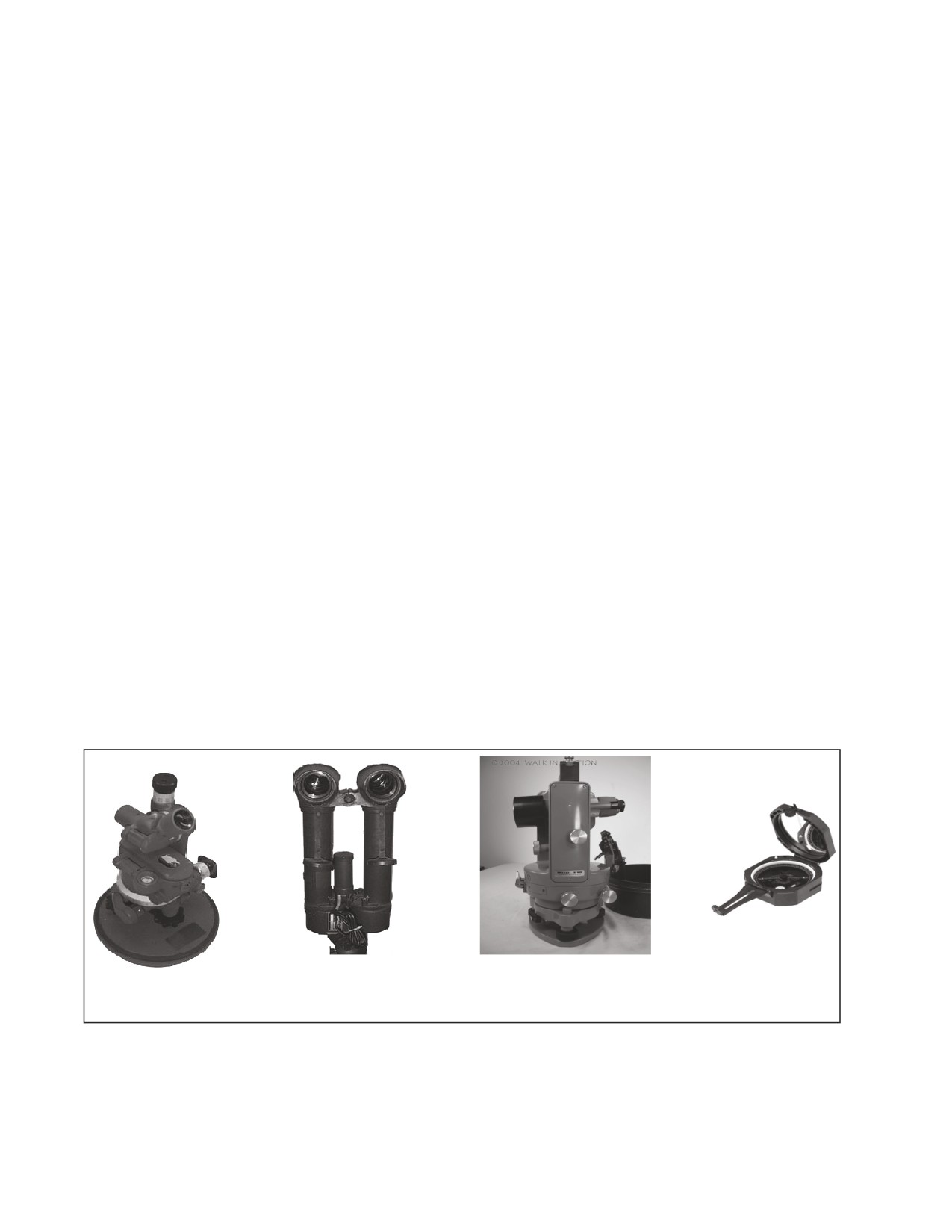
(b) Field artillery and air defense artillery units are best-suited as
designated observer units. These units have organic optical equipment ideal for sighting
measurements. These items are listed below in order of preference (Figure G-1).
•
M2 aiming circle (this equipment is preferred because it is set to GN
and measures in mils).
•
M65 or M43 battery command periscope.
•
T16 or T2 theodolite.
•
M2 pocket transit.
M2 Aiming Circle
Battery Command
Theodolite
M2 Pocket Transit
Periscope
Figure G-1. Unit Organic Optical Equipment Ideal for Sighting Measurements
(c)
Any other unit (e.g., a mortar platoon) having this or similar
equipment may be designated as an observer. Radar should also be considered. Many
2 February 2006
FM 3-11.3/MCWP 3-37.2A/NTTP 3-11.25/AFTTP(I) 3-2.56
G-7
types of radar can define the nuclear cloud. Field artillery and air defense artillery radars
are positioned in the division and corps areas.
(2)
Designated Aerial Observers.
(a) Aircraft provide excellent observer coverage for nuclear attacks. The
CBRN control center coordinates with the appropriate aviation officers to have several
aircraft crews designated as observers. The aviation unit commander selects the crews.
Designated aircrews are instructed to report the type of attack and when and where it
occurred. If aviators measure the cloud parameters, they must also provide the location
from which it was measured.
(b) Aviators have the advantage of height. They are able to see and
report actual GZ locations. They also can see and estimate crater width. Such data is
usually not obtainable from ground observer units.
f.
Nondesignated Observers. All units are required to record (in the prescribed
format) their observations concerning nuclear strikes. Nondesignated observer units that
have not been specifically tasked will transmit their reports only upon request. However,
these units must report a nuclear attack only to the next higher HQ according to the local
SOP.
g.
Determination That a Nuclear Attack has Occurred.
(1)
The development of a nuclear cloud is divided into three stages—fireball,
burst cloud, and stabilized cloud. The fireball stage exists from the instant of the explosion
until the generally spherical cloud of explosion products ceases to radiate a brilliant light.
During this stage, do not look at the fireball. The brilliant light can cause permanent
damage to the eyes.
(2)
As the brilliant light fades to a dull reddish glow, the fireball stage
transforms into the nuclear-burst cloud stage. At this point the cloud can be safely
observed. The cloud may be a spherical cloud (high airburst) or a mushroom type cloud,
with or without a stem (low air or surface burst). Relatively low-yield nuclear surface
bursts have clouds similar to a surface burst of a conventional explosive. Severe turbulence
and rapid growth in cloud height and width are characteristics of this stage.
(3)
When the cloud ceases to grow in height, the stabilized cloud stage begins.
Height stabilization occurs from about 4 to 14 minutes after the explosion, depending on
the yield. The nuclear burst angular cloud width (line LIMA, as explained in Chapter III
for an NBC1 NUC report) and stabilized cloud top/bottom angle or height (line MIKE) are
measured during this stage. Figure G-2 illustrates the growth of a nuclear cloud. After the
height stabilization, the cloud continues to grow. This is due to wind, not nuclear energy.
For this reason, cloud measurements are not taken after H+10 minutes. Measurements of
the nuclear-burst cloud are taken at H+5 minutes (line LIMA) or at H+10 minutes (line
MIKE).
G-8
FM 3-11.3/MCWP 3-37.2A/NTTP 3-11.25/AFTTP(I) 3-2.56
2 February 2006
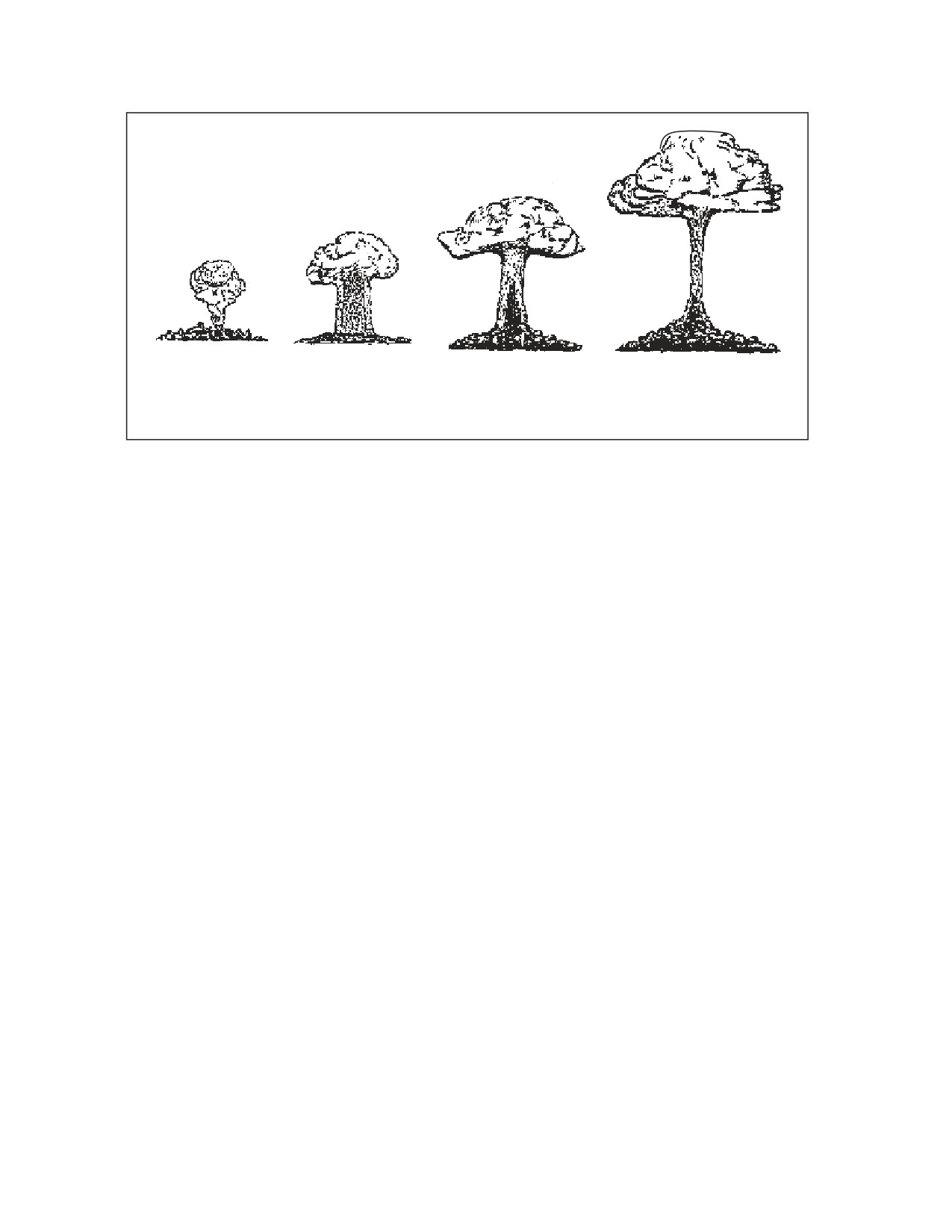
Fireball to
Growing Cloud
Growing Cloud
Stabilized Cloud
Initial Cloud
(10 minutes
(3 minutes
(4 to 14 minutes
(10 seconds
after burst)
after burst)
after burst)
after burst)
Figure G-2. Growth of a Nuclear Cloud
(4)
Nuclear-cloud measurements (parameters) have been correlated with the
yield of the weapon. This information can be extracted from nomograms and the
ABC-M4A1 nuclear yield calculator. The use of the nomograms and the ABC-M4A1 is
described in more detail later in this appendix.
(5)
Unit SOPs detail the duties and circumstances concerning when and how
measurements are taken. For accuracy, the following list of measurements (in order of
reliability) is provided to aid in SOP development:
(a) Nuclear-burst angular cloud width at H+5 minutes.
(b) Stabilized cloud top or cloud bottom height at H+10 minutes.
(c)
Stabilized cloud top or cloud bottom angle at H+10 minutes.
4.
NBC1 NUC Report
The NBC1 NUC Report can have the most far-reaching consequences of all NBC
reports.
a.
Introduction. The NBC1 NUC report (Figure G-3, page G-10) is the most widely
used report. The observing unit uses this report to provide nuclear-attack data. All units
must be familiar with the NBC1 NUC report format and its information. The unit must
prepare this report quickly and accurately and send it to the next higher HQ. The battalion
(squadron) and higher elements decide which NBC1 NUC reports to forward to the next
higher HQ. If several reports are received on the same nuclear attack, then a consolidated
NBC1 NUC report is forwarded instead of separate reports. This reduces the number of
reports to a manageable level. The data in an NBC1 NUC report is used to locate GZ and
to determine the yield of the nuclear burst.
2 February 2006
FM 3-11.3/MCWP 3-37.2A/NTTP 3-11.25/AFTTP(I) 3-2.56
G-9

NBC1 NUC Report
Line Item
Description
Cond*
Example
BRAVO
Location of observer and direction
M
BRAVO/32UNB062634/2500MLG//
of attack or event
DELTA
DTG of attack or detonation and
M
DELTA/201405ZSEP2005//
attack end
FOXTROT
Location of attack or event
O
FOXTROT/32UNB058640/EE//
GOLF
Delivery and quantity information
M
GOLF/SUS/AIR/1/BOM/1//
HOTEL
Type of nuclear burst
M
HOTEL/SURF//
JULIET
Flash-to-bang time, in seconds
O
JULIET/57//
LIMA
Nuclear-burst angular cloud width
O
LIMA/18DGT//
at H+5 Minutes
MIKE
Stabilized cloud measurement at
O
MIKE/TOP/33DGT/9KM//
H+10 minutes
PAPAC
Radar-determined external contour
O
of radioactive cloud
PAPAD
Radar-determined downwind
O
direction of radioactive cloud
YANKEE
Downwind direction and downwind
O
YANKEE/270DGT/015KPH//
speed
ZULU
Actual weather conditions
O
ZULU/4/10C/7/5/1//
GENTEXT
General text
O
*The Cond column shows that each line item is operationally determined (O) or mandatory (M).
Figure G-3. Sample NBC1 NUC Report
(1)
Purpose. The purpose of the NBC1 NUC report is to provide nuclear-attack
data.
(2)
Message Precedence. The first time a nuclear weapon is used against US
forces, the designated unit will send the NBC1 NUC report with a FLASH precedence. If a
previous NBC1 NUC report has been forwarded, an IMMEDIATE precedence will be used.
b.
Observer Position. Use universal transverse mercator (UTM) coordinates
latitude (LAT) and longitude (LONG) or a place name. Enter this location on line BRAVO
of the NBC1 NUC report. Line BRAVO is required on all reports from ground observers
and should be encoded. This is the location of the angle-measuring equipment. It may or
may not be the unit location. The direction of the attack from the observing unit is also
reported on this line.
G-10
FM 3-11.3/MCWP 3-37.2A/NTTP 3-11.25/AFTTP(I) 3-2.56
2 February 2006
c.
DTG of the Attack.
(1)
After the second shock wave has passed, uncover the eyes and record the
DTG to the nearest minute. This data is entered as line DELTA of the NBC1 NUC report.
(2)
The DTG of the attack is always reported. The time zone used is specified
by the field SOP, OPLAN, or OPORD or is contained in other instructions. The CBRN cell
conducts time checks with the designated observers and converts all times to Zulu time.
d.
Attack Location or GZ. If the designated observer has an actual location, this
will be transmitted on line FOXTROT. If the attack location is estimated, a detailed
description of how the estimation was made should be transmitted on line GENTEXT. A
detailed description of how the CBRN cell calculates the GZ location is covered in
paragraph 5 of this appendix.
e.
Type of Burst. Observe the developing cloud to see if the burst was an airburst
by noting the shape and color of the cloud or the absence of a stem. If the cloud is lighter in
color than the stem or if the stem is ragged or broken (does not solidly connect with the
cloud), record “air” in line HOTEL of the NBC1 NUC report. If the stem is thick and dark
and it connects with the cloud, record “surface” in line HOTEL. If the cloud does not match
any mental image for air or surface, record “unknown” in line HOTEL. “Unknown” may
also be recorded when the attack occurs at night. A subsurface burst is recorded as
“surface” only if the detonation ruptures the surface.
f.
Flash-to-Bang Time. The designated observers will be assigned to report the
flash-to-bang time. At the instant of the blue-white flash, cover your eyes, hit the ground,
and start counting slowly (1,000 and 1, 1,000 and 2, 1,000 and 3, and so on) until the arrival
of the shock wave or bang. Make a mental note of the count on which the shock wave
arrives (for example, 1,000 and 4). If the observer has a watch and can note the exact time
(in seconds), the watch can be used to record the flash-to-bang time. This data is entered as
line JULIET on the NBC1 NUC report. Remain in place until the debris has stopped
falling. It must be noted that there will be two shock waves—one blowing in one direction
and the other blowing a few moments later in the opposite direction. If the bang is not
heard in 5 minutes (a count of 1,000 and 300), continue with other measurements below.
g.
Angular Cloud Width. The angular width of the cloud is measured 5 minutes
after the detonation. The width of the nuclear cloud is the angular dimension, in mils or
degrees, of the cloud diameter. The optical equipment operator takes this measurement at
H+5 minutes. This measurement is made for nuclear clouds resulting from air and surface
bursts. All units have some ability to take this measurement. The lensatic compass should
be used if the listed equipment (Figure G-1, page G-7) is not available. Take the
measurement of the angle by measuring the right and left side of the nuclear cloud. The
numerical difference between these azimuths is the angular cloud width (Figure G-4, page
G-12). This measurement is reported as line LIMA.
2 February 2006
FM 3-11.3/MCWP 3-37.2A/NTTP 3-11.25/AFTTP(I) 3-2.56
G-11
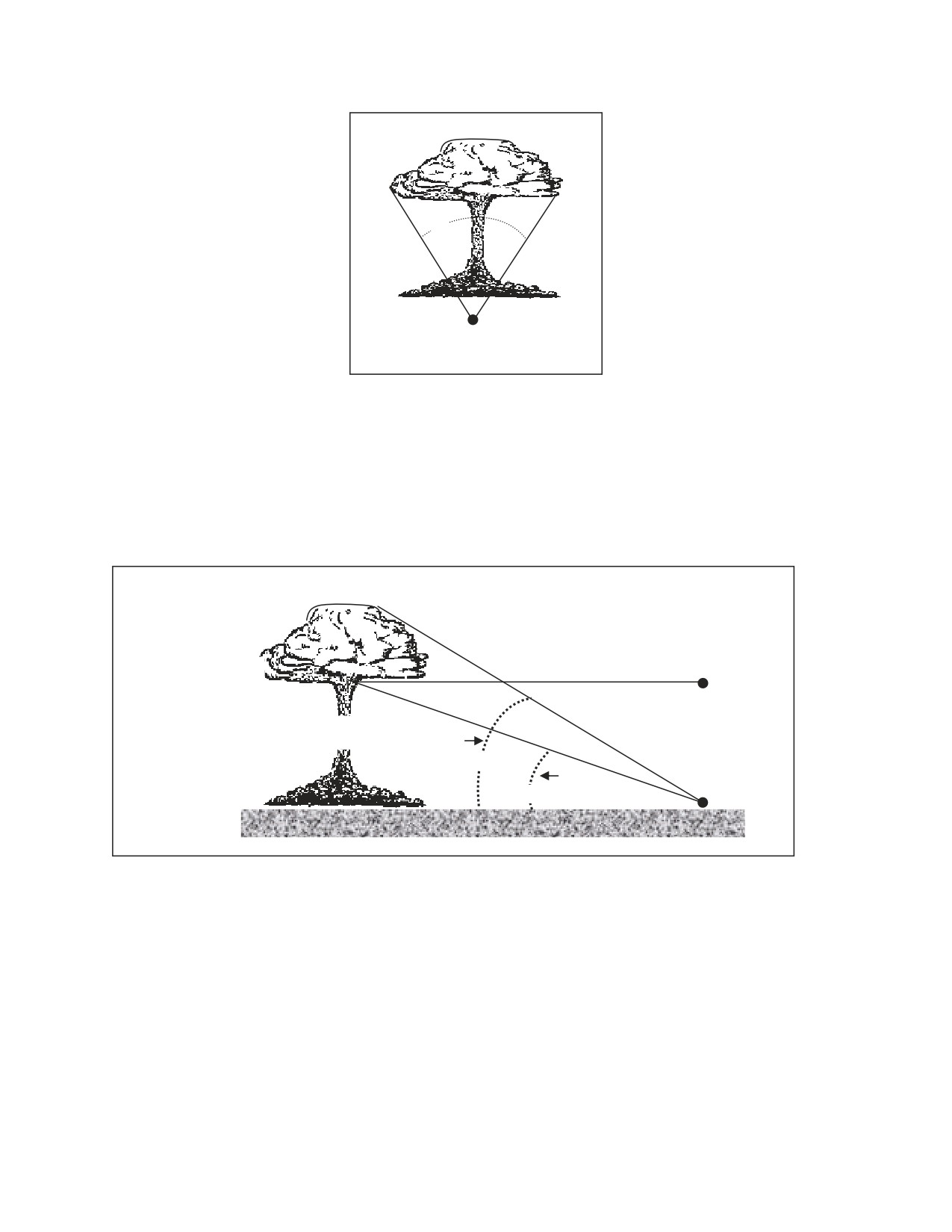
30°
Observer
Figure G-4. Angular Cloud Width
h.
Cloud Top or Cloud Bottom Height. The cloud top or bottom height can only be
measured by aircraft or radar. Helicopters and most small, fixed-wing aircraft have a
limited capability to determine the cloud height. The CBRN cell may have to coordinate
with other service liaison officers to make arrangements to measure the cloud height.
Again, CBRN cell coordination is required to establish this data source. Radar may also be
helpful in resolving the actual number of bursts and GZs. This measurement is taken at
H+10 and reported on line MIKE, in feet or km (Figure G-5).
Cloud Top
Aircraft
Observer
Cloud Bottom
5 km
Stem
50°
Cloud Top Angle
35°
Observer
Cloud Bottom Angle
Ground Level
Figure G-5. Stabilized Cloud Top and Cloud Bottom Angle and Height Measurements
i.
Stabilized Cloud Top Angle.
(1)
The cloud top angle is the vertical measurement, in mils or degrees, from
the GZ level (or from ground level if the GZ level is unknown), to the cloud top. This
measurement is taken at H+10 minutes and reported in line MIKE (see Figure G-3, page G-
10).
(2)
These measurements are less reliable than measurements made at H+5
minutes. Most units in the field cannot take cloud bottom or top angle measurements.
Therefore, they are not normally designated as observer units. These measurements
cannot be made with a lensatic compass.
G-12
FM 3-11.3/MCWP 3-37.2A/NTTP 3-11.25/AFTTP(I) 3-2.56
2 February 2006
(3)
If the angular width of the cloud cannot be measured, the designated
observer unit measures the cloud bottom or cloud top angle. Nondesignated observer units
with angle-measuring equipment can also take this measurement.
(4)
The individuals specifically tasked to take the cloud measurements report
this data and other data specified in the unit SOP to the unit CBRN defense team. If the
unit is a designated observer, the defense team will format the data into an NBC1 NUC
report. The report is transmitted per the SOP or by other written directions.
j.
Stabilized Cloud Bottom Angle. The cloud bottom angle measurement is the
vertical angle (in mils or degrees) measured from the GZ level (or ground level if the GZ
level is unknown) to the point of intersection of the stabilized cloud and the stem. The
cloud bottom or top angle measurements are not taken for airbursts. This measurement is
taken at H+10 minutes and reported in line MIKE (Figure G-3, page G-10).
5.
NBC2 NUC Report
a.
Introduction. The NBC2 NUC report reflects the evaluated nuclear-burst data.
It is based on one or more NBC1 NUC reports. NBC2 NUC reports are created for all air,
surface, and unknown types of bursts. When surface or unknown bursts are reported,
fallout predictions are made. Users of NBC2 NUC reports are not limited to the use of the
line items shown in Figure G-6, page G-14. Any other line items may be added as
appropriate.
(1)
Purpose. The purpose of the NBC2 NUC report is to pass the evaluated
data to higher, subordinate, and adjacent units.
(2)
Message Precedence. All other messages (after the initial NBC1 NUC
report has been sent) should be given a precedence, which reflects the operational value of
the contents. Normally IMMEDIATE would be appropriate.
(3)
The division (or designated higher HQ) CBRN cell, after determining the
estimated yield, prepares the NBC2 NUC report, assigns it a strike serial number, and
disseminates it to the appropriate units.
(4)
Subsequent data may be received after the NBC2 NUC report is sent. If
this data changes the yield or GZ location, send this data in an NBC2 NUC update report.
Use the same strike serial number and DTG of attack.
b.
Strike Serial Number.
(1)
The CBRN cell serves as a focal point for all requests for information
concerning nuclear strikes. It is responsible for assigning a strike serial number to each
nuclear attack (friendly or enemy) that occurs within its assigned area.
(2)
Once the unit receives the NBC2 NUC report, the unit CBRN defense team
takes the report and a current EDM (see Appendix D for further information concerning
EDMs) and prepares a simplified fallout.
2 February 2006
FM 3-11.3/MCWP 3-37.2A/NTTP 3-11.25/AFTTP(I) 3-2.56
G-13

NBC2 NUC Report
Line Item
Description
Cond*
Example
ALFA
Strike serial number
M
ALFA/US/A234/001/N/55//
DELTA
DTG of attack or detonation and
M
DELTA/201405ZSEP2004//
attack end
FOXTROT
Location of attack or event
M
FOXTROT/32UNB058640/EE//
GOLF
Delivery and quantity information
M
GOLF/SUS/AIR/1/BOM/1//
HOTEL
Type of nuclear burst
M
HOTEL/SURF//
NOVEMBER
Estimated nuclear yield in KT or MT
M
NOVEMBER/15KT//
YANKEE
Downwind direction and downwind
O
YANKEE/270DGT/015KPH//
speed
ZULU
Actual weather conditions
O
ZULU/4/10C/7/5/1//
GENTEXT
General text
O
*The Cond column shows that each line item is operationally determined (O) or mandatory (M).
Figure G-6. NBC2 NUC Report
c.
Location of GZ (Line FOXTROT).
(1)
Any unit that is not part of the designated-observer system is obligated to
take the cloud measurements and record all observed burst data. This data is recorded in
the NBC1 NUC report in line BRAVO or FOXTROT and evaluated for the NBC2 NUC
report. The unit does not report to higher HQ unless specifically requested. The CBRN cell
will use this data to locate GZ and to estimate the yield.
(2)
At the unit level, GZ is located in one of three ways—direct observation,
intersection, or polar plot.
(a) Direct Observation. For small-yield weapons, direct observation may
provide the actual GZ location. However, units do not reconnoiter for the GZ location. If
GZ cannot be observed, measure the azimuth from the observer to the center of the stem
(surface burst) or nuclear-burst cloud (air burst). Enter this data in line BRAVO of the
NBC1 NUC report. If GZ can be observed, determine the UTM, LAT, and LONG
coordinates or the place name. Enter this data as line FOXTROT (actual). Aerial observers
may provide an estimated or actual GZ, depending on the altitude, orientation, terrain, and
visibility conditions. The GZ must be observed to use line FOXTROT (actual).
(b)
Intersection (Estimation for Line FOXTROT). The principal GZ
location method is a plot of intersecting azimuths sent by the designated observers. The
procedures are as follows:
•
Locate and mark the position of each observer unit on the operations
map overlay using the data on line BRAVO.
G-14
FM 3-11.3/MCWP 3-37.2A/NTTP 3-11.25/AFTTP(I) 3-2.56
2 February 2006
•
Determine each azimuth to be plotted. This information is also on line
BRAVO. Convert all magnetic azimuths to grid azimuths.
•
Mark each azimuth from each observer position using a protractor.
•
Extend each azimuth to the distance necessary for the observer’s
positions to intersect.
•
Post any data that assists in the determination of the GZ location
(e.g., radar, pilot reports).
•
Evaluate the data. The result of the intersecting azimuths is an
estimation of the location of GZ. The GZ location is reported on the NBC2 NUC report on
line FOXTROT, qualified with the word estimated (unless FOXTROT [actual] information
is used in the determination).
•
Disregard the azimuths that do not intersect with the other azimuths.
•
Take the center of the plot as the estimated GZ location whenever
azimuths do not cross to form a clear GZ location.
(c)
Polar Plot (Estimation for Line FOXTROT). Polar plot techniques are
based on flash-to-bang time and the speed of sound (350 meters per second or 0.35 km per
second). The procedures are as follows (see Figure G-7, page G-16):
•
Make an approximation of the distance between GZ and the observer
in km by multiplying the flash-to-bang time (data on line JULIET of the NBC1 NUC report)
by 0.35 km per second.
•
Plot the observer’s location on the situation map. This is line BRAVO
on the NBC1 NUC report.
•
Mark the azimuth from the observer’s position to the attack location
using a protractor. Convert the magnetic azimuth to a grid azimuth.
•
Draw this azimuth to the length previously calculated as the distance
between GZ and the observer.
•
Read the grid coordinates of the place where the azimuth line, in the
previous step, ends. This is an approximate plot of the GZ location.
2 February 2006
FM 3-11.3/MCWP 3-37.2A/NTTP 3-11.25/AFTTP(I) 3-2.56
G-15
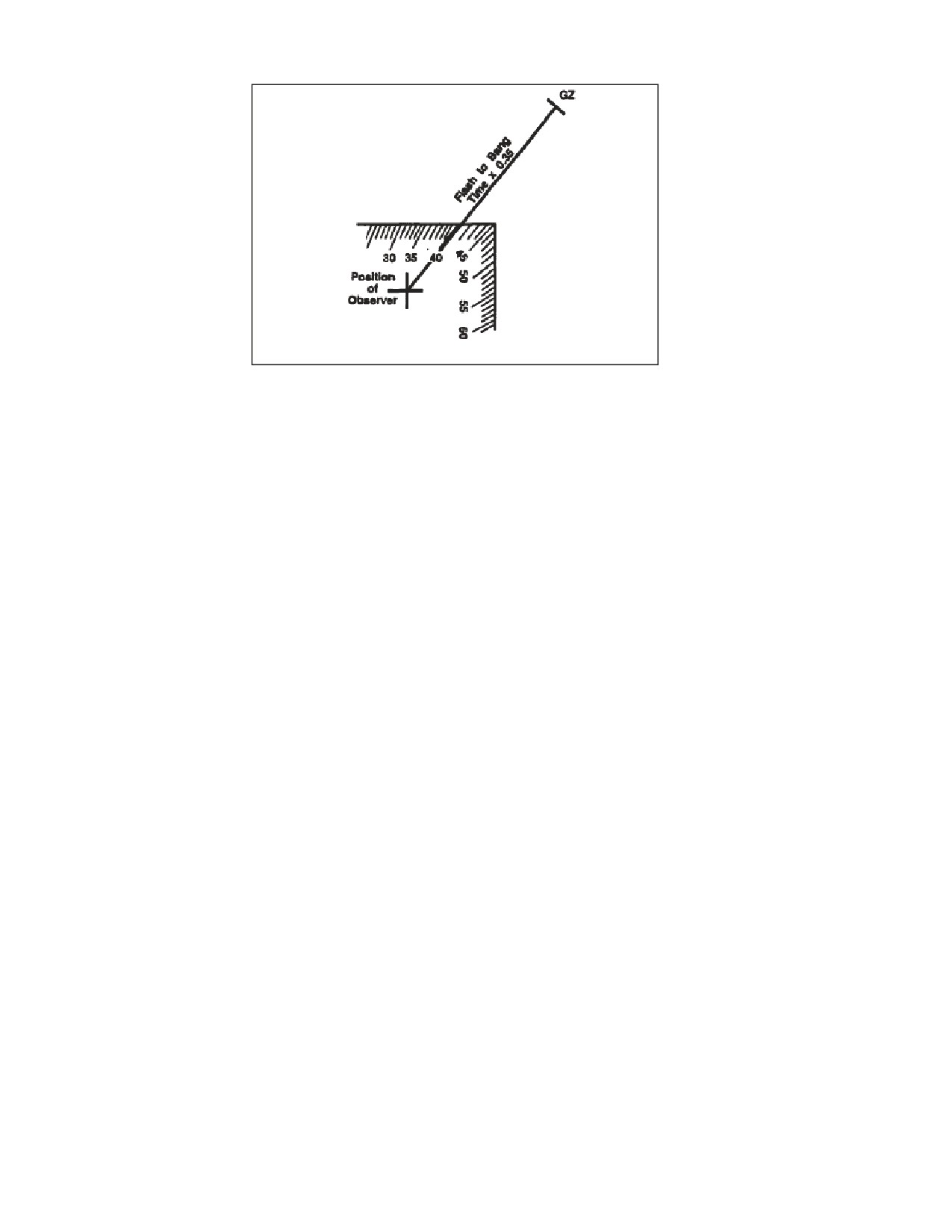
Figure G-7. Polar Plot Method
d.
Methods of Determining the Yield (Line NOVEMBER). Before the yield can be
estimated, the location of GZ, position of the observer, and DTG cloud measurements were
taken must be known. The nuclear-burst parameters are presented in nomograms. Each
nomogram is an independent means of estimating yield. The following are methods for
determining yield, from the most accurate to the least accurate:
(1)
The distance in km between GZ and the observer, in conjunction with line
LIMA or MIKE information, represents the best method of estimating the yield.
(2)
Use Figure G-8 to determine the yield, based on the nuclear-burst angular
cloud width and the distance between GZ (or line JULIET, flash-to-bang time) and the
observer. The data is reported in line LIMA.
(a) The right-hand scale is the nuclear-burst angular cloud width, in mils
and degrees.
(b) The center scale is the distance in km between GZ and the observer.
(c)
The left-hand scale is the yield, in KT.
(d) To use this nomogram, place a hairline from the point on the
right-hand scale (representing the nuclear burst angular cloud width at H+5 minutes)
through the point on the center scale (representing the distance between GZ and the
observer) (or line item JULIET, flash-to-bang time). Read the yield where the hairline
crosses the yield scale (left). You must be as exact as possible.
(3)
The cloud top or cloud bottom height, when stabilized, can be closely
measured by aircraft or air defense artillery (ADA) radar. Measurements, in meters or feet
above the earth’s surface, must be made at H+10 minutes. The data is reported in line
MIKE.
(a) Use Figure G-9, page G-18, to correlate these measurements with the
yield. The distance between GZ and the observer is not required.
(b) The extreme left and right scales on the nomogram are yield, in KT
and MT.
G-16
FM 3-11.3/MCWP 3-37.2A/NTTP 3-11.25/AFTTP(I) 3-2.56
2 February 2006
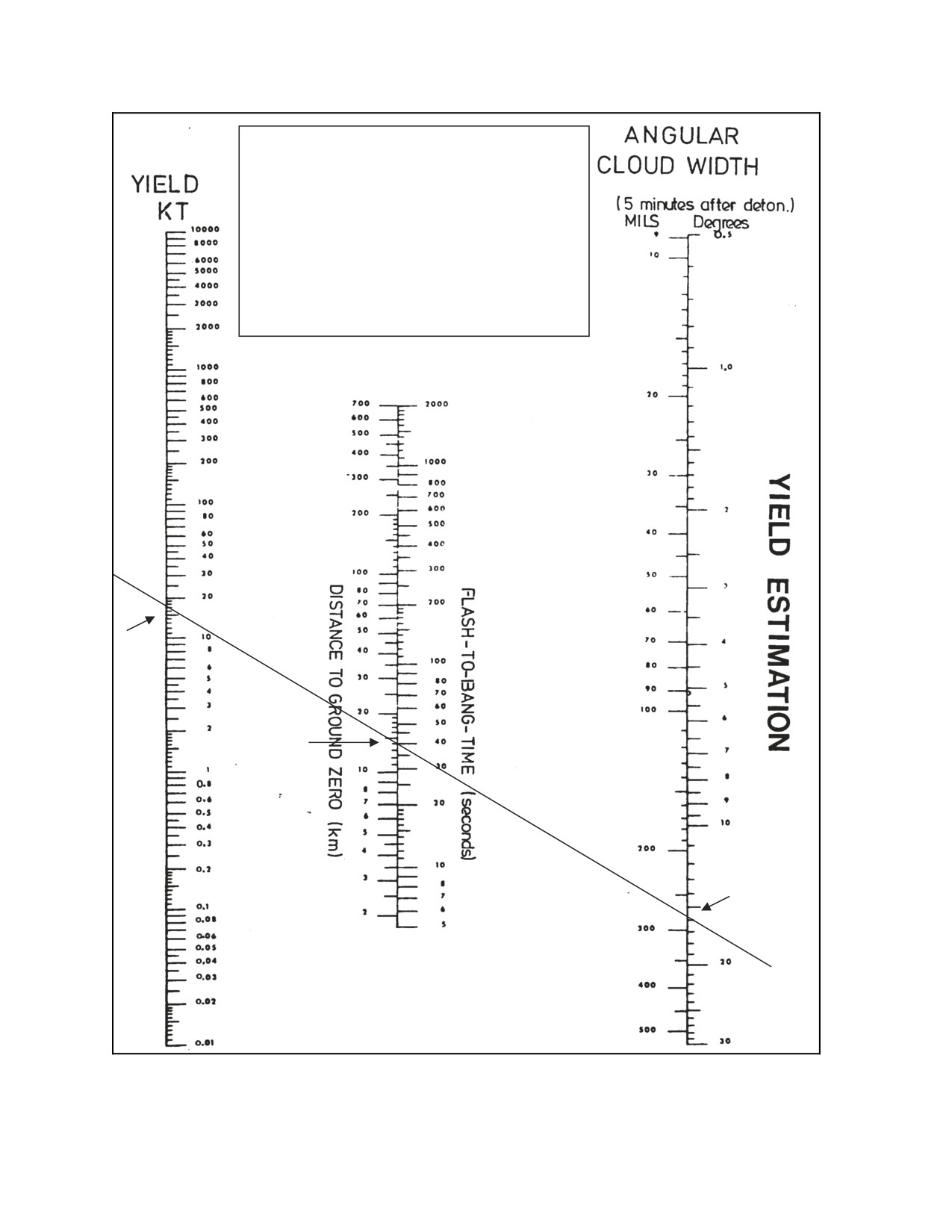
Situation: Estimate the yield.
Line LIMA is 16o .
Distance from observer to GZ is 13.9 km.
Using the hairline, place it from right to left, on 16o
on the right-hand scale (line LIMA).
Align the hairline with 7.5 km on the middle scale
(distance to GZ from observer, in km).
Read the hairline on the left scale for the yield.
The estimated yield is approximately 16.9 KT.
Line NOVEMBER for the NBC 2 NUC Report
is 16.9 KT. NOTE: The hairline may not be to
scale.
16.9
KT
13.9
km
16o
Figure G-8. Yield Estimation, Cloud Width and Flash-to-Bang Time/Distance to GZ (Example)
2 February 2006
FM 3-11.3/MCWP 3-37.2A/NTTP 3-11.25/AFTTP(I) 3-2.56
G-17
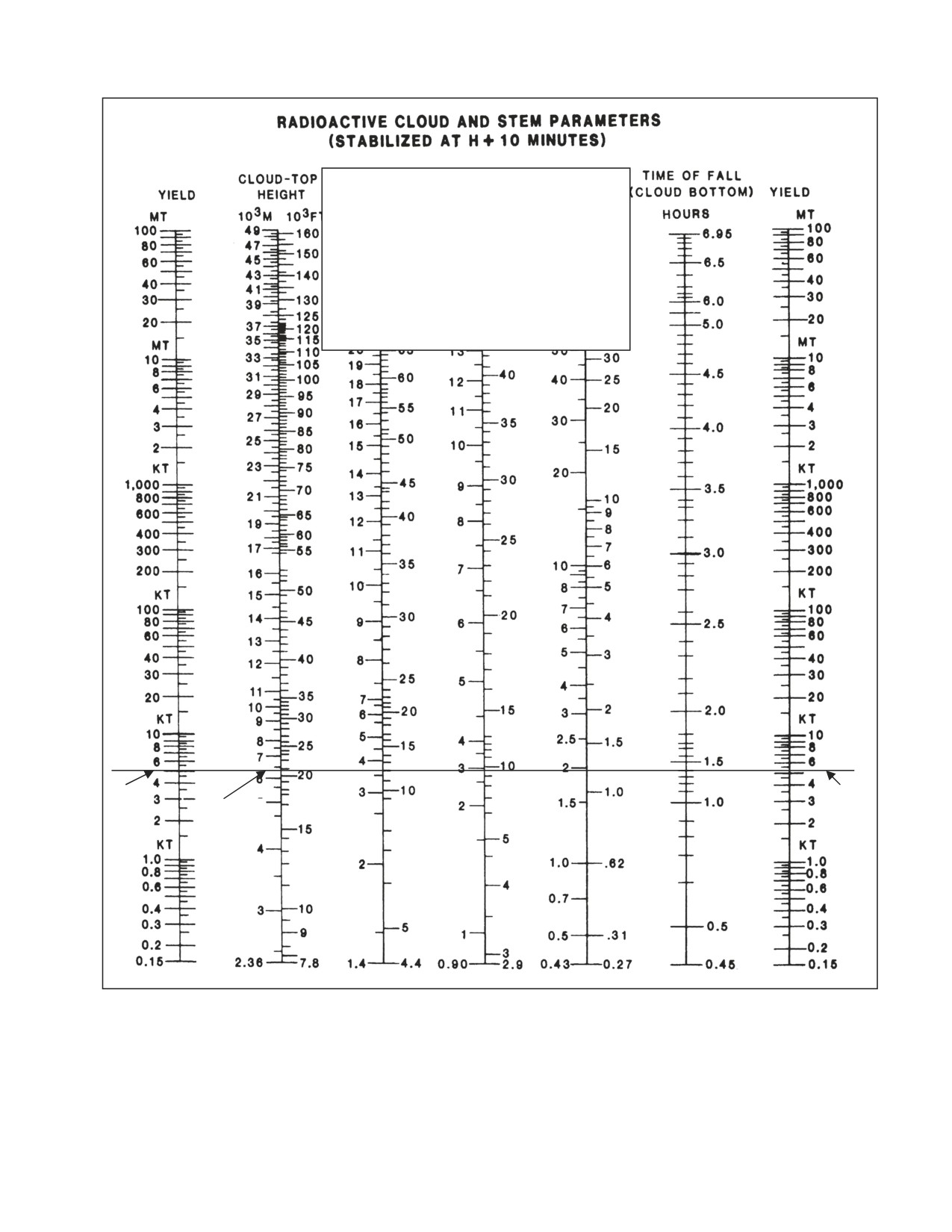
Situation: Estimate the yield.
Cloud top height from line MIKE is 7.9 km.
Using a hairline, align it straight across, from
left to right.
The approximate yield is 9 KT.
Line NOVEMBER for the NBC2 NUC report
is 9 KT.
NOTE: The Hairline may not be to scale.
9 KT
9 KT
7.9 km
Figure G-9. Stabilized Cloud and Stem Parameters—Cloud Top/Bottom Height (Example)
G-18
FM 3-11.3/MCWP 3-37.2A/NTTP 3-11.25/AFTTP(I) 3-2.56
2 February 2006
(c)
The scale second from the left is the cloud top height at H+10 minutes,
in thousands (103 ) of meters or feet.
(d) The scale third from the left is the cloud bottom height at H+10
minutes, in thousands (103) of meters or feet.
(e) The other scales on the nomogram, (2/3 stem height, cloud radius, and
time of fall) are not used in the yield estimation. These scales are used in the detailed
fallout prediction.
(f)
To use the nomogram, determine the stabilized cloud top or cloud
bottom height from line MIKE of the NBC1 NUC report. Place a hairline directly over the
reported data, and pin the hairline to the nomogram. Pivot the hairline until it crosses the
outside yield scales at the same value (far left and far right). This value is the estimated
yield.
(4)
Given the distance between GZ and the observer and the stabilized cloud
top angle or cloud bottom angle, use Figure G-10, page G-20, to determine the yield. The
data is reported in line MIKE.
(a) The right-hand scale gives the distance in km from GZ to the observer
and the flash-to-bang time, in seconds, counted by the observer.
(b) The center scale is the cloud top or cloud bottom angle, in mils or
degrees.
(c)
The left-hand scale is actually two scales. The left side of the scale
lists the yields to be read when using the cloud bottom angle; the right side of the scale lists
the yields to be read when using the cloud top angle.
(d) To use this nomogram, place a hairline through the point on the
right-hand scale, representing the distance between GZ and the observer, and through the
point on the center scale, representing the cloud top or cloud bottom angle. At the point of
intersection of the hairline and the left-hand scale, read the yield. If the cloud top angle
was used on the center scale, read the yield on the right side of the left-hand scale titled
yield-cloud top (KT). If a cloud bottom angle is used, read the yield on the left side of the
left-hand scale titled yield-cloud bottom (KT).
(5)
The M4A1 calculator (Figure G-11, page G-21) is designed to provide a
rapid yield estimation based on any parameter except the cloud top or cloud bottom height.
The M4A1 consists of three plastic disks (front, back, and middle) connected by a rivet. The
front and back disks are opaque white plastic in the center and transparent plastic on the
outer edge. The middle disk is opaque white plastic.
(a) M4A1 Front:
•
Stabilized cloud bottom or top angle scale (mils).
•
Yield stabilized cloud bottom scale (KT).
•
Yield stabilized cloud top scale (KT).
•
Nomenclature.
•
Instructions.
•
Distance-to-GZ scale (KM).
2 February 2006
FM 3-11.3/MCWP 3-37.2A/NTTP 3-11.25/AFTTP(I) 3-2.56
G-19
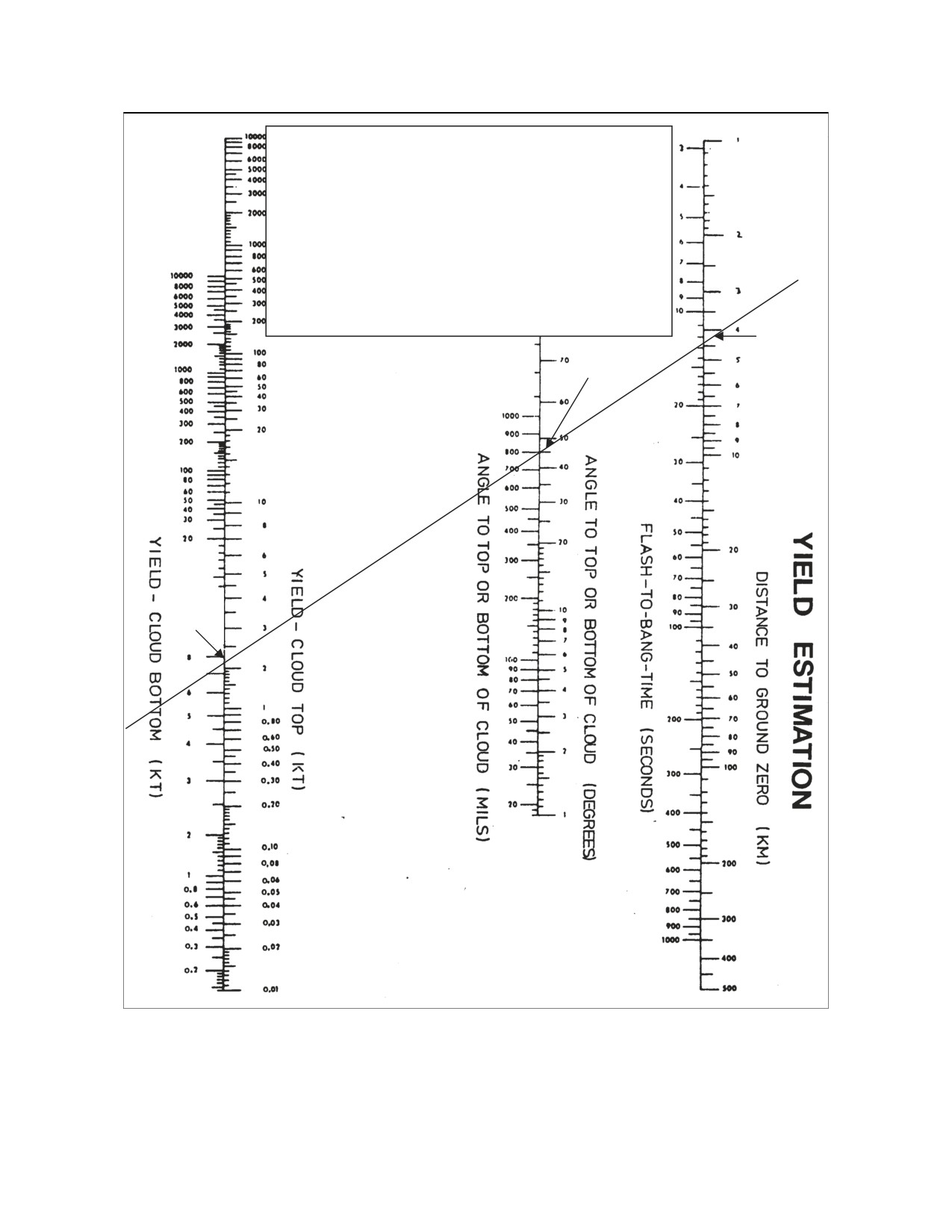
Situation: Estimate the yield.
Distance from observer to GZ is 12.9 km.
Using the hairline, place it from right to left on 12.9 km on the
right hand scale (left side of the right scale).
Align the hairline with 44o CB on the right side of the middle
scale (angle to cloud bottom).
Read the hairline on the left scale for the yield (left side of the
left scale—cloud bottom yield).
The estimated yield is approximately 7.4 KT.
Line NOVEMBER for the NBC2 NUC report is 7.4 KT.
Note: The hairline may not be to scale.
12.9
44o
km
CB
7.4
KT
Figure G-10. Yield Estimation, Angle to Top/Bottom of Cloud and Flash-to-Bang
Time/Distance to GZ (Example)
G-20
FM 3-11.3/MCWP 3-37.2A/NTTP 3-11.25/AFTTP(I) 3-2.56
2 February 2006
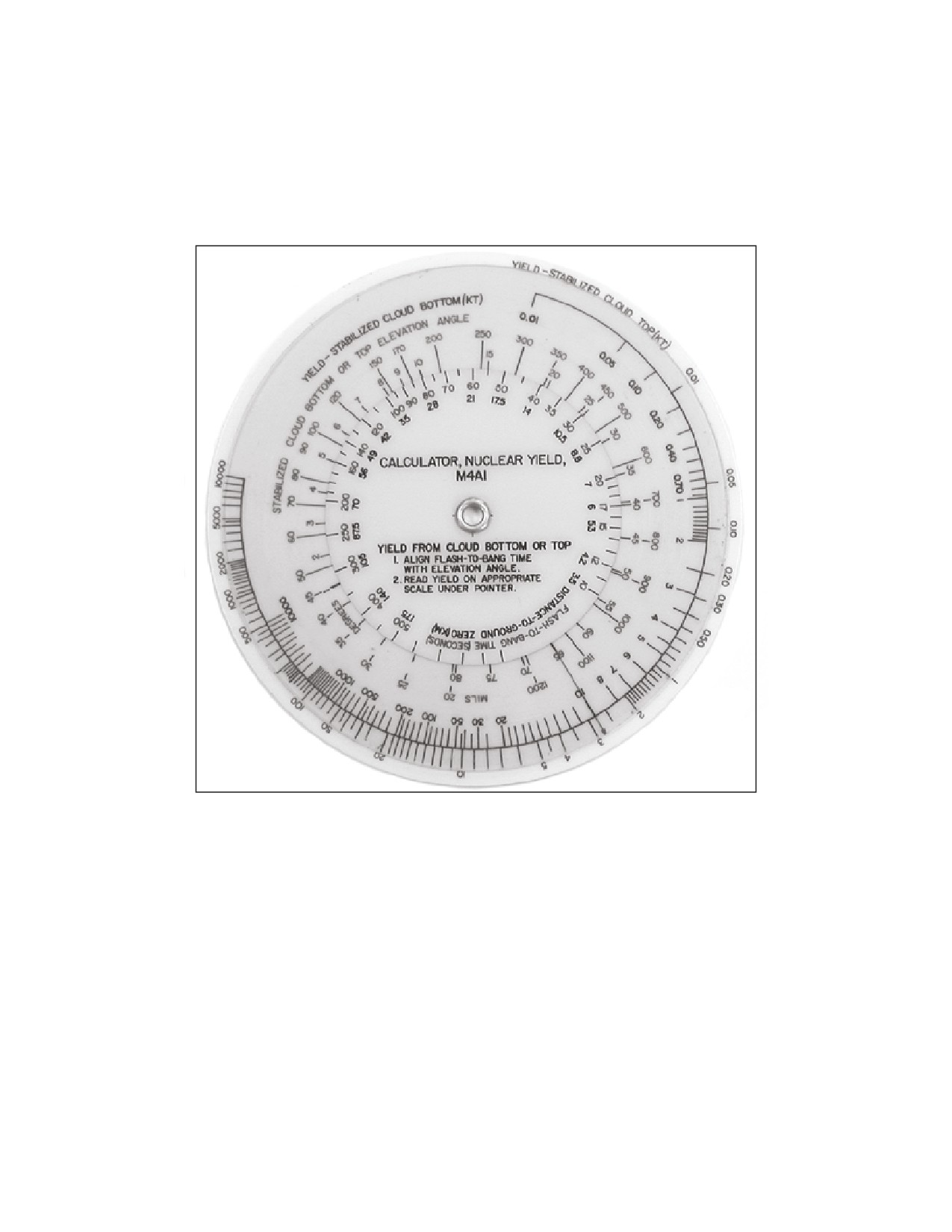
Figure G-11. M4A1 Nuclear Yield Calculator
•
Flash-to-bang time scale (seconds).
•
Indexing pointer.
(b) M4A1 Back:
•
Observed cloud width scale at 5 minutes (H+5 or L).
•
Yield scale.
•
Distance-to-GZ scale (KM).
•
Flash-to-bang time scale (seconds).
2 February 2006
FM 3-11.3/MCWP 3-37.2A/NTTP 3-11.25/AFTTP(I) 3-2.56
G-21
•
Indexing pointer.
•
Instructions.
(c)
The M4A1 calculator is a round nomogram with a fixed hairline.
Because of this, there are situations in which the yield pointer may go off scale on the high
or low ends of the yield scale. (Example: the nuclear cloud is 20 mils wide and the flash-to-
bang time was 10 seconds. This is a small cloud that is very close to the observer,
indicating a small yield. The calculator shows a yield of 1,000 KT, but the actual yield is
less than 0.02 KT).
(d) To use the M4A1, determine the yield utilizing the flash-to-bang time
and the angle to the cloud top.
•
Situation. An observer reports a flash-to-bang time of 100 seconds
and the elevation of the cloud top at the stabilization time of 300 mils.
•
Task. Using the calculator, determine the yield from the burst.
•
Solution. Align 100 seconds on the flash-to-bang time scale, with 300
mils on the stabilized cloud bottom or top elevation angle scale (H+10/M information).
Read the yield on the yield-stabilized cloud top scale that falls under the indexing pointer.
The yield of the observed weapon is 20 KT.
(e) Yield from Flash-to-Bang Time and Cloud Width at 5 Mins (H+5/L).
NOTE: If line LIMA is reported in degrees, it must be converted to mils; mils
equals degrees x 17.8.
•
Situation. An observer reports that the flash-to-bang time from a
burst was 100 seconds and the cloud width at 5 minutes was 180 mils.
•
Task. Using the calculator, determine the yield.
•
Solution. Align 100 seconds on the flash-to-bang time scale with 180
mils on the observed cloud width at 5 mins scale. Read the yield at the point where the
indexing pointer aligns with the yield scale.
•
The yield of the observed weapon is 50 KT.
(6)
The flash-to-bang time is only used to estimate the yield as a last resort.
(7)
Each of the yield estimation techniques was given in order of decreasing
reliability, with the results providing approximate yields.
(8)
When data from several observers, concerning a single attack, does not
result in the same yield, add all yields together and divide by the number of observers to
get the average estimated yield. This is the yield that is transmitted.
6.
NBC3 NUC Calculation Procedures
NBC3 NUC calculation procedures ensure that standard methods are used when
determining fallout.
a.
Fallout Prediction.
(1)
In the preparation of a fallout prediction, the following must be available:
•
MET data.
G-22
FM 3-11.3/MCWP 3-37.2A/NTTP 3-11.25/AFTTP(I) 3-2.56
2 February 2006
•
GZ location.
•
Estimated yield.
(2)
The necessary MET data will be available in the format of an NBC BWM or
an NBC EDM. Refer to Appendix D for further information concerning NBC BWMs and
NBC EDMs.
(3)
The method of fallout prediction consists of two procedures: the simplified
procedure and the detailed procedure. Both are used to determine the extent of the
warning area. Normally, the detailed procedure is used by agencies having a MET
capability, and subordinate units use the simplified procedure. The decision on which
procedure to use is left to the commanders concerned. These two procedures are described
in detail later in this appendix.
(4)
The prediction of the fallout hazard area using the detailed procedure is
more accurate. Although neither procedure precisely defines the extent of the fallout, the
predicted fallout area, calculated by either method, indicates the probable limits to which
the fallout of military significance will extend.
(5)
The boundaries of the predicted fallout area are not dose rate contour lines,
nor do they imply that all points within the enclosed areas will sustain dangerous fallout.
NOTE: No fallout predictions are made for air bursts over land, and the
procedures are not used for surface bursts over water.
b.
Fallout Area Zones.
(1)
The predicted fallout area consists of Zone I and Zone II.
(a) Zone I is an immediate operational concern. Within this zone,
there will be areas where exposed, unprotected personnel may receive doses of 125 cGy
or greater in relatively short periods of time (less than 4 hours after the actual arrival of
fallout). Casualties and major disruptions to the unit operations may occur in some
parts of this zone.
(b) Zone II is a secondary hazard. Within this zone, the total dose
received by exposed, unprotected personnel is not expected to reach 125 cGy within a
period of 4 hours after the actual arrival of fallout. Within this zone, personnel may
receive a total dose of 75 cGy or greater within the first 24 hours after the arrival of
fallout. Personnel with no previous radiation exposure may be permitted to continue
critical missions for as long as 4 hours after the actual arrival of fallout without
incurring the 125 cGy emergency risk dose.
(2)
Outside the two predicted zones, exposed, unprotected personnel may
receive a total dose that does not reach 75 cGy in the first 24 hours after the actual
arrival of fallout.
(3)
The total dose for an infinite stay time should not reach 125 cGy. Refer
to Appendix C for more details.
NOTE: The prediction of fallout is to be regarded as an estimate only. The
necessary preparations should be made to avoid the hazard if tactically possible.
Even within Zone I, units may not be affected by the fallout at all. However, the
decision to act is up to the local commander and national directives or SOPs.
2 February 2006
FM 3-11.3/MCWP 3-37.2A/NTTP 3-11.25/AFTTP(I) 3-2.56
G-23
c.
Significance of the Fallout Ashore Versus at Sea.
(1)
The detailed procedure and the simplified procedure for fallout prediction
are intended for use by all services. They are based on assumed land surface bursts. It is
recognized that the fallout from a sea burst may be rather different, but very little direct
information is available on the fallout from bursts on the surface of deep ocean water.
(2)
It must be stressed that the sea acts like an absorbent of and shield against
radioactive products, but they remain a hazard on land until they have decayed.
(3)
Another important difference is that recipients of warnings ashore do not
have the mobility of ships at sea. Therefore, ships will be particularly interested in the
determination of the approximate area in which deposition of fallout at the surface is
taking place at a given time after the burst.
(4)
Ships with a MET capability may be able to obtain the required MET data
for computation of NBC EDM using the standard pressure level winds. Basic wind data for
this purpose are generally available from MET sources (airbases, MET ships, or mobile
weather stations). Ships, which do not have a MET capability, will normally predict the
fallout areas by using the simplified procedure.
(5)
The fallout warning system (MERWARN) for merchant ships at sea is
described later in this appendix.
d.
Multiple-Burst Fallout.
(1)
No additional prediction procedure is available in the case of multiple-burst
fallout. The information obtained in areas where zones overlap is to be interpreted as
follows:
(a) The hazard classification of an area where fallout prediction patterns
overlap should be that of the higher classification involved. That is, an overlap area
involving Zone I should be designated Zone I and an overlap area involving nothing more
than Zone II should be designated Zone II (see Figure G-12).
(b) Examples:
• Zone I overlapping Zone I, designate Zone I.
• Zone I overlapping Zone II, designate Zone I.
• Zone II overlapping Zone II, designate Zone II.
• Zone II overlapping Zone I, designate Zone I.
e.
Simplified Fallout Prediction.
(1)
Purpose. The purpose of the simplified fallout prediction system is to
provide small-unit commanders with an immediate estimate of the fallout hazard. The
commander will use the simplified fallout prediction in the tactical decision-making
process.
G-24
FM 3-11.3/MCWP 3-37.2A/NTTP 3-11.25/AFTTP(I) 3-2.56
2 February 2006