FM 3-11.3 MULTISERVICE TACTICS, TECHNIQUES, AND PROCEDURES FOR CHEMICAL, BIOLOGICAL, RADIOLOGICAL, AND NUCLEAR CONTAMINATION AVOIDANCE (FEBRUARY 2006) - page 4
(4)
From the end of the first vector, draw the next vector. The downwind end of
this vector is labeled 4, so the vector represents the downwind direction and downwind
speed within the height layer 2,000 to 4,000 meters.
(5)
Proceed in the same manner, using all information given in the BWR. The
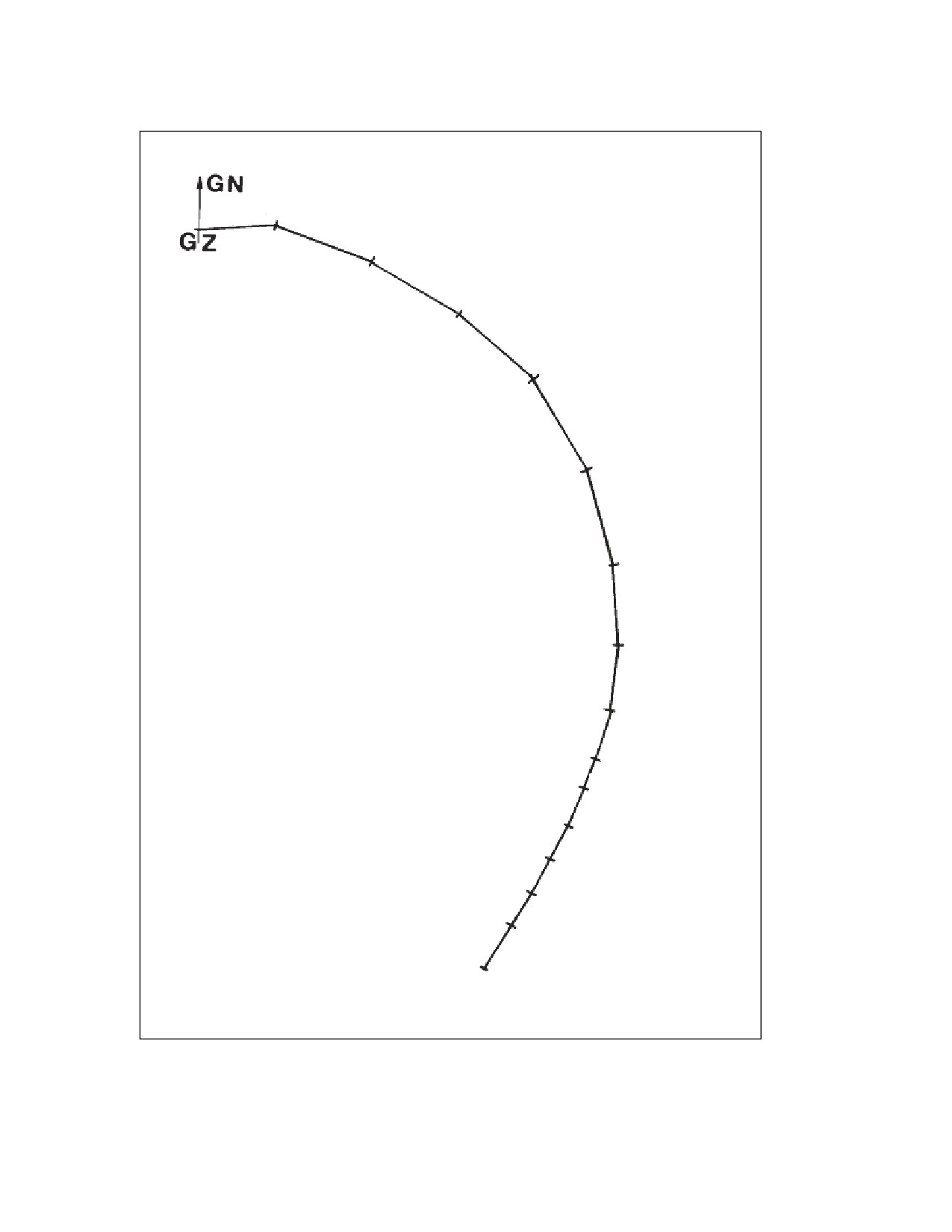
result will be a wind vector plot as shown in Figure D-1 (page D-26). The following is a
sample of a BWR:
MSGID/BWR/AWS/382856/DEC /-/-//
DTG/250630ZDEC2004//
ORGIDDFT/UKRA/BAT/UK/AA/BB/CC/DD/AG/A/-//
NBCEVENT/BWM/-//
AREAM/NFEB4//
ZULUM/250600ZDEC2004/230700ZDEC2004/241900ZDEC2004//
UNITM/-/DGG/KTS /-/
LAYERM/02/266/004/
LAYERM/04/289/007/
LAYERM/06/301/008/
LAYERM/08/311/008/
LAYERM/10/329/009/
LAYERM/12/339/009/
LAYERM/14/356/008/
LAYERM/16/009/007/
LAYERM/18/019/005/
LAYERM/20/015/003/
LAYERM/22/025/004/
LAYERM/24/029/004/
LAYERM/26/030/004/
LAYERM/28/031/005/
LAYERM/30/034/005//
NOTE: Unless otherwise annotated, winds are taken “from” not in the direction
“to”; therefore, the back azimuth must be taken (more than 180°, subtract 180; less
than 180°, add 180). If the windspeed is provided in kph rather than knots per
hour, then multiply by 0.54 (see Tables D-11 and D-12, page D-27).
2 February 2006 FM 3-11.3/MCWP 3-37.2A/NTTP 3-11.25/AFTTP(I) 3-2.56
D-25
2
4
6
8
10
12
14
16
18
20
22
24
26
28
30
Figure D-1. Example Wind Vector Plot
D-26
FM 3-11.3/MCWP 3-37.2A/NTTP 3-11.25/AFTTP(I) 3-2.56
2 February 2006
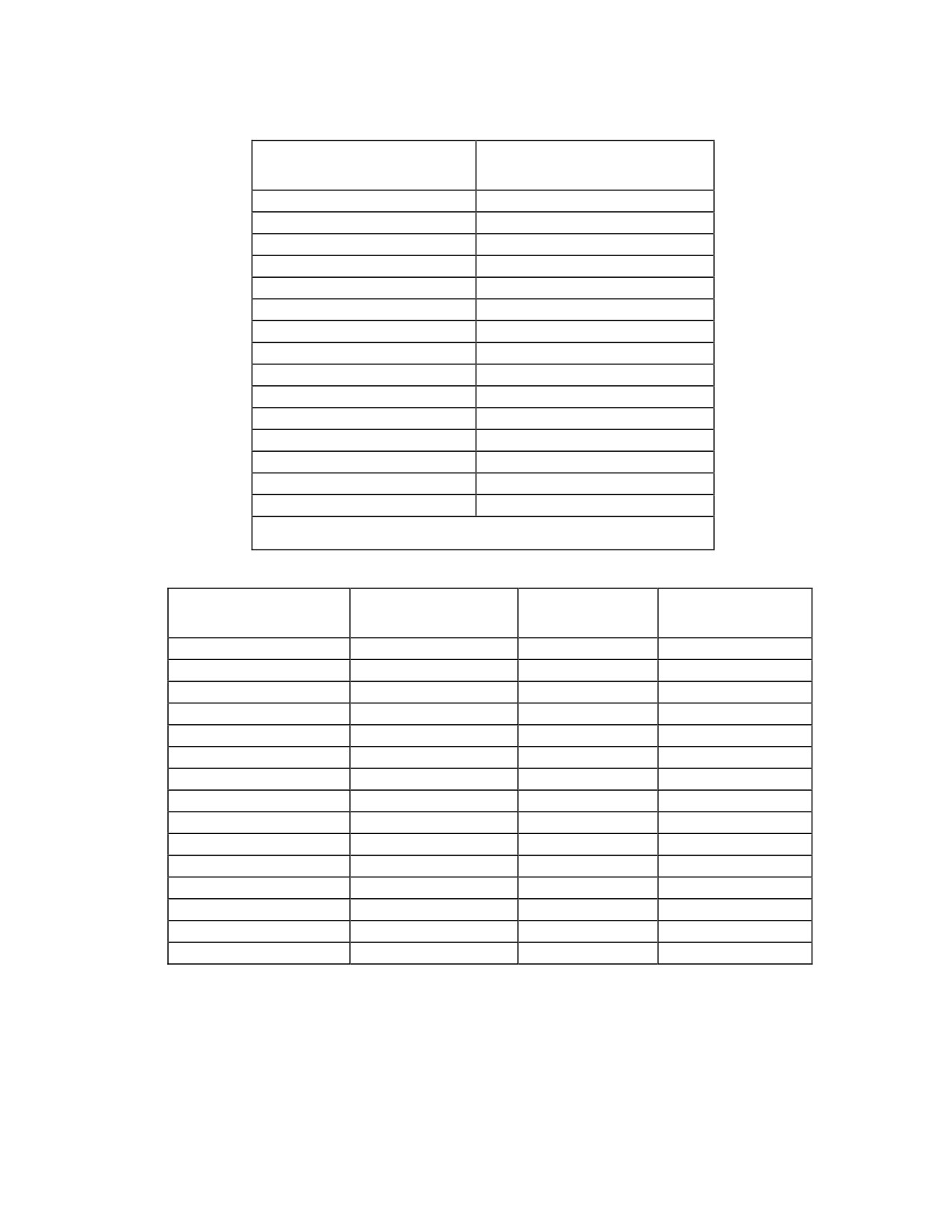
Table D-11. Weighting Factor Table
WIND LAYER
Weighting Factor
(103 meters)
1.26
0-2
1.09
2-4
0.96
4-6
0.93
6-8
0.89
8-10
0.83
10-12
0.78
12-14
0.74
14-16
0.72
16-18
0.70
18-20
0.69
20-22
0.67
22-24
0.67
24-26
0.65
26-28
28-30
0.63
NOTE: Multiply the wind speed, in knots, by the weighting factor
to obtain the vector length, in kilometers.
Table D-12. Wind Vector Lengths
Wind Layer
Weighting Factor
Wind Speed
Vector Length
(103 meters)
(knots)
(km)
0-2
1.26
4
5.04
2-4
1.09
7
7.63
4-6
0.96
8
7.68
6-8
0.93
8
7.44
8-10
0.89
9
8.01
10-12
0.83
9
7.47
12-14
0.78
8
6.24
14-16
0.74
7
4.90
16-18
0.72
5
3.60
18-20
0.70
3
2.16
20-22
0.69
4
2.76
22-24
0.67
4
2.68
24-26
0.67
4
2.68
26-28
0.65
5
3.25
28-30
0.63
5
3.15
5.
Effective Downwind Reports (Details and Example)
The EDR is used to provide the effective downwind data needed to predict a fallout
area following a nuclear burst for the nearest 6-hour period (EDR) or for a period more than
6 hours ahead (EDF). Seven downwind speeds and corresponding downwind directions are
transmitted in the EDM, corresponding to seven preselected weapon yield groups.
2 February 2006 FM 3-11.3/MCWP 3-37.2A/NTTP 3-11.25/AFTTP(I) 3-2.56
D-27
a.
Since effective downwind speed and effective downwind direction vary with the
yield, seven downwind speeds and downwind directions are transmitted, corresponding to
seven preselected yield groups, ALFA through GOLF as follows:
ALFAM
is
≤
2 KT
BRAVOM
is
>
2 KT
≤
5 KT
CHARLIEM
is
>
5 KT
≤
30 KT
DELTAM
is
>
30 KT
≤
100 KT
ECHOM
is
>
100 KT
≤
300 KT
FOXTROTM
is
>
300 KT
≤
1,000 KT (1 MT)
GOLFM
is
>
1,000 KT
≤
3,000 KT (3 MT)
b.
To calculate the data, use the following procedure with 2 KT for ALFAM, 5 KT
for BRAVOM, and 30 KT for CHARLIEM and so on.
(1)
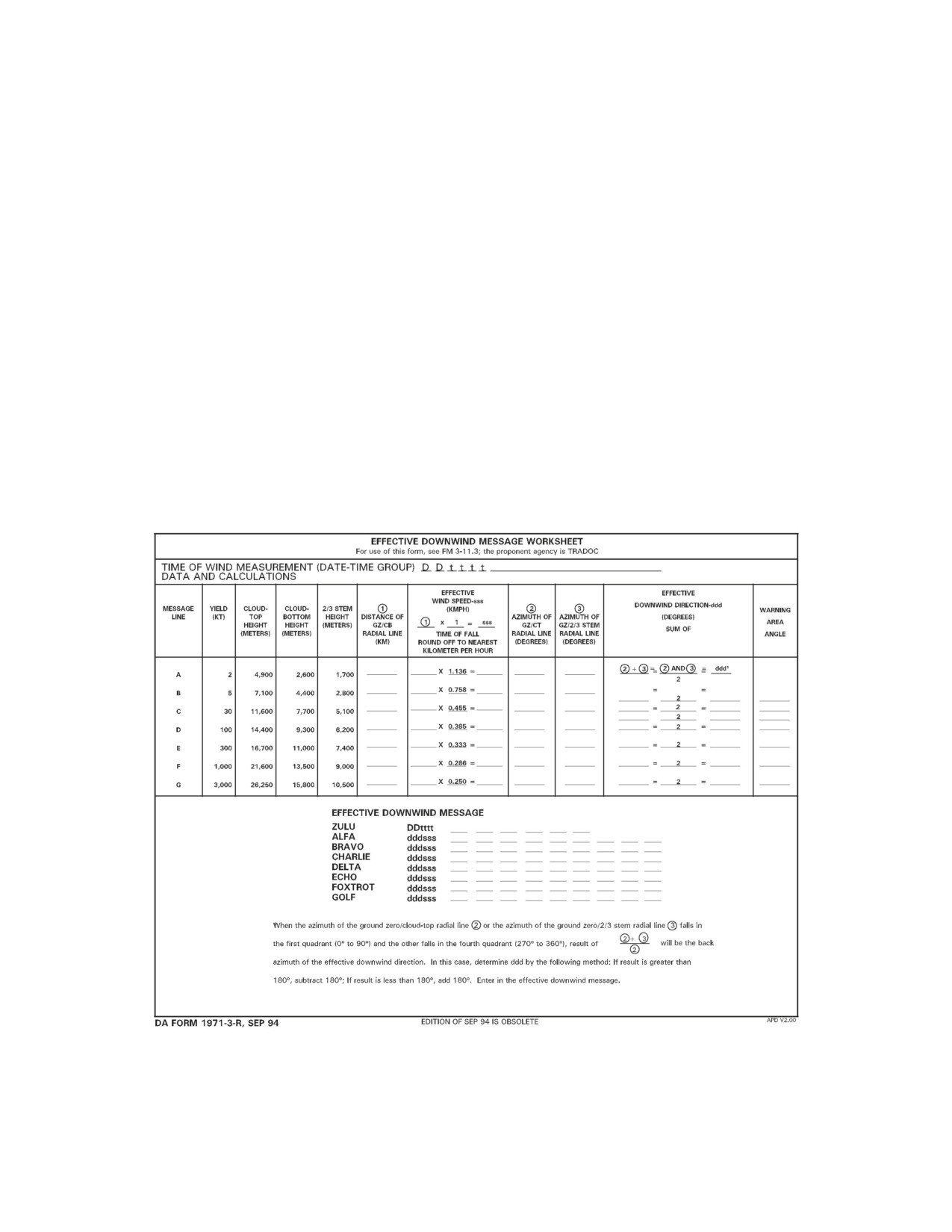
Step 1. Army users may obtain a blank DA Form 1971-3-R, Effective
Downwind Message Worksheet, located in Appendix L (see Figure D-2).
Figure D-2. Effective Downwind Message Worksheet
D-28
FM 3-11.3/MCWP 3-37.2A/NTTP 3-11.25/AFTTP(I) 3-2.56
2 February 2006
(2)
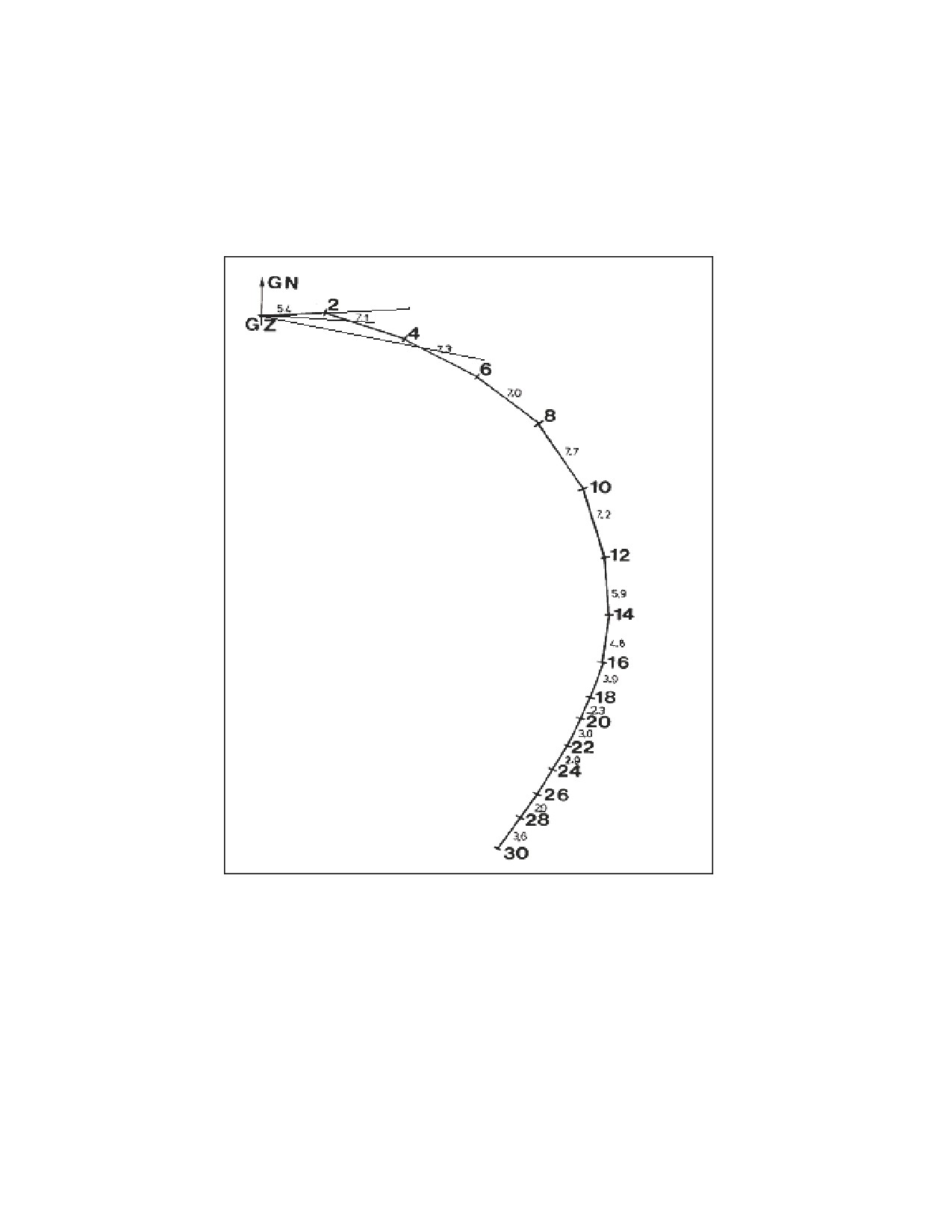
Step 2. Place a sheet of overlay paper over the wind vector plot, and mark a
GN reference line and GZ. Mark the cloud top height, cloud bottom height, and 2/3 stem
height for the 2 KT yield. Draw radial lines from GZ through these three points (see Figure
D-3).
2/3 Stem 1.7 km
CT 4.9 km
CB 2.6 km
Figure D-3. Wind Vector Plot with Cloud and Stem Radial Lines (2 KT)
(3)
Step 3. To determine the effective wind speed (sss), measure the distance
along the cloud bottom radial line from GZ to its intersection with the wind vector plot at
the cloud bottom height point. Multiply as indicated on the EDM work sheet. Round each
result to the nearest kilometer (km) (28.4 km = 28, 28.5 km = 29 km).
NOTE: A situation may arise when the effective wind speed for one or more yield
groups is less than 8 kph. In this case the downwind distance for Zone I is
determined using a nomogram in Appendix J. Enter the nomogram with the
effective wind speed of 8 kph on the left-hand scale and the highest yield for each
2 February 2006 FM 3-11.3/MCWP 3-37.2A/NTTP 3-11.25/AFTTP(I) 3-2.56
D-29
yield group on the right-hand scale. Then, read the downwind distance for Zone I
on the center scale.
(4)
Step 4. To determine the effective downwind direction, use a protractor and
measure the azimuth from GZ to cloud top and the azimuth from GZ to 2/3 stem. Add these
two measurements, and divide by 2. This is known as bisecting the angles. The result of
this bisection is the effective downwind direction (ddd).
NOTE: When the GZ and/or the cloud top radial line or the GZ and/or the 2/3 stem
radial line fall in the first quadrant (0 to 90) and the other radial line falls in the
fourth quadrant (270 to 360), the result of adding the GZ/cloud top azimuth and
the GZ and/or 2/3 stem azimuth divided by 2 will be the back azimuth of the ddd.
In this case, determine ddd by the following method: If the total is greater than
180°, subtract 180°; if the total is less than 180°; add 180° and enter the ddd in the
EDM.
(5)
Step 5. Measure the angle between the cloud top and 2/3 stem. If the angle
exceeds 40°, report the actual angle measured in the "Warning Area Angle" column of the
EDM. If the angle measured is an odd number, round the angle to the next highest even
number.
(6)
Step 6. Repeat Steps 2 through 5 for the remaining yield groups. Use a
separate sheet of overlay paper for each yield group.
(7)
Step 7. Complete the EDM portion of the work sheet based on the data and
calculations. Remember the 3-6-9 rule:
•
3 digits mean winds less than 8 kph, and digits represent the Zone I
distance.
•
6 digits mean normal message.
•
9 digits mean expanded radial lines to a given number of degrees.
NOTE: For ADP EDM reports the expanded angle special case will only contain
seven digits versus nine. For example if the EDM line reads CHARLIEM/-
/310/015/6/, the “6” represents an angle of 60°. See paragraph 5c below.
c.
Special Cases.
(1)
When the effective wind speed is less than 8 kph for a given yield group, the
applicable line will contain only three digits. These three digits will represent the radial
line distance of Zone I. In this case, no wind speed is given and the fallout pattern will be
two concentric circles.
(2)
Another special case occurs when the fallout is not expected to fall within
the normal 40° angle of the prediction. In this case, the appropriate line on the EDM has
nine digits. The first six digits represent wind direction and wind speed. The last three
digits will be the angle in degrees between the left and right radial lines.
(3)
The simplified procedure does not normally provide for a warning angle
greater then 40°. In the instances where the detailed procedure demands an angle greater
then 40°, this warning area is given in the EDM to subordinate units to expand their
original warning area. The 40° standard angle between the two radial lines must be
expanded in equal degrees on each side of the reference line.
D-30
FM 3-11.3/MCWP 3-37.2A/NTTP 3-11.25/AFTTP(I) 3-2.56
2 February 2006
The following is a sample EDM:
MSGID/CDR/AWS/382856/NOV/-/-//
DTG/231130NOV2004//
ORGIDDFT/UKRA/BAT/UK/AA/BB/CC/DD/AG/A/-//
NBCEVENT/EDM/-//
AREAM/NFEB4//
ZULUM/231100ZNOV2004/231200ZNOV2004/231800ZNOV2004//
UNITM/KM/DGT/KPH/-//
ALFAM/020/-/-/-/
BRAVOM/020/-/-/-/
CHARLIEM/-/310/015/6/
DELTAM/-/330/025/-/
ECHOM/-/350/045/-/
FOXTROTM/-/350/045/-/
GOLFM/-/340/050/-//
6.
Chemical Downwind Reports (Details and Example)
This paragraph details how to effectively prepare and use CDRs.
a. General Preparation. A CDR contains basic MET information for predicting
biological aerosol and chemical vapor hazard areas. These reports are also used for a ROTA
incident. Biological agents will generally remain toxic through multiple changes in MET
conditions and multiple CB MET reports.
(1)
The CDR is prepared by corps and division CBRN staffs (or service
equivalent) from information obtained through the USAF AWS, SWO, or Naval
Oceanography Program. The CDR is transmitted at least four times a day, and each
message is valid for a 6-hour period. Each 6-hour period is subdivided into three 2-hour
periods.
(2)
The NBC CDR is an ADP-formatted message that is used to accommodate
the CDM which provides the required weather information during an initial 6-hour period
or the CDF which provides required weather information for subsequent 6-hour periods.
The following is a sample CDM:
MSGID/CDR/AWS/382856/NOV/-/-//
DTG/231130NOV2004//
ORGIDDFT/UKRA/BAT/UK/AA/BB/CC/DD/AG/A/-//
NBCEVENT/CDM/-//
AREAM/NFEB4//
ZULUM/231100ZNOV2004/231200ZNOV2004/231800ZNOV2004//
UNITM/-/DGT/KPH/C//
2 February 2006 FM 3-11.3/MCWP 3-37.2A/NTTP 3-11.25/AFTTP(I) 3-2.56
D-31
WHISKEYM/120/010/4/18/7/4/2//
XRAYM/100/015/4/15/7/5/2//
YANKEEM/110/010/4/13/7/6/2//
(3)
The first step in preparing the CDM is to acquire the weather data.
Weather information can also be obtained from the artillery MET section. Although the
MET section cannot provide forecasts, it can provide current weather information.
(4)
The next step is to break the information down into three consecutive
2-hour increments. WHISKEYM is used for the first 2-hour increment, XRAYM for the
second, and YANKEEM for the final 2-hour increment. Then, the CBRN cell translates this
data into codes and puts it in the proper format. Each forecast line contains 12 digits.
(5)
The first six digits represent the downwind direction and wind speed. The
last six digits represent the air stability, temperature, humidity, significant weather
phenomena, and cloud cover. Weather data which is unavailable or for which no code exists
is represented by a dash.
b.
CDM Preparations Without Weather Service Support. A valid CDM may not
always be available from the corps or division CBRN cell or applicable to the unit AO. Units
may estimate the air stability category by observing local MET conditions. A field-expedient
method of obtaining the necessary weather data may be used when all other sources are
unavailable. In order to obtain local weather data, units may obtain a belt weather kit
(National Stock Number [NSN] 6660-01-024-2638) and barometer (NSN 660-00-551-3998).
The weather information obtained in this manner is only for that particular area, for that
period of time. It is by no means a forecast from which a CDM may be produced. However,
it is a local method of verifying CDM weather data. If this method is used for local weather,
include this data on the NBC1 chemical report.
(1)
Step 1. Measure the wind speed and direction with the lensatic compass
and ananometer. Use the highest wind speed recorded. Take the temperature and
humidity readings using the wet bulb at 1 meter aboveground. Obtain readings every 2
hours if practical, but not greater than 4 hours.
(2)
Step 2. Determine the four transition periods of wind speed and direction
during the day. Take the average of the readings during each transition period. The most
difficult aspect is determining the sun by observation. Since most units do not have
equipment to do this, make the best estimation possible. (Example: It is morning. The
sun’s angle is 45°, and the sky is less than half covered. Find the time of day [morning] and
the angle of the sun [45°] in Table D-13. Find the sky condition [less than half-covered].
Read across and down to the point where the lines converge. The air stability category is
U.)
D-32
FM 3-11.3/MCWP 3-37.2A/NTTP 3-11.25/AFTTP(I) 3-2.56
2 February 2006
Table D-13. Air Stability Category Basic Chart
Condition of Sky
Less Than Half-
More Than Half-
Time of Day
Angle of Sun
Covered
Covered
Overcast
<4
S
S
N
5-32
N
N
N
Morning
33-40
U
N
N
>40
U
U
N
>46
U
U
N
36-46
U
N
N
Evening
13-35
N
N
N
6-12
S
N
N
0-5
S
S
N
S=Stable; N=Neutral; U=Unstable
(3)
Atmospheric Stability Charts. The stability of a CB agent cloud is directly
affected by the temperature of the air at the surface of the earth and the first few meters
above the surface.
(4)
Temperature Gradients. The air stability categories are dependent on the
temperature gradient (difference of air temperature at two altitudes). The temperature
gradient is determined by measuring the air temperature at two different altitudes.
Compare the differences in air temperature to the normal or expected change in
temperature. The normal change in temperature is 1° cooler for every 100 meters increase
in altitude. The four possible gradient conditions are inversion, neutral, lapse, and elevated
inversion.
(a) Inversion Temperature Gradient (Stable). If air at the higher altitude
is warmer than the normal temperature at the lower altitude, the air will not move
vertically. This represents an inversion temperature gradient. This condition usually
exists on a clear night when middle and low clouds cover less than 30 percent of the sky and
on early mornings until about 1 hour after sunrise when the wind speed is less than 5
knots. It is characterized by a minimum of convection currents and by maximum air
stability, which is ideal for enemy employment of chemical agents. Weak inversion
conditions tend to prevail during the day over large bodies of water.
(b) Neutral Temperature Gradient (Neutral). A neutral condition exists
when the air temperature shows very little or no change with air increase in altitude. This
represents the neutral temperature gradient. This condition usually exists on heavily
overcast days or nights, at 1 or 2 hours before sunset or 1 to 2 hours after sunrise, when the
middle and low clouds cover more than 30 percent of the sky. Independent of cloud cover
and the time of day, a neutral condition may also exist when the wind speed is greater than
5 knots. Additionally, periods of precipitation are normally accompanied by a neutral
condition. A neutral temperature gradient is most favorable for enemy use of biological
agents because the associated wind speeds result in larger area coverage.
2 February 2006 FM 3-11.3/MCWP 3-37.2A/NTTP 3-11.25/AFTTP(I) 3-2.56
D-33

(c)
Lapse Temperature Gradient (Unstable). If the air at the higher
altitude is cooler than the expected difference, there will be vertical movement of air
creating turbulence. This condition normally exists on a clear day, when the middle and
low clouds cover less than 30 percent of the sky and when the wind speed is less than 5
knots. This is the least favorable condition for the enemy to employ CB agents. Over large
bodies of water, weak lapse conditions tend to prevail at night. When a lapse condition
exists, area coverage without diffusion will be enhanced with a steady low wind speed of 3
to 7 knots.
(d) Elevated Inversion (Stable).
•
Elevated inversion may occur when cooler air settles under warmer
air. This condition will generally occur when a warm and cold frontal system converge over
a large body of water. Elevated inversions also occur when the stable boundary layer
formed overnight weakens in the morning as the sun heats the surface. The significance of
an elevated inversion layer is that the layer will act as a lid over the surface. This lid traps
air particulants and chemical agents at a given height aboveground, thus presenting an
increased threat to aircrews. The SWO must report this condition to the CBRN and
divisional aviation units when it occurs.
•
Once the air stability category has been obtained from Table D-13
(page D-33), enter the adjustment chart (Table D-14) with that category. Select the
appropriate weather and terrain condition. Read across to where they intersect, and
extract the final stability category. Use this stability category to determine the maximum
downwind distance.
Table D-14. Air Stability Category Adjustment Chart
Weather and Terrain
Stability Category from Table D-13 (page D-33)
Dry to slightly moist surface
U
N
S
Wet surface
N
N
S
Frozen surface
N
S
S
Completely covered with snow
S
S
S
Continuous rainfall
N
N
N
Haze or mist (1-4 km visibility)
N
N
S
Fog (<1 km visibility)
N
S
S
Wind speed >18 kph
N
N
N
NOTE: All conditions must be checked. If more than one applies, choose the most stable category.
c.
Naval CDM. The Naval CDM is essentially computed in the same manner as the
land CDM. In most cases, the CDM information is obtained through land-based CBRN
centers. However, in the event that land CDM information is not available or differs
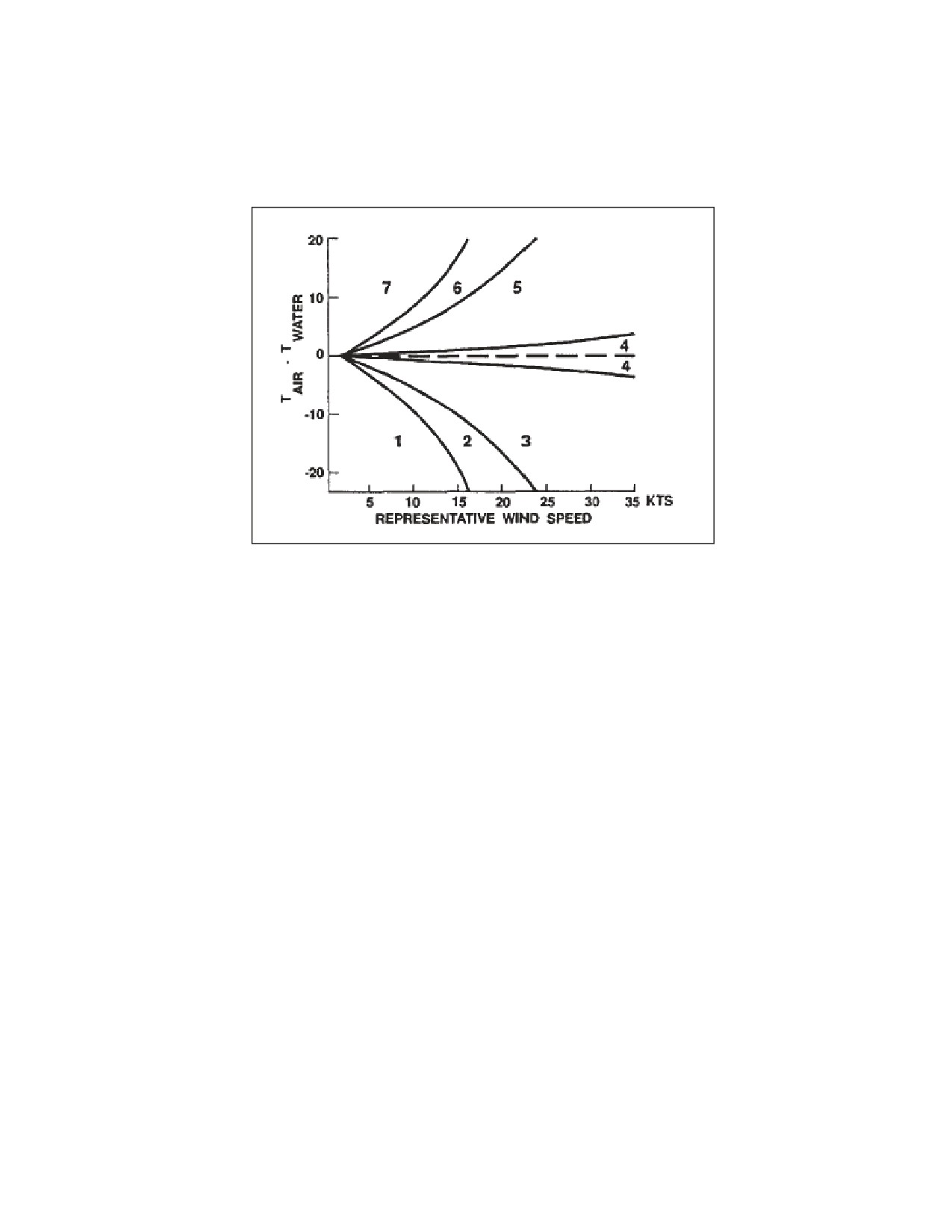
significantly from the weather conditions at sea, Figure D-4 can be used to determine the
stability category. The numbers 1 through 7 depicted on the graph correspond to the seven
stability categories used in the land CDM. The seven stability categories indicated on
Figure D-4 are as follows:
•
1—Very unstable.
•
2—Unstable.
•
3—Slightly unstable.
•
4—Neutral.
D-34
FM 3-11.3/MCWP 3-37.2A/NTTP 3-11.25/AFTTP(I) 3-2.56
2 February 2006
•
5 - Slightly Stable
•
6 - Stable
•
7 - Very Stable
Figure D-4. Naval Air Stability
2 February 2006 FM 3-11.3/MCWP 3-37.2A/NTTP 3-11.25/AFTTP(I) 3-2.56
D-35
THIS PAGE IS INTENTIONALLY LEFT BLANK.
Appendix E
CHEMICAL-CONTAMINATION AVOIDANCE TACTICS,
TECHNIQUES, AND PROCEDURES
1.
Background
a.
The CBRN cell staff monitors and tracks all CBRN information within the
AO. The commander, CBRN cell, and medical and intelligence sections make
decisions that rely on the SA and the significance of gathered data. The commander
and staff apply the information from intelligence, medical, and surveillance systems
to support the following:
•
Hazard predictions.
•
Warning, reporting, and notification.
•
Casualty prevention.
•
Casualty management.
b.
Units obtain relevant data from multiple sources (such as, sensors,
detectors, observers, and medical staffs). The applicable NBC chemical (CHEM)
report data is processed, extracted, formatted, and forwarded. The commanders and
their staff evaluate the information to assess any impact on operations. Risk
assessment is part of the decision-making process and may result in directives or
orders to help reduce the impact of the assessed hazards. The commanders may
direct an integrated series of protective or avoidance measures to decrease the level
of risk (decrease exposure opportunities) or reduce the effects of exposure. Because
SA is an ongoing process, the plan is revised as updated information is received.
2.
Chemical-Contamination Avoidance Procedures
Avoidance procedures are broken down into preattack, during attack, and
postattack. The lists given below, while not all-encompassing, will assist in
developing unit SOPs and directives.
a.
Before the Attack.
(1)
Subordinate units are alerted.
(2)
Commanders specify the appropriate MOPP levels, establish
automatic masking criteria, and if MOPP0 is assumed, determine the location for
chemical protective clothing based on METT-TC.
(3)
The unit continues the mission while implementing actions to
minimize casualties and damage.
(a) Personnel, equipment, munitions, POL, food, and water are
protected from contamination.
(b) Detection paper is placed to provide visibility and maximum
exposure to liquid agents.
2 February 2006 FM 3-11.3/MCWP 3-37.2A/NTTP 3-11.25/AFTTP(I) 3-2.56
E-1
(c)
OPSEC, dispersion, cover, and concealment are practiced so
that the unit may avoid being targeted.
(d) Chemical detectors and alarms are checked and prepared for
use.
(e) Updated CDMs are prepared for each unit
(f)
(Shipboard) Countermeasure wash-down system, shipboard
ACADA, and AN/KAS-1A CW directional detector are activated as appropriate.
b.
During the Attack.
(1)
All personnel automatically mask, sound the alarm, decontaminate
themselves as required, assume MOPP4, and administer self-aid and buddy aid.
(2)
The chain of command and communications are restored, and the
unit continues with the mission.
(3)
Adjacent units are immediately warned of the potential downwind
vapor hazards.
(4)
The unit identifies the type of agent and submits an NBC1 CHEM
report as the mission permits.
(5)
The unit performs the following actions for attacks that leave liquid
or solid contamination on the equipment, personnel, or terrain:
(a) Conduct personal wipe-down and operator’s spray-down or
wipe-down.
(b) Warn the casualty evacuation section of contaminated
casualties. Personnel killed in action are wrapped and marked.
(c)
Mark the contaminated area, and relocate to a clean area if the
mission allows.
(d) Determine where and when further decontamination can be
accomplished, if necessary.
(e) Coordinate for decontamination, and resupply protective
clothing and decontaminants.
(f)
Ensure that contaminated battledress overgarments are
exchanged within 24 hours after being contaminated.
(g) Replace contaminated protective covers within 24 hours.
(h) Conduct unmasking procedures for nonpersistent agents.
(i)
Treat casualties, and prepare for evacuation as the mission
permits.
(j)
Receive the NBC2 CHEM report, plot the potential hazard
area, and inform the commander.
c.
After the Attack.
(1)
The unit has undergone decontamination operations, and casualties
have been evacuated.
E-2
FM 3-11.3/MCWP 3-37.2A/NTTP 3-11.25/AFTTP(I) 3-2.56
2 February 2006
(2)
The unit reorders chemical defense equipment (i.e., MOPP suits,
filters, M291 refill kits).
(3)
Continue the effort to identify the agent if the unit has not yet
identified what agent was used. This will be done by—
•
Using the M256A1 Kit.
•
Using the ICAM.
•
Using the ACADA.
•
Taking samples and forwarding them to the area lab for analysis.
(4)
Perform the following if the unit must continue to operate in or
occupy the contaminated area:
•
Continue efforts to refine the contamination hazard area and extent
by continued sampling and detection.
•
Adjust or improve MOPP as required.
•
Mark contaminated areas, and identify “hot spots.”
•
Monitor contamination decay or covering to determine when natural
decay may render the area safe.
•
Be alert for “transient contamination” and the spread or movement
of contamination by natural sources (i.e., wind, rain, runoff, rivers) or human
sources, (i.e., vehicle traffic, rotor wash).
3.
NBC1 CHEM Report
The NBC1 CHEM report is the most widely used report. The observing unit
uses this report to provide chemical attack data. All units must be completely
familiar with the NBC1 CHEM report format and the information needed to
complete the report. This report is prepared at the unit level quickly and accurately
and then sent to the next higher HQ. NBC1 CHEM reports are not routinely passed
to corps or higher CBRN cells except for the initial-use report. Line items BRAVO
(location of observer), DELTA (DTG), GOLF (means of delivery), INDIA (release
information), and TANGO (terrain, topography, and vegetation description) are
mandatory entries in the NBC1 CHEM report.
a.
Precedence. The precedence of the NBC1 CHEM report depends on
whether or not it is an initial report. The initial use of a CBRN weapon report is
FLASH precedence; all others are IMMEDIATE precedence.
b.
Report Preparation. Individuals identified by the unit SOP submit
raw data to the unit CBRN defense team. NBC1 format should be used; however, a
size, activity, location, unit, time, and equipment (SALUTE) or spot report may also
be used and should be submitted to the unit CBRN defense team. The unit CBRN
defense team normally consists of individuals who have been trained in CBRN
defense. This ensures who the report is in the proper format and is as correct as
possible.
c.
Sample. A sample NBC1 CHEM report is shown in Figure E-1, page
E-4). The column “Cond” indicates the means operationally determined (O) or
2 February 2006 FM 3-11.3/MCWP 3-37.2A/NTTP 3-11.25/AFTTP(I) 3-2.56
E-3
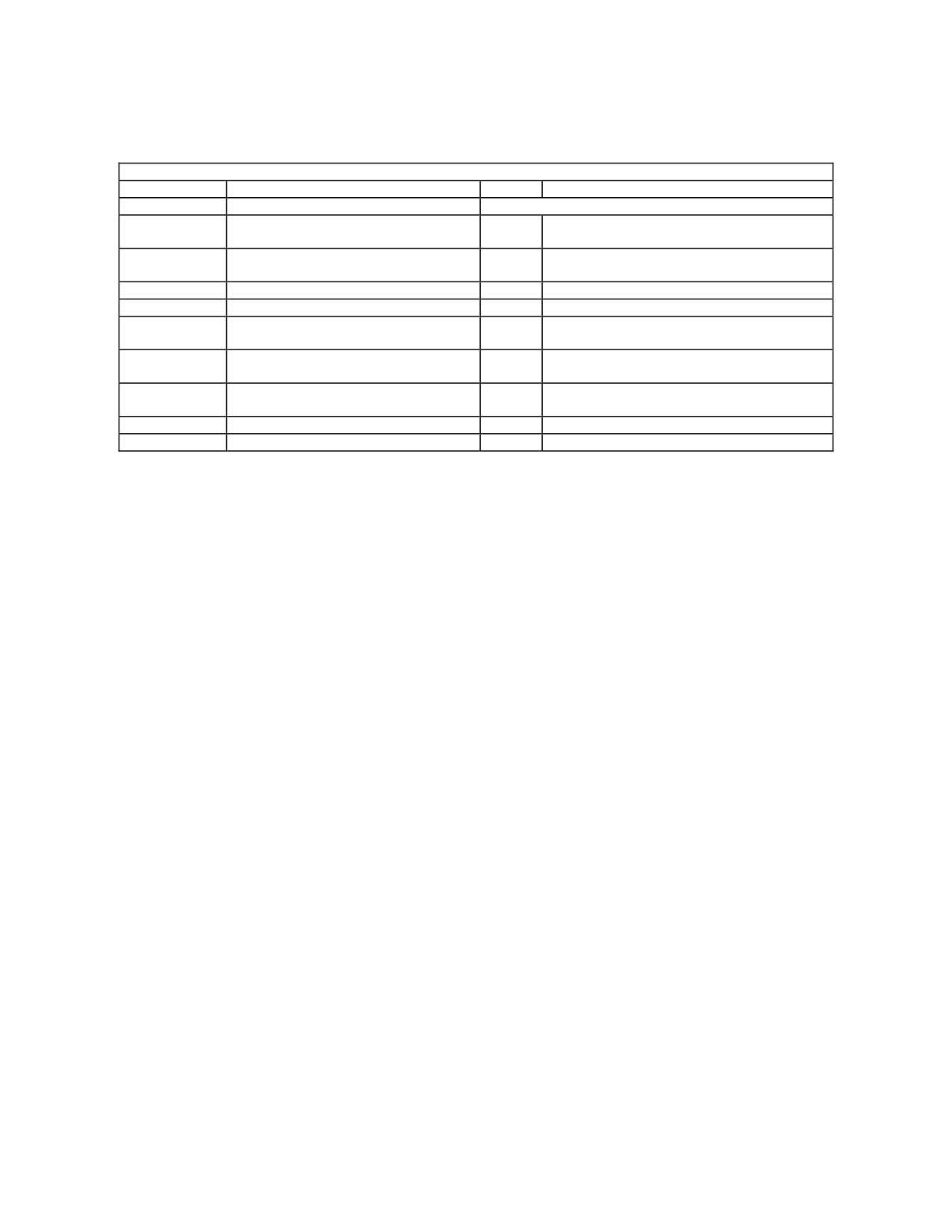
mandatory (M) for each message type. Operationally determined lines listed may be
added or deleted at command discretion.
NBC1 CHEM Report
Line Item
Description
Cond
Example
ALFA
Strike serial number
Will be assigned by the appropriate CBRN cell
BRAVO
Location of observer and direction of
M
BRAVO/32UNB062634/2500MLG//
attack or event
DELTA
DTG of attack or detonation and
M
DELTA/201405ZSEP2005/
attack end
201420ZSEP2005//
FOXTROT
Location of attack or event
O
FOXTROT/32UNB058640/EE//
GOLD
Delivery and quantity information
M
GOLF/OBS/AIR/1/BML/-//
INDIA
Release information on CB agent
M
INDIA/AIR/NERV/P/ACD//
attacks or ROTA events
TANGO
Terrain/topography and vegetation
M
TANGO/FLAT/URBAN//
description
YANKEE
Downwind direction and downwind
O
YANKEE/270DGT/015KPH//
speed
ZULU
Actual weather conditions
O
ZULU/4/10C/7/5/1//
GENTEXT
General text
O
None
Figure E-1. Sample NBC1 CHEM Report
4.
NBC2 CHEM Report
The NBC2 CHEM report is based on one or more NBC1 CHEM reports. It is
used to pass evaluated data to higher, subordinate, and adjacent units.
a.
When actual attack areas are reported, it is easy to differentiate between
attacks by their locations. When estimated attack areas are reported, the CBRN
specialist uses the following sets to differentiate attacks:
•
Set BRAVO: Location of the observer and direction of the attack.
•
Set GOLF: Delivery means and quantity.
•
Set INDIA: Release of information.
b.
Using the sets above, the CBRN specialist can determine whether the
attacks occurred in the same proximity, whether the means of delivery/quantity
were identical or similar (taking into account the fog of war), agent likeness, air or
ground burst, and liquid or vapor.
c.
The CBRN cell prepares the NBC2 CHEM report, assigns it a strike serial
number, and disseminates it to the appropriate units. Each subordinate unit then
decides whether to disseminate the report further. Line items ALFA (strike serial
number), DELTA (DTG), FOXTROT (location of attack), GOLF (means of delivery),
INDIA (release information), and TANGO (terrain, topography, and vegetation
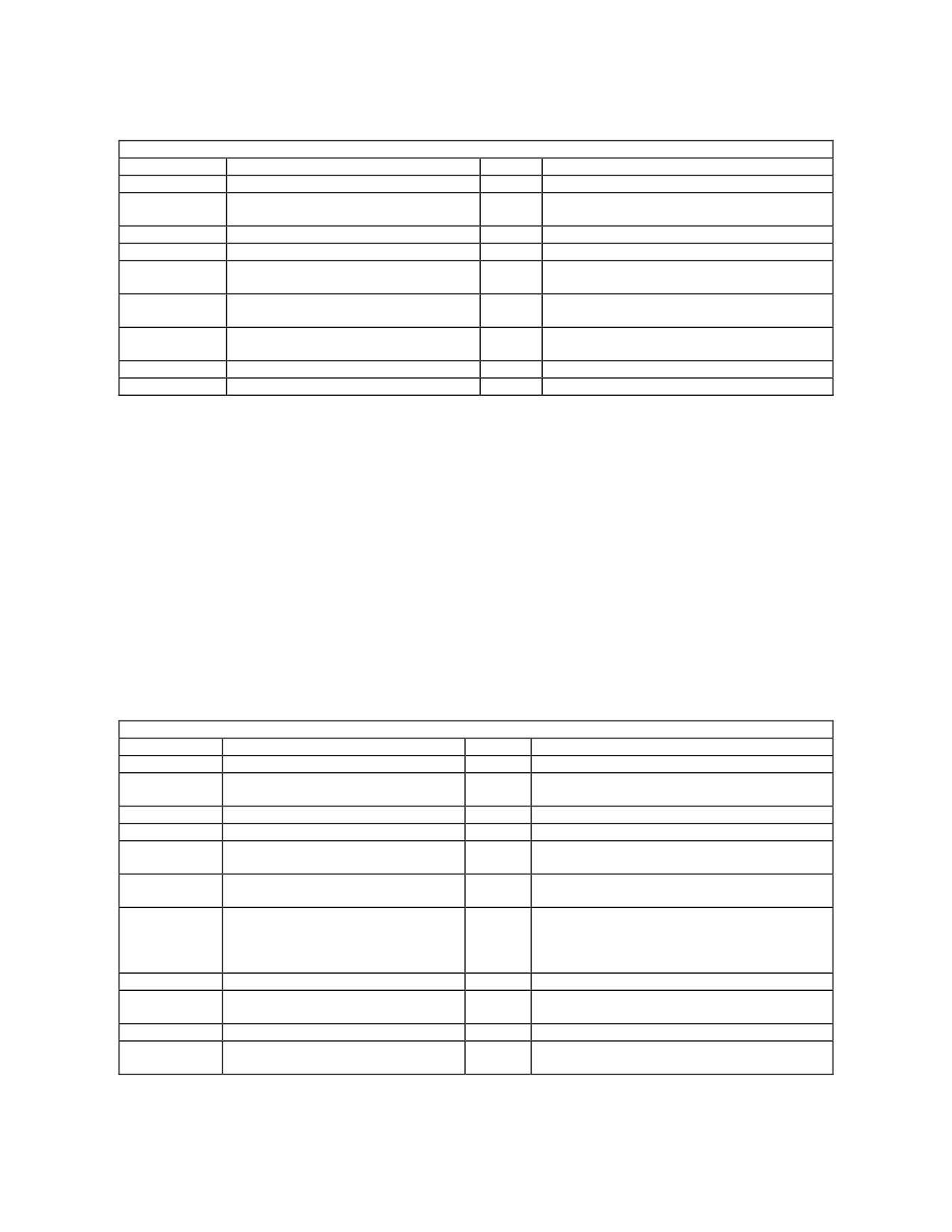
description) are mandatory entries in the NBC2 CHEM report. A sample NBC2
CHEM report is shown in Figure E-2.
E-4
FM 3-11.3/MCWP 3-37.2A/NTTP 3-11.25/AFTTP(I) 3-2.56
2 February 2006
NBC2 CHEM Report
Line Item
Description
Cond
Example
ALFA
Strike serial number
M
ALFA/US/A234/001/B//
DELTA
DTG of Attack or Detonation and
M
DELTA/201405ZSEP2005//
Attack End
201420ZSEP2005//
FOXTROT
Location of attack or event
M
FOXTROT/32UNB058640/EE//
GOLF
Delivery and quantity information
M
GOLF/OBS/AIR/1/BML/-//
INDIA
Release information on CB agent
M
INDIA/AIR/NERV/P/ACD//
attacks or ROTA events
TANGO
Terrain/topography and vegetation
M
TANGO/FLAT/URBAN//
description
YANKEE
Downwind direction and downwind
O
YANKEE/270DGT/015KPH//
speed
ZULU
Actual weather conditions
O
ZULU/4/10C/7/5/1//
GENTEXT
General text
O
None
Figure E-2. Sample NBC2 CHEM Report
5.
NBC3 CHEM Report
The NBC2 CHEM report and current wind information are used to predict the
area of hazard. This prediction is disseminated as an NBC3 CHEM report, which is
sent to all units or activities that could be affected by the hazard. Each unit or
activity prepares a plot of the NBC3 CHEM report, determines which of its
subordinate units or activities are affected, and warns them accordingly.
Commanders should use this report as battlefield intelligence when planning
missions. The NBC3 CHEM report is a prediction of the hazard area. This
prediction is safe-sided to ensure that a significant hazard will not exist outside the
predicted hazard area. Units within the hazard area must adjust their MOPP level
as necessary. They must ensure that chemical-agent alarms are placed far enough
upwind to provide adequate warning. A sample NBC3 CHEM report is shown in
Figure E-3.
NBC3 CHEM Report
Line
Description
Cond
Example
ALFA
Strike serial number
M
ALFA/US/A234/001/C//
DELTA
DTG of attack or detonation and
M
DELTA/201405ZSEP2005/
attack end
201420ZSEP2005//
FOXTROT
Location of attack or event
M
FOXTROT/32UNB058640/EE//
GOLF
Delivery and quantity information
O
GOLF/OBS/AIR/1/BML/-//
INDIA
Release information on CB agent
M
INDIA/AIR/NERV/P/ACD//
attacks or ROTA events
PAPAA
Predicted attack/release and hazard
M
PAPAA/1KM/3-10DAY/10KM/ 2-6DAY//
area
PAPAX
Hazard area location for weather
M
PAPAX/201600ZSEP2005/
period
32VNJ456280/32VNJ456119/
32VNJ576200/32VNJ566217/
32VNJ456280//
XRAYB
Predicted contour information
C
YANKEE
Downwind direction and downwind
O
YANKEE/270DGT/015KPH//
speed
ZULU
Actual weather conditions
O
ZULU/4/10C/7/5/1//
GENTEXT
General text
O
GENTEXT/CBRNINFO/RECALCULATION
BASED ON WEATHER CHANGE//
Figure E-3. Sample NBC3 CHEM Report
2 February 2006 FM 3-11.3/MCWP 3-37.2A/NTTP 3-11.25/AFTTP(I) 3-2.56
E-5
a.
Chemical Contamination Prediction and Plotting. The chemical
prediction procedure for land provides information on the location and extent of the
hazard area and the duration of the hazard resulting from attacks with chemical
weapons. It provides the necessary information for commanders to warn units
within the predicted hazard area. In general, the predicted hazard area will be
dependent on the type of attack, the means of delivery, and MET factors in the
attack area.
b.
Definitions Used in Chemical Hazard Predictions.
(1)
Attack Area. This is the predicted area immediately affected by the
delivered chemical agent.
(2)
Hazard Area. This is the predicted area in which unprotected
personnel may be affected by vapor spreading downwind from the attack area. The
downwind distance depends on the type of attack, the weather, and the terrain in
the attack area and the area downwind of the attack area.
(3)
Contaminated Area. This is the area in which liquid hazard may
remain for some time after the attack. The actual shape and duration can only be
determined by surveys.
NOTE: If actual surveys alter the initial data used for the determination of
the attack, the NBC2 and NBC3 CHEM reports must be changed or
updated.
c.
Types of Chemical Attacks. Chemical attacks can be divided into three
types, as follows:
(1)
Type A: Air-Contaminating attacks (nonpersistent agents). Type A
attacks are to be assumed unless liquid is present that is subsequently confirmed to
be a persistent agent.
(2)
Type B: Ground-contaminating attacks (persistent agents).
(3)
Type C: Attack origin unknown.
d.
Means of Delivery.
(1)
The means of delivery and types of agent containers are listed in
Table E-1.
(2)
In cases where the type of agent container is unknown (UNK), then
rocket (RKT) should be used for computations.
e.
Prediction of the Downwind Hazard. After an attack by chemical agents,
personnel may encounter three types of hazards depending on their position relative
to the attack area—liquid, vapor, or liquid and vapor.
(1)
Liquid Hazard. Personnel in an area contaminated with liquid
chemical agents will be exposed to a hazard that varies according to—
(a) The type and amount of agent disseminated.
(b) The method of dissemination.
(c)
The local climatic conditions.
E-6
FM 3-11.3/MCWP 3-37.2A/NTTP 3-11.25/AFTTP(I) 3-2.56
2 February 2006
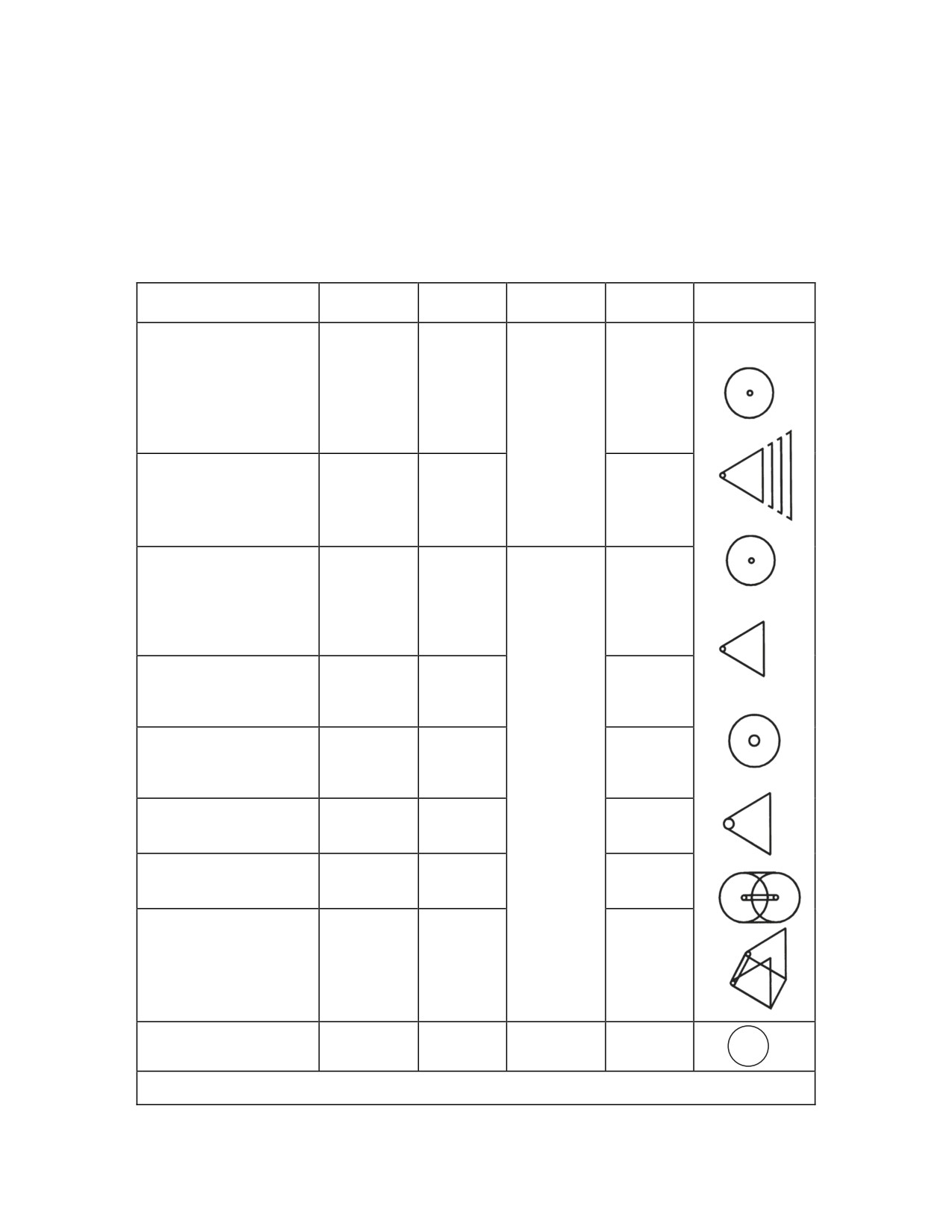
(d) The nature of the terrain.
(e) The time lapse after the contamination.
Liquid agents may completely stop evaporating and result in an all-clear
survey under very cold conditions. A hazard can be recreated when temperatures
rise.
Table E-1. Types and Cases of Chemical Attacks
Type of Agent Container
Radius of
Wind
Type
Case
Symbol
Attack Area
Speed
BML, BOM, RKT, SHL,
1
MNE, UNK, surface burst
MSL
1 km
≤10 kph
A
BML, BOM, RKT, SHL,
MNE, UNK, surface burst
1 km
>10 kph
2
MSL
BML, SHL, MNE, surface
burst RKT and MSL
1 km
≤10 kph
1
BML, SHL, MNE, surface
burst RKT and MSL
1 km
>10 kph
2
BOM, UNK, air burst RKT
and MSL
2 km
≤10 kph
3
B
BOM, UNK, air burst RKT
2 km
>10 kph
and MSL
4
1 km
≤10 kph
SPR, GEN
5
SPR, GEN
1 km
>10 kph
6
Detection after unobserved
N/A
N/A
attack
10 km
C
(NBC4 CHEM)
BML - Bomblets; BOM - Bomb; MNE - Mine; MSL - Missile; RKT - Rocket; SHL - Shell; SPR -
Spray; UNK - Unknown
2 February 2006 FM 3-11.3/MCWP 3-37.2A/NTTP 3-11.25/AFTTP(I) 3-2.56
E-7
(2)
Nonpersistent Agents. Most nonpersistent agents are disseminated
mainly as vapor, but some of the agent types may leave residual liquid in shell or
bomb craters for hours or days depending on the climatic conditions and munition
type. Craters should be avoided until tests have proven the absence of a liquid
hazard.
(3)
Persistent Agents. Persistent agents are disseminated as liquid and
present a vapor and contact hazards. This hazard will last for several hours to days
depending on the terrain, climatic conditions, and munition type.
(4)
Border Areas. Some agents, normally classified as nonpersistent,
may behave as persistent agents in very cold environments, and liquid from
nonpersistent and persistent agents may freeze at low temperatures (e.g., HD
freezes at temperatures below 14°C) and can present a delayed hazard to personnel
when the temperature rises.
(5)
Thickened, Nonpersistent Agents. Thickened, nonpersistent agents
may have to be treated as persistent, ground-contaminating agents. Blister agents
are normally classified as persistent agents and will be indicated as such when
detected by three-way detector paper. Some ground-contaminating agents, however,
are very volatile and should be treated as nonpersistent.
(6)
Vapor Hazard. All chemical agents present a vapor or aerosol
hazard to personnel downwind of the attack area. The area covered by this hazard
may be estimated by using prediction techniques. The actual downwind distance
covered by a toxic cloud will depend on the type and amount of agent disseminated,
method of dissemination, climatic conditions, and terrain.
f.
Attack Chronology.
(1)
The dimensions of the downwind hazard area will depend on the
means of delivery, category of agent, type of attack, weather, and terrain. The cloud
arrival time at positions downwind of the attack point or area will depend on the
representative downwind speed.
(2)
The ability to provide a timely warning to personnel downwind of
the point or area of attack will depend on the time taken to learn of the attack, the
time taken to predict a downwind hazard area, and the time required to transmit
the warning to those in the hazard area.
g.
Principles of Chemical Predictions and Limitations.
(1)
Unprotected personnel in an attack area will be exposed to chemical-
agent hazards unless they take immediate protective action at the first indication of
an attack. It is assumed that once chemical warfare has been initiated, troops in
areas attacked by aircraft or missiles or coming under artillery or other
bombardment will immediately and automatically carry out appropriate chemical
defense tactics whether or not a chemical alarm has been given.
(2)
An attacked unit will attempt to warn all friendly forces in the
immediate vicinity, using the procedures described in STANAG 2047 (CBRN and air
attacks only).
E-8
FM 3-11.3/MCWP 3-37.2A/NTTP 3-11.25/AFTTP(I) 3-2.56
2 February 2006
(3)
At fixed installations and at other locations where established
communications and alarms are available, the procedures in STANAG 2047 should
be used.
(4)
Units and installations that are warned should not promulgate the
alarm beyond their own area.
NOTE: As soon as a CBRN cell realizes that the completion and submission
of an NBC3 CHEM report would not warn a unit in the hazard area in time,
it will attempt to pass the alarm by the most expeditious means available.
(5)
CBRN cells will use information in the NBC3 CHEM report to
provide timely warning to units and installations in the predicted downwind hazard
area. Due to climatic and geographical variations, the lateral limits of the predicted
hazard area are normally defined by an angle of lateral spread that is 30° on either
side of the forecast representative downwind direction.
(6)
The hazard area prediction will be less reliable as the distance from
the point of emission increases.
(7)
Units in the downwind hazard area that are warned by a CBRN cell
will not raise an alarm outside their own area, but will submit an NBC4 CHEM
report according to the SOP when the chemical agent cloud actually arrives.
(8)
The limiting dosages of agents assumed in establishing the
procedures for hazard area prediction, while not sufficient to produce casualties
immediately, may produce later effects (i.e., miosis from nerve agents).
h.
Simplified Hazard Prediction (Land). The simplified hazard prediction
tells subordinate units whether they are in a chemical downwind hazard area. Since
Type A attacks present the greatest hazard, the simplified procedures are based on
that type of attack. It is valid until an NBC3 CHEM report is received. Units need
to make a simplified prediction using a CDM and a simplified template. The
template can be made from acetate, overlay paper, or plastic. Figure E-4, page E-10,
shows a sample simplified predictor. The following steps describe how to use a
simplified prediction:
(1)
Step 1. Get the wind speed from the CDM. If it is less than 10 kph,
use the circular portion of the prediction. If it is greater than 10 kph, follow the
remaining steps.
(2)
Step 2. Get the wind direction from the CDM. Mark that direction
on the compass circle of the template.
(3)
Step 3. Get the air stability code from the CDM and adjust the code
using Table D-14, page D-34, to determine the downwind distance (see Table E-2,
page E-10).
(4)
Step 4. Place the template on the map with the attack center of the
prediction (the cross mark) over the actual attack center. Rotate the predictor until
the downwind direction points toward GN.
(5)
Step 5. Draw the downwind line perpendicular to the downwind
direction using the distance obtained in Step 3.
2 February 2006 FM 3-11.3/MCWP 3-37.2A/NTTP 3-11.25/AFTTP(I) 3-2.56
E-9
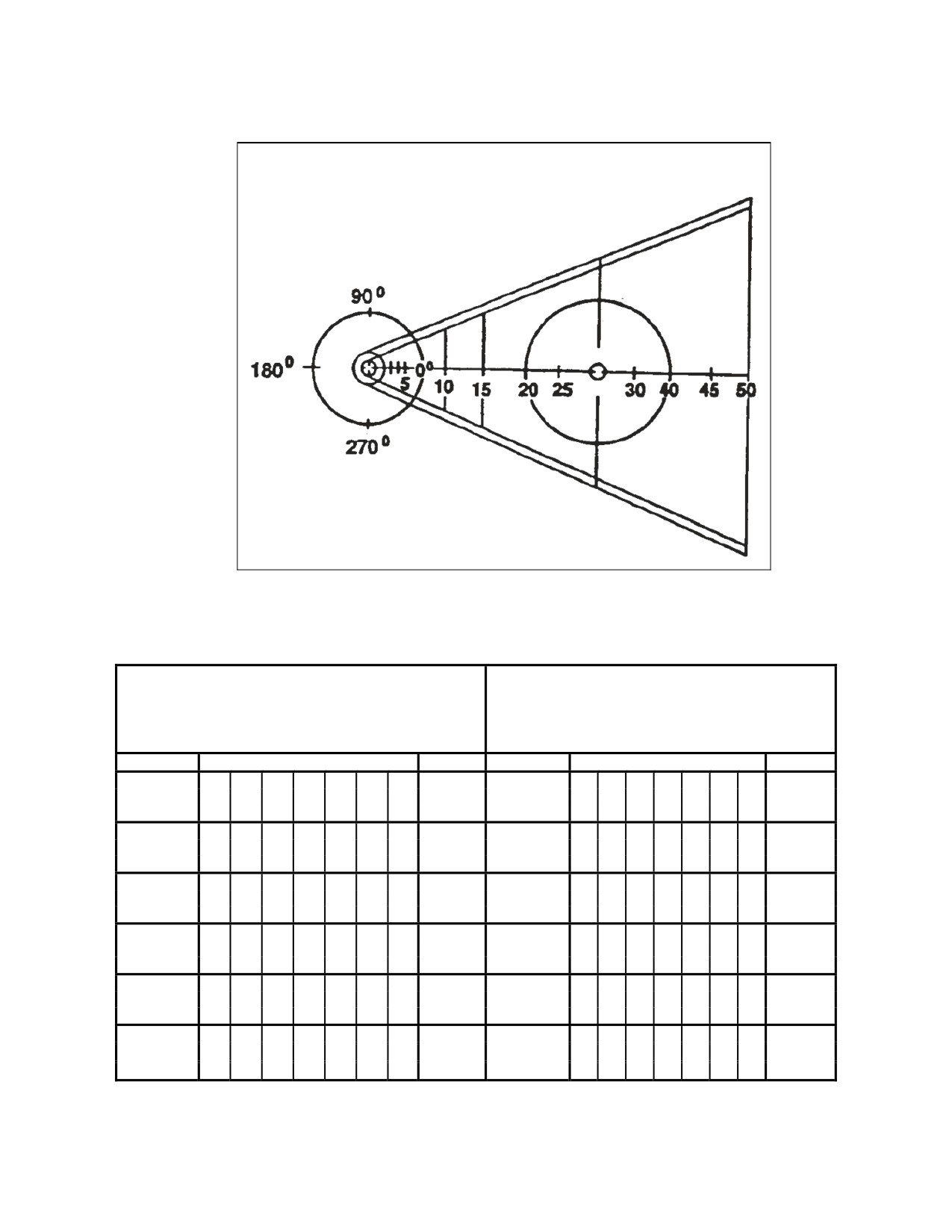
Figure E-4. Simplified Type A Chemical Predictor
Table E-2. DHD Versus Wind Speed (kph) and Air Stability, Land
Agent: Sarin
Agent: Soman
Weapon: Artillery (Cannon/Mortar)
Weapon: Rocket/Missile
Effective Payload: 650 kg
Effective Payload: 250 kg
Stability
1
2
3
4
5
6
7
Dose
Stability
1
2
3
4
5
6
7
Dose
Wind
<1
<1
<1
<1
<1
5
5
LCt50
Wind
<1
<1
<1
<1
<1
<1
<1
LCt50
11-17 kph
5
5
10
10
15
15
15
ICt5
11-17 kph
<1
5
5
5
10
10
10
ICt5
5
10
10
15
20
25
20
Miosis
5
5
5
10
10
15
10
Miosis
Wind
<1
<1
<1
<1
<1
<1
LCt50
Wind
<1
<1
<1
<1
<1
<1
LCt50
18-26 kph
5
5
5
10
15
20
ICt5
18-26 kph
<1
5
5
5
5
10
ICt5
5
5
10
15
20
25
Miosis
5
5
5
5
10
15
Miosis
Wind
<1
<1
<1
<1
LCt50
Wind
<1
<1
<1
<1
LCt50
27-36 kph
5
5
10
10
ICt5
27-36 kph
<1
5
5
5
ICt5
5
10
10
15
Miosis
5
5
5
10
Miosis
Wind
<1
<1
<1
LCt50
Wind
<1
<1
<1
LCt50
37-45 kph
5
5
10
ICt5
37-45 kph
<1
5
5
ICt5
5
10
15
Miosis
5
5
5
Miosis
Wind
<1
<1
<1
LCt50
Wind
<1
<1
<1
LCt50
46-54 kph
5
5
10
ICt5
46-54 kph
<1
5
5
ICt5
5
10
15
Miosis
5
5
5
Miosis
Wind
<1
<1
<1
LCt50
Wind
<1
<1
<1
LCt50
55-63 kph
5
5
5
ICt5
55-63
<1
5
5
ICt5
kph
5
10
10
Miosis
5
5
5
Miosis
E-10
FM 3-11.3/MCWP 3-37.2A/NTTP 3-11.25/AFTTP(I) 3-2.56
2 February 2006
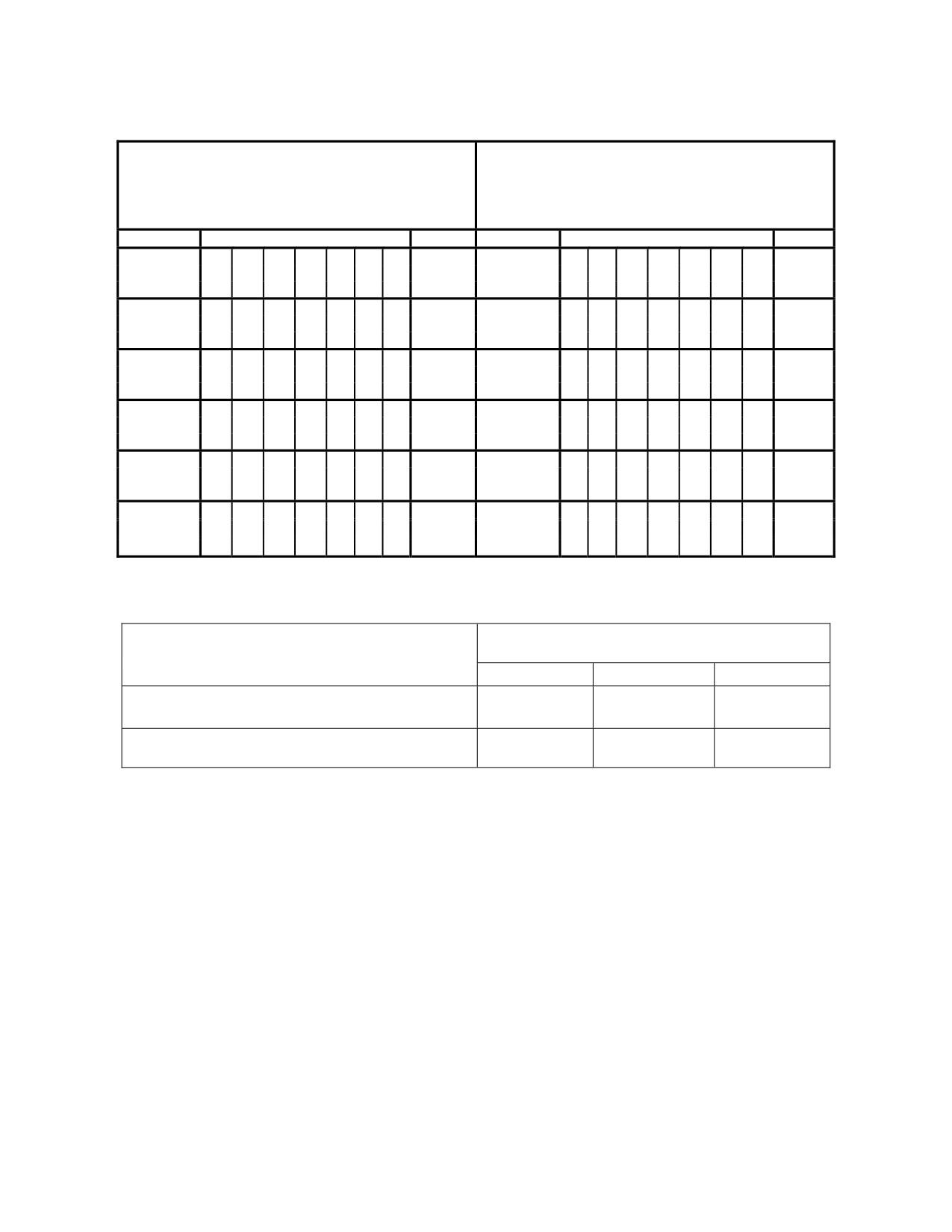
Table E-2. DHD Versus Wind Speed (kph) and Air Stability, Land (Continued)
Agent: Sarin
Agent: Sarin
Weapon: Bombs (6)
Weapon: Multiple-Launched Rocket System
Effective Payload: 600 kg
Effective Payload: 3,500 kg
Stability
1
2
3
4
5
6
7
Dose
Stability
1
2
3
4
5
6
7
Dose
Wind
<1
<1
<1
<1
<1
<1
5
LCt50
Wind
<1
5
5
5
10
10
10
LCt50
11-17 kph
5
5
10
10
15
15
15
LCt5
11-17 kph
10
20
25
40
50
45
35
LCt5
5
10
10
15
20
20
20
Miosis
15
25
40
55
65
60
45
Miosis
Wind
<1
<1
<1
<1
<1
<1
LCt50
Wind
<1
5
5
5
5
10
LCt50
18-26 kph
5
5
5
10
15
15
LCt5
18-26 kph
10
15
25
35
50
55
LCt5
5
5
10
15
20
25
Miosis
15
20
35
50
70
75
Miosis
Wind
<1
<1
<1
<1
LCt50
Wind
<1
5
5
5
LCt50
27-36 kph
5
5
10
10
LCt5
27-36 kph
10
20
30
40
LCt5
5
10
10
15
Miosis
15
25
40
60
Miosis
Wind
<1
<1
<1
LCt50
Wind
<1
5
5
LCt50
37-45 kph
5
5
10
LCt5
37-45 kph
15
25
35
LCt5
5
10
15
Miosis
25
35
55
Miosis
Wind
<1
<1
<1
LCt50
Wind
<1
5
5
LCt50
46-54 kph
5
5
10
LCt5
46-54 kph
15
25
35
LCt5
5
10
15
Miosis
20
30
45
Miosis
Wind
<1
<1
<1
LCt50
Wind
<1
5
5
LCt50
55-63 kph
5
5
5
LCt5
55-63 kph
10
20
30
LCt5
5
5
10
Miosis
20
25
40
Miosis
Table E-3. Type A Case 2 Attack Downwind Distance of Hazard Area
Distance From Center of Attack Area Along
Type of Agent Container
Downwind Axis, When Stability Condition Is:
U
N
S
Shell, bomblets and mines
10 km
30 km
50 km
Air-burst missiles, bombs, rockets and unknown
15 km
30 km
50 km
munitions.
i.
Detailed Type A Attack Downwind Hazard Prediction (Land).
(1)
Type A agents are normally dispersed as an aerosol or vapor cloud
with little or no ground contamination. A nonpersistent nerve agent employed
upwind of the target is an example of this type of attack. Air-contaminating agents
are normally dispersed in ground-bursting munitions, such as artillery shells and
multiple rocket launchers.
(2)
For the following two cases of chemical attacks, see examples in
Figures E-5 and E-6, pages E-12 and E-14) the following information is required:
(a) NBC1 or NBC2 CHEM report.
(b) Detailed MET information.
NOTE: If detailed MET information is not available, the air stability
category should be determined by using Table D-13, page D-33. The
downwind direction and downwind speed must be measured locally.
2 February 2006 FM 3-11.3/MCWP 3-37.2A/NTTP 3-11.25/AFTTP(I) 3-2.56
E-11
(3)
Type A, Case 1.
Sample NBC3 CHEM
ALFA/US/A234/001/C//
DELTA/271630ZAPR1999//
FOXTROT/33UUB206300/AA//
INDIA/SURF/NERV/NP//
PAPAA/01KM/-/10KM/-//
PAPAX/271600ZAPR1999/-//
YANKEE/105DGT/009KPH//
ZULU/4/18C/9/-/2//
GENTEXT/CBRNINFO/TYPE A, CASE 1//
Hazard Area
Attack Area
1 km
Hazard Area
Not to scale
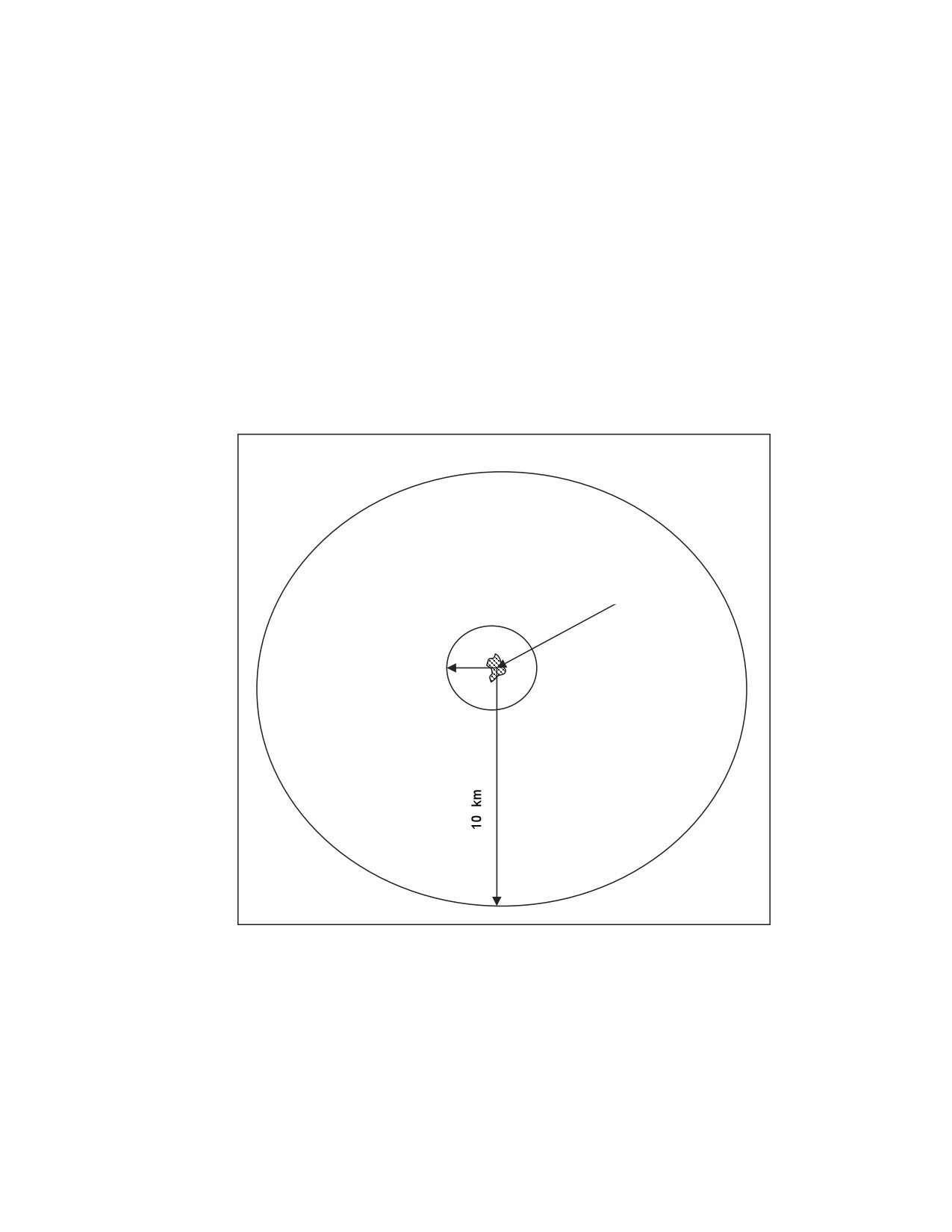
Figure E-5. Hazard Area From Type A Attack, Case 1 (Wind Speed ≤10 kph)
(a) Obtain the location of the attack from the relevant NBC CHEM
reports, and plot it on the map.
(b) Draw a circle (radius 1 km) around the center of the attack
location. The area within this circle represents the attack area.
(c)
Draw a circle (radius 10 km) around the center of the attack
location. The area within this circle represents the hazard area.
E-12
FM 3-11.3/MCWP 3-37.2A/NTTP 3-11.25/AFTTP(I) 3-2.56
2 February 2006
(d) Prepare and transmit an NBC3 CHEM report and/or map
overlays to those units and installations within the hazard area according to the
SOP.
(4)
Type A, case 2.
Sample NBC3 CHEM
ALFA/US/A234/003/C//
DELTA/271647ZAPR1999//
FOXTROT/32UPG560750/AA//
INDIA/AIR/NERV/NP//
PAPAA/01KM/-/10KM/-//
PAPAX/271600ZAPR1999/
32UPG674791/
32UPG557759/
32UPG550752/
32UPG552742/
32UPG638657//
YANKEE/105DGT/015KPH//
ZULU/2/15C/8/-/2//
GENTEXT/CBRNINFO/TYPE A, CASE 2, DHD 10KM//
NOTE: In order that a recipient of an NBC3 CHEM report be able to plot
the downwind hazard easily and quickly, the GENTEXT/CBRNINFO line
may contain the type, case, and downwind hazard distance (DHD).
2 February 2006 FM 3-11.3/MCWP 3-37.2A/NTTP 3-11.25/AFTTP(I) 3-2.56
E-13
Hazard
Area
GN
30°
Downwind Direction 105°
1 km
30°
1 km
Attack Area
Not to scale
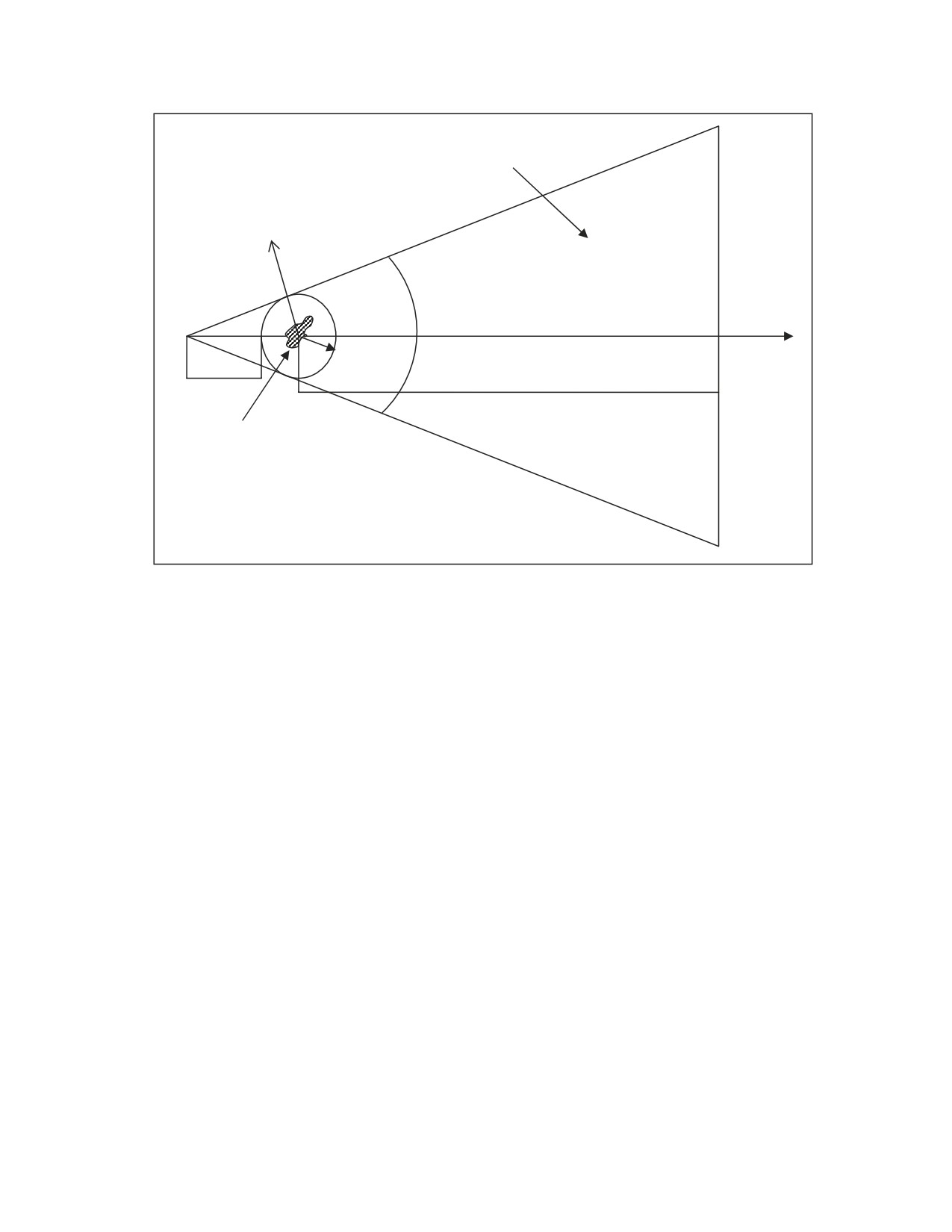
Figure E-6. Hazard Area From Type A Attack, Case 2 (Wind Speed >10 kph)
(a) Obtain the location of the attack from the relevant NBC CHEM
reports, and plot it on the map.
(b) Draw the GN line from the center of the attack location.
(c)
Draw a circle (radius 1 km) around the center of the attack
location. The area within this circle represents the attack area.
(d) Identify the air stability category, downwind direction, and
downwind speed using the valid NBC CDM or from locally measured data.
(e) Draw a line from the center of the attack area showing the
downwind direction.
(f)
Determine the DHD.
•
Use the simplified procedure if no more detailed information is
available (use the appropriate air stability category and means of delivery).
•
Use the detailed procedure if more detailed information is
available regarding the agent type, means of delivery, and the wind speed use Table
E-2, page E-10.
NOTE: When information concerning the means of delivery is not available,
use the figures for multiple-launched rocket systems, missiles, bombs, and
unknown munitions.
(g) Plot the maximum downwind distance from the center of the
attack area on the downwind line.
E-14
FM 3-11.3/MCWP 3-37.2A/NTTP 3-11.25/AFTTP(I) 3-2.56
2 February 2006
(h) Draw a line from the maximum downwind distance at right
angles to the downwind direction line. Extend the line on either side of the
downwind direction line.
(i)
Extend the downwind line upwind from the center of the attack
area 2 km. This is equal to twice the radius of the attack area.
(j)
Draw two lines from the upwind end of this line, which are
tangents to the attack area circle, and extend them until they intersect with the
maximum downwind distance line. These lines will form a 30° angle on either side
of the downwind line.
(k) Ensure that the hazard area is taken to be the area bounded
by—
•
The upwind edge of the attack area circle.
•
The two 30° tangents.
•
The maximum downwind distance line.
(l)
Prepare and transmit an NBC3 CHEM report and/or map
overlays to those units and installations within the hazard area according to the
SOP.
(5)
To estimate the earliest and latest arrival times of the chemical
cloud at a certain point, calculate the traveling speeds of the leading and trailing
edges of the chemical cloud.
(a) Leading Edge Speed = Downwind Speed x 1.5
Distance to Point
Earliest Arrival Time =
Leading-Edge Speed
(b) Trailing Edge Speed = Downwind Speed x 0.5
Distance to Point
Latest Arrival Time =
Trailing-Edge Speed
NOTE: The distance to the points considered must be measured from the
upwind edge (circle center for Case 1) of the attack area.
j.
Detailed Type B Attack Downwind Hazard Prediction (Land).
(1)
Type B agents are normally dispersed in liquid form to contaminate
surfaces. Persistent nerve and mustard agents are examples of this type of attack.
Ground-contaminating agents are normally dispersed by aircraft spray tanks, air-
bursting artillery shells, rockets, missiles, and mines. The evidence of ground
contamination may include the observer’s report of the agent falling to the ground
from air-bursting munitions, the identification of the agent with NBC-M8 paper, the
positive response of M9 paper, or the identification of a blister agent with the M256
series sampler or reading on the ICAM.
2 February 2006 FM 3-11.3/MCWP 3-37.2A/NTTP 3-11.25/AFTTP(I) 3-2.56
E-15
(2)
For the next six cases of chemical attacks the following information
is required:
(a) NBC1 or NBC2 CHEM report.
(b) Detailed MET information (e.g., CDM or similar information).
NOTES:
1. The daily mean surface temperature is needed for the estimation of the
probable time after which personnel may safely remove their protective
masks (see Table E-4).
2. The air stability category is not considered in Type B hazard predictions
as the maximum downwind distance is always 10 km.
Table E-4. Type B Attack, Probable Time After Ground Contamination at Which
Personnel May Safely Remove Protective Masks
Daily Mean Surface Air Temperature
Within Attack Area (Number of
Within Hazard Area (Number of
days)
Days)
< 10° C
3-10 days
2-6 days
11°-20° C
2-4 days
1-2 days
> 20° C
up to 2 days
up to 1 day
(3)
Type B, Case 1 (Figure E-7).
Sample NBC3 CHEM
ALFA/US/A234/001/C//
DELTA/271630ZAPR1999//
FOXTROT/33UUB206300/AA//
INDIA/SURF/NERV/P//
PAPAA/01KM/-/10KM/-//
PAPAX/271600ZAPR1999/-//
YANKEE/105DGT/009KPH//
ZULU/4/18C/9/-/2//
GENTEXT/CBRNINFO/TYPE B, CASE 1//
E-16
FM 3-11.3/MCWP 3-37.2A/NTTP 3-11.25/AFTTP(I) 3-2.56
2 February 2006
Hazard Area
Attack Area
1 km
Hazard Area
Not to scale
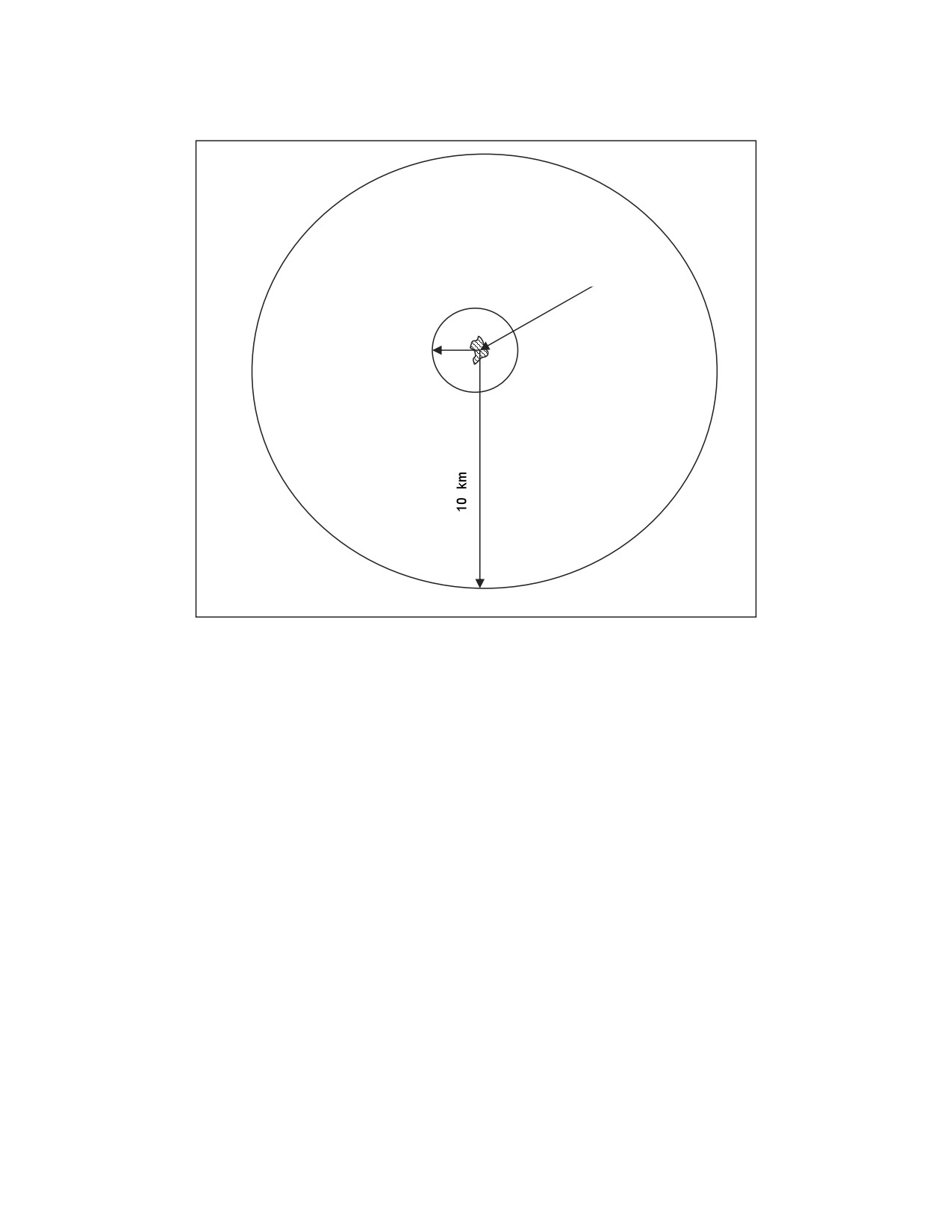
Figure E-7. Hazard Area From Type B Attack, Case 1 (Wind Speed ≤10 kph)
(a) Obtain the location of the attack from the relevant NBC
chemical messages, and plot it on the map.
(b) Draw a circle (radius 1 km) around the center of the attack
location. The area within this circle represents the attack area.
(c)
Draw a circle (radius 10 km) around the center of the attack
location. The area within this circle represents the hazard area.
(d) Prepare and transmit an NBC3 CHEM report and/or map
overlays to those units and installations within the hazard area according to the
SOP.
(4)
Type B, Case 2.
Sample NBC3 CHEM
ALFA/US/A234/011/C//
DELTA/271650ZAPR1999//
FOXTROT/32UNH250010/AA//
INDIA/AIR/NERV/P//
PAPAA/01KM/2-4DAY/10KM/1-2DAY//
PAPAX/271600ZAPR1999/
2 February 2006 FM 3-11.3/MCWP 3-37.2A/NTTP 3-11.25/AFTTP(I) 3-2.56
E-17
32UNH371020/
32UNH250020/
32UNH241015/
32UNH241005/
32UNG301900//
YANKEE/120DGT/015KPH//
ZULU/2/15C/8/-/2//
GENTEXT/CBRNINFO/TYPE B, CASE 2//
Attack Area
GN
30°
Downwind
Direction 120°
30°
1 km
Maximum Downwind
Hazard Distance 10 km
Not to scale
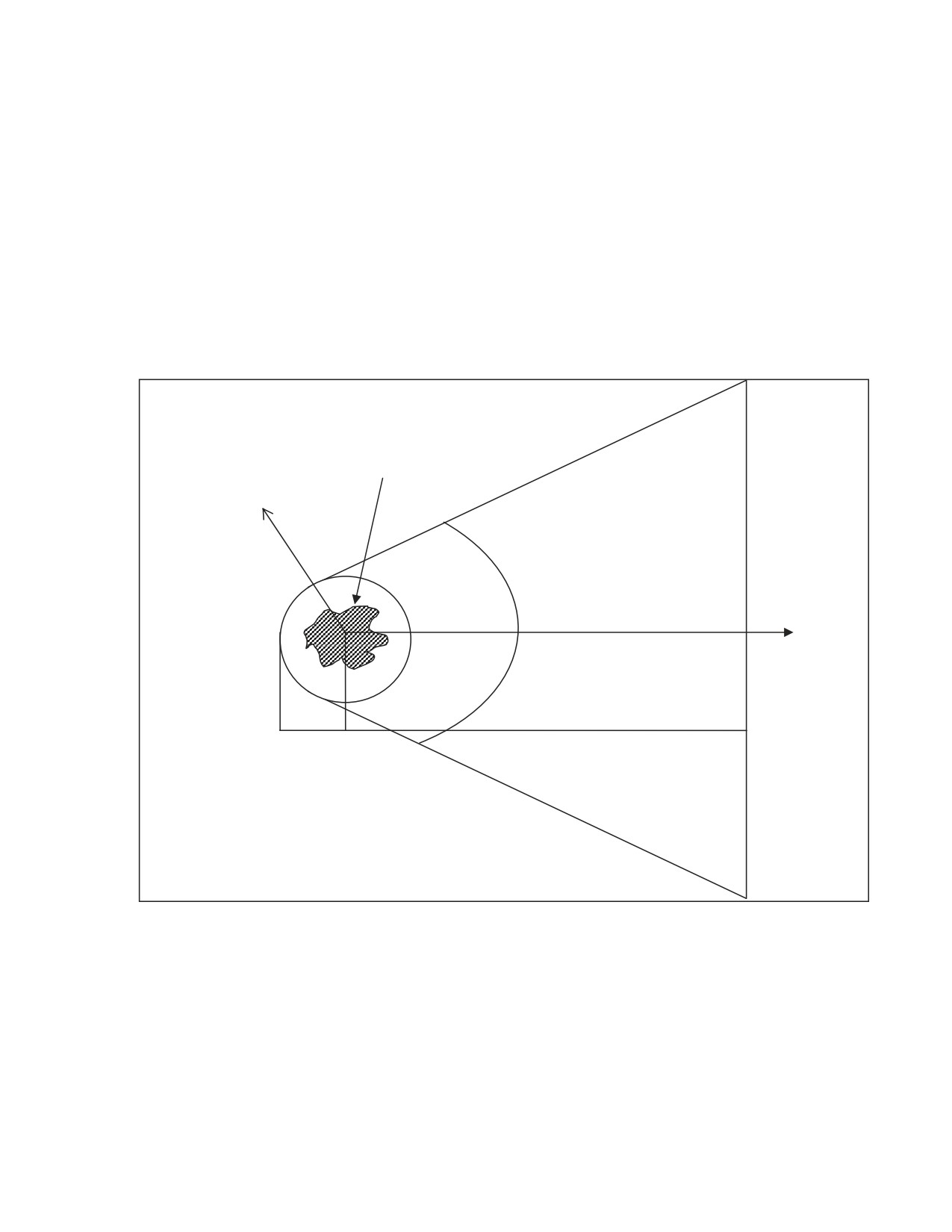
Figure E-8. Hazard Area From Type B Attack, Case 2 (Radius of Attack Area ≤1 km,
Wind Speed >10 kph)
(a) Obtain the location of the attack from the relevant NBC CHEM
reports, and plot it on the map.
(b) Draw a GN line from the center of the attack location.
(c)
Draw a circle (radius 1 km) around the center of the attack
location. The area within this circle represents the attack area.
E-18
FM 3-11.3/MCWP 3-37.2A/NTTP 3-11.25/AFTTP(I) 3-2.56
2 February 2006
(d) Draw a line from the center of the attack area showing the
downwind direction.
(e) Plot the 10-km downwind distance from the center of the
attack area on the downwind line.
(f)
Draw a line from the 10-km downwind distance at right angles
to the downwind direction line. Extend the line on either side of the downwind
direction line.
(g) Extend the downwind line upwind from the center of the attack
area 2 km. This is equal to twice the radius of the attack area.
(h) Draw two lines from the upwind end of this line, which are
tangents to the attack area circle, and extend them until they intersect with the 10-
km downwind distance line. These lines will form a 30° angle on either side of the
downwind line.
(i)
Find the probable time after ground contamination at which
personnel may safely remove their protective masks using Table E-4, page E-16.
(j)
Prepare and transmit an NBC3 CHEM report and/or map
overlays to those units and installations within the hazard area according to the
SOP.
(5)
Type B, Case 3.
Sample NBC3 CHEM
ALFA/US/A234/013/C//
DELTA/211605ZAPR1999//
FOXTROT/32UNH431562/EE//
GOLF/OBS/MSL/10/-/-//
INDIA/AIR/NERV/P//
PAPAA/02KM/2-4DAY/010KM/1-2DAY//
PAPAX/211500ZAPR1999/-//
YANKEE/105DEG/8KPH//
ZULU/2/15C/6/-/2//
GENTEXT/CBRNINFO/TYPE B, CASE 3//
2 February 2006 FM 3-11.3/MCWP 3-37.2A/NTTP 3-11.25/AFTTP(I) 3-2.56
E-19
2 km
10 km
DHD
Attack
Area
Not to scale
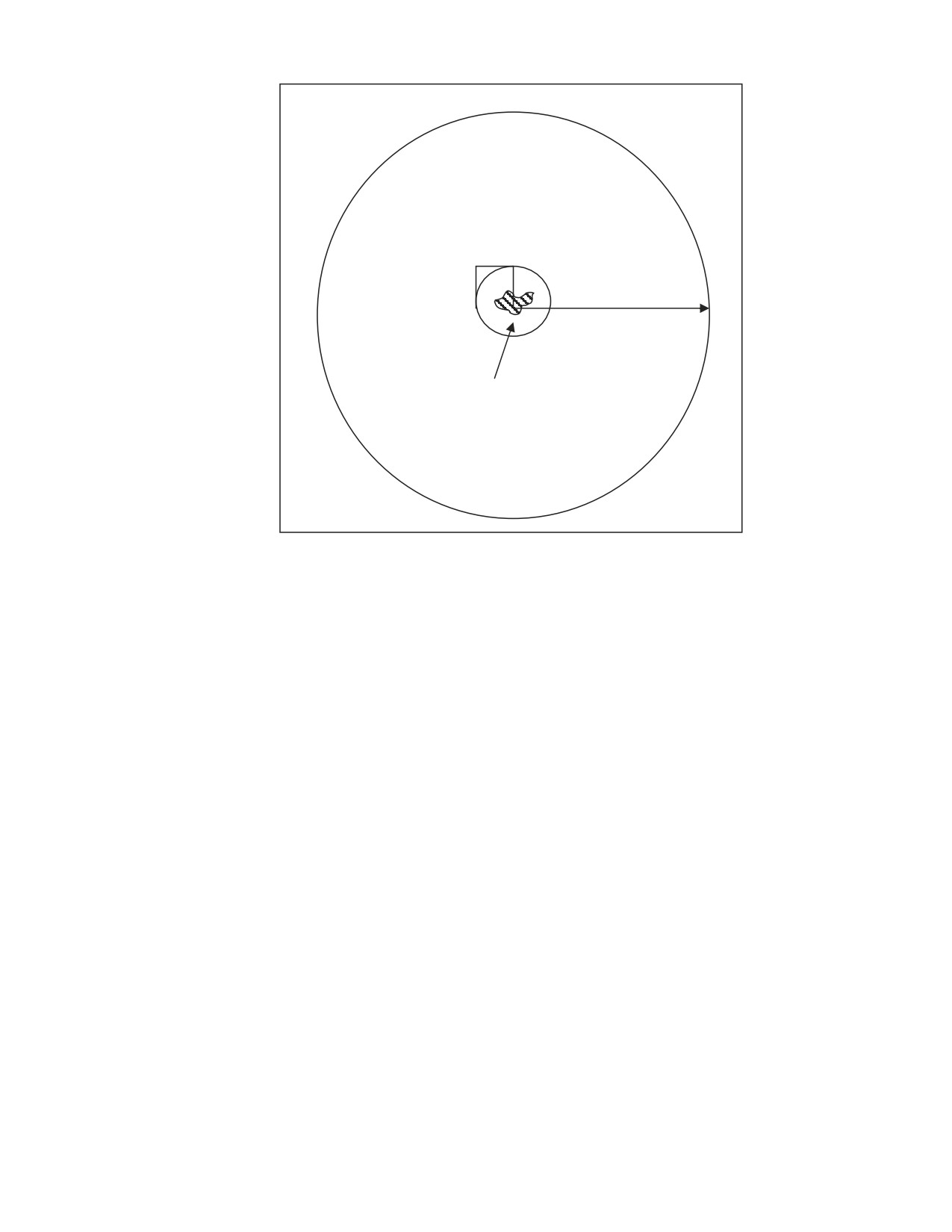
Figure E-9. Hazard Area From Type B Attack, Case 3 Attack Area (Radius >1 km
but ≤2 km, Wind Speed <10 kph)
(a) Obtain the location of the attack from the relevant reports, and
plot it on the map.
(b) Draw a circle (radius 2 km) around the center of the attack
location. The area within this circle represents the attack area.
(c)
Draw a circle (radius 10 km) around the center of the attack
location. The area within this circle represents the hazard area.
(d) Prepare and transmit an NBC3 CHEM report and/or map
overlays to those units and installations within the hazard area according to the
SOP.
(6)
Type B, Case 4.
Sample NBC3 CHEM
ALFA/US/A234/006/C//
DELTA/181730ZAPR1999//
FOXTROT/32UNH320010/EE//
INDIA/AIR/NERV/P//
PAPAA/02KM/2-4DAY/10KM/1-2DAY//
PAPAX/181600ZAPR1999/
32UNH441051/
32UNH316029/
E-20
FM 3-11.3/MCWP 3-37.2A/NTTP 3-11.25/AFTTP(I) 3-2.56
2 February 2006
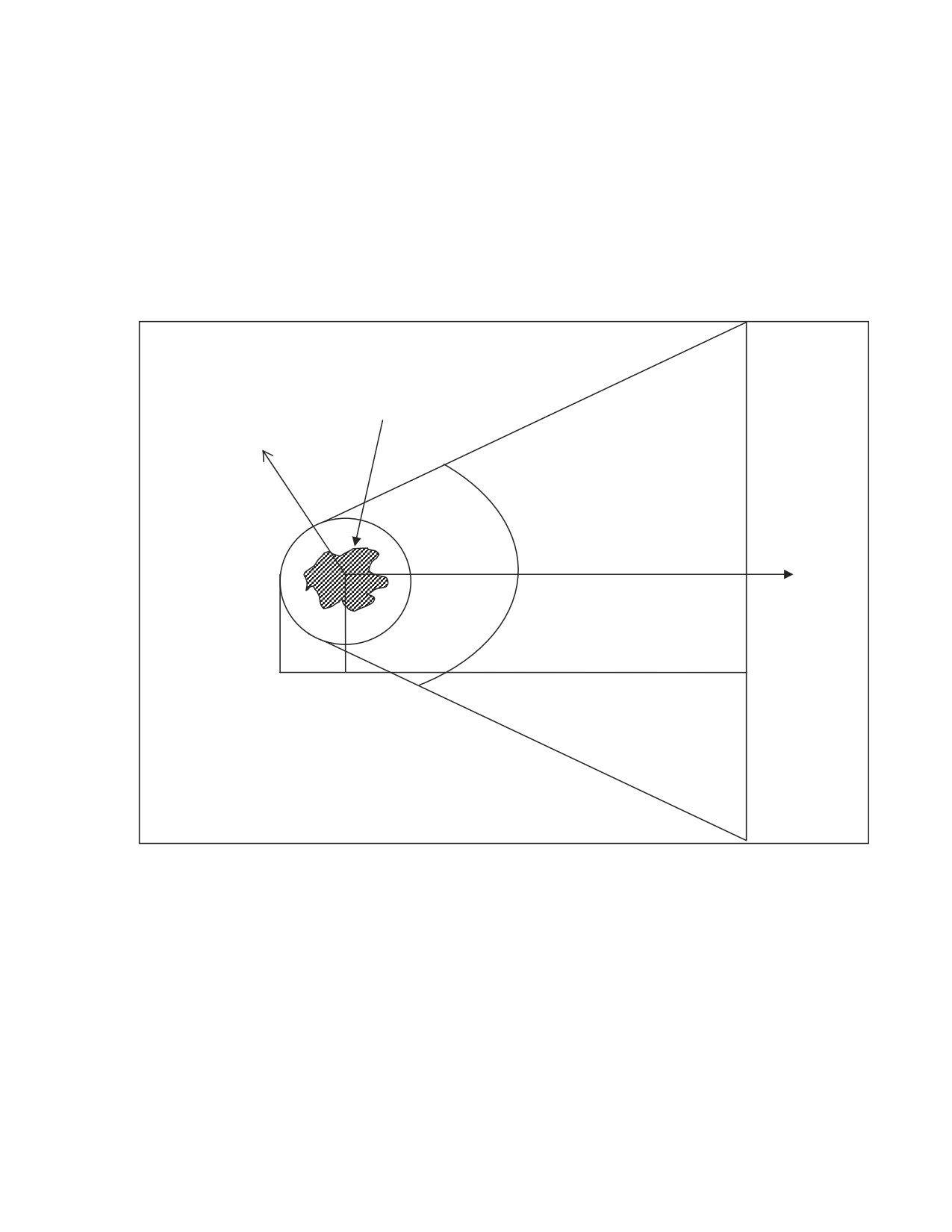
32UNH301016/
32UNG304997/
32UNG386899//
YANKEE/110DGT/020KPH//
ZULU/4/16C/-/-/2//
GENTEXT/CBRNINFO/TYPE B, CASE 4//
Attack Area
GN
30°
Downwind
Direction 120°
30°
2 km
Maximum Downwind
Hazard Distance 10 km
Not to scale
Figure E-10. Hazard Area From Type B Attack, Case 4 (Attack Area Radius >1
km but ≤2 km, Wind Speed >10 kph)
(a) Obtain the location of the attack from the relevant NBC CHEM
reports, and plot it on the map.
(b) Draw a GN line from the center of the attack location.
(c)
Draw a circle (radius 2 km) around the center of the attack
location. The area within this circle represents the attack area.
(d) Draw a line from the center of the attack area showing the
downwind direction.
2 February 2006 FM 3-11.3/MCWP 3-37.2A/NTTP 3-11.25/AFTTP(I) 3-2.56
E-21
(e) Plot the 10-km downwind distance from the center of the
attack area on the downwind line.
(f)
Draw a line from the 10-km downwind distance at right angles
to the downwind direction line. Extend the line on either side of the downwind
direction line.
(g) Extend the downwind line upwind from the center of the attack
area 4 km. This is equal to twice the radius of the attack area.
(h) Draw two lines from the upwind end of this line, which are
tangents to the attack area circle, and extend them until they intersect with the 10-
km downwind distance line. These lines will form a 30° angle on either side of the
downwind line.
(i)
Find the probable time after ground contamination at which
personnel may safely remove their protective masks by using Table E-4, page E-16.
(j)
Prepare and transmit an NBC3 CHEM report and/or map
overlays, to those units and installations within the hazard area according to the
SOP.
(7)
Type B, Case 5.
Sample NBC3 CHEM
ALFA/US/A234/014/C//
DELTA/201530ZAPR1999//
FOXTROT/32UNG420620/EE/
32UNG435620/EE//
INDIA/AIR/NERV/P//
PAPAA/01KM/2-4DAY/010KM/1-2DAY//
PAPAX/211500ZAPR1999/-//
YANKEE/147DGT/009KPH//
ZULU/2/15C/6/-/2//
GENTEXT/CBRNINFO/TYPE B, CASE 5//
E-22
FM 3-11.3/MCWP 3-37.2A/NTTP 3-11.25/AFTTP(I) 3-2.56
2 February 2006
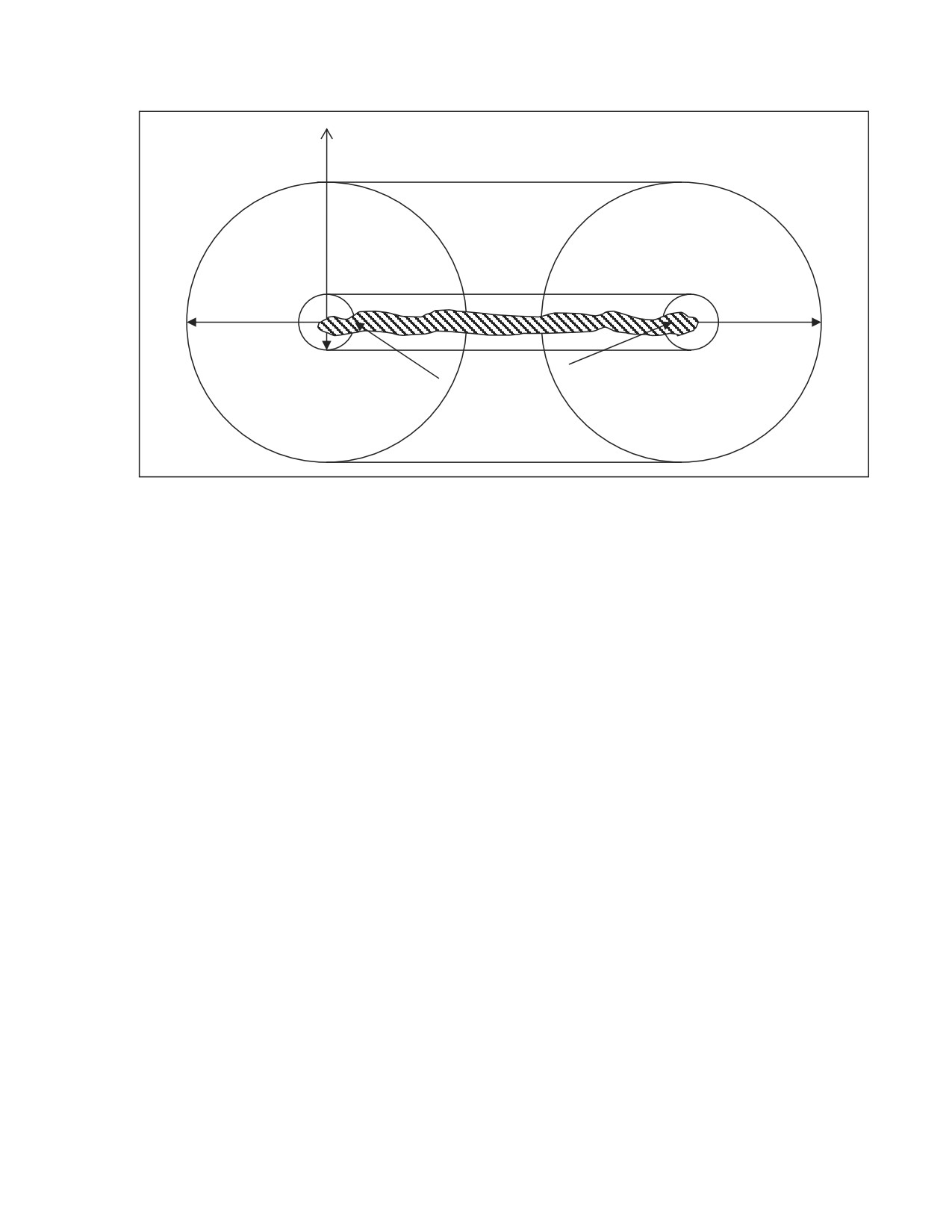
GN
Hazard Area
10-km DHD
10-km DHD
Attack Area
Hazard Area
Not to scale
Figure E-11. Hazard Area From Type B, Case 5 (Any Dimension of Attack Area >2
km, Wind Speed ≤10 kph)
(a) Estimate the attack area from an NBC1 or NBC2 CHEM
report, and plot a point at each extreme end.
(b) Connect the end points to form one or more attack lines.
(c)
Draw a 1-km-radius circle around each end point.
(d) Connect these circles on both sides by drawing tangents to the
circles parallel to the attack line to designate the attack area.
(e) Draw a 10-km-radius circle around each 1-km circle at the end
points.
(f)
Connect these circles on both sides by drawing tangents to the
circles parallel to the attack line, to designate the hazard area.
(g) Find the probable time after ground contamination at which
personnel may safely remove their protective masks by using Table E-4, page E-16.
(h) Prepare and transmit an NBC3 CHEM report and/or map
overlays to those units and installations within the hazard area according to the
SOP.
(8)
Type B, Case 6.
Sample NBC3 CHEM
ALFA/US/A234/007/C//
DELTA/141550ZAPR1999//
FOXTROT/33UUC330060/EE/
33UUC370061/EE//
INDIA/AIR/NERV/P//
2 February 2006 FM 3-11.3/MCWP 3-37.2A/NTTP 3-11.25/AFTTP(I) 3-2.56
E-23
PAPAA/01KM/2-4DAY/10KM/1-2DAY//
PAPAX/141400ZAPR1999/
33UUC482014/
33UUC374069/
33UUC368070/
33UUC328069/
33UUC320059/
33UUB326938/
33UUB366939//
YANKEE/147DGT/012KPH//
ZULU/4/18C/3/-/0//
GENTEXT/CBRNINFO/TYPE B, CASE 6//
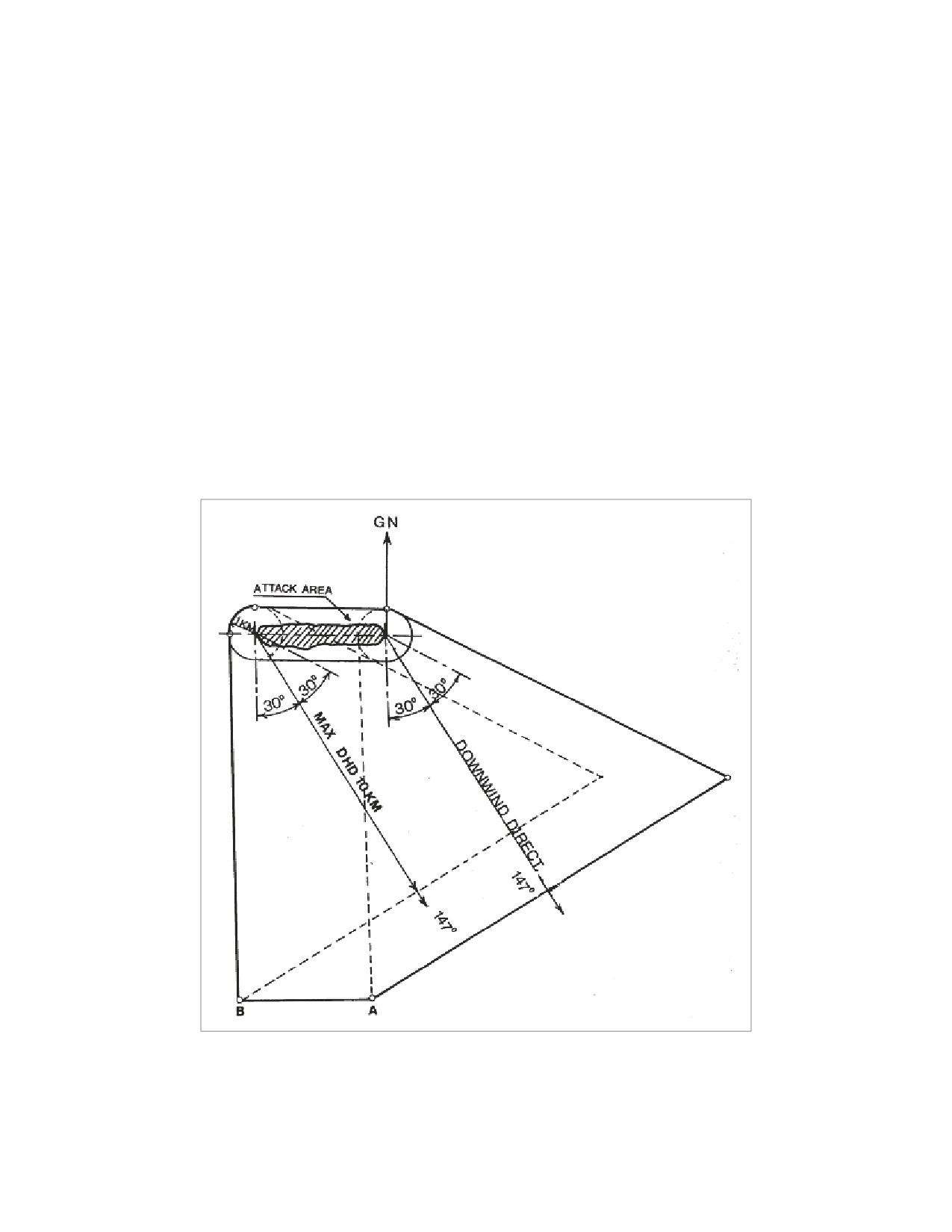
Figure E-12. Hazard Area From Type B Attack, Case 6 (Any Dimension of Attack
Area > 2 km, Wind Speed >10 kph)
(a) Estimate the attack area from the NBC1 or NBC2 CHEM
report, and plot it on a map.
E-24
FM 3-11.3/MCWP 3-37.2A/NTTP 3-11.25/AFTTP(I) 3-2.56
2 February 2006
(b) Identify and mark the extremities of the estimated attack area,
and connect the end points to form one or more attack lines.
(c)
Draw circles (radius of 1 km), using the extremities as center
points, around each point. Connect these circles on both sides by drawing tangents
to the circles parallel to the attack line to designate the attack area.
(d) Draw a GN line from the center of each circle.
(e) Consider each circle as a separate attack area, and carry out
the following procedure for each attack area:
•
Draw a line from the center of the attack area showing the
downwind direction.
•
Plot the 10-km downwind distance from the center of the
attack area on the downwind line.
•
Draw a line from the 10-km downwind distance at right angles
to the downwind direction line. Extend the line on either side of the downwind
direction line.
•
Extend the downwind line upwind from the center of the attack
area 2 km. This is equal to twice the radius of the attack area.
•
Draw two lines from the upwind end of this line, which are
tangents to the attack area circle, and extend them until they intersect with the
10-km downwind distance line. These lines will form a 30° angle on either side of
the downwind line.
•
Draw a line connecting the downwind corners of the two vapor
hazard areas (Points A and B in Figure E-10, page E-21).
(f)
Use Table E-4, page E-16, to find the probable time after
ground contamination at which personnel may safely remove their protective masks.
(g) Prepare and transmit an NBC3 CHEM report and/or map
overlays to those units and installations within the hazard according to the SOP.
(9)
Calculate the traveling speeds of the leading and trailing edges of
the chemical cloud to estimate the earliest and latest arrival times of the chemical
cloud at a certain point.
(a) Leading Edge Speed = Downwind Speed x 1.5
Distance To Point
Earliest Arrival Time =
Leading Edge Speed
(b) Trailing Edge Speed = Downwind Speed x 0.5
Distance To Point
Latest Arrival Time =
Trailing Edge Speed
2 February 2006 FM 3-11.3/MCWP 3-37.2A/NTTP 3-11.25/AFTTP(I) 3-2.56
E-25
NOTES:
1. The estimates assume ground contamination densities up to 10 g/m2.
2. When making hazard estimates, the vapor has been considered to be the
determining factor within the attack area and in the downwind hazard
area. The duration of the hazard from contact with bare skin is, however,
difficult to predict. The duration can only be determined by the use of
chemical-agent detection or confirmation devices.
3. When temperatures are considerably lower than 0°C, the duration of
contamination may be longer than indicated in Table E-4, page E-16. The
absence of vapor does not preclude the presence of contamination.
4. Daily mean surface air temperature may be obtained from local MET
sources.
5. The information in Table E-4 is a worst-case scenario. Real, known
information should be used to the extent possible.
k.
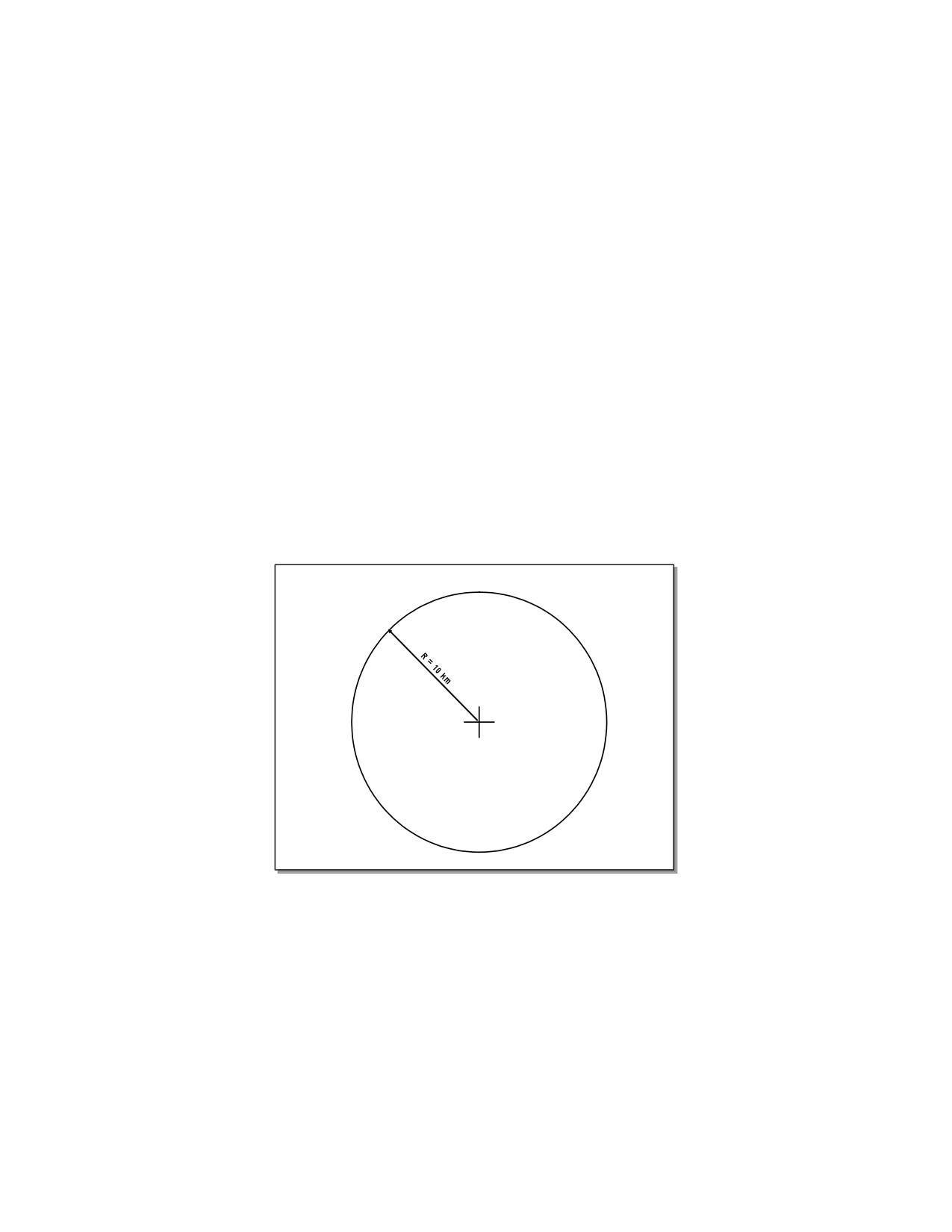
Type C Attack Downwind Hazard Prediction (Land). A Type C attack
(Figure E-13) is an attack in which the attack origin is unknown. These attacks will
most likely be found by a survey or reconnaissance.
Hazard Area
Figure E-13. Type C Attack
(1)
Obtain the location of detection from the relevant NBC4 CHEM
report (Line QUEBEC), and then plot it on the map.
(2)
Draw a circle with a 10-km radius around the center of the detection
location. The area within this circle represents the attack area and the hazard area.
(3)
Prepare and transmit an NBC3 CHEM report to the units and
installations in the predicted hazard area according to the unit SOP.
E-26
FM 3-11.3/MCWP 3-37.2A/NTTP 3-11.25/AFTTP(I) 3-2.56
2 February 2006

(4)
Repeat the above procedures for the new location if a new NBC4
CHEM message, that cannot be allocated to a strike specifies a location outside of
the hazard area.
l.
Adjusted Hazard Prediction (Land). The methods previously discussed
are based on constant environmental conditions. After significant weather changes,
the NBC3 CHEM report may no longer be accurate or apply. An adjusted NBC3
CHEM report must be sent to the unit or installation in the new hazard area if
possible. Also, notify units who may no longer be in the hazard area. Significant
weather changes include the following:
•
Representative downwind speed of 10 kph or more or a wind speed that
increases from less than 10 kph to more than 10 kph or the reverse.
•
Air stability category (Type A attacks only).
•
Changes in downwind direction by 30° or more.
Table E-5 shows which cases and types of attacks may be affected by different
atmospheric changes.
Table E-5. Cases and Types of Attacks
Changes
A 1
A 2
B 1
B 2
B 3
B 4
B 5
B 6
Wind Speed: By 10 kph or more
X
From >10 kph to ≤10 kph
X
X
X
X
From ≤10 kph to >10 kph
X
X
X
X
Wind Direction by 30° or more
X
X
X
X
Stability Category
X
NOTE: For a change in wind speed, determine the geographical center of
the frontline of the traveling cloud at the time the new data becomes
available. Calculate this distance by multiplying the original wind speed
by twice the time in hours since the attack. The center of the cloud front is
then considered to be the new center of attack area. Once the new center
of attack is determined, the downwind hazard area is determined using the
procedures for that type of attack.
(1)
Recalculation of Hazard Distances. When significant weather
changes occur or are predicted to occur, the following procedures for Type A attacks
should be used to determine—
(a) The distance the chemical agent cloud will have traveled prior
to the change by using—
d1
= u1 x t1
d1
= distance traveled prior to change in weather conditions
u1
= downwind speed prior to change in weather conditions
2 February 2006 FM 3-11.3/MCWP 3-37.2A/NTTP 3-11.25/AFTTP(I) 3-2.56
E-27
t1
= time elapsed between the time of attack and the end of the
current CDR time period
NOTE: If the distance traveled, as calculated above, is equal to or exceeds
the original maximum DHD, recalculation is not required.
(b) For Type A case 2 attacks, measure the distance d1 along the
downwind line and mark it. If that point is outside the current CDR area, get the
CDR for the area containing the new point and get the weather conditions for the
next time period. Compare these weather conditions with those used for the current
CDR time period, and determine if significant weather changes are predicted.
(c)
Determine the distance the chemical cloud will travel after the
change by using—
d2
= H2 - d1
d2
= remaining hazard distance
H2
= maximum hazard distance under the conditions prevailing
after the change
d1
= distance traveled prior to change in weather conditions
NOTES:
1. If the second time period has a wind speed ≤10 kph (Type A1), always
draw a circle with a radius of 10 km (as if d2 = 10 km).
2. In constructing the hazard area, keep in mind that the maximum hazard
distance, valid during either set of weather conditions, must not be
exceeded. If d2 is ≤0, recalculation is not required.
(2)
Type A, Case 1 Changing to a Type A, Case 2 (Figure E-14 shows an
increase in wind speed from ≤10 kph to >10 kph).
Sample NBC CDM
Sample NBC2 CHEM
AREAM/NFEA12//
ALFA/US/A234/005/C//
ZULUM/230600ZAPR1999/230900ZAPR1999/2
DELTA/231030ZAPR1999//
31500ZAPR1999//
FOXTROT/32VNH450956/AA//
UNITM/KM/DGT/KPH/C//
GOLF/OBS/CAN/-/SHL/24//
WHISKEYM/140/008/4/06/8/-/2//
INDIA/SURF/NERV/NP//
XRAYM/140/012/4/10/8/-/2//
TANGO/FLAT/SCRUB//
YANKEEM/150/014/4/14/8/-/2//
YANKEE/140DGT/008KPH//
ZULUA/4/10C/8/-/2//
GENTEXT/CBRNINFO/
TYPE OF AGENT CONFIRMED
BY CHEMICAL DETECTION
KIT. RECALCULATION BASED
ON CHANGE IN WIND SPEED
231100Z//
E-28
FM 3-11.3/MCWP 3-37.2A/NTTP 3-11.25/AFTTP(I) 3-2.56
2 February 2006