ARMY FM 4-20.117 RIGGING HIGH-MOBILITY MULTIPURPOSE WHEELED VEHICLES (October 2001) - page 4
FM 4-20.117/TO 13C7-1-111
Table 4-1. Equipment Required for Rigging the M1113 truck with M56 Smoke Generator for Low-
Velocity Airdrop
National Stock
Number
Item
Quantity
8040-00-273-8713
Adhesive, paste, 1-gal
As required
4030-00-090-5354
Clevis, suspension, 1-in (large)
5
4020-00-240-2146
Cord, nylon, type III, 550-lb
As required
1670-00-434-5785
Coupling assembly, airdrop, extraction force transfer with cable,
1
16-ft
1670-00-360-0328
Cover, clevis, large
1
8135-00-664-6958
Cushioning material, packaging, cellulose wadding
As required
8305-00-958-3685
Felt, 1/2-in thick
As required
1670-01-183-2678
Leaf, extraction line (line bag)
2
Line, drogue (for C-17)
1670-01-064-4452
60-ft (3-loop), type XXV I
1
Line, extraction
:
1670-01-062-6313
For C-130: 60-ft (3-loop), type XXV I
1
1670-01-107-7651
For C-141: 140-ft (3-loop), type XXV I
1
For C-5:
1670-01-062-6313
60-ft (3-loop), type XXVI and
1
1670-01-107-7651
140-ft (3-loop), type XXV I
1
For C-17:
1670-01-107-7651
140-ft (3-loop), type XXV I
1
Link assembly, Two-point:
1
5306-00-435-8994
Bolt, 1-in diam, 4-in long
(2
)
5310-00-232-5165
Nut, 1-in, hexagonal
(2
)
1670-00-003-1953
Plate, side, 3 3/4-in
(2
)
5365-00-007-3414
Spacer, large
(2
)
Lumber:
5510-00-220-6448
2- by 6-in
As required
5510-00-220-6274
4- by 4-in
As required
5315-00-010-4659
Nail, steel wire, 8d
As required
4-17
FM 4-20.117/TO 13C7-1-111
Table 4-1. Equipment Required for Rigging the M1113 Truck with M56 Smoke Generator for
Low-Velocity Airdrop (continued)
National Stock
Number
Item
Quantity
1670-00-753-3928
Pad, energy-dissipating (honeycomb)
3- by 36- by 96-in
13 sheets
Parachute:
Cargo:
1670-01-016-7841
G-11 B
3
Cargo extraction:
1670-01-063-3716
22-foot ((for C-17, use H-block with this parachute)
1
Drogue (for C-17 )
1670-01-063-3715
15-ft
1
Platform, airdrop, type
V, 16-ft
1670-01-353-8425
Bracket assembly, EFT C
(1
)
1670-01-162-2372
Clevis assembly, type V
(20
)
1670-01-353-8424
Bracket assembly, extractio n
(1
)
1670-01-162-2381
T
andem link assembly (Multipurpose link)
(4
)
5530-00-128-4981
Plywood, 3/4-in
4
sheets
1670-01-097-8816
Release, cargo parachute, M-1
1
Sling, cargo, airdrop
For suspension:
1670-01-063-7761
16-ft (2-loop), type XXVI nylon webbing
4
For lifting
:
1670-01-062-6304
9-ft (2-loop), type XXVI nylon webbin g
2
1670-01-062-6303
12-ft (2-loop), type XXVI nylon webbing
2
For deployment:
1670-01-062-6304
9-ft (2-loop), type XXVI nylon webbin g
1
For riser extension
:
1670-01-062-6313
60-ft (3-loop), type XXVI nylon webbing
3
4910-01-313-8839
Spreader bar assembly
1
5340-00-040-8219
Strap, parachute release, multi-cut, comes w/ 3
knives
2
7510-00-266-5016
T
ape, adhesive, 2-in
As required
1670-00-937-0271
Tie-down assembly, 15-foot
20
1670-01-344-0825
Vehicle drive-off aid
1
Webbing :
8305-00-268-2411
Cotton, 1/4-in, type I
As required
8305-00-082-5752
Nylon, tubular, 1/2-in
As required
8305-00-263-3591
T
ype VIII
As required
4-18
FM 4-20.117/TO 13C7-1-111
Section II - RIGGING M1114 UP-ARMORED ARMAMENT CARRIER
SECTION I - RIGGING M1113 TRUCK WITH M56 SMOKE GENERATO
DESCRIPTION OF LOAD
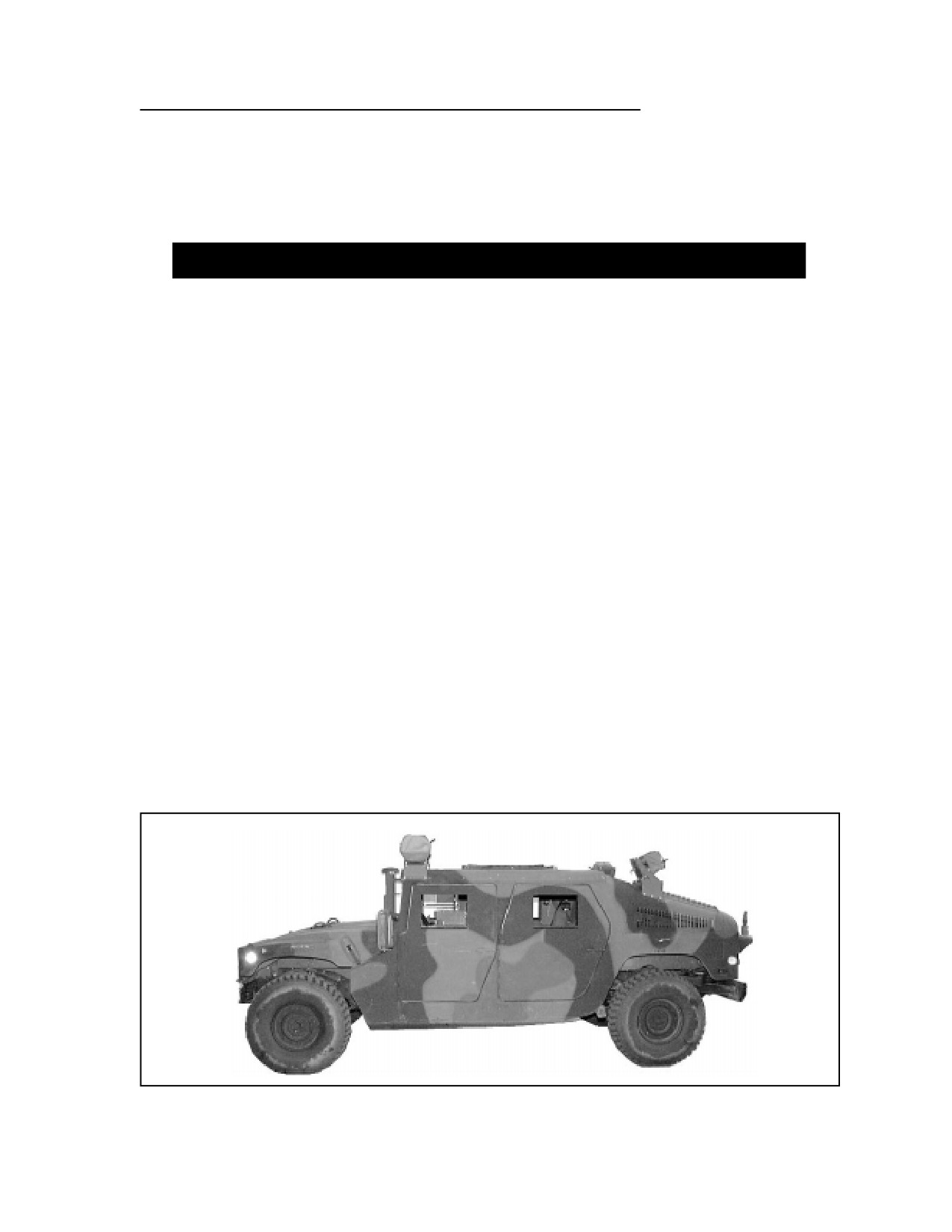
4-15. The M1114 HMMWV-series truck has a heavy-duty suspension and
additional armor in the sides, door, and floor. The truck is shown in Figure 4-
15. The truck is rigged on a 16-foot, type V airdrop platform for low-velocity
airdrop. The load requires three G-11 cargo parachutes.
PREPARING PLATFORM
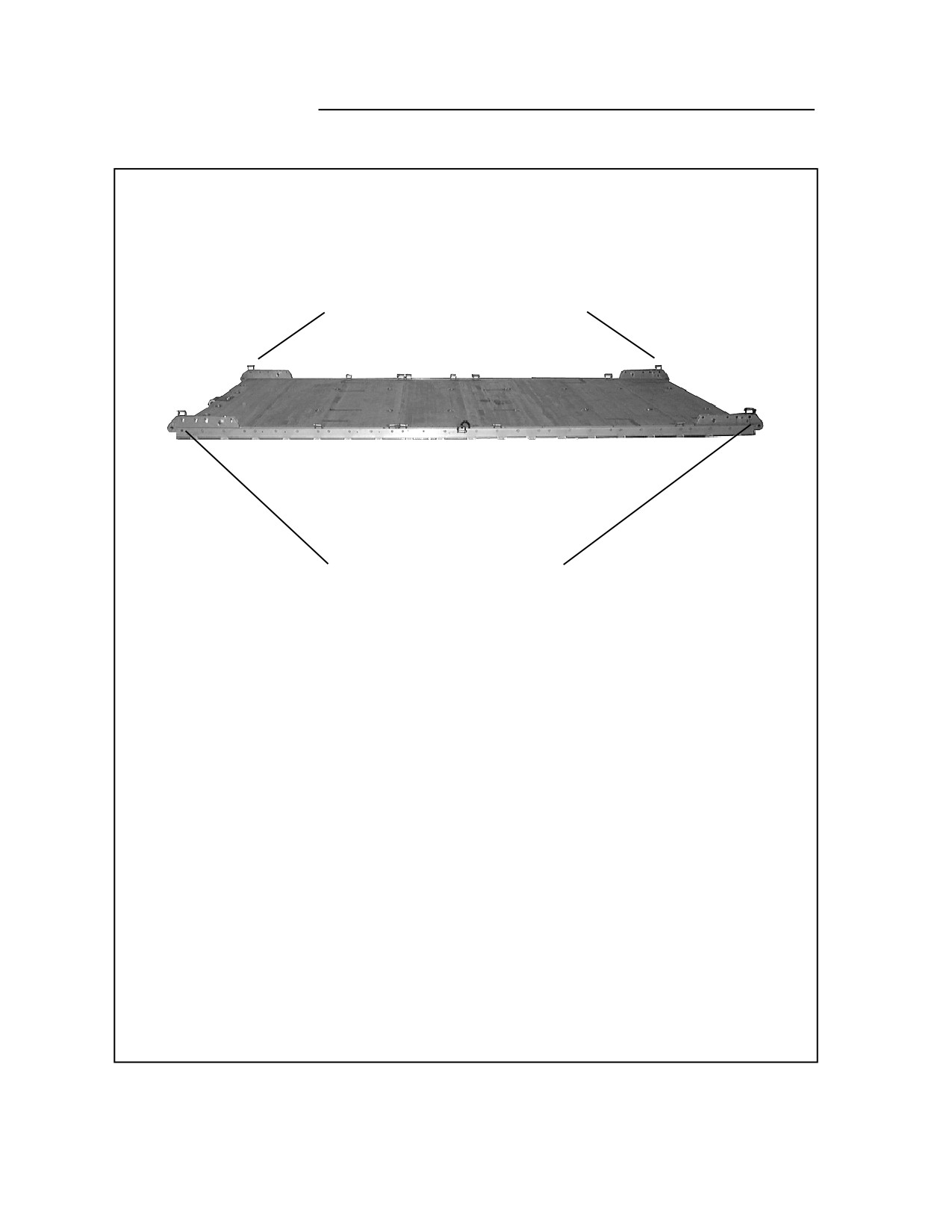
4-16. Prepare a 16-foot, type V airdrop platform according to TM 10-1670-268-
20&P/TO 13C7-52-22. Install four tandem links and 18 load tie-down
clevises according to FM 4-20.102/NAVSEA SS400-AB-MMO-010/TO 13C7-1-5,
and as shown in Figure 4-16.
NOTES:
1. The nose bumper may or may not be installed.
2. Measurements given in the instructions for this load are from the front
edge of the platform, NOT from the front edge of the nose bumper.
Figure 4-15. M1114 Up-Armored Armament Carrier Figure
4-19
FM 4-20.117/TO 13C7-1-111
CLEVISES 9A THROUGH 1A
LEFT
RIGHT
REAR
FRONT
CLEVISES 9 THROUGH 1
Step:
1. Install a tandem link on the front of each platform side rail using holes 1, 2, and 3.
2. Install a tandem link on the rear of each platform side rail using holes 30, 31, and 32.
3. Install a clevis on bushing 1 of each front tandem link.
4. Install a clevis on bushing 4 of each rear tandem link.
5. Starting at the front of the platform, install clevises on each platform side rail using the bushings
bolted on holes 5, 15, 20, 21 and 25.
6. Install a clevis on bushing 17 in an inverted position. Install a bushing on clevis 17A in the normal
position. Bolt an additional clevis to each of these clevises.
7. Starting at the front of the platform, number the clevises bolted to the right side of the platform
from 1 through 9, and those bolted to the left side from 1A through 9A. Number the clevises on the
17th bushings 5 and 5A. Number the clevises bolted to these clevises clevises 4 and 4A.
8. Label the tie-down rings according to FM 4-20.102/NAVSEA SS400-AB-MMO-010/TO 13C7-1-5.
Figure 4-16. Platform Prepared
4-20
FM 4-20.117/TO 13C7-1-111
PREPARING AND POSITIONING HONEYCOMB STACKS
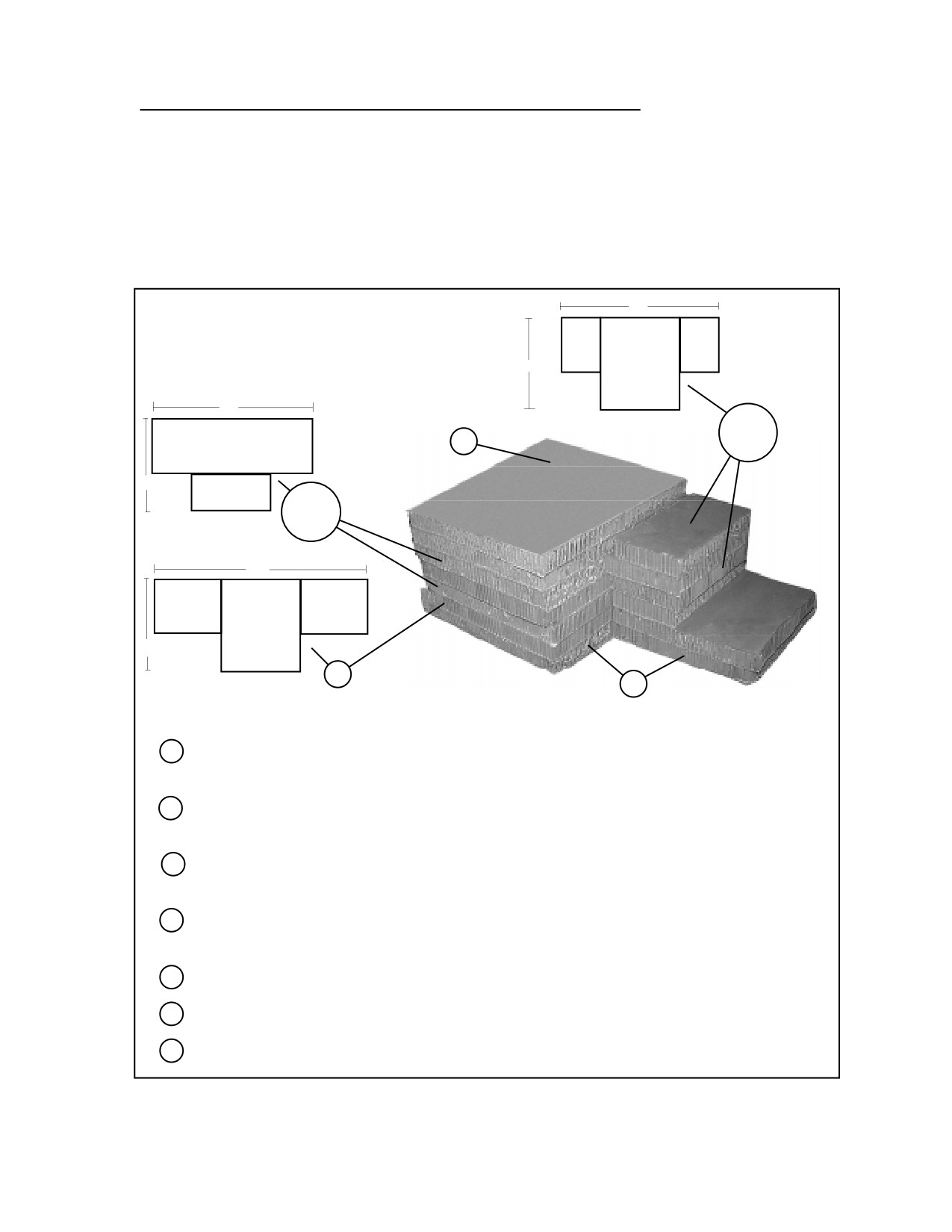
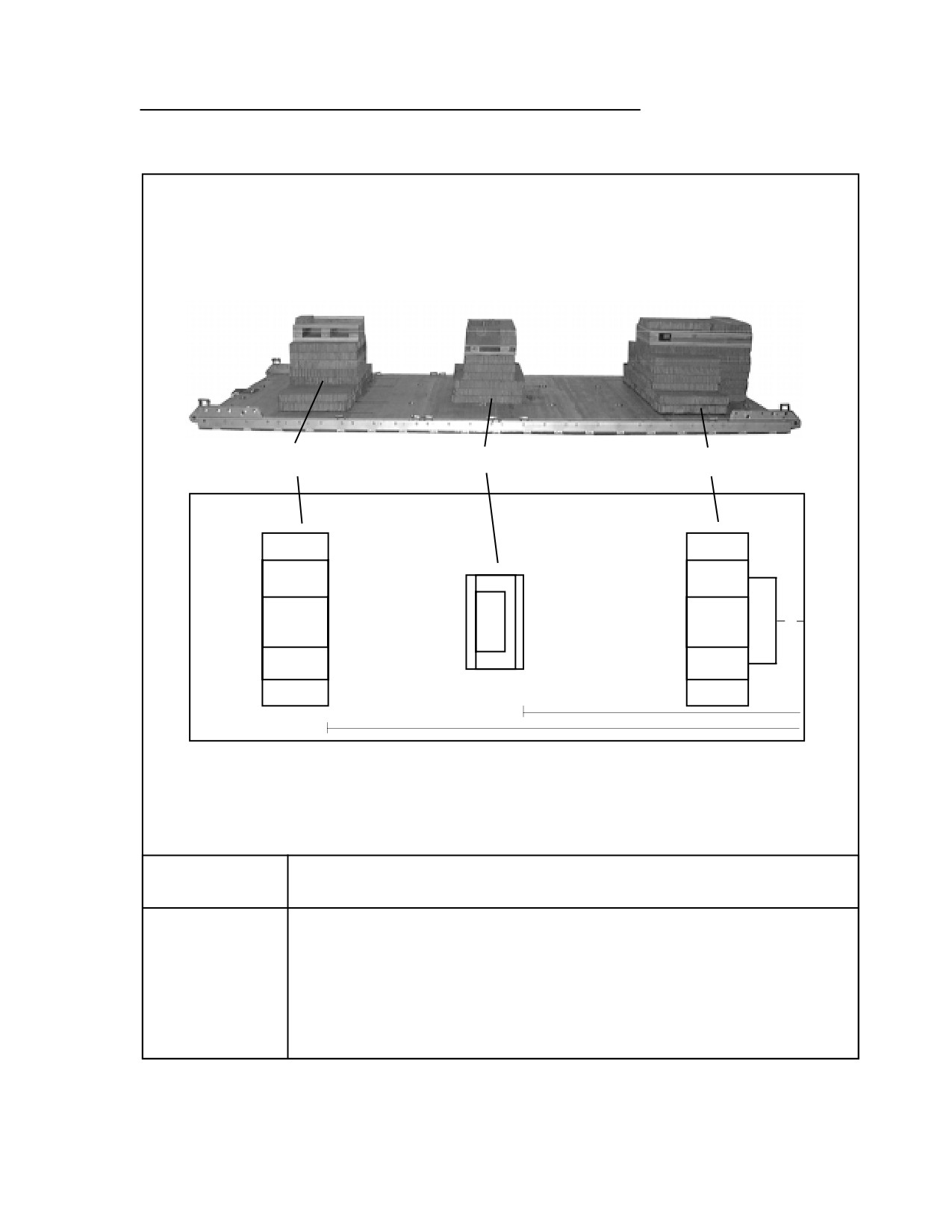
4-17. Build the honeycomb stacks as shown in Figures 4-17 through 4-19.
Position the stacks on the platform as shown in Figure 4-20.
54
Notes:
1. These drawings are not drawn to scale.
24
24
2. All dimensions are in inches.
38
12
12
54
4
30
and
24
7
6
38
14
3
and
30
5
80
24
25
25
38
FRONT
2
30
1
1
Center the edge of a 30- by 14-inch piece of honeycomb along the front edge of an 80- by 24-
inch piece of honeycomb.
2
Place a 25- by 24-inch piece of honeycomb along each long side of a 30- by 38-inch piece of
honeycomb. Align the rear edges of this layer.
3
Center a 30- by 14-inch piece of honeycomb along the front edge of a 54- by 24-inch piece of
honeycomb.
4
Place a 12- by 24-inch piece of honeycomb along each long side of a 30- by 38-inch piece of
honeycomb. Align the rear edges of this layer.
5
Make this layer as shown in step 3 above and center it over the fourth layer.
6
Make this layer as shown in step 4 above and center it over the fifth layer.
7
Center a 30- by 38-inch piece of honeycomb over the sixth layer.
Figure 4-17. Stack 1 Prepared
4-21
FM 4-20.117/TO 13C7-1-111
Notes:
1. These drawings are not drawn to scale.
2. All dimensions are in inches.
30
10PLYWOOD
3/4 x 30 x 38
9
9
LUMBER
LUMBER
2 x 4 x 30
2 x 4 x 30
38
LEFT
PLYWOOD
8
3/4 x 30 x 38
TOP
12
10
PLYWOOD
11
8
3/4 x 30 x 38
13
9
FRONT
8
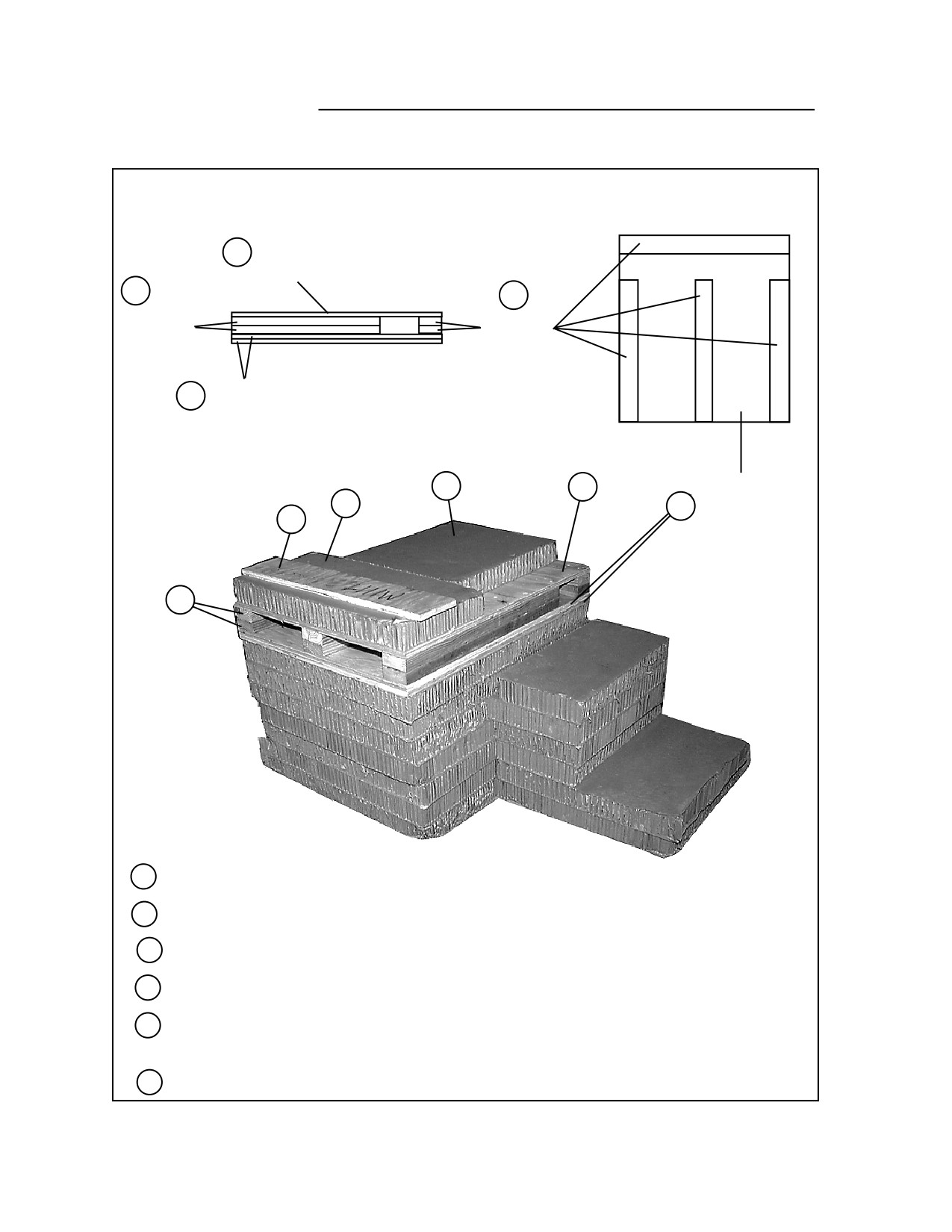
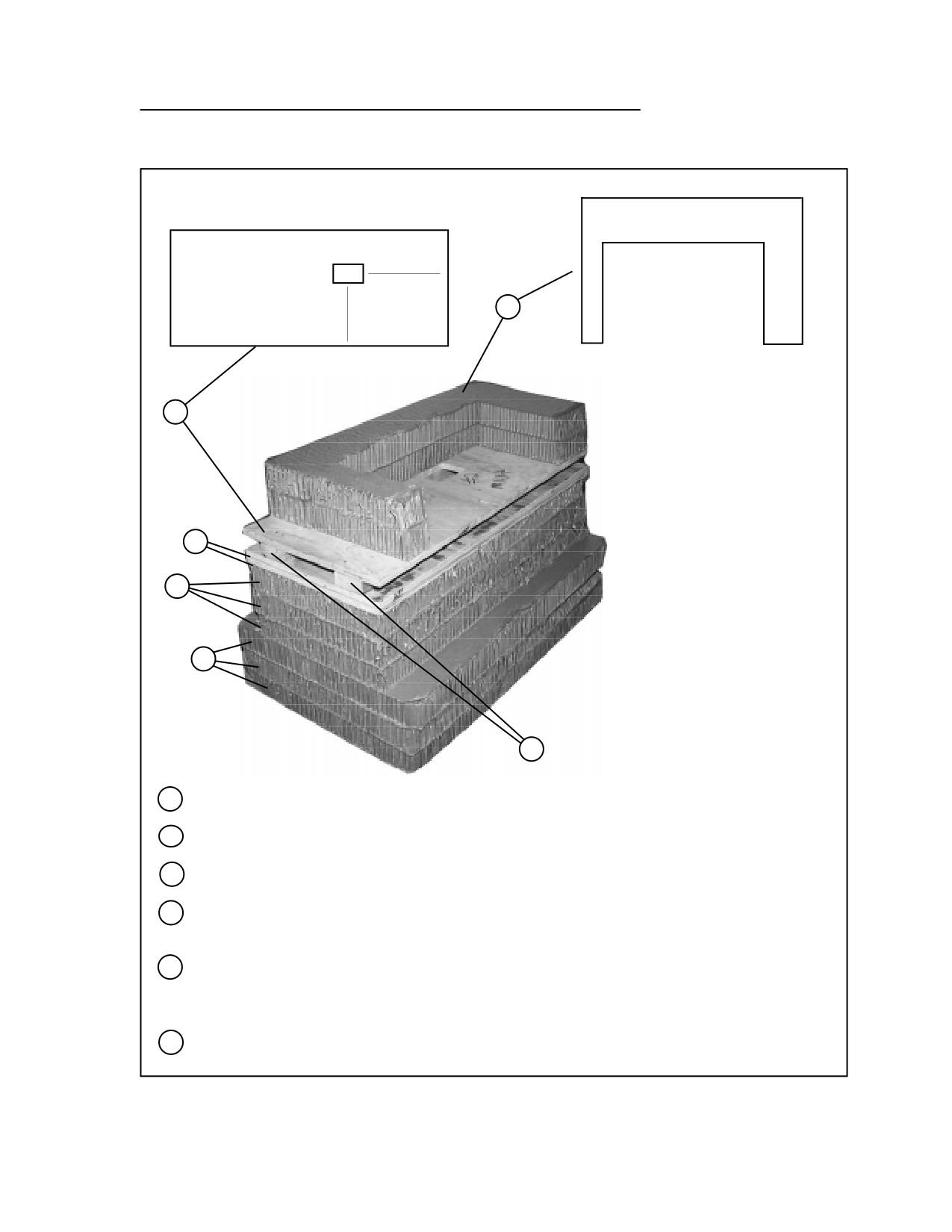
Nail two 30- by 38-inch pieces of 3/4-inch plywood flush together.
9
Space and nail eight pieces of 2- by 4-inch lumber in pairs and to the plywood as shown.
10
Nail one 30- by 38-inch piece of 3/4-inch plywood flush over the lumber as shown.
11
Glue a 30- by 14-inch piece of honeycomb flush along the front edge as shown.
12
Center a 20-inch side of a 20- by 24-inch piece of honeycomb along the rear edge of the piece
placed in step 11.
13
Glue a 30- by 6-inch piece of 3/4-inch plywood 1 inch from the front edge of the stack.
Figure 4-17. Stack 1 Prepared (continued)
4-22
FM 4-20.117/TO 13C7-1-111
39
43
5
3 1/2
18
16
18
12
8 1/2
6
4
8
REAR
Note: 1. These drawings are not drawn
to scale.
5
2. All dimensions are in inches.
3
2
1
REAR
4
1
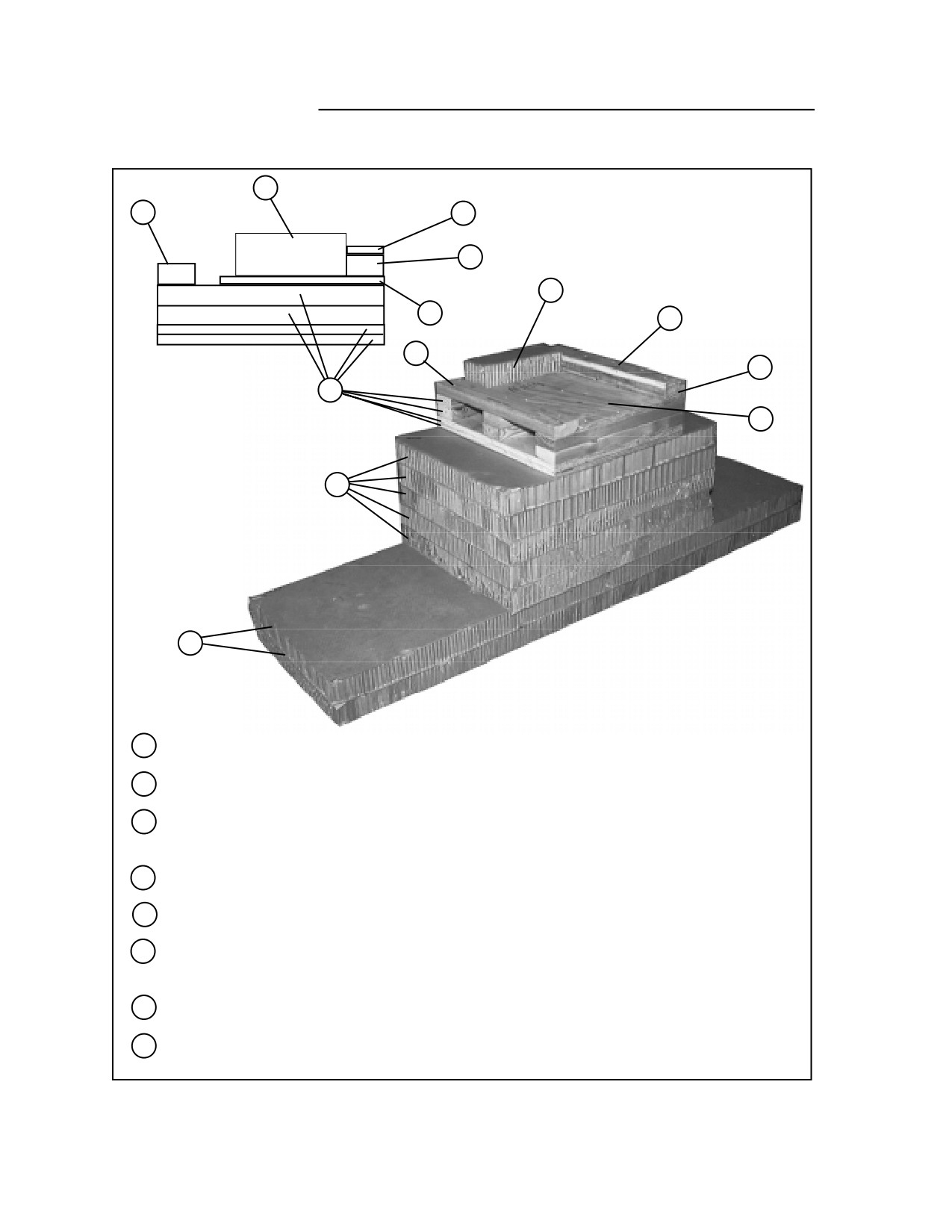
Glue three 43- by 26-inch pieces of honeycomb together to form a base.
2
Center and glue three 43- by 18-inch pieces of honeycomb over the base.
3
Nail two 43- by 18-inch pieces of 3/4-inch plywood flush together.
4
Nail a 43-inch piece of 2- by 4-inch lumber flat side down, parallel to each long side, and 3
inches from each long edge of the plywood.
5
Make a 3 1/2- by 5-inch cutout as shown in a third 3/4- by 43- by 18-inch piece of plywood. Nail
the plywood to the lumber and flush with the bottom pieces of plywood. Glue the wood section
of the stack flush on the honeycomb placed in step 2 above.
6
Make the cutout as shown in two 39- by 18-inch pieces of honeycomb. Glue the honeycomb
flush with the right edge of the plywood, with the cutout facing the rear of the stack.
Figure 4-18. Stack 2 Prepared
4-23
FM 4-20.117/TO 13C7-1-111
8
Note: This drawing is not drawn to scale.
4
7
1234567890
1234567890
1234567890
6
8
5
7
FRONT
4
6
3
5
2
FRONT
1
1
Glue two 80- by 24-inch pieces of honeycomb together to form a base.
2
Center and glue five 35- by 24-inch pieces of honeycomb on the base.
3
Nail two 21- by 24-inch pieces of 3/4-inch plywood to each other and to six 21-inch pieces of
2- by 4-inch lumber. Nail the lumber flush along the sides and in the center of the plywood.
4
Nail a 24-inch piece of 2- by 4-inch lumber flush along the right side.
5
Nail a 17- by 24-ich piece of 3/4-inch plywood flush with the left side.
6
Nail a 24-inch piece of 2- by 4-inch lumber flush with the left edge of the plywood placed in
step 5 above.
7
Nail a 3 1/2- by 24-inch piece of 3/4-inch plywood flush over the lumber placed in step 6 above.
8
Glue a 13- by 5-inch piece of honeycomb along the rear edge of the plywood flush against the
plywood and lumber placed in steps 6 and 7 above.
Figure 4-19. Stack 3 Prepared
4-24
FM 4-20.117/TO 13C7-1-111
Stack3
Stack
2Stack 2
Stack 1
REAR
5
FRONT
88
149
Note: This drawing is not drawn to scale.
Stack
Number
Position of Stack on Platform
Place stack:
1
5 inches from the front edge of the platform and centered.
2
88 inches from the front edge of the platform and centered. Face the
cutout to the rear.
3
149 inches from the front edge of the platform and centered.
Figure 4-20. Honeycomb Stacks Positioned on Platform
4-25
FM 4-20.117/TO 13C7-1-111
PREPARING TRUCK
4-18. Prepare the truck as described below.
a. Prepare the cab of the truck as shown in Figures 2-8, steps 3 through
10.
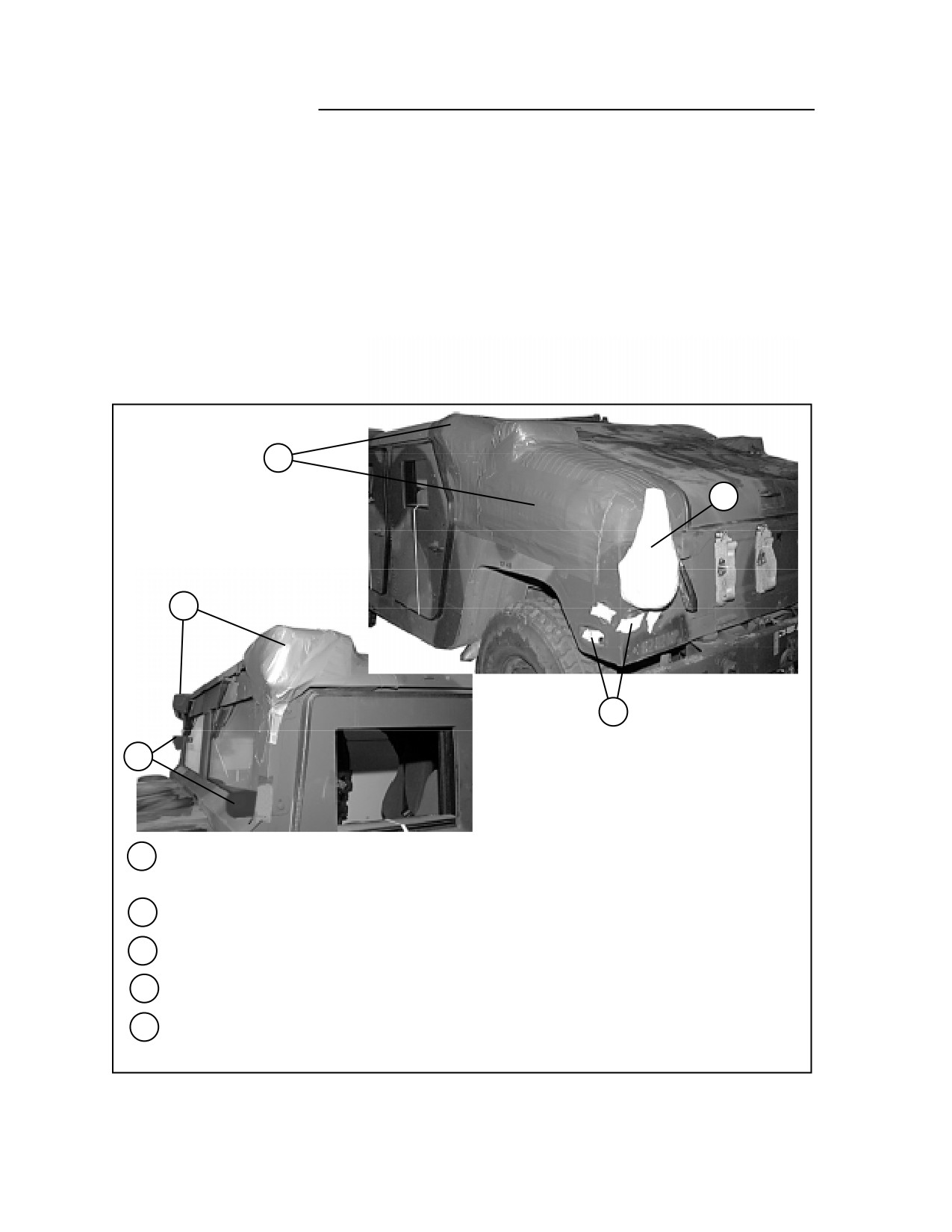
b. Prepare the body of the truck as shown in Figure 4-21.
c. Prepare the underside of the truck as shown in Figure 4-22.
d. Prepare the hood and roof of the truck as shown in Figure 4-23.
3
4
1
2
5
1
Remove the four Light Vehicle Obscuration Smoke System (LVOSS) units from the roof
corners. Pad the brackets with felt and cellulose wadding.
2
Tape all lights and reflectors.
3
Pad the air vents and roof corners with felt taped in place.
4
Pad the antenna mounts with cellulose wadding taped in place.
5
Remove the mirrors, pad and tape them, and tie them under the driver's seat. Pad the mirror
brackets with felt taped in place.
Figure 4-21. Truck Body Prepared
4-26
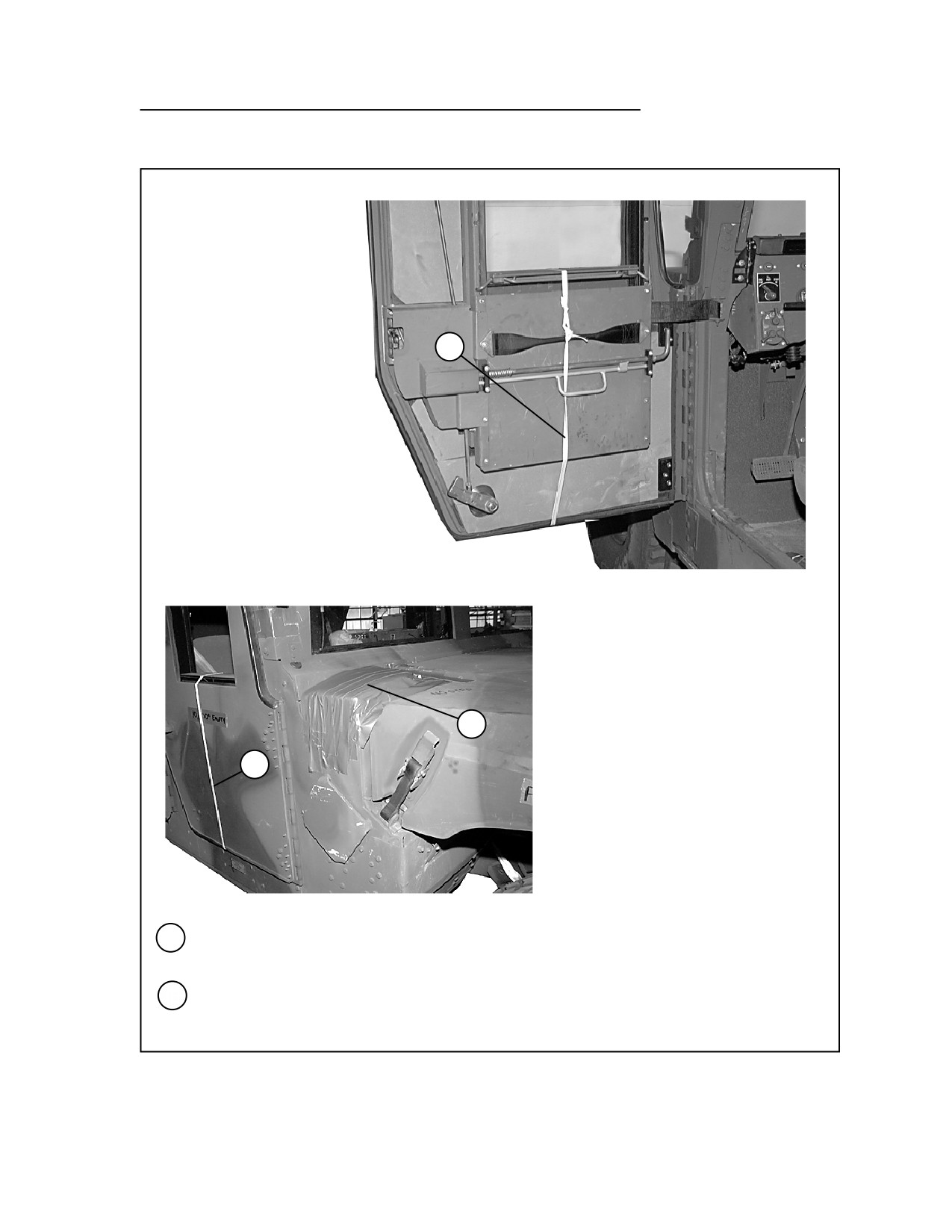
FM 4-20.117/TO 13C7-1-111
6
7
6
6
Lower all windows. Tie them in the lowered position with 1/2-inch tubular nylon webbing.
7
Remove the breather cap and fording stack. Place a layer of felt over the air intake hole, and
tape the felt in place.
Figure 4-21. Truck Body Prepared (continued)
4-27
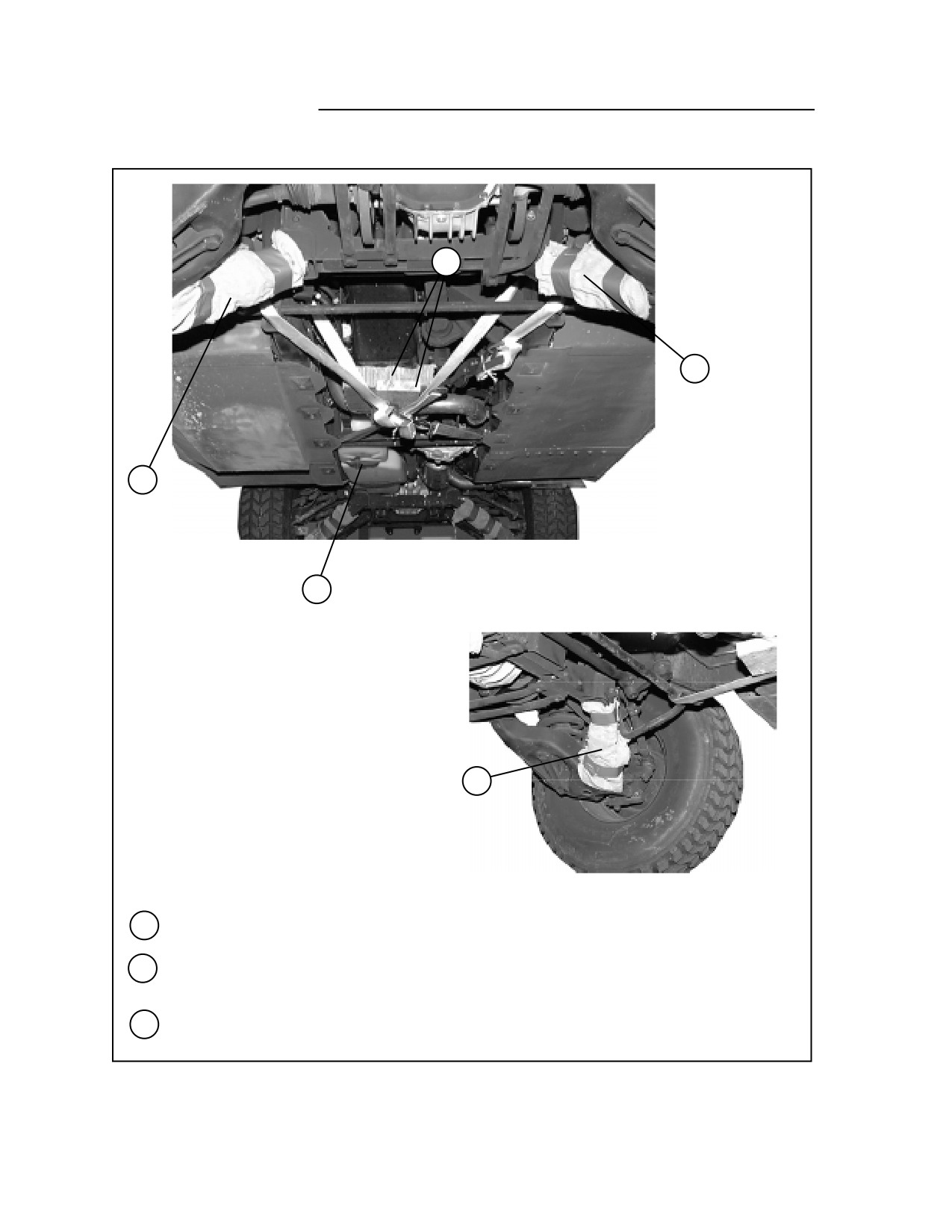
FM 4-20.117/TO 13C7-1-111
3
2
2
1
2
1
Tape the fuel tank drain plug .
2
Pad the lower control arms at the front and rear of the truck with cellulose wadding taped in
place.
3
Have a 12- by 12-inch piece of honeycomb and a 16-inch length of 2- by 6-inch lumber ready
to place under the oil pan as shown.
Figure 4-22. Underside of Truck Prepared
4-28
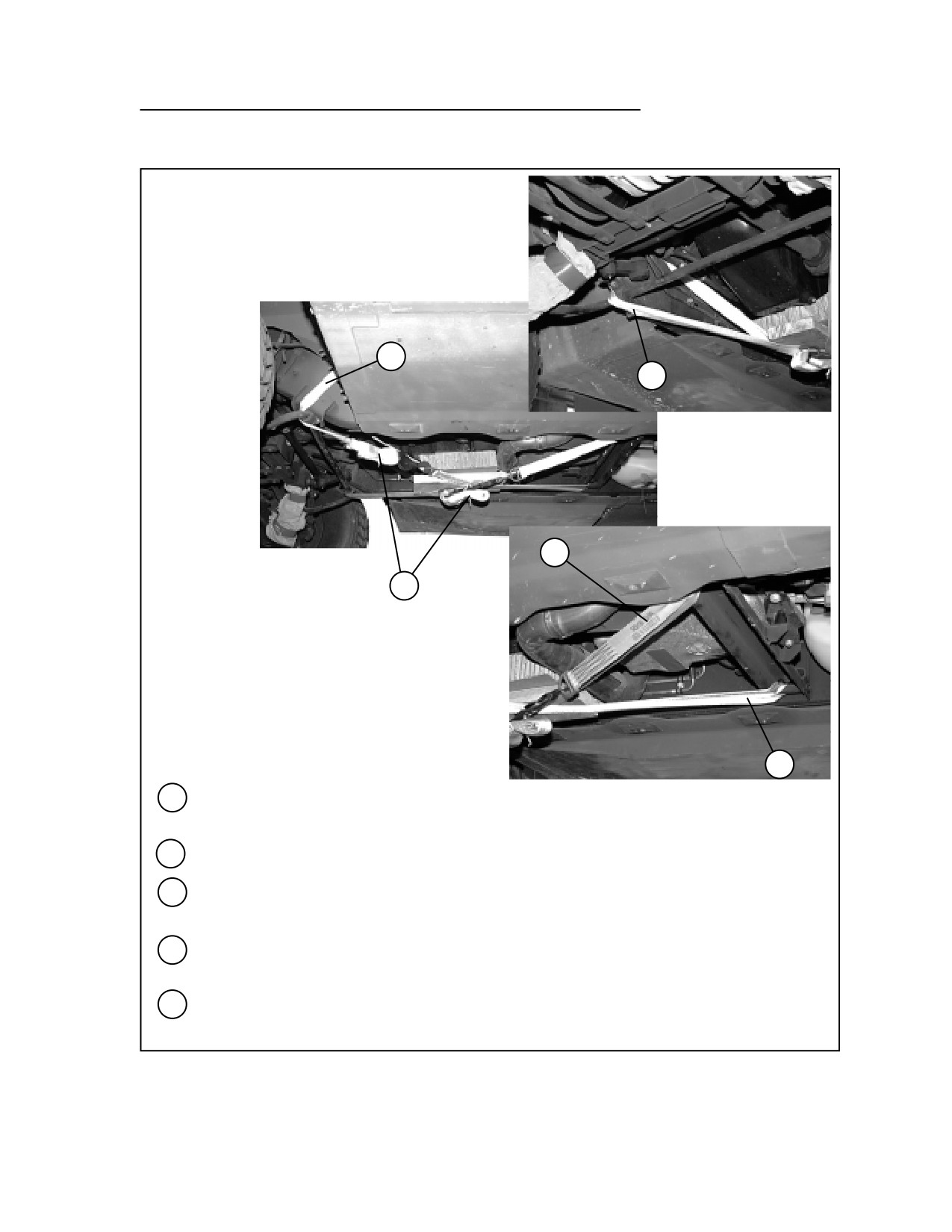
FM 4-20.117/TO 13C7-1-111
5
4
6
8
7
4
Route a 15-foot lashing around the right frame member and to the front side of the stabilizer
bar.
5
Route a second 15-foot lashing around the left frame member and around the stabilizer bar.
6
Route the free end of the lashing placed in step 4 around the radius rod on the left side of the
crossmember in front of the fuel tank.
7
Route the free end of the lashing placed in step 5 around the radius rod on the right side of the
crossmember in front of the fuel tank.
8
Tighten and secure both lashings over the honeycomb and lumber placed under the oil pan.
Separate the load binders so that they do not interfere with each other.
Figure 4-22. Underside of Truck Prepared (continued)
4-29
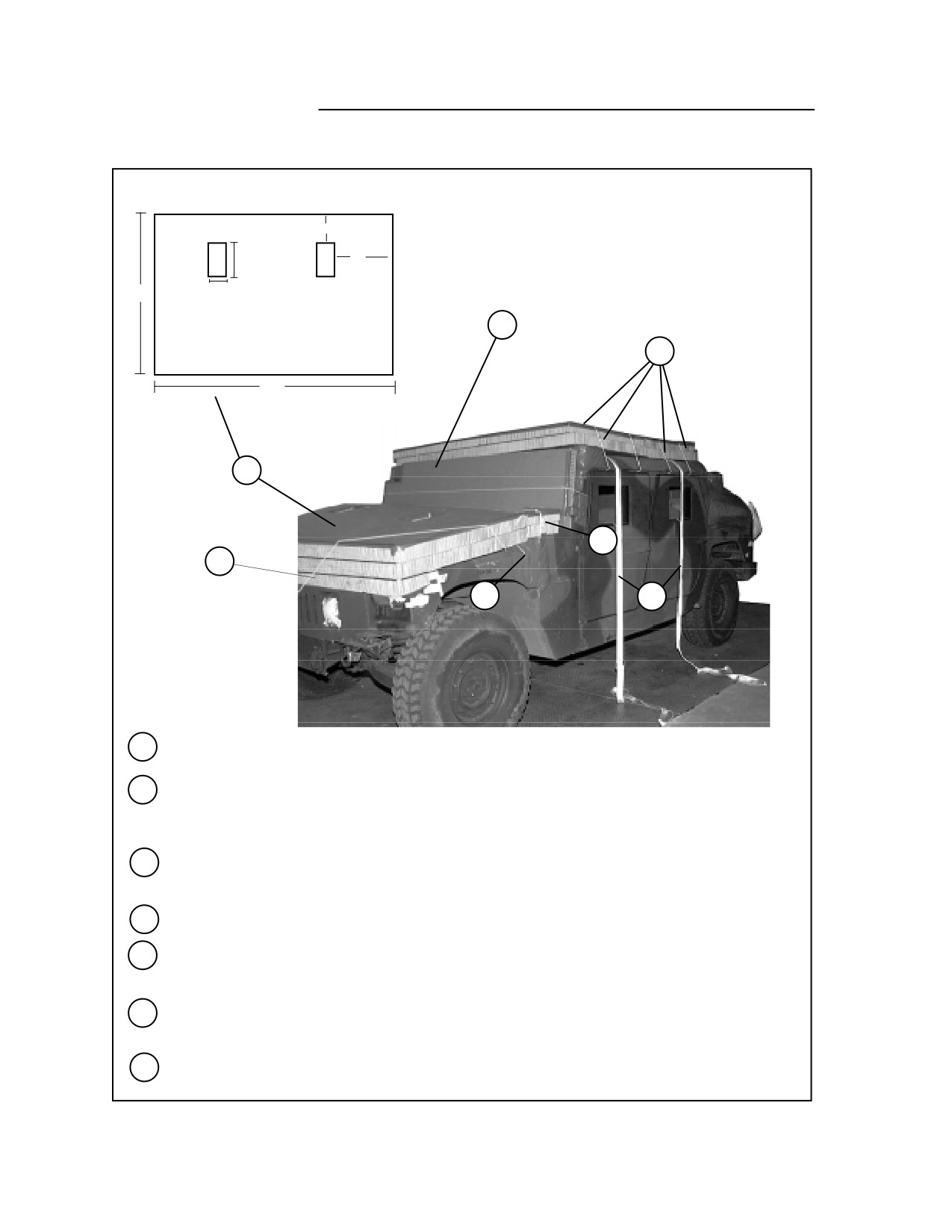
FM 4-20.117/TO 13C7-1-111
8
Notes:
1. This drawing is not drawn to scale.
9
20
2. All dimensions are in inches.
6
36
5
7
83
2
3
1
4
6
1 Place a 4- by 78-inch piece of honeycomb along the front edge of the hood.
2
Tie two 83- by 36-inch pieces of honeycomb with cutouts as shown to the hood with type III
nylon cord. Tape the upper edges of the honeycomb. Route the cord through the grille and tie it
on each side to the hood latches.
3
Place two 83- by 12-inch pieces of honeycomb behind the honeycomb placed in step 1. Tape
the upper outside edges, and tie the honeycomb to the hood latches with type III nylon cord.
4
Tape the hood latches.
5
Tie an 83- by 21-inch piece of honeycomb to the windshield. Tape the outside edges and tie the
type III nylon cord through the door openings and around the honeycomb.
6
Center two 30-foot lashings across the width of the roof. Center one lashing over the front
window openings, and one lashing over the rear window openings.
7
Place four full sheets of honeycomb on the roof. Crush or cut out to allow for the turret fixtures.
Tape the upper edges of the honeycomb. Tie the honeycomb to the roof through the door
Figure 4-23. Hood and Roof Covered
4-30
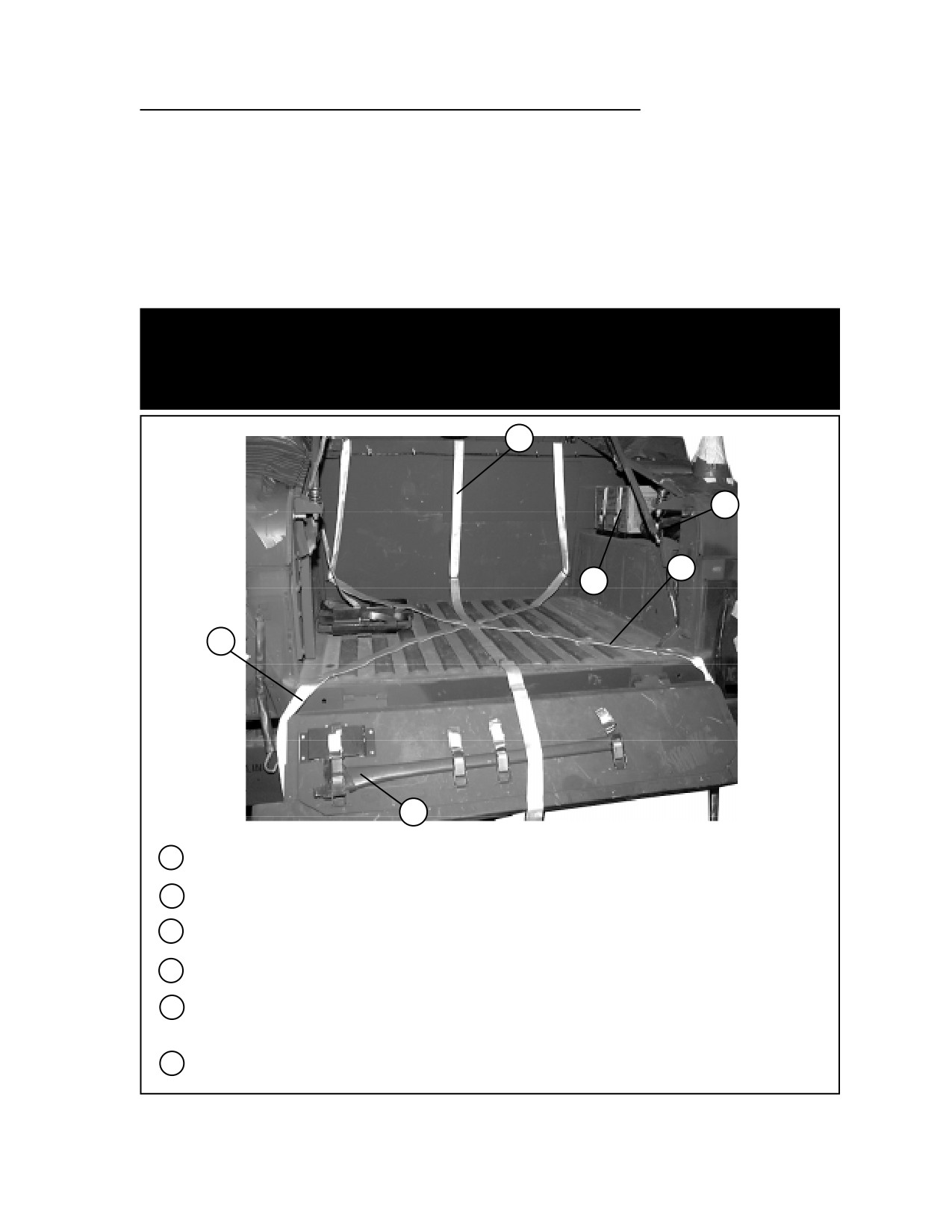
FM 4-20.117/TO 13C7-1-111
Stowing Load in M1114 Truck
4-19. Stow mission equipment in the truck cargo compartment as shown in
Figure 4-24. Stow items in the cab area as shown inFigure 4-25. Install the
wood side protection boards as shown in Figure 4-26.
CAUTION
Only ammunition listed in FM 10-500-53/MCRP 4-3.81/TO 137-18-41
may be airdropped. Package, label, and mark hazardous material according to AFJMAN 24-204/
TM 38-250.
3
5
2
6
1
4
1
Route a lashing through the left rear and right front cargo bed rings.
2
Route a lashing through the right rear and left front cargo bed rings.
3
Route a lashing through the front center and rear center cargo bed rings.
4
Secure the axe in its mount on the tailgate with the straps provided.
5
Secure the jack and MAX tool kit in the right storage area over the wheel well with the straps
provided.
6
Place one box of 9-mm ammunition in the right wheel well cargo area and secure it with
the straps provided.
Figure 4-24. Accompanying Load Stowed in Cargo Bed
4-31
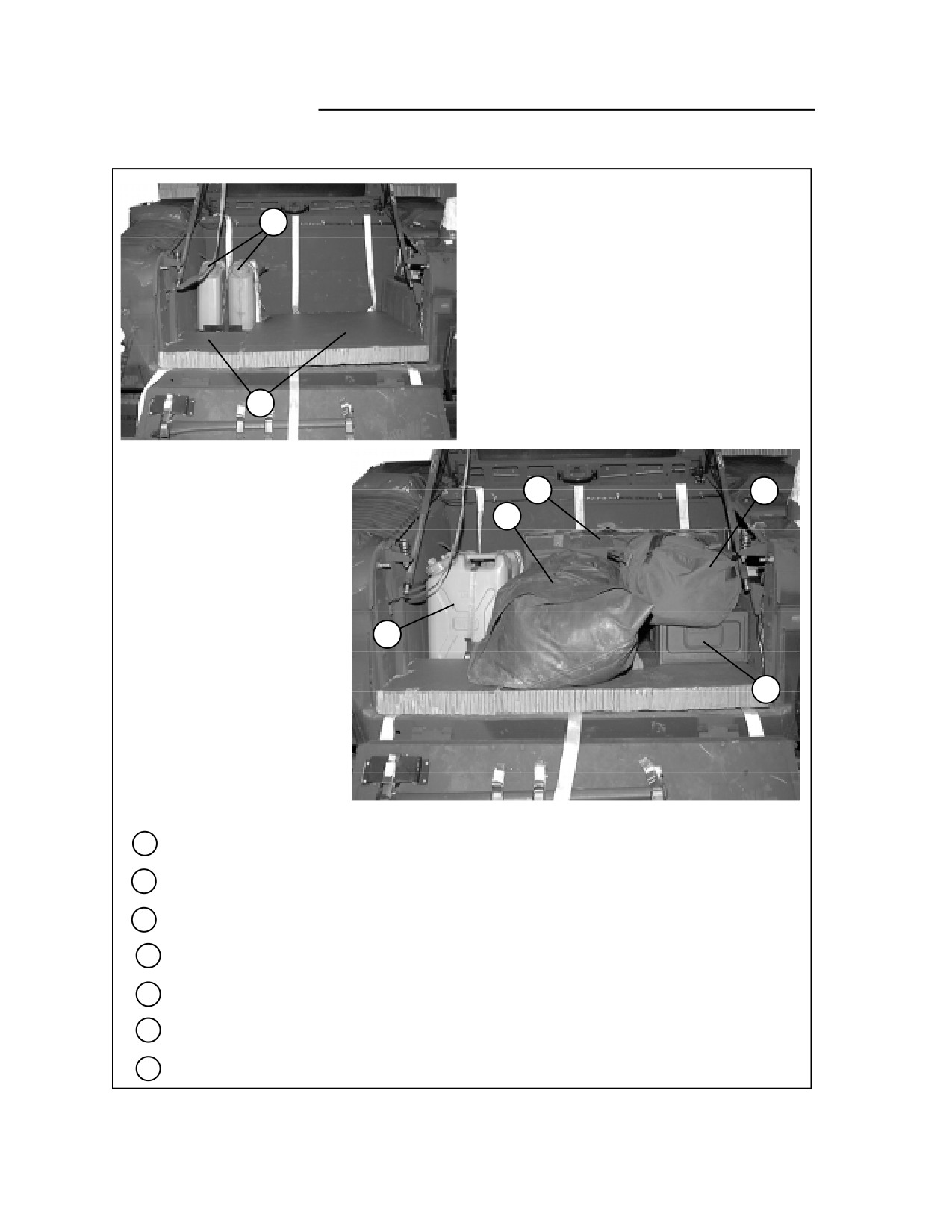
FM 4-20.117/TO 13C7-1-111
8
7
10
13
11
9
12
7
Cover the hatch bed with a 36- by 47-inch and a 15- by 20-inch piece of honeycomb.
8
Secure two fuel cans in the stowage brackets with the straps provided.
9
Secure one water can behind the fuel cans in the stowage bracket with the straps provided.
10
Place the route signing kit in the right front.
11
Place the Light Scattering-Screen (LSS) nets in the center.
12
Place the Enemy Prisoner of War (EPW) kit to the right of the LSS nets.
13
Place the team bag over the EPW kit box.
Figure 4-24. Accompanying Load Stowed in Cargo Bed (continued)
4-32
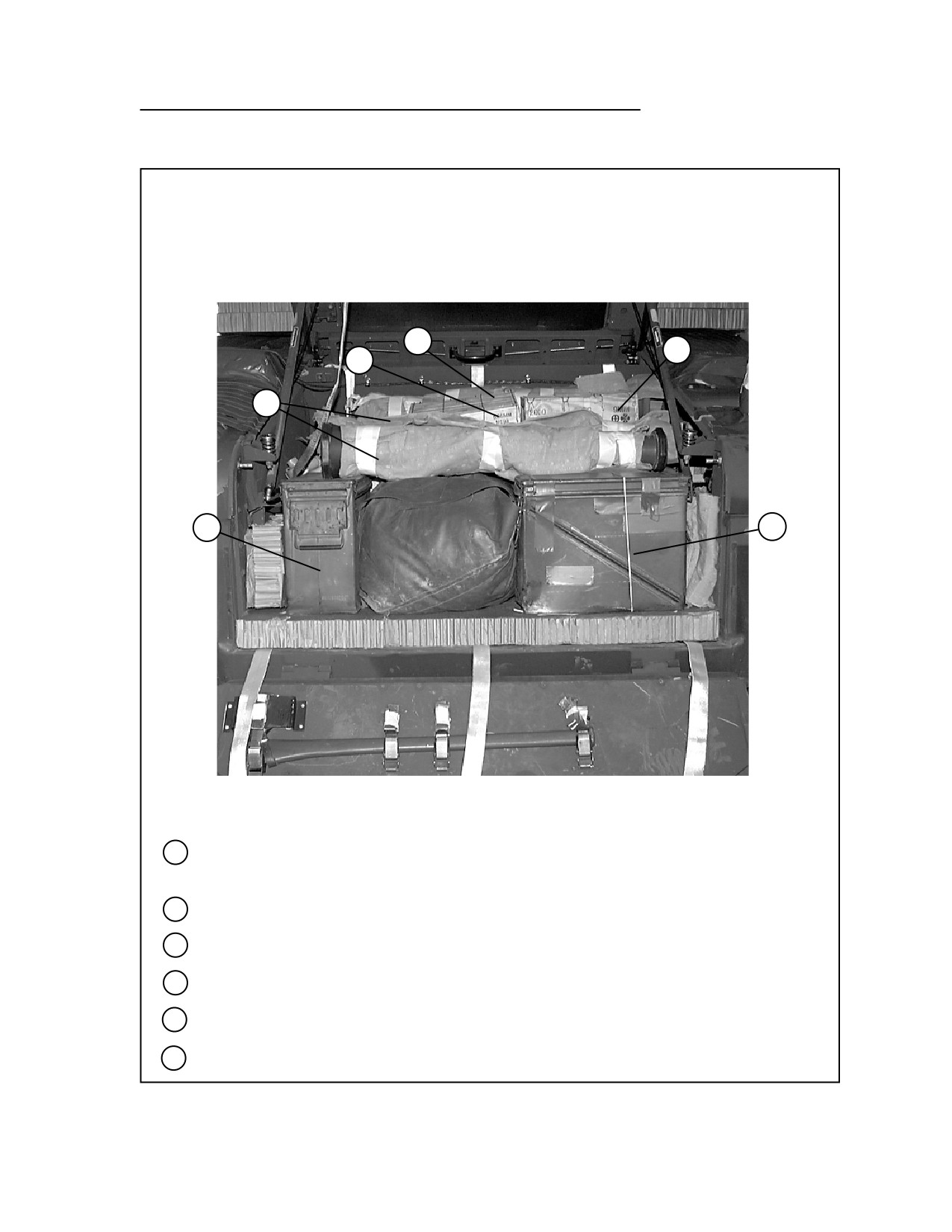
FM 4-20.117/TO 13C7-1-111
14
15
16
19
17
18
14
Wrap all three AT4's with cellulose wadding and tape. Place the first AT4 over the route signing
kit.
15
Place a box of 9-mm ammunition over the team bag.
16
Place a box of 5.56 ammunition over the LSS net bag.
17
Place a can of 40-mm linked ammunition in the left rear.
18
Place a can of 40-mm linked ammunition in the right rear.
19
Place the two remaining AT4's over the 40-mm ammunition, team bag, and LSS bag.
Figure 4-24. Accompanying Load Stowed in Cargo Bed (continued)
4-33
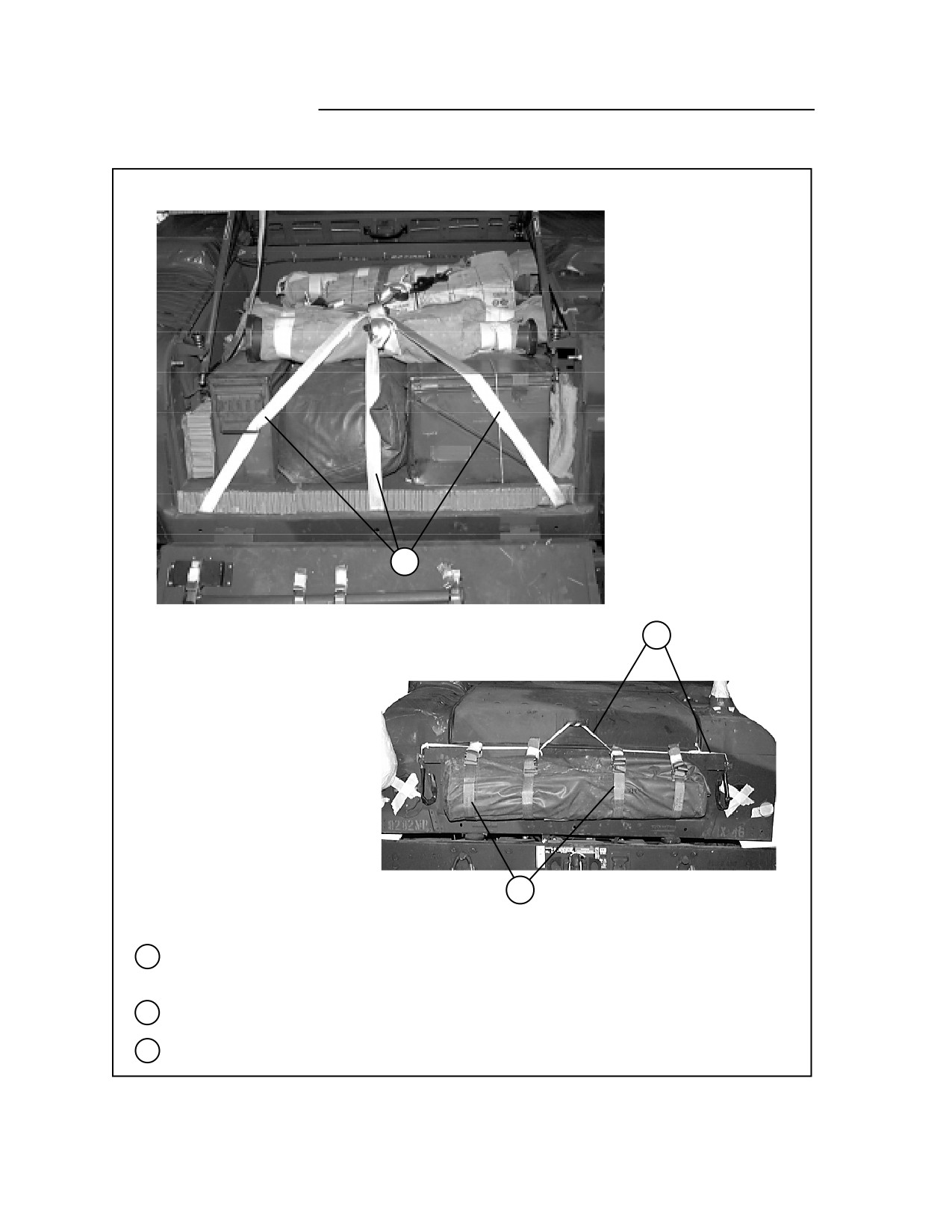
FM 4-20.117/TO 13C7-1-111
20
21
22
20
Secure the three lashings placed in steps 1 through 3 over the load with D-rings and load
binders. Pass the lashing through box handles where possible.
21
Secure the tailgate shut with 1/2-inch tubular nylon webbing.
22
Secure the LSS pole bag to the tailgate with the straps provided. Tape the loose strap ends.
Figure 4-24. Accompanying Load Stowed in Cargo Bed (continued)
4-34
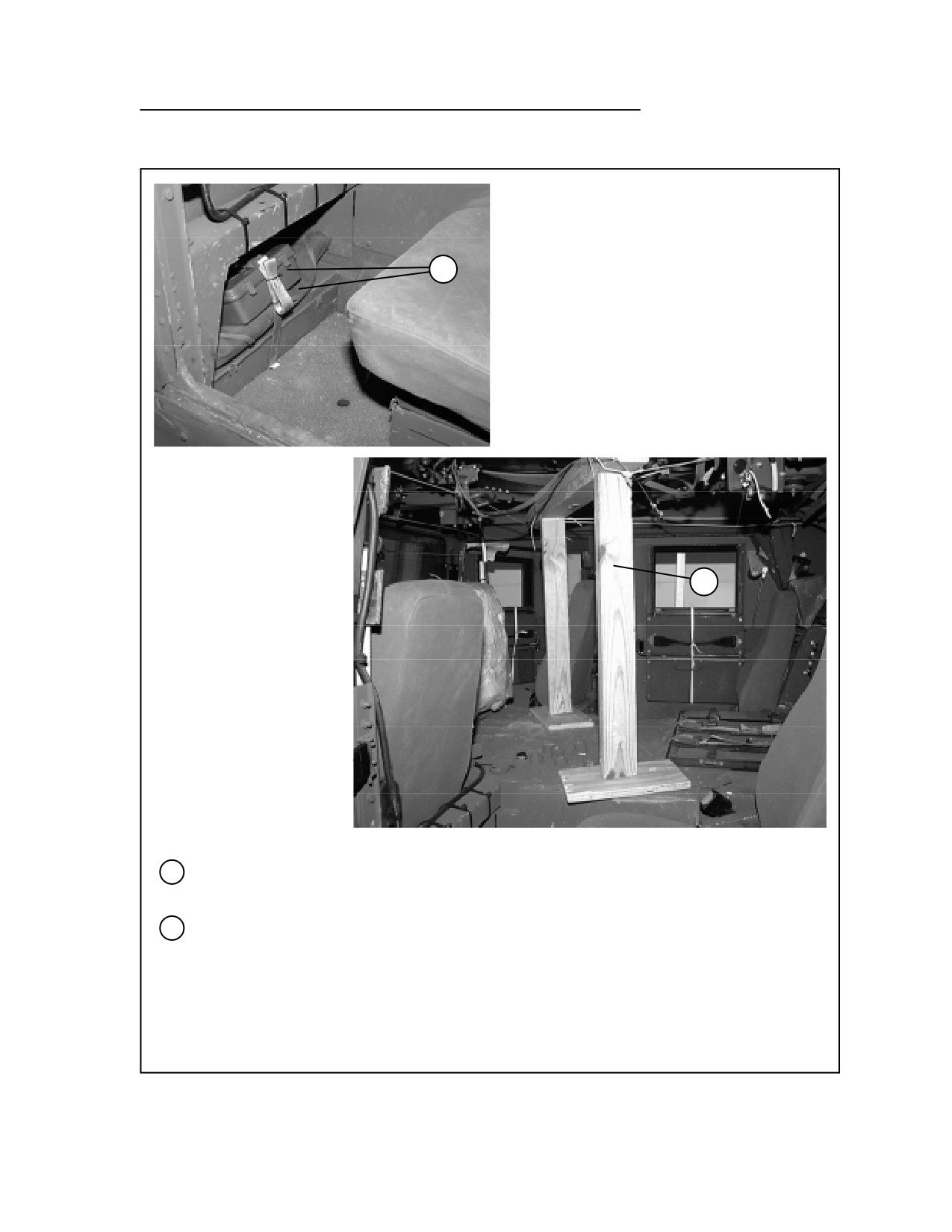
FM 4-20.117/TO 13C7-1-111
1
2
1
Place the warning triangle and the first aid kit behind the driver's seat and secure them with
the strap provided.
2
Build the turret support according to Figure 3-2. Place the turret support under the turret
across its diameter in a left rear to right front direction. Tie the support to convenient points on
the turret with 1/2-inch tubular nylon webbing. Tie the turret brake in the DOWN position with
type III nylon cord. Secure the three turret latches to holes in the turret ring with type III nylon
cord.
Note: Figure 7-6 shows additional detail for securing the turret support.
Figure 4-25. Accompanying Load Stowed in Cab
4-35
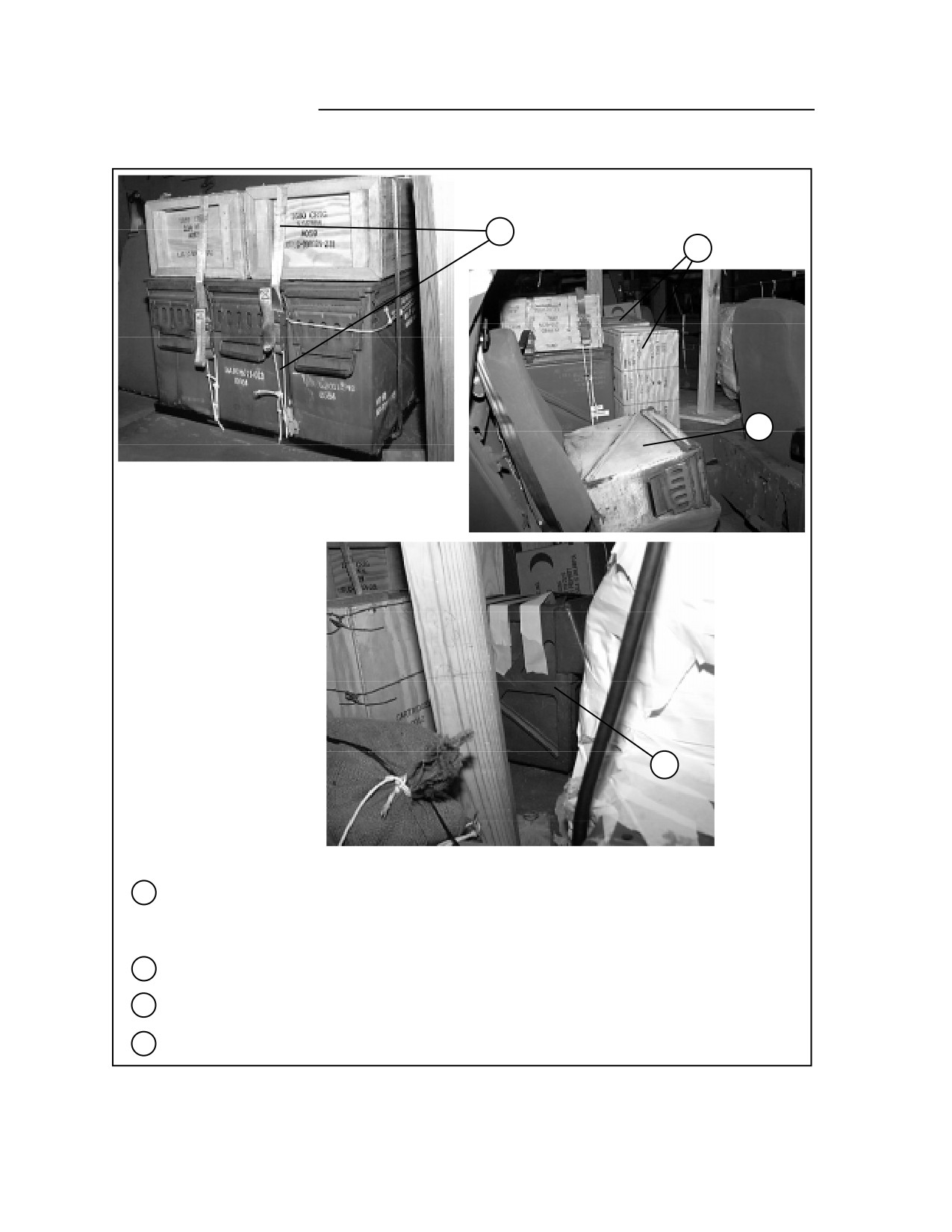
FM 4-20.117/TO 13C7-1-111
3
4
5
6
3
Place three boxes of 40-mm linked ammunition in the space provided between the seats.
Place two boxes of 5.56-mm ammunition on the 40-mm boxes. Secure the ammunition with
the straps provided. Safety the strap fasteners with type III nylon cord.
4
Place two 5.56-mm ammunition boxes in front of the ammunition placed in step 3.
5
Place a box of 40-mm linked ammunition on the right rear passenger seat.
6
Place the MOD60 kit to the left of the 5.56-mm ammunition boxes placed in step 4.
Figure 4-25. Accompanying Load Stowed in Cab (continued)
4-36
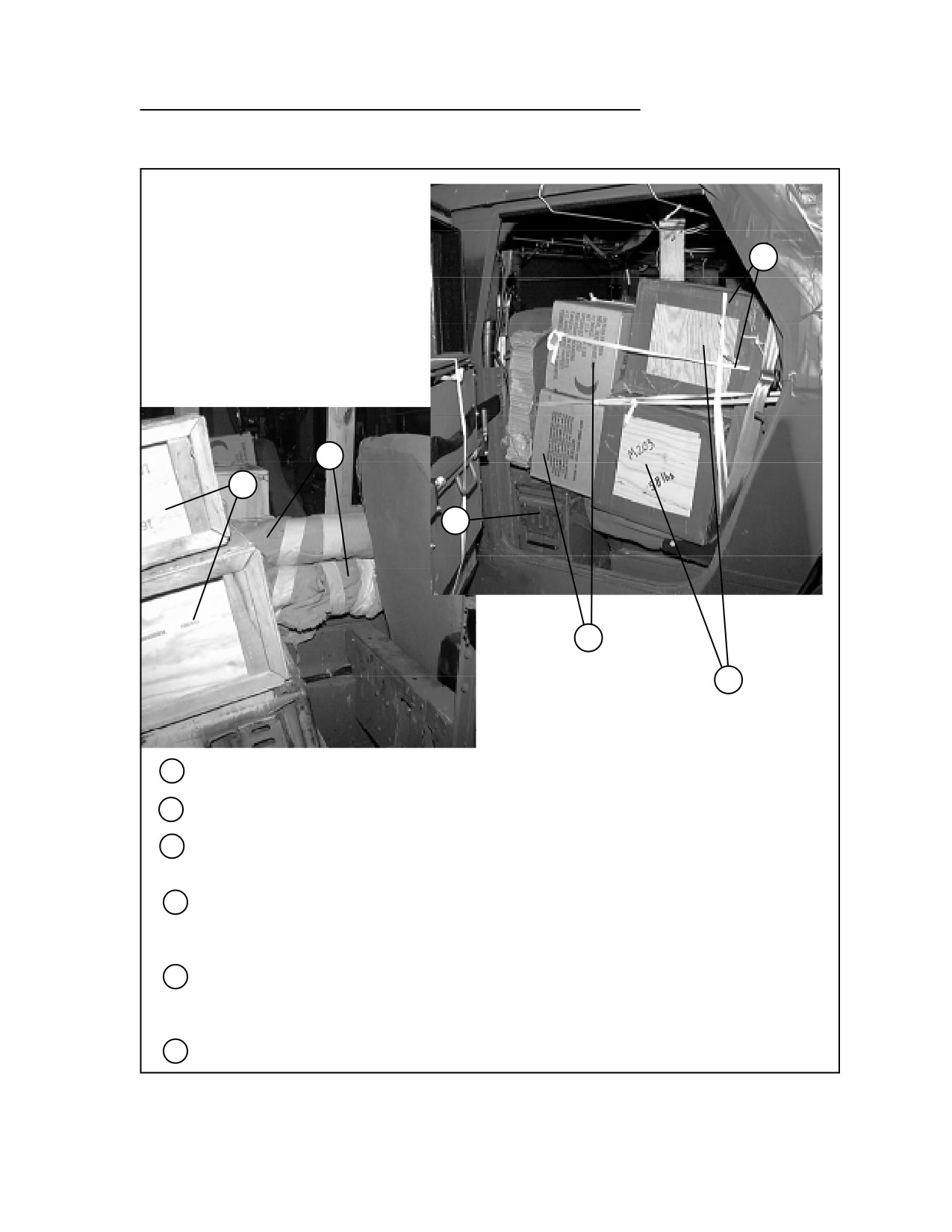
FM 4-20.117/TO 13C7-1-111
10
11
12
7
8
9
7
Place a box of 40-mm linked ammunition upright on the floor behind the driver's seat.
8
Set two boxes of MRE's on their sides over the 40-mm ammunition box.
9
Place a box of claymore mines and a box of M203 grenade rounds between the left rear seat
back and the boxes placed in steps 7 and 8.
10
Tie the items placed in steps 7 through 9 to the seat back and to stationary points in the truck
with 1/2-inch tubular nylon webbing. Place a piece of honeycomb between the driver's seat
back and the tied items.
11
Wrap the Mark 19 grenade launcher, tripod, and fording stack with cellulose wadding and tape.
Place them in the cab center between the passenger seats. Secure them to points near the
floor with type III nylon cord.
12
Place two 5.56-mm ammunition boxes over the 40-mm ammunition box placed in step 5.
Figure 4-25. Accompanying Load Stowed in Cab (continued)
4-37
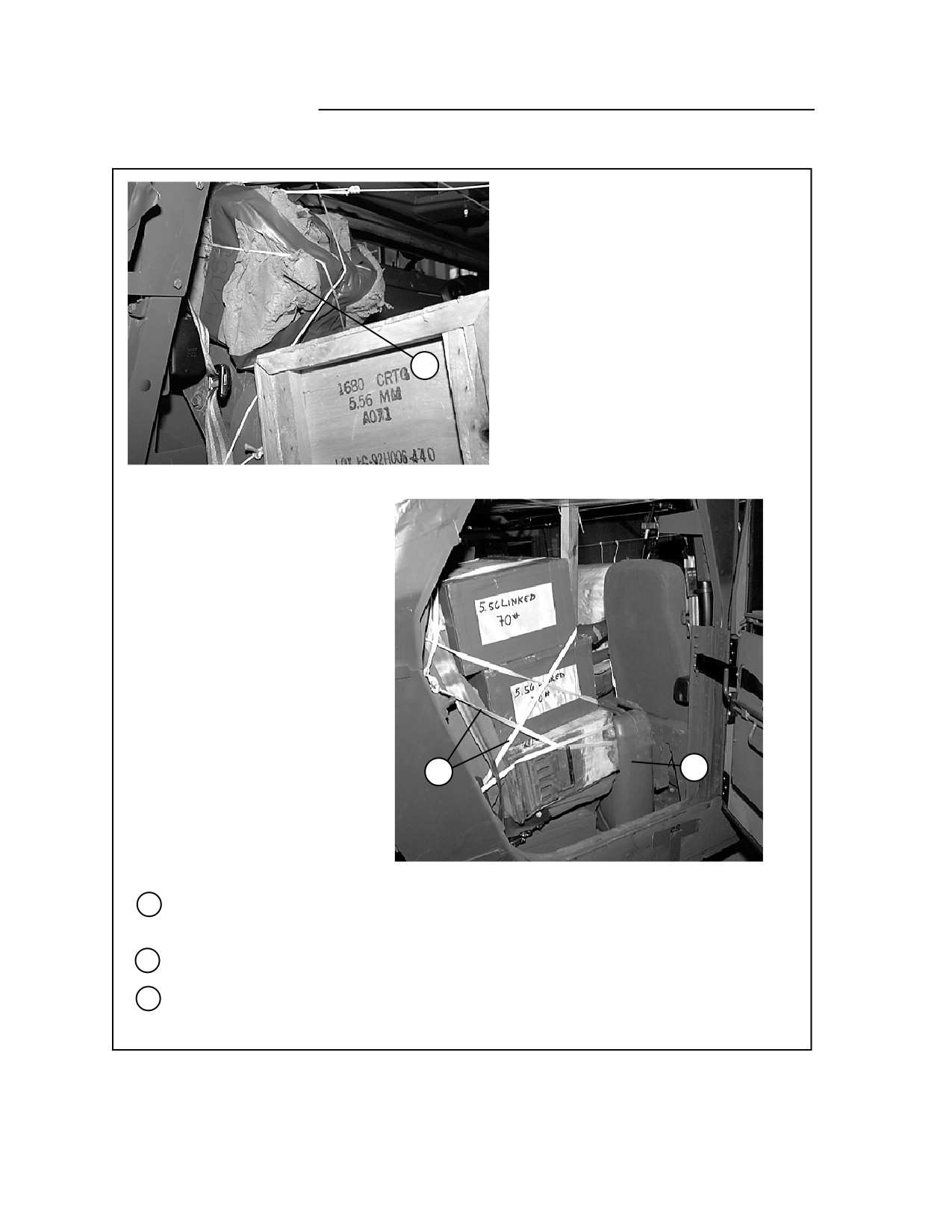
FM 4-20.117/TO 13C7-1-111
13
14
15
13
Place a LVOSS unit and a chock block behind each rear seat. Wrap the LVOSS unit with
cellulose wadding and tape. Secure them to the seat back with type III nylon webbing.
14
Place and secure a water can on the floor behind the front passenger seat.
15 Tie the ammunition boxes to the seat back and to stationary points with 1/2-inch tubular nylon
webbing.
Figure 4-25. Accompanying Load Stowed in Cab (continued)
4-38
FM 4-20.117/TO 13C7-1-111
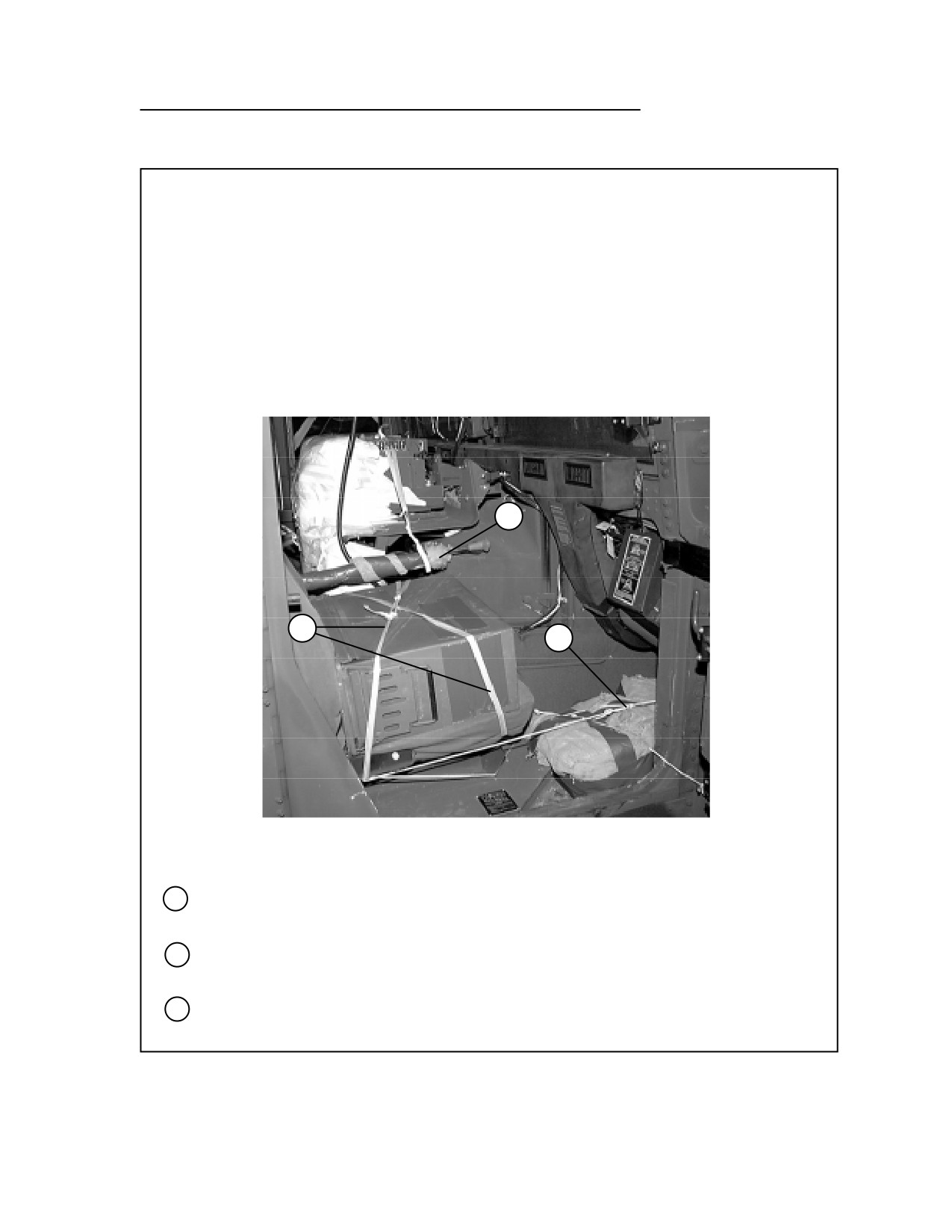
17
16
18
16
Tie a box of 40-mm linked ammunition to the front passenger seat with 1/2-inch tubular nylon
webbing.
17
Wrap the antenna sections with cellulose wadding and tape. Tie the antenna sections to
convenient points with 1/2-inch tubular nylon webbing.
18
Pad the remaining LVOSS units with cellulose wadding and tape. Tie them in the front
passenger footwell with 1/2-inch tubular nylon webbing.
Figure 4-25. Accompanying Load Stowed in Cab (continued)
4-39
FM 4-20.117/TO 13C7-1-111
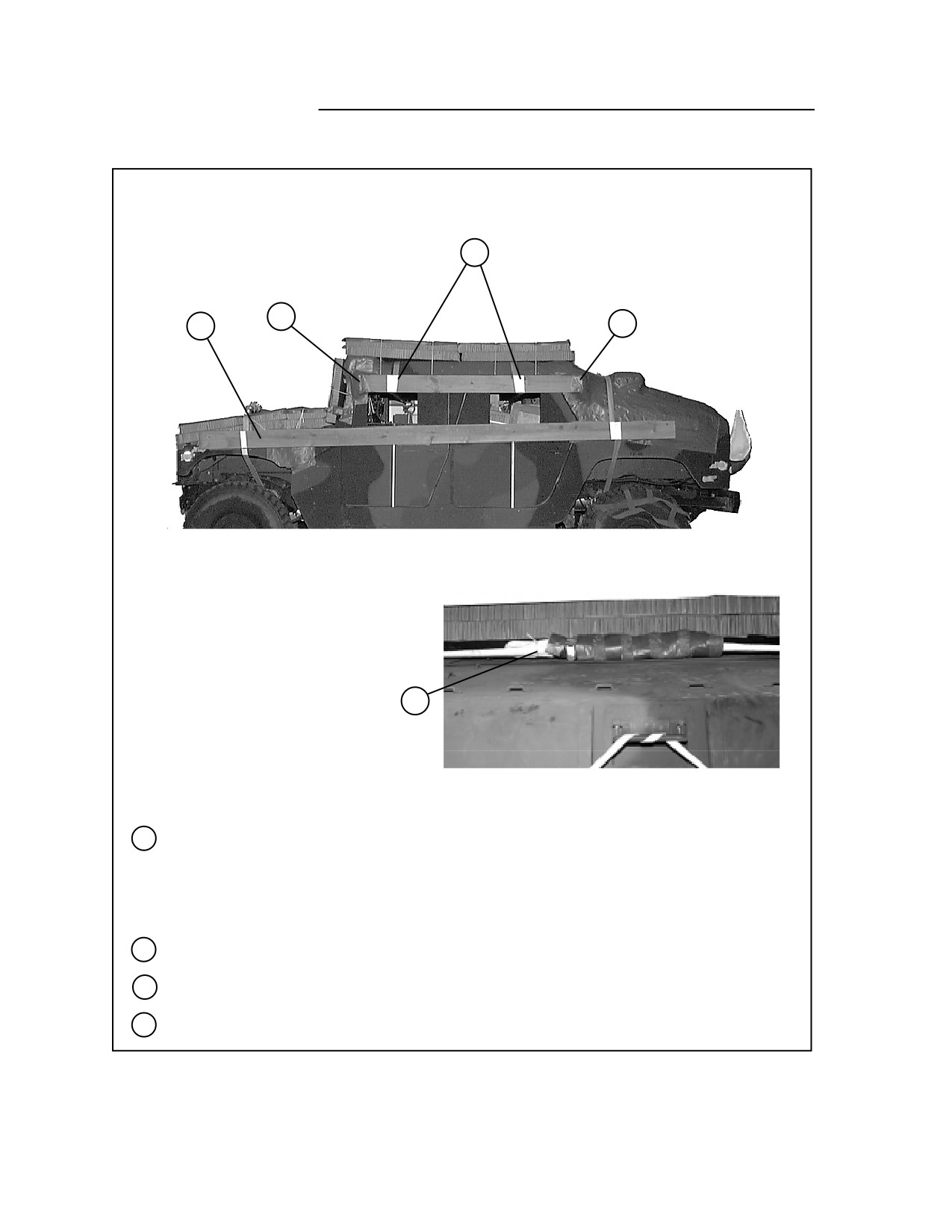
1
2
3
2
4
1
Cut a 45-degree bevel in each end of two 69 1/2- by 2- by 6-inch pieces of lumber. Hold the
lumber even with the top of the window openings, with the beveled cuts facing outward. Extend
the free ends of the lashings placed in Figure 4-24, step 12 down around the lumber, around
the board once, and through the door openings. Secure the ends of the lashings to each other
inside the truck.
2
Pad the ends of the gutter boards placed in step 1 above with felt and tape.
3
Make and install two body side protection boards according to Figure 2-13, steps 3 through 6.
4
Pad the load binder for the lashing over the rear of the truck with felt and tape.
Figure 4-26. Body Side Protection Boards Installed
4-40
FM 4-20.117/TO 13C7-1-111
LIFTING AND POSITIONING TRUCK, AND INSTALLING OPTIONAL DRIVE-OFF AIDS
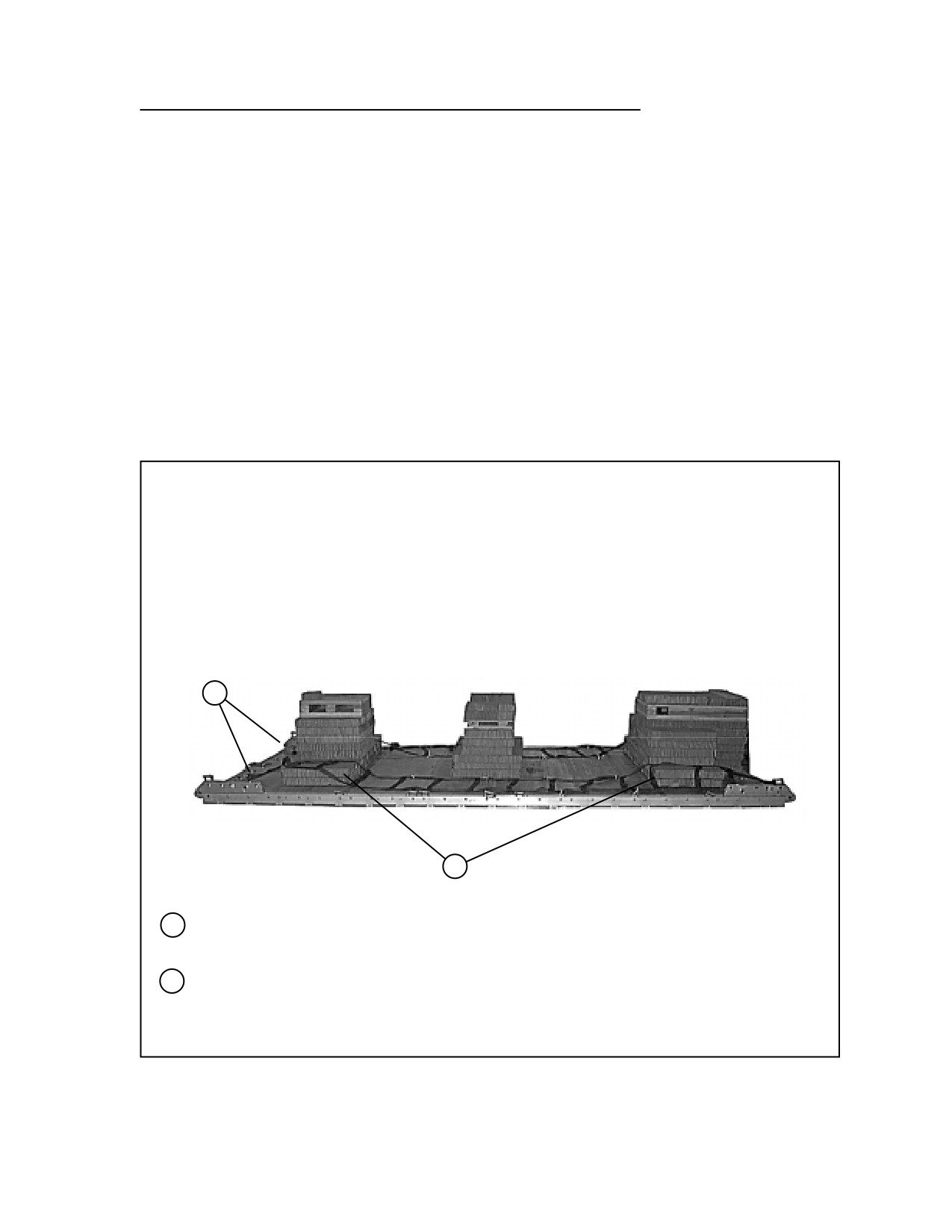
4-20. Install the optional drive-off aids on the platform as shown in Figure 4-27.
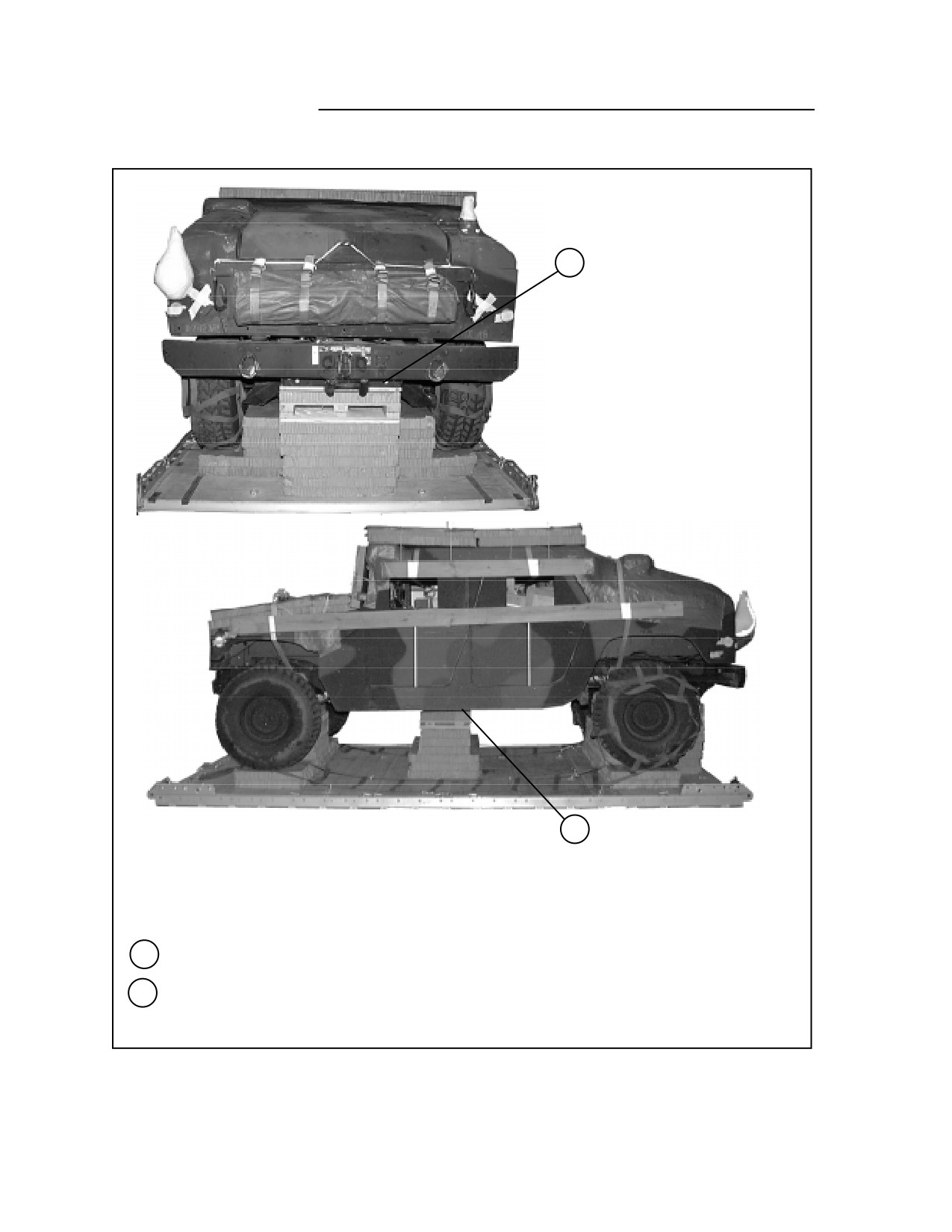
Install lifting slings on the truck as shown in Figure 2-16. Position the truck on
the honeycomb stacks as shown in Figure 4-28. Install the drive-off aids, if used,
to the rear wheels of the truck as shown in Figure 2-17.
LASHING TRUCK
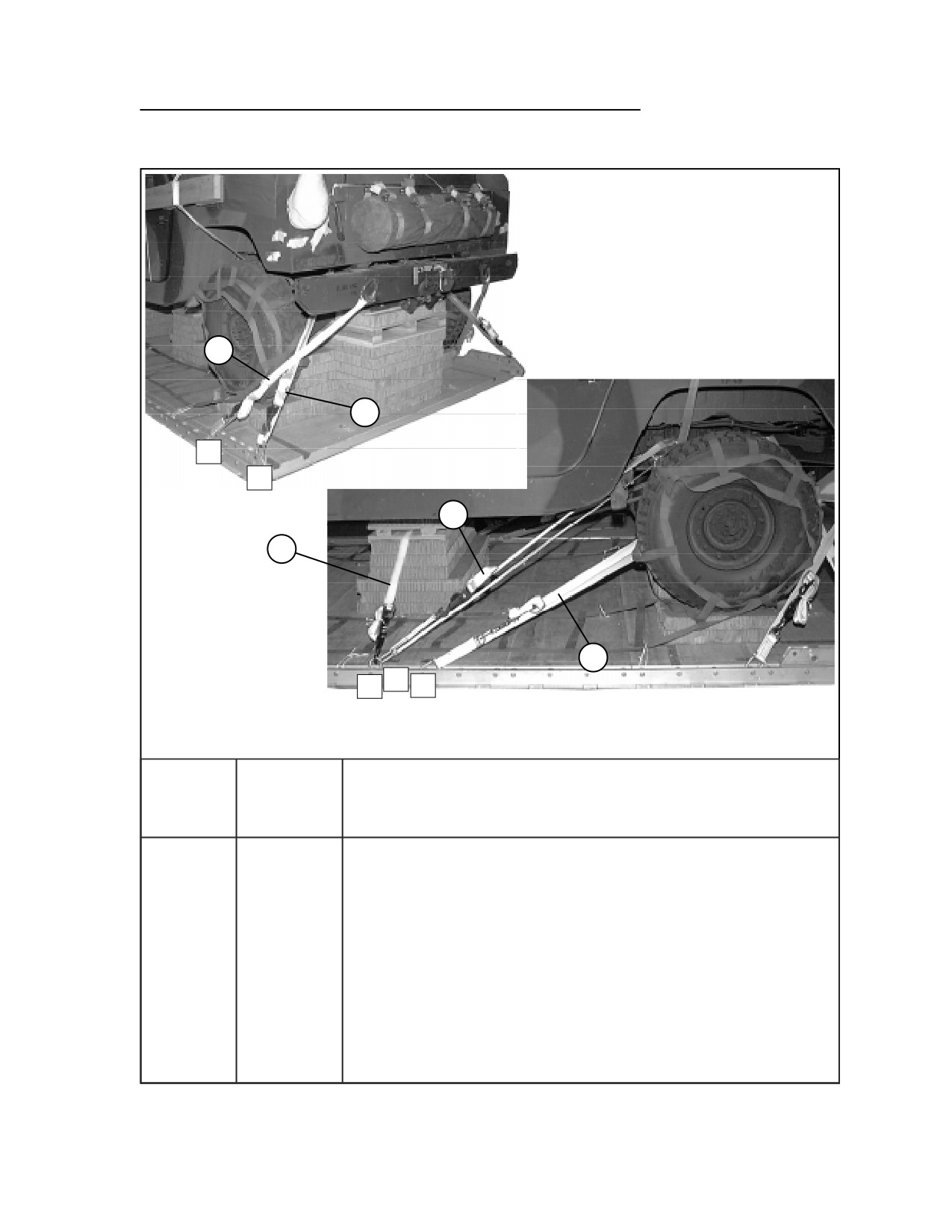
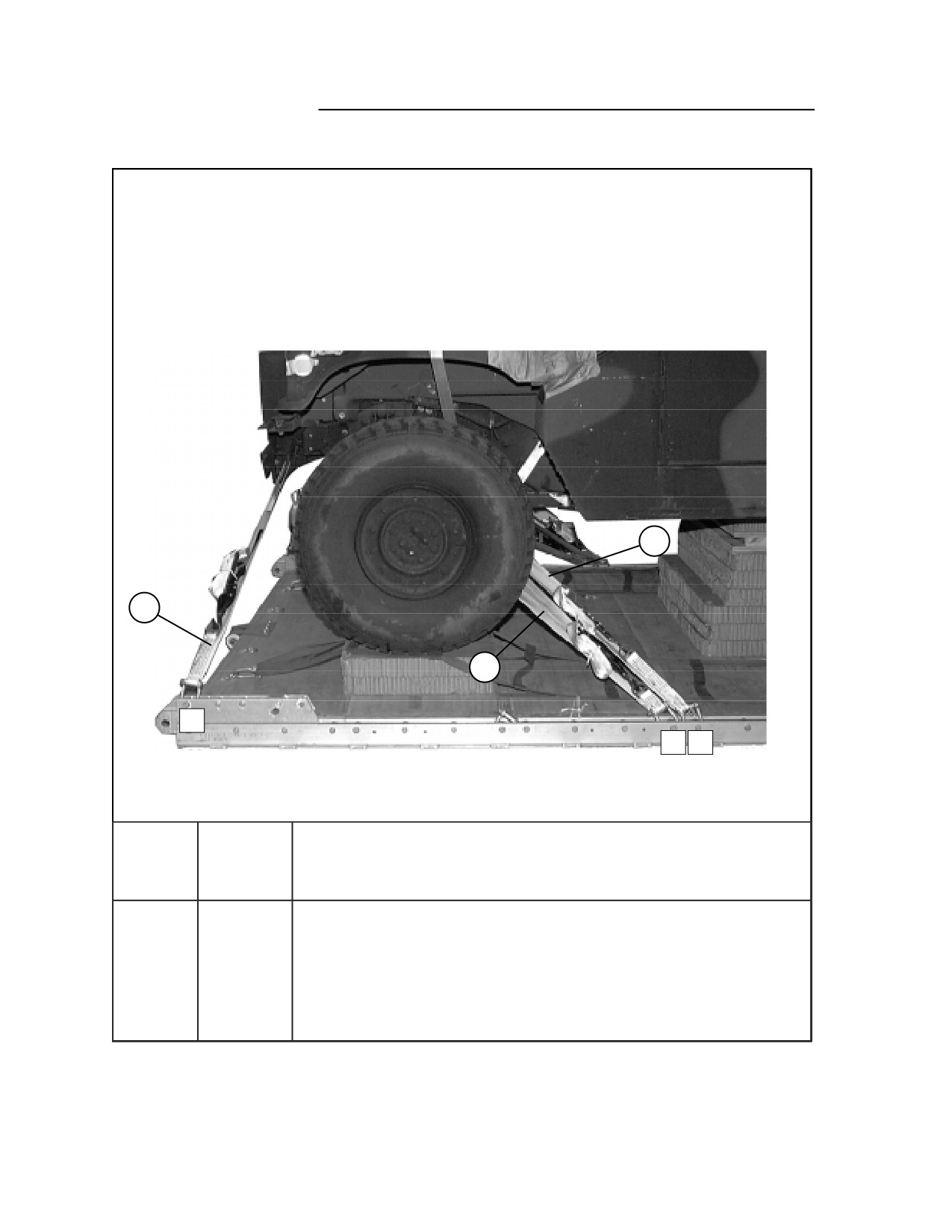
4-21. Lash the truck to the platform with fifteen 15-foot tie-down assemblies as
shown in Figures 4-29 and 4-30, and according to FM 4-20.102/NAVSEA SS400-
AB-MMO-010/TO 13C7-1-5.
1
2
1
Attach the looped end of each drive-off aid to the outside rear tie-down ring on the last platform
panel with a type V clevis assembly.
2
Extend the drive-off aids to the front of the platform, passing them over the base layers of
stacks 1 and 3. Secure the drive-off aids to adjacent platform busings and tie-down rings with
type I, 1/4-inch cotton webbing.
Figure 4-27. Drive-off Aids Installed on Platform
4-41
FM 4-20.117/TO 13C7-1-111
1
2
1
Be sure that the suspension cross members of the truck rest securely on stacks 1 and 3.
2
Be sure that frame cross member rests securely on the 6-inch part of the honeycomb at the
front of stack 2.
Figure 4-28. Truck Positioned on Platform and Drive-Off Aids Installed
4-42
FM 4-20.117/TO 13C7-1-111
3
1
2
1
7
9
5
4
5
3
Tie-down
Lashing
Clevis
Number
Number
Instructions
Pass
l
1
1
Throughtie-down bracket behind
l
2
1A
Throughtie-down bracket behind right rear coil spring.
3
2
Through left rear lifting shackle
4
2A
Through right rear lifting shackle
5
3
Around left rear lower control arm
6
3A
Around right rear lower control arm
7
4
Throughtie-down bracket infront of
l
8
4A
Throughtie-down bracket infront of right rear coil spring.
9
5 and 5A
Pass a 15-foot lashing through clevis 5A and
t
Pass the lashing throughthe hole in stack 2. Attachthe lashing
t
clevis5witha loadbind
r
Figure 4-29. Lashings 1 Through 9 Installed
4-43
FM 4-20.117/TO 13C7-1-111
10
14
12
9
7
6
Tie-down
Lashing
Clevis
Number
Number
Instructions
Pass
l
10
6
Throughtie-down bracket behind left
f
11
6A
Throughtie-down bracket behind right
f
12
7
Around left lower control arm
13
7A
Around right lower control arm
14
9
Throughtie-down bracket on end of left
f
15
9A
Throughtie-down bracket on end of right
f
Figure 4-30. Lashings 10 Through 15 Installed
4-44
FM 4-20.117/TO 13C7-1-111
INSTALLING AND SAFETY TYING SUSPENSION SLINGS
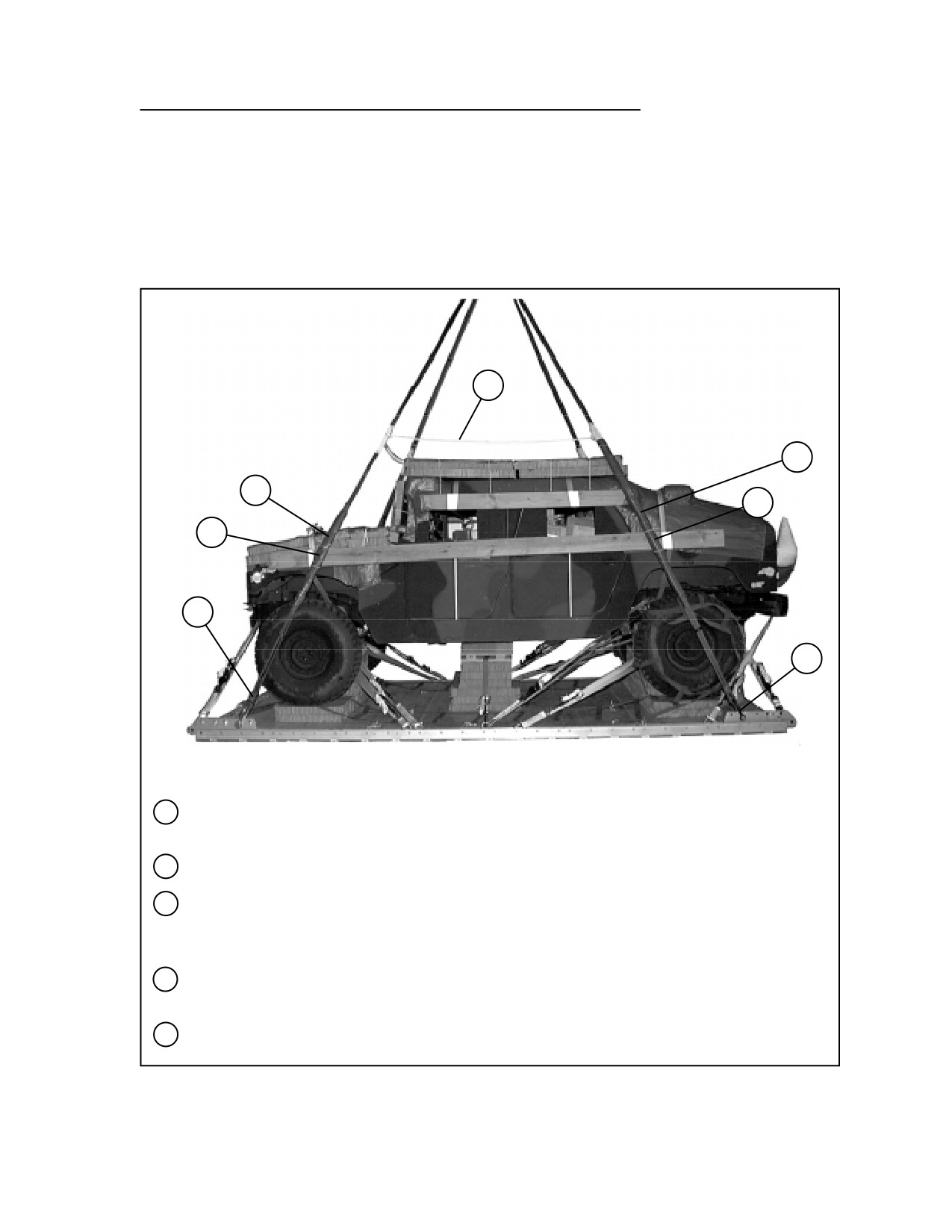
4-22. Install, pad and safety tie four 16-foot (4-loop), type XXVI nylon suspension
slings as shown in Figure 4-31.
2
3
4
5
5
1
1
1
Attach a 16-foot (4-loop), type XXVI nylon suspension sling to each tandem link with a
large clevis.
2
Raise the slings and install the deadman's tie 6 to 8 inches above the load.
3
Position a 6- by 60-inch piece of felt around each front suspension sling 33 inches from the
suspension clevis. Cover the padding completely with tape, extending the tape 6 inches
above and below the padding.
4
Position a 6- by 36-inch piece of felt around each rear suspension sling 31 inches from the
suspension clevis. Secure the padding as described in step 3 above.
5
Secure the suspension slings to the body side boards with type III nylon cord.
Figure 4-31. Suspension Slings Installed, Padded and Safety Tied
4-45
FM 4-20.117/TO 13C7-1-111
STOWING CARGO PARACHUTES
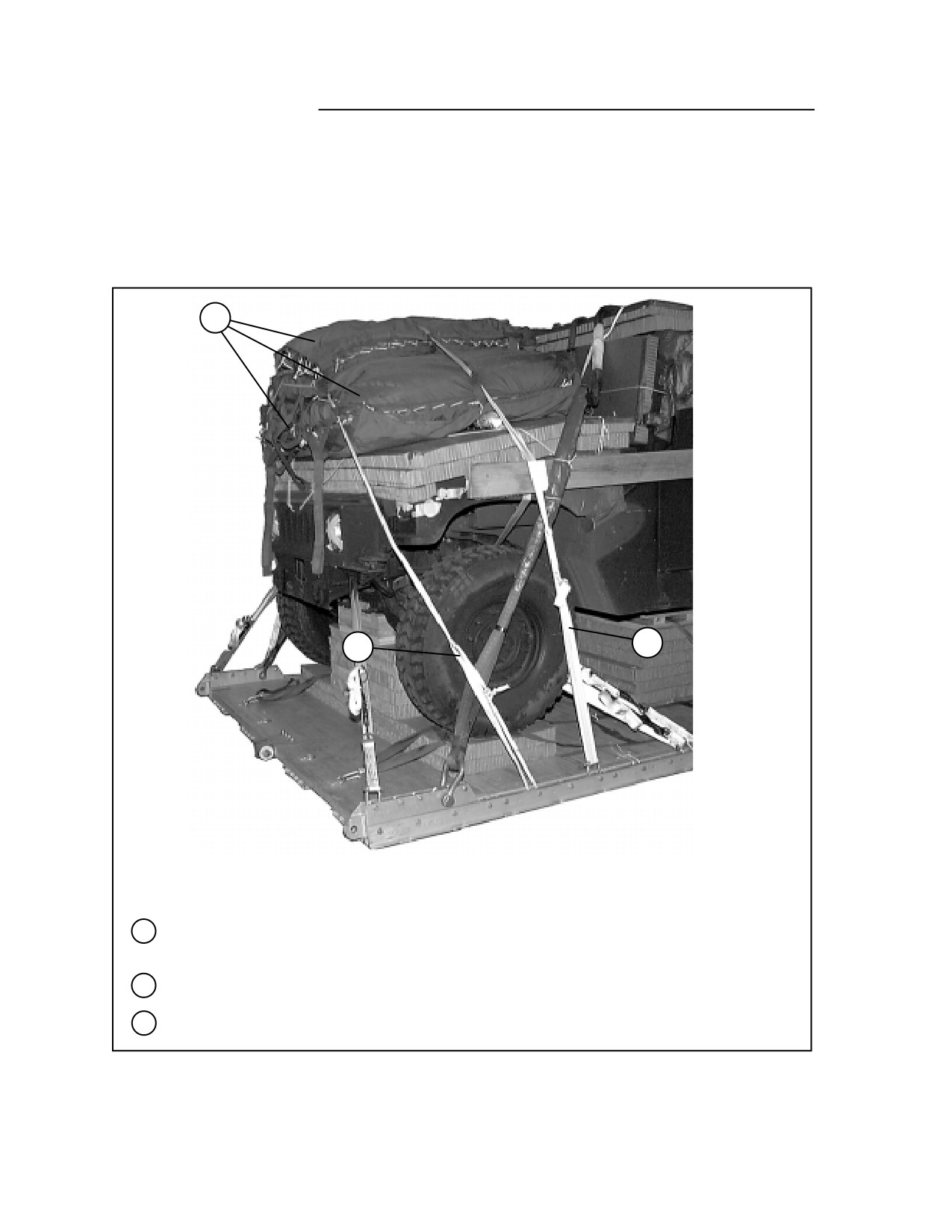
4-23. Stow and restrain three G-11 cargo parachutes on the load according to
FM 4-20.102/NAVSEA SS400-AB-MMO-010/TO 13C7-1-5, and as shown in
Figure 4-32.
1
2
3
1
Place and cluster three G-11 cargo parachutes on the honeycomb over the truck hood accord-
ing to FM 4-20.102/NAVSEA SS400-AB-MMO-010/TO 13C7-1-5.
2
Tie the front restraint straps to clevises 8 and 8A.
3
Tie the rear restraint straps to the 27th bushings on each side of the platform.
Figure 4-32. Cargo Parachutes Installed
4-46
FM 4-20.117/TO 13C7-1-111
INSTALLING PARACHUTE RELEASE
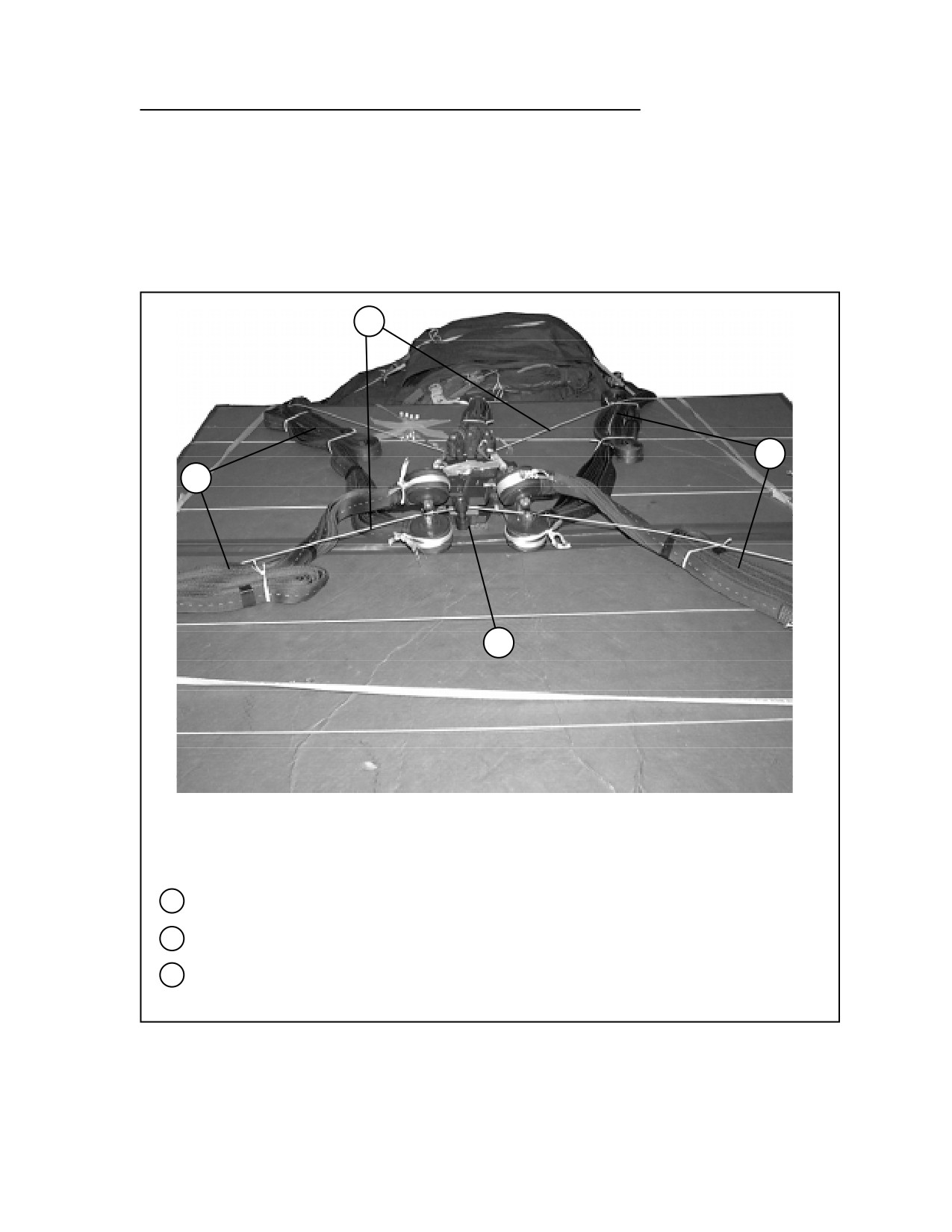
4-24. Prepare and install an M-2 cargo parachute release according to FM 4-
20.102/NAVSEA SS400-AB-MMO-010/TO 13C7-1-5, and as shown in Figure 4-
33 .
3
2
2
1
Note: The M-2 cargo parachute release is used on this load to accommodate the 4-loop suspension
slings.
1
Place the M-2 release on the roof honeycomb in front of the parachutes.
2
S-fold the slack in the suspension slings. Tie the folds with type I, 1/4-inch cotton webbing.
3
Attach the suspension slings and the riser extensions to the release. Tie the release to conve-
nient points on the load with type III nylon cord.
Figure 4-33. M-2 Release Installed
4-47
FM 4-20.117/TO 13C7-1-111
INSTALLING EXTRACTION SYSTEM
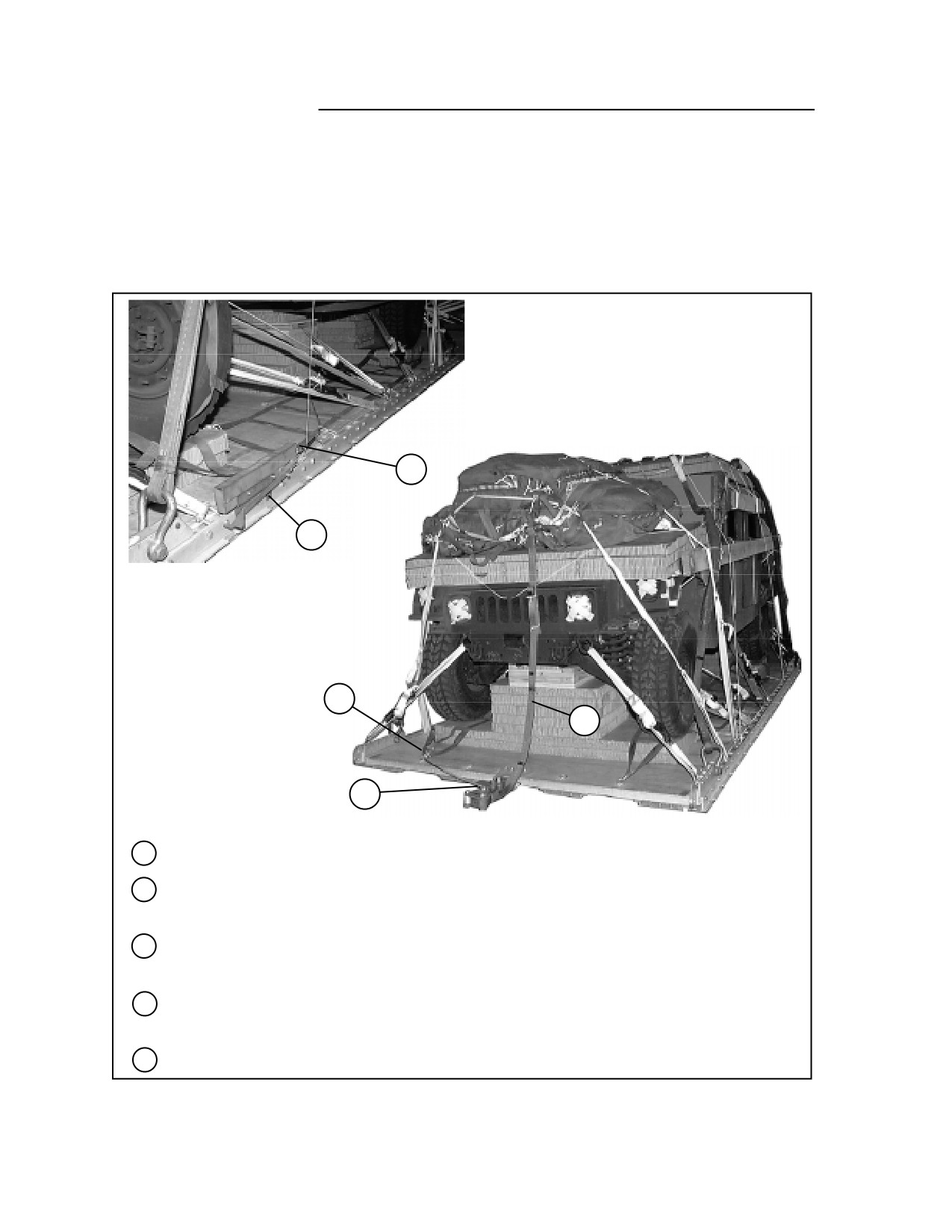
4-25. Install the EFTC extraction system according to FM 4-20.102/NAVSEA
SS400-AB-MMO-010/TO 13C7-1-5, and as shown in Figure 4-34.
2
1
4
5
3
1
Install the EFTC actuator mounting brackets in the front mounting holes in the left platform rail.
2
Attach a 16-foot release cable to the actuator. Install the actuator to the EFTC actuator mount-
ing brackets.
3
Install the latch assembly to the extraction bracket. Attach the release cable to the
latch assembly.
4
Tie the release cable to tie-down ring D8 on the rear platform panel with a length of type I,
1/4-inch cotton webbing.
5
Install a 9-foot (2-loop), type XXVI nylon webbing deployment line on the load.
Figure 4-34. EFTC Installed
4-48
FM 4-20.117/TO 13C7-1-111
INSTALLING PROVISIONS FOR EMERGENCY RESTRAINTS
4-26. Install provisions for emergency restraints according to FM 4-20.102/
NAVSEA SS400-AB-MMO-010/TO 13C7-1-5.
PLACING EXTRACTION PARACHUTE
4-27. Select the extraction parachute and extraction line needed, using the
extraction line requirements table in FM 4-20.102/NAVSEA SS400-AB-MMO-
010/TO 13C7-1-5. Rig the extractionline in a line bag according to TM 10-1670-
286-20/TO 13C5-2-41. Place the extraction parachute and extraction line on the
load for installation in the aircraft.
MARKING RIGGED LOAD
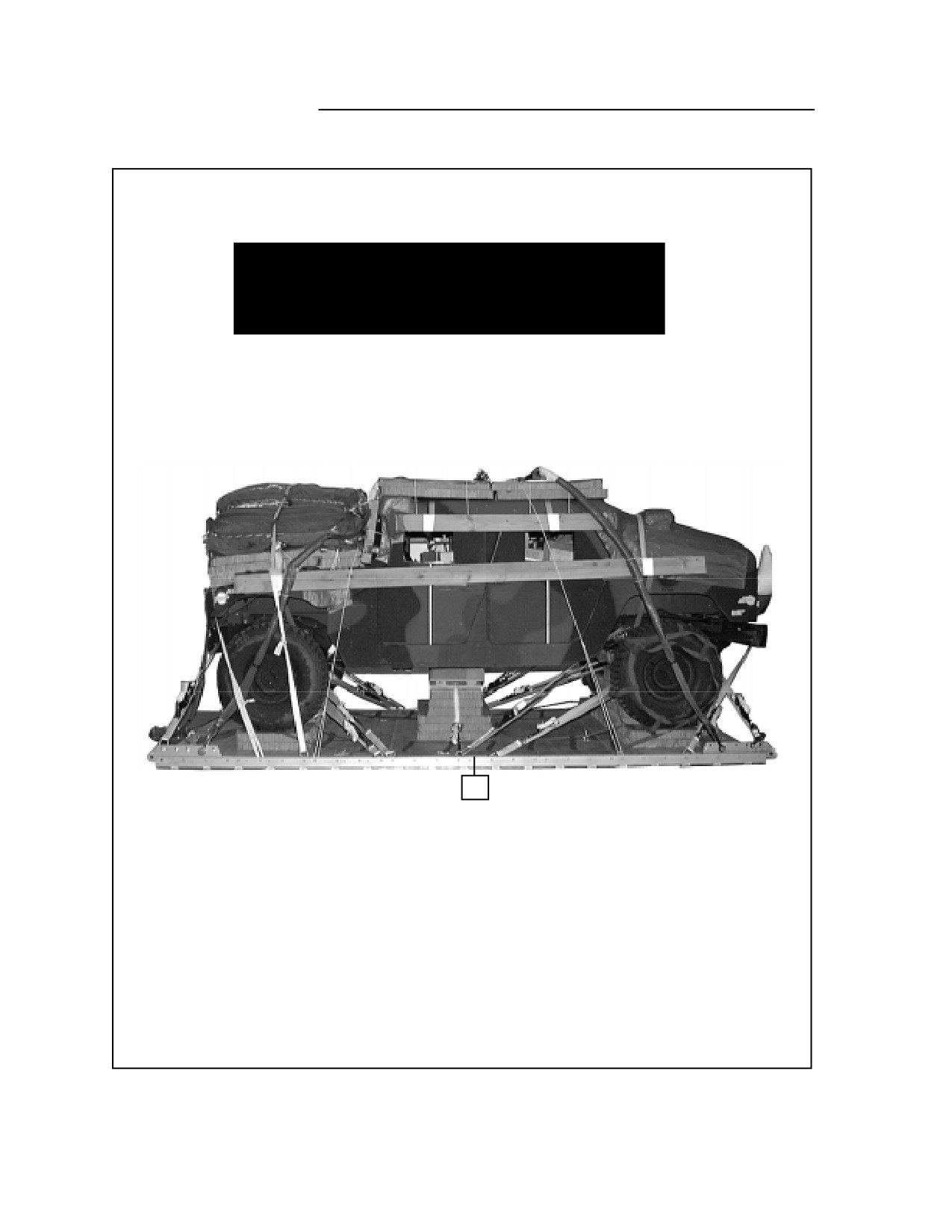
4-28. Mark the rigged load according to FM 4-20.102/NAVSEA SS400-AB-MMO-
010/TO 13C7-1-5, and as shown in Figure 4-35. Complete Shipper's Declaration
for Dangerous Goods according to AFJMAN 24-204/TM 38-250. If the load
varies from the one shown, the weight, height, CB, and parachute requirements
must be recomputed.
EQUIPMENT REQUIRED
4-29. Use the equipment listed in Table 4-2 to rig this load.
4-49
FM 4-20.117/TO 13C7-1-111
CAUTION
Make the final rigger inspection required by FM 4-20.102/
NAVSEA SS400-AB-MMO-010/TO 13C7-1-5.
before the load leaves the rigging site.
CB
RIGGED LOAD DATA
Weight: Load shown
15,240 pounds
Maximum load allowed
15,240 pounds
Height (with three G-11B parachutes)
98 inches
Width
108 inches
Length (overall)
210 inches
Overhang: Front
0 inches
Rear (EFTC)
18 inches
CB (from front edge of platform)
92 inches
Figure 4-35. M1114 Up-Armored Armament Carrier Rigged for Low-Velocity Airdrop
4-50
FM 4-20.117/TO 13C7-1-111
Table 4-2. Equipment Required for Rigging the M1114 Up-Armored Armament Carrier for Low-
Velocity Airdrop
National Stock
Number
Item
Quantity
8040-00-273-8713
Adhesive, paste, 1-gal
As required
4030-00-090-5354
Clevis, suspension, 1-in (large)
5
4020-00-240-2146
Cord, nylon, type III, 550-lb
As required
1670-00-434-5785
Coupling assembly, airdrop, extraction force transfer with cable,
1
16-ft
1670-00-360-0328
Cover, clevis, large
1
8135-00-664-6958
Cushioning material, packaging, cellulose wadding
As required
8305-00-958-3685
Felt, 1/2-in thick
As required
1670-01-183-2678
Leaf, extraction line (line bag
)
2
1670-01-035-6054
Bridle, extraction line bag (for C-17
)
1
Line, drogue (for C-17)
1670-01-064-4452
60-ft (1-loop), type XXV I
1
Line, extraction
:
1670-01-062-6313
For C-130: 60-ft (3-loop), type XXV I
1
1670-01-107-7651
For C-141: 140-ft (3-loop), type XXV I
1
For C-5:
1670-01-062-6313
60-ft (3-loop), type XXVI and
1
1670-01-107-7651
140-ft (3-loop), type XXV I
1
For C-17:
1670-01-107-7651
140-ft (3-loop), type XXV I
1
Link assembly, Two-point:
1
5306-00-435-8994
Bolt, 1-in diam, 4-in long
(2
)
5310-00-232-5165
Nut, 1-in, hexagonal
(2
)
1670-00-003-1953
Plate, side, 3 3/4-in
(2
)
5365-00-007-3414
Spacer, large
(2
)
Lumber:
5510-00-220-6146
2- by 4-in
As required
5510-00-220-6448
2- by 6-in
As required
5510-00-220-6274
4- by 4-in
As required
5315-00-010-4659
Nail, steel wire, 8d
As required
4-51
FM 4-20.117/TO 13C7-1-111
Table 4-2. Equipment Required for Rigging the M1114 Up-Armored Armament Carrier for Low-
Velocity Airdrop (continued)
National Stock
Number
Item
Quantity
1670-00-753-3928
Pad, energy-dissipating (honeycomb)
3- by 36- by 96-in
13 sheets
Parachute:
Cargo:
1670-01-016-7841
G-11 B
3
Cargo extraction:
1670-01-063-3716
22-ft
(for C-17 aircraft, use H-block with this parachute)
1
Drogue (for C-17 )
1670-01-063-3715
15-ft
1
Platform, airdrop, type
V, 16-ft
1670-01-353-8425
Bracket assembly, EFT C
(1
)
1670-01-162-2372
Clevis assembly, type V
(20
)
1670-01-353-8424
Bracket assembly, extractio n
(1
)
1670-01-162-2381
T
andem link assembly (Multipurpose link)
(4
)
5530-00-128-4981
Plywood, 3/4-in
5 sheets
1670-01-097-8817
Release, cargo parachute, M-2
1
Sling, cargo, airdrop
For suspension:
1670-01-062-6308
16-ft 4-loop), type XXVI nylon webbing
4
For lifting
:
1670-01-062-6304
9-ft (2-loop), type XXVI nylon webbin g
2
1670-01-062-6303
12-ft (2-loop), type XXVI nylon webbing
2
For deployment:
1670-01-062-6304
9-ft (2-loop), type XXVI nylon webbin g
1
For riser extension
:
1670-01-062-6313
60-ft (3-loop), type XXVI nylon webbing
3
5340-00-040-8219
Strap, parachute release, multi-cut, comes w/ 3
knives
2
7510-00-266-5016
T
ape, adhesive, 2-in
As required
1670-00-937-0271
Tie-down assembly, 15-foot
28
1670-01-344-0825
Vehicle drive-off aid
1
Webbing :
8305-00-268-2411
Cotton, 1/4-in, type I
As required
8305-00-082-5752
Nylon, tubular, 1/2-in
As required
8305-00-263-3591
T
ype VIII
As required
4-52
FM 4-20.117/TO 13C7-1-111
CHAPTER 5
RIGGING SPECIFIC ACCOMPANYING LOADS
IN HMMWV-SERIES TRUCKS
DESCRIPTION OF LOADS
5-1. This chapter tells and shows how to rig specific items of Army equipment in
the cargo bodies of HMMWV-series trucks. All trucks on 16-foot and 20-foot
platforms must be rigged with a load in the truck. See the chapter or section for
the particular truck for the minimum and maximum allowable load weights. If
a specific piece of equipment is lighter than the minimum specified weight,
additional items must be rigged to meet the minimum weight requirement.
Since loads in actual tactical situations vary greatly, and equipment
changes rapidly, use these procedures as guides for rigging similar items.
The loads shown in this chapter can be rigged in trucks of similar configu-
ration and load capacity, unless the procedures specify that the load can be
rigged in only one model of truck. Consult the chapter or section for the truck
shown to find alternative truck models that can be used to rig the load.
CAUTION
Only ammunition listed in FM 10-500-53/MCRP 4-3.81/TO 13C7-18-41
may be airdropped. Package, mark, andlabel hazardous material
according to AFJMAN 24-204/TM 38-250.
5-1
FM 4-20.117/TO 13C7-1-111
RIGGING TACCS, AMMUNITION, AND TRUCK EQUIPMENT IN M998 AND M1039
CARGO/TROOP CARRIERS
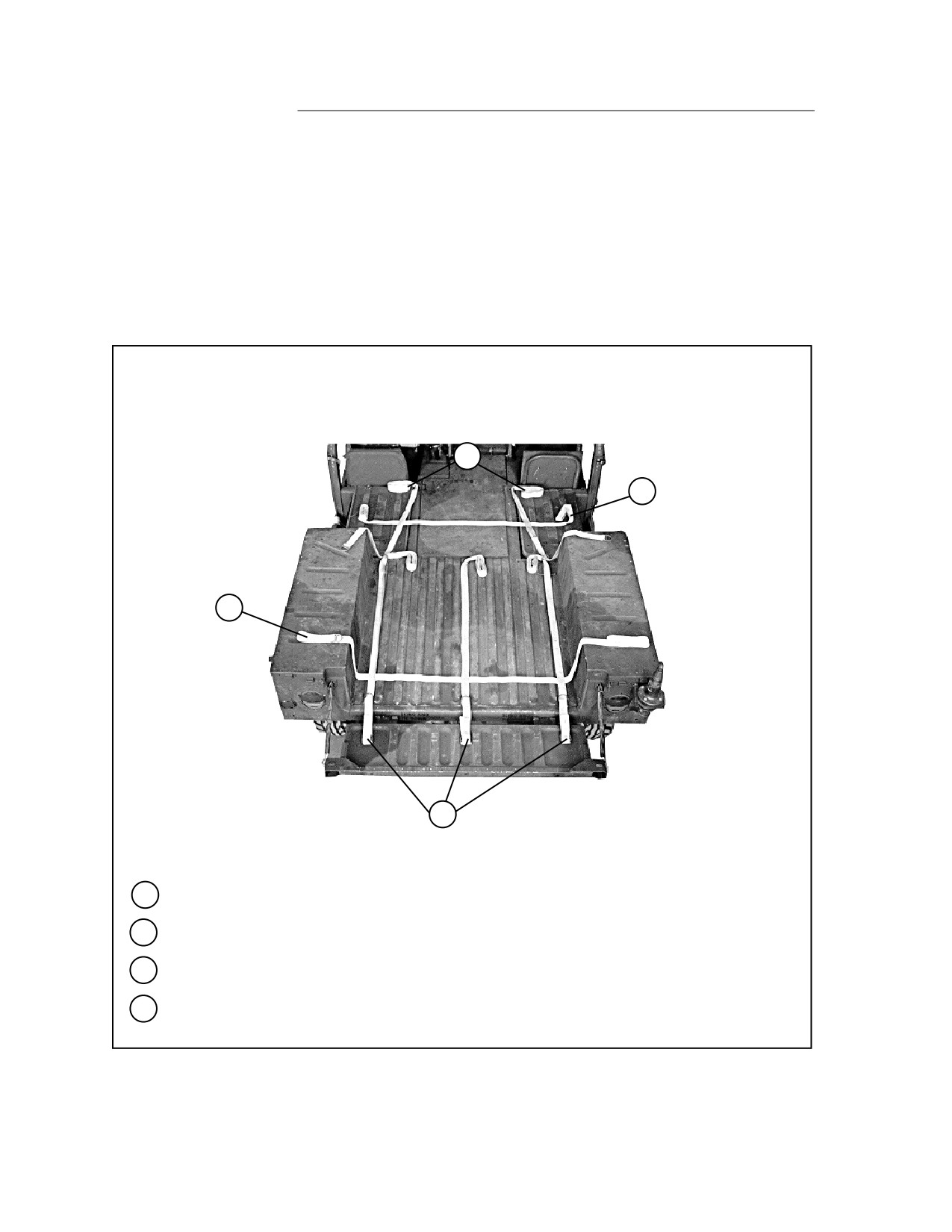
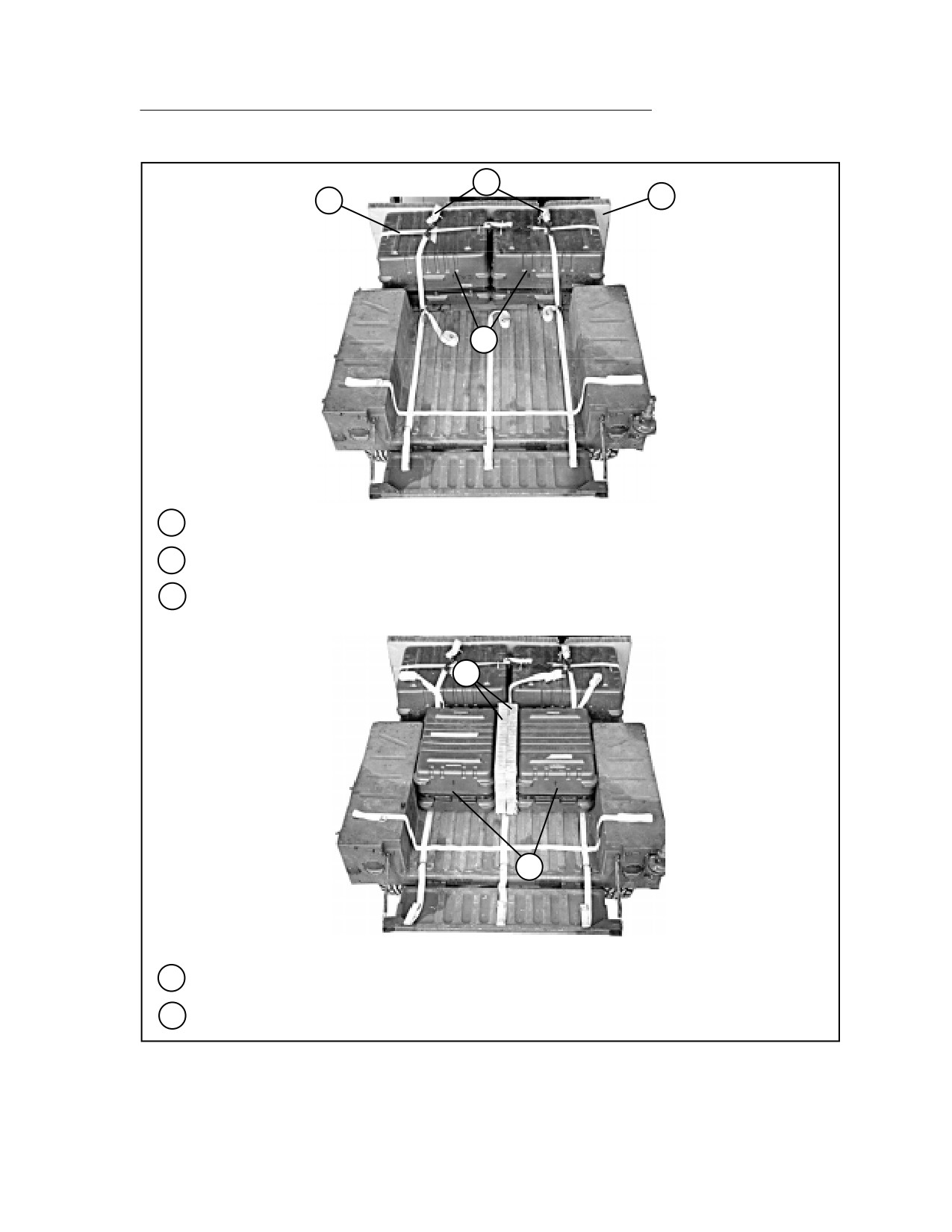
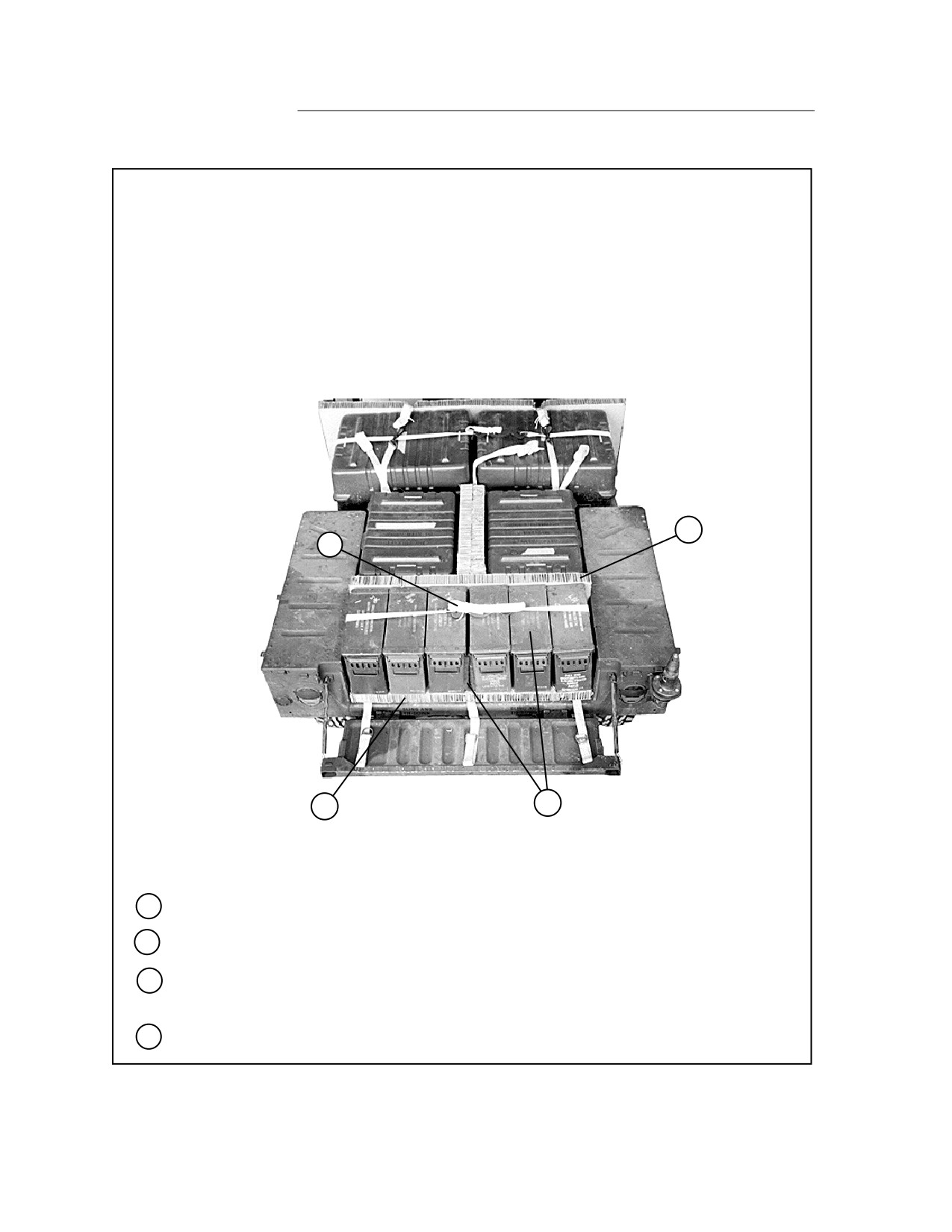
5-2. Use the procedures in Figure 5-1 to stow the TACCS (Tactical Army
Combat Service Support Computer System), six boxes of 20-mm ammunition,
and truck equipment. The accompanying load shown weighs 990 pounds.
4
3
1
2
1
Place a 15-foot lashing across the cargo bed 10 inches from its rear edge.
2
Pass three 15-foot lashings through the rear and center tie-down rings in the cargo bed.
3
Place a 15-foot lashing across the cargo bed 14 inches from the seat backs.
4
Pass a 15-foot lashing through the center and front tie-down rings on both sides.
Figure 5-1. TACCS, Ammunition, and Truck Equipment Rigged in Cargo/Troop Carrier
5-2
FM 4-20.117/TO 13C7-1-111
7
7
5
6
5
Place a 22- by 82-inch piece of honeycomb flush against the seat backs.
6
Place the logic module and terminal cases side by side against the honeycomb.
7
Secure the lashings placed in steps 3 and 4 with D-rings and load binders.
9
8
8
Place the keyboard and printer cases against the components placed in step 6 above.
9
Place two pieces of 18- by 32-inch honeycomb between the keyboard and printer cases.
Figure 5-1. TACCS, Ammunition, and Truck Equipment Rigged in Cargo/Troop Carrier (continued)
5-3
FM 4-20.117/TO 13C7-1-111
10
13
11
12
10
Place an 18- by 52-inch piece of honeycomb against the keyboard and printer boxes.
11
Place an 18- by 52-inch piece of honeycomb on the cargo bed floor.
12
Place six boxes of 20-mm ammunition on the honeycomb. Place two pieces of 1/2- by 15- by
19-inch felt between the third and fourth boxes.
13
Bind the boxes together with the lashing placed in step 1.
Figure 5-1. TACCS, Ammunition, and Truck Equipment Rigged in Cargo/Troop Carrier (continued)
5-4