ARMY FM 4-20.117 RIGGING HIGH-MOBILITY MULTIPURPOSE WHEELED VEHICLES (October 2001) - page 2
! 0
1
2
%
!
6
"
!
%
!
"
78
1
1 )(9
2:
5
"
78
1
1 )(9
2:
5
4
$
0
0*
+
,
"
-
2
!
! "#$
%&'
(
%
8
)
!
$
$
4
$
!
4
"
(
!
#
)
! "
(
3
"
!
"
#
)
! "
,
"
/
3
,4 #&-
!
! "#$
%&'
(
%
;7(2
"
"
;7(2
"
3
*
(
! " <0
!
"
#
)
! "
5
=
+
,#
--.
! "
0
1
,
% 5
6
*
7
!
! "#$
%&'
5
3
3
3
7
!
! "#$ %&'
8
3
3
#
!
+'!
+
!"#$
%&
2
3
3
!
! "#$
%&'
&
5
9
:
:
1
; <
;=
! "#
%
!
6
(
(
( &>(
6
(
7
+ 0
7
#
#
7
*
=$#
6
#
,!5 67
. "
(
8
9*
. 2 & & 3
6 0, ' 9
"
"
(
#011
"
/ ++1
6!
! !
> "
?
!
=#:51
83
!
1#511
& "
+!
!
6
,
0
>
10
? "
+
$
,
5
9$
"
7
1
'
+;7(2,
0
2
+
"
,
=5
2
.%%$ ,
3
( ,
/
- 4
*!
(
9
18
(:
/ 8
/
"
.%%$ ,
3
( ,
:
National Stock
Number
Item
Quantity
8040-00-273-8713
Adhesive, paste, 1-gal
As required
4030-00-090-5354
Clevis, suspension, 1-in (large)
5
4020-00-240-2146
Cord, nylon, type III, 550-lb
As required
1670-00-434-5785
Coupling assembly, airdrop, extraction force transfer with
1
cable, 16-ft
Cover:
1670-00-360-0328
Clevis, large
1
8135-00-664-6958
Cushioning material, packaging, cellulose wadding
As required
8305-00-958-3685
Felt, 1/2-in thick
As required
1670-01-183-2678
Leaf, extraction line (line bag)
2
Line, drogue (for C-17)
1670-01-062-6313
60-ft (3-loop), type XXV I
1
Line, extraction
:
1670-01-062-6313
For C-130: 60-ft (3-loop), type XXV I
1
1670-01-107-7651
For C-141: 140-ft (3-loop), type XXV I
1
For C-5:
1670-01-062-6313
60-ft, (3-loop), type XXVI and
1
1670-01-107-7651
140-ft (3-loop), type XXV I
1
For C-17:
1670-01-107-7651
140-ft (3-loop), type XXV I
1
Link Assembly:
Two-point:
1
5306-00-435-8994
Bolt, 1-in diam, 4-in long
(2
)
5310-00-232-5165
Nut, 1-in, hexagonal
(2
)
1670-00-003-1953
Plate, side, 3 3/4-in
(2
)
5365-00-007-3414
Spacer, large
(2
)
Lumber:
5510-00-220-6448
2- by 6-in
As required
5510-00-220-6274
4- by 4-in
As required
5315-00-010-4659
Nail, steel wire, 8d
As required
9
18
(:
/ 8
/
"
.%%$ ,
3
( ,
:
National Stock
Number
Item
Quantity
1670-00-753-3928
Pad, energy-dissipating (honeycomb)
3- by 36- by 96-in
10 sheets
Parachute:
Cargo:
1670-01-016-7841
G-11 B
2
Cargo extraction:
1670-01-063-3716
22-ft (for C-17, use H-block with this parachute.)
1
Drogue (for C-17 )
1670-01-063-3715
15-ft
1
Platform, airdrop, type
V, 16-ft
1670-01-353-8425
Bracket assembly, couplin g
(1
)
1670-01-162-2372
Clevis assembly, type V
(20
)
1670-01-162-2376
Extraction bracket assembly
(1
)
1670-01-162-2381
T
andem link assembly (Multipurpose link)
(4
)
5530-00-128-4981
Plywood, 3/4-in
3
sheets
1670-01-097-8816
Release, cargo parachute, M-1
1
Sling, cargo, airdrop
For suspension:
1670-01-063-7761
16-ft (2-loop), type XXVI nylon webbing
4
For lifting
:
1670-01-062-6304
9-ft (2-loop), type XXVI nylon webbin g
2
1670-01-062-6303
12-ft (2-loop), type XXVI nylon webbing
2
For deployment:
1670-01-062-6304
9-ft (2-loop), type XXVI nylon webbin g
1
For riser extension
:
1670-01-062-6302
20-ft (2-loop), type XXVI nylon webbing
2
5340-00-040-8219
Strap, parachute release, multi-cut, comes w/ 3
knives
2
7510-00-266-5016
T
ape, adhesive, 2-in
As required
1670-00-937-0271
Tie-down assembly, 15-foot
19
1670-01-344-0825
Vehicle drive-off aid
1
Webbing :
8305-00-268-2411
Cotton, 1/4-in, type I
As required
8305-00-082-5752
Nylon, tubular, 1/2-in
As required
8305-00-263-3591
T
ype VIII
As required
FM 4-20.117/TO 13C7-1-111
CHAPTER 3
RIGGING ARMAMENT CARRIERS
FOR LOW-VELOCITY AIRDROP
SECTION I - RIGGING CARRIERS ON A 16-FOOT PLATFORM
DESCRIPTION OF LOAD
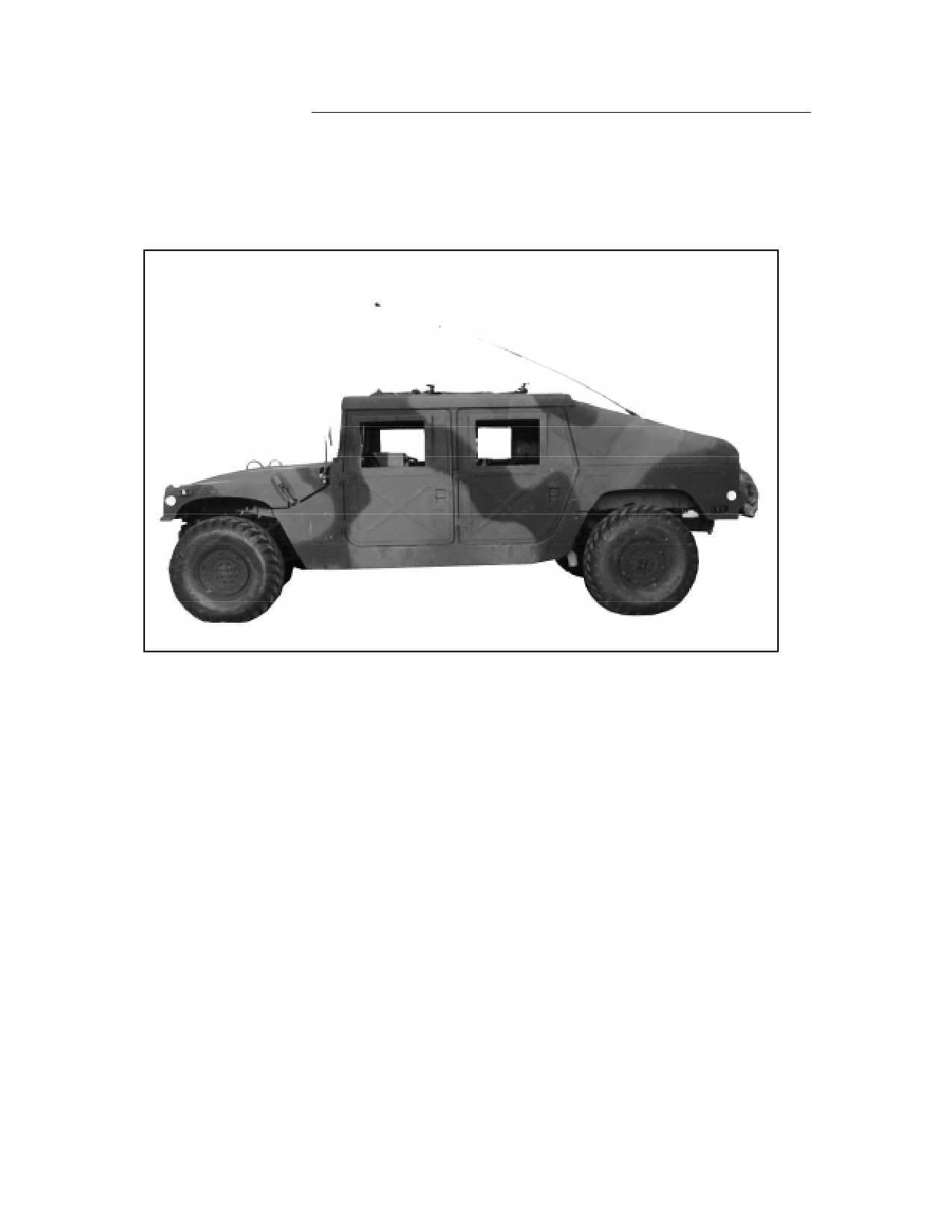
3-1. The unrigged M1025 armament carrier (Figure 3-1) is described in Chapter
1. The truck is rigged on a 16-foot type V platform for low-velocity airdrop. An
accompanying load weighing a minimum of 800 pounds and a maximum of
2,000 pounds must be rigged in the truck. The load requires two G-11 cargo
parachutes.
The following trucks can be rigged using the procedures given in this chapter:
M1025A1, M1025A2, and M1025A2 modified
M1026, M1026 (modified) and M1026A1
M966 and M966A1
M1036
M1043, M1043A1, and M1043A2
M1044 and M1044A1
M1045, M1045A1, and M1045A2
M1046 and M1046A1
M1121
PREPARING PLATFORM
3-2. Prepare a 16-foot, type V airdrop platform using four tandem
links and 18 load tie-down clevises as shown in Figure 2-2.
Notes:
1. The nose bumper may or may not be installed.
2. Measurements given in this chapter are from the front
edge of the platform, NOT from the front edge of the nose bumper.
3-1
FM 4-20.117/TO 13C7-1-111
Figure 3-1. M1025 Armament Carrier
PREPARING AND POSITIONING HONEYCOMB STACKS
3-3. Prepare three honeycomb stacks as shown in Figures 2-3 and 2-4. Position
the stacks on the platform as shown in Figure 2-5, and according to FM 4-
20.102/TO 13C7-1-5.
PREPARING TRUCK
3-4. Prepare the truck as described in paragraphs 2-4a through e, g, and h, and
as shown in Figures 2-6 and 2-7, 2-8 (omit steps 1 and 3), 2-9, 2-11, and 2-12.
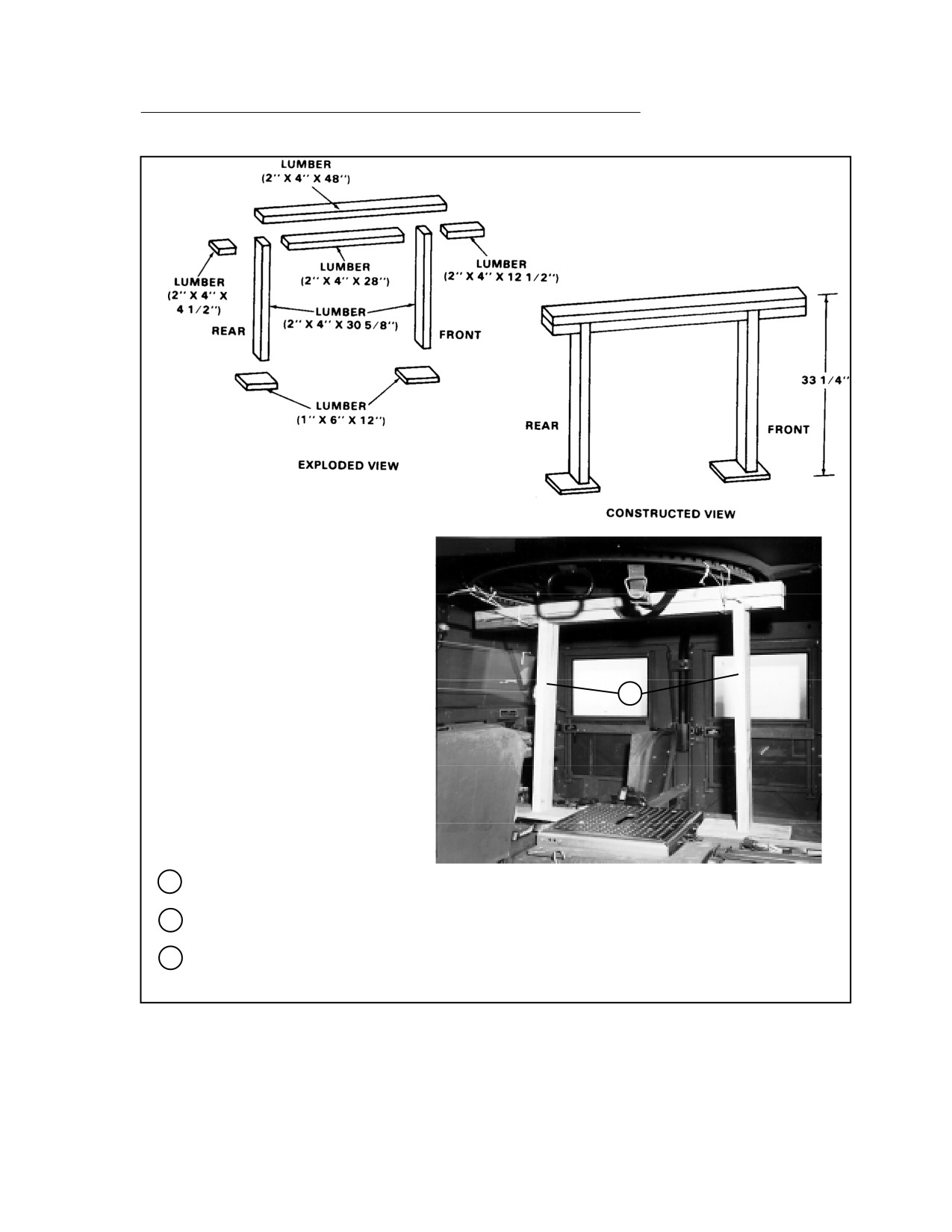
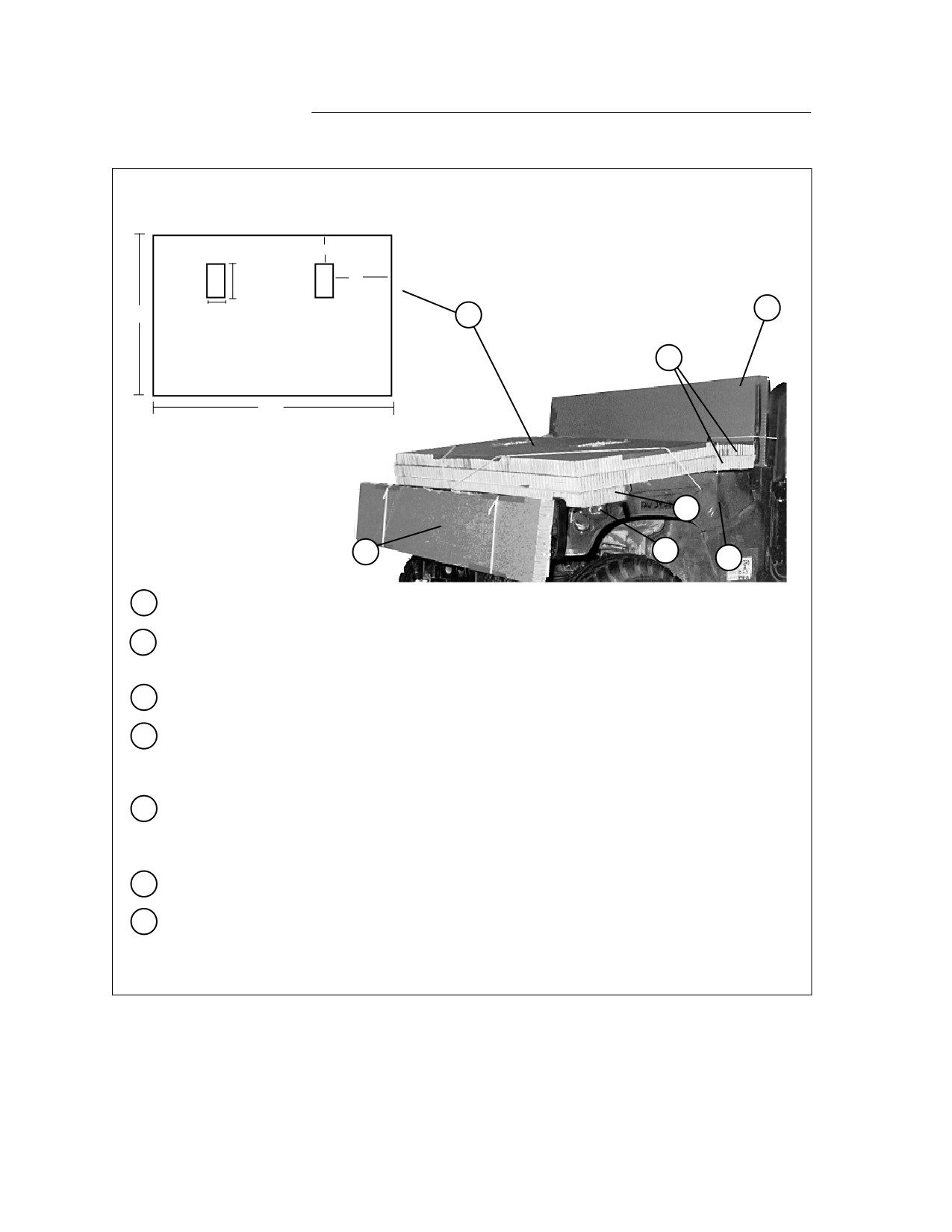
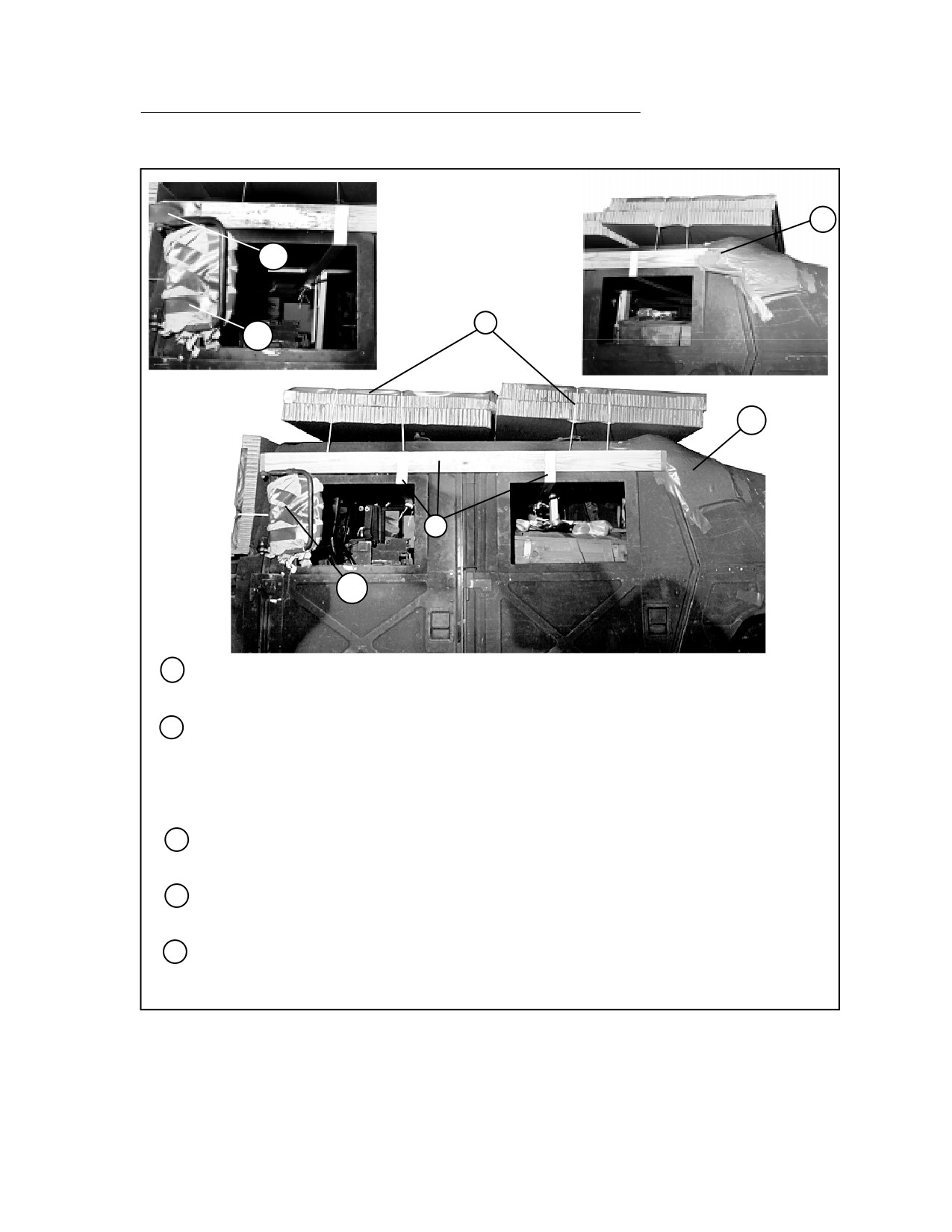
Further prepare the closed-body HMMWV as shown in Figures 3-2 and 3-3.
3-2
FM 4-20.117/TO 13C7-1-111
NOTES 1. These drawings are not drawn to scale.
2. All dimension are given in inches.
3
1
Build the turret housing support as shown. Nail the lumber together with 8d nails.
2
Close the turret cover and secure it with the fasteners provided (not shown).
3
Center the support under the turret housing with the front end of the support toward the front
end of the truck. Tie the support in place with two lengths of type III nylon cord.
Figure 3-2. Turret Support Built and Placed
3-3
FM 4-20.117/TO 13C7-1-111
NOTES 1. These drawings are not to scale.
2. All dimension are given in inches.
8
9
20
6
7
36
4
5
83
3
2
1
6
1
Tape all lights and reflectors.
2
On trucks equipped with the brush guard, cover the front side with a 83- by 14-inch piece of
honeycomb tied in place with type III nylon cord.
3
Center a 78- by 4-inch piece of honeycomb along the front edge of the hood.
4
Place two 36- by 83-inch pieces of honeycomb, with cutouts as shown, over the hood. Tape
the upper edges of the top piece. Tie the honeycomb in place with a length of type III nylon
cord. Tie the cord to a hood latch, pass it through the grille, and tie off to the other hood latch.
5
Place two 83- by 12-inch pieces of honeycomb just behind the honeycomb placed in step 2
above. Tape the top outside edges. Secure the honeycomb to the hood latch brackets with
type III nylon cord.
6
Tape the hood latches.
7
Lower all side windows and open the truck doors. Place a 21- by 83-inch piece of honeycomb
against the windshield. Tie a length of type III nylon cord around the honeycomb and
the inside of the windshield frame.
Figure 3-3. Truck Body Prepared
3-4
FM 4-20.117/TO 13C7-1-111
11
11
8
12
10
9
12
8
Cover the roof with four 82- by 36-inch pieces of honeycomb. Tape the upper 36-inch edges.
Tie four lengths of type III nylon cord over the honeycomb and through the door openings.
9
Pass 15-foot lashings through the door openings on each side of the truck and close the
doors. Cut a 45-degree bevel in each end of two pieces of 2- by 4- by 69 1/2-inch lumber.
Rest the long side of each piece of lumber over the window openings and even with the front
edge of the windshield frame. Pass the free ends of the lashings down over the lumber and
through the windows. Secure the lashings inside the truck.
10
Pad the upper rear corner of the door and the end of the rain gutter with a 12- by 12-inch
piece of felt taped in place.
11
Tape the front and rear ends of the lumber to the windshield frame and to the padding over
the rear gutter.
12
Pad the mirrors with cellulose wadding taped in place. Fold the mirrors inward and tie them
together through the cab of the truck.
Figure 3-3. Truck Body Prepared (continued)
3-5
FM 4-20.117/TO 13C7-1-111
STOWING ACCOMPANYING LOAD
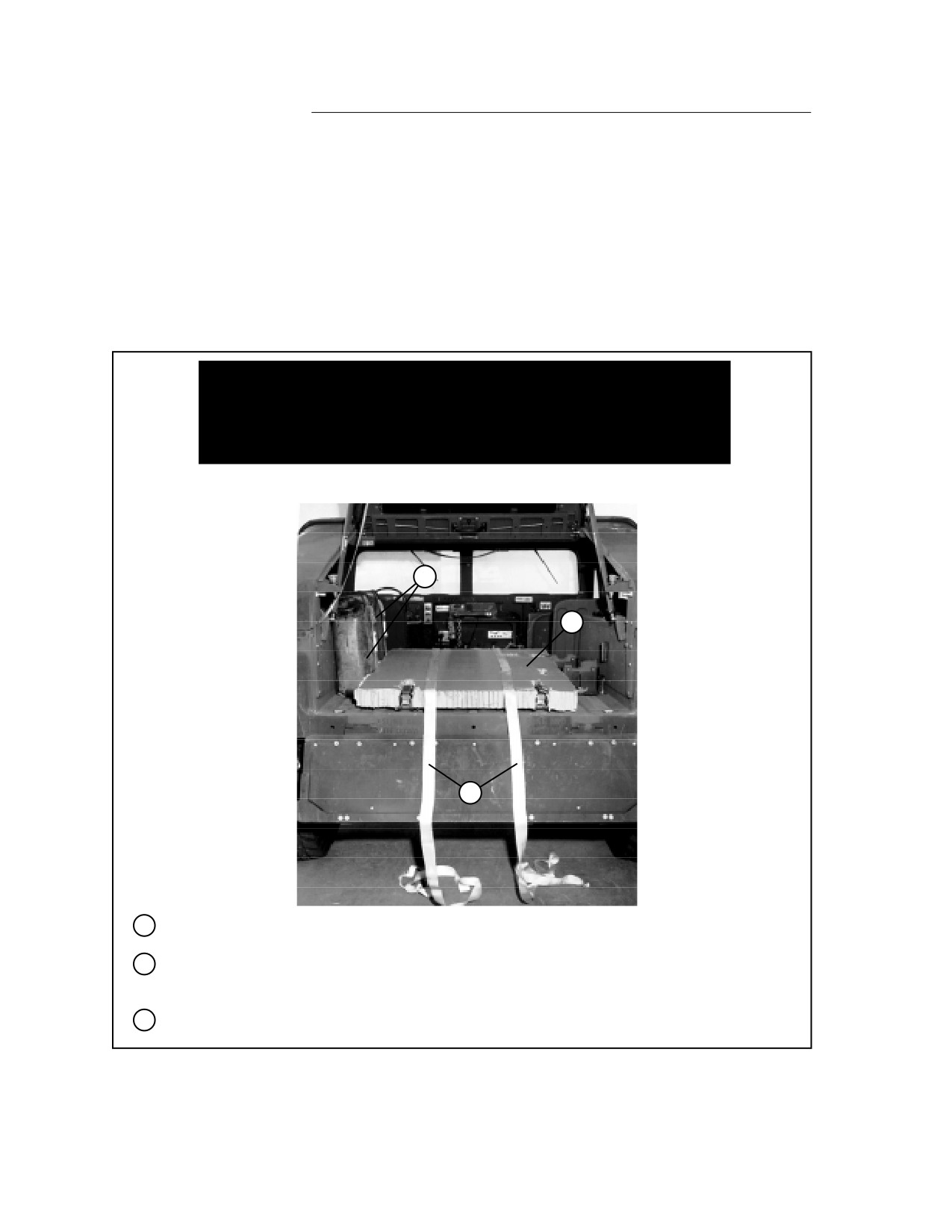
3-5. Stow an accompanying load of 800 to 2,000 pounds in the cargo area of the
truck. Use or adapt the procedures shown in Figure 3-4. Make sure the accom-
panying load complies with the restrictions outlined in FM 4-20.102/TO 13C7-1-
5. The maximum restraint capacity of each cargo area tie-down ring is 2,000
pounds. The accompanying load of ammunition shown in Figure 3-4 weighs 930
pounds.
CAUTION
Only ammunition listed in FM 10-500-53/MCRP 4-3.81/TO 13C7-18-41
may be airdropped. Package, mark, and label hazardous material
according to AFJMAN 24-204/TM 38-250.
1
2
3
1
Stow two water cans in their holders, and secure them with the straps provided.
2
Lay a 36- by 50-inch piece of honeycomb in the cargo area. Make cutouts in the honeycomb
for fixtures on the floor.
3
Lay two 15-foot lashings lengthwise on the honeycomb.
Figure 3-4. Accompanying load stowed in truck
3-6
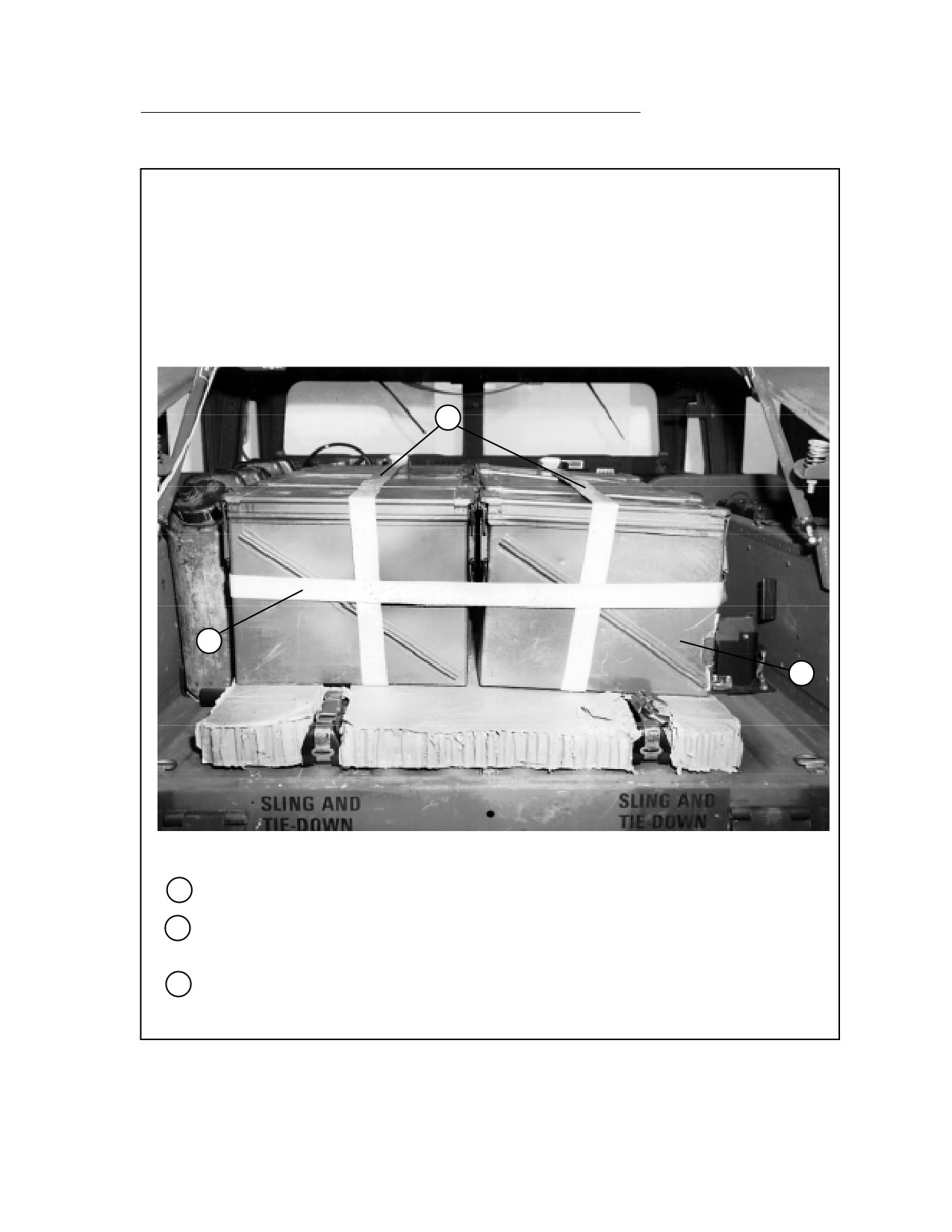
FM 4-20.117/TO 13C7-1-111
5
6
4
4
Place the accompanying load (20-millimeter ammunition shown) on the honeycomb.
5
Fasten the pre-positioned lashings (step 3) on the front side of the boxes with D-rings and
load binders.
6
Run a 15-foot lashing around the boxes through their carrying handles. Secure the lashing
with a D-ring and a load binder.
Figure 3-4. Accompanying Load Stowed in Truck (continued)
3-7
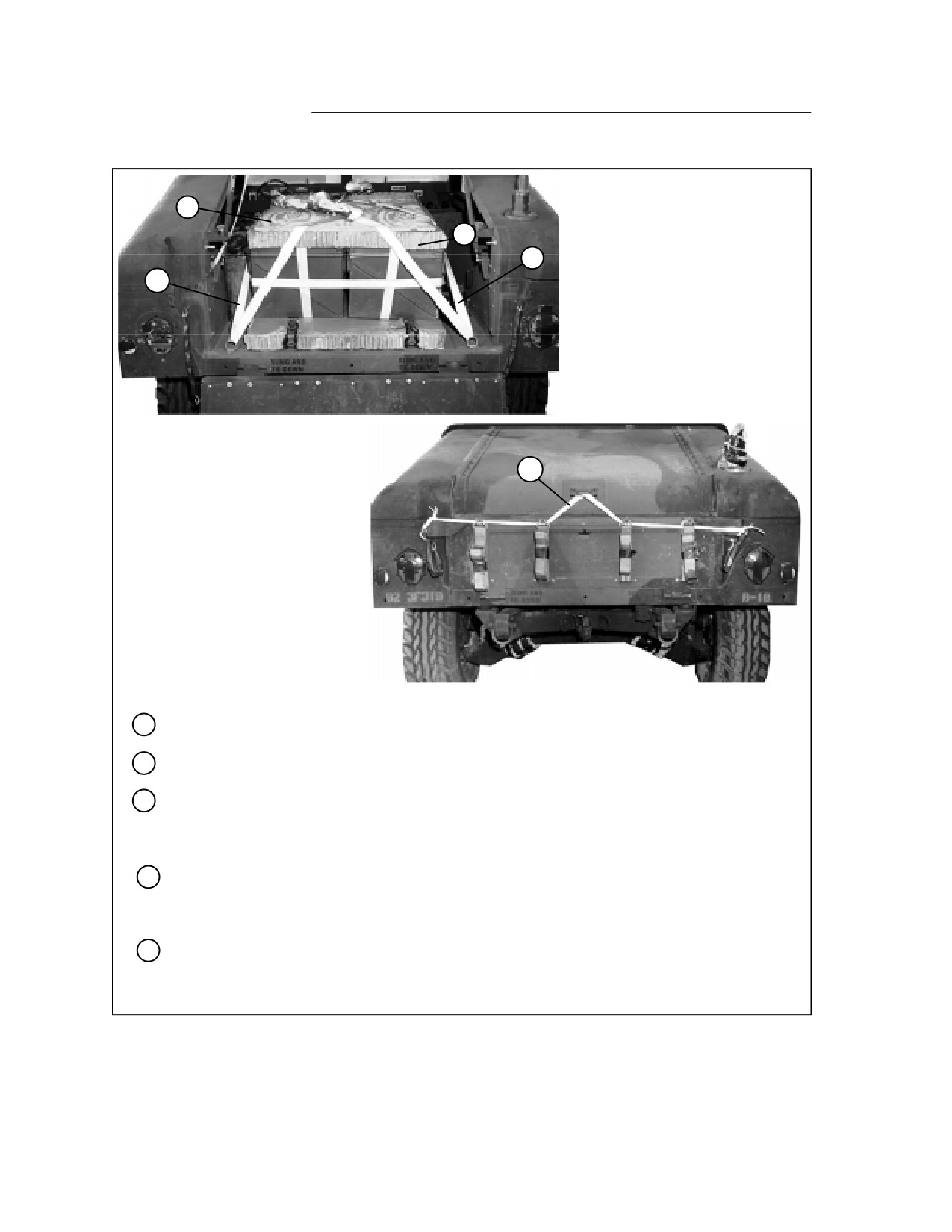
FM 4-20.117/TO 13C7-1-111
8
7
9
10
11
7
Lay a 36- by 40-inch piece of honeycomb flush over the boxes of ammunition.
8
Lay a 3/4- by 36- by 40-inch piece of plywood flush over the honeycomb.
9
Run a 30-foot lashing through the right rear tie-down ring. Bring both ends over the boxes
diagonally. Run the lashing through the left front tie-down ring. Secure the lashing over the
load.
10
Repeat step 9 using the left rear and right front tie-down rings.
Note: Stow truck equipment such as antennas on top of the load. Tie the equipment securely.
11
Close and latch the tailgate and hatch. Fold and tape the cargo straps. Run a length of 1/2-
inch tubular nylon webbing under the cargo straps and through the hatch cover handle. Tie to
the tailgate hook brackets.
Figure 3-4. Accompanying Load Stowed in Truck (continued)
3-8
FM 4-20.117/TO 13C7-1-111
LIFTING AND POSITIONING TRUCK AND INSTALLING OPTIONAL DRIVE-OFF AIDS
3-6. Install the optional drive-off aids on the platform as shown in Figure 2-16.
Install lifting slings on the truck and position the truck on the platform as
shown in Figure 2-16. Attach the driveoff aids to the wheels as shown in Figure
2-17.
LASHING TRUCK
3-7. Lash the truck to the platform with fifteen 15-foot tie-down assemblies.
Install the lashings according to FM 4-20.102/TO 13C7-1-5, and as shown in
Figures 2-18 and 2-19.
INSTALLING AND SAFETY TYING SUSPENSION SLINGS
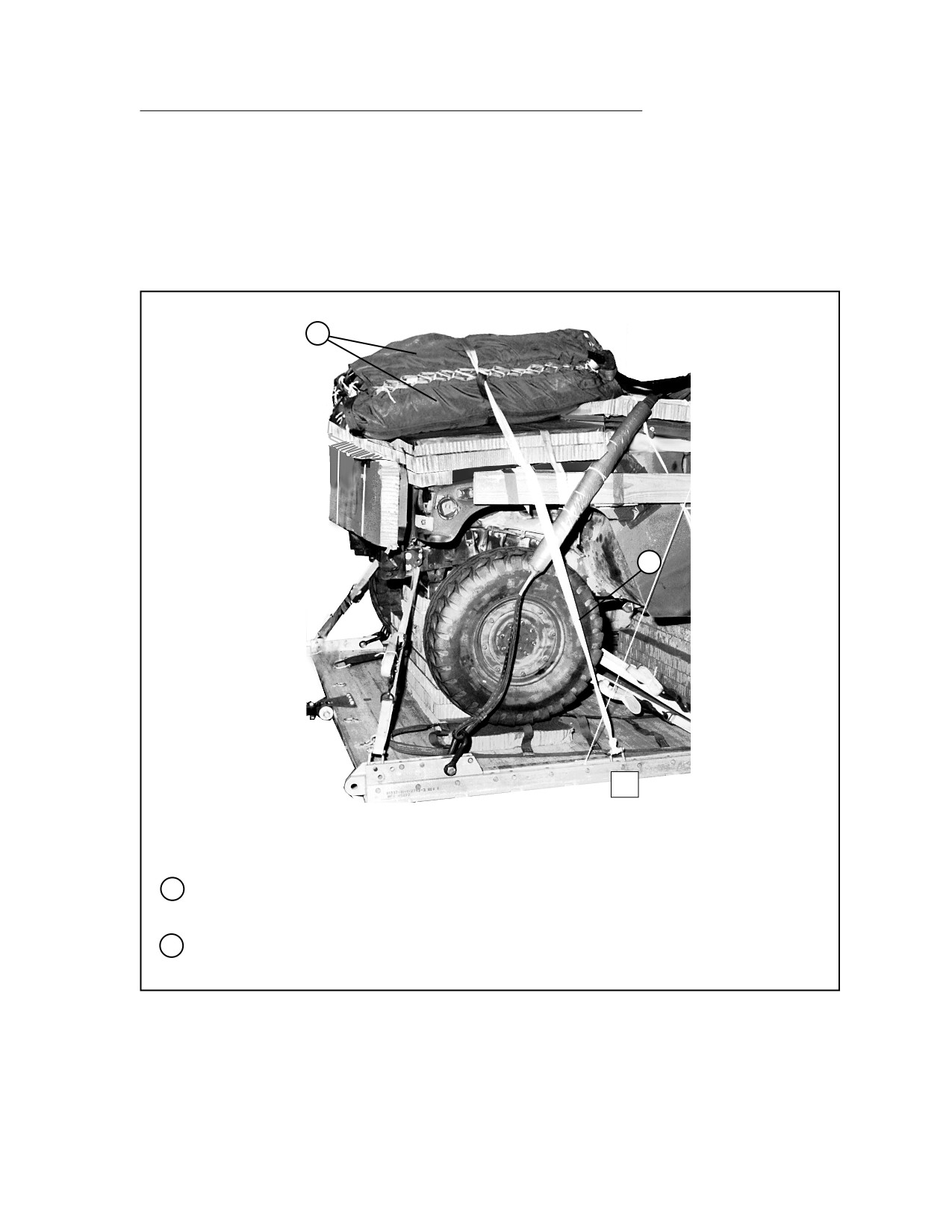
3-8. Install and safety tie four 16-foot (2-loop), type XXVI nylon suspension slings
according to FM 4-20.102/TO 13C7-1-5, and as shown in Figure 3-5.
3-9
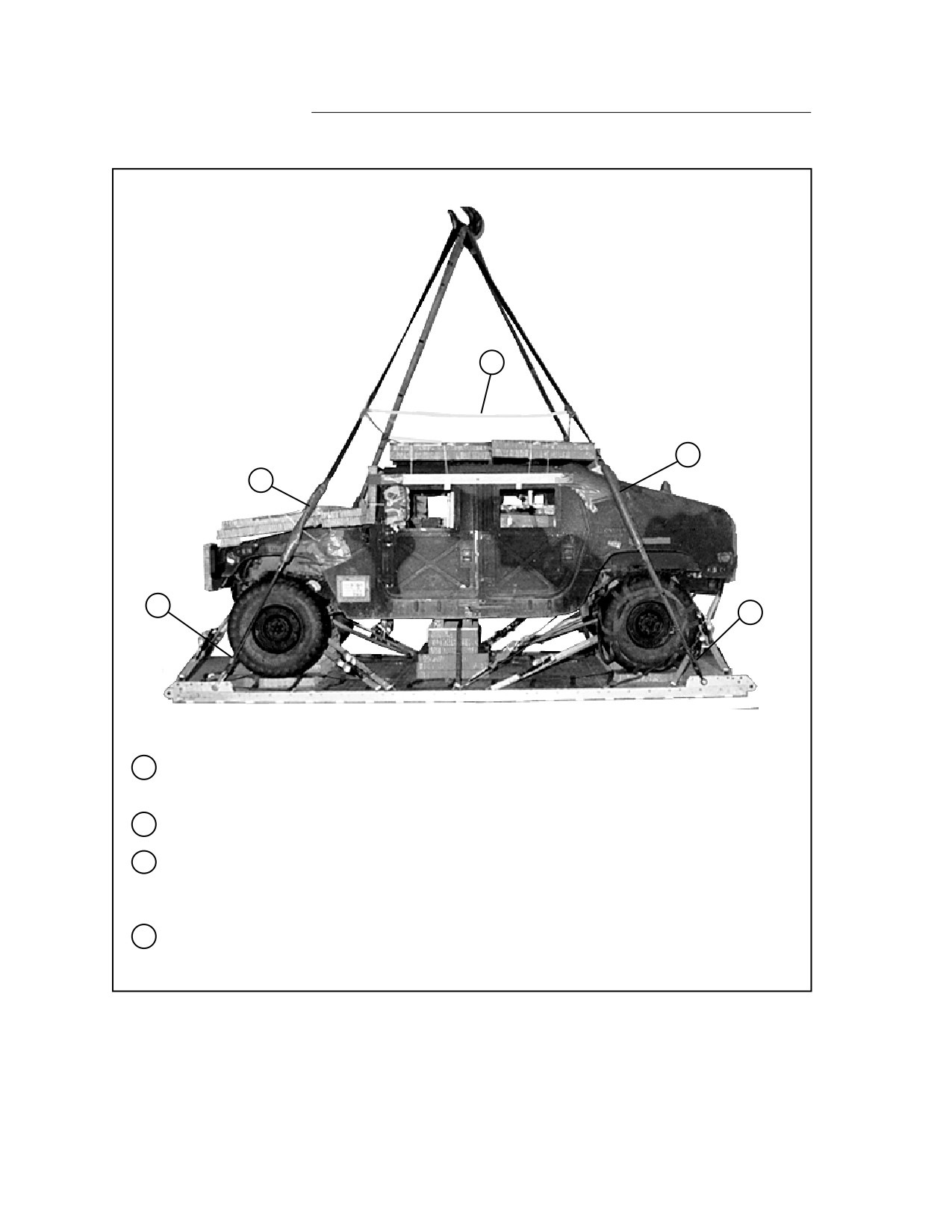
FM 4-20.117/TO 13C7-1-111
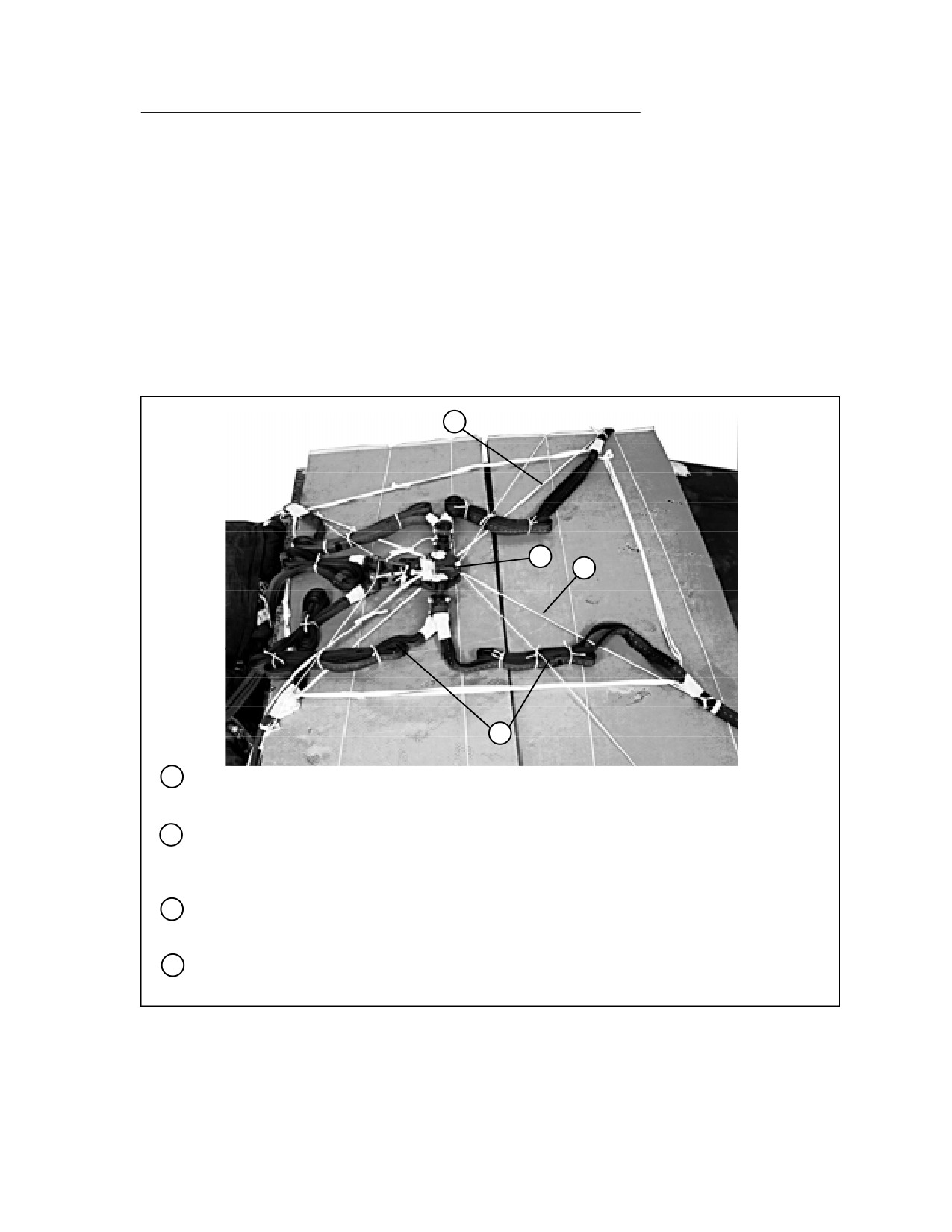
2
3
4
1
1
1
Attach a 16-foot (2-loop), type XXVI nylon suspension sling to each tandem link with a
large clevis.
2
Raise the slings and install the deadman's tie 6 to 8 inches above the load.
3
Position a 6- by 36-inch piece of felt around each front suspension sling 40 inches from the
suspension clevis. Cover the padding completely with tape, extending the tape 6 inches
above and below the padding.
4
Position a 6- by 36-inch piece of felt around each rear suspension sling 45 inches from the
suspension clevis. Secure the padding as described in step 3 above.
Figure 3-5. Suspension Slings Installed, Padded and Safety Tied
3-10
FM 4-20.117/TO 13C7-1-111
STOWING CARGO PARACHUTES
3-9. Use two G-11 cargo parachutes on this load. Stow the cargo parachutes
according to FM 4-20.102/TO 13C7-1-5, and as shown in Figure 2-21.
INSTALLING PARACHUTE RELEASE
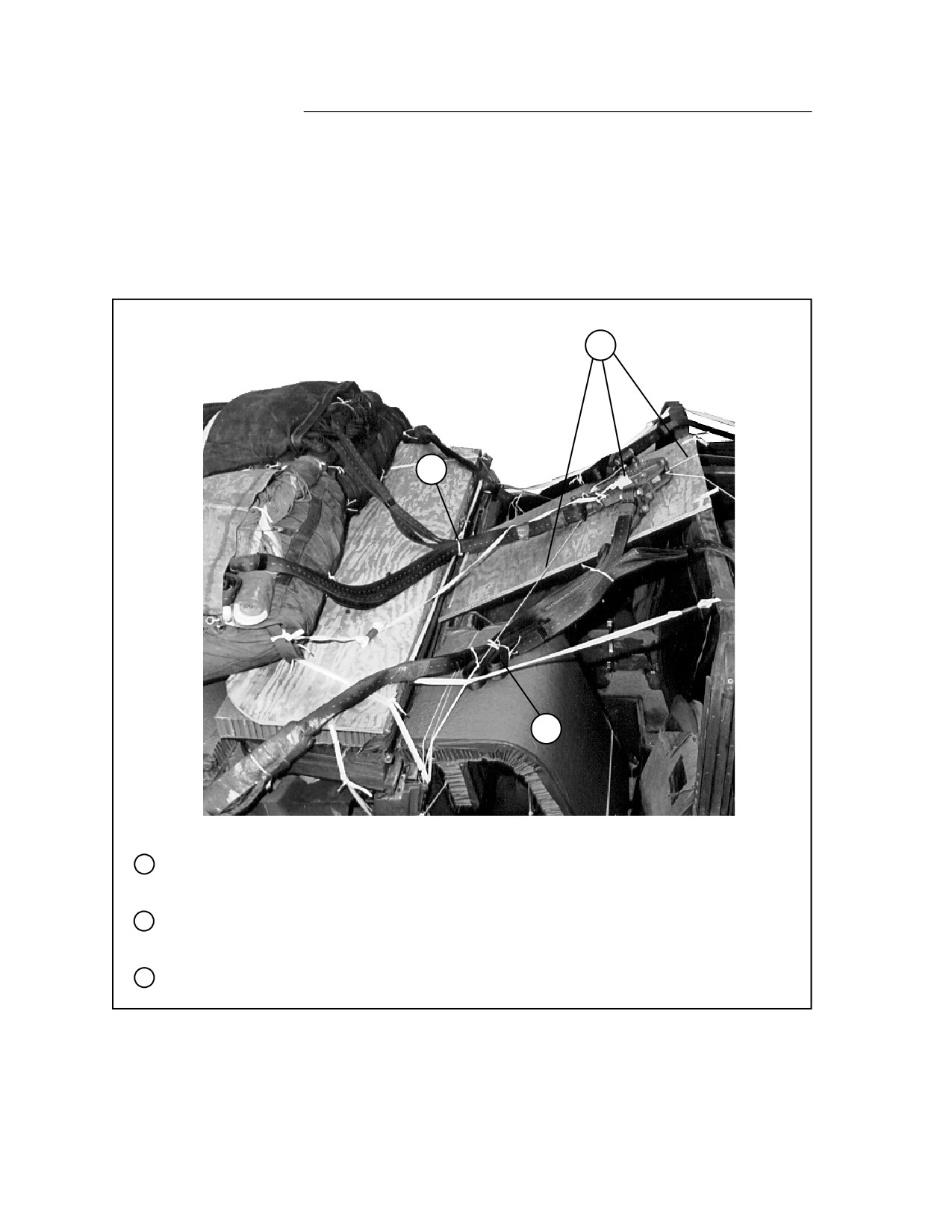
3-10. Prepare and install an M-1 cargo parachute release according to FM 4-
20.102/TO 13C7-1-5, and as shown in Figure 3-6.
2
1
3
4
1
Place the M-1 release on the honeycomb in front of the parachutes. Tie the release to
convenient points on the load.
2
Tie a length of Type I, 1/4-inch cotton webbing to the right rear suspension sling below the
deadman's tie. Bring the webbing diagonally over the load to the left front. Pull it taut, and
tie it to the left front sling below the deadman's tie.
3
Tie the left rear and right front suspension slings together in the same way as outlined in step
2 above.
4
S-fold the slack in the suspension slings, and tie the folds with Type I, 1/4-inch cotton
webbing. Attach the suspension slings and the riser extensions to the release.
Figure 3-6. M-1 Cargo Parachute Release Installed
3-11
FM 4-20.117/TO 13C7-1-111
INSTALLING EXTRACTION SYSTEM
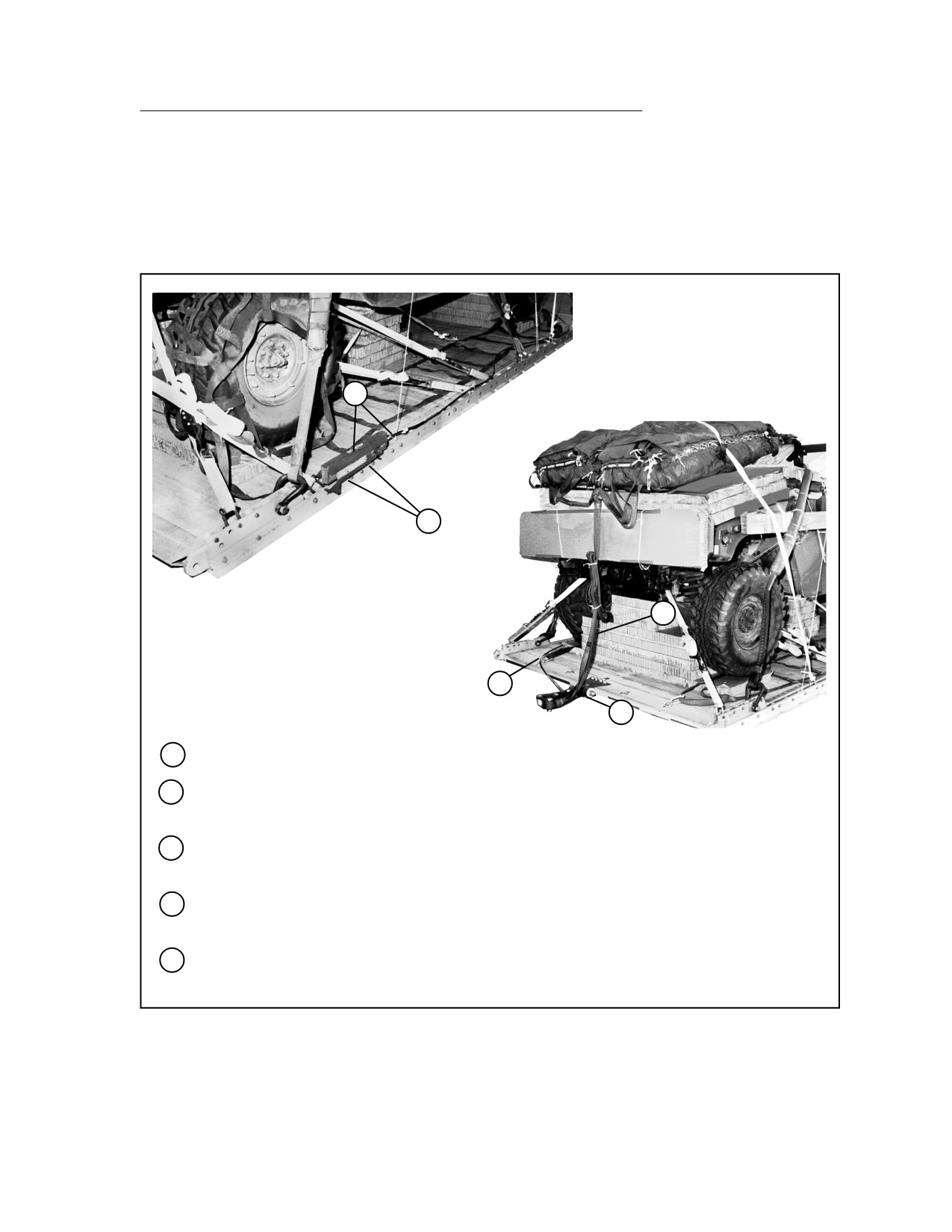
3-11. Install the EFTC extraction system with a 16-foot release cable according
to FM 4-20.102/TO 13C7-1-5, and as shown in Figure 2-23.
INSTALLING PROVISIONS FOR EMERGENCY RESTRAINTS
3-12. Install the provisions for emergency restraints on the load according to FM
4-20.102/TO 13C7-1-5.
PLACING EXTRACTION PARACHUTE
3-13. Select the extraction parachute and extraction line needed using the
extraction line requirements table in FM 4-20.102/TO 13C7-1-5. Rig the
extraction line in an extraction line bag according to TM 10-1670-286-20/TO
13C5-2-41. Place the extraction parachute and extraction line on the load for
installation in the aircraft.
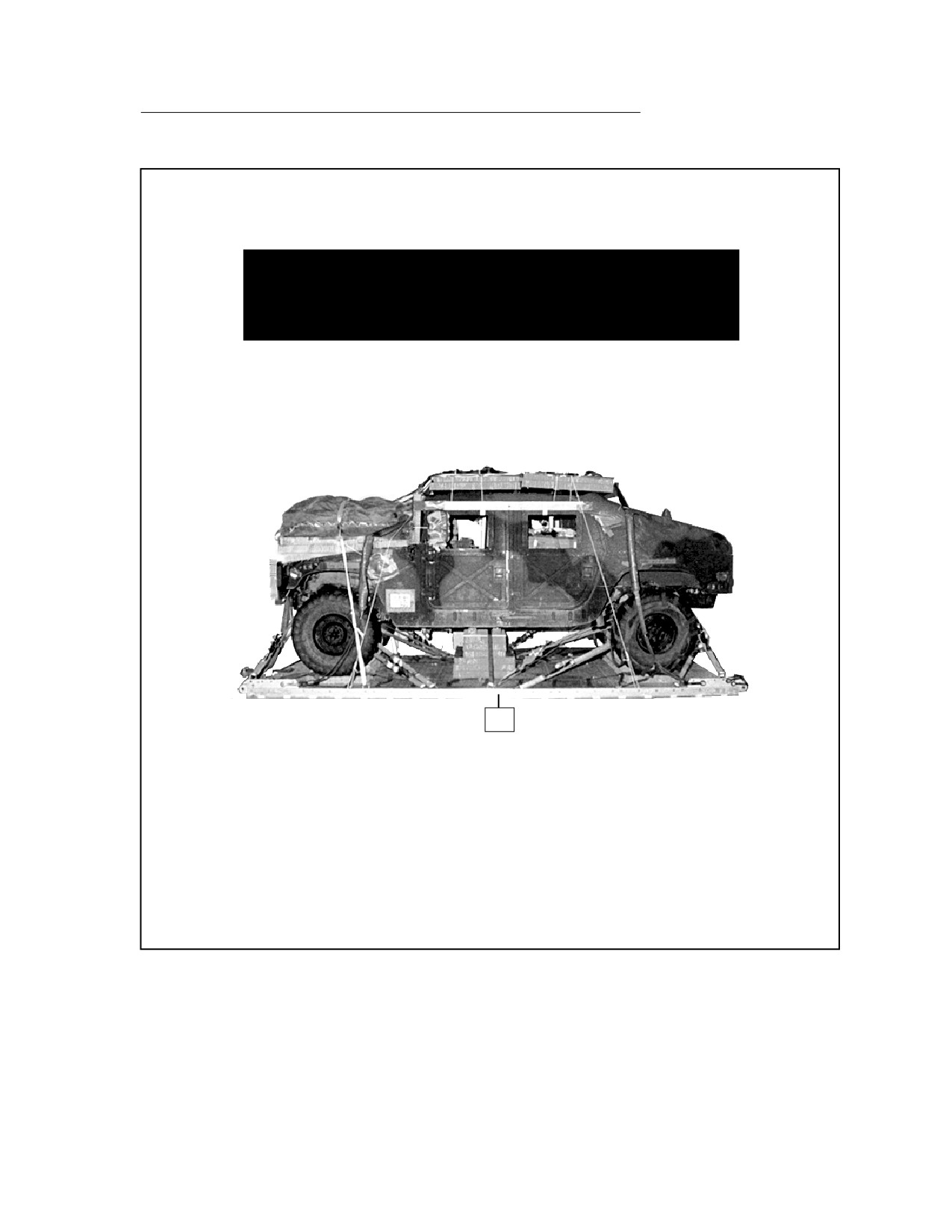
MARKING RIGGED LOAD
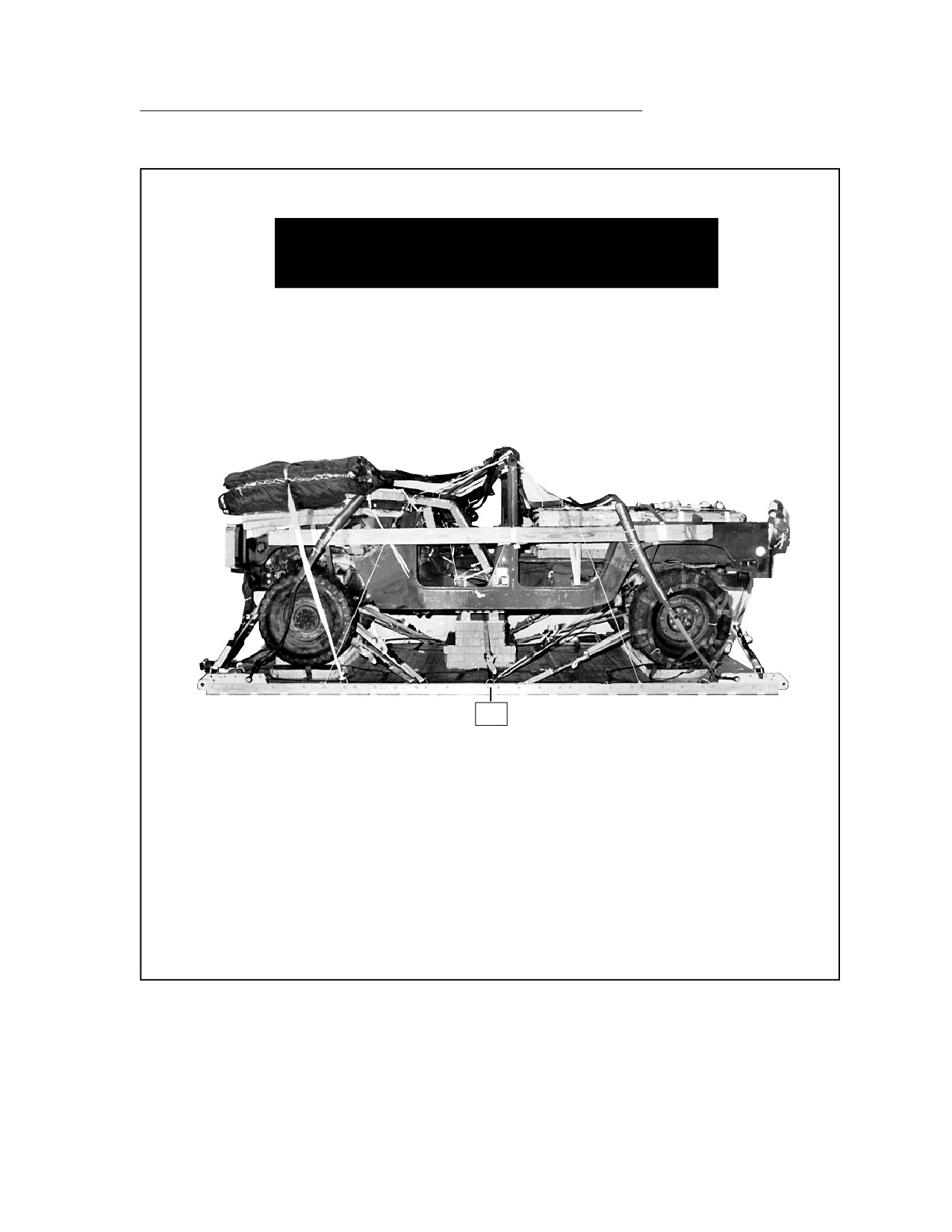
3-14. Mark the rigged load according to FM 4-20.102/TO 13C7-1-5, and as
shown in Figure 3-7. Complete Shipper's Declaration for Dangerous Goods
according to AFJMAN 24-204/TM 38-250. If the load varies from the one
shown, the weight, height, CB, and parachute requirements must be recom-
puted.
EQUIPMENT REQUIRED
3-15. Use the equipment listed in Table 3-1 to rig this load. The equipment for
rigging the accompanying load is NOT given in Table 3-1.
3-12
FM 4-20.117/TO 13C7-1-111
CAUTION
Make the final rigger inspection required by FM 4-20.102/
TO 13C7-1-5 before the load leaves the rigging site.
CB
RIGGED LOAD DATA
Weight: Load shown
9,820 pounds
Maximum load allowed
10,500 pounds
Height (with two G-11 parachutes)
91 inches
Width
108 inches
Length (overall)
215 inches
Overhang: Front
0 inches
Rear (EFTC)
18 inches
CB (from front edge of platform)
96 inches
Figure 3-7. M1025 Armament Carrier Rigged for Low-Velocity Airdrop
on a 16-Foot Platform
3-13
FM 4-20.117/TO 13C7-1-111
Table 3-1. Equipment Required for Rigging Armament Carrier on a 16-Foot Platform
National Stock
Number
Item
Quantity
8040-00-273-8713
Adhesive, paste, 1-gal
As required
4030-00-090-5354
Clevis, suspension, 1-in (large)
5
4020-00-240-2146
Cord, nylon, type III, 550-lb
As required
1670-00-434-5785
Coupling assembly, airdrop, extraction force transfer with
1
cable, 16-ft
Cover:
1670-00-360-0328
Clevis, large
1
8135-00-664-6958
Cushioning material, packaging, cellulose wadding
As required
8305-00-958-3685
Felt, 1/2-in thick
As required
1670-01-183-2678
Leaf, extraction line (line bag)
2
Line, drogue (for C-17)
1670-01-064-4452
60-ft (1-loop), type XXV I
1
Line, extraction
:
1670-01-062-6313
For C-130: 60-ft (3-loop), type XXV I
1
1670-01-107-7651
For C-141: 140-ft (3-loop), type XXV I
1
For C-5:
1670-01-062-6313
60-ft, (3-loop), type XXVI and
1
1670-01-107-7651
140-ft (3-loop), type XXV I
1
For C-17:
1670-01-107-7651
140-ft (3-loop), type XXV I
1
Link Assembly:
1
5306-00-435-8994
Two-point:
(2
)
5310-00-232-5165
Bolt, 1-in diam, 4-in long
(2
)
1670-00-003-1953
Nut, 1-in, hexagonal
(2
)
5365-00-007-3414
Plate, side, 3 3/4-in
(2
)
Spacer, large
Lumber:
5510-00-220-6146
2- by 4-in
As required
5510-00-220-6448
2- by 6-in
As required
5510-00-220-6274
4- by 4-in
As required
5315-00-010-4659
Nail, steel wire, 8d
As required
3-14
FM 4-20.117/TO 13C7-1-111
Table 3-1. Equipment Required for Rigging Armament Carrier on a 16-Foot Platform (continued)
National Stock
Number
Item
Quantity
1670-00-753-3928
Pad, energy-dissipating (honeycomb)
3- by 36- by 96-in
13 sheets
Parachut
e:
Cargo:
1670-01-016-7841
G-11B
2
Cargo extraction:
1670-01-063-3716
22-ft (Use with H-block
f
1
Drogue (for C-17)
1670-01-063-3715
15-ft
1
Platform, airdrop, type
V, 16-ft
1670-01-353-8425
Bracket assembly, couplin g
(1
)
1670-01-162-2372
Clevis assembly,
t
(20
)
1670-01-162-2376
Extraction bracket assembly
(1
)
1670-01-162-2381
T
andem link assembly (Multipurpose link)
(4
)
5530-00-128-4981
Plywood, 3/4-in
3
sheets
1670-01-097-8816
Release, cargo parachute, M-1
1
Sling, cargo, airdrop
For suspension:
1670-01-063-7761
16-ft (2-loop),
t
4
For lifting
:
1670-01-062-6304
9-ft (2-loop),
t
2
1670-01-062-6303
12-ft (2-loop),
t
2
For deployment:
1670-01-062-6304
9-ft (2-loop),
t
1
For riser extension:
1670-01-062-6302
20-ft (2-loop),
t
2
5340-00-040-8219
Strap, parachute release, multi-cut, comes w/ 3
knives
2
7510-00-266-5016
T
ape, adhesive, 2-in
As required
1670-00-937-0271
Tie-down assembly, 15-foot
21
1670-01-344-0825
Vehicle drive-off aid
1
Webbing :
8305-00-268-2411
Cotton, 1/4-in,
t
As required
8305-00-082-5752
As required
8305-00-263-3591
As required
3-15
FM 4-20.117/TO 13C7-1-111
SECTION II - RIGGING CARRIERS ON A 20-FOOT PLATFORM WITH
ADDITIONAL ACCOMPANYING AMMUNITION LOAD
DESCRIPTION OF LOAD
3-16. The unrigged M1025 armament carrier (Figure 3-1) is described in
Chapter 1. The truck and an accompanying load are rigged on a 20-foot type V
platform for low-velocity airdrop. A load weighing a minimum of 800 pounds and
a maximum of 2,000 pounds must be rigged in the truck. The load requires
three G-11 cargo parachutes. The armament carriers listed on page 3-1 can be
rigged using the procedures in this section.
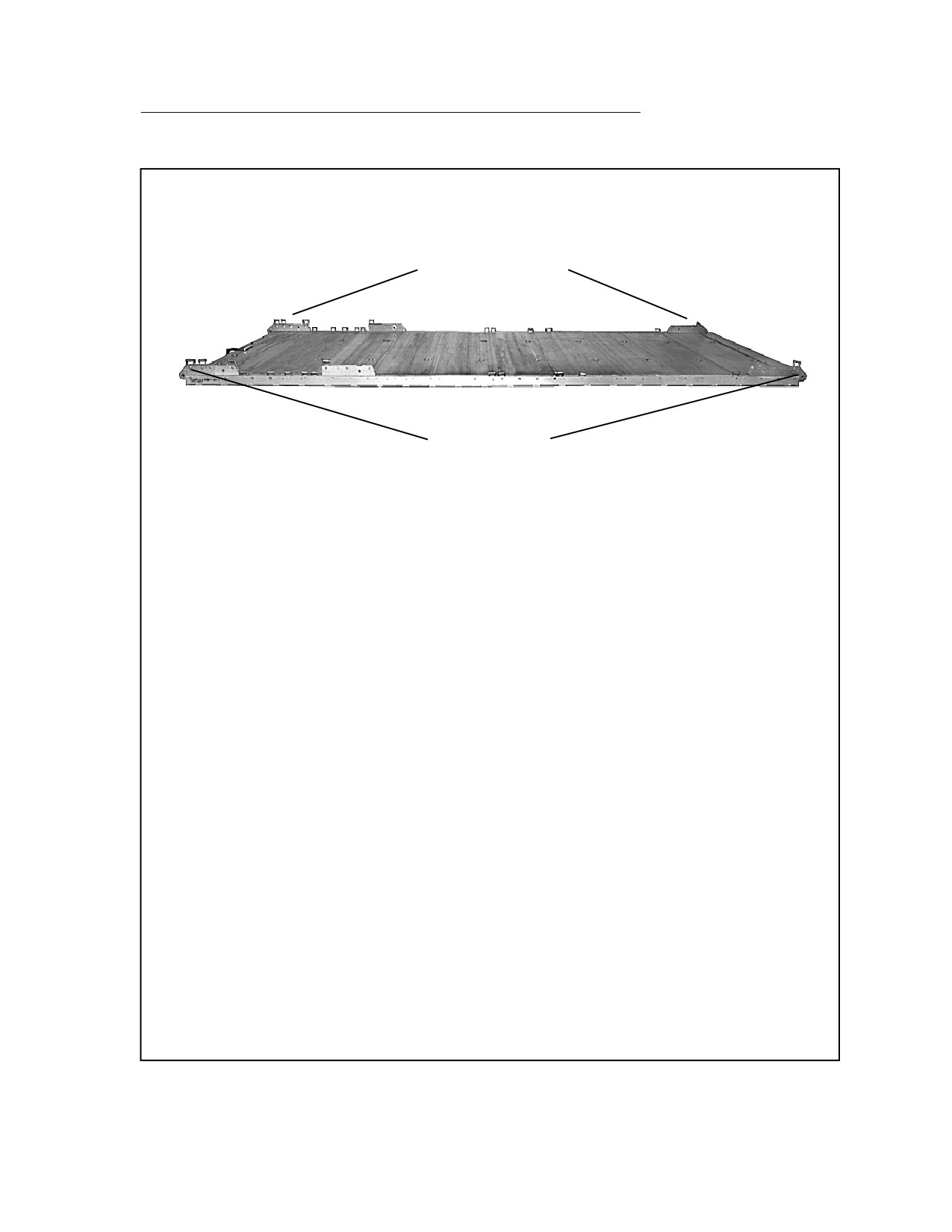
PREPARING PLATFORM
3-17. Prepare a 20-foot, type V airdrop platform according to TM 10-1670-268-
20&P/TO 13C7-52-22. Install four tandem links, two suspension links and 32
load tie-down clevises as shown in Figure 3-8.
Notes:
1. The nose bumper may or may not be installed.
2. Measurements given in this chapter are from the front edge of the
platform, NOT from the front edge of the nose bumper.
3-16
FM 4-20.117/TO 13C7-1-111
CLEVISES
16A THROUGH 1A
LEFT
REAR
FRONT
RIGHT
CLEVISES
16 THROUGH 1
Step:
1.
Install a tandem link on the front of each platform side rail using holes 1, 2, and 3.
2.
Install a suspension link to each platform side rail using holes 29, 30, and 31.
3.
Install a tandem link on the rear of each platform side rail using holes 38, 39, and 40.
4.
Install a clevis on bushing 1of each front tandem link.
5.
Install a clevis on bushing 4 of each suspension link.
6.
Install clevises on bushings 1, 3 and 4 of each rear tandem link.
7.
Starting at the front of the platform, install clevises on each platform side rail using the
bushings bolted on holes 5, 15, 20, 21, 32, 33, 34, 35, and 37.
8.
Install a clevis on bushing 17 in an inverted position. Install a bushing on clevis 17A in the
normal position. Bolt an additional clevis to each of the clevises bolted to the 17th bushings.
9.
Starting at the front of the platform, number the clevises bolted to the right side of the
platform from 1 through 16, and those bolted to the left side from 1A through 16A. Number
the clevises installed on the 17th bushings 5 and 5A. Number the clevises bolted to these
clevises 4 and 4A.
10. Label the tie-down rings according to FM 4-20.102/TO 13C7-1-5.
Figure 3-8. Platform Prepared
3-17
FM 4-20.117/TO 13C7-1-111
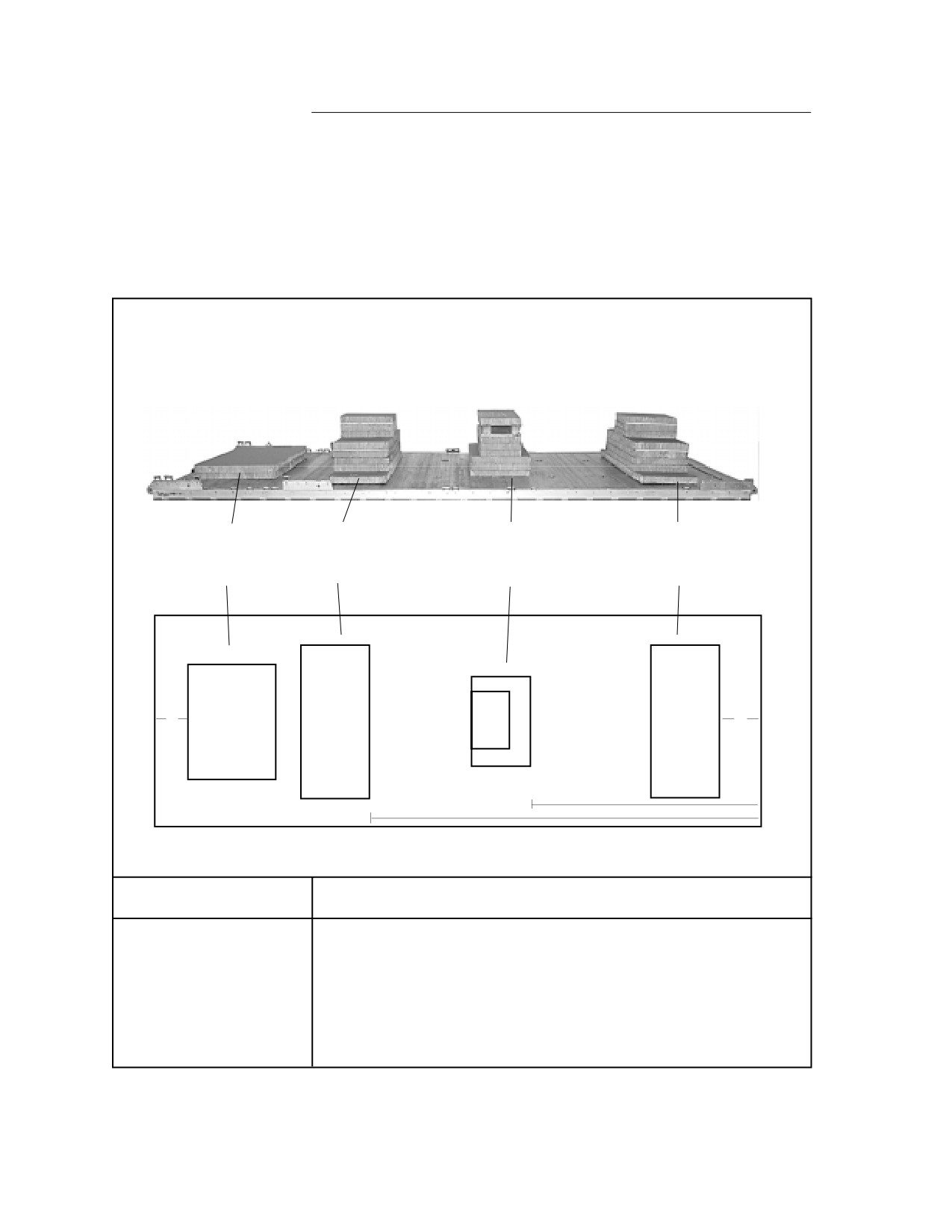
PREPARING AND POSITIONING HONEYCOMB STACKS
3-18. Prepare honeycomb stacks 1 through 3 as shown in Figures 2-3 and 2-4.
Glue two 36- by 60-inch pieces of honeycomb flush together to make stack 4.
Position the stacks on the platform as shown in Figure 3-9, and according to
FM 4-20.102/TO 13C7-1-5.
Notes: 1. This drawing is not drawn to scale.
2. All dimensions are in inches.
STACK
STACK
STACK
STACK
4
3
2
1
REAR
8
17
FRONT
86
147
Stack Number
Position of Stack on Platform
Place stack:
1
17 inches from the front edge of the platform and centered.
2
86 inches from the front edge of the platform and centered. Face the
cutout to the rear.
3
147 inches from the front edge of the platform and centered.
4
8 inches from the rear edge of the platform and centered.
Figure 3-9. Honeycomb Stacks Positioned on Platform
3-18
FM 4-20.117/TO 13C7-1-111
RIGGING ACCOMPANYING LOADS ON THE PLATFORM AND IN THE TRUCK
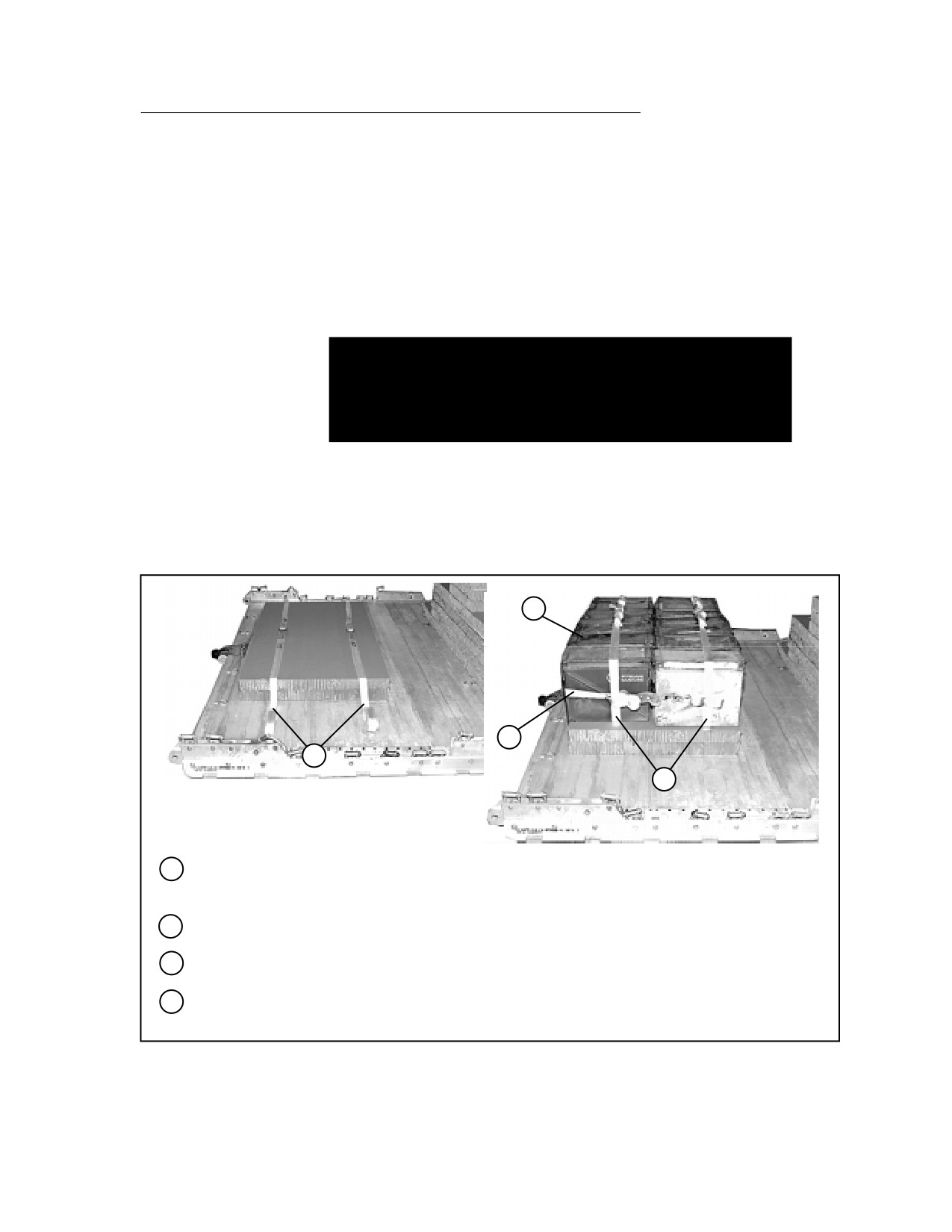
3-19. The accompanying load shown is fourteen boxes of 20-millimeter ammuni-
tion. Any load of similar weight and configuration can be rigged on the platform.
Rig this accompanying load on the platform as shown in Figure 3-10.
CAUTION
Only ammunition listed in FM 10-500-53/MCRP 4-3.81/
TO 13C7-18-41 may be airdropped. Package, mark
and label hazardous material according to
AFJMAN 24-204/TM 38-250.
Rig an accompanying load in the truck as shown in Section I of this chapter.
Chapter 5 shows specific accompanying loads. Make sure any accompanying
loads meet the restrictions and requirements as outlined in FM 4-20.102/TO
13C7-1-5.
2
4
1
3
1
Form two 30-foot lashings according to FM 4-20.102/TO 13C7-1-5. Lay them from side to side
on the honeycomb as shown.
2
Set 14 boxes of 20-millimeter ammunition on top of the lashings and honeycomb.
3
Secure the 30-foot lashings placed in step 1 on top of the boxes with D-rings and load binders.
4
Run a 30-foot lashing around the boxes, passing it through the box carrying handles. Secure
the lashing with D-rings and a load binder on the side.
Figure 3-10. Accompanying Load Stowed on Platform
3-19
FM 4-20.117/TO 13C7-1-111
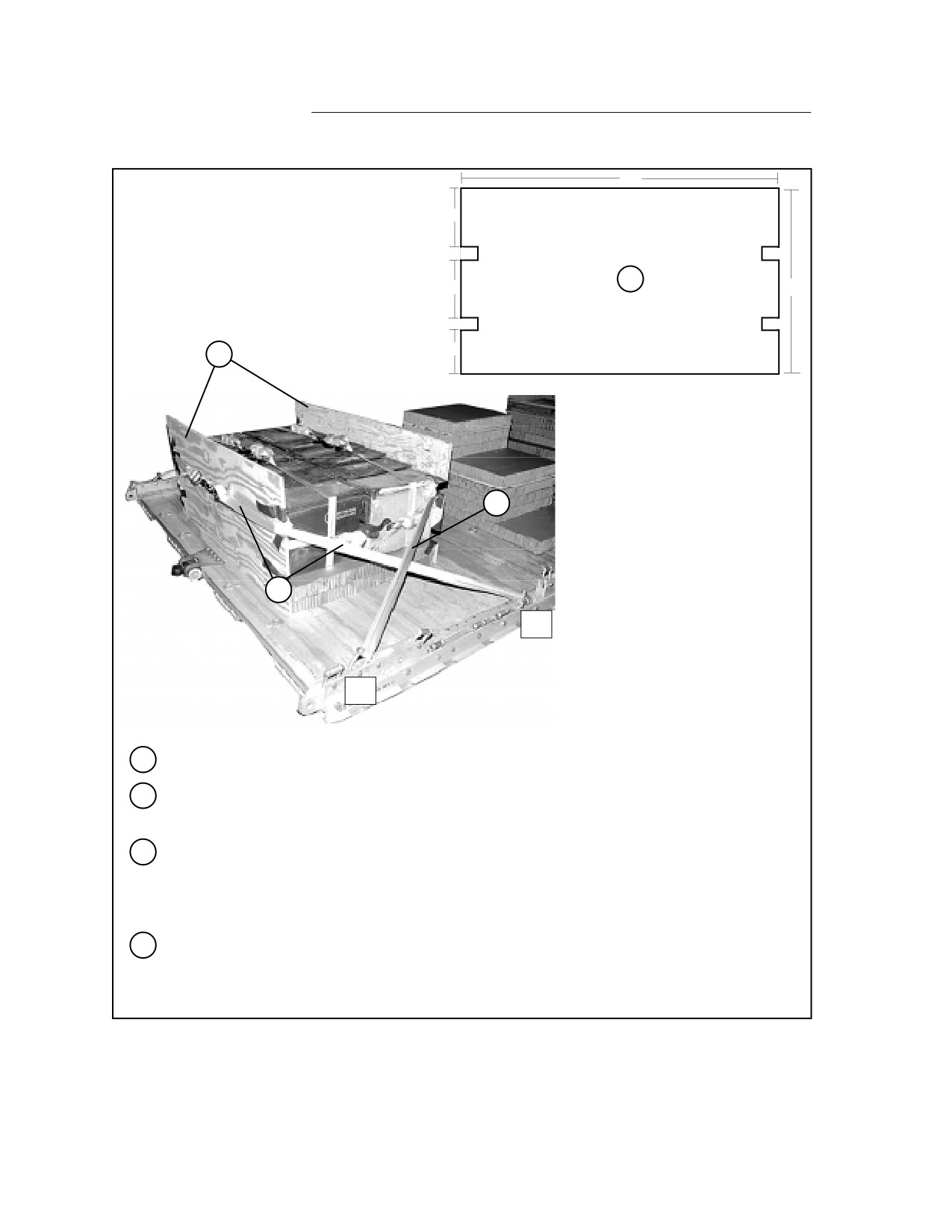
1. This drawing is not drawn to scale.
60
2. All dimensions are in inches.
8
5
8
27
3
3
5
6
7
8
9
15
5
Construct two endboards of 3/4- by 27- by 60-inch plywood as shown.
6
Center an endboard against each end of the stack. Pad the cutouts with cellulose wadding
taped in place.
7
Center a 30-foot lashing on the front endboard and pass the ends through the upper slots. Pass
the lashing through clevises 15 and 15A and bring the ends back through the upper slots in the
front endboard. Secure the lashing against the front endboard with two D-rings and a load
binder.
8
Center a 30-foot lashing on the rear endboard and pass the ends through the upper slots. Pass
the lashing through clevises 9 and 9A and bring the ends back through the upper slots in the
rear endboard. Secure the lashing against the rear endboard with two D-rings and a load
binder.
Figure 3-10. Accompanying Load Stowed on Platform (continued)
3-20
FM 4-20.117/TO 13C7-1-111
12
11
10
10
10
9
16
15
14
12
10
9
9
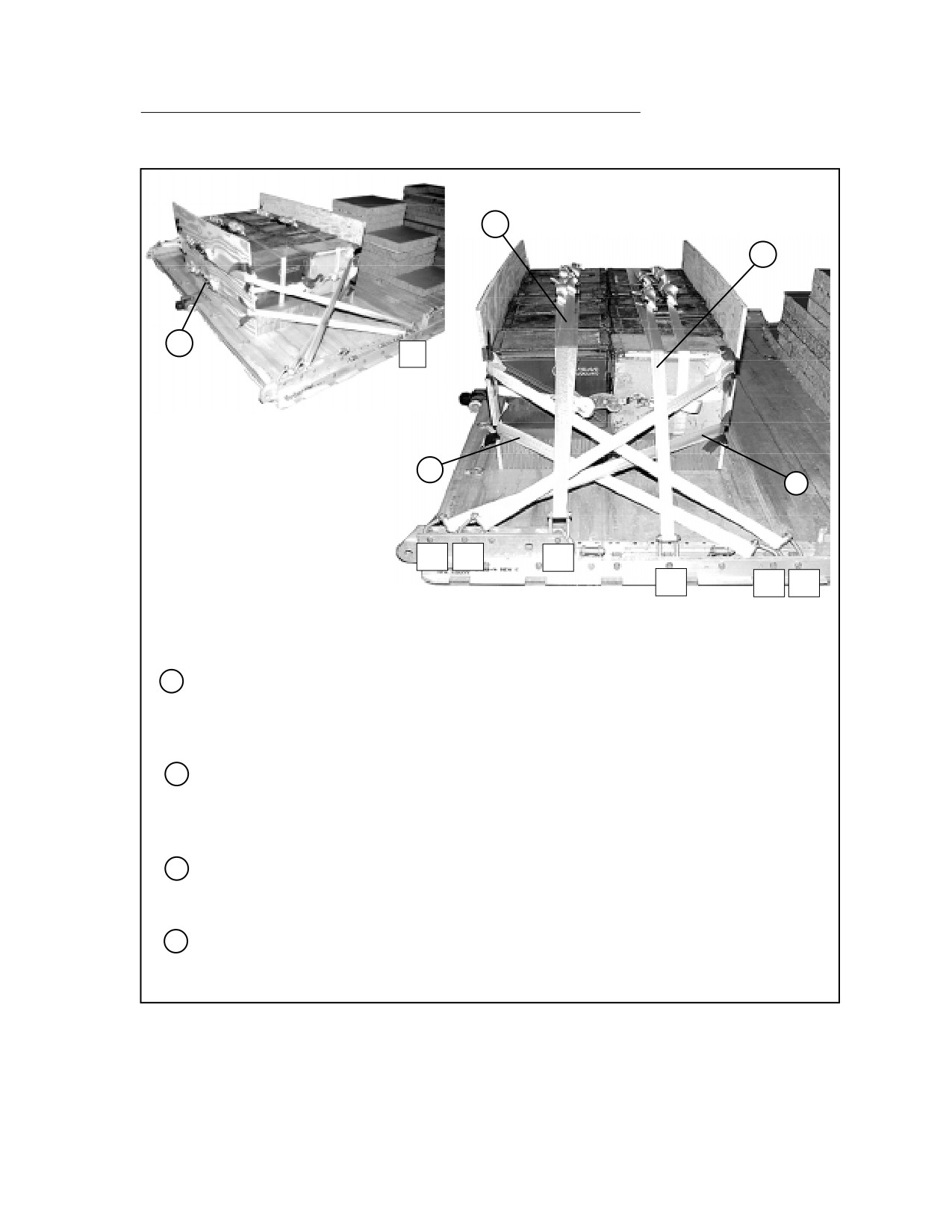
Center a 30-foot lashing on the front endboard and pass the ends through the lower slots. Pass
the lashing through clevises 16 and 16A and bring the ends back through the lower slots in the
front endboard. Secure the lashing against the front endboard with two D-rings and a load
binder.
10
Center a 30-foot lashing on the rear endboard and pass the ends through the lower slots. Pass
the lashing through clevises10 and 10A and bring the ends back through the lower slots in the
rear endboard. Secure the lashing against the rear endboard with two D-rings and a load
binder.
11
Center a 30-foot lashing on top of the boxes. Pass the ends of the lashing through clevises 12
and 12A, and back over to the tops of the boxes. Secure the lashing with two D-rings and a
load binder.
12
Center a 30-foot lashing on top of the boxes. Pass the ends of the lashing through clevises 14
and 14A, and back over to the tops of the boxes. Secure the lashing with two D-rings and a
load binder.
Figure 3-10. Accompanying Load Stowed on Platform (continued)
3-21
FM 4-20.117/TO 13C7-1-111
PREPARING TRUCK
3-20. Prepare the truck as described in paragraphs 2-4a through e, g, and h,
and as shown in Figures 2-6 and 2-7, 2-8 (omit steps 1 and 3), 2-9, 2-11, and 2-
12. Further prepare the closed-body HMMWV as shown in Figures 3-2 and 3-3
(omit step 3).
INSTALLING OPTIONAL DRIVE-OFF AIDS ON PLATFORM
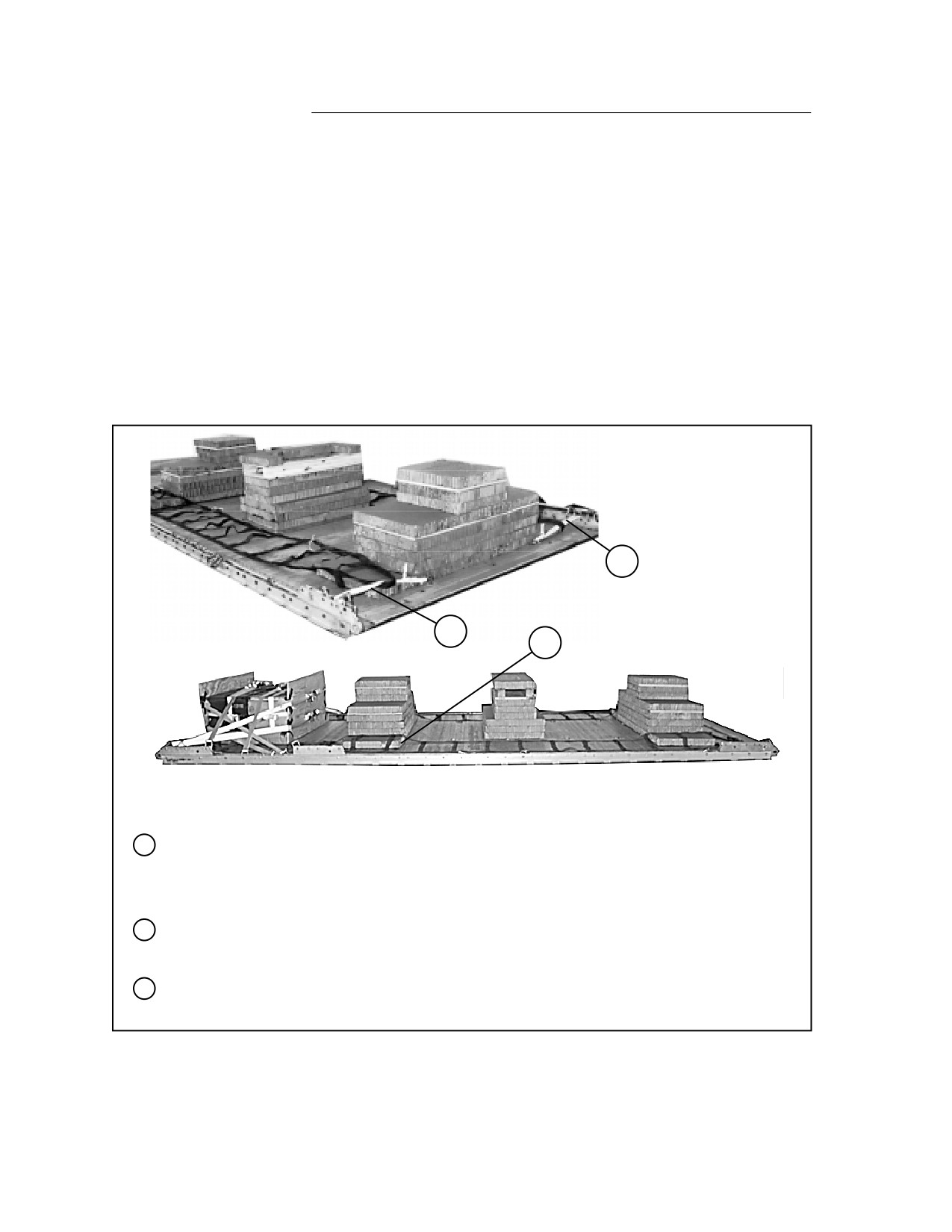
3-21. Install the optional drive-off aids on the platform as shown in Figure 3-11.
2
1
3
1
Pass a 45-inch length of type V or 1-inch tubular nylon webbing through tie-down ring A1,
through the end loop of a drive-off aid, and around the second bushing of the right tandem link.
Knot the webbing according to FM 4-20.102/TO 13C7-1-5.
2
Repeat step 1 for the left side, using tie-down ring B1 and the second bushing of the left
tandem link.
3
Extend the drive-off aids to the rear, over stacks 1 and 3. Secure the drive-off aids to bushings
and clevises with type I, 1/4-inch cotton webbing.
Figure 3-11. Drive-off Aids Installed on Platform
3-22
FM 4-20.117/TO 13C7-1-111
LIFTING AND POSITIONING TRUCK AND INSTALLING OPTIONAL DRIVE-OFF AIDS
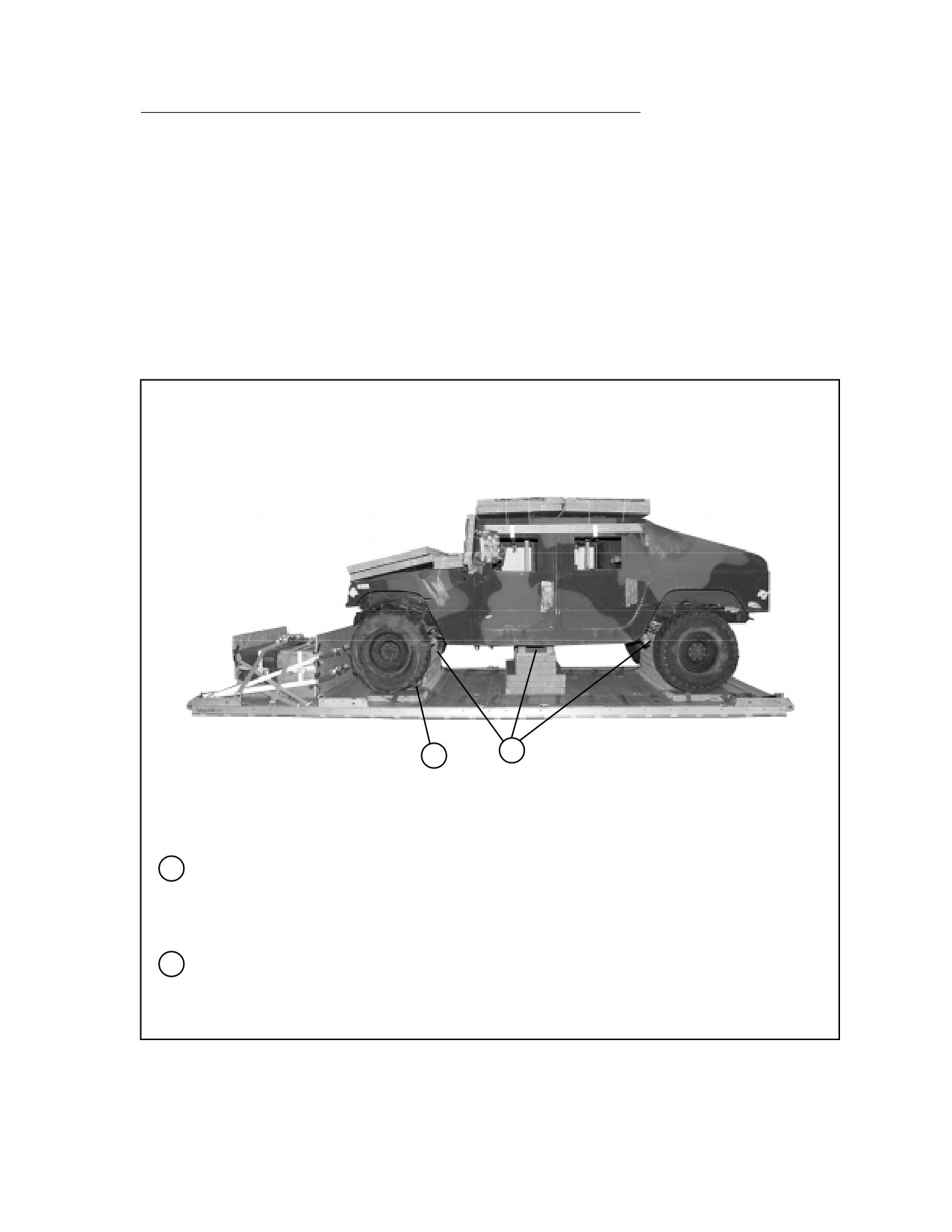
3-22. Install lifting slings on the truck as shown in Figure 2-16.
Position the truck on the platform as shown in Figure 3-12. Adapt the proce-
dures in Figure 2-17 to install the drive-off aids to the front wheels of the truck.
2
1
1
Lift the truck onto the honeycomb stacks so that the rear of the truck is aligned with the front
edge of the platform. Wrap the drive-off aids around the front wheels before setting the truck
down on the honeycomb stacks.
2
Be sure that the suspension cross members rest securely on stacks 1and 3. Be sure that the
frame cross member rests securely on the 6-inch part of the honeycomb at the top of stack 2.
Figure 3- 12. Truck Positioned on Platform
3-23
FM 4-20.117/TO 13C7-1-111
LASHING TRUCK
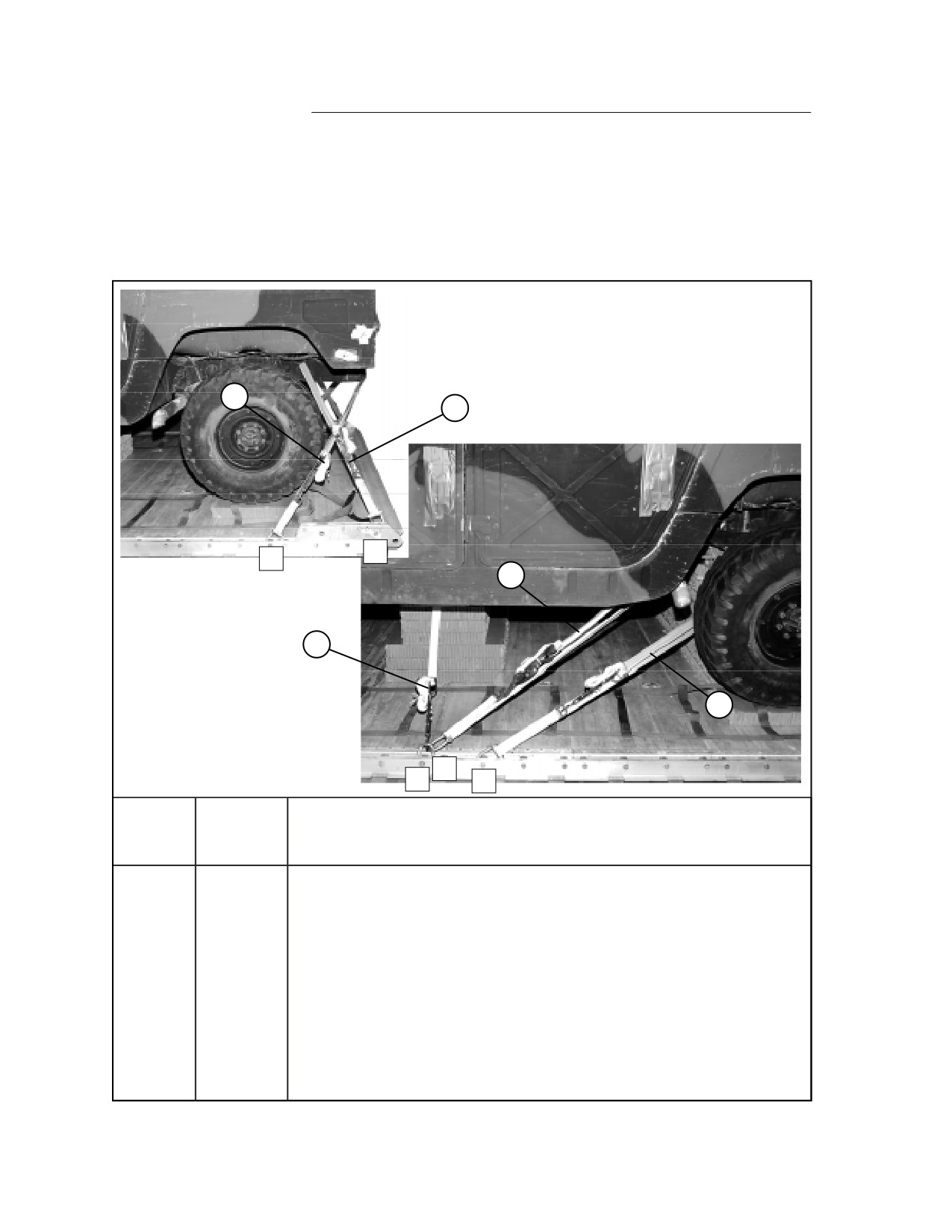
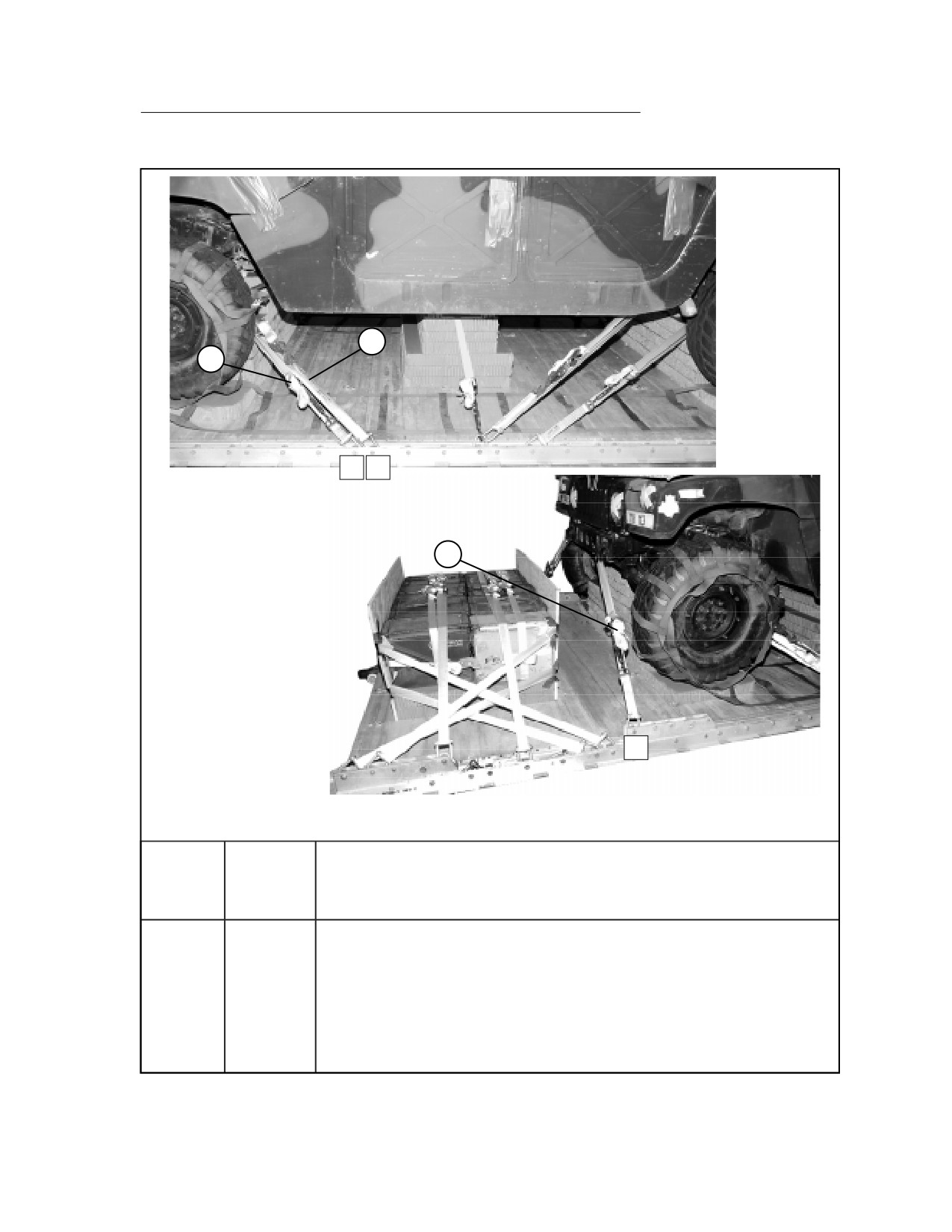
3-23. Lash the truck to the platform with fifteen15-foot tie-down assemblies.
Install the lashings according to FM 4-20.102/TO 13C7-1-5, and as shown in
Figures 3-13 and 3-14.
3
1
1
2
7
9
5
4
5
3
Tie-down
Lashing
Clevis
Number
Number
Instructions
Pass lashing :
1
1
Through tie-down bracket behind left rear coil spring.
2
1A
Through tie-down bracket behind right rear coil spring.
3
2
Through left rear lifting shackle
4
2A
Through right rear lifting shackle
5
3
Around left rear lower control arm
6
3A
Around right rear lower control arm
7
4
Through tie-down bracket in front of left rear coil spring
8
4A
Through tie-down bracket in front of right rear coil spring
9
5 and 5A
Pass a 15-foot lashing through clevis 5A and through its own D-ring .
Pass the lashing through the hole in stack 2. Attach the lashing to clevis
5 with a load binder.
Figure 3-13. Lashings 1 Through 9 Installed
3-24
FM 4-20.117/TO 13C7-1-111
10
12
7
6
14
8
Tie-down
Lashing
Clevis
Number
Number
Instructions
Pass lashing :
10
6
Through tie-down bracket behind left front coil spring.
11
6A
Through tie-down bracket behind right front coil spring.
12
7
Around left lower control arm
13
7A
Around right lower control arm
14
8
Through tie-down bracket on end of left frame rail.
15
8A
Through tie-down bracket on end of right frame rail.
Figure 3-14. Lashings 10 Through 15 Installed
3-25
FM 4-20.117/TO 13C7-1-111
INSTALLING AND SAFETY TYING SUSPENSION SLINGS
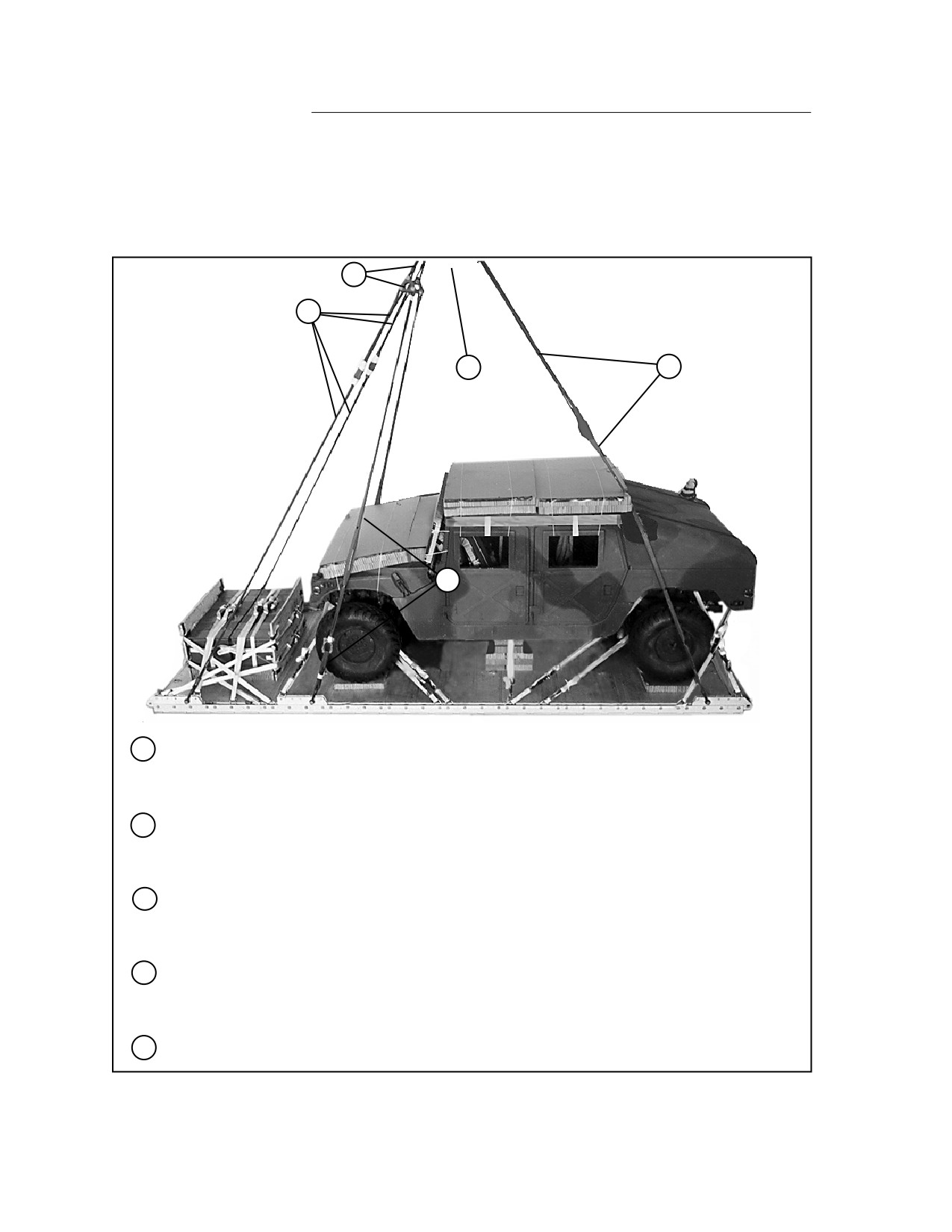
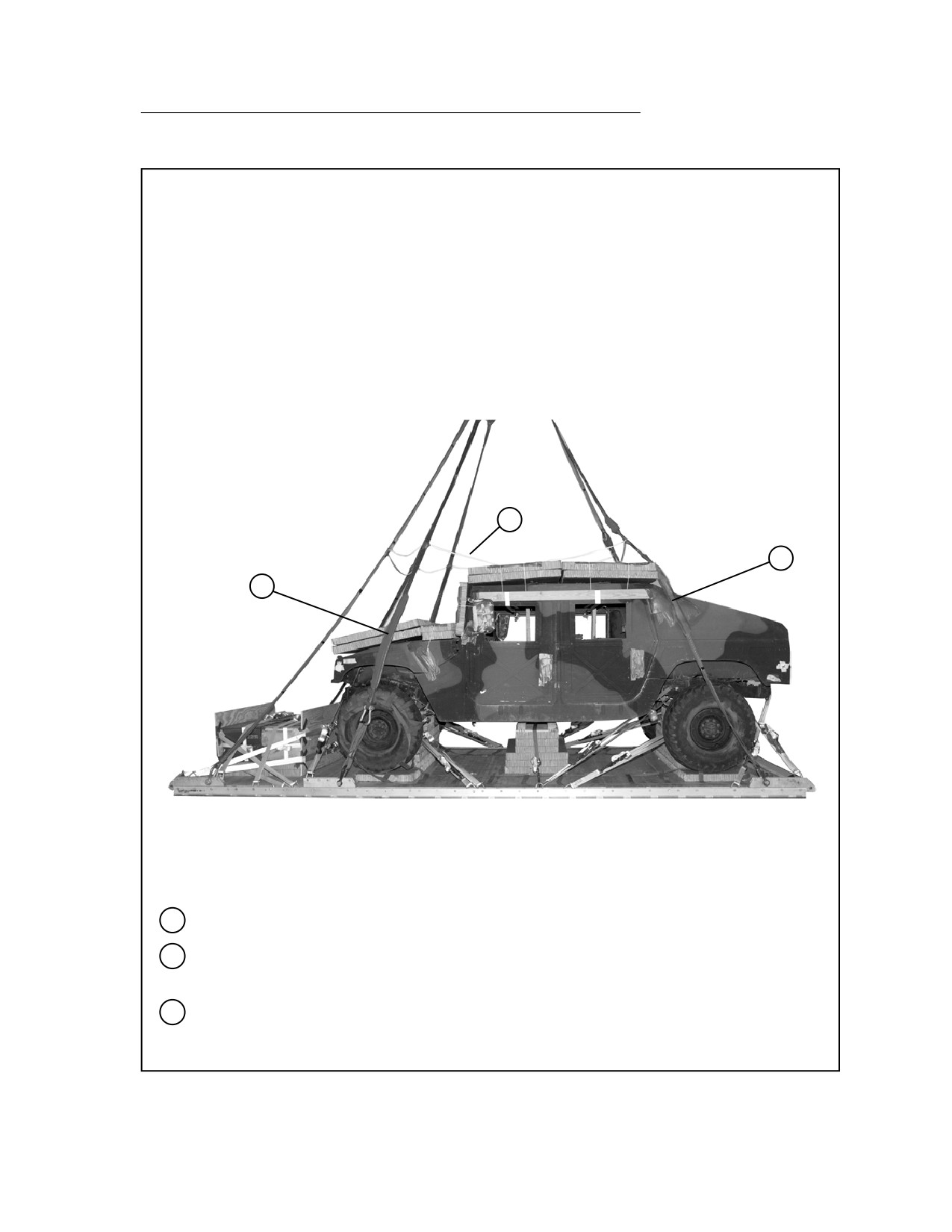
3-24. Install, pad and safety tie the suspension slings according to FM 4-20.102/
TO 13C7-1-5, and as shown in Figure 3-15.
4
2
5
1
3
1
Attach a 9-foot (2-loop), type XXVI nylon sling to each front tandem link with a large clevis.
Join a second 9-foot (2-loop) type XXVI nylon sling to each front suspension sling with a 3 3/4-
inch two-point link. Pad the link with felt taped in place.
2
Attach a 12-foot (2-loop), type XXVI nylon sling to each rear tandem link with a large clevis.
Join a 3-foot, (2-loop), Type XXVI nylon sling to the 12-foot sling with a 3 3/4-inch two point
link. Pad the link with felt taped in place.
3
Place both ends of a 3-foot (2-loop), type XXVI nylon sling in the bell of a large clevis. Bolt the
clevis to the suspension link. Join a 12-foot (2-loop), type XXVI nylon sling to the 3-foot sling
with a large clevis, placing the bell of the clevis in the 3-foot sling. Repeat for the left side.
4
Join the center and rear suspension slings together at their free ends with a three-point link.
Attach a 3-foot (2-loop), Type XXVI nylon sling to the remaining point of the 3-point link on
each side.
5
Attach the front, center, and rear suspension slings to the crane hook and pull the slings taut.
Figure 3-15. Suspension Slings Installed, Padded and Safety Tied
3-26
FM 4-20.117/TO 13C7-1-111
6
7
8
6
Safety tie the suspension slings with the deadman's tie according to FM 4-20.102/TO 13C7-1-5.
7
Wrap the front suspension slings with a layer of felt from 64 to 96 inches above the platform.
Tape the felt in place. Extend the tape 3 inches beyond the ends of the felt.
8
Use the procedure given in step 7 above to pad the center suspension slings from 38 to 74
inches above the platform.
Figure 3-15. Suspension Slings Installed, Padded and Safety Tied (continued)
3-27
FM 4-20.117/TO 13C7-1-111
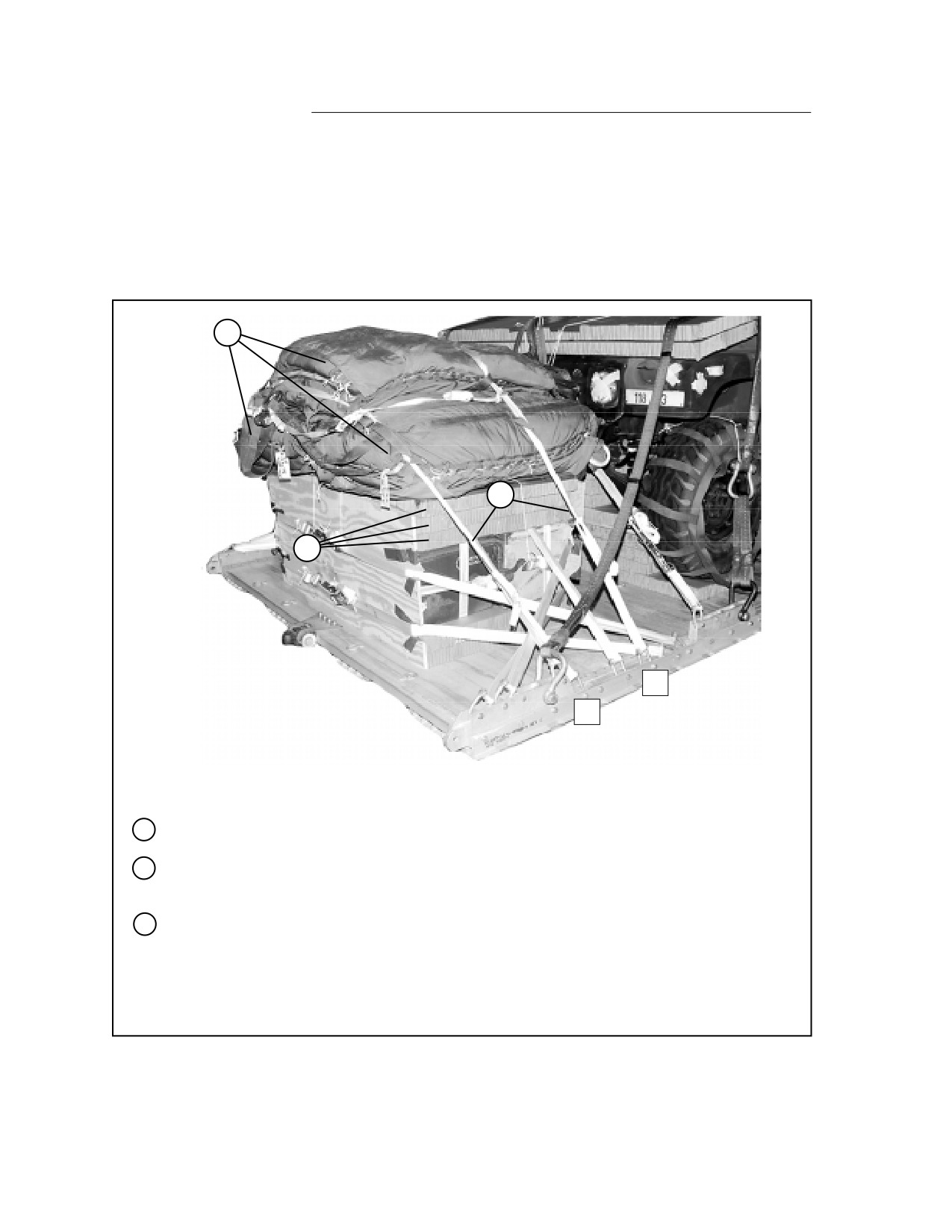
STOWING CARGO PARACHUTES
3-25. Use three G-11 cargo parachutes on this load. Stow the cargo parachutes
according to FM 4-20.102/TO 13C7-1-5, and as shown in Figure 3-16.
2
3
1
11
13
1
Secure three 30- by 60-inch pieces of honeycomb flush over the boxes with type III nylon cord.
2
Place and cluster three G-11 cargo parachutes on the honeycomb accordingto FM 4-20.102/TO
13C7-1-5.
3
Tie the restraint straps to clevises 11 and 11A, and to clevises 13 and 13A. Install the para-
chute release knives and straps according to FM 4-20.102/TO 13C7-1-5.
Figure 3-16. Cargo Parachutes Stowed
3-28
FM 4-20.117/TO 13C7-1-111
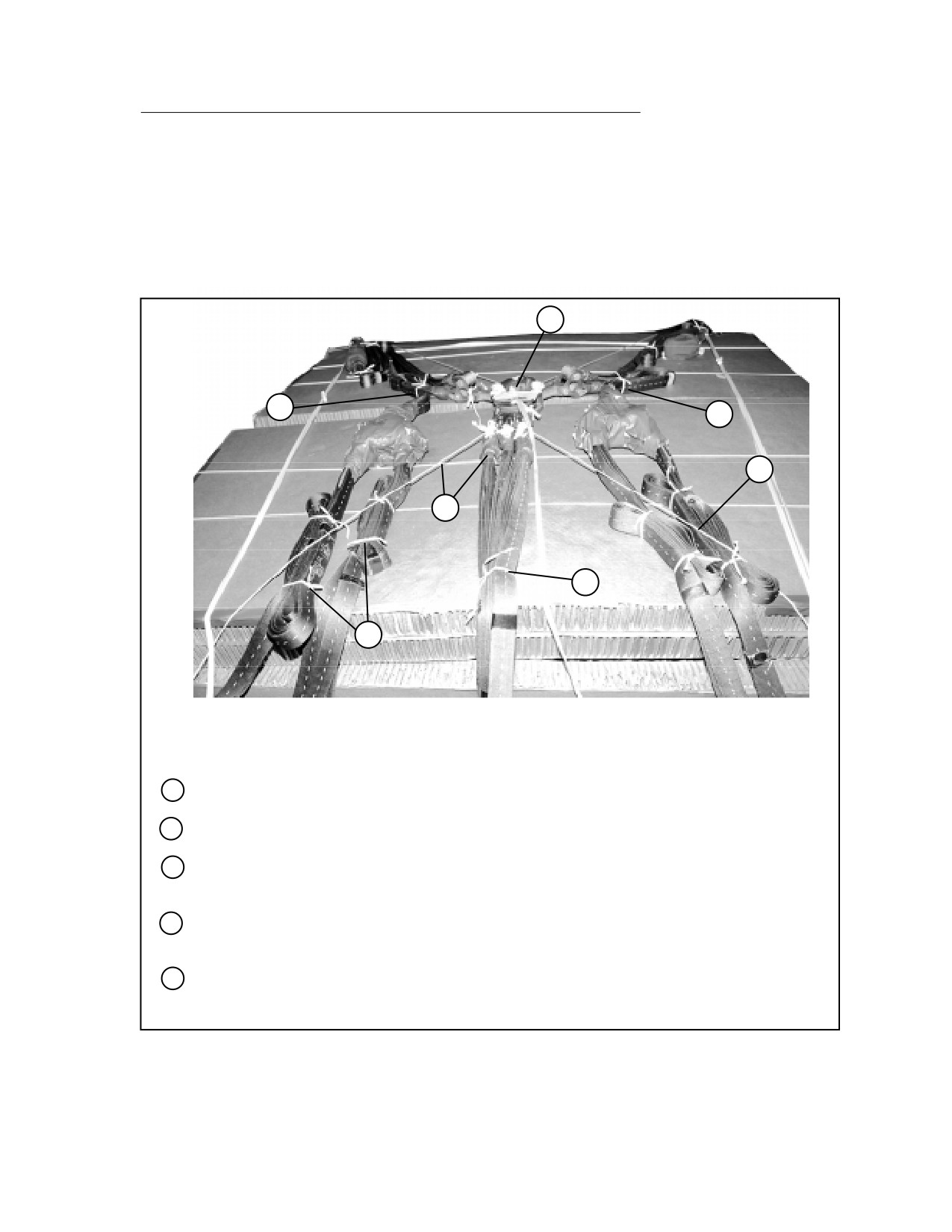
INSTALLING PARACHUTE RELEASE
3-26. Prepare and install an M-1 cargo parachute release according to FM 4-
20.102/TO 13C7-1-5, and as shown in Figure 3-17.
1
3
3
4
4
5
2
1
Center the M-1 release on the truck roof.
2
S-fold the slack in the rear and center suspension slings. Tie the folds with type III nylon cord.
3
S-fold the slack in the front suspension slings, and tie the folds with type I, 1/4-inch cotton
webbing. Tie the front and rear suspension slings together with type I, 1/4-inch cotton webbing.
4
Attach the suspension slings and the riser extensions to the release. Tie the release to conve-
nient points on the load with type III nylon cord tied over the suspension slings.
5
Tie the riser extensions together with type I, 1/4-inch cotton webbing.
Figure 3-17 . M-1 Cargo Parachute Release Installed
3-29
FM 4-20.117/TO 13C7-1-111
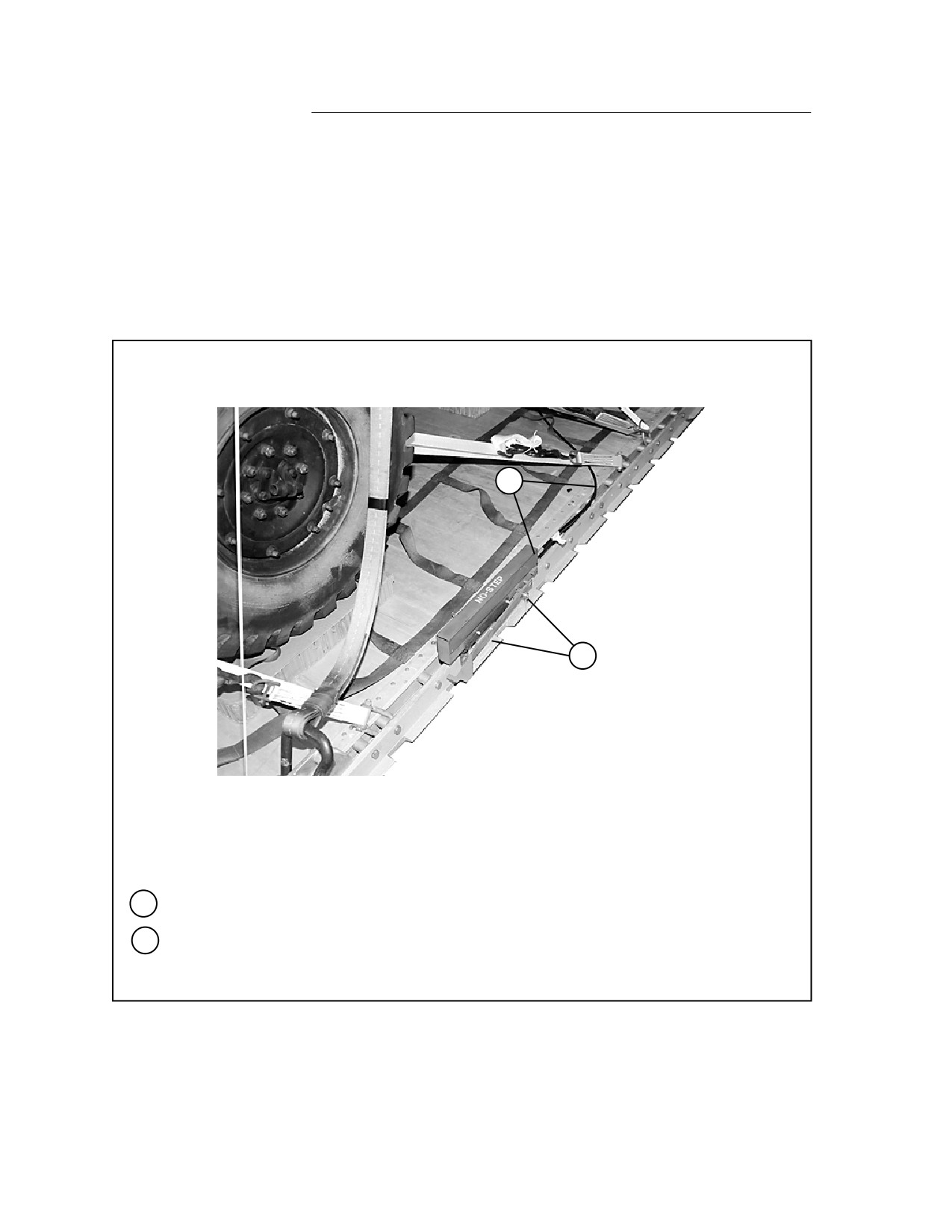
INSTALLING EXTRACTION SYSTEM
3-27. Install the EFTC extraction system according to FM 4-20.102/TO 13C7-1-
5, and as shown in Figure 3-18.
2
1
1
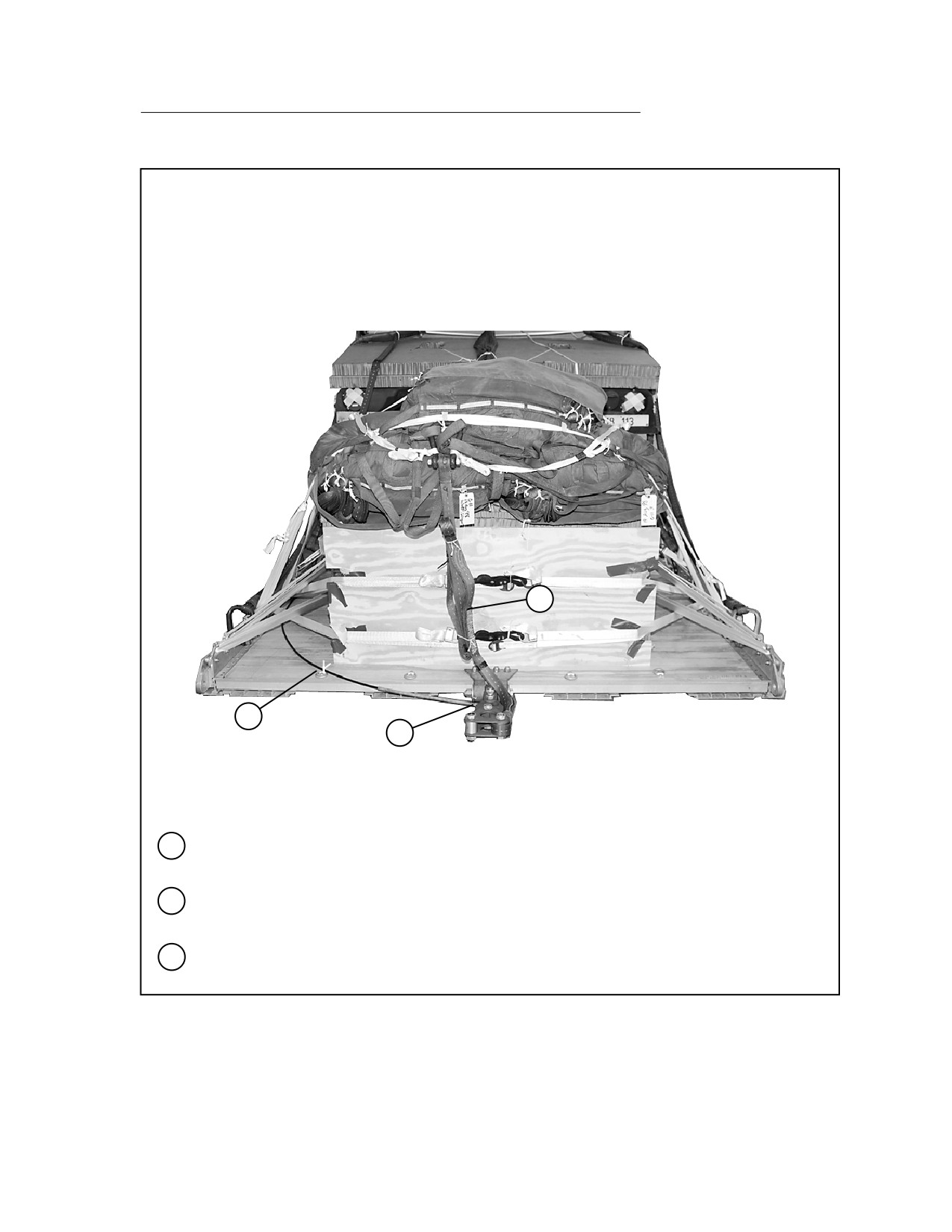
Install the EFTC mounting brackets in the rear mounting holes in the left platform side rail.
2
Attach a 20-foot release cable to the actuator. Install the actuator to the EFTC brackets.
Figure 3-18. EFTC Installed
3-30
FM 4-20.117/TO 13C7-1-111
5
4
3
3
Install the latch assembly to the extraction bracket. Attach the release cable to the latch
assembly.
4
Safety tie the release cable to bushings and tie-down rings with one turn of type I, 1/4-inch
cotton webbing.
5
Install a 9-foot (2-loop), type XXVI nylon webbing deployment line on the load.
Figure 3-18. EFTC Installed (continued)
3-31
FM 4-20.117/TO 13C7-1-111
INSTALLING PROVISIONS FOR EMERGENCY RESTRAINTS
3-28. Install the provisions for emergency restraints on the load according to FM
4-20.102/TO 13C7-1-5.
PLACING EXTRACTION PARACHUTE
3-29. Select the extraction parachute and extraction line needed using the
extraction line requirements table in FM 4-20.102/TO 13C7-1-5. Rig the
extraction line in an extraction line bag according to TM 10-1670-286-20/TO
13C5-2-41. Place the extraction parachute and extraction line on the load for
installation in the aircraft.
MARKING RIGGED LOAD
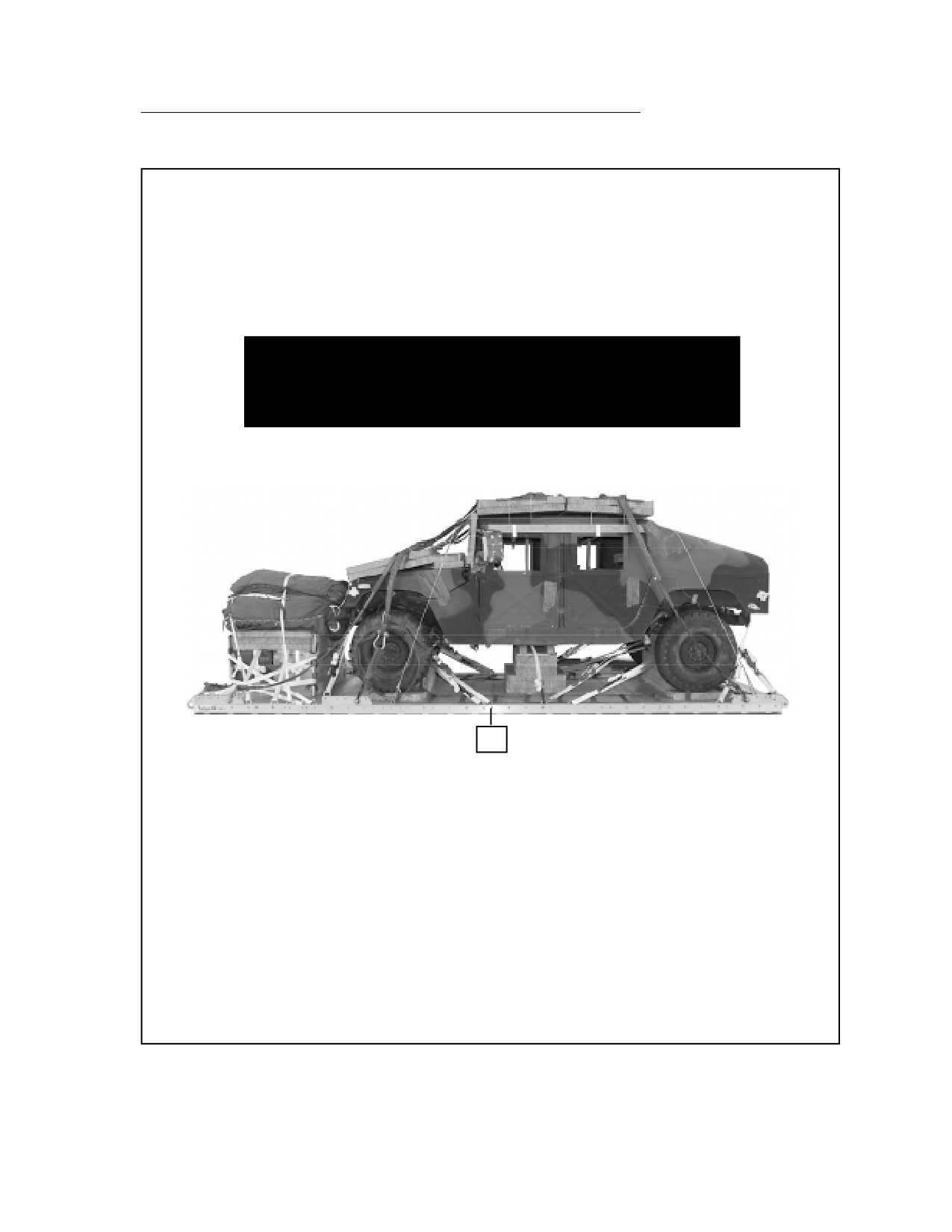
3-30. Mark the rigged load according to FM 4-20.102/TO 13C7-1-5, and as
shown in Figure 3-19. Complete Shipper's Declaration for Dangerous Goods
according to AFJMAN 24-204/TM 38-250. If the load varies from the one shown,
the weight, height, CB, and parachute requirements must be recomputed.
EQUIPMENT REQUIRED
3-31. Use the equipment listed in Table 3-2 to rig this load. The equipment for
rigging the accompanying load is NOT given in Table 3-2.
3-32
FM 4-20.117/TO 13C7-1-111
CAUTION
Make the final rigger inspection required by FM 4-20.102/
TO 13C7-1-5 before the load leaves the rigging site.
CB
RIGGED LOAD DATA
Weight: Load shown
11,740 pounds
Maximum load allowed
12,100 pounds
Height
91 inches
Width
108 inches
Length (overall)
265 inches
Overhang: Front
0 inches
Rear (EFTC)
18 inches
CB (from front edge of platform)
112 inches
Figure 3-19. M1025 Armament Carrier Rigged on a 20-Foot Platform
3-33