FM 3-11.5 MULTISERVICE TACTICS, TECHNIQUES, AND PROCEDURES FOR CHEMICAL, BIOLOGICAL, RADIOLOGICAL, AND NUCLEAR DECONTAMINATION (April 2006) - page 8

Table H-2. Detection Equipment and Materials (Continued)
Item and Description
Use
Limitations
Radiac set, AN/UDR-13
Measures gamma radiation only and
None
provides total dose or dose rate. It will
replace the IM-93/UD dosimeter.
DOD biological sampling
Provides presumptive identification for a
Not to be used as single means of
kit
limited number of biological agents.
identification. The sampling kit should
never be used for diagnostic purposes.
ADM-300
Detects, measures, and digitally displays
None
dose and dose rate levels of beta and
gamma radiation.
Water testing kit, M272
Detects and identifies CW agents in raw or
None
treated water sources.
2.
Decontamination Devices for Personnel
Decontamination devices for personnel are the warfighter’s first defense against
contamination on the skin. They are an integral part of immediate decontamination.
a.
M291 SDK.
(1)
Users: All services and components.
(2)
Description. The M291 kit (Figure H-1) consists of six identical packets
that contain a mixture of activated resins. This resin mixture adsorbs and neutralizes
liquid chemical agents present on an individual’s skin and neutralizes agents. The mixture
consists of an adsorbent resin, a resin containing sulfonic acid, and a hydroxylamine-
containing resin. The black powder residue will provide a visual confirmation of the
thoroughness of application and will not cause any skin irritation even after prolonged
contact with skin. However, normal precautions must be observed so that the powder does
not enter open wounds, the mouth, or the eyes. This kit will also be used for training; no
training aid will be produced. The issue is 20 M291 SDKs per box.
(3)
Mission. The M291 is used to decontaminate the skin, mask hood, and
protective gloves. After masking, the individual opens a packet from the kit, removes the
applicator pad, and applies an even coating of resin powder while scrubbing the entire skin
area suspected to be contaminated.
(4)
Capabilities. One applicator pad will decontaminate both hands and the
face if necessary. If the face must be decontaminated, the neck (including the throat area)
and the ears must also be decontaminated using a second applicator pad. The black powder
resin will provide a visual confirmation of the thoroughness of application and will not
cause any skin irritation even after prolonged contact with skin.
H-4
FM 3-11.5/MCWP 3-37.3/NTTP 3-11.26/AFTTP(I) 3-2.60
4 April 2006
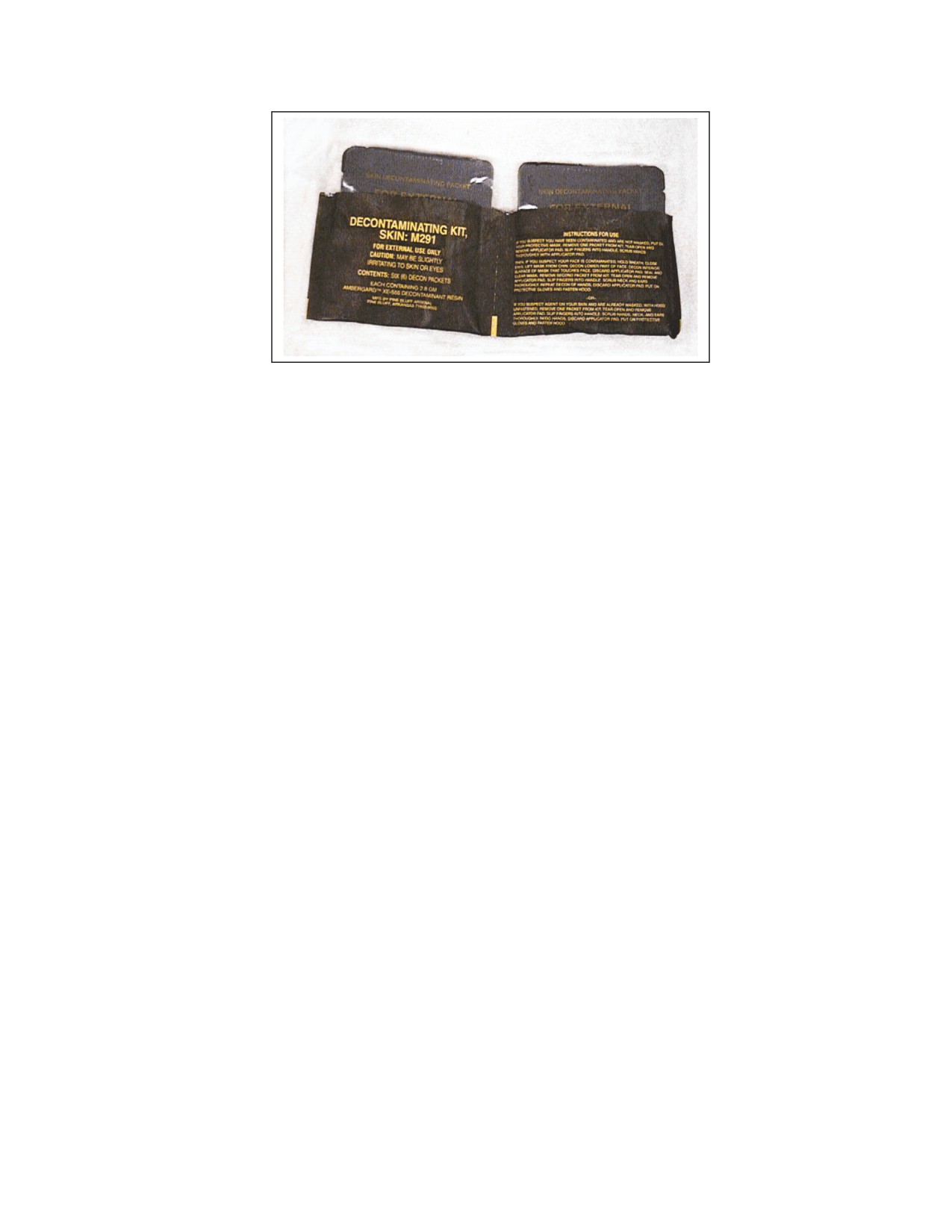
Figure H-1. M291 Skin Decontamination Kit
b.
RSDL.
(1)
Users. All services and components.
(2)
Description. RSDL is a broad-spectrum liquid CW agent decontaminant
that will remove and destroy military chemical agents on contact. After CW agent
destruction, RSDL leaves a nontoxic residue that may be washed off with water. It does not
need to be removed immediately. RSDL is safe for use on all intact skin surfaces and for
limited duration use in the eyes. RSDL reacts rapidly, providing the full removal and
destruction of CW agents within 2 minutes, enabling efficient decontamination of
casualties. The RSDL kit is fielded with three kits per package.
(3)
Mission. The RSDL is used to decontaminate intact skin only. It is
impregnated in a sponge pad and packaged as a single unit in a heat-sealed foil pouch.
When exposed to CW agents, the user wipes the exposed skin with the lotion.
(4)
Capabilities. RSDL acts within seconds of being applied to the skin,
neutralizing the toxicity of chemical agents by breaking down their molecules. Apply the
lotion within 1 minute of contamination. The lotion is effective against cutaneous nerve
and blister agents, such as mustard, GB, and VX.
3.
Decontamination Devices for Equipment
Decontamination devices are used for all levels of equipment decontamination (e.g.,
immediate, operational, and thorough).
a.
M295 IEDK.
(1)
Users. All services and components.
(2)
Description. The M295 kit (see Figure H-2, page H-6) provides a means to
decontaminate individual equipment through physical removal and absorption of chemical
agents, with no long-term harmful side effects. The M295 consists of four individual
wipe-down mitts—each enclosed in a protective packet. Each wipe-down mitt consists of a
decontaminating powder contained within a pad material. When used, the sorbent powder
from the mitt flows freely through the pad material. The M295 allows for the
decontamination of individual equipment, such as gloves, footwear, weapon, helmet, and
LBE through physical removal and sorption of chemical agents. The residue of the powder
4 April 2006
FM 3-11.5/MCWP 3-37.3/NTTP 3-11.26/AFTTP(I) 3-2.60
H-5
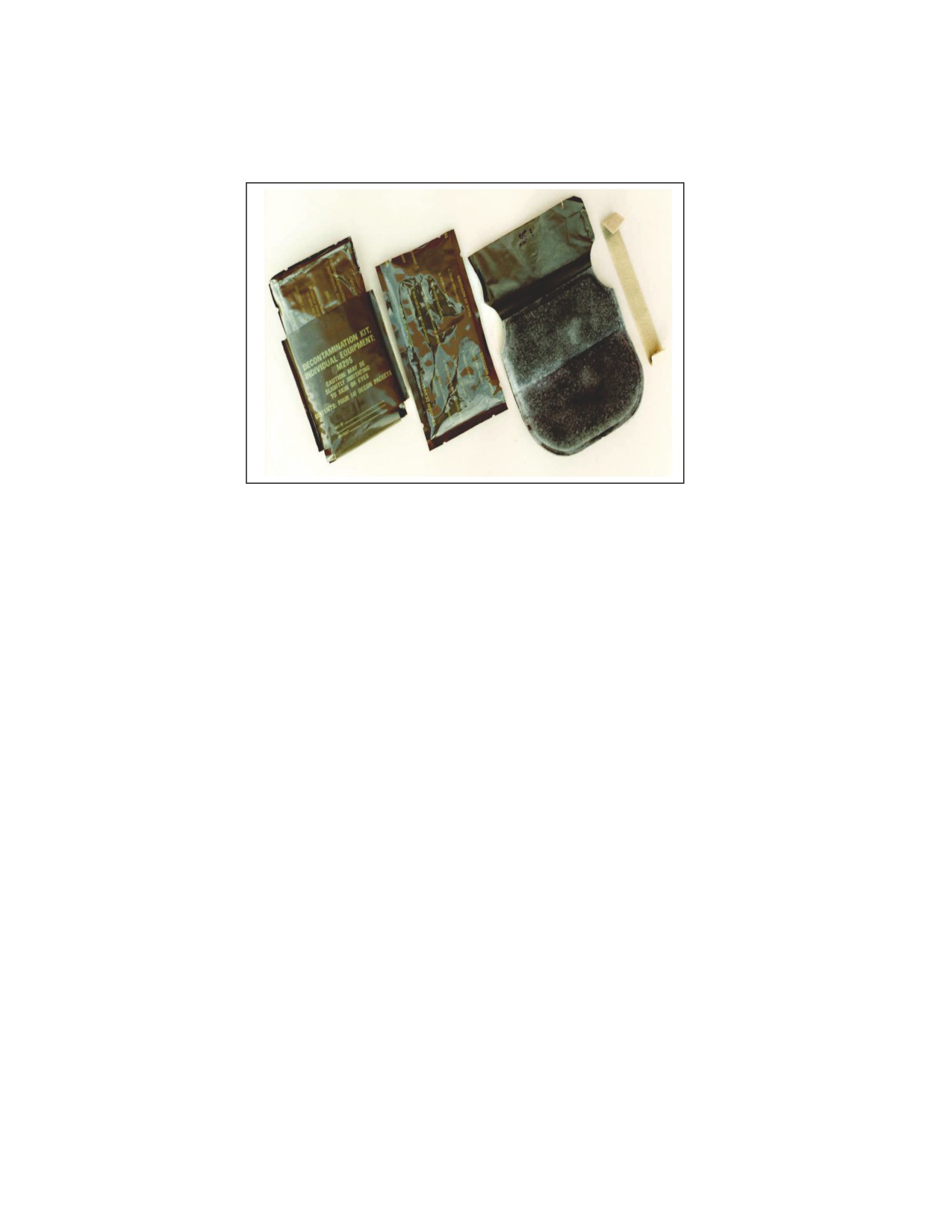
shows where the powder has been used or, more importantly, what areas have not been
decontaminated.
Figure H-2. M295 IEDK
(3)
Mission. The M295 kit is used to decontaminate the individual’s personal
equipment (i.e. protective gloves, mask, hood, NBC overboots, helmet, LBE, and weapon).
Each packet consists of a decontamination mitt filled with 22 grams of the decontaminant
compound, 20 M295 kits are packed in a fiberboard-shipping container.
b.
M100 SDS.
(1)
Users: All services and components.
(2)
Description. The M100 SDS (Figure H-3) uses a reactive sorbent powder to
remove and neutralize chemical agents from surfaces. The use of the M100 SDS decreases
decontamination time and eliminates the need for water. Each M100 SDS consists of two
0.7-pound packs of reactive sorbent powder, two wash mitt type sorbent applicators, a case,
straps, and detailed instructions. An optional chemical-resistant mounting bracket is also
available. The sorbent decontamination system provides a simple, rapid, and efficient
system to decontaminate small and individual issue items. The sorbent is used during the
operator’s wipe-down portion of immediate decontamination on surfaces that personnel
must touch or contact to operate the equipment, such as door handles, crew-served
weapons, etc. The sorbent powder is applied to the mitt or flat surfaces prior to
decontaminating. The M100 SDS is not classified as a hazardous material and, therefore,
can be shipped through normal transport processes.
(3)
Mission. The M100 replaces the M11/M13 DAP and associated
decontamination solution number 2 (DS2) used in operator wipe down (immediate
decontamination) with a reactive, neutralizing sorbent powder.
H-6
FM 3-11.5/MCWP 3-37.3/NTTP 3-11.26/AFTTP(I) 3-2.60
4 April 2006
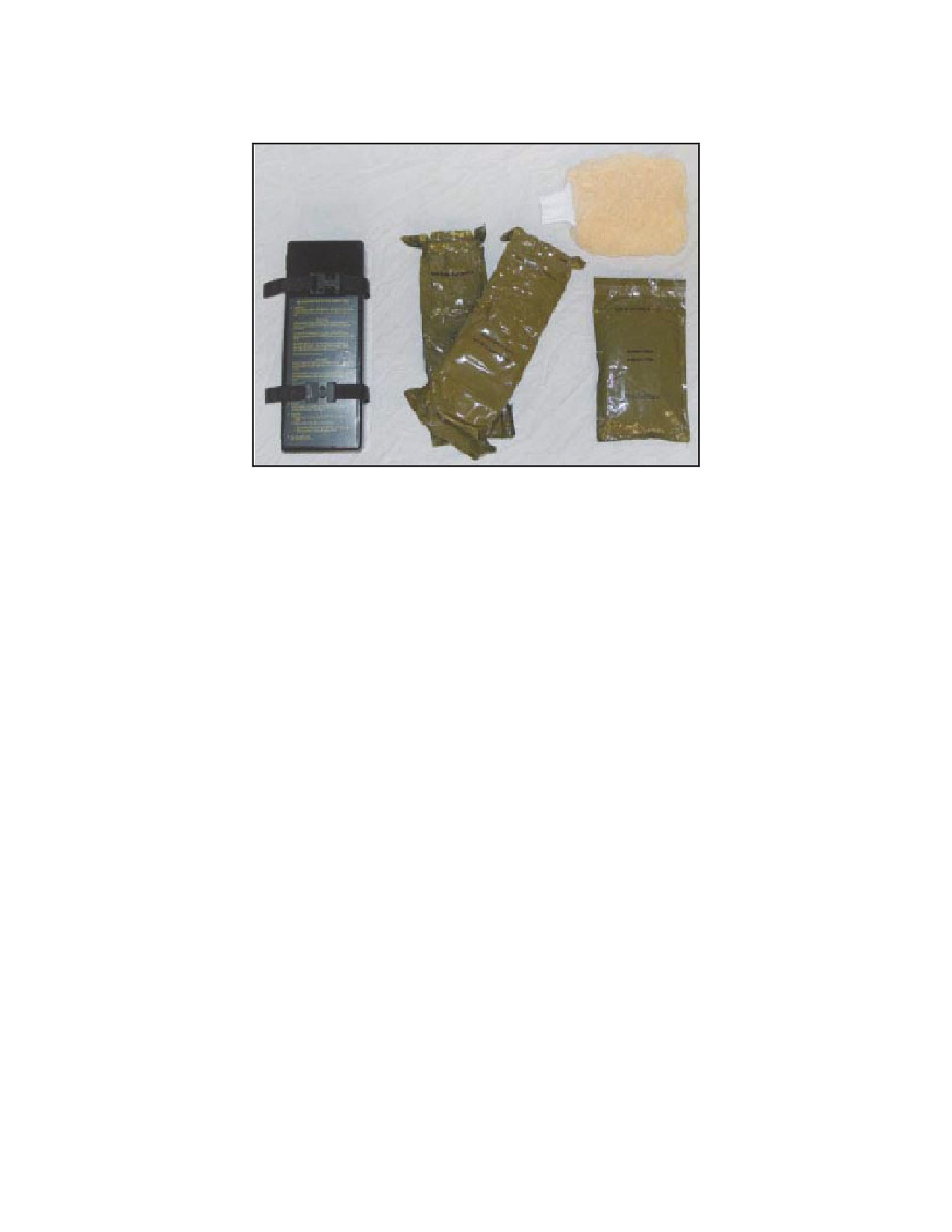
Figure H-3. M100 SDS
4.
Power-Driven Decontamination Systems
Power-driven decontamination systems provide a myriad of decontamination
capabilities to the warfighter. The most significant capability of these systems is their
ability to dispense high-pressure water for the physical removal of contamination.
a.
M17 LDS.
(1)
Users. USA, USMC, and USAF.
(2)
Description. The M17 is a portable decontamination system. It consists of
a 7.3-horsepower engine (Figure H-4, page H-8), a self-priming pump for drawing and
pressurizing water, a fan assembly to deliver combustion air to the heater, a water heater
with a coil of tubing 90 feet (27.45 meters) long, a self-priming pump for the heater fuel
system, and a small generator to supply electricity for ignition and safety control functions.
The M17 LDS includes diesel and gas fuel-powered systems.
(3)
Mission. The M17 dispenses high-volume, low-pressure, hot or cold water
for the removal of gross contamination. It is used to support operational decontamination
missions.
(4)
Capabilities. The M17—
(a) Is transportable by a 3/4-ton trailer, 5/4-ton cargo trucks, cargo
aircraft, and helicopters (sling load).
(b) Provides pressurized water at temperatures up to 248°F (119.88°C) at
a rate of up to 9 gallons (34.06 liters) per minute.
(c)
Draws water from a natural source up to 30 feet (9.15 meters) away
and 9 feet (2.75 meters) below pump level. There is an additional 3,000-gallon (113.55
hectoliter) water storage tank in the event a natural source of water is not available.
4 April 2006
FM 3-11.5/MCWP 3-37.3/NTTP 3-11.26/AFTTP(I) 3-2.60
H-7
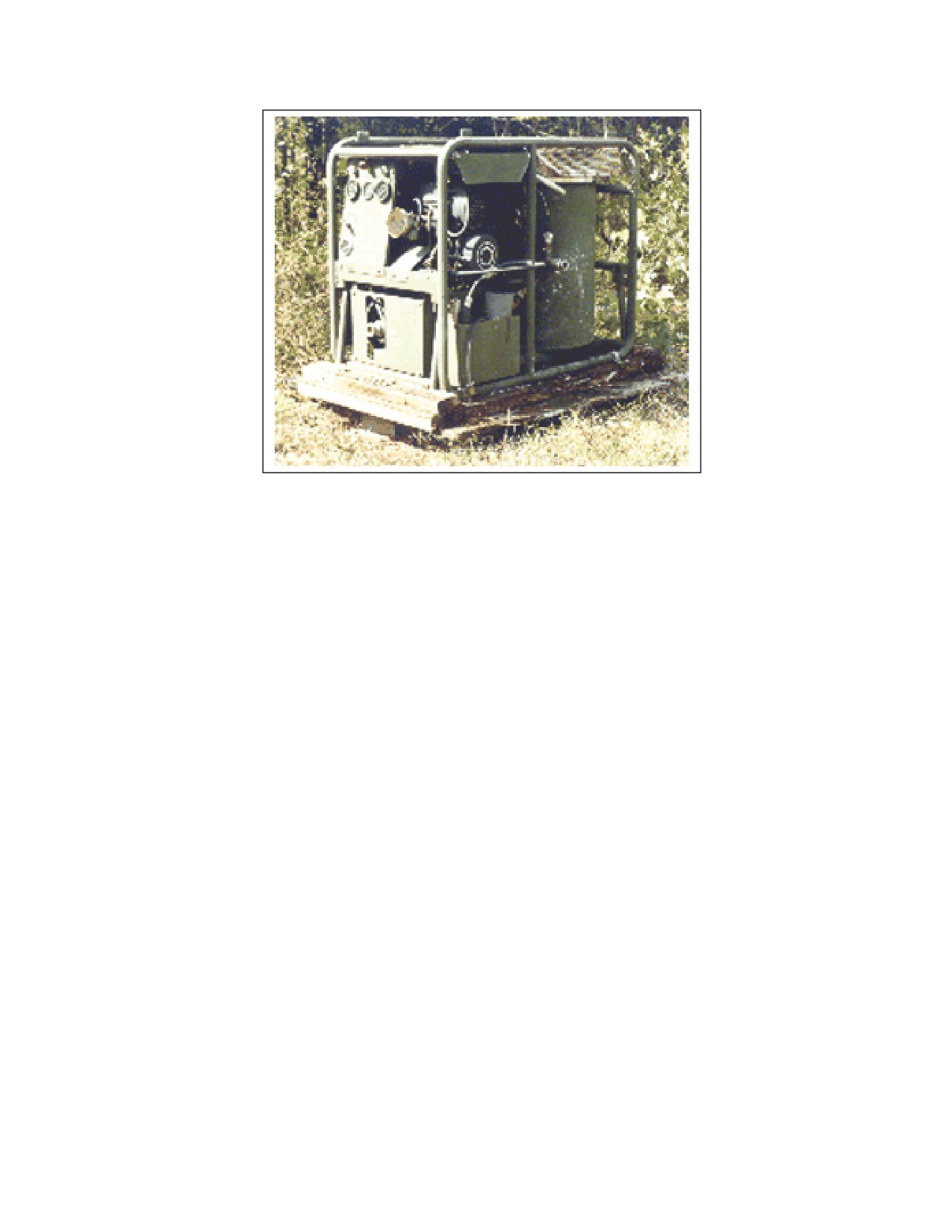
Figure H-4. M17 LDS
b.
Multipurpose Decontamination System.
(1)
Users. USA.
(2)
Description. The MPDS (Figure H-5) is a lightweight, modular
decontamination system.
(3)
Mission. The MPDS decontaminates material with aqueous solutions in
support of operational or thorough decontamination operations.
(4)
Capabilities. The MPDS provides—
(a) Material decontamination with aqueous solutions or hot-foam
treatment.
(b) Equipment decontamination with dry steam.
(c)
Personnel decontamination by supplying warm water to shower
systems.
(d) Multiple operating modes: cold water, hot water, steam, and dry
steam.
(e) Engine winter start capability to -30°C (-22°F).
(f)
Self-priming, high-pressure pump for water intake from all water
sources, including seawater.
(g) Water flow and pressure that are infinitely adjustable.
(h) Automatic protection against calcification.
(i)
Single fuel system.
H-8
FM 3-11.5/MCWP 3-37.3/NTTP 3-11.26/AFTTP(I) 3-2.60
4 April 2006
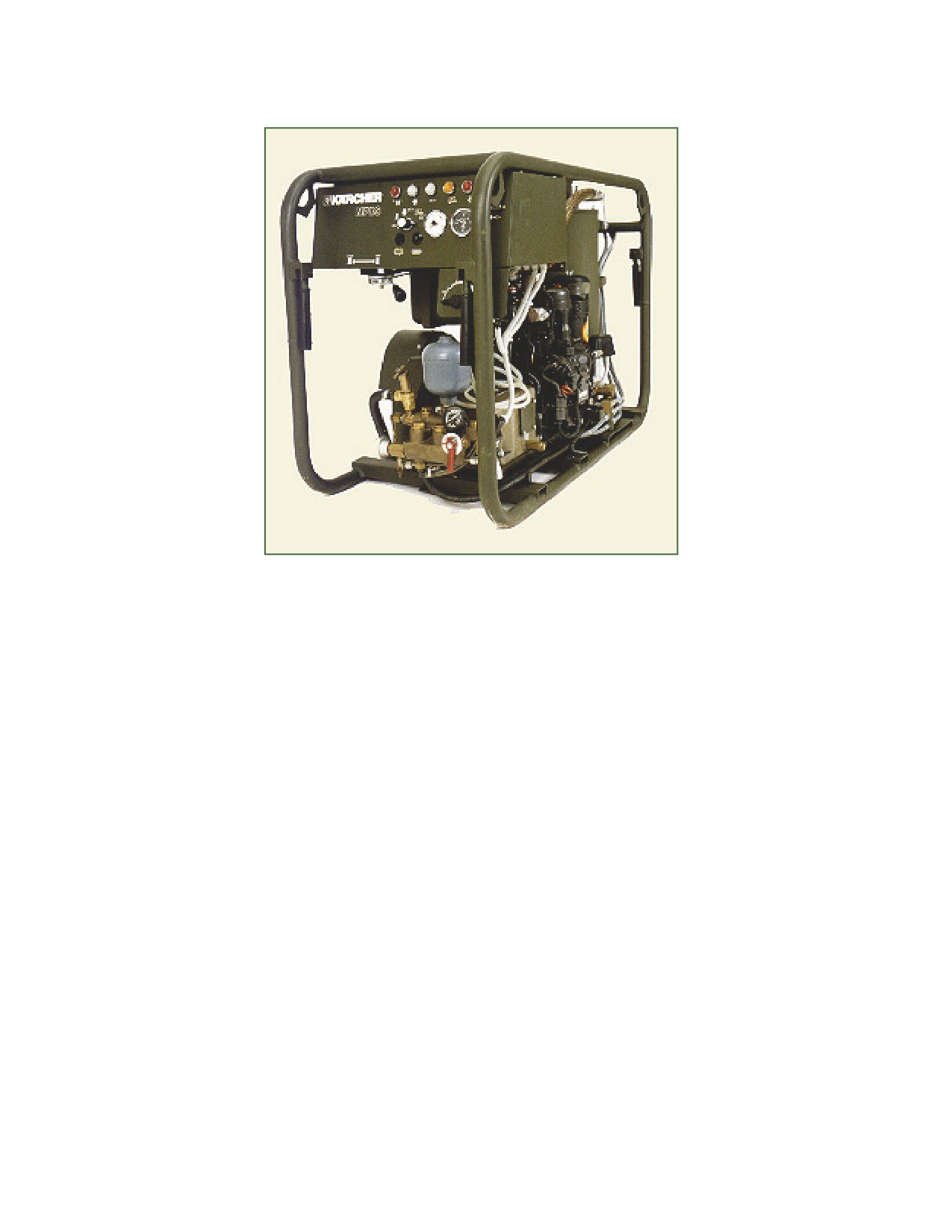
Figure H-5. MPDS
c.
M12A1 Power-Driven Decontamination Apparatus.
(1)
Users. USA.
(2)
Description. The M12A1 consists of a 500-gallon tank, a pumper unit, and
an M2 water heater. Each unit is mounted on a skid base. Power for operating the
equipment is supplied by the pump unit, which uses a 20-horsepower military standard
gasoline or diesel engine to drive a centrifugal pump and a 28-volt direct current generator.
The M2 water heater is electrically connected through a main power cable to a generator in
the pump unit. A personnel shower assembly stowed on the tank unit in disassembled form
can be readily assembled in varying configurations to shower up to 24 personnel at one
time.
(3)
Mission. The M12A1 is used to support thorough, operational, and terrain
decontamination missions.
(4)
Capabilities. The M12A1—
(a) Is used to spray water, STB slurry, and other decontaminants.
(b) May be used for firefighting and spraying water.
d.
Fixed-Site Decontamination System (FSDS).
(1)
Users. USA.
(2)
Description.
(a) The FSDS (Figure H-6, page H-10) is a compressed-air,
foam-generating system, consisting of a pump and bulk decontaminant tank that can be
4 April 2006
FM 3-11.5/MCWP 3-37.3/NTTP 3-11.26/AFTTP(I) 3-2.60
H-9
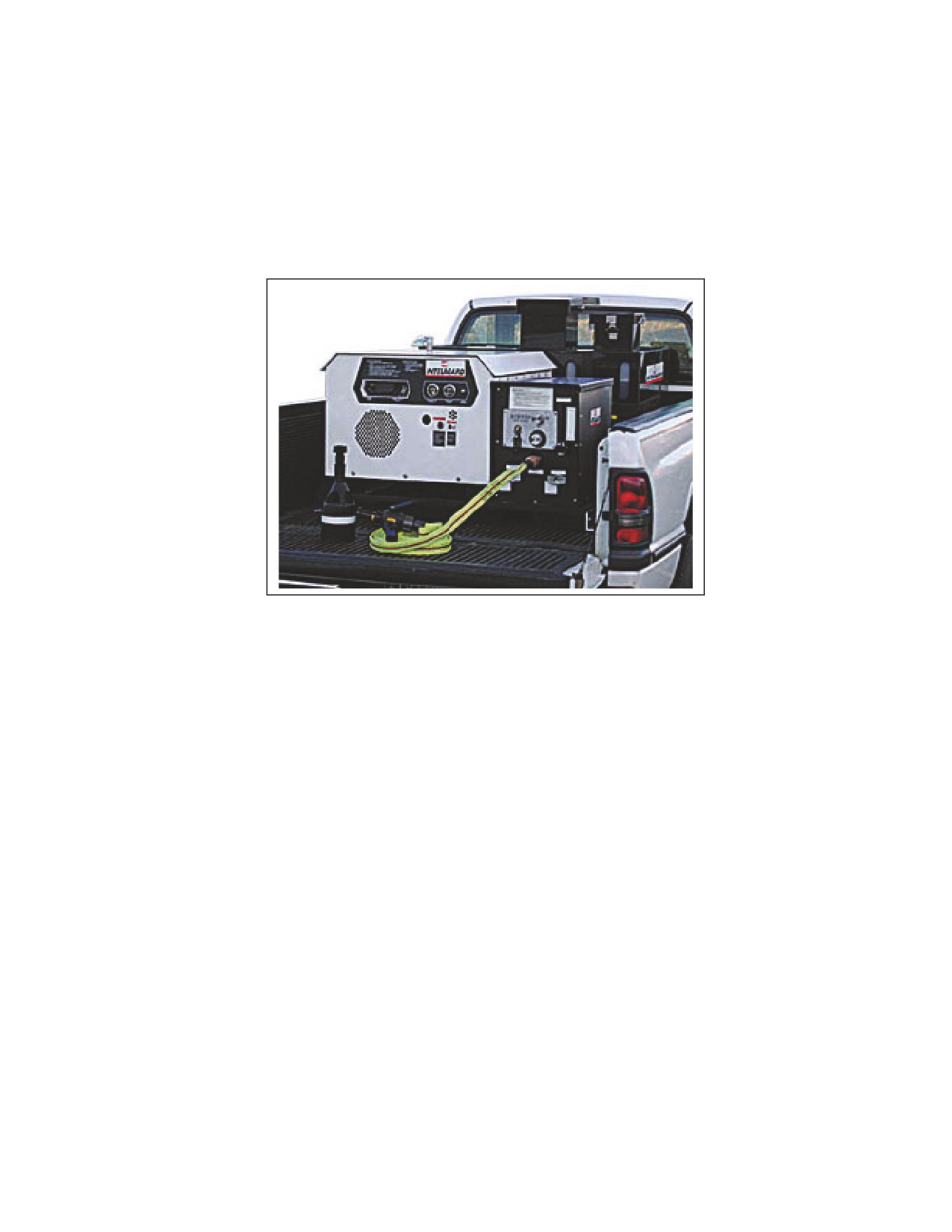
mounted on a commercial vehicle or trailer. The system may be used in three different
modes: a spray bar is mounted at the rear of the trailer for terrain decontamination, a deck
gun is mounted in the truck bed for fixed-site equipment and facility decontamination, and
a foam dispensing nozzle with a 100-foot spray hose is mounted on the trailer for direct
decontaminant application and to supplement deck gun operations.
NOTE: Decontaminant in “foam” form is not authorized for use at this time. DF
200 is currently approved for CENTCOM use only.
Figure H-6. FSDS Placed in a Civilian Vehicle
(b) The systems primary decontaminant is DF 200.
(3)
Mission. The primary function of the FSDS is to provide a decontamination
capability for APODs and SPODs. The system also provides the capability to perform
decontamination on main supply routes (MSRs), vehicles, equipment, and aircraft.
Inherent in the mission to decontaminate APODs and SPODs is the requirement to
decontaminate staging areas, runways, roads, buildings, and container expresses
(CONEXs). Each of these areas requires different approaches, configurations, and planning
factors.
(See paragraph 5 for the TTP to support FSDS operations.)
(4)
Capabilities. The FSDS provides—
• Mobile terrain decontamination.
• Fixed-site and facility decontamination.
• Equipment decontamination.
5.
Fixed-Site Decontamination System Tactics, Techniques, and Procedures
Three individuals (supervisor, driver, and spray cannon/wand operator) man the
system. The system has three modes of operation: spray bar at the rear of the trailer, deck
gun on the truck bed, and 100-foot spray hose on the trailer. Only one mode of operation is
possible at one time. To decontaminate horizontal surfaces (staging areas, docks, and
roads) the rear spray bar is the primary mode of operation. To decontaminate buildings,
structures, and containers, the deck gun is the primary mode. The spray hose will be used
H-10
FM 3-11.5/MCWP 3-37.3/NTTP 3-11.26/AFTTP(I) 3-2.60
4 April 2006
to augment the deck gun and also will be available for smaller areas, vehicles, and aircraft
and to perform self-decontamination of the system.
The primary decontaminant is DF 200. DF 200 is supplied as a three-part solution:
Part A, Part B and Part C activator. The system is configured with a trailer that contains
three separate storage tanks for the solution. There are two 500-gallon tanks, one each for
Parts A and B, and a 30-gallon tank for Part C. Tank C pours directly into Tank B so
activation occurs prior to mixing of Parts A and B. Tank C should be released prior to
movement in order for Parts B and C to get mixed well. The system mixes the solutions as
it operates and, therefore, premixing of the solutions is not required. The system can be
filled and standing ready without the need to perform the loading after the mission is
received. This allows for a quick response when a mission must be performed.
a.
Mission Receipt.
(1)
The planner determines the surface composition of the contaminated area
in order to determine the effects on the mission (i.e., absorption and desorption rate,
reaction of surface with decontaminant, concerns of contaminant transfer due to
uncontrolled runoff).
(2)
The planner determines the extent of the contamination in order to identify
the quantity of required decontamination applicators. Table H-3 identifies the capability of
one system with a 1,000-gallon load of DF 200. The planner also determines the extent of
the contamination, which will determine the resupply quantities required.
Table H-3. Typical Mission Parameters (1,000 gallons of DF 200)
Contaminated Areas
Time
Speed
Coverage
Roads, runways, and staging areas
18 minutes
2-3 mph
25,000 square feet
(3)
The planner identifies any additional requirements (i.e., additional pumps,
detectors, and nonstandard equipment).
(4)
The planner assesses the weather conditions (temperature, precipitation,
and winds) and determines how they may affect the mission. The assessment will also
evaluate whether the mission must be adjusted based on the conditions. For example,
extreme heat may cause the contaminant to dissipate faster than a thorough
decontamination operation can be completed, so a limited area may be decontaminated to
maintain operations until weathering effects are complete.
(5)
The planner determines the entry and exit routes. The locations of the
routes depend on factors such as the locations of the contamination and the threat.
Additionally, multiple start points may be used because two FSDSs can be used at the same
time.
(6)
The planner determines support requirements (e.g., engineer, logistical,
security, and other assets) needed to safely complete the mission.
b.
Mission Preparation.
(1)
Dispatch resupply vehicles, and coordinate the supply linkup location.
(2)
Determine IPE requirements, and request resupply quantities of all IPE
and other expendable items and equipment.
4 April 2006
FM 3-11.5/MCWP 3-37.3/NTTP 3-11.26/AFTTP(I) 3-2.60
H-11
c.
Precombat Checks.
(1)
Individual Equipment. Inspect IPE, to include M40 protective mask and
filter, BDO or JSLIST, overboots, gloves, wet-weather gear, and TAP aprons.
(2)
FSDS. Conduct preventive-maintenance checks and services (PMCS), and
fill fuel and decontaminant tanks. Load Tank A with Solution A, or load Tank B with
Solution B, and fill Tank C with the fortifier. Ensure that the washer fluid reservoir is
topped off, and load extra wiper fluid and wiper blades. Also ensure that wet wipes are on
board for the gunner to use to wipe DF 200 residue off his protective mask eye lenses.
(3)
Weapons. Ensure that all individual and crew-served weapons are
serviceable and that ammunition has been issued to all personnel.
(4)
Communications System of the FSDS. Ensure that PMCS has been
performed on all communications systems. Obtain call signs and frequencies, and load
communications security into all systems. If nonsecure communication devices are used
(handheld, etc.), make communications checks with all personnel. Radios must have
earpieces and microphones that can operate under the mask hood. The primary
communications contact in a vehicle must be the driver; the vehicle commander, once
dismounted, will not have access to interior communications systems.
(5)
Convoy Route. Brief all personnel on the convoy route and the type of road
march to be conducted.
(6)
Support Requirements. Ensure that any external support elements are
integrated into the mission (e.g., security).
(7)
Coordination. Although the FSDS has the ability to decontaminate itself,
decontamination support may have to be coordinated to ensure that the FSDSs are
decontaminated thoroughly upon completion of the assigned mission in preparation for
subsequent missions.
d.
Mission Execution.
(1)
As the systems depart the starting point, the fortifier in Tank C will be
released into Tank B. During the convoy, the fortifier will be thoroughly mixed with
Solution B. When the squad reaches the RP, the DF 200 will be ready for decontamination
operations.
(2)
Upon arrival at the identified site, the FSDS supervisor will direct the
driver to stop prior to entering the contaminated area and will start the FSDS in the
trailer. Once the supervisor and the spray operator exit the vehicle and the mission starts,
they will not reenter the vehicle until the unit has been decontaminated. They should don
either TAP aprons or wet-weather gear prior to entering the contaminated area.
(3)
The FSDS will proceed down the road/MSR at approximately 2 to 3 miles
per hour while the spray bar dispenses DF 200. The driver will place the vehicle in four-
wheel drive, low and allow the vehicle to move while idling.
(4)
Any obstacles encountered while conducting spray operations (vehicles,
debris, etc.) will also be sprayed with decontamination solution so that they may be safely
removed after the contamination has been neutralized. The operator at the system controls
may have to stop the vehicle, turn off the spray bar, and spray this equipment with the
H-12
FM 3-11.5/MCWP 3-37.3/NTTP 3-11.26/AFTTP(I) 3-2.60
4 April 2006
hose or deck gun. If two systems are available, one may be used to spray the equipment
and obstacles while the second is used to spray surfaces.
(5)
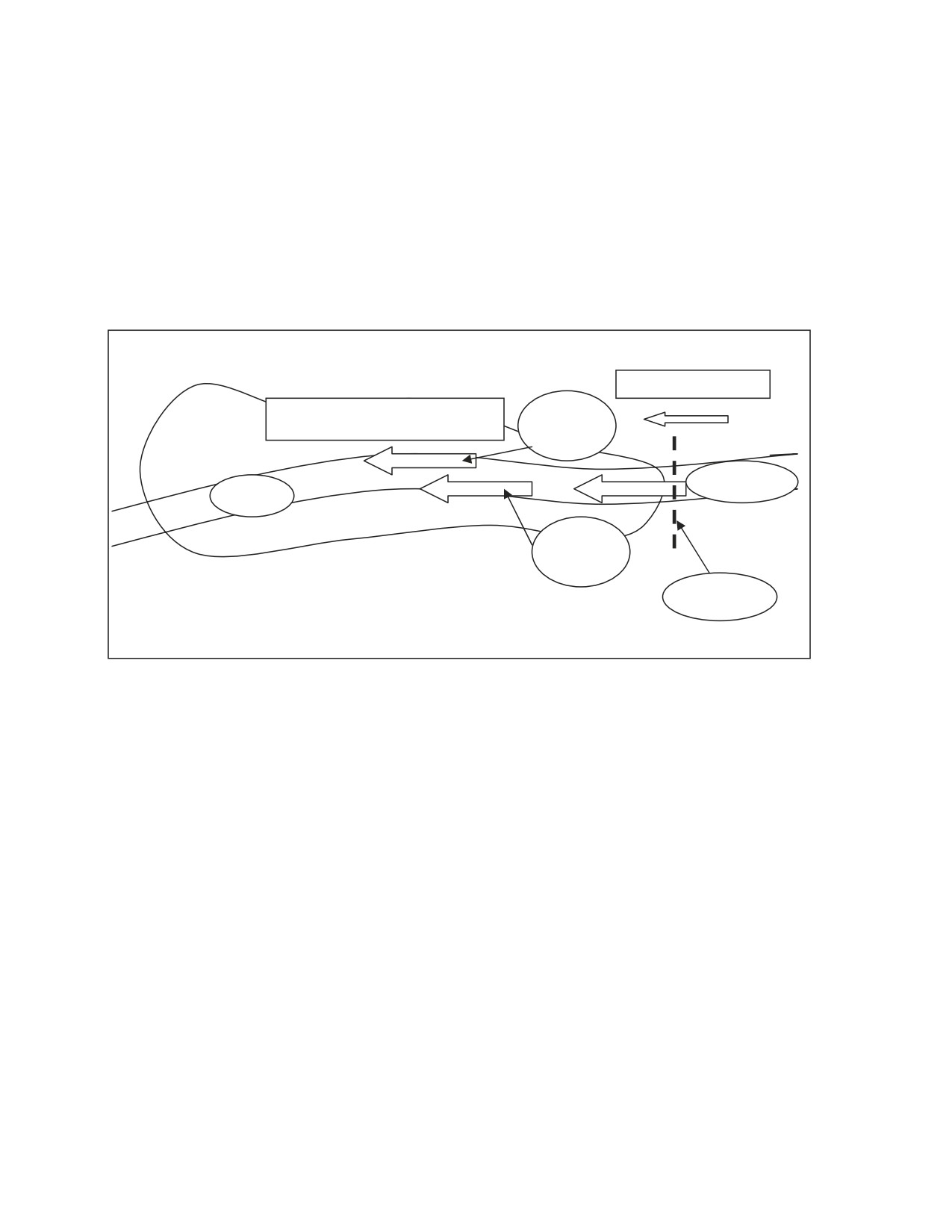
The contamination will be approached from the upwind direction, and the
area will be decontaminated in 10-feet-wide slices. Multiple systems may work in tandem,
each covering a 10-foot swath, ensuring that the swaths overlap and result in full coverage.
Since the system operates at a slow speed (2 to 3 mph), the driver must maintain close
attention to the trailer. If the spray pattern does not overlap, the contamination will
remain. The slow speed increases the time it takes to return to the correct pattern. For
example, Figure H-7 indicates two systems conducting terrain decontamination.
Wind Direction
Area of Contamination
Vehicle
#1
Resupply
Road
Vehicle
#2
Hot Line
Figure H-7. Two FSDSs Conducting Terrain Decontamination
(a) When operating in tandem, the drivers must ensure that spray
patterns overlap. Driving the low speed required can cause the vehicle to drift, and if full
overlap is not obtained, the area not covered must be resprayed. The vehicle supervisor or
gunner should walk alongside the vehicle as it proceeds and ensure that overlap occurs by
communicating the progress to the driver. Figure H-8 (page H-14) shows FSDS operations
conducting terrain decontamination operations that overlap.
4 April 2006
FM 3-11.5/MCWP 3-37.3/NTTP 3-11.26/AFTTP(I) 3-2.60
H-13
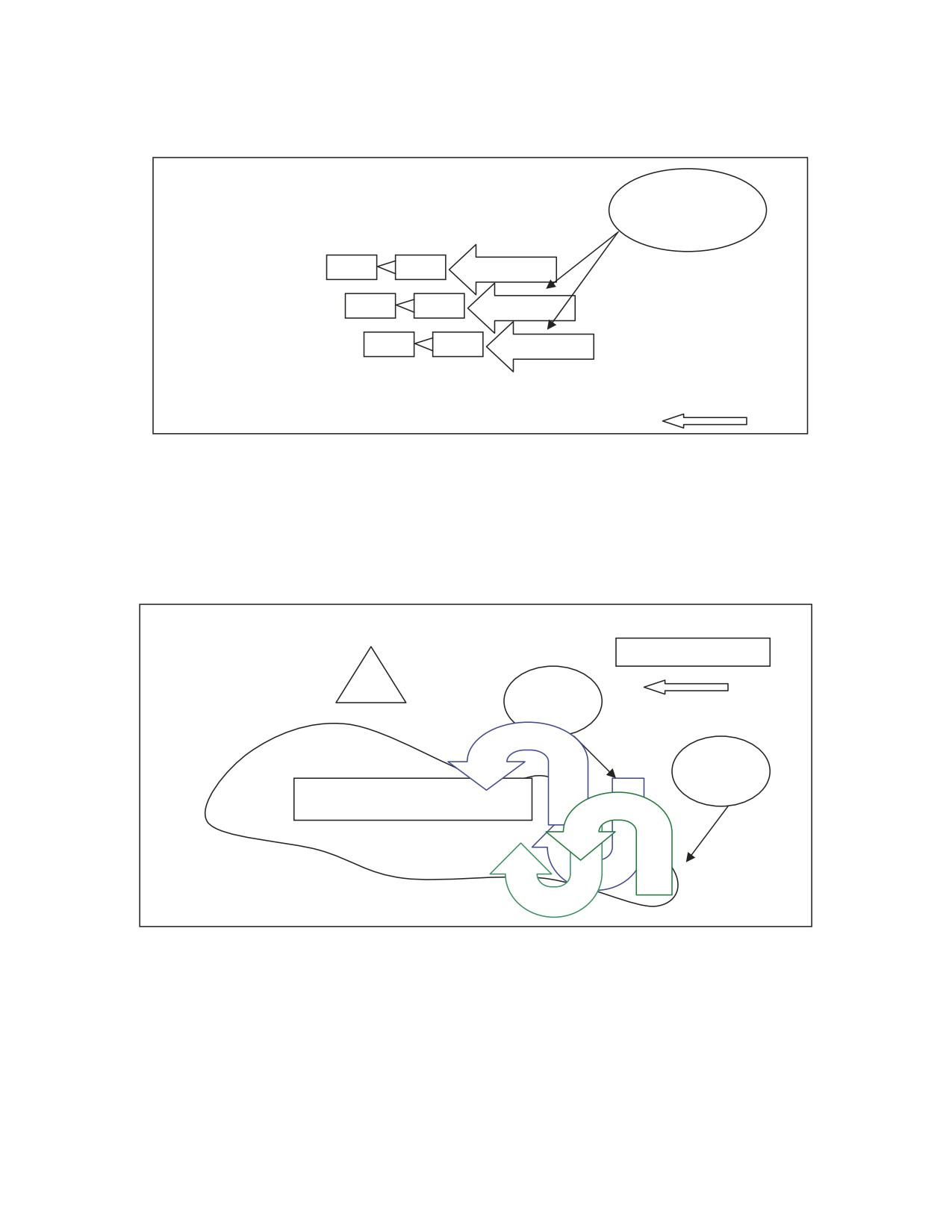
Ensure that
spray patterns
overlap.
Wind Direction
Figure H-8. FSDS Overlap Operation
(b) The CBRN decontamination unit must establish an overwatch
position and control decontamination operations. The decontamination control point (DCP)
(Figure H-9) is the primary location to observe progress and control resupply operations.
Since all contaminated situations are different, the leadership can determine if planned
resupply operations will be sufficient to complete the mission.
Wind Direction
DCP
Vehicle
#2
Vehicle
#1
Area of Contamination
Figure H-9. Decontamination Control Point
(c)
Obstacles or objects (such as vehicles, equipment, debris, or buildings)
will be sprayed with the deck gun or spray hose as they are reached. If several systems are
used, one can be identified as a deck gun/spray hose applicator while the other concentrates
on horizontal surfaces.
(d)
If multiple systems are used, they can work in relays; as one is
spraying, the second can be conducting resupply. Application will progress through the
contamination as vehicles resupply and continue where the last application finished. In
H-14
FM 3-11.5/MCWP 3-37.3/NTTP 3-11.26/AFTTP(I) 3-2.60
4 April 2006
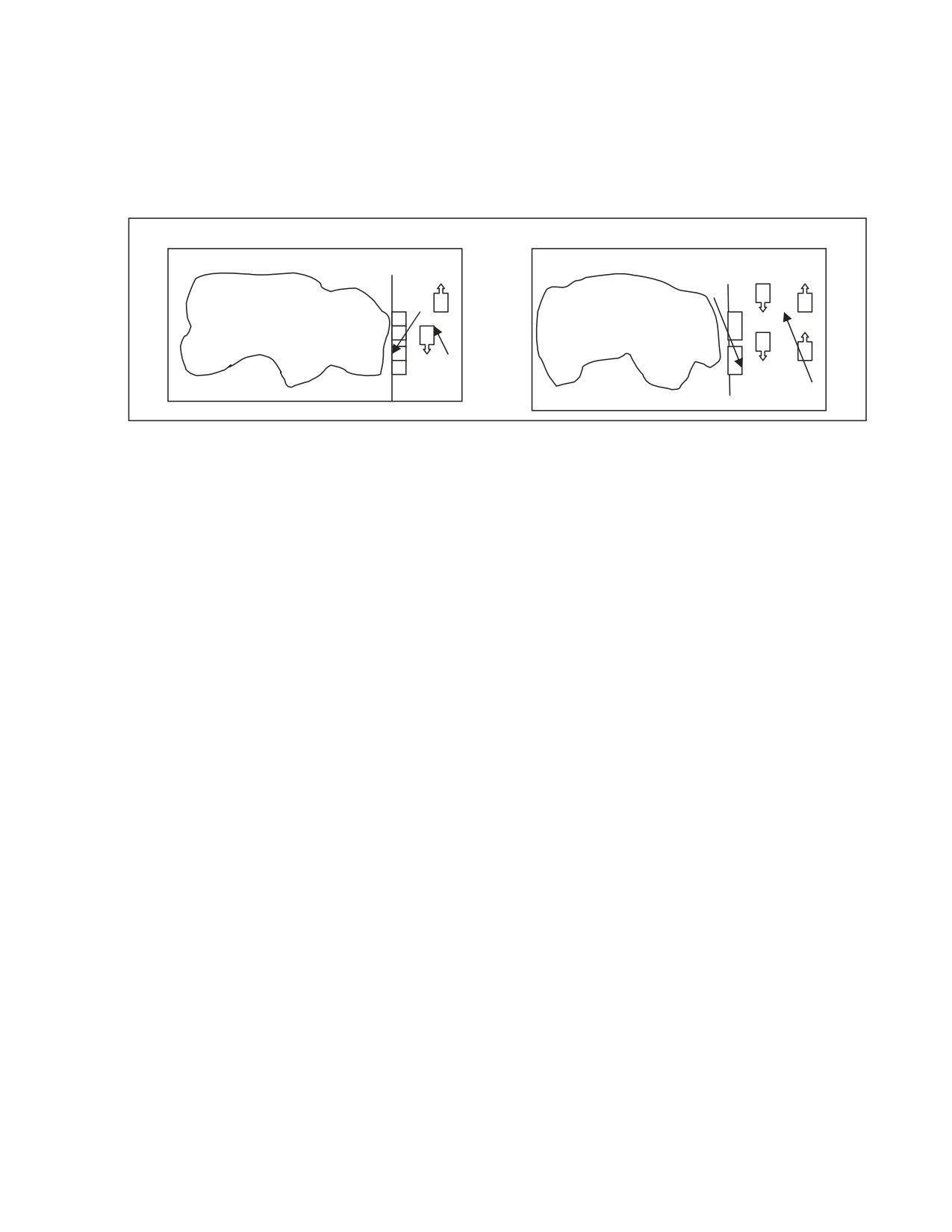
this case, multiple vehicles will reduce the time it takes to complete decontamination.
Resupply vehicles should remain upwind of the contaminated area. Figure H-10
demonstrates how resupply vehicles will approach the hazard area and not cross into that
area.
Option 1
Option 2
Stationary trucks
with loaded totes
Totes
Contamination
Contamination
Trucks
Trucks
running
resupply
Figure H-10. Resupply COAs (Options 1 and 2)
e.
Resupply COAs.
(1)
Option 1. Five-ton or larger trucks drop totes (i.e., supplies) at a hot line
near the contaminated area. This method should be used primarily if a good estimate of
the amount of decontaminant needed can be determined.
(2)
Option 2. A 5-ton truck with a forklift conducts a tank exchange at a hot
line. Another forklift would be needed at the supply issue point. This method can be used
if unit leadership feels that there may be a need for resupply during the mission. Resupply
for the system should be conducted in such a manner that the supply vehicles remain clean.
The supply vehicles move to the resupply point located upwind of the contaminated area. A
hot line will be established, and supply vehicles will not move downwind from that line.
Totes will be dropped based on the estimated requirements determined during a recon of
the contaminated area. Once the mission is completed, resupply trucks, hoses, and totes
will be contaminated and will need to be decontaminated. If accurate estimates of DF 200
requirements can be made, the DF 200 can be pre-positioned and the resupply trucks
should not need decontamination.
f.
Large-Area Missions. Large-area missions (such as airfields, staging areas,
assembly areas, APODs, and SPODs) will be treated in a similar manner as MSR and
runways. Decontamination personnel will recon the area and develop a plan to cover the
contaminated surfaces with decontamination solution as depicted in Figure H-11 (page H
16).
4 April 2006
FM 3-11.5/MCWP 3-37.3/NTTP 3-11.26/AFTTP(I) 3-2.60
H-15
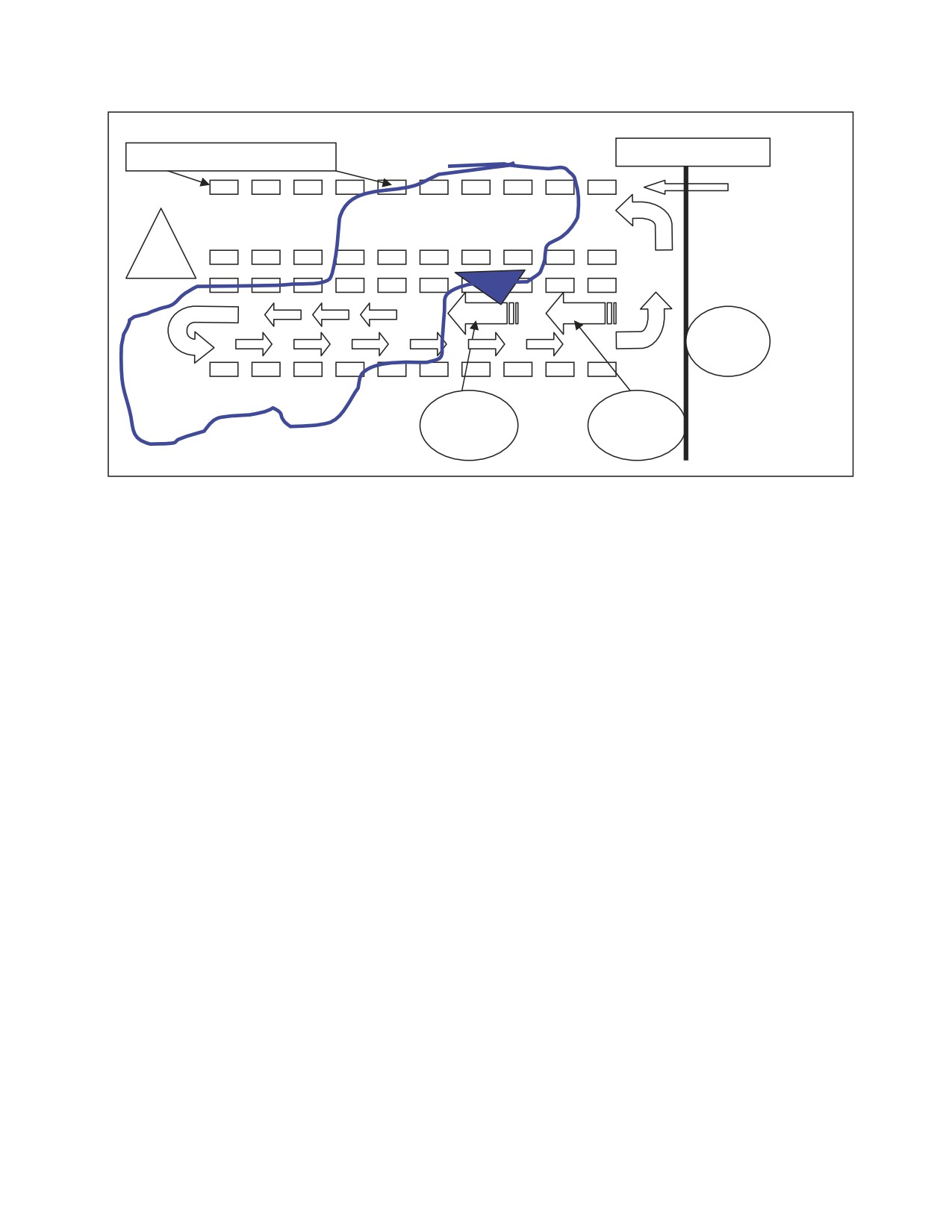
Wind Direction
CONEX/Equipment
DCP
Resupply
Point
Deck
Spray
Gun
Bar
Figure H-11. Large-Area Missions
g.
Building and Vertical Surfaces. Ascertain the wind direction to determine the
start point for decontamination operations (start upwind). Determine areas where runoff
from decontamination will occur, and apply additional decontamination solution in these
areas to reduce agent concentrations. The order of application will be from the top down
and from left to right. Attention must be made to entry or exit points and any areas where
contamination could collect, such as around ventilation equipment and heating and cooling
equipment. When operating the hose reel, ensure that two personnel are available to reel
in the hose (see Figure H-12).
h.
Safety and Coordination.
(1)
When operating the spray cannon or spray wand, the operator must keep a
supply of wipes available to continuously clear the mask eye lenses. The vehicle
commander should also keep wipes available to assist the driver by cleaning the vehicle
windows if necessary.
(2)
When operating the spray wand, careful coordination must be made
between the tank commander (TC), system controls operator, and the spray operator.
When pressure is introduced to the hose, the operator must be aware that the pressure can
be very powerful and could cause injury.
H-16
FM 3-11.5/MCWP 3-37.3/NTTP 3-11.26/AFTTP(I) 3-2.60
4 April 2006
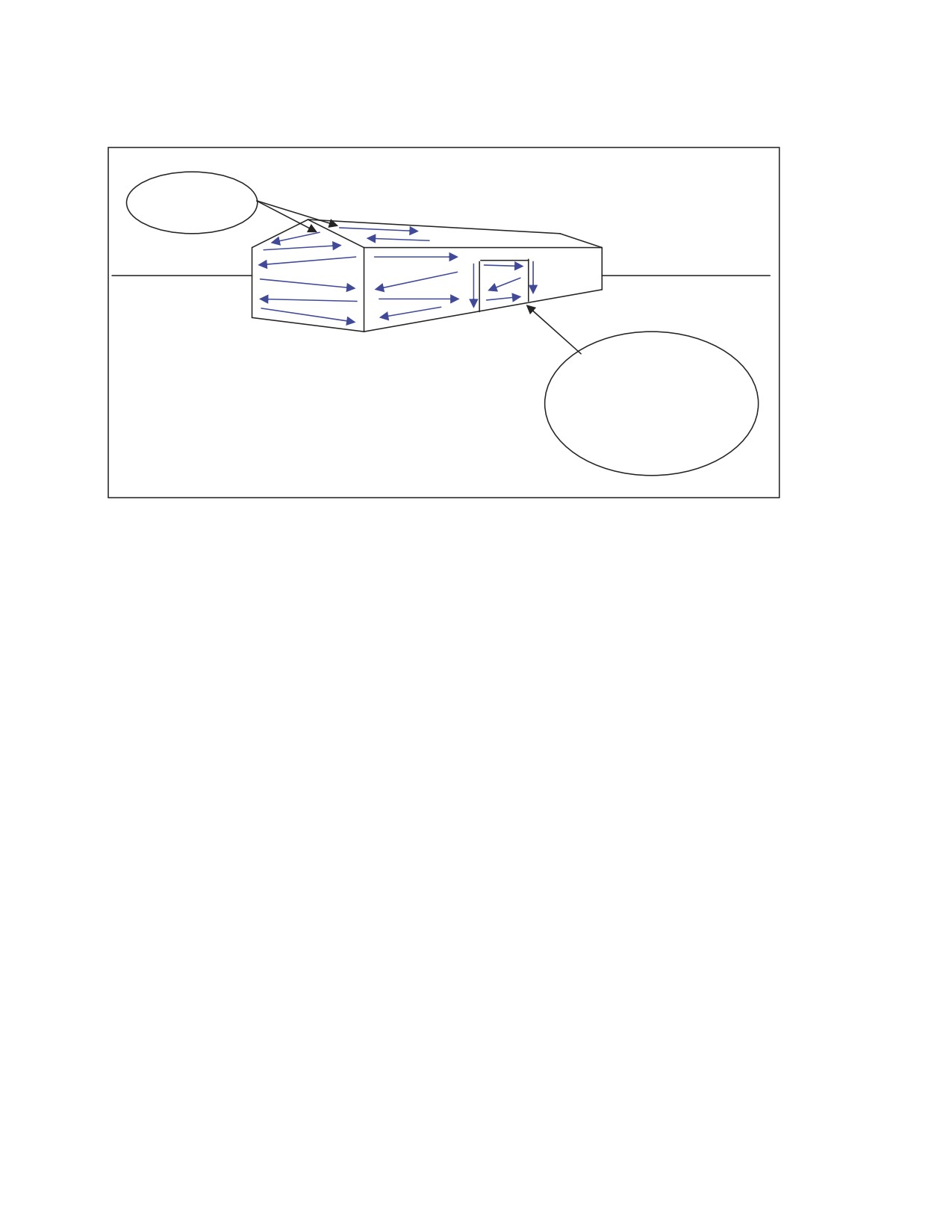
Spray start
points
The spray hose will
be used on doors
and other locations
where contact is
likely.
Figure H-12. Hose Reel Operation (Two-Person)
i.
Postmission Actions.
(1)
Interior decontamination of the vehicle should begin immediately upon
completion of the mission. Interior seat covers and other interior covers must be removed
and bagged as contaminated waste. If a crew member exits the vehicle, he should not
reenter the interior until the mission is complete. This prevents the spread of
contamination. If the crew member must reenter the vehicle, the SDS kit should be used to
decontaminate gloves, boots, and contact areas.
(2)
When all contaminated areas have been decontaminated, the FSDS will
move toward the hot line at the upwind location of the contamination and commence
standard equipment and troop decontamination operations. A thorough equipment
decontamination and DTD site will be established, and all equipment and soldiers will
process through the site.
NOTE: It has not been determined if a complete decontamination of the truck is
possible.
(3)
Security personnel must ensure that all access to the contaminated area is
denied until sufficient contact time between the decontaminant and contaminant is
achieved to guarantee the neutralization of the agent. Security personnel will remain
upwind of the contamination and restrict entry until the area is determined to be
uncontaminated. Following a mission, the FSDS hoses should be purged and all tanks
drained.
(4)
The unit should prepare an NBC4 report and send it to higher HQ and
adjacent units.
4 April 2006
FM 3-11.5/MCWP 3-37.3/NTTP 3-11.26/AFTTP(I) 3-2.60
H-17
THIS PAGE IS INTENTIONALLY LEFT BLANK.
Appendix I
TERRAIN DECONTAMINATION
1.
Background
a.
Most terrain surfaces (excluding unpainted metal and glass) absorb agents.
Thus, an agent may be transferred to clothing or skin by physical contact. The agent may
also be transferred through vaporization and subsequent inhalation or diffusion into eyes
and clothing. The decontamination of terrain allows personnel to increase stay time in an
area and provides passage through an area. Large-scale terrain decontamination requires
extensive amounts of equipment, material, and time. Thus, terrain decontamination is
limited to areas of critical importance. Contaminated areas that can be avoided need no
decontamination other than weathering. If they must be used, decontamination may be
necessary. Wear PPE or IPE when decontamination is not practical.
b.
Terrain decontamination may be accomplished using several methods. The most
effective techniques for terrain decontamination are the natural methods (weathering or
aging). Using standard decontaminants should be a last resort. It will quickly exhaust
your resources. Usually, the most practical method is to scrape contaminated surfaces.
Fire is an acceptable method; however, consideration must be given to the potential
downwind vapor hazard. If possible, a contaminated area should be evacuated until time
and weather remove the contaminant. STB slurry can be used for vital areas.
c.
Terrain decontamination provides more long-term than short-term benefit.
Generally, terrain cannot be decontaminated well enough to allow a reduction of MOPP
level right away. At best, the decontamination process may help speed the weathering
process. Terrain decontamination can be so expensive and so ineffective that the
commander may consider not doing it.
d.
If the commander decides to conduct terrain decontamination, a limited amount
will probably be conducted. Planning may result in building a causeway or breaching a
path through the contamination for entry or exit into a major facility. Movement
restriction will apply to those personnel who must work. Remain in MOPP. If possible, the
contaminated area should be evacuated.
2.
Terrain Decontamination Methods
There are various methods for terrain decontamination. The type of contamination
present will determine the decontamination method used. These methods are listed in the
order of decreasing effectiveness. Although terrain decontamination can reduce the contact
hazard, terrain decontamination will probably not prevent hazardous vapors desorbing
from chemically contaminated surfaces. Therefore, appropriate protective measures must
still be taken.
a.
Weathering. Weathering is the simplest and easiest form of decontamination.
(1)
CB Contamination. Warm, windy weather can significantly reduce terrain
contamination. In some cases, this occurs in a few hours, but it may take a few days. Many
variables affect the persistency of CB hazards, so it is impossible to accurately predict how
long it takes CB contamination to weather. Sunlight is especially effective against most
biological agents.
4 April 2006
FM 3-11.5/MCWP 3-37.3/NTTP 3-11.26/AFTTP(I) 3-2.60
I-1
(2)
Radiological Contamination. Although the term “weathering” is used to
describe the decontamination process, weather has little effect on radiological hazards.
Heavy rain and wind may remove some contamination, but only time will reduce the
radiation emanating from the contamination.
b.
Removing or Covering. Removing or covering contamination does not destroy it,
but it does keep the hazards away temporarily.
(1)
CB Contamination. Contamination can be removed from paths and
unpaved roadways by scraping off a layer of earth with heavy earthmoving equipment
(bulldozers and road graders). Contaminated paths and paved surfaces can be covered with
a 4-inch layer of earth, roofing paper, plastic sheets, or wood mats. This is a temporary
measure because the agents may penetrate the covering. When the contamination
penetrates the covering or when the covering is removed, the hazards will reappear. The
coverings may also extend the life of the contamination hazard by reducing its exposure to
air and sunlight.
(2)
Radiological Contamination. Radiological contamination must be covered
by thick layers of dense material (e.g., earth). Three inches of earth will decrease radiation
dose rates by half because of the shielding provided by the soil; however, 12 inches is more
effective. The job will be easier with earthmoving equipment, but the equipment and
operators must undergo decontamination.
c.
Neutralizing. The STB dry mix or STB slurry may be used effectively against
CB contamination, but not against radiological contamination. Trained personnel and
equipment are required when using the STB slurry, which is costly in time and material.
(1)
CB Contamination. The STB dry mix is spread on solid surfaces and raked
into soft surfaces like sand or earth. The STB slurry is applied to terrain by using a spray
hose that is attached to an M12A1 PDDA. Operators wear TAP aprons over their MOPP
gear and sit on the front fenders of a vehicle to spray the STB slurry. The speed of the
vehicle should be adjusted according to the terrain; this is normally 2 to 4 miles per hour.
The operators spray a fan pattern 3 to 5 feet ahead of the vehicle. The pattern overlaps on
the center and extends past both sides of the vehicle. The STB slurry forms a seal over the
surface and must be renewed periodically due to deterioration from traffic or weathering.
One load of STB slurry will decontaminate a concrete surface about 328 by 33 feet. Other
surfaces may require more decontaminants. It takes about an hour to load and mix one
load of STB slurry.
(2)
Radiological Contamination. The STB dry mix and STB slurry have no
effect on radiological contamination or its hazards.
d.
Burning. Burning works well against CB-contaminated vegetation, but it is of no
value against radiological contamination.
(1)
CB Contamination. Fuel may be used to burn grass or short undergrowth.
Burning also works on dirt surfaces. Soak the area with diesel fuel, kerosene, or fuel oil
and ignite remotely. Do not use gasoline; it burns too quickly. Burning will cause vapor
hazards downwind, and protective measures will have to be used by downwind units. Area
commanders must warn these units of the vapor hazards.
(2)
Radiological Contamination. Radiological-contaminated surfaces should
not be burned. Burning will not destroy radiological contamination or its hazards. It may
I-2
FM 3-11.5/MCWP 3-37.3/NTTP 3-11.26/AFTTP(I) 3-2.60
4 April 2006
spread contamination if radioactive particles become suspended in smoke spread by the
wind.
e.
Exploding. Explosives can be used to blow up areas that have CB contamination;
however, they are of no value against radiological contamination.
(1)
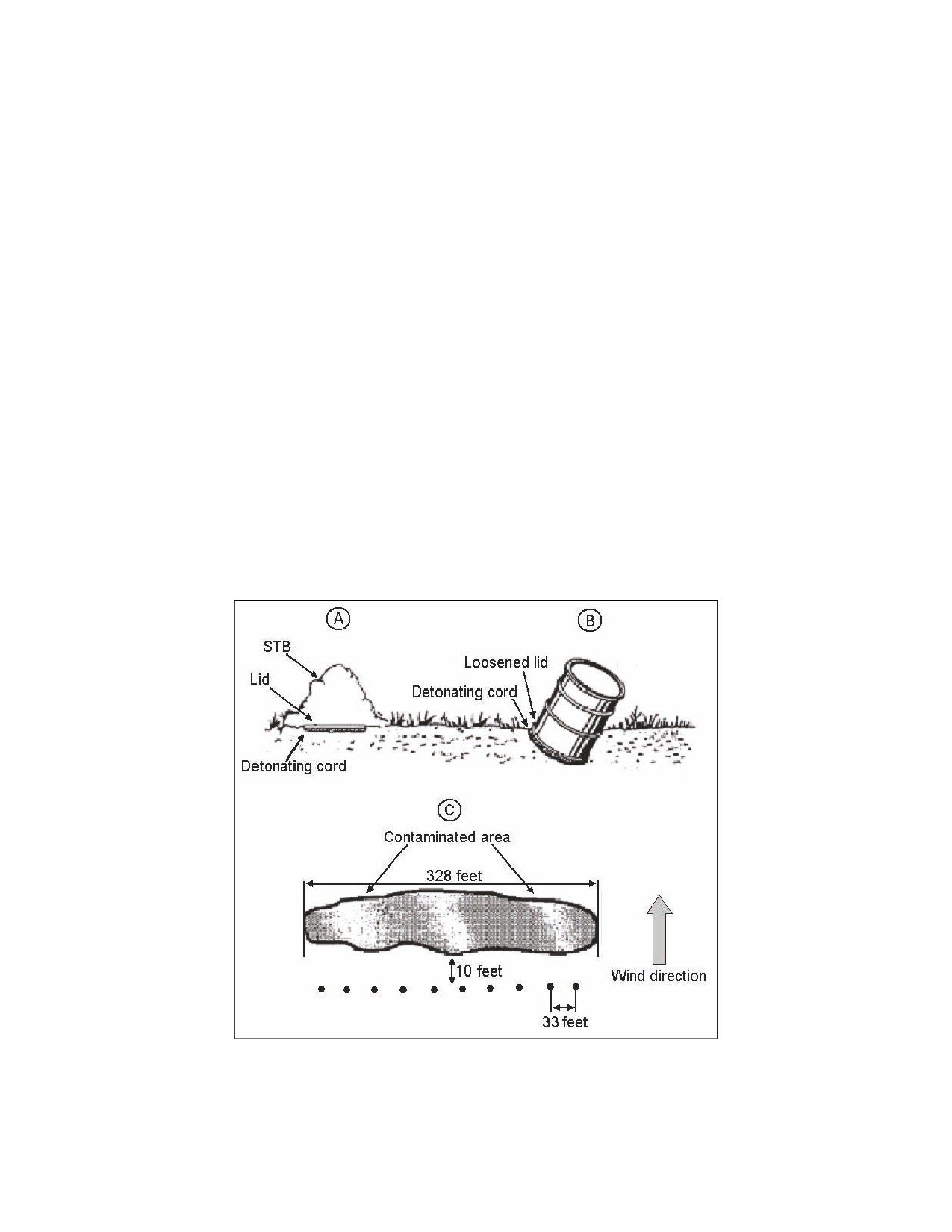
CB Contamination. Detonating cord, bangalore torpedoes, or mine-clearing
charges may be used with the STB dry mix to clear small paths through a contaminated
area. The two methods are used as follows:
(a) First Method. Remove the holding band, and loosen the lid of the
bleach drum. Set the drum with the lid in place upside down over about 3 feet of looped
detonation cord. Remove the drum, and leave the bleach piled on the lid as shown in
Figure I-1, A. Lids may be fired in a series with a single strand of detonation cord
connecting the loops.
(b) Second Method. Remove the holding band, and loosen the lid of the
bleach drum. Set the drum in a shallow hole as shown in Figure I-1, B. Make sure the lid
is loose. Use 5 feet of looped detonating cord (7 feet in soft ground) for each drum. The
drums may be fired individually or in a series. For gross contamination, additional firings
may be necessary.
(c)
For either emplacement method, the suggested spacing for charges is
33 feet apart for a 100-foot front contaminated area. The charges should be placed along
the upwind edge of the contaminated area (see Figure I-1, C). Drums may be fired
individually or in a series.
Figure I-1. Decontamination by Exploding
(2) Radiological Contamination. Explosives will not destroy radiological
contamination or its hazards.
4 April 2006
FM 3-11.5/MCWP 3-37.3/NTTP 3-11.26/AFTTP(I) 3-2.60
I-3
f.
Flushing. Flushing with large quantities of water removes contamination. A
pressurized stream of hot, soapy water delivered by the M12A1 PDDA, M17 LDS, or fire
trucks can remove significant amounts of an agent. Scrubbing removes even more agent.
(1) CB Contamination. Flushing is not very effective against some kinds of
agents, especially thickened agents. However, flushing may speed up the weathering
process.
(2) Radiological Contamination. Flushing is very effective for removing loose
radioactive contamination such as fallout. Rainout, however, can coat surfaces with a film
that resists flushing. Such films must not be scrubbed. Any contamination removed by
flushing and scrubbing will remain radioactive, so control the runoff.
NOTE: Use the lid of an STB drum as a plunger to push STB into the air. Use a
1-meter length of detonation cord and form a loop smaller than the drum lid.
Place the loop on the ground. Loosen the lid of an STB drum. Hold the lid in
place while turning the drum upside down, and set it over the loop. Remove the
drum (the decontaminant will be piled on top of the lid). Use the decontaminant
drum as a makeshift mortar. The top end of the drum must be pointed in the
direction you wish to propel the decontaminant. Position the drum by digging a
shallow hole to hold and point the drum. Place a 1½-meter loop of detonation
cord in the bottom of the hole (2 meters in soft soil). Loosen the holding band on
the drum, loosen the lid, and set the drum upside down in the shallow hole.
g.
Clearing. To clear passageways, remove the contaminated layers covering the
terrain.
(1)
CB Contamination. Most liquid chemical agents will not penetrate the soil
more than 2 inches, and biological agents penetrate even less. Earthmoving equipment or
hand tools can be used to scrap aside contamination. By scraping off 2 to 4 inches of earth,
a passageway can be created that is free of transfer hazards. However, contamination on
either side of the passageway will continue to present a vapor hazard.
(2)
Radiological Contamination. Fallout does not penetrate the top layer of soil
unless it is followed by rain. It can be scraped aside. Move contaminated soil as far away
as possible; the piles tend to concentrate radiation. Immediately below a nuclear blast
area, the soil may be radioactive to a depth of 5 feet. In most cases, the decontamination of
this much earth is not practical.
3.
Types of Surfaces
The type of surface will influence the type of decontamination method selected.
Sample decontamination methods are described for the following representative surfaces:
a.
Beaches.
(1)
Removing. Use earthmoving equipment or hand tools to scrape off a 5- to
10-centimeter (2- to 4-inch) layer of earth. Most liquid chemical agents will not penetrate
more than 5 centimeters (2 inches) beneath the surface. Immediately below a nuclear blast
area, the soil may be radioactive to a depth of 1½ meters. In such cases, decontamination is
not practical.
(2)
Covering. Use roofing paper, wood mats, or other covering material to
furnish a protective mat for the passage of personnel.
I-4
FM 3-11.5/MCWP 3-37.3/NTTP 3-11.26/AFTTP(I) 3-2.60
4 April 2006
(3)
Flushing. A pump and hose may be used. The agent exposed to the surf is
decontaminated by wave action. The extent of decontamination depends on the number of
washings by the tide, the type of beach, the type of contamination, and the weather.
(3)
Neutralizing. Spread STB over the surface, using caution on liquid agents.
b.
Hard Surfaces.
(1)
Flushing. If the surface is well-drained and sufficient water is available,
flush the surface thoroughly with water.
(2)
Neutralizing. Spray the surface with slurry from a PDDA.
c.
Dirt Roads.
(1)
Removing. Scrape the contamination to the side with road graders.
(2)
Covering. Cover paths across the road with at least 10 centimeters (4
inches) of earth.
(3)
Neutralizing. Spray the surface with STB slurry.
d.
Grass and Low Vegetation.
(1)
Burning. Burning is the quickest and most efficient method of
decontaminating CB agents when the area is covered with grass or short undergrowth. Dry
grass and dry wood burn readily; gasoline, kerosene, fuel oil, or fire bombs may be used to
burn green or wet vegetation. Normally, burning a contaminated area does not completely
destroy the agent and protective equipment (protective clothing and mask) must still be
worn. Spreading dry mix after the vegetation has been removed by burning will reduce the
hazard further. If the contamination is radiological, do not burn it. Burning will spread
contamination if radioactive particles become suspended in the smoke.
(2)
Exploding. Clear paths through low vegetation with detonating cord,
bangalore torpedoes, or mine-clearing line charges.
4 April 2006
FM 3-11.5/MCWP 3-37.3/NTTP 3-11.26/AFTTP(I) 3-2.60
I-5
THIS PAGE IS INTENTIONALLY LEFT BLANK.
Appendix J
THOROUGH DECONTAMINATION STATION CHARTS FOR
SUPERVISORS AND ATTENDANTS
This appendix provides sample charts for the support of the thorough
decontamination process (Figures J-1 to J-10, pages J-2 to J-11). They can be laminated
and posted at each station. The charts provide the station number and instructions for the
station supervisor and attendant. They are not meant to be all-inclusive and do not include
setup procedures or equipment requirements, just an informative guide for station
supervisors and attendants.
4 April 2006
FM 3-11.5/MCWP 3-37.3/NTTP 3-11.26/AFTTP(I) 3-2.60
J-1
STATION 1
Individual Gear Decontamination
Task: Remove contamination to a negligible risk from individual gear (LCE, mask carrier, helmet,
and weapon).
NOTE: Individuals wearing the JSLIST chemical protective overgarment will execute
Station 1 procedures in the same manner as prescribed for the BDO.
•
Individual
__
Decontaminates his own gear by washing or scrubbing it for 6 minutes with hot, soapy water
or an STB slurry.
__ Decontaminates his hose and canister (M42 mask) with either hot, soapy water and a
sponge or an STB slurry mix.
__ Dips his gear into the clean water, rinses it for 4 minutes, hands it to the attendant, and
proceeds to the next station.
•
Attendant
__
Takes the gear to the equipment checkpoint and places it on the "dirty" side of the
contamination control line (engineer tape).
__ Checks the gear using the appropriate detection device and procedures associated with that
device.
__ Recycles the gear for decontamination if residual contamination exceeds negligible risks.
__ Places the gear on the clean side of the contamination control line if it passes the check.
__ Carries the gear to the reissue point.
NOTE: Change the slurry mix after 20 personnel have decontaminated their gear, and
change the rinse water after 10 personnel or when it appears dirty (place the waste in the
sump).
Figure J-1. Sample Station 1 Checklist
J-2
FM 3-11.5/MCWP 3-37.3/NTTP 3-11.26/AFTTP(I) 3-2.60
4 April 2006
STATION 2 (BDO)
Overboot and Hood Decontamination
Task: Neutralize gross contamination on overboots, lower trouser legs, the protective mask, and
the hood.
•
Individual
__
The individual walks into the shuffle pit and spreads his legs apart (double-shoulder width),
bends at the waist, and uses his hands to thoroughly rub the STB dry mix or the STB slurry
on his overboots and lower trouser legs.
__ Buddy 1 cuts the shoulder straps and draw cord on Buddy 2’s hood if a replacement hood is
available. He pulls Buddy 2’s hood inside out over the front of the mask, being careful not to
touch the exposed neck or head. Buddy 1 gathers Buddy 2’s hood in one hand and uses a
cutting tool to cut away the hood as close as possible to the eye lens outsert, voicemitter, and
inlet valve cover. Make sure that nothing is left dangling below the bottom of the mask.
__ Buddy 1 decontaminates and rolls Buddy 2’s hood in the same manner as for a MOPP gear
exchange if a replacement hood is not available.
__ Buddy 1 and Buddy 2 reverse roles.
•
Attendant
__
Instructs Buddy 1 on how to roll Buddy 2’s hood to ensure that it is accomplished to standard.
__
Monitors the shuffle pit and adds more STB after 10 personnel have processed through it.
Figure J-2. Sample Station 2 (BDO) Checklist
4 April 2006
FM 3-11.5/MCWP 3-37.3/NTTP 3-11.26/AFTTP(I) 3-2.60
J-3
STATION 2 (JSLIST)
Overboot and Hood Decontamination
Task: Neutralize gross contamination on overboots, lower trouser legs, the protective mask, and the
hood.
•
Individual
__
The individual walks into the shuffle pit and spreads his legs apart (double-shoulder width),
bends at the waist, and uses his hands to thoroughly rub the STB dry mix or the STB slurry on
his overboots and lower trouser legs.
__ Buddy 1 decontaminates his own gloves. He loosens Buddy 2’s overgarment hood by
unfastening the barrel lock. He then loosens the draw cord around the edge of the hood and
unfastens the hook-and-pile fastener tape at the chin. Buddy 1 takes care to avoid touching
Buddy 2’s skin and throat area.
__ Buddy 1 removes Buddy 2’s overgarment hood by opening the front closure flap and pulling
the slide fastener from the chin down to the chest. Buddy 1 instructs Buddy 2 to turn around.
Buddy 1 grasps the back of Buddy 2’s hood, folds the hood inside out (being careful not to
contaminate the inner garment), and pulls the hood off.
__ Buddy 1 and Buddy 2 reverse roles.
•
Attendant
__
Instructs Buddy 1 on how to roll Buddy 2’s hood to ensure that it is accomplished to standard.
__
Monitors the shuffle pit and adds more STB after 10 personnel have processed through it.
Figure J-3. Sample Station 2 (JSLIST) Checklist
J-4
FM 3-11.5/MCWP 3-37.3/NTTP 3-11.26/AFTTP(I) 3-2.60
4 April 2006
STATION 3 (BDO)
Overgarment Removal
Task: Remove the contaminated overgarment before the agent penetrates the material and
touches the undergarments or the skin.
NOTE: Avoid touching the individual’s skin or inner clothing. If contact is made,
decontaminate immediately and then proceed with the overgarment removal.
Attendant
__ Assists the individual in removing his overgarment jacket.
__ Cuts and removes the M9 detector paper from around the individual’s wrist.
__ Unfastens the hook-and-pile fastener over the jacket zipper, waist cord, and wrist.
__ Unfastens the back snaps and instructs the individual to make a fist.
__ Pulls the individual’s jacket down and away from him.
__ Assists the individual in removing his overgarment trousers.
__ Cuts and removes the M9 detector paper from the individual’s trousers.
__ Unfastens the hook-and-pile fastener straps and unzips the zipper on the cuffs of the
individual’s trousers.
__ Unfastens the front waist snaps and unzips the front zipper.
__ Has the individual lift one leg, point that foot down, and bend slightly at the knees for
stability.
__ Grasps the cuff of the elevated boot, with a hand on each side, and pulls the cuff in an
alternating, jerking motion until the individual can step out of the trouser leg.
__ Repeats the last two steps on the other leg.
NOTE: Ensure that the individual steps wide enough so that he does not rub his clean
leg against the contaminated boot or overgarment.
Figure J-4. Sample Station 3 (BDO) Checklist
4 April 2006
FM 3-11.5/MCWP 3-37.3/NTTP 3-11.26/AFTTP(I) 3-2.60
J-5
STATION 3 (JSLIST)
Overgarment Removal
Task: Remove the contaminated overgarment before the agent penetrates material and touches the
undergarments or the skin.
NOTE: Avoid touching the individual’s skin or inner clothing. If contact is made,
decontaminate immediately and then proceed with the overgarment removal.
Attendant
__ Assists the individual in removing his overgarment.
__ Cuts and removes the M9 detector paper from around the individual’s wrist.
__ Releases the hook-and-pile fastener tapes at the wrists and at the bottom of the trousers. Unties
the bow in the coat retention cord if necessary. Unfastens the webbing-strip snaps at the bottom
of the jacket and releases the coat retention cord.
__ Touching only the outside surfaces of the jacket, the attendant loosens the bottom of the jacket
by pulling the material at the bottom away from the individual’s body. The individual locates his
trouser suspender snap couplers by feeling for them on the outside of his jacket and releases
them. Unfastens the front closure flap on the front of the jacket and pulls the slide fastener from
the top of the chest down to the bottom of the jacket.
__ Instructs the individual to turn around, extend his arms in front of him, and make a fist to prevent
the removal of his chemical protective gloves. The attendant grasps the jacket near the
shoulders and removes it by pulling it down and away from the individual’s body.
NOTE: If there is difficulty removing the jacket in this manner, pull one arm out at a time.
__ Instructs the individual to turn back around. Cuts and removes the M9 paper from the individual’s
trousers.
__ Unfastens the hook-and-pile fastener tapes at the waistband of the trousers, unfastens the front
closure snaps, and opens the fly slide fastener. Grasps the individual’s trousers at the hips and
pulls the trousers down to the individual’s knees.
__ Has the individual lift one leg, point that foot down, and bend slightly at the knee for stability.
__ Grasps the trouser leg of the elevated foot, with a hand on each side, and pulls the trouser leg in
an alternating motion until the individual can step out of it. Repeat the last two steps on the other
leg.
NOTE: Ensure that the individual steps wide enough so that he does not rub his clean leg
against the contaminated boot or overgarment.
Figure J-5. Sample Station 3 (JSLIST) Checklist
J-6
FM 3-11.5/MCWP 3-37.3/NTTP 3-11.26/AFTTP(I) 3-2.60
4 April 2006
STATION 4
Overboot and Glove Removal
Task: Remove the contaminated overboots and gloves to limit the spread of contamination (the
overboots and gloves may also be decontaminated for reissue, if serviceable).
NOTE: Individuals wearing the JSLIST chemical protective overgarment will execute Station
1 procedures in the same manner as prescribed for the BDO Station 2.
Attendant
•
Use engineer tape to mark the liquid contamination control line.
•
Unfastens or cut the elastic closures on the individual’s overboots.
•
Have the individual stand next to and face the liquid contamination control line and then step
back about 12 inches from the control line.
•
Step on the back of the individual’s overboot and instruct him to lift his heel, work his foot out
of the overboot, and step across the liquid contamination control line. Repeat the process on
the other foot.
•
Cut off the overboot and discard it into the designated container if it cannot be removed by this
process.
•
Have the attendant from Station 6 carry the individual’s filter canister until the mask is
removed if the individual is wearing an M42 protective mask.
•
Have the individual hold the fingertips of his gloves and partially slide his hands out.
•
Remove the individual’s gloves.
NOTE: Check all items for holes, tears, and punctures; and discard any defective items. Do
not decontaminate items that are unserviceable.
NOTE: The attendant performs his duty from the “dirty” side of the liquid contamination
control line.
__ Submerge the gloves and overboots in the container of hot, soapy water, ensuring that no
water remains inside when removed from the container.
__ Submerge the gloves and overboots in the STB/HTH solution and thoroughly scrub them. ,
Submerge each item once more after scrubbing.
__ Rinses the scrubbed items thoroughly, making sure that they are rinsed inside and out.
__ Place the usable items on a poncho or a plastic tarp to air dry.
__ Place the air-dried usable items into plastic trash bags along with an M256A1 detector kit. If
the kit shows contamination remaining, recycle the items or discard them. However, if the kit
shows no contamination, reuse them.
Figure J-6. Sample Station 4 Checklist
4 April 2006
FM 3-11.5/MCWP 3-37.3/NTTP 3-11.26/AFTTP(I) 3-2.60
J-7
STATION 5
Monitor
Task: Identify contamination on personnel (spot decontamination capability and medical aid are
provided, as required).
•
Monitor
__
Checks the individuals for contamination using an ICAM. Liquid contamination can be
detected with M8 detector paper.
__ Remonitors individuals if decontaminated.
•
Medic
__
Checks the individuals for any chemical-agent symptoms and treats them as necessary.
•
Individual
__
Reports any damage to their MOPP gear that was identified at Stations 2, 3, and 4.
•
Attendant
__
Uses an SDK to decontaminate any areas identified as contaminated.
NOTE: If all the liquid contamination is absorbed into the clothing, the M8 detector paper
will be negative even though there is a hazard.
NOTE: If time is not available, the NBC NCO will have replacement chemical suits,
overboots, and gloves at this station for reissue. If time is available, personnel will receive
this equipment at the postdecontamination AA.
Figure J-7. Sample Station 5 Checklist
J-8
FM 3-11.5/MCWP 3-37.3/NTTP 3-11.26/AFTTP(I) 3-2.60
4 April 2006
STATION 6
Mask Removal
Task: Remove the mask without contaminating the individual.
• Pull the hood over the front of the mask, grab the mask by the voicemitter cover, and pull the
mask off the individual while he holds his breath.
• Hold the mask open so that the individual can remove the inserts without touching the outside
of the mask.
• Have the individual walk upwind approximately 5 meters, cross the vapor contamination
control line, and then resume breathing.
• Bring the mask to Station 7.
NOTE: If the wind direction remains constant, no vapor hazard is expected beyond the
vapor contamination control line.
• The CBRN defense unit positions the M8A1 or M22 ACAA upwind of the site.
• The individual moves straight ahead while his mask, which may still be emitting vapors, is
held on the “dirty” side of the vapor contamination control line and taken to the next station.
Figure J-8. Sample Station 6 Checklist
4 April 2006
FM 3-11.5/MCWP 3-37.3/NTTP 3-11.26/AFTTP(I) 3-2.60
J-9
STATION 7
Mask Decontamination Point
Task: Remove all contamination from the protective mask.
•
Attendant
__
Removes the eye lens outserts and the hoods if the hoods were not cut off at Station 2.
__
Removes the filters or canisters and disposes of them in the properly marked containers.
__
Washes the masks, hoods, eye lens outserts, and hoses on the M42 and M43 masks in hot,
soapy water.
__ Rinses these items in clean water.
__ Dips them in the sanitizing solution and agitates them for 5 minutes.
__ Rinses them in clean water again.
__ Adds one tube of mask-sanitizing solution (calcium hypochlorite) to each quart of water.
__ Wipes the masks with rags dipped in solution until the masks are almost dry.
__ Discards each gallon of mask-sanitizing solution into a sump after every 10 masks.
__ Checks the masks for contamination with an ICAM.
__ Recycles the masks if they are still contaminated
__ Decontaminates the gloves.
__ Takes the unassembled masks to the reissue point if they are not contaminated.
Figure J-9. Sample Station 7 Checklist
J-10
FM 3-11.5/MCWP 3-37.3/NTTP 3-11.26/AFTTP(I) 3-2.60
4 April 2006
STATION 8
Reissue Point
Task: The mask with its components is provided to the individual for reassembly.
__ The unit CBRN NCO reissues the masks with their components to the individuals.
__ The individuals reassemble the masks in the AA.
__ The unit CBRN NCO affixes canisters to the cleaned M42 and M43 hoses.
__ The individuals pick up individual gear and move to the postdecontamination AA.
Figure J-10. Sample Station 8 Checklist
4 April 2006
FM 3-11.5/MCWP 3-37.3/NTTP 3-11.26/AFTTP(I) 3-2.60
J-11
THIS PAGE IS INTENTIONALLY LEFT BLANK.
Appendix K
CONTAMINATED-WASTE COLLECTION AND DISPOSAL
1.
Background
This appendix provides planners, commanders, and unit personnel with operational
guidance and procedures on the collection and disposal of contaminated waste. The use of
contamination avoidance material may increase the amount of contaminated waste that
must be properly collected and disposed of after an attack. Contaminated items may
include IPE, field gear, M8/M9 paper, components of M291 and M295 kits, pallet covers,
bulk plastic, tarps, and other contamination avoidance covers and decontamination
solutions. Waste must be collected and disposed of properly to limit hazards. Depending on
the type and quantity of contaminated material, waste accumulation areas could increase
local hazards and require increased protective measures. Advance planning is the key to
the successful handling and disposal of contaminated waste.
2.
Responsibility
It is the responsibility of all personnel to ensure safe operations.
a.
Unit commanders ensure that waste collection sites are established, properly
marked, reported, and maintained.
b.
All personnel apply contamination avoidance techniques and procedures,
establish and maintain waste collection points, and segregate wastes for localized
collection. Deployed personnel are responsible for limiting, to the greatest extent possible,
cross contamination, postconflict cleanup, and restoration actions.
c.
The CBRN control center (CC) provides technical guidance and oversight for
establishing unit contaminated waste disposal areas and marks and plots accumulation
points and disposal areas on local area and grid maps.
d.
Medical authorities provide technical oversight and guidance for personal safety
and health-related issues.
3.
Contaminated-Waste Holding Areas
It is probable that multiple sites may be required with one large centralized
accumulation point.
4.
Unit Waste Accumulation Points
Units must effectively plan for the disposition of waste during decontamination
operations.
a.
Planners should consider site selection based on a number of factors, such as
terrain and prevailing seasonal winds. The area must be located downwind of work areas
and rest and relief locations.
b.
Accumulation points should be downwind from the rear or entrance to areas such
as bunkers, fighting positions, or CCAs.
4 April 2006
FM 3-11.5/MCWP 3-37.3/NTTP 3-11.26/AFTTP(I) 3-2.60
K-1
c.
All unit accumulation points should be identified and reported to the CBRN CC.
The CBRN CC has the responsibility to mark and plot each accumulation point on local,
grid, or area maps.
d.
When feasible, waste accumulation points should be located on concrete, asphalt,
or other paved surfaces. Avoid positioning the accumulation point on grass or vegetated
areas. Position waste accumulation points so that personnel can transverse a straight line
from their shelter, bunker, or facility to the area without having to cross wet, muddy, or
vegetated areas.
e.
Waste should be separated by type (solid versus liquid and combustible versus
noncombustible). No sharp objects that could puncture the plastic liner are to be placed
directly into the waste container. Sharp objects should be packaged in a rigid waste
container. Collecting sharp objects or material in a cardboard box overwrapped with a 6-mil
plastic bag should prevent objects from penetrating or perforating the protective cover.
f.
Proper marking prevents unintentional contact and alerts personnel of the
hazard.
g.
Containers holding contaminated waste must be in good condition and
compatible with the waste being stored.
(1)
The container must always be closed during storage, except when it is
necessary to add or remove waste.
(2)
Large trash receptacles, 55-gallon barrels, or similar containers are ideal
vessels for collecting contaminated solid waste. These should be lined with a double layer
of 6-mil plastic bags.
(3)
Liquid waste can be stored in 5-gallon or larger containers. A small
containment berm should be placed around any liquid-holding area to control potential
runoff or spills. The use of sandbags or other suitable material should be used to construct
a small containment berm.
h. If sufficient equipment exists, place automatic vapor alarms around or just
upwind of the area.
(1)
CBRN reconnaissance personnel should also periodically monitor just
outside the area with handheld vapor detection devices such as the CAM or the M256.
(2)
To indicate contamination from an attack or cross contamination, M8 or M9
paper should be positioned around the accumulation point.
5.
Equipment and Material
The following items or a suitable substitute should be available for establishing and
maintaining the waste accumulation point. Quantities of this material will vary based on
the number of individuals and area supported.
a.
Containers for solid-waste and liquid-waste streams (e.g., waste receptacle
[44-gallon] National Stock Number [NSN]: 7240-00-151-6630; 5-gallon Jerri can, water,
NSN: 7240-00-089-3827).
b.
Marking material: NBC marking kit (sign kit, contamination, M274, NSN: 9905-
01-346-4716; chemiluminescent lights, white, 8-hour, NSN: 6260-01-247-0367; surveyor’s
tape, red, NSN: 9905-01-458-1192; paper and grease pencils or permanent markers).
K-2
FM 3-11.5/MCWP 3-37.3/NTTP 3-11.26/AFTTP(I) 3-2.60
4 April 2006
c.
Plastic sheeting, 0.006 thick, clear, NSN: 8135-00-579-6489.
d.
Plastic bags, 60 by 30 inches, 0.006 thick, NSN: 8150-01-221-3239.
e.
Pressure-sensitive tape (multiple NSNs available).
f.
Personal decontamination materials: M291 kit, NSN: 6850-01-276-1905; M295
kit, NSN: 6850-01-357-8456; 5 percent bleach; water; and bucket or catch basin.
g.
CBRN detection equipment.
h. Funnel for pouring liquid waste into collection containers.
i.
Sandbags, NSN: 8105-00-285-4744.
6.
Procedures for the Collection of Contaminated Waste
The potential for personnel to be cross-contaminated is at its highest during the
collection of contaminated material for disposal. The following activities are examples to
minimize the time and effort to perform them:
a.
The collection of contaminated waste should be accomplished in the least amount
of time by at least two trained personnel.
b.
Supervisors assign personnel trained to perform the duties to detect
contamination and remove contaminated coverings in and around their area.
(1)
A systematic search of the area for contamination should be planned and
communicated to unit personnel.
(2)
The priority for removing protective covers from unit assets must be
established. Priority should be given to immediate-use items and high-value and/or
limited-quantity items that directly effect mission accomplishment.
c.
Prior to starting the operation, personnel must check to ensure that IPE is
properly worn, using the buddy system.
d.
Unit personnel must check for contamination in assigned areas.
(1)
Starting with the priority items, remove and replace contaminated M8 and
M9 paper and contamination avoidance material.
(2)
Contaminated material collected should be placed in a 6-mil plastic bag
(preferably clear plastic). When collection bags are approximately three-quarters full,
personnel must seal the top of the bag closed.
(3)
Place the first bag into a clean 6-mil bag. To reduce the potential of
contaminating the outside of the clean bag, the assistance of a second person may be
required.
(4)
Perform immediate glove decontamination, utilizing M291 or M295 kits or
5 percent bleach solution (see Figure K-1, page K-4).
4 April 2006
FM 3-11.5/MCWP 3-37.3/NTTP 3-11.26/AFTTP(I) 3-2.60
K-3
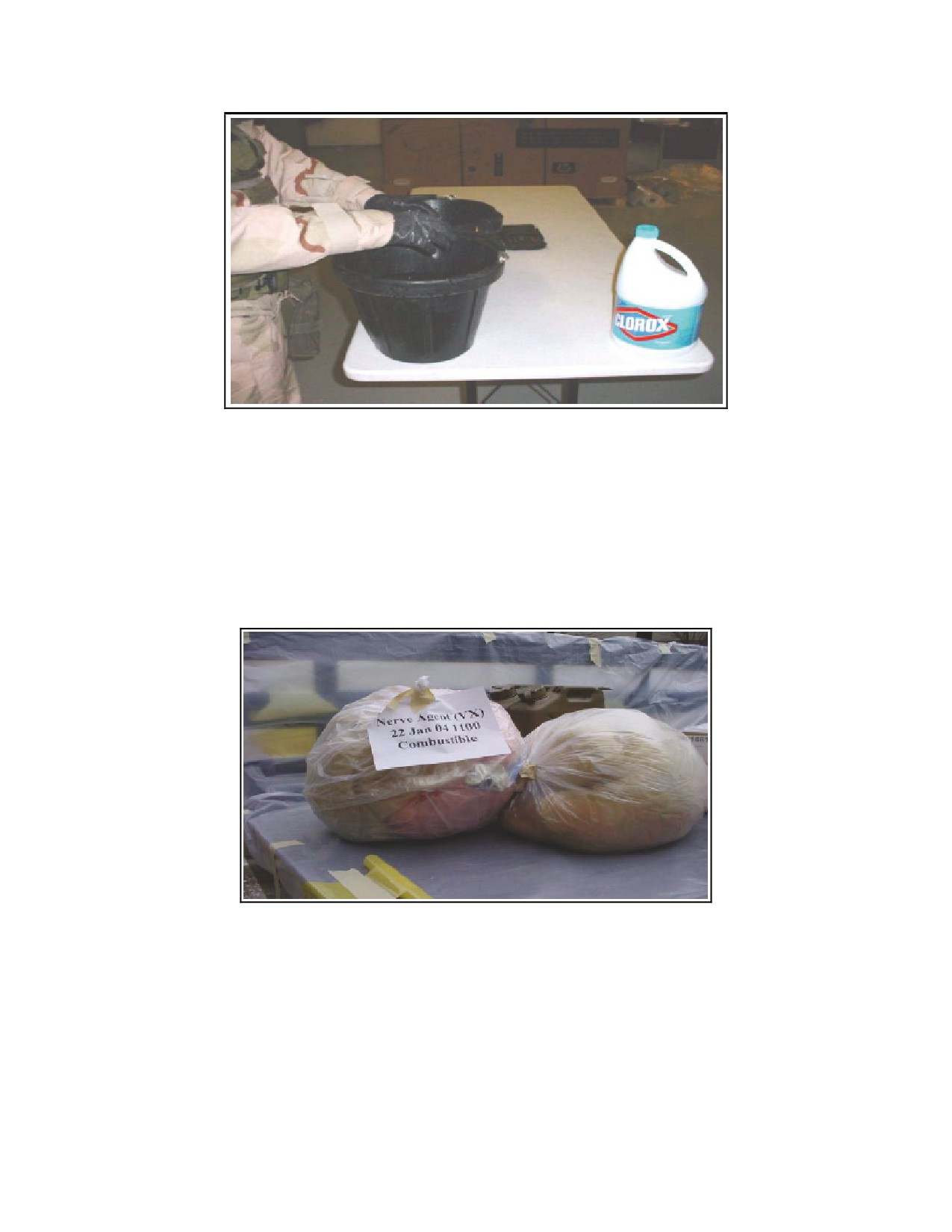
Figure K-1. Glove Decontamination
(5)
Repeat the bag-sealing process for the outer (clean) bag.
(6)
Perform immediate glove decontamination utilizing M291/M295 kits or 5
percent bleach solution.
(7)
Prepare the material for transport to the waste accumulation point.
(8)
Place contaminated markings on the outer bag. The bags must be clearly
marked with the contents, type of contaminant or agent, date, time, and location (see
Figure K-2).
Figure K-2. Markings
NOTE: Supervisors will contact the controlling unit for waste pickup. Waste that
is not properly labeled and packaged will not be picked up until the problem is
corrected.
e.
Material (such as pallet covers and bulk plastic) that will not fit into standard
6-mil trash bags require a different procedure or process as follows:
(1)
Starting from the long end of the material, with arms extended, grasp the
bottom and roll the material onto itself. Properly done, this will contain any contamination
K-4
FM 3-11.5/MCWP 3-37.3/NTTP 3-11.26/AFTTP(I) 3-2.60
4 April 2006
inside the cover or plastic, away from the individual, while reducing air pockets and the
bulkiness of the material.
(2)
After the material is rolled, fold the two outer ends toward the center and
secure the material with tape or string so that it will not unfold or unroll.
(3)
Secure and seal the material in an outer wrapping.
•
If ground contamination is/was suspected, place a drop cloth on the ground
to reduce the potential for cross contamination of the outer wrapper.
•
Avoid kneeling on the ground.
•
Place the material on a section of clean 6-mil plastic sheet, large enough to
fully wrap the material.
•
Perform immediate glove decontamination utilizing M291 or M295 kits or 5
percent bleach solution.
•
Fold the ends of the outer wrapper toward the center, overlap the material,
and secure the seams with pressure-sensitive tape.
(4)
Perform immediate glove decontamination utilizing M291 or M295 kits or 5
percent bleach solution.
(5)
Prepare the material for transport to the unit waste accumulation point.
(6)
Place contaminated markings on the outer wrapping. The outer wrapping
must be clearly marked with the contents, type of contaminant or agent, date, and time.
NOTE: Leaders will contact the unit operation center for waste pickup and
transportation to the contaminated-waste site.
7.
Transportation Procedures
The transportation of contaminated waste should be coordinated and controlled
through the CBRN CC. This is accomplished to effectively control and account for the
contaminated waste, reduce the contamination of multiple vehicles, and eliminate
unnecessary risk to personnel.
a.
Transporters will wear appropriate protective clothing and have personal
decontamination kits immediately available.
b.
Prior to starting the transportation and collection process from unit
accumulation sites to a centralized disposal site, the vehicle driver will—
•
Ensure that the vehicle is properly marked as contaminated.
•
Position contamination marking signs on the vehicle.
•
Allow no one to ride in the open back of a vehicle or trailer.
(1)
A layer of 6-mil plastic may be positioned in the bed of the vehicle to
minimize the spread of contamination.
(2)
As waste material is collected, checks are conducted to verify that
contaminated bags or containers are properly marked.
4 April 2006
FM 3-11.5/MCWP 3-37.3/NTTP 3-11.26/AFTTP(I) 3-2.60
K-5
8.
Waste Collection Point
Establishing waste collection points must be a well-thought-out process to ensure the
safety of all personnel in the area.
a.
Planners must coordinate with joint and HN forces for proper siting of the CBRN
waste accumulation site. To avoid multiple large accumulation points, consideration must
be given for the consolidation of contaminated waste from nearby friendly forces or sister
services. Site selection should be based on prevailing seasonal winds and be away from any
living, working, and rest or relief areas, terrain, and security. The location and size will
vary based on the amount of waste generated. Preferred locations are downwind of the
friendly forces, on flat, unvegetated terrain, in a secure but remote area, and away from
areas that are populated by friendly forces or civilians.
b.
Any contaminated waste must be disposed of in accordance with applicable local
guidance.
c.
Waste should be separated by type (solid versus liquid and combustible versus
noncombustible).
d.
The disposal site and waste are clearly identified. Contaminated marking signs
are also prepared in advance to mark containers after use. Proper marking prevents
unintentional contact and alerts personnel of the hazard. The collection containers must be
marked with their contents, along with the type of contamination or agent, date, and time.
Additionally, personnel should establish a cordon around the immediate area and put up
signs to control unauthorized access.
e.
If sufficient equipment exists, automatic vapor alarms are placed around or just
upwind of the area. CBRN reconnaissance personnel should also periodically monitor just
outside the area with handheld vapor detection devices, such as the ICAM or the M256.
f.
When contaminated material or waste material require disposal, different
methods can be used to dispose of the material.
(1)
For example, burning produces a vapor hazard and the CBRN CC must
submit an NBC5 report if material is burned in order to warn downwind units.
(2)
Burial is another method that is effective for all types of contamination.
The area must also be marked to help ensure that the area is avoided. The unit that closes
the decontamination site must also notify the CBRN CC. The CBRN CC must submit an
NBC5 report outlining the contaminated-waste burial site.
9.
Disposal Procedures
The proper disposal of contaminated waste is paramount to safely conducting
decontamination operations.
a.
The three primary ways of handling the problem of waste disposal are open
storage, burying, and burning.
b.
All personnel directly or indirectly engaged in disposal operations must be
properly trained in the operational procedures, hazards, and safety precautions.
c.
Disposal procedures must be coordinated with the CBRN CC.
K-6
FM 3-11.5/MCWP 3-37.3/NTTP 3-11.26/AFTTP(I) 3-2.60
4 April 2006
10. Open Storage
The HN or command guidance may prohibit the burning or burial of waste. Garbage,
rubbish, and other such material may have to be stored pending transportation to a waste
disposal facility. Wastewater poses significant challenges.
a.
The laundering of potentially contaminated items (i.e., suits) will generate a
considerable amount of wastewater that must be controlled and analyzed for
contamination.
b.
The use of water or 5 percent hypochlorite solution for decontamination will
generate a considerable amount of liquid that requires disposal. To reduce volume,
planners should consider the use of evaporation tanks/lagoons.
c.
Planners should consider the use of large containers, such as sea and land
shipping containers, during open storage for storing or consolidating the waste.
(1)
For open storage of contaminated waste, the use of large containers offers
advantages, such as ample storage space, protection from the environment, limited access
to the contaminated material, the ease of loading, availability at most deployed locations,
and low cost.
(2)
The primary disadvantage and hazard is that the size of the containers
makes them difficult to move, and sealed containers will contain off-gassing vapors.
11. Burying
Burying contaminated items should be well-thought-out, planned and recorded.
a.
When closed, the burial pit should have a mound of dirt placed over the top.
Marking signs must be placed to indicate the type of pit, pits contents, date closed, and unit
designation. Maintaining accurate records on the type and quantity of material buried is
critical for postconflict cleanup actions
b.
Other guidance includes—
•
Marking contaminated material that is placed in the burial pit.
•
Recording all items placed in the burial pit.
•
Using containers for placement in the burial pit.
12. Open Burning
Open burning is the burning of any material wherein air contaminants resulting from
combustion are emitted directly into the air, without passing through a stack or chimney
from an enclosed chamber.
a.
Site selection. Planners must consider prevailing winds along with the potential
for release of toxic vapors and hazardous ash during the selection of the site.
(1)
Contaminated waste should be disposed of in an open space where there
are no woods or heavy brush that might trap fumes close to the operation, especially in the
downwind direction.
(2)
The area should be cleared of all combustible material, out to a 250-foot
radius if possible. No burning shall occur within 250 feet of a power line or within 500 feet
4 April 2006
FM 3-11.5/MCWP 3-37.3/NTTP 3-11.26/AFTTP(I) 3-2.60
K-7