FM 5-472 Materials Testing (DEPARTMENT OF THE ARMY) December 2000 - page 8
FM 5-472/NAVFAC MO 330/AFJMAN 32-1221(I)
Reduce Thickness
A soil layer’s tensile strength and stiffness can be improved by using additives
and can thereby reduce the thickness of the stabilized layer and overlying
layers within the pavement system. Procedures for designing pavements that
use stabilized soils are presented in TM 5-822-5, Chapter 3, and TM 5-825-2,
Chapter 2. Before a stabilized layer can be used to reduce the required
thickness in the design of a pavement system, the stabilized material must
meet the durability requirements of various types of additive stabilization and
the minimum strength requirements. Generally, as the percent of fines and
the PI increase, pulverization becomes more difficult and it is harder to obtain
uniform distribution of the stabilizing additive. For these types of soils,
preprocessing or pretreatment with other additives may be necessary. For
example, fine-grained soils may be pretreated with lime to aid in their
pulverization, making the mixing of a bitumen or cement additive more
successful.
METHODS OF STABILIZATION
The two general stabilization methods are mechanical and additive. The
effectiveness of stabilization depends on the ability to obtain uniformity in
blending the various materials. Mixing in a stationary or traveling plant is
preferred. However, other means of mixing (such as scarifiers, plows, disks,
graders, and rotary mixers) have been satisfactory.
The soil-stabilization method is determined by the amount of stabilizing
required and the conditions encountered on the project. An accurate soil
description and classification are essential for selecting the correct materials
and procedure. FM 5-410, Chapter 9, lists the most suitable treatments for
various soil types to stabilize these soils for different objectives.
Mechanical
Mechanical stabilization is accomplished by mixing or blending two or more
gradations of material to obtain a mixture meeting the required specifications.
The blending of these materials may take place at the construction site, at a
central plant, or at a borrow area. The blended material is then spread and
compacted to the required densities by conventional means. If, after blending
these materials, the mixture does not meet the specifications, then
stabilization with an additive may be necessary.
Additive
Additive refers to a manufactured commercial product that, when added to
the soil in the proper quantities, will improve the quality of the soil layer. The
two types of additive stabilization discussed mainly in this chapter are
chemical and bituminous. Chemical stabilization is achieved by the addition
of proper percentages of portland cement, lime, lime-cement-fly ash (LCF), or
combinations of these materials to the soil. Bituminous stabilization is
achieved by the addition of proper percentages of bituminous material to the
soil. Selecting and determining the percentage of additives depend on the soil
classification and the degree of improvement in the soil quality desired.
Smaller amounts of additives are usually required to alter soil properties
(such as gradation, workability, and plasticity) than to improve the strength
and durability sufficiently to permit a thickness-reduction design. After the
5-2 Soil Stabilization
FM 5-472/NAVFAC MO 330/AFJMAN 32-1221(I)
additive has been mixed with the soil, spreading and compacting are achieved
by conventional means.
MODIFICATION
Modification refers to the stabilization process that results in the
improvement in some property of the soil but does not, by design, result in a
significant increase in the soil’s strength and durability.
Soil modification usually results in something less than a thoroughly
cemented, hardened, or semihardened material. This type of stabilization
may be accomplished by—
• Compacting.
• Blending mechanically.
• Adding cementing material in small amounts.
• Adding chemical modifiers.
Cement and lime modifiers (cement-modified and lime-modified soils) are
used in quantities too small to provide high-strength cementing action. They
reduce the plasticity of clay soils. Calcium chloride or sodium chloride are
added to the soil to retain moisture (and also control dust), to hold fine
material for better compaction, and to reduce frost heave by lowering the
freezing point of water in the soil. Bituminous materials (such as cutback
asphalts or APSB) and certain chemicals (such as polyvinylacetate emulsion
[DCA-1295]) are used to waterproof the soil’s surface and to control dust
SECTION II. STABILIZING AGENTS
This section provides a method for determining the type or types of stabilizers
and the amount of stabilizer to be used with a particular soil. It also considers
the stabilization of soils with lime, cement, fly ash, and bituminous materials.
TYPES OF STABILIZERS
To select the proper stabilizer type for a particular soil, perform a sieve-
analysis test and an Atterberg-limits test according to the procedures given in
this manual.
CEMENT
Portland cement can be used either to modify and improve the quality of the
soil or to transform the soil into a cemented mass with increased strength and
durability.
Cement can be used effectively as a stabilizer for a wide range of materials;
however, the soil should have a PI less than 30. For coarse-grained soils, the
amount passing the No. 4 sieve should be greater than 45 percent. The
amount of cement used depends on whether the soil is to be modified or
stabilized.
Soil Stabilization
5-3
FM 5-472/NAVFAC MO 330/AFJMAN 32-1221(I)
LIME
Experience shows that lime will react with many medium-, moderately fine-,
and fine-grained soils to produce decreased plasticity, increased workability,
reduced swell, and increased strength. Soils classified according to the USCS
as CH, CL, MH, ML, OH, OL, SC, SM, GC, GM, SW-SC, SP-SC, SM-SC, GW-
GC, GP-GC, ML-CL, and GM-GC should be considered as potentially capable
of being stabilized with lime. Lime should be considered with all soils having
a PI greater than 10 and more than 25 percent of the soil passing the No. 200
sieve.
FLY ASH
Fly ash, when mixed with lime, can be used effectively to stabilize most
coarse- and medium-grained soils; however, the PI should not be greater than
25. Soils classified by the USCS as SW, SP, SP-SC, SW-SC, SW-SM, GW, GP,
GP-GC, GW-GC, GP-GM, GW-GM, GC-GM, and SC-SM can be stabilized with
fly ash.
BITUMINOUS
Most bituminous soil stabilization has been performed with asphalt cement,
cutback asphalt, and asphalt emulsions. Soils that can be stabilized
effectively with bituminous materials usually contain less than 30 percent
passing the No. 200 sieve and have a PI less than 10. Soils classified by the
USCS as SW, SP, SW-SM, SP-SM, SW-SC, SP-SC, SM, SC, SM-SC, GW, GP,
SW-GM, SP-GM, SW-GC, GP-GC, GM, GC, and GM-GC can be effectively
stabilized with bituminous materials, provided the above-mentioned
gradation and plasticity requirements are met.
COMBINATION
Combination stabilization is specifically defined as lime-cement, lime-asphalt,
and LCF stabilization. Combinations of lime and cement are often acceptable
expedient stabilizers. Lime can be added to the soil to increase the soil’s
workability and mixing characteristics as well as to reduce its plasticity.
Cement can then be mixed into the soil to provide rapid strength gain.
Combinations of lime and asphalt are often acceptable stabilizers. The lime
addition may prevent stripping at the asphalt-aggregate interface and
increase the mixture’s stability.
TIME REQUIREMENTS FOR TESTING
The more thorough a testing program, the more assurance there is for the
long-term success of the project. Time is often of primary concern to a military
engineer—particularly in a tactical situation—and the rapid completion of a
project may override the requirement for a complete series of laboratory tests
(see Table 5-1). Because of this, the method presented allows for a rapid or
expedient approximation along with a more precise laboratory determination
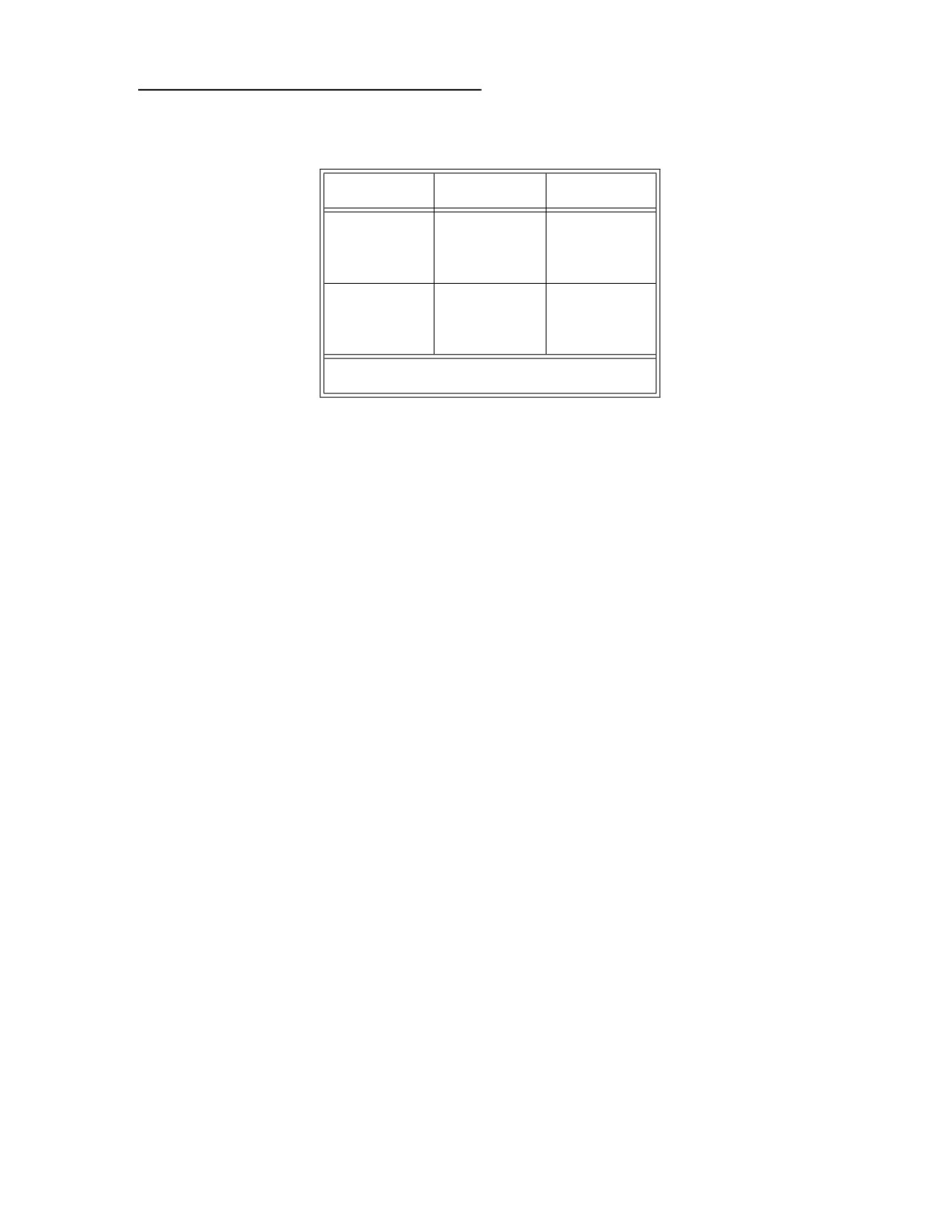
of the type and quantity of stabilizer. An estimate for testing time is
presented in Table 5-1.
5-4 Soil Stabilization
FM 5-472/NAVFAC MO 330/AFJMAN 32-1221(I)
Table 5-7. Estimated time required for test procedures
Construction
Stabilizing
Time
Type
Agent
Required*
Lime
None
LCF
None
Expedient
Cement
None
Bitumen
None
Lime
30 days
LCF
30 days
Nonexpedient
Cement
6 to 9 days
Bitumen
1 day
*These criteria do not include time required for
gradation.
STABILIZER SELECTION
When selecting a stabilizer additive, many factors must be considered. These
factors, design criteria, and the selection and mixing of stabilizers can be
found in FM 5-410, Chapter 9; TM 5-822-14; and FM 5-430-00-2.
If lime is used as a preliminary additive to reduce the PI or to alter the soil
gradation before adding the primary stabilizing agent (such as bitumen or
cement), then the design’s lime content is the minimum treatment level that
will achieve the desired results. For nonplastic and low PI materials in which
lime alone generally is not satisfactory for stabilization, adding fly ash may
produce the necessary reaction.
The lime used for soil stabilization is also used to determine lime
requirements in the pH test.
EQUIPMENT
Use the following items for the pH test:
• A pH meter (the meter must be equipped with an electrode having a
pH range of 14).
•
150-milliliter (or larger) plastic bottles with screw-top lids.
• Distilled water, free of carbon dioxide.
• A balance.
• An oven.
STEPS
Perform the following steps to determine the pH:
Step 1. Standardize the pH meter with a buffer solution having a pH of 12.45.
Step 2. Weigh, to the nearest 0.01 gram, representative samples of air-dried
soil passing the No. 40 sieve and equal to 20.0 grams of oven-dried soil.
Step 3. Pour the soil samples into the 150-milliliter plastic bottles with screw-
top lids.
Soil Stabilization
5-5
FM 5-472/NAVFAC MO 330/AFJMAN 32-1221(I)
Step 4. Add varying percentages of lime, weighed to the nearest 0.01 gram, to
the soils.
(Lime percentages of 0, 2, 3, 4, 5, 6, 8, and 10—based on the dry soil
weight—may be used.)
Step 5. Mix the soil thoroughly and dry the lime.
Step 6. Add 100 milliliters of the distilled water to the soil-lime mixtures.
Step 7. Shake the soil-lime-water mixture for a minimum of 30 seconds or
until there is no evidence of dry material on the bottom of the bottle.
Step 8. Shake the bottles for 30 seconds every 10 minutes.
Step 9. Transfer part of the slurry, after 1 hour, to a plastic beaker and
measure the pH.
Step 10. Record the pH for each of the soil-lime mixtures. The lowest percent
of lime giving a pH of 12.40 is the percent required to stabilize the soil. If the
pH does not reach 12.40, the minimum lime content giving the highest pH is
required to stabilize the soil.
SOIL STABILIZATION IN FROST AREAS
While bituminous, portland-cement, lime, and combinations of LCF
stabilization are the most common additives, other stabilizers may be used for
pavement construction in areas of frost design, but only with approval from—
• Headquarters, Department of the Army (DAEN-MPE-D), Washington,
DC 20314 (for Army projects).
• Headquarters, Air Force Engineering and Services Center (AFESC/
DEM), Tyndall AFB, FL 32401 (for Air Force projects).
• Headquarters, Naval Facilities Engineering Command, Alexandria,
VA 22332 (for Navy or Marine Corps projects).
LIMITATIONS
In frost areas, stabilized soil should be used only in a layer or layers
comprising one of the upper elements of a pavement system and directly
beneath the pavement’s surfacing layer. The structural advantage in reducing
the required thickness of the pavement system compensates for the added cost
of stabilization. Treatment with a lower degree of chemical stabilization
should be used in frost areas only with caution and after intensive tests,
because weakly cemented material usually has less capacity to endure
repeated freezing and thawing than firmly cemented material. A possible
exception is using a low level of stabilization to improve a soil that will be
encapsulated within an impervious envelope as part of a membrane-
encapsulated soil-layer pavement system. A soil that is unsuitable for
encapsulation due to excessive moisture migration and thaw weakening may
be made suitable for such use by a moderate amount of a stabilizing additive.
Materials that are modified by a small amount of a chemical additive to
improve certain properties of the soil without significant cementation also
should be tested to determine that the desired improvement is durable
through repeated freeze-thaw cycles. The improvement should not be
achieved at the expense of making the soil more susceptible to ice segregation.
5-6 Soil Stabilization
FM 5-472/NAVFAC MO 330/AFJMAN 32-1221(I)
CONSTRUCTION CUTOFF
For materials stabilized with cement, lime, or LCF whose strength increases
with curing time, it is essential that the stabilized layer be constructed
sufficiently early in the season to allow the adequate strength to develop
before the first freezing cycle begins. The rate of strength gain is
substantially lower at 50°F than at 70° or 80°F. Chemical reactions will not
occur rapidly for lime-stabilized soils when the soil temperature is less than
60°F and is not expected to increase for one month or for cement-stabilized
soils when the soil temperature is less than 40°F and is not expected to
increase for one month. In frost areas, it is not always sufficient to protect the
mixture from freezing during a 7-day curing period as required by the
applicable guide specifications. A construction cutoff date well in advance of
the onset of freezing conditions may be essential.
WEATHER
Hot, dry weather is preferred for all types of bituminous stabilization. When
asphalt cements are used for stabilization, proper compaction must be
obtained. If thin lifts of asphalt-stabilized material are being placed, the air
temperature should be 40°F and rising and the compaction equipment should
be used immediately after lay-down operations. Adequate compaction can be
obtained at freezing temperatures if thick lifts are used. When cutbacks and
emulsions are used, the air and soil temperatures should be above freezing.
Heavy rains on mixed, uncompacted material may be detrimental.
PICK-AND-CLICK TESTS
Specimens covering a wide range of cement contents (for example: 10, 14, and
18 percents) are molded at optimum moisture and maximum density. After at
least 36 hours of hardening while kept moist and after a 3-hour soaking
period, the specimens are inspected by picking with a pointed instrument
(such as a dull ice pick or bayonet) and by sharply clicking each specimen
against a hard object
(such as concrete or another sound specimen) to
determine their relative hardness when set. If the specimen cannot be
penetrated more than 1/8 to 1/4 inch by picking, and if it produces a clear or
solid tone upon clicking, an adequate cement factor (CF) is indicated. When a
dull thud or plunky sound is obtained, there is inadequate cement even
though the specimen may resist picking.
The specimen’s age is a factor, and a specimen that may not test properly at
first may harden properly a few days later. Some satisfactory specimens
require 7 days or longer to produce adequate hardening. The test results will
indicate the proper content. If the results show that some intermediate
content may be satisfactory, new test specimens (at the suggested content)
should be prepared and tested. It is important to remember that too much
cement is not harmful (although more expensive), but too little cement will
not produce a satisfactory stabilization.
WET-DRY AND FREEZE-THAW TESTS
After determining the maximum density and OMC, mold the specimens for
the wet-dry and freeze-thaw tests.
Soil Stabilization
5-7
FM 5-472/NAVFAC MO 330/AFJMAN 32-1221(I)
PREPARATION
Prepare the specimens using the computed OMC and the cement contents
previously described for the different soil classifications. Select the cement
contents in 2 percent increments on either side of the median value. Mold two
specimens for each of the three cement contents—one for the wet-dry test and
one for the freeze-thaw test. Use the same procedure to mold the specimens
as used for the OMC determination. Take special care to scarify the surfaces
between layers to ensure a good bond. When the second layer is being placed,
take a 750-gram sample for a moisture determination. Place the molded
specimens in a moisture cabinet in an atmosphere of high humidity for 7 days
to permit cement hydration before testing.
WET-DRY TEST PROCEDURE
After the 7-day curing period, submerge the specimens in tap water at room
temperature for a period of 5 hours and then remove them. Dry the specimens
in an oven at 160°F for 42 hours and then remove them. Wire brush the entire
surface area to remove all material loosened during wetting and drying. Use
two firm strokes on each portion of the surface. Apply these strokes the full
height and width with a 3-pound force. One cycle consists of 5 hours of water
immersion, 42 hours of drying, and 1 hour of handling. Repeat the operation
for a total of 12 cycles. After 12 cycles of the test, dry the specimens to a
constant weight at 230°F, and weigh them to determine the oven-dry weights.
FREEZE-THAW TEST PROCEDURE
After the curing period, place water-saturated felt pads about 1/4 inch thick,
blotters, or similar absorptive materials between the specimens and specimen
carriers.
Place the assembly in a freezing cabinet with a constant
temperature not warmer than -10°F for 24 hours and then remove them.
Allow the assembly to thaw in a moist room or in suitable covered containers
with a temperature of 70°F and a relative humidity of 100 percent for 23
hours. Make free water available to the absorbent pads to permit the
specimens to absorb water by capillarity during the thawing period. Give the
specimens two firm strokes on all areas with the wire brush to remove
material loosened during freezing and thawing. If necessary, use a sharp-
pointed instrument to remove any scale that has formed. One cycle consists of
24 hours of freezing, 23 hours of thawing, and 1 hour of handling (total 48
hours). After being brushed at the end of each thawing period, turn the
specimens over, end for end, before replacing them on the water-saturated
pads. Continue the test for a total of 12 cycles, dry the specimens to a constant
weight at 230°F, and weigh them to determine their oven-dry weights.
CALCULATIONS AND CRITERIA
The results of the wet-dry and freeze-thaw cycles are indicated as soil-cement
losses. These losses are computed by using the original dry weights and final
corrected dry weights.
Water-of-Hydration Correction
The final oven-dry weight of the specimen includes some water used for
cement hydration that cannot be driven off at 230°F. The average amount of
this water retained in the specimen is based on the type of soil—gravels,
5-8 Soil Stabilization
FM 5-472/NAVFAC MO 330/AFJMAN 32-1221(I)
+ 1 1/2; sand, + 2 1/2 percent; silt, + 3 percent; and clays, + 3 1/2 percent. This
correction is computed by the following formula:
measured oven-dry specimen wt
corrected oven-dry weight
=
--------------------------------------------------------------------------------------- + 100
× 100
percent water retained
Example: A sample composed mostly of sand weighs 3.77 pounds at the end of
the test. Water of hydration is 2.5 percent.
3.77
corrected oven-dry weight
=
----------- + 100
× 100
2.5
Soil-Cement Loss
The soil-cement loss can now be calculated as a percentage of the original dry
weight, or—
soil-cement loss =
original oven-dry weight - final corrected oven-dry weight
--------------------------------------------------------------------------------------------------------------------------------------------------------------
× 100
original oven-dry weight
Example: A sample of soil has an original weight of 3.99 pounds.
3.99
- 3.68
soil-cement loss
=
----------------------------
× 100
3.99
This value would be reported to the nearest whole number or as 8 percent.
Weight-Loss Criteria
The minimum cement content recommended for use is the one for which losses
of specimen weight during 12 cycles of the wet-dry test or freeze-thaw test
conform to the following standards:
• GW, GM, GC, SW, SM, SC, and SP soils—not over 14 percent.
• ML and MH soils—not over 10 percent.
• GL, CH, OH, and OL soils—not over 7 percent.
Strength Criteria
The strength of soil-cement specimens tested in compression at various ages
should increase with age and with increases in cement. The ranges of cement
contents should produce results meeting the requirements above. A sample
that has an unconfined compression strength of about 300 psi after curing 7
days and shows increasing strength with age can be considered adequately
stabilized.
Cement Weight-to-Volume Conversion
The required cement content by weight must be converted to the equivalent
cement content by volume for control during construction since this is the
easier quantity to use in the field. The following formula illustrates the
calculation:
Soil Stabilization
5-9
FM 5-472/NAVFAC MO 330/AFJMAN 32-1221(I)
D -
-
C
volume of cement (percent)
= ------------------- × 100
94
where—
D = oven-dry density of soil-cement, in pcf
100 + percent cement by weight
C
= ------------------------------------------------------------------------------------
100
94 = weight of 1 cubic foot of cement
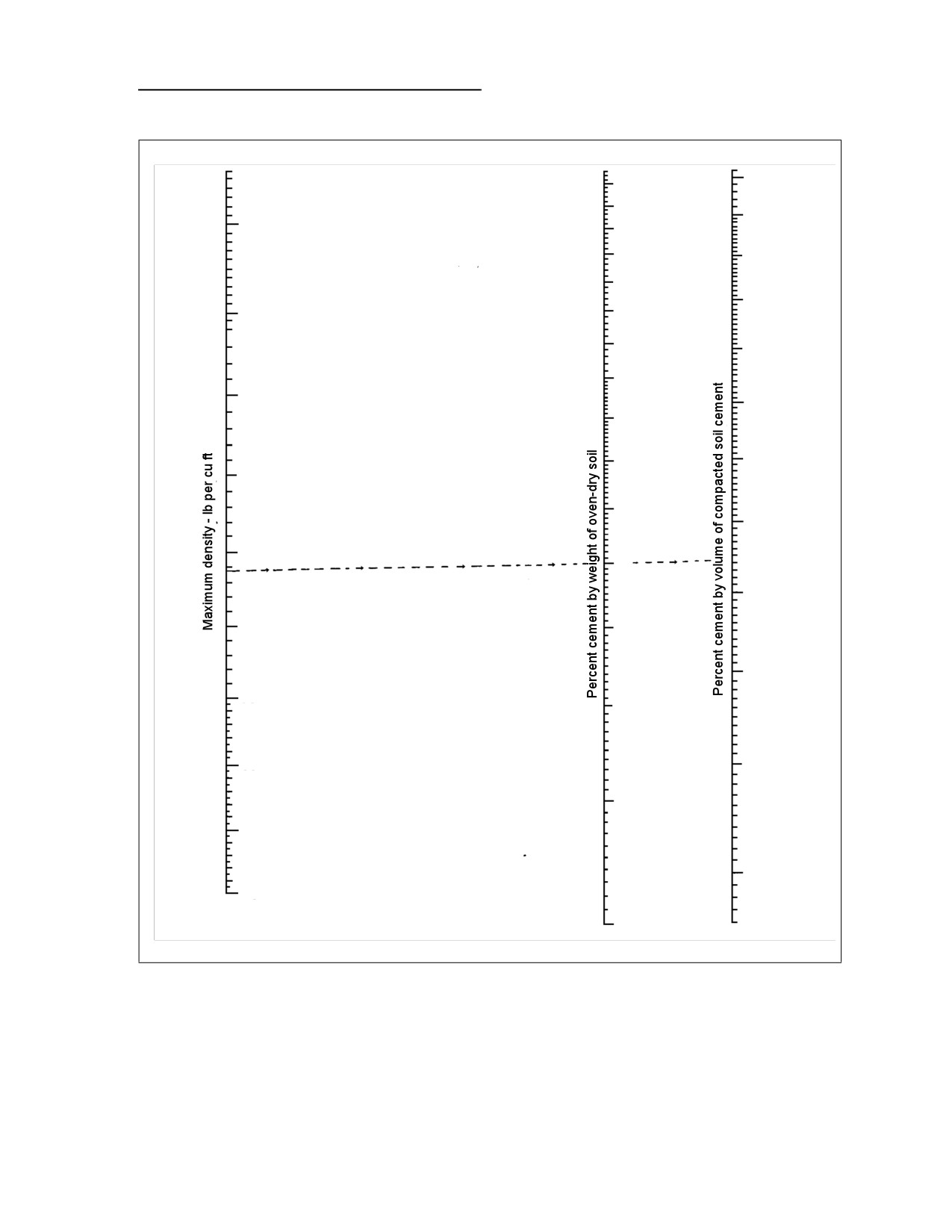
The nomograph in Figure 5-1 makes the conversion without computation. Use
a straightedge placed at the soil-cement density and at the percent by weight
of cement. Read the percent of cement by volume on the right-hand scale.
MODIFIED MIX DESIGN FOR SANDY SOILS
Sandy soils are usually the most readily and economically stabilized because
they require the least amount of cement for adequate hardening and they
contain a minimum amount of material that prevents intimate mixing of soil
and cement. The following shortcut testing procedures for sandy soils will not
always indicate the minimum cement contents required, but the results will
be close enough to be on the safe side and economical. If time permits, the
procedures for the freeze-thaw test are followed for greater design economy.
The two procedures used are for—
• Soils with no material retained on the No. 4 sieve.
• Soils with material retained on the No. 4 sieve.
The procedures can be used only with soils containing less than 50 percent of
material smaller than 0.05 millimeter (silt and clay) and less than 20 percent
smaller than 0.005 millimeter (clay). Dark gray to black sandy soils obviously
containing appreciable organic impurities together with miscellaneous
granular materials (such as cinders, caliche, chat, chart, marl, red dog, scoria,
shale, and slag) should be tested using the full procedures and not tested by
the modified methods for sandy soils. When coarse-grained or sandy soils
(usually of groups GW, GP, GM, SW, or SM) are encountered, they may be
classified for testing purposes using either the first or the second procedure.
There is one other exception. Granular soils with materials retained on the
No. 4 sieve whose bulk specific gravity is less than 2.45 cannot be tested.
Perform the following steps for modifying the mix design for sandy soils:
Step 1. Determine the soil gradation.
Step 2. Determine the bulk specific gravity of the material retained on the No.
4 sieve.
Step
3.
Perform the moisture-density test of an estimated soil-cement
mixture.
Step 4. Locate the indicated cement requirements from the charts.
Step 5. Perform compressive-strength tests to verify the cement requirement.
5-10 Soil Stabilization
FM 5-472/NAVFAC MO 330/AFJMAN 32-1221(I)
16
18
17
15
100
16
15
14
14
13
105
13
12
12
11
110
11
10
9
10
115
8
9
120
7
8
125
6
7
130
5
135
6
4
140
5
145
3
Figure 5-33. Relation of cement content by weight to cement content by volume
SOILS WITH NO MATERIAL RETAINED ON THE NO. 4 SIEVE
Perform the following steps for soils with no material retained on the No. 4
sieve:
Soil Stabilization 5-11
FM 5-472/NAVFAC MO 330/AFJMAN 32-1221(I)
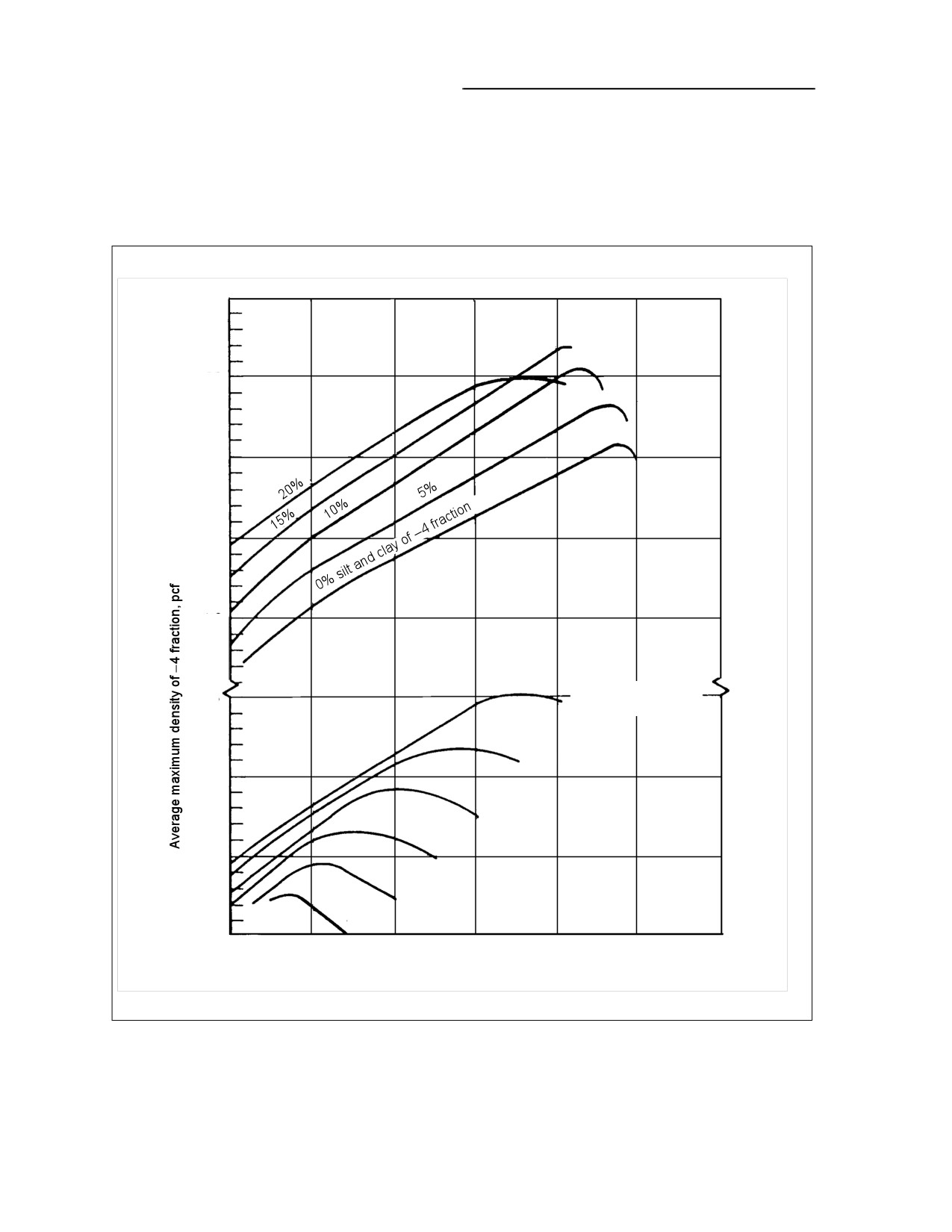
Step 1. Determine the maximum density and OMC for a mixture of soil and
cement.
(Figure 5-2 will give an estimated density. This value and the
percentage of material smaller than 0.05 millimeter are used with Figure 5-3
to determine an indicated cement content.)
130
125
120
115
110
125
20% silt and clay of
- 4 fraction
30%
120
40%
50%
115
60%
70%
110
0
20
40
60
80
100
No. 4 to No. 50 sieve size material of -4 fraction - percent
Figure 5-34. Average maximum densities of the -4 fraction of soil-cement mixtures
5-12 Soil Stabilization
FM 5-472/NAVFAC MO 330/AFJMAN 32-1221(I)
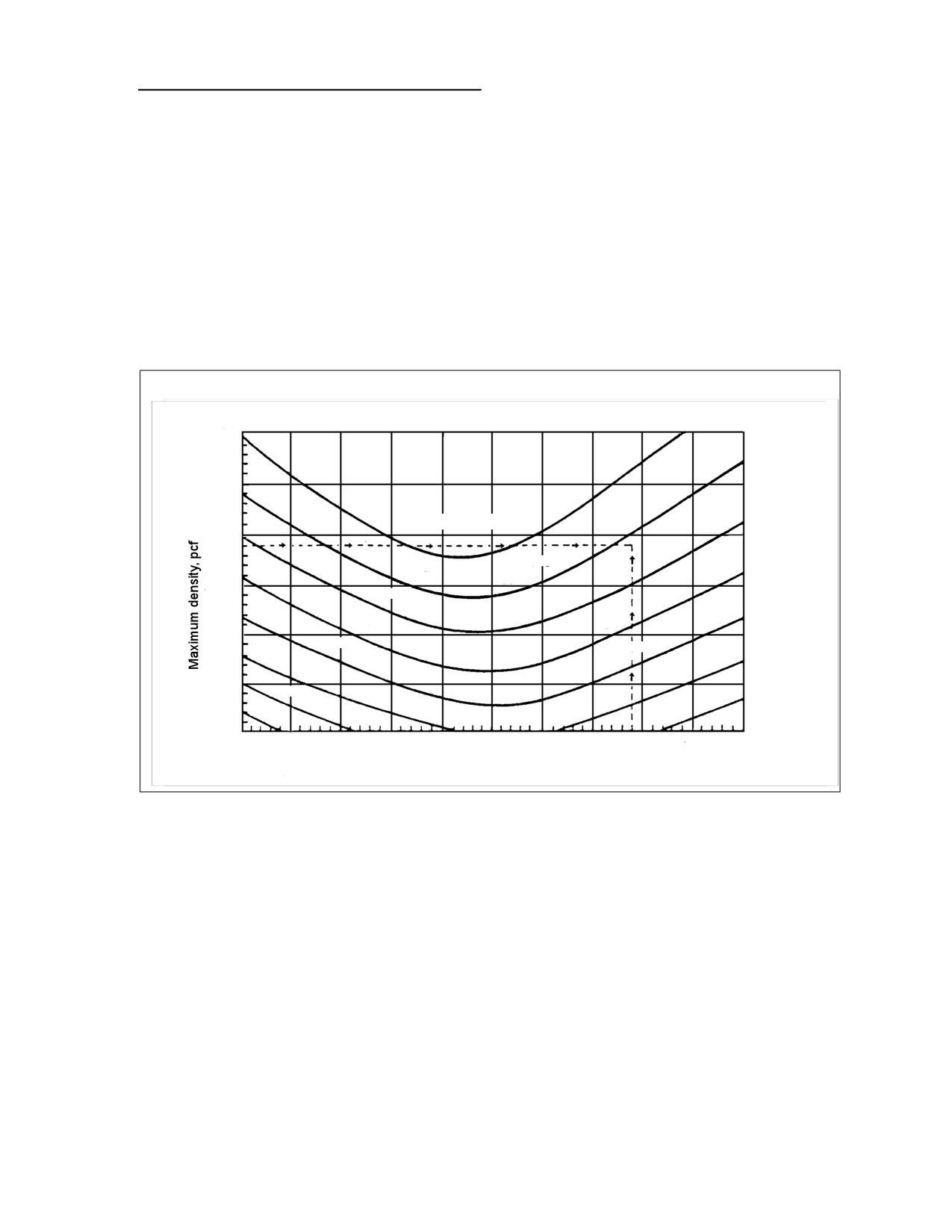
Step 2. Use the maximum density value and Figure 5-3 to determine an
indicated cement requirement.
Step 3. Mold three compressive-strength specimens at maximum density and
OMC.
Step 4. Moist-cure the specimens for 7 days and test for strength.
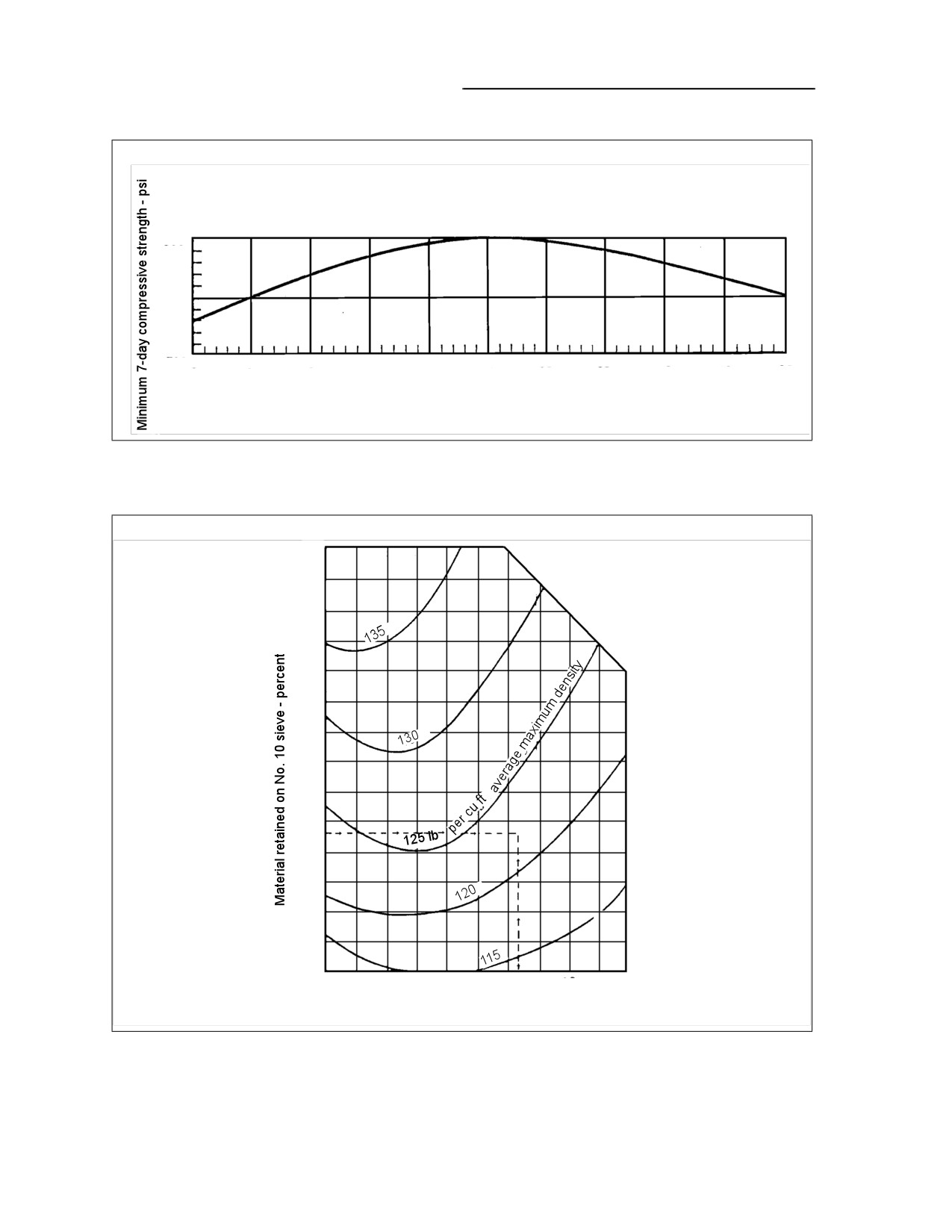
Step 5. Plot the value of the averaged compressive strength of Figure 5-4,
page 5-14. If this plot is above the curve, the CF is probably too low and needs
adjusting. Prepare two new test specimens: one at the cement content as
computed above, and the second with a 2 percent higher cement content.
Perform the full freeze-thaw test on these two specimens.
130
125
6% cement by weight
120
7%
7%
115
8%
8%
9%
9%
110
10%
10%
11%
11%
105
12%
12%
13%
100
0
5
10
15
20
25
30
35
40
45
50
Material smaller than 0.05 mm, percent
Figure 5-35. Indicated cement contents of soil-cement mixtures not containing material
retained on the No. 4 sieve
SOILS WITH MATERIAL RETAINED ON THE NO. 4 SIEVE
Perform the following steps for soils with material retained on the No. 4 sieve:
Step 1. Determine the maximum density and OMC for a mixture of soil and
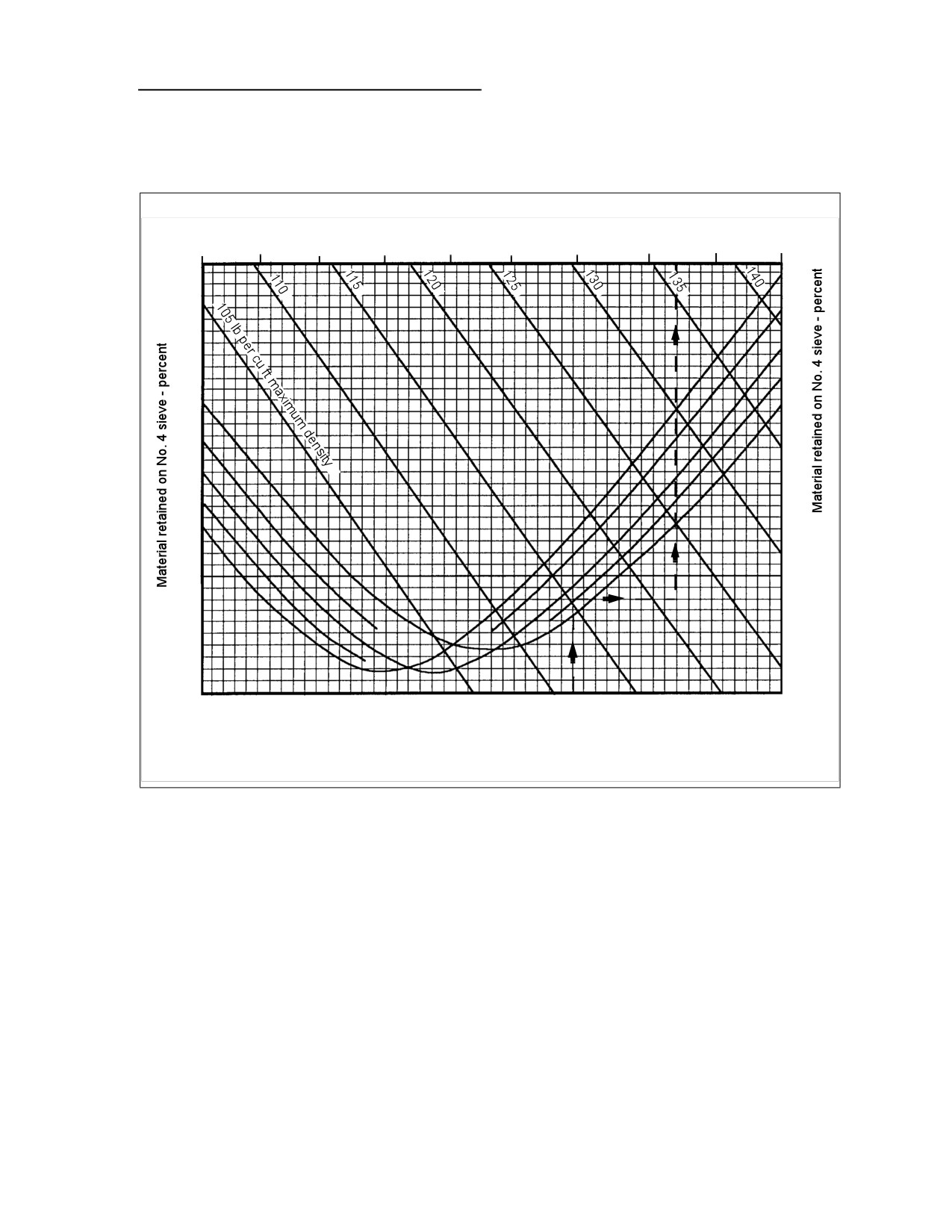
cement. Use Figure 5-5, page 5-14, for an estimated maximum density. Using
this density, the percentage of material retained on the No. 4 sieve, and the
percentage smaller than 0.05 millimeter, determine the moisture content (see
Figure 5-6, page 5-15). The 45 percent maximum retained on the No. 4 sieve
still applies. Also, replace any material larger than
1/4 inch with an
equivalent weight of the material passing the 1/4-inch sieve and retained on
the No. 4 sieve.
Soil Stabilization 5-13
FM 5-472/NAVFAC MO 330/AFJMAN 32-1221(I)
300
250
200
0
5
10
15
20
25
30
35
40
45
50
Material smaller than 0.05 mm - percent
Figure 5-36. Minimum 7-day compressive strengths required for soil-cement not containing
material retained on the No. 4 sieve
70
60
50
40
30
20
10
0
0
10
20
30
40
50
Material smaller than 0.05 mm - percent
Figure 5-37. Average maximum densities of soil-cement mixtures containing material retained
on the No. 4 sieve
5-14 Soil Stabilization
FM 5-472/NAVFAC MO 330/AFJMAN 32-1221(I)
Step 2. Determine the indicated cement requirement using the maximum
density from above and Figure 5-6.
Cement content by weight - percent
13
12
11
10
9
8
7
6
5
40
30
20
10
0
0
10
20
30
40
0
0
10
15
20
25
30
35
40
45
50
Material smaller than 0.05 mm - percent
Figure 5-38. Indicated cement contents of soil-cement mixtures containing material retained
on the No. 4 sieve
Step 3. Mold-test specimens at maximum density and OMC.
Step 4. Moist-cure for 7 days and test for compressive strength and average.
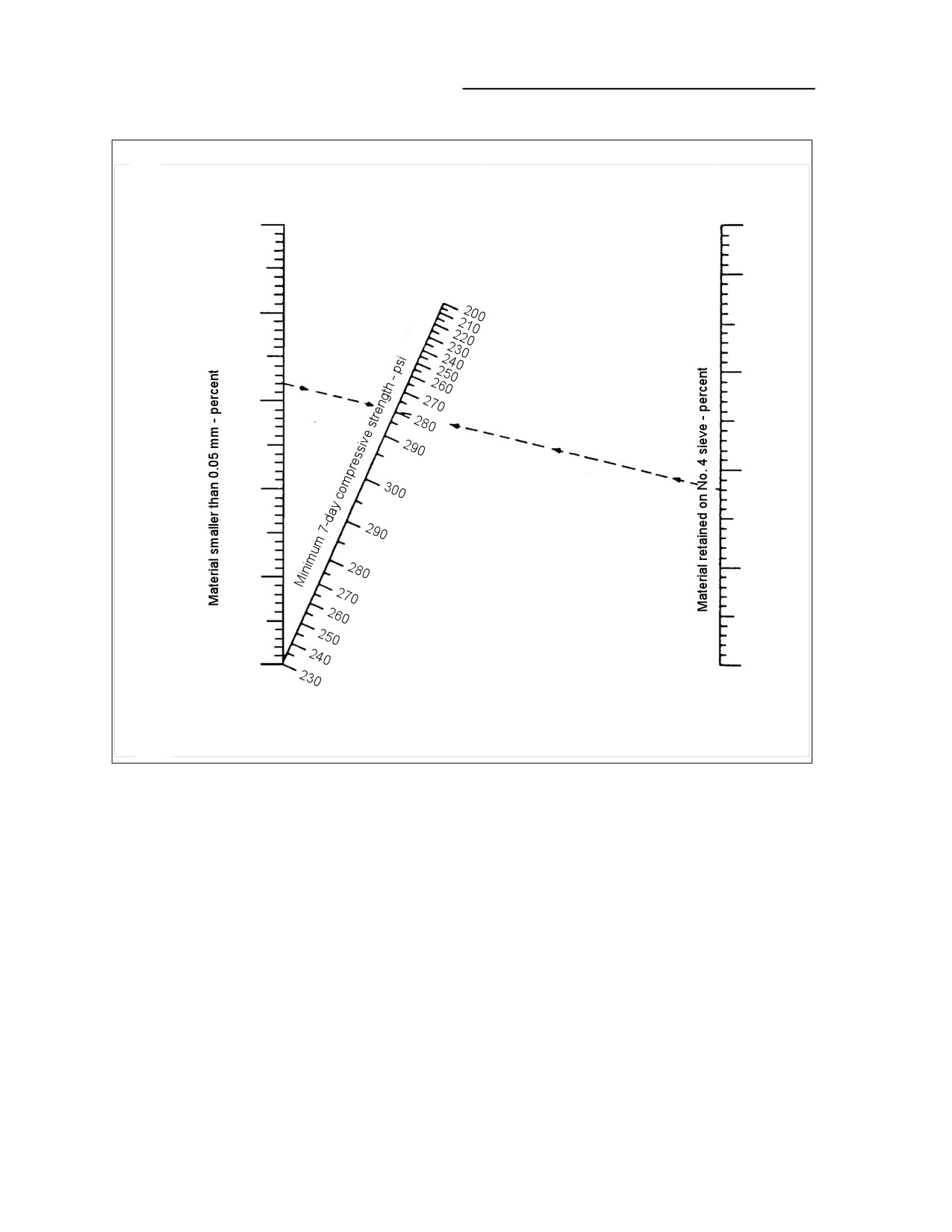
Step 5. Use Figure 5-7, page 5-16, to determine the allowable compressive
strength for the soil-cement mixture. Connect the points on the right- and
left-hand scales of the nomograph, and read the minimum required
compressive strength from the inclined center scale. If the strength is equal to
or greater than the allowable strength, the cement content is adequate. If the
strength is too low, the CF is also too low and a full test should be performed.
Soil Stabilization 5-15
FM 5-472/NAVFAC MO 330/AFJMAN 32-1221(I)
50
45
40
40
30
30
20
20
10
10
0
0
Figure 5-39. Minimum 7-day compressive strengths required for soil-cement mixtures
containing material retained on the No. 4 sieve
5-16 Soil Stabilization
C2
Appendix A
Metric Conversion Chart
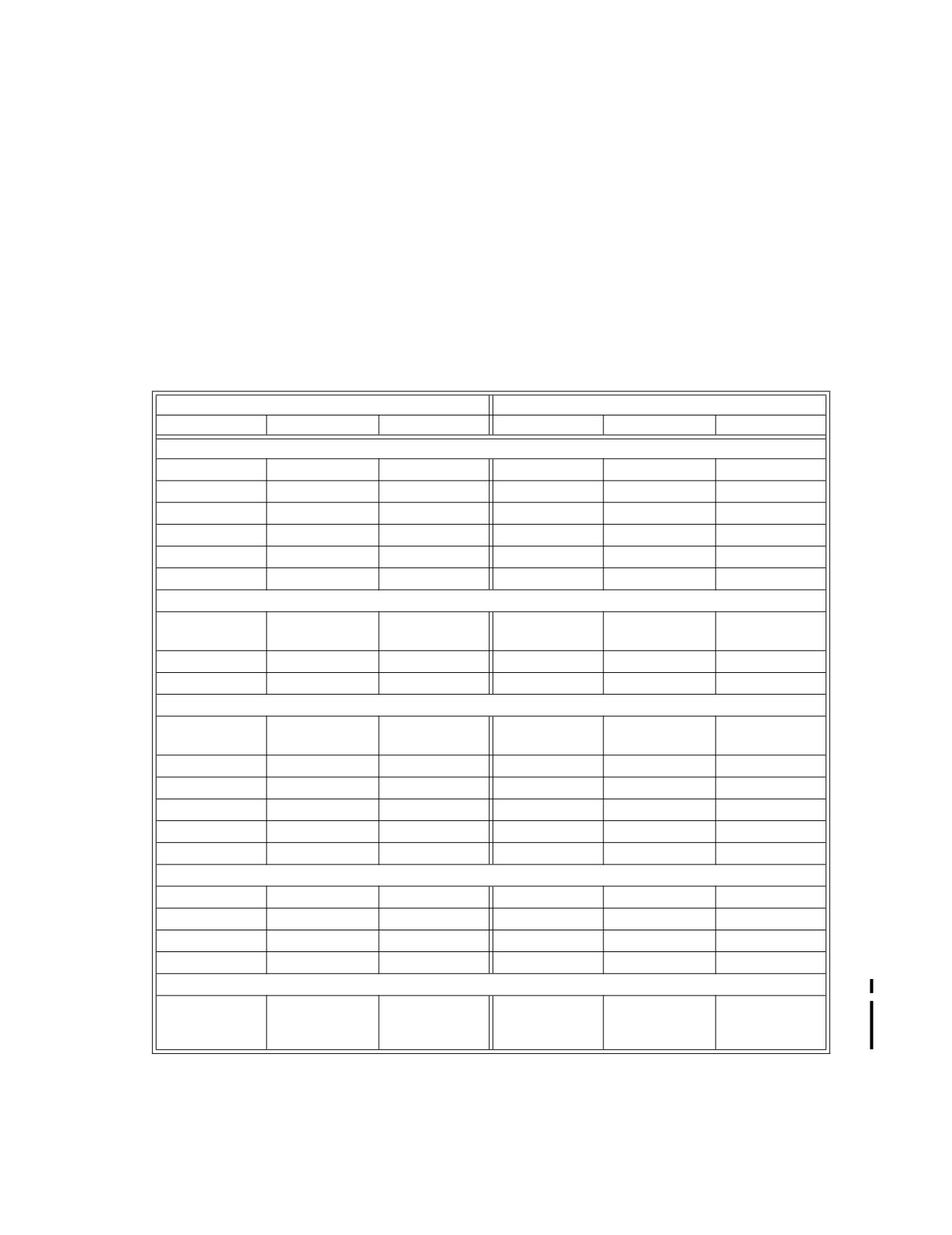
This appendix complies with current Army directives which state that the
metric system will be incorporated into all new publications. Table A-1 is a
conversion chart.
Table A-1. Metric conversion chart
Metric to English
English to Metric
Multiply
By
To Obtain
Multiply
By
To Obtain
Length
Centimeters
0.0394
Inches
Inches
2.54
Centimeters
Meters
3.28
Feet
Feet
0.0305
Meters
Meters
1.094
Yards
Yards
0.9144
Meters
Kilometers
0.621
Miles (stat)
Miles (stat)
1.5609
Kilometers
Kilometers
0.540
Miles (naut)
Miles (naut)
1.853
Kilometers
Millimeters
0.039
Inches
Inches
25.40
Millimeters
Area
Square
Square
0.1550
Square inches
Square inches
6.45
centimeters
centimeters
Square meters
10.76
Square feet
Square feet
0.0929
Square meters
Square meters
1.196
Square yards
Square yards
0.836
Square meters
Volume
Cubic
Cubic
0.610
Cubic inches
Cubic inches
16.39
centimeters
centimeters
Cubic meters
35.3
Cubic feet
Cubic feet
0.0283
Cubic meters
Cubic meters
1.308
Cubic yards
Cubic yards
0.765
Cubic meters
Milliliters
0.0338
US liq ounces
US liq ounces
29.6
Milliliters
Liters
1.057
US liq quarts
US liq quarts
0.946
Liters
Liters
0.264
US liq gallons
US liq gallons
3.79
Liters
Weight
Grams
0.0353
Ounces
Ounces
28.4
Grams
Kilograms
2.20
Pounds
Pounds
0.454
Kilograms
Metric tons
1.102
Short tons
Short tons
0.907
Metric tons
Metric tons
0.984
Long tons
Long tons
1.016
Metric tons
Temperature
Subtract 32
Add 17.8
and
Celsius
Fahrenheit
Fahrenheit
and multiply by
Celsius
multiply by 1.8
0.5556
Metric Conversion Chart A-1
Appendix B
The Unified Soil Classification System
The adoption of the principles of soil mechanics by the engineering
profession has inspired numerous attempts to devise a simple
classification system that will tell the engineer the properties of a given
soil. As a consequence, many classifications have come into existence
based on certain properties of soils such as texture, plasticity, strength,
and other characteristics. A few classification systems have gained fairly
wide acceptance, but rarely has any system provided the complete
information on a soil that the engineer needs. Nearly every engineer who
practices soil mechanics will add judgment and personal experience as
modifiers to whatever soil classification system he uses. Obviously, within
a given agency (where designs and plans are reviewed by persons entirely
removed from a project) a common basis of soil classification is necessary
so that when an engineer classifies a soil as a certain type, this
classification will convey the proper characteristics and behavior of the
material. Further than this, the classification should reflect those
behavior characteristics of the soil that are pertinent to the project under
consideration.
BASIS OF THE USCS
The USCS is based on identifying soils according to their textural and
plasticity qualities and on their grouping with respect to behavior. Soils
seldom exist in nature separately as sand, gravel, or any other single
component. They are usually found as mixtures with varying proportions of
particles of different sizes; each component part contributes its characteristics
to the soil mixture. The USCS is based on those characteristics of the soil that
indicate how it will behave as an engineering construction material. The
following properties have been found most useful for this purpose and form
the basis of soil identification. They can be determined by simple tests and,
with experience, can be estimated with some accuracy.
• Percentages of gravel, sand, and fines (fraction passing the No. 200
sieve).
• Shape of the grain-size-distribution curve.
• Plasticity and compressibility characteristics. In the USCS, the soil is
given a descriptive name and a letter symbol indicating its principal
characteristics.
PURPOSE AND SCOPE
It is the purpose of this appendix to describe the various soil groups in detail
and to discuss the methods of identification so that a uniform classification
procedure may be followed by all who use the system. Placement of the soils
Unified Soil Classification System B-1
FM 5-472/NAVFAC MO 330/AFJMAN 32-1221(I)
into their respective groups is accomplished by visual examination and
laboratory tests as a means of basic identification. It is recognized that the
USCS in its present form may not prove entirely adequate in all cases.
However, it is intended that the classification of soils according to this system
have some degree of elasticity and that the system not be followed blindly nor
regarded as completely rigid.
DEFINITIONS OF SOIL COMPONENTS
Before soils can be classified properly in any system, including the one
presented in this manual, it is necessary to establish a basic terminology for
the various soil components and to define the terms used. In the USCS, the
terms cobbles, gravel, sand, and fines (silt or clay) are used to designate the
size ranges of soil particles. The gravel and sand ranges are further
subdivided into the groups as presented in Table B-1. The limiting
boundaries between the various size ranges have been arbitrarily set at
certain US standard sieve sizes as listed in Table B-1. In the finest soil
component (below the No. 200 sieve), the terms silt and clay are used
respectively to distinguish materials exhibiting lower plasticity from those
with higher plasticity. The minus No. 200 sieve material is silt if the LL and
PI plot below the “A” line on the plasticity chart and is clay if the LL and PI
plot above the “A” line on the chart (all LL and PL tests are based on minus
No. 40 sieve fraction of a soil). The foregoing definition holds for inorganic
silts and clays and for organic silts but is not valid for organic clays since
these latter soils plot below the “A” line. The names of the basic soil
components can be used as nouns or adjectives when describing or
classifying a soil.
THE CLASSIFICATION SYSTEM
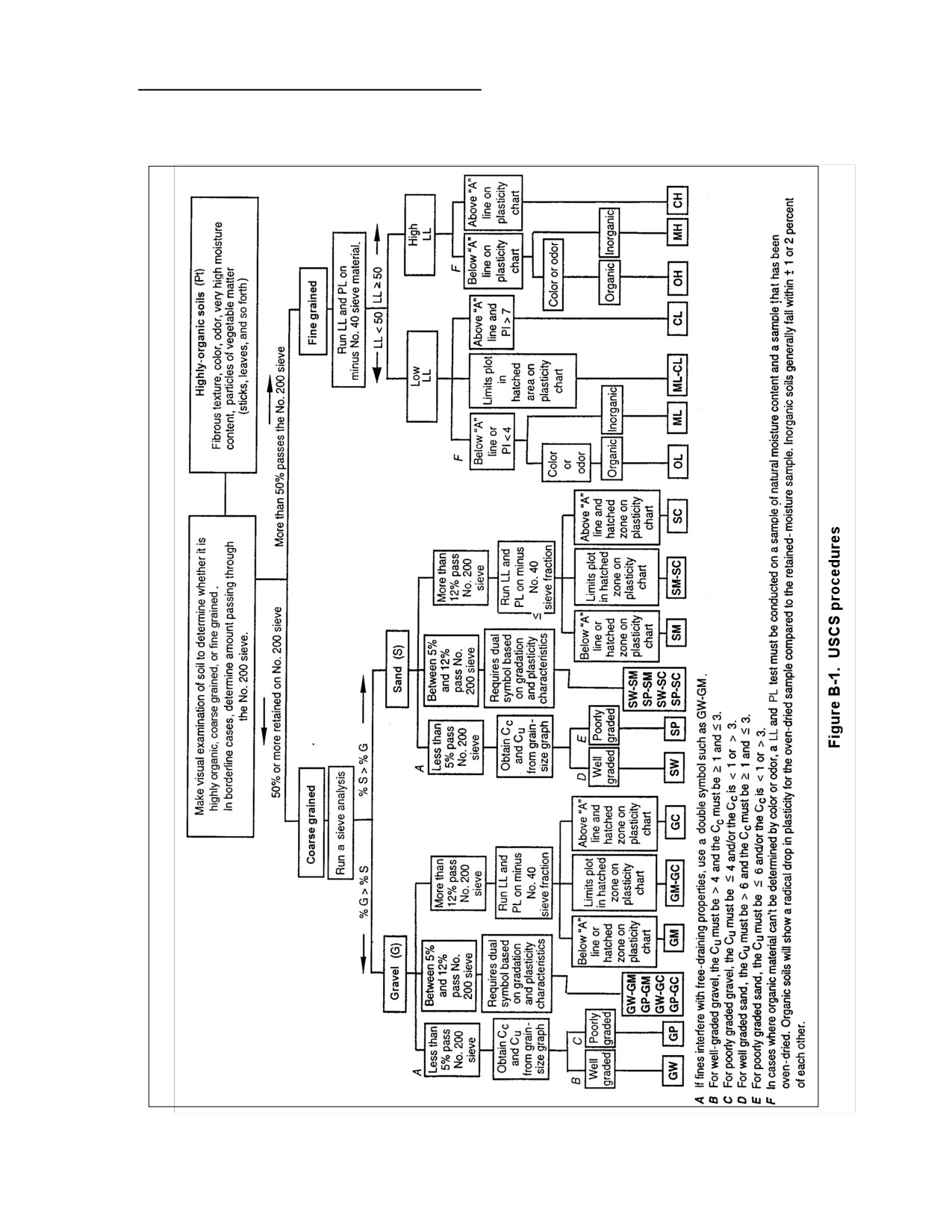
In its simplest form, Figure B-1 illustrates the process of the classification
system. The following paragraphs provide detailed information on the soil
properties and groups as they pertain to the system.
Table B-1. Soil particle-size ranges
Component
Size Range
Cobbles
Above 3 inches
Gravel
3 inches to No. 4 sieve
Coarse
3 inches to 3/4 inch
Fine
3/4 inch to No. 4 sieve
Sand
No. 4 to No. 200 sieves
Coarse
No. 4 to No. 10 sieves
Medium
No. 10 to No. 40 sieves
Fine
No. 40 to No. 200 sieves
Fines (clay or silt)
Below No. 200 sieve (no minimum size)
A short discussion of the USCS procedures (see Figure B-1, page B-3) is
presented so that the succeeding detailed description may be better
understood. The procedures are designed to apply generally to the
B-2 Unified Soil Classification System
FM 5-472/NAVFAC MO 330/AFJMAN 32-1221(I)
Unified Soil Classification System B-3
FM 5-472/NAVFAC MO 330/AFJMAN 32-1221(I)
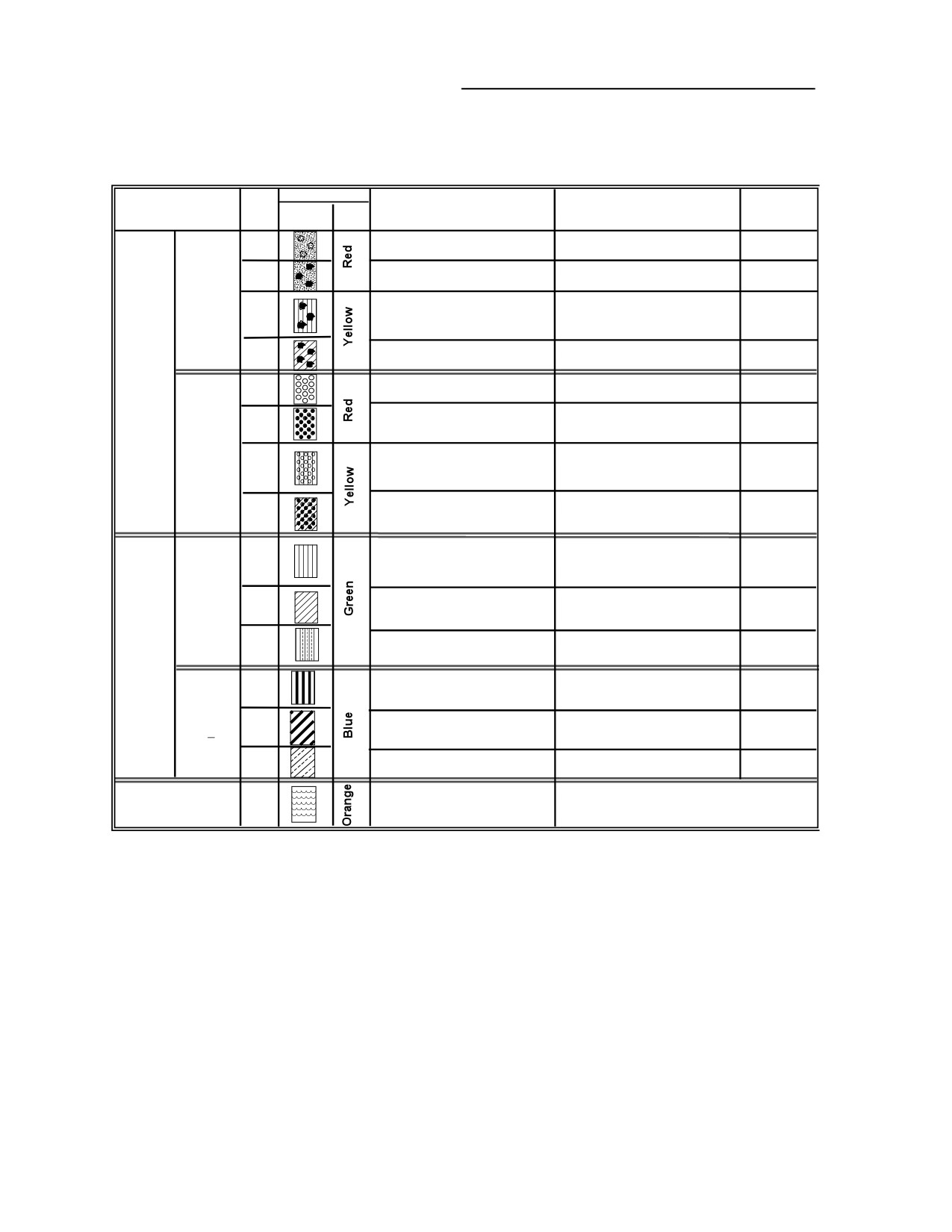
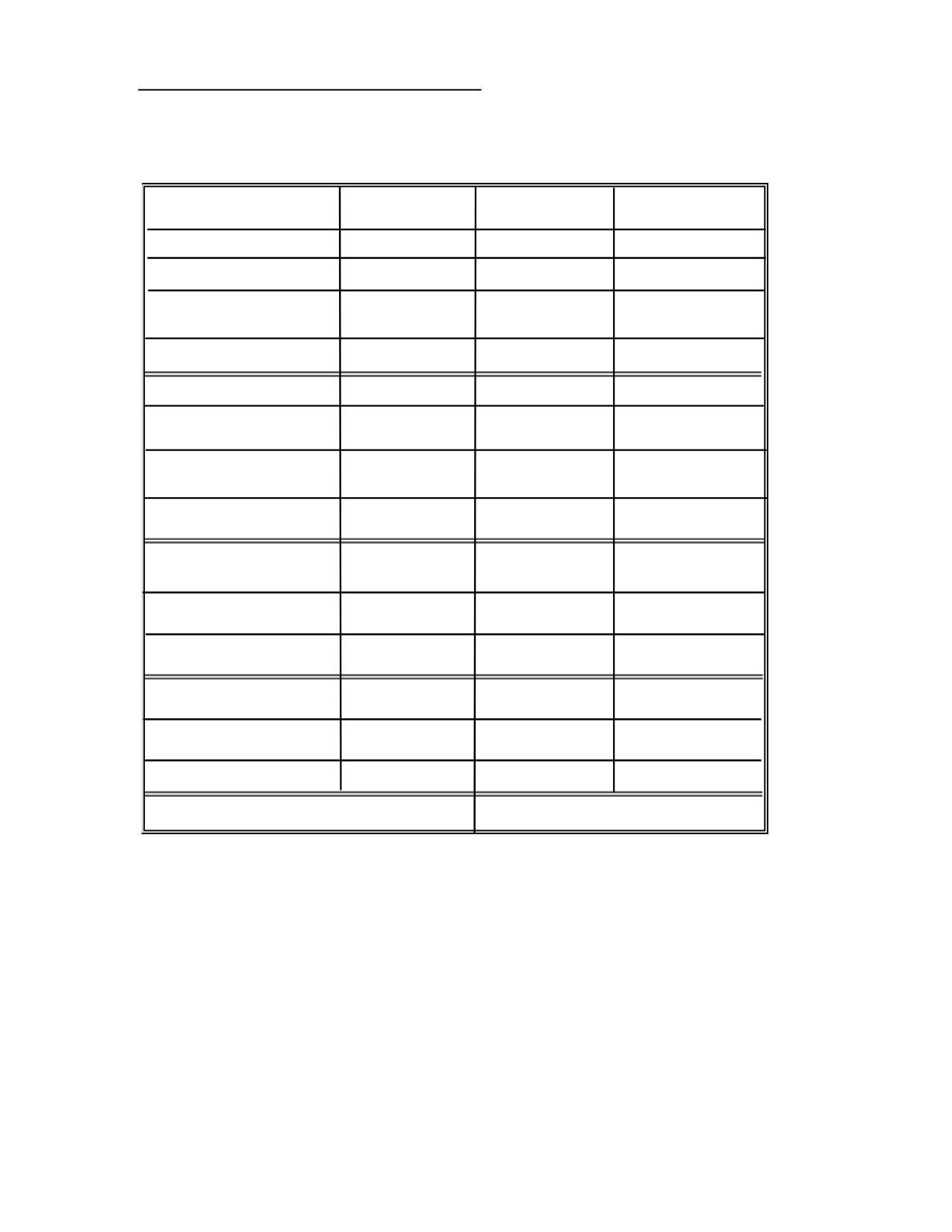
identification of soils regardless of the intended engineering uses. Table B-2,
pages B-6 and B-7, also assists in identifying the symbols and soil descriptions
within this system. Figure B-1 shows the schematic method of classifying
soils from the results of laboratory tests. Columns 1 through 5 of Table B-2,
pages B-6 and B-7 identify the three major divisions of the classification
system and the group symbols that distinguish the individual soil types.
Names of typical and representative soil types found in each group are shown
in column 6.
SOIL GROUPS AND GROUP SYMBOLS
Soils are primarily identified as coarse grained, fine grained, and highly
organic. On a textural basis, coarse-grained soils are those that have 50
percent or more by weight of the overall soil sample retained on the No. 200
sieve; fine-grained soils are those that have more than 50 percent by weight
passing the No. 200 sieve. Highly-organic soils are, in general, readily
identified by visual examination. The coarse-grained soils are subdivided into
gravel and gravelly soils (G) and sands and sandy soils (S). Fine-grained soils
are subdivided on the basis of their LL and plasticity properties; the symbol L
is used for soils with LLs of 50 and less and the symbol H for soils with LLs in
excess of 50. Peat and other highly organic soils are designated by the symbol
Pt and are not subdivided.
In general practice there is no clear-cut boundary between gravelly soils and
sandy soils and, as far as behavior is concerned, the exact point of division is
relatively unimportant. For identification purposes, coarse-grained soils are
classified as G if the greater percentage of the coarse fraction (that which is
retained on the No. 200 sieve) is larger than the No. 4 sieve. They are classed
as S if the greater portion of the coarse fraction is finer than the No. 4 sieve.
Borderline cases may be classified as belonging to both groups. The G and S
groups are each divided into four secondary groups as follows:
• Well-graded material with little or no fines—symbol W, groups GW
and SW.
• Poorly graded material with little or no fines—symbol P, groups GP
and SP.
• Coarse material with nonplastic fines or fines with low plasticity—
symbol M, groups GM and SM.
• Coarse material with plastic fines—symbol C, groups GC and SC.
The fine-grained soils are subdivided into groups based on whether they have
a relatively low (L) or high (H) LL. These two groups are further subdivided
as follows:
• Inorganic silts and very fine sandy soils, silty or clayey fine sands,
micaceous and diatomaceous soils, and elastic silts—symbol M, groups
ML and MH.
• Inorganic clays—symbol C, groups CL and CH.
• Organic silts and clays—symbol O, groups OL and OH.
B-4 Unified Soil Classification System
FM 5-472/NAVFAC MO 330/AFJMAN 32-1221(I)
Coarse-Grained Soils
In the following paragraphs, soils of the GW, GP, SW, and SP groups are
defined as having less than 5 percent passing the No. 200 sieve. Soils which
have between 5 and 12 percent passing the No. 200 sieve are classed as
borderline and will be discussed later in this appendix.
GW and SW Groups
These groups comprise well-graded gravelly and sandy soils having little or no
nonplastic fines (less than 5 percent passing the No. 200 sieve). The presence
of the fines must not noticeably change the strength characteristics of the
coarse-grained fraction and must not interfere with its free-draining
characteristics. If the material contains less than 5 percent fines that exhibit
plasticity, this information should be evaluated and the soil classified and
discussed subsequently under “Laboratory Identification.” In areas subject to
frost action, the material should not contain more than 3 percent of soil grains
smaller than 0.02 millimeter in size.
GP and SP Groups
Poorly-graded gravels and sands containing little or no nonplastic fines (less
than 5 percent passing the No. 200 sieve) are classed in the GP and SP groups.
The materials may be classed as uniform gravels, uniform sands, or
nonuniform mixtures of very coarse material and very fine sand, with
intermediate sizes lacking (sometimes called skip graded, gap graded, or step
graded). The latter group often results from borrow excavation in which
gravel and sand layers are mixed. If the fine fraction exhibits plasticity, this
information should be evaluated and the soil classified as discussed
subsequently under “Laboratory Identification.”
GM and SM Groups
In general, the GM and SM groups comprise gravels or sands with fines (more
than 12 percent passing the No. 200 sieve) having low or no plasticity. The PI
and LL of soils in the group should plot below the “A” line on the plasticity chart.
The gradation of the materials is not considered significant and both well- and
poorly graded materials are included. Some of the sands and gravels in this
group will have a binder composed of natural cementing agents, so proportioned
that the mixture shows negligible swelling or shrinkage. Thus, the dry strength
of such materials is provided by a small amount of soil binder or by cementation
of calcareous material or iron oxide. The fine fraction of other materials in the
GM and SM groups may be composed of silts or rock-flour types having little or
no plasticity, and the mixture will exhibit no dry strength.
GC and SC Groups
In general, the GC and SC groups comprise gravelly or sandy soils with fines
(more than 12 percent passing the No. 200 sieve) which have either low or
high plasticity. The PI and LL of soils in the group should plot above the “A”
line on the plasticity chart. The gradation of the materials is not considered
significant and both well- and poorly graded materials are included. The
plasticity of the binder fraction has more influence on the behavior of the soils
than does variation in gradation. The fine fraction is generally composed of
clays.
Unified Soil Classification System B-5
FM 5-472/NAVFAC MO 330/AFJMAN 32-1221(I)
Table B-2. Characteristics of soil groups pertaining to embankments and foundations
Symbols
Permeability
Major Divisions
Name
Value for
Letter
Hatching
Color
cm per sec
(1)
(2)
(6)
Embankments (7)
(3)
(4)
(5)
(8)
Well-graded gravels or gravel-
Very stable, pervious shells of
GW
k > 10 -2
sand mixtures, little or no fines
dikes and dams
Gravel
Poorly graded gravels or gravel-
Reasonably stable, pervious
and
GP
k > 10 -2
sand mixtures, little or no fines
shells of dikes and dams
Gravelly
Soils
Reasonably stable, not
Silty gravels, gravel-sand-silt
particularly suited to shells,
k = 10 -3
GM
mixtures
but may be used for
to
10 -6
impervious cores or blankets
Clayey gravels, gravel-sand-
Fairly stable, may be used for
k = 10
-6
Coarse-
GC
clay mixtures
impervious core
to
10 -8
Grained
Soils
Well-graded sands or gravelly
Very stable, pervious sections,
SW
k > 10 -3
sands, little or no fines
slope protection required
Reasonably stable, may be
Poorly graded sands or
Sand
used in dike section with flat
k > 10 -3
SP
gravelly sands, little or no fines
and
slopes
Sandy
Fairly stable, not particularly
Soils
k = 10 -3
SM
Silty sands, sand-silt mixtures
suited to shells, but may be used
for impervious cores or dikes
to
10 -6
Fairly stable, use for
Clayey sands, sand-silt
impervious core or flood-control
k = 10 -6
SC
mixtures
structures
to
10 -8
Inorganic silts and very fine
Poor stability, may be used for
-3
sands, rock flour, silty or clayey
k = 10
ML
embankments with proper
fine sands or clayey silts with
to
10 -6
Silts
control
and
slight plasticity
Clays
Inorganic clays of low to medium
Stable, impervious cores and
k = 10 -6
LL < 50
CL
plasticity, gravelly clays, sandy
blankets
to
10 -8
clays, silty clays, lean clays
Fine-
Organic silts and organic silt-
Grained
Not suitable for embankments
k = 10 -4
OL
clays of low plasticity
Soils
to
10 -6
Inorganic silts, micaceous or
Poor stability, core of hydraulic-
-4
k = 10
MH
diatomaceous fine sandy or
fill dam, not desirable in rolled-
Silts
to
10 -6
silty soils, elastic silts
fill construction
and
Clays
Inorganic clays of high
Fair stability with flat slopes,
k = 10 -6
LL > 50
CH
plasticity, fat clays
thin cores, blankets and dike
to
10 -8
sections
Organic clays of medium to
Not suitable for
k = 10
-6
OH
high plasticity, organic silts
embankments
to
10 -8
Highly Organic
Peat and other highly organic
Not used for construction
Pt
Soils
soils
NOTES: 1. Values in columns 7 and 11 are for guidance only. Design should be based on actual test results.
2. The equipment listed in column 9 will usually produce the desired densities with a reasonable number of passes
when moisture conditions and thickness of lift are properly controlled.
3. The range of dry unit weights listed in column 10 are for compacted soil at OMC when using the Standard
Proctor Test (ASTM 1557-91).
B-6 Unified Soil Classification System
FM 5-472/NAVFAC MO 330/AFJMAN 32-1221(I)
Table B-2. Characteristics of soil groups pertaining to embankments and foundations
(continued)
Compaction
Max Dry Unit Weight
Requirements
Value for
for Seepage
Characteristics
Std Proctor (pcf)
Foundations (11)
Control (12)
(9)
(10)
Good; tractor, rubber-tired, or
125 -135
Positive cutoff
steel-wheeled roller
Good bearing value
Good; tractor, rubber-tired, or
Positive cutoff
115 -125
steel-wheeled roller
Good bearing value
Good; with close control; rubber-
120 -135
Good bearing value
Toe trench to none
tired or sheepsfoot roller
Fair; rubber-tired or sheepsfoot
None
115 -130
Good bearing value
roller
Upstream blanket and
Good; tractor
110 -130
Good bearing value
toe drainage or wells
Good to poor bear-
Upstream blanket and
Good; tractor
100 -120
ing value depending on
toe drainage or wells
density
Good with close control; rubber-
Good to poor bearing
110 -125
Upstream blanket and
tired or sheepsfoot roller
value depending on
toe drainage or wells
density
Fair; sheepsfoot or rubber-tired
105 -125
Good to poor bear-
None
roller
ing value
Good to poor; close control
Very poor, susceptible
essential; rubber-tired or
95 -120
to liquefaction
Toe trench to none
sheepsfoot roller
Fair to poor; sheepsfoot or
Good to poor bear-
95 -120
None
rubber-tired roller
ing value
Fair to poor bearing
Fair to poor; sheepsfoot
80 -100
value, may have ex-
None
roller
cessive settlements
Poor to very poor; sheepsfoot
None
70 - 95
Poor bearing value
roller
Fair to poor; sheepsfoot
Fair to poor bearing
75 -105
None
roller
value
Poor to very poor; sheepsfoot
65 - 100
Very poor bearing
None
roller
value
Compaction not practical
Remove from foundations
Unified Soil Classification System B-7
FM 5-472/NAVFAC MO 330/AFJMAN 32-1221(I)
Fine-Grained Soils
The following paragraphs discuss fine-grained soils in their subgroupings:
ML and MH Groups
In these groups, the symbol M has been used to designate predominantly silty
materials and micaceous or diatomaceous soils. The symbols L and H
represent low and high LLs, respectively, and an arbitrary dividing line
between the two is set at an LL of 50. The soils in the ML and MH groups are
sandy silts, clayey silts, or inorganic silts with relatively low plasticity. Also
included are loess-type soils and rock flours. Micaceous and diatomaceous
soils generally fall within the MH group but may extend into the ML group
when their LL is less than 50. The same is true for certain types of kaolin
clays and some elite clays having relatively low plasticity.
CL and CH Groups
In these groups, the symbol C stands for clay, with L and H denoting low or
high LL. These soils are primarily inorganic clays. Low-plasticity clays are
classified as CL and are usually lean, sandy, or silty clays. The medium and
high plasticity clays are classified as CH. These include the fat clays, gumbo
clays, certain volcanic clays, and bentonite. The glacial clays of the northern
US cover a wide band in the CL and CH groups.
OL and OH Groups
The soils in the OL and OH groups are characterized by the presence of
organic matter, hence the symbol O. Organic silts and clays are classified in
these groups. The materials have a plasticity range that corresponds with the
ML and MH groups.
Highly-Organic Soils
The highly-organic soils usually are very compressible and have undesirable
construction characteristics. They are classified into one group, designated by
the symbol Pt. Peat, humus, and swamp soils with a highly-organic texture
are typical soils of the group. Particles of leaves, grass, branches, or other
fibrous vegetable matter are common components of these soils.
IDENTIFICATION OF SOIL GROUPS
The USCS is arranged so that most soils may be classified into at least the
three primary groups (coarse grained, fine grained, and highly organic) by
means of visual examination and simple field tests. Classification into the
subdivisions can also be made by visual examination with some degree of
success. More positive identification may be made through laboratory testing.
However, in many instances a tentative classification determined in the field
is of great benefit and may be all the identification that is necessary,
depending on the purposes for which the soils in question are to be used. The
general or field-identification methods as well as the individual laboratory
test methods are all explained in great detail in Chapter 2. It is emphasized
that the two methods of identification are never entirely separated. Certain
characteristics can only be estimated by visual examination. In borderline
cases, it may be necessary to verify the classification by laboratory tests.
Conversely, the field methods are entirely practical for preliminary laboratory
B-8 Unified Soil Classification System
FM 5-472/NAVFAC MO 330/AFJMAN 32-1221(I)
identification and may be used to an advantage in grouping soils in such a
manner that only a minimum number of laboratory tests need be run.
LABORATORY IDENTIFICATION
Identifying soils in the laboratory is done by determining the gradation and
plasticity characteristics of the materials. The gradation is determined by sieve
analysis, and a grain-size curve is usually plotted as percent finer (or passing)
by weight against a logarithmic scale of grain size in millimeters. DD Form
1207 is typically used for this purpose. Plasticity characteristics are evaluated
by means of the LL and PL tests on the soil fraction finer than the No. 40 sieve.
The laboratory test procedures for the LL and PL determination can be found in
Section IV of Chapter 2.
MAJOR SOIL GROUPS
In the laboratory-identification procedures shown in Figure B-1, page B-3, the
first step in identifying a soil is to determine whether it is coarse grained, fine
grained, or highly organic. This may be done by visual examination in most
cases. In some borderline cases, as with very-fine sands or coarse silts, it may
be necessary to screen a representative dry sample over a No. 200 sieve and
determine the percentage passing. Fifty percent or less passing the No. 200
sieve identifies the soil as coarse grained, and more than 50 percent identifies
the soil as fine grained. The percentage limit of
50 has been selected
arbitrarily for convenience in identification, as it is obvious that a numerical
difference of 1 or 2 in this percentage will make no significant change in the
soil’s behavior. After the major group is established, the identification
procedure is continued according to the proper headings in Figure B-1.
Coarse-Grained Soils
A complete sieve analysis must be run on coarse-grained soils and a gradation
curve plotted on a grain-size chart. For some soils containing a substantial
amount of fines, it may be desirable to supplement the sieve analysis with a
hydrometer analysis to define the gradation curve for particle sizes smaller
than the No.
200 sieve size. Preliminary identification is made by
determining the percentage of material in the gravel (above No. 4 sieve) and
sand (No. 4 to No. 200 sieve) sizes. If there is a greater percentage of gravel
than sand, the material is classed as G; if there is a greater percentage of sand
than gravel, the material is classed as S. Once again, the distinction between
these groups is purely arbitrary for convenience in following the system. The
next step is to determine the amount of material passing the No. 200 sieve.
Since the subgroups are the same for gravels and sands, they will be discussed
jointly in the following paragraphs.
GW, SW, GP, and SP Groups
These groups comprise nonplastic soils having less than 5 percent passing the
No. 200 sieve and in which the fine fraction does not interfere with the soil’s
free-draining properties. If the above criteria are met, an examination is
made of the shape of the grain-size curve. Materials that are well graded are
classified as GW or SW; poorly graded materials are classified as GP or SP.
A soil’s gradation curve and curve data should meet the following
qualifications to be classed as well graded:
Unified Soil Classification System B-9
FM 5-472/NAVFAC MO 330/AFJMAN 32-1221(I)
• The grain-size distributions of well-graded materials generally plot as
smooth and regular concave curves with no sizes lacking or no excess
of material in any size range.
• The coefficient of uniformity (Cu) of well-graded gravels is greater
than 4 and of well-graded sands is greater than 6. The Cu is
determined by dividing the grain-size diameter passing at 60 percent
by the grain-size diameter passing at 10 percent.
• The coefficient of curvature (Cc) must be between 1 and 3. The Cc is
determined by the following formula:
(
D30
)2
-------------------------
= between 1 and 3
D60
×
D10
where—
D30 = grain diameter at 30 percent passing
D60 = grain diameter at 60 percent passing
D10 = grain diameter at 10 percent passing
The Cc ensures that the grading curve will have a concave curvature within
relatively narrow limits for a given D60 and D10 combination. All gradations
not meeting the foregoing criteria are classed as poorly graded. Thus, poorly
graded soils (GP and SP) are those having nearly straight-line gradations,
convex gradations, nearly vertical gradations, and “hump” gradations typical
of skip-graded materials.
NOTE: In the preceding paragraph, soils of the GW, GP, SW, and SP
groups were defined as having less than a 5 percent fraction passing
the No. 200 sieve. Soils having between 5 and 12 percent passing the
No. 200 sieve are classed as borderline and are discussed later.
GM, SM, GC and SC Groups
The soils in these groups are composed of those materials having more than a
12 percent fraction passing the No. 200 sieve. They may or may not exhibit
plasticity. For identification, the LL and PL tests are required on the fraction
finer than the No. 40 sieve. The tests should be run on representative samples
of moist material—not on air- or oven-dried soils. This precaution is desirable
as drying affects the limits values to some extent, as will be explained further
in the discussion of fine-grained soils. Materials in which the LL and PI plot
below the “A” line on the plasticity chart (see Figure 2-54, page 2-100) are
classed as GM or SM. Gravels and sands in which the LL and PI plot above
the “A” line on the plasticity chart are classed as GC or SC. It is considered
that in the identification of materials in these groups, the plasticity
characteristics overshadow the gradation characteristics; therefore, no
distinction is made between well- and poorly graded materials.
Borderline Soils
Coarse-grained soils containing between 5 and 12 percent material passing
the No. 200 sieve are classed as borderline and carry a dual symbol (for
example, GW-GM). Similarly, coarse-grained soils having less than 5 percent
passing the No. 200 sieve but which are not free draining, or wherein the fine
B-10 Unified Soil Classification System
FM 5-472/NAVFAC MO 330/AFJMAN 32-1221(I)
fraction exhibits plasticity, are also classed as borderline and are given a dual
symbol.
Fine-Grained Soils
Once the identity of a fine-grained soil has been established, further
identification is accomplished principally by the LL and PL tests in
conjunction with the plasticity chart. The plasticity chart is a plot of LL
versus PI on which is imposed a diagonal line called the “A” line and a vertical
line at a LL of 50. The “A” line is defined by the equation PI = 0.73 (LL-20).
The “A” line above a liquid limit of about 29 represents an important empirical
boundary between typical inorganic clays (CL and CH), which are generally
located above the line and plastic soils containing organic colloids (OL and
OH) or inorganic silty soils (ML and MH). The vertical line at an LL of 50
separates silts and clays of low LL (L) from those of high LL (H). In the low
part of the chart below an LL of about 29 and in the range of PI from 4 to 7,
there is considerable overlapping of the properties of the clayey and silty soil
types. Hence, the separation between CL and OL or ML soil types in this
region is accomplished by a cross-hatched zone on the plasticity chart between
4 and 7 PI and above the “A” line. The CL soils in this region are those having
a PI above 7 while OL or ML soils are those having a PI below 4.
Soils plotting within the cross-hatched zone should be classed as borderline.
The various soil groups are shown in their respective positions on the
plasticity chart.
Experience has shown that compressibility is about
proportional to the LL and that soils having the same LL possess about equal
compressibility (assuming that other factors are essentially the same). On
comparing the physical characteristics of soils having the same LL, you find
that with increasing the PI, the cohesive characteristics increase and the
permeability decreases. From plots of the results of limits tests on a number
of samples from the same fine-grained deposit, it is found that for most soils
these points lie on a straight line or in a narrow band that is almost parallel to
the “A” line. With this background information in mind, the identification of
the various groups of fine-grained soils is discussed in the following
paragraphs.
ML, CL, and OL Groups
A soil having an LL of less than 50 falls into the low LL (L) group. A plot of
the LL and PI on the plasticity chart will show whether the soil falls above or
below the “A” line and cross-hatched zone. Soils plotting above the “A” line
and cross-hatched zone are classed as CL and are usually typical inorganic
clays. Soils plotting below the “A” line or cross-hatched zone are inorganic
silts or very fine sandy silts (ML) or organic silts or organic silt-clays of low
plasticity (OL). Since two groups fall below the “A” line or cross-hatched zone,
further identification is necessary. The distinguishing factor between the ML
and OL groups is the absence or presence of organic matter. This is usually
identified by color and odor. However, a comparison may be made between the
LL and PL of a moist sample and one that has been oven-dried.
An organic soil will show a radical drop in plasticity after oven- or air-drying.
An inorganic soil will generally show a change in the limits values of only 1 or
2 percent, which may be either an increase or a decrease. For the foregoing
reasons, the classification should be based on the plot of limits values
Unified Soil Classification System B-11
FM 5-472/NAVFAC MO 330/AFJMAN 32-1221(I)
determined before drying. Soils containing organic matter generally have
lower specific gravities and may have decidedly higher water contents than
inorganic soils; therefore, these properties may be of assistance in identifying
organic soils. In special cases, determining the organic content may be made
by chemical methods, but the procedures just described are usually sufficient.
MH, CH, and OH Groups
Soils with an LL greater than 50 are classed in group H. To identify such
soils, the LL and PI values are plotted on the plasticity chart. If the points fall
above the “A” line, the soil classifies as CH; if they fall below the “A” line, a
determination is made as to whether or not organic material is present (as
described in the preceding paragraph). Inorganic materials are classed as MH
and organic materials are classed as OH.
Highly-Organic Soils
Little more can be said as to the laboratory identification of highly-organic
soils (Pt) than has been identified in the field-identification procedures. These
soils are usually identified readily on the basis of color, texture, and odor.
Moisture determinations usually show a natural water content of several
hundred percent, which is far in excess of that found for most soils. Specific
gravities of the solids in these soils may be quite low. Some peaty soils can be
remolded and tested for the LLs and PLs. Such materials usually have an LL
of several hundred percent and fall well below the “A” line on the plasticity
chart.
Borderline Classifications
It is inevitable in the use of the classification system that soils will be
encountered that fall close to the boundaries established between the various
groups. In addition, boundary zones for the amount of material passing the
No. 200 sieve and for the lower part of the plasticity chart have been
incorporated as a part of the system, as discussed subsequently. The accepted
rule in classifying borderline soils is to use a double symbol (for example, GW-
GM). It is possible, in rare instances, for a soil to fall into more than one
borderline zone and, if appropriate symbols were used for each possible
classification, the result should be a multiple designation consisting of three
or more symbols. This approach is unnecessarily complicated, and it is
considered best to use only a double symbol in these cases, selecting the two
that are believed most representative of the probable behavior of the soil. In
cases of doubt, the symbols representing the poorer of the possible groupings
should be used.
Coarse-Grained Soils
In previous discussions, the coarse-grained soils were classified in the GW, GP,
SW, and SP groups if they contained less than 5 percent of material passing
the No. 200 sieve. Similarly, soils were classified in the GM, GC, SM, and SC
groups if they had more than 12 percent passing the No. 200 sieve. The range
between 5 and 12 percent passing the No. 200 sieve is designated as
borderline. Soils falling within it are assigned a double symbol depending on
both the gradation characteristics of the coarse fraction and the plasticity
characteristics of the minus No. 40 sieve fraction. For example, a well-graded
sandy soil with 8 percent passing the No. 200 sieve, a LL of 28, and a PI of 9
B-12 Unified Soil Classification System
FM 5-472/NAVFAC MO 330/AFJMAN 32-1221(I)
would be designated as SM-SC. Another type of borderline classification
occurs for those soils containing appreciable amounts of fines (groups GM, GC,
SM, and SC) and whose LL and PL values plot in the lower portion of the
plasticity chart. The method of classifying these soils is the same as for fine-
grained soils plotting in the same region, as presented in the following
paragraph.
Fine-Grained Soils
Discussion has been presented of a zone on the plasticity chart below a LL of
about 29 and ranging between PI values of 4 and 7. Several soil types
exhibiting low plasticity plot in this general region on the plasticity chart, and
no definite boundary between silty and clayey soils exists. Thus, if a fine-
grained soil, groups CL and ML, or the minus No. 40 sieve fraction of a coarse-
grained soil (groups GM, GC, SM, and SC) plots within the cross-hatched zone
on the plasticity chart, a double symbol (such as ML-CL) is used.
Note that in the descriptive name of the soil type as indicated on Table B-2,
pages B-6 and B-7, silty and clayey may be used to describe silt or clay soils.
Since the definitions of these terms are now somewhat different from those
used by many soils engineers, it is considered advisable to discuss their
connotation as used in this system. In the USCS, the terms silt and clay are
used to describe those soils with LLs and PLs plotting respectively below and
above the “A” line and cross-hatched zone on the plasticity chart. As a logical
extension of this concept, the terms silty and clayey may be used as adjectives
in the soil names when the limits values plot close to the “A” line. For
example, a clay soil with an LL of 40 and a PI of 16 may be called a silty clay.
In general, the adjective silty is not applied to clay soils having an LL in
excess of about 60.
Expansion of Classification
In some cases, it may be necessary to expand the USCS by subdividing
existing groups to classify soils for a particular use. The indiscriminate use of
subdivisions is discouraged and careful study should be given to any soil
group before adopting such a step. In all cases, subdivisions should be
designated preferably by a suffix to an existing group symbol. The suffix
should be selected carefully so there will be no confusion with existing letters
that already have meanings in the classification system. In each case where
an existing group is subdivided, the basis and criteria for the subdivision
should be explained so that anyone unfamiliar with it may understand the
subdivision properly.
Descriptive Soil Classification
At many stages in the soils investigation of a project—from the preliminary
boring log to the final report—the engineer finds it convenient to give the soils
he is working with a name rather than an impersonal classification symbol
(such as GC). This results primarily from the fact that he is accustomed to
talking in terms of gravels, sands, silts, and clays and finds it only logical to
use these same names in presenting the data. The soil names have been
associated with certain grain sizes in the textural classification as shown on
the grain-size chart. Such a division is generally feasible for the coarse-
grained soils; however, the use of such terms as silt and clay may be entirely
Unified Soil Classification System B-13
FM 5-472/NAVFAC MO 330/AFJMAN 32-1221(I)
misleading on a textural basis. For this reason, the terms silt and clay have
been defined on a plasticity basis, as discussed previously. Within a given
region of the country, the use of a name classification based on texture is often
feasible since the general behavior of similar soils is consistent over the area.
However, in another area, the same classification may be entirely inadequate.
The descriptive classification, if used intelligently, has a rightful place in soil
mechanics, but its use should be carefully evaluated by all concerned.
Description From Classification Sheet
Column 6 of Table B-2, pages B-6 and B-7, lists typical names given to the soil
types usually found within the various classification groups. By following
either the field- or laboratory-investigation procedure and determining the
proper classification group in which the soil belongs, it is usually an easy
matter to select an appropriate name from the classification sheet. Some soils
may be readily identified and properly named by only visual inspection. A
word of caution is considered appropriate on the use of the classification
system for certain soils (such as marls, calyces, coral, and shale) where the
grain size can vary widely depending on the amount of mechanical breakdown
of soil particles. For these soils, the group symbol and textural name have
little significance and the locally used name may be important.
Other Descriptive Terms
Records of field explorations in the form of boring logs can be of great benefit
to the engineer if they include adequate information. In addition to the group
symbol and the name of the soil, the general characteristics of the soils as to
plasticity, strength, moisture, and so forth provide information essential to a
proper analysis of a particular problem. Locally accepted soil names should
also be used to clarify the data to local bidders and to protect the government
against later legal claims. For coarse-grained soils, the size of particles,
mineralogical composition, shape of grains, and character of the binder are
relevant features. For fine-grained soils, strength, moisture, and plasticity
characteristics are important. When describing undisturbed soils, such
characteristics as stratification, structure, consistency in the undisturbed and
remolded states, cementation, and drainage are pertinent to the descriptive
classification. Pertinent items to be used in describing soils are shown in
column 6 of Table B-3, pages B-16 and B-17. To achieve uniformity in
estimating the consistency of soils, it is recommended that the Terzaghi
classification based on unconfined compressive strength be used as a tentative
standard. This classification is given in Table B-4, page B-18.
Several examples of descriptive classifications are shown below:
• Uniform, fine, clean sand with rounded grains—SP.
• Well-graded gravelly silty sand; angular chert gravel,
1/2 inch
maximum size; silty binder with low plasticity, well-compacted and
moist—SM.
• Light brown, fine, sandy silt; very low plasticity; saturated and soft in
the undisturbed state—ML.
• Dark gray, fat clay; stiff in the undisturbed state; soft and sticky when
remolded—CH.
B-14 Unified Soil Classification System
FM 5-472/NAVFAC MO 330/AFJMAN 32-1221(I)
CHARACTERISTICS OF SOIL GROUPS PERTAINING TO
EMBANKMENTS AND FOUNDATIONS
The major properties of a soil proposed for use in an embankment or foundation
that are of concern to the design or construction engineer are its strength,
permeability, and consolidation and compaction characteristics. Other features
may be investigated for a specific problem, but in general, some or all of the
properties mentioned are of primary importance in an earth-embankment or
foundation project of any magnitude. It is common practice to evaluate the
properties of the soils in question by means of laboratory or field tests and to
use the results of such tests as a basis for design and construction. The factors
that influence strength, consolidation, and other characteristics are numerous,
and some of them are not completely understood; consequently, it is impractical
to evaluate these features by means of a general soils classification. However,
the soil groups in a given classification do have reasonably similar behavior
characteristics. While such information is not sufficient for design purposes, it
will give the engineer an indication of the behavior of a soil when used as a
component in construction. This is especially true in the preliminary
examination for a project when neither time nor money for a detailed soils-
testing program is available.
Keep in mind that only generalized characteristics of the soil groups are
included therein, and they should be used primarily as a guide and not as the
complete answer to a problem. For example, it is possible to design and
construct an earth embankment of almost any type of soil and on practically
any foundation. However, when a choice of materials is possible, certain of the
available soils may be better-suited to the job than others. It is on this basis
that the behavior characteristics of soils are presented in the following
paragraphs and on the classification sheet. A structure’s use is often the
principal deciding factor in selecting soil types as well as the type of protective
measures that will be used. Since each structure is a special problem within
itself, it is impossible to cover all possible considerations in the brief description
of pertinent soil characteristics contained in this appendix.
FEATURES ON THE SOILS-CLASSIFICATION SHEET
General characteristics of the soil groups pertinent to embankments and
foundations are presented in Table B-2, pages B-6 and B-7. Columns 1
through 5 show major soil divisions, group symbols, and the hatching and
color symbols. The names of soil types are given in column 6. The basic
features are the same as those presented previously in soils classification.
Columns 7 through 12 show the following: the suitability of the materials for
use in embankments
(strength and permeability characteristics); the
minimum or range of permeability values to be expected for the soil groups;
general compaction characteristics; the suitability of the soils for foundations
(strength and consolidation); and the requirements for seepage control,
especially when the soils are encountered in the foundation for earth
embankments
(permeability).
Brief discussions of these features are
presented in the following paragraphs.
Unified Soil Classification System B-15
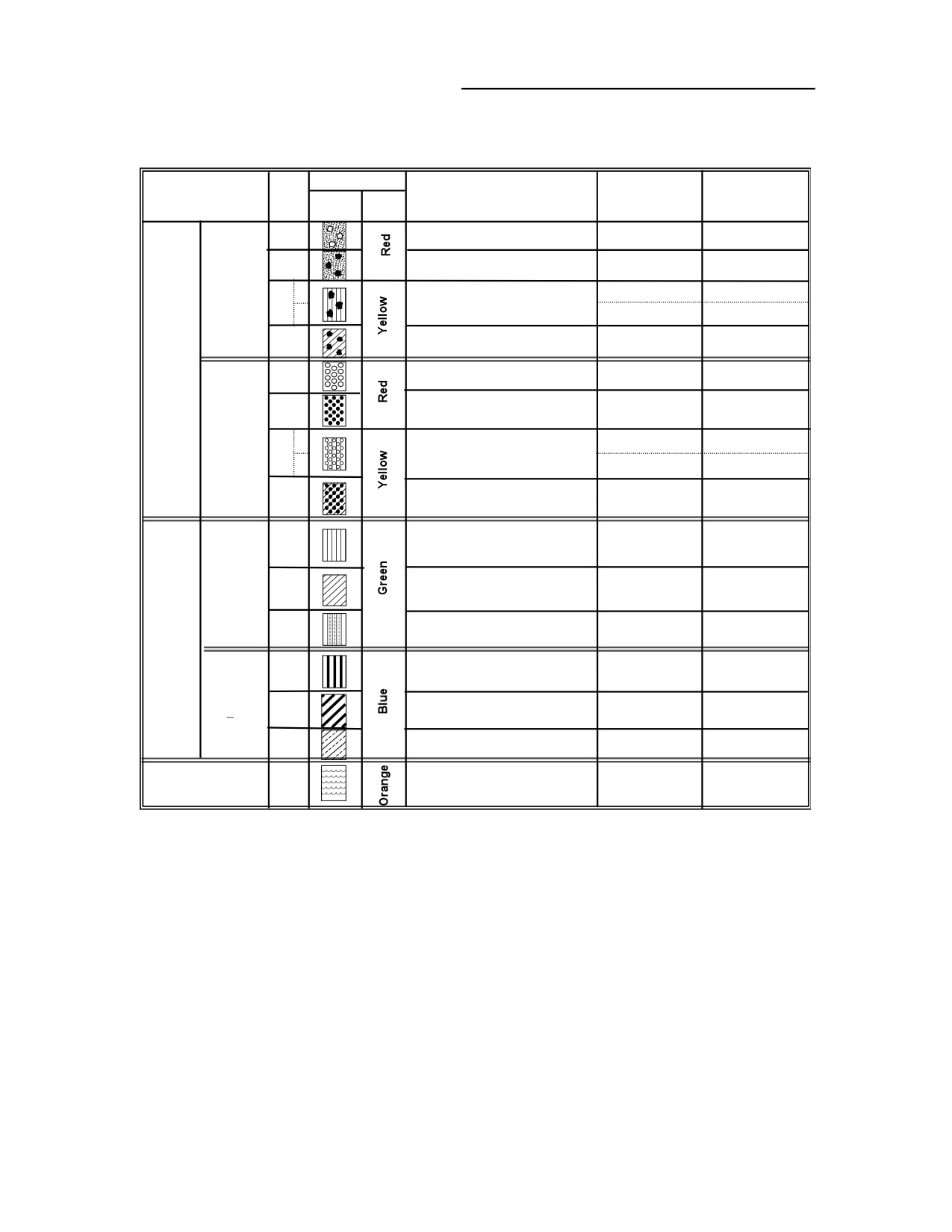
FM 5-472/NAVFAC MO 330/AFJMAN 32-1221(I)
Table B-3. Characteristics of soil groups pertaining to roads and airfields
Value As
Symbols
Value As Subbase
Subgrade When
Major Divisions
When not Subject
Letter
Hatching
Color
Name
not Subject
(1)
(2)
(6)
to Frost Action (8)
(3)
(4)
(5)
to Frost Action (7)
Well-graded gravels or gravel-
GW
Excellent
Excellent
sand mixtures, little or no fines
Gravel
Poorly graded gravels or gravel-
Good to excellent
GP
Good
and
sand mixtures, little or no fines
Gravelly
Soils
d
Silty gravels, gravel-sand-silt
Good to excellent
Good
GM
mixtures
u
Good
Fair
Clayey gravels, gravel-sand-clay
Coarse-
GC
Good
Fair
mixtures
Grained
Soils
Well-graded sands or gravelly
SW
Good
Fair to good
sands, little or no fines
Poorly graded sands or gravelly
Sand
SP
sands, little or no fines
Fair to good
Fair
and
Sandy
d
Fair to good
Fair to good
Soils
SM
Silty sands, sand-silt mixtures
u
Fair
Poor to fair
SC
Clayey sands, sand-silt mixtures
Poor to fair
Poor
Inorganic silts and very fine sands,
ML
rock flour, silty or clayey fine sands
Poor to fair
Not suitable
Silts
or clayey silts with slight plasticity
and
Clays
Inorganic clays of low to medium
LL < 50
CL
plasticity, gravelly clays, sandy
Poor to fair
Not suitable
clays, silty clays, lean clays
Fine-
Organic silts and organic silt-
Grained
OL
Poor
Not suitable
clays of low plasticity
Soils
Inorganic silts, micaceous or
MH
diatomaceous fine sandy or silty
Poor
Not suitable
Silts
soils, elastic silts
and
Clays
Inorganic clays of high plasticity,
LL > 50
CH
fat clays
Poor to fair
Not suitable
Organic clays of medium to high
OH
Poor to very poor
Not suitable
plasticity, organic silts
Highly Organic
Peat and other highly-organic
Pt
Not suitable
Not suitable
Soils
soils
NOTES: 1. Divisions of the GM and SM groups (column 3) into subdivisions of d and u are applicable to roads and
airfields only. Subdivision is based on the LL and PI; suffix d (for example, GMd) will be used when the LL
is 25 or less and the PI is 5 or less; the suffix u will be used otherwise.
B-16 Unified Soil Classification System
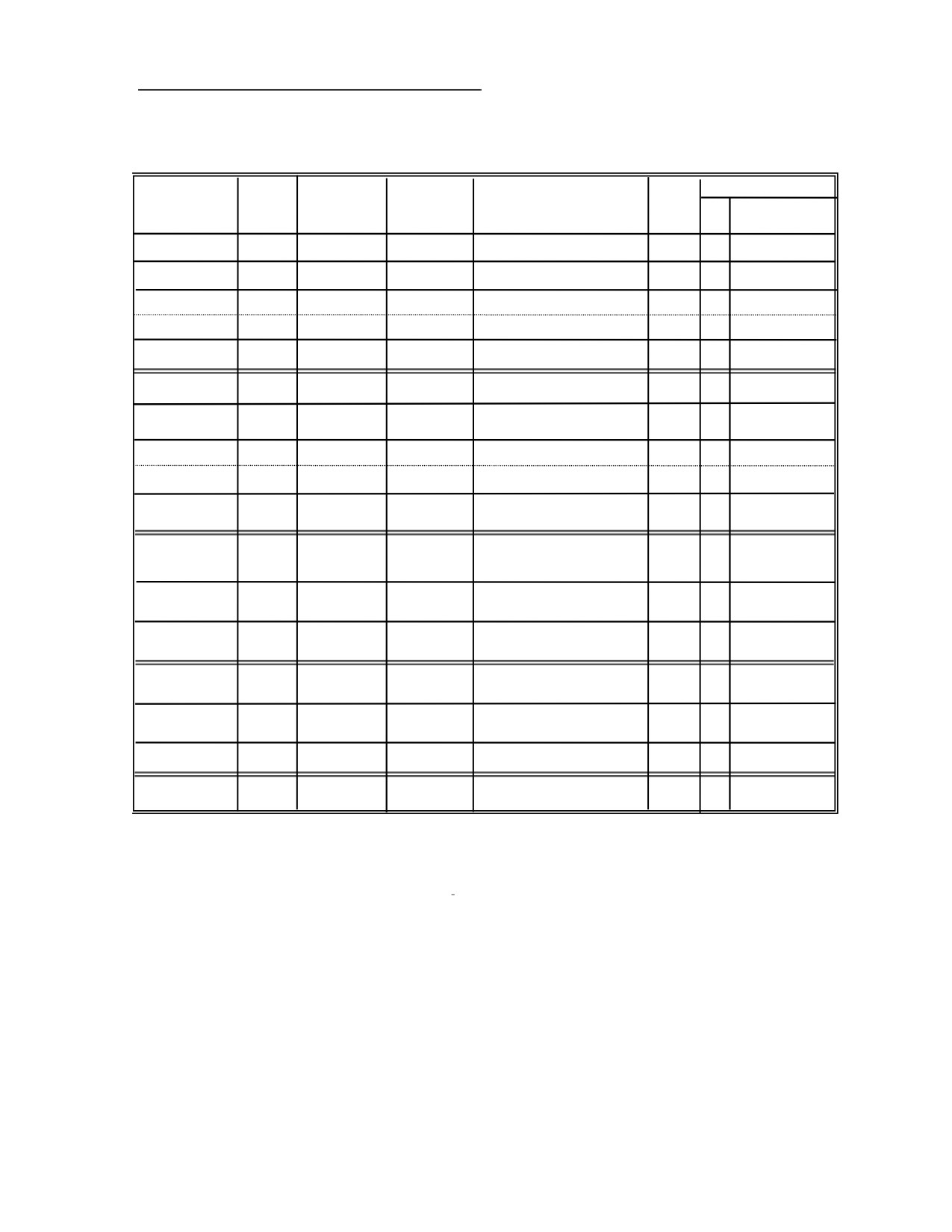
FM 5-472/NAVFAC MO 330/AFJMAN 32-1221(I)
Table B-3. Characteristics of soil groups pertaining to roads and airfields
(continued)
Value As Base
Potential
Typical Design Values
Compressibility
Drainage
Dry Unit
When not Subject
Frost
Compaction
and Expansion
Characteristics
Subgrade Modulus
Weight
to Frost Action
Action
(11)
(12)
Equipment (13)
CBR
k (lb per cu in)
(pcf) (14)
(15)
(9)
(10)
(16)
None to
Crawler-type tractor, rubber-tired
40 -
Good
Almost none
Excellent
125 -140
300 - 500
very slight
roller, steel-wheeled roller
80
None to
Crawler-type tractor, rubber-tired
30 -
Fair to Good
Almost none
Excellent
110 -140
300 - 500
very slight
roller, steel-wheeled roller
60
Slight to
Rubber-tired roller, sheepsfoot
40 -
Very slight
Fair to poor
125 -145
Fair to Good
medium
roller; close control of moisture
60
300 - 500
Poor to not
Slight to
Poor to practi-
Rubber-tired roller,
20 -
Slight
115 -135
suitable
medium
cally impervious
sheepsfoot roller
30
200 - 500
Poor to not
Slight to
Poor to practi-
Rubber-tired roller,
20 -
Slight
130 -145
200 - 500
suitable
medium
cally impervious
sheepsfoot roller
40
None to
Crawler-type tractor, rubber-tired
20 -
Poor
Almost none
Excellent
110 -130
200 - 400
very slight
roller, steel-wheeled roller
40
Poor to not
None to
Crawler-type tractor, rubber-tired
10 -
Almost none
Excellent
105 -135
150 - 400
suitable
very slight
roller, steel-wheeled roller
40
Slight to
Rubber-tired roller, sheepsfoot
15 -
Poor
Very slight
Fair to poor
120 -135
150 - 400
high
roller; close control of moisture
40
Slight to
Slight to
Poor to practi-
Rubber-tired roller, sheepsfoot
10 -
Not suitable
100 -130
100 - 300
high
medium
cally impervious
roller
20
Slight to
Slight to
Poor to practi-
Rubber-tired roller,
100 -135
5 -
100 - 300
Not suitable
high
medium
cally impervious
sheepsfoot roller
20
Medium to
Slight to
Rubber-tired roller,
Not suitable
Fair to poor
90 -130
15 or
100 - 200
very high
medium
sheepsfoot roller; close
less
control of moisture
Medium to
Practically
Rubber-tired roller,
Not suitable
Medium
90 -130
15 or
50 - 150
high
impervious
sheepsfoot roller
less
Medium to
Medium to high
Rubber-tired roller,
5 or
Not suitable
Poor
90 -105
50 - 100
high
sheepsfoot roller
less
Medium to
Rubber-tired roller,
Not suitable
High
Fair to poor
80 -105
10 or
50 - 100
very high
sheepsfoot roller
less
Practically
Rubber-tired roller,
Medium
High
90 -115
15 or
Not suitable
impervious
sheepsfoot roller
50 - 150
less
Practically
Rubber-tired roller,
5 or
Not suitable
Medium
High
80 -110
impervious
sheepsfoot roller
less
25 - 100
Not suitable
Slight
Very high
Fair to poor
Compaction not practical
-
-
-
NOTES (continued):
2. The equipment listed in column 13 will usually produce the required densities with a reasonable number of passes when
moisture conditions and thickness lift are properly controlled. In some instances, several types of equipment are listed because
variable soil characteristics within a given soil group may require different equipment. In some instances, a combination of two
types may be necessary.
a. Processed base materials and other angular material. Steel-wheeled and rubber-tired rollers are recommended for hard,
angular materials with limited fines or screenings. Rubber-tired equipment is recommended for softer materials subject to
degradation.
b. Finishing. Rubber-tired equipment is recommended for rolling during final shaping operations for most soils and processed
materials.
c. Equipment Size. The following sizes of equipment are necessary to assure the high densities required for airfield
construction:
• Crawler-type tractor—total weight in excess of 30,000 pounds.
• Rubber-tired equipment—wheel load in excess of 15,000 pounds; wheel loads as high as 40,000 pounds may be necessary
to obtain the required densities for some materials (based on contact pressure of approximately 65 to 150 psi).
• Sheepsfoot roller—unit pressure (on 6- to 12-square-inch foot) to be in excess of 250 psi and unit pressures as high as 650
psi may be necessary to obtain the required densities for some materials. The area of the feet should be at least 5 percent of the
total peripheral area of the drum, using the diameter measured to the faces of the feet.
3. The range of dry unit weights listed in column 14 are for compacted soil at OMC when using the Standard Proctor Test (ASTM
1557-91).
4. The maximum CBR values (column 15) that can be used in design of airfields is, in some cases, limited by gradation and
plasticity requirements.
Unified Soil Classification System B-17
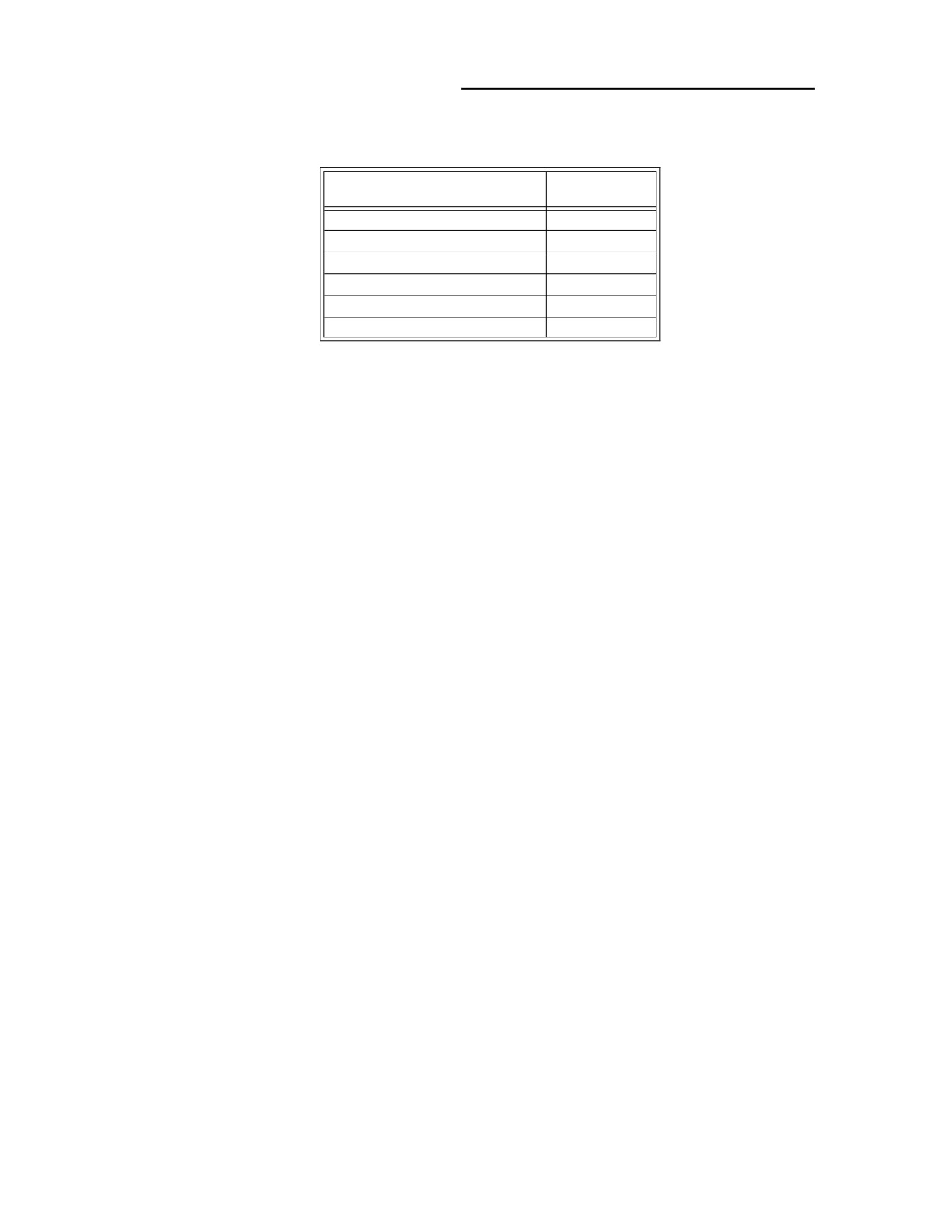
FM 5-472/NAVFAC MO 330/AFJMAN 32-1221(I)
Table B-4. Terzaghi classification
Unconfined Compressive
Consistency
Strength (Tons/Sq Ft)
< 0.25
Very soft
0.25 to 0.50
Soft
0.50 to 1.00
Medium
1.00 to 2.00
Stiff
2.00 to 4.00
Very stiff
> 4.00
Hard
Suitability of Soils for Embankments
Three major factors that influence the suitability of soils for use in
embankments are permeability, strength, and ease of compaction. The
gravelly and sandy soils with little or no fines (groups GW, GP, SW, and SP)
are stable, pervious, and able to attain good compaction with crawler-type
tractors and rubber-tired rollers. The poorly graded materials may not be
quite as desirable as those which are well graded, but all of the materials are
suitable for use in the pervious sections of earth embankments. Poorly graded
sands (SP) may be more difficult to use and, in general, should have flatter
embankment slopes than the SW soils. The gravels and sands with fines
(groups GM, GC, SM, and SC) have variable characteristics depending on the
nature of the fine fraction and the gradation of the entire sample. These
materials are often sufficiently impervious and stable to be used for
impervious sections of embankments. The soils in these groups should be
carefully examined to ensure that they are properly zoned with relation to
other materials in an embankment.
Of the fine-grained soils, the CL group is best adapted for embankment
construction; the soils are impervious, fairly stable, and give fair to good
compaction with sheepsfoot or rubber-tired rollers. The MH soils, while not
desirable for rolled-fill construction, may be used in the core of hydraulic-fill
structures. Soils of the ML group may or may not have good compaction
characteristics and, in general, must be closely controlled in the field to secure
the desired strength. CH soils have fair stability when used on flat slopes but
have detrimental shrinkage characteristics which may necessitate blanketing
them or incorporating them in thin interior cores of embankments. Soils
containing organic matter (groups OL, OH, and Pt) are not commonly used for
embankment construction because of the detrimental effects of the organic
matter present. Such materials may often be used to advantage in blankets
and stability berms where strength is not important.
Permeability and Seepage Control
Since the permeability (column 8) and requirements for seepage control
(column 12) are essentially functions of the same property of a soil, they will
be discussed jointly. The subject of seepage in relation to embankments and
foundations may be roughly divided into three categories:
B-18 Unified Soil Classification System
FM 5-472/NAVFAC MO 330/AFJMAN 32-1221(I)
• Seepage through embankments.
• Seepage through foundations.
• Control of uplift pressures.
These are discussed in relation to the soil groups in the following paragraphs.
Seepage Through Embankments
In the control of seepage through embankments, it is the relative permeability
of adjacent materials rather than the actual permeability of such soils that
governs their use in a given location. An earth embankment is not watertight,
and the allowable quantity of seepage through it is largely governed by the
use to which the structure is put. For example, in a flood-control project,
considerable seepage may be allowed and the structure will still fulfill the
storage requirements; whereas for an irrigation project, much less seepage is
allowable because pool levels must be maintained. The more impervious soils
(GM, GC, SM, SC, CL, MH, and CH) may be used in core sections or in
homogeneous embankments to retard the flow of water. Where it is important
that seepage not emerge on the downstream slope or the possibility of
drawdown exists on upstream slopes, more pervious materials are usually
placed on the outer slopes. The coarse-grained, free-draining soils (GW, GP,
SW, SP) are best-suited for this purpose. Where a variety of materials is
available, they are usually graded from least pervious to more pervious from
the center of the embankment outward. Care should be used in the
arrangement of materials in the embankment to prevent piping within the
section.
The foregoing statements do not preclude the use of other
arrangements of materials in embankments. Dams have been constructed
successfully entirely of sand (SW, SP, and SM) or of silt (ML) with the section
made large enough to reduce seepage to an allowable value without the use of
an impervious core. Coarse-grained soils are often used in drains and toe
sections to collect seepage water in downstream sections of embankments.
The soils used will depend largely on the material that they drain; in general,
free-draining sands (SW and SP) or gravels (GW and GP) are preferred, but a
silty sand (SM) may effectively drain a clay (CL and CH) and be entirely
satisfactory.
Seepage Through Foundations
As in the case of embankments, the use of the structure involved often
determines the amount of seepage control necessary in foundations. Cases
could be cited where the flow of water through a pervious foundation would
not constitute an excessive water loss and no seepage control measures would
be necessary if adequate provisions were made against piping in critical areas.
If seepage control is desired, then the more pervious soils are the soils in
which necessary measures must be taken. Free-draining gravels (GW and
GP) are capable of carrying considerable quantities of water, and some means
of positive control (such as a cutoff trench) may be necessary. Clean sands
(SW and SP) may be controlled by a cutoff or by an upstream impervious
blanket. While a drainage trench at the downstream toe or a line of relief
wells will not reduce the amount of seepage, either will serve to control
seepage and route the flow into collector systems where it can be led away
harmlessly. Slightly less pervious material (such as silty gravels [GM], silty
Unified Soil Classification System B-19
FM 5-472/NAVFAC MO 330/AFJMAN 32-1221(I)
sands [SM], or silts [ML]) may require a minor amount of seepage control such
as that afforded by a toe trench, or if they are sufficiently impervious, no
control may be necessary. The relatively impervious soils (GC, SC, CL, OL,
MH, CH, and OH) usually pass such a small volume of water that seepage
control measures are not necessary.
Control of Uplift Pressures
The problem of control of uplift pressures is directly associated with pervious
foundation soils. Uplift pressures may be reduced by lengthening the path of
seepage (by a cutoff or upstream blanket) or by measures for pressure relief in
the form of wells, drainage trenches, drainage blankets, or pervious
downstream shells. Free-draining gravels (GW and GP) may be treated by
any of the aforementioned procedures; however, to obtain the desired pressure
relief, the use of a positive cutoff may be preferred, as blanket, well, or trench
installations would probably have to be too extensive for economical
accomplishment of the desired results. Free-draining sands (SW and SP) are
generally less permeable than the gravels and, consequently, the volume of
water that must be controlled for pressure relief is usually less. Therefore a
positive cutoff may not be required and an upstream blanket, wells, or a toe
trench may be entirely effective. In some cases a combination of blanket and
trench or wells may be desirable.
Silty soils (silty gravels [GM], silty sands [SM], and silts [ML]) usually do not
require extensive treatment; a toe drainage trench or well system may be
sufficient to reduce uplift pressures. The more impervious silty materials may
not be permeable enough to permit dangerous uplift pressures to develop, and
in such cases, no treatment is indicated. In general, the more impervious soils
(GC, SC, CL, OL, MH, CH, and OH) require no treatment for control of uplift
pressures. However, they do assume importance when they occur as a
relatively thin top stratum over more pervious materials. In such cases, uplift
pressures in the lower layers acting on the base of the impervious top stratum
can cause heaving and formation of boils; treatment of the lower layer by some
of the methods mentioned above is usually indicated in these cases. It is
emphasized that control of uplift pressures should not be applied
indiscriminately just because certain types of soils are encountered. Rather,
the use of control measures should be based on a careful evaluation of
conditions that do or can exist, and an economical solution should be reached
that will accomplish the desired results.
Compaction Characteristics
Column 9 of Table B-2, pages B-6 and B-7, shows the general compaction
characteristics of the various soil groups. The evaluations given and the
equipment listed are based on average field conditions where proper moisture
control and thickness of lift are attained and a reasonable number of passes of
the compaction equipment are required to secure the desired density. For lift
construction of embankments, the sheepsfoot and rubber-tired rollers are
commonly used pieces of equipment. Some advantages may be claimed for the
sheepsfoot roller in that it leaves a rough surface that affords better bond
between lifts and it kneads the soil—affording better moisture distribution.
Rubber-tired equipment referred to in the table is considered to be heavily
loaded compactors or earthmoving equipment with a minimum wheel load of
B-20 Unified Soil Classification System
FM 5-472/NAVFAC MO 330/AFJMAN 32-1221(I)
15,000 pounds. If ordinary wobble-wheel rollers are used for compaction, the
thickness of a compacted lift is usually reduced to about 2 inches.
Granular soils with little or no fines generally show good compaction
characteristics, with the well-graded materials
(GW and SW) usually
furnishing better results than the poorly graded soils (GP and SP). The sandy
soils, in most cases, are best compacted by crawler-type tractors; on the
gravelly materials, rubber-tired equipment and sometimes steel-wheel rollers
are also effective. Coarse-grained soils with fines of low plasticity (groups GM
and SM) show good compaction characteristics with either sheepsfoot rollers
or rubber-tired equipment; however, the range of moisture contents for
effective compaction may be very narrow and close moisture control is
desirable. This is also true of the silty soils in the ML group. Soils of the ML
group may be compacted with rubber-tired equipment or with sheepsfoot
rollers. Gravels and sands with plastic fines (groups GC and SC) show fair
compaction characteristics, although this quality may vary somewhat with the
character and amount of fines.
Rubber-tired or sheepsfoot rollers may be used. Sheepsfoot rollers are
generally used for compacting fine-grained soils.
The compaction
characteristics of such materials are variable—lean clays and sandy clays
(CL) being the best, fat clays and lean organic clays or silts (OL and CH) fair
to poor, and organic or micaceous soils (MH and OH) usually poor.
For most construction projects of any magnitude, it is highly desirable to
investigate the compaction characteristics of the soil by means of a field test
section. Column 10 shows the ranges of unit dry weight for soils compacted
according to the compaction test method as described in ASTM 1557-91 and
Chapter 2 of this manual. It is emphasized that these values are for guidance
only. Design or construction control should be based on laboratory test
results.
Suitability of Soils for Foundations
Suitability of soils for foundations of embankments or structures depends
primarily on the strength and consolidation characteristics of the subsoils.
The type of structure and its use will largely govern the adaptability of a soil
as a satisfactory foundation. For embankments, large settlements may be
allowed and compensated for by overbuilding; whereas the allowable
settlement of structures (such as control towers) may be small to prevent
overstressing the concrete or steel of which they are built or because of the
necessity for adhering to established grades. Therefore, a soil may be entirely
satisfactory for one type of construction but may require special treatment for
other types.
Strength and settlement characteristics of soils depend on a number of
variables (such as structure, in-place density, moisture content, and cycles of
loading in their geologic history) which are not readily evaluated by a
classification system such as used here. For these reasons, only very general
statements can be made as to the suitability of the various soil types as
foundations. This is especially true for fine-grained soils.
In general, the gravels and gravelly soils (GW, GP, GM, and GC) have good
bearing capacity and undergo little consolidation under load. Well-graded
Unified Soil Classification System B-21
FM 5-472/NAVFAC MO 330/AFJMAN 32-1221(I)
sands (SW) usually have a good bearing value. Poorly graded sands and silty
sands (SP and SM) may exhibit variable bearing capacity depending on their
density. This is true to some extent for all coarse-grained soils but is
especially critical for uniformly graded soils of the SP and SM groups. Such
soils, when saturated, may become
“quick” and present an additional
construction problem. Soils of the ML group may be subject to liquefaction
and may have poor bearing capacities, particularly where heavy structure
loads are involved. Of the fine-grained soils, the CL group is probably the best
from a foundation standpoint, but in some cases, the soils may be soft and wet
and exhibit poor bearing capacity and fairly large settlements under load.
Soils of the MH groups and normally consolidated CH soils may show poor
bearing capacity and large settlements. Organic soils (OL and OH) have poor
bearing capacity and usually exhibit large settlement under load.
For most of the fine-grained soils discussed above, the type of structure
foundation selected is governed by such factors as the bearing capacity of the
soil and the magnitude of the load. It is possible that simple spread footings
might be adequate to carry the load without excessive settlement in many
cases. If the soils are poor and structure loads are relatively heavy, then
alternate methods are indicated. Pile foundations may be necessary in some
cases and in special instances—particularly in the case of some CH and OH
soils—it may be desirable and economically feasible to remove such soils from
the foundation. Highly-organic soils are generally very poor foundation
materials. These may be capable of carrying very light loads but, in general,
are unsuited for most construction purposes. If highly-organic soils occur in
the foundation, they may be removed (if limited in extent), they may be
displaced (by dumping firmer soils on top), or piling may be driven through
them to a stronger layer. Proper treatment will depend on the structure
involved.
GRAPHICAL PRESENTATION OF SOILS DATA
It is customary to present the results of soils explorations on drawings or
plans as schematic representations of the borings or test pits with the soils
encountered using various symbols. Commonly used hatching symbols are
small, irregular round symbols for gravel; dots for sand; vertical lines for silts;
and diagonal lines for clays. Combinations of these symbols represent the
various combinations of materials found in the explorations. This system has
been adapted to the various soil groups in the USCS and the appropriate
symbols are shown in column 4 of Table B-2, pages B-6 and B-7. As an
alternative to the hatching symbols, they may be omitted and the appropriate
group letter symbol written in the boring log. In addition to the symbols on
logs of borings, the effective size of coarse-grained soils and the natural water
content of fine-grained soils should be shown by the side of the log. Other
descriptive abbreviations may be used as deemed appropriate. In certain
instances, the use of color to delineate soil types on maps and drawings is
desirable. A suggested color scheme to show the major soil groups is described
in column 5 of Table B-2.
B-22 Unified Soil Classification System
FM 5-472/NAVFAC MO 330/AFJMAN 32-1221(I)
CHARACTERISTICS OF SOIL GROUPS PERTAINING TO ROADS AND
AIRFIELDS
The properties desired in soils for foundations under roads and airfields and
for base courses under flexible pavements are adequate strength, good
compaction characteristics, adequate drainage, resistance to frost action in
areas where frost is a factor, and acceptable compression and expansion
characteristics. Some of these properties, if inadequate in the soils available,
may be supplied by proper construction methods. For instance, materials
having good drainage characteristics are desirable, but if such materials are
not available locally, adequate drainage may be obtained by installing a
properly designed water-collecting system. Strength requirements for base-
course materials (to be used immediately under the pavement of a flexible
pavement structure) are high and only good-quality materials are acceptable.
However, low strengths in subgrade materials may be compensated for in
many cases by increasing the thickness of overlying concrete pavement or of
base materials in flexible pavement construction. From the foregoing brief
discussion, it may be seen that the proper design of roads and airfield
pavements requires the evaluation of soil properties in more detail than is
possible by using the general soils classification system. However, the
grouping of soils in the classification system is such that a general indication
of their behavior in road and airfield construction may be obtained.
FEATURES ON THE SOILS-CLASSIFICATION SHEET
General characteristics of the soil groups pertinent to roads and airfields are
presented in Table B-3, pages B-16 and B-17. Columns 1 through 5 show
major soil divisions, group symbols, hatching and color symbols; column 6
gives names of soil types; column 7 evaluates the performance (strength) of
the soil groups when used as subgrade materials that will not be subject to
frost action; columns 8 and 9 make a similar evaluation for the soils when
used as subbase and base materials; column 10 shows potential frost action;
column 11 shows compressibility and expansion characteristics; column 12
presents drainage characteristics; column
13 shows types of compaction
equipment that perform satisfactorily on the various soil groups; column 14
shows ranges of unit dry weight for compacted soils; column 15 gives ranges of
typical CBR values; and column 16 gives ranges of modulus of subgrade
reaction (k). The various features presented are discussed in the following
paragraphs.
Subdivision of Coarse-Grained Soil Groups
Note that in column 3 the basic soil groups (GM and SM) have each been
subdivided into two groups designated by the suffixes d and u which have
been chosen to represent desirable and less desirable (undesirable) base
materials, respectively. This subdivision applies to roads and airfields only
and is based on field observation and laboratory tests on the behavior of the
soils in these groups. Basis for the subdivision is the LL and PI of the fraction
of the soil passing the No. 40 sieve. The suffix d is used when the LL is 25 or
less and the PI is 5 or less; otherwise, the suffix u is used. Typical symbols for
soils in these groups are GMd and SMu.
Unified Soil Classification System B-23
FM 5-472/NAVFAC MO 330/AFJMAN 32-1221(I)
Values of Soils as Subgrade, Subbase, or Base Materials
The descriptions in columns 7 through 9 give a general indication of the
suitability of the soil groups for use as subgrades, subbase, or base materials,
provided they are not subject to frost action. In areas where frost heaving is a
problem, the value of materials as subgrades or subbases will be reduced,
depending on the potential frost action of the material as shown in column 10.
Proper design procedures should be used in situations where this is a problem.
The coarse-grained soils, in general, are the best subgrade, subbase, and base
materials. The GW group has excellent qualities as a subgrade and subbase,
and is good as base material. Note that the adjective “excellent” is not used
for any of the soils for base courses; “excellent” should be used in reference to a
high-quality processed crushed stone. Poorly graded gravels and some silty
gravels (groups GP and GMd) are usually only slightly less desirable as
subgrade or subbase materials and, under favorable conditions, may be used
as base materials for certain conditions. However, poor gradation and other
factors sometimes reduce the value of such soils to the extent that they offer
only moderate strength, and their value as a base material is less. The GMu,
GC, and SW groups are reasonably good subgrade materials but are generally
poor to not suitable as bases. The SP and SMd soils are usually considered
fair to good subgrade and subbase materials but, in general, are poor to not
suitable for base materials. The SMu and SC soils are fair to poor subgrade
and subbase materials and are not suitable for base materials. The fine-
grained soils range from fair to very poor subgrade materials as follows:
• Silts and lean clays (ML and CL)—fair to poor.
• Organic silts, lean organic clays, and micaceous or diatomaceous soils
(OL and MH)—poor.
• Fat clays and fat organic clays (CH and OH)—poor to very poor.
These qualities are compensated for in flexible pavement design by increasing
the thickness of overlying base material and in rigid pavement design by
increasing the pavement thickness or by adding a base-course layer. None of
the fine-grained soils are suitable as subbase or base materials. The fibrous
organic soils (group Pt) are very poor subgrade materials and should be
removed wherever possible; otherwise, special construction measures should
be adopted. They are not suitable as subbase and base materials. The CBR
values shown in column 15 give a relative indication of the strength of the
various soil groups as used in flexible pavement design. Similarly, values of
subgrade modulus (k) in column 16 are relative indications of strengths from
plate-bearing tests as used in rigid pavement design. As these tests are used
for the design of pavements, actual test values should be used for this purpose
instead of the approximate values shown in the tabulation.
For wearing surfaces on unsurfaced roads, sand-clay-gravel mixtures (GC) are
generally considered the most satisfactory. However, they should not contain
too large a percentage of fines and the PI should be in the range of 5 to about
15.
Potential Frost Action
The relative effects of frost action on the various soil groups are shown in
column 10. Regardless of the frost susceptibility of the various soil groups,
B-24 Unified Soil Classification System