FM 5-472 Materials Testing (DEPARTMENT OF THE ARMY) December 2000 - page 6
FM 5-472/NAVFAC MO 330/AFJMAN 32-1221(I)
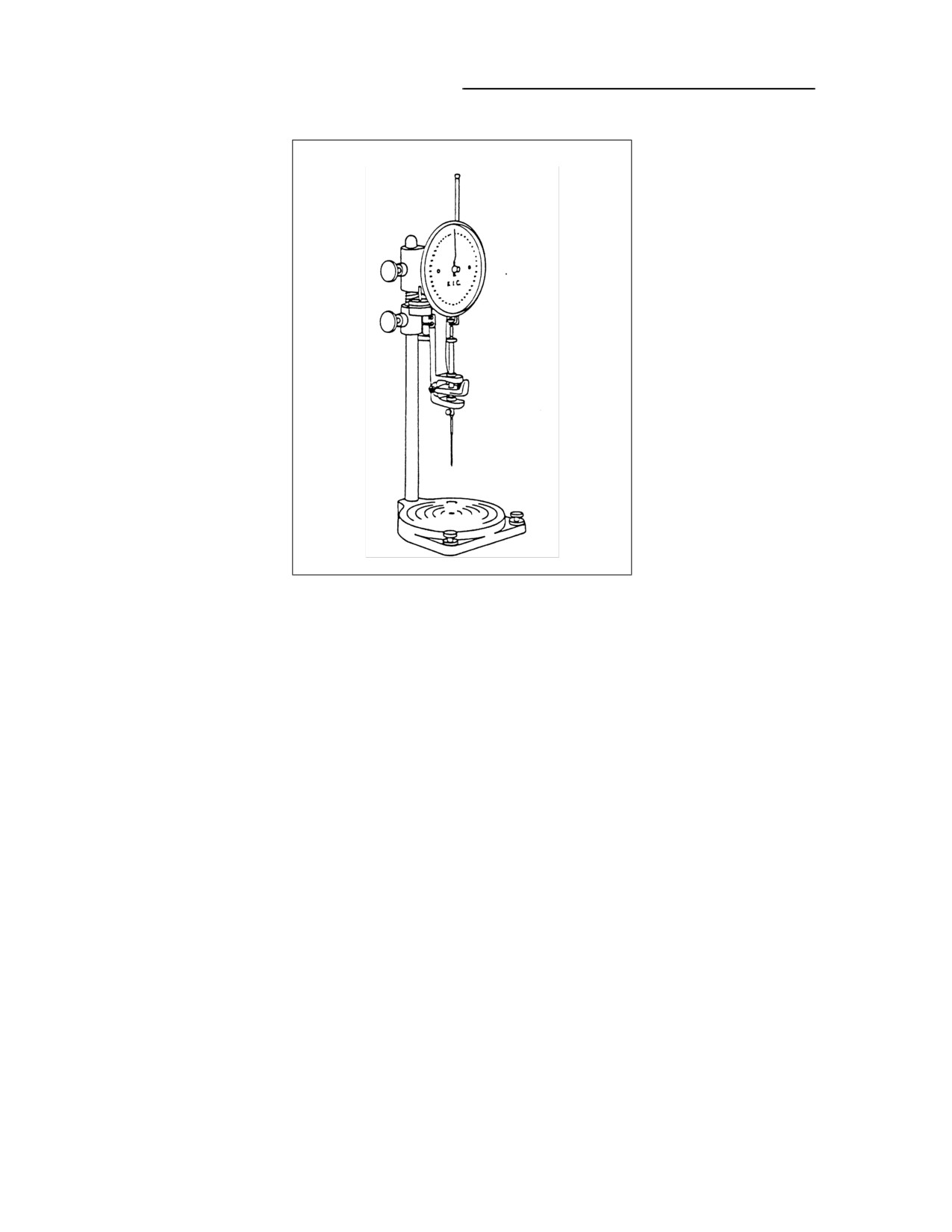
Figure 3-9. Asphalt penetrometer
impractical or less accuracy is acceptable, perform the test with the sample at
room temperature. Perform the following steps:
Step 1. Melt the sample at the lowest possible temperature, using the electric
hot plate and frying pan or copper beaker. Stir thoroughly until the sample is
homogeneous and free of air bubbles.
Step 2. Pour the sample into the sample container (moisture-content box) to a
depth of not less than 1.38 inch for the harder grades and 1.77 inch for the
softer grades. Protect the sample from dust and allow it to cool in an
atmosphere not lower than 65°F for 1 hour.
Step 3. Place the sample in its container in the sieve pan (or any other small,
flat-bottomed pan or container that is 2 inches deep). Immerse the pan and
sample for 1 hour in the water bath maintained at 77°F.
Step 4. Keep the sample in the pan filled with water from the water bath.
The water should completely cover the sample container to maintain the
temperature during the test. Place the transfer dish containing the sample in
its container and the water on the stand of the penetrometer.
Step 5. Adjust the needle to make contact with the sample’s surface of the
sample. Place a light in a position so that the actual needle point and its
image reflected on the specimen’s surface are clearly defined. Contact may be
judged with the point and its image touch on the surface.
Step 6. Note the reading of the dial or bring the indicator on the dial to zero.
3-28 Bituminous Mixtures
FM 5-472/NAVFAC MO 330/AFJMAN 32-1221(I)
Step 7. Release the needle for a period of 5 seconds. Read the distance
penetrated on the thermometer. The needle and plunger are designed to have
a standard weight of 100 grams. The dial is divided into 38 major divisions,
each marked in 10 smaller subdivisions. Each of the smaller subdivisions
represents a penetration by the needle of 1/100 centimeter. Thus, readings on
the dial give penetration values without conversion.
Step 8. Test at least three points on the surface not less than 3/8 inch from the
side of the container and not less than 3/8 inch apart. After each test, return
the sample and pan to the water bath and carefully wipe the needle toward its
point with a clean, dry cloth to remove all adhering asphalt.
RESULTS
The reported penetration is the average of at least three tests whose values do
not differ by more than amounts shown in Table 3-5.
The penetration test, as pointed out previously, is used to classify asphalt
cements for purchasing and identifying purposes, but it has other uses as well.
It can be used to detect overheating or prolonged heating of asphalts in
storage tanks. Also, when an asphalt is extracted from a pavement, the
penetration test affords a means of estimating how the asphalt has changed
with time and weathering.
Table 3-5. Penetration results
Penetration
0 to 49
50 to 149
150 to 249
250
Maximum difference
between highest and
2
4
6
8
lowest determination
DUCTILITY TEST
In the ductility test, dumbbell-shaped specimens of asphalt are molded under
standard conditions. The dumbbell-shaped specimens are conditioned in a
water bath to standard temperature (usually 77°F) then extended at the rate
of 5 centimeters per minute until the threads connecting the two ends break.
The difference in centimeters between the final length at the break and the
original length is the ductility.
The ductility test is helpful in estimating an asphalt’s ability to resist cracking
and raveling. High-ductility asphalts have greater flexibility and tenacity.
Conversely, low-ductility asphalts are considered more likely to crack under
heavy loads or severe changes in temperature. Ductility is affected by various
factors, such as method of refining and consistency. Blown asphalts (asphalts
that have been hardened by blowing air through them, which causes
oxidation) have low ductility. This is one reason why they are not used as
paving asphalts. Within the group of asphalts produced by steam and vacuum
distillation, ductility will vary according to the consistency at a given
temperature. Note that the ductility test is also sensitive to other factors,
such as imperfections in the specimens or impurities such as mineral filler in
a sample of asphalt recovered from a pavement.
Bituminous Mixtures 3-29
FM 5-472/NAVFAC MO 330/AFJMAN 32-1221(I)
SOFTENING-POINT TEST
For the softening-point test, position a 3/8-inch-diameter steel ball on a brass
ring filled with asphalt. Place the assembly in the beaker containing freshly
boiled, distilled water and heat it slowly. As the asphalt becomes warmer, it
begins to soften, and the weight of the ball forces the asphalt out of the ring.
Record the temperature at which the asphalt touches the bottom of the beaker
as the softening point.
The softening point is another consistency test and varies inversely with the
penetration test. Like the penetration test, the softening-point test can be used
to determine changes in an asphalt due to excessively high or prolonged
heating. An abnormal increase in the softening point is an indication of
excessive heating. The softening-point test is used in studies on asphalts
recovered from pavements after extended service to determine effects of aging.
If an asphalt shows an unusual increase in softening point, considerable aging
and hardening have occurred.
VISCOSITY TESTS
There are two viscosity tests for identifying the qualities of bitumen—the
Saybolt-Furor test and the kinematic-viscosity test.
SAYBOLT-FUROR TEST (ASTM D 244-89)
This test measures the time, in seconds, required to pass 60 cubic centimeters of
asphalt-emulsion material, at a given temperature, through a tube of standard
dimensions. Its purpose is to determine the viscosity of the material from which
the spraying temperatures are established for field application of the bitumen.
KINEMATIC-VISCOSITY TEST (ASTM D 2170-85)
This test, like the Saybolt-Furor test, measures the time that a given amount
of liquid-asphalt material will flow through a tube of standard dimensions
under rigidly controlled conditions of temperature and pressure (or vacuum).
The test establishes the viscosity of the liquid and, when correlated with the
specific gravity of the material at the same temperature, results in a
numerical designation called kinematic viscosity. The units used for
kinematic viscosity are stokes (square centimeters per second) or centistokes
(1/100 stoke). The kinematic-viscosity test requires special laboratory
equipment that is not available in the field.
SOLUBILITY TEST (ASTM D 2042-81)
The solubility of asphalt cement can be determined using trichloroethylene.
Trichloroethylene is toxic; therefore, protective equipment
(including a
ventilator, protective goggles, and protective gloves) must be worn while using
it. Trichloroethylene waste is a hazardous waste and must be disposed of as
such. Consult your installation environmental office for further guidance as
to safe handling and disposal of trichloroethylene.
Dissolve 2 grams of the sample in 100 milliliters of solvent. Pour the mixture
into a tared Gooch crucible and wash it through. Dry and weigh the crucible.
The increase in the crucible’s weight is the portion of the sample that is
insoluble in the solvent.
3-30 Bituminous Mixtures
FM 5-472/NAVFAC MO 330/AFJMAN 32-1221(I)
The solubility test is a quality-control test used in specifications to ensure
getting an asphalt cement that is not contaminated with mineral matter or is
not improperly refined.
SPOT TEST
The spot test (often called the Oliensis spot test) is a solubility test that takes
advantage of the selective solvent action of certain hydrocarbons; usually
standard naphtha is specified. The test is applicable only to petroleum
asphalts and should not be applied to natural asphalts containing
nonbituminous matter insoluble in xylene.
Dissolve a 2-gram sample of asphalt in 10 milliliters of naphtha. Thoroughly
stir the mixture with a stirring rod. Place a drop of the asphalt and solvent on
a piece of Whatman No. 50 filter paper. Examine the filter paper after 5
minutes. If the drop forms a yellowish-brown stain with a darker nucleus, the
test is positive. If the stain is uniformly brown, the test is negative. In the
latter case, stopper the sample and set it aside for 24 hours, then repeat the
test. If the stain with the darker nucleus again develops, the test is positive
and is so reported. A negative result is an indication that the asphalt sample
is a homogeneous material. A positive result may indicate that the sample is
not a homogeneous material. A negative result is regarded as favorable to the
sample; a positive result is unfavorable and may be used to reject the asphalt.
Considerable importance is attached to the spot test by some asphalt
technologists and paving engineers. It is relied on principally as a means of
detecting a cracked asphalt, which is a nonhomogeneous material not
regarded as a good paving asphalt. The test can also be used to detect an
asphalt that has been overheated or coked. Overheating or coking can occur
in storage tanks or when the asphalt is added to aggregate that is too hot. In
such cases, the asphalt is no longer a homogeneous substance, and the spot
test will often show a nonuniform (positive) stain.
THIN-FILM OVEN TEST (ASTM D 1754-87)
The thin-film oven test was developed to overcome the deficiencies of the
standard loss-on-heating test. The test uses the same oven as the loss-on-
heating test except for a modification of the rotating shelf. The test has the
same period and temperature of heating (5 hours at 325°F). The significant
difference is in the sample. Instead of the 50-gram sample in a 3-ounce
ointment can, a 1/8-inch-thick layer of asphalt is poured into a wide, shallow,
circular aluminum dish. The dish has a flat bottom and is 5 1/2 inches in
diameter and 3/8 inch deep. Weigh the sample before and after the heating
period and compute the loss in weight. A penetration or viscosity test may
also be conducted on the sample after the heating period to evaluate changes
in the asphalt.
SECTION V. AGGREGATE AND FILLER TESTING
The aggregate transmits the load, takes the abrasive wear of traffic, and
provides a nonskid surface. Desired aggregate characteristics include
angular shape, rough surface, hardness, and gradation. Some of these
Bituminous Mixtures 3-31
FM 5-472/NAVFAC MO 330/AFJMAN 32-1221(I)
characteristics
(such as shape, surface, and cleanliness) are determined
visually. Durability and hardness cannot be seen but require knowledge
based either on experience or some form of abrasion testing. Rocks that soak
up water will eventually reach the condition where the binder is forced from
the surface pores and the cementing action breaks down. Gradation may be
established to some extent by observation. However, the grain-size
distribution (sieve) tests will define the particle sizes and amounts much
more accurately.
In bituminous paving, the aggregate constitutes the bulk of the pavement.
Common practice subdivides the bituminous aggregates into a coarse
aggregate, a fine aggregate, and a mineral filler. The No. 10 sieve separates
coarse from fine aggregate, and the No. 200 sieve size is the lower limit for
fine aggregate. Usually 65 percent or more of the mineral filler will pass the
No. 200 sieve. The distribution of the different sizes determines how many
voids will remain and helps determine how much bitumen will be needed.
Bituminous pavement specifications define acceptable gradation limits. The
bitumen content for the mix is then determined from the trial-mix properties
that are defined in the specifications.
SIEVE ANALYSIS
A sieve analysis of the aggregates to be used in a paving mixture is required to
determine the particle-size distribution.
MINERAL FILLER (ASTM D 242-85)
In bituminous paving, particles finer than the No. 200 sieve are referred to as
a mineral filler. To measure the amount of filler in a selected sample, perform
a washed sieve analysis using the No. 40 and No. 200 sieves. Discard the
material that has passed the No. 200 sieve, then return the material on the
sieves to the original washed sample, oven-dry it, and weigh it. The amount of
mineral filler is computed as—
original dry weight - washed dry weight
percent finer than No. 200
= -------------------------------------------------------------------------------------------------------------- × 100
original dry weight
FINE AND COARSE AGGREGATE (WASHED) (ASTMS D 1073-88, 448-86, AND 692-88)
When definite amounts or limits of coarse and fine aggregates are specified,
the sieve analysis with prewashing must be made using suitable sieves. If no
limits have been designated, select a range of sieves to give adequate
information about gradation. Record the results on DD Form 1206 (see Figure
2-39, page 2-74) and plot them as a gradation curve on DD Form 1207 (see
Figure 2-42, page 2-78). When testing aggregates, obtain a representative
sample by quartering, if necessary. The minimum size of the sample depends
on the maximum size of particles in the material (see Table 3-6).
SPECIFIC GRAVITY
The specific gravities of aggregates and mineral filler used in bituminous
paving mixtures are required to compute the percent of air voids and percent
of voids filled with bitumens. Apparent specific gravity used with aggregate
blends showing water absorption of less than 2 1/2 percent is based on the
apparent volume of the material, which does not include those port spaces in
3-32 Bituminous Mixtures

FM 5-472/NAVFAC MO 330/AFJMAN 32-1221(I)
Table 3-6. Aggregate sizes and weights
Approximate Dry Weight
Approximate Aggregate Size
of Sample (in Grams)
Fine Aggregate
At least 95 percent finer than No. 10*
100
At least 90 percent finer than No. 4 and
500
more than 5 percent coarser than No. 10*
Coarse Aggregate
3/8-inch maximum size
1,000
1/2-inch maximum size
2,000
3/4-inch maximum size
3,000
1-inch maximum size
4,000
1 1/2-inch maximum size
5,000
2-inch maximum size
8,000
2 1/2-inch maximum size
12,000
3-inch maximum size
18,000
3 1/2-inch maximum size
25,000
* ASTM specifies Numbers 8, 16, 30, and 50 instead of Numbers 10,
40, and 60. Tests based on ASTM standards identify the appropriate
sieve sizes.
the aggregate which are permeable to water. Bulk-impregnated specific
gravity is used for aggregate blends with 2 1/2 percent or greater water
absorption. The methods for determining absorption of aggregates are
described in Chapter 4 of this manual.
APPARENT SPECIFIC GRAVITY OF COARSE AGGREGATE
Apparent specific gravity can be determined using the method described for
apparent and bulk specific gravity, or it may be determined using the
Dunagan apparatus furnished with the concrete test set. Additional
information for course-aggregate testing can be found in ASTM C 127-88.
Equipment
Use the concrete test set to determine the apparent specific gravity. The test
set includes—
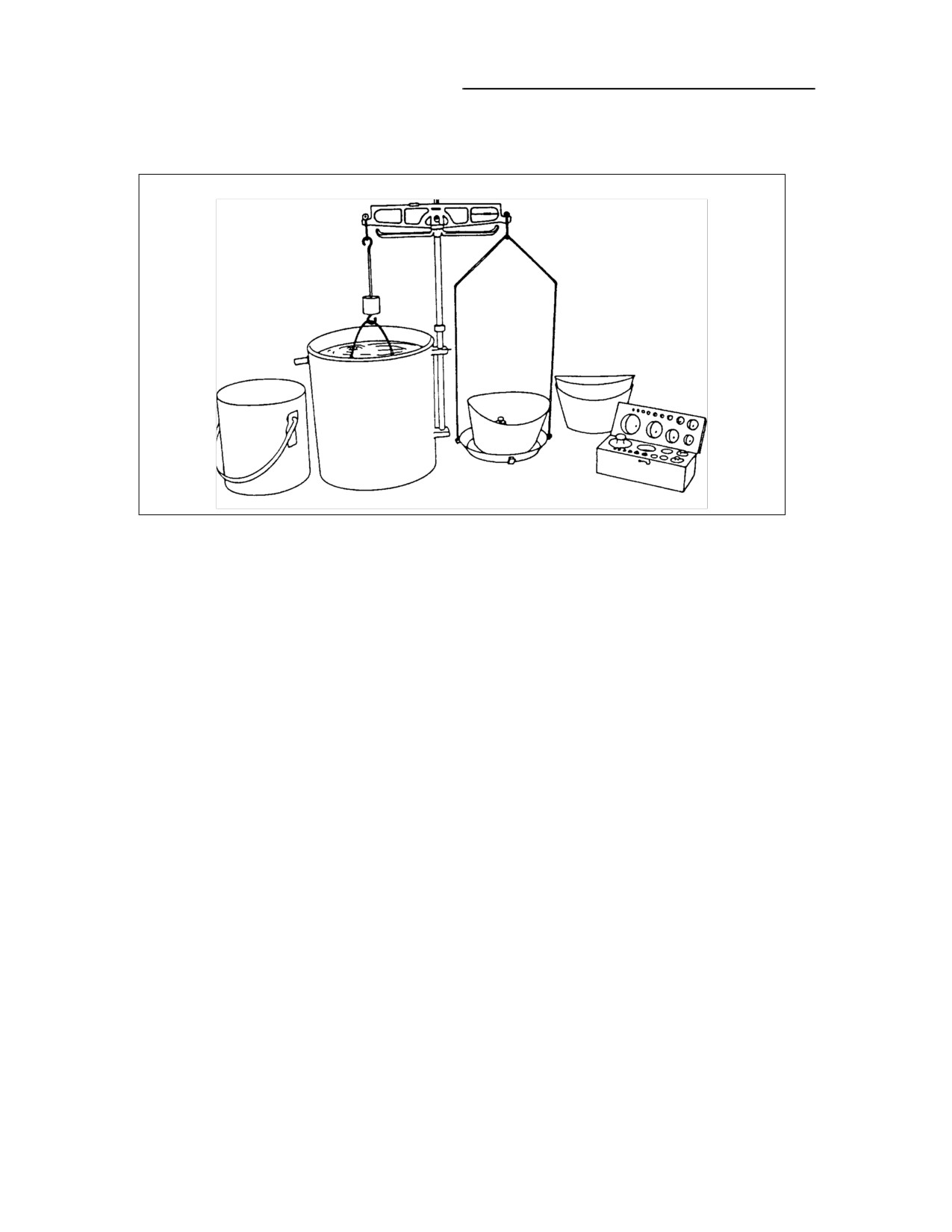
• The Dunagan apparatus (see Figure 3-10, page 3-34).
• Sieves (2-, 1 1/2-, 1/2-, and 3/8-inch and Numbers 4, 10, 40, 60, 80, 100,
and 200).
• Evaporating dishes.
• An electric oven.
• Pans.
Bituminous Mixtures 3-33
FM 5-472/NAVFAC MO 330/AFJMAN 32-1221(I)
Figure 3-10. Specific-gravity test; Dunagan apparatus
Steps
Perform the following steps to determine the apparent specific gravity:
Step 1. Select about 5,000 grams of aggregate from the sample, not including
particles smaller than the 3/8-inch sieve.
Step 2. Wash the aggregate to remove any dust or other coating and dry it to
constant weight in the oven. Record the total weight of the oven-dry
aggregate on DD Form 1216 (see Figure 3-6, page 3-23).
Step 3. Immerse the aggregate in water at 59° to 77°F for a period of 24 hours.
Step 4. Soak the sample and place it in a copper bucket filled with water.
Turn the bucket and aggregate sharply back and forth to remove any air.
Step 5. Suspend the bucket from the brass hanger and bring the water level
to the overflow pipe.
Step 6. Determine the submerged weight using weights placed in the scoop on
the right-hand pan. Record the weight.
Calculations
The calculations required to determine the apparent specific gravity of
coarse aggregate are shown on DD Form 1216 and are self-explanatory (see
Figure 3-6).
APPARENT SPECIFIC GRAVITY OF FINE AGGREGATE (CALIBRATED FLASK)
Perform the procedure below to determine the apparent specific gravity when
a calibrated flask is available.
3-34 Bituminous Mixtures
FM 5-472/NAVFAC MO 330/AFJMAN 32-1221(I)
Equipment
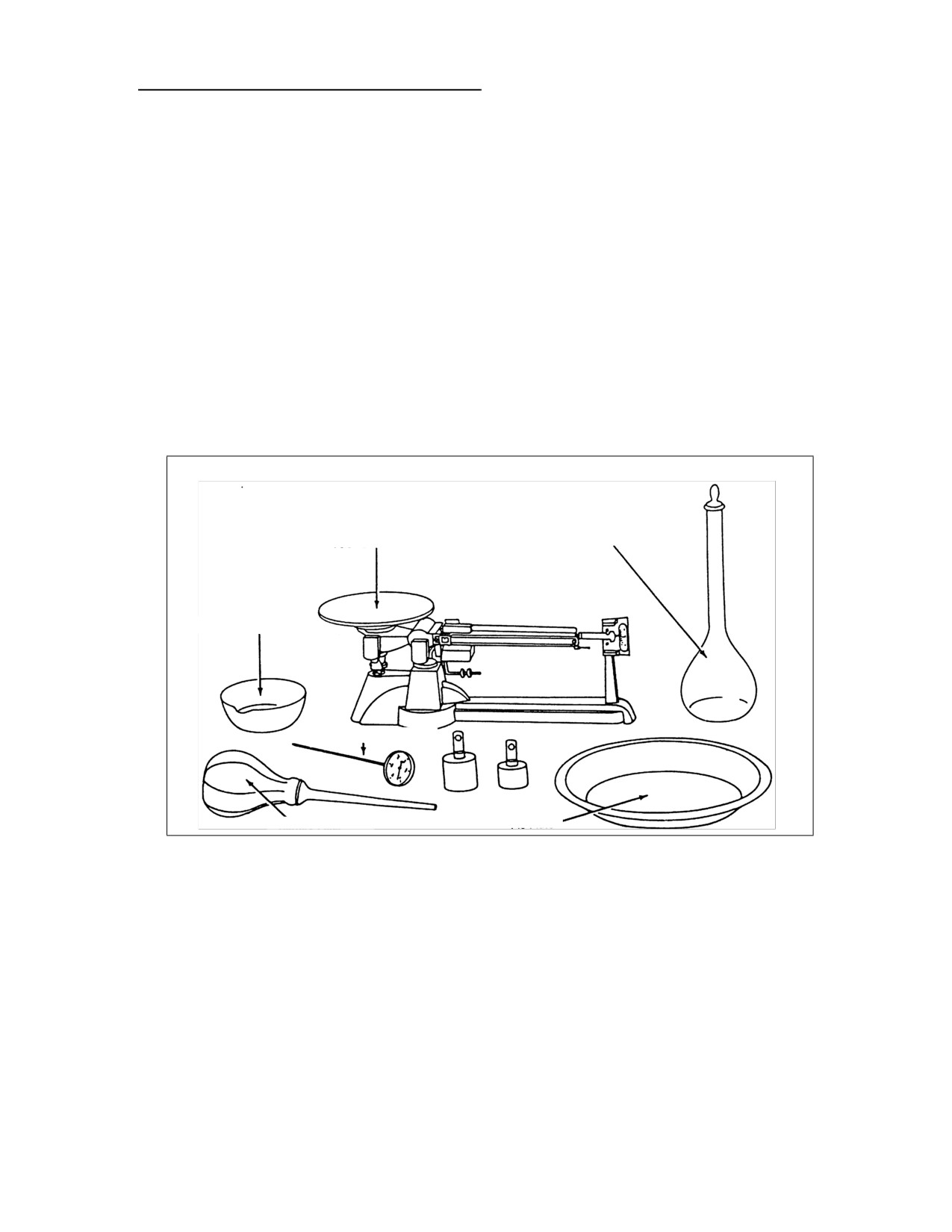
Use the following items (see Figure 3-11) to determine the apparent specific
gravity of fine aggregate (calibrated flask):
• A balance; 2,000 grams, sensitive to 0.1 gram.
• An evaporating dish.
• A battery filler.
• A volumetric flask; 500-milliliter.
• An electric oven.
• A pan.
• A thermometer (0° to 300°F, in 1° gradations).
• An absorbent paper or cloth.
2,000-gram balance
Volumetric flask
Evaporating dish
Thermometer
Battery filler
Pie plate
Figure 3-11. Calibrated-flask apparatus for determining apparent specific gravity of fine
aggregate
Steps
Perform the following steps for particles finer than the No. 4 sieve (the data is
recorded on DD Form 1208—see Figure 2-36, page 2-65):
Step 1. Calibrate a 500-milliliter volumetric flask.
Step 2. Dry a representative sample weighing about 500 grams to constant
weight in the electric oven.
Step 3. Determine the oven-dry weight of the cooled sample and record in on
DD Form 1208 (see Figure 2-36).
Bituminous Mixtures 3-35
FM 5-472/NAVFAC MO 330/AFJMAN 32-1221(I)
Step 4. Transfer the sample to the 500-milliliter flask, being careful not to
lose any of the material.
Step 5. Add clean water until the level just reaches the neck of the flask.
Allow the sample to soak for 24 hours.
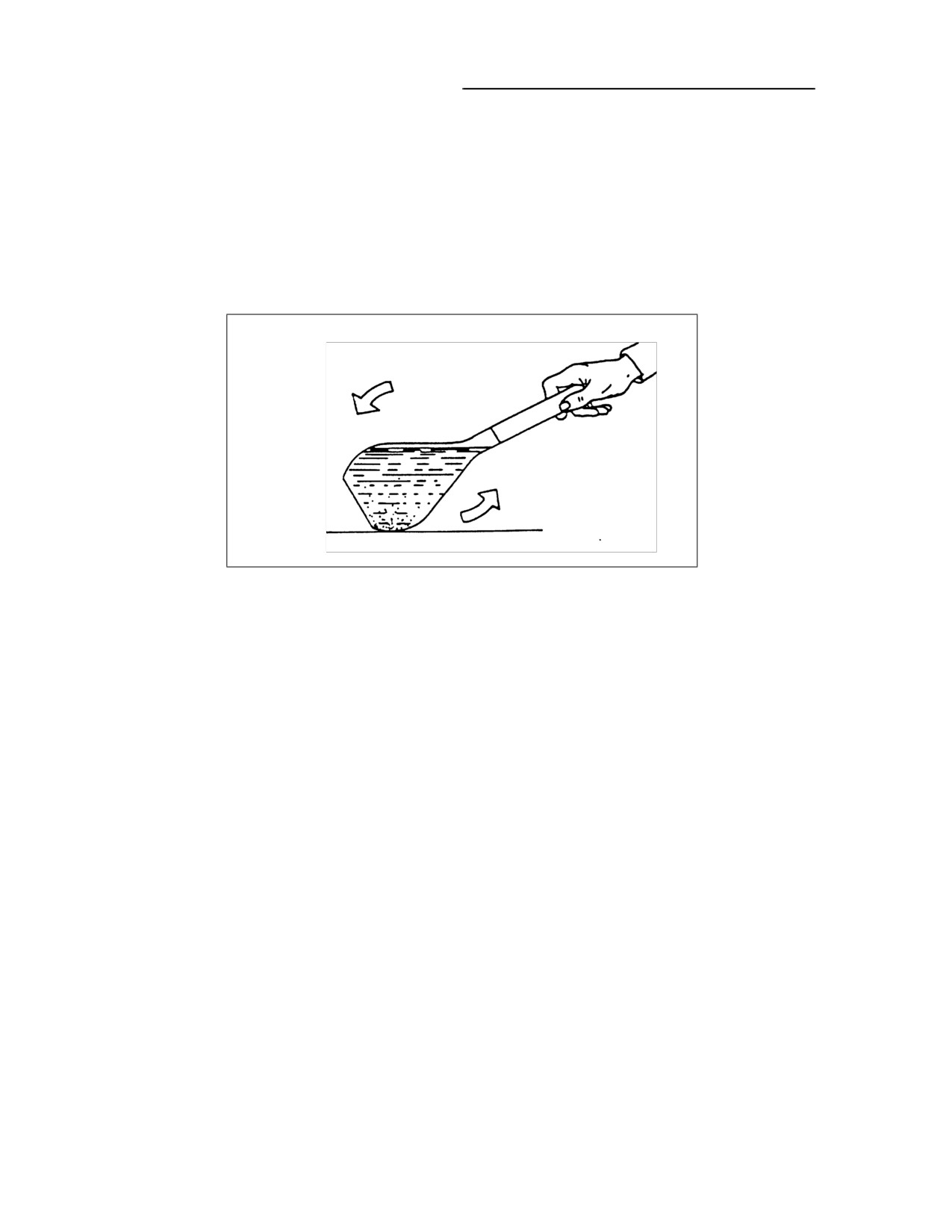
Step 6. Hold the flask containing the soaked sample by the neck, and roll it
back and forth on a smooth surface until air bubbles stop coming from the
sample (see Figure 3-12).
Figure 3-12. Manipulation of calibrated flask to remove air
Step 7. Use the battery filler to bring the water level up in the neck of the
flask until the bottom of the meniscus coincides with the calibration mark on
the flask. Use absorbent paper or cloth to remove any drops of water from the
inside of the neck and on the outside of the flask.
Step 8. Determine the weight of the flask, aggregate, and water. Record the
weight on DD Form 1208 (see Figure 2-36, page 2-65).
Step 9. Measure and record the temperature.
Calculations
The calculations for apparent specific gravity are the same as those indicated
for soil in Figure 2-36.
APPARENT SPECIFIC GRAVITY OF FINE AGGREGATE (UNCALIBRATED FLASK)
Perform the procedure below to determine the apparent specific gravity when
a calibrated flask is not available.
Equipment
Use the same equipment as for the calibrated-flask test, with the addition of a
water bath maintained at 68°F. Do not use this procedure unless the
temperature can be maintained.
Steps
Perform the following steps to determine the apparent specific gravity:
3-36 Bituminous Mixtures
FM 5-472/NAVFAC MO 330/AFJMAN 32-1221(I)
Step 1. Obtain a representative sample of aggregate passing the No. 4 sieve
weighing about 500 grams. Dry it to constant weight in the electric oven
maintained at a temperature of 230°F + 9°.
Step 2. Obtain and record the dry weight after the sample has cooled in air.
Step 3. Transfer the sample to the flask, being careful not to lose any of the
material.
Step 4. Add clean water until its level just reaches the neck of the flask.
Allow the sample to soak for 24 hours.
Step 5. Roll the flask back and forth on a smooth surface until air bubbles
stop coming from the sample (see Figure 3-12).
Step 6. Use the battery filler to bring the water level up in the neck of the
flask to slightly above the calibrated mark.
Step 7. Place the flask with water and aggregate in the water bath
maintained at a temperature of 68°F. Use the glass thermometer to check the
temperature of the water in the flask from time to time.
Step 8. Bring the water in the flask to a uniform temperature of 68°F. Use
the battery filler and absorbent paper to adjust the bottom of the meniscus to
coincide with the calibration mark. Remove any drops of water inside the
neck of the flask.
Step 9. Remove the flask from the bath and dry the outside thoroughly.
Determine and record the weight of the flask plus the aggregate, plus the
water at 68°F. It does not matter if the level of the water in the neck of the
flask changes after removal from the bath. The proper adjustment was made
at 68°F, and the total weight is not affected by the subsequent change in
volume.
Step 10. Repeat the procedure in steps 6 through 9 above using water only.
Enter the weight of the flask filled with water at 68°F on DD Form 1216 (see
Figure 3-6, page 3-23). This needs to be done only once for a given flask; this
value can be tabulated and used in subsequent tests. The weight of the flask
filled only with water at 68°F must be known.
Calculations
Indicate the calculations necessary to determine the apparent specific
gravity of fine aggregate using an uncalibrated flask on DD Form 1216 (see
Figure 3-6).
SPECIFIC GRAVITY OF BULK-IMPREGNATED AGGREGATE
This test is used for determining the specific gravity of the blended aggregates
(including filler) used in hot asphaltic mixtures. This method is to be used
only when the water absorption for the entire blend of aggregate selected for
the job-mix formula exceeds 2 1/2 percent. The method is not applicable to
determine specific gravity of mineral filler except when included in the
blended aggregate. See Military Standard (MIL-STD) 620A, method 105, for
additional testing details.
Bituminous Mixtures 3-37
FM 5-472/NAVFAC MO 330/AFJMAN 32-1221(I)
Equipment
Use the following items to perform this test:
• The Dunagan apparatus.
• An electric oven (sensitive to ± 5° in the range of 275° to 325°F).
• Gallon-capacity pails.
• A balance; 5-kilogram capacity sensitive to 0.1 gram.
• Baking pans.
• A heavy sheet-metal strip for stirring the contents of the pail.
• A wire handle. NOTE: A wire handle is convenient for handling
the pail, but is not essential, since the container will be placed
in the copper bucket of the Dunagan apparatus to determine
the weight submerged in water. A No. 10 can (an empty fruit
or vegetable can) with the top smoothly cut out is satisfactory,
but care must be taken to eliminate air trapped under the
bottom when the can is submerged.
Samples should consist of 1,500 grams of blended aggregate (ensuring that
the sample represents prototype grading) and 85 to 100 penetration-grade
asphalt cement.
Steps
Perform the following steps to determine the specific gravity of bulk-
impregnated aggregate:
Step 1. Dry the aggregate sample to constant weight at a temperature not
less than 230°F nor greater than 290°F. After cooling the sample in air, weigh
it to the nearest 0.1 gram.
Step 2. Heat the asphalt to
280°F ± 5°, using care to ensure that the
temperature never exceeds 285°F. Add a sufficient amount to the 1-gallon pail
to fill it about 1/3 full.
Step 3. Insert the sheet-metal stirrer and allow the pail and its contents to
cool to room temperature. Allow 8 hours for cooling (preferably overnight).
Step 4. Weigh the pail plus the asphalt and stirrer in air at room temperature
and submerged in water at 72°F ± 2°.
Step 5. Place the pail of asphalt with stirrer and also the sample of aggregate
in an oven at 280°F ± 5° until temperatures of both are equalized.
(A
minimum of 4 hours is usually required.)
Step 6. Remove the aggregate and asphalt from the oven and gradually add
aggregate to the asphalt, stirring thoroughly. After all of the aggregate is
added, continue stirring until the total elapsed time from the start of mixing
to the end of stirring is 2 minutes. During the cooling period, apply a flame to
the surface to remove air bubbles. Cool the sample to room temperature
(preferably overnight).
Step 7. Weigh the sample in air and in water at 72°F ± 2°.
3-38 Bituminous Mixtures
FM 5-472/NAVFAC MO 330/AFJMAN 32-1221(I)
Calculations
Calculate the bulk-impregnated specific gravity as follows:
A
bulk-impregnated specific gravity
= ------------------------------------------
(D-E)-(B-C)
where—
A = weight of oven-dry aggregate, in grams
B = weight of pail + stirrer + asphalt in air, in grams
C = weight of pail + stirrer + asphalt in water, in grams
D = weight of pail + stirrer + asphalt + aggregate in air, in grams
E = weight of soil + stirrer + asphalt + aggregate in water, in grams
Duplicate determinations should check within 0.04 gram. If the values are
within the 0.04 tolerance, use an average value. If the initial duplicate tests
are not within the 0.04 tolerance, repeat the tests in duplicate. If the second
set of test values is within the tolerance, discard the first two test values and
use an average value of the second two tests.
SPECIFIC GRAVITY OF MINERAL FILLER
The specific gravity of mineral filler used in bituminous mixes is required for
void computation. The methods described in the specific-gravity test apply
(including procedures, calibration, testing, and calculations). Note that when
the bulk-impregnated specific gravity is used, the mineral filler is included in
the blended aggregate. Details can be found in ASTM D 854-92.
LOS ANGELES ABRASION TEST
The Los Angeles abrasion test requires a special machine consisting of a
revolving drum rotated at the rate of 30 to 33 revolutions per minute (rpm) by
an electric motor. Inside the drum is a shelf that picks up the aggregate
sample along with a charge of steel balls and drops them together on the
opposite side of the drum. Details can be found in ASTM C 131-89.
Conduct the test using various numbers of drum revolutions, sizes of samples,
and numbers of steel balls, depending on the grading of the sample. For a
sample that passes the 3/4-inch sieve and is retained on the 3/8-inch sieve, use
5,000 grams of material with 11 balls and 500 revolutions. Wash and dry the
sample to constant weight before placing it in the machine. After the 500
revolutions are completed, remove the sample from the drum and sieve it over
a No. 12 sieve. Wash, dry to constant weight, and weigh the portion retained
on the No. 12 sieve. The difference between the original weight and the final
weight of the sample is expressed as a percentage of the original weight of the
sample
Job specifications usually require that the loss in weight as determined in the
Los Angeles abrasion test shall not be greater than 40 percent for pavement
aggregates and 50 percent for base and subbase aggregates.
Bituminous Mixtures 3-39
FM 5-472/NAVFAC MO 330/AFJMAN 32-1221(I)
SECTION VI. BITUMINOUS-MIX DESIGN
Hot-mix bituminous concrete for pavements is a mixture of blended aggregate
filled with bituminous cement binder. The materials are heated when mixed
so that the bitumen becomes fluid and thoroughly covers the aggregate
particles. The design of a bituminous concrete mix is an economical blend and
gradation of aggregates with bituminous cement. This produces a mixture
that is durable, has the stability to withstand traffic loads, and is workable for
placement and compaction with the construction equipment available.
The procedures described in this section are performed during the design of a
hot-mix bituminous concrete. They include testing, plotting the results on
graphs, and checking the readings against values from the design tables.
Testing of the ingredients and the mix is started before and continued
throughout the paving operations. FM
5-430-00-1 covers the design
considerations in more detail. The paving operations and the blending and
bitumen-content criteria are explained in TM 5-337. The testing phases are
described in this manual.
The selection of the mix ratios of materials is tentative. The bitumen should
be the same as the one used in the construction. The aggregates and fillers
must meet definite requirements. In general, several blends should be
considered for laboratory mix-design tests.
At times it will be necessary to shorten the design procedures to expedite
military construction. Suggestions for expediting design mix are given at the
end of this chapter. The final step is the preparation of a job-mix formula to be
furnished to the construction unit.
HOT-MIX DESIGN CONSIDERATIONS
The objective of designing a hot mix is to determine the most economical blend
of components that will produce a final product that meets specifications.
STEPS
Perform the following steps for determining the most economical blend of
components:
Step 1. Prepare a sieve analysis of the aggregate available.
Step 2. Determine the aggregate blend that will achieve the specified
gradation (see TM 5-337). Plot the selected blend proportions on a graph with
the allowable limits to see that the blend conforms.
Step 3. Determine the specific gravity of the components
Step 4. Use selected percentages of bitumen (see TM 5-337), make trial
mixes, and determine the mix’s design test properties.
Step 5. Plot the test properties on individual graphs using the selected
bitumen percentages. Draw smooth curves through the plotted points.
3-40 Bituminous Mixtures
FM 5-472/NAVFAC MO 330/AFJMAN 32-1221(I)
Step 6. Select the optimum bitumen content for each test property from the
curves (as explained in the criteria tables).
Step 7. Average the bitumen content values from step 6 and from the graphs.
Read the test-property value corresponding to this average.
Step 8. Check these values read in step 7 with the satisfactoriness-of-mix
criteria.
VARIABLES
Gradation specifications are based on limits established as satisfactory by the
Corps of Engineers. Within these limits, the following variables will affect the
final mix design:
• The use of the mix (surface course, binder course, or road mix).
• The binder (asphalt, cement, or tar).
• Loading (low tire pressure [100 psi and under] or high tire pressure
[over 100 psi]).
• The maximum size of the aggregate (in a stockpile or based on the
thickness of the pavement course).
BLENDS
Once the gradation specifications have been selected, check the available
materials to determine how to proportion the blend to meet these
specifications. Study the sieve analysis of the available aggregates, and
compute a series of trial blends. Make any necessary adjustments of the blend
after testing the design and prepared mix. The considerations for establishing
and adjusting the blend are explained in TM 5-337.
OPTIMUM BITUMEN CONTENT
The determination of optimum bitumen content is based on the gyratory test
method or the Marshall test method.
GYRATORY TEST METHOD
The purposes of the gyratory test are to—
• Prepare specimens by kneading compaction at a pressure equal to the
tire pressure for which the pavement is designed.
• Indicate optimum bitumen content directly by plasticity indicators
called gyragraph recordings and by direct readings of shear
resistance. The gyragraph recordings begin to widen, and the
shearing resistance begins to decrease when the maximum
permissible bitumen content is exceeded.
• Measure shear at the applied tire pressure which is used to calculate a
shear-strength factor. This factor is used to predict whether the
paving mixture will withstand the proposed tire-contact pressure.
• Obtain
(by direct measurement) unit weight values required to
minimize settlement under the design loads. Unit weight calculations
are based on direct measurement of the sample height and the known
sample diameter.
Bituminous Mixtures 3-41
FM 5-472/NAVFAC MO 330/AFJMAN 32-1221(I)
Definitions
The following terms are used for the gyratory test:
• Gyragraph. A recording of shear strain experienced by the
bituminous mixture during the compaction test.
• Gyratory angle. A measure of the magnitude of the gyratory strain.
Three pertinent angles are defined as follows:
— Initial gyratory angle or shear strain (machine setting) 0o.
— Minimum gyratory angle or shear strain (minimum gyragraph
band width) 01.
— Maximum gyratory angle or shear strain (maximum gyragraph
band width) 0max.
• Gyratory stability index (GSI). The ratio of the maximum gyratory
angle to the minimum gyratory angle.
• Gyratory compactibility index (GCI). The ratio of the unit mass (total
mix) at 30 revolutions of the gyratory testing machine (GTM) to the
unit mass (total mix) at 60 revolutions of the GTM.
• Gyratory shear strength (SG). The shear resistance of the specimen
under the imposed loading conditions.
• Gyratory shear factor (GSF). The ratio of the measured gyratory
shear strength to the approximate theoretical maximum induced
shear stress.
Equipment
Use the following items to perform the gyratory test:
• A GTM and appurtenances (the primary equipment for this test).
• Spacer blocks. Two metal spacer blocks used to zero the equipment
that measures the specimen height. They are 2 inches in diameter
with one each of the following lengths: 2.50 + 0.005 inches and 3.75 +
0.005 inches.
• An oven, thermostatically controlled to maintain the required
temperature within 5°.
• An electric hot plate.
• An electric mixer. A heavy-duty commercial food mixer complete with
mixing bowl and beaters.
• Balances. Two balances are required, one having a capacity of 5
kilograms or more, sensitive to 1.0 gram; and one having a capacity of
2 kilograms or more, sensitive to 0.1 gram.
• Thermometers, armored glass or dial-type with metal stems are
recommended. A range from 50° to 400°F with sensitivity to 5° is
required.
• A metal beaker, about 1,000-milliliter capacity.
3-42 Bituminous Mixtures
FM 5-472/NAVFAC MO 330/AFJMAN 32-1221(I)
• Tongs for the beaker.
• A metal cooking pan, 12 inches in diameter.
• A kitchen scoop.
• Paper disks, 4 inches and 6 inches in diameter.
• Work gloves.
• Rags or paper towels.
• Kerosene (asphalt solvent).
• Creosote (tar solvent).
Steps
The gyratory method is applicable to mixtures containing asphalt cement,
asphalt cutback, asphalt emulsion, tar or rubberized tar, and aggregate up to
1-inch maximum size in the 4-inch-diameter specimen and 1.5-inch maximum
size in the 6-inch-diameter specimen. Perform the following procedures for
the gyratory test:
Select the Bitumen Content
The bitumen content is expressed as a percent of the mixture’s total weight.
Using the procedures outlined in the following paragraphs, conduct
preliminary tests with one specimen each at a minimum of three bitumen
contents: one above, one below, and one at the estimated optimum. Once the
range of bitumen contents for the design test has been selected, test at least
four specimens at each of the selected bitumen contents. The formulas listed
in the surface-area method may be used to make a rough estimate of optimum
bitumen content. The GTM indicates excessive bitumen by the widening of
the gyragraph and the reduction in upper-roller pressure during the
compaction test. In these preliminary tests, bracket the optimum bitumen
content by tests in which these phenomena occur at the higher bitumen
contents.
The incremental change of the bitumen content should be generally 0.5
percent. For extremely critical mixes, lower the incremental change of
bitumen content to 0.3 percent. For highly absorptive aggregate, increase the
incremental change of bitumen content to 1.0 percent. The gyratory method
does not use voids criteria to select the optimum bitumen content. However,
the mix must be sufficiently dense (low in voids) to widen the gyragraph and
reduce the roller pressure since these indicate overfilled voids. For this
reason, the gyratory method selects mixtures with the most desirable
durability properties, the maximum permissible bitumen content, and the
minimum acceptable voids content.
Prepare the Aggregate
Procedures for determining particle-size distribution and blending to meet
specification requirements have been discussed. The amount of aggregate
required is discussed below.
Bituminous Mixtures 3-43
FM 5-472/NAVFAC MO 330/AFJMAN 32-1221(I)
Prepare the Mixture
For mixes employing penetration grades of bitumen, the temperature of the
aggregate and asphalt at the time of mixing should correspond to the
temperatures anticipated at the plant while manufacturing the paving mix.
These temperatures will be in the range of 200°F for rubberized tar mixes.
For tar and rubberized tar, the temperature of the aggregate and the binder at
the time of mixing should correspond to the temperature to be used at the
plant during manufacture of the paving mix. This temperature will usually
not exceed 225°F for tar mixes and 250°F for rubberized tar mixes.
For mixtures employing liquid asphalts (cutbacks or emulsions), the aggregate
should be dried to the moisture content expected during construction (up to a
maximum of 2 percent by dry weight). Combine the liquid asphalt with the
aggregate at the temperature recommended for field application. Following
mixing, cure the loose mixture in a ventilated oven maintained at 140°F ± 5°
for at least 12 hours before compaction at this temperature. Occasionally stir
the mix during curing to accelerate the loss of volatiles.
Combine the aggregates into batches large enough to make specimens about
2.50 inches long in the 4-inch-diameter mold and 3.75 inches long in the 6-
inch-diameter mold. For normal aggregates, this will require about 1,200
grams for the 4-inch-diameter specimen and about 4,050 grams for the 6-inch-
diameter specimen. Heat the aggregate to the proper mixing temperature,
then weigh the required amount of bitumen at the proper temperature into
the aggregate mixture. Mix the aggregate and bitumen as thoroughly and
rapidly as possible. Mechanical mixing is recommended.
Perform the Compaction and Shear Test
For this test, set the initial gyratory angle, 0o, at 1°. Roller positions 2 and 4
are used to set the initial gyratory angle, T. Use a trial batch of mix in making
the 0o adjustment. Ensure that the specimen molds are thoroughly clean and
free of defects. Excessive wear or grooving in the molds in the area of contact
with the upper and lower plates will have an adverse effect on the compaction
as well as the gyragraph (shear strain) recording.
(Instructions for the
compaction temperatures for the laboratory specimens are presented above.)
Set the GTM at 140°F at least 15 minutes before starting the compaction test.
Preheat the mold and baseplate at 140°F. Place paper disks in the bottom of
the mold and on top of the loose mix to prevent the bitumen from adhering to
the end plates. Place the entire batch in the mold. Avoid hand troweling or
tamping so that the compaction process will be completely controlled
mechanically and will be the most precise and reproducible. Place the wall-
friction yoke in position, then use the mold-carrying tray to load the mold
containing the mixture into the machine. Raise the ram and use just enough
pressure to retain the specimen while tightening the front of the mold chuck
securely in position. When the mold chuck is securely tightened, increase the
vertical pressure to the full compaction test pressure. Bring the gyragraph
recorder pin into contact, actuate the roller carriage, and continue until 29
revolutions have been applied. After 29 revolutions, stop the carriage and
record the specimen height and roller-pressure readings at three positions: 1,
3, and 4 (29 to 30 revolutions), thus completing 30 revolutions. Continue to
apply additional revolutions until a total of 59 are reached. Again, record the
3-44 Bituminous Mixtures
FM 5-472/NAVFAC MO 330/AFJMAN 32-1221(I)
height and roller pressure readings at three positions:
1, 3, and 4 (59 to 60
revolutions), thus completing 60 revolutions.
Perform the Wall-Friction Test
Immediately following the compaction and shear test, lower the vertical ram
slightly to relieve the pressure on the bottom roller. Lower the bottom roller
enough turns to ensure that it will be out of contact with the mold chuck.
(Keep account of the exact number of turns so that the roller can be reset to
exactly the same position.) Reapply the compaction pressure to the ram, and
cycle the roller carriage several times to level the specimen. With the
compaction pressure still acting on the specimen, loosen the mold-chuck bolts
and remove the front of the chuck so that the specimen mold is no longer
restrained by the chuck. Install the two wall-friction apparatus jacks beneath
the wall-friction yoke.
With the vertical load acting on the specimen, determine the force required to
overcome wall friction and move the mold by observing the pressure gauge of
the jack while actuating the jack. The pressure reading will increase with
each thrust of the jack until there is enough force to move the mold. The
pressure reading will then stabilize to about the same minimum value after
each thrust of the jack. Record the low reading of the wall-friction gauge in
the space provided. Remove the test specimen from the GTM immediately
after the wall-friction test is completed, and bring the lower roller back to the
1° setting so that the machine is ready for the next test specimen.
Calibrate the Machine
When conducting shear tests with the GTM, it is necessary to make machine
corrections for the gyratory shear value SG. For this correction, shift the
Mohr's diagram for test results on a cohesionless material enough to cause the
envelope to pass through the origin of the Mohr's diagram. The cohesionless
material used for this test is standard dry ottawa sand, all passing a No. 20
sieve and retained on a No. 40 sieve. A correction is needed for each
combination of compaction pressure and gyratory angle used in the GTM
compaction and shear tests. This correction is determined only once for any
combination of vertical pressure and gyratory angle. The dry ottawa sand is
first compacted under the same pressure, gyratory angle, and number of
revolutions as scheduled for the compaction and shear tests on a given
bituminous mixture. The shear test on the dry sand is then conducted for at
least three different magnitudes of vertical pressure: starting at some lower
value; including an intermediate value; and finally, using the same value that
was used for compaction. The roller carriage is cycled once after each
incremental adjustment in vertical pressure and before reading the upper
roller values under that pressure.
Calculations and Presentation of Results
Perform the following calculations for the gyratory method:
Compaction Calculations
Calculate the following compaction properties for each specimen:
• Unit mass, total mix.
Bituminous Mixtures 3-45
FM 5-472/NAVFAC MO 330/AFJMAN 32-1221(I)
• Unit mass, aggregate only.
• GCI.
Shear Calculation
Calculate the following gyratory shear properties:
• GSI.
• Gyratory shear strength (SG).
• GSF.
Graphical Presentation
For convenience of analysis, the calculations above are plotted against the
bitumen content. The graphs may be to any convenient arithmetic scales.
Application of the Gyratory Method
The bitumen content must be as high as possible when using the gyratory
method to select the optimum bitumen content and judge the satisfactoriness
of the mix. The GSI must not be significantly greater than 1, and the GSF at
this bitumen content must exceed 1.
MARSHALL TEST METHOD (ASTM D 1559-89)
The purposes of the Marshall test method are to—
•
Prepare specimens by drop-hammer compaction. The number of drop-
hammer blows used on the specimens is based on empirical
correlations with two different traffic conditions:
50 blows on each
end of the specimen for tires with less than 100-psi pressure and 75
blows on each end of the specimen for tires with greater than 100-psi
pressure.
•
Find the optimum bitumen content by averaging four measured
properties: the peak of the compaction curve, the peak of the stability
curve, the percent of the voids of the total mix at a specified amount,
and the percent of the voids filled with bitumen at a specified amount.
These values for total mix and bitumen vary with the aggregate’s
gradation, absorption properties, and compaction effort. There are ten
separate sets of criteria to cover these variations. A special exception
is made to use only voids total mix when the overall average falls
outside the voids total-mix limits. This occurs for open-graded mixes
or highly porous aggregates. There are no standards for sand-asphalt
mixes at 75-blow compaction.
•
Measure maximum breaking load
(stability) and corresponding
deformation
(flow) for specimens prepared according to the
compaction procedure. These values of stability and flow are
empirically correlated for conditions outlined in the paragraph above.
•
Obtain the unit weights of specimens from calculations based on
weighing the specimens in air and in water. Porous specimens are
coated with paraffin before weighing them in water.
3-46 Bituminous Mixtures
FM 5-472/NAVFAC MO 330/AFJMAN 32-1221(I)
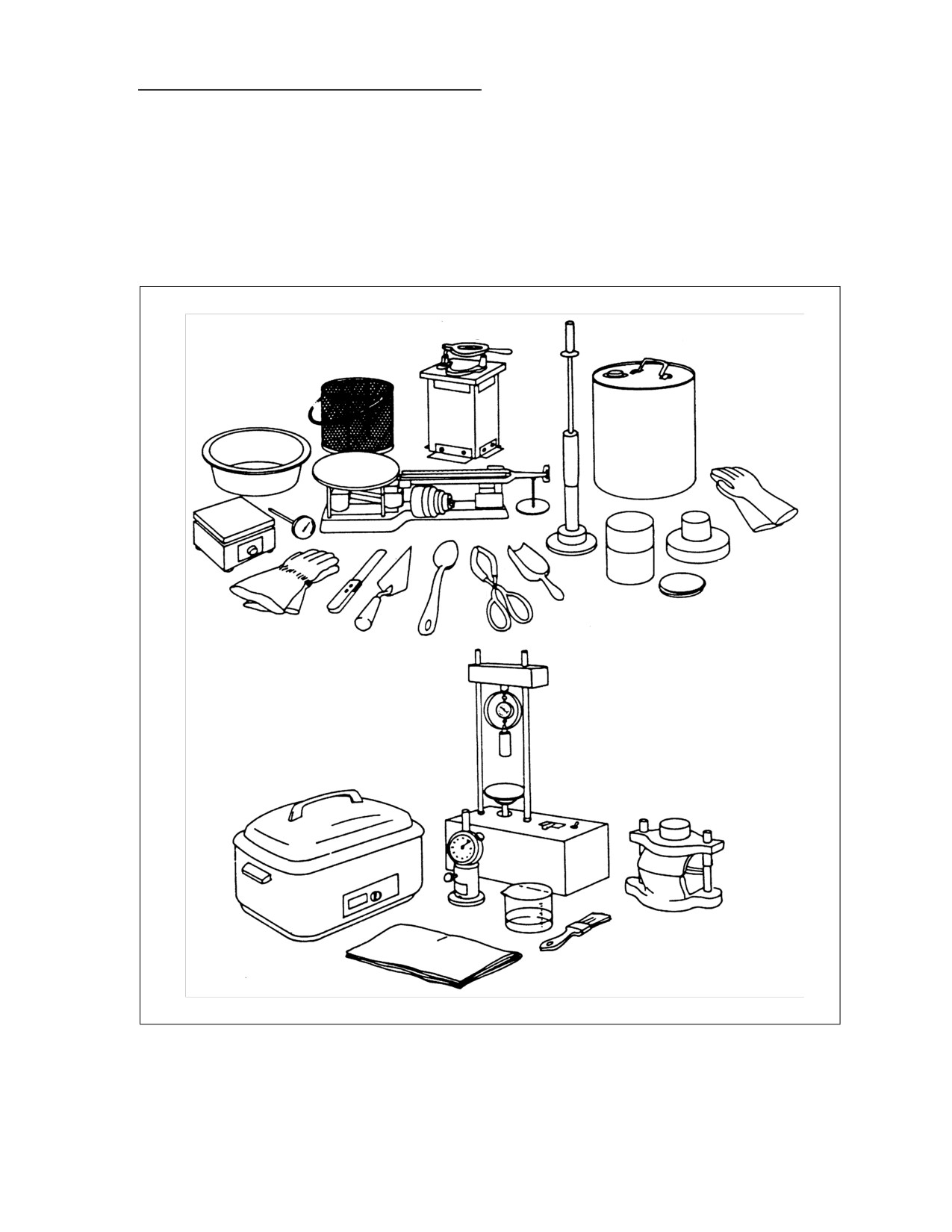
Equipment
Use the following items to perform the Marshall test (see Figure 3-13):
• A mixing pan.
• A hot plate.
Figure 3-13. Apparatus for bituminous mix design—Marshall method
Bituminous Mixtures 3-47
FM 5-472/NAVFAC MO 330/AFJMAN 32-1221(I)
•
Insulated gloves.
•
A laboratory spatula.
•
A trowel.
•
A spoon.
•
Insulated tongs.
•
A scoop.
•
A compaction hammer.
•
A compaction mold.
•
An extractor.
•
Chemical-resistant gloves.
•
Trichloroethane technical.
•
A holder, compaction mold.
•
A compaction pedestal.
•
A triple-beam scale.
•
A wire basket.
•
A thermometer.
•
A hot-water bath.
•
A Marshall stability-testing machine.
•
A flow indicator.
•
Lab towels.
•
A beaker with oil.
•
A brush.
•
A stability mold.
Steps
The Marshall method is applicable to hot-mix mixtures using penetration
grades of asphalt cement and containing aggregate with not more than 10
percent of the aggregate larger than the 1-inch sieve. The procedure for
handling large aggregate as well as for cold mix is described later. Use the
following procedure and example to determine the optimum asphalt content
for one particular blend of aggregates:
Select the Bitumen Content
Start the laboratory tests by estimating the optimum amount of bitumen for
the aggregate to be tested. Continue the tests until results show at least two
bitumen contents above and two below what would be the optimum content.
Since the optimum is not determined until after the results are plotted,
specimens are usually prepared for each of six different contents. Prepare at
least three specimens at each bitumen content. You may use 1 percent
incremental changes of bitumen content for preliminary work. However, use
3-48 Bituminous Mixtures

FM 5-472/NAVFAC MO 330/AFJMAN 32-1221(I)
increments of 1/2 or 1 percent for final tests. Express the percent of bitumen
as a percent of the total weight of the batch of paving mix. The procedure for
establishing the estimated optimum content is explained in TM 5-337.
Prepare the Aggregate
Procedures for determining the particle-size distribution and blending to meet
specification requirements have already been presented. Dry 50 pounds of the
selected blend to constant weight at 221° to 230°F. This amount of material
provides for 1,220 grams per specimen for 18 specimens (three in each of six
bitumen contents) with allowance for some loss. The Marshall method uses a
4-inch-diameter mold and is not applicable, without special handling, when
more than 10 percent of the aggregate is larger than 1 inch. The previously
given total amounts of aggregate required assume less than 10 percent of the
particle will exceed 1 inch. (Special handling of oversize aggregates is covered
later.)
Prepare the Hot Mixture
Heat the bitumen and the aggregates to specified temperatures for mixing.
These temperatures are based on the bitumen that will be used (see Table 3-7).
Bitumen should not be held at the mixing temperature for more than 1 hour
before using. Therefore, plan the preparation so that the mixing will be done
within this time limit. Preheat the mixing pans to a temperature about 50°
above the mixing temperature. Pour the heated dry aggregate fractions into the
pans and mix thoroughly. Form a crater in the mixed aggregate, and pour the
required amount of bitumen at the proper temperature into the crater. At this
point, the temperature of the ingredients should be within the limits specified
above. Mix the aggregates and bitumen as rapid and as thorough as possible to
ensure that the bitumen is uniformly distributed throughout the aggregate.
Table 3-7. Temperatures for mixing bitumens and aggregates
Mixing Temperature (°F)
Bitumen Type
Aggregate
Bitumen
Asphalt cement
300 + 5
270 + 5
Tar (RT-10, -11, or -12)
225 + 5
200 + 5
Rubberized tar
250 + 5
225 + 5
Compact the Hot Mixture
Prepare three specimens at each bitumen content, and prepare the molds to
receive the specimens as soon as they are mixed. Thoroughly clean and heat
the striking face of the compaction hammers and the compaction molds to
200° to 300°F. Oil the mold and other metal in contact with the mix before the
mixture is introduced to facilitate removing the specimen after compaction. A
silicone spray is convenient for this use. Wipe the parts with a rag or paper
towel before using. Place the mix in the mold (rodding the material as it is
added). Remove the collar and, with a trowel, smooth the top surface of the
mix to a slightly rounded shape. The thickness of the compacted specimen
should be 2.5 + .05 inches. One or two trials will indicate the quantity of mix
required to produce such a specimen. Replace the collar and place the mold
Bituminous Mixtures 3-49
FM 5-472/NAVFAC MO 330/AFJMAN 32-1221(I)
assembly on the compaction pedestal. The temperature at this point must be
as specified in Table 3-8 for compaction.
Table 3-8. Temperatures for compacting bitumens and aggregates
Compaction Temperature
Bitumen Type
(°F)
Asphalt cement
300 + 5
Tar (RT-10, -11, or -12)
225 + 5
Rubberized tar
250 + 5
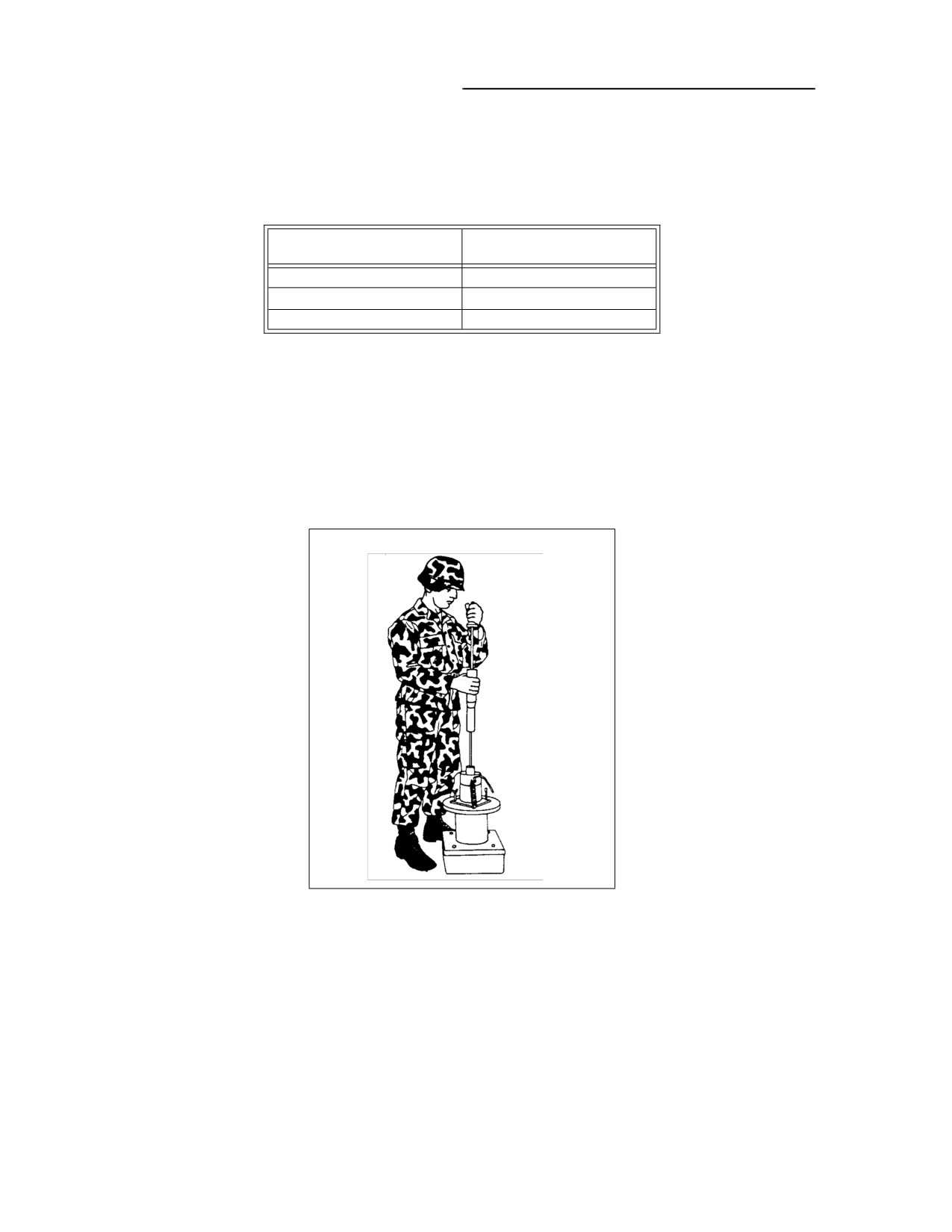
Apply the required number of blows with the compaction hammer (see Figure
3-14). Remove the baseplate and collar, and reverse and reassemble the mold.
Apply the required number of blows to the other side of the specimen. For
example, roads, streets, and facilities for an airfield designed for aircraft
whose tires carry 100 psi or less should be compacted by 50 blows on each end
of the specimen. If the pavement is being designed for aircraft which carry
tires with pressure greater than 100 psi, the compactive effort should be 75
blows per side.
Figure 3-14. Compaction of bituminous trial-mix specimens
Cool the Hot Specimen
After compacting, remove the baseplate and collar, and either air cool the mold
and specimen (normally overnight) or place them in cold water for a minimum
of 2 minutes for fast cooling. Remove the cooled specimen from the mold with
an extension jack or by placing the collar on the floor (with the mold and
specimen on top) and forcing the specimen out with blows from the compaction
hammer. The specimen is easier to remove if the mold is placed in a 140°F
3-50 Bituminous Mixtures
FM 5-472/NAVFAC MO 330/AFJMAN 32-1221(I)
oven for a few minutes just before ejecting the specimen. Place the specimen
(carefully handled and suitably identified) on a smooth surface until it is
ready for testing as described below.
Weigh the Specimen in Air and in Water
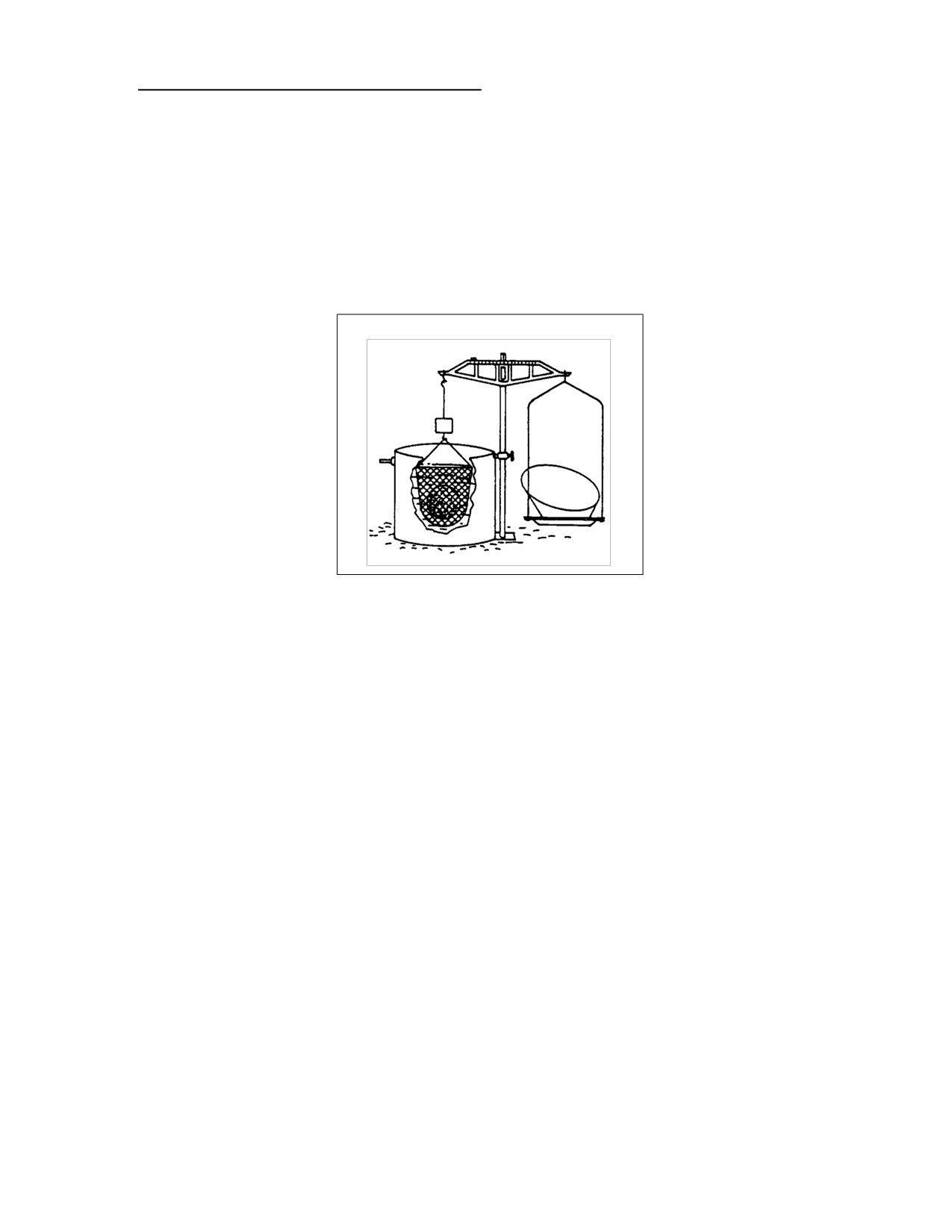
Weigh each specimen in air and in water to obtain the weight and volume
measurements used in calculating the unit weight of the compacted mix (see
Figure 3-15).
Figure 3-15. Weighing compacted bituminous specimen in water
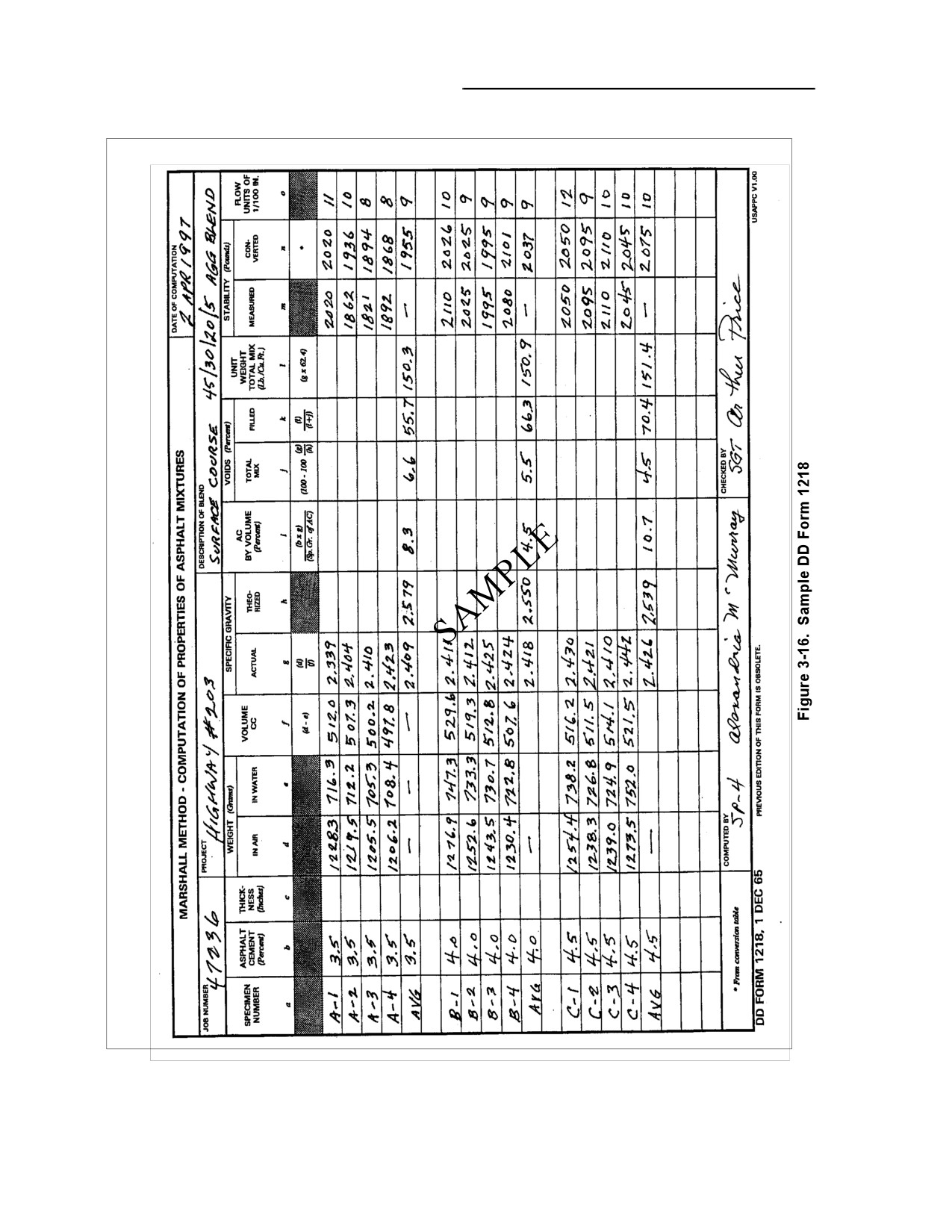
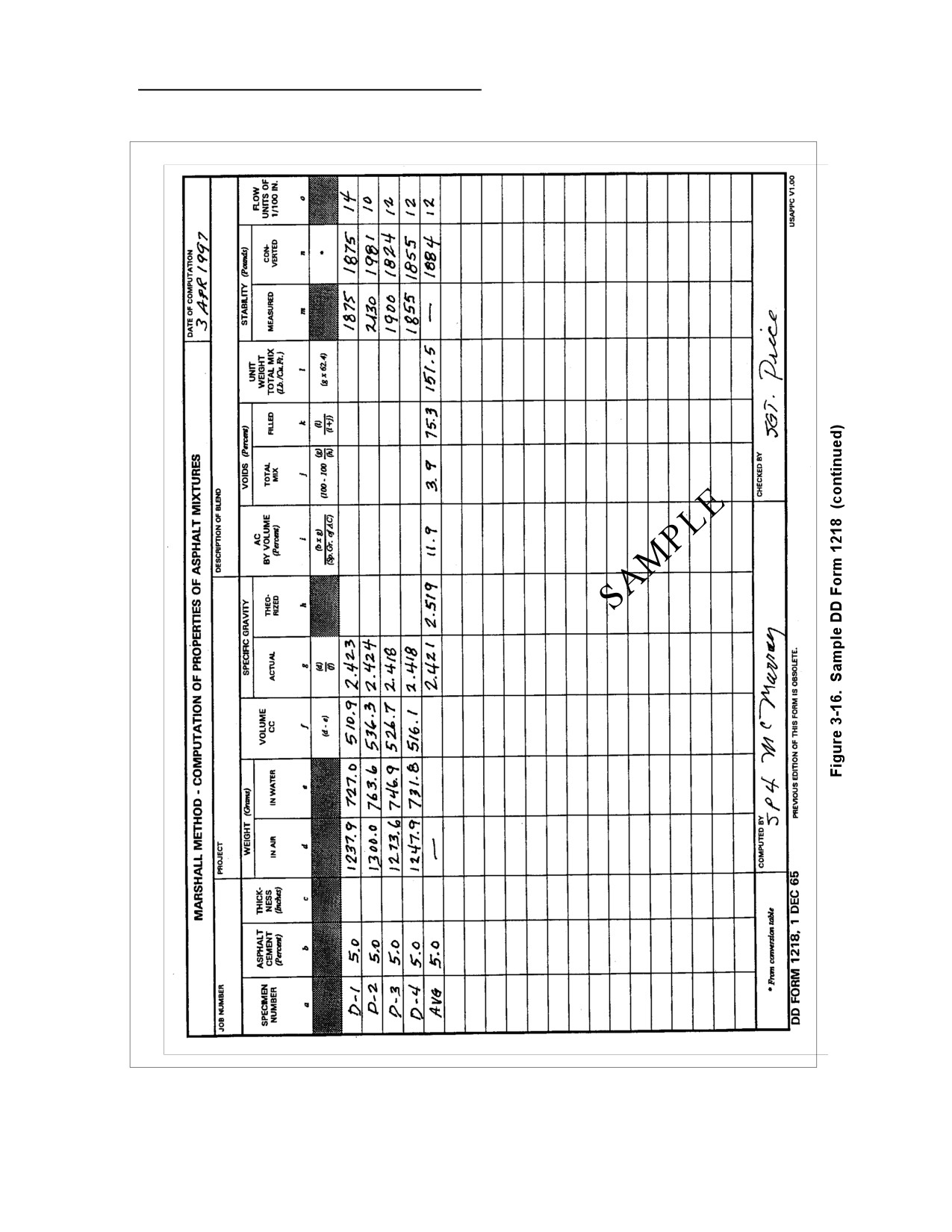
DD Form 1218 provides space for recording those measurements made at
room temperature (see Figure 3-16, pages 3-52 and 3-53). A direct weight in
water of open-textured or porous specimens will give erroneous results
because of water penetration and absorption. For such specimens, you must
use other means to determine the volume. One means of measuring the
volume of the porous specimens is to coat it with paraffin to seal all the voids
and then weigh the coated specimens in air and in water.
Measure Stability and Flow
Bring the test specimens to the desired temperature for the test by immersing
them in an oven for at least 2 hours. The bath temperature for asphalt
samples is 140°F ± 1.8° and 100°F ± 1.8° for tar samples (RT-10 to RT-12).
Record test measurements on DD Form 1218 (see Figure 3-16).
Clean the inside surfaces of the test heads and the guide rods thoroughly
before performing the stability test, and lubricate the guide rods so the upper
test head will slide easily over the guide rods on the lower test head. Remove
the specimen from the water bath and place it on its side in the lower section
of the breaking head. Position the upper section of the breaking head on the
guide rods and on the specimen, then place the complete assembly in position
in the testing machine (see Figure 3-17, page 3-54). To prevent excessive
cooling of this specimen with a resulting increase in stability value, perform
the entire procedure as quickly as possible (within 30 seconds) from the time
the specimen is removed from the water bath.
Bituminous Mixtures 3-51
FM 5-472/NAVFAC MO 330/AFJMAN 32-1221(I)
3-52 Bituminous Mixtures
FM 5-472/NAVFAC MO 330/AFJMAN 32-1221(I)
Bituminous Mixtures 3-53
FM 5-472/NAVFAC MO 330/AFJMAN 32-1221(I)
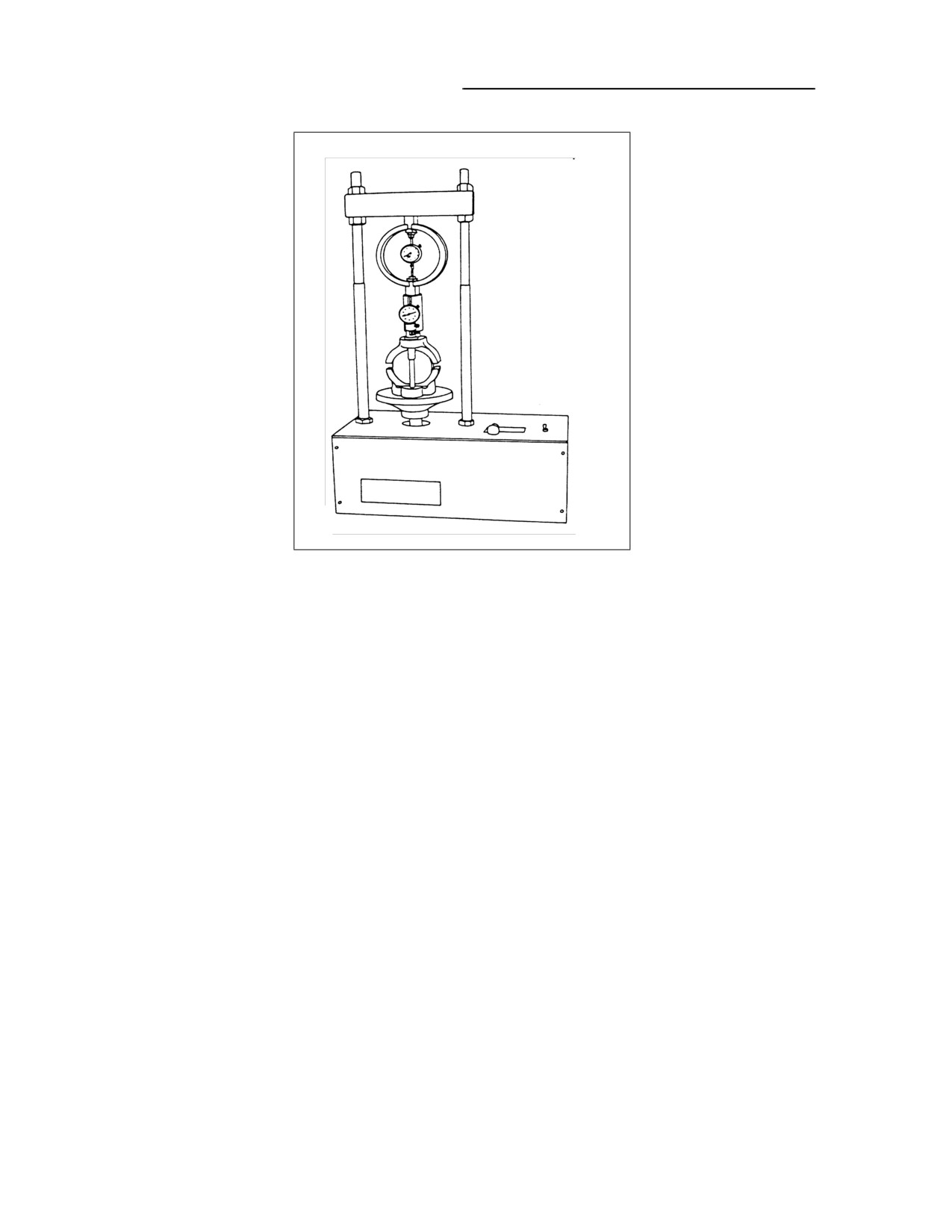
Figure 3-74. Stability-test assembly
Place the flowmeter over one of the guide rods and take an initial reading,
estimated to 0.01 inch. Hold the flowmeter firmly over the guide rod while
loading the specimen. Read or remove the flowmeter from its position over
the guide rod just when the load first begins to decrease, as indicated by the
dial gauge in the proving ring. DD Form 1218 provides space for recording the
flow valve, which is the difference between the initial reading and the final
reading (see Figure 3-16, pages 3-52 and 3-53).
Apply load to the specimen at a constant rate of strain of 2 inches per minute
until specimen failure occurs. The load builds up on the typical test as
movement occurs, until it reaches a maximum and falls off. The maximum
reading of the dial, converted to pounds, is the stability value for the
specimen. Record this reading on the form (see Figure 3-16).
Calculation and Presentation of Results
DD Form 1218 is used to summarize the measured and calculated Marshall
test properties (see Figure 3-16). The specimen numbers—placed on each
specimen with a marking crayon—are given for identification. Note that
there are four duplicate tests for each bitumen content and that these four
test values are averaged in each instance. Note also that the specimen’s
thickness is not indicated since the volume can be used to find the stability
correlation ratio from Table 3-9. The theoretical specific gravity is transferred
from DD Form 1218 to calculate the voids (see Figure 3-16, pages 3-52 and
3-53). Note that the stability value is shown directly in pounds. Unless the
testing machine provides a load-measuring device that reads directly in
pounds, it will be necessary to convert this value. Use the calibration factor
3-54 Bituminous Mixtures

FM 5-472/NAVFAC MO 330/AFJMAN 32-1221(I)
furnished with the ring dynamometer on the testing machine. The stability
value varies directly with the specimen’s thickness. Therefore, it is necessary
to correct the stability values for specimens of a thickness greater or less than
the standard 2 1/2 inches. Table 3-9 shows the necessary conversion factors
for specimens varying in thickness from 1 to 3 inches. Table 3-9 also contains
data whereby the stability conversion factor can be determined on the basis of
the volume of the specimen, since the volume is a direct function of height for
Table 3-9. Stability correlation ratios, Marshall stability test
Volume of Specimen
Approximate Thickness of
Correlation Ratio
(in Cubic Centimeters)
Specimen (in Inches)
200 to
213
1
5.56
214 to
225
1 1/16
5.00
226 to
237
1 1/8
4.55
238 to
250
1 3/16
4.17
251 to
264
1 1/4
3.85
265 to
276
1 5/16
3.57
277 to
289
1 3/8
3.33
290 to
301
1 7/16
3.03
302 to
316
1 1/2
2.78
317 to
328
1 9/16
2.50
329 to
340
1 5/8
2.27
341 to
353
1 11/16
2.08
354 to
367
1 3/4
1.92
368 to
379
1 13/16
1.79
380 to
392
1 7/8
1.67
393 to
405
1 15/16
1.56
406 to
420
2
1.47
421 to
431
2 1/16
1.39
432 to
443
2 1/8
1.32
444 to
456
2 3/16
1.25
457 to
470
2 1/4
1.19
471 to
482
2 5/16
1.14
483 to
495
2 3/8
1.09
496 to
508
2 7/16
1.04
509 to
522
2 1/2
1.00
523 to
535
2 9/16
0.96
536 to
546
2 5/8
0.93
547 to
559
2 11/16
0.89
560 to
573
2 3/4
0.86
574 to
585
2 13/16
0.83
586 to
598
2 7/8
0.81
599 to
610
2 15/16
0.78
611 to
625
3
0.76
Bituminous Mixtures 3-55
FM 5-472/NAVFAC MO 330/AFJMAN 32-1221(I)
a constant 4-inch-diameter specimen. All other calculations are indicated
directly on the form (see Figure 3-16, pages 3-52 and 3-53).
Graphical Presentation
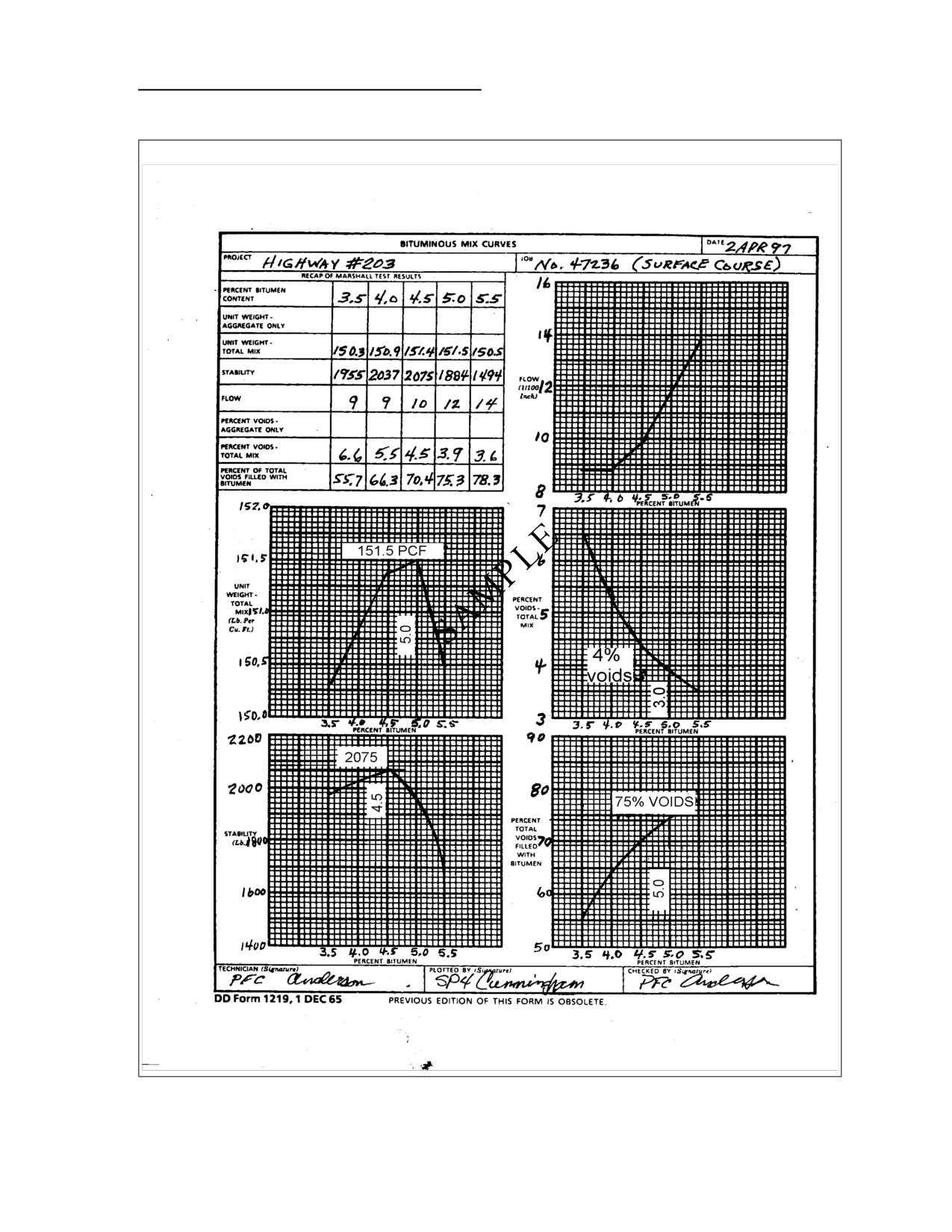
The average Marshall test properties from the tabulation (see Figure 3-16)
for each bitumen content are shown graphically on DD Form 1219 (see
Figure 3-18). The average values for each property are plotted on their
respective graphs using the bitumen content as ordinates. A smooth curve is
drawn through the plotted points in each instance.
Application of the Marshall Test
Table 3-10, page 3-58, lists the criteria for determining the optimum bitumen
content along with the Marshall specifications for a satisfactory mix. The
optimum bitumen content is determined by averaging the bitumen content
read from the curves in Figure
3-18 at the four points indicated for
determination of the optimum bitumen content in Table 3-10. Once this
average bitumen content is obtained, the Marshall properties at this average
are read from curves representing the mix, as in Figure 3-18. These values
are compared with the specification limits in Table 3-10 to evaluate the
satisfactoriness of the mix. The exceptions allowed when the values obtained
fail to conform with the specification limits given in the table are shown in
notes at the bottom of Table 3-10.
Modified Marshall Test for Cold-Mix Pavement
This method is used as an aid in determining the asphalt content for cold-mix
design of light-duty pavement. It can be used where asphalt cutbacks will be
the binder. The procedure follows those used for hot-mix design in general,
with the following modifications:
• Aggregates. These are dried to a moisture content expected during
construction (up to a maximum of 2 percent by weight).
• Asphalt. The selected bitumen is mixed with the aggregates, but at
the temperature recommended for field application. The aggregates
remain at room temperature.
• Curing. Before compaction, the mixture is cured at least 12 hours in
an oven set at 140°F ± 5°.
• Compaction. After curing, the mixture is compacted at 140°F using 50
blows of the hammer at each end of the specimen.
• Cooling. After molding, the specimens are cooled to room temperature
in the molds. Care must be taken to remove the specimens,
undisturbed and undamaged, from the molds.
• Testing. The specimens are heated in an oven to 100°F ± 2° and tested
in the Marshall machine. Heating will normally take about 2 hours.
• Design amount of asphalt. The asphalt contents at maximum density
and maximum stability, after averaging, are used as the design
amount.
3-56 Bituminous Mixtures
FM 5-472/NAVFAC MO 330/AFJMAN 32-1221(I)
Figure 3-75. Asphalt mix curves, Marshall test properties
Bituminous Mixtures 3-57

FM 5-472/NAVFAC MO 330/AFJMAN 32-1221(I)
Table 3-19. Marshall test specifications and determination of optimum asphalt content
Criteria
Determination of OAC
Property
Course
75 Blows
50 Blows
High Press
Low Press
**High Press
Low Press
Aggregate blends showing water absorption up to 2 1/2 percent (used with ASTM apparent specific gravity)
Stability
Surface
1,800 or higher
500 or higher
Peak of curve
Peak of curve
Unit weight
Surface
—
—
Peak of curve
Peak of curve
Flow
Surface
16 or less
20 or less
Not used
Not used
Percent voids total mix
Surface
3 to 5 percent
3 to 5 percent
4 percent
4 percent
Percent voids filled w/AC
Surface
70 to 80 percent
75 to 85 percent
75 percent
80 percent
Stability
Binder
1,800 or higher
500 or higher
Peak of curve*
Peak of curve*
Unit weight
Binder
—
—
Peak of curve*
Peak of curve*
Flow
Binder
16 or less
20 or less
Not used
Not used
Percent voids total mix
Binder
5 to 7 percent
4 to 6 percent
6 percent
5 percent
Percent voids filled w/AC
Binder
50 to 70 percent
65 to 75 percent
60 percent
70 percent*
Stability
Sand asphalt
**
500 or higher
**
Peak of curve
Unit weight
Sand asphalt
—
—
**
Peak of curve
Flow
Sand asphalt
**
20 or less
Not used
Not used
Percent voids total mix
Sand asphalt
**
5 to 7 percent
**
6 percent
Percent voids filled w/AC
Sand asphalt
**
65 to 75 percent
**
70 percent
Aggregate blends showing water absorption greater than 2 1/2 percent (used with bulk-impregnated specific
gravity)
Stability
Surface
1,800 or higher
500 or higher
Peak of curve
Peak of curve
Unit weight
Surface
—
—
Peak of curve
Peak of curve
Flow
Surface
16 or less
20 or less
Not used
Not used
Percent voids total mix
Surface
2 to 4 percent
2 to 4 percent
3 percent
3 percent
Percent voids filled w/AC
Surface
75 to 85 percent
80 to 90 percent
80 percent
85 percent
Stability
Binder
1,800 or higher
500 or higher
Peak of curve*
Peak of curve*
Unit weight
Binder
—
—
Peak of curve*
Peak of curve*
Flow
Binder
16 or less
20 or less
Not used
Not used
Percent voids total mix
Binder
4 to 6 percent
3 to 5 percent
5 percent
4 percent
Percent voids filled w/AC
Binder
55 to 75 percent
70 to 80 percent
65 percent
75 percent
Stability
Sand asphalt
**
500 or higher
**
Peak of curve
Unit weight
Sand asphalt
—
—
**
Peak of curve
Flow
Sand asphalt
**
20 or less
Not used
Not used
Percent voids total mix
Sand asphalt
**
4 to 6 percent
**
5 percent
Percent voids filled w/AC
Sand asphalt
**
70 to 80 percent
**
75 percent
*If the inclusion of bitumen contents at these points in the average causes the voids total
mix to fall outside the limits, then the optimum bitumen should be adjusted so that the voids
total mix are within the limits.
**Criteria for sand asphalt to be used in designing pavement for high-pressure tires have
not been established.
Test Variations
These variations apply to aggregates with 10 percent or more larger than 1-inch
maximum size. The procedure previously described is applicable where the
amount of aggregate larger than the 1-inch sieve is less than 10 percent of the
total. When the +1-inch material exceeds 10 percent of the total, the following
variations are made in the procedure:
3-58 Bituminous Mixtures
FM 5-472/NAVFAC MO 330/AFJMAN 32-1221(I)
•
Mix bitumen at the selected content with the entire aggregate,
including the +1-inch portion.
•
Pass the mixed hot batch through a 1-inch sieve. Discard the +1-inch
portion.
•
Make compacted specimens from the portion that passes the 1-inch
sieve and perform the Marshall test. Do not calculate the voids of the
compacted specimens at this time.
•
Determine the bulk specific gravity of the +1-inch aggregate and, with
the specific gravity of the compacted specimens, compute the adjusted
specific gravity (GA) as follows:
100
GA
= ----------------------------
A
B
---
+ ---
×
f
C
D
where—
A = weight of dry, 1-inch material expressed as a percentage of the total
batch weight (bitumen plus aggregate)
B = portion of the total batch remaining after the dry, +1-inch portion is
removed (100 percent - A percent)
C = bulk specific gravity of the +1-inch aggregate
D = actual specific gravity of the compacted specimen
f
= empirical factor = 0.995
•
Calculate the voids by using the adjusted specific gravity and apply
the design criteria for this value.
•
Use stability and flow values as measured on the compacted
specimens.
SURFACE-AREA METHOD
The following approximation formulas may be used for estimating the
optimum bitumen content when the gradation of the aggregate blend is
known. These estimates must be considered rough approximations since the
optimum bitumen content is a function of the compaction effort as well as the
gradation and surface area. The greater the anticipated pavement loading,
the greater the compaction effort that must be used. The greater the
compaction effort for a given aggregate, the lower the optimum bitumen
content.
Asphalt Cement
Use the following formula for asphalt cement, based on the surface area of the
aggregate:
P = 0.02a + 0.07b + 0.15c + 0.20d
where—
P = percent of asphalt material by weight of dry aggregate
a = percent of mineral aggregate retained on the No. 50 sieve
Bituminous Mixtures 3-59
FM 5-472/NAVFAC MO 330/AFJMAN 32-1221(I)
b = percent of mineral aggregate passing the No. 50 and retained on the No.
100 sieve
c = percent of mineral aggregate passing the No. 100 and retained on the No.
200 sieve
d = percent of mineral aggregate passing the No. 200 sieve
NOTE: Express all percentages as whole numbers.
Asphalt Emulsion
Use the following formula for asphalt emulsion, based on the surface area of
the aggregate:
P = 0.05A + 0.1B + 0.5C
where—
P = percent by weight of asphalt emulsion, based on weight of graded mineral
aggregate
A = percent of mineral aggregate retained on the No. 8 sieve
B = percent of mineral aggregate passing the No. 8 sieve and retained on the
No. 200 sieve
C = percent of mineral aggregate passing the No. 200 sieve
NOTES:
1. Express all percentages as whole numbers.
2. Absorptive aggregate, such as slag, lime rock, vesicular lava, and
coral, will require additional asphalt.
JOB-MIX FORMULA
When the necessary laboratory tests have been completed and the optimum
bitumen content has been determined, the job-mix formula must be
established for use by plant personnel producing the paving mix. Setting up
the job-mix formula involves the relative percentages of the available
aggregate and the bitumen. In the mix-design test already illustrated, the
optimum content was found to be 4.7 percent of the total mix. Accordingly, the
aggregate portion of the mix will be 95.3 percent of the total mix. Referring to
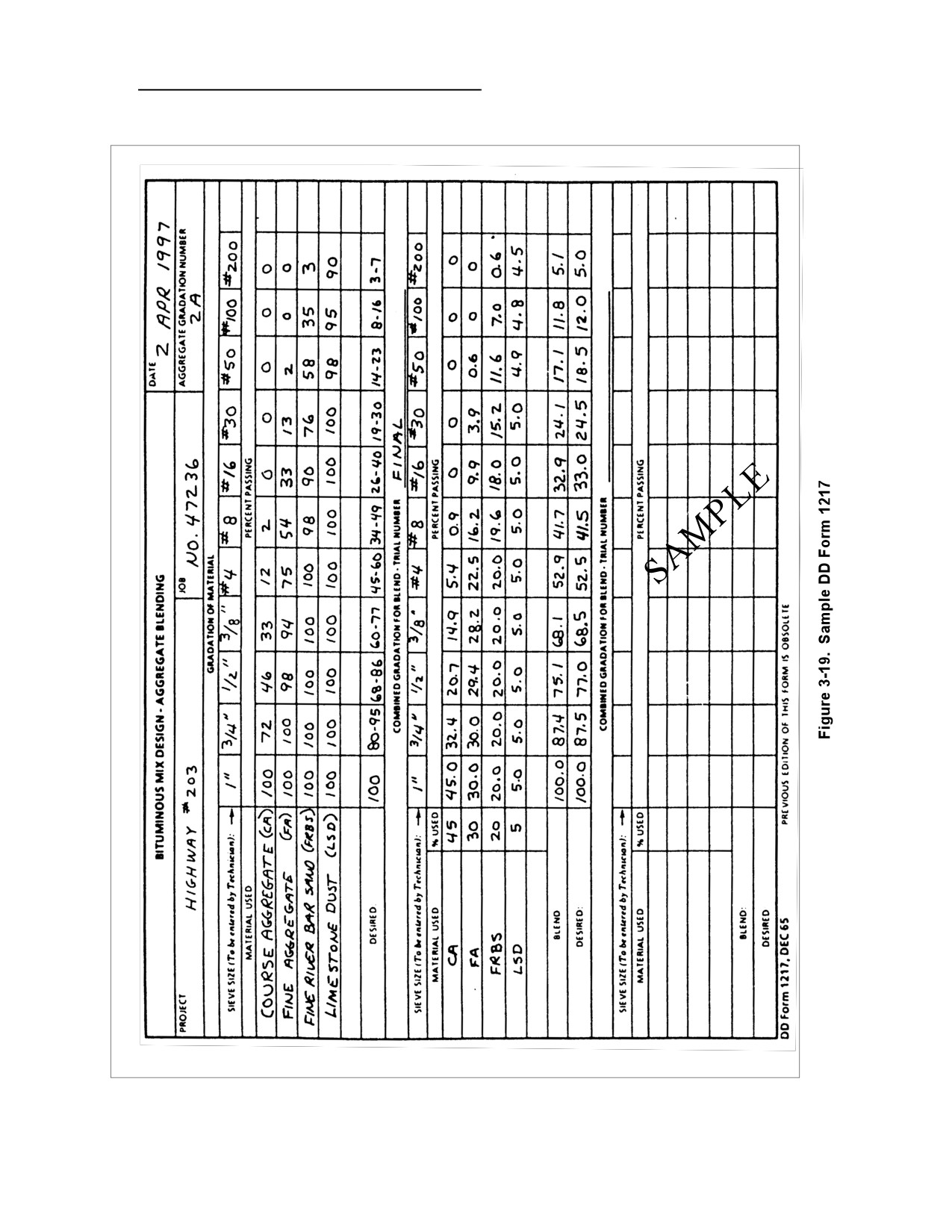
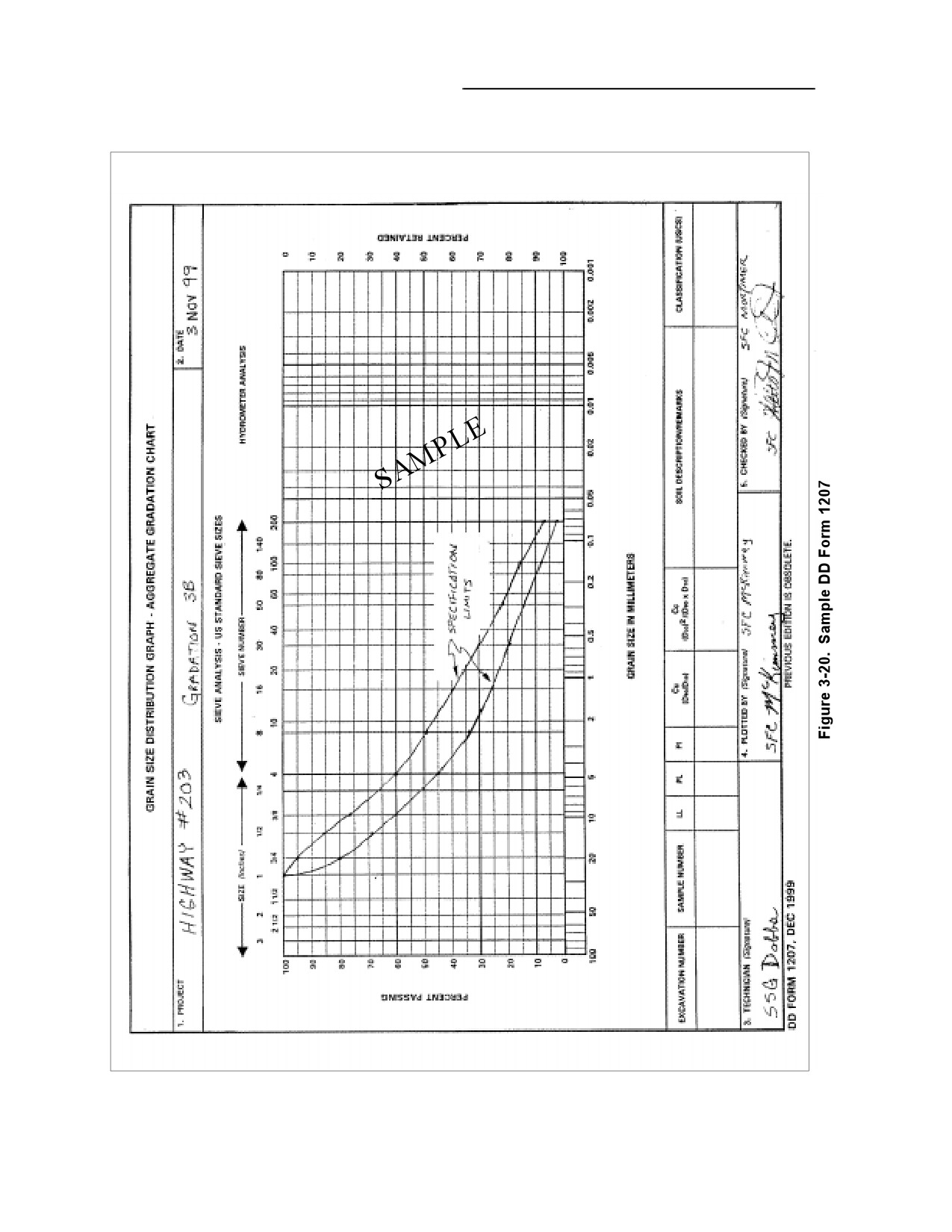
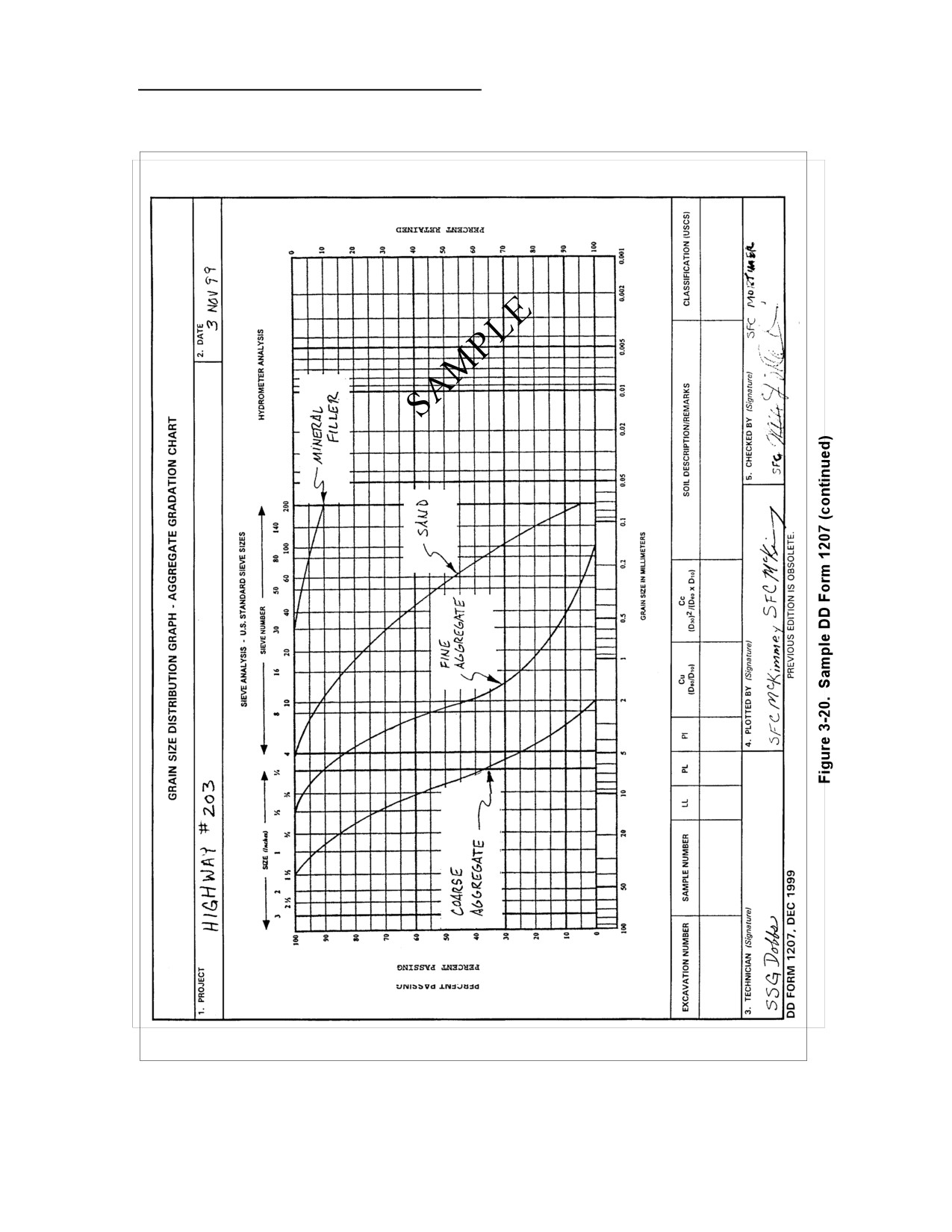
the aggregate-blend calculations on DD Forms 1217 (see Figure 3-19) and
1207 (see Figure 3-20, pages 3-62 and 3-63), the portions were 45 percent
coarse aggregate, 30 percent fine aggregate, 20 percent fine river-bar sand
(FRBS), and 5 percent limestone dust or mineral filler.
The job-mix formula is then computed as follows:
Coarse aggregate = 95.3 x 45 = 42.9 percent
Fine aggregate = 95.3 x 30 = 28.6 percent
FRBS = 5.3 x 20 = 19.0 percent
Mineral filler = 95.3 x 5 = 4.8 percent
Bitumen = 4.7 percent
Total = 100.0 percent
3-60 Bituminous Mixtures
FM 5-472/NAVFAC MO 330/AFJMAN 32-1221(I)
Bituminous Mixtures 3-61
FM 5-472/NAVFAC MO 330/AFJMAN 32-1221(I)
3-62 Bituminous Mixtures
FM 5-472/NAVFAC MO 330/AFJMAN 32-1221(I)
Bituminous Mixtures 3-63
FM 5-472/NAVFAC MO 330/AFJMAN 32-1221(I)
SECTION VII. PLANT CONTROL
Aggregate is mixed in correct proportions for specified construction in high-
type bituminous paving plants and intermediate-type plants. The type of
plant used depends on proximity and the requirements for the aggregate.
Laboratory procedures must be done to obtain correct mixes and must be
correlated with production procedures. Proper control over all procedures and
equipment must be exercised to ensure quality for each aggregate specified.
PLANT TYPES
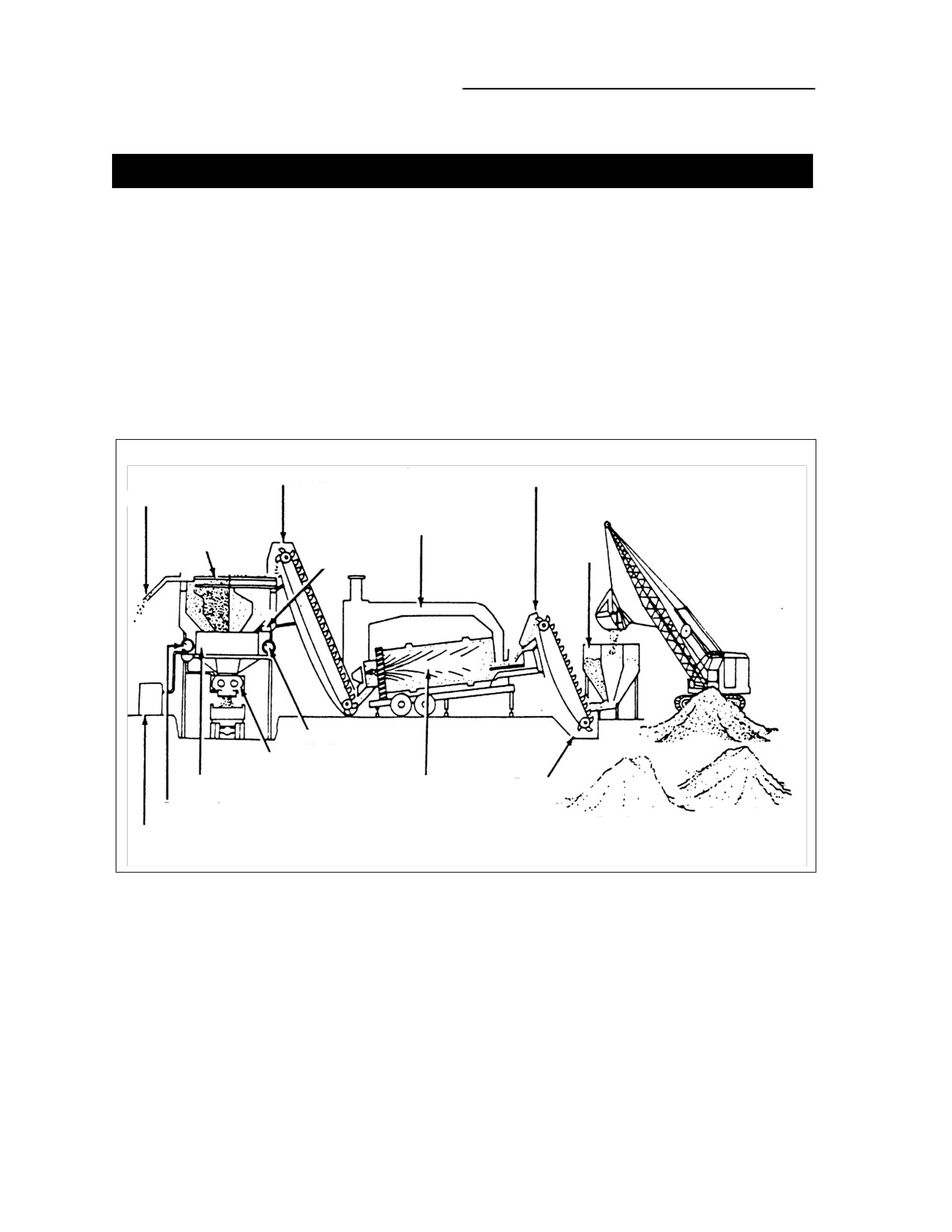
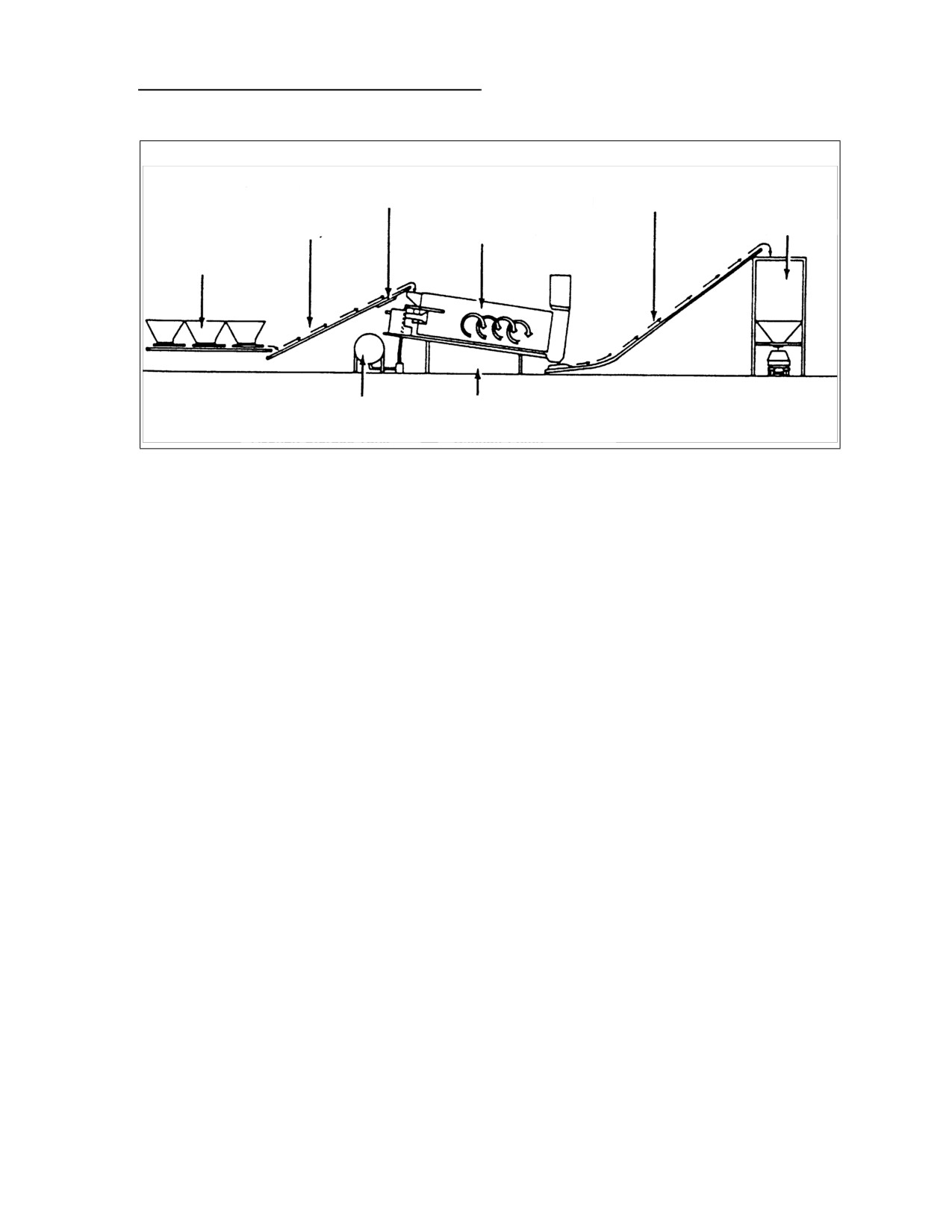
Figures 3-21 and 3-22 are schematic drawings of a batch plant and a drum-
mix plant.
Hot elevator
Cold elevator
Oversize rejects
Dust collector
Screens
Hopper
Mineral filler
Aggregate scale
Stone
Pug mill
Weigh box
Dryer
Feeder
Bitumen scale
Coarse sand
Fine sand
Bitumen storage tank
Figure 3-21. Bituminous hot-mix batch plant
HIGH-TYPE BITUMINOUS PAVING PLANT
In the operation of a high-type bituminous paving plant, aggregates from two or
more sources are fed into the aggregate dryer in the approximate proportions
required to produce the desired gradation. This initial proportioning usually is
accomplished by means of a hopper-type feeder, operating from one or more
bins, which feeds the aggregates into a cold elevator that delivers them to the
dryer. The mechanical feeder is loaded by a clamshell or other suitable means.
3-64 Bituminous Mixtures
FM 5-472/NAVFAC MO 330/AFJMAN 32-1221(I)
Automatic weighing system
Hot-mix conveyor
Cold-feed conveyer
Mix surge silo
Drum mixer
Cold-feed bins
Asphalt storage tank
Asphalt pump
Figure 3-22. Bituminous hot-mix continuous-mix plant
They are heated to the desired temperature. Upon leaving the dryer, they
pass over vibrating screens where they are separated according to size. The
usual screening equipment for a three-bin plant consists of a rejection
(scalping) screen for eliminating oversized material and screens for dividing
the coarse aggregate into two separate sizes (bins). Fine aggregate goes into
the third bin. An additional screen is provided for separating the coarse
aggregate in a four-bin plant. Additional mineral filler, if required, usually is
stored and weighed or proportioned into the mix separately. It may be
obtained from the plant's dust collector or from an external source. Plant
screens may be changed to provide a variation in the size of openings. The
sizes used depend largely on the type of mixture being produced. In some
cases, it may be necessary to change the size of the screens to obtain a proper
balance of aggregate sizes in each bin.
The aggregates must be fed through the plant uniformly, preferably by a
mechanical feeder, to obtain efficient plant operation and to produce a desired
mixture. It is usually necessary to make some slight adjustments in the plant-
bin proportions, since a screen analysis of the hot storage bins will not entirely
duplicate the screen analysis used in the laboratory design. This may result
from—
• Fines lost while passing through the dryer (unless the equipment
includes an effective dust collector and the fines are returned to the
mix).
• Aggregate degradation in the dryer.
• Plant screens that are not completely efficient in the separation of the
aggregate, with the result that some fines are carried over into the
coarser bins.
• Separation of material at hot bins into more or fewer fractions than
represented at stockpiles.
Bituminous Mixtures 3-65
FM 5-472/NAVFAC MO 330/AFJMAN 32-1221(I)
INTERMEDIATE-TYPE PLANTS
An intermediate-type plant does not have the refinements of the high-type
plant described above. Such items as the gradation control unit, the dryer
unit, and even the storage hoppers or bins may not be components of this type
of plant. The aggregates from stockpiles or trucks are added directly (in
correct proportion) into the elevator and then fed into the mixer. Corrections
or changes in the aggregate proportions must be made during the feed. If a
dryer is not part of the plant, adjustment to compensate for moisture must be
anticipated and made externally.
INITIATING PLANT PRODUCTION
The heaviest demands on laboratory facilities arise at the beginning of plant
production. Preliminary computations, which provide the gradation for the
mixture design, may be made to determine the weight of material from each
bin. The gradation of aggregate supplied by the plant according to computed
bin weights may not reproduce precisely the desired gradation. The gradation
of the plant-produced aggregates approximates the one used in design, within
reasonable tolerances, if initial sampling has been done properly and if the
plant is operated efficiently. Certain steps should be taken, however, to ensure
that satisfactory mixtures are reproduced from the beginning and throughout
the period of plant production. Procedures outlined in this section will ensure
satisfactory paving mixtures.
SIEVE ANALYSIS
A sieve analysis is made on material from each plant bin. Samples for these
sieve analyses are obtained after a few tons of aggregate have been processed
through the dryer and screens so that the sample will be representative.
Final bin proportions may be based on these sieve analyses.
MIX REDESIGN
The aggregates from the bins sometimes cannot be proportioned to
satisfactorily reproduce the gradation of the aggregate used in the laboratory
design. It is then necessary to redesign the mix, using plant-produced
aggregates. Specimens are prepared and tested for the new design in the
same manner as for the original. This gives optimum asphalt content and a
satisfactory mix produced by the plant. Occasions may arise in which the
gradation of the plant-produced aggregate will differ from the laboratory
design so that part of the aggregates may be wasted. The mix should be
redesigned to use all of the available aggregate. Sufficient additional tests
should be performed to establish optimum asphalt requirements and ensure
that the mix meets applicable criteria.
CONTROLLING PLANT PRODUCTION
Obtain from each of the first four truckloads enough paving mix for the
preparation of four test specimens. Prepare the four specimens from each of
these samples and compact and test them according to standard procedures
described previously. Conduct the tests as rapidly as possible, and delay plant
production until data from these tests are available. The data must conform
to final design data at the same asphalt content, within reasonable tolerances,
before plant production is resumed. If necessary, make adjustments to secure
3-66 Bituminous Mixtures
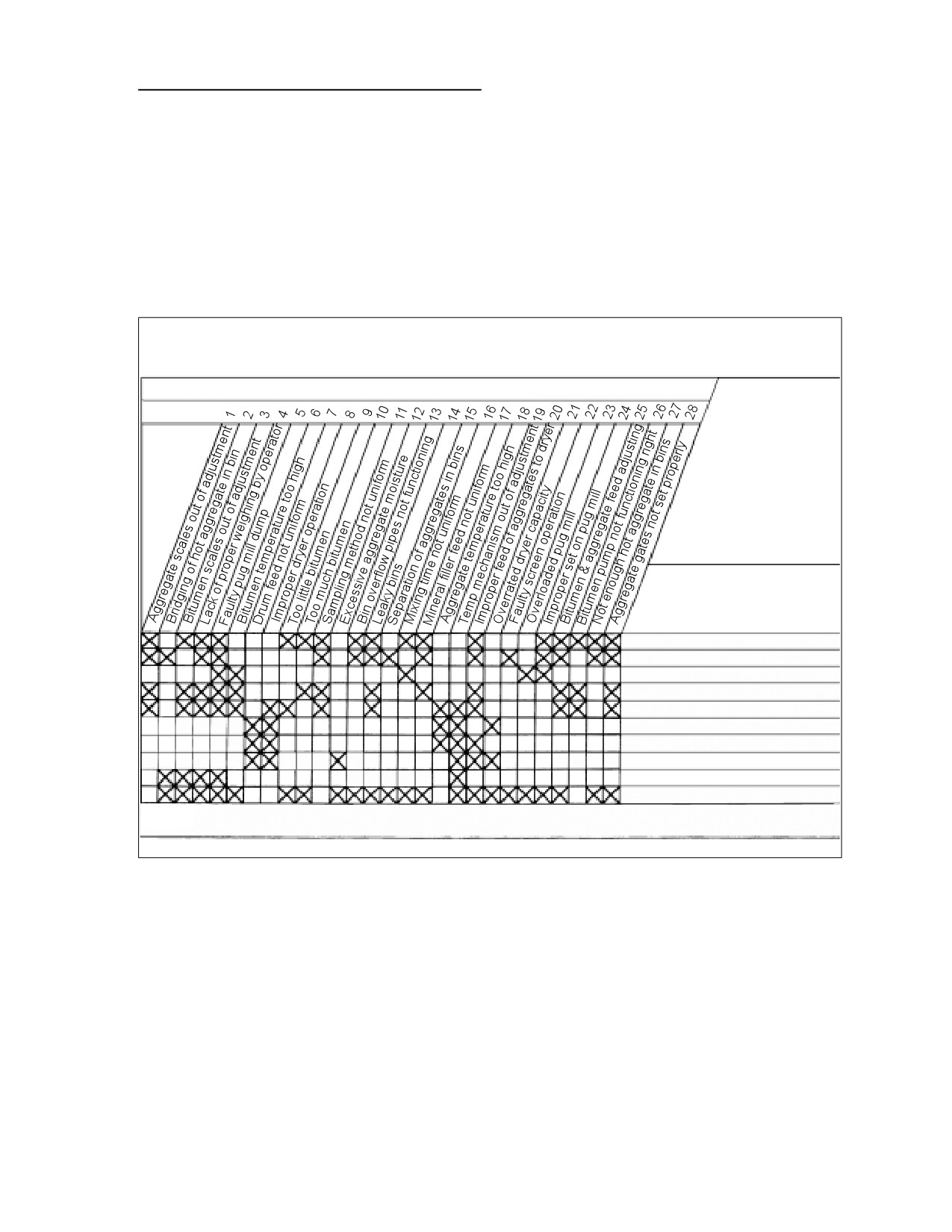
FM 5-472/NAVFAC MO 330/AFJMAN 32-1221(I)
a conforming mix. Such procedures will delay plant production generally less
than 2 hours and assure production of satisfactory mixes. As soon as the data
from the testing of the plant-produced mix are obtained, compare it with
corresponding design data for further adjustments of the mix, if necessary.
Probable causes of paving-mixture deficiencies for both batch and continuous
mixing plants are shown in Figure 3-23. These deficiencies are observed at
the plant. Other imperfections and their causes that may be encountered in
placing the mix in the pavement are given in Figure 3-24, page 3-68.
Probable causes of deficiencies in hot plant-mix paving mixtures
Types of deficiencies that
may be encountered in
producing hot plant-mix
paving mixtures
Bitumen content formula error
Gradation formula error
Poorly mixed loads
Fat, rich mixtures
Lean or burned mixtures
Mixture temperature error
Smoking loads
Steaming loads
Overweight or underweight loads
Lack of mixture uniformity
Items 6 to 23 inclusive are applicable to all types of plants. Items 1 to 5 inclusive and items 24 to 28 inclusive are
applicable to batch plants and volumetric plants respectively.
Figure 3-74. Probable causes of paving-mixture deficiencies detected at plant
GYRATORY TEST CONTROL
The GSI of the individual test specimens should never exceed 1.05. The GSF
of the individual test specimens should never be less than 1.0. The average
value of the other test properties for the four test specimens from any given
truckload should not deviate from the final design values by more than the
following amounts:
• Unit weight total mix ± 1.5 pcf.
• Gyratory shear (SG) ± 15 percent.
Bituminous Mixtures 3-67