FM 3-55.93 Long-Range Surveillance Unit Operations (MAY 2008) - page 9
Hide and Surveillance Sites
HASTY SUBSURFACE SITES
G-3.
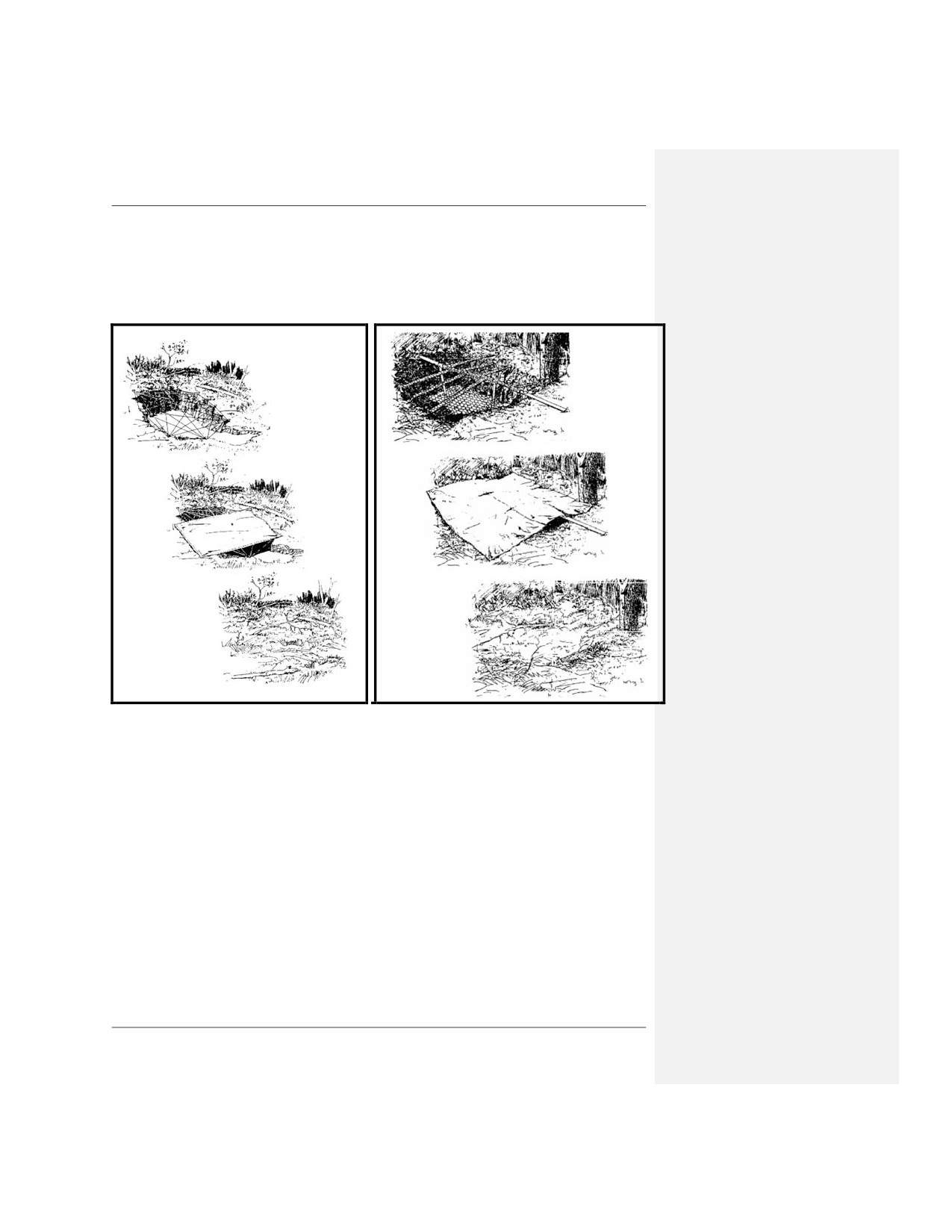
The team constructs a hasty subsurface site when they have too little time to construct a complete
subsurface site. A hasty subsurface site is especially useful in the absence of natural cover and
They plan the site so they can improve it to a full subsurface site as time and the situation allow
and Figure G-3).
Figure G-2. Suspension line-weave site.
Figure G-3. Polyvinyl chloride site.
ADVANTAGES COMPARED TO SURFACE SITE
• Lower profile.
• Better protection against small-arms and indirect fires.
• Excellent camouflage.
DISADVANTAGES COMPARED TO SURFACE SITE
• Requires more construction tools.
• Challenge of concealing removed soil.
• Greater construction time.
• More construction noise.
FM 3-55.93
G-3
Appendix G
CONSTRUCTION MATERIALS NEEDED
• Ponchos or other waterproofing material.
• Yetti or small camouflage net.
• Entrenching tool or D-handled shovels.
• One 550-pound or bungee cord.
• Sandbags.
• Polyvinyl chloride pipe with connectors.
• Fiberglass rod.
• Aluminum conduit.
• Plywood.
• Chicken wire (optional).
• Burlap or canvas (optional).
• Small saplings, stripped and lashed together in place of pipe or fiberglass rods.
FINISHED SUBSURFACE SITE
G-4.
The team generally uses finished subsurface sites for stay-behind missions and when they
anticipate having to remain underground for extended periods of time.
LOCATION
G-5.
Dig the site in a well-concealed area, away from enemy observation, and well away from any
populated areas.
CONSTRUCTION
G-6.
Use any available containers, such as rucksacks, sandbags, or socks, to remove the dirt. Some of
the removed soil will later be placed on top of the site. Leftover dirt must also be camouflaged.
Overhead Cover
G-7.
Overhead cover is constructed strong enough that it can be walked on.
Ingress and Egress
G-8.
Construct two sets of entrances and exits, primary and secondary (emergency), and cover and
conceal each.
Size of Site
G-9.
The site must accommodate the whole team. It must allow freedom of movement and have room
for separate and comfortable sleeping positions.
G-4
FM 3-55.93
Hide and Surveillance Sites
Materials
G-10. Materials needed depends on the design.
• Fifty 2 x 4 x 12's (2 inches by 4 inches by 12 feet boards).
• Six 4 x 4 x 6's (4 inches by 4 inches by 6 feet boards).
• Sufficient gravel to cover the floor.
• Eighteen inches of cover over entire site.
• Backhoe or Soldiers with shovels.
• Sandbags, 100 each.
• One large general purpose tent to cover construction until complete.
ADVANTAGES OF SUBSURFACE SITES
• Little risk of compromise.
• Protection from artillery and small-arms weapons fire.
• Protection from nuclear attack.
• Excellent camouflage.
DISADVANTAGES OF SUBSURFACE SITES
• Concealment of leftover soil away from the site.
• Construction noise.
• Construction resources (time, manpower, materials, and equipment).
USE OF EXISTING SITES
G-11. Look for and use depressions or predug holes, such as former fighting positions, and improve
them as the situation allows. During heavy rains, do not use streams and waterways as they could flood.
CONCEALMENT
G-12. To conceal the site, use yetti nets, man-made and natural camouflage, or chicken wire.
COVER
G-13. Build a barricade to provide shelter.
STOCKAGE
G-14. Stock it with rations, water, ammunitions, batteries, and so on, and arrange equipment, such as
rucksacks and communications equipment, so it can be grabbed in an emergency.
FM 3-55.93
G-5
Appendix G
STANDING OPERATING PROCEDURE
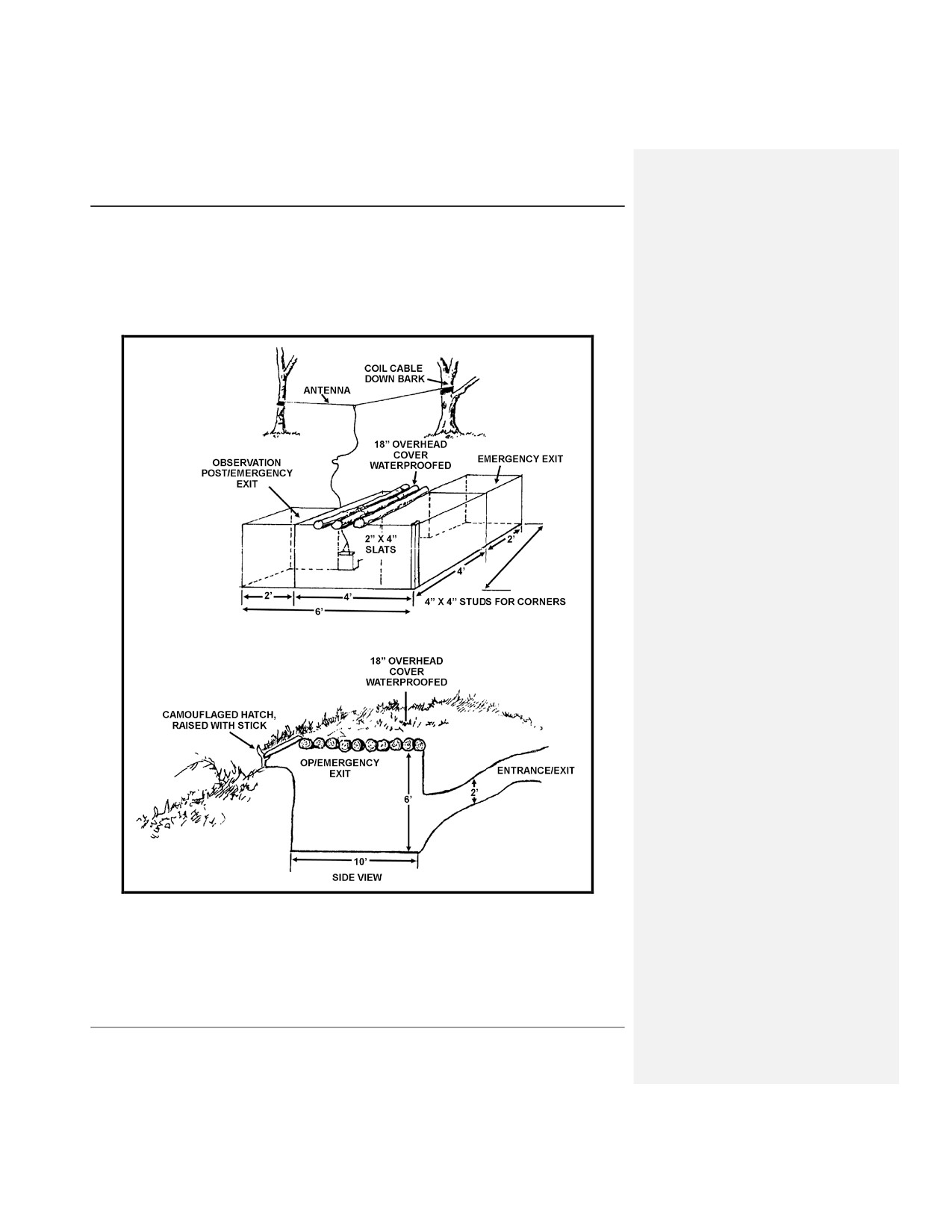
G-15. Have an SOP for exiting the site. If the team conducts surveillance from the site, then how the
leaves the site depends on the location of the enemy objective (Figure G-4). The team should also prepare a
deception plan to cover exiting by the secondary
(emergency) exit, in case the enemy finds the
primary entrance.
Figure G-4. Example subsurface site.
G-6
FM 3-55.93
Hide and Surveillance Sites
WASTE MANAGEMENT
G-16. Use a portable camping toilet or line an MRE box with a trash bag. Cover waste odor with lime
(best) or baking soda. Remove the waste in zipper storage bags, leftover MRE bags, or any other type of
sealable container.
PERSONAL EQUIPMENT
G-17. Disassemble shovels and carry them in rucksacks, and leave on load-carrying equipment.
SITE SELECTION
G-18. When selecting a site, the leader should--
• Consider LOS to target.
• Ensure the site is in range of available observation equipment so that it can meet the reporting
requirements.
• Ensure the site has adequate overhead cover and concealment.
• Ensure the site is located away from natural lines of drift, roads, trails, railroad tracks, and
major waterways.
• Ensure the site is defendable for at least a short time.
• Ensure the site has primary and secondary (emergency or alternate) hasty exits.
• Ensure the site has a concealed and serviceable entrance, and that Soldiers make little noise
getting in and out of the hide site.
• Ensure the site works within the factors of METT-TC relative to other site positions (hide,
surveillance, and communication).
• Ensure the site is located well away from any man-made objects.
• Ensure the site is located downwind of inhabited areas.
• Ensure the site uses, but is not dominated by, high ground.
LEADER RECONNAISSANCE
G-19. The team leader selects tentative sites during the planning phase. He physically reconnoiters (in a
stay-behind); observes from aircraft; studies photographs, line-of-site data, soil and drainage data, or
conducts a map reconnaissance. At a minimum, he selects primary and alternate hide and surveillance sites
(thus, four sites in all). Before the team occupies the sites, the team leader physically reconnoiters the
tentative sites chosen during planning. If necessary, he moves the site to a better location.
OCCUPATION OF HIDE SITE
G-20. The leader can occupy the hide site by any of several methods:
FM 3-55.93
G-7
Appendix G
FISHHOOK OR DOG-LEG METHOD
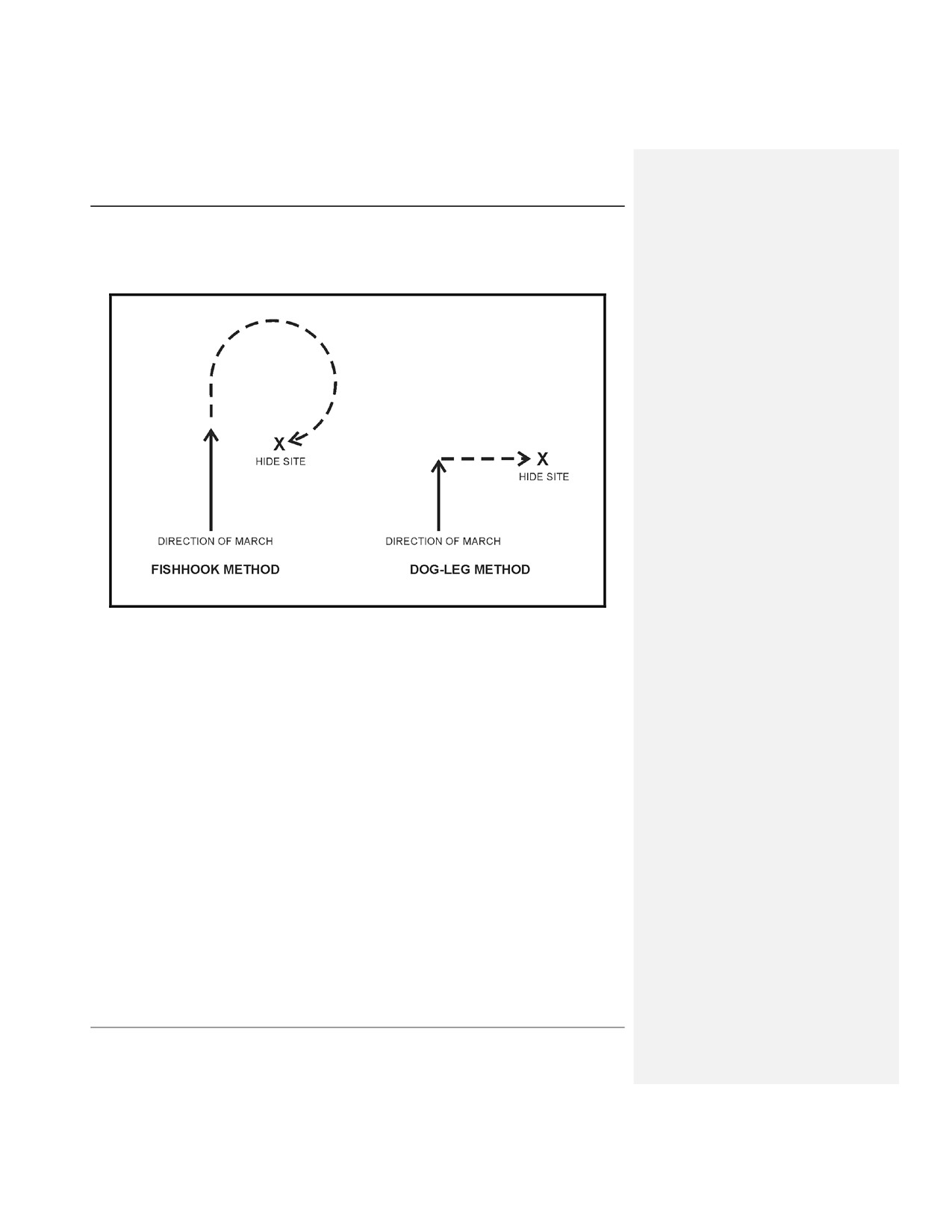
G-21. The team occupies the hide site off the direction of march (Figure G-5).
Figure G-5. Fishhook and dog-leg methods.
G-8
FM 3-55.93
Hide and Surveillance Sites
OCCUPATION BY FORCE
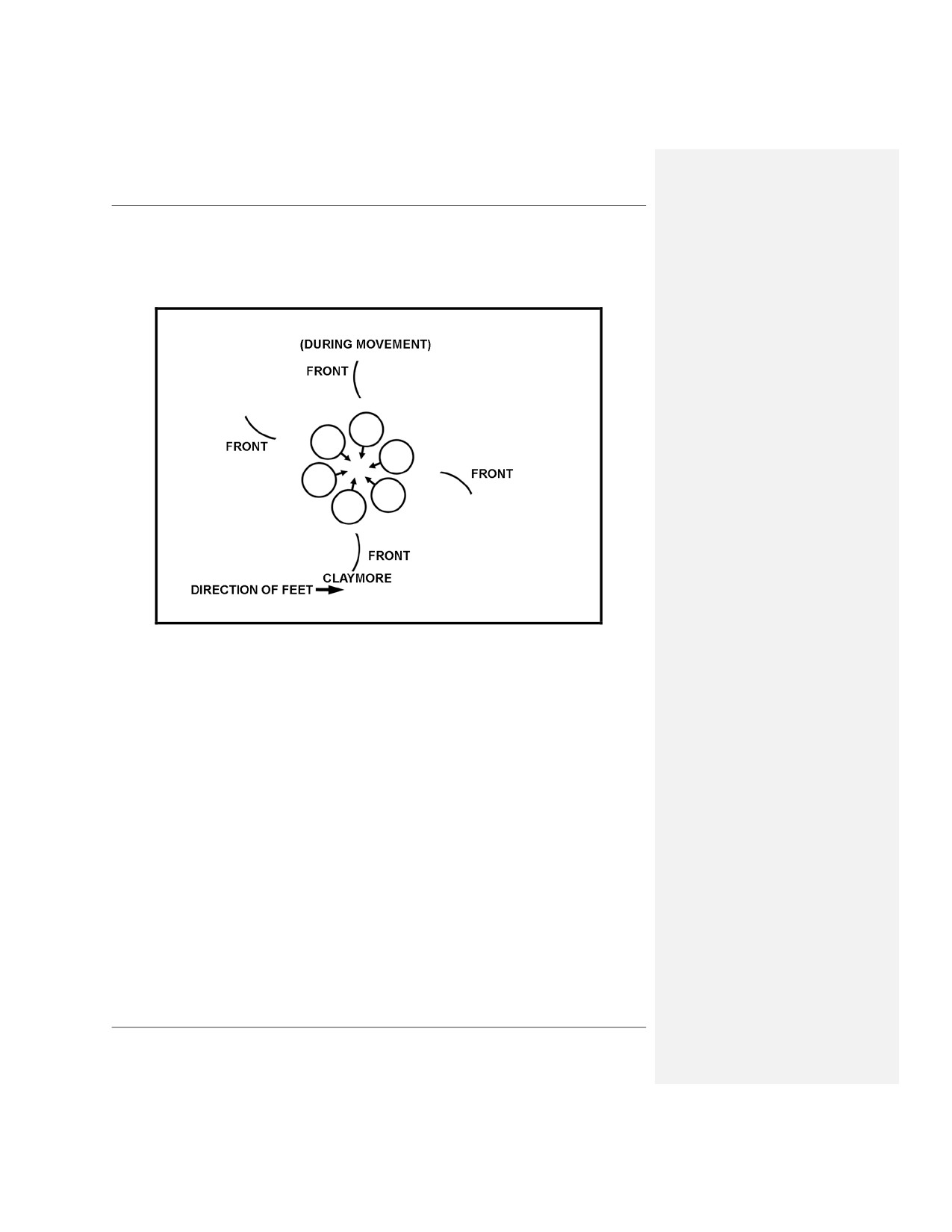
G-22. The team only occupies a hide site by force if it must, such as when time is a major limiting
In such a case, the team leader reconnoiters and the team moves directly into the tentative site
Figure G-6. Forcible occupation of site.
ACTIONS IN HIDE SITE
G-23. The team maintains security at all times. Soldiers are positioned either back-to-back or
feet-to-feet, using all-round security.
• The team waits 15 minutes before moving or unpacking equipment--a listening halt. They do
not lean against small trees or vegetation. They place Claymores at least in the four cardinal
directions.
• If communication is to be conducted from the hide site, they construct the antenna before
daylight. They only raise it off the ground once they are ready to establish communication.
• Wear their load-carrying equipment at all times and camouflage all around the position.
• The best time to rotate teams is at dusk and dawn. The surveillance team takes their rucksacks
or assault packs. The team rests during the day.
FM 3-55.93
G-9
Appendix G
PRIORITY OF WORK
G-24. Except for security, work priorities vary based on METT-TC. The team has security, alert, guard
and rest, evacuation, rendezvous, scheduling, maintenance, hygiene, and meal plans.
• Conduct stand-to starting before first light and continue until after full light. Conduct stand-to
again starting before dark and continue until after dark. Vary start times to avoid patterns.
Conduct stand-to at anytime a heightened level of enemy activity is expected.
• Maintain equipment, radios, weapons, and camouflage.
• Perform personal hygiene and preventive medicine. Conduct isometric exercises.
SITE STERILIZATION
G-25. Before departing hide and surveillance locations, team members must ensure sites and routes have
been sterilized.
• Carry out all foreign debris.
If possible, avoid burying waste and trash. Animals will uncover it and expose it to enemy
patrols. If it must be buried, enclose it in sealed containers or cover the scent with CS or lime,
then bury it at least 18 inches deep.
• Sterilize the sites with displaced earth. Bury the overhead materials in the site itself.
• Camouflages the area by blending the site with local surroundings.
• As team members withdraw from the site, ensure routes are camouflaged to prevent detection.
G-10
FM 3-55.93
Appendix H
Battle Drills
A battle drill is a collective action executed by a platoon or smaller element without
the application of a deliberate decision making process. Well-rehearsed battle drills
are critical to the success of a LRS team. LRS teams are lightly armed, with limited
amounts of ammunition, and normally have no immediately available fire support.
Teams only have resources for basic life-saving first aid in the event of casualties. A
LRS team might only get one chance to defeat or disengage from an enemy force.
Therefore, it is critical all team members respond instantly and instinctively when in
contact. The team must rehearse battle drills thoroughly before actual enemy contact
is made. LRS team battle drills are a supplement to ARTEP 7-1-DRILL.
BREAK CONTACT
H-1.
A team should break contact as soon it can, since it lacks the capability to stay and fight. The team
fires and maneuvers in two- or three-Soldier groups. Team members can use fragmentation or smoke
grenades to cover their withdrawal, continuing until they successfully break contact. Doing so could
require repeated bounds. After breaking contact, the team consolidates at a rendezvous or rally point and
reorganizes.
PRINCIPLES
H-2.
General principles for breaking contact include--
• Maintaining a high initial volume of fire to kill or suppress the enemy.
• Using smoke to screen movement. Hexachloroethane (HC)smoke is best, but white
phosphorous (if available) kills, wounds, and screens.
• Dually priming Claymores (one command-detonated fuse or one timed fuse from 45 seconds to
2 minutes) and preparing them for immediate deployment. This can be integrated into a
rucksack destruction plan.
• Rehearsing "man down" (wounded) actions.
• Rehearsing “RTO down” vital communication retrieval actions.
H-3.
Following the successful execution of the break contact battle drill, the team leader uses
METT-TC to determine the next action of the team.
FM 3-55.93
H-1
Appendix H
INITIAL CONTACT
H-4.
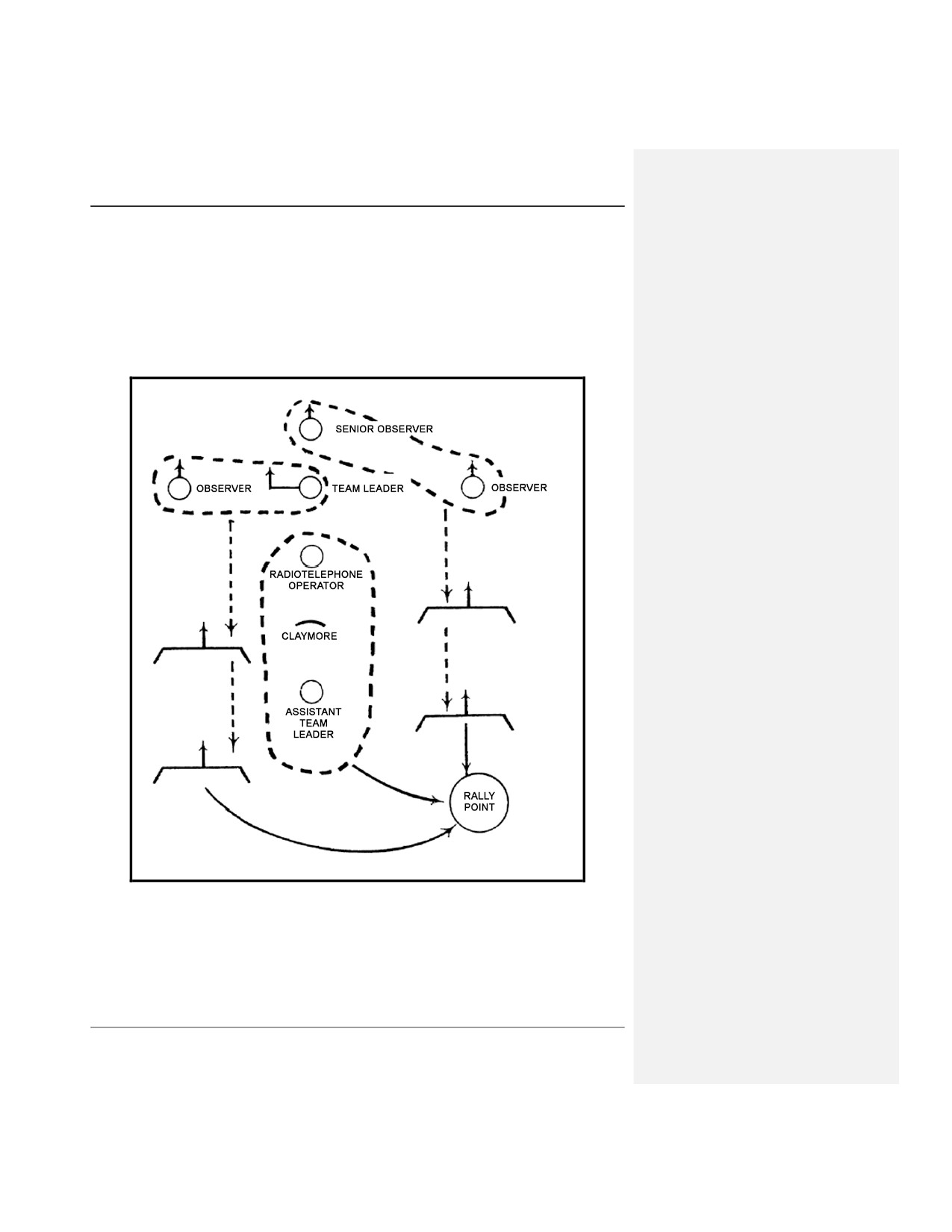
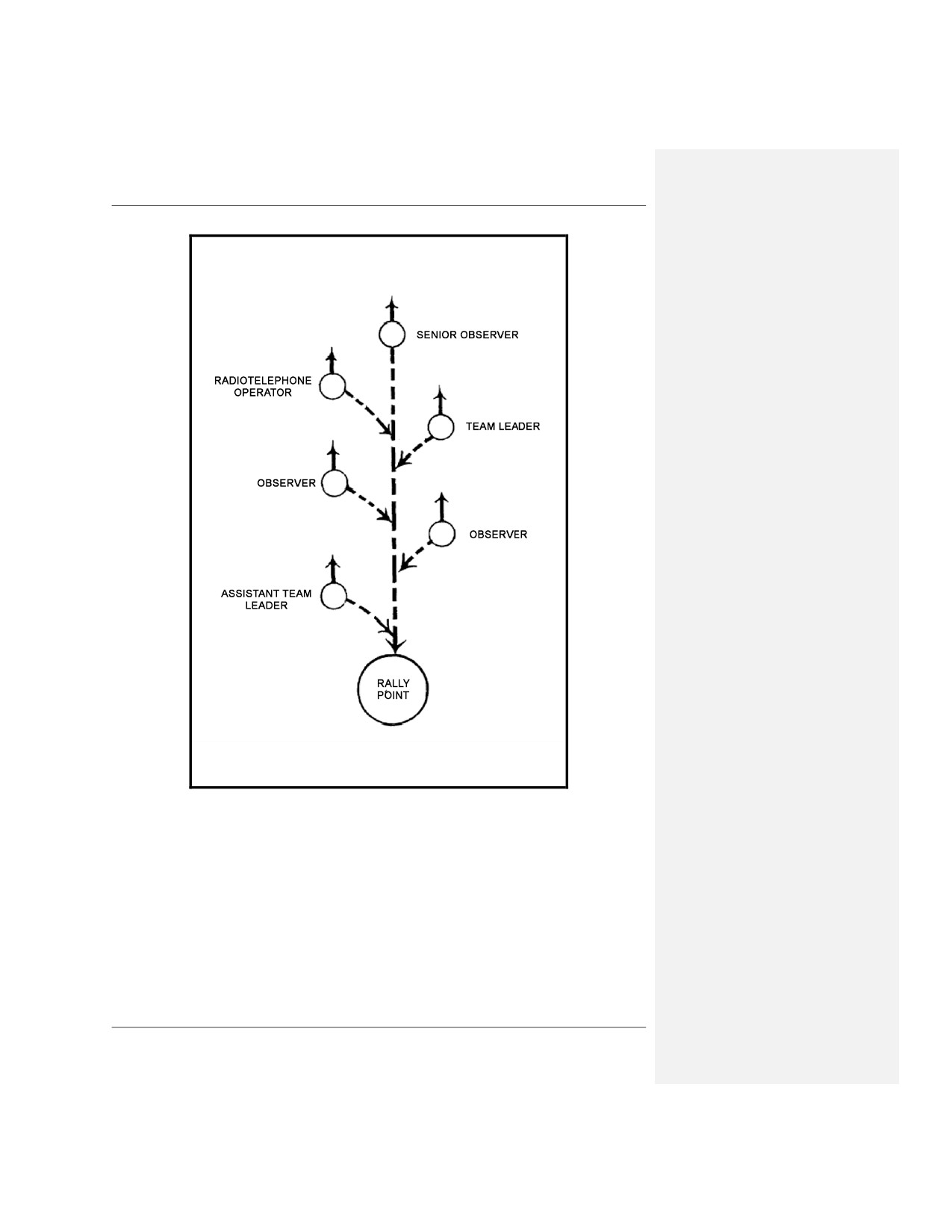
When the team makes initial contact, all team members seek cover and concealment. Each Soldier
makes every attempt to avoid masking the fires of other team members. The lead element (first, second,
third Soldiers), deploy and take cover within a few steps of their original locations, and lay down a base of
fire. The trail element (fourth, fifth, and sixth Soldiers) deploy at the assistant team leader's command. He
calls left or right, depending on the direction of enemy contact and the location of the lead element. The
team deploys roughly on line, and starts firing. This lead element then bounds back (Figure H-1 and
Figure H-2).
Figure H-1. Break contact front (diamond or file).
H-2
FM 3-55.93
Battle Drills
Figure H-2. Break contact front, left and right (Australian peel).
FIRST BOUND
H-5.
The lead element (first, second, and third Soldiers) bound back first, followed by the trail element.
The elements can alternate bounds to keep the enemy guessing.
SMOKE
H-6.
The elements throw smoke on all bounds.
FM 3-55.93
H-3
Appendix H
RELOADING OF MAGAZINES
H-7.
Everyone changes their magazines on the move.
MALFUNCTIONS
H-8.
If a team member's weapon malfunctions, he immediately moves and conducts corrective action
on the bound.
SAFETY
H-9.
All team members keep weapons on "Safe" during bounds.
FORMATION
H-10. Team members bound on line so as to not cross into lines of fire.
ASSEMBLY
H-11. Once the team has broken contact, they reassemble on line and move out of the contact area.
H-4
FM 3-55.93
Battle Drills
CONTACT LEFT OR RIGHT
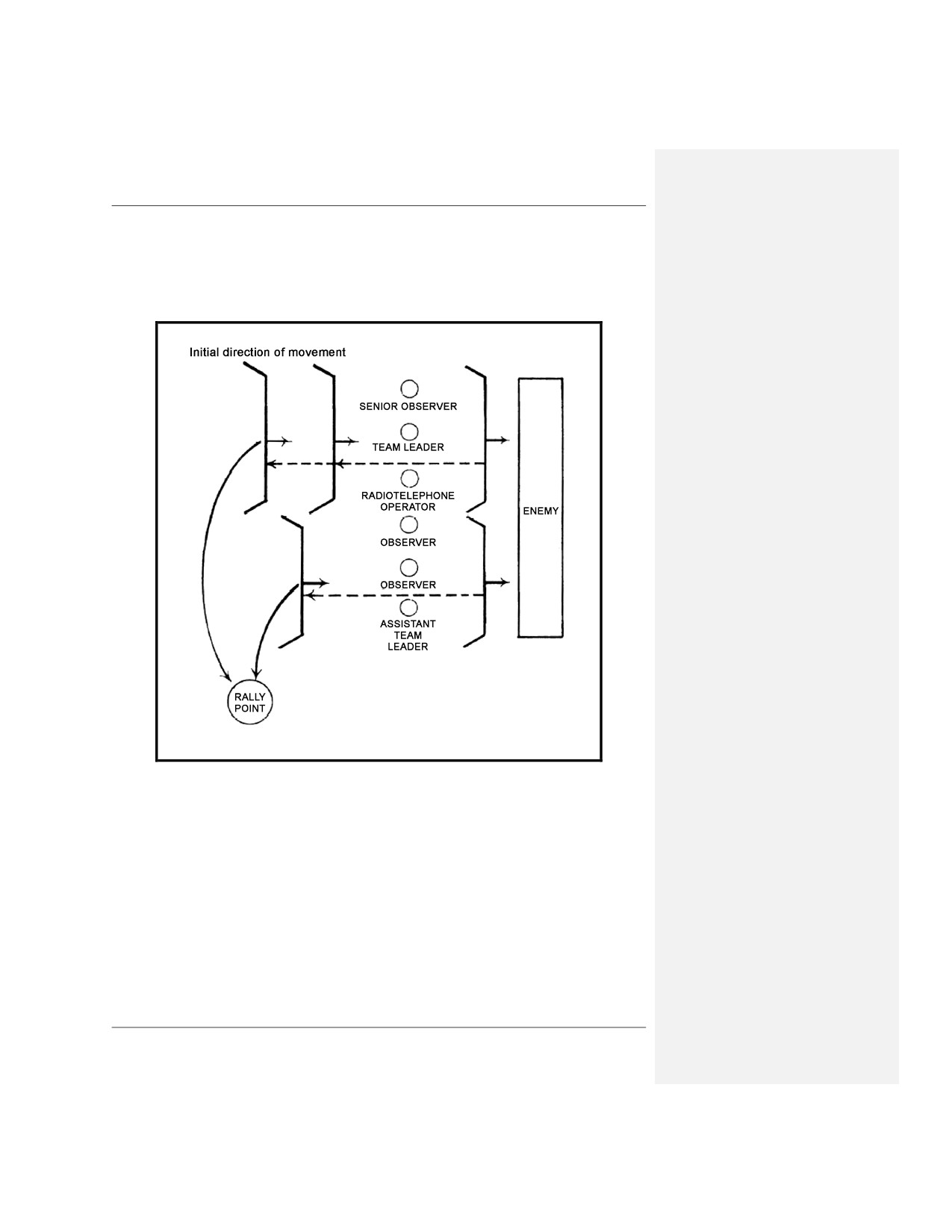
H-12. The team turns toward the contact, takes a knee, and returns fire. One element bounds back while
the other team suppresses the enemy. The second team bounds back and continues until contact is broken.
Both teams assemble on line and move out of the area (Figure H-3).
Figure H-3. Break contact left, right (diamond or file).
FM 3-55.93
H-5
Appendix H
REACT TO AIR ATTACK
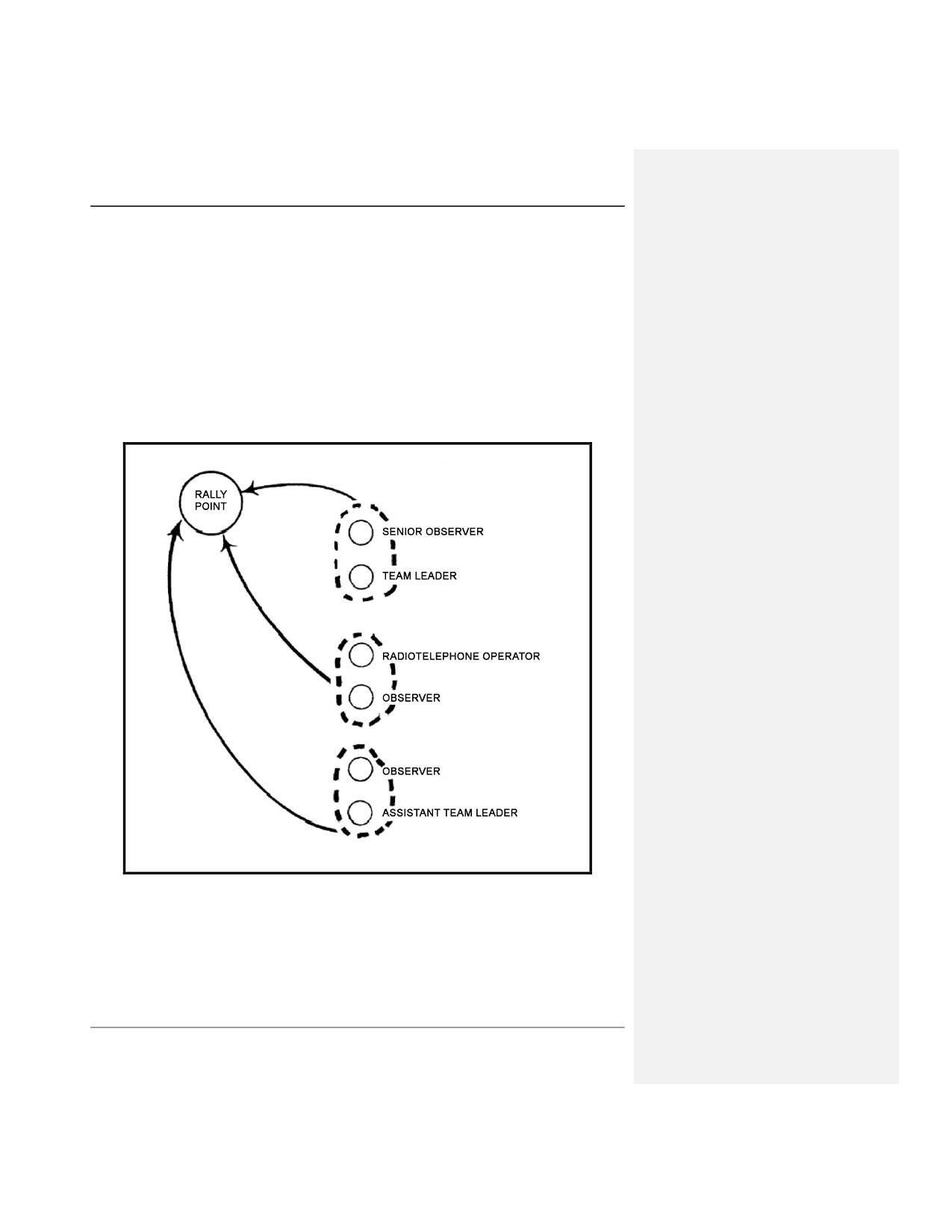
H-13. The first Soldier who hears or sees an aircraft gives the "freeze" signal. The first Soldier who sees
an attacking aircraft alerts, "Aircraft, front
(left, right, or rear)." The team moves quickly into a line
formation, well spread out, perpendicular to the aircraft's direction of flight. As each Soldier comes on line,
he goes prone, using available cover. Between attacks, the team should seek better cover and concealment.
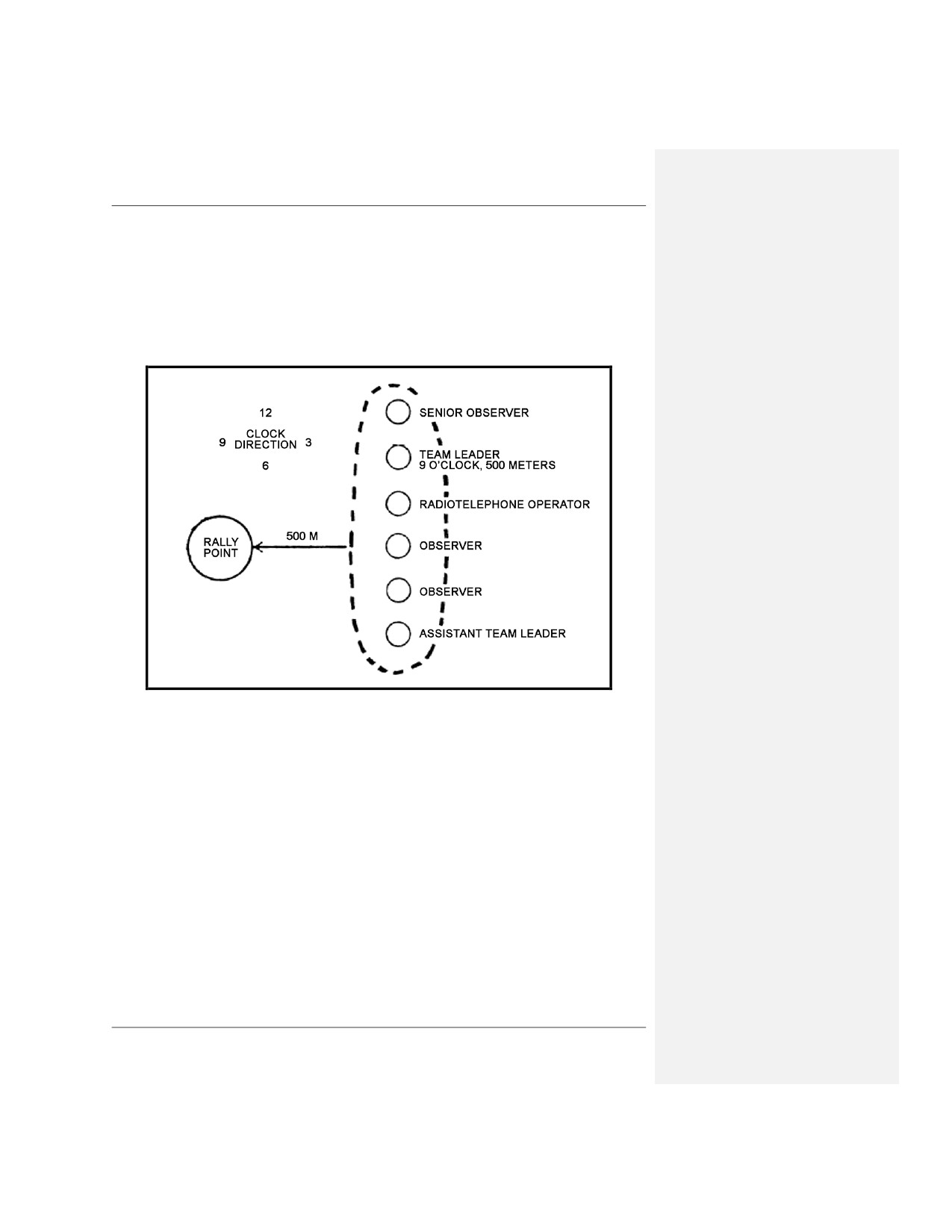
If the team leader wants the team to move out of the area, he gives the clock direction and distance
(Figure H-4).
H-14. After the team consolidates and reorganizes, it moves to the last rally point. The team should
engage the aircraft only as a last resort. Using the head-on method, they mass fires to engage attacking
aircraft. They engage slow-moving aircraft at 50 meters and fast-moving aircraft at 200 meters. If the team
receives fire, the team leader decides whether to continue the mission, move out of the area, or return fire
on the aircraft.
Figure H-4. React to enemy air attack.
H-15. Another technique is to disperse into two groups of three Soldiers each or three groups of two
Soldiers each. On sight of the aircraft, the team leader designates a rally point and gives the command to
disperse. On linkup, the team leader assesses the situation and either calls for extraction or continues the
mission.
H-6
FM 3-55.93
Battle Drills
REACT TO INDIRECT FIRE
H-16. On receiving indirect fire, the team deploys and takes cover. If more rounds impact, the team
leader gives the clock position and the direction and distance to move. The team consolidates while moving
or at a distance given by team leader. Once the team consolidates and reorganizes, it moves out quickly.
The enemy might adjust fires as the team moves. The team should remain oriented on the 12 o'clock
position. They may elect to move to the last rally point or as directed by the team leader. He must also
decide whether to continue the mission or move out of the AO (Figure H-5).
Figure H-5. React to indirect fire or air attack.
REACT TO FLARES
H-17. If the team encounters flares, it should execute the following actions:
GROUND FLARES
H-18. The team moves out of the illuminated area and takes cover. Each Soldier closes his firing eye to
protect his night vision. The team leader decides the next direction to move.
OVERHEAD FLARE WITH WARNING
H-19. The team assumes a prone position--behind concealment, when available--before the flare bursts.
Each Soldier closes his firing eye to protect his night vision.
FM 3-55.93
H-7
Appendix H
OVERHEAD FLARE WITHOUT WARNING
H-20. The team gets into a prone position, making the most use of nearby cover, concealment, and
shadows until the flare burns out. Each Soldier closes his firing eye to protect his night vision. The team
leader gives the direction of movement.
BREAK FROM HIDE OR SURVEILLANCE SITE
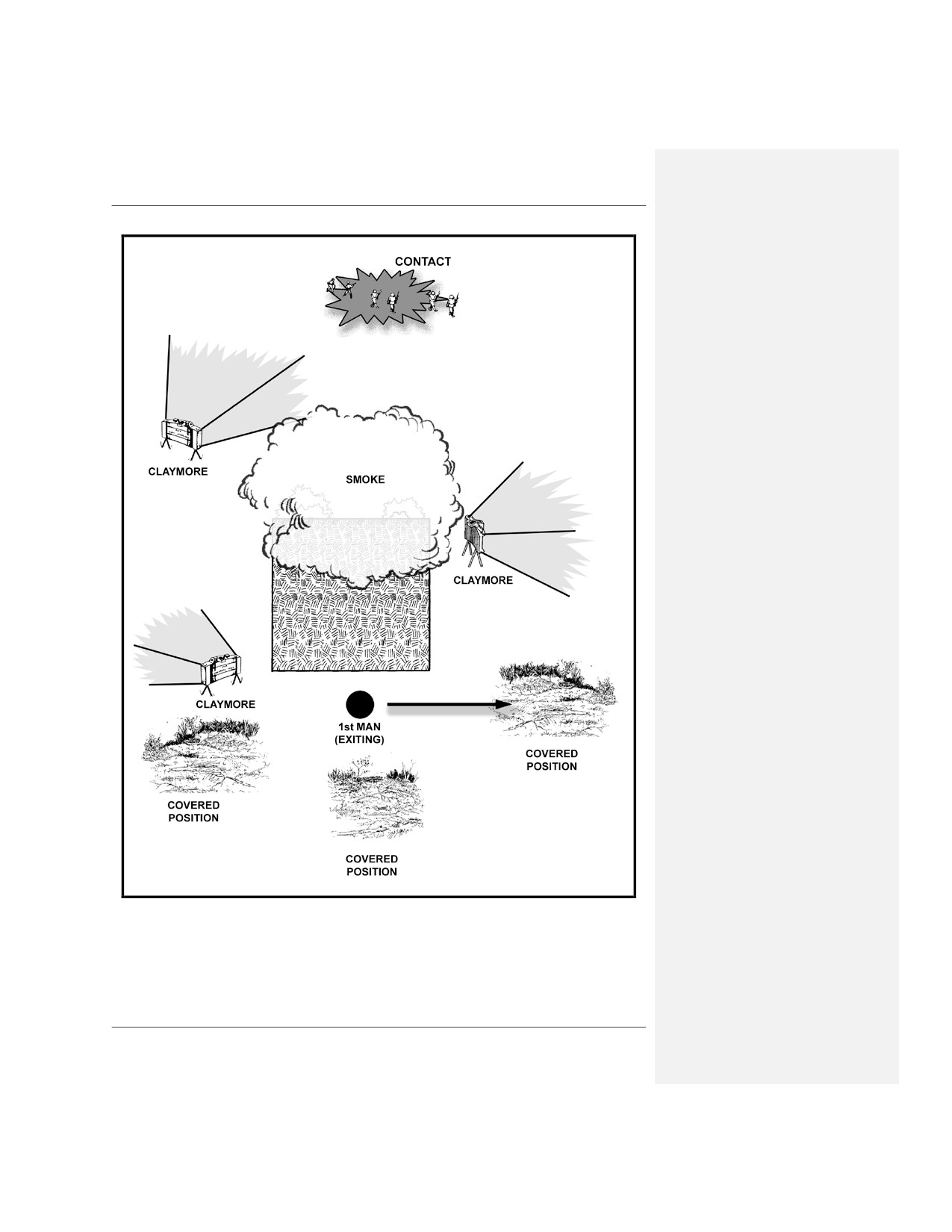
H-21. When a hide or surveillance site is compromised, the element involved might have to execute a
breakout drill. The drill must be well rehearsed to ensure speed, a base of fire, screening, and survivability.
The type of breakout drill used depends on the type of site and the number of personnel in the site. Proper
rehearsals determine the best methods of site construction and the materials needed for a breakout. After
constructing the site, the team employs M18 Claymores and smoke to assist execution of the drill.
• Emplace smoke grenades in the ground around the site so they can be activated with a pull cord
instead of throwing them after clearing overhead cover.
• Rig Claymores in tandem for one-step activation.
• Keep equipment packed at all times. Prepare an assault pack with all of the site's
mission-essential equipment.
H-22. Upon site completion, the leader visually recons the immediate vicinity and designates covered
and concealed positions for each team member. The leader designates responsibilities and order of
movement from the time claymores are detonated. This helps eliminate confusion and increase battle drill
speed and effectiveness.
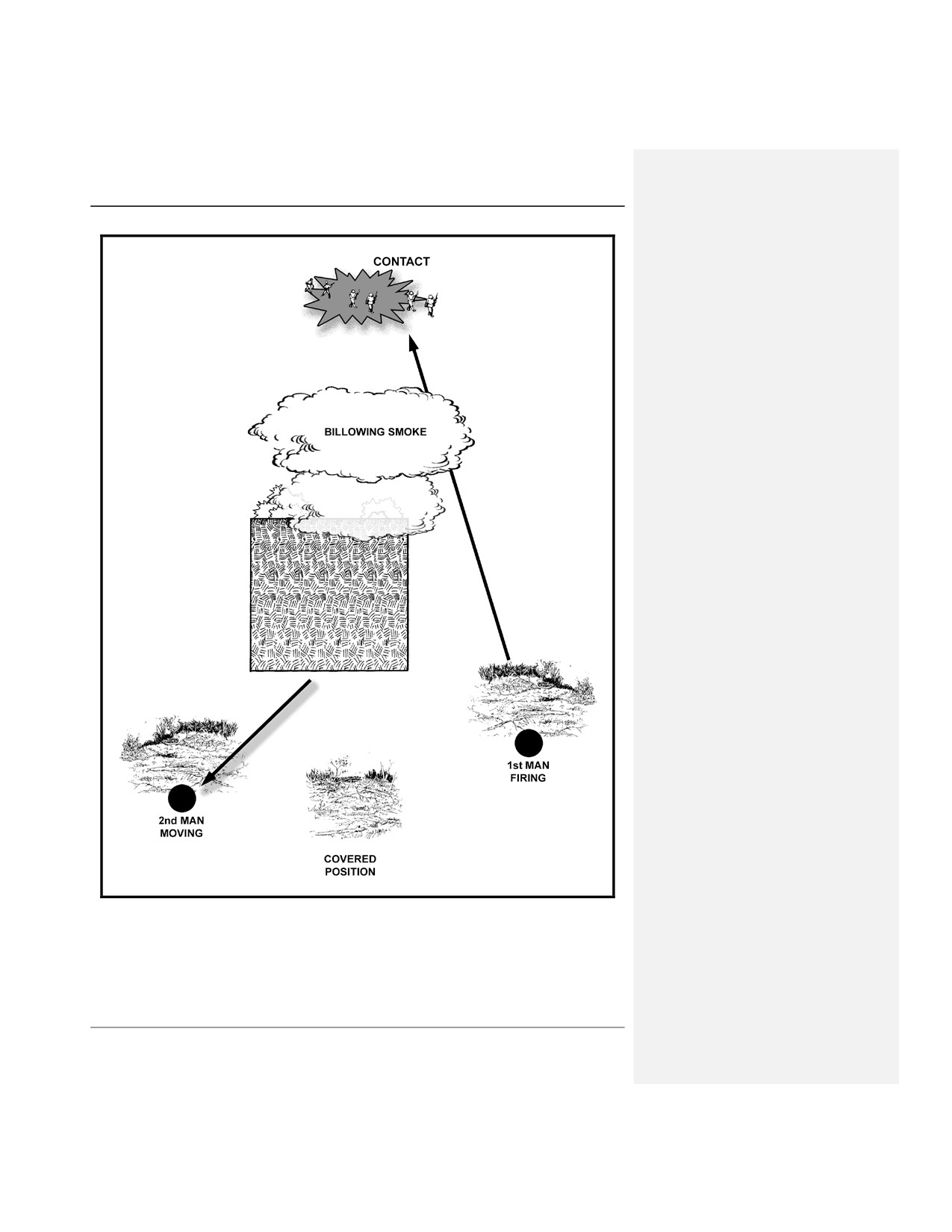
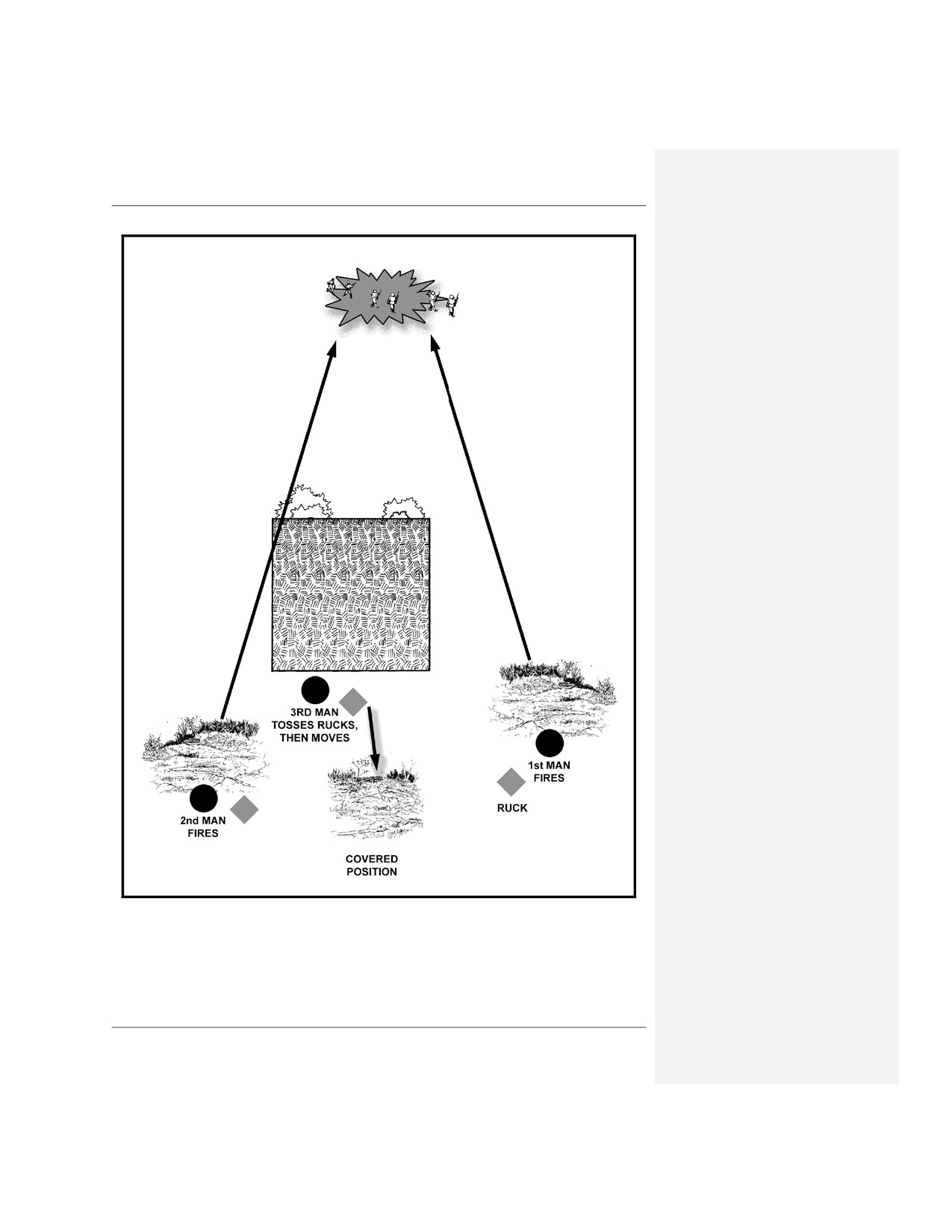
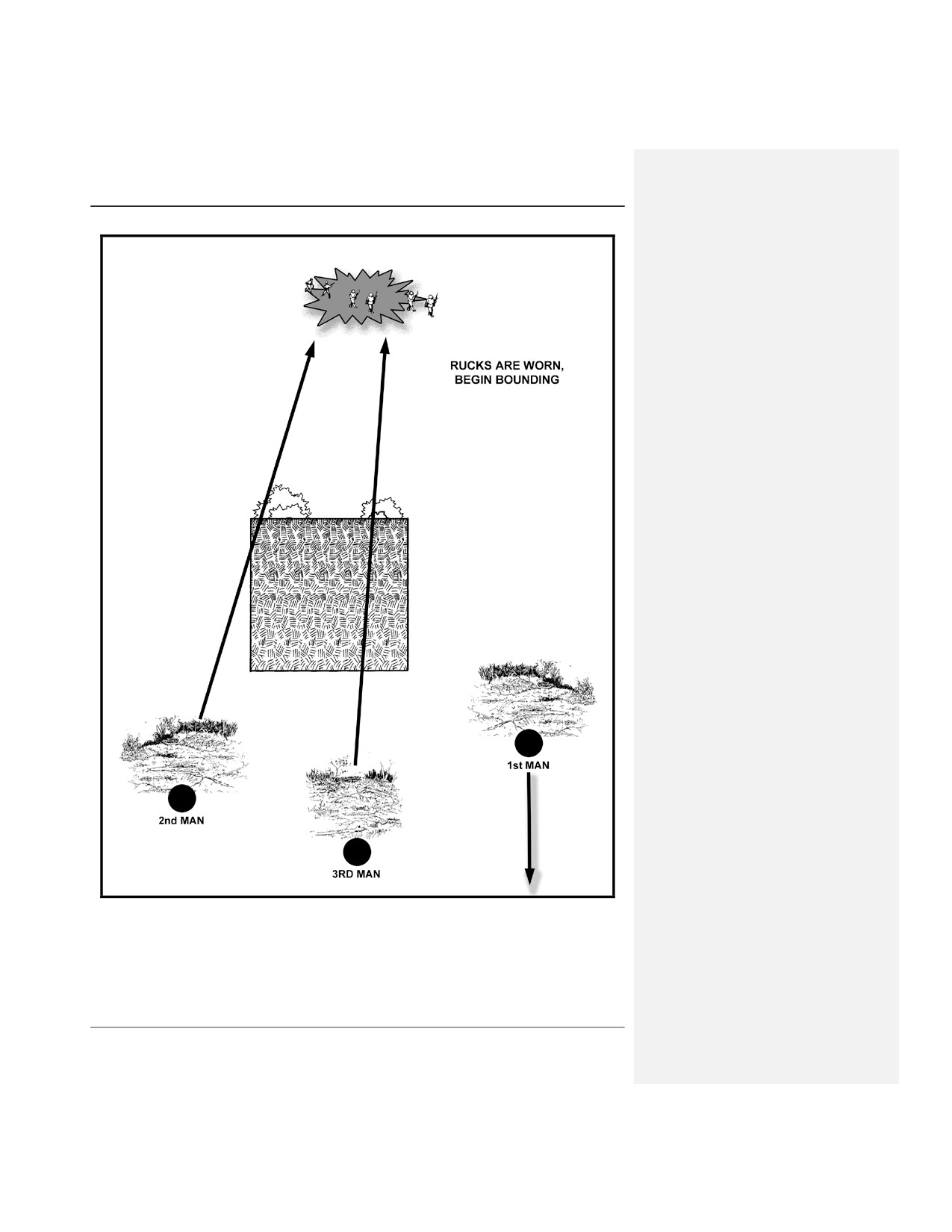
H-23. When compromise is inevitable, the element notifies other team members not in the position of
the situation. Claymores are rigged to all detonate at one time. Smoke grenades are thrown and each
Soldier moves to his designated covered and concealed position, and then he lays down a base of fire to
cover bounding team members. After the breakout, the element links up with the rest of the team or
continues the mission (Figures H-6A through H-6D).
H-8
FM 3-55.93
Battle Drills
Figure H-6A. Break contact from hide or surveillance site.
FM 3-55.93
H-9
Appendix H
Figure H-6B. Break contact from hide or surveillance site (continued).
H-10
FM 3-55.93
Battle Drills
Figure H-6C. Break contact from hide or surveillance site (continued).
FM 3-55.93
H-11
Appendix H
Figure H-6D. Break contact from hide or surveillance site (continued).
H-12
FM 3-55.93
Appendix I
Tracking and Countertracking
The LRS teams must learn crucial tracking skills and techniques for use while in
enemy territory. This allows them to provide immediate intelligence on the frequency
and flow of enemy traffic on a trail. Tracking is also useful when a LRS team
conducts a PR mission to retrieve a downed pilot.
Good tracking skills enhance countertracking skills, and good countertracking skills
assist in the success or failure of a mission by allowing the team to effectively evade
anyone tracking them while in enemy territory.
Both skill sets increase the Soldier's general awareness and reduces the chance of
being caught off guard.
CONCEPTS OF TRACKING
I-1.
To become a tracker, the LRS Soldier must develop and refine traits such as patience, persistence,
acute observation, good memory, and attention to detail. These all help when tracking signs weaken and
the tracker must rely on intuition. As he evaluates sign, he forms an opinion about the enemy's training,
equipment, and morale. Six factors help the tracker form a picture of the enemy.
DISPLACEMENT-TYPE SIGN
I-2.
"To displace" means "to move something from its original position." Thus, "displacement" means
"the act of displacing" or "the signs or evidence that something has moved."
FM 3-55.93
I-1
Appendix I
Survey Area
I-3.
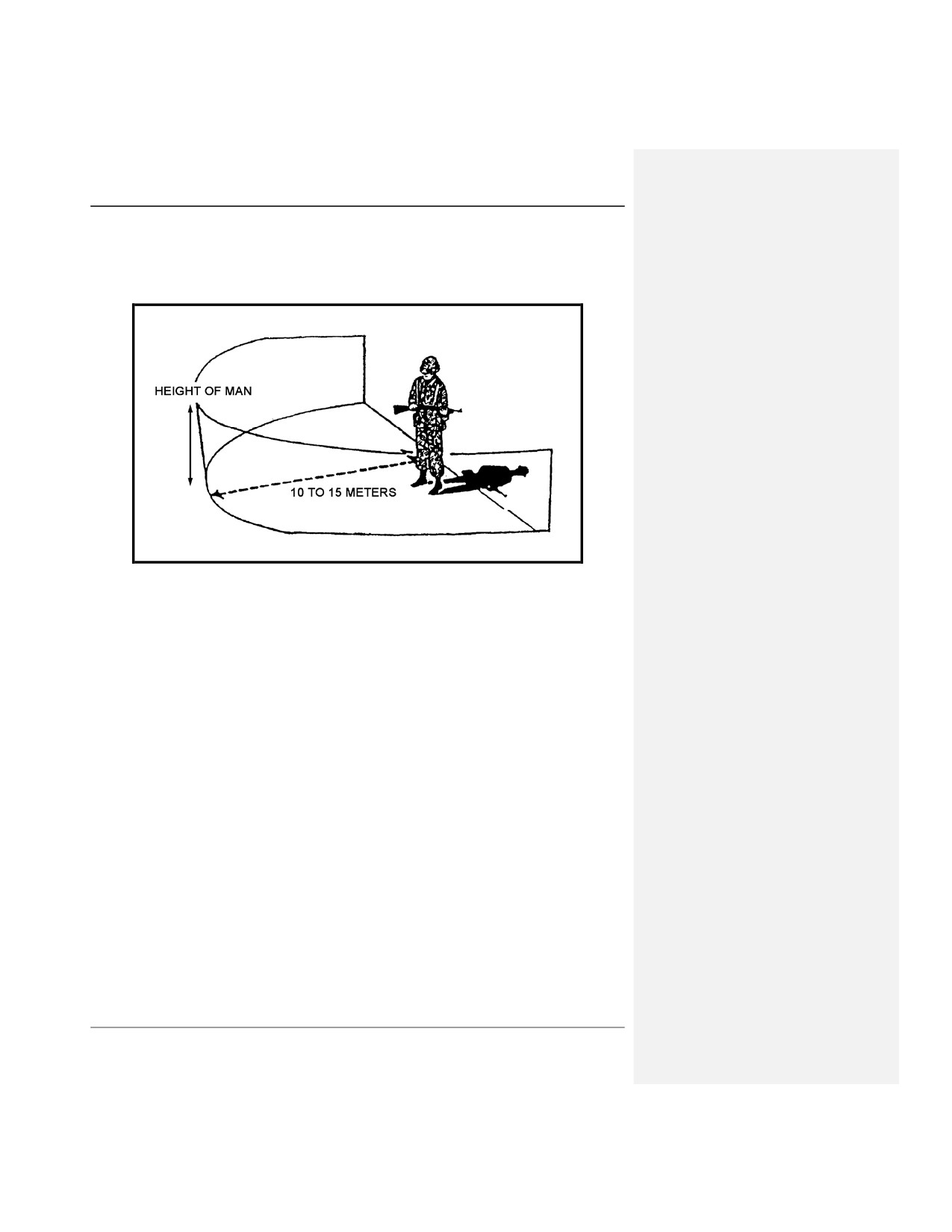
The tracker looks for displacement signs in a full 15-meter deep, 180-degree arc and up to the
height of a tall man (Figure I-1). He evaluates all of the signs for trends and patterns.
Figure I-1. Areas surveyed for indicators by tracker.
Human Passage
I-4.
Some displacement type signs that indicate the likely presence of other humans include footprints;
scraped and broken vegetation; bits of thread or clothing on the ground or on vegetation; limbs freshly
broken or grass bent over on a windless day; the sudden excited cries of animals or sounds of sudden
movement; disturbed insect life; and upturned rocks.
I-2
FM 3-55.93

Tracking and Countertracking
Armed Soldier
I-5.
A footprint, found near a waist-high scuffmark on a tree, can indicate the passage of an armed
Soldier (Figure I-2).
Figure I-2. Examples of displacement.
FM 3-55.93
I-3
Appendix I
Footgear
I-6.
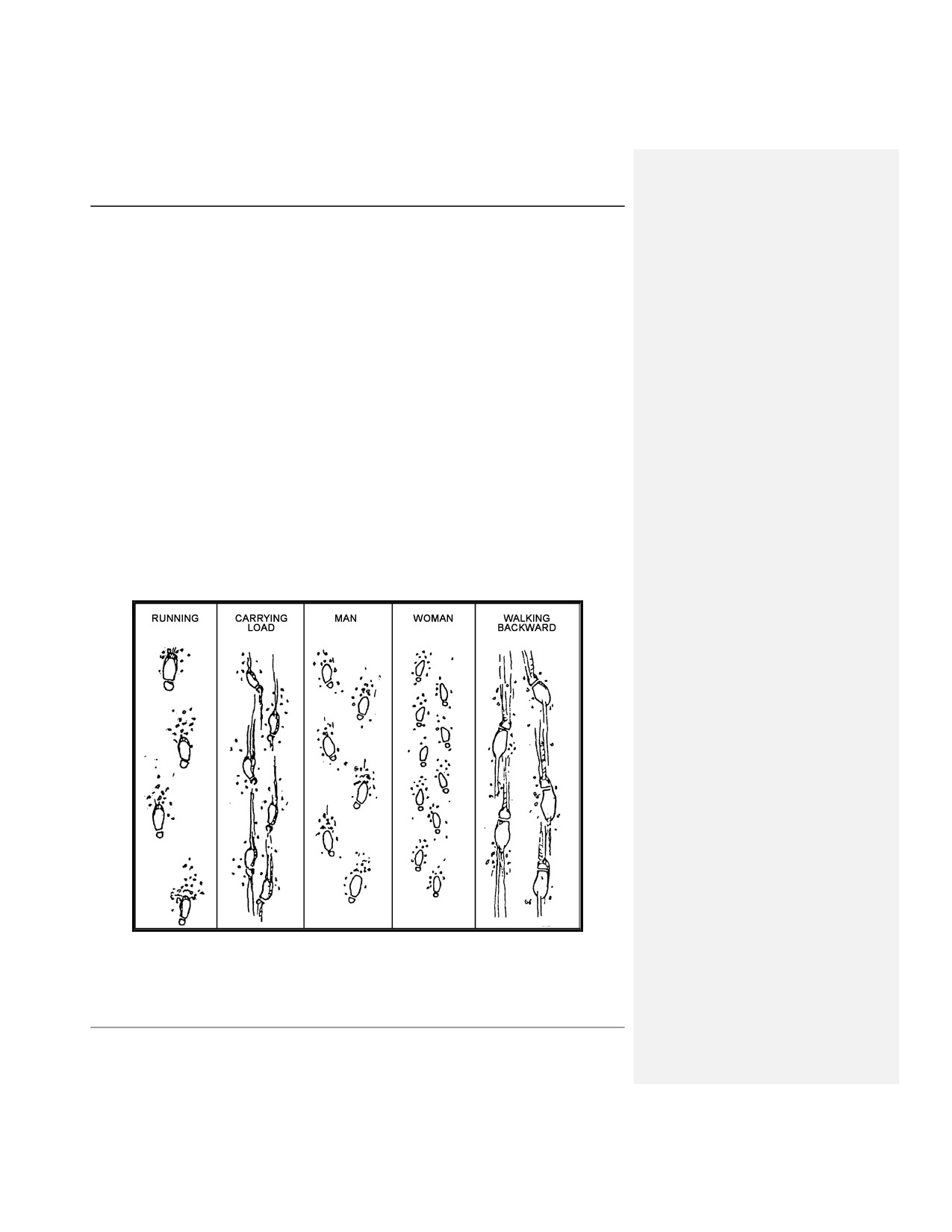
A footprint can reveal what footgear the enemy is wearing, if any; the lack of proper equipment;
the direction of movement; the number and gender of people moving and their rate of movement; the
of their loads; the amount of time passed since they made the track; and whether they know they are being
tracked (Figure I-3).
Rapid Movement
I-7.
If the footprints are deep and the pace long, the party is moving fast. Long strides and deep prints,
with toe prints deeper than heel prints, indicate that they are running.
Heavy Load
I-8.
If the prints are deep, short, and widely spaced, with signs of scuffing or shuffling, the party is
probably carrying a heavy load.
Gender
I-9.
To determine the gender of the party, study the sizes and positions of the footprints. Women tend
to walk with their toes pointed inward, whereas men usually walk with their feet pointed straight ahead or
outward. Women's prints and their strides are usually shorter than those of men.
Backstep
I-10.
If a party knows or suspects that someone is following them, they might try to hide their tracks.
Parties walking backwards have a short, irregular stride. The prints will have an unusually deep toe, and the
soil will be kicked backward, confirming the direction of movement.
Figure I-3. Types of footprints.
I-4
FM 3-55.93
Tracking and Countertracking
Box Method
I-11.
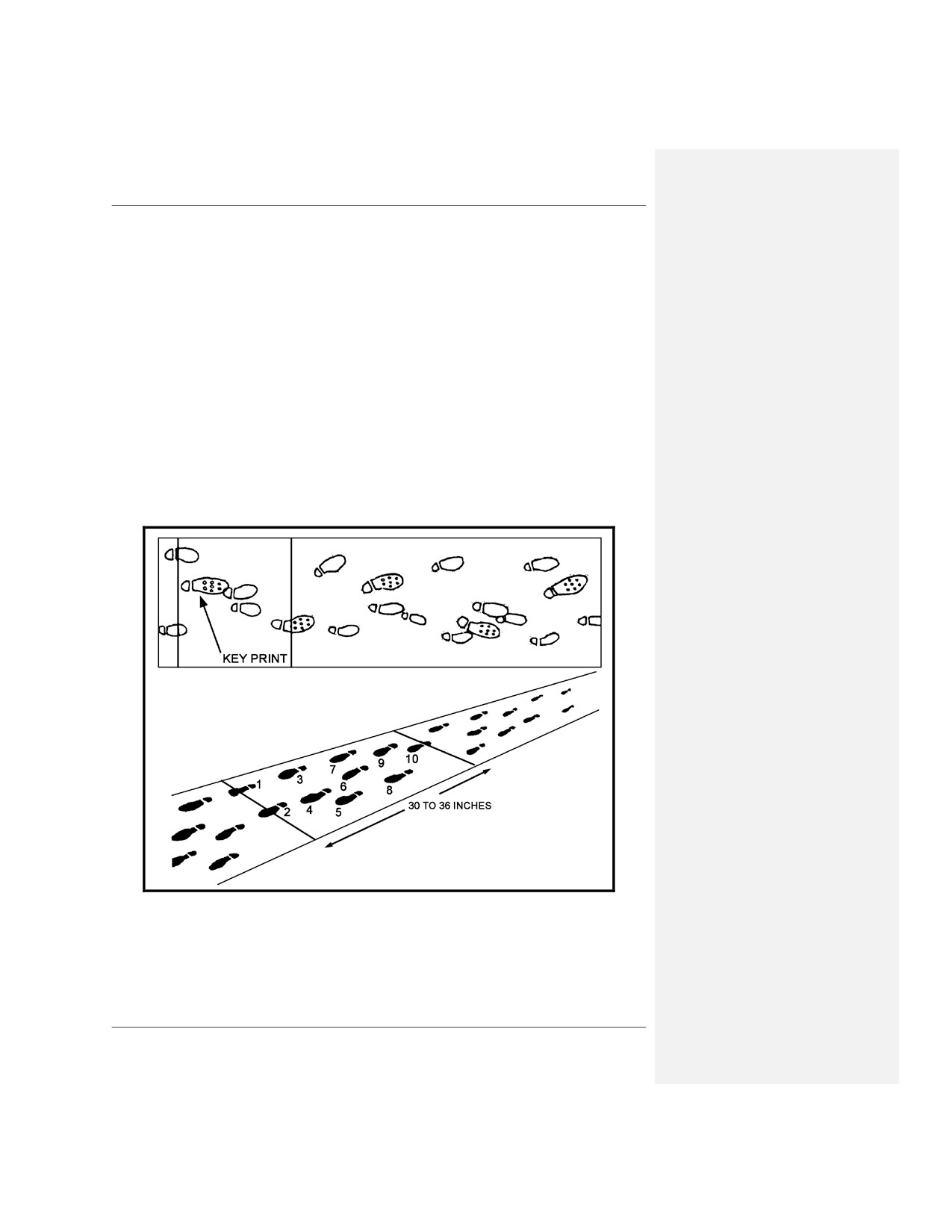
To use the 36-inch-box method, mark off a 30- to 36-inch cross-section of the trail, count the
in the box, then divide by two to determine the number of parties who used the trail. The M16 rifle is 39
inches long. You can use it to measure (Figure I-4).
Identify a Key Print
I-12.
The figure shows the use of a left boot print as the key print. In this situation, you draw a line from
the heel across the trail.
Move Forward
I-13.
Move to the key print for the opposite foot and draw a line through the instep. Your two lines form
two opposite sides of a box. The edges of the trail form the other two sides. Together, the four lines form
a box.
Count
I-14.
Count every whole or partial print that falls inside of the box. Because any person who was
walking normally would have stepped in the box at least once, the number of footprints in the box will help
you to determine the total number of people in the party.
Figure I-4. Box method for determination of number of footprints.
FM 3-55.93
I-5
Appendix I
STAINS
I-15.
One obvious example of staining is blood on the ground or foliage. Other examples include mud
dragged by footgear and crushed vegetation on a hard object. Crushed berries also cause stains, and,
finally, the movement of water makes it cloudy.
EFFECTS OF WEATHER
I-16.
The weather may help or hinder the tracker to determine the age of signs. Wind, snow, rain, and
sunlight all affect tracking. Assess recent weather aids in determining the age of a track. A tracker can use
the last rain or strong wind as a measure to show the amount of time it has been there.
LITTER
I-17.
A poorly disciplined unit leaves a trail of litter.
DECEPTION TECHNIQUES
I-18.
Deception applies when the followed party tries to slow the tracker by, for example, leaving false
trails, walking backwards, brushing out trails, splitting up, fading out, fanning out, and walking over rocky
ground or through streams.
INTERPRETATION OF COMBAT INFORMATION
I-19.
The tracker makes a mental image of his quarry based on his learned concepts. When reporting to
the commander, he reports what he believes, but should not state it as a fact. The commander considers the
facts alongside the tracker's beliefs and any other information he has.
ORGANIZATION OF TRACKING TEAM
I-20.
Tracking units can be any size as long as they have these three elements: a leader, a tracker, and
security. Often tracking teams consist of two types:
TRACKER AND COVER PERSON
I-21.
Each team member is equally skilled. They can move fast because they know each other's abilities
and weaknesses and can compensate for each other.
TRACKING TEAM LEADER, TRACKER, RTO, AND TWO SECURITY PERSONNEL
I-22.
The advantages of a tracking team with this many members are increased observation and
security. The disadvantage is the size of the team.
TRACKER AND DOG TEAM
I-23.
Trackers work more effectively with dog teams than without.
TRAITS OF A TRACKING DOG
I-24.
The dog(s) follows a trail faster and can continue to track at night. Despite years of domestication,
dogs retain most of the traits of their wild ancestors. If put to controlled use, these traits are effective when
tracking.
I-6
FM 3-55.93
Tracking and Countertracking
Endurance
I-25.
A dog can hold a steady pace and effectively track for up to eight hours. The speed can be up to 10
miles per hour, only limited by the speed of the handler. The speed and endurance can be further increased
by the use of vehicles and extra teams.
Mental Characteristics
I-26.
Dogs are curious by nature. They can also be aggressive or lazy, cowardly or brave. Dogs' sensory
traits are what make them seem intelligent.
Aggressiveness
I-27.
Tracking dogs are screened and trained to function as aggressive trackers, eager to please their
handlers.
SENSES OF A TRACKING DOG
I-28.
Knowledge of the dog's senses and how he uses them helps the evader to think ahead of the dog.
Sight
I-29.
A dog's vision is the lesser of the sensing abilities. He can see in black and white and has trouble
spotting static objects at more than 50 yards. He can spot moving objects at considerable distances, but he
does not look up unless he is trained. His night vision is no better than that of a human.
Sound
I-30.
Dogs can hear quieter and higher frequencies than humans. A dangerous problem for the evader is
the dog's ability to hear. Even more dangerous is their ability to locate the source of a sound. Dogs can hear
40 times better than a human.
Smell
I-31.
The dog's sense of smell is about 900 times better than a human. It is by far the greatest asset to
the tracker and largest threat to the evader. Dogs can detect minute substances or disturbances on the
ground, or even in the air. Using distracting or irritating odors such as CS powder or pepper only bothers a
dog for 3 to 5 minutes. After the dog discharges the odor, he can pick up a cold trail even quicker. The dog
smells odors from the ground and air and forms scent pictures. He puts together these scent pictures from
several sources.
Individual Scent
I-32.
This is the most important scent when it comes to tracking. Vapors from body secretions work
their way through the evader's shoes onto the ground. Sweat from other parts of the body rubs off onto
vegetation and other objects. Scent is even left in the air.
Reinforcing Scent
I-33.
Objects that reinforce the scent as it relates to the evader are introduced to the dog. Some
reinforcing scents could be on the evader's clothing or boots, or they could be made of the same material as
is used in his clothing. Even the smell of boot polish can help a dog find a person.
FM 3-55.93
I-7
Appendix I
Ecological Scent
I-34.
For the dog, the most important scent comes from the earth itself. The strongest smell comes from
disturbances in ecology such as crushed insects, bruised vegetation, and broken ground. Over varied
terrain, dogs can smell particles and vapors carried by the evader wherever he walks.
UNFAVORABLE TRACKING CONDITIONS
I-35.
Few conditions are ideal for dog tracker teams. During training, the teams learn the difficulties
that they will face and develop skills to cope with them:
Unverified Start Point
I-36.
The dogs may follow the wrong route or scent.
Heat, Low Humidity, and Dry Ground
I-37.
These all cause rapid evaporation of scent.
Wind
I-38.
Wind disperses scent, causing the dog to track downwind.
Heavy Rain
I-39.
This washes scent away.
Distracting Scents
I-40.
These divert the dog's attention from the trail. Some distracting scents are blood, meat, manure,
farmland, and populated areas.
Elements that Cover Scent
I-41.
Some elements in nature cover the scent picture partially or completely. For example, sand can
blow over the tracks and help to disguise it; snow and ice can form over the track and make it nearly
impossible to follow; and water can completely obscure a trail.
FAVORABLE TRACKING CONDITIONS
I-42.
Some conditions favor the teams:
Fresh Scent
I-43.
Scent is probably the most important factor for dog tracker teams. Fresh scent increases the
chance of success.
Verified Starting Point
I-44.
Introducing a definite scent to the dogs early on increases the chance that the dogs will follow the
correct trail.
Unclean Evader
I-45.
An unclean evader leaves a more distinctive scent.
I-8
FM 3-55.93
Tracking and Countertracking
Fast Moving Evader
I-46.
A fast moving evader causes more ground disturbances than a slower moving evader and, because
he is sweating more than the slower mover, he also leaves a stronger scent trail.
Night and Early Morning
I-47.
At these times, the air is thicker, so scent lasts longer.
Cool, Cloudy Weather
I-48.
This limits evaporation of scent.
Lack of Wind
I-49.
This keeps the scent close to the ground. It also keeps it from spreading around, allowing the dog
to follow the correct route.
Thick Vegetation
I-50.
This restricts the dissemination of scent and holds the smell.
COUNTERTRACKING
I-51.
To avoid or evade the enemy, the LRS team must constantly use countertracking techniques.
Knowledge of tracking is probably the best way to successfully evade trackers. Knowledge of trackers and
dog teams greatly assists the survivor when evading the enemy. The two main types of trackers and
methods of evading each follow:
Visual Trackers
I-52.
Visual trackers cue, obviously, on visible signs. Evading them requires that you reduce visual
signs and confuse the tracker(s):
Outdistance the Tracker
I-53.
Put time and distance between you and the tracker. This increases the chance that the track will
disappear or the tracker team will track too slowly to keep up with you (the team).
Change Direction Frequently
I-54.
Change direction often--at least every 1,000 meters--and cover your changes. This can confuse
less skillful trackers and buy you some time. If a tracker picks up sign, he can send a party ahead as far as
he feels confident that the tracks may be found on a track trap such as road or muddy bank. Track traps
allow trackers to gain time and distance on the evaders. Methodical tracking is slow and arduous. By
changing direction, you can prevent these cutting parties from finding sign where they expect it and can
enlarge the area that the tracker must cover. If you must cross a track trap such as a road, approach at an
off-angle to your azimuth and cross the road or track trap. After crossing, go a short distance, and then
change direction sharply, carefully covering the signs.
FM 3-55.93
I-9
Appendix I
Use Streams for Deception
I-55.
Approach a stream at an off-angle. Move downstream for 100 to 200 meters, leaving false trails
every so often. At the end of the false trail, leave a set of tracks and countertrack them just enough that the
tracks can be seen just barely. This will make the tracker think that he has found the right set of prints. Find
a place to enter the stream such as a log and move in the opposite direction from where you entered. Go to
a place where you can leave the stream without leaving sign and do so. This will buy you time, because the
trackers will have to check out false trails and scour the banks for tracks.
Move on Hard Surfaces
I-56.
Any surface that is too hard to retain the indentations of feet makes visual tracking almost
impossible. Ensure that the soles of your footwear are as clean as possible to avoid leaving deposits on the
surface. Enter the hard-surfaced area from an off-angle, and leave as little sign as possible. Even as little as
100 meters of hard surface can gain you a great amount of time over a tracker team.
Camouflage Sign
I-57.
Any deliberate attempt at camouflage will slow any following parties by making them look harder
for sign. It will also make the aging of sign more difficult. The best technique is to leave as little sign as
possible. This is an individual responsibility. One person at the rear of the formation cannot cover all the
sign left by a team of six. Each person must take special care at track traps and things such as ant mounds
that leave definite signs for trackers. When crossing roads or track traps, try to step in the footprints of the
Soldiers before you. This will make the job of countertracking for the last Soldiers easier. If you cannot
completely camouflage the tracks, try to age them by brushing them or sprinkling debris in them.
Walk Backwards
I-58.
Walking backwards produces a different type of print than walking forward, but only the most
skillful trackers will pick up the difference. Used with other deception methods, this one can create some
confusion and buy some time.
Split Up the Team
I-59.
Multiple sets of tracks slow the tracker team, because following six sets of prints takes much
longer than following one set. The team can then link up at a rally or rendezvous site. This is a great
technique for use in tall grass or other areas where leaving tracks is unavoidable. Animal tracks increase
the confusion.
Use Animal Trails
I-60.
Wildlife that shares trails with the team will soon obscure any signs of human passage.
Set Booby Traps
I-61.
Even if the tracker team fails to detonate the device, they will become more cautious. A few hasty
devices such as a grenade and trip wire will slow them down considerably. The more they encounter, the
slower they will move.
Dog Trackers
I-62.
Dogs track by scent, so countertracking against them is more difficult than countertracking a
visual tracker. One of the main ways to defeat a dog is to defeat his handler. A dog is only as effective as
the handler allows:
I-10
FM 3-55.93
Tracking and Countertracking
Change Direction Frequently
I-63.
One way to defeat the handler is to change direction frequently. A relatively inexperienced handler
might perceive the dog's resulting frequent direction changes as a sign of indecisiveness. He might then
think that the dog has lost the scent. Changing direction frequently in difficult terrain such as brush has the
added advantage of entangling dog and handler, thus fatiguing and stressing them.
Use Hard Surfaces
I-64.
Dogs track best on loose textured surfaces. Hard surfaces seldom retain scent as well. Use these as
is tactically feasible. The effect of this technique depends on the experience of the dog.
Travel in More Frequented Areas
I-65.
While not a preferred technique for a LRS team, traveling in more frequented areas might be
necessary to throw dogs off the scent. Having to differentiate between scents can cause them to lose the
scent of the team.
Travel in Streams
I-66.
While traveling in streams, avoid contact with anything that could catch and reinforce your scent
such as a branch or rock.
METHODS OF AVOIDING DETECTION
I-67.
To avoid detection--
Wear Common Footwear
I-68.
Some types of soles, such as the ripple type, are uncommon, which allows for easier tracking. Flat
soles leave less sign than treaded soles, but are impractical for traveling over rough terrain. Wearing
sandbags over boots reduces sign. However, burlap rips off and leaves telltale sign, so watch out for this
should you choose this method.
Leave No Scent
I-69.
Avoid leaving scent. While in a position or on the move, leave as little scent picture as possible.
Food, blood, urine, and feces all leave strong, reinforcing scents for a search dog. Be especially careful in
areas where you must remain for some time and in areas that you know are patrolled by dog teams.
Behave Unpredictably
I-70.
Go against everything that human nature tells you to do. Go into difficult terrain and behave as
most people moving through such an area would not do.
Practice Tracking
I-71.
Know your enemy. Practice tracking and you will notice things that you should avoid doing when
you are the one being tracked. For the team to successfully countertrack as a unit, each team member must
have a basic working knowledge of tracking.
FM 3-55.93
I-11
Appendix J
Night Operations
Night-fighting skills are necessary and are combat multipliers. Infantry forces use
these skills to gain tactical and psychological advantages. Night operations do not
rely on technology for success--commanders can plan and execute them with or
without the use of night vision devices. In fact, for LRSU, night operations are
the norm.
This appendix lists the psychological, physiological, and physical effects of
night-fighting. It also discusses the techniques used to maintain direction, control,
and surprise. Some of these apply in other limited visibility conditions such as fog,
rain, snow, and sandstorms.
NIGHT VISION
J-1.
At night, the eye uses spiral eye cells called rods. These cells cannot differentiate color, and are
easily blinded by light. This creates a central blind spot, which causes the viewer to miss larger objects as
distances increase.
PROTECTION OF NIGHT VISION
J-2.
Soldiers who work and perform tasks in daylight experience a reduction in night vision. Exposure
to intense sunlight for two to five hours significantly decreases visual sensitivity for up to five additional
hours. Sunlight magnified by reflective surfaces such as sand or snow reduces the rate of adaptability to the
dark and it reduces general night vision even more. These effects are cumulative and may persist for
days. Consequently, Soldiers scheduled for night operations should wear military, neutral-density (N-15)
sunglasses (or the equivalent) in bright sunlight.
FM 3-55.93
J -1
Appendix J
NIGHT-VISION SCANNING
J-3.
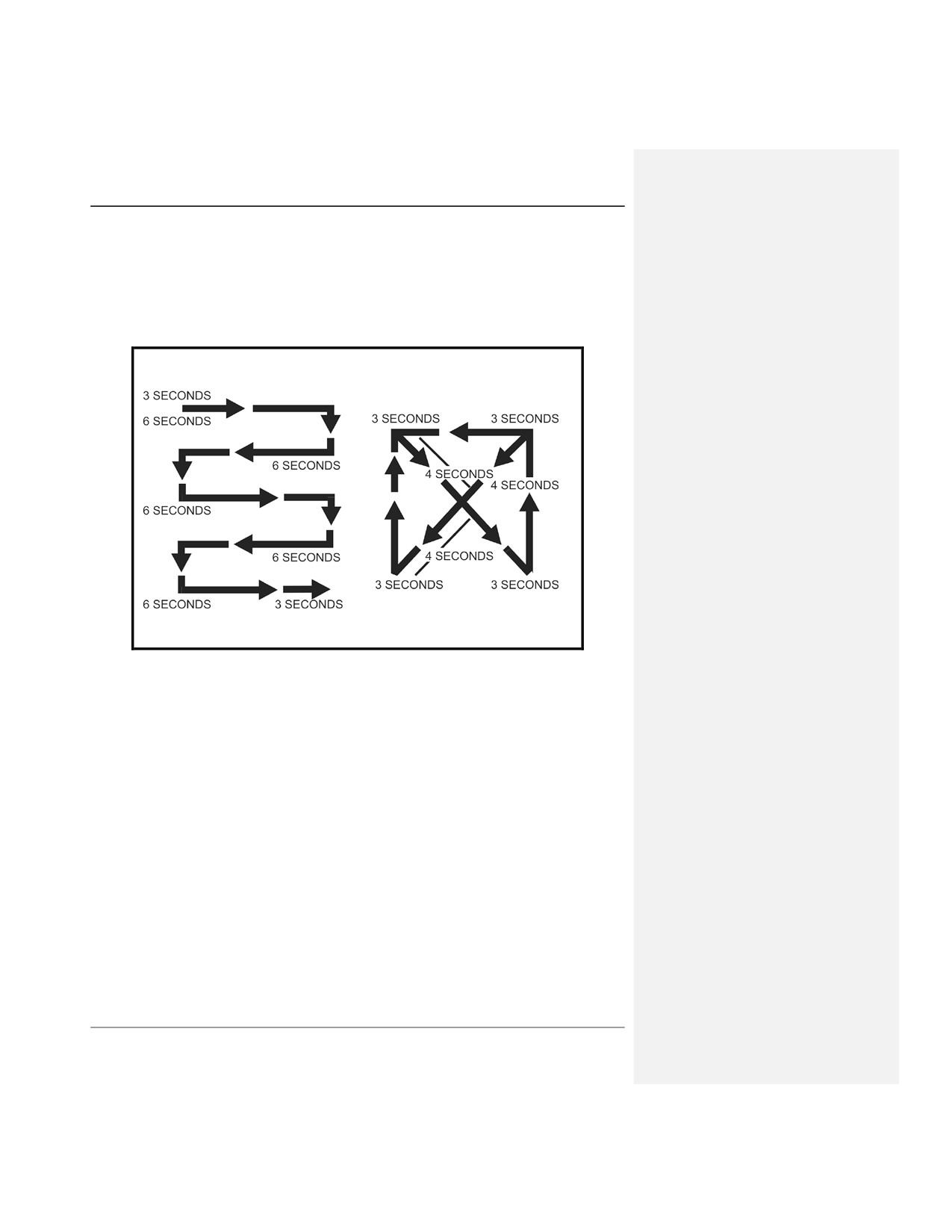
Soldiers use the night-vision-scanning technique to overcome physiological limitations and reduce
illusions. It also protects their night vision and dark adaptation capabilities. The night-vision-scanning
technique involves scanning slowly and regularly from right to left or from left to right (Figure J-1).
Granted, this is the same as scanning in daylight. The difference is that, at night, Soldiers must also avoid
looking directly at faintly visible objects.
Figure J-1. Typical scanning patterns.
J -2
FM 3-55.93

Night Operations
OFF-CENTER VISION
J-4.
Looking straight at an object (using central vision) works in daylight, but not at night. This is due
to the aforementioned central blind spot. To compensate for this blind spot, Soldiers use off-center
(peripheral) vision. In other words, instead of looking directly at an object, they look 10 degrees above,
below, or to either side of it (Figure J-2).
Figure J-2. Off-center viewing technique.
ADAPTATION TO THE DARK
J-5.
Adaptation to the dark means that as darkness increases, so does visual sensitivity. Just like the
aperture in a camera, the pupil opens to let in more light. Soldiers are unique, so they adapt to darkness at
slightly different degrees and rates. After the first 30 minutes in the dark, visual sensitivity maxes out (to
about 10,000 times that of normal), and it increases little after that time.
FM 3-55.93
J -3

Appendix J
• Visual sensitivity in the dark is affected by exposure to bright lights such as matches,
flares, and vehicle headlights. Full recovery from this exposure might take up to 45 minutes.
• Use of night vision goggles impedes dark adaptation. However, if a Soldier adapts to the dark
before he dons the goggles, then he will adapt to the dark fully about two minutes after
removing the goggles.
• Color perception decreases as light decreases. Soldiers can distinguish light and dark colors
only to the degree of reflected light intensity.
• Darkness reduces visual acuity to one-seventh of daylight levels, so Soldiers can see only
large objects.
BLEACHED-OUT EFFECT
J-6.
Even when the Soldier practices off-center viewing, the image of an object that he views for more
than two to three seconds tends to bleach out into one solid color. As a result, he can no longer see the
object, which can increase operational risk. To overcome this effect, the Soldier must know about this
phenomenon and avoid looking at any object for more than two or three seconds. By shifting his eyes from
one off-center point to another, he can continue to see the object in his peripheral vision.
SHAPE OR SILHOUETTE
J-7.
At night, Soldiers must identify objects by their shapes or silhouettes. Knowing the architectural
designs of structures common to the AO determines the success of this technique. For example, in the US,
a church is often characterized by a high roof and steeple, but churches elsewhere have different
architectures.
LIGHT SOURCES AND DISTANCES
J-8.
Table J-1 shows how far the naked eye can detect light sources at night.
Table J-1. Light sources and distances.
Sources
Distances
Vehicle headlight
4.0
to
8.0 kilometers
Muzzle flash from single cannon
4.0
to
5.0 kilometers
Muzzle flash from small-arms weapon
1.5
to
2.0 kilometers
Bonfire
6.0
to
8.0 kilometers
Flashlight
0.0
to
2.0 kilometers
Lighted match
0.0
to
1.5 kilometers
Lighted cigarette
0.5
to
0.8 kilometers
Note: From the air, these distances can increase two to three times.
J -4
FM 3-55.93

Night Operations
HEARING
J-9.
Hearing is more acute in the dark for several reasons: mental concentration increases; background
noises tend to diminish; and, lower temperatures and higher humidity carry sound farther. Practice and
training help the Soldier overcome fear of night sounds. Training helps him to discriminate (distinguish)
multiple sounds, faint sounds, and the directions from which sounds originate. Table J-2 shows how far
away the Soldier can hear particular sounds at night.
Table J-2. Sounds and distances.
Source
Distance
Cannon shot
0.0
to
15.0
kilometers
Single shot from a rifle
2.0
to
3.0
kilometers
Automatic weapons fire
3.0
to
4.0
kilometers
Tank movement
On a dirt road
0.0
to
2.0
kilometers
On a highway
3.0
to
4.0
kilometers
Motor vehicle movement
On a dirt road
0.0
to
500.0
kilometers
On a highway
0.0
to
1.0
kilometers
Movement of troops on foot
On a dirt road
0.0
to
300.0
meters
On a highway
0.0
to
600.0
meters
Small-arms weapon loading
0.0
to
500.0
meters
Metal on metal
0.0
to
300.0
meters
Conversation between a few men
0.0
to
300.0
meters
Steps of a single Soldier
0.0
to
40.0
meters
Axe blow, sound of saw
0.0
to
500.0
meters
Blows of shovels and pickaxes
0.0
to
1,000.0
meters
Screams
0.0
to
1,500.0
meters
Oars on water
0.0
to
2,000.0
meters
FM 3-55.93
J -5
Appendix J
SMELL
J-10.
Smell is the Soldier's least used sense. Typically, he only uses two percent of its potential.
Different diets produce different human odors. For example, habitual meat eaters smell different from
habitual vegetarians. Most enemy have different diets from those of US Soldiers. Once US Soldiers learn
the enemy's characteristic odor, they can easily detect him at night. Practice improves skill and confidence.
J-11.
Facing into the wind at a 45-degree angle makes sensing odors easier. The Soldier relaxes,
breathes normally, sniffs sharply, thinks about specific odors, and concentrates. Table J-3 shows the
distances at which the human nose can typically sense particular odors.
Table J-3. Odor sources and distances.
SOURCE
DISTANCE
Diesel fuel
0.0 to
500.0
meter
Cigarette smoke
0.0 to
150.0
meter
Heat tab
0.0 to
300.0
meter
FATIGUE
J-12.
Too much work and too little sleep make for a tired Soldier, especially in conditions of great
stress. Tired Soldiers affect the unit's capabilities. Following a work-rest schedule can help prevent
collective fatigue. It builds-in recovery time to maintain unit effectiveness. Leaders--
• Ensure that each Soldier sleeps or rests during part of each of his off-shift periods.
• Rotates cross-trained Soldiers through various duties to reduce errors.
• Should assign two Soldiers to each job that requires discrimination between factors, such as OP
procedures or writing and encrypting messages.
• Can experiment until he finds the best schedules. A four-hours-on, four-hours-off schedule
works in good weather; a two-hours-on, four-hours-off schedule works better for bad weather.
Other schedules can also help. No schedule suits everyone, but a particular schedule might
work best for a particular team.
J-13.
Sleep order depends on task seriousness, complexity, and tedium level. For example, team leaders
and RTOs might rate Priority 1 or 2 in this system. So, if someone has to miss sleep to check the OP, the
team leader might check it once, his assistant twice, and an observer thrice. The team leader must get the
most sleep, since he makes the most serious decisions and processes the most complex information.
J-14.
Some Soldiers operate at their greatest efficiency early in their awake cycle, and vice versa.
Leaders try to have decision makers perform their most critical tasks when they tend to think most clearly.
Leaders evaluate and plan this ahead of time.
CAUTION
The intense concentration required to use night vision devices
can degrade the other senses. Leaders should prepare Soldiers for
night operations by having them use all of their senses. On some
operations, this might require that some of them avoid using night
vision devices.
J -6
FM 3-55.93
Night Operations
SELECTION OF ROUTE
J-15.
The leader determines the route for night movement based on METT-TC. Since more than one
route might satisfy METT-TC, leaders should select the easiest one to navigate. Night travel is strenuous,
and often done when Soldiers are tired. This adds to physical and psychological stress. Simple navigation is
easier to direct and control.
J-16.
He analyzes the selected route farther using the factors of OAKOC. METT-TC might weight some
of these factors, such as terrain, cover, or avenues of approach, over other factors.
J-17.
Before analyzing the route, the leader divides it into segments or legs. Each leg starts with a
checkpoint and ends with a change in direction or prominent terrain feature. The leader orients and
controls the team's movement on the checkpoints along the route. He uses OAKOC to analyze each leg, and
to determine probable hasty ambush sites, likely areas for enemy movement, and locations with improved
observation.
J-18.
The leader also identifies a linear feature, or catchpoint, such as a river, road, or ridge, on the far
side of each checkpoint. If the team misses the checkpoint, they head for the nearest catchpoint. This is a
quick, easy way to reorient movement.
J-19.
The leader tries to reconnoiter the route before he moves the unit. Ideally, he reconnoiters day and
night. During his reconnaissance, he adds, confirms, or adjusts orientation aids. These can include any of
the following:
• Terrain features (hills, cliffs, rivers, ridges, draws).
• Man-made features (towers, buildings, bridges, and roads).
• Ground surveillance radar (GSR).
• Wire.
• Illumination rounds.
• Night vision devices.
• Machine gun tracer fire. When mortar illumination rounds or tracer fire is used to locate
positions, the leader plans the fire patterns so that the team can see them.
J-20.
A reorientation plan is one of the final ingredients in route selection. The leader plans for
reorientation throughout the movement using checkpoints, catchpoints, and position locators. Nevertheless,
units do get lost. Therefore, the leader must plan how to recover and reorient his team and complete the
mission. He plans this during the reconnaissance and adds checkpoints as needed. He uses distant terrain
features to resection off indirect fire. Planning how to react should the unit become lost reduces the
negative effects should it occur.
NIGHT WALKING
J-21.
Leaders must train their units to move silently. Night movement requires different muscles than
day movement, and so requires practice.
J-22.
Whereas daylight travel stresses the calf muscles, walking at night places more strain on the
muscles of the thighs and buttocks. Soldiers must get used to taking short, careful steps, stressing the use
of the larger muscle groups in their thighs. This method of balanced, smooth walking at night reduces the
chance of tripping over roots and rocks, and it reduces noise. Sufficient practice helps make crossing
terrain at night seem as natural and easy as walking on a sidewalk in the daytime. Soldiers conditioned to
move this way can travel far with little fatigue.
FM 3-55.93
J -7
Appendix J
J-23.
To walk at night, the Soldier looks ahead, shifts his weight completely to his left foot, and then
slowly lifts his right foot about knee high. He balances on his left foot while he eases his right toes down
and out, feeling lightly for twigs or trip wires. Still keeping his weight on his left foot, he gently touches his
right toes to the ground about 6 inches to the front of his left foot. He lightly feels the ground under the
outside of the toes of his right boot. Then, he feels with his right boot for any twigs, loose rocks, or holes. If
he finds none, he finally settles his foot on the ground. Once he is confident of solid, quiet footing, he
slowly shifts his weight forward onto the right foot, hesitates until he has his balance, then repeats the
sensing process with his left foot.
J-24.
Crossing fords and streams requires extensive team-level training. The team must establish and
maintain security when crossing these obstacles. To cross a ford, the Soldier slips silently into the water,
gains and maintains his footing, and remains alert. He starts crossing by sliding his leading foot forward
and dragging his rear foot, as if shuffling. This helps him keep his balance in the current. After everyone
crosses, the leader counts heads, and the team moves out.
SIGNALS
J-25.
The team uses simple, familiar signals to pass information, identify locations, control formations,
or initiate activity. Each basic signal has alternate signals as backups, and everyone must know these as
well. Signaling at night helps the leader control what is happening. It supports security and surprise. It
requires different methods than daylight signaling, for example, arm-and-hand signals might not be visible
at night. The most common signals use sound, touch, and sight. The leader chooses signals based on the
unit's activity and desired results, then he briefs the Soldiers and has them practice.
AUDIO SIGNALS
J-26.
These include radio, wire, telephones, messengers, and grating or clicking of objects.
Radio and Telephone Signals
J-27.
When using the radio and telephone at night, operators take precautions. They know that noise
travels farther at night than during the day. They lower the volume as much as practical. They use
headphones or earphones to reduce unnecessary noise. They know the possibility of loud static. They use
signals such as breaking squelch a specified number of times.
Messages
J-28.
Messengers carry written messages to avoid confusion and misinterpretation. When this is not
possible, leaders ensure the messenger understands the message by having him repeat it word for word.
Oral Signals
K-1.
Oral communication at night should be whispered. To do this, the Soldier takes a normal breath,
exhales half of it, and then whispers into the other person's ear using the remainder of his breath.
VISUAL SIGNALS
J-29.
These can be active or passive and include many options. For visual signals to work, everyone
must see and recognize them.
J -8
FM 3-55.93