FM 3-55.93 Long-Range Surveillance Unit Operations (MAY 2008) - page 7
Chapter 6
DUST AND DIRT
6-135. Wind-blown particles (dust, dirt, sand, and grit) damages everything it contacts. They cause the
most damage to items with moving or electrical parts, or with vents, grids, or grilles. Because radios with
servomechanisms are particularly vulnerable, extra cleaning and precautions are required. For example, use
dustproof covers to protect communications equipment such as HF amplifiers. Regularly check items such
as receiver-transmitter units that have ventilating ports or channels. Keep these openings clear of dust so
the equipment remains within operating temperatures. Keep an extra supply of dry batteries on hand,
because heat drains batteries at a higher rate and produces a higher failure rate. Protect electrical wire
insulation with tape while it is still intact. Use an old toothbrush or other brush to clean electrical contacts
and plugs before connecting, then seal the connection with tape. Conduct preventive maintenance checks
often. Check parts that require lubrication often. Dust and dirt can collect in lubricants and damage
moving parts.
JUNGLE OPERATIONS
6-136. Communications in jungle areas must also be carefully planned. Thick jungle growth vertically
polarizes RF energy, which reduces transmission ranges. Heat and humidity increase maintenance
problems. Siting is the most important consideration in the jungle, followed closely by maintenance.
ANTENNA SITE
6-137. Complete antenna systems, such as ground planes and dipoles, work better than fractional,
wave-length, whip antennas. To further improve communications--
• Locate antennas in clearings. Place them on the edge farthest from the distant station, and as
high as possible.
• Keep all cables and connectors--antenna, power, and telephone--off the ground to reduce
damage from moisture, fungus, and insects.
• If possible, clear vegetation from antenna sites. Foliage touching an antenna will ground its
signal.
• If vegetation cannot be removed, especially dense or wet vegetation, always
horizontally polarize the antennas.
HUMIDITY
6-138. The high humidity of jungle environments condenses moisture on equipment. This encourages
rust and fungus, complicating maintenance. Operators and maintenance personnel should check their TMs
for special requirements but mainly they must--
• Keep the equipment as dry as possible and in lighted areas to retard fungus growth.
• Keep air vents clear to help keep equipment cool and dry.
• Keep connectors, cables, and bare metal parts as free of fungus as possible. After repairs or
damage, paint all surfaces of equipment with moisture-fungus-proofing paint.
FIELD-EXPEDIENTS
6-139. LRSU can greatly improve their ability to communicate in the jungle by using expedient antennas.
Moving units are generally restricted to using the short and long antennas that come with the radios.
However, when not moving, field-expedient antennas increase range and improve reception.
6-44
FM 3-55.93
Communications
COLD WEATHER OPERATIONS
6-140. In very cold weather, ionospheric storms and night lights, such as the Aurora Borealis, can
degrade sky-wave propagation and disable radio communications. Static can block frequencies for
extended periods; changes in the density and height of the ionosphere can fade a signal for weeks. When
these disturbances occur is difficult to predict. However, when they do, radio operators must be ready to
use alternate frequencies, or other means of communication. Put radios in vehicles, if possible. This
simplifies transport and provides shelter for radio operators. It also helps alleviate grounding and antenna
installation problems caused by the cold: permafrost and deep snow limit grounding. Frozen ground
conducts electricity too poorly to propagate ground waves well. To improve ground wave transmission,
install a counterpoise far enough aboveground to prevent the snow from covering it. When installing
antennas--
• Handle the mast sections and the antenna cables carefully; they become brittle at very low
temperatures.
• Run antenna cables overhead to avoid damage from heavy snow and frost. Use nylon rope for
guy wires rather than cotton or hemp. Nylon absorbs less moisture, so it is less likely to freeze
and break.
• Use extra guy wires, supports, and anchors to help antennas withstand heavy ice and wind
loading.
• Allow radios to warm up for several minutes before use. Since extreme cold lowers the voltage
output of a dry battery, try warming the battery before operating the radio set. This minimizes
frequency drift. Flakes or pellets of highly electrically charged snow have been reported in
northern regions. When these particles strike the antenna, the resulting electrical discharge
causes a high-pitched static roar that can blanket all frequencies. To prevent this, cover all
antenna elements with polystyrene tape and shellac.
6-141. Protect radios from blowing snow. Snow can freeze to dials and knobs and blow into the wiring,
causing shorts and grounds. Handle cords and cables carefully because they lose their flexibility in extreme
cold. Properly winterize all radio equipment and power units. Check the appropriate technical manuals
(TM) for winterization procedures.
Power Units
6-142. As temperature decrease, operating and maintaining generators becomes increasingly difficult.
Protect them from weather as much as possible.
Batteries
6-143. The effect of cold weather on wet and dry cell batteries depends on the type and kind of battery,
the load on the battery, the use of the battery, and the degree of exposure to cold temperatures.
Shock Damage
6-144. In extreme cold, most synthetic shock mounts get brittle and fail to cushion the equipment. The
jolting of a vehicle during movement can damage radios. Check the shock mounts often, and change them
when needed.
Microphones
6-145. Moisture from a Soldiers breath can freeze on the perforated cover plate on the microphone. Use
standard microphone covers to prevent this. If no standard covers are available, improvise one from rubber
or cellophane membranes or from rayon or nylon cloth.
FM 3-55.93
6-45
Chapter 6
Breathing and Sweating
6-146. A radio generates heat when it is operated. When it is turned off, the air inside cools and
contracts, drawing cold air in. This "breathing" can bring still-hot parts into contact with subzero air. This
can cool the glass, plastic, and ceramic parts too quickly, and cause them to break. If the cold equipment is
brought suddenly into contact with warm air, moisture will condense on its parts. This is called sweating.
Before cold equipment is brought into a heated area, wrap it in a blanket or parka to ensure that it will
warm gradually to reduce sweating. Thoroughly dry all equipment before taking it back out into the cold.
Otherwise, moisture caused by sweating will freeze equipment.
MOUNTAIN OPERATIONS
6-147. Operation in mountainous areas presents many of the same problems as operation in northern or
cold weather areas. It also makes selecting transmission sites a critical task. Terrain restrictions often make
relay stations necessary for good communications. Terrain obstacles often make line-of-sight transmission
necessary. Also, the dirt in mountainous areas seldom conducts electricity well. Use a complete antenna
system such as a dipole or ground-plane antenna with a counterpoise. Maintenance requirements in
mountainous areas resemble those in northern or cold weather areas. Tricky mountain climates require
flexible maintenance planning.
URBAN OPERATIONS
6-148. Communications in urbanized terrain pose special problems. Some problems are similar to those
encountered in mountainous areas. Obstacles can block transmission paths. Pavement surfaces conduct
electricity poorly. Commercial power lines cause electrical interfere. VHF radios are generally less
effective in urban terrain. Due to their power output and operating frequencies, VHF radios require a LOS
between antennas. Urban areas sometimes prohibit the establishment of a street-level LOS. HF radios
require and rely on LOS less than VHF radios, because they use lower operating frequencies and transmit
at higher powers. The antenna should be hidden or blended into its surroundings to prevent discovery.
Antennas can be concealed by blending them with existing structures such as: water towers, existing
civilian antennas, or steeples. In urban areas, the LRSU should--
• Park radio-equipped vehicles inside buildings for cover and concealment and then remote the
antennas outside the buildings.
• Dismount radio equipment and install it inside buildings, ideally, in basements.
• Conceal generators against buildings or under sheds; this also decreases noise. Provide
adequate ventilation to prevent heat buildup.
6-46
FM 3-55.93
Chapter 7
Intelligence Preparation of the Battlefield
The IPB process applies to all types of operations, from stability operations to war. It
helps leaders reduce uncertainty. IPB is conducted as part of the MDMP. The MDMP
is generally used at battalion or squadron level and above--units with staffs. LRSUs
do not have staffs and as a result use TLP to plan operations. However, because
LRSUs make extensive use of IPB products, it is imperative LRSU Soldiers have an
in-depth understanding of the continuous IPB process. FM 2-01.3 defines IPB as,
“The staff planning activity undertaken by the entire staff to define and understand
the operational environment and the advantages and disadvantages presented to
friendly and threat forces.” IPB has four steps, which this chapter will treat as
sections:
• Define the Operational Environment (Section I).
• Describe Environmental Effects on Operations (Section II).
• Evaluate the Threat (Section III).
• Determine Threat Courses of Action (Section IV).
SECTION I. DEFINE THE OPERATIONAL ENVIRONMENT
This first of the four steps in the IPB process identifies for further analysis specific features of the environment
or activities within it and the physical space where they exist that may influence available COAs or the
commander’s decision. To conduct this step, the staff performs five substeps:
• Identify significant characteristics of the environment.
• Identify the limits of the command's AO.
• Establish limits of the area of influence and the area of interest (AOI).
• Evaluate existing databases and identify intelligence gaps.
• Initiate collection of information required to complete IPB.
IDENTIFY SIGNIFICANT CHARACTERISTICS OF THE
ENVIRONMENT
7-1.
The Army uses METT-TC as the framework for analysis in IPB. Much of the information on
environmental characteristics can be obtained from existing databases. The BFSB S-2 GI&S section and
USAF combat weather team contribute much of the commander's and staff's information and analysis.
FM 3-55.93
7-1
Chapter 7
TERRAIN
7-2.
In this first substep of defining the operational environment, commanders and staffs use OAKOC
to develop the military aspects of terrain. These are examples of terrain characteristics:
• Hydrological data.
• Elevation data.
• Soil composition.
• Vegetation.
CLIMATE AND WEATHER
7-3.
Climate and weather can significantly impact military operations. Climate is the prevailing
pattern of temperature, wind velocity, and precipitation in a specific area measured over a period of years.
Weather describes the conditions at a specific place and time, and is only somewhat predictable. The
following are military aspects of weather:
• Visibility.
• Wind.
• Precipitation.
• Cloud cover.
• Temperature.
• Humidity.
CIVIL CONSIDERATIONS
7-4.
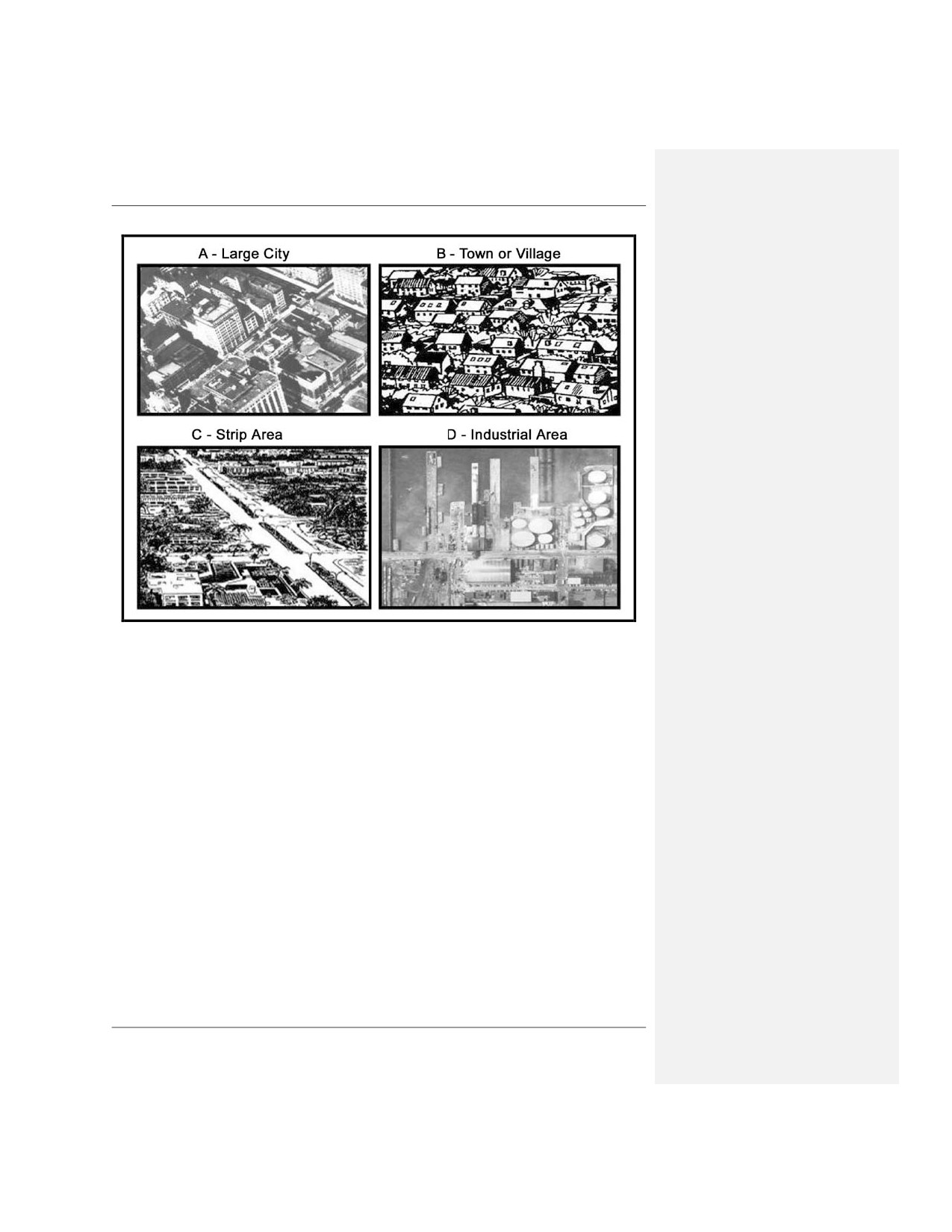
In urban terrain, manmade infrastructure, civilian institutions, attitudes and activities of civilian
leaders, populations, and organizations also affect the environment (Figure 7-1).
7-2
FM 3-55.93
Intelligence Preparation of the Battlefield
Figure 7-1. Classification of urban area by size.
POPULATION
7-5.
Most urban environments have a significant population in both number and density. Civilians in
the urban environment may pose significant threats, obstacles, and logistical support problems such as
medical. They can also provide both support and information. Therefore, it is important to gain as much
insight into the population as possible. This should start with the basics of demographic information:
ethnic background, religion, age structure, growth rate, birth and death rates, net migration rates,
communicable disease issues, languages spoken, and literacy rate. Any information on friendly, enemy, or
neutral personnel will aid in planning.
POLITICAL OR SOCIOECONOMIC CONDITIONS
7-6.
Knowing the political affiliations of the populace may help the team determine whether the they
are likely to be for, against, or neutral towards the U.S.. Clans, tribes, and gangs may not only influence
area politics and economic conditions, they may control them. Cultivation of and traffic in illicit drugs can
also impact the political and economic conditions.
INFRASTRUCTURE
7-7.
Infrastructure refers to all basic resources, support systems, communications, and vital industries.
The physical and social attributes of an infrastructure operate interdependently. Understanding the
and interrelationships of these components allow an assessment of how disruption or restoration of the
infrastructure affects the population and ultimately the mission.
FM 3-55.93
7-3
Chapter 7
Physical
7-8.
Lines of communication such as roads, rails, trails, and waterways, as well as telecommunications
means, are key aspects of the physical environment to consider.
Social
7-9.
The social attributes of infrastructure include such things as the medical system, the commerce
system, and the transportation system. Each of these needs people in order to operate efficiently. For
example, the doctors, nurses and support staff (pharmacists, ambulance drivers, clerks and janitors) interact
with the physical infrastructure. The transportation system allows the people of the medical system to get
to and from work. The commerce system provides the goods to supply the needs of the medical system.
IDENTIFY THE LIMITS OF THE COMMAND'S AREA OF
OPERATIONS
7-10.
In this second of five subtasks, the unit commander defines the AO. The AO is one of the most
basic and important control measures. It is where he has the responsibility and authority to conduct
military operations. AOs may be contiguous or non contiguous. Contiguous means adjacent, touching,
sharing a single boundary. Thus, contiguous AOs share a boundary, and noncontiguous AOs do not. Higher
headquarters controls the unassigned areas between noncontiguous AOs.
ESTABLISH THE LIMITS OF THE AREA OF INFLUENCE AND THE
AREA OF INTEREST
7-11.
In this third of five tasks, the commander defines the area of influence and the AOI. The area of
influence is larger than and includes the AO:
AREA OF INFLUENCE
7-12.
The area of influence (no acronym) is a geographic area--
• Where the commander can directly influence operations by maneuver or fires support systems
normally under the commander's C2.
• An area that includes terrain inside and outside the AO.
• An area determined by both the G-2/S-2 and the G-3/S-3.
AREA OF INTEREST
7-13.
The AOI is the commander's area of concern (interest). It includes the area of influence and
adjacent areas, and it extends into enemy territory to the objectives of current or planned operations. It also
includes areas occupied by enemy forces who could jeopardize the accomplishment of the mission. The
AOI is established by the commander with input from the G-2/S-2 and G-3/S-3. It is normally larger than
the area of influence, and may therefore require more intelligence assets to monitor. Time is the key
consideration in establishing the limits of the AOI. Time limits consider two primary factors: the mobility
of the threat and the time needed for the friendly unit to accomplish the mission.
7-4
FM 3-55.93

Intelligence Preparation of the Battlefield
EVALUATE EXISTING DATABASES AND IDENTIFY
INTELLIGENCE GAPS
7-14.
In this fourth of five subtasks, national, allied, joint, and higher echelon databases are examined to
determine if the information required already exists and is available. Not all needed information will be
available, which causes gaps in the available information. Identifying the gaps early allows actions to be
initiated to collect the intelligence required to fill them. The commander’s initial intelligence requirements
and intent also allows these gaps to be prioritized. Any gaps not expected to be filled within the available
time must be substituted with reasonable assumptions.
INITIATE COLLECTION OF INFORMATION REQUIRED TO
COMPLETE IPB
7-15.
In this last of five subtasks, the G-2/S-2 identifies and prioritizes the gaps in current holdings
(Table 7-1). Based on this analysis, collection activities are initiated or RFIs are submitted to fill
intelligence gaps to the level of detail needed to conduct IPB. IPB products are constantly updated as the
staff receives new information.
7-16.
Once the LRSC and LRS team receives their mission, they conduct a similar analysis. The leaders
and team members review and evaluate the MPF, OPORD, annexes, briefings and debriefings to identify
intelligence or information gaps. Once this is complete, they formulate RFIs and requests for intelligence
information (RIIs).
Table 7-1. Identification of gaps in existing databases.
Who ?
What ?
Why or When ?
Leader
Evaluates LRS and SOF debrief and
To identify and prioritize gaps in current
patrol/surveillance log archives
information
Teams
Evaluates the MPF
To find information gaps
Leader
Reviews the MPF
To thoroughly identify intelligence or information
gaps
Leader
Loses planning time and manpower
If he fails to thoroughly research information in
the MPF
Team
Formulates requests for RFI and RII
After intelligence gaps are identified
SECTION II. DESCRIBE ENVIRONMENTAL EFFECTS ON OPERATIONS
At this second step in the IPB process, staffs determine how the environment affects both the friendly and threat
operations and the friendly and threat COAs. Performing this step in a determined and thorough manner may
prevent the unit from being surprised by an unexpected enemy COA.
ANALYZE THE ENVIRONMENT
7-17.
An AO evaluation is generally more detailed than an AOI evaluation. For each, the leader
considers the areas that might favor one type of military operation, such as attack or defend, or those
associated with stability operations such as peace enforcement, peace keeping, and arms control.
FM 3-55.93
7-5
Chapter 7
ANALYZE TERRAIN
7-18.
Terrain analysis is the study and interpretation of natural and manmade features of an area, their
effects on military operations, and the effects of weather and climate on these features. Terrain analysis is a
continuous process. Changes in the operational environment may change the analysis of its effects on the
operation or on threat COA.
7-19.
Ideally, analysis of the military aspects of terrain is based on reconnaissance of the AO and AOI.
This starts with a map and imagery reconnaissance. If METT-TC permits, the LRS team can conduct an
aerial or vehicular reconnaissance of the AO and of the objective AO. Automated digital terrain tools can
assist in the analysis of environmental factors and can display data over maps. Multispectral imaging
processors (MSIPs) and other digital tools can also help. The BFSB S-2's GI&S team can provide these and
other tools, as available. Automated tools supplement ground, air, map, or imagery reconnaissance and
products include--
• Cross-country mobility.
• Lines of communication.
• Vegetation types and distributions.
• Surface drainages and configurations.
• Surface materials.
• Subsurface (bedrock) materials.
• Obstacles.
• Infrastructures.
• Flood zones.
• Potential helicopter landing zones.
• Potential amphibious landing zones.
Note: Lines of communication include transportation, communications, and power.
Analyze the Military Aspects of Terrain
7-20.
The military aspects of terrain--OAKOC--follow:
Observation and Fields of Fire
7-21.
Observation refers to the ability to see the threat, either aided by surveillance devices or unaided.
This includes observation through electronic and optical LOS systems, thermal imaging devices, laser
range finders, jamming devices, radars, and radios as well as observation from overhead platforms.
7-22.
A field of fire is an area that a weapon or group of weapons can effectively cover with fire from a
given position. A field of fire is evaluated for threat and friendly indirect- and direct-fire weapons. Even if a
clear opening offers the best observation, it might have poor fields of fire.
7-23.
The evaluation of observation and fields of fire allows identification of--
• Potential engagements areas.
• Defensive terrain and specific equipment or equipment positions.
• Areas where friendly forces are most vulnerable to observation and fires.
• Areas of visual dead space.
7-24.
Intervisibility and line of sight have a close relationship. Intervisibility is the condition of being
able to see one point from the other. This condition may be altered or interrupted by adverse weather, dusk,
terrain masking, and smoke. Line of sight is an unobstructed path from a Soldier weapon, weapon sight,
electronic sending and receiving antennas, or reconnaissance equipment from one point to another.
7-6
FM 3-55.93
Intelligence Preparation of the Battlefield
7-25.
Observation and field of fire require special consideration in urban environments such as
observation and weapons effects. Urban situations create a lot of dead space. However, high structures
generally offer excellent observation. Line of sight distances may decrease in urban settings.
Avenue of Approach
7-26.
This is an air or ground route of an attacking force (friendly or threat) leading to its objective or
key terrain. Avenues of approach normally show the size of unit that can use them.
Key Terrain
7-27.
This refers to any place whose seizure, retention, or control affords a marked advantage to either
combatant. In an urban environment, key terrain can include tall structures, choke points, intersections,
bridges, industrial complexes, or other facilities, for example. High ground can serve as key terrain,
because it dominates an area with good observation and fields of fire. In an open or arid environment, a
draw or wadi could serve as key terrain.
7-28.
Decisive terrain is key terrain that has an extraordinary impact on the mission. The successful
accomplishment of the mission depends on seizing, retaining, or denying decisive terrain to the threat.
Note that key terrain is not necessarily decisive. The commander designates decisive terrain to show his
staff and subordinate commanders how important that terrain is to his concept of the operation.
7-29.
Other services emphasize the importance of the population, and include groups of people such as
ethnic groups, the media, or political parties as terrain, and in some cases key terrain. However, the US
Army does not consider people to be terrain.
Obstacles
7-30.
An obstacle is any obstruction designed or employed to disrupt, fix, turn, or block the movement
of a threat, and to impose additional losses in personnel, time, and equipment on the threat. Obstacles can
be natural, manmade, or a combination of both. Some examples are--
• Buildings.
• Mountains.
• Steep slopes.
• Dense forests.
• Rivers.
• Lakes.
• Urban areas.
• Minefields.
• Certain religious and cultural sites.
• Wire obstacles such as concertina wire, barbed wire.
7-31.
Obstacles could affect certain types of movement differently. As an example, obstacles such as
rivers, lakes, swamps, densely forested areas, road craters, rubble in streets, or dense populations in urban
areas may have a greater effect on mounted movement than on dismounted movement. Mine fields,
concertina wire, or steep slopes may have a greater effect against dismounted movement. Obstacles that
can affect air mobility include terrain features that are higher than an aircraft’s service ceiling, that restrict
nap-of-the-earth flight, or that force the aircraft to use a particular flight profile. Examples include tall
buildings
(skyscrapers), cell phone towers, phone and power lines, rapidly rising terrain features,
mountains, smoke, and other obscurants. High mountains can impact rotary- and fixed-wing aircraft lift
capabilities.
FM 3-55.93
7-7
Chapter 7
7-32.
Leaders combine the several factor overlays into a single product known as the combined obstacle
overlay (COO). They integrate these overlays with the evaluations of various other factors, for example,
into a single product, the modified COO, or MCOO, that shows the effect of the operational environment
on mobility.
7-33.
The MCOO provides the basis for identifying air and ground AA and mobility corridors. It
integrates all obstacles to movement including, but not limited to, built-up areas, slopes, soil, vegetation,
and transportation systems (bridge classification, road characteristics) into one overlay. It is important that
the MCOO be tailored to operational METT-TC factors. It is a collaborative effort involving input from the
entire staff. The MCOO shows the terrain according to mobility classification. These classifications are
severely restricted, restricted, and unrestricted.
• Unrestricted--This terrain is free of any restrictions to movement. Examples include gently
sloping terrain with scattered or widely spaced obstacles such as trees or rocks.
• Restricted--This terrain hinders movement to some degree. It is represented as "/////////" on
overlays. Restricted terrain includes "zigzagging" or frequent detours; swamp or rugged terrain
for LRS teams or dismounts; and moderately to densely spaced obstacles for armor or
mechanized forces.
• Severely Restricted--This terrain severely impedes or redirects movement. It is represented as
"XXXXXXXXX" (cross-hatching) on overlays. Examples include minefields; unfordable rivers; and
road, railroad, and stream embankments.
Cover and Concealment
7-34.
This aids in identification of defensible terrain, approach routes, assembly areas, or deployment
and dispersal areas. Cover and concealment is evaluated the same as observation and fields of fire. Each
factor is combined onto a single product such as a cross-hatched overlay.
Cover
7-35.
This means protection from bullets, fragments of exploding rounds, flame, nuclear effects, and
biological and chemical agents. Cover does not necessarily provide concealment.
Concealment
7-36.
This is protection from observation such as that provided by woods, underbrush, snowdrifts, and
tall grass. Concealment considerations for urban operations include using NSTVs or wearing the types of
clothing worn by the populace. Both may offer some concealment and help the LRS teams blend in.
Concealment and cover are not the same thing. Concealment hides, cover protects.
7-8
FM 3-55.93
Intelligence Preparation of the Battlefield
Evaluate the Terrain's Effect on Military Operations
7-37.
The BFSB and R&S squadron staffs evaluate how terrain will affect military operations. They
disseminate the results of this analysis in the intelligence annex or estimate. The staff uses any of four
techniques to evaluate and graphically show the results of the analysis:
Concentric Ring Technique--This technique establishes concentric rings around US forces that
start from the unit’s base of operation and work out.
Belt Technique--This technique divides the AO in belts (areas) that run the width of the AO. The
shape of the belt is based on METT-TC analysis.
Avenue-In-Depth Technique--This technique focuses on one avenue of approach. It is good for
offensive COAs or for defense when canalized terrain inhibits mutual support.
Box Technique--This technique requires a detailed analysis of a critical area such as an
engagement area, river-crossing site, or LZ. It is most useful when time is short for operations
in noncontiguous AOs.
WEATHER ANALYSIS
7-38.
The BFSB USAF combat weather team and the S-2 section work closely during much of the
analysis process. The weather team analyzes the weather’s direct effects and its effects on terrain and other
aspects of the environment that integrates climate, forecasts, and current weather data with terrain analysis
and with the overall analysis of the environment. The weather team describes in detail how the weather will
affect each equipment system and subsystem.
7-39.
Terrain and weather aspects of the environment are inseparable. During terrain analysis, the
analyst determines how the weather will affect terrain. In this substep, the analyst also evaluates how the
weather will directly affect operations.
7-40.
The Integrated Meteorological System (IMETS) produces the Integrated Weather Effects Decision
Aid (IWEDA). The IWEDA shows the LRSU how the weather will affect current and planned operations.
IMETS forecasts wind turbulence, surface temperatures, cloud ceilings, humidity, visibility, and ice.
Military Aspects of Weather
7-41.
The military aspects of weather are visibility, wind, precipitation, cloud cover, temperature, and
humidity.
Visibility is the greatest distance from which prominent objects can be seen and identified by the
unaided, normal eye.
Wind of sufficient speed from any direction can blow dust, smoke, sand, or precipitation, reducing
the combat effectiveness of a force.
Precipitation is any moisture that falls from a cloud in frozen or liquid form. Rain, snow, hail,
drizzle, sleet, and freezing rain are examples.
Cloud Cover affects ground operations by limiting illumination. It can also reduce the thermal
signature of targets.
Temperature extremes can reduce effectiveness of troops and equipment.
Humidity is the amount of water vapor suspended in the atmosphere.
FM 3-55.93
7-9
Chapter 7
Additional Weather Considerations
Thermal Crossover
7-42.
Temperature of targets and objects on the ground is important for the use of thermal sights and
forward-looking infrared (FLIR). Thermal crossover, which is an additional weather consideration, is a
natural phenomenon that normally occurs twice daily when temperature conditions reduce thermal contrast
between adjacent objects.
Direct and Indirect Effects
7-43.
Weather has both direct and indirect effects on military operations. The following are examples of
direct effects and indirect effects on military operations:
• Temperature inversion can increase the risk of contamination by chemical agents.
• Low visibility, such as that caused by fog, obviously affects the observation capabilities of both
friendly and threat forces.
• Hot, dry weather might force friendly and threat forces to consider water sources key terrain.
Civil Considerations
7-44.
An appreciation of civil considerations—the ability to analyze their impact on operations—
enhances several aspects of operations: among them, the selection of objectives; location, movement, and
control of forces; use of weapons; and protection measures. Civil considerations comprise six
characteristics, expressed in the memory aid ASCOPE:
• Areas.
• Structures.
• Capabilities.
• Organizations.
• People.
• Events.
DESCRIBE ENVIRONMENTAL EFFECTS
7-45.
Combine the evaluations of the effects of terrain, weather, and civil considerations into a product
that best suits the LRS team's needs. Avoid guessing or assuming. Focus on the total environment’s effects
on the COAs available to both the LRS team and threat forces.
7-46.
On request from the LRSC, the BFSB S-2 and R&S squadron S-2 will provide all the products
previously described. The LRSC may only need some of these products as is; others they may be able to
use, with some adaptation, in LRS team planning operations. Training and close coordination between the
LRSC, the BFSB, and the R&S squadron staffs will produce useful products for team planning.
SECTION III. EVALUATE THE THREAT
In step 3, the G-2/S-2 and staff analyze the command’s intelligence holdings, which they identified in step 1, to
determine how the threat normally conducts operations under similar circumstances. Every threat can be
analyzed, understood and, to some extent, predicted. Threat doctrine may be simple or even nonexistent.
However, a threat will usually, at some level of command, act based on some set of ad hoc or established
procedures. This third step in the IPB process begins with analyzing the threat, after which two substeps are
performed: 1) update or create threat models, and 2), identify threat capabilities.
7-10
FM 3-55.93
Intelligence Preparation of the Battlefield
ANALYZE THREAT FACTORS
7-47.
When operating against a new or less defined threat, the G-2/S-2 may need to develop or expand
intelligence databases and threat models concurrently. In order to accomplish this, the G-2/S-2 should
conduct threat characteristic order of battle (OB) analysis for each group identified in step 1. To do this,
the staffs analyze--
• Composition.
• Disposition.
• Tactics.
• Training.
• Logistics.
• Operational effectiveness.
• Communications.
• Intelligence.
• Recruitment.
• Support.
• Finance.
• National agencies.
• Law enforcement agencies.
• International organizations and nongovernmental organizations.
• Personality.
• Other threats such as CBRN, diseases, or toxins.
UPDATE OR CREATE THREAT MODELS
7-48.
Creating or updating a threat model lets the analyst piece together information, identify gaps,
predict threat activities or COAs, and plan ISR. There will always be information gaps in the threat model,
so the analyst will always have some uncertainty. Threat models have three parts:
• Convert threat doctrine or patterns of operation to graphics.
• Describe the threat’s tactics and options.
• Identify HVTs and HPTs.
CONVERT THREAT DOCTRINE OR PATTERNS OF OPERATION TO GRAPHICS
7-49.
Threat templates graphically portray how the threat might use its capabilities to perform the
functions required to accomplish its objectives. Construct threat templates by analyzing the intelligence
database and by evaluating the threat’s past operations. Determine how the threat normally organizes for
combat, and how he deploys and employs his forces and assets. Look for patterns in how the threats
organize their forces, timing, distances, relative locations, groupings, or use of the terrain and weather.
Threat templates are tailored to the needs of the unit or staff section creating them.
7-50.
Threat templates for a LRS team are tailored to the team's mission. If the LRS team is tasked to
locate the threat's regimental or division reconnaissance, the LRSU needs the threat template showing how
the threat reconnaissance units are deployed. In some OEs, threat templating can be more difficult and
unpredictable. The LRS team must consider the enemy situation and mission. Ask this question: “If I had
to accomplish the same mission, and had no terrain constraints, where would I place my assets?” Analyze
patterns and associations, even though these require frequent updates and are somewhat reactive.
FM 3-55.93
7-11
Chapter 7
DESCRIBE THE THREAT'S TACTICS AND OPTIONS
7-51.
The threat model includes a description of the threat’s preferred tactics. A description is still
needed, even if the threat’s preferred tactics are shown in graphic form. The description--
• Lists the threat's available options.
• Is not a "snapshot in time"--should portray actions as events unfold.
• Aids in war-gaming and in developing threat COAs, and situational templates.
• Addresses timelines, phases, WFFs.
7-52.
Describe and determine the threat's goal(s). Threat objectives are often, but not always, what the
unit’s mission is trying to prevent. Threat objectives are also often actions taken by the threat to prevent
unit mission accomplishment. Describe them in terms of purpose and endstate.
IDENTIFY HVTS AND HPTS
7-53.
An HVT is the asset the threat commander requires for successful completion of a COA. It is
shown and described on the template. Examples include--
Fires, for example, regimental artillery group (RAG), division artillery group (DAG), IV13, IV14,
SNAR-10, or individual artillery and mortars.
Protection, for example, ZSU-23-4, 2S6, straight flush radar, fan song radar, man-portable air
defense systems, and heavy machine guns.
Command and Control, for example, IV13, IV14, TOCs, and vehicles with multiple antennas.
Intelligence, for example, twin box DF, dog-ear radar, scanners and local populace.
Movement and Maneuver, for example, IMR, MT-55, PMM-2, GSP, MDK-2M, and BTM.
Sustainment, for example, a list of assets key to the threat commander's execution of the primary
mission is recorded. Then, the assets are ranked by their relative worth to the threat's operation.
Throughout the course of an operation, the HVTs will change. The HVTs for the phase of each
operation are recorded and annotated on the threat model. The LRS team should identify HVTs
for their mission with the help of the unit staff.
7-54.
An HPT is a target whose loss to the threat commander, will contribute to the success of the
friendly COA. HVTs and HPTs may be one in the same. In some OEs, HPTs might be key personalities.
However, the loss of the enemy key personality might support the friendly COA, but may fail to deter the
enemy from completing the COA.
7-12
FM 3-55.93
Intelligence Preparation of the Battlefield
Link Analysis
7-55.
This tool identifies HVTs and HPTs in the OE. It is used to show contacts, associations and
relationships between persons, events activities and organizations in an unconventional setting. Link
analysis tools use link diagrams, association matrixes, relationship matrixes, activities matrixes and
time-event charts. All help in identifying HVTs and HPTs in the OE.
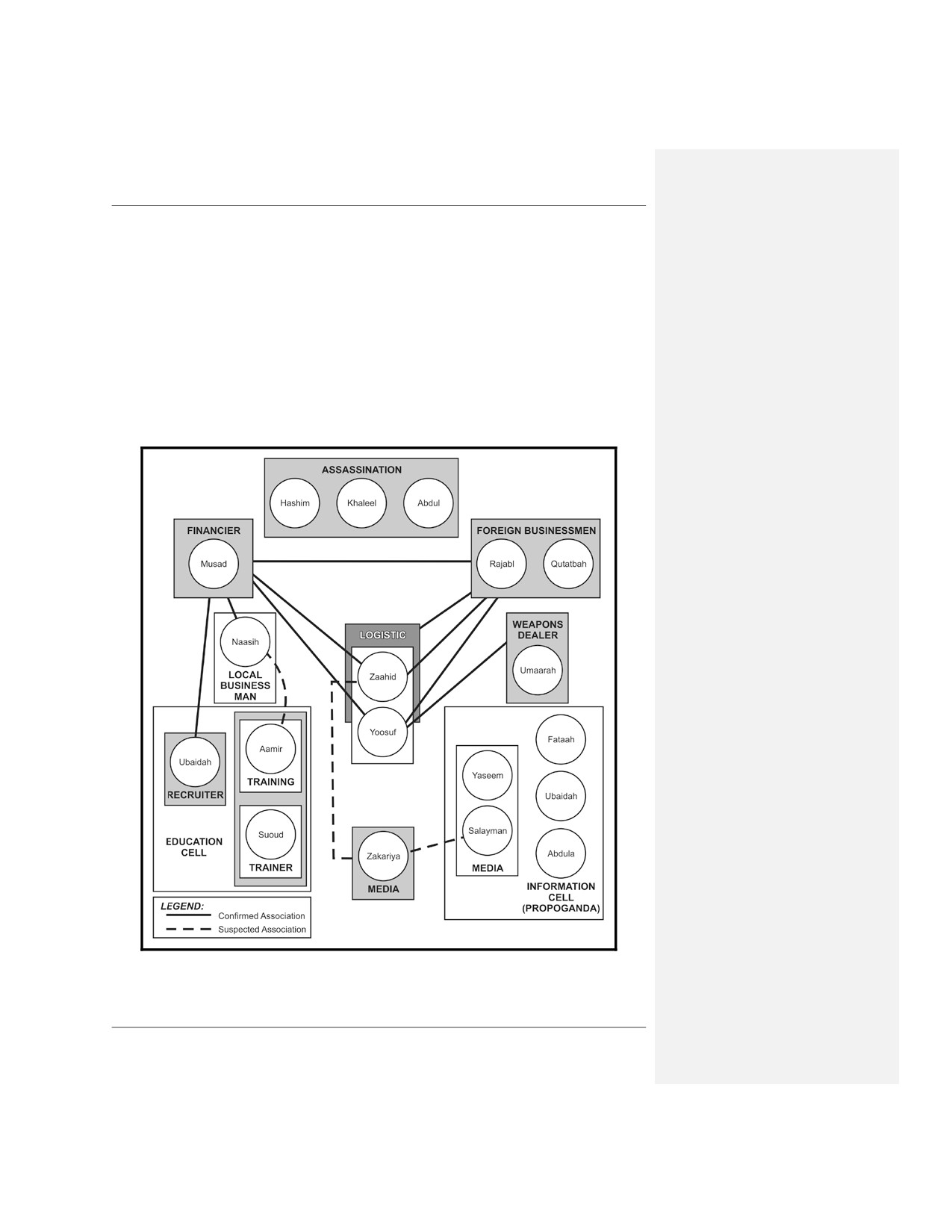
Link Diagram
7-56.
This tool seeks to graphically show relationships between people, locations, or other factors
deemed significant in any given situation. It reflects information from both association and activities
matrices, is easy to read and interpret and is generally an effective briefing tool. Link diagrams show
participants in activities, personal and nonpersonal links, internal and external contacts, structures and
of C2 (Figure 7-2).
Figure 7-2. Example link diagram.
FM 3-55.93
7-13
Chapter 7
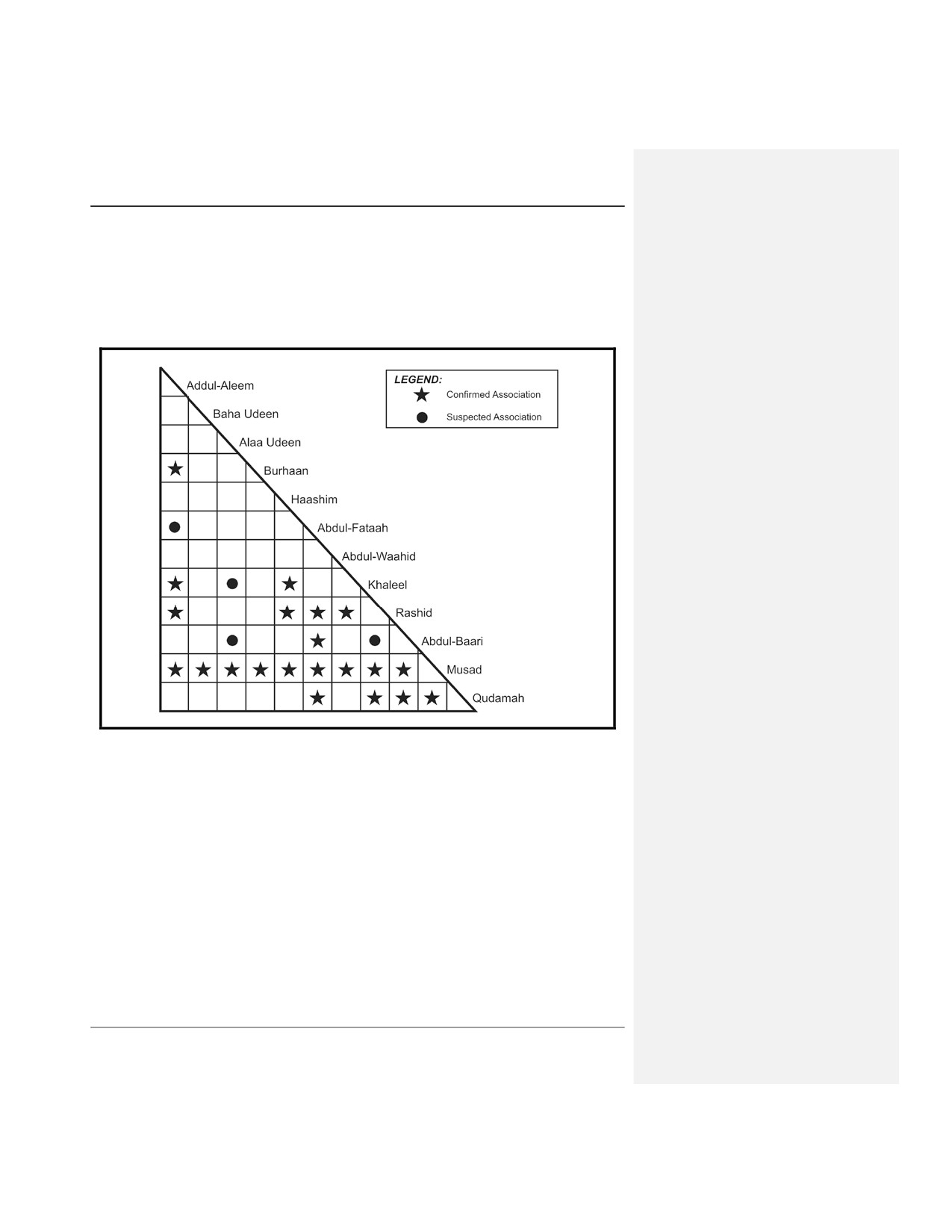
Association Matrix
7-57.
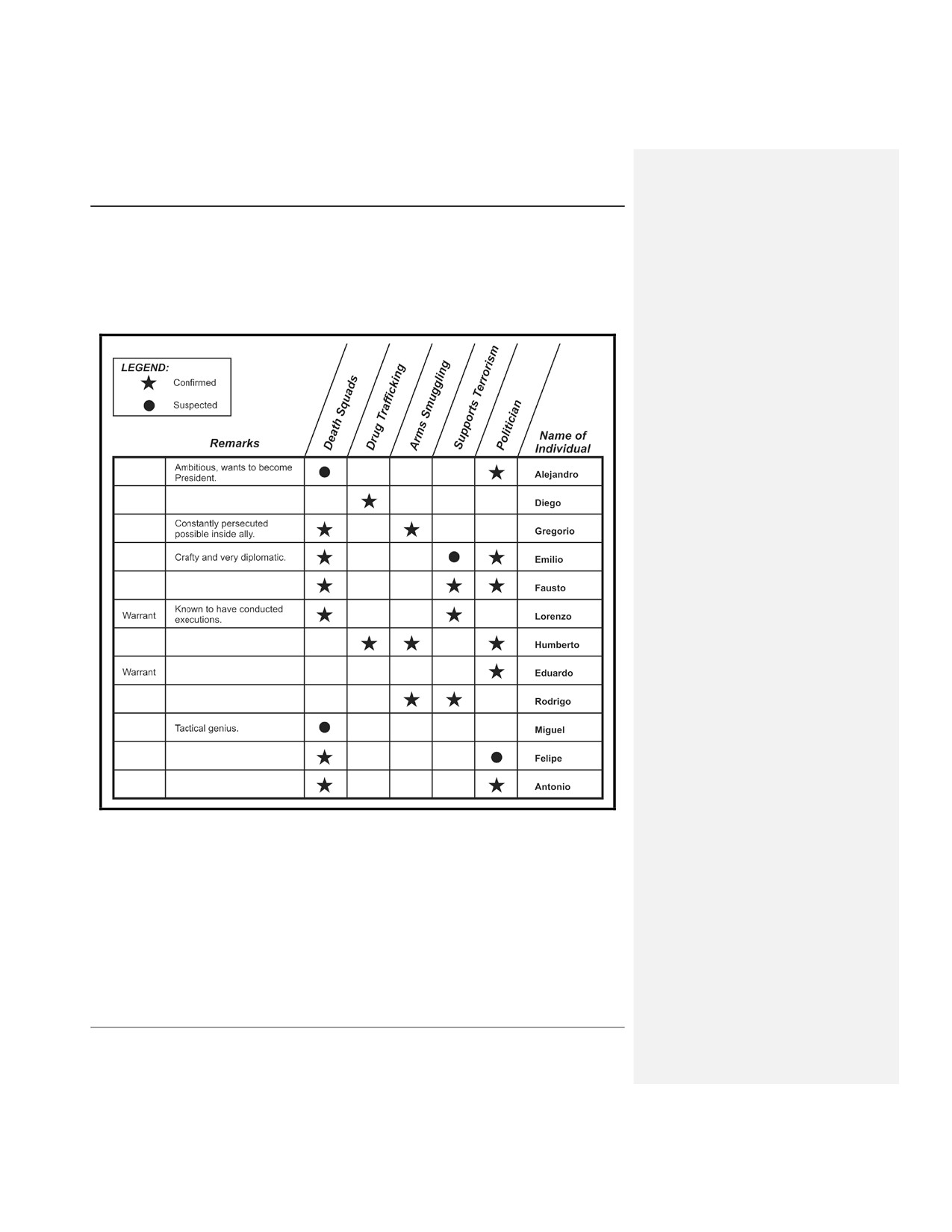
The association matrix is used to establish the existence of an association between individuals.
Analysts can use association matrices to identify those personalities and associations needing a more
in-depth analysis in order to determine the degree of relationship, contacts, or knowledge between the
individuals. The structure of a threat organization is formed as connections between personalities are made
(Figure 7-3).
Figure 7-3. Example association matrix.
7-14
FM 3-55.93
Intelligence Preparation of the Battlefield
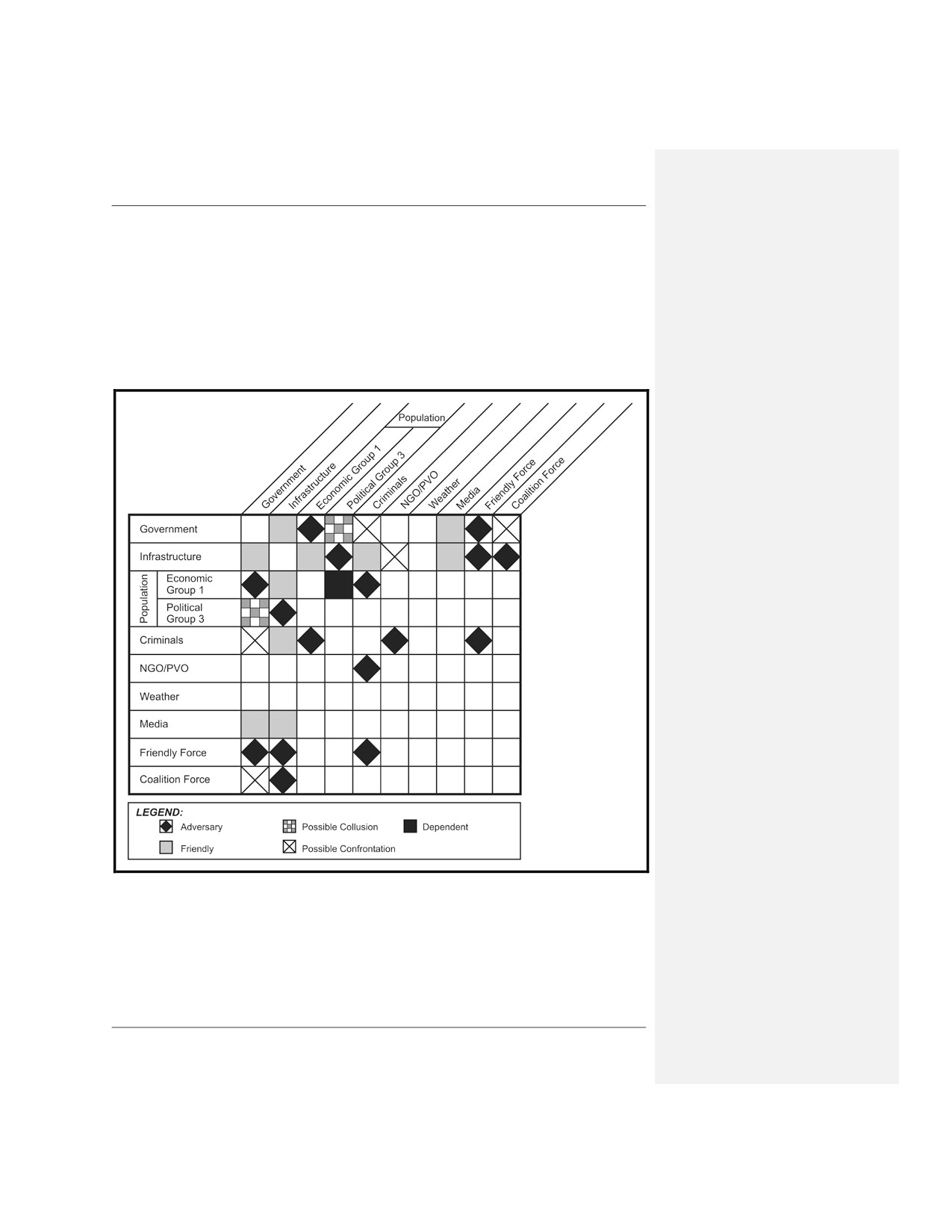
Relationship Matrix
7-58.
Relationship matrices are intended to show the nature of relationships between elements of the
The elements can include members from the noncombatant population, the friendly force, international
organizations and adversarial groups. Utility infrastructures, significant buildings, media and activities
might also be included. The nature of the relationship between two or more components includes measures
of contention, collusion or dependency. The purpose of this tool is to demonstrate graphically how each
component of AO interacts with others and whether these interactions promote or degrade the likelihood of
mission success. The relationships represented in the matrix can assist the analysts in deciphering how best
to use the relationship to shape the environment (Figure 7-4).
Figure 7-4. Example relationship matrix.
FM 3-55.93
7-15
Chapter 7
Activities Matrix
7-59.
Activities matrices help analysts connect individuals (such as those in the association matrices) to
organizations, events, entities, addresses and activities--anything other than people. Information from this
matrix, combined with information from association matrices, can assist analysts in linking personalities as
well (Figure 7-5).
Figure 7-5. Example activities matrix.
7-16
FM 3-55.93
Intelligence Preparation of the Battlefield
Time Event Chart
7-60.
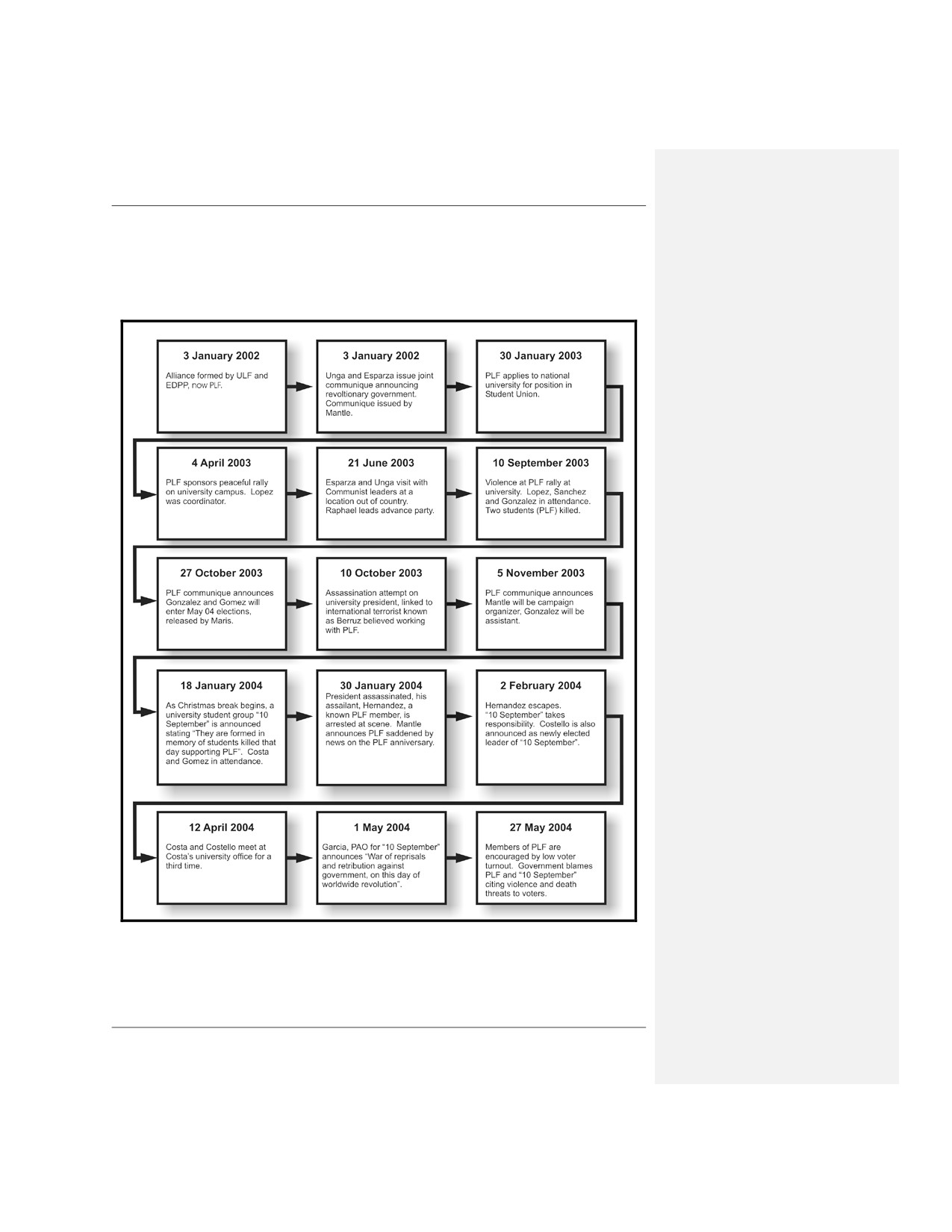
Time event charts are chronological records of individual or group activities designed to store and
display large amounts of information in a small space. Analysts can use time event charts to help analyze,
for example, large-scale patterns of activity and relationships (Figure 7-6).
Figure 7-6. Example time event chart.
FM 3-55.93
7-17
Chapter 7
IDENTIFY THREAT CAPABILITIES
7-61.
Leaders identify broad COAs and supporting operations that the threat can take to influence the
accomplishment of the friendly mission. Use statements to define the capabilities, for example--
“The threat has the capability to attack with up to eight divisions supported by 150 daily sorties
of fixed-wing aircraft.”
“The criminal organization has the ability to pay off local law enforcement agencies (LEAs).”
“The threat can establish a prepared defense by 14 May.”
”The terrorists have the ability to conduct multiple car bombings simultaneously.”
7-62.
In a stability operation, the lack of, or a variety of, uniforms and equipment makes it more difficult
to identify the threat. Varying levels of organization increases the range of options afforded the enemy
threat. This makes it easier for the threat to conduct large scale demolitions (car bombs and rigged
buildings) against friendly forces. The ability of the threat to collect information and conduct covert
operations is greatly enhanced in a stability operations. Sniper employment and booby traps are capabilities
that are often unpredictable and very dangerous to friendly forces.
SECTION IV. DETERMINE THREAT COURSES OF ACTION
This is the fourth and final step in the IPB process. Staffs identify and develop threat COAs, along with other
facts and assumptions about the OE, that drive the friendly COAs analysis (wargaming). This leads to
development of the friendly COA development. The LRS team uses these threat COAs to drive their own
war-gaming process, and to develop the LRS team COA. Developing threat COAs has five substeps:
• Identify the threat’s likely objectives and desired endstate.
• Identify the full set of COAs available to the threat.
• Evaluate and prioritize each COA.
• Develop each COA.
• Identify initial ISR requirements.
IDENTIFY THE THREAT'S LIKELY OBJECTIVES AND DESIRED
ENDSTATE
7-63.
At a minimum, the staff determines likely objectives and desired endstate. Against a conventional
threat, the analysis should start at more than one level above the friendly echelon unit and work down. For
those threats that are asymmetrical in nature, the analysis should start at the lowest level possible.
7-64.
The LRS leader starts with the threat command one level above that of the threat he expects the
LRS team to encounter. He then ensures the objectives of the threat commands at each level are identified.
The BFSB S-2 fusion element advises the LRSU on the threat's overall objective. A LRS team should break
down the threat objective to the level and detail appropriate for the team mission.
7-18
FM 3-55.93
Intelligence Preparation of the Battlefield
IDENTIFY THE FULL SET OF COAs AVAILABLE TO THE THREAT
7-65.
The staff and the LRS team consider possible threat COAs.
CONSIDERATIONS
7-66.
At a minimum they consider--
• The COAs that the threat's doctrine assumes that the threat will use in the current situation, and
the threat's most likely objectives.
• The threat COAs that could greatly influence the friendly unit's mission.
• The threat COA that may exceed the boundaries of known threat doctrine or TTP, even if threat
doctrine generally considers them unfeasible.
• The threat COAs indicated by recent activities and events.
CRITERIA
7-67.
Each threat COA should meet five criteria:
Suitability--If the COA is successful, it will accomplish the threat's objective.
Feasibility--The threat has the time, resources, and space available to execute the COA.
Acceptability--The threat's tactical or operational advantage gained by executing the COA must
justify the cost. The threat might undertake an unfavorable COA if he believes there are no
other choices.
Distinguishability--Each threat COA must differ greatly from the others.
Completeness--The COA must show how the decisive operation accomplishes the mission, and
how shaping and sustaining operations support the decisive operation.
EVALUATE AND PRIORITIZE EACH COURSE OF ACTION
7-68.
The commander and staff need to develop a plan that is optimized to one of the COAs, while
allowing for contingency options should the threat choose another COA. Therefore, the staff must evaluate
each threat COA and prioritize it according to how likely the threat will adopt that option. Use judgment to
rank the threat COAs in their likely order of adoption. Modify the list as needed as the current
situation changes.
DEVELOP COURSES OF ACTION
7-69.
Once a COA set is complete, develop each COA into as much detail as time allows. To ensure
completeness, each COA must answer six basic questions: who, what, when, where, how and why. Each
developed COA has three parts--
• Situation templates.
• Threat course of action and options.
• High value targets.
SITUATION TEMPLATES
7-70.
Situation templates are developed on the threat’s current situation, for example, training and
experience levels, logistical status, losses, dispositions, the environment, threat doctrine. or patterns of
operations. The SITEMP is a graphic that shows the expected threat dispositions should the threat adopt a
particular COA.
FM 3-55.93
7-19
Chapter 7
Construction
7-71.
To construct a SITEMP, start with the threat template and lay it over the MCOO. Adjust the
disposition of the arrayed force on the threat template to account for battlefield effects such as weather and
terrain. Try to array forces as the threat commander might. Construct the SITEMP in as much detail as
time allows:
• Conventional Threat--evaluate time and space factors to develop time phaselines showing
threat movement.
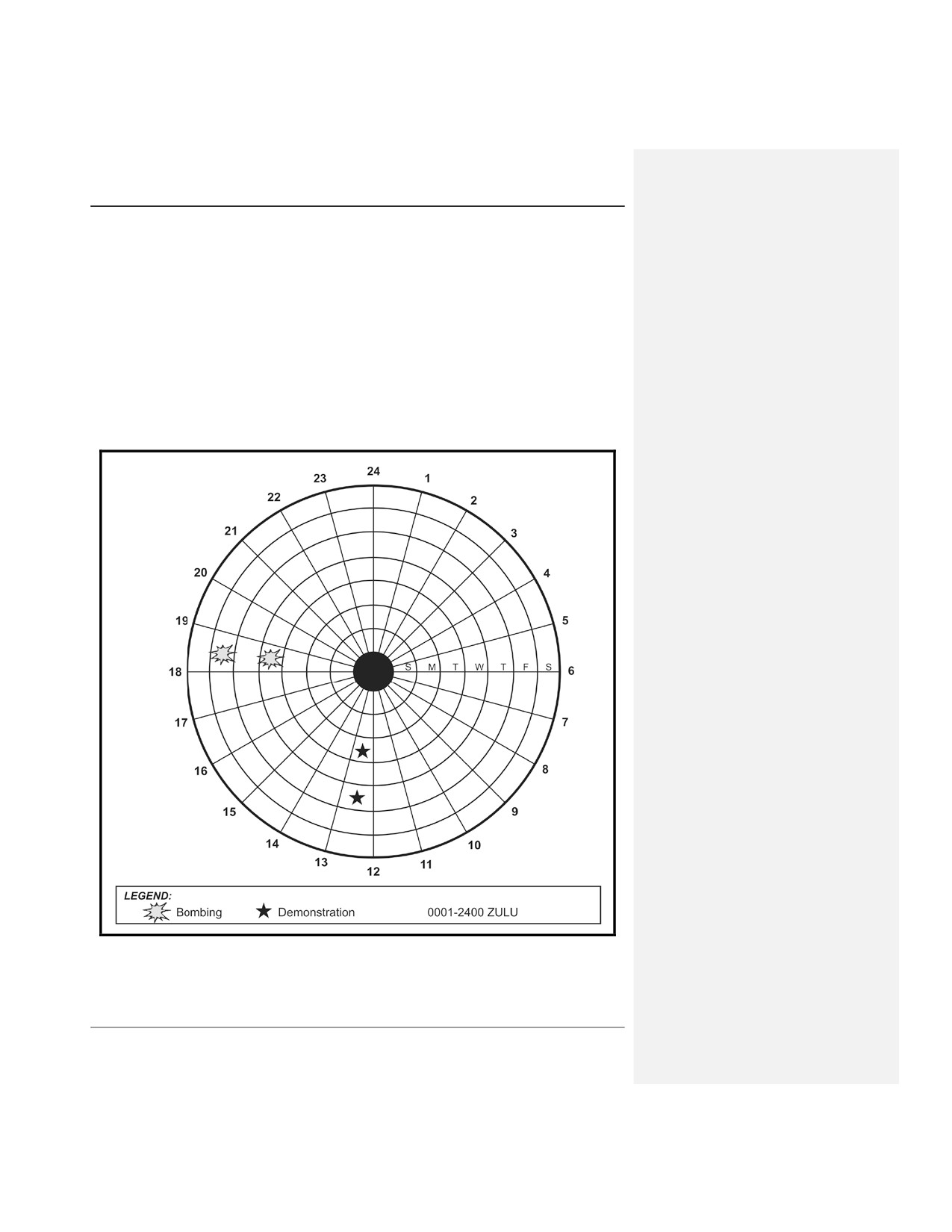
• Unconventional Threat--other tools such as pattern analysis. Pattern analysis uses multiple
map overlays and text assessing military, terrorist, or other threat activity in an urban area.
These events can be related by any of several factors to include location and time. These events
can be analyzed by plotting them on maps over time, using multiple historical overlays (analog
or digital) that can be compared to one another over time, and using a time-event wheel or other
analysis tools (Figure 7-7).
Figure 7-7. Example pattern analysis plot sheet.
7-20
FM 3-55.93
Intelligence Preparation of the Battlefield
Pattern Analysis
7-72.
The pattern analysis is a technique that is based on certain characteristic patterns that can be
identified and interpreted. Pattern analysis can be critically important when facing an enemy whose
doctrine is undeveloped or unknown. It is necessary for the intelligence analyst to create or update the
threat model and threat templates.
7-73.
A pattern analysis requires the organization and recording of large volumes of incoming
information and adding it to existing information so meaningful relationships are clarified. Often,
indicators can initially be ambiguous and incomplete. but over time patterns of activity or tip-offs that
characterize specific threat emerge. Expect to deal with a thinking threat that learns from previous success
or failures and will change or vary patterns of operations.
7-74.
Once all related items of information from the intelligence files, sources, and agencies are
obtained, assemble the available information to form as many logical solutions or hypothesis as possible.
Assembly of information to develop logical hypothesis requires good judgment and considerable area
expertise. When developing hypothesis, avoid reaching conclusions based on prejudices or
preconceived notions.
7-75.
Pattern analysis tools consist of automation, situation map
(SITMAP), incident map, IPB
templates, working files, hot files, resource files, coordinate register and time-event charts.
Automation--Automation provides immediate access to situational updates and execution
information and allow transmittal of situational understanding and execution orders.
Automation enhances situational awareness and enables friendly forces to share a common
picture while communicating and targeting in real or near-real time.
Incident Map--Working incident maps and overlays are considered informal. Post current
information on the incident map as received. This map is a working aid that graphically shows
threat activity in both AO and AOI considered important to the operation. Information on the
incident map can provide a good foundation for the SITMAP.
Situation Map--The SITMAP is built from the incident overlay. The SITMAP adds current
intelligence and activities indicating movement, resupply operations, or attacks.
Working Files--Working files are critical to properly store the research material generated.
Whether done manually or with automation, ensure the filing system is easily understood,
information is easy to retrieve, and includes cross-referencing.
Hot Files--Hot files are the most important working file. The hot file contains material pertaining
to a specific incident, as well as information from related incidents. Reports of planned
demonstrations, sabotage, or attack all initiate hot files. A hot file becomes inactive when the
event occurs, does not occur, or when the unit's priorities change.
Resource Files--Resource files includes all material which is important but not of immediate
value. It includes hot files that are obsolete, inactive incident files, inactive personality and
organization files, and photographs.
FM 3-55.93
7-21
Chapter 7
Level of Command, Operational Type, and Named Areas of Interest
7-76.
The level of command and type of operation bears directly on the level of detail that goes into a
situation template.
Tactical Level--Templates at this level sometimes show individual vehicles in threat dispositions.
The NAIs are often pinpoint locations such as road junctions or small-unit battle positions.
Operational Level--Templates at this level focus on large reserve formations, major staging bases
and LOCs. The NAIs are often large dispersal areas, reserve assembly areas, or logistical
support areas.
Strategic Level--Templates at this level might focus on the shift of large forces from one theater to
another as well as political and economic developments. The NAIs can sometimes encompass
large regions.
THREAT COURSES OF ACTION AND OPTIONS
7-77.
This describes the activities of the forces shown on the situation template. It can range from a
narrative description to a detailed synchronization matrix showing activities of each unit, WFF, or
asymmetrical activity in detail. It should address the earliest time the COA can be executed, timelines and
phases associated with the COA, and decisions the threat commander will make during and after execution
of the COA. Use the COA description to support staff wargaming and to develop the event template and
supporting indicators
HIGH-VALUE TARGET
7-78.
As the SITEMP is prepared, mentally war-game and note how and where each of the WFF provide
critical support to the COA. This leads to identification of the HVTs. Note on the SITEMP where the HVTs
must appear or be employed to make the operation successful. Focus on times just before or when the
HVTs are most valuable. These HVTs lead to potential TAIs, engagement areas, and decision points.
IDENTIFY INITIAL ISR REQUIREMENTS
7-79.
After identifying the set of potential COAs, focus on which one the threat will most likely adopt.
This is crucial to identify ISR requirements for an effective ISR plan. At the LRSC and LRS team level,
they identify the COA RFIs and RIIs to send to the R&S squadron S-2 and the BFSB S-2 ISR fusion
element to "fill in the blanks" in the COA. The team identifies the areas where they expect key events to
occur. These are called "named areas of interest" (NAIs). Activities or events that reveal a COA are called
"indicators."
EVENT TEMPLATE
7-80.
The event template is a guide for ISR synchronization and ISR planning. It shows the NAIs where
activity or lack of activity will indicate which threat COA the threat has adopted. It shows who, what,
where, and when to collect information that reveal the threat's chosen COA. Comparing and contrasting the
various NAIs and indicators associated with each COA helps identify the differences. These differences are
markers that help to recognize which COA the threat has chosen to execute. The selected NAIs are marked
on the event template. This initial event template focuses only on identifying which of the predicted COAs
the threat has adopted.
7-22
FM 3-55.93
Intelligence Preparation of the Battlefield
EVENT MATRIX
7-81.
The event matrix complements the event template. The matrix provides details on the type of
activity is expected to occur at each NAI, when it is expected to be active, and how those activities relate to
other events (indicators) on the battlefield. The matrix contains the event (indicator) associated with each
NAI. It also includes the team phase lines from the SITEMP, and the LTIOV time line. Its main uses are in
collecting intelligence and aiding in situation development. The elements of the event matrix follow:
Information Requirement—IR includes all of the information elements that the commander and
staff need to successfully conduct operations, that is, all elements necessary to address the
factors of METT-TC.
Priority Intelligence Requirement—PIR includes all intelligence requirements for which a
commander has an anticipated and stated priority in his task of planning and decision-making.
Intelligence Requirement—Intelligence requirements include knowledge of lesser importance than
the PIR.
Specific Information Requirement—SIR consists of indicators that will answer all or part of a PIR
or IR.
ISR Tasks and RFIs—ISR tasks and RFIs are the orders or requests that generate planning and
execution of a collection mission or analysis of database information.
Named Area of Interest—An NAI is a geographic area where indicators can be collected.
Target Area of Interest—A TAI is a geographic area where high-value targets (HVTs) can be
acquired and engaged.
Decision Point—A DP is a point in space and time where the commander or staff anticipates
making a decision concerning a specific friendly COA. A DP is usually associated with a
specific TAI, and is located in time and space to permit the commander sufficient lead time to
engage the enemy in the TAI.
PREPARE DECISION SUPPORT TEMPLATE
7-82.
The decision support template is a graphic version of a war game. From this template, the BFSB
and R&S squadron S-2 and S-3 prepare a detailed ISR plan. This plan shows where and when R&S
elements such as LRS should look for the enemy. The plan directs specific tasks and priorities to LRSC,
which are then assigned as missions to individual LRS teams.
FM 3-55.93
7-23
Chapter 8
Evasion and Recovery
Evasion is the process whereby people isolated in hostile or unfriendly territory avoid
capture and return to areas under friendly control. Recovery is the return of such
evaders to friendly control, either with or without aid, as the result of plans,
operations, and individual actions by recovery planners, conventional or
unconventional forces, and sometimes the evaders themselves. Evasion is considered
the highest form of resistance. Both E&R are integral to military operations
(Appendix K).
FUNDAMENTALS
8-1.
Conduct of E&R operations requires Soldiers understand each kind of operation and the laws that
govern them. Soldiers participating in an evasion operation are classified as one of the following:
EVADER
8-2.
An evader is considered a lawful combatant for the duration of the evasion, since evasion is an
extension of combat and a refusal to capitulate to the enemy. Evaders are obliged by the Code of Conduct
to do all they can to avoid capture and rejoin friendly forces. If needed, they may commit acts of violence
against legitimate military targets, without being prosecuted by the enemy for violating local criminal laws.
Code of Conduct. Article II:
I will never surrender of my own free will. If in command, I will never surrender the
members of my command while they still have the means to resist.
ESCAPEE
8-3.
An escapee is someone who has escaped from a confinement facility. Escapees are
noncombatants, no longer able to commit hostile acts, who may be charged under the laws of the detaining
power for certain acts committed against its military or civilian population during escape or avoidance of
recapture. Such an escapee may carry no arms of any kind, nor may he try to arm himself. If he commits
any crime(s) of no specific military significance, he may be tried and punished for war crimes, not only by
the detaining country, but also by his own. The Code of Conduct and Law of Land Warfare both list the
responsibilities of the evader and escapee in an evasion. However, under Geneva Convention Articles
91-94, Geneva Convention Relative to the Treatment of Prisoners of War, POWs have a national obligation
to escape and rejoin their own forces. Those apprehended during or after an attempted escape are subject to
disciplinary punishment only. This assumes that any offences they may have committed were for the sole
purpose of escaping, and that the offences entail no violence against life or limb, or the goal of
self-enrichment.
FM 3-55.93
8-1
Chapter 8
DETENTION OF EVADERS BY NEUTRAL COUNTRIES
8-4.
The evader who crosses into a neutral country is subject to detention by that country for the
duration of the war. A neutral country that receives escapees may leave them at liberty. If it allows them to
remain in its territory it may assign them a place of residence. The neutral country is also authorized to
confiscate all equipment of the evader/escapee.
TIMES TO INITIATE E&R
8-5.
These include—
• On order of commander.
• When considered "isolated personnel" by individual unit standards or SOP.
CHAIN OF COMMAND
8-6.
The agencies, units and individuals within the E&R chain of command are responsible for the
successful planning for and execution of E&R operations.
JOINT PERSONNEL RECOVERY AGENCY
8-7.
The JPRA develops joint E&R tactics, techniques, and procedures; E&R aids; tools; and
specialized equipment for E&R. They also provide expertise on E&R and survival to all services.
JOINT SEARCH-AND-RESCUE CENTER
8-8.
The JSRC represents two or more services or countries. They coordinate recovery efforts among
joint services. They develop and distribute the Air Tasking Order Special Instructions (ATO SPINS). They
maintain ISOPREP cards for missing personnel.
RESCUE COORDINATION CENTER
8-9.
A RCC is located at each service in the theatre of operation. The RCC notifies the JSRC of
isolated personnel. They help individual units develop their own EPA. They maintain a copy of ISOPREP
cards for isolated personnel. They coordinate recovery efforts for that service.
INDIVIDUAL UNITS
8-10.
Each unit is responsible for developing an EPA, and for ensuring that all personnel properly fill
out their ISOPREP cards, after which the unit keeps the cards updated, stores them in a secure location,
and forwards a copy to the RCC.
INDIVIDUAL SOLDIER
8-11.
Responsible for filling out the EPA and the ISOPREP card.
8-2
FM 3-55.93
Evasion and Recovery
PLANS
8-12.
Personnel assigned to LRSU are considered high-risk-of-capture and subject to isolation in hostile
territory. Therefore, they should prepare for the possibility of being in an evasion situation. Successful
evasion is dependent on detailed planning, as well as peacetime training and proficiency in survival and
E&R tactics, techniques and procedures.
8-13.
The LRSC commander, with assistance from the RCC and JSRC, is responsible for and prepared
to conduct personnel recovery operations in support of their own operations. The commander also
coordinates with the RCC when elements are preparing to enter a possible evasion situation. He relays
information such as ISOPREP cards and EPA with overlays of the AO. After the LRSC commander
coordinates with evasion planning agencies, he may determine the unit must make independent evasion
plans. The LRSC commander starts by identifying the team's AO and formulating and evasion annex with
the assistance of the JSRC.
8-14.
LRS team evasion planning begins with receiving the E&R annex to the OPORD along with any
evasion aids that will assist them in the planning phase. After receiving area briefings and examining E&R
area studies, the team formulates an EPA. The EPA is normally an annex to the team OPORD and briefed
to the commander. All available evasion aids are requested to assist the team if evasion is required. Finally,
the team reviews their ISOPREP cards before leaving the planning facility to start infiltration.
TYPES OF RECOVERY
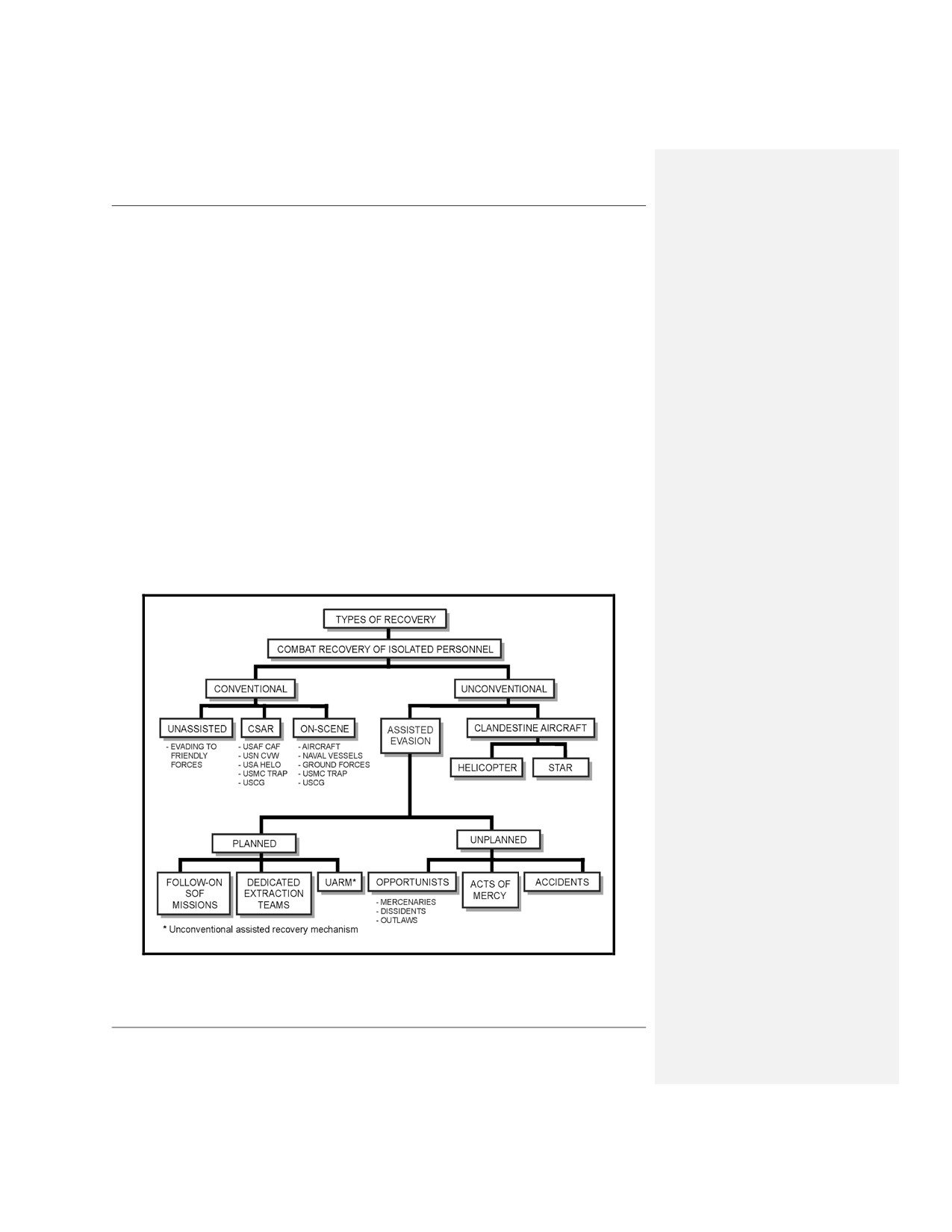
8-15.
The two types of combat recovery of isolated personnel are conventional and unconventional
(Figure 8-1):
Figure 8-1. Types of recovery.
FM 3-55.93
8-3
Chapter 8
CONVENTIONAL
8-16.
There are three types of conventional recovery:
Unassisted--Unassisted recovery by isolated personnel requires evasion back to friendly lines.
CSAR--Available PR assets, controlled and initiated by the JPRA, can recover the isolated
personnel.
On-Scene--Assets already in the AO, such as aviation, ground or naval forces can recover the
isolated personnel.
UNCONVENTIONAL
8-17.
There are two types of unconventional recovery: assisted and clandestine (aircraft). Assisted
evasion is the most likely of the two types that LRSU will have available. Planned recovery by SOF with a
dedicated recovery mission, or clandestine units may already be in place in the AO. Opportunists
sometimes perform unplanned recoveries in hope of receiving a reward for their actions. Civilians may
perform acts of mercy when evaders need medical attention. At other times, those sympathetic to the cause
will also provide accidental assistance.
CLASSIFICATIONS OF EVASION
8-18.
In a short-range evasion, the evader is close to the main battle area and becomes isolated. The
evader usually has the means to return to the unit within a few days. In an extended evasion, which
involves greater distances behind enemy lines, the evader might have to travel an extended distance
through foreign terrain, possibly with little food and equipment. LRS teams generally fit into this group.
Characteristics of a successful extended evasion include—
KNOWLEDGE OF THE AO
8-19.
Study of the AO and detailed E&R are critical to success.
KNOWLEDGE OF SURVIVAL
8-20.
These skills should be reinforced in the unit with thorough survival and evasion classes. Like most
perishable skills, survival training should be a regular training task.
SUPPLY ECONOMY
8-21.
Limiting use and making the best use of available supplies.
ENDURANCE
8-22.
The physical and mental conditioning of individuals and the team will largely determine the
ability to successfully execute E&R.
8-4
FM 3-55.93
Evasion and Recovery
PATIENCE AND DISCIPLINE
8-23.
Recovery may not be immediate--individuals and teams should be prepared to evade for days,
weeks, months or even years. Patience and discipline are often traits acquired though tough and realistic
training. Soldiers in an E&R and survival situation will be subjected to many physical and mental
These hardships are compounded if detailed area studies are not conducted during the planning phase and
Soldiers have limited survival skills. One major factor that has lead to more successful evasions than any
other is the individuals will to survive. Many factors affect evaders, they include—
• Family and home ties.
• Self-preservation.
• Material items.
• Religion.
• Sense of responsibility—to your family, to your team, and to your country.
Code of Conduct. Article III:
If I am captured, I will continue to resist by all means available. I will make every
effort to escape and aid others to escape. I will accept neither parole nor special
favors from the enemy.
MOVEMENT
8-24.
The team must consider the following movement factors in order to ensure successful evasion:
TECHNIQUES
8-25.
The movement techniques used during evasion are the same as with normal patrolling, as well as
the SOPs for movement.
ROUTE SELECTION
8-26.
Route selection is an extremely important factor when conducting evasion. Avoid all major built
up areas and areas with high traffic.
CAMOUFLAGE AND CONCEALMENT
8-27.
Camouflage and concealment are crucial when moving, and should never be sacrificed.
RATE OF MOVEMENT
8-28.
A rate of movement is established that allows the team to achieve goals established in the E&R
plan. Moving as fast as possible is seldom the preferred technique. Some of the goals and reasons for
them are--
Progress
8-29.
The team moves to the terrain feature/location goals established in the E&R plan. Measure
progress on the ground by the hole-up areas that are reached. Be flexible--make adjustments to the E&R
plan based on METT-TC considerations.
FM 3-55.93
8-5
Chapter 8
Stealth
8-30.
Although progress is extremely important, care should be taken so that the team is not rushed.
Speed should not be substituted for security.
Energy Conservation
8-31.
Along with assisting in stealth, the slower you move, the more energy you conserve, and the
longer you will be able to evade.
PHYSICAL CONDITION
8-32.
Physical condition is another deciding factor in how successful the team will be in the evasion.
Equipment cross loading may be necessary if some Soldiers are caring a heavier load than others, or if
there are wounded personnel on the team. The team is only as strong and fast as their weakest or slowest
man. Since the goal of the team is to be recovered by friendly forces, at times it may be necessary to cache
equipment in order to assist the team in evading. This technique is highly discouraged since the team
should have a goal of extracting with 100 percent of Soldiers, weapons, and equipment.
TEAM MOVEMENT
8-33.
The team may evade by whatever technique they have for a SOP, such as moving as a whole
element or by breaking up into two to three groups. There are advantages and disadvantages for both and
they must be considered when deciding how the team will move during E&R.
COUNTERTRACKING
8-34.
The team should use counter tracking techniques throughout the E&R. During the course of the
evasion there are certain considerations that will greatly affect the routes that are taken and the way the
evasion is conducted.
OBSTACLES
8-35.
Obstacles will be encountered throughout the evasion corridor. The two types of obstacles are
natural and man-made. Obstacles not only restrict movement, but they may also funnel movement.
However, some obstacles may serve as navigation aids for the evader, as well as aid in movement:
Mountains and Hilltops
8-36.
Use these for navigation, but avoid traveling on them due to silhouetting.
Rivers and Streams
8-37.
You can also use rivers and streams as guides and for water resupply, if the water is potable, but
remember that the local populace may also use it.
Roads or Trails
8-38.
Avoid roads and trails, and never use them for movement.
8-6
FM 3-55.93
Evasion and Recovery
Bridges
8-39.
Avoid these, too, because, although they look like the easiest and fastest way across a water
obstacle, they are also used for checkpoints and roadblocks.
Populated Areas
8-40.
Avoid entering populated areas, though if you are being tracked by dogs, traveling near a
populated area can throw off your scent.
SPECIAL CONSIDERATIONS
8-41.
Here are some things to considered while evading:
• Know how the locals feel about your cause. If you are compromised during the evasion, this
information can improve your chances of survival.
• Blend in with the natives. Knowing and following their customs and habits will aid in your
survival during the evasion.
• Remember that pets and livestock will compromise your situation.
• Know local curfews. They may determine your movement in an evasion.
DISGUISES
8-42.
The use of disguises, have been discouraged due to the belief that if captured you could possibly
be shot as a spy for treason. That is not to far from the truth, however there are ways that you may use a
disguise to your advantage
WEARING OF ENEMY UNIFORMS
8-43.
It is a violation of international law to make improper use of the uniform of the enemy. It is,
however, permissible for military personnel isolated in hostile territory to use the enemy's uniform to assist
in evading capture, as long as no other military operations are carried out while so attired.
WEARING OF CIVILIAN CLOTHING
8-44.
It is a violation of international law to kill, injure, or capture the enemy by feigning civilian status.
As with the military disguise you should avoid conducting operations that might be defined as either
military or espionage. Even if the evader is within his legal rights to use the clothing to help him evade, he
might, if captured, have to identify himself as an American. If partisans are aiding his evasion, then he
could be treated as one of them and tried for acts of treason. Every Soldier must keep his ID card and blood
chit on his person.
PROTECTED EMBLEMS
8-45.
The only disguises unauthorized for use in escape or evasion are protected emblems such as those
of medical, religious, or relief agencies.
IDENTIFICATION
8-46.
According to the Geneva Convention, all Soldiers involved in armed conflict must keep control of
his ID card and ID tag at all times.
FM 3-55.93
8-7
Chapter 8
LOCAL CURRENCY
8-47.
Soldiers are strongly discouraged from carrying any type of payment for helpers, partisan or
otherwise sympathetic to your cause, since this requires contact, which would compromise the team's
status. Higher echelons control payment to partisans; teams should not be concerned with this.
UNIFORMS
8-48.
It has traditionally been the practice of LRS teams to go to the field wearing sterile uniforms. The
Geneva Convention only requires them to wear a nametag and US Army tags. The sole purpose of the
sterile uniform is to avoid giving away the major supported unit or command. Wearing of rank is
permitted. If captured, a Soldier must provide name, rank, SSN, and date of birth anyway.
EVASION AIDS
8-49.
Evasion aids are easily accessible to the teams as long as the team knows where to request them.
Some of the evasion aids available and methods of requesting them are--
ISOLATED PERSONNEL REPORT (DD FORM 1833)
8-50.
This is the most important source of authentication data in the US and in some allied countries.
When filled out, it becomes a classified document. JP 3-50.2 provides instructions for completing the
ISOPREP card. When an individual enters an evasion mode the ISOPREP card should be forwarded to the
RCC to assist in recovery (Appendix K).
BLOOD CHITS
8-51.
The blood chit is a small piece of material imprinted with an American flag, control numbers in
each corner, and a statement in English and in several other languages (spoken by the indigenous populace
in the AO). This chit identifies the bearer as an American and promises a reward to any one or more people
who help him return to friendly control. The presenter of the blood chit may either tear the control number
off one of the corners, or he can let them write down the control number. He may also give them his name,
rank and SSN, to assist in identification. When the blood chit number is presented to friendly authorities
and the claim has been properly validated, it represents an obligation by the US government to provide
compensation to the claimant for services rendered to the evader. Blood chits are available through JPRA,
the office of primary responsibility for policy and authorizing the production, distribution, and use of blood
chits. The National Imagery Mapping Agency (NIMA) maintains the capability to produce and reprint
blood chits at the request of the combatant commander as coordinated through the JPRA.
POINTIE TALKIE
8-52.
This is similar to language guides used by invasion forces in WWII. They are distributed by the
JPRA. Each English phrase has the same phrase in various languages to the side. Simply point to the
phrase you wish to use. One of the disadvantages of this are the same as the blood chit, which are you must
make contact with people in order to use it. Literacy is also a problem that might arise among the
local populace.
8-8
FM 3-55.93
Evasion and Recovery
EVASION CHARTS
8-53.
The National Imagery Mapping Agency (NIMA) distributes evasion charts. Each evasion chart is
actually a series of eight 1:250,000 scale joint operations graphic (JOG) charts. The National Imagery
Mapping Agency (NIMA) distributes evasion charts. Each evasion chart is actually a series of eight
1:250,000 scale joint operations graphic (JOG) charts. The JOG charts are usually printed four to a side.
The chart is overprinted with a camouflage pattern suitable for area terrain, and also includes an American
flag that allows the evader to identify himself. An evasion chart combines standard navigation charts and
includes evasion and survival information in the margins. In addition, it typically provides information on
local navigation, survival medicine, environmental hazards, personal protection, and water and food
procurement, plus photos of edible and poisonous plants and wildlife. The evasion chart is waterproof, and
can provide a make-shift shelter in an emergency. It folds up small enough to fit into a cargo pocket or
flight suit. If evasion charts are unavailable, tactical pilotage charts (1:500,000 scale) may be substituted.
INTELLIGENCE DESCRIPTION FOR SELECTED EVASION AREA
8-54.
The term usually used for this is SAID, which means "SAFE area intelligence description" or,
spelled out completely, "Selected Area for Evasion Intelligence Description." The "SAID" (say each letter)
is distributed by the Defense Intelligence Agency for training and real-world contingencies. The SAID is an
in-depth study of all-source evasion designated to help in recovering military personnel from a SAFE under
hostile conditions. The SAID includes a 1-to-1:50,000 scale map of the AO, colored photographs of contact
points within the SAFE, possible LZs and PZs, survival information, terrain surveys, a chart that shows
average rainfall by month, high and low temperatures, and any other information about the AO that the
evader might find useful.
AIR-TASKING-ORDER SPECIAL INSTRUCTIONS
8-55.
The JSRC develops the ATOSPIN using information that will allow recovery to be conducted with
the least amount of problems possible. These instructions include--
• Point of contact for PR incident report.
• Communications report.
• Color of the day.
• Number of the day.
• Codeword of the day.
• Letter of the day.
• Search and rescue point (SARDOT).
EVASION PLAN OF ACTION
8-56.
The individual units, not the team, develop the EPA. The RCC helps. Speed of recovery depends
on how closely everyone follows the EPA. All units operating in or over hostile territory should develop an
EPA or review their existing EPA each time a designated target or AO changes. Responsibility for properly
preparing and planning the evasion rests with the potential evaders. The headquarters element supports
planning, the team develops the plan, and joint theatre assets support the recovery effort. Successful
depends on detailed planning, including contingency plans, initiation mechanisms, and incorporates
information from available reference sources. The EPA provides critical information to the recovery force,
such as the scheme of maneuver. The EPA format has six mandatory and five optional components
(Appendix K).
FM 3-55.93
8-9
Chapter 8
Mandatory Components
•
Identification.
— Name and rank for each team member.
— Mission number.
— Team call sign or identifier.
— Team position.
— Call sign suffix.
— Other.
•
Planned flight or travel routes.
— Describe routes for both ingress and egress.
— In-flight emergency plans for each leg of the mission.
•
Evasion actions and intentions for first 48 hours, uninjured.
— Compare evasion to resupply and continuation of the mission.
— Plan for evading alone, in small groups, or with entire team.
— Plan travel, including such factors as distance, duration, and speed.
— Plan intended actions and length of stay at initial hole-up location(s).
•
Evasion actions and intentions for first 48 hours, injured.
— Plan for treatment of the injured or self-aid.
— Considerations for movement techniques.
— Litters, canes, crutches, and so on.
— Rate of march.
•
Evasion actions and intentions after 48 hours.
— Routes, plans to destination.
— Actions and intentions at potential contact or recovery locations.
— Contact and recovery point signals, signs or procedures.
— Contingency plans.
•
Communication and authentication.
— Code words.
— Bona fides.
— Color or letter of the day, month, or quarter.
— Challenge or password and any number combinations.
— Available communications and signaling devices (day or night, near or far).
— Primary communication schedule procedures and frequencies.
— Alternate communication schedule procedures and frequencies.
Optional Components
• Weapons and ammunition carried.
• Personal evasion kit items.
• Listing of issued survival kit items.
• Mission evasion preparation checklist.
• Signature of reviewing officer.
EVASION AREAS
8-57.
Evasion areas within the theatre or area of operation are decisive to mission accomplishment
should the team or individual become isolated from his unit. Using the evasion area within the study region
increases the evader's chance to reunite to friendly control.
8-10
FM 3-55.93
Evasion and Recovery
SAFE
8-58.
A SAFE is an area within a potentially hostile region where an individual may become isolated
and must evade to avoid capture by the enemy. This area will be pre-determined to have the best conditions
for evasion and survival opportunities. Within the SAFE will be contact points and usually a recovery site.
An area study of the SAFE will be found in the SAID and should be used when planning for a possible
evasion situation.
DESIGNATED AREAS FOR RECOVERY
8-59.
The DAR can be any size or shape within a potentially hostile region where individuals may
become isolated and must evade to avoid capture. The DAR is issued when no SAFE is available in the
AOor can supplement the SAFE in the area of recovery. An area study will be used similar to the SAID
during the planning process. If a DAR is used, the contact points are called 'recovery points.' (For more
information on E&R see JP 3-50.2, JP 3-50.21, and JP 3-50.3.)
FM 3-55.93
8-11
Appendix A
Recruitment, Assessment, and Selection Program
The physical and psychological demands on the LRSU Soldier generally exceed those
those on conventional Infantry and reconnaissance Soldiers. Instead of operating near
near friendly supporting units, they operate deep in the enemy's rear, surrounded by
hostile forces. They operate independently for long periods of time without support.
They must rely only on each other and on what they can carry. The pressure of having
having to perform under such extreme circumstances requires more than
extraordinary physical capabilities--it also requires specific character traits. Ideally,
LRSU Soldiers are selected in three stages: recruitment, assessment, and selection.
This appendix covers the purpose, organization, and elements of the recruitment,
assessment, and selection program (RASP) as well as reassignment during and after
the 90-day probationary period.
PURPOSE AND ORGANIZATION
A-1.
The purpose of a LRSU RASP is to identify and gauge the potential of individual Soldiers to meet
LRSU standards within a reasonable training period.
Memorandum of Understanding—The BFSB S-1, the R&S squadron S-1 and the LRSC should
develop a RASP Memorandum of Understanding (MOU). The RASP MOU should have the
approval of the BFSB and R&S squadron commanders.
Three-Time Volunteers—Potential new Soldiers for a LRS team should be at least three time
volunteers: they have joined the Army, they are Airborne qualified, and they agree to be
assigned to a LRSC.
Assessment and Selection Board—The LRSU assessment and selection board consists of senior
LRSC leaders, R&S squadron and BFSB commanders and Command Sergeants Majors (or
their designated representatives). The board centrally reviews the candidate's qualifications and
results of the assessment process. Assignment to the LRSC ideally occurs only after the Soldier
successfully completes the assessment phase and receives a recommendation for assignment
from the selection board.
Phases—A LRSU RASP normally has three phases: recruitment, assessment, and selection.
RECRUITMENT
A-2.
LRSU recruitment should not be used to reward or promote particular Soldiers. Neither should
other units reassign Soldiers with "problems" or marginal performance to the LRSC. For the LRSU to
properly perform its mission, Soldiers should volunteer or be chosen based on their proven ability or
potential to perform and thrive under the demanding conditions of LRS missions. LRSU recruitment
should be viewed as an extension of the Army's personnel-management program. It identifies Soldiers who
meet the requirements for specific LRSU needs.
A-3.
Privates through specialists will be assigned to the BFSB by the Human Resources Command.
With very few exceptions, 11B1P Soldiers assigned to the BFSB are intended to fill slots in the LRSC. It is
unlikely that these Soldiers will initially all meet the unique characteristics of a LRS Soldier. The BFSB
S-1 needs to establish a relationship with units on the host installation that require 11B10s and institute a
reassignment policy so Soldiers not meeting the RASP standards can be transferred. A Soldier not meeting
the RASP standards does not necessarily mean he is a substandard performer. Likewise, RASP standards
should not be so stringent that the failure rate of potential new LRSU Soldiers puts an undue burden on the
BFSB, the host installation and the US Army Human Resources Command.
FM 3-55.93
A-1