FM 3-55.93 Long-Range Surveillance Unit Operations (MAY 2008) - page 4
Chapter 4
EMPLOYMENT OF LASER DESIGNATORS
4-214. Lasers aid in target identification, location of aim point, site selection, and site illumination.
Aim Point Location—The laser aids in location of aim point by revealing—
— Target reflectivity.
— Ordnance type.
— Method of delivery.
Beam divergence—Offset should not exceed 7 degrees from either side -the aircraft must stay
within that cone.
Target Orientation—Laser energy reflects in an arc, but is strongest at the angle where it would
reflect if the surface were a mirror. If the laser designator is perpendicular to a surface the
reflection can be seen from all angles on the designated side, but can be detected best near the
laser designator to target line.
Weather conditions—Visibility of less than 3 nautical miles restricts the operation, regardless of
aircraft type.
Site Selection—The aircraft must be able to approach within 10-to 60 degrees to the left or right
of the team’s location. While maximizing standoff, the team needs to ensure they have both
optical and electrical LOS to the target. Observer to target distance should not exceed the
capabilities of the laser designator being employed.
Site Illumination—The laser aids in illuminating the site.
Function Check—Conduct a laser function check, and recheck the laser codes based on the type
of aircraft conducting the attack. Designate the target (paint) for not less than 5 seconds before
the aircraft releases its ordnance. For guns or other nonguided ordnance, you can use the laser
to identify targets for aircraft without the 5 second (paint).
FIRE SUPPORT
4-215. Fire support, particularly artillery and CAS, are excellent assets to use during target-acquisition
missions or in support while breaking out of a site or away from contact. Leaders must fully integrate fire
support into their plans. They must understand how fire support can assist or detract from the execution of
their assigned missions. They must understand fire support limitations.
INDIRECT-FIRE SUPPORT CAPABILITIES
4-216. Indirect fire support capabilities follow:
• Quick response time.
• Adjustability of fire.
• Variety of munitions, including precision munitions.
• Multiple strike capability.
• All-weather capability.
INDIRECT-FIRE SUPPORT LIMITATIONS
4-217. Indirect fire support limitations follow:
• Range.
• Naval gunfire availability limited to areas with naval assets.
4-60
FM 3-55.93
Team Operations
CLOSE AIR SUPPORT (USAF FIXED WING) CAPABILITIES
4-218. Close air support (CAS, or Army fixed wing) capabilities follow:
• Long range.
• Visual target engagement and adjustment of fires.
CLOSE AIR SUPPORT (USAF FIXED WING) LIMITATIONS
4-219. Close air support (CAS, or Army fixed wing) limitations follow:
• Limited time on target.
• Limited compatibility with team radio systems (depending on aircraft type).
• Limited munitions.
• Limited ability to operate in poor weather.
CLOSE COMBAT ATTACK (ARMY ROTARY WING) CAPABILITIES
4-220. Close combat attack (CCA, or Army rotary wing) capabilities follow:
• Medium range.
• Longer time on target than fixed wing assets
• Visual target engagement and adjustment of fires.
• VHF radio capabilities.
CLOSE COMBAT ATTACK (ARMY ROTARY WING) LIMITATIONS
4-221. Close combat attack limitations follow:
• Limited ability to operate in poor weather.
• Limited munitions.
• Vulnerability to enemy ground fire.
FIRE PLANS
4-222. Teams plan targets on infiltration and exfiltration routes, LZs, DZs, PZs, routes to and from the
objective, on the objective, between the objective and surveillance, and between the surveillance and hide
sites (linear targets work well). Teams plan RFAs and NFAs as needed. Coordination is done using the
target list and coordination checklist. They consider the effects, the mission, the types of targets, and the
methods of engagement.
FM 3-55.93
4-61
Chapter 4
Section VI. UR B AN TE R R AIN
The LRS teams can be very effective in an urban environment. Their ability to gather information and report
timely information about the current situation is vital to the BFSB intelligence-collection plan. The LRS team
can help in two ways during an urban operation: First, the commanders can use LRS teams extensively and
effectively for surveillance. Second, he can use them on a limited basis for reconnaissance. Before committing a
LRS team to a mission in urban terrain, he must consider all aspects of the mission and the environment.
Specifically, he must consider the differences between LRSU support to offense, defense, stability and civil
support operations.
SURVEILLANCE OPERATIONS
4-223. This is normally the primary mission a LRS team conducts in an urban environment. LRS teams
are most often used to report information received along main supply routes to and from the urban
environment. Depending on the size of the urban area and location of key buildings, the LRS team might
report information on specific buildings, motor pools, and so on. During stability operations, a LRS team
might surveil a specific target from inside the environment. Considerations include camouflage,
observation, security, and support.
CAMOUFLAGE
4-224. LRS teams are proficient in camouflage techniques specific to urban environments such as
window screening and false walls.
OBSERVATION
4-225. In built-up areas, windows provide readily accessible observation ports. However, care should be
taken to prevent optics from protruding beyond the window. This is an obvious sign of a surveillance
position. The team members must position themselves as far back in the room as possible to keep from
being seen. To lower their silhouettes, they can support their positions with a table or sand bags. Another
techniques is to observe through a hole in the wall. When observing through the window, individuals
should stand well back in the shadows. At all times, care must be taken to avoid allowing light to reflect off
optics.
SECURITY
4-226. From the time the team leaves the last secure point until exfiltration, security remains a constant
and immediate concern. Teams plan constant and sustained security for every phase of the mission. In the
security role, the team can use both active and passive security devices. Teams can stage objects in and
around the site that will identify any presence. All security devices must be able to withstand scrutiny.
PROTECTION AND SUSTAINMENT SUPPORT
4-227. In an urbanized AO, the LRS team can achieve protection and sustainment in stay-behind or
rollover missions.
4-62
FM 3-55.93
Team Operations
RECONNAISSANCE OPERATIONS
4-228. This is the second mission that a LRS team can perform in an urban environment. Due to the
increased chance of compromise in an urbanized environment, the commander should consider employing
LRS teams in a very limited reconnaissance role. The LRS team plans reconnaissance missions on
urbanized terrain in as much detail as possible. Considerations include—METT-TC, the type of mission,
planning time, specialized equipment need to accomplish the mission, and specialized equipment weight
and size.
PLANS
4-229. Urban areas are categorized in the following manner, by population size:
• Villages (population of 3,000 inhabitants or less).
• Towns (population of over 3,000 to 100,000 inhabitants and not part of a major urban complex).
• City (population over 100,000 to 1 million inhabitants).
• Metropolis (population over 1 million to 10 million inhabitants).
• Megalopolis (population over 10 million inhabitants).
RULES OF ENGAGEMENT
4-230. All LRS team members must receive a detailed briefing on the rules of engagement before
deployment in an urban environment.
VISIBILITY
4-231. Weather, smoke, and dust always obscure visibility. Military operations can change urban terrain,
shifting shadows and dead spaces around every time a building collapses or a new pile of rubble forms.
SIZE, LOCATION, AND HISTORY
4-232. Within the city, urban terrain differs based on size, location, and history.
Industrial Areas and Residential Sprawl
4-233. Residential areas have some houses or small dwellings with yards, gardens, trees and fences.
Streets normally form rectangular or curving patterns. Industrial areas usually have low
(one- to
three-story) flat-roofed buildings. Most of these are factories or warehouses, and they are generally located
on or along major rail and highway routes. Both types of terrain have many open areas.
Core Periphery—A core periphery has narrow streets (12 to 20 meters wide) and continuous
fronts of brick- and heavy-walled-concrete buildings. Most buildings are about the same height,
ranging between two and three stories in small towns and five to ten stories in large cities.
City Cores and Outlying High-Rise Areas—Typical city cores consist mostly of high-rise
buildings that can vary greatly in height. More modern buildings often have more space
between them than that do the buildings in older city cores. This open construction style is
more prevalent in outlying high-rise areas than in city cores. Streets generally form rectangular
patterns.
Commercial Ribbons—These rows of stores, shops, and miscellaneous structures are built on
either side of the major (at least 25 meters wide) streets that run through built-up areas. These
structures are uniformly two or three stories tall.
FM 3-55.93
4-63
Chapter 4
INSERTION AND EXTRACTION
4-234. Leaders must consider the distance of the insertion or extraction, and the training of all team
members. They consider support assets, their own experience, and internal and external assets. All types of
insertion and extraction means available in other environments are still viable in an urban environment
however, considerations for their use may be different. For example, the use of nonstandard tactical
vehicles may be a good insertion and extraction platform in urban areas during stability operations.
Subterranean corridors such as sewers, subways, underground tunnels, or drainage systems can be used
with great effectiveness.
EVALUATION
4-235. When a LRS team evaluates urban terrain, it considers the following factors:
Observation
4-236. Buildings on the edge of a city generally offer better observation than those inside. There, tall
buildings with numerous windows often offer the best observation, especially if the buildings have spaces
between them.
Avenues of Approach
4-237. The best way to enter a building is from the top. Therefore, the most important avenue of
approach is one that quickly leads to the top from fire escapes, drainpipes, or adjacent buildings.
Key Control Points
4-238. Key control points in a building include entrances, hallways, and stairs. Whoever controls these
controls the building.
Doors and Fire Barriers
4-239. These are common in commercial buildings. They become obstacles when closed or secured.
Furniture and appliances can also become obstacles.
Cover and Concealment
4-240. Buildings with brick walls and a few narrow windows balance cover and concealment. Roofs
provide little protection—lower floors offer LRS teams better protection than do areas directly under the
roof. Additionally, floor layouts with many small rooms offer more protection than those with larger rooms.
Intercity Distribution of Building Types
4-241. Leaders can generally determine the layout of a city by the distribution of the buildings within the
city. In built-up areas, mass-construction buildings (modern apartments and hotels) are the most common
structures. They comprise two-thirds of the total area, and they are usually constructed of brick. Steel and
concrete-framed multistory buildings comprise the city's core area, its most valuable land. As centers of
economic and political power, they have potentially great military significance. Open spaces, such as parks,
athletic fields, and golf courses, comprise about 15 percent of the average city's area. Most of this 15
percent is suitable for air assault or airborne operations. However, approaches to these areas may have
obstacles such as tall buildings, trees and wires, and should be carefully considered during planning.
Additionally, rooftops complement this 15 percent since many can take the weight of aircraft or the impact
of men and equipment jumping on to them.
4-64
FM 3-55.93
Team Operations
Sources of Information
4-242. Cities offer a wealth of useful information. This information is found in a variety of sources.
• Large-scale city maps.
• Diagrams of underground sewer, utility, transport, and other systems.
• Publicly available information about key public buildings.
• Rosters of key personnel.
• US government studies and data bases that detail—
— Size and density of the population.
— Police and security capabilities.
— Civil defense and air-raid shelters.
— Fire-fighting capabilities.
— Utility systems.
— Medical facilities.
— Mass-communication facilities.
Equipment
4-243. Some of the items a Soldier might consider carrying into an urban environment include—
• Camera.
• Communications equipment with various antennas.
• Spotting scope with stand.
• Binoculars.
• Dark cloth.
• Tape.
• Glass cutter.
• Complete cleaning kit.
• Multipurpose knife.
• Suppressed pistol.
• Notebook.
• Pencils.
• Tape recorder.
• Sleeping pad.
• Wasp and hornet spray.
• Bungee cord(s).
• Small saw.
• Crowbar.
FM 3-55.93
4-65
Chapter 4
COMMUNICATIONS
4-244. Probably the most important considerations in planning urban communications are: type of
placement of that antenna.
Subsurface Surveillance Site
4-245. A team can split into surveillance and hide sites, with the hide site located outside of the urban
area. If so, team members at the hide site should be able to use their HF, UHF TACSAT, and LOS systems
normally. However, when the surveillance site operates subsurface, they need an antenna for LOS
communications with the hide site. Depending on the situation, the team members at the surveillance site
might be able to use the whip antenna that is normally issued with their inter team radio. When the sites
are split, the surveillance site can use any one of several methods to establish LOS communications with
the hide site.
4-246. Sometimes, the team will have to use remoting equipment to communicate with the hide site.
Before the mission, they should try to obtain some field-expedient materials.
4-247. If the team is configured in a combined surveillance and hide site, and the entire element is in a
subsurface environment, then the team must remote the long-range antenna system to the surface area.
4-248. To make contact with the COB or AOB, the RTO might be able to attach the HF antenna wire to
some nearby metallic object that protrudes above the surface such as a light, a fence, or a storm drain gate.
The RTO must remember to place the antenna system towards the receiving station. If using UHF
TACSAT, the antenna must be placed so that no obstructions stand between it and the satellite.
4-249. Operating from a subsurface situation can be highly risky, because the enemy may be able to
detect the antenna.
4-250. Communications are easier to achieve from an elevated position such as a building or other
structure. In most cases, depending on distance, the surveillance team can use the whip antennas organic to
their radio system.
4-251. If a structure obstructs the LOS view between the two sites (surveillance and hide), then the RTO
can make a closed-loop antenna. He fastens Claymore wire to an interior wall in a loop from the socket of
the radio's whip antenna to the ground for the radio. He must remember to cut the antenna to at least one
full wave-length of the frequency he is using. This is an excellent antenna to use during urban area
missions.
4-252. VHF antennas are much shorter than HF antennas. In fact, the antennas used for HF
communications can also be used for VHF, except that they must be scaled down for higher frequencies.
However, constructing and placing them is much the same as it is for the LOS.
4-253. Other items that can be used for HF communications include—.
• Existing antennas on the structure.
• Existing electrical wiring (team has to test for conductivity).
• Metal plumbing pipes.
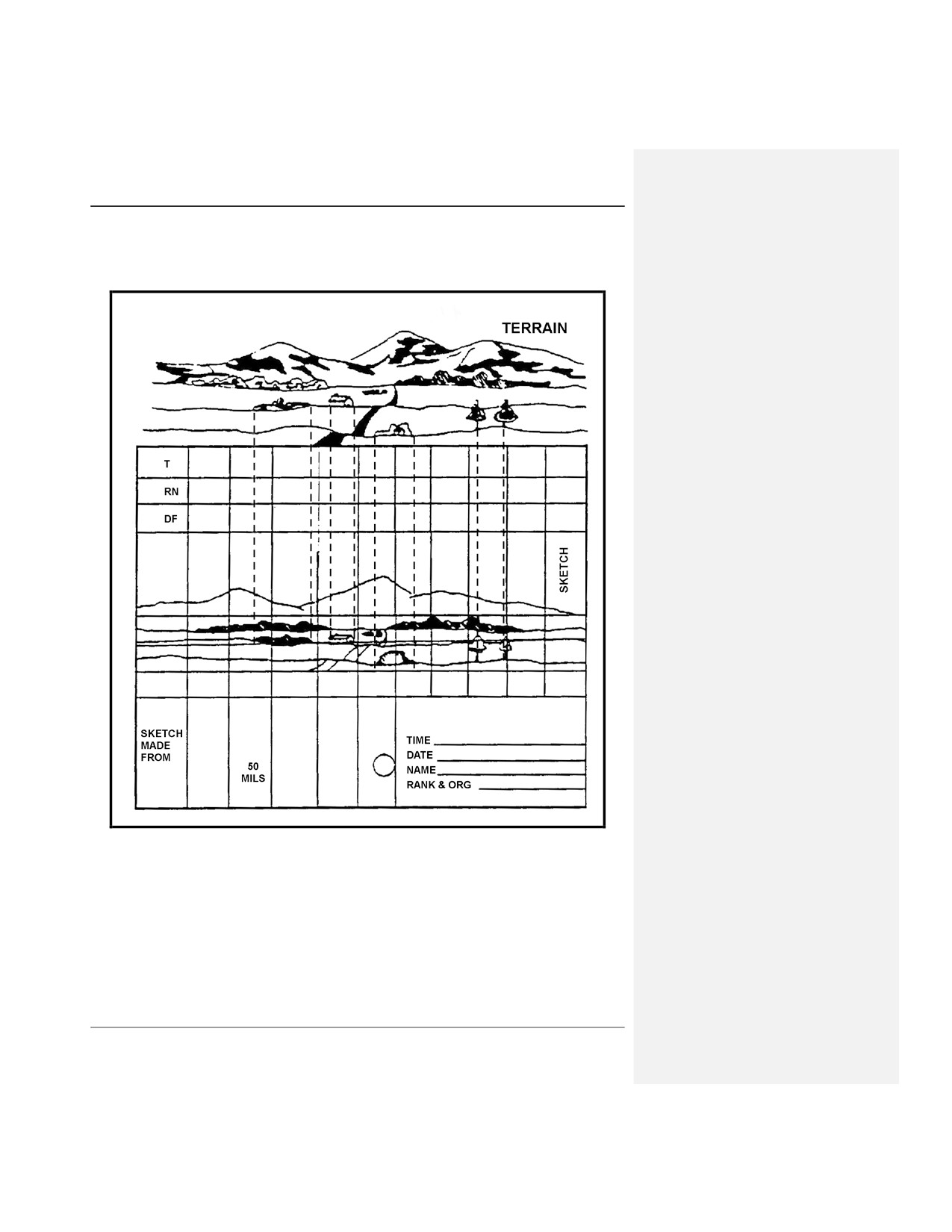
• Ceiling grids.
• Metal clothes lines.
• Metal building frames (if power to the building is off, otherwise damage to the radio could
occur).
4-66
FM 3-55.93
Team Operations
WARNING
Never construct antennas less than twice their length from power
lines and transformers.
HIDE AND SURVEILLANCE SITES
4-254. When selecting a suitable site, Soldiers tend to go for height. In an urban operation, this can be a
mistake. The greater the height attained, the more the LRS Soldier has to look out over an area and away
from his immediate surroundings. For example, to see the road below a tenth-floor surveillance site, the
LRS Soldier must lean out of the window, which reveals his location and exposes him to fire. Though the
observer cannot predict where incidents will occur, he can expect that the ranges will be relatively short
distances. A surveillance site must cover its surroundings as well as middle and far distances. In urban
areas, this is rarely possible: sites are often forced off ground-floor levels by passing pedestrians. However,
generally, the team should avoid going above the second floor.
CONSIDERATIONS
4-255. When considering possible hide or surveillance positions, the team should consider old, derelict
buildings as they are unlikely to be reoccupied by civilians in the area. Abandoned or unoccupied houses or
buildings also offer good sites, but could be booby trapped or be reoccupied by civilians. The team must
search the building after they have occupied it. Buildings that provide protection from weather and small
arms are preferred. They should avoid isolated buildings as they tend to be obvious observation positions.
After carefully observing the inhabitants' daily routines, the team can occupy private residences. They can
occupy the home and establish hides or surveillance sites in the basement or attic, or both, but the
homeowner will pose a danger and the team should generally limit their stay to 12 to 24 hours. The team
can use shops with empty accommodations on a second floor, but again should limit their stay to 12 to 24
hours.
CONSTRUCTION
4-256. During the reconnaissance phase, the team plans the construction of an urban hide or surveillance
site in detail. They must prepare a view aperture, a viewing platform (if needed), and the interior layout.
Selection of the viewing aperture takes priority over construction of the viewing platform or any interior
work. When construction begins, the team must pull local security to warn of any excess noise or act as
early warning. If they have floor plans of the building or house during their planning phase, the team can
rehearse the construction and occupation of the site. Before constructing a hide or surveillance site, the
team records what the area looks like so that they can return it to normal before departing.
FM 3-55.93
4-67
Chapter 4
CAMOUFLAGE
4-257. To survive in an urban environment, LRS Soldiers must supplement cover and concealment with
camouflage. To properly camouflage their positions, they must study the terrain in the surrounding area.
The site must blend in with the terrain. For instance, in an undamaged building, they should not make a
hole for observation. They should use only the materials that they need-excess materials can reveal their
position. They should also consider—
Use of Shadows—Buildings in urban areas throw sharp shadows.
Color and Texture—The team needs to break up the silhouettes of their individual equipment.
They can use burlap or canvas strips for this. The predominant colors are normally brown, tan,
and gray. The team should evaluate the camouflage they need for each location separately.
Section VII. IMAGERY COLLECTION AND TRANSMISSION
The timely and accurate collection and transmission of imagery, video or hand drawn pictures of the objective,
plays a key role in the success of follow-on missions. The purpose of imagery collection and transmission is to
provide an accurate description of enemy strengths, positions and capabilities so that the commander can make
informed decisions. With the introduction of new technology and integration between digital cameras, global
positioning system (GPS) devices, laser range-finding equipment and other electronic devices, it is now easier
and of more tactical value to take digital imagery of objectives. The use of a digital camera with laser range-
finding equipment and GPS helps produce clear, real-time information.
4-68
FM 3-55.93
Team Operations
IMAGERY LABELS
4-258. All personnel on the team should be proficient at labeling images according to the unit SOP.
PRINCIPLES
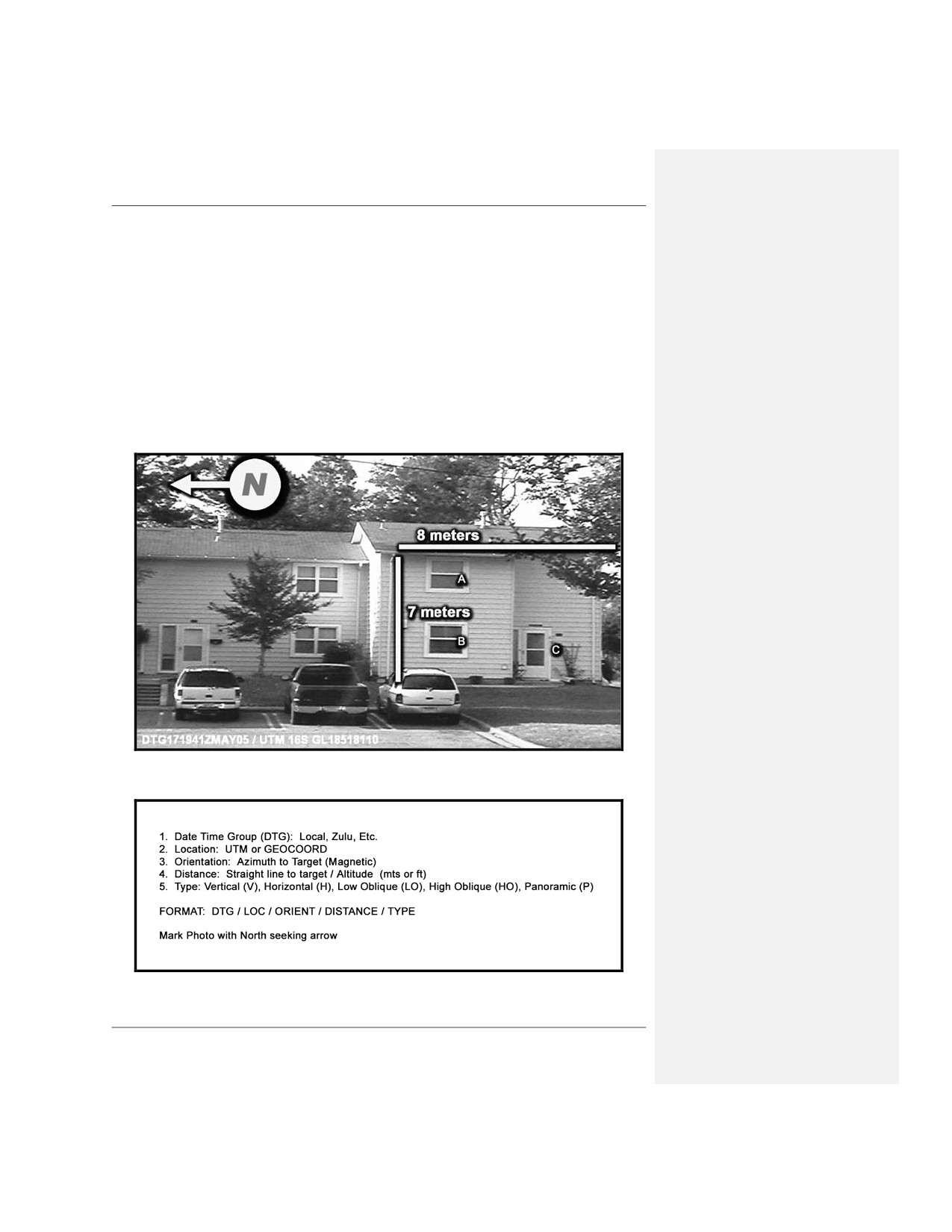
4-259. General principles of labeling imagery include (Figure 4-9 and Figure 4-10) —
• Placement of letters or numbers on the image to correspond with the legend.
• Placing appropriate arrows and other graphics where needed.
• Ensuring the image has a title, including a name, DTG, and grid, for example,
• North-seeking arrow.
• Size of the picture (from East to West, North to South).
• Remarks page for details about what each number or letter means.
Figure 4-9. Example imagery labels.
Figure 4-10. Example imagery legend.
FM 3-55.93
4-69
Chapter 4
IMAGE-GATHERING EQUIPMENT
4-260. There are many types of cameras and video cameras available. The majority of this equipment
becomes dated quickly, so it is important to stay proficient in the equipment available.
CAMERAS
4-261. Several different types of cameras may be used to gather imagery from an objective. Some basic
principles should be adhered to when considering what type and or kind to use—
• Durable.
• Waterproof.
• Number of images at a particular resolution.
• Film type, memory stick, or compact flash card.
• Weight and size measurements.
VIDEO CAMERAS
4-262. The introduction of the video camera recorder (a camera capable of taking video and still images)
has aided the R&S community in its ability to record information. Considerations for video camera use
are—
• Zoom.
• Quality and resolution.
• Battery life.
• Power converter for military batteries (BA-5590).
COMPRESSION SOFTWARE
4-263. The use of compression software can greatly enhance the effectiveness of a unit when it comes to
gathering and transmitting imagery and video. Compression software allows compression of files up to
88% smaller then the original file. Being able to compress files aids in decreasing the amount of time
required to transmit.
OBJECTIVE SKETCH
4-264. In the case of loss of communication or enemy compromise, an objective sketch may be the only
piece of information about that objective available. The ability to draft a proper objective sketch is an
extremely important skill. It is important to understand the basics of objective sketch production.
Understanding the basics allows a novice or non-artist to draw an understandable objective sketch.
4-70
FM 3-55.93
Team Operations
Types
Panoramic Sketches
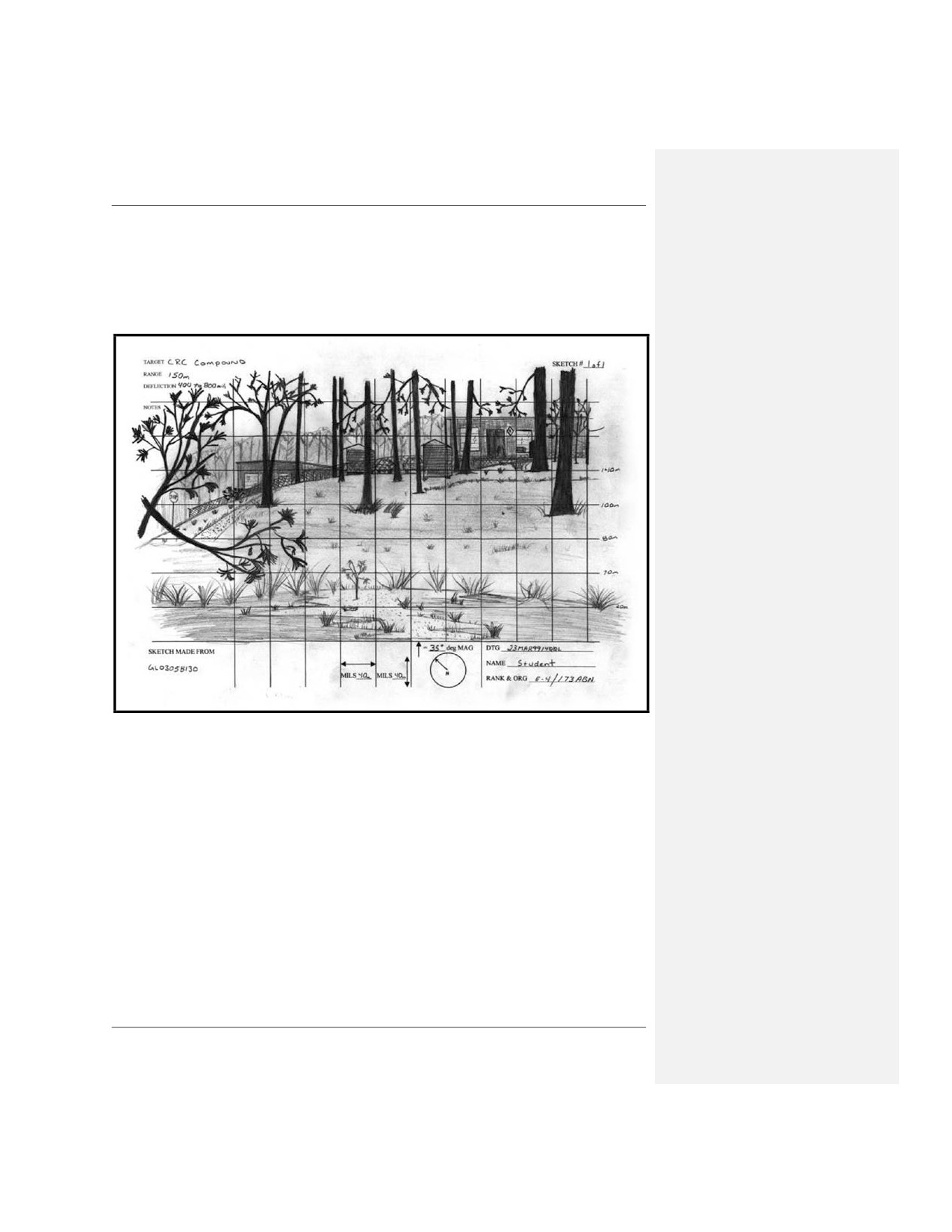
4-265. Each of these represents an area or object, and is drawn to scale from the observer’s perspective. It
provides a useful way to record details about a specific area or structure (Figure 4-11).
Figure 4-11. Example panoramic sketch.
FM 3-55.93
4-71
Chapter 4
Topographic Sketches
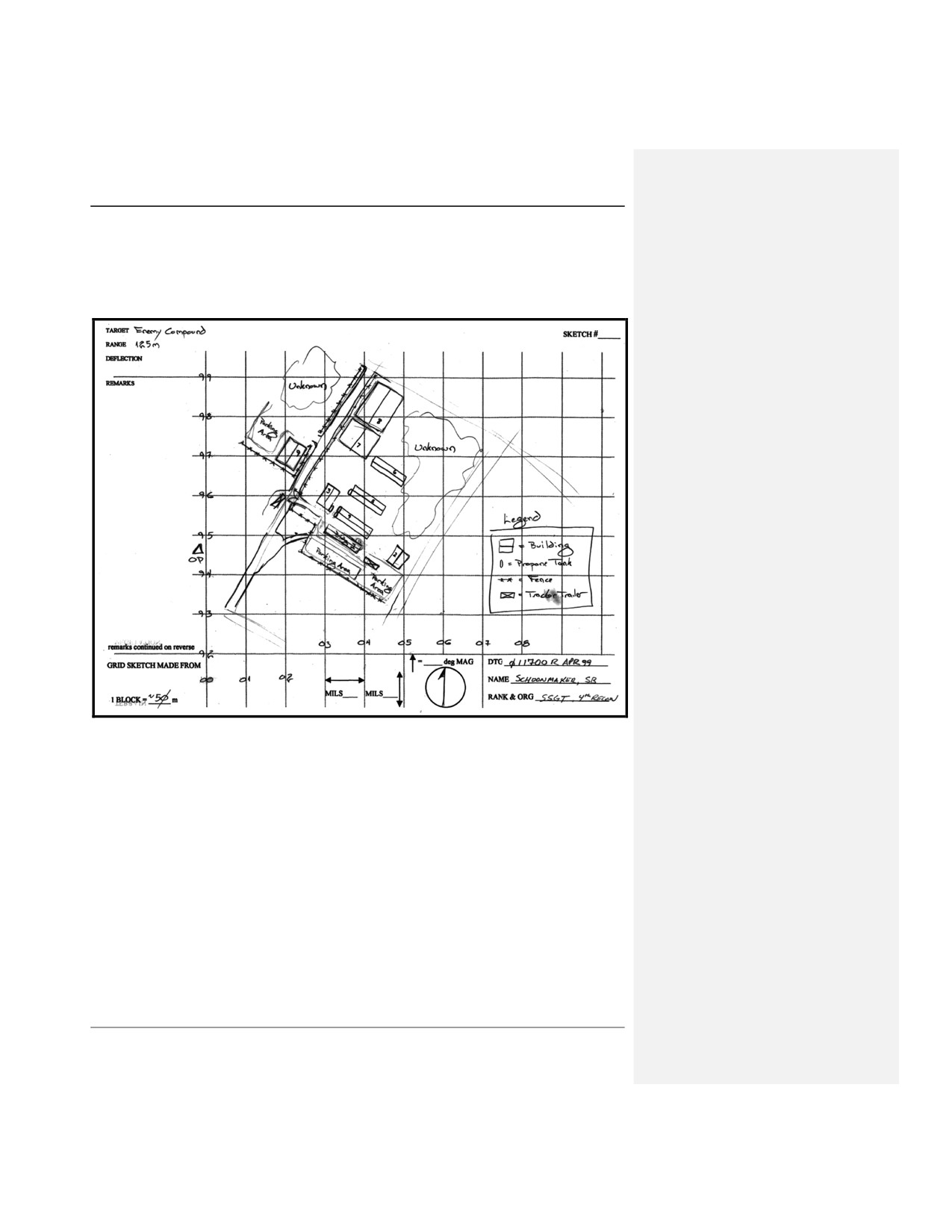
4-266. Each of these represents a large area drawn to scale as seen from above (bird's eye view). It shows
reliable distances and azimuths between major features. A topographic sketch can also be used as an
overlay on a range card (Figure 4-12).
Figure 4-12. Example topographic sketch.
4-72
FM 3-55.93

Team Operations
Objective Sketch
4-267. Each of these, most easily drawn on a printed objective sketch pad, shows all useful information.
The pad includes reminders of what specific information should be placed on the objective sketch. The
sketch pad includes marginal information and remarks (Figure 4-13) —
Figure 4-13. Example objective sketch pad.
FM 3-55.93
4-73
Chapter 4
Marginal Information
• Target number.
• Range from the preparer to the objective.
• Reference point, that is, the point of origin.
• Deflection angle from the preparer to the objective.
• Grid coordinates for the objective.
• Block scale, that is, the size of the blocks printed or drawn on the sketch pad.
• Mils latitude and longitude (for air strikes using fixed wing aircraft)
• Magnetic azimuth from the preparer to the objective.
• Sketch number (if more than one sketch).
• DTG when the sketch was prepared.
• Name of the preparer.
• Rank and organization of the preparer.
Remarks
• Terrain on the objective.
• Vegetation, that is, whether it can provide concealment.
• Structural composition at the objective, for example, brick, mud, or wood.
• Tactical value of the objective, for example, what purpose it could serve such as prison camp,
training camp, or communications site
• Additional information of tactical relevance such as whether buildings on the objective are
elevated and whether their windows have screens, the locations of power lines and
construction, types of sidings, building numbers, lighting, gaps, breach points, or any other
information that might help the chain of command plan follow-on missions.
Preparation
4-268. Sketching is an easy way to record information about an objective. The following are some useful
steps to take when preparing a sketch:
• Work from the whole to the part.
• Use common shapes to show common objects such as roads, buildings, and poles.
• Draw in perspective.
• Use vanishing points.
• Cross-hatch to show depth in the sketch.
• Avoid concentrating on the fine details unless used to clarify the drawing or emphasize
something of tactical importance.
4-74
FM 3-55.93

Team Operations
Work from the Whole to the Part
4-269. See Figure 4-14.
Figure 4-14. Example drawing technique: whole to part.
FM 3-55.93
4-75
Chapter 4
Use Common Shapes for Common Objects
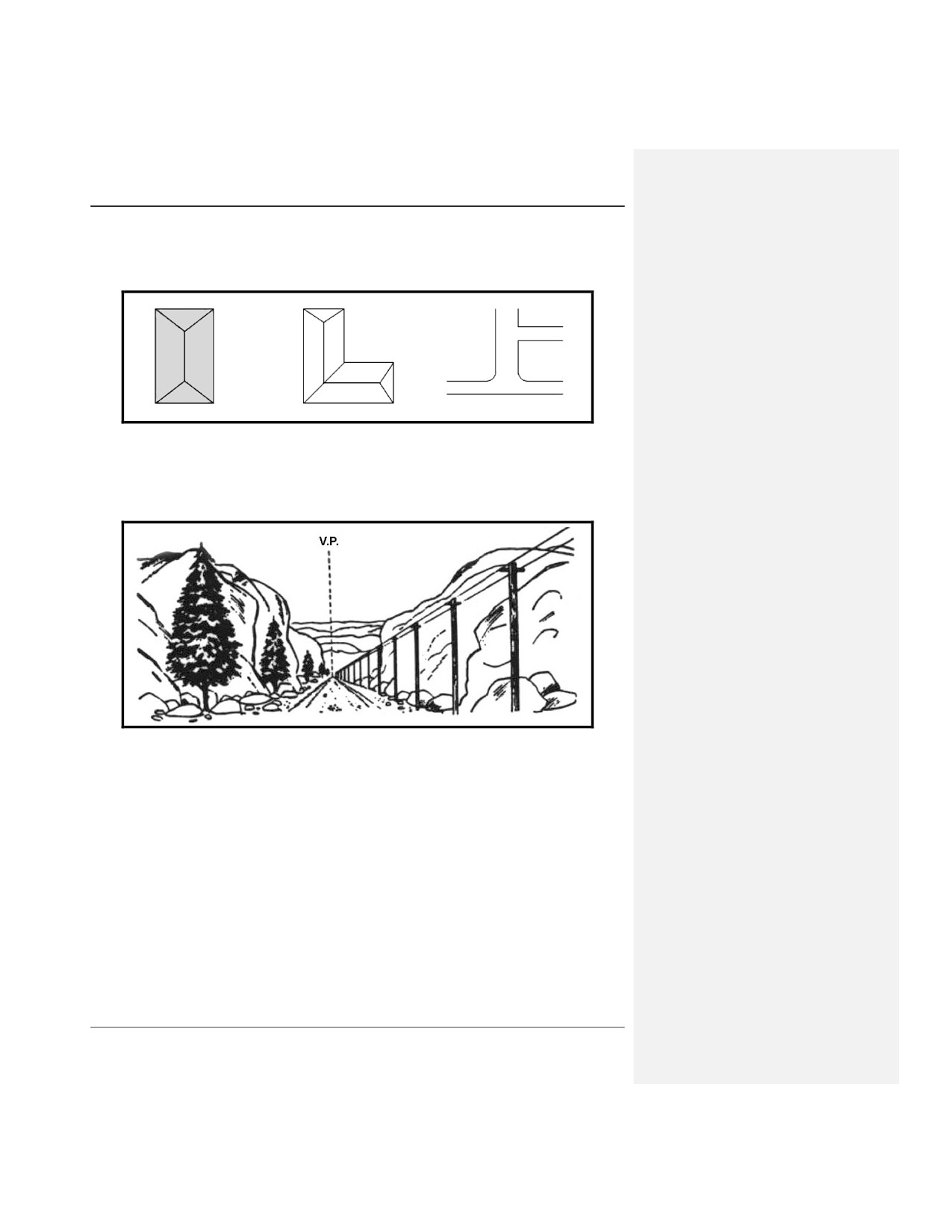
4-270. Use common shapes to show common objects such as roads, buildings, and poles (Figure 4-15).
Figure 4-15. Example drawing technique: use of common shapes to show common objects.
Use Perspective Drawing
4-271. Draw in perspective (Figure 4-16).
Figure 4-16. Example drawing technique: use of perspective to represent depth.
4-76
FM 3-55.93

Team Operations
Use Vanishing Points
4-272. Use vanishing points (Figure 4-17).
Figure 4-17. Example drawing technique: use of vanishing points to indicate distance.
FM 3-55.93
4-77
Chapter 4
Cross-Hatch to Show Depth
4-273. Use hatching to show depth in the sketch (Figure 4-18).
Figure 4-18. Example drawing technique: hatching.
Detail Only the Most Important Elements
4-274. Avoid concentrating on fine detail except to clarify the drawing or to emphasize something of
tactical importance.
4-78
FM 3-55.93
Team Operations
Section VIII. S TAB ILITY OPE R ATIONS
This section discusses LRSU activities in stability operations. LRSU are well suited to conduct stability
operations, because can they provide both overt and covert combat information. Both of these are critical to
success in stability operations. Stability operations occur unilaterally, or with offensive and defensive
operations. United States forces can participate in a stability operation while a host nation is at war. In addition,
stability can evolve into war, and leaders should be prepared in case this occurs. Stability operations influence
the political, civil and military environments, and can disrupt illegal activities. Military operations in stability
are characterized by indirectness rather than directness.
TYPES
4-275. Stability operations typically fall into ten broad and often overlapping types. For example, a force
engaged in a peace operation may at the same time conduct arms control or a show of force to set the
conditions for achieving an end state. This paragraph introduces stability operations. (See FM 3-0 and
FM 3-07 for more detailed information.) The LRSU can participate in any of the following operations in a
stability environment:
• Peace operations (POs).
• Foreign internal defense (FID).
• Humanitarian and civic assistance.
• Foreign humanitarian assistance.
• Security assistance.
• Support to insurgencies.
• Support to counterdrug operations.
• Combatting terrorism.
• Noncombatant evacuation operations (NEO).
• Arms control.
• Show of force.
PEACE OPERATIONS
4-276. Peace operations (PO) support strategic and policy objectives and the diplomatic activities that
implement them. POs include peacekeeping operations (PKOs), peace enforcement operations (PEOs), and
support to diplomatic efforts to establish and maintain peace. Peace operations monitor and ease the
implementation of agreements, such as a cease fire or truce. They can also support diplomatic efforts to
reach a long-term political settlement. They usually consist of observing, monitoring, or supervising and
aiding the parties to a dispute. The mission of a peace operation is fluid, and is based on a review of
METT-TC. LRSU activities supporting PKO include, among others—
• R&S of a demilitarized zone.
• Surveillance of confrontation areas.
• Surveillance of cease-fire areas.
• R&S of refugee camps.
• Damage assessment.
• Monitoring of chemical, biological, radiological, or nuclear activity.
• R&S of smuggling routes.
FM 3-55.93
4-79
Chapter 4
FOREIGN INTERNAL DEFENSE
4-277. Foreign internal defense (FID) is participation by civilian and military agencies of a government
in any action programs taken by another government to free and protect its society from subversion,
lawlessness, and insurgency (FM 1-02). The main objective is to promote stability by helping a host nation
establish and maintain institutions and facilities responsive to its people’s needs. Army forces in FID
normally advise and assist host-nation forces conducting operations to increase their capabilities.
4-278. When conducting FID, Army forces provide military supplies as well as military advice, tactical
and technical training, and intelligence and logistics support (not involving combat operations). Army
forces conduct FID operations in accordance with JP 3-07.1 and FM 3-07. Army forces provide indirect
support, direct support (not involving combat operations), or conduct combat operations to support a host
nation’s efforts.
4-279. LRSU support during FID normally consists of the traditional role of information gathering, but
can also consist of training host nation combat information gathering units. LRSU can also provide
long-range communications capability to host nations or deployed US forces.
HUMANITARIAN AND CIVIC ASSISTANCE
4-280. Humanitarian and civic assistance (HCA) programs provide assistance to the host nation populace
in conjunction with military operations and exercises. The very nature of HCA programs frequently
dictates that additional engineer units and support capabilities will augment units participating in HCA
operations. In contrast to humanitarian and disaster relief operations, HCA are planned activities
authorized by the Secretary of State with specific budget limitations and are appropriated in the Army
budget. Assistance must fulfill unit training requirements that correspondingly create humanitarian benefit
to the local populace. HCA programs must be in compliance with Title 10, United States Code, Sections
401, 401(E), (5), and Section 2551. For additional information on selected sections of Title 10, US Code
for medical support, see FM 8-42. See AR 40-400 for information on emergency medical treatment for
local national civilians during stability operations. Humanitarian and civic actions are limited to the
following categories:
• Medical, dental, and veterinary care provided in rural areas of a country.
• Construction of rudimentary surface transportation systems.
• Well drilling and construction of basic sanitation facilities.
• Rudimentary construction and repair of public facilities.
• Specified activities related to mine detection and clearance, including education, training, and
technical assistance.
4-281. It is unlikely LRSU would participate in HCA activities. However, LRSU could provide support to
units conducting traditional HCA activities by providing search and rescue, and long-range
communications support.
SECURITY ASSISTANCE
4-282. Security assistance includes the participation of Army forces in any of a group of programs by
which the US provides defense articles, military training, and other defense-related services to foreign
nations by grant, loan, credit, or cash sales in furtherance of national policies and objectives (JP 3-07).
Army forces support security assistance efforts by training, advising, and assisting allied and friendly
armed forces. LRSU forces are well suited to provide training and advisory services in their normal areas
of expertise.
4-80
FM 3-55.93
Team Operations
SUPPORT TO INSURGENCIES
4-283. An insurgency is an organized movement aimed at the overthrow of a constituted government
through the use of subversion and armed conflict (JP 1-02). At the direction of the National Command
Authority, US military forces may assist insurgents or counterinsurgents.
4-284. The US supports selected insurgencies that oppose oppressive regimes who work against US
interests. Major considerations include the feasibility of effective support and the compatibility of US and
insurgent interests. Because support for insurgencies is often covert, special operations forces are
frequently involved. Leaders may call upon general-purpose forces when needed. That is, when the
situation requires their particular specialties or when the scope of operations is so vast that conventional
forces are required. LRSU activities in support of an insurgency or counterinsurgency consist of but not
limited to--
• Early warning for US and host nation forces.
• Reconnaissance for lines of communication (LOC).
• Surveillance of refugee camps.
• R&S of targets for future direct action.
• Training of insurgent forces in their normal areas of expertise.
SUPPORT TO COUNTERDRUG OPERATIONS
4-285. Military efforts support law enforcement agencies (LEAs), other US agencies, state governments,
and foreign governments. The goal of counterdrug operations is to stop the flow of illegal drugs at the
source, in transit, and during distribution.
• DOD may provide training, assistance, equipment, and facilities as long as doing so does not
affect US military readiness.
• The Posse Comitatus Act applies only to federalized forces, and only within the US.
For example, federal military forces may not search US civilians, arrest US civilians, or conduct
any related law-enforcement activity involving US civilians.
• Title 10, United States Code, Sections 371-378, gives military forces the authority to assist
civilian LEAs.
• DOD may pass information collected during normal operations to law-enforcement agencies.
• Military efforts support and complement--not replace--the counterdrug efforts of other entities.
(These entities can include US agencies, states, and cooperating foreign governments.) The
Army can support any or all phases of a combined and synchronized effort to attack the flow of
illegal drugs at the source, in transit, and during distribution. In counterdrug operations, LRS
normally supports law-enforcement agencies. LRSU activities supporting counterdrug
operations include but are limited to—
— R&S of shipment facilities.
— R&S of shipment routes.
— R&S of marijuana, cocoa, and poppy fields.
— Surveillance of narcotics traffickers.
— Surveillance of air and vehicle traffic.
FM 3-55.93
4-81
Chapter 4
COMBATTING TERRORISM
4-286. Joint Publication 1-02 defines terrorism as "the calculated use of unlawful violence or threat of
unlawful violence to inculcate fear; intended to coerce or intimidate governments or societies in pursuit of
goals that are generally political, religious, or ideological" (JP 3-07.2).
Categories
4-287. Terrorism is categorized three ways, based on where its control and support originate:
• Non-state supported terrorism.
• State-supported terrorism.
• State-directed terrorism.
Methods
4-288. Antiterrorism refers to defensive measures taken against terrorism. Counterterrorism refers to
offensive actions taken against terrorism.
Antiterrorism
4-289. The DOD Dictionary defines this as "defensive measures used to reduce the vulnerability of
individuals and property to terrorist acts, to include limited response and containment by local military
forces." Typical antiterrorism actions include—
• Crime prevention and physical security actions that prevent theft of weapons, munitions,
identification cards, and other materials.
• Physical security actions designed to prevent unauthorized access or approach to facilities.
• Positioning and hardening of facilities.
• Coordination with local law enforcement.
• Policies regarding travel, size of convoys, breaking of routines, host nation interaction, and
off-duty restrictions.
• Protection from weapons of mass destruction.
Counterterrorism
4-290. The DOD Dictionary defines this as "offensive measures taken to prevent, deter, and respond to
terrorism." Specially organized and trained counterterrorism units usually conduct counterterrorism
operations. In some cases, conventional forces provide, at most, limited support. LRSU activities that
support combating terrorism include at a minimum—
• R&S to confirm terrorist activity.
• Surveillance of a terrorist safe house(a).
• Surveillance of suspected or known terrorists.
• Surveillance of individuals on the black, white, and gray lists.
• Force-protection surveillance.
4-82
FM 3-55.93
Team Operations
NONCOMBATANT EVACUATION OPERATIONS
4-291. Noncombatant evacuation operations (NEO) relocate threatened civilian noncombatants to secure
areas. Normally, these operations remove US citizens from foreign nations where their lives are in danger
either from the threat of hostilities or from a natural disaster. In addition to US citizens, relocated civilians
can include selected host-nation citizens and third-country nationals. NEO has three basic environments:
Permissive—A permissive environment has no apparent physical threat and no host-nation
opposition. Military assistance is normally limited to agency support. This operation (NEO in a
permissive environment) is slow and deliberate. It is the least likely environment in which an
NEO might occur.
Uncertain—An uncertain environment requires the commander to disseminate the ROE early.
The host nation may or may not be in control, but cannot ensure safety. An uncertain
environment increases the need for a reaction force.
Hostile—A hostile environment might require a large security element and a large reaction force.
The ROEs must be strictly enforced. The host nation or other threat will probably oppose
evacuation. The LRSU activities supporting NEO include, at a minimum—
— R&S of NEO sites.
— Early warning for host nation and United States forces.
— PR and CSAR support.
— Perimeter security.
— Linkup force.
— Pilot and casualty removal from downed aircraft.
ARMS CONTROL
4-292. This stability operation is associated with weapons of mass destruction. For example, on 26
November 1993, Iraq agreed to long-term monitoring of its weapons programs. Under the resolution,
international weapons inspectors were authorized to roam Iraq freely and for an indefinite period. Their
goal was to prevent Iraq from acquiring weapons of mass destruction. Inspectors monitored numbers,
types, and performance characteristics of the weapon systems at issue. The inspection also extended
beyond weapons to include C2, logistics support, and intelligence mechanisms. LRSU activities supporting
arms control include, at a minimum—
• R&S of ammunition holding areas.
• R&S of motor pools.
• R&S of suspected transshipment sites.
• R&S of weapon cache.
• Chemical, biological, radiological, or nuclear monitoring.
• Inspection of storage facilities.
FM 3-55.93
4-83
Chapter 4
SHOW OF FORCE
4-293. A show of force is a mission carried out to demonstrate resolve. Units conducting a show of force
must deploy rapidly due to the political need for timely action. As the word "show" implies, media
is desirable and must be planned. Commanders must prepare in case a show of force evolves into a combat
operation.
• A show of force—
— Bolsters and reassures allies.
— Deters potential aggressors.
— Gains or increases regional influence.
— Defuses a situation that could damage US interests or national objectives.
— Lends credibility to US commitments and increases regional influence.
• It can take any of the following forms:
— Combined training exercise.
— Rehearsal.
— Forward deployment of military forces.
— Introduction and buildup of military forces in a region such as in Operation "Golden
Pheasant," conducted during a 1988 border incident between Honduras and Nicaragua.
• Some LRSU activities that support shows of force follow:
— Participation in airborne operations.
— Surveillance from fixed observation posts.
— Route reconnaissance.
CAPABILITIES AND LIMITATIONS
4-294. Planning factors for stability include intelligence, rules of engagement, combined operations,
OPSEC, demography, deception, technology, and COMSEC.
INTELLIGENCE
4-295. The nature of stability operations require detailed intelligence. LRS teams need this intelligence
before they infiltrate. It should include the target location and description; enemy equipment and
capabilities; any civilian personnel in the area; and a variety of terrain, weather, and other related facts.
RULES OF ENGAGEMENT
4-296. The commander must monitor the ROE to ensure that all teams know when and how to apply
force to meet specific situations. He must avoid vague or wordy ROE. Each Soldier must understand the
rules as they apply to him. LRS teams must adjust rapidly to changes in the ROE.
COMBINED OPERATIONS
4-297. LRSUs must be prepared to coordinate and work with the host country's military and paramilitary
forces. Every situation is unique and depends on the extent of involvement of US forces and the nature of
the operations. Chief considerations when planning combined operations are C2, intelligence, operational
procedures, and sustainment.
4-84
FM 3-55.93
Team Operations
OPERATIONS SECURITY
4-298. OPSEC is critical for LRSU in stability operations. Due to the potential for other forces (US or
host nation) to operate near LRS teams, LRS commanders must carefully coordinate to reduce the risk of
fratricide. This requirement poses an equally dangerous risk to OPSEC for the teams.
DEMOGRAPHY
4-299. LRS commanders must study all aspects of the local population to understand the effect that it
might have on teams operating in the area. He can obtain information from a variety of sources, to include
area studies, intelligence staff agencies, local government, and the media.
DECEPTION
4-300. To reduce the risk to LRS teams, commanders should consider using deception, particularly
during insertion of the teams. Establishing false landing zones and sending dummy radio transmissions are
two techniques to deceive the enemy. Deception is limited only by the imagination, but leaders should
consider and coordinate all means of insertion or extraction through the R&S squadron S-3.
TECHNOLOGY
4-301. Technology is a proven combat multiplier. Advanced optics, thermal sights, and remote sensors
increase the capabilities of the LRS teams. Commanders must weigh the advantages against the inherent
disadvantages. These include increased Soldier's load and the impact of emitting the various equipment
signatures.
COMMUNICATIONS SECURITY
4-302. The threat of interception and direction finding exists in all levels of conflict. Foreign purchases of
threat equipment and relatively inexpensive off-the-shelf technology have enabled many third world
countries and indigenous forces to equip themselves with the ability to take advantage of poor COMSEC.
LRS commanders and team leaders must take appropriate measures to enforce COMSEC procedures.
Section IX. S PE CIAL MIS S IONS
Special missions include, among others, CBRN; Pathfinder; and personnel recovery (PR).
CHEMICAL, BIOLOGICAL, RADIOLOGICAL, AND NUCLEAR
4-303. LRSU may be called on to perform limited CBRN reconnaissance duties. The amount or type of
equipment available and the current qualifications of the team members help determine the nature of these
duties (FM 3-100).
PATHFINDER
4-304. Commanders sometimes require LRSU to perform limited pathfinder duties. This capability is
limited by the team's pathfinding experience, number of radios, and signaling devices (FM 3-21.38).
FM 3-55.93
4-85
Chapter 4
PERSONNEL RECOVERY
4-305. The LRSU commander, with assistance from the Joint Search and Rescue Center (JSRC), is
responsible for and should be prepared to conduct PR operations in support of his own operations. He also
coordinates with the rescue coordination center (RCC), advising them when his teams might have to evade
threat. He relays information such as isolated personnel report (ISOPREP) cards and an evasion plan of
action (EPA) along with overlays of the evasion corridor. After he coordinates with other evasion planning
agencies, he might determine that the unit must make its own evasion plans. He starts by identifying the
team's evasion corridor and forms an evasion annex with the assistance of the JSRC (JP 3-50.2 and
FM 3-50.1).
4-86
FM 3-55.93
Chapter 5
Insertion and Extraction Methods
The LRS team must be prepared to insert and extract by various means to accomplish
their mission. The team can insert and extract by water (Section I), air (Section II),
land (vehicle [Section III] or on foot [Section IV]); or it can stay behind [also covered
covered in Section IV]. Proficiency at inserting and extracting improves the team’s
likelihood of accomplishing—and surviving—the mission.
A member of the LRSU headquarters should accompany LRS teams on insertions
and extractions by air. The presence of a representative from headquarters
emphasizes the criticality of the air mission. He can also assist with navigation and
other key duties, as dictated by the unit SOP.
Section I. WATE R B OR NE OPE R ATIONS
Using inland and coastal waterways can improve the speed, stealth, and flexibility of a LRS team's insertion and
extraction.
CONSIDERATIONS
5-1.
Waterborne insertion means include using surface craft, swimming on the surface, helocasting, or
a combination of these. Whichever they choose, they should execute during limited visibility for
maximum stealth. While planning waterborne operations, leaders must consider the following factors:
• Enemy situation.
• Civilian situation.
• Shipping.
• Beach landing site, which must allow the team to infiltrate and support movement to the inland
objective.
• Environmental factors such as: winds, waves, fog, thunderstorms and lightning.
• Equipment.
• Time schedule. Leaders use reverse planning to schedule operational events.
• Drop site. The team debarks a larger vessel at a planned drop site then begins infiltration.
• Launch point. A point where swimmers enter the water and begin infiltration.
• Method of loading. Supervisors inspect to ensure loads and lashings, especially waterproofing,
adhere to unit SOP.
FM 3-55.93
5-1
Chapter 5
COMBAT RUBBER RAIDING RECONNAISSANCE CRAFT
5-2.
Most LRS teams use a combat rubber raiding reconnaissance craft, commonly called a "rubber
boat," for small-boat operations.
TECHNICAL INFORMATION
5-3.
Specifications and other information about the rubber boat follow:
Inflation—This boat is inflated with foot pumps, using four separate valves on the inside of the
gunwale. Each valve is used to section off the rubber boat into five separate air-tight
compartments.
Structure—A keel tube runs the length of the boat, and two skeg tubes serve as shock absorbers.
Size—Outside, the boat measures about 6 feet by 15 feet. Inside, it measures about 3 by 10 feet.
Weight—The boat weighs 265 pounds, including the deck.
Maximum Payload—The boat can carry a maximum of 2,710 pounds.
Motors—The standard motor is a 40-HP short-shaft outboard motor. Adding a kit to stiffen the
transom allows the use of either two 35-HP motors or one 55-HP motor.
CREW RESPONSIBILITIES
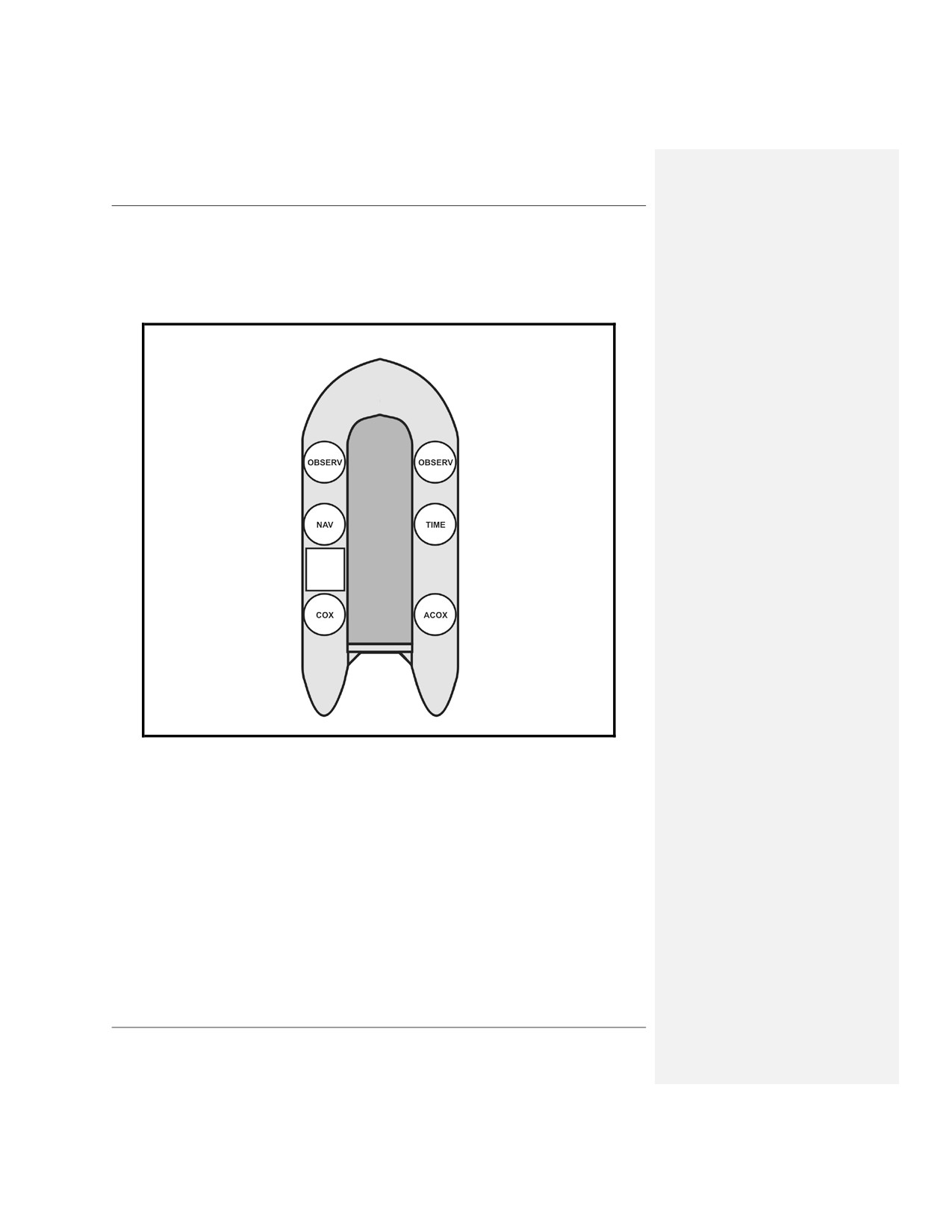
5-4.
The crew includes a coxswain, assistant coxswain, timekeeper, two observers (for security), and a
navigator. To ensure mission success, each Soldier must track the team's location during movement. The
team is positioned as shown in Figure 5-1.
Coxswain—The coxswain controls the boat and the actions of the crew. He supervises the
loading, lashing, and distribution of equipment. He maintains the heading and speed of the boat
and gives all commands.
Assistant Coxswain—The assistant coxswain helps the coxswain navigate and control personnel,
and, when needed, assumes the duties of the coxswain. He also stows and uses the bowline, and
he provides rear security for the crew.
Timekeeper—The timekeeper keeps time during dead reckoning and aids in navigation. He
provides flank security during movement.
Navigator—The navigator tracks the team's movement on the chart and reads the GPS as needed.
He notifies the coxswain of any changes in heading, and he provides flank security during
movement.
Observer—The observer(s) notifies the coxswain of any obstacles and provides frontal security
during movement.
PREPARATION OF PERSONNEL AND EQUIPMENT
5-5.
Each person dons a work vest, a life preserver, or both. He dons any additional equipment, such as
LCE, over his vest. He slings his rifle over his life preserver, where it is readily available. Securely lashing
radios, ammunition, and other bulk equipment to the boat prevents loss in case of a capsize. To lash
equipment to the boat—
• Secure a 5-foot section of 1-inch tubular nylon across the boat at the rear set of "D" rings.
• Securely knot a 12-foot section of 1-inch tubular nylon to the front "D" ring. Place a loop about
two feet from the other end of the rope. Using a slip knot, tie off this section to the
5-foot section.
5-2
FM 3-55.93
Insertion and Extraction Methods
• Attach a snaplink to the top of each rucksack frame and secure the rucksack to the
equipment line.
• Place the coxswain's rucksack at the rear of the boat. Route the snaplink through the loop at the
rear of the equipment line. If the boat capsizes, the coxswain can release the knot, allowing the
rucksacks to float free of the boat while he tries to right it.
Figure 5-1. Rubber boat.
LAUNCHING OF BOAT
5-6.
When timing the launch, the coxswain observes surf conditions and considers wave intervals.
When team members are about thigh deep in the water, the coxswain orders them to board by pairs. As
soon as they board, they grab a paddle and help keep the boat perpendicular to the waves as the coxswain
starts the motor. After the motor is running, the coxswain orders the rest of the team into the boat. To help
avoid capsizing, the boat is kept perpendicular to the waves.
FM 3-55.93
5-3
Chapter 5
BEACHING OF BOAT
5-7.
The coxswain observes the surf to see when to enter. To avoid capsizing, he has the team shift
weight to the rear of the boat before the boat enters the surf.
5-8.
As the boat enters the surf zone, all team members work to keep the boat perpendicular to the
waves. The coxswain observes the surf and commands the team to vary speed as needed and to avoid
plunging into breakers. He periodically looks seaward to observe the waves.
5-9.
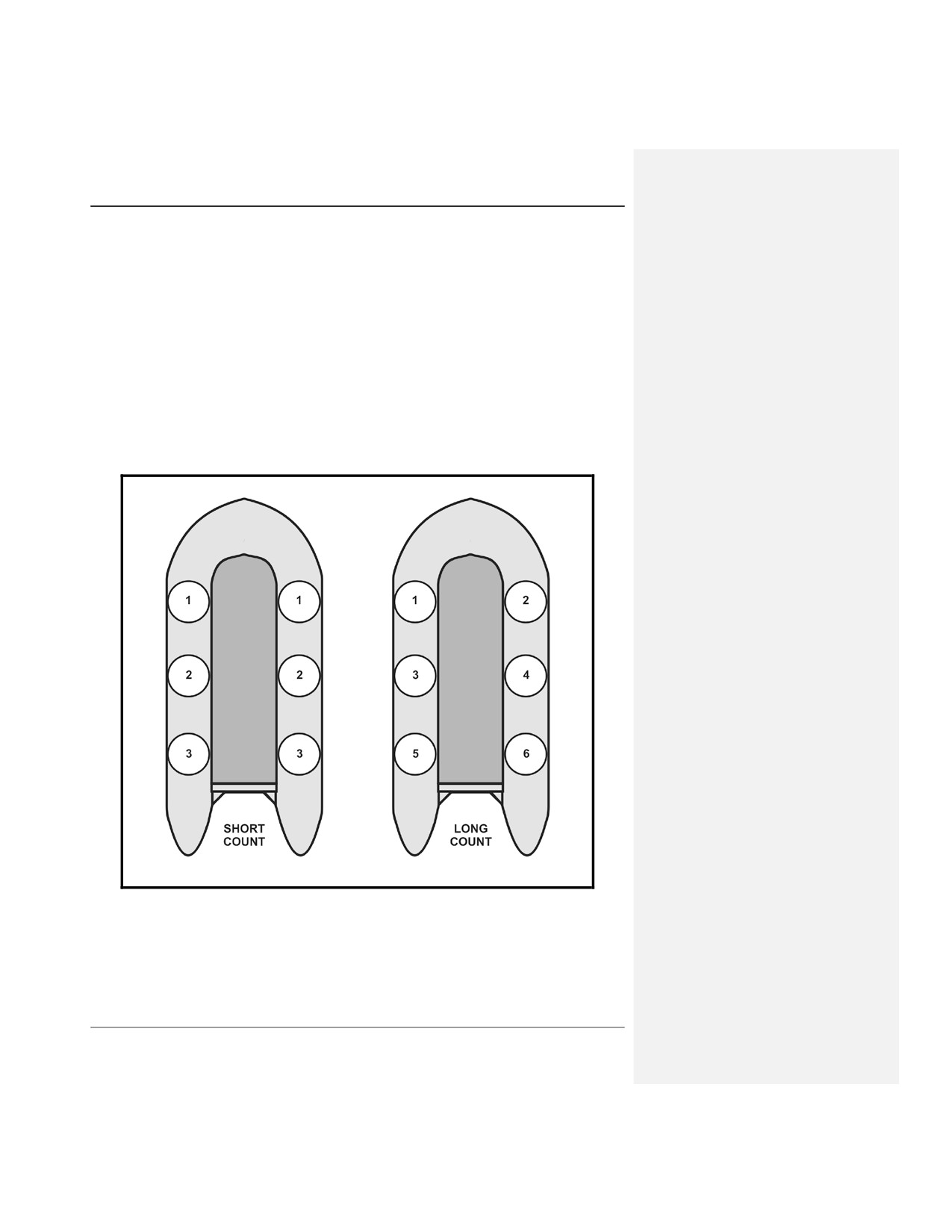
When the boat reaches shallow water, the coxswain orders the team out of the boat in pairs, for
example (short count), "Ones, out; twos, out" (Figure 5-2). On disembarking, each pair immediately grabs
the boat handles and pulls the boat to the beach.
5-10.
The coxswain directs the team to empty the water from the boat and carry it to higher ground. He
has two team members provide security.
5-11.
Once the team reaches an area suitable for caching the boat, they conceal it in a surface or
subsurface cache, or, if required, they submerge the equipment.
Figure 5-2. Short count, long count.
5-4
FM 3-55.93
Insertion and Extraction Methods
OFFSHORE NAVIGATION
5-12.
Inserting a team from a larger vessel to their small boat might require offshore navigation. To
move a long distance in a small boat, the team must be highly skilled in navigating by nautical charts, tides,
currents (piloting), and dead reckoning. They must be able to compute for a compensated launch point,
using offset navigation to take into account tides and current. Before launching, the team should conduct
timed runs at full, half, and a quarter throttle. This helps them determine the speed of the boat at each
setting, which is a critical part of navigation. To determine the speed (distance/time = speed ), they divide
the distance by the time, or the team uses a nautical slide rule. The types of navigation follow:
Piloting uses visible references from land or sea, the depth of the water, and other published
information. It resembles land navigation by terrain association.
Dead reckoning is the predicted advancement of a vessel's position from a known point
(debarking point) to calculate the vessel's approximate position at any time. It uses distance,
speed, and time. It does not factor in water currents.
Celestial navigating uses the positions of the sun, moon, other planets, and stars relative to that of
Earth. Because it requires a stable platform (for the sextant) and reference publications,
celestial navigation is impractical for use on smaller vessels.
Electronic-radio navigating uses radio waves and satellite-based positioning systems such as
GPS or Long Range Navigation—Revision C (LORAN-C).
Note: Express distance in nautical miles.
MAINTENANCE
5-13.
The team must wash the boat with fresh water after using it in salty or muddy water.
• Remove all sand and debris.
• Carefully clean between the bottom and the skeg tube.
• Stand the boat upright on its cones against a wall, or suspend it. Using a high-pressure hose,
rinse the entire boat. Allow several hours for it to dry.
• Wipe any remaining sand off the boat with a dry rag.
• After the boat dries, check and clean all metallic parts.
• Spray the valves with silicone to prevent freezing.
STORAGE
5-14.
Store the boat in a dry, cool place out of direct sunlight. Avoid storing it near furnaces, steam
pipes, boilers, oil or oil-contaminated areas, grease, solvents, or sharp or pointed objects. If possible, store
it on a rack. Excessive handling, such as rolling and unrolling, will shorten the life of the boat. When
storing it in a carrying bag, be sure to roll the boat from bow to stern.
FM 3-55.93
5-5
Chapter 5
SCOUT SWIMMERS
5-15.
The term "scout swimmers" refers to a pair of surface swimmers assigned a reconnaissance or
security mission in advance of the boat or other swimmers. Scout swimmers secure the beach landing site
and reconnoiter it to ensure that it can accommodate the entire team. They must also reconnoiter a suitable
assembly area, cache sites, and a position from which to signal the remainder of the team into the beach
landing site. The team must maintain strict noise and light discipline throughout the operation.
EQUIPMENT
5-16.
Normally, scout swimmers launch from a small boat outside the surf zone. Their equipment
includes a life vest, swim fins, dive tool, MK 13 day or night flare, and coral shoes or booties.
Life Vest
5-17.
Each scout swimmer wears his life vest under all equipment except his wet suit. It has no quick
release, because he must wear it throughout his mission.
Serviceability
• Check the oral inflation tube.
• Inflate the vest and check it for leaks.
• Check the CO2 inflation mechanism.
Preventive Maintenance
• Wash in fresh water after use.
• Clean and lubricate the CO2 mechanism.
• Replace the C02 cartridge if used.
• Partially inflate the vest.
• Store vest in a cool, dry area.
Swim Fins
5-18.
These help propel the swimmer.
Serviceability
5-19.
Check fins for proper fit and broken straps. Check for any rips or tears.
Preventive Maintenance
5-20.
Wash the fins with fresh water after each use. Store in a cool dry place.
Dive Tool
5-21.
Swimmers keep this tool or knife with them at all times in case they become entangled while
swimming.
Serviceability
• Check for rust or corrosion.
• Sharp edges.
• Cracked or broken blade.
5-6
FM 3-55.93
Insertion and Extraction Methods
Preventive Maintenance
• Wash with fresh water.
• Sharpen.
• Lubricate.
• Store dive tool out of the sheath to dry.
MK13 Day or Night Flare
5-22.
This is an emergency signal device.
Serviceability
• Use flare only if seals are intact.
• Check pull-ring lanyard.
Preventive Maintenance
• Wash in fresh water.
• Store according to standing operating procedures.
Coral Shoes or Booties
5-23.
The swimmer wears these under his fins. They protect his feet from coral, rocks, or other
sharp-edged or poisonous underwater objects.
Serviceability
• Check for rips or holes.
• Check for proper fit.
• Check to ensure the zippers work.
Preventive Maintenance
• Wash in fresh water.
• Dry away from direct sunlight.
LAUNCH POINT
5-24.
Scout swimmers normally move from the debarkation to launch points in inflatable boats with
motors. The scout swimmers enter the water at the launch point. The launch point should be at least 400
meters off the beach, out of the range of small arms.
RECONNAISSANCE
5-25.
Once the team reaches the launch point, the team leader sends out a scout swim team to
reconnoiter the beach landing site. Before leaving the main body, the swimmers receive last-minute
instructions or adjustments to the original plan. The scout swimmers' may either leave their rucksacks with
the main body or take them along. The swimmers use a dive compass, or they guide on prominent terrain
features or lights on the beach. To allow all-round observation, they swim facing each other, which lets
each swimmer observe the area behind the other one.
FM 3-55.93
5-7
Chapter 5
APPROACH
5-26.
As the scout swimmers reach the surf zone, or when they get close to the beach landing site, they
start using the breaststroke to observe the beach. They approach with stealth and caution, keeping a low
profile. One of them looks to the rear periodically so he can warn of large waves, which could injure or
separate them from their equipment and each other. When they reach shallow water and determine that the
situation is safe, they remove their fins.
1.
If they can see the wood line easily from the waterline, one scout swimmer remains in the
water just inside the waterline and covers the other Soldier’s movement across the beach.
Once the first scout moves to the edge of the wood line, he covers his partner's movement to
the same position.
2.
If the topography prohibits easy observation of the wood line from the waterline, the
swimmers move by successive bounds.
3.
Once both scouts move inland, they use a modified box pattern to reconnoiter and secure the
beach. They choose a suitable assembly and cache site that provides the entire team cover and
concealment.
4.
One scout positions himself at the edge of the wood line. He provides security for the
remainder of the team and guides them to the assembly area. The other scout positions
himself where he can signal the main body. When he makes visual contact, with the
remainder of the team, he moves to the waterline.
5.
When the remainder of the team reaches the beach landing site, the scout at the waterline
directs them to the other scout, who guides them to the assembly area. After the last team
member passes him, the scout at the waterline disguises any tracks left in the sand and rejoins
the team.
6.
If possible, the team locates the cache site away from the assembly area. If the enemy
discovers and follows the tracks or trails from the beach to the assembly area, they could
easily determine the number of personnel involved in the operation by counting swim gear.
HELOCASTING OPERATIONS
5-27.
Helocasting can be an effective means of inserting and extracting LRS teams and equipment. The
speed, range, and lift capability of rotary-wing aircraft make them excellent waterborne delivery and
recovery vehicles. Helocast preparation considerations include--
1.
When planning for the number of personnel for each type of aircraft, the leader uses the
standard planning figures for loading troops. He can adjust these figures based on aircraft
configuration, type of equipment, and casting or recovery procedures. He coordinates these
items in advance with the aircrew.
2.
Rehearsals include all jumpers, the crew, the accompanying equipment, and support
personnel. During live-casting rehearsals, the leader emphasizes the commands, positions,
and timing of body exit and water entry.
3.
All equipment attaches to the jumper with l/4-inch, 80-pound test, cotton webbing. In or on
this webbing, he normally carries a mask, fins, web belt with knife, flare(s), and life vest.
5-8
FM 3-55.93
Insertion and Extraction Methods
4.
When using rubber boats, the team must—
a. Tie down and secure all equipment inside the boat.
b. Secure the motor in the floor of the boat and pad it with honeycomb cardboard (for
UH-60).
c. Securely attach and isolate fuel cans.
d. Secure paddles under the gunwales, out of the way of the rest of the gear.
e. Secure the rucksacks as tightly as possible to the deck of the boat.
f. Waterproof all equipment in the boat in case of submersion.
g. Regardless of the type of aircraft used, tie down or secure all equipment. Tape or pad all
sharp edges or items.
h. If using side doors for casting (UH-60 or UH-1H), secure the doors in the open position,
and tape all edges.
i. With a CH-46 or CH-47, ensure the ramp is secured in the open or casting position (10
degrees below horizontal).
j. To use a wire ladder for recovery, secure it beforehand using a wire "donut" secured to the
floor of the aircraft. Use 5/8-inch wire and secure the wire to at least five points
using snaplinks.
k. Ensure all personnel (cast master, pilots, and safety boats) use the same frequency.
l. Ensure the casting area is clear of all surface and subsurface obstacles.
5-28.
When helocasting from a ramp, such as a CH-47, the cast master gives the commands
GET READY, STAND UP, CHECK EQUIPMENT, SOUND OFF WITH EQUIPMENT CHECK, and GO.
When using UH-60 or UH-lH, he omits STAND UP:
1.
The cast master ensures jumpers leave their seat belts on until they hear the command
GET READY.
2.
If using a rubber boat, the team moves it to the end of the ramp. Just before the command
GO, they push out until the boat is about halfway past the edge of the ramp. On hearing the
command GO, they push the boat off the ramp.
3.
The cast master ensures that when the pilot drops personnel, he flies within 10 feet of the
surface of the water at 10 knots or slower.
4.
When casting from the ramp, jumpers assume a normal prepare-to-land attitude.
5.
When casting from a side door, jumpers cast from a seated door position. On the cast master's
command, jumpers push off and face the direction of flight, assuring a normal prepare-to-
land attitude.
6.
The cast master throws bundles or rucksacks before the jumper exits on the command GO.
7.
Upon entering the water, the jumper signals "Okay" to the cast master and safety boat.
8.
When using a single rotor aircraft for recovery operations, the cast master lowers a wire
ladder to the swimmers, who line up at 50-meter intervals in the recovery area.
9.
As the aircraft flies over, each swimmer hooks the lowest rung on the ladder with his leading
arm and climbs to a designated height, where he hooks up (with snaplink and rope seat) to
the ladder.
10. All CH-46 or CH-47 aircraft land in the water. If using a rubber boat with a motor, the team
drives the boat up to the ramp. When the rubber boat is not using a motor, the cast master
uses the aircraft's winch to lower a rope with a 10-pound padded weight attached to it. He
lowers the rope behind the boat and drags the rope over it. The swimmers secure the rope,
and the winch pulls the boat in.
11. When swimmers are in the water without a boat, they either go up a ladder or, if the aircraft is
on the water, they swim up to the ramp.
12. For SPIES recovery, swimmers put on their harnesses before the helicopter arrives. The
helicopter hovers over the group of swimmers as they attach their harnesses to the "D" ring.
FM 3-55.93
5-9
Chapter 5
5-29.
Due to the hazards involved, the leader emphasizes safety in all aspects of planning and executing
helicopter casting and recovery operations:
• Immediately before a helocast and recovery operation, the leader—
— Physically reconnoiters the casting area
— Verifies water depth and the absence of obstacles and debris.
• He ensures that the water is at least 15 feet deep.
• He ensures motorized safety boats are in the water with motors.
• He establishes radio voice communications between the safety boats and the drop aircraft.
• He ensures the cast master has voice communications with the pilot.
• He ensures one dive supervisor and two divers, with complete scuba gear, are in a safety boat.
• He ensures that a qualified medic/dive medical technician is in one of the safety boats.
• He ensures drop altitude stays within 10 feet of the surface of the water.
• He ensures drop speed remains at or slower than 10 knots indicated airspeed.
• If an injury occurs, the leader ceases until he determines the cause and extent of the injury.
Section II. HE LICOPTE R OPE R ATIONS
Helicopters provide a variety of methods for inserting and extracting teams. (FM 3-05.210, TC 21-24 and
USASOC Reg 350-6 provide more information.) This section only covers the operational requirements and
procedures for SPIES, FRIES, Army aviation, air assault, pick-up and landing zones, and the UH-60 loading
sequence. Training requirements are covered in FM 3-05.210 and USASOC Reg 350-6.
SPECIAL PATROL INSERTION/EXTRACTION SYSTEM
5-30.
The SPIES should be used only when the team needs immediate extraction or cannot move to a
clear (open) position suitable for helicopter landing. The SPIES works best for extracting LRS teams over
short distances. Teams are almost never inserted by SPIES because doing so would expose them to
observation and fire throughout the insertion. Before a SPIES operation, the leader thoroughly briefs
participants. Before inserting, the team receives extensive training in SPIES operations. Personnel
supporting the SPIES operation receive a complete preoperational briefing. This is most crucial when the
operation involves assets other than the extraction helicopter such as gunships, aerial observers, or artillery.
FAMILIARIZATION
5-31.
When time and situation permit, personnel unfamiliar with SPIES should watch or help with the
rigging of the helicopter. Initial training with SPIES is without combat equipment. This builds confidence
in the equipment and procedures, and it also aids in more comprehensive training of new SPIES masters.
5-10
FM 3-55.93
Insertion and Extraction Methods
SAFETY
5-32.
This safety briefing should cover at a minimum--
• Area hazards.
• General Aircraft safety.
• SPIES equipment and its characteristics.
• Preoperational inspection of equipment.
• Proper donning of the harness.
• Method of insertion and extraction.
• Hand-and-arm signals and emergency signals.
• Medical coverage.
• Communications requirements.
• Operational requirements for limited visibility.
COMMUNICATIONS
5-33.
Helicopter noise necessitates radio communications be the primary means of communications
between the Soldiers on the ground and the helicopter. Light and arm-and-hand signals are the alternate
means of communication. The SPIES master uses the inter-cockpit communication system on the
helicopter. Soldiers practice the appropriate arm-and-hand and light signals in case radio communications
fail.
5-34.
Radio operators should use headsets and voice suppressors (if available) rather than handsets.
This frees the ground RTO's hands so that, when the helicopter hovers, he can hook up faster and
more safely.
EXTRACTION
5-35.
After the extracting team is located on the ground, the SPIES master helps direct the helicopter
the proper distance above the team. On order of the pilot, the SPIES master drops the rope.
1.
The team leader positions himself to move and approach the rope as the SPIES master drops
it. Once the rope is clear of any obstacles, the team leader directs the team to move to their
assigned positions along the hookup points.
2.
Each member attaches the primary (harness) snaplink to the "D" ring on his side of the line.
Using the safety line and snaplink, he hooks into the alternate or secondary hookup point on
the opposite side of the rope. He faces forward along the line so that, when the aircraft
ascends, he is looking in the direction of travel. He holds up the SPIES rope and routes it over
the shoulder closest to the rope. With the other hand, he gives a thumbs-up signal to the team
leader and SPIES master signaling he is ready to go.
3.
After all team members signal they are ready, the team leader physically inspects (if time and
situation permit) each team members hook up. The team leader then hooks himself on to the
lowest point with the RTO. He then gives the thumbs-up signal to the SPIES master. He
continues this thumbs-up signal, which at night is an arranged light signal, until the helicopter
reaches a safe altitude (about 3 meters above the tallest obstacle at the extraction site).
4.
During extraction, the team RTO maintains communications with the extraction helicopter.
Because he is near the bottom of the rope with the team leader, he can assist in giving verbal
confirmation of all light and arm-and-hand signals, and relay information between the team
leader, the SPIES master and the aircraft crew.
FM 3-55.93
5-11
Chapter 5
CAUTION
Not all chemical lights are visible at night using image intensifying night
vision devises. Coordination with the pilots during the air mission brief
to finalize the types and colors of chemical lights to use is required.
EMERGENCY PROCEDURES
5-36.
During the flight, from the time the team extracts until they safely detach from the SPIES rope,
each team member watches for any problems that might arise from above or below. The Soldier above
checks the Soldier below. At the first sign of danger, or if an emergency occurs, the team leader or a team
member places his free hand on the top of his head. When the SPIES master sees this, he instructs the pilot
to make an emergency landing in the nearest and safest area.
DISMOUNTING PROCEDURES
5-37.
When the extraction helicopter has reached a tactically safe dismount area, the pilot transitions to
a hover and then begins a vertical descent. The SPIES master continuously provides information to the
pilot on the distance from the ground to the lower end of the SPIES rope. As team members reach the
ground, they immediately move away from the aircraft. For a UH-60, the team walks to a 90 degree angle
to the front of the aircraft. For a UH-1, the team walks to the direction of the front of the aircraft. In both
cases the pilot or the crew can see the team is out from under the aircraft. The team ensures the SPIES rope
does not interfere with the aircraft and that the aircraft does not land on the rope. All team members rapidly
unhook themselves and their teammates who need assistance. Once unhooked, they move away from the
area and set up security, or help clear the rope if the helicopter is going to land.
OPERATIONAL TRAINING
5-38.
In preparing for an operation, if the leader thinks the situation, mission, or terrain indicates the
need for a SPIES extraction, then he should include a SPIES harness in each Soldier's equipment list. If the
mission or insertion precludes team members from wearing the harnesses, they should carry them inside
their packs. As soon as they request helicopter extraction, they can retrieve and don their harnesses.
1.
The extraction helicopter(s) proceeds to the area and the pilot establishes radio or visual
contact with the team. The backup helicopter, equipped with the SPIES, remains aloft and
away from the area, maintaining visual contact with the LZ and monitoring radio
communications.
2.
The SPIES master deploys the rope, and then notifies the pilot the rope is out. The pilot
normally can not see the team nor determine the most suitable position for the aircraft. The
SPIES master gives the pilot vertical and lateral corrections until the aircraft reaches the
desired position. He commands, LEFT, RIGHT, FORWARD, or REAR, along with the
estimated distance. For example, LEFT, 10 FEET. The SPIES master counts down as the pilot
responds, for example, "Ten, nine, eight, seven, six, hover. Hold, ropes out." The SPIES
master informs the pilot of any unexpected drift that could pull the team into an obstruction.
The crew chief maintains his attention to the safety of the aircraft and watches for any
possible interference with the tail rotor.
3.
To avoid losing weapons during a SPIES extraction, team members sling them over their
shoulders and attach them to their bodies with safety lines. They secure other weapons and
equipment against the wind as well. After observing this, the team leader gives them the
thumbs-up signal.
5-12
FM 3-55.93
Insertion and Extraction Methods
4.
During the extraction, the team RTO maintains communications with the extraction
helicopter. He verbally confirms the thumbs-up signal and relays any other relevant
information during the flight. He should position himself near or at the bottom hookup point.
This ensures he can give accurate information about the extraction, the clearing of obstacles,
5.
The extraction aircraft must lift off vertically until the SPIES rope clears all obstacles. If
needed, team members can fire their individual weapons from the hip with their barrels
directed downward at a 45-degree angle and outward from the team.
6.
Once the aircraft clears any vertical obstacles, the RTO, who is the lowest Soldier on the
SPIES rope, signals the pilot all team members have cleared the obstacle. This is especially
important during limited visibility. Even if the pilot uses night vision goggles, his depth
perception is poor when looking 120 feet below the aircraft.
7.
On descent, both the RTO and the SPIES master inform the pilot of his altitude, drift, and
forward speed. They also tell him whether their ropes are oscillating enough to potentially
injure team members on impact. The RTO counts down in 10-foot increments ("Fifty, forty,
thirty, twenty, ten, nine, eight…one; one man down, two…") until the whole team is down.
During limited visibility, the SPIES master might not be able to see this.
8.
Once the team is on the ground, the SPIES master monitors drift. Sudden lateral shifts can
drag team members before they can disconnect from their ropes.
WATER-EXTRACTION PROCEDURE
5-39.
The SPIES also works well for extracting LRS teams from the water. Three inflatable life vests or
other flotation devices are attached to the SPIES; one to each end of the attachment points, and one to the
middle of the attachment point area, just above the middle two sets of "D" rings. Each team member wears
a SPIES harness under his life vest. In amphibious operations, he may also wear swim fins, mask, and
snorkel. This simplifies hookup to the SPIES rope in the chop and spray caused by the helicopter.
1.
After the pilot stabilizes the aircraft above the team members, he gives the order and the
SPIES master drops the SPIES rope (with flotation attached).
2.
When the team members finish hooking up to the SPIES rope, the team leader signals the
SPIES master to start liftoff.
3.
The aircraft must lift off vertically until all team members and the bottom end of the rope
clear the water. During initial liftoff, the aircraft may drag team members through the water.
They must be ready to roll onto their backs until the aircraft lifts them clear of the water.
4.
The aircraft should fly at the same speed and altitude as it would over land. Dismounting
procedures also remain the same, except for shipboard landings: on a ship, all team members
take their orders from the personnel in charge of the deck.
FM 3-55.93
5-13