FM 3-55.93 Long-Range Surveillance Unit Operations (MAY 2008) - page 3
Chapter 4
4-48.
Any requested SEAD and CAS start when the insertion platform crosses the FLOT and starts
moving towards the insertion point. Insertion normally ends after the team caches nonmission-essential
equipment and the insertion platform leaves the loiter area. Generally, the infiltration phase continues with
team movement from the point of insertion to the security halt, and ends before the objective rally point
(ORP). Ideally, infiltration occurs during times of limited visibility. If the team must halt during periods of
increased visibility, they establish a clandestine patrol base. During infiltration, the team leader records the
team's movements in the patrol log. In the log, the team leader records in detail--
• The general direction of movement.
• Deviations from planned infiltration route.
• Information about terrain and weather.
• Enemy sightings en route.
• Signs of activity.
• Grid locations.
• Any peculiarities.
• Time of initial entry report.
EXECUTION (ACTIONS ON OBJECTIVE)
4-49.
The LRS team establishes a security halt and the leader reconnoiters to identify an ORP. After the
team establishes the ORP, the leader moves out to pinpoint the objective or NAI, then to establish
surveillance. Once the reconnaissance is complete, other team members move to and establish the tentative
hide site and to set up communications with the COB or AOB. The surveillance team keeps their "eyes on"
the objective and maintains continuous communications with the hide site. The surveillance site reports
ISR tasks to the hide site.
4-50.
If the LRS team cannot establish communications, the team and the LRS COB or AOB execute
the "no communications" contingency plan (developed during the planning phase).
4-51.
The hide site sends information to the COB or AOB via HF or UHF TACSAT communications.
Once communications is established, the COB or AOB forwards the information to the BFBS S-2 ISR
fusion element over a LAN. The R&S squadron is copied on all reports.
4-52.
The LRS team keeps sending reports to the COB or AOB until the team meets the mission
completion criteria or until the LTIOV. The LRS team reports during designated communication windows
or, if the report is information answering a PIR, out of those windows. After the team pulls back from the
objective they disseminate information, collect all surveillance logs and objective sketches.
EXFILTRATION PHASE AND EXTRACTION METHOD
4-53.
This phase starts after the team links up and disseminates information at the ORP and ends when
the team arrives at the debriefing location. Exfiltration routes normally differ from infiltration routes. The
team leader (again) keeps a patrol log, which details--
• The general direction of movement.
• Deviations from the planned exfiltration route.
• The terrain and weather.
• Enemy sightings.
• Signs of activity.
• Peculiarities.
4-20
FM 3-55.93
Team Operations
4-54.
Extraction method options include--
• Linkup (friendly or partisan).
• Air.
• SPIES.
• Vehicle.
• Watercraft.
• Rollover.
RECOVERY
4-55.
This phase starts when the LRS team returns to the debriefing site, which is normally located at
the planning facility, and starts the multiphase debriefing process. It ends with the after action review
(AAR).
DEBRIEFING PROCESS
4-56.
The whole LRS team attends all phases of the debriefing. The debriefing covers the team's actions
and all related details, chronologically, from the start of the infiltration phase, through arrival at the
debriefing site. The debriefing process normally includes the following in sequence: initial debriefing, post
initial debriefing, review of documents and other materials, follow-up debriefing, AAR and team report of
lessons learned.
Debrief Team
4-57.
A trusted and knowledgeable intelligence representative, or LRS operations personnel conducts
the debriefing, which starts NLT two hours after the team returns. The timely collection, analysis, and
dissemination of information recovered in the debrief can provide many answers needed for follow-on
missions in the objective area.
Followup Actions
4-58.
After the debriefing, the LRS team starts equipment maintenance, refit operations, and training for
follow-on missions.
Timing
4-59.
Every LRS team is debriefed immediately after returning from a mission. The debriefing is
important in the intelligence collection effort, especially when used to clarify and expound on information
received via reporting.
Advantages
4-60.
A debriefing can--
• Bring out unreported details that when collated with other information could alter the picture of
the enemy situation.
• Update terrain information.
• Reveal the location of downed or missing friendly aircraft.
• Highlight shortcomings in pre-mission planning in unit SOPs.
• Help reconstruct a mission in which casualties were sustained, either to recover remains or to
determine KIA, MIA, or POW status.
• Provide historical record of the mission for post-hostilities analysis.
FM 3-55.93
4-21
Chapter 4
Site
4-61.
The LRS operations and the supporting intelligence section provide a facility for the debriefing.
They must choose a quiet, secure site with few physical, visual, or audible distractions. For example, if
they set up in a tent, they should do so away from generators. Before the LRS team arrives, the debriefing
team sets up everything they need such as maps, overlays and other planning materials. They arrange for
soup and coffee to keep team members alert and active during the debriefing process. If the debriefing team
plans to record the debriefing on audio or videotape, they should set up and test the equipment before the
team arrives.
Written or Taped Record of Information
4-62.
Rather than recording the mission himself, the debriefer should delegate this task to two people
(written record) or one person (electronic record that is, audio or videotape). The recorder(s) should
concentrate on locations, times, direction of movement, and any other information the debriefer identifies
as important. For best results, the recorders should use two electronic recording devices so that they can
capture everything accurately. Voice and video recorders capture the facts of a debriefing and serve as
excellent historical records. When a patrol is in progress or the pace of an operation increases, a unit can
record the action and send copies of the tapes in place of formal patrol reports. Knowing that he can hear or
see a tape of the proceedings later keeps most requesters from asking to attend the live debriefing.
Operations provide the overlays produced during planning. These include the infiltration, exfiltration,
evasion and recovery (E&R), enemy situation map, and enemy SITEMP overlays. On a clean overlay, the
team records the actual routes taken. They also mark locations of key events such as halts, enemy sightings,
and signs of enemy presence or passage. On the overlay, they can add short narratives of the events.
Protocol
4-63.
Everyone attending must understand the rules. Although informal, the initial debriefing still
follows a strict protocol. Regardless of rank, the debriefer is in charge of the debriefing at all times. This
keeps the process orderly and prevents conflict. Interested parties may submit questions or comments for
the debriefer to address during the session. This ensures that all personnel receive as much information as
possible. "Strangers" may not interrogate the team. Only the debriefer may address them during the
debriefing. This allows rapport to build between the debriefer and the team. The LRS team sits together in
the center of the room or tent, in front of a map of their operational area. The debriefer sits or stands near
the team, where they can all see and reach the maps. Other participants, such as recorders, interested staff
members, and LNOs, sit in the second or third row of chairs from the map. This reinforces the fact that the
team members are the center of the debrief. This encourages them to speak out, especially when attendance
includes only a small group of people whom the team knows.
Attendees
4-64.
The entire team, the debriefer(s), two recorders or one with an electronic recording device, the
LRSU commander, the operations sergeant, and a communications representative attend the debriefing. A
few interested parties, such as the R&S squadron or BFSB commanders, may also attend. If unable to
attend, the commanders may give their questions to the debrief team beforehand. Keeping the group small
helps the LRS and debriefing teams establish rapport. It also reduces the chance of hostilities.
Debriefer
4-65.
The debriefer focuses on helping team members reconstruct their mission. Ideally, the debriefer is
an enemy OB analyst or technician who worked with the team before they infiltrated. An enemy OB
analyst will know the team's mission, the enemy situation in general, and how to deal with information
from other sources.
4-22
FM 3-55.93
Team Operations
Raw Data
4-66.
Before the debriefing, the team gives the intelligence section representative all team maps and
notes; patrol, surveillance, communications, and photo logs; film and sketches; captured material; and any
other relevant materials.
Time-Sensitive Information
4-67.
The intelligence staff immediately exploits time-sensitive information critical to their
commander's or higher's decision-making process. For example, the debriefer might ask first about the
location of insurgent safe houses, so that friendly direct-action teams can target them.
TECHNIQUES
4-68.
The debriefer can use several methods to gather information. A good technique is to use a map of
the team's AO. He starts at the team's point of infiltration and follows their routes and actions through
exfiltration. He monitors the flow of information to ensure the team covers all events, sightings, and
activities up to the point of arrival at the debriefing site. After going over the initial mission information,
segments route information. He asks specific questions, emphasizing the specific WFF that affected the
team's mission. On a clean map overlay, the team leader and other members of the team annotate route
deviations, enemy sightings, or mission-sensitive information. Rather than leading participants through the
reconstruction of the mission, he keeps them focused and asks them questions for clarification. The team
leader is the key, but not the only, speaker. He helps ensure that each member gets the chance to say what
he saw.
Prepared Questions
4-69.
The debriefer asks about observed target types.
Spot Reports
4-70.
The team elaborates on their earlier reports.
Map
4-71.
The team talks through the mission as executed.
INITIAL DEBRIEFING
4-72.
The LRS operations section, a member of the BFSB S-2 ISR fusion element and a representative
of the R&S squadron S-2 section conduct this portion of the debriefing, but other staff elements may also
attend. This debriefing should help answer PIR, intelligence requirements, SIR, and ISR tasks and RFIs.
When the team arrives, the debriefer escorts them to the site. The initial debriefing is quick and to the
point. The debriefer chooses what format and line of questioning he will use.
FM 3-55.93
4-23
Chapter 4
POST-INITIAL DEBRIEFING
4-73.
At the end of the formal debrief, a communications representative debriefs the RTO. He covers
communications-specific information when certain antennas worked best, which frequencies were best,
and other communications-specific issues. After the initial intelligence debriefing, the intelligence staff
gathers all maps, logs, notebooks, papers, exposed film, video tapes, photographs, recovered equipment,
and other material. If necessary, they inventory all rucksacks, map cases, and uniform pockets to ensure
that they have collected all items of intelligence interest. Then, they thoroughly review all of the collected
items for data and formulate more detailed questions for the next stage of debriefing. The team remains
separated from outside contact until after the follow-up debrief, but can start recovery operations
(showering, eating, sleeping, and conducting post-mission maintenance).
REVIEW OF DOCUMENTS AND OTHER MATERIAL
4-74.
The BFBS and R&S squadron S-2 sections process all of the information the team collected.
Individual members of the team can be requestioned to clarify a sketch or log entry. The LRS team also
begins to complete a debrief report and to collate their AAR notes. The R&S squadron and LRS operations
section collects information on the adequacy of MPF, intelligence and operations support. The original
overlays and maps should not be destroyed or discarded. After properly classifying and annotating them,
the squadron S-2 files them. Later, they will go into the unit historian's archives, for reference in case of
future missions into the same AO. These artifacts, consisting of actual operations overlays, maps, orders,
and debriefing records, should go into an historical database. Though considered of little immediate value,
the information in these items assumes increased importance over time, not only for historical reasons, but
for reference for future operations.
FOLLOW-UP DEBRIEF AND AFTER-ACTION REVIEW
4-75.
After individual debriefings, and not later than six hours after the team has recovered to the
debriefing site, the LRS operations section assembles the LRS team and the staff for a follow-up debriefing
and AAR. The commander may also attend. At this debriefing, the team leader summarizes the operation,
focusing on the team's stated and implied missions. He also briefs unanticipated team or member activities
such as actions to exploit a high-value source of information. Each staff section takes a turn questioning the
team members. This debriefing gives the team members the chance to raise issues of support,
communication, and coordination as well as any other perceived deficiencies in planning or execution. The
commander provides any further guidance and releases the team to prepare their AAR and Report of
Lessons Learned.
AFTER-ACTION REVIEW AND REPORT OF LESSONS LEARNED
4-76.
The AAR identifies who, what, when, why, where, and how of the operation. It permanently
records the team's major activities from planning to debriefing. As such, it serves as an extremely
important template for comparison with past missions and planning of future missions. In his report, the
team leader reflects on the operation and makes recommendations for the future. He organizes them IAW
the WFF. He states what did and did not work, and identifies how the unit's existing TTP need to change.
4-24
FM 3-55.93
Team Operations
Section II. R E CONNAIS S ANCE OPE R ATIONS
The three forms of reconnaissance operations are area reconnaissance, zone reconnaissance and route
reconnaissance. Reconnaissance missions greatly increase a team's vulnerability and chances of compromise.
The team's mobility is generally limited to foot movement and the amount of equipment carried reduces the size
of the area they can reconnoiter. Appendix J provides example formats for reconnaissance of bridges and
AREA RECONNAISSANCE
4-77.
Area reconnaissance is a form of reconnaissance operation. It is a directed effort to obtain detailed
information concerning the terrain or enemy activity within a prescribed area (FM 1-02). The location may
be given as a grid coordinate or an objective on an overlay. The team leader organizes the team to conduct
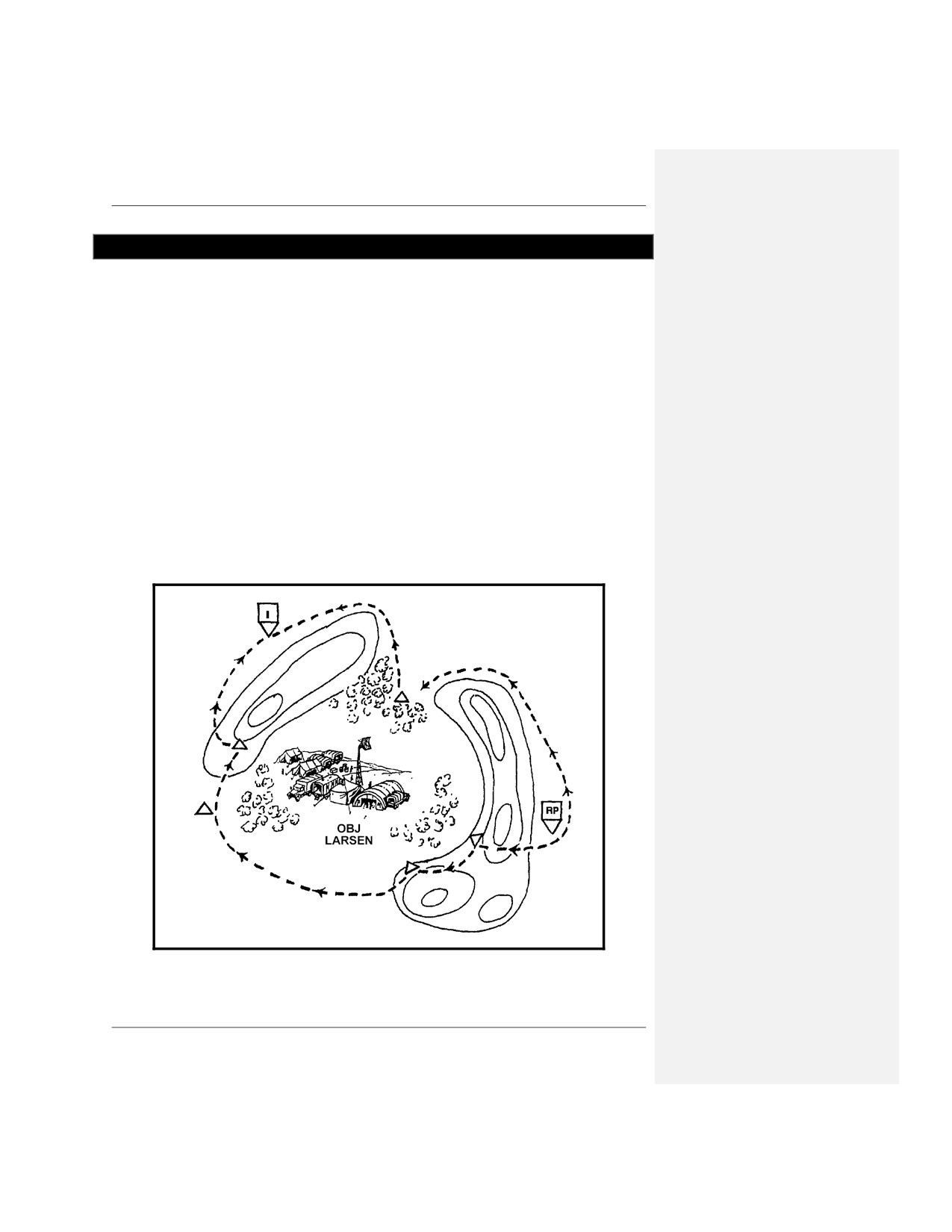
the reconnaissance in one of two ways. Depending on the terrain and time, the team may either use single
multiple separate reconnaissance and security elements (Figure 4-3). Reconnaissance and security teams
normally used in any size reconnaissance patrol. When conducting reconnaissance missions in team-sized
units, the leader can organize the team in any of several ways:
• One two- to three-Soldier reconnaissance and security team conducts the reconnaissance. The
rest of the team stays at the release point and establishes a hide site.
• Two reconnaissance and security teams reconnoiter a separate portion of the objective, and
then meet at a designated linkup point.
• One reconnaissance and security team, followed closely by a security team, acting as a
quick-reaction force.
Figure 4-3. Reconnaissance and surveillance elements.
FM 3-55.93
4-25
Chapter 4
4-78.
One or two Soldiers in a reconnaissance and security team can reconnoiter, while the rest of the
element provides security. However, the number of Soldiers in a reconnaissance and security team varies,
depending on the mission. Usually, three can provide both an adequate reconnaissance and the required
security. The information used may vary according to the terrain. The most important planning
consideration is that each member of the reconnaissance and security team knows the sector or area for
which he is responsible.
4-79.
Before executing an area reconnaissance, the team develops a detailed plan using all available
information. They conduct this mission the same as they would a surveillance mission. First, the leader
pinpoints the reconnaissance objective or NAI, and second, he locates the best vantage points for a static
surveillance. The best static surveillance techniques include—
Long-Range Observation and Surveillance
4-80.
Long range observation and surveillance means "the observation of an objective from a point" (an
observation post [OP]). The OP is normally outside enemy small-arms weapons range and local security
measures. The LRS team can use this technique whenever METT-TC lets them gather information from a
distance. It is the best way to conduct an area reconnaissance, because the team remains far enough away
avoid detection. Using this technique also keeps the team's no-fire or restricted fire area from overlapping
with the objective area. When the reconnaissance team cannot gather information from one OP, they can
move to a series of OPs until they gather the required information. Observation posts require adequate
cover and concealment and a good view of the objective. Routes between and from OPs to the hide site or
RP also require cover and concealment.
Short-Range Observation and Surveillance
4-81.
Short-range observation and surveillance is "the observation of an objective from a place that is
within the range of enemy small-arms weapons fire and local security measures."
• Short-range observation works best when METT-TC requires a close approach to the objective
to gain information.
• The reconnaissance teams can conduct short-range observation and surveillance from OPs, but
they must usually move near the objective before they can find a place where they can observe.
In some cases, the teams may gather information by listening, even though they cannot see
the enemy.
• Observing at short ranges increases the chance of detection. The enemy might use
anti-intrusion devices and patrols near key installations. Inclement weather can reduce the
sounds of the reconnaissance team's movement, and limited visibility favors short-range
observation. When the team must observe at short ranges, they use every means available to
avoid detection.
4-82.
To reconnoiter a road, the team leader selects multiple vantage points (OPs) along the road. The
reconnaissance element reconnoiters bridges, defiles, bends in the road, and urban areas. The
reconnaissance element reports the condition, trafficability, and width of the road; evidence of the enemy,
obstacles; bridge and ford locations and conditions; and tunnel or underpass locations and dimensions.
4-83.
To reconnoiter a wood line, the reconnaissance element uses concealed routes and stealth to reach
the wood line and avoids contact. The reconnaissance element checks for evidence of enemy activity such
as tracks, litter, old fighting positions, mines, booby traps, and obstacles. The reconnaissance element
determines if the woods are trafficable. The element checks all positions from which the enemy could
observe and fire on friendly elements in open areas, then reports.
4-26
FM 3-55.93
Team Operations
ZONE RECONNAISSANCE
4-84.
Zone reconnaissance is a directed effort to obtain detailed information on all routes, obstacles,
terrain, and enemy forces within a zone defined by boundaries (FM 1-02). The team obtains detailed
information about routes, obstacles, key terrain, and enemy activities in a zone established by lateral
boundaries. The team can use either the fan, converging-routes, or successive-sectors method.
FAN METHOD
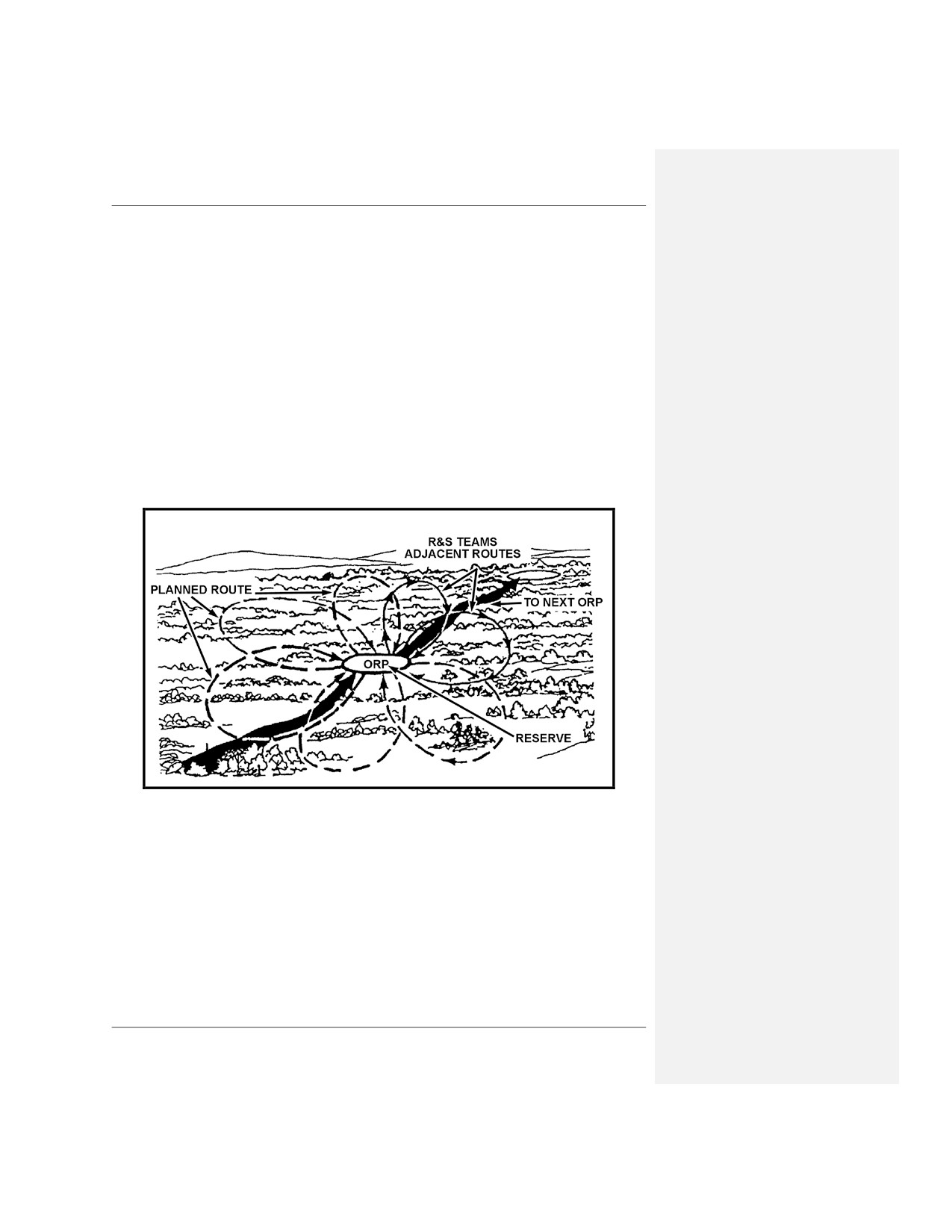
4-85.
The team leader selects a series of ORPs throughout the zone. When the team arrives at the first
ORP, it halts and establishes security. The team leader confirms the team's location. He then selects
reconnaissance routes to and from the ORP. The routes form a fan-shaped pattern around the ORP
(Figure 4-4). The routes must overlap to ensure that the team reconnoiters the entire area. Once the routes
are selected, the team leader sends out reconnaissance elements. He keeps a small reserve in the ORP. For
example, if the team has three reconnaissance elements, he sends two, keeping the third in reserve. The
team leader also sends the elements out on adjacent routes. This keeps the teams from making contact in
two different directions. After the team has reconnoitered the area (fan), the leader reports the information.
The team then moves to the next ORP and repeats these actions.
Figure 4-4. Fan method.
FM 3-55.93
4-27
Chapter 4
CONVERGING-ROUTES METHOD
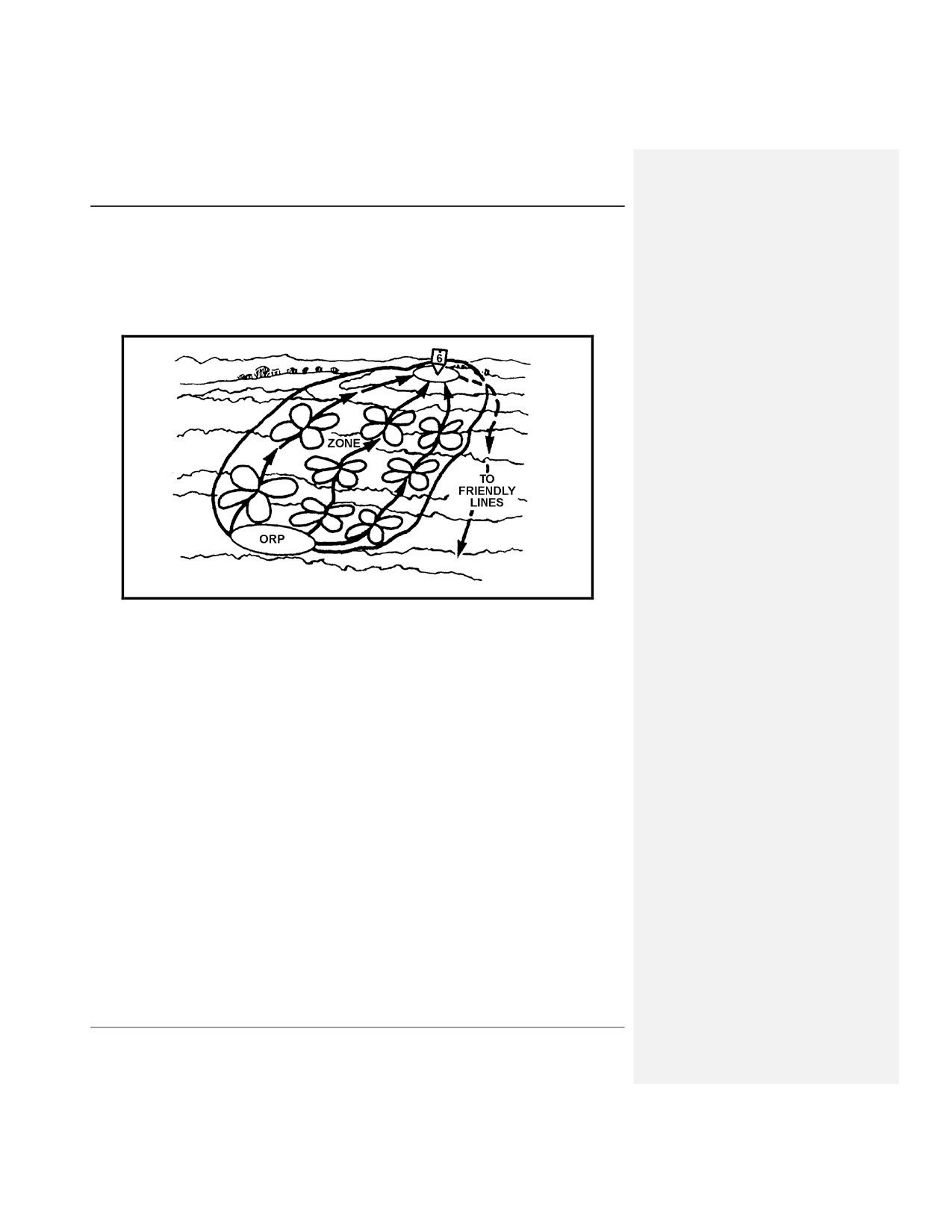
4-86.
The team leader selects an ORP, reconnaissance routes through the zone, and then a linkup point.
He sends out a sub element on each route. He normally moves with the center element. The subunits
normally reconnoiter their routes by using the fan method. The entire team meets at the linkup point at the
designated time (Figure 4-5).
Figure 4-5. Converging routes method.
4-28
FM 3-55.93
Team Operations
SUCCESSIVE-SECTOR METHOD
4-87.
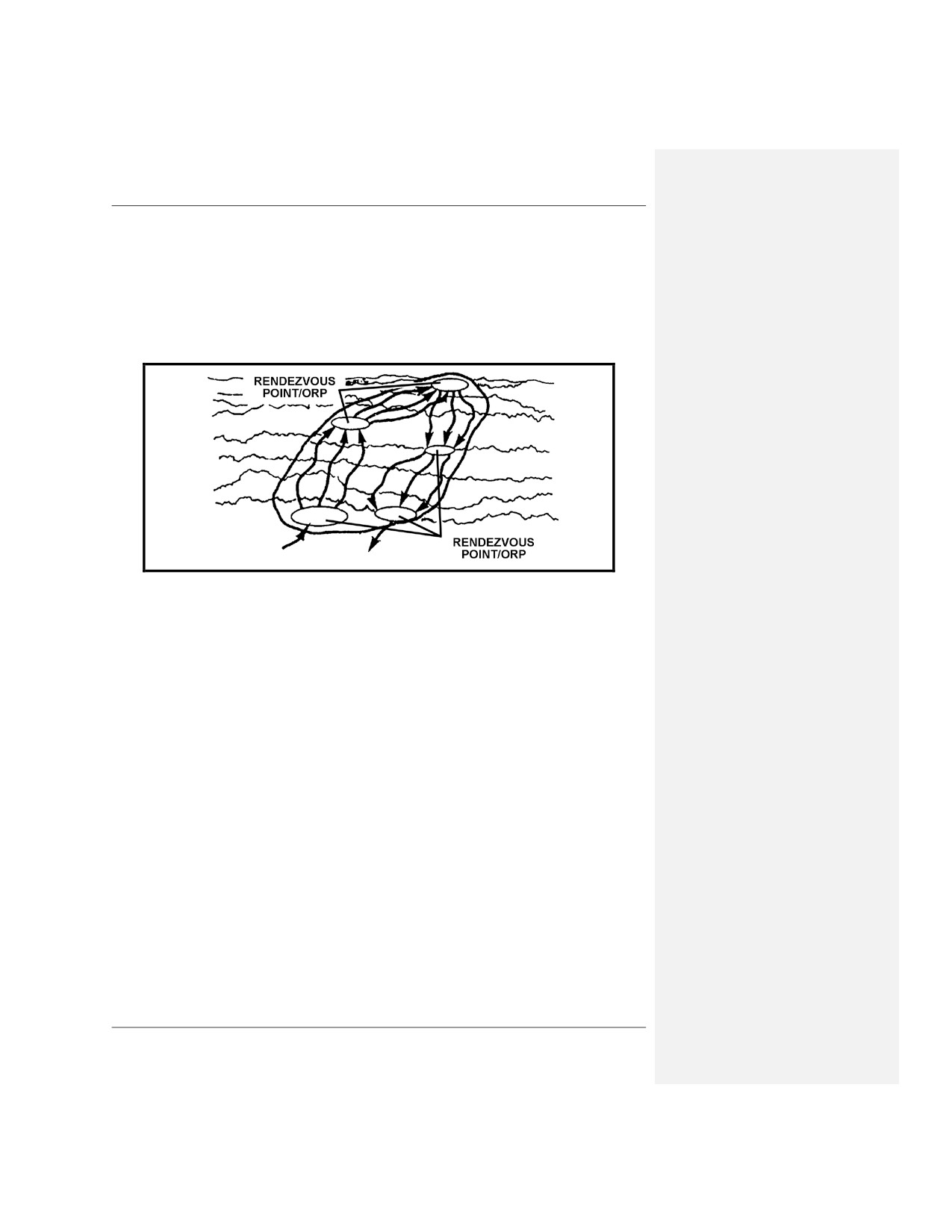
This method is a continuation of the converging-routes method. The team leader selects an ORP, a
series of reconnaissance routes, and linkup points. The actions of the team from each ORP to each linkup
point are the same as in the converging-routes method, that is, each linkup point becomes the ORP for the
next phase. When the team meets, the team leader again designates reconnaissance routes, a linkup time,
and the next linkup point. This action continues until the team has reconnoitered the entire zone
(Figure 4-6).
Figure 4-6. Successive sector method.
ROUTE RECONNAISSANCE
4-88.
Route reconnaissance is a directed effort to obtain detailed information of a specified route and all
terrain from which the enemy could influence movement along that route (FM 1-02).
4-89.
Route reconnaissance obtains information about enemy activity, obstacles, route conditions, and
critical terrain features along a specific route. It is generally beyond the capability of a LRS team to obtain
precise data for road curves, widths and heights of underpasses, and dimensions of tunnels. However, they
can report the types of vehicles that use the roads, or that enter or exit the tunnels. From this, intelligence
personnel can estimate the weight limits, widths, and other information about the roads, tunnels, and
underpasses. The LRS team follows the example report formats provided in FM 5-170. Example
intelligence requirements for a LRS route reconnaissance include--
• The available space (in meters) in which a force can maneuver without having to bunch up to
avoid obstacles. The size of trees and the density of forests are reported due to the effect on
vehicle movement.
• The locations of all obstacles and of any available bypass(s).
• Any enemy forces that can influence movement along the route.
• The observation and fields of fire along the route and adjacent terrain.
• The locations along the route that provide good cover and concealment.
• Trafficability along the route.
• Landing and pickup zones along the route.
• Any bridges by construction and type, estimated dimensions of each, and any vehicles crossing
the bridge. This helps intelligence personnel estimate its load classification.
FM 3-55.93
4-29
Chapter 4
BRIDGE CLASSIFICATION
4-90.
This is not a separate category of reconnaissance, but it might be a necessary part of an area, zone,
or route reconnaissance. The team follows procedures to ensure that they provide the dimensional data
needed to analyze the bridge's structure for repairs, demolition, or military-load classification. Seldom can
a team obtain precise measurements. However, if possible, they report the type and number of vehicles that
cross the bridge. Intelligence can then estimate the weight, height, and weight limit of the bridge
(FM 5-170).
LEADER RECONNAISSANCE
4-91.
The leader plans and reconnoiters all primary and alternate surveillance and hide sites. The criteria
for selecting these sites is similar, except that the hide site must be sited to allow for long-range
communications, and the surveillance site must allow round-the-clock surveillance. Leaders evaluate all
primary and alternate sites based on the following criteria, then they establish and disseminate rally points
and break out plans for all sites:
HIDE SITE
• Does the site facilitate long-range (HF or UHF TACSAT) communications?
• Does the area provide concealment as well as routes of ingress and egress?
• Are dominant or unusual terrain features located nearby?
• Is the area wet, does it have adequate drainage, or is it prone to flooding?
• Is the area a place that the enemy would want to occupy?
• Is the site silhouetted against the skyline or a contrasting background?
• Are roads or trails located nearby?
• Are other natural lines of drift located nearby?
• Could the hide personnel get trapped easily in the site?
• Do obstacles, such as a ditch, fence, wall, stream, or river, prevent vehicle movement nearby?
• Are any inhabited areas located in the prevailing downwind area?
• Are any suitable communication sites located nearby?
• Is the site in the normal line of vision of enemy personnel in the area?
• Is there a source of water in the area?
4-30
FM 3-55.93
Team Operations
SURVEILLANCE SITE
• Can the team place the designated surveillance target(s) under constant and effective
observation and within the range of surveillance devices to be used?
• Would the surveillance site have to move if weather and light conditions change?
• Does the area provide concealment?
• Does the area provide adequate egress routes?
• Are dominant or unusual terrain features located nearby?
• Is the area wet, does it have adequate drainage, or is the area prone to flooding?
• Would the enemy want to occupy this area?
• Is the site silhouetted against the skyline or a contrasting background?
• Are any roads or trails located nearby?
• Are any other natural lines of drift located nearby such as gullies, draws, or any terrain easy for
foot movement?
• Could the surveillance team get trapped easily in the site?
• Do any obstacles, such as a roadside ditch, fence, wall, stream, or river, prevent vehicle
movement nearby?
• Are any inhabited areas located in the prevailing downwind area?
• Is the site in the normal line of vision of enemy personnel in the area?
• Is there a source of water in the area?
• Does the site facilitate communications?
Section III. S UR VE ILLANCE OPE R ATIONS
This section discusses selection and occupation of sites; security and reports; linkup and dissemination of
information; contingencies and heavy team and platoon operations.
SELECTION AND OCCUPATION OF SITES
4-92.
After he completes his reconnaissance (described in Section II), the leader selects the hide and
surveillance sites. While selecting the sites, he determines whether each site will have nonmission-essential
equipment. His decision determines the size of sites to construct and the type of breakout drills that the
team must perform, if required.
HIDE SITE
4-93.
The team should test communications from the tentative site before they start constructing it.
Otherwise, they might have to start over with a new site.
SURVEILLANCE SITE
4-94.
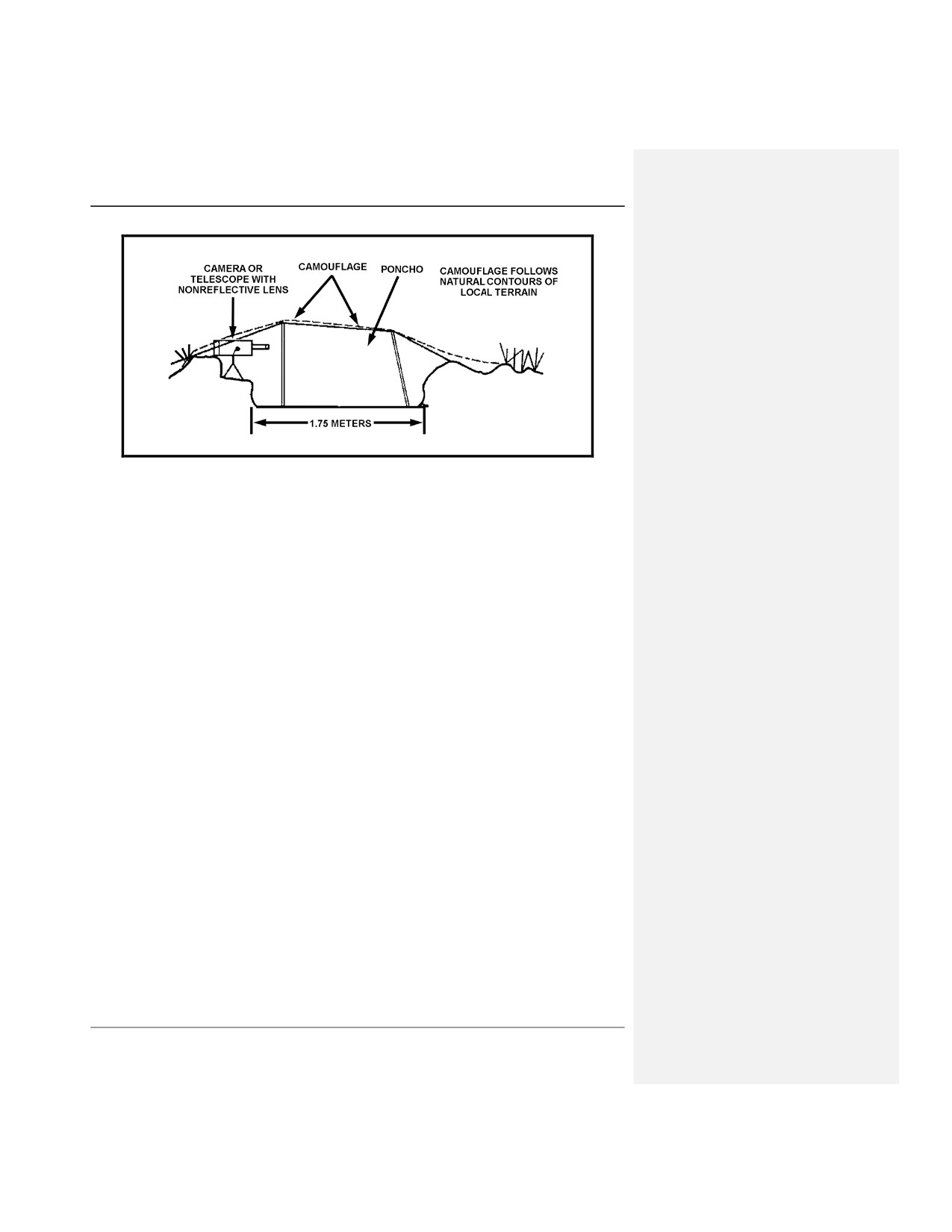
The leader selects each site based on the quality of its observation and communications with the
other site. To determine if the planned surveillance site (Figure 4-7) will work well for surveillance, the
team places all optics at the same levels they will use when they actually occupy the site, such as at ground
level. Seldom do circumstances allow for rebuilding of sites. Finally, try to minimize digging signatures
(sound and dust).
FM 3-55.93
4-31
Chapter 4
Figure 4-7. Example surveillance site.
OCCUPATION
4-95.
Teams maintain security at all time. Security personnel must emplace far enough out to detect
intruders, but must remain close enough to alert the team. A technique to alert the site of an intruder is to
simply tug on a cord tied from the security position to a Soldier at the site.
4-96.
The team should maintain all-round security, and pay close attention to the most likely avenues of
approach. Each site needs all-round observation and a view of anyone or anything in the area. This helps
prevent compromise, as it allows team members to detect movement and gives them the advantage if they
must break out of the site.
4-97.
Appendix H discusses how to construct hide and surveillance sites. In most cases, the team should
only work on a surveillance site in limited visibility, but they can work on a hide site during the day, if
needed. Generally, the team must camouflage all sites well enough to escape detection from greater than 10
meters. The sites should blend well with the surrounding terrain in texture and form.
4-98.
The LRS team prepares and rehearses a complete breakout plan. Team members prepare
equipment for executing a breakout drill immediately. Pre-positioned M18 Claymore mines and smoke
grenades can facilitate a quick breakout of the site.
4-32
FM 3-55.93
Team Operations
SECURITY AND REPORTS
4-99.
The team prepares and sends reports during actions on the objective from on the start of
observation activities until the dissemination of information. The reports the team members at each site
must make depend on that site's specific tasking.
HIDE SITE
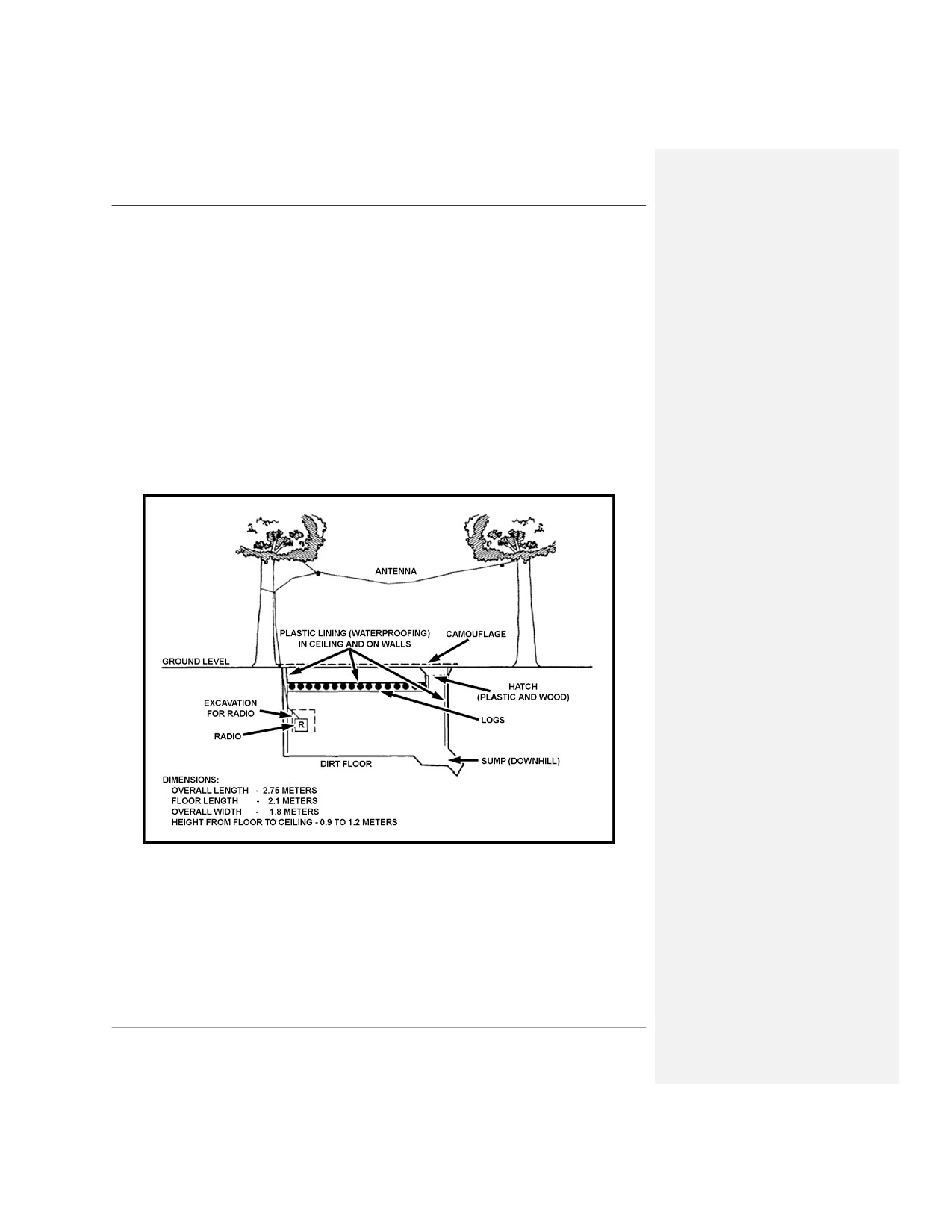
4-100. The primary mission of the hide site is to facilitate team internal and long-range communications.
On long missions, team members can rotate between the surveillance and hide sites (Figure 4-8). It is
usually more secure than the surveillance site, because it is farther from the objective and designed for
hiding. Antennas, a hide site's largest signature, should remain up only when in use. Otherwise, they are
lowered or removed. One team member serves as lookout while another one constructs or adjusts the
antennas. The lookout must be able to see the enemy before the enemy sees the Soldier working on the
antennas. To prevent detection, team members minimize movement around the site. They use
countertracking whenever someone moves around the site. They also minimize noise and light. Although
the site is well camouflaged, noise and light can easily compromise the team's location.
Figure 4-8. Example hide site.
4-101. The team keeps detailed communications and patrol logs throughout the mission. The
communications log includes—
• Exact messages sent.
• Exact messages received.
• Antennas used or tried, and their configuration time(s) and location(s).
FM 3-55.93
4-33
Chapter 4
4-102. Before any element performs a shift change in the site, all information collected at the site by the
outgoing shift is disseminated, to include—
• Message traffic.
• The status of the surveillance site.
• Any enemy activity on the objective.
SURVEILLANCE SITE
4-103. During periods of activity on the objective, all personnel should be awake and alert to aid in
security and recording. One person cannot record and conduct surveillance at the same time during periods
of increased activity. The team keeps detailed surveillance logs, to include sketches of the objective. The
more detailed the information and sketches are, the more successful the mission will be. When the team
recognizes PIR, intelligence requirements, SIR, ISR tasks and RFIs, they send it to the hide site promptly
for transmission to the COB or AOB either immediately (PIR) or during a scheduled communications
window. They can use either secure or nonsecure means, depending upon the equipment or time available.
The messages must be complete and well written to reduce time needed for corrections or clarification.
(Chapter 6 provides examples of communication orders formats.) The team pays particular attention to the
amount of movement, noise and light discipline, and the reduction of any reflection that may come from
using optics. The team must pack any equipment not in use so that they can evacuate the site quickly. As
with the hide site, the team must completely disseminate all information collected before they change
shifts. If the team plans to perform a breakout drill, they send a message to the hide site first, if possible.
LINKUP AND DISSEMINATION OF INFORMATION
4-104. When the decision is made to leave the objective, the team must perform a number of actions. The
plan outlines the routes they will take, site breakdown procedures, and security during breakdown. After
they break down the site, they thoroughly sterilize it to prevent the enemy from detecting their presence
and knowing where to release tracker teams. The team must leave nothing behind that can give the enemy
any information. They take extra care with their security. The team is in great danger from this point until
the extraction is complete.
4-105. While the surveillance team moves out, the hide site team breaks down and sterilizes the site.
They follow the same procedures and precautions as described for the surveillance site.
4-106. The team rehearses linkup procedures before the mission begins. During linkup, the team is at the
greatest risk of fratricide. Everyone must understand all signals. Only one element may move into the
linkup site at a time. Who moves first is decided during rehearsals. Communications and night vision
capability assist in conducting linkups After the linkup, the team disseminates all information gained in
case they become separated again before extraction.
4-34
FM 3-55.93
Team Operations
CONTINGENCIES
4-107. Due to the uncertainty of the situation, contingencies require plans, rapid response, and special
procedures to ensure safety and readiness of personnel and equipment. The team must consider the
following contingencies for the execution phase:
• Actions on enemy contact during insertion.
• Break in contact.
• Actions taken by the team if separated during insertion.
• Plan for priority of destruction of equipment.
• Rally or rendezvous plan to cover team during foot infiltration to objective, while on the
objective, and during exfiltration.
• Plan for avoiding all known or suspected enemy forces, danger areas, or civilian concentrations.
• Security during movement, halts, cache, communications, and during hide or surveillance site
construction.
• Cross-loading of equipment, sensitive items, and construction material.
• Lack of a communications plan (team internal and external to the COB).
• Actions on enemy contact.
• Linkup plan for both teams internally, and with other friendly forces.
HEAVY TEAM AND PLATOON OPERATIONS
4-108. Some METT-TC conditions may require a LRS team to have additional Soldiers attached or in
support. A LRS team may require additional personnel to carry surveillance site construction materials and
water. These additional Soldiers (three to six) are known as a "mule team." They accompany the team to
the objective area, construct the subsurface surveillance site, and depart the objective area during limited
visibility. The advantage to using these TTP is that the LRS team is rested when starting the
surveillance mission.
4-109. METT-TC conditions may also allow for the use of a LRSD employed as a tactical platoon. The
LRSD establishes a patrol base, and then emplaces multiple surveillance sites. The LRSD acts both as the
sustainment base and as a quick reaction force in case a surveillance site is compromised. This technique
has been very successfully employed in desert environments when the objective area is far from any
support base and multiple surveillance sites are needed. Sustainment and rotation of surveillance site
personnel occurs during the hours of limited visibility.
FM 3-55.93
4-35
Chapter 4
Section IV. COMB AT AS S E S S ME NT
Combat assessment is the determination of the overall effectiveness of force employment during military
operations. Combat assessment has three major components: battle damage assessment (BDA), munitions
effects assessment, and reattack recommendation (JP 3-60 and FM 1-02). However, LRS teams only participate
in the BDA component. LRS teams are critical sensors for all fire-support platforms. At times, they may be the
only source of targeting information available for high-value targets (HVTs). Keys to a successful combat
assessment operation are using standardized report formats and sending the best possible information and
images of the damage observed for trained analysts to evaluate.
DEFINITION AND PURPOSE
4-110. BDA is the timely and accurate estimate of damage resulting from the application of military
force, either lethal or nonlethal, against a predetermined objective. BDA can be applied to the employment
of all types of weapon systems (air, ground, naval, and special forces weapons systems) throughout the
range of military operations. BDA is primarily an intelligence responsibility with required inputs and
coordination from the operators (FM 1-02). BDA, in its most basic form, answers four questions quickly
and accurately:
• Was the target hit?
• What was the extent of physical and functional damage?
• Were the commander's objectives achieved in full, in part, or not at all?
• Should the target be reattacked?
4-111. The LRS team can make a recommendation to reattack, but it is the targeting planners, not the
LRS team, who decide whether the target should be reattacked.
CONSIDERATIONS
4-112. When assessing battle damage, the team should consider—
CONDITION OF THE TARGET
4-113. This includes the overall level of destruction or serviceability of the target and whether it was
occupied or unoccupied, and whether the enemy was withdrawing or reinforcing.
CASUALTIES
4-114. This includes the number of wounded or dead.
EQUIPMENT DAMAGE OR SERVICEABILITY
4-115. This lists destroyed and neutralized vehicles and weapon systems, and identifies which need
repair or recovery.
INSTALLATION DAMAGE OR SERVICEABILITY
4-116. This identifies damage levels and relative serviceability of runways, roads, buildings, lighting,
bridges, power and phone lines, and any repair and damage-control activities.
MISSION PLANNING FACTORS
4-117. In addition to normal planning factors, BDA missions include—
4-36
FM 3-55.93
Team Operations
• Task organization (forward observers or combat controllers).
• Personnel markings.
• Position markings.
• Communications equipment and frequencies.
• BDA criteria.
• Special equipment such as lasers and thermals.
• Pulse repetition codes.
• Authentication codes.
• Training in the use of special equipment.
• Rehearsals and precombat inspections.
• Withdrawal.
CHARACTERISTICS
4-118. Initial post-strike BDA reports are sent to the COB or AOB, who sends them to the controlling
headquarters. The team is responsible for obtaining and reporting raw data about collateral, physical, and
functional damage.
WEAPON AND ORDNANCE MALFUNCTIONS
4-119. Because the team observes and reports any observed battle damage, the team can also report the
number and type of dud ordinance and any weapon malfunctions.
REPORTS
4-120. The team reports their BDA observations from the target area in either the SALUTER or INTREP
format. They should include digital imagery, if available.
FM 3-55.93
4-37
Chapter 4
DAMAGE TYPES AND LEVELS
4-121. The team reports the extent of physical and functional damage sustained by each target. Physical
damage assessments estimate the extent of physical damage resulting from the application of military
force, that is, from munitions blasts, fragmentation, and the effects of fire. The team bases their assessment
upon observed or interpreted damage.
COLLATERAL DAMAGE
4-122. The team reports any collateral damage that occurs during BDA missions. Collateral damage is
defined as unintentional or incidental damage to facilities or equipment, or casualties, that occur due to
military actions directed against a targeted enemy force or facility.
PHYSICAL DAMAGE
4-123. Assessing physical damage is a judgment call. The key factors are the type and size of the target
and warhead used, and the location of the detonation. The team also considers whether the enemy's use of
camouflage, concealment, and deception reduced or increased the physical damage, because these factors
could distort the assessment.
FUNCTIONAL DAMAGE
4-124. The team assesses the extent to which military force degraded or destroyed the ability of the
targeted facility or objective to perform its intended mission. The level of success is based upon the
operational objectives established against the target. Because assessment of functional damage is
subjective, the team need not associate a confidence level with it. However, they can include an estimate of
the time required for the recuperation or replacement of the target function.
No Functional Damage--Target is undamaged or has sustained little or no damage to critical
element(s), leaving normal functional capability intact. The target is fully operational or able to
act; it is mission capable. This damage level does not require recuperation or replacement
times.
Light Functional Damage--The critical element(s) of the target has sustained damage, causing
less than a 15 percent decrease in normal operational capability. This damage level requires an
estimation of the time required for recuperation or replacement of the target function.
Moderate Functional Damage--The critical element(s) of the target has sustained damage,
causing a 15 to 45 percent decrease in normal operational capability. This damage level
requires an estimation of the time required for recuperation or replacement of the target
function.
Severe Functional Damage--The critical element(s) of the target has sustained damage, causing
greater than a 45 percent decrease in normal operational capability. This damage level requires
an estimation of the time required for recuperation or replacement of the target function.
Functional Destruction--The critical element(s) of the target has sustained damage rendering the
entire target unusable for its original purpose. Target cannot support combat or production
operations without repairing or replacing critical elements. This damage level requires an
estimation of the time required for recuperation or replacement of the target function.
Abandoned--Regardless of physical damage, this facility or equipment is not being used for its
intended purpose. Target cannot support combat or production operations without being
reoccupied, re-equipped, or both.
Unknown Functional Damage--Although the critical element(s) of the target has been attacked,
insufficient data exist to assess whether functional damage occurred.
4-38
FM 3-55.93
Team Operations
BRIDGES
4-125. A bridge is designed to allow movement of personnel and equipment across an obstacle.
Destruction of the bridge might not be required. For example, degrading the ability of the bridge to allow
movement of vehicles might be enough to accomplish the mission.
PHYSICAL DAMAGE
4-126. When reporting physical damage, report the number of spans that are damaged and destroyed out
of the total number of spans on the bridge. Note that the deck or floor of a railroad bridge can be solid or
open track.
No Damage--Military action has caused no apparent damage.
Light Damage--The bridge has sustained superficial damage, but the roadway remains
undamaged.
Moderate Damage--All spans remain intact, but one or more spans has sustained holes in the
deck or floor. For pontoon bridges, one pontoon section has been sunk.
Severe Damage--All spans remain attached, but one or more spans has sustained 50 percent
destruction to the deck or floor width. For pontoon bridges, two or more nonadjacent pontoon
sections has been sunk.
Destruction--At least one span has been dropped. Piers or abutments might have sustained
damage or they might have been destroyed. For pontoon bridges, two or more adjacent pontoon
sections have been sunk.
FUNCTIONAL DAMAGE
4-127. Using the assessment of physical damage can help determine the level of functional damage.
Highway Bridge--When you report that a bridge has sustained moderate to severe damage,
identify the number of lanes that remain open (on a highway bridge) and what how much traffic
can still use the bridge.
Railroad Bridge--Moderate or greater physical damage to a railroad bridge generally renders
it unusable.
Pontoon Bridge--Recuperation time may be short in duration for a pontoon bridge that has been
destroyed due to the destruction of a few sections. Several factors such as the presence or
availability of spare sections, repair capability, or both, can rapidly reverse the effects of an
attack. Some might be repaired before the combat assessment report is completed.
Permanent Spanned Bridge--When a permanent bridge span sustains moderate to severe
physical damage, assessing the extent of functional damage is difficult. The combat assessment
analyst can seldom see under the bridge, but the damage there often exceeds the damage he can
see on the deck. This is due to the delayed fuses used on most bridges.
FM 3-55.93
4-39
Chapter 4
BUILDINGS
4-128. A building is designed to environmentally shelter an enclosed function or equipment. Destruction
of the building is not required. The point is to destroy the critical element(s) it houses.
TYPES
4-129. These include framed buildings, buildings with load-bearing walls, high multistory buildings, and
buildings with multiple wings.
Framed Buildings--Framed structures (such as military headquarters, office buildings, and
aircraft hangars) rarely collapse totally in an attack with conventional weapons. However,
regardless of external and overall damage, the building's frame tends to remain intact. On the
other hand, a steel or concrete frame need not collapse for the building to sustain damage at the
levels previously described.
Buildings with Load Bearing Walls--In contrast to framed buildings, those with load-bearing
walls, that is, walls that carry the weight of the floor and roof, generally sustain damage levels
equal to the amount of building collapse, and the damaged elements generally include the
load-bearing and non-load-bearing structural elements.
High, Multistory Buildings--For buildings with more than four stories or with multiple sections
(or wings), the team should report the level of damage for each story, section, or wing
individually and that of the structure as a whole. For example, if a ten-story building receives
severe damage to the upper three stories, they report the level of damage to those three floors
plus the level of damage to the structure as a whole, which in this case might be assessed as
moderate.
Buildings with Multiple Wings--For buildings with multiple wings, the team reports the
destroyed wings and the damage to the remainder of the structure. For example, they might
report that the North and South wings of an headquarters building have been destroyed, while
the center section sustained only moderate damage.
PHYSICAL DAMAGE
4-130. Target-element-area damage includes damage to non-load-bearing elements such as facades and
external sheathing, as well as broken windows and glass, blown-out curtain walls, and blown-out
roof panels.
No Damage--Military action has caused no apparent damage.
Light Damage--At this level of damage, the target-element area has sustained up to 15
percent damage.
Moderate Damage--At this level of damage, the target-element area has sustained from 15 to 45
percent damage.
Severe Damage--At this level of damage, the target-element area has sustained from 45 to 75
percent damage.
Destruction--At this level of damage, the target-element area has sustained from 75 to 100
percent damage.
4-40
FM 3-55.93
Team Operations
FUNCTIONAL DAMAGE
4-131. The greater the extent of physical damage to the building, the greater the likelihood that the
element(s) within is damaged, hence the building requires a longer recuperation time to restore the
Location and Hardness--Although the level of physical damage to a building and functional
damage to its critical element(s) correlate somewhat, the location and hardness of a building's
contents are the keys to a meaningful functional assessment. For example, in an industrial
building, the machinery may be less vulnerable than the structure in which it is contained. The
structure might be moderately damaged, while the machinery it houses sustains little or no
damage. On the other hand, fragile computer or other electronic equipment might be destroyed
while the building that houses it sustains far less functional damage.
Contents--Framed structures tend to show less apparent physical damage and is less likely to
collapse than other types of buildings. Thus, determining the functional damage to the contents
of a framed building is more difficult than assessing those of a wall-bearing structure. These
tend to show more physical damage, and they collapse more readily, causing greater functional
damage to their contents than do framed structures.
Recuperation--The team reports recuperation for both the structure and for the critical elements.
Structural Damage as Unusability Criteria--General weaponeering guidance considers a
building unusable (functionally destroyed) when it has sustained 50 percent structural damage.
Depending on the type and location of critical elements, a lesser percentage of damage may be
adequate to achieve the desired level of functional degradation.
Landmarks and Symbols--A building may also serve as an important landmark or other symbol
of national unity and resolve; in these cases, the entire building may be the critical element.
FM 3-55.93
4-41
Chapter 4
BUNKERS
4-132. Bunkers were formerly called hardened facilities. It can be very difficult for LRS teams to provide
accurate BDA on bunkers unless they are able to conduct a physical inspection.
PHYSICAL DAMAGE
4-133. Target-element-area damage includes damage to non-load-bearing elements such as facades and
external sheathing, as well as to broken windows and glass, blown-out curtain walls, and blown-out
roof panels.
No Damage--Military action has caused no apparent damage.
Light Damage--At this level of damage, no weapon penetration has occurred, but exterior damage
is apparent.
Moderate Damage--At this level of damage, weapons have obviously penetrated the bunker.
Severe Damage--At this level of damage, part, but less than one-third of, the bunker roof or side
walls has collapsed.
Destruction--At this level of damage, more than one-third of the bunker roof and side walls
have collapsed.
FUNCTIONAL DAMAGE
4-134. Assessing damage to all types of hardened structures requires analysis of aircraft cockpit video
(ACV) and a search for blown-off entrance doors, burn marks outside entrances, or smoke from fire or
secondary explosions. The results of this analysis must be compared to information about the internal
configuration of the bunker to determine the approximate location of the weapon detonation.
4-135. A single weapon is unlikely to collapse or partially destroy a large bunker built with lots of thick
concrete, burster slabs, and soil layers. However, a big weapon detonation inside the bunker generally
destroys the contents. Knowledge of bunker construction such as dimensions, wall placement, and
thickness of roofs, floors, or walls is required to accurately assess the extent of internal physical and
functional damage.
4-136. Functional damage to a bunker depends on its mission. If internal compartmentalization allows, a
round that penetrates the bunker has a good chance of damaging or destroying sensitive contents such as
aircraft or munitions. If the damage is not too great, the contents can be moved In these situations,
depending on the level of physical damage, the contents can be removed and the bunker can be
reconstituted to reuse for protective storage of other equipment or supplies.
4-137. A successful weapon penetration and detonation generally damages or destroys both mission and
operations in a bunker serving in a production or C2 role. In any of these situations, the extent of functional
damage depends on estimates of physical damage to the internal structure, ventilation system, to electronic
or communications equipment, and to power supplies, lights, water lines, tools, and equipment, for
example. Generally, long recuperation times are associated with this type of internal damage. As with
buildings, when reporting recuperation, the team reports both the structure's recuperation and the
recuperation of the critical elements.
4-42
FM 3-55.93
Team Operations
DAMS AND LOCKS
4-138. Dams and locks have one function: to contain water on the upstream side. Military action
can cause--
NO DAMAGE
4-139. If no damage occurs, no loss of functionality occurs.
DAMAGE
4-140. A breach, break, or puncture in the face of the lock or dam affects functionality immediately in the
form of a leak, whose size depends on the amount of damage.
DESTRUCTION
4-141. Loss of the lock or dam causes an immediate flood, which is total functional failure.
FM 3-55.93
4-43
Chapter 4
DISTILLATION TOWERS
4-142. Distillation tower targets include the tower and all associated equipment.
PHYSICAL DAMAGE
4-143. When reporting physical damage to a specific tower, also report damage level of equipment
directly associated with the tower. This equipment usually includes one or more furnaces, heat exchangers,
or condensers; and elevated pipe ways. If possible, also report damage level of the control building
associated with the distillation tower.
No Damage
4-144. Military action has caused no apparent damage.
Light Damage
4-145. Military action has caused no apparent penetration of tower shell or disruption to piping
connections. Portions of the insulation covering the tower shell appear damaged or scorched.
Moderate Damage
4-146. Military action has left the tower shell standing, but has penetrated the tower or deformed or
severed piping connections.
Destruction
4-147. Military action has at least partially collapsed or toppled the tower.
FUNCTIONAL DAMAGE
4-148. The effects of damaging a distillation tower on the target's production capabilities depends on the
specific functions of the towers such as primary distillation or secondary processing. The team reports
functional damage of a distillation tower in terms of the time required to repair or replace it and the
specific production capabilities denied in the meantime. The team must also report damage to equipment
directly associated with a distillation tower, because the results could compare to significant damage to the
tower.
4-44
FM 3-55.93
Team Operations
MILITARY EQUIPMENT
4-149. This applies to equipment whether deployed or in depot:
DEFINITIONS
• Armored vehicles include tanks and armored personal carriers.
• Artillery includes field and antiaircraft artillery systems, both towed and self propelled.
• Trucks include all types of nonarmored vehicles, whether used for land transportation, and C2.
• Locomotives and rolling stock include all types of rail transportation.
• Aircraft include all types of fixed- and rotary-wing aircraft.
• Rockets include single-round and multiround rockets and their associated launchers.
• Missiles include surface-to-surface and surface-to-air (fixed and mobile) missiles and their
associated launchers.
• Radar antennas include those that stand alone or are attached to a van or trailer. Radars may or
may not be associated with a missile site.
• Fire-control components include all vans or trailers (radar, guidance, power and computer)
associated with SSM, SAM, and AAA sites.
PHYSICAL DAMAGE
4-150. The team must consider their observations carefully before they report "No damage" to military
equipment. They might not observe some of the physical deformations that happened to it. To determine
damage level, they must analyze as many sources and types of information as they can observe, for
example, a complete lack of either vehicular movement or radio transmissions for an extended period of
time. Then, when they are ready to report physical damage to military equipment, they must report the total
number of each type of equipment observed, the number of pieces of equipment damaged, and the
number destroyed.
No Damage
4-151. Military action has caused no apparent damage.
Damage
4-152. Military action has caused physical deformations to equipment such as holes, exterior scorch
marks, or broken or missing exterior equipment or components such as broken tracks or wheel or missing
armored plates. However, major components remain intact.
Destruction
4-153. Military action has left the equipment unrepairable, possibly scrappable. This qualifies as
catastrophic damage (K-Kill).
FM 3-55.93
4-45
Chapter 4
FUNCTIONAL DAMAGE
4-154. The level of functional damage of a missile or radar site depends upon the extent of damage, the
number of critical elements and their individual levels of damage, and the interconnectivity of the various
elements that make up the site. Visible damage might have little or no effect on equipment functionality.
Functional damage of equipment includes any damage that partly or completely reduces--
• The ability of the C2 nodes to effectively operate.
• The ability of the logistics nodes to--
-- Fuel,
-- Arm,
-- Fix,
-- Transport,
-- Operate, or
-- Protect.
• The ability of the engineering resources to provide--
-- Mobility,
-- Countermobility, and
-- Survivability support.
TYPES OF EQUIPMENT
4-155. Types of equipment whose reduction in capability can affect the functioning of a site or
element include--
Armored Vehicles and Artillery--Functional damage is an elimination of firepower capability
(F-kill), prevention of mobility (M-kill), or both, which the crew cannot repair on the
battlefield.
Trucks--Functional damage is a reduction in mobility (M-kill) or in ability to use the truck's
internal equipment for a number of hours until the crew can repair the equipment or vehicle.
Locomotives and Rolling Stock--Functional damage is prevention of mobility (M-kill) for a
number of hours until the crew can repair the locomotive or rolling stock cars. Functional
damage can also include damage or destruction of materials within the cars.
Aircraft--Functional damage prevents takeoff (PTO-kill) for a number of hours until the crew can
repair it.
Rocket, Missile, or Launcher--Functional damage prevents successful or effective firing of the
weapon (F-kill). The crew cannot repair this damage on the battlefield.
Radar Antenna or Its Van or Trailer--Functional damage prevents a radar system from
acquiring, firing, or tracking missiles (F-kill) until the system can be repaired.
4-46
FM 3-55.93
Team Operations
GROUND FORCE PERSONNEL
4-156. Damaging or destroying an occupied position such as a bunker, trench, or other structure or a
vehicle such as a personnel carrier or truck usually causes casualties. FM 6-30 states that for indirect fire,
thirty-percent casualties or materiel damage inflicted during a short time span normally renders a unit
ineffective. However, a commander will stipulate the desired effects and percentages required for success
against specific target categories.
PHYSICAL DAMAGE
4-157. In addition to reporting physical damage levels, the team should estimate the total percentage of
the ground force destroyed. For equipment, see the damage definitions provided for military equipment.
No Damage
4-158. Military action has caused no apparent damage.
Damage
4-159. Military action has caused up to 30 percent casualties to visible personnel or to occupied positions
or organic equipment.
Destruction
4-160. Military action has caused more than 30 percent casualties to visible personnel or to occupied
positions or organic equipment.
FUNCTIONAL DAMAGE
4-161. The attrition of ground forces is influenced by factors in the domains of battle: physical
(personnel, weapons systems, and sustainment), cybernetic (C2), morale (will to fight), training, and
leadership. Generally, the greater the personnel casualties and damage to their equipment and
communications and supply networks, the greater the attrition of ground forces and the lower their combat
effectiveness. Desertions or POW losses may also render a unit ineffective. As part of determining enemy
combat effectiveness (ability to function), two factors must be addressed in clear and simple terms:
• Reconstitution of forces and recuperation of facilities.
• Residual capabilities to perform defense, assault, and supply missions.
FM 3-55.93
4-47
Chapter 4
STORAGE TANKS FOR PETROLEUM, OIL, LUBRICANTS
4-162. Although a POL tank may sustain damage, its contents may be retrievable and usable.
PHYSICAL DAMAGE
No Damage
4-163. Military action has caused no apparent damage.
Light to Moderate Damage, Aboveground Tanks
4-164. Military action has punctured top walls, side walls, or both; possibly spilled contents; caused no
evidence of sustained fire; left structural integrity intact.
Light to Moderate Damage, Partly or Completely Underground Tanks
4-165. Round has penetrated tank, but no secondary explosion or sustained fire has occurred.
Destruction
4-166. Military action has caused at least partial collapse or buckling of side wall; or, a secondary
explosion or a sustained fire has occurred, or both
FUNCTIONAL DAMAGE
4-167. Significant functional damage of a POL storage installation is expressed in terms of storage
capacity rendered unusable and time required to repair or replace this denied capacity.
4-48
FM 3-55.93
Team Operations
POWER PLANT TURBINES AND GENERATORS
4-168. Power plant turbines and generators may be housed in separate structures or together in a single
structure called a "generator hall." Physical damage to the turbine or generator units can be difficult to
identify if the generator hall remains relatively intact. Therefore, damage estimates to the units are based
upon the location of the weapon detonation and on the physical damage to the building itself. The closer to
the floor a weapon detonates, the greater the probability of unit damage. The extent and location of
structural damage, as opposed to roof-panel damage, is another indicator of unit damage--the greater the
wall damage and structural collapse, the greater the likelihood that the unit(s) is damaged or destroyed
under the rubble.
PHYSICAL DAMAGE
4-169. When reporting physical damage, the team reports the number of turbines or generators that are
damaged and destroyed out of the total number of units at the facility. When performing combat
assessment on a generator hall, they report physical damage to both the building (see previous discussion),
and they estimate damage to the turbines or generators located inside.
No Damage
4-170. Military action has caused no apparent damage.
Damage
4-171. Military action has caused no apparent weapon penetration of unit, but the environmental housing
over the unit has sustained damage and is disfigured. The unit may also have been displaced from its
foundation.
Destruction
4-172. Military action has breached or penetrated the turbine or generator unit, causing extensive
structural deformation, or completely tore the unit apart. This is a catastrophic kill (K-kill).
FUNCTIONAL DAMAGE
4-173. Power plants with free-standing, gas-turbine-generator units can operate independently of each
other. These units are housed in light metal structures that provide environmental protection only.
Destruction of one unit of these units only partly degrades electrical production. Also, because turbines and
generator units exemplify machines that are less vulnerable to damage than their housing, moderately
damaging a generator hall can have little or no effect on the units it houses, and thus on their functioning.
When reporting recuperation, the team reports recuperation both of the structure and of the turbines
and generators.
FM 3-55.93
4-49
Chapter 4
RAIL LINES AND RAIL YARDS
4-174. Recuperation time for destroyed rail yards may be short in duration, because new rails, repair
equipment, and repair personnel might already be onsite or readily available.
PHYSICAL DAMAGE
4-175. These definitions also indicate the rail yard's functional damage.
No Damage
4-176. Military action has caused no apparent damage.
Cut
4-177. Military action has cratered one or more tracks, prohibiting movement around the damaged area,
although movement around or past the damaged area (choke point or rail yard) is still possible on
undamaged tracks.
Destruction
4-178. Military action has caused multiple cuts to multiple tracks, which keeps rolling stock from moving
around or past the damaged area (choke point or rail yard).
FUNCTIONAL DAMAGE
4-179. The location(s) of rail yard "cuts" and the ability of the yard to bypass the damage determines the
extent of functional damage to the rail yard.
4-50
FM 3-55.93
Team Operations
ROADS
4-180. Where geographically possible, an alternate to damaging a road with crater(s) is to attack the
adjacent hillside to cause a landslide to cover the road.
PHYSICAL DAMAGE
No Damage
4-181. Military action has caused no apparent damage.
Cratered
4-182. Military action has cratered the road, but vehicles can maneuver around the damaged section.
Cut
4-183. Military action has caused so many aligned and close-set craters that vehicles cannot pass.
FUNCTIONAL DAMAGE
4-184. The effectiveness of attacks on roads depends on reducing or stopping traffic flow. Estimating
flow reduction and road repair requirements are based on whether and what vehicles the adjacent terrain
allows to bypass the damaged road section, on the depth and width of the cratered area, on the availability
of repair equipment and personnel (usually readily available), and so on.
FM 3-55.93
4-51
Chapter 4
RUNWAYS AND TAXIWAYS
4-185. To successfully assess runway or taxiway damage, the team must know the takeoff and landing
capabilities of the aircraft located at the airfield. They must also know what type or category of aircraft can
or cannot use the airfield. A fighter or bomber base may be considered interdicted if damage prevents
normal operation of the aircraft stationed there. However, the airfield may be usable by other aircraft types
that can operate on an unimproved runway. The team can refer to the appropriate aircraft documents for
specific aircraft minimum clear
(takeoff) length
(MCL) and minimum clear takeoff width (MCW)
dimensions. The team also assesses nearby roads for possible aircraft use.
PHYSICAL DAMAGE
4-186. An assessment of physical damage to runways and taxiways implies its functional capability.
No Damage
4-187. Military action has caused no apparent damage.
Cratered
4-188. Military action has cratered runways or taxiways, but aircraft can maneuver around them.
Cut
4-189. Military action has caused multiple craters in line and close enough together to prohibit aircraft
movement around them. However, operations can occur beyond the cut.
Interdicted
4-190. Military action has caused multiple cuts close enough together to prevent any takeoff or landing
operations, either between the cuts, or between the last cut and the runway overrun.
FUNCTIONAL DAMAGE
4-191. The effectiveness of an attack on a runway or taxiway depends on whether surface cratering
prevents aircraft takeoff or landing.
4-52
FM 3-55.93
Team Operations
SATELLITE DISHES
4-192. Before assessing damage to a satellite dish(es), the team must know the dish type (fixed or
tracking) and the location of the damage.
PHYSICAL DAMAGE
No Damage
4-193. Military action has caused no apparent damage.
Light Damage
4-194. Military action has blown off a few reflective panels.
Moderate Damage
4-195. Military action has blown off less than 25 percent of the reflective panels and either damaged the
dish support structure or the feed horn, or both.
Severe Damage
4-196. Military action has blown off between 25 and 60 percent of the reflective panels, changed the
antenna point, and either slightly deformed the dish or damaged its structural components, or both.
Destruction
4-197. Military action has blown off more than 60 percent of the reflective panels, destroyed the feed
horn, extensively deformed the dish, or knocked the dish off its base, or any combination of these.
FUNCTIONAL DAMAGE
4-198. Functional degradation to sites depends on damage to the dish or its associated control
building(s), or both.
FM 3-55.93
4-53
Chapter 4
SHIPS
4-199. The types and locations of damage determine the ship's ability to continue offensive and defensive
operations as well as its need to return to the shipyard for repairs.
PHYSICAL DAMAGE
4-200. The team must consider certain factors before determining the level of physical damage.
Factors
• Seaworthiness--Is the ship listing, capsized, or sunk?
• Firepower--What are the degrees of damage to the ship's guns, launchers, and magazines?
-- Surface-to-air guns.
-- Surface-to-surface guns.
-- Antisubmarine guns.
• Flight deck.
• Hangars.
• Aircraft elevators.
• Mobility--To what degree is the rudder (steering) damaged? How much does this degrade the
ship's sustained speed capability?
• Sensors--To what degree is the ship's search equipment damaged and capability reduced (air,
surface, and subsurface)? This assessment considers radar, sonar, and fire-control means.
• Command, Control, and Communications--What percentage, type, and level of damage was
inflicted on the pilot house, the bridge, the combat information center, the communications
center, antennas, computer systems, and data links? What is the reconstitution time for each?
Levels
No Damage--Military action has caused no apparent damage.
Moderate Damage--Military action has caused physical deformation, holes in the ship or its
equipment, reduced the ship's ability to move or maneuver, or any combination of these.
Severe Damage--Military action has destroyed or burned more than one-third of the
superstructure or deck area, rendered major subsystems (weapon sensors, radar) inoperable,
destroyed the ship's ability to move or maneuver, or any combination of these.
Destruction--Military action has flooded more than one-third of the ship's waterline length. This
indicates that the ship is experiencing uncontrolled flooding, and is sinking. In addition, the
ship's major subsystem that supports operations is destroyed.
FUNCTIONAL DAMAGE
4-201. When assessing functional damage, the team considers the ship's ability or inability to move and
maneuver and the degree of disruption to particular ship subsystems such as its weapon-delivery capability,
the functioning of its sensors, and so on.
4-54
FM 3-55.93
Team Operations
STEEL TOWERS
4-202. Steel towers transmit electric power and support communications antennas, for example.
PHYSICAL DAMAGE
No Damage--Military action has caused no apparent damage.
Damage--Military action has damaged supports, but tower remains standing.
Destruction--Military action has caused tower to collapse or topple.
FUNCTIONAL DAMAGE
4-203. The level of functional damage associated with a physically damaged steel tower depends on the
tower's function and on its connectivity with other target elements.
FM 3-55.93
4-55
Chapter 4
TRANSFORMERS
4-204. A transformer is a static electrical device that uses mutual electromagnetic induction to convert
AC power from one current on one circuit to a different current on another circuit. The team must report
the extent of external damage, if any, and the expected effects.
PHYSICAL DAMAGE
4-205. When reporting physical damage, include the total number of transformers, and the number
damaged or destroyed.
No Damage--Military action has caused no apparent damage.
Damage--Military action has left the structure of the unit intact, but blackened as a result of a fire
or of leakage of oil.
Destruction--Military action has torn the structure apart or greatly distorted it. This is considered
catastrophic damage (K kill).
FUNCTIONAL DAMAGE
4-206. The effect of transformer damage on the target's function depends on the facility's power
requirements and on the enemy's ability to reroute the power.
4-56
FM 3-55.93
Team Operations
TUNNEL ENTRANCES OR PORTALS
4-207. Tunnels at best are dangerous places for people, but some are used only for storage. Tunnels are
used for passage, operations, storage, or some combination of these. When reporting damage to tunnel
entrances, the team should also include, when possible, the estimated volume and size of the debris or
rubble pile that blocks the entrance. This can help in estimating clearing and recuperation times.
PHYSICAL DAMAGE
4-208. Physical damage to a tunnel entrance generally makes it impassable and can reduce the protection
afforded to anything or anyone in the tunnel during follow-on attacks.
No Damage--Military action has caused no apparent damage.
Light Damage--Military action has left the portal (the approach or entrance to the tunnel) intact,
but craters and debris partly block access. The doors, if any, operate as before the attack.
Moderate Damage--Military action has left the portal intact, but entrance to the tunnel is
completely cut off by craters or debris. The doors, if any, do not operate.
Severe Damage--Military action has partly collapsed the portal, and has completely blocked any
entrance to the tunnel.
Destruction--Military action has completely collapsed the portal, rendering access to the tunnel
impossible.
FUNCTIONAL DAMAGE
4-209. The extent of functional damage depends on the size of crater(s), the degree of portal collapse, or
the amount of debris blocking the entrance. Degree of functional damage also depends on the purpose of
the tunnel facility. For example, a storage tunnel is much more vulnerable to entrance damage than a C2
tunnel, which depends less on ingress and egress. The time required to repair tunnel entrances depends on
the extent of damage and the availability of personnel and equipment. In addition, the tunnel might have
many entrances. How many it has affects the level of functional damage. When reporting the functional
damage to tunnel entrances, the team considers accessibility based on how many entrances remain useable.
FM 3-55.93
4-57
Chapter 4
TUNNEL FACILITY AIR VENTS
4-210. Air vents are vital for some tunnel facilities. They bring in fresh air and remove exhaust fumes
and other noxious byproducts. Closing off these vents can sometimes prevent usage of the tunnel or facility
altogether. The vents are less critical for facilities used for storage only, but more critical if they contain
operating equipment and people.
PHYSICAL DAMAGE
No Damage--Military action has caused no apparent damage.
Damage--Military action has partly blocked the vent opening with craters and debris. The vent
structure might not be damaged.
Destruction--Craters or debris completely block the vent opening.
FUNCTIONAL DAMAGE
4-211. Functional damage restricts or cuts off airflow through the vent(s) in the facility. Complete
elimination of airflow to or through the facility might require the destruction of multiple air vents. When
reporting the functional damage of the facility vents, the team must divide the number of damaged vents by
the total number of vents to determine the overall percentage of airflow blockage in the facility.
4-58
FM 3-55.93
Team Operations
Section V. TAR GE T ACQUIS ITION
Target acquisition is conducted by a combat patrol. The intent of a combat patrol is to make contact with the
enemy, in contrast to a reconnaissance patrol where the intent is to avoid enemy contact. LRS teams seldom
conduct combat patrols. However, the capability to conduct a target-acquisition mission is inherent within a
team. The team can serve as the initial eyes of a long-range targeting asset, by providing terminal guidance
appropriate communication and signal such as a beacon or mirror by marking the target with a laser. Normally,
LRS team is tasked to conduct surveillance or reconnaissance of an NAI. If a target of opportunity is observed,
the LRS team can be retasked to engage the target. Under these circumstances, the team guides the munitions
aircraft onto the target, then moves out undetected.
COMBAT PATROL
4-212. The LRS team reorganizes into three elements: acquisition, communications, and security.
• When using a laser designator, the acquisition element has a two-Soldier laser team and a
communications element.
• When adjusting artillery, close air, AC-130, or attack helicopters, the acquisition element and
communications element can combine.
MISSION-PLANNING FACTORS
4-213. Route planning and movement are the same for target acquisition as for a surveillance or
reconnaissance mission. A pickup zone close to the planned acquisition point allows for quick removal
the area. The PZ must, at a minimum, support FRIES or SPIES operations, although air landing is
All team members must have a method to illuminate their position to assist in fratricide avoidance. Teams
need a positive ground-to-air communications means such as a VHF radio. All attack helicopters and
CAS aircraft have VHF capabilities.
• Review all procedures for controlling available fires prior to mission execution.
• During mission coordinations, confirm the PAVE Penny codes for laser designators with a
USAF or Army aircraft representative.
• Establish and confirm self authenticators and code words for communicating with the USAF or
Navy on a nonsecure net.
• Quickly assess bomb damage before withdrawing.
• Know the rules of engagement.
• Plan for the effect on and reaction of the local populace.
• Coordinate no-fire and restrictive-fire zone for weapons systems operators.
FM 3-55.93
4-59