FM 4-20.112 AIRDROP OF SUPPLIES AND EQUIPMENT: RIGGING TYPICAL SUPPLY LOADS (February 2009) - page 6
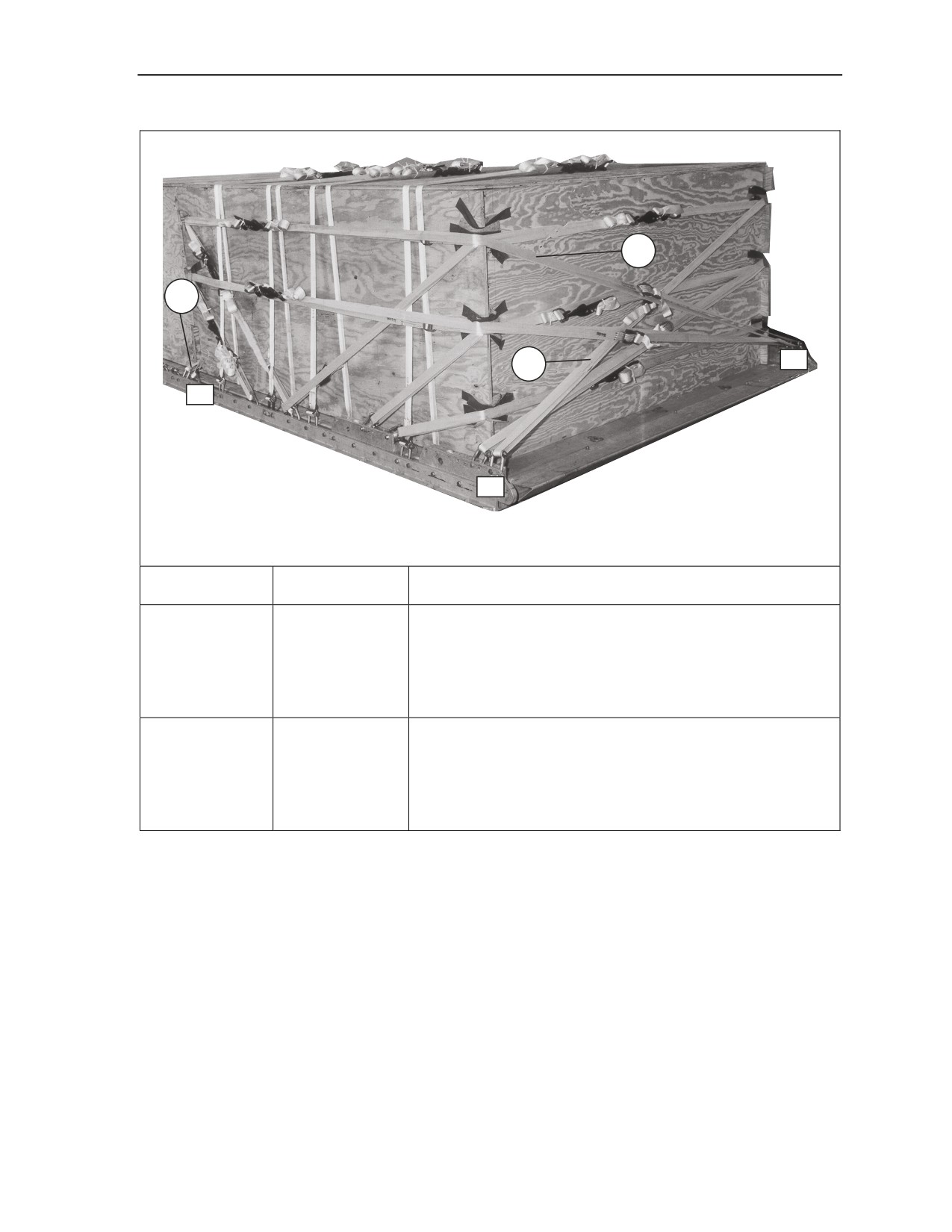
Rigging Mass Supply Box on a 20-Foot, Type V Platform for Low-Velocity Airdrop
7
6
6
1A
12
1
Lashing Number
Tiedown Clevis
Instructions
Number
6
1 and 12
Pass a 60-foot lashing through clevis 1, through the top
cutout in the left side of the first box and around the left side
of the box. Pass the lashing through the top left cutout on
the rear side of the first box and through clevis 12. Secure
the lashing on the left side with two D-rings and a load
binder.
7
1A and 12A
Pass a 60-foot lashing through clevis 1A, through the top
cutout in the right side of the first box and around the right
side of the box. Pass the lashing through the top right
cutout on the rear end of the first box and through clevis
12A. Secure the lashing on the right side with two D-rings
and a load binder.
Figure 6-10. Lashings 6 and 7 Installed
20 February 2009
FM 4-20.112/TO 13C7-1-8
6-11
Chapter 6
8
8
9
2A
13
2
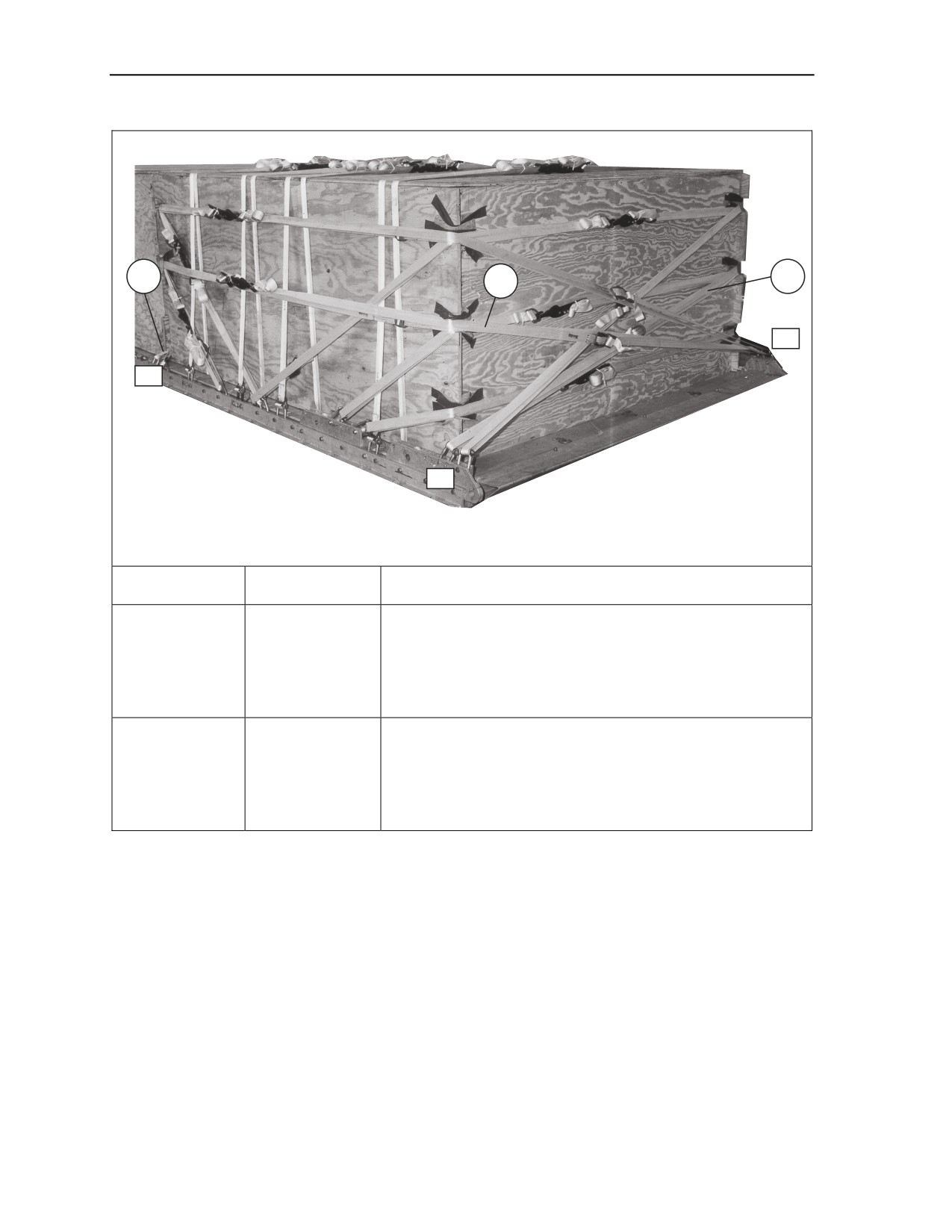
Lashing Number
Tiedown Clevis
Instructions
Number
8
2 and 13
Pass a 60-foot lashing through clevis 2, through the middle
left cutout in the left side of the first box, and around the left
side of the box. Pass the lashing through the middle left
cutout on the rear end of the first box and through clevis 13.
Secure the lashing on the left side with two D-rings and a
load binder.
9
2A and 13A
Pass a 60-foot lashing through clevis 2A, through the
middle right cutout in the right side of the first box and
around the right side of the box. Pass the lashing through
the middle right cutout on the rear end of the first box and
through clevis 13A. Secure the lashing on the right side with
two D-rings and a load binder.
Figure 6-11. Lashings 8 and 9 Installed
6-12
FM 4-20.112/TO 13C7-1-8
20 February 2009
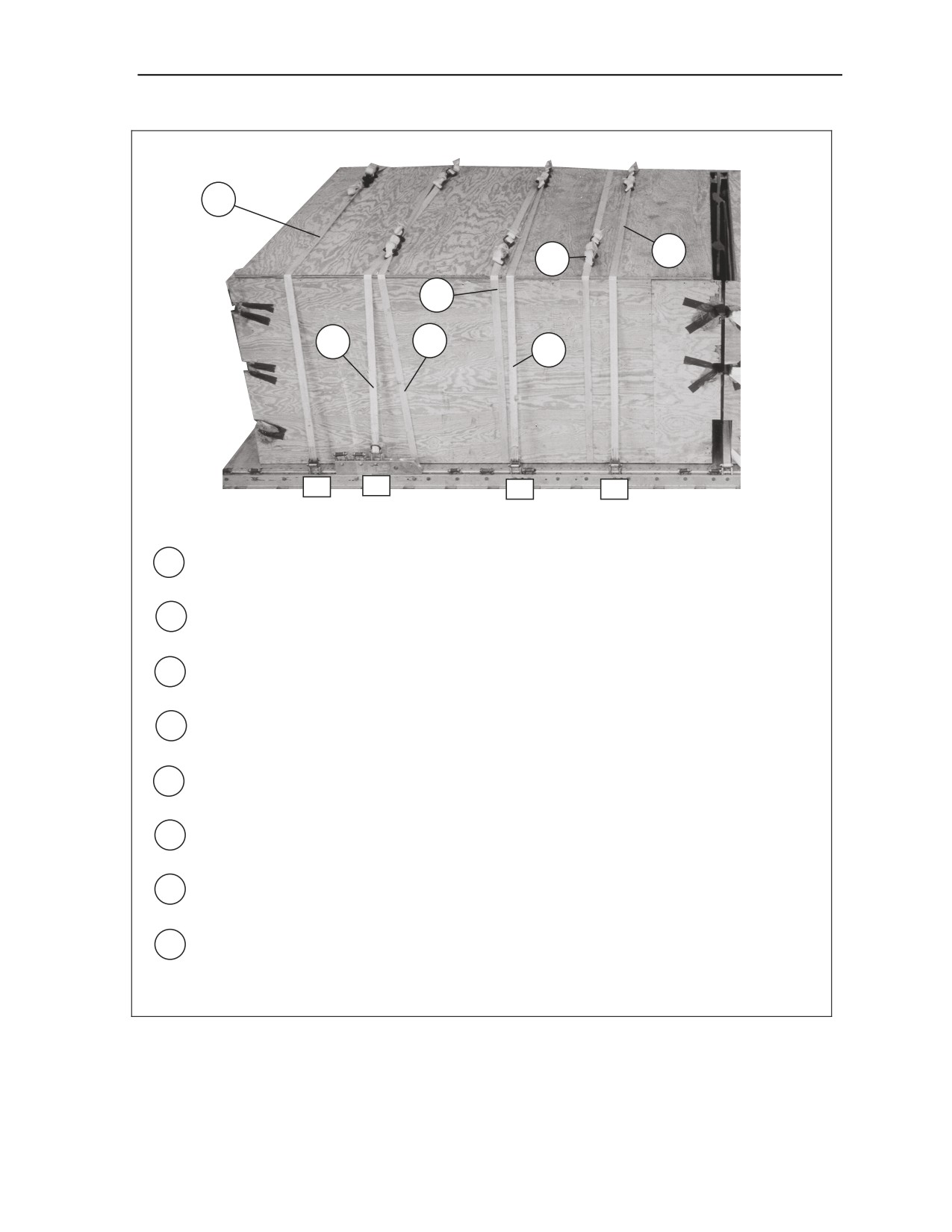
Rigging Mass Supply Box on a 20-Foot, Type V Platform for Low-Velocity Airdrop
8
2
3
5
6
7
4
24
21
18
16
1 Pass a 15-foot lashing through clevis 16 and through its own D-ring. Do the same for
clevises 16A, 18, 18A, 21, 21A, 24, and 24A.
2 Secure the pre-positioned lashing in tiedown ring B7 to the lashing in clevis 16 on top of
the box with two D-rings and a load binder.
3 Secure the pre-positioned lashing in tiedown ring A7 to the lashing in clevis 16A on top of
the box with two D-rings and a load binder.
4 Secure the pre-positioned lashing in tiedown ring B8 to the lashing in clevis 18 on top of
the box with two D-rings and a load binder.
5 Secure the pre-positioned lashing in tiedown ring A8 to the lashing in clevis 18A on top of
the box with two D-rings and a load binder.
6 Secure the pre-positioned lashing in tiedown ring B9 to the lashing in clevis 21 on top of
the box with two D-rings and a load binder.
7 Secure the pre-positioned lashing in tiedown ring A9 to the lashing in clevis 21A on top of
the box with two D-rings and a load binder.
8 Secure the lashings in clevises 24 and 24A together on top of the box with two D-rings and
a load binder.
Figure 6-12. Pre-positioned Lashings Secured to Lashings on Platform Rails
20 February 2009
FM 4-20.112/TO 13C7-1-8
6-13
Chapter 6
12
11
13
10
23
22
20
19
17
14
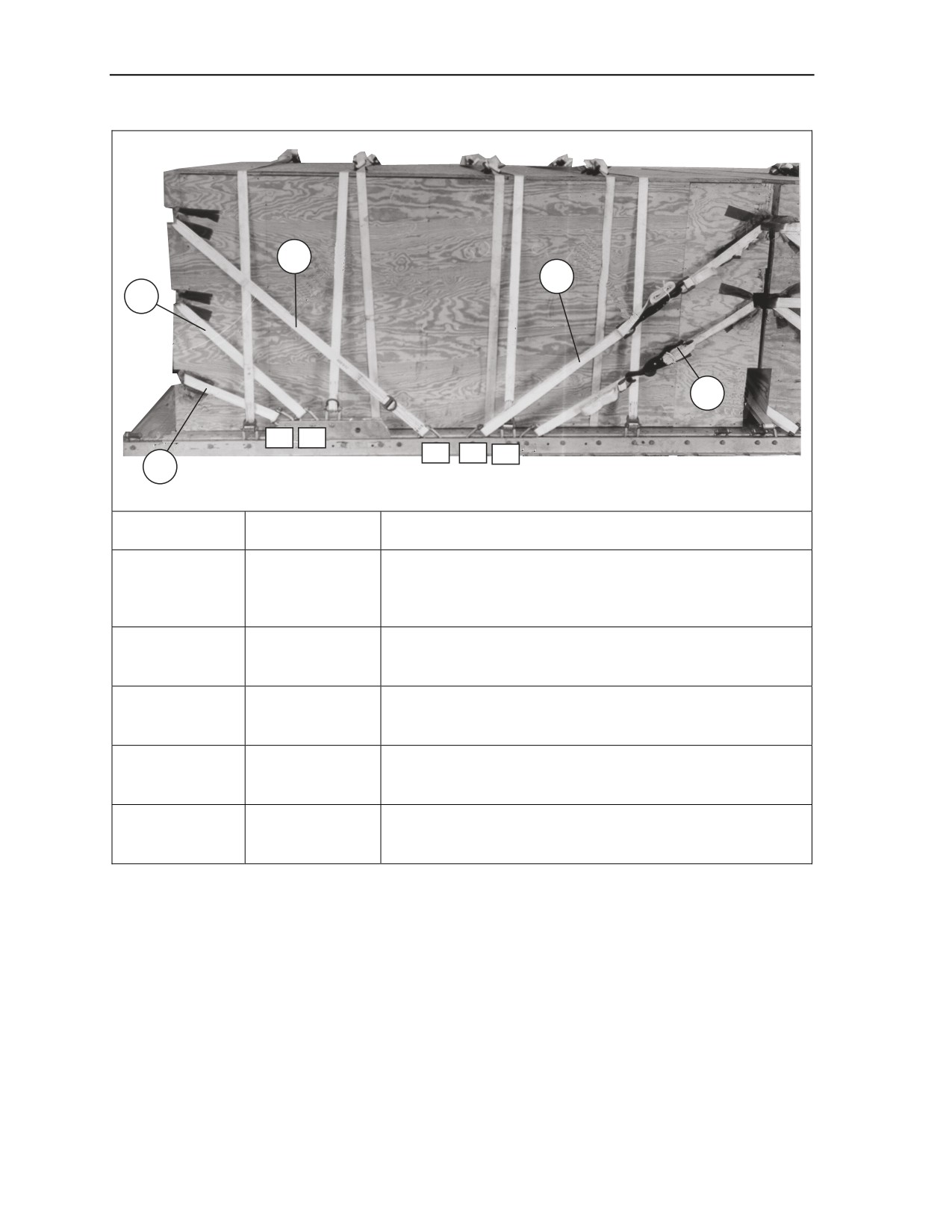
Lashing Number
Tiedown Clevis
Instructions
Number
10
17 and 17A
Pass a 30-foot lashing through both clevises and through
the middle cutouts in the front end of the second box.
Secure the lashing on the side with two D-rings and a load
binder.
11
19 and 19A
Pass a 45-foot lashing through both clevises and through
the top cutouts in the front end of the second box. Secure
the lashing on the side with two D-rings and a load binder.
12
20 and 20A
Pass a 45-foot lashing through both clevises and through
the top rear cutouts. Secure the lashing in the rear with two
D-rings and a load binder.
13
22 and 22A
Pass a 30-foot lashing through both clevises and through
the middle rear cutouts. Secure the lashing in the rear with
two D-rings and a load binder.
14
23 and 23A
Pass a 30-foot lashing through both clevises and through
the bottom rear cutouts. Secure the lashing in the rear with
two D-rings and a load binder.
Figure 6-13. Lashings 10 Through 14 Installed
6-14
FM 4-20.112/TO 13C7-1-8
20 February 2009
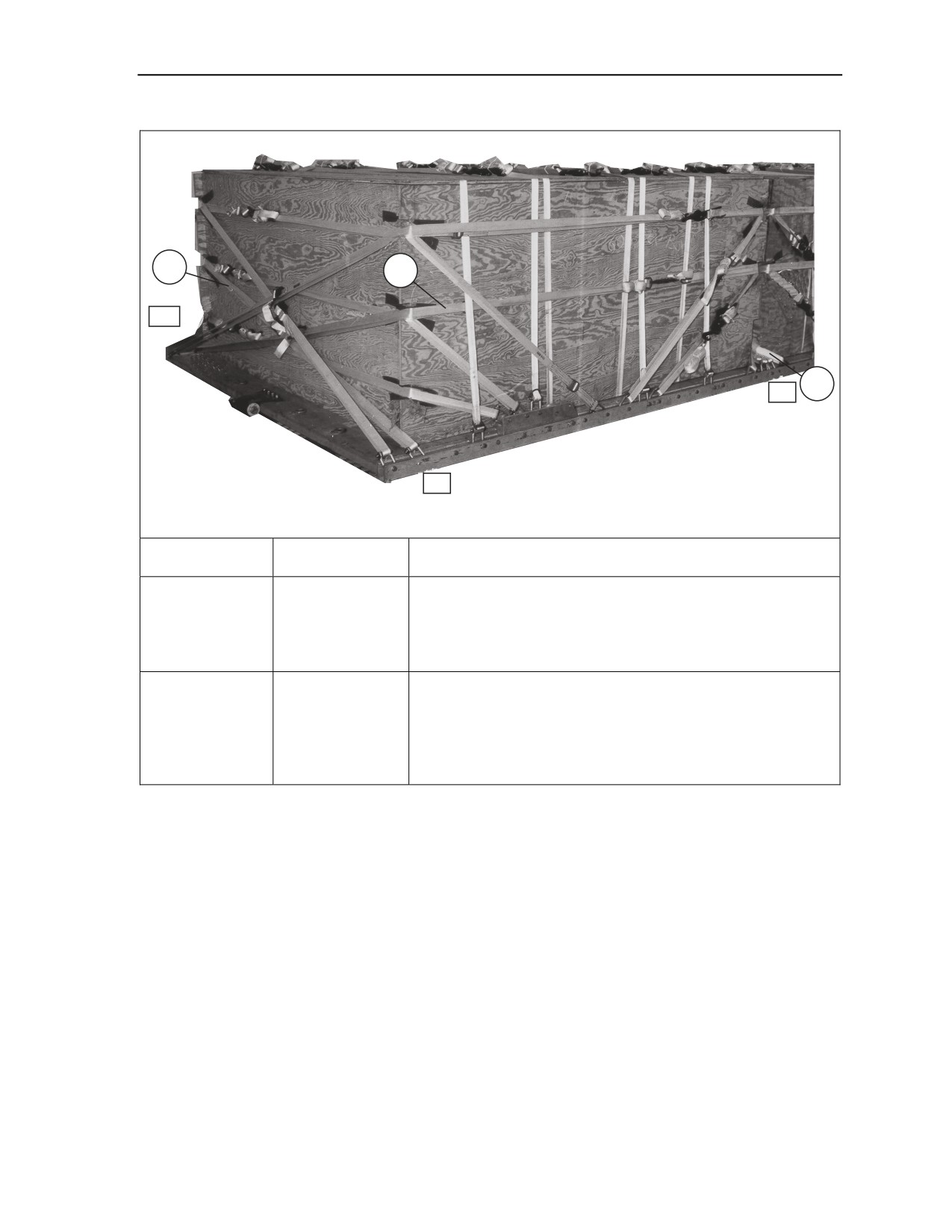
Rigging Mass Supply Box on a 20-Foot, Type V Platform for Low-Velocity Airdrop
15
16
25A
15
14
25
Lashing Number
Tiedown Clevis
Instructions
Number
15
14 and 25
Pass a 60-foot lashing through clevis 14, through the middle
cutout in the left side of the second box and around the left
side of the box. Pass the lashing through the left middle
cutout at the rear and through clevis 25. Secure the lashing
in the rear with two D-rings and a load binder.
16
14A and 25A
Pass a 60-foot lashing through clevis 14A, through the
middle cutout in the right side of the second box and around
the right side of the box. Pass the lashing through the right
middle cutout at the rear and through clevis 25A. Secure
the lashing on the right side with two D-rings and a load
binder.
Figure 6-14. Lashings 15 and 16 Installed
20 February 2009
FM 4-20.112/TO 13C7-1-8
6-15
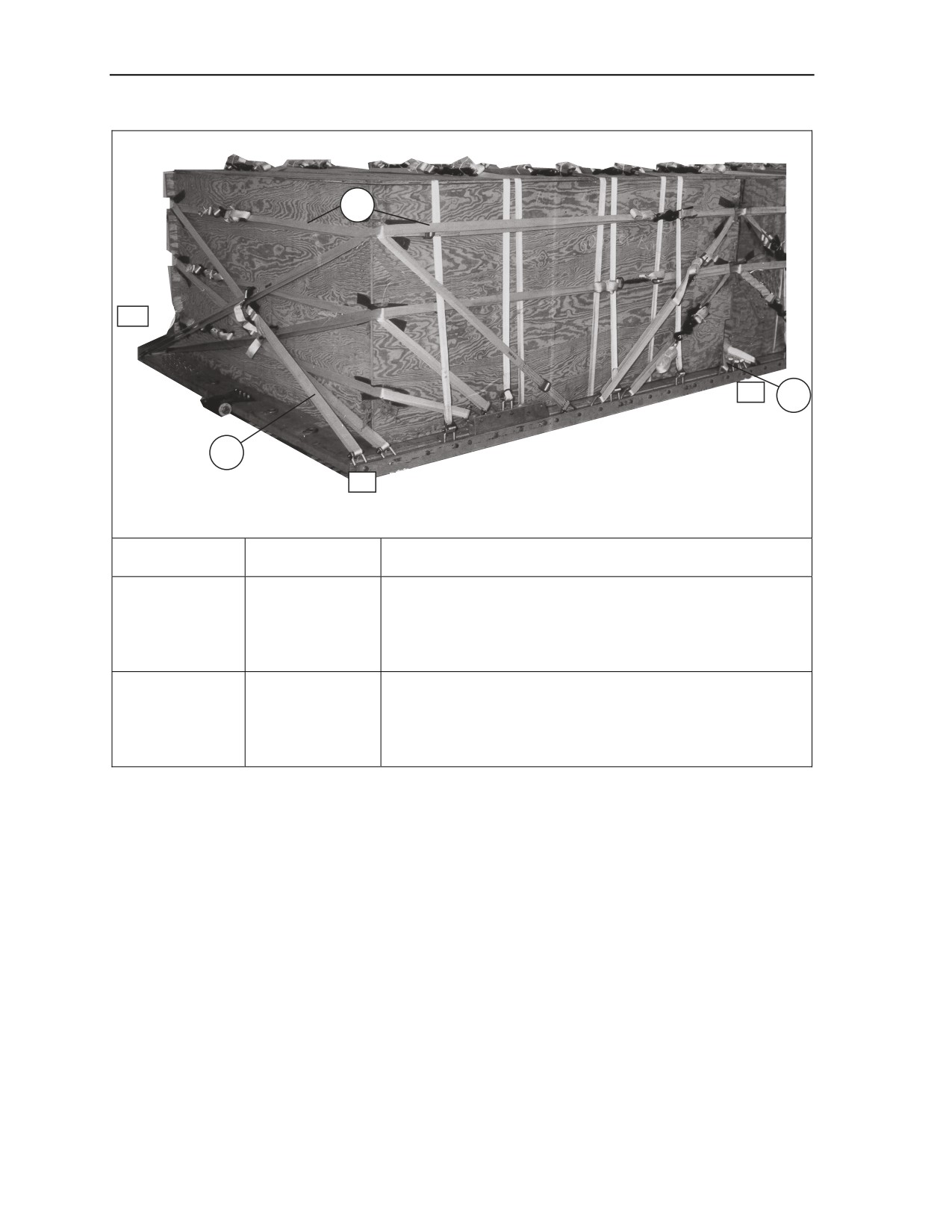
Chapter 6
18
26A
15
17
17
26
Lashing Number
Tiedown Clevis
Instructions
Number
17
15 and 26
Pass a 60-foot lashing through clevis 15, through the top
cutouts in the left side of the second box and around the left
side of the box. Pass the lashing through the left top cutout
at the rear and through clevis 26. Secure the lashing in the
rear with two D-rings and a load binder.
18
15A and 26A
Pass a 60-foot lashing through clevis 15A, through the top
cutouts in the right side of the second box and around the
right side of the box. Pass the lashing through the right top
cutout at the rear and through clevis 26A. Secure the
lashing on the right side with two D-rings and a load binder.
Figure 6-15. Lashings 17 and 18 Installed
6-16
FM 4-20.112/TO 13C7-1-8
20 February 2009
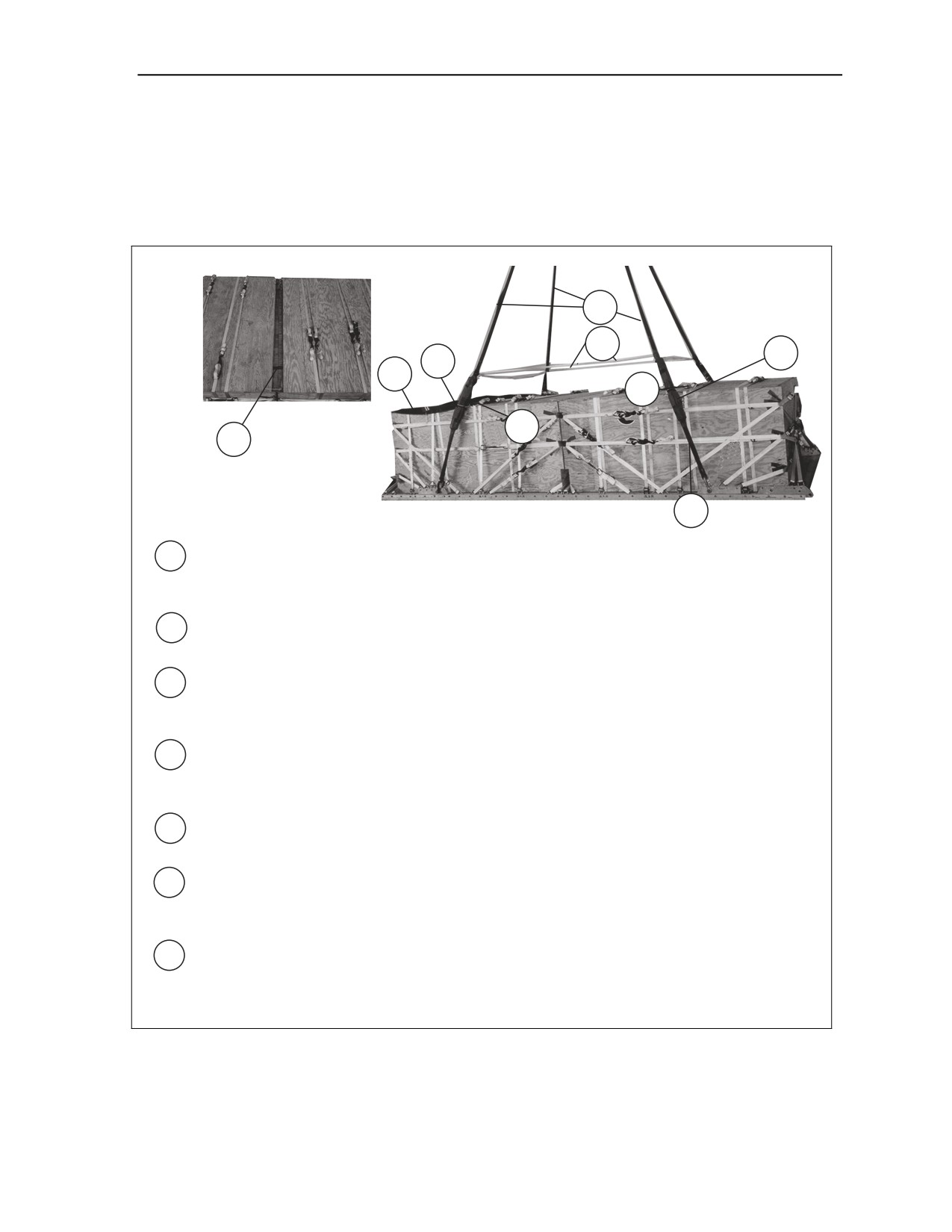
Rigging Mass Supply Box on a 20-Foot, Type V Platform for Low-Velocity Airdrop
INSTALLING LOAD COVER, SUSPENSION SLINGS AND
DEADMAN’S TIE
6-7. Install the load cover, honeycomb buffers, suspension slings and deadman’s tie as shown in Figure
6-16.
4
5
6
6
2
7
7
1
3
1 Slide two 6- by 92-inch pieces of honeycomb between the two boxes at the top. The
honey-comb may be held in place by lengths of type III nylon cord tied around the
honeycomb to convenient locations.
2 Cover the rear fourth of the load with a 60- by 96-inch piece of cloth coated nylon. Secure
the cover to the adjacent lashings with type III nylon cord.
3 Pass one end of a 20-foot (4-loop), type XXVI nylon suspension sling through the bell
portion of a large suspension clevis. Bolt the clevis to the suspension hole of the right front
suspension link.
4 Install on the left front suspension link and the right rear and left rear suspension links a
20-foot (4-loop), type XXVI nylon suspension slings as in step 3.
Note. Use (2-loop) slings if the load is under 14,000 pounds.
5 Raise the slings and install the deadman's tie according to FM 4-20.102/MCRP 4-
11.3J/NAVSEA SS400-AB-MMO-010/TO 13C7-1-5.
6 Pad the suspension slings with felt tied and tape in place 36 inches above the suspension
clevises to 8 inches above the top of the load. Extend the tape 6 inches beyond the top
and bottom of the felt.
7 Tie the front suspension slings together over the top of the load with a single length of type
III nylon cord. Tie the rear suspension slings the same way.
Figure 6-16. Load Cover, Suspension Slings, and Deadman’s Tie Installed
20 February 2009
FM 4-20.112/TO 13C7-1-8
6-17
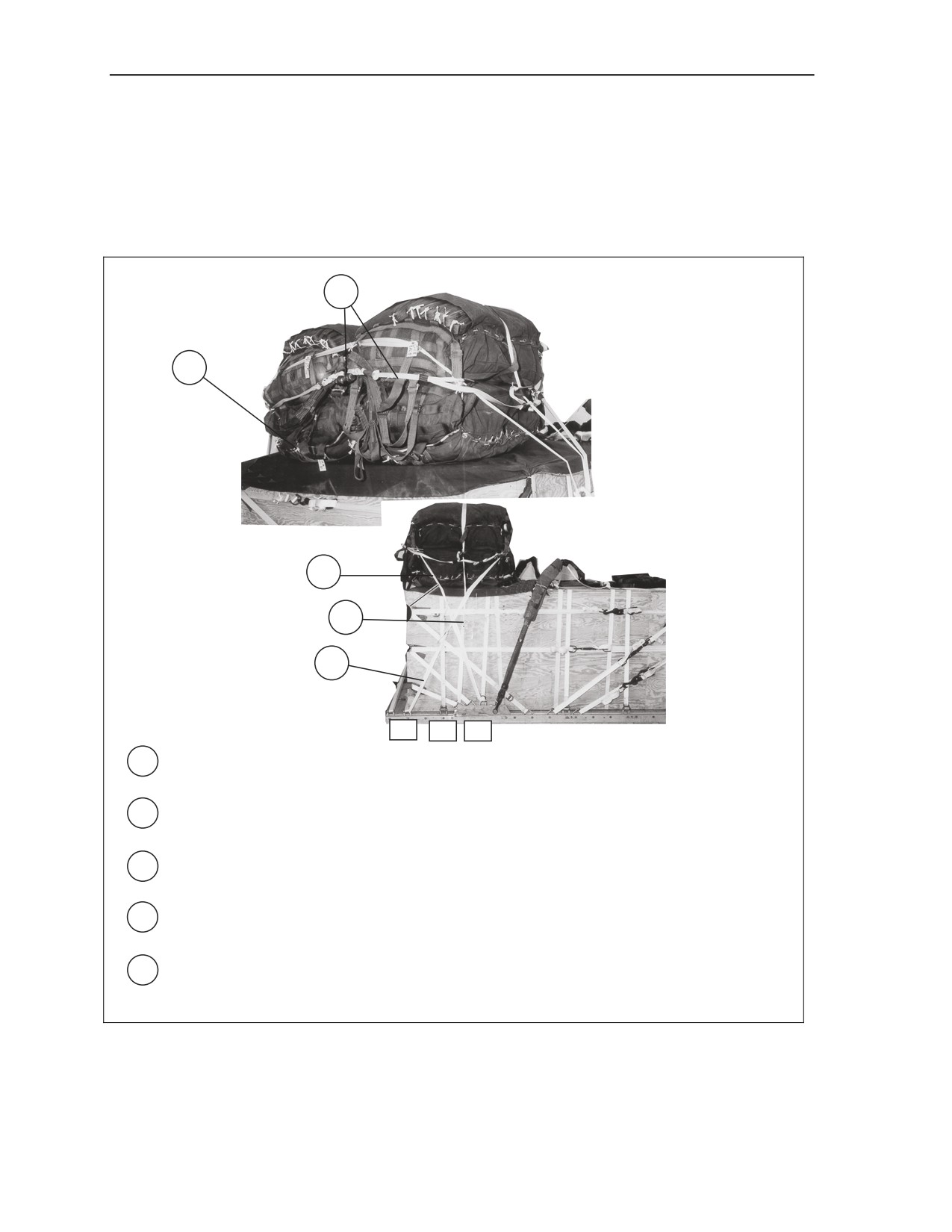
Chapter 6
INSTALLING PARACHUTES
6-8. Compute the parachute requirements for the load being rigged according to FM 4-20.102/MCRP 4-
11.3J/NAVSEA SS400-AB-MMO-010/TO
13C7-1-5. Prepare and install the cargo parachutes
according to FM 4-20.102/MCRP 4-11.3J/NAVSEA SS400-AB-MMO-010/TO 13C7-1-5 and as shown in
Figure 6-17.
5
1
4
3
2
25
23
21
1 Prepare, position, and stow four G-11 cargo parachutes on the rear of the load according to FM 4-
20.102/MCRP 4-11.3J/NAVSEA SS400-AB-MMO-010/TO 13C7-1-5.
2 Install the front cargo parachute restraints according to FM 4-20.102/MCRP 4-11.3J/NAVSEA
SS400-AB-MMO-010/TO 13C7-1-5 using type VIII nylon webbing to clevises 25 and 25A.
3 Install the center cargo parachute restraints according to FM 4-20.102/MCRP 4-1.3J/NAVSEA
SS400-AB-MMO-010/TO 13C7-1-5 using type VIII nylon webbing to clevises 23 and 23A.
4 Install the rear cargo parachute restraints according to FM 4-20.102/MCRP 4-11.3J/NAVSEA SS400-
AB-MMO-010/TO 13C7-1-5 using type VIII nylon webbing to clevises 21 and 21A.
5 Install the parachute release straps according to FM 4-20.102/MCRP 4-11.3J/NAVSEA SS400-AB-
MMO-010/TO 13C7-1-5.
Figure 6-17. Cargo Parachutes Installed
6-18
FM 4-20.112/TO 13C7-1-8
20 February 2009
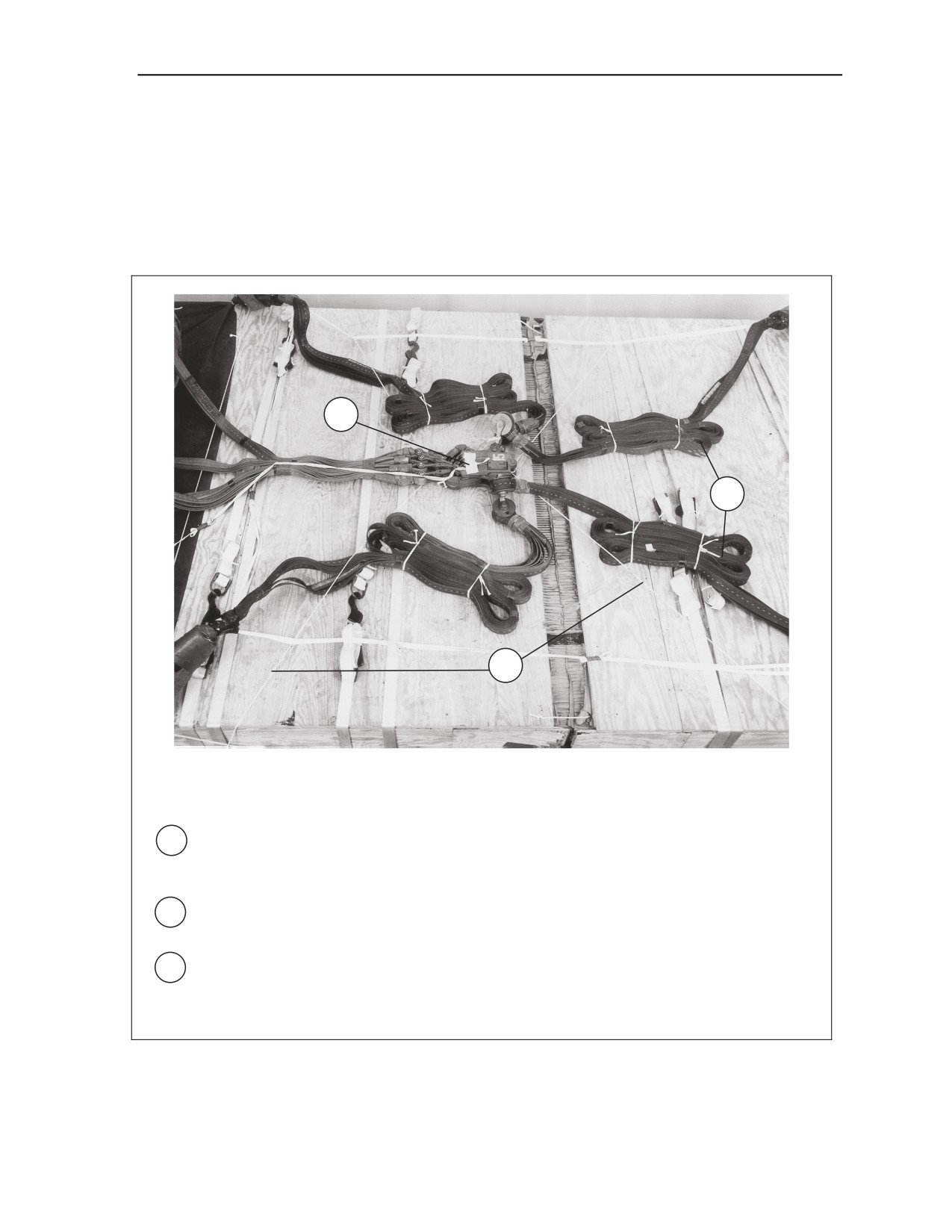
Rigging Mass Supply Box on a 20-Foot, Type V Platform for Low-Velocity Airdrop
INSTALLING THE RELEASE SYSTEM
6-9. Prepare, attach, and safety an M-2 cargo parachute release according to FM 4-20.102/MCRP 4-
11.3J/NAVSEA SS400-AB-MMO-010/TO 13C7-1-5 and as shown in Figure 6-18.
1
3
2
1 Prepare and install the M-2 cargo parachute release according to FM 4-20.102/MCRP 4-
11.3J/NAVSEA SS400-AB-MMO-010/TO 13C7-1-5. Place the assembly in front of the
parachutes as shown.
2 Safety the release to convenient points on the load with type III nylon cord according to FM
4-20.102/MCRP 4-11.3J/NAVSEA SS400-AB-MMO-010/TO 13C7-1-5.
3 S-fold and tie any excess suspension slings with one turn of type I, 1/4-inch cotton
webbing.
Figure 6-18. Release System Installed
20 February 2009
FM 4-20.112/TO 13C7-1-8
6-19
Chapter 6
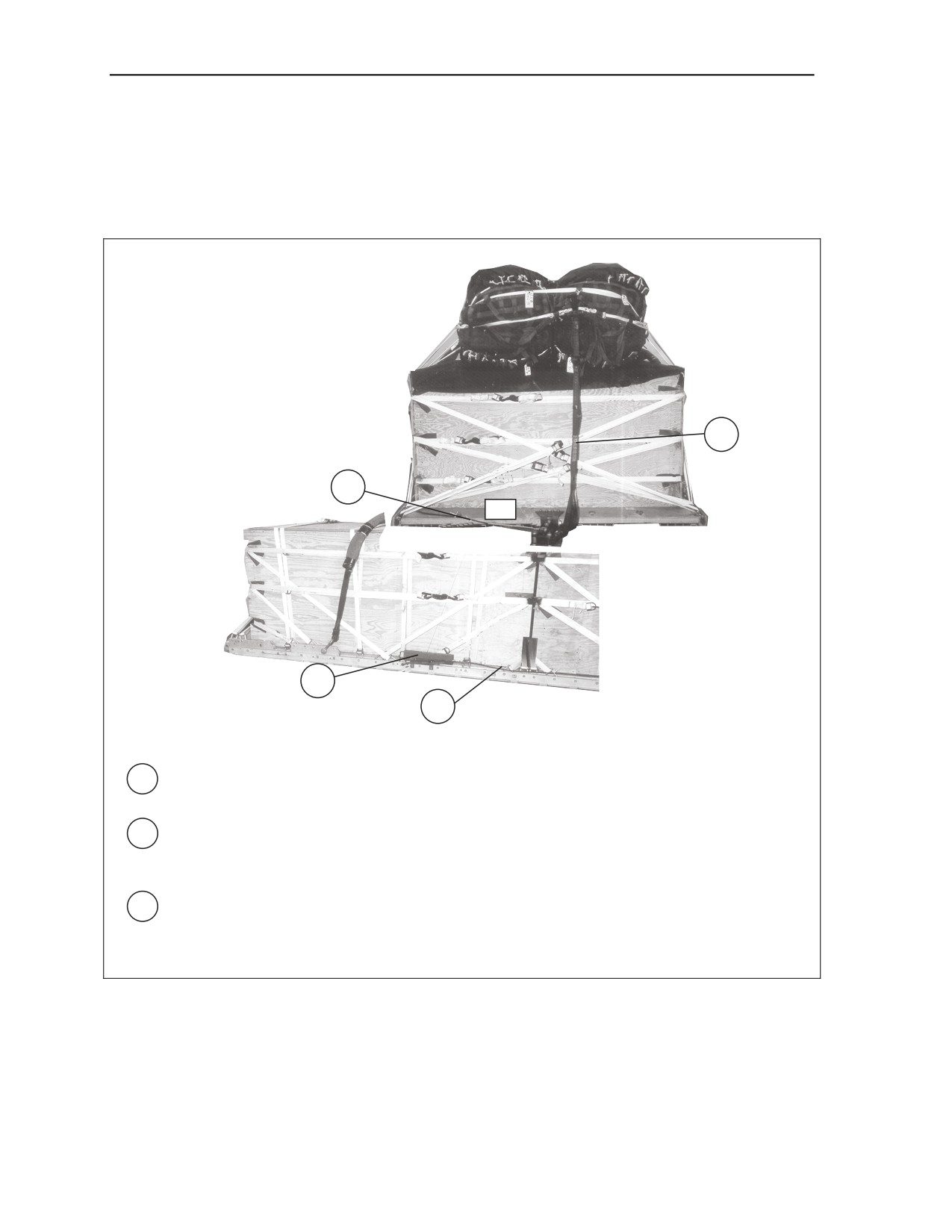
INSTALLING THE EXTRACTION SYSTEM
6-10. Install the extraction system according to FM
4-20.102/MCRP 4-11.3J/NAVSEA SS400-AB-
MMO-010/TO 13C7-1-5 and as shown in Figure 6-19.
3
2
D10
1
2
1 Install the components of the EFTC according to FM 4-20.102/MCRP 4-11.3J/NAVSEA
SS400-AB-MMO-010/TO 13C7-1-5. Use the rear mounting holes for the EFTC brackets.
2 Install a 20-foot EFTC cable according to FM 4-20.102/MCRP 4-11.3J/NAVSEA SS400-AB-
MMO-010/TO 13C7-1-5 and safety the cable to tiedown ring D10 with one turn of type I, 1/4-
inch cotton webbing.
3 Attach a 9-foot (2-loop), type XXVI nylon sling according to FM 4-20.102/MCRP 4-
11.3J/NAVSEA SS400-AB-MMO-010/TO 13C7-1-5 to be used as a deployment line. S-fold
the excess and tie it in two places with type I, 1/4-inch cotton webbing.
Figure 6-19. Extraction System Installed
6-20
FM 4-20.112/TO 13C7-1-8
20 February 2009
Rigging Mass Supply Box on a 20-Foot, Type V Platform for Low-Velocity Airdrop
PLACING EXTRACTION PARACHUTE
6-11. Select the extraction parachute and extraction line needed using the extraction line requirements
table in FM 4-20.102/MCRP 4-11.3J/NAVSEA SS400-AB-MMO-010/TO 13C7-1-5. Place the extraction
parachute and line on the load for installation in the aircraft.
INSTALLING PROVISIONS FOR EMERGENCY RESTRAINTS
6-12. Select and install the provisions for the emergency aft restraints according to the emergency aft
restraint requirements table in FM 4-20.102/MCRP 4-11.3J/NAVSEA SS400-AB-MMO-010/TO 13C7-1-
5.
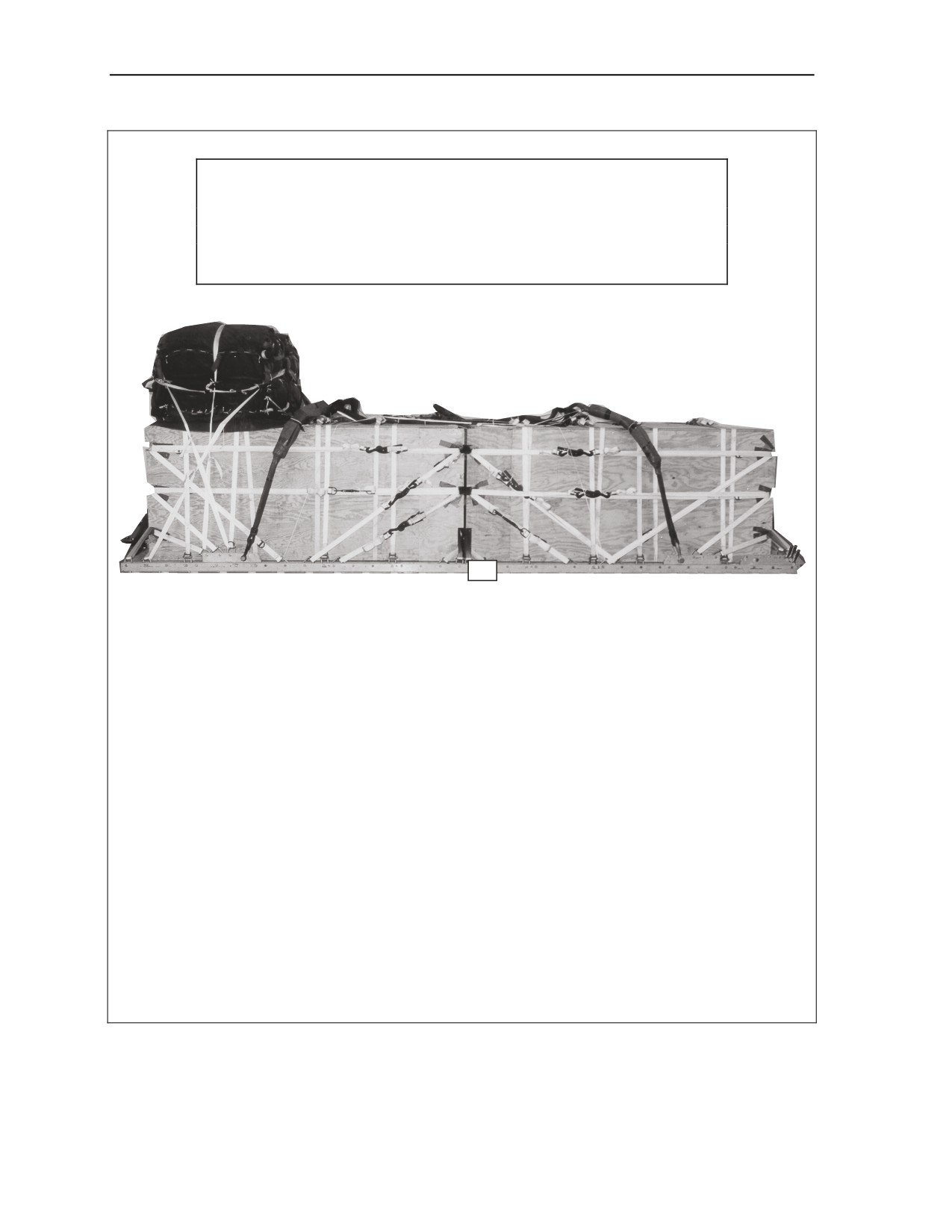
MARKING RIGGED LOAD
6-13. Mark the rigged load according to FM 4-20.102/MCRP 4-11.3J/NAVSEA SS400-AB-MMO-
010/TO 13C7-1-5, and as shown in Figure 6-20. Complete Shipper’s Declaration for Dangerous Goods. If
the load varies from the one shown, the weight, height, CB, and parachute requirements must be
recomputed.
EQUIPMENT REQUIRED
6-14. Use the equipment listed in Table 6-1 to rig this load.
20 February 2009
FM 4-20.112/TO 13C7-1-8
6-21
Chapter 6
CAUTION
Make the final rigger inspection required by AR 59-4 and FM 4-
20.102/MCRP 4-11.3J/NAVSEA SS400-AB-MMO-010/TO 13C7-1-5
before the load leaves the rigging site.
CB
RIGGED LOAD DATA
Minimum Weight:
6,300 pounds
Maximum Suspended Weight
20,000 pounds
Height
88 inches
Width
108 inches
Overall Length
240 inches
Overhang: Front
0 inches
Rear
0 inches
Center of Balance (from front edge of the platform)
126 inches
Extraction System with 16-foot cable (adds 18 inches to length of platform)
EFTC
Note. Refer to FM 4-20.102/MCRP 4-11.3J/NAVSEA SS400-AB-MMO-010/TO 13C7-1-5 (Table 2-
2) when adding additional parachutes for heavier loads for the suspension/tandem link positioning.
Figure 6-20. Mass Supply Boxes Rigged on a 20-Foot, Type V Platform for Low-Velocity
Airdrop
6-22
FM 4-20.112/TO 13C7-1-8
20 February 2009
Rigging Mass Supply Box on a 20-Foot, Type V Platform for Low-Velocity Airdrop
Table 6-1. Equipment Required for Rigging Mass Supply Boxes on a 20-Foot, Type V
Platform for Low-Velocity Airdrop
National Stock Number
Item
Quantity
8040-00-273-8713
Adhesive, paste, 1-gallon
As required
Clevis, suspension:
4030-00-090-5354
1-inch (large)
5
8305-00-880-8155
Cloth, coated (nylon, type II, green, 60-in)
As required
4020-00-240-2146
Cord, nylon, type III
As required
1670-00-434-5787
Coupling, airdrop, extraction force transfer with
20-foot cable
1
1670-00-360-0328
Cover, clevis, large
4
8135-00-664-6958
Cushioning material, packaging, cellulose wadding
As required
8305-00-191-1101
Felt, ½-inch thick
As required
1670-01-183-2678
Leaf, extraction line (line bag) (add 2 for C-17)
2
Line, extraction, type XXVI nylon webbing:
1670-01-062-6313
60-foot (3-loop), type XXVI
1
1670-01-107-7651
140-foot (3-loop), type XXVI
1
1670-01-062-6313
60-foot (3-loop), type XXVI for C-17 drogue line
1
1670-01-493-6418
Link assembly, two-point:
1
5510-00-220-6146
Lumber, 2- by 4-in
45-in
85-in
106 ½-in
5351-00-010-4659
Nail, steel wire, common 8d
As required
1670-00-753-3928
Pad, energy-dissipating, honeycomb
2 sheet
Parachute:
1670-01-016-7841
Cargo, G-11
4
1670-00-040-8135
Cargo, extraction, 28-foot
1
1670-01-063-3715
Cargo, extraction, 15-foot for C-17
1
Platform, airdrop, type V, 20-foot
1670-00-128-4981
Plywood, ¾- by 48- by 96-inches
12 sheets
1670-01-353-8425
Bracket assembly, EFTC
1
1670-01-162-2372
Bracket assembly, extraction
1
1670-01-162-2376
Clevis assembly
52
1670-01-247-2389
Suspension bracket link, type V
4
1670-01-162-2381
Tandem link
2
1670-01-097-8817
Release, cargo parachute, M-2
1
20 February 2009
FM 4-20.112/TO 13C7-1-8
6-23
Chapter 6
Table 6-1. Equipment Required for Rigging Mass Supply Boxes on a 20-Foot, Type V
Platform for Low-Velocity Airdrop (Continued)
National Stock Number
Item
Quantity
Sling, cargo airdrop:
1670-01-062-6304
9-foot (2-loop), type XXVI nylon webbing
1
1670-01-064-4453
20-foot (4-loop), type XXVI nylon webbing
4
1670-01-062-6313
60-foot (3-loop), type XXVI nylon webbing
4
5340-00-040-8219
Strap parachute release, multicut
2
7501-00-266-5016
Tape, adhesive, 2-inch
As required
7501-00-266-6710
Tape, masking
As required
1670-00-937-0271
Tie-down assembly, 15-foot
93
1670-01-483-8259
Towplate release mechanism (H-block) (C-17)
1
Webbing:
8305-00-268-2411
Cotton, 1/4-inch, type I
As required
Nylon:
8305-00-082-5752
Tubular, 1/2-inch
As required
8305-00-263-3591
Type VIII webbing
As required
6-24
FM 4-20.112/TO 13C7-1-8
20 February 2009
Chapter 7
Rigging Palletized Load System (PLS) on a 24-Foot, Type V
Platform for Low-Velocity Airdrop
SECTION I-RIGGING 105-MILLIMETER (MM) AMMUNITION
DESCRIPTION OF LOAD
7-1. The palletized load system (PLS) can be moved from the drop zone and transported on a specially
designed truck. Bulk supplies are lashed to the pallet, giving the load integrity for transport. The pallet has
swivel rings along the sides for lashing the load. The pallet and load are lashed to the airdrop platform for
low-velocity airdrop. The load shown consists of 245 boxes of 105-millimeter ammunition. Adapt these
procedures to rig other items of bulk supplies. Ammunition listed in FM 4-20.153/MCRP 4-11.3B/TO
13C7-18-41, as certified for low-velocity airdrop, may be rigged using these procedures. The rigged load
may not be more than 100 inches high. Refer to FM 4-20.102/MCRP 4-11.3J/NAVSEA SS400-AB-MMO-
010/TO 13C7-1-5 for the weight limitations and for the number of parachutes to be used.
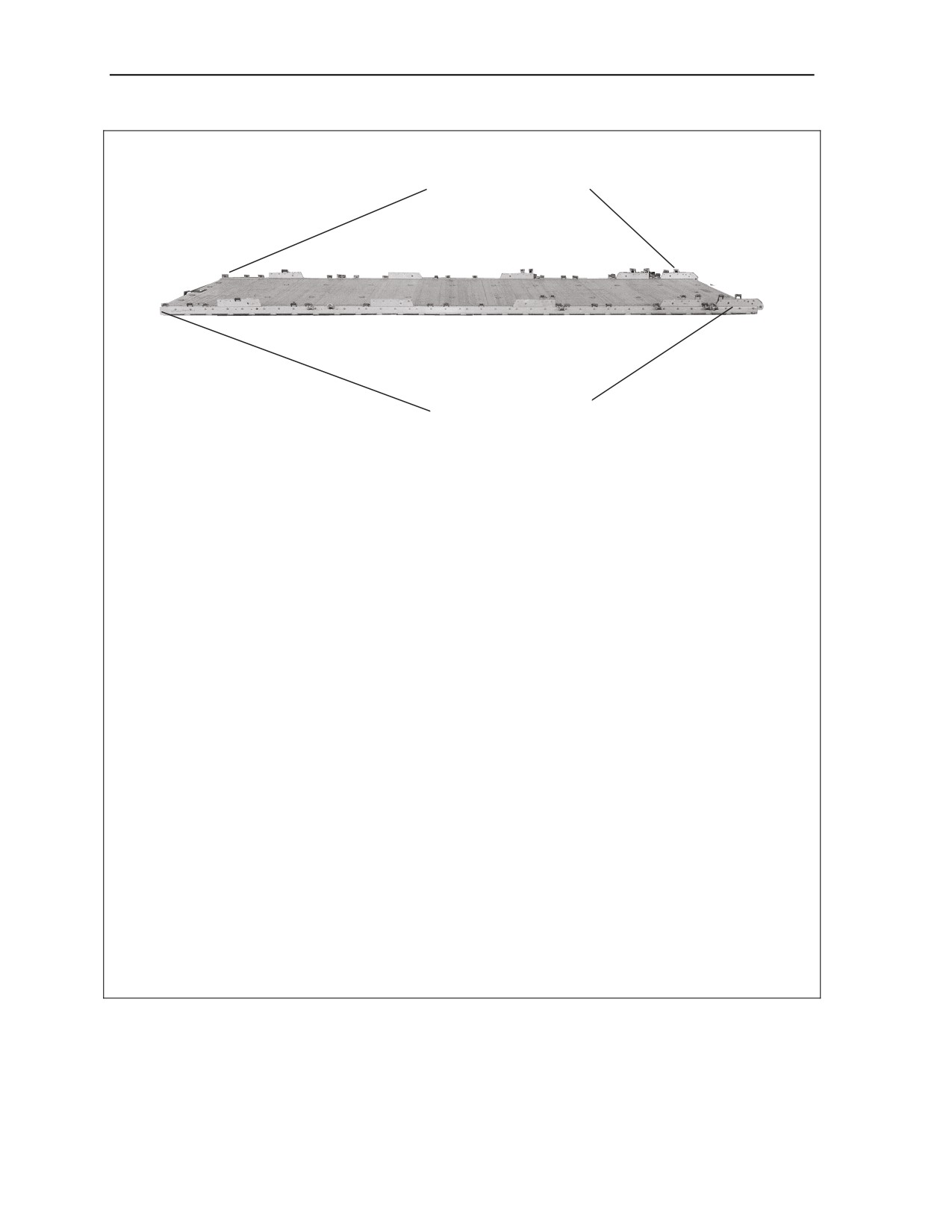
PREPARING PLATFORM
7-2. Prepare a 24-foot, type V platform as shown in Figure 7-1.
20 February 2009
FM 4-20.112/TO 13C7-1-8
7-1
Chapter 7
CLEVISES
24A THROUGH 1A
LEFT
REAR
FRONT
RIGHT
CLEVISES
24 THROUGH 1
Step:
1. Inspect, or assemble and inspect, a 24-foot, type V platform as outlined in TM 10-1670-268-
20&P/TO 13C7-52-22.
2. Install a suspension link in holes 18, 19, and 20 on each side of the platform.
3. Install a suspension link in holes 6, 7, and 8 on each side of the platform.
4. Install a tandem link on the front of each platform side rail using holes 1, 2, and 3.
5. Install a suspension link in holes 29, 30, and 31 on each side rail.
6. Install a suspension link in holes 41, 42, and 43 on each side of the platform.
7. Install clevises on bushings 3 and 4 of each front tandem link.
8. Install a double clevis on bushing 1 of each first suspension link.
9. Install a clevis on bushing 3 of each first suspension link.
10. Install clevises on bushings 1 and 2 of each second suspension link.
11. Install a clevis on bushings 2 of each fourth suspension link.
12. Starting at the front of the right and left platform side rail, install clevises on the bushings
bolted to holes 13, 14, 16, 23, 26, 27, 32, 38, 46, and 48.
13. Install a double clevis on bushings 4, 5, 9, 17, 35, and 37 on each side of the platform.
14. Starting at the front of the platform, number the clevises 1 through 24 on the right side, and
1A through 24A on the left side.
Figure 7-1. Platform Prepared
7-2
FM 4-20.112/TO 13C7-1-8
20 February 2009
Rigging Palletized Load System (PLS) on a 24-Foot, Type V Platform for Low-Velocity Airdrop
PREPARING AND POSITIONING HONEYCOMB
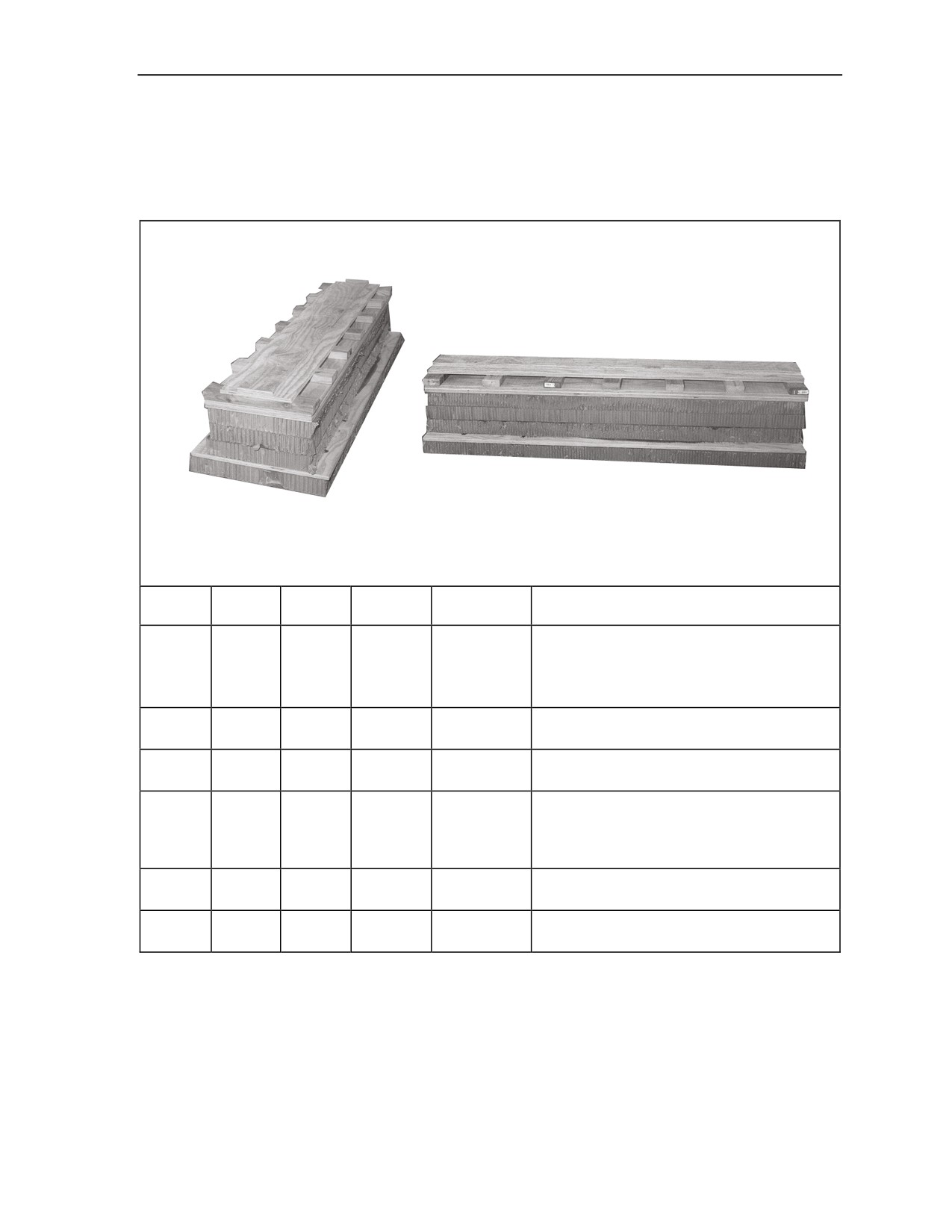
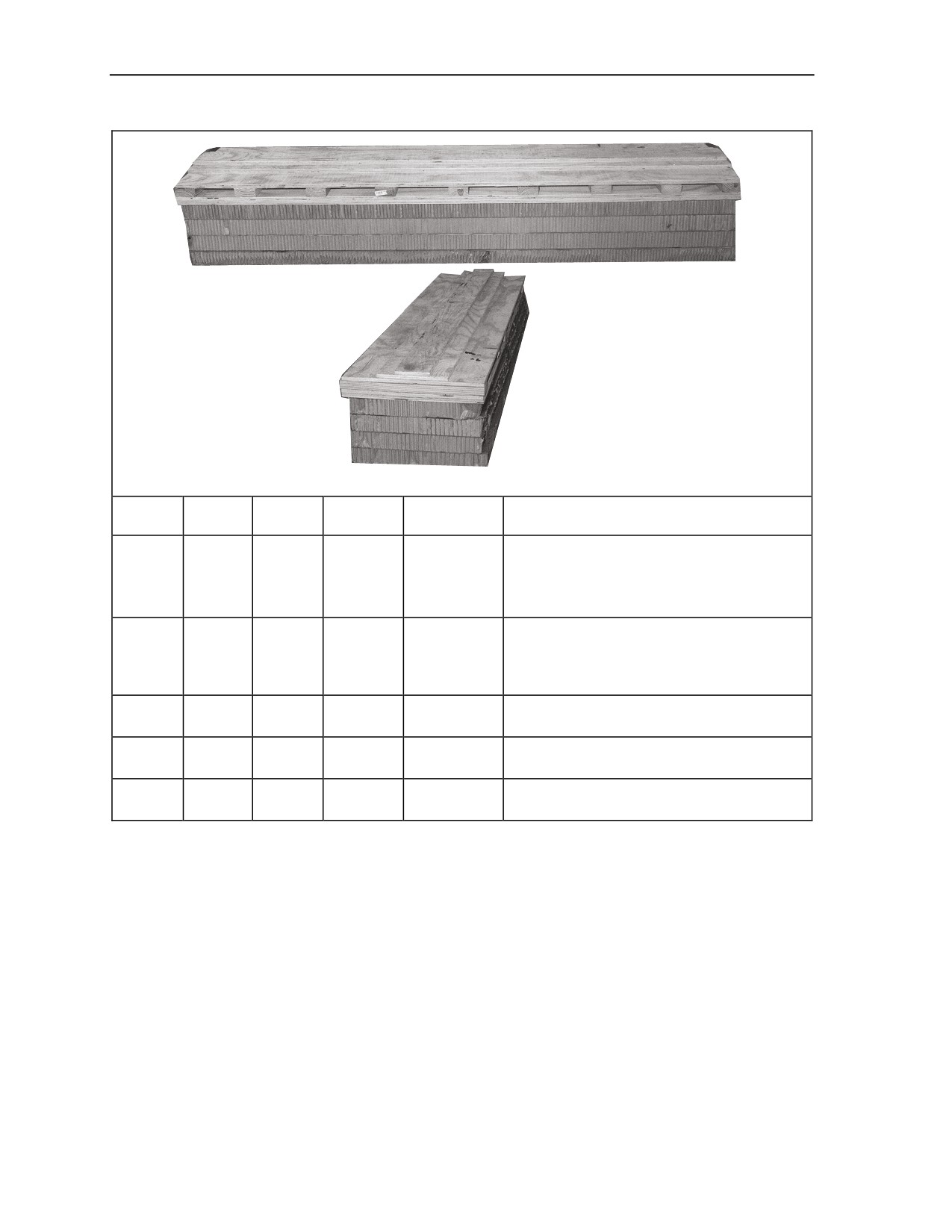
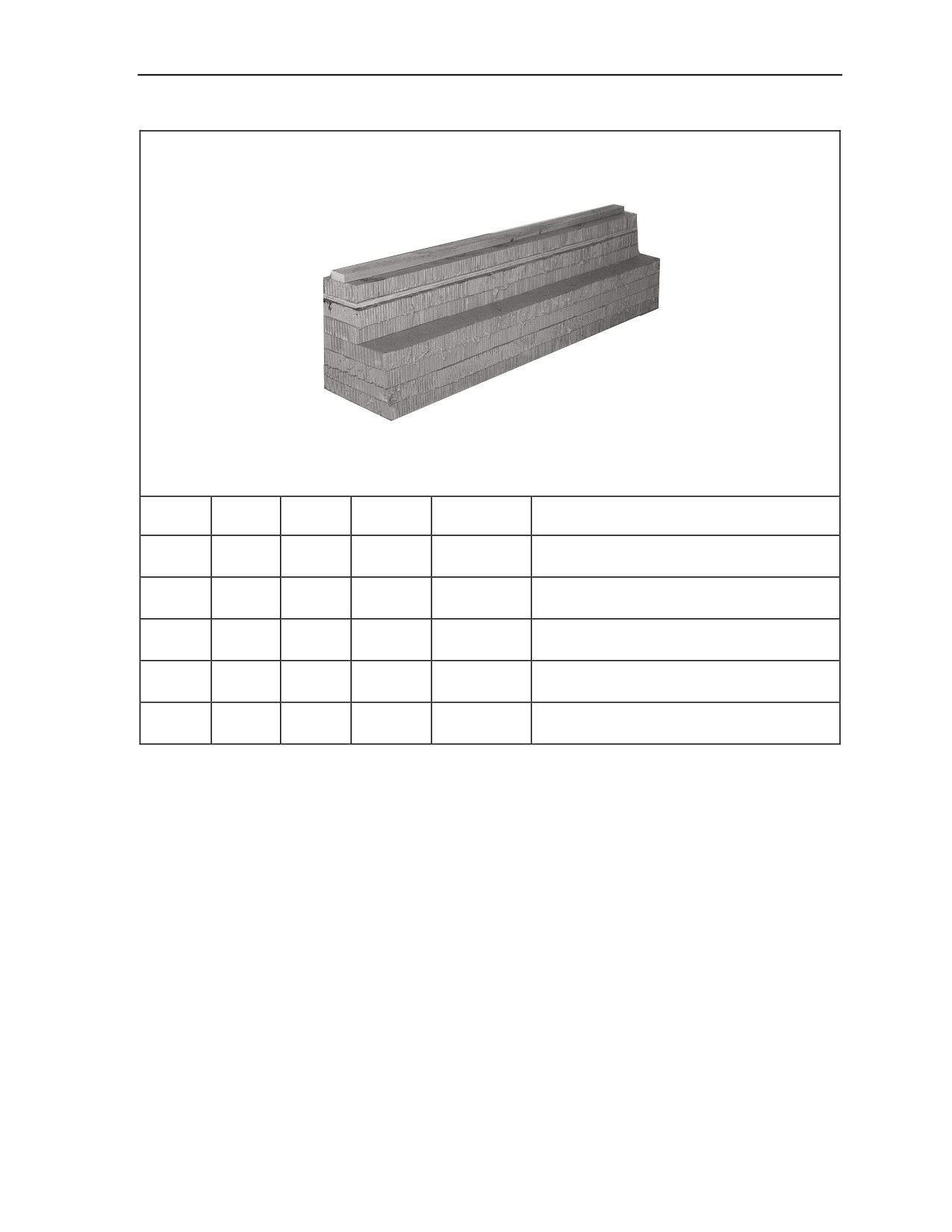
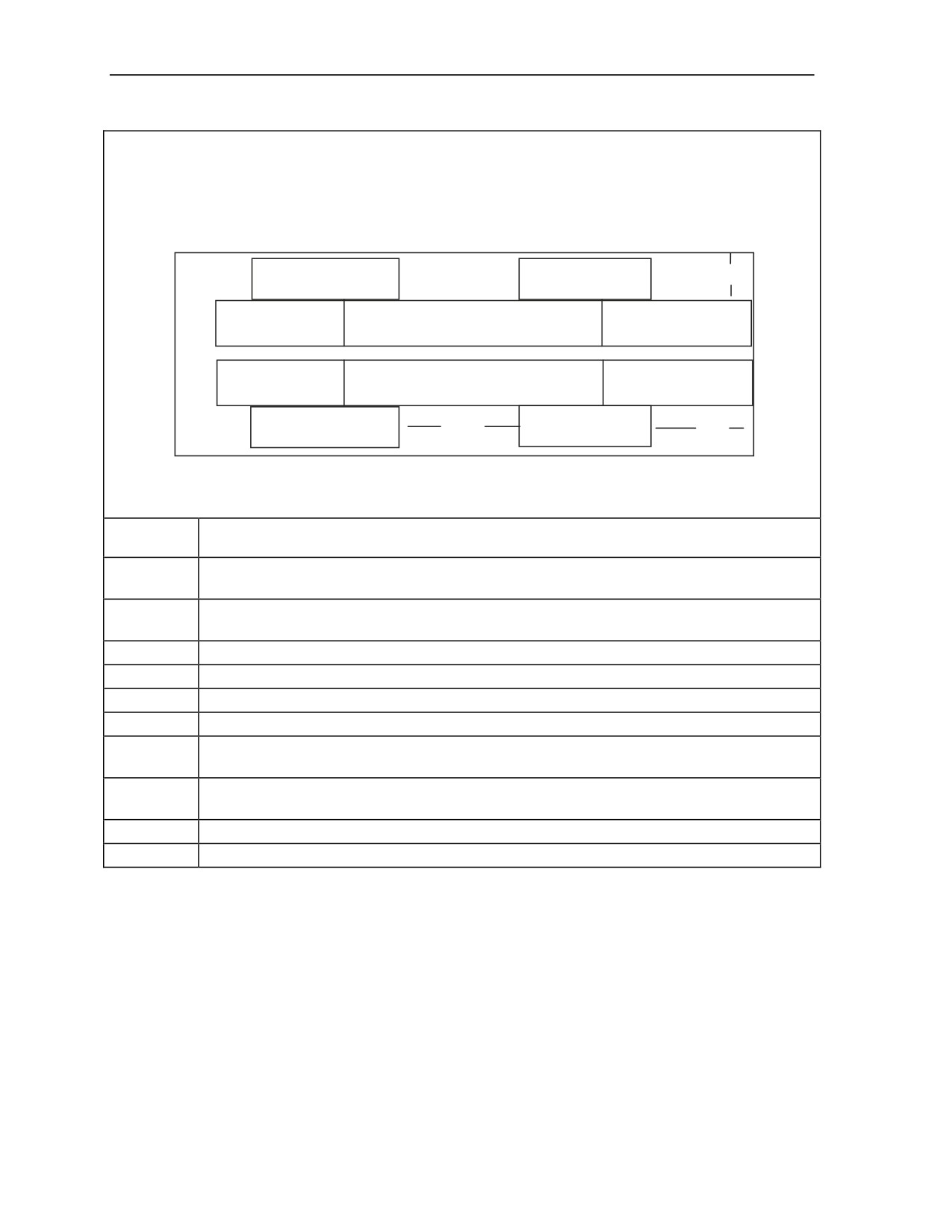
7-3. Prepare ten honeycomb stacks as shown in Figures 7-2 through 7-4. Position the stacks on the
platform as shown in Figure 7-5.
Stack
Pieces
Width
Length
Material
Instructions
Number
(Inches)
(Inches)
1, 2, 5,
1
24
76
Honeycom
Glue plywood flush over honeycomb to
and 6
b
form base.
1
24
76
¾-inch
plywood
3
18
76
Honeycom
Center and glue on base.
b
2
18
76
¾-inch
Glue flush over honeycomb.
plywood
7
18
*3 1/2
2- by 4-inch
Nail one piece flush over each end of the
lumber
plywood. Center a third piece between the
ends. Space two pieces evenly between
each end piece and the center piece.
1
12
76
¾-inch
Center and nail over lumber.
plywood
1
6
76
¾-inch
Center and nail over plywood.
plywood
* Two- by four-inch lumber is actually 3 ½ inches wide.
Figure 7-2. Stacks 1, 2, 5 and 6 Prepared
20 February 2009
FM 4-20.112/TO 13C7-1-8
7-3
Chapter 7
Stack
Pieces
Width
Length
Material
Instructions
Number
(Inches)
(Inches)
3 and 4
4
24
96
Honeycom
Glue plywood flush over honeycomb to
b
form base.
2
24
96
¾-inch
plywood
9
24
*3 1/2
2- by 4-inch
Nail one piece flush over each end of the
lumber
plywood. Center a third piece between the
ends. Space three pieces evenly between
each end piece and the center piece
1
24
96
¾-inch
Center and nail over lumber.
plywood
1
12
96
¾-inch
Center and nail over plywood.
plywood
1
6
96
¾-inch
Center and nail over plywood.
plywood
* Two- by four-inch lumber is actually 3 ½ inches wide.
Figure 7-3. Stacks 3 and 4 Prepared
7-4
FM 4-20.112/TO 13C7-1-8
20 February 2009
Rigging Palletized Load System (PLS) on a 24-Foot, Type V Platform for Low-Velocity Airdrop
Stack
Pieces
Width
Length
Material
Instructions
Number
(Inches)
(Inches)
7, 8, 9,
4
16
84
Honeycom
Glue flush to form base.
and 10
b
2
9
84
Honeycom
Glue flush on one side of base.
b
1
9
84
¾-inch
Center and glue over honeycomb.
plywood
1
9
84
Honeycom
Center and glue over plywood.
b
1
*3 1/2
84
2- by 4-inch
Center and glue on honeycomb.
lumber
* Two- by four-inch lumber is actually 3 ½ inches wide.
Figure 7-4. Stacks 7, 8, 9, and 10 Prepared
20 February 2009
FM 4-20.112/TO 13C7-1-8
7-5
Chapter 7
Notes.
1. This drawing is not to scale
2. All dimensions are in inches.
10
8
24
6
4
2
5
3
1
9
22
7
32
Stack
Position of Stack on the Platform
Number
1
Place flush with the front edge of the platform and 24 inches from the right inside
platform edge.
2
Place flush with the front edge of the platform and 24 inches from the left inside
platform edge.
3
Place against and aligned behind stack 1.
4
Place against and aligned behind stack 2.
5
Place against and aligned behind stack 3.
6
Place against and aligned behind stack 4.
7
Place 32 inches from the front edge of the platform and flush with the right sides of
stacks 1 and 3.
8
Place 32 inches from the front edge of the platform and flush with the left sides of
stacks 2 and 4.
9
Place 22 inches to the rear of stack 7 and flush with the right sides of stacks 3 and 5.
10
Place 22 inches to the rear of stack 8 and flush with the left sides of stacks 4 and 6.
Figure 7-5. Honeycomb Stacks Positioned on Platform
7-6
FM 4-20.112/TO 13C7-1-8
20 February 2009
Rigging Palletized Load System (PLS) on a 24-Foot, Type V Platform for Low-Velocity Airdrop
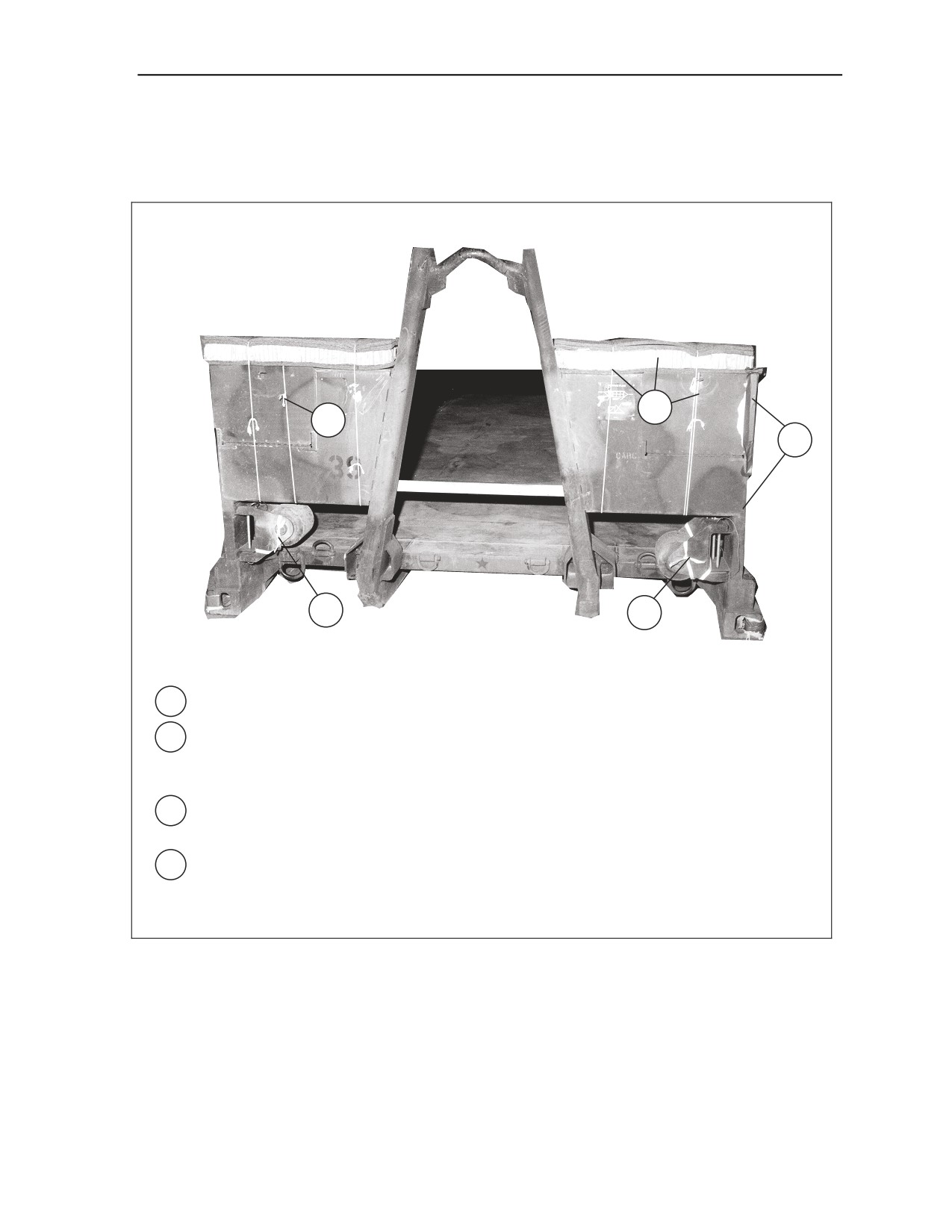
PREPARING PLS PALLET
7-4. Prepare the pallet as shown in Figure 7-6.
2
1
4
3
3
1 Tie the storage compartments on each side shut with type III nylon cord.
2 Pad the top of each box area with a 7- by 30-inch piece of felt, a 7- by 30-inch piece of
honeycomb, and two 7- by 30-inch pieces of felt. Tie the padding in place with lengths of
type III nylon cord.
3 Remove the wheels and secure them in place with the pins provided. Tie the wheels to
their brackets with a length of 1/2-inch tubular nylon webbing.
4 Pad the fixtures on the outsides of the boxes with cellulose wadding and tape.
Figure 7-6. Pallet Prepared
20 February 2009
FM 4-20.112/TO 13C7-1-8
7-7
Chapter 7
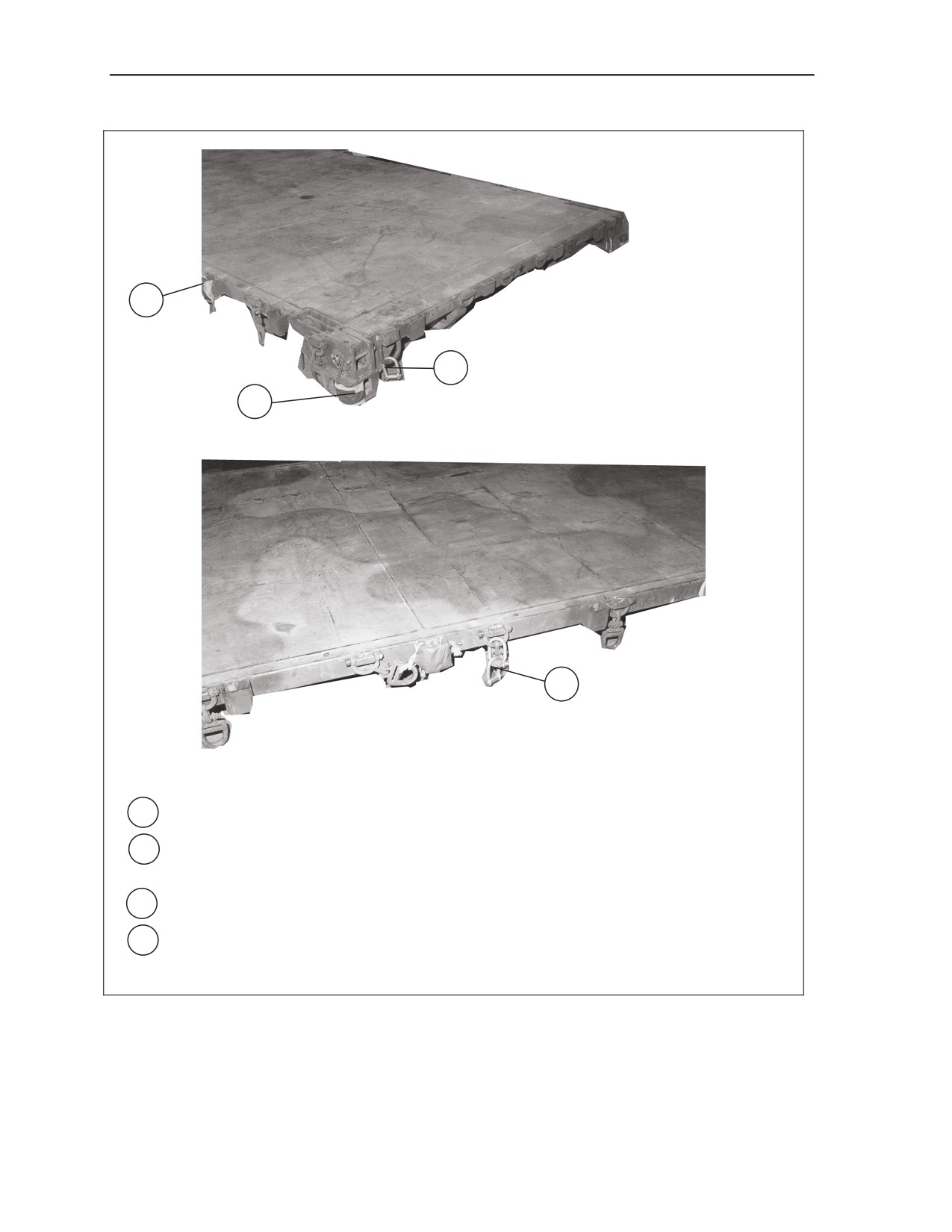
5
7
6
8
5 Pad the second stake bracket on each side with cellulose wadding and tape.
6 Pad all four corners of the pallet around the bottom holes with cellulose wadding and tape
as shown.
7 Add a platform clevis to each of the large tie-down brackets at the rear of the PLS pallet.
8 Add two platform clevises to the seventh swivel ring bracket on each side of the PLS pallet.
Figure 7-6. Pallet Prepared (Continued)
7-8
FM 4-20.112/TO 13C7-1-8
20 February 2009
Rigging Palletized Load System (PLS) on a 24-Foot, Type V Platform for Low-Velocity Airdrop
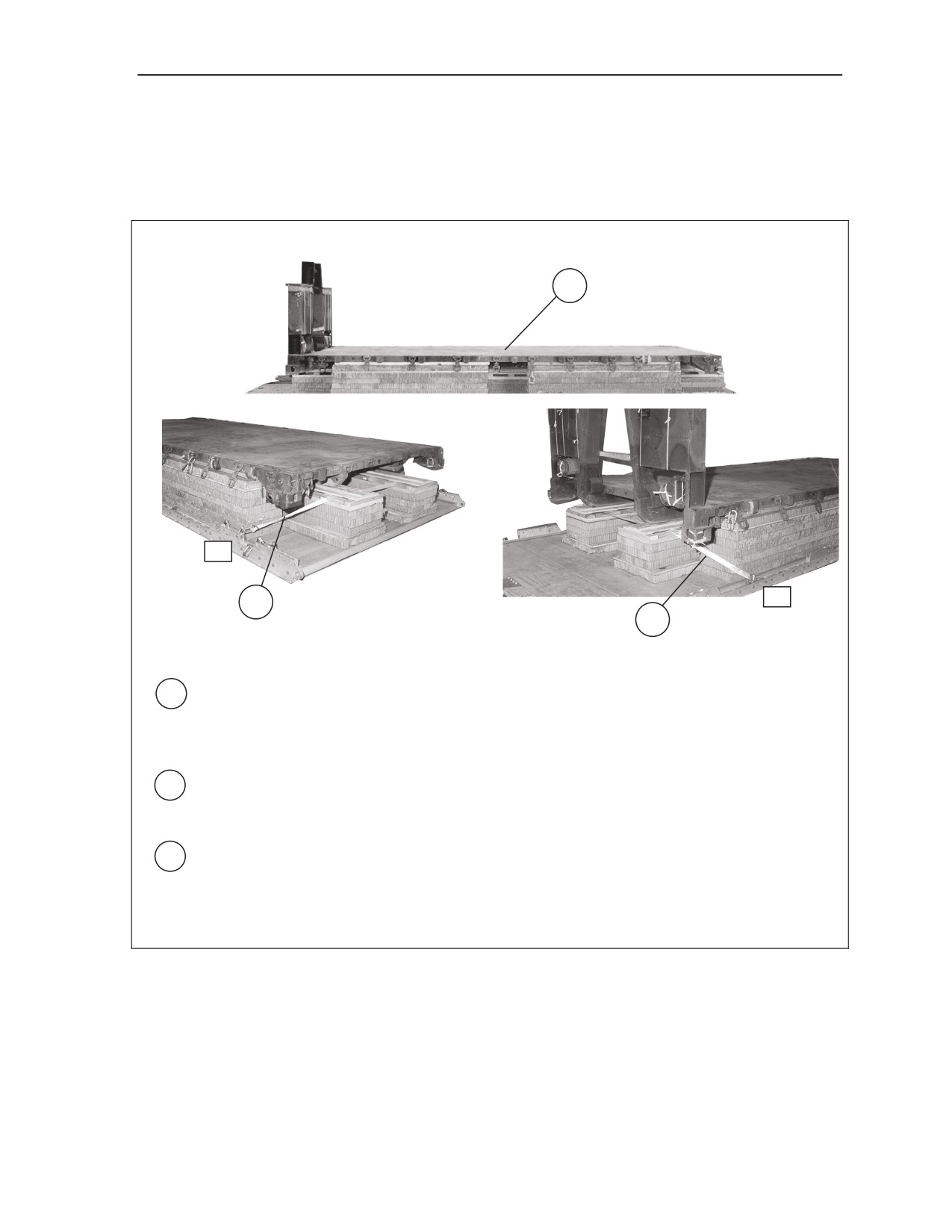
POSITIONING PLS PALLET ON PLATFORM
7-5. Position the pallet on the platform and install the restraint lashings around the honeycomb stacks as
shown in Figure 7-7.
1
5
19
2
3
1 Center the pallet on the stacks with the yoke assembly to the rear. The rear edge of the pallet
must be even with the rear edges of stacks 5 and 6. Be sure that the center runners of the
pallet rest squarely on stacks 1, 2, 3, 4, 5, and 6. Be sure that the pallet side rails rest on the
lumber portion of stacks 7, 8, 9, and 10.
2 Pass a 15-foot lashing through clevis 5 and through its own D-ring according to FM 4-
20.102/MCRP 4-11.3J/NAVSEA SS400-AB-MMO-010/TO 13C7-1-5. Pass the lashing
through the first holes in stacks 1 and 2. Secure the lashing to clevis 5A with a load binder.
3 Pass a 15-foot lashing through clevis 19 and through its own D-ring according to FM 4-
20.102/MCRP 4-11.3J/NAVSEA SS400-AB-MMO-010/TO 13C7-1-5. Pass the lashing
through the rear holes in stacks 5 and 6. Secure the lashing to clevis 19A with a load binder.
Figure 7-7. Pallet Positioned and Restraint Lashing Installed
20 February 2009
FM 4-20.112/TO 13C7-1-8
7-9
Chapter 7
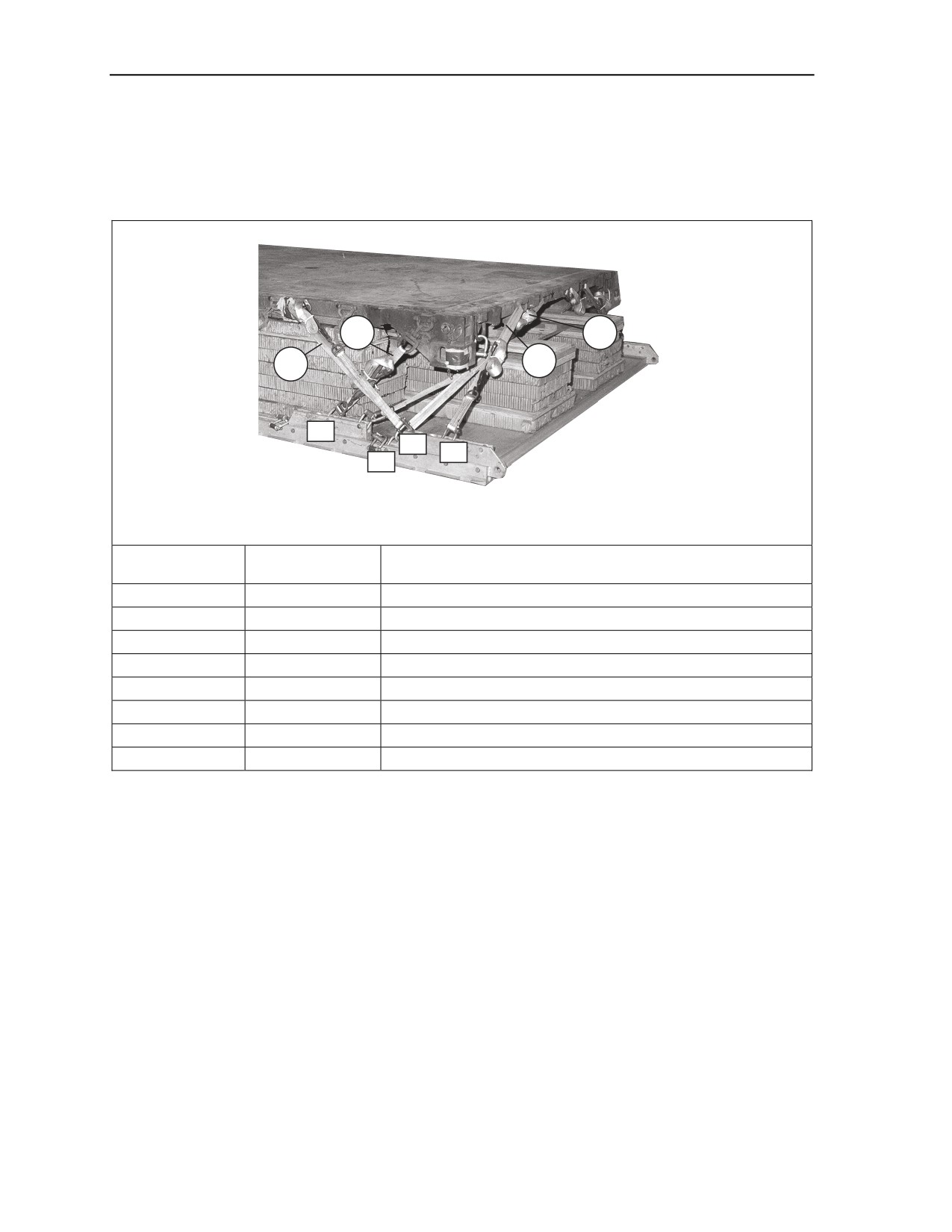
LASHING PLS PALLET TO PLATFORM
7-6. Lash the PLS pallet to the platform as shown in Figure 7-8.
7
5
3
1
6
2
1
3
Lashing Number
Tiedown Clevis
Instructions
Number
1
1
Pass lashing through the right front outside tiedown point.
2
1A
Pass lashing through the left front outside tiedown point.
3
2
Pass lashing through the second stake bracket.
4
2A
Pass lashing through the second stake bracket.
5
3
Pass lashing through the right front inside tiedown point.
6
3A
Pass lashing through the left front inside tiedown point.
7
6
Pass lashing through the first swivel ring.
8
6A
Pass lashing through the first swivel ring.
Figure 7-8. Pallet Lashed to Platform
7-10
FM 4-20.112/TO 13C7-1-8
20 February 2009
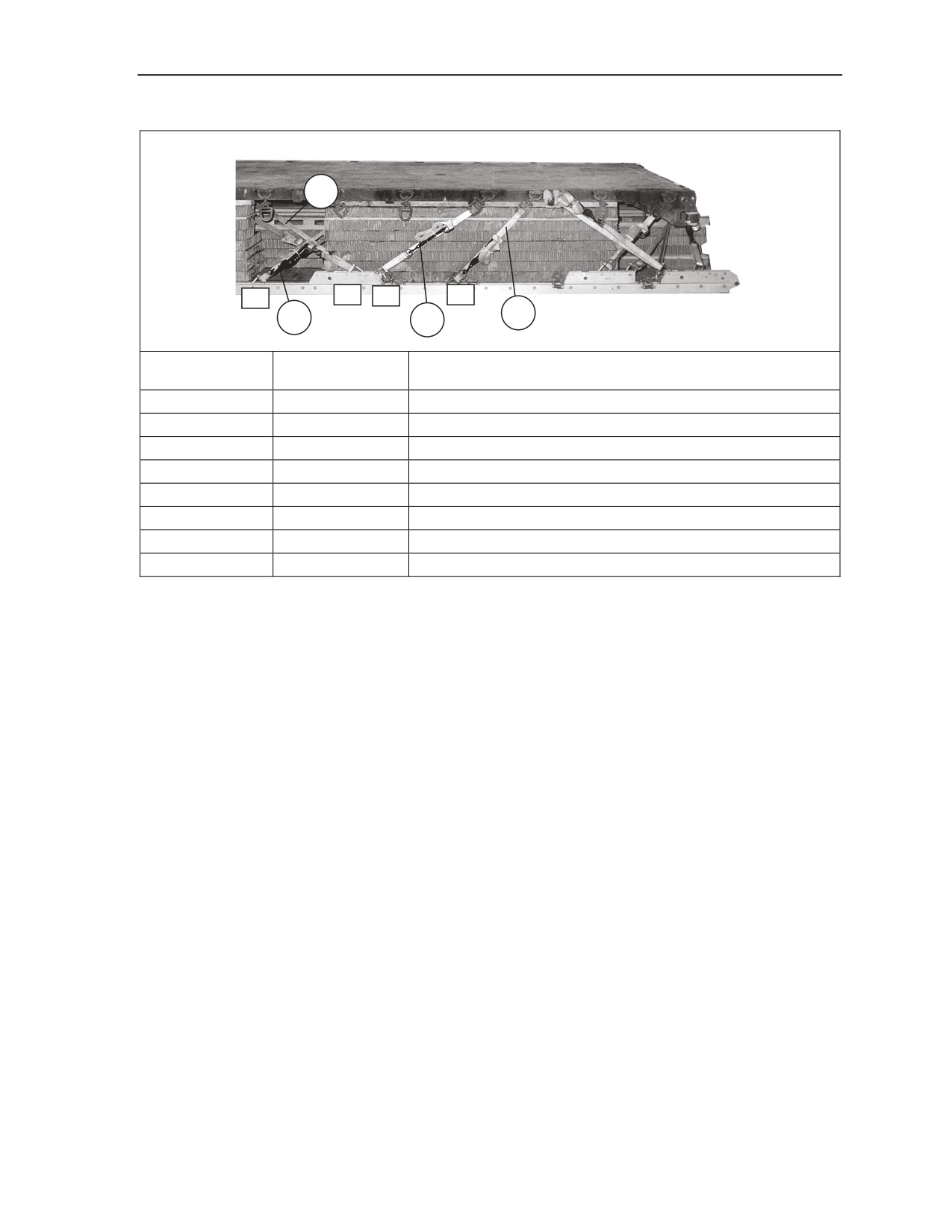
Rigging Palletized Load System (PLS) on a 24-Foot, Type V Platform for Low-Velocity Airdrop
13
14
13
12
9
9
15
11
Lashing Number
Tiedown Clevis
Instructions
Number
9
9
Pass lashing through the third swivel ring.
10
9A
Pass lashing through the third swivel ring.
11
12
Pass lashing through the fourth swivel ring.
12
12A
Pass lashing through the fourth swivel ring.
13
13
Pass lashing through the rear holes in the skid.
14
13A
Pass lashing through the rear holes in the skid.
15
14
Pass lashing through the front holes in the skid.
16
14A
Pass lashing through the front holes in the skid.
Figure 7-8. Pallet Lashed to Platform (Continued)
20 February 2009
FM 4-20.112/TO 13C7-1-8
7-11
Chapter 7
22
17
22A
19
21
18
20
22
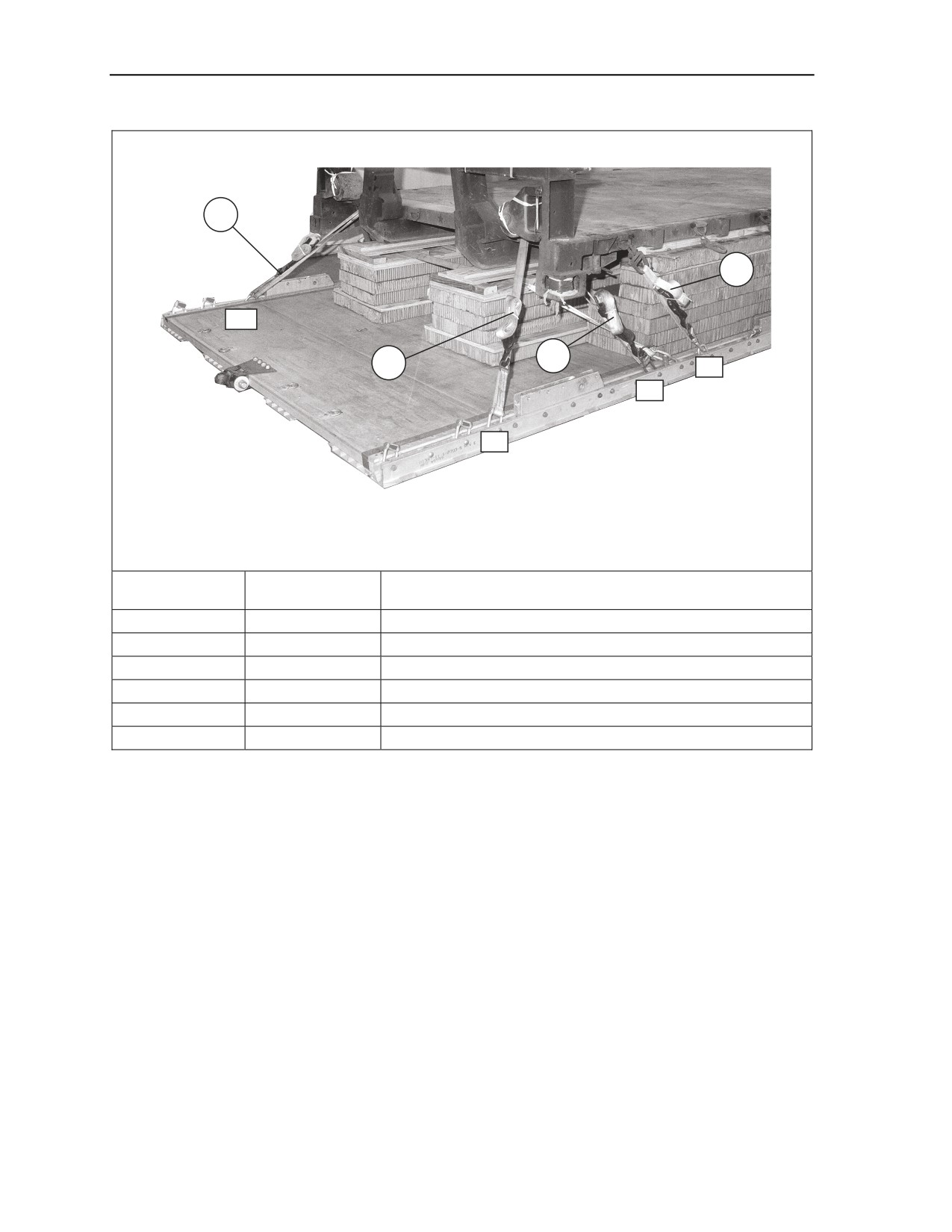
Lashing Number
Tiedown Clevis
Instructions
Number
17
18
Pass lashing through the eleventh swivel ring.
18
18A
Pass lashing through the eleventh swivel ring.
19
20
Pass lashing through the right corner tiedown ring.
20
20A
Pass lashing through the left corner tiedown ring.
21
22
Pass lashing through the right outside tiedown point.
22
22A
Pass lashing through the left outside tiedown point.
Figure 7-8. Pallet Lashed to Platform (Continued)
7-12
FM 4-20.112/TO 13C7-1-8
20 February 2009
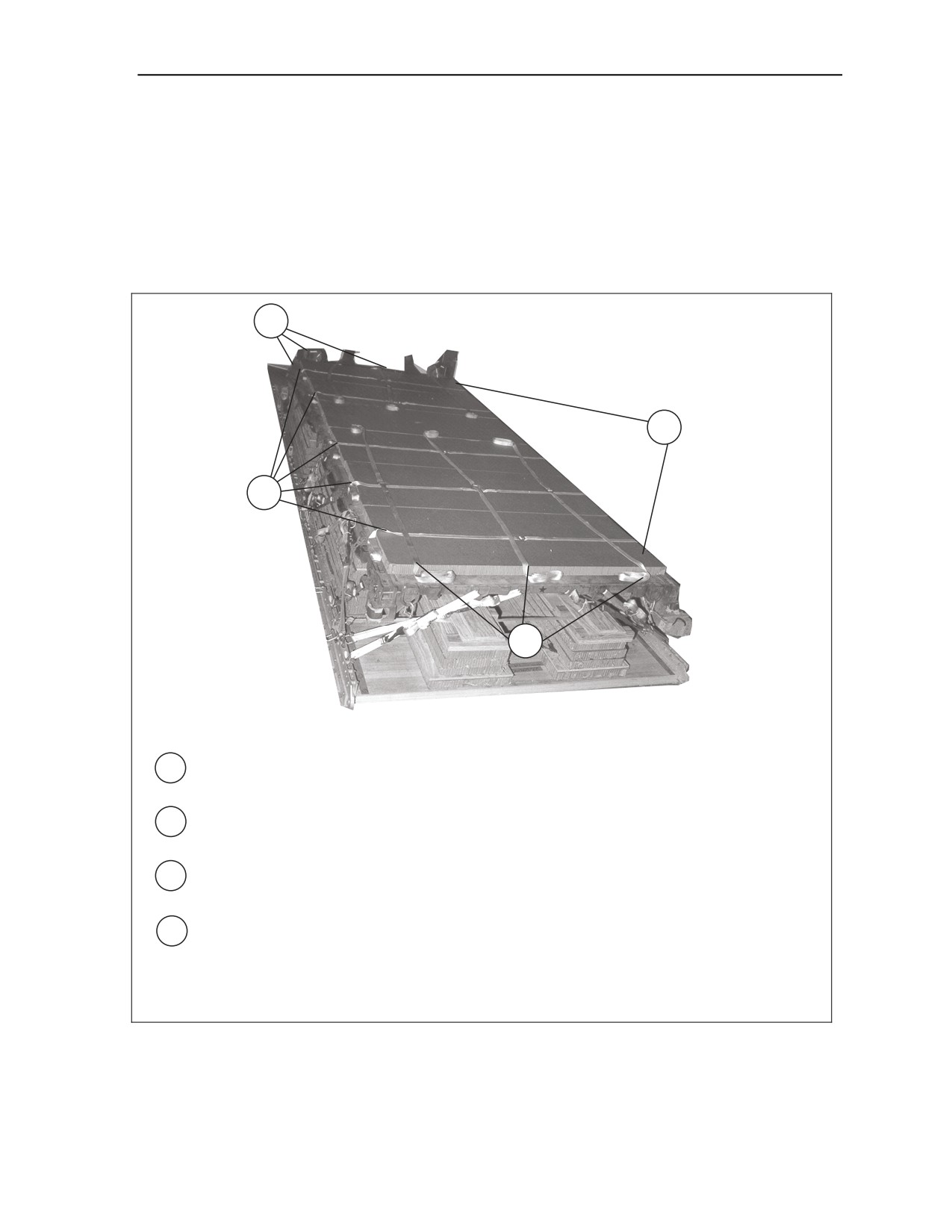
Rigging Palletized Load System (PLS) on a 24-Foot, Type V Platform for Low-Velocity Airdrop
PLACING AND LASHING THE LOAD
7-7. Place a layer of honeycomb and eleven
30-foot lashings on the pallet according to FM
4-
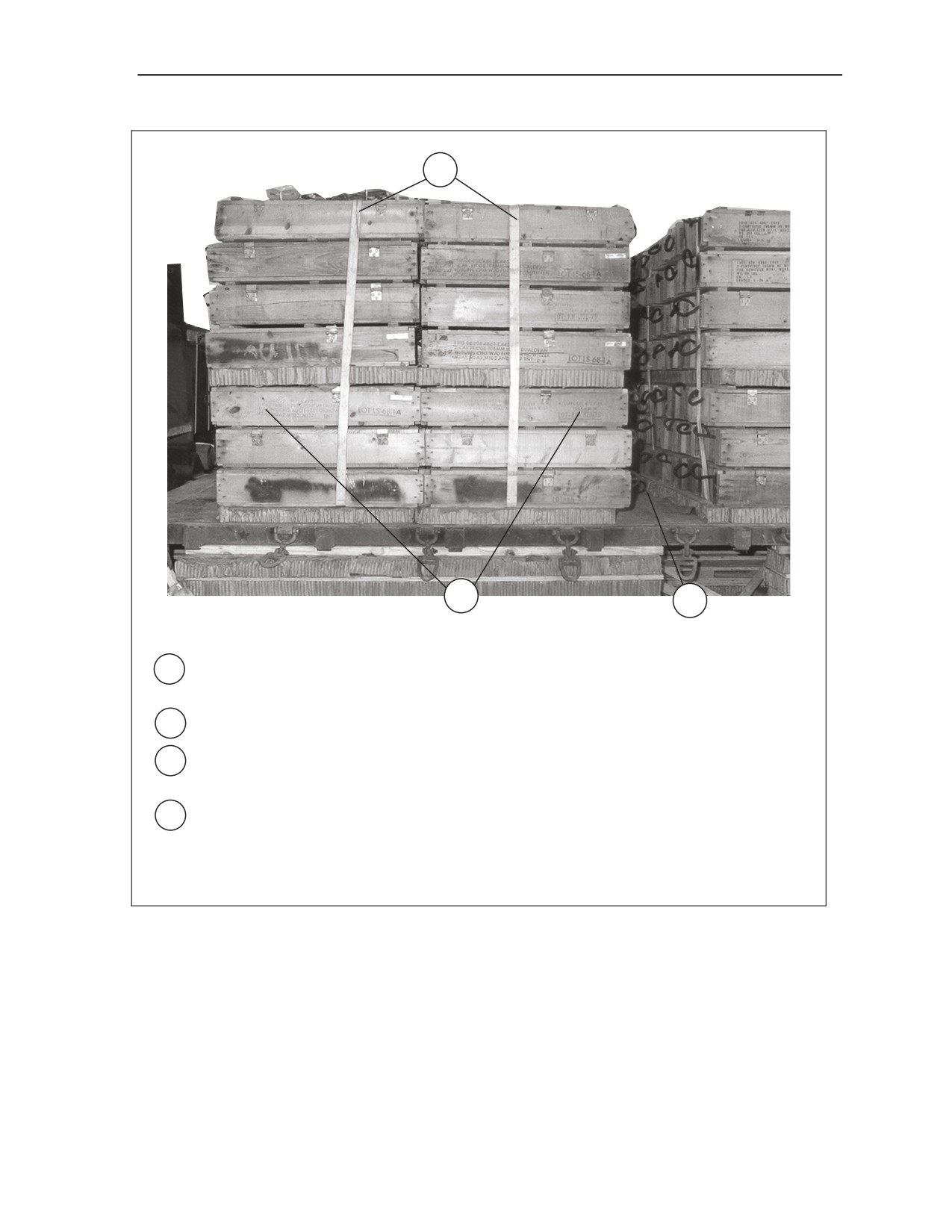
20.102/MCRP 4-11.3J/NAVSEA SS400-AB-MMO-010/TO 13C7-1-5 and as shown in Figure 7-9. Place
245 boxes of 105-millimeter ammunition on the pallet and bind the boxes together with the lashings as
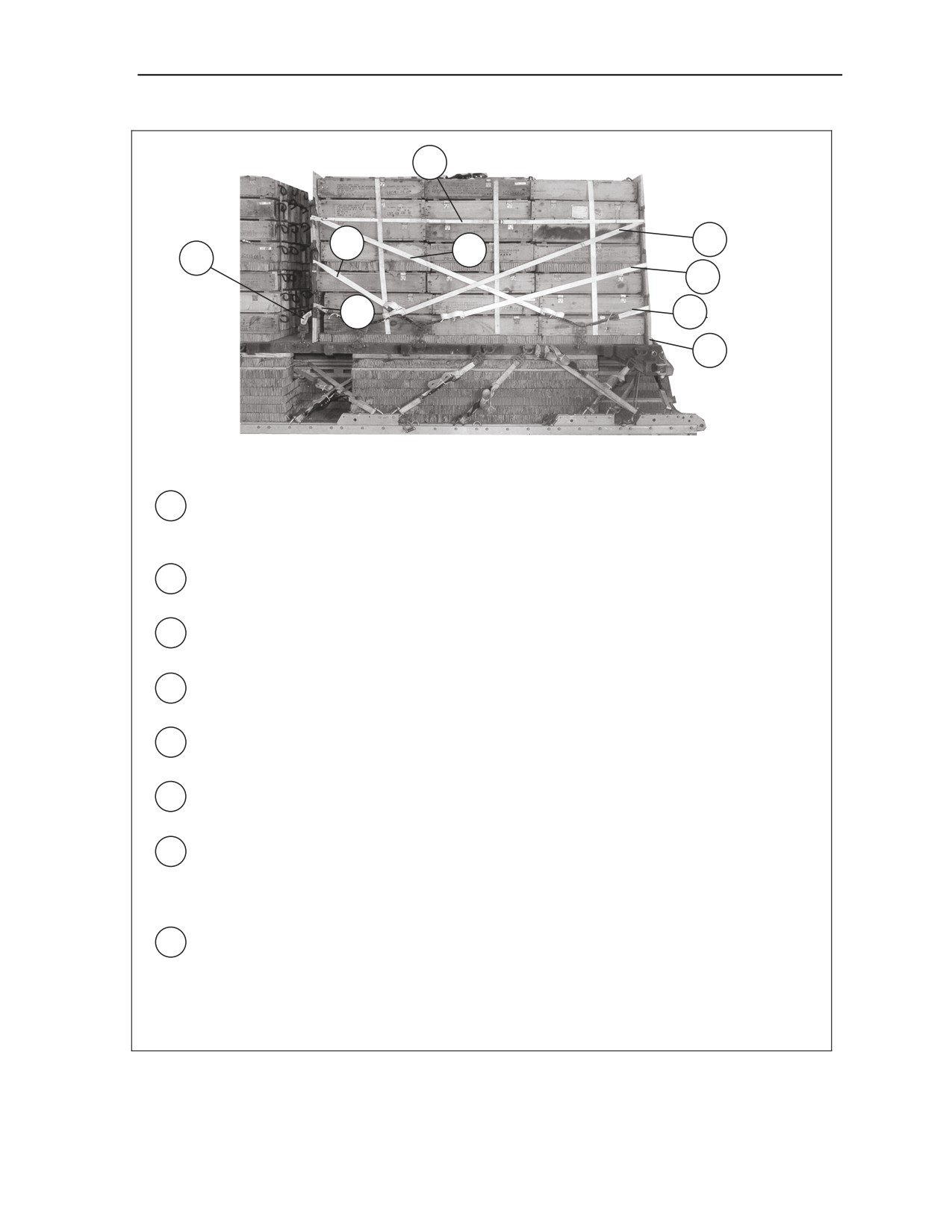
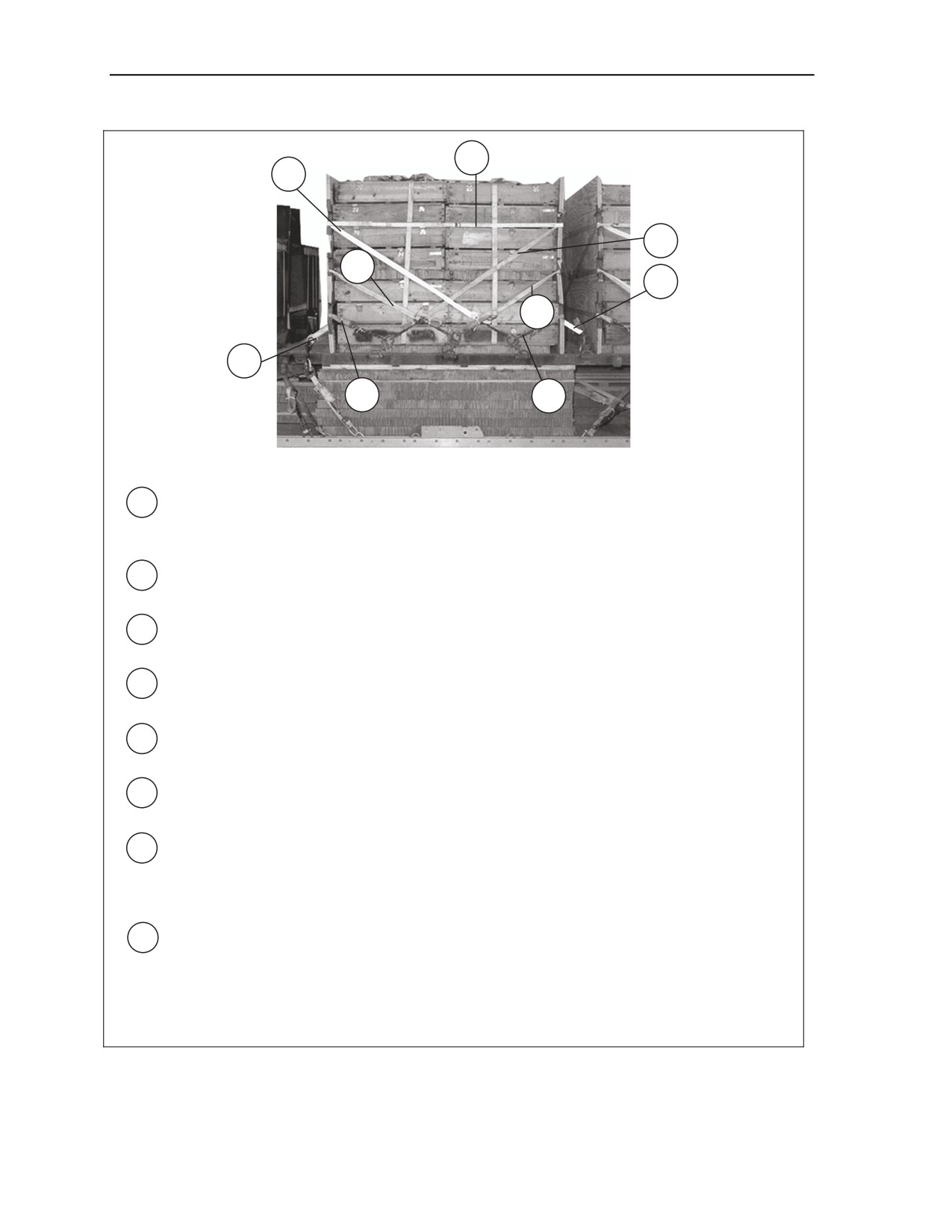
shown in Figure 7-10. Construct four endboards as shown in Figure 7-11. Secure the boxes and endboards
to the front section of the pallet as shown in Figure 7-12. Secure the boxes and endboards to the rear
section of the pallet as shown in Figure 7-13. Lash the load to the platform as shown in Figure 7-14.
4
1
2
3
FRONT
1 Cover the pallet with five 96- by 36-inch pieces of honeycomb, beginning 4 1/2 inches from
the front edge.
2 Place and center five 30-foot lashings across the honeycomb at 18 inches, 54 inches, 90
inches, 124 inches, and 160 inches from the front of the honeycomb.
3 Center the D-rings of three 30-foot lashings on the second of the lashings placed in step 2.
Center one of the lashings, and place the other two 7 inches from each side.
4 Center the D-rings of three 30-foot lashings between the fourth and fifth lashings placed in
step 2. Center one of the lashings, and place the other two 7 inches from each side.
Figure 7-9. Honeycomb and Lashings Placed on the Pallet
20 February 2009
FM 4-20.112/TO 13C7-1-8
7-13
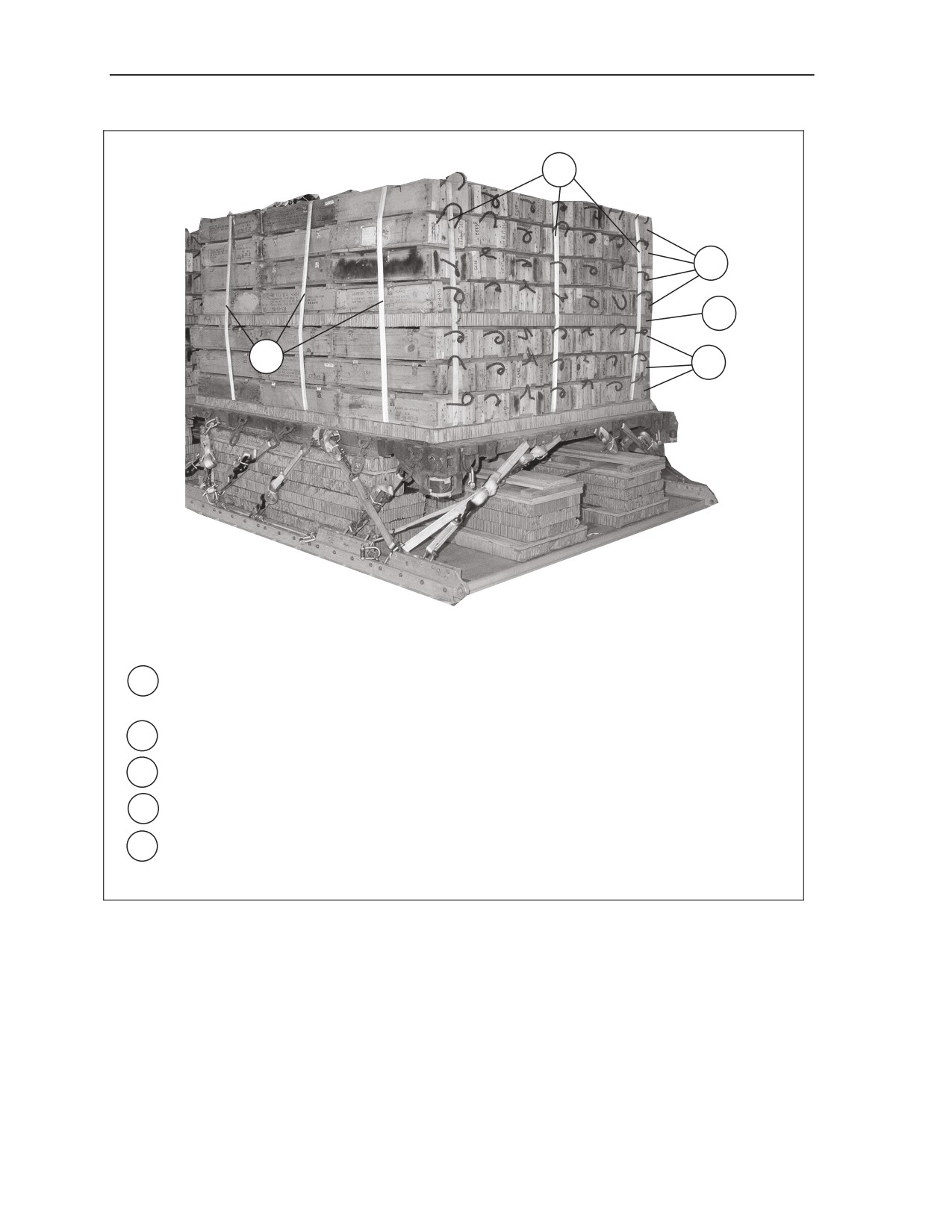
Chapter 7
5
3
2
4
1
1 Place boxes (three rows of seven each) flush with the front edge of the honeycomb. Place
two more stacks of 21 each flush behind these.
2 Cover the three layers of boxes with a layer of honeycomb.
3 Place four layers of boxes over the boxes and honeycomb placed in steps 1 and 2 above.
4 Fasten the three side-to-side lashings on top of the boxes.
5 Fasten the three front to rear lashings on top of the boxes.
Figure 7-10. Ammunition Boxes Placed on the Pallet
7-14
FM 4-20.112/TO 13C7-1-8
20 February 2009
Rigging Palletized Load System (PLS) on a 24-Foot, Type V Platform for Low-Velocity Airdrop
8
7
6
6 Beginning 16 inches from the front stack of boxes, place 98 boxes on the honeycomb in
the same configuration as in steps 1 through 3.
7 Secure the two side-to-side lashings on top of the boxes.
8 Route and secure the three front-to-rear lashings in the same way as in step 5. (Not
shown)
9 Cut out the honeycomb between the two stacks of boxes to allow the endboards to rest on
the pallet.
Figure 7-10. Ammunition Boxes Placed on the Pallet (Continued)
20 February 2009
FM 4-20.112/TO 13C7-1-8
7-15
Chapter 7
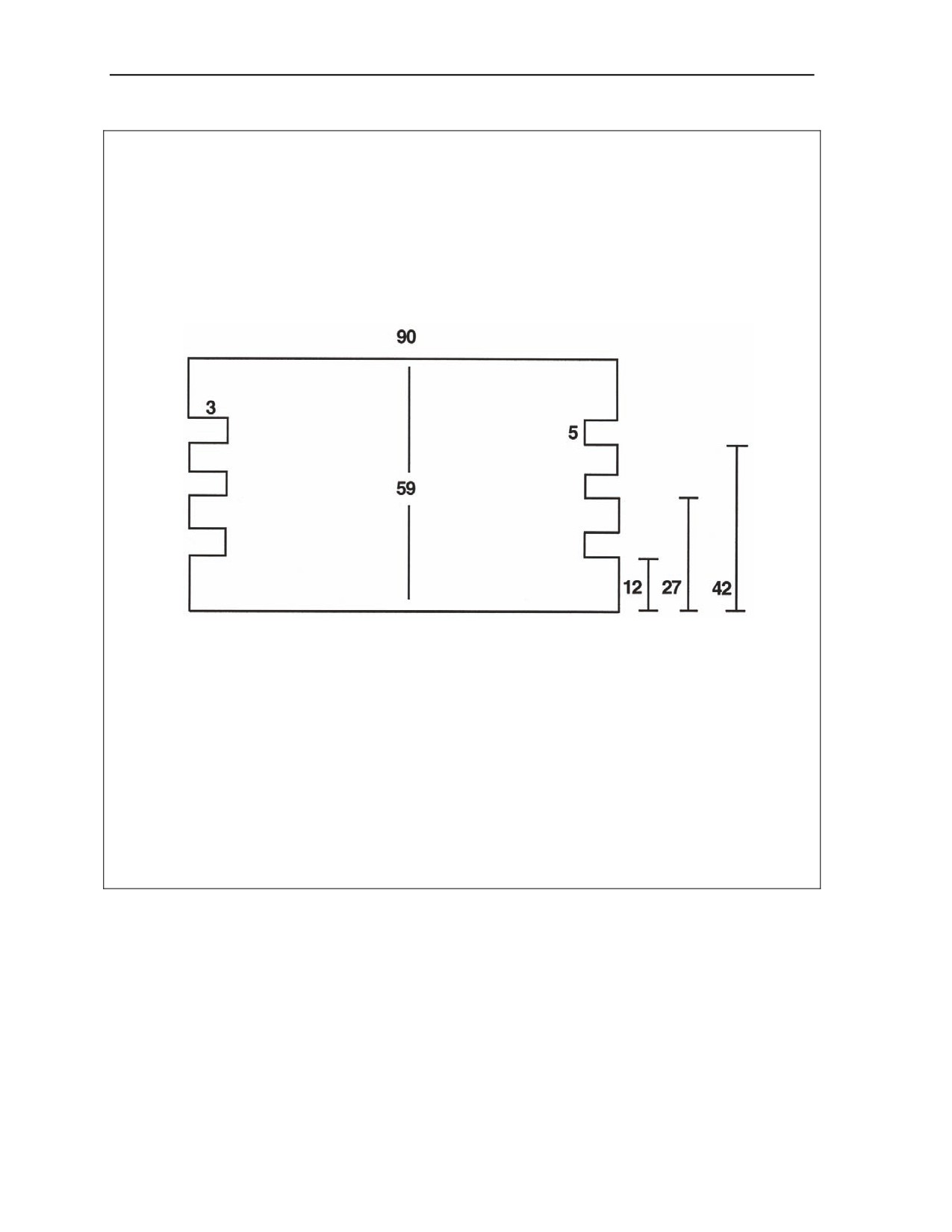
Notes.
1. This drawing is not to scale
2. All dimensions are in inches.
3. For loads different from that shown in this section, make the endboards the same height as the
load configuration.
4. The instructions given are for one endboard. Four are required for this load.
Step:
1. Cut two 3/4- by 48- by 90-inch and two 3/4- by 11- by 90-inch pieces of plywood. Nail the
four pieces flush together so that a single 1 1/2- by 59- by 90-inch piece of plywood results.
(The 11-inch piece will be at the top on one side and at the bottom on the other side).
2. Make cutouts 5 inches wide and 3 inches deep. Tape the sharp edges of the cutouts.
3. Construct three more endboards following steps 1 and 2.
Figure 7-11.Four Endboards Constructed
7-16
FM 4-20.112/TO 13C7-1-8
20 February 2009
Rigging Palletized Load System (PLS) on a 24-Foot, Type V Platform for Low-Velocity Airdrop
7
2
6
4
8
1
5
3
8
1
Set an endboard against each end of the front stack of boxes. Center a 30-foot lashing on
the front endboard and pass the free ends through the middle cutouts. Secure the ends to
the fifth swivel ring with D-rings and load binders.
2
Center a 30-foot lashing on the second endboard and pass the free ends through the
middle cutouts. Secure the ends to the fifth swivel ring with D-rings and a load binder.
3
Place a 15-foot lashing in the lower cutouts of the first endboard. Secure each end of the
lashing to the second swivel ring with a load binder.
4
Center a 30-foot lashing on the second endboard and pass the free ends through the
upper cutouts. Secure the ends to the second swivel ring with D-rings and a load binder.
5
Place a 15-foot lashing in the lower cutouts of the second endboard. Secure each end of
the lashing to the sixth swivel ring with a load binder.
6
Center a 30-foot lashing on the first endboard and pass the free ends through the upper
cutouts. Secure the ends to the sixth swivel ring with D-rings and a load binder.
7
Center a 30-foot lashing against the right side and pass the free ends through the upper
cutouts in the right side of both endboards. Secure the ends to the left front clevis in the
front tie-down point and to the seventh swivel ring on the left side with D-rings and load
binders. Fasten the load binder to the platform clevis installed earlier.
8
Center a 30-foot lashing against the left side and pass the free ends through the upper
cutouts in the left side of both endboards. Secure the ends to the right front clevis in the
front tie-down point and to the seventh swivel ring on the right side with D-rings and load
binders. Fasten the load binder to the platform clevis installed earlier.
Figure 7-12. Front Boxes and Endboards Secured to Pallet
20 February 2009
FM 4-20.112/TO 13C7-1-8
7-17
Chapter 7
7
4
6
2
8
1
8
5
3
1
Set an endboard against each end of the rear stack of boxes. Center a 30-foot lashing on
the third endboard and pass the free ends through the middle cutouts. Secure the ends to
the ninth swivel ring with D-rings and load binders.
2
Center a 30-foot lashing on the fourth endboard and pass the free ends through the middle
cutouts. Secure the ends to the ninth swivel ring with D-rings and load binders.
3
Place a 15-foot lashing in the lower cutouts of the third endboard. Secure each end of the
lashing to the eigth swivel ring with a load binder.
4
Center a 30-foot lashing on the fourth endboard and pass the free ends through the upper
cutouts. Secure the ends to the eighth swivel ring with D-rings and a load binder.
5
Place a 15-foot lashing in the lower cutouts of the fourth endboard. Secure each end of the
lashing to the tenth swivel ring with a load binder.
6
Center a 30-foot lashing on the third endboard and pass the free ends through the upper
cutouts. Secure the ends to the tenth swivel ring with D-rings and a load binder.
7
Center a 30-foot lashing against the right side and pass the free ends through the upper
cutouts in the right side of both endboards. Secure the ends to the clevis on the eleventh
swivel ring and to the seventh swivel ring on the left side with D-rings and load binders.
Fasten the load binder to the remaining platform clevis installed earlier.
8
Center a 30-foot lashing against the left side and pass the free ends through the upper
cutouts in the left side of both endboards. Secure the ends to the clevis on the eleventh
swivel ring and to the seventh swivel ring on the right side with D-rings and load binders.
Fasten the load binder to the remaining platform clevis installed earlier.
Figure 7-13. Rear Boxes and Endboards Secured to Pallet
7-18
FM 4-20.112/TO 13C7-1-8
20 February 2009
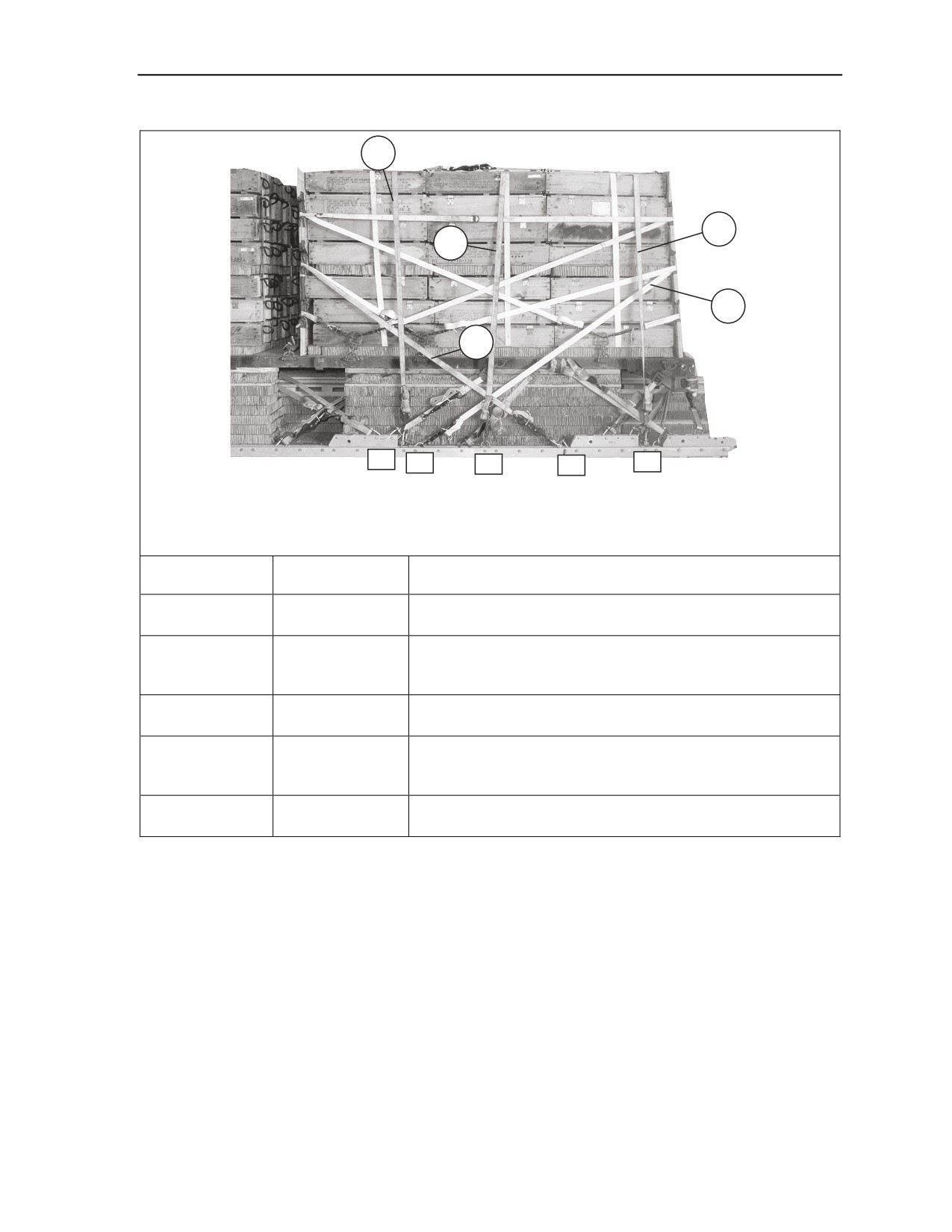
Rigging Palletized Load System (PLS) on a 24-Foot, Type V Platform for Low-Velocity Airdrop
5
1
3
4
2
11
4
10
8
7
Lashing Number
Tiedown Clevis
Instructions
Number
1
4 and 4A
Pass a 30 foot lashing over the load. Fit a D-ring to each
free end, and secure to clevises with load binders.
2
7 and 7A
Pass a 30 foot lashing through the center cutouts in the
second endboard. Fit a D-ring to each free end, and secure
to the clevises with load binders.
3
8 and 8A
Pass a 30 foot lashing over the load. Fit a D-ring to each
end, and secure to the clevises with load binders.
4
10 and 10A
Pass a 30 foot lashing through the center cutouts in the first
endboard. Fit a D-ring to each free end, and secure to the
clevises with load binders.
5
11 and 11A
Pass a 30 foot lashing over the load. Fit a D-ring to each
free end, and secure to the clevises with load binders.
Figure 7-14. Load Lashed to Platform
20 February 2009
FM 4-20.112/TO 13C7-1-8
7-19
Chapter 7
8
7
6
9
16
15
17
18
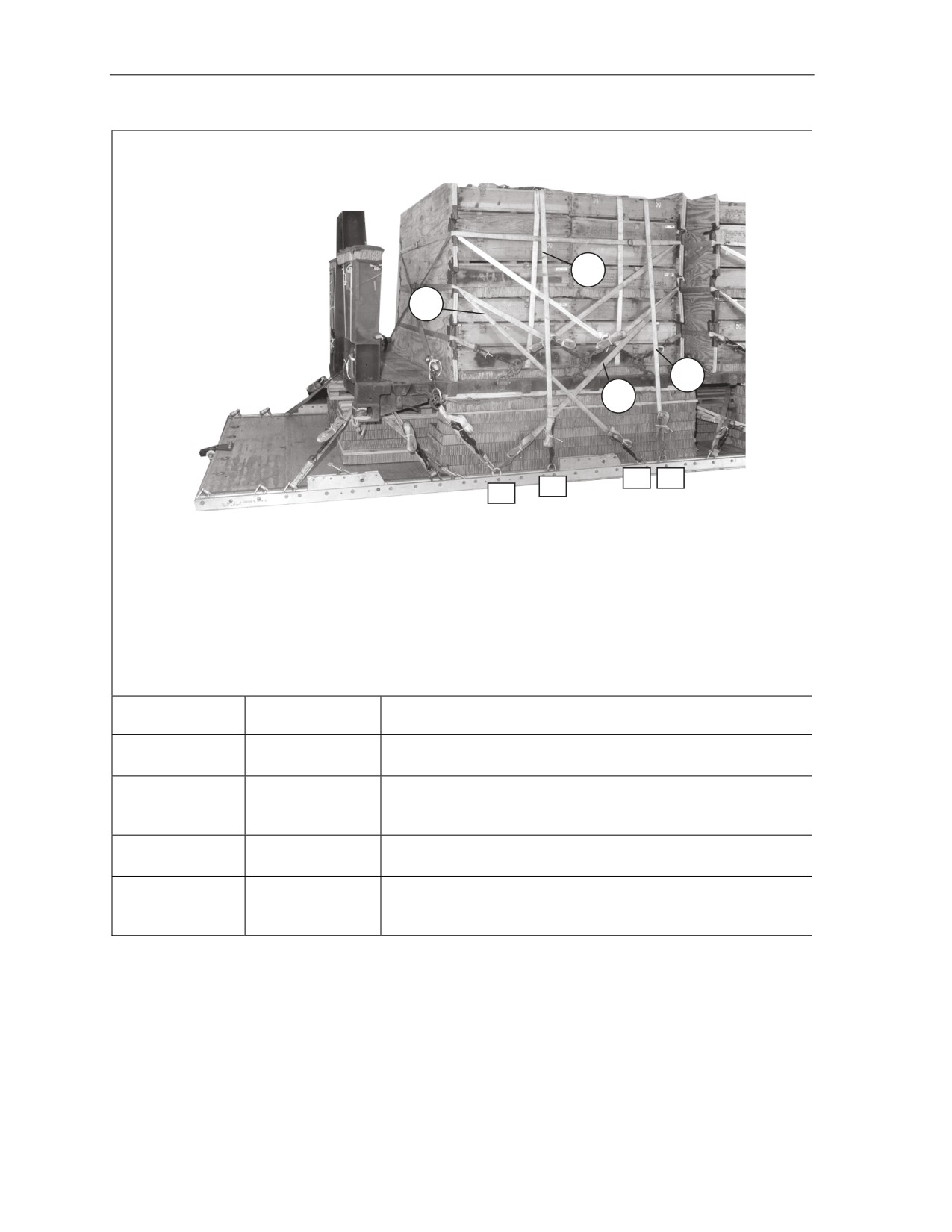
Lashing Number
Tiedown Clevis
Instructions
Number
6
15 and 15A
Pass a 30 foot lashing over the load. Fit a D-ring to each
free end, and secure to clevises with load binders.
7
16 and 16A
Pass a 30 foot lashing through the center cutouts in the
forth endboard. Fit a D-ring to each free end, and secure to
the clevises with load binders.
8
17 and 17A
Pass a 30 foot lashing over the load. Fit a D-ring to each
end, and secure to the clevises with load binders.
9
18 and 18A
Pass a 30 foot lashing through the center cutouts in the
third endboard. Fit a D-ring to each free end, and secure to
the lower clevises with load binders.
Figure 7-14. Load Lashed to Platform (Continued)
7-20
FM 4-20.112/TO 13C7-1-8
20 February 2009
Rigging Palletized Load System (PLS) on a 24-Foot, Type V Platform for Low-Velocity Airdrop
INSTALLING AND SAFETYING SUSPENSION SLINGS
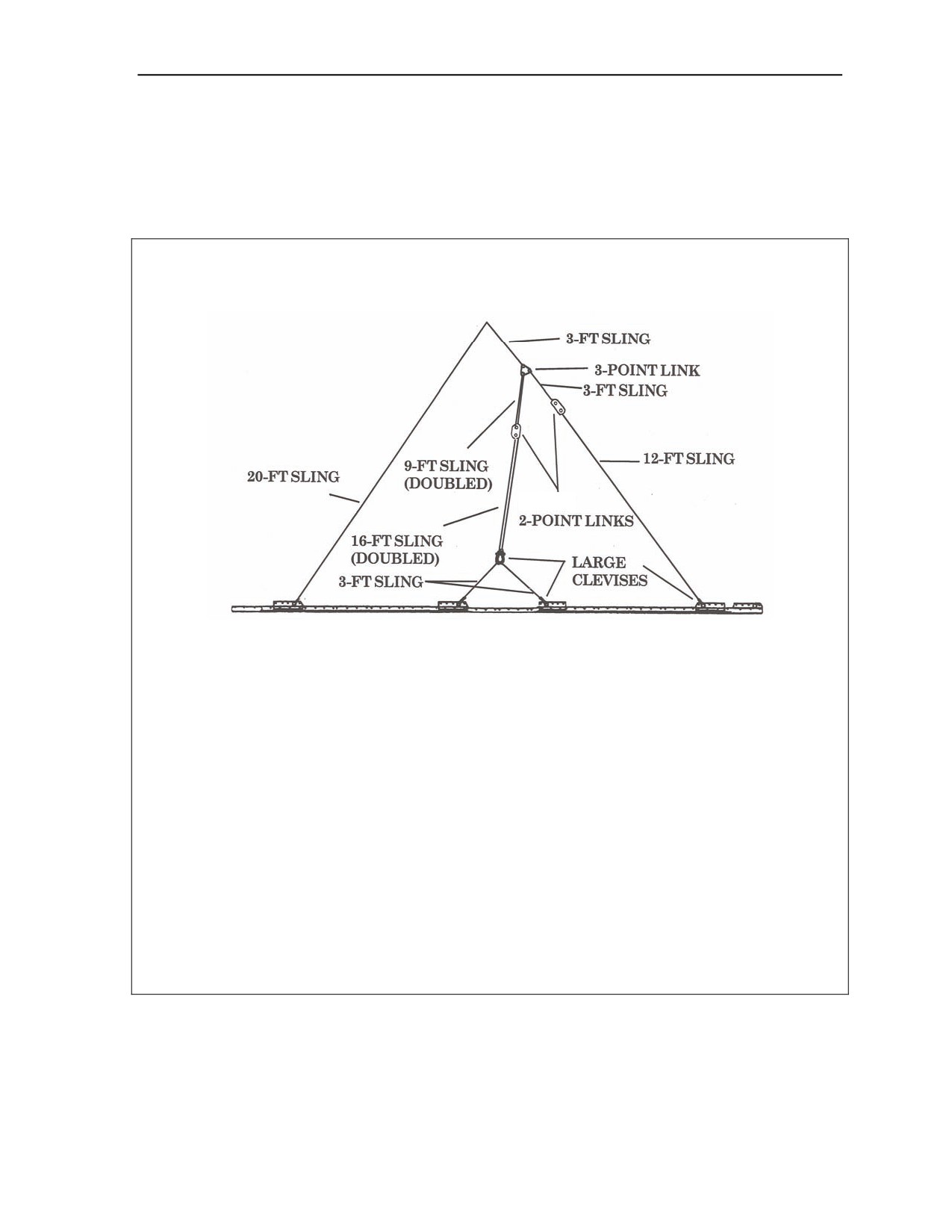
7-8. Install the components of the centerline suspension system according to FM 4-20.102/MCRP 4-
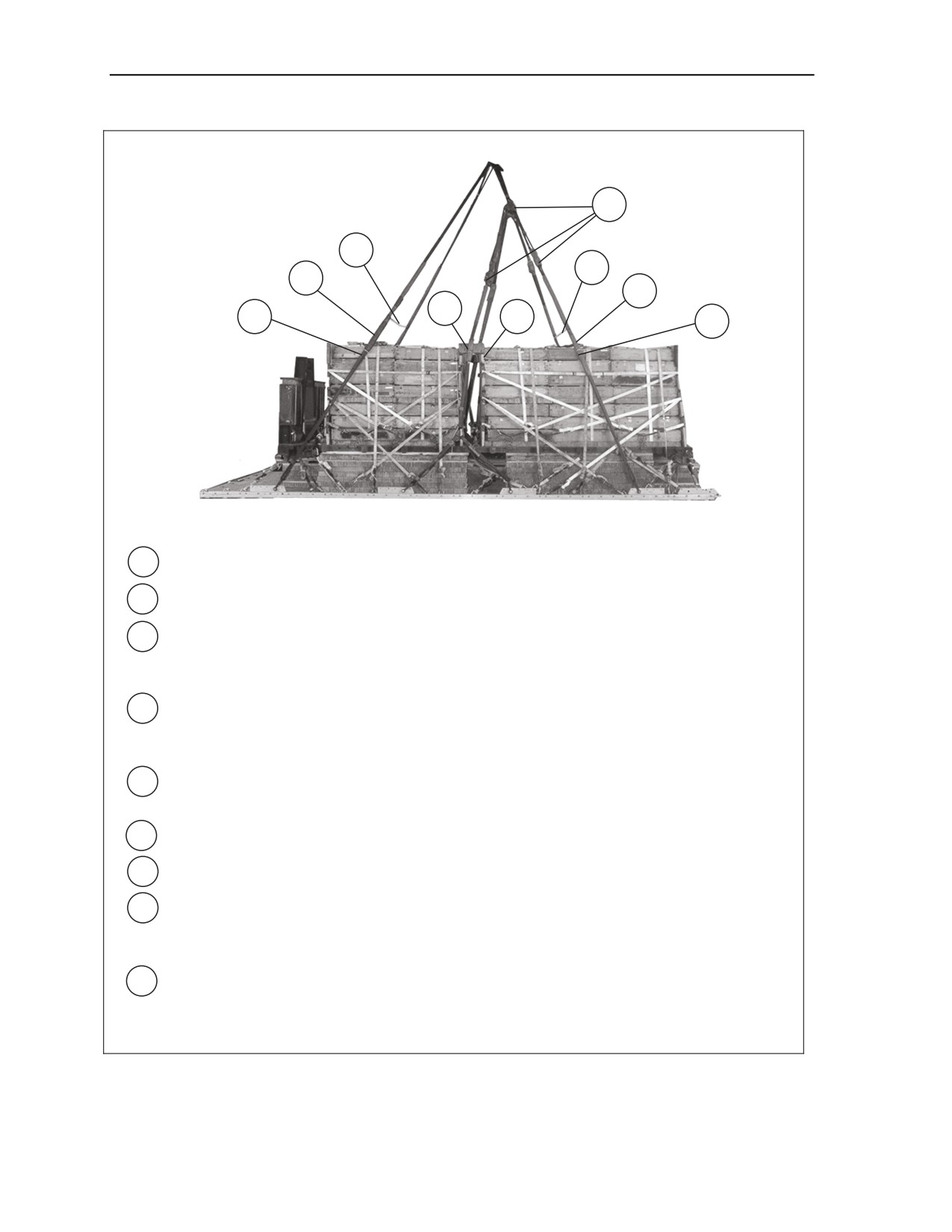
11.3J/NAVSEA SS400-AB-MMO-010/TO 13C7-1-5 and as shown in Figure 7-15. Safety the suspension
slings as shown in Figure 7-16.
Notes.
1. This drawing is not to scale.
2. Instructions are for one side. Repeat for the other side of the load.
Step:
1. Place the end loop of a 12-foot (4-loop), type XXVI sling in the bell of a large clevis. Bolt the
clevis to the right front suspension link. Connect the free end of the 12-foot sling to a 3-foot
(4-loop), type XXVI sling with a two-point link.
2. Attach a 3-foot (4-loop) sling to each center suspension link with a large clevis. Place both
3-foot slings in the bell of a large clevis. Pass a 16-foot (2-loop), type XXVI sling through one
spool of a two-point link. Place both ends of a 16-foot sling on the bolt of the large clevis.
3. Pass a 9-foot (2-loop), type XXVI sling through a spool of a three-point link. Place both ends
of the sling on the remaining spool of the two-point link used in step 2 above.
4. Bolt the 3-foot sling used in step 1 above to the three-point link so that the third spool points
upward. Bolt a 3-foot (4-loop), type XXVI sling to the upper spool of the three-point link.
5. Place the end loop of a 20-foot (4-loop), type XXVI sling in the bell of a large clevis. Bolt the
clevis to the rear suspension link.
6. Repeat steps 1 through 5 for the left side.
Figure 7-15. Suspension Slings Installed
20 February 2009
FM 4-20.112/TO 13C7-1-8
7-21
Chapter 7
1
9
8
7
6
5
2
3
2
1
Pad the two-point and three-point links with felt and tape. Raise the suspension slings.
2
Pad the suspension slings where they pass over the corners of the load with felt and tape.
3
Measure and cut two pieces of 2- by 12-inch lumber long enough to bridge the gap
between the endboards. Nail the lumber securely to the endboards flush with the top
edges. Pad the lumber with cellulose wadding and tape.
4
Tie a length of type III nylon cord to the center clevis on one side. Pass the cord over the
load, and tie it to the center clevis on the other side so that both clevises are supported.
(Not shown)
5
Tie the center suspension slings to the padded lumber placed in step 3 above with type III
nylon cord.
6
Tie the front suspension slings to each other over the load with type III nylon cord.
7
Tie the rear suspension slings to each other over the load with type III nylon cord.
8
Tie the front suspension, with a modified deadman’s tie, 12 inches above the load with 1/2-
inch tubular nylon webbing as shown in FM 4-20.102/MCRP 4-11.3J/NAVSEA SS400-AB-
MMO-010/TO 13C7-1-5.
9
Tie the rear suspension slings, with a modified deadman’s tie, 12 inches above the load
with type VIII webbing as shown in the FM 4-20.102/MCRP 4-11.3J/NAVSEA SS400-AB-
MMO-010/TO 13C7-1-5.
Figure 7-16. Suspension Slings Safetied
7-22
FM 4-20.112/TO 13C7-1-8
20 February 2009
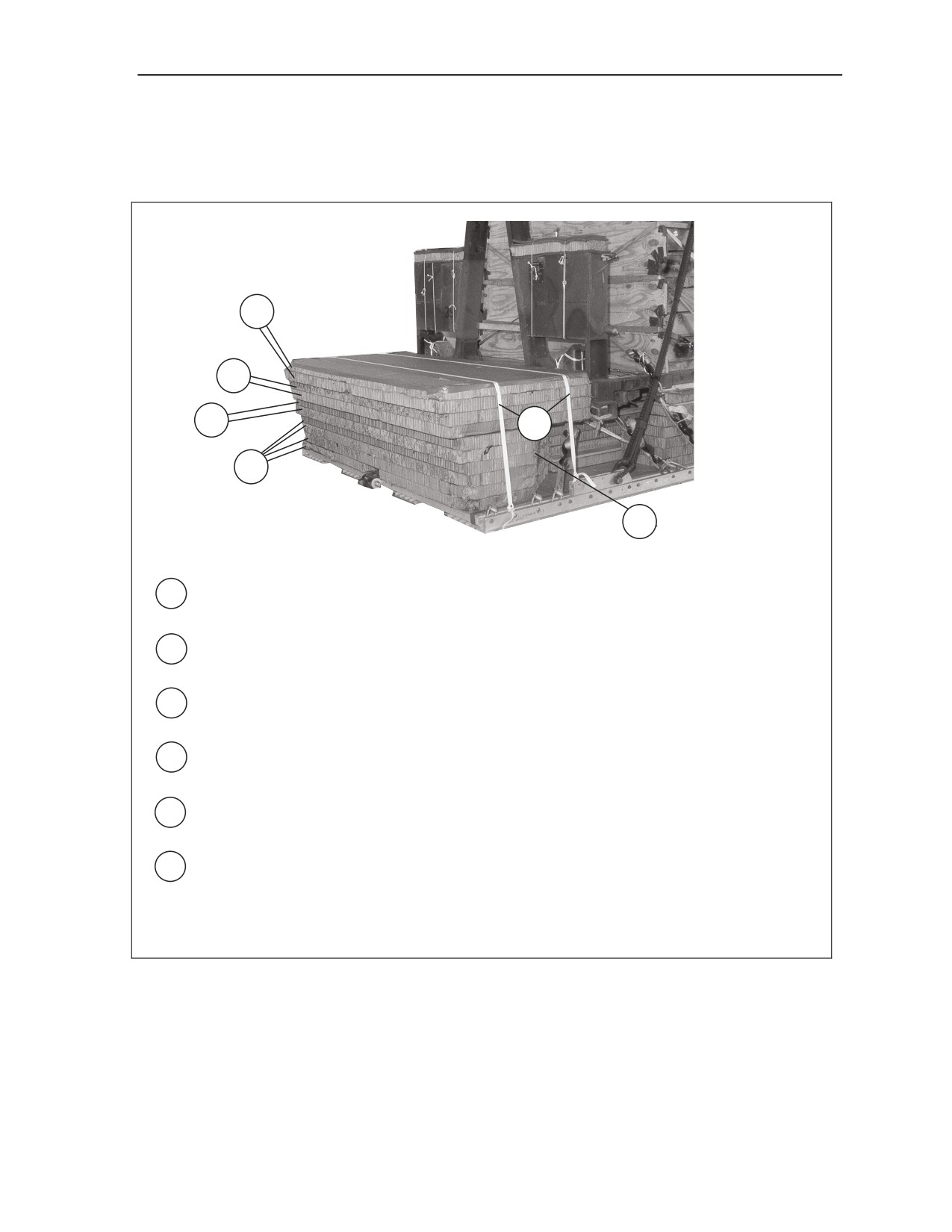
Rigging Palletized Load System (PLS) on a 24-Foot, Type V Platform for Low-Velocity Airdrop
BUILDING PARACHUTE STOWAGE PLATFORM
7-9. Build the parachute stowage platform as shown in Figure 7-17.
5
4
2
6
1
3
1 Alternate and glue four 96- by 36-inch and four 96- by 6-inch pieces of honeycomb to form
a four-layer base 96 by 42 inches.
2 Alternate and glue two 96- by 36-inch and two 96- by 8-inch pieces of honeycomb to form
two 96- by 44-inch pieces. Place these layers over the base and flush with the front edge.
3 Cut the front corners of the honeycomb placed in steps 1 and 2 above to allow for the
lashings.
4 Alternate and glue two 96- by 36-inch and two 96- by 10-inch pieces of honeycomb to form
two 96- by 46-inch pieces. Place these layers over the base and flush with the front edge.
5 Alternate and glue two 96- by 36-inch and two 96- by 12-inch pieces of honeycomb to form
two 96- by 48-inch pieces. Place these layers over the base and flush with the front edge.
6 Secure the parachute stowage platform to the rails with a length of 1/2-inch tubular nylon
webbing tied to the fourth bushing on each rear suspension link, and to bushing 47 on
each side.
Figure 7-17. Parachute Stowage Platform Built and Placed
20 February 2009
FM 4-20.112/TO 13C7-1-8
7-23
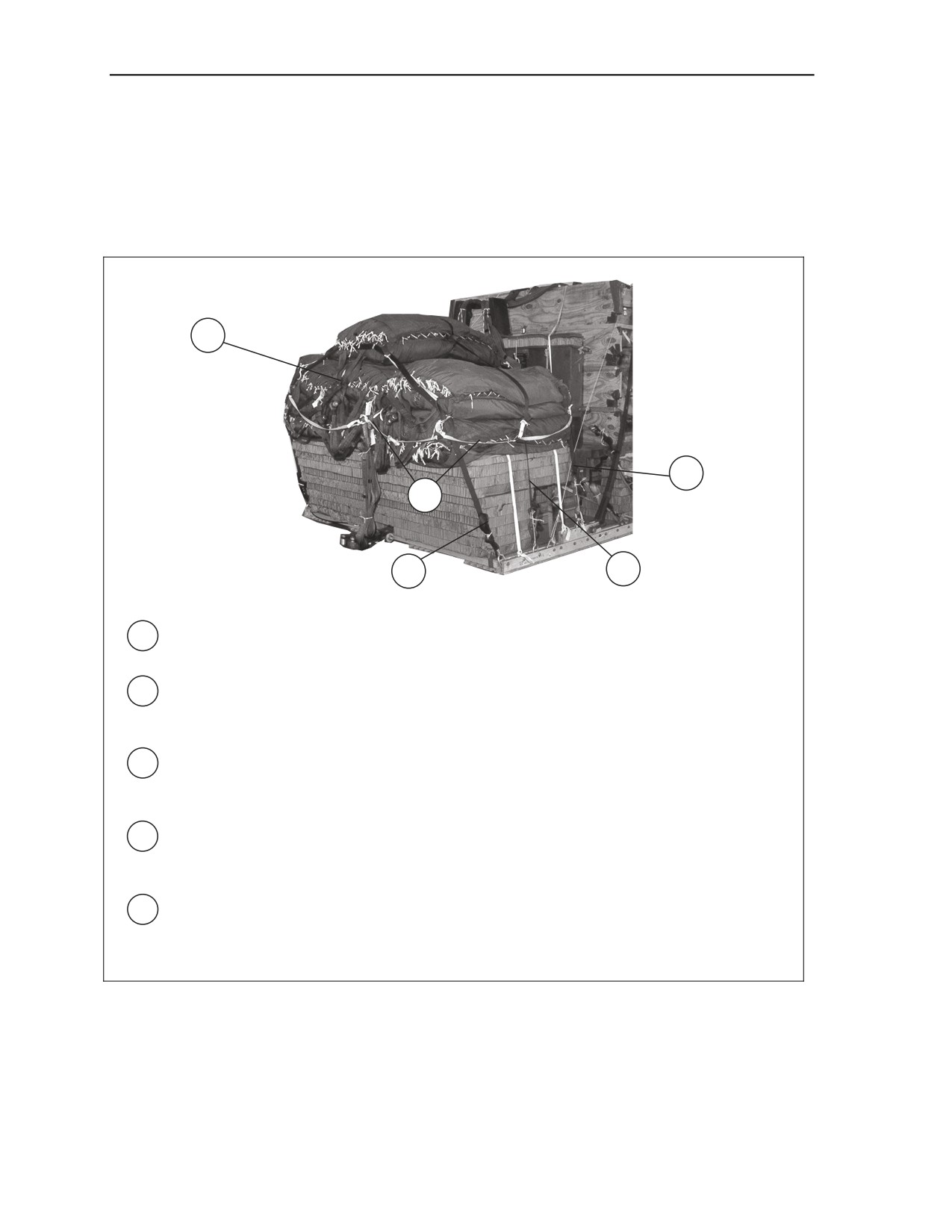
Chapter 7
INSTALLING CARGO PARACHUTES
7-10. Compute the parachute requirements for the load being rigged according to FM 4-20.102/MCRP 4-
11.3J/NAVSEA SS400-AB-MMO-010/TO 13C7-1-5. Prepare and install the cargo parachutes according
to FM 4-20.102/MCRP 4-11.3J/NAVSEA SS400-AB-MMO-010/TO 13C7-1-5 and as shown in Figure 7-
18.
1
2
5
4
3
1 Prepare, position, and stow seven G-11C cargo parachutes on the rear of the load
according to FM 4-20.102/MCRP 4-11.3J/NAVSEA SS400-AB-MMO-010/TO 13C7-1-5.
2 Install the front cargo parachute restraint according to FM 4-20.102/MCRP 4-
11.3J/NAVSEA SS400-AB-MMO-010/TO 13C7-1-5 using type X nylon webbing to clevises
21 and 21A.
3 Install the center cargo parachute restraint according to FM 4-20.102/MCRP 4-
11.3J/NAVSEA SS400-AB-MMO-010/TO 13C7-1-5 using type X nylon webbing to clevises
23 and 23A.
4 Install the rear cargo parachute restraint according to FM 4-20.102/MCRP 4-
11.3J/NAVSEA SS400-AB-MMO-010/TO 13C7-1-5 using type X nylon webbing to clevises
24 and 24A.
5 Install the parachute release straps according to FM 4-20.102/MCRP 4-11.3J/NAVSEA
SS400-AB-MMO-010/TO 13C7-1-5.
Figure 7-18. Cargo Parachutes Installed
7-24
FM 4-20.112/TO 13C7-1-8
20 February 2009
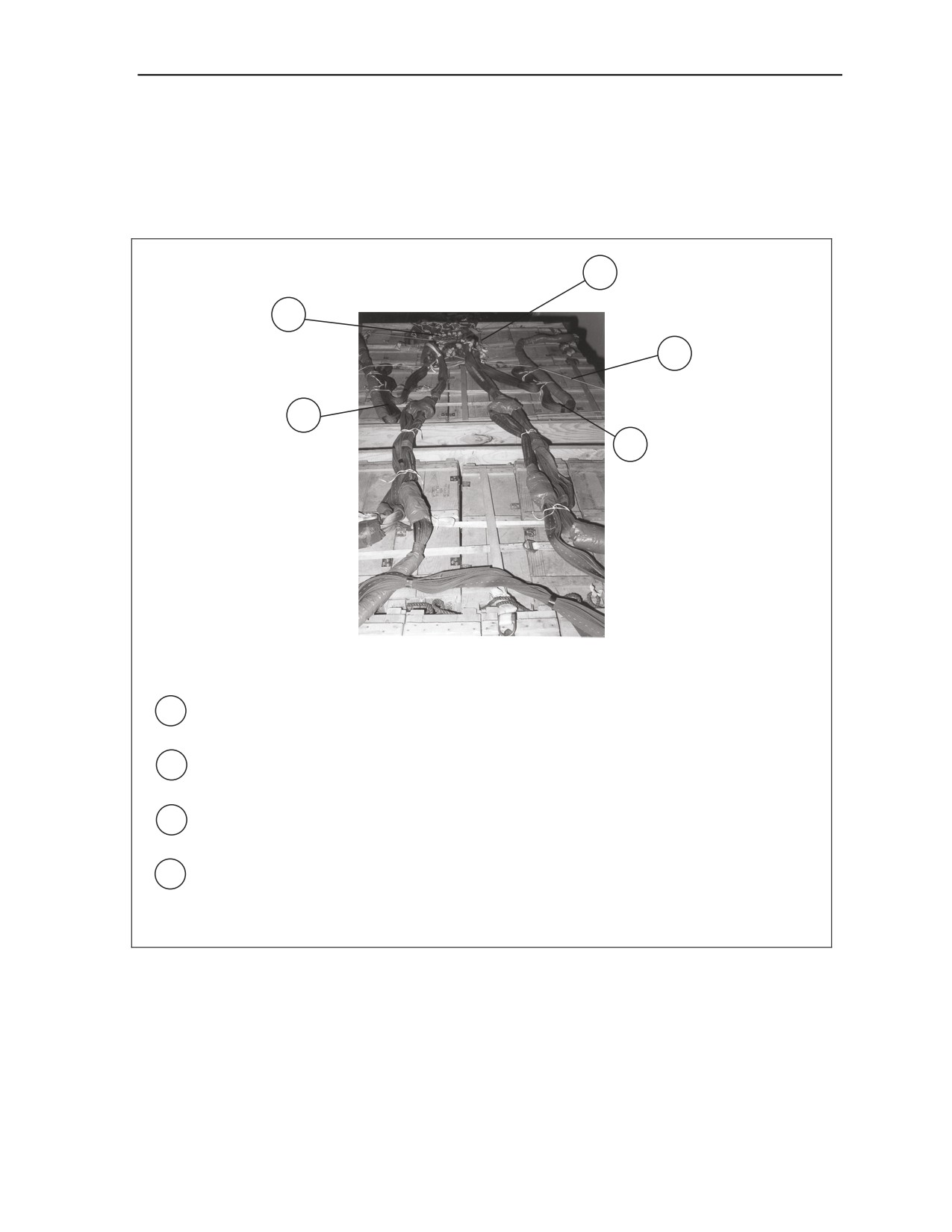
Rigging Palletized Load System (PLS) on a 24-Foot, Type V Platform for Low-Velocity Airdrop
INSTALLING THE RELEASE SYSTEM
7-11. Prepare, attach, and safety an M-2 cargo parachute release according to FM 4-20.102/MCRP 4-
11.3J/NAVSEA SS400-AB-MMO-010/TO 13C7-1-5 and as shown in Figure 7-19.
1
2
3
4
4
1 Center a 24- by 36-inch piece of felt on top of the load with a 24-inch side against the
fourth endboard. Secure the release platform to the load with type III nylon cord.
2 Prepare and install the M-2 cargo parachute release according to FM 4-20.102/MCRP 4-
11.3J/NAVSEA SS400-AB-MMO-010/TO 13C7-1-5. Place the assembly on the felt.
3 Safety the release to convenient points on the load with type III nylon cord according to FM
4-20.102/MCRP 4-11.3J/NAVSEA SS400-AB-MMO-010/TO 13C7-1-5.
4 S-fold and tie any excess suspension slings with one turn of type I, 1/4-inch cotton
webbing.
Figure 7-19. M-2 Release System Installed
20 February 2009
FM 4-20.112/TO 13C7-1-8
7-25
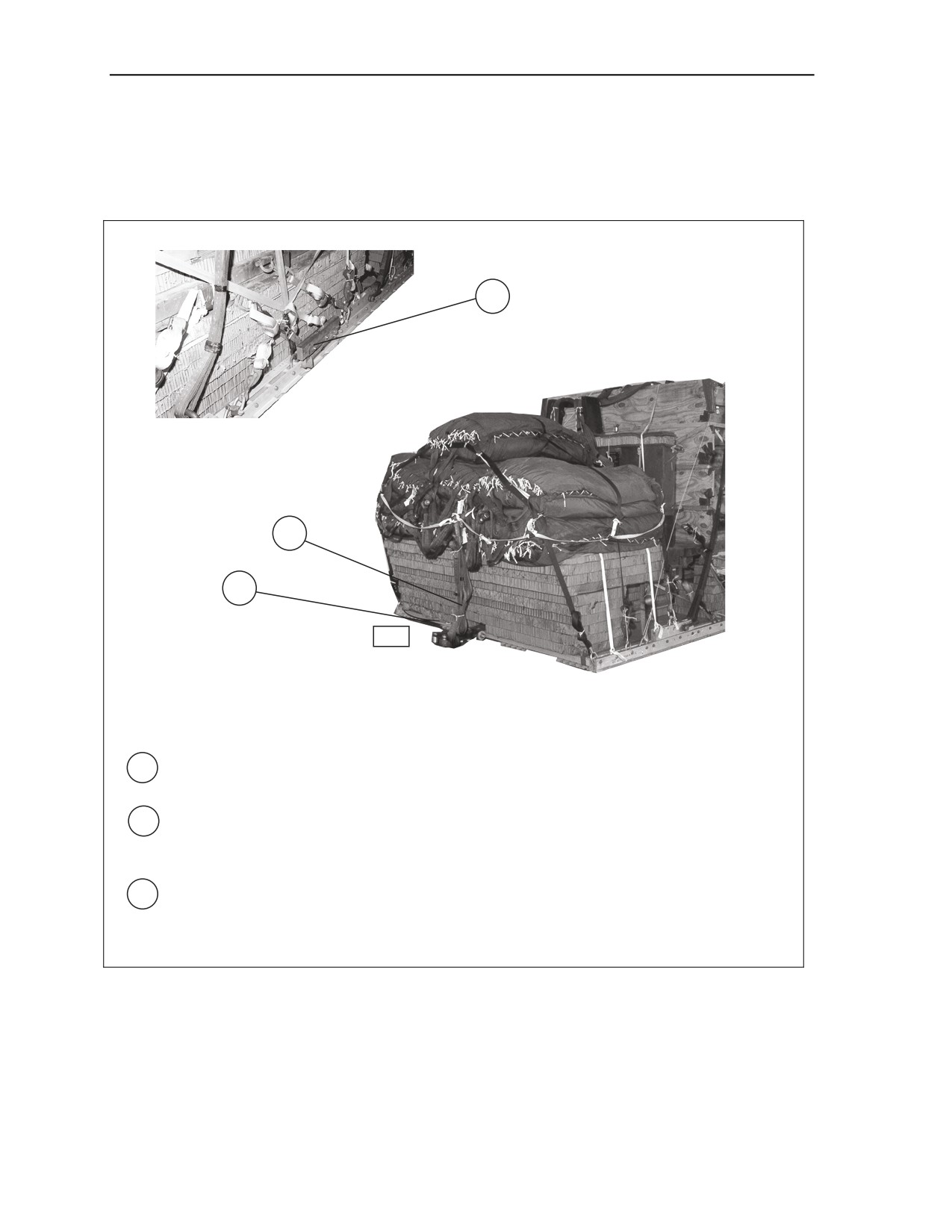
Chapter 7
INSTALLING THE EXTRACTION SYSTEM
7-12. Install the extraction system according to FM 4-20.102/MCRP 4-11.3J/NAVSEA SS400-AB-MMO-
010/TO 13C7-1-5 and as shown in Figure 7-20.
1
3
2
D10
1 Install the components of the EFTC according to FM 4-20.102/MCRP 4-11.3J/NAVSEA
SS400-AB-MMO-010/TO 13C7-1-5. Use the rear mounting holes for the EFTC brackets.
2 Install a 24-foot EFTC cable according to FM 4-20.102/MCRP 4-11.3J/NAVSEA SS400-
AB-MMO-010/TO 13C7-1-5 and safety the cable to tiedown ring D10 with one turn of type
I, 1/4-inch cotton webbing.
3 Attach a 9-foot (2-loop), type XXVI nylon sling according to FM 4-20.102/MCRP 4-
11.3J/NAVSEA SS400-AB-MMO-010/TO 13C7-1-5 to be used as a deployment line. S-fold
the excess and tie it in two places with type I, 1/4-inch cotton webbing.
Figure 7-20. Extraction System Installed
7-26
FM 4-20.112/TO 13C7-1-8
20 February 2009