FM 3-11.9 POTENTIAL MILITARY CHEMICAL/BIOLOGICAL AGENTS AND COMPOUNDS (JANUARY 2005) - page 2
•
Drooling, excessive sweating, drowsiness, and confusion.
•
Difficulty breathing, twitching, jerking, and staggering.
•
Convulsions and coma.
b.
Miosis. When airborne vapor comes in contact with the eyes, miosis occurs as a
result of a direct local effect of the nerve agent on the eyes and can occur prior to any
inhibition of ChE in the blood. This type of exposure is frequently accompanied by
tightness of the chest and/or rhinorrhea, and any or all other symptoms can occur. In cases
of nerve agent exposure not involving vapor contact with the eyes, miosis is one of the last
effects to occur before death.10
c.
Treatment. Treatment of nerve agent poisoning includes use of atropine, 2-PAM
chloride, convulsant antidote for nerve agents (CANA), and pyridostigmine bromide (PB).
(1)
Atropine binds to receptor sites blocking the excess acetylcholine caused by
nerve agent poisoning.
(2)
2-PAM Cl acts by reactivating ChE inhibited by a nerve agent.15 Prompt
treatment is essential because after the agent binds to AChE, a second reaction occurs in
which the agent loses one alkyl or alkoxy group. This phosphorylated AChE is called an
“aged” enzyme and is completely resistant to both spontaneous and oxime-medicated (2-
PAM Cl) reactivation. The “aging” period varies from minutes to hours depending on the
type of agent.16 For GD, the “aging” half-time is within 2 minutes.17
(3)
The CANA prevents and treats convulsions caused by exposure to nerve
agents in moderate to severe cases.1
(4)
PB is a pretreatment for exposure to GD. PB and AChE bind and form
what is called a carbamoylated AChE. Although PB is also an AChE inhibitor, it is unlike
nerve agents in that the interaction between PB and AChE is freely and spontaneously
reversible and it does not undergo the aging process. The carbamoylated AChE is fully
protected from attack by nerve agents. Atropine is still needed to counteract the excess
ACh and 2-PAM Cl is still needed to reactivate AChE active sites that were protected by
PB.17 PB is available to US forces in active theaters of operation (TOs).1
d.
Tabun (GA) (see Table II-6). GA was the first of the nerve agents developed by
the Germans.15 GA is primarily an inhalation hazard. See Table II-7 (page II-17) for GA
toxicity estimates.
Table II-6. GA
Alternate Designations: EA 1205; Le-100 (German), T-83 (German); MCE; FM-511; T-2104 (British); TL-1578 (UCTL);
Trilon 83 (German); Gelan I (German); Taboon A
Chemical Name: Ethyl N, N-dimethylphosphoroamidocyanidate
Synonyms: Ethyl dimethylamidocyanophosphate; Dimethylaminoethoxyphosphoryl cyanide;
Dimethylaminocyanophosphoric acid ethyl ester; Cyanodimethylaminoethoxyphosphine;
Dmethylaminecyanoethoxyphosphine oxide; Ethyl dimethylaminocyanophosphonate Phosphoramidocyanidic acid, dimethyl,
ethyl ester; Dimethylamidoethoxyphosphoryl cyanide; Dimethylaminocyanphosphorsaeureaethylester (German);
Dimethylphosphoramidocyanidic acid, ethyl ester; Ethyl dimethylphosphoramidocyanidate; Ethylester-dimethylamid kyseliny
kyanfosfonove (Czech)
CAS Registry Number: 77-81-6
RTECS Number: TB4550000
II-14

Table II-6. GA (Continued)
Physical and Chemical Properties
Structural Formula:
O
CH3
CH3CH2
O P N
CH3
CN
Molecular Formula: C5H11N2O2P
Molecular Weight: 162.13
Physical State
Colorless to brown liquid 1
Odor
Faintly fruity; none when pure 2
Boiling Point
248oC (extrapolated) 3-7
FP/MP
-50oC (FP) 5
Liquid Density (g/mL)
1.0756 @ 25oC; 1.0999 @ 0oC 3
Vapor Density (relative to air)
5.6 (calculated)
Vapor Pressure (torr)
5.70 x 10⁻² @ 25oC; 4.75 x 10⁻³ @ 0oC (extrapolated) 3-7
Volatility (mg/m3)
4.97 x 10² @ 25oC; 4.52 x 101 @ 0oC (calculated from vapor pressure) 3-7
Latent Heat of Vaporization (kcal/mol)
15.5 @ 25oC; 16.7 @ 0oC (calculated from vapor pressure) 3-7
Viscosity (cP)
2.277@25.0o C, 4.320@ 0oC3
Viscosity of Vapor (cP)
6.20 x 10⁻³ @ 25.0oC, 5.60 x 10⁻³ @ 0oC3
Surface Tension (dynes/cm)
32.5 @ 25.0oC, 35.0 @ 0oC3
Flash Point
78oC (closed cup) 8
Decomposition Temperature
Decomposes completely @ 150oC after about 3 to 3 1/4 hrs 9
Solubility
Solubility in water is approximately 7.2g GA/100g solution @ 20oC and 9.8g
GA/100g @ 0oC; 3 readily soluble in common organic solvents 2
Rate of Hydrolysis
t1/2 = 8.5 hrs @ 20oC and pH 7;10 slow in water but fairly rapid with strong acids and
alkalis with self-buffering @ pH 4 to 5; 1 autocatalytic below pH 4 11
Hydrolysis Products
AC, dimethylaminocyanophosphonic acid, and other products 10
Stability in Storage
When stabilized with 5% chlorobenzene, GA can be stored in steel containers for
several years @ ambient temperatures. The degree of stability decreases @
elevated temperatures with decomposition occurring within 6 months @ 50oC and
3 months @ 65oC. 12
Action on Metals or Other Materials
Corrosion rate of steel on crude GA with 5 to 20% chlorobenzene is 0.000034
inch/month @ 65oC. 12
Other Data
Skin and eye toxicity
Eyes: very high; much greater through eyes than through skin. Skin: highly toxic,
decontamination of smallest drop of liquid agent is essential; liquid penetrates skin.
13
Inhalation Toxicity
Primarily inhalation hazard 14
Rate of action
Rapid 15
Means of detection
M8 paper, M9 paper, M256A1 CADK, M8A1 ACAA, M90 AMAD, M21 ACAA, M22
ACADA, CAM/ICAM, M272 Water Testing Kit, M18A3 CADK16, M18A2 CADK,
MM1, CAPDS, IPDS, AN/KAS-1 CWDD16
Protection required
MOPP4; liquid nerve agents penetrate ordinary clothing rapidly 13
Decontamination
Flush eyes with water immediately. Use the M291 SDK to remove any liquid nerve
agent on skin or clothing. Use the M295 IEDK for individual equipment.13 STB is
effective on equipment. Water, steam, and absorbents (earth, sawdust, ashes,
and rags) are effective for physical removal. 17 NOTE: GA may react to form CK
in bleach slurry.18
Use
Quick-acting casualty agent
II-15
Table II-6. GA (Continued)
NOTES
¹Witten, Benjamin, The Hydrolysis of MCE, Technical Division Memorandum Report 1121, USA Chemical Research and
Development Laboratories, Army Chemical Center, MD, August 1945, UNCLASSIFIED Report (ADB964102).
2Welchman, R.M.A., Preliminary Report on the Potential Value of Nerve Gases as C.W. Agents, Porton Report No. 2747
(PR 2747), Chemical Defence Experimental Establishment, Porton, England, January 1947, UNCLASSIFIED Report.
3Samuel, J.B., et al., Physical Properties of Standard Agents, Candidate Agents, and Related Compounds at Several
Temperatures (U), ARCSL-SP-83015, USA Armament Research and Development Command, Aberdeen Proving Ground,
MD, June 1983, UNCLASSIFIED Report (ADC033491).
4Abercrombie, P., ECBC Notebook # NB 98-0079, p. 36 (U).
5Harris, B.L., Physical Constants of MCE, Technical Division Memorandum Report 1094, USA Chemical Research and
Development Laboratories, Army Chemical Center, MD, July 1945, UNCLASSIFIED Report (ADB 964103).
6Balson, E.W., Determination of the Vapor Pressure of T.2104, A.3804/3, Military Intelligence Division, Chemical Defence
Experimental Establishment, Porton, England, April 1945, UNCLASSIFIED Report.
7Belkin, F., and Brown, H.A., Vapor Pressure Measurements of Some Chemical Agents Using Differential Thermal Analysis,
Part III, ECTR-75032, Edgewood Arsenal, Aberdeen Proving Ground, MD, June 1975, UNCLASSIFIED Report
(ADA010666).
8Walpole, J.L., Determination of the Flash Points of GA and GB, Porton Technical Paper No. 45 (PTP 45), Chemical
Defence Experimental Establishment, Porton, England, March 1948, UNCLASSIFIED Report.
9Miller, C.E., Thermal Studies on MCE, Technical Division Memorandum Report 1132, USA Chemical Research and
Development Laboratories, Army Chemical Center, MD, September 1945, UNCLASSIFIED Report (ADB964104).
10Marsh, D.J. et al., Kinetics of the Hydrolysis of Ethyl Dimethylamino Cyanophosphonate (and certain other related
compounds) in Water, Proton Technical Paper No. 85 (PTP-85), Chemical Defense Experimental Establishment, Porton,
England, December 1948, UNCLASSIFIED Report.
¹¹Clark, D.N, Review of Reactions of Chemical Agents in Water, Final Report to USA Biomedical Research and
Development Laboratory, Battelle, Columbus, OH, January 1989, UNCLASSIFIED Report (ADA213287).
¹²Harris, B.L. and Macy, R., Storage Stability of German GA in Uncoated and Lacquered 75mm Shell at 50°C and 65°C.
Corrosion Rate of Steel by GA at 65oC, Technical Division Memorandum Report 1299, USA Chemical Research and
Development Laboratories, Army Chemical Center, MD, December 1946, UNCLASSIFIED Report (ADB964902).
13FM 8-285/NAVMED P-5041/AFJMAN 44-149/FMFM 11-11, Treatment of Chemical Agent Casualties and Conventional
Military Chemical Injuries, 22 December 1995.
14Sharon Reutter, et al., Review and Recommendations for Human Toxicity Estimates for FM 3-11.9, ECBC-TR-349,
September 2003.
15NIOSH-DOD-OSHA Sponsored Chemical and Biological Respiratory Protection Workshop Report, February 2000.
16DOD Chemical And Biological Defense Program Annual Report to Congress, Volume I, April 2003.
17FM 3-5/MCWP 3-37.3, NBC Decontamination, 28 July 2000.
18W.R. Kirner, Summary Technical Report of Division 9, NDRC Volume 1, Chemical Warfare Agents, and Related Chemical
Problems Part I-II, Office of Scientific Research and Development, Washington, DC, 1946, UNCLASSIFIED Report
(AD234270).
II-16

Table II-7. GA Toxicity Estimates10
Endpoint
Toxicity
MV (L)
Exposure
ROE
Probit
TLE
ROD
DOC
(mg-min/m3)
Duration
Slope
Lethality
LD50: 1500 mg a
N/A
N/A;
Percutaneous
5
N/A
Unknown
Low
70-kg man
Liquid b
LCt50:
70 a
15
2 min
Inhalation/Ocular
12
1.5 c
Some
Moderate
LCt50:
15,000 a,d
N/A
30-360 min
Percutaneous
5
1 c,f
Unknown
Low
Vapor e
LCt50:
7500 g,h
N/A
30-360 min
Percutaneous
5
1 c,f
Unknown
Low
(Provisional)
Vapor e
Severe effects,
ED50: 900 mga
N/A
N/A;
Percutaneous
5
N/A
Unknown
Low
includes deaths
70-kg man
Liquid b
ECt50: 50 a
15
2 min
Inhalation/Ocular
10
1.5 c
Some
Moderate
ECt50:12,000a,d
N/A
30-360 min
Percutaneous
5
1 c,f
Unknown
Low
Vapor e
ECt50: 6000 g,h
N/A
30-360 min
Percutaneous
5
1 c,f
Unknown
Low
(Provisional)
Vapor e
Threshold
ECt50: 2000 a,d
N/A
30-360 min
Percutaneous
5
1 c,f
Unknown
Moderate
effects (slight
Vapor e
ChE inhibition)
ECt50: 1000 g,h
N/A
30-360 min
Percutaneous
5
1 c,f
Unknown
Moderate
(Provisional)
Vapor e
Mild effects
ECt50: 0.4 h
N/A
2 min
Inhalation/Ocular
10
1.5 c
Some
Low
(miosis,
rhinorrhea)
NOTES
aBased on Grotte and Yang (2001).
bBare skin.
cSee Appendix H for supporting toxicity profile estimates.
dModerate temperatures (65-85°F).
eAssumes personnel are masked with eye protection and bare skin.
fThe TLE value is assumed 1 because the Ct profile is unknown.
gHot temperatures (greater than 85°F).
hBased on recommendations for GB.
e.
GA Toxicity Estimates. Note that for an inhalation/ocular expouse the TLE is
greater that 1. This means that the effective dosage increases with longer exposure
durations and the concentration of the agent decreases.
f.
Sarin (GB) (see Table II-8 [page II-18]). The Germans developed GB after they
developed GA,15 hence the designation GB. Pure GB is odorless and colorless.13 It is a
volatile liquid at room temperature. Unlike many other agents, for which clothing affords
some protection against a liquid agent, clothing may enhance the potency of GB liquid on
the skin. It is hypothesized that clothing retards evaporation, thereby increasing the
effective dose.10 See Table II-9 (page II-20) for toxicity estimates.
II-17

Table II-8. GB
Alternate Designations: EA 1208; T-144 (German); Trilon 144 (German); Trilon 46 (German); T 46 German); TL-1618
(UCTL); T-2106 (British); MFI; IMPF; Sarin II
Chemical Name: Isopropyl methylphosphonofluoridate
Synonyms: Fluorisoproopoxymethylphosphine oxide; Isopropyl methylfluorophosphate; Isopropyl
methanefluorophosphonate; Isopropoxymethylphosphoryl fluoride; Propoxyl-2-methylphosphoryl fluoride; Phosphonofluridic
acid, methyl-, isopropyl ester; Isopropylester kyseliny methylfluorfosfonove (Czech); O-Isopropyl methylphosphonofluoridate;
Isopropyl-methylphosphoryl fluoride; Methylphosphonofluoridic acid isopropyl ester; Methylphosphonofluoridic acid 1-
methylethyl ester; Phosphine oxide, fluoroisopropoxymethyl-; Phosphoric acid, methylfluoro-, isopropyl ester;
Methylfluorphosphorsaeureisopropylester (German)
CAS Registry Number: 107-44-8
RTECS Number: TA8400000
Physical and Chemical Properties
Structural Formula:
O
CH3
CH3
P
O CH
F
CH3
Molecular Formula: C4H10FO2P
Molecular Weight: 140.09
Physical State
Colorless liquid 1
Odor
None when pure 2
Boiling Point
150oC (extrapolated) 3
FP/MP
-56oC (FP) 3-5
Liquid Density (g/mL)
Pure: 1.0887 @ 25oC; 1.1182 @ 0oC (extrapolated) 6
Munitions grade: 1.0964 @ 25oC; 1.1255 @ 0oC (extrapolated) 6
Vapor Density (relative to air)
4.8 (calculated)
Vapor Pressure (torr)
2.48 x 10o @ 25oC; 4.10 x 10⁻¹ @ 0oC 3
Volatility (mg/m3)
1.87 x 10⁴ @ 25oC; 3.37 x 10³ @ 0oC (calculated from vapor pressure) 3
Latent Heat of Vaporization
11.6 @ 25oC; 11.7 @ 0oC (calculated from vapor pressure) 3
(kcal/mol)
Viscosity (cP)
1.397 @ 25.0oC, 2.583 @ 0oC (extrapolated)7
Viscosity of Vapor (cP)
7.19 x 10⁻³ @ 25.0oC, 5.51 x 10⁻³ @ 0oC7
Surface Tension (dynes/cm)
25.9 @ 25.0oC, 28.8 @ 0oC (extrapolated)7
Flash Point
Nonflammable 8
Decomposition Temperature
Complete decomposition occurs within 2 1/2 hr @ 150oC 9
Solubility
Completely miscible with water and common organic solvents 1,2
Rate of Hydrolysis
Varies with pH and temperature; at 20oC, t1/2 = 27 min. @ pH 1; t1/2 = 3 1/2 hr @ pH
2; t1/2 = 80 hr @ pH 7; t1/2 = 5.4 min @ pH 10; and t1/2 = 0.6 min @ pH 11. 10
Hydrolysis Products
Under acidic conditions, hydrogen fluoride (HF) and isopropyl methylphosphonic acid
(IMPA) are formed which further hydrolyze to produce methylphosphonic acid (MPA)
and isopropanol. Under alkaline conditions, methylfluorophosphonic acid (MFPA)
and isopropyl alcohol are initially formed which further hydrolyze to produce MPA and
HF. 11
Stability in Storage
GB stabilized with tributylamine can be stored in steel containers for at least 5 to 10
years @ ambient temperature. At elevated temperatures up to 71oC, storage life
decreases slightly. 12
Action on Metals or Other Materials
At 71oC, slightly corrosive on steel, copper, brass, inconel, K-monel, and lead as well
as slight to severe amounts of corrosion on aluminum, depending on the type. 13
II-18

Table II-8. GB (Continued)
Other Data
Skin and eye toxicity
Eyes: very high; much greater through eyes than through skin; Skin: highly toxic;
decontamination of smallest drop of liquid agent is essential; liquid penetrates skin 14
Inhalation toxicity
Most toxic route of exposure 15
Rate of action
Rapid 16
Means of detection
M8 paper, M9 paper, M256A1 CADK, M8A1 ACAA, M90 AMAD, M21 ACAA, M22
ACADA, CAM/ICAM, M272 Water Testing Kit, , CAPDS, IPDS, AN/KAS-1 CWDD,
M18A3 CADK16, M18A2 CADK, MM1
Protection required
MOPP4; liquid nerve agent penetrates ordinary clothing rapidly, clothing may
enhance the potency of GB liquid on the skin 15
Decontamination
Flush eyes with water immediately. Use the M291 SDK to remove any liquid nerve
agent on skin or clothing. Use the M295 IEDK for individual equipment.14 STB is
effective on equipment. Water, steam, and absorbents (earth, sawdust, ashes, and
rags) are effective for physical removal. 18
Use
Quick-acting casualty agent
NOTES
1Franke, S., Manual of Military Chemistry Volume I- Chemistry of Chemical Warfare Agents, ACSI-J-3890, Chemie der
Kampfstoffe, East Berlin, April 1968, UNCLASSIFIED Report (AD849866).
2Welchman, R.M.A., Preliminary Report on the Potential Value of Nerve Gases as C.W. Agents, Porton Report No. 2747
(PR 2747), Chemical Defence Experimental Establishment, Porton, England, January 1947, UNCLASSIFIED Report.
3Penski, Elwin C., The Properties of 2-Propyl Methylfluorophosphonate (GB) I. Vapor Pressure Data Review and Analysis,
ERDEC-TR-166, USA Chemical and Biological Defense Command, Aberdeen Proving Ground, MD, June 1994,
UNCLASSIED Report (ADB187225).
4Zeffert, B.M., et al., Slow Fractional Crystallization of GB, CRLR 2, USA Chemical and Radiological Laboratories, Army
Chemical Center, MD, April 1951, UNCLASSIFIED Report (AD498968).
5Tannenbaum, H., and Zeffert, B.M., Crystallization of GB, TCIR-513, USA Chemical and Radiological Laboratories, Army
Chemical Center, MD, November 1949, UNCLASSIFIED Report (ADE471275).
6Wardrop, A.W.H., and Bryant, P.J.R., Physico-Chemical Properties of Phosphorus Esters Part II: Some Constants of
Isopropyl methylfluorophosphinate (GB), Porton Technical Paper No. 278 (PTP-278), Chemical Warfare Laboratories, Army
Chemical Center, MD, March 1952, UNCLASSIFIED Report (ADE481544).
7Samuel, J.B., et al., Physical Properties of Standard Agents and Related Compounds at Several Temperatures (U),
ARCSL-SP-83015, USA Armament Research and Development Command, Aberdeen Proving Ground, MD, June 1983,
UNCLASSIFIED Report (ADC033491).
8Walpole, J.L., Determination of the Flash Points of GA and GB, Porton Technical Paper No. 45 (PTP 45), Chemical
Defence Experimental Establishment, Porton, England, March 1948, UNCLASSIFIED Report (ADE481350).
9Perry, B.J., et al., The Chemistry of the Alkylfluorophosphonites and Related Compounds, Porton Technical Paper No. 258,
Chemical Defense Experimental Establishment, Porton, England, 31 August 1951. UNCLASSIFIED Report
(ADE481528).
10Epstein, J., Studies on Hydrolysis of GB I. Effect of pH and Temperature on Hydrolysis Rates. II. Observations on
Hydrolysis of GB in Sodium Bicarbonate Buffered Waters, MDR 132, Chemical Warfare Laboratories, Army Chemical
Center, MD, February 1948, UNCLASSIFIED Report.
11Clark, D.N, Review of Reactions of Chemical Agents in Water, Final Report to USA Biomedical Research and
Development Laboratory, Battelle, Columbus, OH, January 1989, UNCLASSIFIED Report (ADA213287).
12Comparison of GA and GB as Chemical Warfare Agents (U), CWL-SP-1, USA Chemical Warfare Laboratories, Army
Chemical Center, MD, November 1957, UNCLASSIFIED Report.
13Hutchcraft, A.S. Jr., et al., Special Report: Corrosion Resistance of Metals Toward Isopropyl Methylphosphonofluoridate
(GB), CRLR 510, USA Chemical and Radiological Laboratories, Army Chemical Center, MD, May 1955, UNCLASSIFIED
Report (AD474404).
14FM 8-285/NAVMED P-5041/AFJMAN 44-149/FMFM 11-11, Treatment of Chemical Agent Casualties and Conventional
Military Chemical Injuries, 22 December 1995.
15Sharon Reutter, et al., Review and Recommendations for Human Toxicity Estimates for FM 3-11.9, ECBC-TR-349,
September 2003.
16NIOSH-DOD-OSHA Sponsored Chemical and Biological Respiratory Protection Workshop Report, February 2000.
17DOD Chemical And Biological Defense Program Annual Report to Congress, Volume I, April 2003.
18FM 3-5/MCWP 3-37.3, NBC Decontamination, 28 July 2000.
II-19

g.
GB Toxicity Estimates (Table II-9). Note that for an inhalation/ocular expouse
the TLE is greater than 1. This means that the effective dosage increases with longer
exposure durations and the concentration of the agent decreases.
Table II-9. GB Toxicity Estimates10
Endpoint
Toxicity
MV (L)
Exposure
ROE
Probit
TLE
ROD
DOC
(mg-min/m3)
Duration
Slope
Lethality
LD50: 1700 mg a
N/A
N/A; 70-kg
Percutaneous
5
N/A
Unknown
Low c
man
Liquid b
LCt50:
35 a
15
2 min
Inhalation/
12
1.5 d
Some
Moderate
Ocular
LCt50:
12,000 a,e
N/A
30-360 min
Percutaneous
5
1 d,g
Unknown
Low
Vapor f
LCt50:
6000 h,i
N/A
30-360 min
Percutaneous
5
1 d,g
Unknown
Low
(provisional)
Vapor f
Severe effects,
ED50: 1000 mg a
N/A
N/A; 70-kg
Percutaneous
5
N/A
Unknown
Low
includes some
man
Liquid b
deaths
ECt50: 25 a
15
2 min
Inhalation/
12
1.5 d
Some
Moderate
Ocular
ECt50: 8000 a,e
N/A
30-360 min
Percutaneous
5
1 d,g
Unknown
Low
Vapor f
ECt50: 4000 h,i
N/A
30-360 min
Percutaneous
5
1 d,g
Unknown
Low
(provisional)
Vapor f
ECt50: 1200 a,e
N/A
30-360 min
Percutaneous
5
1 d,g
Unknown
Moderate
Threshold
Vapor f
effects (Slight
ECt50: 600 h, i
N/A
30-360 min
Percutaneous
5
1 d,g
Unknown
Low
ChE inhibition)
(provisional)
Vapor f
Mild effects
ECt50: 0.4 j
N/A
2 min
Inhalation/
10
1.5 d, j
Some
Moderate
(miosis,
Ocular
rhinorrhea)
NOTES
aBased on Grotte and Yang (2001).
bBare skin.
cLD50 could be less with clothing.
dSee Appendix H for supporting toxicity profile estimates.
eModerate temperatures (65-85°F)
fAssumes personnel are masked with eye protection and bare skin.
gThe TLE value is assumed 1 because the concentration-time profile is unknown.
hHot temperatures (greater than 85°F)
iBased on Grotte and Yang (2001) and Letter (25 Mar 03).
jBased on human data and recent rat data of Mioduszewski et al. (2002).
h. GD (see Table II-10). GD is a colorless liquid when pure.
13
2 PAM Cl is not as
effective for GD poisoning as it is for other nerve agents1 because the “aging” process half-
time is within 2 minutes.15 See Table II-11 (page II-23) for toxicity estimates.
II-20

Table II-10. GD
Alternate Designations: EA 1210 (US); Zoman (USSR); T-2107 (British, UK); Trilon (German); PMFP
Chemical Name: Pinacolyl methyl phosphonofluoridate
Synonyms: 3,3-Dimethyl-n-but-2-yl methylphosphonofluoridate; 3,3-Dimethyl-2-butyl methylphosphonofluridate; 2-Butanol,
3,3-dimethyl-, methylphosphonofluoridate; Methylphosphonofluoridic acid, 3,3-dimethyl-2-butyl ester; 1,2,2-Trimethylpropyl
methyphosphonofluoridate; 1,2,2-Trimethylpropylester kyseliny methylfluorfosfonove (Czech); Methylphosphonofluoridic
acid 1,2,2-trimethylpropyl ester; Phosphonofluoridic acid, methyl-, 1,2,2-trimethylpropyl ester; Phosphine oxide, fluoromethyl
(1,2,2-trimethylpropoxy)-; Methyl pinacolyl phosphonofluoridate; Pinacolyl methylfluorophosphonate;
Fluoromethylpinacolyloxyphosphine oxide; Methyl pinacolyloxyfluorophosphine oxide; Pinacolyl methane
fluorophosphonate; Pinacoloxymethylphosphoryl fluoride; Methylfluoropinacolylphosphonite;
Methylfluorphosphorsaeurepinakolylester (German); Methyl pinacolyloxy phosphorylfluoride; Methyl pinacolyl
phosphonofluoridate; Pinacoloxymethylphosphoryl fluoride; Pinacolyl methylphosphonofluoride; Pinacolyloxy
methylphosphoryl fluoride; Pynacolyl methylfluorophosphonate
CAS Registry Number: 96-64-0
RTECS Number: TA8750000
Physical and Chemical Properties
Structural Formula:
O
CH3
CH3
P
O CH C CH3
F
CH3
CH3
Molecular Formula: C7H16FO2P
Molecular Weight: 182.17
Physical State
Colorless liquid when pure 1
Odor
Fruity; impurities give it the odor of camphor 2,3
Boiling Point
198oC (extrapolated) decomposes 4
FP/MP
-42oC (MP); 5,6 generally solidifies to a noncrystalline, glasslike material 7
Liquid Density (g/mL)
1.0222 @ 25oC; 1.0456 @ 0oC (extrapolated) 7
Vapor Density (relative to air)
6.3 (calculated)
Vapor Pressure (torr)
4.01 x 10⁻¹ @ 25oC; 4.96 x 10⁻² @ 0oC 4
Volatility (mg/m3)
3.93 x 10³ @ 25oC; 5.31 x 10² @ 0oC (calculated from vapor pressure) 4
Latent Heat of Vaporization
13.2 @ 25oC; 13.8 @ 0oC (calculated from vapor pressure) 4
(kcal/mol)
Viscosity (cP)
3.167 @ 25.0oC, 6.789 @ 0oC (extrapolated)5
Viscosity of Vapor (cP)
5.90 x 10⁻³ @ 25.0oC, 5.33 x 10⁻³ @ 0oC5
Surface Tension (dynes/cm)
24.5 @ 25.5oC5
Flash Point
121oC (open cup) 5,8
Decomposition Temperature
Above 150oC,1 stabilized GD decomposes in 200 hrs @ 130oC; unstabilized GD
decomposes in 4 hrs @ 130oC 9
Solubility
Solubility of GD in water is 2.1 g GD/100g @ 20oC; 9,10 3.4 g GD/100g solution @
0oC; 9 very soluble in organic solvents 1
Rate of Hydrolysis
Varies with pH; using a 0.003 molar solution of GD @ 25oC, t1/2 = 3 hr. @ pH 2; t1/2
= 45 hrs @ pH 6.65; t1/2 = 60 hrs @ pH 10; complete hydrolysis occurs in less than
5 min in a 5% NaOH solution 11
Hydrolysis Products
Essentially PMPA and HF 11
Stability in Storage
Relatively stable in glass for 5-1/2 months @ ambient temperature with or without a
stabilizer. 12 Stabilized GD can be stored for at least 6 months @ elevated
temperatures (71oC) in glass, steel, and aluminum containers. 13
Action on Metals or Other Materials
Corrosion rate on steel is 0.00001 inch/month @ 65oC 14
II-21

Table II-10. GD (Continued)
Other Data
Skin and eye toxicity
Eyes: very high toxicity; much greater through eyes than through skin. Skin: highly toxic;
decontamination of smallest drop of liquid agent is essential; liquid penetrates skin. 15
Inhalation toxicity
Most toxic route of exposure 16
Rate of action
Rapid 17
Means of detection
M8 paper, M9 paper, M256A1 CADK, M8A1 ACAA, M90 AMAD, M21 ACAA, M22
ACADA, CAM/ICAM, M272 Water Testing Kit, , CAPDS, IPDS, AN/KAS-1 CWDD,
M18A3 CADK,16 M18A2 CADK, MM1
Protection required
MOPP4; liquid nerve agents penetrate ordinary clothing rapidly 15
Decontamination
Flush eyes with water immediately. Use the M291 SDK to remove any liquid nerve
agent on skin or clothing. Use the M295 IEDK for individual equipment.15 STB is
effective on equipment. Water, steam, and absorbents (earth, sawdust, ashes, and
rags) are effective for physical removal. 19
Use
Quick-acting casualty agent
NOTES
1Franke, S., Manual of Chemistry Volume I- Chemistry of Chemical Warfare Agents, ACSI-J-3890, Chemie der Kampfstoffe, East
Berlin, April 1968, UNCLASSIFIED Technical Manual (AD849866).
2Welchman, R.M.A., Preliminary Report on the Potential Value of Nerve Gases as C.W. Agents, Porton Report No. 2747 (PR 2747),
Chemical Defence Experimental Establishment, Porton, England, January 1947, UNCLASSIFIED Report (ADE470188).
3 TM 3-215/AFM 355-7, Military Chemistry and Chemical Agents, December 1963, UNCLASSIFIED Technical Manual
(ADA292141).
4Savage, J. J., and Fielder, D., The Vapor Pressure of Chemical Agents GD, VX, EA2223, EA 3547, EA 3580, EA 5365, and EA
5533, EC-TR-76058, Aberdeen Proving Ground, MD, August 1976, UNCLASSIFIED Report (ADB013164).
5Samuel, J.B., et al., Physical Properties of Standard Agents, Candidate Agents, and Related Compounds at Several Temperatures
(U), ARCSL-SP-83015, USA Armament Research and Development Command, Aberdeen Proving Ground, MD, June 1983,
UNCLASSIFIED Report (ADC033491).
6Stern, R.A., USA Chemical Research and Development Laboratories Notebook # NB 7265, p. 45 (C).
7Zeffert, B.M., and Coulter, P.B., Physical Constants of G-Series Compounds: Compounds EA 1210, EA 1211, EA 1212, EA 1213,
EA 1214, Technical Division Memorandum Report 1292, USA Chemical Research and Development Laboratories, Army Chemical
Center, MD, July 1947, UNCLASSIFIED Report (ADB964904).
8Fielder, D, USA Chemical Warfare Laboratories Notebook # NB 6695, p. 72 (C).
9Chemical Agent Data Sheets Volume I, Edgewood Arsenal Special Report EO-SR-74001, Edgewood Arsenal, Aberdeen Proving
Ground, MD, December 1974, UNCLASSIFIED Report (ADB028222).
10Witten, Benjamin, The Search for Toxic Chemical Agents (U), EATR 4210, Edgewood Arsenal Research Laboratories, MD,
November 1969, UNCLASSIFIED Report (AD507852).
11Buckles, L.C., The Hydrolysis Rate of GD, TCIR 373, Chemical Corps Technical Command, Army Chemical Center, MD, March
1947, UNCLASSIFIED Report (ADB966291).
12Newman, J.H., et al., A Thickener for GD (U), EC-TR-77016, Edgewood Arsenal, Aberdeen Proving Ground, MD, April 1977,
CONFIDENTIAL Report (ADC009719).
13Grula, R.S., et al., Storage Stability of GD, GF and EA 1356 (U), CRDLR 3342, USA Chemical Research and Development
Laboratories, Edgewood Arsenal, MD, December 1965, CONFIDENTIAL Report (AD369299).
14Hormats, S., et al., Storage Stability in Steel at 65°C of Pure GD. Corrosion Rate of Steel at 65°C, TDMR 1346, Chemical Corps
Technical Compound, Army Chemical Center, MD, March 1948, UNCLASSIFIED Report (ADB964759).
15FM 8-285/NAVMED P-5041/AFJMAN 44-149/FMFM 11-11, Treatment of Chemical Agent Casualties and Conventional Military
Chemical Injuries, 22 December 1995.
16Sharon Reutter, et al., SBCCOM Report Review and Recommendations for Human Toxicity Estimates for FM 3-11.9, ECBC-TR-
349, September 2003.
17NIOSH-DOD-OSHA Sponsored Chemical and Biological Respiratory Protection Workshop Report, February 2000.
18 DOD Chemical And Biological Defense Program Annual Report to Congress, Volume I, April 2003.
19FM 3-5/MCWP 3-37.3, NBC Decontamination, 28 July 2000.
II-22

i.
GD Toxicity Estimates (Table II-11). Note that for an inhalation/ocular expouse
the TLE is greater than 1. This means that the effective dosage increases with longer
exposure durations and the concentration of the agent decreases.
Table II-11. GD Toxicity Estimates10
Endpoint
Toxicity
MV (L)
Exposure
ROE
Probit
TLE
ROD
DOC
(mg-min/m3)
Duration
Slope
Lethality
LD50: 350 mg a
N/A
N/A; 70-kg
Percutaneous
6
N/A
Unknown
Low
man
Liquid b
LCt50:
35 a
15
2 min
Inhalation/
12
1.25 c
Some
Low
Ocular
LCt50:
3000 a,d
N/A
30-360 min
Percutaneous
6
1 c,f
Unknown
Low
Vapor e
LCt50:
1500 g,h
N/A
30-360 min
Percutaneous
6
1 c,f
Unknown
Low
(provisional)
Vapor e
Severe effects,
ED50: 200 mg a
N/A
N/A; 70-kg
Percutaneous
6
N/A
Unknown
Low
includes some
man
Liquid b
deaths
ECt50:
25 a
15
2 min
Inhalation/
12
1.25 c
Some
Low
Ocular
ECt50:
2000 a,d
N/A
30-360 min
Percutaneous
6
1 c,f
Unknown
Low
Vapor e
ECt50: 1000 g,h
N/A
30-360 min
Percutaneous
6
1 c,f
Unknown
Low
(provisional)
Vapor e
Threshold
ECt50:
300 a,d
N/A
30-360 min
Percutaneous
6
1 c,f
Unknown
Low
effects
Vapor e
ECt50: 150 g,h
N/A
30-360 min
Percutaneous
6
1 c,f
Unknown
Low
(provisional)
Vapor e
Mild effects
ECt50:
0.2 i
N/A
2 min
Inhalation/
10
1.4 c
Some
Low
(miosis,
Ocular
rhinorrhea)
NOTES
aBased on Grotte and Yang (2001).
bBare skin.
cSee Appendix H for supporting toxicity profile estimates.
dModerate temperatures (65-85°F).
eAssumes personnel are masked with eye protection and bare skin.
fThe TLE value is assumed 1 because the concentration time profile is unknown.
gBased on recommendations for GB.
hHot temperatures (greater than 85°F).
iBased on recommendations for GB and relative potency of GD and GB.
j.
Cyclosarin (GF) (see Table II-12 [page II-24]). GF is a colorless and odorless
liquid when pure.13 See Table II-13 (page II-26) for toxicity estimates.
II-23
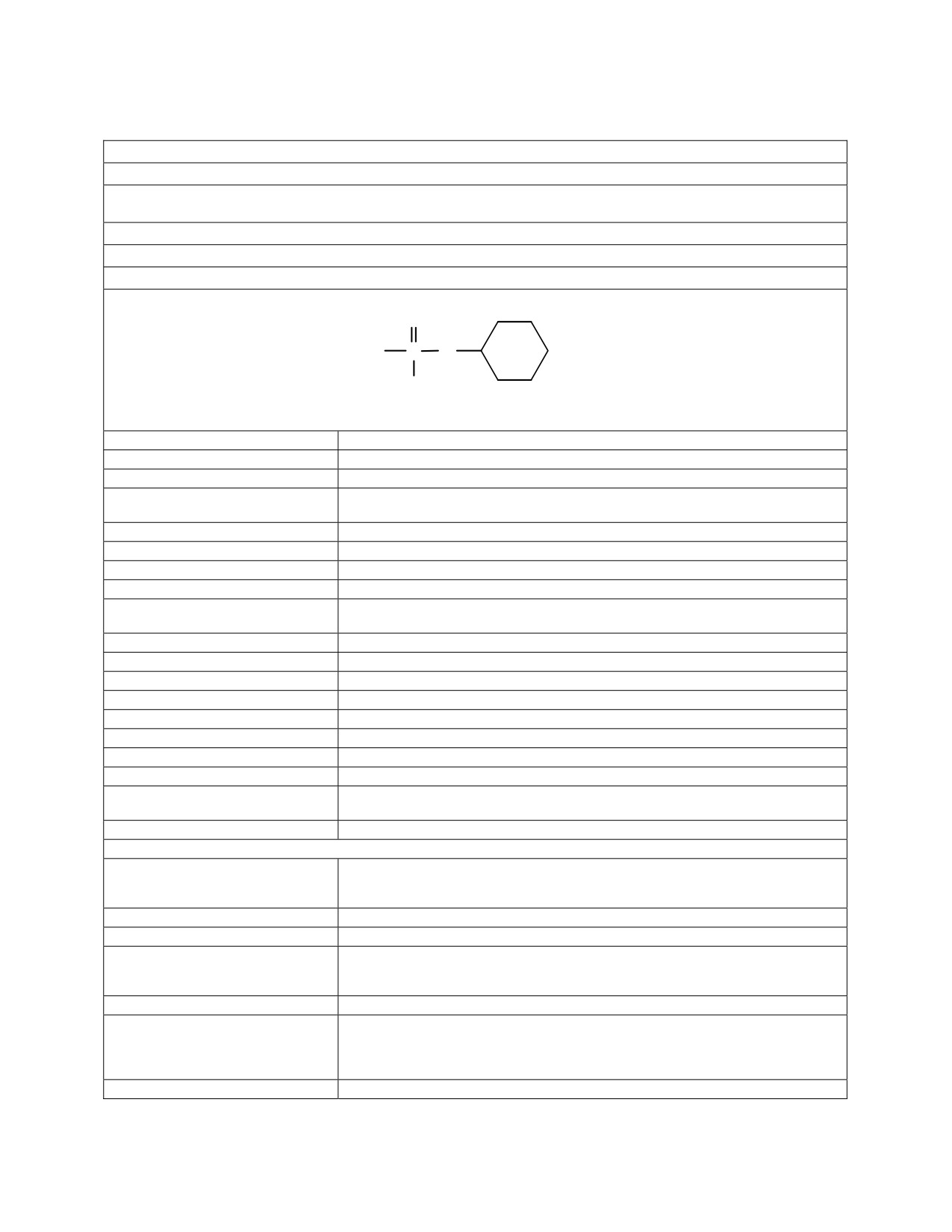
Table II-12. GF
Alternate Designations: EA 1212 (US); T-2139 (British); CMPF
Chemical Name: Cyclohexyl methylphosphonofluoridate
Synonyms: Cyclohexyloxyfluoromethylphosphine oxide; Cyclohexyl methylfluorophosphate; Phosphonofluoridic acid,
methyl-, cyclohexyl ester; Methyl cyclohexylfluorophosphonate
CAS Registry Number: 329-99-7
RTECS Number: TA 8225000
Physical and Chemical Properties
Structural Formula:
O
CH3
P
O
F
Molecular Formula: C7H14FO2P
Molecular Weight: 180.16
Physical State
Colorless liquid 1
Odor
None if pure 2
Boiling Point
228oC (extrapolated) 3
FP/MP
-30 to -50oC (FP); 4 -12oC (MP); below -30oC, a metastable crystalline form of GF
is produced which slowly converts into a stable form that melts @ -12oC 5
Liquid Density (g/mL)
1.1276 @ 25oC; 1.1525 @ 0oC (extrapolated) 4
Vapor Density (relative to air)
6.2 (calculated)
Vapor Pressure (torr)
9.27 x 10⁻² @ 25oC; 9.78 x 10⁻³ @ 0oC (extrapolated) 3
Volatility (mg/m3)
8.98 x 10² @ 25oC; 1.03 x 10² @ 0oC (calculated from vapor pressure) 3
Latent Heat of Vaporization
14.3 @ 25oC; 14.8 @ 0oC (calculated from vapor pressure) 3
(kcal/mol)
Flash Point
94oC 6
Viscosity (cP)
5.41 @ 25.0oC, 14.762 @ 0oC (extrapolated)6
Viscosity of Vapor (cP)
6.15 x 10⁻³ @ 25.0oC, 5.5 x 10⁻³ @ 0oC6
Surface Tension (dynes/cm)
32.3 @ 25.5oC6
Decomposition Temperature
Completely decomposes within 2 hrs @ 150oC 7
Solubility
Solubility in water is 3.7 g GF/100g @ 20oC; 5.1 g GF/100 g @ 0oC 6
Rate of Hydrolysis
t1/2 = 42 hrs @ 25oC using a 0.003 M solution of GF in distilled water 8
Hydrolysis Products
Hydrogen fluoride and cyclohexyl methylphosphonic acid 5
Stability in Storage
Stabilized GF can be stored @ 71oC for at least 6 months in glass containers and at
least 1 year in steel and aluminum containers. 9
Action on Metals or Other Materials
Corrosion rate on steel is 0.000053 inch/month @ 65oC 10
Other Data
Skin and eye toxicity
Eyes: very high toxicity; much greater through eyes than through skin. Skin: highly
toxic; decontamination of smallest drop of liquid agent is essential; liquid penetrates
skin 11.
Inhalation toxicity
Most toxic route of exposure 12
Rate of action
Rapid 13
Means of detection
M8 paper, M9 paper, M256A1 CADK, M8A1 ACAA, M90 AMAD, M21 ACAA, M22
ACADA, CAM/ICAM, M272 Water Testing Kit, , CAPDS, IPDS, AN/KAS-1 CWDD
M18A3 CADK, 14 M18A2 CADK, MM1
Protection required
MOPP4; liquid nerve agents penetrate ordinary clothing rapidly 11.
Decontamination
Flush eyes with water immediately. Use the M291 SDK to remove any liquid nerve
agent on skin or clothing. Use the M295 IEDK for individual equipment.11 STB is
effective on equipment. Water, steam, and absorbents (earth, sawdust, ashes, and
rags) are effective for physical removal. 15
Use
Quick-acting casualty agent
II-24
Table II-12. GF (Continued)
NOTES
1Eakle, B.F., Chemical Agent GF (U), Technical Study 69-C4, USA Desert Test Center, Fort Douglas, Utah, January 1969,
UNCLASSIFIED Report (AD509689).
2Chemical Agent Data Sheets Vol. II, Edgewood Arsenal Special Report EO-SR-74002, USA Armament Command,
Edgewood Arsenal, Aberdeen Proving Ground, MD, December 1974, CONFIDENTIAL Report (AD000020).
3Tevault, D.E., et al., Vapor Pressure of GF, TR-304S, USA ECBC, Aberdeen Proving Ground, MD, submitted for
publication 2 May 2003, UNCLASSIFIED Report.
4Zeffert, B.M., and Coulter, P.B., Physical Constants of G-Series Compounds: EA1210, EA1211, EA1212, EA1213, EA1214,
Technical Division Memorandum Report 1292), July 1947, USA Chemical Research and Development Laboratories, Army
Chemical Center, MD, July 1947, UNCLASSIFIED Report (ADB964904).
5Chinn, Kenneth, S. K., Joint CB Technical Data Source Book, Volume III, G Nerve Agents, Part Three: Agents GD and GF
(U), DPG-TR-82-004, USA Dugway Proving Ground, Utah, August 1983, SECRET Report (ADC032927).
6Samuel, J.B., et al., Physical Properties of Standard Agents, Candidate Agents, and Related Compounds at Several
Temperatures (U), ARCSL-SP-83015, USA Armament Research and Development Command, Aberdeen Proving Ground,
MD, June 1983, UNCLASSIFIED Report (ADC033491).
7Perry, B.J., et al., The Chemistry of the Alkylfluorophosphonites and Related Compounds, Porton Technical Paper No. 258,
Chemical Defense Experimental Establishment, Porton, England, 31 August 1951, UNCLASSIFIED Report (ADE481528).
8Buckles, L.C., The Hydrolysis Rate of G Agents, TCIR 393, USA Chemical Research and Development Laboratories, Army
Chemical Center, MD, December 1947, UNCLASSIFIED Report (ADB966236).
9Grula, R.S., et al., Storage Stability of GD, GF and EA 1356 (U), CRDLR 3342, USA Chemical Research and Development
Laboratories, Edgewood Arsenal, MD, December 1965, CONFIDENTIAL Report (AD369299).
10Kaiser, W.A., Summary of Information on Agent GF, CRLR 164, USA Chemical Research and Development Laboratories,
Army Chemical Center, MD, March 1954, UNCLASSIFIED Report (ADB969120).
¹¹FM 8-285/NAVMED P-5041/AFJMAN 44-149/FMFM 11-11, Treatment of Chemical Agent Casualties and Conventional
Military Chemical Injuries, 22 December 1995.
12Sharon Reutter, et al., Review and Recommendations for Human Toxicity Estimates for FM 3-11.9, ECBC-TR-349,
September 2003.
13NIOSH-DOD-OSHA Sponsored Chemical and Biological Respiratory Protection Workshop Report, February 2000.
14DOD Chemical And Biological Defense Program Annual Report to Congress, Volume I, April 2003.
15FM 3-5/MCWP 3-37.3, NBC Decontamination, 28 July 2000.
k.
GF Toxicity Estimates (Table II-13, page II-26). Note that for an
inhalation/ocular exposure the TLE is greater than 1. This means that the effective dosage
increases with longer exposure durations and the concentration of the agent decreases.
II-25

Table II-13. GF Toxicity Estimates10
Endpoint
Toxicity
MV (L)
Exposure
ROE
Probit
TLE
ROD
DOC
(mg-min/m3)
Duration
Slope
Lethality
LD50: 350 mg
N/A
N/A; 70-kg
Percutaneous
5
N/A
Unknown
Low
a
man
Liquid b
LCt50:
35 a
15
2 min
Inhalation/
12
1.25 c
Some
Moderate
Ocular
LCt50:
3000 a,d
N/A
30-360 min
Percutaneous
5
1 c,f
Unknown
Low
Vapor e
LCt50:
1500 g,h
N/A
30-360 min
Percutaneous
5
1 c,f
Unknown
Low
(provisional)
Vapor e
Severe effects,
ED50: 200 mg
N/A
N/A; 70-kg
Percutaneous
5
N/A
Unknown
Low
a
includes some
man
Liquid b
deaths
ECt50 25 a
15
2 min
Inhalation/
12
1.25 c
Some
Moderate
Ocular
ECt50: 2000 a,d
N/A
30-360 min
Percutaneous
5
1 c,f
Unknown
Low
Vapor e
ECt50 1000 g,h
N/A
30-360 min
Percutaneous
5
1 c,f
Unknown
Low
(provisional)
Vapor e
Threshold
ECt50: 300 a,d
N/A
30-360 min
Percutaneous
6
1 c,f
Unknown
Low
effects
Vapor e
ECt50: 150 g,h
N/A
30-360 min
Percutaneous
6
1 c,f
Unknown
Low
(provisional)
Vapor e
Mild effects
ECt50: 0.2 i
N/A
2 min
Inhalation/
10
1.4 c
Some
Low
(miosis,
Ocular
rhinorrhea)
NOTES
aBased on Grotte and Yang (2001).
bBare skin.
cSee Appendix H for supporting toxicity profile estimates.
dModerate temperatures (65-85°F).
eAssumes personnel are masked with eye protection and bare skin.
fThe TLE value is assumed to be 1 because the Ct profile is unknown.
gHot temperatures (greater than 85°F).
hBased on recommendations for GB.
iBased on recommendations for GD.
l.
O-ethyl methyl phosphonothiolate (VX) (see Table II-14). VX is a colorless and
odorless liquid when pure.13 Although VX is significantly less volatile than the other
agents, it does vaporize to some extent and is extremely potent. A significant component of
the hazard or airborne VX is percutaneous absorption of the vapor.10 See Table II-15 (page
II-29) for toxicity estimates.
II-26

Table II-14. VX
Alternate Designations: EA 1701; TX60
Chemical Name: O-Ethyl-S-(2-diisopropylaminoethyl) methyl phosphonothiolate
Synonyms: S-(2-Diisopropylaminoethyl) O-ethyl methyl phosphonothiolate; Ethyl-S-dimethylaminoethyl
methylphosphonothiolate; Phosphonothioic acid, methyl-, S-(2-(diisopropylamino)ethyl) O-ethyl ester; Ethyl S-2-
diisopropylaminoethyl methylphosphonothiolate; Ethyl-S-diisopropylaminoethyl methylthiophosphonate;
Methylphosphonothioic acid S-(2- (bis(methylethyl)amino)ethyl) O-ethyl ester;
O-Ethyl-S-2-diisopropylaminoethylester
kyseliny methylthiofosfonove (Czech)
CAS Registry Number: 50782-69-9
RTECS Number: TB1090000
Physical and Chemical Properties
Structural Formula:
O
CH(CH3)2
CH3CH2
O P S
CH2CH2
N
CH(CH3)2
CH3
Molecular Formula: C11H26NO2PS
Molecular Weight: 267.37
Physical State
Colorless liquid when pure 1
Odor
Odorless when pure 1
Boiling Point
292oC (extrapolated) 2
FP/MP
Below -51oC and -39 to -60oC (FP) 3-5
Liquid Density (g/mL)
1.0083 @ 25oC; 1.0209 @ 0oC (extrapolated) 4
Vapor Density (relative to air)
9.2 (calculated)
Vapor Pressure (torr)
8.78 x 10⁻⁴ @ 25oC; 4.22 x 10⁻⁵ @ 0oC (extrapolated) 2
Volatility (mg/m3)
1.26 x 101 @ 25oC; 6.62 x 10⁻¹ @ 0oC (calculated from vapor pressure) 2
Latent Heat of Vaporization
19.2 @ 25oC; 20.1 @ 0oC; (calculated from vapor pressure) 2,6
(kcal/mol)
Viscosity (cP)
10.041 @ 25.0oC, 37.532 @ 0oC (extrapolated)3
Viscosity of Vapor (cP)
5.13 x 10⁻³ @ 25.0oC, 4.63 x 10⁻³ @ 0oC3
Surface Tension (dynes/cm)
31.3 @ 25.0oC, 37.7 @ 0oC3
Flash Point
127oC (continuously closed cup method) 7
Decomposition Temperature
t1/2 = 502 days @ 71oC; t1/2 = 41 days @ 100oC; t1/2 = 34.5 hrs @ 150oC; t1/2 = 10
hrs @ 170oC; 8 t1/2 = 1.6 hrs @ 200oC; t1/2 = 4 min @ 250oC; t1/2 = 36 sec @ 295oC
5
Solubility
Water solubility of VX is 5% @ 21.5oC; 4 miscible with water below 9.4oC; 4 soluble
in common organic solvents 5
Rate of Hydrolysis
Hydrolysis rate of VX varies with temperature and concentration. At 22oC, t1/2 = 1.8
min [1.25M NaOH]; t1/2 = 10.8 min [0.25M NaOH]; t1/2 = 31 min. [0.10M NaOH]; t1/2 =
3.3 hrs [0.01M NaOH]; t1/2 = 20.8 hrs [0.001M NaOH]; and t1/2 = 60 hrs [pure H2O] 9
Hydrolysis Products
VX hydrolyzes via three different pathways (P-S, P-O, and C-S), which vary
significantly with temperature and pH. At pH below 12, the P-O bond cleavage path
produces ethyl methylphosphonate (EMPA) and the toxic S-[2-
diisopropylaminoethyl] methylphosphonothiolate ion (EA 2192). At room
temperature EA 2192 reacts very slowly with OH- [EA 2192, t1/2 = 7.4 days (1.0M
NaOH)] eventually producing less toxic products. 9,10 Using an equimolar ratio of
VX and water at elevated temperatures appears to reduce the persistency of EA
2192. 11
Stability in Storage
Relatively stable @ ambient temperature; unstabilized VX of 95% purity
decomposes at a rate of 5% a month @ 71oC. 13 Highly purified VX is stable in both
glass and steel. 1
Action on Metals or Other Materials
Negligible on brass, steel, and aluminum; slight corrosion with copper 12
II-27

Table II-14. VX (Continued)
Other Data
Skin and eye toxicity
Extremely toxic by skin and eye absorption 14
Inhalation toxicity
Extremely potent 15
ROA
Rapid 16
Means of detection
M8 paper, M9 paper, M256A1 CADK, M8A1 ACAA, M90 AMAD, M22 ACADA,
CAM/ICAM, M272 Water Testing Kit, CAPDS, IPDS, AN/KAS-1 CWDD, M18A3
CADK,17 M18A2 CADK, MM1
Protection required
MOPP4; liquid nerve agents penetrate ordinary clothing rapidly 14
Decontamination
Flush eyes with water immediately. Use the M291 SDK to remove any liquid nerve
agent on skin or clothing. Use the M295 IEDK for individual equipment.14 STB,
HTH, or household bleach are effective on equipment. Water, soaps, detergents,
steam, and absorbents (earth, sawdust, ashes, and rags) are effective for physical
removal. 18
Use
Quick-acting casualty agent
NOTES
1Witten, B., The Search for Toxic Chemical Agents (U), EATR 4210, Edgewood Arsenal Research Laboratories, MD,
November 1969, UNCLASSIFIED Report (AD507852).
2Buchanan, J.H., et al., Vapor Pressure of VX, ECBC-TR-068, USA Soldier and Biological Chemical Command, Aberdeen
Proving Ground, MD, November 1999, UNCLASSIFIED Report (ADA371297).
3Samuel, J.B., et al., Physical Properties of Standard Agents, Candidate Agents, and Related Compounds at Several
Temperatures (U), ARCSL-SP-83015, June 1983, USA Armament Research and Development Command, Aberdeen
Proving Ground, MD, UNCLASSIFIED Report (ADC033491).
4Coulter, P.B., et al., Physical Constants of Thirteen V Agents, CWLR 2346, USA Chemical Warfare Laboratories, Army
Chemical Center, MD, December 1959, UNCLASSIFIED Report (AD314520).
5Chemical Agent Data Sheets Volume I, Edgewood Arsenal Special Report EO-SR-74001, USA Armament Command,
Edgewood Arsenal, Aberdeen Proving Ground, MD, December 1974, UNCLASSIFIED Report (ADB028222).
6Abercrombie, P., ECBC Notebook # NB 98-0079, p. 11 (U).
7Butrow, B., ECBC Notebook # NB 97-0109 (C).
8Rohrbaugh, D.K., et al., Studies in Support of SUPLECAM (Surveillance Program for Lethal Chemical Agents and
Munitions) II, 1. Thermal Decomposition of VX, CRDEC-TR-88056, USA Chemical Research, Development and Engineering
Center, Aberdeen Proving Ground, MD, May 1988, UNCLASSIFIED Report (ADB124301).
9 Yang, Y, et al., “Hydrolysis of VX: Activation Energies and Autocatalysis,” In Proceedings of the 1994 ERDEC Scientific
Conference on Chemical Biological Defense Research 15-18 November1994, UNCLASSIFIED Paper (ADE479900),
ERDEC-SP-036, pp. 375-382, USA Edgewood Research, Development and Engineering Center, Aberdeen Proving
Ground, MD, May 1996, UNCLASSFIED Report (ADA313080).
10Yang, Y., et al., “Perhydrolysis of Nerve Agent VX,” J. Org. Chem, Vol. 58, p. 6965, 1993.
11Yang, Y., et al., “Hydrolysis of VX with Equimolar Water at Elevated Temperatures: Activation Parameters of VX, CV and
EA 2192,” In Proceedings of the 1996 ERDEC Scientific Conference on Chemical Biological Defense Research 19-22
November1996, UNCLASSIFIED Paper (ADE487572), ERDEC-SP-048, pp. 599-605, USA Edgewood Research,
Development and Engineering Center, Aberdeen Proving Ground, MD, October 1997, UNCLASSFIED Report
(ADA334105).
12Eckhaus, S.R., et al., Resistance of Various Materials of Construction in Contact with Transester Process, CWL Technical
Memorandum 31-73, USA Chemical Research and Development Laboratories, Army Chemical Center, MD, February 1959,
UNCLASSIFIED Report (ADB963125).
13Salamon, M.K., Agent VX, CWL Special Publication 4-10, USA Chemical Warfare Laboratories, Army Chemical Center,
MD, June 1959, UNCLASSIFIED Report (ADE471109).
14FM 8-285/NAVMED P-5041/AFJMAN 44-149/FMFM 11-11, Treatment of Chemical Agent Casualties and Conventional
Military Chemical Injuries, 22 December 1995.
15Sharon Reutter, et al., Review and Recommendations for Human Toxicity Estimates for FM 3-11.9, ECBC-TR-349,
September 2003.
16NIOSH-DOD-OSHA Sponsored Chemical and Biological Respiratory Protection Workshop Report, February 2000.
17DOD Chemical And Biological Defense Program Annual Report to Congress, Volume I, April 2003.
18FM 3-5/MCWP 3-37.3, NBC Decontamination, 28 July 2000.
m. VX Toxicity Estimates (see Table II-15). VX is unlike the G agents in that the Ct
profile for vapor inhalation appears to obey Haber’s Law. However, some data indicates
that the TLE may be less than one. If it does obey the toxic load principle (Cnt = k) where
the TLE (n) is less than one, it means that the ECt50 does not increase with longer
exposures at lower concentrations; in fact, it may actually decrease.9
II-28

Table II-15. VX Toxicity Estimates10
Endpoint
Toxicity
MV (L)
Exposure
ROE
Probit
TLE
ROD
DOC
(mg-min/m3)
Duration
Slope
Lethality
LD50: 5 mg a
N/A
N/A; 70-kg
Percutaneous
6
N/A
Unknown
Low
man
Liquid b
LCt50:
15 a
15
2-360 min
Inhalation/
6
1 c
Little, if any
Low d
Ocular
LCt50:
150 a,e
N/A
30-360 min
Percutaneous
6
1 c,g
Little, if any
Low
Vapor f
LCt50:
75 h, i
N/A
30-360 min
Percutaneous
5
1 c,g
Little, if any
Low
(Provisional)
Vapor f
Severe effects,
ED50: 2 mg a
N/A
N/A; 70-kg
Percutaneous
6
N/A
Unknown
Low
includes some
man
Liquid b
deaths
ECt50: 10 a
15
2-360 min
Inhalation/
6
1 c
Little, if
Low d
Ocular
any
ECt50: 25 a,e
N/A
30-360 min
Percutaneous
6
1 c,g
Unknown
Moderate
Vapor f
ECt50: 12 h,I
N/A
30-360 min
Percutaneous
6
1 c,g
Unknown
Low
(Provisional)
Vapor f
Threshold effects
ECt50: 10 a,e
N/A
30-360 min
Percutaneous
6
1 c,g
Unknown
Moderate
(Slight ChE
Vapor f
inhibition)
ECt50: 5 h,i
N/A
30-360 min
Percutaneous
6
1 c,g
Unknown
Low
Vapor f
Mild effects
ECt50: 0.1 a
N/A
2-360 min
Inhalation/
4
1 c,g,j
Some
Low
(miosis,
Ocular
rhinorrhea)
NOTES
aBased on Grotte and Yang (2001).
bBare skin.
cSee Appendix H for supporting toxicity profile estimates.
dLCt50 /ECt50 could be less.
eModerate temperatures (65-85°F).
fAssumes personnel are masked with eye protection and bare skin.
gThe TLE value is assumed to be 1 because the Ct profile is unknown.
hHot temperatures (greater than 85°F).
iBased on recommendations for GB and Cummings and Craig (1965).
jEstimates should be revised as new data becomes available; human estimate for miosis may go down.
n. Vx (see Table II-16) [page II-30]. Another V agent of interest is Vx, called “V sub
x”. Information on this agent is limited. Based upon percutaneous liquid exposure, it
appears to be less potent than VX. However, it is decidedly more potent than the G agents.
It is also noted that it is more volatile than VX, so its potential airborne hazard is greater
than that for VX.10 See Table II-17 (page II-31) for toxicity estimates.
II-29

Table II-16. Vx
Alternate Designations: EA 1699; EDMM; Medemo
Chemical Name: O-ethyl S-(2-dimethylaminoethyl) methylphosphonothiolate
Synonyms: Phosphonothioic acid, methyl-, S-[2-(dimethylamino)ethyl] O-ethyl ester; O-Aethyl-S-(2-dimethylaminoaethyl)-
methylphosphonothioat (German); S-2- Dimethylaminoethyl-O-ethylester kyseliny methylthiofosfonove (Czech); O-Ethyl-S-
(dimethylaminoethyl)-methylphosphonothioate
CAS Registry No: 20820-80-8
RTECS Number: 51366-09-7
Physical and Chemical Properties
Structural Formula:
O
CH3
CH3CH2
O P S
CH2CH2
N
CH3
CH3
Molecular Formula: C7H18NO2PS
Molecular Weight: 211.26
Physical State
Liquid 1
Odor
Odorless2
Boiling Point
256oC (extrapolated) 3, 4
FP/MP
Data not available
Liquid Density (g/mL)
1.060 @ 25oC; 1.0820 @ 0oC (extrapolated) 1
Vapor Density (relative to air)
7.3 (calculated)
Vapor Pressure (torr)
6.73 x 10⁻³ @ 25oC; 5.7 x 10⁻⁴ @ 0oC (extrapolated) 3,4
Volatility (mg/m3)
7.64 x 101 @ 25oC; 7.02 @ 0oC (calculated from vapor pressure) 3,4
Latent Heat of Vaporization (kcal/mol)
16.0 @ 25oC; 16.1 @ 0oC (calculated from vapor pressure) 3,4
Viscosity (cP)
5.628 @ 25.0oC, 15.335 @ 0oC (extrapolated)3
Viscosity of Vapor (cP)
5.56 x 10⁻³ @ 25.0oC, 5.02 x 10⁻³ @ 0oC3
Surface Tension (dynes/cm)
31.4 @ 25.0oC, 33.7 @ 0oC (extrapolated)3
Flash Point
Data not available
Decomposition Temperature
Data not available
Solubility
Soluble in organic solvents; slightly soluble in water (source unidentified)
Rate of Hydrolysis
The rate coefficient for 7.8 x 10⁻³ hr-1 (based on a nonlinear least square fit) 5
Hydrolysis Products
Ethanol and the toxic product compound S-(2-dialkylamino-ethyl)
methylphosphonothioic acid that is very stable in neutral water3
Stability in Storage
Data not available
Action on Metals or Other Materials
Data not available
Other Data
Skin and eye toxicity
Extremely toxic by skin and eye absorption 6
Inhalation Toxicity
Extremely potent 7
Rate of action
Rapid 8
Means of detection
M8 paper, M9 paper, M8A1, IPDS, CAM/ICAM, M18A2 CADK, MM17
Protection required
MOPP4; liquid nerve agents penetrate ordinary clothing rapidly 6
Decontamination
Flush eyes with water immediately. Use the M291 SDK to remove any liquid nerve
agent on skin or clothing. Use the M295 IEDK for individual equipment.5 STB,
HTH, or household bleach is effective on equipment. Water, soaps, detergents,
steam, and absorbents (earth, sawdust, ashes, and rags) are effective for physical
removal. 10
Use
Quick-acting casualty agent
II-30

Table II-16. Vx (Continued)
NOTES
1Coulter, P.B., et al., Physical Constants of Thirteen V Agents (U), CWLR 2346, USA Chemical Warfare Laboratories, Army
Chemical Center, MD, December 1959, UNCLASSIFIED Report (AD314520).
2TM 3-215/AFM, Military Chemistry and Chemical Agents, Washington DC, December 1963, UNCLASSIFIED Technical
Manual (ADA 292141).
3Samuel, J.B., et al., Physical Properties of Standard Agents, Candidate Agents, and Related Compounds at Several
Temperatures (U), ARCSL-SP-83015, June 1983, USA Armament Research and Development Command, Aberdeen
Proving Ground, MD, UNCLASSIFIED Report (ADC033491).
4Newman, J.H., Edgewood Arsenal Notebook # NB 9298, p. 64 (U).
5Szafraniec, L.J., et al., On the Stoichiometry of Phosphonothiolate Ester Hydrolysis, CRDEC-TR-212, USA Chemical
Research Development & Engineering Center, Aberdeen Proving Ground, MD, July 1990, UNCLASSIFIED Report
(ADA225952).
6FM 8-285/NAVMED P-5041/AFJMAN 44-149/FMFM 11-11, Treatment of Chemical Agent Casualties and Conventional
Military Chemical Injuries, 22 December 1995.
7Sharon Reutter, et al., Review and Recommendations for Human Toxicity Estimates for FM 3-11.9, ECBC-TR-349,
September 2003.
8NIOSH-DOD-OSHA Sponsored Chemical and Biological Respiratory Protection Workshop Report, February 2000.
9DOD Chemical And Biological Defense Program Annual Report to Congress, Volume I, April 2003.
10FM 3-5/MCWP 3-37.3, NBC Decontamination, 28 July 2000.
Table II-17. Vx Toxicity Estimates10
Endpoint
Toxicity
MV (L)
Exposure
ROE
Probit
TLE
ROD
DOC
(mg-min/m3)
Duration
Slope
N/A
No toxicity estimates
N/A
N/A
N/A
N/A
N/A
Unknow
N/A
are recommended at
n
this time because data
are lacking.
6.
Blood Agents
Blood agents include AC, CK, and SA. The cyanogen blood agents AC and CK affect
the bodily functions by inactivating the cytochrome oxidase system.18 This poisoning
prevents cell respiration and the normal transfer of oxygen from the blood to body tissues.18
SA causes hemolysis of the red blood cells.19 Cyanogen agents are highly volatile and,
therefore, nonpersistent.20 Exposure at high concentrations causes effects within seconds
and death within minutes in unprotected personnel.18 The protective mask with fresh
filters gives adequate protection against field concentrations.1 After exposure to AC and
CK, filters should be changed.12 See FM 3-11.4 for filter change criteria.
a.
AC (see Table II-18 [page II-32]). Pure AC is a nonpersistent, colorless liquid
that is highly volatile. It has a faint odor, similar to bitter almonds, that sometimes cannot
be detected even in lethal concentrations.12 Inhalation of small amounts causes giddiness,
headache and faintness, confusion, palpitation and pain in the chest and region of the
heart, difficulty breathing, and ultimately unconsciousness.10 Inhalation of high
concentrations can initially cause breathing that is deeper and more rapid than is normal
at rest, followed closely by a loss of consciousness. This progresses to respiratory arrest,
cessation of cardiac activity, and death.18 Exposure to AC causes an increase in respiration
within a few seconds; a casualty may not be able to hold his breath. The pink color of the
casualty’s skin suggests AC poisoning.1 See Table II-19 (page II-33) for toxicity estimates.
II-31

Table II-18. AC
Alternate Designations: Cyclone (Russian); Cyclone B; Cyclon; Prussic acid, Forestite (French); Aero Liquid HCN
Chemical Name: Hydrogen cyanide
Synonyms: Hydrocyanic acid; Acide cyanhydrique (French); Acido cianidrico (Italian); Blausaeure (German); Blauwzuur
(Dutch); Carbon hydride nitride (chn); Cyaanwaterstof (Dutch); Cyanwasserstoff (German); Cyjanowodor (Polish); Evercyn;
Formic anammonide; Formonitrile
CAS Registry Number: 74-90-8
RTECS Number: MW6825000
Physical and Chemical Properties
Structural Formula:
H
C
N
Molecular Formula: HCN
Molecular Weight: 27.03
Physical State
Colorless liquid 1
Odor
Bitter almonds or peach kernels 2,3
Boiling Point
25.5oC 4,1
FP/BP
-13.3oC (MP) 1
Liquid Density (g/mL)
0.6797 @ 25oC; 0.7162 @ 0oC 5
Vapor Density (relative to air)
0.93 (calculated)
Vapor Pressure (torr)
7.60 x 10² @ 25.5oC; 7.46 x 10² @ 25.0oC; 2.65 x 10² @ 0oC 4,1
Volatility (mg/m3)
1.10 x 10⁶ @ 25.5oC; 1.08 x 10⁶ @ 25.0oC; 4.20 x 10⁵ @ 0oC (calculated from vapor
pressure) 4,1
Latent Heat of Vaporization
6.72 @ 25.5oC; 6.72 @ 25.0oC; 6.71 @ 0oC (calculated from vapor pressure)4,1
(kcal/mol)
Viscosity (cP)
Data not available
Viscosity of Vapor (cP)
Data not available
Surface Tension (dynes/cm)
Data not available
Flash Point
-18oC (closed cup); 3 frequently ignites when explosively disseminated6
Decomposition Temperature
Above 65.5oC when stabilized; 6 forms explosive polymer on standing; 2,3 stabilized
material can be stored up to 65oC 6
Solubility
Miscible with water and common organic solvents including alcohol and ether 7
Rate of Hydrolysis
Slow under acidic conditions; rapid with traces of base or basic salts 8
Hydrolysis Products
Ammonia, formic acid (HCOOH), and amorphous brown solids 9
Stability in Storage
Pure AC is unstable in storage; forms explosive polymer on long standing; 2,6 with
the use of a stabilizer such as phosphoric acid, sulfur dioxide, or powdered copper,
AC may be stored in metal containers for long periods of time @ temperatures up to
65oC 2,3,6
Action on Metals or Other Materials
Corrodes iron, cast iron, chromium steel, and lead 2
Other Data
Skin and eye toxicity
None
Inhalation toxicity
Can cause death within minutes. 10
Rate of action
Rapid 11
Means of detection
M256A1 CADK, M272 water testing kit, M18A2 CADK,12 M18A3, MMI
Protection required
Protective mask with fresh filter; MOPP 4 when exposed to or handling liquid AC 13
Decontamination
Move to fresh air; none required under field conditions 14
Use
Quick-acting casualty agent
II-32

Table II-18. AC (Continued)
NOTES
¹Giauque, W.F. and Ruehrwein, R.A., “The Entropy of Hydrogen Cyanide. Heat Capacity, Heat of Vaporization and Vapor
Pressure. Hydrogen Bond Polymerization of the Gas in Chains of Indefinite Length.” J. Am. Chem. Soc., Vol. 61, p. 2626,
1939.
²Franke, S., Manual of Military Chemistry Volume I- Chemistry of Chemical Warfare Agents, ACSI-J-3890, Chemie der
Kampfstoffe, East Berlin, April 1968, UNCLASSIFIED Report (AD849866).
³Lewis, R.J., Sax’s Dangerous Properties of Industrial Materials, 10th ed., Vol. 3, p. 1992, John Wiley & Sons, Inc., New
York, NY, 2001.
4Abercrombie, P., ECBC Notebook # NB 98-0079, p. 16 (U).
5Coates, J.E., and Davies, R.H., “Studies on Hydrogen Cyanide. Part XVIII. Some Physical Properties of Anhydrous
Hydrogen Cyanide,” J. Chem. Soc., p. 1194, 1950.
6W.R. Kirner, Summary Technical Report of Division 9, NDRC Volume 1, Chemical Warfare Agents, and Related Chemical
Problems Part I-II, Chapter 2, p. 7, Office of Scientific Research and Development, Washington, DC, 1946, UNCLASSIFIED
Report (AD234270).
7The Merck Index: An Encyclopedia of Chemicals, Drugs, and Biologicals, 13th ed., p. 857, Merck & Company, Inc.,
Whitehouse Station, NJ, 2001.
8Properties of War Gases Vol. II: Blood and Nettle Gases (U), ETF 100-41/Vol-2, Chemical Corps Board, Army Chemical
Center, Maryland, December 1956, CONFIDENTIAL Report (AD108457).
9Clark, D.N, Review of Reactions of Chemical Agents in Water, Final Report to USA Biomedical Research and Development
Laboratory, Battelle, Columbus, OH, January 1989, UNCLASSIFIED Report (ADA213287).
10BG Russ Zajtchuk et al. (eds), Textbook of Military Medicine: Medical Aspects of Chemical and Biological Warfare, Office
of the Surgeon General, 1997, Chap. 10, “Cyanide Poisoning.”
¹¹NIOSH-DOD-OSHA Sponsored Chemical and Biological Respiratory Protection Workshop Report, February 2000.
12AFMAN 10-2602, Nuclear, Biological, Chemical, and Conventional (NBCC) Defense Operations and Standards
(Operations), 29 May 2003.
13FM 8-285/NAVMED P-5041/AFJMAN 44-149/FMFM 11-11, Treatment of Chemical Agent Casualties and Conventional
Military Chemical Injuries, 22 December 1995.
14FM 8-9/NAVMED P-5059/AFJMAN 44-151, NATO Handbook on the Medical Aspects of NBC Defense Operations
AMEDP-6(B), 1 February 1996.
b.
AC Toxicity Estimates (Table II-19). Note that for an inhalation/ocular expouse
the TLE is greater than 1. This means that the effective dosage increases with longer
exposure durations and the concentration of the agent decreases. No toxicity effects for
severe effects is recommended. The existing estimate is not supported by the available
data.
Table II-19. AC Toxicity Estimates10
Endpoint
Toxicity
MV (L)
Exposure
ROE
Probit
TLE
ROD
DOC
(mg-min/m3)
Duration
Slope
Lethality
LCt50:
2860 a
15
2 min
Inhalation/
10
1.85 b
Some
Low
(Provisional)
Ocular
Severe effects
ECt50: NR
N/A
N/A
Inhalation/
Unknown
Unknown
Some
N/A
Ocular
Threshold/odor
EC50: 34 mg/m3 c
N/A
Seconds
Inhalation/
Unknown
N/A
N/A
Low
(odor detection)
Ocular
NOTES
aBased on McNamara (1976).
bSee Appendix H for supporting toxicity profile estimates.
cBased on TM 3-215 (1952) and secondary human data.
c.
CK (see Table II-20 [page II-34]). CK is a colorless gas with an irritating odor.13
It is nonpersistent and is used as a quick-acting casualty agent.20 It is readily detectable by
its immediate lacrimatory effect and its irritant effect on the nasal passage.20 At high
concentrations CK produces effects similar to AC.10 However, in occasional instances, lung
irritation can lead to pulmonary edema.20 See Table II-21 (page II-35) for CK toxicity
estimates.
II-33

Table II-20. CK
Alternate Designations: Mauguinite (French); CC; Klortsian
Chemical Name: Cyanogen chloride
Synonyms: Chlorcyan; Chlorine cyanide; Chlorocyan; Chlorocyanide; Chlorocyanogen; Chlorure de cyanogene (French)
CAS Registry Number: 506-77-4
RTECS Number: GT2275000
Physical and Chemical Properties
Structural Formula:
Cl
C
N
Molecular Formula: CNCl
Molecular Weight: 61.47
Physical State
Colorless gas 1
Odor
Lacrimatory and irritating 2
Boiling Point
12.8°C (calculated) 3-5
FP/MP
-6.9°C (FP)5
Liquid Density (g/mL)
1.202 @ 10°C; 1.222 @ 0°C 4
Vapor Density (relative to air)
2.1 (calculated)
Vapor Pressure (torr)
7.60 x 10² @ 12.8°C; 6.80 x 10² @ 10°C; 4.48 x 10² @ 0°C 3-5
Volatility (mg/m3)
2.62 x 10⁶ @ 12.8°C; 2.37 x 10⁶ @ 10°C; 1.62 x 10⁶ @ 0°C (calculated from vapor
pressure) 3-5
Latent Heat of Vaporization
6.40 @ 12.8°C; 6.41 @ 10°C; 6.44 @ 0°C calculated from vapor pressure) 3-5
(kcal/mol)
Viscosity (cP)
Data not available
Viscosity of Vapor (cP)
Data not available
Surface Tension (dynes/cm)
Data not available
Flash Point
Nonflammable 2
Decomposition Temperature
Approximately 149°C 6
Solubility
Solubility of liquefied CK in water is 71.4 g/L @ 20°C, 7 soluble in common organic
solvents, sulfur mustard, and AC 1
Rate of Hydrolysis
The hydrolysis rate of CK with tap water is t1/2 = 180 hrs @ ambient temperature and
pH 7 8
Hydrolysis Products
Hydrogen chloride and cyanic acid (CNOH) 9
Stability in Storage
CK is stable in glass containers for long periods of time even @ elevated
temperatures. Stable in steel containers for at least 1 year @ ambient temperature,
but only about 9 weeks @ 60°C, after which time the gas begins to polymerize with
formation of the corrosive solid, cyanuric chloride. Impurities have a tendency to
promote explosive polymerization. 10,2 When stabilized using 5% anhydrous,
powdered sodium pyrophosphate, munitions grade CK with a water content of less
than 0.5% can be stored in most common metals for extended periods of time @
temperatures up to 100°C. 2
Action on Metals or Other Materials
None if CK is dry; slowly polymerizes when stored unstabilized in steel and other
common metals @ elevated temperatures (see stability in storage section) 2
Other Data
Skin and eye toxicity
Irritation to eyes similar to RCAs 11
Inhalation toxicity
Can cause death within minutes 11
Rate of action
Rapid 12
Means of detection
M256A1 CADK, M272 water testing kit, M18A2 CADK, M18A3 CADK, MMI 13
Protection required
Protective mask with fresh filters 14
Decontamination
Move to fresh air; none required under field conditions 15
Use
Quick-acting casualty agent
II-34

Table II-20. CK (Continued)
NOTES
1Franke, S., Manual of Military Chemistry Volume I - Chemistry of Chemical Warfare Agents, ACSI-J-3890, Chemie der
Kampfstoffe, East Berlin, April 1968, UNCLASSIFIED Report (AD849866).
2W.R. Kirner, Summary Technical Report of Division 9, NDRC Volume 1, Chemical Warfare Agents, and Related Chemical
Problems Part I-II, Chapter 2, Office of Scientific Research and Development, Washington, DC, 1946, UNCLASSIFIED
Report (AD234270).
3Abercrombie, P., ECBC Notebook # NB 98-0079, p. 16 (U).
4Cook, R.P., and Robinson, P.L., “Certain Physical Properties of Cyanogen and its Halides,” J. Chem. Soc., p. 1001, 1935.
5Douglas, D.E., and Winkler, C.A., “The Preparation, Purification, Physical Properties and Hydrolysis of Cyanogen Chloride,”
Ca. J. Research, Vol. 25B, p. 381, 1947.
6Brooks, Marguerite E, et al., Incineration/Pyrolysis of Several Agents and Related Chemical Materials Contained in
Identification Sets, ARCSL-TR-79040, October 1979, UNCLASSIFIED Report (ADB042888).
7Carter, R.H., and Knight, H.C., Fundamental Study of Toxicity: Solubility of Certain Toxics in Water and in Olive Oil, EACD
445, Chemical Warfare Service, Edgewood Arsenal, MD, May 1928, UNCLASSIFIED Report (ADB955216).
8Price, C.C., et al., “Hydrolysis and Chlorinolysis of Cyanogen Chloride”, J. Amer. Chem. Soc., Vol. 69, p. 1640, 1947.
9Edwards, J.O., and Sauer, M., Chemical Reactivity of Cyanogen Chloride in Aqueous Solution, Quarterly Status Report
(March through May 1972), Report No. III, DAAA15-71-C-0478-QSR 3, USA Chemical Laboratories, Edgewood Arsenal,
MD, February 1973, UNCLASSIFIED Report (ADA090556).
10Henley, F.M., Surveillance Tests on 75 mm Steel Gas Shell Extending Over a Period of One Year, EACD 11, Chemical
Warfare Service, Edgewood Arsenal, MD, June 1920, UNCLASSIFIED Report (ADB959731).
11BG Russ Zajtchuk et al. (eds), Textbook of Military Medicine: Medical Aspects of Chemical and Biological Warfare, Office
of the Surgeon General, 1997, Chap. 10, “Cyanide Poisoning.”
¹²NIOSH-DOD-OSHA Sponsored Chemical and Biological Respiratory Protection Workshop Report, February 2000.
13AFMAN 10-2602, Nuclear, Biological, Chemical, and Conventional (NBCC) Defense Operations and Standards
(Operations), 29 May 2003.
14FM 8-285/NAVMED P-5041/AFJMAN 44-149/FMFM 11-11, Treatment of Chemical Agent Casualties and Conventional
Military Chemical Injuries, 22 December 1995.
15FM 8-9/NAVMED P-5059/AFJMAN 44-151, NATO Handbook on the Medical Aspects of NBC Defense Operations
AMEDP-6(B), 1 February 1996.
d.
CK Toxicity Estimates (Table II-21). Note that for an inhalation/ocular expouse
the TLE is greater than 1. This means that the effective dosage increases with longer
exposure durations and the concentration of the agent decreases. No toxicity estimates for
lethal and severe effects are recommended. The existing estimates are not supported by
the available data.
Table II-21. CK Toxicity Estimates10
Endpoint
Toxicity
MV (L)
Exposure
ROE
Probit
TLE
ROD
DOC
(mg-min/m3)
Duration
Slope
Lethality
LCt50: NR
N/A
N/A
Inhalation/
Unknown
More than 1
Probably
N/A
Ocular
Insignificant
Severe effects
ECt50: NR
N/A
N/A
Inhalation/
Unknown
More than 1
Probably
N/A
Ocular
Insignificant
Threshold
EC50: 12 mg/m3 a
N/A
Few
Inhalation/
N/A
N/A
N/A
Low
(odor
Seconds
Ocular
detection,
tearing)
NOTES
aBased on human data and TM 3-215 (1952).
e.
SA (see Table II-22 [page II-36]). SA is a colorless gas with a disagreeable,
garlic-like odor.13 Symptoms from inhalation exposure include abdominal pain, confusion,
dizziness, headache, nausea, shortness of breath, vomiting, and weakness. Severe exposure
damages blood, causing anemia and kidney damage.19 Exposure from liquid can cause
frostbite.19 See Table II-23 (page II-37) for toxicity estimates.
II-35

Table II-22. SA
Alternate Designations: Arthur
Chemical Name: Arsenic trihydride
Synonyms: Hydrogen arsenide, Arseniuretted hydrogen; Arsenic hydride; Arsenous hydride; Arsenowodor (Polish);
Aresenwasserstoff (German)
CAS Registry Number: 7784-42-1
RTECS Number: CG6475000
Physical and Chemical Properties
Structural Formula:
H As H
H
Molecular Formula: AsH3
Molecular Weight: 77.95
Physical State
Colorless gas 1
Odor
Disagreeable, garlic-like 1
Boiling Point
-62.2°C (extrapolated) 2
FP/MP
-116°C (MP) 2
Liquid Density (g/mL)
1.667 @ -75°C; 1.734 @ -100°C 2
Vapor Density (relative to air)
2.7 (calculated)
Vapor Pressure (torr)
4.00 x 10² @ -75°C and 8.69 x 10¹ @ -100°C 2
Volatility (mg/m3)
2.55 x 10⁶ @ -75°C and 6.27 x 10⁵ @ -100°C (calculated from vapor pressure) 2
Latent Heat of Vaporization (kcal/mol)
4.17 (calculated from Clausius Clapeyron equation which assumes constant heat
of vaporization as a function of temperature) 2
Viscosity (cP)
Data not available
Viscosity of Vapor (cP)
Data not available
Surface Tension (dynes/cm)
Data not available
Flash Point
Flammable; forms explosive mixtures with air 3
Decomposition Temperature
300°C 1
Solubility
Solubility of SA in water is 0.028 g/100 g @ 20°C,4 soluble in alkalis, halogen
alkanes, hydrocarbons, and benzene 3,4
Rate of Hydrolysis
Rapid in the presence of light.1 Slow, in the absence of light and air @ 15.5°C and
pH ~ 7; 32% of SA is hydrolyzed within 5 hrs and about 66% within 24 hrs 5
Hydrolysis Products
SA hydrolyzes to produce shiny black arsenic, which is also highly toxic 1
Stability in Storage
Unstable in most metal containers; metals catalyze decomposition;6 on exposure
to light, moist SA decomposes quickly, depositing shiny black arsenic 1
Action on Metals or Other Materials
Corrosive to most metals 6
Other Data
Skin and eye toxicity
Exposure to liquid causes frostbite 7
Inhalation toxicity
Acute toxicity is high 7
Rate of action
1-24 hours (dependent on concentration and exposure duration)7
Means of detection
MM1
Protection required
Protective mask with fresh filter; MOPP4 when exposed to or handling liquid SA 7
Decontamination
Move to fresh air; none required under field conditions8
Use
Delayed-action casualty agent
II-36

Table II-22. SA (Continued)
NOTES
¹The Merck Index: An Encyclopedia of Chemicals, Drugs, and Biologicals, 13th ed., p. 138, Merck & Company, Inc.,
Whitehouse Station, NJ, 2001.
²Johnson, W. and Pechukas, A., “Hydrogen Compounds of Arsenic. I. Preparation of Arsine in Liquid Ammonia Some
Physical Properties of Arsine,” J. Am. Chem. Soc., Vol. 59, p. 2065, 1937.
3Franke, S., Manual of Chemistry Volume I- Chemistry of Chemical Warfare Agents, ACSI-J-3890, Chemie der Kampfstoffe,
East Berlin, April 1968, UNCLASSIFIED Technical Manual (AD849866).
4Lewis, R.J., Sax’s Dangerous Properties of Industrial Materials, 10th ed., Vol. 2, p. 309, John Wiley & Sons, Inc., New
York, NY, 2001.
5Properties of War Gases Volume II: Blood and Nettle Gases (U), ETF 100-41/Vol-2, Chemical Corps Board, Army
Chemical Center, Maryland, December 1956, CONFIDENTIAL Report (AD108457).
6TM 3-215/AFM 355-7, Military Chemistry and Chemical Agents, Departments of the Army and the Air Force, Washington
DC, December 1963, UNCLASSIFIED Technical Manual (ADA292141).
7L. Fishbein and S. Czerczak, “Concise International Chemical Assessment Document 47: Arsine: Human Health Aspects,”
WHO, 2002.
8 FM 8-9/NAVMED P-5059/AFJMAN 44-151, NATO Handbook on the Medical Aspects of NBC Defense Operations
AMEDP-6(B), 1 February 1996.
Table II-23. SA Toxicity Estimates10
Endpoint
Toxicity
MV (L)
Exposure
ROE
Probit Slope
TLE
ROD
DOC
(mg-min/m3)
Duration
Lethality
LCt50:
7500 a
15
2 min
Inhalation/Ocular
Not Calculated
1.4 b
Some
Low
(Provisional)
NOTES
aBased on modeling of 6 species.
bSee Appendix H for supporting toxicity profile estimates.
7.
Blister Agents (Vesicants)
Blister agents are used to produce casualties, to degrade fighting efficiency, and to
restrict use of terrain and equipment.1 Blister agents are CW agents that act on the eyes,
mucous membranes, lungs, skin, and blood-forming organs.12 The most toxic route of
exposure is inhalation/ocular.10 The severity of a blister agent burn relates directly to the
concentration of the agent, the duration of contact with the skin,1 and the location on the
body. Most blister agents are insidious in action except for lewisite (L) and phosgene oxime
(CX), which cause immediate pain on contact. Assume MOPP4 whenever liquid or
vaporized agents are known to be present.1 Decontaminate within 1 or 2 minutes after
exposure to help prevent or decrease tissue damage.21 The blister agents are divided into
three groups: mustards, arsenicals, and urticants.
a.
Mustards. This group of agents includes the sulfur mustards (H and HD) and
the nitrogen mustards (HN-1, HN-2, and HN-3). Because of their physical properties,
mustards are persistent under cool conditions; however, evaporation increases as the
temperature increases.21 It is possible to increase their persistency even more by
dissolving them in thickeners.12
(1)
Distilled Mustard (HD) (see Table II-24 [page II-38]). HD is a pale yellow
to dark brown oily liquid with a garlic-like odor.13 The eyes and respiratory tract are the
most sensitive target organs.10 The latency period for ocular effects is shorter than that for
pulmonary effects, and acutely, ocular effects are more debilitating.10 Both mustard vapor
and liquid rapidly penetrate the skin. Warm, moist areas with thin skin (perineum,
external genitalia, underarms, inside elbow, and neck) are much more sensitive.21 Sweaty
skin absorbs more mustard than dry skin. With an increase in temperature (>85 degrees F)
and humidity, the effective dosages decrease and are about half of those for temperatures
from 65 to 75 degrees F.10 Mild symptoms caused from vapor exposure include tearing,
II-37

itchy, burning, gritty feeling in the eyes, rhinorrhea, sneezing, hoarseness, hacking cough,
and erythema. Severe symptoms include marked lid edema, possible corneal damage,
severe pain in the eyes, productive cough, dyspnea, and vesication.21 Repeated exposures
can cause an increase in sensitivity.21 See Table II-25 (page II-40) for toxicity estimates.
Table II-24. HD
Alternate Designations: EA 1033; HS; G.34; M.O; Kampstoff “Lost”; Mustard HD; Mustard gas; Mustard Sulfur; Mustard
vapor; S-Lost; Schewefel-lost; S mustard; Sulfur mustard gas; Sulfur mustard; Sulphur mustard; Sulphur mustard gas;
Yellow Cross liquid; Y; Yperite (French & German)
Chemical Name: Bis (2-chloroethyl) sulfide
Synonyms: 2, 2’-dichloroethyl sulfide; 1, 1’-Thiobis(2-chloroethane); β- β ‘-dichlorodiethyl sulphide; β ,β´-
dichloroethylsulfide di - (2-chloro-ethyl) sulfide; Sulfide, bis (2-chloroethyl); Bis (beta-chloroethyl)sulfide; Bis (2-
chloroethyl)sulfide; Bis (2-chloroethyl) sulphide; 1-Chloro-2-(beta-chloroethylthio)ethane; 2,2’-Dichlorodiethyl sulfide; Di-2-
chloroethyl sulfide; beta,beta’-Dichloroethyl sulfide; beta,beta-Dichlor-ethyl-sulphide; 2,2’-Dichloroethyl sulphide; Gelbkreuz
(Czech); 1,1’-Thiobis(2-chloroethane)
CAS Registry Number: 505-60-2
RTECS Number: WQ0900000
Physical and Chemical Properties
Structural Formula:
Cl-CH2-CH2-S-CH2-CH2-Cl
Molecular Formula: C4H8Cl2S
Molecular Weight: 159.07
Physical State
Pale yellow to dark brown oily liquid; 1 colorless when pure 1,2
Odor
Garlic-like 1,3 or horseradish 3
Boiling Point
218°C (extrapolated); at atmospheric pressure HD starts to decompose below the
boiling point 4
FP/MP
14.45°C (FP) 2
Solid Density (g/mL)
1.372 @ 0°C; 1.333 @ 10°C 5
Liquid Density (g/mL)
1.2685 @ 25°C 6
Vapor Density (relative to air)
5.5 (calculated)
Vapor Pressure (torr)
1.06 x 10-¹ @ 25°C 4
Volatility (mg/m3)
9.06 x 10² @ 25°C (calculated from vapor pressure) 4
Latent Heat of Vaporization
15.0 @ 25°C (calculated from vapor pressure) 4
(kcal/mol)
Viscosity (cP)
3.951 @ 25.0°C, 7.746 @ 0°C (extrapolated)7
Viscosity of Vapor (cP)
6.65 x 10⁻³ @ 25.0°C, 6.00 x 10⁻³ @ 0°C7
Surface Tension (dynes/cm)
42.5 @ 25.0°C, 45.9 @ 0°C7
Flash Point
105°C 5
Decomposition Temperature
180°C 8
Solubility
HD is practically insoluble in water; solubility of HD in distilled water is 0.92g
HD/100g solution at 22°C. HD is freely soluble in fats and oils, gasoline, kerosene,
most organic solvents, and CW agents. 5
Rate of Hydrolysis
t1/2 = 5 min @ 25°C via a Sn1 mechanism;9 t1/2 = 60 min @ 25°C in salt water.10
HD on or under water undergoes hydrolysis only if dissolved. The rate of HD
hydrolysis is controlled by the rate of mass transfer and is very slow.11
Hydrolysis Products
Hydrogen chloride, thiodiglycol, and sulfonium ion aggregates—one of which is also
highly toxic11
Stability in Storage
A small amount of degradation occurs when stored in steel ton containers for over
50 years.12 This degradation appears to be caused by the formation of solid
deposits “heels” comprised of a six-membered ring cyclic sulfonium ion {1-(2-
chloroethyl) -1,4-dithianium chloride}, HD, and Fe, which were detected at the
bottom of the containers.13
Action on Metals or Other Materials
Very little when pure.3 The corrosion rate of HD on steel is 0.0001 inch/month @
65°C using munitions grade HD. 14
II-38

Table II-24. HD (Continued)
Other Data
Skin and eye toxicity
Eyes are very susceptible to low concentrations; incapacitating effects by skin
absorption require higher concentrations. 15
Inhalation toxicity
Most toxic route of exposure 16
Rate of action
Delayed—hours to days 17
Means of detection
M8 paper, M9 paper, M256A1CADK, M90 AMAD, M21 ACAA, M22 ACADA,
CAM/ICAM, M272 water testing kit, M18A3 CADK18, MM1, M18A2 CADK
Protection required
MOPP4 whenever liquid or vaporized agents are present 15
Decontamination
Flush eyes with water immediately. Use the M291 SDK to remove any liquid nerve
agent on skin or clothing. Use the M295 IEDK for individual equipment.15 HTH or
household bleach is effective on equipment. Water, soaps, detergents, steam, and
absorbents (earth, sawdust, ashes, and rags) are effective for physical removal.
STB does not effectively decontaminate mustard if it has solidified at low
temperatures.19
Use
Delayed-action casualty agent
NOTES
1Franke, S., Manual of Chemistry Volume I-Chemistry of Chemical Warfare Agents, ACSI-J-3890, Chemie der Kampfstoffe,
East Berlin, April 1968, UNCLASSIFIED Technical Manual (AD849866).
2Felsing, W.A., et al., “The Melting Point of Mustard Gas,” J. Amer.Chem. Soc., Vol. 70, p. 1966, 1948.
3Kibler, A.L., Data on Chemical Warfare, Technical Division Memorandum Report 456, Chemical Warfare Center, Edgewood
Arsenal, MD, November 1942, UNCLASSIFIED Report (ADB969725).
4Penski, E.C., Properties of Di-(2-Chloroethyl) Sulfide I. Vapor Pressure Data Review and Analysis, ERDEC-TR-043, USA
Edgewood Research, Development and Engineering Center, Aberdeen Proving Ground, MD, April 1993, UNCLASSIFIED
Report (ADA 267059).
5Buckles, M.F., CW Vesicants: Selected Values for the Physical Properties of H, T, and Q (U), Special Report CRLR 542,
Chemical Corps Chemical and Radiological Laboratories, Army chemical Center, MD, May 1956, UNCLASSIFIED Report
(AD108272).
6Moelwyn-Hughes, E.A., and Owens, R., The Surface Tension, The Molecular Surface Energy and the Parachor of Toxic
Compounds and of Certain Chlorides Used in Their Manufacture, Part XV of the Thermal Decomposition of the Secondary
Alkylfluorophosphonites, Sutton Oak Report 544, Sutton Oak, England, September 1941, UNCLASSIFIED Report.
7Samuel, J.B., et al., Physical Properties of Standard Agents, Candidate Agents, and Related Compounds at Several
Temperatures (U), ARCSL-SP-83015, USA Armament Research and Development Command, Aberdeen Proving Ground,
MD, June 1983, UNCLASSIFIED Report (ADC033491).
8Williams, A.H., “The Thermal Decomposition of 2:2’-Dichlorodiethyl Sulphide,,” J. Chem. Soc., p. 318, 1947.
9Bartlett, P.D., and Swain, C.G., “Kinetics of Hydrolysis and Displacement Reactions of β-β’-(Dichlorodiethyl Sulfide
(Mustard Gas) and of β-Chloro-β’-hyroxidediethyl Sulfide (Mustard Chlorohydrin),” J. Chem. Soc., Vol. 71, p. 1406, 1949.
10Brookfield, K.J., et al., The Kinetics of the Hydrolysis of Vesicants Part II-2:2’-Dichlorodiethylsulphide (H), SO/R/576,
Military Intelligence Division, Great Britain, March 1942, UNCLASSIFIED Report.
11Yang, Y., et al., “Decontamination of Chemical Warfare Agents,” Chem. Rev., Vol. 92, p. 1729, 1992.
12Abercrombie, P.L., and Butrow, A.B., Selected Physical Properties of Ton Container HD (Mustard) and VX, ERDEC-TR-
450, USA Edgewood Research, Development, and Engineering Center, Aberdeen Proving Ground, MD, July 1998,
UNCLASSIFIED Report (ADA350462).
13Yang, Y., et al., “Characterization of HD Heels and the Degradation of HD in Ton Containers,” In Proceedings of the 1996
ERDEC Scientifiec Conference on Chemical and Biological Defense Research 19-22 November 1996, UNCLASSIFIED
Paper, ERDEC-SP-048, pp 353-360, USA Edgewood Research, Development and Engineering Center, Aberdeen Proving
Ground, MD, October 1997, UNCLASSIFIED Report (ADA334105).
14Harris, B.L., et al., Corrosion by Vesicants: Rate of Corrosion of Steel and Other Metals by H, HQ, HN-3, HN-1 and L.
Mostly at 65°C, Technical Division Memorandum Report 1031, USA Chemical Research and Development Laboratories,
Army Chemical Center, MD, April 1945, UNCLASSIFIED Report (ADB963161).
15FM 8-285/NAVMED P-5041/AFJMAN 44-149/FMFM 11-11, Treatment of Chemical Agent Casualties and Conventional
Military Chemical Injuries, 22 December 1995.
16Sharon Reutter, et al., Review and Recommendations for Human Toxicity Estimates for FM 3-11.9, ECBC-TR-349,
September 2003.
17NIOSH-DOD-OSHA Sponsored Chemical and Biological Respiratory Protection Workshop Report, February 2000.
18DOD Chemical And Biological Defense Program Annual Report to Congress, Volume I, April 2003.
19FM 3-5/MCWP 3-37.3, NBC Decontamination, 28 July 2000.
II-39

Table II-25. HD Toxicity Estimates10
Endpoint
Toxicity
MV (L)
Exposure
ROE
Probit
TLE
ROD
DOC
(mg-min/m3)
Duration
Slope
Lethality
LD50: 1400 mg a
N/A
N/A; 70-kg
Percutaneous
7
N/A
Little, if
Low
man
Liquid b
any
LCt50:
1000 c
15
2 min
Inhalation/
6
1.5 d
Some
Low
Ocular
LCt50:
10,000 a,e
N/A
30-360 min
Percutaneous
7
1 d,g
Unknown
Low h
Vapor f
LCt50:
5000 I,j
N/A
30-360 min
Percutaneous
7
1 d,g
Unknown
Low
(Provisional)
Vapor f
Severe
ED50: 600 mg a
N/A
N/A;
Percutaneous
3
N/A
Little, if
Low
effects
70-kg man
Liquid b
any
(vesication)
ECt50: 500 e,k
N/A
30-360 min
Percutaneous
3
1 d,g,l
Little, if
Moderate
Vapor f
any
ECt50: 200 i,k
N/A
30-360 min
Percutaneous
3
1 d,g,l
Little, if
Moderate h
Vapor f
any
Severe
ECt50: 75 m
N/A
2-360 min
Ocular
3
1 d
Little, if
High
effects (eyes)
any
Mild effects
ECt50: 50 a,e
N/A
30 min
Percutaneous
3
1 d
Little, if
Moderate
(erythema,
Vapor f
any
itching, some
ECt50: 25 a,i
N/A
30 min
Percutaneous
3
1 d
Little, if
Moderate
pain)
Vapor f
any
Mild effects
ECt50: 25 a
N/A
2-360 min
Ocular
3
1 d
Some
High
(eyes)
Odor
EC50: 0.6-1mg/m3 n
N/A
Few
Inhalation
N/A
N/A
Probably
High
detection
seconds
insignificant
NOTES
aBased on Grotte and Yang (2001).
bBare skin.
cBased on Grotte and Yang (2001) and Sommerville (2002).
dSee Appendix H for supporting toxicity profile estimates.
eModerate temperatures (65-85°F).
fAssumes personnel are masked with eye protection and clothed skin.
gThe TLE value is assumed to be 1 because the Ct profile is unknown.
hTrue human LCt50/ECt50 values could be lower.
iHot temperatures (greater than 85°F).
jBased on temperature factor given in Grotte and Yang (2001) and analysis of lethal data for GB percutaneous vapor
exposure.
kBased on Grotte and Yang (2001) and Letter (Dec 2001).
lBased on human data.
mBased on re-analysis of human data.
nBased on primary human data.
(2)
Levinstein Mustard (H). Levinstein mustard is the original mustard (gas)
of World War I vintage. It contains H and about 30 percent impurities. Properties of H are
essentially the same as those for HD. The effective dosages of H and HD have been
demonstrated to be quite comparable.10 This manual does not differentiate between H and
HD.
(3)
Nitrogen Mustard (HN-1) (see Table II-26). HN-1 is a colorless liquid when
pure with a faint, fishy or soapy odor.13 It is used as a delayed-action casualty agent. The
most prevalent symptoms in men inadvertently exposed to HN-1 vapor were conjunctivitis,
laryngitis, bronchitis, hoarseness, coughing, elevated temperature, nausea, and vomiting.
In this accidental exposure, the fact that these men, with all the knowledge available at
their command as to precautions, protection against, and physical and chemical properties
II-40

of HN-1, were severely affected without knowledge of their exposure, serves to further
emphasize the insidious nature of this agent.10 See Table II-27 (page II-43) for HN-1
toxicity estimates.
Table II-26. HN-1
Alternate Designations: Ethyl S; NH-Lost; NOR nitrogen mustard; Nitrogen mustard gas -1; NSC 10873; TL 329; TL 1149
Chemical Name: 2,2’-Dichlorotriethylamine
Synonyms: Bis (2-chloroethyl)ethylamine; Ethylbis(2-chloroethyl)amine; N-ethyl, bis (β -chloroethyl)amine Ethylbis (beta-
chloroethyl)amine
CAS Registry Number: 538-07-8
RTECS Number: YE1225000
Physical and Chemical Properties
Structural Formula:
CH2CH2Cl
CH3CH2
N
CH2CH2Cl
Molecular Formula: C6H13Cl2N
Molecular Weight: 170.08
Physical State
Dark oily liquid;1 colorless when pure 1,2
Odor
Faint, fishy or soapy 3
Boiling Point
192°C (extrapolated);4,2 at atmospheric pressure HN-1 decomposes below the boiling
point 5
FP/MP
-34.2°C (MP) 2
Liquid Density (g/mL)
1.086 @ 25°C; 1.110 @ 0°C (extrapolated) 2
Vapor Density (relative to air)
5.9 (calculated)
Vapor Pressure (torr)
2.44 x 10-¹ @ 25°C; 3.32 x 10-²@ 0°C (extrapolated) 4,2
Volatility (mg/m3)
2.23 x 10³ @ 25°C; 3.31 x 10² @ 0°C (calculated from vapor pressure) 4,2
Latent Heat of Vaporization
13.0 @ 25°C; 12.9 @ 0°C (calculated from vapor pressure) 4,2
(kcal/mol)
Viscosity (cP)
Data not available
Viscosity of Vapor (cP)
Data not available
Surface Tension (dynes/cm)
Data not available
Flash Point
Data not available; flashing has occurred on static detonation 3
Decomposition Temperature
For HN-1 ٠ HCl, 12.7% is destroyed @ 149°C and @ 426°C >99% is destroyed. 5
Solubility
Solubility in water is approximately 4 g HN-1/L solution @ ambient temperature.
Miscible with common organic solvents. 3
Rate of Hydrolysis
t1/2
= 1.3 min @ 25°C in aqueous solution 3
Hydrolysis Products
Complete hydrolysis yields the following: hydrochloric acid and ethyl diethanolamine,
CH3CH2N(CH2CH2OH)2. 1 The process involves a complex series of reactions, with
formation of the hydrochloride, cyclic imonium salts, a dimer, etc. 6
Stability in Storage
Polymerizes with the formation of solid deposits, when stored in steel containers; this
amount is slight @ ambient temperature, but increases @ temperatures above 50°C. 7
Action on Metals or Other Materials
Corrosion of HN-1 on steel @ 65°C is 1 x 10⁻⁵ to 5 x 10⁻⁵ inch/month 8
Other Data
Skin and eye toxicity
Eyes are very susceptible to low concentration; incapacitating effects by skin absorption
require higher concentrations. 9
Inhalation toxicity
Most toxic route of exposure 10
Rate of action
Delayed: 12 hours or longer 11
Means of detection
M8 paper, M9 paper, M256A1 CADK, CAM/ICAM, MM1 12
Protection required
MOPP4 whenever liquid or vapor is present 9
II-41

Table II-26. HN-1 (Continued)
Decontamination
Liquid on eyes and skin requires immediate decontamination. 9 HTH, household bleach
is effective on equipment. Water, soaps, detergents, steam, and absorbents (earth,
sawdust, ashes, and rags) are effective for physical removal. STB does not effectively
decontaminate mustard if it has solidified at low temperatures.13
Use
Delayed-action casualty agent
NOTES
¹Cheicante, R.L., et al., “Investigation for the Determination of Nitrogen Mustard and Related Compounds in Air by Gas
Chromatography Using Solid Sorbent Collection and Thermal Desorption,” In Proceedings of the 1998 ERDEC Scientific
Conference on Chemical and Biological Defense Research 17-20 November 1998, UNCLASSFIED Paper (ADE491775),
ERDEC-SP-004, pp 781-792, USA ECBC, Aberdeen Proving Ground, MD, July 1999, UNCLASSFIED Report (ADA375171).
²Dawson, T., A Memorandum Report New Compounds 2,2’ Dichlorotriethylamine, Technical Division Memorandum Report 552,
USA Chemical Research and Development Laboratories, Army Chemical Center, MD, February 1943, UNCLASSFIED Report
(ADB960467).
³W.R. Kirner, Summary Technical Report of Division 9, NDRC Volume 1, Chemical Warfare Agents, and Related Chemical
Problems Part I-II, Chapter 6, p. 59, Office of Scientific Research and Development, Washington, DC, 1946, UNCLASSIFIED
Report (AD234270).
4Abercrombie, P., ECBC Notebook # NB 98-0079, p. 24 (U).
5Brooks, M. E. and Parker, G.A., et al., Incineration/Pyrolysis of Several Agents and Related Chemical Materials Contained in
Identification Sets, ARCSL-TR-79040, October 1979, UNCLASSIFIED Report (ADB042888).
6W.R. Kirner, Summary Technical Report of Division 9, NDRC Volume 1, Chemical Warfare Agents, and Related Chemical
Problems Part I-II, Chapter 19, p. 389, Office of Scientific Research and Development, Washington, DC, 1946, UNCLASSIFIED
Report (AD234270).
7Harris, B.L., et al., Thickened Vesicants: Storage Stability of Unthickened and Thickened Nitrogen Mustards and Their Mixtures
with Levinstein Mustard, Technical Division Memorandum Report 706, USA Chemical Research and Development
Laboratories, Army Chemical Center, MD, July 1943, UNCLASSIFIED Report (ADB962153).
8Harris, B.L. andMacy, R., Corrosion by Vesicants: Rate of Corrosion of Steel and Other Metals by H, HQ, HN-3, HN-1, and L,
Mostly at 65°C, Technical Division Memorandum Report 1031, USA Chemical Research and Development Laboratories, Army
Chemical Center, MD, April 1945, UNCLASSIFIED Report (ADB963161).
9FM 8-285/NAVMED P-5041/AFJMAN 44-149/FMFM 11-11, Treatment of Chemical Agent Casualties and Conventional Military
Chemical Injuries, 22 December 1995.
10Sharon Reutter, et al., Review and Recommendations for Human Toxicity Estimates for FM 3-11.9, ECBC-TR-349,
September 2003.
11NIOSH-DOD-OSHA Sponsored Chemical and Biological Respiratory Protection Workshop Report, February 2000.
12DOD Chemical and Biological Defense Program Annual Report to Congress, Volume I, April 2003.
13FM 3-5/MCWP 3-37.3, NBC Decontamination, 28 July 2000.
II-42

Table II-27. HN-1 Toxicity Estimates10
Endpoint
Toxicity
MV (L)
Exposure
ROE
Probit
TLE
ROD
DOC
(mg-min/m3) a
Duration
Slope
Lethality
LD50: 1400 mg
N/A
N/A; 70-
Percutaneous Liquid b
Unknown
N/A
Unknown
Low
kg man
LCt50:
1000
15
2 min
Inhalation/Ocular
Unknown
1 c,d
Unknown
Low
LCt50:
10,000 e
N/A
30 min
Percutaneous Vapor f
Unknown
1 c,d
Unknown
Low
LCt50:
5000 g
N/A
30 min
Percutaneous Vapor f
Unknown
1 c,d
Unknown
Low
Severe
ED50: 600 mg
N/A
N/A; 70-
Percutaneous Liquid
Unknown
N/A
Unknown
Low
effects
kg man
(vesication)
ECt50: 500 e
N/A
30 min
Percutaneous Vapor f
Unknown
1 c,d
Unknown
Low
ECt50: 200 g
N/A
30 min
Percutaneous Vapor.f
Unknown
1 c,d
Unknown
Low
Severe
ECt5: 75
N/A
2 min
Ocular
Unknown
1 c,d
Unknown
Low
effects
(eyes)
Mild effects
ECt50: 50 e
N/A
30 min
Percutaneous Vapor f
Unknown
1 c,d
Unknown
Low
(pain,
ECt50: 25 g
N/A
30 min
Percutaneous Vapor f
Unknown
1 c,d
Unknown
Low
erythema,
itching)
Mild effects
ECt50: 25
N/A
2 min
Ocular
Unknown
1 c,d
Unknown
Low
(eyes)
NOTES
aAll toxicity values given are provisional and based on recommendations for H/HD.
bBare skin.
cSee Appendix H for supporting toxicity profile estimate.
dThe TLE value is assumed to be 1 because the Ct profile is unknown.
eModerate temperatures (65-85°F).
fAssumes personnel are masked with eye protection.
gHot temperatures (greater than 85°F).
(4)
Nitrogen mustard (HN-2) (see Table II-28). HN-2 is a colorless liquid when
pure, and it has a fishy or soapy odor.13 HN-2 is irritating to the eyes.20 For other
symptoms, see discussions of HN-1. See Table II-29 (page II-45) for HN-2 toxicity
estimates.
Table II-28. HN-2
Alternate Designations: Dichloren; N-methyl-Lost (German); Mustine; Mustargen; Mutagen; Nitrogen mustard; NSC 762; S;
TL 146; T-1024; ENT-25294; MBA
Chemical Name: Bis-(2-chloroethyl)methylamine
Synonyms: 2,2’-Dichloro-N-methyldiethylamine; N, N-bis(2-chloroethyl)methylamine, N-methyl, bis(β chloroethyl)amine;
Bis(beta-chloroethyl)methylamine; Chloramine; Chlorethazine; Chlormethine; 2-Chloro-N-(2-chloroethyl)-N-
methylethanamine; beta, beta’-Dichlorodiethyl-N-methylamine; 2,2’-Dichlorodiethyl-methylamine; Di(2-
chloroethyl)methylamine; N,N-Di(chloroethyl)methylamine; Ethanamine, 2-chloro-N-(2-chloroethyl)-N-methyl-;
Mechlorethamine; Mecloretamina (Italian); Methylbis(beta-chloroethyl)amine; Methylbis(2-chloroethyl)amine; N-Methyl-bis-
chloraethylamin (German); N-Methyl-bis(beta-chloroethyl)amine; N-Methyl-bis(2-chloroethyl)amine; N-Methyl-2,2’-
dichlorodiethylamine; Methyldi(2-chloroethyl)amine
CAS Registry Number: 51-75-2
RTECS Number: IA750000
II-43

Table II-28. HN-2 (Continued)
Physical and Chemical Properties
Structural Formula:
CH2CH2Cl
CH3
N
Molecular Formula: C5H11Cl2N
CH2CH2Cl
Molecular Weight: 156.05
Physical State
Colorless liquid when pure 1
Odor
Fishy or soapy 2
Boiling Point
177°C (extrapolated);3,2,4 at atmospheric pressure, HN-2 decomposes below its
boiling point 5
FP/MP
- 70°C (FP) 2
Liquid Density (g/mL)
1.118 @ 25°C; 1.1425 @ 0°C (extrapolated) 3,4
Vapor Density (relative to air)
5.4 (calculated)
Vapor Pressure (torr)
4.16 x 10-¹ @ 25°C; 5.70 x 10-² @ 0°C (extrapolated) 3,2,4
Volatility (mg/m3)
3.49 x 10³ @ 25°C; 5.22 x 10² @ 0°C (calculated from vapor pressure) 3,2,4
Latent Heat of Vaporization
12.9 @ 25°C; 12.8 @ 0°C (calculated from vapor pressure) 3,2,4
(kcal/mol)
Viscosity (cP)
Data not available
Viscosity of Vapor (cP)
Data not available
Surface Tension (dynes/cm)
Data not available
Flash Point
Data not available
Decomposition Temperature
Decomposes before boiling point is reached; instability of HN-2 is associated with its
tendency to polymerize or condense; the reactions involved could generate enough
heat to cause an explosion. 5
Solubility
Solubility in water is approximately 13 g HN-2/L solution @ ambient temperature.
Miscible with common organic solvents. 2
Rate of Hydrolysis
t1/2
= 4 min @ 25°C in an aqueous solution. Slow except where alkali is present;
dimerizes fairly rapidly in water. 2
Hydrolysis Products
The process involves a complex series of reactions, with formation of the
hydrochloride, cyclic imonium salts, a dimer, etc. 6
Stability in Storage
Not stable; dimerizes on storage and deposits crystalline dimers 2
Action on Metals or Other Materials
None on steel and brass 2
Other Data
Skin and eye toxicity
Eyes are very susceptible to low concentration; incapacitating effects by skin
absorption require higher concentrations 7
Inhalation toxicity
Most toxic route of exposure 8
Rate of action
Delayed: 12 hrs or longer 9
Means of detection
M8 paper, M9 paper, M256A1 CADK, CAM/ICAM, MM1 10
Protection required
MOPP4 whenever liquid or vapor is present 7
Decontamination
Liquid on eyes and skin requires immediate decontamination. 7 HTH or household
bleach is effective on equipment. Water, soaps, detergents, steam, and absorbents
(earth, sawdust, ashes, and rags) are effective for physical removal. STB does not
effectively decontaminate mustard if it has solidified at low temperatures.11
Use
Delayed-action casualty agent
II-44

Table II-28. HN-2 (Continued)
NOTES
¹Witten, Benjamin, The Search for Toxic Chemical Agents (U), EATR 4210, Edgewood Arsenal Research Laboratories, MD,
November 1969, UNCLASSIFIED Report (AD507852).
2W.R. Kirner, Summary Technical Report of Division 9, NDRC Volume 1, Chemical Warfare Agents, and Related Chemical
Problems Part I-II, Chapter 6, p. 59, Office of Scientific Research and Development, Washington, DC, 1946,
UNCLASSIFIED Report (AD234270).
³Abercrombie, P., ECBC Notebook # NB 98-0079 p. 27 (U).
4Dawson, T.P., and Witten, B., Bis (2-chloroethyl) methylamine, Preparation, Decontamination, and Stability, Technical
Division Memorandum Report 442, Chemical Warfare Center, Edgewood Arsenal, MD, September 1942, UNCLASSIFIED
Report (ADB960331).
5 TM 3-215/AFM 355-7, Military Chemistry and Chemical Agents, December 1963, UNCLASSIFIED Technical Manual
(ADA292141).
6W.R. Kirner, Summary Technical Report of Division 9, NDRC Volume 1, Chemical Warfare Agents, and Related Chemical
Problems Part I-II, Chapter 19, p. 389, Office of Scientific Research and Development, Washington, DC, 1946,
UNCLASSIFIED Report (AD234270).
7FM 8-285/NAVMED P-5041/AFJMAN 44-149/FMFM 11-11, Treatment of Chemical Agent Casualties and Conventional
Military Chemical Injuries, 22 December 1995.
8Sharon Reutter, et al., Review and Recommendations for Human Toxicity Estimates for FM 3-11.9, ECBC-TR-349,
September 2003.
9NIOSH-DOD-OSHA Sponsored Chemical and Biological Respiratory Protection Workshop Report, February 2000.
10DOD Chemical and Biological Defense Program Annual Report to Congress, Volume I, April 2003.
11FM 3-5/MCWP 3-37.3, NBC Decontamination, 28 July 2000.
Table II-29. HN-2 Toxicity Estimates10
Endpoint
Toxicity
MV (L)
Exposure
ROE
Probit
TLE
ROD
DOC
(mg-min/m3)a
Duration
Slope
Lethality
LD50: 1400 mg
N/A
N/A;
Percutaneous
Unknown
N/A
Unknown
Low
70-kg man
Liquid b
LCt50:
1000
15
2 min
Inhalation/
Unknown
Unknown c
Unknown
Low
Ocular
LCt50:
10,000 d
N/A
30 min
Percutaneous
Unknown
1 c,f
Unknown
Low
Vapor e
LCt50:
5000 g
N/A
30 min
Percutaneous
Unknown
1 c,f
Unknown
Low
Vapor e
Severe
ED50: 600 mg
N/A;
Percutaneous
Unknown
N/A
Unknown
Low
effects
N/A
70-kg man
Liquid b
(vesication)
ECt50: 500 d
N/A
30-360
Percutaneous
Unknown
1 c,f
Unknown
Low
min
Vapor.e
ECt50: 200 g
N/A
30-360
Percutaneous
Unknown
1 c,f
Unknown
Low
min
Vapor e
Severe
ECt50: 75
Ocular
Unknown
Unknown
Low
effects
N/A
2 min
1 c,f
(eyes)
Mild effects
ECt50: 50 d
N/A
30-360
Percutaneous
Unknown
1 c,f
Unknown
Low
(pain,
min
Vapor e
erythema,
ECt50: 25 g
N/A
30-360
Percutaneous
Unknown
1 c,f
Unknown
Low
itching)
min
Vapor e
Mild effects
ECt50: 25
N/A
2 min
Ocular
Unknown
1 c, f
Unknown
Low
(eyes)
II-45

Table II-29. HN-2 Toxicity Estimates9 (Continued)
NOTES
aAll toxicity values given are provisional and based on recommendations for H/HD.
bBare skin.
cSee Appendix H for supporting toxicity profile estimates.
dModerate temperatures (65-85°F).
eAssumes personnel are masked with eye protection.
fThe TLE value is assumed to be 1 because the Ct profile is unknown.
gHot temperatures (greater than 85°F).
(5)
Nitrogen Mustard (HN-3) (see Table II-30). HN-3 is a colorless, odorless
liquid when pure.13 It is the most stable in storage of the three nitrogen mustards.20
Symptoms noted among humans inadvertently exposed to HN-3 vapor include local
irritation of eyes and upper respiratory tract, headache, and vomiting.20 See HN-1
discussion for additional symptoms. See Table II-31 (page II-48) for HN-3 toxicity
estimates.
Table II-30. HN-3
Alternate Designations: EA 1053; Nitrogen mustard-3; TO; TL 145; TS 160
Chemical Name: 2, 2’, 2”-Trichlorotriethylamine
Synonyms: Tri (2-chloroethyl)amine; Tris (2-chloroethyl)amine; Tris (β-chloroethyl)amine
CAS Registry Number: 555-77-1
RTECS Number: YE2625000
Physical and Chemical Properties
Structural Formula:
CH2CH2Cl
ClCH2CH2
N
CH2CH2Cl
Molecular Formula: C6H12Cl3N
Molecular Weight: 204.53
Physical State
Oily dark liquid; colorless when pure 1
Odor
Geranium-like; none when pure 2
Boiling Point
257°C (extrapolated); 3 at atmospheric pressure HN-3 decomposes below the
boiling point 4
FP/MP
-3.74°C (MP) 3
Liquid Density (g/mL)
1.2352 @ 25°C; 1.2596 @ 0°C (extrapolated) 3
Vapor Density (relative to air)
7.1 (calculated)
Vapor Pressure (torr)
1.1 x 10-² @ 25°C; 9.2 x 10⁻⁴ @ 0°C (extrapolated) 3
Volatility (mg/m3)
1.2 x 10² @ 25°C; 1.1 x 10¹ @ 0°C; (calculated from vapor pressure) 3
Latent Heat of Vaporization
15.8 @ 25°C; 16.0 @ 0°C (calculated from vapor pressure) 3
(kcal/mol)
Viscosity (cP)
0.073 @ 25.0oC, 0.177 @ 0oC (extrapolated)3
Viscosity of Vapor (cP)
5.97 x 10⁻³ @ 25.0oC, 5.38 x 10⁻³ @ 0oC3
Surface Tension (dynes/cm)
40.9 @ 25.0oC, 44.1 @ 0oC3
Flash Point
Data not available
Decomposition Temperature
Above 150°C; 4 remains stable when explosively disseminated 2
Solubility
Solubility in water is approximately 0.08 g HN-3/L @ ambient temperature. Miscible
with common organic solvents. 2
Rate of Hydrolysis
Very slow; hydrolysis is not complete even after several days unless alkali is
present 5
II-46

Table II-30. HN-3 (Continued)
Hydrolysis Products
Complete hydrolysis gives the following products: Hydrochloric acid and
triethanolamine (TEA), N(CH2CH2OH)3. 1 The process involves a complex series of
reactions, with formation of the hydrochloride, cyclic imonium salts, a dimer, etc. 6
Stability in Storage
In storage HN-3 darkens and forms crystalline deposits. 4 Relatively stable in steel
containers, if dry. 2
Action on Metals or Other Materials
No attack on iron if dry.4 Corrodes steel @ a rate of 1 x 10⁻⁵ to 5 x 10⁻⁵ inch/month
@ 65°C.7
Other Data
Skin and eye toxicity
Eyes are very susceptible to low concentration; incapacitating effect by skin
absorption require higher concentrations 8
Inhalation Toxicity
Most toxic route of exposure 9
Rate of action
Delayed: 12 hours or longer 10
Means of detection
M8 paper, M9 paper, M256A1 CADK, CAM/ICAM, MM1 11
Protection required
MOPP4 whenever liquid or vapor is present8
Decontamination
Liquid on eyes and skin requires immediate decontamination. 8 HTH or household
bleach is effective on equipment. Water, soaps, detergents, steam, and absorbents
(earth, sawdust, ashes, and rags) are effective for physical removal. STB does not
effectively decontaminate mustard if it has solidified at low temperatures.12
Use
Delayed-action casualty agent
NOTES
¹Cheicante, R.L., et al., “Investigation for the Determination of Nitrogen Mustard and Related Compounds in Air by Gas
Chromatography Using Solid Sorbent Collection and Thermal Desorption,” In Proceedings of the 1998 ERDEC Scientific
Conference on Chemical and Biological Defense Research 17-20 November 1998, UNCLASSFIED Paper, ERDEC-SP-004,
pp 781-792, USA ECBC, Aberdeen Proving Ground, MD, July 1999, UNCLASSFIED Report (ADA375171).
2W.R. Kirner, Summary Technical Report of Division 9, NDRC Volume 1, Chemical Warfare Agents, and Related Chemical
Problems Part I-II, Chapter 6, p. 59, Office of Scientific Research and Development, Washington, DC, 1946,
UNCLASSIFIED Report (AD234270).
³Samuel, J.B., et al., Physical Properties of Standard Agents, Candidate Agents, and Related Compounds at Several
Temperatures (U), ARCSL-SP-83015, USA Armament Research and Development Command, Aberdeen Proving Ground,
MD, June 1983, UNCLASSIFIED Report (ADC033491).
4Kibler, A.L, Data on Chemical Warfare, Technical Division Memorandum Report 456, Chemical Warfare Center, Edgewood
Arsenal, MD, November 1942,UNCLASSIFIED Report (ADB969725).
5Bartlett, P.D., et al., “Kinetics and Mechanism of the Reactions of Tertiary β-Chloroethylamines in Solution. III. β-
Chloroethyldiethylamine and tris-β-Chloroethylamine,” J. Am. Chem. Soc., Vol. 71, p. 1415, 1949.
6W.R. Kirner, Summary Technical Report of Division 9, NDRC Volume 1, Chemical Warfare Agents, and Related Chemical
Problems Part I-II, Chapter 19, p. 389, Office of Scientific Research and Development, Washington, DC, 1946,
UNCLASSIFIED Report (AD234270).
7Harris, B.L. and Macy, R, Corrosion by Vesicants: Rate of Corrosion of Steel and Other Metals by H, HQ, HN-3, HN-1, and
L, Mostly at 65°C, Technical Division Memorandum Report 1031, USA Chemical Research and Development Laboratories,
Army Chemical Center, MD, April 1945, UNCLASSIFIED Report (ADB963161).
8FM 8-285/NAVMED P-5041/AFJMAN 44-149/FMFM 11-11, Treatment of Chemical Agent Casualties and Conventional
Military Chemical Injuries, 22 December 1995.
9Sharon Reutter, et al., Review and Recommendations for Human Toxicity Estimates for FM 3-11.9, ECBC-TR-349,
September 2003.
10NIOSH-DOD-OSHA Sponsored Chemical and Biological Respiratory Protection Workshop Report, February 2000.
11DOD Chemical and Biological Defense Program Annual Report to Congress, Volume I, April 2003.
12FM 3-5/MCWP 3-37.3, NBC Decontamination, 28 July 2000.
II-47

Table II-31. HN-3 Toxicity Estimates10
Endpoint
Toxicity
MV (L)
Exposure
ROE
Probit
TLE
ROD
DOC
(mg-min/m3)a
Duration
Slope
Lethality
LD50: 1400 mg
N/A
N/A; 70-kg
Percutaneous Liquid b
Unknown
N/A
Unknown
Low
man
LCt50:
1000
15
2-360 min
Inhalation/Ocular
Unknown
1 c,d
Unknown
Low
LCt50:
10,000 e
N/A
30-360
Percutaneous Vapor f
Unknown
1 c,d
Unknown
Low
min
LCt50:
5000 g
N/A
30-360
Percutaneous Vapor f
Unknown
1 c,d
Unknown
Low
min
Severe effects
ED50: 600 mg
N/A
N/A; 70-kg
Percutaneous Liquidb
Unknown
N/A
Unknown
Low
(vesication)
man
ECt50: 500 e
N/A
30-360
Percutaneous Vapor f
Unknown
1 c,d
Unknown
Low
min
ECt50: 200 g
N/A
30-360
Percutaneous Vapor f
Unknown
1 c,d
Unknown
Low
min
Severe effect
ECt50: 75
N/A
2-360 min
Ocular
Unknown
1 c,d
Unknown
Low
(eyes)
Mild effects
ECt50: 50 e
N/A
30-360
Percutaneous Vapor f
Unknown
1 c,d
Unknown
Low
(pain,
min
erythema,
ECt50: 25 g
N/A
30-360
Percutaneous Vapor f
Unknown
1 c,d
Unknown
Low
itching)
min
Mild effects
ECt50: 25
N/A
2-360 min
Ocular
Unknown
1 c,d
Unknown
Low
(eyes)
NOTES
aThe toxicity values given are provisional and based on recommendations for H/HD.
bBare skin.
cThe TLE value is assumed to be 1 because the Ct profile is unknown.
dSee Appendix H for supporting toxicity profile estimates.
eModerate temperatures (65-85°F).
fAssumes personnel are masked with eye protection.
gHot temperatures (greater than 85°F).
(6)
Mustard-T Mixture (HT) (see Table II-32). HT is a pale yellow to brown
liquid with a garlic-like odor. It is a mixture of 60 percent HD and 40 percent T.13 It is
somewhat more vesicant than H on bare skin; however, it is less vesicant through wet or
dry clothing and is somewhat less effective than H on the eyes.10 See Table II-33 (page II-
50) for HT toxicity estimates.
Table II-32. HT
Alternate Designations: Distilled mustard and T mixture
Chemical Name: HD: Bis-(2-chloroethyl) sulfide; T: Bis {2(2-chloroethylthio)ethyl} ether
Synonyms: N/A
CAS Registry Number: HD: 505-60-2; T: 63918-89-8
RTECS Number: HD: WQ0900000; T: KN1400000
Physical and Chemical Properties
Structural Formula:
60wt% HD: Cl-CH2-CH2-S-CH2-CH2-Cl
40 wt% T: (ClCH2CH2SCH2) 2O
Molecular Formula: HD: C4H8Cl2S; T: C8H16Cl2OS2
Molecular Weight: HD: 159.07; T: 263.24; Average: 188.96 (based on 60:40 wt %)
Physical State
Pale yellow to brown liquid 1
Odor
Garlic-like; less pronounced than mustard 1
Boiling Point
No constant boiling point 2
II-48

Table II-32. HT (Continued)
FP/MP
1.3°C (MP) 3
Liquid Density (g/mL)
1.263 @ 20°C 3
Vapor Density (relative to air)
6.5 (calculated based on 60:40 HT mixture)
Vapor Pressure (torr)
7.7 x 10-² @ 25°C (calculated based on Raoult’s Law equation) 4
Volatility (mg/m3)
7.83 x 10² @ 25°C (calculated from vapor pressure) 4
Latent Heat of Vaporization
Data not available
(kcal/mol)
Viscosity (cP)
Data not available
Viscosity of Vapor (cP)
Data not available
Surface Tension (dynes/cm)
Data not available
Flash Point
Flash point range 109 to 115°C 5
Decomposition Temperature
165°C to 180°C 4
Solubility
Slightly soluble in water; soluble in most organic solvents. 2
Rate of Hydrolysis
Hydrolyzed by prolonged boiling with water or treatment with caustic alkalis. 4
Hydrolysis Products
Hydrogen chloride, thiodiglycol, and sulfonium aggregates; based on HD 6
Stability in Storage
Pressure develops in steel 2
Action on Metals or Other Materials
Very little when pure. Canadian HT corrodes steel at a rate of 0.00007 inch/ month @
65°C. 7
Other Data
Skin and eye toxicity
Eyes are very susceptible to low concentrations; incapacitating effects by skin
absorption require higher concentrations than does eye injury 8
Inhalation toxicity
Most toxic route of exposure 9
Rate of action
No data available
Means of detection
M8 paper, M9 paper, M256A1 CADK, M18A3 CADK, CAM/ICAM,10 M18A2 CADK,
MM1
Protection required
MOPP4 whenever liquid or vapor is present. 8
Decontamination
Liquid on eyes and skin require immediate decontamination. 8 HTH or household
bleach is effective on equipment. Water, soaps, detergents, steam, and absorbents
(earth, sawdust, ashes, and rags) are effective for physical removal. STB does not
effectively decontaminate mustard if it has solidified at low temperatures.11
Use
Delayed-action casualty agent
NOTES
¹Cone, N.M. and Rouiller, C.A., HQ & HT Review of British & US Literature, TDMR 575, USA Chemical Research and
Development Laboratories, Army Chemical Center, MD, February 1943, UNCLASSIFIED Report.
²Chemical Agent Data Sheets Vol. II, Edgewood Arsenal Special Report EO-SR-74002, USA Armament Command,
Edgewood Arsenal, Aberdeen Proving Ground, MD December 1974, CONFIDENTIAL Report (AD000020).
³Dawson, T.P., A Memorandum Report: New Compounds Bis(B-Chloroethylthioethyl) Ether (T) and its Mixtures with Mustard
(HT), TDMR 534, USA Chemical Research and Development Laboratories, Army Chemical Center, MD, January 1943,
UNCLASSIFIED Report (ADB960651).
4Properties of War Gases Volume IV: Vesicants (U), ETF 100-41/Vol-4, Chemical Corps Board, Army Chemical Center, MD,
December 1956, CLASSIFIED Report (AD108459).
5Butrow, A.B., ECBC Notebook # N 03-0025, p. 50 (U).
6Yang, Y., et al., “Decontamination of Chemical Warfare Agents,” Chem. Rev., Vol. 92, p. 1729, 1992.
7Harris, B.L. and Macy, R., Corrosion by Vesicants: Rate of Corrosion of Steel and Other Metals by H, HQ, HN-3, HN-1, and
L, Mostly @ 65°C, TDMR 1031, USA Chemical Research and Development Laboratories, Army Chemical Center, MD, April
1945, UNCLASSIFIED Report (ADB963161).
8FM 8-285/NAVMED P-5041/AFJMAN 44-149/FMFM 11-11, Treatment of Chemical Agent Casualties and Conventional
Military Chemical Injuries, 22 December 1995.
9Sharon Reutter, et al., SBCCOM Report Review and Recommendations for Human Toxicity Estimates for FM 3-11.9, Draft.
10DOD Chemical and Biological Defense Program Annual Report to Congress, Volume I, April 2003.
11FM 3-5/MCWP 3-37.3, NBC Decontamination, 28 July 2000.
II-49

Table II-33. HT Toxicity Estimates10
Endpoint
Toxicity
MV (L)
Exposure
ROE
Probit
TLE
ROD
DO
(mg-min/m3)a
Duration
Slope
C
Lethality
LD50: 1400 mg
N/A
N/A; 70-kg
Percutaneous
Unknown
N/A
Unknown
Low
man
Liquid b
LCt50:
1000
15
2-360 min
Inhalation/Ocular
Unknown
1 c,d
Unknown
Low
LCt50:
10,000 e
N/A
30-360 min
Percutaneous
Unknown
1 c,d
Unknown
Low
Vapor f
LCt50:
5000 g
N/A
30-360 min
Percutaneous
Unknown
1 c,d
Unknown
Low
Vapor f
Severe effects
ED50: 600 mg
N/A
N/A; 70-kg
Percutaneous
Unknown
N/A
Unknown
Low
(vesication)
man
Liquid b
ECt50: 500 e
N/A
30-360 min
Percutaneous
Unknown
1 c,d
Unknown
Low
Vapor f
ECt50: 200 g
N/A
30-360 min
Percutaneous
Unknown
1 c,d
Unknown
Low
Vapor f
Severe effect
ECt50: 75
N/A
2-360 min
Ocular
Unknown
1 c,d
Unknown
Low
(eyes)
Mild effects
ECt50: 50 e
N/A
30-360 min
Percutaneous
Unknown
1 c,d
Unknown
Low
(pain,
Vapor f
erythema,
ECt50: 25 g
N/A
30-360 min
Percutaneous
Unknown
1 c,d
Unknown
Low
itching)
Vapor f
Mild effects
ECt50: 25
N/A
2-360 min
Ocular
Unknown
1 c,d
Unknown
Low
(eyes)
NOTES
aThe toxicity values given are provisional and based on recommendations for H/HD.
bBare skin.
cThe TLE value is assumed to be 1 because the concentration time profile is unknown.
dSee Appendix H for supporting toxicity profile estimates.
eModerate temperatures (65-85°F).
fAssumes personnel are masked with eye protection.
gHot temperatures (greater than 85°F).
b.
Arsenicals. The arsenical vesicants are organic dichloroarsines. They are
respiratory tract irritants and produce lung injury on sufficient exposure. The vapors are
irritating to the eyes and the liquid may produce serious eye lesions. Skin damage leading
to vesication is produced by sufficient exposure to the vapor or by contact with the liquid.
Absorption of vapor or liquid through the skin may lead to systemic intoxication or death.20
(1)
Lewisite (L) (see Table II-34). L is a brown liquid with a geranium-like
odor.13 L is the principal arsenical of military interest.12 It is extremely irritating to the
eyes and quickly produces copious tearing. Liquid on the skin is immediately painful and is
absorbed more promptly than H.10 Blistering starts within several hours.21 See Table II-35
(page II-53) for toxicity estimates.
Table II-34. L
Alternate Designations: EA 1034; Lyvizit; LI; M-1; Lewisite (arsenic compound)
Chemical Name: Dichloro(2-chlorovinyl)arsine
Synonyms: Arsonous dichloride, (2-chloroethenyl)-; Chlorovinylarsine dichloride; 2-Chlorovinyldichloroarsine; β-
Chlorovinyldichloroarsine; (2-Chloroethenyl) arsonous dichloride; Arsine, dichloro (2-chlorovinyl)-
CAS Registry Number: 541-25-3
RTECS Number: CH2975000
II-50

Table II-34. L (Continued)
Physical and Chemical Properties
Structural Formula:
Cl
ClCH HC As
Cl
Molecular Formula: C2H2AsCl3
Molecular Weight: 207.32
Physical State
Brown liquid; colorless when pure 1
Odor
Geranium-like; odorless when pure 1
Boiling Point
196°C (extrapolated); 2,3 decomposes prior to boiling 4
FP/MP
-44.7 to -1.8°C (FP) (depending on purity and isomers present) 5
Liquid Density (g/mL)
1.8793 @ 25°C; 1.9210 @ 0°C (extrapolated) 2
Vapor Density (relative to air)
7.1 (calculated)
Vapor Pressure (torr)
3.46 x 101 @ 25°C (extrapolated); 2.71 x 10⁻² @ 0°C (extrapolated) 2,3
Volatility (mg/m3)
3.86 x 10³ @ 25°C; 3.30 x 10² @ 0°C (calculated from vapor pressure) 2,3
Latent Heat of Vaporization
15.5 @ 25°C; 17.5 @ 0°C (calculated from vapor pressure) 2,3
(kcal/mol)
Viscosity (cP)
2.053 @ 25.0oC, 3.521 @ 0oC (extrapolated)2
Viscosity of Vapor (cP)
8.53 x 10⁻³ @ 25.0oC, 7.70 x 10⁻³ @ 0oC2
Surface Tension (dynes/cm)
41.1 @ 25.0oC, 44.2 @ 0oC2
Flash Point
Nonflammable 6
Decomposition Temperature
At 149°C, 0.5% of L is destroyed and @ 493°C > 99.99% is destroyed 4
Solubility
Lewisite on contact with water immediately hydrolyzes to form Lewisite oxide (solid),
which dissolves very slowly in water. 1,7 Readily soluble in common organic
solvents, oils, and CW agents. 8
Rate of Hydrolysis
Rapid 1,7
Hydrolysis Products
2-Chlorovinylarsonous acid (CVAA), 2-chlorovinylarsenious oxide (lewisite oxide),
and hydrochloric acid 9
Stability in Storage
Fairly stable in glass and steel containers, but decomposes considerably upon
detonation; alkalis decompose L @ ambient temperatures 1
Action on Metals or Other Materials
None if L is dry; corrosive penetration on steel is 1 x 10⁻⁵ to 5 x 10⁻⁵ inch/month @
65°C.10 Extremely corrosive towards aluminum and aluminum alloys. 8
Other Data
Skin and eye toxicity
Extremely irritating to the eyes and produces copious tearing,11 also causes
immediate burning sensation on skin.
Inhalation toxicity
Most toxic route of exposure 11
Rate of action
Rapid 12
Means of detection
M9 paper, M256A1 CADK, M21 ACAA, M22 ACADA, M272 Water Testing Kit,13
MM1
Protection required
MOPP4 whenever liquid or vapor is present 14
Decontamination
Liquid on eyes and skin requires immediate decontamination. 14 STB, HTH, or
household bleach is effective on equipment. Water, soaps, detergents, steam, and
absorbents (earth, sawdust, ashes, and rags) are effective for physical removal. 15
Use
Quick-acting casualty agent
II-51
Table II-34. L (Continued)
NOTES
¹W.R. Kirner, Summary Technical Report of Division 9, NDRC Volume 1, Chemical Warfare Agents, and Related Chemical
Problems Part I-II, Chapter 7, p. 83, Office of Scientific Research and Development, Washington, DC, 1946,
UNCLASSIFIED Report (AD234270).
²Samuel, J.B., et al., Physical Properties of Standard Agents, Candidate Agents, and Related Compounds at Several
Temperatures (U), ARCSL-SP-83015, USA Armament Research and Development Command, Aberdeen Proving Ground,
MD, June 1983, UNCLASSIFIED Report (ADC033491).
³Sumner, J.F., et al., The Vapour Pressure of Arsenious Chloride and of Lewisite I, Sutton Oak Report 561(SO/R/561),
Military Intelligence Division, Great Britain, December 1941, UNCLASSIFIED Report.
4Brooks, M. E. and Parker, G.A., Incineration/Pyrolysis of Several Agents and Related Chemical Materials Contained in
Identification Sets, ARCSL-TR-79040, October 1979, UNCLASSIFIED Report (ADB042888).
5Macy, R., Constants and Physiological Action of Chemical Warfare Agents, EATR 78, Chemical Warfare Service,
Edgewood Arsenal, MD July 1932, UNCLASSIFIED Report (ADB956574).
6Chemical Agent Data Sheets Volume I, Edgewood Arsenal Special Report EO-SR-74001, USA Armament Command,
Edgewood Arsenal, Aberdeen Proving Ground, MD December 1974, UNCLASSIFIED Report (ADB028222).
7Buswell, A.M., et al., The Chemistry of Certain Arsenical Chemical Warfare Agents as Water Contaminants, OSRD 4193,
Division 9 National Defense Research Committee of the Office of Scientific Research and Development, June 1944,
UNCLASSIFIED Report.
8Franke, S., Manual of Chemistry Volume I- Chemistry of Chemical Warfare Agents, ACSI-J-3890, Chemie der Kampfstoffe,
East Berlin, April 1968, UNCLASSIFIED Technical Manual, (AD849866).
9Bossle, P.C., et al., Determination of Lewisite Contamination in Environmental Waters by High Performance Liquid
Chromatography, CRDEC-TR-042, USA Chemical Research Development and Engineering Center, Aberdeen Proving
Ground, MD, January 1989, UNCLASSIFIED Report (ADA206000).
10Harris, B.L. and Macy, R., Corrosion by Vesicants: Rate of Corrosion of Steel and Other Metals by H, HQ, HN-3, HN-1,
and L, Mostly at 65°C, Technical Division Memorandum Report 1031, USA Chemical Research and Development
Laboratories, Army Chemical Center, MD, April 1945, UNCLASSIFIED Report (ADB963161).
11Sharon Reutter, et al., Review and Recommendations for Human Toxicity Estimates for FM 3-11.9, ECBC-TR-349,
September 2003.
12NIOSH-DOD-OSHA Sponsored Chemical and Biological Respiratory Protection Workshop Report, February 2000.
13DOD Chemical and Biological Defense Program Annual Report to Congress, Volume I, April 2003.
14FM 8-285/NAVMED P-5041/AFJMAN 44-149/FMFM 11-11, Treatment of Chemical Agent Casualties and Conventional
Military Chemical Injuries, 22 December 1995.
15FM 3-5/MCWP 3-37.3, NBC Decontamination, 28 July 2000.
II-52

Table II-35. L Toxicity Estimates10
Endpoint
Toxicity
MV (L)
Exposure
ROE
Probit
TLE
ROD
DOC
(mg-min/m3)
Duration
Slope
Lethality
LD50: 1400 mg a
N/A
N/A; 70-kg
Percutaneous
Unknown
N/A
Unknown
Low
(Provisional)
man
Liquid b
LCt50:
1000 a
15
2-360 min
Inhalation/
Unknown
1 c,d
Unknown
Low
(Provisional)
Ocular
LCt50:
5000 - 10,000
N/A
30-360 min
Percutaneous
Unknown
1 c,d
Unknown
Low h
e,f (Provisional)
Vapor g
LCt50:
2500 - 5000 f,I
N/A
30-360 min
Percutaneous
Unknown
1 c,d
Unknown
Low h
(Provisional)
Vapor g
Severe
ED50: 600 mg a
N/A
N/A; 70-kg
Percutaneous
Unknown
N/A
Unknown
Low
effects
(Provisional)
man
Liquid b
(vesication)
ECt50: 500 a,e
N/A
30-360 min
Percutaneous
Unknown
1 c,d
Unknown
Low
(Provisional)
Vapor g
ECt50: 200 a, i
N/A
30-360 min
Percutaneous
Unknown
1 c,d
Unknown
Low
(Provisional)
Vapor g
Severe
ECt50: 75 a
N/A
2-360 min
Ocular
Unknown
1 c,d
Unknown
Low
effects
(Provisional)
(eyes)
Mild effects
ECt50: 50 a,e
N/A
30-360 min
Percutaneous
Unknown
1 c,d
Unknown
Low
(erythema,
(Provisional)
Vapor g
pain)
ECt50: 25 a,I
N/A
30-360 min
Percutaneous
Unknown
1 c,d
Unknown
Low
(Provisional)
Vapor g
Mild effects
ECt50: 25 a
N/A
2-360 min
Ocular
Unknown
1 c,d
Unknown
Low
(eyes)
(Provisional)
Threshold/
EC50: 8 j
N/A
Few
Inhalation/
N/A
N/A
Unknown
Low
odor
Seconds
Ocular
detection
NOTES
aBased on recommendations for H/HD.
bBare skin.
cThe TLE value is assumed 1 because the Ct profile is unknown.
dSee Appendix H for supporting toxicity profile estimates.
eModerate temperatures (65-85°F).
fBased on H estimate and animal data.
gAssumes personnel are masked with eye protection.
hTrue human values could be lower.
iHot temperatures (greater than 85°F).
jBased on TM-215 (1952) and secondary human data.
(2)
Mustard-Lewisite Mixture (HL) (see Table II-36 [page II-54]). HL has a
garlic-like odor from its HD content.13 Table II-36 lists the properties for the mixture with
37 percent HD and 63 percent L by weight. Statistical analysis of comparative data for HL,
H, and L indicates that HL is equipotent to H and both are statistically less potent than
L.10 See Table II-37 (page II-56) for toxicity estimates.
II-53