FM 3-11.9 POTENTIAL MILITARY CHEMICAL/BIOLOGICAL AGENTS AND COMPOUNDS (JANUARY 2005) - page 1
*FM 3-11.9
MCRP 3-37.1B
NTRP 3-11.32
AFTTP(I) 3-2.55
FM 3-11.9
US Army Training and Doctrine Command
Fort Monroe, Virginia
MCRP 3-37.1B
Marine Corps Combat Development Command
Quantico, Virginia
NTRP 3-11.32
Naval Warfare Development Command
Newport, Rhode Island
AFTTP(I) 3-2.55
Headquarters Air Force Doctrine Center
Maxwell Air Force Base, Alabama
10 January 2005
POTENTIAL MILITARY CHEMICAL/BIOLOGICAL AGENTS AND
COMPOUNDS
TABLE OF CONTENTS
Page
EXECUTIVE SUMMARY
xiii
CHAPTER I
INTRODUCTION
Background
I-1
Threat
I-2
Militarily Significant Aspects of Toxic Chemical Agents
I-4
Militarily Significant Aspects of Biological Agents
I-7
Militarily Significant Aspects of Toxic Industrial Chemicals
I-11
CHAPTER II
CHEMICAL WARFARE AGENTS AND THEIR PROPERTIES
Background
II-1
Definitions of Selected Physical and Chemical Properties
II-1
Definitions of Toxicity-Related Terms
II-4
DISTRIBUTION RESTRICTION: Approved for public release; distribution is unlimited.
*This publication supersedes FM 3-9, 12 December 1990.
iv
Choking Agents
II-9
Nerve Agents
II-13
Blood Agents
II-31
Blister Agents (Vesicants)
II-37
Incapacitating Agents
II-64
Chemical Warfare Agent Precursors
II-68
Other Chemical Warfare Agents
II-76
CHAPTER III
MILITARY CHEMICAL COMPOUNDS AND THEIR PROPERTIES
Background
III-1
Riot Control Agents (Tear-Producing Compounds)
III-1
Respiratory Irritants
III-7
Obsolete Riot Control Agents
III-14
Smokes, Obscurants, and Incendiaries
III-16
CHAPTER IV
BIOLOGICAL AGENTS AND THEIR PROPERTIES
Background
IV-1
Bacterial Agents of Potential Concern
IV-4
Rickettsiae of Potential Concern
IV-11
Viral Agents of Potential Concern
IV-14
Toxins of Potential Concern
IV-22
CHAPTER V
TOXIC INDUSTRIAL CHEMICALS AND THEIR PROPERTIES
Background
V-1
Other Information Sources
V-2
Reach-Back Capability
V-4
APPENDIX A
TABLE OF EQUIVALENTS
A-1
APPENDIX B
TEMPERATURE CONVERSIONS
B-1
APPENDIX C
PERIODIC TABLE OF THE ELEMENTS
C-1
APPENDIX D
CHEMICAL WEAPONS CONVENTION SCHEDULE 1, 2,
AND 3 CHEMICALS
D-1
APPENDIX E
CHEMICAL WARFARE AGENT PRECURSOR CHEMICALS:
USES AND EQUIVALENTS
E-1
APPENDIX F
CHEMICAL WARFARE AGENTS AND OTHER MILITARY
CHEMICAL COMPOUNDS
F-1
APPENDIX G
PROPERTIES OF CHEMICAL WARFARE AGENTS AND MILITARY
CHEMICAL COMPOUNDS
G-1
APPENDIX H
TOXICITY PROFILE ESTIMATES
H-1
v
Background
H-1
Choking Agents
H-1
Nerve Agents
H-1
Blood Agents
H-16
Blister Agents
H-17
Respiratory Irritants
H-32
APPENDIX I
PROPERTIES OF SELECTED BIOLOGICAL AGENTS
I-1
APPENDIX J
SELECTED ANIMAL PATHOGENS
J-1
Background
J-1
Animal Diseases
J-1
APPENDIX K
SELECTED PLANT PATHOGENS
K-1
Background
K-1
Bacterial Diseases
K-1
Fungal Diseases
K-2
Viral Diseases
K-5
APPENDIX L
DISSEMINATION OF BIOLOGICAL AGENTS
L-1
Background
L-1
Inhalation or Aerosol Route of Entry
L-1
Percutaneous Route of Entry
L-3
Oral Route of Entry
L-4
Covert Dissemination
L-4
REFERENCES
References-1
GLOSSARY
Glossary-1
INDEX
Index-1
FIGURES
II-1
The TLE Effect on the Ct Profile
II-7
II-2
Ct Profile for Dosage versus Exposure Duration
II-8
G-1
Vapor Pressure of Choking Agents
G-19
G-2
Vapor Pressure of Nerve Agents
G-20
G-3
Vapor Pressure of Blood Agents
G-21
G-4
Vapor Pressure of Blister Agents
G-22
G-5
Vapor Pressure of Incapacitating Agents (BZ)
G-23
G-6
Vapor Pressure of Riot Control Agents (Capsaicin)
G-24
G-7
Vapor Pressure of Respiratory Irritants
G-25
H-1
GA Vapor: Dosage versus Exposure Duration
H-3
vi
H-2
GA Vapor: Concentration versus Exposure
Duration
H-4
H-3
GB Vapor: Dosage versus Exposure Duration
H-6
H-4
GB Vapor: Concentration versus Exposure
Duration
H-7
H-5
GD Vapor: Dosage versus Exposure Duration
H-9
H-6
GD Vapor: Concentration versus Exposure
Duration
H-10
H-7
GF Vapor: Dosage versus Exposure Duration
H-12
H-8
GF Vapor: Concentration versus Exposure
Duration
H-13
H-9
VX Vapor: Dosage versus Exposure Duration
H-15
H-10
VX Vapor: Concentration versus Exposure
Duration
H-16
H-11
HD Vapor: Dosage versus Exposure Duration
H-19
H-12
HD Vapor: Concentration Versus Exposure
Duration
H-19
TABLES
II-1
List of Selected CW Agents and Precursors
I-1
II-2
CG
II-10
II-3
CG Toxicity Estimates
II-11
II-4
DP
II-12
II-5
DP Toxicity Estimates
II-13
II-6
GA
II-14
II-7
GA Toxicity Estimates
II-17
II-8
GB
II-18
II-9
GB Toxicity Estimates
II-20
II-10
GD
II-21
II-11
GD Toxicity Estimates
II-23
II-12
GF
II-24
II-13
GF Toxicity Estimates
II-26
II-14
VX
II-27
II-15
VX Toxicity Estimates
II-29
II-16
Vx
II-30
II-17
Vx Toxicity Estimates
II-31
II-18
AC
II-32
vii
II-19
AC Toxicity Estimates
II-33
II-20
CK
II-34
II-21
CK Toxicity Estimates
II-35
II-22
SA
II-36
II-23
SA Toxicity Estimates
II-37
II-24
HD
II-38
II-25
HD Toxicity Estimates
II-40
II-26
HN-1
II-41
II-27
HN-1 Toxicity Estimates
II-43
II-28
HN-2
II-43
II-29
HN-2 Toxicity Estimates
II-45
II-30
HN-3
II-46
II-31
HN-3 Toxicity Estimates
II-48
II-32
HT
II-48
II-33
HT Toxicity Estimates
II-50
II-34
L
II-50
II-35
L Toxicity Estimates
II-53
II-36
HL
II-54
II-37
HL Toxicity Estimates
II-56
II-38
PD
II-57
II-39
PD Toxicity Estimates
II-58
II-40
ED
II-59
II-41
ED Toxicity Estimates
II-60
II-42
MD
II-60
II-43
MD Toxicity Estimates
II-62
II-44
CX
II-63
II-45
CX Toxicity Estimates
II-64
II-46
BZ
II-65
II-47
BZ Toxicity Estimates
II-66
II-48
Correlation of Symptoms and Incapacitating
Agent Family
II-68
II-49
DF
II-69
II-50
DF Toxicity Estimates
II-70
II-51
QL
II-71
viii
II-52
QL Toxicity Estimates
II-72
II-53
OPA
II-72
II-54
OPA Toxicity Estimates
II-73
II-55
NE
II-74
II-56
NE Toxicity Estimates
II-75
II-57
NM (Containing Elemental Sulfur)
II-75
II-58
NM Toxicity Estimates
II-76
II-59
Other CW Agents
II-76
III-1
List of Selected Military Chemical Compounds
III-1
III-2
CS
III-2
III-3
CS Toxicity Estimates
III-3
III-4
CR
III-4
III-5
CR Toxicity Estimates
III-5
III-6
OC
III-5
III-7
OC Toxicity Estimates
III-7
III-8
DM
III-7
III-9
DM Toxicity Estimates
III-9
III-10
DA
III-10
III-11
DA Toxicity Estimates
III-11
III-12
DC
III-12
III-13
DC Toxicity Estimates
III-13
III-14
Cl2
III-13
III-15
Cl2 Toxicity Estimates
III-14
III-16
CN
III-15
III-17
ZnCl2
III-17
III-18
WP
III-18
III-19
TiO2
III-19
III-20
Synthetic Graphite
III-20
III-21
SGF-2
III-21
IV-1
List of Potential BW Agents
IV-2
IV-2
Animal and Plant Pathogens with Potential
BW Applications
IV-3
V-1
Accidents Involving Hazardous Substances
V-2
A-1
Table of Equivalents
A-1
ix
A-2
Table of Commonly Used Prefixes
A-1
B-1
Temperature Conversions
B-1
C-1
Periodic Table of the Elements
C-1
C-2
Chemical Elements and Symbols
C-2
D-1
CWC Schedule 1 Chemicals
D-1
D-2
CWC Schedule 2 Chemicals
D-2
D-3
CWC Schedule 3 Chemicals
D-3
E-1
CW Agent Precursor Chemicals: Uses and
Equivalents
E-1
F-1
Symbols for CW Agents and Military Chemical
Compounds
F-1
G-1
Physical Properties of Choking, Nerve, and Blood
Agents
G-2
G-2
Physical Properties of Blister and
Incapacitating Agents
G-7
G-3
Physical Properties of RCAs and Respiratory Irritants
G-12
G-4
Toxicity Estimates for CW Agents
G-17
G-5
Toxicity Estimates (Exposure Duration) for Military
Chemical Compounds
G-18
G-6
Persistency of Selected CW Agents
G-18
H-1
CG Profile Estimates (Lethal Dose, Inhalation/Ocular)
H-1
H-2
DP Profile Estimates (Lethal Dose, Inhalation/Ocular)
H-1
H-3
GA Profile Estimates (Lethal Dose, Inhalation/Ocular)
H-1
H-4
GA Profile Estimates (Lethal Dose, Percutaneous)
H-2
H-5
GA Profile Estimates (Severe Effects, Inhalation/Ocular)
H-2
H-6
GA Profile Estimates (Severe Effects, Percutaneous)
H-2
H-7
GA Profile Estimates (Threshold Effects, Percutaneous)
H-3
H-8
GA Profile Estimates (Mild Effects, Inhalation/Ocular)
H-3
H-9
GB Profile Estimates (Lethal Dose, Inhalation/Ocular)
H-4
H-10
GB Profile Estimates (Lethal Dose, Percutaneous)
H-5
H-11
GB Profile Estimates (Severe Effects, Inhalation/Ocular)
H-5
H-12
GB Profile Estimates (Severe Effects, Percutaneous)
H-5
H-13
GB Profile Estimates (Threshold Effects, Percutaneous)
H-6
H-14
GB Profile Estimates (Mild Effects, Inhalation/Ocular)
H-6
H-15
GD Profile Estimates (Lethal Dose, Inhalation/Ocular)
H-7
x
H-16
GD Profile Estimates (Lethal Dose, Percutaneous)
H-8
H-17
GD Profile Estimates (Severe Effects, Inhalation/Ocular)
H-8
H-18
GD Profile Estimates (Severe Effects, Percutaneous)
H-8
H-19
GD Profile Estimates (Threshold Effects, Percutaneous)
H-9
H-20
GD Profile Estimates (Mild Effects, Inhalation/Ocular)
H-9
H-21
GF Profile Estimates (Lethal Dose, Inhalation/Ocular)
H-10
H-22
GF Profile Estimates (Lethal Dose, Percutaneous)
H-10
H-23
GF Profile Estimates (Severe Effects, Inhalation/Ocular) ... H-11
H-24
GF Profile Estimates (Severe Effects, Percutaneous)
H-11
H-25
GF Profile Estimates (Threshold Effects, Percutaneous)
H-11
H-26
GF Profile Estimates (Mild Effects, Inhalation/Ocular)
H-12
H-27
VX Profile Estimates (Lethal Dose, Inhalation/Ocular)
H-13
H-28
VX Profile Estimates (Lethal Dose, Percutaneous)
H-14
H-29
VX Profile Estimates (Severe Effects, Inhalation/Ocular) ... H-14
H-30
VX Profile Estimates (Severe Effects, Percutaneous)
H-14
H-31
VX Profile Estimates (Threshold Effects, Percutaneous)
H-15
H-32
VX Profile Estimates (Mild Effects, Inhalation/Ocular)
H-15
H-33
AC Profile Estimates (Lethal Dose, Inhalation/Ocular)
H-16
H-34
SA Profile Estimates (Lethal Dose, Inhalation/Ocular)
H-16
H-35
HD Profile Estimates (Lethal Dose, Inhalation/Ocular)
H-17
H-36
HD Profile Estimates (Lethal Dose, Percutaneous)
H-17
H-37
HD Profile Estimates (Severe Effects, Percutaneous)
H-17
H-38
HD Profile Estimates (Severe Effects, Ocular)
H-18
H-39
HD Profile Estimates (Mild Effects, Percutaneous)
H-18
H-40
HD Profile Estimates (Mild Effects, Ocular)
H-18
H-41
HN-1 Profile Estimates (Lethal Dose, Inhalation/Ocular)... H-20
H-42
HN-1 Profile Estimates (Lethal Dose, Percutaneous)
H-20
H-43
HN-1 Profile Estimates (Severe Effects, Percutaneous)
H-20
H-44
HN-1 Profile Estimates (Severe Effects, Ocular)
H-21
H-45
HN-1 Profile Estimates (Mild Effects, Percutaneous)
H-21
H-46
HN-1 Profile Estimates (Mild Effects, Ocular)
H-21
H-47
HN-2 Profile Estimates (Lethal Dose, Inhalation/Ocular)... H-22
H-48
HN-2 Profile Estimates (Lethal Dose, Percutaneous)
H-22
H-49
HN-2 Profile Estimates (Severe Effects, Percutaneous)
H-22
xi
H-50
HN-2 Profile Estimates (Severe Effects, Ocular)
H-23
H-51
HN-2 Profile Estimates (Mild Effects, Percutaneous)
H-23
H-52
HN-2 Profile Estimates (Mild Effects, Ocular)
H-23
H-53
HN-3 Profile Estimates (Lethal Dose, Inhalation/Ocular)... H-24
H-54
HN-3 Profile Estimates (Lethal Dose, Percutaneous)
H-24
H-55
HN-3 Profile Estimates (Severe Effects, Percutaneous)
H-24
H-56
HN-3 Profile Estimates (Severe Effects, Ocular)
H-25
H-57
HN-3 Profile Estimates (Mild Effects, Percutaneous)
H-25
H-58
HN-3 Profile Estimates (Mild Effects, Ocular)
H-25
H-59
HT Profile Estimates (Lethal Dose, Inhalation/Ocular)
H-26
H-60
HT Profile Estimates (Lethal Dose, Percutaneous)
H-26
H-61
HT Profile Estimates (Severe Effects, Percutaneous)
H-26
H-62
HT Profile Estimates (Severe Effects, Ocular)
H-27
H-63
HT Profile Estimates (Mild Effects, Percutaneous)
H-27
H-64
HT Profile Estimates (Mild Effects, Ocular)
H-27
H-65
L Profile Estimates (Lethal Dose, Inhalation/Ocular)
H-28
H-66
L Profile Estimates (Lethal Dose, Percutaneous)
H-28
H-67
L Profile Estimates (Severe Effects, Percutaneous)
H-28
H-68
L Profile Estimates (Severe Effects, Ocular)
H-29
H-69
L Profile Estimates (Mild Effects, Percutaneous)
H-29
H-70
L Profile Estimates (Mild Effects, Ocular)
H-29
H-71
HL Profile Estimates (Lethal Dose, Inhalation/Ocular)
H-30
H-72
HL Profile Estimates (Lethal Dose, Percutaneous)
H-30
H-73
HL Profile Estimates (Severe Effects, Percutaneous)
H-30
H-74
HL Profile Estimates (Severe Effects, Ocular)
H-31
H-75
HL Profile Estimates (Mild Effects, Percutaneous)
H-31
H-76
HL Profile Estimates (Mild Effects, Ocular)
H-31
H-77
PD Profile Estimates (Lethal Dose, Inhalation/Ocular)
H-32
H-78
CX Profile Estimates (Lethal Dose, Inhalation/Ocular)
H-32
H-79
DM Profile Estimates (Lethal Dose, Inhalation/Ocular)
H-32
I-1
Properties of Selected Biological Agents
I-2
xii
EXECUTIVE SUMMARY
Potential Military Chemical/Biological Agents and Compounds
Chapter I
Introduction
Chapter I briefly addresses the threat and the significant military aspects of
chemical and biological agents and TIC.
Chapter II
Chemical Warfare Agents and Their Properties
Chapter II provides information on chemical agents that might be encountered
in the field. It discusses chemical agent physical characteristics and toxicity data of
choking, nerve, blood, blister, and incapacitating agents.
Chapter III
Military Chemical Compounds and Their Properties
Chapter III discusses military chemical compounds such as the riot control
agents (RCAs). It provides physical and chemical characteristics and toxicity data
for military chemical compounds.
Chapter IV
Biological Agents and Their Properties
Chapter IV addresses general characteristics of biological agents (including
toxins) and provides a summary of selected antipersonnel agents that may be
employed in weapons systems.
Chapter V
Toxic Industrial Chemicals and Their Properties
Chapter V addresses TIC and a summary of available TIC information sources.
xiii
PROGRAM PARTICIPANTS
The following commands and agencies participated in the development of this publication:
Joint
Joint Requirements Office, 401 MANSCEN Loop, Suite 1309, Fort Leonard Wood, MO
65473
Army
United States Army Chemical School, 401 MANSCEN Loop, Suite 1029, Fort Leonard
Wood, MO 65473
United States Army Edgewood Chemical and Biological Center, Aberdeen Proving Ground,
MD 21040
Marine Corps
United States Marine Corps Combat Development Command, 3300 Russell Road, Suite
318A, Quantico, VA 22134-5021
Navy
United States Navy Warfare Development Command, 686 Cushing Road, Sims Hall,
Newport, RI 02841
United States Navy Surface Warfare Development Group, 2200 Amphibious Drive, Norfolk,
VA 23521
Air Force
HQ Air Force Doctrine Center, ATTN: DJ, 155 North Twining Street, Maxwell AFB, AL
36112-6112
HQ Air Force Civil Engineer Support Agency, 139 Barnes Drive, Suite 1, Tyndall AFB, FL
32403-5319
xiv
Chapter I
INTRODUCTION
1.
Background
The threat or use of CB weapons is a possible condition of future warfare and could
occur in the early stages of war to disrupt United States (US) operations and logistics. In
many of the regions where the US is likely to deploy forces, potential adversaries may use
CB weapons. Potential adversaries may seek to counter US conventional military
superiority using less expensive and more attainable, asymmetrical means. To meet this
challenge, US forces must be properly trained and equipped to operate effectively and
decisively in the face of NBC attacks.1 Additionally, US forces could be confronted in an
environment where TIC present a hazard to US forces.2
a.
Use of CB Weapons.3 Adversaries may employ CB agents and other toxic
materials to achieve specific effects. In addition to the physical effects, there exist
psychological effects, both in the immediate target area and in other vulnerable areas that
may be potential targets.
(1)
Chemical agents have effects that can be immediate or delayed, can be
persistent or nonpersistent, and can have significant physiological effects. While relatively
large quantities of an agent are required to ensure an area remains contaminated over
time, small-scale selective use that exploits surprise can cause significant disruption and
may have lethal effects.
(2)
Biological agents can produce lethal or incapacitating effects over an
extensive area and can reproduce. The delayed onset of symptoms and detection,
identification, and verification difficulties for biological agents can also confer important
advantages to adversaries who decide to use biological agents.
(3)
The means available to adversaries for delivery of CB weapons range from
specially designed, sophisticated weapon systems developed by nations to relatively
inefficient improvised devices employed by terrorists and other disaffected individuals and
groups.
b.
US Policy.3 This paragraph contains brief descriptions of treaty, legal, and
policy strictures on chemical and biological warfare (CBW).
(1)
The Protocol for the Prohibition of the Use in War of Asphyxiating,
Poisonous or Other Gases, and of Bacteriological Methods of Warfare,” also known as the
Geneva Protocol of 1925, prohibits chemical and bacteriological methods of warfare. Most
parties interpret the protocol as a prohibition only of the first use of these agents in war. It
did not ban the development, production, or stockpiling of these weapons. In 1974, the US
Senate gave advice and consent to ratification of this protocol, subject to the reservation
that the US would not be bound by the provisions with respect to an enemy state or its
allies who fail to respect the prohibitions of the protocol. On 22 January 1975, the US
ratified the protocol subject to this reservation. The protocol entered into force for the US
on 10 April 1975. The relevance of the Geneva Protocol is largely superseded by the more
I-1
restrictive Convention on the Prohibition of the Development, Production, Stockpiling, and
Use of Chemical Weapons and on their Destruction (also known as the Chemical Weapons
Convention [CWC] and by the Convention on the Prohibition of Bacteriological and Toxic
Weapons (also known as the Biological Weapons Convention [BWC]) summarized below.
(2)
The Presidential Statement on Chemical and Biological Weapons, 25
November 1969, renounced the US use of lethal biological agents and weapons and confined
biological research to defensive measures such as immunization and safety. Under the
terms of the BWC, parties undertake not to develop, produce, stockpile, or acquire biological
agents or toxins “of types and in quantities that have no justification for prophylactic,
protective and other peaceful purposes,” as well as weapons and means of delivery. The
BWC does not establish a specific verification regime. The US ratified the BWC on 29
March 1975.
(3)
Executive Order No. 11850, 8 April 1975, Renunciation of Certain Uses in
War of Chemical Herbicides and Riot Control Agents, renounced first use of herbicides in
war (except for specified defensive uses) and first use of RCAs in war except for defensive
military modes to save lives.
(4)
The CWC, which entered into force on 29 April 1997, bans the development,
production, acquisition, stockpiling, transfer, or use of chemical weapons. It provides for
the destruction of all chemical weapons stocks within 10 years after entry into force. It
contains a vigorous challenge regime to ensure compliance. The US ratified the CWC on 25
April 1997.
2.
Threat
a.
Changes.4 Countries with chemical weapons programs are adding agents and
more sophisticated delivery systems. Similarly, the sophistication of CBW capabilities is
increasing. Proliferation of weapons technology, precision navigation technology, and CBW
technology in developing nations presents the US with a complicated national security
challenge. Intelligence efforts include collection and analysis of nations’ dual-use, CB
industrial capabilities, and development of the indications and warning of adversarial use
of dual-use capabilities.
b.
Challenges. The US faces a number of regional proliferation challenges. Many
of these are detailed in the January 2001 report published by the Office of the Secretary of
Defense (OSD), Proliferation: Threat and Response. At least 25 countries now possess—or
are in the process of acquiring and developing—capabilities to inflict mass casualties and
destruction: NBC weapons or the means to deliver them.5
c.
Proliferation.4 Proliferation of CBW technology also raises several important
issues. Various nations could export a wide array of chemical products, including
Australian group-controlled items to numerous countries of proliferation concern. The
controlled items include specific chemical agent precursors, pathogens with biological
warfare (BW) applications, and dual-use equipment that can be used in both CBW
programs.
d.
Increases in Proliferation.4 In the next several years, the threat from the
proliferation of CBW may increase. This could result from the development of CB agents
that are more difficult to detect and from the adoption of more capable delivery systems.
States with existing programs may master the production processes for complete weapons
development and will be less dependent on outside suppliers.
I-2
(1)
Any nation with the political will and a minimal industrial base could
produce CBW agents suitable for use in warfare. Efficient weaponization of these agents,
however, does require design and production skills usually found in countries that possess a
munitions development infrastructure or access to such skills from cooperative sources.
(2)
On the other hand, almost any nation or group could fabricate crude agent
dispersal devices. Such weapons might be capable of inflicting only limited numbers of
casualties; nevertheless, they could have significant operational repercussions due to the
psychological impact created by fears of CBW agent exposure.4
(3)
Genetic engineering gives BW developers the tools to pursue agents that
could defeat the protective and treatment protocols of the prospective adversary.
Genetically engineered microorganisms also raise the technological hurdle that must be
overcome to provide for effective detection, identification, and early warning of BW attacks.
(4)
Numerous characteristics need to be controlled for a highly effective BW
agent. Historically, the accentuation of one characteristic often resulted in the attenuation
of one or more other characteristics, possibly even rendering the modified agent ineffective
as a weapon. Advances in biotechnology, genetic engineering, and related scientific fields
provide ever-increasing potential to control more of these factors, possibly leading to an
enhanced ability to use BW agents as battlefield weapons.
e.
Novel BW Agents.1 Advances in biotechnology and genetic engineering may
facilitate the development of potentially new and more deadly BW agents. The ability to
modify microbial agents at a molecular level has existed since the 1960s, when new genetic
engineering techniques were introduced, but the enterprise tended to be slow and
unpredictable. With today’s techniques, infectious organisms can be modified to bring
about disease in different ways. The current level of sophistication for many biological
agents is low, but there is enormous potential—based on advances in modern molecular
biology, fermentation, and drug delivery technology—for making more sophisticated
weapons. The BW agents may emerge in two likely categories: man-made manipulations of
classic BW agents and newly discovered or emerging infectious diseases. An example of a
recent new pathogen (though not necessarily ideal BW agents) includes streptococcus
pneumonia S23F, a naturally occurring strain of pneumonia resistant to at least six of the
more commonly used antibiotics.
(1)
The potential types of novel biological agents that could be produced
through genetic engineering methodologies are listed below. Each of these techniques seeks
to capitalize on the extreme lethality, virulence, or infectivity of BW agents and exploit this
potential by developing methods to deliver more efficiently and to control these agents on
the battlefield.
(a) Benign microorganisms genetically altered to produce a toxin, venom,
or bioregulator.
(b) Microorganisms resistant to antibiotics, standard vaccines, and
therapeutics.
(c)
Microorganisms with enhanced aerosol and environmental stability.
(d) Immunologically altered microorganisms able to defeat standard
identification, detection, and diagnostic methods.
(e) Combinations of the above four types with improved delivery systems.
I-3
(2)
The future likelihood of infectious agents being created for BW purposes
will be influenced by technological trends such as—
(a) Genetically engineered vectors in the form of modified infectious
organisms may become increasingly available as medical tools and techniques become more
widely available.
(b) Strides will be made in the understanding of infectious disease
mechanisms and in microbial genetics that are responsible for disease processes.
(c)
An increased understanding of the human immune system function
and disease mechanisms will shed light on the circumstances that cause individual
susceptibility to infectious disease.
(d) Vaccines and antidotes will be improved over the long term, perhaps
to the point where classic BW agents will offer less utility as a means of causing casualties.
(e) Many bioengineering companies (both US and foreign) now sell all-in-
one kits to enable researchers to perform recombinant deoxyribonucleic acid (DNA)
experiments. The availability of free online gene sequence databases and analytic software
over the Internet further amplifies and disseminates this capability. It is now possible to
transform relatively benign organisms to cause harmful effects.
3.
Militarily Significant Aspects of Toxic Chemical Agents
a.
Classification. A toxic chemical agent is any chemical which, through its
chemical action on life processes, can cause death, temporary incapacitation, or permanent
harm to humans or animals.6 For the purpose of this manual, chemical agents are further
divided into chemical warfare (CW) agents and military chemical compounds. The terms
“persistent” and “nonpersistent” describe the time chemical agents remain in an area and
do not classify the agents technically.
(1)
CW Agents. The CW agents are toxic chemicals and their precursors
prohibited under the CWC. These agents include choking, nerve, blood, blister, and
incapacitating agents. Their physiological actions are as follows:
(a) Choking Agents.7 Choking agents cause damage to the lungs,
irritation to the eyes and the respiratory tract, and pulmonary edema (“dry-land
drowning”).
(b) Nerve Agents. Nerve agents inhibit cholinesterase (ChE) enzymes.
This inhibition permits acetylcholine (ACh), which transmits many nerve impulses, to
collect at its various sites of action.7 The body’s muscles and glands become overstimulated
due to excessive amounts of ACh. At sufficient doses, this can lead to an inability of the
body to sustain breathing.
(c)
Blood Agents.7 The blood transports these agents to all body tissues.
Hydrogen cyanide (AC) and cyanogen chloride (CK) are cellular poisons, and they disrupt
the oxidative processes used by the cells.7 Arsine (SA) is different. It causes hemolysis of
the red blood cells.8 The central nervous system (CNS) is especially vulnerable to lack of
oxygen regardless of the etiology, and respiratory and cardiovascular collapse resulting
from AC and CK poisoning. In the case of SA poisoning, the proximal cause of death is
myocardial failure.
I-4
(d) Blister Agents (Vesicants). Blister agents are noted for producing
reddening and blistering of the skin, but the eyes and respiratory tract are more sensitive
than the skin. Eye exposure results in reddening of the eyes and temporary blindness or
permanent effects. Inhaled mustard damages mucous membranes and the respiratory
tract.7
(e) Incapacitating Agents.9 Used in a military context, incapacitation is
understood to mean inability to perform one’s military mission. Since missions vary, for the
purpose of this manual, incapacitation means the inability to perform any military task
effectively. An incapacitating agent is an agent that produces temporary physiological or
mental effects, or both, which will render individuals incapable of concerted effort in the
performance of their assigned duties. Medical treatment is not essential but can facilitate a
more rapid recovery.7
(2)
Military Chemical Compounds. Military chemical compounds are less toxic
and include materials such as respiratory irritant agents, RCAs, smoke and obscurants,
and incendiary materials. The term excludes CW agents. Their physiological actions are as
follows:
(a) RCAs (Lacrimators). The RCAs are chemicals that rapidly produce in
humans sensory irritation or disabling physical effects which disappear within a short time
following termination of exposure.6 They are local irritants that, in very low
concentrations, act primarily on the eyes, causing intense pain and tearing. At high
concentrations they irritate the respiratory tract and the skin. They sometimes cause
nausea and vomiting.
(b) Respiratory Irritant Agents. These agents were previously called
vomiting agents. Their primary action is irritation of the respiratory tract.10 In addition,
these agents cause lacrimation (tearing), irritation of the eyes, uncontrollable coughing,
sneezing, nausea, and a general feeling of bodily discomfort. Usually symptoms disappear
in 20 minutes to 2 hours, leaving no residual injury.7
b.
Duration of Effectiveness. Several factors determine the time a chemical agent
remains effective. These include, but are not limited to, the method of dissemination,
weather and terrain conditions, and the physical and chemical properties of the agent.
(1)
Method of Dissemination.11 Chemical agents are usually disseminated in
the field in the form of vapors (gases), aerosols, or liquids. When a chemical agent is
disseminated as a vapor from a bursting munition, initially the cloud expands, grows cooler
and heavier, and tends to retain its form. Aerosols are finely divided liquid and/or solid
substances suspended in the atmosphere and behave in much the same manner as
vaporized agents. Liquid agents can be absorbed (soaked into) and adsorbed (adhered to)
by surfaces. They can then be evaporated or desorbed (off-gas) from surfaces, causing a
vapor hazard.
(2)
Weather and Terrain Conditions.11 Many weather factors and terrain
conditions influence the duration of effectiveness of chemical agents. Most important
weather factors include temperature, temperature gradient, wind speed, relative humidity,
and precipitation. Important terrain conditions include vegetation, soil, and terrain
contours.
(3)
Physical Properties. Some of the important physical properties are vapor
density, vapor pressure (VP), volatility, freezing point (FP), and melting point (MP). Vapor
I-5
density determines whether the agent is lighter or heavier than air, thus determining
whether the agent will settle to low areas or float away and dissipate in the atmosphere.
Vapor pressure is used to determine the volatility of an agent. The volatility has an effect
upon the vapor concentration. It also affects the duration of an agent hazard after
dissemination. The boiling and freezing points of chemical agents influence their
operational use and the means of disseminating them. See Appendix A for information on
table of equivalents and commonly used prefixes, Appendix B for information on
temperature conversions, and Appendix C for the periodic table of elements. See Chapter II
for definitions of selected physical properties.
(4)
Chemical Properties. The chemical properties of an agent include its
stability and reactivity with water and other substances. See Chapter II for definitions of
selected chemical properties.
c.
Potency and Physiological Actions. Factors that contribute to the adverse
human health effects of chemical agents include toxicity, route of exposure (ROE), dosage,
exposure duration, minute volume (MV), temperature, endpoint, physiological stressors,
rate of detoxification (ROD), and rate of action (ROA). Note that not all factors are
applicable to all exposure scenarios. For example, MV is not applicable to a percutaneous
liquid exposure. Dosages are given for a 70-kilogram (kg) male with an MV of 15 liters per
minute (L/min). Additional toxicological data are required to determine if the toxicity
estimates can be applied to women. Emphasis is placed on acute toxic effects. Acute toxic
effects are those occurring within moments to a few days of the toxic exposure. The toxicity
estimates provided are not applicable to the general population.10, 12, 13
NOTE: Occupational health guidelines for the evaluation and control of
occupational exposure to nerve and blister agents is promulgated separately by
the US Army Surgeon General in DA Pamphlets 40-8 and 40-173. These references
define the medical surveillance program for personnel who support chemical
demilitarization operations.
d.
CWC Chemicals. Appendix D contains the list of toxic chemicals, groups of
chemicals, and precursors subject to the CWC. The examples given in Appendix D are not
all-inclusive. There are, by conservative estimates, 25,000 or more chemicals subject to the
CWC regulation—listing each chemical by name is not practical.14 Chemicals covered
under the CWC are divided into three categories as follows:
(1)
Schedule 1 chemicals (See Table D-1, page D-1) have little or no use in
industrial and agricultural industries. They pose a high risk to the object and purpose of
the CWC by virtue of their high potential for use in activities prohibited under the CWC.14
(2)
Schedule 2 chemicals (See Table D-2, page D-2) may be useful in the
production of chemical weapons; however, they also have legitimate uses in other industrial
areas. They pose a significant risk to the object and purpose of the CWC.14
(3)
Schedule 3 chemicals (See Table D-3, page D-3) have legitimate uses in
industrial areas and pose a risk to the object and purpose of the CWC.14
e.
Dual-Use Precursors. Precursors for CW agents also have civil uses in industrial
and agricultural industries (see Appendix E).
f.
CW Agents and Other Military Chemical Compounds. See Appendix F for the
symbols of CW agents and other military chemical compounds. See Appendix G for a
I-6
consolidation of the information given in the chemical agent tables and toxicity tables in
Chapters II and III.
NOTE: See information in Chapters II, III, and Appendix H for detailed
information on toxicity of CW agents and military chemical compounds.
g.
Agent Mixtures. Mixing chemical agents with each other or with other materials
can alter the characteristics and effectiveness of the agents. Mixtures may lower the
freezing point, increasing agent effectiveness over a wider temperature range. The addition
of thickeners or thinners to agents will increase or decrease persistency: for example,
soman (GD) mixed with thickeners will increase persistency; RCAs mixed with thinners
will decrease persistency. In addition to changing the physical properties, mixing agents
together will create special problems through their physiological effects. These problems
can produce difficulty in identification, immediate and delayed effects, or contact and vapor
hazards occurring simultaneously. Some mixtures would make it difficult to maintain the
seal of the protective mask. Mixing some agents can also increase the toxic effects, either
by a synergistic effect or by an improved absorption through the skin.
4.
Militarily Significant Aspects of Biological Agents
a.
Classification. A biological agent is a microorganism that causes disease in
personnel, plants, or animals or causes the deterioration of material.6 Biological agents can
be classified as pathogens, toxins, bioregulators, or prions.
(1)
Pathogens. Pathogens are disease-producing microorganisms,6 such as
bacteria, rickettsiae, or viruses. Pathogens are either naturally occurring or altered by
random mutation or recombinant DNA techniques.
(2)
Toxins. Toxins are poisons formed as a specific secreting product in the
metabolism of a vegetable or animal organism, as distinguished from inorganic poisons.
Such poisons can also be manufactured by synthetic processes.6 Toxins are produced by a
variety of organisms, including microbes, snakes, insects, spiders, sea creatures, and
plants.15
(3)
Bioregulators. Bioregulators include biochemical compounds that regulate
cell processes and physiologically active compounds such as catalysts and enzymes.
Although they can be found in the human body in small quantities, introduction of large
quantities can cause severe adverse effects or death.15
(4)
Prions. Prions are proteins that can cause neurodegenerative diseases in
humans and animals.16 Proteins have a unique, genetically defined amino acid sequence
that determines their specific shapes and functions. Normal cell proteins have the same
amino acid building blocks but they fold differently than prions. When prions enter brain
cells, they apparently convert normal proteins into prions. Ultimately, the infected brain
cells die and release prions into the tissue. These prions enter, infect, and destroy other
brain cells. Prions entered the public’s consciousness during the mad cow epidemic that hit
England in 1996.17 Transmission of the prions from cows to man is suspected to cause
human illness. There are no known therapies effective against prions.18
b.
Uses. Biological agents can be disseminated and used against personnel,
animals, plants, or material. Food and industrial products can be rendered unsafe or unfit
for use by contamination or by the effects resulting from contamination with biological
agents. The US military forces are deployed throughout the world. Associated with the
I-7
movement of troops are risks of introduction of exotic agricultural pests and animal disease
agents through soil contamination and transportation of regulated items such as fruits,
vegetables, meat, and dairy products, other food items, and animal products (e.g., trophies).
The United States Department of Agriculture (USDA), Animal and Plant Health Inspection
Service (APHIS) oversees the entry of cargo, personnel, equipment, personal property, mail,
and their means of conveyance into the US.19 (See Appendix I for selected properties of
some biological agents.)
(1)
Antipersonnel. Biological antipersonnel agents are those that are effective
directly against humans. The threat would select these agents on the basis of the agents’
ability to cause death or disability. Potential biological antipersonnel agents include toxins,
bacteria, rickettsiae, viruses, and toxins.
(2)
Antianimal. Biological antianimal agents are those that could be employed
against animals to incapacitate or destroy them through disease. The purposeful spreading
of infectious agents that attack cattle or other domestic animals can lead to serious
consequences for a country’s food supply or export of animal products (hides, wool, fats, and
biological medicinal products such as adrenalin, insulin, pituitary extracts, cortisone,
vaccines, and antisera).20 See Appendix J.
(3)
Antiplant. Biological antiplant agents are organisms that cause disease or
damage to plants. These agents may be used intentionally by an enemy to attack food or
economically valuable crops, thereby reducing a nation’s ability to resist aggression.20 See
Appendix K.
(4)
Antimaterial. Antimaterial agents are organisms that degrade or break
down some item of material. For example, fungi may damage fabrics, rubber products,
leather goods, or foodstuffs. Some bacteria produce highly acidic compounds that cause
pitting in metals; these agents could create potential problems with stockpiled material.
Some bacteria can use petroleum products as an energy source and cause residues that
might clog fuel or oil lines.20
c.
Duration of Effectiveness. The duration of effectiveness of a biological agent
refers to the persistency of the agent in the environment. It depends on the characteristics
of the agent and environmental factors.3
(1)
Biological agent characteristics such as encapsulation (natural, such as
bacterial spores, or manmade protective coverings), addition of dyes to the spray fluid, or
possibly genetic engineering (of pathogens) may protect some agents from sunlight and
other destructive natural forces.3 Bacteria that are resistant to environmental extremes
frequently produce spores to allow survival during adverse conditions. Spore formation is
not a method of reproduction inasmuch as each vegetative cell forms only a single spore and
each spore germinates to form a single vegetative cell. The bacterium (vegetative cell)
makes a copy of its DNA. The DNA becomes surrounded by a series of membranes that
accumulate calcium, dipicolinic acid (heat-resistant factor), and protein layers. The
resistant spore might remain dormant for years without requiring nutrients or water and
might survive under extreme ranges of temperature. When conditions become favorable,
the spore develops into an actively growing vegetative cell.21
(2)
Ultraviolet (UV) radiation, relative humidity, wind speed, and temperature
gradient are important weather factors in determining duration of effectiveness.
I-8
d.
Methods of Dissemination.22 Biological agents may be disseminated as aerosols,
liquid droplets (toxins only), or dry powders. See Appendix L for additional information on
dissemination of biological agents.
(1)
Biological agents may be delivered in either wet or dry form. Dry powders
composed of very small particles tend to have better dissemination characteristics and have
advantages in storage. Dried agents require an increased level of technological
sophistication to produce, although freeze-drying and spray-drying technologies have been
available in the industry for a number of years.
(2)
The BW agents might be released against our forces or against civilian
populations by means of sprays, explosive devices, and contamination of food and water.
Most commonly, delivery methods use aerosolized agents.
(a) A BW agent can be released as a line source. A line source would be
released perpendicular to the direction of the wind, upwind of the intended target area.
(b) A second type of aerosol source is a point source, which is a stationary
device for aerosolization of the agent, such as a stationary sprayer. A modified point source
would be a group of spray devices, such as specially designed bomblets dispersed in a
pattern on the ground or a missile or artillery shell designed to release such bomblets.
e.
Physiological Aspects. Employment considerations for BW agents include the
following:
(1)
ROE. The important portals of entry are the respiratory tract, the exposed
mucosal surfaces (moist surfaces of nose, mouth, and eyes), and the digestive tract.23 In a
biological attack the respiratory route would be the primary route of entry.3 The
respiratory system is much more susceptible to penetration. The body is more resistant to
invasion by microorganisms through the skin; however, penetration across the skin can
occur. This is particularly true of abraded (broken) surfaces and some toxins such as
mycotoxins.23 Toxins absorbed through the respiratory tract can produce signs and
symptoms different from those acquired through natural occurrence.24 For example,
staphylococcal enterotoxin B when ingested in food causes acute gastrointestinal (GI)
illness; however, when delivered via aerosol to the respiratory tract, it produces respiratory
disease.23 Personnel can encounter biological agents by natural routes, such as in water
and food or by vectors.
(2)
Dosage. The BW agents are inherently more toxic than CW nerve agents
on a weight-for-weight basis and can potentially provide broader coverage per pound of
payload than CW agents.15
(a) Infective Dose.25 The infectivity of an agent reflects the relative ease
with which microorganisms establish themselves in a host species. Pathogens with high
infectivity cause disease with relatively few organisms.
(b) Lethal Dose. Some pathogens produce toxins that can result in
disease (for example, anthrax, botulinum, cholera, diphtheria, and typhus). The extreme
toxicity of many toxins causes the lethal dose to be much smaller than that of chemical
agents. Hence, units of micrograms (µg) or even nanograms (ng) may be used instead of
milligrams (mg) in expressing toxicity. Human toxicity estimates are based on animal
data, and the ROE for the animals is not always what would be expected on the battlefield.
I-9
Some human toxicity data are based on accidental contact, ingestion, or inhalation of these
natural poisons.
(3)
ROA. The rate of reaction to toxins varies widely. Rapid-acting toxins
generally incapacitate within minutes. Delayed-acting agents may take several hours to
days to incapacitate. The time for maximum effects for pathogens is normally more than 24
hours (unless the pathogen produces a toxin). However, the incubation periods of
microorganisms used in BW may be far shorter than those expected by examining the
natural disease.
f.
Requirements for a Weaponized BW Agent.22 The key factors that make a
biological agent suitable for an attack include availability or ease of production in sufficient
quantity; the ability to cause either lethal or incapacitating effects in humans at doses that
are achievable and deliverable; appropriate particle size in aerosol; ease of dissemination;
stability (while maintaining virulence) after production in storage, weapons, and the
environment; and susceptibility of intended victims with nonsusceptibility of friendly
forces.
(1)
Availability or Ease of Production. Many replicating agents (bacteria and
viruses) can be produced in large quantities with modern fermentation and viral production
technologies. Some toxins, like ricin, are widely available because their source in nature is
ubiquitous and the process necessary to harvest the toxin is technically straightforward.
On the other hand, some replicating agents are very difficult to grow in quantity, and many
toxins are produced in nature in such low quantities that harvesting them is impractical
(shellfish toxins are a good example).
(2)
Incapacitation and Lethality. BW agents are likely to be selected for their
ability to either incapacitate or kill the human targets of the attack. A BW agent does not
necessarily have to be lethal to be useful as a military weapon. An agent such as
Venezuelan equine encephalitis (VEE) virus could cause incapacitation among large
numbers of unit personnel. If lethality is desired, agents such as anthrax have high case
fatality rates once infection is established in unimmunized hosts.
(3)
Appropriate Particle Size in Aerosol. An effective weaponized BW agent is
of a particle size that would allow it to be carried for long distances by prevailing winds and
inhaled deeply into the lungs of the unsuspecting victims. The size range of particles that
meets both of these conditions is 1 to 5 microns in diameter. Particles larger than this
would either settle out into the ground or more likely be filtered out in the upper
respiratory tract of those who inhale them. Particles in this size range are invisible to the
human eye; thus, a cloud of such particles would not generally be detected by those
attacked, even if such a cloud were to be carried through their position. It is worth noting,
however, that particles outside this size range are still dangerous and able to cause deadly
illnesses, even though their transmission efficiency is less.
(4)
Ease of Dissemination. An effective weaponized BW agent is easily
disseminated in the open air by using off-the-shelf devices such as industrial sprayers or
other types of aerosol-producing devices. These could be mounted on an airplane, boat, car,
or other moving vehicle, or even placed in a stationary position. An alternative method
would be to disseminate the agent in an enclosed space (e.g., a building) where it could
more efficiently infect or intoxicate humans living or working in the area.
I-10
(5)
Stability after Production. Once an adversary produces a BW agent in
quantity, it must be fairly stable—either in bulk storage or once put into a weapon or
delivery system. It must, therefore, retain its viability and virulence or toxicity during
production, storage, transportation, and delivery.
(6)
Susceptibility and Nonsusceptibility. An effective BW agent is one to which
the target force is known to be susceptible (i.e., not immunized against), but to which the
adversary possesses high levels of immunity, usually via vaccination.
5.
Militarily Significant Aspects of Toxic Industrial Chemicals
a.
Classification. The TIC are chemicals that are toxic to plants, animals, or
humans.
b.
Uses. The TIC are found in abundance in all countries, and are used in chemical
manufacturing processes, agriculture (pesticides), water treatment (chlorination), and
many other areas. Each year, more than 70,000 different chemicals amounting to billions
of tons of material are produced, processed, or consumed by the global chemical industry. A
large portion of these chemicals may exhibit characteristics or be sufficiently hazardous to
be a threat in a military situation.2
c.
Characteristics of TIC. The TIC of military concern may exist as solids, liquids,
or gases. For many cases, release of a TIC may involve a change of the state of the
chemical, therefore making protection difficult. Like CW agents, TIC include many lethal
compounds.
(1)
Toxicity. Many TIC, due to their toxicity, can cause incapacitation or
death.
(2)
Corrosiveness. Many TIC are highly corrosive. Special equipment
containers and procedures are necessary to ensure safe handling.
(3)
Flammability. Many TIC are highly flammable and present a major fire
hazard.
(4)
Explosiveness. Unlike CW agents, TIC can be highly explosive and present
a serious threat when handled.
(5)
Reactivity. Many TIC react violently with water or other materials, and
thus present dangers upon contact with other materials, including air.
(6)
Byproducts. When burned, mixed, or exploded, many TIC produce
additional highly toxic byproducts.
(7)
Quantities available. The sheer volume and widespread availability of TIC
present a serious danger in the event of a release.
d.
Duration of Effectiveness. A number of factors determine the amount of time a
TIC would present a danger after release. Factors include the physical properties of the
TIC as well as weather, terrain, and conditions at the release site. These factors affect TIC
in the same manner as that for chemical agents.3
e.
Physiological Aspects. Exposure to TIC affects the body in a variety of ways.
Generally, they disrupt bodily functions. The effects are dependent on the routes of entry,
toxicity of the chemical, and the concentration to which exposed.
I-11
(1)
ROE. The TIC can enter the body through inhalation, ingestion, dermal
absorption, or a combination of these methods. The primary concern for exposure is that of
the inhalation of a TIC as a gas.2
(2)
Exposure Concentration and Levels of Concern. The type and seriousness
of effects from exposure to TIC, like any chemical is dependent upon the concentration and
length of time one is exposed. This concentration and time relationship is unique to every
chemical. The dosages of TIC are expressed in parts per million (ppm). In general, TIC
tend to be at least one order of magnitude less potent than nerve agents and tend not be
rapidly lethal in small quantities. Standards have been developed for industry for different
exposure scenarios.
(a) Immediately Dangerous to Life and Health (IDLH):24 The definition of
IDLH that was derived during the Standards Completion Program (SCP) was based on the
Mine Safety and Health Administration (MSHA) definition stipulated in 30 CFR 11.3(t).
The purpose for establishing an IDLH value in the SCP was to ensure that a worker could
escape without injury or irreversible health effects from an IDLH exposure in the event of
the failure of respiratory protection equipment. The highly reliable breathing apparatus
providing maximum worker protection was permitted. In determining IDLH values, the
ability of a worker to escape without loss of life or irreversible health effects was considered
along with severe eye or respiratory irritation and other deleterious effects (e.g.,
disorientation or lack of coordination) that could prevent escape. As a safety margin, the
SCP IDLH values were based on the effects that might occur as a consequence of a 30-
minute exposure. However, the 30-minute period was not meant to imply that workers
should stay in the work environment any longer than necessary. In fact, every effort should
be made to exit immediately.
(b) Refer to the United States Army Center for Health Promotion and
Preventive Medicine (USACHPPM) Technical Guide 230, Chemical Exposure Guidelines for
Deployed Military Personnel, for obtaining the military exposure guidelines for assessing
exposure concentrations for TIC.
f.
TIC Hazard Assessment. As part of the IPB process, a planner must assess the
likelihood of a release or exposure as well as the actual TIC material. Some example
considerations are3—
(1)
Accidents in civilian operations significantly increase when technically
trained personnel flee an area, such as a combat zone (CZ). Civilian personnel remaining
may be pressured to operate equipment beyond their training/technical expertise in a area
of combat.
(2)
Pipelines can offer a very attractive target for terrorists because actions can
be planned well in advance of execution and pipelines do not rely on shipping or
transportation scheduled.
(3)
Storage yards, ports, airfields and rail yards often contain significant
amounts of transiting TIC. This not only presents opportunities for improvised use against
US forces, but also presents increased possibility of accidents and targets for those who
want to destroy the TIC (such as ammunition precursor chemicals).
g.
Pesticides. Large stockpiles of obsolete pesticides have been accumulated in
virtually all developing countries over periods sometimes exceeding four decades.28 The
term “pesticides,” as used by US forces include insecticides, rodenticides, fungicides, and
I-12
herbicides. The health effects of pesticides depend on the type of pesticide. Some, such as
the organophosphates and carbamates, affect the nervous system. Others may irritate the
skin or eyes. Some pesticides may be carcinogens. Others may affect the hormone or
endocrine system in the body.29 The US Environmental Protection Agency (EPA) has
recognized the dangers of many pesticides and publishes lists of those pesticides that are
either banned or severely restricted in their use. Applicable service personnel (e.g., Army
preventive medicine (PVNTMED), Air Force civil engineering, public health) can provide
information on specific pesticides that could be used in specific areas of operation (AOs).
I-13
NOTES
1Office of the Secretary of Defense, Proliferation: Threat and Response, ISBN: 0-16-042727-
4, US Government Printing Office, November 1997.
2A.K. Steumpfle et al., Final Report of International Task Force-25: Hazard From Toxic
Industrial Chemicals, March 18, 1996.
3Joint Publication 3-11, Joint Doctrine of Operations in NBC Environment, 11 July 2000.
4DOD Chemical and Biological Defense Program Annual Report to Congress, Vol. I, April
2002.
5Office of the Secretary of Defense, Proliferation: Threat and Response, US Government
Printing Office, January 2001.
6Joint Publication 1-02, Department of Defense Dictionary of Military and Associated Terms,
as amended through 05 June 2003.
7FM 8-285/Navy Medical (NAVMED) P-5041/Air Force Joint Manual (AFJMAN) 44-
149/Fleet Marine Force Manual (FMFM) 11-11, Treatment of Chemical Agent Casualties
and Conventional Military Chemical Injuries, 22 December 1995.
8L. Fishbein and S. Czerczak, Concise International Chemical Assessment Document 47:
Human Health Aspects, WHO, 2002.
9Brigadier General (BG) Russ Zajtchuck, et al. (eds.), Textbook of Military Medicine:
Medical Aspects of Chemical and Biological Warfare, Office of the Surgeon General, 1997,
Chapter 11, “Incapacitating Agents.”
10Sharon Reutter et al., Review and Recommendations for Human Toxicity Estimates for
FM 3-11.9, ECBC-TR0349, September 2003.
11FM 3-6/FMFM 7-11-H/Air Force Manual (AFM) 105-7, Field Behavior of NBC Agents
(Including Smoke and Incendiaries), 3 November 1986.
12Jeffrey H. Grotte and Lynn I Yang, Report of the Workshop on Chemical Agent Toxicity for
Acute Effects: Institute for Defense Analyses, May 11-12, 1998, IDA Document D-2176, June
2001.
13Anna Johnson-Winegar, PhD, Assistant to the Secretary of Defense, Memorandum,
Subject: Interim Certification of Chemical and Biological Data, December 27, 2001.
14Federal Register, Department of Commerce, Bureau of Export Administration, “15 CFR Part
710 et al., Chemical Weapons Convention Regulations; Final Rule,” December 30, 1999.
15Office of the US President, The Biological and Chemical Warfare Threat, 1999.
16Centers for Disease Control and Prevention (CDC), Office of Health and Safety (OHS),
“BMBL Section VII: Agent Summary Statements, Section VII-D: Prions,” 17 June 1999,
17Ruth Levy Guyer, “Research in the News: Prions: Puzzling Infectious Proteins,”
education.nih.gov/nihHTML/ose/snapshots/multimedia/ritn/prions/prions1.html, 8 August
2003.
I-14
18AFMAN 10-2602, Nuclear, Biological, Chemical, and Conventional (NBCC) Defense
Operations and Standards (Operations), 1 December 2002.
19USDA, APHIS, “Protocol for Military Clearance,” 18 June 2001.
20BG Russ Zajtchuk, et al. (eds.), Textbook of Military Medicine: Medical Aspects of
Chemical and Biological Warfare, Office of the Surgeon General, 1997, Chapter 21, “The
Biological Warfare Threat.”
21TM 3-216/AFM 355-6, Technical Aspects of Biological Defense, 12 January 1971.
22BG Russ Zajtchuk, et al. (eds.), Textbook of Military Medicine: Medical Aspects of
Chemical and Biological Warfare, Office of the Surgeon General, 1997, Chapter 20, “Use of
Biological Weapons.”
23FM 8-284/NAVMED P-5042/AFMAN (I) 44-156/Marine Corp Reference Publication
(MCRP) 4-11.1C, Treatment of Biological Warfare Agent Casualties, 17 July 2000.
24BG Russ Zajtchuk, et al. (eds.), Textbook of Military Medicine: Medical Aspects of
Chemical and Biological Warfare, Office of the Surgeon General, 1997, Chapter 30,
“Defense Against Toxin Weapons.”
25FM 8-9/NAVMED P-5059/AFJMAN 44-151, NATO Handbook on the Medical Aspects of
NBC Defense Operations AMEDD-6(B), 1 February 1996.
26CDC, NOISH, Documentation for Immediately Dangerous to Life or Health
Concentrations, National Technical Information Service (NTIS) Publication No. PB-94-
195047, May 1994.
27Mark Davis, Baseline Study on the Problem of Obsolete Pesticide Stocks, Food and
Agriculture Organization of the United Nations (FAO) Pesticide Disposal Series N.9, 2001.
28US EPA, “Pesticides: Health and Safety: Human Health Issues,” 19 May 2003,
I-15
Chapter II
CHEMICAL WARFARE AGENTS AND THEIR PROPERTIES
1.
Background
The CW agents can be classified according to their physiological effects or their
military use; they include choking, nerve, blood, blister, and incapacitating agents.1 This
chapter contains definitions for selected physical and chemical properties; definitions for
selected toxicity terms; and the physical, chemical, and physiological properties of selected
CW agents and precursors listed in Table II-1.
Table II-1. List of Selected CW Agents and Precursors
2.
Definitions of Selected Physical and Chemical Properties
The definitions for the physical and chemical properties are given in the same order
listed in the chemical agent tables.
a.
Molecular Weight (MW). MW is the value represented by the sum of the atomic
weights of all the atoms in a molecule.2 See Table C-1 (page C-1) for the Periodic Table of
Elements and Table C-2 (page C-2) for the list of elements and their symbols. For example,
the MW of ethyldichloroarsine (ED), C
2
H
5
AsCl2, is computed as follows:
C (atomic weight = 12.011) x 2 = 24.02
H (atomic weight = 1.0079) x 5 =
5.04
As (atomic weight = 74.9216) x 1 = 74.92
Cl (atomic weight = 35.453) x 2 = 70.91
MW = 174.89
b.
Physical State. Chemical agents may exist as solids, liquids, or gases.2 To a
certain extent the state in which an agent normally exists determines its use, duration of
effectiveness, and physiological action. It also determines the type of munitions used for its
dissemination.
c.
Odor. Odor is the emanation from any substance that stimulates the olfactory
cells in the organ of smell.3
d.
Boiling Point. The boiling point
which the vapor pressure
is the temperature at
of a liquid equals the pressure of the gas above it. The normal boiling point is the
temperature at which the vapor pressure of a liquid equals one atmosphere (atm). At high
altitudes where the atmospheric pressure is less than one atm, water boils below 100
degrees Celsius (C) or 212 degrees Fahrenheit (F).2
e.
FP/MP. The FP is the temperature at which the solid and liquid phases of a
given substance are in equilibrium and is generally equivalent to the MP.2
NOTE: Some liquids can be cooled well below their freezing temperatures and
still remain in a liquid state. This extended form of the liquid physical state is
called “supercooling.” Supercooled liquids are unstable and can crystallize
II-1
spontaneously. Constant agitation and/or the use of seed crystals can sometimes
prevent or reduce the amount of supercooling that occurs. However, many
hemical
ts.
c
agents experience some degree of supercooling, especially the G agen
Due to the potential for supercooling, freezing point values should be used with
caution. Whenever possible, MP valves should be used because they are more
thermodynamically reproducible than the FP.4
f.
Density (Liquid/Solid). The density of a chemical agent is the mass per unit
volume of the substance. Because volume varies with temperature, a specified temperature
should be given. The density of a liquid or solid is usually given as grams per milliliter
(g/ml) or grams per cubic centimeter (g/cm3).2
NOTE: Solid density can be further specified as bulk (or apparent) density or
crystalline (or true) density. Both properties describe the mass per unit volume.
Bulk density includes the volume of the voids, pores, or empty spaces between
particles, whereas crystalline density includes only the volume occupied by the
material itself.5
g.
Vapor Density. Vapor density is the ratio of the weight of a given volume of a
gaseous substance and that of the same volume of another gas measured under the same
For the purpose of this manual, the other gas is
conditions of pressure and temperature.6
air. To calculate the vapor density, divide the MW of the compound of interest by 29 (the
average MW of air). If the vapor density is less than 1, the gas will generally rise in the air.
If the vapor density is greater than 1, the gas will generally settle on the ground.
h. VP. The VP is the pressure exerted by a vapor when a state of equilibrium exists
between the vapor and its liquid (or solid) state. It is the pressure in a closed space above a
substance when no other gas is present. The VP varies with temperature, so the
temperature should be stated. The VP increases as temperature increases.2
i.
Volatility. Volatility is the tendency of a solid or liquid material to pass into the
vapor state at a given temperature.7 The volatility depends on vapor pressure and varies
with temperature. Volatility is expressed as milligrams of vapor per cubic meter (mg/m3).
It is calculated numerically by an equation derived from the perfect gas law:
II-2
V = 16020 x MW x VP
T
Where
V = Volatility (mg/m3)
MW = molecular weight
VP = vapor pressure (in torr at a specified temperature)
T = Kelvin temperature (degrees C + 273.15)
j.
Latent Heat of Vaporization. The latent heat of vaporization is the quantity of
energy absorbed or given off as a substance undergoes a change in state with no change in
temperature.7 It is calculated using the following equation:8
∆Hv = ln 10 RBT2
(C + t)2
Where
∆Hv = Enthalpy of vaporization (latent heat of vaporization)
T
= Kelvin temperature = (degrees C + 273.15)
R
= Ideal gas law constant (1.987 cal K-1 mol-1)
B,C
= Vapor pressure constants (from Antoine or Clausius Clapeyron fit)
t
= Temperature in degrees C
k.
Viscosity. Viscosity is resistance that a gaseous or liquid system offers to flow
when it is subjected to a shear stress.9 The more complex the molecules in a liquid and the
stronger the intermolecular forces between them, the more difficult it is for the molecules to
move past each other and the greater the viscosity of the liquid. A fluid with a large
viscosity resists motion. Also, as temperatures increase, the viscosity of the liquid
decreases.2 Units for viscosity are given in centipoises (cP).
l.
Surface Tension. Surface tension is the force that causes the surface of a liquid
to contract, reducing its surface area to a minimum. The molecules within a liquid are
attracted equally in all directions by the cohesive forces within the liquid. However, the
molecules on the surface of a liquid are attracted only into the liquid and to either side.
This unbalanced molecular attraction tends to pull the surface molecules back into the
liquid such that the minimum number of molecules possible are on the surface.2 Units for
surface tension are dynes per centimeter (dynes/cm).
m. Flash Point. The flash point is the temperature at which a liquid or volatile solid
gives off sufficient vapor to form an ignitable mixture near the surface of the liquid.7
n. Decomposition Temperature. The decomposition temperature is the temperature
at which a chemical breaks down into two or more substances.4 Because reaction rates
vary; decomposition temperature is a function of both temperature and time (some
reactions are slower than others).
II-3
o.
Solubility. The solubility of a solute is the quantity that will dissolve in a given
amount of solvent to produce a saturated solution.2
p.
Hydrolysis. Hydrolysis is the reaction of a compound with water whereby
decomposition of the substance occurs.2 New substances (hydrolysis products) form when a
compound reacts with water.
q.
Half-Life of a Reaction (t1/2). This is the time required for half of the original
concentration of the limiting reactant to be consumed.4
r.
Stability in Storage. Stability in storage determines the practical usefulness of a
compound. If a compound decomposes in storage, it will have little military operational
value. The addition of stabilizers will typically slow down decomposition and
polymerization in storage.
s.
Action on Metals, Plastics, Fabrics, and Paint. This item describes the action
between a given compound and different materials. Depending on their activity, some
chemicals can react with and degrade materials they contact. Chemical agent-resistant
coating (CARC) can minimize this effect.
t.
Specific Heat. The specific heat is the quantity of heat required to raise the
temperature of 1 gram of a substance 1 degree C2 (given in lieu of latent heat of
vaporization for military chemical compounds only).
3.
Definitions of Toxicity-Related Terms
a.
ROE. Chemical agents enter the body through the respiratory tract, skin, eyes,
and by ingestion. Any part of the respiratory tract, from the nose to the lungs, may absorb
inhaled gases and aerosols. For some agents, effects are more severe in normally sweaty
areas. The skin can also absorb vapors. The surface of the skin, eyes, and mucous
membranes can absorb droplets of liquids and solid particles. Wounds or abrasions are
probably more susceptible to absorption than the intact skin. Chemical agents can
contaminate food or drink, and therefore, the body can absorb them through the
gastrointestinal tract. Nerve agents exert their toxic effects through the skin, eyes, and
lungs. Inhalation is the usual route of exposure for blood agents. Blister agents damage
skin and other tissues that they contact, to include eyes and lungs. The choking agents
exert their effects only if inhaled. The onset and severity of signs may vary, depending
upon the ROE and dosage.1 The ROEs have been limited to those that are likely to be
encountered in the field: vapor inhalation with eye exposure, skin exposure to vapor, and
skin exposure to liquid. The toxicity estimates given for percutaneous vapor exposure for
the nerve agents are based on bare skin exposures. The toxicity estimates for mustard
agent percutaneous vapor exposure are based on clothed skin exposures. Effective dosages
of liquid on the skin are based upon data for bare skin.9
b.
Dosage. Dosage is the amount of substance administered (or received) per
body weight.11 In this manual, dosage is usually expressed as milligrams per kilogram
(mg/kg) of body weight for liquid agents and as milligrams-minute per meter cubed for (mg-
min/m3) for vapor exposure. Dosages are given for a 70-kg man.9
(1)
Median Lethal Dosage (LD50) of Liquid Agent. The LD50 is the amount of
liquid agent expected to kill 50 percent of a group of exposed, unprotected individuals.
(2)
Median Effective Dosage (ED50) of Liquid Agent. The ED50 is the amount of
liquid agent expected to cause some defined effect (e.g., severe, such as prostration,
II-4
collapse, convulsions; mild, such as erythema) in 50 percent of a group of exposed,
unprotected individuals.
(3)
Median Lethal Dosage (LCt50) of a Vapor or Aerosol. The LCt50 of a
chemical agent in vapor form is the dosage that is lethal to 50 percent of exposed,
unprotected personnel for a defined MV and exposure duration.
(4)
Median Effective Dosage (ECt50) of a Vapor or Aerosol. The ECt50 is the
effective dosage of a chemical agent vapor that is sufficient to cause some defined effect in
50 percent of exposed, unprotected personnel for a defined MV and exposure duration.
NOTES:
1. Effective dosages can be calculated for more or less than the median dosage
(e.g., LCt25, ED84). Such calculations require knowledge of the probit (Bliss) slope
and use the probit equation.10
2. Selected toxicity estimates are assigned provisional values. A toxicity estimate
is considered provisional based on only having limited data, but the data are
within the range of available animal data or when the agent is presumed to be
comparable in toxicity to a related agent.10
3. Physiological Stressors. Physiological stressors include anxiety, heat, and
humidity and are likely to reduce toxicity estimates. In other words, the agent is
potentially more effective.10
c.
Modifying Factors. After exposure to a chemical agent vapor, a person may show
signs and symptoms that are less or more severe than expected. The severity of the effects
may depend upon some of the following potential variables:
(1)
How long the person held his or her breath during short exposure.
(2)
Speed with which he or she donned the mask.
(3)
Proper fit of the mask.
(4)
Whether the body absorbed the agent through the skin.
(5)
Whether the agent increased the MV.
(6)
MV of the person at the time of exposure.
(7)
Physical exertion of the person at the time of exposure.
(8)
Rate of detoxification, especially if exposure was long.
(9)
Previous exposure to chemical agents and type of agent.
d.
MV. The MV is the volume of air exchanged in one minute. In general, as the
MV increases, the apparent dosage decreases because more agent is inhaled into the lungs.
It is important to note that increasing respiratory rate does not necessarily increase MV
and may actually decrease it. The relationship of MV to dosage is approximately linear
over ranges of MV from 10 to 50 liters. For example, if the LCt50 is given as 35 mg-min/m3,
for an MV of 15 liters, it would be approximately 50 mg-min/m3 for an MV of 10 liters and
approximately 15 mg-min/m3 for an MV of 30 liters.3 Where available, MV profile tables
are provided in Appendix H.
II-5
e.
Exposure Duration. The official interim standards for inhalation/ocular
exposures are for a 2-minute duration; those for percutaneous vapor exposure (masked
personnel) are for a 30-minute duration. More data have become available since the
interim standards were defined, and they are also given for longer exposures, as data are
available.10
f.
Temperature. Selected agents have toxicity estimates for hot and moderate
temperatures. Hot temperatures are defined as greater than 85 degrees F. Moderate
temperatures are defined as 65 to 85 degrees F. In general, as the temperature increases,
the effective dosage decreases. The dosages for hot temperatures are about half of those for
moderate temperatures.10
g.
Endpoint (Physiological Effects). Toxicity estimates are provided for different
endpoints to include lethality, severe effects, threshold effects, and mild effects.
(1)
For nerve agents, severe effects include prostration, collapse, and/or
convulsions. Some deaths will occur. Threshold effects for percutaneous vapor exposure
include slight, not necessarily significant, ChE inhibition and/or localized sweating. Mild
effects following inhalation/ocular exposure include miosis, rhinorrhea, and tight chest.
These effects can occur in the absence of measurable ChE inhibition in the blood.10
(2)
For percutaneous exposure to blister agents, severe effects include
vesication and mild effects include erythema, edema, pain, and itching—depending upon
the agent. Severe effects following ocular exposure include pain, conjunctivitis,
blepharospasm, and temporary blindness; mild effects consist of erythema and minimal
conjunctivitis.10
h.
ROD. The human body can detoxify some toxic materials. The ROD is an
important factor in determining the hazards of repeated exposure to CW agents. Many CW
agents are essentially cumulative in their effects.
i.
ROA. The ROA of a chemical agent is the rate at which the body reacts to or is
affected by that agent. The rate varies widely, even between those of similar tactical or
physiological classification.
j.
Concentration-Time (Ct) Profile. Dosage is a function of Ct; however, the
equation k=Ct does not describe all cases of injury from chemical agent exposure. As seen
in some Ct profile tables, a given effective dosage does not always produce a specific effect
for all duration exposures. In order to describe the effective dosages better mathematically,
the equation Cnt=k is used. The exponent “n” is called the toxic load exponent (TLE). See
Figure II-1 and II-2 (page II-8)
(a) When the TLE value is greater than 1, effective dosages increase as the
exposure duration increases (and the exposure concentration decreases).
(b) When the TLE value is less than 1, effective dosages decrease as the
exposure duration increases (the agent is more potent following long exposures to low
concentrations than short exposures to high concentrations).
(c)
When the TLE value equals 1 (Haber’s Law), a given dosage (Ct) produces a
given effect—independent of concentration or exposure duration. When the Ct profile is
unknown, a default exponent value of one is used (TLE is assumed to be 1).
II-6

The effect the TLE has on the effective dosage is illustrated in the following Ct profile tables. In the
equation k-Cnt, there are three possible cases for the value of the TLE(n).
Case 1: TLE>1
Ct Profile (15L MV)
NOTES:
• LCt50/ECt50 increases as exposure
Exposure
LCt50
Concentration
duration increases.
Duration (min)
(mg-min/m3)
(mg/m3)
• Concentration decreases; exposure to
2
35
17.5
low levels for an extended period of time
60
70
1.2
can cause effects.
• There is no single LCt/ECt for a specific
120
80
0.7
type of exposure and endpoint.
Case 2: TLE<1
Ct Profile (15L MV)
NOTES:
• LCt50/ECt50 decreases as exposure
Exposure
LCt50
Concentration
duration increases.
Duration (min)
(mg-min/m3)
(mg/m3)
• The agent is more potent following long
2
35
17.5
exposures to low concentrations than
60
20
0.3
short exposures to high concentrations.
• There is no single LCt/ECt for a specific
120
15
0.125
type of exposure and endpoint.
Case 3: TLE =1 (Haber’s Law)
Ct Profile (15L MV)
NOTES:
• LCt50/ECt50 remains constant as
Exposure
LCt50
Concentration
exposure duration increases.
Duration (min)
(mg-min/m3)
(mg/m3)
• Concentration decreases; exposure to
2
35
17.5
low levels for an extended period of time
can cause effects.
60
35
0.5
• There is a single LCt/ECt for a specific
120
35
0.3
type of exposure and endpoint.
Figure II-1. The TLE Effect on the Ct Profile
II-7
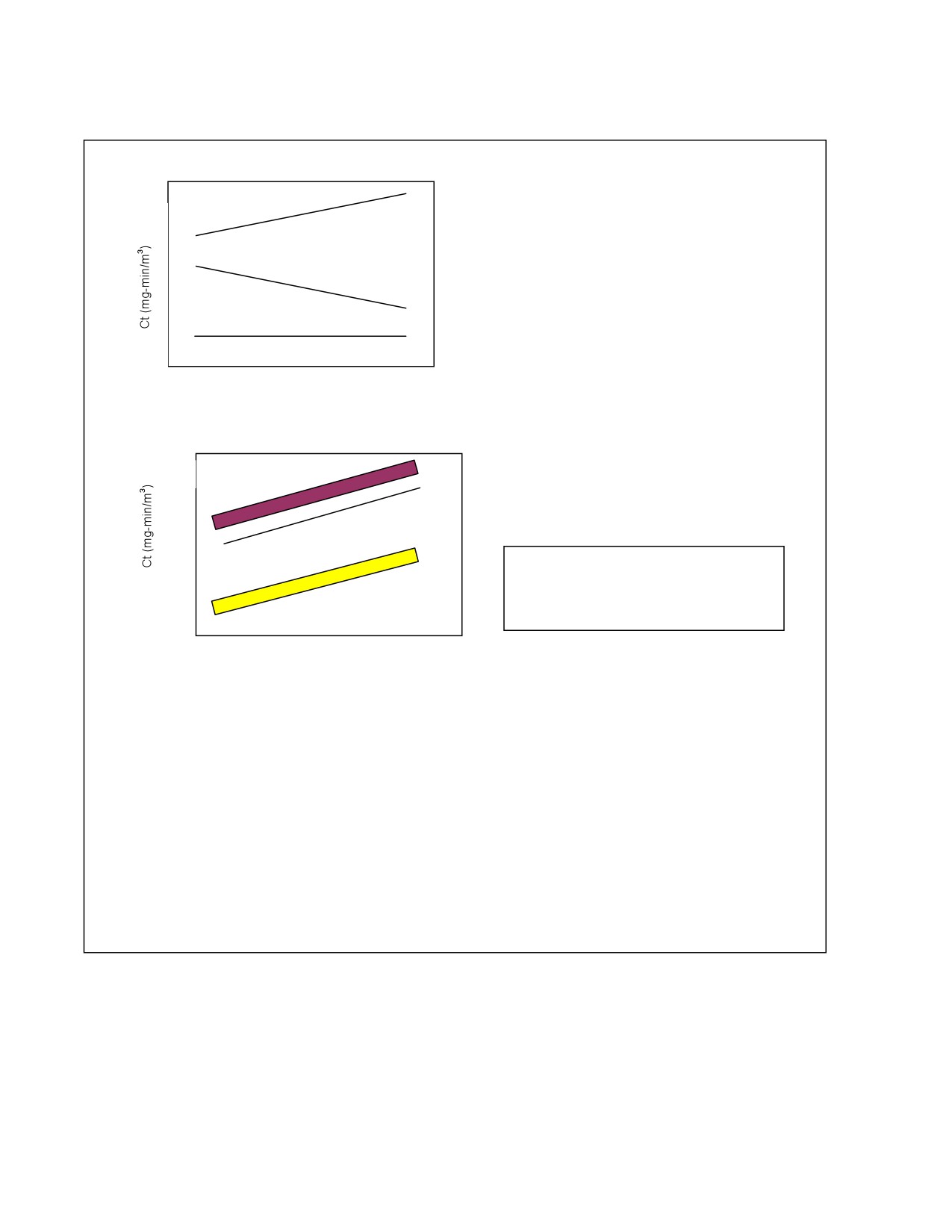
Dosage vs. Exposure Duration
The graph on the left is a representation of a Ct
profile for dosage versus exposure duration. The
graph is constructed by plotting the exposure
Case 1
duration (t) on the horizontal axis and the dosage
(k) on the vertical axis. In the quotation k=Cnt there
are three possible cases for the value of the TLE
(n). The graph shows the three cases.
Case 2
Case 1: TLE > 1; LCt50/ECt50 increases as
exposure duration increases.
Case 2: TLE < 1; LCt50/ECt50 decreases as
exposure duration increases.
Case 3: TLE = 1; LCt50/ECt50 remains constant as
Case 3
exposure duration increases.
Time (minutes)
Example TLE > 1 (Case 1)
CW Agent Vapor: Dosage versus Exposure Duration
This is an example of the Ct profile graphs for
dosage versus exposure duration given in
10
Appendix H. this is for an inhalation/ocular
vapor exposure to a CW agent.
Given:
Upper Band: LCt16 and LCt84 region
1
Line: ECt16 (severe) [roughly LCt01]
Lower Band: ECt16 and ECt84 region for mild
effects
0.0
1
10
100
Time (minutes)
Upper Band: The endpoint is lethality. The region shows the effective dosages that would be lethal to 16-84% of 70-
kg males exposed.
Line: The endpoint is severe effects (specific symptoms depend on the type of CW agent exposure). The line gives
the effective dosages where 16 percent of 70-kg males would experience severe effects. This is roughly equivalent to
the lethal dosage for 1 percent. Severe effects can include some deaths.
Lower Band: The endpoint is mild effects (specific symptoms depend on the type of CW agent exposure). The region
shows the effective dosages that would cause mild effects in 16-84% of 70-kg males exposed.
Notice as exposure duration (time) increases, the effective dosage (LCt/ECt) increases. There is no single LCt or ECt
for an exposure; they are time-dependent.
Figure II-2. Ct Profile for Dosage versus Exposure Duration
II-8
k.
Probit Slope. Dose response curves can be used to assess from a graphical
depiction the results of an exposure to a CW agent. The dose response curve is impacted by
the concentration of the CW agent and duration of the exposure (i.e., a graphical x-axis
plot) and response (i.e., a graphical y-axis plot). The probit slope is derived from dose
response curve data and corresponds to the variability in the response of the population to
the chemical agent.
(a) A high probit slope value means that a small change in the dose will make
a large change in the number of individuals responding to the chemical agent. With very
potent agents, a small change in the dose can also make a big change in the level and
severity of the effects produced.
(b) A low probit slope value means that a relatively large change in the dose
will make for a relatively minor change in the number of individuals responding to the
given dose.
l.
Degree of Confidence (DOC).10 The DOC is an indication of the level of
confidence in each toxicity estimate and is provided to indicate uncertainty. It is a
subjective evaluation based on the quality and quantity of the underlying data and the
method(s) by which the estimate was derived. The following definitions are provided:
(1)
Low. There are no primary data, and/or the data are extremely limited.
(2)
Moderate. There are primary data for both humans and animals, and there
are sufficient data for mathematical modeling.
(3)
High. There are ample primary data for both humans and animals, and
there is good statistical confidence in the value.
4.
Choking Agents
Choking agents are CW agents that attack lung tissue, primarily causing pulmonary
edema. They cause irritation to the bronchi, trachea, larynx, pharynx, and nose. Initial
symptoms may include tears, dry throat, coughing, choking, tightness of chest, nausea,
vomiting, and headache.1 In extreme cases, membranes swell, lungs become filled with
liquid, and death results from lack of oxygen; thus, these agents “choke” an unprotected
person. Fatalities of this type are called “dry-land drownings.” Of the choking agents,
phosgene (CG) is the only one considered likely to be used in the future.12 The protective
mask gives protection against choking agents.1
a.
CG (see Table II-2 [page II-10]). CG is a colorless gas with an odor similar to
musty hay or rotting fruit.13 Vapors can linger for some time in trenches and low-lying
areas under calm or light winds.12 The severity of poisoning cannot be estimated from the
immediate symptoms, and the full effect can be delayed up to 72 hours after exposure.14
Any activity or stress after exposure is likely to exacerbate the effects and turn a sublethal
exposure into a lethal exposure.10 Lung damaging concentrations may not be detected by
smell.10
II-9

Table II-2. CG
Alternate Designations: Collongite (French); Zusatz (German); Green Cross (German); D-gas (German); Fosgeen (Dutch);
Fosgen (Polish); Fosgene (Italian); Phosgen (German); NCI-C60219
Chemical Name: Carbonyl chloride
Synonyms: Carbon oxychloride; Carbon dichloride oxide; Carbone (oxychlorure de) (French); Carbonic chloride; Carbonio
(ossiclorurodi) (Italian); Carbonylchlorid (German); Carbonyl dichloride; Chloroformy chloride; Koolstofoxychloride (Dutch)
CAS Registry Number: 75-44-5
RTECS Number: SY5600000
Physical and Chemical Properties
Structural Formula:
Cl
O C
Cl
Molecular Formula: COCl2
Molecular Weight: 98.92
Physical State
Colorless gas that is readily liquefied 1
Odor
Musty hay or rotting fruit 2
Boiling Point
7.8oC 3,4
FP/MP
-128oC (MP) 5
Liquid Density (g/mL)
Liquefied phosgene 1.360 @ 25oC; 1.402 @ 7.8oC; 1.420 @ 0oC 6
Vapor Density (relative to air)
3.4 (calculated)
Vapor Pressure (torr)
1.40 x 10³ @ 25oC; 7.60 x 10² @ 7.8oC; 5.60 x 10² @ 0oC 3,4
Volatility (mg/m3)
7.46 x 10⁶ @ 25oC; 4.29 x 10⁶ @ 7.8oC; 3.53 x 10⁶ @ 0oC (calculated from vapor
pressure) 3,4
Latent Heat of Vaporization
5.92 @ 25oC; 5.95 @ 7.8oC; 5.96 @ 0oC (calculated from vapor pressure) 3,4
(kcal/mol)
Viscosity (cP)
Data not available
Viscosity of Vapor (cP)
Data not available
Surface Tension (dynes/cm)
Data not available
Flash Point
Nonflammable 1
Decomposition Temperature
Complete @ 800oC 7
Solubility
Limited in water; 8 miscible with common organic solvents, petroleum, and lubricating oil
9,10
Rate of Hydrolysis
t1/2
= 0.25 sec. @ 13oC; does not react quickly with water vapor, but it immediately
reacts with liquid water to yield carbon dioxide and hydrochloric acid 8,11
Hydrolysis Products
Hydrochloric acid and carbon dioxide 9
Stability in Storage
Stable in steel containers @ ambient temperatures for at least one year if CG is dry;
stability decreases at elevated temperatures 12
Action on Metals or Other Materials
None when CG is dry; acidic and corrosive when moist 13
Other Data
Eye toxicity
Initial effects resemble those of tear gas. 14
Inhalation toxicity
Causes pulmonary edema 15
Rate of action
Immediate to 3 hours, depending on concentration 16
Means of detection in field
M18A2 CADK, MM1 17
Protection required
Protective mask 15
Decontamination
Not required in the field except in very cold climates 18
Use
Delayed action casualty agent 19
II-10

Table II-2. CG (Continued)
NOTES
¹Matheson Gas Data Book, 4th ed., p. 411, The Matheson Company, Inc., East Rutherford, NJ, 1966.
2Franke, S., Manual of Military Chemistry Volume I-Chemistry of Chemical Warfare Agents, ACSI-J-3890, Chemie der
Kampfstoffe, East Berlin, April 1968, UNCLASSIFIED Technical Manual (AD849866).
3Abercrombie, P., ECBC Notebook # NB 98-0079, p. 7 (U).
4Germann, A.F.O. and Taylor, Q.W., “The Critical Constants and Vapor Tension of Phosgene,” J. Amer. Chem. Soc., Vol. 48(5),
pp. 1154 -1159, 1928.
5Giauque, W. F., and Jones, W.M., “Carbonyl Chloride. Entropy. Heat Capacity. Vapor Pressure. Heats of Fusion and
Vaporization. Comments on Solid Sulfur Dioxide Structures,” J. Amer. Chem. Soc., Vol. 70, p. 120, 1948.
6Davies, C. N., “The Density and Thermal Expansion of Liquid Phosgene,” J. Chem. Phys., Vol. 14, p. 48, 1946.
7Bodenstein, M., and Durant, G., “Die Dissociation des Kohlenoxychlorids,” Z. Physik. Chem., Vol. 61, p. 437, 1908.
8Hall, R.W., An Investigation on the Solubility and Rate of Hydrolysis of Phosgene in Water, Porton Report 2663, Chemical
Defence Experimental Establishment, Porton, England, 19 December 1944, UNCLASSIFIED Report.
9Atkinson, R.H., et al., “The Preparation and Physical Properties of Carbonyl Chloride,” J. Chem. Soc., Vol. 117, pp. 1410-1426,
1920.
10Baskerville, C., and Cohen, P.W., “Solvents for Phosgene,” J. Ind. Eng. Chem., Vol. 13, p. 333, 1921.
11Properties of War Gases Volume III: Vomiting & Choking Gases & Lacrimators (U), ETF 100-41/Vol-3, Chemical Corps Board,
Army Chemical Center, MD, December 1944, CONFIDENTIAL Report (AD108458).
12Henley, F.M., Surveillance Tests on 75 MM. Steel Gas Shell Extending Over a Period of One Year, EACD 11, Chemical
Warfare Service, Edgewood Arsenal, MD, June 1920, UNCLASSIFIED Report (ADB959731).
13Patten, H.E., and Bouder, N.M., Chemical Properties of Phosgene, EACD 124, Chemical Warfare Service, Edgewood
Arsenal, MD, March 1923, UNCLASSIFIED Report (ADB955133).
14BG Russ Zajtchuk, et al. (eds.), Textbook of Military Medicine: Medical Aspects of Chemical and Biological Warfare, Office of
the Surgeon General, 1997, Chapter 4, The Chemical Warfare Threat and the Military Healthcare Provider.”
15FM 8-285/NAVMED P-5041/AFJMAN 44-149/FMFM 11-11, Treatment of Chemical Agent Casualties and Conventional
Military Chemical Injuries, 22 December 1995.
16NIOSH-DOD-OSHA Sponsored Chemical and Biological Respiratory Protection Workshop Report, February 2000.
17AFMAN 10-2602 Nuclear, Biological, Chemical, and Conventional (NBCC) Defense Operations and Standards (Operations),
29 May 2003.
18FM 8-9/NAVMED P-5059/AFJMAN 44-151, NATO Handbook on the Medical Aspects of NBC Defense Operations AMEDP-
6(B), 1 February 1996.
19W.R. Kirner, Summary Technical Report of Division 9, NDRC Volume 1, Chemical Warfare Agents, and Related Chemical
Problems Part I-II, Office of Scientific Research and Development, Washington, DC, 1946, UNCLASSIFIED Report
(AD234270).
b.
CG Toxicity Estimates (see Table II-3). Although the probit slope for CG is
unknown, it is known to be so steep that “incapacitating” or “severe effects” dosages could
include some lethality.10
Table II-3. CG Toxicity Estimates10
Endpoint
Toxicity
MV (L)
Exposure
ROE
Probit
TLE
ROD
DOC
(mg-min/m3)
Duration
Slope
Lethality
LCt50: 1500 a
15
2-60 min
Inhalation/Ocular
Unknown
1 b
Probably
Moderate
Insignificant
Odor
EC50 : 6 mg/m3 c
N/A
Few
Inhalation
N/A
N/A
Probably
Low
Detection
Seconds
Insignificant
NOTES
aBased on ECBC modeling of 10 mammalian species.
bSee Appendix H for supporting toxicity profile estimates.
cBased on secondary human data and TM 3-215 (1952).
c.
Diphosgene (DP) (see Table II-4 [page II-12]). DP is a colorless liquid with an
odor similar to that of musty hay.13 DP is not a polymer of CG, but does produce similar
physiological effects. DP is described as a respiratory irritant and a lachrymator. It is
more easily detected than CG because of its lacrimatory effects.9 See Table II-5 (page II-
13) for DP toxicity estimates.
II-11

Table II-4. DP
Alternate Designations: Difosgene; Superpalite (British); Perstoff (German); Surpalite(French); Green Cross (German)
Chemical Name: Trichloromethyl chloroformate
Synonyms: Trichloromethyl chlorocarbonic acid ester; Chloroformic acid trichloromethyl ester; Trichloromethyl
chlorocarbonate; Trichloromethyl carbonochloridate; Formic acid, chloro-, trichloromethyl ester; Carboncohloridic acid
trichloromethyl ester
CAS Registry Number: 503-38-8
RTECS Number: LQ7350000
Physical and Chemical Properties
Structural Formula:
O
Cl
C
Cl
O
C Cl
Cl
Molecular Formula: C2Cl4O2
Molecular Weight: 197.83
Physical State
Colorless oily liquid 1
Odor
Musty hay 2
Boiling Point
127oC 3,4
FP/MP
-57oC (MP) 2
Liquid Density (g/mL)
Munitions grade: 1.656 @ 20oC; 1.687 @ 0oC 2
Vapor Density (relative to air)
6.8 (calculated)
Vapor Pressure (torr)
4.41 @ 20oC; 9.14 x 10⁻¹ @ 0oC 3,4
Volatility (mg/mL)
4.77 x 10⁴ @ 20oC; 1.06 x 10⁴ @ 0oC (calculated from vapor pressure) 3,4
Latent Heat of Vaporization (kcal/mol)
12.2 @ 20oC; 12.8 @ 0oC (calculated from vapor pressure) 3,4
Viscosity (cP)
Data not available
Viscosity of Vapor (cP)
Data not available
Surface Tension (dynes/cm)
Data not available
Flash Point
None 5
Decomposition Temperature
300oC to 350oC (yields two molecules of CG) 1
Solubility
Solubility in water is 44.6 g DP/L solution @ 20oC; 6 readily soluble in common
organic solvents 2
Rate of Hydrolysis
Slow @ ambient temperature and fairly rapid @ 100oC 1
Hydrolysis Products
Hydrogen chloride (HCl) and carbon dioxide 1
Stability in Storage
Unstable; converts to CG. 1
Action on Metals or Other Materials
Metals act as catalyzers in conversion to CG. 1,2 Also attacks rubber, cork, 2,4 and
cement. 2
Other Data
Eye toxicity
Lachrymator 7
Inhalation toxicity
Causes pulmonary edema 8
Rate of action
Immediate to 3 hours depending on concentration 9
Means of detection
MM1
Protection required
Protective mask 8
Decontamination
Not required in the field except in very cold climates. 10
Use
Delayed or immediate action casualty agent, depending on dosage rate
II-12

Table II-4. DP (Continued)
NOTES
1Hood, H.P., and Murdock, H.R., “Superpalite,” J. Phys. Chem., Vol. 23, p. 498, 1919.
²Potts, A.M.,The Physical and Chemical Properties of Phosgene and Diphosgene, OEMCMR-114, 1945, UNCLASSIFIED
Report.
3Abercrombie, P., ECBC Notebook # NB 98-0079, p. 34 (U).
4Herbst, V.H., “Uber die Fluchtigkeit und Vernebelung einer Reihe organischer Stoffe,” Kolloid Beihefte, Vol. 23, p. 330,
1927.
5TM 3-215/AFM 355-7, Military Chemistry and Chemical Agents, December 1963, UNCLASSIFIED Technical Manual.
6Carter, R.H., and Knight, H.C., Fundamental Study of Toxicity Solubilities of Certain Toxics in Water and in Olive Oil, EACD
445, Chemical Warfare Service, Edgewood Arsenal, Edgewood, MD, May 1928, UNCLASSIFIED Report (ADB955216).
7Sharon Reutter, et al., Review and Recommendations for Human Toxicity Estimates for FM 3-11.9, ECBC-TR-349,
September 2003.
8FM 8-285/NAVMED P-5041/AFJMAN 44-149/FMFM 11-11, Treatment of Chemical Agent Casualties and Conventional
Military Chemical Injuries, 22 December 1995.
9NIOSH-DOD-OSHA Sponsored Chemical and Biological Respiratory Protection Workshop Report, February 2000.
10FM 8-9/NAVMED P-5059/AFJMAN 44-151, NATO Handbook on the Medical Aspects of NBC Defense Operations
AMEDP-6(B), 1 February 1996.
Table II-5. DP Toxicity Estimates10
Endpoint
Toxicity
MV (L)
Exposure
ROE
Probit
TLE
OD
DOC
(mg-min/m3)
Duration
Slope
Lethality
LCt50:
1500a
15
10-60 min
Inhalation/
Unknown
1 b,c
Unknown,
Low
(Provisional)
Ocular
Probably
Insignificant
Odor
EC50: 4 mg/m3 d
N/A
Few
Inhalation
N/A
N/A
N/A
Low
Detection
Seconds
NOTES
aBased on recommendations for CG.
bThe TLE value is assumed to be 1 because the Ct profile is unknown.
cSee Appendix H for supporting toxicity profile estimates.
dBased on secondary human data.
5.
Nerve Agents
Nerve agents are more toxic than other CW agents. They may cause effects within
seconds and death within minutes.15 The nerve agents are all liquids, not nerve gas per se.
They can be absorbed through any body surface and can penetrate ordinary clothing
rapidly.1 They are divided into the G agents and V agents. The V agents have high boiling
points, low volatility, and resultant high persistency.12 Even though the V agents are
considered primarily a contact hazard12; they are at least twice as potent as GB, and even a
minute amount of airborne material is extremely hazardous.10 Nerve agents are
cumulative poisons. Repeated exposure to low concentrations may produce symptoms.1
Level 4 mission-oriented protective posture (MOPP4) is required for protection.1
a.
Physiological Effect. Both the G and V agents have the same physiological
action on humans. Normally, the enzyme acetylcholinesterase (AChE) binds and
hydrolyzes the neurotransmitter ACh, which terminates the activity of ACh at the receptor
sites. Upon exposure, the nerve agents bind to AChE, making it unable to bind with ACh.
As a result, ACh is not hydrolyzed. The accumulation of ACh causes hyperactivity of the
body organs stimulated by cholineraic neruons.15 Individuals poisoned by nerve agents
may experience symptoms in the following order:
•
Miosis, runny nose, and chest tightness.
•
Dim vision and headache.
•
Nausea, vomiting, and cramps.
II-13
///////////////////////////////////////