FM 4-01.30 MOVEMENT CONTROL (SEPTEMBER 2003) - page 6
FM 4-01.30 ______________________________________________________________________________________ Appendix G
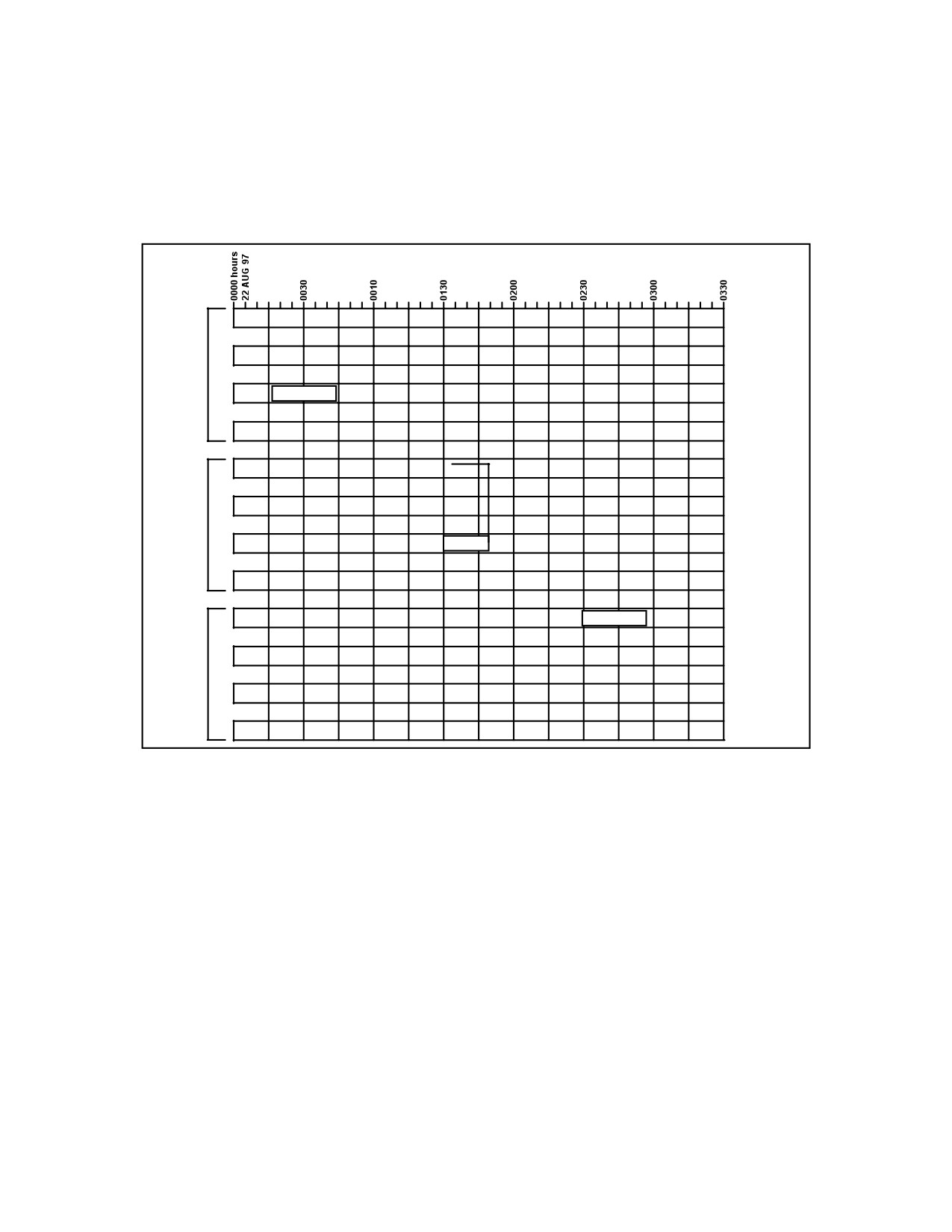
• Convoy 226 travelling northward on MSR Hawk arrives at critical point 27 at 0230 and will
clear that point at 0300.
CRITICAL
N
MSR HAWK
POINT
NUMBER
S
MSR HAWK
25
E
SER 225
MSR SPARROW
W
MSR SPARROW
N
MSR HAWK
S
MSR HAWK
26
E
SER 225
MSR SPARROW
W
MSR SPARROW
N
SER 226
MSR HAWK
S
MSR HAWK
27
E
MSR SPARROW
W
MSR SPARROW
Figure G-10. Critical Time and Point Graph
G-63. Critical time and point graphs should be prepared for each MSR in advance for a specified
planning period to manage programmed moves over multiple routes. The data for arrive and clear
times at critical points can be obtained from movement graphs, movement bids, or automated
planning programs such as movement plan
(MOVEPLAN). The planning period will vary
depending upon the level of command. Generally, the Movement Control Agency (MCA) and MCB
work with longer planning periods than does the DTO because movements in the communication
zone (COMMZ) and Corps rear area can be programmed further in advance.
G-64. On the day of movement, movement planners receive the in-transit status of convoys as
reported by MRTs, TCPs, or the moving unit. They check the progress of movement against the
critical time and point graph for that day. When a convoy is reported off schedule, they check the
graph for time and space separations from other convoys. If necessary, planners may reroute or stop
a movement or reschedule convoys to prevent conflicts. They provide these changes to the affected
commands and the military police (MPs).
G-25
FM 4-01.30 ______________________________________________________________________________________ Appendix H
Appendix H
Intermodal Terminals
H-1. The role of a intermodal terminal is to expedite the onward movement of sustainment cargo in
a theater of operations. The intermodal terminal may be staffed with personnel from the cargo
transfer company
(CTC), freight consolidation and distribution team
(FCDT) and cargo
documentation team. The term intermodal terminal includes activities that support hub-and-spoke
operations or intermodal terminals. Unit equipment, mail, class III, Class V, Class VII and personnel
do not normally pass through intermodal terminals, although all other commodities and hazardous
materials do. The intermodal terminal will:
• Receive and document containerized and breakbulk cargo destined for multiple consignees.
• Unstuff the containers and arrange for transport of the container contents.
• Load vehicles and prepare vehicle manifests or related documentation (e.g., transportation
control and movement document (TCMD), commercial bill of lading (CBL), or freight
warrant).
• Receive smaller shipments from distribution ‘spokes.’
• Prepare, update, and deactivate radio frequency (RF) tags or other automatic identification
technology (AIT) devices.
• Route the shipments to their destination using scheduled truck services.
• Account for containers, flatracks, pallets, and trailers at its facility.
• Report in-transit visibility
(ITV) events to Global Transportation Network (GTN) and
regional ITV and total asset visibility (TAV) databases.
H-2. The CTC documentation section or cargo documentation team will accomplish the following
tasks:
• Identify Inbound Shipments. The intermodal terminal receives a bill of lading as a notice
of inbound cargo. The bill of lading establishes a 'due-in' record accessible by TCN,
movement number, and AIT device name. Advanced transportation control and movement
document (ATCMD)-related information and anticipated arrival date at intermodal terminal
should be recorded, also.
• Plan Workload. The CTC personnel create reports that display the manifest due in by
hour/day of anticipated receipt. These reports are the basis for workload planning. The
reports also account for shipments already received but not yet released. Intermodal
terminal managers allocate workload to a specific shift or timeframe, not just a specific day.
The workload should identify:
╺ Floor space available to handle shipments in transit.
╺ Handling capacity (number of pallets and containers moved per shift) of available
material handling equipment (MHE) and operators.
╺ Yard space available to temporarily store empty containers, pallets, and flatracks.
H-1
FM 4-01.30 ______________________________________________________________________________________ Appendix H
•
In-Check/Validate Shipment Receipt. CTC personnel place an automated workstation
at the intermodal terminal receiving dock. This workstation allows access to the CTC server
due-in database and permits electronic in-check of shipments that arrive at the terminal.
CTC personnel record loading dock number, date-time of item receipt, and location where
placed. CTC personnel record shipment condition for discrepancy reporting. When the
item received is not identified in the CTC server due-in database, a new record is added
using data on the AIT or by keyboard entry.
•
Report Shipment Arrival. Intermodal terminals use AIT and automated systems such as
Transportation Coordinators-Automated Information for Movements System II (TC-AIMS
II) to report the ITV arrival event to the regional ITV server which updates GTN.
•
Generate Discrepancy Reports. CTC personnel will create and transmit a cargo
discrepancy report (DISREP) based on presence of discrepancy data in shipment arrival
records. Discrepancy reporting can result from the in-check process, a shipment release
process, or any inspection process conducted while the shipment is in the intermodal
terminal.
•
Load Planning for Outbound Shipments. CTC personnel use information about dues-in
and received shipments to prepare load plans for outbound shipments. Load plans are
based on the ability to manipulate the cargo data by date, customer, route, and load
compatibility. The theater surface distribution plan is used to support the load planning
functions when a single movement supports multiple consignees. Load plans organize the
shipments into loads for specific vehicle types and produce a sequenced load list for each
vehicle. This load list is used by CTC vehicle loading personnel in hard copy or electronic
feed to remote hand-held terminals. The terminal loading dock consolidates individual
shipments into pallet, container roll-in/roll-out platform
(CROP) or container
configurations; assigns a new consolidation transportation control number
(TCN), and
prepares required TCMD. The actions of the CTC personnel in load-planning vehicles
include wheeled vehicles, rail cars, barges, other watercraft, helicopters, and fixed-wing
transport aircraft.
•
Prepare Documents for Onward Movement. CTC personnel at the loading dock prepare
final vehicle manifests with places for driver and receiver to sign. They will also create
TCMDs, military shipment labels, RF tags, and optical memory cards (OMC). They also
prepare hazardous material certification documents and customs clearance documents when
origin shippers have not provided the documentation.
•
Offer Shipments to Movement Control Team (MCT). Once shipment load planning is
completed, CTC personnel generate a request for transport services from area MCTs.
Intermodal terminals assign a unique transport request number to the shipment or use lead-
TCN. The transportation request identifies shipment origin, destination, priority,
characteristics, delivery instructions, and preferred mode. The MCT provides a copy of the
TMR to the intermodal terminal. This process need not occur if the intermodal terminal
loads the shipments on vehicles which are dispatched with standing TMR (e.g., scheduled
truck service).
H-2
FM 4-01.30 ______________________________________________________________________________________ Appendix H
•
Establish and Maintain an RF AIT Interrogator Network. CTC personnel use RF AIT
interrogators to identify locations of shipments and empty containers or flatracks within the
intermodal terminal. CTC personnel read and write tags using joint total asset visibility
(JTAV) standard formats. Tag information will be used to validate receipt of a due-in
shipment (i.e., container, pallet, and flatrack). The interrogator is used to identify a shipment
event. A date-time stamp for the event updates the intermodal terminal server database.
When the shipment is not listed as due in, additional data is read from the RF tag to establish
the cargo identification in the CTC database.
•
Record Shipment Release Data. CTC personnel use RF AIT interrogators to update the
their database as shipments depart. The terminal allows AIT or keyboard entry of departure
time, date, location, releaser identification, carrier, movement number and anticipated arrival
time at next stop.
•
Provide a Bill of Lading to Next Delivery Location and Ultimate Consignee. The
CTC personnel creates a bill of lading when the shipment is released and ensures the next
designated delivery location receives it
(i.e., the consignee, a port complex, or another
intermodal terminal).
•
Receive Discrepancy Report (DISREP). The CTC personnel receive transportation
DISREP from shipment receivers. The transaction identifies a transportation discrepancy
for a shipment that was processed by the intermodal terminal. The transaction updates the
shipment record to register the discrepancy.
•
Identify Histogram of Shipments in Intermodal Terminal. CTC personnel generate a
report identifying the shipments processed through the terminal and the age of each
shipment. The system calculates average processing time for shipments based on customer
and type cargo. It also supports calculation of average processing time for internal terminal
activities.
•
Trace Shipments. At the intermodal terminal, the CTC personnel can query the database
about specific shipments or movements and display all information about the shipment.
Personnel will be able to print a report of the information being displayed.
•
Process Hold and Divert or Expedite Actions. The intermodal terminal receives hold
and diversion transactions from the material management center
(MMC). Expedite
shipment transactions are also received. CTC personnel hold, divert, or expedite the
shipment as required. If the record cannot be identified, a negative response is provided and
the action is placed in suspense in the intermodal terminal database for later action.
Requesters are notified of the status of the requested action.
•
Report Frustrated Cargo. The CTC personnel establish cargo records for intermodal
terminal cargo that is frustrated (i.e., cargo documentation has been destroyed or cargo
cannot be delivered to a recognized location). These records are forwarded to the servicing
distribution management center (DMC) for disposition instructions.
•
Daily Activity Report (DAR). At the discretion of intermodal terminal managers, CTC
personnel may create a DAR showing the status of the terminal. This status may include
H-3
FM 4-01.30 ______________________________________________________________________________________ Appendix H
terminal assets (MHE available, storage capacity used and available), the identification of
shipments on hand, and an accounting of containers, flatracks or pallets at the terminal.
• Maintain Department of Defense Activity Address Code (DODAAC) Data. The
intermodal terminal will receive DODAAC updates to the database.
• Movement Tracking System (MTS). CTC personnel may use MTS to contact inbound
vehicles and determine shipment receipt status.
H-4
FM 4-01.30 _______________________________________________________________________________________Appendix I
Appendix I
Example Of A Highway Regulation Plan
I-1. The highway regulation plan is used to inform all units within the theater of operations of the
policies and procedures governing convoy or oversize/overweight vehicle movements.
I-2. Highway regulation plan should be developed for all OPLANs or exercises and be included
within the transportation annex of the applicable OPLAN or exercise directive.
I-3. It is the responsibility of all organizations with a wartime highway regulation mission to develop
highway regulation plans. Responsible organizations include DTOs, MCBs, and TCEs.
I-4.
Whenever two or more regulating agencies operate in the same theater of operation,
coordination to standardize policies and procedures must be accomplished. Development of the
traffic circulation plan (TCP) must also be coordinated to ensure mutual use MSRs are given one
name throughout the theater to avoid confusion. Movement priority codes and other policies and
procedures must be standardized.
I-5. Recommended Format and Information for the Highway Regulation Plan:
ANNEX ____ HIGHWAY REGULATION PLAN TO OPERATION____
Reference: Maps, Traffic Circulation Plan, and other relevant documents.
Time zone used throughout the order
Dates: Julian Dates (movement request dates)
1. SITUATION
Include information affecting movement.
2. MISSION
Include provisions of effective highway regulation, reporting, support of operations, and coordination of
movement and maneuver. Identify responsible organizations (who controls routes).
3. EXECUTION
a. Concept of movements. Briefly state the Highway Regulation concept and coordination of
movements and maneuver and battlefield circulation control.
b. Tasks to subordinate units.
(1) Units perform route reconnaissance or get information from TCP pertaining to theater route
network.
(2) Units responsible for abiding by all policies and procedures listed in the plan.
I-1
FM 4-01.30 _______________________________________________________________________________________Appendix I
c.
Coordination of use of MSRs.
(1)
Request procedures.
(a) Convoy request form or oversize/overweight request form. Put example(s) at appendix.
Identify required data (mandatory). Hazardous cargo and oversize/overweight information
must be put in remarks. Round trip, use request form with stopover time.
(b) Submit to. Identify locations units will submit convoy movement requests or
oversize/overweight. Telephone procedures/telephone numbers, FAX, walk in locations,
MCT, system modem numbers, and so on. Hours of operation.
(c) Submit when. How many days before movement peace/war, emergency procedures, and
authorization.
(d) Convoy movement priorities. Use numbers 1: highest priority and so on. Coordinate with
all clearance activities to use same number system.
(e) Minimum number of vehicles that constitute a convoy.
(f) Infiltration rules (less vehicles than a convoy). Ensure infiltrating vehicles yield to convoys
at intersection and do not hinder convoy movement.
(g) Special movement consideration information must be entered in remarks on the request for
movement form.
(2)
Route utilization information. Discuss MSR listed in TCP. Explain controlled versus MSR
(open).
(a) MSR listed on TCP is open route, any unit can use. No clearance required. First come, first
serve. Minimum speed on MSR and any restrictions. Direction of travel.
(b) Controlled route. Listed in TCP (same as dispatch route). Convoy request must be
submitted and a clearance issued prior to movement. Minimum speed for controlled routes
and any restrictions. Direction of travel.
(c) Supervised route. Identify route(s) rules and procedures.
(d) Prohibited route. Identify which routes are prohibited.
(e) Reserved route (identify who can use and duration).
(f) Lightlines.
(g) Hardening of vehicles.
I-2
FM 4-01.30 _______________________________________________________________________________________Appendix I
4. SERVICE SUPPORT
a. Provide logistical support request procedures. Rest, refueling, and so forth. The TCP (text version)
identifies convoy halt locations, convoy support centers, facilities, and services available to include units
responsible for providing service.
b. Maintenance and recovery procedures. Vehicle breakdown procedures.
c. Medical evacuation procedures.
d. Halts.
5. PROCEDURES. (Note: Should be same information as in system parameter table.)
a. Planning factors (convoy).
- Distance between vehicles.
- Time gap between march units/serials.
- Time gap between convoys.
- Oversize/overweight criteria. Procedures to submit request for clearance.
- Vehicles per march unit.
- March units per serial.
- Blackout procedures/light lines.
- Hardening of vehicles.
- Convoy/hazardous cargo marking/flags.
- Delay in meeting SP time procedures.
b. Planning factors (route information). Refer to TCP for location and type routes, halt locations and
services, traffic control point locations, critical point locations, and restrictions.
6. ENFORCEMENT. Include command actions that will be taken in the event units do not follow policies
and procedures. Stress the requirement that units must have approved march table/movement order prior to
using controlled routes. Identify who will monitor and control movements.
7. COMMAND AND SIGNAL.
a. Command. Identify communications reporting locations and procedures with Highway Regulation and
police officials.
b. Signal. Describe reporting requirements, method of communication, and radio frequencies.
APPENDIXES:
1. Traffic Circulation Plan (text copy attached and system disk distributed to system users)
2. Convoy Request Form and Oversize/Overweight (same form)
I-3
FM 4-01.30 ______________________________________________________________________________________ Appendix J
Appendix J
Types of Intermodal Assets and Intermodal Asset Handlers
J-1. A wide variety of military and commercial container handling equipment (CHE) exists. Figures
J-1 through J-8 show some of the available military material- and container-handling equipment.
Because of the variety, an all-inclusive list of commercial CHE is beyond the scope of this appendix.
Commercial CHE, such as top picks, side picks, and straddle carriers are generally available for lease
through a port facility. Military CHE is capable of handling 20- or 40-foot containers.
J-2.
Some longer containers
(45-feet and
48-feet) have American National Standards
Institute/International Organization for Standardization
(ANSI/ISO) corner fittings at
40-foot
spacing and can usually be handled by the 40-foot CHE. Smaller containers can also be handled by
military CHE if configured into a 20-foot ANSI/ISO unit.
Container Handling Equipment
J-3. The unique quality of an ocean-freight container is its ability to travel over road, rail, and ocean
without transferring its cargo at any point. Thus, it is commonly referred to as intermodal.
Accomplishing intermodal handling requires complementary CHE.
J-4. The container trailer chassis is the most adaptable over-the-road unit capable of hauling empty
or loaded containers. The chassis is suitable for carrying the different types of containers, and
depending on its size, will accommodate 20-, 35-, 40-, or 45-foot containers. The chassis are
designed and manufactured in accordance with the statutory requirements for over-the-road use.
The container is secured to the chassis by twist locks, which are individually operated, and which lock
into the lower container corner castings.
J-5. In the absence of a trailer chassis, a flat bed trailer may be used to carry a container over the
road. When securing a container to a flat bed trailer, the container corner castings must be
employed, as they are built into the container for this specific purpose. Other means of holding
down a container may cause structural damage to the unit, in turn jeopardizing safe cargo delivery.
J-6. When a container travels by rail, it may be situated on a chassis (referred to as trailer on a flatcar
service). Or, it may be secured on the railroad flatcar without wheels (referred to as container on a
flatcar service). In either case, the container must be secured correctly at all times to avoid any
possible damage.
J-7. For loading or unloading 20-foot containers from chassis, flatcars, and flatbed trailers, large
forklift trucks may be used if the container has built-in forklift pockets (FLP). Loaded containers
longer than 20 requires special handling equipment. Other complementing container equipment
such as cranes with specialized lifting devices or slings, straddle carriers, and heavy-duty lift trucks are
also employed. Shipboard gear, as well as on-shore cranes, are used for loading and unloading
containers from the ocean carrier.
J-1
FM 4-01.30 ______________________________________________________________________________________ Appendix J
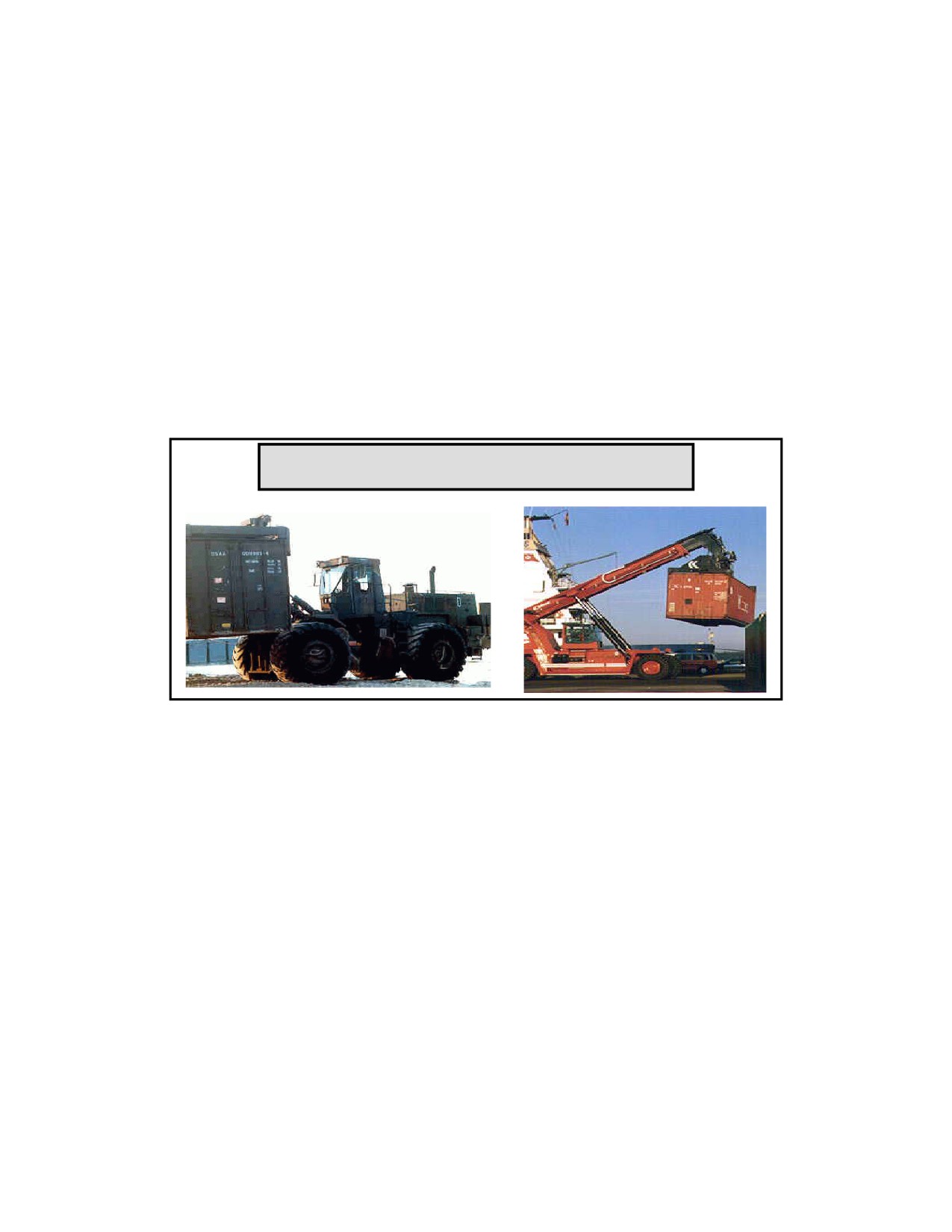
50,000 POUND ROUGH TERRAIN CONTAINER HANDLER (RTCH) AND TOP
HANDLER
J-8. The RTCH is a diesel powered container handler capable of lifting, stacking, and moving 20, 25,
and 40-foot containers weighing up to 50,000 pounds (figure J-1). It is a rough terrain vehicle
designed for operating on soft soil conditions such as unprepared beaches. The RTCH has four-
wheel drive and is capable of operating in up to five feet of seawater. Tophandler attachments in 20,
35, and 40-foot sizes are required for container. These top handlers are placed on the forks of the
RTCH to allow for handling different lengths of ANSI/ISO containers. If needed, it could also
handle longer containers fitted with ANSI/ISO fittings at 40-foot locations along the top of the
container. Future procurements of the RTCH will include expandable tophandlers that are
considered part of the end item.
ROUGH TERRAIN CONTAINER HANDLER
(RTCH)
New 53K lb RTCH
Current 50K lb RTCH
Figure J-1. 50,000 Pound RTCH and Top Handler
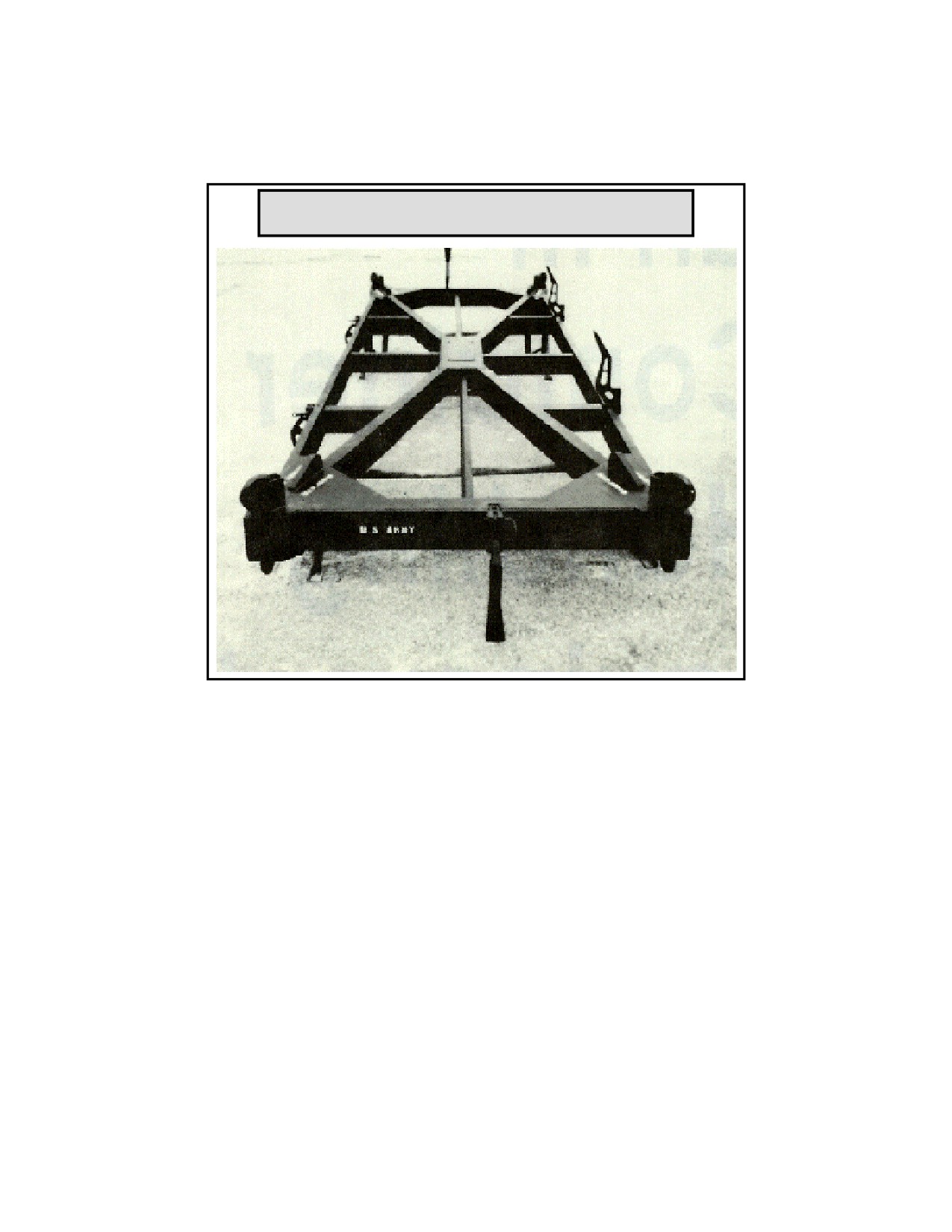
INTERMODAL CONTAINER-HANDLING SPREADER BARS
J-9. Spreader bars (figure J-2) are connected by slings to the hook of a crane such as a rough terrain
container crane (RTCC) or the 140-ton truck-mounted container-handling crane and are used to
handle ANSI/ISO and other intermodal containers. The 40-foot spreader bars can also handle many
longer containers since they usually have ANSI/ISO corner fittings at 40-foot spacing. Both
spreader bar types conform to Military Specification MIL-S-52713 and are fixed frame designs with
manually locking twist locks.
J-2
FM 4-01.30 ______________________________________________________________________________________ Appendix J
INTERMODAL CONTAINER-HANDLING
SPREADER BARS
Figure J-2. Intermodal Container-Handling Spreader Bars
Rough Terrain Container Crane
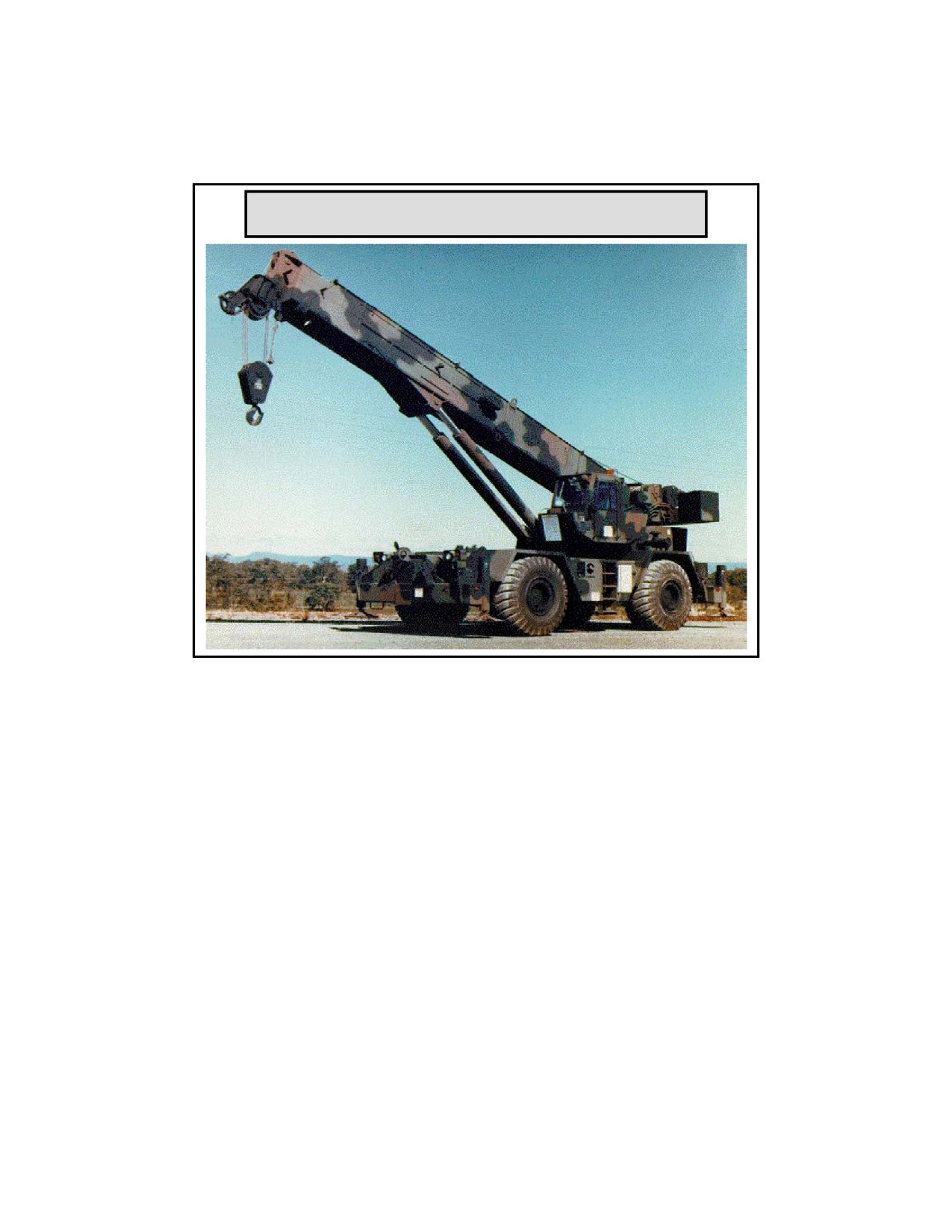
J-10. The RTCC (figure J-3) is a wheel-mounted crane available through commercial sources. The
RTCC is capable of lifting a 20-foot container weighing 44,800 pounds at a radius of 27 feet and a
35/40-foot container weighing
67,200 pounds at a radius of
22 feet. General support
(GS)
ammunition units, located in theater and corps ammunition storage areas, use the RTCC to load or
transship
20-foot ANSI/ISO containers from one mode of transportation to another.
Transportation units use the RTCC to augment the 50,000-pound rough terrain container handler in
the transfer and handling of 20, 35, or 40-foot containers and other cargo between transportation
modes and in storage areas.
J-3
FM 4-01.30 ______________________________________________________________________________________ Appendix J
40-TON ROUGH TERRAIN CONTAINER CRANE (RTCC)
Figure J-3. 40-Ton Rough Terrain Container Crane
4,000-Pound Rough Terrain Forklift (RTF)
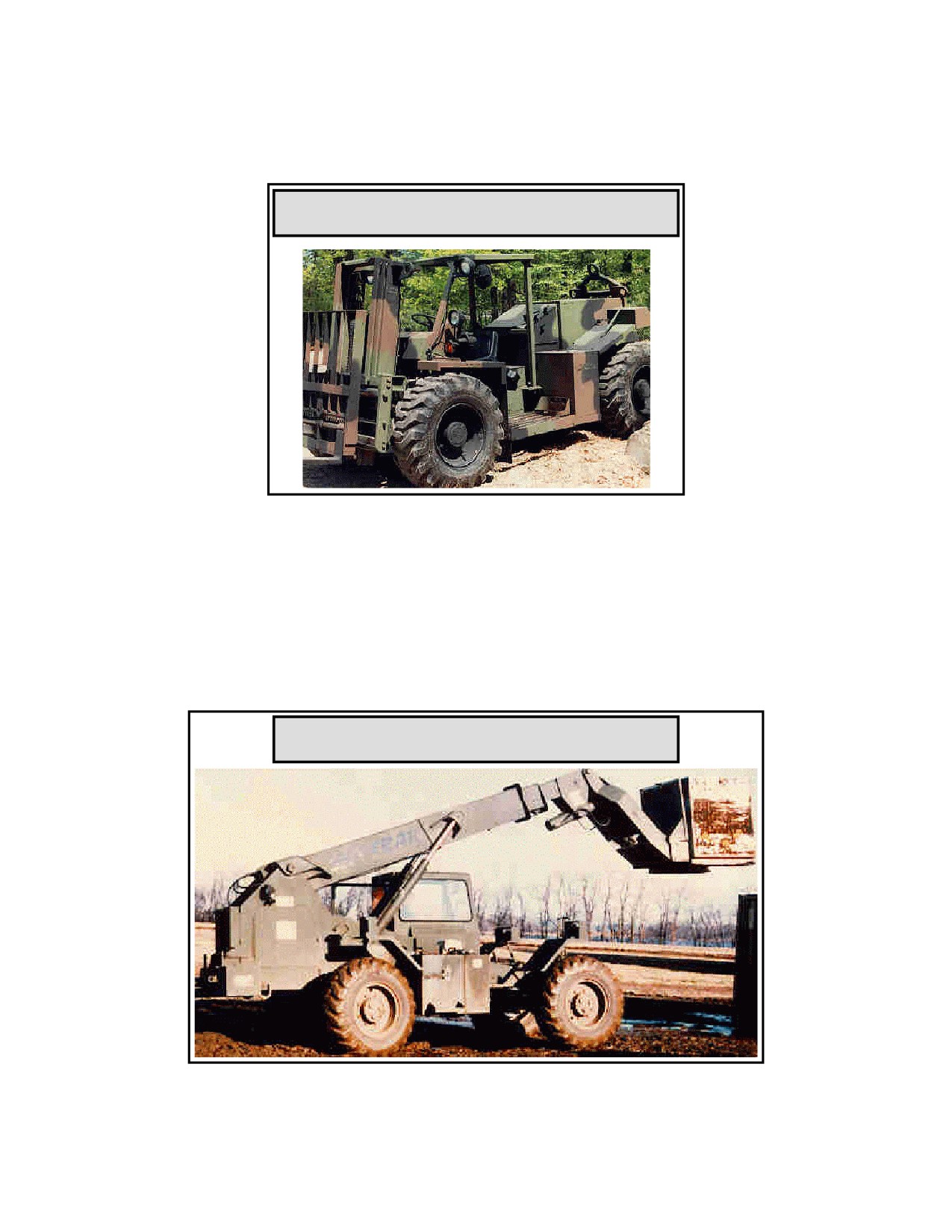
J-11. The 4K RTF (see figure J-5) is the Army’s smallest capacity rough terrain forklift. Its primary
function is to stuff and unstuff pallets from ground mounted containers. It is capable of handling,
lifting, and stacking palletized cargo containers and boxes weighing up to 4,000 lbs. The Army’s
logistics system relies on this forklift to load and unload ammunition, supplies and equipment; and to
transfer cargo between ground vehicles, watercraft, and aircraft. It is found in Quartermaster,
Transportation, Ordnance, Missile & Munitions, Medical, Aviation, and Engineer units. This
versatile
4,000 lb forklift can be deployed for wartime or contingency operations in a 20-foot
container.
J-4
FM 4-01.30 ______________________________________________________________________________________ Appendix J
4,000 POUND ROUGH TERRAIN FORKLIFT
Figure J-4. 4,000 Pound Rough Terrain Forklift
6,000-Pound Variable Reach Forklift
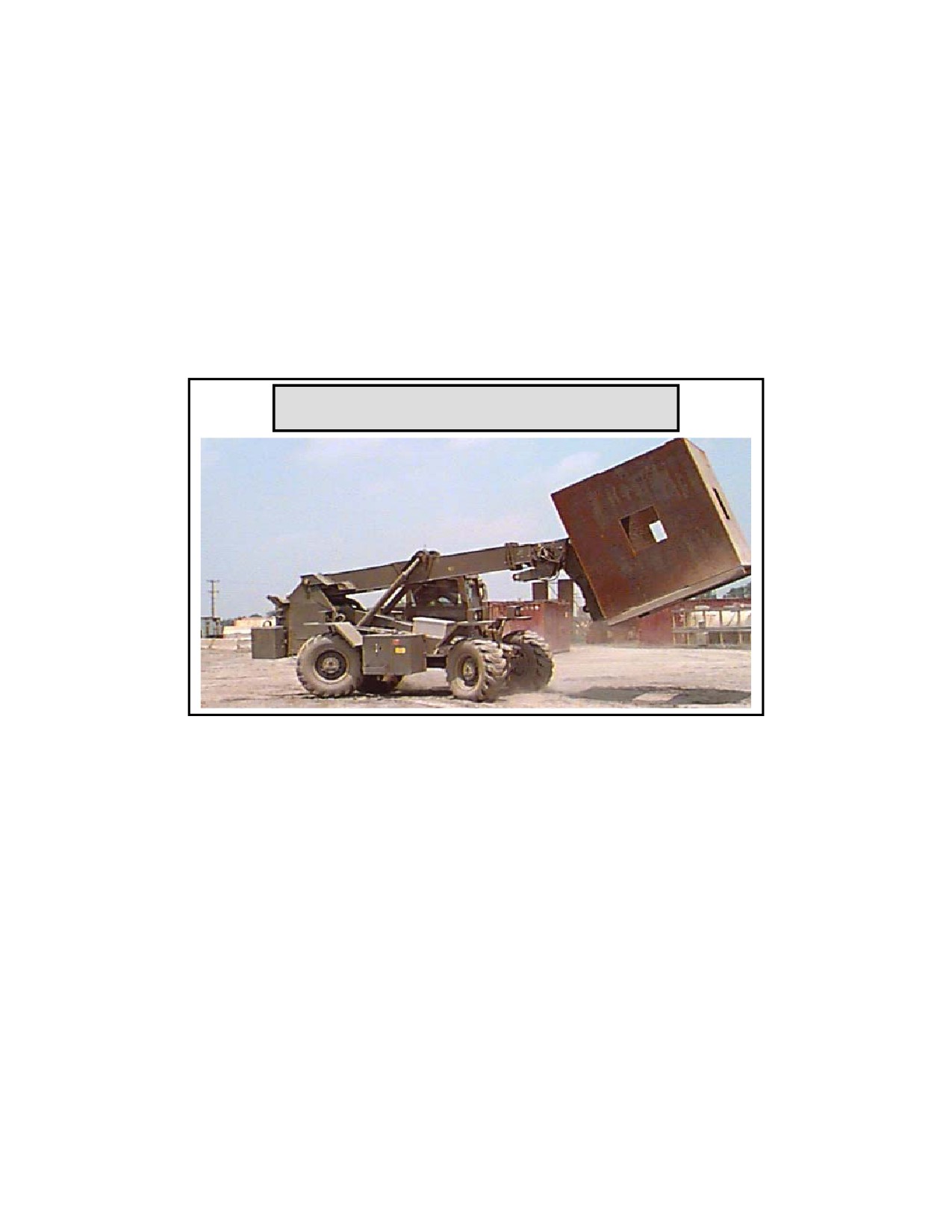
J-12. This forklift (figure J-6) is designed primarily to load and unload palletized ammunition from
resupply vehicles in the theater, corps, division, and brigade rear area ammunition storage areas. It
has advantages over the 4K RTF in that it can load and unload cargo from trucks without the
assistance of a ramp. When outfitted with special tool attachments it can extract Multiple-Launch
Rocket System (MLRS) pods from containers.
6,000 POUND VARIABLE REACH FORKLIFT
Figure B-5. 6,000 Pound Variable Reach Forklift
J-5
FM 4-01.30 ______________________________________________________________________________________ Appendix J
All-Terrain Lifter, Army System
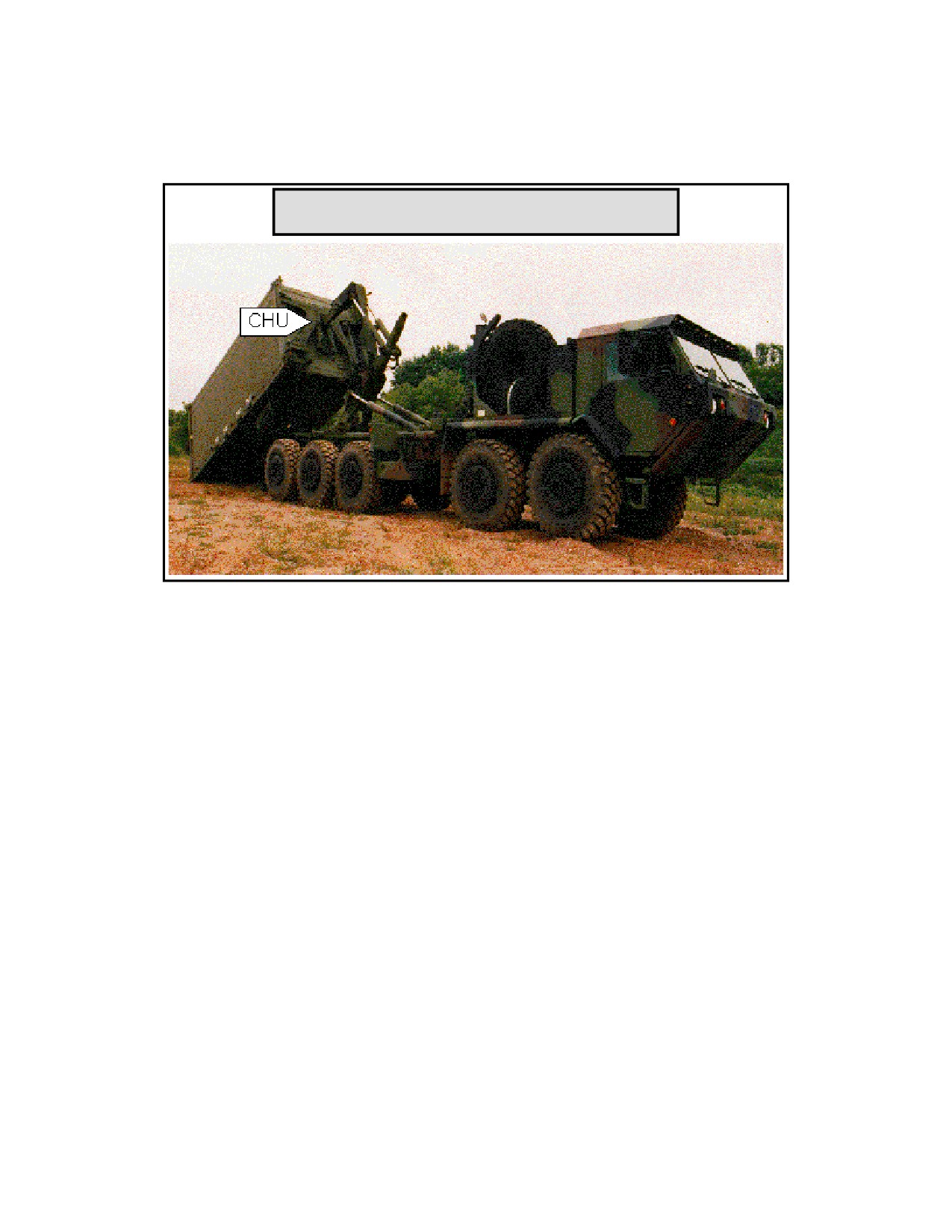
J-13. The All-Terrain Lifter, Army System (ATLAS) (figure J-7) is a 10,000 lb, variable reach, air
transportable, rough terrain forklift. The ATLAS is a key materiel handling system in aviation,
engineer, medical, ordnance, transportation, and supply units. This material handling equipment
(MHE) is used to load and unload ammunition, supplies, and equipment; transload cargo between
watercraft, ground vehicles, and aircraft; and stuff and unstuff these containers. Unlike the current
10Kforklift, ATLAS can safely lift 10,000 pound 463L pallets and unstuff these pallets from 20-foot
containers.
ALL TERRAIN LIFTER, ARMY SYSTEM (ATLAS)
Figure J-6. All Terrain Lifter, Army System (ATLAS)
Load Handling System Container Handling Unit
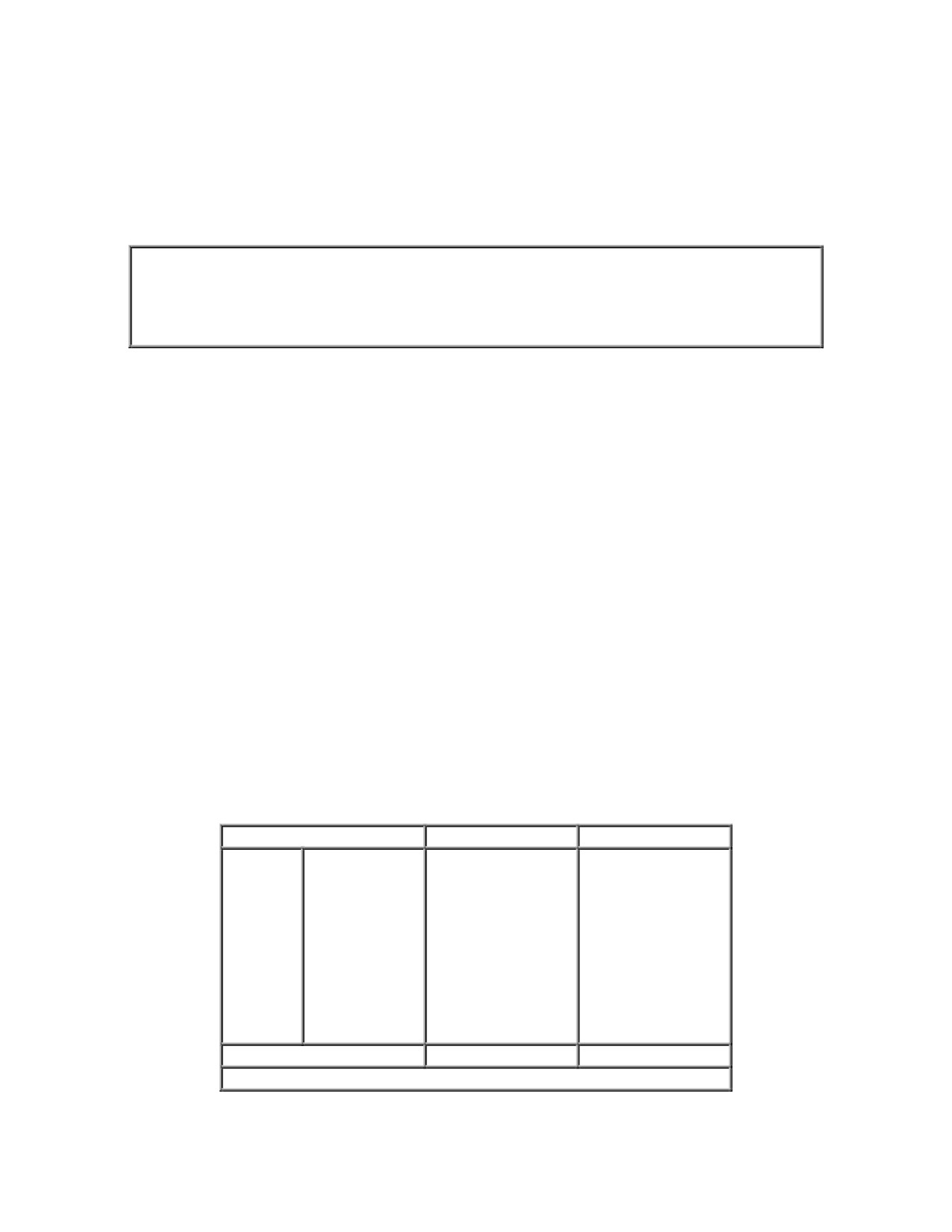
J-14. The Load Handling System Container Handling Unit (CHU) attaches to the load handling
system on the Palletized Load System (PLS). It allows the PLS to self-load 20-foot containers
without requiring the container to be loaded on a flatrack. The PLS truck can carry the CHU aboard
the vehicle in addition to the standard flatrack hook. The PLS with a CHU is capable of lifting 20-
foot ANSI/ISO containers weighing up to 36,250 pounds. Figure J-8 shows a PLS lifting a 20-foot
container with a CHU attached to the lifting arm.
J-6
FM 4-01.30 ______________________________________________________________________________________ Appendix J
CONTAINER HANDLING UNIT (CHU)
Figure J-7. Container Handling Unit (CHU)
20/40-Foot Container Sideloader
J-15. The diesel-powered container sideloader is a commercial item capable of transferring or self-
loading and transporting 20- through 40-foot ANSI/ISO containers. Typically, the maximum lifting
capability is 66,150 pounds. Units are available with a telescoping spreader bar for 20-, 35-, and 40-
foot length containers and can also lift containers with slings. The sideloader can transport
containers within maximum road height limitations. It also has an air ride suspension enabling it to
transport ANSI/ISO containers containing delicate equipment. These are primarily found at
commercial facilities and at depots. Sideloaders use a reduced amount of maneuver space compared
to RTCHs, which makes them more attractive. Rough terrain container sideloaders are offered
through commercial sources.
J-7
FM 4-01.30 ______________________________________________________________________________________ Appendix J
Container Characteristics and Types
NOTE: This section provides an overview of the various types of containers available for Army use.
The Equipment Deployment and Storage System (EDSS) family of containers and the 20-foot
ANSI/ISO container is the standard for unit equipment deployment. Units interested in procuring
ANSI/ISO containers may purchase only 20-foot versions. Procurements must be coordinated
through the Joint Transportation Movement Officer (JTMO).
STANDARDIZATION
J-16. The key to the use of more than one form of transportation and use of intermodal containers
is the establishment and compliance with commercially approved common standards. These serve to
ensure interoperability in the movement of containers between modes and countries. They increase
efficiency and effectiveness and foster a seamless flow of cargo.
J-17. Certain provisions of this field manual are the subject of North Atlantic Treaty Organization
(NATO) standardization agreements (STANAG). They are: STANAGs 2828 (Military Pallets,
Packing and Containers); 2829 (Material Handling Equipment); 2926 (Procedures for the Use and
Handling of Freight Containers for Military Supplies); 2998 (Materials Handling Glossary of Terms
and Definitions); and 4062 (Slinging and Tie-Down Facilities for Lifting and Tying Down Military
Equipment for Movement by Land and Sea). The aim of NATO standardization is to increase
interoperability and interchangeability of materiel and to improve the combined operational
effectiveness of the military forces of the Alliance.
CONTAINER SIZES
J-18. Container dimensions and capabilities vary dramatically, depending upon the manufacturer and
the target customer. The majority of containers conform to ANSI/ISO specifications. Figure J-9
shows the characteristics of the ANSI/ISO 20-and 40-foot containers. These standards allow for
some variance. External dimensions are required dimensions; however, internal dimensions and the
door opening size are minimum dimensions.
DIMENSIONS (inches)
20-foot ISO
40-foot ISO
Internal
Length
230.9
472.3
Width
91.7
91.7
Height
External
Length
238.5
480
Width
96
96
Height
96 and 102
96 and 114
Door
Width
90
90
Height
83.5-89.5
83.5-101.5
Max Gross Weight
52900 pounds
67200 pounds
* Maximum height is external height minus 9.5 inches
Figure J-8. ISO Standard Characteristics
J-8
FM 4-01.30 ______________________________________________________________________________________ Appendix J
J-19. Having to containerize increasing volumes of goods, customers have sought containers of
increased height, length, and width. Containers with the original ANSI/ISO external height of 8 feet
are generally being replaced by containers measuring 8 1/2 feet high. Also increasing numbers of
containers of 45-, 48-, 53-feet lengths have been brought into domestic service within the United
States, Canada, and Mexico.
CONTAINER TYPES
J-20. Samples of container types are depicted in figures J-10 through J-18. They include both
military and commercial intermodal containers, most of which are identical in nature.
ANSI/ISO End Opening Commercial
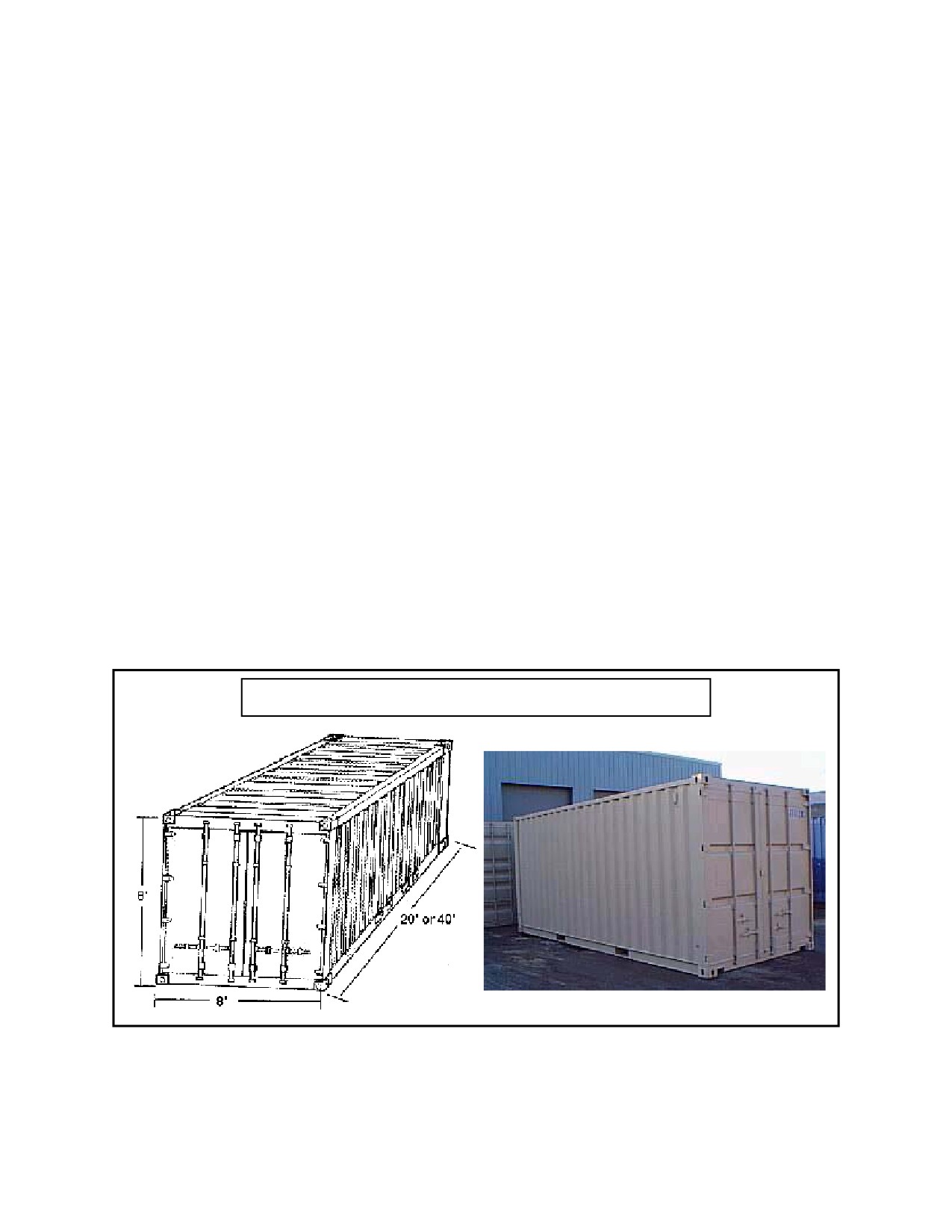
J-21. The commercial 20-foot end-opening container can be used to transport munitions or general
cargo. The door end corner posts are modified with angle iron to enhance blocking and bracing. As
there is no permanent restraint system, wooden blocking and bracing is used to restrain munitions.
J-22. End-opening dry cargo units are the most common intermodal containers in the inventory
(figure J-10). ANSI/ISO End-opening containers come in various lengths. DOD uses only 20- and
40-foot lengths. The outside dimensions can vary slightly. Both are approximately 8 feet high by 8
feet wide. DOD owns several container types that fit into this category. All military vans
(MILVANs) and ANSI/ISO end-opening containers can be readily transported by most military and
commercial CHE.
20- AND 40-foot ANSI/ISO CONTAINER
Figure J-9. Common Intermodal Container
J-9
FM 4-01.30 ______________________________________________________________________________________ Appendix J
MILVAN
J-23. The Ammunition Restraint MILVAN is made of steel, with wood flooring and walls and is
capable of transporting 39,015 pounds of ammunition. The tare weight of this MILVAN is 5,785
pounds. The total gross weight per MILVAN is 44,800 pounds. It has an internal restraint system of
eight slotted steel rails permanently installed on each sidewall with 25 adjustable crossbars that can be
inserted into the slots.
J-24. The General Cargo MILVAN container is made of steel, with hardwood flooring and plywood
lined walls and is capable of transporting 40,100 pounds of general cargo. The tare weight of this
MILVAN is 4,700 pounds. The total gross weight per MILVAN is 44,800 pounds.
J-25. MILVANs are still in use today. In 1989 there was a procurement for 1,160 of the ammunition
restraint MILVANs. The older ones are gradually being phased out of the system and replaced by
commercial containers. The Containerized Ammunition Distribution System (CADS) now uses
Army-owned and leased standard 20-foot ANSI/ISO containers.
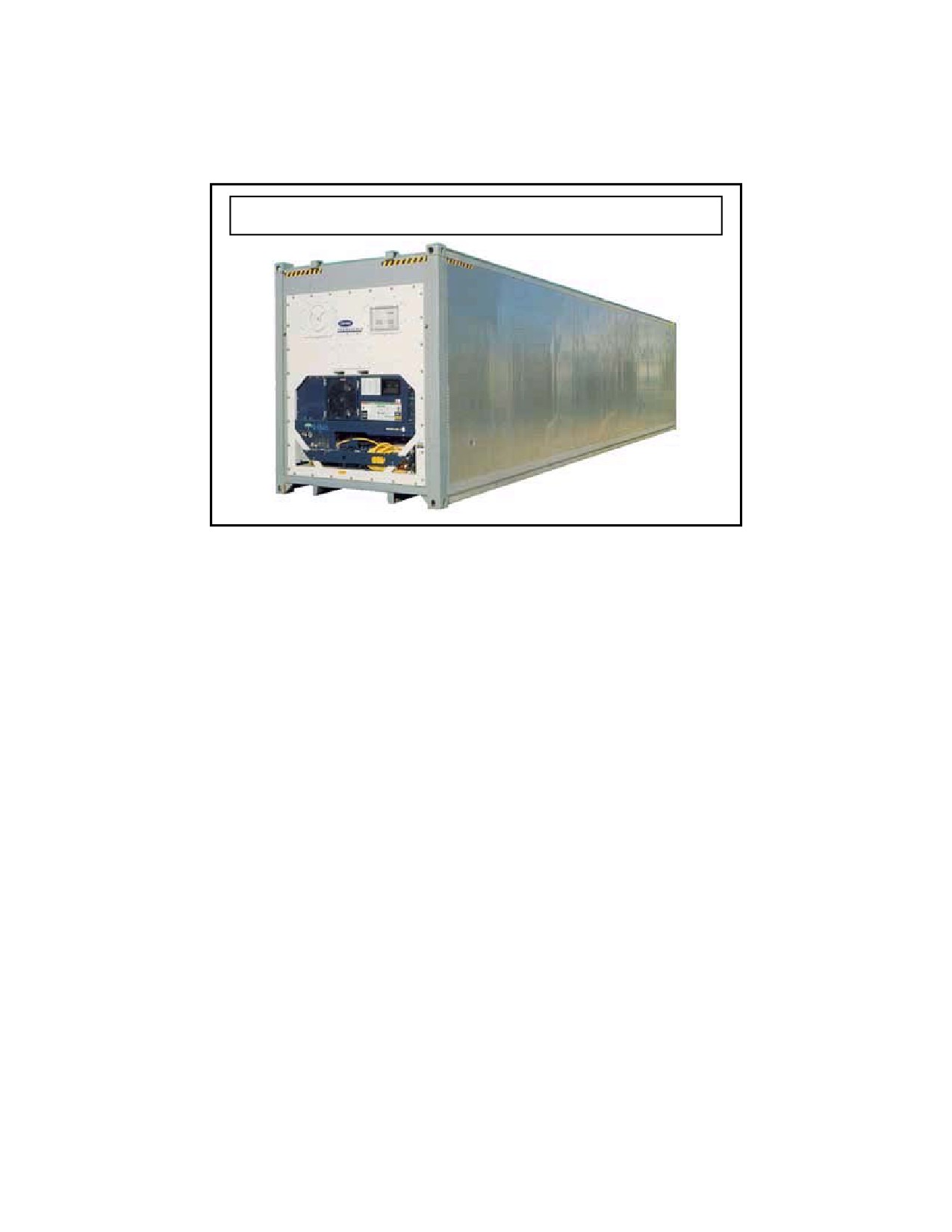
Refrigerated Container (REEFER)
J-26. REEFERs (figure J-11)provide the capability to transport, temporarily store, and distribute
temperature-sensitive cargo such as perishable food or blood. Military-owned REEFERs include a
refrigeration unit with a 10 KW generator. They can be plugged into an external power source or
run off their own generators. Most ships are equipped with a power source into which the
containers can be plugged. Commercial REEFERs are available with their own generator installed in
the front wall of the container with the refrigeration unit. Some commercial REEFERs are plugged
into a separate generator that fits into an adjoining container cell. REEFERs have the outer
dimensions of ANSI/ISO containers and meet all ANSI/ISO requirements for intermodal
shipments.
J-27. The Army only uses 20-and 40- foot length REEFERs. A 20-foot REEFER is 8’ wide by 8
feet high. The one shown in figure J-11 has its own generator system installed in the nose of the
container with the refrigeration unit.
J-10
FM 4-01.30 ______________________________________________________________________________________ Appendix J
REFRIGERATED CONTAINER (REEFER)
Figure J-10. Refrigerated Container (REEFER)
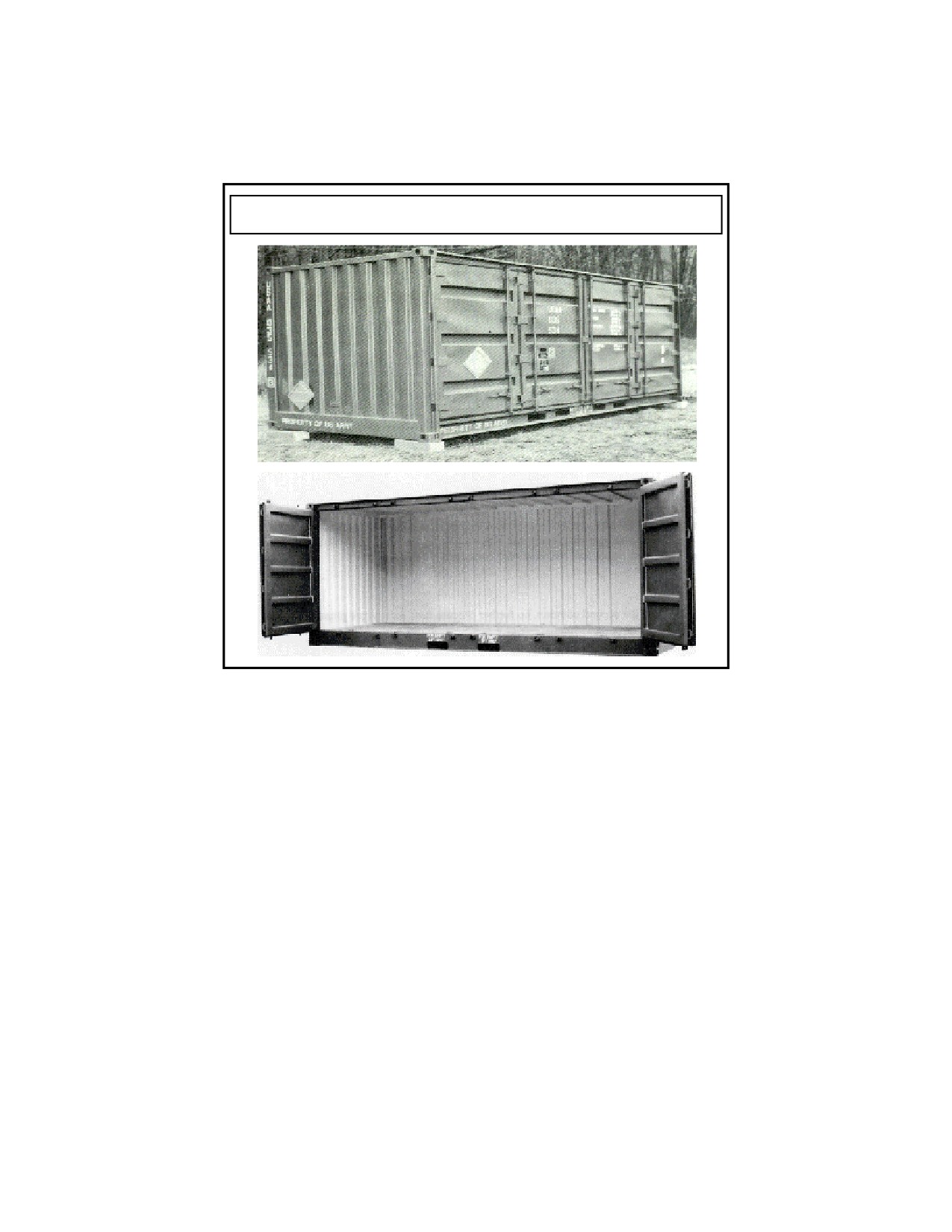
Side-Opening Container
J-28. Twenty-foot side-opening ANSI/ISO containers have two double doors located on one side
(figure J-12). These doors open to allow easy access to the container’s contents. The side-opening
container can be lifted and transported by commercial and military conveyances. Military versions
have internal tie-down rings that can be used to secure cargo during shipment. The military often
uses side-opening containers for transporting munitions.
J-29. Side-opening containers have the same dimensions as the 20-foot end opening ANSI/ISO
container. The Air Force is procuring side-opening containers to use as their standard munitions
container.
J-11
FM 4-01.30 ______________________________________________________________________________________ Appendix J
20-FOOT SIDE-OPENING CONTAINER
Figure J-11. Side-Opening Container
Open Top Container
J-30. The open top container is used primarily by commercial industry to transport cargo items that
are too large and bulky for standard containers. An open top container can be stuffed from the top,
or one end can be opened and it can be stuffed from there. It has ANSI/ISO standard corner
fittings at the top and bottom and commercial and military handlers and conveyances can readily lift
and transport it. Open top containers require tarpaulins for cover during shipping and storage.
Open top containers cannot be used for sensitive items requiring high security and may also have
agricultural restrictions.
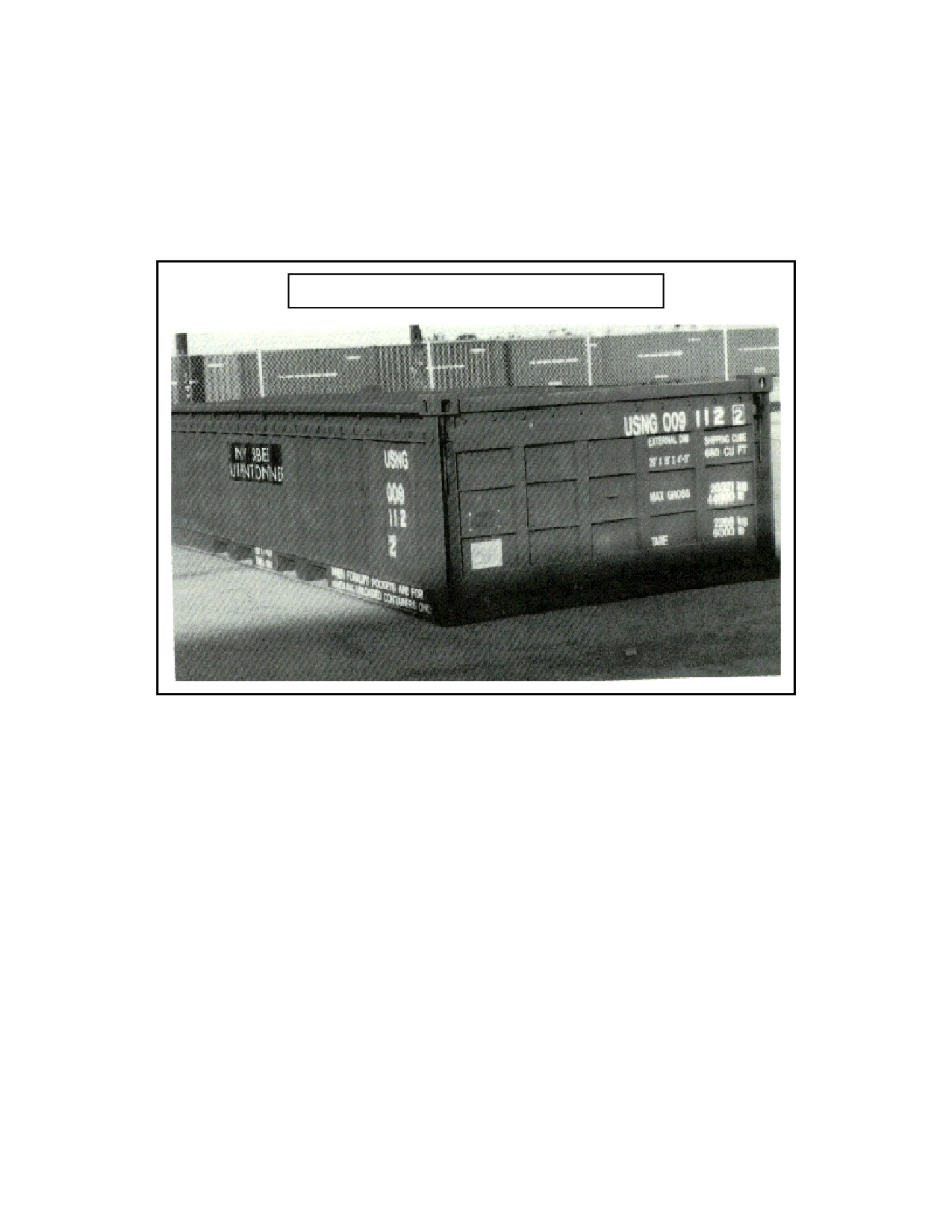
Half-Height Container
J-31. Half-height containers have the footprint of an ANSI/ISO container with ANSI/ISO standard
structural members and corner fittings (figure J-13). They are approximately half the height of a
standard end-opening container. They have fixed sides, an open top, and one drop-end opening.
Material is accessible by either MHE or crane. Tarpaulins accompany the containers for cover during
shipping and storage. These containers are useful to ship drummed oils and lubricants.
J-12
FM 4-01.30 ______________________________________________________________________________________ Appendix J
J-32. The 20-foot half-height container used by the Army is 20”x8’x4’3”. The Army uses the half-
height container primarily to ship ammunition having a high weight to volume ratio, such as 155mm
projectiles.
HALF-HEIGHT CONTAINER
Figure J-12. Half-Height Container
Tank Container
J-33. Commercial tank containers are 8 and 1/2 feet in length and are used to haul liquids, gases, and
dry bulk cargo. They can be pressurized or non-pressurized. Prototypes of military PLS compatible
ANSI/ISO bulk tank containers are being developed. They are used for intermodal transport of
liquids such as Class III and other liquids and gases.
Equipment Deployment and Storage System (EDSS)
J-34. EDSS containers are designed to support unit deployments. This category includes
QUADCON, TRICON, and internal airlift/helicopter slingable container unit (ISU) containers.
QUADCONs and TRICONs are primarily for ground and sea transport ISUs are intended for air
transport. All are available in multiple configurations including different doors, internal shelves, and
dividers. ISUs are not covered by ANSI/ISO specifications and are not used for marine transport in
ANSI/ISO 20- and 40-foot configurations.
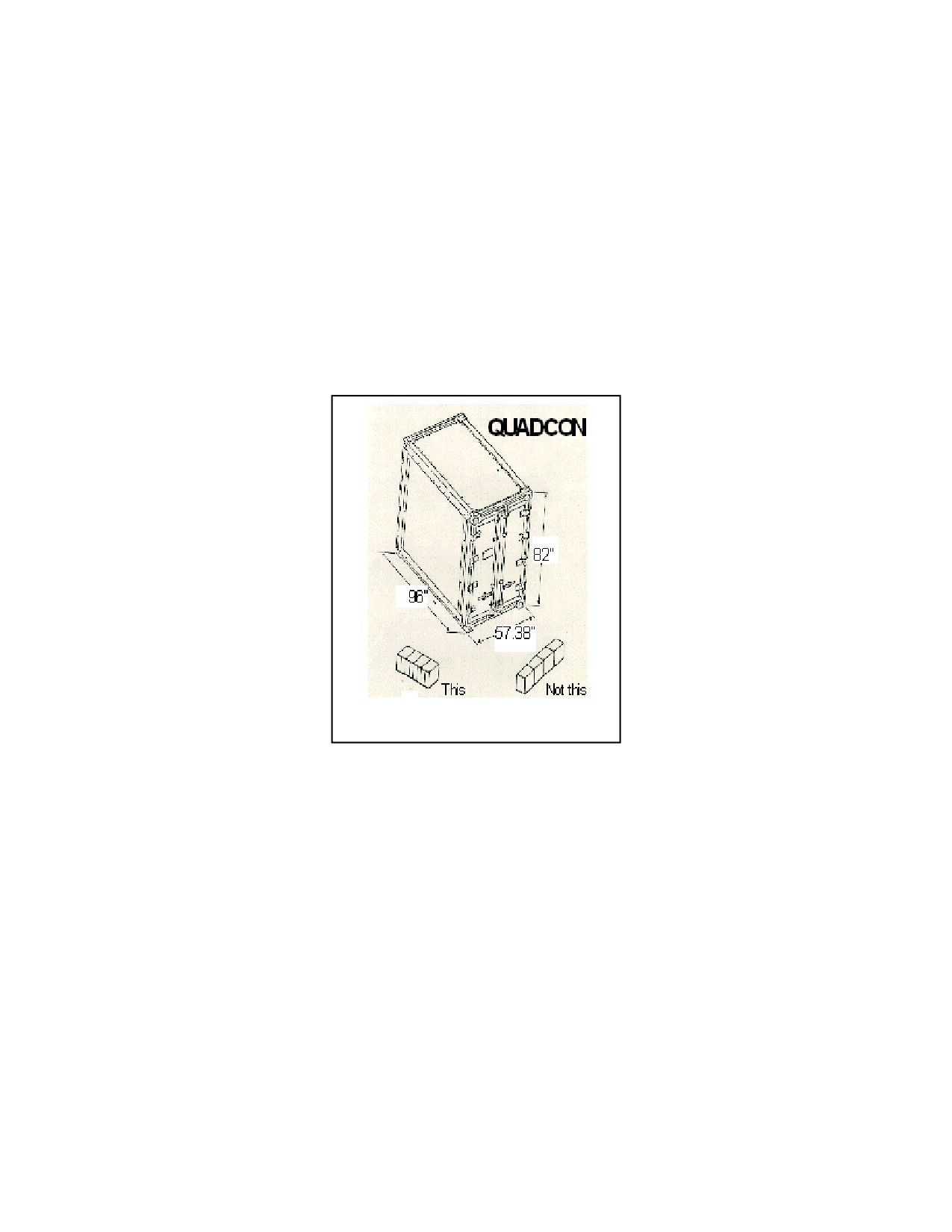
• QUADCON. QUADCONs (figure J-14) are not a common-use asset. They are unit-
owned military containers that are lockable, watertight, and made of steel construction.
They were first used as part of the Marine Corps Family of Intermediate Size Containers.
J-13
FM 4-01.30 ______________________________________________________________________________________ Appendix J
Other Services plan to procure QUADCONs in the near future. They are available to Army
units as CTA 50-900 items. The QUADCON is fast becoming the primary EDSS container
for surface movements. The QUADCON has ANSI/ISO corner fittings to allow for
coupling of the QUADCONs into arrays of up to four units. An array of four
QUADCONs has the same external length and width as a 20-foot ANSI/ISO container and
is designed to be lifted as a 20-foot unit or moved as a 20-foot unit in ocean shipping. The
QUADCON is certified to meet all ANSI/ISO standards. Each has four-way forklift
pockets and lockable double doors on each end that provide full access to the contents. To
accommodate smaller items, a small item storage cabinet can be installed or removable
inserts may be placed as shelves inside the QUADCON.
Four joined together become a 20-foot
ISO container
Figure J-13. QUADCON
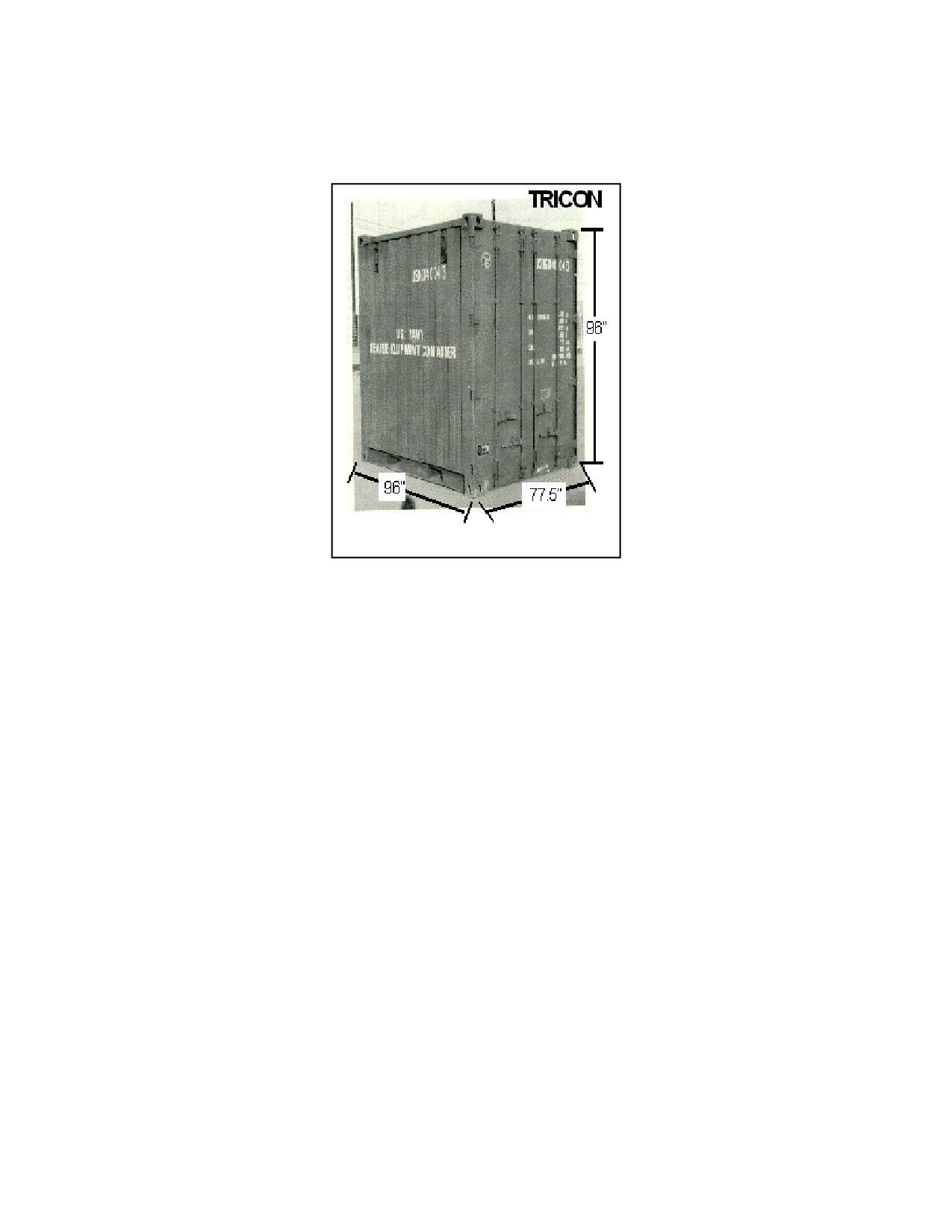
• TRICON. TRICONs (figure J-15) are not a common-use asset. They are military
containers owned by the Army and the Navy. Like QUADCONs, they are lockable,
watertight, and made of steel construction. TRICONs have standard ANSI/ISO corner
fittings and 3-way forklift pockets on the side and back. The TRICON has ANSI/ISO
corner fittings to allow for coupling into arrays of up to three units. An array of three
TRICONs has the same external length and width dimensions as a 20-foot ANSI/ISO
container and is designed to be lifted as a 20-foot unit in ocean shipping. Two styles of
containers have been procured: bulk and configured. Bulk containers do not have drawers,
shelves, or rifle racks. Configured containers consist of cabinets with drawers, shelves, rifle
racks, or a combination thereof.
J-14
FM 4-01.30 ______________________________________________________________________________________ Appendix J
Three joined together become a 20-foot
ISO container
Figure J-14. TRICON
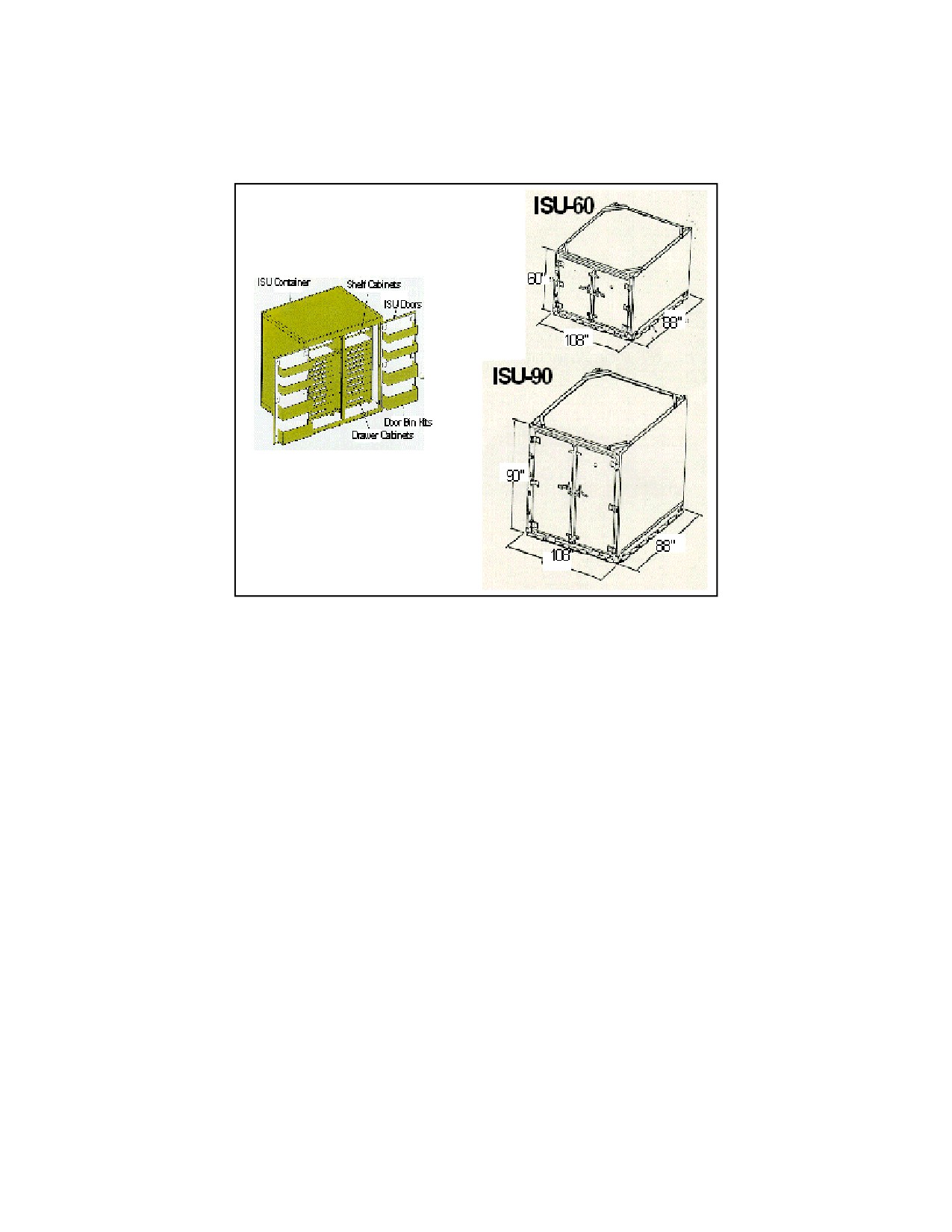
• ISU-60, -90, and -96. ISUs are 463L compatible, transportable in C-130 & CH 47 aircraft,
external air transport certified, and can be picked up with a forklift. They can be fitted with
removable bins and drawers as shown below in figure J-16. These ISU containers provide
weather resistant storage and transport, but do not meet ANSI/ISO structural standards.
They are certified for internal or external helicopter transport and for all AMC transport
aircraft. If transported aboard a ship, they would be secondary loads. A number of these
units have been procured by US Army Airborne and Air Assault units. The ISU-96 is a
refrigeration model used primarily to transport medical supplies. They are not ANSI/ISO
compatible.
J-15
FM 4-01.30 ______________________________________________________________________________________ Appendix J
Example of an ISU fitted with
interior shelves to better utilize
and organize the space.
Figure J-15. ISU-60, -90, and -96
Flatracks
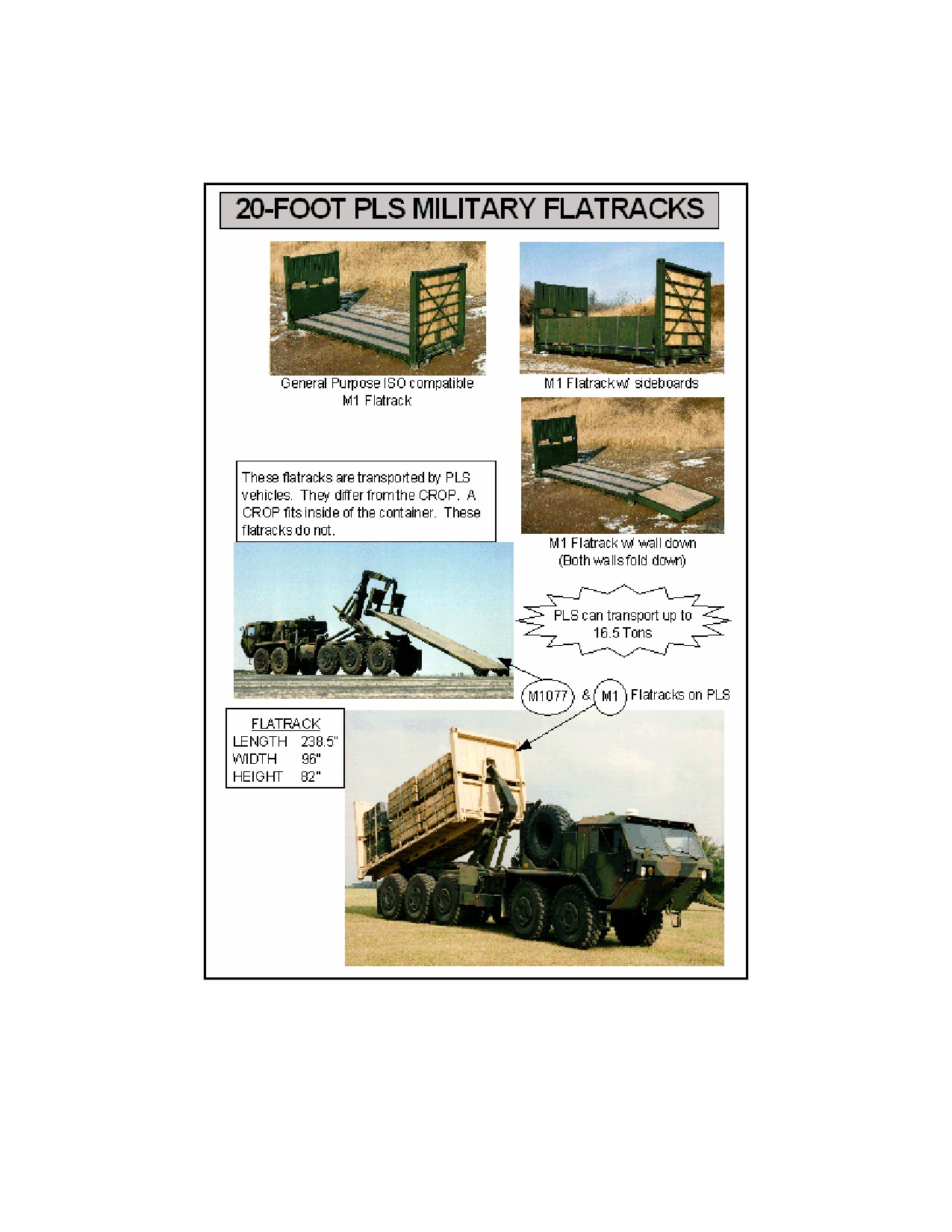
J-35. Flatracks are topless, sideless ISO containers (figure J-17). Flatracks enable containerships to
transport bulky items such as lumber, steel products, and piping (regular flatrack) and heavy or
outsized cargo such as tanks and armored vehicles (heavy-duty flatrack). The flatrack is a structural
steel frame, decked over and fitted with tie-down points. When loaded side-by-side in containership
cells, multiple flatracks can be used between decks to accommodate over-width cargo. Some
flatracks have corner posts while others have end walls. The corner posts or end walls on most
flatracks fold down to facilitate stacking and storage.
J-36. The military flatracks come in three sizes: 20-, 35-, and 40-foot. Twenty-foot flatracks are PLS
compatible. They are used to carry light items that do not fit into a 20-foot container. There are
several types of heavy-duty flatracks Some are equipped with telescoping corner posts adjustable
from 102 to 162 inches for various cargo heights. Some have fixed corner posts 156 inches high.
Corner posts of all three types fold to facilitate stacking and storage. These flatracks were designed
for over-ocean movement and have height restrictions when used in highway or rail transport roles.
J-16
FM 4-01.30 ______________________________________________________________________________________ Appendix J
Figure J-16. 20-Foot PLS Flatracks
Container Roll-In/Roll-Out Platform (CROP)
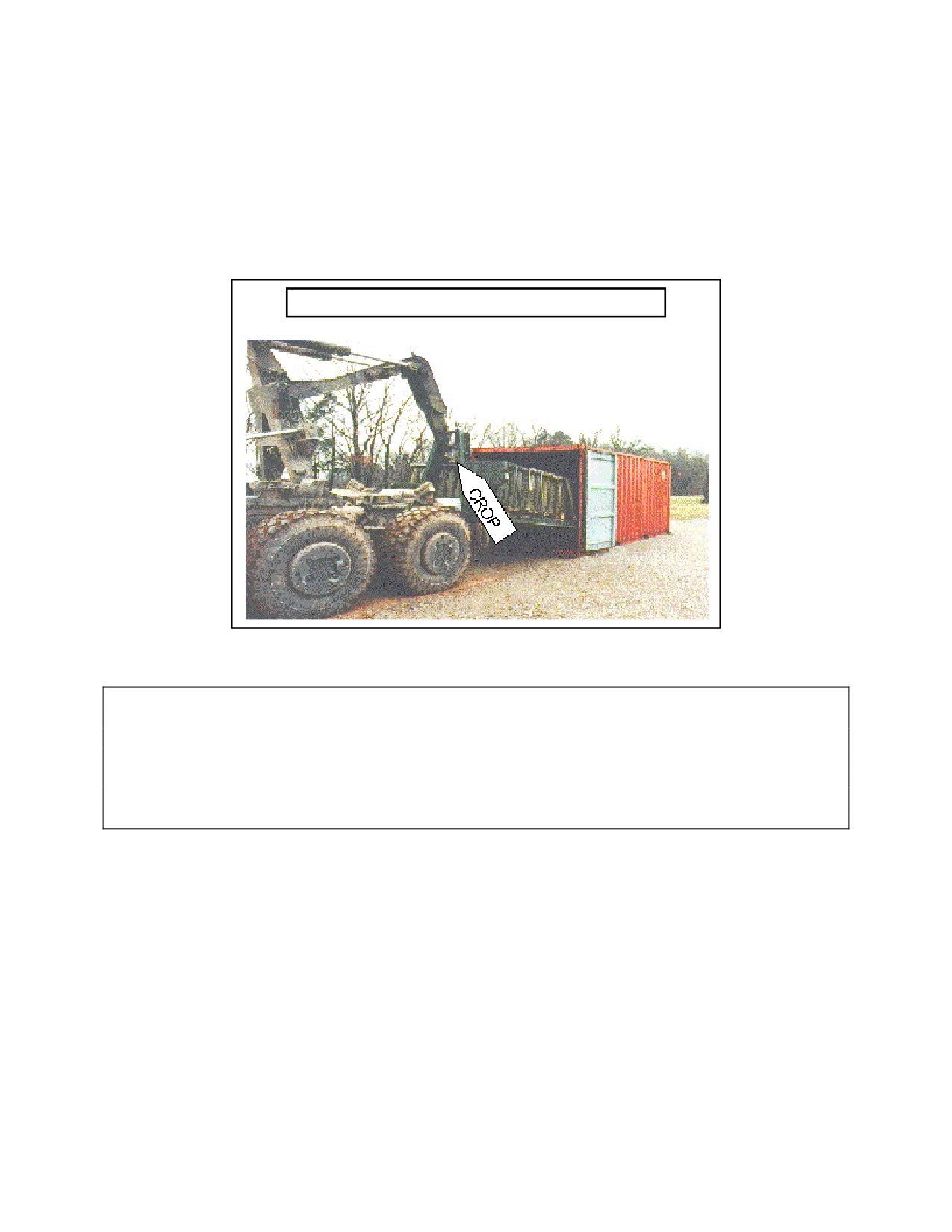
J-37. The CROP is a PLS flatrack that fits inside an ANSI/ISO standard 20-foot container. Figure
J-18, shows a PLS truck pulling a CROP out of a 20-foot container. The CROP is similar in function
J-17
FM 4-01.30 ______________________________________________________________________________________ Appendix J
to the standard M1077 PLS flatrack except for its dimensions. The CROP is 91.5" wide and 230"
long so it fits securely inside an ANSI/ISO container. A benefit of using the CROP is that of
external protection of ammunition verses tarps. The CROP does not require additional blocking and
bracing or materials and only the PLS truck is required to unload it.
CONTAINER ROLL-IN/ROLL-OUT PLATFORM (CROP)
Figure J-17. Container Roll-In/Roll-Out Platform (CROP)
NOTE
The world of containers and container handlers continues to develop and evolve. The
transportation world must accept that there will be many different models and names
associated with intermodal assets and asset handlers in the near future.
J-18
FM 4-01.30 ________________________________________________________________________________________ Glossary
GLOSSARY
Acronyms
2D
Two dimensional
A/DACG
Arrival/Departure Airfield Control Group
AA
Assembly Areas
AAI
Air-to-Air Interface
AALPS
Automated Air Load Planning System
ABS
Automated Battlefield System
AC
Active Component
ACA
Airlift Clearance Authority
ACOFS
Assistant Chief Of Staff
ADAO
Assistant Division Aviation Officer
AEI
Automatic Equipment Identification
AIS
Automated Information Systems
AIT
Automatic Identification Technology
ALCOM
Alaskan Command
AMC
Air Mobility Command
AMC-LSE
Army Material Command Logistics Support Element
AMFT
Automated Movement Flow Tracking
AmovP
Allied Movement Publications
AMS
Automated Manifest System
AO
Area of Operation
AOR
Area of Responsibility
APOD
Aerial Port of Debarkation
APOE
Aerial Port of Embarkation
APS
Army Pre-Positioned Stocks
ARCENT
Army Component Command
ARFOR
Army Forces
ASCC
Army Service Component Commander
ASG
Area Support Groups
ASP
Ammo Supply Points
ASR
Alternate Supply Routes
ATAV
Army Total Asset Visibility
ATCMD
Advanced Transportation Control and Movement Document
AWIS
Army World-Wide Military Command and Control Information System
AWRDS
Army War Reserve Deployment System
BBPCT
Blocking, Bracing, Packing, Crating, and Tie-Down
BMC
Brigade Movement Coordinator
BSA
Brigade Support Area
BSB
Base Support Battalion
C2
Command and Control
CAPS II
Consolidated Aerial Port System II
CBL
Commercial Bill of Lading
CCP
Consolidation and Containerization Point
CD-ROM
Compact Disk-Read Only Memory
C-E
Communications and Electronics
CFMS
Continental United States Freight Management System
Glossary - 1
FM 4-01.30 ________________________________________________________________________________________ Glossary
CHE
Container Handling Equipment
CIM
Corporate Information Management
CINC
Commander-in-Chief
CMCC
Corps Movement Control Center
CMMC
Corps Materiel Management Center
CMOS
Cargo Movement Operations System
CofS
Chief of Staff
COMSEC
Communications Security
COMMZ
Communication Zone
CONPLAN
Concept Plan
CONUS
Continental United States
COSCOM
Corps Support Command
CP
Checkpoint
CP
Command Post
CRC
CONUS Replacement Centers
CS
Combat Support
CSB
Corps Support Battalions
CSC
Convoy Support Center
CSG
Corps Support Group
CSS
Combat Service Support
CSSCS
Combat Service Support Control System
CTC
Cargo Transfer Company
CTMC
Combined Transportation Movement Center
CTO
Corps Transportation Officer
DAAS
Defense Automated Addressing System
DAMMS-R
Department of the Army Movements Management System-
Redesign
DAR
Daily Activity Report
DCSLOG
Deputy Chief of Staff for Logistics
DCSO
Deputy Commander for Support
DCSOPS
Deputy Chief of Staff for Operations and Plans
DDN
Defense Data Network
DELA
Drexler European License Association
DIMHRS
Defense Integrated Military Human Resource System
DISCOM
Division Support Command
DISREP
Discrepancy Report
DLA
Defense Logistics Agency
DMC
Defense Movement Coordinator
DMMC
Division Materiel Management Center
DNVT
Digital Non-secure Voice Terminal’s
DOD
Department of Defense
DODAAC
Department of Defense Activity Address Code
DOT
Department of Transportation
DS
Direct Support
DS2T
Deployment and Sustainment Support Tool
DSA
Division Support Area
DSS
Distribution Standard System
DST
Division Support Teams
DTG
Date Time Group
DTO
Division Transportation Officer
DTS
Defense Transportation System
DTTS
Defense Transportation Tracking System
E2DSK
Early Entry Deployment Support Kit
EAC
Echelons Above Corps
EDI
Electronic Data Interchange
EEM
Early Entry Module
Glossary - 2
FM 4-01.30 ________________________________________________________________________________________ Glossary
eMILPO
Electronic Military Personnel Management Office System
EPW
Enemy Prisoner of War
ETA
Estimated Time of Arrival
ETR
Export Traffic Release
EUSA
Eighth United States Army
FAD
Force Activity Designator
FCDT
Freight Consolidation and Distribution Team
FDRP
First Destination Reporting Point
FMFPAC
Fleet Marine Forces, Pacific
FORSCOM
United States Army Forces Command
FPP
Force Projection Platforms
FRAGO
Fragmentary Orders
FSB
Forward Support Battalion
GATES
Global Air Transportation Execution System
GBL
Government Bill of Lading
GCCS
Global Command and Control System
GCCS-A
Global Command and Control System-Army
GCSS
Global Combat Support System
GCSS-Army
Global Combat Support System-Army
GDSS
Global Decision Support System
GOPAX
Groups Operational Passenger System
GPS
Global Positioning System
GS
General Support
GSU
General Support Unit
GTN
Global Transportation Network
HAZMAT
Hazardous Materiel
HET
Heavy Equipment Transporter
HF
High Frequency
HHC
Headquarters & Headquarters Company
HHD
Headquarters and Headquarters Detachment
HHI
Hand Held Interrogators
HMCT
Highway Movement Control Team
HN
Host Nation
HNS
Host Nation Support
HQ
Headquarters
HTD
Highway Traffic Division
IBS
Integrated Booking System
ICODES
Integrated Computerized Deployment System
IG
Inspector General
ISSA
Inter-Service Support Agreement
ITO
Installation Transportation Officer
ITV
In-Transit Visibility
JCS
Joint Chief of Staff
JMC
Joint Movement Center
JOPES
Joint Operation Planning and Execution System
JTAV
Joint Total Asset Visibility
JTB
Joint Transportation Board
JTCC
Joint Transportation Corporate Information Management Center
JTF
Joint Task Force
LAN
Local Area Network
LCA
Logistic Control Activity
Glossary - 3
FM 4-01.30 ________________________________________________________________________________________ Glossary
LIA
Logistics Integration Agency
LIF
Logistics Intelligence Files
LIN
Line Identification Number
LO/LO
Lift-On/Lift-Off
LOC
Lines Of Communication
LOTS
Logistics-Over-The-Shore
LPT
Logistics Preparation of the Theater
LZ
Landing Zone
MA
Marshalling Area
MACOM
Major Army Command
MAGTF
Marine Air-Ground Task Force
MARFORCENT
Marine Forces, Pacific
MCA
Movement Control Agency
MCB
Movement Control Battalion
MCNCO
Movement Control Noncommissioned Officer
MCO
Movement Control Officer
MCS
Multi-Purpose Communications and Signaling
MCT
Movement Control Team
MDSS
Marine Air-Ground Task Force Deployment Support System
METS
Mechanized Export Traffic System
METT-TC
Mission, Enemy, Terrain and Weather, Troops and Support Available, Time
Available, and Civil Considerations
MHE
Materiel Handling Equipment
MILVAN
Military-Owned Demountable Container
MLC
Military Load Classification
MMC
Material Management Center
MOU
Memorandum of Understanding
MOVEPLAN
Movement Plan
MP
Military Police
MRE
Meal, Ready-To-Eat
MRO
Material Release Order
MRT
Movement Regulating Team
MS
Mobilization Station
MSB
Main Support Battalion
MSC
Military Sealift Command
MSE
Mobile Subscriber Equipment
MSL
Military Shipping Label
MSR
Main Supply Route
MTMC
Military Traffic Management Command
MTS
Movement Tracking System
MTS-CS
Movement Tracking System-Control Station
MWO
Mobility Warrant Officer
NATO
North Atlantic Treaty Organization
NBC
Nuclear, Biological, and Chemical
NCO
Non-Commissioned Officer
NCS
Net Control Station
NEO
Noncombatant Evacuation Operation
NICP
National Inventory Control Point
NSN
National Stock Number
OCCA
Ocean Cargo Clearance Authority
OCIE
Organizational Clothing & Individual Equipment
OCONUS
Outside the Continental United States
OEL
Organizational Equipment List
OIC
Officer In Charge
Glossary - 4
FM 4-01.30 ________________________________________________________________________________________ Glossary
OMC
Optical Memory Card
OPLAN
Operation Plan
OPORD
Operation Order
OPSEC
Operations Security
OPTEMPO
Operating Tempo
PACFLT
US Pacific Fleet
PD
Priority Designator
PDF
Portable Data File
PERSCOM
Personnel Command
PIC
Positive Inbound Clearance
PM
Provost Marshal
POC
Point of Contact
POCD
Process Operational Concept Document
POD
Port of Debarkation
POE
Port of Embarkation
POL
Petroleum, Oil, and Lubricants
PP&O
Plans, Programs, and Operations
PRAMS
Passenger Reservation and Manifest System
PSA
Port Support Activity
PSN
Proper Shipping Name
PZ
Pickup Zone
RAP
Rear Area Protection
RC
Reserve Component
RDD
Required Delivery Date
RF
Radio Frequency
RFDC
Radio Frequency Data Communication
RFID
Radio Frequency Identification
RGATES
Remote Global Air Transportation Execution System
RLAN
Remote Local Area Network
RMMT
Rail Movement Management Team
ROKA
Republic of Korea Army
ROM
Refuel On The Move
RP
Release Point
SA
Staging Area
SAAM
Special Assignment Airlift Mission
SAAS-MOD
Standard Army Ammunition System - Modernized
SAI
Surface-To-Air Interface
SARSS
Standard Army Retail Supply System
SATCOM
Satellite Communications
SDD
Standard Delivery Date
SJA
Staff Judge Advocate
SOCPAC
Special Operations Command, Pacific
SOO
Support Operations Officer
SOP
Standard Operating Procedures
SP
Start Point
SPBS-R
Standard Property Book System - Redesigned
SPOD
Seaport of Debarkation
SPOE
Seaport of Embarkation
SRP
Soldier Readiness Processing
SSA
Supply Support Activity
STACCS
Standard Theater Army Command and Control System
STANAG
Standardization Agreements
SWA
Southwest Asia
Glossary - 5
FM 4-01.30 ________________________________________________________________________________________ Glossary
TA
Theater Army
TAA
Tactical Assembly Area
TAACOM
Theater Army Area Command
TALCE
Tanker Airlift Control Element
TALO
Tactical Air Liaison Officer
TAT
To Accompany Troops
TAV
Total Asset Visibility
TC-ACCIS
Transportation Coordinators-Automated Command and Control Information System
TC-AIMS II
Transportation Coordinators' Automated Information for Movements System II
TCC
Transportation Component Command
TCE
Transportation Command Element
TCMD
Transportation Control & Movement Document
TCN
Transportation Control Number
TCP
Traffic Circulation Plan
TEU
Twenty-Foot Equivalent Unit
TFOP
Theater Force-Opening Package
TMO
Traffic Management Office
TMR
Transportation Movement Release
TMT
Transportation Motor Transport
TO&E
Tables of Organization and Equipment
TOE
Table of Organization and Equipment
TOFM
Theater-Opening Force Module
TP
Transportation Priority
TPFDD
Time Phased Force Deployment Data
TPS
Tactical Personnel Dystem
TRANSCOM
Transportation Command
TRITAC
Tri-Service Tactical
TSC
Theater Support Command
TTP
Trailer Transfer Point
TUSA
Third US Army
TWV
Tactical Wheeled Vehicle
UDL
Unit Deployment List
UMC
Unit Movement Coordinator
UMMIPS
Uniform Materiel Movement and Issue Priority System
UMO
Unit Movement Officer
UMT
Unit Ministry Team
UMT
Unit Movement Team
USAF
US Air Force
USAFE
US Air Force in Europe
USAREUR
US Army Europe Commands
USARPAC
US Army Pacific
USARSO
US Army South
USCENTCOM
United States Central Command
USEUCOM
United States European Command
USFJ
US Forces Japan
USFK
US Forces Korea
USMC
United States Marine Corps
USPACOM
United States Pacific Command
USSOUTHAF
US South Air Force
USTRANSCOM
United States Transportation Command
VHF
Very High Frequency
WHNS
Wartime Host Nation Support
WPS
Worldwide Port System
WWW
World Wide Web
Glossary - 6
FM 4-01.30 ________________________________________________________________________________________ Glossary
Terms And Definitions
A
Active Component (AC) - The active Army component of the United States Army refers to
units on full-time active duty, as distinguished from the Reserve component that is
composed of units of the United States Army Reserve and the Army National Guard.
Advanced Transportation Control and Movement Document (ATCMD) - The ATCMD
function is used to provide advance information concerning equipment that will be moving
to an airport or seaport for shipment.
Aerial Port of Debarkation (APOD) - An aerial port within the theater of operations
where the strategic transportation of forces is completed.
Aerial Port of Embarkation (APOE) - A station which serves as an authorized port to
process and clear aircraft (scheduled, tactical, and ferried) and traffic for departure from the
country in which located.
Air Mobility Command (AMC) - Air Mobility Command's primary mission is rapid, global
mobility and sustainment for America's armed forces. The command also plays a crucial
role in providing humanitarian support at home and around the world. They also provide
tactical and strategic airlift and aerial refueling for all of America's armed forces.
Air-to-Air Interface (AAI) - AAI is used when units or reinforcements are critical or when
the strategic aircraft is diverted from its original APOD due to the tactical situation, weather,
or other reasons. AAIs are normally short notice, short duration missions.
Airlift Clearance Authority (ACA) - Service activity that controls the movement of traffic,
cargo and personal property, into the airlift system.
Alert Holding Area - The equipment, vehicle, and passenger control area. It is normally
located in the vicinity of the departure airfield. It is used to assemble, inspect, hold, and
service aircraft loads. Control of the load is transferred from the individual unit to the DACG
at this point.
Alternate Supply Routes (ASR) - A route or routes designated within an area of
operations to provide for the movement of traffic when main supply routes become disabled
or congested.
Ammo Supply Points (ASP) - The Ammunition Supply Point (ASP) has the mission of
supporting installations with ammunition and explosives (Class V). The ASP is staffed and
equipped to support all Class V missions and is capable of storing all categories of munitions
and explosives.
Apportionment - In the general sense, distribution for planning of limited resources among
competing requirements. Specific apportionment’s (e.g., air sorties and forces for planning)
are described as apportionment of air sorties and forces for planning, etc.
Area of Operation (AO) - An operational area defined by the joint force commander for
land and naval forces. Areas of operation do not typically encompass the entire operation
Glossary - 7
FM 4-01.30 ________________________________________________________________________________________ Glossary
area of the joint force commander, but should be large enough for the component
commanders to accomplish their missions and protect their forces.
Area of Responsibility (AOR) - The geographical area associated with a combatant
command within which a combatant commander has authority to plan and conduct
operations.
Army Material Command Logistics Support Element (AMC-LSE) - The LSE is an
organization deployed by the USAMC to help commanders manage USAMC contractors and
works as part of the TSC.
Army Pre-Positioned Stocks (APS) - APS constitute one leg of the strategic mobility
triad. The purposes of APS are to reduce the initial amount of strategic lift required to
support a CONUS-based force projection Army; and to sustain the warfight until sea lines of
communication (SLOC) with CONUS are established. Accordingly, APS is pre-positioned at
several sites to quickly project power to potential contingency areas.
Army Service Component Commander (ASCC) - The commander of the Army
component in support of a theater commander, combatant commander, or joint force
command. The ASCC is responsible for preparing, maintaining, training, equipping,
administering, and supporting Army forces assigned to unified and specified commands.
The ASCC normally advises the combatant or subordinate unified commander on the proper
employment of the forces of the Army component.
Army Total Asset Visibility (ATAV) - The ATAV Program is a comprehensive U.S. Army
initiative that dramatically improves the logisticians' ability to obtain and act on information
about the location, quantity, condition, and movement of assets. It provides visibility of
assets in use, in storage, in process, and in transit, as well as other logistics information.
Army War Reserve Deployment System (AWRDS) - This operational data store was
designed to enable Army War Reserve to rapidly deploy forces around the globe for combat
and humanitarian missions. This system is a distributed database application that allows
military personnel in the United States and in Europe and Asia (both on land and sea) to
maintain and access current equipment availability and readiness information. Military
personnel from around 20 pre-positioned sites update the information into their local
database and every 6 hours the updated information is replicated from their local machines
to a centralized server. This ensures that all Army War Reserve sites have access to the
most up-to-date information.
Army World-Wide Military Command and Control Information System (AWIS) -
When the Army is currently called upon to rapidly deploy its forces, AWIS provides the
support for the entire operation: from mobilization and deployment through employment
and sustainment. AWIS fulfills the Army's strategic C2 requirements for software,
hardware, and databases for the implementation of the Joint Operations Planning and
Execution System (JOPES) and other Joint Service systems that support the Unified
Commands and the Joint Staff. In addition, AWIS modernizes the Army's C2 system,
supporting conventional military planning and execution. AWIS-developed software
systems provide the capability for Army commands to analyze courses of action; develop,
manage, and support the execution of the Army's responsibilities in the Joint Chiefs of Staff
(JCS) War Plans; ensure that the Army's plan is feasible in a global environment; and
perform status reporting, mobilization, deployment, employment, and sustainment support
actions for Army forces supporting conventional joint-military operations.
Glossary - 8
FM 4-01.30 ________________________________________________________________________________________ Glossary
Arrival/Departure Airfield Control Group (A/DACG) - A provisional organization
provided by the designated installation to perform aerial port functions during unit
deployment/employment/ redeployment.
Assembly Area - An area in which a command is assembled to prepare for further
operations.
Automated Air Load Planning System (AALPS) - A computerized system to rapidly
estimate total airlift requirements and to produce individual aircraft load plans. The system
allows preplanned equipment deployment packages to be built, analyzed, and maintained.
Automated Battlefield System (ABS) - The ABS is a fully automated man-portable
system capable of supporting Air Force accounting requirements and military pay service. It
uses laptop computers to provide deployed forces direct, on-line access to accounting and
payroll systems from any location. The ABS, which consists of a simple piece of software
that works with ground-based communication equipment or a portable satellite transmission
device, permits the user to access all financial information resident in stateside computers.
Automated Information Systems (AIS) - A discrete set of information resources
organized using information technology. Automated information systems may be used for
the collection, processing, maintenance, transmission, or dissemination of information.
Automated Manifest System (AMS) - AMS is a Defense Logistics Agency (DLA) initiative
that utilizes laser-readable optical cards in place of paper packing slips on the exterior of
shipment containers. The AMS is used at depots, Central Receiving Points (CRPs), and
Supply Support Activities (SSAs) such as the DSU in a forward support battalion of a
division to facilitate manifesting and tracking of multipack shipments from the depot to the
CRP or SSA. AMS provides 'in the box" asset visibility and may be used as the source of
intransit visibility data. The AMS reader can be connected directly to the STAMIS at the
receiving unit thereby increasing the accuracy of data by automating the input of source
data.
Automated Movement Flow Tracking (AMFT) - AMFT is an Army software tool that
provides automated support for deployment planning and execution. It also develops
deployment schedules, updates and modifies chalks, creates and prints movement flow
tables, and is capable of sending electronic messages.
Automatic Equipment Identification (AEI) - AEI reader systems provide automated
tracking of railcars and shipments via RF tags, and make shipment location information
available to railroads and their customers. Although not an Army asset, it may be possible
to use this technology and Electronic Data Interchange (EDI) from the rail company to
Global Transportation Network (GTN) to provide ITV data of Army equipment moving on
commercial rail carriers.
Automatic Identification Technology (AIT) - A suite of tools for facilitating total asset
visibility (TAV) source data capture and transfer. Automatic Identification technology (AIT)
includes a variety of devices, such as bar codes, magnetic strips, optical memory cards, and
radio frequency tags for marking or tagging individual items, multi-packs, equipment, air
pallets, or containers, along with the hardware and software required to create the devices,
read the information on them, and integrate that information with other logistic information.
AIT integration with logistic information systems is key to the Department of Defenses TAV
efforts.
Glossary - 9
FM 4-01.30 ________________________________________________________________________________________ Glossary
Automation Network - The automation network combines all of the information collection
devices, automatic identification technologies, and the automated information systems, that
either support or facilitate the joint reception, staging, onward movement, and integration
process.
B
Balance - Balance is the matching of vehicle characteristics with route characteristics to
ensure that vehicle traffic does not exceed the most limiting feature of a route.
Bar Code - A code consisting of a group of printed and variously patterned bars, spaces,
rectangles, or other shapes that encode data that is designed to be scanned and read into
computer memory to provide identification or other information relating to the object it
labels.
(1) Linear Bar Code - A code consisting of a group of printed and variously
patterned bars and spaces, and sometimes numerals, that is designed to be scanned and
read into computer memory as identification for the object it labels. An ordinary linear
barcode, with vertical bars and stripes, can hold about 16 ASCII characters.
(2) Two Dimensional Barcode - Data encoded in many different size rectangles,
can hold between 1000 and 2000 ASCII characters. Two Dimensional barcodes have to be
scanned in a raster format (like a television) to cover their whole area.
Base Support Battalion (BSB) - BSB provides command and control of assigned and
attached units and facilities to ensure the sustainment of the community in its Area of
Operation. It supports Operations Other Than War, receives and prepares augmentation
forces for onward movement, processes and provides individual replacements, transitions
the community during deployments and crises, and provides community support operations.
Blocking, Bracing, Packing, Crating, and Tie-Down (BBPCT) - Materials used to
contain and immobilize materiel and equipment and to protect it from damage during
transportation. BBPCT materials may include lumber, CONEX inserts, cardboard boxes,
paper wrapping, plastic “bubble wrap”, Styrofoam, metal banding, chains, and cleats.
Boundary - A line that delineates surface areas for the purpose of facilitating coordination
and deconfliction of operations between adjacent units, formations, or areas.
Brigade Movement Coordinator (BMC) - BMCs are appointed to coordinate and support
Brigade movement activities and to assist in the development, maintenance, and evaluation
of subordinate units’ movement plans.
Brigade Support Area (BSA) - A designated area in which combat service support
elements from division support command and corps support command provide logistics
support to a brigade. The brigade support area normally is located 20 to 25 kilometers
behind the forward edge of the battle area.
C
Call Forward Area - The area is that portion of the departure airfield where the DACG and
TALCE conduct joint inspections of aircraft loads. A final briefing is provided to deploying
troops by the TALCE. The DACG and TALCE review all load plans and manifests for
accuracy. The deploying unit corrects all discrepancies found by the joint inspection in this
area.
Glossary - 10
FM 4-01.30 ________________________________________________________________________________________ Glossary
Campaign - A series of related military operations aimed at accomplishing a strategic or
operational objective within a given time and space.
Campaign Plan - A plan for a series of related military operations aimed at accomplishing a
strategic or operational objective within a given time and space.
Cargo Documentation Team - A Cargo Documentation Team is a small TOE detachment
staffed with 88N Documentation Specialists. Its mission is to administrate the document
associated with moving cargo. The Cargo Documentation Team has no MHE. The team is
normally assigned to augment a Cargo Transfer Company to prepare documentation for
cargo and equipment being loaded on vessels.
Cargo Movement Operations System (CMOS) - CMOS classifies and consolidates cargo,
determines cargo priority, and provides the capability to schedule and move cargo
expeditiously.
Cargo Transfer Company (CTC) - A CTC is organized with four Cargo Transfer Platoons
and a Documentation Section. The four platoons have MHE to support transshipping cargo,
containers, and unit equipment to ships and aircraft. Each platoon can operate
independently at a remote site to support transshipment operations. The company assists
in loading ships and operating a staging area.
Centralized Control - Centralized Control means that a focal point for transportation
planning and resource allocation exists at each level of command involved in an operation.
The focal point is an individual or unit that is aware of the current and future requirements
of the supported force as well as the capabilities available to meet the requirements.
Centralization of movement control normally occurs at the levels charged with integrating
logistics support.
Checkpoint (CP) - 1. A predetermined point on the surface of the Earth used as a means
of controlling movement, a registration target for fire adjustment, or reference for location.
2. Center of impact; a burst center.
3. Geographical location on land or water above which
the position of an aircraft in flight may be determined by observation or by electrical means.
4. A place where military police check vehicular or pedestrian traffic in order to enforce
circulation control measures and other laws, orders, and regulations.
Close Column - A form of convoy organization that provides the greatest degree of convoy
control. It is characterized by vehicle intervals of 25 to 50 meters and speeds under 25
mph. Close column is normally used during limited visibility or on poorly marked or
congested roads.
Column Schedule - Specifies arrive and clear times at checkpoints (CPs) along an entire
route. Based upon the extent of control required, a column schedule can provide the most
effective highway regulation because it provides in-transit times to reach CPs and helps the
pacesetter maintain the prescribed rate of march. It may be used for supervised, dispatch,
or reserved routes. It should also be used when congestion is anticipated.
Combat Power - The total means of destructive and/or disruptive force which a military
unit/formation can apply against the opponent at a given time.
Combat Service Support (CSS) - The essential capabilities, functions, activities, and
tasks necessary to sustain all elements of operating forces in theater at all levels of war.
Glossary - 11
FM 4-01.30 ________________________________________________________________________________________ Glossary
Combat Service Support Control System (CSSCS) - CSSCS is designed to collect,
analyze, and disseminate critical logistical, transportation, medical, financial, and personnel
information. CSSCS will receive data directly from TC-AIMS II and GTN.
Combatant Commander - A commander in chief of one of the unified or specified
combatant commands established by the President.
Combined Operation - An operation conducted by forces of two or more Allied nations
acting together for the accomplishment of a single mission.
Combined Transportation Movement Center (CTMC) - The CTMC serves as the single
transportation manager for coordinating theater-level transportation movements and asset
management in support of contingency operations.
Command and Control (C2) - The exercise of command that is the process through which
the activities of military forces are directed, coordinated, and controlled to accomplish the
mission. This process encompasses the personnel, equipment, communications, facilities,
and procedures necessary to gather and analyze information, to plan for what is to be done,
and to supervise the execution of operations.
Commercial Bill of Lading (CBL) - Carrier documentation used for transportation of
shipments, such as that used by small package express carriers. It includes the commercial
procedures related to the use of such documentation.
Communication Zone (COMMZ) - The COMMZ extends from the CONUS base to the rear
of the Combat Zone (CZ) in the theater of operations. Its size may vary depending on the
size of the theater of operations, number of forces required for operations and sustainment,
need for depth, the number and direction of lines of communication (LOC), and the enemy's
capability to interdict and disrupt sustainment operations, geography, and political
boundaries. The COMMZ contains the LOC; the establishments within the theater logistics
bases that provide supply, maintenance, field services, transportation, health services,
personnel support, and evacuation; and other agencies required for the immediate support
and sustainment of the field forces.
Concept Of Operations - A verbal or graphic statement, in broad outline, of a
commander's assumptions or intent in regard to an operation or series of operations. The
concept of operations frequently is embodied in campaign plans and operation plans; in the
latter case, particularly when the plans cover a series of connected operations to be carried
out simultaneously or in succession. The concept is designed to give an overall picture of
the operation. It is included primarily for additional clarity of purpose.
Concept Plan (CONPLAN) - An operation plan in a concept format that would require
considerable expansion or alteration to convert to an OPLAN and OPORD.
Consolidated Aerial Port System II (CAPS II) - CAPS II is an umbrella system that
includes cargo, passenger, and command and control operations. It provides a
standardized worldwide automated network of computers for processing cargo and
passengers through the major aerial ports. The cargo system records receipts, staging, and
unloading at APOEs, and prints out the aircraft manifest upon completion of loading. The
passenger system will accomplish passenger processing, seat allocation, cash collection,
flight update processing to ASIFICS/PRAMS, boarding pass, and final manifest
preparation/issue.
Glossary - 12
FM 4-01.30 ________________________________________________________________________________________ Glossary
Container Handling Equipment (CHE) - Material-handling equipment (MHE) designed
specifically to receive, maneuver, and dispatch containers.
Continental United States (CONUS) - The 48 contiguous states and the District of
Columbia.
Continental United States Freight Management System (CFMS) - CFMS provides an
automated, electronic capability for the procurement of commercial freight transportation
services. It covers freight shipments at all sources. It provides the central DOD database
for filing all commercial freight transportation rates and services. It provides automation
support for preparing freight shipping documents, carrier selection, electronic filing of
Government bill of lading (GBL), prepayment, shipment status, quality control, and intransit
visibility. The CFMS interfaces with GTN and the defense transportation tracking system for
shipment status and GBL maintenance.
Contingency - An emergency involving military forces caused by natural disasters,
terrorists, subversives, or by required military operations. Due to the uncertainty of the
situation, contingencies require plans, rapid response, and special procedures to ensure the
safety and readiness of personnel, installations, and equipment.
Control Point - 1. A position along a route of march at which personnel are stationed to
give information and instructions for the regulation of traffic.
2. A position marked by a
buoy, boat, aircraft, electronic device, conspicuous terrain feature, or other identifiable
object which is given a name or number and used as an aid to navigation or control of
ships, boats, or aircraft.
Controlled Route - A route, the use of which is subject to traffic or movement restrictions.
Convoy Commander - An officer, designated to command the convoy, subject to the
orders of the commander.
Corporate Information Management (CIM) - CIM is a strategic, collaborative
management initiative to guide the evolution of the DoD enterprise and capture the benefits
of the information revolution. It represents a partnership of functional and technical
management to achieve a combination of improved business processes and effective
application of information technology across the functional areas of the DoD. It is embodied
in policies and programs, implementation guidance, and supporting resources, to help
functional managers guide and implement changes to processes, data, and systems across
the DoD.
Corps Transportation Officer (CTO) - Performs these critical transportation staff
functions and integrates airlift requirements into the overall corps transportation
requirements.
Countermeasures - Employment of devices and/or techniques designed to impair the
operational effectiveness of enemy activity.
Crisis Action Planning (CAP) - The time-sensitive planning for the deployment,
employment, and sustainment of assigned and allocated forces and resources that occurs in
response to a situation that may result in actual military operations. Crisis action planners
base their plan on the circumstances that exist at the time planning occurs.
Critical Point - 1. A key geographical point or position important to the success of an
operation.
2. In point of time, a crisis or a turning point in an operation.
3. A selected
Glossary - 13
FM 4-01.30 ________________________________________________________________________________________ Glossary
point along a line of march used for reference in giving instructions.
4. A point where there
is a change of direction or change in slope in a ridge or stream.
5. Any point along a route
of march where interference with a movement may occur.
D
Date Time Group (DTG) - A set of characters, usually in a prescribed format, used to
express the day of the month, the hour of the day, the minute of the hour, the time zone,
and the year.
Decentralized Execution - The delegation of execution authority to subordinate
commanders.
Defense Automated Addressing System (DAAS) - Automated system that allows
logistics personnel to access data through DoD to asset management. It provides updated
information to databases.
Defense Data Network (DDN) - A global communications network serving the U.S.
Department of Defense composed of MILNET, other portions of the Internet, and classified
networks that are not part of the Internet. The DDN is used to connect military installations
and is managed by the Defense Information Systems Agency.
Defense Integrated Military Human Resource System (DIMHRS) - DIMHRS is an
unclassified, single, integrated military personnel and pay management system for all DOD
military personnel during peace, war mobilization, and demobilization. DIMHRS provides
near real-time information from the foxhole to the Human Resource National Provider.
Defense Logistics Agency (DLA) - The DLA is a logistics combat support agency whose
primary role is to provide supplies and services to America's military forces worldwide. The
DLA manages over four million consumable items, processes more than 30 million
distributions annually, and administers $900 billion in DoD contracts. Their responsibility
has grown so much that if a war fighter comes in contact with an item, chances are the DLA
has had something to do with it.
Defense Movement Coordinator (DMC) - The DMC is a designated official established in
each State Movement Control Center to routinely coordinate defense highway movements.
The DMC coordinates military movement plans that traverse or originate in his/her State
including those that originate elsewhere. In coordination with his/her State counterparts,
the DMC requests permits, obtains clearances, monitors and coordinates moves, resolves
problems, and reroutes moves as necessary.
Defense Transportation System (DTS) - The infrastructure supporting DOD’s common-
user transportation needs. The DTS consists of military and commercial assets, services,
and systems organic to, contracted for or controlled by DOD.
Defense Transportation Tracking System (DTTS) - A joint Service program that uses
satellite positioning and communications technology to fulfill its primary mission of ensuring
the safe and secure movement of all DoD ordnance transported by approved munitions
carriers in CONUS. DTTS supports DOD’s In-transit Visibility (ITV) structure by forwarding
its complete database of by-product ordnance movement position data to USTRANSCOM’s
Global Transportation Network on an hourly basis.
Deliberate Planning - The process used when time permits the total participation of
commanders and staff of the supported and supporting commands. Procedures involve
Glossary - 14