FM 101-5 STAFF ORGANIZATION AND OPERATIONS (May 1997) - page 5
FM 101-5
_____________
(Classification)
Place the required classification at the top and bottom of every page of the SSPLAN or SSORD.
(Change from oral orders, if any)
This annotated order follows the same format as the OPORD/OPLAN. Only specific items that pertain to the
SSPLAN are discussed.
Copy of copies
Issuing headquarters
Place of issue
Date-time group of signature
Message reference number
SERVICE SUPPORT PLAN (ORDER) _____________ (code name)
(Number)
Related operation plan (order) ____________(when applicable).
(Number)
References:
Time Zone Used Throughout the Plan (Order):
Task Organization: List the number and coordinates of service support units here or in a trace or overlay. If
you do not list units here, omit this heading.
1. SITUATION. State the general service support factors affecting support of the operation. Include any in-
formation essential to understanding the current situation as it influences combat service support. This
comes from paragraph 1 of the related OPLAN or OPORD on the general overall situation.
a.
Enemy forces. Refer to an OPORD or to the intelligence annex to an OPORD if it has been pub-
lished or is to be published. List information about the composition, disposition, location, movements, esti-
mated strengths, and identifications of enemy forces. List enemy capabilities that could influence the CSS
mission.
b. Friendly forces. List pertinent information on own forces (other than those a referenced OPORD
covers or that subsequent paragraphs of this order include) that might directly influence the CSS mission.
c.
Attachments and detachments. See OPLAN/OPORD.
d. Assumptions (OPLAN only). Same as OPLAN/OPORD.
2. MISSION. State the CSS tasks and their purpose.
3. EXECUTION
NOTE: There is no commander's intent statement for a SSPLAN or SSORD.
Concept of support operations. Outline the general service support plan for CSS and any instructions
that succeeding paragraphs do not suitably cover (for example, location of the division support area, location
of coordinating agencies, general instructions for movement of bases).
4. SERVICE SUPPORT
a. Materiel and services.
Figure H-4. Annotated service support plan (order) format
H-20
FM 101-5
SSPLAN or SSORD NO _______
(1) Supply. This paragraph contains a subparagraph for each class of supply, maps, water, spe-
cial supplies, excess materiel, salvage materiel, and captured enemy materiel. Each subparagraph contains
the location of the installations that handle supplies and materiel for supported units, the time of opening or
closing, operating units, supported units, levels of supply, methods and schedules of distribution, and other
pertinent instructions or information supported units will need. Instructions or information for two or more
classes of supply may be listed under one paragraph. However, do not sacrifice clarity. For Class V, include
the designation and location of the approving agency for ammunition requisitions and the controlled supply
rate, as appropriate.
(2) Transportation. Include location of terminals and installations (rail stations, airfields, and
ports); operating units; schedules (march tables, timetables, and rail movement tables); area responsibilities
of the transportation movement officers and highway regulating teams; traffic control and regulation meas-
ures, such as regulations, restrictions, allocation priorities, and regulating and control points; and designa-
tion of the main supply routes. Modes covered in this subparagraph may include ocean, inland waterway,
coastal, highway, air, and rail. This paragraph will include procedures to request transportation support.
(3) Services. Include information or instructions for support units that prescribe the type of service
available, designation and location of the unit or installation providing the service, assignments to support
units, and schedules for service, if applicable. Include specific missions for service units supporting opera-
tions. For example, include priority of effort of general engineering missions. Under each subparagraph, list
pertinent service installations stating location, operating units, and assignments to supported units. In addi-
tion, assign any special missions that are not covered in other orders to service units in these
subparagraphs.
(a) Field services. Include food preparation, water purification, aerial delivery, showers, laun-
dry, clothing repair, light textile repair, and mortuary affairs. For mortuary affairs, establish location of collec-
tion points, evacuation procedures, and handling of personal effects. Include procedures for emergency and
temporary burials, mass burials, or contaminated remains.
(b) Installation service. List real estate, repair and utilities, fire protection, sewage and trash
disposal, hazardous materiel and waste disposal, and water supply services. Establish base camps to
house soldiers.
(c) Other. Include any unique service support requirements for explosive ordnance disposal
and contingency contracting.
(4) Labor. Include policies, with any restrictions, on using civilian and enemy prisoners of war and
civilian internees or detainees in labor units; allocation and priorities of available labor; and designation and
location of labor units available.
(5) Maintenance. Include priority of maintenance, location of facilities, collection points, mainte-
nance time lines, and evacuation procedures.
b. Medical evacuation and hospitalization. Include information and instructions for supported units
prescribing the plan for collection, triage, medical evacuation, and medical treatment of sick, injured, and
wounded soldiers including enemy prisoners of war. List procedures to be used for chemical casualties.
Figure H-4. Annotated service support plan (order) format (continued)
H-21
FM 101-5
SSPLAN or SSORD NO _______
(1) Evacuation. Include ambulance exchange points (AXPs) and establishment of ambulance
shuttles, routes, means, and schedules of evacuation; evacuation and en route treatment policies for the use
of nonmedical transportation assets; specific policies for evacuation by air or ground and evacuation of
NBC-contaminated patients; information about MEDEVAC request procedures and channels; and evacua-
tion or holding policies.
(2) Treatment. Include a list of all appropriate treatment facilities (for example, dispensaries, aid
stations, clearing stations, hospitals) belonging to or supporting organizations; the location and operational
time of supporting hospitals, medical regulating matters, and evacuation policy; and the establishment of pa-
tient decontamination facilities.
(3) Other services. Include pertinent information on any other combat health support matters (for
example, dental, preventive medicine, health service logistics, combat stress control, veterinary). Include
unit locations, support information, policies, requirements for nonmedical augmentation to accomplish pa-
tient decontamination, support requirements for providing nonmedical guards for enemy prisoners of war
evacuated within CHS channels, and any other information, as appropriate.
c.
Personnel.
(1) Personnel matters. Include all necessary information and instructions on personnel matters,
including foreign civilian labor used in direct military support functions. List information under each of the fol-
lowing subparagraphs, when applicable.
• Installations. Location and time of opening or closing.
• Operating units. The units or areas served.
• Rotation criteria.
• Unit responsibility for movement or administration of personnel.
• Requisitions or plans concerning personnel activities.
• Necessary references to previous order, instructions, or SOP.
(2) Maintenance of unit strength.
(a) Strength reports. Include instructions for submission of strength reports. Include require-
ments for routine reports and special reports following an attack using weapons of mass destruction, and af-
ter a natural disaster or serious incident.
(b) Replacements. Include a statement establishing the validity of existing personnel requisi-
tions, instructions for submission of requisitions, instructions for processing and moving replacements, the
location of replacement units and the units each will support, and the type and location of unit replacements
under control of the issuing headquarters.
(3) Casualty operations. Include instructions for recording, reporting, verifying, and processing
casualty information.
(4) Personnel management.
Figure H-4. Annotated service support plan (order) format (continued)
H-22
FM 101-5
SSPLAN or SSORD NO _______
(a) Military personnel. Include information or instructions concerning classification, assign-
ment, promotion, transfer, reclassification, reduction, elimination, retirement, separation, training, rotation,
and personnel economies.
(b) Civilian personnel. List sources of civilian labor; locations of civilian personnel offices or
other labor administration centers and labor pools; procurement policies and procedures; restrictions on use
of civilian labor; administrative and control procedures; pay schedules, allowances, and CSS to be provided;
and responsibilities of subordinate commanders for administration. Provide specific pay scales and other
conditions of employment in an annex.
(c) Enemy prisoners of war and civilian internees or detainees. Include instructions con-
cerning collecting, safeguarding, processing, evacuating, using, treating, and disciplining enemy prisoners
of war and civilian internees or detainees and all other personnel arrested or captured but not immediately
identifiable as enemy prisoners of war. Include the location of EPW and civilian internee or detainee
facilities.
(5) Personnel service support (PSS). Include information or instructions concerning leaves; rest
and recreation facilities, to include criteria and unit quotas; decorations and awards; postal and finance
services; chaplain activities and religious coverage; field services; morale support activities; post exchange;
and legal assistance.
(6) Discipline, law and order. Include information and instructions concerning troop conduct and
appearance; the control and disposition of stragglers, locations of straggler-collecting points, and special in-
structions for straggler-control augmentation; instructions for administering military justice; and any informa-
tion or instructions concerning relations between military and civilian personnel, such as fraternization, black
marketing, selling of government property, and respect for local laws.
(7) Headquarters management. Include instructions concerning movement, internal arrange-
ment, organization, operation of headquarters, and allocation of shelter in the headquarters area for troops
and headquarters personnel.
(8) Miscellaneous. Include any personnel administrative matters not specifically assigned to
another coordinating staff section or included in the preceding subparagraphs.
d. Foreign nation support and host nation support. This paragraph covers the concept for foreign
nation support and host nation support during the operation. It includes plans for both forecasted and unfore-
casted support.
e.
Coordinating instructions. This is the same as in the OPLAN/OPORD.
(1) Boundaries. Location of the rear boundary and any other boundary needed for CSS purposes.
(2) Protection. Measures established for the protection of CSS units or installations. Specify
which tactical units are to provide protection, which CSS units or installations will receive protection, and any
conditioning factors to that protection. This paragraph provides information for CSS units; it is not an order to
tactical units. Include pertinent instructions from the rear operations plan or reference to an annex or both.
(3) Special reports. Include those reports requiring special emphasis that are required but are not
included in previous paragraphs or reports.
Figure H-4. Annotated service support plan (order) format (continued)
H-23
FM 101-5
SSPLAN or SSORD NO _______
(4) Other CSS matters. Include information or instructions not included in any previous
paragraph.
(5) Execution. Include the time or the conditions under which the plan is to be placed in effect.
5. COMMAND AND SIGNAL
a.
Command.
b. Signal. Refer to appropriate OPLAN/OPORD. When not included in the basic OPLAN/OPORD, in-
clude the headquarters location and movements, liaison arrangements, recognition and identification in-
structions, and general rules concerning the use of communications and other electronic equipment, if
necessary. Use an annex when appropriate.
ACKNOWLEDGE:
NAME (Commander's last name)
RANK (Commander's rank)
Same as OPLAN/OPORD.
OFFICIAL: (Authentication) Same as OPLAN/OPORD.
ANNEXES: Same as OPLAN/OPORD.
DISTRIBUTION:
_____________
(Classification)
Figure H-4. Annotated service support plan (order) format (continued)
H-24
FM 101-5
_____________
(Classification)
(Change from oral orders, if any)
Copy of
copies
Issuing headquarters
Place of issue
Date-time group of signature
Message reference number
MOVEMENT ORDER ________
References:
Time Zone Used Throughout the Order:
Task Organization:
1.
SITUATION
a. Enemy forces.
b. Friendly forces.
c. Attachments and detachments.
2.
MISSION
3.
EXECUTION
a. Concept of movement.
b. Tasks to subordinate units.
c. Detailed timings.
d. Coordinating instructions.
(1)
Order of march.
(2)
Routes.
(3)
Density.
(4)
Speed. (Include catch-up speed.)
(5)
Method of movement.
(6)
Defense on move.
(7)
Start, release, or other critical points.
(8)
Convoy control.
(9)
Harbor areas.
(10) Instructions for halts.
(11) Lighting.
(12) Air Support.
Figure H-5. Movement order format
H-25
FM 101-5
MOVEMENT ORDER ________
4. SERVICE SUPPORT
a. Traffic control (performed by MPs).
b. Recovery.
c. Medical.
d. Petroleum, oils, and lubricants.
e. Water.
5. COMMAND AND SIGNAL
a. Command.
(1)
Location of commander and chain of command.
(2)
Locations of key individuals or particular vehicles.
b. Signal.
ACKNOWLEDGE:
NAME (Commander's last name)
RANK (Commander's rank)
OFFICIAL:
ANNEXES:
DISTRIBUTION:
_____________
(Classification)
Figure H-5. Movement order format (continued)
H-26
FM 101-5
_____________
(Classification)
(Change from oral orders, if any) (Optional)
A WARNING ORDER DOES NOT AUTHORIZE EXECUTION UNLESS SPECIFICALLY STATED
Copy of copies
Issuing headquarters
Place of issue
Date-time group of signature
Message reference number
WARNING ORDER _______
References: Refer to higher headquarters OPLAN/OPORD, and identify map sheet for operation.
Optional.
Time Zone Used Throughout the Order: (Optional)
Task Organization: (Optional) (See paragraph 1c.)
1. SITUATION
a. Enemy forces. Include significant changes in enemy composition dispositions and courses of action.
Information not available for inclusion in the initial WARNO can be included in subsequent warning orders.
b. Friendly forces. (Optional) Only address if essential to the WARNO.
(1)
Higher commander's mission.
(2)
Higher commander's intent.
c. Attachments and detachments. Initial task organization, only address major unit changes.
2. MISSION. Issuing headquarters' mission at the time of the WARNO. This is nothing more than higher
headquarters' restated mission or commander's decisions during MDMP.
3. EXECUTION
Intent:
a. Concept of operations. Provide as much information as available, this may be none during the initial
WARNO.
b. Tasks to maneuver units. Any information on tasks to units for execution, movement to initiate, re-
connaissance to initiate, or security to emplace.
c. Tasks to combat support units. See paragraph 3b.
d. Coordinating instructions. Include any information available at the time of the issuance of the
WARNO. It may include the following:
• CCIR.
• Risk guidance.
• Deception guidance.
• Specific priorities, in order of completion.
Figure H-6. Warning order (WARNO) format
H-27
FM 101-5
WARNO _______
• Time line.
• Guidance on orders and rehearsals.
• Orders group meeting (attendees, location, and time).
• Earliest movement time and degree of notice.
4. SERVICE SUPPORT. (Optional) Include any known logistics preparation for the operation.
a. Special equipment. Identifying requirements, and coordinating transfer to using units.
b. Transportation. Identifying requirements, and coordinating for pre-position of assets.
5. COMMAND AND SIGNAL (Optional)
a. Command. State the chain of command if different from unit SOP.
b. Signal. Identify current SOI edition, and pre-position signal assets to support operation.
ACKNOWLEDGE: (Mandatory)
NAME (Commander's last name)
RANK (Commander's rank)
OFFICIAL: (Optional)
_____________
(Classification)
Figure H-6. Warning order (WARNO) format (continued)
H-28
FM 101-5
_______________
(Classification)
(Change from oral orders, if any)
Copy of copies
Issuing headquarters
Place of issue
Date-time group of signature
Message reference number
FRAGMENTARY ORDER ______
References: (Mandatory) Reference the order being modified.
Time Zone Used Throughout the Order (Optional)
1. SITUATION. (Mandatory) Include any changes to the existing order.
2. MISSION. (Mandatory) List the new mission.
3. EXECUTION
Intent:
(Optional)
a. Concept of operations. (Mandatory)
b. Tasks to subordinate units. (Mandatory)
c. Coordinating instructions. (Mandatory) Include statement, “Current overlay remains in effect” or
“See change 1 to Annex C, Operations Overlay.” Mark changes to control measures on overlay or issue a
new overlay.
4. SERVICE SUPPORT. Include any changes to existing order or the statement, “No change to OPORD
xx.”
5. COMMAND AND SIGNAL. Include any changes to existing order or “No change to OPORD xx.”
ACKNOWLEDGE: (Mandatory)
NAME (Commander's last name)
RANK (Commander's rank)
OFFICIAL: (Optional)
ANNEXES: (Optional)
DISTRIBUTION: (Optional)
_____________
(Classification)
Figure H-7. Fragmentary order (FRAGO) format
H-29
FM 101-5
_____________
(Classification)
(Change from oral orders, if any)
Copy of copies
Issuing headquarters
Place of issue
Date-time group of signature
Message reference number
OVERLAY ORDER ________ (code name)
(number)
References:
Time Zone Used Throughout the Order:
Task Organization: List only changes on the overlay.
1. SITUATION. List any changes to enemy or friendly situation.
a. Enemy forces. Verbal brief, referring to enemy unit locations (known or suspected) on the overlay.
b. Friendly forces. Verbal brief, referring to friendly unit locations on the overlay.
c. Attachments and detachments. Verbal brief, confirms changes to task organization.
d. Commander's evaluation. Verbal brief.
2. MISSION. Written on the overlay.
3. EXECUTION
Intent:
a. Concept of operations. Verbal brief, referring to the overlay. Focus is on key events, identifying the
main effort, priorities of fires, and trigger points to execute engagements.
b. Tasks to maneuver units. Written, for each subordinate unit, on the overlay. Specified tasks for
each unit only.
c. Tasks to CS units. Verbal brief, identifies priority of support.
d. Coordinating instructions. Verbal brief, covers only items not covered in unit SOPs. Focus on con-
trol measures and graphics.
4. SERVICE SUPPORT. Verbal brief, referring to the overlay for locations of support. Any changes to
sustainment.
5. COMMAND AND SIGNAL
a. Command. Verbal brief, refer to the overlay for location of key personnel, and identify the succession
of command.
b. Signal. Verbal brief, and any code words which key events.
Figure H-8. Overlay order format
H-30
FM 101-5
OVERLAY ORDER _______
ACKNOWLEDGE: List on the overlay
NAME (Commander's last name)
RANK (Commander's rank)
List on the overlay
OFFICIAL: Authentication by preparing staff officer, if not signed by the commander.
ANNEXES: None will be used.
DISTRIBUTION: Per unit SOP.
_______________
(Classification)
Figure H-8. Overlay order format (continued)
H-31
FM 101-5
Figure H-8. Overlay order format (continued)
H-33
FM 101-5
Annex A Task Organization
Annex B Intelligence
Appendix 1 Initial IPB
Tab A Modified Combined Obstacle Overlay (MCOO)
Tab B Enemy Situation Template
Tab C Analysis of AO
Appendix 2 Collection Management
Annex C Operation Overlay
Annex D Fire Support
Appendix 1 Air Support
Appendix 2 Field Artillery Support
Appendix 3 Naval Gunfire Support
Annex E Rules of Engagement (ROE)
Annex F Engineer
Appendix 1 Engineer Overlay
Appendix 2 Environmental Considerations
Annex G Air Defense
Annex H Signal
Annex I Service Support
Appendix 1 Service Support Overlay
Appendix 2 Traffic Circulation and Control
Tab A Traffic Circulation (Overlay)
Tab B Road Movement Table
Tab C Highway Regulations
Appendix 3 Personnel
Appendix 4 Legal
Appendix 5 Religious Support
Annex J Nuclear, Biological, and Chemical (NBC) Operations
Annex K Provost Marshal (PM)
Annex L Reconnaissance and Surveillance Operations
Annex M Deep Operations
Annex N Rear Operations
Annex O Airspace Command and Control (AC2)
Annex P Command and Control Warfare (C2W)
Annex Q Operations Security (OPSEC)
Annex R PSYOP
Annex S Deception
Annex T Electronic Warfare (EW)
Annex U Civil-Military Operations (CMO)
Annex V Public Affairs
Figure H-9. Sequence of annexes and appendixes to OPLANs or OPORDs
H-34
FM 101-5
_______________
(Classification)
(Change from oral orders, if any)
Copy of copies
Issuing headquarters
Place of issue
Date-time group of signature
Message reference number
ANNEX __ (Title) TO OPERATION ORDER NO_______
References: Maps, charts, datum, and other relevant documents.
Time Zone Used Throughout the Order:
1. SITUATION. Include information affecting the functional area that paragraph 1 of the OPORD does not
cover or that needs to be expanded.
a.
Enemy. See Annex B (Intelligence) or intelligence estimate, and analysis of area of operations if
available.
(1) Terrain. List all critical terrain aspects that would impact functional areas operations.
(2) Weather. List all critical weather aspects that would impact functional area operations.
(3) Enemy functional area capability and/or activity:
• List known and templated locations and activities of enemy functional area units. Informa-
tion is normally gathered one level up and two levels down.
• List significant enemy maneuver and functional area capabilities that impact friendly func-
tional area operations.
• State the expected employment of enemy functional area assets based on the most prob-
able enemy course of action.
b. Friendly situation.
• Outline the plan of the higher headquarters as it pertains to the functional area.
• List designation, location, and outline of the plan of higher, adjacent, and other functional area as-
sets that support or would otherwise impact the issuing headquarters or would require coordination, and any
other functional area supporting the unit.
• List nonfunctional-area units capable of assisting in functional area operations (such as non-engineer
units capable of emplacing scatterable mines).
c.
Attachments and detachments.
(1) List units attached or detached only as necessary to clarify task organization.
(2) Highlight changes in functional area task organization that occur during the operation, including
effective times or events.
2. MISSION. State the mission of the functional area in support of the basic OPORD or OPLAN.
Figure H-10. Annex and appendix format (general)
H-35
FM 101-5
ANX __ (Abb title) TO OPORD NO_______
3. EXECUTION
a.
Scheme of support. May be titled “Scheme of (functional area) operations” or “support.”
• Describe the concept of functional area operations to support the commander's intent and the
maneuver plan, tying in critical functional area tasks or the functional area's main effort by mission.
• Establish the main functional area effort by mission and unit for each phase of the operation.
• State functional area priorities.
b. Tasks to subordinate units.
• List functional area tasks that specific maneuver elements are to accomplish that the base
OPORD does not contain.
• List functional area tasks the functional area units supporting maneuver elements are to accom-
plish only as necessary to ensure unity of effort.
c.
Coordinating instructions. Include only instructions common to two or more units not already
covered in the base OPORD.
• State specific rules of engagement that apply to the functional area.
• Refer to supporting appendixes not referenced elsewhere.
• Do not include SOP information.
4. SERVICE SUPPORT
a.
Command-regulated classes of supply. Highlight subordinate allocations of command-
regulated classes of supply that impact functional area operations (such as the controlled supply rate). Sum-
marize in a matrix or table, if necessary.
b. Supply distribution plan.
• State the method of supply (supply point or unit distribution) to be used for appropriate classes of
supply for each subordinate or supporting unit.
• Give tentative locations for supply points or locations for linkup of push packages direct to units.
• Give allocation of classes of supply supplies by subordinate unit, control measure, or combina-
tion. Summarize in a matrix or table, if necessary.
c.
Transportation. State the allocation and priority of support of haul or airlift assets dedicated for
haul of classes of supply.
d. Combat health support. Address arrangements made for health support of functional area units
operating in forward maneuver unit areas.
e.
Maintenance. State priority of support, locations of maintenance facilities, and any relevant
policies.
f.
Field services. State priority of support, locations of facilities, and command policies.
g. Host nation.
• List the type and location of HN functional area facilities, assets, or support.
Figure H-10. Annex and appendix format (general) (continued)
H-36
FM 101-5
ANX __ (Abb title) TO OPORD NO_______
• List the procedures for requesting and acquiring HN functional area support.
• Highlight any limitations or restrictions on HN support.
5. COMMAND AND SIGNAL
a.
Command.
• State the location of key functional area leaders.
• Designate a functional area chain of command, to include succession of command.
• Designate a functional area headquarters to control the functional area effort within functional
area work lines on an area basis.
• List command posts and other C2 facilities and their locations.
b. Signal.
• State the SOI edition in effect. Do not write “current SOI in effect”; state the specific edition
number.
• Describe the nets that must be monitored for reports.
• Designate critical functional area reporting requirements of subordinate units.
• Address any unique communications or digitization connectivity requirements or coordination
necessary to meet functional responsibilities.
ACKNOWLEDGE:
NAME (An annex or appendix can be signed
by either the commander or primary staff officer)
RANK
APPENDIXES:
DISTRIBUTION:
_____________
(Classification)
Figure H-10. Annex and appendix format (general) (continued)
H-37
FM 101-5
ANNEX A (TASK ORGANIZATION) TO OPERATION ORDER NO_______
See Appendix F for methodology of task organization.
Figure H-11. Annex A (Task Organization) instructions and format
H-38
FM 101-5
ANNEX B (INTELLIGENCE) TO OPERATION ORDER NO_____
See Figure H-10, page H-36, for completing this annex. Additional intelligence-specific items are listed
below to ensure inclusion in this annex.
1. SITUATION
2. MISSION
3. EXECUTION. This annex implements the command’s intelligence collection plan.
a.
Scheme of support.
b. Tasks to subordinate units. List by unit (in a separate, numbered subparagraph) detailed instruc-
tions for intelligence acquisition tasks. List units in the same order as in the OPORD. List particular opera-
tional tasks for the command’s intelligence and electronic warfare
(IEW) unit, to include special
communications and downlink arrangements.
c.
Multidiscipline counterintelligence. List any special operational instructions having CI aspects.
Certain instructions and procedures on the operations of special personnel may require limited dissemina-
tion on a need-to-know basis. Therefore, the unit may need to prepare a special multidiscipline CI-measures
appendix for limited distribution.
d. Coordinating instructions.
(1) Other intelligence requirements (IR). List each intelligence requirement in priority in a sepa-
rate subparagraph. Assign each IR a latest time intelligence of value and tie each to an operational decision
point.
(2) Intelligence acquisition. List requests for information to higher, adjacent, and cooperating
units in separate, lettered subparagraphs.
(3) Measures for handling personnel, documents, and materiel.
(a) Prisoners of war, deserters, repatriates, inhabitants, and other persons. State special
handling, segregation instructions, and locations of the commands and next higher headquarters' EPW col-
lection point.
(b) Captured documents. List instructions for handling and processing captured documents
from time of capture to receipt by specified intelligence personnel.
(c) Captured materiel. Designate items or categories of enemy materiel required for examina-
tion. Include any specific instructions for their processing and disposition. Give locations of the command’s
and next higher headquarters' captured materiel collection point.
(4) Documents or equipment required. List in each category the conditions under which units
can obtain or request certain documents or equipment. Items may include air photographs and maps,
charts, and geodesy products.
(5) Distribution of intelligence products. State the conditions (for example, dates, number of
copies, issue) regulating the issue of intelligence reports to the originating command for the operation's dura-
tion. This paragraph may cover any or all of the following: periods that routine reports and distribution cover;
periodic or special conferences of intelligence officers; distribution of special intelligence studies, such as
defense overprints, photo intelligence reports, and order of battle overlays; and special intelligence liaison,
when indicated.
Figure H-12. Annex B (Intelligence) instructions and format
H-39
FM 101-5
(6) Other instructions.
4. SERVICE SUPPORT
5. COMMAND AND SIGNAL
a.
Identify command intelligence handover line.
b. Identify intelligence liaison requirements.
c.
Identify special security office (SSO) arrangements and coordination.
Figure H-12. Annex B (Intelligence) instructions and format (continued)
H-40
FM 101-5
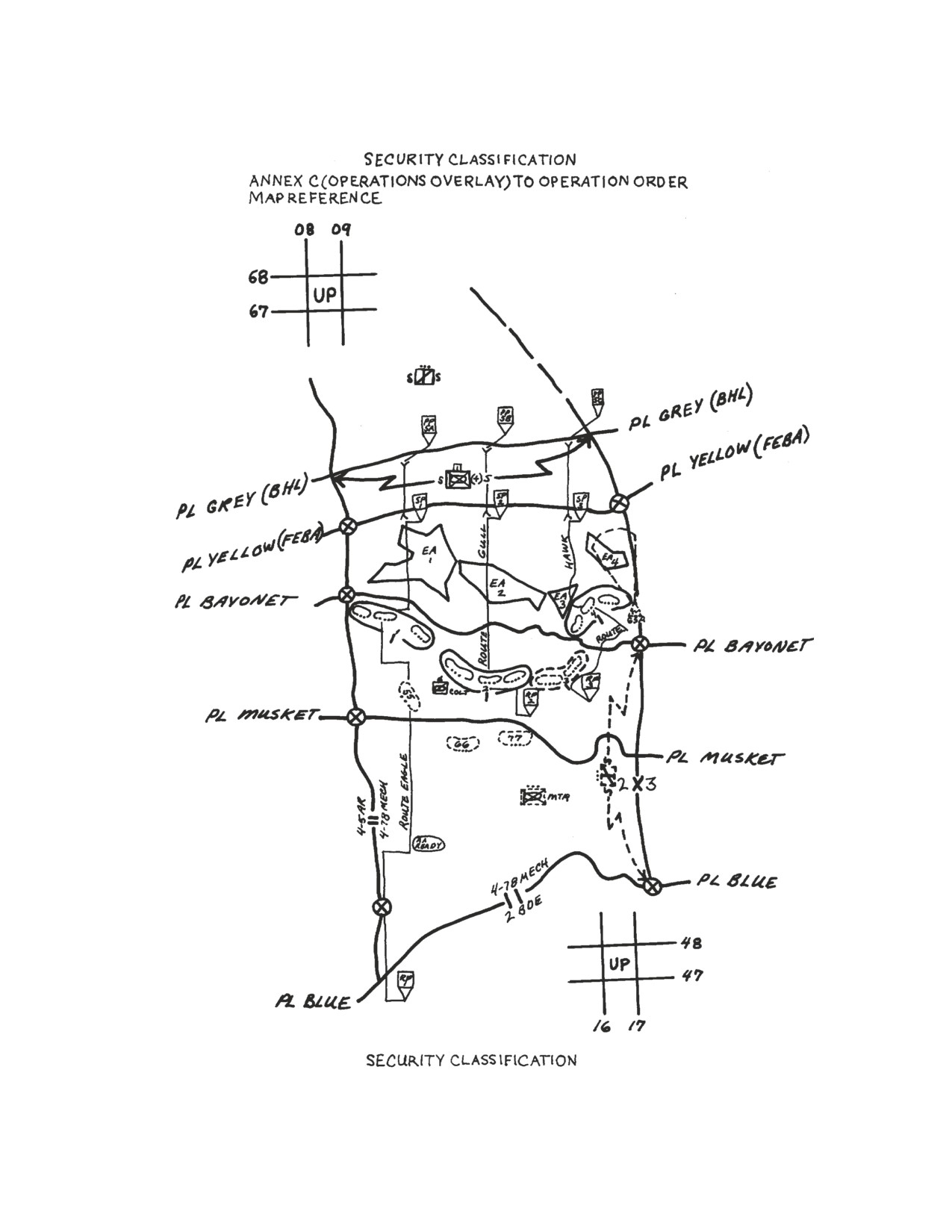
ANNEX C (OPERATION OVERLAY) TO OPERATION ORDER NO_______
1. Center the security classification at the top and bottom of the overlay. Use the largest and widest letters
possible.
2. Place the title in the upper left margin (below the security classification).
3. Place the map reference in the upper left margin immediately below the title.
4. Place at least two overlay and map reference points (double cross-hair reference marks on map grid
lines) on opposite corners of the overlay.
5. Use the same map scales as subordinate units will use.
6. Correctly transfer control measures onto the overlay from the higher headquarters' OPLAN or OPORD.
7. Provide a coordinate appendix (a list of coordinates for major C2 points, unit locations, coordinating
points, and so on) with the overlay.
8. Make the overlay consistent with the applicable text from the OPLAN or OPORD.
9. Place symbols on doctrinally correct locations. (Before placing symbols on an overlay, always consider
the effect of terrain and weather.)
10. Keep the overlay simple, but give enough detail for others to understand the operation and its essential
tasks.
11. Limit control measures to the minimum number needed to synchronize the operation or to limit possible
fratricide.
12. Make sure control measures give the commander flexibility to react to changing situations or conditions.
13. When transmitting or storing overlays, roll up or fold the overlay with the classification, title, and map ref-
erence visible on the outside.
NOTE: An overlay must always contain the first four items listed here.
Figure H-13. Annex C (Operation Overlay) instructions and format
H-41
FM 101-5
ANNEX D (FIRE SUPPORT) TO OPERATION ORDER NO_______
See Figure H-10 for completing this annex. Additional specific items are listed below to ensure inclusion
in this annex.
1. SITUATION
a.
Enemy forces.
• Include a detailed description of enemy fire support and AD assets.
• List enemy rocket, cannon, or missile artillery units, including those organic to maneuver units, as
being committed or reinforcing. List all artillery units that can be identified as being committed or reinforcing.
Consider all artillery units that can be identified as being within supporting range, as being in support of the
committed force. Include the number of possible enemy air sorties by day, if known. Estimate the number,
type, yield, and delivery means of enemy NBC weapons available to the committed force.
b. Friendly forces.
(1) State the higher headquarters' concept of fires.
(2) Provide adjacent units' concept of fires.
(3) Include supporting air power and naval forces.
c.
Attachments and detachments. List fire support resources, attached or under the operational
control of the unit by higher headquarters, and any units detached or under the operational control of other
headquarters.
2. MISSION
3. EXECUTION
a.
Concept of fires. Describe how fires will be used to support the maneuver commander's concept
of operations. Address the priority of fire support.
b. Air support.
(1) General. Briefly describe the maneuver commander's concept for the use of air power.
(2) Air interdiction (AI) .
(3) Close air support (CAS) .
(4) Electronic combat (EC) .
(5) Reconnaissance and surveillance operations.
(6) Miscellaneous.
• The air tasking order's (ATO's) effective time period.
• Deadlines for submission of AI, CAS, search and rescue, and EC requests.
• The mission request numbering system as it relates to the target numbering system.
• The joint suppression of enemy air defense (JSEAD) tasking from the joint force land compo-
nent commander (JFLCC).
Figure H-14. Annex D (Fire Support) instructions and format
H-42
FM 101-5
• Essential AC2 measures (coordinating altitude, target areas, low-level transit route (LLTR) re-
quirements, and so on) identified in the AC2 annex.
c.
Field artillery support.
(1) General. Include the concept for use of cannon, rocket, and missile artillery in support of close,
deep, and rear operations.
(2) Artillery organization for combat.
(3) Allocation of ammunition.
(4) Miscellaneous.
• Changes to the targeting numbering system.
• The use of pulse repetition frequency (PRF) codes.
• Positioning restrictions.
d. Naval gunfire support.
(1) General. Include the concept for use of naval gunfire support.
(2) Naval gunfire organization.
(3) Miscellaneous.
• Trajectory limitations or minimum safe distances.
• Frequency allocations.
• Reference to a naval gunfire support annex.
e.
Nuclear operations (corps and EAC only).
f.
Smoke operations.
g. Target acquisition. Include information pertaining to the employment and allocation of FA target-
acquisition systems and IEW assets. Refer to an FA support plan for specific target-acquisition tasks, if
needed. The FA support plan can include planning products such as an observation matrix, a fire support
execution matrix, a radar deployment order, or a target-acquisition appendix.
h. Coordinating instructions.
• Provide boundaries of the deep operations area.
• List the targeting products (target-selection standards matrix, high-payoff target list (HPTL), and
attack-guidance matrix.
• Include fire support coordination measures.
• Refer to time of execution of program of fires relative to H-hour.
• Include rules of engagement.
• List fire support rehearsal times and requirements.
• List target allocations.
• List FASCAM allocations and requirements.
Figure H-14. Annex D (Fire Support) instructions and format (continued)
H-43
FM 101-5
4. SERVICE SUPPORT. Identify the location of ammunition transfer points and ammunition supply points,
or refer to the logistics overlay. List the controlled supply rate, if needed.
5. COMMAND AND SIGNAL
ACKNOWLEDGE:
NAME
RANK
APPENDIXES:
1 Air Support
2 Field Artillery
3 Naval Gunfire Support
DISTRIBUTION:
Figure H-14. Annex D (Fire Support) instructions and format (continued)
H-44
FM 101-5
ANNEX E (RULES OF ENGAGEMENT) TO OPERATION ORDER NO_______
This annex does not follow the standard five-paragraph format defined for other annexes. This annex
should provide the level of detail required to list the rules of engagement and any command requirements to
ensure these rules of engagement are transmitted down to the lowest echelons of the command. This annex
is not likely to contain any appendixes.
Figure H-15. Annex E (Rules of Engagement) instructions and format
H-45
FM 101-5
ANNEX F (ENGINEER) TO OPERATION ORDER NO_____
See Figure H-10 for completing this annex. Additional specific items are listed below to ensure inclusion
in this annex.
1. SITUATION
a.
Enemy forces.
(1) Include a detailed description of enemy engineer assets and known obstacles.
(2) List enemy engineer units, including those organic to maneuver units, as being committed or
reinforcing. List all engineer units that can be identified as being committed or reinforcing.
b. Friendly forces.
(1) State the higher headquarters' concept of engineer support.
(2) Provide adjacent units' concept of engineer support.
c.
Attachments and detachments. List engineer support resources, attached or under the opera-
tional control of the unit by higher headquarters, and any units detached or under the operational control of
other headquarters.
2. MISSION
3. EXECUTION
a.
Scheme of Engineer Operations (SOEO)—same SOEO used in the supported unit's basic
OPORD.
• Provide narrative of mobility and survivability tasks that support the maneuver plan regardless of what
unit performs the task. For example, artillery-delivered FASCAM would be addressed in this paragraph.
• Explain what the essential mobility and survivability tasks are and how they support the scheme of
maneuver.
• Ensure the SOEO corresponds to the maneuver unit's concept of operations. The concept provides
the foundation and structure from which engineer operations are modeled. If the operations are phased, the
SOEO is also phased, using the same phases. If the supported unit does not use phases, the SOEO uses
the same format the supported unit used for its concept of operations.
• Address four areas under each phase in the SOEO—general comments, countermobility, survivability,
and mobility. Address each in the order of priority for that particular phase. If there is no support provided in
a specific area during a phase, do not mention that area. The support addressed under each phase applies
to the mobility and survivability effort that supports a maneuver unit during that phase, no matter when the ef-
fort was completed. Address each area as follows:
— General comments: a brief, one-sentence comment about mobility and survivability support for the
phase.
— Countermobility: each obstacle belt, in order of its priority, its intent, and which maneuver unit it
supports. Provide execution criteria for reserve targets and situational obstacles.
— Survivability: each survivability task and relative location, for example, battle position (BP) or vicin-
ity of an EA, and which maneuver unit is supported.
Figure H-16. Annex F (Engineer) instructions and format (continued)
H-46
FM 101-5
— Mobility: each mobility task (breaching, marking lanes, providing guides, and maintaining a route),
relative location (route or objective), priority of reduction asset used (use plows first, then mine clearing line
charge), and which maneuver unit is supported.
b. Tasks to subordinate units. List engineer tasks to be accomplished by engineers supporting ma-
neuver elements (only as necessary to ensure unity of effort). Ensure that the unit level tasks assigned to the
engineer organization are included. This paragraph is used to inform subordinate unit commanders of tasks
under unit control being done by unit-level forces.
C. Coordinating instructions.
• Include times or events in which obstacle control measures become effective if they differ from
the effective time of the order.
• List supported unit PIR that must be considered by subordinate engineer staff officers or that the
supported unit requires. List mission reports that the supported unit requires if not covered in the signal para-
graph or unit SOP.
• Include explanation of countermobility and survivability time lines, if used.
4. SERVICE SUPPORT
a.
Command-regulated classes of supply. Identify command-regulated classes of supply. High-
light supported unit allocations that impact on engineer operations CSR.
b. Supply distribution plan. Establish a Class IV and V (obstacle) supply distribution plan. State
method of supply for each class, for each supported unit subordinate element.
• List supply points of linkup points.
• List allocations of Class IV and V (obstacle) by support unit element by obstacle control measure
or combination. May summarize in a matrix or table.
c.
Transportation.
d. Combat health support.
e.
Host nation.
• Include host nation (HN) coordination.
• List type and location of HN engineer facilities, assets, or support.
• List procedures for requesting and acquiring HN engineer support.
• Identify any limitations or restrictions on HN support (for example, HN personnel not authorized
forward of PL______).
5. COMMAND AND SIGNAL
a.
Command. Designate the headquarters that controls the effort within work lines on an area basis.
b. Signal.
• Identify communication networks monitored by the unit engineer, if different than SOP.
• Identify critical engineer reporting requirements of subordinates if not covered in SOP.
Figure H-16. Annex F (Enginer) instructions and format (continued)
H-47
FM 101-5
ACKNOWLEDGE:
NAME
RANK
Appendixes:
1 Engineer Overlay
2 Environmental Considerations
Figure H-16. Annex F (Enginer) instructions and format (continued)
H-48
FM 101-5
ANNEX G (AIR DEFENSE) TO OPERATION ORDER NO _______
See Figure H-10 for completing this annex. Additional specific items are listed below to ensure inclusion
in this annex.
1. SITUATION
a.
Enemy. See Annex B (Intelligence).
(1) Terrain. Identify most likely enemy ingress and egress routes.
(2) Weather. Identify enemy aircraft all-weather capabilities and limitations.
(3) Enemy air capability and or activity.
(a) Air threat data. Air-capable organizations including air platforms by number and type.
(b) Additional air threat information. Include air threat information pertinent to the operation
but not covered in the Intelligence Annex. Highlight specific air threat considerations such as sortie rates,
subordination of air elements to ground units, ordnance peculiarities, target preferences, tactics, and recent
significant activities and tactical ballistic missile threat.
(c) Air avenues of approach. List all expected air avenues of approach and identify by air
platform their potential users. List all beginning points. List all known beginning points and describe avenue
of approach as it goes through the area of interest.
b. Friendly situation. List ADA mission at all applicable levels. Describe how the air defense plan in-
tegrates with higher-echelon plans.
(1) Higher units. Outline higher AD unit concept and plans.
(2) Adjacent units. Outline adjacent AD unit concept and plans.
(3) Supporting elements. Note supporting units and support relationship.
c.
Attachments and detachments. Identify air defense resources attached from other commands
and identify those air defense resources detached.
2. MISSION
3. EXECUTION
a.
Scheme of ADA support. Commander's overall ADA plan to include the concept, objectives, and
priorities.
b. Tasks to subordinate ADA units. Briefly discuss ADA plan, command and support relationships,
and priority of protection.
c.
Coordinating instructions. Instructions applicable to two or more subordinate units. Include ref-
erences to other applicable annexes.
• Weapons control status (WCS) and WCS authority. Include any plans to change WCS.
• Hostile criteria. Basic rules the commander has established to assist in the identification of
friendly or hostile air vehicles. Include preplanned changes.
• Rules of engagement. Address ROE unique to the operation or points in the operation where
changes are intended. Include use of supplemental fire control measures.
Figure H-17. Annex G (Air Defense) instructions and format
H-49
FM 101-5
• Passive air defense. Specific passive air defense measures that all units should take to protect
themselves from air and missile attack or surveillance during this operation.
• Combined arms for air defense. Specific techniques units should use to help in defending them-
selves against an air or a missile attack or surveillance.
• Early warning. Method and format for passing early warning to the entire force.
4. SERVICE SUPPORT
5. COMMAND AND SIGNAL
a.
Command.
b. Signal.
• Identification, friend or foe (IFF) code edition and book number.
• Communications links for early warning equipment.
Figure H-17. Annex G (Air Defense) instructions and format (continued)
H-50
FM 101-5
ANNEX H (SIGNAL) TO OPERATION ORDER NO_______
See Figure H-10 for completing this annex. Additional specific items are listed below to ensure inclusion
in this annex.
1. SITUATION
a.
Enemy.
(1) Terrain. Critical terrain aspects that would impact on deployment of communications systems.
(2) Enemy capability and or activity. Significant enemy electronic warfare capabilities that im-
pact communications systems.
b. Friendly situation.
• Primary communications gateways providing connectivity to higher, lower, and adjacent units.
• Critical communications security measures required to counter expected enemy EW capabilities
and protect C2 systems.
• External communications assets that augment capabilities of signal support units.
3. EXECUTION
a.
Scheme of signal support operations.
(1) Describe the concept of signal operations to support the maneuver plan, including primary and
back-up systems supporting critical C2 networks.
(2) Establish the plan for extending C2 systems through each phase of the operation.
(3) List critical links between tactical and strategic communications systems.
(4) Identify critical limitations of organic signal support assets as detailed by the signal plan and de-
fine limitations of assets from higher headquarters.
(5) State signal support tasks that all nonsignal units (combat, CS, CSS) must perform to accom-
plish missions and tasks beyond normal MTOE requirements.
(6) State signal support priorities.
b. Tasks to subordinate units.
• Signal support tasks that specific maneuver elements are to accomplish that the base OPORD
does not contain.
• Signal support tasks that signal units supporting maneuver elements are to accomplish only as
necessary to ensure unity of effort.
• Army Battle Command System (ABCS) control procedures.
c.
Coordinating instructions.
• Critical signal support instructions not already covered in the base OPORD.
• Key times or events critical to information system and network control procedures.
4. SERVICE SUPPORT
Figure H-18. Annex H (Signal) instructions and format
H-51
FM 101-5
5. COMMAND AND SIGNAL
a.
Identify C2 systems control hierarchy for common user network.
b. Identify local area network control procedures for network administration and/management.
c.
Use appropriate appendixes to diagram any unique changes to standard communications networks
for specified operations.
Figure H-18. Annex H (Signal) instructions and format (continued)
H-52
FM 101-5
ANNEX I (SERVICE SUPPORT) TO OPERATION ORDER NO_______
See Figure H-10 for completing this annex. Additional specific items are listed below to ensure inclusion
in this annex.
1. SITUATION
2. MISSION
3. EXECUTION
4. SERVICE SUPPORT (service support matrix and overlay)
a.
Materiel and services.
(1) Supply. Provide information by class of supply. List maps, water, special supplies, and excess
and salvage materiel, as applicable. For each subparagraph, list supply point locations and state supply
plan and procedures. Post supply point locations to service support matrix and overlay.
(a) Class I Rations. List ration cycle.
(b) Class II Organizational clothing and individual equipment (OCIE) and maps. Classi-
fied map requests are submitted through S2 (G2) channels.
(c) Class III Bulk fuel; Class III package petroleum, oils, and lubricants.
(d) Class IV Construction and fortification material. List command-controlled items.
(e) Class V Munitions. List CSRs and procedures to request explosive ordnance detachment
(EOD) support.
(f) Class VI Personal demand items. Health and comfort packs and items normally sold
through the exchange service.
(g) Class VII Major end items. List command-controlled items.
(h) Class VIII Medical material.
(i) Class IX Repair parts. State the approving authority for controlled exchange of parts. List
critical shortages and command-controlled items.
(j) Class X Material for nonmilitary or civil affairs operations.
(k) Miscellaneous. Miscellaneous items which are not one of the 10 supply classes (such as
water, captured material, and salvage material).
(2) Transportation. For each subparagraph, identify facility locations, traffic control, regulation
measures, main supply routes (MSRs) and alternate supply routes (ASRs), transportation critical shortages,
and essential data not provided elsewhere. Post MSRs, ASRs, and transportation nodes to services support
overlay. List transportation request procedures.
(a) Land.
(b) Sea.
(c) Air.
(3) Services. Identify services available, the designation and location of units providing the
services, and the time the service will be available. List procedures by type for requesting services. Post
services information to service support matrix and overlay.
Figure H-19. Annex I (Service Support) instructions and format
H-53
FM 101-5
(a) Construction.
(b) Showers, laundry, clothing repair (SLCR), and light textile repair.
(c) Mortuary affairs.
(d) Food preparation.
(e) Water purification.
(f) Aerial delivery.
(g) Installation service.
(4) Labor. Include essential information as appropriate.
(5) Maintenance. For each subparagraph, include priority of maintenance, location of facilities
and collecting points, repair time limits at each level of maintenance, and evacuation procedures. Post main-
tenance points to service support matrix and overlay.
(a) Air.
(b) Ground.
(c) Watercraft.
b. Medical evacuation and treatment. State plan for collection and medical treatment of sick, in-
jured, or wounded US and joint force soldiers, enemy prisoners of war, and civilians. Discuss support re-
quirements for CHS logistics (including blood management), combat stress control, preventive medicine,
dental services, and veterinary services. Post hospital locations and information to service support matrix
and overlay.
(1) Evacuation. Medical evacuation policy, including contaminated casualty treatment.
(2) Hospitalization.
c.
Personnel. Detail plans for unit-strength maintenance; personnel management; morale develop-
ment and maintenance; discipline, law and order; headquarters management; force provider; religious sup-
port and so on. Post locations and information to service support matrix and overlay.
(1) Unit strength maintenance.
(2) Morale.
d. Foreign nation and host nation support. This can be an appendix to the service support annex.
e.
Miscellaneous. Logistics and personnel reports format usually as per SOP or included in an ap-
pendix. List any allocation rules in effect.
5. COMMAND AND SIGNAL
ACKNOWLEDGE:
NAME
RANK
Figure H-19. Annex I (Service Support) instructions and format (continued)
H-54
FM 101-5
APPENDIXES: 1
Service Support Matrix.
2
Service Support Overlay.
3
Traffic Circulation and Control.
Tab A Traffic Circulation (Overlay).
Tab B Road Movement Table.
Tab C Highway Regulations.
4
Personnel.
5
Legal.
6
Religious Support.
DISTRIBUTION:
Figure H-19. Annex I (Service Support) instructions and format (continued)
H-55
FM 101-5
ANNEX J (Nuclear, Biological, and Chemical (NBC)) TO OPERATION ORDER NO______
See Figure H-10 for completing this annex. Additional specific items are listed below to ensure inclusion
in this annex.
1. SITUATION. Address enemy NBC threat, to include smoke, flame, and riot control agents.
2. MISSION
3. EXECUTION
a.
Scheme of NBC operations. Briefly state the NBC defense operation to be carried out. State
smoke synchronization plan.
b. Tasks to subordinate units. Include subordinate and supporting chemical unit tasks, missions,
and priorities for NBC reconnaissance, surveillance, and decontamination operations.
c.
Coordinating instructions.
(1) MOPP-level guidance.
(2) Automatic masking criteria.
(3) Troop safety criteria.
(4) Locations of linkup points for decontamination sites.
(5) Locations of medical facilities for treating chemical casualties.
(6) Designated turn-in point and procedures for handling of chemical and biological samples.
(7) Civilian and military facilities whose destruction could create militarily significant NBC hazards.
(8) Operational exposure guidance (if applicable).
(9) Procedures for limiting electromagnetic pulse (EMP) effects.
(10) Identification of designated observer units.
(11) Identification of procedures for providing support to local populations.
4. SERVICE SUPPORT
a.
Procedures for handling contaminated casualties and processing of remains, if not in SOP. State
the battlefield interment authority.
b. Information on the availability and location of field expedient decontamination supplies, materials,
and decontaminants.
c.
Information about the availability, procedures for distributing, prestock points, and transportation of
NBC equipment and chemical defense equipment.
d. Procedures for chemical defensive equipment push package concept.
5. COMMAND AND SIGNAL
a.
Command. Location of chemical staffs and subordinate and supporting chemical unit
headquarters.
Figure H-20. Annex J (Nuclear, Biological, and Chemical (NBC)) instructions and format
H-56
FM 101-5
b. Signal.
• Special signal instructions to subordinate and supporting chemical units.
• Information concerning the NBC warning and reporting system (NBCWRS).
• Information concerning dissemination of STRIKWARN messages.
Figure H-20. Annex J (Nuclear, Biological, and Chemical (NBC))
instructions and format (continued)
H-57
FM 101-5
ANNEX K (PROVOST MARSHAL) TO OPERATION ORDER NO_______
See Figure H-10 for completing this annex. Additional specific items are listed below to ensure inclusion
in this annex.
1. SITUATION
2. MISSION
3. EXECUTION
a.
Scheme of provost marshal operations. State PM concept to employ military police assets. Fo-
cus on commander's guidance, mission, and intent, and how this supporting effort contributes to the fight and
how it is nested.
(1) Maneuver and mobility support. Outline circulation control plan. Focus on maneuver unit
mobility to minimize interference with movement within and through the rear area forward. Include the
following:
• Route reconnaissance and surveillance.
• Main supply route regulation enforcement.
• Contamination avoidance.
• Straggler control.
• Dislocated civilian control.
• Tactical and criminal intelligence collecting and reporting.
(2) Force protection. Develop rear area protection plan, to include Levels II and III response ac-
tions
(base and base cluster defense); assist in developing reconnaissance and surveillance plan.
Include—
• Security of critical assets.
• Base response force (Levels I, II, III).
• Counterreconnaissance and response force activities.
• Airbase defense.
• Counterterrorism and antiterrorism activities.
• Area damage control.
• NBC detection and reporting.
• C2 protection activities.
(3) Internment and resettlement operations. Determine locations of EPW, detainee, or internee
holding areas. Coordinate with appropriate rear area operations center (RAOC) or staff element on popula-
tion data (such as number and location). Plan and direct operations (collection, detention, internment, pro-
tection measures, sustainment, and evacuation). Coordinate with G4 (S4) and host nation as necessary.
(4) Law and order operations. Outline plan to maintain law and order in rear area; forward to ma-
neuver units. Determine investigative assets, develop MP patrol routes, and establish criteria for apprehen-
sion and detention of US military prisoners.
Figure H-21. Annex K (Provost Marshal) instructions and format
H-58
FM 101-5
(5) Police intelligence operations. Outline coordination with Criminal Investigation Division
(CID), MP, and MI relative to the collection, integration, and dissemination of police intelligence and
information.
b. Tasks to subordinate units. List tasks to be accomplished by units in GS, and specific units if in a
DS role.
c.
Coordinating instructions. Include instructions on MP GS missions that apply to two or more
subordinate units. Refer to other supporting appendixes or annexes (such as Annex N (Rear Operations)),
which include elements this annex does not cover in detail.
• State coordination and cooperation among adjacent and other units, and civilian HN agencies
that are required to complete the mission, for example, engineer in building and hardening EPW holding
area.
• State actions pertaining to rear area force protection that may expand or differ from established
SOP.
4. SERVICE SUPPORT
5. COMMAND AND SIGNAL
Figure H-21. Annex K (Provost Marshal) instructions and format (continued)
H-59
FM 101-5
ANNEX L (RECONNAISSANCE AND SURVEILLANCE) TO OPERATION ORDER NO_______
See Figure H-10 for completing this annex. Additional specific items are listed below to ensure inclusion
in this annex.
1. SITUATION
2. MISSION
3. EXECUTION
a.
Scheme of support. State the overall reconnaissance objective. State the overall reconnaissance
and surveillance plan, with tasks and purposes. Detail how reconnaissance assets operate in relation to the
rest of the force. State the method reconnaissance forces will use to get to the assigned area (infiltration,
penetration of enemy security zone, passage of lines, and so on). (Refer to reconnaissance and surveillance
overlay.)
b. Tasks to subordinate units. Each task to a subordinate reconnaissance or surveillance asset
must include the following.
(1) How the unit will get to its assigned area (routes, passage points, and so on).
(2) The reconnaissance objective for the unit.
(3) Specific collection tasks (PIR with indicators) and where to look (NAIs) as identified in the re-
connaissance and surveillance plan matrix.
• State when to conduct the reconnaissance and surveillance operation and the time when infor-
mation is needed.
c.
Coordinating instructions.
4. SERVICE SUPPORT
5. COMMAND AND SIGNAL
a. Command
b. Signal
• State whom to report collected information to specifically and on what nets.
• State retransmission plan to support the operation.
Figure H-22. Annex L (Reconnaissance and Surveillance) instructions and format
H-60