FM 3-28 Civil Support Operations (Draft) (June 2010) - page 5
Chapter 8
z
If possible, commanders should maintain unit integrity at as high a level as feasible, and specify a
support relationships between dissimilar units. This allows the parent unit commanders to mange
missions and accountability more effectively.
z
Commanders need to be aware of Soldiers in their command that may be affected personally by a
disaster response mission. These Soldiers may have Family in the affected area.
z
In some civil support operations, it may be necessary to bring in one or more human resources
platoons or teams to support civil authorities in accomplishing their mission using civilian
agency systems. These elements may include postal platoons to assist the U.S. Postal Service or
casualty liaison teams to assist in casualty operations.
8-86. The entire chain of command should ensure that basic services continue with particular attention to
mail and internet connectivity. The latter becomes increasingly important each year as more soldiers depend
upon online services for banking and communications. The commander should contract for connectivity
(e.g. wireless networks) sufficient for Soldiers to use their own devices or leased terminals to remain
connected when off duty.
8-87. During extended operations, commanders should develop rotational plans to allow Soldiers and
Civilians to spend a short time back at home station to deal with personal and professional issues. In most
civil support operations, there will be numerous courier vehicles and flights, and a well-managed personnel
control system can ensure that Soldiers get to where they need to go and back again efficiently.
8-88. One of the key policies that the supported commander will establish concerns the use of alcohol.
Commanders and leaders need to understand and enforce the personal conduct rules on consumption of
alcohol.
8-89. Personnel officers should review the awards and decorations that the command may award for
service, achievement, and heroism during civil support. Careful personnel accountability will help ensure
that Soldiers receive service ribbons authorized for civil support missions. Provide information to
subordinate commanders on the criteria for awards and decorations and assist in their expeditious
submission and approval.
HUMAN RESOURCES SERVICES
8-90. Even during DSCA operations, there may be a requirement for casualty reporting and operations. For
military and civilian members who are killed or injured while performing a DSCA mission, the nearest
military installation will coordinate with the home station Casualty Area Center for Family notification and
transportation. DOD civilians are treated similar to military members while deployed in support of DSCA
operations
8-91. Casualty reporting procedures during a DSCA operation are just as important as if in a combat
environment. It must also be understood that media access within the United States can potentially be
greater and any delays in reporting can undermine the Family notification process
RESOURCE MANAGEMENT OPERATIONS
8-92. When developing command resource requirements, the appropriate staff section must determine if
there are any existing agreements, regulations, or policy guidance that the financial manager must support.
Based on this staff review, the financial managers ensure adherence to proper billing and reimbursement
procedures. Resource requirements include, but are not limited to contracting, transportation, support to
other agencies and force sustainment. The financial manager determines the method to fund these
requirements; and what appropriations, authorities, and fiscal laws apply during the mission.
8-93. Accounting systems track costs (by event, program, unit, MDEP, and AMSCO for each transaction)
based on the accounting classification associated with transactions. Financial managers use the accounting
classification for two main purposes. First, it helps track expenditures at a detailed level. Second, it helps
prepare and present fiscal information to the command and staff, including the status of funds, mission or
event cost, status of unfunded requirements, and obligations rates.
8-20
FM 3-28 (Signature Draft—Not for Implementation)
4 June 2010
Sustainment—Logistics and Personnel Services
8-94. Reimbursable costs may occur because of providing support to other organizations, units, and
Services, or agencies. Financial managers normally seek reimbursable authority by contacting the
USARNORTH Reimbursement Cell (ARC) or the USNORTHCOM Financial Management Augmentation
Team (FMAT). The ARC and FMAT manage reimbursable budget authority for DSCA events and
document expenses associated with these events.
Finance Operations
8-95. Deployed units depend on support provided to the logistical system and to contingency contracting
efforts. A large percentage of financial management wartime efforts support the procurement process and
oversight is critical in preventing improper or illegal payments. Financial managers coordinate with
contracting officers and the staff judge advocate regarding local business practices. Procurement support
includes two areas: contracting support and commercial vendor services support.
8-96. Civil support operations may require additional financial management support. Financial
Management consists of two core functions, resource management and finance operations. Resource
management support is found in the support brigade Budget Section. Finance Operations support is
dependent upon METT-TC. Additional resource management and finance operations support should be
included in planning requirements for the support brigade. Financial managers will coordinate with
contracting officers and the staff judge advocate regarding local business practices. Financial management
detachment operations may include support to procurement, pay, disbursing, and accounting
8-97. Financial Management Detachment operations may include procurement and disbursing support.
Deployed units depend on support provided to the logistical system and to contingency contracting efforts.
A large percentage of financial management wartime efforts support the procurement process and oversight
is critical in preventing improper or illegal payments. Financial managers coordinate with contracting
officers and the staff judge advocate regarding local business practices. Procurement support includes two
areas: contracting support and commercial vendor services support.
Temporary Duty
8-98. Not every civil support mission requires a large operation. Often the support provided may consist of
a small element such as a dive team (such as the Navy element that responded to the Minneapolis bridge
collapse) or a pair of helicopters. Temporary duty status remains an effective means of deploying and
sustaining Soldiers performing limited missions. Depending on the situation, the supported agency may
contract the necessary support, the defense coordinating officer may provide for their support, or the
Soldiers may make arrangements following normal travel procedures.
RELIGIOUS SUPPORT
8-99. The unit ministry team deploys during civil support operations for the primary purpose of providing
religious support to authorized DOD personnel. In this context, authorized DOD personnel is defined as
military members, their families and other authorized DOD civilians (both assigned and contracted) as
determined by the JFC. Laws implementing the Establishment Clause of the U.S. Constitution generally
prohibit chaplains from providing religious services to the civilian population. However, following certain
rare and catastrophic large-scale disasters, local and state capabilities of all types, to include spiritual care,
may be overwhelmed. In these situations unit ministry teams may serve as liaison to NGOs (including faith-
based organizations) when directed by the JFC. In addition, the primary supported agency, in coordination
with local and state authorities, may determine that additional caregivers are needed and may request
federal military chaplains to provide care, counseling, or informational services to non-DOD civilians.
Commitment requires meeting four criteria:
z
Such support is incidental; meaning that there is generally no significant cost and that such
support does not significantly detract from the primary role of the Unit Ministry Team as defined
above.
z
Pursuant to an emergency which results in a Presidential disaster declaration.
4 June 2010
FM 3-28 (Signature Draft—Not for Implementation)
8-21
Chapter 8
z
There is an acute need for immediate ministry recognized by appropriate authorities, and directed
by a federal military commander.
z
There is a government-imposed burden of some sort such as quarantine on a federal facility, or
when there is no reasonable civilian alternative to meet the needs of non-DOD personnel
impacted by the emergency.
8-22
FM 3-28 (Signature Draft—Not for Implementation)
4 June 2010
Chapter 9
Army Health Service Support
This chapter provides information on health service support during civil support
operations. It discusses four broad areas—emergency medical support,
considerations for domestic incidents, medical logistics, and specialized medical
response capabilities. This discussion builds on the doctrine presented in chapters 2,
3, and 8.
MEDICAL CAPABIILITIES FOR DOMESTIC INCIDENTS
9-1. Army health service support includes all medical services performed, provided, or arranged by the
Army Medical Department to meet health service support and force health protection requirements for the
Army and, as directed, for civilian agencies during civil support operations. Commanders review
considerations for transition to civilian medical organizations throughout operations. Department of
Defense (DOD) provides medical support for declared emergencies and major disasters under the guidance
of the National Response Framework’s emergency support function annex (ESF) #8, led by Department of
Health and Human Services (see chapter 2). The coordinated effort includes Department of Health and
Human Services, Federal Emergency Management Agency, DOD, Department of Veterans Affairs, state
and local governments, and the private sector. Civil authorities’ requests for federal military medical
capabilities are coordinated through a defense coordinating officer. Generally, the primary coordination of
local, state, and federal medical assets occurs within a joint (interagency) field office. This interagency
coordination helps determine what Army health service support capabilities are required in response to an
incident. Primary authorities within a joint field office can include state and federal ESF #8 representatives,
state National Guard surgeon(s), a joint regional medical plans and operations officer, and the supported
combatant command surgeons.
9-2. ESF #8 of the National Response Framework discusses multiagency public health and medical
support to state, tribal, and local governments. The National Response Framework continues to evolve; the
most up-to-date information is available online at http://www.fema.gov/emergency/nrf/. The functional
support areas covered by ESF #8 appear in Table 9-1, on page 9-2.
4 June 2010
FM -3-28 (Signature Draft—Not for Implementation)
9-1

Chapter 9
Table 9-1. Functional support areas covered by ESF #8
Assessment of public health and medical needs.
Health surveillance.
Medical care personnel.
Health, medical, and veterinary equipment and supplies.
Patient evacuation.
Patient care.
Safety and security of drugs, biologics, and medical devices.
Blood and blood products.
Food safety and security.
Agriculture safety and security.
All-hazard public health and medical consultation, technical assistance, and support.
Behavioral health care.
Public health and medical information.
Vector control.
Potable water and wastewater and solid waste disposal.
Mass fatality management, victim identification, and decontaminating remains.
Veterinary medical support.
9-3. Medical response efforts begin at the local level and increase based on requests from local and state
authorities. A broad response may include federal military assets. Specific DOD ESF #8 support functions
are in Table 9-2. (This table omits the U.S. Army Corps of Engineers.)
Table 9-2. DOD public health and medical support responsibilities in ESF #8
DOD performs the following support functions:
Alerts DOD National Disaster Medical System federal coordinating centers (Army, Navy, and Air Force)
and provides specific reporting and regulating instructions to support incident relief efforts.
Alerts DOD National Disaster Medical System federal coordinating centers to activate National Disaster
Medical System patient reception plans in a phased, regional approach, and when appropriate, in a
national approach.
At the request of the Department of Health and Human Services, provides support for the evacuation of
patients and medical needs populations to locations where hospital care or outpatient services are
available.
Using available DOD transportation resources, in coordination with the National Disaster Medical
System Medical Interagency Coordination Group, evacuates and manages victims and patients from
the regional evacuation point in the vicinity of the incident site to National Disaster Medical System
patient reception areas.
Provides available logistical support to public health and medical response operations.
Provides available medical personnel for casualty clearing and staging and other missions as needed,
including aeromedical evacuation and medical treatment. Mobilizes and deploys available Reserve and
National Guard medical units, when authorized and necessary to provide support.
Coordinates patient reception, tracking, and management to nearby National Disaster Medical System
hospitals, Veterans Administration hospitals, and DOD military treatment facilities that are available
and can provide appropriate care.
Provides available military medical personnel to assist ESF #8 in the protection of public health (such
as food, water, wastewater, solid waste disposal, vectors, hygiene, and other environmental
conditions).
Provides available military veterinary personnel to assist ESF #8 personnel in the evacuation, triage,
medical treatment and temporary sheltering of pets, companion animals and livestock.
Provides available DOD medical supplies for distribution to mass care centers and medical care
locations being operated for incident victims with reimbursement to DOD.
Provides available emergency medical support to assist state, tribal, or local officials within the disaster
9-2
FM 3-28 (Signature Draft—Not for Implementation)
4 June 2010
Army Health Service Support
area and the surrounding vicinity. Such services may include triage, medical treatment, behavioral
health support, and the use of surviving DOD medical facilities within or near the incident area.
Provides assistance, as available, in managing human remains, including victim identification and
mortuary affairs and temporary internment of the dead.
Provides evaluation and risk management support through use of defense coordinating officers,
emergency preparedness liaison officers, and joint regional medical planners.
Provides available blood products in coordination with the Department of Health and Human Services.
Provides medical surveillance and laboratory diagnostic and confirmatory testing in coordination with
the Department of Health and Human Services.
9-4. Most states have a statutory provision that addresses the recognition of medical licenses issued by
another state or the waiver of the states’ licensure requirements for military health care providers who enter
the state to provide medical treatment to civilians during an emergency or disaster. Military health care
providers will be covered by the federal Tort Claims Act and the Medical Malpractice Immunity Act (see
chapter 7 for a discussion of legal considerations).
INITIAL ACTIONS
9-5. Initial federal-level incident response actions begin with assessment of public health and medical
needs and health surveillance requirements. Department of Health and Human Services deploys teams and
assets based on requests and the situation.
9-6. Primary health service support authorities in a joint field office include state and federal ESF #8
representatives; a joint regional medical planner; and joint task force surgeon. Through multiagency
coordination, these authorities determine the Federal military support capabilities needed.
NATIONAL DISASTER MEDICAL SYSTEM
9-7. The Department of Health and Human Services’ Office of Preparedness and Response activates the
National Disaster Medical System when requested by local and state authorities. This system integrates
federal medical support into a unified medical response to augment state and local capabilities. The system
activates in either preparation for or response to a declared major disaster or emergency, for a specific
period of time. If Federal military support is needed, requests are processed as requests for assistance.
Normally, requests for assistance are developed into approved mission assignments.
9-8. The National Disaster Medical System has three major components:
z
Deployable medical response to a disaster area in the form of individuals and teams, supplies,
and equipment.
z
Patient movement from a disaster site to unaffected areas of the nation.
z
Definitive medical care at participating hospitals in unaffected areas.
DEPLOYABLE MEDICAL RESPONSE
9-9. The deployable medical response capability includes response teams and equipment designed for
rapid deployment. Team members are non-federal volunteers who may be federalized as part-time
employees when activated. They are principally a community resource available to support local, regional,
or state requirements. DOD medical teams may support these teams in emergency situations. In contrast to
the Army health system, the National Response Framework and the National Disaster Medical System
classify mortuary services under public health and medical care.
PATIENT MOVEMENT
9-10. To move patients out of a disaster area, local authorities initially set up casualty collection points.
Initially transportation support may include commercial aviation companies, private organizations, and
individual citizens. If local medical services are inadequate, local authorities request state assistance. A state
may operate regional evacuation points. When local authorities request state assistance, support may
4 June 2010
FM 3-28 (Signature Draft—Not for Implementation)
9-3
Chapter 9
include the National Guard ground and aviation assets. If state and local authorities are unable to establish
casualty collection points or regional evacuation points, they may request federal authorities to rapidly
deploy teams, such as U.S. Public Health Service Commissioned Corps teams, to assist. If resources still are
inadequate, local and state authorities can request additional federal medical evacuation assistance.
9-11. When necessary, the Department of Health and Human Services requests federal military support
through ESF #8 for evacuating seriously ill or injured patients. Federal military support may include
providing transportation assets, operating and staffing National Disaster Medical System federal
coordinating centers, and processing and tracking patient movements from regional evacuation points to
reception facilities. DOD takes the lead for federally managed evacuation efforts.
9-12. The United States Transportation Command
(USTRANSCOM) Global Patient Movement
Requirements Center may deploy a joint patient movement team. A joint patient movement team regulates
and tracks all patients, including civilians, transported on DOD assets to reception facilities. The team
regulates and tracks patients using the USTRANSCOM regulating and command and control evacuation
system.
9-13. USTRANSCOM coordinates DOD transportation assets. Most seriously ill patients are evacuated by
air. USTRANSCOM establishes aeromedical evacuation centers. Depending on the nature and scope of the
disaster, transportation may be by air, surface, or sea:
z
Air Mobility Command.
z
Military Surface Deployment and Distribution Command.
z
Military Sealift Command.
9-14. Civilian medical teams meet patients at the reception facilities. These teams determine which patients
will go to which National Disaster Medical System hospitals. Procedures are based on local agreements and
advance coordination among National Disaster Medical System federal coordinating centers and hospitals.
Transportation directly to the hospitals is by local ground and air transport.
DEFINITIVE MEDICAL CARE
9-15. The National Disaster Medical System provides a nationwide network of nonfederal acute care
hospitals. These hospitals provide definitive care for disaster victims when the need exceeds the capabilities
of the affected local, state, or federal medical systems.
9-16. Sixty-two federal coordinating centers coordinate with a network of approximately 1,800 nonfederal
National Disaster Medical System member hospitals and eighty-two patient reception areas to provide an
80,000-bed capability for definitive acute medical care.
9-17. Within this system, the federal coordinating center roles include—
z
Soliciting participation in the National Disaster Medical System by nonfederal area hospitals.
z
Assisting in coordination of area disaster plans with hospital representatives.
z
Arranging annual National Disaster Medical System exercises, and developing procedures for
participants to report on bed availability.
z
Triaging.
z
Transporting and tracking of incoming patients to area hospitals.
USAMEDCOM SPECIALIZED MEDICAL RESPONSE CAPABILITIES
9-18. USAMEDCOM has the capability to task-organize its table of distribution and allowances assets and
deploy them in support of assigned Army Medical Department missions. These capabilities are not intended
to supplant table of organization and equipment units but can be used to support domestic disasters,
chemical, biological, radiological, nuclear, or high-yield explosives incidents, and other designated support.
The table of distribution and allowances assets of the USAMEDCOM and its subordinate commands will be
used to provide the capabilities needed. There are several different types of capabilities which the
USAMEDCOM Commander can support, such as—
9-4
FM 3-28 (Signature Draft—Not for Implementation)
4 June 2010
Army Health Service Support
z
Health facilities planning which provides a rapid deployable capability to address, assess, and
assist in the comprehensive evaluation of health facility support systems and medical facility
specific issues.
z
Investigational new drug capability which provides guidance in the administration of
investigational new drugs and vaccines as biological threat countermeasures in mass casualty
incidents (such as anthrax, botulinum, and smallpox).
z
Radiological advisory medical capability which provides direct comprehensive radiological
health and medical guidance and specialized services to the combatant commander, on-scene
commander and local medical officials responding to a radiological nuclear event.
z
TLAMM support which provides rapid deployment capability of medical logisticians to
USNORTHCOM’s base support installations in support of its joint task force-medical, DOD
installations, and various civil support requirements. The TLAMM capability will coordinate
linkage of medical supply chain support from the base support installation to Class VIII supply
sources.
z
Medical command, control, communications, and telemedicine capability which provides an
intuitive, compact, and deployable medical command, control, communication and telemedicine
information technology package as augmentation for incident response.
z
Behavioral health and religious support capability which provides behavioral health care and
religious support to local, state, federal, and other government authorities in response to man-
made and environmental disasters. These capabilities augment behavioral health and religious
support to local medical authorities. They support trauma ministry, mass casualty ministry, and
spiritual assessment.
z
Public health support is a multifunctional capability that combines preventive medicine,
veterinary services, and smallpox epidemiological response. This capability is still being refined
but will be able to provide initial disease and occupational and environmental health threat
assessments, conduct or assist in the field investigations of disease or injury outbreaks or
clusters, and assess environmental destruction or risk related to animal health and food safety.
z
Burn capability which provides expert worldwide aeromedical evacuation for any critical illness
or injury, with particular expertise in the stabilization and management of trauma and burn
patients.
CONSIDERATIONS FOR MEDICAL SUPPORT TO DOMESTIC
INCIDENTS
9-19. This section briefly discusses special considerations for medical support during civil support
operations. This discussion is not exhaustive. The overarching consideration is that disaster response
operations are multiagency operations in support of civil authorities. Army health system units support and
cooperate with various nonmilitary organizations, consistent with ESF #8 and under appropriate local, state,
and federal laws. Army health system units support and cooperate with various nonmilitary organizations,
consistent with ESF #8 and under appropriate local, state, and federal laws. Continuous coordination helps
avoid duplication of effort. In each situation, the nature and scope of the response depends on the
requirements of the incident. Refer to FM 8-42 for additional information.
9-20. Public health authorities conduct surveillance and rapid needs assessment immediately after an
incident. Army health system personnel review all relevant intelligence products from the Armed Forces
Medical Intelligence Center, Centers for Disease Control and Prevention, U.S. Army Center for Health
Promotion and Preventive Medicine, and other public health entities before deployment and employment.
Army health system personnel should deploy as part of the military advance party detachments. Medical
units acquire information as rapidly as possible for developing medical courses of action.
9-21. Commanders ensure that medical personnel conduct pre and post-deployment assessments for all
Soldiers according to DOD and Service policies. On-scene, following the emergency treatment or
evacuation of civilian patients, Army health system units emphasize preventive medicine and force health
protection.
4 June 2010
FM 3-28 (Signature Draft—Not for Implementation)
9-5
Chapter 9
COMMAND RELATIONSHIPS
9-22. Based on the size of the disaster and capability of local and state assets, federal medical personnel
may be under the command of a defense coordinating officer, a task force commander, or a joint task force
commander. The normal command relationship will be operational control. Army medical forces that
deploy under immediate response authority remain under the command parent unit or installation until the
defense coordinating officer or joint task force assumes operational control of forces. Under a joint task
force, medical forces may be aligned functionally, geographically or by service (such as a joint force land
component command or a joint force air component command) depending on the joint task force
commander’s concept of support and intent. Likely tasks remain the same as those listed below. Task force-
medical, for example, is a component of the federal military CBRNE consequence management response
forces. Task force-medical and its subordinate units are organized to accomplish assigned medical tasks for
disasters.
Medical Surveillance
9-23. Medical surveillance and sharing of health-related intelligence help guide decisions for incident
response operations. Medical personnel gather data and monitor health threat indicators throughout
operations. Integrated medical surveillance tasks are listed in Table 9-3.
Table 9-3. Integrated medical surveillance tasks
Describing and monitoring medical, public health, and psycho-social effects.
Identifying changes in agents and host factors.
Detecting changes in health practices.
Detecting illness or injuries, including sudden changes in disease occurrence.
Detecting, investigating, and analyzing collected data to identify necessary interventions.
Monitoring long-term disease trends.
Providing evidence for establishment of response protocols.
Providing information about probable adverse health effects for decisionmaking.
Investigating rumors.
Determining needs and match resources in affected communities.
9-24. Medical personnel identify potential health hazards and develop and implement countermeasures.
They provide education and training to personnel on potential health threat exposures. They perform
environmental and personal monitoring and sampling to document exposure. They monitor the health of the
force; gauge the pre-deployment health status of units; and identify preexisting
(baseline) health
characteristics of assigned Service members. They ensure sampling data, reports, and assessments are
evaluated, reported, and archived. They ensure that occupational and environmental hazard exposure
incident data and reports are submitted to the Defense Occupational and Environmental Health Readiness
System (DOEHRS) portal. Refer to DODI 6490.03 for more information.
9-25. Additionally, veterinary personnel develop a vigorous veterinary surveillance program that includes
food, water and ice inspections, suspected animal-to-human disease outbreak investigations, animals
treated, and any other veterinary-related events. They archive veterinarian-related sampling data for
analysis.
MEDICAL RISK ASSESSMENT
9-26. A Medical health risk assessment is developed as part of the preventive medicine estimate. Army
units coordinate risk assessments with civil authorities. The intent is to identify any health threat and its
potential impact on the mission. The assessment includes analysis of weather, altitude, terrain, endemic
diseases, local food and water sources, zoonotic diseases (disease transmitted from animals to humans),
parasites, hazardous plants and animals, and potential exposure to hazardous and toxic materials. Refer to
FM 4-02.17 for Army doctrine on preventative medical services. See also AR 11-35.
9-6
FM 3-28 (Signature Draft—Not for Implementation)
4 June 2010
Army Health Service Support
9-27. The completed medical risk assessment is used to—
z
Determine immunization and chemoprophylaxis requirements.
z
Determine personal protective equipment requirements.
z
Conduct health threat briefings on the health hazards.
z
Provide individual training to all deploying personnel on health and specific protective measures.
z
Educate medical support personnel on recognition, prevention, and treatment of potential
diseases, injuries, exposures.
9-28. The primary disaster related health threats are listed in Table 9-4.
Table 9-4. Disaster-related health threats
Contaminated food.
Contaminated water.
Environmental conditions (heat and cold).
Environmental contamination (air, water, soil).
Inadequate living/sleeping conditions (crowding, ventilation).
Disease vectors.
Accidents.
Stress.
ASSISTING CIVIL AUTHORITIES WITH INSPECTIONS OF WATER, FOOD, AND WASTE
9-29. Army health system units assist civil authorities with water, food and waste disposal inspections as
requested. This includes monitoring approved sources of food, water, and ice products as well as
production, distribution and storage systems. Waste disposal site inspections include solid, medical and
hazardous waste streams and will comply with state and federal standards. Public health hazards caused by
inadequate or contaminated services may pose a greater threat than the initial incident. Medical units, when
requested, support civil authorities with sanitation inspections of potable water sites, systems, and
containers. Inspections or surveys are conducted using civilian forms in accordance with local, state and
federal guidelines.
9-30. Under most conditions, threats posed by contaminated water and food are interrelated. Medical
personnel may support civil authorities with food service sanitation inspections, food service sanitation
training, and illness outbreak investigations. Inspections are performed according to local, state, and federal
standards.
9-31. Medical personnel may help civil authorities to conduct sanitation inspections of waste handling
operations to determine health threats. Medical personnel may also assist with training on countermeasures
and use of personal protective equipment, sanitation inspections, or environmental surveillance of affected
areas.
BEHAVIORAL HEALTH
9-32. Disasters produce strong and unpleasant emotional and physical responses in victims and rescuers.
Common symptoms are listed in Table 9-5.
4 June 2010
FM 3-28 (Signature Draft—Not for Implementation)
9-7
Chapter 9
Table 9-5. Common emotional and physical symptoms related to disaster response
Confusion
Fear
Anxiety
Hopelessness
Helplessness
Sleeplessness
Anger
Grief
Guilt
Shock
Aggressiveness
Mistrustfulness
Loss of confidence
Physical pain
Over-dedication to mission
9-33. Behavioral health personnel play a vital role in any DOD force performing civil support operations.
Behavioral health personnel apply psychological first aid when required and advise leaders on preventive
measures. Examples of preventive measures for behavioral health during disaster response operations are
listed in Table 9-6.
Table 9-6. Examples of preventive measures for behavioral health
Providing basic needs for food, shelter, and health care.
Listening to peoples’ stories.
Keeping families together.
Providing frequent, clear, updated information to victims.
Helping maintain connection with friends and family.
Providing responders with regular communication with family members back home.
Maintaining awareness of the stress levels of others.
Providing responders with a rest area for sleep, hygiene, and food that is separate from the
public and media.
Insisting on proper sleep, nutrition, and exercise among responders.
Not forcing people to share stories.
Not giving simple, generalized reassurances (such as ―everything will be ok‖).
Not telling people how they may feel, or ―why‖ things happened to them.
Not making promises one cannot keep.
Not criticizing current relief efforts in front of those needing help.
9-34. Handling of human remains is particularly stressful. Examples of behavioral health preventive
measures used during handling of human remains are in Table 9-7.
9-8
FM 3-28 (Signature Draft—Not for Implementation)
4 June 2010
Army Health Service Support
Table 9-7. Examples of preventive measures for handling human remains
Remembering the larger purpose of the work.
Wearing protective clothing, taking frequent breaks, and maintaining hygiene and hydration.
Talking with others and listening well.
Using humor to relieve stress, as long as it is not too personal or inappropriate.
Limiting exposure to bodies as much as possible.
Breathing through one’s mouth to help avoid smells.
Not focusing on individual victims.
Getting teams together for mutual support and encouragement.
Providing opportunities for voluntary, formal debriefings.
Limiting exposure to human and animal remains as much as possible.
9-35. Additional stress management personnel may be required to meet health requirements. Combat and
operational stress control (COSC) and behavioral health teams educate Soldiers about recognition and
treatment of stress prior to operations. During deployment, they conduct investigations of suspected stress
outbreaks. They use results of the investigations to identify corrective measures. Stress management
personnel inform commanders of the impact stress may have on operations and of any irregularities in stress
statistics or trends. They conduct briefings to newcomers arriving in the area of operations about stress
threats and countermeasures. They brief personnel exiting the area of operations on possible stress-related
conditions that may manifest and procedures for follow-up.
VETERINARY SUPPORT
9-36. Pets and livestock require veterinary care during incident response operations. Veterinary issues
should be anticipated and planned for. Preventive measures help reduce the spread of disease and minimize
injuries. Veterinary concerns affecting public health are listed in Table 9-8.
Table 9-8. Veterinary concerns affecting public health
Spoilage of human food and water supply (through contamination by animals).
Animal bites.
Outbreaks of diseases transmitted between animals and humans.
Impact on public behavioral health due to the emotions owners feel for their animals. (This is
more evident in seniors and children.)
Overall health of pets, companion animals, and livestock.
Military Working Dogs
9-37. Veterinarians care for working animals during operations (military and interagency). They ensure
follow-up care upon redeployment. Based on risk assessments and potential exposures to medical threats
additional immunization and chemoprophylaxis may be required for working animals prior to or during
deployment. Veterinarians also ensure follow-up care and health surveillance upon redeployment.
Additional immunization and chemoprophylaxis may be required for military working dogs prior to
deployment.
Animal Remains
9-38. To avoid potential spread of disease, animal remains should be disposed of properly and as
expeditiously as operations allow. Army units may be tasked to assist civil authorities with carcass disposal
operations. Carcass disposal methods and locations will be determined by local and state authorities.
Soldiers assisting in animal carcass disposal operations should consider the precautions listed in Table 9-9.
Waivers may be required.
4 June 2010
FM 3-28 (Signature Draft—Not for Implementation)
9-9
Chapter 9
Table 9-9. Precautions related to handling animal carcasses
Wearing protective clothing (waterproof gloves, waterproof boots, and protective eyewear).
Covering any open wounds.
Using duct tape to seal tops of gloves and boots to prevent water seepage.
Wearing respiratory protection—an N-95 respirator or better.
Recognizing the smell hydrogen sulfide (a rotten egg smell) and evacuating if detected.
Cleaning and disinfecting all clothing and boots after handling carcass-contaminated
materials.
Washing work clothes separately from other clothes.
Washing hands thoroughly.
Showering and washing hair thoroughly after handling carcass-contaminated materials.
MEDICAL LOGISTICS FOR DOMESTIC INCIDENTS
9-39. During civil support operations, United States Army Medical Command (USAMEDCOM) continues
medical logistics support to Army installations through its medical treatment facilities and clinics and serves
as the theater lead agent for medical materiel
(TLAMM) for United States Northern Command
(USNORTHCOM). As the TLAMM, USAMEDCOM coordinates directly with USNORTHCOM, Defense
Logistics Agency (as the DOD executive agent for medical materiel), and the single integrated medical
logistics manager to ensure the appropriate level of medical logistics support. Medical logistics support is
normally a Service responsibility. However, in joint operations, the USNORTHCOM commander
designates one of the Service components to serve as the single integrated medical logistics manager
responsible for providing centralized medical logistics support to USNORTHCOM joint task forces and
other government agencies.
9-40. USAMEDCOM uses existing Army medical logistics automated systems, infrastructure (including
installation medical supply activities at Army medical treatment facilities in the continental United States),
Defense Logistics Agency contracts, and support relationships with regional DOD logistics organizations
and supply support activities to execute the TLAMM mission. As the TLAMM, USAMEDCOM’s medical
logistics capability is ready to rapidly deploy in support of civil support operations. Support includes
providing Class VIII supply chain and medical logistics support to deployed medical joint task forces.
When directed, USAMEDCOM medical logistics enablers can assist a joint task force in coordinating for
the receipt and distribution of resources from the Centers for Disease Control and Prevention’s Strategic
National Stockpile. The Strategic National Stockpile is a national repository of antibiotics, chemical
antidotes, antitoxins, life-support medications, IV administration, airway maintenance supplies, and medical
and surgical items. The Strategic National Stockpile is designed to re-supply state and local public health
agencies in a biological or chemical incident.
9-41. Federal military Class VIII requisitions flow from the supported units, through the TLAMM master
ordering facilities, to the prime vendor contracted to provide the requested item. The designated prime
vendor delivers the requested item to the supporting medical logistics company. Joint task force-medical
units are expected to deploy with their full unit basic load of Class VIII supplies. Service components are
responsible to resupply its forces for the first ten days of the operation or until the TLAMM and joint task
force-medical logistics unit are operational. Once the medical logistics units are operational, supported
units will establish accounts with the deployed medical logistics company for Class VIII resupply support.
Requisitions are forwarded using existing automated systems. The primary DOD requisitioning system is
the Defense Medical Logistics Standard Support System’s Customer Assistance Module. The TLAMM
conducts post-operational financial reconciliation with other Service components and USNORTHCOM for
reimbursement.
BLOOD AVAILABILITY
9-42. Department of Health and Human Services monitors blood availability nationally. It maintains
contact with the American Red Cross, American Association of Blood Banks Inter-organizational Task
9-10
FM 3-28 (Signature Draft—Not for Implementation)
4 June 2010
Army Health Service Support
Force on Domestic Disasters and Acts of Terrorism, and the Armed Services Blood Program Office. The
Department of Health and Human Services determines—
z
The need for blood, blood products, and supplies used in their manufacture, testing, and storage.
z
The ability of existing supply chain resources to meet needs.
z
Emergency measures needed to augment or replenish existing supplies.
9-43. Department of Health and Human Services sends a request for assistance through military channels
when blood product requirements exceed capacity. The USNORTHCOM Joint Blood Program Office, in
coordination with the Armed Services Blood Program Office, manages blood products within DOD.
9-44. The Armed Services Blood Program has blood distribution and storage assets in the continental
United States. The Armed Services Whole Blood Processing Laboratories are the major blood product
distribution hubs. Deployable blood distribution assets include Blood Support Detachment and Blood
Transshipment Systems. Also, medical treatment facilities on DOD installations can be used for limited
expanded blood product storage.
9-45. When Department of Health and Human Services requests blood distribution assets, the
USNORTHCOM joint blood program office coordinates with USARNORTH, joint task force-medical and
Joint Forces Command to accommodate blood distribution and storage.
SPECIAL NEEDS POPULATIONS
9-46. The National Response Framework defines a special needs population as a group with special
functional needs before, during, and after an incident. Special functional needs include maintaining
independence, communication, transportation, supervision, and medical care. For example, individuals in
need of additional assistance may have disabilities, live in institutionalized settings, be very young or very
old, or have limited English proficiency. Army medical and nonmedical personnel may support response
efforts for special needs populations.
MANAGEMENT OF MASS CASUALTY EVENTS
9-47. The military may be tasked to support civilian medical capabilities as needed in the handling of mass
casualties. DOD coordinates closely with Department of Health and Human Services and other public
health providers in the JOA. Army medical planning staffs cooperate closely with responding organizations
under the guidelines of the National Incident Management System and the National Response Framework.
The military augments civilian medical capabilities as needed in the handling of mass casualties resulting
from chemical, biological, radiological, nuclear, and high-yield explosives attacks CBRNE) or other toxic
material contamination. For pertinent Army doctrine, refer to FM 4-02.283, 4-02.285, 4-02.7, and 8-284.
Also see the Field Management of Chemical Casualties Handbook, Third Edition for additional
information.
9-48. In a mass casualty situation, triage establishes who receives treatment first by placing casualties into
four categories. Terminology and priorities for these categories differ in military and civilian environments,
but the basic concepts are similar. See FM 3-28.1, Table VII-2 and Table VII-3 for more information about
triage in civil support operations. The Army’s senior medical commander coordinates treatment priorities
with the lead civil medical authority.
4 June 2010
FM 3-28 (Signature Draft—Not for Implementation)
9-11
Appendix A
Planning Checklists
This appendix contains a variety of checklists designed to help unit commanders and
staffs with their military decision making process during a civil support operation.
The appendix provides general checklists for situational assessment (overall, joint
task force, organizational, and local agency) and individual staff section checklists.
INITIAL SITUATIONAL AWARENESS AND ASSESSMENT
A-1. Table A-1 lists items to consider for initial situational awareness and assessment. This list is not all
inclusive.
Table A-1. Initial situational awareness and assessment checklist
Damage Assessment estimates from incident commanders and situational assessment teams
Homes, especially those with light construction, such as mobile homes.
Status of roads, rail lines, airports, airfields, communications nodes and seaports.
Other factors associated with the local community and the nature of the disaster. (Refer to appendix B for more
information on safety considerations.)
Status of first responders and their assets (such as vehicles, communications, and fuel).
Debris removal and clearing lines of communication.
Environmental hazards, natural or manmade.
Fires, toxic chemical spills (toxic and nontoxic), ruptured pipelines, downed power lines.
Weather or geographic hazards.
New and emerging threats (such as civil disorder, or another natural disaster).
Further evacuations needed or taking place.
Sustainment
Medical capacity
Communication status
Aviation facilities
Search and rescue efforts underway
Water purification, ice, and means of delivery.
Availability of basic personal hygiene and cleaning materials.
Sanitation capabilities.
Security.
Available shelter.
Availability of food and means of distribution.
Electrical power and electrical grid.
Availability of gasoline and diesel fuel
Availability of JP -8
Command and Control
Incident command structure in place
Liaison and planning staff for headquarters.
Counselors for citizens affected by the disaster
Communications
Chains of command and positions of authority.
4 June 2010
FM -3-28 (Signature Draft—Not for Implementation)
A-1
Appendix A
Types of communication and information management systems in use by first responders and other responding
organizations.
Communication assets required for Soldiers to communicate with the joint task force HQ and other responding
groups.
Identifying alternatives when communication systems are not operating or not compatible.
Identification of responding organizations not yet integrated with the overall effort; facilitating cooperation with these
groups (including volunteer groups).
Maps, global positioning system (GPS), and other topographic resources to navigate to specific locations when roads
and landmarks are destroyed. Map products used by local organizations and first responders. Identifying a map
system useable by most organizations.
Electronic and hard copy products used to portray the common operational picture across boundaries or jurisdictions
and all organizations.
Location for the Army headquarters and where to place supporting staff and liaisons.
Existing staff and liaisons needing augmentation.
Public affairs assets required to acquire and relay accurate, useable information to the public.
Synchronization of public affairs operations with the lead civil authority and local news media.
Resource requirements
Document actions to assure prompt acquisition of resources and timely reimbursements. (Refer to chapter 6 for
information required for reimbursement.)
Resources available now and later in the operation.
Contracting management and support.
How to synchronize civil and military resource prioritization.
Communication assets required to obtain resources during the operation.
Transportation assets available to move resources and transport personnel.
Accounting systems to activate for military reimbursement.
Procedures to track expenditures within funding systems.
Legal
Initial plans and orders review by staff judge advocate
Review Standing rules of the use of force (RUF).
Permissible actions according to military status of Soldiers (federal Title 10 Active Duty, National Guard Title 32, and
state Active Duty).
Pertinent local, state, and federal laws.
Coordination and planning with other responding groups
Obtain a copy of the most up-to-date disaster plan from the lead civil authority with the applicable Emergency
Obtain a copy of the Applicable JFLCC contingency plan
Extract how the plan covers the tasks and responsibilities of all organizations based on METT-TC.
Determine where Army support is required.
Review the makeup and focus of the other organizations.
Designate staff responsibility to collect lessons learned.
JOINT TASK FORCE CHECKLIST
A-2. Table A-2 provides a list of initial tasks for a joint task force. This list is not all inclusive.
Table A-2. Joint task force initial checklist
Coordinate with military (Air National Guard, Army National Guard, Coast Guard, Air Force, Navy, Marine Corps),
local, state, federal agencies and organizations and NGOs and volunteers. The bottom line is command control
systems coordinate with virtually any agency, organization or individual that can help support the mission to reduce
loss of life, limb and property. Determine the most feasible solutions for effective communication.
Ensure that initial communications capabilities are self-sufficient and interoperable with both first responders and local
authorities. This usually means commercial internet and telephone capability.
Bring all communications equipment, to include computers, cables, routers, switches, and power supply. Procure and
plan for the use of additional communication devices: telephone (satellite, cellular or land line), radio (military
maritime, and civilian, in all bandwidths), Non-Secure Internet Protocol Router Network, SECRET Internet Protocol
Router Network, video equipment, video teleconferencing, and satellite-based commercial Internet systems. The goal
A-2
FM 3-28 (Signature Draft—Not for Implementation)
4 June 2010
Planning Checklists
is to communicate effectively and reduce restrictions to effective communication.
Ensure all equipment has operators, essential repair parts, operating and repair manuals, tools, initial fuel and power
generation required.
Send qualified signal leaders to ensure operators and equipment are used effectively.
Prepare to provide a limited amount of critical communications equipment (cell phones, radios, base sets, etc.) to first
responders.
Plan and coordinate for additional, extended logistical and maintenance support for equipment and personnel as well
as unexpected requirements including generator support; maintenance of equipment; fuel requirements of vehicles,
systems, and generators; and support for others' equipment (i.e. charging cell phones from your power source,
charging satellite phones, identify internal and external electronic repair capabilities).
Ensure that communications structures are expandable and flexible to meet future needs. Remember that military
units and civilian agencies may require extended communications support.
Conduct a synchronization meeting between all primary agencies/entities that have impact as soon as possible.
ORGANIZATIONAL AND UNIT CHECKLIST
A-3. Table A-3 lists initial tasks for Army units. This list is not all inclusive.
Table A-3. Organizational and unit initial checklist
Bring all communications equipment, to include computers, cables, routers, switches, and power. Ensure all
equipment has operators, essential repair parts, operating and repair manuals, tools, initial fuel and power generation
required.
Send qualified signal leaders to integrate signal systems and to ensure operators and equipment are used effectively.
Plan and coordinate for additional, extended logistical and maintenance support for equipment and personnel.
Ensure that communications structures are expandable and flexible to meet future needs.
Establish reach-back capability.
LOCAL AGENCIES
A-4. A complete or precise list of potential responding groups is not practical. Initial disaster response
efforts tend to be chaotic, and responders in various regions or types of disasters are different. At the
beginning, no one knows exactly who is responding. Therefore, these lists provide a starting point for Army
staffs to seek and obtain precise information during a given mission so they can establish communication.
Most local government contact information is available in local phone books under "government." Some
information is available by internet searches or even word of mouth.
CIVILIAN LEADERSHIP
A-5. Local civil authorities normally can be found at these locations:
z
Local town hall (local government employees and elected officials).
z
County seat (county government employees and elected officials).
z
Emergency operations centers.
PRIMARY EMERGENCY RESOURCES
A-6. Primary emergency resources may come from—
z
Law enforcement (local sheriff or chief of police).
z
Fire department.
z
Ambulance district.
z
Department of public works or engineering, including geospatial information and services
offices.
z
Search and rescue teams.
z
Hazardous materials response teams.
z
Local transportation assets (private or public).
z
Bomb disposal (locations of bombs, bomb disposal assets).
4 June 2010
FM 3-28 (Signature Draft—Not for Implementation)
A-3
Appendix A
z
Local medical centers and hospitals.
z
County, city, or town transportation departments.
z
Department of public works or engineering.
z
Finance officers (such as a city or county treasurer).
z
Public safety center.
OTHER RESOURCES
A-7. Additional resources may come from—
z
Local library (source for maps, specific local information).
z
Recreation and tourism center (source for maps and specific, local information).
z
Chief medical examiner.
z
Local and regional religious and service club organizations
z
Morgue.
z
Forensics specialists.
z
Department of education (temporary infrastructure, storm and fallout shelters).
z
Labor center (hiring of local workers).
z
LP gas and petroleum boards (location of damaged gas and oil lines, oil spills).
z
Historical preservation society.
z
Local Chamber of Commerce
VOLUNTEER RESPONDERS
A-8. Examples of volunteer responders may include—
z
Volunteer security.
z
Volunteer fire fighters.
z
Volunteer and commercial security and law enforcement.
z
Volunteer and commercial skilled labor with equipment.
z
Volunteer and commercial transportation with knowledge of locations.
z
Volunteer and commercial medical services and search and rescue crews.
z
Volunteer and commercial organizations providing food, water, and shelter.
z
Corporate and independent agriculture.
z
Private education facilities and staff.
z
Local veterinarians, animal shelters, and wildlife volunteers.
z
Commercial gas and petroleum companies.
z
American Red Cross.
z
Salvation Army.
z
Volunteer Responders.
z
Young Lawyers Association.
z
Catholic Charities.
STAFF CHECKLISTS
A-9. The following checklists assist with initial planning for S-1, S-2, S-3, S-4, and S-6 staffs. Staffs use
the military decisionmaking process and ensure the use simple, concise statements in language all parties
(including civilians) understand. The Army uses the National Incident Management System and National
Response Framework for planning and coordination with other organizations as much as possible. Table A-
4 lists initial planning items for S-1. This list is not all inclusive.
A-4
FM 3-28 (Signature Draft—Not for Implementation)
4 June 2010
Planning Checklists
Table A-4. Planning checklist for S-1
S-1 performs checks on the following :
Soldier readiness processing
Personnel accountability, including government and contractor personnel and volunteers
Coordination for postal service with the local postal office
Requests for military pay support
Coordination for chaplain activities
Automation equipment including power generation, back-up battery packs with surge protection, photo copiers,
printing capability with backup printer, field filing systems, supplies, tool kit, mobile shelving, tables, chairs, waterproof
shelter, heating, cooling.
A-10. Table A-5 lists planning initial items for S-2. This list is not all inclusive.
Table A-5. Planning checklist for S-2
S-2 performs checks on the following:
Intelligence preparation of the battle field (modified intelligence preparation of the battlefield). NOTE: This is an
analysis of the environment and civil considerations under incident awareness and assessment.
Maps (paper and electronic) both civilian and military, electronic topographic capability. Knowledge to incorporate
systems to build map products useable to help locate personnel and critical facilities or infrastructure in areas where
road signs, roads, and landmarks are destroyed. Do military and Army civilian areas of responsibility correlate?
Population demographics of residential areas. Residents of economically distressed areas are more likely to remain in
the area and require support.
Ethnic distribution of population in disaster areas; identify types of linguists required.
Areas without electricity.
Areas without water, status of water purification systems, and availability of commercial purification equipment and
products, improvised water purification systems.
Location and capabilities of medical facilities.
Status of sanitation systems.
Relief and drainage systems. Effects on mobility for unit vehicles in rescue and relief efforts. Estimated time to drain
flooded areas; include bridging requirements if applicable.
Obstacles. Identify areas where debris impedes mobility.
Surface materials. Type and distribution of soils and subsoils in area and soil trafficability.
Manmade features. Identify roads, railroads, bridges, tunnels, mines, towns, industrial areas, and piers. Identify
unsafe structures requiring demolition.
Availability of unmanned aircraft systems (UAS).
Topographic systems with global positioning system and software.
Operations and physical security.
Arms room.
Automation equipment including power generation, back-up battery packs with surge protection, photo copiers,
printing capability with backup printer, field filing systems, supplies, tool kit, mobile shelving, tables, chairs, waterproof
shelter, heating, cooling.
Local criminal activity and gangs for Force Protection purposes. Note this may contain Sensitive Information - check
with the SJA
Coordination with local law enforcement to proscribe registered sex offenders from family sections of emergency
shelters. Note this will contain Sensitive Information - check with the SJA
Special needs populations i.e. retirement homes and group homes. Note this may contain Sensitive Information -
check with the SJA
A-11. Table A-6 lists initial planning items for S-3. This list is not all inclusive.
Table A-6. Initial planning checklist for S-3
S-3 performs checks on the following:
Simple, concise definition of command and support relationships (Army and other coordinating organizations).
Priority: location of victims requiring rescue, evacuation, and medical treatment; status of local emergency medical
capabilities; hazards or potential threats; and facilities (such as schools or warehouses) for temporary housing.
4 June 2010
FM 3-28 (Signature Draft—Not for Implementation)
A-5
Appendix A
Status of lines of communication, major roads, railroads, waterways, ports, and airports, and airfields in the area.
State the nature and extent of damage and projected repairs.
Characteristics of physical damage in specific areas: housing, commercial, industrial, public utilities, and so on. Start
damage assessment in high-density and low-income areas: mobile homes, high-rise apartment buildings, and
business offices.
Numbers and locations of dislocated persons. Economically distressed areas tend to have more victims. These areas
may be near industrial areas containing hazardous materials. Identify hazards such as fires, chemical spills, or
ruptured pipelines.
Local sources of media reproduction, especially high-speed, large-format printing.
Availability of civilian engineer equipment and personnel.
Advance party. Include signal officer, engineer, provost marshal, JAG, contracting officer, information operations
officer, and internal logistical planner.
Daily schedule.
Briefings and reports.
Points of contact for subject matter experts.
Packing lists.
Transportation (tactical)/convoy operations.
Mission-related training and mission rehearsal exercises.
Weapons qualification.
After action reviews.
Composite Risk management. See FM 5-19 and Appendix B
Liaison officers.
Air Space Command and Control. See appendix F.
Checks with S6 on Dedicated satellite/cell phones and satellite/cable Internet capability.
Automation equipment including power generation, back-up battery packs with surge protection, photocopiers, printing
capability, field filing systems, supplies, tool kit, mobile shelving, tables, chairs, waterproof shelter, heating, cooling.
Set end state conditions as soon as possible and recognize when the unit’s work is complete. Coordinate these
conditions with other organizations. The Army responds to disasters when conditions temporarily overwhelm state and
local governments.
Avoid Staying Too Long:
State and local governments may expect Army assistance much longer than actually needed.
The Army avoids allowing state and local governments to become dependent on Army assistance, thus impeding
long-term recovery.
If local businesses and contractors can perform the missions and tasks assigned to the Army, the continued
employment of the Army may be unnecessary or illegal. It may rouse resentment of local citizens who feel deprived of
employment opportunities.
The primary role of the Army is to train, prepare for, and execute combat operations. Even a short absence from this
focus on combat operations may degrade a unit’s preparedness.
End state and exit strategy. Include the following checks:
Be attentive to measures of performance and the conditions the Army achieves to declare mission success and the
end state.
Make clear to state and local governments that the Army presence is limited and temporary.
Agree with state and local governments on the acceptable end state, usually recognized as when state and local
governments can re-establish normal operations.
Use commercial vendors and contractors.
Unit training prior to CSO mission
A-12. Table A-7 provides planning items for S-4. This list is not all inclusive.
Table A-7. Initial planning checklist for S-4
S-4 performs checks on the following:
Sources of all classes of supply needed for critical restoration activities.
Life support: mobile weatherproof shelters with all required equipment, billeting, mess, rations, water, bath and
laundry.
Funding. Units capture costs for reimbursement. Reimbursable authority may be provided.
A-6
FM 3-28 (Signature Draft—Not for Implementation)
4 June 2010
Planning Checklists
Transportation (administration). See chapter 2 of ―Coordinating Military Deployments on Roads and Highways: A
Guide for state and Local Agencies,‖ dated May 2005, published by the U.S. Department of Transportation, Federal
Highway Department, Petroleum, oils, and lubricants.
Fuel access and fuel requirements.
Minimum of a 90-day supply of repair parts based upon weather and increased use of certain types of equipment in
unique environments.
Locations/sources to purchase parts, fuel, oils, lubricants.
Maintenance and recovery.
Reception, staging, onward movement, and integration.
Ammunition storage.
Automation accessories required for austere environment.
Maintain an accurate record of the mission. Items to include:
Record of missions performed.
Rosters of personnel involved.
Travel and per diem (military and civil service).
Civilian employee overtime
Temporary personnel wages, travel, and per diem.
Lodging cost.
Transportation cost (car and bus rentals, chartered aircraft, fuel).
Contracting cost.
Equipment provided or operated (estimated hourly cost for operation).
Material provided from regular stock. (all classes of supply).
Laundry expenses.
Official or morale phone calls.
Retain receipts and other supporting documents. Supporting documents include:
Unit orders.
Temporary duty (TDY) orders.
TDY payment vouchers. (Refer to unit procedures for Defense Travel System Management)
Vehicle dispatch logs.
Fuel card receipts.
Hand receipts.
Request and receipt of supplies.
Government credit card receipts.
Copy of contracts.
Memorandums and other documentation of exceptions to policy/regulations.
Mortuary services
A-13. Table A-8 shows initial planning items for S-6 (or G-6). This list is not all inclusive.
Table A-8. Planning checklist for S-6
S-6 or G-6 performs the following:
Incorporate local and state responders into exercises prior to an incident to identify likely communications challenges.
Establish liaison with military (Air National Guard, Army National Guard, Coast Guard, Air Force, Navy, Marine Corps),
local, state, federal agencies and organizations and NGOs and volunteers. The bottom line is command control
systems coordinate with virtually any agency, organization or individual that can help support the mission to reduce
loss of life, limb and property. Determine the most feasible solutions for effective communication.
Initial communications capabilities are self-sufficient and interoperable with both first responders and local authorities.
If operating as a joint task force headquarters, the Joint Communication Control Center (JCCC) should incorporate
and co-locate technical representatives from subordinate units (TF S6s, assigned signal battalion etc) with JCCC to
facilitate planning and collaboration.
4 June 2010
FM 3-28 (Signature Draft—Not for Implementation)
A-7

Appendix A
Plan for all means of communications and purchasing of additional communication devices: telephone (satellite,
cellular or land line), radio (military maritime, and civilian, in all bandwidths), Non-Secure Internet Protocol Router
Network, SECRET Internet Protocol Router Network, video equipment, video teleconferencing, and satellite-based
commercial Internet systems. The goal is to communicate effectively and reduce restrictions to effective
communication.
Do not send equipment without operators, essential repair parts, operating and repair manuals, tools, initial fuel and
power generation required.
Send qualified signal leaders to ensure operators and equipment are used effectively.
Prepare to provide communications equipment (cell phones, radios, base sets, etc.) to first responders based on
mission assignments.
Plan and coordinate for additional, extended logistical and maintenance support for equipment and personnel as well
as unexpected requirements including generator support; maintenance of equipment; fuel requirements of vehicles,
systems, and generators; and support for others' equipment (i.e. charging cell phones from your power source,
charging satellite phones, identify internal and external electronic repair capabilities).
Know the power requirements for your equipment. Always bring your own power generation equipment, parts and fuel
for essential communication equipment.
Communications (voice, data, video) with various emergency operations centers including military (Air National Guard,
Army National Guard, Coast Guard, Air Force, Navy, Marines), local, state, or federal.
Communications structures are expandable and flexible to meet future needs. What can be established initially and
expanded to handle a greater demand? Small deployable packages ahead of larger deployable command posts for
immediate feedback of requirements.
Establish reach-back capability.
Conduct a synchronization meeting between all primary agencies/entities that have impact as soon as possible.
Realize that geography and weather affects signal performance. A communications system that worked well at one
location might not work in another.
B-1.
A-8
FM 3-28 (Signature Draft—Not for Implementation)
4 June 2010
Appendix B
Safety
This appendix highlights safety concerns during civil support operations. It focuses
on composite risk management and accident reporting. National Guard and federal
military forces adhere to similar safety requirements.
B-2. In a civil support operation, safety and accident prevention are critical to mission accomplishment.
Training and operating to standard are key elements in ensuring safe and effective mission accomplishment.
Responses to any of the events addressed in this publication do not indicate a need for participants to cast
aside safety and standards in order to accomplish the assigned tasks. Commanders, leaders at all levels,
Soldiers, and Army Civilians are responsible for safety and safe completion of all tasks while conducting
Civil Support Operations and activities.
B-3. The DODI 6055-series is the basis for DOD safety and occupational health programs. The Army
safety program is addressed in AR 385-10 and DA PAM 385-10 and supporting publications. The US Air
Force uses the Air Force Instruction or AFI 91 series and the US Navy uses the OPNAV Instruction or
OPNAVINST 5100 series; the USMC uses the Marine Corps Orders (MCO) 5100 series in applying the
DODIs.
B-4. Hazard identification, mitigation and management of risk are key factors in safely conducting civil
support operations. The Army teaches and uses the Composite Risk Management program as the primary
decision-making tool for the commander and staff while the other services use Operational Risk
Management (ORM). Both programs are used to identify hazards associated with the conduct of required
operations and assist in the mitigation and management of associated risks. Commanders implement both
throughout the operations process. Both are implemented through the operations process and integrated
throughout the operation from beginning to end to ensure mission completion.
B-5. FM 5-19 provides in-depth guidance in the composite risk management process with examples for
required staff estimates (See also FM 5-0). The Army Combat Readiness / Army Safety Center created the
Ground Risk Assessment Tool (GRAT) for both classified and unclassified networks as a tool for
commanders and staff to integrate the composite risk management process. Fewer accidents occur when
Soldiers are aware of hazards and hazard prevention measures. The intent of this information is to increase
awareness and reduce risk.
B-6. Several U.S. Government websites such as OSHA, CDC, FEMA, and READY ARMY contain
excellent safety information to assist responders at all levels identify hazards and risks to safe mission
completion and protect the civilian population. These web sites contain information for specific disasters to
ensure responders at all levels have the safety tools to provide support and aid in the rapid return to
normalcy after such incidents.
B-7. During a disaster response, an Incident Action Plan (IAP) is published that identifies the Incident
Action Safety Officer. DOD personnel supporting these operations will contact the incident action safety
officer and participate in any safety boards or meetings conducted in support of these operations.
COMPOSITE RISK MANAGEMENT
B-8. Disaster response involves numerous hazards. Composite Risk Management is the Army’s primary
decision-making process for identifying hazards and managing risks. Composite risk management is
integrated into all phases of mission or operational planning, preparation, execution, and recovery.
composite risk management is a decision making process used to mitigate risks associated with all hazards
4 June 2010
FM -3-28 (Signature Draft—Not for Implementation)
B-1
Appendix B
that have the potential to injure or kill personnel, damage or destroy equipment, or otherwise impact
mission effectiveness.
B-9. Hazards associated with civil support operations vary greatly based on the incident. For each
situation, the Army uses appropriate equipment and procedures to prevent injury and equipment loss. This
translates to effective and efficient mission accomplishment. Safety equipment can include hard hats,
combat helmets, gloves, personal protective equipment, biohazard protection, respirators, water hazard
protection, personal flotation devices, goggles, face shields, and knee and elbow pads. Subordinate units
should coordinate with their joint task force safety officer regarding the type of personal protective
equipment, and ensure that the S-4 or G-4 submit the requisitions.
B-10. In general, disaster response operations require Soldiers to—
z
Be aware of the surroundings and know how to enter damaged structures as required.
z
Be alert for exposed electrical, gas, other utility lines, fallen or flying debris and raw sewage.
z
Wear appropriate protective gear.
z
Avoid moving or tampering with propane tanks unless necessary.
z
Watch for nails, glass, and other sharp objects.
z
Follow appropriate procedures when they discover human remains.
z
Do not attempt to recover human remains (unless serving as a trained member of a recovery
crew.)
z
Avoid domestic and wild animals when possible. Leave handling of such animals to trained
personnel.
Note: Soldiers should not attempt to enter collapsed structures except under the supervision of
trained rescue personnel. Untrained personnel may endanger themselves as well as any survivors.
HAZARDS
B-11. To identify hazards, the Army obtains information about the characteristics of the specific
geographical region and the overall effects of the disaster. For example, flooding of buildings has
significant secondary effects in hot, humid environments. Toxic mold and fungus thrive in these conditions.
Standing, water-damaged structures can become uninhabitable for humans but may shelter dangerous stray
or wild animals, insects, and reptiles.
B-12. Specific types of disasters require specific types of safety equipment. For example, safety equipment
for disasters triggered by high winds and water includes life preservers and other marine-specific safety
gear, waterproof boots, and special handling equipment for stray pets. Engineering safety equipment for
assessment of damaged infrastructure includes equipment for safe repair of damaged electrical facilities,
towers, buildings, and bridges. Disasters triggered by chemical, nuclear, and biological terrorist events or
accidents require both Army and civilian protective clothing and masks. The Army uses civilian masks and
clothing because the Army protective mask does not filter certain chemicals and the MOPP suit may not
protect against some chemical hazards. Purchase or issue of civilian OSHA-approved filtration masks and
clothing is required for specific contamination agents.
B-13. The pace of work in a disaster response and other incidents is demanding. Leaders monitor their
Soldiers to avoid physical exhaustion. Rotating personnel between more demanding tasks and less
demanding tasks mitigates the accumulation of fatigue. Leaders need to establish and enforce viable sleep
plans.
PERSONAL HYGIENE
B-14. Personal hygiene requires every leader’s personal attention. Many natural and manmade contaminants
pose risks during civil support operations. Precautions include providing potable water, sanitary laundry
B-2
FM 3-28 (Signature Draft—Not for Implementation)
4 June 2010
Safety
and bath facilities, and latrines. Soldiers should wash their hands often, and make sure that waste is
disposed of properly.
FOOD SAFETY
B-15. Trained personnel should inspect food and water sources frequently for safety. Contamination may
come from sources such as extreme heat, chemicals, biohazards, pest infestations, smoke, and flooding.
PREVENTABLE INJURIES
B-16. Many injuries to the eyes, ears, head, hands, back, and feet are preventable with appropriate safety
gear. When appropriate, Soldiers wear protective lenses, goggles, or face shields. Leaders enforce the use of
hearing protection when personnel are operating heavy equipment, generators, or chain saws. Helmets or
hard hats must be worn in construction areas in accordance with civilian requirements. Combat helmets
(such as Kevlar helmets) do not provide the same protection as civilian hardhats. Soldiers must remove
rings or other jewelry that conduct electricity or may become hooked or snagged or interact adversely with
chemicals or heat. Soldiers must wear gloves as required. Soldiers must use proper lifting techniques and
lifting equipment to avoid back injuries. Soldiers must wear the correct footwear for the job and follow
preventative measures for trench foot and fungal infections.
RESPIRATORY HAZARDS
B-17. Respiratory hazards are common in any disaster area. These include smoke, ash, molds, various
airborne contaminants, toxic chemicals, and radiation. Soldiers can be exposed to asbestos, carbon
monoxide, nuisance dust, or other caustic vapors. Qualified individuals should conduct tests to identify
hazards. When needed, Soldiers must use the appropriate Army or civilian gas, mist, fume, or dust
protective masks to remove airborne toxins. Commanders and leaders must understand that current MOPP /
JSLIST gear does not provide adequate protection against most Toxic Industrial Chemicals (TICs) and
Toxic Industrial Materials (TIMs).
BLOOD BORNE PATHOGENS AND DISEASES SUCH AS TETANUS
B-18. Everyone involved in disaster response operations must be aware of the risk from blood-borne
pathogens. At a minimum, Soldiers must have up-to-date hepatitis and tetanus immunizations. Soldiers must
observe basic preventive medicine precautions. Soldiers must use the following equipment, whenever
required:
z
Latex or rubber gloves.
z
Over-garments for clothing protection.
z
Face masks for respiratory protection.
z
Goggles for eye protection from splashes or spills.
z
Bleach and chlorine for cleanup and decontamination of biohazards.
z
Biohazard bags.
STRESS
B-19. Everyone involved in rescue and recovery operations experiences increased stress and anxiety.
Medical Combat and Operational Stress (COSC) teams, Army Chaplains, leaders and Soldiers are trained to
manage stress. For information on control of combat stressors and for details about specific leader and
individual actions to control stress, see FM 4-02.51, and FM 6-22.5. Primary stress management support
channels for civilians include local churches and the American Red Cross. The Red Cross has the ability to
send stress management teams to help citizens affected by the disaster.
4 June 2010
FM 3-28 (Signature Draft—Not for Implementation)
B-3
Appendix B
ANIMALS
B-20. Disaster conditions increase the risk of bites and scratches from domestic or wild animals, including
venomous snakes and rats. Soldiers can become infested with lice and fleas. The danger from diseases such
as rabies increases. Household pets can become more aggressive or dangerous than usual. Soldiers take
precautions to avoid animal and snakebites. They do not taunt, play with, or handle animals unless trained
and authorized.
BITING OR STINGING INSECTS AND SPIDERS
B-21. Soldiers need to be aware of and protect themselves from mosquitoes, ticks, chiggers, ants, venomous
spiders, fleas, lice, wasps, and bees. Refer to Army Center for Health Promotion and Preventive Medicine at
http://chppm-www.apgea.army.mil for information on health and personal safety
HAZARDOUS PLANTS
B-22. Numerous hazardous plants require special handling and safety procedures. Some species of brush,
such as oleander, are poisonous. Oleander is used as an ornamental plant around parks and residential areas.
Burning it releases toxic chemicals. Poison ivy and poison oak are harmful when touched or burned. Refer
to the Army Center for Health Promotion and Preventive Medicine website at http://chppm-
www.apgea.army.mil. For additional detail, go to http://chppm-www.apgea.army.mil/ento/plant.htm.
ELECTRICAL HAZARDS
B-23. All electrical transformers pose severe risks. Electrical lines can present a lethal shock hazard. To
avoid injuries, Soldiers—
z
Do not attempt to move transformers during cleanup.
z
Mark transformers and report locations to the chain of command.
z
Do not touch, work or operate equipment near downed power lines. Electricity might be restored
to downed power lines without notice.
B-24. As commercial power is re-supplied, all emergency generators should be taken offline. Only qualified
utility or engineer personnel conduct the changeover. If a downed power line is difficult to see but is in a
traffic area, Soldiers clearly mark the area so no one touches the downed wire.
B-25. Soldiers use caution when antennas are near power lines. They should avoid erecting antennas near
power lines. They identify antennas that may fall on power lines or on people and take appropriate action to
prevent accidents or injury.
POWER GENERATOR SAFETY
B-26. Generator usage during Civil Support operations can create special concerns. Soldiers entering homes
and buildings need to be aware of the carbon monoxide threat posed by generators used indoors with
inadequate ventilation. Military personnel using generators should ensure—
z
Generators are only operated by trained personnel.
z
Safe refueling.
z
Proper grounding and bonding of generators.
z
Carbon Monoxide hazards.
z
Generator fire hazards and fire protection.
z
Generator electrical load limits and capacity.
z
Electrocution hazards, prevention and first aid.
B-4
FM 3-28 (Signature Draft—Not for Implementation)
4 June 2010
Safety
HANDLING CONTAMINATED ITEMS
B-27. Soldiers take precautions when handling and collecting contaminated items. A collection site for
contaminated items is established. In addition, sites are designated for showering and clothing changes
before Soldiers move to non-contaminated areas. For more information, see the following websites—
z
U.S. Army Maneuver Support Center: www.wood.army.mil.
z
U.S. Department of Labor Occupational Safety and Health Administration: www.osha.gov.
z
DOD Chemical, Biological, Radiological and Nuclear Defense Information Analysis Center:
z
Center for Disease Control and Prevention: http://www.cdc.gov for further information.
FIRE
B-28. Fires trigger extreme heat, toxic gases, fumes, and toxic dust hazards. Most Army units do not have
all the equipment required to fight large fires. Special breathing and burn prevention equipment is required.
For further information, refer to the U.S. Army Maneuver Support Center website at www.wood.army.mil,
and Fire Rescue I at http://www.firerescue1.com.
USE OF CHAIN SAWS
B-29. Chain saws are inherently dangerous. Chain saw safety guidance is available through every chain saw
manufacturer and the U.S. Department of Labor Occupational Safety and Health Administration website,
www.osha.gov. They require maintenance and prudent use to reduce risk of injury and death. Leaders
ensure chainsaw operators—
z
Receive training before operation. This includes procedures for chain saw use and maintenance,
and how to ensure cut trees fall safely.
z
Use personal protective equipment including eye protection, hearing protection, leg guards, and
gloves (adjusted according to weather conditions).
z
Check for nails, wire, and other metal objects before cutting.
USE OF VEHICLES AND TRANSPORTATION
B-30. Soldiers must drive defensively and remain alert to potential hazards. Leaders and operators of
vehicles—
z
Pair experienced drivers with inexperienced drivers for supervision and hands-on training.
z
Use experienced drivers in difficult terrain.
z
Remind drivers to slow down in limited visibility, on rough terrain, and during inclement
weather.
z
Secure vehicle antennas to prevent contact with power lines and other objects.
z
Take into account the maximum fording depth for each vehicle type, and ensure proper fording
equipment and accessories are installed before entering water areas.
z
Use ground guides during periods of limited visibility.
z
Ensure operators are licensed on their vehicle. Operators designated to transport hazardous
materials and ammunition must be licensed to load, transport and off-load these materials.
B-31. All operators of vehicles perform—
z
Preventive maintenance checks and services, especially under adverse or unusual conditions.
z
Special requirements covered in the ―Operating Under Unusual Conditions‖ section of their
respective operator’s manual.
B-32. Leaders conduct convoy briefings before movement. Additionally, leaders ensure all vehicle
operators know how to—
z
Conduct a physical reconnaissance of the route to avoid hazards. Mark unavoidable hazards on a
strip map and include them in the convoy briefing.
4 June 2010
FM 3-28 (Signature Draft—Not for Implementation)
B-5
Appendix B
z
Reconnoiter the route for bridges or underpasses that might be too low for large vehicles.
z
Assess roads, bridges, and overpasses that may not be posted with weight or height restrictions.
z
Reconnoiter routes for hazards below the water line before operations begin.
z
Check water height before driving on submerged surfaces. (A good rule of thumb is not to drive
into running water deeper than the vehicle axle.)
ACCIDENT REPORTING
B-33. Army Regulation (AR) 385-10 and DA Pamphlet (DA PAM) 385-40 address accident reporting
requirements. All accidents will be reported within 24 hours to the task force safety office. Accidents
meeting the following criteria may require more in-depth investigations and/or US Army Combat Readiness
/ Safety Center investigator support—
z
Injury to any military personnel that results in a lost workday.
z
Estimated damage of $2,000 or more to any military property or equipment.
z
Nonfatal injury or illness to any civilian resulting from military operations that requires either
hospitalization of 24 hours or more or the loss of work. .
z
Estimated damage to civilian property of $2,000 or more resulting from military operations.
B-34. At a minimum the following information is provided for each accident reported:
z
Point of contact for the accident information and their duty.
z
Point of contact telephone number.
z
Unit involved in the accident.
z
Location of the accident.
z
Date and time of the accident.
z
Name and rank of personnel involved.
z
Extent of injuries.
z
Type of property or equipment damage.
z
Estimated cost of damage.
z
Estimated environmental cost.
z
Description of circumstances and events.
B-6
FM 3-28 (Signature Draft—Not for Implementation)
4 June 2010
Appendix C
National Guard Civil Support Teams
The Weapons of Mass Destruction Civil Support Teams
(WMD-CST) of the
National Guard are units that provide a specialized capability to respond to a
CBRNE incident within their state. They provide immediate response capabilities to
assist local and state agencies that may be overwhelmed by an intentional or
unintentional release of CBRNE. They can also respond to other types of disasters.
The WMD-CST often provides support for smaller-scale incidents where specific
technical capabilities are required.
ORGANIZATION
C-1. The WMD-CST includes twenty-two full-time NG, Active Guard Reserve (AGR) Army and Air NG
personnel
(Title
32) and is comprised of six sections: command, operations, communications,
medical/analytical, administration/logistical, and survey. WMD-CST members receive specialized training
and state-of-the-art equipment (both commercial and military) to provide the teams the capability to rapidly
and accurately identify and model the extent of chemical, biological, or radiological contamination in a
given area and provide a technical reach back capability to other experts. The level of specialization within
the team results in a structure that contains a greater number of senior personnel than normally found in a
similar-sized military unit.
OPERATIONS
C-2. The mission of the WMD-CST is to support civil authorities at domestic CBRNE incident sites by
identifying CBRNE agents and substances, assessing current and projected consequences, advising on
response measures, and assisting with appropriate requests for additional support. This includes incidents
involving the intentional or unintentional release of CBRNE, to include toxic industrial chemicals (TIC) and
materials (TIM), and other disasters that result or could result in the catastrophic loss of life or property in
the United States.
EMPLOYMENT
C-3. In the event of an emergency resulting from actual or suspected use of a WMD, the National Guard
Bureau (NGB) facilitates WMD-CST employment through the response management plan (RMP). The
response management plan prescribes NGB-assigned national response categories for each WMD-CST and
consists of three mission categories: Priority (gold), Ready (silver), or Standby (bronze). The assigned
response category directs how rapidly a WMD-CST must be prepared to deploy to an incident scene after
official notification. Non-mission-capable teams receive a ―black‖ status, which alerts the National Guard
Bureau to cover that state with other teams. Note that the legislation creating the WMD-CST program
permits WMD-CSTs to deploy across state boundaries in Title
32 status without a formal written
agreement, but based simply on a verbal agreement between the affected governors. Up to 22 CST’s, for
example, deployed to states impacted by Hurricane Katrina over a 45 day period in 2005.
C-4. Priority response (gold) requires the deployment of an advanced party of the WMD-CST no later than
90 minutes after the official time of notification (N-hour) and deployment of the remaining WMD-CST no
later than N + 3 hours to support a response anywhere within the Nation. Ready response (silver) requires
units to focus on preparing for possible priority response missions outside their home state. WMD-CSTs in
this phase, once directed, must deploy to the event no later than N + 24 hours. Standby response (bronze)
4 June 2010
FM -3-28 (Signature Draft—Not for Implementation)
C-1
Appendix C
requires units to focus on areas such as training requirements and leave. WMD-CSTs in this category, once
directed, must prepare for and deploy no later than N + 72 hours.
CAPABILITIES
C-5. The Analytical Laboratory System (ALS) is a self-contained, C-130 transportable, mobile, analytical
platform. The ALS provides advanced technologies with enhanced sensitivity and selectivity for
identification and characterization of CBRNE agents. Within the compartments of the Analytical
Laboratory System, operators have the ability to prepare, extract, analyze, and store environmental samples
and to document the contaminated environmental conditions. They may also prepare samples for possible
law enforcement evidence in the event of a criminal or terrorist incident, and send them to other national
laboratory networks. The members of the ALS team provide the incident commander with the best available
on-site analysis of hazards. This allows the state and federal agencies to determine appropriate follow-on
response to a CBRNE incident. When linked to the Unified Command Suite (UCS), the Analytical
Laboratory System provides on-site data and analysis to national laboratories and subject matter experts.
C-6. The UCS is a self-contained, stand-alone C-130 air-mobile, fielded communications system that
operates in urban and undeveloped areas using portable and fixed equipment. The UCS provides real-time
voice, data, and video communications reach back
(unclassified and classified) among WMD-CST
members, local and state emergency response agencies, lead federal agents, and supporting military
activities. This enhanced communications system allows technicians with the WMD-CST to share on-scene
data and analysis with any responding or supporting agency.
C-7. The Advanced Echelon (ADVON) of the team deploys using a specially equipped sport utility
vehicle with capabilities similar to the UCS, but with limited encryption. It is interoperable with the UCS
and first responders. En route ADVON capabilities allow mobile voice and data international maritime
satellite
(INMARSAT), satellite telephone communications, a media center with onboard navigational
information, and intra-team communications.
C-8. Because it was designed to comply with incident command system specifications, the CST’s
integrated Command, Operations, Medical, and Communications sections can form the support nucleus of a
much larger incident command staff. During large terrorists incidents and natural disasters these teams have
provided incident commanders critical communications, hazard predication modeling, medical assessments
and support staff. Joint and inter-agency CBRNE response task forces of over 200 people have been
structured around the CST’s sections.
LIMITATIONS
C-9. Although WMD-CST can provide a wide array of support, the teams have limited endurance without
follow-on support. The WMD-CST can conduct 24-hour continuous operations for limited periods.
Extended CST deployments have lasted
60 days during sustained response operations. However,
commanders should consider providing the team additional personnel for continuous operations extending
beyond 18 hours. The WMD-CST is one deep in most specialty functions. Factors such as ongoing training
(including required schools), mission preparation requirements, leave, illness, and personal emergencies
reduce the number of personnel available for contingency missions. Required response times require careful
management by The Adjutant General to ensure mission readiness. To meet increased force requirements or
sustained mission duration multiple CSTs are frequently employed to an incident
C-10. WMD-CST equipment receives rapid resupply in the form of push packages from the
(CoMSUPCEN). Equipped with CBRNE detection and protection equipment found in many government
and civilian agencies the CST can also purchase needed equipment during a response. These packages
typically move by commercial carrier to the response location.
C-11. The civil support team usually deploys using organic vehicles. Teams routinely practice airlift
movement to reinforce responses in more remote states and territories. Normally, the Air National Guard
moves the teams using C-130 transports. Interstate movement times can vary widely due to distance,
available airlift, and weather. Although WMD-CST equipment is rail mobile, that mode is the least timely.
C-2
FM 3-28 (Signature Draft—Not for Implementation)
4 June 2010
National Guard Civil Support Teams
C-12. WMD-CST is capable mainly of self-decontamination. Limited capabilities and supplies exist for
decontamination of other first responders.
C-13. The organic medical capability of WMD-CST, including formulary, is very limited. The team only
has enough medical capability to support team personnel.
C-14. The WMD-CST is a National Guard response asset. Strategic planning normally excludes them from
Army contingency force packages deployed outside the U.S. and its territories. However, the
USNORTHCOM or PACOM commander may request one or more WMD-CST as part of a civil support
mission.
4 June 2010
FM 3-28 (Signature Draft—Not for Implementation)
C-3
Appendix D
CBRNE Enhanced Response Force Package
The National Guard chemical, biological, radiological, nuclear, and high-yield
explosives enhanced response force package
(CERFP) provide specialized
consequence management capabilities required by local, state, or federal authorities.
It is the ―medium‖ Army response package, considerable larger than the weapons of
mass destruction-civil support teams
(WMD-CST) but much smaller than the
chemical, biological, radiological, nuclear, and high-yield explosives consequence
management response force (CCMRF). Seventeen chemical, biological, radiological,
nuclear, and high-yield explosives enhanced response force packages, distributed
among the National Guards of Massachusetts, New York, Pennsylvania, West
Virginia, Florida, Illinois, Texas, Missouri, Colorado, California, Hawaii, Ohio,
Minnesota, Georgia, Virginia, Nebraska, and Washington, ensure that every Federal
Emergency Management Agency region has at least one available.
RESPONSIBILITY
D-1. The National Guard chemical, biological, radiological, nuclear, and high-yield explosives (CBRNE)
enhanced response force packages (CERFP) support mass casualty decontamination operations at or near a
CBRNE incident sites; provide casualty search and extraction; and emergency medical treatment, triage and
patient stabilization. A request for a CBRNE enhanced response force package can originate from a variety
of state sources but will be channeled through the JFHQ-state and coordinated with the state emergency
management agency or equivalent. A CBRNE enhanced response force package can deploy within 6 hours
of alert and perform their mission upon arrival at the incident site. With augmentation and support, the
CBRNE enhanced response force package can continue operations for 72 hours or longer, at which time
much larger federal military forces will have arrived to continue the mission.
ORGANIZATION
D-2. National Guard Soldiers and Airmen form a CBRNE enhanced response force package. Unlike the
WMD-CST personnel, however, they are not full-time active guard and reserve (AGR), but must be called
up by their governor. They organize and train for no-notice CBRNE consequence management. A CBRNE
enhanced response force package deploys to an incident site and provides command and control, casualty
decontamination operations, casualty search and extraction, and emergency medical triage and patient
stabilization. When reinforced with a security element, a CBRNE enhanced response force package also
conducts cordon and entry control point missions. A CBRNE enhanced response force package can be task-
organized with almost any National Guard or Regular Army headquarters. Operational parameters
include—
z
A CBRNE enhanced response force package will normally operate under state command and
control as an element of the National Guard (Title 32).
z
A CBRNE enhanced response force package supports the state’s incident command system when
requested through the state emergency management system.
z
A CBRNE enhanced response force package may be federalized (Title 10 status), and pass to the
attachment or OPCON of a federal military joint task force or other higher headquarters. The
modular combat support brigade is optimum force headquarters for a CBRNE enhanced response
force package
4 June 2010
FM -3-28 (Signature Draft—Not for Implementation)
D-1
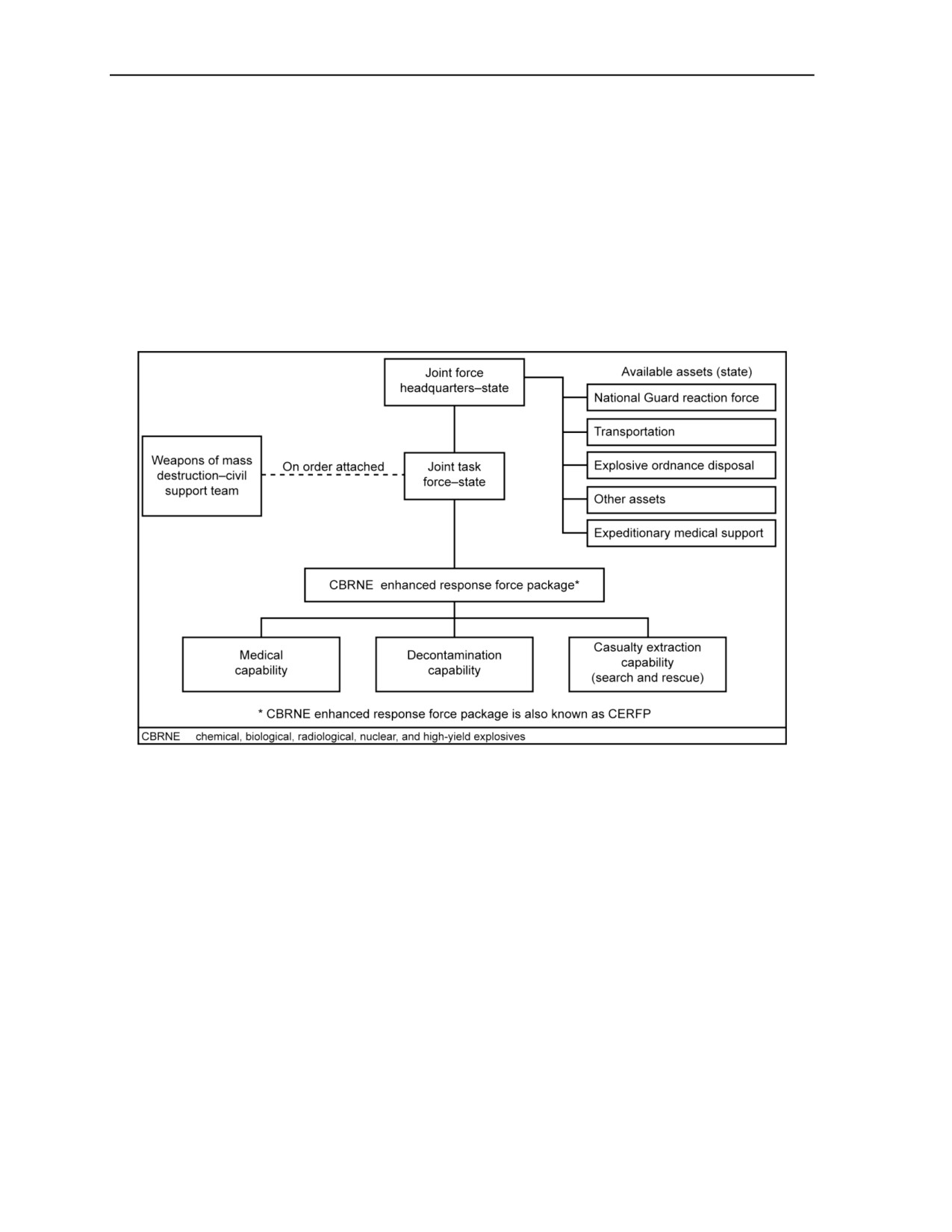
Appendix D
z
A single CBRNE enhanced response force package can operate a maximum capacity for up to 12
hours, with subsequent rest periods. If the incident commander requires 24-hour operational
support, the force headquarters requests one or more additional CBRNE enhanced response force
package.
D-3. A CBRNE enhanced response force package is comprised of four response elements: medical
treatment; decontamination; search and extraction; and a command and control team. Typical attachments
may include a Fire Fighting Element, a Fatality Search and Recovery Team, Air and Ground Casualty
Transportation assets, and ANG Expeditionary Medical Support Teams. The JFHQ-state is responsible for
coordinating administrative and logistic requirements that will be required for training certification, orders,
travel, equipment maintenance, and storage. Figure D-1 shows an example of a CBRNE enhanced response
force package organization.
Figure D-1. Example of CBRNE enhanced response force package organization
D-4. The command and control element must be prepared to execute recall of a CBRNE enhanced
response force package and coordinate adequate transportation for CBRNE enhanced response force
package personnel and equipment to the incident site. At the incident site, the command and control element
coordinates with the incident or task force commander.
D-5. The medical element provides short duration, pre-hospital emergency medical treatment during a
CBRNE response mission and at rescue sites. Specifically, the team works with decontamination and/or
casualty extraction teams to provide emergency medical treatment and triage in a contaminated environment
and stabilization and treatment in the cold zone prior to evacuation.
D-6. The decontamination element conducts ambulatory and non-ambulatory patient decontamination
under supervision of medical personnel. The decontamination element will don appropriate Personal
Protective Equipment (PPE) (defined as a minimum of Level C) when conducting decontamination.
D-7. Unlike most search and rescue teams, Search and Extraction Element has capability to identify and
recover casualties from a contaminated environment. As a type II collapse search and rescue team, a
CBRNE enhanced response force package can conduct medium intensity operations for 12-24 hours.
D-2
FM 3-28 (Signature Draft—Not for Implementation)
4 June 2010
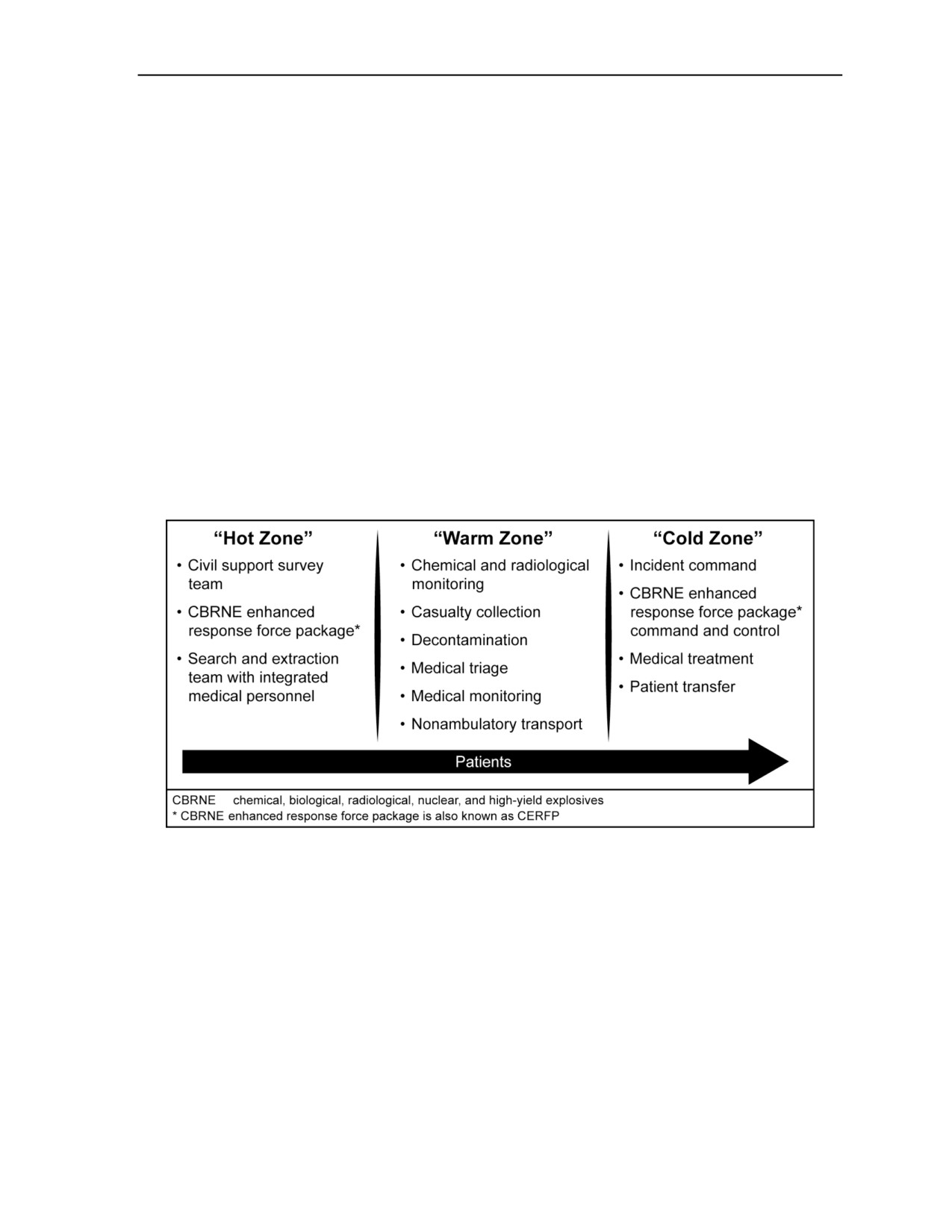
CBRNE Enhanced Response Force Package
D-8. The parent National Guard JFHQ may attach a security element as shown. This normally comes out
of that state’s National Guard Response Force. The security element receives training in contaminated
environment operating procedures. Note that if a WMD-CST is on scene, a CBRNE enhanced response
force package may assume OPCON of it. Although not shown, the Defense Threat Reduction Agency
(DTRA) can support a CBRNE enhanced response force package with technical information on
contaminants and other hazards through reach-back to subject matter experts. States should be prepared to
task organize EOD and CBRNE enhanced response force package capabilities to respond to situations
involving explosives. Detachments of the 52nd Ordnance Group (EOD), located around the country,
provide EOD capability in response to requests for federal assistance. Many civilian law enforcement
agencies also possess EOD capability.
OPERATIONS
D-9. The search and extraction element locates and removes the casualties from a contaminated area (the
―hot zone‖) to an initial decontamination area known as a ―warm zone.‖ Medical personnel with the search
element perform initial triage and prioritize casualties before decontamination. The decontamination
element moves the patient to decontamination, records the casualty, and decontaminates the patient. Once
decontaminated, the medical team provides medical treatment and stabilization in a contaminant-free area
(the ―cold zone‖) prior to evacuation to an area hospital. If required, the security detachment controls all
entry and exit from a CBRNE enhanced response force package area. Figure D-2 depicts a typical flow of
patients.
Figure D-2. Example of patient flow
DEPLOYMENT
D-10. When alerted, CBRNE enhanced response force package members report to designated armories or
staging areas and will deploy by the fastest means available to the incident site. A CBRNE enhanced
response force package command and control element will establish liaison with the incident command staff
and the National Guard task force commander. A CBRNE enhanced response force package will deploy
with equipment to the incident site or staging area using organic transportation, or designated National
Guard ground or air assets. An additional command element from the supporting state may deploy to
coordinate a CBRNE enhanced response force package’s employment and sustainment with the supported
JFHQ-state. Table D-1 below highlights the authorities associated with various employment options.
4 June 2010
FM 3-28 (Signature Draft—Not for Implementation)
D-3
Appendix D
SUSTAINMENT
D-11. The CBRNE enhanced response force package leadership works with the JTF-state, the JFHQ-state,
the nearest consequence management support center and the National Guard Support Center in Lexington,
Kentucky to sustain extended operations. The consequence management support center should be prepared
to provide immediate service and sustainment support for non-standard, commercial off the shelf
equipment, as requested. Additionally, United States Property and Fiscal Officer, Surgeon, Chaplain, Public
Affairs, Operations, and state logistical staffs must be prepared to support the operational employment of
the CBRNE enhanced response force package. Chaplain and Surgeon activities should comply with state
and federal guidelines for employment. If federalized, the CBRNE enhanced response force package will
receive support from the gaining unit commander.
D-4
FM 3-28 (Signature Draft—Not for Implementation)
4 June 2010
Appendix E
CBRNE Consequence Management Response Force
The chemical, biological, radiological, nuclear, and high-yield explosives
consequence management response force (CCMRF) provides the Department of
Defense response to a chemical, biological, radiological, nuclear, and high-yield
explosives incident. It is a multi-component and multi-service force package;
however, all forces are federal military forces (Title 10). This appendix provides a
general overview of the chemical, biological, radiological, nuclear, and high-yield
explosives consequence management response force along with some considerations
for its employment.
E-1. The chemical, biological, radiological, nuclear, and high-yield explosives (CBRNE) consequence
management response force is the largest of the military forces trained for CBRNE consequence
management. Should a significant CBNRE incident occur within the United States, USNORTHCOM would
alert and prepare to deploy the CBRNE consequence management response force to augment federal
consequence management efforts. For planning purposes the force includes about 5,000 personnel task
organized into three subordinate task forces. Units may vary depending upon forces provided by USJFCOM
to USNORTHCOM, but the capabilities remain constant. Joint Task Force Civil Support (JTF-CS), a
standing USNORTHCOM joint task force, normally commands the initial CBRNE consequence
management response force committed. Additional CBRNE consequence management response forces will
be employed under the command of other joint task forces (JTF-51 or JTF-52 in the continental United
States) as the forces become available to the supported combatant command. Figure E-1 illustrates the state
response CBRNE elements and the CBRNE consequence management response force.
4 June 2010
FM -3-28 (Signature Draft—Not for Implementation)
E-1
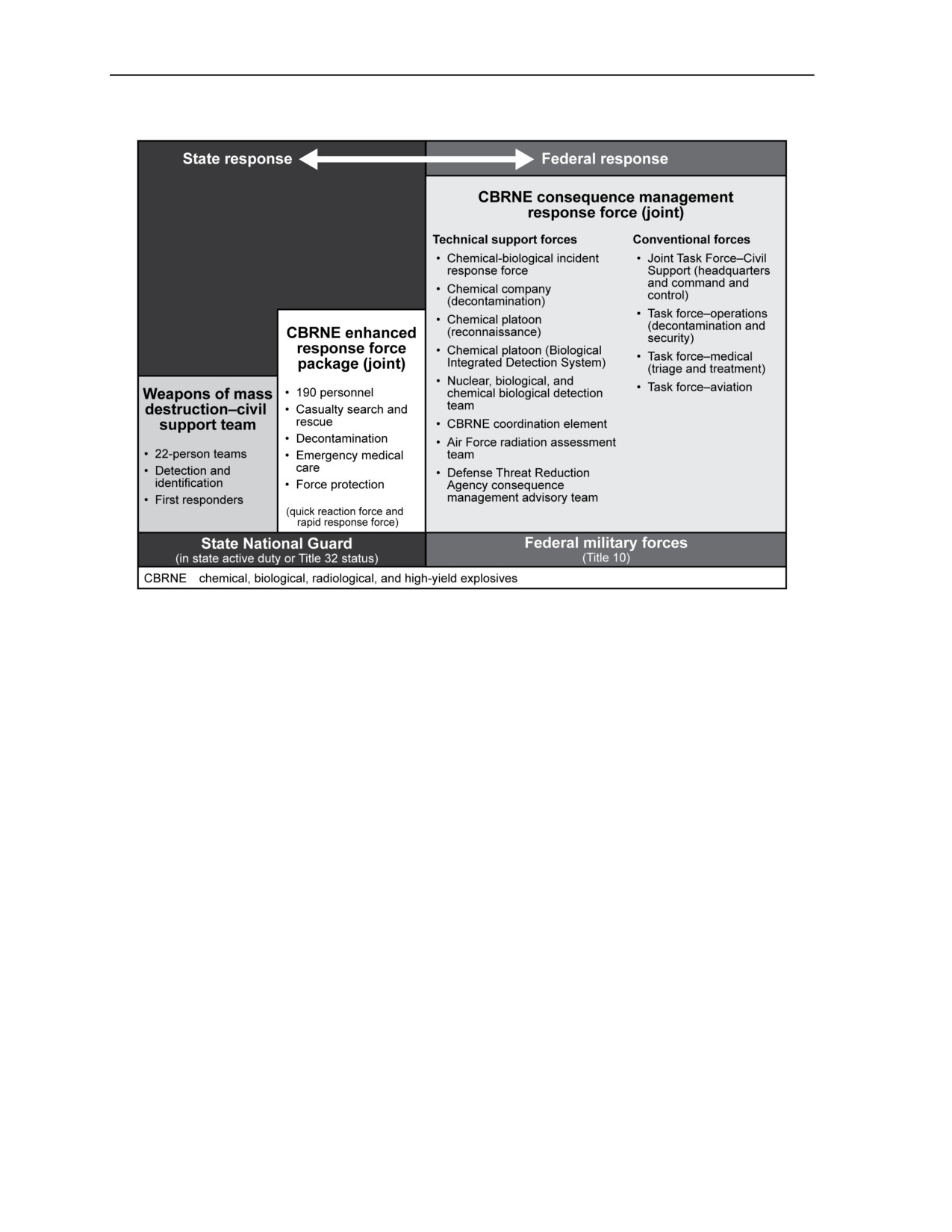
Appendix E
Figure E-1. State and federal CBRNE response forces
ORGANIZATION
E-2. The CBRNE consequence management response force is a multi-service force drawn from the active
and reserve components of the Air Force, Army, Navy, and Marines. Forces designated for the CBRNE
consequence management response force remain under the administrative control (ADCON) of the parent
Service. Commander USNORTHCOM exercises coordinating authority for training of these forces through
Commander JFCOM. Commander USNORTHCOM reviews training readiness, and mobilization plans for
reserve component forces in the CBRNE consequence management response force.
JOINT TASK FORCE-CIVIL SUPPORT
E-3.
Joint Task Force-Civil Support
(JTF-CS) is a USNORTHCOM standing joint task force
headquarters, commanded by a two-star officer. The JTF-CS is assigned to USARNORTH. The task force
consists of active, Guard and Reserve military members drawn from all service branches, as well as civilian
personnel, commanded by a federalized (Title 10) National Guard general officer. JTF-CS plans and
integrates federal military support to the designated primary agency for domestic CBRNE consequence
management. The JTF-CS trains to respond to a CBRNE incident beyond the capability of civilian
agencies. When directed by USNORTHCOM, JTF-CS alerts and deploys to the incident site and
commands forces federal military forces provided by the combatant commander. The JTF-CS provides
support to civil authorities to save lives, prevent injury and provide temporary critical life support. Some
typical JTF-CS tasks include incident site support, casualty medical assistance and treatment, displaced
populace support, mortuary affairs support, logistical support, and air operations. Additional CBRNE
consequence management response forces will be commanded by a joint task force with similar capabilities
to JTF-CS. The role of the JTF-CS within the CBRNE consequence management response force construct
is illustrated in Figure E-2.
E-2
FM 3-28 (Signature Draft—Not for Implementation)
4 June 2010
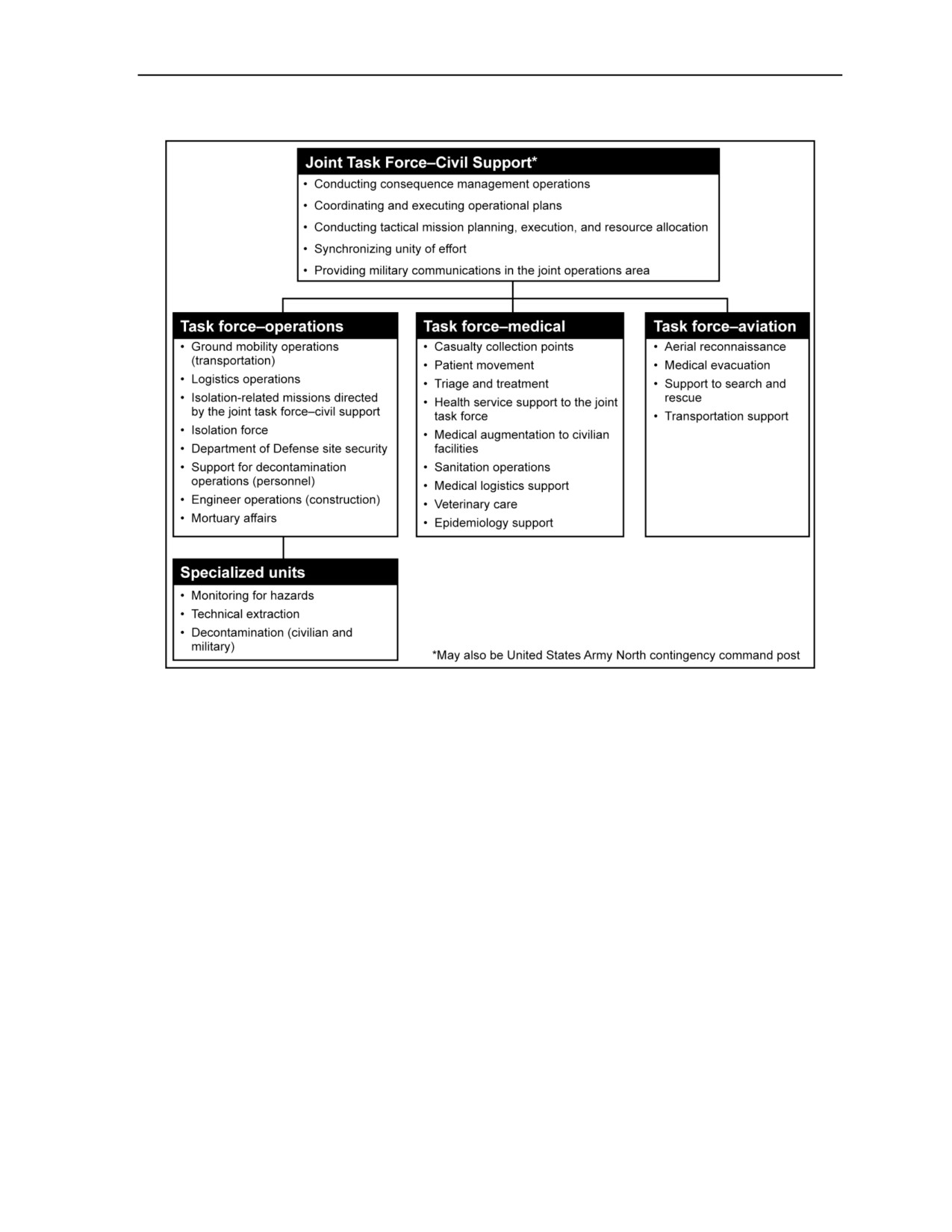
CBRNE Consequence Management Response Force
Figure E-2. Organization of the CBRNE consequence management response force
CBRNE CONSEQUENCE MANAGEMENT RESPONSE FORCE SUBORDINATE TASK FORCES
E-4. The CBRNE consequence management response force is a tailored force based on the specialized
requirements for CBRNE incident response. It becomes the base organization to which additional federal
military forces may be attached or OPCON, based upon the requirements at the incident site. The CBRNE
consequence management response force normally consists of three subordinate, multi-service task forces:
task force-operations; task force-medical; and task force-aviation. Each task force has a colonel or
equivalent
(O-6) in command and is organized around a brigade or equivalent headquarters. The
composition of each task force varies according to the availability and organization of forces selected for
the CBRNE consequence management response force. Subsequent paragraphs describe the CBRNE
consequence management response force using example forces. It is important to note that the logistic
support to this force is limited and dependent on the theater logistic support established by USARNORTH.
Task Force-Operations
E-5. The largest task force in the CBRNE consequence management response force is task force-
operations. The basic organization comes from an infantry brigade combat team or a combat support
brigade (maneuver enhancement) although Joint Force Command may designate other brigades. A Marine
Expeditionary Brigade may also become task force-operations, but this manual uses the Army for
illustration. The brigade commander task organizes the brigade and any attachments into subordinate task
forces intended for area support, and functional task forces intended for specialized activities such as
4 June 2010
FM 3-28 (Signature Draft—Not for Implementation)
E-3