FM 3-28 Civil Support Operations (Draft) (June 2010) - page 4
Chapter 5
USE OF FACILITIES AND EQUIPMENT
5-62. Military departments and defense agencies may make equipment, base facilities, or research facilities
available to federal, state, or local civilian law enforcement officials for law enforcement purposes,
according to DOD directives. Additionally, DOD personnel can operate or maintain or assist in operating or
maintaining DOD equipment, when the training of non-DOD personnel would be unfeasible or impractical
from a cost or time perspective and would not otherwise compromise national security or military
preparedness concerns. This must be approved by the Secretary of Defense or a designated representative.
(See DODD 5525.5.)
5-12
FM 3-28 (Signature Draft—Not for Implementation)
4 June 2010
Chapter 6
Provide Other Designated Support
This chapter discusses the fourth primary civil support task—provide other
designated support. It describes five types of support that Army forces provide under
this task. It provides basic information about how civilian organizations request these
types of support.
TYPES OF DESIGNATED SUPPORT
6-1. The Army conducts a range of civil support missions not directly related to disasters; chemical,
biological, radiological, nuclear, or high-yield explosives (CBRNE) incidents; or law enforcement. In fact,
they are hybrid missions, combining aspects of incident response, law enforcement, and public relations, to
accomplish different ends. Missions that fall under this task include support for special events, direct
support to federal agencies, protection of critical infrastructure, wildland firefighting support, and
community support activities.
SUPPORT FOR SPECIAL EVENTS
6-2. Department of Defense (DOD) provides other support as directed for a variety of special events.
Events typically requiring Federal military support include large recreational or sporting events such the
World’s Fair, the Super Bowl, the Olympics, or the World Series. Events requiring Federal military support
also include important political events such as a Presidential inauguration, joint sessions of Congress, or
meetings involving world leaders. Certain events receive special status not only because of large crowds,
but also because of security requirements for the participants and the threat of civil disturbance. Events such
as these are known as ―national special security events.‖ National special security events are characterized
by political, economic, social, or religious significance that may cause them to become the target of
terrorism or other criminal activity. The Department of Homeland Security designates national special
security events. The Secretary of Homeland Security establishes a special working group for each event.
The working group normally includes representatives from DOD and the National Guard Bureau. The
United States Secret Service, as part of Department of Homeland Security, is the primary agency for
coordinating support to national special security events. The Secret Service designs and implements the
operational security plan. Events in this category normally allow sufficient time for planning. Numerous
federal and state agencies may cooperate. Planning for possible transition to disaster support is inherent in
these operations. The United States Northern Command (USNORTHCOM) and United States Pacific
Command (USPACOM) commanders monitor national special security events in their respective areas of
responsibility. If an incident occurs at a national special security event, the Federal Bureau of Investigation
leads the law enforcement and criminal investigation efforts, and Federal Emergency Management Agency
(FEMA) leads incident management.
6-3. State National Guard forces provide other support as directed for civilian law enforcement agencies,
national special security events, protecting critical infrastructure, and other activities. The general focus of
state National Guard missions is usually on supporting security. Normally, some level of threat or hostility
is anticipated. Some general, ongoing planning and preparation may be possible for these types of missions.
Normally, mission-specific planning and training will be required once National Guard support has been
requested and approved. The supporting state National Guard forces are typically force packages task-
organized, trained, and equipped for the mission. The duration of these National Guard missions is typically
weeks to months.
4 June 2010
FM -3-28 (Signature Draft—Not for Implementation)
6-1
Chapter 6
6-4. National special security events may combine National Guard, Regular Army, and Army Reserve
forces. During the Presidential inauguration of 2009, National Guard, Regular Army, and Army Reserve
forces provided both ceremonial and security support. More than 10,000 National Guard troops from
numerous states assembled under the command of the District of Columbia adjutant general. All the Regular
Army and Army Reserve forces fell under the control of the Joint Task Force-National Capitol Region. The
federal military and state National Guard commanders coordinated closely throughout operations. This
event is an excellent model of effective parallel command structure for federal military and State National
Guard forces working together. Based on this model, Army officers tasked with similar responsibilities
should—
z
Integrate plans between federal military forces and State National Guard forces as early as
possible.
z
Establish joint and interagency planning protocols and provide liaison officers to key command
centers.
z
Establish a mobile reserve large enough to handle contingencies. Position the reserve closely
enough that it can respond quickly, yet far enough away that it is not visible to the crowds, or
impeded by them.
z
Maintain operational security.
6-5. Because a national special security event entails detailed planning, preparation, and execution, there
is time to appoint a dual-status commander for the event. In most cases, this will be a senior National Guard
officer from the state hosting the event. See chapter 7 for a discussion of dual-status command.
6-6. For other special events, the joint director of military support plans, coordinates, and monitors
Federal military support according to priorities assigned by the Department of Homeland Security special
events working group. DOD focuses on support related to public safety and security, including, but not
limited to, physical security, aviation, logistics, communications, joint operations and command centers,
and explosive ordnance disposal. Federal military support for special events may be reimbursable or
nonreimbursable depending on the type of support provided and the nature of the event.
DIRECT SUPPORT TO FEDERAL AGENCIES
6-7. Certain domestic situations may require contingency military support outside the National Incident
Management System framework. In such cases, DOD provides support in response to a request from a
federal government agency or at the direction of the President. These incidents fall into three general
categories.
6-8. In the first case, the President may direct the Secretary of Defense to augment the federal civilian
work force of an agency experiencing labor problems. For example, in 1982, the President used military
personnel to replace the striking air traffic controllers. Earlier Presidents used the Army to deliver the mail
during postal strikes. This may occur based upon a request from the supported agency, or may be based
upon a Presidential decision.
6-9. In the second case, the President may authorize military support to a federal government agency that
suddenly expands its responsibilities due to an incident. Some examples include.
z
Animal or plant disease eradication. DOD supports the U.S. Department of Agriculture for
emergencies requiring the containment and eradication of plant or animal diseases.
z
Oil and hazardous substance spills. The Environmental Protection Agency and Department of
Homeland Security
(U.S. Coast Guard) have responsibilities for the Oil and Hazardous
Substances Pollution Contingency Plan. DOD contributes support either under the Stafford Act,
or the Economy Act. The oil drilling accident and resulting oil contamination in the Gulf of
Mexico illustrates such support. In this instance, reimbursement costs were assumed by the
owning corporation, while DOD assets supported the clean up.
z
Wildfires. The National Interagency Fire Center, a joint Department of Agriculture and
Department of Interior organization, coordinates the federal response to wildfires. DOD provides
resources for the containment, control, and extinguishing of wildfires on lands owned by the
federal government. (See paragraph 6-15.)
6-2
FM 3-28 (Signature Draft—Not for Implementation)
4 June 2010
Provide Other Designated Support
6-10. The third event involves a sudden mass immigration to the United States. This could result in DOD
providing support, when directed, to other federal agencies support such as housing, security, and logistics
while the federal government resolves the administrative requirements for migrants to enter the United
States. For example, Regular Army and Army Reserve forces provided extensive support to federal
authorities during the Mariel Boatlift in 1980. Thousands of Cubans took advantage of Castro’s relaxation
of his immigration policy to come to the United States. Local authorities were overwhelmed, and the Army
provided extensive support to temporarily house, secure, and move the immigrants.
PROTECTION OF CRITICAL INFRASTRUCTURE
6-11. Law enforcement support and protection of critical infrastructure share certain similarities. Both
missions require Soldiers to be prepared to use force to protect individuals and facilities. Both require close
cooperation with civilian security elements. These missions differ in other respects. Federal military units
may be tasked to protect nonmilitary critical infrastructure by the President, and critical military
infrastructure by the President or Secretary of Defense. Within the specific limits of their infrastructure
protection mission, federal military forces may remove, detain, and use force against individuals that pose a
threat to designated facilities without violating the Posse Comitatus act. Any use of force must remain
within the rules for the use of force specified for that mission. National Guard forces under state command
may receive a specific protection mission by their governor or may deploy to protect certain facilities in
accordance with pre-existing contingency plans when ordered. Certain USNORTHCOM and USPACOM
plans require National Guard forces under federal command (Title 10 status) to alert and deploy security
elements for either homeland defense or homeland security missions.
6-12. The President has authority to order federal military forces to protect critical infrastructure. This
authority is derived from the President’s position as the Commander in Chief of the Armed Forces of the
United States, under Article II of the Constitution. The President may direct DOD forces to protect critical
infrastructure in either a homeland security or a homeland defense role. The distinction between these roles
is critical for two reasons. First, DOD is the lead federal agency for a homeland defense operation, but not
for a homeland security operation. Second, with the exception of defense critical infrastructure protection
(functions normally a part of DOD’s core mission), DOD participates in homeland security missions only if
approved by the Secretary of Defense, consistent with existing legal constraints, and only if they do not
negatively impact DOD’s primary war fighting missions.
6-13. Normally, the President will provide justification prior to exercising authority under Article II, either
by issuing either a national emergency declaration or through executive order. This declaration or order
would also trigger the authority the Secretary of Defense, combatant commanders, and on-scene
commanders to exercise their authority to protect defense critical infrastructures, assets, and property.
Before any federal military forces can use deadly force to protect any infrastructure or asset, the President
must designate it as either a ―national critical infrastructure‖ or ―asset vital to national security,‖ or an on-
scene commander must have designated the property as ―inherently dangerous property.‖
6-14. Critical infrastructure protection requires careful planning and effective small-unit leadership. The
primary consideration is the application of the rules for the use of force. Soldiers with the mission to protect
designated public utilities, transportation nodes, or similar critical infrastructure vital to the public health
and safety must understand how to apply the rules for the use of force to protect that particular facility. The
unit leader should coordinate in detail with the manager of the facility and any security personnel employed
at the facility.
WILDLAND FIREFIGHTING SUPPORT
6-15. The federal government manages vast areas of land within the United States. Some of this land is
provided for national parks; some is owned and managed by the United States government for wildlife
habitat and natural resources. Each state also has an array of parks and resource preserves. Wildfires occur
on these lands every year, and federal and state forestry services maintain robust firefighting capabilities to
combat them. However, when wildfires exceed civilian firefighting capabilities, the primary agency requests
assistance from federal military forces, the National Guard, or both. The types of support vary, but they
range from surveillance to air movement of personnel and equipment and may include augmenting
4 June 2010
FM 3-28 (Signature Draft—Not for Implementation)
6-3
Chapter 6
firefighting personnel with military units. Military forces support wildland firefighting under the Economy
Act.
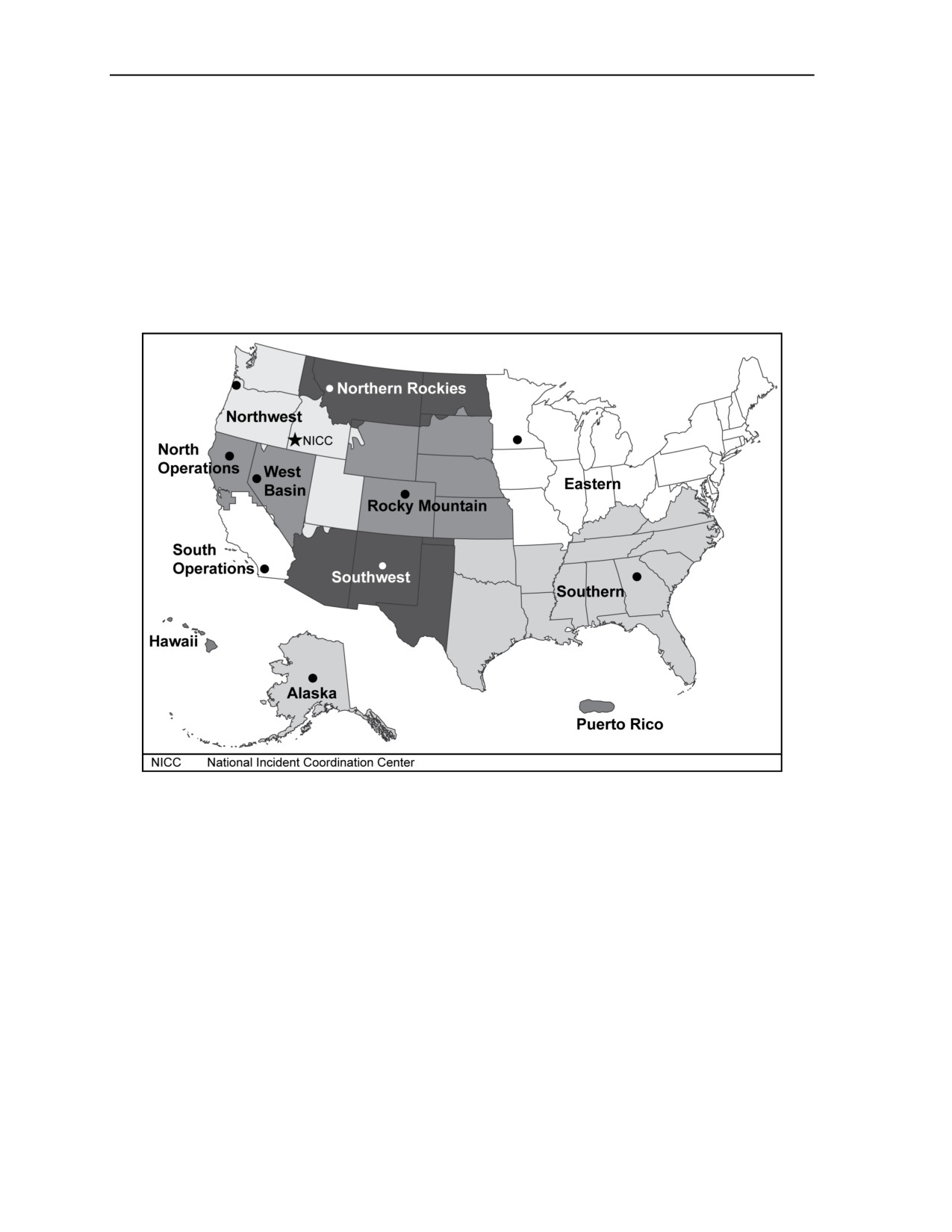
6-16. The National Interagency Fire Center is located in Boise Idaho. It coordinates the mobilization of
national resources for wildland fire and other fire incidents throughout the United States. The National
Interagency Fire Center operates and maintains the National Incident Coordination Center. The National
Incident Coordination Center dispatches heavy air tankers, lead planes, smokejumpers, hotshot crews,
incident management teams, area command teams, medium and heavy helicopters, infrared-equipped
aircraft, military resources, telecommunications equipment, remote automated weather stations, and large
transport aircraft. Geographic area control centers control manage wildland firefighting within their regions.
Figure 6-1 illustrates the geographic area coordination centers with their respective regions.
Figure 6-1. Geographic area coordination centers for wildland firefighting
6-17. Wildfire firefighting is a hybrid mission that combines aspects of disaster response with other types of
support. It involves response to an incident but also entails specialized planning, training, and command and
control. Although military forces remain under the command of their military leadership, civilian
professionals direct the tactical employment of supporting military forces. First responders need disciplined
manpower they can rapidly convert into large numbers of personnel along the fire line. They also need
reserves to fill gaps created when civilian firefighters reach exhaustion.
6-18. Any large wildfire creates a very dangerous environment for neighboring residents and first
responders alike. Fighting fires can be lethal, and Soldiers supporting firefighting agencies must receive
special training and equipment. The National Interagency Fire Center has developed an intensive training
program that prepares Soldiers and leaders for service on the fire lines. The National Interagency Fire
Center conducts training in conjunction with joint reception, staging, onward movement, and integration of
supporting military units. Commanders need to understand the U.S. Forest Service reorganizes its small
units into firefighting teams and places them under the tactical control of an experienced firefighter. The
Forest Service also provides equipment, protective garments, and communications as part of the training. It
6-4
FM 3-28 (Signature Draft—Not for Implementation)
4 June 2010
Provide Other Designated Support
provides communications and life support to all personnel not directly involved in firefighting, such as truck
drivers and administrative personnel.
6-19. Force health protection becomes a primary concern of commanders in any wildfire support mission.
While the Forest Service can train personnel, it cannot condition them or enforce field discipline.
Commanders must stress the role of the small-unit leader in caring for subordinates. Medical personnel need
to conduct frequent checks on the health of Soldiers and be prepared to treat heat injuries, burns, and
trauma.
COMMUNITY SUPPORT ACTIVITIES
6-20. Commanders take an active interest in their relationships with civilian officials by supporting
appropriate community events. They initiate and support activities of common interest and benefit. They
establish productive relationships with national, state, and community officials that benefit the Army and
civilian communities. Army installation commanders often appoint a community relations committee to
review community assistance requests. Such civil support falls outside the definition of DSCA.
6-21. There are limitations on the use of Army forces for community support. Army forces do not compete
with resources and services commercially available in the community. Commanders may not authorize
military support when local businesses can provide the same or similar support. Army participation in
community assistance is never provided for profit. Leaders ensure that no unit realizes a monetary profit, a
gratuity, or remuneration in any form unless provided for by public law or regulation.
6-22. Periodic planned community assistance activities can be national missions that focus on developing
public support for the Army. They also can be civilian organization or local community missions focused on
improving the community, its infrastructure, and quality of life. However, certain programs do not fit neatly
into one category or the other. Programs established by DOD or Department of the Army require execution
at the installation level. Many require the energy and initiative of the commander to foster successful
partnerships to form new partnerships.
6-23. Army aviation units may fly emergency medical evacuation missions to transport civilians to
community hospitals. This is similar to immediate response authority, but there are administrative
differences. The civilian agency is not required to reimburse DOD. Army aircraft must perform the mission
from their home airfield and return upon completion. In other words, the aircrew cannot relocate to another
state to support emergency services away from their home base.
REQUESTS FOR OTHER DESIGNATED SUPPORT
6-24. Paragraphs 6-25 to 6-27 discuss how civilian organizations request other designated support.
REQUESTS TO THE STATE NATIONAL GUARD
6-25. The requesting civilian organization may contact each state National Guard directly. All state
National Guard headquarters have established processes for community support requests, generally through
their public affairs offices. Contact information may be found online.
REQUESTS TO DEPARTMENT OF DEFENSE
6-26. Civilian organizations may submit requests for Federal military support through public affairs
channels to the Office of the Assistant Secretary of Defense for Public Affairs, Attn: Directorate for
Community Relations and Public Liaison as Community Relations/Public Affairs Support. Organizations
use DD Form 2535 or DD Form 2536. Either form can be submitted through Army, Navy, Marine, or Air
Force public affairs officer for processing.
REQUESTS TO INSTALLATION COMMANDERS
6-27. Installation commanders may provide support when it meets the requirements of innovative readiness
training (under title 10 USC, section 2012). Innovative readiness training refers to training authorized by a
4 June 2010
FM 3-28 (Signature Draft—Not for Implementation)
6-5
Chapter 6
provision of law. It also refers to support provided to a civilian organization that provides military training
for the military unit involved.
6-6
FM 3-28 (Signature Draft—Not for Implementation)
4 June 2010
Chapter 7
Legal Considerations
This chapter identifies the primary mission authorities for military forces
participating in civil support, with an emphasis on authorities affecting federal
military forces. It summarizes the authorities of state governors, the President, the
Secretary of Defense, and military commanders to respond to requests for assistance
from civil authorities. This chapter also discusses the most common legal issues
commanders face when conducting civil support operations—particularly those
issues related to rules for the use of force, information and intelligence, isolation and
quarantine, and liability.
POWERS OF A STATE GOVERNOR
7-1. Governors serve as commanders in chief of their state National Guard forces and may assume special
powers upon the declaration of a disaster, emergency, enemy attack, or riot. The authority of the governor is
circumscribed or limited by United States Code (USC) and each state’s law and statutes. Although the
governors’ powers vary from state to state, emergency powers in all states generally include authorities to—
z
Suspend statutory and regulatory provisions that otherwise might hinder response to a disaster.
z
Require hospitalization for those injured during a disaster.
z
Control ingress and egress into the emergency area to direct the evacuation of residents and
prescribe transportation routes.
z
Provide temporary shelter.
z
Commandeer property (with compensation).
z
Control or suspend utility services.
z
Limit or suspend the sale and possession of alcohol and explosives following a disaster or
emergency.
7-2. Governors also issue executive orders declaring ―states of emergency‖ and ensure that state agencies
plan for actions in the event of a disaster. Once a disaster occurs, the governor determines how to respond
to a local government’s request for assistance. If appropriate, the governor declares a state of emergency,
activates the state response plan, and may call up the National Guard (under state orders). The governor
gives the National Guard its mission(s) and determines when to withdraw National Guard forces. The
governor informs the Federal Emergency Management Agency (FEMA) regional director of his or her
actions.
AUTHORITIES FOR FEDERAL MILITARY SUPPORT
7-3. The U.S. military has provided support to civil authorities in response to civil emergencies and
natural disasters throughout its history. The terminology applied to this function has varied over the years:
military assistance or military support to civil authorities, military support of civil defense, and employment
of military resources in natural disaster emergencies within the United States. The change in terminology
reflects the evolving changes in authorities granted to Department of Defense (DOD) by the President and
the Congress.
4 June 2010
FM -3-28 (Signature Draft—Not for Implementation)
7-1
Chapter 7
AUTHORITIES OF THE PRESIDENT
7-4. Although Article II of the Constitution and laws passed by Congress provide the primary basis for the
present-day authorities of the President, the scope of Presidential authority is much broader. The President
possesses inherent authority derived not from specific constitutional provisions or statutes, but from the
aggregate of presidential responsibilities as the Nation’s Chief Executive, Commander in Chief of the
Armed Forces, and the highest law enforcement authority. Supreme Court decisions have held that the
President has the inherent authority to preserve order and ensure public health and safety during a national
crisis or an emergency, according to the necessities of the situation. This inherent authority empowers the
President to act in response to an incident.
7-5. When confronted with a national crisis or emergency where there is no expressed Constitutional or
statutory authority, the President can either present the matter to the Congress and wait for legislation that
will authorize him or her to act, or take immediate action on the basis of the President's inherent authority
when no one other than the President is capable of doing so.
The Stafford Act
7-6. The Robert T. Stafford Disaster Relief and Emergency Assistance Act (Public Law 100-707, known
as the Stafford Act) is the primary federal statute giving the President the authority to direct federal
agencies to provide assistance to state and local authorities during an incident. The purpose of this
assistance is to save lives, alleviate human suffering, protect public health and safety, and lessen or avert the
threat of a catastrophe. The Stafford Act allows four ways for the President to provide federal—including
military—support to civil authorities. Within these four categories, military support may include aviation,
communications, engineering, logistical, medical, public affairs, and other capabilities.
Major Disaster Declaration
7-7. The President may declare a major disaster when an incident is severe enough to necessitate federal
assistance to save lives, protect and preserve property, and provide for the public health and safety. The
declaration follows a request from the governor of the affected state. The President acts through FEMA to
authorize any appropriate federal agency to support state and local authorities.
Emergency Declaration
7-8. In cases where the President does not declare a major disaster, he or she may declare an emergency.
This declaration is either before (in anticipation of) or following an incident necessitating federal assistance
to save lives, protect property, provide for the public health and safety, and lessen or avert the threat of a
catastrophe. The amount of damage either anticipated or actual is less severe than for a major disaster.
Again, a request from the governor of the affected state is required. The President, through FEMA, may
authorize any federal agency to use personnel, equipment, facilities, and technical and advisory services to
support state and local authorities.
Department of Defense Ten-Day Emergency Work Authority
7-9. The President may direct the Secretary of Defense to send federal military forces on an emergency
basis to preserve life and property for a period not to exceed ten days. This DOD ten-day emergency work
authority includes removal of debris and wreckage and temporary restoration of essential public facilities
and services. It follows a request from a governor for assistance. A Presidential major disaster or emergency
declaration is not required. However, the President may issue a declaration following the ten-day period, if
additional federal assistance is requested and necessary.
Federal Primary Responsibility Authority
7-10. The President may, without a request for assistance from a governor, unilaterally issue an emergency
declaration and send federal assets, including federal military forces, to an area or facility over which the
7-2
FM 3-28 (Signature Draft—Not for Implementation)
4 June 2010
Legal Considerations
federal government exercises exclusive or primary responsibility by virtue of the Constitution or a federal
statute. This may include federal missions, personnel, equipment, and property.
Reimbursement Under The Economy Act And Stafford Act
7-11. Once approved by the Secretary of Defense, federal military forces may perform civil support on a
reimbursable basis. The Economy Act of 1932 (Section 1525, Title 31, USC) is the fiscal authority for a
federal agency to reimburse DOD for goods and services that agency ordered and DOD rendered (when a
more specific statutory authority does not exist). Under the Economy Act, reimbursement may be provided
for DOD’s total costs.
7-12. If the President issues a major disaster or emergency declaration under the Stafford Act, then the
requesting federal agency reimburses DOD for the incremental costs of support provided. Reimbursement
policies and procedures differ depending on the authority under which services are performed. Commanders
must work closely with their supporting financial management offices to ensure costs are captured and
reported appropriately.
AUTHORITY OF THE SECRETARY OF DEFENSE
7-13. The Secretary of Defense, subject to the direction of the President, has the statutory authority to
direct and control DOD. The Secretary of Defense also has the statutory authority to issue regulations to
manage federal military personnel, property, and facilities. This includes the authority to delegate to
subordinate officials the authority vested in the Secretary of Defense. Under these authorities, the Secretary
of Defense has issued several DOD directives pertaining to civil support, such as DODD 3025.15 and
DODD 3025.1. The Secretary of Defense designated the Assistant Secretary of Defense for Homeland
Defense and America's Security Affairs (ASD (HD/ASA)) as the DOD domestic crisis manager, in DODD
5111.13. The ASD (HD/ASA) has policy, planning, advice, and approval authority for civil support
operations, except for civil disturbance and chemical, biological, radiological, nuclear, and high-yield
explosives incidents, direct support to civilian law enforcement agencies, and the use or potential use of
lethal force by federal military forces—which the Secretary of Defense retains.
7-14. The joint director of military support (JDOMS) is the action agent for the ASD (HD/ASA) for civil
support. Once DOD receives a request for assistance, the JDOMS evaluates and processes it for the ASD
(HD/ASA), and issues an execution order approved by the Secretary of Defense. The JDOMS also
recommends to the Secretary of Defense designation of United States Northern Command
(USNORTHCOM) or United States Pacific Command (USPACOM) as the supported commander,
depending on the geographic location of the incident.
AUTHORITY OF THE COMBATANT COMMANDER
7-15. The Secretary of Defense has authorized the commanders of USNORTHCOM and USPACOM to
provide limited civil support on their own within their respective areas of operation. Specifically, they are
authorized to perform the following actions with their assigned and allocated forces and certain aviation,
communication, transportation, and medical units:
z
Place them on a 24-hour prepare-to-deploy alert for up to seven days.
z
Deploy them for up to 60 days, first notifying to the Secretary of Defense and the Chairman of
the Joint Chiefs of Staff.
z
Employ forces in an emergency after personally approving a request for immediate assistance
from a primary federal agency such as FEMA, first notifying the Secretary of Defense and the
Chairman of the Joint Chiefs of Staff.
AUTHORITY OF A DUAL-STATUS COMMANDER
7-16. Federal law permits the use of a dual-status military commander to integrate federal and State
National Guard forces, reduce duplication of effort, and ensure unity of effort during a national-level
(interagency) incident or national special security event. In practice, the authority is used only in pre-
4 June 2010
FM 3-28 (Signature Draft—Not for Implementation)
7-3
Chapter 7
planned special events. In most emergencies and disasters, the federal military and State National Guard
chains of command remain separate, the former supporting the joint (interagency) field office and the latter
the state emergency management authority. In a large, protracted response, particularly one limited in
geographic scope to a single state, the President and governor may agree to appoint a dual-status
commander. Note that in any extreme emergency, and particularly in case of an external attack on the
United States, the President may consolidate all military forces under DOD by federalizing the National
Guard and exercising command through USNORTHCOM or USPACOM. This is not dual-status command.
7-17. Under Section 325 of Title 32, USC, a National Guard officer may serve on active duty in a federal
status (under Title 10) while retaining his or her National Guard status, if the President authorizes service in
both duty statuses, and if the governor of the affected state consents. Under Section 315 of Title 32, USC,
the President may approve a Title 10 active duty officer who is detailed to duty with the State National
Guard by a Service Secretary to accept a commission from a governor into the State National Guard and
serve concurrently in both a federal and nonfederal status. Only the commander is in a dual status;
subordinate forces are not.
Note: The dual-status commander may elect to combine or keep separate sections of the staff.
7-18. Four documents are necessary to implement this arrangement:
z
Presidential authorization.
z
Governor’s consent.
z
Order by the appropriate Service Secretary bringing the designated dual-status commander onto
active duty.
z
A memorandum of agreement between the two chains of command.
7-19. A memorandum of agreement must be signed by the governor and the President or their respective
designees before a dual-status commander can be established. The purpose of the memorandum of
agreement is to avoid future complicating liability determinations and confusion over the application of the
Posse Comitatus Act. This memorandum of agreement between the two chains of command should define,
at a minimum—
z
An agreement that each chain of command will not attempt to issue orders to the dual-status
commander that concern forces or missions assigned to the other chain of command.
z
Delineation of missions to be performed by forces in each chain of command and that the federal
missions will not involve law enforcement duties.
z
The military justice authority that can be exercised by the dual-status commander in each of his
or her statuses.
z
The successor of command authority for each chain of command.
z
Rules for the use of force for both chains of command.
z
Procedures to resolve any conflicts that may arise.
7-20. A dual-status commander may receive orders from both the federal and state chains of command.
However, both chains recognize and respect that the dual-status commander cannot exercise dual authority
simultaneously on behalf of two mutually exclusive sovereign governments. Instead, a dual-status
commander exercises authority in a completely mutually exclusive manner, (either in a federal or nonfederal
status), but never in both statuses at the same time. In other words, a dual-status commander holds a federal
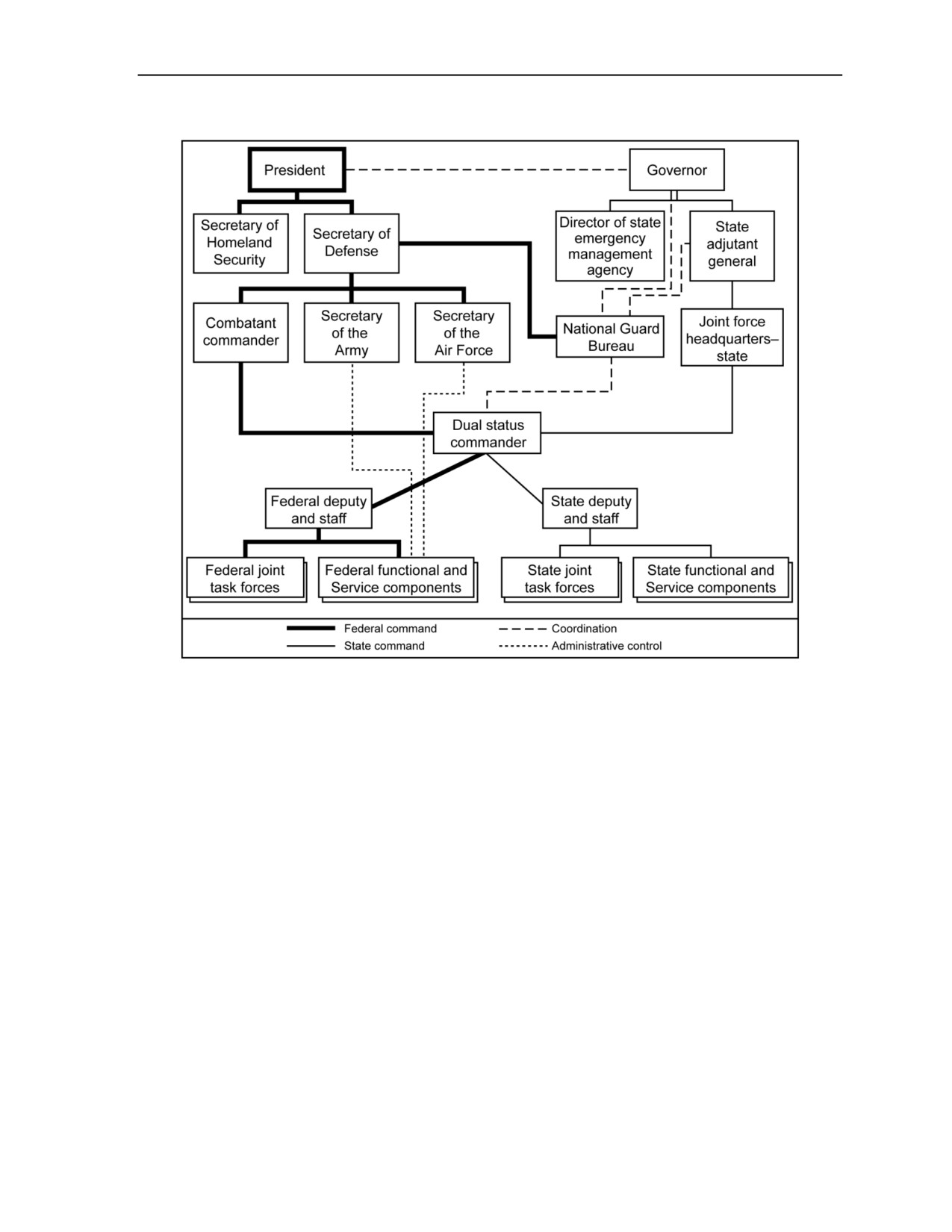
hat in one hand and a nonfederal hat in the other hand but can wear only one hat at a time. Figure 7-1 shows
an example of a dual-status command structure.
7-4
FM 3-28 (Signature Draft—Not for Implementation)
4 June 2010
Legal Considerations
Figure 7-1. An example of a dual-status command
7-21. When in a federal status, the dual-status commander takes orders from the President or those officers
the President and the Secretary of Defense have ordered to act on their behalf, and may issue orders to
federal forces under his or her command. When in a nonfederal status, the dual-status commander takes
orders from the governor through the adjutant general of the state and may issue orders only to National
Guard Soldiers serving in a nonfederal (Title 32 or state active duty) status under his or her command.
THE POSSE COMITATUS ACT
7-22. The Constitution does not explicitly bar the use of military forces in civilian situations or in matters
of law enforcement, but the United States has traditionally refrained from employing troops to enforce the
law except in cases of necessity. The Posse Comitatus Act (Section 1385 of Title, 18 USC) punishes those
who, ―except in cases and under circumstances expressly authorized by the Constitution or Act of Congress,
willfully use any part of the Army or the Air Force as a Posse Comitatus or otherwise to execute the
laws….‖ Questions arise most often in the context of assistance to civilian law enforcement agencies. In this
context, courts have held that, absent a recognized exception, the Posse Comitatus Act is violated (1) when
civilian law enforcement officials make ―direct active use‖ of military investigators, (2) when the military
―pervades the activities‖ of civilian officials, or (3) when the military is used so as to subject citizens to the
exercise of military power that is ―regulatory, prescriptive, or compulsory in nature.‖ The Act applies by
regulation to the Navy and Marines. It does not prohibit activities conducted for a military purpose (base
security or enforcement of military discipline) that incidentally benefit civilian law enforcement bodies. The
Act does not apply to the state forces, but state law may impose similar restrictions.
4 June 2010
FM 3-28 (Signature Draft—Not for Implementation)
7-5
Chapter 7
7-23. Congress has provided for a number of statutory exceptions to the Posse Comitatus Act by explicitly
vesting law enforcement authority either directly in a military branch (the Coast Guard) or indirectly by
authorizing the President or another government agency to call for assistance in enforcing certain laws.
There are several exceptions to the Posse Comitatus Act. Some important exceptions include—
z
Under the Prohibited Transaction Involving Nuclear Materials statute (Title 18, Section 831), if
the Attorney General and the Secretary of Defense jointly determine that the Nation faces an
emergency, the Secretary of Defense may authorize federal military forces to provide direct
support to civilian authorities to protect nuclear materials.
z
Title
10, USC, Sec.
333 (Chapter
15 Insurrection Sec.
1068(a)(3)), also known as
―the
Insurrection Act,‖ governs the President’s ability to deploy federal military forces and
federalized National Guard forces within the United States to put down lawlessness, insurrection,
and rebellion with or without the consent of the governor depending on the situation.
z
Under the Emergency Situation Involving Chemical or Biological Weapons of Mass Destruction
statute,
(Title 10, Section 382) if the Attorney General and the Secretary of Defense jointly
determine that the Nation faces an emergency involving an attack using chemical, biological,
radiological, or high-yield explosives, the Secretary of Defense may provide resources and
personnel to assist civil authorities regarding the enforcement of this statute.
7-24. Although not an exception to the prohibition against direct engagement in the execution of the law,
federal military forces may assist state and local civilian law enforcement agencies within limits. Federal
law allows federal military forces to provide ―indirect‖ support to federal, state, and local civilian law
enforcement agencies. This includes passing information relevant to a violation of federal or state laws;
providing equipment, supplies, spare parts, and facilities; supplying sensors, protective clothing, antidotes,
or other supplies appropriate for use in responding to a chemical or biological incident; training in the
operation and maintenance of equipment; giving expert advice; and allowing personnel to maintain and
operate certain detection and communications equipment. The Secretary of Defense or a designee exercises
approval authority for this level of support.
THE INSURRECTION ACT
7-25. Congress has delegated authority to the President to call up federal military forces during an
insurrection or civil disturbance. The Insurrection Act authorizes the President to use federal military forces
within the United States to restore order or enforce federal law after a major public emergency when
requested by the state governor or when the President determines that the authorities of the state are
incapable of maintaining public order. The President normally executes this authority by first issuing a
proclamation ordering the dispersal of those obstructing the enforcement of the laws. The President may act
unilaterally to suppress an insurrection or domestic violation against the authority of the United States
without the request or authority of the state governor.
7-26. The Insurrection Act has been used to send the armed forces to quell civil disturbances a number of
times during U.S. history, most recently during the 1992 Los Angeles riots and during Hurricane Hugo in
1989, during which widespread looting was in reported in Saint Croix, Virgin Islands. During the civil
rights movement, a few governors of southern states attempted to defy federal law and court orders,
necessitating action by the President under the Insurrection Act. In 1957, President Eisenhower federalized
the Arkansas National Guard at Central High School in Little Rock. In 1962, President Kennedy invoked
the Act when rioting broke out at the University of Mississippi in Oxford upon the admission of a black
student. It was again invoked by President Kennedy on June 11, 1963, and September 10, 1963, to enforce
court decrees opening public schools to blacks in the state of Alabama. The statue was also invoked by
President Lyndon Johnson as a preemptive measure in 1965 to federalize National Guardsmen and deploy
federal military forces when state officials in Alabama refused to protect participants during a civil rights
march.
7-6
FM 3-28 (Signature Draft—Not for Implementation)
4 June 2010
Legal Considerations
THE NATIONAL EMERGENCIES ACT
7-27. The National Emergencies Act of 1976 (Section 1601-1651 of Title 50, USC) gives the President
broad authorities to respond to emergencies, subject to Congressional regulation of these emergency
powers. Under the powers delegated by this statute, the President may seize property, organize and control
the means of production, seize commodities, assign military forces aboard, institute martial law, seize and
control all transportation and communication, regulate the operation of private enterprise, restrict travel,
and, in a variety of ways, control the lives of United States citizens. Moreover, Congress may modify,
rescind, or render dormant such delegated emergency authority.
MOBILIZATION OF THE RESERVE COMPONENT
7-28. When the President declares a major disaster or emergency under the Stafford Act, the Reserve
Component may support the relief effort. Under title 10 USC, section 12304, the President has the authority
to involuntarily call-up no more than
200,000 members of the Selected Reserve. There are specific
limitations on mobilization of Army Reserve Units and National Guard for civil support. This authority
cannot be used for any civil disturbance or a domestic incident, except to respond to an emergency
involving a weapon of mass destruction, a terrorist attack, or a threatened terrorist attack in the United
States that results or could result in significant loss of life or property. Thus, the President may use this
statutory authority to federalize and deploy the National Guard civil support teams of several states in the
event of a chemical, biological, radiological, nuclear, or high-yield explosives incident in another state.
Note: Section 12304(c) of Title USC restricts the involuntary call up of Reserve Components.
They may not be used under this authority for disaster response or to repress rebellions. The
latter situation requires Insurrection Act authority.
7-29. Soldiers on inactive duty for training (battle assembly) or annual training may be available to perform
a civil support mission and may support relief operations during these training periods, subject to the
approval of the Secretary of Defense or under immediate response authority. Under Section 10147(a)(2) of
Title 10 USC, an Army Reserve unit’s annual training may be extended, upon the approval of United States
Army Reserve Command, to continue to perform civil support operations for up to 29 days (including travel
time).
RULES FOR THE USE OF FORCE
7-30. Soldiers deployed to a combat zone overseas follow rules of engagement established by the Secretary
of Defense and adjusted for theater conditions by the joint force commander. Within the United States and
its territories, Soldiers adhere to rules for the use of force. There are many similarities between them, for
example in the inherent right of self-defense, but they differ in intent. Rules of engagement are by nature
permissive measures intended to allow the maximum use of destructive combat power appropriate for the
mission. Rules for the use of force are restrictive measures intended to allow only the minimum force
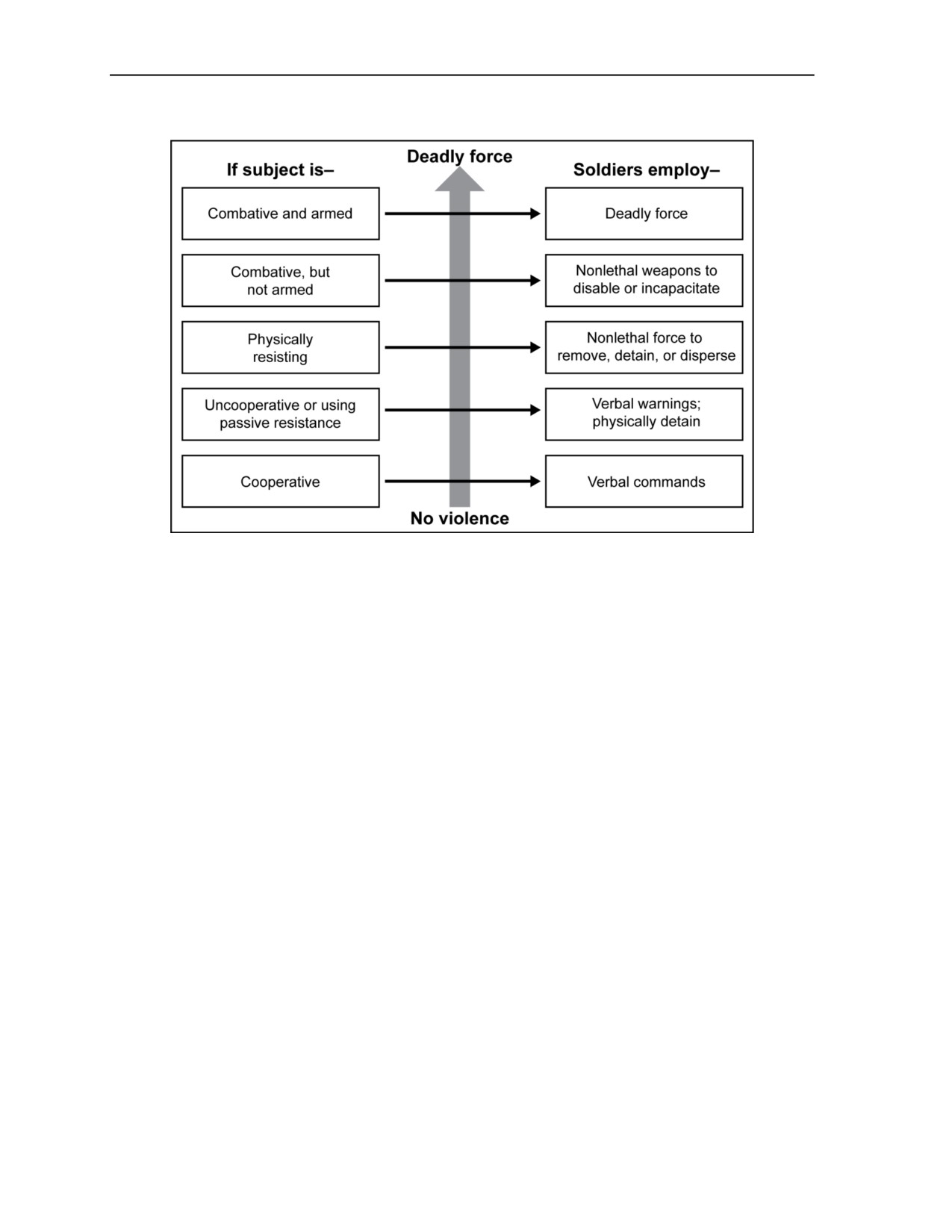
necessary to accomplish the mission. The underlying principle is a ―continuum of force,‖ a carefully
graduated level of response determined by civilians' behavior. The application of rules for the use of force
also differs somewhat between National Guard forces and federal military forces. Figure 7-2 illustrates the
continuum of force and the graduated response required of Soldiers. Civilian behavior, on the left, rises
from
―cooperative‖
(behaves as ordered by the Soldier) to potentially lethal confrontations. The
corresponding military response is on the right.
4 June 2010
FM 3-28 (Signature Draft—Not for Implementation)
7-7
Chapter 7
Figure 7-2. Illustration of the continuum of force
7-31. When deployed, both National Guard and Regular Army forces will encounter situations where
Soldiers and small-unit leaders will have to know and adhere to the rules for the use of force. Therefore,
leaders at every level review the rules for the use of force with their subordinates as part of their pre-mission
inspections and confirm that the Soldiers know the rules. Commanders should obtain and issue a rules-for-
the-use-of-force summary card to each Soldier before deploying from home station, and the small unit
leaders should inspect to ensure that the Soldiers have it. The potentially confusing situations associated
with infrastructure and property protection require particular attention from commanders. The Soldiers
securing an facility or area must understand the rules for the use of force as they apply to that specific
location. Above all, the unit leader must understand if, when, and how he or she may use lethal force to
protect the facility.
FEDERAL MILITARY FORCES
7-32. All federal military forces involved in civil support must follow the standing rules for the use of force
(SRUF) specified in CJCSI 3121.01B. The Secretary of Defense approves SRUF, and the supported
combatant commander incorporates them into plans and orders for different civil support missions. The
SRUF also apply to federal military forces performing a land homeland defense mission within U.S.
territory. They apply to federal forces, civilians, and contractors performing law enforcement and security
duties at all federal military installations
(and off-installation, while conducting official DOD security
functions), unless otherwise modified by the Secretary of Defense. This includes protection of critical U.S.
infrastructure both on and off federal military installations, federal military support during a civil
disturbance, and federal military cooperation with federal, state, and local civilian law enforcement
agencies.
7-33. Before employment in civil support, all Soldiers require training on the appropriate rules of the use of
force. Training focuses upon the particular rules for the use of force in the OPLAN issued by the gaining
joint force commander, but in the absence of the plan commanders should train according to the SRUF.
Commanders should include a staff judge advocate to assist with leader training. SRUF cards should be
issued to each person during training and personnel should not deploy until they are trained in SRUF.
7-8
FM 3-28 (Signature Draft—Not for Implementation)
4 June 2010
Legal Considerations
Supported combatant commanders submit a request for mission-specific rules for the use of force to the
Chairman of the Joint Chiefs of Staff, for approval by the Secretary of Defense. Unit commanders may
further restrict mission-specific rules for the use of force approved by the Secretary of Defense, but may not
make them more permissive. Unit commanders notify their chain of command up through the Secretary of
Defense of any additional restrictions (at all levels) they place on approved rules for the use of force. In
time-critical situations, notification to the Secretary of Defense occurs concurrently with notification to the
Chairman of the Joint Chiefs of Staff.
NATIONAL GUARD FORCES
7-34. State law governs rules for the use of force for National Guard forces in a state active duty status. As
such, each state must take into account its own specific criminal laws when drafting rules for the use of
force. As an example, in the case of the airport security mission conducted by the National Guard following
the September 11, 2001 terrorist attacks, there were over 50 different rules for the use of force used by the
various states and territories conducting the mission. Although virtually identical, all of these rules for the
use of force addressed similar subjects, the specific implementation of these subject areas varied from state
to state because of their differing state and territory legal foundations.
7-35. Note that states that provide National Guard forces in state active duty or Title 32 duty status to
another state normally will adopt the rules for the use of force of the supported state for those forces while
they deployed. The states involved will normally specify in their memorandum of agreement on the rules for
the use of force the forces will follow before deployment. As an example, states worked through this
process with Louisiana, Texas, and Mississippi following Hurricanes Katrina and Rita.
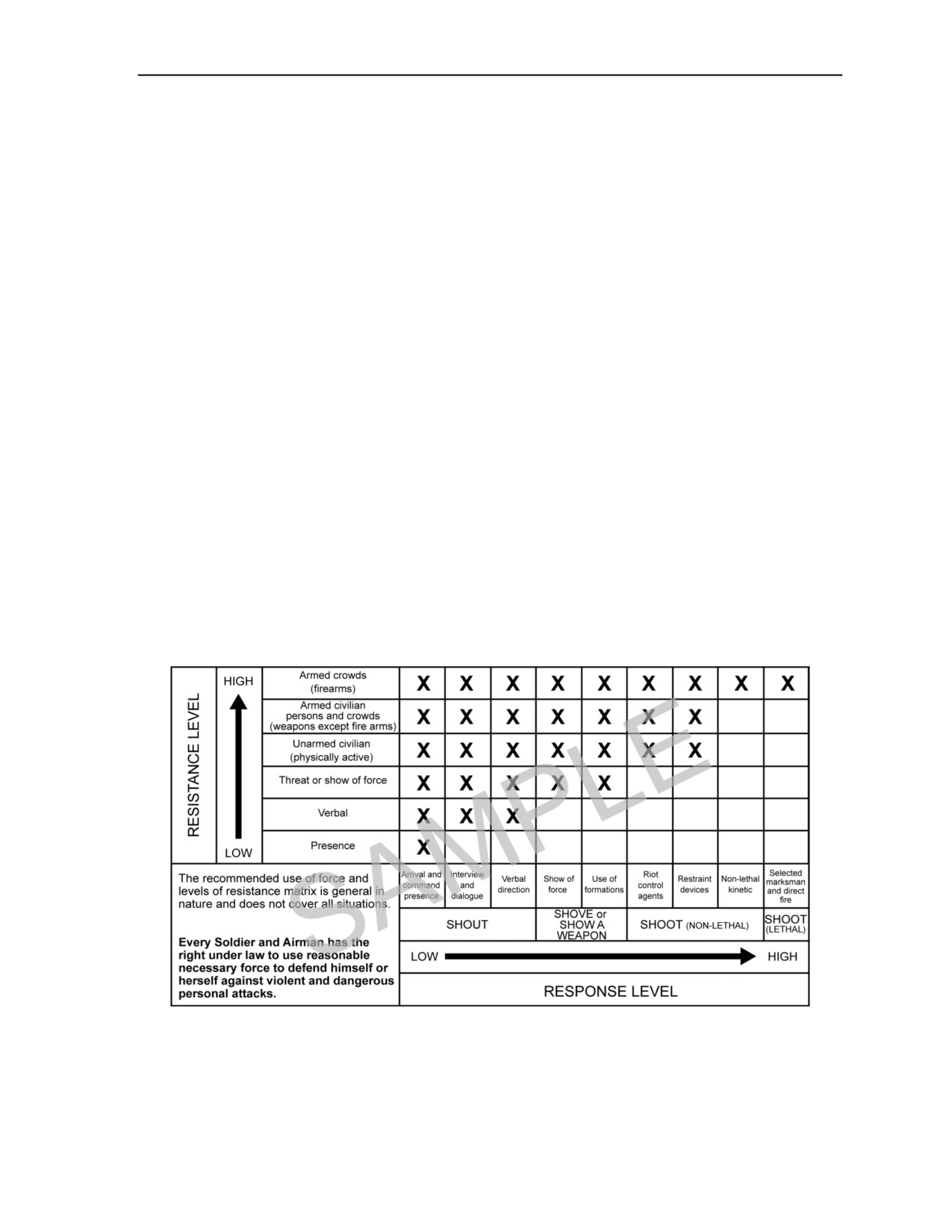
7-36. Note also that there is no single term used to describe state rules for the use of force. Each state uses a
different term. States may refer to them as rules of engagement, rules for the use of force, rules on the use of
force, and rules of interaction. "State rules for the use of force," as used in this field manual, is a generic
term intended to refer to rules of the fifty-four National Guards based on the criminal laws of the individual
states or territories. Each state prepares and issues a reference card for its rules for the use of force. Figure
7-3 illustrates the type of card that a Guardsman might carry.
Figure 7-3. Example rules for the use of force card carried by National Guard forces
4 June 2010
FM 3-28 (Signature Draft—Not for Implementation)
7-9
Chapter 7
INTELLIGENCE OVERSIGHT—RULES AND RESTRICTIONS
7-37. Intelligence oversight refers to the law and regulations that balance the Constitutional right of
individuals to privacy with the need for the federal government to collect intelligence for national security
purposes. Commanders need to understand that DOD directives and Service regulations restrict the military
from collecting or possessing information on U.S. citizens, whether individuals and groups. (See table 7-1).
Because of the difficulty of determining an individual’s legal status, DOD imposes restrictions on collection
and storage of any civilian personal indentifying information, or information on groups of citizens that make
up a civilian organization (such as a church congregation or parish). This restricts Army units under federal
military command from collecting or retaining information that identifies individuals with businesses,
voluntary organizations, or civilian agencies, except as authorized by DOD directives and regulations.
Table 7-1. Individuals and groups protected by intelligence oversight rules
U.S. citizens
Lawful permanent resident aliens
Unincorporated associations substantially composed of U.S. citizens or permanent resident
aliens
Corporations incorporated in the United States, except for those directed and controlled by a
foreign government
7-38. Seven documents contain the core legal authorities for intelligence oversight (see table 7-2). The
restrictions put in place by intelligence oversight directly affect specific Army elements and organizations
conducting authorized intelligence activities.
Table 7-2. Intelligence oversight authorities
Constitution
Executive Order 12333 (1981)
National Security Act of 1947
Foreign Intelligence Surveillance Act of 1978 (Public law 95-511)
DODD 5240.01
DOD 5240.1-R
AR 381-10
7-39. Although units limit incident awareness and assessment operations in order to safeguard the rights of
U.S. citizens, they may receive and retain intelligence concerning foreign intelligence and counter-
intelligence. Commanders and intelligence personnel require further authorization, however, to continue to
retain information if a foreign group or noncitizen is within the United States. The best practice for
commanders is to limit intelligence capabilities to supporting situational awareness, assessment, and force
protection unless they have a specified task to support civilian law enforcement agencies or national
intelligence requirements.
7-40. Collection, retention, and further dissemination of law-enforcement-derived information and
intelligence are permissible only according to DODD 5200.27, paragraphs 3, 4, and 5. For example, local
police may know that a violent gang is active in a neighborhood affected in a disaster. The police may
provide the Army unit with information on known locations used by the gang, peculiar paraphernalia
associated with that gang, and the types of weapons and vehicles used by the gang members. Army units
may only retain this information if there is a clear foreign intelligence or counterintelligence relationship or
nexus. Military police or force protection units may only retain this information if these gangs constitute a
direct and articulable threat to DOD missions, personnel, or resources, according to DODD 5200.27,
paragraphs 3, 4, and 5. Civilian police may ask Soldiers to report any gang activity they observe through
their chain of command to the police, although this information may only be acquired incidentally since
federal military personnel may not directly assist civilian police in developing criminal information. Such
information may be reported by Army intelligence or military police and force protection units according to
DODD 5525.5, and DOD 5240.1-R, Procedure 12, and DODD 5200.27, paragraphs 3, 4, and 5. The unit
7-10
FM 3-28 (Signature Draft—Not for Implementation)
4 June 2010
Legal Considerations
may retain law enforcement intelligence provided by the police only IAW DODD 5525.5, and DOD
5240.1-R, Procedure 3, and DODD 5200.27, and log any information provided to the police under
intelligence oversight or other sensitive information program standards, as long as no specifically
identifying information is retained regarding the United States persons collected on. Before any further
dissemination, the staff should confirm with the staff judge advocate that they could distribute the
information to subordinate units.
7-41. Airborne sensors and unmanned aircraft systems pose particular challenges for intelligence oversight.
These systems provide commanders and civil authorities with powerful tools to help them assess the
situation on the ground, particularly in the initial stages of response. However, information gathered by
these systems can conflict with the intelligence oversight restrictions. For example, an Army helicopter
equipped with forward looking infrared may be tasked to assess the stability of flood control constructed
earlier in the day. During the course of the surveillance mission, the aircrew may spot a group of looters
near the flooding. They may legally report this to their chain of command, without identifying the looters,
IAW DOD 5240.1-R, Procedure 12. No identifying United States personal information may be retained by
the Army unit. According to DOD 5240.1-R, Procedure 3, information of this nature may be incidentally
retained for this purpose of relaying it to civilian law enforcement, after which time it must be destroyed,
not later than 90 days after acquisition.
7-42. Airborne support for incident awareness and assessment traditionally required specific Secretary of
Defense approval on a case-by-case basis. In order to clarify the types of airborne support authorized, the
DSCA EXORD contains pre-approved, incident awareness and assessment support modules. Even though
pre-approved, any use of the capabilities for any purpose other than that specified in the EXORD requires
specific Secretary of Defense approval. See Table 7-3.
Table 7-3. Current Incident awareness and assessment support modules
Situational Awareness Module
Damage Assessment Module
Evacuation Monitoring Module
Search and Rescue Module
Dynamic Ground Coordination Team
Hydrographic Survey Module
Chemical, Biological, Radiological, Nuclear, And High-Yield Explosives
Assessment Module
SENSITIVE INFORMATION
7-43. Any information acquired on individual citizens and specific civilian organizations by military
intelligence personnel and capabilities or by DOD law enforcement antiterrorism or force protection
personnel is extremely sensitive; its collection must be authorized; and all information collected must be
provided directly to the supported law enforcement agency, unless separate exceptions exist permitting
retention by the DOD. Otherwise, the military unit may not retain it. If commanders determine or suspect
that these prohibitions have been violated, they report the violation in accordance with DOD 5240.1-R,
Procedure 15 for G2 and intelligence violations, and according to DODD 5200.27 for improper collection
activities by provost marshal, antiterrorism, or force protection personnel. DODD 5525.5, and Enclosure 2;
DOD 5240.1-R, and DODD 5200.27 govern the release of sensitive information. Any waivers or exceptions
to these restrictions may only be granted by Secretary of Defense or the Secretary of the Army.
7-44. Sensitive information includes criminal intelligence generated by civilian law enforcement agencies
and passed to military units involved in civil support; similarly it includes information and reports from
Soldiers who witness what they believe to be criminal activity. Army forces may assist civilian and military
law enforcement agencies through the dissemination of incidentally acquired information reasonably
believed to reveal violations of federal, state or local law. Support must be consistent with DODD 5200.27,
and DOD 5240.1-R which provide the following guidance:
4 June 2010
FM 3-28 (Signature Draft—Not for Implementation)
7-11
Chapter 7
Operations Related to Civil Disturbance. The Attorney General is the chief civilian
officer in charge of coordinating all federal government activities relating to civil
disturbances. Upon specific prior authorization of the Secretary of Defense or his
designee, information may be acquired that is essential to meet operational requirements
flowing from the mission as to DOD to assist civil authorities in dealing with civil
disturbances. Such authorization will only be granted when there is a distinct threat of a
civil disturbance exceeding the law enforcement capabilities of State and local
authorities.
7-45. Information developed by civilian law enforcement agencies regarding non-DOD affiliated personnel
during civil support operations is handled according to DODD 5200.27 and AR 381-13. Most of this
information is law-enforcement derived. DOD policy limits collecting, reporting, processing, or storing law-
enforcement-derived information on individuals or organizations not affiliated with DOD. Chapter
6
provides additional information for handling intelligence and information related to citizens. This is a major
difference between stability and civil support operations. These directives and regulations ensure
compliance with various laws intended to protect the rights of citizens and restrict military intelligence
collection to external threats. Although not discussed here, similar restrictions limit the activities of
National Guard forces operating in either state active duty or Title 32 duty status. Each state and territory
has specific instructions governing the collection and processing of information on U.S. citizens, legal
aliens, and illegal aliens. In general, these are not as restrictive as DODD and Service regulations applicable
to federal military forces. The state adjutant general works with the state attorney general to clarify
instructions pertaining to National Guard support of civil authorities.
7-46. There are legal restrictions on using information about individuals and organizations physically
located within the United States and its possessions unless they are part of DOD (military, civilian, or
contractor). The core regulations pertaining to these restrictions are DODD 5200.27 and AR 381-13. The
restrictions on the use of law enforcement information govern the activities of all members of DOD
(uniformed members and civilians). Like intelligence oversight program objectives, these restrictions are
designed to ensure that the rights of, and information on, individuals or organizations not affiliated with
DOD are protected unless such information is essential to the accomplishment of specified DOD missions.
Any information collected on people not affiliated with DOD must pertain only to the protection of DOD
functions and property, personnel security, or operations related to civil disturbance. Specific prohibitions
regarding information acquisition are in table 7-4.
Table 7-4. Prohibitions on information acquisition
Information acquired on individuals or organizations not affiliated with DOD may be restricted
to that which is essential to the accomplishment of assigned DOD missions.
No information shall be acquired about a person or organization solely because he or she
lawfully advocates measures in opposition to government policy.
Physical or electronic surveillance of federal, state, or local officials or of candidates for such
offices is prohibited.
Electronic surveillance of any individual or organization is prohibited, except as otherwise
authorized by law (e.g., by warrant).
Covert or otherwise deceptive surveillance or penetration of civilian organizations is strictly
prohibited, unless specifically authorized by the Secretary of Defense (or designee).
No DOD personnel shall be assigned to attend public or private meetings, demonstrations, or
other similar activities for the purpose of acquiring information, without specific prior approval
by the Secretary of Defense (or designee). However, an exception to this policy may be made
by the local commander concerned, or higher authority, when, in his judgment, the threat is
direct and immediate and time precludes obtaining prior approval. In each such case a report
is made immediately to the Secretary of Defense (or designee). (While permissible IAW DODD
5200.27, paragraph 5.6, this is not recommended as it places the Commander at great legal
risk.)
Absolutely no computerized data banks shall be maintained relating to individuals or
organizations not affiliated with DOD, unless specifically authorized by the Secretary of
Defense (or designee).
7-12
FM 3-28 (Signature Draft—Not for Implementation)
4 June 2010
Legal Considerations
SHARING INFORMATION
7-47. Because of these restrictions, commanders should ensure intelligence and sensitive information is not
only lawfully collected or acquired, but is also is lawfully retained and disseminated. DOD operates under
the common Congressional mandate to ensure all agencies, including DOD, share homeland security and
homeland defense information and intelligence with the proper authorities to identify threats rapidly and
effectively. However, the process requires careful compliance with existing laws and regulations. The key is
to understand these requirements, their inherent complexities, and the requirement to protect civil rights.
Because information acquired during civil support missions often refers to persons not affiliated with DOD,
commanders should require their subordinates to segregate and label electronic and paper files generated
during a civil support mission. This facilitates efficient disposal of all information on persons and
organizations not affiliated with DOD following return to home station.
7-48. At the conclusion of any civil support mission, commanders should direct their subordinates to
inspect printed and electronically stored information acquired during the operation. There is a 90-day
window for disposal of sensitive information related to U.S. citizens not affiliated with DOD (measured
from the time of acquisition). DODD 5200.27 states—
Information within the purview of this Directive, regardless of when acquired, shall be
destroyed within 90 days unless its retention is required by law or unless its retention is
specifically authorized under criteria established by the Secretary of Defense, or his
designee.‖
DODD 5200.27
All staff sections and subordinate units should inspect their paper and electronic archives. The purpose of
this inspection is to ensure that the unit has not inadvertently retained personal information on any citizen or
civilian organization. In general, units should only retain operational records and documents related to
expenditures. They should delete or destroy any information containing civilian names, phone numbers,
addresses, or any other personal identifying information, even if acquired incidental to the mission (e.g. an
aircraft manifest). Some information on individuals and groups not affiliated with DOD may be retained if it
falls within the limits specified in AR 25-400-2. This regulation states—
―U.S. person information in intelligence files, databases, and repositories is retained in
accordance with disposition criteria in AR 25-400-2. U.S. person information deleted
from user electronic files, but remaining on servers or archived files, may remain until
systems administrators purge or retire them in accordance with systems maintenance
policies, AR 25-400-2, or Archivist of the United States disposition instructions.
AR 25-400-2
7-49. In combat, many units reconfigure command post configurations and processes to create a ―fusion
center‖ for different types of intelligence, particularly in a counterinsurgency mission. Any information
received from a variety of sources is funneled to the fusion center where it is analyzed and used in data
bases. While a powerful tool in combat situations, units engaged in civil support operations should not use a
fusion center to combine operational information with any sensitive information, including criminal
intelligence or law enforcement information. ―Fusing‖ information using combat intelligence techniques and
procedures with information received from civilian police authorities on United States persons or persons
not affiliated with DOD will invariably lead to violations of intelligence oversight and sensitive information
restrictions. In a civil support operation, commanders and their staffs segregate any sensitive information
into appropriate law enforcement channels and keep it there.
ISOLATION AND QUARANTINE
7-50. Isolation refers to the separation and the restriction of movement of people who have an infectious
illness from healthy people to stop the spread of that illness. Quarantine refers to the separation and
restriction of movement of people who are not yet ill but have been exposed to an infectious agent and are
therefore potentially infectious. A geographical quarantine, known as a ―cordon sanitaire,‖ is a sanitary
4 June 2010
FM 3-28 (Signature Draft—Not for Implementation)
7-13
Chapter 7
barrier erected around an area. Both isolation and quarantine may be conducted on a voluntary basis or
compelled on a mandatory basis through legal authority.
7-51. The federal government has the authority to prevent the spread of disease into the United States
(foreign) or between states and territories (interstate). The Department of Health and Human Services is the
lead federal agency for isolation and quarantine. The Secretary of Health and Human Services has delegated
to the Director of the Centers for Disease Control and Prevention the authority to determine whether
measures taken by health authorities of any state are insufficient to prevent the spread of any communicable
diseases from that state to another state. The Director of the Centers for Disease Control and Prevention
may take measures to prevent the spread of the disease interstate as he or she deems reasonably necessary.
7-52. The Secretary of Health and Human Services is authorized to accept from State and local authorities
any assistance in the enforcement of federal quarantine regulations that those authorities are able and
willing to provide. The Secretary of Health and Human Services shall cooperate with and aid States in the
enforcement of their quarantine and other health regulations. At the request of State authorities, the
Secretary of Health and Human Services may extend temporary assistance not to exceed six months to a
State in meeting health emergencies of a nature warranting federal assistance. The Secretary of Health and
Human Services may require reimbursement for any assistance provided as he may determine to be
reasonable under the circumstances.
7-53. Apprehension, detention, examination, isolation and quarantine by federal civil authorities are
authorized for a period of time and in such a manner as may be reasonably necessary, but only for those
―communicable‖ diseases that are set forth in executive orders issued from time to time by the President.
The current order’s (E.O. 13295 as amended by E.O. 13375) list includes cholera, diphtheria, infectious
tuberculosis, influenza caused by novel or re-emergent influenza viruses, plague, severe acute respiratory
syndrome, smallpox, yellow fever, and viral hemorrhagic fevers.
7-54. Only one federal statute permits federal military forces to enforce quarantine laws, under very narrow
circumstances. Section 97 of Title 42, USC, allows military commanders of any coastal fort or station to
assist in the execution of State quarantines with respect to vessels arriving in or bound for the United States.
Otherwise, there have been several legislative proposals to expand this enforcement authority to other
situations, but Congress has always refused to consider them. Consequently, absent a Presidential decision
under inherent authority or an exception to the Posse Comitatus Act (see chapter 7), federal military forces
cannot be used to enforce quarantine or isolation.
7-55. Under Sections 8301-8321 of Title 7, USC, the Secretary of Agriculture, to protect the agriculture,
environment, economy, and health and welfare of the population by preventing, detecting, controlling, and
eradicating diseases and pests of animals, is authorized to cooperate with foreign countries, states, and other
jurisdictions, or other persons, to prevent, regulate, and eliminate burdens on interstate commerce and
foreign commerce. When federal military support is requested, it is provided under the Economy Act.
LIABILITY
7-56. Federal military personnel are immune from personal liability if they cause death, injury, or property
damage as a result of their negligent acts (not intentional misconduct) while carrying out duties under the
Stafford Act or within the scope of employment under the Federal Tort Claims Act (Sections 1346(b) and
2671 through 2680 of Title 28, USC), respectively. As long as they are performing defense support of civil
authorities under a valid mission authority, they are protected. If a negligent act causing the death, injury, or
property damage was committed outside the scope of their duty or employment, a Soldier or civilian
employee may face personal liability, criminal prosecution, or both.
7-57. In conclusion, civil support is governed by different laws and regulations than military operations
conducted in foreign counties against a hostile force Legal issues will often arise and necessitate timely
legal advice throughout the civil support operation. The character of the Constitution and laws enacted by
successive Congresses create a complicated legal environment. Commanders should note that this chapter
only provides a summary; this discussion is not a comprehensive review of every requirement and
restriction. Commanders should always consult a staff judge advocate for legal advice.
7-14
FM 3-28 (Signature Draft—Not for Implementation)
4 June 2010
Chapter 8
Sustainment—Logistics and Personnel Services
This chapter begins by defining the sustainment warfighting function, including its
three major subfunctions. This chapter discusses the first two subfunctions of the
sustainment warfighting function—logistics and personnel services—in relation to
civil support operations. This discussion builds on the doctrine in chapters 1, 2, and
3.
THE SUSTAINMENT WARFIGHTING FUNCTION DEFINED
8-1. Sustainment often determines the degree of success units conducting civil support can achieve. Army
doctrine defines the sustainment warfighting function as the related tasks and systems that provide support
and services to ensure freedom of action, extend operational reach, and prolong endurance (FM 3-0). The
sustainment warfighting function includes logistics, personnel services, and health service support. (Health
service support is discussed in chapter 9.) Effective sustainment, especially logistics, allows units to move
into the operational area rapidly and commence operations quickly. Logistics is planning and executing the
movement and support of forces. It includes those aspects of military operations that deal with: a. design
and development, acquisition, storage, movement, distribution, maintenance, evacuation, and disposition of
materiel; b. movement, evacuation, and hospitalization of personnel; c. acquisition or construction,
maintenance, operation, and disposition of facilities; and d. acquisition or furnishing of services (JP 4-0).
Personnel services are related to Soldiers’ welfare, readiness, and quality of life.
LOGISTICS IN CIVIL SUPPORT OPERATIONS
8-2. The principal logistics function of the military during disaster response is to move, maintain and
secure logistical capabilities necessary for the response effort. The characteristics of the operational area
must be taken into consideration by all levels of command in order to properly assist with the response
effort and support military personnel. The military must be dependable in their ability to respond and
provide assistance in the most austere and damaged environments. The unit will deploy with basic
sustainment (food, water, and fuel), and coordinate with the higher headquarters for resupply. As the
situation improves, contracted support plays a greater role within the affected area. The capability of the
civilian population to provide for logistics decreases or eliminates the military requirement. In other
missions, the supported state or federal agency may provide the full range of support, with easy access to
amenities and rapid response to requirements. This might be the case during planned support to law
enforcement agencies. The Army possesses significant logistical capability and is able to respond with its
organic assets to assist civil support operations. Additionally, the Army is able to leverage other component
and Service installations in order to support operations. Logistics capabilities determine to a significant
extent the flexibility that the commander has to complete mission assignments quickly and accept other
missions. The ground and rotary wing distribution capability of Army forces is often critical to alleviate
suffering within the operational area.
8-3. Army units are expected to be self-sustaining during any civil support operations and individual units
should deploy with their sustainment requirements for the initial phase of operations, usually 72 hours,
unless prior coordination has been made and is in place. Units should arrive at the location of an incident
with enough sustainment to conduct operations for at least
72 hours. This eases the sustainment
requirements on the gaining headquarters during any rapid response situation. After the 72 hours, Army
units must utilize the unit supply system, government purchase card or military contracting officers in order
to provide sustained internal support that incorporates all classes of supply. Except in rare circumstances,
4 June 2010
FM -3-28 (Signature Draft—Not for Implementation)
8-1
Chapter 8
the need for Class V (ammunition) is not required. Any deployment order will specify whether or not
ammunition is required for the specific mission. Except in extreme circumstances, ammunition supply is not
a factor; units deploy with small arms and ammunition as specified by their gaining headquarters and
normally return with every round they took with them. In most cases, National Guard forces under state
control receive sustainment from National Guard installations and supply centers, while Federal military
forces draw from DOD resources and installations. However, this may not always be the case.
8-4. A defense coordinating officer serves as a key link between the primary agency and joint field office,
state agencies, and the combatant commands providing forces and support (see chapter 2). Activities within
the joint field office or regional coordination center involve more than requests for Federal military support.
The defense coordinating officer also coordinates for support to DOD forces supporting incident response.
For example, if Federal military forces require additional radios to communicate with civilian responders,
the defense coordinating officer may coordinate a loan through the Federal Emergency Management
Agency (FEMA) or other agency resources. The defense coordinating officer coordinates through the
logistics section at the joint field office, which includes ground support, communications, supply, facilities,
and medical support units for additional support available through FEMA and other agencies.
8-5. Federal military and state National Guard forces receive logistical and personnel support through
their controlling commands. Federal military forces receive support through DOD channels, primarily
through their parent Service channels, while National Guard units in Title 32 or state active duty receive
support through their state National Guard supply agencies. Both federal military and state National Guard
obtain consumables through contracting to the maximum extent feasible. In practice, commanders adjust
logistics support to the situation. Recent operations have featured Federal military installations providing
facilities and common user logistics to National Guard forces conducting civil support operations. In other
instances, DOD may receive support such as basing and facilities from the National Guard through a
memorandum of agreement coordinated between the adjutant general, National Guard Bureau, and DOD.
8-6. Federal statutes and DOD policy restrict DOD components from procuring or maintaining any
supplies, materiel, or equipment exclusively for providing civil support; unless otherwise directed by the
Secretary of Defense. Federal military forces may lease or hand receipt real property such as vehicles,
generators, etc., from other agencies or contracted vendors, but may not purchase these items without
specific authority from DOD. All leased or borrowed real property must be returned to the owning agency,
transferred to other Federal agencies as directed by the joint field office, or returned to the vendor as part of
the unit’s transition and redeployment. The defense coordinating officer can coordinate through the federal
coordinating officer for FEMA to acquire certain items for use by Federal military forces, and then hand
receipt the items to the deployed forces. Such items must be returned to FEMA prior to redeployment.
Federal Government Logistics Support
8-7. For any disaster response, FEMA is responsible for the overall coordination of logistical support at
the federal, interagency level during a disaster response operation. At this level, commercial, private,
government, volunteer, and faith based organizations work with FEMA using coordination guidance
contained within the National Incident Management System (NIMS) and the National Response Framework
(NRF). Note that some military organizations involved in logistical support may operate outside the Federal
military joint task force chain of command. For example, the U.S. Army Corps of Engineers (USACE), as
an agency, draws directly upon its own and federal resources in coordination with FEMA. The Corps of
Engineers will also support National Guard and Regular Army units when tasked, and may submit requests
for assistance through the joint field office to the federal military or National Guard joint task force.
8-8. In a disaster response, FEMA coordinates and provides most of the sustainment needed by
responding organizations and victims. Military forces may provide some support to disaster victims as part
of a mission assignment. Officials from FEMA coordinate and sustain the majority of these people using the
resources of the Federal government and agencies such as the Red Cross. FEMA has a number of logistic
centers (see figure 8-1) that support responding agencies. These sites provide the resources required for
FEMA to manage any emergency. The sites are located near Atlanta, GA; Berryville, VA; Cumberland,
MD; Ft. Worth, TX; Frederick, MD; Kansas City, MO; and San Jose, CA. The three offshore storage sites
are located in Guam, Hawaii, and Puerto Rico. With access to 50 additional cache storage facilities used by
FEMA’s National Disaster Medical System to store medical supplies and equipment across the country and
8-2
FM 3-28 (Signature Draft—Not for Implementation)
4 June 2010
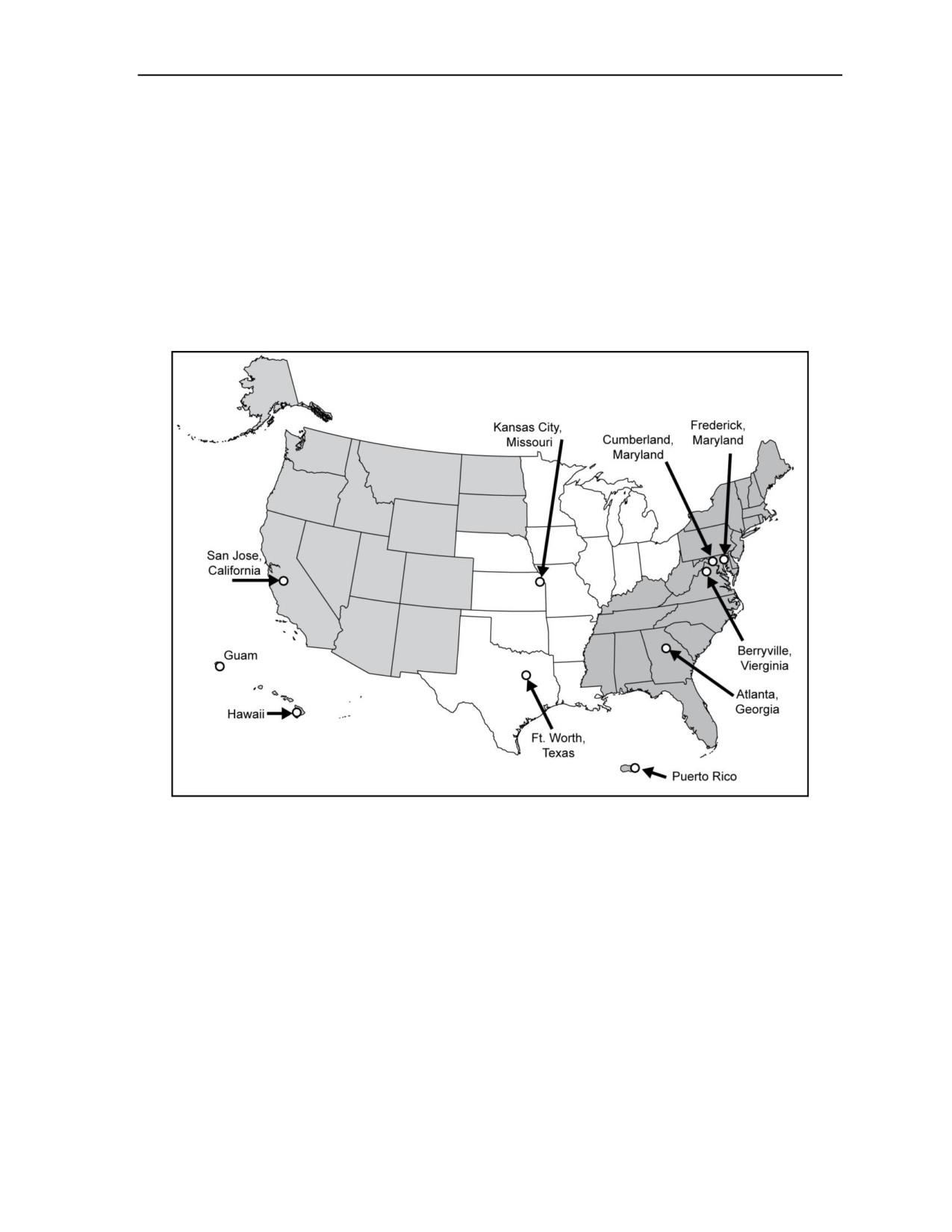
Sustainment—Logistics and Personnel Services
252 Pre-Positioned Disaster Supplies containers located in logistical centers and 14 states, FEMA can
expedite the shipment of emergency commodities to any disaster in the U.S. or its territories.
8-9. Most of the centers provide resources such as blankets, meals ready-to-eat (MRE’s) and emergency
meals, bottled water, generators, cots, blankets, tarps, and Blue Roof sheeting all of which can be
distributed through state and county distribution points in time of need. In addition to the equipment listed
above, FEMA has two centers that provide specialized resources: the Berryville, VA, center stores and
maintains computer equipment and electronics mainly for disaster field office operations and the Frederick,
MD, center provides emergency medical supplies and equipment for emergency medical operations in
affected areas. FEMA supports actual emergencies regularly from these centers. FEMA also includes
logistical planning as part of its national exercise program involving commercial, private, government,
volunteer, and faith-based organizations.
Figure 8-1. FEMA logistics centers
8-10. Federal support under emergency support function annex
(ESF) #5 (Emergency Management)
includes staffing and operating the Regional Response Coordination Center (RRCC) and the joint field
office. FEMA personnel coordinate the establishment of site facilities, supplies, and equipment to support
federal activities, but may coordinate with the military for any identified shortfalls in their capability. The
integration of the defense coordinating officer and defense coordinating element with FEMA into normal
operations helps facilitate logistical coordination during emergencies. When an incident occurs, the defense
coordinating officer and the defense coordinating element coordinate with the resource staff in the joint
field office. Each agency working in the joint field office is responsible for documenting the costs of its own
normal activities and response efforts. Military forces coordinate with civil authorities and other partners
based on the NIMS and the NRF to achieve unity of effort (see chapter 2). The response to floods in North
Dakota in 2009 provides an excellent example of unity of effort in domestic disaster response.
4 June 2010
FM 3-28 (Signature Draft—Not for Implementation)
8-3
Chapter 8
Flooding in North Dakota
Severe flooding of the Red River in 2009 led to a multi-component response that
featured innovative cooperation between all military forces in the disaster area. Grand
Forks Air Force Base, a Regular Air Force installation located outside the flood plain
near Grand Forks, ND, became the nexus for federal and state response forces. The
North Dakota National Guard provided most of the military forces, with assistance
from DOD-tasked capabilities. Federal military force helicopters and unmanned aerial
system providers used Grand Forks AFB for basing and sustainment. The North
Dakota National Guard utilized the Air Force emergency preparedness liaison officer
to coordinate for use of the AFB to bed down of NG aircraft. FEMA utilized the AFB to
warehouse emergency supplies (cots, food, water, etc.). The National Guard used its
working relationships with the Base Commander to accommodate all National Guard
flood fighting forces, ground and air. During the flood fight...when the status of
National Guard aircraft crews transitioned from Title 32 status to state active duty
status, the issue of financial reimbursement surfaced. The North Dakota Adjutant
General has since negotiated a MOU with the Air Force so that their National Guard
has a "standing agreement" for use of the Grand Forks Air Force Base for any future
floods in the region.
DEPLOYMENT OF FORCES
8-11. Deployment and redeployment of military forces to an incident requires planning and preparation that
is similar to that used in deploying and redeploying from operations outside the United States. However,
there are some notable differences. The most important difference is one of infrastructure—the United
States has one of the most developed transportation infrastructures in the world. A robust and advanced
communications network ties the transportation infrastructure together. In fact, in many ways, the
commercial communications architecture exceeds the military’s capability. For the deployment planner, this
means that there are many options. There are also challenges. The most important of these is civilian control
of the transportation system. All military movements using military transportation need coordination
through military channels to civilian agencies such as the Federal Aviation Administration (FAA) and state
transportation authorities. In addition, movement of equipment and supplies needs to comply with any
applicable federal and state transportation restrictions on oversized and hazardous materials. Movement to
and from a disaster must comply with the same restrictions that apply to movement to and from a major
training event; however, the priority accorded to the movement is much higher.
8-12. Deployment into the area of operations will be administrative in nature. Movement plans will be
coordinated by the gaining headquarters through TRANSCOM and the installation transportation officers
for federal military forces. The state or territorial joint force headquarters will coordinate movement
requirements for road movement with state transportation and highway patrol officials. The National Guard
Bureau will also assist the supported and supporting Adjutants General with air movement of additional
National Guard units when required.
Deployment of National Guard Forces
8-13. Following an alert order, National Guard forces assemble at their designated marshalling point, which
is normally their unit armory. Unit leaders conduct equipment issue and pre-movement inspections. As they
do this, the state joint force headquarters coordinates for movement clearance and support through the state
transportation officials for road movements of military convoys, since movement for most equipment will
be by road. Advance parties and liaison elements normally self deploy in one or two vehicle elements, and
draw fuel using state credit cards or state agency facilities coordinated by the JFHQ-State. When required,
the JFHQ-state directs movement of convoy support detachments (maintenance, fuel, and possible medical)
to support areas coordinated with state transportation officials through that state’s ESF.
8-14. Reception, staging and onward movement of units normally occurs at a designated location that the
JFHQ-state and JTF-state commanders have selected as the base area for the support. This may be a
8-4
FM 3-28 (Signature Draft—Not for Implementation)
4 June 2010
Sustainment—Logistics and Personnel Services
National Guard air base, state maintenance facility, or contracted property. As they reach their assembly
areas, unit commanders report their status and coordinate for logistical support and forward operating bases
as required. They then self-deploy into their areas of operations and conduct civil support operations.
8-15. Air assets normally self-deploy to the area of operations using pre-established procedures managed
by that state’s Air National Guard. All air movement remains under the airspace control authority of the
Federal Aviation Administration (FAA). Normally, fixed and rotary wing aircraft will deploy to the nearest
Air National Guard facility; if that lies beyond supportable range, the JFHQ-state will contract for space and
facilities at a commercial airport. The third option bases Air and Army Guard helicopters at a field location
contracted through the state or local emergency mangers.
8-16. Emergency management assistance units from other states may move by either ground or air assets.
When moved by Air National Guard assets, the supported state coordinates with the supporting state and the
National Guard Bureau for necessary air movement. The National Guard Bureau coordinates with
USTRANSCOM and the Joint Staff to ensure that Air Guard support to DOD operations continues. When
moving by ground, the providing JFHQ-state coordinates with state transportation officials from the point of
departure through any adjoining states until the supporting unit moves into the supported state, at which
time the unit passes to the movement control of the gaining state.
Deployment of Federal Military Forces
8-17. Deployment of federal military assets to the area of operations in the continental United States is
under the direction of the supported combatant commands: USNORTHCOM or USPACOM. The
combatant command determines deployment priorities and movement timelines in conjunction with its
Service Components or joint task force. United States Transportation Command
(USTRANSCOM)
executes the deployment plan and sources required transportation assets to move the required force. The
joint movement control center (JMCC) coordinates with the state emergency operations center for necessary
road clearances.
8-18. USTRANSCOM schedules movement by military aircraft and contracted commercial aircraft
according to priorities established by the supported combatant commander. The supporting commander,
normally JFCOM, provides support to the APOE. Upon arrival at the APOD, the gaining commander
conducts reception, staging, onward movement, and integration (RSOI) activities necessary to get the unit
into the joint operations area. Competing worldwide strategic lift requirements, particularly during war, may
prevent rapid air movement for the main body. Therefore, planners give priority movement to critical
command and control elements necessary to support RSOI and initial phases of operations.
8-19. Road movement to the joint operations area is often the most effective means to move personnel and
equipment. Military convoys are coordinated between the deploying unit's installation and the defense
movement coordinators in states where the convoys originate. A representative from the supporting base
support installations Installation transportation Office (ISO), in conjunction with a Movement Control Team
(MCT) coordinates military movements with a state’s transportation, emergency management, and law
enforcement officials. USTRANSCOM and USNORTHCOM coordinate liaison officers for more complex
movements. National Guard forces coordinate their movements with the JFHQ-state and state officials. The
latter serve as the nexus to coordinate with TRANSCOM and state law enforcement for movements. Unit
staffs should coordinate with their parent commands and United States Army North (USARNORTH) for
movement support.
8-20. Managing RSOI in the early stages of a disaster response requires flexible leaders and patience. Prior
planning provides a framework for responding to contingencies, but cannot capture all situations requiring
military support of civil authorities. Commanders need to be flexible and innovative to meet the demands of
civil support operations. An essential component of contingency operations is effective command and
control. As soon as possible following alert, the deploying unit headquarters should deploy an early entry
command post to the designated RSOI location, and liaison officers to the gaining headquarters. Liaison
personnel should have cell phones, laptops, and unit information. The early entry command post should
have tactical communications as well as commercial communications. The deploying command post reports
to the RSOI commander at the APOD and coordinates for the reception of units.
4 June 2010
FM 3-28 (Signature Draft—Not for Implementation)
8-5
Chapter 8
8-21. During deployment/redeployment planning, units should consider the use of commercial assets in an
effort to minimize overall transportation costs. The servicing installation transportation office in the area of
operations procures the commercial transportation, prepare and issue shipping documentation, and monitors
carrier performance.
NATIONAL GUARD LOGISTICS
8-22. National Guard forces continue to be supported through their state’s military infrastructure for
military specific support. Initially, this support comes from unit armories, but the state JFHQ shifts bulk
resupply of military items to resources maintained at the state level, normally at that state’s military training
facilities. The Adjutant General and joint task force commander work through the state emergency manager
and state coordinating officer to establish contracts for bulk consumables, temporary facilities and
commercially available services such as laundry and sanitation support (portable latrines). The joint task
force staff coordinates with unit commanders, local officials and state contracting representatives to obtain
facilities capable of providing field services or submits a request for forces (RFF) for Army field service
units. For example, the Army Corps of Engineers may respond to a National Guard request for specialized
engineering equipment.
8-23. Out of state National Guard forces receive logistical support from the supported state. Because
different state units may have different equipment, the supporting state headquarters remains prepared to
respond to requests for assistance from the supported state.
FEDERAL MILITARY LOGISTICS
8-24. The primary Army service component command for civil support is USARNORTH, providing
logistical support within the continental states, Alaska, Puerto Rico and Virgin Islands. Although US Army
Pacific Command (ARPAC), located in Hawaii, has operational control of the federal military units located
in Alaska, there are significant geographical barriers that have led to the implementation of Joint Task
Force-Alaska. Joint Task Force-Alaska supports civil support operations within Alaska and is a
subordinate command of United States Northern Command (USNORTHCOM).
8-25. USARNORTH makes extensive use of both DOD and federal government capabilities to sustain
deployed Army forces. As the Army service component command (ASCC), USARNORTH supports all
deployed federal Army forces and provides common user logistics to other federal military forces as
directed by the Combatant Commander. USARNORTH works with the deployed joint task force and the
defense coordinating officer to coordinate for FEMA support, usually through a series of federally
negotiated contracts. The keys to success are flexibility and coordination between logisticians from each
Service element. Logisticians must keep in mind not only mission accomplishment, but also good
stewardship of taxpayer dollars when determining the most effective and efficient method of support.
USARNORTH coordinates with the Army staff, Army commands, and direct reporting units for Service
specific logistical support. Figure 8-2, below, shows the sustainment structure that USARNORTH may use
to support a large incident.
8-26. The primary means for providing ASCC-level support is a dedicated theater sustainment command.
The theater sustainment command serves as the senior logistics command in the joint operations area. This
support may include:
z
Establishment of lines of communication
z
Joint reception, staging, onward movement, and integration of deploying forces as required
z
Transportation and movement control of military and displaced civilian personnel, equipment,
and supplies
z
Distribution sources for water, food, ice, and other classes of supply
z
Establishment of temporary shelter
z
Managing staging and throughput
z
Managing fuel support and distribution
z
Managing medical and veterinary support
8-6
FM 3-28 (Signature Draft—Not for Implementation)
4 June 2010
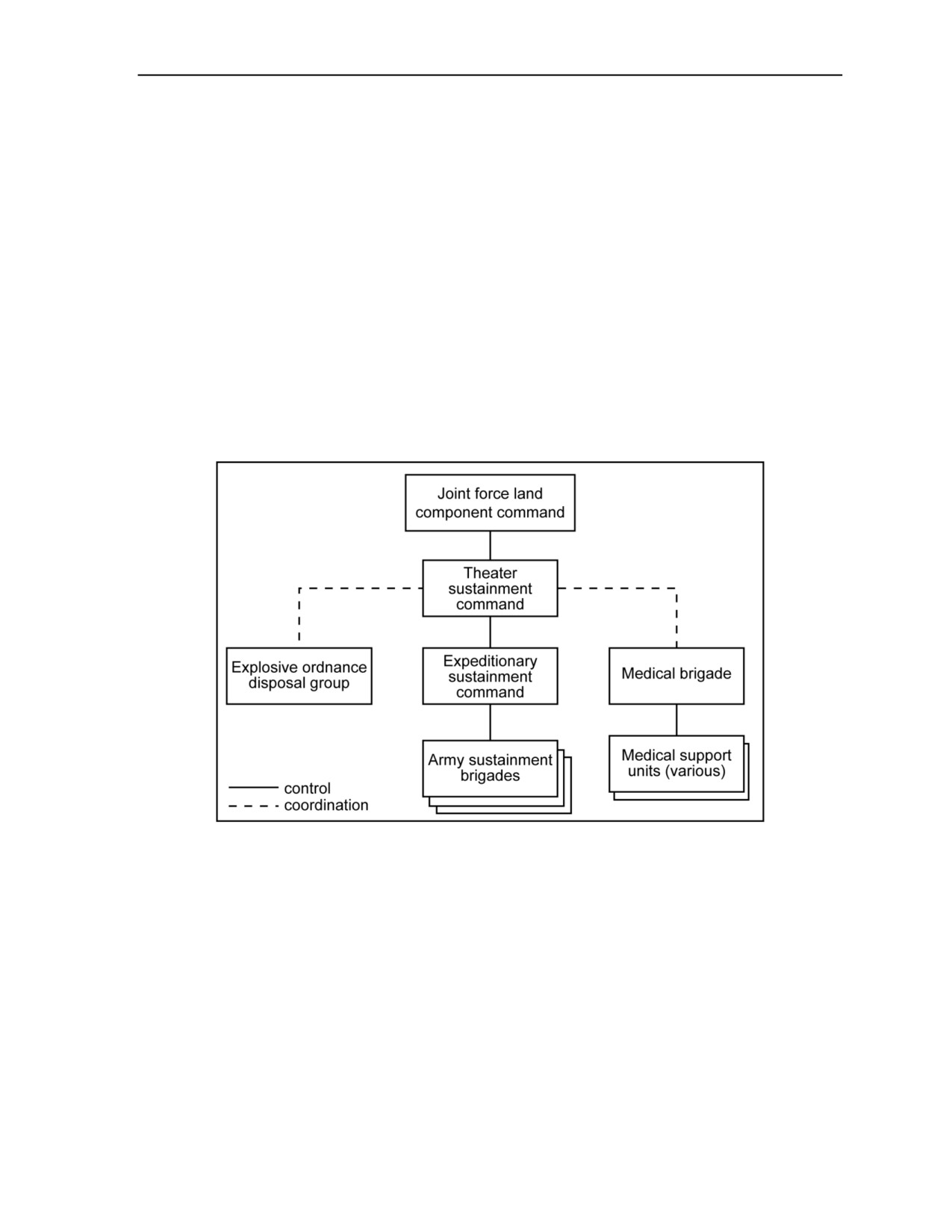
Sustainment—Logistics and Personnel Services
z
Managing rotary and ground ambulance support
z
Mortuary affairs, explosive ordnance disposal
z
Vertical and horizontal engineering support
z
Military police support
8-27. One of the most important functions of the ASCC is coordination with the Army Commands and
Direct Reporting Units (DRU) that lie outside the combatant commander’s control. The ASCC provides the
direct linkage to Department of the Army capabilities. For example, the ASCC coordinates with Army
Installation Management Command (IMCOM) for support provided by Army installations. Other support is
coordinated through the Army Material Command (AMC) for distribution directly from strategic stocks to
deployed Army forces.
8-28. Not all civil support operations involve large forces. The ASCC monitors the sustainment of small
detachments providing civil support. The defense coordinating officer exercise tactical control of a small
detachment deployed to an incident site, and will normally coordinate for any logistics, human resources
support, and medical support that is not available from the parent installation or through the primary
agency. While the situation may vary, the ASCC manages sustainment for company-sized formations and
larger (approximately 250 personnel or more).
Figure 8-2. USARNORTH sustainment structure
Strategic and National Providers
8-29. Several organizations assist in sustainment activities. When requested, they can provide an LNO or
potentially a team to provide support to the deployed joint task force. Some of the providers are DLA,
AMC, TRANSCOM, and AAFES. Additionally, the Army service component command
(usually
USARNOTH) has a habitual relationship with 20th Support group to provide EOD and Dog teams, 412th
Contracting Support Brigade to provide contingency contracting teams, and
3rd Human Resources
Command to provide personnel services. The Defense contracting agency and General Services
Administration (GSA) also provide support.
4 June 2010
FM 3-28 (Signature Draft—Not for Implementation)
8-7
Chapter 8
Catastrophic Incident Response
8-30. USARNORTH plans for sustainment in Phase 0 and provides sustainment in the next five phases.
Phase I involves coordinating and preparing for efficient flow of USARNORTH forces and materiel. Phase
II includes establishment of logistic operations. Phase III involves the deployment of USARNORTH forces
and materiel. Phase IV involves on the ground sustainment operations. Phase V involves transition of
sustainment operations to appropriate local, state, and federal level organizations.
8-31. During Phase I, the theater sustainment command and its expeditionary sustainment commands plan
and prepare for JRSOI of deploying federal military forces. During the initial phases of any response, the
defense coordinating officer estimates the required capabilities and USARNORTH assesses the sustainment
needed. A USNORTHCOM assessment team (NSAT) may help assess federal and DOD sustainment
requirements. Actions are shown in table 8-1:
Table 8-1. USARNORTH Phase I sustainment actions
Gather information
Assess logistical support requirements
Assess required logistical capabilities
Identify unit capabilities required to support ground forces.
8-32. Phase II is the staging phase in preparation for deployment of sustainment of command and control
elements capable of opening the theater for the arrival of federal military assets. The JFLCC commander, in
coordination with the federal coordinating officer, prioritizes essential units and equipment required to
support of life saving operations. Phase II actions are in Table 8-2.
Table 8-2. USARNORTH Phase II sustainment actions
Plan and prepare for operation of distribution networks, base support installations, and
support of displaced civilian centers. (State National Guard units prepare based on
guidance from their state chain of command while Regular Army units respond to
approved mission assignments
Plan and prepare to support sustainment of decontamination operations in support of a
chemical, biological, radiological, nuclear, and high-yield explosives (CBRNE) event
Augment logistical command and control activities capability based upon mission analysis
Establish JRSOI C2, facilities, and procedures
Monitor force readiness of units
Conduct health service review
Review and adjust existing support contracts
USARNORTH coordinates with the state to identify key distribution nodes in the affected
region and alternate logistic routes.
Identify status of key distribution nodes in the affected region. Identify alternate logistic
routes
Develop options for providing sustainment support to active component forces
Coordinate sustainment actions with state National Guard forces, FEMA, General Services
Administration, and other organizations to help optimize sustainment operations.
8-33. Phase III involves continuous support to deployed forces. During this phase, USARNORTH serving
in its role as both JFLCC and ASCC ensures that logistical support is as efficient as possible. When
authorized by the Secretary of Defense and the state adjutant general, joint task force commanders of both
components develop common user logistics agreements and accounting procedures. In this phase,
USARNORTH may also support ESFs as determined by the mission assignment process. Phase III actions
are in table 8-3.
8-8
FM 3-28 (Signature Draft—Not for Implementation)
4 June 2010
Sustainment—Logistics and Personnel Services
Table 8-3. USARNORTH Phase III sustainment actions
Manage sustainment, establish and maintain a distribution network, manage the base
installation sustainment as directed in mission assignments
Support decontamination operations
Conduct JRSOI
Support force protection requirements of DOD Title10 forces as required and authorized
Support force readiness
Plan and execute force rotation due to exposure to chemical, biological, radiological,
nuclear, and high-yield explosives (CBRNE) elements
8-34. Phase IV encompasses preparation and planning for transition to civilian support throughout the joint
operations area. This requires assessment at the joint field office of logistical support requirements for the
deployed forces and continuing support needed for the civilian agencies once military assets redeploy.
Phase V involves a staged execution of sustainment to appropriate local, state, federal, or civilian
organizations. USARNORTH does this in close coordination with the unified coordination group and
specific ESF managers. Phase IV actions are shown in table 8-4.
8-35. When the mission nears completion, sustainment units continue to support other units awaiting
redeployment. Military support is not curtailed before civil authorities assume the function. Transportation
is arranged through the appropriate movement control organization in accordance with established
priorities.
Table 8-4. USARNORTH phase IV sustainment actions
Initiate logistical planning for redeployment and reset requirements
Manage sustainment operations, distribution networks, and support installations in
preparation to return to civilian control
Remove debris
Decontaminate personnel and equipment
Distribute fuel
Coordinate, as required, actions for procurement, production, and distribution of water
Support dislocated civilian operations
Prepare for force redeployment
Base Support Installation
8-36. A crucial early decision is selection of the base support installation. Base support installation
selection is a seven step process that follows guidance given by the DOD ―manual for Civil Emergencies‖
(DOD Manual 3025.1-M) and the Joint Chiefs of Staff (JCS) Defense Support of Civil Authorities (DSCA)
Standing Execute Order (EXORD). Support provided by the designated base support installation may
include, but is not limited to: general supply and maintenance, transportation, contracting, communications,
personnel and equipment reception/staging, facilities, civil engineering, health, and other life support
services to include billeting, food service, and force protection. The preferred location for the base support
installation is at a DOD installation with these capabilities:
z
Proximity to the incident site (less than 100 miles)
z
Proximity to a major airfield that is suitable for use as an APOD
z
Life support services
z
Open and covered areas for staging of supplies and equipment
z
Adequate transportation infrastructure to and from incident site
z
Communications infrastructure sufficient to meet the surge of forces arriving in the area.
8-37. If a designated base support installation is a major installation within a reasonable travel time from
the incident area, then that installation will augment joint task force common user support to all responding
4 June 2010
FM 3-28 (Signature Draft—Not for Implementation)
8-9
Chapter 8
forces to the greatest extent possible. This will enable the responding joint task force to focus on the civil
support mission. The installation staff should be able to assume responsibility for the majority of the joint
reception and staging mission. Acting in the role of ASCC, USARNORTH coordinates for Army specific
support through the base support installation.
8-38. Figure 8-3 illustrates the selection process for DSCA missions. Base support installation selection is a
seven step sequence to allow for the selection of the best possible location to provide support. The seven
steps include:
z
Data Collection and Coordination. The regional defense coordinating officer is the primary
contact with installations in the affected area. Along with the defense coordinating element, state
emergency preparedness liaison officer and potentially a base support installation recon team
from USARNORTH, the defense coordinating officer will collect data on installation capabilities
to make a recommendation for site selection.
z
Data Reporting. Installation Commanders will be given USARNORTH’s handbook for base
support installation along with the USNORTHCOM base support installation selection criteria.
This data will be reported to USARNORTH, consolidated and sent to USNORTHCOM. At this
time any capabilities and shortfalls will be identified.
z
Evaluation. Each situation is different and base support installations will be evaluated on their
ability to provide the various forms of support listed above.
z
Incident Response. After the commander of USNORTHCOM designates the joint operations
area, dialogue between USARNORTH staff, defense coordinating officer, IMCOM, and
prospective base support installation locations will start to determine the exact nature of the
capabilities that will be required or requested.
z
Base support installation nomination. USARNORTH considers input from IMCOM, regional
defense coordinating officer, and installation staff prior to submitting base support installation
nomination to USNORTHCOM.
z
Base support installation designation. For Homeland Defense (HLD) missions, the Secretary of
Defense designates primary and alternate base support installations. In DSCA operations, the
USNORTHCOM commander can designate base support installations after conferring with and
reaching an agreement with the owning Service Component. If an agreement cannot be reached
the Secretary of Defense will make the final decision
z
Base support installation build-up and sustainment. When base support installation selection is
approved, IMCOM will provide USARNORTH with the installation capabilities and shortfalls.
This allows the USARNORTH staff to submit a request for forces to augment the base support
installation and ensure mission success.
8-10
FM 3-28 (Signature Draft—Not for Implementation)
4 June 2010
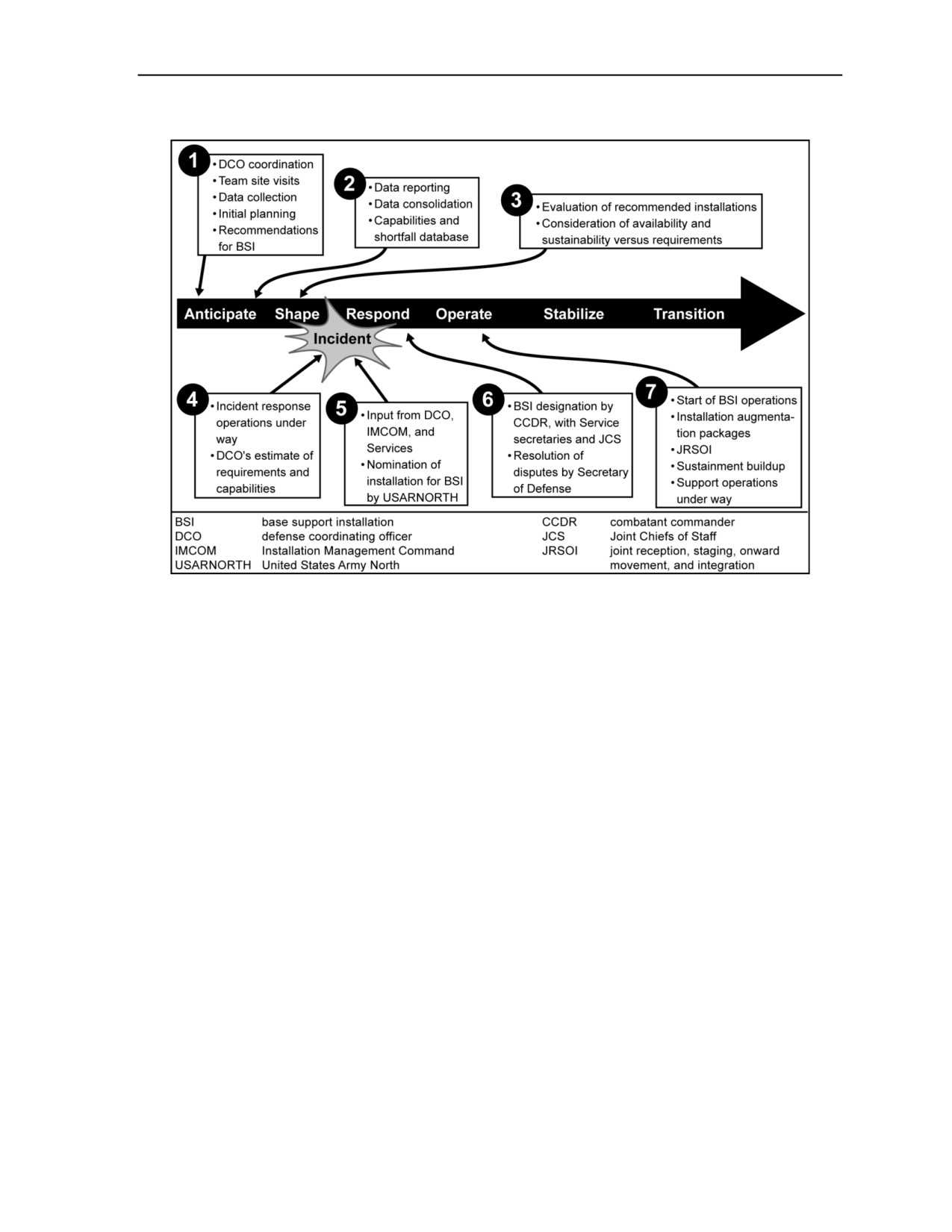
Sustainment—Logistics and Personnel Services
Figure 8-3. Example base support installation selection
8-39. Depending on the location of the catastrophic incident, there may not be a major DOD installation
close enough to support the operation. In these instances, the joint task force will complete an estimate of
the situation and request either contract support or submit requests for forces in order to mitigate logistic
capability shortfalls due to limited personnel, equipment, facilities, or interrupted or extended lines of
communications between the base support installation and those DOD elements operating at the incident
site. In some cases, the Secretary of Defense may authorize USNORTHCOM to coordinate to use a state
National Guard installation either as the base support installation or as a forward operating base.
Commander, USNORTHCOM can designate base support installation(s) after conferring with and reaching
an agreement with the owning Service Component.
LOGISTICS CONSIDERATIONS
8-40. There are several unique aspects to logistical support during DSCA. By understanding these
differences and applying their initiative, logisticians can provide effective and efficient support to not only
their Soldiers, but also the supported civilian population. The major advantages between operations
conducted inside the United States and those on foreign soil include:
z
The availability of rapid and reliable commercial transportation;
z
Robust communications grid;
z
The availability of professional contracted support for most logistical requirements;
z
Minimal language barriers;
z
Honest public officials;
z
An affectionate population;
z
Straightforward access to the Nation’s military support organizations (DLA, AMC, TRADOC,
etc.) and installations, including home stations;
4 June 2010
FM 3-28 (Signature Draft—Not for Implementation)
8-11
Chapter 8
z
Potable water and safe food are readily available anywhere there is electrical power (outside a
disaster area).
8-41. The first difference that logisticians and commanders need to understand are legal requirements
concerning movement, handling, and storage of hazardous materials, including fuel, ammunition, and many
other seemingly mundane support items. The environment matters and environmental regulations apply to
all DSCA. Local installation transportation officer’s and movement control team personnel can also provide
specific guidance on what may be required for military drivers to haul hazardous cargo. The Environmental
Protection Agency
(EPA) and other agencies can provide guidance when requested. Additionally,
commanders should also consider any specific environmental concerns for their particular operating area
and noise abatement requirements for any space they occupy.
8-42. Fuel is readily available throughout the United States, barring temporary disruption of a power grid.
However, it is not military grade JP-8. Tactical vehicles will require military refueling support, or a
command waiver to use commercially available diesel fuel with attendant maintenance requirement upon
redeployment. Military aircraft can normally obtain fuel from commercial or military airfields. The DLA
representative can coordinate with the Defense Energy Supply Center (DESC). The DESC coordinates for
direct bulk fuel delivery for ground or aviation operations to established base support installations or
airfields. Units should plan to deploy with sufficient tankers to support the tactical vehicles, and coordinate
with the joint task force for continued support. Any refueling operations need to comply with environmental
restrictions, and NCOs need to emphasis safe handling and cleanup procedures.
8-43. Rental equipment and vehicles go quickly near a disaster. If the mission depends upon additional
commercial equipment, units should be prepared to obtain it through providers well outside the disaster
areas.
8-44. Units should prepare to deploy items and personnel capable of executing a field arms room. The
decision to deploy with weapons rests with the Secretary of Defense for federal military forces and with The
Adjutant General for National Guard. Unfortunately, many civil support operations involve aspects of law
enforcement and infrastructure protection that may require arming some Soldiers. Depending on proximity
to home station or armory, plan to establish a field arms room for at least some of the deploying force.
8-45. Sustainment officers should work closely with the joint task force to obtain adequate bath and laundry
support for the force. One of the lessons of Hurricane Katrina is that bath and laundry is not just a morale
booster, it is a critical force protection measure. For planning purposes, contract or deploy sufficient
resources to allow Soldiers to have a clean uniform and shower daily. Medical, Food Service, and Mortuary
Affairs personnel receive priority for showers and laundry in order to conduct their jobs on a day to day
basis Commanders should ensure that their Soldiers involved in disaster response have ready access to
replacement uniforms or separate work clothing. Hurricane Katrina and other disasters indicate that
expensive ACUs need replacement after exposure to filthy water, various contaminates, and jagged debris.
Contracting
8-46. Operational contract support can be an effective and efficient method of rapidly augmenting organic
military support capabilities in civil support actions if properly planned and executed. Contracted support
can be especially viable as a source of base support installation augmentation support. Contracted support in
civil support operations may include all classes of supply, labor, mortuary affairs, laundry, showers, food
service, sanitation, billeting, transportation, maintenance and repair, access to communications networks,
temporary real property leasing, and construction. And while lessons learned from recent major DSCA
operations clearly indicate contracting of supplies and services was an important source of support for these
operations, there are some key limiting factors that must be kept in mind when planning for these types of
operations. These limiting factors include:
z
Limited pre-planning opportunities.
z
Very short time requirement.
z
Very limited availability of commercial supplies and services within or near the joint operational
area.
8-12
FM 3-28 (Signature Draft—Not for Implementation)
4 June 2010
Sustainment—Logistics and Personnel Services
z
Numerous federal, state and local agencies competing for locally available commercial
capabilities.
z
Low priority to the military for any locally available commercial support.
8-47. In most DSCA missions, the Army will be the lead Service responsible to plan and execute contract
support to the joint force. In these operations, the ASCC will utilize their aligned contracting support
brigade (CSB) to perform this task. This AMC unit has unique capabilities to plan for and integrate contract
support. A related CSB mission is to ensure any expansion of existing contracts or development of new
contracts does not adversely impact other federal, state, or local responder contracting efforts. At the
tactical level, the CSB contracting battalions and teams, taking advantage of organic base support
installation contracting support capabilities, award contracts, provide contract oversight, and assist in the
overall integration of contract support effort. Additionally, the Army may also utilize the USAMC’s
Logistic Civil Augmentation Program and the US Army Corps of Engineers contract support capabilities as
necessary.
8-48. Commanders should understand DOD is not normally the lead contracting authority in DSCA
missions. In most of these operations, FEMA will be the lead common contract coordination effort between
state agencies, local agencies, National Guard forces operating under Title 32 authority, and federal military
forces. This centralized coordination effort is essential since numerous contracting agencies will be
competing for the same locally available resources. Additionally, in DSCA operations priority of
commercial support will normally be to local emergency services (e.g. hospitals, fire and police services,
etc.) displaced civilians, and support of mobilized/deployed military forces, respectively. Because of this
lower priority of support and the often short-term nature of DSCA missions, Army forces operating inside a
disaster zone must be prepared to deploy with their full MTO&E sustainment capabilities and to live in field
conditions. Deployed Army forces also must be prepared to provide sufficient trained contracting officer
representatives (COR) with the required subject matter expertise to assist in contract oversight.
8-49. The key to successful contracting actions is proper operational contract support planning,
requirements development, and adequate contracting capabilities to support the force. Failure to accomplish
these critical operational contract support related tasks may lead to costly delays of materiel and services
during civil support operations. Supported units must also be prepared to assist in contract oversight
through the nomination of qualified contracting officer representatives and receiving officials as required by
the responsible contracting officer.
Negotiated Support
8-50. In some cases, civil agencies and organizations may have enough logistical resources to support not
only themselves but also Army personnel providing assistance. Such support is negotiated on a case-by-case
basis with the appropriate civil authorities. Memorandums of agreement are established before an operation
to reduce time of negotiation.
Support from Other Organizations
8-51. General Services Administration provides support to civil organizations. General Services
Administration provides general supplies and services common to organizations of the federal government.
General Services Administration may support DOD through its procurement and leasing service capability
for supplies, office supplies and furniture, real property, service contracts, transportation, machine and hand
tools, photo supplies, various types of batteries, and numerous other items. Commanders use the normal
procurement process. However, military forces should not expect to be supported from other agencies
providing assistance during DSCA operations
8-52. The Defense Logistics Agency provides common user logistics and services used by the military
when conducting civil support operations. Normally the classes of supply may consist of class I
(subsistence, bottled water, etc.), class II (clothing, textiles, tents, etc), class III (packaged and bulk fuel),
class IV (construction and barrier material), class VIII Medical, Dental and Veterinary Supplies/Equipment
and blood products, and class IX (spare parts). Services may include storage, distribution, disposal,
document automation and printing production. Normally, a Defense Logistics Agency response team will
4 June 2010
FM 3-28 (Signature Draft—Not for Implementation)
8-13
Chapter 8
collocate with various logistical headquarters to coordinate supply and fuel support. Defense Logistics
Agency distribution depots are located strategically throughout the continental United States along major
distribution networks to quickly launch needed supplies to its customers
Resource Management
8-53. The Department of Defense provides civil support on a reimbursable basis unless directed otherwise
by the President. Cost reimbursement for civil support is usually in accordance with the Economy Act,
which mandates cost reimbursement by the federal agency requesting support. However, when a
Presidential disaster or emergency declaration is declared, the Stafford Act sets the guidelines for
reimbursements to federal agencies and states from federal funds set aside to support these missions.
8-54. When possible, resource management analysis precedes key operational decisions and actions. Army
financial managers must seek early guidance regarding reimbursement from published orders, HQDA
published guidance, the USARNORTH Reimbursement Cell (ARC), or the USNORTHCOM Financial
Management Augmentation Team (FMAT). These sources provide guidance on the reimbursable process,
specific accounting codes that have been established and allocation of reimbursable authority from funding
received from other federal agencies.
Reimbursable Activities
8-55. In most cases, state, local, and federal agencies provide reimbursement for assistance provided by the
Department of Defense during the conduct of Civil Support missions. The reimbursement process requires
the DOD components to capture and report total and incremental costs in accordance with applicable DOD
financial management regulations. Supported agencies should also maintain records of support received
from the Department of Defense. To distinguish these costs from those related to training or normal
operating expenses, resource managers must maintain accountability throughout an operation for equipment
and material costs associated with operational support. Organizational record keeping needed to support
cost-capturing must begin at the start of the operation and extend to the lowest functional level.
8-56. Reimbursable Activities. Commanders must work closely with their financial management staff to
ensure all reimbursable activities are documented and accounted for properly. Note that under current
policy, DOD components shall not procure or maintain any supplies, materiel, or equipment exclusively for
providing civil support, unless otherwise directed by the Secretary of Defense.
8-57. Table 8-5 lists costs that directly result from disaster relief or other Domestic Operations and are
generally considered eligible for reimbursement:
Table 8-5. Costs eligible for reimbursement
Pay for personnel specifically hired for disaster response support.
Regular Pay and Allowances are reimbursable for Economy Act Orders only - military and
civilian.
Overtime.
Travel and per diem.
Cost of consumables (such as fuel, rations) requisitioned to support disaster operations.
Transportation of personnel, supplies, and equipment.
Cost to pack and crate supplies and equipment lost, destroyed, or damaged as a result of
civil support operations, (except aircraft, motor vehicles, and water craft).
Cost of aircraft flight hours.
Cost of port (air, ocean, inland-waterway) loading, off-loading, and handling.
Cost to repair or recondition non-consumable items returned (allocated according to
percentage of repair costs attributable to the support provided).
Replacement costs of supplies and equipment furnished and not returned.
Cost of parts used to repair end-items used in disaster relief (excluding depot or field
maintenance on a time compliance basis)
8-14
FM 3-28 (Signature Draft—Not for Implementation)
4 June 2010
Sustainment—Logistics and Personnel Services
8-58. Additional guidance in this area from the federal military can be found in DOD
7000.14-R,
Department of Defense Financial Management Regulation. A second source of additional federal military
information is JP 1-06.
Nonreimbursable Activities
8-59. Table 8-6 shows expenses not considered reimbursable in the context of civil support operations.
Table 8-6. Costs ineligible for reimbursement
Generally, regular pay and allowances of military and civilian personnel. (Regular pay and
allowances for civilian and military personnel are reimbursable for Economy Act orders.)
USACE personnel pay and allowances may be eligible for reimbursement.
Charges for use of military vehicles and watercraft.
Aircraft, vehicles, or watercraft damaged, lost, destroyed, or abandoned.
Administrative overhead.
Annual and sick leave, retirement, and other benefits.
Cost of telephone, telegram, or other transmissions used to requisition items in a disaster
area to replenish depot stocks.
8-60. Accounting codes, for use in accumulating costs, are requested at the onset of a disaster relief effort.
The key is to maintain accounting records and monitor how much funding is expended. All organizations
supporting operations such as the Army Materiel Command, Theater Sustainment Command elements,
Sustainment Brigades, or Medical Brigades that receive, store, issue, and account for DOD material ensure
complete accountability of all supplies.
8-61. State, local, federal organizations, DOD, and other military services normally reimburse the Army for
its assistance. Civil support sustainment events are reimbursable operations. Unit commanders are required
to maintain accurate records of expenditures. Accounting codes help track accumulation of costs. The
reimbursement process requires accurate billing records for legitimate costs. Discrepancies are resolved
with the supported and/or reimbursing agency. Supported organizations keep records of support and
services received from the Army. Army financial managers maintain accountability throughout operation for
costs of support and services to distinguish costs from those related to training or normal operating
expenses.
8-62. Commanders and staff integrate financial management into all phases of the operation. Early
involvement is essential for advice and review procedures. Responsive financial management calls for
detailed planning procedures to account for the expenditure of all resources supporting sustainment for an
operation with the expectation of being audited. By requesting early on-site involvement and advice from
external functional experts, for example, Army Audit Agency and General Accounting Office, resource
managers can head off major accounting problems that may occur later in the support operations. Specific
financial guidance and point of contact information is included in operation orders, execution orders and
deployment orders published by USNORTHCOM, USARNORTH and service command channels.
Critical Services
8-63. The supported state and federal coordinating officers identify certain critical sustainment functions to
reduce loss of life, limb and property, and to meet basic logistic requirements. These critical services
include mortuary affairs, establishment of temporary facilities and relief supplies. Commanders providing
these capabilities should:
z
Tailor the package for the mission.
z
Contract for support and services early.
z
Utilize local resources when possible.
4 June 2010
FM 3-28 (Signature Draft—Not for Implementation)
8-15
Chapter 8
Mortuary Affairs
8-64. Disasters may create higher than normal casualty rates that initially overwhelm local and state assets.
When requested, Army mortuary affairs units can provide valuable assistance. Army mortuary affairs units
normally provide collection point, transport to designated storage area, and identification services in
support of civil authority. Ensure there is link-up between mortuary affairs and local morgues, medical
facilities, funeral parlors and ensure cultural considerations are considered during operations. Chapter II of
Joint Publication
4-06 outlines additional information for Mortuary Affairs support in a DSCA
environment. Chapter 9 provides additional discussion on the handling of human and animal remains.
8-65. The local, territorial, tribal, or state medical examiner or coroner normally maintains jurisdiction over
fatalities and military forces support that official when authorized. Within the United States, the civil
jurisdiction has authority to order and perform an investigation to include an autopsy or an appropriate
examination of human remains. This local authority can waive jurisdiction to the military or request an
Armed Forces medical examiner. This is a sensitive topic and requires analysis and legal advice on case-by-
case basis.
8-66. A mass fatality disaster or emergency may exceed the capabilities of local and state authorities to
perform mortuary affairs services. Because mortuary affairs capabilities within DOD are extremely limited,
mortuary affairs units support civil authorities only when response or recovery requirements are beyond the
capabilities of civil authorities. When directed by the President or Secretary of Defense, DOD can provide
advisory support, search, recovery, receiving, decontamination, identification, processing, storage, and
transportation assistance of the remains. DOD mortuary affairs personnel integrate into federal, state, and
local operations to assist and augment the medical examiner or coroner according to state laws. It is DOD
guidance that only mortuary affairs personnel handle human remains, with the reverence, care, and dignity
befitting them and the circumstances.
8-67. In most states, the state medical examiner or coroner is legally responsible for operations associated
with the identification, processing, and disposition of human remains. Each state and territory has different
laws for processing human remains. DOD personnel may assist National Guard and civilian law
enforcement authorities in locating human remains and transporting them after processing. The search,
recovery, and movement of human remains may become a law enforcement issue when there is a
requirement to enter private property or when the location is clearly a crime scene. In the former, a law
enforcement official must enter the private premises first to conduct a search to determine if any deceased
persons are inside. In the latter, permission from law enforcement authorities must be received before
moving human remains.
8-68. The National Response Framework under ESF #8 gives Department of Health and Human Services
the lead in providing mortuary services (table 8-7).
Table 8-7. Mortuary services under ESF #8
Identifying victims (by means such as fingerprint, dental, DNA, pathological, and
anthropological)
Providing temporary morgue facilities
Processing, preparation, and disposition of remains
Returning personal effects
If necessary, making remains and personal effects available to law enforcement
8-69. There are three types of searches for victims and for human remains. Soldiers may conduct an
immediate or hasty search in the aftermath of a disaster, such as a flood or hurricane, to find and rescue
living personnel who are on rooftops, front porches, or trees, for example, waiting for rescue. A primary
search follows, by going house-to-house, knocking on doors, looking into windows, and listening for sounds
to determine if someone inside needs assistance. DOD forces may accompany National Guard or civilian
law enforcement authorities and stand by to assist while they do the initial entry into the house or private
business. A deliberate or secondary search follows later by going house-to-house and entering the premises
to determine if any deceased persons are inside. DOD forces again may accompany and stand ready to assist
National Guard or civilian law enforcement authorities.
8-16
FM 3-28 (Signature Draft—Not for Implementation)
4 June 2010
Sustainment—Logistics and Personnel Services
Temporary Facilities
8-70. The U.S. Army Corps of Engineers, Army and other Service engineers may prepare temporary or
improve facilities needed to house military and supporting civilian personnel, and additional support basing.
Mission assignments determine the support provided to supported agencies, while USARNORTH
coordinates with the base support installation and subordinate Army commanders for additional facilities to
support military forces. USARNORTH and the JFHQ-state may also coordinate for shared logistical
facilities and housing; a memorandum of agreement may follow that assigns shared costs and
responsibilities. The USARNORTH and subordinate engineer staff coordinate with Service engineer
agencies (such as Naval Facilities Command or NAVFAC) to analyze cost, availability, and schedules for
construction of temporary facilities. Normally housing for displaced citizens comes through the joint field
office under ESF#6, coordinated by FEMA, assisted by other federal agencies, USACE, and the American
Red Cross. In situations involving a mass evacuation or refugee crisis, DOD may receive mission
assignments to provide shelter to civilians.
8-71. Service capabilities developed and procured for rapid global deployment may prove equally useful in
domestic emergencies. Such capabilities may include Air Force RED HORSE and PRIME BEEF; Army
rapid deployment logistics and medical modules such as FORCE PROVIDER; or pre-packaged Marine
logistics sets stored in the United States or on sea lift currently in U.S. waters.
Other Logistics Support
8-72. Army units may require an extensive storage complex based on mission requirements and flow of
supplies. During an incident response, federal and state agencies and civilian partners distribute large
quantities food, water, ice, and clothing to affected citizens. Frequently, stockpiles of military supplies
supplement resources from civilian emergency stockpiles. When tasked, Soldiers assist in distribution.
Leaders need to understand that the law requires an accurate accounting for both the supplies and the
Soldiers’ effort.
Real Property
8-73. When requested and approved by their respective headquarters, National Guard and federal military
bases may support civilian agencies. Vacant warehouses, parking lots, open fields, potential staging areas,
universities, airports and airfields, hospitals, and other facilities may be used for support and service
activities, and temporary resettlement of dislocated persons. The Secretary of Defense, in coordination with
the owning service secretary, commits active military installations to support civilian agencies. The
Adjutant General exercises decision authority for use of National Guard bases and armories.
8-74. Permanent or temporary transfer of any accountable equipment from an Army unit to a sister Service,
other service component, or civilian agency requires Department of the Army approval. Loans require
proper authorization and documentation. The borrower signs a statement assuming liability for equipment
during the period of the loan, and for care, custody, security and safeguarding, proper use and maintenance,
and responsibility for all incremental costs accrued to the Army. Before issue, the Army clearly defines
condition standards for return and how and where to find the agency or organization that borrowed the item.
In an emergency situation, Soldiers may provide items of equipment to their military counterparts or a
civilian organization. They should document the transfer either in writing, or in an operations log at their
TOC. One expedient means of documentation is to record it digitally on cell phone cameras. Transfer of
weapons, combat or tactical vehicles, water vessels, or aircraft requires the approval of the Secretary of the
Army.
Maintenance
8-75. Army commanders and staff cooperate with the lead civil authority. Commanders consider support
for their own equipment and support for civilian equipment such as buses, trucks, ambulances, and power
generation equipment. Federal military forces require a mission assignment in order to provide maintenance
assistance to civilian equipment. National Guard assets provide support through immediate response or
upon approval by their joint task force. Maintenance support to nearby NGOs is worth considering, as this
4 June 2010
FM 3-28 (Signature Draft—Not for Implementation)
8-17
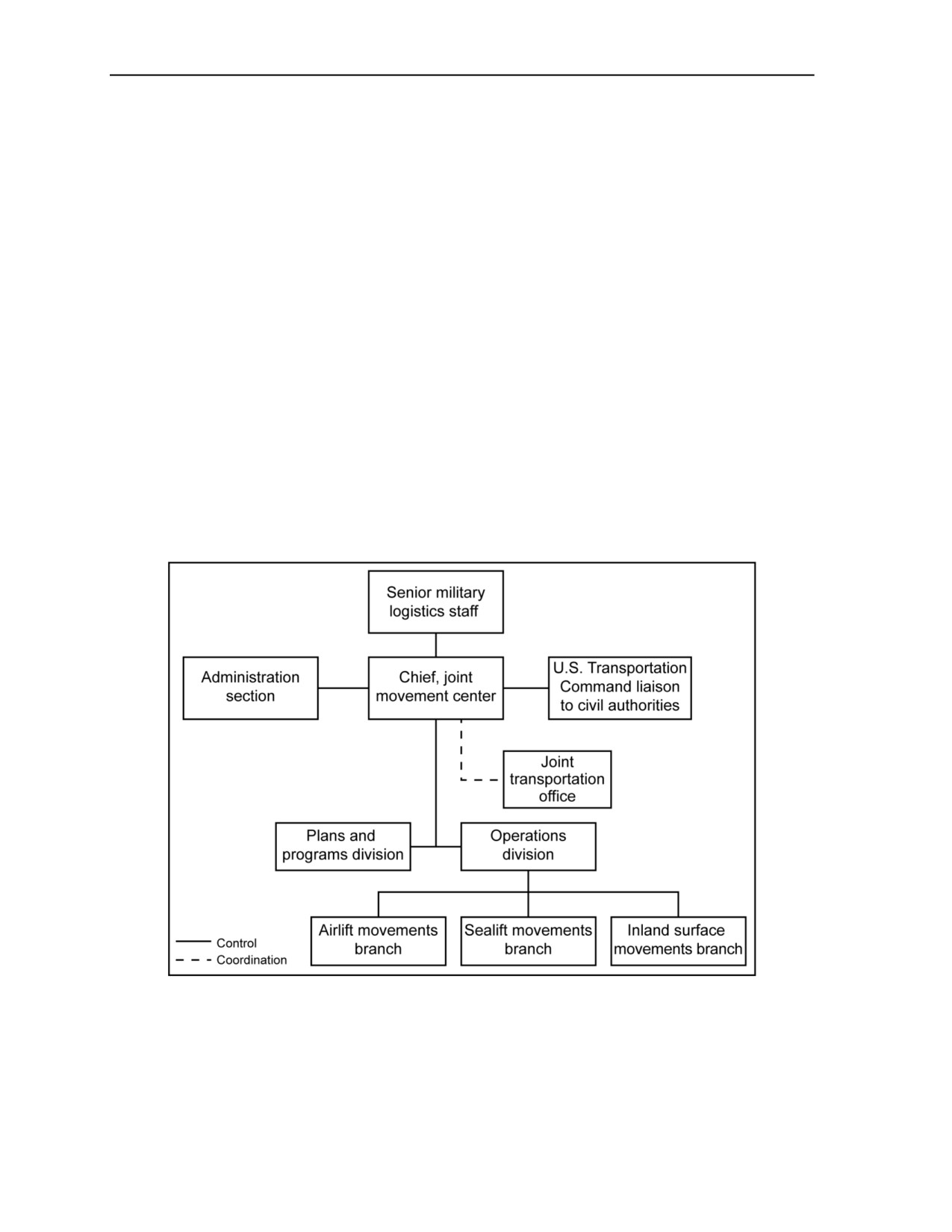
Chapter 8
can be one of the most effective means of building unity of effort while improving support. As soon as
possible, however, contractors should replace military maintenance support to external agencies.
Transportation
8-76. USARNORTH planners assist USNORTHCOM and USTRANSCOM to plan, schedule, and control
federal military movements into, within, and out of an area of operations. They support joint movement
control and coordinate support with civilian agencies in the joint operating area. When tasked by a mission
assignment, Army movement control personnel may augment and assist civilian authorities manage traffic
into and out of a declared disaster area. The preferred means of manning traffic control points is through
National Guard forces, in order to avoid any conflict with the PCA. Regular Army personnel may support in
a staff capacity or in a liaison capacity with law enforcement and National Guard elements. The JTF-state
and federal military joint task force may establish a joint movement center to ensure efficient movement
within declared disaster areas. Federal military and state National Guard commanders coordinate manning
requirements. Transportation units may serve as part of a joint force headquarters or as part of a pure Army
force transportation headquarters. (See Figure 8-5.)
8-77. Transportation units may serve as part of a joint headquarters or a pure Army transportation
headquarters. Units serve as part of forces (except for small TOE staff elements), not as part of the
headquarters. They may provide services in unity of effort with civilian transportation assets. Wheeled
military units can distribute large quantities of essential cargoes over terrain normally impassable to most
civilian trucking. Inland cargo transfer companies prepare cargo for transshipment at distribution centers.
Seaport operations companies operate water ports, load and offload ships, or assist civilian port operators.
Watercraft companies move units, supplies, and equipment along intra-coastal and inland waterways.
Figure 8-5. Example joint movement center organization
Geospatial Support
8-78. In civil support operations, map coverage is critical to responding military and civil agencies. When
possible, all controlling headquarters operate from the same geographic reference(s). In many cases, locally
8-18
FM 3-28 (Signature Draft—Not for Implementation)
4 June 2010
Sustainment—Logistics and Personnel Services
produced large-scale
(1:10,000 or
1:5,000) maps are optimal. Many of the local residents and first
responders are familiar with such local products. Local planning agencies, realtor associations, travel
agencies, or utility company records may be able to provide such detailed map coverage. Army geospatial
engineer units, federal mapping agencies or local topographic or printing companies may be able to
reproduce or modify these products as required. If map coverage does not exist over the area of operations,
agencies can request image-based products, which can be produced in a relatively short period.
8-79. The US Army Geospatial Center at Fort Belvoir provides direct geospatial support and products to
deployed forces conducting civil support operations. This includes products such as maps, hydrological
studies, and ―flyover capabilities.‖ These products can support the unit’s incident awareness and assessment
before, during, and after deployment.
PERSONNEL SERVICES IN CIVIL SUPPORT
8-80. During a civil support operation, personnel support to military forces should not be overlooked.
Personnel support activities encompass the elements of postal operations management; morale, welfare and
recreation (MWR); and band operations. For DSCA operations, personnel support operations not only
support the military, but can also assist civil authorities in restoring capabilities that may be degraded
8-81. The ability of the Army to support the U.S. Postal Service is important and may be requested to
augment postal operations until normal postal services are restored in the affected area.
8-82. The MWR network, in coordination with servicing base support installations, provides DOD
personnel with an opportunity to relax and unwind while deployed normally through opportunities for sports
and recreation. While HR organizations are not the executors of MWR centers, acknowledging this aspect
of personnel support during DSCA operations is essential to provide military and civilians alike with an
outlet that improves morale.
8-83. Administrative control over personnel remains with the parent Service and providing headquarters
unless otherwise specified by the supported combatant commander. National Guardsmen remain under the
ADCON of their respective state. The Army Reserve Command continues to exercise ADCON over
mobilized Army Reserve Soldiers. Active Component Soldiers receive administrative support through their
home station. The supporting commander may attach a human resources team with the deploying unit to
assist with administrative actions and coordinate with home station for additional support as required.
Adequate personnel support to the deployed force must be a planning consideration for commanders and
Human Resource (HR) providers.
HUMAN RESOURCES SUPPORT
8-84. HR Support to military personnel supporting DSCA operations is dependent on the operational
environment. Some HR support can be coordinated at home station, the base support installation, when
deployed with the organization, or from multiple deployed locations. HR planners must consider the
numbers and type of organizations involved, task organization of the force, level of support needed, and the
operating environment, specifically technological capabilities available.
8-85. Civil support operations may require additional planning and preparation by the personnel staff
officer. The biggest single challenge is maintaining accurate strength accountability. This is a problem for
both National Guard and federal military forces. There are several steps that commanders should take to
maintain personnel accountability. These include:
z
Establish and maintain a central control point through which all Soldiers report and depart from
the JOA. This is not easy to control, since there are numerous ways to arrive and depart.
z
Ensure accountability procedures and reporting requirements are accurate and integrated with not
only with the higher headquarters, but also the rear detachment.
z
National Guard joint task force commanders should manage units provided by other states under
EMAC carefully, since these units normally have a 30-day employment window.
4 June 2010
FM 3-28 (Signature Draft—Not for Implementation)
8-19