FM 3-22.37 COMBAT MISSILE SYSTEM, MEDIUM (March 2008) - page 7
Appendix E
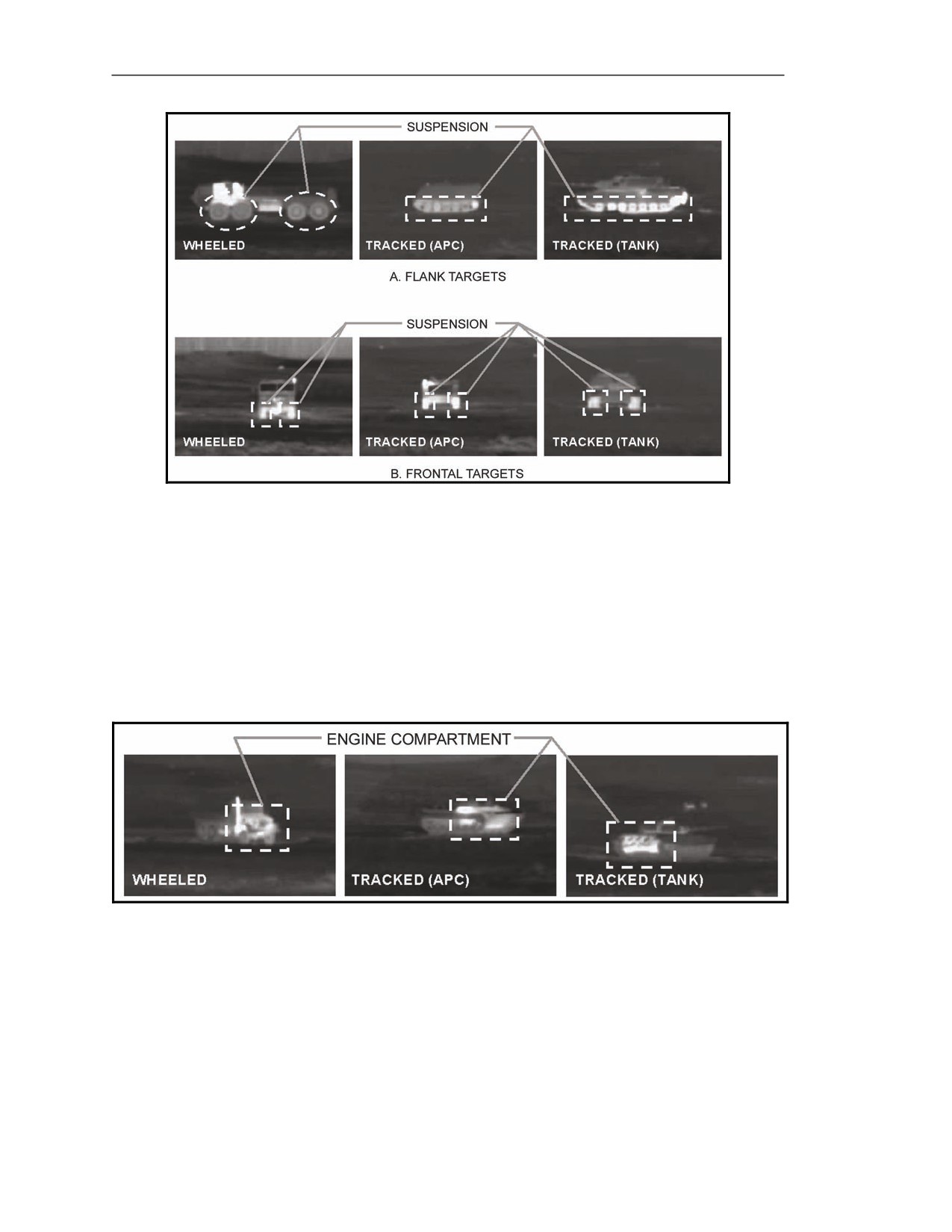
Figure E-56. Classification features―suspension system.
Engine Compartment (Figure E-57)
Wheeled Vehicles
E-123. Generally, the engine on a wheeled vehicle is located at the front.
Tracked Vehicles
E-124. The location of the engine on a tracked vehicle depends on whether the vehicle is a tank or an APC. Tanks
have engine compartments located at the rear. APCs generally have engine compartments located at the front.
Figure E-57. Classification features―engine compartment location.
Gun Tube/Barrel
E-125. When a gun tube or barrel is mounted on a turret or cupola, the Javelin gunner may or may not
be able to see it, depending on turret orientation.
Wheeled Vehicle
E-126. In most cases, wheeled vehicles do not have a gun tube, but they may have some type of
smaller support gun (machine gun) mounted.
E-34
FM 3-22.37
20 March 2008
Forward Looking Infrared
Tracked Vehicle
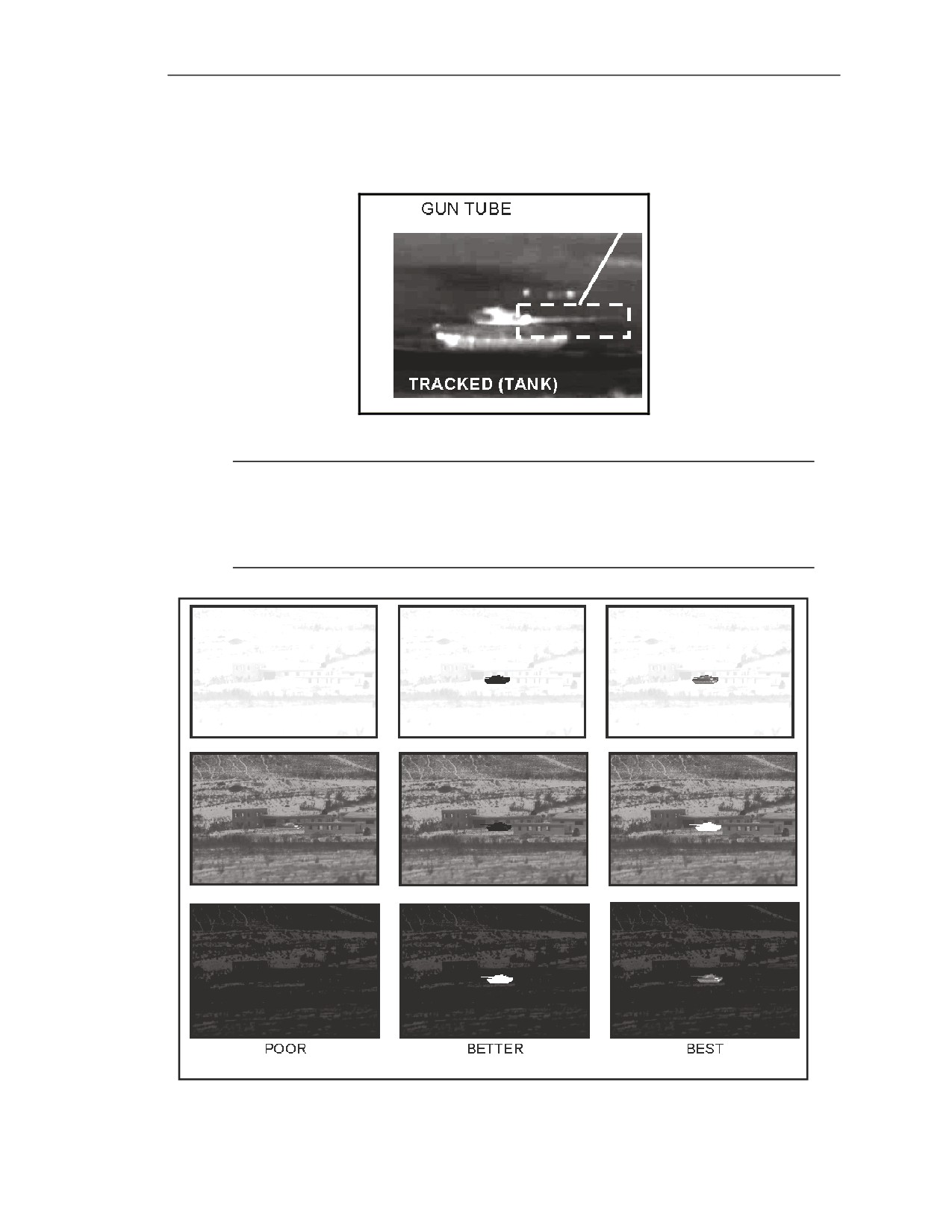
E-127. When the turret is oriented to the proper angle, the gun tube signature stands out from the
turret (Figure E-58).
Figure E-58. Classification features―gun tube/barrel.
NOTE: Proper adjustment of focus, contrast, and brightness enables the gunner to classify
and recognize targets. Adjust the image so the target features stand out from the surrounding
terrain features. It may be necessary to make several adjustments for the same target. See
Figure E-59 for examples of poorly adjusted and properly adjusted target images for
classification and recognition.
Figure E-59. Image adjustments for target classification and recognition.
20 March 2008
FM 3-22.37
E-35
Appendix E
DEFENSIVE OPERATIONS (MOVING TARGETS)
E-128. Some targets may be easier to classify and recognize than others for the following reasons:
Range to the Target
E-129. Even under ideal conditions, classifying and recognizing a target at long ranges is difficult due
to the NVS magnification and image resolution. As range to the target decreases, target details become
clearer, which makes classification and recognition easier.
Target Aspect
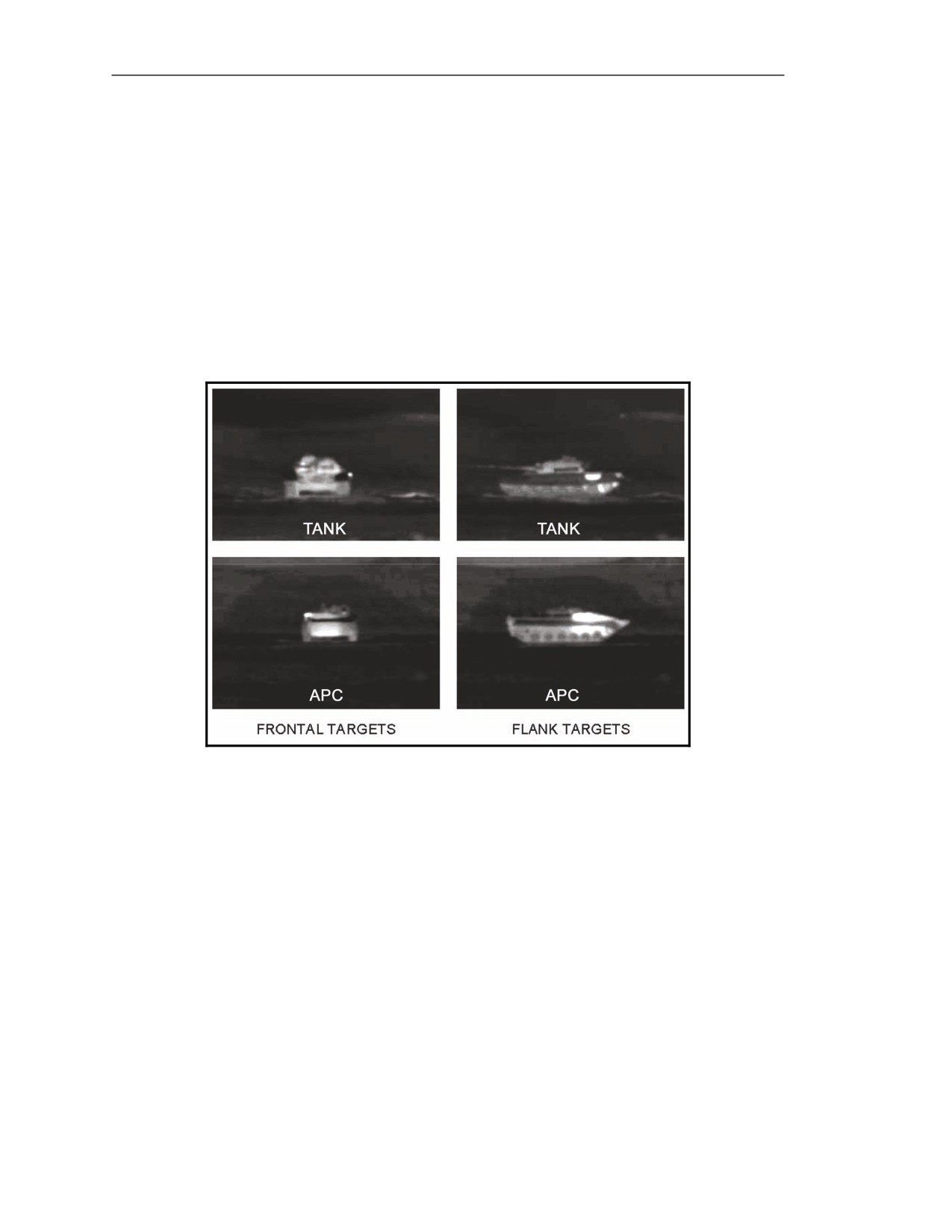
E-130. Flank targets are easier to classify and recognize than frontal targets (Figure E-60). The profile
exposes the suspension and other distinctive features, such as turrets, engine compartments, gun tubes,
or other armament.
Figure E-60. Classification and recognition features of flank and frontal targets.
Target Movement
E-131. A moving target allows the gunner to see it from more than one aspect making it easier to
classify and recognize than a frontal target moving in a straight line.
Terrain
E-132. Targets try to remain hidden from the gunner by staying in cover and concealment, or by
using the terrain to mask their movement. Depending on the amount of terrain masking, the gunner
may see only one or two features from which to classify, and recognize a target.
OFFENSIVE OPERATIONS (STATIONARY TARGETS)
E-133. The gunner’s ability to detect, classify, and recognize a stationary target depends on:
z
Position of the target with respect to the gunner’s location.
z
Enemy activity.
z
Proper image adjustment.
z
Amount of target exposure.
E-36
FM 3-22.37
20 March 2008
Forward Looking Infrared
TARGET RECOGNITION
E-134. Target recognition is the next step in the process of elimination whether a tracked vehicle is a
tank.
DEFINITION
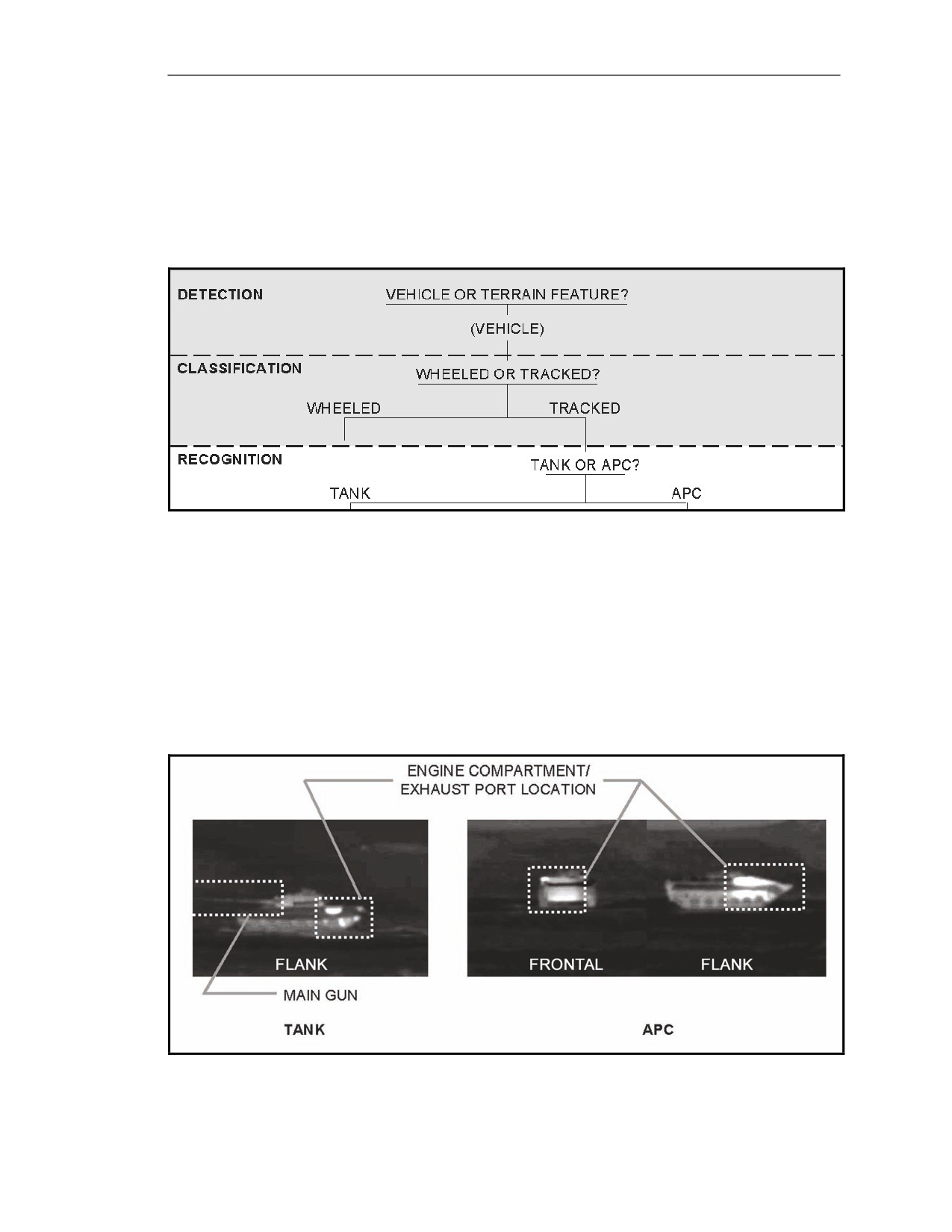
E-135. Target recognition: to determine whether a tracked vehicle is a tank or an APC (Figure E-61).
Figure E-61. Target acquisition process―recognition step.
IMAGE ADJUSTMENT
E-136. Image adjustment for target recognition is the same as for classification. The gunner should
make image adjustments so the target features stand out from the surrounding terrain features. The
gunner may have to keep adjusting contrast and brightness to bring out different target details as he
tries to attempts target recognition.
RECOGNITION FEATURES
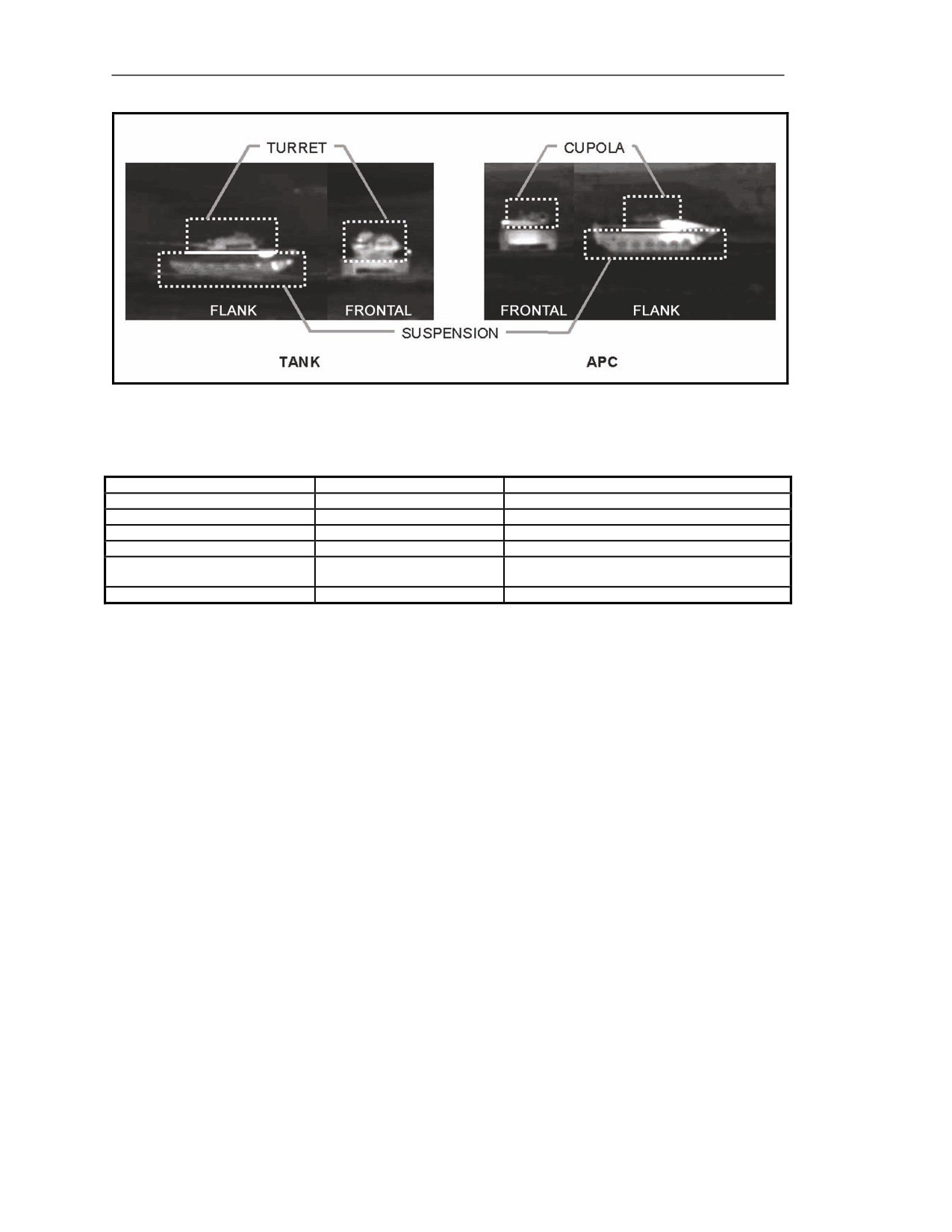
E-137. The major differences between tanks and APCs are shown in Figure E-62 and Table E-1.
Figure E-62. Target recognition features.
20 March 2008
FM 3-22.37
E-37
Appendix E
Figure E-62. Target recognition features (continued).
Table E-1. Target recognition features.
SIGNATURE
TANK
APC
Engine Compartment
Located In Rear
Located In Front
Exhaust Ports
Located In Rear
Located In Front Or On The Side
Main Gun
Long And Thick
Short And Thin
Turret
Yes - And Large
Yes, Most Have Turrets
Cupola
New Tanks―No
Yes―Usually Small
Old Tanks―Yes
Size/Shape
Large And Sloping
Small And Rectangular
E-38
FM 3-22.37
20 March 2008
GLOSSARY
SECTION I. ACRONYMS AND ABBREVIATIONS
AA
avenue of approach
AAR
after-action review
ACU
Army combat uniform
APC
armored personnel carrier
ARNG
Army National Guard
ARNGUS
Army National Guard of the United States
ARTEP
Army Training and Evaluation Program
ASI
additional skill identifier
ASIP
advanced systems improvement program
BCU
battery coolant unit
BDA
battle damage assessment
BFV
Bradley fighting vehicle
BIT
built-in test
BMP
fighting vehicle manufactured by the former Soviet Union
BNCOC
Basic Noncommissioned Officer Course
BST
basic skills trainer
CARC
chemical-agent resistant coating
CBRN
chemical, biological, radiological, nuclear
CD-ROM
compact disk read-only memory
CGP
commander’s ground pointer
CLU
command launch unit
CU
control unit
CVI
combat vehicle identification
DDC
detector dewar cooler
DLIC
detachment left in contact
DRC
daily readiness check
EMI
electromagnetic interference
ESAF
electronic safe, arm, and fire
FM
field manual
FNC
fiber nickel cadmium
FOV
field-of-view
FTT
field tactical trainer
FTX
field training exercise
GRP
gunner’s reference point
GST
gunner’s skill test
GTA
graphic training aid
HE
high-explosive
HMMWV
high-mobility multipurpose wheeled vehicle
I2R
imaging infrared
IAW
in accordance with
IEDK
individual equipment decontamination kit
20 March 2008
FM 3-22.37
Glossary-1
Glossary
IFV
Infantry fighting vehicle
IR
infrared
JGC
Javelin Gunner’s Course
LD
line of departure
LED
light-emitting diode
LL
left limit
LTA
launch tube assembly
MEL
maximum engagement line
METL
mission-essential task list
METT-TC
mission, enemy, terrain and weather, troops and support available, time
available, civil considerations
MILES
multiple integrated laser engagement system
MRE
meals ready-to-eat
MSR
missile simulation round
MTP
mission training plan
NCO
noncommissioned officer
NCOES
Noncommissioned Officer Education System
NFOV
narrow field-of-view
NSN
national stock number
NVG
night vision goggles
NVS
night vision sight
OES
Officer Education System
PE
practice exercise
PMCS
preventive maintenance checks and services
POI
program of instruction
RL
right limit
ROC-V
Recognition of Combat—Vehicles
ROE
rules of engagement
SAAF
small-arms alignment fixture
SBCT
Stryker brigade combat team
SBCU
simulated battery coolant unit
SCLU
simulated command launch unit
SDK
skin decontamination kit
SINCGARS
single-channel ground and airborne radio system
SOP
standing operating procedure
STP
Soldier’s training publication
STX
situational training exercise
TDC
Training Device Course
TEWT
tactical exercises without troops
TM
technical manual
TOE
table of organization and equipment
TOW
tube-launched, optically tracked, wire-guided missile
TRP
target reference point
TSC
training support center
USAIS
United States Army Infantry School
USAR
United States Army Reserve
Glossary-2
FM 3-22.37
20 March 2008
Glossary
VCR
video camera recorder
WFOV
wide field-of-view
SECTION II. DEFINITIONS
ΔT
Delta (Δ) is a Greek letter that stands for change or difference. T
stands for temperature.
absorbers
Protect CLU from damage during handling and movement
aft end cap
Protects the round from damage during handling and movement;
permanently attached to round.
ATTK SEL
Attack select. Switches between the top attack mode and the direct
attack mode.
backlighting
Indirect IR signature that indicates the presence of a target.
basic skills trainer
An indoor/shipboard training device that can train and test the
gunner’s skills in a wide variety of situations.
battery coolant unit
Provides electrical power and seeker cooling for the missile.
carry handle
Used to lift and carry the round.
CLU interface connector
Provides electrical interface with the round.
CTRS
Contrast. The contrast is adjusted by moving the GATE ADJ/CTRS
and BRT switch horizontally (left and right).
daysight
Optical system that works similar to a telescope. Develops a
magnified, visible-light target image for the gunner.
desiccant
Used to prevent moisture from gathering in the missile and causing
possible missile malfunctions. It is located inside forward end cap.
DFOV
Day field-of-view. The power switch is in the DAY position, the
Javelin is in mode. The status indicator located on the CLU display.
This appears as a green indicator light when the day FOV is
selected.
DIR
Direct attack mode. When the DIR indicator light is lit the direct
attack mode is selected.
elapsed time meter
Records total operating hours of CLU. It is located in battery
compartment.
electronic safe, arm, and fire
Controls arming and ignition of the missile motors, arming, and
detonation of the warhead charges.
eyepiece
Allows viewing of CLU display image. Contains diopter adjust ring
that gunner uses to focus CLU display image, eyecup.
20 March 2008
FM 3-22.37
Glossary-3
Glossary
face shield absorber
Shields gunner’s face from possible launch debris and helps protect
CLU from damage during handling and movement.
field tactical trainer
Designed to be used as an outdoor trainer and is equipped with the
MILES.
fire trigger
Used to initiate missile firing sequence
FLTR SEL switch
Filter select. The filter select switch is used to select the night vision
sight (NVS) filter. The NVS filter prevents the CLU from being
detected by enemy countermeasures.
FOC ADJ switch
Focal adjust. Used to adjust the focus of the CLU display image
during NVS (NFOV or WFOV) operation.
forward end cap
Protects the round from damage during handling and movement. It
provides environmental and electromagnetic interference
(EMI)
protection for the missile. It is removed prior to missile firing.
GATE ADJ/CTRS and BRT
Gate adjust/contrast and brightness. It serves two functions
depending on whether the CLU display image is from the NVS or
the seeker. In the NVS mode the controls adjusts the brightness and
contrast. In the seeker mode the controls control the track gates by
moving them in or out horizontally and vertically.
humidity indicator
Displays status of relative humidity inside CLU. It is located on
right side of CLU. It displays the status of relative humidity inside
LTA. Located on the forward end cap.
latch assembly
Latch assembly together with the alignment fork and latch release
provides the mechanical interface with the CLU.
launch tube assembly
Serves as a handling container and launch platform for the missile.
Provides environmental and electromagnetic interference
(EMI)
protection for the missile.
left handgrip controls
Consists of focus adjust (FOC ADJ), sight select (SGT SEL), and
filter select (FLTR SEL) switches.
lock-on
Simulated seeker lock-on has been commanded.
locking pin
Locks the forward end cap latch in place and prevents movement.
missile simulation round
Simulates the weight and balance of the round and has CLU and
BCU connectors.
night vision sight
Optical system that converts an IR target image into a visible-light
target image for the gunner.
power switch
Four-position rotary switch used to place the Javelin into operation.
right handgrip controls
Consists of gate adjust
(GATE ADJ), contrast and brightness
(CTRS and BRT), and attack select (ATTK SEL) switches.
round interface bracket
Round interface bracket together with the alignment pin and round
interface catch provide the mechanical interface with round.
Glossary-4
FM 3-22.37
20 March 2008