FM 5-0 THE OPERATIONS PROCESS (MARCH 2010) - page 3
Assessment
assessing an upcoming operation. In protracted stability operations, commanders may desire a formal
assessment plan, an assessment working group, and standard reports. Subordinate units use these tools to
assess local or provincial governance, economics, essential services, or the state of security. In fast-paced
offensive or defensive operations or in an austere theater of operations, a formal assessment may prove
impractical. To assess progress in those cases, commanders rely more on reports and assessments from
subordinate commanders, the common operational picture, operation updates, assessment briefings from
the staff, and their personal observations. The principles in this chapter apply to formal and informal
assessment methods. The tools described in table 6-1 on page 6-3 are useful for the assessment process
even if not recorded in a formal assessment framework. (Appendix H discusses formal assessment plans.)
6-56. A common informal assessment method is the after action review (AAR). Leaders use the AAR to
assess unit performance in training and throughout an operation. Leaders at all echelons conduct AARs to
generate candid, professional unit evaluations that include specific recommendations for improving unit
performance. (See FM 6-01.1 for tactics, techniques, and procedures on conducting AARs during and after
operations.)
6-57. Collecting, assembling, and analyzing information takes time and resources. Commanders balance
time and resources for assessment just as they do for planning, preparation, and execution. To help achieve
this balance, commanders and staffs ask the following questions:
z
What will be assessed and to what detail?
z
How will a particular task, objective, end state condition, or assumption be assessed? What
MOEs and MOPs will be used?
z
What information requirements (indicators) are needed to support a particular assessment?
z
Who on the staff has primary responsibility for assessing a particular area? What is the
collection plan?
6-58. Commanders must be careful, however, not to over assess. Staffs can easily get bogged down in
developing formal assessment procedures for numerous tasks and objectives. Additional numerous reports,
questions, and information requirements from higher headquarters can smother subordinate commanders
and their staffs. Often standard reports, operational and intelligence summaries, and updates by subordinate
commanders suffice. Higher echelons should never ask for something that the lower echelon does not need
for its own purposes. The chief of staff or executive officer helps the commander achieve the right balance
between formal and informal assessments.
ASSESSMENT WORKING GROUPS
6-59. Assessing progress is the responsibility of all staff sections and not the purview of any one staff
section or command post cell. Each staff section assesses the operation from its specific area of expertise.
However, these staff sections must coordinate and integrate their individual assessments and associated
recommendations across the warfighting functions to produce comprehensive assessments for the
commander, particularly in protracted operations. They do this in the assessment working group.
6-60. Assessment working groups are more common at higher echelons (division and above) and are more
likely to be required in protracted operations than in fast-paced offensive or defensive operations.
Normally, the frequency of meetings is part of a unit’s battle rhythm. The staff, however, does not wait for
a scheduled working group to inform the commander on issues that require immediate attention. Nor do
they wait to take action in those areas within their delegated authority.
6-61. The assessment working group is cross-functional by design and includes membership from across
the staff, liaison personnel, and other partners outside the headquarters. Commanders direct the chief of
staff, executive officer, or a staff section leader to run the assessment working group. Typically, the
operations officer, plans officer, or senior ORSA staff section serves as the staff lead for the assessment
working group.
6-62. The assessment working group fuses assessment information to provide a comprehensive assessment
of the operation. They consolidate and discuss emerging trends, issues, and impacts relating to events over
the various planning horizons. They consider United States government civilian agency tools such as the
United States Agency for International Development Tactical Conflict Assessment and Planning
26 March 2010
FM 5-0
6-9
Chapter 6
Framework. (See appendix D in FM 3-07.) They examine the assessment plan to ensure MOEs, MOPs, and
indicators are still valid and develop new measures and indicators as required. They provide input to ISR
synchronization for adjusting collection requirements. The results of the assessment working group support
and feed short-, mid-, and long-range planning in the current operations integration, future operations, and
plans cells respectively.
6-63. Minority views are heard and dissenters speak up in the assessment working group. Commanders
encourage all subject matter experts and relevant staff sections to debate vigorously on the proper
understanding of observed trends and their associated causes. Minority views often create critical insights;
they also are presented to the commander at the assessment board.
6-64. The frequency with which the assessment working group meets depends on the situation.
Additionally, the assessment working group may present its findings and recommendations to the
commander for decision. Subordinate commanders may participate and provide their assessments of the
operations and recommendations along with the staff. Commanders combine these assessments with their
personal assessment, consider recommendations, and then direct changes to improve performance and
better accomplish the mission.
ASSESSMENT SUPPORT
6-65. The ORSA staff section supports assessment on many levels. Staff analytical resources and expertise
increase at each echelon. Division and corps headquarters, for example, have an assigned ORSA staff
section. In addition to managing a formal assessment framework, these staff sections can provide other
capabilities to assist the commander. These include—
z
Trend analysis.
z
Hypothesis testing.
z
Forecasting.
6-66. ORSA staff sections can use various mathematical techniques to identify and analyze trends in data.
They confirm or rule out suspected trends in a statistically rigorous manner. They can also determine how
much a given trend depends on other variables within the information. For example, given sufficient
information, the ORSA staff section can determine which essential services trends correlate most to the
trend in the number of attacks.
6-67. The ORSA staff section confirms or rules out many theories about given information. For example,
the commander may propose a hypothesis that enemy surface-to-air attacks increased because helicopter
flight patterns became too predictable. The ORSA cell can analyze the flight patterns and determine a
correlation to attacks to confirm or rule out the hypothesis.
6-68. The ORSA staff section can use statistical techniques to predict the next information point in a series.
Margins of error for this activity can be significant, but it is one more tool the commander can use to
develop estimates in an unknown situation.
6-10
FM 5-0
26 March 2010
Appendix A
Command Post Organization and Operations
This appendix describes how commanders organize their headquarters into command
posts (CPs) during the conduct of operations. It describes how commanders further
cross-functionally organize the staff within CPs into functional and integrating cells.
Next, this chapter provides guidelines for CP operations to include the importance of
establishing standard operating procedures and an effective battle rhythm for the
headquarters. For specific guidance on CP organization by echelon or type of unit,
see the corresponding field manual. For headquarters serving as a joint task force
headquarters, see JP 3-33.
±COMMAND POST ORGANIZATION
A-1. Staffs at every echelon are structured differently; however, all staffs are similar. A commander’s staff
includes a chief of staff (COS) or executive officer (XO) and various staff sections. A staff section is a
grouping of staff members by area of expertise under a coordinating, special, or personal staff
officer. The number of coordinating, special, and personal principal staff officers and their corresponding
staff sections varies by type of unit and echelon. FM 6-0 details the duties and responsibilities of the
coordinating, special, and personal staff.
A-2. In operations, effective mission command requires continuous, and often immediate, close
coordination, synchronization, and information sharing across staff sections. To promote this, commanders
cross-functionally organize elements of staff sections within CP cells (see A-15 to A-33). Additional staff
integration occurs in meetings to include working groups and boards.
COMMAND POSTS
A-3.
±A command post is a unit headquarters where the commander and staff perform their
activities. The headquarters’ design of the modular force, combined with robust communications, gives
commanders a flexible mission command structure consisting of a main CP, a tactical CP, and a command
group for brigades, divisions, and corps. Combined arms battalions are also resourced with a combat trains
CP and a field trains CP. Theater army headquarters are resourced with a main CP and a contingency CP.
See appropriate echelon manuals for doctrine on specific CP and headquarters’ organization.
A-4. Each CP performs specific functions by design as well as tasks the commander assigns. Activities
common in all CPs include—
z
Maintaining running estimates and the common operational picture.
z
Controlling operations.
z
Assessing operations.
z
Developing and disseminating orders.
z
Coordinating with higher, lower, and adjacent units.
z
Conducting knowledge management and information management. (See FM 6-01.1.)
z
Performing CP administration.
Main Command Post
A-5.
±The main command post is a facility containing the majority of the staff designed to control
current operations, conduct detailed analysis, and plan future operations. The main CP is the unit’s
principal CP. It includes representatives of all staff sections and a full suite of information systems to plan,
18 March 2011
FM 5-0, C1
A-1
Appendix A
prepare, execute, and assess operations. It is larger in size and staffing and less mobile than the tactical CP.
The COS (XO) leads and provides staff supervision of the main CP. Functions of the main CP include—
z
Controlling and synchronizing current operations.
z
Monitoring and assessing current operations (including higher and adjacent units) for their
impact on future operations.
z
Planning operations, including branches and sequels.
z
Assessing the overall progress of operations.
z
Preparing reports required by higher headquarters and receiving reports for subordinate units.
z
Providing a facility for the commander to control operations, issue orders, and conduct
rehearsals.
Tactical Command Post
A-6.
±The tactical command post is a facility containing a tailored portion of a unit headquarters
designed to control portions of an operation for a limited time. Commanders employ the tactical CP as
an extension of the main CP to help control the execution of an operation or a specific task, such as a gap
crossing, a passage of lines, or an air assault operation. Commanders may employ the tactical CP to direct
the operations of units close to each other. This can occur for a relief in place. The tactical CP may also
control a special task force or a complex task, such as reception, staging, onward movement, and
integration.
A-7. The tactical CP is fully mobile. As a rule, it includes only the Soldiers and equipment essential to the
tasks assigned. The tactical CP relies on the main CP for planning, detailed analysis, and coordination. A
deputy commander or the operations officer leads the tactical CP.
A-8. When employed, tactical CP functions include the following:
z
Monitor and control current operations.
z
Provide information to the common operational picture.
z
Assess the progress of operations.
z
Monitor and assess the progress of higher and adjacent units.
z
Perform short-range planning.
z
Provide input to targeting and future operations planning.
z
Provide a facility for the commander to control operations, issue orders, and conduct rehearsals.
A-9. When the commander does not employ the tactical CP, the staff assigned to it reinforces the main
CP. Unit standard operating procedures (SOPs) should address the specifics for this, including procedures
to quickly detach the tactical CP from the main CP.
±Command Group
A-10. A command group consists of the commander and selected staff members who assist the
commander in controlling operations away from a command post. The command group is organized
and equipped to suit the commander’s decisionmaking and leadership requirements. It does this while
enabling the commander to accomplish critical mission command tasks when the commander is away from
a command post. The command group consists of critical staff officers necessary to assist the commander
in directly influencing the ongoing operation.
A-11. Command group personnel includes staff representation that can immediately affect current
operations, such as maneuver, fires (including the air liaison officer), and intelligence. The mission and
available staff, however, dictate the command group’s makeup. For example, during a deliberate breach,
the command group may include an engineer and an air defense officer. When visiting a dislocated
civilians’ collection point, the commander may take a translator, civil affairs operations officer, a medical
officer, and a chaplain.
A-12. Division and corps headquarters are equipped with a mobile command groups. The mobile command
group serves as the commander’s mobile CP. It consists of ground and air components equipped with
information systems. The mobile command group’s mobility allows commanders to move to critical
A-2
FM 5-0, C1
18 March 2011
Command Post Organization and Operations
locations to personally assess a situation, make decisions, and influence operations. The mobile command
group’s information systems and small staff allow commanders to do this while retaining communication
with the entire force.
Early-Entry Command Post
A-13. ±While not part of the unit’s table of organization and equipment, commanders can establish an
early-entry command post to assist them in controlling operations during the deployment phase of an
operation. An early-entry command post is a lead element of a headquarters designed to control
operations until the remaining portions of the headquarters are deployed and operational. The early-
entry command post normally consists of personnel and equipment from the tactical CP with additional
intelligence analysis, planners, and other staff officers from the main CP based on the situation.
A-14. The early-entry command post performs the functions of the main and tactical CPs until those CPs
are deployed and fully operational. A deputy commander, COS (XO), or operations officer normally leads
the early-entry command post.
COMMAND POST CELLS AND STAFF SECTIONS
A-15. ±Within the CP, commanders organize elements of staff sections into CP cells. A command post cell
is a grouping of personnel and equipment organized by warfighting function or by planning horizon
to facilitate the exercise of mission command. CP cells are formed from staff elements—personnel and
equipment from staff sections. For example, the current operations integration cell contains elements from
nearly all staff sections of a headquarters.
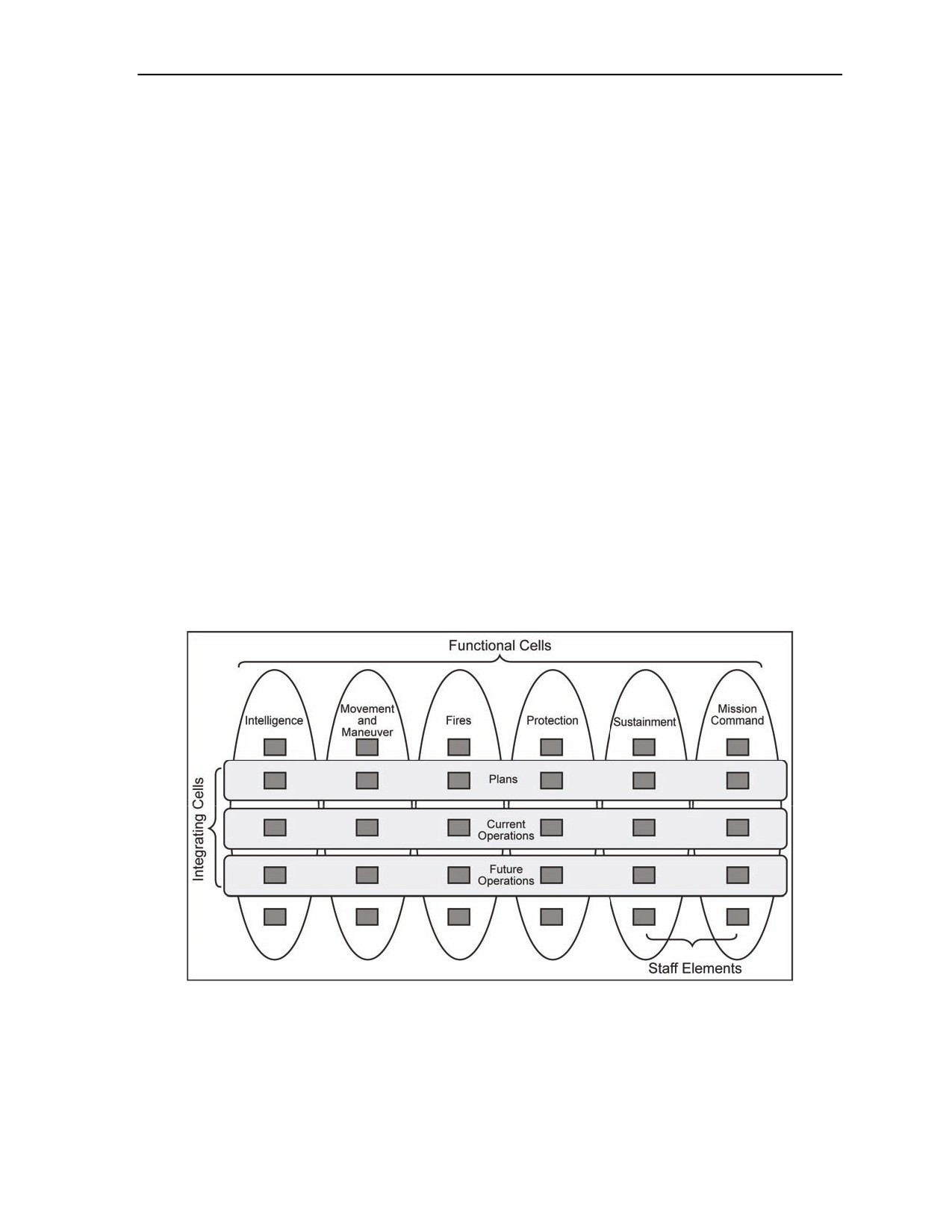
A-16. ±While each echelon and type of unit organizes CPs differently, two types of CP cells exist:
functional and integrating.
(See figure A-1.) Functional cells group personnel and equipment by
warfighting function. Integrating cells group personnel and equipment to integrate the warfighting
functions by planning horizon.
±Figure A-1. Functional and integrating cells
Functional Cells
A-17. ±Functional cells coordinate and synchronize forces and activities by warfighting function. The
functional cells within a CP are intelligence, movement and maneuver, fires, protection, sustainment, and
mission command. Echelons above brigade are resourced to establish all six functional cells described in
18 March 2011
FM 5-0, C1
A-3
Appendix A
paragraphs A-18 through A-23. See appropriate brigade and battalion manuals for specifics on the
functional cells at those levels.
Intelligence Cell
A-18. The intelligence cell coordinates activities and systems that help commanders understand the enemy,
terrain and weather, and civil considerations. The intelligence cell requests, receives, and analyzes
information from all sources to produce and distribute intelligence products. This includes tasks associated
with intelligence preparation of the battlefield and intelligence, surveillance, and reconnaissance. Most of
the intelligence staff section resides in this cell. The unit’s intelligence officer leads this cell.
Movement and Maneuver Cell
A-19. The movement and maneuver cell coordinates activities and systems that move forces to achieve a
position of advantage in relation to the enemy. This includes tasks associated with combining forces with
direct fire or fire potential (maneuver) and force projection (movement) related to gaining a positional
advantage over an enemy. Elements of the operations, airspace command and control, aviation, engineer,
geospatial information and service, and space staff sections form this cell. The unit’s operations officer
leads this cell. Staff elements in the movement and maneuver cell also form the core of the current
operations integration cell. (See paragraphs A-30 through A-32.)
±Fires Cell
A-20. The fires cell coordinates activities and systems that provide collective and coordinated use of Army
indirect fires, joint fires, and cyber/electromagnetic activities through the targeting process. The fires cell
consists of elements of fire support, Air Force (or air component), and electronic warfare staff section. The
unit’s chief of fires (or fire support officer brigade and below) leads this cell.
±Protection Cell
A-21. The protection cell coordinates the activities and systems that preserve the force through composite
risk management. This includes tasks associated with protecting personnel, physical assets, and
information. Elements of the following staff sections form this cell: air and missile defense; chemical,
biological, radiological, nuclear, and high-yield explosives; engineer; operations security; personnel
recovery; force health protection; and provost marshal. Additionally, a safety officer is assigned at theater
army and is often augmented as required down to the brigade level. The protection cell coordinates with the
signal staff section in the mission command cell to further facilitate the information protection task. The
chief of protection leads this cell.
Sustainment Cell
A-22. The sustainment cell coordinates activities and systems that provide support and services to ensure
freedom of action, extend operational reach, and prolong endurance. It includes those tasks associated with
logistics, personnel services, and Army health system support. The following staff sections form this cell:
personnel, logistics, financial management, engineer, and surgeon. The chief of sustainment (or logistics
officer brigade and below) leads this cell.
±Mission Command Cell
A-23. The mission command cell is made up of the G-6 (S-6) signal, G-7 (S-7) inform and influence
activities, and civil affairs operations staff sections. The mission command cell is unique among the other
functional cells in two ways. First, the mission command cell is not responsible for coordinating all the
tasks associated with its title. The mission command cell has a narrower focus. Second, the staff sections
that reside in the mission command cell report directly to the COS and not through a cell chief.
Integrating Cells
A-24. Whereas functional cells are organized by warfighting functions, integrating cells coordinate and
synchronize forces and warfighting functions within a specified planning horizon and include the plans,
A-4
FM 5-0, C1
18 March 2011
Command Post Organization and Operations
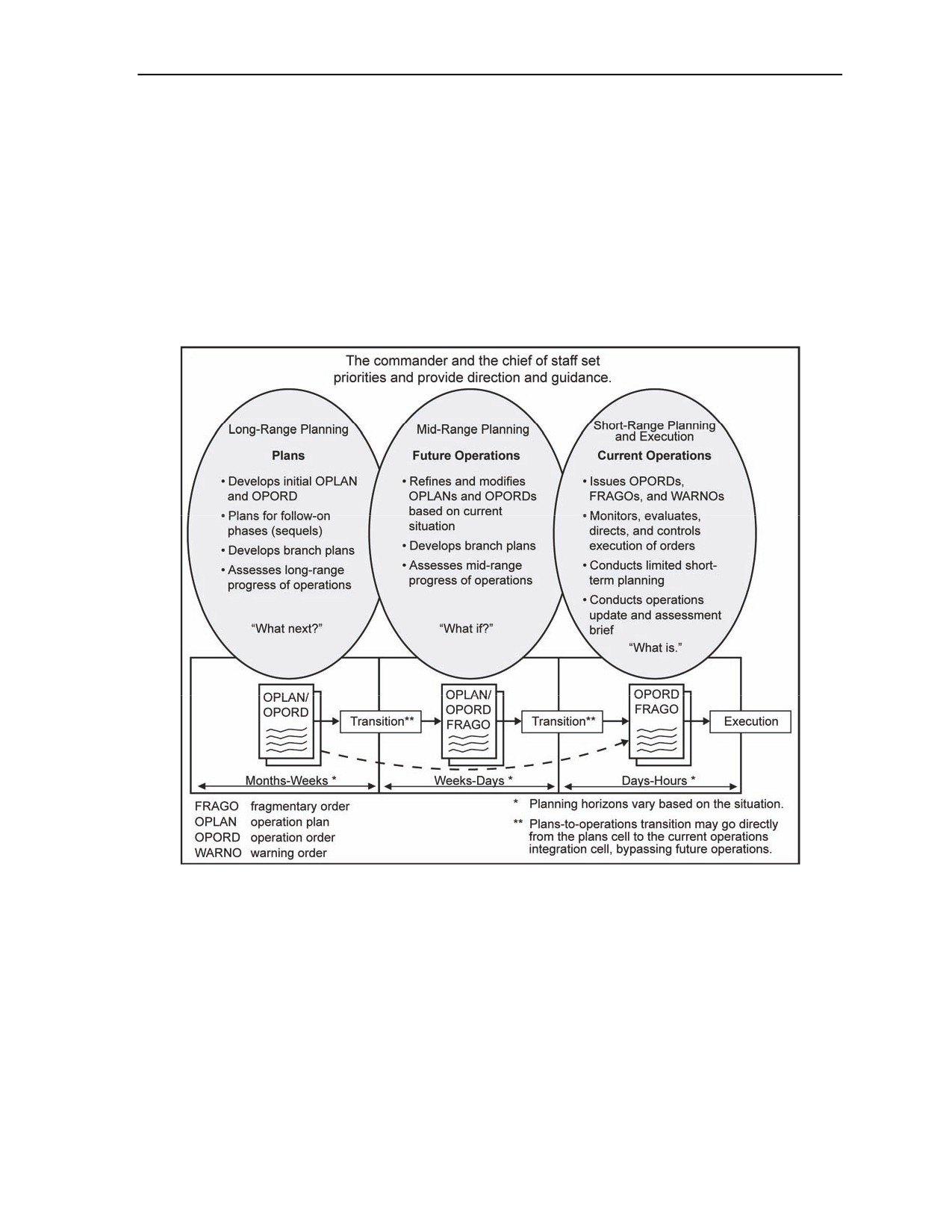
future operations, and current operations integration cells. A planning horizon is a point in time
commanders use to focus the organization’s planning efforts to shape future events. The three
planning horizons are long, mid, and short. Generally, they are associated with the plans cell, future
operations cell, and current operations integration cell respectively. Planning horizons are situation-
dependent; they can range from hours and days to weeks and months. As a rule, the higher the echelon, the
more distant the planning horizon with which it is concerned. (See chapter 2 for a discussion of planning in
time.)
A-25. Not all echelons and types of units are resourced for all three integrating cells. Battalions, for
example, combine their planning and operations responsibilities in one integrating cell. The brigade combat
team has a small, dedicated plans cell but is not resourced for a future operations cell. Divisions and above
are resourced for all three integrating cells as shown in figure A-2.
Figure A-2. Integration of plans, future operations, and current operations
Plans Cell
A-26. The plans cell is responsible for planning operations for the long-range planning horizons. It prepares
for operations beyond the scope of the current order by developing plans and orders, including branch plans
and sequels. The plans cell also oversees military deception planning.
A-27. The plans cell consists of a core group of planners and analysts led by the plans officer (or the
operations officer at battalion level). All staff sections assist as required. Whereas a brigade has a small,
dedicated plans cell, the majority of its staff sections balance their efforts between the current operations
integration and plans cells. Battalions are not resourced for a plans cell. Planning in combined arms
battalions occurs in the current operations integration cell.
18 March 2011
FM 5-0, C1
A-5
Appendix A
Future Operations Cell
A-28. The future operations cell is responsible for planning operations in the mid-range planning horizon. It
focuses on adjustments to the current operation—including the positioning or maneuvering of forces in
depth—that facilitates continuation of the current operation. The cell consists of a core group of planners
led by an assistant operations officer (the chief of future operations). All staff sections assist as required.
Divisions and above headquarters have a future operations cell. Battalion and brigade headquarters do not.
A-29. In many respects, the future operations cell serves as a fusion cell between the plans and current
operations integration cells. The future operations cell monitors current operations and determines
implications for operations within the mid-range planning horizon. In coordination with the current
operations integration cell, the future operations cell assesses whether the ongoing operation must be
modified to achieve the current phase’s objectives. Normally, the commander directs adjustments to the
operation, but the cell may also recommend options to the commander. Once the commander decides to
adjust the operation, the cell develops the fragmentary order necessary to implement the change. The future
operations cell also participates in the targeting working group since the same planning horizons normally
concern them both. The future operations cell updates and adds details to the branch plans foreseen in the
current operation and prepares any orders necessary to implement a sequel to the operation.
Current Operations Integration Cell
A-30. The current operations integration cell is the focal point for the execution of the operations. This
involves assessing the current situation while regulating forces and warfighting functions in accordance
with the mission, commander’s intent, and concept of operations.
A-31. The current operations integration cell displays the common operational picture and conducts shift
changes, assessments, and other briefings as required. It provides information on the status of operations to
all staff members and to higher, subordinate, and adjacent units. The operations synchronization meeting is
the most important event in the battle rhythm in support of the current operation.
A-32. The operations officer leads the current operations integration cell and is aided by an assistant
operations officer (the chief of operations). The movement and maneuver cell forms the core of the current
operations integration cell. Elements or watch officers from each staff section and liaison officers from
subordinate and adjacent units form the remainder of the cell. All staff sections are represented in the
current operations integration cell, either permanently or on call. (Chapter 5 discusses execution with a
focus on the current operations integration cell.)
Staff Sections
A-33. Not all staff sections reside in one of the functional or integrating cells. Personal staff officers and
their associated staff sections, such as the inspector general and public affairs staff sections, are examples.
Special staff sections such as the operations research/systems analysis, red team, and knowledge
management are other examples. These staff sections maintain their distinct organizations. They operate in
different CP cells as required and coordinate their activities in the various meetings established in the unit’s
battle rhythm.
COMMAND POST OPERATIONS
A-34. ±Units must man, equip, and organize command posts to control operations for extended periods.
Command post personnel, information systems, and equipment must be able to support 24-hour operations
while in continuous communication with all subordinate units and higher and adjacent units. Commanders
arrange CP personnel and equipment to facilitate internal coordination, information sharing, and rapid
decisionmaking. They also ensure they have procedures to execute the operations process within the
headquarters to enhance how they exercise mission command. Commanders use the following to assist
them with effective CP operations:
z
SOPs.
z
Battle rhythm.
z
Meetings.
A-6
FM 5-0, C1
18 March 2011
Command Post Organization and Operations
STANDARD OPERATING PROCEDURES
A-35. ±SOPs assist with effective mission command. These SOPs serve two purposes. Internal SOPs
standardize each CP’s internal operations and administration. External SOPs developed for the entire force
standardize interactions among CPs and between subordinate units and CPs. For SOPs to be effective, all
Soldiers must know their provisions and train to their standards. (See FM 7-15 for details on the task and
subtasks of “Conduct Command Post Operations.” )
A-36. Each CP should have SOPs that address the following:
z
Organization and setup.
z
Staffing and shifts plans.
z
Eating and sleeping plans.
z
Physical security and defense.
z
Priorities of work.
z
Equipment and vehicle maintenance.
z
Loading plans and equipment checklists.
z
Orders production and dissemination procedures.
z
Journals and log maintenance.
A-37. In addition to these SOPS, each CP requires—
z
CP battle drills.
z
Shift-change briefings.
z
Reports and returns.
z
Operation update and assessment briefings.
z
Operations synchronization meeting.
z
Transferring control between CPs.
Command Post Battle Drills
A-38. Each CP requires procedures to react to a variety of situations. Specific actions taken by a CP should
be defined in its SOPs and rehearsed during training and operations. Typical CP battle drills include—
z
React to an air attack.
z
React to a ground attack.
z
React to a chemical attack.
z
React to indirect fire.
z
React to jamming or suspected communications compromise.
z
Execute time-sensitive targets.
z
Execute a close air support or joint fires mission.
z
React to a mass casualty incident.
z
React to a civil riot or incident.
z
React to significant collateral damage.
z
React to a misinformation incident.
Shift-Change Briefings
A-39. During continuous operations, CPs operate in shifts. To ensure uninterrupted operations, staffs
execute a briefing when shifts change. Depending on the situation, it may be formal or informal and include
the entire staff or selected staff members. Normally it is done face-to-face among key CP leaders. The COS
(XO) oversees the briefing, with participants briefing their areas of expertise. The briefing’s purpose is to
inform the incoming shift of—
z
Current unit status.
z
Significant activities that occurred during the previous shift.
z
Significant decisions and events anticipated during the next shift.
18 March 2011
FM 5-0, C1
A-7
Appendix A
The commander may attend and possibly change the focus of the briefing. If the commander issues
guidance or makes a decision, issuing a fragmentary order may be necessary.
A-40. The shift-change briefing format and emphasis change based on the situation. For example, the
format for a force supporting civil authorities in a disaster area differs from one for a force conducting
offensive operations abroad. To facilitate a quick but effective shift-change briefing, unit SOPs should
contain tailored formats.
A-41. The shift-change briefing provides a mechanism to formally exchange information periodically
among CP staff members. However, CP staff members share information throughout the shift. They
coordinate activities and inform each other continuously. Information that answers a commander’s critical
information requirement and exceptional information is given to the commander immediately. Information
that can potentially affect the entire force is disseminated to the commander, higher headquarters, and
subordinate units as the situation dictates. Situational understanding for CP staff members includes
knowing who needs what relevant information and why they need it. CP staff members exercise initiative
when they ensure relevant information gets to people who need it.
Reports and Returns
A-42. A unit’s reporting system facilitates timely and effective information exchange among CPs and
higher, lower, and adjacent headquarters. An established SOP for reports and returns is key to effective
information management. These SOPs include—
z
The writer required to submit each report.
z
The frequency and time of each report.
z
The recipient of each report.
For those reports not standard in a unit SOP, list reports found in annex R of the operation plan and
operation order.
Operation Update and Assessment Briefing
A-43. An operation update and assessment briefing may occur daily or anytime the commander calls for
one. Its content is similar to the shift-change briefing but has a different audience. The staff presents it to
the commander and subordinate commanders. Its purpose is to provide all key personnel with common
situational awareness. Often commanders require this briefing shortly before an operation begins to
summarize changes made during preparation, including changes resulting from intelligence, surveillance,
and reconnaissance efforts.
A-44. During the briefing, staff sections present their running estimates. Subordinate commanders brief
their current situation and planned activities. Rarely do all members conduct this briefing face-to-face.
Various communications means are used including radio, conference calls, and video teleconference. All
CPs and subordinate commanders participate. The briefing follows a sequence and format specified by
SOPs. That keeps transmissions short, ensures completeness, and eases note taking. This briefing normally
has a format similar to a shift-change briefing. However, it omits CP administrative information and
includes presentations by subordinate commanders in an established sequence.
Operations Synchronization Meeting
A-45. The operations synchronization meeting is the key event in the battle rhythm in support of the current
operation. Its primary purpose is to synchronize all warfighting functions and other activities in the short-
term planning horizon. It is designed to ensure that—
z
All staff members have a common understanding of current operation, including upcoming
decision points and projected actions at those decision points.
z
All warfighting functions are synchronized and appropriate fragmentary orders are issued to
subordinates based on the commander’s intent for current operations.
A-46. ±The operations synchronization meeting does not replace the shift-change briefing or operation
update and assessment briefing. The meeting is chaired by the G-3 (S-3). Representatives of each CP cell
A-8
FM 5-0, C1
18 March 2011
Command Post Organization and Operations
and separated staff section attend. Key outputs of the operations synchronization meeting include a
fragmentary order addressing any required changes to maintain synchronization of the current operations
planning guidance for upcoming working groups and boards.
Transferring Control of Operations Between Command Posts
A-47. The employment and use of CPs are important decisions reflected in the operation order. Often, a
particular CP may control a part of the operation or all of the operation for a specific time. Effectively
transferring control between CPs requires a well-understood SOP and clear instructions in the operations
order.
A-48. ±While all CPs have some ability to exercise control on the move, they lose many capabilities they
have when stationary. Therefore, CPs normally control operations from a static location. During moves,
control responsibilities are transferred to another CP. Transfer of control requires notifying subordinates
since many network operations change to route information to the new controlling CP. SOPs establish these
requirements to minimize interruptions when transferring control.
BATTLE RHYTHM
A-49. Battle rhythm is a deliberate daily cycle of command, staff, and unit activities intended to
synchronize current and future operations (JP 3-33). A headquarters’ battle rhythm consists of a series of
meetings, briefings, and other activities synchronized by time and purpose. The COS (XO) oversees the
battle rhythm. Each meeting, to include working groups and boards, should be logically sequenced so that
one meeting’s outputs are available as another meeting’s inputs (to include higher headquarters meetings).
The COS (XO) balances the time required to plan, prepare for, and hold meetings and conduct briefings
with other staff duties and responsibilities. The COS
(XO) also critically examines attendance
requirements. Some staff sections and CP cells may lack the personnel to attend all events. The COS (XO)
and staff members constantly look for ways to combine meetings and eliminate unproductive ones.
A-50. The battle rhythm facilitates integration and collaboration. The COS (XO) manages the headquarters’
battle rhythm. This battle rhythm serves several important functions, to include—
z
Establishing a routine for staff interaction and coordination.
z
Facilitating interaction between the commander and staff.
z
Synchronizing activities of the staff in time and purpose.
z
Facilitating planning by the staff and decisionmaking by the commander.
A-51. The battle rhythm changes during execution as operations progress. For example, early in the
operation a commander may require a plans update briefing daily. As the situation changes, the commander
may only require a plans update every three days. Many factors help determine a unit’s battle rhythm.
Some factors include the staff’s proficiency, higher headquarters’ battle rhythm, and current mission. In
developing the unit’s battle rhythm, the chief COS (XO) considers—
z
Higher headquarters’ battle rhythm and report requirements.
z
Subordinate headquarters’ battle rhythm requirements.
z
The duration and intensity of the operation.
z
Integrating cells’ planning requirements.
MEETINGS
A-52. Meetings are gatherings to present and exchange information, solve problems, coordinate action, and
make decisions. They may involve the staff; the commander and staff; or the commander, subordinate
commanders, staff, and other partners. Who attends depends on the issue. Commanders establish these
meetings to integrate the staff and enhance planning and decisionmaking within the headquarters.
Commanders also identify staff members to participate in the higher commander’s meeting, including
working groups and boards. (See JP 3-33 for a discussion of the various working groups and boards used
by joint force commanders.)
18 March 2011
FM 5-0, C1
A-9
Appendix A
A-53. The number of meetings and subjects they address depend on the situation and echelon. While
numerous informal meetings occur daily within a headquarters, meetings commonly included in a unit’s
battle rhythm and the cells responsible for them include—
z
A shift-change briefing (current operations integration cell).
z
An operation update and assessment briefing (current operations integration cell).
z
An operations synchronization meeting (current operations integration cell).
z
Planning meetings and briefings (plans or future operations cells).
z
Working groups and boards (various functional and integrating cells).
A-54. Often, the commander establishes and maintains only those meetings required by the situation.
Commanders—assisted by the COS (XO)—establish, modify, and dissolve meetings as the situation evolves.
The COS (XO) manages the timings of these events through the unit’s battle rhythm. (See paragraphs A-49
through A-51.)
A-55. For each meeting, the unit’s SOPs address—
z
Purpose.
z
Frequency.
z
Composition (chair and participants).
z
Inputs and expected outputs.
z
Agenda.
A-56. Working groups and boards are types of meetings and are included on the unit’s battle rhythm. A
working group is a grouping of predetermined staff representatives who meet to provide analysis,
coordinate, and provide recommendations for a particular purpose or function. Working groups are
cross-functional by design to synchronize the contributions of multiple CP cells and staff sections. For
example, the targeting working group brings together representatives of all staff elements concerned with
targeting. It synchronizes the contributions of all staff elements with the work of the fires cell. It also
synchronizes fires with future operations and current operations integration cells.
A-57. Typical working groups and the lead cell or staff section at division and corps headquarters include
the—
z
Assessment working group (plans or future operations cell).
z
Intelligence, surveillance, and reconnaissance working group (intelligence cell).
z
Targeting working group (fires cell).
z
Protection working group (protection cell).
z
Civil affairs operations working group (civil affairs operations staff section).
A-58. The number of subjects that working groups address depends on the situation and echelon. Battalion
and brigade headquarters normally have fewer working groups than higher echelons. Working groups may
convene daily, weekly, monthly, or on call depending on the subject, situation, and echelon.
A-59. A board is a grouping of predetermined staff representatives with delegated decision authority
for a particular purpose or function. Boards are similar to working groups. However, commanders
appoint boards with the purpose to arrive at a decision. When the process or activity being synchronized
requires command approval, a board is the appropriate forum.
A-10
FM 5-0, C1
18 March 2011
Appendix B
The Military Decisionmaking Process
This appendix defines and describes the military decisionmaking process (MDMP).
To conduct the MDMP effectively, leaders must first understand the fundamentals of
planning and design. (See chapters 2 and 3 respectively.) Additional doctrine on
commander’s planning guidance, formats for plans and orders, task organization, and
running estimates are located in appendixes D, E, F, and G respectively.
OVERVIEW
B-1. The military decisionmaking process is an iterative planning methodology that integrates the
activities of the commander, staff, subordinate headquarters, and other partners to understand the
situation and mission; develop and compare courses of action; decide on a course of action that best
accomplishes the mission; and produce an operation plan or order for execution. The MDMP helps
leaders apply thoroughness, clarity, sound judgment, logic, and professional knowledge to understand
situations, develop options to solve problems, and reach decisions. It is a process that helps commanders,
staffs, and others think critically and creatively while planning. (See chapter 1.)
Note: Joint force headquarters use the joint operation planning process (known as JOPP), which
is similar to the Army’s MDMP. (See JP 5-0.) Marine Corps headquarters use the Marine Corps
planning process, which is similar to both the MDMP and the joint operation planning process.
(See MCWP 5-1.)
B-2. The MDMP facilitates collaborative and parallel planning as the higher headquarters solicits input
and continuously shares information concerning future operations with subordinate and adjacent units,
supporting and supported units, and other military and civilian partners through planning meetings, warning
orders, and other means. Commanders encourage active collaboration among all organizations affected by
the pending operations to build a shared understanding of the situation, participate in course of action
development and decisionmaking, and resolve conflicts before publication of the plan or order.
B-3. The MDMP also drives preparation. Since time is a factor in all operations, commanders and staffs
conduct a time analysis early in the planning process. This analysis helps them determine what actions are
required and when those actions must begin to ensure forces are ready and in position before execution.
This may require the commander to direct subordinates to start necessary movements; conduct task
organization changes; begin intelligence, surveillance, and reconnaissance (ISR) operations; and execute
other preparation activities before completing the plan. These tasks are directed in a series of warning
orders (WARNOs) as the commander and staff conducts the MDMP.
B-4. During planning, assessment focuses on developing an understanding of the current situation and
determining what to assess and how to assess progress using measures of effectiveness and measures of
performance. Developing the unit’s assessment plan occurs during the MDMP—not after the plan or order
is developed. (See chapter 6 for a discussion of the fundamentals of assessment. See appendix H for details
in developing an assessment plan.)
B-5. Depending on complexity of the situation, commanders may initiate design activities before or in
parallel with the MDMP. Commanders may choose to conduct design to assist them in understanding the
operational environment, framing the problem, and considering operational approaches to solve or manage
the problem. The products of design, including the operational approach, would guide more detailed
planning as part of the MDMP. Commanders may also conduct design in parallel with the MDMP. In this
instance, members of the staff conduct mission analysis as the commander and other staff members engage
in design activities prior to course of action development. In time-constrained conditions or if the problem
18 March 2011
FM 5-0, C1
B-1
Appendix B
is relatively straight forward, commanders may conduct the MDMP without the benefit of a formal design
process. During execution, commander may conduct design to help refine their understanding and
visualization and adjust the plan as required. (See chapter 2 for a discussion on the interface between
design and the MDMP.)
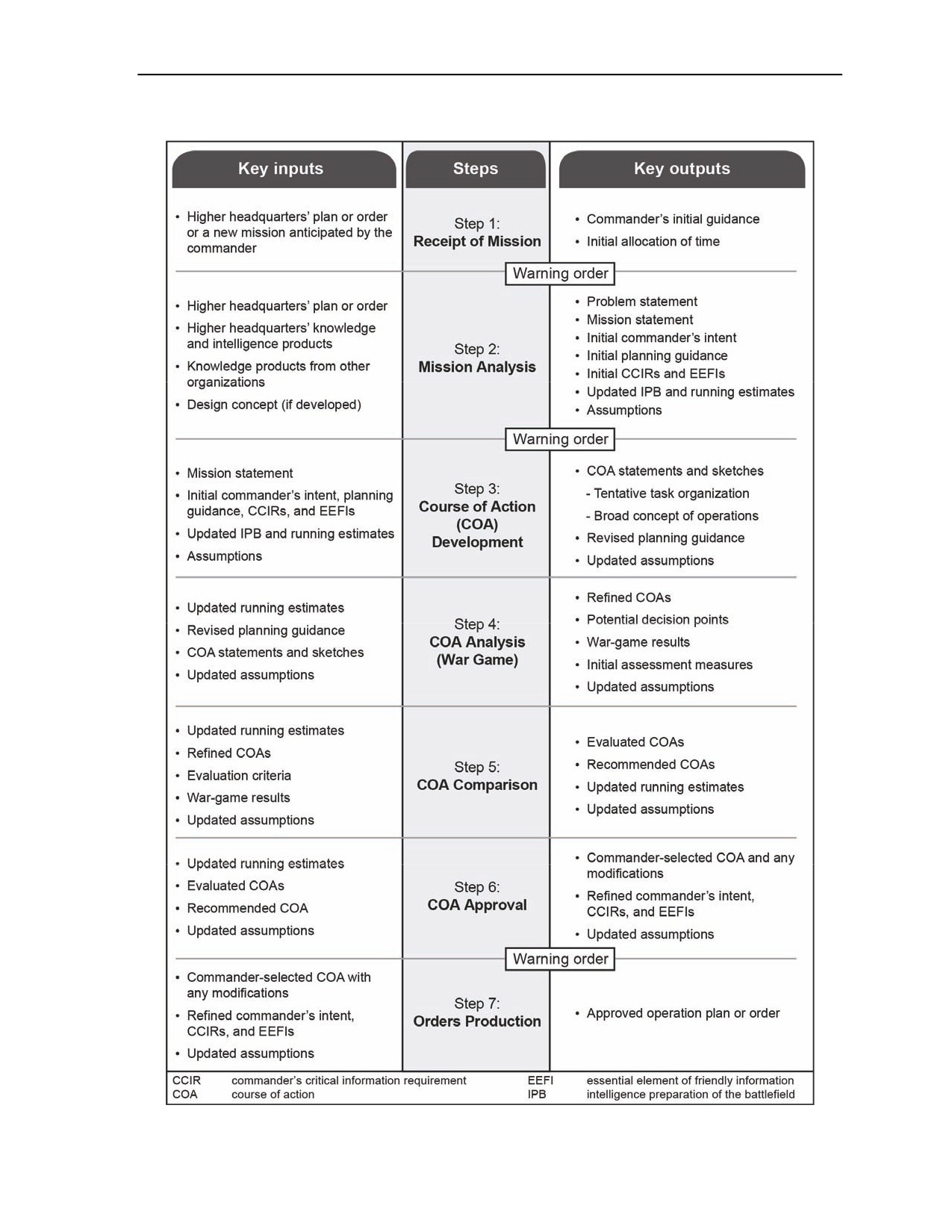
THE STEPS OF THE MILITARY DECISIONMAKING PROCESS
B-6. The MDMP consists of seven steps as shown in figure B-1. Each step of the MDMP has various
inputs, a method (step) to conduct it, and outputs. The outputs lead to an increased understanding of the
situation facilitating the next step of the MDMP. Commanders and staffs generally perform these steps
sequentially; however, they may revisit several steps in an iterative fashion as they learn more about the
situation before producing the plan or order.
B-7. Commanders initiate the MDMP upon receipt of or in anticipation of a mission. Commanders and
staffs often begin planning in the absence of a complete and approved higher headquarters’ operation plan
(OPLAN) or operation order (OPORD). In these instances, the headquarters begins a new planning effort
based on a WARNO and other directives, such as a planning order or an alert order from their higher
headquarters. This requires active collaboration with the higher headquarters and parallel planning among
echelons as the plan or order is developed.
THE ROLE OF COMMANDERS AND STAFFS IN THE MDMP
B-8.
±The commander is the most important participant in the MDMP. More than simply decisionmakers
in this process, commanders use their experience, knowledge, and judgment to guide staff planning efforts.
While unable to devote all their time to the MDMP, commanders remain aware of the current status of the
planning effort, participate during critical periods of the process, and make sound decisions based on the
detailed work of the staff. During the MDMP, commanders focus their activities on understanding,
visualizing, and describing as addressed in chapter 2.
B-9. The MDMP stipulates several formal meetings and briefings between the commander and staff to
discuss, assess, and approve or disapprove planning efforts as they progress. However, experience has
shown that optimal planning results when the commander meets informally at frequent intervals with the
staff throughout the MDMP. Such informal interaction among the commander and staff can improve
understanding of the situation and ensure the planning effort adequately reflects the commander’s
visualization of the operation.
B-10. The chief of staff (COS) or executive officer (XO) is a key participant in the MDMP. The COS (XO)
manages and coordinates the staff’s work and provides quality control during the MDMP. The COS (XO)
must clearly understand the commander’s intent and guidance because COSs (XOs) supervise the entire
process. They provide timelines to the staff, establish briefing times and locations, and provide any
instructions necessary to complete the plan.
B-11. The staff’s effort during the MDMP focuses on helping the commander understand the situation,
making decisions, and synchronizing those decisions into a fully developed plan or order. Staff activities
during planning initially focus mission analysis. The products developed during mission analysis help
commanders understand the situation and develop the commander’s visualization. During course of action
(COA) development and COA comparison, the staff provides recommendations to support the commander
in selecting a COA. After the commander makes a decision, the staff prepares the plan or order that reflects
the commander’s intent, coordinating all necessary details.
MODIFYING THE MDMP
B-12. The MDMP can be as detailed as time, resources, experience, and the situation permit. Conducting
all the steps and substeps of the MDMP is detailed, deliberate, and time-consuming. Commanders use the
full MDMP when they have enough planning time and staff support to thoroughly examine two or more
COAs and develop a fully synchronized plan or order. This typically occurs when planning for an entirely
new mission.
B-2
FM 5-0, C1
18 March 2011
The Military Decisionmaking Process
±Figure B-1. The steps of the military decisionmaking process
18 March 2011
FM 5-0, C1
B-3
Appendix B
B-13. Commanders may alter the steps of the MDMP to fit time-constrained circumstances and produce a
satisfactory plan. In time-constrained conditions, commanders assess the situation, update the commander’s
visualization, and direct the staff to perform the MDMP activities that support the required decisions. (See
paragraphs B-186 through B-202.) In extremely compressed situations, commanders rely on more intuitive
decisionmaking techniques, such as the rapid decisionmaking and synchronization process described in
chapter 5.
PERFORMING THE MILITARY DECISIONMAKING PROCESS
B-14. This section describes the methods and provides techniques for conducting each step of the MDMP.
It describes the key inputs to each step and expected key outputs. This section also describes how the
intelligence preparation of the battlefield (IPB), targeting, composite risk management (CRM), and ISR
synchronization are integrated throughout the MDMP.
RECEIPT OF MISSION
B-15. Commanders initiate the MDMP upon receipt or in anticipation of a mission. The purpose of this
step is to alert all participants of the pending planning requirements, determine the amount of time available
for planning and preparation, and decide on a planning approach, including guidance on design and how to
abbreviate the MDMP, if required. When a new mission is identified, commanders and staffs perform the
actions and produce the outputs as described in paragraphs B-16 through B-24.
Alert the Staff and Other Key Participants
B-16. ±As soon as a unit receives a new mission (or when the commander directs), the current operations
integration cell alerts the staff of the pending planning requirement. Unit standard operating procedures
(SOPs) should identify members of the planning staff who participate in mission analysis. In addition, the
current operations integration cell also notifies other military, civilian, and host-nation organizations of
pending planning events as required.
Gather the Tools
B-17. Once notified of the new planning requirement, the staff prepares for mission analysis by gathering
the tools needed to perform it. These tools include, but are not limited to—
z
Appropriate field manuals, including FM 5-0 and FM 1-02.
z
All documents related to the mission and area of operations
(AO), including the higher
headquarters’ OPLAN and OPORD, maps and terrain products, and operational graphics.
z
Higher headquarters’ and other organizations’ intelligence and assessment products.
z
Estimates and products of other military and civilian agencies and organizations.
z
Both their own and the higher headquarters’ SOPs.
z
Current running estimates.
z
Any design products, including the design concept.
B-18. The gathering of knowledge products continues throughout the MDMP. Staff officers carefully
review the reference sections (located before paragraph 1. Situation) of the higher headquarters’ OPLANs
and OPORDs to identify documents (such as theater policies and memoranda) related to the upcoming
operation. If the MDMP occurs while in the process of replacing another unit, the staff begins collecting
relevant documents—such as the current OPORD, branch plans, current assessments, operations and
intelligence summaries, and SOPs—from that unit.
Update Running Estimates
B-19. While gathering the necessary tools for planning, each staff section begins updating its running
estimate—especially the status of friendly units and resources and key civil considerations that affect each
functional area. Running estimates not only compile critical facts and assumptions from the perspective of
each staff section, but also include information from other staff sections and other military and civilian
B-4
FM 5-0, C1
18 March 2011
The Military Decisionmaking Process
organizations. While this task is listed at the beginning of the MDMP, developing and updating running
estimates continues throughout the MDMP and the operations process. (See appendix G.)
Conduct Initial Assessment
B-20. During receipt of mission, the commander and staff conduct an initial assessment of time and
resources available to plan, prepare, and begin execution of an operation. This initial assessment helps
commanders determine—
z
The time needed to plan and prepare for the mission for both the headquarters and subordinate
units.
z
Guidance on design and abbreviating the MDMP, if required.
z
Which outside agencies and organizations to contact and incorporate into the planning process.
z
The staff’s experience, cohesiveness, and level of rest or stress.
B-21. A key product of this assessment is an initial allocation of available time. The commander and staff
balance the desire for detailed planning against the need for immediate action. The commander provides
guidance to subordinate units as early as possible to allow subordinates the maximum time for their own
planning and preparation of operations. As a rule, the commander allocates a minimum of two-thirds of
available time for subordinate units to conduct their planning and preparation. This leaves one-third of the
time for commanders and their staff to do their planning. They use the other two-thirds for their own
preparation. Time, more than any other factor, determines the detail to which the commander and staff can
plan.
B-22. Based on the commander’s initial allocation of time, the COS (XO) develops a staff planning
timeline that outlines how long the headquarters can spend on each step of the MDMP. The staff planning
timeline indicates what products are due, who is responsible for them, and who receives them. It includes
times and locations for meetings and briefings. It serves as a benchmark for the commander and staff
throughout the MDMP.
Issue the Commander’s Initial Guidance
B-23. Once time is allocated, the commander determines whether to initiate design, conduct design and
MDMP in parallel, or proceed directly into the MDMP without the benefits of formal design activities. In
time-sensitive situations where commanders decide to proceed directly into the MDMP, they may also
issue guidance on how to abbreviate the process. Having determined the time available together with the
scope and scale of the planning effort, commanders issue initial planning guidance. Although brief, the
initial guidance includes—
z
Initial time allocations.
z
A decision to initiate design or go straight into the MDMP.
z
How to abbreviate the MDMP, if required.
z
Necessary coordination to perform, including liaison officers to exchange.
z
Authorized movements and any reconnaissance and surveillance to initiate.
z
Collaborative planning times and locations.
z
Initial information requirements (IRs).
z
Additional staff tasks.
Issue the Initial Warning Order
B-24. The last task in receipt of mission is to issue a WARNO to subordinate and supporting units. This
order includes at a minimum the type of operation, the general location of the operation, the initial timeline,
and any movement or reconnaissance to initiate.
MISSION ANALYSIS
B-25. The MDMP continues with an assessment of the situation called mission analysis. Commanders
(supported by their staffs and informed by subordinate and adjacent commanders and by other partners)
18 March 2011
FM 5-0, C1
B-5
Appendix B
gather, analyze, and synthesize information to orient themselves on the current conditions of the
operational environment. The commander and staff conduct mission analysis to better understand the
situation and problem, and identify what the command must accomplish, when and where it must be done,
and most importantly why—the purpose of the operation.
B-26. Since no amount of subsequent planning can solve a problem insufficiently understood, mission
analysis is the most important step in the MDMP. This understanding of the situation and the problem
allows commanders to visualize and describe how the operation may unfold in their initial commander’s
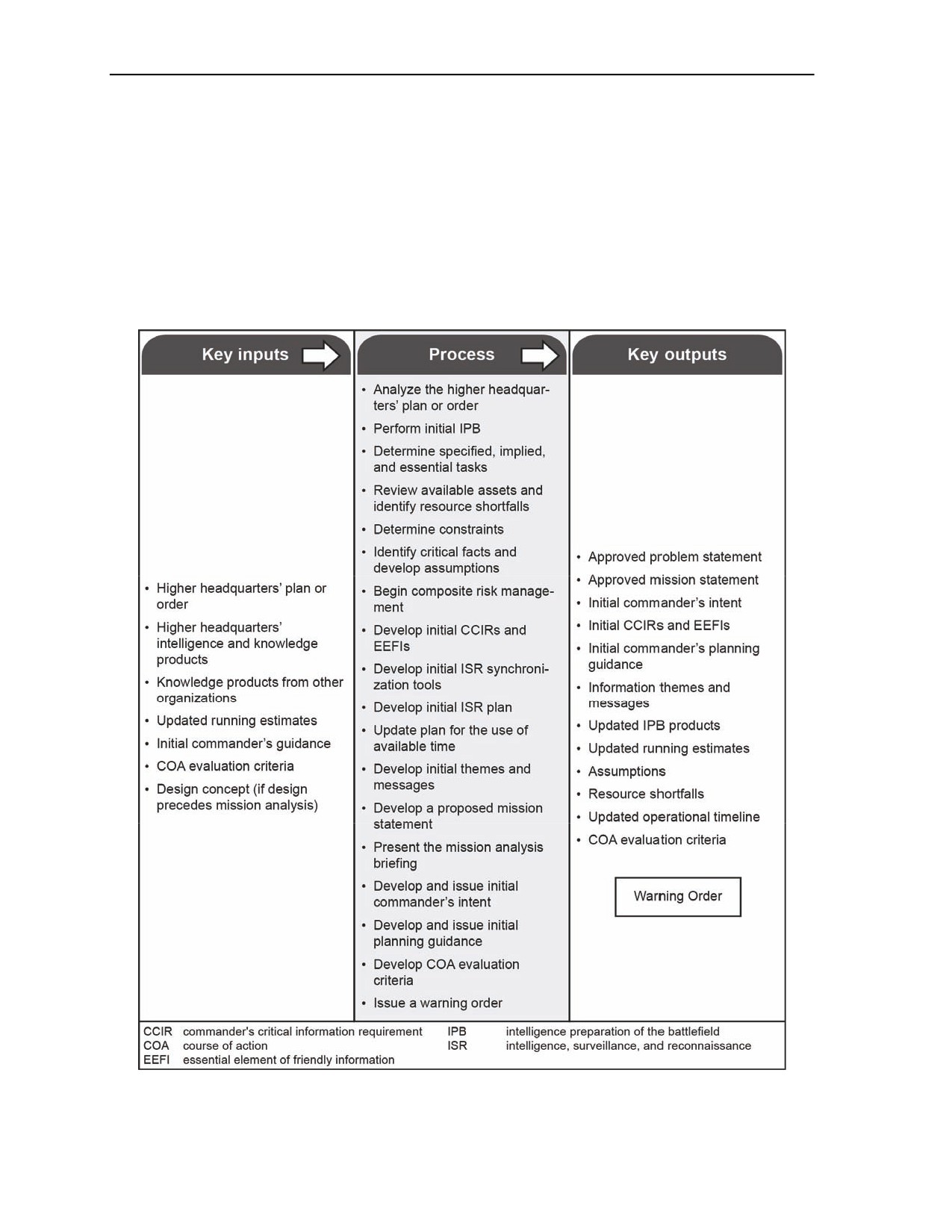
intent and planning guidance. During mission analysis, the commander and staff perform the process
actions and produce the outputs shown in figure B-2. See FM 6-0 for specific areas of responsibility for
each staff section.
±Figure B-2. Mission analysis
B-6
FM 5-0, C1
18 March 2011
The Military Decisionmaking Process
Analyze the Higher Headquarters’ Plan or Order
B-27. Commanders and staffs thoroughly analyze the higher headquarters’ plan or order. They aim to
determine how their unit—by task and purpose—contributes to the mission, commander’s intent, and
concept of operations of the higher headquarters. The commander and staff seek to completely
understand—
z
The higher headquarters’—
Commander’s intent.
Mission.
Concept of operations.
Available assets.
Timeline.
z
The missions of adjacent, supporting, and supported units and their relationships to the higher
headquarters’ plan.
z
The missions of interagency, intergovernmental, and nongovernmental organizations that work
in the operational areas.
z
Their assigned area of operations.
B-28. If the commander misinterprets the higher headquarters’ plan, time is wasted. Additionally, when
analyzing the higher order, the commander and staff may identify difficulties and contradictions in the
higher order. Therefore, if confused by the higher headquarters’ order or guidance, commanders seek
clarification immediately. Liaison officers familiar with the higher headquarters’ plan can help clarify
issues. Collaborative planning with the higher headquarters also facilitates this task. Staffs also use requests
for information (RFIs) to clarify or obtain additional information from the higher headquarters.
Perform Initial Intelligence Preparation of the Battlefield
B-29. IPB and the products it produces help the commander and staff understand situations. IPB is a
systematic, continuous process of analyzing the threat and operational environment in a specific geographic
area. Led by the intelligence officer, the entire staff participates in IPB to develop and maintain an
understanding of the enemy, terrain and weather, and key civil considerations. (See FM 2-01.3 for a more
detailed discussion of IPB.)
B-30. IPB begins in mission analysis and continues throughout the operations process. Results of the initial
IPB include terrain products and weather products (to include the modified combined obstacle overlay),
likely enemy COAs, high-value target lists, and explanations of how key civil considerations affect the
operation. Additionally, the initial IPB identifies gaps in information that the commander uses to establish
initial priority information requirements (PIRs) and RFIs.
Determine Specified, Implied, and Essential Tasks
B-31. The staff analyzes the higher headquarters’ order and the higher commander’s guidance to determine
their specified and implied tasks. In the context of operations, a task is a clearly defined and measurable
activity accomplished by Soldiers, units, and organizations that may support or be supported by other tasks.
The “what” of a mission statement is always a task. From the list of specified and implied tasks, the staff
determines essential tasks for inclusion in the recommended mission statement.
B-32. A specified task is a task specifically assigned to a unit by its higher headquarters. Paragraphs 2
and 3 of the higher headquarters’ order or plan state specified tasks. Some tasks may be in paragraphs 4
and 5. Specified tasks may be listed in annexes and overlays. They may also be assigned verbally during
collaborative planning sessions or in directives from the higher commander.
B-33. An implied task is a task that must be performed to accomplish a specified task or mission but
is not stated in the higher headquarters’ order. Implied tasks are derived from a detailed analysis of the
higher headquarters’ order, the enemy situation, the terrain, and civil considerations. Additionally, analysis
of doctrinal requirements for each specified task might disclose implied tasks.
18 March 2011
FM 5-0, C1
B-7
Appendix B
B-34. ±When analyzing the higher order for specified and implied tasks, the staff also identifies any be-
prepared or on-order mission. A be-prepared mission is a mission assigned to a unit that might be
executed. It is generally a contingency mission that units will execute because something planned has or
has not been successful. In planning priorities, units plan a be-prepared mission after any on-order mission.
An on-order mission is a mission to be executed at an unspecified time. A unit with an on-order mission
is a committed force. Commanders envisions task execution in the concept of operations; however, they
may not know the exact time or place of execution. Subordinate commanders develop plans and orders and
allocate resources, task-organize, and position forces for execution.
B-35. Units with an assigned AO are responsible for ensuring that essential stability tasks are conducted for
the population in areas they control. While some stability tasks will be specified, commanders consider the
primary stability tasks found in FM 3-07 as sources for implied tasks. By analyzing these primary stability
tasks and their associated subtasks, commanders and staffs develop implied tasks. These implied tasks, at a
minimum, provide for civil security, restoration of essential services, and civil control for civil populations
in their AO that they control. Based on this analysis, the staff determines if there are other agencies, civil or
military, that can provide these tasks. If not, the unit plans to provide these tasks using available assets. If
the unit determines that it does not have the assets, it informs its higher headquarters. The higher
headquarters then either provide the assets or assigns the task to another unit.
B-36. Once staff members have identified specified and implied tasks, they ensure they understand each
task’s requirements and purpose. Any task that must be successfully completed for the commanders to
accomplish their purpose is an essential task. An essential task is a specified or implied task that must be
executed to accomplish the mission. Essential tasks are always included in the unit’s mission statement.
Review Available Assets and Identify Resource Shortfalls
B-37. The commander and staff examine additions to and deletions from the current task organization,
command and support relationships, and status (current capabilities and limitations) of all units. This
analysis also includes the capabilities of civilian and military organizations (joint, special operations, and
multinational) that operate within the unit’s AO. They consider relationships among specified, implied, and
essential tasks, and between them and available assets. From this analysis, staffs determine if they have the
assets needed to accomplish all tasks. If shortages occur, they identify additional resources needed for
mission success to the higher headquarters. Staffs also identify any deviations from the normal task
organization and provide them to the commander to consider when developing the planning guidance. A
more detailed analysis of available assets occurs during COA development.
Determine Constraints
B-38. The commander and staff identify any constraints placed on their command. A constraint is a
restriction placed on the command by a higher command. A constraint dictates an action or inaction,
thus restricting the freedom of action of a subordinate commander. Constraints are found in
paragraph 3 in the OPLAN or OPORD. Annexes to the order may also include constraints. The operation
overlay, for example, may contain a restrictive fire line or a no fire area. Constraints may also be issued
verbally, in WARNOs, or in policy memoranda.
Note: Joint doctrine uses the term operational limitation that includes the terms constraints and
restrictions that differ from Army doctrine. An operational limitation is an action required or
prohibited by higher authority, such as a constraint or a restraint, and other restrictions that limit
the commander’s freedom of action, such as diplomatic agreements, rules of engagement,
political and economic conditions in affected countries, and host nation issues (JP 5-0). In the
context of joint operation planning, a constraint is requirement placed on the command by a
higher command that dictates an action, thus restricting freedom of action (JP 5-0). In the
context of joint operation planning, a restraint requirement placed on the command by a higher
command that prohibits an action, thus restricting freedom of action (JP 5-0).
B-8
FM 5-0, C1
18 March 2011
The Military Decisionmaking Process
Identify Critical Facts and Develop Assumptions
B-39. Plans and orders are based on facts and assumptions. Commanders and staffs gather facts and
develop assumptions as they build their plan. A fact is a statement of truth or a statement thought to be true
at the time. Facts concerning the operational and mission variables serve as the basis for developing
situational understanding, for continued planning, and when assessing progress during preparation and
execution.
B-40. In the absence of facts, the commander and staff consider assumptions from their higher headquarters
and develop their own assumptions necessary for continued planning. An assumption is a supposition on
the current situation or a presupposition on the future course of events, either or both assumed to be true in
the absence of positive proof, necessary to enable the commander in the process of planning to complete an
estimate of the situation and make a decision on the course of action (JP 1-02).
B-41. Having assumptions requires commanders and staffs to continually attempt to replace those
assumptions with facts. The commander and staff should list and review the key assumptions on which
fundamental judgments rest throughout the MDMP. Rechecking assumptions is valuable at any time during
the operations process prior to rendering judgments and making decisions. (See chapter 2 for a detailed
discussion on verifying assumptions.)
Begin Composite Risk Management
B-42. CRM is the Army’s primary process for identifying hazards and controlling risks during operations.
CRM is the process of identifying, assessing, and controlling risks arising from operational factors and of
making decisions that balance risk costs with mission benefits. (See FM 5-19 for a detailed discussion on
CRM.)
B-43. The chief of protection (or S-3 in units without a protection cell) in coordination with the safety
officer integrates CRM into the MDMP. All staff sections integrate CRM for hazards within their
functional areas. The first four steps of CRM are conducted in the MDMP. The details for conducting
CRM, including products of each step, are addressed in FM 5-19.
Develop Initial Commander’s Critical Information Requirements and Essential Elements of
Friendly Information
B-44. Mission analysis identifies gaps in information required for further planning and decisionmaking
during preparation and execution. During mission analysis, the staff develops IRs. Information
requirements are all information elements the commander and staff require to successfully conduct
operations; that is, all elements necessary to address the factors of METT-TC (FM 6-0). Some IRs are of
such importance to the commander that they are nominated to the commander to become a commander’s
critical information requirement
(CCIR). The two types of CCIRs are friendly force information
requirements and PIRs. (See chapter 2.)
B-45. Commanders determine their CCIRs and consider the nominations of the staff. CCIRs are situation-
dependent and specified by the commander for each operation. Commanders continuously review the
CCIRs during the planning process and adjust them as situations change. The initial CCIRs developed
during mission analysis normally focus on decisions the commander needs to make to focus planning. Once
the commander selects a COA, the CCIRs shift to information the commander needs in order to make
decisions during preparation and execution. Commanders designate CCIRs to let the staff and subordinates
know what information they deem essential for making decisions. The fewer the CCIRs, the better the staff
can focus its efforts and allocate sufficient resources for collecting them.
B-46. In addition to nominating CCIRs to the commander, the staff also identifies and nominates essential
elements of friendly information (EEFIs). Although EEFIs are not CCIRs, they have the same priority as
CCIRs and require approval by the commander. An EEFI establishes an element of information to protect
rather than one to collect. EEFIs identify those elements of friendly force information that, if compromised,
would jeopardize mission success. Like CCIRs, EEFIs change as the operation progresses.
B-47. Depending on the situation, the commander and selected staff meet prior to the mission analysis brief
to approve the initial CCIRs and EEFIs. This is especially important if the commander intends to conduct
18 March 2011
FM 5-0, C1
B-9
Appendix B
reconnaissance and intelligence collection early in the planning process. The approval of the initial CCIRs
early in planning assist the staff in developing the initial ISR synchronization tools and the subsequent ISR
plan. Approval of the EEFI allows the staff to begin planning and implementing measures to protect
friendly force information, such as deception and operations security.
±Develop Initial ISR Synchronization Tools
B-48. Several activities conducted during mission analysis (such as IPB, developing running estimates, and
developing requirements for targeting) create numerous IRs. ISR synchronization is a key integrating
process that helps the commander and staff prioritize, manage, and develop a plan to collect on those IRs.
ISR synchronization ensures all available information concerning the enemy, terrain and weather, and civil
considerations is obtained through intelligence reach, RFIs, and reconnaissance and surveillance tasks. The
results are successful reporting, production, and dissemination of relevant information and intelligence to
support decisionmaking.
B-49. ISR synchronization accomplishes the following:
z
Identifies requirements and intelligence gaps.
z
Evaluates available assets (internal and external) to collect information.
z
Determines gaps in the use of those assets.
z
Recommends those ISR assets controlled by the organization to collect on the IRs.
z
Submits RFIs for adjacent and higher collection support.
z
The G-2 (S-2) submits information gathered during ISR synchronization to the G-3 (S-3) for
integration and development of the ISR plan.
B-50. During mission analysis, the staff identifies IRs to support situational understanding and continued
planning. Based on the commander’s guidance, the staff, led by the G-2 (S-2), determines the best way of
satisfying those requirements. In some instances, the G-2 (S-2) recommends that internal reconnaissance or
surveillance assets are used to collect information. In other instances, the G-2 (S-2) recommends an RFI to
the higher headquarters.
B-51. In many instances, a staff section within the headquarters can satisfy IRs by researching open
sources. Open sources include books, magazines, encyclopedias, Web sites, and tourist maps. Academic
sources, such as articles and university personnel, can also provide critical information. Many IRs
concerning civil considerations, such as culture, language, history, current events, and actions of
governments, are available through open sources. Teams of anthropologists and other social scientists
attached to headquarters rely heavily on open sources to satisfy IRs. The knowledge management staff
section can also assist them in accessing specific data.
B-52. The results of ISR synchronization conducted during mission analysis leads to the creation of initial
intelligence synchronization tools. The intelligence staff section continues to refine the ISR synchronization
tools throughout the MDMP for inclusion in Annex L (Intelligence, Surveillance, and Reconnaissance) of
the OPLAN and OPORD.
Develop Initial Intelligence, Surveillance, and Reconnaissance Plan
B-53. ISR integration follows ISR synchronization. The G-3 (S-3) leads the staff through ISR integration to
task available reconnaissance and surveillance assets to satisfy IRs identified in the initial ISR
synchronization matrix. ISR integration consists of the following tasks:
z
Develop the ISR plan by developing—
The ISR scheme of support.
The ISR tasking matrix.
The ISR overlay.
z
Issue order (warning, operation, or fragmentary order).
B-54. The initial ISR plan is crucial to begin or adjust the collection effort to help answer IRs identified
during ISR synchronization. ISR assets are tasked or dispatched as soon as possible. The initial ISR plan
sets surveillance and reconnaissance in motion. It may be issued as part of a WARNO, a fragmentary order,
B-10
FM 5-0, C1
18 March 2011
The Military Decisionmaking Process
or an OPORD. Upon the completion of planning, the initial ISR plan becomes annex L (Intelligence,
Surveillance, and Reconnaissance) of the OPLAN and OPORD.
Update Plan for the Use of Available Time
B-55. As more information becomes available, the commander and staff refine their initial plan for the use
of available time. They compare the time needed to accomplish tasks to the higher headquarters’ timeline to
ensure mission accomplishment is possible in the allotted time. They also compare the timeline to the
assumed enemy timeline or the projected timelines within the civil sector with regard as to how conditions
are anticipated to unfold. From this, they determine windows of opportunity for exploitation, times when
the unit will be at risk for enemy activity, or when action to arrest deterioration in the civil sector is
required.
B-56. The commander and COS (XO) also refine the staff planning timeline. The refined timeline includes
the—
z
Subject, time, and location of briefings the commander requires.
z
Times of collaborative planning sessions and the medium over which they will take place.
z
Times, locations, and forms of rehearsals.
±Develop a Proposed Problem Statement
B-57. A problem is an issue or obstacle that makes it difficult to achieve a desired goal or objective. (See
chapter 1.) As such, a problem statement is the description of the primary issue or issues that may impede
commanders from achieving their desired end state.
Note: The problem statement is developed by the commander, staff, and other partners as part of
design (see chapter 3). During mission analysis, the commander and staff review the problem
statement and revise it as necessary based on the increased understanding of the situation. If
design activities do not precede mission analysis, then the commander and staff develop a
problem statement prior to moving to COA development.
B-58. How the problem is formulated leads to particular solutions. As such, it is important that
commanders dedicate the time in identifying the right problem to solve and describe it clearly in a problem
statement. Ideally, the commander and members of the staff meet to share their analysis of the situation.
They dialog among each other to synthesize the results of the current mission analysis and determine the
problem. If the commander is not available, the staff dialogs among themselves and prepares a proposed
problem statement to be discussed and approved by the commander at the mission analysis brief.
B-59. To help identify and understand the problem, the staff—
z
Compares the current situation to the desired end state.
z
Brainstorms and lists issues or obstacles that are impeding the command from achieving the
desired end state.
z
Determines the primary obstacles that will impede the command from achieving the desired end
state.
Based on this analysis, the staff develops a proposed problem statement—a statement of the problem to be
solved—for the commander’s approval.
Develop Initial Themes and Messages
B-60. ±Faced with the many different actors (individuals, organizations, and publics) that are connected
with the operation, commanders identify and engage those actors that matter to their operational success.
These actors have behaviors that can help solve or complicate the friendly forces’ challenges as they strive
to accomplish their missions. Gaining and maintaining the trust of key actors is an important aspect of
operations.
18 March 2011
FM 5-0, C1
B-11
Appendix B
B-61. Commanders and their units must coordinate what they do, say, and portray. Fundamental to that
process is the development of information themes and messages in support of an operation and military
action. An information theme is a unifying or dominant idea or image that expresses the purpose for
military action. Information themes are tied to objectives, lines of effort, and end state conditions.
Information themes are overarching and apply to the components and enablers of inform and influence
activities, such as public affairs, military information support operations, and Soldier and leader
engagements. A message is a verbal, written, or electronic communications that supports an information
theme focused on a specific actor and in support of a specific action (task). Information themes and
messages are transmitted to those actors whose perceptions, attitudes, beliefs, and behaviors matter to the
success of an operation.
B-62. To assist in developing initial information themes and messages for the command, the G-7 (S-7) with
support from the entire staff, reviews the higher headquarters’ information themes and messages. If
available, they also review internal design products (see chapter 3), including the initial commander’s
intent, mission narrative, and planning guidance. Information themes and messages are refined throughout
the MDMP as commanders refine their commander’s intent and planning guidance and COAs are
developed, evaluated, and decided upon.
Develop a Proposed Mission Statement
B-63. The COS (XO) or operations officer prepares a proposed mission statement for the unit based on the
mission analysis. This officer presents the unit’s mission statement to the commander for approval
normally during the mission analysis brief. A mission statement is a short sentence or paragraph that
describes the organization’s essential task (or tasks) and purpose—a clear statement of the action to be
taken and the reason for doing so. The mission statement contains the elements of who, what, when, where,
and why, but seldom specifies how (JP 5-0). The five elements of a mission statement answer the
questions:
z
Who will execute the operation (unit or organization)?
z
What is the unit’s essential task (tactical mission task)?
z
When will the operation begin (by time or event) or what is the duration of the operation?
z
Where will the operation occur (AO, objective, grid coordinates)?
z
Why will the force conduct the operations (for what purpose)?
Example 1. Not later than 220400 Aug 09 (when), 1st Brigade (who) secures ROUTE SOUTH
DAKOTA (what/task) in AO JACKRABBIT (where) to enable the movement of humanitarian
assistance materials (why/purpose).
Example
2.
1-505th Parachute Infantry Regiment
(who) seizes
(what/task) JACKSON
INTERNATIONAL AIRPORT (where) not later than D-day, H+3 (when) to allow follow-on
forces to air-land into AO SPARTAN (why/purpose).
B-64. The mission statement may have more than one essential task. The following example shows a
mission statement for a phased operation with a different essential task for each phase:
Example.
1-509th Parachute Infantry Regiment
(who) seizes
(what/task) JACKSON
INTERNATIONAL AIRPORT (where) not later than D-day, H+3 (when) to allow follow-on
forces to air-land into AO SPARTAN (why/purpose). On order (when), secure (what/task)
OBJECTIVE GOLD (where) to prevent the 2d Pandor Guards Brigade from crossing the BLUE
RIVER and disrupting operations in AO SPARTAN (why/purpose).
B-65. The who, where, and when of a mission statement are straightforward. The what and why are more
challenging to write and can confuse subordinates if not stated clearly. The what is a task and expressed in
terms of action verbs. These tasks are measurable and can be grouped as “actions by friendly forces” or
“effects on enemy forces.” The why puts the task into context by describing the reason for performing it.
B-12
FM 5-0, C1
18 March 2011
The Military Decisionmaking Process
The why provides the mission’s purpose—the reason the unit is to perform the task. It is extremely
important to mission command and mission orders.
B-66. Commanders should use tactical mission tasks or other doctrinally approved tasks contained in
combined arms field manuals or mission training plans in mission statements. These tasks have specific
military definitions that differ from dictionary definitions. A tactical mission task is the specific activity
performed by a unit while executing a form of tactical operation or form of maneuver. FM 3-90,
appendix B, describes each of the tactical tasks. FM 3-07 provides a list of primary stability tasks which
military forces must be prepared to execute. Commanders and planners should carefully choose the task
that best describes the commander’s intent and planning guidance.
Present the Mission Analysis Briefing
B-67. The mission analysis briefing informs the commander of the results of the staff’s analysis of the
situation and helps the commander understand, visualize, and describe the operations. Throughout the
mission analysis briefing, the commander, staff, and other partners discuss the various facts and
assumptions about the situation. Staff officers present a summary of their running estimates from their
specific functional area and how their findings impact or are impacted by other areas. This helps the
commander and staff as a whole to focus on the interrelationships among the mission variables and to
develop a deeper understanding of the situation. The commander issues guidance to the staff for continued
planning based on situational understanding gained from the mission analysis briefing.
B-68. Ideally, the commander holds several informal meetings with key staff members before the mission
analysis briefing, including meetings to assist the commander in developing CCIRs, the mission statement,
and information themes and messages. These meetings are a forum for commanders to issue guidance for
certain activities such as ISR operations and assist commanders with developing their initial commander’s
intent and planning guidance.
B-69. A comprehensive mission analysis briefing helps the commander, staff, subordinates, and other
partners develop a shared understanding of the requirements of the upcoming operation. Time permitting,
the staff briefs the commander on its mission analysis using the following outline:
z
Mission and commander’s intent of the headquarters two levels up.
z
Mission, commander’s intent, and concept of operations of the headquarters one level up.
z
A proposed problem statement.
z
A proposed mission statement.
z
Review of the commander’s initial guidance.
z
Initial IPB products, including civil considerations that impact the conduct of operations.
z
Specified, implied, and essential tasks.
z
Pertinent facts and assumptions.
z
Constraints.
z
Forces available and resource shortfalls.
z
Initial risk assessment.
z
Proposed information themes and messages.
z
Proposed CCIRs and EEFIs.
z
Initial ISR plan.
z
Recommended timeline.
z
Recommended collaborative planning sessions.
B-70. During the mission analysis briefing or shortly thereafter, commanders approve the mission
statement and CCIRs. They then develop and issue their initial commander’s intent and planning guidance.
Develop and Issue Initial Commander’s Intent
B-71. Based on their situational understanding, commanders summarize their visualization in their initial
commander’s intent statement. The initial commander’s intent links the operation’s purpose with conditions
that define the desired end state. Commanders may change their intent statement as planning progresses
18 March 2011
FM 5-0, C1
B-13
Appendix B
and more information becomes available. It must be easy to remember and clearly understood two echelons
down. The shorter the commander’s intent, the better it serves these purposes. Typically, the commander’s
intent statement is three to five sentences long. (See chapter 2.)
Develop and Issue Initial Planning Guidance
B-72. Commanders provide planning guidance along with their initial commander’s intent. Planning
guidance conveys the essence of the commander’s visualization. Guidance may be broad or detailed,
depending on the situation. The initial planning guidance outlines an operational approach—the broad
general actions that will produce the conditions that define the desired end state. The guidance should
outline specific COAs the commander desires the staff to look at as well as rule out any COAs the
commander will not accept. That kind of guidance allows the staff to develop several COAs without
wasting effort on things that the commander will not consider. It reflects how the commander sees the
operation unfolding. It broadly describes when, where, and how the commander intends to employ combat
power to accomplish the mission within the higher commander’s intent.
B-73. Commanders use their experience and judgment to add depth and clarity to their planning guidance.
They ensure staffs understand the broad outline of their visualization while allowing the latitude necessary
to explore different options. This guidance provides the basis for a detailed concept of operations without
dictating the specifics of the final plan. As with their intent, commanders may modify planning guidance
based on staff and subordinate input and changing conditions. (See appendix D for a detailed discussion of
commander’s planning guidance.)
Develop Course of Action Evaluation Criteria
B-74. Evaluation criteria are factors the commander and staff will later use to measure the relative
effectiveness and efficiency of one COA relative to other COAs. Developing these criteria during mission
analysis or as part of commander’s planning guidance helps to eliminate a source of bias prior to COA
analysis and comparison.
B-75. Evaluation criteria address factors that affect success and those that can cause failure. They change
from mission to mission and must be clearly defined and understood by all staff members before starting
the war game to test the proposed COAs. Normally, the COS (XO) initially determines each proposed
criterion with weights based on the assessment of its relative importance and the commander’s guidance.
Commanders adjust criterion selection and weighting according to their own experience and vision. The
staff member responsible for a functional area scores each COA using those criteria. The staff presents the
draft evaluation criteria to the commander at the mission analysis brief for approval.
Issue a Warning Order
B-76. Immediately after the commander gives the planning guidance, the staff sends subordinate and
supporting units a WARNO that contains, at a minimum—
z
The approved mission statement.
z
The commander’s intent.
z
Changes to task organization.
z
The unit AO (sketch, overlay, or some other description).
z
CCIRs and EEFIs.
z
Risk guidance.
z
Priorities by warfighting functions.
z
Military deception guidance.
z
Essential stability tasks.
z
Specific priorities.
B-14
FM 5-0, C1
18 March 2011
The Military Decisionmaking Process
COURSE OF ACTION DEVELOPMENT
B-77. A COA is a broad potential solution to an identified problem. The COA development step generates
options for follow-on analysis and comparison that satisfy the commander’s intent and planning guidance.
During COA development, planners use the problem statement, mission statement, commander’s intent,
planning guidance, and the various knowledge products developed during mission analysis to develop
COAs.
B-78. Embedded in COA development is the application of operational and tactical art. Planners develop
different COAs by varying combinations of the elements of operational art such as phasing, lines of effort,
and tempo. (See FM 3-0.) The approved COA is converted into the concept of operations.
B-79. The commander’s direct involvement in COA development greatly aids in producing comprehensive
and flexible COAs within the available time. To save time, the commander may also limit the number of
COAs to be developed or specify particular COAs not to explore. Each prospective COA is examined for
validity using the following screening criteria:
z
Feasible. The COA can accomplish the mission within the established time, space, and resource
limitations.
z
Acceptable. The COA must balance cost and risk with the advantage gained.
z
Suitable. The COA can accomplish the mission within the commander’s intent and planning
guidance.
z
Distinguishable. Each COA must differ significantly from the others (such as scheme or form of
maneuver, lines of effort, phasing, day or night operations, use of the reserve, and task
organization).
z
Complete. A COA must incorporate—
How the decisive operation leads to mission accomplishment.
How shaping operations create and preserve conditions for success of the decisive operation
or effort.
How sustaining operations enable shaping and decisive operations or efforts.
How offensive, defensive, and stability or civil support tasks are accounted for.
Tasks to be performed and conditions to be achieved.
B-80. A good COA positions the force for sequels and provides flexibility to meet unforeseen events
during execution. It also gives subordinates the maximum latitude for initiative. During COA development,
the commander and staff continue risk assessment, focus on identifying and assessing hazards to mission
accomplishment, and incorporate proposed controls to mitigate them into COAs. The staff also continues to
revise IPB products, emphasizing event templates. During COA development, commanders and staffs
perform the process actions and produce the outputs shown in figure B-3, page B-16.
Note: If design precedes or is conducted in parallel with the MDMP, the updated design concept
provides an overarching structure COA development.
Assess Relative Combat Power
B-81. Combat power is the total means of destructive, constructive, and information capabilities that a
military unit/formation can apply at a given time. Army forces generate combat power by converting
potential into effective action (FM 3-0). Combat power is the effect created by combining the elements of
intelligence, movement and maneuver, fires, sustainment, protection, mission command, information and
leadership. The goal is to generate overwhelming combat power to accomplish the mission at minimal cost.
B-82. To assess relative combat power, planners initially make a rough estimate of force ratios of maneuver
units two levels down. For example, at division level, planners compare all types of maneuver battalions
with enemy maneuver battalion equivalents. Planners then compare friendly strengths against enemy
weaknesses, and vice versa, for each element of combat power. From these comparisons, they may deduce
particular vulnerabilities for each force that may be exploited or may need protection. These comparisons
provide planners insight into effective force employment.
18 March 2011
FM 5-0, C1
B-15
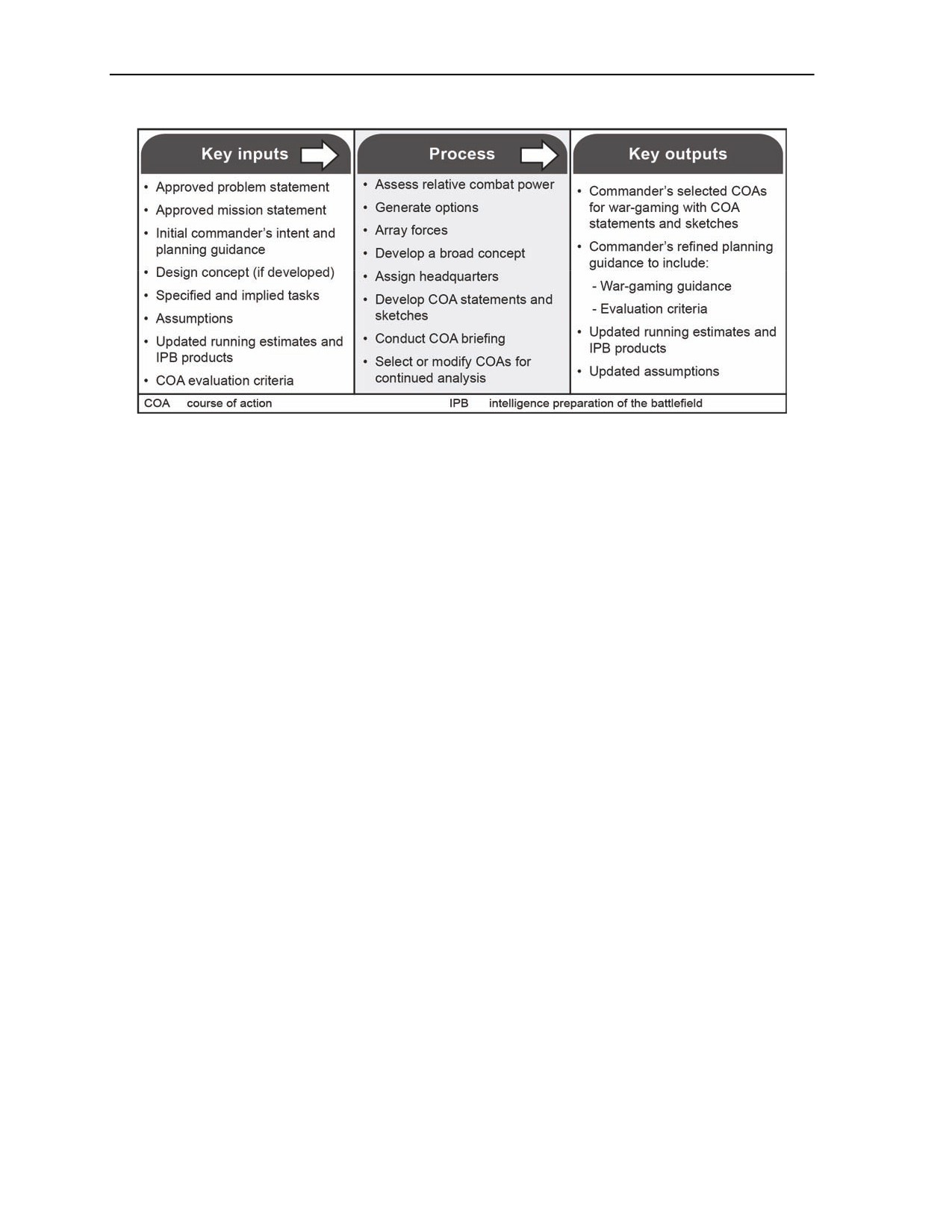
Appendix B
Figure B-3. COA development
B-83. For stability or civil support operations, staffs often determine relative combat power by comparing
available resources to specified or implied stability or civil support tasks. This is known as troop-to-task
analysis. This analysis provides insight as to what options are available and whether more resources are
required. In such operations, the elements of sustainment, movement and maneuver, nonlethal effects, and
information may dominate.
B-84. By analyzing force ratios and determining and comparing each force’s strengths and weaknesses as a
function of combat power, planners can gain insight into—
z
Friendly capabilities that pertain to the operation.
z
The types of operations possible from both friendly and enemy perspectives.
z
How and where the enemy may be vulnerable.
z
How and where friendly forces are vulnerable.
z
Additional resources that may be required to execute the mission.
z
How to allocate existing resources.
B-85. Planners must not develop and recommend COAs based solely on mathematical analysis of force
ratios. Although some numerical relationships are used in the process, the estimate is largely subjective.
Assessing combat power requires assessing both tangible and intangible factors, such as morale and levels
of training. A relative combat power assessment identifies enemy weaknesses that can be exploited,
identifies friendly weaknesses that require protection, and determines the combat power necessary to
conduct essential stability or civil support tasks.
Generate Options
B-86. Based on the commander’s guidance and the initial results of the relative combat power assessment,
the staff generates options. A good COA can defeat all feasible enemy COAs while accounting for essential
stability tasks. In an unconstrained environment, the goal is to develop several possible COAs. Time
dependent, commanders may limit the options in the commander’s guidance. Options focus on enemy
COAs arranged in order of their probable adoption or on those stability tasks that are most essential to
prevent the situation from deteriorating further.
B-87. Brainstorming is the preferred technique for generating options. It requires time, imagination, and
creativity, but it produces the widest range of choices. The staff (and members of organizations outside the
headquarters) must be unbiased and open-minded when developing proposed options.
B-88. In developing COAs, staff members determine the doctrinal requirements for each type of operation
being considered, including doctrinal tasks for subordinate units. For example, a deliberate breach requires
a breach force, a support force, and an assault force. Essential stability tasks require the ability to provide a
B-16
FM 5-0, C1
18 March 2011

The Military Decisionmaking Process
level of civil security, civil control, and certain essential services. In addition, the staff considers the
potential capabilities of attachments and other organizations and agencies outside military channels.
B-89. When generating options, the staff starts with the decisive operation identified in the commander’s
planning guidance. The staff checks that the decisive operation nests within the higher headquarters’
concept of operations. The staff clarifies the decisive operation’s purpose and considers ways to mass the
effects (lethal and nonlethal) of overwhelming combat power to achieve it.
B-90. Next, the staff considers shaping operations. The staff establishes a purpose for each shaping
operation tied to creating or preserving a condition for the decisive operation’s success. Shaping operations
may occur before, concurrently with, or after the decisive operation. A shaping operation may be
designated as the main effort if executed before or after the decisive operation.
B-91. The staff then determines sustaining operations necessary to create and maintain the combat power
required for the decisive operation and shaping operations. After developing the basic operational
organization for a given COA, the staff then determines the essential tasks for each decisive, shaping, and
sustaining operation.
B-92. Once staff members have explored possibilities for each COA, they examine each COA to determine
if it satisfies the screening criteria stated in paragraph B-79. In doing so, they change, add, or eliminate
COAs as appropriate. During this process, staffs must avoid the common pitfall of focusing on the
development of one good COA among several throwaway COAs.
Array Forces
B-93. After determining the decisive and shaping operations and their related tasks and purposes, planners
determine the relative combat power required to accomplish each task. To do this, planners may use
minimum historical planning ratios shown in table B-1 as a starting point. For example, historically
defenders have over a 50 percent probability of defeating an attacking force approximately three times their
equivalent strength. Therefore, as a starting point, commanders may defend on each avenue of approach
with roughly a 1:3 force ratio.
Table B-1. Historical minimum planning ratios
Friendly Mission
Position
Friendly: Enemy
Delay
1:6
Defend
Prepared or fortified
1:3
Defend
Hasty
1:2.5
Attack
Prepared or fortified
3:1
Attack
Hasty
2.5:1
Counterattack
Flank
1:1
B-94. Planners determine whether these and other intangibles increase the relative combat power of the unit
assigned the task to the point that it exceeds the historical planning ratio for that task. If it does not,
planners determine how to reinforce the unit. Combat power comparisons are provisional at best. Arraying
forces is tricky, inexact work. It is affected by factors that are difficult to gauge, such as impact of past
engagements, the quality of leaders, morale, maintenance of equipment, and time in position. It is also
affected by levels of electronic warfare support, fire support, close air support, and civilian support, among
many other factors.
B-95. In counterinsurgency operations, planners can develop force requirements by gauging troop
density—the ratio of security forces (including host-nation military and police forces as well as foreign
counterinsurgents) to inhabitants. Most density recommendations fall within a range of
20 to
25
counterinsurgents for every 1,000 residents in an AO. Twenty counterinsurgents per 1,000 residents are
often considered the minimum troop density required for effective counterinsurgency operations; however,
as with any fixed ratio, such calculations strongly depend on the situation. (See FM 3-24.)
B-96. Planners also determine relative combat power with regard to civilian requirements and conditions
that require attention and then array forces and capabilities for stability tasks. For example, a COA may
18 March 2011
FM 5-0, C1
B-17
Appendix B
require a follow-on force to establish civil security, maintain civil control, and restore essential services in a
densely populated urban area over an extended period. Planners conduct a troop-to-task analysis to
determine the type of units and capabilities to accomplish these tasks.
B-97. Planners then proceed to initially array friendly forces starting with the decisive operation and
continuing with all shaping and sustaining operations. Planners normally array ground forces two levels
down. The initial array focuses on generic ground maneuver units without regard to specific type or task
organization and then considers all appropriate intangible factors. For example, at corps level, planners
array generic brigades. During this step, planners do not assign missions to specific units; they only
consider which forces are necessary to accomplish its task. In this step, planners also array assets to
accomplish essential stability tasks.
B-98. The initial array identifies the total number of units needed and identifies possible methods of
dealing with the enemy and stability tasks. If the number arrayed is less than the number available, planners
place additional units in a pool for use during the develop a concept step. If the number of units arrayed
exceeds the number available and the difference cannot be compensated for with intangible factors, the
staff determines whether the COA is feasible. Ways to make up the shortfall include requesting additional
resources, accepting risk in that portion of the AO, or executing tasks required for the COA sequentially
rather than simultaneously. Commanders should also consider requirements to minimize and relieve
civilian suffering. Establishing civil security and providing essential services such as medical care, food
and water, and shelter are implied tasks for commanders during any combat operation. See FM 3-07 for a
full discussion on stability tasks.
Develop a Broad Concept
B-99. The broad concept describes how arrayed forces will accomplish the mission within the
commander’s intent. It concisely expresses the how of the commander’s visualization and will eventually
provide the framework for the concept of operations. The broad concept summarizes the contributions of
all warfighting functions. The staff develops a broad concept for each COA that will be expressed in both
narrative and graphic forms. A sound COA is more than the arraying of forces. It should present an overall
combined arms idea that will accomplish the mission. The broad concept includes the following:
z
The purpose of the operation.
z
A statement of where the commander will accept risk.
z
Identification of critical friendly events and transitions between phases (if the operation is
phased).
z
Designation of the decisive operation, along with its task and purpose, linked to how it supports
the higher headquarters’ concept.
z
Designation of shaping operations, along with their tasks and purposes, linked to how they
support the decisive operation.
z
Designation of sustaining operations, along with their tasks and purposes, linked to how they
support the decisive and shaping operations.
z
Designation of the reserve, including its location and composition.
z
Reconnaissance operations.
z
Security operations.
z
Essential stability tasks.
z
Identification of maneuver options that may develop during an operation.
z
Assignment of subordinate AOs.
z
Scheme of fires.
z
Information themes, messages, and means of delivery.
z
Military deception operations.
z
Key control measures.
B-100. Planners select control measures, including graphics, to control subordinate units during the
operation. These establish responsibilities and limits that prevent subordinate units’ actions from impeding
one another. These measures also foster coordination and cooperation between forces without unnecessarily
B-18
FM 5-0, C1
18 March 2011
The Military Decisionmaking Process
restricting freedom of action. Good control measures foster freedom of action, decisionmaking, and
individual initiative. (See FM 3-90 for a discussion of control measures associated with offensive and
defensive operations. See FM 1-02 for a listing of doctrinal control measures and rules for drawing control
measures on overlays and maps.)
B-101. Planners may use both lines of operations and lines of effort to build their broad concept. Lines of
operations portray the more traditional links among objectives, decisive points, and centers of gravity. A
line of effort, however, helps planners link multiple tasks with goals, objectives, and end state conditions.
Combining lines of operations and lines of efforts allows planners to include nonmilitary activities in their
broad concept. This combination helps commanders incorporate stability or civil support tasks that, when
accomplished, help set end state conditions of the operation.
B-102. Based on the commander’s planning guidance (informed by the design concept if design preceded
the MDMP), planners develop lines of effort by—
z
Confirming end state conditions from the initial commander’s intent and planning guidance.
z
Determining and describing each line of effort.
z
Identifying objectives (intermediate goals) and determining tasks along each line of effort.
B-103. During COA development, lines of efforts are general and lack specifics, such as tasks to
subordinate units associated to objectives along each line of effort. Lines of effort, to include specific tasks
to subordinate units, are developed and refined during war-gaming. (See FM 3-0 and FM 3-07 for examples
of operations depicted along lines of effort.)
B-104. As planning progresses, commanders may modify lines of effort and add details during war-
gaming. Operations with other instruments of national power support a broader, comprehensive approach to
stability operations. Each operation, however, differs. Commanders develop and modify lines of effort to
focus operations on achieving the end state, even as the situation evolves.
Assign Headquarters
B-105. After determining the broad concept, planners create a task organization by assigning headquarters
to groupings of forces. They consider the types of units to be assigned to a headquarters and the ability of
that headquarters to control those units. Generally, a headquarters controls at least two subordinate
maneuver units (but not more than five) for fast-paced offensive or defensive operations. The number and
type of units assigned to a headquarters for stability operations will vary based on factors of METT-TC. If
planners need additional headquarters, they note the shortage and resolve it later. Task organization takes
into account the entire operational organization. It also accounts for the special mission command
requirements for operations such as a passage of lines, gap crossing, or air assault.
Prepare Course of Action Statements and Sketches
B-106. The operations officer prepares a COA statement and supporting sketch for each COA. The COA
statement clearly portrays how the unit will accomplish the mission. The COA statement should be a brief
expression of how the combined arms concept will be conducted. The sketch provides a picture of the
movement and maneuver aspects of the concept, including the positioning of forces. Together, the
statement and sketch cover the who (generic task organization), what (tasks), when, where, and why
(purpose) for each subordinate unit.
B-107. At a minimum, the COA sketch includes the array of generic forces and control measures, such as—
z
The unit and subordinate unit boundaries.
z
Unit movement formations (but not subordinate unit formations).
z
The line of departure, or line of contact and phase lines, if used.
z
Reconnaissance and security graphics.
z
Ground and air axes of advance.
z
Assembly areas, battle positions, strong points, engagement areas, and objectives.
z
Obstacle control measures and tactical mission graphics.
z
Fire support coordination and airspace control measures.
18 March 2011
FM 5-0, C1
B-19
Appendix B
z
Main effort.
z
Location of command posts and critical information systems (INFOSYS) nodes.
z
Enemy known or template locations.
z
Population concentrations.
B-108. Planners can include identifying features (such as cities, rivers, and roads) to help orient users. The
sketch may be on any medium. What it portrays is more important than its form. Figure B-4 provides a
sample COA sketch and COA statement for a brigade combat team.
Conduct a Course of Action Briefing
B-109. After developing COAs, the staff briefs them to the commander. A collaborative session may
facilitate subordinate planning. The COA briefing includes—
z
An updated IPB.
z
Possible enemy COAs.
z
The approved problem statement and mission statement.
z
The commander’s and higher commander’s intent.
z
COA statements and sketches, including lines of effort if used.
z
The rationale for each COA, including—
Considerations that might affect enemy COAs.
Critical events for each COA.
Deductions resulting from the relative combat power analysis.
The reason units are arrayed as shown on the sketch.
The reason the staff used the selected control measures.
The impact on civilians.
How it accounts for minimum essential stability tasks.
Updated facts and assumptions.
Refined COA evaluation criteria.
Select or Modify Courses of Action for Continued Analysis
B-110. After the COA briefing, the commander selects or modifies those COAs for continued analysis.
The commander also issues planning guidance. If all COAs are rejected, the staff begins again. If one or
more of the COAs are accepted, staff members begin COA analysis. The commander may create a new
COA by incorporating elements of one or more COAs developed by the staff. The staff then prepares to
war-game this new COA. The staff must incorporate those modifications and ensure all staff members
understand the changed COA.
COURSE OF ACTION ANALYSIS AND WAR-GAMING
B-111. COA analysis enables commanders and staffs to identify difficulties or coordination problems as
well as probable consequences of planned actions for each COA being considered. It helps them think
through the tentative plan. COA analysis may require commanders and staffs to revisit parts of the COA as
discrepancies arise. COA analysis not only appraises the quality of each COA but also uncovers potential
execution problems, decisions, and contingencies. In addition, COA analysis influences how commanders
and staffs understand the problem and may require the planning process to restart.
B-20
FM 5-0, C1
18 March 2011
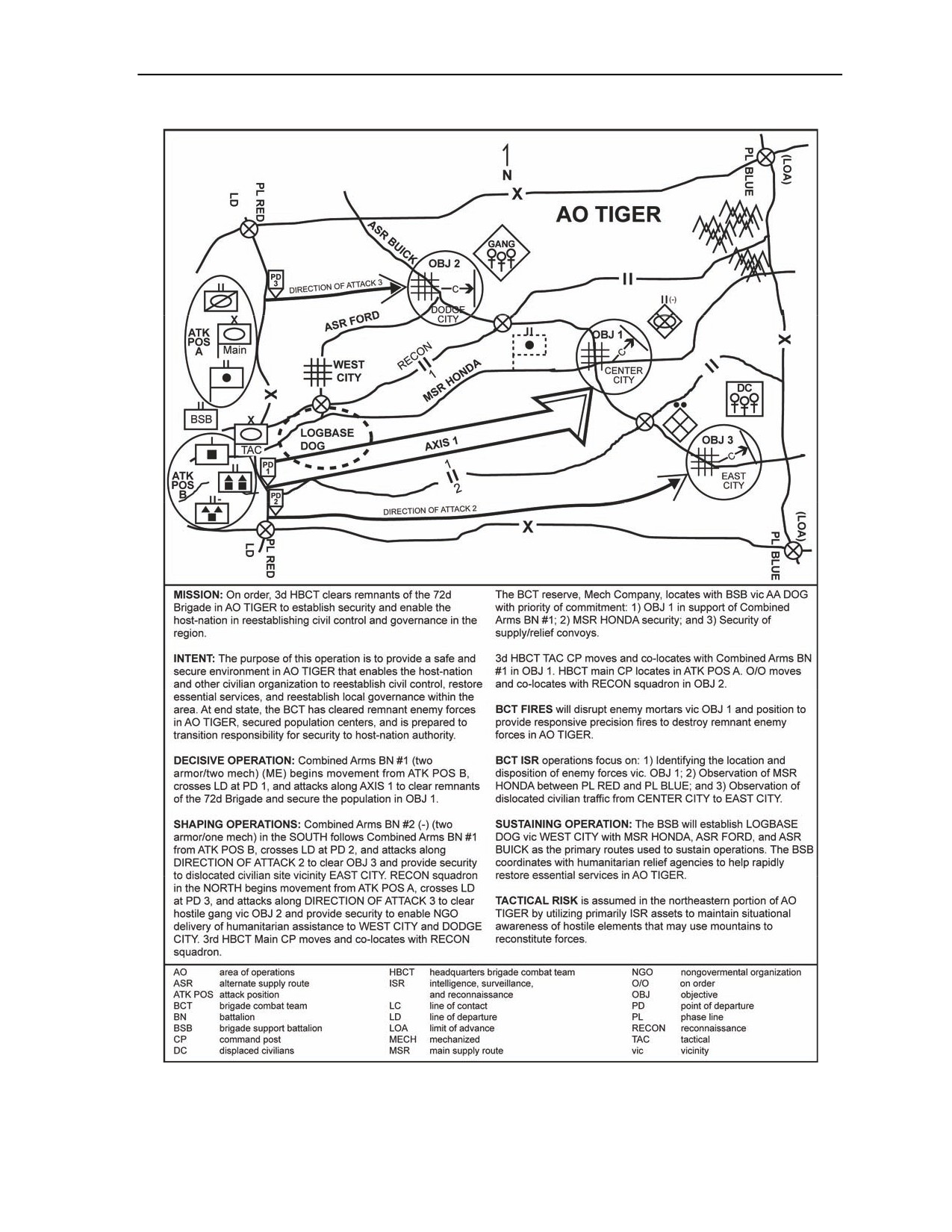
The Military Decisionmaking Process
Figure B-4. Sample brigade COA sketch
18 March 2011
FM 5-0, C1
B-21
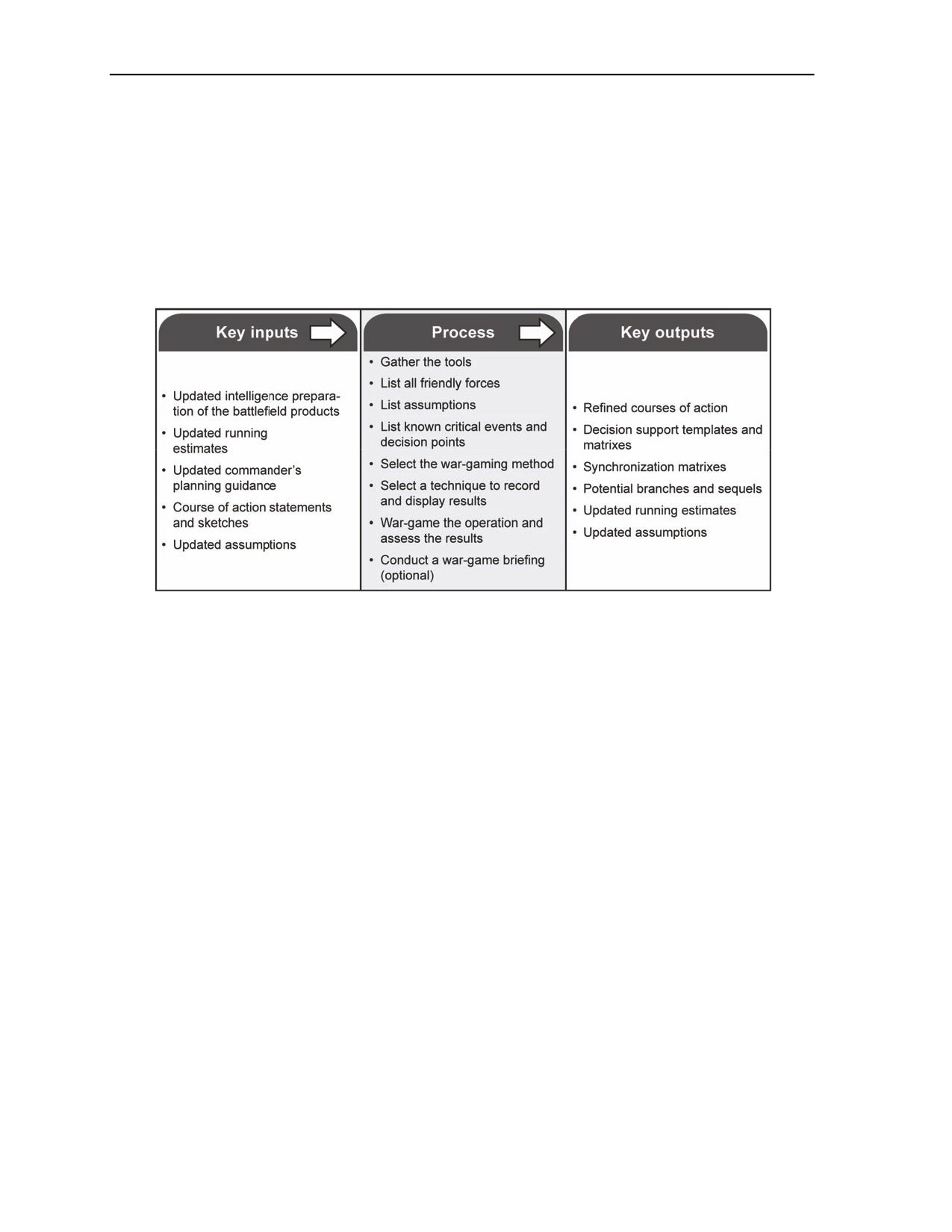
Appendix B
B-112. War-gaming is a disciplined process, with rules and steps that attempt to visualize the flow of the
operation, given the force’s strengths and dispositions, enemy’s capabilities and possible COAs, impact and
requirements of civilians in the AO, and other aspects of the situation. The simplest form of war gaming is
the manual method, often utilizing a tabletop approach with blowups of matrixes and templates. The most
sophisticated form of war gaming is modern, computer-aided modeling and simulation. Regardless of the
form used, each critical event within a proposed COA should be war-gamed using the action, reaction, and
counteraction methods of friendly and enemy forces interaction. This basic war-gaming method (modified
to fit the specific mission and environment) applies to offensive, defensive, and stability or civil support
operations. When conducting COA analysis, commanders and staffs perform the process actions and
produce the outputs shown in figure B-5.
Figure B-5. COA analysis and war-gaming
B-113. War-gaming results in refined COAs, a completed synchronization matrix, and decision support
templates and matrixes for each COA. A synchronization matrix records the results of a war game. It
depicts how friendly forces for a particular COA are synchronized in time, space, and purpose in relation to
an enemy COA or other events in stability or civil support operations. The decision support template and
matrix portray key decisions and potential actions that are likely to arise during the execution of each COA.
B-114. COA analysis allows the staff to synchronize the six warfighting functions for each COA. It also
helps the commander and staff to—
z
Determine how to maximize the effects of combat power while protecting friendly forces and
minimizing collateral damage.
z
Further develop a visualization of the operation.
z
Anticipate operational events.
z
Determine conditions and resources required for success.
z
Determine when and where to apply force capabilities.
z
Identify coordination needed to produce synchronized results.
z
Determine the most flexible COA.
B-115. During the war game, the staff takes each COA and begins to develop a detailed plan while
determining its strengths or weaknesses. War gaming tests and improves COAs. The commander, staff, and
other available partners
(and subordinate commanders and staffs if the war game is conducted
collaboratively) may change an existing COA or develop a new COA after identifying unforeseen events,
tasks, requirements, or problems.
B-22
FM 5-0, C1
18 March 2011
The Military Decisionmaking Process
General War-Gaming Rules
B-116. War gamers need to—
z
Remain objective, not allowing personality or their sense of “what the commander wants” to
influence them. They avoid defending a COA just because they personally developed it.
z
Record advantages and disadvantages of each COA accurately as they emerge.
z
Continually assess feasibility, acceptability, and suitability of each COA. If a COA fails any of
these tests, they reject it.
z
Avoid drawing premature conclusions and gathering facts to support such conclusions.
z
Avoid comparing one COA with another during the war game. This occurs during COA
comparison.
War-Gaming Responsibilities
B-117. This section provides the responsibilities of key staff members during the war game.
Chief of Staff (Executive Officer)
B-118. The COS (XO) coordinates actions of the staff during the war game. This officer is the unbiased
controller of the process, ensuring the staff stays on a timeline and achieves the goals of the war-gaming
session. In a time-constrained environment, this officer ensures that, at a minimum, the decisive operation
is war-gamed.
Intelligence
B-119. The assistant chief of staff (ACOS), G-2 (S-2), intelligence, role-plays the enemy commander.
This officer develops critical enemy decision points in relation to the friendly COAs, projects enemy
reactions to friendly actions, and projects enemy losses. When additional intelligence staff members are
available, the intelligence officer assigns different responsibilities to individual staff members within the
section for war gaming (such as the enemy commander, friendly intelligence officer, and enemy recorder).
The intelligence officer captures the results of each enemy action and counteraction as well as the
corresponding friendly and enemy strengths and vulnerabilities. By trying to win the war game for the
enemy, the intelligence officer ensures that the staff fully addresses friendly responses for each enemy
COA. For the friendly force, the intelligence officer—
z
Identifies IRs.
z
Refines the situation and event templates, including named areas of interest that support decision
points.
z
Refines the event template with corresponding decision points, target areas of interest, and high-
value targets.
z
Participates in targeting to select high-payoff targets from high-value targets identified during
IPB.
z
Recommends PIRs that correspond to the decision points.
Movemenent and Maneuver
B-120. During the war game, the ACOS, G-3 (S-3), operations, and ACOS, G-5 (S-5), plans, are
responsible for movement and maneuver.
B-121. The G-3 (S-3) normally selects the technique for the war game and role-plays the friendly
maneuver commander. The G-3 (S-3) is assisted by various staff officers such as the aviation officer,
engineer officer, and red team members. The G-3 (S-3) executes friendly maneuver as outlined in the COA
sketch and COA statement.
B-122. The G-5 (S-5) assesses warfighting requirements, solutions, and concepts for each COA. This
plans officer develops plans and orders and determines potential branches and sequels arising from the war-
gaming of various COAs. The G-5 (S-5) coordinates and synchronizes warfighting functions in all plans
18 March 2011
FM 5-0, C1
B-23
Appendix B
and orders. The planning staff ensures that the war game of each COA covers every operational aspect of
the mission. The members of the staff record each event’s strengths and weaknesses and the rationale for
each action. They complete the decision support template and matrix for each COA. The rationale for
actions during the war game are annotated and used later with the commander’s guidance to compare
COAs.
Fires
B-123. The chief of fires (fire support officer) assesses the fire support feasibility of each COA. For each
COA, the chief of fires develops the fire support execution matrix and evaluation criteria to measure the
effectiveness of the fire support. This officer develops a proposed high-priority target list, target selection
standards, and attack guidance matrix. The chief of fires identifies named and target areas of interest, high-
value targets, high-priority targets, and additional events that may influence the positioning of fire support
assets.
Protection
B-124. The provost marshal advises the commander regarding military police functions, security, force
protection issues, and the employment of assigned or attached military police elements for each COA. The
provost marshal assesses military police operations in support of freedom of movement, security for ground
lines of communication, operational law enforcement, and operational internment and resettlement
operations.
Sustainment
B-125. The following officers are responsible for sustainment:
z
ACOS, G-1 (S-1), personnel.
z
ACOS, G-4 (S-4), logistics.
z
ACOS, G-8, financial management.
z
Surgeon.
B-126. The G-1 (S-1) assesses the personnel aspect of building and maintaining the combat power of
units. This officer identifies potential shortfalls and recommends COAs to ensure units maintain adequate
manning to accomplish their mission. The personnel officer estimates potential personnel battle losses and
assesses the adequacy of resources to provide human resources support for the operation.
B-127. The G-4 (S-4) assesses the logistics feasibility of each COA. This officer determines critical
requirements for each logistics function (classes I through VII and IX) and identifies potential problems
and deficiencies. The G-4 (S-4) assesses the status of all logistics functions required to support the COA,
including potential support required to provide essential services to the civilians, and compares it to
available assets. This officer identifies potential shortfalls and recommends actions to eliminate or reduce
their effects. While improvising can contribute to responsiveness, only accurately predicting requirements
for each logistics function can ensure continuous sustainment. The logistics officer ensures that available
movement times and assets support each COA.
B-128. The G-8 assesses the commander’s area of responsibility to determine the best COA for use of
resources. This includes both core functions of financial management (resource management and finance
operations). This officer determines partner relationships
(joint, interagency, intergovernmental, and
multinational), requirements for special funding, and support to the procurement process.
B-129. The surgeon section coordinates, monitors, and synchronizes the execution of the Army health
system activities for the command for each COA to ensure a fit and healthy force. The surgeon provides
advice for medically related matters and exercises technical supervision of all medical activities within the
AO.
±Mission Command
B-130. The following officers are responsible for aspects of mission command:
z
ACOS, G-6 (S-6), signal.
z
ACOS, G-7 (S-7), inform and influence activities.
B-24
FM 5-0, C1
18 March 2011
The Military Decisionmaking Process
z
ACOS, G-9 (S-9), civil affairs operations.
z
Red team.
z
Staff Judge Advocate.
z
Operational research/systems analysis (ORSA).
z
Recorders.
B-131. The G-6 (S-6) assesses network operations, electromagnetic spectrum operations, and electronic
protection feasibility of each COA. The G-6 (S-6), determines communication systems requirements and
compares them to available assets, identifies potential shortfalls, and recommends actions to eliminate or
reduce their effects.
B-132. The G-7 (S-7) assesses how effectively the information themes and messages are reflected in
operations. This officer assesses the effectiveness of the media. Lastly, this officer assesses how the
information themes and messages impact various audiences of interest and populations in and outside the
AO.
B-133. The G-9 (S-9) ensures each COA effectively integrates civil considerations (the “C” of METT-
TC). The civil affairs operations officer considers not only tactical issues, but also sustainment issues. This
officer assesses how operations affect civilians and estimates the requirements for essential stability tasks
commanders might have to undertake based on the ability of the unified action. Host-nation support and
care of dislocated civilians are of particular concern. The civil affairs operations officer’s analysis considers
how operations affect public order and safety, the potential for disaster relief requirements, noncombatant
evacuation operations, emergency services, and the protection of culturally significant sites. This officer
provides feedback on how the culture in the AO affects each COA. If the unit lacks an assigned civil affairs
operations officer, the commander assigns these responsibilities to another staff member. The civil affairs
operations officer represents the other actors’ points of view if these agencies are not able to participate in
the war game for security or other reasons.
B-134. The red team staff section provides the commander and G-2 with an independent capability to fully
explore alternatives in plans, operations, concepts, organizations, and capabilities in the context of the
operational environment from the perspectives of adversaries, partners, and others.
B-135. The Staff Judge Advocate advises the commander on all matters pertaining to law, policy,
regulation, and good order and discipline for each COA. This officer provides legal advice across the
spectrum of conflict on law of war, rules of engagement, international agreements, Geneva Conventions,
treatment and disposition of noncombatants, and the legal aspects of lethal and nonlethal targeting.
B-136. The ORSA staff section provides analytic support to the commander for planning and assessment
of operations. Specific responsibilities includes—
z
Providing quantitative analytic support, including regression and trend analysis, to planning and
assessment activities.
z
Assisting other staff elements in developing customized analytical tools for specific
requirements, providing a quality control capability, and conducting assessments to measure the
effectiveness of operations.
B-137. The use of recorders is particularly important. Recorders are trained to capture coordinating
instructions, subunit tasks and purposes, and information required to synchronize the operation. Doing this
allows part of the order to be written before planning is complete. Automated INFOSYS simplify this
process. These systems enable recorders to enter information into preformatted forms that represent either
briefing charts or appendixes to orders. Each staff section keeps formats available to facilitate networked
orders production.
Course of Action Process Actions
B-138. COA analysis consists of eight actions first shown in figure B-5 on page B-22.
18 March 2011
FM 5-0, C1
B-25
Appendix B
Gather the Tools
B-139. The first task for COA analysis is to gather the necessary tools to conduct the war game. The COS
(XO) directs the staff to gather tools, materials, and data for the war game. Units war-game with maps,
sand tables, computer simulations, or other tools that accurately reflect the terrain. The staff posts the COA
on a map displaying the AO. Tools required include, but are not limited to—
z
Running estimates.
z
Event templates.
z
A recording method.
z
Completed COAs, including graphics.
z
A means to post or display enemy and friendly unit symbols and other organizations.
z
A map of the AO.
List All Friendly Forces
B-140. The commander and staff consider all units that can be committed to the operation, paying special
attention to support relationships and constraints. This list must include assets from all participants
operating in the AO. The friendly forces list remains constant for all COAs.
List Assumptions
B-141. The commander and staff review previous assumptions for continued validity and necessity.
List Known Critical Events and Decision Points
B-142. Critical events are those that directly influence mission accomplishment. They include events that
trigger significant actions or decisions (such as commitment of an enemy reserve), complicated actions
requiring detailed study (such as a passage of lines), and essential tasks. The list of critical events includes
major events from the unit’s current position through mission accomplishment. It includes reactions by
civilians that might affect operations or that will require allocation of significant assets to account for
essential stability tasks.
B-143. A decision point is a point in space and time when the commander or staff anticipates making a
key decision concerning a specific course of action (JP 5-0). Decision points may also be associated with
the friendly force and the status of ongoing operations. A decision point may be associated with CCIRs that
describe what information the commander needs to make the anticipated decision. The PIR describes what
must be known about the enemy or the operational environment and often is associated with a named area
of interest. The friendly force information requirement describes friendly information the commander must
protect from enemy disclosure, such as pending operations or locations of key nodes. A decision point
requires a decision by the commander. It does not dictate what the decision is, only that the commander
must make one, and when and where it should be made to maximally impact friendly or enemy COAs or
the accomplishment of stability tasks.
Select the War-Gaming Method
B-144. There are three recommended war-gaming methods: belt, avenue-in-depth, and box. Each
considers the area of interest and all enemy forces that can affect the outcome of the operation. The
methods can be used separately or in combination and modified for long-term operations dominated by
stability.
B-145. The belt method divides the AO into belts (areas) running the width of the AO. (See figure B-6.)
The shape of each belt is based on the factors of METT-TC. The belt method works best when conducting
offensive and defensive operations on terrain divided into well-defined cross-compartments, during phased
operations (such as gap crossings, air assaults, or airborne operations), or when the enemy is deployed in
clearly defined belts or echelons. Belts can be adjacent to or overlap each other.
B-146. This war-gaming method is based on a sequential analysis of events in each belt. It is preferred
because it focuses simultaneously on all forces affecting a particular event. A belt might include more than
B-26
FM 5-0, C1
18 March 2011
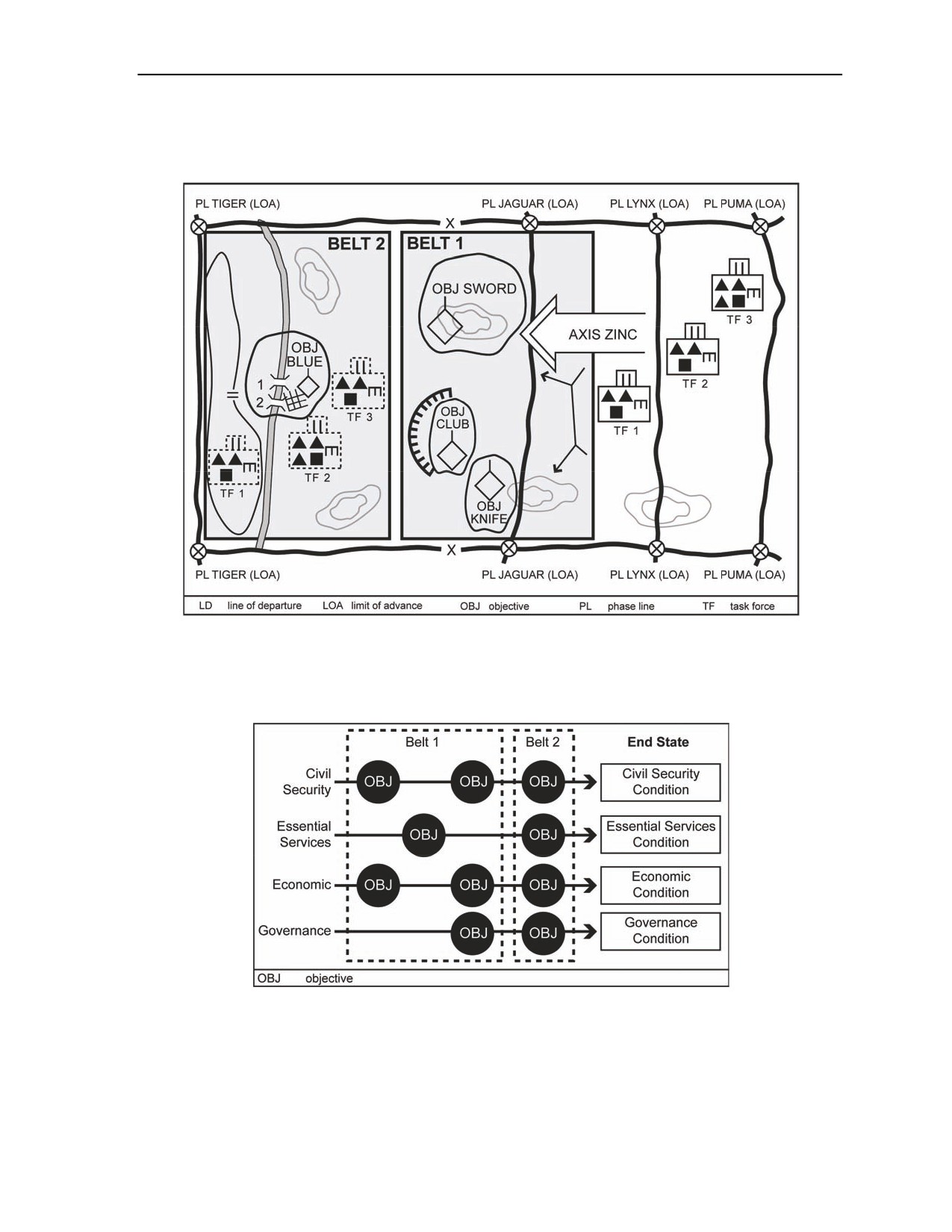
The Military Decisionmaking Process
one critical event. Under time-constrained conditions, the commander can use a modified belt method. The
modified belt method divides the AO into not more than three sequential belts. These belts are not
necessarily adjacent or overlapping but focus on the critical actions throughout the depth of the AO.
Figure B-6. Sample belt method
B-147. In stability operations, the belt method can divide the COA by events, objectives (goals not
geographic location), or events and objectives in a selected slice across all lines of effort. (See figure B-7.)
It consists of war-gaming relationships among events or objectives on all lines of effort in the belt.
Figure B-7. Sample modified belt method using lines of effort
B-148. The avenue-in-depth method focuses on one avenue of approach at a time, beginning with the
decisive operation. (See figure B-8, page B-28.) This method is good for offensive COAs or in the defense
when canalizing terrain inhibits mutual support.
18 March 2011
FM 5-0, C1
B-27
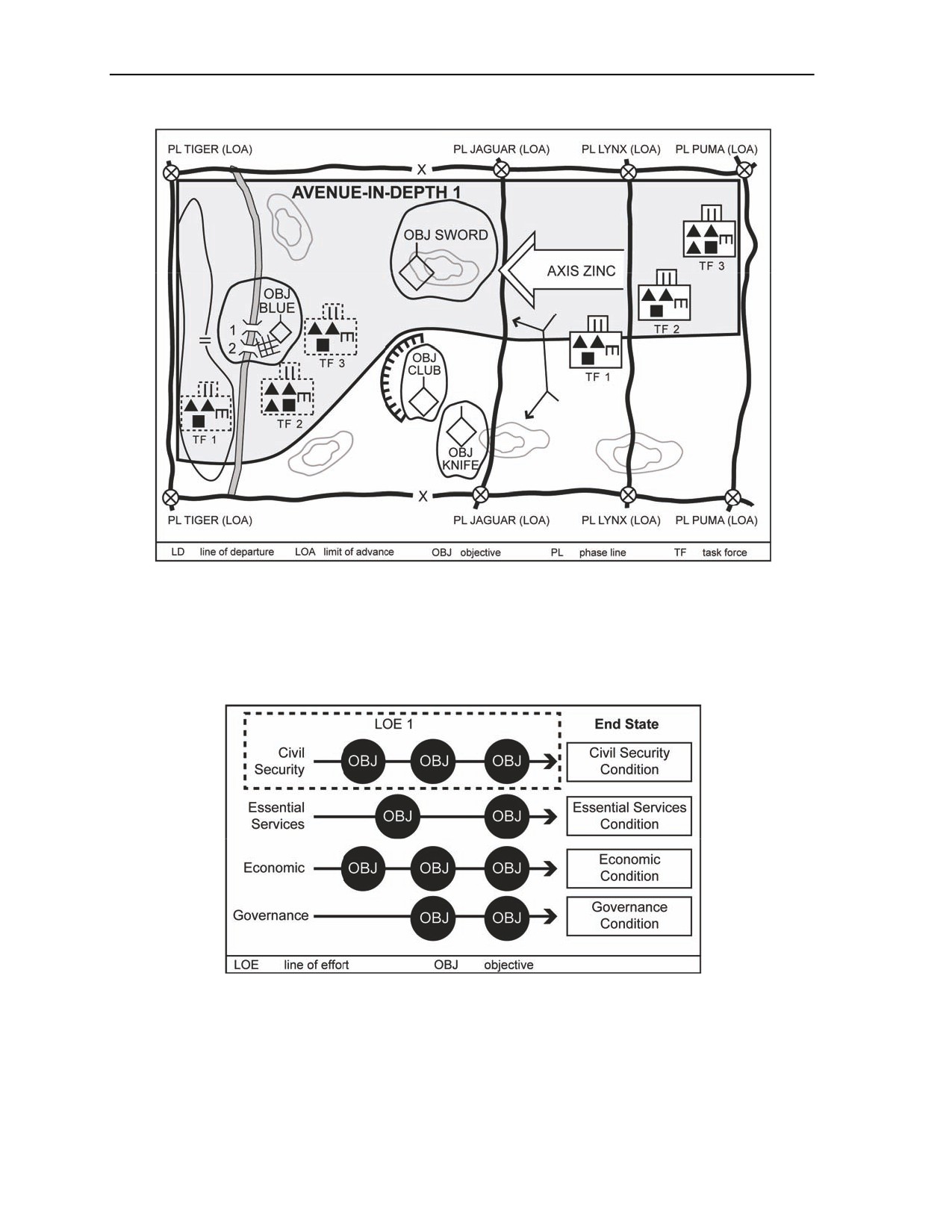
Appendix B
Figure B-8. Sample avenue-in-depth method
B-149. In stability operations, the avenue-in-depth method can be modified. Instead of focusing on a
geographic avenue, the staff war-games a line of effort. This method focuses on one line of effort at a time,
beginning with the decisive line. (See figure B-9.) It includes not only war-gaming events, objectives, or
events and objectives in the selected line, but also war-gaming relationships among events or objectives on
all lines of effort with respect to events in the selected line.
Figure B-9. Sample modified avenue-in-depth method using lines of effort
B-150. The box method is a detailed analysis of a critical area, such as an engagement area, a river-
crossing site, or a landing zone. (See figure B-10.) It works best in a time-constrained environment, such as
a hasty attack. It is particularly useful when planning operations in noncontiguous AOs. When using this
method, the staff isolates the area and focuses on critical events in it. Staff members assume that friendly
units can handle most situations in the AOs and focus their attention on essential tasks.
B-28
FM 5-0, C1
18 March 2011
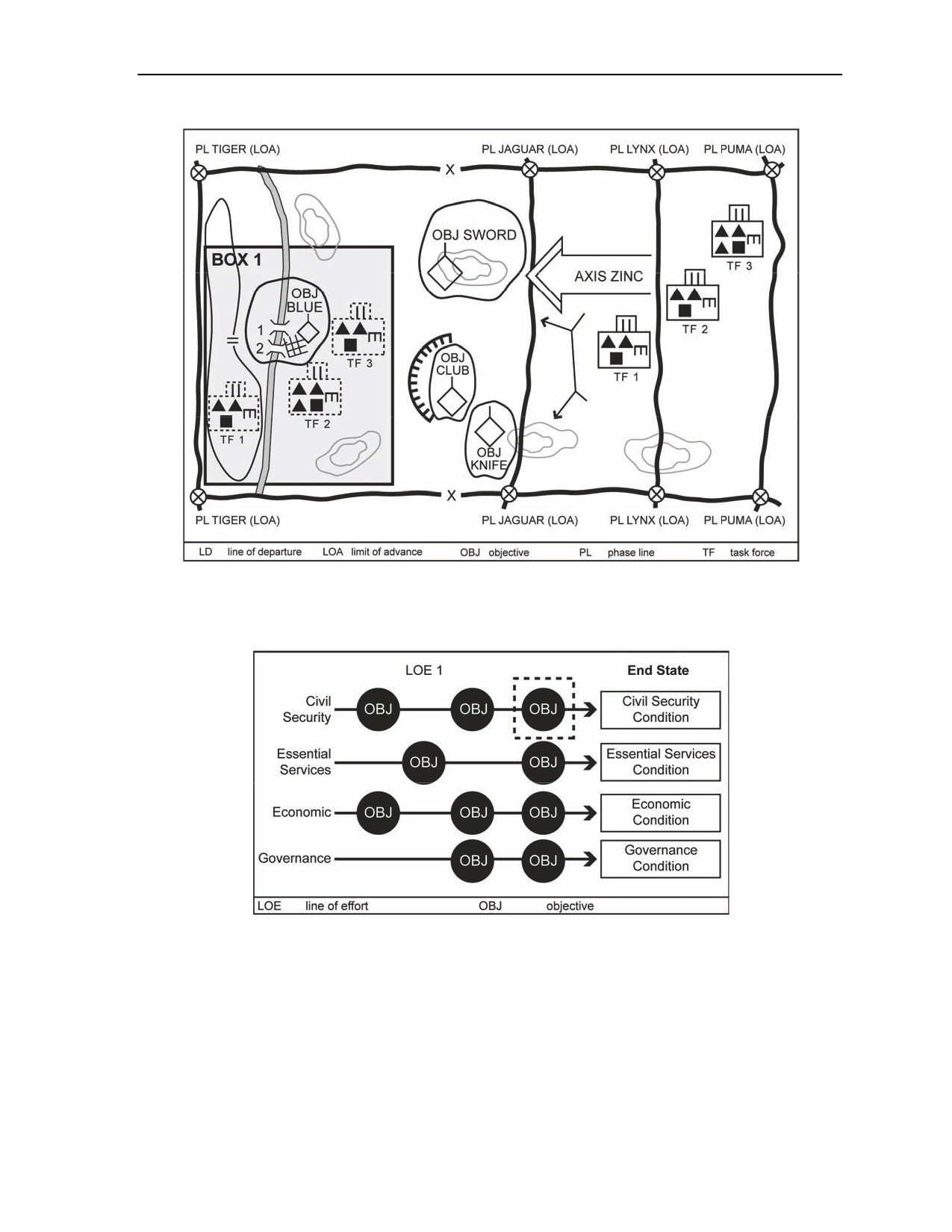
The Military Decisionmaking Process
Figure B-10. Sample box method
B-151. In stability operations, the box method may focus analysis on a specific objective along a line of
effort such as development of local security forces as part of improving civil security. (See figure B-11.)
Figure B-11. Sample modified box method using lines of effort
Select a Technique to Record and Display Results
B-152. The war-game results provide a record from which to build task organizations, synchronize
activities, develop decision support templates, confirm and refine event templates, prepare plans or orders,
and compare COAs. Two techniques are commonly used to record and display results: the synchronization
matrix technique and the sketch note technique. In both techniques, staff members record any remarks
regarding the strengths and weaknesses they discover. The amount of detail depends on the time available.
Unit SOPs address details and methods of recording and displaying war-gaming results.
18 March 2011
FM 5-0, C1
B-29