FM 4-25.12 UNIT FIELD SANITATION TEAM (January 2002) - page 3
FM 4-25.12
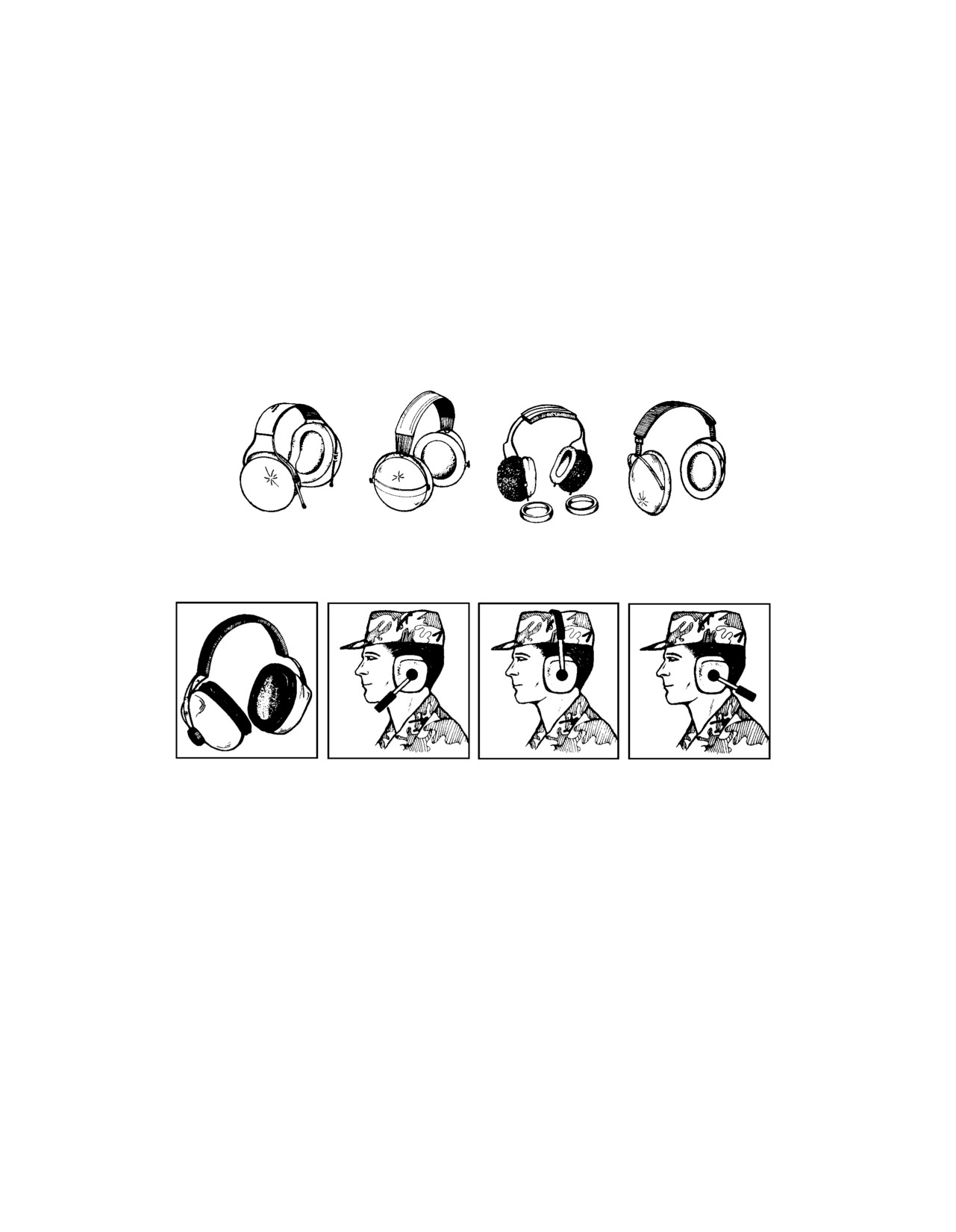
b. Well-designed and properly fitted earplugs or earmuffs will lessen the noise reaching the inner
ear by 15 dB in the lower frequencies and by up to 35 dB in the higher frequencies. Wearing earplugs and
earmuffs together, however, does not provide attenuation (weakening of the sound) equal to the arithmetic
sum of the individual attenuation of earplugs and earmuffs worn separately. The combination of plugs and
muffs provides from 35 to 40 dB noise attenuation at most frequencies. Regular use of ear protective
devices is mandatory for all individuals exposed to steady-state noise in excess of 85 dB or impulse noise in
excess of 140 dB.
Figure 2-9. Type I earmuffs.
Figure 2-10. Type II earmuffs.
c.
Persons with normal hearing will have little difficulty understanding speech when earplugs or
earmuffs are worn, if the speakers will raise their voices slightly above the level of ordinary conversation.
Actually, it is easier for a person to hear and understand auditory signals such as speech in a moderately
noisy environment with ear protection than without it. For example, put a fingertip firmly into each ear
while carrying on a conversation in a noisy room. You will note that the conversation is more easily
understood.
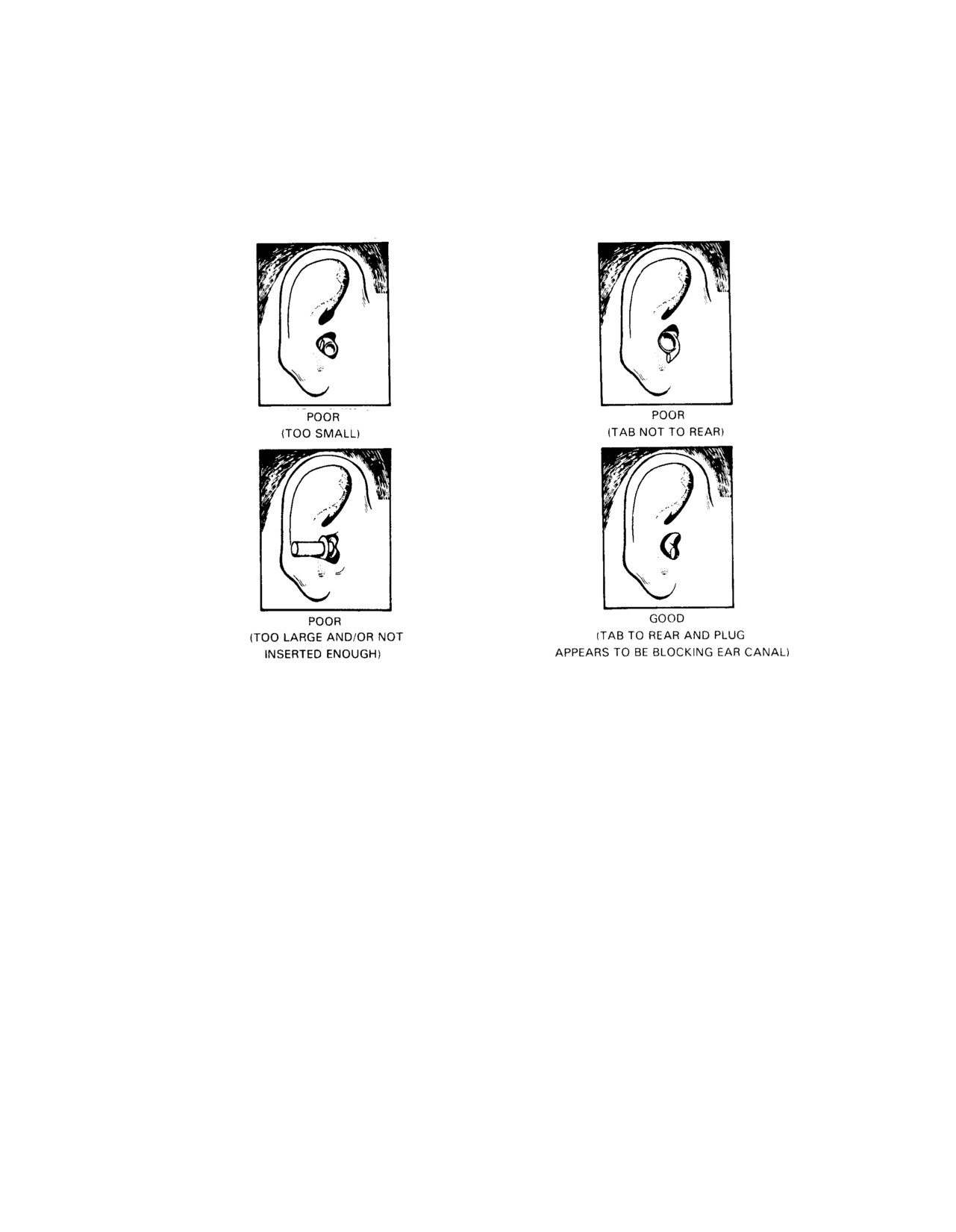
d. Properly fitted earplugs will not damage a normal ear canal if the earplugs are kept reasonably
clean. Plugs must be fitted individually for each ear under medical supervision (Figure 2-11, page 2-75).
Occasionally, an individuals two ear canals will require earplugs of different sizes. To prevent leaks, a
good seal between the ear canal and the earplug is very important. A really good seal may cause some
initial discomfort to the wearer.
2-73
FM 4-25.12
e.
When earmuffs are chosen in preference to earplugs, the headband must be properly adjusted
to ensure a snug fit.
(1) When eyeglasses are worn at the same time as earmuffs, it is important that the flange of
the muff fit well around the temple of the glasses. Even a small leak will completely destroy the purpose
of the ear protector, yet the wearer will have a false sense of security because of wearing the protector.
(2) A related problem with earplugs is that they tend to work loose as a result of talking and
chewing. Therefore, earplugs must be reseated from time to time during the workday.
(3) The only effective ear protector is one that is worn consistently. Hearing damage
becomes progressively worse with each additional exposure; personnel must be convinced of the importance
of wearing their ear protectors.
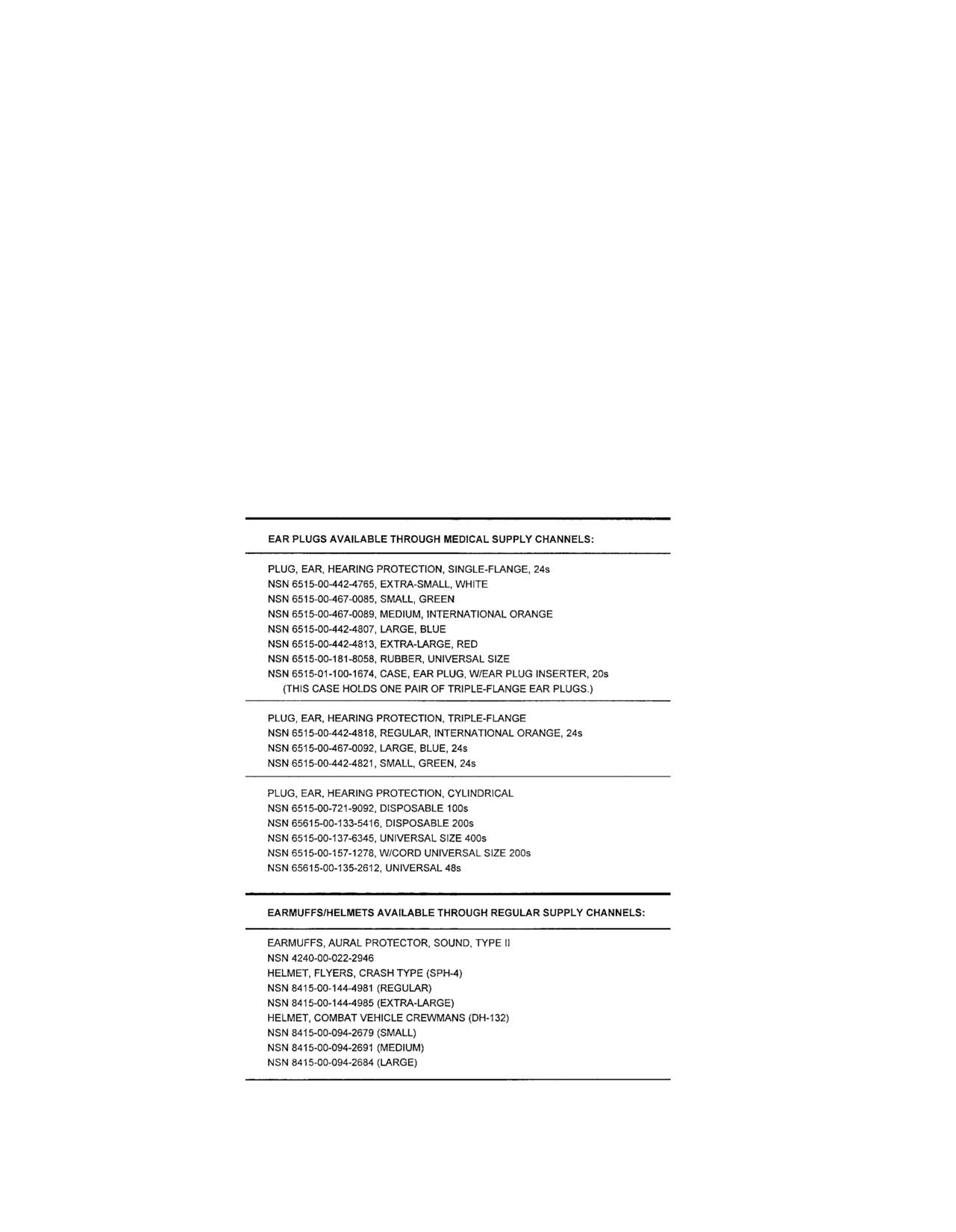
Table 2-9. Hearing Protector Devices
2-74
FM 4-25.12
Figure 2-11. Examples of poorly fitted/poorly inserted earplugs
and a well-fitted/properly seated earplug.
2-75
FM 4-25.12
APPENDIX A
FIELD SANITATION TEAM TRAINING COURSE
The following lesson plans are outlines that can be used when you are unable to obtain the formal course
CD-ROM. The CD-ROM is available and may be ordered from the Nonresident Instruction Branch,
Department of Academic Support, Academy of Health Sciences, AMEDDC&S, Fort Sam Houston, Texas
78234-6100 (DSN 471-5877/commercial 210-221-5877). The title of the CD-ROM/course is Field
Sanitation Team Certification Course, FSTCC08 SGI. The 15 lesson plans will take approximately 29.5
hours of instruction. They follow the Master Plan presented in Chapter 1 of this publication. Instructors of
this course should order the CD-ROM to acquire the accompanying lesson plans and slides for each lesson.
Appendix B lists the equipment and materials needed to conduct the training, along with figures of various
materials and/or sample setups. When the Distance Learning Program is completed, updated lesson plans
will be available on the AMEDD website.
A-1
FM 4-25.12
LESSON 1INTRODUCTION
(30 minutes)
COURSES PRESENTED TO: Field Sanitation Team Members.
PLACE: Classroom.
REFERENCES: None.
RELATED SOLDIERS MANUAL/MOS TASKS: None.
STUDY ASSIGNMENT: None.
STUDENT UNIFORM AND EQUIPMENT: Uniform of the day.
TOOLS, EQUIPMENT, AND MATERIALS: None.
PERSONNEL: One instructor.
INSTRUCTIONAL AIDS: None.
TROOP REQUIREMENTS: None.
TRANSPORTATION REQUIREMENTS: None.
RISK ASSESSMENT: Low.
SAFETY REQUIREMENT: None.
METHODS OF INSTRUCTION: Conference, 30 minutes.
I.
INTRODUCTION (3 minutes).
A. Provide a motivational opening appropriate to your student population such as the following.
You are here because your unit commander has appointed you a member of the FST. As a member of the
FST, you will be asked to assist the commander in what could be your units toughest mission: the battle
against disease and nonbattle injury, or DNBI. As you will see as we progress through this course, history
is riddled with examples of failed missions due to disease and nonbattle injury. It is your job, as a member
of the field sanitation team, to ensure that your unit does not repeat history. The effectiveness with which
you accomplish the critical tasks taught in this course will have a major effect on the health of your fellow
soldiers as well as the success of your units mission and the mission of the Army.
B. Lesson Topics.
1.
Inform the students of the topics that will be covered in this lesson.
A-2
FM 4-25.12
2.
Ask for and answer any questions the students might have about their mission.
II.
PRESENTATION (25 minutes).
A. Purpose. The purpose of the field sanitation team training is to teach the skills and knowledge
required for you to become an effective member of the field sanitation team. The course ensures that small
units have preventive medicine resources to reduce the occurrence of disease and nonbattle injuries as
required by AR 40-5, Preventive Medicine. The information in each lesson is taught and tested in
accordance with FM 21-10, Field Hygiene and Sanitation, and FM 4-25.12, Unit Field Sanitation Team.
B. Administrative Concerns. The unit field sanitation team must consist of at least two soldiers,
one of which must be a noncommissioned officer. The following personal qualifications must be met and
the administrative conditions adhered to.
1.
Personnel qualifications.
(a) Soldiers in this class should have at least six months of service remaining with their
unit. This requirement was established to ensure that the unit gains the most benefit from the training you
receive.
NOTE: Ask students for a show of hands of those who do not have at least six months remaining with their
units. Soldiers that do not meet the time-in-service requirement should be returned to their respective unit.
(b) Organic combat medics should be used as FST members.
NOTE: All FST member candidates will receive the same training regardless of their MOS/AOC.
2.
Course administrative concerns. Administrative concerns as they pertain to the course
presented to the students.
3.
Site administrative concerns. Administrative concerns as they pertain to your classroom
location should be presented to the students.
NOTE: In this section, present the rules and regulations that students must be made aware of in your
classroom location.
C. Course Structure and Testing. Explain to the students how this course is structured and what
the testing requirements are.
1.
Course structure. This course consists of 15 lessons designed to enhance, sustain, or
provide the initial training for the field sanitation team members. Total training time for this course is
approximately 29.5 hours.
2.
Testing. One or more examinations will be administered to determine your mastery of
the information presented in the course. The minimum passing score for the test(s) is 70 percent.
A-3
FM 4-25.12
(a) Students who fail the test(s) will be given a lesson review and retested.
(b) Students who fail to pass the retest will be dismissed from the course and returned
to their unit.
III.
SUMMARY (2 minutes).
A. Summary of Main Points. Ask for and answer any questions the students might have about the
lesson material.
B. Closing Statement. The role of the FST is to aid the commander in protecting the health of the
soldiers in your unit by advising and assisting in many duties essential to reducing injuries and illnesses not
directly related to combat. My goal in the next fifteen class sessions is to train you to operate effectively as
a member of the FST. Remember that the information you receive here is vital to the survival of the
soldiers in your unit and success of your units mission.
LESSON 2THE MEDICAL THREAT TO FIELD FORCES
AND PREVENTIVE MEDICINE MEASURES
(1 hour)
COURSES PRESENTED TO: Field Sanitation Team Members.
PLACE: Classroom.
REFERENCES:
FM 21-10, FIELD HYGIENE AND SANITATION, 21 June 2000.
FM 4-25.12, UNIT FIELD SANITATION TEAM.
RELATED SOLDIERS MANUAL/MOS TASKS: None.
STUDY ASSIGNMENT: None.
STUDENT UNIFORM AND EQUIPMENT: Uniform of the day.
TOOLS, EQUIPMENT, AND MATERIALS: None.
PERSONNEL: One instructor.
INSTRUCTIONAL AIDS: None.
TROOP REQUIREMENTS: None.
A-4
FM 4-25.12
TRANSPORTATION REQUIREMENTS: None.
RISK ASSESSMENT: Low.
SAFETY REQUIREMENT: None.
METHODS OF INSTRUCTION: Conference, 1 hour.
I.
INTRODUCTION (3 minutes).
A. Opening Statement: Provide a motivational opening appropriate to your student population
such as the following. Statistics for the conflicts in which the United States has been involved, reveal that
three times as many soldiers have died from DNBI than the number of soldiers lost as a result of enemy
contact. You are taught and trained to protect yourself from enemy weaponry, but the environment poses a
significant threat to soldiers, as well. As a member of the FST, you must be aware of the dangers posed by
the environment and assist the commander in making decisions that will keep the soldiers in your unit
healthy and combat-effective.
B. Objectives.
1.
Terminal Learning Objective: Inform the students of the terminal learning objective for
this lesson: Given classroom instruction, FM 21-10 and FM 4-25.12, utilize appropriate preventive
medicine measures (PMM) to overcome medical threats to field forces IAW FM 21-10 and FM 4-25.12.
2.
Enabling Learning Objectives: Inform the students of the enabling learning objectives
for this lesson.
(a) Identify medical threats to field forces.
(b) Identify circumstances under which a soldier, in a field setting, would not practice
proper personal hygiene.
(c) Identify the field sanitation teams roles as they pertain to sanitation and preventive
medicine measures.
II.
EXPLANATION (45 minutes).
A. Introduction to the Medical Threat: Introduce the student to the concept of medical threat.
Explain that although the medical threats have been classified as major and minor, that all threats should be
treated as potentially lethal.
B. The Medical Threat to Field Forces: History has revealed that casualties caused by DNBI
have a serious impact on military operations. There are four major and three minor threats to field forces
A-5
FM 4-25.12
that have contributed to the number of DNBI in military operations. We will look at each of them
individually along with an example or two from history. By studying the impact of the medical threat from
a historical perspective, you can become more effective members of the field sanitation team. It is your
duty as part of this team to see to it that the soldiers in your unit do not repeat history.
C. The Four Major Medical Threats: Introduce the four major medical threats to field forces.
Explain that major medical threats are those that occur most often in the field. Make sure that students are
aware that these medical threats exist in peacetime as well as wartime operations, and that they should be
conscious of their impact in both situations.
1.
HEAT is the most lethal of all the factors working against field forces.
(a) Heat is as effective as tactical weapons in impacting unit operations, as was proven
in the 1967 Egyptian-Israeli conflict.
(b) In the 1982 US Sinai Peacekeeping action, 35 soldiers from an airborne company
were so badly dehydrated they required intravenous fluids to recover.
2.
COLD is also incapacitating on the battlefield.
(a) Over 90,000 US soldiers were admitted to hospitals with cold injuries during World
War II.
(b) While in combat for 24 days on the Falkland Islands, cold injuries accounted for 14
percent of the British casualties. How? The British, concerned about the possible number of cold weather
casualties, conducted their main assault before they were fully prepared. By rushing their assault and going
in unprepared, they actually increased the number of combat injuries they sustained.
3.
ARTHROPODBORNE ILLNESS can adversely affect military operations.
(a) Only 100,000 of Napoleons 600,000-man army returned to France from Russia in
1812.
(b) During the campaign for the Solomon Islands, malaria infection resulted in eight
times more casualties than were caused by the Japanese.
4.
DIARRHEAL DISEASE is contracted from contaminated water and food, and it has a
catastrophic impact on the fighting force.
(a) Not one of Rommels highly successful generals was available to help him when he
needed them most for his desert campaign in North Africa at El Alamein.
(b) The US commander of the 1980 exercise Operation Bright Star, rewarded his troops
for a job well done with a night in town prior to redeployment. Thirty percent of his troops awoke the next
day infected with shigellosis. All were vomiting and had severe diarrhea on the flight back to the states.
A-6
FM 4-25.12
QUESTION: Of the four major medical threats, which is the most lethal?
ANSWER: Heat.
DISCUSSION: Of the four major medical threats, heat is the most lethal. In conflicts, it is often used in
conjunction with the destruction or elimination of the enemys water supply lines. As illustrated by the
Egyptian-Israeli conflict, its effects can quickly incapacitate large numbers of soldiers.
D. The Three Minor Medical Threats: Introduce the three minor medical threats to field forces.
1.
Toxic industrial materials
(TIM), exist throughout modern society. They may be
beneficial to us in small quantities, but when they are spilled in large quantities or are misused, they can
become harmful, or even deadly, to humans.
(a) These materials consist of TIM hazards such as solvents, fuels, and cleaning
chemicals.
(b) If not properly used, stored, or disposed of, TIM can become extremely dangerous.
2.
Noise is also a constant threat in military operations. The Army has many types of heavy
equipment, weapon-systems, and generators that can have immediate, as well as gradual, detrimental effects
on our hearing.
(a) Exposed to very loud concussion noises may cause an acute, or short-term, hearing
loss.
(b) Prolonged exposure to vehicle and generator noises can cause a chronic, or long-
term, damage to your hearing.
3.
Pests other than arthropods, like mice and rats, are attracted to human dwellings for the
shelter and food.
(a) Other pests include wild animals like snakes, bats, coyotes, as well as stray dogs
and cats.
(b) These creatures can hurt you with poisonous bites and the possible spread of
disease.
(c) Did you know that you dont need to be bitten to contract rabies? Even a cute,
cuddly puppy can transmit rabies through its saliva.
QUESTION: A soldier who is exposed to vehicle and generator noises without wearing hearing protection
can sustain what type of hearing loss?
ANSWER: Chronic, or long-term, hearing loss.
A-7
FM 4-25.12
DISCUSSION: Frequent or prolonged exposure to vehicle or generator noises without hearing protection
can cause chronic, or long-term, hearing loss. In fact, it could result in a twenty to fifty percent hearing
loss over a twenty-year career.
E. Circumstances Contributing to Poor Personal Hygiene.
1.
Ordinarily, the US soldier maintains a high standard when it comes to personal hygiene.
2.
The human body has an enormous capacity to protect itself against disease and climatic
injury.
3.
Soldiers have the potential to encounter a wide range of climates, from mosquito-infested
jungles and sand fly-infested villages to hot, dusty deserts and cold, windy plains.
4.
Deploying soldiers halfway around the world can disrupt their circadian rhythm, or their
bodys natural cycle.
5.
The problems you face in the prevention or reduction of DNBI pertain not only to the
existing natural elements, but also to the soldiers reactions to them.
QUESTION: What environmental factors may make a soldier more susceptible to illness and combat
stress?
ANSWER: Unfamiliar environments, adverse weather conditions, feeding meals at irregular hours, and
sleep deprivation.
DISCUSSION: Be aware of the environmental influences listed above when you are analyzing your units
situation and making recommendations. Not only must you consider the effects of these environmental
influences, but also the soldiers reactions to them.
F. Roles of the Field Sanitation Team: The commander is ultimately responsible for ensuring the
health of the troops. Therefore, the commander must have a clear understanding of the direct relationship
between a soldiers health and mission accomplishment and emphasize this at all levels. The commander
appoints a functional FST to assist in ensuring that preventive medicine measures are practiced to a high
degree at all levels. To properly assist the commander in assessing the medical threat, FST members must
be able to perform several tasks.
1.
Inspect unit water containers and trailers; check unit water supply for chlorine and
disinfect as required.
(a) Water is essential to the army in the field. Inspection of water containers and the
units water supply will help eliminate such waterborne diseases as hepatitis, typhoid, and amoebic dysentery.
(b) Checking the units water supply for the proper levels of chlorination will reduce
the potential for chemical poisoning that occurs with excessive chlorination.
A-8
FM 4-25.12
2.
Direct Unit Field Food Sanitation Operations.
(a) The conditions under which food is transported, stored, prepared, and served can
have a direct bearing on the success of a mission.
(b) Monitoring the units field food operations is vital to the soldiers health, as well as
the overall moral of the unit.
3.
Direct unit field waste disposal operations.
(a) The proper disposal of all wastes is essential in preventing the spread of disease.
(b) As a member of the Field Sanitation Team you must assist the commander in the
selection and construction of proper waste disposal devices.
4.
Control arthropods and other animals in unit area.
5.
Monitor status of PMM in unit against heat, cold, arthropodborne illness, diarrheal
disease, noise hazards, and toxic industrial chemical threats.
6.
Assist in selection of the unit bivouac.
7.
Supervise the construction of all field sanitation devices.
G. The Three Principles of PMM: Inform the students that these principles must be applied to
ensure the success of the units mission.
1.
First, the individual soldier is responsible for putting individual PMM into practice.
2.
Second, the commander is responsible for implementing and enforcing PMM.
3.
Finally, the FST is responsible for advising the commander and training the units
soldiers.
H. Ask for and answer any questions the students might have about the lesson material.
QUESTION: While walking through your unit area, you pass some mechanics who are working on large
vehicles. No one in the vicinity is wearing hearing protection, yet many of the engines are running and the
soldiers are yelling to each other to be heard above them. What recommendation do you make?
ANSWER: Soldiers should wear hearing protection.
A-9
FM 4-25.12
DISCUSSION: Frequent and long-term exposure to noise can cause permanent hearing loss. To avoid the
ill effects of noise, always wear hearing protection.
III.
SUMMARY (2 minutes).
A. Review the Main Points.
1.
The major and minor medical threats to field forces.
2.
Circumstances under which a soldier, in a field setting, would abandon proper personal
hygiene practices.
3.
The field sanitation teams roles as they pertain to sanitation and preventive medicine
measures.
B. Closing Statement: During this lesson you have identified four major and three minor medical
threats to field forces, circumstances that may influence a soldiers personal hygiene, and the role of the
FST. As you can see, your role as a member of the FST encompasses a broad list of tasks. Throughout the
course you will be taught these specific tasks in detail. The commander will come to rely on you for the
knowledge and experience you receive in this course.
LESSON 3PERSONAL HYGIENE
AND PREVENTIVE MEDICINE MEASURES
(1 hour)
COURSES PRESENTED TO: Field Sanitation Team Members.
PLACE: Classroom.
REFERENCES:
FM 21-10, FIELD HYGIENE AND SANITATION, 21 June 2000.
FM 4-25.12, UNIT FIELD SANITATION TEAM.
RELATED SOLDIERS MANUAL/MOS TASKS: None.
STUDY ASSIGNMENT: None.
STUDENT UNIFORM AND EQUIPMENT: Uniform of the day.
TOOLS, EQUIPMENT, AND MATERIALS: None.
A-10
FM 4-25.12
PERSONNEL: One instructor.
INSTRUCTIONAL AIDS: None.
TROOP REQUIREMENTS: None.
TRANSPORTATION REQUIREMENTS: None.
RISK ASSESSMENT: Low.
SAFETY REQUIREMENT: None.
METHODS OF INSTRUCTION: Conference, 1 hour.
I.
INTRODUCTION (3 minutes).
A. Opening Statement: Provide a motivational opening appropriate to your student population
such as the following. Personal hygiene is a lot broader than the isolated area of personal cleanliness that is
associated with it. While cleanliness is important, it is only one of the elements essential to healthy living.
To round out the total health concept, there has to be a balance of the mental as well as the physical aspects
of personal hygiene. As a member of the Field Sanitation Team (FST), you must be able to direct the
soldiers in your unit in the preventive medicine measures necessary to maintain overall physical and mental
health in order to keep them combat-ready.
B. Objectives.
1.
Terminal Learning Objective: Inform the students of the terminal learning objective for
this lesson: Given classroom instruction, FM 21-10 and FM 4-25.12, direct personal hygiene practices
IAW FM 21-10 and FM 4-25.12.
2.
Enabling Learning Objectives: Inform the students of the enabling learning objectives
for this lesson.
(a) Recognize proper personal hygiene practices associated with the care of the skin,
hair, hands, mouth and teeth, and clothing.
(b) Recognize proper personal hygiene practices associated with the care of the feet.
(c) Identify nutritional elements associated with maintaining good health.
(d) Identify physical fitness factors associated with the maintenance of good health.
(e) Recognize personal hygiene practices used to avoid diseases and injuries associated
with the environment.
A-11
FM 4-25.12
(f)
Identify mental fitness concepts associated with the maintenance of good health.
II.
EXPLANATION (45 minutes).
NOTE: Stress to the student the importance of personal hygiene.
A. Personal Cleanliness.
1.
Skin care.
(a) The body should be washed with soap and water from head to toe as often as
possible.
(b) Seek prompt medical attention for all infected cuts and burns.
(c) Special considerationsArctic conditions.
(1) Washing in an Arctic environment may be accomplished by dry washing with
snow.
(2)
Shave at night to allow oil replacement by morning.
2.
Hair care.
3.
Hands.
4.
Clothing.
5.
Care of the mouth and teeth.
6.
Prosthetic devices and fillings.
NOTE: Stress to students that although prosthetics are not your actual teeth, care must still be given to the
inside of the mouth and tongue where bacteria can easily grow.
QUESTION: To what areas should you pay particular attention when taking a sponge bath?
ANSWER: The armpits, face, hands, feet, and genitalia.
DISCUSSION: We know that not every field situation will allow for the construction of showers. Under
such circumstances, take sponge baths and wash all of the body creases, such as the armpits and groin. Also
be sure to wash your hands, your feet, your face and your genitalia.
QUESTION: What is the importance of wearing a clean uniform?
A-12
FM 4-25.12
ANSWER: Dirty clothing harbors disease. Also, dirt and grease render the BDU ineffective as an
insulator.
DISCUSSION: If you work at keeping your body clean, it doesnt make sense to wear dirty clothing. Your
BDU is designed to protect you from the environment. Dirty clothes harbor disease germs that may cause
infections.
7.
Foot care. Explain to the students that although todays weaponry may resemble
something out of Star Wars, it is still the basic foot soldier who will be carrying it. Proper care of the feet
has not gone out of style. It is essential to follow these simple rules.
(a) The feet should be washed with soap and water at least once a day, paying particular
attention to between the toes and under the nails.
(b) The feet should be thoroughly dried all over and aired before putting socks back on.
If your feet perspire a great deal, it is wise to use foot powder on them at least twice a day.
(c) Foot powder. Apply foot powder lightly and evenly over the top and bottom
surface of the feet as well as between the toes.
(d) Clean feet by rubbing them with foot powder in cold climates or where water is not
available.
(e) ShoesThere should not be any pressure points or binding spots. Nor should the
shoe be so large that the foot moves inside of it.
(f)
SocksSocks should be changed daily and washed.
(1)
Woolen socks should be purchased one size larger than cotton socks to allow
for shrinkage.
(2)
Socks with holes or poorly darned socks may cause blisters and should be
discarded.
(3)
Different types of socks are provided for various footgear. Their proper use
should be learned upon issue.
(g) Blisters. Avoid getting blisters by wearing properly fitted socks and boots. Also be
sure that boots are properly broken in before wearing them on long hauls such as road marches.
(h) Ingrown toenails result from cutting the toenail to the contour of the toe rather than
straight across. Avoid ingrown toenails by ensuring that the nail is cut straight across the toe.
(i)
Athletes foot infection is one of the most common skin diseases. Avoid serious
trouble with athletes foot by practicing good foot hygiene as outlined above.
A-13
FM 4-25.12
8.
Foot care on road marches.
(a) Preparing for the road march.
(1)
Deficiencies in supply or properly fitted gear should be taken care of at this
time.
NOTE: Impress to students that soldiers should never attempt to break in new boots on a march!
(2)
Blisters or other problems with the feet should be taken care of before the
march.
(b) On the road march.
(1)
On the march, the feet should be kept as dry as possible.
(2)
Tender pressure points should be relieved promptly by adjusting gear or
applying moleskin or adhesive tape.
(c) Once or twice daily while on the march, you should attempt to dust your feet with
powder.
9.
Care of the feet during rest periods.
10. Care of the feet after the march.
(a) All used socks should be washed thoroughly with soap and water, stretched to
facilitate drying, and hung in the sun or in an air current to dry.
(b) Woolen socks should be washed in cold water to prevent shrinkage.
(c) Feet should be inspected for potential trouble spots. Soldiers with blisters or
infections should seek medical attention immediately.
QUESTION: You are on a road march. What care should be given to your feet during the rest periods?
ANSWER: Inspect your feet for potential trouble spots, wash them, elevate them.
DISCUSSION: Your feet need special attention during a road march to avoid discomfort and injury.
During rest periods, the feet should be inspected for potential trouble spots. Tender pressure points should
be promptly relieved by adjusting gear or applying moleskin or adhesive tape. The feet should also be
washed and dried, and then elevated to reduce swelling and muscle congestion.
QUESTION: How often should you wash your feet?
A-14
FM 4-25.12
ANSWER: At least once a day.
DISCUSSION: Your feet should be washed at least once per day. During the daily washing of your feet,
you should pay particular attention to the areas between your toes and under your nails. Your feet should be
thoroughly dried and aired before putting on your socks and shoes.
B. Nutrition. For proper strength, development, and survival, the human body requires protein
for muscle development, fats and carbohydrates for energy, minerals for blood and bone development, and
certain essential vitamins, and water.
1.
The Army ration provides these essential food elements in adequate amounts and in the
proper balance.
2.
A normal intake of food usually provides all of the essential elements needed by the
body, but supplements are occasionally needed such as extra amounts of salt in hot climates or vitamins for
special situations.
NOTE: Coffee, tea, alcohol, etc., taken in moderation will not extensively hurt the body, but juices, milk
and plain water should be the beverage of choice.
C. Physical Fitness. Regular exercise is necessary to maintain stamina and good health.
D. Rest and Relaxation. Our bodies require rest to restore our mental and physical vigor. Six to
nine hours of uninterrupted sleep a night is desirable, but in the military, situations often make this im-
possible. It is up to the individual soldier to learn how to take advantage of spare time, and to relax, even if
they cannot sleep.
E. Protection from the Environment.
1.
Protection from the elements.
2.
Protection against disease-bearing insects.
(a) Keep your uniform and body as clean as possible.
(b) Observe the proper use of repellents.
(c) Observe the proper wear of uniform.
3.
Avoid possible sources of disease.
(a) Army basic protective measures. Provisions for food and water that is free from
disease organisms and poisons, sanitary disposal of body wastes and the elimination of insects and rodents
are all ways the Army protects its soldiers from disease.
A-15
FM 4-25.12
(b) Army special protective procedures. Drug prophylaxis, immunizations, and the
detection and treatment of cases of communicable disease are additional measures that can be implemented.
(c) Individuals basic protective measures. Each soldier must avoid food and water
that may be contaminated.
NOTE: Special protective measures. Each geographical area, climate, and living situation has its own
special health hazard.
F. Mental Health Concepts. For total health you need a healthy mind as well as a healthy body.
The two are unbreakably linked.
1.
Friendliness. No man is an island.
2.
Tolerance. Apply the golden rule. The Army is composed of individuals of various
ages, backgrounds, and religious beliefs.
3.
Combating worry. Although worry cannot be shut off like a faucet there are always
ways of combating it.
4.
Combating fear. Fear is a normal reaction. It serves an important purpose of preparing
the body for action, for self-defense.
QUESTION: What nutritional elements provide your body with energy?
ANSWER: Carbohydrates and fats.
DISCUSSION: The human body requires several food substances in order to maintain strength, for tissue
and muscle development, and for survival.
QUESTION: How many hours of sleep is considered ideal?
ANSWER: Six to nine hours of uninterrupted sleep.
DISCUSSION: Our bodies require rest to restore our mental and physical vigor.
QUESTION: What mental concept is demonstrated by respecting an individuals beliefs and habits?
ANSWER: Tolerance.
DISCUSSION: Remember and apply the golden rule. The Army is composed of individuals of many
varying backgrounds, ages, and religious beliefs.
G. Guidance for Avoiding Illness in the Field.
A-16
FM 4-25.12
1.
Dont consume foods and beverage from unauthorized, unapproved sources.
2.
Dont contaminate the ground with urine or feces.
3.
Keep fingers and other contaminated objects out of your mouth.
4.
Clean your mess kit thoroughly after each meal, and let it air dry.
5.
Avoid unnecessary exposure to wet and cold.
6.
Avoid insect bites by keeping your body clean, wearing your uniform in the proper
manner, and using repellents and bed nets as instructed.
7.
Dont share personal items with anyone.
8.
Dont take a laxative for pain in the stomach.
9.
Dont throw food scraps, cans, and refuse about the camp area.
10. Avoid unnecessary contact with sources of disease, especially in areas where native
sanitation is poor.
11. When possible, get six to nine hours of uninterrupted sleep each night.
H. Ask for and answer any questions the students might have about the lesson material.
III.
SUMMARY (2 minutes).
A. Review the Main Points.
1.
Proper personal hygiene practices associated with the care of the skin, hair, hands,
mouth and teeth, and clothing.
2.
Proper personal hygiene practices associated with the care of the feet.
3.
The nutritional elements associated with maintaining good health.
4.
The physical fitness factors associated with the maintenance of good health.
5.
Proper personal hygiene practices necessary to avoid diseases and injuries associated
with the environment.
6.
The mental fitness concepts associated with the maintenance of good health.
A-17
FM 4-25.12
B. Closing Statement: During this lesson you have learned the importance of personal hygiene
and preventive medicine measures. It is not easy to maintain good personal hygiene while out of our normal
environment, but it is critical if we are to remain a functional fighting force. Disease and injury due to
poor personal hygiene practices can decimate a unit and leave it vulnerable to enemy attack. Take the
time necessary to perform personal hygiene as often as possible. A little prevention can go a long
way.
LESSON 4WATER SUPPLY IN THE FIELD
(3 hours)
COURSES PRESENTED TO: Field Sanitation Team Members.
PLACE: Classroom.
REFERENCES:
FM 21-10, FIELD HYGIENE AND SANITATION, 21 June 2000.
FM 4-25.12, UNIT FIELD SANITATION TEAM.
TB MED 577, OCCUPATIONAL AND ENVIRONMENTAL HEALTH: SANITARY CONTROL AND
SURVEILLANCE OF FIELD WATER SUPPLIES, 7 March 1986.
RELATED SOLDIERS MANUAL/MOS TASKS: None.
STUDY ASSIGNMENT: None.
STUDENT UNIFORM AND EQUIPMENT: Uniform of the day.
TOOLS, EQUIPMENT, AND MATERIALS: None.
PERSONNEL: One instructor.
INSTRUCTIONAL AIDS: None.
TROOP REQUIREMENTS: None.
TRANSPORTATION REQUIREMENTS: None.
RISK ASSESSMENT: Low.
SAFETY REQUIREMENT: None.
METHODS OF INSTRUCTION: Conference, 3 hours.
A-18
FM 4-25.12
I.
INTRODUCTION (3 minutes).
A. Provide a motivational opening appropriate to your student population such as the following.
In combat, safe water ranks in importance with ammunition and food. It often has an important bearing on
the success or failure of a mission. In this lesson you will learn the importance of water in the practice of
sanitation, responsibilities for producing safe water in the field, sources of safe water, and procedures for
disinfecting water.
B. Objectives.
1.
Terminal Learning Objective. Inform the students of the terminal learning objective for
this lesson: Given classroom instruction, FM 21-10 and FM 4-25.12, direct field water supply practices
IAW FM 21-10 and FM 4-25.12.
2.
Enabling Learning Objectives. Inform the students of the enabling learning objectives
for this lesson.
(a) Describe general field water supply practices.
(b) Determine the best water source based upon the units situation.
(c) Demonstrate the knowledge of the steps to disinfect water in the field.
(d) Demonstrate the knowledge of the steps to perform chlorine residual monitoring.
II.
EXPLANATION (135 minutes).
A. Definitions. Provide the students with the following definitions.
1.
Palatable water.
2.
Potable water.
3.
Water treatment.
4.
Disinfection.
5.
Chlorination.
6.
Chlorine dosage.
7.
Chlorine demand.
8.
Chlorine residual.
A-19
FM 4-25.12
9.
Parts per million (ppm).
QUESTION: What term is defined as a treatment process that combines the water with chlorine or chlorine
compound?
ANSWER: Chlorination.
QUESTION: What is the difference between water that is potable and water that is palatable?
ANSWER: Potable water is fit for human consumption. Palatable water looks, smells, and tastes good. It
is not necessarily fit to drink.
NOTE: Continue to query the students on the definitions you discussed and ensure their understanding
before you continue.
B. Safe Water is Essential.
1.
When in the field, soldiers must be supplied with sufficient water to drink and maintain
personal hygiene and maximum health.
2.
The water must be safe to drink and should be reasonably free of objectionable tastes,
odors, turbidity, and color.
(NOTE: Water that is turbid is opaque with suspended foreign particles.)
C. Water is a Vehicle in Disease Transmission. Waterborne disease organisms are a contributing
source of disease to soldiers in a field environment.
1.
Common waterborne diseases of man are hepatitis, typhoid, bacillary and amoebic
dysentery, cholera, leptospirosis, giardia and schistosomiasis.
2.
No direct method has been developed for detecting the minimum infectious quantities of
disease organisms in water.
D. Water is Tested for the Presence of Coliform Bacteria.
1.
Coliform bacteria are found in great numbers in the excreta (feces) of humans, warm-
blooded animals, and in the soil. Because of this, water may be contaminated many times between the point
where it is produced and the point of consumption.
2.
Although the presence of coliform bacteria in water may not prove fecal contamination,
it is an indication that pathogenic (disease-carrying) organisms may be present. This test is the best
indicator that contamination exists.
3.
Many military units in the field do not have the capability for determining the presence of
coliform bacteria in water, so all water must be thoroughly treated and disinfected before use.
A-20
FM 4-25.12
E. Water Requirements.
1.
A general guide for planning to meet the water requirements in an arid zone is 3 to 6
gallons per individual per day unless improvised showering facilities are made available. In this case, the
requirement should be increased to 15 gallons or more.
2.
Additional amounts of water are required for personal hygiene and cooking.
3.
You may think that soldiers working in a cold climate do not need as much water for
mission success as soldiers deployed to a hot desert climate.
NOTE: Water requirement information is available in FM 10-52.
QUESTION: Where are many of the harmful bacteria responsible for waterborne disease transmissions
found?
ANSWER: The feces of warm-blooded animals and in the soil.
DISCUSSION: Since many harmful disease organisms live in fecal matter and in the soil, the water maybe
contaminated many times between where it is produced and where troops receive it to consume. All
it takes is a small amount of contaminated dirt to enter the water trailer for potential health problems to
arise.
QUESTION: What is the daily water requirement per soldier for a unit that is deployed to an arid climate.
ANSWER: 3 to 6 gallons of water.
DISCUSSION: It is important to consider the season, geographical location and tactical situation when
determining potable water needs for your unit. Under normal circumstances, you should anticipate a need
for 3 to 6 gallons of water per soldier per day. If shower facilities are constructed, this requirement goes up
to 15 gallons of water per soldier per day.
F. Production of Potable Water in the Field.
1.
Army Medical Department responsibilities.
2.
Corps of Engineers responsibilities.
3.
Quartermaster Corps responsibilities.
4.
Unit commander responsibilities.
G. Rules of Water Discipline.
1.
Drink approved water only.
A-21
FM 4-25.12
2.
Prevent water waste.
3.
Protect water sources with good sanitary practices.
QUESTION: Who is responsible for the selection and establishment of water points?
ANSWER: The Corps of Engineers.
QUESTION: What are the commanders responsibilities?
ANSWER: To ensure that the unit has an adequate supply of safe water and to monitor the water treatment
processes performed in the unit area.
H. Water Sources. Introduce the student to the six sources of water.
NOTE: It is important to note that, although the selection of the water source is the responsibility of the
Corps of Engineers, you may be called upon (in their absence) to assist in selecting a suitable site.
Therefore, you must be familiar with the six sources of water and the factors you need to consider when
selecting a water source.
1.
Surface water. Surface water includes streams, ponds, rivers, and lakes.
2.
Ground water. Ground water includes wells and springs.
3.
Rainwater, ice, and snow. Rainwater is obtained by collecting it from the roofs of
buildings or from other surfaces into containers. Water is obtained from ice or snow by collecting it then
melting it over a heat source.
4.
Sea water. Water obtained from oceans or saltwater lakes or seas cannot be used for
human consumption until it has been distilled or demineralized to remove the salt.
NOTE: Rain, melted snow or ice, and sea water are only used in special instances when neither surface nor
ground water is available. It should also be emphasized that water taken from any of the above six sources
must be considered contaminated and, therefore, must be treated before use.
I.
Factors to Consider When Selecting Water Source. Several factors must be taken into account
when selecting a source for your units water in the field.
1.
The units military situation.
2.
The quantity of water needed.
3.
The accessibility of the source.
4.
The general quality of the source.
A-22
FM 4-25.12
5.
The type of purification equipment available for use.
QUESTION: What water source is generally selected for use in the field?
ANSWER: Surface water.
DISCUSSION: Although ground water is usually less polluted than surface water, surface water is the
primary choice for water used in the field. This is due, in part, to its abundance, its relative accessibility,
and the low cost of disinfecting it.
J.
Water Treatment. The objective of water treatment is to produce potable water.
Methods of water treatment.
1.
Coagulation and sedimentation to remove turbidity.
2.
Filtration to remove the remaining turbidity and a large portion of the pathogenic
organisms.
3.
Disinfection to kill the pathogenic organisms that were not removed by sedimenta-
tion and filtration using chlorine compounds, iodine, or boiling of water.
4.
Chlorine treatment. A relatively small quantity of chlorine and contact time of at
least 30 minutes is required for satisfactory water disinfection.
(a)
Under ordinary field conditions the chlorine residual required is 2 ppm at the
point of production and distribution (for example, 400-gallon water trailer) and at least 1 ppm at the point of
consumption (for example, 5-gallon containers and canteens).
(b) The sudden disappearance of all chlorine probably indicates recontamination
of the water.
5.
Calcium hypochlorite treatment.
6.
Reverse osmosis water purification units (ROWPU).
(a)
If ROWPU are used to produce the drinking water, then the water must be main-
tained at 2 ppm at the point of production (for example, the ROWPU storage tanks) and only 1 ppm at the point
of distribution (for example, the 5000-gallon water tankers, 400-gallon water trailers and 5-gallon cans).
(b) The water must have a trace chlorine residual (.5 ppm to .1 ppm) at the
point of consumption (for example, the canteen).
K. Safe Water Storage. Water for use in the field is generally stored in a 400-gallon water trailer,
or water buffalo. Prior to filling the 400-gallon water trailer with water, it should be inspected for
cleanliness and serviceability.
A-23
FM 4-25.12
NOTE: Have the students refer to TB MED 577, page 7-3, Section IV, Preventive Medicine Inspection
Criteria.
1.
Container appearance.
(a) Interior surfaces of stainless steel and aluminum trailers.
(1)
Interior seams should be free of rust. If rust is present, scrub the interior
seams with a nonmetallic brush and a nonabrasive, nonchlorinated cleanser. Rinse the interior thoroughly
after cleaning.
(2)
Interiors should not be painted or coated with any material.
(3)
Cracks and dents that expose the polyurethane foam insulation are not
permitted for use and must be repaired.
(b) Interior surfaces of fiberglass tanks.
(1)
Stains from natural impurities such as iron and magnesium are permitted.
(2)
Stains resulting from rust or storage of unauthorized liquids are not authori-
zed.
(3)
Flaking of the interior surface paint may be a result of the use of an
unapproved paint or improper subsurface preparation.
(4)
Chips in the interior in excess of 10 percent of the lining prohibit the use of
the trailer.
(5)
Cracks are the most common interior surface deficiencies.
NOTE: Should deficiencies be noted in either tank type, the unit issuing the water trailer is responsible for
correcting them prior to dispatching the water trailer for use.
(c) Exterior. POTABLE WATER ONLY must be stenciled on the exterior of the
trailer in plain view.
QUESTION: What do you look for when performing a visual inspection of the interior of a stainless steel
trailer?
ANSWER: Absence of paint, rust, cracks and dents.
2.
Manhole cover.
(a) Manhole covers should seal effectively to prevent contamination.
A-24
FM 4-25.12
(b) Rubber gaskets should be intact, without cracks and missing pieces. Ensure gaskets
are free of excessive dry rot, and fit cover properly.
(c) Locking mechanism should be fully functional.
(d) Manhole cover should be free of rust on both the interior and exterior.
(e) Insulation on the inside cover should not be damaged.
(f)
Pressure relief valve should operate effectively.
NOTE: Test the pressure relief valve by blowing into the bottom. If air escapes through the top, then the
valve is working correctly.
3.
Dispensing spigots.
(a) The T-handle that dispenses water to the spigots should open and close freely.
(b) Water should flow from the spigots when the T-handle is turned to the open
position.
(c) The protective box covering the spigots should be intact.
(d) Locking devices for the spigots should be operational.
4.
Drains.
(a) The drain plug should be easy to remove.
(b) Threads in the plug and drain hole should not be stripped or damaged.
(c) The drain plug should be installed hand tight only.
NOTE: Interior surface cracks around the drain hole indicate that excessive pressure was used to remove or
install the plug. Remove thread corrosion at least semiannually.
5.
Site conditions.
(a) If the residual meets the required standard, the water is safe to drink.
(b) If the residual does not meet the required standard, rechlorinate the water to the
required level.
NOTE: Heat and sunlight will cause chlorine to evaporate and dissipate more rapidly. Therefore, check
the chlorine residual periodically and rechlorinate as necessary.
A-25
FM 4-25.12
L. Procedure for rechlorinating a full water 400-gallon trailer using ROWPU water.
1. Mix 1 MRE spoonful of calcium hypochlorite from the 6-ounce bottle, or use 4 ampules,
(for 5 ppm, use 3 MRE spoonfuls or 22 ampules) with one-half canteen cup of water.
2.
Thoroughly mix the slurry and then add it to the water in the trailer.
3.
Mix the solution with a clean stick or other clean device and flush the four taps.
4.
Wait 10 minutes, flush the taps again, and check the chlorine residual.
5.
If the residual is 1 ppm or greater, wait an additional 20 minutes before releasing the
water for consumption.
NOTE: If the residual is not 1 ppm, check the inside of the water buffalo for possible contamination (for
example, large amounts of dirt, leaves, rust or other debris). If there is no sign of gross contamination, then
add additional chlorine, but not a full MRE spoonful. Wait 10 minutes before testing the chlorine residual.
Repeat this process until the chlorine residual reaches 1 ppm.
QUESTION: How much calcium hypochlorite is used to rechlorinate the 400-gallon water buffalo to a
chlorine residual of 2 ppm?
ANSWER: 1 MRE spoonful or 4 hypochlorite ampules.
M. Procedure for rechlorinating a 5-gallon water can. Five-gallon containers filled from the
400-gallon water trailer must also maintain a chlorine residual of 1 ppm. This procedure is for a full 5
gallons of water. Using this procedure to rechlorinate less than 5 gallons of water may result in over
chlorination.
1.
Add 1 ampule to a 1/2 canteen cup of water and stir the slurry solution.
2.
Add approximately 1/2 of the solution to one 5-gallon can of water.
3.
Shake the container and wait 10 minutes. Loosen the can cap, invert the can to let some
treated water flow over the threads of the can.
4. Wait an additional 20 minutes, for a total of 30 minutes of contact time prior to water
consumption.
N. Procedure for rechlorinating a 1-quart canteen. In emergency cases, where no treated water
is available, canteens of water can be disinfected using iodine tablets, calcium hypochlorite or Chlor-
Floc®.
1.
Rechlorination procedure using iodine tablets. Two iodine tablets must be used to disinfect
a 1-quart canteen of water.
A-26
FM 4-25.12
NOTE: Always inspect the iodine tablets prior to use. The tablets should be a uniform gray in color with a
smooth even surface. Tablets that are yellowish brown or crumbling should be turned in and replaced with
new tablets.
(a) Drop the tablets into the canteen filled with water and wait 5 minutes for tablets to
dissolve.
(b) Cover the canteen and shake it.
(c) Loosen the canteen cap and invert the canteen to allow the treated water to flow
across the threads of the canteen neck. This will kill any organisms growing there.
(d) Wait a minimum of 30 minutes to ensure all harmful organisms are killed prior to
consumption of the water.
2.
Rechlorination process using calcium hypochlorite.
(a) Dissolve the contents of 1 ampule in 1/2 canteen cup of water to make a slurry.
(b) Fill an NBC compatible canteen cap or 1/2 non-NBC compatible canteen cap with
the slurry. Pour the cap contents into the canteen and wait 5 minutes for the slurry to fully dissolve.
(c) Cover the canteen and shake it.
(d) Loosen the canteen cap and invert the canteen to allow the treated water to flow
across the threads of the canteen neck. This will kill any organisms growing there.
(e) Wait a minimum of 30 minutes to ensure all harmful organisms are killed prior to
consuming the water.
NOTE: Sometimes, adding small amounts of chlorine to water can cause the water to taste and smell bad.
If this happens, adding a little more chlorine to the water will usually correct this problem.
3.
Rechlorination process using Chlor-Floc®. Rechlorinating with Chlor-Floc® is another
method of treating water in a canteen. Follow the directions listed on the Chlor-Floc® package.
NOTE: Explain that this product requires a settling time. The treated water must also be strained before it
can be consumed.
4.
Disinfection process by boiling. In emergency situations without a means of
rechlorination, water can be boiled to destroy harmful disease organisms.
NOTE: Emphasize that there is no chemical residual in boiled water, so the water can be easily recontam-
inated if not protected.
A-27
FM 4-25.12
(a)
Boil water at a rolling boil for 5 to 10 minutes to kill pathogenic organisms.
NOTE: In tactical situations where an open flame for minutes might mean attack or capture, boiling for as
little as 15 seconds will kill most harmful organisms.
(b) After boiling, the water must be stored in a clean, closed container to prevent
recontamination.
QUESTION: What two methods are used to rechlorinate the water in a 1-quart canteen?
ANSWER: Calcium hypochlorite and Chlor-Floc®.
DISCUSSION: Remember that after using Chlor-Floc®, that you need to let the water settle then strain it
prior to its consumption.
O. Chlorine Residual Monitoring.
1.
Components of the chlorination test kit.
(a)
100 calcium hypochlorite ampules.
(b)
150 DPD #1 test tablets.
(c) One plastic color comparator.
2.
Procedure for monitoring the chlorine residual in water.
(a) Wash your hands.
(b) Flush the taps of 400-gallon water trailer for several seconds.
(c) Triple-rinse the sample section of the color comparator.
(d) Fill the comparator with water to the uppermost black border.
(e) Tear open a DPD #1 packet, (DO NOT TOUCH THE TABLET) and drop it into
the comparator.
(f)
Wait 1 minute.
(g) Place your thumb over the opening and invert the comparator 3 times to ensure that
the DPD #1 tablet is completely dissolved.
(1)
If the color of the water in the left window marked 2 is the same or darker
shade of pink as the right window marked 2 then the residual is correct.
A-28
FM 4-25.12
(2)
If the color of the water is a lighter shade of pink, then more chlorine must
be added to the water.
NOTE: When testing water with the DPD color comparator, make sure you monitor color changes in the
water carefully. When the chlorine residual is above 10 ppm, the color of the water will change through all
the colors in the test kit levels and then turn clear. Failure to carefully observe the color changes may lead
to excessive chlorination of the water. This, in turn, may result in soldiers refusing to drink the water
because of the strong chlorine taste.
P. Bottled Water Operations.
1.
Bottled water is often used in current operations.
2.
Bottled water must only come from approved sources through the normal supply chain.
3.
Bottled water that is acquired from an approved source can still become contami-
nated in the field if not properly stored and protected.
4.
Bottled water should be stored in a dry, cool environment out of direct sunlight.
5.
Bottled water that is opened for personal consumption must still be protected against
secondary contamination from humans or the environment.
Q. Ask for and answer any questions the students might have about the lesson material.
QUESTION: What is the biggest danger in using bottled water in the field?
ANSWER: Secondary contamination.
DISCUSSION: Bottled water is not chlorinated, as is field water and can become contaminated if not
properly stored and protected. Sunlight can trigger biologic growth in the water, and exterior contaminants
can seep into water bottles that become submerged due to flooding. Therefore, it is very important to
protect bottled water from secondary contamination from humans or the environment.
III.
SUMMARY (2 minutes).
A. Review of the Main Points.
1.
General field water supply practices.
2.
Field water sources.
3.
Processes used to disinfect water.
4.
Monitoring the chlorine residual in field water supplies.
A-29
FM 4-25.12
B. Closing Statement. In all field situations, soldiers must be supplied with sufficient potable
water to drink and to maintain personal hygiene. This requires the coordination efforts the AMEDD, Corps
of Engineers, the Quartermaster Corps, the unit commanders, and the field sanitation team as well as the
individual soldier.
LESSON 5FOOD SERVICE SANITATION IN THE FIELD
(3 hours)
COURSES PRESENTED TO: Field Sanitation Team Members.
PLACE: Classroom.
REFERENCES:
FM 21-10, FIELD HYGIENE AND SANITATION, 21 June 2000.
FM 4-25.12, UNIT FIELD SANITATION TEAM.
TB MED 530, OCCUPATIONAL AND ENVIRONMENTAL HEALTH FOOD SERVICE SANITATION,
28 November 1991.
RELATED SOLDIERS MANUAL/MOS TASKS: None.
STUDY ASSIGNMENT: None.
STUDENT UNIFORM AND EQUIPMENT: Uniform of the day.
TOOLS, EQUIPMENT, AND MATERIALS: None.
PERSONNEL: One instructor.
INSTRUCTIONAL AIDS: Transparencies/PowerPoint presentation: computer with PowerPoint; computer
monitor(s) or overhead projector.
TROOP REQUIREMENTS: None.
TRANSPORTATION REQUIREMENTS: None.
RISK ASSESSMENT: Low.
SAFETY REQUIREMENT: None.
METHODS OF INSTRUCTION: Conference, 3 hours.
A-30
FM 4-25.12
I.
INTRODUCTION (3 minutes).
A. Opening Statement. Provide a motivational opening appropriate to your student population
such as the following. Failure to apply proper sanitary practices as they pertain to food service operations
in the field can have a devastating impact on a units ability to accomplish its mission. Food handlers who
are sick or who have poor personal hygiene habits can spread diseases and disease-causing microorganisms
to the entire unit. The same potential exists when food service personnel fail to apply good food sanitation
practices as they prepare, serve, transport and store food. As a member of the field sanitation team, you
need to be able to provide advice and training to the members and leaders of your unit, and direct proper
food sanitation practices in the field.
B. Objectives.
1.
Terminal Learning Objective. Inform the students of the terminal learning objective for
this lesson: Given classroom instruction, FM 21-10 and FM 4-25.12, direct food service sanitation in the
field IAW FM 21-10 and FM 4-25.12.
2.
Enabling Learning Objectives. Inform the students of the enabling learning objectives
for this lesson.
(a) Describe sanitary practices in food handling.
(b) Describe measures taken to prevent foodborne illnesses as they pertain to food
handlers, utensils, and food service facilities.
II.
EXPLANATION (145 minutes).
A. Definitions. Provide the students with the following definitions.
1.
Contamination.
2.
Spoilage.
3.
Potentially hazardous foods (PHF).
4.
Temperature danger zone.
5.
Cleaning.
6.
Sanitizing.
7.
Food-contact surface.
8.
Cross-contamination.
9.
Calibration.
A-31
FM 4-25.12
QUESTION: What term is defined as a transfer of harmful microorganisms from one food item to another?
ANSWER: Cross-contamination.
QUESTION: What is the difference between cleaning and sanitizing?
ANSWER: When you clean something you physically remove the soil and food particles. When you
sanitize something you actually reduce the number of microorganisms present by chemical or physical
means.
NOTE: Continue to query the students on the definitions you discussed and ensure their understanding
before you continue.
B. Foodborne Illness.
1.
Using improper or unsanitary practices when dealing with food can cause it to become
contaminated with disease-causing microorganisms resulting in an outbreak of foodborne disease. There are
5 bacteria that cause most of the reported foodborne illnesses.
(a) Campylobacter jejuni.
(b) Escherichia coli.
(c) Listeria monocytogenes.
(d) Salmonella.
(e) Staphylococcus.
NOTE: Inform the students that hygiene and sanitation standards for food service personnel are found in
Chapter 3 of TB MED 530, Occupational and Environmental Health Food Service Sanitation.
2.
Sources of food contamination. In the field, there are basically four sources of food
contamination. It is important to remember that any food classified as a PHF furnishes a very good medium
for harmful microorganisms to grow. Meats, dairy, and poultry are especially hazardous; as are many
salads, chopped meats and sandwich fillings due to the special handling they require during preparation and
the combination of potentially hazardous foods.
(a) Biological hazards.
(b) Chemical hazards.
(c) Physical hazards.
(d) Cross-contamination.
A-32
FM 4-25.12
3.
Unsafe food handling practices.
(a) Failure to refrigerate cold PHF or maintain them at temperatures below 40°
Fahrenheit.
(b) Failure to maintain hot PHF at 140° Fahrenheit or above.
(c) Not protecting foods from contamination and or cross-contamination.
(d) Improper food transportation and storage practices.
(e) Improper procedures and practices of food handlers.
NOTE: Field Sanitation Team members do not have to memorize every standard and regulation, but need
to be aware of factors that contribute to foodborne disease outbreaks. The best way to control these factors
is through proper supervisory action.
QUESTION: Escherichia coli is an example of what?
ANSWER: A foodborne illness.
QUESTION: What is an example of a physical hazard that can contaminate food?
ANSWER: Foreign particles such as glass, metal shavings, bones, or insects.
QUESTION: State one example of an unsafe food handling practice that can result in foodborne disease.
ANSWER: Students are correct if they answer with any of the following: failure to refrigerate cold PHF or
maintain them at temperatures below 40° Fahrenheit; failure to maintain hot PHF at 140° Fahrenheit or
above; not protecting foods from contamination and/or cross-contamination; improper food transportation
and storage practices; improper procedures and practices of food handlers.
NOTE: Query students for remaining unsafe food handling practices OR discuss remaining unsafe food
handling practices to ensure understanding before moving on.
C. Sanitary Practices in Food Handling. The conditions present when food is prepared, stored,
transported and served can have a direct bearing on the success or failure of a units mission.
1.
Preparing food.
(a) Food service personnel need to plan meals that reduce the amount of food waste. In
garrison, some foods may be kept as leftovers. In the field, potentially hazardous foods cannot be retained.
(b) As food service personnel prepare meals, they need to coordinate their work to
avoid any unnecessary lapses of time between the preparation and serving of food.
A-33
FM 4-25.12
(c) Potentially hazardous foods that cant be served promptly after being prepared
should be placed immediately in a refrigerator.
(1)
If the food cannot be served or refrigerated immediately after preparation, as
in the case of box lunches, PHF should be avoided altogether.
(2)
If there is no means to refrigerate food, MRE and heat-and-serve Unitized
Group Rations (UGR) will be the only foods served.
(3)
Once a UGR has been opened, it can not be kept as a leftover. If the tray has
been heated but not opened, it can be kept and reheated one time. If its reheated and still not used, it must
be thrown away even if it hasnt been opened.
(d) Fresh fruit and vegetables need to be cleaned and disinfected.
(1)
If food service disinfectant is not available, fruits and vegetables can be
soaked in a 200 parts per million chlorine solution for thirty minutes, or they can be immersed in 160°F
water for one minute.
NOTE: Prepare the chlorine solution by mixing one tablespoon of liquid bleach (sodium hypochlorite
3 to 5 percent) with one gallon of potable water.
(2)
There are some fruits and berries, like strawberries, that cannot be properly
washed or disinfected. Therefore, they should not be served or eaten raw outside of the US.
QUESTION: What should be done with UGR that have been reheated but not used?
ANSWER: It must be thrown away.
DISCUSSION: UGR that have been reheated but are not used must be thrown away, even if it has not been
opened.
2.
Storing food.
(a) Preventing food contamination.
(b) Safe product temperatures.
(c) Food storage chest.
(d) Semiperishable foods.
(e) Unwrapped food or food products can be stored in boxes but should be covered
first to protect them from dust.
A-34
FM 4-25.12
(f)
Dry food items such as flour, sugar, coffee-creamer and rice should be kept in their
original packaging.
(g) Acidic foods such as potato salad, tomato juice, lemonade or other citrus drinks
must never be stored in galvanized containers.
QUESTION: How should dry food items be stored?
ANSWER: Wrapped in their own packaging.
DISCUSSION: Dry food items such as flour, sugar, coffee-creamer and rice should be kept in their
original packaging. When transfer to other packaging is necessary, they should be placed in metal containers
that have been lined with clean, disposable food-grade plastic liners. The lids should fit tightly and the
containers should be protected from heat and moisture. Improper storage can result in product deterioration
or infestation by insects and rodents.
3.
Transporting food.
(a) Vehicles used for transporting food must be completely enclosed.
(b) Every unit should have clean tarps, boxes, or bags available to further protect food
from contamination.
(c) Transporting potentially hazardous foods to troops away from the food service
facility requires the use of insulated food containers.
(d) When transporting hot foods, insulated food containers will keep the foods at safe
temperatures for three to four hours if properly preheated.
(1)
Remove the inserts.
(2)
Pour 2 quarts of boiling water into the container.
(3)
Close the lid and let the container sit for 30 minutes.
(4)
Pour out enough water to make room for inserts.
(5)
Place the hot food into inserts.
(6)
Return the inserts to the container.
(7)
Tightly close and fasten the lid.
(8)
Label the container with the common name of the food, the time it was
packaged and the internal temperature of the food at the time it was packed.
A-35
FM 4-25.12
NOTE: Follow the same steps using crushed ice or ice water instead of boiling water to prechill the
container to transport cold food. When properly prechilled, cold food should remain at safe temperatures
for three to four hours.
(e) Serving utensils that are sent with the container should be covered to prevent
contamination.
(f)
Disposable food service gloves should be provided.
4.
Serving food. The condition of the dining facility and its staff can be primary sources of
food contamination and disease.
QUESTION: For what period of time will a properly prechilled insulated food container keep cold foods cold?
ANSWER: Three to four hours.
(a) Purpose for inspection.
(1)
First, to identify basic defects that could cause or spread communicable
diseases.
(2)
Second, to recommend corrective actions.
(3)
Third, to give assistance to unit food service personnel in understanding the
importance of effective sanitation practices.
(b) General procedure. Perform the following:
(1)
Ensure that the unit is inspecting all food it receives at the time of delivery or
pick-up.
(2)
Conduct a brief visual inspection of the facility to ensure that all food
sanitation principles and practices are being followed.
(3)
Ensure that all prepared foods are being maintained at the proper temperatures.
(c) The NCOIC of the dining facility should check the facility for proper equipment
prior to using it for food service.
(1)
Ensure an adequate supply of food service gloves and aprons are on hand.
(2)
There must be a handwashing device for the food handlers.
(d) The NCOIC of the dining facility must inspect the food handlers at the start of each
shift, every day.
A-36
FM 4-25.12
(1)
The focus of this inspection should be to insure that all food handlers are
practicing good personal hygiene and verify that theyre not sick with a communicable illness.
(2)
Camouflage paint, while essential to survival in combat, is not good for
humans if eaten.
(3)
Food service personnel who are sick should report to sick call and be returned
to kitchen duty only when the medical authority determines they are fit.
(e) Regardless of the type of food you are storing, it may become contaminated even if
it is packaged according to the guidelines weve discussed. Additional precautions are:
NOTE: When in doubt, contact the supporting veterinary services unit to make a determination on food
quality.
(1)
Keep food protected from the elements (sun, rain, freezing temperatures).
(2)
If at all possible, avoid storing food in excessive heat or moisture.
(3)
Carefully observe all expiration dates on foods. Be sure to dispose of food
when the expiration date has passed.
QUESTION: When should the NCOIC inspect the food handlers/servers?
ANSWER: At the start of every shift, every day.
DISCUSSION: The focus of the inspection should be to ensure that all food handlers are practicing good
personal hygiene and verify that theyre not sick with a communicable illness.
QUESTION: When should the unit inspect the food it receives?
ANSWER: Immediately upon receipt.
QUESTION: For what three reasons do you perform an inspection of the food service facility?
ANSWER: To identify basic defects that could cause or spread communicable disease; to recommend
corrective actions; to give assistance to food service personnel in understanding the importance of effective
sanitation practices.
5.
Cleaning and sanitizing utensils.
(a) Preferred method. Use this method whenever possible.
(1)
Scrape off any excess food.
A-37
FM 4-25.12
(2)
Wash them in hot (120°F150°F) soapy water.
(3)
Rinse them in clear, boiling water.
(4)
Sanitize them in another container of boiling water. If boiling water is not
available, they can be sanitized in a chlorine solution.
(5)
Allow the utensils to air dry.
(b) The mess kit laundry.
(1)
The first can is a waste can for food scraps.
(2)
The second is a wash can of soapy water heated to between 120°F and 150°F.
(3)
The third can in the mess kit laundry contains clear, boiling water and is used
to rinse the soap off the dishes.
(4)
The fourth can also contains clear boiling water and is used for sanitizing.
NOTE: When it is impossible to heat the water, use a sanitizing solution in the fourth container. If
possible, use food service disinfectant as specified on the label. Other alternatives are to mix three MRE
spoonfuls of calcium hypochlorite powder for each ten gallons of water or one canteen cup of three to five
percent liquid chlorine bleach for each 32 gallons of water.
(c) The Food Sanitation Center (FSC).
(1)
The steps for using the FSC are exactly the same as those for using the mess
kit laundry.
(2)
The FSC is used with the modular field kitchen or the trailer-mounted field
kitchen.
QUESTION: What is the purpose of the fourth can in the mess kit laundry and the fourth sink in the FSC?
ANSWER: To sanitize cooking and serving utensils.
QUESTION: What is contained in the fourth can or sink?
ANSWER: Clear boiling water OR a sanitizing solution.
DISCUSSION: When it is impossible to heat the water, use a sanitizing solution in the fourth container. If
possible, use food service disinfectant as specified on the label. Other alternatives are to mix three MRE
spoonfuls of calcium hypochlorite powder for each ten gallons of water or one canteen cup of three to five
percent liquid chlorine bleach for each 32 gallons of water.
A-38