FM 4-25.12 UNIT FIELD SANITATION TEAM (January 2002) - page 1
*FM 4-25.12
FIELD MANUAL
HEADQUARTERS
NO. 4-25.12
DEPARTMENT OF THE ARMY
Washington, DC, 25 January 2002
UNIT FIELD SANITATION TEAM
TABLE OF CONTENTS
Page
PREFACE
................................................................................................ iv
CHAPTER
1.
UNIT FIELD SANITATION TEAM DEVELOPMENT
Section
I.
General
1-1
1-1.
Introduction
1-1
1-2.
Objective of Field Sanitation Team Training
1-1
1-3.
Responsibilites
1-1
1-4.
General Guides
1-1
Section
II.
Master Schedule (20 Hours)
1-2
CHAPTER
2.
INSTRUCTORS REFERENCE MATERIAL
Section
I.
Introduction: Relationship Between the Incidence of Disease and the
Environment
2-1
2-1.
Importance of the Field Sanitation Team
2-1
2-2.
The Medical Threat
2-1
2-3.
The Individual in a Field Environment
2-4
2-4.
Duties of the Field Sanitation Team
2-4
2-5.
Preventive Medicine Measures
2-5
Section
II.
Water Supply
2-6
2-6.
Importance of Water in the Practice of Sanitation
2-6
2-7.
Responsibilities for the Production of Potable Water in the Field
2-8
2-8.
Terms and Definitions
2-8
2-9.
Sources of Water
2-9
2-10.
Water Treatment
2-10
Section
III.
Food Service Sanitation
2-16
2-11.
Importance of Sanitary Practices in Food Handling
2-16
2-12.
Factors that Most Often Cause Foodborne Disease Outbreaks
2-16
2-13.
Transportation of Food
2-17
2-14.
Storage of Food
2-17
2-15.
Personal Hygiene of Food Handlers
2-20
2-16.
Cleaning and Sanitizing Utensils
2-21
2-17.
Physical Facilities
2-21
2-18.
Preparing and Serving Food
2-22
2-19.
Inspection of Food Service Facilities
2-23
DISTRIBUTION RESTRICTION: Approved for public release; distribution is unlimited.
*This publication supersedes FM 21-10-1, 11 October 1989.
i
FM 4-25.12
Page
Section
IV.
Waste Disposal
2-23
2-20.
Importance of Proper Waste Disposal in Disease Prevention
2-23
2-21.
Responsibilities for Waste Disposal
2-24
2-22.
Waste Disposal Methods
2-24
2-23.
Field Facilities for Human Waste Disposal
2-24
2-24.
Garbage Disposal
2-28
2-25.
Liquid Waste Disposal
2-29
2-26.
Rubbish Disposal
2-31
2-27.
Hazardous Waste Disposal
2-31
Section
V.
Arthropods and Diseases
2-31
2-28.
General
2-31
2-29.
Direct Arthropod Affects on Human Health
2-32
2-30.
Arthropodborne Diseases
2-34
Section
VI.
Arthropod Control
2-35
2-31.
General
2-35
2-32.
Preventive Medicine Measures
2-36
2-33.
Chemical Control (Pesticides)
2-38
Section
VII.
The Biology and Control of Rodents
2-39
2-34.
General
2-39
2-35.
Rodents and Human Disease
2-39
2-36.
Norway Rat
2-41
2-37.
Roof Rat
2-41
2-38.
House Mouse
2-42
2-39.
Equipment Used in Pesticide Applications
2-43
2-40.
Control Measures
2-44
Section
VIII.
Heat Injuries
2-47
2-41.
General
2-47
2-42.
Predisposing Factors Leading to Heat Injury
2-48
2-43.
Types of Heat Injury
2-48
2-44.
Prevention of Heat Injuries
2-49
2-45.
Use of the Wet Bulb Globe Temperature Index in the Control of
Physical Activity
2-54
Section
IX.
Cold Injuries
2-55
2-46.
General
2-55
2-47.
Predisposing Factors
2-55
2-48.
Prevention of Cold Injuries
2-58
Section
X.
Toxic Industrial Chemical Hazards
2-62
2-49.
General
2-62
2-50.
Routes of Entry
2-62
2-51.
Toxic Industrial Chemical Classifications
2-62
2-52.
Chemical Actions and Effects
2-63
2-53.
Carbon Monoxide
2-64
2-54.
Hydrogen Chloride
2-65
ii
FM 4-25.12
Page
2-55.
Bore/Gun Gases
2-65
2-56.
Liquid Chemicals
2-65
2-57.
Prevention and Control
2-67
Section
XI.
Noise Hazards
2-67
2-58.
General
2-67
2-59.
Factors Determining the Degree of Hazard
2-69
2-60.
The Mechanics of Hearing
2-69
2-61.
The Effects of Noise on the Ear
2-70
2-62.
Preventive Medicine Measures
2-70
APPENDIX
A.
FIELD SANITATION TEAM TRAINING COURSE
A-1
Lesson 1.
Introduction
A-2
Lesson 2.
The Medical Threat to Field Forces and Preventive Medicine Measures
A-4
Lesson 3.
Personal Hygiene and Preventive Medicine Measures
A-10
Lesson 4.
Water Supply in the Field
A-18
Lesson 5.
Food Service Sanitation in the Field
A-30
Lesson 6.
Waste Disposal in the Field
A-40
Lesson 7.
Arthropods and Disease
A-48
Lesson 8.
Management of Arthropods through Individual Preventive Medicine
Measures
A-54
Lesson 9.
Management of Arthropods through Nonchemical (Sanitation) and
Chemical Practices
A-60
Lesson 10.
Rodent Management
A-67
Lesson 11.
Preventing Heat Injury
A-73
Lesson 12.
Preventing Cold Injury
A-80
Lesson 13.
Controlling Toxic Industrial Materials
A-89
Lesson 14.
Noise Hazards and Noise Management
A-101
Lesson 15.
Field Sanitation Team Equipment and Supplies
A-108
APPENDIX
B.
CHECKLIST OF EQUIPMENT AND MATERIALS FOR FIELD
SANITATION TEAM TRAINING
B-1
B-1.
Equipment and Materials to be Supplies
B-1
B-2.
Equipment and Materials which the Student is to Bring to Class
B-2
APPENDIX
C.
FIELD SANITATION TEAM MATERIALS
C-1
APPENDIX
D.
SAMPLE UNIT STANDING OPERATING PROCEDURE FOR FIELD
SANITATION
D-1
GLOSSARY
..................................................................................... Glossary-1
REFERENCES
................................................................................... References-1
INDEX
......................................................................................... Index-1
iii
FM 4-25.12
PREFACE
The purpose of this field manual (FM) is to provide doctrine and training procedures for unit field
sanitation teams (FST). In addition, a training program in the application of personal protective measures
(PPM) is included for personnel appointed as members of the FST for each company, troop, or battery.
This publication contains a proposed 20-hour master training schedule which may be adjusted as necessary;
a text that may serve as reference material for the FST instructor; and supporting illustrations for the
instructors assigned the training task. This publication provides guidance to the commanders, unit leaders,
and soldiers for implementing unit field sanitation and preventive medicine (PVNTMED) measures in the
field. This publication is written to further aid the commander and his unit leaders in the continuing effort
of reducing the disease and nonbattle injury (DNBI) rates during deployments.
This publication provides information on PPM for the unit FST on applying unit-level PPM.
This publication implements or is in consonance with the following North Atlantic Treaty Organization
(NATO) International Standardization Agreements (STANAGs), American, British, Canadian, and
Australian
(ABCA) Quadripartite Standardization Agreements (QSTAGs) and Quadripartite Advisory
Publications issued by the Washington Standardization Officers:
NATO ABCA
TITLE
STANAG QSTAG
2048
Chemical Methods of Insect and Rodent Control
2122
Medical Training in First Aid, Basic Hygiene, and Emergency Care. Edition 2.
(Latest Amendment, 13 June 1986.)
2136
Minimum Standards of Water Potability in Emergency Situations
245
Minimum Requirements for Water Potability (Short- and Long-Term Use)
2885
Procedures for the Treatment, Acceptability, and Provision of Potable Water
in the Field
2899
Protection of Hearing. Edition 2.
2981
Prevention of Cold Injury
889
Essential Field Sanitary Requirements
892
Prevention of Cold Injuries
891
Prevention of Heat Related Injuries
The staffing and organization structure of the FST is established in the living tables of organization
and equipment (TOE). However, such staffing is subject to change to comply with manpower requirements
criteria outlined in Army Regulation (AR) 71-32 and can be subsequently changed by your modification TOE.
iv
FM 4-25.12
Users of this publication are encouraged to submit comments and recommendation to improve the
publication. Comments should include the page, paragraph, and line(s) of the text where the change is
recommended. The proponent for this publication is the US Army Medical Department Center and School
(AMEDDC&S). Comments and recommendations should be forward directly to: Commander,
AMEDDC&S, ATTN: MCCS-FCD-L, 1400 Grayson Street, Fort Sam Houston, Texas 78234-5052.
Use of trade or brand names in this publication is for illustrative purposes only and does not imply
endorsement by the Department of Defense (DOD).
Unless this publication states otherwise, masculine nouns and pronouns do not refer exclusively
to men.
v
FM 4-25.12
CHAPTER 1
UNIT FIELD SANITATION TEAM DEVELOPMENT
Section I. GENERAL
1-1.
Introduction
Military PVNTMED is: The identification of the medical threat, assessing the risk of the medical threat in
terms of operation requirements, medical surveillance, and the providing of recommendations for the
mitigation of adverse health effects. This can include the anticipation, prediction, identification, prevention,
and control of communicable diseases including vector-, food-, and waterborne diseases toxic industrial
chemicals as well as low level chemical warfare agents. The US Army has gone to great lengths to
eliminate medical threats in order to reduce the debilitating illnesses and injuries that has, over the course of
American history, caused more casualties than actual battlefield injuries within US Armed Forces. In some
cases, debilitating illnesses and injuries have destroyed the fighting effectiveness of many Army units
deployed in global environments. The DNBI rates have gradually been lowered since the Civil War.
However, it is only through rigid PVNTMED discipline from the highest command headquarters of a
deploying force down to the small unit commander. The units and the soldiers within those units are all
responsible for seeing that the tenets of PVNTMED are followed (see FM 4-02.17). When a problem exists
beyond unit capabilities, the brigade or division PVNTMED section or corps PVNTMED detachments
should be called upon to assist in countering the threat.
1-2.
Objective of Field Sanitation Team Training
One objective of FST training is to ensure that team members understand their roles and responsibilities.
Another objective is to ensure that small units have the PVNTMED resources to ensure basic field sanitation
measures, promote personal hygiene, and reduce DNBI rates. Commanders and troops must remember that
DNBI is the leading cause of combat ineffectiveness. The medical threat to the force may be the most
serious overall threat during current day operations, especially during stability operations and support
operations.
1-3.
Responsibilities
The commander is responsible for appointing, training, and equipping the FST within his unit (see AR 40-5).
Army Regulation 40-5 requires that members of the FST (organic or attached medical or nonmedical
personnel) will receive training from supporting medical resources before deployment or field exercises to
assure that small units have the PVNTMED resources to operate in adverse disease and/or climatic
conditions.
1-4.
General Guides
a. Role of the Field Sanitation Team. The role of the FST is to aid the unit commander in
protecting the health of the command. This is accomplished by advising and assisting the commander in the
many duties essential to reducing DNBI. By providing instruction and supervision, and assisting, inspecting,
1-1

FM 4-25.12
and reporting, the FST ensures that appropriate field sanitation facilities are established and maintained; that
effective sanitary and control measures are applied; and that effective PMM are practiced.
b. Selection of Team Members.
(1) The first sergeant selects team members, and the commander appoints the personnel
whose normal field duties allow them to devote sufficient time to field sanitation activities. Those personnel,
whose military occupational specialty and training require full time operation under field conditions, should
not be appointed members of the FST. Selected team members should have ample time for FST duties.
(2) The FST consists of at least two soldiers, one of whom must be a noncommissioned
officer when organic medical personnel are not available. If available, one member should be a medic and
the leader of the FST.
(3) Selected team members should have at least 6 months service remaining with their unit.
c.
Training of Team Members.
(1) The training should be conducted under field conditions and with the frequency necessary
for the team to maintain proficiency.
(2) Principles and techniques of effective military instruction, including examination, are
defined and discussed in FMs 25-4, 25-100, and 25-101.
d. Application of This Manual. The master schedule and lesson plans provided in this publication
should be considered as guides to instruction. The content of the material presented during training classes
is flexible and may be tailored to the situation and type of units for which the training is to be conducted.
Section II. MASTER SCHEDULE (20 Hours)
HOURS AND
SCOPE OF
PERIOD
SUBJECT
TYPE OF
REFERENCES
INSTRUCTION
INSTRUCTION
1
INTRODUCTION,
1-LECTURE AND
THE IMPORTANCE OF FST,
AR 40-5; FM 21-10;
MEDICAL THREAT
CONFERENCE
THE MEDICAL THREAT,
FM 4-02.17; AND
AND PMM
PMM, AND THE INDIVIDUAL
CHAPTER 2 OF THIS
IN THE FIELD ENVIRONMENT.
PUBLICATION.
2
PERSONAL
1-LECTURE AND
THE ROLE OF THE FST IN
AR 40-5; FM 21-10;
HYGIENE
CONFERENCE
RELATION TO THE UNIT
FM 4-02.17; CHAPTER 2
AND PMM
COMMANDER AND SOLDIERS.
OF THIS PUBLICATION.
PERSONAL HYGIENE AND PMM
NOT DISCUSSED UNDER
OTHER SUBJECTS.
1-2

FM 4-25.12
Section II. MASTER SCHEDULE (20 Hours) (Continued)
HOURS AND
SCOPE OF
PERIOD
SUBJECT
TYPE OF
REFERENCES
INSTRUCTION
INSTRUCTION
3
WATER SUPPLY
2-LECTURE AND
IMPORTANCE OF WATER IN
AR 40-5; FM 21-10;
PRACTICAL
THE PRACTICE OF SANITATION
FM 4-02.17; STANAG
EXERCISES
INCLUDING WATER AS A
2136; QSTAG 245;
VEHICLE IN TRANSMISSION
CTA 8-100; AND
OF DISEASE. QUANTITY OF
CHAPTER 2 OF THIS
WATER NEEDED FOR SOLDIERS.
PUBLICATION.
PRODUCTION OF POTABLE
WATER. CHLORINE RESIDUAL
DETERMINATION.
4
FOOD SERVICE
1-LECTURE AND
SANITARY FOOD HANDLING
AR 40-5; FM 10-23;
SANITATION
DEMONSTRATION
PRACTICES. TRANSPORTATION
FM 4-02.17; FM 21-10;
AND STORAGE OF FOOD.
FM 8-34; TB MED 530;
FOOD HANDLERS PERSONAL
CHAPTER 2 OF THIS
HYGIENE. CLEANING AND
PUBLICATION.
SANITIZING UTENSILS AND
PHYSICAL FACILITIES. FOOD
PREPARATION AND SERVING
FOOD. FOOD SERVICE
FACILITIES INSPECTION.
5
WASTE
2-DEMONSTRATION,
IMPORTANCE OF PROPER
AR 40-5; FM 21-10;
DISPOSAL
CONFERENCE,
WASTE DISPOSAL IN PREVENTING
FM 4-02.17; AND
IN THE FIELD
AND PRACTICAL
DISEASES AND PESTS.
CHAPTER 2 OF
EXERCISE
CONSTRUCTION OF FACILITIES
THIS PUBLICATION.
FOR PROPER WASTE DISPOSAL
IN THE FIELD. SPECIAL PROBLEMS
IN DISPOSAL. MAINTENANCE
AND CLOSING OF WASTE
DISPOSAL FACILITIES.
6
ARTHROPODS
1-LECTURE
DIRECT AND INDIRECT WAYS
AR 40-5; FM 21-10;
AND DISEASE
ARTHROPODS AFFECT THE
FM 4-02.17; MILITARY
HEALTH OF SOLDIERS.
PEST MANAGEMENT
HANDBOOK; AND
CHAPTER 2 OF THIS
PUBLICATION.
7
CONTROL OF
2-LECTURE AND
ENVIRONMENTAL CONTROL
AR 40-5; FM 21-10;
ARTHROPODS
DEMONSTRATION
OF ARTHROPODS THROUGH
FM 4-02.17; MILITARY
THROUGH FIELD
FIELD SANITATION.
PEST MANAGEMENT
SANITATION AND
INDIVIDUAL PMM.
HANDBOOK; AND
INDIVIDUAL PMM
CHAPTER 2 OF
THIS PUBLICATION.
8
CONTROL OF
2-LECTURE,
CHEMICAL CONTROL, TO
AR 40-5; FM 21-10,
ARTHROPODS
DEMONSTRATION,
INCLUDING PESTICIDES
FM 4-02.17; MILITARY
WITH PESTICIDES
AND PRACTICAL
AND EQUIPMENT.
PEST MANAGEMENT
EXERCISE
HANDBOOK; AND
SB 3-40.
1-3

FM 4-25.12
Section II. MASTER SCHEDULE (20 Hours) (Continued)
HOURS AND
SCOPE OF
PERIOD
SUBJECT
TYPE OF
REFERENCES
INSTRUCTION
INSTRUCTION
9
RODENT CONTROL
2-LECTURE,
HABITS OF RODENTS.
AR 40-5; FM 21-10;
DEMONSTRATION
RELATION OF RODENTS TO
FM 4-02.17; MILITARY
AND PRACTICAL
HUMAN DISEASE.
PEST MANAGEMENT
EXERCISE
ENVIRONMENTAL,
HANDBOOK;
MECHANICAL, AND
STANAG 2048; AND
CHEMICAL CONTROL
CHAPTER 2 OF THIS
MEASURES.
PUBLICATION.
10
HEAT
1-LECTURE,
RECOGNIZE THE TYPES OF
AR 40-5; TB MED
INJURIES
HEAT INJURIES, FACTORS
507; FM 4-02.17; AND
INFLUENCING INJURIES,
CHAPTER 2 OF THIS
AND PMM.
PUBLICATION.
11
COLD INJURIES
1-LECTURE,
RECOGNIZE THE TYPES OF
AR 40-5; FM 8-250;
DEMONSTRATION,
COLD INJURIES, FACTORS
FM 4-02.17; DA PAM
AND PRACTICAL
INFLUENCING INJURIES,
40-503; STANAG 2981;
EXERCISE
AND PMM.
AND CHAPTER 2 OF
THIS PUBLICATION.
12
TOXIC
1-LECTURE
RECOGNIZE THE TIC
AR 40-5; FM 8-250;
INDUSTRIAL
THREAT, PLAN FOR TIC,
FM 4-02.17; DA
CHEMICAL
IDENTIFY SOURCES,
PAM 40-503; AND
HAZARDS
DEVELOP PROTECTIVE
CHAPTER 2 OF THIS
(NON-NBC)
ACTIONS, AND ENFORCE PMM.
PUBLICATION AND
FM 8-500.
13
NOISE HAZARDS
1-LECTURE
RECOGNIZE THE TYPES OF
CHAPTER 2 OF
NOISE, THE EFFECTS OF
THIS PUBLICATION.
NOISE ON SOLDIERS AND
UNIT MISSION, AND PMM.
14
EXAMINATION
2-EXAMINATION
A COMPREHENSIVE TEST
FM 25-4; FM 25-100;
AND DISCUSSION
THAT SERVES AS A VALID,
AND FM 25-101; PLUS
RELIABLE, AND DISCRIMINATING
ALL LISTED
INSTRUMENT FOR EVALUATING
REFERENCES.
THE EFFECTIVENESS OF
INSTRUCTION AND INDIVIDUAL
STUDENT LEARNING. A
DISCUSSION FOLLOWS THE
TEST TO ENHANCE STUDENT
LEARNING.
1-4
FM 4-25.12
CHAPTER 2
INSTRUCTORS REFERENCE MATERIAL
Section I. INTRODUCTION: RELATIONSHIP BETWEEN THE
INCIDENCE OF DISEASE AND THE ENVIRONMENT
2-1.
Importance of the Field Sanitation Team
a. The FST is responsible for those PMM that affect units as a whole or are beyond the resources
of the individual soldier (AR 40-5). This is a most important responsibility because unit effectiveness is
greatly dependent upon the health of its soldiers. Military units are unable to carry out their missions when
the soldiers are weakened by disease. The success or failure of an army, the outcome of a war, and the fate
of a nation may, therefore, rest upon how well DNBI are prevented through effective PMM in the units.
For example, historical records of armies in the field are filled with accounts of failures for which disease
was a major contributing factor. This was true of Napoleon in his retreat from Moscow in 1812. Confronted
with cold weather and louseborne typhus, his elite army was almost completely decimated. However,
Napoleons loss is understandable in view of his lack of knowledge concerning the medical threat. Yet,
modern armies have also experienced great losses from DNBI. Arthropodborne diseases alone were
responsible for the loss of 16,576,100 mandays among US Armed Forces during World War II. The
debilitating effects of malaria seriously threatened the entire Asiatic-Pacific campaign during World War II.
b. In todays modern world, we find evidence that careless PMM are devastating to the offending
armies. For example, during the Soviet-Afghan War, the Soviets deployed some 620,000 troops to
Afghanistan. Of these, only a modest 2.33 percent (14,453) were killed or died of wounds; while an
unbelievable 76 percent (469,685) of the Soviet force were hospitalized after contracting serious diseases
(infectious hepatitis, typhoid fever, plague, malaria, diphtheria, meningitis, dysentery, pneumonia, typhus,
and paratyphus).
c.
For the US Army, the forerunner of the present FST was established during World War II.
When it became apparent that the control of malaria and other arthropodborne diseases was beyond the
capability of existing engineer and medical units, commanders of company-sized units were required to
appoint vector-control teams. In 1956, the operation of these teams was broadened to include the control of
all animal pests. In 1958, health problems encountered in the field by the American Task Force in Lebanon
focused attention on the need for a team with broader training. Subsequently, the vector-control team
became the FST with its training expanded to include not only the control of potential animal vectors, but
also field water supply, food service sanitation, waste disposal, and personal hygiene. The FST, therefore,
plays a major role in reducing DNBI. When the unit commander encounters problems beyond the
capabilities of the FST, he requests assistance from supporting PVNTMED elements.
2-2.
The Medical Threat
a. The impact of casualties caused by DNBI upon military campaigns has been a prominent and a
continuous feature of military operations. From the beginning of recorded history up to the present time,
armies have had immense problems with heat, cold, and communicable diseases. In all US conflicts, three
times as many soldiers have been lost to DNBI as to enemy action. The ultimate objective of a military
force, success in battle, demands that troops be maintained in a constant state of good health.
2-1
FM 4-25.12
b. There are three major components of the medical threat to field forces:
(1) Environmental factors. These include humidity, and significant elevations above sea
level, and, of course, heat and cold. Of these, heat and cold are the most significant.
(a) Heat. Heat is the most lethal component of all. Those of us born and raised in
temperate climates have a hard time relating to heat and its awesome impact. During the 1967 Arab-Israeli
conflict, the Israelis enveloped the Egyptians, severing their lines of support. The Egyptians suffered
20,000 deaths due to heat while the Israelis had no deaths and only 128 cases of heat injury. The Israelis
demonstrated that health hazards, such as heat, could be as effective as tactical weapons in securing success
on the battlefield. In the 1982 US-Sinai Peacekeeping Force, 35 members of an airborne company were
incapacitated by the desert heat. These soldiers were so badly dehydrated that they required intravenous
fluids to recover. Commanders can minimize the effects of heat by ensuring soldiers drink adequate
amounts of water (see paragraph 2-44). Based on the heat category, thirst is a poor indicator of a bodys
need for water. Commanders should also ensure soldiers consume three meals a day to replace lost
electrolytes; and when the tactical situation permits, follow correct work/rest cycles.
(b) Cold. Cold weather can also be very incapacitating on the battlefield. In World
War II, during the winter of 1944-1945 in the European Theater, over 54,000 US soldiers were admitted to
hospitals with cold injuries. Over 90,000 US soldiers were admitted with cold injuries throughout the war.
In the 24 days the British were in combat on the Falkland Islands, they sustained 777 total casualties, 109
(or 14 percent) were cold injuries. When the British had the Argentinians surrounded at Port Stanley, they
could have waited until the Argentinians exhausted their food and water, but they were forced by the
adverse environment to attack, thus sustaining additional combat casualties. Commanders can reduce the
risk of cold injuries by incorporating weather data into operations planning; enforcing the proper wearing of
the uniform; ensuring that soldiers frequently change wet or damp socks; and when the tactical situation
permits, providing warming areas.
(2) Diseases caused by zoonotic/animal bites. There are many species of arthropods that
transmit diseases which seriously affect military operations. Napoleons Le Grand Armee numbered over
600,000 when it crossed the Russian border in June of 1812. Although he succeeded in taking Moscow,
disease and cold injury decimated his troops, forcing his retreat. Only 100,000 men returned to France.
There were 70,000 combat losses versus 430,000 DNBI losses. It is estimated that over 100,000 of
Napoleons soldiers were lost to louseborne typhus. Recently, nearly 50 percent of the US units in Grenada
were deployed to that tropical environment without insect repellent. At least one unit was using an
ineffective Cuban repellent. Commanders must ensure that soldiers use the DOD Insect Repellent System
(33 percent DEET [N, N-diethyl-m-tolumide] on skin, permethrin on uniforms, and proper wear of the
uniform); use bed nets when appropriate; and consume prescribed prophylactic medications, when necessary.
(3) Diseases endemic to the area of operations. Of these, diarrheal disease can be contracted
from contaminated water or food, but in either case it can have a catastrophic impact on the fighting force;
Rommels situation in North Africa is a superb example. Not one of Rommels original highly successful
generals was available to help him when he needed them mostat El Alamein; they had all, over time, been
medically evacuated for illness. Rommel, himself, was not present when the battle began; he was in
Germany recovering from hepatitis. His chief of staff and his intelligence officer were evacuated just
2-2
FM 4-25.12
before the battle and his operations officer was evacuated during the battleall three for amoebic dysentery.
In Operation Bright Star, 1980, the US commander rewarded his troops for a job well done by allowing
them to go into town the evening prior to redeployment. Thirty percent of his command contracted
shigellosis and were simultaneously vomiting and defecating in the aircraft on the flight back to the states.
The above examples are just as relevant today as in the past. Commanders must ensure that soldiers only
consume food and water from approved sources; that waste disposal and handwashing devices are
constructed; and that unit dining facilities are operated under sanitary conditions.
(a) The commanders responsibilities are not all-inclusive, but outline a few measures
that only the commander can enforce. Emphasis is usually placed on those things the commander himself
checks; therefore, it is important for him to appoint and train a functional FST because the ultimate
responsibility for ensuring the health of soldiers rests with the commander. Commanders must gain a new
awareness of the importance of PVNTMED.
(b) The direct relationship between soldier health and success in battle must be
emphasized throughout the chain of command. In the Soviet commanders decision-making process, his
correlation of forces assesses a degradation of our fighting force over time due to factors such as DNBI. If
commanders ignore the medical threat, degradation can be greater over a shorter period. However, with
sound PMM, we can maintain our fighting strength and exploit that strength when the enemy expects
weakness.
c.
In the field, our soldiers have increased vulnerability to DNBI because of
The harshness of the environment and the tactical situation. The operational environment
may be infested with mosquitoes, sand flies, or other disease carrying pests; it may be hot, dusty deserts or
cold, windy plains. Our soldiers and their leaders must be prepared to live and fight in such places.
The disruption of the bodys natural defenses. The human body has an excellent capacity
to protect itself against disease and climatic injury; however, the efficiency of these mechanisms is dependent
upon our overall well-being. By deploying soldiers halfway around the world, we disrupt their personal
biological rhythms. Adding heat or cold, serving meals at irregular hours, and depriving soldiers of sleep
soon results in individuals who are more susceptible to illness and combat stress. Additionally, as soldiers
have not been exposed to the diseases present in many deployment areas, they are more susceptible to
becoming seriously ill from these diseases than the native population. Vectorborne disease may present a
hidden threat to deploying units. Immunologically naive soldiers may be at more risk from vectorborne
disease than the local populace due to the local populaces relatively higher immunity to them. There may
be the mistaken impression that the disease threat is low when it is high for the deployed units; therefore,
PMM are essential on all deployments.
Breakdowns in basic sanitation. Potable water and proper waste disposal are examples
of things taken for granted in garrison. Using the latrine or changing your socks becomes a challenge when
you are living in a muddy foxhole.
Consumption of unauthorized rations including locally procured and scavenged food.
2-3
FM 4-25.12
2-3.
The Individual in a Field Environment
a. Ordinarily, the US soldier has a high standard of personal hygiene when in an environment
with convenient facilities. In the field, however, where proper sanitation requires coping with the elements
of nature, a problem arises; the soldier is suddenly faced with inconveniences.
b. In garrison, soldiers readily conduct daily personal hygiene. Routine acts of personal hygiene
are performed in a conveniently located latrine that is warm and has hot and cold water. However, upon
arising in the field, one may feel too cold to change into clean underwear. Even in the summer, a cold-
water shower is uncomfortable. Usually, the toilet in the field is not as pleasant as the one in garrison. An
ordinarily well-groomed individual may become dirty and unkempt. Filth and disease go hand in hand.
Dirty, sweaty socks may cause the feet to be more susceptible to disease. Dirty clothing worn for prolonged
periods of time and unwashed hair are open invitations to lice. In addition to keeping uniforms clean,
treating with clothing repellent will prevent body louse infestations. The problems entailed in reducing
DNBI, therefore, pertain not only to the existing elements of nature but also to the reactions of soldiers
brought into the environment. Inadequate individual PMM in the field is one of the most difficult problems
to overcome because it requires a sense of responsibility on the part of each individual to try to maintain his
health regardless of difficulties encountered.
2-4.
Duties of the Field Sanitation Team
The commander establishes the FST duties. Consider the following duties for basic sanitation and arthropod
and rodent control:
a. Basic Sanitation and Protection.
(1) Supervise the disinfection of water in the unit area. Instruct soldiers, as necessary, in
individual water purification methods (Section II).
(2) Advise the unit food service personnel in the prevention and elimination of deficiencies
in food service sanitation. Instruct the soldiers as necessary in methods of washing individual eating utensils
(Section III) and dangers of consuming unapproved foods and drinks.
(3) Supervise the construction of garbage and soakage pits and assist the unit commander in
inspections for proper disposal of garbage (Section IV).
(4)
Supervise the construction of field latrines and urinals and assist the unit commander in
inspections for proper sanitation (Section IV).
NOTE
A unit detail is responsible for the actual construction of field waste
disposal facilities.
2-4
FM 4-25.12
(5) Assist the unit commander in the guidance and inspection of personnel and facilities to
ensure a high level of personal hygiene (paragraph 2-5a).
(6) Provide guidance as needed in the use of protective measures to prevent arthropodborne
disease and heat and cold injuries (paragraph 2-5b).
(7) Report deficiencies to the unit commander.
(8) Report possible toxic industrial chemicals
(TIC)/toxic industrial materials
(TIM)
contamination to the unit commander.
(9) Report existing noise sources in your unit and post NOISE HAZARD signs near noise
hazard areas and on equipment which presents a noise hazard.
(10) The FST advises the unit commander of potential hazards within selected sites.
This paragraph implements and/or is in consonance with
STANAG 2048.
b. Arthropod and Rodent Control.
(1) Ensure that practice of proper waste disposal is followed. It is essential for arthropod
and rodent control (Section VI) and is in compliance with applicable environmental laws.
(2) Explain to soldiers the ways in which arthropods may affect their health (Section V) and
instruct them in the use of PMM (Section VI).
(3) Supervise the application of or apply pesticides as required for arthropod control (Section
VI). Be sure to follow product label instructions exactly.
(4) Inspect to ensure the elimination of food and shelter (harborage) for rodents (Section VII).
(5) Supervise the use of traps and authorized rodenticides as required in the control of
rodents (Section VII).
(6) Report deficiencies to the unit commander.
2-5.
Preventive Medicine Measures
Various aspects of PMM are discussed in relation to water supply (Section II), food service sanitation
(Section III), waste disposal (Section IV), arthropod control (Section VI), and rodent control (Section VII).
Other aspects of PMM are:
2-5
FM 4-25.12
a. Personal Hygiene.
(1) The FST can promote personal hygiene of soldiers by arranging for facilities such as
handwashing and showering devices, hot water for shaving, and a heated place to dress. Handwashing
devices are provided outside latrine enclosures and in the food service area. They may also be set up at
other points in the bivouac area. They are constructed so that they operate easily and must be kept filled
with water at all times. All washing and showering devices must have a soakage pit underneath them to
prevent water from collecting and forming pools.
(2) The team members provide soldiers guidance or instruction as needed concerning the
hazards involved when personal hygiene is neglected. They assist the unit commander in inspecting soldiers
and their billets to ensure adequate personal hygiene, including body, hair, and teeth; airing sleeping bags;
wearing clean clothes (including socks); and disposing of refuse. Moreover, enforcement of sanitary control
measures pertaining to all camp facilities encourages soldiers to have more pride in their personal hygiene.
b. Cold Weather. The FST provides guidance as needed in the use of PMM to prevent cold
injuries. Hypothermia or frostbite may be prevented by wearing several layers of warm, loosely fitting
clothing; by protecting the face from the wind; and by exercising the face, fingers, and toes to keep them
warm. Trench foot, which results from prolonged exposure to wet and/or cold conditions when the
temperature is between 32° and 50° Fahrenheit (F) (0° and 10° Celsius [C]), may be prevented by the use
of protective footgear and dry socks. Snow blindness, which occurs when the sun shines brightly on
unbroken ice or snow, can be prevented by wearing sunglasses or an improvised device made of cardboard
or cloth and by blackening the areas around the eyes. See FM 21-10 for information on types of cold
injuries and their prevention.
c.
Toxic Industrial Chemicals/Materials. The FST provides guidance as needed in the use of
PMM to prevent injuries from the use of, or near proximity of TIC/TIM. Identify sources; obtain safer
chemicals if possible. Ensure soldiers follow cautions/warnings posted in material safety data sheets
(MSDS). Enforce PMM (see FM 21-10, FM 8-500, and paragraph 2-62 in this publication).
d. Noise. First, identify possible noise sources. The FST should ensure all unit members are med-
ically fitted for hearing protection and are issued multiple sets. Isolate the noise source by barrier, if possible.
e.
Hot Weather. See Section VIII, paragraphs 2-41 through 2-45.
This section implements and/or is in consonance with
STANAGs 2136 and 2885 and QSTAG 245.
Section II. WATER SUPPLY
2-6.
Importance of Water in the Practice of Sanitation
a. General. Water is essential to the army in the field. Safe water ranks in importance with
ammunition and food as a unit of supply in combat and often has an important bearing on the success or
2-6
FM 4-25.12
failure of a mission. When in the field, soldiers must be supplied with sufficient potable water to drink and
for personal hygiene (such as shaving, brushing teeth, helmet baths, and comfort cleaning). The water for
these purposes must be safe for human consumption and should be reasonably free of objectionable tastes,
odors, turbidity, and color. For showering, disinfected nonpotable fresh water is to be used. However,
only potable water will be used for showering, bathing, or bodily contact in locations
(1) Where diseases such as schistosomiasis and leptospirosis are endemic and prevalent.
(2) Where chemical agents may be present.
b. Water as a Vehicle in Disease Transmission. A primary source of illness to the soldier is water-
borne disease organisms. Common waterborne diseases of man are hepatitis, typhoid and paratyphoid fever,
bacillary and amoebic dysentery, cholera, common diarrhea, leptospirosis, and schistosomiasis (snail fever).
(1) No direct method has been developed for detecting the minimum infectious quantities of
these organisms in water; therefore, it is necessary to resort to an indicator test to determine the
bacteriological acceptability of water. The water is tested for the presence of coliform bacteria.
(2) Coliform bacteria are found in great numbers in the excreta (feces) of humans, warm-
blooded animals, and in soil. Also, many of the diseases mentioned above are spread through feces.
(3) Although the presence of coliform bacteria in water may not prove fecal contamination,
it is an indication that pathogenic (disease-carrying) organisms may be present. The indicator test is the best
indicator that contamination exists; therefore, we must assume that pathogens are present.
(4) Many military units in the field do not have the capability for determining the presence of
coliform bacteria in water; hence all water must be thoroughly treated and disinfected before use.
c.
Quantity of Water Required for Soldiers. The quantity of water required for soldiers varies
with the season of the year, the geographical area, and the tactical situation.
(1) In a cold climate, only 2 gallons (7.57 liters) of water per soldier per day may be
required for drinking purposes even though they are engaged in physical activity.
(2) In a hot climate, 3 or 4 gallons (11.355 to 15.14 liters) per man per day may be required
when they are engaged in only sedentary duty.
(3) Additional amounts of water are required for personal hygiene and cooking. A guide for
planning to meet the water requirements in an arid zone is 3 to 6 gallons (11.355 to 22.71 liters) per
individual per day unless improvised showering facilities are made available. In this case, the requirement
should be increased to 15 gallons (56.775 liters) or more.
NOTE
For additional information on water requirements, see FM 10-52.
2-7
FM 4-25.12
2-7.
Responsibilities for the Production of Potable Water in the Field
a. Army Medical Department. The bacteriological examination of water, as well as chlorine
residual and pH (symbol relating the hydrogen ion concentration or activity of a solution to that of a given
standard solution) tests under some circumstances, is done by the AMEDD as part of its responsibility for
military water supply. The AMEDD establishes standards for water quality; inspects water points or
sources; provides advice on potable treatment methods for purification; and after appropriate laboratory or
field examination, approves water for consumption.
b. Corps of Engineers. The engineers identify potential sources of water and water point
development. The selection of water points may be based on examination of data provided by the AMEDD
as well as the reconnaissance performed by the engineers.
c.
Quartermaster Corps. The Quartermaster (QM) Corps sets up and operates bulk water
treatment equipment. They obtain, treat, and then distribute the treated water. Sometimes, the QM units
transport water to centralized distribution points (dry points) for convenient pick up by military units.
However, the usual practice is to provide standpipes adjacent to the water point for filling unit water trailers
or containers.
d. Unit Commander. Water supply and treatment in the unit are responsibilities of the unit
commander. The commander makes certain that the unit has an adequate supply of safe drinking water;
enforces the rules of water discipline; and ensures that each individual thoroughly understands the danger of
drinking unsafe water. The rules of water discipline are to
(1) Drink approved water only.
(2) Conserve water.
(3) Protect water sources by good sanitary practices.
NOTE
It should be emphasized that water discipline does not imply teaching
soldiers to do without water. It means using water intelligently and
not wasting it.
2-8.
Terms and Definitions
a. Palatable Water. Water that has an agreeable taste and odor.
b. Potable Water. Water that is fit for humans to drink.
c.
Water Treatment. Procedures that are used to change the chemical, physical, or
microbiological quality of water.
2-8
FM 4-25.12
d. Disinfection. A process of killing infectious agents outside the body by direct exposure to
chemical or physical agents.
e.
Chlorination. A water treatment process that uses chlorine or a chlorine compound.
f.
Chlorine Dosage. The total amount of free available chlorine (FAC) or chlorine compound
added to a given amount of water.
g. Chlorine Demand. The amount of FAC that is used or consumed by substances in the water
before a chlorine residual develops.
h. Chlorine Residual. The amount of FAC left after chlorination has taken place.
i.
Parts per Million. A measure of concentration. One part per million (ppm) of chlorine means
one part chlorine in 1,000,000 parts of water.
2-9.
Sources of Water
The six sources of water that may be used are
a. Surface. Surface water includes streams, ponds, rivers, and lakes.
b. Ground. Ground water includes wells and springs.
c.
Rain. Rainwater is obtained by collecting it from the roofs of buildings or from other
catchment surfaces.
d. Ice. Water from melting ice.
e.
Snow. Obtained by melting snow.
f.
Seawater. Water obtained from oceans or salty seas cannot be used for human consumption
until it has been distilled or demineralized to remove the salt.
NOTE
Water taken from any of these sources must be treated before use, as
all sources of water in the field are considered contaminated. In
selecting a water source, the following factors are considered:
Military situation.
Quantity of water needed.
Accessibility of the source.
General quality of the source.
Type of purification equipment available for use.
2-9
FM 4-25.12
2-10. Water Treatment
a. General. The objective of water treatment is to produce safe drinking water. Water treatment
in the field environment is accomplished through a process called reverse osmosis (RO). The QM Corps
employs specialized reverse osmosis water purification units (ROWPU) to produce water. The ROWPU
uses the three levels of filtration described below:
(1) The multimedia filter provides the first stage of removing matter from raw water. This
filter contains activated carbon and sand of varying grain size. The objective is to remove gross particulate
matter with the sand, chemicals, and activated carbon.
(2) Cartridge filtration provides the second stage for water treatment after it is processed
through the multimedia filter. The cartridge filter consists of woven fabric tubes that are inserted in a
cartridge. The filter tubes act as micron filters, removing fine particulate matter carried over from the
multimedia filter.
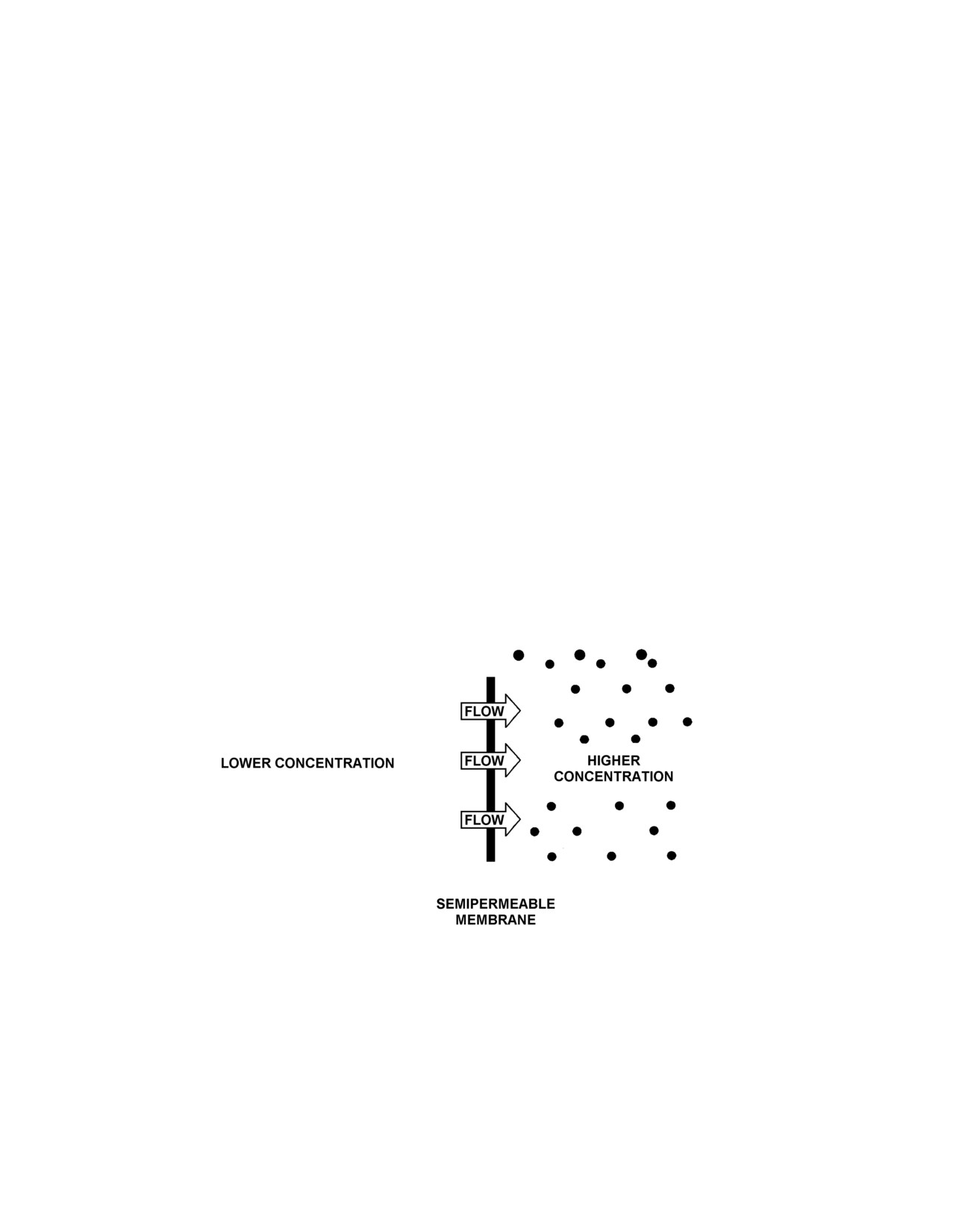
(3) Reverse osmosis is the final stage of filtration. The RO filter consists of a semipermeable
membrane. Under hydrostatic conditions, water will migrate from the side of the semipermeable membrane
that has the lower concentration of dissolved or suspended matter to the side with greater concentration.
This movement of water through the semipermeable membrane is referred to as osmosis (see Figure 2-1).
Figure 2-1. Osmosiswater flows through the semipermeable membrane from lower to higher
concentration of matter.
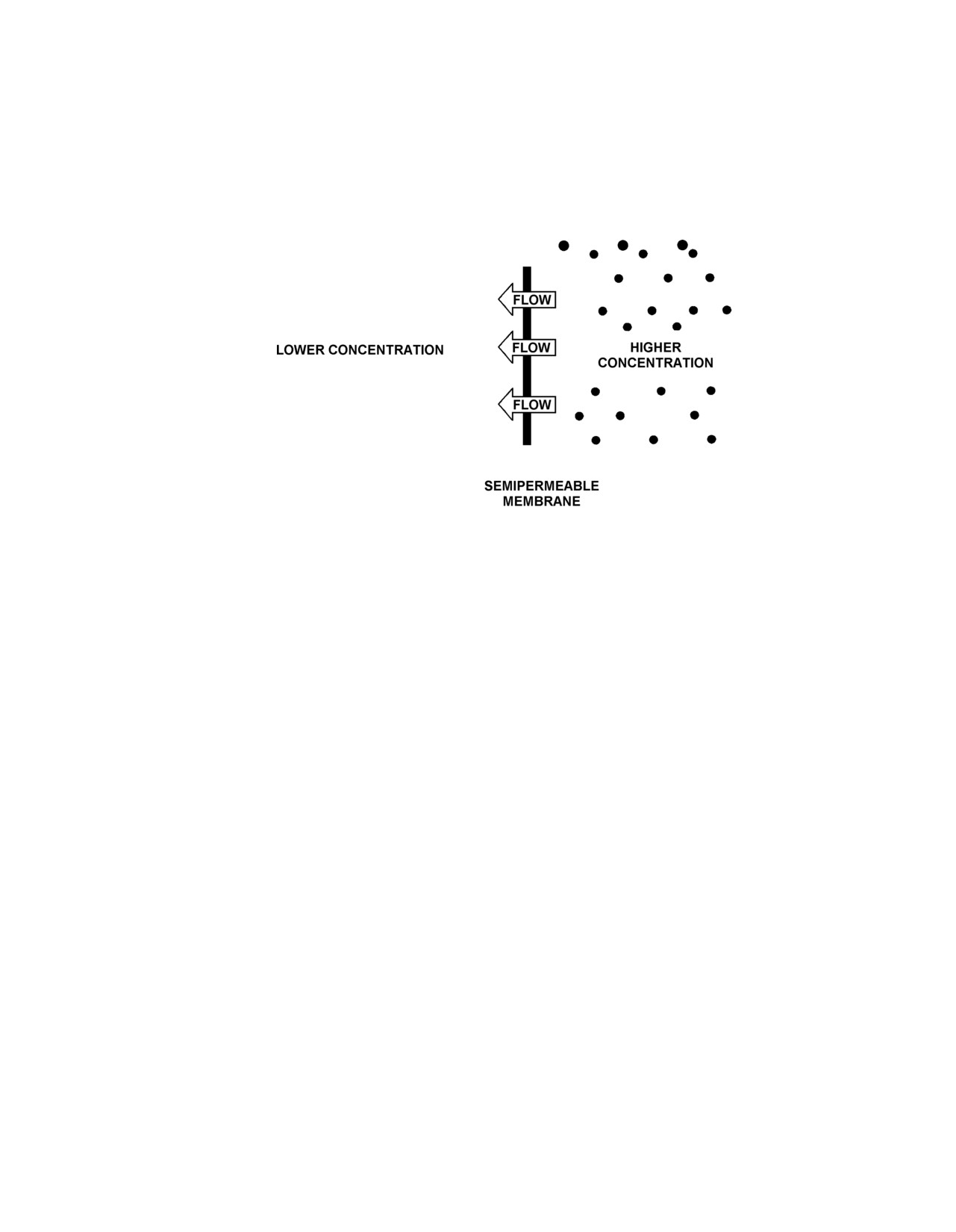
In RO, substantial pressure on the side of the higher concentration of matter is increased in order to counter
the osmotic pressure and force the water through the semipermeable membrane in the direction opposite to
the osmotic flow (see Figure 2-2).
2-10
FM 4-25.12
Figure 2-2. Reverse osmosiswater is forced through the semipermeable membrane in the opposite
direction of osmotic flow by using high pressure.
b. Water Disinfection. Disinfection is a physical or chemical process of destroying potentially
pathogenic organisms in the water. This is accomplished by boiling the water, microfiltration, ultraviolet
radiation, using iodine tablets, or calcium hypochlorite.
Field units employ calcium hypochlorite for disinfecting water. Calcium hypochlorite
comes in a white powder making it much easier to use than liquid or gaseous chlorine products. It is the
hypochlorite that oxidizes and destroys the pathogen. Since calcium hypochlorite is nearly 72 percent
hypochlorite by weight it is approximately 70 percent effective.
The sudden drop in FAC may indicate contamination and a decrease in protection.
A contact time of at least 30 minutes is required for satisfactory water disinfection.
NOTE
Experience has proven that in most cases the major portion of the
chlorine demand is satisfied within 10 minutes after chlorine dosage is
added. Even if the required chlorine residual is present after this
period, an additional contact period of 20 minutes is mandatory before
the water can be consumed.
Water treated by a ROWPU requires a chlorine residual of 2 ppm/milligrams per liter (mg/l)
after a 30-minute total contact period.
Emergency field water not treated by a ROWPU requires a chlorine residual of 5 ppm/
mg/l after a 30-minute total contact period.
2-11
FM 4-25.12
c.
Method of Disinfecting Water.
(1) Water purification (Lyster) bag and calcium hypochlorite.
(a) This is the most satisfactory and convenient method for disinfecting water for a
small unit in the field. The 36-gallon Lyster bag is issued to units on the basis of one per 100 persons. The
calcium hypochlorite is issued in ampules for handling convenience. Each ampule contains 0.5 gram of
calcium hypochlorite and gives a dosage of approximately 2 ppm/mg/l after initial chlorine demand is met.
Several ampules may be added to the water in the Lyster bag. As many ampules as necessary are used to
provide the required 5 ppm/mg/l chlorine residual after a 10-minute contact period. After the desired
chlorine residual is obtained, the water is allowed to stand for an additional 20 minutes before use. When a
residual above 5 ppm/mg/l is desired, the 5 ppm/mg/l chlorine residual after a 10-minute contact is first
obtained, then the number of ampules of calcium hypochlorite required to create the desired residual are
added. The number required is based on the fact that after the initial chlorine demand is satisfied, one
additional ampule will raise the residual approximately 2 ppm/mg/l in 36 gallons of water. After additional
chlorine has been added, a 30-minute contact period must be allowed before the water is consumed.
(b) The Lyster bag must be cleaned of dirt and debris before it is used and hung by
supporting ropes before it is filled with water. The bag is scrubbed and cleaned inside with a solution made
with two ampules of calcium hypochlorite dissolved in 1 gallon (3.8 liters) of water.
NOTE
The concentration of chlorine in a solution (one ampule of calcium
hypochlorite in 1 gallon of water) is approximately 100 ppm. This
may be too low to effectively sanitize the canvas Lyster bag. Thus the
recommended concentration is two ampules per gallon for sanitizing
the Lyster bag prior to initial use.
The cleaned bag is filled only to within 4 inches (10 centimeters) from the top. If possible, the water is
settled and cleared (perhaps even strained through a cloth) before it is poured into the Lyster bag. Do not
pour in the settlings. Before the calcium hypochlorite is added, it is first dissolved in a canteen cup with a
small amount of water taken from the Lyster bag. As this mixture is poured into the Lyster bag, the water is
stirred with a clean stick. Then the faucets are flushed with a small quantity of water. After 10 minutes, the
faucets are flushed again and the chlorine residual is determined (see paragraph d below). The sample must
not be collected in the same cup or container used to dissolve the calcium hypochlorite.
(2) The 400-gallon (1,514-liter) water trailer and calcium hypochlorite.
(a) When the water trailer arrives in the unit area from the refill point, always check
the chlorine residual. This verifies that the water contains the correct chlorine residual. The chlorine
residual should be at the level established for the area of operations (AO).
(b) If the residual meets the required standard, the water is safe to drink; if not, the
water must be rechlorinated to the required level.
2-12
FM 4-25.12
NOTE
After rechlorination, the water must be checked periodically to
maintain the minimum required level.
NOTE
Heat and sunlight will cause chlorine to evaporate/dissipate more
rapidly; therefore, periodic rechlorination may be required.
(c) To rechlorinate a full water trailer
1.
Mix one meal, ready-to-eat (MRE) spoonful of calcium hypochlorite from the
6-ounce bottle (or 22 ampules) with 1/2 canteen cup of water.
2.
Thoroughly mix the slurry and then add it to the water in the trailer. Use a
clean stick or other clean device to mix the chlorine slurry in the water.
3.
Flush the four water taps for several seconds. Wait 10 minutes, then flush the
taps again and check the chlorine residual; if the residual is at least 1 ppm/mg/l or greater, wait an
additional 20 minutes before releasing the water for consumption.
NOTE
If the residual is below that required for the AO, additional chlorine
must be added to the water.
1. Mix a slurry as before; however, the amount of chlorine required
may be less than one MRE spoonful.
2. Wait 10 minutes and check the chlorine residual; flush the taps again
and check the chlorine residual; if the chlorine residual is not adequate,
the flushing and testing procedures described above must be repeated.
3. If the residual is 1 ppm/mg/l or greater, wait an additional 20
minutes before releasing the water for consumption.
(3) The 5-gallon can using calcium hypochlorite. Water disinfection, using a 5-gallon can,
is accomplished by using one ampule of calcium hypochlorite to 1/2 canteen cup of water to disinfect fifteen
5-gallon cans. The desired chlorine residual should be 1 ppm of water.
2-13
FM 4-25.12
(4) Individual containers. Disinfect individual canteens using iodine tablets or ampules of
calcium hypochlorite. The following method is used when soldiers are on the march or on patrol and the
only source is raw/unapproved water.
(a) One iodine tablet releases 8 ppm/mg/l of iodine as a disinfecting agent; two tablets
ensure adequate disinfection of a 1-quart canteen of water (current guidance is two tablets to prevent
giardiasis). This amount is normally more than adequate for clear water. However, two tablets are
recommended for both clear and cloudy water to ensure adequate disinfection.
1.
Place the tablet(s) into the canteen.
2.
After 5 minutes, shake the canteen.
3.
Loosen the canteen cap and allow the iodine-treated water to seep around the
neck of the canteen to kill any organisms harbored there.
4.
A minimum contact time of 30 minutes is required for water disinfection using
the iodine purification tablets.
NOTE
At the present time, there is no method that may be used in the field to
determine the iodine residual.
(b) When calcium hypochlorite is used instead of the iodine tablet
1.
Prepare a solution by dissolving the contents of one calcium hypochlorite
ampule in 1/2 canteen cup of water.
2.
Use the standard 1/2 plastic canteen capful or 1 NBC canteen capful of this
concentrate in each canteen of water.
3.
After 5 minutes, allow the chlorine-treated water to seep around the neck of
the canteen to kill any organisms harbored there.
NOTE
A total of 30-minutes contact time is required before drinking the
water. Sometimes the addition of small amounts of chlorine to water
causes disagreeable odors or taste to develop. If this occurs, one or
more additional canteen caps of the prepared solution will usually
correct the condition.
2-14
FM 4-25.12
(5) Plastic containers and household bleach. Household bleach may be used to disinfect
plastic containers. Ensure the bleach is unscented. See FM 21-10 for complete instructions.
(6) Other containers using calcium hypochlorite. The procedure for treating other containers
of water with calcium hypochlorite is the same as for the Lyster bag except that the amount of chlorine must
be adjusted. See FM 21-10 for additional information.
(7) Boiling water. This method is used when disinfecting compounds are not available.
It is not the best method, since there is no residual protection against recontamination.
Boiling water at a rolling boil for 5 to 10 minutes kills most organisms that are
known to cause intestinal diseases.
In an emergency, even boiling water for 15 seconds will help. Care must be taken
to use clean containers for boiling the water.
After boiling, the water must be stored in a clean, closed container to prevent
recontamination.
(8) Commercially available alternatives to water treatment are also available. An example is
Chlor-Floc® that combines chlorination for disinfection along with the process of flocculation to remove
suspended solids.
d. Determination of Chlorine Residual. The N, N-diethyl-p-phenylene-diamine (DPD) chlorine
residual determination kit has been procured and placed in the updated field chlorination kits. The new kit
consists of a color comparator with color comparisons for measuring 1, 1.5, 2, 3, 5, and 10 mg/l chlorine
residual. The procedure for testing chlorinated water with this kit is as follows:
(1) Treat the water with desired amount of chlorine. Wait 10 minutes.
(2) Fill the comparator with treated water to a level above the uppermost black border.
(3) Open one DPD tablet package and drop the tablet into the comparator. Wait 2 minutes,
place your thumb over the opening, and invert the comparator 3 times (this is a must for correct reading).
(4) If the color of the water in the left window marked 1 is the same or darker than the right
window marked 1, then the water is acceptable if a 1-mg/l residual is desired. If the color of the water is
lighter than the window marked 1, repeat chlorination, wait 10 minutes, and retest the water.
(5) If higher residuals are required, compare the color of the water in the left window with
the color of the right window of the required level.
(6) If the colors match or the left window is darker, then the required level has been met.
(7) Wait an additional 20 minutes before drinking the water.
2-15
FM 4-25.12
CAUTION
When testing water with the DPD test kit, carefully observe the
color changes of the water. When the chlorine residual is above
10 mg/l, the water color will change through the test kit levels,
then turn clear. Failure to carefully observe color changes may
lead to excessive chlorination of the water supply.
NOTE
Standard ROWPU-produced water is required to have a FAC residual
of 2 ppm.
e.
Point of Consumption. Water at the point of consumption must show a trace residual.
Recommend that water in a 400-gallon trailer have a FAC residual of approximately 1 ppm.
f.
Water Consumption under Emergency Conditions. Under emergency conditions in which
water is obtained from a natural or unapproved source such as a lake, river, or host nation water distribution
system, and no treatment (for example, ROWPU) is available, residuals of 5 ppm should be used.
Section III. FOOD SERVICE SANITATION
2-11. Importance of Sanitary Practices in Food Handling
The conditions under which food is transported, stored, prepared, and served can have a direct bearing on
the success or failure of a military mission. Food contaminated with disease-causing microorganisms
through improper temperature control or unsanitary practices can result in outbreaks of foodborne disease.
All persons who handle food must maintain the highest sanitation standards.
2-12. Factors that Most Often Cause Foodborne Disease Outbreaks
Although the FST does not have to memorize every sanitary standard and regulation, they must use
common sense and must be aware of the factors that contribute to foodborne disease outbreaks. The only
way to control these factors is through proper supervisory actions. The six factors that most often cause
foodborne disease outbreaks are failure to
Refrigerate potentially hazardous cold foods and maintain a product temperature of 40°F or below.
2-16
FM 4-25.12
Cook food to proper temperature.
Maintain potentially hazardous hot foods at a product temperature of 140°F or above.
Protect foods from cross-contamination.
Use proper transportation and storage practices.
Protect food contact surfaces, pots and pans, eating utensils, and cutting boards from
contamination.
2-13. Transportation of Food
Vehicles used for transporting food must be clean and completely enclosed, if possible. Vehicles used for
transporting garbage, trash, petroleum products, or similar materials must not be used for transporting food
unless the vehicles have been properly cleaned and sanitized. If bulk quantities of meat and dairy products
are to be transported over a considerable distance, refrigerated containers should be used. Every unit
should have clean tarpaulins, boxes, or bags to protect food from contamination. Perishable foods are
stocked only at a level commensurate with the capacity of the food storage facilities of the unit.
2-14. Storage of Food
Immediately upon receipt, unit food service personnel must inspect the food. Any food suspected of being
unfit for human consumption is referred to the supporting veterinary unit or to the surgeon for disposition
instructions.
a. Food Requiring Refrigeration. Food products requiring refrigeration should be stored at a
temperature of 40°F (4.4°C) or below. Some units have a refrigerator and a generator as part of their
equipment. Each unit with food preparation capabilities, however, is issued an ice chest with a 200-pound
(90-kilogram) capacity. Every effort must be made to keep the temperature of food in the ice chest below
45°F (7°C).
b. Potentially Hazardous Foods.
(1) Food items that can support the rapid growth of foodborne disease microorganisms are
called potentially hazardous foods (PHF). Foods high in protein, high in moisture, and with a pH (see
Glossary for definition) of 4.5 or higher are potentially hazardous. Given the right temperature for a long
enough period of time, disease-causing microorganisms can grow rapidly in foods such as
Chopped ham.
Ground meat.
2-17
FM 4-25.12
Potato salad.
Egg salad.
Fish.
Poultry.
Cut melons.
Cooked vegetables.
Raw sprouts.
Eggs.
(2) Safe product temperatures.
(a) Decisions for the type of rations issued are usually beyond the control of the unit. It
is of utmost importance that all product temperatures be monitored. Potentially hazardous foods must be
stored immediately in the best refrigeration available to maintain a safe product temperature.
(b) When serving hot or cold meals in the field, maintaining safe product temperatures
of 40°F (5°C) and below or 140°F (60°C) and above can seem like an impossible job. By correctly using
equipment that is available and using good supervisory techniques, the job can be done. Failure to maintain
a safe product temperature is the leading cause of foodborne disease outbreaks. In addition to disease
prevention, temperature control retards food spoilage and loss of culinary quality. When food temperature
is not controlled, spoilage will occur sooner. It should be noted that foods containing enough microorganisms
or toxins to cause foodborne diseases may not have any changes in odor, taste, or appearance.
(c) Safe temperatures are 40°F (4.4°C) or below and 140°F (60°C) or above. Any
temperature between 41°F (5°C) and 139°F (59°C) is in the DANGER ZONE. Food products may have
to be in the danger zone during some periods of preparation. For example, when food is being mixed with
other ingredients, chopped, or formed, it is in the danger zone. At each stage of preparing and serving, the
product may be exposed to unsafe temperatures and the chance of becoming contaminated. The goal in
temperature control is to minimize the time PHF are in the danger zone. This time accumulatesthat is,
each separate period of time that the food is in the danger zone adds to the limit. Three hours cumulative
time is the maximum such food can be in the danger zone and not be a health hazard. After 4 hours in the
danger zone, enough bacteria may have grown in the food to cause foodborne disease outbreaks.
(d) Transporting PHF from a base camp to troops at other locations requires the use of
insulated food containers. Correct use of the insulated food container will help maintain safe product
temperatures.
2-18
FM 4-25.12
(e) For hot foods, preheat the insulated container by using boiling water. Preheating
the container helps maintain safe hot food temperatures. When preheated correctly, foods should remain at
safe temperatures for 3 to 4 hours. Take the following steps for preheating:
1.
Remove the inserts.
2.
Pour 2 quarts/liters of boiling water into the container.
3.
Close and let the container stand for at least 30 minutes.
4.
Pour out enough water to provide room for the inserts.
5.
Place the hot food (at least 140°F [60°C]) into the inserts and then place the
inserts in the container.
6.
Close and fasten the container lid. Label containers with common name of
food, date/time filled, and the statement, Food must be consumed by _________ hours (a time no greater
than 4-hours after filling [for insulated container]).
(f)
For foods that must remain cold, put crushed ice into the container to prechill it.
When correctly prechilled, cold foods should remain at safe temperatures for 3 to 4 hours. Take the
following steps for prechilling:
1.
Remove the inserts.
2.
Put crushed ice or 2 quarts (1.892 liters) of iced water into the container.
3.
Close and let the container stand for 30 minutes.
4.
Dump out enough ice to provide room for the inserts
5.
Place the cold food (below 45°F [7.5°C]) into the inserts and then place the
inserts in the container.
6.
Close and fasten the container lid. Label containers with common name of
food, date/time filled, and the statement, Food must be consumed by _________ hours (a time no greater
than 4 hours after filling [for insulated containers]).
c.
Semiperishable Food. Vegetables, such as potatoes and onions, are stored in a dry place on
dunnage so air can circulate around them, thus retarding decay and spoilage.
(1) Screened food boxes may be used to keep such items as bread for a short period. These
screened boxes are suspended to permit free circulation of air and to protect the food from insects and
rodents. The food is covered before it is placed in the boxes to protect it from dust.
2-19
FM 4-25.12
(2) Items such as flour, sugar, and rice should be stored in their original containers. They
should be placed in metal containers with tightly fitting lids and protected from excessive heat and moisture.
Improper storage can result in loss from rodent or insect infestation or from deterioration because of
excessive heat or moisture.
d. Acid Food. Acid food or beverages, such as potato salad, tomato juice, lemonade, citrus fruit
drink, or other acidified drinks, must never be stored or served in galvanized containers because they are
capable of dissolving the zinc which can cause heavy metal poisoning.
2-15. Personal Hygiene of Food Handlers
a. Food handlers can be a primary source of disease and food contamination. The following
measures should be taken to minimize this hazard:
Daily inspection of personnel by supervisors.
Instructions to food handlers on maintenance of personal hygiene, especially proper hand-
washing.
Provisions for clean uniforms.
Provisions for adequate toilet and handwashing facilities.
Referral of ill food handlers to the medical facility.
Ensure previously ill food handlers are cleared by the medical facility before returning
to duty.
Consideration of diseases prevalent in local area before deciding to use indigenous
personnel in food service facilities.
All cuts on hands, regardless of whether they are obviously infected or not, must be
bandaged and then a glove must be worn.
All food service personnel, to include kitchen police, will not use any tobacco products
(including smokeless tobacco) in the food service area.
NOTE
Persons who appear ill or have been absent from work because of a
communicable disease, including diarrhea, must be referred to the
medical treatment facility for determination of fitness for duty before
resuming work. Changes to this policy may be directed by the
command surgeon based on local conditions.
2-20
FM 4-25.12
b. The food service supervisor or other supervisory personnel of the food-handling activity
inspects all food service personnel daily at the beginning of their duty shift and observes them throughout
the work period for signs of illness. Anyone showing evidence of illness, skin disease, and infected cuts or
boils is not permitted to handle food unless cleared by a medical officer. Food workers must thoroughly
wash their hands before working with food preparation. Handwashing after visiting the latrine must
become an unfailing habit.
2-16. Cleaning and Sanitizing Utensils
a. Cooking Utensils. Cooking utensils are washed, rinsed, sanitized, and properly stored after
each use.
In the field, they are scraped free of food particles.
Washed in hot (120° to 150°F/48.88° to 62°C), soapy water.
Rinsed in one container of boiling water.
Sanitized in another container of boiling water or an approved chemical sanitizer.
Allowed to air dry.
Stored in a clean covered place that is protected from dust and vermin.
b. Leftover Potentially Hazardous Foods. Leftover PHF are extremely dangerous. Leftovers are
prohibited in the field food service.
2-17. Physical Facilities
The physical facilities where food is stored, prepared, and served must be free of rats, mice, flies, roaches,
ants, and other vermin. Screening and ratproofing methods are used to the greatest extent possible. Repairs
are made as soon as the need is indicated.
Food and utensils are stored in protected places.
Repairs to facilities should be made as soon as the need arises.
Proper waste disposal and control methods are used to eliminate arthropod and rodent feeding
and breeding places. When pesticides are used, the directions on the container must be followed exactly!
2-21
FM 4-25.12
NOTE
Extreme care is taken when using pesticides in the presence of food.
All food and food contact surfaces must be protected during the
application of pesticides. Pesticides must never be stored in any food
storage area. Wash, rinse and sanitize food preparation utensils and
surfaces prior to use after pesticide application inside field kitchens.
If PVNTMED soldiers or contractors conduct area pesticide
applications
(fogging or aerial spraying, for example), food
preparation areas must be washed, rinsed, and sanitized prior to use.
2-18. Preparing and Serving Food
a. The food service functions should be coordinated to eliminate any unnecessary lapses of time
between preparing and serving food. Every effort is made in handling food items to keep them from
becoming contaminated, since most foods provide microorganisms with the ideal environment to multiply
and in some instances, to produce enough toxins to cause illness.
b. Potentially hazardous foods furnish a very good media for the growth of microorganisms. To
keep leftover PHF in the field is setting a unit up for disaster. Meats, milk, and eggs are especially
hazardous. Salads, chopped meats, and sandwich fillings require considerable handling during preparation,
thus increasing the possibility for contamination.
(1) Such items are, therefore, prepared immediately before serving or promptly refrigerated
after preparation.
(a) When neither procedure is feasible, as in the case of box lunches, PHF are avoided.
(b) Proper storage of leftover food presents a serious problem; meals must be planned
to reduce the amount of leftovers.
(c) No food items will be retained as leftovers for reuse. Prepared refrigerated items
that have not been placed on the serving line may be retained at the correct stated temperatures, but no more
than 24 hours.
(d) Never save foods such as opened T-Rations, creamed beef, casseroles, or gravies
or creamed sauces.
(2) Fresh fruits and vegetables grown in areas where human excreta is used as fertilizer, or
where gastrointestinal or parasitic diseases are prevalent, must not be consumed raw except with the
approval of the medical authority. All foods must be obtained from approved sources. Local purchase of
fruits, vegetables, or other products is prohibited without written approval from US Army veterinary
personnel.
2-22
FM 4-25.12
(a) When they are authorized for consumption, fruits and vegetables, including leafy
vegetables may be served raw if they are taken or broken apart to expose all leaf surfaces. They must be
washed with approved detergent according to the packet label instructions and then rinsed with potable
water to remove any visible dirt.
(b) Where Disinfectant, Food Service, is not available, emergency disinfection of fruits
and vegetables may be accomplished by thoroughly washing them, then soaking them for 30 seconds in a
200-ppm/mg/l chlorine solution or by immersing them in potable water at 160°F (71.1°C) for 1 minute.
(Prepare the chlorine solution by mixing 1 tablespoon of household liquid bleach [sodium hypochlorite
5-percent] with 1 gallon of potable water.)
NOTE
Fresh fruits and vegetables from other areas must be thoroughly washed
and rinsed with potable water before serving. Certain fruits and berries,
such as strawberries, cannot be properly washed or readily disinfected;
therefore, they should not be served or eaten raw outside the US.
2-19. Inspection of Food Service Facilities
Food service facility inspections are made for the following purposes:
Identifying basic deficiencies which could cause or spread communicable diseases.
Recommending corrective measures.
Providing information and instructions which help food service personnel understand effective
sanitation practices and their importance.
The FST can be of great assistance to unit food service personnel in the prevention of such deficiencies;
however, FST members are not a replacement for inspections by trained PVNTMED personnel.
Section IV. WASTE DISPOSAL
2-20. Importance of Proper Waste Disposal in Disease Prevention
The proper disposal of all wastes is essential in preventing the spread of diseases. Liquid and solid wastes
produced under field conditions may amount to 100 pounds (45 kilograms) per person per day, especially
when shower facilities are available. A camp or bivouac area without proper waste disposal methods soon
becomes an ideal breeding area for flies, rats, and other vermin and may result in diseases such as dysentery
(amoebic and bacillary), typhoid, paratyphoid, and cholera among soldiers.
2-23
FM 4-25.12
2-21. Responsibilities for Waste Disposal
a. The unit commander is responsible for proper waste disposal in his unit area. Commanders
should check with the Logistics Officer (US Army [S4]) or the supporting PVNTMED officer for assistance
with the removal of hazardous waste.
b. The PVNTMED personnel are responsible for inspecting waste facilities and methods of
operation. It recommends changes which aid in protecting the health and welfare of soldiers.
2-22. Waste Disposal Methods
There are several disposal methods for the different kinds of wastes, which include
Human waste (feces and urine).
Animal waste.
Garbage.
Kitchen and bath liquid waste.
Rubbish.
Hazardous waste.
The methods selected for use will depend upon the location of the unit and the military situation. Generally,
wastes are buried if the environment, especially soil conditions, and local regulations permit.
2-23. Field Facilities for Human Waste Disposal
a. General. Human waste disposal becomes a problem for both the individual and the unit in the
field. Local, state, federal, and host-nation regulations or laws may prohibit burning or burial of waste.
Chemical latrines are the preferred human waste disposal devices for use during field exercises or missions.
When chemical latrines are not available, individuals and units must use improvised devices as discussed in
paragraph c, below. During short halts when troops are on a march, each soldier uses a brief relief bag or
a cat-hole latrine. The cat-hole latrine is dug approximately 1-foot (30-centimeters) deep and is completely
covered and packed down after use. In temporary bivouac areas (1 to 3 days), the straddle trench latrine is
used unless more permanent facilities are provided for the unit. When setting up a temporary camp, a deep-
pit latrine and urine soakage pits are usually constructed. Alternate devices, which may be used to dispose
of human waste in the field, are the burn-out, mound, bored-hole, or pail latrines (see FM 21-10). The
burn-out latrine is the preferred method for improvised devices. If possible, urinals should be provided in
these facilities to prevent soiling the toilet seats. The numbers of latrines are based on one commode or
urinal per 25 male soldiers and one commode per 17 female soldiers.
2-24
FM 4-25.12
(1) Latrines are so constructed to prevent the contamination of food and water. They are
located at least 100 yards (90 meters) downwind (prevailing wind) and down gradient from the unit food
service facility and at least 100 feet (30 meters) from any unit ground water source. They should never be
placed above gradient of the unit food service facility. For further protection, latrines are not dug to the
ground water level or in places where pit contents may drain into the water source. Usually they are built at
least 30 yards (30 meters) from the border of the unit area but within a reasonable distance for easy access.
A drainage ditch is dug around the edges of the latrine enclosure to keep out rainwater and other surface
water. A handwashing device is installed outside each latrine enclosure; these devices should be easy to
operate and kept full of water. Each individual must wash his hands after he uses the latrine.
(2) When a latrine is filled to within 1 foot (30 centimeters) of the ground surface or when it
is to be abandoned, it is closed in the following manner. The pit is filled to the ground surface in 3-inch
(8-centimeter) layers; each layer is compacted. This is to prevent fly pupae from hatching and gaining
access to the open air. Dirt is then compacted over the pit to form a mound at least 1-foot (30-centimeters)
high. A sign is posted with the date and the words closed latrine, if the tactical situation permits.
b. Chemical Latrines.
(1) Chemical latrines are used in the field when federal, state, or local laws prohibit the use
of other field latrines. These toilets are self-contained in that they have a holding tank with chemical
additives to aid in decomposition of the waste and for odor control. The number of such facilities required
is established by the surgeon or other medical authority in the AO.
(2) The facility must be cleaned daily, and the contents pumped out for disposal in a
conventional sanitary waste water system. The frequency of emptying is determined by the demand for use
of the device.
c.
Improvised Devices. When chemical latrines are not available, the following improvised
devices can be used.
(1) Burn-out Latrine. The burn-out latrine may be provided when the soil is hard, rocky, or
frozen, making it difficult to dig a deep pit latrine. It is particularly suitable in areas with high water tables
because digging a deep pit is impossible. The burn-out latrine is not used when regulations prohibit open
fires or air pollution. Personnel should urinate in a urine disposal facility rather than the burn-out latrine, as
more fuel is required to burn out the liquid.
(a) To construct a burn-out latrine, an oil drum is cut in half, and handles are welded to
the sides of the half drum for easy carrying. A wooden seat with a flyproof, self-closing lid is placed on top
of the drum.
(b) The latrine is burned out daily by adding sufficient fuel to incinerate the fecal
matter. A mixture of 1 quart (1 liter) of gasoline to 4 quarts (4 liters) of diesel oil is effective, but must be
used with caution. If possible, have two sets of drums, one set for use while the other set is being burned
clean. If the contents are not rendered dry and odorless by one burning, they should be burned again. Any
remaining ash should be buried.
2-25
FM 4-25.12
DANGER
Highly volatile fuel such as JP4 (jet propulsion fuel,
grade 4) should not be used because of its explosive
nature.
(2) Straddle Trench Latrine. The trench is dug 1-foot (30-centimeters) wide, 21/2-feet
(75-centimeters) deep, and 4-feet (120-centimeters) long. Two feet (60 centimeters) of length are allowed
per person. These trenches, which are constructed parallel to one another, are spaced at least 2-feet
(60-centimeters) apart. Since there are no seats on this type of latrine, boards may be placed along both
sides of the trench to provide sure footing. As the earth is removed, it is piled at one end of the trench, and
a shovel or paddle is provided so that each soldier can promptly cover his excreta. Toilet paper is placed on
suitable holders and protected from bad weather by a tin can or other covering. The straddle trench latrine
is closed, using the same method described in a(2) above.
(3) Deep Pit Latrine. The deep pit is used with the standard latrine box which is issued to or
built by the unit. The two-seat box is 4-feet (120-centimeters) long, 21/2-feet (75-centimeters) wide at the
base, and 18-inches (45-centimeters) high. A four-seat box 8-feet (240-centimeters) long, 21/2-feet
(75-centimeters) wide at the base, and 18-inches (45-centimeters) high may be built by the unit using scrap
lumber or other material.
(a) The pit is dug 2-feet (60-centimeters) wide and either 31/2- or 71/2-feet (105- or
225-centimeters) long, depending upon the size of the latrine box. This allows 3 inches (8 centimeters) of
earth on each side of the pit to support the latrine box. The depth of the pit depends on the estimated length
of time the latrine will be used. As a guide, a depth of 1 foot (30 centimeters) is allowed for each week of
estimated use, plus 1 foot (30 centimeters) of depth for dirt cover. Generally, it is not desirable to dig the
pit more than 6-feet (2-meters) deep because of the danger of the walls caving in. Rocks or high ground
water levels may also limit the depth of the pit. In some soils, supports of planking or other material may be
necessary to prevent the walls from caving in.
(b) To prevent fly breeding and to reduce odors, the latrine box must be kept clean, the
lids closed, and all cracks sealed. If a fly problem exists, they may be controlled by the application of a
residual pesticide. Control effects should be based upon fly surveys and pesticides applied in accordance
with label directions. Pit contents should not be sprayed routinely since flies can develop resistance to
pesticides if used over and over. The latrine boxes and seats are scrubbed daily with soap and water. Using
lime in the pit or burning out the pit contents is not effective for fly or odor control; therefore, these
methods are not recommended. The deep pit latrine is closed as described in a(2) above.
(4) Mound Latrine.
(a) This latrine may be used when a high ground water level or a rock formation near
the ground surface prevents digging a deep pit. A dirt mound makes it possible to build a deep pit and still
not extend it into the ground water or rock.
2-26
FM 4-25.12
(b) A mound of earth with a top at least 6-feet (2-meters) wide and 12-feet (4-meters)
long is formed so that a four-seat latrine box may be placed on top of it. It is made high enough to meet the
pits requirement for depth, allowing 1-foot (30-centimeters) from the base of the pit to the level of the
ground water or rock level. The mound is formed in approximately 1 foot (30 centimeters) layers. The
surface of each layer is compacted before adding the next layer. When the desired height is reached, the pit
is then dug in the mound. Wood or other bracing may be needed to prevent the pit walls from caving in.
An alternate method is to construct a latrine pit on top of the ground, using lumber, logs, corrugated sheet
metal, or whatever other material is available; to pile dirt around it and up to the brim, thus creating the
mound around the latrine pit. The exact size of the mound base depends upon the type of soil; it should be
made large to avoid a steep slope. It may be necessary to provide steps up the slope. The mound latrine is
closed as described in a(2) above.
(5) Pail Latrine. A pail latrine may be built when conditions (populated areas, rocky soil,
and marshes) are such that a latrine of another type cannot be constructed. A four-seat latrine box may be
converted for use as a pail latrine by placing a hinged door on the rear of the box, adding a floor, and
placing a pail under each seat. If the box is located in a building, it should, if possible, be fitted into an
opening made in the outer wall so that the rear door of the box can be opened from outside the building.
The seats and rear door should be self-closing, and the entire box should be made flyproof. The floor of the
box should be made of an impervious material (concrete, if possible) and should slope enough toward the
rear to facilitate rapid water drainage used in cleaning the box. A urinal may also be installed in the latrine
enclosure with a drainpipe leading to a pail outside. This pail should also be enclosed in a flyproof box. The
waste in pails may be disposed of by burning or by hauling to a suitable area and burying. Emptying and
hauling containers of waste must be closely supervised to prevent careless spillage. The use of plastic bag
liners for pails reduces the risk of accidental spillage. The filled bags are tied at the top; they then are
disposed of by burning or burial.
(6) Urine Disposal Facilities. Urine disposal facilities should be provided for the males in
the command. Urine should be drained from the urinals into a soakage pit, into a standard deep pit latrine if
the urinals are constructed in conjunction with the latrine, or into the chemical latrine. The urine may be
drained into a pit latrine through a pipe, hose, or trough. If a soakage pit is used, it should be dug 4-feet
(1.2-meters) square and 4-feet (1.2-meters) deep and filled with rocks, flattened tin cans, bricks, broken
bottles, or similar nonporous rubble.
(a) Urinal pipes. Urinal pipes should be at least 1 inch (2.5 centimeters) in diameter and
approximately 39-inches (1-meter) long and placed at each corner of the soakage pit and, if needed, on the
sides halfway between the corners. The pipes are inserted at least 8-inches (20-centimeters) below the surface
of the pit with the remaining 28 inches (80 centimeters) slanted outward above the surface. A funnel of tar
paper, sheet metal, or similar material is placed in the top of each pipe and covered with a screen.
(b) Urinal trough. A urinal trough, about 10-feet (3.3-meters) long, is provided when
material for its construction is more readily available than pipes. The trough is made of sheet metal or
wood with either V- or U-shaped ends. If the trough is made of wood, it is lined with tar paper or metal.
The legs supporting the trough are cut slightly shorter on one end where a pipe carries the urine into the
soakage pit or latrine pit. A urinal trough about 12-inches (30-centimeters) long is attached to the inside
wall of the chemical latrine. A pipe is connected to the trough to drain urine into the latrine holding tank.
2-27
FM 4-25.12
(c) Urine soakage pit. For the urine soakage pit to function properly, soldiers must not
urinate on the surface of the pit. The funnels or trough must be cleaned daily with soap and water and the
funnels replaced as necessary. Oil and grease must never be poured into the pit, as they will clog it. When
a urine soakage pit is to be abandoned or it becomes clogged, it is sprayed with a residual insecticide and
mounded over with a 2-foot (60-centimeter) covering of compacted earth.
(d) Urinoil. In areas where the ground water level is more than 3-feet (1-meter) below
the surface, the urinoil is an acceptable substitute for other types of urine disposal facilities. The urinoil is a
55-gallon drum designed to receive and trap urine and to dispose of it into a soakage pit. Urine voided
through the screen onto the surface of the oil immediately sinks through the oil to the bottom of the drum.
As urine is added, the level rises within the 3-inch diameter pipe and overflows into the 11/2-inch diameter pipe
through the notches cut in the top of this pipe. The oil acts as an effective seal against odors and against fly
entrance. The screen on top of the oil is lifted by supporting hooks and cleaned of debris as necessary.
2-24. Garbage Disposal
Garbage is disposed of by burial or incineration. Tactical requirements must be considered in either case.
The excavated soil must be concealed; also, smoke and flame may not be tolerated in a tactical situation. In
a training situation, environmental protection may rule out burning or burying; therefore, garbage will have
to be collected and hauled away.
a. Burial.
(1) Garbage must not be buried within 100 feet (30 meters) of any natural source of water,
such as a stream or well, used for cooking or drinking.
(2) The garbage burial area should be a reasonable distance from the kitchen to minimize
problems with flies, odor, and appearance.
(3) On a march, in bivouac, or in camps of less than 1-week duration, the kitchen waste is
disposed of by burial in pits or trenches. Pits are preferred for overnight halts. They are usually dug 4-feet
(1.2-meters) square and 4-feet (1.2-meters) deep. The pit is filled to not more than 1 foot (30 centimeters)
from the top; then it is covered, compacted, and mounded with 1 foot (30 centimeters) of earth.
(4) The continuous trench is more adapted to stays of 2 days or more. This method is started
by digging a trench about 2-feet (60-centimeters) wide, 4-feet (1.2-meters) deep, and long enough to
accommodate the garbage. As in the pit method, the trench is filled to not more than 1 foot (30 centimeters)
from the top. The trench is extended as required, and the excavated dirt is used to cover and mound the first
deposit. This procedure is repeated daily or as often as garbage is dumped. It is a very efficient field
expedient for disposing of garbage.
b. Incineration. In temporary camps of 1 week or more, the garbage is often burned in open
incinerators. Excellent types of open incinerators may be constructed from materials that are readily
available in any camp area. Since incinerators will not handle wet garbage, it is necessary to separate the
2-28
FM 4-25.12
solid from the liquid portions of the garbage. This is done by straining the garbage with a coarse strainer
such as an old bucket, salvaged can, or oil drum with holes punched in the bottom. The solids remaining
in the strainer are incinerated, and the liquids are poured through a grease trap (paragraph 2-25a(3)) into
a soakage pit. Since field incinerators create an odor nuisance, they should be located at least 50 yards
(50 meters) downwind from the camp.
(1) Barrel incinerator. The barrel incinerator will effectively take care of the waste produced
by a company-sized unit. This is an excellent dry trash incinerator, but wet material tends to disrupt proper
draft and does not burn easily. A stack is made from an oil drum with both ends cut out or with one end cut
out and the other end liberally punched with holes to admit draft air. Holes are punched through the sides of
the drum and steel rods are inserted. The steel rods create a grate. The drum is set up on rocks, bricks, or
other nonflammable material. A fire is built under the drum and the waste is added, one shovelful at a time,
on top of the grate.
(2) Inclined plane incinerator. The inclined plane incinerator will dispose of the garbage of
an entire battalion, CSH, or other unit of similar size. Its effectiveness in combustion and the fact that it is
not affected by rain or wind make it an excellent improvised device. However, building the incinerator
requires time and skill. A sheet metal plane is inserted through telescoped oil drums from which the ends
have been removed. A loading or stoking platform is built; then one end of the plane-drum device is
fastened to it, thus creating an inclined plane. A grate is positioned at the lower end of the plane, and a
wood or fuel oil fire is built under the grate. After the incinerator becomes hot, drained garbage is placed
on the stoking platform. As the garbage dries, it is pushed down the incline in small amounts to burn. Final
combustion takes place on the grate.
2-25. Liquid Waste Disposal
a. Liquid Kitchen Waste. Liquid kitchen waste accumulates at the rate of 1 to 5 gallons (4 to
19 liters) per man per day.
(1) Soakage pits. The liquid kitchen waste is disposed of in the soil by means of soakage pits
at or near the place where it is produced. A soakage pit for the disposal of kitchen waste is constructed in
the same manner as the soakage pit for urine disposal (paragraph 2-23) except that it is equipped with a
grease trap (see (3) below). Two pits are needed for a company, so that each one can have a rest period
every other day. In porous soil, a soakage pit 4-feet (1.2-meters) square and 4-feet (1.2-meters) deep will
take care of 200 gallons (760 liters) of liquid per day. In camps of long duration, each soakage pit should be
given a rest period of 1 week every month. Even though precautionary measures are taken, a pit may
become clogged with organic material.
(2) Soakage trenches. If the ground water table is high or a rock stratum is encountered near
the surface, soakage trenches may be substituted for soakage pits. These trenches are extended outward
from each corner of a central pit dug 2-feet (60-centimeters) square and 1-foot (30-centimeters) deep. The
trenches are dug 1-foot (30-centimeters) wide and 6-feet (2-meters) or more long. The depth is increased
from 1 foot (30 centimeters) at the end joining the pit to 18 inches (45 centimeters) at the outer end. The pit
and the trenches are filled with rock, flattened cans, broken bottles, or other coarse contact material. Two
2-29
FM 4-25.12
such units should be built for every 200 persons fed, and each unit should be used on alternate days. A
grease trap (see (3) below) is employed with this device.
(3) Grease traps. The grease trap is a necessary addition to the kitchen soakage pit and
trenches. All kitchen liquids are passed through a grease trap to remove food particles and as much grease
as possible; otherwise the soakage pits become clogged and useless. There are two types of grease traps
the filter and the baffle.
(a) Filter grease trap. An oil drum with the top removed and the bottom perforated is
filled two-thirds full with crushed rock, or large gravel at the bottom, followed by gravel which has been
graded to smaller sizes, and then a 6-inch (15-centimeter) layer of sand, ashes, charcoal, or straw. The top
of the drum is covered with burlap or other fabric to strain out the larger pieces of debris. The burlap or other
fabric is removed daily, burned or buried, and replaced with a clean piece. The 6-inch layer of filtering
material is removed at intervals of once or twice weekly and buried. The barrel is usually placed in the center
of the soakage pit with the bottom of the barrel about 2 inches (5 centimeters) below the pit surface.
(b) Baffle grease trap. The baffle grease trap is the most effective way of removing
grease. It is a watertight container divided into entrance and exit chambers by a baffle, the entrance
chamber having about twice the capacity of the exit chamber. The lower edge of the baffle hangs within
1 inch (2.5 centimeters) of the bottom. The outlet, a 2-inch (5-centimeter) pipe, is placed from 3 to 6 inches
(7.5 to 15 centimeters) below the upper edge of the exit chamber. The baffle grease trap is usually placed
on the ground at the side of the soakage pit with the outlet pipe extending 1 foot (30 centimeters) beneath the
surface at the center of the pit. The liquid waste is strained of solids and debris before it goes into the
entrance chamber of the trap. The strainer is filled two-thirds full with loose straw, hay, or grass. Before
the grease trap is used, the chambers are filled with cool water. When warm liquid strikes the cool water in
the entrance chamber, the grease rises to the surface and is prevented by the baffle from reaching the outlet
to the soakage pit. If the water is warm, proper separation of the grease will not occur. This is often the
case in hot climates. The grease retained in the entrance chamber is skimmed from the surface of the water
daily or more frequently as required and buried. The trap should be emptied and thoroughly scrubbed with
hot, soapy water as often as necessary. The efficiency of this grease trap can be increased by constructing it
with multiple baffles. Also, a series of baffle grease traps may be used.
(4) Evaporation beds. In a hot, dry climate where heavy clay soil prevents the use of
standard soakage pits, evaporation beds may be required. These beds actually involve the processes of
evaporation, percolation, and oxidation. Sufficient beds, 8 by 10 feet (240 by 300 centimeters), are con-
structed to allow 3 square feet (2787 square centimeters) per person per day for kitchen waste and 2 square
feet (1858 square centimeters) per person per day for bath waste. The beds are spaced so that the wastes can
be distributed to any one of the beds. The beds are constructed by scraping off the topsoil and constructing
small dikes around the 8 by 10 feet (240 by 300 centimeters) spaces. These spaces are then spaded to a
depth of 10 to 15 inches (25 to 38 centimeters) and the surfaces are raked into a series of ridges and
depressions with the ridges approximately 6 inches (15 centimeters) above the depressions. These rows
may be formed either lengthwise or crosswise as deemed desirable for best distribution of water. In
operation, one bed is flooded during one day with liquid waste to the top of the ridges which is equivalent to
an average depth over the bed of 3 inches (7.5 centimeters); the liquid waste is allowed to evaporate and
percolate. After about 4 days, this bed is usually sufficiently dry for respading and reforming. The other
2-30
FM 4-25.12
beds are flooded on successive days and the same sequence of events is followed. Careful attention must be
given to proper rotation and maintenance. It is also essential that the kitchen waste be run through an
efficient grease trap before it is allowed to enter the evaporation beds. If these beds are used properly, they
create no insect hazard and only a slight odor.
b. Bath and Wash Water. This water is disposed of in the same manner as liquid kitchen waste
(a above).
2-26. Rubbish Disposal
Combustible rubbish is burned when the tactical situation permits. Other rubbish is either buried or hauled
to a suitable disposal site, depending on the tactical situations.
2-27. Hazardous Waste Disposal
Hazardous waste should normally be disposed of through the unit S4 section. Commanders should check
with the supporting PVNTMED personnel for information concerning the turn-in of hazardous materials
and hazardous waste materials.
Section V. ARTHROPODS AND DISEASES
2-28. General
a. Historically, arthropodborne diseases have caused more casualties than combat injuries.
Arthropodborne diseases alone were responsible for the loss of 15,576,000 man-days among US Armed
Forces during World War II.
(1) Today, harmful arthropods represent one of the greatest environmental hazard to soldiers
in the field. The chain of infection for arthropodborne diseases involves a pathogenic organism in an
infected person or animal (the reservoir), an arthropod to transmit the disease (vector), and a susceptible
person (the host).
(2) The significance of vector efficiency in disease transmission from reservoir to host is
related to many factors. Some of the factors are species-related such as vector reproductive capacity,
physiology, morphology, and genetics.
(3) Other factors that affect the vectors ability to transmit disease are physical and related to
environmental conditions, such as temperature, moisture, rainfall, pH, weather, geographical and
topographical location, photoperiod, and wind.
(4) Soldiers in a field environment must break the chain of infection for arthropodborne
disease or arthropod injury by limiting arthropod pest exposures.
2-31
///////////////////////////////////////