FM 3-5 NBC Decontamination (July 2000) - page 4
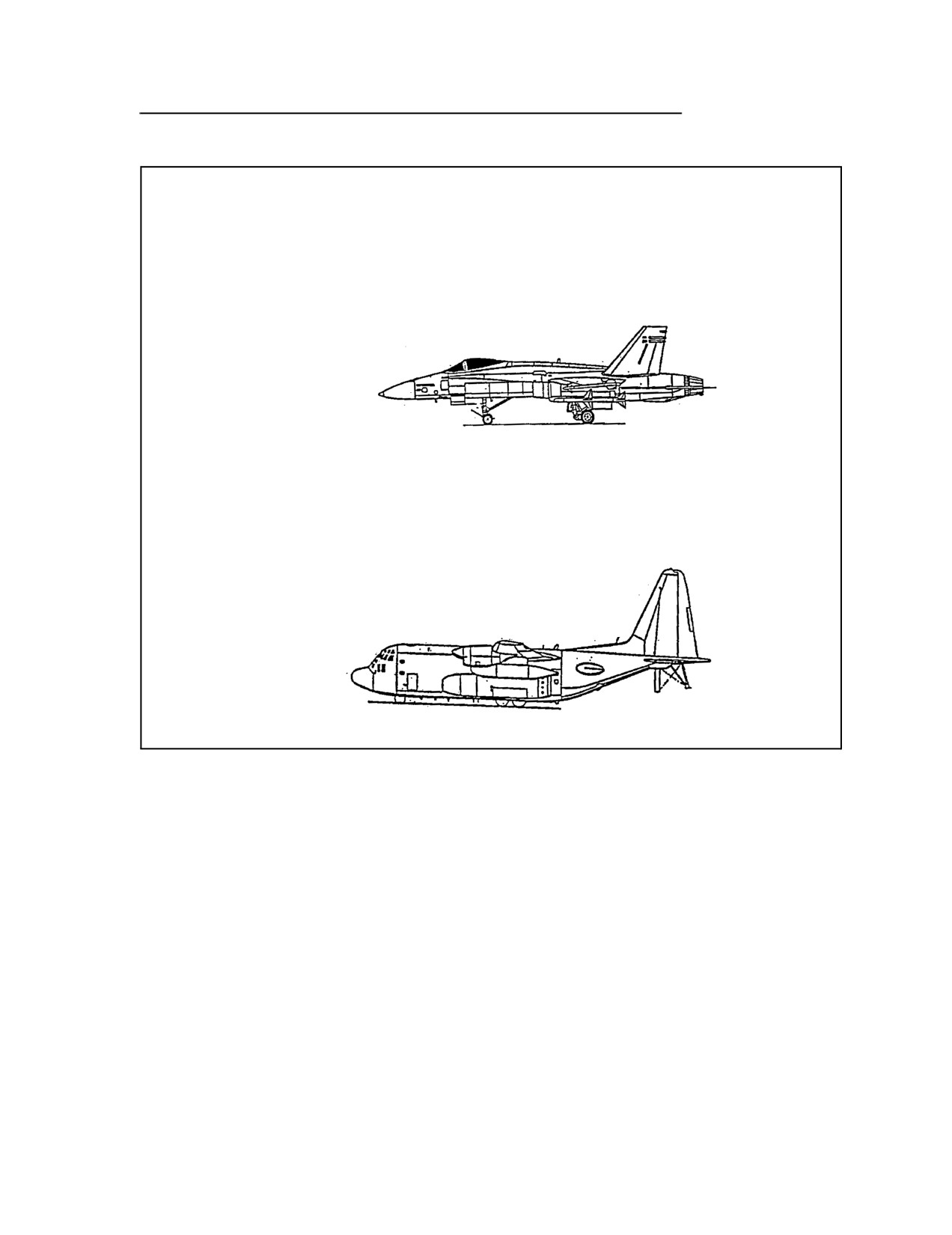
FM 3-5/MCWP 3-37.3
NOTE: The pilot will brief decon
F-18
NCOIC on areas to be sprayed.
Ensure that the canopy is down
before spraying.
NOTE: The pilot will brief decon
C-130
NCOIC on what will be taped and
sprayed.
Figure 7-6. No Direct Water-Pressure Areas for the F-18 and C-130
consulted before using this technique to ensure that the aircraft is not
damaged by the heat.
7-28. For radiological contamination, use a radiac meter to determine the
extent and location of contamination inside the aircraft. If there is
contamination, determine the intensity of the contamination. If the
contamination has an intensity greater than 0.33 cGy, the interior of the
aircraft must be decontaminated. Use hot, soapy water to wash the
contaminated areas and a sponge to mop up the water and the contamination.
Station 4 - Rinse
7-29. At this station, the decon solution is removed from the aircraft. Spray
the aircraft with water from top to bottom. Take care not to damage the
aircraft’s skin. This station will use about 250 gallons of water. Failure to
remove all decon solution from the aircraft’s skin may cause corrosion.
Aviation 7-13
FM 3-5/MCWP 3-37.3
Station 5 - Check
7-30. At this station, the completeness of the decon is checked. Determine if the
aircraft has a negligible risk or if it still has significant contamination
remaining. Detection procedures vary depending on the type of
contamination. If significant contamination is found on the aircraft, it will be
recycled to station 2 for chemical contamination or station 1 for radiological
contamination.
7-31. Chemical. Use the CAM to check for the presence of vapors. A one bar
or lower reading on the CAM indicates a negligible risk. If the CAM indicates
the presence of vapors, use M8
detector paper to check for liquid
contamination. If it is suspected that these are producing a false positive, use
an M256A1 detector kit to confirm or deny the presence of contamination. If
the aircraft has significant contamination remaining, recycle it. Desorption of
chemical agents may occur after the decon. On CARC-painted surfaces, the
desorption of vapors will stop sooner than on alkyd-painted surfaces.
7-32. Radiological. Use the radiac meter to determine if any contamination
remains. If so, determine the intensity of the contamination. If the
contamination is greater than 0.33 cGy, recycle the aircraft to station 1.
RECYCLE CRITERIA
7-33. The commander, with the chemical unit leader’s help, establishes the
recycle criteria before starting a decon operation. If contamination is detected
at station 5, the recycle criteria is used to determine which aircraft are
returned to station 2 or, if radiologically contaminated, station 1. If the unit
has sufficient time and resources available, any aircraft having more
contamination than a negligible risk should be recycled. However, time and
resources are usually limited and not all aircraft can be recycled.
AIRCRAFT DECON-SITE SELECTION
7-34. Operational- and thorough-decon sites for aircraft must be selected with
care. The decon area must be big enough for the required number of aircraft,
have a readily available water source, and allow for adequate drainage. The
site should be relatively secure; however, it should be close enough to the AOs
and FARP to allow for a reasonably quick turnaround of aircraft. The site
must not have less than a 5 percent slope. Decon sites should be integrated
into the tactical plan.
DECON-SITE LAYOUT
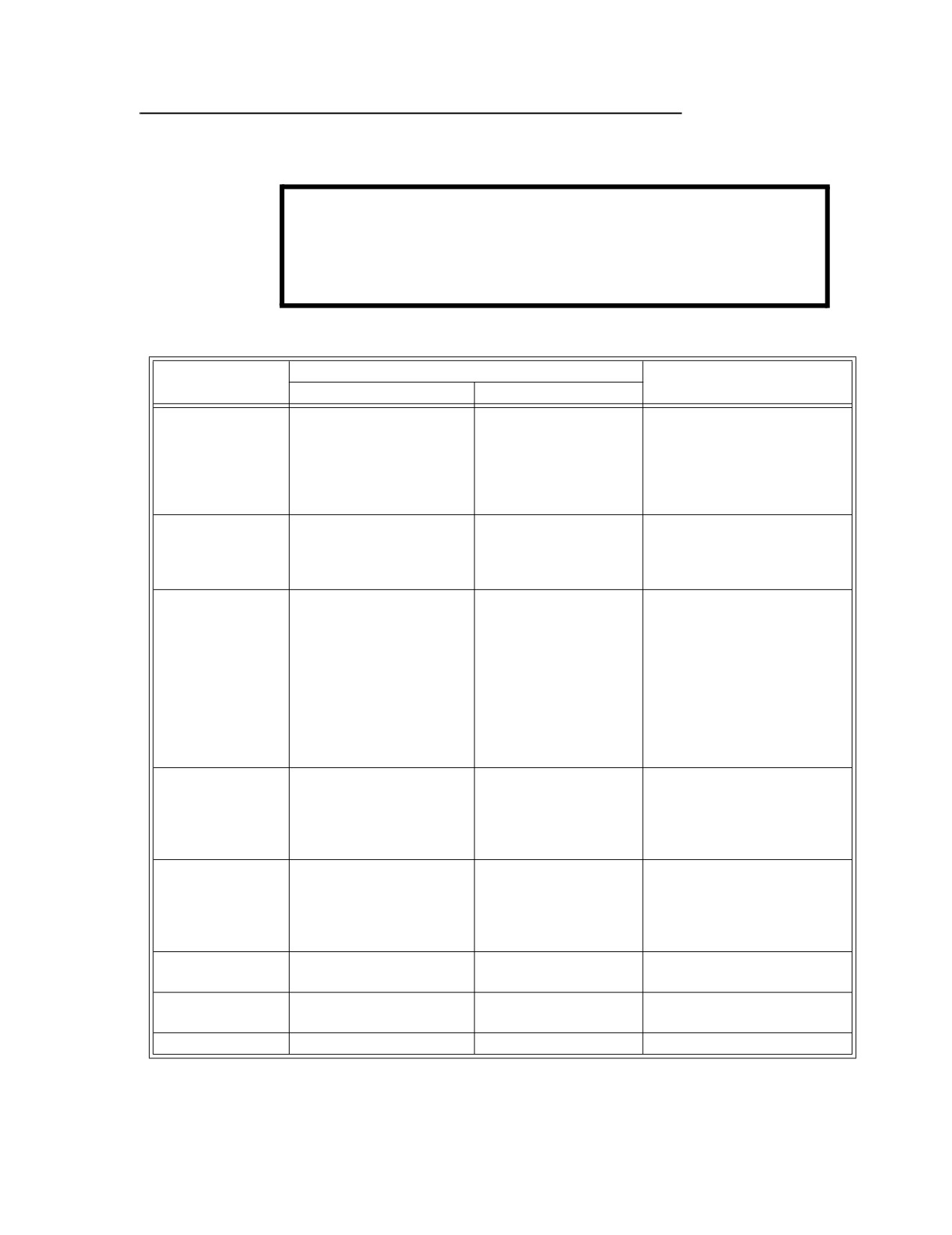
7-35. The equipment and personnel requirements for a DAD layout are
identified in Table 7-3, page 7-16. Chemical units can establish other layouts
based on METT-TC.
7-36. It may not be possible, for a variety of reasons, for a chemical platoon to
use the optimum layout. Limited personnel or equipment will affect the layout
of the thorough aircraft decon site. The platoon leader will use METT-TC and
the concepts outlined in this chapter to establish a DAD station within his
capabilities.
7-14 Aviation
FM 3-5/MCWP 3-37.3
WARNING
Chemical unit leaders must consider the impact of the work/rest
cycle on their operation to process aircraft. Failure to initiate a
work/rest cycle could result in heat casualties and mission
failure.
Table 7-3. Personnel and Equipment Requirements for an Optimum DAD Layout
Personnel
Stations
Equipment/Supplies
Decon Platoon
Augmenter
Station 1 - primary
1 squad leader
2 scrubbers
1 PDDE
wash
1 PDDE operator
1 3,000-gallon tank
2 sprayers
2 65-GPM pumps
6 long-handled brushes
5 TAP aprons
Liquid detergent
Station 2 - decon-
1 squad leader
4 appliers
1 PDDE
solution application
2 appliers
18 long-handled brushes
2 sprayers
9 mops with extra heads
1 PDDE operator
Liquid detergent
Station 3 - contact
1 NCO (CAM operator)
2 interior decon assis-
2 AN/VDR-2 or AN/PDR-77
time/interior decon
tants
3 TAP aprons
6 30-gallon containers
10 books of M8 detector paper
30 sponges
8 M256A1 detector kits
50 plastic trash bags
1 clipboard with a pen
1 stopwatch
1 CAM
Station 4 - rinse
1 squad leader
1 PDDE
1 PDDE operator
1 3,000-gallon tank
2 sprayers
3 65-GPM pumps
1 TPU
2 TAP aprons
Station 5 - check
1 NCO
1 CAM
2 CAM operators
10 M256A1 detector kits
20 books of M8 detector paper
2 AN/VDR-2 or AN/PDR-77
2 M8A1 or M22 ACAA
1 platoon leader
1 HMMWV
C2
1 platoon sergeant
3 marking kits
Aircraft moving
6 drivers
team
18 ground guides
Total personnel
20
32
Aviation 7-15
Chapter 8
Patient Evacuation and Decon
Evacuating patients under NBC conditions forces the unit commander to
consider to what extent he will commit evacuation assets to enter the
contaminated area. Generally, if most or all of a supported force is
operating in a contaminated area, most or all of the medical-evacuation
assets will operate there also. If it is possible to keep some ambulances
free from contamination, every effort should be made to do so.
EVACUATION CONSIDERATIONS
8-1. On the modern battle space, there are three basic modes of evacuating
patients (personnel, ground vehicles, and aircraft). Personnel who physically
carry the patients incur a great deal of inherent stress. Cumbersome MOPP
gear, climate, increased workloads, and fatigue will greatly reduce the
effectiveness of unit personnel.
8-2. If evacuation personnel are to be sent into an area that is contaminated
with radiation, an OEG must be established. Radiation-exposure records
must be maintained by the supported unit chemical NCO and made available
to the commander, staff, and medical leader. Based on the OEG, the
commander or medical leader decides which evacuation elements to send into
the contaminated environment. Every effort is made to limit the number of
evacuation assets that are contaminated; however, a number of these assets
will become contaminated in the course of a battle. Therefore, optimize the
use of resources, medical and nonmedical, which are already contaminated
before employing uncontaminated resources.
8-3. Once a vehicle has entered a contaminated area, it is highly unlikely that
it can be spared long enough to undergo a complete decon. This will depend
on the contaminant, the tempo of the battle, and the resources available for
casualty evacuation. Normally, contaminated vehicles (air and ground) will
be confined to dirty environments.
8-4. Ground ambulances should be used instead of air ambulances in
contaminated areas. They are more plentiful, are easier to decon, and can be
replaced more easily. However, this does not preclude the use of aircraft, if
required.
8-5. The patient's medical condition and the relative positions of the
contaminated area, the forward line of troops (FLOT), and the threat’s air-
defense systems determine if and where air ambulances may be used in the
evacuation process. One or more air ambulances may be restricted to the
contaminated areas. To the greatest extent possible, use ground vehicles to
cross the line separating the contaminated and clean areas.
Patient Evacuation and Decon 8-1
FM 3-5/MCWP 3-37.3
8-6. After the patients are loaded, the medical-evacuation vehicles proceed to
a medical-treatment facility (MTF) with a patient-decon station.
(For the
setup of a patient-decon station, see FM
8-10-7.) The patients are
decontaminated and treated at this station. If further evacuation is required,
transfer the patients to a clean ground or air ambulance. The routes that the
ground vehicles use to cross between contaminated and clean areas should be
considered dirty routes and should not be crossed by clean vehicles. The
effects of the wind and time on the contaminants must be considered.
8-7. The rotor wash of the helicopters must always be kept in mind when
evacuating patients. The intense winds will disturb the contaminants,
increasing vapor hazards.
8-8. The helicopter should be allowed to land and reduce to a flat pitch before
the patients are brought near. Additionally, the helicopter must not land too
close to a decon station because any trace of contaminants in the rotor wash
may be spread into the clean treatment area.
8-9. Evacuating patients must continue even under NBC conditions. The
medical leader must recognize the constraints that NBC operations place on
him, and he must plan and train to overcome these constraints.
PATIENT DECON
8-10. Patient decon presents special problems for units and combat-health-
support (CHS) personnel. Under NBC conditions, contaminated wounded
soldiers create increased hazards to rescuers and CHS personnel. In the
following paragraph, decon procedures at unit level are discussed:
8-11. On the NBC battle space, two classifications of patients will be
encounteredcontaminated and uncontaminated. Those contaminated may
suffer from the effects of an NBC agent, a conventional wound, or both. For
more information on the treatment of NBC patients, see FM 8-9. Some may
suffer battle fatigue or heat injuries induced by the stress of NBC conditions
and the extended time spent in MOPP4. It is important to follow proper decon
procedures to limit the spread of contamination. The most important decon is
performed at the contamination site. Later decon may be too late to prevent
injury. All agents should be promptly removed from the skin.
8-12. Patient decon must begin at the platoon and company level with the
individual soldier. The soldier himself or members of his team must perform
immediate decon and administer nerve-agent antidotes and convulsant
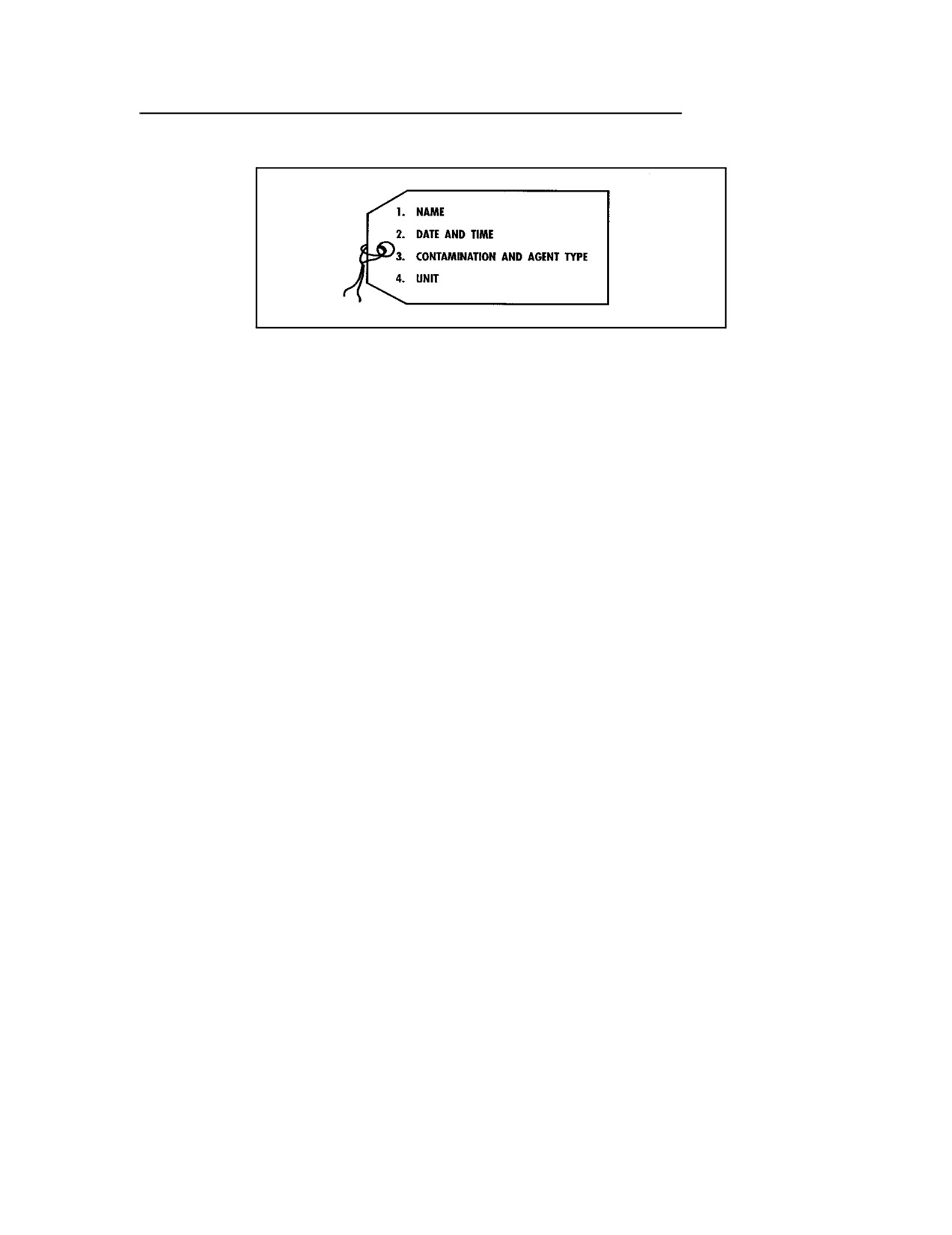
antidotes, if required. Tag the patient with a DD Form 1380 or a field-
expedient tag, noting the time and type of contamination (see Figure 8-1). If
available, use the CAM or M8/M9 detector paper to determine the type and
concentration of contamination. When the patient's condition and the battle
permits, the patient may go through a MOPP-gear exchange (see Chapter 3 of
this manual). The MOPP-gear exchange must not cause further injury to the
patient.
PATIENT DECON AT AN MTF
8-13. In the following paragraphs, the types of MTFs are discussed:
8-2 Patient Evacuation and Decon
FM 3-5/MCWP 3-37.3
Figure 8-1. Field-Expedient NBC Patient Tag
BATTALION AID STATION (BAS)
8-14. When battle conditions prevent decon procedures forward, the patient
may have to be evacuated to the BAS before decon. Contaminated patients
arriving at the MTF must be decontaminated before admission into the clean
treatment area.
8-15. Patient decon is the systematic removal of clothing and contaminants
from a patient who is unable to decon himself. Patient decon is done by an 8-
man, patient-decon team consisting of nonmedical personnel from the
supported unit at the BAS. The team operates under the supervision of
medical personnel to ensure that no further injury is caused to the patient by
the decon process.
MEDICAL COMPANY’S CLEARING STATION
8-16. The medical company’s clearing station may receive patients from the
BAS or directly from other areas who may be contaminated. The clearing
station must also have a patient-decon area. For more information on BAS
operations under NBC conditions, see FMs 8-10-4 and 8-10-7. As with the BAS,
the clearing station must have at least an 8-man, patient-decon team consisting
of nonmedical personnel from the supported units to perform the decon.
Procedures for patient decon at the clearing station are the same as for the
BAS.
HOSPITAL
8-17. To the maximum extent possible, hospitals are located away from
tactical or logistical targets. Patients evacuated from forward areas should
already be decontaminated; however, contaminated patients may arrive from
forward MTFs and units located within the geographical area of the hospital
and require decon. Patient decon is done by 20 nonmedical personnel from
units located in the geographical area/base cluster of the hospital.
8-18. If the hospital does not have CPSs and becomes contaminated with a
persistent agent, patients are rerouted to other hospitals. All inpatients are
evacuated, if possible, and the hospital is decontaminated. On completion of
the decon, the hospital will return to normal operations.
8-19. A hospital with CPSs will decon the areas around the entry to these
facilities, then continue receiving and caring for patients. Forward medical
facilities and hospitals use the same patient-decon procedures. Several
patient-decon stations can be operated at a hospital decon site. All patients
arriving at the hospital will be considered contaminated. They must be
Patient Evacuation and Decon 8-3
FM 3-5/MCWP 3-37.3
decontaminated before being admitted into the clean areas. Perform decon as
required.
CHLORINE-SOLUTION PREPARATION FOR PATIENT DECON
8-20. To decon a patient, use an SDK; however, if an SDK is not available, use a
chlorine solution. If the chlorine solution is used, two concentrations of it are
required. A 5 percent chlorine solution is required to decon gloves, aprons, litters,
scissors, patient's hood, and other nonskin contact areas. A 0.5 (½) percent
chlorine solution is required to decon the patient's mask, skin, and splints and to
irrigate his wounds. To prepare the solutions, use calcium hypochlorite granules
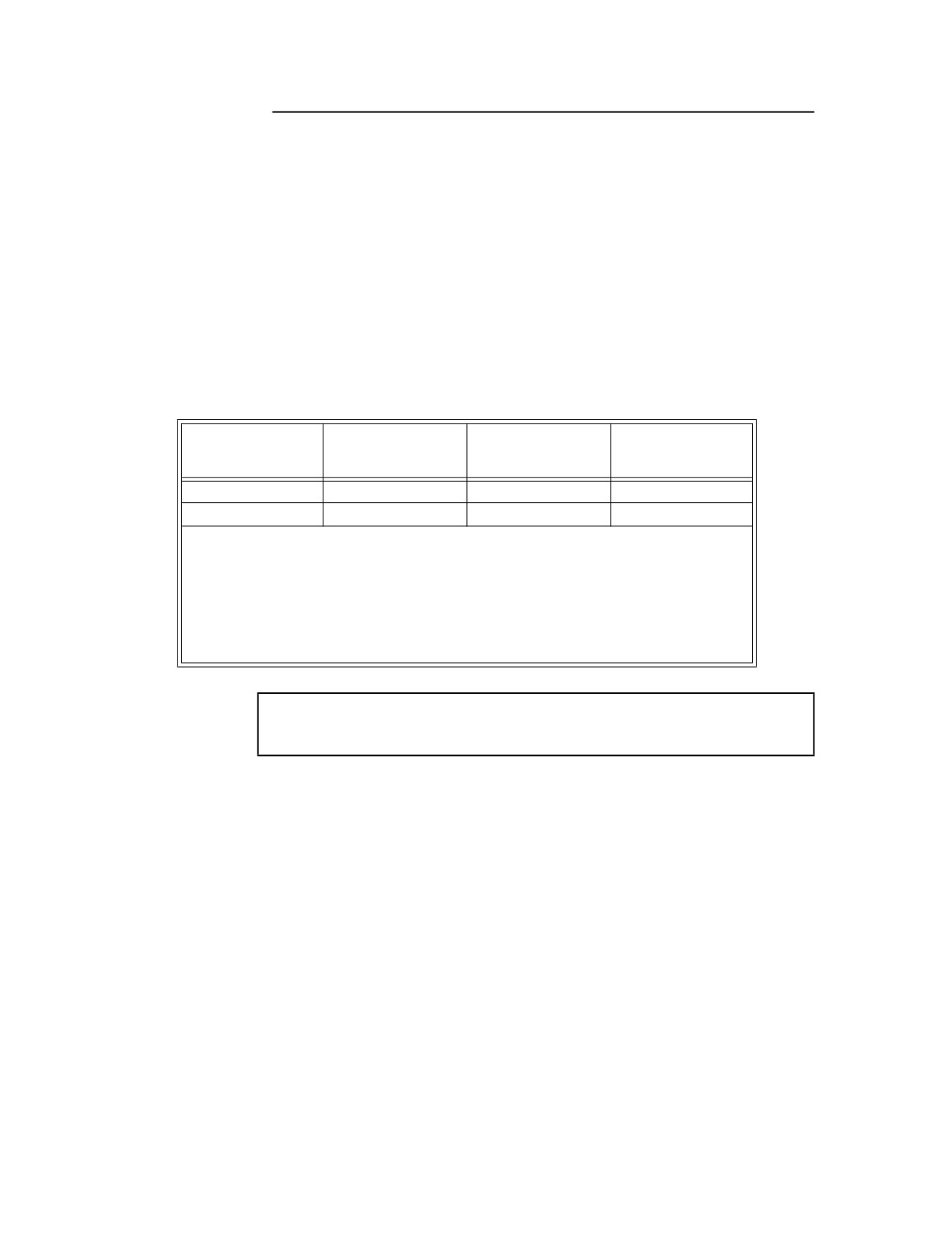
or sodium hypochlorite (household bleach) (see Table 8-1).
Table 8-1. Preparation of Chlorine Solution for Patient Decon
Solution Percent-
HTH Ounces
HTH Spoonfuls*
Household Bleach
age in 5 Gallons of
Water
6
5
2 quarts
0.5
48
40
**
5
*These measurements are used when bulk HTH is used. To measure this preparation,
use the plastic spoon supplied with your meal, ready-to-eat (MRE). Use a heaping
spoonful of chlorine (all that the spoon will hold). Do not shake any granules off the
spoon before adding to the water.
**Do not dilute in water because household bleach is about a 5 percent solution.
NOTE: HTH is supplied in a 6-ounce jar in the chemical-agent patient’s treatment
and decon medical-equipment set.
CAUTION
Only use a 0.5 percent chlorine solution on the patient’s skin. Avoid vigorous
scrubbing because it can force the agent into the skin.
CHEMICAL-AGENT PATIENT DECON PROCEDURES
8-21. Decon procedures for chemical-agent patients are discussed in the
following paragraphs:
LITTER PATIENT
8-22. Before patients receive medical treatment in the clean treatment area,
the 8-man patient-decon team decontaminates them. Figure 8-2 shows one
way to establish the patient-decon station. Place the bandage scissors in a
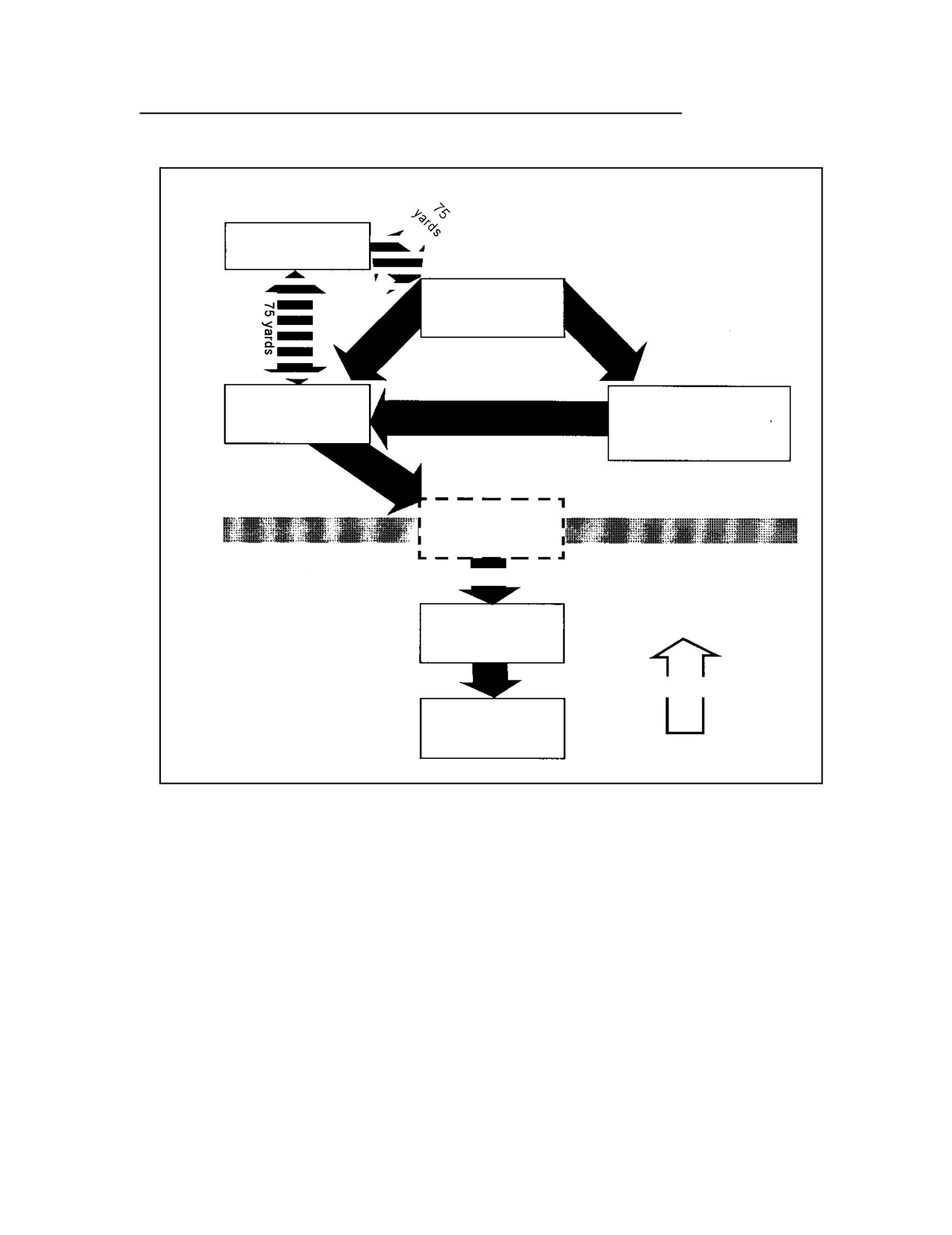
container of 5 percent chlorine solution between each use. The team members
decon their gloves and aprons with a 5 percent chlorine solution.
NOTE: Litter patients requiring emergency medical treatment (EMT)
or ambulatory medical treatment (AMT) in the clean area of the MTF
will be completely decontaminated. However, a patient requiring
immediate evacuation should have only his wound area and MOPP
gear spot decontaminated to remove any gross contamination (for
example, a stable patient with a partial amputation of a lower
extremity). The patient should be evacuated in his MOPP gear.
8-4 Patient Evacuation and Decon
FM 3-5/MCWP 3-37.3
Dirty dump
Contaminated
area
(downwind)
Dirty dump
Casualty
Contaminated
decon station
emergency medical
treatment
Dirty dump
(dirty side)
Shuffle pit
Hot line
(clean side)
30 to 50 yards
Clean area
(upwind)
Clean
treatment
station
Wind direction
Patient
disposition
point
Figure 8-2. Layout for a Patient-Decon Station and a Clean Treatment Area Without a CPS
8-23. Decon the patient's skin, bandages, wounds, mask, identification tags
with chain, and splints by wiping them with a 0.5 percent chlorine solution.
For treatment procedures, refer to FMs 8-9, 8-33, and 8-285.
8-24. Some procedures in the following steps can be done with one soldier,
while others require more than one soldier.
Step 1 - Decon the Patient's Mask and Hood
8-25. Move the patient to the clothing removal station. After the patient
has been triaged and stabilized (if necessary) by the senior medic in the
patient-decon area, move him to the litter stands at the clothing removal
station.
8-26. Decon the hood. Use either an IEDK or a 5 percent chlorine solution
(or household bleach) to wipe down the front, sides, and top of the hood.
Patient Evacuation and Decon 8-5
FM 3-5/MCWP 3-37.3
8-27. Remove the hood. Remove the hood by cutting it with scissors or by
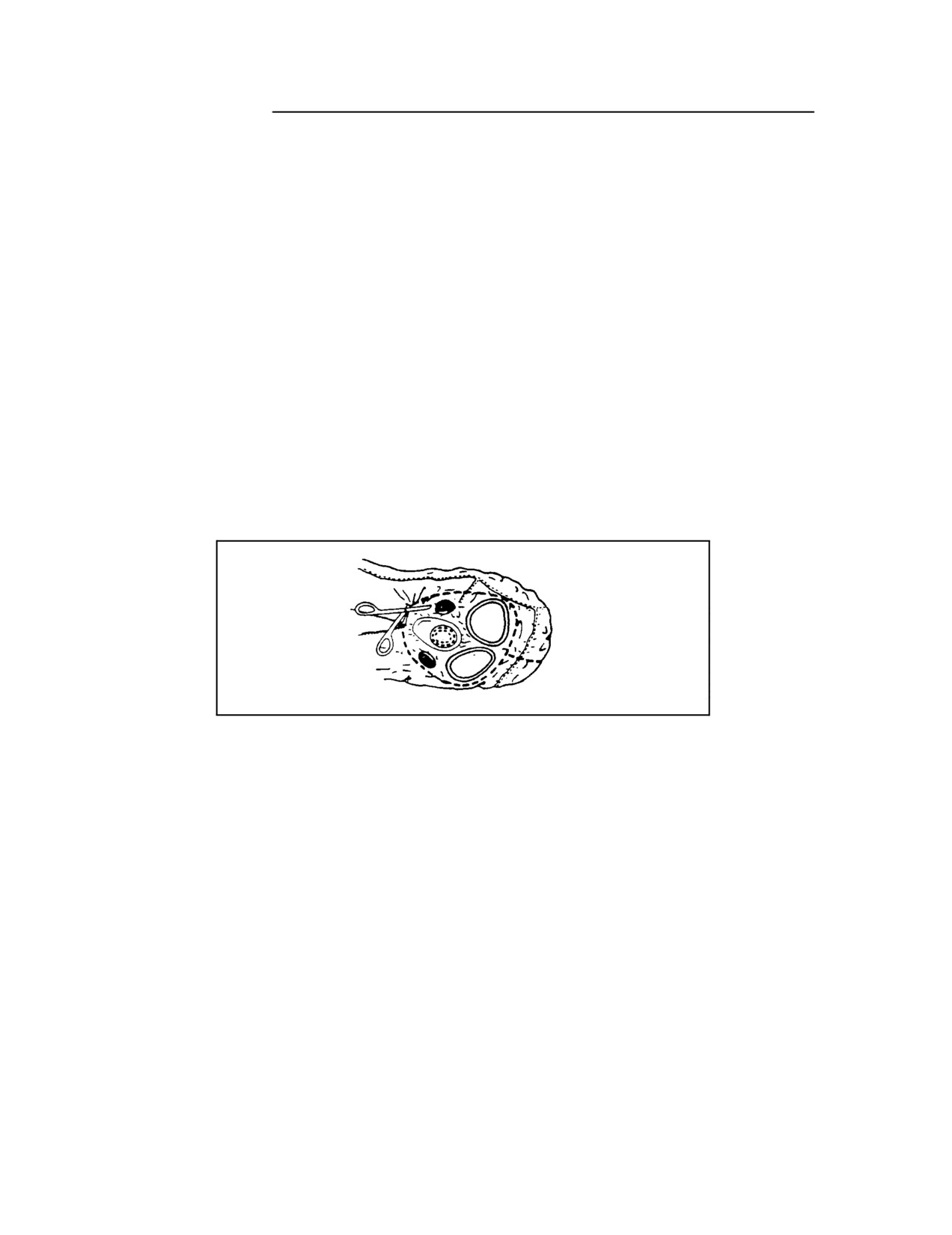
loosening it from the mask attachment points for the quick-doff hood or other
similar hoods (see Figure 8-3). Before cutting the hood, dip the scissors in a 5
percent chlorine solution. Cut the neck cord and the small string under the
voicemitter. Release or cut the hood shoulder straps and unzip the hood
zipper. Cut the hood upward to the top of the eye-lens outsert, staying close to
the filter-inlet cover and eye-lens outsert, then across the forehead to the
outer edge of the other eye-lens outsert. Proceed downward toward the
patient's shoulder, staying close to the eye lens outsert and filter-inlet cover,
then across the lower part of the voicemitter to the zipper. After dipping the
scissors in the 5 percent chlorine solution, cut the hood from the center of the
forehead over the top of the head. Fold the left and right sides of the hood to
the side of the patient's head, laying the sides of the hood on the litter.
8-28. Decon the protective mask and exposed skin. Use an SDK or a 0.5
percent chlorine solution to wipe the external parts of the mask. Cover the
mask’s air inlets with gauze or your hand to keep the mask filter dry.
Continue by wiping the exposed areas of the patient's face, to include the neck
and behind the ears. Do not remove the protective mask.
Figure 8-3. Cutting the Protective Mask Hood
8-29. Remove the field medical card (FMC). Cut the patient's FMC tie
wire, allowing the FMC to fall into a plastic bag. Seal the plastic bag and
rinse the outside of the bag with a 5 percent chlorine solution. Place the
plastic bag under the back of the protective mask’s head straps. The FMC will
remain with the patient in the contaminated area and a clean copy will be
made before the patient is moved to the clean area.
Step 2 - Remove Gross Contamination From the Patient's Protective Overgarment
8-30. Remove all visible contamination spots from the overgarment with an
SDK or a 5 percent chlorine solution.
Step 3 - Remove the Patient's Personal Effects and Protective Overgarment
8-31. Remove the patient's personal effects. Remove the patient's
personal effects from his protective overgarment and BDU pockets. Place the
articles in a plastic bag, label the bag with the patient's identification, and
seal the bag. If the articles are not contaminated, they are returned to the
patient. If the articles are contaminated, place them in the contaminated
holding area until they can be decontaminated, then return them to the
patient.
8-6 Patient Evacuation and Decon
FM 3-5/MCWP 3-37.3
CAUTION
Bandages may have been applied to control severe bleeding;
therefore, they are treated like tourniquets. Only medical
personnel will remove bandages, tourniquets, and splints.
NOTE: The overgarment jacket and trousers will be cut
simultaneously. One soldier cuts the jacket, while another soldier
cuts the trousers.
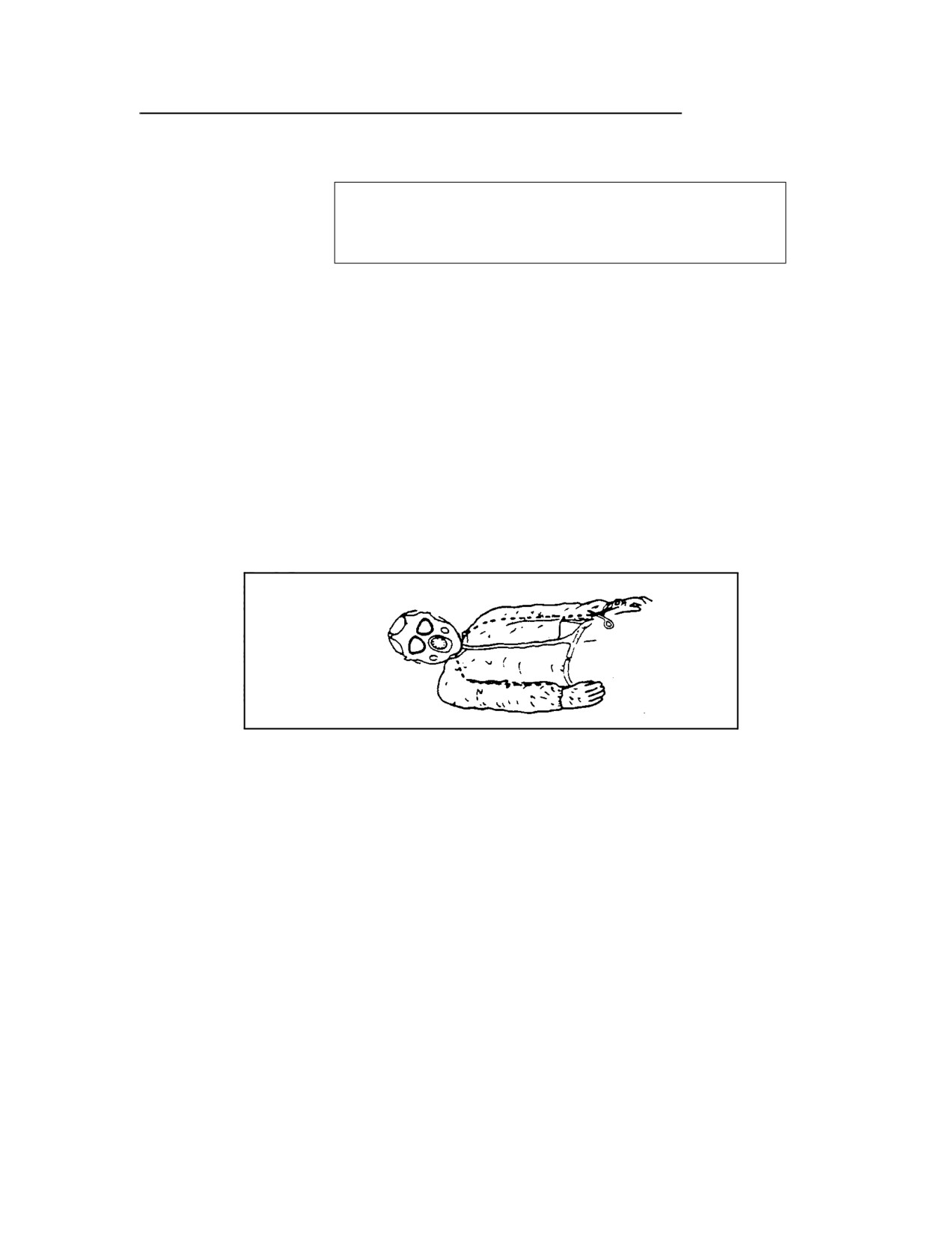
8-32. Cut and remove the overgarment jacket. Before cutting the
overgarment jacket and trousers, dip the scissors in a 5 percent chlorine
solution to prevent contamination of the patient's BDU or undergarments.
Make two cuts, one up each sleeve from the wrist up to the shoulder and then
across the shoulder through the collar (Figure 8-4). Cut around bandages,
tourniquets, and splints, leaving them in place. Do not allow your gloves to
touch the patient along the cut line. Keep the cuts close to the inside of the
arms so that most of the sleeve material can be folded outward. Unzip the
jacket and roll the chest sections to the respective sides, with the inner surface
outward. Continue by tucking the clothing between the arm and chest. Roll
the cut sleeves away from the arms, exposing the black liner.
Figure 8-4. Cutting the Overgarment Jacket
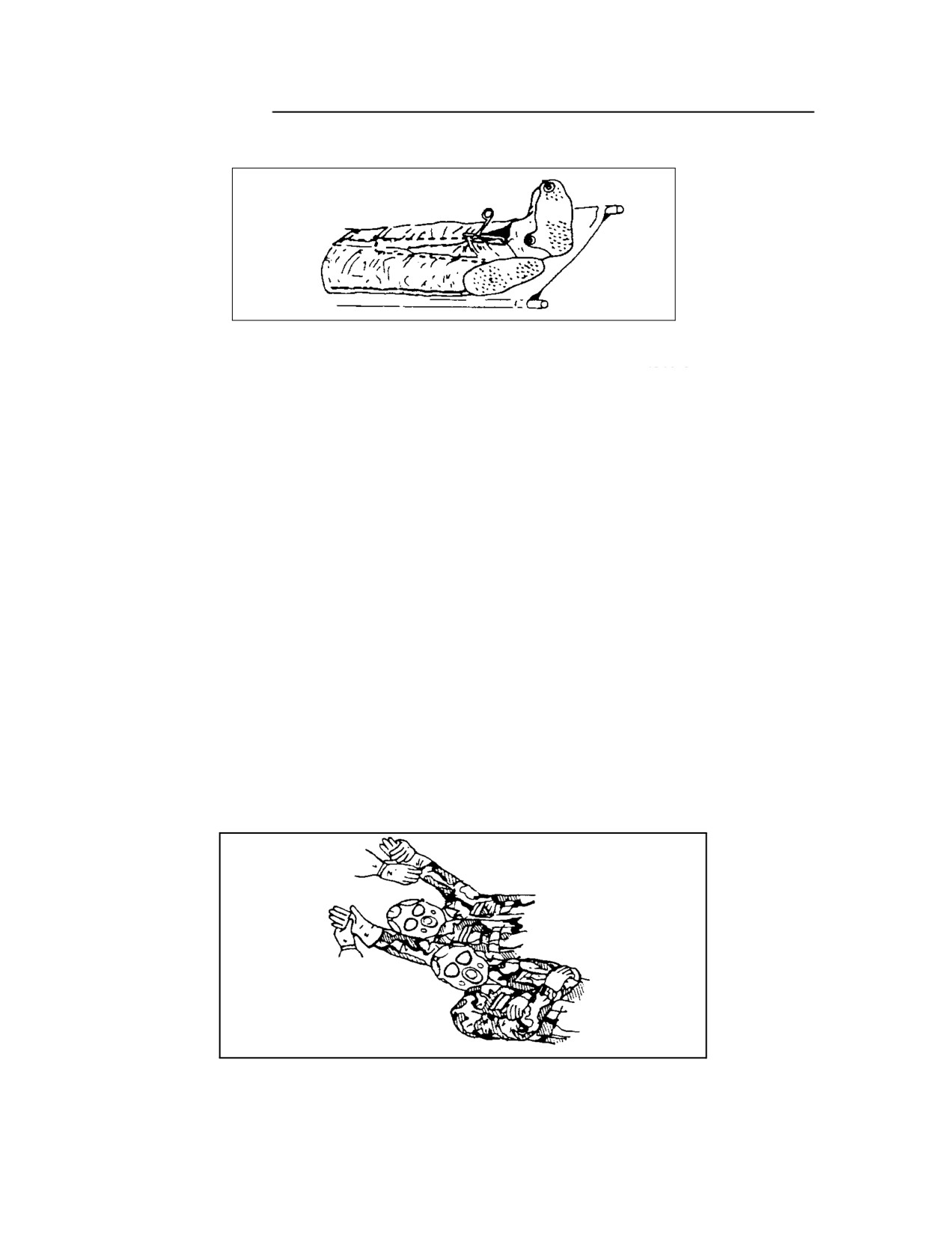
8-33. Cut and remove the overgarment trousers. Cut both trousers legs
starting at the ankle as shown in Figure 8-5, page 8-8. Keep the cuts near the
inside of the legs, along the inseam, to the crotch. With the left leg, cut all the
way to the waist, avoiding the pockets. With the right leg, cut across at the
crotch to the left leg cut. Cut around bandages, tourniquets, and splints,
leaving them in place. Place the scissors in a 5 percent chlorine solution. Fold
the cut trouser halves away from the patient and allow the halves to drop to
the litter with the contaminated (green) side down. Roll the inner leg portion
under and between the legs.
8-34. Remove the outer gloves. Before touching the patient, the patient-
decon team decontaminates its gloves with a 5 percent chlorine solution. Lift
the patient's arms up and out of the cutaway sleeves unless detrimental to his
condition. Grasp the fingers of the gloves, roll the cuffs over the fingers, and
turn the gloves inside out. Do not remove the inner cotton gloves at this time.
Carefully lower the patient’s arms across the chest after the outer gloves have
been removed (Figure 8-6, page 8-8). Do not allow the patient's arms to come
into contact with the exterior of his overgarment. Drop his gloves into the
Patient Evacuation and Decon 8-7
FM 3-5/MCWP 3-37.3
Figure 8-5. Remove the Overgarment Trousers
contaminated-waste bag. The team members decon their gloves with the 5
percent chlorine solution.
8-35. Remove the overboots. Cut the overboot laces and fold the lacing
eyelets flat outward. While standing at the foot of the litter, hold the patient’s
heel with one hand. Pull the overboot downward, then toward you to remove
it. Remove the two overboots simultaneously. This reduces the likelihood of
contaminating one of the combat boots.
8-36. While holding the patient’s heels off the litter, have a team member wipe
the end of the litter with a 5 percent chlorine solution to neutralize any
contamination that was transferred to the litter from the overboots. Lower the
patient's heels onto the decontaminated litter. Place the overboots in the
contaminated-waste bag. The team members decon their gloves with the 5
percent chlorine solution.
Step
4 - Remove the Patient's BDU and Undergarments
8-37. Cut and remove the BDU. To cut and remove the BDU jacket and
trousers, follow the procedures for removing the protective overgarment as
described in paragraph 8-32 and 8-33.
8-38. Remove the combat boots. Cut the bootlaces along the tongue.
Remove the boots by pulling them toward you. Place the boots in the
contaminated-waste bag. Do not touch the patient's skin with your
contaminated gloves when removing his boots.
Figure 8-6. Removing the Outer Gloves and Positioning
the Arms After the Glove Removal
8-8 Patient Evacuation and Decon
FM 3-5/MCWP 3-37.3
8-39. Cut and remove the undergarments. Follow the procedures for
cutting away the protective overgarment and rolling it away from the patient
(see paragraph 8-32 and 8-33). If the patient is wearing a brassiere, cut it
between the cups. Cut both shoulder straps where they attach to the cups and
lay them back off of the shoulders. Remove the socks and cotton gloves. Do
not remove the identification tags.
Step
5 - Transfer the Patient to a Decon Litter
8-40. After the patient's clothing has been cut away, transfer him to a decon
litter or a canvas litter with a plastic-sheeting cover. Three decon team
members decon their gloves and aprons with a 5 percent chlorine solution.
One member places his hands under the patient's legs at the thighs and
Achilles tendons, a second member places his arms under the patient's back
and buttocks, and a third member places his arms under the patient's
shoulders and supports the head and neck. They carefully lift the patient
using their knees (not their backs) to minimize back strain. While the patient
is elevated, another decon team member removes the litter from the litter
stands and replaces it with a decontaminated (clean) litter. The team
members carefully lower the patient onto the clean litter. The clothing and
overgarments are placed in a contaminated-waste bag and moved to the
contaminated-waste dump. The dirty litter is rinsed with the 5 percent
chlorine solution and placed in the litter storage area.
Step
6 - Decon the Patient’s Skin
8-41. Spot decon. With the patient in a supine position, spot decon the skin
by using an SDK or a 0.5 percent chlorine solution. Decon areas of potential
contamination, to include areas around the neck, wrists, and lower parts of
the face. Decon the patient's identification tags and chain, if necessary.
NOTE: A complete body wash is not appropriate and may be harmful
to the patient. During a complete body wash, the patient would have
to be rolled over to reach all areas of the skin. This is not necessary
for an adequate decon.
8-42. Combat medic care. The combat medic gently cuts away the bandage.
He decontaminates the area around the wound and irrigates it with a 0.5
percent chlorine solution. If bleeding begins, he replaces the bandage with a
clean one. He replaces the old tourniquet by placing a new one ½ to 1 inch
above the old one. He then removes the old tourniquet and decontaminates
the patient's skin with an SDK or a 0.5 percent chlorine solution. He does not
remove a splint. He decontaminates the splint by thoroughly rinsing it, to
include the padding and cravats, with a 0.5 percent chlorine solution.
WARNING
Do not use an SKD around any wounds. Do not remove splints.
Splints will not be removed until the patient has been evacuated to a
forward MTF or hospital.
8-43. Completeness of decon check. Check the patient with M8 detector
paper or the CAM for completeness of decon.
NOTE: Other monitoring devices may be used, if available.
Patient Evacuation and Decon 8-9
FM 3-5/MCWP 3-37.3
8-44. Contaminated-waste disposal. Dispose of contaminated bandages
and coverings by placing them in a contaminated-waste bag. Seal the bag and
place it in the contaminated-waste dump.
Step
7 - Transfer the Patient Across the Shuffle Pit
8-45. The patient's clothing has been cut away and his skin, bandages, and
splints have been decontaminated. Transfer the patient to the shuffle pit and
place the litter on the litter stands. The shuffle pit is wide enough to prevent
the decon team members from straddling it while carrying the litter. A third
team member will assist with transferring the patient to a clean treatment
litter in the shuffle pit. Decon personnel rinse or wipe down their aprons and
gloves with a 5 percent chlorine solution.
8-46. The three team members lift the patient off the decon litter (see step 5
for lifting procedures). While the patient is elevated, another team member
removes the litter from the stands and returns it to the decon area. A medic
from the clean side of the shuffle pit replaces the litter with a clean one. The
patient is lowered onto the clean litter. Two medics from the clean side of the
shuffle pit move the patient to the clean treatment area. The patient is
treated in this area or awaits processing into the CPS. The litter is wiped
down with a 5 percent chlorine solution in preparation for reuse. Once the
patient is in the air lock of the CPS and the air lock has been purged, his
protective mask is removed. Place the mask in a plastic bag and seal it.
NOTE: Before decontaminating another patient, each decon team
member drinks about half a quart of water. The exact amount of
water consumed is increased or decreased according to the work
level and temperature (see Table 8-2).
AMBULATORY PATIENT
8-47. All ambulatory patients requiring EMT or AMT in the clean treatment
area of the BAS will be decontaminated. Stable patients not requiring
treatment at the BAS, but requiring evacuation to the medical company’s
clearing station or a corps hospital for treatment (for example, a patient with
a broken arm), should be evacuated in their protective overgarments and
masks by any available transportation. However, before evacuation, spot
remove all thickened agents from their protective clothing.
NOTE: Place the bandage scissors that are used in this procedure in
a container of 5 percent chlorine solution when not in use. Most
ambulatory patients will be treated in the contaminated treatment
area and returned to duty. Upon removal of an ambulatory patient's
clothing, he becomes a litter patient. The BAS and clearing station do
not have clothing to replace those that are cut off during the decon
process. The patient must be placed in a patient protective wrap
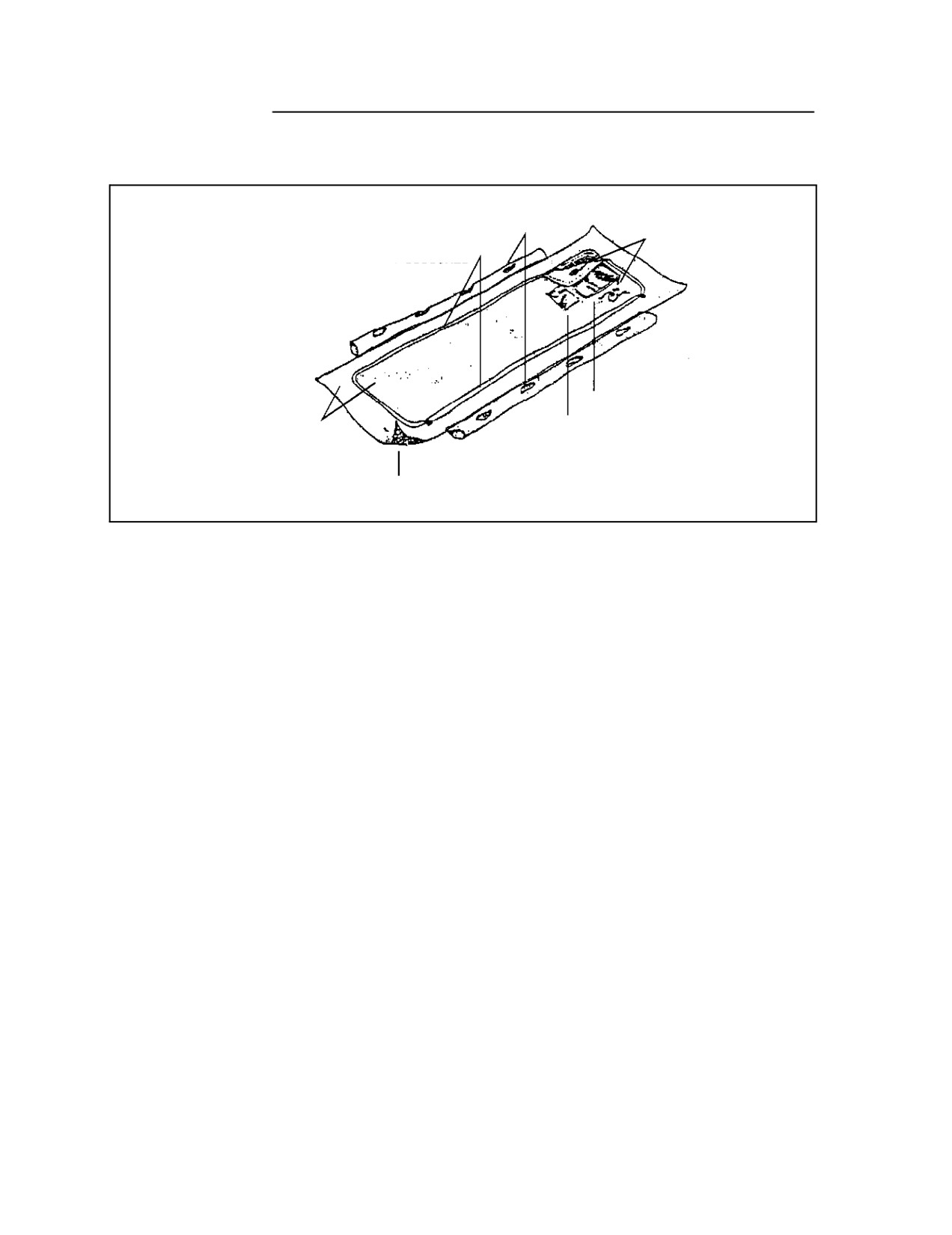
(PPW) for protection during evacuation (Figure 8-7, page 8-12).
8-48. The ambulatory patient is decontaminated and undressed as follows.
Some procedures in the following steps can be done with one soldier, while
others require more than one.
8-10 Patient Evacuation and Decon
FM 3-5/MCWP 3-37.3
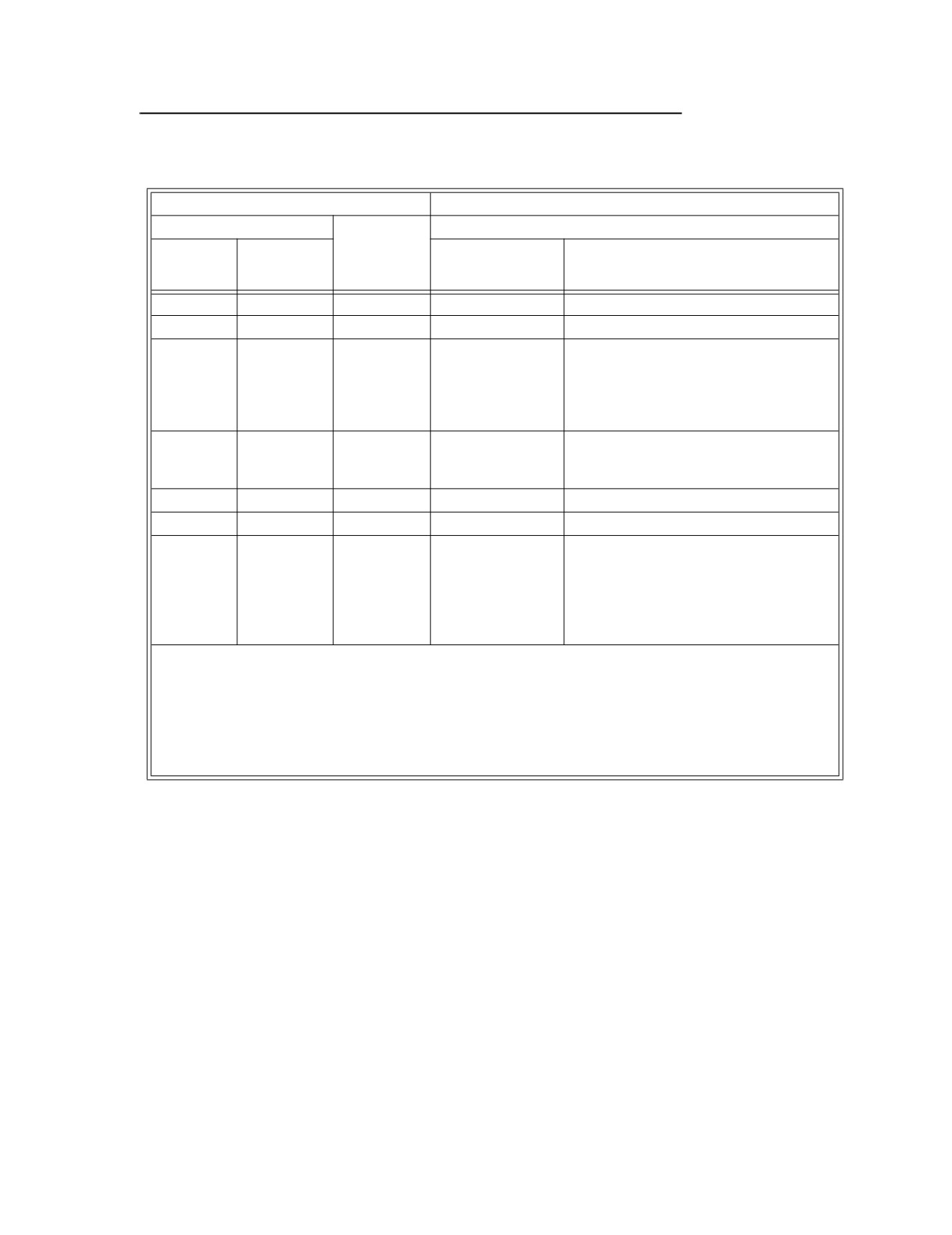
Table 8-2. Heat-Injury Prevention and Water Consumption
Criteria
Controls
Heat
Water
Physical Activity for Soldiers/Trainees
Intake
WBGT
Acclimatized to
Condition
Quart/Hour
Not Acclimatized to Work/Rest
Index °F*
Work/Rest**
White
78-81.9
At least ½
Continuous
Green
82-84.9
At least ½
50/10 minutes
Use discretion in planning heavy exercise.
Yellow
85-87.9
At least 1
45/15 minutes
Suspend strenuous exercise during the
first 3 weeks of training. Training activities
may be continued on a reduced scale
after the second week of training. Avoid
activity in the direct sun.
Red
88-89.9
At least 1½
30/30 minutes
Curtail strenuous exercise for all person-
nel with less than 12 weeks of hot-
weather training.
White
78-81.9
At least ½
Continuous
Green
82-84.9
At least ½
50/10 minutes
Use discretion in planning heavy exercise.
Black
90 and up
More than 2
20/40 minutes
Suspend physical training and strenuous
exercise. Essential operational commit-
ments (not for training), where the risk of
heat casualties may be warranted, are
excluded from suspension. Enforce water
intake to minimize expected heat injuries.
*MOPP gear or body armor adds 10oF to the wet-bulb gradient-temperature (WBGT) index.
**An acclimatized soldier is one who has worked in the given heat condition for 10 to 14 days.
NOTE: "Rest" means minimal physical activity. Rest should be accomplished in the shade, if possi-
ble. Any activity requiring only minimal physical activity can be performed during rest periods (for
examples, training by lecture or demonstration, minor maintenance procedures on vehicles or weap-
ons, and personal-hygiene activities such as skin and foot care).
Step 1 - Remove the LCE
8-49. Remove the LCE by unfastening/unbuttoning all connectors or tie straps
and then place the equipment in a plastic bag. Place the plastic bag in the
designated storage area for later decon.
Step 2 - Decon the Patient's Mask and Hood
8-50. Begin the clothing removal process. After the patient has been
triaged and treated (if necessary) by the senior medic in the patient-decon
station, the clothing removal process begins.
8-51. Decon the hood. Use either an IEDK or a 5 percent chlorine solution
(or household bleach) to wipe down the front, sides, and top of the hood.
8-52. Remove the hood. Remove the hood by cutting it with scissors or by
loosening it from the mask attachment points for the quick-doff hood or other
similar hoods (see Figure 8-3, page 8-6). Before cutting the hood, dip the
scissors in a 5 percent chlorine solution. Cut the neck cord and the small
Patient Evacuation and Decon 8-11
FM 3-5/MCWP 3-37.3
Carrying handles
IV ports
Zipper closures
Impermeable window
Permeable
Medical-card holder
top sheet
Impermeable
bottom sheet
Figure 8-7. Chemical-Agent Patient Protective Wrap
string under the voicemitter. Release or cut the hood shoulder straps and
unzip the hood zipper. Cut the hood upward to the top of the eye-lens outsert,
staying close to the filter-inlet cover and eye-lens outsert, then across the
forehead to the outer edge of the other eye-lens outsert. Proceed downward
toward the patient's shoulder, staying close to the eye-lens outsert and filter-
inlet cover, then across the lower part of the voicemitter to the zipper. After
dipping the scissors in the 5 percent chlorine solution, cut the hood from the
center of the forehead over the top of the head. Fold the left and right sides of
the hood away from the patient's head and remove the hood.
8-53. Decon the protective mask and exposed skin. Decon the mask and
the patient's face by using an SDK or a 0.5 percent chlorine solution. Cover
the mask’s air inlets with gauze or your hands to keep the mask filters dry.
Continue by wiping the exposed areas of the patient’s face, to include the neck
and behind the ears. Do not remove the protective mask.
8-54. Remove the FMC. Cut the patient's FMC tie wire, allowing the FMC to
fall into a plastic bag. Seal the plastic bag and rinse the outside of the bag
with a 5 percent chlorine solution. Place the plastic bag under the back of the
protective mask’s head straps. The FMC will remain with the patient in the
contaminated area and a clean copy will be made before the patient is moved
to the clean area.
Step
3 - Remove Gross Contamination From the Patient's Protective Overgarment
8-55. Remove all visible contamination spots from the overgarment by using
an SDK (preferred method) or a 0.5 percent chlorine solution.
Step
4 - Remove the Patients Personal Effects and Protective Overgarment
8-56. Remove the patient's personal effects. Remove the patient's
personal effects from his protective overgarment and BDU pockets. Place the
8-12 Patient Evacuation and Decon
FM 3-5/MCWP 3-37.3
articles in a plastic bag, label the bag with the patient's identification, and
seal the bag. If the articles are not contaminated, they are returned to the
patient. If the articles are contaminated, place them in the contaminated
holding area until they can be decontaminated, then return them to the
patient.
8-57. Remove the overgarment jacket. Have the patient stand with his
feet spread apart at shoulder width. Unsnap the front flap of the jacket and
unzip the jacket. If the patient can extend his arms, have him clinch his fist
and extend his arms backward at about a 30° angle. Move behind the patient,
grasp his jacket collar at the sides of the neck, and peel the jacket off the
shoulders at a 30° angle down and away from the patient. Avoid any rapid or
sharp jerks, which spread contamination. Gently pull the inside sleeves over
the patient's wrists and hands.
8-58. If the patient cannot extend his arms, you must cut the jacket to aid in
its removal. Before cutting the overgarment jacket, dip the scissors in a 5
percent chlorine solution to prevent contamination of the patient's BDU or
underclothing. As with the litter patient, make two cuts, one up each sleeve
from the wrist up to the shoulder and then across the shoulder through the
collar. Cut around bandages, tourniquets, and splints, leaving them in place.
Do not allow your gloves to touch the patient along the cut line. Peel the
jacket back and downward to avoid spreading contamination. Ensure that the
outside of the jacket does not touch the patient or his inner clothing.
8-59. Cut and remove the overgarment trousers. Unfasten or cut all ties,
buttons, or zippers before grasping the trousers at the waist and peeling them
down over the patient's combat boots. Again, the trousers are cut to aid in
removal. If necessary, cut both trouser legs starting at the ankle. Keep the
cuts near the inside of the legs, along the inseam, to the crotch. Cut around
all bandages, tourniquets, and splints. Continue to cut up both sides of the
zipper to the waist and allow the narrow strip with the zipper to drop between
the legs. Peel or allow the trouser halves to drop to the ground. Have the
patient step out of the trouser legs one at a time. Place the trousers in the
contaminated-waste bag. Place the scissors in a 5 percent chlorine solution.
8-60. Remove the outer gloves. Grasp the fingers of the gloves, roll the cuffs
over the fingers, and turn the gloves inside out. Do not remove the inner
cotton gloves at this time. Drop the gloves into the contaminated-waste bag.
Do not allow the patient to touch his clothing or other contaminated objects
with his hands.
8-61. Remove the overboots. Cut the overboot laces and fold the lacing
eyelets flat on the ground. Step on the toe and heel eyelets to hold the
overboot on the ground and have the patient step out of it. Repeat this
procedure for the other overboot. If the overboots are in good condition, they
can be decontaminated and reissued.
8-62. Remove the patient's cotton glove liners. Instruct the patient to
remove his cotton glove liners to reduce the possibility of spreading
contamination. Have the patient grasp the heel of one glove liner with the
other gloved hand, peeling it off of his hand. Hold the removed glove by the
inside and grasp the heel of the other glove, peeling it off of his hand. Place
both gloves in the contaminated-waste bag.
Patient Evacuation and Decon 8-13
FM 3-5/MCWP 3-37.3
Step
5 - Check the Patient for Contamination
8-63. After the patient's overgarment has been removed, check his BDU by
using M8 detector paper or the CAM. Carefully survey the patient, paying
particular attention to discolored areas, damp spots, and tears on the uniform;
areas around the neck, wrists, and ears; and bandages, tourniquets, and
splints. Remove contaminated spots by using an SDK or a 0.5 percent chlorine
solution or, if possible, by cutting away the contaminated area. Always dip
the scissors in a 5 percent chlorine solution after each cut. Recheck the area
with the detection equipment. If significant contamination is found on the
BDU, then remove it and spot decon the skin. To remove the BDU, follow the
procedures for removing the overgarment as described in paragraphs 8-57
through 8-59. Do not remove the patient's identification tags.
Step
6 - Decon the Patient's Skin
8-64. Spot decon. Use an SDK or a 0.5 percent chlorine solution to spot decon
the skin and areas of potential contamination, to include areas around the
neck, wrists, and lower parts of the face. Decon the patient's identification
tags and chain, if necessary.
8-65. Have the patient hold his breath, close his eyes, and lift, or assist him
with lifting, his mask at the chin. Wipe his face and exposed areas of the skin
with an SDK or a 0.5 percent chlorine solution. Starting at the top of the ear
and quickly wiping downward, wipe all folds in the skin, ear lobes, upper lip,
chin, dimples, and nose. Continue up the other side of the face to the top of the
other ear. Wipe the inside of the mask where it touches the face. Have the
patient reseal and check his mask.
CAUTION
Keep the decon solution out of the patient's eyes.
8-66. Combat medic care. The combat medic gently cuts away the bandage.
He decontaminates the area around the wound and irrigates it with a 0.5
percent chlorine solution. If bleeding begins, he replaces the bandage with a
clean one. He replaces the old tourniquet by placing a new one ½ to 1 inch
above the old one. He then removes the old tourniquet and decontaminates
the patient’s skin with an SDK or a 0.5 percent chlorine solution. He does not
remove a splint. He decontaminates the splint by thoroughly rinsing it, to
include the padding and cravats, with a 0.5 percent chlorine solution.
8-67. Contaminated-waste disposal. Dispose of contaminated bandages
and coverings by placing them in a contaminated-waste bag. Seal the bag and
place it in the contaminated-waste dump.
Step
7 - Proceed Through the Shuffle Pit to the Clean Treatment Area
8-68. Have the decontaminated patient proceed through the shuffle pit to the
clean treatment area. To ensure that the patient's boots are well
decontaminated, have him stir the contents of the shuffle pit with his boots as
he crosses it. The patient's combat boots and protective mask will be removed
at the entrance of the CPS or clean treatment area.
8-14 Patient Evacuation and Decon
FM 3-5/MCWP 3-37.3
BIOLOGICAL-AGENT PATIENT DECON PROCEDURES
8-69. The decon station as established for chemical-agent patients is also used
for biologically contaminated patients. The 8-man, patient-decon team is
required for biologically contaminated patient-decon procedures.
LITTER PATIENT
8-70. The decon procedures for a litter patient that is contaminated with a
biological agent are described in the following paragraphs. Some procedures
can be done with one soldier, while others require more than one.
Step
1 - Decon the Patient's Mask and Hood
8-71. Move the patient to the clothing removal station. After the patient
has been triaged and stabilized (if necessary) by the senior medic in the
patient-decon area, move him to the litter stands at the clothing removal
station.
8-72. Decon the hood. Use a 0.5 percent chlorine solution to wipe down the
front, sides, and top of the hood.
8-73. Remove the hood. Remove the hood by cutting it with scissors or by
loosening it from the mask attachment points for the quick-doff hood or other
similar hoods (see Figure 8-3, page 8-6). Before cutting the hood, dip the
scissors in a 5 percent chlorine solution. Cut the neck cord and the small
string under the voicemitter. Release or cut the hood shoulder straps and
unzip the hood zipper. Cut the hood upward to the top of the eye-lens outsert,
staying close to the filter-inlet cover and eye-lens outsert, then across the
forehead to the outer edge of the other eye-lens outsert. Proceed downward
toward the patient's shoulder, staying close to the eye-lens outsert and filter-
inlet cover, then across the lower part of the voicemitter to the zipper. After
dipping the scissors in the 5 percent chlorine solution, cut the hood from the
center of the forehead over the top of the head. Fold the left and right sides of
the hood to the side of the patient's head, laying the sides of the hood on the
litter.
8-74. Decon the protective mask and exposed skin. Use a 0.5 percent
chlorine solution to wipe the external parts of the mask. Cover the mask’s air
inlets with gauze or your hand to keep the mask filter dry. Wash the exposed
areas of the patient's face, to include the neck and behind the ears, with soap
and warm water or wipe them with a 0.5 percent chlorine solution. Do not
remove the protective mask.
8-75. Remove the FMC. Cut the patient's FMC tie wire, allowing the FMC
to fall into a plastic bag. Seal the plastic bag and rinse the outside of the bag
with a 0.5 percent chlorine solution. Place the plastic bag under the back of
the protective mask’s head straps. The FMC will remain with the patient in
the contaminated area and a clean copy will be made before the patient is
moved to the clean area.
Step
2 - Remove Gross Contamination From the Patient's Protective Overgarment
8-76. Remove all visible contamination spots from the overgarment by using a
0.5 percent chlorine solution.
Patient Evacuation and Decon 8-15
FM 3-5/MCWP 3-37.3
Step 3 - Remove the Patient's Personal Effects and Protective Overgarment
8-77. Remove the patient's personal effects. Remove the patient's
personal effects from his protective overgarment and BDU pockets. Place the
articles in a plastic bag, label the bag with the patient's identification, and
seal the bag. If the articles are not contaminated, they are returned to the
patient. If the articles are contaminated, place them in the contaminated
holding area until they can be decontaminated, then return them to the
patient.
CAUTION
Bandages may have been applied to control severe bleeding; therefore, they
are treated like tourniquets. Only medical personnel will remove bandages,
tourniquets, and splints.
NOTE: The overgarment jacket and trousers will be cut
simultaneously. One soldier cuts the jacket, while another soldier
cuts the trousers.
8-78. Cut and remove the overgarment jacket. Before cutting the
overgarment jacket and trouser, dip the scissors in a 5 percent chlorine
solution to prevent contamination of the patient's BDU or undergarments.
Make two cuts, one up each sleeve from the wrist up to the shoulder and then
across the shoulder through the collar (Figure 8-4, page 8-7). Cut around
bandages, tourniquets, and splints, leaving them in place. Do not allow your
gloves to touch the patient along the cut line. Keep the cuts close to the inside
of the arms so that most of the sleeve material can be folded outward. Unzip
the jacket and roll the chest sections to the respective sides, with the inner
surface outward. Continue by tucking the clothing between the arm and
chest. Roll the cut sleeves away from the arms, exposing the black liner.
8-79. Cut and remove the overgarment trousers. Cut both trousers legs
starting at the ankle as shown in Figure 8-5, page 8-8. Keep the cuts near the
inside of the legs, along the inseam, to the crotch. Cut the left leg all the way
to the waist, avoiding the pockets. Cut the right leg across at the crotch to the
left leg cut. Cut around bandages, tourniquets, and splints, leaving them in
place. Place the scissors in a 5 percent chlorine solution. Fold the cut trouser
halves away from the patient and allow the halves to drop to the litter with
the contaminated (green) side down. Roll the inner leg portion under and
between the legs.
8-80. Remove the outer gloves. Before touching the patient, the patient-
decon team decontaminates its gloves with a 5 percent chlorine solution. Lift
the patient's arms up and out of the cutaway sleeves unless detrimental to his
condition. Grasp the fingers of the gloves, roll the cuffs over the fingers, and
turn the gloves inside out. Do not remove the inner cotton gloves at this time.
Carefully lower the patient’s arms across the chest after the outer gloves have
been removed (Figure 8-6, page 8-8). Do not allow the patient's arms to come
into contact with the exterior of his overgarment. Drop his gloves into the
contaminated-waste bag. The team members decon their gloves with the 5
percent chlorine solution.
8-16 Patient Evacuation and Decon
FM 3-5/MCWP 3-37.3
8-81. Remove the overboots. Cut the overboot laces and fold the lacing
eyelets flat outward. While standing at the foot of the litter, hold the patient’s
heel with one hand. Pull the overboot downward, then toward you to remove
it. Remove the two overboots simultaneously. This reduces the likelihood of
contaminating one of the combat boots.
8-82. While holding the patient’s heels off the litter, have a team member wipe
the end of the litter with a 0.5 percent chlorine solution to neutralize any
contamination that was transferred to the litter from the overboots. Lower
the patient's heels onto the decontaminated litter. Place the overboots in the
contaminated-waste bag. The team members decontaminate their gloves with
the 5 percent chlorine solution.
Step
4 - Remove the Patient's BDU and Undergarments
8-83. Cut and remove the BDU. To cut and remove the BDU jacket and
trousers, follow the procedures (described in paragraphs 8-78 and 8-79) for
removing the protective overgarment.
8-84. Remove the combat boots. Cut the bootlaces along the tongue.
Remove the boots by pulling them toward you. Place the boots in the
contaminated-waste bag. Do not touch the patient's skin with your
contaminated gloves when removing his boots.
8-85. Cut and remove the undergarments. Follow the procedures for
cutting away the protective overgarment and rolling it away from the patient
(see paragraphs 8-78 and 8-79). If the patient is wearing a brassiere, cut it
between the cups. Cut both shoulder straps where they attach to the cups and
lay them back off of the shoulders. Remove the socks and cotton gloves. Do
not remove the identification tags.
Step
5 - Transfer the Patient to a Decon Litter
8-86. After the patient's clothing has been cut away, transfer him to a decon
litter or a canvas litter with a plastic-sheeting cover. Three decon team
members decon their gloves and aprons with a 5 percent chlorine solution.
One member places his hands under the patient's legs at the thighs and
Achilles tendons, a second member places his arms under the patient's back
and buttocks, and a third member places his arms under the patient's
shoulders and supports the head and neck. They carefully lift the patient
using their knees (not their backs) to minimize back strain. While the patient
is elevated, another decon team member removes the litter from the litter
stands and replaces it with a decontaminated (clean) litter. The patient is
carefully lowered onto the clean litter. The clothing and overgarments are
placed in a contaminated-waste bag and moved to the contaminated-waste
dump. The dirty litter is rinsed with the 0.5 percent chlorine solution and
placed in the litter storage area.
Step
6 - Decon the Patient’s Skin
8-87. Spot decon. With the patient in a supine position, spot decon the skin
by washing it with soap and warm water or by wiping it with a 0.5 percent
chlorine solution. Decon areas of potential contamination, to include areas
around the neck, wrists, and lower parts of the face. Decon the patient's
identification tags and chain, if necessary.
Patient Evacuation and Decon 8-17
FM 3-5/MCWP 3-37.3
NOTES:
1. Use a 0.5 percent chlorine solution to decon patients suspected of
being contaminated with mycotoxins.
2. A complete body wash is not appropriate and may be harmful to
the patient. During a complete body wash, the patient would have to
be rolled over to reach all areas of the skin. This is not necessary for
an adequate decon.
8-88. Combat medic care. The combat medic gently cuts away the bandage.
He decontaminates the area around the wound and irrigates it with a 0.5
percent chlorine solution. If bleeding begins, he replaces the bandage with a
clean one. He replaces the old tourniquet by placing a new one ½ to 1 inch
above the old one. He then removes the old tourniquet and decontaminates
the patient's skin with a 0.5 percent chlorine solution. He does not remove a
splint. He decontaminates the splint by thoroughly rinsing it, to include the
padding and cravats, with a 0.5 percent chlorine solution.
WARNING
Do not use an SDK around any wounds. Do not remove splints. The
splint will not be removed until the patient has been evacuated to a
forward MTF or hospital.
8-89. Completeness of decon check. Check the patient with M8 detector
paper or the CAM for completeness of decon.
NOTE: Other monitoring devices may be used, if available.
8-90. Contaminated-waste disposal. Dispose of contaminated bandages
and coverings by placing them in a contaminated-waste bag. Seal the bag and
place it in the contaminated-waste dump.
Step
7 - Transfer the Patient to the Hot Line
8-91. The patient's clothing has been cut away and his skin, bandages, and
splints have been decontaminated. Transfer the patient to the hot line and
place the litter on the litter stands. A third team member will assist with
transferring the patient to a clean treatment litter at the hot line. Decon
personnel rinse or wipe down their aprons and gloves with a 5 percent
chlorine solution.
8-92. Three team members lift the patient off the decon litter (see step 5 for
lifting procedures). While the patient is elevated, another team member
removes the litter from the stands and returns it to the decon area. A medic
from the clean side of the hot line replaces the litter with a clean one. The
patient is lowered onto the clean litter. Two medics from the clean side of the
hot line move the patient to the clean treatment area. The patient is treated
in this area or awaits processing into the CPS. The litter is wiped down with a
0.5 percent chlorine solution in preparation for reuse. Once the patient is in
the air lock of the CPS and the air lock has been purged, his protective mask is
removed. Place the mask in a plastic bag and seal it.
8-18 Patient Evacuation and Decon
FM 3-5/MCWP 3-37.3
NOTE: Before decontaminating another patient, each decon team
member drinks about half a quart of water. The exact amount of
water consumed is increased or decreased according to the work
level and temperature (see Table 8-2, page 8-11).
AMBULATORY PATIENT
8-93. The decon procedures for an ambulatory patient that is contaminated
with a biological agent are described in the following paragraphs. Some
procedures can be done with one soldier, while others require more than one.
8-94. All ambulatory patients requiring EMT or AMT in the clean treatment
area of the BAS will be decontaminated. Stable patients not requiring
treatment at the BAS, but requiring evacuation to the medical company’s
clearing station or a corps hospital for treatment (for example, a patient with
a broken arm), should be evacuated in their protective overgarments and
masks by any available transportation. However, before evacuation, spot
remove all thickened agents from their protective overgarment.
NOTE: Place the bandage scissors that are used in this procedure in
a container of 5 percent chlorine solution when not in use. Most
ambulatory patients will be treated in the contaminated treatment
area and returned to duty. Upon removal of an ambulatory patient's
clothing, he becomes a litter patient. The BAS and clearing station do
not have clothing to replace those that are cut off during the decon
process. The patient must be placed in a PPW for protection during
evacuation (Figure 8-7, page 8-12).
Step
1 - Remove the LCE
8-95. Remove the LCE by unfastening/unbuttoning all connectors or tie straps
and then place the equipment in a plastic bag. Place the plastic bag in the
designated storage area for later decon.
Step
2 - Decon the Patient's Mask and Hood
8-96. Begin the clothing removal process. After the patient has been
triaged and treated (if necessary) by the senior medic in the patient-decon
station, the clothing removal process begins.
8-97. Decon the hood. Use a 0.5 percent chlorine solution to wipe down the
front, sides, and top of the hood.
8-98. Remove the hood. Remove the hood by cutting it with scissors or by
loosening it from the mask attachment points for the quick-doff hood or other
similar hoods (Figure 8-3, page 8-6). Before cutting the hood, dip the scissors
in a 5 percent chlorine solution. Cut the neck cord and the small string under
the voicemitter. Release or cut the hood shoulder straps and unzip the hood
zipper. Cut the hood upward to the top of the eye-lens outsert, staying close to
the filter-inlet cover and eye-lens outsert, then across the forehead to the
outer edge of the other eye-lens outsert. Proceed downward toward the
patient's shoulder, staying close to the eye-lens outsert and filter-inlet cover,
then across the lower part of the voicemitter to the zipper. After dipping the
scissors in the 5 percent chlorine solution, cut the hood from the center of the
forehead over the top of the head. Fold the left and right sides of the hood
away from the patient's head and remove the hood.
Patient Evacuation and Decon 8-19
FM 3-5/MCWP 3-37.3
8-99. Decon the protective mask and exposed skin. Use a 0.5 percent
chlorine solution to decon the external parts of the mask. Cover the mask’s
air inlets with gauze or your hands to keep the mask filters dry. Wash the
exposed areas of the patient’s face, to include the neck and behind the ears,
with soap and warm water or wipe them with a 0.5 percent chlorine solution.
Do not remove the protective mask.
8-100. Remove the FMC. Cut the patient's FMC tie wire, allowing the FMC
to fall into a plastic bag. Seal the plastic bag and rinse the outside of the bag
with a 5 percent chlorine solution. Place the plastic bag under the back of the
protective mask’s head straps. The FMC will remain with the patient in the
contaminated area and a clean copy will be made before the patient is moved
to the clean area.
Step
3 - Remove Gross Contamination From the Patient's Protective Overgarment
8-101. Remove all visible contamination spots from the overgarment by using
a 0.5 percent chlorine solution.
Step
4 - Remove the Patient’s Personal Effects and Protective Overgarment
8-102. Remove the patient's personal effects. Remove the patient's
personal effects from his protective overgarment and BDU pockets. Place the
articles in a plastic bag, label the bag with the patient's identification, and
seal the bag. If the articles are not contaminated, they are returned to the
patient. If the articles are contaminated, place them in the contaminated
holding area until they can be decontaminated, then return them to the
patient.
8-103. Remove the overgarment jacket. Have the patient stand with his
feet spread apart at shoulder width. Unsnap the front flap of the jacket and
unzip the jacket. If the patient can extend his arms, have him clinch his fist
and extend his arms backward at about a 30° angle. Move behind the patient,
grasp his jacket collar at the sides of the neck, and peel the jacket off the
shoulders at a 30° angle down and away from the patient. Avoid any rapid or
sharp jerks, which spread contamination. Gently pull the inside sleeves over
the patient's wrists and hands.
8-104. If the patient cannot extend his arms, you must cut the jacket to aid in
its removal. Before cutting the overgarment jacket, dip the scissors in a 5
percent chlorine solution to prevent contamination of the patient's BDU or
undergarment. As with the litter patient, make two cuts, one up each sleeve
from the wrist up to the shoulder and then across the shoulder through the
collar. Cut around bandages, tourniquets, and splints, leaving them in place.
Do not allow your gloves to touch the patient along the cut line. Peel the
jacket back and downward to avoid spreading contamination. Ensure that the
outside of the jacket does not touch the patient or his inner clothing.
8-105. Cut and remove the overgarment trousers. Unfasten or cut all ties,
buttons, or zippers before grasping the trousers at the waist and peeling them
down over the patient's combat boots. Again, the trousers are cut to aid in
removal. If necessary, cut both trouser legs starting at the ankle. Keep the cuts
near the inside of the legs, along the inseam, to the crotch. Cut around all
bandages, tourniquets, and splints. Continue to cut up both sides of the zipper to
the waist and allow the narrow strip with the zipper to drop between the legs.
8-20 Patient Evacuation and Decon
FM 3-5/MCWP 3-37.3
Peel or allow the trouser halves to drop to the ground. Have the patient step out
of the trouser legs one at a time. Place the trousers in the contaminated-waste
bag. Place the scissors in a 5 percent chlorine solution.
8-106. Remove the outer gloves. Grasp the fingers of the gloves, roll the
cuffs over the fingers, and turn the gloves inside out. Do not remove the inner
cotton gloves at this time. Drop the gloves into the contaminated-waste bag.
Do not allow the patient to touch his clothing or other contaminated objects
with his hands.
8-107. Remove the overboots. Cut the overboot laces and fold the lacing
eyelets flat on the ground. Step on the toe and heel eyelets to hold the
overboot on the ground and have the patient step out of it. Repeat this
procedure for the other overboot. If the overboots are in good condition, they
can be decontaminated and reissued.
8-108. Remove the patient's cotton glove liners. Instruct the patient to
remove his cotton glove liners to reduce the possibility of spreading
contamination. Have the patient grasp the heel of one glove liner with the
other gloved hand, peeling it off of his hand. Hold the removed glove by the
inside and grasp the heel of the other glove, peeling it off of his hand. Place
both gloves in the contaminated-waste bag.
Step
5 - Check the Patient for Contamination
8-109. After the patient's overgarment has been removed, check his BDU by
using M8 detector paper or the CAM. Carefully survey the patient, paying
particular attention to discolored areas, damp spots, and tears on the uniform;
areas around the neck, wrists, and ears; and bandages, tourniquets, and
splints. Remove contaminated spots by washing with soap and water, by
wiping with a 0.5 percent chlorine solution or, if possible, by cutting away the
contaminated area. Always dip the scissors in a 5 percent chlorine solution
after each cut. Recheck the area with the detection equipment. If significant
contamination is found on the BDU, then remove it and spot decon the skin.
To remove the BDU, follow the procedures for removing the protective
overgarment as described in paragraphs 8-103 through 8-105. Do not remove
the patient's identification tags.
Step
6 - Decon the Patient's Skin
8-110. Spot decon. Use soap and water or a 0.5 percent chlorine solution to
spot decon the skin and areas of potential contamination, to include areas
around the neck, wrists, and lower parts of the face. Decon the patient's
identification tags and chain, if necessary.
8-111. Have the patient hold his breath, close his eyes, and lift, or assist him
with lifting, his mask at the chin. Wash his face and exposed areas of the skin
with soap and water or wipe them with a 0.5 percent chlorine solution.
Starting at the top of the ear and quickly wiping downward, wipe all folds in
the skin, ear lobes, upper lip, chin, dimples, and nose. Continue up the other
side of the face to the top of the other ear. Wipe the inside of the mask where
it touches the face. Have the patient reseal and check his mask.
CAUTION
Keep the decon solution out of the patient's eyes.
Patient Evacuation and Decon 8-21
FM 3-5/MCWP 3-37.3
8-112. Combat medic care. The combat medic gently cuts away the
bandage. He decontaminates the area around the wound and irrigates it with
a 0.5 percent chlorine solution. If bleeding begins, he replaces the bandage
with a clean one. He replaces the old tourniquet by placing a new one ½ to 1
inch above the old one. He then removes the old tourniquet and
decontaminates the patient’s skin with an SDK or a 0.5 percent chlorine
solution. He does not remove a splint. He decontaminates the splint by
thoroughly rinsing it, to include the padding and cravats, with a 0.5 percent
chlorine solution.
NOTE: Use a 0.5 percent chlorine solution to decon ambulatory
patients suspected of being contaminated with mycotoxins.
8-113. Contaminated-waste disposal. Dispose of contaminated bandages
and coverings by placing them in a contaminated-waste bag. Seal the bag and
place it in the contaminated-waste dump.
Step 7 - Cross the Hot Line to the Clean Treatment Area
8-114. Have the decontaminated patient cross the hot line to the clean
treatment area. The patient's boots must be decontaminated at the hot line
before enters the clean area. The patient's combat boots and protective mask
will be removed at the entrance of the CPS or clean treatment area.
RADIOLOGICAL-AGENT PATIENT DECON PROCEDURES
8-115. The decon of patients that are contaminated with radiation is easily
accomplished without interfering with the required medical care. The 8-man,
patient-decon team is required to perform the decon procedures on patients
contaminated with radiation.
NOTE: Patients must be monitored by using a radiac meter before,
during, and after each step of the decon procedure.
LITTER PATIENT
8-116. The decon procedures for a litter patient that is contaminated with
radiation are discussed in the following paragraphs. Some procedures can be
done with one soldier, while others require more than one soldier.
Step 1 - Decon the Patient's Mask and Hood
8-117. Move the patient to the clothing removal station. After the
patient has been triaged and stabilized (if necessary) by the senior medic in
the patient-decon area, move him to the litter stands at the clothing removal
station.
8-118. Decon the hood. Brush contamination off or use soap and water to
wipe down the front, sides, and top of the hood.
8-119. Remove the hood. Remove the hood by cutting it with scissors or by
loosening it from the mask attachment points for the quick-doff hood or other
similar hoods (see Figure 8-3, page 8-6). Before cutting the hood, dip the
scissors in a 5 percent chlorine solution. Cut the neck cord and the small
string under the voicemitter. Release or cut the hood shoulder straps and
unzip the hood zipper. Cut the hood upward to the top of the eye-lens outsert,
staying close to the filter-inlet cover and eye-lens outsert, then across the
8-22 Patient Evacuation and Decon
FM 3-5/MCWP 3-37.3
forehead to the outer edge of the other eye-lens outsert. Proceed downward
toward the patient's shoulder, staying close to the eye-lens outsert and filter-
inlet cover, then across the lower part of the voicemitter to the zipper. After
dipping the scissors in the 5 percent chlorine solution, cut the hood from the
center of the forehead over the top of the head. Fold the left and right sides of
the hood to the side of the patient's head, laying the sides of the hood on the
litter.
8-120. Decon the protective mask and exposed skin. Use soap and water
to wipe the external parts of the mask. Cover the mask’s air inlets with gauze
or your hand to keep the mask filter dry. Wash the exposed areas of the
patient's face, to include the neck and behind the ears, with soap and warm
water. Do not remove the protective mask.
8-121. Remove the FMC. Cut the patient's FMC tie wire, allowing the FMC
to fall into a plastic bag. Seal the plastic bag and rinse the outside of the bag
with soap and water. Place the plastic bag under the back of the protective
mask’s head straps. The FMC will remain with the patient in the
contaminated area and a clean copy will be made before the patient is moved
to the clean area.
Step
2 - Remove Gross Contamination From the Patient's Protective Overgarment
8-122. Remove all visible contamination spots from the overgarment by
brushing off or by washing with soap and water.
Step
3 - Remove the Patient's Personal Effects and Protective Overgarment
8-123. Remove the patient's personal effects. Remove the patient's
personal effects from his protective overgarment and BDU pockets. Place the
articles in a plastic bag, label the bag with the patient's identification, and
seal the bag. If the articles are not contaminated, they are returned to the
patient. If the articles are contaminated, place them in the contaminated
holding area until they can be decontaminated, then return them to the
patient.
CAUTION
Bandages may be applied to control severe bleeding; therefore, they are
treated like tourniquets. Only medical personnel will remove bandages.
NOTE: The overgarment jacket and trousers will be cut
simultaneously. One soldier cuts the jacket, while another soldier
cuts the trousers.
8-124. Cut and remove the overgarment jacket. Before cutting the
overgarment jacket and trousers, dip the scissors in a 5 percent chlorine
solution to prevent contamination of the patient's BDU or undergarment.
Make two cuts, one up each sleeve from the wrist up to the shoulder and then
across the shoulder through the collar (Figure 8-4, page 8-7). Cut around
bandages, tourniquets, and splints, leaving them in place. Do not allow your
gloves to touch the patient along the cut line. Keep the cuts close to the inside
of the arms so that most of the sleeve material can be folded outward. Unzip
the jacket and roll the chest sections to the respective sides, with the inner
Patient Evacuation and Decon 8-23
FM 3-5/MCWP 3-37.3
surface outward. Continue by tucking the clothing between the arm and
chest. Roll the cut sleeves away from the arms, exposing the black liner.
8-125. Cut and remove the overgarment trousers. Cut both trousers legs
starting at the ankle as shown in Figure 8-5, page 8-8. Keep the cuts near the
inside of the legs, along the inseam, to the crotch. Cut the left leg all the way
to the waist, avoiding the pockets. Cut the right leg across at the crotch to the
left leg cut. Cut around bandages, tourniquets, and splints, leaving them in
place. Place the scissors in a 5 percent chlorine solution. Fold the cut trouser
halves away from the patient and allow the halves to drop to the litter with
the contaminated- (green-) side down. Roll the inner leg portion under and
between the legs.
8-126. Remove the outer gloves. Before touching the patient, the patient-
decon team decontaminates its gloves with a 5 percent chlorine solution. Lift
the patient's arms up and out of the cutaway sleeves unless detrimental to his
condition. Grasp the fingers of the gloves, roll the cuffs over the fingers, and
turn the gloves inside out. Do not remove the inner cotton gloves at this time.
Carefully lower the patient’s arms across the chest after the outer gloves have
been removed (Figure 8-6, page 8-8). Do not allow the patient's arms to come
into contact with the exterior of his overgarment. Drop his gloves into the
contaminated-waste bag. The team members decon their gloves with the 5
percent chlorine solution.
8-127. Remove the overboots. Cut the overboot laces and fold the lacing
eyelets flat outward. While standing at the foot of the litter, hold the patient’s
heel with one hand. Pull the overboot downward, then toward you to remove
it. Remove the two overboots simultaneously. This reduces the likelihood of
contaminating one of the combat boots.
8-128. While holding the patient’s heels off the litter, have a team member
wipe the end of the litter with a 0.5 percent chlorine solution to neutralize any
contamination that was transferred to the litter from the overboots. Lower
the patient's heels onto the decontaminated litter. Place the overboots in the
contaminated-waste bag. The team members decon their gloves with the 5
percent chlorine solution.
NOTE: Patients arriving at the MTF in MOPP gear will only have
their MOPP gear removed. They will remain in their BDUs unless
contamination is found on them. If contamination is found, follow
the procedures for removing the protective overgarment as described
in paragraphs 8-124 and 8-125.
Step
4 - Check the Patient for Contamination
8-129. After the patient's overgarment has been removed, check his BDU by
using M8 detector paper or the CAM. Carefully survey the patient, paying
particular attention to discolored areas, damp spots, and tears on the uniform;
areas around the neck, wrists, and ears; and bandages, tourniquets, and
splints. Remove contaminated spots by washing with soap and water, by
wiping with a 0.5 percent chlorine solution or, if possible, by cutting away the
contaminated area. Always dip the scissors in a 5 percent chlorine solution
after each cut. Recheck the area with the detection equipment. If significant
contamination is found on the BDU, then remove it and spot decon the skin.
8-24 Patient Evacuation and Decon
FM 3-5/MCWP 3-37.3
To remove the BDU, follow the procedures for removing the protective
overgarment as described in paragraphs 8-124 and 8-125. Do not remove the
patient's identification tags.
Step
5 - Decon the Patient’s Skin
8-130. Spot decon. Wash exposed skin surfaces with soap and warm water,
to include areas around the neck, wrists, and lower parts of the face. Decon
the patient’s identification tags and chain, if necessary.
8-131. Combat medic care. The combat medic gently cuts away the
bandage. He decontaminates the area around the wound and irrigates it with
a 0.5 percent chlorine solution. If bleeding begins, he replaces the bandage
with a clean one. He replaces the old tourniquet by placing a new one ½ to 1
inch above the old one. He then removes the old tourniquet and
decontaminates the patient's skin with a 0.5 percent chlorine solution. He
does not remove a splint. He decontaminates the splint by thoroughly rinsing
it, to include the padding and cravats, with a 0.5 percent chlorine solution.
WARNING
Do not use an SDK around any wounds. Do not remove splints. The
splint will not be removed until the patient has been evacuated to a
forward MTF or hospital.
8-132. Completeness of decon check. Check the patient with M8 detector
paper or the CAM for completeness of decon.
NOTE: Other monitoring devices may be used, if available.
8-133. Contaminated-waste disposal. Dispose of contaminated bandages
and coverings by placing them in a contaminated-waste bag. Seal the bag and
place it in the contaminated-waste dump.
Step
6 - Transfer the Patient to the Hot Line
8-134. Move the patient to the hot line. Two medics from the clean side of the
hot line move the patient into the clean treatment area.
NOTE: Before decontaminating another patient, each decon team
member drinks about half a quart of water. The exact amount of
water consumed is increased or decreased according to the work
level and temperature (see Table 8-2, page 8-11).
AMBULATORY PATIENT
8-135. The decon procedures for an ambulatory patient that is contaminated
with radiation are discussed in the following paragraphs. Some procedures
can be done with one soldier, while others require more than one.
8-136. All ambulatory patients requiring EMT or AMT in the clean area of the
BAS will be decontaminated. Stable patients not requiring treatment at the
BAS, but requiring evacuation to the medical company’s clearing station or a
corps hospital for treatment (for example, a patient with a broken arm),
should be evacuated in their protective overgarments and masks by any
Patient Evacuation and Decon 8-25
FM 3-5/MCWP 3-37.3
available transportation. However, before evacuation, spot remove all
thickened agents from their protective overgarment.
NOTE: Place the bandage scissors that are used in this procedure in
a container of 5 percent chlorine solution when not in use. Most
ambulatory patients will be treated in the contaminated treatment
area and returned to duty. Upon removal of an ambulatory patient's
clothing, he becomes a litter patient. The BAS and clearing station do
not have clothing to replace those that are cut off during the decon
process. The patient must be placed in a PPW for protection during
evacuation (Figure 8-7, page 8-12).
Step
1 - Remove the LCE
8-137. Remove the LCE by unfastening/unbuttoning all connectors or tie
straps and then place the equipment in a plastic bag. Place the plastic bag in
the designated storage area for later decon.
Step
2 - Decon the Patient's Mask and Hood
8-138. Begin the clothing removal process. After the patient has been
triaged and treated (if necessary) by the senior medic in the patient-decon
station, the clothing removal process begins.
8-139. Decon the hood. Brush off contamination or use soap and water to
wipe down the front, sides, and top of the hood.
8-140. Remove the hood. Remove the hood by cutting it with scissors or by
loosening it from the mask attachment points for the quick-doff hood or other
similar hoods (see Figure 8-3, page 8-6). Before cutting the hood, dip the
scissors in a 5 percent chlorine solution. Cut the neck cord and the small
string under the voicemitter. Release or cut the hood shoulder straps and
unzip the hood zipper. Cut the hood upward to the top of the eye-lens outsert,
staying close to the filter-inlet cover and eye-lens outsert, then across the
forehead to the outer edge of the other eye-lens outsert. Proceed downward
toward the patient's shoulder, staying close to the eye-lens outsert and filter-
inlet cover, then across the lower part of the voicemitter to the zipper. After
dipping the scissors in the 5 percent chlorine solution, cut the hood from the
center of the forehead over the top of the head. Fold the left and right sides of
the hood away from the patient's head and remove the hood.
8-141. Decon the protective mask and exposed skin. Use soap and water
to wipe the external parts of the mask. Cover the mask’s air inlets with gauze
or your hands to keep the mask filters dry. Wash the exposed areas of the
patient’s face, to include the neck and behind the ears, with soap and warm
water. Do not remove the protective mask.
8-142. Remove the FMC. Cut the patient's FMC tie wire, allowing the FMC
to fall into a plastic bag. Seal the plastic bag and rinse the outside of the bag
with a 5 percent chlorine solution. Place the plastic bag under the back of the
protective mask’s head straps. The FMC will remain with the patient in the
contaminated area and a clean copy will be made before the patient is moved
to the clean area.
8-26 Patient Evacuation and Decon
FM 3-5/MCWP 3-37.3
Step
3 - Remove Gross Contamination From the Patient's Protective Overgarment
8-143. Remove all visible contamination spots by brushing off or by washing
with soap and water.
Step
4 - Remove the Patient’s Personal Effects and Protective Overgarment
8-144. Remove the patient's personal effects. Remove the patient's
personal effects from his protective overgarment and BDU pockets. Place the
articles in a plastic bag, label the bag with the patient's identification, and
seal the bag. If the articles are not contaminated, they are returned to the
patient. If the articles are contaminated, place them in the contaminated
holding area until they can be decontaminated, then return them to the
patient.
8-145. Remove the overgarment jacket. Have the patient stand with his
feet spread apart at shoulder width. Unsnap the front flap of the jacket and
unzip the jacket. If the patient can extend his arms, have him clinch his fist
and extend his arms backward at about a 30° angle. Move behind the patient,
grasp his jacket collar at the sides of the neck, and peel the jacket off the
shoulders at a 30o angle down and away from the patient. Avoid any rapid or
sharp jerks, which spread contamination. Gently pull the inside sleeves over
the patient's wrists and hands.
8-146. If the patient cannot extend his arms, you must cut the jacket to aid in
its removal. Before cutting the overgarment jacket, dip the scissors in a 5
percent chlorine solution to prevent contamination of the patient's BDU or
undergarment. As with the litter patient, make two cuts, one up each sleeve
from the wrist up to the shoulder and then across the shoulder through the
collar. Cut around bandages, tourniquets, and splints, leaving them in place.
Do not allow your gloves to touch the patient along the cut line. Peel the
jacket back and downward to avoid spreading contamination. Ensure that the
outside of the jacket does not touch the patient or his inner clothing.
8-147. Cut and remove the overgarment trousers. Unfasten or cut all
ties, buttons, or zippers before grasping the trousers at the waist and peeling
them down over the patient's combat boots. Again, the trousers are cut to aid
in removal. If necessary, cut both trouser legs starting at the ankle. Keep the
cuts near the inside of the legs, along the inseam, to the crotch. Cut around
all bandages, tourniquets, and splints. Continue to cut up both sides of the
zipper to the waist and allow the narrow strip with the zipper to drop between
the legs. Peel or allow the trouser halves to drop to the ground. Have the
patient step out of the trouser legs one at a time. Place the trousers in the
contaminated-waste bag. Place the scissors in a 5 percent chlorine solution.
8-148. Remove the outer gloves. Grasp the fingers of the gloves, roll the
cuffs over the fingers, and turn the gloves inside out. Do not remove the inner
cotton gloves at this time. Drop the gloves into the contaminated-waste bag.
Do not allow the patient to touch his clothing or other contaminated objects
with his hands.
8-149. Remove the overboots. Cut the overboot laces and fold the lacing
eyelets flat on the ground. Step on the toe and heel eyelets to hold the
overboot on the ground and have the patient step out of it. Repeat this
Patient Evacuation and Decon 8-27
FM 3-5/MCWP 3-37.3
procedure for the other overboot. If the overboots are in good condition, they
can be decontaminated and reissued.
8-150. Remove the patient's cotton glove liners. Instruct the patient to
remove his cotton glove liners to reduce the possibility of spreading
contamination. Have the patient grasp the heel of one glove liner with the
other gloved hand, peeling it off of his hand. Hold the removed glove by the
inside and grasp the heel of the other glove, peeling it off of his hand. Place
both gloves in the contaminated-waste bag.
Step
5 - Check the Patient for Contamination
8-151. After the patient's overgarment has been removed, check his BDU by
using M8 detector paper or the CAM. Carefully survey the patient, paying
particular attention to discolored areas, damp spots, and tears on the uniform;
areas around the neck, wrists, and ears; and bandages, tourniquets, and
splints. Remove contaminated spots by washing with soap and water. Always
dip the scissors in a 5 percent chlorine solution after each cut. Recheck the
area with the detection equipment. If significant contamination is found on
the BDU, then remove it and spot decon the skin. To remove the BDU, follow
the procedures for removing the protective overgarment as described in
paragraphs 8-145 through 8-147. Do not remove the patient's identification
tags.
Step
6 - Decon the Patient's Skin
8-152. Spot decon. Wash exposed skin surfaces with soap and warm water,
to include areas around the neck, wrists, and lower parts of the face. Decon
the patient's identification tags and chain, if necessary.
8-153. Have the patient hold his breath, close his eyes, and lift, or assist him
with lifting, his mask at the chin. Wipe his face and exposed areas of the skin
with soap and water. Starting at the top of the ear and quickly wiping
downward, wipe all folds in the skin, ear lobes, upper lip, chin, dimples, and
nose. Continue up the other side of the face to the top of the other ear. Wipe
the inside of the mask where it touches the face. Have the patient reseal and
check his mask.
8-154. Combat medic care. The combat medic gently cuts away the
bandage. He decontaminates the area around the wound and irrigates it with
a 0.5 percent chlorine solution. If bleeding begins, he replaces the bandage
with a clean one. He replaces the old tourniquet by placing a new one ½ to 1
inch above the old one. He then removes the old tourniquet and
decontaminates the patient’s skin with a 0.5 percent chlorine solution. He
does not remove a splint. He decontaminates the splint by thoroughly rinsing
it, to include the padding and cravats, with a 0.5 percent chlorine solution.
8-155. Contaminated-waste disposal. Dispose of contaminated bandages
and coverings by placing them in a contaminated-waste bag. Seal the bag and
place it in the contaminated-waste dump.
Step
7 - Transfer the Patient to the Hot Line
8-156. Have the decontaminated patient cross the hot line to the clean
treatment area. The patient's boots must be decontaminated at the hot line
8-28 Patient Evacuation and Decon
FM 3-5/MCWP 3-37.3
before he enters the clean area. The patient's combat boots and protective
mask will be removed at the entrance of the CPS or clean treatment area.
NOTE: Before decontaminating another patient, each decon team
member drinks about half a quart of water. The exact amount of
water consumed is increased or decreased according to the work
level and temperature (see Table 8-2, page 8-11).
Patient Evacuation and Decon 8-29
Chapter 9
Logistics
The materials that are needed to conduct decon operations are identified
in this chapter.
SKIN DECON AND PERSONAL WIPE DOWN
9-1. Each soldier carries his own skin-decon supplies. The SDK is stored in
the right cargo pocket of the overgarment trousers or BDU trousers. The
basis of issue per soldier is two SDKs (12 packets). Each kit contains six
individual decon packets. The unit maintains at least one SDK per assigned
person for resupply. Personal wipe down is also done with these kits.
INDIVIDUAL-GEAR DECON
9-2. The standard decon kit for individual gear is the IEDK. Each soldier
carries an IEDK in the right cargo pocket of his overgarment trousers or BDU
trousers. The basis of issue per soldier is one IEDK. Each kit contains four
individual decon packets, enough to decon two complete sets of individual
gear. The unit maintains at least one IEDK per assigned soldier for resupply.
OPERATOR’S SPRAY DOWN
9-3. The M11 or M13 is the decon apparatus used for the operator’s spray
down. Fill the M11 with a 11/3-quart can of DS2 before use. The IEDK can be
used on equipment that the DS2 may cause damage to by corrosive action.
9-4. Four nitrogen cylinders and two 11/3-quart cans of DS2 should be carried
in the vehicle with each M11 (two nitrogen cylinders are authorized per can of
DS2). Use the nitrogen cylinders to pressurize the M11 during use. Operating
the M11 in below-freezing weather
(below
32oF) requires two nitrogen
cylinders to expend its contents.
9-5. Units maintain limited spare parts and accessories. They are not required
to maintain additional stocks of 11/3-quart cans of DS2. The 5-gallon pails
that are authorized to each unit can be used to refill empty M11s until a
resupply of 11/3-quart cans of DS2 is received from the battalion.
9-6. The M13 comes with a 3.7 gallon DS2 container.
MOPP-GEAR EXCHANGE
9-7. Each soldier wears or carries one complete set of MOPP gear. The unit
stocks a second complete set, which is sized and identified for each soldier.
When a squad or platoon undergoes a MOPP-gear exchange, the unit sends a
supply vehicle with replacement MOPP gear and any decontaminants (STB)
to rendezvous with the contaminated element at the operational-decon site.
(The procedure on how to prepare the STB dry mix is discussed in Appendix
B.) Use about 40 pounds of the STB dry mix per squad-sized element. In
Logistics 9-1
FM 3-5/MCWP 3-37.3
wartime, 5-pound quantities of the STB dry mix can be put in 1-gallon airtight
containers and stored in the company’s supply section.
NOTE: Do not leave a 50-pound drum of STB dry mix open because it
loses its effectiveness if left open to the air for extended periods. The
unit is resupplied with MOPP gear and decontaminants from its
battalion.
9-8. Units maintain a
5 percent overage of MOPP gear based on their
personnel strength or authorization
(whichever is greater) to ensure a
complete range of sizes and replacement gear. All MOPP gear, serviceable
and unserviceable, is handled as organizational clothing and equipment
(Class II supplies). The higher HQ is responsible for resupply of these items.
VEHICLE WASHDOWN
9-9. Like the MOPP-gear exchange, a vehicle washdown is done in the unit’s
AO. The battalion’s PDDE crew, stationed in the battalion trains, conducts the
washdown. The crew moves to the operational-decon site, rendezvous with the
contaminated element, and conducts the washdown. The crew uses its PDDE to
spray about 100 to 150 gallons of hot, soapy water on each vehicle to wash off
the gross contamination. For vehicles such as the M1-series armored fighting
vehicles, about 200 gallons of water may be required per vehicle. One hundred
gallons of water per vehicle provides a 2- to 3-minute wash. To speed up the
operation, the crew should heat the water before arriving at the operational-
decon site. See Chapters
2 and 3 and Table 9-1 for the planning and
coordination of and the requirements for a vehicle washdown.
9-10. The M12A1 PDDA injects detergent into the water as it operates. It uses
2.5 quarts of detergent for every 1,200 gallons of water (about 1 quart of soap
per 450 gallons of water). The battalion decon crew should maintain a basic
load of liquid all-purpose detergent, which is sufficient to decon 30 percent of
the battalion’s organic vehicles.
DETAILED TROOP DECON
9-11. Generally, units conduct DTD in the brigade support area. Battalions
conduct it in the division/corps support area. Materials for this technique
usually are stocked in the battalion or brigade trains. Reconstitution
operations should be closely associated with decon operations. The battalion’s
assessment and recovery team (ART) ensures that the material and equipment
are available for the decon operation as part of the reconstitution effort.
DETAILED EQUIPMENT DECON
9-12. A chemical platoon must have access to large water sourcesrivers,
ponds, and public water systemsto conduct the DED. The chemical unit
leader estimates the amounts of decontaminants that are needed. The platoon
sets up the DED site, supplies the decontaminants, and conducts the DED. The
platoon should carry enough decontaminants to service one company/team/
battery. A decon platoon that is assigned to support a maneuver company
(about 16 vehicles per tank company) should carry a minimum of 4 gallons of
liquid detergent, 48 5-gallon cans of DS2, and 10 50-pound drums of STB. The
chemical platoon is usually resupplied through its parent unit. Command-
assignment relationships can change the resupply channels.
9-2 Logistics
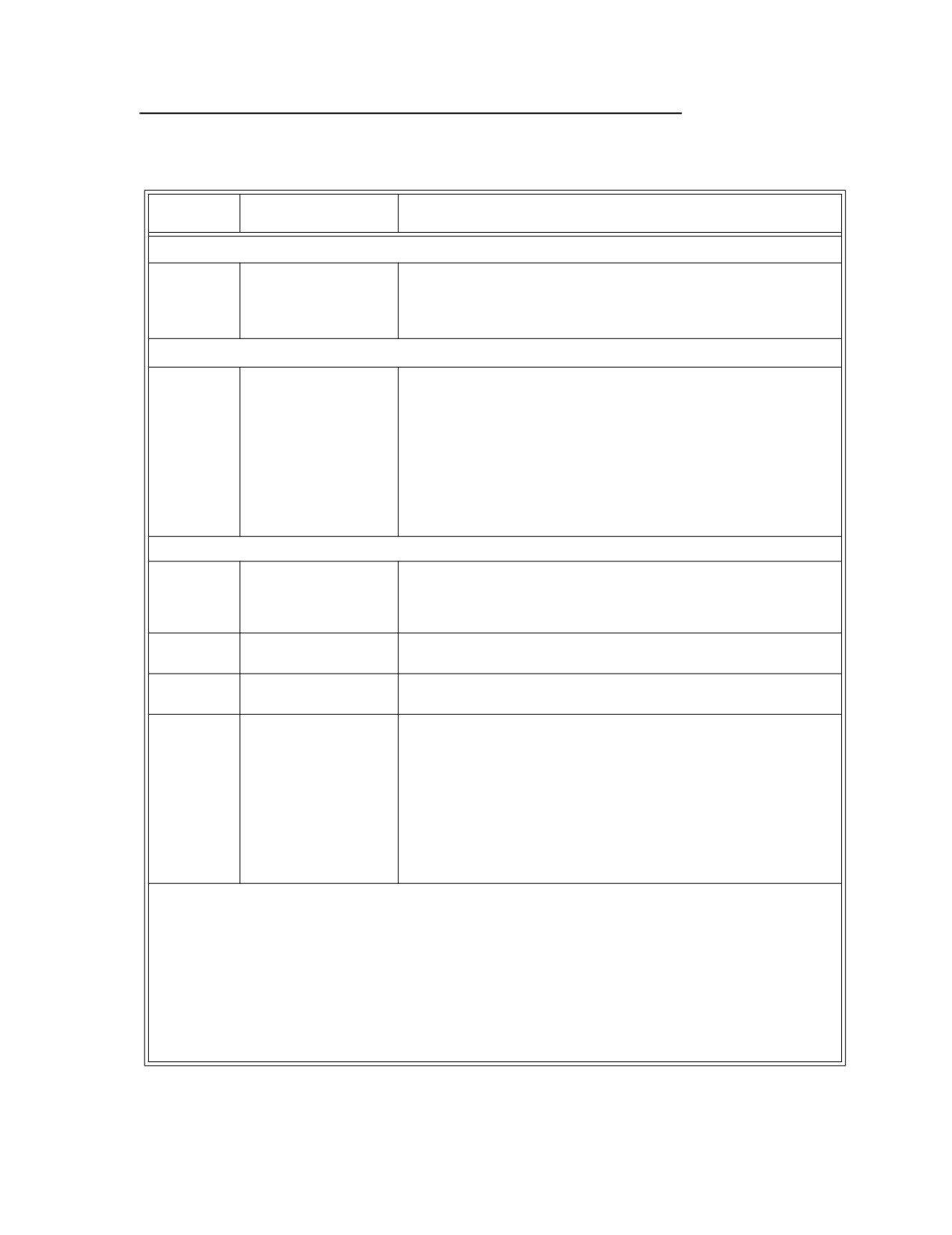
FM 3-5/MCWP 3-37.3
Table 9-1. Estimated Water Consumption for Decon
Required
Time
Water Consumption
Equipment
Operational Decon1
M12A1
1-3 minutes
100 to 150 gallons per regular vehicle
PDDA or
150 to 200 gallons per armored or larger vehicle
M17 LDS
Example:
15
(contaminated vehicles) x 150 (gallons of water) = 2,250 gallons2
Detailed Equipment Decon3
M12A1
See Chapter 4 for the
Vehicles:
PDDA4
time allowed during a
Station 1 - primary wash, 250 gallons
or M17
primary wash and
Station 4 - rinse, 200 gallons
rinse. Use the proper
Armored or larger vehicle:
LDS4
decon method.
Station 1 - primary wash, 300 gallons
Station 4 - rinse, 200 gallons
Example:
6 vehicles x 450 gallons of water = 2,700 gallons
4 tanks x 500 gallons of water = 2,000 gallons
Total: 4,700 gallons2
Detailed Troop Decon
30-gallon
The initial setup requires 258 gallons of water. The water must be
container
exchanged after 10 troops have been decontaminated through the
DTD to avoid the transfer of contamination.
Station 1 (120 gallons, 4 30-gallon containers).
3-gallon
Station 2 (6 gallons, 2 3-gallon containers).
container
30-gallon
Station 4 (180 gallons, 6 30-gallon containers).
container
3-gallon
Station 7 (12 gallons, 4 3-gallon containers).
container
Example:
About 150 troops are to be decontaminated through the DTD. You
will need 258 gallons of water per every 10 troops.
Example:
150
(number of troops) ÷ 10 (required water exchange) = 15 (the
amount of times the water will need to be exchanged)
15 x 258 (gallons of water per every 10 troops) = 3,870 gallons of
water for 150 troops2
1To reduce contamination, conduct the operator’s spray down before the operational decon. This process
requires less water consumption during a thorough decon.
2Always include a 10 percent planning factor to the total estimate of the water consumption for the DED and
the DTD. Example: 2,250 (gallons of water for the DTD) x 10 percent = 225 (additional gallons of water). A
total of 2,250 + 225 = 2,475 (gallons of water required for the DTD).
3The planner should consider vehicle predecon action to estimate water consumption. He should consider
vehicles that were processed through operational decon because they will normally increase the weatheriza-
tion process and may reduce water usage.
4The M17 LDS with two wands uses 14 gallons of water per minute. The M17 LDS with only one wand, which
is fitted with an injector, uses 25 gallons per minute. The M12A1 PDDA pumps 25 gallons of water per minute.
Logistics 9-3
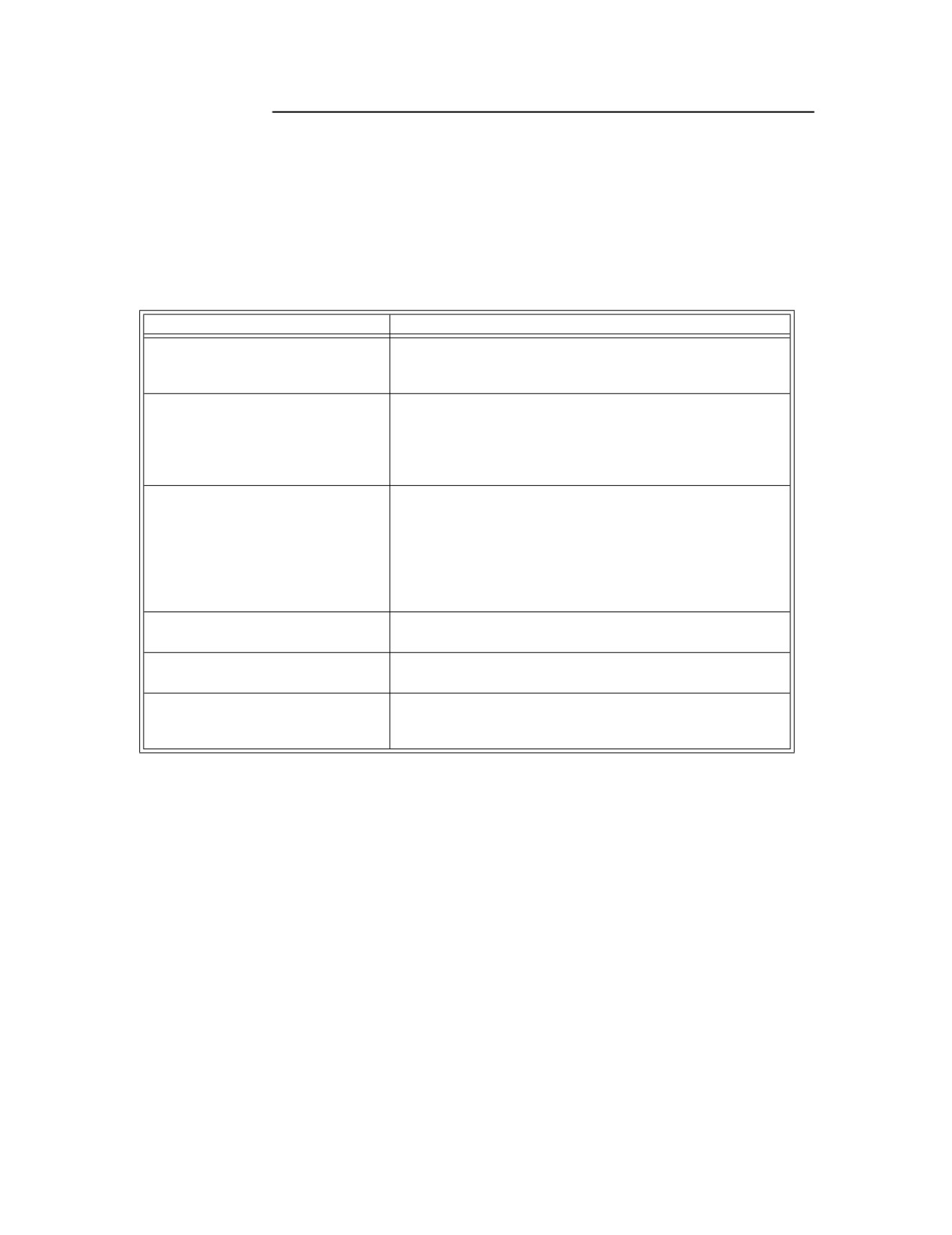
FM 3-5/MCWP 3-37.3
9-13. Chemical platoons attached to division engineers may be resupplied
through the division engineer battalion instead of their parent company. See
Table 9-2 for the decon resources that are available at each organizational
level. For the equipment and supplies that are needed for decon operations,
see Table 9-3, pages 9-5 through 9-7.
Table 9-2. Decon Resources Available at Each Organizational Level
Organizational Level
Decon Resources
Individual soldiers
2 SDKs
1 canteen of water
2 IEDKs
Operators and crews
2 SDKs
2 IEDKs
1 on-board decon apparatus (M11 or M13)
Soap and water
2 50-pound drums STB
Companies
2 5-gallon pails of DS2
2 immersion heaters
2 to 3 30-gallon containers
6 3-gallon containers
6 long-handled brushes
6 sponges
300 plastic trash bags
Battalion PDDE crews
PDDE (M17 LDS)
Basic load, liquid detergent
Chemical company decon squad
PDDE (M12A1 PDDA/M17 LDS)
Basic load, liquid detergent
Chemical company decon platoon
PDDE (M12A1 PDDA/M17 LDS)
Interior decon equipment
Sufficient materials to set up a DTD
9-4 Logistics
Table 9-3. Equipment and Supplies Needed for Decon Operations
Minimum Amounts of Equipment and Supplies
Basis of Issue
Needed for Decon Techniques
Class of
Unit of
(See TOE for
Nomenclature
NSN
Supply
Issue
Actual Authoriza-
SD*
PW*
OS*
MGX**
VW**
DTD**
DED**
tion)***
1
***
Decon apparatus,
4230-00-720-1618
II
Each
1 per every major
DS2, ABC-M11 or
4230-01-113-4124
II
Each
equipment
M13 DAP
2
Cylinder, nitrogen
4230-00-775-7541
II
Box
2 per can, DS2
filled
5 per box
Decon kit,
1
1
1
M291 SDK
4230-01-0276-1905
II
Each
1 per mask
2
35
2
M295 IEDK
6850-01-3577-8456
II
Each
2 per soldier
1
Fluid-filled container,
4230-01-136-8888
II
Each
1 per M13 DAP
DS2
1
Filter canister, C2, or
4240-01-119-2315
II
Each
1 per M40-series
filter canister, C2A1
4240-01-361-1319
mask
1
Hood, M40 mask
4240-01-376-3152
II
Each
1 per mask
1
2
Shears
5111-00-223-6371
II
Each
As needed
Knife
5110-00-240-5943
II
Each
As needed
***
***
Axe, single bit
5110-00-293-2336
II
Each
1 per most vehi-
cles
***
***
***
Shovel, hand, RD, PT,
5120-00-293-3336
VII
Each
1 each for most
D handle
vehicles
***
NAAK, MK1
6505-01-140-6455
VII
Each
3 per individual
***
CANA
6505-01-274-0951
VII
Each
1 per individual
5 per combat life
saver
10 per combat
medic
***
3
Paper, chemical
6665-00-049-8982
II
Roll
1 per squad
agent, detector, M9
3 per platoon
Table 9-3. Equipment and Supplies Needed for Decon Operations (Continued)
Minimum Amounts of Equipment and Supplies
Basis of Issue
Needed for Decon Techniques
Nomenclature
NSN
Class of
Unit of
(See TOE for
Supply
Issue
Actual Authoriza-
SD*
PW*
OS*
MGX**
VW**
DTD**
DED**
tion)***
***
***
Paper, chemical
6665-00-050-8529
II
Book
6 books per com-
agent, detector, M8
pany
***
***
Radiac meter,
6665-01-222-1425
VII
Each
Per MTOE
AN/PDR-2
2
***
Radiac meter,
6665-00-752-7759
VII
Each
Per MTOE
IM-93/UD
1
2
Alarm, chemical
6665-00-935-6955
VII
Each
Per MTOE
agent, M8A1 or M22
6665-01-438-6963
VII
Each
4
2
CAM
6665-01-199-4153
VII
Each
Per MTOE
4
Detector kit, chemical
6665-01-016-8399
II
Kit
1 per squad
agent, M256A1
1
Mask sanitizing solu-
6810-00-266-6979
III
Tube
4 per 10 masks
tion
**
1
Decontaminating
6850-00-297-6653
III
Drum
2 50-pound drums
agent, STB
per company
***
Decontaminating
6850-00-753-4870
II
Can
5 gallons, 25 cans
agent, DS2
per decon
1
2
24
Brush, scrub, long-
7920-00-141-5452
II
Each
As required
handled
7
Pail, metal, 14-quart
7240-00-160-0455
II
Each
As required
1
9
4
Garbage can, galva-
7240-00-160-0440
II
Each
2 per company
nized, 30-gallon
6
Mop
7920-00-224-8756
Each
As required
5
Sponge, cellulose
7920-00-240-2559
II
Each
As required
2
4
6
Brush, scrub
7920-00-240-7171
II
Each
As required
2
2
Towels, paper
7920-00-823-6931
II
Box
As required
1
1
1
1
Detergent, GP, liquid
7930-00-282-9699
II
Gallon
As required
Table 9-3. Equipment and Supplies Needed for Decon Operations (Continued)
Minimum Amounts of Equipment and Supplies Needed
Basis of Issue
for the Decon Techniques
Class of
Unit of
(See TOE for
NSN
Nomenclature
Supply
Issue
Actual
SD*
PW*
OS*
MGX**
VW**
DTD**
DED**
Authorization)***
1
1
1
Bag, plastic
8105-00-655-8286
II
Box
125 count
**
10
TAP apron
8415-00-281-7813
II
Each
10 per platoon
through
8415-00-281-7816
1
1
Suit, clothing, protec-
8415-01-137-1700
II
Each
2 per soldier
tive, See CTA 50-909
through
for clothing tariff
8415-01-137-1707
1
1
Glove set, CP, See
8415-01-033-3517
II
Pair
1 per soldier
SB 10-523 for cloth-
through
ing tariff
8415-01-033-3520
Cover, helmet, chem-
8415-01-111-9028
II
Each
1 per soldier
ical protective
1
1
Overboots
8430-01-048-6305
II
Pair
1 per soldier
through
8430-01-049-0887
2
2
2
2
NBC marking kit
9905-12-124-5955
II
Kit
1 per squad
2
Immersion heater
II
Each
2 per company
*Techniques executed by individual soldiers
SD - Skin decon
Amount is consumption rate for 1 soldier
PW - Personal wipe down
OS - Operator’s spray down
**Techniques executed by units
MGX - MOPP-gear exchange
Amount is consumption rate for 1 platoon
VW - Vehicle washdown
(4 vehicles, 40 personnel)
DTD - Detailed troop decon
Amount is consumption rate for 1 com-
DED - Detailed equipment decon
pany (20 vehicles, 150 personnel)
***Amounts vary, depending on situation
Chapter 10
Decon Procedures for
Individual and Crew-Served Weapons
Decon procedures for light infantry crew-served weapons and some
individual major weapons that are critical to the unit’s mission are
discussed in this chapter. For those units that are not authorized decon
devices such as the M11 or M13 DAP, alternative measures are described.
Decon procedures are specified for the following weapons: M60 machine
gun; M249 squad automatic weapon (SAW); M47 Dragon; tube-launched,
optically tracked, wire-guided (TOW) missile (M220 series); 81-millimeter
mortar; 60-millimeter mortar; M203 grenade launcher; AT4 light antitank
weapon (LAW); LAW (M72 series); and 66-millimeter rocket launcher.
OPERATIONAL-DECON PROCEDURES USING THE IEDK
10-1. Operational decon is conducted to sustain combat operations, remove
gross contamination, and reduce the transfer/spread of contamination. Before
decon, soldiers should visually inspect the weapon system for contamination.
If liquid contamination is present, follow the procedures prescribed for each
weapon system. The protection level required for operational-decon operations
is MOPP4.
NOTE: The United States Marine Corp (USMC) does not possess the
IEDK; therefore, it will have to use additional SDKs to decon
individual and crew-served weapons.
10-2. The following procedures reduce the spread/transfer of liquid
contamination. These procedures are unique to the IEDK. Using other decon
equipment with these procedures could result in a malfunction of the
weapons/weapon systems. Powder from the IEDK could affect the mechanical
parts of the weapons/weapon systems if not used properly. See the
maintenance manual for proper lubrication after decon.
WARNING
Do not apply an IEDK to any optic lens. The abrasive effect of the
charcoal inside the IEDK will damage the lens.
M60
MACHINE GUN
NOTE: Ensure that the feed tray of the weapon is closed. This
prevents the powder from the IEDK from falling inside the feed tray
and jamming the weapon. Do not touch the barrel of the weapon with
the chemical protective gloves when it is hot. The heat of the barrel
could melt the gloves.
Decon Procedures for Individual and Crew-Served Weapons 10-1
FM 3-5/MCWP 3-37.3
10-3. To decon the M60 machine gun, follow the steps below:
• Step 1. Decon your gloves using the IEDK.
• Step 2. Use the IEDK to remove all liquid contamination from the
bipod, barrel assembly, forearm assembly, and carrying handle. Use a
second IEDK if necessary.
• Step 3. Use the IEDK to decon the feed-tray cover, shoulder stock, and
trigger assembly.
• Step 4. Repeat step 1.
NOTE: Do not decon the flash suppressor with the IEDK. Powder
debris may fall into the barrel and cause the weapon to malfunction.
M249 SQUAD AUTOMATIC WEAPON
NOTE: Ensure that the feed tray of the weapon is closed. This
prevents the powder from the IEDK from falling inside the feed tray
and jamming the weapon. Do not touch the barrel of the weapon with
chemical protective gloves when it is hot. The heat of the barrel could
melt the gloves.
10-4. To decon the M249 SAW, follow the steps below:
• Step 1. Decon your gloves using the IEDK.
• Step 2. Use the IEDK to remove all liquid contamination from the
bipod, barrel assembly, gas regulator, and carrying handle.
• Step 3. Use the IEDK to decon the feed-tray cover, magazine, trigger
assembly, and shoulder stock.
• Step 4. Repeat step 1.
NOTE: Ensure that the weapon is upright when decontaminating the
feed-tray cover with the IEDK. This prevents powder from the IEDK
from falling into the ammunition feeder. Place the magazine in the
well before the decon.
M203 GRENADE LAUNCHER
NOTE: The M203 is not a crew-served weapon; however, this weapon
is considered critical for accomplishing the infantry squad’s mission.
Decon the M16A2
according to STP
21-24-SMCT. Before
decontaminating the M203 grenade launcher, ensure that the dust
cover is closed and the magazine is stored in the well. Ensure that
the barrel assembly is closed.
10-5. To decon the M203 grenade launcher, follow the steps below:
• Step 1. Decon your gloves using the IEDK.
• Step 2. Use the IEDK to decon the barrel, hand guard, and receiver.
• Step 3. Use the IEDK to decon the lower receiver group and butt stock.
• Step 4. Repeat step 1.
M47 DRAGON
10-6. Use this procedure only when liquid contamination is present on
encased missile or tracker components. If the launcher has been fired and
chemical contamination is present, follow the procedures shown in steps 1, 4,
10-2 Decon Procedures for Individual and Crew-Served Weapons