FM 3-5 NBC Decontamination (July 2000) - page 3
FM 3-5/MCWP 3-37.3
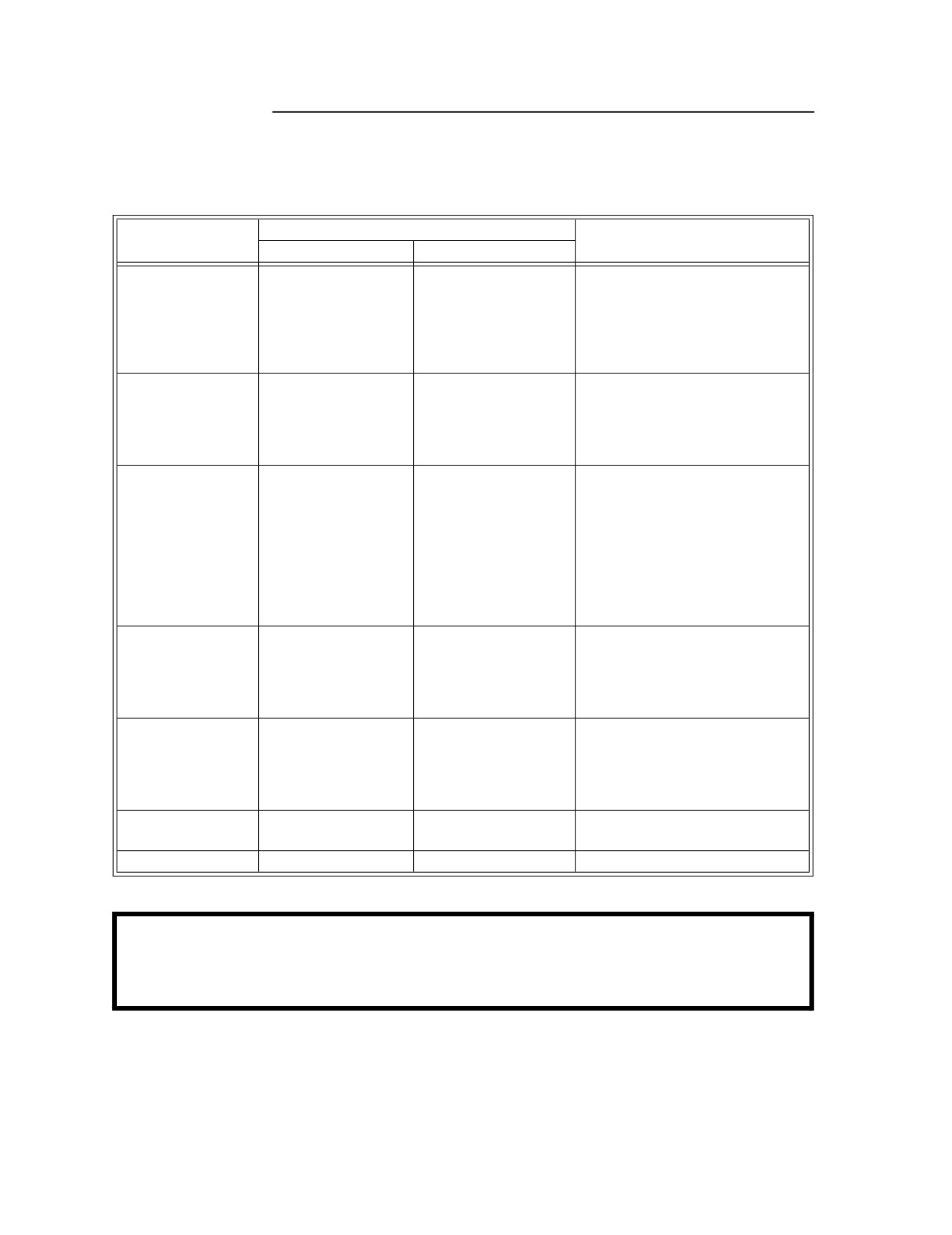
Table 4-7. Personnel and Equipment Requirements for the Optimum DED Layout of the M12A1
PDDA-Equipped Unit
Personnel
Equipment/Supplies
Stations
Decon Platoon
Augmenter
Station 1 -
1
squad leader
4 scrubbers
2 M12A1 PDDAs
primary wash
2
PDDE operators
2 3,000-gallon tanks
4
sprayers
2 65-GPM pumps
6 long-handled brushes
8 TAP aprons
Liquid detergent
Station 2 -
1
squad leader
9 appliers
18 long-handled brushes
DS2 application
3
appliers
9 mops with extra mop heads
3 30-gallon containers
9 M13 DAPs
Sufficient DS2
Station 3 -
1
NCO
2 interior decon assis-
2 AN/VDR-2
contact time/
tants
3 TAP aprons
interior decon
6 30-gallon containers
10 books of M8 detector paper
30 sponges
8 M256A1 detector kits
50 trash bags
1 clipboard with a pen
1 stopwatch
Station 4 -
1
squad leader
2 sprayers
1 M12A1 PDDA
rinse
1
PDDE operator
1 3,000-gallon tank
2
pump operators
3 65-GPM pumps
2 TPUs
2 TAP aprons
Station 5 -
2
NCO/CAM opera-
2 CAMs
check
tors
10 M256A1 detector kits
20 books of M8 detector paper
2 AN/VDR-2
2 M8A1 or M22 ACAAs
1 PL
1 HMMWV with a radio
C2
1 PSG
3 NBC marking kits
Total personnel
20
17
WARNING
Chemical-unit leaders must consider the impact of the work/rest cycle on their unit’s
ability to process vehicles through the DED. Failure to initiate a work/rest cycle could
result in heat casualties and mission failure.
4-109. It may not be possible, for a variety of reasons, for an M12A1 PDDA-
equipped decon platoon to use the optimum DED layout. Limited personnel or
equipment will affect the DED layout. Figure 4-6, page 4-25, shows an
example of an alternate DED layout.
Thorough Decon 4-28

FM 3-5/MCWP 3-37.3
Table 4-8. Personnel and Equipment Requirements for the Alternate DED Layout
of the M12A1 PDDA-Equipped Unit
Stations
Personnel
Equipment/Supplies
Station 1 -
1
NCOIC*
2 M12A1 PDDAs
primary wash
2
PDDE operators*
2 3,000-gallon tanks
4
sprayers
2 65-GPM pumps
2
scrubbers
4 long-handled brushes
6 TAP aprons
Liquid detergent
Station 2 -
1
NCOIC*
14 long-handled brushes
DS2 application
8
appliers
8 mops with extra mop heads
3 30-gallon containers
8 M13 DAPs
Sufficient DS2
Station 3 -
1
NCO*
2 AN/VDR-2
contact time/
2
interior decon assistants
3 TAP aprons
interior decon
6 30-gallon containers
10 books of M8 detector paper
30 sponges
8 M256A1 detector kits
50 trash bags
1 clipboard with a pen
1 stopwatch
Station 4 -
1
NCOIC*
1 M12A1 PDDA
rinse
1
PDDE operator*
1 3,000-gallon tank
2
sprayers
3 65-GPM pumps
2 TPUs
2 TAP aprons
Station 5 -
2
NCO/CAM operators*
2 CAMs
check
10 M256A1 detector kits
20 books of M8 detector paper
2 AN/VDR-2
2 M8A1 or M22 ACAAs
1
PL*
1 HMMWV with a radio
C2
1
PSG*
3 NBC marking kits
Total personnel
29
(Minimum of 11 soldiers from
the decon platoon)
* These individuals should be from the decon platoon.
THOROUGH-DECON-SITE CLOSURE
4-110. Once all vehicles and soldiers from the contaminated unit
have
processed through the thorough-decon site, the site can be closed.
Coordination with the supported unit is necessary before actually closing the
site to ensure that all contaminated elements have been processed.
4-111. The chemical unit (decon or smoke/decon platoons) closes the DED
first. Once the DED is closed, the chemical unit processes through the DTD.
After the chemical unit has processed through the DTD, the DTD is closed. At
that point, the chemical unit marks the area as a contaminated area and
reports its exact location to the supported unit, using an NBC-5 report. The
exact procedures for closing the DED and DTD are described as follows:
Thorough Decon 4-29

FM 3-5/MCWP 3-37.3
Table 4-9. Personnel and Equipment Requirements for the Optimum DED Layout of the M17
LDS-Equipped Unit
Personnel
Stations
Equipment/Supplies
Decon Platoon
Augmenter
Station 1 -
1 squad leader
2
scrubbers
3 M12A1 PDDAs
primary wash
4 sprayers
3 1,500-gallon tanks
2 scrubbers
3 65-GPM pumps
6 long-handled brushes
8 TAP aprons
Liquid detergent
Station 2 -
1 squad leader
9
appliers
18 long-handled brushes
DS2 application
3 appliers
9 mops with extra mop heads
3 30-gallon containers
9 M13 DAPs
Sufficient DS2
Station 3 -
1 NCO
2 AN/VDR-2
contact time/
2 interior decon assis-
3 TAP aprons
interior decon
tants
6 30-gallon containers
10 books of M8 detector paper
30 sponges
8 M256A1 detector kits
50 trash bags
1 clipboard with a pen
1 stopwatch
Station 4 -
1 squad leader
3 M17 LDSs
rinse
4 sprayers
3 3,000-gallon tanks
3 65-GPM pumps
2 TPUs
4 TAP aprons
Station 5 -
2 NCO/CAM opera-
2 CAMs
check
tors
10 M256A1 detector kits
20 books of M8 detector paper
2 AN/VDR-2
2 M8A1 or M22 ACAAs
1 PL
1 HMMWV with a radio
C2
1 PSG
3 NBC marking kits
Total personnel
23
11
CLOSING THE DED AREA
4-112. The DED is closed in sequence,
starting at station 1. All vehicles,
equipment, and nonexpendable supplies are inspected for contamination. If
contamination is found on an item, it is decontaminated. The actions at each
station are described as follows:
Station 1 - Primary Wash
4-113. Spray all vehicles and equipment with hot, soapy water to remove any
contamination that could have been transferred during the primary wash
operations. Drain the water billets or fabric tanks of water. Inspect all
equipment and vehicles for contamination using the appropriate detection
equipment.
Thorough Decon 4-30

FM 3-5/MCWP 3-37.3
Table 4-10. Personnel and Equipment Requirements for the Alternate DED Layout
of the M17 LDS-Equipped Unit
Stations
Personnel
Equipment/Supplies
Station 1 -
1
NCOIC*
3 M17 LDSs
primary wash
4
sprayers
3 3,000-gallon tanks
4
scrubbers
3 65-GPM pumps
4 long-handled brushes
8 TAP aprons
Liquid detergent
Station 2 -
1
NCOIC*
14 long-handled brushes
DS2 application
8
appliers
8 mops with extra mop heads
3 30-gallon containers
8 M13 DAPs
Sufficient DS2
Station 3 -
1
NCO*
2 AN/VDR-2
contact time/
2
interior decon assistants
3 TAP aprons
interior decon
6 30-gallon containers
10 books of M8 detector paper
30 sponges
8 M256A1 detector kits
50 trash bags
1 clipboard with a pen
1 stopwatch
Station 4 -
1
NCOIC*
2 M17 LDS
rinse
4
sprayers
2 3,000-gallon tanks
2 65-GPM pumps
4 TAP aprons
Station 5 -
2
NCO/CAM operators*
2 CAMs
check
10 M256A1 detector kits
20 books of M8 detector paper
2 AN/VDR-2
2 M8A1 or M22 ACAAs
1
PL*
1 HMMWV with a radio
C2
1
PSG*
3 NBC marking kits
Water resupply
2 drivers*
2 TPUs
Total personnel
32
(Minimum of 10 soldiers from
the smoke/decon platoon)
* These individuals should be from the smoke/decon platoon.
Station 2 - DS2 Application
4-114. Throw the mops and brushes that were used in applying the DS2 into a
sump or bury them. Load the unused cans of the DS2 and the M13 DAPs on a
vehicle.
Station 3 - Contact Time/Interior Decon
4-115. Inspect any unused supplies and equipment for contamination. If no
contamination is detected, load the equipment and supplies on a vehicle.
Throw all contaminated supplies into the nearest sump. In calculating sump
requirements, 35 cubic feet of space is required for 250 gallons of liquid drain
off. Once a sump is 2/3 full, prepare a new sump.
Thorough Decon 4-31

FM 3-5/MCWP 3-37.3
Table 4-11. Work/Rest Table
Stations and Workload
Station 3 -
Station 1 -
Station 2-
Station 4 -
Station 5 -
Contact
Temperatures
Primary
DS2 Appli-
Rinse
Check
Time/Inte-
Wash
cation
rior Decon
Physical Exertion
Moderate
Heavy
Moderate
Moderate
Light
Cool
60 work
30 work
60 work
60 work
60 work
(<68oF)
15 rest
30 rest
15 rest
15 rest
15 rest
Warm
45 work
20 work
45 work
45 work
50 work
(68o - 74oF)
45 rest
20 rest
45 rest
45 rest
50 rest
Hot
30 work
15 work
30 work
30 work
40 work
60 rest
30 rest
60 rest
60 rest
80 rest
(74o - 84oF)
Very Hot
20 work
10 work
20 work
20 work
25 work
(>84oF)
60 rest
30 rest
60 rest
60 rest
75 rest
NOTE: When operating in temperatures above 75oF, consider the ability of the soldiers
to accomplish the mission. Once the soldiers have reached their maximum workload
for heat stress, they cannot recover quickly enough to accomplish the decon mission.
A viable option is to postpone the decon operation until a cooler part of the day or
evening. This will reduce the heat-stress load on the soldiers and increase the proba-
bility of mission success. For further information, see FM 3-4.
Station 4 - Rinse
4-116. Spray all vehicles and equipment with hot, soapy water to remove any
contamination that could have been transferred during the rinse operations.
Drain the water billets or fabric tanks of water. Inspect all equipment and
vehicles for contamination using the appropriate detection equipment. If no
contamination is detected, load the equipment on the vehicles. Spread one can
of STB dry mix into each of the sumps and then cover them. Ensure that DS2
is not present in the sumps. Post NBC hazard markers near the covered
sumps. (NOTE: DS2 destroys chemical agents; however, some of the
by-products created from it are toxic.)
Station 5 - Check
4-117. Ensure that all equipment has been checked for contamination. If it is
not contaminated, load it on a vehicle. If it is contaminated, decon it according
to the appropriate technical manual (TM). Throw any contaminated supplies
into the nearest sump. Move all vehicles upwind of station 5 and inspect them
again for contamination. If any contamination is detected, the crew will use
either the M11 or M13 DAP to decon the identified areas. Once the vehicles
are staged, all the soldiers will proceed to the DTD.
CLOSING THE DTD AREA
4-118. Once all the soldiers from the DED have processed through the DTD, it
may be closed. After the last person has exited the DTD
Thorough Decon 4-32
FM 3-5/MCWP 3-37.3
• Pick up all the used supplies from station 7 and put them in station 7’s
sump. Take up the contamination control line. If engineer tape was
used, dispose of it in station 7’s sump.
• Move all usable supplies and equipment from all the stations to station
1. Discard all unusable supplies from stations 3, 4, and 5 in station 1’s
sump.
• Decon all supplies and equipment collected at station 1 using the decon
and rinse water at station 1. Empty the decon and rinse water from the
station into the sump and decontaminant the containers.
• Mark the entire decon area. Remove your overgarment using the
MOPP-gear-exchange technique and dispose of it in the sump at
station 1.
• Move any equipment used to fill the sump upwind of the decon area.
Decon your rubber gloves and move all equipment and supplies in
station 1 upwind of the decon area. Keep this equipment and supplies
separate from that used to fill the sump.
THOROUGH DECON UNDER UNUSUAL CONDITIONS
4-119. Decon operations are not restricted to daylight hours. The enemy may
employ chemical and biological weapons at night, since weather conditions are
usually more favorable for their employment at that time. Consequently, NBC
contamination encountered at night may require decon before daylight.
4-120. Conducting decon operations at night is a challenge. “White light”
cannot be used without possibly revealing your location. However, decon
personnel must have illumination to perform such essential decon tasks as
spraying water, applying decontaminants, using detection equipment, and
taking off the MOPP gear.
4-121. Use M8/M9 detector paper to check for chemical contamination and to
see how well the chemical decon was performed. If contamination is present,
the paper color changes to red and cannot be seen if red-filtered light is used.
The CAM and M256A1 detector kit can be used to identify and detect chemical
agents but will require a light source in order to obtain a reading.
4-122. Several vehicles awaiting or undergoing decon present a significant
infrared “signature” due to the hot engines. To enter, exit, and move within
the decon site is difficult under blackout conditions.
4-123. Night-decon operations are difficult but can be accomplished.
Whenever possible, conduct thorough-decon operations in built-up areas. Use
a building for DTD operations and a warehouse for DED operations. This
allows for the use of white light. Soldiers can see what they are
decontaminating, see where they are going, and read the color changes of the
M8/M9 detector paper.
4-124. There will be a need for additional soldiers to act as ground guides in
the DED area. The NCOICs of stations 1, 2, and 4 will inspect each vehicle
with a flashlight or chemical light before the vehicle proceeds to the next
station. There should be at least two flashlights at each station in both the
DED and DTD areas.
Thorough Decon 4-33
Chapter 5
Special Decon Operations
The decon of terrain or structures allows personnel to increase their stay
time in an area and facilitates their passage through an area. Large-scale
terrain decon requires extensive amounts of equipment, material, and
time. Thus, terrain decon is limited to areas of critical importance.
Contaminated areas and structures that can be avoided do not need to be
decontaminated except by weathering. If they must be used, decon may be
necessary. When decon is not practical, use protection to deal with the
hazard. Most terrain and structural surfaces (excluding unpainted metal
and glass) absorb the agent. Therefore, the agent may be transferred to
clothing by physical contact. The agent may also be transferred through
vaporization and subsequent inhalation or diffusion into the eyes and the
clothing. The decon of equipment containing vulnerable components
presents certain challenges. Electronics and optics are especially
vulnerable to damage if not carefully decontaminated. Some materials,
such as canvas, absorb chemical agents and may not be decontaminated
and reused.
TERRAIN DECON
5-1. A terrain decon provides more long-term rather than short-term benefits.
Generally, you cannot decon occupied terrain well enough to allow you to
reduce your MOPP level right away. At best, all you can do is speed up the
weathering process. This may allow you to reduce your MOPP level a little
sooner, for example, in 2 days instead of 4 or 5. Terrain decon can be so
expensive and so ineffective that you should consider relocating.
5-2. If you decide on a terrain decon, limit the amount you do. Build a
causeway or breach a path through the contamination for entry/exit into a
major facility. Restrict your efforts to areas where you must work or move. No
matter what you do, you will probably have to remain in MOPP; but you can
reduce the danger of picking up liquid contamination and spreading it to other
areas.
5-3. The most effective techniques for a terrain decon are the natural methods
(weathering or aging). Using standard decontaminants will quickly exhaust
your resources (see Appendix B). Usually the most practical method is to scrap
off contaminated surfaces. Fire is a terrain-decon method; however,
consideration must be given to the potential downwind vapor hazard. If
possible, a contaminated area should be evacuated until time and weather
remove the hazard. An STB slurry can be used for vital areas. To determine
the persistency of chemicals at various temperatures, refer to FM 3-9.
5-4. A terrain decon may be accomplished using several methods. These
methods are listed in the order of decreasing effectiveness. Although they
Special Decon Operations 5-1
FM 3-5/MCWP 3-37.3
reduce the contact hazard, none will prevent hazardous vapors desorbing from
contaminated surfaces. Therefore, appropriate protective measures must still
be taken.
WEATHERING
5-5. Weathering is the simplest and easiest form of decon.
Chemical and Biological Contamination
5-6. Warm, windy weather can significantly reduce terrain contamination. In
some cases, this occurs in a few hours or it may take a few days. Many
variables affect the persistency of chemical and biological hazards, so it is
impossible to accurately predict how long it takes such contamination to
weather. Sunlight is especially effective against most biological agents.
Radiological Contamination
5-7. Although the term “weathering” is used to describe the decon process,
weather has little effect on radiological hazards. Heavy rain and wind may
remove some contamination, but only time will reduce the radiation
emanating from the contamination.
REMOVING/COVERING
5-8. Removing or covering contamination does not destroy it, but it does keep
the hazards away from you temporarily.
Chemical and Biological Contamination
5-9. Contamination can be removed from paths and unpaved roadways by
scraping off a layer of earth using heavy earthmoving equipment (bulldozers
and road graders). Contaminated paths and paved surfaces can be covered
with a 4-inch layer of earth, roofing paper, plastic sheets, and wood mats.
This is a temporary measure because the agents may penetrate the covering.
When the contamination penetrates the covering or when the covering is
removed, the hazards will reappear. The coverings may also extend the life of
the contamination hazard by reducing its exposure to air and sunlight.
Radiological Contamination
5-10. Radiological contamination must be covered by thick layers of dense
material, like earth. Three inches of earth will decrease radiation dose rates
by half because of the shielding provided by the soil. However, 12 inches is
more effective. The job will be easier with earthmoving equipment, but the
equipment and operators probably will have to undergo decon.
NEUTRALIZING
5-11. The STB dry mix or STB slurry may be used effectively against chemical
or biological contamination, but not against radiological contamination.
Trained chemical troops and equipment are required when using the STB
slurry, which is costly both in time and material.
Chemical and Biological Contamination
5-12. The STB dry mix is spread on solid surfaces and raked into soft surfaces
like sand or earth.
5-2 Special Decon Operations
FM 3-5/MCWP 3-37.3
5-13. The STB slurry is applied to terrain by using a spray hose that is
attached to an M12A1 decon apparatus. Operators wear TAP aprons over
their MOPP gear and sit on the front fenders of a vehicle to spray the STB
slurry. The speed of the vehicle should be adjusted according to the terrain;
this is normally 2 to 4 miles per hour. The operators spray a fan pattern 3 to 5
feet ahead of the vehicle. The pattern overlaps on the center and extends past
both sides of the vehicle. The STB slurry forms a seal over the surface and
must be renewed periodically due to deterioration from traffic or weathering.
One load of STB slurry will decon a concrete surface about 328 feet long by 33
feet wide. Other surfaces may require more decontaminants. It takes about
an hour to load and mix one load of SBT slurry.
Radiological Contamination
5-14. The STB dry mix and STB slurry have no effect on radiological
contamination or its hazards.
BURNING
5-15. Burning works well against chemically or biologically contaminated
vegetation; but it is of no value against radiological contamination.
Chemical and Biological Contamination
5-16. Fuel may be used to burn grass or short undergrowth. Burning also
works on dirt surfaces. Soak the area with diesel fuel, kerosene, or fuel oil
and ignite remotely. Do not use gasoline; it burns too quickly. Burning will
cause vapor hazards downwind, and protective measures will have to be used
by downwind units. Area commanders must warn these units of the vapor
hazards.
Radiological Contamination
5-17. Radiologically contaminated surfaces should not be burned. Burning
will not destroy radiological contamination or its hazards. It may spread
contamination if radioactive particles become suspended in smoke spread by
the wind.
EXPLODING
5-18. Explosives can be used to blow up areas that are chemically and
biologically contaminated; however they are of no value against radiological
contamination.
Chemical and Biological Contamination
5-19. Detonating cord, bangalore torpedoes, or mine-clearing line charges may
be used with the STB dry mix to clear small paths through a contaminated
area. The two methods that are used follow:
• First method. Remove the holding band and loosen the lid of the
bleach drum. Set the drum with the lid in place upside down over
about 3 feet of looped detonation cord. Remove the drum and leave the
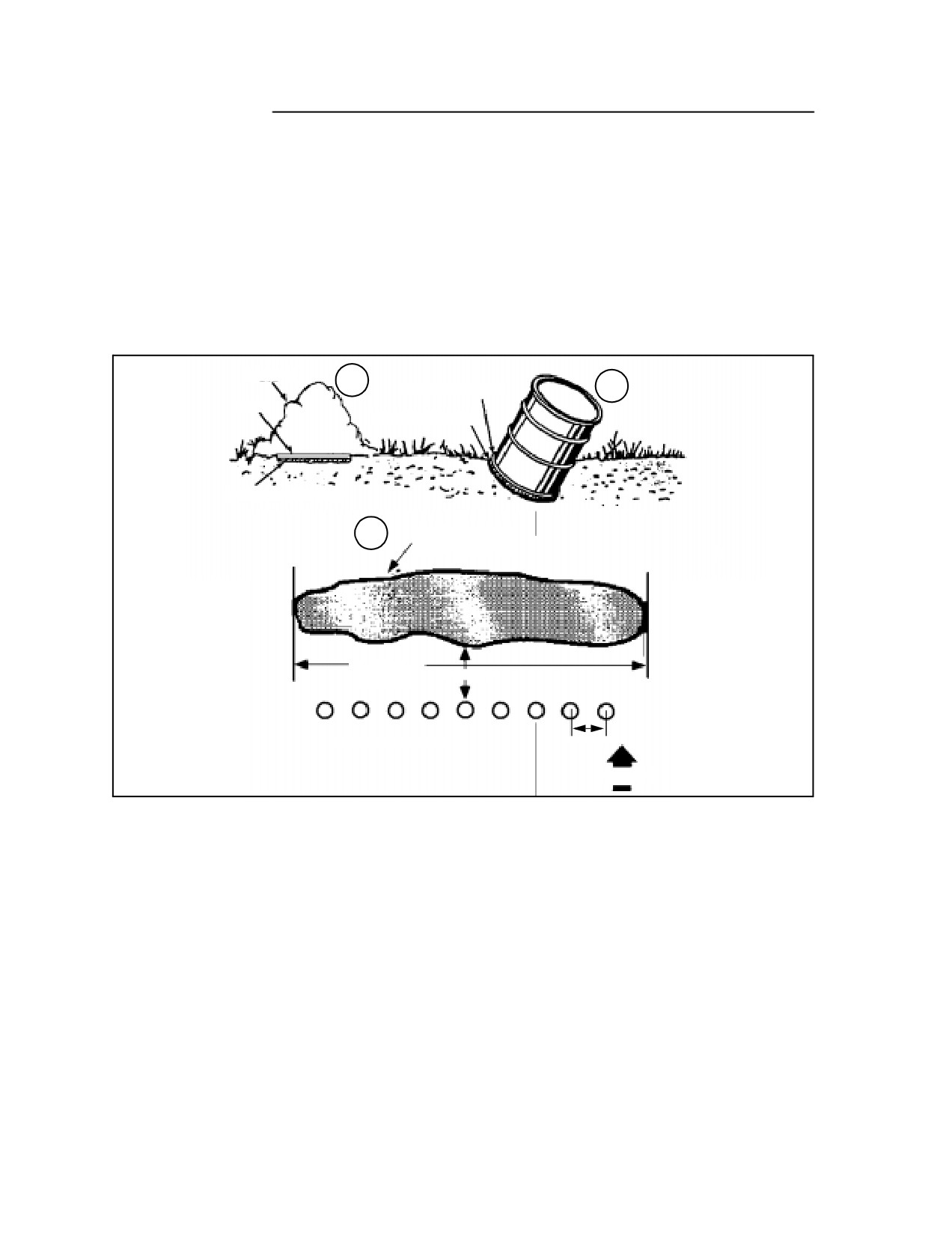
bleach piled on the lid as shown in Figure 5-1, A, page 5-4. Lids may
be fired in a series with a single strand of detonation cord connecting
the loops.
Special Decon Operations 5-3
FM 3-5/MCWP 3-37.3
• Second method. Remove the holding band and loosen the lid of the
bleach drum. Set the drum in a shallow hole as shown in Figure 5-1, B.
Make sure the lid is loose. Use 5 feet of looped detonating cord (7 feet in
soft ground) for each drum. The drums may be fired individually or in a
series. For gross contamination, additional firings may be necessary.
5-20. For either emplacement method, the suggested spacing for charges is 33
feet apart for a 100-foot-front contaminated area. The charges should be
placed along the upwind edge of the contaminated area (see Figure 5-1, C).
STB
A
Loosened lid
B
Lid
Detonating cord
Detonating cord
Contaminated
C
area
328 feet
10 feet
Not to scale
33 feet
Wind
Figure 5-1. Two Methods of Emplacing Dry STB for Distribution by Detonation
Radiological Contamination
5-21. Explosives will not destroy radiological contamination or its hazards.
FLUSHING
5-22. Flushing with large quantities of water removes contamination. A
pressurized stream of hot, soapy water delivered by the PDDA, M17 LDS, or
fire trucks can remove significant amounts of an agent. Scrubbing removes
even more.
Chemical and Biological Contamination
5-23. Flushing is not very effective against some kinds of agents, especially
thickened agents. However, flushing may speed up the weathering process.
5-4 Special Decon Operations
FM 3-5/MCWP 3-37.3
Radiological Contamination
5-24. Flushing is very effective for removing loose radioactive contamination
such as fallout. Rain out, however, can coat surfaces with a film that resists
flushing. Such films must be scrubbed. Any contamination removed by
flushing and scrubbing will remain radioactive, so control the runoff.
CLEARING
5-25. To clear passageways, remove the contaminated layers covering the
terrain.
Chemical and Biological Contamination
5-26. Most liquid chemical agents will not penetrate the soil more than 2
inches, and biological agents penetrate even less. Earthmoving equipment or
hand tools can be used to scrap aside contamination. By scraping off 2 to 4
inches of earth, a passageway can be created that is free of transfer hazards.
However, contamination on either side of the passageway will continue to
present a vapor hazard.
Radiological Contamination
5-27. Fallout does not penetrate the top layer of soil unless it is followed by
rain. It can be scraped aside. Move contaminated soil as far away as possible;
the piles tend to concentrate radiation. Immediately below a nuclear blast
area, the soil may be radioactive to a depth of 5 feet. In most cases, decon of
this much earth is not practical.
FIXED-SITE DECON
5-28. Personnel and equipment need to be decontaminated to reduce the
hazard and the spread of contamination, limit casualties, and minimize
operational degradation. The goal is to restore the unit to an acceptable level
of operational effectiveness. The inability of a fixed site to move away from
contamination makes decon more critical. Decon is necessary when protective
items cannot be worn in performing the mission or when long-term occupancy
is anticipated.
5-29. Decon capabilities may be designed and built into a facility and used if
the facility becomes contaminated. Mobile decon equipment may also be
available at a fixed site to decon equipment, roads, and buildings. Interior
decon may be accomplished with large commercial heaters. Loading docks,
entries and exits, and building exteriors can be decontaminated with more
conventional methods, such as using an STB dry mix or STB slurry, soap and
water, or an M13 DAP. Commanders should identify all systems that are
capable of contributing to the decon effort (for example, fire trucks, steam
cleaners, and water pumps).
5-30. Decon equipment can be retrofitted to accommodate the process in each
area. For instance, rest and relief shelters need rapid, personnel decon
systems, and supply operations need a decon system that can handle
moderate size pieces of equipment, but at a high volume. Light maintenance
needs a system that can decon equipment sensitive to harsh decontaminants
or water, and heavy maintenance needs a system that can clean large
equipment.
Special Decon Operations 5-5
FM 3-5/MCWP 3-37.3
5-31. The commander should designate and train teams that can perform
decon for fixed-site operations. The following are fixed-site decon techniques
that the teams could apply:
AIRFIELD
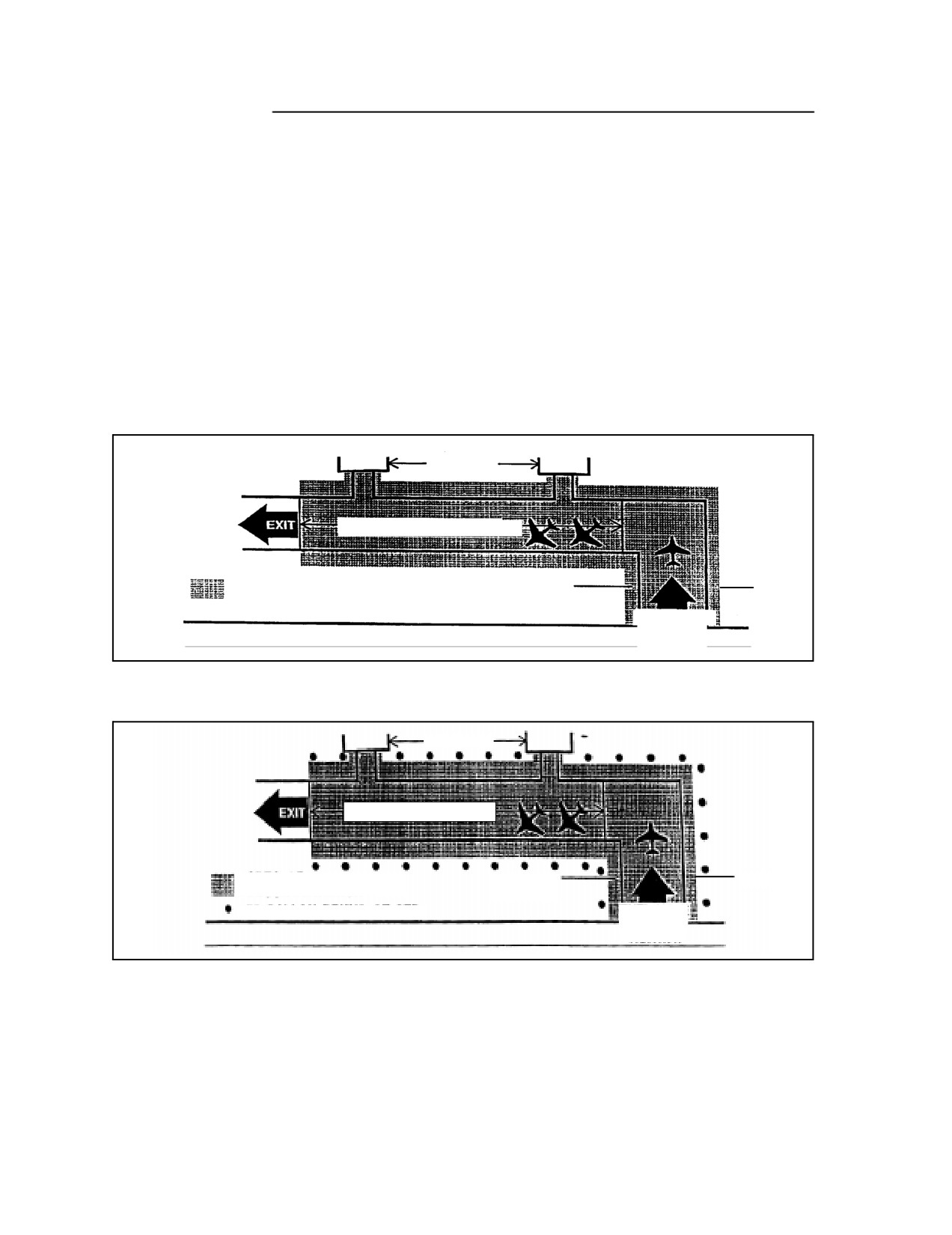
5-32. Decon the area required to sustain the mission (see Figure 5-2). Figure 5-3
illustrates the STB application on the entrance/exit of the airfield hangers. Note
that the STB application includes 10 feet on each side of the runway between
the entrance and the exit. A transfer hazard will remain a problem until all
parts of the airfield have weathered. Buildings’ or hangers’ entrance/exit and
doors must be decontaminated accordingly. Figure 5-3 illustrates a field-
expedient method that could be employed at any fixed site to cover the major
entry/exit toward the site.
Hangers
AO
Area of decon
10 feet
10 feet
Entrance
Runway
Figure 5-2. Airfield-Area Decon
Hangers
AO
10 feet
Area of decon
10 feet
55-gallon drums of STB
Entrance
Runway
Figure 5-3. Field-Expedient Airfield Decon
HELIPAD
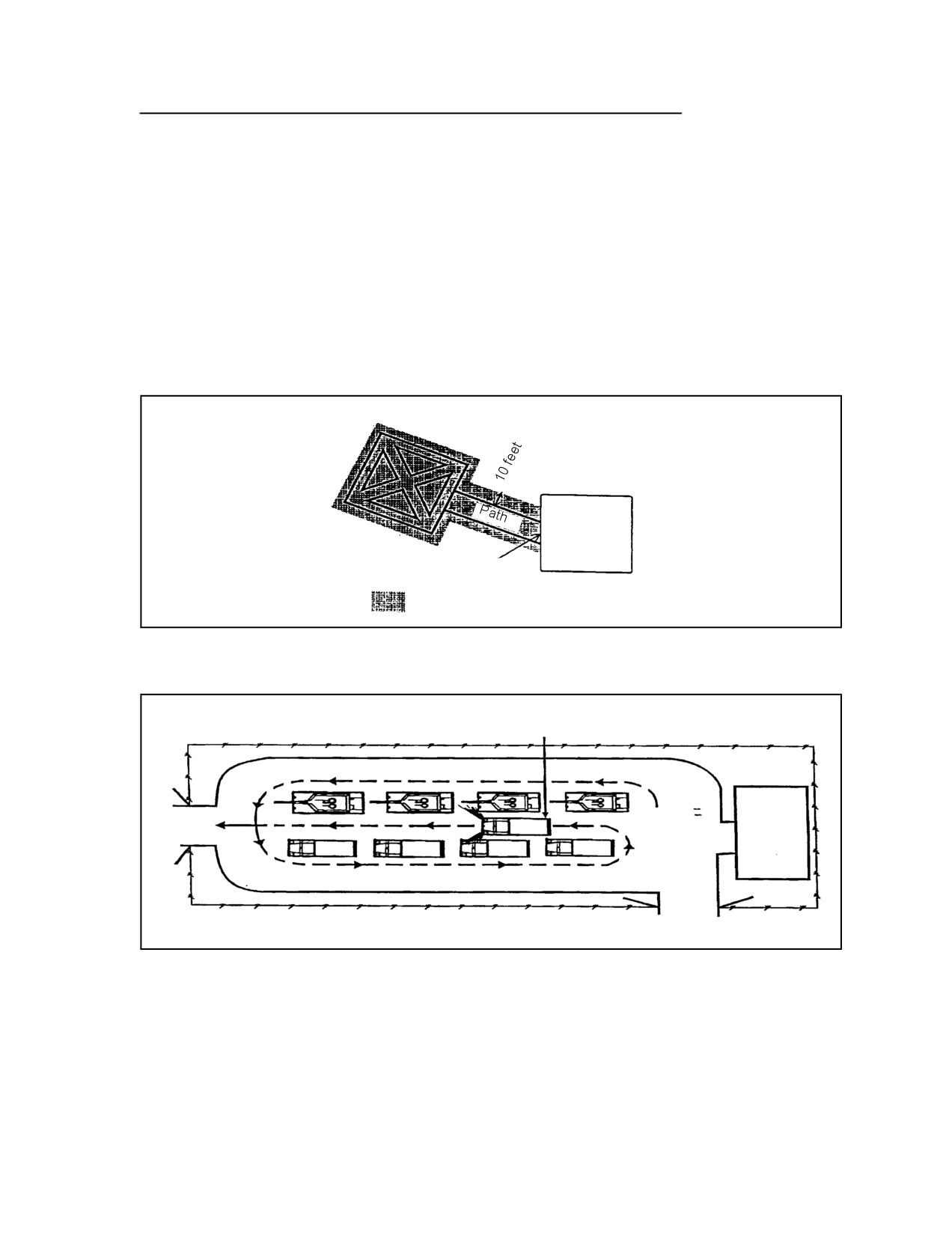
5-33. To decon a helipad site, spray the STB slurry on the entrance/exit
approach or the path (see Figure 5-4). Since airborne STB particles can
damage sensitive aircraft components, the decontaminated area should be
washed with water before landing helicopters.
5-6 Special Decon Operations
FM 3-5/MCWP 3-37.3
POMCUS/MOTOR PARK
5-34. At a prepositioning of material configured to unit sets (POMCUS)/motor-
park site, decon entrance/exit approaches to limit contamination. Exposed
vehicles in a POMCUS/motor park will become contaminated but most likely
there will not be enough personnel to drive the vehicles to a decon station.
Decon parked equipment by spraying it with an STB slurry or with hot, soapy
water (see Figure 5-5). The M12A1 PDDA crew drives around the parked
vehicles and performs vehicle washdown to accelerate the weathering process.
NOTE: For more detailed guidance on the decon procedures of fixed
sites, ports, and airfields, refer to FM 3-4-1.
Helipad
Building entry
Area of decon
Figure 5-4. Helipad-Area Decon
An M12A1 PDDA or a
truck-mounted M17 LDS
Exit
Entrance
Figure 5-5. POMCUS/Motor-Park-Site Decon
VULNERABLE EQUIPMENT DECON
5-35. Most military equipment has not been critically assessed for its ability to
withstand decon operations. As more testing is done, specific decon
instructions will be included in the TM for all types of equipment. Some
equipment is extremely vulnerable to damage when subjected to decon
operations. Electronics and optic equipment are especially vulnerable. Some
Special Decon Operations 5-7
FM 3-5/MCWP 3-37.3
materials (such as canvas and rubber) tend to absorb chemical agents, and
decontaminating absorbent surfaces is extremely difficult, if not impossible.
Most decontaminants are highly corrosive and cannot be used on certain
materials. They may also render ammunition unserviceable. Do not subject
vulnerable equipment to unnecessary decon operations. Radiac meters may
measure low levels of radiation that are not dangerous. The commander's
operational exposure guidance (OEG) determines the maximum permissible
radiation dose rate (usually 0.33 cGy per hour). If this dose rate is exceeded,
you must decon.
ELECTRONICS
5-36. Nonsealed electronic-equipment circuitry can be damaged by corrosive
decon materials. Most field electronic equipment is watertight for
environmental protection. This also provides good protection against NBC
contamination. Contamination probably will not penetrate gasket-equipped
protective covers and sealed components on electronic equipment; but if
exposed, the contaminants may be present on the outside of cases containing
the electronic equipment. Wipe down the outside portions of the equipment
case with a designated decontaminant. After decontaminating the outside,
wipe down the equipment with either water or an approved solvent to remove
traces of the decon solution. If equipment seals appear damaged or if
penetration of NBC contamination into the inside of the equipment is
suspected, then the unit should be treated as if it was nonsealed. Under no
circumstances should electronic equipment be immersed in a decon solution or
subjected to a high-pressure application of decon solutions.
5-37. For chemical contamination, wipe all metal electronic cases with DS2. If
a chemical agent is identified as HD, allow 30 minutes contact time. Next,
wipe the case down thoroughly with a damp cloth, dry it off, and wipe it down
with a designated oil (for biological agents, wait 10 minutes). If DS2 is not
available or the case is of some material other than metal, wipe the
equipment's exterior with a cloth and hot, soapy water or use a nonstandard
decontaminant (see Appendix B). If contamination is not extensive, use an
IEDK.
5-38. Corrosive decontaminants, such as DS2, should never be used on
nonsealed electronic equipment. This type of equipment is often found inside
shelter assemblies and helicopters. Refer to the appropriate TMs or to
Appendix C for acceptable decon procedures for nonsealed electronic
equipment.
5-39. For radiological contamination, brush, wipe, or vacuum contamination
from the equipment. Since contamination is not destroyed but just moved
from one place to another, control the runoff and treat it is as a hazardous
substance.
OPTICS
5-40. Optic systems are extremely vulnerable to decon materials that might
scratch or adversely affect the lenses. Wipe optic systems with a soft,
nonabrasive material such as lens-cleaning tissue, cotton wadding, or soft
cloth dipped in hot, soapy water. Wipe the optic system with decontaminants.
Do not immerse it.
5-8 Special Decon Operations
FM 3-5/MCWP 3-37.3
5-41. Hot, soapy water is the preferred decontaminant for chemical and
biological contamination. When DS2 is applied to coated lenses, it causes some
damage. Likewise, exposing lenses to an STB slurry removes some of the
magnesium from the coating. Small optic surfaces can be decontaminated
with the IEDK.
5-42. Radiological contamination should be blown off with a stream of air or
wiped off with hot, soapy water. Rinse by wiping with a sponge dipped in clean
water.
AMMUNITION
5-43. Decon contaminated ammunition with cool, soapy water. Apply the
soapy water with the PDDA or with brushes, mops, rags, or brooms. Cool,
soapy water is the preferred decontaminant for all types of contamination.
WARNING
Do not use DS2 or an STB powder on ammunition. It removes critical
markings from the ammunition. The STB powder may cause a fire when it
comes in contact with a blister agent or DS2. It may also corrode and ren-
der the ammunition unserviceable. Do not use nonstandard decontami-
nants that are corrosive. They also may remove critical markings from
the ammunition.
CANVAS ITEMS
5-44. These items include load-carrying equipment and web gear. It may be
necessary to burn or bury them if they are heavily contaminated. Either an
STB dry mix or an STB slurry may be used to decon them. The STB slurry is
more effective. In many cases, weathering may be the preferred decon
technique because scrubbing canvas frequently imbeds the contamination
further and worsens the situation. If the item must be decontaminated, boil it
for 1 hour in soapy water. This is the preferred method for chemical and
biological decon. Radiological contamination can be removed by brushing it
off, then washing. It may also be vacuumed off a surface.
5-45. Salvage of contaminated canvas requires a great amount of logistic and
manpower requirements. Other options for disposing of contaminated canvas
should be considered against METT-TC. NBC covers protect vulnerable items,
but these covers must be buried or destroyed after use.
FOOD AND WATER
5-46. Most units cannot test the purity of food and water even if they can
decon it. Food and water decon usually takes special handling by trained
technicians. If your water becomes contaminated, contact medical personnel.
Water-treatment specialists test and treat the water in an NBC environment.
Direct contaminated-food questions to supporting veterinary personnel.
5-47. Food and water should be kept in sealed containers and protective
packaging. Leave food in wrappers. Keep wrapped food in boxes, tins, or other
containers. Store these containers in closed refrigerators or vans. See FM 3-3
for further discussion on avoiding contamination.
Special Decon Operations 5-9
FM 3-5/MCWP 3-37.3
5-48. Contaminated food should be placed into three groups for handling.
Group I
5-49. Group I consists of canned and unopened items that have been exposed
only to the vapors of an agent. Generally, the items in this group will be safe
for issue to personnel after a brief period of outdoor airing to remove clinging
vapors.
Group II
5-50. Group II consists of canned and unopened items that have been
contaminated with a liquid chemical agent. Attempts to decon porous
packaging materials, such as cardboard or wood, are likely to be unsuccessful
and may result in spreading the contamination. To handle such items, strip
off the outer contaminated coverings and examine the inner layer to
determine if agent penetration has occurred. If it has, continue stripping off
layers until an uncontaminated layer is reached. Items packaged for military
operations are usually packed in boxes, so this procedure is feasible. When the
inner uncontaminated package is reached, place it in group I. If the agent has
penetrated to the food, place it in group III.
Group III
5-51. Group III consists of unpackaged or poorly packaged items that have
been exposed to an agent in either a vapor or liquid form. Foodstuffs in this
group should be decontaminated only when absolutely necessary.
5-52. If you do not know if the food is contaminated, do not use it. Do not
decon items in group III without the help of veterinary personnel.
CHEMICAL MUNITIONS DISPOSAL AND DECON
5-53. In combat, chemical munitions may be encountered. Captured enemy
chemical munitions may have sustained damage or have deteriorated to
where they are leaking. Leaking munitions must be decontaminated,
evacuated, and disposed of safely by specialized units with properly trained
soldiers performing this task. All soldiers must use protective clothing and
masks when there is a possibility of exposure to a toxic chemical agent. The
MOPP level will be specified by the unit commander. Use detection equipment
(CAM, M256A1 detector kit, M8A1 or M22 ACAA, and M8/M9 detector paper)
to monitor chemical munitions.
5-54. Unexploded leaking munitions should be treated in the same manner as
conventional ordnance. A spot report must be submitted to an explosive
ordnance disposal (EOD) unit.
5-55. When disposing of and decontaminating chemical munitions, see Army
regulation (AR) 385-10 and TM 10-277 for additional safety guidance.
HANDLING
5-56. Chemical projectiles should not be handled. A good rule of thumb is to
treat them as you would a fused high-explosive (HE) round. Security and
protective measures must match those given to conventional munitions. Notify
an EOD unit for disposal and decon of chemical munitions. EOD units have the
responsibility for sealing, packaging, and disposing of chemical munitions.
5-10 Special Decon Operations
FM 3-5/MCWP 3-37.3
CONTAMINATION CONTROL
5-57. Whenever a chemical projectile is damaged and starts to leak, the round
presents the same hazards to personnel in the area as an enemy chemical
attack. Only munitions that have not completely detonated or have been
severely damaged may exude liquid agent. It is the vapor hazard created
when the chemical leakage occurs that poses the greatest threat to personnel.
When a leaking chemical munition is discovered, react as if you are under
chemical attack.
DEPLETED URANIUM (DU) DECON
5-58. DU is an extremely dense metal used in munitions to penetrate heavy
armor or as a protective shielding (armor packages). DU is also used as
equipment components. All components containing radioactive isotopes are
listed in TB 43-0116.
5-59. DU exposure and incidents may occur anytime there is damage to the
DU armor package, a vehicle is hit with DU munitions, DU munitions are
damaged, or equipment components containing DU are damaged. The DU
armor package can be damaged during vehicle maneuvers, on-board fires,
maintenance activities, or ballistic impacts. DU munition problems may occur
during storage, transportation, combat, testing, or manufacturing. DU
contamination may be present on the ground in areas where equipment was
destroyed or damaged.
5-60. DU contamination may include DU oxides
(dust), contaminated
shrapnel, munition components, or armor components. DU emits primarily
alpha particles; however, beta, gamma, and x-ray ionizing radiation are also
emitted. DU contamination can be inhaled, ingested, or injected. DU
contamination does not pose an immediate health risk. Consequently,
contamination should be removed from personnel or vehicle surfaces when
directed by the unit commander based on METT-TC.
5-61. Visual signs that DU contamination is present include heavy, dull-black
dust or small round holes. DU contamination can only be verified with a
radiac meter. An AN/VDR-2 or AN/PDR-77 with an alpha or beta probe (flat-
pancake surface) is used to detect and measure DU contamination. These
probes are within the radiological protection officer (RPO) kit.
5-62. When working on or within DU contaminated equipment, soldiers
should wear their protective mask. Depending on temperature, protective-
clothing availability, DU contamination levels, and tasks to be performed,
soldiers can wear the BDO or coveralls or they can roll down their sleeves and
blouse their trousers as directed by the unit’s chemical or medical personnel.
5-63. General decon procedures follow:
• Use a radiac meter to determine if DU contamination is present.
• Provide protection, including appropriate clothing, for workers as
directed by the unit’s chemical or medical personnel.
• Identify what is to be decontaminated.
• Obtain necessary equipment and materials (Appendix D).
Special Decon Operations 5-11
FM 3-5/MCWP 3-37.3
• Brush, wash, or wipe off contamination with a damp cloth. Use a
high-efficiency particulate air filter
(HEPA) vacuum cleaner, if
available.
• Work from the outside of the contaminated area to the inside.
• Cover fixed contamination with tape, paint, paper, plastic, or other
disposable material.
• Use the standard double-bag-and-tag process for hazardous waste.
The only contaminated waste generated by DU will be the vacuum-
cleaner bags after use on multiple vehicles.
• Continue the decontaminating process until contamination levels are
reduced to the appropriate level (see AR 11-9).
• Decon personnel and equipment according to Chapter
4 of this
manual.
CONTAMINATED REMAINS DECON
5-64. Mortuary affairs personnel establish and operate the mortuary affairs
decontamination collection point (MADCP). When an NBC event has occurred
on the battlefield, there is a very high probability that many deceased
personnel were exposed to contaminating agents. If the situation does not lend
itself to the determination of a hazard on an individual basis, all remains
within the affected area will be treated as if contaminated. If the theater
surgeon or his staff determines that biological agents have been employed, all
remains will be treated as if contaminated.
5-65. Whenever the threat of NBC warfare exists in a theater of operations,
the unified commander will direct the Joint Mortuary Affairs Office (JMAO)
to be prepared to handle contaminated remains. The JMAO will serve as the
theater central point of coordination for the operation. Joint operations of
contaminated remains are described in Joint Publication 4-06.
5-66. Personnel support is required after completing the evacuation mission to
the MADCP. A DTD takes about 1 hour. The MADCP site will require a
complete detailed decon by a chemical decon unit.
RADIOLOGICAL DECON
5-67. Radiological contamination may occur in the form of one element. In the
following paragraphs, the decon of six specific, commonly found radioactive
elements is discussed. The discussion is applicable not only to these elements
but also to other elements having similar chemical properties.
CESIUM
5-68. The common radioisotope of cesium is cesium-137. It emits beta and
gamma radiation, decaying to stable barium-137. Cesium-137 is widely used
in gamma sources. It occurs in these sources as cesium-chloride pellets.
Cesium chloride is a soluble salt. The contamination from a sealed-source leak
absorbs water, becomes damp, and creeps. Contamination from a sealed
cesium source is best decontaminated by wet procedures unless the
contamination is on a porous surface, in which case wet procedures should be
preceded by vacuuming. Cesium is known to adsorb from a solution onto glass
surfaces. Decontaminating a cesium liquid-contaminated surface is best
5-12 Special Decon Operations
FM 3-5/MCWP 3-37.3
accomplished by wetting the surface, absorbing the solution with a rag or
other absorbent material, and rinsing the area several times with water. If the
contamination persists, use a detergent solution and scrub with a brush. A
cesium-contaminated solution that has been standing for some time is best
decontaminated by absorbing any remaining liquid, treating the surface
several times with water (allowing the water to stand on the surface for about
1 minute each time), and then absorbing the liquid from the surface. If the
contamination remains, further treatment depends on the surface. Metallic
surfaces are treated with strong mineral or oxidizing acids. Waxed surfaces
are removed. If contamination still persists, abrasives or other removal
techniques are used.
COBALT
5-69. The common radioisotope of cobalt is cobalt-60, a beta gamma emitter.
Metallic cobalt-60 is commonly used in sealed gamma sources. Particles of
cobalt dust adhering to small articles are readily removed by ultrasonic cleaners
or by dipping the article in a dilute solution of nitric, hydrochloric, or sulfuric
acid. Cobalt-dust contamination that exists over a large area is best removed by
vacuuming. Sealed cobalt sources may leak as a result of electrolytic action
between the cobalt and the container. The result is often a soluble cobalt salt,
which creeps and spreads. This is best decontaminated with a detergent or an
ethylene diamine tetra acetic acid (EDTA) solution, followed by a treatment
with mineral acids. Contamination from solutions containing cobalt may be
treated with water.
PLUTONIUM
5-70. The most common isotope in which plutonium may be present as a
contaminant is plutonium-239, an alpha emitter. This isotope is present in the
AN/UDM-6 calibration source. Plutonium contamination may be the result of
a nuclear weapon’s accident, in which case, the plutonium will be scattered as
a metal or oxide in a dust form. Both forms of plutonium are insoluble. Aging
of plutonium-239 contamination is impractical since it has a 24,000-year half-
life. Plutonium contamination that covers a small area is best decontaminated
by vacuuming. If contamination remains, the area should be washed with a
detergent solution. Any contamination that remains can be sealed in a
protective coating of paint, varnish, or plastic. Plutonium oxide or metal dust
spread over a large area, such as a field, is best decontaminated by removing
the top layer of soil and disposing of it as radioactive waste. Personnel should
wear respiratory protection when decontaminating or moving the soil.
STRONTIUM
5-71. The most common radioisotope of a strontium is strontium-90, a beta
emitter. The daughter particle of strontium-90 is yttrium-90, which is also a
beta emitter. Strontium-90-yttrium-90
is commonly used in sealed beta
sources such as the M6 source. Generally, it is present as chlorine or
carbonate. The chlorine is hygroscopic; it absorbs water and creeps out of the
container. This contamination is best decontaminated by vacuuming, followed
by a treatment with water, a complexing-agent solution, and a mineral acid,
in that order. Contamination resulting from a dilution containing strontium is
best decontaminated by absorbing the solution and washing the area with a
detergent solution. If strontium contamination persists, the top layer of the
Special Decon Operations 5-13
FM 3-5/MCWP 3-37.3
surface should be removed by abrasives or other removal procedures and a
sealing coat should be placed over the surface.
TRITIUM
5-72. Tritium is the radioisotope of hydrogen and is a weak beta emitter. If it
is released to an area as a gas, the best decon method is to flush the area with
air. Since inhalation of tritium can present an internal hazard, personnel
entering an area containing tritium gas should wear an appropriate self-
contained type of breathing apparatus. Objects in an area exposed to tritium
for a length of time may absorb the gas and should be disposed of, if possible.
They may be degassed, under a vacuum, by flushing with helium or hydrogen.
A surface which monitors clean may become contaminated again in a matter
of hours by percolation. There is no practical way of removing tritium oxide
(T20) from water due to its similarity to natural water.
URANIUM
5-73. The most probable source of uranium contamination is a nuclear weapon
accident in which the fissionable uranium is spread as a metal or oxide dust.
The common isotopes of uranium contamination are uranium-235
and
uranium-238. This metal or oxide is insoluble and is best removed from a
contaminated surface by brushing or vacuuming, followed by a treatment with
mineral acids or oxidizing acids and then sealed. Large-area uranium
contamination is best decontaminated by removing the top layer of the surface
or by sealing it.
5-14 Special Decon Operations
Chapter 6
Effects of Environmental Conditions
US forces may find themselves anywhere in the world and subjected to the
conditions in that region. Weather and terrain conditions will dictate how
to fight and what equipment is most effective to support the fighting force
under NBC conditions. The conditions in cold- and arctic-weather areas,
warmed areas, urban areas, mountains, jungles, and deserts impact how
decon operations are performed.
COLD- AND ARCTIC-WEATHER AREAS
6-1. These regions comprise about 45 percent of the North American continent
and about 65 percent of the Eurasian land mass. They are characterized by
extreme cold weather and deep snow during winter months. Spring breakup
and mud restrict mobility. Whiteout and grayout cause loss of depth
perception, making vehicle movement hazardous. Ice fog
(clouds of ice
crystals) covers troops, vehicles, bivouac areas, and permanent facilities,
marking their location. Chemical agents become more persistent in low
temperatures
(see Table
6-1, page
6-2). As a result, some normally
nonpersistent chemicals, such as sarin (GB), become persistent; this nerve
agent could remain a transfer hazard for up to 30 days in arctic climates.
Normally, persistent agents become more persistent. Although frozen agents
do not present a significant problem in solid state, they become hazards when
they warm up. Decon is a problem because low temperatures also reduce the
effect of decontaminants.
6-2. The freezing points of decontaminants are as follows:
• Water, 32oF.
• STB slurry with antiset, 0oF.
• DS2, -25oF.
• SKD, -50oF.
• IEDK, -50oF.
DECONTAMINANTS
6-3. When temperatures reach 32oF, water can no longer be used as a decon.
In such situations, use DS2. DS2 is effective down to -25oF. For temperatures
below -25oF, use STB or HTH as a dry mix (two parts of STB to three parts of
earth or snow) for decon. Apply the dry mix by shoveling it on contaminated
surfaces or by filling sandbags with the mix and dusting it on the surfaces.
Remove the dry mix by brushing, scraping, or using uncontaminated earth or
snow to "wash" it off. Other decontaminating methods using nonstandard
solvents and fuels may be used, but observe fire safety, protect personnel from
corrosives, and take precautions against super-cooling effects. Because of
Effects of Environmental Conditions 6-1

FM 3-5/MCWP 3-37.3
their low freezing points, solvents such as aviation fuel (JP8), diesel fuel, and
kerosene may be used to physically remove contamination. These solvents
only flush the agent from the surfaces. They generally do not neutralize
agents nor do they eliminate agents that soak into surfaces. Nonstandard
solvents generally are very flammable and must be handled with care. See
Appendix B for specific nonstandard solvents.
Table 6-1. Freezing Points of Selected Chemical Agents
Agents
Symbols
Contact
Vapor Hazard
Freezing Point
Hazard
Nerve
Tabun
GA
Extreme
Low-moderate
+23oF
Sarin
GB
Extreme
Extreme
-69oF
Soman
GD
Extreme
Probable
-44oF
GF
Extreme
Probable
-22oF
VX
Extreme
Negligible
-60oF
VR-55
Extreme
Probable
Unknown
TGD
Extreme
Probable
Depends on the percent
of thickener
Blister
Distilled mustard
HD
Extreme
Negligible
+57oF
Mustand-lewisite
HL
Extreme
Low
-14oF (Pure)
-44oF (Plant purity)
Nitrogen mustard
HN-1
Extreme
Low
-29oF
Nitrogen mustard
HN-2
Extreme
Low
-76oF
Lewisite
L
Extreme
Negligible
0oF
Nitrogen mustard
HN-3
Extreme
Low
+25oF
Phosgene oxime
CX
Extreme
Low
+95oF
Blood
Hydrogen cyanide
AC
Low
Extreme
+8oF
Cyanogen chloride
CK
Low
Extreme
+20oF
Arsine
SA
Low
Extreme
-177oF
Choking
Phosgene
CG
Slight
Extreme
-198oF
Diphosgene
DP
Slight
Extreme
-71oF
6-2 Effects of Environmental Conditions
FM 3-5/MCWP 3-37.3
EQUIPMENT-DECON DEVICES
6-4. Discussed in the following paragraphs are the different types of
equipment decon devices:
M11 Decon Apparatus
6-5. This apparatus is designed to dispense DS2 at temperatures as low as
-15oF. DS2
is effective down to
-25oF, but it becomes thicker as the
temperature drops. Normally, one nitrogen cylinder is used to charge the
M11. In cold weather, a second nitrogen cylinder may be used if inadequate
pressure is developed with one. Never use more than two nitrogen cylinders.
M13 Decon Apparatus
6-6. This apparatus is designed to dispense DS2 at temperatures as low as
-15oF. As the temperature drops, the flow of decontaminants through the hose
and wand becomes degraded.
M17 Lightweight Decon System and M12A1 Decon Apparatus
6-7. Both apparatuses have problems in the cold similar to any other water
pump. Normal engine "cold-soaking" problems that cause starting difficulties
and brittle metal parts have been observed. Also, internal pumps and lines
will crack and break when water freezes within these systems. To avoid
freeze-up problems, use the shutdown procedures described in TMs 3-4230-
228-10 and 3-4230-209-20&P.
DETECTION AND WARNING DEVICES
6-8. In the following paragraphs, the different types of detection and warning
devices are discussed:
M8/M9 Detector Paper
6-9. M8/M9 detector paper is limited in the cold because only agents in a
liquid form can be detected. If the substance is thickened or solidified, collect
a sample with a stick or scraper and wipe it onto a sheet of M8/M9 detector
paper. Place the sample on a heated surface, such as an operating vehicle or a
power generator, to thaw the suspected agent. Because of off gassing, do not
do this in a heated vehicle or tent. Put a box or can over the paper to
concentrate any vapors. Put an M256A1 detector kit inside the box or can.
Heat the suspected agent enough to enable detection and allow agent
identification.
M256A1 Detector Kit
6-10. As temperatures drop toward 32oF, the M256A1 detector kit takes
longer to give a positive or negative indication. When temperatures reach
freezing, carry the liquid components in the breast pockets of the chemical
protective clothing. It may also be necessary to put the test sampler back into
the shipping bag after sampling and place it on a heated surface to hasten the
reaction. The kit will not work at temperatures below -25oF.
Chemical-Agent Monitor
6-11. The CAM will have difficulty in detecting agents at low temperatures.
Contaminated personnel entering a building or a collective protection shelter
will desorb agents as they warm up. Use the CAM in a vestibule or an air lock
where the temperature has been raised to that of the building’s or shelter’s
Effects of Environmental Conditions 6-3
FM 3-5/MCWP 3-37.3
interior. Likewise, check aircraft and vehicles requiring maintenance as they
pass through a warmed-up site before entry into a hanger or maintenance bay.
M8A1 Automatic Chemical-Agent Alarm
6-12. When operating an M8A1 ACAA at temperatures below 20oF, use the
M253 winterization kit. Warm-up time with this kit is 50 minutes.
EQUIPMENT-DECON STATIONS
6-13. Place decon sites in built-up areas and near road junctions and
intersections of forest lanes to facilitate access. Divide the decon sites and
approach routes into sectors, and assign units to keep them open in spite of
mud or heavy snow. With present technology, equipment decon problems in
the field are difficult to overcome in an arctic climate. Commanders should
consider fighting dirty in arctic regions. Fresh units can be rotated into the
field so that dirty units can be moved back to built-up areas to decon.
6-14. Decon apparatuses and water trucks may have to be deployed with
empty tanks instead of full ones as in temperate climates. To prevent freezing,
it may be necessary to preheat water when loading the water trucks and the
tanks of the decon apparatuses and keep it heated until it is used. These
vehicles may have to be enclosed and warmed so that the engines will start.
Decon apparatuses and water trucks must be drained immediately after use
to prevent damage from freezing. Commanders may choose to conduct
minimum decon until they can get back to fixed facilities and conduct a more
thorough decon.
6-15. Vehicles and personnel covered with contaminated snow must be
decontaminated before the snow has a chance to melt and freeze. Such snow
forms layers of ice that make contamination difficult to remove. Radioactive
fallout that is mixed with snowfall must be removed as soon as possible. Use
tree branches (if available) to remove contaminated snow.
6-16. Snow can be used to cover contamination; however, the snow can blow
away or the contamination can resurface when tracked vehicles, troop
movement, or digging disturbs it. Snow cover provides some protection if left
undisturbed, but this protection is too uncertain to rely on.
WARMED AREAS
6-17. Preventing contamination from entering warmed areas is a challenging
problem. For example, if soldiers get frozen agents on their clothing, it will be
hard to detect because low temperatures have slowed its effects. However, if
the temperature warms or if the soldiers enter a warmed area, the agents
become dangerous. Because of this, it may be necessary to set up a warming
station for each warmed area to isolate the agents. Otherwise, all occupants
may be subjected to hazardous liquids and vapors.
6-18. Additional soldiers and equipment are needed for these warming
stations. Therefore, in cold-weather operations, the decon and detection
priority must be heated support facilities. FM 3-4 discusses individual and
collective protection in detail.
6-4 Effects of Environmental Conditions
FM 3-5/MCWP 3-37.3
URBAN AREAS
6-19. The need for decon operations in urban areas may also exist, and it may
be easier to support. Water sources are generally available and commercial
chemicals may be used as decontaminants. Site security may be simplified
because of limited observation and poor fields of fire. Decon operations in
urban areas will not differ significantly from similar operations in the field;
however, keep the following considerations in mind:
STREETS AND STRUCTURES
6-20. When buildings are contaminated with persistent chemicals, their value
for cover, concealment, and shelter is reduced. Wood and concrete tend to
absorb liquid agents, and they may give off toxic vapors for days or weeks.
Building decon is very difficult and requires large quantities of
decontaminants. The hazard can be reduced by covering the contamination
with plastic sheets, STB slurry, sodium silicate, or other substances that cover
or absorb the agent. Even though a particular part of a building is not
intended for occupation, it may still need to be decontaminated to prevent the
contamination from spreading.
6-21. Streets and sidewalks also absorb liquid agents, then give off toxic
vapors when heated by the sun. These surfaces may need to be
decontaminated several times to reduce hazards. Streets, sidewalks, or other
porous surfaces are best decontaminated by weathering if the time and the
situation permit.
CIVILIANS
6-22. Try to locate decon operations away from civilians because they may
injure themselves or interfere with the work. Civilians must not be forced to
prepare decon sites or to help with decon operations. However, volunteers who
have been cleared by the Assistant Chief of Staff, G5 (Civil Affairs) (G5) may
be used.
SUPPLIES AND AMMUNITION
6-23. Store ammunition, as well as other supplies, under cover to protect it
from NBC contamination. FM 3-4 explains contamination covers in detail.
SANITATION SYSTEMS
6-24. Urban areas may have sophisticated sanitation systems. When those
systems are destroyed, sanitary conditions become far worse than those in
areas where sanitation systems have never existed. Sanitation systems must
be maintained to avoid epidemics and to avoid overloading biological-decon
capabilities. Contaminated water and residue must be controlled so that they
will not create a hazard to the civilian population or interfere with sanitation
systems. Engineer support may be necessary to construct controlled runoff
areas.
MOUNTAINS
6-25. Excluding the extremely high, alpine-type mountains, most mountain
systems are characterized by heavy woods or jungle, compartments and ridge
systems, limited routes, and highly variable weather conditions. All these
factors will affect decon operations.
Effects of Environmental Conditions 6-5
FM 3-5/MCWP 3-37.3
MOBILITY
6-26. The terrain and the disruption of existing routes may dictate that
mountain operations be decentralized. Additional water-carrying vehicles
may be needed to support these operations. Forces must be organized to be
self-sufficient and should have decon elements attached to them initially.
Decon platoons are attached to brigades and decon squads are attached to
battalions. When decon elements operate independently, their parent
chemical companies may not be able to provide support. Decon elements must
be equipped with greater hauling capabilities, especially for water.
Administrative and logistical support to the decon element will have to come
from the support unit.
WIND
6-27. Mountains have changing weather and constant winds that promote
weathering at a faster rate. In high mountains, calm winds in the ridges and
passes are seldom; whereas, in protected valleys, strong winds are rare.
Normally, wind velocity increases with altitude. Generally, downwind
contamination will be greater because high winds are more frequent.
However, variable winds will make predictions unreliable.
TEMPERATURE
6-28. Cool or cold temperatures have an adverse effect on decon operations.
With every 328-foot gain in elevation, the temperature will normally drop 3o
to 5oF. The drier the air, the more pronounced this drop will be. At high
altitudes, there may be differences of 40o to 50oF between the temperature in
the sun and that in the shade. Consequently, the temperature rises swiftly
after sunrise and drops quickly after sunset. Low temperatures that normally
exist at extremely high altitudes may demand decon procedures and
precautions similar to those used in cold-weather operations. Daytime
operations can be scheduled to avoid some low-temperature problems.
SUNLIGHT
6-29. Sunlight destroys most biological agents. Above the timberline, there is
little protection from the sun, so the effectiveness of a biological attack is
reduced.
JUNGLE
6-30. Jungle climates vary with the location. Close to the equator, all seasons
are nearly alike, with rains throughout the year. Farther from the equator,
especially in India and Southeast Asia, jungles have distinct wet (monsoon)
and dry seasons. Both zones have high temperatures (averaging 78o to 98oF),
heavy rainfall (as much as 400 inches annually), and high humidity (90
percent) throughout the year.
6-31. Transportation is extremely difficult due to natural obstacles; therefore,
decon operations will be decentralized as much as possible. Because of high
humidity and temperatures, MOPP gear should not be worn for long periods.
Since decon crews will be more susceptible to heat stress, staffs should plan
for frequent crew rotations and provide enough decon personnel to conduct
decon operations.
6-6 Effects of Environmental Conditions
FM 3-5/MCWP 3-37.3
6-32. Contamination will be retained temporarily in the jungle canopy,
reducing the immediate hazard. Later, rains will wash these particles to the
ground and concentrate them in low areas. These areas are likely to become
contamination "hot spots." Decon sites should be put on high ground during
the rainy season.
6-33. Tropical rainstorms will flood decon sites unless the sites are adequately
drained. Ground that appears firm may become impassable when it rains.
Rain and intense heat will speed the deterioration of many supplies. Do not
break the seals on packing material until it is absolutely necessary.
6-34. Rain and high humidity (wetness) degrade the protective abilities of the
overgarment. Take care to ensure the maximum length of time of the
overgarment’s usefulness. Additional quantities of overgarments must be
maintained to replace those that have gotten wet. Rain helps the decon
process by washing away contamination on exposed surfaces. Rain can also
hydrolyze some agents. However, runoff may contaminate the soil.
TEMPERATURE AND HUMIDITY
6-35. When temperatures rise to the 85o to 100oF range, troops can only
continue medium or heavy workloads by reducing their MOPP level. More
soldiers will be needed to make up for extra rest periods and more frequent
rotation periods during decon operations.
6-36. Frequently oil exposed metal parts and grease wheel bearings to protect
them from moisture. Since petroleum, oils, and lubricants (POL) tend to
absorb chemical agents, additional decon may be needed. Measures taken to
protect electronic communications equipment from moisture will reduce the
need for decon since these measures provide good NBC protection. Seal radios
with silicone compound and pack them in waterproof containers when they
are not in use (remove batteries). Protect handsets and microphones with
plastic bags and check the bags frequently for moisture buildup.
6-37. The jungle’s high humidity and temperature increase the need for
maintenance. Contact teams must operate independently as they move from
site to site doing repairs. There may be no decon specialists to help them.
6-38. Biological agents thrive in the heat, humidity, and shade, which are
characteristics of the jungle. Therefore, weathering is not a practical means of
biological decon.
6-39. Solid decontaminants, such as STB powder, tend to cake and decompose
at a faster rate than in temperate climates. Caking is no problem, but the
decomposition eventually makes STB powder ineffective.
TIME
6-40. Many tasks in the jungle take more time than in other environments.
More time for movement and security must be allowed, which may leave less
time for planning and preparation. In the jungle, more decon personnel will be
required to perform decon operations.
Effects of Environmental Conditions 6-7
FM 3-5/MCWP 3-37.3
SECURITY
6-41. Decon stations are lucrative targets; therefore, security must be a prime
consideration. Relocating a decon site may require a small security force, thus
additional personnel will be required.
RESUPPLY
6-42. Because of the terrain, aerial resupply usually will be common practice.
Keep this in mind when determining the amounts of decontaminants to keep
on hand since they will compete with ammunition, POL, medical supplies,
food, and water for priority of delivery.
PERSISTENCY
6-43. Sunlight and wind are reduced within thick jungles due to the
vegetation. As a result, chemical and biological agents are less likely to
disperse and will remain a hazard for an extended time.
DESERT
6-44. Desert regions are characterized by extreme temperatures with ranges
varying between 30o to 130oF over a 24-hour period. These regions have long
drought periods, which are interrupted by sudden rains that bring flash
floods. There are shortages of suitable groundwater. Large areas suitable for
tracked-vehicle maneuvers may sometime have impassable ravines; wet,
spongy grounds; and sand areas.
WATER
6-45. The principal problem for decon in the desert is the lack of water. The
use of STB slurry and DS2 will burden the logistical system because of the
water required for mixing and rinsing. Nonwater-based decontaminants
(natural solvents) may be required
(see Appendix B of this manual).
Contamination avoidance becomes
increasingly important in desert
operations because of limited water sources. Therefore, maximum use should
be made of field-expedient covers, especially at night when an attack by
chemical or biological agents is most likely.
HEAT STRESS
6-46. Heat stress is a critical problem for soldiers working in the desert
environment in full MOPP. Operating decon stations in daytime temperatures
may require short periods of work followed by long periods of rest. Performing
operations at night to avoid heat stress may create light discipline problems.
WEATHERING
6-47. Weathering is a viable decon option. High daytime temperatures can
increase evaporation of liquid contamination. As a result, vapor
concentrations will be high but may not last long. Refer to FM 3-4 for MOPP
opening/unmasking guidance to estimate the chemical hazards resulting from
enemy attacks. If liquid contamination soaks into soft, porous soil (such as
loose sand), evaporation is not as quick. Strong winds also increase the
evaporation rate. Low temperatures during the night have a reverse effect
and tend to increase the persistency of chemical and biological contamination.
The sandblasting effect of sandstorms may remove contamination from
6-8 Effects of Environmental Conditions
FM 3-5/MCWP 3-37.3
surfaces facing the storm. Desert sunlight and high temperatures will destroy
many chemical and biological agents without additional decon measures.
BEARINGS AND OTHER CRITICAL MOVING PARTS
6-48. Bearings and other critical moving parts need extra lubrication in the
desert. This complicates decon because lubricants tend to absorb chemical
agents. After a sandstorm, maintenance must be conducted regardless of the
last scheduled maintenance. Therefore, perform decon first and if time is
critical, decon only those surfaces that will be touched during maintenance.
This will not eliminate vapor hazards.
Effects of Environmental Conditions 6-9
Chapter 7
Aviation
Contamination in the battle space causes a unique problem for aviation.
Since an aircraft uses its high mobility to maneuver across the entire
battle space, avoiding contamination can be very difficult. Once an aircraft
is contaminated, it is very difficult to decon. Therefore, aviation units need
to prepare effective standing operating procedures (SOPs) that emphasize
contamination avoidance, protection, and methods to decon each type of
aircraft using an immediate, an operational, and a thorough decon.
CONTAMINATION AVOIDANCE
7-1. Contamination avoidance is critical due to the difficulty in decon.
Aircrews must be aware of NBC hazards. For instance, an aircraft that hovers
or lands in a contaminated area could splash contamination onto itself.
Likewise, contaminated passengers or ground crews pose a danger of
transferring contaminants into the aircraft where they are difficult to remove.
Aircraft could also possibly pick up some contamination by flying through an
invisible vapor cloud. Hazards that will only incapacitate ground personnel
for a short time can be fatal in the air.
7-2. Some things that can be done to limit contamination are as follows:
• Know what areas are contaminated and avoid these, if possible.
• Pick landing zones that will have a reduced splash effect if an aircraft
must land in a contaminated area.
• Limit the spread of contamination into the aircraft from the outside.
For example, ground crews at the forward arming and refueling point
(FARP) could conduct arming and refueling without requiring the
aircrew to exit the aircraft.
• Conduct inspections without touching or shaking items. The
contaminated crews should perform this task. Many inspection points
can be inspected visually.
• Increase the use of covers when not flying. Use engine covers, flyaway
gear, and hatches. If possible, provide overhead cover for parked
aircraft.
• Limit the number of aircraft that must operate in a contaminated area
or use aircraft already contaminated.
• Line the troop compartment with plastic (a field expedient way to
limit the spread of contamination) when carrying contaminated
personnel or casualties. A plastic curtain can be fastened between the
troop compartment and the flight compartment with tape or Velcro to
limit contamination transfer. The aircraft’s heater can be used with
Aviation 7-1
FM 3-5/MCWP 3-37.3
the curtain to create an overpressure in the pilot’s compartment. This
will limit vapors from entering the compartment.
• Apply M9 detector paper to the landing gear of the aircraft. FARP
personnel should always check the M9 detector paper before servicing
the aircraft. Another piece of M9 detector paper can be placed on the
windscreen where the aircrew can see it.
CAUTION
M9 detector paper will show false positives if exposed to petroleum
products.
DECONTAMINANTS
7-3. Only approved cleaning compounds may be used to decon aircraft. Caustic
decontaminants such as DS2, STB, bleaches, and sodium hypochlorite are not
considered safe. STB corrodes metal components and the aircraft’s skin, and
DS2 corrodes rubber, plastic, and acrylic-plastic windows.
7-4. Soap and water, kerosene, JP8, and diesel fuels are approved as
decontaminants on selected parts of the aircraft. JP8 is effective in removing
some agents from the aircraft’s skin and components; however, it does not
neutralize the agents. Personnel must use care when handling JP8. When
using a cloth soaked in JP8, personnel must avoid wiping internal components
near the exhaust. If water is available, use it to rinse off the JP8. Many
portions of the aircraft are delicate and cannot stand high-pressure water or
extreme hot air.
7-5. Sodium carbonate is a fair decontaminant against G nerve agents, but it
is not effective against V nerve and blister agents. The chemical reaction of
the V nerve agent and sodium carbonate is extremely slow and produces a
product that is very toxic. Most of the field-expedient decontaminants are
corrosive and could cause damage to the aircraft’s skin or acrylic-plastic
windows.
AIRCRAFT DECON
7-6. When an aircraft becomes contaminated, the aircrew must fly in MOPP
gear. However, wearing MOPP gear degrades the aircrew’s ability to perform
its jobs over time.
7-7. If air and ground crews are careful when operating in a contaminated
environment, contamination can be contained on the exterior of the aircraft. The
increased airflow over the aircraft’s skin increases the rate of evaporation. Still,
some agents will remain and continue to be a hazard. Thickened agents evaporate
more slowly and may remain a hazard even after prolonged flights. If the interior
is contaminated, flying the aircraft with the doors open can help reduce the
hazard. The heat from the running engine decontaminates the interior of the
engine compartment. However, more active methods of decon may be needed. Use
the immediate-, operational-, or thorough-decon method with modifications to
perform an aircrew spot decon, an aircraft washdown, and the DAD.
7-2 Aviation

FM 3-5/MCWP 3-37.3
DECON TYPES
7-8. Table 7-1 shows the types of aircraft decon. The crew of a contaminated
aircraft will use the techniques described in previous chapters to decon. Unit
personnel conduct the aircrew spot decon and aircraft washdown, but a
chemical decon unit usually conducts the DAD.
Aircrew Spot Decon
7-9. After personal wipe down, aviators may conduct a spot decon on their
aircraft (see Table 7-1). The aircrew spot decon provides the same benefits as
the operator’s spray down. It limits the transfer and spread of contamination
by decontaminating the surfaces that must be touched during operations. Spot
decon applies to the first six functional activities. The goal is to limit the
transfer and spread of contamination while sustaining flight operations.
Table 7-1. Aircraft Decon Types
When, Why, Who Per-
Types of Decon
Decon Types
Areas to Decon
forms Decon
Agents
Aircrew spot decon
The crew decontaminates
Essential operating sur-
IEDK, JP81
after the immediate decon
faces on the aircraft
to allow continued opera-
tions
Aircraft washdown
The unit decon PDDE crew
The entire exterior surface
Hot, soapy water
or decon unit performs
of the aircraft3
decon within 6-24 hours to
reduce contact hazards2
DAD
The decon units decon
The entire exterior surface
10 percent sodium-
when the mission allows to
and selected interior sur-
carbonate solution (10
reduce the hazard to negli-
faces of the aircraft
pounds of sodium
gible risk levels
carbonate to 12 gallons
of water)
1JP8 should not be used inside the aircraft.
2An aircraft washdown is most effective if conducted within 1 hour of contamination.
3An aircrew spot decon is performed to reduce contact hazards inside the aircraft. Do not spray water
inside the aircraft.
7-10. Air or ground crews may perform the aircrew spot decon. Wash exterior
surfaces with decontaminants to flush off contamination. Fuel, soap, and
water are most commonly used. Exact procedures and areas to decon are
identified in the aircraft’s maintenance manual. See Table 7-2, pages 7-4
through 7-6, for guidance on the aircrew spot decon.
Aircraft Washdown
7-11. An aircraft washdown site consists of a single station; with other decon
sites, there may be several stations. Before arriving at the site, the aircrew
should fly its aircraft at high speeds to help evaporate exterior contamination.
If the aircraft’s interior has been contaminated, open the doors; however,
before arriving at the washdown site, close the doors. At the washdown site,
the aircraft will land and reduce its speed to an idle. If the aircrew is
contaminated, it should exit the aircraft and perform a MOPP-gear exchange.
Aviation 7-3

Table 7-2. Aircraft Spot Decon
Actions and
Personnel
Remarks
Areas to Decon
Decontaminants
Procedures
Locations
Responsible
Refueling at
Fuel ports,
POL handler
Diesel fuel; JP8; or
Wipe fuel ports and hatches with a
FARP personnel should conduct
FARP
hatches, and all
hot, soapy water
sponge dipped in the decontaminant.
an operational decon before ser-
areas that FARP
Do not allow the decontaminant to
vicing aircraft if they are contami-
personnel touch
enter the fuel system. Control runoff
nated.
because the agent will not be neutral-
ized. This method simply flushes con-
tamination from the surface.
Armament sys-
Ammo handler
JP8 or hot, soapy
Wipe the armament system with a
CAUTION
Arming at
tem
water
sponge dipped in the decontaminant.
Take care to prevent certain
FARP
Control runoff because the agent will
areas of the armament system
not be neutralized. This method sim-
from being exposed to the
ply flushes contamination from the
decontaminants.
surface.
The TM on the armament system
should be checked to know what
areas to avoid.
Entering and
Door handles,
Crew members
JP8 or hot, soapy
Apply the decontaminant. Take care
Procedures should be developed
exiting air-
steps, ladders,
and FARP per-
water
to prevent the spread of liquid con-
for each type of aircraft. Before
craft any-
handholds, and
sonnel
tamination from the outside of the air-
entering the aircraft, use an IEDK
where
all other areas
craft to the inside. This includes
on boots and gloves. FARP per-
that the aircraft
controlling the contaminated runoff.
sonnel can decon the area for
crew is likely to
This method simply flushes contami-
exiting aircrew members.
touch
nation from the surface. Precautions
might include having the crew chief
do the decon, which reduces the
chance of contamination spreading
into the pilot and copilot compartment.
All crew members should diligently
practice NBC avoidance.
Table 7-2. Aircraft Spot Decon (Continued)
Actions and
Areas to Decon
Personnel
Decontaminants
Procedures
Remarks
Locations
Responsible
Preflight and
Areas that must
Aircrew
Diesel fuel; JP8; or
Wipe areas that are required to be
Overheated air should not be used
postflight
be touched as
hot, soapy water on
touched for preflight and postflight
directly on instrumentation. Crews
checks any-
part of the
exterior surfaces.
checks with a sponge dipped in the
may want to wear wet-weather
where. Main-
inspection
Use hot air on interi-
decontaminant. Wash gloves in a
gear to keep most of the contami-
tenance
ors or areas that are
decontaminant before touching uncon-
nation off overgarments.
inspections at
not compatible with
taminated surfaces. Decon gloves with
aviation inter-
decontaminants or
an IEDK after the inspection is com-
mediate
liquids.
pleted. Control runoff because the
maintenance
agent will not be neutralized. This
(AVIM) facili-
method simply flushes contamination
ties
from the surface.
Repair and
Parts or areas
Battle-damage
Diesel fuel; JP8; or
Decon only those parts that need to be
Contaminated aircraft should not
recovery any-
that will need to
repair team
hot, soapy water on
touched during repair.
be brought into an uncontaminated
where
be decontami-
exterior surfaces.
area.
nated depend-
Use hot air on interi-
ing on the
ors or areas that are
situation
not compatible with
liquid decontami-
nants.
Cannibaliza-
Parts or assem-
Maintenance
DS2; diesel fuel; 5
Decon only those parts or assemblies
Caustic decontaminants should be
tion any-
blies being can-
personnel
percent chlorine
that need to be touched during canni-
used only on those areas that have
where on the
nibalized
(someone who
solution; or hot,
balization.
been removed from the aircraft.
battle space
knows what
soapy water on
Assemblies must be rinsed thor-
assembly or
exterior parts or sur-
oughly before replacing.
parts are
faces. Use hot air on
needed)
interior parts that are
not compatible with
liquids or corrosive
decontaminants.
Table 7-2. Aircraft Spot Decon (Continued)
Actions and
Areas to Decon
Personnel
Decontaminants
Procedures
Remarks
Locations
Responsible
Overhaul at
All areas and
Maintenance
DS2; diesel fuel; 5
Wash with diesel fuel and then hot,
Caustic decontaminants should be
AVIM facilities
equipment
personnel and/
percent chlorine
soapy water. Then rinse. Check for
used only on those assemblies
required to be
or a chemical
solution; or hot,
contamination with the M8 detector
that have been removed from the
worked on dur-
decon platoon
soapy water. Sur-
paper or the CAM. If time permits,
aircraft. Assemblies must be
ing the overhaul
from division or
faces that are easily
allow the equipment to weather to
rinsed thoroughly before replacing.
corps
destroyed by liquid
reduce chemical contamination to neg-
This process has the same results
or corrosion should
ligible risk levels.
as a deliberate decon.
be decontaminated
using hot air.
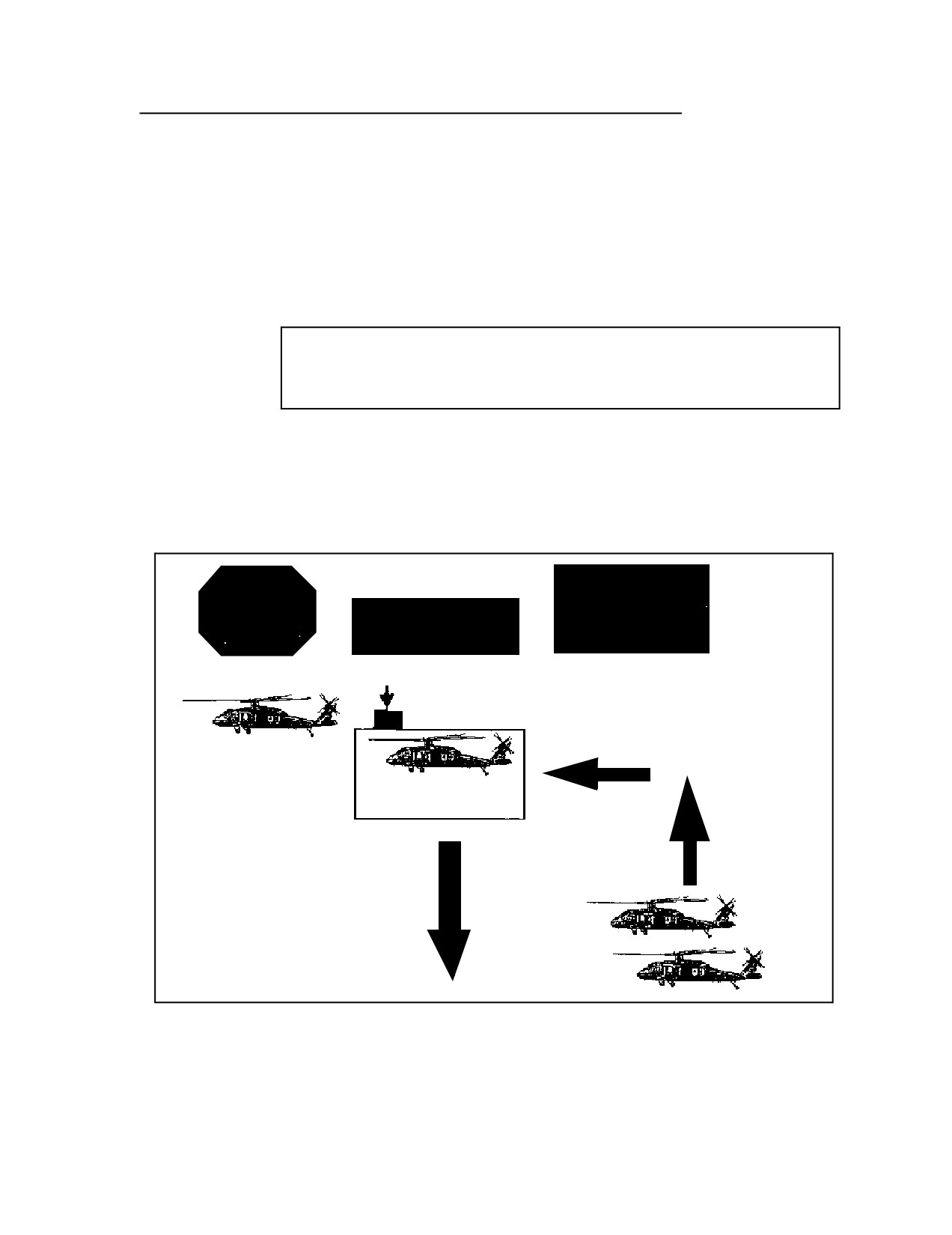
FM 3-5/MCWP 3-37.3
If the aircrew must perform a MOPP-gear exchange, the aircraft will be shut
down. After the MOPP-gear exchange, the aircrew should use a shuffle pit
before reboarding the aircraft. The M12A1 PDDE or M17 LDS is used to spray
down the aircraft with hot, soapy water and then to rinse it. Spray the aircraft
from the top to the bottom, working from the front to the rear. Sprayers must
avoid the tail rotor when the aircraft is running. Aviation personnel should
follow the guidelines in the aircraft’s maintenance manual during aircraft
washdown operations.
CAUTION
The aircraft’s skin and components can be damaged when spraying
aircraft with pressurized water.
7-12. The aviation unit must provide a C2 element to control the flow of
aircraft into the washdown site. Figure 7-1 shows a typical layout for an
aircraft washdown site. The support aviation must assist the chemical unit in
selecting the site to ensure that it has a suitable landing zone for the type of
aircraft contaminated.
M12 or M17
MOPP-
PDDE-crew
gear
exchange
PDDE crew
hide position
Shuffle pit with cover
Landing zone
Wind
Direction
Figure 7-1. Aircraft Washdown Site
7-13. An aircraft washdown is important when operating an aircraft
contaminated by gross amounts of chemical agent. It limits the absorption of
the chemical agent into the paint, plastic, and rubber portions of the aircraft
Aviation 7-7
FM 3-5/MCWP 3-37.3
where it will pose a vapor hazard and be difficult, if not impossible, to decon
later.
NOTE: Many (but not all) aircraft have been painted with CARC
paint. Aircraft will be painted with CARC paint when sent to the
appropriate maintenance shop. Contamination stays on top of CARC
surfaces where it can be more easily neutralized or removed.
7-14. An aircraft washdown should be conducted within 6 hours and is most
effective if conducted within 1 hour. Some amounts of chemical contamination
may remain after the aircraft washdown. The aircrew should continue to
wear, as a minimum, its protective masks and rubber gloves for protection
until a deliberate decon can be conducted.
7-15. Presently, there is no timely detection method to check the effectiveness
of decon for biological contamination. Medical personnel will monitor the
aircrew’s disposition if biological contamination is suspected.
Detailed Aircraft Decon
7-16. The goal of a DAD is to reduce contamination hazards to a negligible risk
level so that air and ground crews can operate the aircraft without protective
measures. The DTD can be conducted at the same time. The decon site should be
set up in a similar fashion to the thorough-decon site (see Chapter 4). The decon
site consists of the following areas: a predecon staging area, DAD and DTD areas,
and a postdecon AA. For safety reasons, it is not possible to decon aircraft and
ground vehicles at the same site. A separate DED site can be established in the
vicinity to support the contaminated aviation unit’s ground vehicles.
7-17. Aviation units must be supported by a chemical unit to set up and operate
the DAD site. The chemical unit, assisted by the supported aviation unit,
operates the DAD site while the aviation unit sets up and operates the DTD.
See Chapter 4 for DTD operations.
7-18. Typically, a DAD is either performed as part of a reconstitution effort
or before maintenance operations (after every 25 hours of flight time). When
the aircraft is either overhauled or grounded for scheduled maintenance,
contamination hazards should be reduced to negligible risk levels by going
through a DAD. When components are removed from the aircraft for repair,
care must be taken because of residual contamination. Decon these
components either before cannibalization or overhaul.
7-19. Chemical units (decon and smoke/decon) are responsible for setting up,
operating, and closing the DAD portion of the thorough-decon operation. The
site setup is the same for all types of contamination (chemical, biological, and
radiological). The DAD area is composed of the following five stations: primary
wash, decon-solution application, contact time/interior decon, rinse, and check
(see Figure 7-2).
DECON STATIONS
7-20. The actions that are taken at each of the stations are as follows:
Station 1 - Primary Wash
7-21. At this station, gross contamination is removed from the aircraft. Spray
the aircraft for 2 to 3 minutes with hot, soapy water. Avoid hitting the
7-8 Aviation
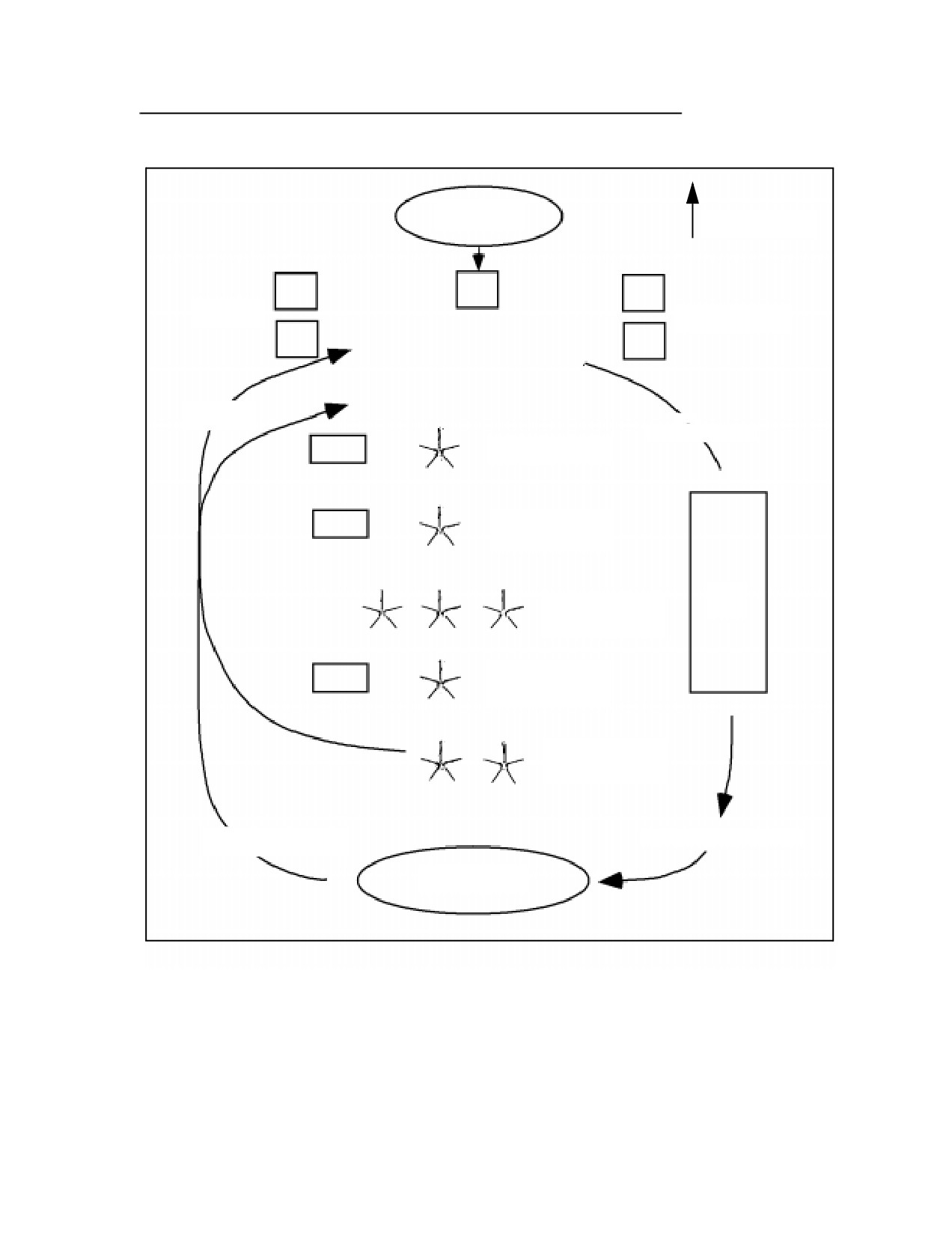
FM 3-5/MCWP 3-37.3
Predecon
Wind
staging area
direction
Tow
Tow
vehicles
vehicles
Recycle
route
Crew
Station 1 —
PDDE
primary wash
Station 2 —
PDDE
decon-solution
application
DTD
Station 3 —
contact time/
interior decon
Station 4 —
PDDE
rinse
Station 5 —
check
Tow vehicles
Clean crews
return route
Postdecon AA
Figure 7-2. Optimum Layout for a DAD Station
aircraft’s skin at a 90o angle to prevent damage. Also avoid the sensitive
areas shown in Figures 7-3 through 7-6, pages 7-10 through 7-13.
Station 2 - Decon-Solution Application
7-22. At this station, a decon solution is applied using the M12A1 PDDE or the
M17 LDS (in the siphinjector mode). After the solution is applied, a member of
the scrubbing team scrubs the aircraft’s skin. This allows the chemical agent
Aviation 7-9
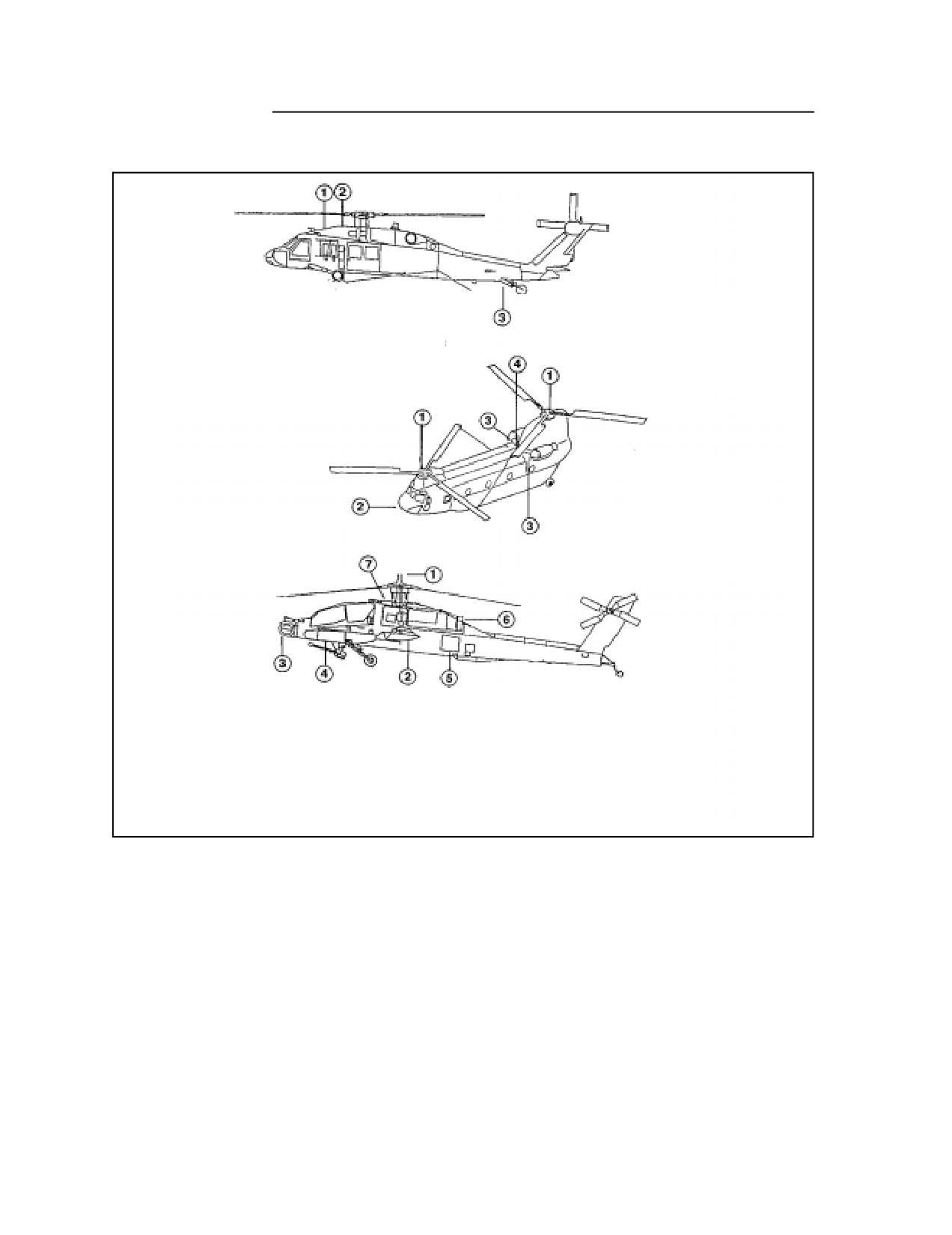
FM 3-5/MCWP 3-37.3
UH60A/E60
CH-47
1. Flight-control area
1. Rotor system
2. Electrical-power generator
2. Avionics
3. Tail landing gear
3. Engine
4. Transmission
AH-64
1. Air-data sensor and main-rotor transmission
2. Pilot tube
3. TADS-PNVS turret
4. Forward-avionics bay-access door
5. Nacelle door assembly/complete nose gearbox
6. Environmental control unit (ENCU)
7. Infrared countermeasure device
Figure 7-3. No Direct Water-Pressure Areas for the UH60A/E60, CH-47, and AH-64 Helicopters
to mix with the decon solution, especially when thickened chemical agents are
present. For decontaminants, refer to Appendix B. STB and HTH should not
be used because of their corrosive nature.
Station 3 - Contact Time/Interior Decon
7-23. At this station, the decon solution is allowed to completely neutralize the
chemical agent; also, the interior of the aircraft is decontaminated, if
necessary. The aircraft will remain in station 3 for no less than 30 minutes.
The decon solution reacts with most chemical agents within 5 minutes.
However, allowing the decon solution to remain on the contaminated surface
for 30 minutes ensures a complete neutralization.
7-10 Aviation
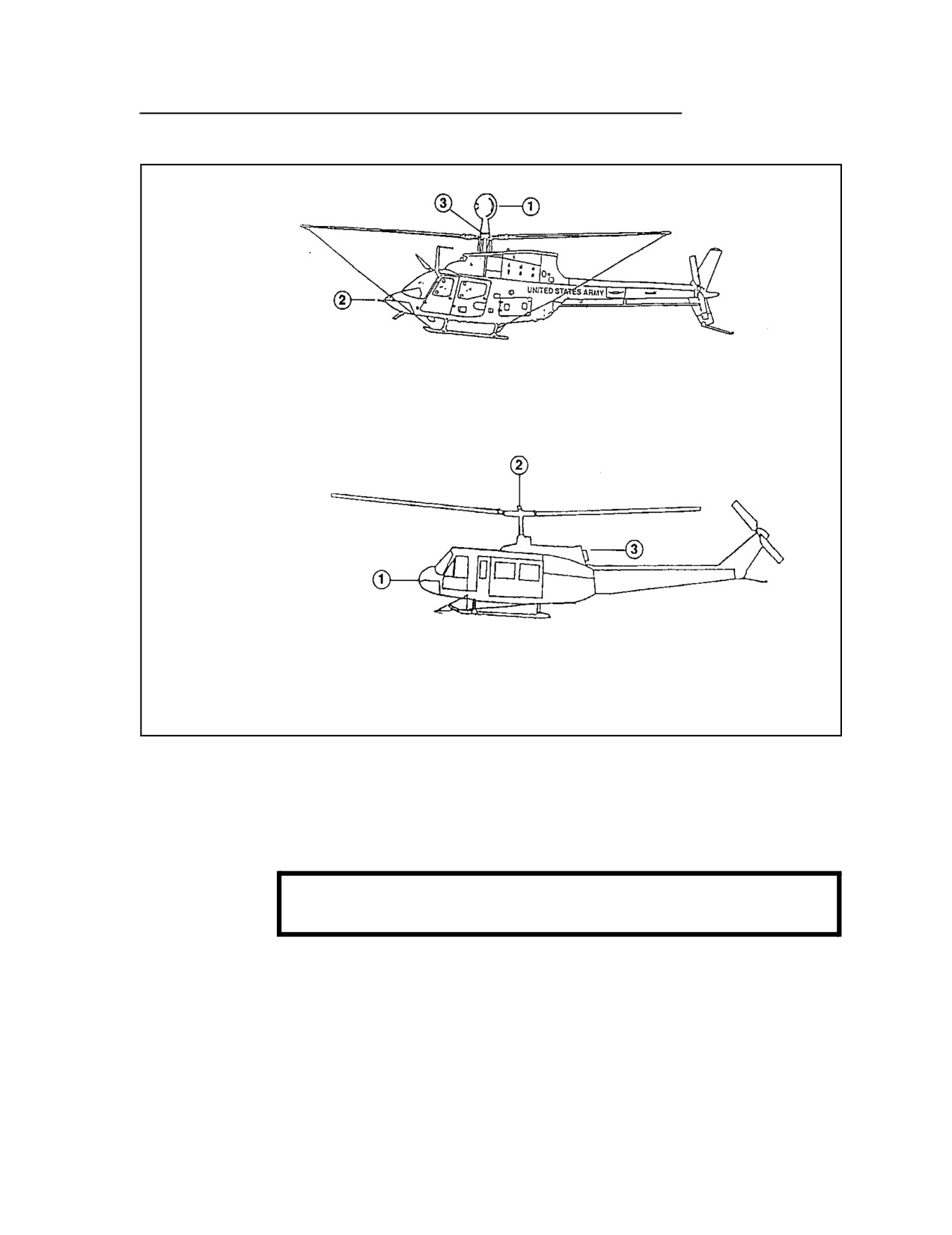
FM 3-5/MCWP 3-37.3
OH-58
1. Special device (additional)
2. Avionics
3. Rotor system/engine
UH-1
1. Avionics
2. Rotor system
3. Engine
Figure 7-4. No Direct Water-Pressure Areas for the OH-58 and UH-1 Helicopters
7-24. While the aircraft is in this station, an attendant inspects the interior of
the aircraft for liquid contamination using the CAM and M8 detector paper. If
liquid-chemical contamination is identified, he will decon the interior of the
aircraft.
WARNING
Personnel should not be in the aircraft during this operation.
7-25. Decon the aircraft’s interior with hot, soapy water as long as
maintenance personnel approve the use of it on certain pieces of equipment.
Use IEDKs or damp, soapy washcloths to decon optical and electrical
equipment and instruments.
NOTE: The IEDK leaves a charcoal residue on surfaces.
7-26. Field studies show the Herman-Nelson portable duct heaters to be
effective in decontaminating chemically contaminated vehicle and aircraft
Aviation 7-11
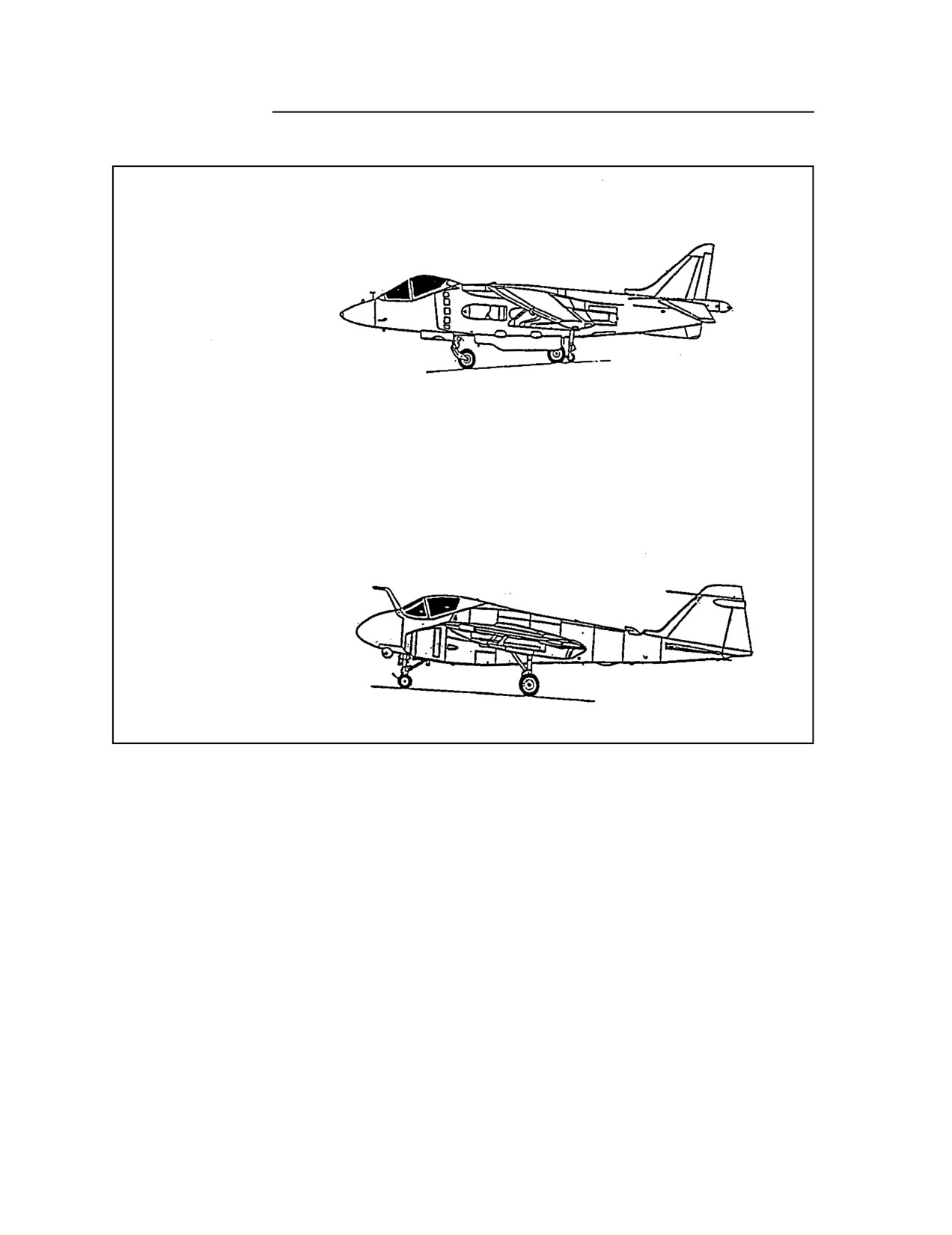
FM 3-5/MCWP 3-37.3
AV-8
Ensure that canopy is down
before spraying
NOTE: Pilots will brief decon
NCOIC on areas to be sprayed.
EA-6
Ensure that the canopy is down
before spraying.
Figure 7-5. No Direct Water-Pressure Areas for the AV-8 and EA-6
interiors. However, using a hot-air decon has the following drawbacks: time
required, heat damage, and downwind vapor hazards. A hot-air decon for a
helicopter or light aircraft requires about 30 to 120 minutes to remove all of
the contamination. Times are based on the amount of contamination and
interior surface materials. Enough time must be provided to get the
contaminated surface hot enough to vaporize the agent. The Herman-Nelson
heaters discharge air at a temperature between 150o and 280oF. Pressurized
containers, such as fire extinguishers, must be removed before starting a hot-
air decon. These items will fail catastrophically and could cause severe
damage. The heat will also damage sensitive electronic equipment.
Additionally, chemical agents irreversibly bind to many materials,
particularly gaskets, vinyl coatings, seat belts, and seat cushions. These items
should be removed since they cannot be decontaminated. A hot-air decon does
not destroy chemical agents. The air exiting the aircraft may contain
hazardous levels of the agent. A downwind exclusion area of about 164 yards
must be maintained to prevent unwanted casualties.
7-27. While a hot-air decon is an alternate to using hot, soapy water or an
IEDK, the technique has many drawbacks. Maintenance personnel must be
7-12 Aviation