FM 7-100.4 Opposing Force. Organization Guide (MAY 2007) - page 2
Task-Organizing
headquarters within the OSC. Normally, the OSC further allocates part of its combat service support units
to its tactical-level subordinates and some, as an ISG, to support its IFC. The rest remain in the ISC at OSC
level to provide overall support of the OSC. For organizational efficiency, other combat service support
units may be grouped in this ISC, although they may support only one of the major units of the OSC.
Sometimes, an ISC might also include units performing combat support tasks (such as chemical defense,
IW, or law enforcement) that support the OSC. Any units that an OSC suballocates down to its
subordinates are no longer part of its ISC. (See FM 7-100.1 for more detail on the ISC at OSC level.)
ISC Headquarters
3-44. The ISC headquarters is composed of the ISC commander and his command group, an operations
section, and a resources section. The operations section provides the control, coordination,
communications, and IW support for the ISC headquarters. Located within the operations section is the
support operations coordination center
(SOCC). The SOCC is the staff element responsible for the
planning and coordination of support for the OSC. In addition to the SOCC, the operations section has
subsections for future operations and airspace operations. The resources section consists of logistics and
administrative subsections which, respectively, execute staff supervision over the ISC’s logistics and
personnel support procedures. The ISC headquarters includes liaison teams from subordinate units of the
ISC and from other OSC subordinates to which the ISC provides support. These liaison teams work
together with the SOCC to ensure the necessary coordination of support for combat operations.
OSC
TACTICAL
IFC
ISC
LEVEL
SUBORDINATES
ISC
ISG
HEADQUARTERS
MATERIEL
HEAVY
EQUIPMENT
MAINTENANCE
SUPPORT
TRANSPORT
BATTALION
BRIGADE
BRIGADE
CHEMICAL
TRAFFIC
SMOKE
DEFENSE
CONTROL
BATTALION
BATTALION
BRIGADE
INFORMATION
PERSONNEL
MEDICAL
WARFARE
SUPPORT
BATTALION
BRIGADE
BATTALION
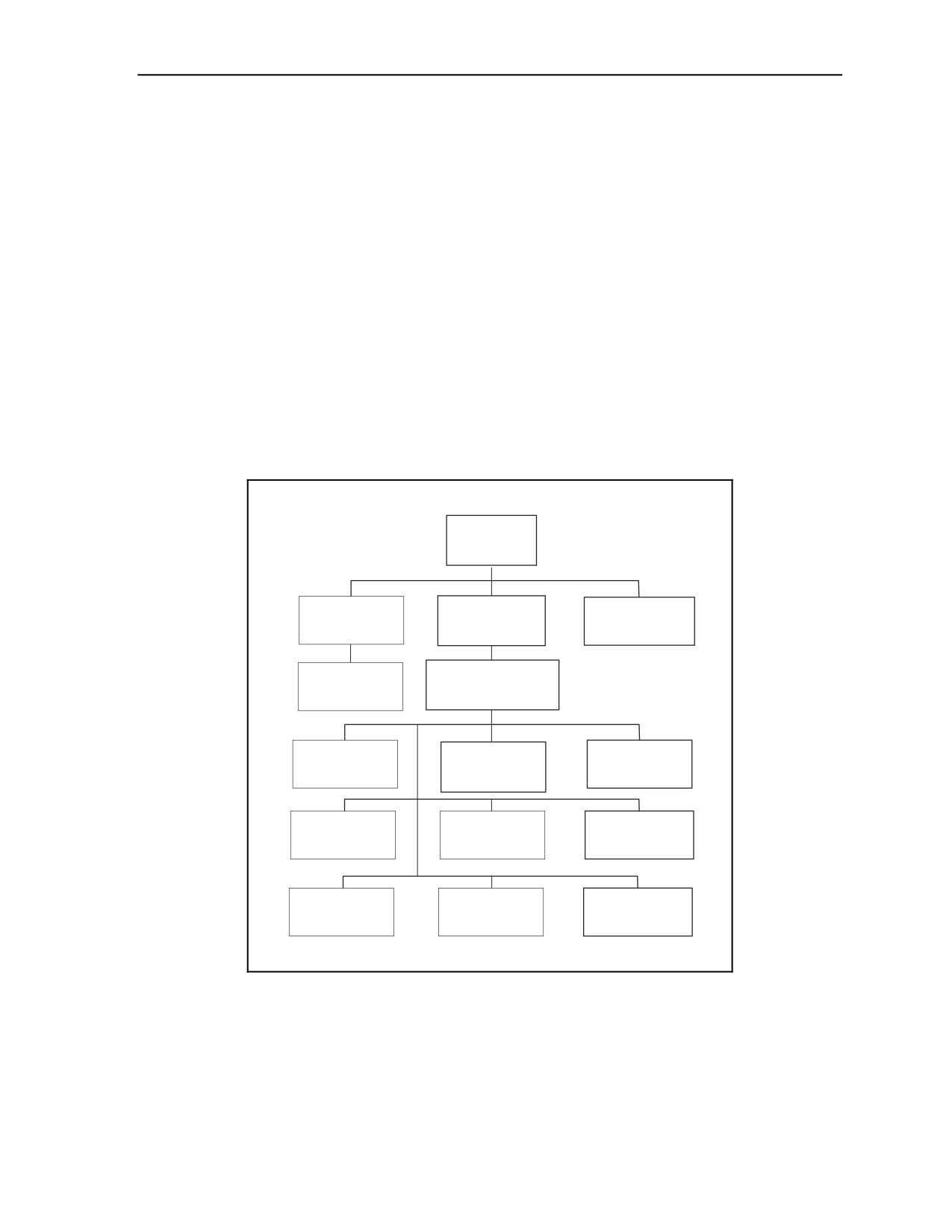
Figure 3-5. OSC Task Organization, with ISC Example
ISC Task-Organizing
3-45. The units allocated to an OSC and its ISC vary according to the mission of that OSC and the support
requirements of other operational-level commands. The OSC resources officer (in consultation with his
3 May 2007
FM 7-100.4
3-11
Chapter 3
chiefs of logistics and administration and the ISC commander) determines the proper task organization of
logistics and administrative support assets allocated to the OSC. He suballocates some assets to the IFC
and to other OSC subordinates based on support mission requirements. The remainder he places under the
ISC commander. Figure 3-5 on page 3-11 shows a typical OSC organization, with an example of the types
of combat service support and combat support units that might appear in an OSC ISC.
3-46. The number and type of units in the ISC and ISG will vary according to the number and size of
supported units in the OSC and its IFC, respectively. For example, an ISC supporting an OSC composed
mainly of tank and mechanized infantry units will differ from an ISC supporting an OSC composed mainly
of infantry or motorized infantry units. When the logistics units are no longer required for ISC or ISG
functions, they will revert to control of their original parent units in the AFS or otherwise will be assigned
to other operational-level commands, as appropriate.
SECTION IV - NATION-STATE FORCES: TACTICAL LEVEL
3-47. In the OPFOR’s AFS, the largest tactical-level organizations are divisions and brigades. In wartime,
they are often subordinate to a larger, operational-level command. Even in wartime, however, some
separate single-service tactical commands (divisions, brigades, or battalions) may remain under their
respective service headquarters or come under the direct control of the SHC or a separate theater
headquarters. (See figure 3-1 on page 3-6.) In any of these wartime roles, a division or brigade may receive
additional assets that transform it into a tactical group.
TACTICAL GROUPS
3-48. A tactical group is a task-organized division or brigade that has received an allocation of additional
land forces in order to accomplish its mission. Thus, a tactical group differs from higher-level task
organizations in that it is built around the structure of an already existing organization. Tactical groups
formed from divisions are division tactical groups (DTGs), and those formed from brigades are brigade
tactical groups (BTGs). In either of those cases, the original division or brigade headquarters becomes the
DTG or BTG headquarters, respectively.
3-49. The additional forces that transform a division or brigade into a tactical group may come from within
the MOD, from the Ministry of the Interior, or from affiliated forces. Typically, these assets initially are
allocated to an OSC or FG, which further allocates them to its tactical subordinates. If the tactical group
operates as a separate command, it may receive additional assets directly from the theater headquarters or
the SHC that are necessary for it to carry out an operational-level mission. If a DTG has a mission directly
assigned by an SCP or theater campaign plan, it acts as an operational-level command. If a DTG has a
mission assigned by an intermediate operational-level command (such as an FG or an OSC), then it acts as
a tactical-level command.
3-50. A DGT or BTG may receive augmentation from other services of the State’s Armed Forces.
However, it does not become joint. That is because it can accept such augmentation only in the form of
land forces, such as special-purpose forces from the SPF Command or naval infantry from the Navy.
Augmentation may also come from other agencies of the State government, such as border guards or
national police that have not been resubordinated to the SHC in wartime.
3-51. Any division or brigade receiving additional assets from a higher command becomes a DTG or BTG.
In addition to augmentation received from a higher command, a DTG or BTG normally retains the assets
that were originally subordinate to the division or brigade that served as the basis for the tactical group.
However, it is also possible that the same higher command that augments a division or brigade to transform
it into a tactical group could use units from one division or brigade as part of a tactical group that is based
on another division or brigade. The purpose of a tactical group is to ensure unity of command for all land
forces in a given AOR.
3-52. A DTG may fight as part of an OSC or as a separate unit in an FG or directly under a theater
headquarters or the SHC. A BTG may fight as part of a division or DTG or as a separate unit in an OSC or
FG.
3-12
FM 7-100.4
3 May 2007
Task-Organizing
DIVISIONS AND DTGS
3-53. Divisions in the AFS are designed to be able to serve as the basis for forming a division tactical
group (DTG), if necessary. Thus, they are able to⎯
Accept constituent flame weapons, artillery (cannon and rocket), engineer, air defense, chemical
defense, antitank, medical, logistics, signal, and electronic warfare (EW) units.
Accept dedicated and supporting surface-to-surface missile (SSM), Special-Purpose Forces
(SPF), aviation (combat helicopter, transport helicopter), and unmanned aerial vehicle (UAV)
units. A division may accept these type units as constituent if it is also allocated their essential
logistics support.
Integrate interagency forces up to brigade size.
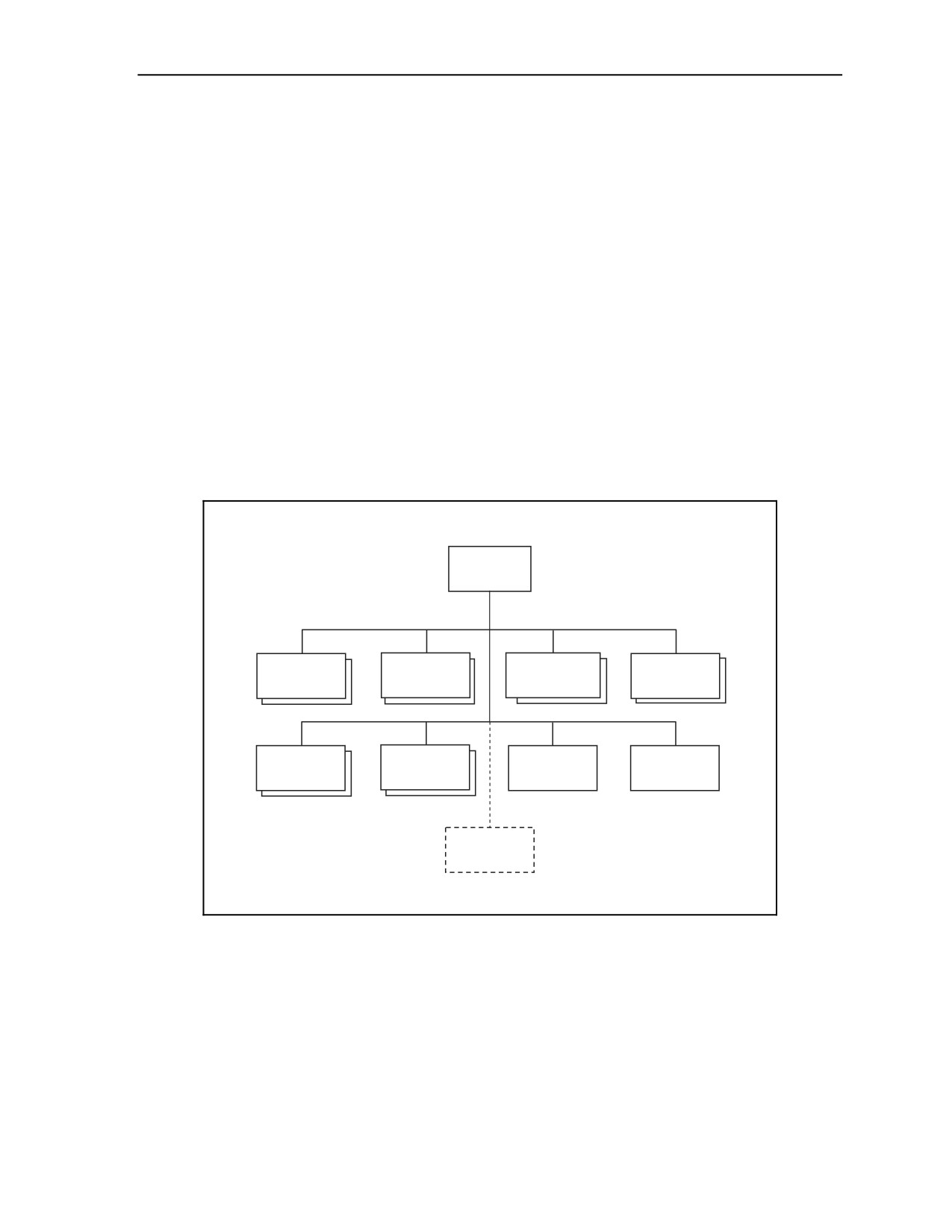
3-54. Figure 3-6 gives an example of possible DTG organization. Some of the units belonging to the DTG
are part of the division on which it is based. Note that some brigades are task-organized into BTGs, while
others may not be and have structures that come straight out of the organizational directories for the AFS.
Likewise, some battalions and companies may become detachments. Besides what came from the original
division structure, the rest of the organizations shown come from a pool of assets the parent operational-
level command has received from the AFS and has decided to pass down to the DTG. All fire support units
that were organic to the division or allocated to the DTG (and are not suballocated down to a BTG) go into
the integrated fires command (IFC). Likewise, combat service support units go into the integrated support
command (ISC). As shown here, DTGs can also have affiliated forces from paramilitary organizations.
DTG
BTGs
BRIGADES
DETACHMENTS
BATTALIONS
INTERAGENCY
COMPANIES
IFC
ISC
UNITS
AFFILIATED
FORCES
Figure 3-6. Possible DTG Organization (Example)
3-55. The division that serves as the basis for a DTG may have some of its brigades task-organized as
BTGs. However, just the fact that a division becomes a DTG does not necessarily mean that it forms
BTGs. A DTG could augment all of its brigades, or one or two brigades, or none of them as BTGs. A
division could augment one or more brigades into BTGs, using the division’s own constituent assets,
without becoming a DTG. If a division receives additional assets and uses them all to create one or more
BTGs, it is still designated as a DTG.
3 May 2007
FM 7-100.4
3-13
Chapter 3
MANEUVER BRIGADES AND BTGS
3-56. In the AFS, divisional or separate maneuver brigades are robust enough to accomplish some
missions without further allocation of forces. However, maneuver brigades are designed to be able to serve
as the basis for forming a brigade tactical group (BTG), if necessary. Thus, they are able to⎯
Accept constituent flame weapons, artillery (cannon and rocket), engineer, air defense, antitank,
logistics, and signal units.
Accept dedicated and supporting chemical defense, medical, EW, SSM, SPF, aviation (combat
helicopter, transport helicopter), and UAV units. A brigade may accept these type units as
constituent if it is also allocated their essential logistics support.
Integrate interagency forces up to battalion size.
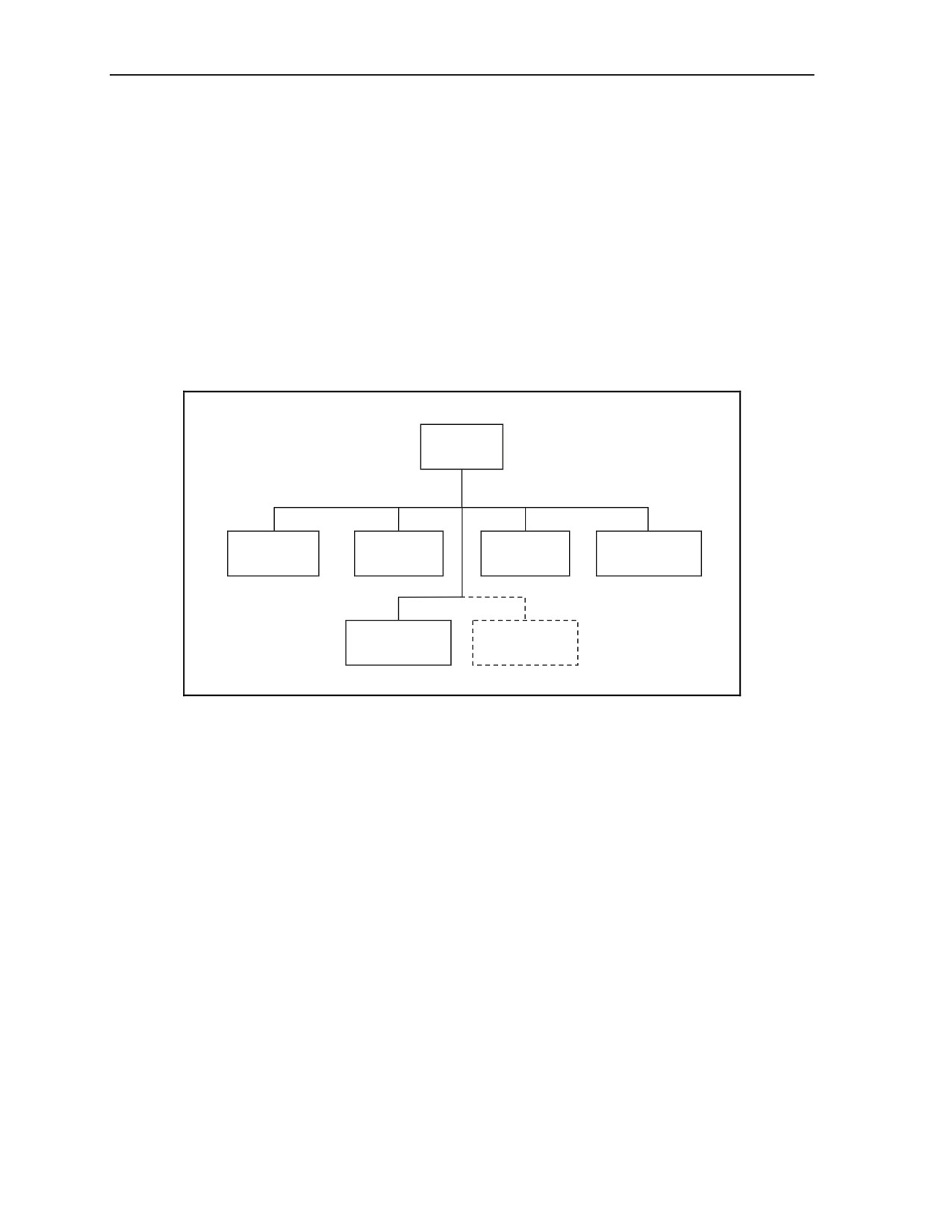
3-57. Figure 3-7 give an example of possible BTG organization. This example shows that some battalions
and companies of a BTG may be task-organized as detachments, while others are not. Although not shown
here, BTGs (and higher commands) can also have affiliated forces from paramilitary organizations.
BTG
DETACHMENTS
BATTALIONS
COMPANIES
PLATOONS
INTERAGENCY
AFFILIATED
UNITS
FORCES
Figure 3-7. Possible BTG Organization (Example)
3-58. Unlike higher-level commands, OPFOR brigades and BTGs do not have an IFC or an ISC. Brigade
and BTG headquarters have a fire support coordination center (FSCC) in their operations section, but are
not expected to integrate fires from all systems and services without augmentation.
DETACHMENTS
3-59. A detachment is a battalion or company designated to perform a specific mission and allocated the
forces necessary to do so. Detachments are the OPFOR’s smallest combined arms formations and are, by
definition, task-organized. To further differentiate, detachments built from battalions can be termed BDETs
and those from companies CDETs. The forces allocated to a detachment suit the mission expected of it.
They may include⎯
Artillery or mortar units.
Air defense units.
Engineer units (with obstacle, survivability, or mobility assets).
Heavy weapons units (including heavy machineguns, automatic grenade launchers, and antitank
guided missiles).
Units with specialty equipment such as flame weapons, specialized reconnaissance assets, or
helicopters.
Chemical defense, antitank, medical, logistics, signal, and EW units.
3-14
FM 7-100.4
3 May 2007
Task-Organizing
Interagency forces up to company for BDETs or platoon for CDETs.
BDETs can accept dedicated and supporting SPF, aviation (combat helicopter, transport helicopter) and
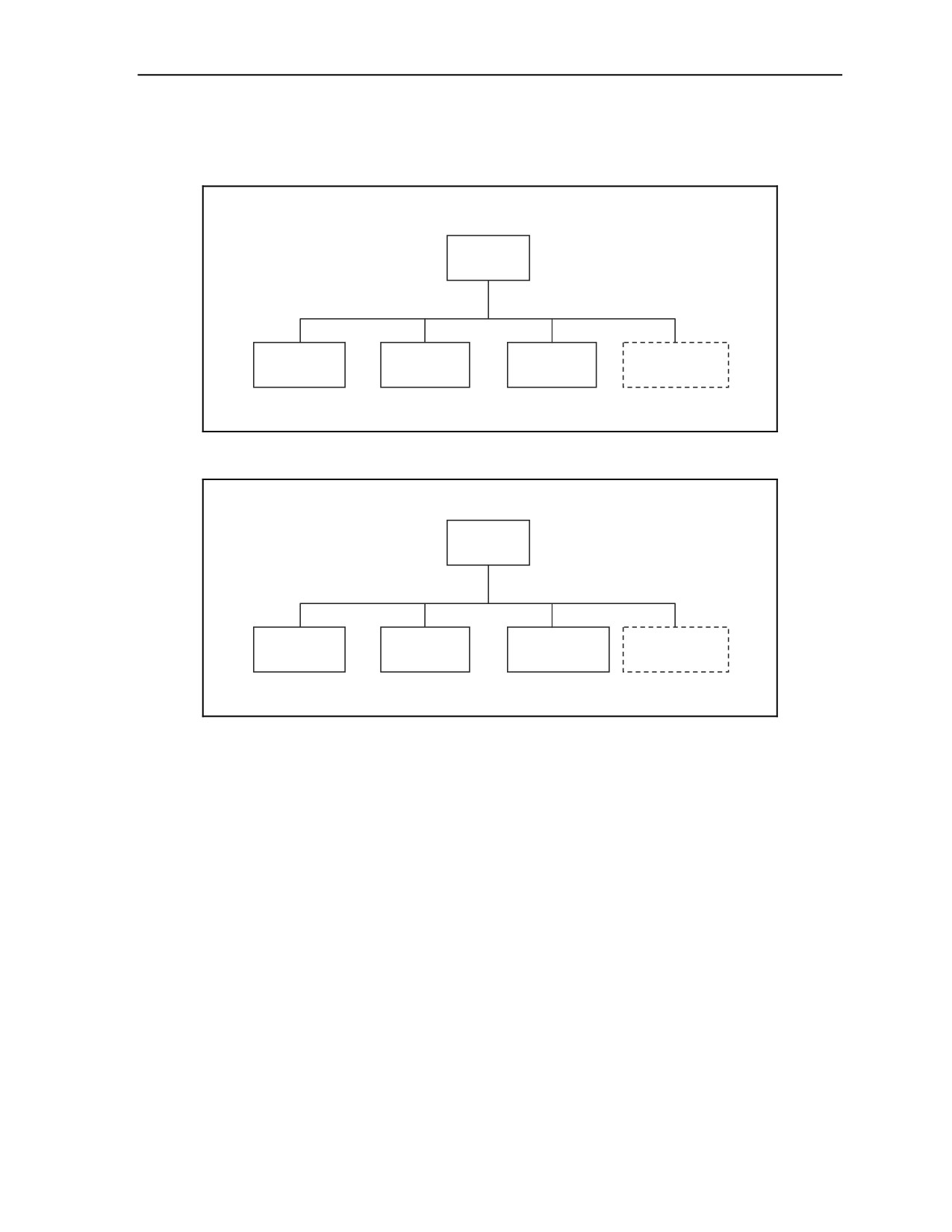
UAV units. Figures 3-8 and 3-9 provide examples of a BDET and a CDET, respectively.
BDET
BATTALION
ADDITIONAL
ADDITIONAL
INTERAGENCY
(BASE)
COMPANIES
PLATOONS
UNITS
Figure 3-8. Battalion-Size Detachment (BDET) Example
CDET
COMPANY
ADDITIONAL
ADDITIONAL
INTERAGENCY
(BASE)
PLATOONS
SQDS/SECTIONS
UNITS
Figure 3-9. Company-Size Detachment (CDET) Example
3-60. The basic type of OPFOR detachment—whether formed from a battalion or a company—is the
independent mission detachment. Independent mission detachments are formed to execute missions that are
separated in space and/or time from those being conducted by the remainder of the forming unit. Other
common types of detachment include⎯
Counterreconnaissance detachment.
Movement support detachment.
Obstacle detachment.
Reconnaissance detachment.
Security detachment.
Urban detachment.
INTEGRATED FIRES COMMAND
3-61. A division or DTG would have an IFC similar to that found in an operational-level command (see
figure 3-10 on page 3-16). The primary difference is that its aviation component would include only Army
aviation assets. Also, rather than an “SPF component” as at the operational level, the division or DTG IFC
would have a “long-range reconnaissance component” that most often would not include scarce SPF assets.
Even when allocated to a DTG, probably in a supporting status, the SPF would pursue tactical goals in
3 May 2007
FM 7-100.4
3-15
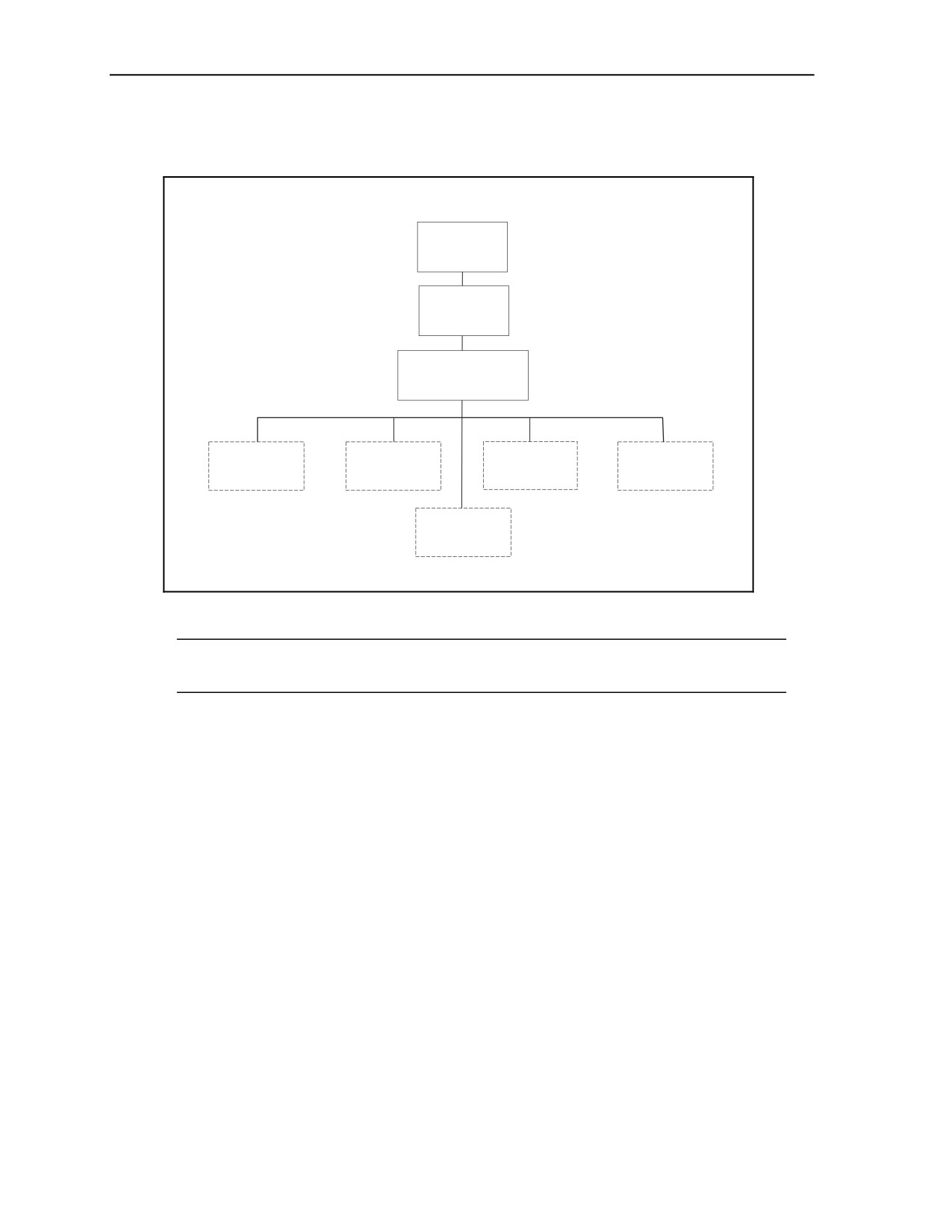
Chapter 3
support of operational objectives. Any units that a division or DTG suballocates down to its subordinates
are no longer part of its IFC. An IFC C2 structure and task organization is not found below division or
DTG level. (See FM 7-100.2 for more detail on the IFC at division or DTG level.)
DTG
IFC
IFC
HEADQUARTERS
LONG-RANGE
ARTILLERY
ARMY AVIATION
MISSILE
RECON
COMPONENT
COMPONENT
COMPONENT
COMPONENT
INTEGRATED
SUPPORT
GROUP
Figure 3-10. Possible IFC Components in a DTG
Note. In rare cases, such as when a division or DTG would have the mission of conducting a
strike, the commander might also allocate maneuver forces to the IFC.
INTEGRATED SUPPORT COMMAND
3-62. A division or DGT would have an ISC similar to that found in an OSC (see figure 3-5 on page 3-11).
An ISC C2 structure and task organization is not found below division or DTG level. Any units that a
division or DTG suballocates down to its subordinates are no longer part of its ISC. (See FM 7-100.2 for
more detail on the ISC at division or DTG level.)
INTERNAL TASK-ORGANIZING
3-63. Given the pool of organizational assets available to him, a commander at any level has several
options regarding the task-organizing of his subordinates. An OSC is always a task organization. An OSC
allocated divisions and/or separate brigades would almost always provide those immediate tactical-level
subordinates additional assets that would transform them into DTGs and BTGs tailored for specific
missions. However, it is not necessary that all divisions or divisional brigades (or even separate brigades)
become tactical groups. That is the higher commander’s option.
3-64. At any level of command, a headquarters can direct one or more of its subordinates to give up some
of their assets to another subordinate headquarters for the creation of a task organization. Thus, a division
could augment one or more brigades into BTGs, using the division’s own constituent assets, without
becoming a DTG. A brigade, using its own constituent assets, could augment one or more battalions into
BDETs (or direct a battalion to form one or more CDETs) without becoming a BTG. A battalion could use
its own constituent assets to create one or more CDETs without becoming a BDET.
3-16
FM 7-100.4
3 May 2007
Task-Organizing
3-65. If a division receives additional assets and uses them all to create one or more BTGs, it is still
designated as a DTG. If a brigade receiving additional assets does not retain any of them at its own level of
command but uses them all to transform one or more of its battalions into BDETs, it is still a BTG.
SPECIAL-PURPOSE FORCES
3-66. In wartime, some SPF units from the SPF Command or from the Army, Navy, Air Force, or Internal
Security Forces SPF may remain under the command and control of their respective service headquarters.
However, some SPF units also might be suballocated to operational- or even tactical-level commands
during the task-organizing process.
3-67. When the OPFOR establishes more than one theater headquarters, the General Staff may allocate
some SPF units to each theater. From those SPF assets allocated to him in a constituent or dedicated
relationship, the theater commander can suballocate some or all of them to a subordinate OSC.
3-68. The General Staff (or a theater commander with constituent or dedicated SPF) can allocate SPF units
to an OSC in a constituent or dedicated relationship or place them in support of an OSC. These command
and support relationships ensure that SPF objectives support the overall mission of the OSC to which the
SPF units are allocated. Even in a supporting relationship, the commander of the OSC receiving the SPF
unit(s) establishes those units’ objectives, priorities, and time of deployment. The OSC commander may
employ the SPF assets allocated to him as constituent or dedicated as part of his integrated fires command
(IFC), or he may suballocate some or all of them to his tactical-level subordinates. Even SPF units
allocated to an OSC may conduct strategic missions, if required.
3-69. The SPF units of the Army, Navy, Air Force, and Internal Security Forces may remain under the
control of their respective services (or be allocated to a joint theater command). However, they are more
likely to appear in the task organization of an OSC. In that case, the OSC commander may choose to
suballocate them to tactical-level subordinates. If necessary, SPF from any of these service components
could become part of joint SPF operations in support of national-level requirements. In that case, they
could temporarily come under the control of the SPF Command or the General Staff.
3-70. Regardless of the parent organization in the AFS, SPF normally infiltrate and operate as small teams.
When deployed, these teams may operate individually, or they may be task-organized into detachments.
The terms team and detachment indicate the temporary nature of the groupings. In the course of an
operation, teams can leave a detachment and join it again. Each team may in turn break up into smaller
teams (of as few as two men) or, conversely, come together with other teams to form a larger team,
depending on the mission. At a designated time, teams can join up and form a detachment (for example, to
conduct a raid), which can at any moment split up again. This whole process can be planned before the
operation begins, or it can evolve during the course of an operation.
INTERNAL SECURITY FORCES
3-71. During wartime, some or all of the internal security forces from the Ministry of the Interior become
subordinate to the SHC. Thus, they become the sixth service component of the Armed Forces, with the
formal name “Internal Security Forces.” The SHC might allocate units of the Internal Security Forces to a
theater command or to a task-organized operational- or tactical-level military command that is capable of
controlling joint and/or interagency operations. In such command relationships, or when they share a
common area of responsibility (AOR) with a military organization, units of the Internal Security Forces
send liaison teams to represent them in the military organization’s staff. (See chapter 2 of this manual and
FM 7-100.3 for more detail on the various types of internal security forces and their possible roles in the
OPFOR’s wartime fighting force structure.)
SECTION V − NON-STATE ACTORS
3-72. Various types on non-state actors might be part of the OPFOR, affiliated with it, or support it in
some manner. Even those who do not belong to the OPFOR or support it directly or willingly could be
exploited or manipulated by the OPFOR to support its objectives.
3 May 2007
FM 7-100.4
3-17
Chapter 3
INSURGENT AND GUERRILLA FORCES
3-73. Insurgent organizations are irregular forces, meaning that there is no “regular” table of organization
and equipment. Thus, the baseline insurgent organizations in the organizational directories represent the
“default” setting for a “typical” insurgent organization. If an OPFOR OB has more than one local insurgent
organization, no two insurgent organizations should look exactly alike. Trainers and training planners
should vary the types and numbers of cells to reflect the irregular nature of such organizations.
3-74. The baseline organization charts and equipment lists for individual cells include many notes on
possible variations in organization or in numbers of people or equipment within a given organization.
When developing an OB for a specific insurgent organization for use in training, users may exercise some
latitude in the construction of cells. Some cells might need to be larger or smaller than the “default” setting
found in the organizational directories. Some entire cells might not be required, and some functional cells
might be combined into a single cell performing both functions. However, trainers and training planners
would need to take several things into consideration in modifying the “default” cell structures:
What functions the insurgents need to be able to perform.
What equipment is needed to perform those functions.
How many people are required to employ the required equipment.
The number of vehicles in relation to the people needed to drive them or the people and
equipment that must be transported.
Equipment associated with other equipment (for example, an aiming circle/goniometer used
with a mortar or a day/night observation scope used with a sniper rifle).
3-75. Any relationship of independent local insurgent organizations to regional or national insurgent
structures may be one of affiliation or dependant upon a single shared or similar goal. These relationships
are generally fluctuating and may be fleeting, mission dependant, or event- or agenda-oriented. Such
relationships can arise and cease due to a variety of reasons or motivations.
3-76. When task-organizing insurgent organizations, guerrilla units might be subordinate to a larger
insurgent organization, or they might be loosely affiliated with an insurgent organization of which they are
not a part. A guerrilla unit or other insurgent organization might be affiliated with a regular military
organization. A guerrilla unit might also become a subordinate part of an OPFOR task organization based
on a regular military unit.
3-77. Even in the AFS organizational directories, some guerrilla units were already reconfigured as
hunter/killer units. In the fighting force structure represented in an OPFOR OB, some additional guerrilla
units may become task-organized in that manner.
OTHER PARAMILITARY FORCES
3-78. Insurgent and guerrilla forces are not the only paramilitary forces that can perform countertasks that
challenge a U.S. unit’s METL. Other possibilities are criminal organizations and private security
organizations. Sometimes the various types of paramilitary organizations operate in conjunction with each
other when it is to their common benefit.
CRIMINAL ORGANIZATIONS
3-79. Criminal organizations may employ criminal actions, terror tactics, and militarily unconventional
methods to achieve their goals. They may have the best technology, equipment, and weapons available,
simply because they have the money to buy them. Criminal organizations may not change their structure in
wartime, unless wartime conditions favor or dictate different types of criminal action or support activities.
3-80. The primary motivation of drug and other criminal organizations is financial profit. Thus, the
enemies of these organizations are any political, military, legal, or judicial institutions that impede their
actions and interfere with their ability to make a profit. However, there are other groups that conduct drug-
trafficking or other illegal actions as a means to purchase weapons and finance other paramilitary activities.
3-18
FM 7-100.4
3 May 2007
Task-Organizing
3-81. When mutual interests exist, criminal organizations may combine efforts with insurgent and/or
guerrilla organizations controlling and operating in the same area. Such allies can provide security and
protection or other support to the criminal organization’s activities in exchange for financial assistance,
arms, and protection against government forces or other common enemies. The amount of mutual
protection depends on the size and sophistication of each organization and the respective level of influence
with the government or the local population.
3-82. Criminal organizations may conduct civic actions to gain and maintain support of the populace. A
grateful public can provide valuable security and support functions. The local citizenry may willingly
provide ample intelligence collection, counterintelligence, and security support. Intelligence and security
can also be the result of bribery, extortion, or coercion.
PRIVATE SECURITY ORGANIZATIONS
3-83. Private security organizations (PSOs) are business enterprises or local ad hoc groups that provide
security and/or intelligence services, on a contractual or self-interest basis, to protect and preserve a person,
facility, or operation. Some PSOs might be transnational corporations. Others might be domestic firms that
supply contract guard forces, or they might be local citizen organizations that perform these actions on a
volunteer basis. Their clients can include private individuals and businesses
(including transnational
corporations) or even insurgent or criminal organizations.
3-84. The level of sophistication and competence of a commercial PSO is often directly related to a client's
ability to pay. For example, a drug organization can afford to pay more than many small countries. The
leader of an insurgent or criminal organization might employ a PSO to provide bodyguards or conduct
surveillance or a search at a site prior to his arrival. Another group, such as a drug organization or a
transnational corporation, may contract a PSO to guard its facilities. During the conduct of their duties,
members of a PSO may take offensive actions. For example, a patrol may conduct a small-scale ambush to
counter an intrusion. The allegiance of PSOs can vary from fanatical devotion to just doing a job for purely
financial reasons. Each organization is tailored to serve its customer’s needs.
NONCOMBATANTS
3-85. Noncombatants might be friendly, neutral, or hostile toward U.S. forces. Even if they are not hostile,
they could get in the way or otherwise affect the ability of U.S. units to accomplish their METL tasks.
Some might become hostile, if U.S. forces do not treat them properly. Noncombatants may be either armed
or unarmed.
3-86. A military or paramilitary force can manipulate an individual or group of noncombatants by
exploiting their weaknesses or supplying their needs. For example, an insurgent, guerrilla, drug, or criminal
organization might use bribery or extortion to induce noncombatants to act as couriers or otherwise support
its activities. It might also coerce a businessperson into running a front company on its behalf. A
paramilitary organization might orchestrate a civil disturbance by encouraging the local populace to meet at
a public area at a certain time. Members of the paramilitary group could then infiltrate the crowd and incite
it to riot or protest. Sometimes, they might pay members of the local populace to conduct a demonstration
or march.
UNARMED NONCOMBATANTS
3-87. Common types of unarmed noncombatants found in the organizational directories include medical
teams, media, humanitarian relief organizations, transnational corporations, local populace, displaced
persons, transients, and foreign government and diplomatic personnel. The directories allow for adjusting
the number of unarmed noncombatants by employing multiples of the basic organization shown. Thus,
numbers can vary from one individual to as many as several hundred. While such noncombatants are
normally unarmed, there is always the potential for them to take up arms in reaction to developments in the
OE and their perception of U.S. actions. Therefore, it is increasingly difficult to distinguish between
combatants and noncombatants.
3 May 2007
FM 7-100.4
3-19
Chapter 3
3-88. Unarmed noncombatants are likely to be present in any OE. For training in METL tasks other than
those dealing with armed conflict, these noncombatants are present as key players. However, armed
conflict will draw in more of some groups, such as displaced persons, humanitarian relief organizations,
and media. Even in the midst of armed conflict, U.S. units will still need to deal with the local populace
and all the other kinds of unarmed noncombatants. Insurgents can melt into the general populace—or
perhaps were always part of it.
ARMED NONCOMBATANTS
3-89. There are also likely to be armed noncombatants who are not part of any military or paramilitary
organization. Some may be in possession of small arms legally to protect their families or as part of their
profession (for example, hunters, security guards, or local police). They may be completely neutral or have
leanings for either, or several sides. Some may be affiliated with the one faction or the other, but are not
members. Opportunists may decide to hijack a convoy or a vehicle by force of arms. Some are just angry at
the United States. Some may be motivated by religious, ethnic, and cultural differences, or by revenge,
anger, and greed. The reasons are immaterial—armed noncombatants are ubiquitous. The organizational
directories allow for adjusting the number of armed noncombatants by employing multiples of the basic
organization shown. Thus, numbers can vary from one individual to as many as several hundred. The
armed noncombatants may have vehicles or may not be associated with any vehicle.
SECTION VI - EXPLOITATION OF NONCOMBATANTS AND CIVILIAN ASSETS
3-90. Some noncombatant personnel and civilian assets may be available as additional resources for
OPFOR military and/or paramilitary forces. Because these assets are not part of the peacetime,
administrative force structure of military or paramilitary organizations, they do not appear under those
organizations in the online AFS organizational directories. In wartime, however, they may be incorporated
or co-opted into a military or paramilitary force. Willingly or unwillingly (sometimes unwittingly), such
personnel and equipment can supplement the capabilities of a military or paramilitary organization.
Therefore, trainers and training planners should also take these assets into account when building an
OPFOR OB.
BY MILITARY FORCES
3-91. In wartime, the State and its armed forces might nationalize, mobilize, confiscate, or commandeer
civilian transportation assets that are suitable for supporting military operations. These assets can include
trucks, boats, or aircraft. The OPFOR would organize these assets into units that resemble their military
counterparts as much as possible. For example, civilian trucks and their operators could be formed into a
cargo transport company or a whole materiel support battalion. One difference might be that the operators
are not armed. This is either because weapons are not available or because the OPFOR does not trust the
operators—who may have been coerced into entering this military-like force, along with their vehicles or
craft. Civilian construction workers and their equipment (such as dump trucks, back hoes, dozers, and
cement mixers) could be formed into an engineer support company or a road and bridge construction
company. Medical professionals, engineers, mechanics, and other persons with key skills might also be
pressed into military service in wartime, even though they had no connection with the military forces in
their peacetime, administrative force structure.
BY PARAMILITARY FORCES
3-92. Non-state paramilitary forces also could mobilize additional support assets in the same ways—except
for nationalization. Again, they could organize these assets into units or cells that are similar to their
counterparts in the particular paramilitary organization. In this case, transport vehicles could include
civilian cargo trucks, vans, pickup trucks, automobiles, all-terrain vehicles, motorcycles, bicycles, or carts.
For the purposes of a paramilitary organization, transportation assets can extend beyond vehicles and craft
to draft animals and noncombatant personnel used as bearers or porters. Individuals might receive pay for
their services or the use of their vehicles, or they might be coerced into providing this assistance. A front
3-20
FM 7-100.4
3 May 2007
Task-Organizing
organization could employ such assets without individuals or vehicle owners being aware of the connection
with the paramilitary organization. In other cases, individuals or groups might volunteer their services
because they are sympathetic to the cause. When such individuals or their vehicles are no longer required,
they melt back into the general populace.
SECTION VII − UNIT SYMBOLS FOR OPFOR TASK ORGANIZATIONS
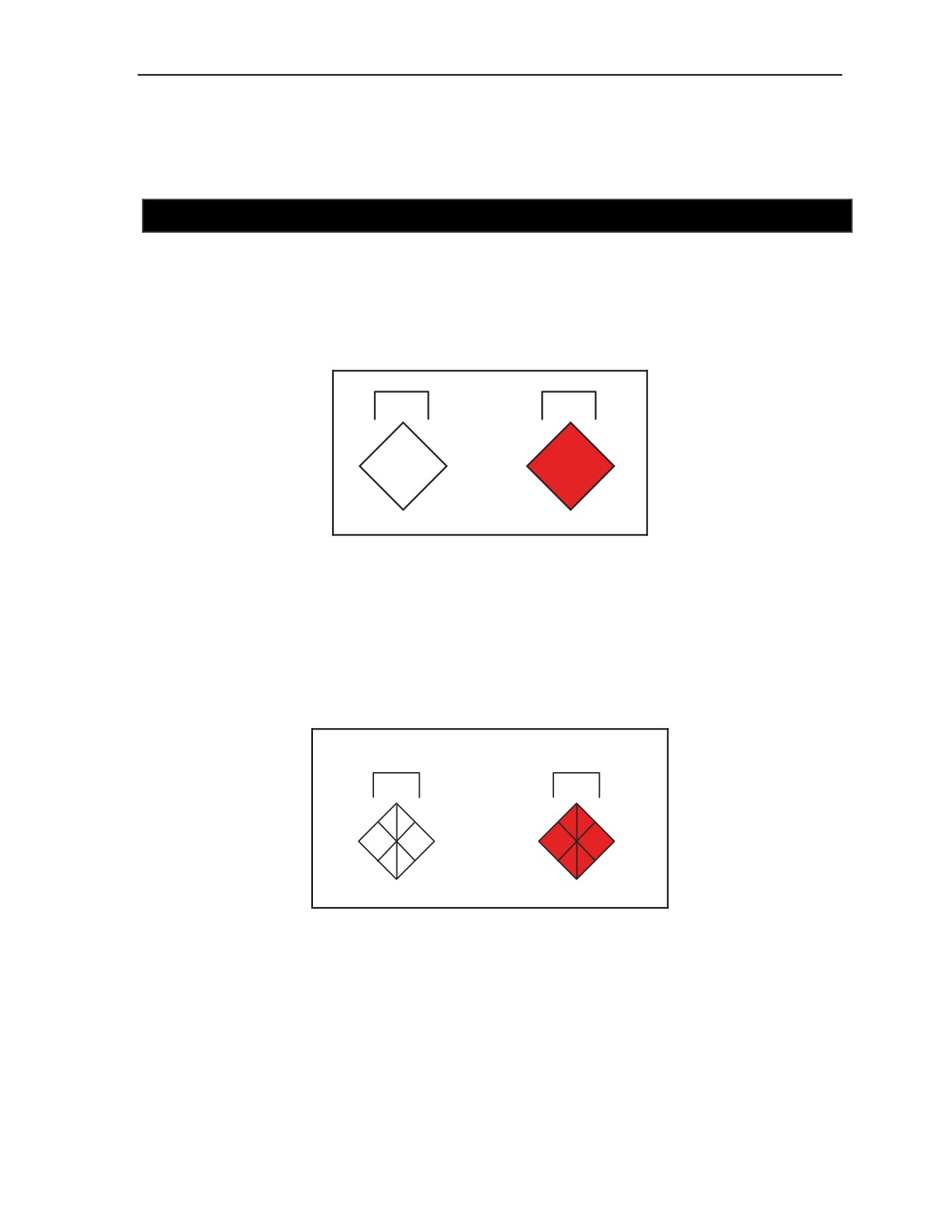
3-93. Unit symbols for all OPFOR units employ the diamond-shaped frame specified for “hostile” units in
FM 1-02. When there is a color capability, the diamond should have red fill color. All OPFOR task
organizations should use the “task force” symbol placed over the “echelon” (unit size) modifier above the
diamond.
3-94. An OSC is the rough equivalent of a U.S. joint task force (JTF). Therefore, the map symbol for an
OSC is derived from the JTF symbol in FM 1-02 (see figure 3-11.)
XXX
XXX
OSC
OR
OSC
Figure 3-11. OSC Symbol
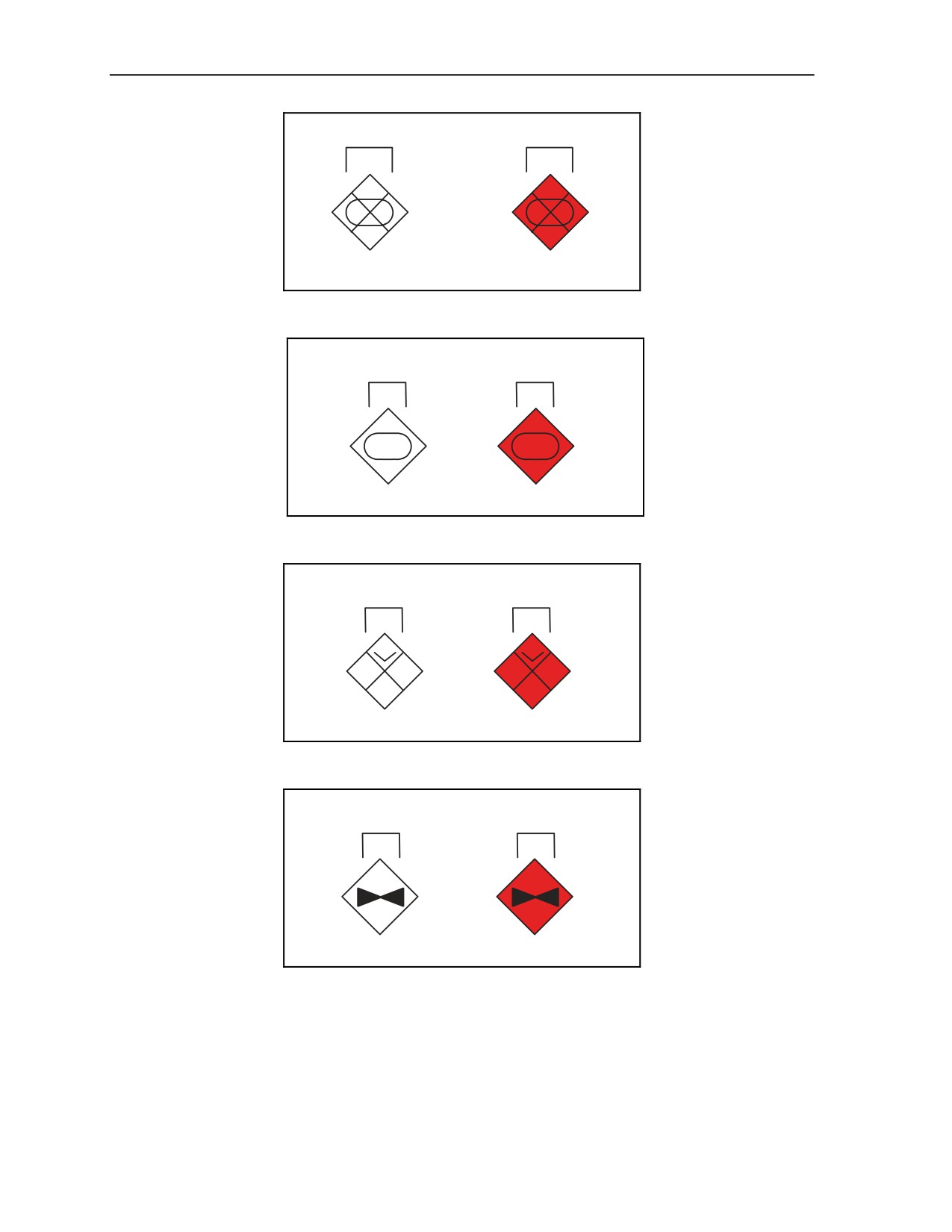
3-95. At the tactical level, the area inside the diamond contains the symbol for the branch or function of
the unit. For OPFOR task organizations, this part of the symbol reflects the type of unit (for example, tank,
mechanized infantry, or motorized infantry) in the AFS, which served as the “base” around which the task
organization was formed and whose headquarters serves as the headquarters for the task organization. In
many cases, the task organization might also retain the alphanumeric unit designation of that base unit as
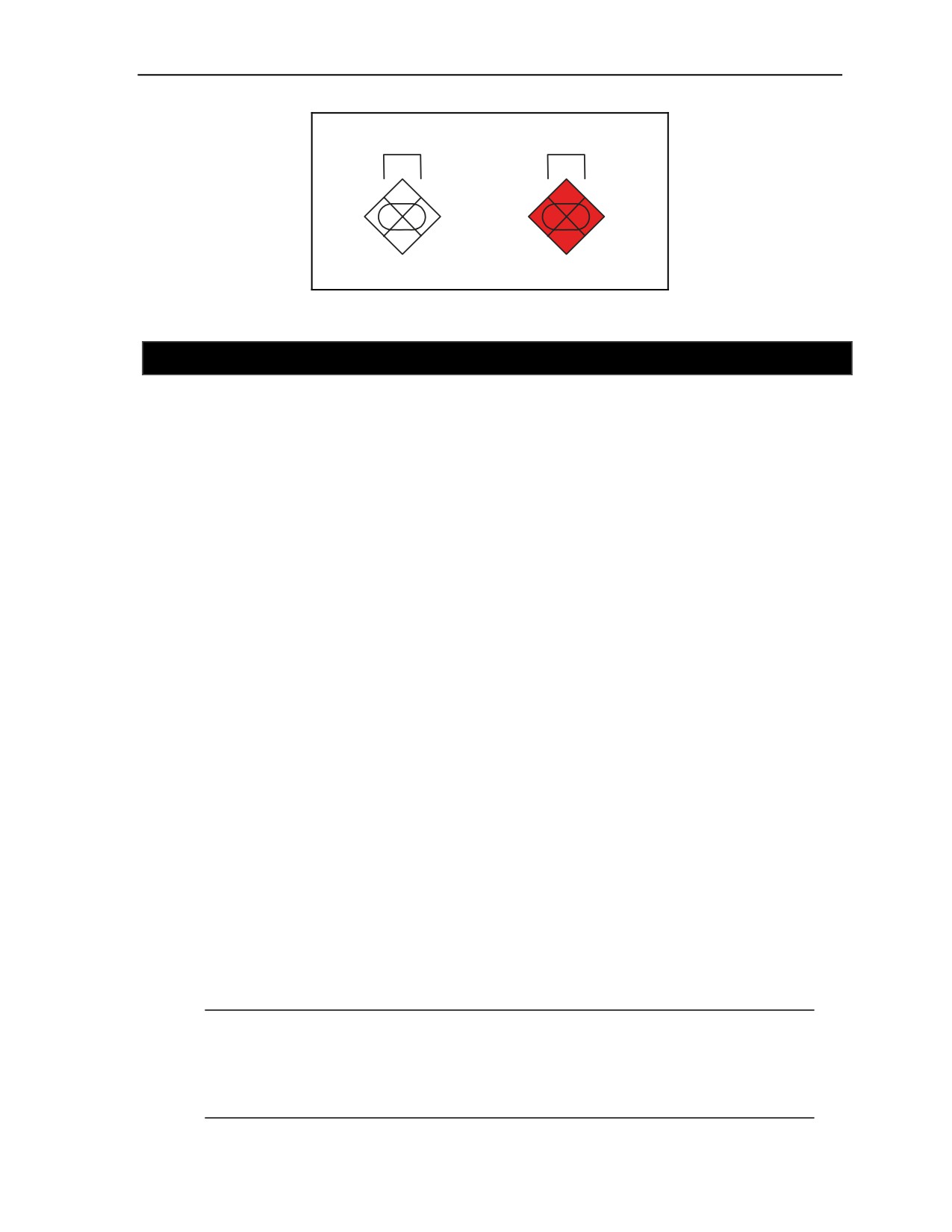
well. Figures 3-12 through 3-17 (on pages 3-21 through 3-23) provide examples for various types of
OPFOR task organizations at the tactical level.
XX
XX
OR
Figure 3-12. Motorized Infantry-Based DTG Symbol
3 May 2007
FM 7-100.4
3-21
Chapter 3
XX
XX
OR
Figure 3-13. Mechanized Infantry-Based DTG Symbol
X
X
OR
Figure 3-14. Tank-Based BTG Symbol
I I
I I
OR
Figure 3-15. Heliborne Infantry-Based BDET Symbol
I I
I I
OR
A
A
Figure 3-16. Attack Helicopter-Based BDET Symbol
3-22
FM 7-100.4
3 May 2007
Task-Organizing
I
I
OR
Figure 3-17. Mechanized Infantry-Based CDET Symbol
SECTION VIII − BUILDING AN OPFOR ORDER OF BATTLE
3-96. For effective training, an OPFOR must be task-organized to stress those tasks identified in the U.S.
unit’s mission essential task list (METL). The U.S. unit commander identifies those areas (or training
objectives) requiring a realistic sparring partner. The U.S. unit’s organization and mission drives the task-
organizing of the OPFOR. OPFOR task-organizing is accomplished to either stress issues identified in the
U.S. unit’s METL or it is accomplished in order to exploit the OPFOR strength and U.S. weakness. Steps 1
through 3 of the process outlined below define the scope and purpose of the training exercise. This sets the
stage for Steps 4 through 9, which determine the kind of OPFOR needed to produce the desired training.
The entire process results in building the appropriate OPFOR order of battle (OB).
STEP 1. DETERMINE THE TYPE AND SIZE OF U.S. UNITS
3-97. The U.S. commander who acts as the senior trainer (commander of the parent organization of the
unit being trained) determines the type and size of unit he wants trained for a specific mission or task. The
first step in exercise design is for the senior trainer to determine the exact troop list for the training unit.
The senior trainer should identify the task organization of the unit to be trained.
STEP 2. SET THE CONDITIONS
3-98. The senior trainer ensures the unit’s training objectives support its approved METL. Each training
objective has three parts: task, condition, and standard. The COE—including the OPFOR—is the
condition. The exercise planner has the task of actual creating the framework for the exercise and its
conditions. For the training scenario, the exercise planner develops reasonable courses of action (COAs)
for the U.S. unit and reasonable COAs for the OPFOR consistent with the COE and the FM 7-100-series
manuals. The exercise planner determines the size and type of OPFOR organizations. The conditions under
which U.S. units perform tasks to achieve training objectives include the time of day or night, weather
conditions, the type of OPFOR, the type of terrain, the CBRN environment, the maturity of the theater, and
the OE variables in play. During scenario development, all the conditions for the exercise OE are set.
STEP 3. SELECT ARMY TACTICAL TASKS
3-99. The U.S. commander reviews the Army Universal Task List (AUTL) in FM 7-15. As a catalogue,
the AUTL can assist a commander in his METL development process by providing all the collective tasks
possible for a tactical unit of company-size and above and staff sections. From the AUTL, the U.S.
commander selects specific Army tactical tasks (ARTs) on which he wants to train.
Note. Commanders use the AUTL to extract METL tasks only when there is no current mission
training plan (MTP) for that echeloned organization, there is an unrevised MTP to delineate
tasks, or the current MTP is incomplete.) The AUTL does not include tasks Army forces
perform as part of joint or multinational forces at the operational and strategic levels. Those
tasks are included in the Universal Joint Task List (UJTL) (CJCSM 3500.04C).
3 May 2007
FM 7-100.4
3-23
Chapter 3
STEP 4. SELECT OPFOR COUNTERTASKS
3-100. Trainers and planners select OPFOR countertasks to counter or stress each selected ART for the
U.S. unit. Appendix A of FM 7-100.2 provides an “OPFOR Universal Task List.” This is a listing of
OPFOR tactical countertasks for various ARTs found in the AUTL. If, for example, the U.S. unit’s METL
includes ART 5.1.1 (Overcome Barriers/Obstacles/Mines), the OPFOR countertask would involve creating
barriers or obstacles or emplacing mines. If the U.S. unit’s METL includes tasks under ART 4.0 (Air
Defense), the OPFOR needs to have aviation units. If the U.S. unit’s METL includes ART 5.3.2 (Conduct
NBC [CBRN] Defense), the OPFOR needs to have a CBRN capability. If the U.S. unit’s METL includes
counterinsurgency operations, the OPFOR should include insurgents.
STEP 5. DETERMINE THE TYPE AND SIZE OF OPFOR UNITS
3-101. Trainers and planners select the appropriate type and size of OPFOR unit or units capable of
performing the OPFOR countertasks. The type of OPFOR unit is determined by the type of capability
required for each OPFOR countertask. The size of the OPFOR organization is determined by the required
capability and the size of the U.S. unit(s) being trained.
STEP 6. REVIEW THE AFS ORGANIZATIONAL DIRECTORIES
3-102. Once the U.S. units and tactical tasks have been matched with OPFOR countertasks and OPFOR
units capable of providing counters to each ART, trainers and planners review the list of units in OPFOR
organizational directories on the Battle Command Knowledge System (BCKS). They review this menu of
OPFOR units to find out what kinds and sizes of OPFOR units are available in the AFS, and the options
given.
STEP 7. COMPILE THE INITIAL LISTING OF OPFOR UNITS FOR
THE TASK ORGANIZATION
3-103. Trainers and planners compile an initial listing of OPFOR units for the task organization. This
initial listing could use one of the two task organization formats provided in FM 5-0: outline and matrix.
STEP 8. IDENTIFY THE BASE UNIT
3-104. Trainers and planners again review the OPFOR organizational directories to determine which
standard OPFOR unit most closely matches the OPFOR units in the initial task organization list. This
OPFOR unit will become the “base” unit to which modifications are made, converting it into a task
organization. (At the tactical level, all OPFOR task organizations are formed around a “base” unit, using
that unit’s headquarters and all or some of its original subordinates as a core to which other OPFOR units
are added in order to supply capabilities missing in the original “base” organization.) While the base unit
for a task organization is most commonly a ground maneuver unit of a regular military force, that does not
necessarily have to be the case. (For example, an aviation unit might serve as the base for a task
organization that includes infantry units to provide security at its base on the ground.) It is even possible
that the base unit for the required task organization might be other than a regular military unit. (For
example, an insurgent or guerrilla organization might have a small military unit affiliated with it, as
“advisors.”)
3-105. Before extracting the “base” unit from the organizational directories, trainers and training planners
should determine how much of the organizational detail in the directories they actually need for their
particular training exercise or simulation. The directories typically break out subordinate units down to
squad-size components. However, some simulations either cannot or do not need to provide that level of
resolution. Therefore, trainers and training planners should identify the lowest level of organization that
will actually be portrayed. If the only task-organizing involved will be internal to that level of base unit,
any internal task-organizing is transparent to the users. However, if any subordinate of that base unit
receives assets from outside its immediate higher organization, it might be necessary to first modify the
3-24
FM 7-100.4
3 May 2007
Task-Organizing
subordinate into a task organization and then roll up the resulting personnel and equipment totals into the
totals for the parent organization in the OPFOR OB for the exercise.
STEP 9. CONSTRUCT THE TASK ORGANIZATION
3-106. Trainers and planners modify the standard OPFOR baseline unit to become the new task
organization. This can involve changes in subordinate units, equipment, and personnel. If training
objectives do not require the use of all subordinates shown in a particular organization as it appears in the
AFS, users can omit the subordinate units they do not need. Likewise, users can add other units to the
baseline organization in order to create a task organization that is appropriate to training requirements.
Users must ensure that the size and composition of the OPFOR is sufficient to meet training objectives and
requirements. However, total assets organic to an organization or allocated to it from higher levels should
not exceed that which is realistic and appropriate for the training scenario. Skewing the force ratio in either
direction negates the value of training. Therefore, specific OBs derived from the organizational directories
are subject to approval by the trainers’ OPFOR-validating authority.
3-107. Some trainers and planers may be very proficient with MS Office®. For these people, the steps for
converting an AFS baseline unit to a task-organized OPFOR are straightforward and simple. Once the units
comprising the task-organization have been identified and the AFS baseline unit has been selected, the
following sub-steps are then followed:
Step 9a. Create folders in MS Windows Explorer® to accommodate the MS Word® and MS
Excel® files copied and/or modified from those in the AFS directories using in the process
explained below.
Step 9b. Modify the organizational graphics in the MS Word® document using the inserted
PowerPoint® graphic. Remove the units not needed in the task organization and add the new
ones that are required. Re-insert the PowerPoint® graphic into the MS Word® document.
Step 9c. Modify personnel and equipment charts. Even for those lower-level units that have
only an MS Word® document in the AFS organizational directories, it is recommended to use
an MS Excel® chart as a tool for rolling up personnel and equipment totals for the modified
unit. Update the subordinate units at the tops of the columns on the Excel® spreadsheet page.
Adjust all of the equipment numbers in appropriate rows, by unit columns. Once the new
personnel and equipment numbers are updated in MS Excel®, transfer the appropriate numbers
back to the basic Word® organizational document.
Step 9d. Adjust equipment tiers, if necessary, to reflect different levels of modernity and
capability (see chapter 4).
Step 9e. Update folders and file paths to reflect the conversion from an AFS organization to a
task-organized unit.
The task-organized detachment, BTG, DTG, or OSC is finished. For detailed instructions on performing
Step 9 and its sub-steps, see appendix B.
STEP 10. REPEAT STEPS 4 THROUGH 9 AS NECESSARY
3-108. Repeat Step 9 for as many task organizations as are required to perform the OPFOR countertasks.
In each case, select a baseline AFS unit and modify it as necessary.
3-109. Training may reveal the need for the U.S. unit to train against other ARTs. If so, trainers and
planners must repeat Steps 4 through 9.
3 May 2007
FM 7-100.4
3-25
Chapter 4
Equipment Options
The administrative force structure (AFS) organizational directories provide example
equipment types and the numbers of each type typically found in specific
organizations. The purpose is to give trainers and training planners a good idea of
what an OPFOR structure should look like. However, training requirements may
dictate some modifications to this baseline. Therefore, training planners have several
options by which they can modify equipment holdings to meet particular training
requirements.
BASELINE EQUIPMENT
4-1. For each organization in the OPFOR AFS, the online organizational directories list “Principal Items
of Equipment” in the basic MS Word® document and/or list “Personnel and Items of Equipment” in an
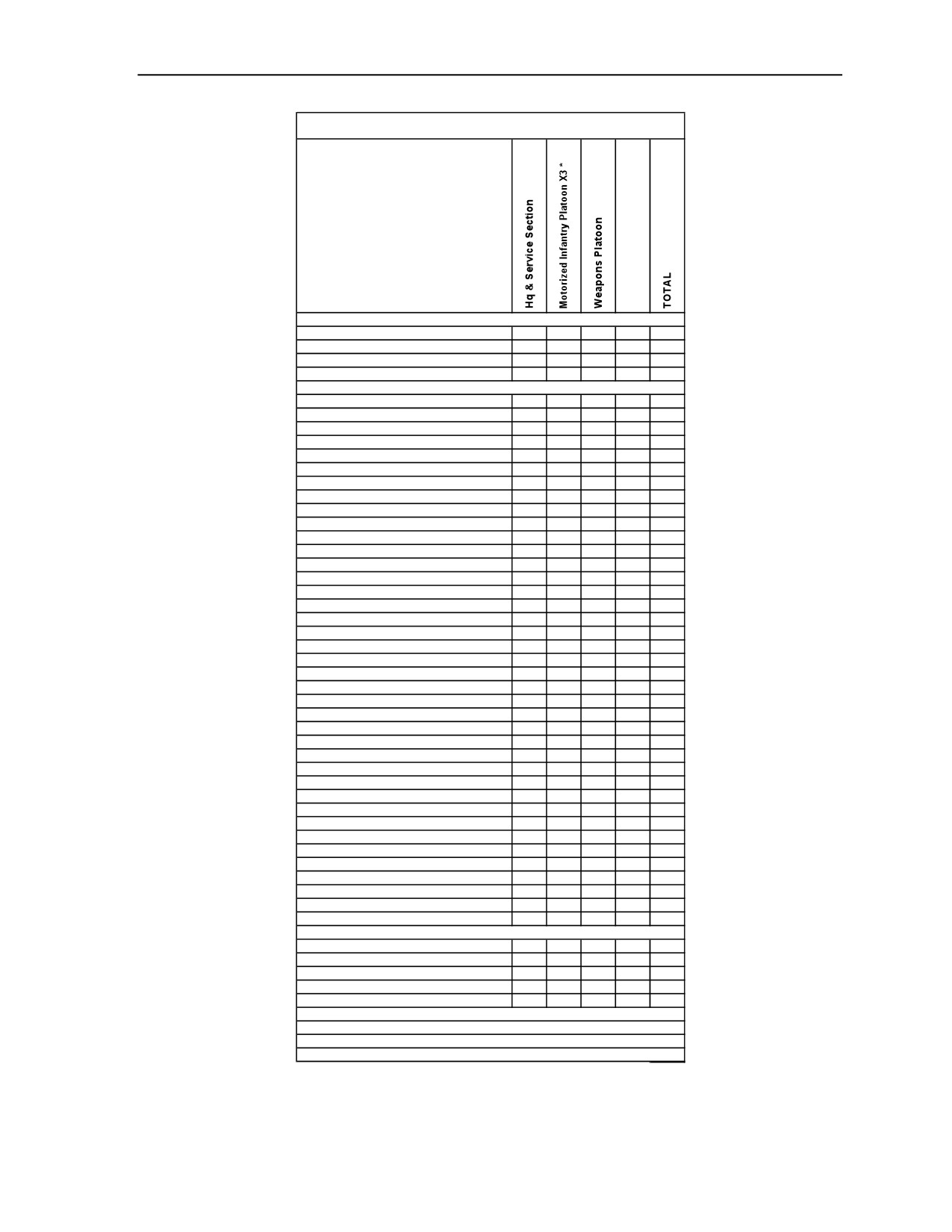
MS Excel® chart. (Figures 4-1 and 4-2 on pages 4-2 and 4-3 show the equipment list for a motorized
infantry company in both formats.) In most cases, this equipment corresponds to Tier 2 in the tier tables of
the Worldwide Equipment Guide (WEG) online. However, some elite units, such as Special-Purpose
Forces, may have Tier 1 equipment. On the other hand, insurgent and guerrilla organizations typically have
older, less capable equipment. (For more information on equipment tiers, see Equipment Tier Tables in the
section on the WEG later in this chapter.)
Note. For illustrative purposes, this FM contains several examples from the online AFS
organizational directories and the online WEG. Readers are reminded that even the baseline
OPFOR organizations are subject to change over time. The equipment found in those
organizations can also change. Therefore, readers should always consult the online directories
for the latest, most up-to-date versions of organizational and equipment data. (See page 4-4 for a
link to the online WEG.)
4-2. For larger units, equipment lists in the AFS directories take the form of an Excel® spreadsheet that
provides a quick overview of the holdings for subordinate units and equipment totals for the unit as a
whole. When the organization chart indicates multiple, identical units subordinate to a particular
organization (using stacked blocks), the spreadsheet column for those particular subordinates indicates
equipment totals already multiplied by the number of such units present. The heading with the subordinate
unit name at the top of such a column indicates that multiplication by adding an annotation, for example
“(x2)” or “x3),” after the name of the subordinate unit type.
Note. In a unit with multiple subordinates of the same type, one or more of these like
subordinates may be augmented or decremented in different ways in the process of task-
organizing. In such cases, users will need to replace this column in the spreadsheet with multiple
columns reflecting the differences created.
4-3. Footnotes linked to the equipment nomenclature in the “Equipment” or “Personnel and Items of
Equipment” column in equipment lists may serve one of two purposes. Sometimes, such a footnote
indicates additional information about that piece of equipment or a possible substitute for it. In other cases,
it may indicate possible variations in the quantity of that particular item of equipment.
3 May 2007
FM 7-100.4
4-1
Chapter 4
Infantry Company, Mtzd Inf Bn ___________________________________________
PRINCIPAL ITEMS OF EQUIPMENT
Equipment
Total
Equipment
Total
9-mm Pistol, PM
18
Truck, Medium
2
5.45-mm Assault Rifle, AK-74M
131
Trailer, Cargo, 1-Axle
2
5.45-mm Carbine, AKS-74U
21
Trailer, Cargo, 2-Axle
2
7.62-mm GP MG, PKM *
12
Trailer, Utility
7
7.62-mm Sniper Rifle, SVD *
11
Trailer, Water (1,200-Liter)
1
.50-cal Antimateriel Rifle, M82A1 *
2
Smoke Pots, Drums, Barrels,
12.7-mm HMG, NSV *
8
and Grenades
Assorted
35-mm AGL-Light, W-87 *
9
Aiming Circle/Goniometer
1
40-mm Grenade Launcher, GP-30
30
Binocular Laser Rangefinder *
42
60-mm Mortar, Light, Type 90 *
3
GPS Receiver, Handheld
53
ATGM Launcher, Milan 3 **
3
Laser Target Designator **
3
ATGM Lchr, Manportable-SR, Eryx *
3
Observation Scope, Day/Night * or **
2
ATGL-Long Range, RPG-29 *
6
Radar, GSR, Manportable, Fara-1
3
ATGL, Panzerfaust 3-T600 *
9
Thermal Viewer, Handheld, Sophie
14
ATDL, Armbrust ***
9
Night-Vision Goggles
61
ATDL, RPG-27 ***
4
Night-Vision Goggles (Driver)
12
Flame Weapon, RPO-A Series
23
Night-Vision Goggles (AK w/GP-30)
30
Minefield Breaching System-
Night-Vision Sight (Aiming Circle)
1
Explosive Charge, ZRP-2 ****
3
Radios:
Mine-Scattering System,
Handheld, Very-Low-Power
48
Manportable, PKM
3
Manpack, Low-Power
6
Mines (AP&AT) ***/*****
Assorted
Vehicle Mount, Medium-Power
12
Tactical Utility Vehicle, UAZ-469
7
Warning Receiver
1
Truck, Light
3
________________________________
* With II night sight.
** With thermal sight.
*** Issued as ammunition rather than a weapon- the BOI may vary.
**** No dedicated operator/BOI. It is carried until needed
***** Includes remotely detonated mines and side-attack (AT & anti-vehicle) mines.
Figure 4-1. Motorized Infantry Company Principal Items of Equipment List
4-2
FM 7-100.4
3 May 2007
Equipment Options
Motorized Infantry Company
Personnel and Items of Equipment
Personnel
Officers
2
3
1
6
NCO
2
27
14
43
Enlisted
8
99
25
132
Total Personnel
12
129
40
181
Equipment
9-mm Pistol, PM
15
3
18
5.45-mm Assault Rifle, AK-74M
12
87
32
131
5.45-mm Carbine, AKS-74U
18
3
21
7.62-mm GP MG, PKM
3
9
12
7.62-mm Sniper Rifle, SVD
9
2
11
.50-cal Antimateriel Rifle, M82A1
2
2
12.7-mm HMG, NSV
2
3
3
8
35-mm AGL-Light, W-87
6
3
9
40-mm Grenade Launcher, GP-30
3
24
3
30
60-mm Mortar, Light, Type 90
3
3
ATGM Launcher, Milan 3
3
3
ATGM Lchr, Manportable-SR, Eryx
3
3
ATGL-Long Range, RPG-29
6
6
ATGL, Panzerfaust 3-T600
9
9
ATDL, Armbrust
9
9
ATDL, RPG-27
3
1
4
Flame Weapon, RPO-A Series
2
21
23
Minefield Breach System-Explosive ZRP-2
3
3
Mine-Scattering System, Manport, PKM
3
3
Mines (AP&AT)
Assort
Assort
Assort
Assort
Tactical Utility Vehicle, UAZ-469
2
3
2
7
Truck, Light
1
2
3
Truck, Medium
2
2
Trailer, Cargo, 1-Axle
2
2
Trailer, Cargo, 2-Axle
2
2
Trailer, Utility
2
3
2
7
Trailer, Water (1,200-Liter)
1
1
Smoke Pots, Drums, Barrels & Grenades
Assort
Assort
Aiming Circle/Goniometer
1
1
Binocular Laser Rangefinder
2
27
13
42
GPS Receiver, Handheld
5
30
18
53
Laser Target Designator
1
2
3
Observation Scope, Day/Night
2
2
Radar, GSR, Manportable, Fara-1
3
3
Thermal Viewer, Handheld, Sophie
1
6
7
14
Night-Vision Goggles
1
30
30
61
Night-Vision Goggles (Driver)
5
3
4
12
Night-Vision Goggles (AK w/GP-30)
3
24
3
30
Night-Vision Sight (Aiming Circle)
1
1
Radios:
Handheld, Very-Low-Power
3
30
15
48
Manpack, Low-Power
1
3
2
6
Vehicle Mount, Medium-Power
5
3
4
12
Warning Receiver
1
1
NOTES:
* The values in this column are the total number for three platoons.
** This company may be augmented by high-mobility/all-terrain vehicles.
Page 1
Figure 4-2. Motorized Infantry Company Personnel and Equipment Chart
3 May 2007
FM 7-100.4
4-3
Chapter 4
4-4. The OPFOR order of battle (OB) must meet the training requirements, based on the menu of possible
organizational parts provided in the directories. If a particular piece of equipment is not appropriate for a
specific scenario, trainers may substitute another system according to the guidelines in the WEG. However,
such substitutions are subject to approval by the trainers’ OPFOR-validating authority. Training planners
should exercise caution in modifying equipment holdings, since this impacts on an OPFOR unit’s
organizational integrity and combat capabilities.
WORLDWIDE EQUIPMENT GUIDE
4-5. The Worldwide Equipment Guide (WEG) is accessible online by means of the following link to the
TRADOC ADCSINT-Threats portal on the Battle Command Knowledge System (BCKS): https://dcsint
threats.leavenworth.army.mil/COE/default.aspx; then click on “COE,” then on “Worldwide Equipment
Guide.” Alternatively, users can click here on the following link: Worldwide Equipment Guide. Access to
BCKS requires use of Army Knowledge Online (AKO) user name and password. If the user is already
logged into AKO (by user name and password or by Common Access Card login), no further login may be
necessary.
4-6. The WEG directories consist of three volumes: Volume 1, Ground Systems; Volume 2, Airspace and
Air Defense; and Volume
3, Naval and Littoral Systems. These directories are maintained and
continuously updated, as necessary, by the Deputy Chief of Staff for Intelligence, U.S. Army Training and
Doctrine Command (TRADOC DCSINT). The TRADOC DCSINT is designated as “the responsible
official for the development, management, administration, integration, and approval functions of the
OPFOR Program across the Army” (Army Regulation 350-2).
EQUIPMENT DATA
4-7. The WEG contains technical data on the capabilities of systems identified as “Principal Items of
Equipment” in the AFS organizational directories and/or in the equipment tier tables or substitution
matrices of the WEG. On the following three pages are examples of the kind of information the WEG
provides. The three systems chosen as examples are highly capable in today’s operational environments.
They are widely proliferated and are likely to be encountered by U.S. forces in real-world areas of conflict.
Therefore, they are good candidates for inclusion in OPFOR OBs used in training that is realistic and
relevant for the COE.
4-4
FM 7-100.4
3 May 2007

Equipment Options
United States M82A1A .50-cal Antimateriel Rifle _____________________________
Ammunition
Typical
Types
Combat Load
.50-cal cartridge
30
Raufoss Grade A
Ball (M2/M33)
AP (M2)
AP-I (M8)
API-T (M20)
Tracer (M10/21)
SLAP (M903)
MP (MK211 Mod 0)
SYSTEM
Name: AP-S NM173 (Nammo)
Alternative Designations: None
Caliber/length: .50-cal BMG/12.7-mm x 99-mm (NATO)
Date of Introduction: Early 1980s
Type: Armor piercing
Proliferation: Widespread (27+)
Range (m) (equipment-size targets):
Maximum (w/scope): 1,800
Description:
Armor Penetration: 11 mm @30° @1,500 m
Weight (kg):
Accuracy: <15 cm @ 550 m
Empty (w/o magazine): 14.75
Muzzle Velocity (m/s): 915
Length (mm):
Overall: 1,448
Name: M903 (Olin)
Barrel: 736
Caliber/length: .50-cal BMG/12.7-mm x 99-mm (NATO)
Rate of Fire (rd/min): 20
Type: Saboted Light Armor Penetrator (SLAP) (actual bullet is
Operation: Recoil
tungsten .30 inch penetrator wrapped in a .50-cal plastic sabot)
Feed: 10-rd detachable box magazine
Range (m) (equipment-size targets):
Fire Mode: Semi-automatic only
Maximum (w/scope): 1,500
Armor Penetration: 19 mm (.75 in) @1,500 m
SIGHTS
Accuracy: INA
Muzzle Velocity (m/s): 1,014
Name: Unertl
Type: Optical (matches trajectory of .50-cal Raufoss Grade A)
Name: M8
Magnification: 10x
Caliber/length: .50-cal BMG/12.7-mm x 99-mm (NATO)
Type: Armor piercing incendiary
Name: Swarovski
Range (m) (equipment-size targets):
Type: Optical (with ranging reticle)
Maximum (w/scope): 1,800
Magnification: 10x42
Armor Penetration: 20 mm @ 100 m
Night Sights Available: yes
Accuracy: <25 cm @ 550 m
Muzzle Velocity (m/s): 881
AMMUNITION
Name: M20
Name: Raufoss Grade A (match)(DODIC A606) (USMC)
Caliber/length: .50-cal BMG/12.7-mm x 99-mm (NATO)
Caliber/length: .50-cal BMG/12.7-mm x 99-mm (NATO)
Type: Armor piercing incendiary-Tracer
Type: Standard operating round
Trace (m): 91 to 1,463
Range (m) (equipment-size targets):
Armor Penetration: 20 mm @ 100 m
Maximum (w/scope): 1,800
Accuracy: <25 cm @ 550 m
Muzzle Velocity (m/s): 854
Muzzle Velocity (m/s): 887
Name: MP NM140 (Nammo) MK211 Mod 0
VARIANTS
Caliber/length: .50-cal BMG/12.7-mm x 99-mm (NATO)
Type: Multipurpose
Model 95: Bullpup bolt action, 5-round magazine
Range (m) (equipment-size targets):
Maximum (w/scope): 1,800
Armor Penetration: 11 mm @45° @1,000 m
Fragmentation: 20 fragments after hitting 2 mm steel
Incendiary Effect: Ignition of JP4 and JP8
Accuracy: <15 cm @ 550 m
Muzzle Velocity (m/s): 915
NOTES
The M82A1A provides maneuver commanders with the tactical option of employing snipers with an antimateriel weapon to augment present
7.62-mm antipersonnel sniper rifles. Recoil equals 7.62x51-mm levels. The USMC uses Raufoss Grade A ammunition, but the rifle is capable
of firing any standard 12.7x99-mm Browning machinegun ammunition.
3 May 2007
FM 7-100.4
4-5
Chapter 4
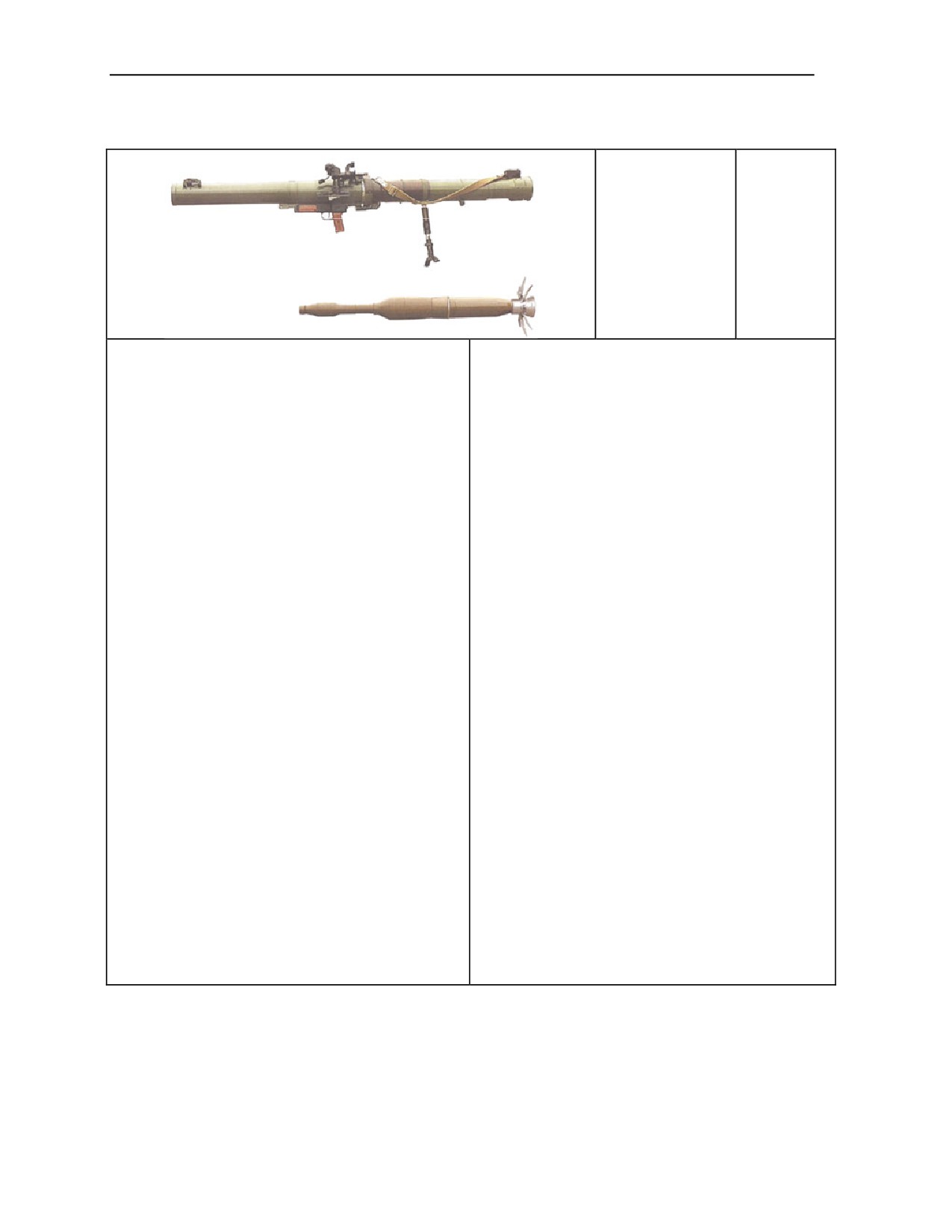
Russian 105-mm Antitank Grenade Launcher RPG-29________________________
Ammunition
Typical
Types
Combat Load
105-mm grenade
3
HEAT (tandem)
HE thermobaric
As needed
SYSTEM
AMMUNITION
Alternative Designations: Vampir
Name: PG-29V
Date of Introduction: Late 1980s
Caliber (warhead): 105
Proliferation: Former Soviet Union
Type: Tandem HEAT (shaped charge)
Description:
Range (m):
Crew: 2
Effective: 500m, 800 for RPG-29 mounted (used by OPFOR)
Caliber (tube) (mm): 105
Penetration (m):
Weight (w/o sight) (kg): 11.5
Armor: 750 + (650 behind ERA)
Length (transport) (mm): 1,000
Concrete and brick: 1.5 +
Length (firing) (mm): 1,850
Brick: 2 +
Life of Tube/barrel: 300
Earth: 3.7 +
Rate of Fire (rd/min): INA
Length (mm): INA
Fire From Inside Building: INA
Complete Round Weight (kg): 6.7
Maximum Target Speed (km/h): INA
Muzzle Velocity (m/s): 280
Emplacement/displacement time (min): <0.25
Other Ammunition: A multipurpose HE thermobaric grenade is
SIGHTS
also used. Blast effects are the same as the TBG-7V.
Daysight:
Name: 1P-38
VARIANTS
Type: Iron, optical, and LRF-based FCS
RPG-29N: Night sight only variant
Magnification: INA
Location: Left side
RPG-29 Mounted: For use as a mounted crew-served system. This
Sighting Range (m): 500
variant can fit on a vehicle with a pintle mount, or be dismounted to a
Weight (kg): .6
tripod ground mount. The RPG-29 Mounted variant has a fire control
system with an optical sight, laser rangefinder and ballistic data
Name: Simrad IS2000 or similar sight for RPG-29 Mounted
computer for increased range and precision. This increases the
Type: LRF-based FCS with ballistic computer
effective range of the mounted system to 800 m against a stationary
Magnification: INA
target with a hit probability of 80%. The system can fire at all
Location: Left side
(including moving) to its maximum range, even with a reduced Ph.
Sighting Range (m): 800 m for this mount
This variant would be expected to include HE in its mix of grenades .
Weight (kg): INA
For Tier 1 and Tier 2 COE OPFOR, RPG-9 Mounted is the crew
weapon in Weapons Squads and other supporting tactical units. In
Night Sight:
later time frame, this system or equivalent could become the standard
Name: 1PN51, 1PN52 standard RPG-29 or RPG-29N
squad ATGL for maneuver forces.
Type: II sight
Weight (kg): 2.1
RPG-32/Hashim: New Russian/Jordanian ATGL to launch RPG
Name: KN250F or similar sight for RPG-29 Mounted
29V and HE thermobaric grenades. The launcher base is a short tube
Type:
3 gen II clip-on sight designed to work with daysight
extension with optics and trigger assembly, which attach to the the
Magnification: 1 X
grenade canister, resulting in a shoulder-launcher with up to 700 m
Location: Left side
range. Grenades come two per carry case. This is another example of
Sighting Range (m): 600-800 for vehicle targets, 300+ man
an expanding AT trend of fitting large lethal warheads onto ATGLs.
Weight (kg): INA
Another example fitting canister on launcher base is PF-98 (pg 1-34).
NOTES
The RPG-29 replaces SPG-9 as an all-purpose small unit artillery against the gamut of targets, including vehicles, personnel, buildings, and any
other direct-fire targets within range - including helicopters.
The RPG-29 can be broken down into two parts for one soldier carry. It can be made ready to fire within a few seconds. A folding bipod is
provided to assist aiming during prone firing. RPG-27, PG-7VR for RPG-7V, and RPG-32/Hashim use the same (PG-29V) warhead.
4-6
FM 7-100.4
3 May 2007
Equipment Options
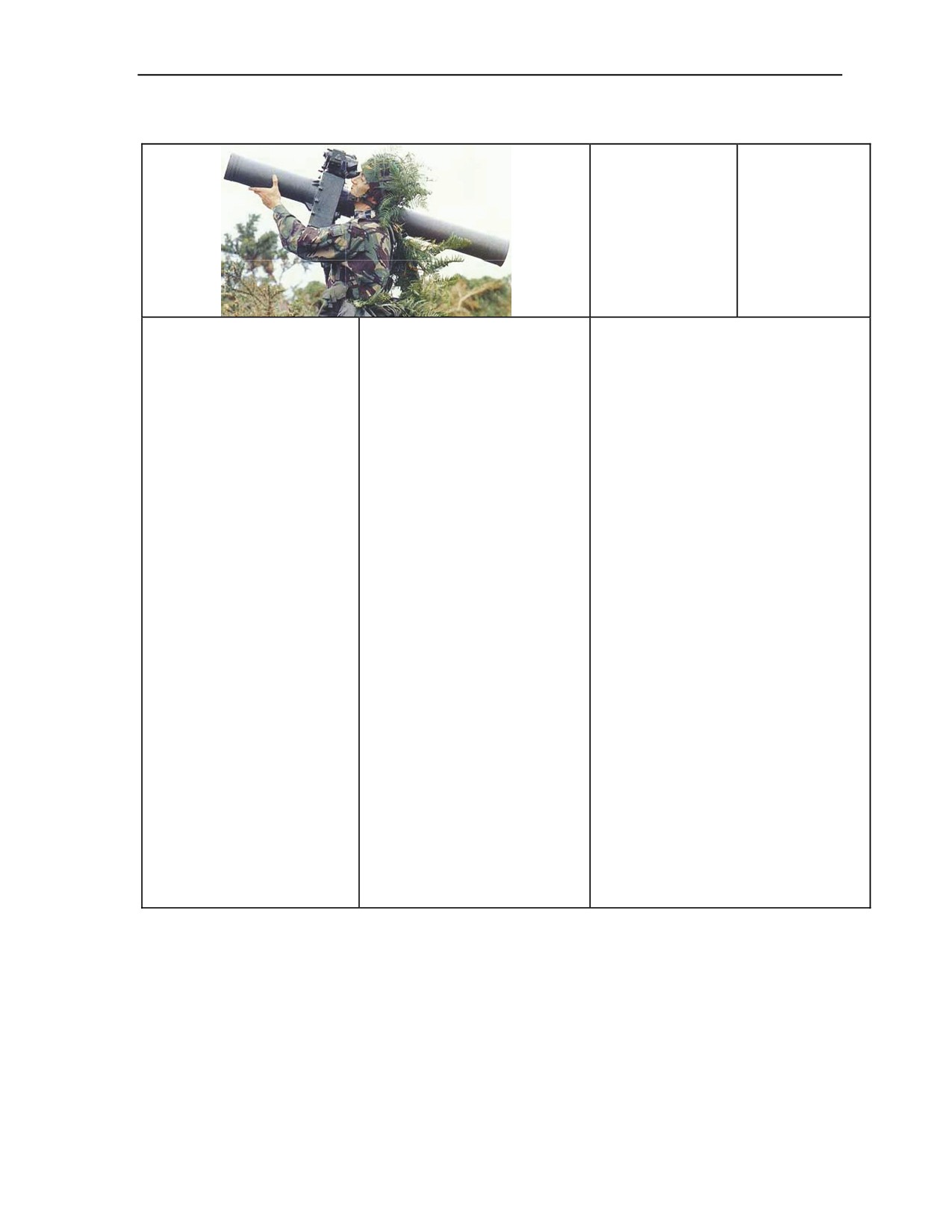
British High Velocity Missile System Starstreak ____________________________
Weapons &
Typical
Ammunition Types
Combat Load
Ready missiles
Dismount
3
Team in Vehicle
5
SYSTEM
Propulsion: 2-stage missile, eject, guided
launcher can also be mounted on a light vehicle,
Alternative Designation: Shoulder-
flight to target for darts
such as a TUV. A demonstrator uses the LML on a
Launched (SL) Starstreak
Flight Time to max range (sec): 5
Panhard tactical truck.
Date of Introduction: 2000 (1997 for
Guidance: SACLOS Laser beam rider
vehicle mount)
Warhead Type: Three darts, each with a
Armored Starstreak or (SP HVM): Vehicle is a
Proliferation: At least 6 countries
25-mm rod and Frag-HE liner
Stormer tracked APC chassis, with an 8-missile
Target: FW, heli
Penetration (mm): 120+ all LAVs
launcher. The passive IR fire control system uses
Description: (SL configuration)
Fuze Type: Contact with time delay.
ADAD, an auto-tracker and thermal sight for high-
System: Consists of launcher and
Delayed blast then follows penetrator
volume SHORAD support. It was successfully
canistered missiles
Probability of Hit (Ph%): 60 FW, 80 heli
tested against light armored vehicle (LAV) targets.
Crew: 2 with a loader (one possible)
Self-Destruct (sec): Yes, INA
The launcher can be mounted on other vehicles.
ARMAMENT
FIRE CONTROL
Starstreak Lightweight Vehicle (LWV): British
Launcher
Sights w/Magnification:
Land Rover truck converted into an SP SAM
Name: Aiming Unit
Day sight: Avimo stabilized optical sight
launcher system with a 6-canister launcher, ADAD
System Dimensions:
with lead bias system
auto-tracker, and TV/thermal FCS. Launcher can be
Length: 1.4 m with missile
Field of View (o): INA
mounted on other vehicles.
Diameter: 274 mm
Acquisition Range (m): 7000+
System Weight (kg): 24.3 with missile
Seastreak: Single-stage missile naval variant in a
Reaction Time (sec): <6
Night sight: Thales clip-on thermal sight
12-missile launcher, with mm-wave radar FCS.
Time Between Launches (sec): <30 sec
Acquisition Range (km): 4-5 est
Reload Time (sec):
<25 sec est
Helstreak or Air-to-air Starstreak (ATASK):
Fire on the Move: Yes, in short halt
Other Acquisition Aides:
Apache helicopter launch conversion program.
ADAD: British passive thermal IR
Missile
scanners on remote tripod or vehicle
Starburst: British Javelin missile system converted
Name: Starstreak. Canistered missile
mount with 240 o FOV automatic cueing
to use Starstreak laser beam-rider guidance. This
includes a booster, a 2nd stage
system.
variant is in production with conversions underway.
propelled missile body, and three
separating guided darts.
Missile team employs an azimuth plotting
Optional Use: As an air defense/anti-armor
Range (m):
board, such as the Russian 1L15-1
(multi-role) system. Starstreak can be employed
Max. Range: 6,000-7,000
azimuth plotting board, to provide
against ground targets, such as light armored
Min. Range: 300 (guided)
direction of approach for aerial targets
vehicles, and snipers in bunkers or buildings. The
Altitude (m):
(see WEG pg 5-18).
missile and its darts, with a unique combination of
Max. Altitude: 5,000
penetrator and following Frag-HE, have been
Min. Altitude: 0
VARIANTS
successfully tested against vehicle targets. With a
Dimensions (mm):
Lightweight Multiple Launcher (LML):
missile cost of 1/2 to 1/3 of competing MANPADS,
Length: 1400
Pedestal launcher on a tripod, with
the system could be used as a fire support asset to
Diameter: 127
brackets for three launch canisters. The
complement ATGM launchers and vehicle weapons.
Missile Speed: 1,364 m/s, Mach 4
NOTES
Ground-based air defense weapon system optimized for use against armored helicopters and low flying high-performance aircraft. Missile
employs smokeless propellant for minimal signature. Coupled with minimum flight time and LBR guidance, the system is essentially immune to
countermeasures other than obscurants. Because of the high velocity, the system exceeds the hit probability of competing systems against high
speed aircraft on receding flight paths.
The Starstreak's lower cost and capabilities as a multi-role missile system could justify employment other than straight substitution. A
consideration is the SACLOS guidance, which makes it less effective against agile fixed-wing aircraft from some aspects. Therefore, a better
arrangement would be to replace a portion (33-50%) of the MANPADS. Given the lower cost of Starstreak and its mult-role capability, it could
replace a portion of the expensive MANPADS with more Starstreaks for more lethality at lower cost. For instance, an 18-MANPADS battery
could be reduced 33% to 12 MANPADS while adding 12 Starstreaks, with the latter used as a multi-role system. With 50% of the MANPADS
replaced, the mix would be 9 MANPADS and 18 Starstreaks. Such a substitution would be based on the expected adversary weapons mix.
3 May 2007
FM 7-100.4
4-7
Chapter 4
EQUIPMENT TIER TABLES
4-8. The WEG contains Tier Tables for the various categories of equipment found in OPFOR
organizations. Training planners can employ these tables to adjust the level of capabilities of equipment
from the baseline shown in the AFS organizational directories. Within each functional category of
equipment, there are four tiers representing different levels of capability, with Tier 1 representing the
highest level of capability and modernity.
Note. Niche systems and niche technology upgrades provide capabilities that exceed the general
capability level of the overall force. For example, a Tier 3 force might have a few systems from
Tier 1 or 2. Applying a niche technology upgrade to one or more subsystems of a Tier 2 legacy
system could raise its level of capability to the equivalent of a Tier 1 system. (See the sections
on Equipment Upgrades and Emerging Technology Trends later in this chapter.)
4-9. Tier 1 reflects systems across the different functional areas that a major military force with state-of
the-art technology would generally have. At Tier 1, new or upgraded systems are limited to those robust
systems fielded in military forces or currently developed and marketed for sale, with capabilities and
vulnerabilities that can be portrayed for training.
4-10. Tier 2 reflects modern competitive systems fielded in significant numbers for the last 10 to 20 years,
with limitations or vulnerabilities being diminished by available upgrades. Although forces are equipped
for operations in all terrains and can fight day and night, their capability in range and speed for several key
systems may be somewhat inferior to U.S. capability.
4-11. Tier 3 systems date back generally 30 to 40 years. They have limitations in all three subsystems
categories: mobility, survivability, and lethality. Systems and force integration are inferior. However, guns,
missiles, and munitions can still challenge vulnerabilities of U.S. forces. Niche upgrades can provide
synergistic and adaptive increases in force effectiveness.
4-12. Tier 4 systems reflect 40- to 50-year-old systems, some of which have been upgraded numerous
times. These represent equipment typically found in forces of Third World or smaller developed countries.
Use of effective strategy, adaptive tactics, niche technologies, and terrain limitations could enable a Tier 4
OPFOR to challenge the effectiveness of a U.S. force in achieving its goals. This tier includes militia,
guerrillas, special police, and other forces.
4-13. To achieve specific training objectives, trainers and training planners can substitute other equipment
for those items listed in the baseline. Equipment tier tables and substitution matrices list alternative systems
with varying levels of capability and modernity. The baseline systems, as well as those listed in tier tables
and substitution matrices, are built in large numbers and proliferated throughout the world. (That is part of
the criteria for their inclusion in the WEG.) Thus, the country of origin or an actual country possessing
such systems does not necessarily pose a threat to the United States. However, these widely used systems
provide an OPFOR with capabilities that could present a challenge in U.S. Army training.
4-14. Table 4-1 provides a sample of systems listed in the Tier Tables (from volume 1 of the WEG). This
example is based on the assessment of tiers in 2006.
4-15. OPFOR organizations and equipment must support the entire spectrum of COE training scenarios for
the U.S. Army. The contemporary OPFOR, as described in the FM 7-100 series, represents rational and
adaptive adversaries, and offers flexibility for use in training applications and scenarios for U.S. training.
The main part of the WEG deals with systems that are widely proliferated in the current timeframe. Lists of
equipment on the Tier Tables offer convenient baseline examples arranged in capability tiers for use in
composing OPFOR equipment arrays for training scenarios. Each volume of the WEG also has a chapter
on Emerging Technology Trends. Tables in those chapters offer an extended capabilities tier for the near
and mid-term.
4-8
FM 7-100.4
3 May 2007

Equipment Options
Table 4-1. Equipment Tier Table (Example)
Tier 1
Tier 2
Tier 3
Tier 4
Main Battle Tank
T-90S
T-72B (Improved)
Chieftain
T-55AM
Amphibious Tank
Type 63AModernized
Type 63AM
M1985
PT-76B
Tracked HACV
2S25
AMX-10 PAC 90
AMX-13
M41A3
Wheeled HACV
AMX-10RC Desert Storm
AMX-10RC
EE-9
EE-9
Towed Light Howitzer
D-30
D-30
D-30
D-30
Towed Medium How/Gun
G5
2A65
2A36
D-20
Self-Propelled Howitzer
G6, AU-F1T
G6, 2S19
2S3M
2S1
Multiple Rkt Launcher
Prima
Prima
BM-21
Type 63
Heavy MRL
9A52-2
9A52-2
9P140
Fadjr-3
1-Round Rkt Launcher
9P132
9P132
9P132
9P132
Amphibious SP How
2S1
2S1
2S1
2S1
4-16. The Tier Tables were developed in order to portray systems for adversaries with differing budgetary
levels and force capabilities. Systems in a tier reflect more or less comparable levels of modernity, for use
with a force at that level of capability. Each tier provides an equivalent level of modernization for systems
across different functional areas. The tier tables are also another tool for OPFOR customers to use to alter
systems in simulations to reflect different levels of modernity. One can find an item of equipment at Tier 2
in the baseline equipment list for a given OPFOR organization, note its counterpart at a higher or lower
tier, and then substitute to build the same unit (for example, division, brigade, battalion) for a different tier.
The key to using the tables is to know the tier capability of the initial organizations.
4-17. An OPFOR OB should contain a mix of systems that realistically vary in fielded age and generation.
Given the modern reality of budget constraints on military spending, the WEG authors have tempered
depiction of new, expensive systems to a fraction of any force. The more common modernization approach
within the higher tiers is to upgrade existing systems.
4-18. The Tier Tables are less concerned with systems’ age than realistically reflecting a capability to be
addressed in training. Not all systems and functional areas have to be modernized equally or
simultaneously. The OPFOR may have one system 10 to 20 years older than others in a functional area. In
a given time frame, military forces often will emphasize upgrades in one functional area while modernizing
or maintaining lower tier levels in other functional areas.
4-19. Some systems are used in common in lower and higher tiers. For instance, because of the need for
improved anti-armor, air defense, and precision artillery munitions, these capabilities are shared across
several tier levels. Older 4x4 tactical utility vehicles that are 30 to 40 years old still offer effective support
capability, and may extend across three tier levels. Common use of some OPFOR systems also reduces the
database maintenance requirement.
4-20. No force in the world has all of its systems at the most modern tier. Even the best force in the world
has a mix of state-of-the-art (Tier 1) systems, as well as mature (Tier 2), and somewhat dated (Tier 3)
legacy systems. Much of the latter systems have been upgraded to some degree, but may exhibit the
limitations of their original state of technology. Even modern systems recently purchased may be
3 May 2007
FM 7-100.4
4-9
Chapter 4
considerably less than state-of-the-art, due to limited military budgets and limited user training and
maintenance capabilities. Thus, even new systems may not exhibit Tier 1 or Tier 2 capability. As forces
later field systems with emerging technologies, legacy systems may be more suitable for employment in
certain conditions, or they may be upgraded and continue to be competitive. Adversaries with lower-tier
systems can use adaptive technologies and tactics, or obtain niche technology systems to challenge the
advantages of a modern force.
4-21. A major emphasis in the COE is flexibility in use of forces and in doctrine. This also means that the
OPFOR, given rational and justifiable force development methodology, has the flexibility to adapt the
systems mix to support doctrine and plans. The tiers provide the baseline list for determining the force mix,
based on scenario criteria. The OPFOR compensates for capability limitations by using innovative and
adaptive tactics, techniques, and procedures (TTP). Some of these limitations may be caused by the lack of
sophisticated equipment or integration capability, or by insufficient numbers. Forces can be tailored, in
accordance with OPFOR doctrine, to form tactical groups and other task organizations.
SYSTEMS SUBSTITUTION MATRICES
4-22. In each volume of the WEG, a Systems Substitution Matrix table provides comparative data for users
who would like to substitute other systems for OPFOR systems listed in the baseline organizational
directories. For each system, the table shows the system name, its tier level, and the WEG page on which
data for that system begins. Within each functional area, systems are displayed in groups (with spaces
separating the groups) of systems of like type that could be substituted for one another. Within each group,
the system shown in italics is the one listed in FM 7-100.4 as the baseline system (normally Tier 2) in some
OPFOR organization. Within each grouping by type, most systems are listed in tier order, and can be
substituted to fit scenario requirements. Some systems span the boundary between two tiers (for example,
“3-4”). Other systems can be used at more than one tier (for example, “3 and 4”). Table 4-2 provides a
sample from the Systems Substitution Matrix in volume 1 of the WEG. Tiers shown in this example are
based on the assessment of tiers in 2006.
4-23. Trainers also should keep in mind that substitutions of major weapon systems may also affect the
types and numbers of supporting and related systems. For example—
A towed artillery system needs an appropriate prime mover vehicle.
Some air defense systems need radars that are not on the weapon platform.
An under-barrel grenade launcher needs to be compatible with the assault rifle on which it is
mounted.
A mortar system may need an aiming circle/goniometer.
4-24. Within each functional category of equipment, there are four tiers representing different levels of
capability, with Tier 1 representing the highest level of capability and modernity. Not all tiers of a given
system category may be represented in the WEG.
EQUIPMENT UPGRADES
4-25. An OPFOR force developer has the option to make selective adjustments such as use of niche
technology upgrades
(for example, in tanks, cruise missiles, or rotary-wing aircraft) to offset U.S.
advantages. (See the Equipment Upgrades chapter in each volume of the WEG). Forces may include niche
systems that exceed the general capability level of the overall force. For example, a Tier 3 force might have
a few systems from Tier 1 or 2. As the “current” timeframe shifts each year, more systems from higher tiers
could be expected to be added to the force. The WEG authors will always be ready to assist a developer in
selecting niche systems and upgrades for use in OPFOR portrayal. The scenario developer should be
cognizant of the need to justify changes and systems selected. With savvy use of TTP and systems
available, all tiers can offer challenging OPFOR capabilities for training.
4-10
FM 7-100.4
3 May 2007
Equipment Options
Table 4-2. Systems Substitution Matrix (Example)
Tier
Page
Tier Page
Armored Personnel Carriers
Main Battle Tanks
BTR-80A
2
2-15
T-72B/T-72B (Improved)
2
4-23
BTR-90
1-2
2-16
Challenger 2
1
4-5
BTR-T Heavy APC
1-2
2-19
T-90M
1
4-33
BTR-80
3
2-14
T-90S
1
4-31
Pandur
3
2-23
T-80U
1-2
4-29
WZ 551A
3
2-25
Chieftain Mk 5
2-3
4-7
VTT-323
3-4
2-24
Leopard 2
2-3
4-11
BTR-60PB
3-4
2-13
T-64B
2-3
4-21
BTR-D Airborne APC
3-4
2-18
T-80B
2-3
4-27
M113A1
3-4
2-21
Type 96
2-3
4-39
YW 531H/Type 85
3-4
2-27
T-72M1
3
4-25
BOV-M
4
2-10
AMX-30
3-4
4-3
BTR-152
4
2-17
Leopard 1A1
3-4
4-9
BTR-60PA
4
2-11
M60A1/M60A3
3-4
4-13
MT-LB
4
2-22
T-55AMV
3-4
4-17
YW 531A/531C/Type 63-II
4
2-26
T-62M
3-4
4-19
Type 59-II
4
4-37
Infantry Fighting Vehicles
T-34
4
4-15
BMP-2M Modernized
2
2-39
Heavy Armored Combat Vehicles
BMP-3M IFV
Near Term
2-43
2S25 Self-Propelled AT Gun
1-2
5-9
BMP-3 UAE IFV
1
2-41
Type 63A Mod Amphibious Tank
1-2
5-21
Kliver IFV Turret
1
2-49
AMX-10RC Armored Recon Veh
2-3
5-12
BMD-3 Airborne
2
2-31
AMX-10 PAC90 Fire Support Veh
3
5-11
Marder 1IFV
2-3
2-45
EE-9 Armored Recon Veh
3
5-14
Warrior IFV
2-3
2-47
M1985/PT-85 Light Tank
3
5-17
AMX-10P IFV
3
2-28
AMX-13 Light Tank
3-4
5-13
BMP-2 IFV
3
2-37
Scorpion Trkd Combat Recon Veh
3-4
5-20
BMP-1P IFV
3-4
2-35
M41A3 Walker Light Tank
4
5-16
BMD-1/BMD-1P Airborne
4
2-29
M36 SP AT Gun
4
5-15
BMP-1 IFV
4
2-33
PT-76B Amphibious Tank
4
5-19
4-26. Upgrades enable military forces to employ technological niches to tailor their force against a specific
adversary, or to integrate niche upgrades in a comprehensive and well-planned modernization program.
Because of the competitive export market and varying requirements from country to country, a system may
be in production simultaneously in many different configurations, as well as variants fulfilling other roles.
In light of this trend, OPFOR equipment selected for portrayal in training simulations should not be limited
to the original production model of a system. Rather, training planners should select a version of the system
that reflects the OPFOR’s overall strategy and modernization plans and likely constraints that would apply.
4-27. An adaptive OPFOR will introduce new combat systems and employ upgrades on existing systems
to attain a force structure that supports its plans and doctrine. Because the legacy force mix was selected in
accordance with earlier plans and options, the use of upgrades will always be an attractive option,
compared to costly new acquisitions. Equipment Upgrade chapters in the WEG consider only upgrades
currently available (or marketed with production and fielding expected in the near term) for systems in
Tiers 1 through 4. However, the WEG’s Emerging Technology Trends chapters anticipate a wider variety
of upgrades that could be applied to currently fielded systems.
3 May 2007
FM 7-100.4
4-11
Chapter 4
EMERGING TECHNOLOGY TRENDS
4-28. The equipment data and Tier Tables in the WEG reflect legacy systems that are fielded and available
to various forces worldwide at the time the latest version of the WEG directories is posted on BCKS. As
time passes, new systems and whole new technologies will be fielded and available to the OPFOR. (See the
Emerging Technology Trends chapter in each volume of the WEG.)
4-29. The most notable difference between the OPFOR force mix and that of U.S. forces is that the
OPFOR would typically have a broader mix of older systems and a lower proportion of state-of-the-art
systems. Rather, the OPFOR typically relies more on adaptive applications, niche technologies, and
selected proven upgrades. The OPFOR will retain expensive legacy systems, but with affordable upgrades
and technology niches. A judicious mix of equipment, strategic advantages, and sound OPFOR principles
can enable even lesser (lower-tier) forces to challenge the capabilities of U.S. forces.
4-30. OPFOR systems must represent reasonable responses to U.S. force developments and developments
in other countries. A rational, thinking OPFOR would study force developments of its adversaries, as well
as approaches of the best forces worldwide, then attempt to exploit and counter them. For instance, U.S.
Future Combat System technologies would trigger the OPFOR to modify equipment and tactics to counter
them. Given economic constraints, the OPFOR has the option of incrementally adding higher-tier systems
to lower-tier units, as selective upgrades. However, it might also upgrade legacy systems with subsystem
technology upgrades in order to keep pace with state-of-the-art systems fielded by U.S. forces or possibly
by its regional neighbors.
4-12
FM 7-100.4
3 May 2007
Appendix A
Administrative Force Structure Organizational Directories
Listing
The organizational directories of the OPFOR administrative force structure (AFS) are contained in four
volumes on the Battle Command Knowledge System (BCKS). The folders and unit files in these directories
serve as the menu for OPFOR baseline units. The OPFOR organizational directories are continually updated on
the BCKS. Therefore, the listing below is dynamic. Although the list of OPFOR units in the directories might
change over time, the basic architecture of the menu remains. The basic organizational directory listing is as
follows:
Note. The organizations in these directories do not constitute an OPFOR order of battle
(OB). However, trainers and training planners can use these organizational building blocks to
construct an OPFOR OB that is appropriate for their training requirements. To do so, it will
often be necessary to create task organizations from the available building blocks. It may also be
necessary to substitute different pieces of equipment for those listed for units in the
organizational directories.
Note. For illustrative purposes, this FM contains several examples from the online AFS
organizational directories. Readers are reminded that even the baseline OPFOR
organizations are subject to change over time. Additional units will be added and existing
units will be modified and updated, as necessary, to represent contemporary and emerging
capabilities. Therefore, readers should always consult the online directories for the latest, most
up-to-date versions of organizational data.
VOLUME I - DIVISIONS AND DIVISIONAL UNITS
01 Mechanized Infantry Division (IFV) (the architecture for all divisions is similar)
01 Mechanized Infantry Division
01 Mechanized Infantry Division (IFV).doc
02 Mechanized Infantry Division (IFV) Equipment.xls
02 Division Headquarters and Staff
01 Division Headquarters and Staff.doc
03 Integrated Fires Command (IFC)/Integrated Support Command (ISC)
01 Integrated Fires Command Headquarters.doc
02 Integrated Fires Command Structure.ppt
03 Integrated Support Command Headquarters.doc
04 Integrated Support Command Structure.ppt
04 Mechanized Infantry Brigade (IFV) (X3)
01 Mechanized Infantry Brigade.doc
01A Mechanized Infantry Brigade (IFV).doc
01B Mechanized Infantry Brigade (IFV) Equipment.xls
02 Brigade Headquarters and Staff.doc
03 Mechanized Infantry Battalion (IFV).doc
03A Mechanized Infantry Battalion (IFV).xls
04 Tank Battalion (31-Tank).doc
04A Tank Battalion (31-Tank) Equipment.xls
05 Self-Propelled Artillery Battalion (18-gun).doc
3 May 2007
FM 7-100.4
A-1
Appendix A
05A Self-Propelled Artillery Battalion 152-mm.xls
06 Air Defense Battalion (Short-Range).doc
06A Air Defense Battalion (Short-Range).xls
07 Antitank Battalion, Brigade (Div).doc
08 Reconnaissance Company.doc
09 Sniper Platoon.doc
10 Engineer Company.doc
11 Signal Company.doc
12 Materiel Support Company.doc
13 Maintenance Company.doc
14 Chemical Defense Platoon.doc
15 Medical Platoon.doc
05 Tank Brigade (Div)
01 Tank Brigade.doc
01A Tank Brigade Equipment.doc
01B Tank Brigade (Div) Equipment.xls
02 Brigade Headquarters and Staff.doc
03 Mechanized Infantry Battalion (IFV)
04 Tank Battalion (31-Tank).doc
04A Tank Battalion (31-Tank).xls
05 Self-Propelled Artillery Battalion (18-gun) (152-mm).doc
05A Self-Propelled Artillery Battalion (18-gun) (152-mm).xls
06 Air Defense Battalion (Short-Range).doc
06A Air Defense Battalion (Short-Range).xls
07 (not used)
08 Reconnaissance Company.doc
09 (not used)
10 Engineer Company.doc
11 Signal Company.doc
12 Materiel Support Company.doc
13 Maintenance Company.doc
14 Chemical Defense Platoon.doc
15 Medical Platoon.doc
06 Self-Propelled Artillery Brigade
01 Self-Propelled Artillery Brigade Equip.doc
02 Brigade Headquarters and Staff.doc
02A Self-Propelled Artillery Brigade Equipment.xls
03 Self-Propelled Artillery Battalion (152-mm) (18-gun).doc
03A Self-Propelled Artillery Battalion (152-mm) Equipment.xls
04 Multiple Rocket Launcher Battalion (122-mm) (18-Launcher).doc
04A Multiple Rocket Launcher Battalion (122-mm) (18-Launcher).xls
05 Target Acquisition Battery.doc
06 MANPADS Platoon.doc
07 Materiel Support Battalion.doc
07A Materiel Support Battalion.xls
07B Ammunition Transport Company.xls
07C Cargo Transport Company.xls
08 Maintenance Company.doc
09 Signal Company.doc
10 Chemical Defense Platoon.doc
11 Medical Platoon.doc
07 Air Defense Brigade (Short-Range)
01 Air Defense Brigade (Short-Range).doc
02 Air Defense Brigade (Short-Range) Equipment.xls
A-2
FM 7-100.4
3 May 2007

Administrative Force Structure Organizational Directories Listing
08 Materiel Support Brigade (Div)
01 Materiel Support Brigade.doc
01A Materiel Support Brigade.xls
02 Brigade Headquarters and Staff.doc
03A Materiel Support Battalion.doc
03B Materiel Support Battalion Equipment.xls
03D Cargo Transport Company.xls
04A Maintenance Battalion.doc
04B Maintenance Battalion.xls
04C Tracked Vehicle Maintenance Company.xls
04E Wheeled Vehicle Maintenance Company.xls
05A Heavy Equipment Transport Battalion.doc
05B Heavy Equipment Transport Battalion Equipment.xls
05C Heavy Equipment Transport Company.xls
06A POL Transport Battalion.doc
06B POL Battalion Equipment.xls
06C POL Company Equipment.xls
07 (not used)
08 Signal Platoon.doc
09 Chemical Defense Platoon.doc
09 Antitank Battalion
01 Antitank Battalion (Sep).doc
02 Antitank Battalion (Sep) Equipment.xls
10 Reconnaissance Battalion
01 Reconnaissance Battalion (Div).doc
02 Reconnaissance Battalion Equipment.xls
11 Sniper Company
01 Sniper Company.doc
02 Sniper Company Equipment.xls
12 Engineer Battalion
01 Engineer Battalion.doc
02 Engineer Battalion Equipment.xls
13 Signal Battalion
01 Signal Battalion.doc
02 Signal Battalion.xls
14 Chemical Defense Battalion
01 Chemical Defense Battalion.doc
02 Chemical Defense Battalion Equipment.xls
03 Decontamination Company Equipment.xls
15 Medical Battalion
01 Medical Battalion.doc
02 Medical Battalion Equipment.xls
03 Medical Company Equipment.xls
03A Collection and Evacuation Company Equipment.xls
02 Mechanized Infantry Division (APC) (see AFS, BCKS for complete listing)
03 Tank Division (see AFS, BCKS for complete listing)
04 Motorized Infantry Division (see AFS, BCKS for complete listing)
Note. The organizational directory architecture for the Mechanized Infantry Division (APC), the
Tank Division, and the Motorized Infantry Division is similar to that shown above for the
Mechanized Infantry Division (IFV).
3 May 2007
FM 7-100.4
A-3
Appendix A
VOLUME II - NONDIVISIONAL UNITS*
01 Separate Combat Brigades
01 Separate Mechanized Infantry Brigade (IFV) (typical breakout)
01 Separate Mechanized Infantry Brigade (IFV).doc
01A Separate Mechanized Infantry Brigade (IFV)
02 Brigade Headquarters and Staff.doc
03 Mechanized Infantry Battalion (IFV).doc
03A Mechanized Infantry Battalion (IFV) Equipment.xls
04 Tank (41-Tank) (Sep).doc
04A Tank Battalion (Sep) Equipment.xls
04B Light Tank Battalion (Sep) Equipment.xls
05 Composite Artillery Battalion (Sep).doc
05A Composite Artillery Battalion (Sep) Equipment.xls
06 Antitank Battalion (Sep).doc
06A Antitank Battalion, (Sep) Equipment.xls
07 Reconnaissance Battalion (Sep).doc
07A Reconnaissance Battalion (Sep) Equipment.xls
08 Sniper Platoon.doc
09 Air Defense Battalion (Short-Range) (Sep).doc
09A Air Defense Battalion (Short-Range) (Sep) Equipment.xls
10 Engineer Battalion (Sep).doc
10A Engineer Battalion (Sep) Equipment.xls
11A Materiel Support Battalion.doc
11B Materiel Support Battalion Equipment.xls
11C Ammunition Transport Company Equipment.xls
11D Cargo Transport Company Equipment.xls
12A Maintenance Battalion.doc
12B Maintenance Battalion Equipment.xls
12C Tracked Vehicle Maintenance Company Equipment.xls
12D Wheeled Vehicle Maintenance Company Equipment.xls
12E Ordnance Maintenance Company Equipment.xls
13 Signal Company (Sep).doc
14 Chemical Defense Company (Sep).doc
14A Chemical Defense Company (Sep) Equipment.xls
15 Medical Company (Sep).doc
15A Medical Company (Sep) Equipment.xls
02 Separate Mechanized Infantry Brigade (APC) (see AFS, BCKS for complete listing)
03 Separate Tank Brigade (see AFS, BCKS for complete listing)
04 Separate Motorized Infantry Brigade (see AFS, BCKS for complete listing)
02 Combat Brigades (Nondivisional)
01 Special-Purpose Forces (SPF) Brigade
01A Special-Purpose Forces Brigade.doc
01B Special-Purpose Forces Brigade Equipment.xls
02 Brigade Headquarters Staff.doc
03A Special-Purpose Forces Battalion.doc
03B Special-Purpose Forces Battalion Equipment.xls
03C Special-Purpose Forces Company Equipment.xls
04A Long-Range Signal Company (SPF).doc
04B Long-Range Signal Equipment (SPF).xls
05A Materiel Support (SPF).doc
05B Materiel Support Company (SPF) Equipment.xls
06 Medical Platoon (SPF).doc
A-4
FM 7-100.4
3 May 2007
Administrative Force Structure Organizational Directories Listing
02 Multiple Rocket Launcher (MRL) Brigade (Nondivisional)
01 MRL Brigade (Nondiv).doc
01A MRL Brigade (Nondiv) Equipment.xls
02 Brigade Headquarters and Staff.doc
03A MRL Battalion (220-mm) (18-launcher).doc
03B MRL Battalion (220-mm) (18-launcher) Equipment.xls
04A MRL Battalion (300-mm) (12-launcher).doc
04B MRL Battalion (300-mm) (12-launcher) Equipment.xls
05 Target Acquisition Battery.doc
06 MANPADS Platoon (APC).doc
07A Materiel Support Battalion.doc
07B Materiel Support Battalion Equipment.xls
07C Ammunition Transport Company Equipment.xls
07D Cargo Transport Company Equipment.xls
08 Maintenance Company, Wheeled.doc
09 Signal Company (Sep).doc
10 Chemical Defense Platoon.doc
11 Medical Platoon.doc
03 Combat Support Units (Nondivisional)
01 Smoke Battalion (Nondiv)
01 Smoke Battalion (Nondiv).doc
02 Smoke Battalion Equipment.xls
02A Smoke Company Equipment.xls
04 Combat Service Support Units (Nondivisional)
01 Materiel Support Brigade (Nondivisional)
01 Materiel Support Brigade (Nondiv).doc
01A Materiel Support Brigade (Nondiv) Equipment.xls
02 Brigade Headquarters and Staff.doc
03A Materiel Support Battalion.doc
03B Materiel Support Battalion Equipment.xls
03C Ammunition Transport Company Equipment.xls
03D Cargo Transport Company Equipment.xls
04A Maintenance Battalion.doc
04B Maintenance Battalion Equipment.xls
04C Tracked Vehicle Maintenance Company Equipment.xls
04D Wheeled Vehicle Maintenance Company Equipment.xls
04E Ordnance Maintenance Company Equipment.xls
05A HET Battalion.doc
05B HET Battalion Equipment.xls
05C HET Transport Company Equipment.xls
06A POL Transport Battalion.doc
06B POL Transport Battalion Equipment.xls
07A Mobile Security Battalion (Nondiv).doc
07B Mobile Security Battalion (Nondiv) Equp.xls
08 Signal Platoon.doc
09 Chemical Defense Platoon.doc
10 Medical Platoon.doc
*Note. The Other Nondivisional Units in volume IV are temporary low-resolution placeholders
for units not yet described in the format and detail afforded nondivisional units in volume II.
Over time, those organizations will be fleshed out in higher resolution and added to volume II.
3 May 2007
FM 7-100.4
A-5
Appendix A
VOLUME III - PARAMILITARY AND NONMILITARY ACTORS
Paramilitary and nonmilitary-chart.ppt
01 Combatants
01 Armed Combatants
01 Armed Combatants.doc
01 Insurgent Organizations
01 Local Insurgent Organization
01A Local Insurgent Organization.doc
01B Local Insurgent Organization Equipment.xls
01C Direct Action Cells-insurgents-Equipment.xls
01D Direct Action Cells-multifunction-Equipment.xls
01E Technical Support Cell Equipment.xls
02 Higher Insurgent Organizations (Regional, National, Transnational)
02A Higher Insurgent Organization.doc
02B Higher Insurgent Organization Equipment.xls
02 Guerrilla Brigade
01 Guerrilla Brigade, Headquarters and Staff
01A Guerrilla Brigade.doc
01B Brigade Headquarters and Staff.doc
01C Guerrilla Brigade Equipment.xls
01D Brigade Headquarters Equipment.xls
01E Command Group and Staff Equipment.xls
01F Command Section Equipment.xls
01G Staff Section Equipment.xls
02 Guerrilla Battalion
01 Guerrilla Battalion.doc
02A Guerrilla Battalion Equipment.xls
03A Hunter/Killer Company Equipment.xls
03B Headquarters Command Sect Equipment.xls
03C Hunter/Killer Group Equipment.xls
03D Hunter/Killer Section 1,2,3 Equipment.xls
03E Hunter/Killer Section 4 Equipment.xls
04A Guerrilla Company Equipment.xls
04B Headquarters Service Section Equipment.xls
04C Guerrilla Platoon Equipment.xls
04D Weapons Platoon Equipment.xls
05 Weapons Company Equipment.xls
03 Weapons Battalion
01 Weapons Battalion.doc
01A Weapons Battalion Equipment.xls
02A Towed Mortar Battery (120-mm).doc
02B Towed Mortar Battery (120-mm) Equipment.xls
03A Rocket Launcher Battery (107-mm and 122-mm).doc
03B Rocket Launcher Battery (107-mm & 122-mm) Equipment.xls
04A Antitank Battery.doc
04B Antitank Battery Equipment.xls
05A Transport Section.doc
04 Reconnaissance Company
01A Reconnaissance Company.doc
01B Reconnaissance Company Equipment.xls
01C Intelligence/Electronic Warfare Platoon Equipment.xls
A-6
FM 7-100.4
3 May 2007
Administrative Force Structure Organizational Directories Listing
05 Sapper Company
01A Sapper Company.doc
01B Sapper Company Equipment.xls
06 Transport Company
01 Transport Company.doc
07 Signal Platoon
01 Signal Platoon.doc
08 Medical Platoon
01 Medical Platoon.doc
02 Unarmed Combatants
01 Unarmed Combatants.doc
02 Noncombatants
01 Armed Noncombatants
Personal Security Force.doc
01 Unarmed Noncombatants
Unarmed Noncombatants.doc
VOLUME IV - OTHER
01 Glossary
02 Brigade Tactical Group (Motorized) (Antiarmor-Light), Example OPFOR Task-Organization
03 Other Nondivisional Units*
*Note. The Other Nondivisional Units in volume IV are temporary low-resolution placeholders
for units not yet described in the format and detail afforded other nondivisional units in volume
II. Over time, these organizations will be fleshed out in higher resolution and added to volume
II.
3 May 2007
FM 7-100.4
A-7
Appendix B
Building an OPFOR Task Organization
Chapter
3 describes the process of task-organizing for combat and its role in
matching the appropriate OPFOR task organization to the training objectives of the
unit to be trained. This appendix explains in more detail how trainers and training
planners modify an OPFOR organization from the administrative force structure
(AFS) listed in the organizational directories on the Battle Command Knowledge
System (BCKS) into an OPFOR task organization for countering the tasks listed in
FM 7-15, Army Universal Task List (AUTL). For illustrative purposes, the appendix
describes a particular example based on hypothetical tasks and OPFOR countertasks.
Then, it provides detailed guidance on how to task-organize OPFOR units from the
bottom up.
Note. All of the OPFOR organizations listed in the AFS organizational directories on BCKS are
constructed using Microsoft Office 2000® or Microsoft Office 2003® software (MS Word®,
MS PowerPoint®, and MS Excel®). The use of these commonly available tools should allow
trainers and planners to tailor and/or task-organize units individually or collectively to meet
specific training and/or simulation requirements. Most trainers and simulations personnel have
MS Office® software available and a basic knowledge of its use. The following instructions
enable a trainer with only a basic knowledge of MS Office® (MS Word®, MS PowerPoint®,
and MS Excel®) to build a task-organized structure using available software.
Note. For illustrative purposes, this FM contains several examples from the online AFS
organizational directories. Readers are reminded that even the baseline OPFOR organizations
are subject to change over time. Therefore, readers should always consult the online directories
for the latest, most up-to-date versions of organizational data.
TASK ORGANIZATION EXAMPLE
B-1. The last part of chapter 3 outlines nine steps in the process of creating the properly task-organized
OPFOR for an exercise. The first part of this appendix provides more detailed guidance, based on an
example. This example covers all nine steps. However, it concentrates on Step 9—how to modify a
standard OPFOR baseline unit (selected from the AFS) to become a new, task-organized OPFOR unit.
STEPS 1 THROUGH 3. SELECT TRAINING UNITS AND TASKS
B-2. For this example, it is assumed that the senior commander (commander of the U.S. unit to be trained)
identified the units he wants trained in selected tasks. In this example, the training units consist of a lightly
armored force of two brigade-size units. The commander’s primary training objective is to conduct an
assault and sustained combat to destroy an OPFOR brigade defending in complex terrain. His secondary
training objective is to restore and maintain civil order.
B-3. The U.S. commander (senior trainer) also has reviewed FM 7-15, Army Universal Task List (AUTL)
and has determined the specific tactical collective tasks on which he wants to train his unit. The specific
Army Tactical Tasks (ARTs) selected from the AUTL are—
ART 5.1.1
Overcome Barriers/Obstacles/Mines
3 May 2007
FM 7-100.4
B-1
Appendix B
ART 8.1.2
Conduct an Attack
ART 8.1.3
Exploitation
ART 8.3.1.2
Conduct Peace Enforcement Operations
ART 8.3.2.3
Conduct Combat Operations in Support of Foreign Internal Defense (Counter
Insurgents and Terrorists)
ART 8.3.7
Combat Terrorism
B-4. Thus, the U.S. commander (senior trainer) has completed the Steps 1 through 3 of the process
outlined at the end of chapter 3, which define the scope and purpose of the training exercise. Now the
training planners know that the enemy of the OPFOR (the training unit) is lightly armored, mobile, and
lethal, and consists of at least two or more brigade-level units. The training commander has determined the
level and types of units he wants trained and the specific tasks on which he wants them trained. This sets
the stage for Steps 4 through 9, which determine the kind of OPFOR needed to produce the desired
training. The entire process results in building the appropriate OPFOR order of battle (OB), which must
provide appropriate organizations capable of countering (stressing) those tasks selected from the AUTL.
STEP 4. SELECT OPFOR COUNTERTASKS
B-5. The mission of the OPFOR is to counter the training unit, with capabilities that challenge the training
unit’s ability to accomplish its tasks. In this case, the training unit’s mission is to attack and destroy the
OPFOR. Therefore, the OPFOR’s mission is to prevent the training unit (enemy) from destroying the
OPFOR and, if possible, destroy attacking enemy. The OPFOR could accomplish this by defending with
light, mobile forces in complex terrain and perhaps employing guerrilla warfare tactics. The training
commander has also selected a task to restore civil order. One way of countering this task is for the
OPFOR to possess an organization capable of providing or instigating civil disorder to stress the training.
The commander also wants to train against ART 8.3.7 (Combat Terrorism). One way to counter this task is
for the OPFOR to include insurgents using terror tactics.
STEP 5. DETERMINE THE TYPE AND SIZE OF OPFOR UNITS
B-6. Next, trainers and planners determine the appropriate type and size OPFOR units capable of
performing the OPFOR countertasks and conducting persistent fights on several levels. For the maneuver
fight, defending against two brigade-size U.S. units, the OPFOR needs a brigade-size organization. The
optimal OPFOR organization for conducting such a defense in complex terrain would include relatively
light, motorized infantry, perhaps some even lighter guerrilla forces, and preferably some mechanized
infantry, combined with an antiarmor capability against lightly armored U.S. forces. Such a mix of forces
would entail the use of a brigade tactical group (BTG) task organization. In addition, a local insurgent
force can provide the training unit with an opportunity to combat terrorism.
Motorized Infantry Forces
B-7. The OPFOR organizations determined to best counter (stress) the ARTs consist of a BTG based on a
motorized infantry brigade, with an antiarmor capability against lightly armored forces to counter the
maneuver fight, and an affiliated local insurgent organization to counter ART 8.3.7, Combat Terrorism.
The BTG also can have guerrilla and special-purposes forces subordinate to it.
Guerrilla Forces
B-8. The BTG could include a guerrilla battalion to provide a wider training spectrum and a realistic
training experience that reflects the COE. Guerrilla warfare is one of many threats that exist in the COE,
but it does not necessarily occur in isolation from other threats. While guerrilla organizations can be
completely independent of a parent insurgent organization, they are often either a part of the overall
insurgency or affiliated with the insurgent groups. Guerrilla units can also be subordinate to a larger, more
conventional force. For purposes of illustration and simplicity, in this example case, the guerrilla battalion
is subordinated to the larger conventional maneuver force, the BTG. The guerrillas are a Tier 3 and 4
B-2
FM 7-100.4
3 May 2007

Building an OPFOR Task Organization
organization.
(Equipment tiering is discussed in chapter
4.) The inclusion of guerrillas provides
countertasks to the following ARTs—
ART 8.3.1.2 Conduct Peace Enforcement Operations
ART 8.3.2.3 Conduct Combat Operations in Support of Foreign Internal Defense (Counter
Insurgents and Terrorists)
For details on the guerrilla hunter/killer company and the personnel and equipment list for the guerrilla
battalion, see appendix E.
Special-Purpose Forces
B-9. Special-Purpose Forces (SPF) can bring another dimension to the training environment. Therefore,
the BTG could integrate an SPF company and an SPF deep attack/reconnaissance platoon integrated into
its task organization. The SPF units are a Tier 1 (modern) force multiplier providing a completely different
level and style of OPFOR countertasks to the fight. While SPF units can also be independent of maneuver
forces on the battlefield, and generally are, they can also be subordinate to a maneuver organization. For
simplicity, this example has the SPF units subordinate to a parent maneuver organization—the BTG. The
inclusion of the SPF provides countertasks to the following ARTs—
ART 8.3.1.2 Conduct Peace Enforcement Operations
ART 8.3.2.3 Conduct Combat Operations in support of Foreign Internal Defense (Counter
Insurgents and Terrorists)
Insurgent Forces
B-10. Insurgent forces can provide an OPFOR countertask capability to ART 8.3.7 (Combat Terrorism). A
typical insurgent organization also provides the OPFOR with an information warfare (IW) capability to
stress ART 7.10.3 (Maintain Community Relations), which is an implied task inherent to several selected
ARTs. Even a local insurgent organization provides a wide spectrum of insurgent capabilities. It is
complete with direct action cells, IW cells, improvised explosive devices (IEDs), IED factories, suicide
bombers, and even weapons of mass destruction. The relationship between the BTG and the local insurgent
organization, in this example, is one of loose affiliation, rather than subordination.
Overall OPFOR Organization
B-11. In this example case, the appropriate OPFOR required to meet the commander’s training
requirements consists of two parts: the Brigade Tactical Group (Motorized) (Antiarmor-Light) and an
affiliated Local Insurgent Organization. See figure B-1.
BRIGADE
LOCAL
TACTICAL GROUP
Affiliated
INSURGENT
(Mtzd) (Antiarmor-Lt)
ORGANIZATION
Figure B-1. Basic Task-Organized OPFOR (Example)
3 May 2007
FM 7-100.4
B-3
Appendix B
STEP 6. REVIEW THE AFS ORGANIZATIONAL DIRECTORIES
B-12. The trainers and planners review the list of units in the OPFOR organizational directories on BCKS
to determine what kinds and sizes of units are available in the AFS. At this point, the purpose is only to
review the menu of options available.
STEP 7. COMPILING THE INITIAL LISTING OF OPFOR UNITS FOR THE TASK
ORGANIZATION
B-13. From the AFS menu, trainers and planners compile an initial listing of OPFOR units for the task
organization (see table B-1). At this point, the purpose is only to identify the units available, without
concern for any higher-level command to which they are subordinate in the AFS.
Table B-1. Initial Listing of OPFOR Units Required for Task Organization
BTG Headquarters
SPF Deep Attack/Recon Platoon
Motorized Infantry Battalion (x2)
Air Defense Battalion (Motorized)
Mechanized Infantry Battalion (APC)
Engineer Battalion
Guerrilla Battalion (Hunter/Killer)
Materiel Support Battalion
Antitank Battalion
Maintenance Battalion (APC/Motorized)
Artillery Battalion
Signal Company
Reconnaissance Battalion (Motorized)
Chemical Defense Company
SPF Company
Medical Company
Sniper Company
STEP 8. IDENTIFY THE BASE UNIT
B-14. Trainers and planners again review the OPFOR organizational directories to determine which
standard OPFOR unit most closely matches the OPFOR units in the initial task organization list. This
OPFOR unit will become the “base” unit to which modifications are made, converting it into a task
organization.
Separate Motorized Infantry Brigade
B-15. For the main maneuver force, the leading candidate seems to be a motorized infantry brigade, of
which the organizational directories show two types: divisional and separate. Of the two, the separate
motorized infantry brigade has a much more robust antiarmor capability, with an antitank battalion of the
type normally found in a division. As a base unit, this brigade can easily accommodate guerrillas and SPF
into its task organization to meet training requirements.
B-16. Once training planners have determined the OPFOR units they need to be part of the task
organization, they review the AFS organizational directories and select that OPFOR unit most closely
representing the combination of units identified in the initial list for the task organization. In this example
case, the OPFOR separate motorized infantry brigade in the AFS organizational directories most closely
matches the task-organized requirement. To prepare for the task-organizing process, the separate motorized
infantry brigade was extracted, exactly as it is posted, from the AFS organizational directories (see figure
B-2). This AFS brigade will serve as the base (core) that will be modified and built upon to create the task-
organized Brigade Tactical Group (Motorized) (Antiarmor-Light) seen in figure B-5 on page B-12.
Some units originally subordinate to the separate motorized brigade will be transferred out of the base
structure, since they are not needed. Meanwhile, other units that were not part of the base unit will be
added in order to provide additional capabilities that are required. From the OPFOR perspective, higher
headquarters determines where these units are allocated to or from. If the next higher headquarters does not
have a subordinate unit that it can allocate for the task organization, it passes the requirement to (or
through) its next higher headquarters until the appropriate unit can be allocated.
B-4
FM 7-100.4
3 May 2007
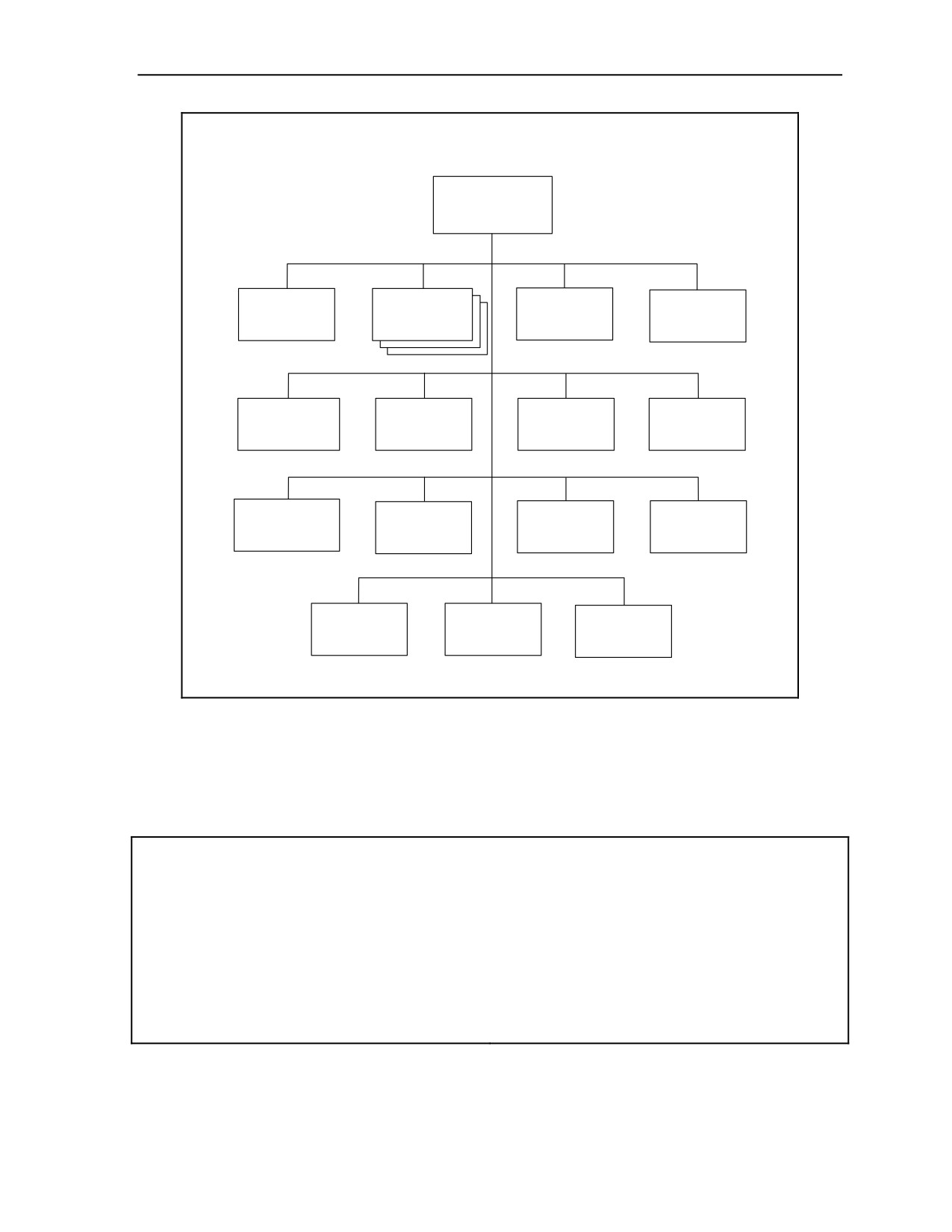
Building an OPFOR Task Organization
Separate Motorized Infantry Brigade ______________________
SEPARATE
MOTORIZED
INF BDE
MOTORIZED
TANK
LIGHT TANK
BRIGADE
INFANTRY
BATTALION
BATTALION
HQ
BATTALION
(41-Tank)
(41-Tank)
ANTITANK
COMPOSITE
RECON
SNIPER
BATTALION
ARTILLERY
BATTALION
PLATOON
(Div)
BN (Sep)
(Mtzd)(Sep)
AIR DEFENSE
ENGINEER
MATERIEL
MAINT
BATTALION
BATTALION
SUPPORT
BATTALION
(Mtzd) (Sep)
(Sep)
BATTALION
(APC/Mtzd)
SIGNAL
CHEMICAL
MEDICAL
COMPANY
DEFENSE
COMPANY
(Sep)
CO (Sep)
(Sep)
Figure B-2. Separate Motorized Infantry Brigade from AFS to Use as a Baseline Unit
B-17. The separate motorized infantry brigade already contains many of the units required for the BTG
(Mtzd) (Antiarmor-Lt) task organization. The task-organizing process has determined that the BTG
consists of the specific units listed in table B-2.
Table B-2. Specific Units Required for BTG Task Organization
BTG Headquarters (based on Bde HQ)
SPF Deep Attack/Recon Platoon
Motorized Infantry Battalion (x2)
Air Defense Battalion (Motorized)
Mechanized Infantry Battalion (APC)
Engineer Battalion (Sep)
Guerrilla Battalion (Hunter/Killer)
Materiel Support Battalion
Antitank Battalion (Div)
Maintenance Battalion (APC/Motorized)
Composite Artillery Battalion (Sep)
Signal Company (Sep)
Reconnaissance Battalion (Motorized) (Sep)
Chemical Defense Company (Sep)
SPF Company
Medical Company (Sep)
Sniper Company
3 May 2007
FM 7-100.4
B-5
Appendix B
Note. For simplicity, all of the units forming the BTG task organization in this example are
constituent to the BTG. The local insurgent group is affiliated with the BTG, but it is not part of
the BTG. For additional information on command relationships see chapter 3. Also see chapter 2
for an explanation of the “(Div)” and “(Sep)” designations following the names of some units
(usually battalions or companies) in the AFS.
Note. In this example, again for the sake of simplicity, none of the battalions or companies in the
BTG have been task-organized into detachments. In reality, such task-organizing of subordinate
units could very well be required in order to produce the right challenge to the training unit’s
METL. In that case, training planners creating the OPFOR order of battle (OB) would have to
start from the bottom up—first creating the necessary task organizations at the lowest levels of
organization and then rolling them up into the personnel and equipment totals for the overall
task organization. For example, rather than exchanging its original sniper platoon for a sniper
company, the brigade becoming a BTG could have received a standard sniper company and then
added its own sniper platoon to that company to create an augmented company-size detachment
(CDET). See the Building from the Bottom Up section later in this appendix.
Local Insurgent Organization
B-18. The AFS organizational directories include a “typical” local insurgent organization. (See figure B-3.)
This baseline organization shows the various types of cells often found in insurgent organizations.
However, the dashed boxes in the organizational chart indicate possible variations in the numbers of cells
of each type that might be present in a particular insurgent organization. These cell types represent the
various functions that can contribute to the OPFOR countertasks in this example.
Noncombatants
B-19. This task organization does not include all the players in the COE or even on the battlefield. At a
minimum, other players include armed and unarmed noncombatants. They are an integral part of the
operational environment and cannot be excluded. Examples of common types of noncombatants can also
be found in the organizational directories. The types, behaviors, and impact of such noncombatants are
discussed in detail in FM 7-100.3.
B-6
FM 7-100.4
3 May 2007
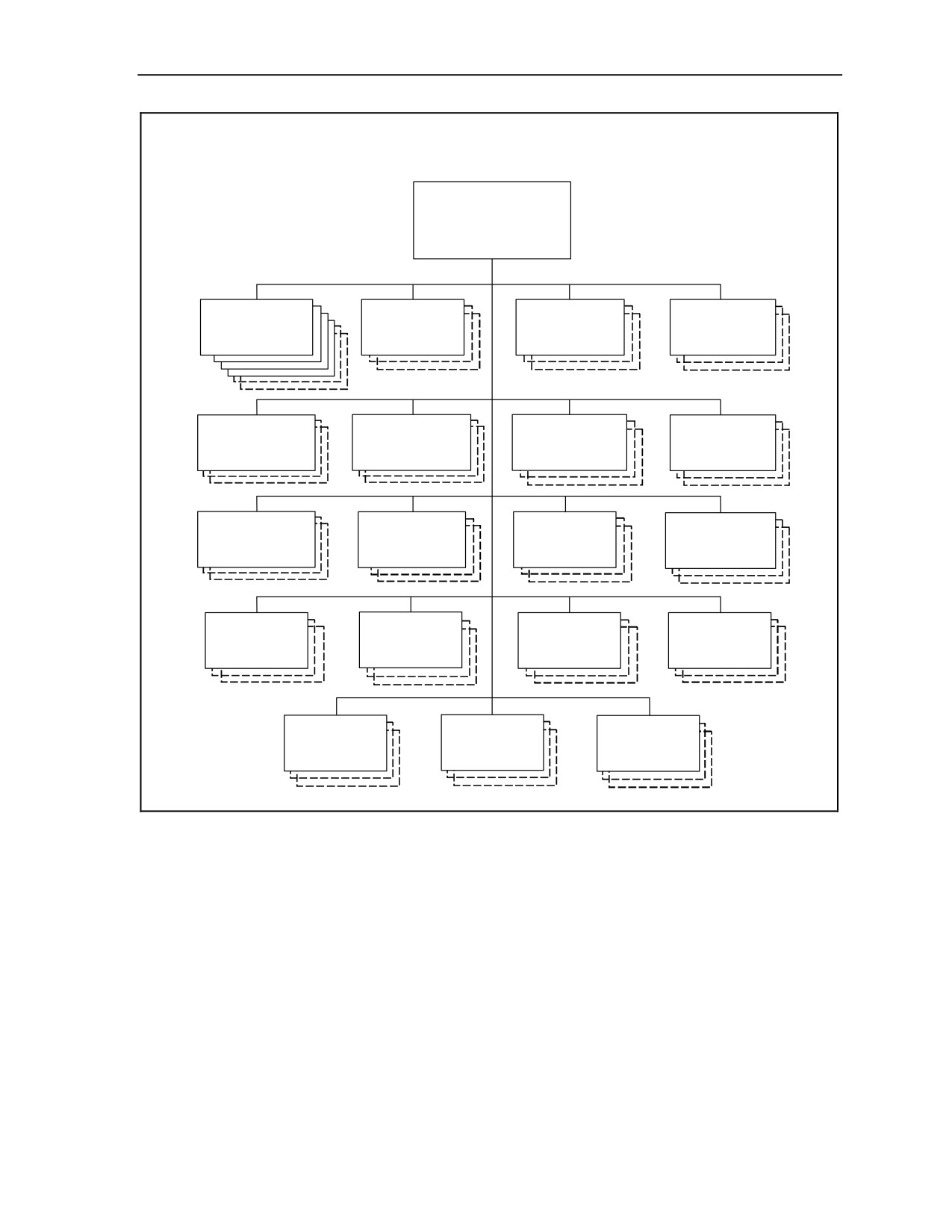
Building an OPFOR Task Organization
Local Insurgent Organization (Typical) _________________________
LOCAL
INSURGENT
ORGANIZATION
DA CELL
DA CELL
DA CELL
DA CELL
(Multi-
(Assassin/
(Kidnapping
(Information
Function)
Sniper)
& Extortion)
Warfare)
DA CELL
CI & INTERNAL
INTELLIGENCE
PLANNING
(Mortar
SECURITY
CELL
CELL
& Rocket)
CELL
INFORMATION
TECHNICAL
COMMS &
LOGISTICS
WARFARE
SUPPORT
TRADECRAFT
CELL
CELL
CELL
CELL
SHELTER
FINANCE
TRAINING
RECRUITING
CELL
CELL
CELL
CELL
(Safe Houses)
CIVIL
TRANSPORT
MEDICAL
AFFAIRS
CELL
CELL
CELL
Figure B-3. Local Insurgent Organization from AFS to Use as a Baseline Unit
STEP 9. CONSTRUCT THE TASK-ORGANIZED BTG
B-20. There are several differences between the final task-organized BTG (Mtzd) (Antiarmor-Lt) and the
AFS separate motorized infantry brigade. Not all units originally subordinate to a standard separate
motorized infantry brigade will be needed to complete the task organization, while additional units will be
added to provide countertasks to the selected ARTs. Higher headquarters will allocate or re-allocate units
depending on their need in the task-organized unit. In this task-organizing process, the AFS separate
motorized infantry brigade—
Loses the two tank battalions. Transferred back to higher headquarters and possibly allocated to
another task organization.
Loses one motorized infantry battalion. Transferred back to higher and possibly allocated to
another task organization.
3 May 2007
FM 7-100.4
B-7