FM 7-100.4 Opposing Force. Organization Guide (MAY 2007) - page 1
FM 7-100.4
Field Manual
Headquarters
Department of the Army
No. 7-100.4
Washington, DC, 3 May 2007
Opposing Force Organization Guide
Contents
Page
PREFACE
v
INTRODUCTION
vi
Chapter 1
OPFOR ROLES AND RELATIONSHIPS IN TRAINING
2-1
OPFOR for the Contemporary Operational Environment
2-1
Role in Training
2-1
Tie-In with Other Manuals in the FM 7-100 Series
2-2
Chapter 2
ADMINISTRATIVE FORCE STRUCTURE
2-1
Section I - Nation-State Forces: Strategic Level
2-1
National-Level Command Structure
2-1
Service Components
2-2
Theater Headquarters
2-6
Section II - Nation-State Forces: Operational Level
2-7
Section III - Nation-State Forces: Tactical Level
2-8
Divisions
2-8
Maneuver Brigades
2-8
Battalions
2-8
Companies
2-9
Platoons
2-9
Aviation Units
2-9
Nondivisional Units
2-9
Section IV - Non-State Actors
2-9
Paramilitary Organizations
2-9
Noncombatants
2-13
Section V - Organizational Directories
2-14
Files for OPFOR Units
2-15
Folders for OPFOR Unit Files
2-19
Distribution Restriction: Approved for public release; distribution is unlimited.
3 May 2007
i
Contents
Chapter 3
TASK-ORGANIZING
3-1
Section I − Fundamental Considerations
3-1
U.S. Training Requirements
3-1
OPFOR Doctrine
3-2
Section II - Nation-State Forces: Strategic Level
3-4
Supreme High Command
3-4
Strategic Framework
3-5
Section III - Nation-State Forces: Operational Level
3-5
Field Group
3-6
Operational-Strategic Command
3-7
Section IV - Nation-State Forces: Tactical Level
3-12
Tactical Groups
3-12
Detachments
3-14
Integrated Fires Command
3-15
Integrated Support Command
3-16
Internal Task-Organizing
3-16
Special-Purpose Forces
3-17
Internal Security Forces
3-17
Section V − Non-State Actors
3-18
Insurgent and Guerrilla Forces
3-18
Other Paramilitary Forces
3-18
Noncombatants
3-19
Section VI - Exploitation of Noncombatants and Civilian Assets
3-20
By Military Forces
3-20
By Paramilitary Forces
3-21
Section VII − Unit Symbols for OPFOR Task Organizations
3-21
Section VIII − Building an OPFOR Order of Battle
3-23
Step 1. Determine the Type and Size of U.S. Units
3-23
Step 2. Set the Conditions
3-23
Step 3. Select Army Tactical Tasks
3-23
Step 4. Select OPFOR Countertasks
3-24
Step 5. Determine the Type and Size of OPFOR Units
3-24
Step 6. Review the AFS Organizational Directories
3-24
Step 7. Compile the Initial Listing of OPFOR Units for the Task Organization.3-24
Step 8. Identify the Base Unit
3-24
Step 9. Construct the Task Organization
3-25
Step 10. Repeat Steps 4 through 9 as Necessary
3-25
Chapter 4
EQUIPMENT OPTIONS
4-1
Baseline Equipment
4-1
Worldwide Equipment Guide
4-4
Appendix A
ADMINISTRATIVE FORCE STRUCTURE ORGANIZATIONAL DIRECTORIES
LISTING
A-1
Volume I - Divisions and Divisional Units
A-1
Volume II - Nondivisional Units
A-4
ii
FM 7-100.4
3 May 2007
Contents
Volume III - Paramilitary and Nonmilitary Actors
A-6
Volume IV - Other
A-7
Appendix B
BUILDING AN OPFOR TASK ORGANIZATION
B-1
Task Organization Example
B-1
Building from the Bottom Up
B-30
Appendix C
LOCAL INSURGENT ORGANIZATION FROM THE AFS ORGANIZATIONAL
DIRECTORIES
C-1
Insurgent Organizations
C-1
Local Insurgent Organization Example
C-1
Appendix D
MOTORIZED INFANTRY COMPANY FROM THE AFS ORGANIZATIONAL
DIRECTORIES
D-1
Infantry and Motorized Infantry Companies
D-1
Motorized Infantry Company Example
D-1
Appendix E
GUERRILLA HUNTER/KILLER COMPANY FROM THE AFS ORGANIZATIONAL
DIRECTORIES
E-1
Guerrilla Organizations
E-1
Guerrilla Hunter/Killer Company Example
E-1
GLOSSARY
Glossary-1
REFERENCES
References-1
INDEX
Index-1
Figures
Figure 2-1. National-Level Command Structure and Service Components
2-2
Figure 2-2. Internal Security Forces in the Ministry of the Interior
2-4
Figure 2-3. Peacetime Administrative Force Structure
2-7
Figure 2-4. Infantry Squad Personnel and Equipment (Example)
2-17
Figure 2-5. Basic Listing of Folders in AFS Organizational Directories
2-20
Figure 3-1. Wartime Fighting Force Structure
3-6
Figure 3-2. Allocation of Forces to an OSC (Example)
3-7
Figure 3-3. Possible OSC Organization (Example)
3-8
Figure 3-4. Possible IFC Components in an OSC
3-9
Figure 3-5. OSC Task Organization, with ISC Example
3-11
Figure 3-6. Possible DTG Organization (Example)
3-13
Figure 3-7. Possible BTG Organization (Example)
3-14
Figure 3-8. Battalion-Size Detachment (BDET) Example
3-15
Figure 3-9. Company-Size Detachment (CDET) Example
3-15
Figure 3-10. Possible IFC Components in a DTG
3-16
Figure 3-11. OSC Symbol
3-21
Figure 3-12. Motorized Infantry-Based DTG Symbol
3-21
Figure 3-13. Mechanized Infantry-Based DTG Symbol
3-22
3 May 2007
FM 7-100.4
iii
Contents
Figure 3-14. Tank-Based BTG Symbol
3-22
Figure 3-15. Heliborne Infantry-Based BDET Symbol
3-22
Figure 3-16. Attack Helicopter-Based BDET Symbol
3-22
Figure 3-17. Mechanized Infantry-Based CDET Symbol
3-23
Figure 4-1. Motorized Infantry Company Principal Items of Equipment List
4-2
Figure 4-2. Motorized Infantry Company Personnel and Equipment Chart
4-3
Figure B-1. Basic Task-Organized OPFOR (Example)
B-3
Figure B-2. Separate Motorized Infantry Brigade from AFS to Use as a Baseline Unit
B-5
Figure B-3. Local Insurgent Organization from AFS to Use as a Baseline Unit
B-7
Figure B-4. Folders for Task Organization
B-9
Figure B-5. Brigade Tactical Group (Motorized) (Antiarmor-Light)
B-12
Figure B-6. Rows 1 and 2
B-13
Figure B-7. BTG (Mtzd) (Antiarmor-Lt) Personnel and Equipment List, Page 1
B-19
Figure B-8. BTG (Mtzd) (Antiarmor-Lt) Personnel and Equipment List Continued,
Page 2
B-20
Figure B-9. BTG (Mtzd) (Antiarmor-Lt) Personnel and Equipment List Continued,
Page 3
B-21
Figure B-10. BTG (Mtzd) (Antiarmor-Lt) Personnel and Equipment List Continued,
Page 4
B-22
Figure B-11. BTG (Mtzd) (Antiarmor-Lt) Personnel and Equipment List Continued,
Page 5
B-23
Figure B-12. Folders and Files for Task Organization
B-25
Figure B-13. Folders and Files for Task Organization (Continued)
B-26
Figure B-14. Local Insurgent Organization (Affiliated)
B-28
Figure B-15. Local Insurgent Organization Equipment (Affiliated)
B-29
Tables
Table 3-1. Command and Support Relationships
3-3
Table 4-1. Equipment Tier Table (Example)
4-9
Table 4-2. Systems Substitution Matrix (Example)
4-11
Table B-1. Initial Listing of OPFOR Units Required for Task Organization
B-4
Table B-2. Specific Units Required for BTG Task Organization
B-5
This publication is available at
General Dennis J. Reimer Training and Doctrine
iv
FM 7-100.4
3 May 2007
Preface
This manual is one of a series that describes an opposing force (OPFOR) for training U.S. Army commanders,
staffs, and units. See the References section for a list of the manuals in this series. Together, these manuals
outline an OPFOR that can cover the entire spectrum of military and paramilitary capabilities against which the
Army must train to ensure success in any future conflict.
Applications for this series of manuals include field training, training simulations, and classroom instruction
throughout the Army. All Army training venues should use an OPFOR based on these manuals, except when
mission rehearsal or contingency training requires maximum fidelity to a specific real-world threat. Even in the
latter case, trainers should use appropriate parts of the OPFOR manuals to fill information gaps in a manner
consistent with what they do know about a specific threat.
This publication applies to the Active Army, the Army National Guard/Army National Guard of the United
States, and the United States Army Reserve unless otherwise stated.
The proponent for this publication is the United States Army Training and Doctrine Command (TRADOC).
Send comments and recommendations on DA Form
2028 directly to the Contemporary Operational
Environment and Threat Integration Directorate (CTID), TRADOC Intelligence Support Activity (TRISA)-
Threats, of the TRADOC Office of Deputy chief of Staff for Intelligence (DCSINT) at the following address:
Director, CTID, TRISA-Threats, ATTN: ATIN-T (Bldg 53), 700 Scott Avenue, Fort Leavenworth, KS 66027-
1323.
This publication is available at Army Knowledge Online (AKO) at http://www.us.army.mil and linked to online
organizational directories on the Battle Command Knowledge System
threats.leavenworth.army.mil/COE/default.aspx. Readers should monitor those sites for the status of this
manual and information regarding updates. Periodic updates, subject to the normal approval process, will occur
as a result of the normal production cycle in accordance with TRADOC regulation 25-36, paragraphs 2-17 and
4-7. The date on the cover and title page of the electronic version will reflect the latest update.
Unless this publication states otherwise, masculine nouns or pronouns do not refer exclusively to men.
3 May 2007
FM 7-100.4
v
Introduction
This manual is part of the FM 7-100 series, which describes an opposing force (OPFOR) that exists for the
purpose of training U.S. forces for potential combat operations. This OPFOR reflects the characteristics of
military and paramilitary forces that may be present in the contemporary operational environment (COE).
Like those real-world threats, the OPFOR will continue to present new and different challenges for U.S.
forces. The COE is constantly changing, and it is important for U.S. Army training environments to keep
pace with real-world developments. This manual differs from others in the FM 7-100 series in that it
includes both OPFOR doctrine regarding organization (administrative force structure and task-organized
fighting force structure) and training-related issues from a U.S. viewpoint.
This organization guide also differs from other FMs in the fact that it is linked to online organizational
directories. TRADOC DCSINT maintains these directories and continuously updates them, as necessary, to
represent contemporary and emerging capabilities. In order to provide a comprehensive menu of the
numerous types of OPFOR organizations in the detail required for the Army’s live, virtual, and
constructive training environments, these directories exceed the scope and size that can be accommodated
within a traditional FM format. The directories contain over 10,000 pages detailing OPFOR organizations.
From this menu, users can select and download just those parts needed to build the appropriate OPFOR for
a particular exercise. Task-organizing an exercise order of battle also requires that users have the ability to
use downloaded organizations in an interactive manner. For these reasons, it is necessary for this FM to be
linked to organizational diagrams and associated equipment inventories made available in electronic form
that users can download and manipulate as necessary in order to create task organizations capable of
fighting in adaptive ways that typify the COE.
CONTEMPORARY OPERATIONAL ENVIRONMENT
In planning a training scenario and its road to war, trainers need to take into consideration the entire
operational environment (OE) and its impact on the OPFOR’s order of battle (OB). The DOD officially
defines an operational environment as “a composite of the conditions, circumstances, and influences that
affect the employment of capabilities and bear on the decisions of the commander” (JP 1-02 and JP 3-0).
The contemporary operational environment (COE) is the synergistic combination of all the critical
variables and actors that create the conditions, circumstances, and influences that can affect military
operations today and in the near- and mid-term.
The COE has a direct impact on the architecture and capabilities of OPFOR organizations. Proper task-
organizing can either mitigate or exploit the environment by the proper selection of organization and/or
equipment. This enables the appropriate OPFOR to perform countertasks that challenge the ability of U.S.
units to perform the tasks in their mission essential task list (METL) in training environments.
The COE is the holistic view of the environment in the near- and mid-term that comprises the conditions,
circumstances, and influences that affect the training and employment of military forces. Analysis of the
COE focuses on eight interrelated variables:
Political.
Military.
Economic.
Social.
Information.
Infrastructure.
Physical environment.
Time.
3 May 2007
FM 7-100.4
vi
Introduction
An assessment of these critical variables and their relationships helps to understand any OE and its impact
on the Army.
The COE is particularly valuable in training. In order to develop adaptive leaders capable of operating in
any OE, the Army requires challenging training scenarios, an OPFOR model, and OPFOR doctrine. This
provides an adaptive, asymmetric OPFOR in order to train, develop, and prepare Soldiers and leaders to
overcome threats in a complex and adaptive OE. It also provides a benchmark to measure training
effectiveness and combat development activities. See FM 3-0.2 (to be published) for further discussion of
the COE and its application to training.
REAL WORLD
In the real world, the COE is the entire set of conditions, circumstances, and influences that U.S. Armed
Forces can expect to face when conducting military operations to further the interests of the United States,
its friends, and allies. The COE is “contemporary” in the sense that it does not represent conditions that
existed only in the past or that might exist only in the remote future, but rather those conditions that exist
today and in the clearly foreseeable near- and mid-term future. This COE consists not only of the military
and/or paramilitary capabilities of potential real-world adversaries, but also of the manifestations of the
seven other variables that help define any OE.
TRAINING
In training environments, the COE is the OE created to approximate the demands of the real-world COE
and to set the conditions for desired training outcomes. This involves the appropriate combination of an
OPFOR (with military and/or paramilitary capabilities representing a composite of a number of potential
adversaries) and other OE variables in a realistic, feasible, and plausible manner. The purpose of the COE
in training simulations is to produce the necessary training outcomes.
Note. The same type of COE conditions can be created to support some combat development
activities that do not require simulation of a specific real-world potential adversary. However,
some combat development activities may require portrayal of an OE that extends further into the
future than is typical for the COE; in that case, they are dealing with the future operational
environment (FOE).
OPPOSING FORCE
As a training tool, the OPFOR must be a challenging, uncooperative sparring partner capable of stressing
any or all warfighting functions and mission-essential tasks of the U.S. force. Training for the COE
requires an OPFOR that is “a plausible, flexible military and/or paramilitary force representing a composite
of varying capabilities of actual worldwide forces, used in lieu of a specific threat force, for training and
developing U.S. forces” (Army Regulation 350-2). This manual introduces the baseline organizational
structures of a flexible, thinking, adaptive OPFOR.
As the real-world conditions and capabilities change over time, OPFOR doctrine, organizations, and
equipment capabilities will evolve along with them, to continue to provide the Army an OPFOR
appropriate for the COE. Thus, the OPFOR will remain capable of presenting realistic and relevant
challenges that are appropriate to meet evolving training requirements at any given point in time.
3 May 2007
FM 7-100.4
vii
Chapter 1
OPFOR Roles and Relationships in Training
An opposing force (OPFOR) is a training tool that should allow the U.S. Army to
train against a challenging and plausible sparring partner that represents the range of
possible opponents the Army could face in actual conflict. It enables training of all
arms of the Army and prepares the Army for potential combat operations.
OPFOR FOR THE CONTEMPORARY OPERATIONAL
ENVIRONMENT
1-1. Training U.S. forces for the contemporary operational environment (COE) requires a different kind
of OPFOR from that of the past. The OPFOR must be less predictable and not based on the armed forces of
a particular country or non-state actor. In today’s world, the U.S. Army must be prepared to go into any
operational environment (OE) and perform its full range of missions. It must be ready to do so in the face
of a wide variety of possible threats and at the same time be prepared to deal with third-party actors that
may have other interests. Not all threats are purely military in nature. Therefore, the U.S. Army now
defines an OPFOR as “a plausible, flexible military and/or paramilitary force representing a composite of
varying capabilities of actual worldwide forces, used in lieu of a specific threat force, for training and
developing U.S. forces” (Army Regulation 350-2).
1-2. In some training environments, a military force or a paramilitary force alone may be the OPFOR. In
other cases, military forces may have paramilitary forces acting in loose affiliation with them, or acting
separately from them within the same training environment. These relationships depend on the scenario,
which is driven by training requirements.
1-3. Various agencies and experts have different lists of real-world threats the United States might have
to face. If the U.S. Army were to pick any one of these threats as the threat against which to train, that
threat would almost certainly not be the one that all Army forces would actually fight. What is needed is a
composite that is representative of the full range and variety of possible threats and OEs. It must have a bit
of everything⎯it could be virtually anybody, anywhere. Therefore, this manual is linked to directories of
organizations that provide a representative composite of real-world military and paramilitary organizations.
With this composite as a baseline, trainers have the flexibility to task-organize and adjust the capabilities of
an OPFOR to fit the most demanding U.S. Army training requirements and provide a framework for
training that creates the leaders, soldiers, and unit skills necessary for success on the next
battlefield⎯wherever that might be.
ROLE IN TRAINING
1-4. As a training tool, the OPFOR must be a challenging, uncooperative sparring partner, capable of
stressing any or all warfighting functions and mission-essential tasks of the U.S. force. However, it must
also be tailored to meet specific training requirements.
Note. Although the OPFOR is primarily a training tool, it may be used for other purposes. For
example, some combat development activities that do not require simulation of a specific real-
world potential adversary may use an OPFOR to portray the “threat” or “enemy.”
1-5. As a baseline for developing specific OPFORs for specific training environments, this manual
describes an OPFOR that is representative of the forces of contemporary nation-states and non-state actors.
This composite of the characteristics of real-world military and paramilitary forces provides a framework
for the realistic and relevant portrayal of capabilities that U.S. forces might face in the COE. This manual is
3 May 2007
FM 7-100.4
1-1
Chapter 1
applicable to the entire U.S. Army training community, including the OPFORs at all of the combat training
centers, the TRADOC schools, and units in the field.
1-6. The FM 7-100 series, as a whole, covers not only the military and paramilitary forces of a nation-
state, but also other, non-state paramilitary organizations and nonmilitary actors that might be present in a
region of the world. The Unites States, as an extraregional power becoming involved in such a region,
might have to deal with any or all of these types of military, paramilitary, and nonmilitary elements. It
might encounter these elements individually or, more likely, in combination with other such elements.
Whether these elements operate in concert or independently, they are an important part of the COE.
1-7. Trainers need to consider the total OE⎯not just the military or threat dimension⎯in designing
training environments. All the other critical variables can affect the overall OE and the military,
paramilitary, and nonmilitary entities that are part of it.
1-8. The baseline OPFOR organizations linked to this manual no not constitute an OPFOR order of battle
(OB). Rather, they provide a framework from which trainers can develop a specific OPFOR OB
appropriate for their particular training requirements. Within this framework, scenario writers and exercise
designers have considerable flexibility in determining what the OPFOR actually has at a given point in
time or a given place on the battlefield⎯in a particular scenario. In some cases, an organization taken
straight from the OPFOR administrative force structure may meet the requirements for a particular U.S.
Army training environment. In most cases, however, it will be necessary to task-organize the OPFOR
organizations in order to portray the right mix of units and equipment for stressing the mission essential
task list (METL) of U.S. units in particular training environments.
1-9. Thus, the baseline organizations presented in the organizational directories linked to this manual are
intended to be tailored and task-organized in a manner that is appropriate for the training objectives.
Depending on the training requirement, the OPFOR may be a large, medium, or small force. Its technology
may be state-of-the-art, relatively modern, obsolescent, obsolete, or an uneven combination of these
categories. Its ability to sustain operations may be limited or robust.
1-10. During the road to war leading up to events in a training scenario, the OPFOR may play the role of a
“threat” (potential enemy) that is on the verge of becoming an enemy. However, the actual training event
usually deals with a state of hostilities. Thus, once hostilities begin in the training event, the OPFOR acts as
the “enemy” of the U.S. force in the training environment.
TIE-IN WITH OTHER MANUALS IN THE FM 7-100 SERIES
1-11. This organization guide is meant to be used in conjunction with other manuals in the FM 7-100
series. Together, these manuals outline an OPFOR that can cover the entire spectrum of military and
paramilitary capabilities against which the Army must train to ensure success in the types of OEs it can
expect to encounter in the clearly foreseeable future.
OPFOR STRATEGY, OPERATIONS, AND TACTICS
1-12. This organization guide ties in with the national-level organizations described in detail in FM 7-100,
Opposing Force Doctrinal Framework and Strategy. Organizations from the OPFOR administrative force
structure (found in the online directories linked to this manual) should be task-organized in accordance
with OPFOR doctrine in FM 7-100.1, Opposing Force Operations, and FM 7-100.2, Opposing Force
Tactics.
PARAMILITARY ORGANIZATIONS AND NONMILITARY ACTORS
1-13. This organization guide ties in with FM 7-100.3, Opposing Force: Paramilitary Organizations and
Nonmilitary Actors (to be published) .See that manual for more detail on the nature and activities of such
actors.
1-2
FM 7-100.4
3 May 2007
OPFOR Roles and Relationships in Training
WORLDWIDE EQUIPMENT GUIDE
1-14. Chapters 3 and 4 each provide a link to the Worldwide Equipment Guide (WEG) online. The WEG
contains equipment data, tier tables, and substitution matrices for the various categories of equipment
found in OPFOR organizations. Training planners can employ the tier tables and substitution matrices in
the WEG to find appropriate substitutes for baseline equipment shown in the organizational directories.
Within each functional category of equipment, there are four tiers representing different levels of
capability, with Tier 1 representing the highest level of capability and modernity. The WEG also contains
technical data on the capabilities of systems identified as
“Principal Items of Equipment” in the
organizational directories and/or listed in the tier tables.
3 May 2007
FM 7-100.4
1-3
Chapter 2
Administrative Force Structure
This chapter and the organizational directories to which it is linked provide the
administrative force structure (AFS) to be used as the basis for OPFOR organization
in all Army training, except real-world-oriented mission rehearsal exercises. This
includes the forces of nation-state actors as well as key non-state actors. In most
cases, the organizations found in the AFS will require task-organizing (see chapter 3)
in order to construct an OPFOR order of battle appropriate for a training event.
SECTION I - NATION-STATE FORCES: STRATEGIC LEVEL
2-1. When the OPFOR consists of or includes the military and/or paramilitary forces of a nation-state, the
national-level structure of that state, including the overall military and paramilitary structure, should follow
the patterns described in FM 7-100. Those patterns are summarized here. (See FM 7-100 for more detail.)
2-2. The FM 7-100 series refers to the country in question as “the State.” In specific U.S. Army training
environments, however, the generic name of the State may give way to other fictitious country names used
in the specific training scenarios. (See Army Regulation 350-2 for additional guidance concerning the use
of country names in a scenario.) The State possesses various military and paramilitary forces with which to
pursue its national interests. This section of chapter 2 describes the national-level command structure and
the various services that control these forces.
2-3. The State’s Armed Forces have an administrative force structure (AFS) that manages military forces
in peacetime. This AFS is the aggregate of various military headquarters, organizations, facilities, and
installations designed to man, train, and equip the forces. Within the AFS, tactical-level commands have
standard organizational structures (as depicted in the organizational directories). However, these AFS
organizations normally differ from the OPFOR’s wartime fighting force structure. (See chapter 3 on Task-
Organizing.)
2-4. The AFS includes all components of the Armed Forces⎯not only regular, standing forces (active
component), but also reserve and militia forces (reserve component). For administrative purposes, both
regular and reserve forces come under the headquarters of their respective service component. Each of the
six service components is responsible for manning, equipping, and training of its forces and for organizing
them within the AFS.
NATIONAL-LEVEL COMMAND STRUCTURE
2-5. The State employs its military forces, along with its other instruments of power, to pursue its tactical,
operational, and strategic goals and, thus, support its national security strategy. The national-level
command structure includes the National Command Authority, the Ministry of Defense, and the General
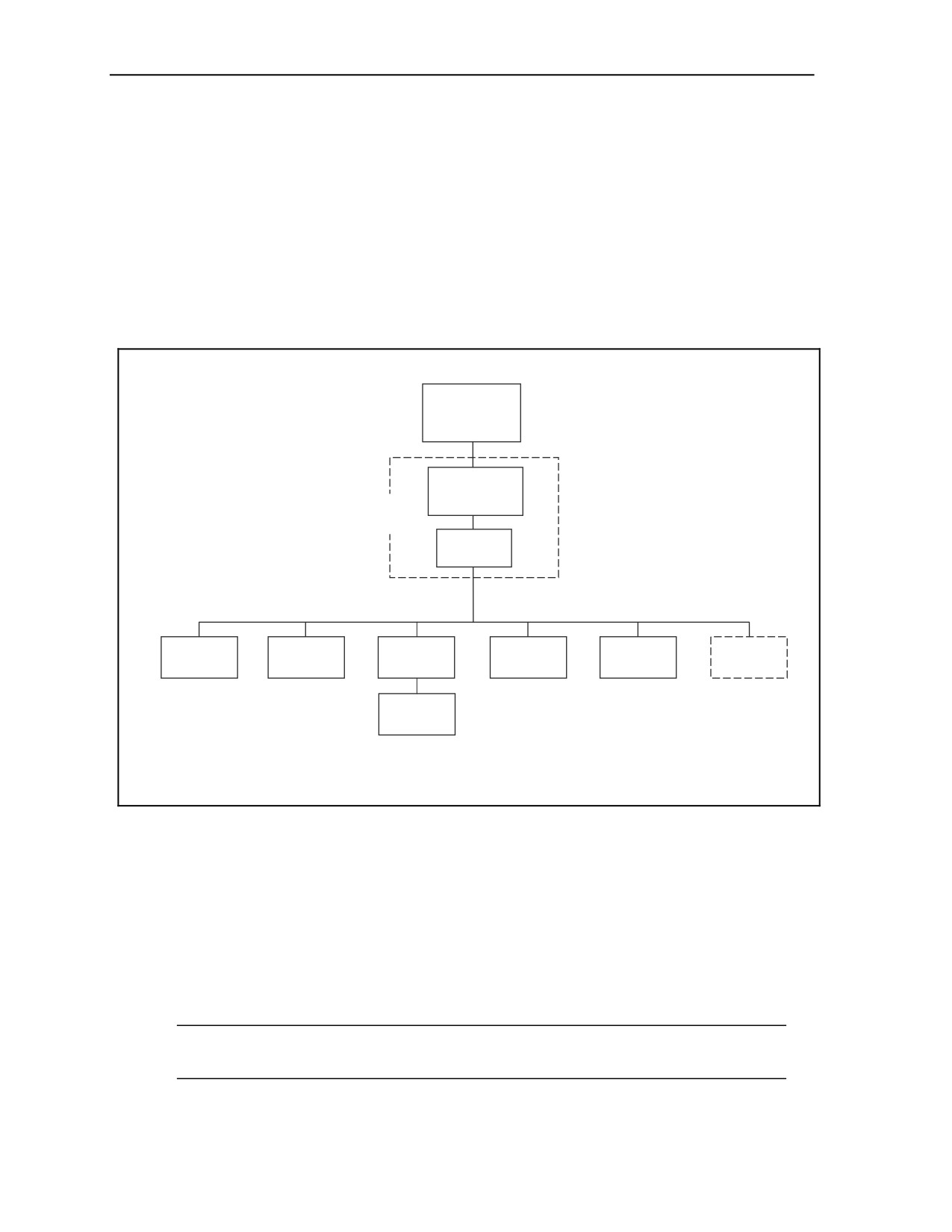
Staff. (See figure 2-1 on page 2-2.)
NATIONAL COMMAND AUTHORITY
2-6. The National Command Authority
(NCA) exercises overall control of the application of all
instruments of national power in planning and carrying out the national security strategy. The NCA
allocates forces and establishes general plans for the conduct of national strategic campaigns. The NCA
exercises control over the makeup and actions of the Armed Forces through the Ministry of Defense and
the General Staff.
3 May 2007
FM 7-100.4
2-1
Chapter 2
MINISTRY OF DEFENSE
2-7. The Ministry of Defense (MOD) is responsible for the day-to-day administration of the Armed
Forces and for the readiness and overall development of the six service components of the Armed Forces.
However, the General Staff has direct control over the six services. In wartime, the MOD merges with the
General Staff to form the Supreme High Command (SHC).
GENERAL STAFF
2-8. The General Staff is a major link in the centralization of military command at the national level,
since it provides staff support and acts as the executive agency for the NCA. Together with the MOD, the
General Staff forms the SHC in wartime. The General Staff has direct control over the six services, and all
military forces report through it to the NCA. The Chief of the General Staff commands the SHC.
NATIONAL
COMMAND
AUTHORITY
MINISTRY OF
DEFENSE
SUPREME
HIGH COMMAND
GENERAL
STAFF
INTERNAL
STRATEGIC
SPF
ARMY
NAVY
AIR FORCE
SECURITY
FORCES
COMMAND
FORCES*
AIR
DEFENSE
FORCES
*In peacetime, the Internal Security Forces are subordinate to the Ministry of the Interior.
In wartime, some or all these forces may be resubordinated to the SHC.
Figure 2-1. National-Level Command Structure and Service Components
SERVICE COMPONENTS
2-9. The Armed Forces generally consist of six services. These include the Army, Navy, Air Force
(which includes the national-level Air Defense Forces), Strategic Forces (with long-range rockets and
missiles), Special-Purpose Forces (SPF) Command, and Internal Security Forces. The Internal Security
Forces are subordinate to the Ministry of the Interior in peacetime, but become subordinate to the SHC in
time of war. The Armed Forces field some reserve component forces in all services, but most reserve
forces are Army forces. Militia forces belong exclusively to the ground component.
Note. Regular, reserve, and militia forces of the State can maintain various relationships with
insurgent, guerrilla, and possibly criminal organizations.
2-2
FM 7-100.4
3 May 2007
Administrative Force Structure
ARMY
2-10. The Army includes tank, mechanized infantry, motorized infantry, and a small number of airborne
and special-purpose forces (Army SPF). The Army fields both rocket and tube artillery to support ground
operations. The Army also has some long-range rockets and surface-to-surface missiles (SSMs). Fire
support capability includes attack helicopters of Army aviation. The Army is assigned large numbers of
shoulder-fired surface-to-air missiles (SAMs) and will also have mobile air defense units in support.
NAVY
2-11. The State maintains a regional force-projection navy with a significant access-control capability built
on small surface combatants, submarines, surface- and ground-based antiship missile units, and antiship
mines. The Navy has a limited amphibious capability and possesses naval infantry capable of conducting
forcible entry against regional opponents. The Navy also fields organic Special-Purpose Forces (Naval
SPF).
Note. If the State in a particular scenario is a landlocked country, it may not have a navy.
AIR FORCE
2-12. The Air Force, like the Navy, is fundamentally a supporting arm. Its aircraft include fighters,
bombers, tactical transport, tankers, airborne early warning aircraft, electronic warfare (EW) aircraft,
reconnaissance aircraft, and auxiliaries. The State’s national-level Air Defense Forces are subordinate to
the Air Force. Similar to other services, the Air Force has its own organic Air Force SPF.
STRATEGIC FORCES
2-13. The Strategic Forces consist of long-range rocket and missile units. The missiles of the Strategic
Forces are capable of delivering chemical, biological, radiological, and nuclear (CBRN) munitions, and the
NCA is the ultimate CBRN release authority. The State considers the Strategic Forces capability, even
when delivering conventional munitions, the responsibility of the NCA. Therefore, the NCA is likely to
retain major elements of the Strategic Forces under its direct control or under the SHC or a theater
headquarters in wartime. In some cases, the SHC or theater commander may allocate some Strategic Forces
assets down to operational-level commands. Conventionally-armed rocket and missile units may be
assigned directly in support of air, naval, and ground forces.
SPECIAL-PURPOSE FORCES COMMAND
2-14. The SPF Command includes both SPF units and elite commando units. The General Staff or SHC
normally reserves some of these units under its own control for strategic-level missions. It may allocate
some SPF units to subordinate operational or theater commands, but can still task the allocated units to
support strategic missions, if required.
2-15. Four of the five other service components also have their own SPF. In contrast to the units of the
SPF Command, the Army, Navy, and Air Force SPF are designed for use at the operational level. The
Internal Security Forces also have their own SPF units. These service SPF normally remain under the
control of their respective services or a joint operational or theater command. However, SPF from any of
these service components could become part of joint SPF operations in support of national-level
requirements. The SPF Command has the means to control joint SPF operations as required.
2-16. Any SPF units (from the SPF Command or from other service components’ SPF) that have
reconnaissance or direct action missions supporting strategic-level objectives or intelligence requirements
would normally be under the direct control of the SHC or under the control of the SPF Command, which
reports directly to the SHC. Also, any service SPF units assigned to joint SPF operations would
temporarily come under the control of the SPF Command or perhaps the SHC.
3 May 2007
FM 7-100.4
2-3
Chapter 2
2-17. Most of the service SPF units are intended for use at the operational level. Thus, they can be
subordinate to operational-level commands even in the AFS. In peacetime and in garrisons within the State,
SPF of both the SPF Command and other services are organized administratively into SPF companies,
battalions and brigades.
Note. SPF can organize, train, and support local irregular forces (insurgents or guerrillas and
possibly even criminal organizations) and conduct operations in conjunction with them. SPF
missions can also include the use of terror tactics.
INTERNAL SECURITY FORCES
2-18. The State maintains internal security forces to deal with various internal threats to the regime. In
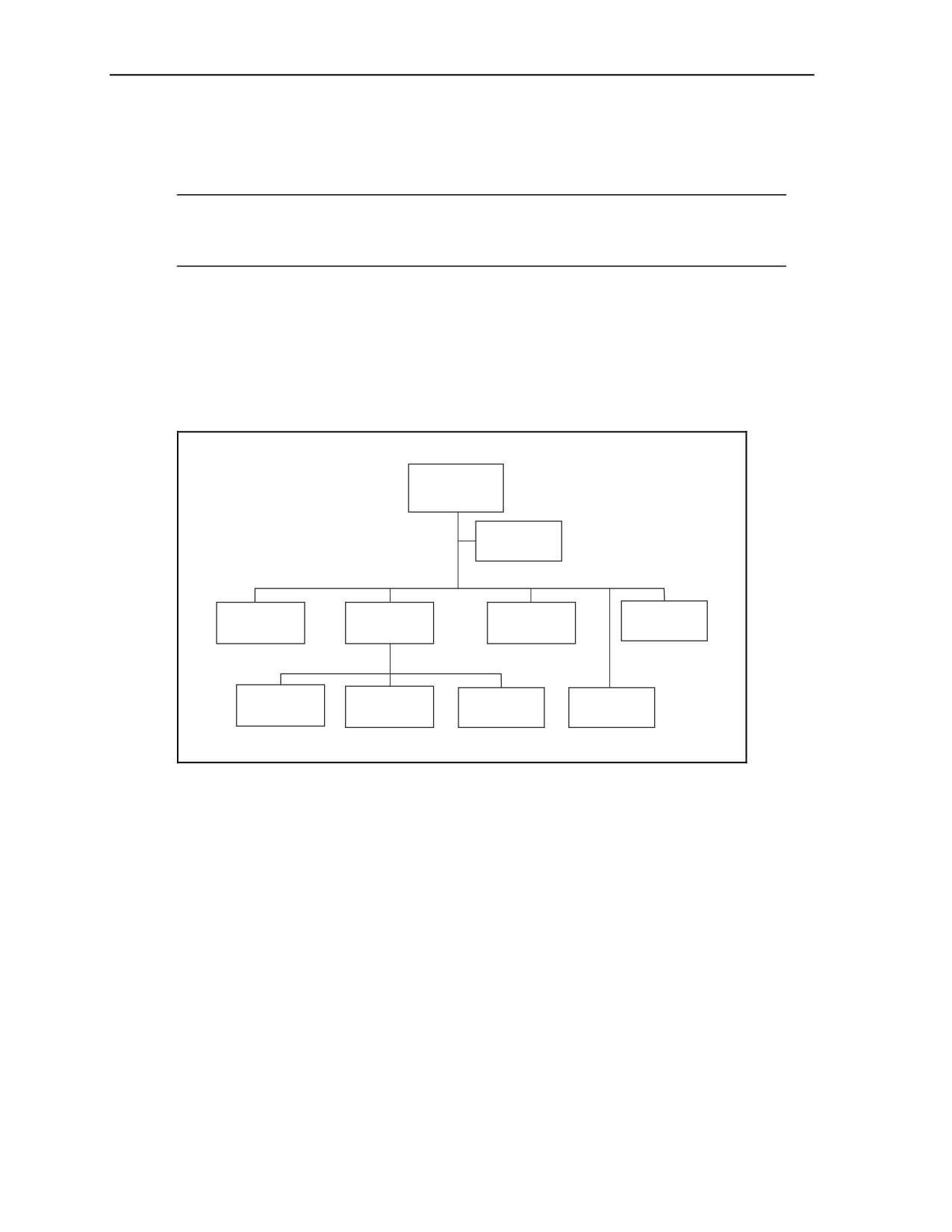
peacetime, the Chief of Internal Security heads the forces within the Ministry of the Interior that fall under
the general label of “internal security forces.” (See figure 2-2.) Most of the internal security forces are
uniformed, using military ranks and insignia similar to those of the other services of the State’s Armed
Forces.
MINISTRY OF
THE
INTERIOR
CHIEF OF
INTERNAL
SECURITY
INTERNAL SECURITY FORCES
STATE
GENERAL
CIVIL
POLITICAL
SECURITY
POLICE
DEFENSE
DIRECTORATE
DIRECTORATE
DIRECTORATE
DIRECTORATE
BORDER
NATIONAL
SPECIAL
GUARD
INTELLIGENCE
SECURITY
PURPOSE
DIRECTORATE
FORCES
FORCES
FORCES
Figure 2-2. Internal Security Forces in the Ministry of the Interior
2-19. During wartime, some or all of the internal security forces from the Ministry of the Interior become
subordinate to the SHC. Thus, they become the sixth service component of the Armed Forces. At that time,
the formal name “Internal Security Forces” applies to all forces resubordinated from the Ministry of the
Interior to the SHC, and the General Staff controls and supervises their activities. The forces
resubordinated to the SHC are most likely to come from the State Security Directorate, the General Police
Directorate, or the Civil Defense Directorate.
State Security Directorate
2-20. The State Security Directorate has elements deployed throughout the State. Many of these elements
are paramilitary units equipped for combat. They include Border Guard Forces, National Security Forces,
and Special-Purpose Forces. Together with the regular Armed Forces, these paramilitary forces help
maintain the State's control over its population in peace and war.
2-21. The Border Guard Forces consist of a professional cadre of officers and noncommissioned officers
(NCOs) supplemented by conscripts and civilian auxiliaries. During war, they may be assigned to a
military unit to guard a newly gained territory or to conduct actions against the enemy. The Border Guard
2-4
FM 7-100.4
3 May 2007
Administrative Force Structure
Forces may also have one or more independent special border battalions. These constitute an elite
paramilitary force of airborne-qualified personnel trained in counterterrorism and commando tactics. When
the SHC assumes control of Border Guard Forces in wartime, the General Staff provides overarching
administrative and logistics support in the same manner as with a regular military force.
2-22. The National Security Forces are organized along military lines and equipped with light weapons
and sometimes heavy weapons and armored vehicles. This organization conducts liaison with other internal
security forces and with other services of the State’s Armed Forces and may combine with them to conduct
certain actions. An operational-level command of the State’s Armed Forces may include one or more
security brigades to augment its military capability. This type of brigade not only increases the military
combat power, but also offers a very effective and experienced force for controlling the local population.
Security battalions, companies, and platoons are similar to equivalent infantry units in the regular Armed
Forces and can thus be used to augment such forces.
2-23. Within the State Security Directorate, the Ministry of the Interior has its own Special-Purpose Forces
(SPF). These are the most highly-trained and best-equipped of the internal security forces. The State
Security Directorate maintains its SPF units as a strategic reserve for emergency use in any part of the State
or even outside State borders. The commando-type SPF forces can conduct covert missions in support of
other internal security forces or regular military forces. SPF activities may include the formation and
training of an insurgent force in a neighboring country. In wartime, the SHC may use them to secure
occupied territory or to operate as combat troops in conjunction with other services of the Armed Forces.
General Police Directorate
2-24. The General Police Directorate has responsibility for national, district, and local police. In some
circumstances, police forces at all three levels operate as paramilitary forces. They can use military-type
tactics, weapons, and equipment. National Police forces include paramilitary tactical units that are
equipped for combat, if necessary. These uniformed forces may represent the equivalent of an infantry
organization in the regular Armed Forces. Within the various national- and district-level police
organizations, the special police are the forces that most resemble regular armed forces in their
organization, equipment, training, and missions. Because some special police units are equipped with
heavy weapons and armored vehicles, they can provide combat potential to conduct defensive operations if
required. Thus, special police units could be expected to supplement the Armed Forces in a crisis situation.
Civil Defense Directorate
2-25. The Civil Defense Directorate comprises a variety of paramilitary and nonmilitary units. While the
majority of Civil Defense personnel are civilians, members of paramilitary units and some staff elements at
the national and district levels hold military ranks. Civil Defense paramilitary units are responsible for the
protection and defense of the area or installation where they are located. Even the nonmilitary, civil
engineering units can supplement the combat engineers of the Armed Forces by conducting engineer
reconnaissance, conducting explosive ordnance disposal, and providing force-protection construction
support and logistics enhancements required to sustain military operations.
RESERVES AND MILITIA
2-26. Although all six services can field some reserve forces, most of the reserve forces are Army forces.
All militia forces belong to the Army component. Overall planning for mobilization of reserves and militia
is the responsibility of the Organization and Mobilization Directorate of the General Staff. Each service
component headquarters would have a similar directorate responsible for mobilization of forces within that
service. Major geographical commands (and other administrative commands at the operational level and
higher) serve as a framework for mobilization of reserve and militia forces.
3 May 2007
FM 7-100.4
2-5
Chapter 2
Note. The Army is normally the dominant partner among the services, but relies on the
mobilization of reserve and militia forces to conduct sustained operations. These additional
forces are not as well-trained and -equipped as the standing Army. Militia forces are composed
primarily of infantry and can act in concert with regular forces.
2-27. During mobilization, some reserve personnel serve as individual replacements for combat losses in
active units, and some fill positions (including professional and technical specialists) that were left vacant
in peacetime in deference to requirements of the civilian sector. However, reservists also man reserve units
that are mobilized as units to replace other units that have become combat-ineffective or to provide
additional units necessary for large, sustained operations.
2-28. Like active force units, most mobilized reserve and militia units do not necessarily go to war under
the same administrative headquarters that controlled them in peacetime. Rather, they typically become part
of a task-organized operational- or tactical-level fighting command tailored for a particular mission. In
most cases, the mobilized reserve units would be integrated with regular military units in such a fighting
command. In rare cases, however, a reserve command at division level or higher might become a fighting
command or serve as the basis for forming a fighting command based partially or entirely on reserve
forces.
THEATER HEADQUARTERS
2-29. For the State, a theater is a clearly defined geographic area in which the State’s Armed Forces plan
to conduct or are conducting military operations. Within its region, the State may plan or conduct a
strategic campaign in a single theater or in multiple theaters, depending on the situation. The General Staff
may create one or more separate theater headquarters even in peacetime, for planning purposes. However,
no forces would be subordinated to such a headquarters until the activation of a particular strategic
campaign plan.
Note. The term theater may have a different meaning for the State than for a major extraregional
power, such as the United States. For an extraregional power with global force-projection
capability, a theater is any one of several geographic areas of the world where its forces may
become involved. For the State, however, the only theater (or theaters) in question would be
within the region of the world in which the State is located and is capable of exerting its
regionally-centered power. The extraregional power may not define the limits of this specific
region in exactly the same way that the State defines it, in terms of its own perceptions and
interests. Within its region, the State may plan or conduct a strategic campaign in a single
theater or in multiple theaters, depending on the situation.
2-30. A theater headquarters provides flexible and responsive control of all theater forces. When there is
only one theater, as is typical, the theater headquarters may also be the field headquarters of the SHC, and
the Chief of the General Staff may also be the theater commander. Even in this case, however, the Chief of
the General Staff may choose to focus his attention on national strategic matters and to create a separate
theater headquarters, commanded by another general officer, to control operations within the theater.
2-31. When parts of the strategic campaign take place in separated geographical areas and there is more
than one major line of operations, the State may employ more than one theater headquarters, each of which
could have its own theater campaign plan. In this case, albeit rare, the SHC field headquarters would be a
separate entity exercising control over the multiple theater headquarters.
2-32. The existence of one or more separate theater headquarters could enable the SHC to focus on the
strategic campaign and sustaining the forces in the field. A theater headquarters acts to effectively
centralize and integrate General Staff control over theater-wide operations. The chief responsibility of this
headquarters is to exercise command over all forces assigned to a theater in accordance with mission and
2-6
FM 7-100.4
3 May 2007
Administrative Force Structure
aim assigned by the SHC. A theater headquarters links the operational efforts of the OPFOR to the
strategic efforts and reports directly to the SHC.
2-33. If the General Staff or SHC elects to create more than one theater headquarters, it may allocate parts
of the AFS to each of the theaters, normally along geographic lines. One example would be to divide Air
Force assets into theater air armies. Another would be to assign units from the SPF Command to each
theater, according to theater requirements. During peacetime, however, a separate theater headquarters
typically would exist for planning purposes only and would not have any forces actually subordinated to it.
SECTION II - NATION-STATE FORCES: OPERATIONAL LEVEL
2-34. The organizational directories do not show organization charts or equipment lists for operational-
level commands. That is because there are no standard organizations above division level in the AFS.
However, the directories do provide the organizational building blocks for constructing operational-level
commands appropriate to a given training scenario.
2-35. In peacetime, each service commonly maintains its forces grouped under single-service operational-
level commands (such as corps, armies, or army groups) for administrative purposes. In some cases, forces
may be grouped administratively under operational-level geographical commands designated as military
regions or military districts (see note). There are no standard “table of organization and equipment (TOE)”
organizations for these echelons above division. For example, an army group can consist of several armies,
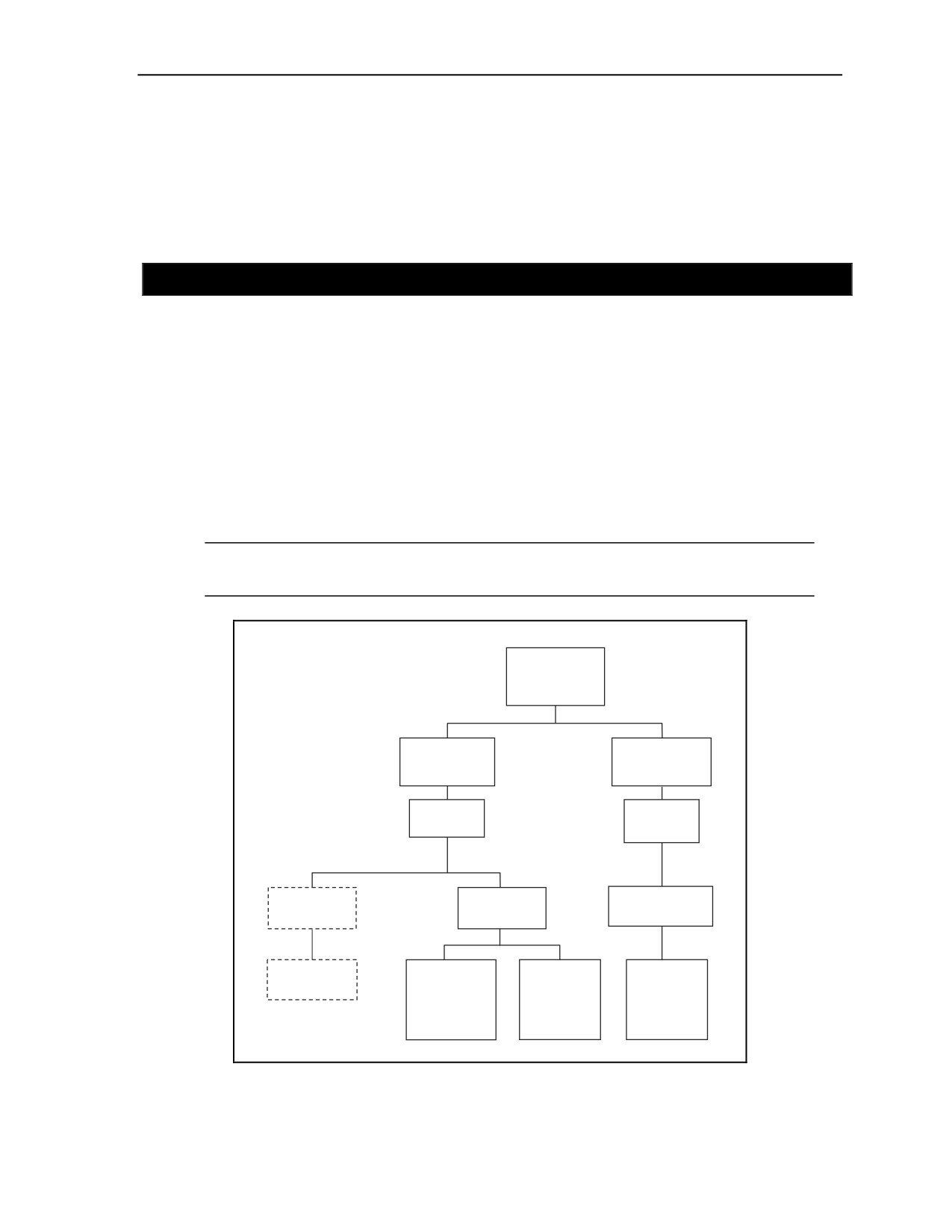
corps, or separate divisions and brigades. In peacetime, the internal security forces are under the
administrative control of the Ministry of the Interior. (See figure 2-3.) Normally, these administrative
groupings differ from the Armed Forces’ go-to-war (fighting) force structure (see chapter 3).
Note. A military district may or may not coincide with a political district within the State
government.
NATIONAL
COMMAND
AUTHORITY
MINISTRY OF
MINISTRY OF
DEFENSE
THE INTERIOR
CHIEF OF
GENERAL
INTERNAL
STAFF
SECURITY
INTERNAL
THEATER HQs
SERVICE HQs
SECURITY
FORCES HQ
SINGLE
OSC HQs
SINGLE
SINGLE
SERVICE
SERVICE
SERVICE
NATIONAL/
OPERATIONAL
DIVISIONS/
DISTRICT
LEVEL
BRIGADES/
LEVEL
COMMANDS
BATTALIONS
COMMANDS
Figure 2-3. Peacetime Administrative Force Structure
3 May 2007
FM 7-100.4
2-7
Chapter 2
2-36. In wartime, most major administrative commands continue to exist under their respective service
headquarters. However, their normal role is to serve as force providers during the creation of operational-
level fighting commands. Operational-level commands of the AFS generally remain in garrison and
continue to exercise command and control (C2) and administrative supervision of any of their original
subordinates (or portions thereof) that do not become part of the fighting force structure. See chapter 3 for
more information on the formation of wartime fighting commands.
SECTION III - NATION-STATE FORCES: TACTICAL LEVEL
2-37. In the OPFOR’s AFS, the largest tactical-level organizations are divisions and brigades. In
peacetime, they are often subordinate to a larger, operational-level administrative command. However, a
service of the Armed Forces might also maintain some separate single-service tactical-level commands
(divisions, brigades, or battalions) directly under the control of their service headquarters. (See figure 2-3
on page 2-7.) For example, major tactical-level commands of the Air Force, Navy, Strategic Forces, and
the SPF Command often remain under the direct control of their respective service component
headquarters. The Army component headquarters may retain centralized control of certain elite elements of
the ground forces, including airborne units and Army SPF. This permits flexibility in the employment of
these relatively scarce assets in response to national-level requirements.
2-38. For these tactical-level organizations
(division and below), the AFS organizational directories
contain standard “TOE” structures. However, these administrative groupings normally differ from the
OPFOR’s go-to-war (fighting) force structure. (See chapter 3 on Task-Organizing.)
DIVISIONS
2-39. In the OPFOR’s AFS, the largest tactical formation is the division. Divisions are designed to be able
to serve as the basis for forming a division tactical group (DTG), if necessary. (See chapter 3.) However, a
division, with or without becoming a DTG, could fight as part of an operational-strategic command (OSC)
or an organization in the AFS (such as army or military region) or as a separate unit in a field group (FG).
MANEUVER BRIGADES
2-40. The OPFOR’s basic combined arms unit is the maneuver brigade. In the AFS, some maneuver
brigades are constituent to divisions, in which case the OPFOR refers to them as divisional brigades.
However, some are organized as separate brigades, designed to have greater ability to accomplish
independent missions without further allocation of forces from a higher tactical-level headquarters.
Separate brigades have some subordinate units that are the same as in a divisional brigade of the same type
(for example, the headquarters), some that are especially tailored to the needs of a separate brigade
[marked “(Sep”) in the organizational directories], and some that are the same as units of this type found at
division level [marked “(Div)”].
2-41. Maneuver brigades are designed to be able to serve as the basis for forming a brigade tactical group
(BTG), if necessary. However, a brigade, with or without becoming a BTG, can fight as part of a division
or DTG, or as a separate unit in an OSC, an organization of the AFS (such as army, corps, or military
district), or an FG.
BATTALIONS
2-42. In the OPFOR’s force structure, the basic unit of action is the battalion. Battalions are designed to be
able to execute basic combat missions as part of a larger tactical force. A battalion most frequently would
fight as part of a brigade, BTG, or DTG. A battalion can also serve as the basis for forming a battalion-size
detachment (BDET), if necessary. (See chapter 3.)
2-8
FM 7-100.4
3 May 2007
Administrative Force Structure
COMPANIES
2-43. OPFOR companies most frequently fight as part of a battalion or BTG. However, companies are
designed to be able to serve as the basis for forming a company-size detachment (CDET), if necessary.
(See chapter 3.)
PLATOONS
2-44. In the OPFOR’s force structure, the smallest unit typically expected to conduct independent fire and
maneuver tactical tasks is the platoon. Platoons are designed to be able to serve as the basis for forming a
reconnaissance or fighting patrol. A platoon typically fights as part of a company, battalion, or detachment.
AVIATION UNITS
2-45. The OPFOR has a variety of attack, transport, multipurpose, and special-purpose helicopters that
belong to the ground forces (Army) rather than the Air Force. Hence the term army aviation. Army
aviation units follow the organizational pattern of other ground forces units, and are thus organized into
brigades, battalions, and companies.
2-46. Air Force organizations are grouped on a functional, mission-related basis into divisions, regiments,
squadrons, and flights. For example, a bomber division is composed primarily of bomber regiments, and a
fighter regiment is composed mainly of fighter squadrons. The Air Force also has some mixed aviation
units with a combination of fixed- and rotary-wing assets; these follow the normal Air Force organizational
pattern, with mixed aviation regiments and squadrons. However, rotary-wing subordinates of these mixed
aviation units would be battalions and companies (rather than squadrons and flights), following the pattern
of similar units in army aviation. Various fixed- and/or rotary-wing Air Force assets may be task-organized
as part of a joint, operational-level command in wartime.
NONDIVISIONAL UNITS
2-47. Units listed as “nondivisional” [marked “(Nondiv”)] in the AFS organizational directories might be
found in any of the operational-level commands discussed above, or in a theater command, or directly
subordinate to the appropriate service headquarters. The OPFOR force structure contains brigade- and
battalion-size units of single arms such as SAM, artillery, SSM, antitank, combat helicopter, signal, and
EW. In wartime, these nondivisional units can become part of a task-organized operational- or tactical-
level command. These units almost always operate in support of a larger formation and only rarely as
tactical groups or detachments, or on independent missions.
SECTION IV - NON-STATE ACTORS
2-48. Aside from the military and/or paramilitary forces of a nation-state, the OPFOR might consist of or
include the forces of non-state paramilitary actors. The operational environment (OE) also includes various
types of nonmilitary actors, although they are not part of the OPFOR.
PARAMILITARY ORGANIZATIONS
2-49. Non-state paramilitary organizations are distinct from the regular armed forces of the State or any
other country, but resemble them in organization, equipment, training, or mission. Therefore, the AFS
organizational directories include baseline organizations for insurgent and guerrilla forces (see examples in
appendixes C and E), as well as criminal organizations and private security organizations.
INSURGENT ORGANIZATIONS
2-50. Insurgent organizations have no regular, fixed “table of organization and equipment” structure. The
mission, environment, geographic factors, and many other variables determine the configuration and
composition of each insurgent organization and its subordinate cells. Their composition varies from
3 May 2007
FM 7-100.4
2-9
Chapter 2
organization to organization, mission to mission, environment to environment. The structure, personnel,
equipment, and weapons mix all depend on specific mission requirements. So do the size, specialty,
number, and type of subordinates.
2-51. There are several factors that differentiate the structure and capability of an insurgent organization
(direct action cells) from the structure and capability of a guerrilla organization. Since the insurgent
organization is primarily a covert organization, it typically has a cellular structure to prevent compromise
of the overall organization. By comparison, the guerrillas’ organization reflects their kinship to a more
formal military structure (battalion, company, platoon, squad, and fire team or task-organized hunter/killer
battalion, H/K company, H/K group, H/K section, and H/K team).
2-52. Insurgent organizations generally do not have much of the heavier and more sophisticated equipment
that guerrilla organizations can possess (see below). The weapons of the insurgents are generally limited to
small arms, antitank grenade launchers, and improvised explosive devices (IEDs) with very few crew-
served weapons (82-mm mortar, 107-mm single-tube rocket launcher). In the event the insurgents require
heavier weapons or capabilities they might obtain them from guerrillas, or the guerrilla organization might
provide its services depending on the relationship between the two organizations at the time.
Higher Insurgent Organizations
2-53. The term higher insurgent organization includes any insurgent organization at regional, provincial,
district, or national level, or at the transnational level. Cities, towns, or villages with a large population or
covering a large geographic area are considered regions and may therefore control several local insurgent
and/or guerrilla organizations. Higher insurgent organizations usually contain a mix of local insurgent and
guerrilla organizations. Each of these organizations provides differing capabilities.
Local Insurgent Organizations
2-54. Local insurgent organizations are typically composed of from three to over 30 cells. All of the direct
action cells could be multifunction (or multipurpose), or some may have a more specialized focus. The
single focus may be a multifunction direct action mission, assassination, sniper, ambush, kidnapping,
extortion, hijacking and hostage taking, or mortar and rocket attacks. Each of these may be the focus of one
or more cells. More often, the direct action cells are composed of a mix of these capabilities and several
multifunction cells. There are also a number of types of supporting cells with various functions that
provide support to the direct action cells or to the insurgent organization as a whole. Thus, a particular
insurgent organization could be composed of varying numbers of multifunction or specialty direct action
cells, supporting cells, or any mix of these.
2-55. Appendix C provides an example of a typical local insurgent organization, taken from volume III of
the AFS organizational directories. For illustrative purposes, this example includes a reasonable number of
multifunction direct action cells (four) and at least one cell of each of the 18 other, more specialized types.
The dashed boxes in the organizational graphic indicate the possibilities for varying numbers of each type
of cell, depending on the functions required for the insurgent organization to accomplish its mission.
2-56. Local insurgent organizations may or may not be associated with or subordinate to a higher insurgent
organization at the regional, national, or transnational level. The local insurgents may operate
independently, without central guidance or direction from the overall movement, and may not be
associated with a larger, higher insurgent movement in any manner. The local insurgent organization can
therefore be subordinate to, loosely affiliated with, or completely autonomous and independent of higher
insurgent organizations. Any relationship of insurgent organizations to higher or lower organizations may
be one of affiliation or dependant upon only a single shared or similar goal. These relationships are
generally fluctuating and may be fleeting, mission dependent, event- or agenda-oriented, or for any other
reasons or motivations.
Relationships to Other Paramilitary Actors
2-57. Insurgent organizations may have some type of relationship with guerrilla organizations and/or
criminal organizations or other actors, based on similar or shared goals and/or interests. The nature of the
2-10
FM 7-100.4
3 May 2007
Administrative Force Structure
shared goal/interest determines the tenure and type of relationship and the degree of affiliation. The
affiliation with criminal organizations is dependent only on the needs of the criminal organization at a
particular time. In some cases, lower-level guerrilla organizations may be subordinate to a local insurgent
organization. Higher insurgent organizations also may have guerrilla organizations subordinate to them.
GUERRILLA ORGANIZATIONS
2-58. Guerrilla organizations come in various shapes and sizes. They may be as large as several brigades
or as small as a platoon and/or independent hunter/killer (H/K) teams. The structure of the organization
depends on several factors including the physical environment, sociological demographics and
relationships, economics, and support available from external organizations and countries. In any case, a
guerrilla organization might be affiliated with forces from other countries or external organizations. Some
guerrilla organizations may constitute a paramilitary arm of an insurgent movement, while others may
pursue guerrilla warfare independently from or loosely affiliated with an insurgent organization.
2-59. Compared to insurgent organizations as a whole, guerrilla organizations have a more military-like
structure. Within this structure, guerrilla organizations have some of the same types of weapons as a
regular military force. The guerrilla organization contains weapons up to and including 120-mm mortars,
antitank guided missiles (ATGMs), and man-portable air defense systems (MANPADS), and can conduct
limited mine warfare and sapper attacks. Other examples of equipment and capability the guerrillas have in
their organizations that the insurgents generally do not have are 12.7-mm heavy machineguns; .50-cal
antimateriel rifles; 73-, 82-, and 84-mm recoilless guns; 100- and 120-mm mortars; 107-mm multiple
rocket launchers; 122-mm rocket launchers; GPS jammers; and signals intelligence capabilities.
2-60. While both insurgent and guerilla organizations are very effective and lethal in close and populated
terrain, the guerrilla organizations can perform more typical fire and maneuver tactics. The guerrilla
organization can, and often does, use terror tactics; however it is best suited to conduct irregular or
unconventional warfare tactics.
Guerrilla Brigades
2-61. The composition of the guerrilla brigade may vary. A basically rural, mountainous, or forested area
with no major population centers might have a guerrilla brigade with only one or two battalions (or five or
six companies) with little or no additional combat support or combat service support. A guerrilla brigade
operating astride a major avenue of approach, or one that contains several major population (urban) or
industrial centers, might be a full guerrilla brigade with additional combat support or combat service
support elements.
Guerrilla Battalions
2-62. Often a brigade-sized guerrilla force may not be appropriate⎯a guerrilla battalion or a task-
organized battalion may be sufficient. A guerrilla battalion may be any combination of guerrilla companies
or guerrilla H/K companies. When a battalion consists predominantly of guerrilla H/K companies, it may
be considered a guerrilla H/K battalion. A typical task-organized-battalion might have four or five guerrilla
H/K companies, organic battalion units, and a weapons battery from brigade (with mortar, antitank, and
rocket launcher platoons) and possibly intelligence and electronic warfare (IEW) support.
Guerrilla Companies
2-63. The guerrilla company fights unconventionally with platoons, squads, and fire teams. When
organized for combat as a guerrilla H/K company, it also fights unconventionally, but with H/K groups,
sections, and teams. The guerrilla H/K company is simply a restructured guerrilla company. Therefore,
they both contain the same number of personnel and similar numbers of equipment. Complete battalions
and brigades—or any part thereof—can be organized for combat as H/K units.
2-64. The typical guerrilla H/K company is broken into three H/K groups. Each group has four sections of
three H/K teams each. Thus, the company contains a total of 36 H/K teams. There are actually 39 H/K
3 May 2007
FM 7-100.4
2-11
Chapter 2
teams, if the two sniper teams and the company scouts in the company’s headquarters and command
section are counted.
2-65. The guerrilla H/K company or battalion is especially effective and lethal in close environments (such
as urban, forest, or swamp). The task-organized H/K team structure is ideal for dispersed combat. The
structure that makes H/K teams virtually impossible to isolate and kill in a dispersed fight also allows them
to melt into the population and terrain whenever necessary.
PRIVATE SECURITY ORGANIZATIONS
2-66. Private security organizations (PSOs) are business enterprises or local ad hoc groups that provide
security and/or intelligence services, on a contractual or self-interest basis, to protect and preserve a person,
facility, or operation. PSO teams may consist of bodyguard teams, patrol teams, stationary guard teams, or
information and investigation teams.
2-67. PSOs are diverse in regard to organizational structure and level of capability. The weapons and
equipment mix is based on team specialization/role and varies. Other example equipment includes listening
and monitoring equipment, cellular phones, cameras, facsimiles, computers, motorcycles, helicopters, all-
terrain vehicles, antitank disposable launchers, submachine guns, and silenced weapons. See FM 7-100.3
for more detail on PSOs.
CRIMINAL ORGANIZATIONS
2-68. Criminal organizations are normally independent of nation-state control and large-scale
organizations often extend beyond national boundaries to operate regionally or worldwide. Individual drug
dealers and criminals or small-scale criminal organizations (gangs) do not have the capability to adversely
affect legitimate political, military, and judicial organizations—but the large-scale organizations do. The
weapons and equipment mix varies, based on type and scale of criminal activity. Criminal organizations at
the higher end of the scale can take on the characteristics of a paramilitary organization.
2-69. By mutual agreement, or when their interests coincide, criminal organizations may become affiliated
with other non-state paramilitary actors, such as insurgent or guerrilla forces. Insurgents or guerrillas
controlling or operating in the same area can provide security and protection to the criminal organization’s
activities in exchange for financial assistance or arms. Guerrilla or insurgent organizations can create
diversionary actions, conduct reconnaissance and early warning, money laundering, smuggling,
transportation, and civic actions on behalf of the criminal organization. Their mutual interests can include
preventing U.S. or local government forces from interfering in their respective spheres.
2-70. At times, criminal organizations might also be affiliated with nation-state military and/or
paramilitary actors. In time of war, for instance, the State can encourage and materially support criminal
organizations to commit actions that contribute to the breakdown of civil control in a neighboring country.
Additional information is provided in FM 7-100.3.
OTHER ARMED COMBATANTS
2-71. In any OE, there are likely to be nonmilitary personnel who are armed but not part of an organized
paramilitary or military structure. Nevertheless, they may be disgruntled and hostile. Some of these
nonaffiliated personnel may possess small arms legally to protect their families, homes, and/or businesses.
When a catalyst occurs, they can use their “defensive” weapons to attack. Some might only be opportunists
who decide to attack a convoy, a vehicle, or a soldier in order to make a profit. Their motives might be
religious, racial, or cultural differences, or revenge, hatred, or greed. Some are just angry at the United
States. The reasons are immaterial—armed civilians are ubiquitous.
2-72. Such armed combatants may represent a large portion of the undecided in a population—those who
have yet to determine which side they are on. They may also be those who are going to change sides. They
might be completely neutral one minute, and the next they might be on the side of the enemy. Any number
of catalysts might cause them to change sides. The event causing the change might be the injury or death of
a family member, loss of property, or the perceived disrespect of their culture, religion, or tribe. Their
2-12
FM 7-100.4
3 May 2007
Administrative Force Structure
decision will probably not remain permanent. They might change sides several times depending on the
circumstances directly affecting their lives. Once they commit themselves to a side, they are easier to
categorize.
UNARMED COMBATANTS
2-73. The local populace contains various types of unarmed nonmilitary personnel who, given the right
conditions, may decide to purposely and materially support hostilities against the United States. This active
support or participation may take many forms, not all of which involve possessing or using weapons. In an
insurgent organization, for example, unarmed personnel might conduct recruiting, financing, intelligence-
gathering, supply-brokering, transportation, courier, or information warfare functions
(including
videographers and camera operators). Technicians and workers who fabricate IEDs might not be armed.
The same is true of people who provide sanctuary for combatants. Individuals who perform money-
laundering or operate front companies for large criminal organizations might not be armed. Individual
criminals or small gangs might be affiliated with a paramilitary organization and perform support functions
that do not involve weapons. Unarmed religious, political, tribal, or cultural leaders might participate in or
actively support a paramilitary organization. Unarmed media or medical personnel may become affiliated
with a military or paramilitary organization. Even unarmed individuals who are coerced into performing or
supporting hostile actions and those who do so unwittingly can in some cases be categorized as
combatants. Thus, various types of unarmed combatants can be part of the OPFOR. In short, an unarmed
combatant is any unarmed person who engages in hostilities or who purposely and materially supports
hostilities against the United States or its co-belligerents. This includes support that takes place off the
battlefield.
NONCOMBATANTS
2-74. The online directories also include nonmilitary actors that are not part of the OPFOR but might be
present in the OE. As noncombatants, they are currently either friendly or neutral. They can be either
armed or unarmed, and have the potential to become combatants in certain conditions. They might provide
support to combatants—either willingly or unwillingly.
ARMED NONCOMBATANTS
2-75. There are likely to be armed noncombatants who are not part of any military or paramilitary
organization. Some may be in possession of small arms legally to protect their families, property, and/or
businesses. Some may use weapons as part of their occupation (for example, hunters, security guards, or
local police). Some may be minor criminals who use their weapons for activities such as extortion and
theft; they might even steal from U.S. forces, to make a profit. They may be completely neutral or have
leanings for either side, or several sides. However, they are not members of or directly affiliated with a
hostile faction. Such armed noncombatants are ubiquitous. Their numbers vary from one individual to
several hundred. The types, behaviors, and impact of such persons are discussed in detail in FM 7-100.3.
Given the fact that they are already armed, it would be easy for such noncombatants to become combatants,
if their situation changes.
UNARMED NONCOMBATANTS
2-76. At a minimum, other actors in the OE include unarmed noncombatants. They are an integral part of
the OE and cannot be excluded. Examples of common types of unarmed noncombatants can also be found
in the organizational directories. These include medical teams, media, humanitarian relief organizations,
transnational corporations, displaced persons, transients, foreign government and diplomatic personnel, and
local populace. These nonmilitary actors may be neutral or potential side-changers, depending on their
perception of U.S. actions. Changes in the situation might cause some previously unarmed noncombatants
to become combatants and perhaps to take up arms. See FM 7-100.3 for more detail on the types of actors
summarized here.
3 May 2007
FM 7-100.4
2-13
Chapter 2
SECTION V - ORGANIZATIONAL DIRECTORIES
2-77. This organization guide is linked to online organizational directories, which TRADOC DCSINT
maintains and continuously updates, as necessary, to represent contemporary and emerging capabilities.
These directories provide a comprehensive menu of the numerous types of OPFOR organizations in the
detail required for the Army’s live, virtual, and constructive training environments. To meet these various
requirements, the directories contain over 10,000 pages of organizational information, breaking out most
OPFOR units down to squad-size components. However, some training simulations either cannot or do not
need to portray OPFOR units down to that level of resolution. From this extensive menu, therefore, trainers
and training planners can select and extract only the units they need, in the appropriate level of detail for
their specific training requirements.
Note. The organizations in these directories do not constitute an OPFOR order of battle
(OB). However, trainers and training planners can use these organizational building blocks to
construct an OPFOR OB that is appropriate for their training requirements. To do so, it will
often be necessary to create task organizations from the available building blocks. It may also be
necessary to substitute different pieces of equipment for those listed for units in the
organizational directories.
2-78. The organizational information contained in the directories exceeds the scope and size that can be
accommodated within a traditional FM format. The magnitude of task-organizing an exercise order of
battle also requires that users have the ability to use downloaded organizations in an interactive manner.
For these reasons, it is necessary for this FM to be linked to organizational diagrams and associated
equipment inventories made available in electronic form that users can download and manipulate as
necessary in order to create task organizations capable of fighting in adaptive ways that typify the COE.
Note. For illustrative purposes, this FM contains several examples from the online AFS
organizational directories. Readers are reminded that even the baseline OPFOR
organizations are subject to change over time. Therefore, readers should always consult the
online directories for the latest, most up-to-date versions of organizational data.
2-79. Online directories of OPFOR organizations in the AFS are accessible by means of the following link
to the TRADOC ADCSINT-Threats portal on the Battle Command Knowledge System
(BCKS):
https://dcsint-threats.leavenworth.army.mil/COE/default.aspx; then click on
“FM 7-100.4 Organization
Guide,” then on “Admin Force Structure-Organizational Directories.” Alternatively, users can click here
on the following link: Organizational Directories; then click on Volume I, II, II, or IV of the organizational
directories. Access to BCKS requires use of Army Knowledge Online (AKO) user name and password. (It
may be necessary to enter these more than once in order to arrive at the proper location.) If the user is
already logged into AKO (by user name and password or by Common Access Card login), no further login
may be necessary.
2-80. The directories consist of four volumes: Divisions and Divisional Units; Nondivisional Units;
Paramilitary and Nonmilitary Actors; and Other. These directories are maintained and continuously
updated, as necessary, by the Deputy Chief of Staff for Intelligence, U.S. Army Training and Doctrine
Command (TRADOC DCSINT), in order to represent contemporary and emerging capabilities. The
TRADOC DCSINT is designated as “the responsible official for the development, management,
administration, integration, and approval functions of the OPFOR Program across the Army” (Army
Regulation 350-2).
2-81. The role of these directories is to provide a menu of OPFOR units to use in task-organizing to stress
U.S. Army training. These directories do not constitute an order of battle (OB) but rather a menu of
capabilities. Chapter 3 provides guidance on how to task-organize the OPFOR from the pieces contained in
the online directories. In some cases, task-organizing may not be required (particularly at lower tactical
levels), and OPFOR fighting organizations may be lifted directly from the AFS. However, it is often
2-14
FM 7-100.4
3 May 2007
Administrative Force Structure
necessary to tailor these standard organizations into task organizations better suited for training
requirements.
2-82. There is no such thing as a standard structure for major operational-level commands in the AFS:
corps, armies, army groups, military districts, or military regions. Therefore, the online directories provide
only the organizational structures for the types of units likely to be found in one of these echelons-above
division commands in the peacetime AFS. In an OPFOR OB, some of these units will have become part of
a task organization at operational or tactical level.
FILES FOR OPFOR UNITS
2-83. The architectural build of the OPFOR units located on the BCKS is simple and straightforward. The
organizations were built from the bottom up, solely for trainers and planners to use to select and build
OPFOR organizations to execute OPFOR countertasks. The build for the organizational directories started
at the lowest level, breaking out the organization, personnel, and equipment down to squad-size
components, since some training simulations may require that level of resolution. If some trainers or
training planners do not require that level of detail, they can extract from the organizational directories the
entries starting at the lowest level that is required for their particular exercise OB.
2-84. All of the OPFOR organizations listed in the AFS organizational directories on BCKS are
constructed using Microsoft Office
2000® or Microsoft Office 2003® software (MS Word®, MS
PowerPoint®, and MS Excel®) so the trainer could tailor and/or task-organize them individually or
collectively to meet specific training and/or simulation requirements. Most trainers and simulators have MS
Office® software available and a basic knowledge of its use. See appendix B for detailed instructions that
should enable a trainer with only a basic knowledge of MS Office® (MS Word®, MS PowerPoint®, and
MS Excel®) to build a task-organized structure using available software.
2-85. The basic entry for each organization is built in an MS Word® document. This Word® document
provides details for the OPFOR organization and contains four basic sets of information: unit name,
organizational graphics, personnel information, and principal items of equipment (unless personnel and
equipment are listed in a separate MS Excel® spreadsheet). For examples, see appendix D, which contains
the complete entries for the motorized infantry company and the personnel and equipment spreadsheets for
the motorized infantry battalion as they appear in the AFS organizational directories on BCKS.
UNIT NAME
2-86. The name of the unit appears in a heading at the top of each page in the organizational directory.
Each Word® or Excel® file name includes the name of the highest unit described in that file.
2-87. The names of some units (usually battalions or companies) in the AFS organizational directories are
followed by the label “(Div)” or “(Sep).” Here, “(Div)” indicates that the battalion or company in question
is the version of its type organization normally found at division level in the AFS. Separate brigades in the
AFS have some subordinates that are the same as at division level and are therefore labeled “(Div).” Other
subordinates that are especially tailored to the needs of a separate brigade are labeled “(Sep).” Any
subordinates of a separate brigade that are the same as their counterparts in a divisional brigade do not have
either of these labels. Units with “(Sep)” following their names are not separate battalions or separate
companies. To avoid confusion, any unit that is actually “separate” would have the modifier “Separate” (or
abbreviated “Sep”) preceding its name rather than following it.
2-88. Some units (usually brigades and battalions) could have the label “(Nondiv)” following their names
in order to identify them as “nondivisional” assets (not subordinate to a division). Other units with the
same basic name may have the label “(Div)” to distinguish them as being “divisional” (subordinate to a
division). For example, the Materiel Support Brigade (Nondiv) has a different structure from the Material
Support Brigade (Div).
3 May 2007
FM 7-100.4
2-15
Chapter 2
ORGANIZATIONAL GRAPHICS
2-89. The organizational graphics are built in MS PowerPoint® and then inserted into an MS Word®
document. The organizational charts for specific organizations in the online directories depict all possible
subordinate units in the AFS. Aside from the basic organization, the organizational directory entry for a
particular unit may contain notes that indicate possible variations and alternatives.
Note. Some of the graphics in this FM are based on MS PowerPoint® (.ppt) graphics in the
online organizational directories. In the process prescribed for FM publication, however, they
may have been converted to another format and thus can no longer be opened or manipulated as
PowerPoint® objects. If users of this FM need these graphics in PowerPoint® form, they will
have to go to the organizational directories.
2-90. Organization charts in the online directories display units in a standard line-and-block chart format.
These charts show unit names as text in a rectangular box (rather than using “enemy” unit symbols in
diamonds, as is often the custom in OPFOR OBs for training exercises). There are a number of reasons for
this, mostly in the interest of clarity: The OPFOR has some units whose nature and names (appropriate to
their nature) do not correspond directly to unit symbols in FM 1-02, which are designed primarily for
depicting the nature of U.S. units. Therefore, the use of text allows organizational charts to be more
descriptive of the true nature of OPFOR units. The space inside a rectangular box is better suited than a
diamond for showing the unit names as text, thus allowing organization charts to display a larger number
of subordinate units in a smaller space.
PERSONNEL AND EQUIPMENT LISTS
2-91. For each unit, the organizational directories provide a very detailed listing of personnel and
equipment. For some training requirements, the OPFOR OB might not need to include personnel numbers.
A particular OB might not require a listing of all equipment, but only major end items. In such cases,
trainers and training planners can extract the appropriate pages from the organizational directories and then
simplify them by eliminating the detail they do not need. However, the directories make the more detailed
version available for those who might need it.
2-92. At the lowest-level organizations (for example, infantry squad), where the organizational chart does
not show a unit breaking down into further subordinate units, the organizational directories list individual
personnel with their individual weapons. (Figure 2-4 shows the example of an infantry squad, taken from
page 9 of the Word® document for the motorized infantry battalion in the AFS organizational directories.
See appendix D for additional details on the motorized infantry platoon, company, and battalion.) At this
level, each individual’s duty title/position/function is identified for all OPFOR personnel organic to the
organization described. The duty title is followed by the individual’s rank category:
(O) = Officers (commissioned and warrant).
(N) = Noncommissioned officers.
(
) = Enlisted personnel. This is usually blank and reflected only in the personnel totals.
Note. Charts for insurgent organizations are the exception, since they do not show personnel
broken down into the three rank categories. Insurgents are not part of a formalized military
structure and are therefore not broken down by rank. See appendix C for an example of
insurgent organization. For additional information on insurgents, see FM 7-100.3.
2-93. Directly following the individual’s title and rank category is the number of personnel occupying that
position, such as (x1) or (x2). This is followed by the nomenclature of the individual’s assigned personal
weapon, such as AK-74M or SVD. In some cases, an individual may have two assigned weapons; for
example, an individual assigned a 7.62-mm GP MG, PKM may also be assigned a 9-mm Pistol, PM. This
reads as PKM/PM in the listing. In some instances, the individual also serves as the gunner/operator of a
weapon—this is also identified. In figure 2-4, for instance, the Grenadier (x1) is the gunner/operator of the
2-16
FM 7-100.4
3 May 2007
Administrative Force Structure
ATGL, Panzerfaust 3-T600. His personal weapon is the 5.45-mm Carbine, AKS-74U. The Riflemen (x2)
are assigned the 5.45-mm Assault Rifle, AK-74M with the 40-mm Under-Barrel Grenade Launcher, GP-30
(similar to the U.S. M16/M203).
Infantry Squad, Inf Plt____________________________________________________
INFANTRY
SQUAD
Squad Leader (N) (x1)
AK-74M
Asst Sqd Ldr (N) (x1)
AK-74M
Machinegunner (x1)
PKM/PM
Asst Machinegunner (x1)
AK-74M
Sniper/Marksman (x1)
SVD
Grenadier (x1)
PZF3-T/AKS-74U
Asst Grenadier (x1)
AK-74M
Rifleman (x2)
AK-74M/GP-30
Total Personnel
9
O-0/N-2/E-7
PRINCIPAL ITEMS OF EQUIPMENT
Equipment
Total
Equipment
Total
9-mm Pistol, PM
1
Flame Weapon, RPO-A Series **
2
5.45-mm Assault Rifle, AK-74M
6
Mines (AP&AT) **/***
Assorted
5.45-mm Carbine, AKS-74U
1
Binocular Laser Rangefinder *
2
7.62-mm GP MG, PKM *
1
GPS Receiver, Handheld
2
7.62-mm Sniper Rifle, SVD *
1
Night-Vision Goggles
2
40-mm Grenade Launcher, GP-30
2
Night-Vision Goggles (AK w/GP-30)
2
ATGL, Panzerfaust 3-T600 *
1
Radios:
ATDL, Armbrust
1
Handheld, Very-Low-Power
2
NOTES:
1. The infantry squad consists of at least two maneuver fire teams. The squad leader may choose to command one fire
team while the assistant squad leader commands the second. The infantry squad may be augmented by elements from the
weapons squad-in which case the infantry squad may operate with three maneuver fire teams (or anti-armor hunter-killer
teams).
2. The squad leader and assistant squad leader both have NVGs, a handheld radio, LRF, and GPS. The riflemen also
support other weapons including the machinegunner, the ATGL grenadier, the sniper/marksman, or attachments from the
weapons squad.
3. Some squads may have a second machinegunner in lieu of the rifleman (mission dependent). In this case the second
rifleman becomes the assistant machinegunner. You gain a PKM and PM for the machinegunner and an AK-47M for the
assistant machinegunner but lose the two AK-74M/GP-30s the riflemen carried previous to the substitution.
__________________________________________
* With II night sight.
** Issued as ammunition rather than a weapon-BOI may vary.
*** Includes remotely detonated mines and side-attack (AT & anti-vehicle) mines. The mine mix is mission depend
ent and varies.
9
Figure 2-4. Infantry Squad Personnel and Equipment (Example)
2-94. Personnel totals for a unit are listed below the detailed listing of individual personnel and their
equipment (or directly below the organizational chart for larger units). The first number reflects the total
3 May 2007
FM 7-100.4
2-17
Chapter 2
personnel in that organization. The second set of numbers breaks down the total number of personnel by
rank category. In this case, “E” is used for enlisted personnel. In figure 2-4 on page 2-17, for example, the
personnel for the infantry squad indicate that there are no officers, two noncommissioned officers, and
seven enlisted personnel—for a total of nine personnel.
2-95. For organizations from the lowest levels up through battalion level (in some cases up to brigade
level), the basic MS Word® entry in the AFS organizational directories includes a listing of “Principal
Items of Equipment.” This list gives the full nomenclature for each item of equipment and the total number
of each item in the unit. Figure 2-4 on page 2-17 shows an example of this for the infantry squad.
2-96. Some weapons are issued as a munition rather than an individual’s assigned weapon. An example of
this is the Flame Weapon, RPO-A Series (see figure 2-4 on page 2-17). Generally, a footnote accompanies
these weapons, stating that they are issued as ammunition rather than a weapon—therefore the basis of
issue (BOI) may vary. Anyone in the unit might fire these weapons, and the numbers of these weapons in
an organization vary. Often they are carried in a vehicle, or kept on hand, until needed.
2-97. Sometimes a weapon is not assigned a gunner. In this case, a note generally describes the
relationship. Some organizations, especially Special-Purpose Forces, have a wide selection of weapons and
equipment available due to their multipurpose mission capability. The final selection of weapons and
equipment is determined by the specific mission required at the time. These weapon and equipment
numbers are easily adjusted using MS Word® and/or MS Excel®.
Note. Some of the graphics in this FM are based on MS Excel® (.xls) spreadsheets in the online
organizational directories. In the process prescribed for FM publication, however, they may
have been converted to another format and thus can no longer be opened or manipulated as
Excel® objects. If users of this FM need these spreadsheets in Excel® form, they will have to
go to the organizational directories.
2-98. For larger organizations, personnel and equipment numbers are listed in MS Excel® spreadsheets.
There is a vertical column for each subordinate unit and a horizontal row for each item of equipment, with
an automatically summed total at the right end of each row for the total number of each item of equipment
in the overall organization. When the overall organization contains multiples of a particular subordinate
unit, the unit designation at the top of the column indicates the number of like units (for example,
“Hunter/Killer Groups (x3)” for the three hunter/killer groups in a hunter/killer company of a guerrilla
battalion). In the interest of space, however, the spreadsheet format is not used for smaller units. Instead,
they list “Total Personnel” and “Principal Items of Equipment” as part of the MS Word® document.
Brigades and some battalions list personnel and equipment in both formats.
FOOTNOTES
2-99. Footnotes apply to lists of personnel and equipment, in either Word® or Excel® format. Each
footnote has a number of asterisks that link it to footnote reference with the same number of asterisk in the
equipment list. Some footnotes explain—
Characteristics of a piece of equipment (for example, “* With thermal sight”).
Why the total for a particular item of equipment is flexible
(for example,
** Issued as
ammunition rather than a weapon—the BOI varies”).
The types of weapons or equipment that might be included under “Assorted.”
Possible equipment substitutions and their affect on personnel numbers.
2-100. In an Excel® spreadsheet, footnotes with reference asterisks in the top row of a column can
provide information about the subordinate unit in that column. Most often, this type of footnote explains
that the equipment numbers in that column have already been multiplied to account for multiple
subordinates of the same type. For example, the reference “Motorized Infantry Company (x3)*” is linked
to a footnote that explains: “* The values in this column are the total number for three companies.” Other
footnotes serve the same purposes as in a Word® document.
2-18
FM 7-100.4
3 May 2007
Administrative Force Structure
NOTES
2-101. Notes in a Word® document generally apply to the organization as a whole or its relationship with
other organizations. Occasionally, they provide additional information on a particular part of the
organization. In either case, notes are numbered (unless there is only one), but the number is not linked to a
particular part of the organization. Various types of notes can explain—
The nature of the organization and possible variations in its structure.
Possible augmentation with additional equipment.
Personnel options. For example: “Some squads may have a second machinegunner in lieu of a
rifleman (mission dependant).”
Unit capabilities or limitations. For example: “The infantry platoon has sufficient assets to
transport the platoon headquarters and weapons squad. It is dependent upon augmentation from
higher (battalion transport platoon) to transport the three infantry squads over distance.”
Which personnel man a particular weapon or piece of equipment.
How units or personnel are transported.
How a unit or subordinate is employed and the types of tactics used.
How assets of one subordinate can be allocated to other subordinates.
2-102. Especially for paramilitary and nonmilitary entities, notes describe various possible mixtures of
personnel, equipment, and subordinates that might occur. Notes may reference another manual in the FM
7-100 series for more information regarding the organization described.
FOLDERS FOR OPFOR UNIT FILES
2-103. The organizational directories of the AFS are contained in four volumes on BCKS. Each volume is
divided into folders that contain the OPFOR unit files. These folders and files serve as the menu for
OPFOR baseline units. The OPFOR organizational directories are continually updated on the BCKS;
therefore, the listing below is dynamic. Over time, additional units will be added and existing units will be
modified and updated, as necessary, to represent contemporary and emerging capabilities. Although the list
of OPFOR units may change, the basic architecture of the organizational directories will remain essentially
the same. Figure 2-5 on page 2-20 shows the basic listing of folders in the organizational directories. For a
more detailed listing of folders and files for OPFOR units in the AFS organizational directories, see
appendix A.
2-104. A particular training venue might not require the level of detail found in the MS Excel®
spreadsheets and MS Word® equipment lists in the organizational directories. However, the use of these
tools is a good way to avoid the sometimes significant errors that can result from more expedient methods
of performing the OPFOR OB function. (See appendix B.)
3 May 2007
FM 7-100.4
2-19
Chapter 2
Volume I - Divisions and Divisional Units
01 Mechanized Infantry Division (IFV)
01 Mechanized Infantry Division (IFV)
02 Division Headquarters and Staff
03 Integrated Fires Command and Integrated Support Command
04 Mechanized Infantry Brigade (IFV) (X3)
05 Tank Brigade (Div)
06 Self-Propelled Artillery Brigade
07 Air Defense Brigade (Short-Range)
08 Materiel Support Brigade (Div)
09 Antitank Battalion
10 Reconnaissance Battalion
11 Sniper Company
12 Engineer Battalion
13 Signal Battalion
14 Chemical Defense Battalion
15 Medical Battalion
02 Mechanized Infantry Division (APC) (see appendix A)
03 Tank Division (see appendix A)
04 Motorized Infantry Division (see appendix A)
Volume II - Nondivisional Units
01 Separate Combat Brigades
01 Separate Mechanized Infantry Brigade (IFV)
02 Separate Mechanized Infantry Brigade (APC)
03 Separate Tank Brigade
04 Separate Motorized Infantry Brigade
02 Combat Brigades (Nondivisional)
01 Special-Purpose Forces Brigade
02 Multiple Rocket Launcher Brigade (Nondiv)
03 Combat Support Units (Nondivisional)
01 Smoke Battalion (Nondiv)
04 Combat Service Support Units (Nondivisional)
01 Materiel Support Brigade (Nondiv)
Volume III - Paramilitary and Nonmilitary Actors
01 Combatants
01 Armed Combatants
01 Insurgent Organizations
01 Local Insurgent Organization
02 Higher Insurgent Org (Regional, National, Transnational)
02 Guerrilla Brigade
02 Unarmed Combatants
02 Noncombatants
01 Armed Noncombatants
02 Unarmed Noncombatants
Volume IV - Other
01 Glossary
02 Brigade Tactical Group (Motorized) (Antiarmor-Light), Example
OPFOR Task Organization
03 Other Nondivisional Units
Figure 2-5. Basic Listing of Folders in AFS Organizational Directories
2-20
FM 7-100.4
3 May 2007
Chapter 3
Task-Organizing
The concept of task-organizing for combat is not unique to the OPFOR. It is
universal, performed at all levels, and has been around as long as combat. The U.S.
Army defines a task organization as “A temporary grouping of forces designed to
accomplish a particular mission” and defines task-organizing as “The process of
allocating available assets to subordinate commanders and establishing their
command and support relationships” (FM 1-02). Task-organizing of the OPFOR must
follow OPFOR doctrine
(see FMs
7-100,
7-100.1, and
7-100.2) and reflect
requirements for stressing U.S. units’ mission essential task list (METL) in training.
SECTION I − FUNDAMENTAL CONSIDERATIONS
3-1. The purpose behind task-organizing the OPFOR is to build an OPFOR order of battle (OB) that is
appropriate for U.S. training requirements. The OPFOR administrative force structure
(AFS)
organizational directories are not the OPFOR OB. The OB is the OPFOR’s go-to-war, fighting force
structure.
U.S. TRAINING REQUIREMENTS
3-2. The OPFOR’s reason for existence is to serve as an appropriately challenging sparring partner in
U.S. training. Although, from the OPFOR doctrinal view, task-organizing is a top-down process, the
process of building the OPFOR OB for a training event is best approached in a bottom-up manner⎯for
practical purposes. That is because the task organizations at one level of command are the building blocks
for determining the overall organization and total equipment holdings of the next-higher command. From
the perspective of U.S. Army training, OPFOR task organization is also based on the missions and tasks
the OPFOR needs to perform in order to stress U.S. units’ METL.
3-3. At some point, the holdings of the higher levels of command become irrelevant to a particular
training event. Generally, this occurs when those assets no longer have an effect on OPFOR capabilities
within the particular area of responsibility (AOR) where the training event occurs. If trainers build the
OPFOR OB from the bottom up, they will know when to stop⎯or at least when all they need is a general
organizational outline, rather than a detailed OB.
Note. It is possible to have a training scenario that begins when the OPFOR is still entirely in its
peacetime AFS—or that peacetime organization is all the U.S. force knows about the OPFOR’s
organization. Then an implied task for the U.S. unit(s) would be to conduct further OB analysis
to determine what parts of the OPFOR currently have been task-organized and how. In most
cases, however, the training scenario begins at a point when the OPFOR has already task-
organized its forces for combat. In those cases, the AFS as a whole is merely a part of the road
to war, which outlines how this fight came to take place and how the U.S. unit(s) become
challenged by certain OPFOR unit(s). Aside from the OPFOR unit(s) required to perform
specific countertasks to challenge U.S. METL tasks, everything else could be a mere
backdrop—to explain the larger context in which this particular fight occurs and perhaps where
some of the assets came from to form this particular OPFOR task organization.
3 May 2007
FM 7-100.4
3-1
Chapter 3
OPFOR DOCTRINE
3-4. U.S. training requirements normally dictate the size and type of OPFOR needed. Nevertheless, the
OPFOR OB needs to make sense within the OPFOR doctrinal framework, including the OPFOR task-
organizing process. From the OPFOR doctrinal view, task-organizing is a top-down process. That is
because the higher commander is always the one who decides the missions of his subordinates and
allocates additional resources for some of those missions. The allocated units can have several types of
command and support relationship with the receiving command.
ALLOCATION AND SUBALLOCATION OF ASSETS
3-5. OPFOR commanders must consider where the assets required for a particular task organization are
located within the OPFOR administrative force structure (AFS) and how to get them allocated to the task
organization that needs them. Particularly at the tactical level, the base organization around which a tactical
group or detachment is formed may not have the organizational or equipment assets necessary to carry out
the mission. Its next higher headquarters might have such assets at its disposal to allocate downward, or
those assets might first have to be allocated from outside that parent organization in order for the parent
organization to further suballocate them to the task organization. The latter could be the case, for instance,
when a brigade tactical group (BTG) within a division or division tactical group (DTG) needs attack
helicopters to augment its fire support or transport helicopters to enable a heliborne landing. If the BTG
needs these assets in a subordinate (constituent or dedicated) command relationship rather than just a
supporting relationship, a higher headquarters would have to allocate the helicopter units to the division or
DTG, which would in turn suballocate them to this BTG.
3-6. When tactical-level commands become part of the fighting force structure, they often receive
additional assets that better enable them to perform a mission for which they are task-organized. If some of
their original subordinates are inappropriate or otherwise not required for the assigned mission, the tactical-
level organizations typically leave these behind, under the command and control (C2) of their next-higher
headquarters that remains in the AFS framework. The higher headquarters could provide these units to
another task organization or hold them in reserve for possible future requirements.
Note. The OPFOR must understand its own strengths and weaknesses, and those of its enemy.
An OPFOR commander must consider how to counter or mitigate what the other side has and/or
how to exploit what he has on his own side. The mitigation or exploitation may be by means of
equipment, tactics, or organization—or more likely all of these. However, the process generally
starts with the proper task organization of forces with the proper equipment to facilitate
appropriate tactics, techniques, and procedures (TTP).
OPFOR COMMAND AND SUPPORT RELATIONSHIPS
3-7. OPFOR units are organized using four command and support relationships, summarized in table 3-1
and described in the following paragraphs. Command relationships define command responsibility and
authority; they establish the degree of control and responsibility commanders have on forces operating
under their control. Support relationships define the purpose, scope, and effect desired when one capability
supports another. These relationships may shift during the course of an operation in order to best align the
force with the tasks required. The general category of subordinate units includes both constituent and
dedicated relationships; it can also include interagency and multinational (allied) subordinates.
3-2
FM 7-100.4
3 May 2007

Task-Organizing
Table 3-1. Command and Support Relationships
Relationship
Commanded by
Logistics from
Positioned by
Priorities from
Constituent
Gaining
Gaining
Gaining
Gaining
Dedicated
Gaining
Parent
Gaining
Gaining
Supporting
Parent
Parent
Supported
Supported
Affiliated
Self
Self or “Parent”
Self
Mutual Agreement
Constituent
3-8. Constituent units are those forces assigned directly to a unit and forming an integral part of it. They
may be organic to the table of organization and equipment of the administrative structure forming the basis
of a given unit, assigned at the time the unit was created, or attached to it after its formation. From the view
of an OPFOR commander, a unit has the same relationship to him regardless of whether it was originally
organic or was later assigned or attached.
Dedicated
3-9. Dedicated is a command relationship identical to constituent with the exception that a dedicated unit
still receives logistics support from a parent organization of similar type. An example of a dedicated unit
would be the case where one or two surface-to-surface missile (SSM) battalions from an SSM brigade
could be dedicated to an operational-strategic command (OSC). Since the OSC does not otherwise possess
the technical experts or transloading equipment for missiles, the dedicated relationship permits the SSM
battalion(s) to fire exclusively for the OSC while still receiving its logistics support from the parent SSM
brigade. Another example of a dedicated unit would be the case where a specialized unit, such as an attack
helicopter company, is allocated to a brigade tactical group (BTG). Since the base brigade does not
otherwise possess the technical experts or repair facilities for the aviation unit’s equipment, the dedicated
relationship permits the helicopter company to execute missions exclusively for the BTG while still
receiving its logistics support from its parent organization. In OPFOR plans and orders, the dedicated
command relationship is indicated by “(DED)” next to a unit title or symbol.
Note. The dedicated relationship is similar to the U.S. concept of operational control (OPCON),
but also describes a specific logistics arrangement. This is something for exercise designers to
consider when developing the OPFOR order of battle. They should not “chop” part of an SSM
unit to an OSC, DTG or BTG without its support structure. If the gaining unit does not have the
ability to support the SSM unit logistically, it might be better to keep it in a dedicated
relationship. If the gaining unit also does not have the capability to exercise command over the
SSM unit, it might be better to keep it in a supporting relationship.
Supporting
3-10. Supporting units continue to be commanded by and receive their logistics from their parent
headquarters, but are positioned and given mission priorities by their supported headquarters. This
relationship permits supported units the freedom to establish priorities and position supporting units while
allowing higher headquarters to rapidly shift support in dynamic situations. The supporting unit does not
necessarily have to be within the supported unit’s AOR. An example of a supporting unit would be a
fighter-bomber regiment supporting an OSC for a particular phase of the strategic campaign plan (SCP) but
ready to rapidly transition to a different support relationship when this OSC becomes the theater reserve in
a later phase. Another example of a supporting unit would be a multiple rocket launcher (MRL) battalion
3 May 2007
FM 7-100.4
3-3
Chapter 3
supporting a BTG for a particular phase of an operation but ready to rapidly transition to a different
support relationship when the BTG becomes the DTG reserve in a later phase. In OPFOR plans and orders,
the supporting relationship is indicated by “(SPT)” next to a unit title or symbol.
Note. The supporting relationship is the rough equivalent of the U.S. concept of direct support
(DS). Note that there is no general support (GS) equivalent. That is because what would be GS
in the U.S. Army is merely something that is constituent to the parent command in the OPFOR.
In U.S. doctrine (FM 5-0) the format for task-organizing says: “List subordinate units under the
C2 headquarters to which they are assigned, attached, or in support. Place DS units below the
units they support.” In an OPFOR OB, therefore, units in the supporting status (like U.S. DS)
could be considered part of the task organization of the “supported” unit. For units that are
supporting, but not subordinate, it may be better to keep them and their equipment listed under
their parent unit’s assets, unless that parent unit is not included in the OB. In any case, trainers
will need to know what part of the parent unit will actually affect the situation.
Affiliated
3-11. Affiliated organizations are those operating in a unit’s AOR that the unit may be able to sufficiently
influence to act in concert with it for a limited time. No “command relationship” exists between an
affiliated organization and the unit in whose AOR it operates. Affiliated organizations are typically
nonmilitary or paramilitary groups such as criminal organizations, terrorists, or insurgents. In some cases,
affiliated forces may receive support from the OSC, DTG, or BTG as part of the agreement under which
they cooperate. Although there would typically be no formal indication of this relationship in OPFOR
plans and orders, in rare cases “(AFL)” is used next to unit titles or symbols.
Note. Although there is no “command” relationship between the two organizations, the military
command may have the ability to influence an affiliated paramilitary organization to act in
concert with it for a limited time. For example, it might say: “If you are going to set off a car
bomb in the town square, we would appreciate it if you could do it at 3 o’clock tomorrow
afternoon.” In organizational charts for an OPFOR task organization, affiliated forces are shown
with a dashed line (rather than a solid one) connecting them to the rest of the task organization.
The dashed line indicates only a loose affiliation, but no direct command relationship with the
military unit with which they are affiliated. For units that are affiliated, but not subordinate, it
may be better to list their personnel and equipment separately or under their parent unit’s assets,
if there is a parent organization. However, trainers will need to know what part of the parent unit
will actually affect the situation. If affiliated forces are not included in organization charts or
equipment totals for the task organization, they have to be accounted for elsewhere in the
OPFOR OB.
SECTION II - NATION-STATE FORCES: STRATEGIC LEVEL
3-12. In the wartime fighting force structure, the national-level command structure still includes the
National Command Authority (NCA), the Ministry of Defense (MOD), and the General Staff. The only
difference is that the MOD and General Staff merge to form the Supreme High Command. How the Armed
Forces are organized and task-organized depends on the type of operations they are conducting under the
State’s strategic framework.
SUPREME HIGH COMMAND
3-13. In wartime, the State’s NCA exercises C2 via the Supreme High Command (SHC), which includes
the MOD and a General Staff drawn from all the service components. In peacetime, the MOD and General
Staff operate closely but separately. During wartime, the MOD and General Staff merge to form the SHC,
which functions as a unified headquarters. (See figure 3-1 on page 3-6.)
3-4
FM 7-100.4
3 May 2007
Task-Organizing
STRATEGIC FRAMEWORK
3-14. For most training scenarios, strategic-level organizations serve only as part of the road to war
background. Within the OPFOR strategic framework, it makes a difference whether the exercise portion of
the scenario takes place during regional, transition or adaptive operations. (See FM 7-100 for more detail
on these strategic-level courses of action.)
3-15. For regional operations against a weaker neighboring country, the OPFOR might not have needed to
use all the forces in its AFS in forming its fighting force structure—only “all means necessary” for the
missions at hand. As U.S. and/or coalition forces begin to intervene, the OPFOR begins transition
operations and shifts more AFS units into the wartime fighting structure—possible mobilizing reserves and
militia to supplement regular forces. For adaptive operations against U.S. and coalition forces, the OPFOR
would use “all means available.” Even those forces that were previously part of the fighting force structure
might need to be task-organized differently in order to deal with extraregional intervention.
3-16. If the OPFOR originally task-organized to fight a regional neighbor, it would (if it has time) modify
that task organization in preparation for fighting an intervening U.S. or coalition force. OPFOR units may
have suffered combat losses during the original fight against a neighboring country or in the early stages of
the fight against U.S. or coalition forces. In such cases, the OPFOR task organizations might have to
change in order to sustain operations. Lost or combat-ineffective units might be replaced by units from the
reserves, paramilitary units from the Internal Security Forces, or regular military units from other
commands, which are still combat effective—or by additional units from the AFS. If not already the case,
OPFOR military forces may incorporate nongovernmental paramilitary forces (insurgent, guerrilla, or even
criminal), at least in an affiliated relationship.
SECTION III - NATION-STATE FORCES: OPERATIONAL LEVEL
3-17. In the peacetime AFS, each service of the Armed Forces commonly maintains its forces grouped
under single-service operational-level commands
(such as corps, armies, or army groups) for
administrative purposes. In some cases, forces may be grouped administratively under operational-level
geographical commands designated as military regions or military districts. (See chapter 2 for more detail
on these administrative groupings.) However, these administrative groupings normally differ from the
Armed Forces’ go-to-war (fighting) force structure. (See figure 3-1 on page 3-6.)
3-18. In wartime, most major administrative commands continue to exist under their respective service
headquarters. However, their normal role is to serve as force providers during the creation of operational-
level fighting commands, such as field groups (FGs) or operational-strategic commands (OSCs). OSC
headquarters may exist in peacetime, for planning purposes, but would not yet have any forces actually
subordinate to them. The same would be true of any theater headquarters planned to manage multiple
OSCs. FGs, on the other hand, are not normally standing headquarters, but may be organized during full
mobilization for war.
3-19. The original operational-level administrative headquarters normally remain “in garrison” during
conflict. After transferring control of its major fighting forces to one or more task-organized fighting
commands, an administrative headquarters, facility, or installation continues to provide depot- and area
support-level administrative, supply, and maintenance functions. A geographically-based administrative
command also provides a framework for the continuing mobilization of reserves to complement or
supplement regular forces.
3-20. In rare cases, an administrative command could function as a fighting command. This could occur,
for instance, when a particular administrative command happens to have just the right combination of
forces for executing a particular strategic campaign plan. (This is not likely to be the case at division level
and higher.) Another case would be in times of total mobilization, when an administrative command has
already given up part of its forces to a fighting command and then is called upon to form a fighting
command with whatever forces remain under the original administrative headquarters.
3 May 2007
FM 7-100.4
3-5
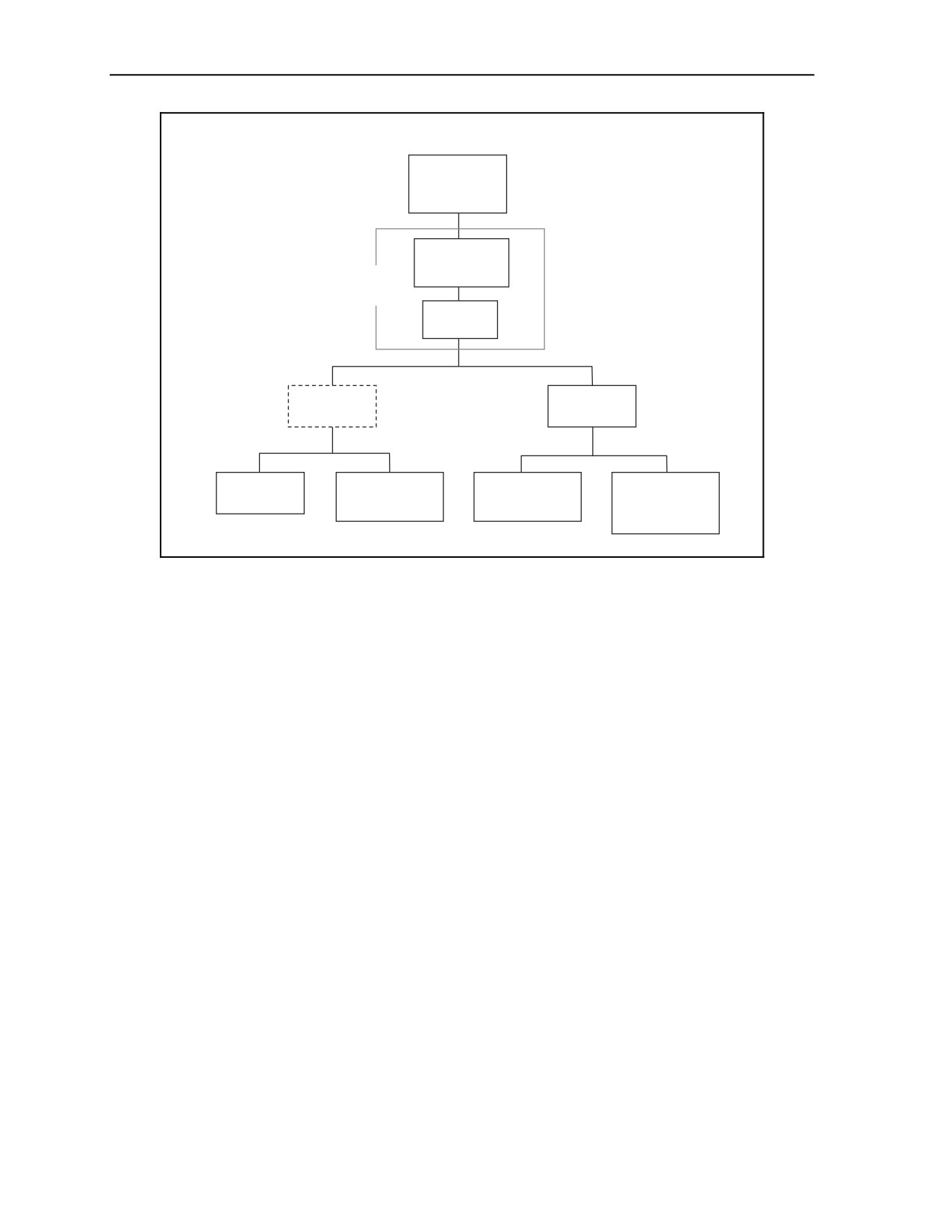
Chapter 3
NATIONAL
COMMAND
AUTHORITY
MINISTRY OF
DEFENSE
SUPREME
HIGH COMMAND
GENERAL
STAFF
SERVICE
THEATER HQs
HQs
SEPARATE
SINGLE-SERVICE
SEPARATE
FGs/OSCs
DIVs/DTGs/
OPERATIONAL
SINGLE-SERVICE
BDEs/BTGs/BNs
LEVEL COMMANDS
DIVs/DTGs/
BDEs/BTGs/BNs
Figure 3-1. Wartime Fighting Force Structure
3-21. The operational level of command is that which executes military tasks assigned directly by a
strategic campaign plan (SCP). The most common OPFOR operational-level commands are FGs and
OSCs. There is also the possibility that a division or DTG could be directly subordinate to the SHC in the
fighting force structure and thus perform tasks assigned directly by an SCP. In such cases, the OPFOR
would consider the divisions or DTGs to be operational-level commands. More typically, however, they
perform tactical missions as subordinates of an FG or OSC.
FIELD GROUP
3-22. A field group is the largest operational-level organization, since it has one or more smaller
operational-level commands subordinate to it. An FG is a grouping of subordinate organizations with a
common headquarters, a common AOR, and a common operation plan. FGs are always joint and
interagency organizations and are often multinational. However, this level of command may or may not be
necessary in a particular SCP. An FG may be organized when the number of forces and/or the number of
major military efforts in a theater exceeds the theater commander’s desired or achievable span of control.
This can facilitate the theater commander’s remaining focused on the theater-strategic level of war and
enable him to coordinate effectively the joint forces allocated for his use.
3-23. The General Staff does not normally form standing FG headquarters, but may organize one or more
during full mobilization, if necessary. An FG can be assigned responsibilities in controlling forces in the
field during adaptive operations in the homeland, or forward-focused functionally (an FG may be assigned
an access-control mission). However, FGs may exist merely to accommodate the number of forces in the
theater.
3-24. FGs are typically formed for one or more of the following reasons:
An SCP may require a large number of OSCs and/or operational-level commands from the AFS.
When the number of major military efforts in a theater exceeds the theater commander’s desired
or achievable span of control, he may form one or more FGs.
3-6
FM 7-100.4
3 May 2007
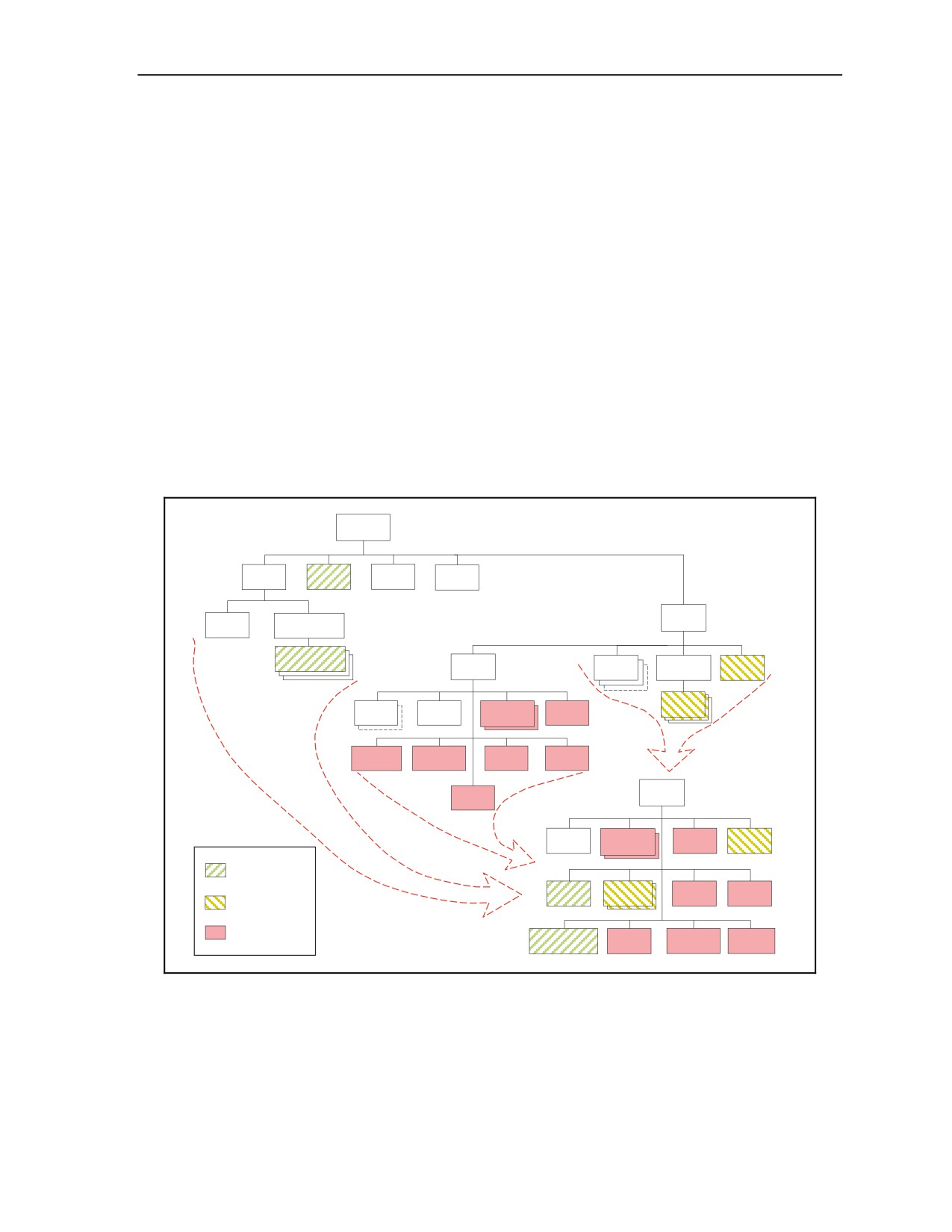
Task-Organizing
In rare cases when multiple operational-level commands from the AFS become fighting
commands, they could come under the control of an FG headquarters.
Due to modifications to the SCP, a standing operational-level headquarters that was originally
designated as an OSC headquarters may receive one or more additional operational-level
commands from the AFS as fighting commands. Then the OSC headquarters would transition
into an FG headquarters.
OPERATIONAL-STRATEGIC COMMAND
3-25. The OPFOR’s primary operational organization is the OSC. Once the General Staff writes a
particular SCP, it forms one or more standing OSC headquarters. Each OSC headquarters is capable of
controlling whatever combined arms, joint, interagency, or multinational operations are necessary to
execute that OSC’s part of the SCP. However, the OSC headquarters does not have any forces permanently
assigned to it.
3-26. Figure 3-2 shows an example of allocation of forces to an OSC. A basic difference between an OSC
and tactical-level task organizations is that the latter are built around an existing organization. In the case
of an OSC, however, all that exists before task-organizing is the OSC headquarters. Everything else is this
example is color coded to show where it came from. Figure 3-2 shows under the OSC all the major units
from the AFS that are allocated to the OSC headquarters in this example, but does not reflect how those
units might be task organized within the OSC.
THEATER
THEATER
SPF
OTHER
OTHER
THEATER
ARMY
AIR ARMY
BRIGADE
ASSETS
GROUPS
ARMY
OTHER
FIGHTER-BOMBER
AIR FORCE
AVIATION
GROUP
ASSETS
DIVISION
FIGHTER-BOMBER
AVIATION
OTHER
OTHER
AIRBORNE
REGIMENT
ARMY
ARMY GROUP
ARMIES
ASSETS
BRIGADE
ARTILLERY
OTHER
MECHANIZED
OTHER
ARMY
TANK
BRIGADE
DIVISIONS
INFANTRY
DIVISION
ASSETS
DIVISION
COMBAT
UAV
HELICOPTER
SAM
SSM
SQUADRON
BRIGADE
BRIGADE
BRIGADE
ANTITANK
OSC
BRIGADE
OSC
MECHANIZED
TANK
AIRBORNE
HQ
INFANTRY
DIVISION
BRIGADE
DIVISION
LEGEND
Theater assets
resubordinated to
the OSC
SPF
ARTILLERY
SSM
SAM
Army group assets
BRIGADE
BRIGADE
BRIGADE
BRIGADE
resubordinated to
the OSC
Army assets
resubordinated to
FIGHTER-BOMBER
ANTITANK
COMBAT
UAV
AVIATION
HELICOPTER
the OSC
REGIMENT
BRIGADE
BRIGADE
SQUADRON
Figure 3-2. Allocation of Forces to an OSC (Example)
3-27. The units allocated from the AFS to form the OSC typically come from an army group, army, or
corps (or perhaps a military district or military region) or from forces directly subordinate to a service
headquarters. There can also be cases where forces from the services have initially been allocated to a
theater headquarters and are subsequently re-allocated down to the OSC. The organizations shown under
the OSC, like those shown under the theater headquarters in this example, indicate a pool of assets made
3 May 2007
FM 7-100.4
3-7
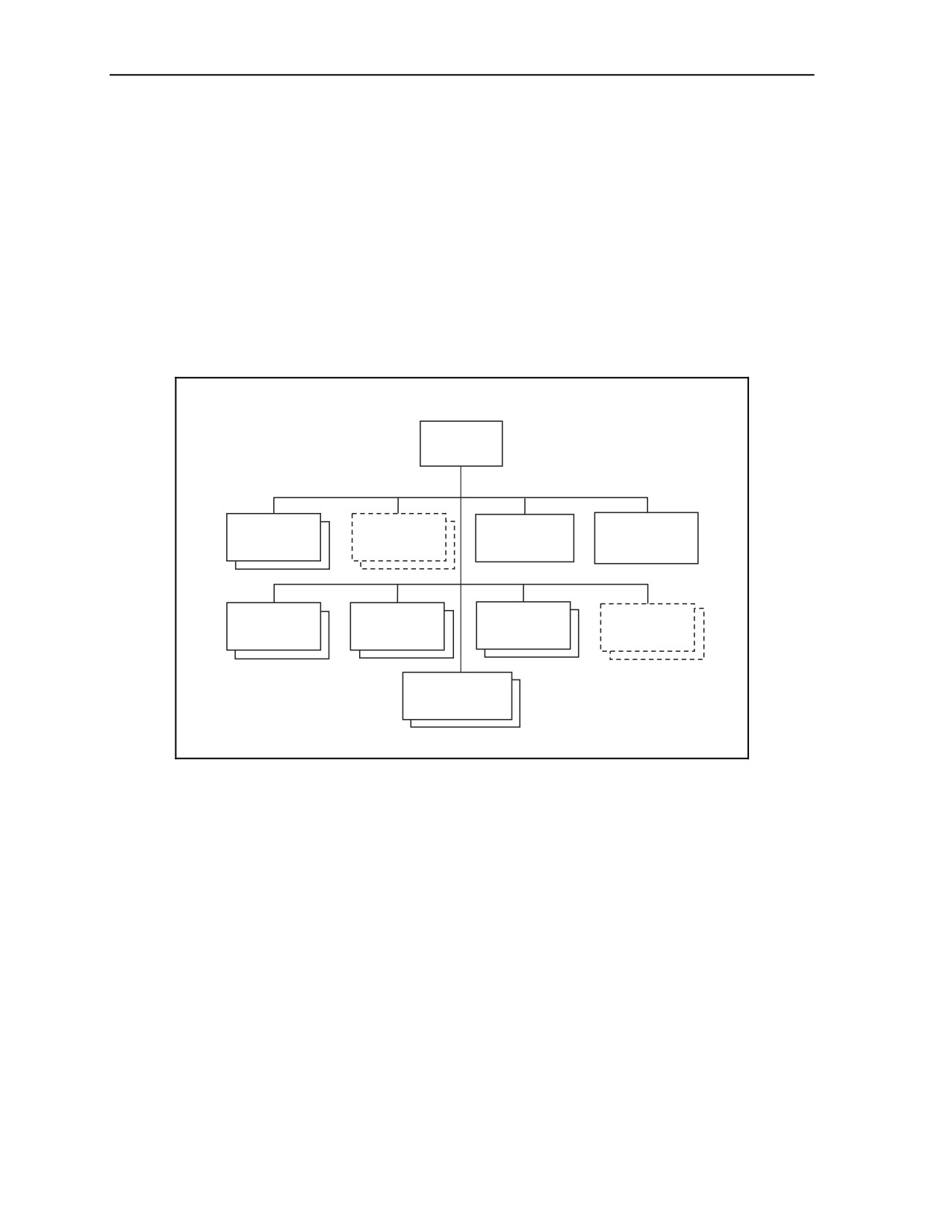
Chapter 3
available to that command. The commander receiving these assets may choose to retain them at his own
level of command, or he may choose to sub-allocate them down to one or more of his subordinates for their
use in their own task organization.
3-28. When the NCA decides to execute a particular SCP, each OSC participating in that plan receives
appropriate units from the OPFOR’s AFS, as well as interagency and/or multinational forces. Forces
subordinated to an OSC may continue to depend on the AFS for support.
3-29. If a particular OSC has contingency plans for participating in more than one SCP, it could receive a
different set of forces under each plan. In each case, the forces would be task-organized according to the
mission requirements in the given plan. Thus, each OSC consists of those division-, brigade-, and
battalion-size organizations allocated to it by the SCP currently in effect. These forces also may be
allocated to the OSC for the purpose of training for a particular SCP. When an OSC is neither executing
tasks as part of an SCP nor conducting exercises with its identified subordinate forces, it exists as a
planning headquarters.
OSC
INTEGRATED
INTEGRATED
DTGs
DIVISIONS
FIRES
SUPPORT
COMMAND
COMMAND
AIR FORCE
MARITIME
BTGs
BRIGADES
UNITS
UNITS
INTERAGENCY
UNITS
Figure 3-3. Possible OSC Organization (Example)
3-30. Figure 3-3 shows an example of the types of organizations that could make up a particular OSC
organization. The numbers of each type of subordinate and whether they actually occur in a particular OSC
can vary. As shown in this example, the composition of an OSC is typically joint, with Air Force and
possibly maritime (naval or naval infantry) units, and it can also be interagency. If some of the allocated
forces come from another, allied country, the OSC could be multinational. The simplified example of an
OSC shown here does not show all the combat support and combat service support units that would be
present in such an organization. Many of these support units are found in the integrated fires command and
the integrated support command (outlined below). Other support units could be allocated initially from the
AFS to the OSC, which further allocates them to its tactical subordinates.
3-31. Once allocated to an OSC, a division or brigade often receives augmentation that transforms it into a
DTG or BTG, respectively. However, an OSC does not have to task-organize subordinate divisions and
brigades into tactical groups. Most divisions would become DTGs, but some maneuver brigades in the
AFS may be sufficiently robust to accomplish their mission without additional task-organizing.
3-32. The OPFOR has great flexibility regarding possible OSC organizations for different missions. There
is virtually no limit to the possible permutations that could exist. The allocation of organizations to an OSC
3-8
FM 7-100.4
3 May 2007
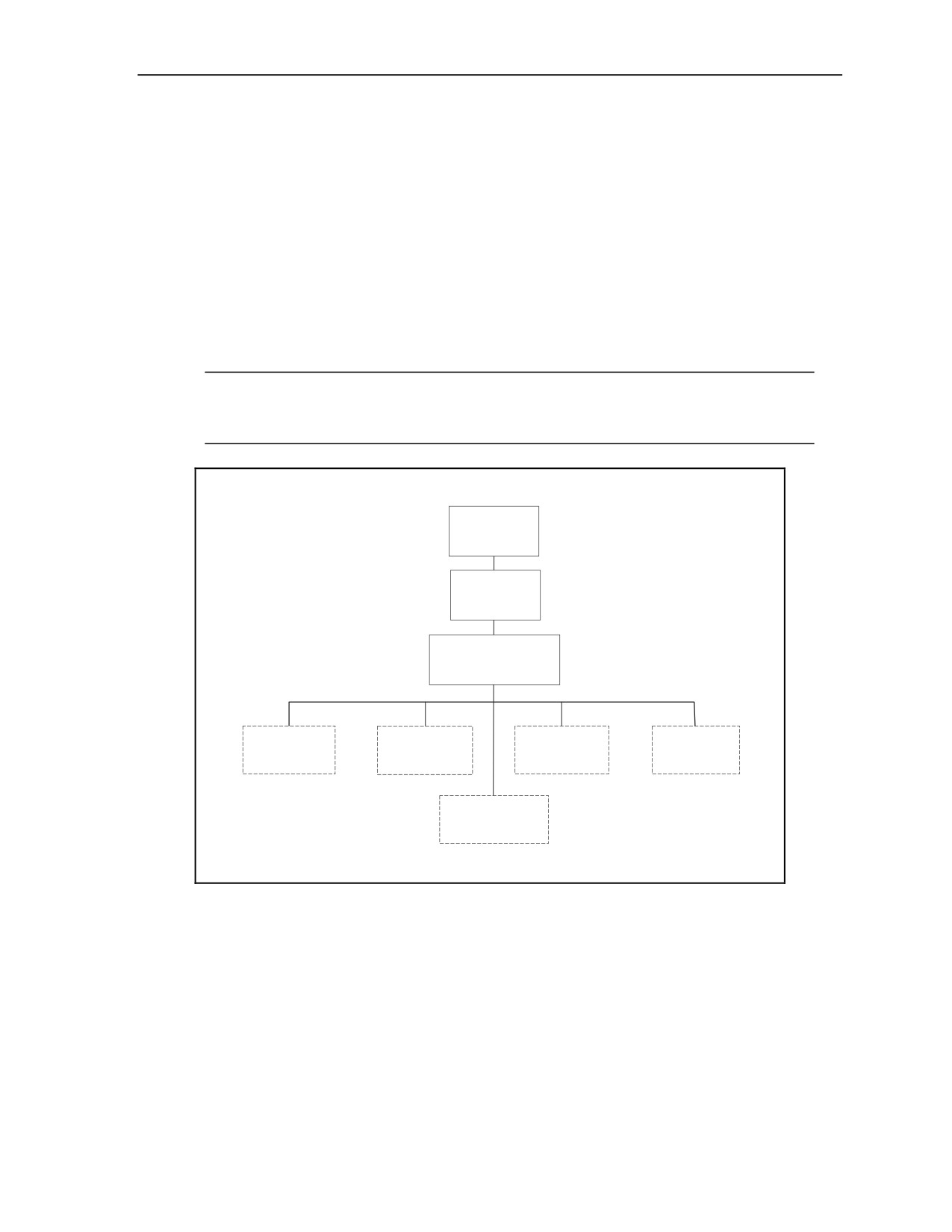
Task-Organizing
depends on what is available in the State’s AFS, the mission requirements of that OSC, and the
requirements of other operational-level commands. In a U.S. Army training exercise, the OSC should get
whatever it needs to give the U.S. unit a good fight and challenge its METL tasks.
INTEGRATED FIRES COMMAND
3-33. The integrated fires command
(IFC) is a combination of a standing C2 structure and task
organization of constituent and dedicated fire support units. (See figure 3-4.) All division-level and above
OPFOR organizations possess an IFC C2 structure. The IFC exercises command of all constituent and
dedicated fire support assets retained by its level of command. This includes aviation, artillery, and missile
units. It also exercises command over all reconnaissance, intelligence, surveillance, and target acquisition
(RISTA) assets allocated to it. Any units that an OSC (or any headquarters at echelons above division)
suballocates down to its subordinates are no longer part of its IFC. (See FM 7-100.1 for more detail on the
IFC at OSC level.)
Note. Based on mission requirements, the commander may also allocate maneuver forces to the
IFC. This is most often done when he chooses to use the IFC command post to provide C2 for a
strike, but can also be done for the execution of other missions.
OSC
IFC
IFC
HEADQUARTERS
ARTILLERY
AVIATION
MISSILE
SPF
COMPONENT
COMPONENT
COMPONENT
COMPONENT
INTEGRATED
SUPPORT
GROUP
Figure 3-4. Possible IFC Components in an OSC
3-34. The number and type of fire support and RISTA units allocated to an IFC is mission-dependent. The
IFC is not organized according to a table of organization and equipment, but is task-organized to
accomplish the missions assigned.
IFC Headquarters
3-35. The OSC IFC headquarters, like the overall OSC headquarters, exists in peacetime in order to be
ready to accommodate and exercise C2 over all forces made subordinate to it in wartime. The IFC
headquarters is composed of the IFC commander and his command group, a RISTA and information
warfare (IW) section, an operations section, and a resources section. Located within the operations section
3 May 2007
FM 7-100.4
3-9
Chapter 3
is the fire support coordination center (FSCC). To ensure the necessary coordination of fire support and
associated RISTA, the operations section of the IFC headquarters also includes liaison teams from
subordinate units.
Artillery Component
3-36. The artillery component is a task organization tailored for the conduct of artillery support during
combat operations. In an OSC’s IFC, it is typically organized around one or more artillery brigades, or
parts of these that are not allocated in a constituent or dedicated relationship to tactical-level subordinates.
The artillery component includes appropriate target acquisition, C2, and logistics support assets.
3-37. The number of artillery battalions assigned to an IFC varies according such factors as mission of
friendly units, the enemy (U.S.) situation, and terrain. However, the number of artillery units also can vary
based on the capabilities of the supporting artillery fire control system.
Aviation Component
3-38. The aviation component is a task organization tailored for the conduct of aviation operations. The
aviation component is task-organized to provide a flexible and balanced air combat organization capable of
providing air support to the OSC commander. It may be organized around an Air Force aviation regiment
or an air army, or parts of these, as required by the mission. It may also include rotary-wing assets from
Army aviation. It includes ground attack aviation capability as well as requisite ground and air service
support assets.
Missile Component
3-39. The missile component is a task organization consisting of long-range missiles or rockets capable of
delivering conventional or chemical, biological, radiological, and nuclear
(CBRN) munitions. It is
organized around an SSM or rocket battalion or brigade and includes the appropriate logistics support
assets. Missile and rocket units may come from the Strategic Forces or from other parts of the AFS (where
they may be part of a corps, army, or army group).
Special-Purpose Forces Component
3-40. The SPF component normally consists of assets from an SPF brigade. Units may come from the
national-level SPF Command or from Army, Air Force, and Navy SPF. If an OSC has received SPF units,
it may further allocate some of these units to supplement the long-range reconnaissance assets a division or
DTG has in its own IFC. However, the scarce SPF assets normally would remain at OSC level.
Integrated Support Group
3-41. The integrated support group (ISG) is a compilation of units performing logistics tasks that support
the IFC in a constituent or dedicated command relationship. For organizational efficiency, various units
performing other combat support and combat service support tasks might be grouped into the ISG, even
though they may support only one of the major units or components of the IFC. The ISG can perform the
same functions as the OSC’s integrated support command (see below), but on a different scale and tailored
to the support requirements of the IFC
3-42. There is no standard ISG organizational structure. The number, type, and mix of subordinate units
vary based on the operational support situation. In essence, the ISG is tailored to the mission and the task
organization of the IFC. An ISG can have many of the same types of units as shown in figure 3-5 for one
example of ISC subordinates, but tailored in size and functions to support the IFC.
INTEGRATED SUPPORT COMMAND
3-43. The integrated support command (ISC) is the aggregate of combat service support units (and perhaps
some combat support units) allocated from the AFS to an OSC in a constituent or dedicated command
relationship and not suballocated in a constituent or dedicated command relationship to a subordinate
3-10
FM 7-100.4
3 May 2007
///////////////////////////////////////